
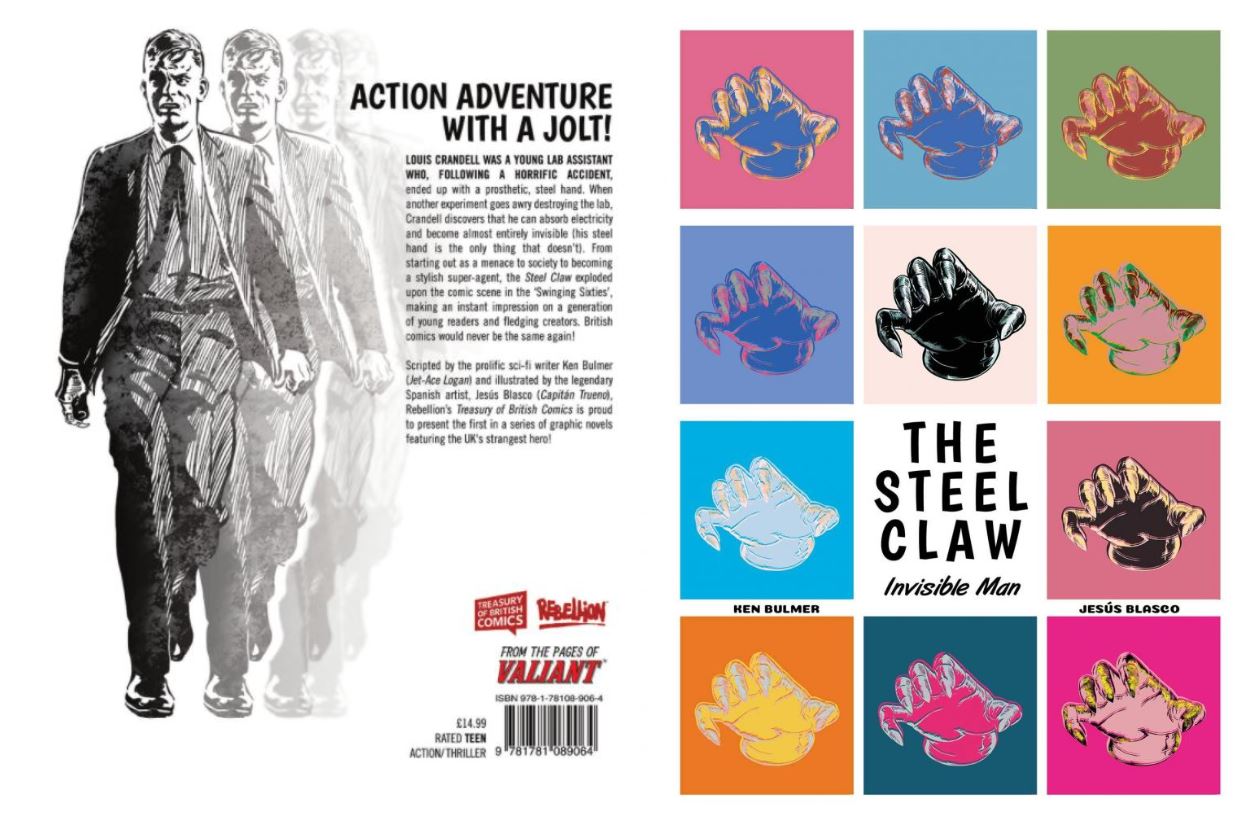
By Ken Bulmer & Jesús Blasco & various (Rebellion)
ISBN: 978-1-78108-906-4 (TPB/Digital edition)
This book includes Discriminatory Content produced in less enlightened times.
One of the most fondly-remembered British strips of all time is the startlingly beautiful Steel Claw. From 1962 to 1973 the stunningly gifted Jesús Blasco and his small studio of family members thrilled the nation’s children, illustrating the angst-filled adventures of scientist, adventurer, secret agent and even – occasionally – costumed superhero Louis Crandell.
The majority of the character’s career was scripted by comic veteran Tom Tully, but initially follows the premise of HG Wells’ original unseen adversary with prolific science fiction novelist Ken Bulmer devising a modern spin and contemporary twist on The Invisible Man.
Another superb salvo of baby boomer nostalgia from Rebellion’s Treasury of British Comics strand, initial collection The Steel Claw: Invisible Man gathers material from beloved and enduring weekly anthology Valiant, spanning 6th October 1962 to 21st September 1963 and also includes stories from the Valiant Annuals for 1965 and 1966.
Following an Introduction from Paul Grist, the tense drama begins with our (eventual) hero debuting as a rather surly assistant to the venerable Professor Barringer, working to create a germ-destroying ray. Crandell is an embittered man, possibly due to having lost his right hand in a lab accident. After its replacement with a steel prosthetic and his notional recovery, he is back at work when the prof’s new device explodes. Crandell receives a monumental electric shock and is bathed in radiation from the ray-device which, rather than killing him, renders him totally transparent. Although he doesn’t stay unseen forever, this bodily mutation is permanent. Electric shocks cause all but his metal hand to disappear.
Kids of all ages, do not try this at home!
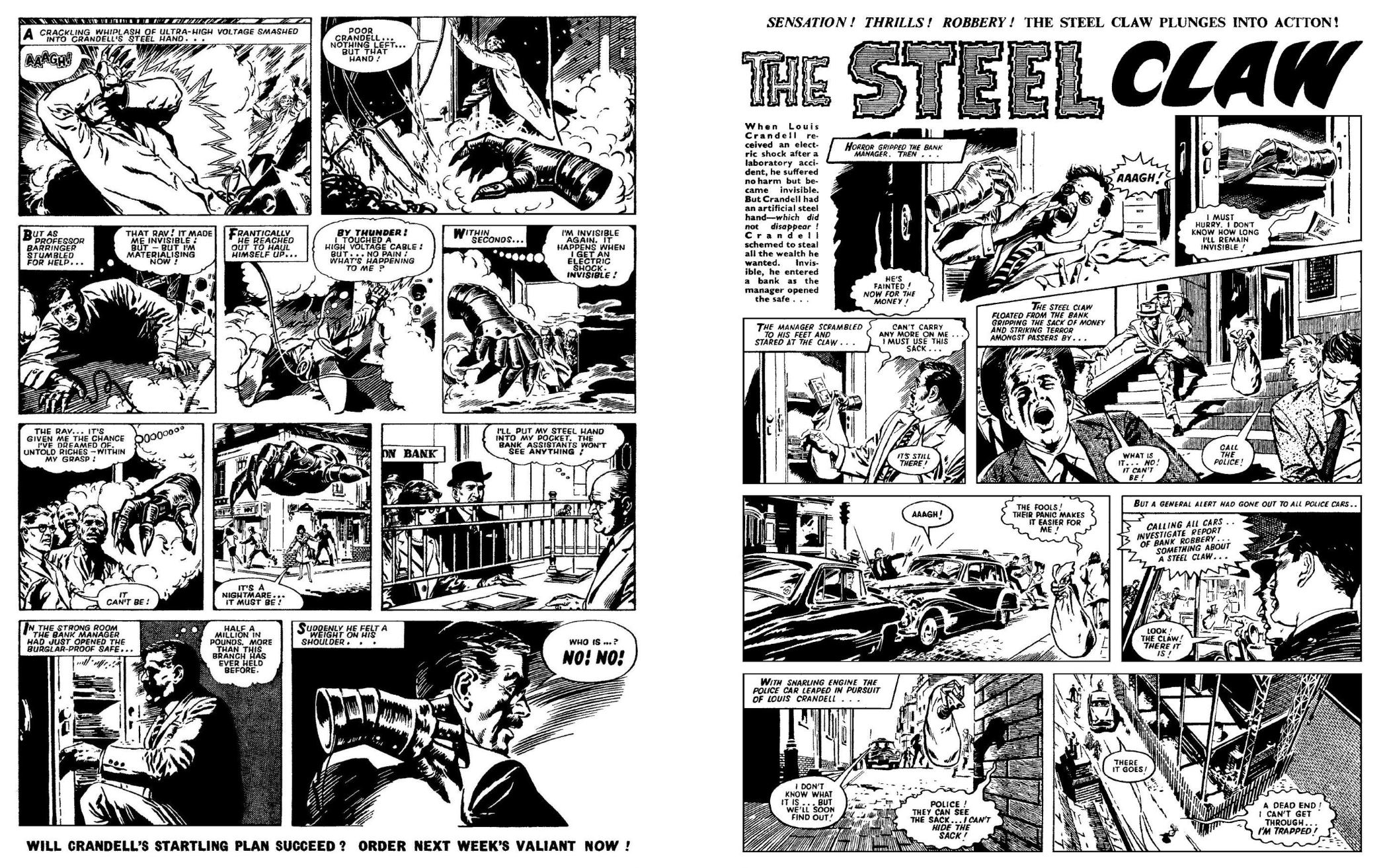
Whether venal at heart or temporarily deranged, Crandell goes on a rampage of terror against society and destruction of property culminating in an attempt to blow up New York City before finally coming to his senses. Throughout Crandell’s outrages, Barringer is in guilt-fuelled pursuit, determined to save or stop his former friend…
The second adventure channels another classic (The Strange Case of Dr Jekyll and Mr Hyde), intriguingly pitting the Claw against his therapist, who – in an attempt to treat him – is also traumatically and life-changingly exposed to Barringer’s ray. Instead of permanent invisibility, Dr. Deutz develops the ability to transform himself into a bestial ape-man who malevolently turns to crime and frames Crandell for a series of spectacular robberies and outrages.
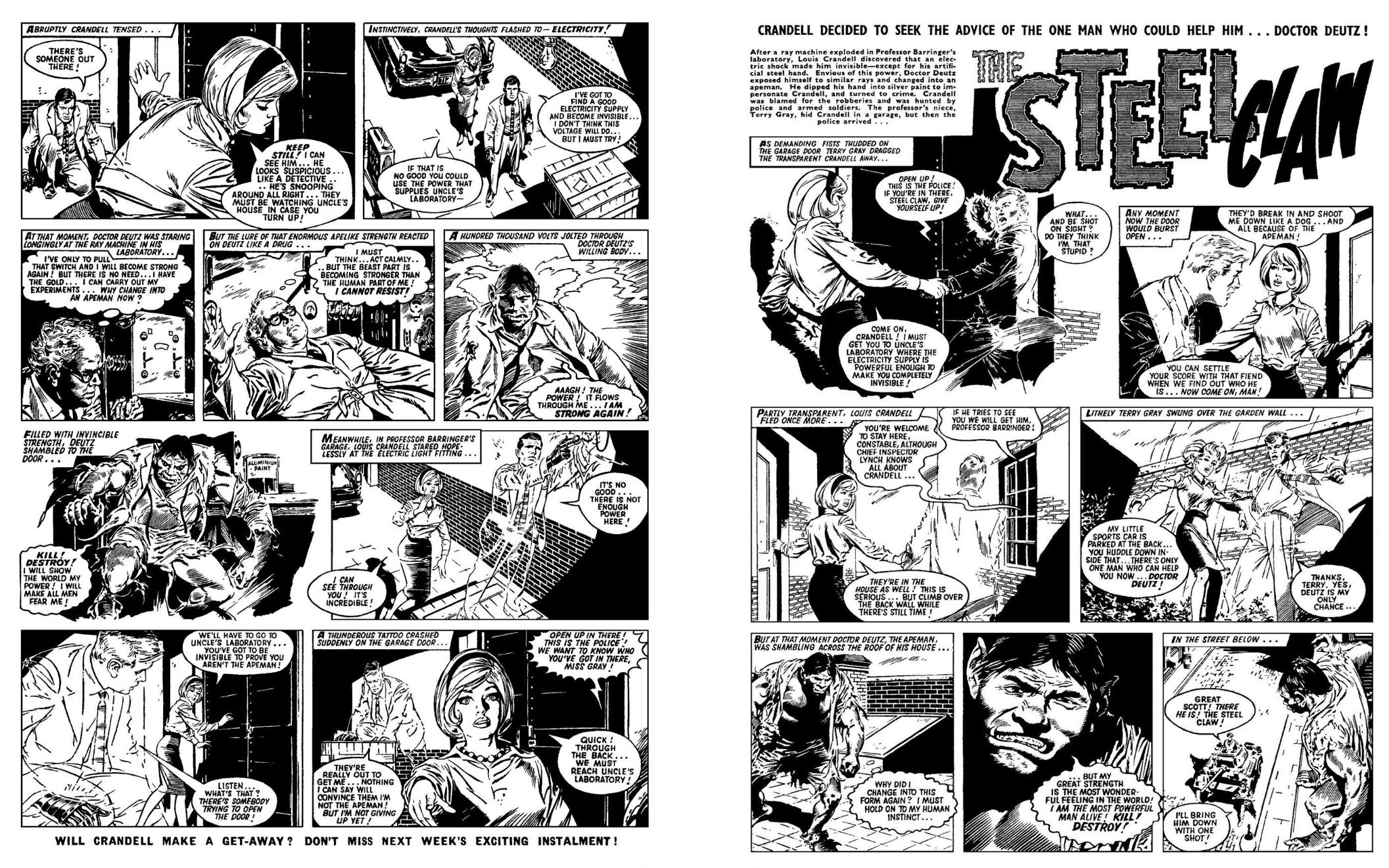
On the run and innocent for once, Crandell is saved by the intervention of Barringer’s niece Terry Gray. After weeks of beast-triggered catastrophe and panic in the streets, the Steel Claw is vindicated and proved a hero …of sorts…
Bulmer’s next tale changes location to the Bahamas as our star shifts from outlaw to hero. While recuperating on an inventor-friend’s yacht, Crandell is accidentally embroiled in a modern-day pirate’s attempt to hijack an undersea super-weapon system. After would-be bullion bandit Sharkey and his nefarious gang steal the device and use it to capture a submarine, their convoluted scheme to rob an ocean liner finally falters when a steel-fisted ghost starts picking them off one by one…
More than any other comics character, the Steel Claw was a barometer for reading fashions. Starting out as a Quatermass-style cautionary sci fi tale, the strip mimicked fresh trends of the greater world, becoming a James Bond-style superspy strip with Crandall eventually tricked out with outrageous gadgets, and latterly, a masked-&-costumed super-doer when TV-show-sparked “Batmania” gripped the nation and the world.
When that bubble burst, he resorted to becoming a freelance adventurer, combating eerie menaces and vicious criminals. However, before we head too far down that path, his potent contributions to Valiant Annuals 1965 and 1966 – respectively released in Autumn 1964 and 1965 – afford rather more constrained thrills and chills as Crandell defeats a gang using an electricity-supressing gadget to rob a blacked-out London and (one year later) assists the Metropolitan Police force in corralling a bunch of apparently invisible bandits dubbed the Phantom Raiders…
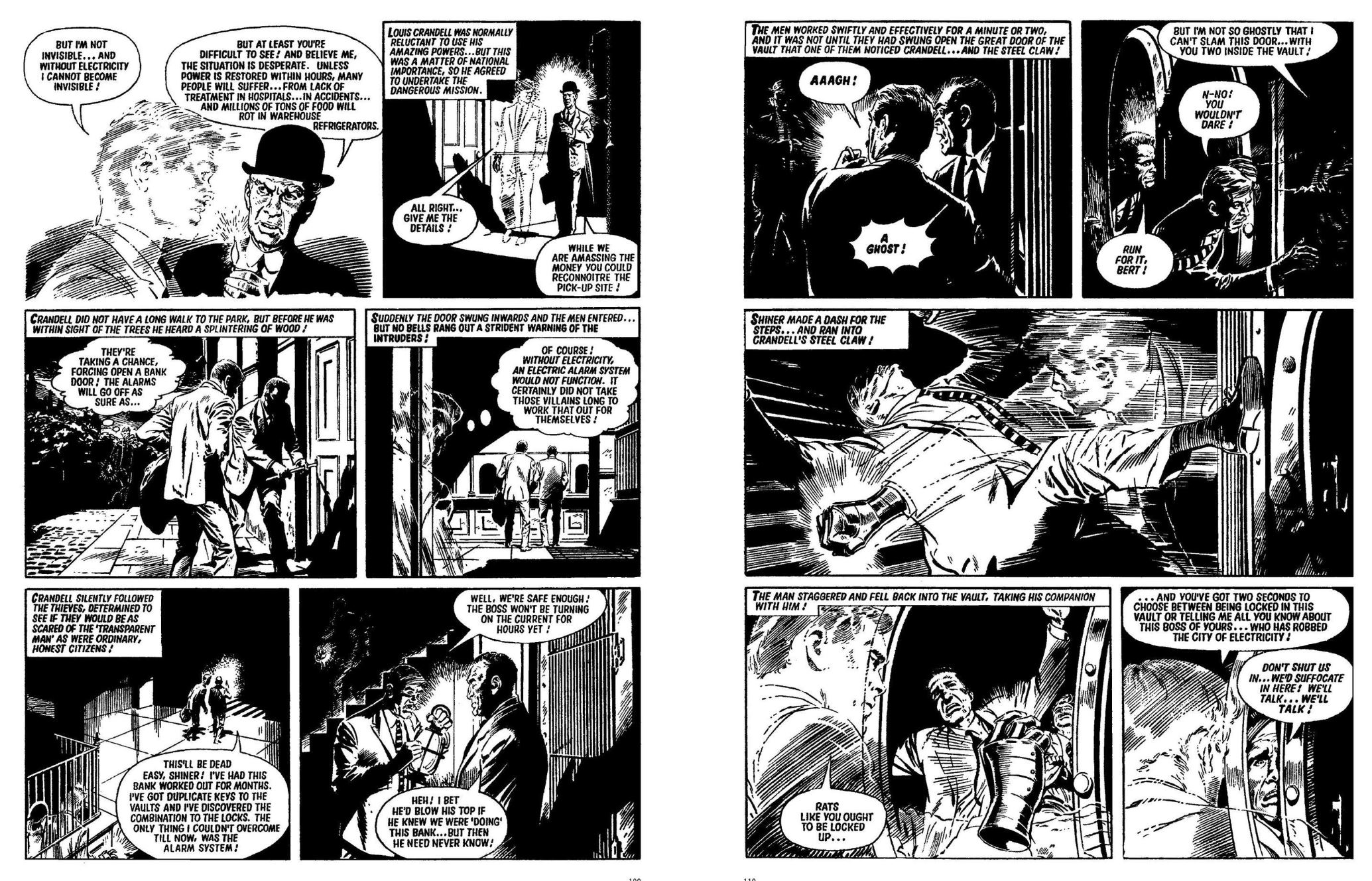
The thrills of the writing are engrossing enough, but the real star of this feature is the artwork. Blasco’s captivating classicist drawing, his moody staging and the sheer beauty of his subjects make this an absolute pleasure to look at. Buy it for the kids and read it too; this is a glorious book, and brace yourself for even better yet to come…
© 1962, 1963, 1965, 1966 & 2021 Rebellion Publishing IP Ltd. All Rights Reserved.
Today in 1949 actor turned comics writer John Ostrander (Oracle, The Spectre, Grimjack, Firestorm, Suicide Squad, Star Wars, Magnus Robot Fighter) was born, as was Norwegian creator Christopher Nielson (To Trøtte Typer) in 1963 and funny, funny guy Evan Dorkin (Milk and Cheese, Welcome to Eltingville, Dork, Beasts of Burden) in 1965.
In 1968 comedy master and Katzenjammer Kids creator Rudolph Dirks died. And while we remember laughing, let’s celebrate that Crockett Johnson’s astounding 10-year wonder Barnaby debuted on this date in 1942.