


By André Franquin, translated by Jerome Saincantin (Cinebook)
ISBN: 978-1-84918-224-9 (Album PB/Digital edition)
This book includes Discriminatory Content produced in less enlightened times. This book also contains Discriminatory Content included for comedic effect.
André Franquin was born in Etterbeek, Belgium on January 3rd 1924 and died on January 5th 1997. In between there were good times and bad, which he offset by creating the most incredible characters and stories, and by making people laugh and think – but mostly laugh. This is one of the very best you can find translated into English.
Adventure-seeking brave lad Spirou headlined the magazine he was named for from the first issue (dated April 21st 1938). He was created by French cartoonist Françoise Robert Velter using his pen-name Rob-Vel for Belgian publisher Éditions Dupuis in direct response to the success of Hergé’s Tintin for rival outfit Casterman. Originally a plucky bellboy/lift operator employed by the Moustique Hotel (a puckish reference to the publisher’s premier periodical Le Moustique), his improbable exploits with pet squirrel Spip gradually but steadily grew into high-flying, far-reaching, surreal comedy dramas. That evolution was mainly thanks to Velter’s wife Blanche “Davine” Dumoulin who took over the strip when her husband enlisted in 1939 and Belgian artist/assistant Luc Lafnet… at least until 1943 when Dupuis purchased all rights to the property, after which comic-strip prodigy Joseph Gillain (Jijé) took the helm.
When Jijé handed his own trainee/assistant total responsibility for the flagship feature part-way through serial Spirou et la maison préfabriqué (Le Journal de Spirou #427, June 20th 1946), André Franquin ran with it for the next 20 years, enlarging the scope and horizons until it was purely his own. Almost every week fans would meet startling new characters such as comrade/rival Fantasio or crackpot inventor and Merlin of mushroom mechanics the Count of Champignac. Spirou and Fantasio became globe-trotting journalists, travelling to exotic places, uncovering crimes, exploring the fantastic and clashing with a coterie of exotic arch-enemies such as Zorglub and Fantasio’s unsavoury cousin Zantafio.
Franquin, plagued in later life by bouts of depression, passed away in 1997 but his legacy remains; a vast body of work which reshaped the landscape of European comics.
With that brave experiment clearly having paid dividends over decades it’s perhaps timely to remind readers that times and taste having changed radically since then, and as such current UK publisher Cinebook felt the need to issue a heartfelt warning and carefully considered apologia regarding some content of The Rhinoceros’ Horn…
I’ll précis it here: it was seventy years ago and our attitudes to hunting, other ethnicities and especially the modern obscenity of killing for ivory and horn have thankfully changed. Please read this book with that in mind. The publishers, of course, phrased it much better…
The Rhinoceros’ Horn was originally serialised in two sequences in Le Journal de Spirou: #764-787 (Spirou et la Turbotraction) and #788-797(La corne de rhinocéros), and spanned 1952 and early 1953 before being united in 1955 hardback album La corne de rhinocéros. The story begins with Spirou exulting over the success of Fantasio’s latest enterprise – personal helicopters worn as backpacks – but discovers his pal is rather down in the dumps. The ingenious journo’s just been dressed down by his editor on The Mosquito and warned that the paper has hired a new reporter: a real go-getting hotshot. Dejected and desperate, Fantasio resolves to revive his flagging career by staging a publicity stunt: robbing the Good Bazaar Department Store…
As the rattled reporter draws up his plans and sends a warning to the store of his intentions, a colossal explosion shakes the town. Persons unknown have blown up the nearby Turbot car plant. With even more to prove now, Fantasio proceeds…
Dragged along for the ride and to photograph the stunt, Spirou and snarky squirrel Spip reluctantly join their pal in the harebrained venture. Alighting on the roof of the emporium courtesy of those petrol-powered “Fantacopters”, they deftly break in through the fire-door, Spirou recording everything with his gigantic flash camera. Of course, our lead-footed burglars make an appalling clatter and tremendous mess, but no night-watchmen confront them. They’ve all been incapacitated and tied up by real robbers…
Hearing villains approaching, the lads take refuge in a wardrobe in the bedrooms department and discover an old acquaintance already there. Behring works for Turbot and was wounded in the explosion earlier. Moreover, he’s carrying the company’s blueprints for their latest advancement. The burglars in the darkened store are actually trying to finish him off to get them. Handing the boys an envelope and begging them to get it to his employer Mr. Martin, the troubleshooter loses consciousness just as the involuntary heroes are challenged by a shadowy figure demanding the precious prize. It’s not the bad guys, however, but Fantasio’s journalistic nemesis…
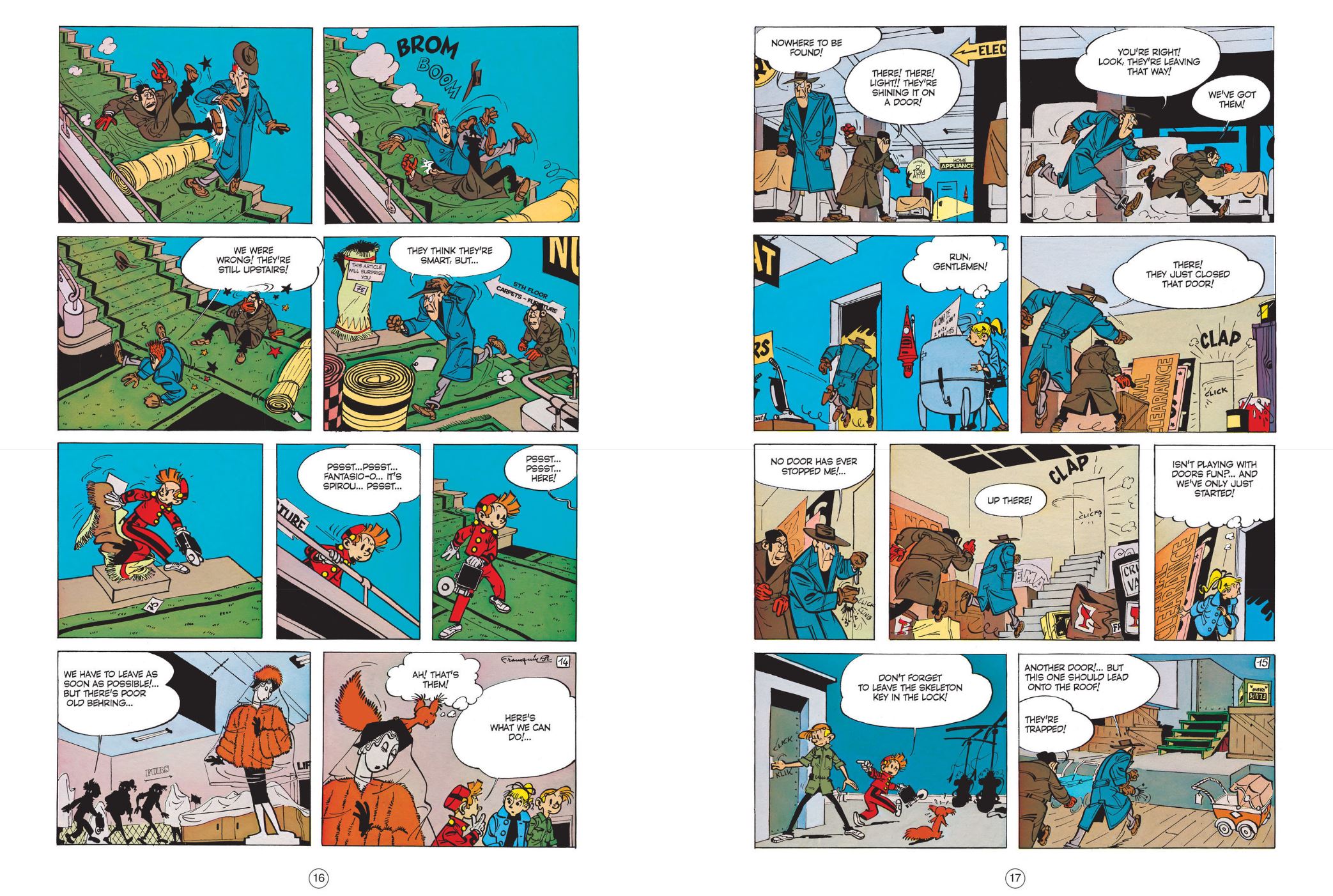
Cellophine is already streets ahead of them: she knows of the plot to steal Turbot’s revolutionary supercar. All she needs is the address Behring muttered to secure an interview with the in-hiding Martin and her next terrific scoop.
…And that’s when the gun-toting goons make their move, demanding blueprints and the rendezvous address. Thankfully, Spirou is still holding the camera and super-bright flashgun…
Calamitously – and hilariously – fleeing for their lives through the darkened store, the guys eventually escape via fantacopters from the top storey, allowing Cellophine to lock the bandits up on the roof before dragging Behring to safety. Next morning the boys are in Whistleton but Martin has already fled. His note reveals nothing, but later a sinister stranger in a café advises them to surrender the blueprints and warns them not to join Mr. Martin at Bab-el-bled in North Africa.
Ignoring him and returning home, they encounter distressingly persistent Cellophine and Spirou clues her in. Sadly, the thugs have also tracked them down and overhear the plans, so when the boys catch a jet liner to Africa, heavily disguised heavies are in the seats behind them…
These villains are on the lads’ tails all though the avenues and alleyways of Bab-el-bled, before a wig malfunction in the Souk warns Spirou that they’re being shadowed and another hectic chase ensues. Thinking they’ve at last shaken their pursuers our heroes go to Martin’s house only to learn he was ambushed by the bandits…
Happily the troubled Turbot exec had escaped and fled further into North Africa. He’s apparently rushing off to the M’saragba Animal Reservation but as the boys try to follow Cellophine appears and pips them to the last spot on the plane – stowed away in the baggage hold.

Forced to follow by train, it is eight days later when Fantasio & Spirou finally reach the Reserve and yet again – as infinitely aggravating Cellophine explains – they’ve just missed Martin. He was chased into the bush by the implacable bandits…
Going after him they find him just after the thugs do. Having shot Martin, the villains are smugly gloating when the sinister stranger from Whistleton café appears. He’s a cop and finally has enough evidence to arrest them for blowing up the factory, but they are all too late. The harassed entrepreneur has already got rid of his portion of the plans, giving them to a local friend to hide.
As Martin is carried to hospital, Spirou & Fantasio volunteer to retrieve those accursed documents but have not reckoned on the quirky ingenuity of the chief of the Wakukus, the vastness of the reserve and the sheer bloody-mindedness of local flora and fauna. After days of unpleasant and painful adventures, they finally locate the safeguarding tribe and, following even more nerve-wracking moments convince the chief that they too are friends of Martin. That’s when the king delivers his bombshell…
Tasked with keeping safe the plans – now contained on a spool of microfilm – the wily Wakuku had his subjects capture a rhino before drilling a hole in its horn and sealing the container within. They then released it back into the wild. He has no idea where it is now or even which of the 200 in the park it might be…
Determined to complete their mission, the lads spend months tracking and capturing assorted beasts. The task becomes only slightly easier after they find a dipsomaniac white trader who sells them hunting gear and latterly, yellow paint so that they can tell the rhinos they’ve already checked from the ones so cunningly evading them…
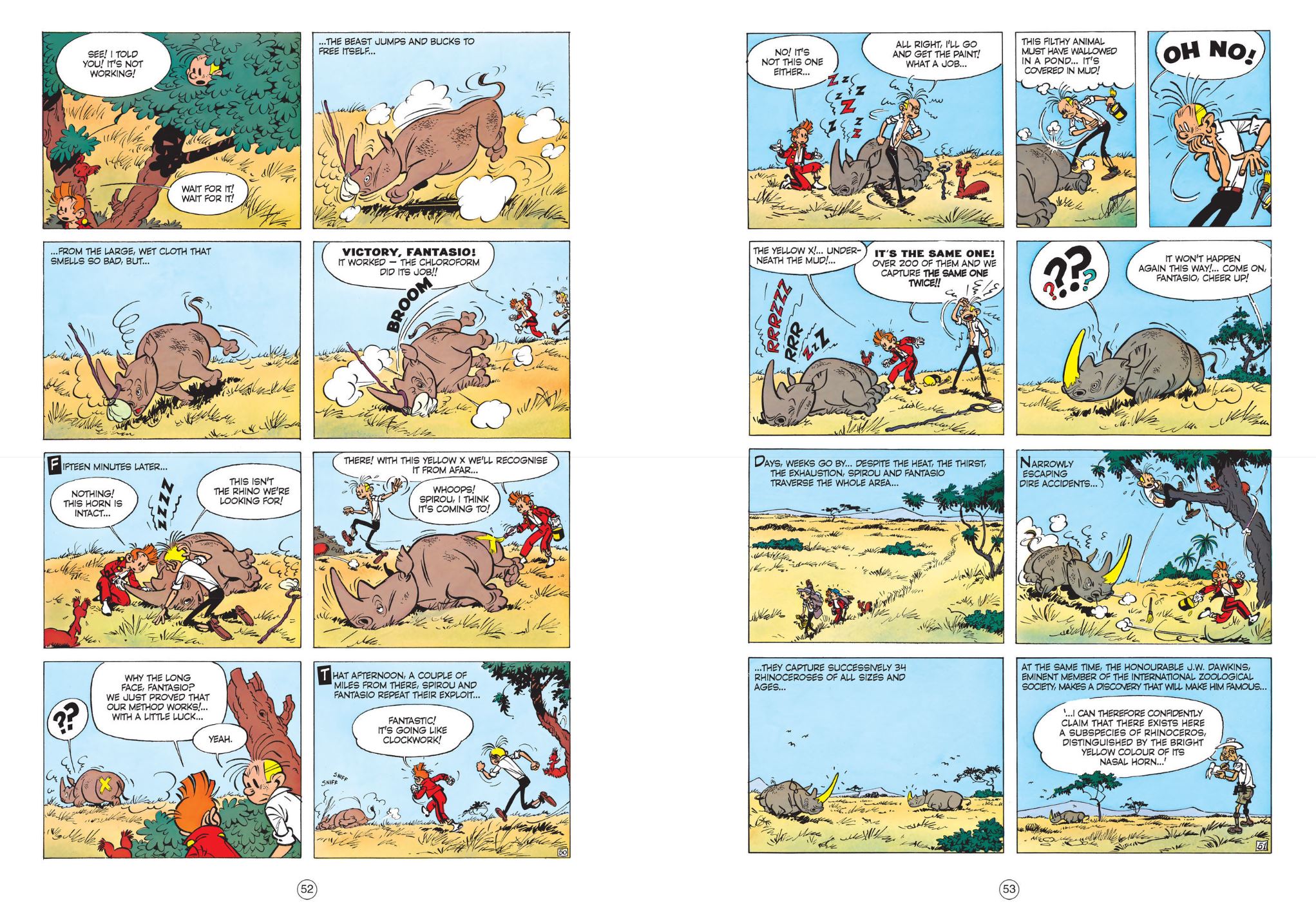
It’s a backbreaking, heartbreaking and increasingly pointless task but only when their resolve crumbles and they brokenly give up and head for home do they find the prize in the very last place they looked…
Even the trip back is a tribulation, and eventually they collapse only to awake in a nice clean hospital with Martin and Cellophine offering to fill in the blanks on this baffling case. Six weeks later the lads are recuperating at home when Behring shows up. He’s got a little reward for them from the grateful Turbot Company but, as usual, Cellophine is on hand to spoil it for Fantasio…
Stuffed with superb slapstick situations, riotous Keystone Cops chases and gallons of gags, this exuberant, high-spirited yarn is a true celebration of angst-free action, thrills and spills. accessible to readers of all ages and drawn with all the beguiling style and seductively wholesome élan which makes Asterix, and Lucky Luke so compelling, this is an enduring comics treat from a long line of superb exploits, certain to be as much a household name as those series – and even that other kid with the white dog…
Original edition © Dupuis, 1955 by Franquin. All rights reserved. English translation 2014 © Cinebook Ltd.
Today in 1942 Underground Commix pioneer Dan O’Neill (Air Pirates Funnies, Odd Bodkins) was born, preceding both Teris Sue Wood (Wandering Star) in1965 and super-glamour artist Michael Turner (Witchblade, Fathom, Superman/Batman) in 1971.
Deaths on this date include British satirist & caricaturist Thomas Rowlandson in 1827. In 1962 Golden Age cartoonist/animator Robert Winsor McCay (Nemo in Adventureland, Impie, Bulletman, Ajax the Sun Man, Blackstone the Magician) and animator turned cartoonist Bob Wickersham (Spencer Spook, Funny Films, Ha Ha Comics, The Kilroys, The Kellys, Flippity and Flop, Colonel Punchy Penguin) both passed on as did veteran comics book illustrator Art Saaf (Sheena, Jumbo Comics, Princess Pantha, Boris Karloff Tales of Mystery, Ripley’s Believe It or Not!, The Twilight Zone, Supergirl) in 2007.
In 1938 on this date, Tif et Tondu and Spirou premiered in the debut issue of Le Journal de Spirou.