
If you love funny fabulous comics, love to get involved and have an eye to premium goodies ,check out our Notice Board Section right now!
John Constantine, Hellblazer volume 1: Original Sins (New Edition)
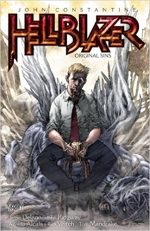
By Jamie Delano, Rick Veitch, John Ridgway, Alfredo Alcala, Tom Mandrake, Brett Ewins, Jim McCarthy & various (DC Comics)
ISBN: 978-1-4012-300-6-7
Originally created by Alan Moore during his groundbreaking run on Swamp Thing, John Constantine is a mercurial modern wizard, a dissolute chancer who plays like an addict with magic on his own terms for his own ends. He is not a hero. He is not a nice person. Sometimes though, he’s all there is between us and the void…
Given his own series by popular demand, Constantine premiered at the height of Thatcherite Barbarism in Britain, during the dying days of Reaganite Atrocity in the US, to become a founding father of DC’s adult-oriented Vertigo imprint.
This collection is available in paperback and digital formats, collecting John Constantine, Hellblazer #1-9 plus crossover chapters from Swamp Thing #76-77; cumulatively spanning January to October 1988 and beginning a renaissance in comicbook horror that thrives to this day.
Back in 1987 Creative Arts and Liberal Sentiments were dirty words in many quarters and the readership of Vertigo was pretty easy to profile. British scripter Jamie Delano began the series with a relatively safe horror-comic plot about an escaped hunger demon, introducing us to Constantine’s unpleasant nature and odd acquaintances – such as Papa Midnite – in a tale of infernal possession and modern voodoo, but even then, discriminating fans were aware of a welcome anti-establishment political line and metaphorical underpinnings.
‘Hunger’ and ‘A Feast of Friends’ also established another vital fact. Anyone who got too close to John Constantine tended to end very badly, very quickly…
‘Going for It’ then successfully equated Conservative Britain with Hell, with demons trading souls on their own stock market and Yuppies getting ahead in the rat race by selling short. Set on Election Day 1987, this potent pastiche never loses sight of its goal to entertain, whilst making telling points about humanity, individuality and society.
Constantine’s cousin Gemma and tantalising splinters of his Liverpool childhood are revealed in ‘Waiting for the Man’: a tale of abduction and ghosts which introduces disturbing Christian fundamentalists the Resurrection Crusade, and a mysterious woman known only as Zed.
America is once again the focus of terror in ‘When Johnny Comes Marching Home’ as the Vietnam war breaks out again in rural Iowa, before we pop back to Blighty for ‘Extreme Predjudice’.
Skinheads, racism demons and more abound as Delano cannily joins up lots of previously unconnected dots to reveal a giant storyline in the making. The Damnation Army are up to something, but nobody knows who they are. Now everything’s going bad and somehow Zed and the Resurrection Crusade are at the heart of it all…
Brett Ewins & Jim McCarthy briefly replace magnificent regular artist John Ridgway for the first three pages of ‘Ghost in the Machine’, before the beautifully restrained and poignantly humanistic stylism returns with Constantine further unraveling the Damnation plot by catching up with the Coming Thing: the cutting edge mysticism dubbed cyber-shamanism.
In Delano’s world the edges between science and magic aren’t blurred – they simply don’t exist…
Alfredo Alcala signs on as inker with ‘Intensive Care’ and the drama ramps up to a full gallop as the plans of both Crusade and Army are revealed, and the value and purpose of Zed are finally exposed. All Constantine can do in response is make the first of many bad bargains with Hell….
The volume then takes a stranger turn due to the nature of periodical publishing…
The storyline in Hellblazer #1-8 ran contiguously, before converging with Swamp Thing, wherein the wizard reluctantly lends his physical body to the planetary plant elemental so that the vegetable guardian can impregnate its human girlfriend Abigail Arcane.
Thus, in the ninth issue, there’s a kind of dissolute holding pattern in play as the weary wizard confronts the ghosts of all the people he’s gotten killed to allow all the pieces to be suitably arranged. ‘Shot to Hell’ (Delano, Ridgway & Alcala) then neatly segues into Swamp Thing #76-77 for the conception of a new messiah. Sort of…
The post-Alan Moore Swamp Thing comics were long neglected after the author’s departure, but eventually fans realised that writer-artist Rick Veitch – aided by veteran inker Alcala – produced a stunning sequence of mini-classics well worthy of serious scrutiny. The issues built on Moore’s cerebral, visceral writing as the world’s planet elemental became increasingly involved with ecological matters.
Having decided to “retireâ€, Swamp Thing (an anthropomorphic plant with the personality and mind of murdered biologist Alec Holland) was charged by his ephemeral overlords in “the Green†with facilitating the creation of his/its successor. However, the ancient and agonising process was contaminated by consecutive failures and false starts, leading to a horrendous series of abortive creatures and a potentially catastrophic Synchronicity Maelstrom.
Alec, “wife†Abigail and the chillingly charismatic Constantine are eventually compelled to combine forces – and indeed some body-fluids – in ‘L’Adoration de la Terre’ (Swamp Thing #76, by Veitch & Alcala) – to create a solution before the resultant chaos-storm destroys the Earth.
The process is not with risk – or shame – but the affair is brought to a successful conclusion in ‘Infernal Tringles’ (Swamp Thing #77, and with Tom Mandrake pencilling) and with terrestrial order restored, the participants go their separate ways… but the events have affected them all in ways that will have terrible repercussions in the months and years to come…
Rounding out the so-sophisticated spook-fest is an original covers gallery by Dave McKean and John Totleben, and an “in-world†exposé of Constantine by faux journalist Satchmo Hawkins in ‘Faces on the Street’.
Also included are other relics of the antihero’s sordid past such as the lyrics from Venus of the hardsell – a single from John’s aberrant punk band mucous membrane – plus extracts from the magician’s medical file whilst he was an inmate of the Ravenscar Secure Psychiatric Facility…
Delivered by creators capable and satiric, but still wedded to the basic tenets of their craft, these superb examples of contemporary horror fiction – inextricably linking politics, religion, human nature and sheer bloody-mindedness as the root cause of all ills – are still powerfully engaging. Beautifully constructed, they make a truly abominable character seem an admirable force for our survival. The art is clear, understated and subtly subversive while the slyly witty, innovative stories jangle at the subconscious with scratchy edginess.
This is a book no fear-fan should be without.
© 1987, 1988, 2011 DC Comics. All Rights Reserved
Lex Luthor: A Celebration of 75 Years
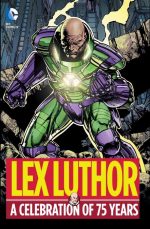
By Jerry Siegel & Joe Shuster, Bill Finger, Edmund Hamilton, Len Wein, Cary Bates, Elliot S. Maggin, John Byrne, Roger Stern, Grant Morrison, Greg Rucka, Brian Azzarello, Paul Cornell, Geoff Johns, John Sikela, Wayne Boring, Curt Swan, Jackson Guice, Howard Porter, Matthew Clark, Lee Bermejo, Frank Quitely, Pete Woods, Doug Mahnke & various (DC Comics)
ISBN: 978-1-4012-6207-5
Win’s Christmas Gift Recommendation: A Sound Reason to Keep up with Science Classes as well as Reading… 9/10
Closely paralleling the evolution of the groundbreaking Man of Steel, the exploits of the mercurial Lex Luthor are a vital aspect of comics’ very fabric. In whatever era you choose, the ultimate mad scientist epitomises the eternal feud between Brains and Brawn and over those decades has become the Man of Steel’s true antithesis and nemesis as well as an ideal perfect indicator of what different generations deem evil.
This stunning compilation – part of a dedicated series introducing and exploiting the comics pedigree of venerable DC icons – is available in hardback Trade Paperback and digital formats and offers a sequence of snapshots detailing how Luthor has evolved in his never-ending battle with Superman.
The groundbreaking appearances selected are preceded here by a brief critical analysis of the significant stages in the villain’s development, beginning with ‘Part I: 1940-1969 The Making of a Mastermind’. After history and deconstruction comes sinister adventure as the grim genius debuted in ‘Europe at War Part 2’ (by Jerry Siegel & Joe Shuster from Action Comics #23, April 1940).
Although not included here Action #22 had loudly declared ‘Europe at War’ – a tense and thinly-disguised call to arms for the still neutral USA – and as the Man of Tomorrow tried to stem the bloodshed the tale became a continued story (almost unheard of in those early days of funny-book publishing).
Spectacularly concluding in #23, Clark Kent‘s European investigations revealed a red-headed fiend employing outlandish science to foment war for profit and intent on conquering the survivors as a modern-day Genghis Khan. Of course, the Man of Steel strenuously objected…
Next comes ‘The Challenge of Luthor’ from Superman #4 (Spring/March1940) and created at almost the same time: a landmark clash with the rogue scientist who, back then, was still a roguish red-headed menace with a bald and pudgy henchman. Somehow in the heat of burgeoning deadlines, master got confused with servant in later adventures and the public perception of the villain irrevocably crystalized as the sinister slap-headed super-threat we know today…
This story – by Siegel & Shuster – involves an earthquake machine and ends with Luthor exhausting his entire arsenal of death-dealing devices in attempts to destroy his enemy with no negligible effect…
From Superman #17 (July 1942), ‘When Titans Clash’, by Siegel & John Sikela, depicts how the burly bald bandit uses a mystic powerstone to survive his justly deserved execution and steals Superman’s abilities. However, the Action Ace stills maintains his wily intellect and outsmarts his titanically-empowered foe…
Jumping ahead ten years, ‘Superman’s Super Hold-Up’ World’s Finest Comics #59 (July 1952, by Bill Finger, Wayne Boring & Stan Kaye) is a supremely typical duel of wits in which the Einstein of Crime renders the Metropolis Marvel helpless with the application of a devilish height- and pressure-sensitive mega explosive device – but only for a little while…
World’s Finest Comics #88 (June 1957) provides ‘Superman and Batman’s Greatest Foes!’ (by Edmond Hamilton, Dick Sprang & Stan Kaye) which finds “reformed†master criminals Lex and the Joker ostensibly setting up in the commercial robot business – which nobody really believed – and as it happens quite correctly…
As the mythology grew and Luthor became a crucial component of Superman’s story, the bad boy was retroactively introduced into the hero’s childhood. ‘How Luthor Met Superboy!’ (from Adventure Comics #271, April 1960 by Siegel & Al Plastino) details how Superboy and the budding genius were pals until a lab accident burned off the human’s hair and in his prideful fury Lex blamed the Kryptonian and swore revenge…
In ‘The Conquest of Superman’ (Action Comics #277, June 1961 by Bill Finger, Curt Swan & John Forte) the authorities paroled Lex to help with an imminent crisis only to have the double-dealer escape as soon as the problem was fixed. By the time Superman returned to Earth, Luthor was ready for him…
Superman #164, October 1963, featured ‘The Showdown between Luthor and Superman’ (by Hamilton, Swan & George Klein): the ultimate Silver Age confrontation between the Caped Kryptonian and his greatest foe, pitting the lifelong foes in an unforgettable confrontation on the post-apocalyptic planet Lexor – a lost world of forgotten science and fantastic beasts – which resulted in ‘The Super-Duel!’ and displayed a whole new side to Superman’s previously two-dimensional arch-enemy.
Part II: 1970-1986 Luthor Unleashed previews how a more sophisticated readership demanded greater depth in their reading matter and creators responded by adding a human dimension to the avaricious mad scientist, as seen in ‘The Man Who Murdered the Earth’ from Superman #248 (February 1972 by Len Wein, Swan & Murphy Anderson).
Here Luthor dictates his final testament after creating a Galactic Golem to destroy his sworn enemy, and ponders how his obsession caused the destruction of Earth…
For the 45th anniversary of Action Comics Superman’s two greatest enemies – the other being Brainiac – were radically re-imagined for an increasingly harder, harsher world. ‘Luthor Unleashed’ in issue #544 (June 1983, by Cary Bates Swan & Murphy Anderson) saw the eternal duel between Lex and Superman lead to the destruction of Lexor and death of Luthor’s new family after the techno-terror once again chose vengeance over love. Crushed by guilt and hatred, the maniacal genius reinvents himself as an implacable human engine of terror and destruction…
Elliot S. Maggin, Swan & Al Williamson then offer a glimpse into the other motivating force in Luthor’s life by exposing ‘The Einstein Connection’ (Superman #416, February 1986) wherein a trawl through the outlaw’s life reveals a hidden link to the greatest physicist in history…
The Silver Age of comicbooks had utterly revolutionised a flagging medium, bringing a modicum of sophistication to the returning sub-genre of masked mystery men. However, after decades of cosy wonderment, Crisis on Infinite Earths transformed the entire DC Universe and led to the creation of a harder, tougher Superman. John Byrne’s radical re-imagining was most potently manifested in Luthor, who morphed from brilliant, obsessed bandit to ruthless billionaire capitalist… as seen in the introduction to Part III: 1986-2000 Captain of Industry…
The tension begins with ‘The Secret Revealed’ (Superman #2, February 1987 by John Byrne, Terry Austin & Keith Williams) when the relentless tycoon kidnaps everyone Superman loves to learn his secret and after collating all the data obtained by torture and other means jumps to the most mistaken conclusion of his misbegotten life…
‘Metropolis – 900 Miles’ (Superman volume 2 #9, September1987 by Byrne, & Karl Kesel) then explores the sordid cruelty of the oligarch as he cruelly torments a pretty waitress with a loathsome offer and promises of a new life…
‘Talking Heads’ appeared in Action Comics #678 (June 1992, by Roger Stern, Jackson Guice & Ande Parks) set after Luthor – riddled with cancer from constantly wearing a green Kryptonite ring to keep Superman at arms’ length – has secretly returned to Metropolis as his own son in a hastily cloned new young and handsome body. Acting as a philanthropist and with Supergirl as his girlfriend/arm candy, young Luthor has everybody fooled, Sadly, everything looks like falling apart when rogue geneticist Dabney Donovan is arrested and threatens to tell an incredible secret he knows about the richest man in town…
‘Hostile Takeover’ comes from JLA #11 1997) wherein Grant Morrison, Howard Porter & John Dell opened interstellar saga ‘Rock of Ages’ with the Justice League facing a newly-assembled, corporately-inspired Injustice Gang organised by Lex and run on his ruthlessly efficient commercial business model.
Superman, Batman, Wonder Woman, Martian Manhunter, Flash, Green Lantern and Aquaman are targeted by a coalition of arch-enemies comprising Chairman-of-the-Board Lex, the Joker, Circe, Mirror Master, Ocean Master and Doctor Light with ghastly doppelgangers of the World’s Greatest Heroes raining destruction down all over the globe.
Even with new members Aztek and second generation Green Arrow Connor Hawke on board, the enemy are running the heroes ragged, but the stakes change radically when telepath J’onn J’onzz detects an extinction-level entity heading to Earth from deep space…
The action and tension intensify when the cabal press their advantage whilst New God Metron materialises, warning the JLA that the end of everything is approaching.
As ever, these snippets of a greater saga are more frustrating than fulfilling, so be prepared to hunt down the complete saga. You won’t regret it…
A true Teflon businessman, Lex ended the millennium running for President and Part IV: 2000-Present 21st Century Man follow a prose appraisal with ‘The Why’ from President Luthor Secret Files and Origins #1 (2000, by Greg Rucka, Matthew Clark & Ray Snyder). Here the blueprint to power and road to the White House is deconstructed, picturing the daily frustrations and provocations which inspired the nefarious oligarch to throw his hat into the political ring…
The next (frustratingly incomplete) snippet comes from a miniseries where the antagonist was the star. ‘Lex Luthor Man of Steel Part 3’ by Brian Azzarello & Lee Bermejo offers a dark and brooding look into the heart and soul of Superman’s ultimate and eternal foe: adding gravitas to villainy by explaining Lex’s actions in terms of his belief that the heroic Kryptonian is a real and permanent danger to the spirit of humanity.
Luthor – still believed by the world at large to be nothing more than a sharp and philanthropic industrial mogul – allows us a peek into his psyche: viewing the business and social (not to say criminal) machinations undertaken to get a monolithic skyscraper built in Metropolis. The necessary depths sunk to whilst achieving this ambition, and Lex’s manipulating Superman into clashing with Batman, are powerful metaphors, but the semi-philosophical mutterings – so very reminiscent of Ayn Rand’s The Fountainhead – although flavoursome, don’t really add anything to Luthor’s character and even serve to dilute much of the pure evil force of his character.
Flawed characters truly make more believable reading, especially in today’s cynical and sophisticated world, but such renovations shouldn’t be undertaken at the expense of the character’s heart. At the end Luthor is again defeated: diminished without travail and nothing has been risked, won or lost. The order restored is of an unsatisfactory and unstable kind, and our look into the villain’s soul has made him smaller, not more understandable.
Lee Bermejo’s art, however, is astoundingly lovely and fans of drawing should consider buying this simply to stare in wonder at the pages of beauty and power that he’s produced here. Or read the entire story in its own collected edition…
Rather more comprehensive and satisfying is ‘The Gospel According to Lex Luthor’ as first seen in All-Star Superman #5. Crafted by Morrison, Frank Quitely & Jamie Grant from September 2006, here an unrepentant Luthor on Death Row grants Clark Kent the interview of his career and scoop of a lifetime, after which ‘The Black Ring Part 5’ (Action Comics #894, December 2010 by Paul Cornell & Pete Woods) confirms the genius’ personal world view as Death of the Endless stops the universe just so she can have a little chat with Lex and see what he’s really like…
This epic trawl through the villain’s published life concludes with a startling tale from Justice League volume 2, #31 (August 2014) as the post-Flashpoint, re-rebooted New 52 DCU again remade Lex into a villain for the latest generation: brilliant, super-rich, conflicted and hungry for public acclaim and approval. In ‘Injustice League Part 2: Power Players’ by Geoff Johns, Doug Mahnke, Keith Champagne & Christian Alamy, bad-guy Luthor has helped save the world from extradimensional invaders and now wants to be a hero. His solution is to make the real superheroes invite him to join the Justice League, and that can be accomplished by ferreting out Batman’s secret identity and blackmailing the Dark Knight into championing his admission…
Lex Luthor is arguably the most recognizable villain in comics and can justifiably claim that title in whatever era you choose to concentrate on; goggle-eyed Golden Age, sanitised Silver Age or malignant modern and Post-Modern milieus. This book captures just a fraction of all those superb stories and offers a delicious peek into the dark, unhealthy side of rivalry and competition…
This monolithic testament to the inestimable value of a good bad-guy is a true delight for fans of all ages and vintage.
© 1940, 1942, 1952, 1954, 1957, 1960, 1961, 1963, 1972, 1983, 1986, 1987, 1992, 1997, 2001, 2005, 2006, 2007, 2010, 2014, 2015 DC Comics. All Rights Reserved.
Batman: A Death in the Family
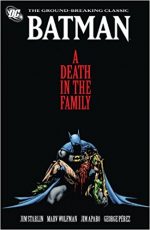

By Jim Starlin, Marv Wolfman, Jim Aparo, George Pérez & various (DC Comics)
ISBN: 978-1401225162 (HC)Â Â Â Â Â Â Â Â Â Â Â Â Â Â Â Â Â Â Â Â Â Â Â 978-1-4012-3274-0 (TPB)
Modern comicbooks live or die on the strength of their “Special Event†publishing stunts but every so often such storylines can get away from editors and publishers and take on a life of its own. This usually does not end well for our favourite art form, as the way the greater world views the comics microcosm is seldom how we insiders and cognoscenti see it. Just check out the media frenzies that grew around the Death of Superman or Death of Captain America crossovers…
One of the most controversial comics tales of the last century saw an intriguing marketing attention-grabber go spectacularly off the rails – for all the wrong reasons – to become instantly notorious whilst simultaneously and sadly masking the real merits of the piece.
Created by Bob Kane, Bill Finger & Jerry Robinson, Robin, the Boy Wonder debuted in Detective Comics #38 (April 1940): a juvenile circus acrobat whose parents were murdered by a greedy mob boss. The story of how Batman took the orphaned Dick Grayson under his scalloped wing and trained him to fight crime has been told, retold and revised many times over the decades and still undergoes the odd tweaking to this day
The child Grayson fought beside Batman until 1970 when, as a sign of the turbulent times, he flew the nest, to become a Teen Wonder and college student. His invention as a junior hero for younger readers to identify with had inspired an incomprehensible number of costumed sidekicks and kid crusaders throughout the industry, and Grayson continued in similar vein for the older, more worldly-wise readership of America’s increasingly rebellious youth culture.
Robin even had his own solo series in Star Spangled Comics from 1947-1952, a solo spot in the back of Detective Comics from the end of the 1960s which he alternated and shared with Batgirl, and a starring feature in anthology utility comic Batman Family. During the 1980s the young warrior led the New Teen Titans, re-established a turbulent working relationship with Batman and reinvented himself as Nightwing. This of course left the post of Robin open…
After Grayson’s departure Batman worked alone until he caught a streetwise young urchin trying to steal the Batmobile’s tires. Debuting in Batman #357 (March 1983) this lost boy was Jason Todd, and eventually the little thug became the second Boy Wonder (#368, February 1984), with a short but stellar career, marred only by his impetuosity and tragic links to one of the Caped Crusader’s most unpredictable foes…
Todd had serious emotional problems that became increasingly apparent in the issues leading up to A Death in the Family wherein the street kid became more callous and brutal in response to the daily horrors he was being exposed to. When he caused the death of a vicious, abusive drug-dealer with diplomatic immunity, Todd entered a spiral that culminated in the first unforgettable story-arc collected in this volume (available in hardcover, trade paperback and digital editions), collectively comprising Batman #426-429, and #440-442 as well as New Teen Titans #60-61 and material from Batman Annual #25.
As Batman #426 (December 1988) opens, Jason is acting ever more violently. Seemingly incapable of rudimentary caution, he is suspended by Batman who believes the boy has not adjusted to the death of his parents. Meanwhile, the Joker is again on the loose. But rather than his usual killing frenzy, the Clown Prince is after mere cash, as the financial disaster of “Reaganomics†has depleted his coffers – meaning he can’t afford his outrageous signature murder gimmicks…
Without purpose, Jason wanders the streets where he grew up. When he sees an old friend of his parents, she reveals a shocking secret. The woman who raised him was not his birth-mother…
She knows of a box of personal papers indicating three women, each of whom might be his true mother. Lost and emotionally volatile, Jason sets out to track them down…
His potential mother is either Lady Shiva, world’s deadliest assassin, Mossad agent Sharmin Rosen or Dr. Sheila Haywood, a famine relief worker in Ethiopia. As the lad bolts for the Middle East and a confrontation with destiny, he is unaware Batman is also in that troubled region, hot on the Joker’s trail as the Maniac of Mirth attempts to sell a stolen nuclear missile to any terrorist who can pay…
The estranged heroes accidentally reunite to foil the plot, and Jason crosses Rosen off his potential mom-list. As Batman offers to help Jason check the remaining candidates the fugitive Joker escapes to Ethiopia. After eliminating Shiva, who has been training terrorists in the deep desert, the heroes finally get to Jason’s true mother Sheila Haywood, unaware that she has been blackmailed into a deadly scam involving stolen relief supplies with the Clown Prince of Crime…
I’m not going to bother with the details of the voting fiasco that plagues all references to this tale: it’s all copiously detailed elsewhere (just Google and see) but suffice to say that to test then-new marketing tools a 1-900 number was established and – thanks to an advanced press campaign – readers were offered the chance to vote on whether Robin would live or die in the story. You can even see the original ad reproduced here…
Jason dies.
The kid had increasingly become a poor fit in the series and this storyline galvanised a new direction with a darker, more driven Batman. The changes came almost immediately as Joker, after killing Jason in a chilling, unforgettably violent manner, becomes UN ambassador for Iran (later revised as the fully fictional Qurac – just in case) and – at the personal request of the Ayatollah himself – attempted to kill the entire UN General Assembly during his inaugural speech.
With echoes of Frank Miller’s The Dark Knight Returns, Superman then becomes a government watchdog tasked with stopping Batman from breaching diplomatic immunity as the vengeance-hungry Caped Crusader attempts to stop the Joker at any cost, leading to a spectacular yet chillingly inconclusive conclusion with the portents of dark days to come…
And here is the true injustice surrounding this tale: the death of Robin (who didn’t even stay dead) and the voting debacle took away from the real importance of this story – and perhaps deflected some real scrutiny and controversy. Starlin had crafted a clever and bold tale of real world politics and genuine issues which most readers didn’t even notice…
Terrorism Training Camps, Rogue States, African famines, black marketeering, charity relief fraud, Economic, Race and Class warfare, diplomatic skulduggery and nuclear smuggling all featured heavily, as did such notable hot-button topics as Ayatollah Khomeini, Reagan’s Cruise Missile program, the Iran-Contra and Arms for Hostages scandals and the horrors of Ethiopian refugee camps.
Most importantly, it signalled a new and fearfully casual approach to violence and death in comicbooks.
This is a superbly readable tale, morally challenging and breathtakingly audacious – but it’s controversial in all the wrong places and for all the wrong reasons. But don’t take my word for it: read it and see for yourself.
The saga is appended here by an afterword from Marv Wolfman, before the sequel he penned introduces the third kid to don the cape and pixie boots…
After Grayson’s departure and Jason’s death the shock and loss traumatised Batman. Forced to re-examine his own origins and methods, he becomes a far darker knight…
After a period of increasingly undisciplined encounters Batman is on the very edge of losing not just his focus but also his ethics and life: seemingly suicidal on his frequent forays into the Gotham nights. Interventions from his few remaining friends and associates prove ineffectual. Something drastic had to happen if the Dark Knight is to be salvaged.
Luckily there was an opening for a sidekick…
The second story arc here is a crossover tale originally running in Batman #440-442 and New Teen Titans #60-61 from October to December 1989. Plotted by Wolfman and George Pérez, scripted by Wolfman with the Batman chapters illustrated by Jim Aparo & Mike DeCarlo, and the Titans sections handled by Pérez, Tom Grummett & Bob McLeod, a new character enters the lives of the extended Batman Family; a remarkable child who will change the shape of the DC Universe.
‘Suspects’ sees Batman rapidly burning out, but not only his close confederates but also an enigmatic investigator and a mystery villain have noticed the deadly deterioration. However, as the criminal mastermind embroils the wildly unpredictable Two-Face in his scheme, the apparently benevolent voyeur is hunting for Dick Grayson: a mission successfully accomplished in second chapter, ‘Roots’.
The first Robin had become disenchanted with the adventurer’s life, quitting the New Teen Titans and returning to the circus where the happiest and most tragic days of his life occurred. Here he is confronted by a young boy who has deduced the secret identities of both Batman and Robin…
‘Parallel Lines’ then unravels the enigma of Tim Drake, who as a toddler was in the audience the night the Flying Graysons were murdered. Tim was an infant prodigy, and when, months later he saw new hero Robin perform the same acrobatic stunts as Dick Grayson, he instantly realises who the Boy Wonder must be – and thus, by extrapolation, the real identity of Batman.
A passionate fan, Drake followed the Dynamic Duo’s exploits for a decade: noting every case and detail. He knew when Jason Todd became Robin and was moved to act when his murder led to the Caped Crusader going catastrophically off the rails.
Taking it upon himself to fix his broken heroes, Drake determines to convince the “retired†Grayson to became Robin once more – before Batman makes an inevitable, fatal mistake. It might all be too little too late, however, as in ‘Going Home!’, Two-Face makes his murderous move against a severely sub-par Gotham Guardian…
Concluding with a raft of explosive and highly entertaining surprises in ‘Rebirth’, this long-overlooked Bat-saga introduces the third Robin (who would get into costume only after years of training – and fan-teasing) whilst acknowledging both modern sentiments about child-endangerment and the classical roles of young heroes in heroic fiction. Perhaps a little slow and definitely a bit too sentimental in places, this is nevertheless an excellent, key Batman story, and one no fan should be unaware of.
This combined compilation offers also a full cover gallery by Mike Mignola & Pérez plus a lost treasure for fans and aficionados. Printed comics are produced with a long lead-in time so when the phone poll to determine Jason’s fate was launched, the editors had to prepare for both outcomes. Wrapping up proceedings here is the alternate final page by Aparo & DeCarlo depicting Robin’s survival to gratify the dreams of those who originally voted against what these days would have been agonisingly and inappropriately dubbed “R-exitâ€â€¦
Potent, punchy and eminently readable, this is a bold Bat-treat well worth tracking down and devouring.
© 1988,1989, 2006, 2011 DC Comics. All Rights Reserved.
Amazing Spider-Man Epic Collection: Great Responsibility
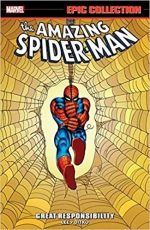
By Stan Lee & Steve Ditko (Marvel)
ISBN: 978-0-7851-9581-8
Win’s Christmas Gift Recommendation: Because With Great Goodness Comes Great Presents… 10/10
Outcast, geeky high school kid Peter Parker was bitten by a radioactive spider and, after attempting to cash-in on the astonishing abilities he’d developed, suffered an irreconcilable personal tragedy. Due to the teenager’s arrogant neglect, his beloved guardian Uncle Ben was murdered and the traumatised boy determined henceforward to always use his powers to help those in dire need.
For years the brilliant young hero suffered privation and travail in his domestic situation, whilst his heroic alter ego endured public condemnation and mistrust as he valiantly battled all manner of threat and foe…
Spanning November 1964 to July 1966, this second full-colour Epic Collection devoted to the astounding early years as described by plotter and illustrator Steve Ditko and scripter/Editor Stan Lee reprints Amazing Spider-Man #18-38 and Amazing Spider-Man Annual #2, and kicks off with the middle chapter of an ambitious 3-part saga (which began in Amazing Spider-Man #17); depicting a rapidly-maturing hero touching emotional bottom before rising to triumphant victory over all manner of enemies.
In the previous volume the wallcrawler endured renewed print assaults from the Daily Bugle and its rabid publisher J. Jonah Jameson just as enigmatic archfoe Green Goblin began a war of nerves and attrition, using the Enforcers, Sandman and an army of thugs to publicly humiliate the Amazing Arachnid. To exacerbate matters Peter’s beloved Aunt May‘s health took a drastic downward turn…
Resuming with ‘The End of Spider-Man!’ and explosively concluding in the triumphal ‘Spidey Strikes Back!’ – featuring a turbulent team-up with friendly rival Johnny Storm, the Human Torch – this extended tale proved the fans were ready for every kind of narrative experiment (single issue or even two stories per issue were still the norm in 1964) and Stan & Steve were more than happy to try anything.
With ‘The Coming of the Scorpion!’ Jameson let his obsessive hatred for the cocky kid crusader get the better of him; hiring scientist Farley Stillwell to endow a private detective with insectoid-based superpowers. Unfortunately, the process drove mercenary Mac Gargan completely mad before he could capture Spidey, leaving the webspinner with yet another lethally dangerous meta-nutcase to deal with…
‘Where Flies the Beetle’ features a hilarious love triangle as the Torch’s girlfriend used Peter Parker to make the flaming hero jealous. Unfortunately, the Beetle – a villain with high-tech insect-themed armour – was simultaneously stalking her to use as bait for a trap. As ever, Spider-Man was simply in the wrong place at the right time, resulting in a spectacular fight-fest…
‘The Clown, and his Masters of Menace’ offered a return engagement for the Circus of Crime with splendidly outré action and a lot of hearty laughs provided by increasingly irreplaceable supporting stars Aunt May, Betty Brant and J. Jonah Jameson whilst #23 presented a superb thriller blending the mundane mobster and thugs that Ditko loved to depict with the more outlandish threat of a supervillain attempting to take over all the city’s gangs.
‘The Goblin and the Gangsters’ is both moody and explosive, a perfect contrast to ‘Spider-Man Goes Mad!’ in #24. This psychological stunner finds a clearly delusional hero seeking psychiatric help, but there is more to the matter than simple insanity, as an insidious old foe made an unexpected return…
Issue #25 once again sees the Bugle’s obsessed publisher take matters into his own hands. ‘Captured by J. Jonah Jameson!’ introduces Professor Smythe – whose dynasty of robotic Spider-Slayers would bedevil the wallcrawler for years to come – hired by the bellicose newsman to remove Spider-Man for good.
Issues #26 and 27 comprised a captivating 2-part mystery exposing a deadly duel between the Green Goblin and an enigmatic new masked criminal. ‘The Man in the Crime-Master’s Mask!’ and ‘Bring Back my Goblin to Me!’ together form a perfect arachnid epic, with soap-opera melodrama and screwball comedy leavening tense crime-busting thrills and all-out action.
‘The Menace of the Molten Man!’ from #28 is a tale of science gone bad and remains remarkable today not only for the spectacular action sequences – and possibly the most striking Spider-Man cover ever produced – but also as the story in which Peter Parker finally graduates from High School.
Ditko was on peak form and fast enough to handle two monthly strips. At this time he was also blowing away audiences with another oddly tangential superhero. Those disparate crusaders met in ‘The Wondrous World of Dr. Strange!’: lead story in the second super-sized Spider-Man Annual (October of that year and filled out with vintage Spidey classics).
The entrancing fable unforgettably introduced the Amazing Arachnid to arcane other realities as he teamed up with the Master of the Mystic Arts to battle power-crazed mage Xandu in a phantasmagorical, dimension-hopping masterpiece involving ensorcelled zombie thugs and the stolen Wand of Watoomb. After this, it was clear that Spider-Man could work in any milieu and nothing could hold him back…
Also included here from that immensely impressive landmark are more Ditko pin-ups in ‘A Gallery of Spider-Man’s Most Famous Foes’ – highlighting such nefarious ne’er-do-wells as The Scorpion, Circus of Crime and the Beetle.
Back in the ever-more popular monthly mag ASM #29 warned ‘Never Step on a Scorpion!’ as the lab-made larcenous lunatic returned, craving vengeance against not just the webspinner but also Jameson for turning a disreputable private eye into a super-powered monster…
Issue #30’s off-beat crime-caper then cannily sowed the seeds for future masterpieces as ‘The Claws of the Cat!’ features a city-wide hunt for an extremely capable burglar (way more exciting than it sounds, trust me!), plus the introduction of an organised mob of thieves working for mysterious new menace the Master Planner.
Sadly by this time of their greatest comics successes, Lee and Ditko were increasingly unable to work together on their greatest creations.
Ditko’s off-beat plots and quirky art had reached an accommodation with the slickly potent superhero house-style Jack Kirby had developed (at least as much as such a unique talent ever could). The illustration featured a marked reduction of signature line-feathering and moody backgrounds plus a lessening of concentration on totemic villains, but, although still very much a Ditko baby, Amazing Spider-Man‘s sleek pictorial gloss warred with Lee’s scripts. These were comfortably in tune with the times if not his collaborator. Lee’s assessment of the audience was probably the correct one, and disagreements with the artist over the strip’s editorial direction were still confined to the office and not the pages themselves. However, an indication of growing tensions could be seen once Ditko began being credited as plotter of the stories…
After a period where old-fashioned crime and gangsterism predominated, science fiction themes and costumed crazies started to return full force. As the world went gaga for masked mystery-men, the creators experimented with longer storylines and protracted subplots…
When Ditko abruptly left, the company feared a drastic loss in quality and sales but it didn’t happen. John Romita (senior) considered himself a mere “safe pair of hands†keeping the momentum going until a better artist could be found, but instead blossomed into a major talent in his own right, and the wallcrawler continued his unstoppable rise at an accelerated pace…
Change was in the air everywhere. Included amongst the milestones for the ever-anxious Peter Parker collected here are graduating High School, starting college, meeting true love Gwen Stacy and tragic friend/enemy Harry Osborn plus the introduction of arch nemesis Norman Osborn. Old friends Flash Thompson and Betty Brant subsequently begin to drift out of his life…
‘If This Be My Destiny…!’ from issue #31 details a spate of high-tech robberies by the Master Planner culminating in a spectacular confrontation with Spider-Man. Also on show is that aforementioned college debut, first sight of Harry and Gwen and Aunt May on the edge of death due to an innocent blood transfusion from her mildly radioactive darling Peter…
This led to indisputably Ditko’s finest and most iconic moments on the series – and perhaps of his entire career. ‘Man on a Rampage!’ shows Parker pushed to the edge of desperation as the Planner’s men make off with the serums that might save her, resulting in an utterly driven, berserk wallcrawler ripping the town apart whilst trying to find them.
Trapped in an underwater fortress, pinned under tons of machinery, the hero faces his greatest failure as the clock ticks down the seconds of May’s life…
This in turn results the most memorable visual sequence in Spidey history as the opening of ‘The Final Chapter!’ luxuriates in five full, glorious pages to depict the ultimate triumph of will over circumstance. Freeing himself from tons of fallen debris, Spider-Man gives his absolute all to deliver the medicine May needs, and is rewarded with a rare happy ending…
Russian exile Kraven the Hunter then returns in ‘The Thrill of the Hunt!’ seeking vengeance for past humiliations by impersonating the webspinner, after which #35 confirms that ‘The Molten Man Regrets…!’: a plot-light yet inimitably action-packed combat classic wherein the gleaming golden bandit foolishly resumes his career of pinching other people’s valuables…
Amazing Spider-Man #36 features a deliciously off-beat, quasi-comedic turn in ‘When Falls the Meteor!’ as deranged, would-be scientist Norton G. Fester starts stealing extraterrestrial museum exhibits whilst calling himself the Looter…
In retrospect these brief, fight-oriented tales, coming after such an intricate, passionate epic as the Master Planner sage should have indicated that something was amiss. However fans had no idea that ‘Once Upon a Time, There was a Robot…!’ – featuring a beleaguered Norman Osborn targeted by his disgraced ex-partner Mendel Strom and some eccentrically bizarre murder-machines in #37 and the tragic tale of ‘Just a Guy Named Joe!‘ – wherein a hapless sad-sack stumblebum boxer gains super-strength and a bad-temper – were to be Steve Ditko’s last arachnid adventures…
As added enticements – and alone worth the price of this collection of much-reprinted material – is a big gallery of extras including reproductions of 20 ultra-rare Steve Ditko Spider-Man pencil pages plus an unused cover…
Although other artists have inked his narratives, Ditko handled all the art on Spider-Man and these lost gems demonstrate his fluid mastery and just how much of the mesmerising magic came from his pens and brushes…
Also included are rare Ditko T-shirt designs, posters and ad art, plus a range of Marvel Masterworks covers with Kirby and Ditko’s original images enhanced by painter Dean White.
Full of energy, verve, pathos and laughs, gloriously short of post-modern angst and breast-beating, these fun classics – available in numerous formats including eBook editions – are quintessential comicbook magic which constitute the very foundation of everything Marvel became. This classy compendium is an unmissable opportunity for readers of all ages to celebrate the magic and myths of the modern heroic ideal…
© 1964, 1965, 1966, 2016 Marvel Characters, Inc. All rights reserved.
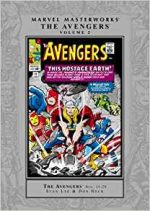
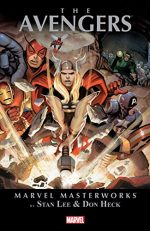
Avengers Masterworks volume 2
By Stan Lee, Don Heck, Dick Ayers & various (Marvel)
ISBN: 978-0-7851-3202-8 (HC)Â Â Â Â Â Â Â Â Â Â Â Â Â Â Â Â Â Â Â 978-0785137085 (TPB)
Win’s Christmas Gift Recommendation: Immortal masterpieces to savour forever… 9/10
Whenever Jack Kirby left a title he’d co-created it took a little while to settle into a new rhythm, and none more so than the collectivised costumed crusaders called the Avengers. Although writer Stan Lee and the fabulously utilitarian Don Heck were perfectly capable of producing cracking comics entertainments, they never had The King’s unceasing sense of panoramic scope and vast scale which constantly searched for bigger, bolder blasts of excitement. After Kirby, the tales starring Thor, Iron Man, Giant Man, The Wasp and scene-stealing newcomer Captain America concentrated on frail human beings in costumes, not wild modern gods bestriding and shaking the Earth…
Following another Stan Lee introduction, the wonderment herein contained (covering issues #11-20, December 1964 – September 1965 and available in Hard Cover, Trade Paperback and eBook editions) begins with ‘The Mighty Avengers Meet Spider-Man!’; a clever and classy cross-fertilising tale inked by Chic Stone and featuring the return of time-bending tyrant Kang the Conqueror. Here, he attempts to destroy the team by insinuating a robotic duplicate of the outcast hero within their serried ranks. It’s accompanied by a Marvel Master Work Pin-up of ‘Kang!’ and followed by a cracking end-of-the-world thriller with Fantastic Four guest-villains Mole Man and the Red Ghost.
This was another Marvel innovation, as – according to established funnybook rules – bad guys stuck to their own nemeses and didn’t clash outside their own backyards….
‘This Hostage Earth!‘ (inked by Dick Ayers) is a welcome return to grand adventure with lesser lights Giant-Man and the Wasp taking rare lead roles, but is trumped by a rousing gangster thriller of a sort seldom seen outside the pages of Spider-Man or Daredevil, which introduced Marvel universe Mafia analogue The Maggia and another major menace in #13’s ‘The Castle of Count Nefaria!’
After failing in his scheme to frame the Avengers, Nefaria was crushed, but the caper ended on a tragic cliffhanger as Janet Van Dyne is left gunshot and dying, leading to a peak in melodramatic tension in #14 (scripted by Paul Laiken & Larry Lieber over Stan’s plot) as the traumatised team scour the globe for the only surgeon who can save her.
‘Even Avengers Can Die!’ – although of course she didn’t – resolves into an epic alien invader tale with overtones of This Island Earth with Kirby stepping in to lay out the saga for Heck & Stone to illustrate, which only whets the appetite for a classic climactic confrontation as the costumed champions finally deal with the Masters of Evil and Captain America finally avenges the death of his dead partner Bucky.
‘Now, by My Hand, Shall Die a Villain!’ in #15 (again laid-out by Kirby, pencilled by Heck but now inked by Mike Esposito) features the final, fatal confrontation between Captain America and Baron Zemo in the heart of the Amazon jungle, whilst the other Avengers and Zemo’s cohort of masked menaces clash once more on the streets of New York City…
The battle ends in concluding episode ‘The Old Order Changeth!’ (again visually broken down by Kirby before being finished by Ayers) which presaged a dramatic change in concept for the series; presumably because, as Lee increasingly wrote to the company’s unique strengths – tight continuity and strongly individualistic characterisation – he found juggling individual stars in their own titles as well as a combined team episode every month was just incompatible if not impossible.
As Cap and teen sidekick Rick Jones fight their way back to civilisation, the Avengers set-up changes completely with big name stars retiring only to be replaced by three erstwhile villains: Hawkeye, Quicksilver and the Scarlet Witch.
Eventually, led by perennial old soldier Captain America, this relatively powerless group with no outside titles to divide the attention (the Sentinel of Liberty did have a regular feature in Tales of Suspense but it was at that time recounting adventures set during the hero’s WWII career), evolved into another squabbling family of flawed, self-examining neurotics, enduring extended sub-plots and constant action as valiant underdogs; a formula readers of the time could not get enough of and which still works superbly well today…
Acting on advice from the departing Iron Man, the neophytes seek to recruit the Hulk to add raw power to the team, only to be sidetracked by the malevolent Mole Man in #17’s ‘Four Against the Minotaur!’ (Lee, Heck & Ayers), after which they then fall foul of a dastardly “commie†plot ‘When the Commissar Commands!’ – necessitating a quick trip to a thinly disguised Viet Nam analogue dubbed Sin-Cong and a battle against a bombastic android…
This brace of relatively run-of-the-mill tales is followed by an ever-improving run of mini-masterpieces starting with a 2-part gem providing an origin for Hawkeye and introducing a rogue-ish hero/villain to close this sturdy, full-colour compendium.
‘The Coming of the Swordsman!’ premiers a dissolute and disreputable swashbuckler – with just a hint of deeply-buried nobility – who attempts to force his way onto the highly respectable team. His rejection lead to him becoming an unwilling pawn of a far greater menace after being kidnapped by A-list world despot the Mandarin.
The conclusion comes in the superb ‘Vengeance is Ours!’ – inked by the one-&-only Wally Wood – wherein the constantly-bickering Avengers finally pull together as a supernaturally efficient, all-conquering super-team.
Augmented by original art, production-stage corrections photostats plus the usual round of Biographies, these immortal epics are tales that defined the Marvel experience and a joy no fan should deny themselves or their kids.
© 1963, 1964, 2017 Marvel Characters, Inc. All rights reserved.
Modesty Blaise: The Killing Game
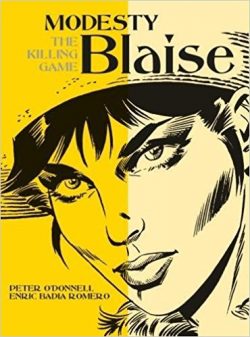
By Peter O’Donnell & Enric Badia Romero (Titan Books)
ISBN: 978-1-78565-300-1
Win’s Christmas Gift Recommendation: Blockbuster Derring-do and the Perfect Postprandial Tonic… 9/10
Infallible super-criminals Modesty Blaise and her lethally charming, compulsively platonic, equally adept partner Willie Garvin gained fearsome reputations heading underworld gang The Network. They then retired young, rich and healthy.
With honour intact and their hands relatively clean, they cut themselves off completely from careers where they made all the money they would ever need and far too many enemies: a situation exacerbated by their heartfelt conviction that killing was only ever to be used as a last resort.
When devious British Spymaster Sir Gerald Tarrant sought them out, they were slowly dying of boredom in England. The wily old bird offered them a chance to have fun, get back into harness and do a bit of good in the world. They jumped at his offer and have been cleaning up the dregs of society in their own unique manner ever since …
From that tenuous beginning in ‘La Machine’ (see Modesty Blaise: the Gabriel Set-Up) the dynamic duo went on to crush the world’s vilest villains and most macabre monsters in a never-ending succession of tense suspense and inspirational action for more than half a century. And now this final 30th collected paperback album completes their astounding run of newspaper strip escapades leaving us dedicated devotees delighted and simultaneously bereft…
The inseparable associates debuted in The Evening Standard on 13th May 1963 and over the passing decades went on to star in some of the world’s most memorable crime fiction, all in approximately three panels a day.
Creators Peter O’Donnell & Jim Holdaway (who had previously collaborated on Romeo Brown – a lost strip classic just as deserving of its own archive albums) crafted a timeless treasure trove of brilliant graphic escapades until the illustrator’s tragic early death in 1970, whereupon Spanish artist Enric Badia Romero (and occasionally John Burns, Neville Colvin and Pat Wright) assumed the art reins, taking the partners-in-peril to even greater heights.
The series has been syndicated world-wide and Modesty has starred in numerous prose novels, short-story collections, several films, a TV pilot, a radio play, an original American graphic novel from DC, a serial on BBC Radio 4 and in nearly one hundred comic adventures until the strip’s conclusion in 2001 with the trio of titanic tales collected in this volume.
The pictorial exploits comprise a broad blend of hip adventuring lifestyle and cool capers; combining espionage, crime, intrigue and even – now and again – plausibly intriguing sci fi and supernaturally-tinged horror genre fare, with ever-competent Modesty and Willie canny, deadly, yet all-too-fallibly human defenders of the helpless and avengers of the wronged…
Reproduced in stark and stunning monochrome – as is only right and fitting – Titan Books’ superb and scrupulously chronological serial re-presentations of the ultimate cool trouble-shooters conclude here, with O’Donnell & Romero offering three last masterpieces of mood, mystery, mayhem and macabre mirth. The high-octane drama is preceded by a brace of preambles: affecting reminiscence ‘Modesty and Me’ from O’Donnell’s grandson Paul Michael and the true secret of writing the perfect comic strip in the author’s own ‘All in the Mind’, penned before his death in 2010.
The pulse-pounding pictorial perils premiere with ‘The Last Aristocrat’ (originally running in The Evening Standard from December 16th 1999-19th May 2000), as old – and mostly unwanted – acquaintance Guido the Jinx embroils Willie, Sir Gerald and Modesty in his last journalistic scoop.
Sadly, the stakes this time are terrifyingly high, as a former criminal rival returns selling grotesque bacterial weapons of mass destruction forcing the dynamic duo to infiltrate an island fortress to prevent a disastrous terrorist coup…
As ever each tale is introduced by a connected celebrity: Daphne Alexander who plays Modesty in the BBC radio series adds her thoughts to the first and final adventures whilst eponymous central story ‘The Killing Game’ (22nd May June-October 17th) benefits from the insights of Radio Drama Producer Kate MCall.
Here Modesty and Willie are abducted from an innocent British Church Fete by a cabal of ultra-rich, exceedingly jaded “sportsmen†(and woman), intent on spicing up their annual safari by including the proverbial Most Dangerous Game on their private tropical preserve and in their sights…
Marooned in New Guinea, our heroes experience a debilitating setback when they find a stray teenager and her newborn baby obliviously squatting in the killing fields, but as always, Modesty and Willie are up to the challenge and soon turn predators into prey…
The themes shift to criminal skulduggery and doomsday cults – with just a hint of bloody vengeance – in ‘The Zombie’ (October 10th 2000 to April 11th 2001) as an old associate from Modesty’s Network days is kidnapped for use as leverage…
What seems to be a simple turf war between gangs squabbling for markets get decidedly nasty and strange as the kidnappers are revealed as adherents of computer pioneer Professor Nicomede Katris, whose dream is to replace all the world’s fallible, venal governments with an incorruptible super-computer of his own design.
He knows he’s right: after all, his years of programming his doctrines have transformed his own daughter Leda into a coldly logical killing machine and ideal tool of societal transformation.
The wily Prof only ever made two mistakes: ordering his human zombie to guard empathic, charming abductee Danny Chavasse and presuming he could extrapolate and predict the actions of Modesty Blaise and Willie Garvin when they inevitably come for their friend…
These are incomparable capers crafted by brilliant creators at the peak of their powers; revelling in the sheer perfection of an iconic creation. Startling shock and suspense-stuffed escapades packed with sleek sex appeal, dry wit, terrific tension and explosive action, these stories grow more appealing with every rereading and never fail to deliver maximum impact and total enjoyment.
And, hopefully, now that the entire saga has been compiled, we can soon expect sturdy hardback deluxe collections in the manner of the companion James Bond volumes…
Modesty Blaise © 2017 Associated Newspapers/Solo Syndication.
Batman and the Outsiders volume 1
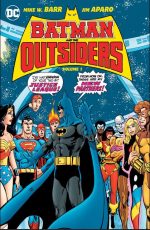
By Mike W. Barr, Marv Wolfman, Jim Aparo, George Pérez & various (Marvel)
ISBN: 978-1401268121 (HC)
During the early 1980s the general trend of comics sales was yet another downturn – although team-books were holding their own – and the major publishers were less concerned with experimentation than with consolidation. Many popular titles were augmented by spin-offs, a recurring tactic in publishing troughs.
At the time the Dark Knight was the star of two and two half titles, sharing World’s Finest Comics with Superman (until its cancellation in 1986) and appearing with rotating guest-stars in The Brave and the Bold, as well as his regular lead spots in both Batman and Detective Comics. He was also a member of the Justice League of America.
In July 1983 B&B was cancelled with issue #200, but inside was a preview of a new Bat-title. One month later Batman and the Outsiders debuted…
All the details can be found in ‘Out with the Bold, in with The Outsiders’: scripter Mike W. Barr’s introductory reminiscence to this commemorative hardback collection (also available as an eBook) gathering a daring departure for the Gotham Gangbuster and re-presenting The Brave and the Bold #200, BATO #1-13 and a crossover episode which spread into New Teen Titans #37, collectively spanning July 1983-August 1984.
The core premise of the new series was that Batman became increasingly convinced that the JLA was not fit for purpose; that too many problems were beyond their reach because they were hamstrung by international red tape and, by inference, too many laws.
It all kicks off in ‘Wars Ended… Wars Begun!’ with a revolution in the European nation of Markovia (nebulously wedged into that vague bit between France, Belgium and Russia) and details a telling personal crisis when Bruce Wayne‘s friend Lucius Fox goes missing in that war-torn country. As neither the US State Department nor his fellow superheroes will act, Batman takes matters into his own hands. He begins sniffing around only to discover that a number of other metahumans, some known to him and others new, are also sneaking about below the natives’ radar.
Markovia’s monarchy is threatened by an attempted coup, and is being countered by the King’s unorthodox hiring of Dr. Jace, a scientist specialising in creating superpowers. When King Victor dies, Prince Gregor is named successor whilst his brother Brion is charged with finding their sister Tara who has been missing since she underwent the Jace Process.
To save his sister and his country, Brion submits to the same procedure. Meanwhile two more Americans are clandestinely entering the country…
Rex (Metamorpho) Mason is a chemical freak able to turn into any element, and he wants Jace to cure him, whereas Jefferson (Black Lightning) Pierce is infiltrating Markovia as Batman’s ace-in-the-hole. Things go badly wrong when a ninja assassin kills the General Pierce is negotiating with, and he is blamed. As Batman attempts to extricate him the Caped Crusader finds a young American girl in a bombed-out building: a teenager with fantastic light-based superpowers… and amnesia.
As Prince Brion emerges from Jace’s experimental chamber, revolutionaries attack and not even his new gravity and volcanic powers, or the late-arriving Metamorpho, can stop them. Brion is shot dead and dumped in an unmarked grave whilst the Element Man joins Batman, who – encumbered by the girl – is also captured by the rebels. The heroes and Dr. Jace are the prisoners of the mysterious Baron Bedlam…
The second issue provides the mandatory origin and plans of the Baron, but while he’s talking the new heroes are mobilising. Like the legendary Antaeus, Brion (soon to be known as Geo-Force) is re-invigorated by contact with Earth and rises from his grave, whilst the girl (code-named Halo) is found by the ninja ‘Katana‘.
Together they invade the Baron’s HQ during ‘Markovia’s Last Stand!’ Not to be outdone, the captive heroes break free and join forces with the newcomers to defeat the Baron, who now has powers of his own courtesy of the captive Jace.
As introductory stories goes, this is well above average, with plenty of threads laid for future development, and the tried-&-tested super-team formula (a few old and a few new heroes thrown together for a greater purpose) that worked so well with the New X-Men and New Teen Titans still proved an effective one.
As always Barr’s adroit writing meshed perfectly with the understated talents of Jim Aparo; an artist who gave his all to a script…
Issue #3 began a long run of high-quality super-hero sagas with ‘Bitter Orange’, as the new team get acquainted whilst stopping a chemical terrorist with a hidden agenda, and is followed by that preview from B&B #200: a hospital hostage crisis tale designed to tease and introduce new characters, followed here by ‘One-Man Meltdown’ (BATO #4) in which a radioactive villain from Batman’s past returns with malice in mind but acting on a hidden mastermind’s agenda…
New Teen Titans #37 (December 1983) features next. ‘Light’s Out, Everyone!’ by Marv Wolfman, George Pérez & Romeo Tanghal is the first part of a cross-over tale wherein Dr. Light and the Fearsome Five kidnap Dr. Jace and Titans and Outsiders must unite to rescue her. Concluding with ‘Psimon Says’ in BATO #5, its most notable feature is the portentous reuniting of Brion with his sister Tara, the Titan known as Terra.
‘Death Warmed Over’ and ‘Cold Hands, Cold Heart’ tell the tale of The Cryonic Man, a villain who steals frozen body-parts, before ‘The Hand That Rocks the Cradle’ offers a sinister supernatural Christmas treat guest-starring possibly Aparo’s most fondly remembered character (most certainly for me) The Phantom Stranger.
Issue #9 introduces a new super-villain gang in ‘Enter: The Masters of Disaster!’ (the first half of a two-part tale) plus a brief back-up tale of Halo in ‘Battle For the Band’, written by Barr and illustrated by Bill Willingham & Mike DeCarlo.
Illustrated by Steve Lightle & Sal Trapani, ‘The Execution of Black Lightning’ epically concludes the Masters of Disaster saga, before issue #11 begins exposing ‘The Truth About Katana’: exploring her past and the implications of her magic soul-drinking blade. ‘A Sword of Ancient Death!’ is by Barr & Aparo and continues with ‘To Love, Honour and Destroy’, leading directly into #13’s impressive final inclusion.
‘In the Chill of the Night’ (illustrated by Dan Day & Pablo Marcos) sees the desperate team attempting to capture a drugged, dying and delusional Dark Knight as his fevered mind and memories pit him against the gunman who murdered his parents…
With a full cover gallery – including the diptych assemblage of NTT #37 and BATO #50 – original Aparo art, house ad and preliminary character designs, this is a splendid package to appeal to dedicated Fights ‘n’ Tights fanatics. Although probably not flashy enough to cross the Fan-Barrier into mainstream popularity, Batman and the Outsiders was always a highly readable series and is re-presented here in most accessible manner. An open-minded new reader could do lots worse than try out this forgotten corner of the DCU.
© 1983, 1984, 2017 DC Comics. All Rights Reserved.
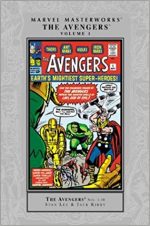
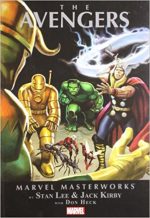
Avengers Masterworks volume 1
By Stan Lee, Jack Kirby, Don Heck, Dick Ayers, Chic Stone & various (Marvel)
ISBN: 978-0-7851-0883-2 (HC)Â Â Â Â Â Â Â Â Â Â Â Â Â Â Â Â Â Â Â 978-0 7851 3706 1 (TPB)
Win’s Christmas Gift Recommendation: Timeless Classics to Enjoy Forever … 10/10
After a period of meteoric expansion, in 1963 the burgeoning Marvel Universe was finally ready to emulate the successful DC concept that cemented the legitimacy of the Silver Age of American comics.
The concept of putting a bunch of all-star eggs in one basket which had made the Justice League of America such a winner had inspired the moribund Atlas outfit – primarily Stan Lee, Jack Kirby & Steve Ditko – into inventing “super-characters†of their own. The result in 1961 was the Fantastic Four.
Nearly 18 months later the fledgling House of Ideas had a viable stable of leading men (but only sidekick women) so Lee & Kirby assembled a handful of them and moulded them into a force for justice and soaring sales…
Seldom has it ever been done with such style and sheer exuberance. Cover dated September 1963, The Avengers #1 launched as part of an expansion package which also included Sgt. Fury and his Howling Commandos and The X-Men…
Marvel’s Masterwork’s collections – available in hardcover, paperback and digital formats – are only one of many series faithfully compiling those groundbreaking tales and this premier volume gathers #1-10 of The Avengers spanning March 1963 to November 1964: a sequence no lover of superhero stories can do without…
Following an introduction from Stan the Man himself, the suspenseful action kicks off with ‘The Coming of the Avengers’: one of the cannier origin tales in comics. Instead of starting at a zero point and acting as if the reader knew nothing, Stan & Jack (plus inker Dick Ayers) assumed readers had at least a passing familiarity with Marvel’s other titles and wasted very little time or energy on introductions.
In Asgard, Loki is imprisoned on a dank isle, hungry for vengeance on his half-brother Thor. Observing Earth, the god of evil espies the monstrous, misunderstood Hulk and mystically engineers a situation wherein the man-brute seemingly goes on a rampage, simply to trick the Thunder God into battling the monster.
When the Hulk’s sidekick Rick Jones radios the Fantastic Four for assistance, devious Loki diverts the transmission and smugly awaits the blossoming of his mischief. Sadly, Iron Man, Ant-Man and the Wasp also pick up the redirected SOS….
As the heroes converge in the American Southwest to search for the Jade Giant, they soon realize that something is oddly amiss…
This terse, epic, compelling and wide-ranging yarn (New York, New Mexico, Detroit and Asgard in 22 pages) is Lee & Kirby at their bombastic best and one of the greatest stories of the Silver Age (it’s certainly high in my own top ten Marvel Tales) and is followed by ‘The Space Phantom’ (Lee, Kirby & Paul Reinman), wherein an alien shape-stealer almost destroys the team from within.
With latent animosities exposed by the malignant masquerader, the tale ends with the volatile Hulk quitting the team in disgust, only to return in #3 as an outright villain in partnership with ‘Sub-Mariner!’
This globe-trotting romp delivers high-energy thrills and one of the best battle scenes in comics history as the assorted titans clashed in abandoned World War II tunnels beneath the Rock of Gibraltar.
Inked by George Roussos Avengers #4 was an epic landmark as Marvel’s greatest Golden Age sensation was revived for another increasingly war-torn era. ‘Captain America joins the Avengers!’ has everything that made the company’s early tales so fresh and vital. The majesty of a legendary warrior returned in our time of greatest need: stark tragedy in the loss of his boon companion Bucky, aliens, gangsters, Sub-Mariner and even subtle social commentary and – naturally – vast amounts of staggering Kirby Action.
Reinman returned to ink ‘The Invasion of the Lava Men!’: another staggering adventure romp as the team battle superhuman subterraneans and a world-threatening mutating mountain with the unwilling assistance of the Hulk…
However, even that pales before the supreme shift in quality that was Avengers #6.
Chic Stone – arguably Kirby’s best Marvel inker of the period – joined the creative team just as a classic arch-foe debuts. ‘The Masters of Evil!’ reveals how Nazi super-scientist Baron Zemo is forced by his own arrogance and paranoia out of the South American jungles he’s been skulking in since the Third Reich fell, after learning his hated nemesis Captain America has returned from the dead.
To this end, the ruthless war-criminal recruits a gang of super-villains to attack New York City and destroy the Avengers. The unforgettable clash between valiant heroes and the vile murdering mercenaries Radioactive Man, Black Knight and the Melter is an unsurpassed example of prime Marvel magic to this day.
Issue #7 followed up with two more malevolent recruits for the Masters of Evil as Asgardian outcasts Enchantress and the Executioner ally with Zemo just as Iron Man is suspended from the team due to misconduct occurring in his own series (this was the dawning of the close-continuity era where events in one series were referenced and even built upon in others)…
It may have been ‘Their Darkest Hour!’ but Avengers #8 held the greatest triumph and tragedy as Jack Kirby (inked with fitting circularity by Dick Ayers) relinquished his drawing role with the superb and entrancing invasion-from-time thriller which introduced ‘Kang the Conqueror!’
The Avengers evolved into an entirely different series when the subtle humanity of Don Heck’s work replaced the larger-than-life bombastic bravura of Kirby. The series had rapidly advanced to monthly circulation and even The King could not draw the massive number of pages his expanding workload demanded.
Heck was a gifted and trusted artist with a formidable record for meeting deadlines and, progressing under his pencil, sub-plots and character interplay finally got as much space as action and spectacle.
His first outing was the memorable tragedy ‘The Coming of the Wonder Man!’ (inked by Ayers) wherein the Masters of Evil plant superhuman Trojan Horse Simon Williams within the ranks of the Avengers, only to have the conflicted infiltrator find deathbed redemption amongst the heroes…
This glorious collection concludes with the introduction of malignant master of time Immortus who briefly combines with Zemo’s devilish cohort to engineer a fatal division in the ranks when ‘The Avengers Break Up!’
Accompanied by a Marvel Masterwork Pin-Up of ‘The One and Only Cap’ the bonus features in this titanic tome include September 1963 house ads for the imminently debuting Avengers, a previous Kirby Masterworks cover colourised by painter Dean White, original cover art for Avenger #4 and Alex Ross’s recreation of it for the 1999 Overstreet Guide to Comics plus the usual round of Creator Biographies.
These immortal epics are tales that defined the Marvel experience and a joy no fan should deny themselves or their kids.
© 1963, 1964, 2017 Marvel Characters, Inc. All rights reserved.
Captain Marvel: Marvel Masterworks volume 1
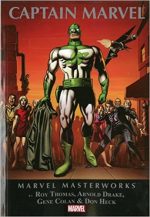
By Stan Lee, Roy Thomas, Arnold Drake, Gene Colan, Don Heck & various (Marvel)
ISBN: 978-0-7851-6756-3
After years as an also-ran and up-and-comer, by 1968 Marvel Comics was in the ascendant. Their sales were catching up with industry leaders National/DC Comics and Gold Key, and they finally secured a new distribution deal that would allow them to expand their list of titles exponentially. Once the stars of “twin-books†Tales of Suspense, Tales to Astonish and Strange Tales all got their own titles the House of Ideas just kept on creating.
One dead-cert idea was a hero named after the company – and one with some popular cachet and nostalgic pedigree as well. After the DC/Fawcett court case of the 1940s-1950s, the name Captain Marvel disappeared from the newsstands.
In 1967, during a superhero boom/camp craze generated by the Batman TV show, publisher MLF secured rights to the name and produced a number of giant-sized comics featuring an intelligent robot who (which?) could divide his body into segments and shoot lasers from his eyes.
Quirky and charming and devised by the legendary Carl (Human Torch) Burgos, the feature nevertheless could not attract a large following. On its demise, the name was quickly snapped up by the expanding Marvel Comics Group.
Marvel Super-Heroes was a brand-new title: it had been the giant-sized reprint comicbook Fantasy Masterpieces, combining monster and mystery tales with Golden Age Timely Comics classics, but with the twelfth issue it added an all-new experimental section for characters without homes such as Medusa, Ka-Zar, Black Knight and Doctor Doom, and debuted new concepts like Guardians of the Galaxy, Phantom Eagle and, to start the ball rolling, an troubled alien spy sent to Earth from the Kree Galaxy. He held a Captain’s rank and his name was Mar-Vell.
Most of that is covered in series-author Roy Thomas’ Introduction before this cosmically conceived tome – available in hardcover, paperback and digital editions – kicks off. On offer are the origin adventure from Marvel Super-Heroes #12-13 and the contents of Captain Marvel #1-9 collectively spanning cover-dates December 1967 to January 1969…
Crafted by Stan Lee, Gene Colan & Frank Giacoia, the initial MS-H 15 page-instalment ‘The Coming of Captain Marvel’ devolved directly from Fantastic Four #64-65 wherein the quartet defeated a super-advanced Sentry robot from a mythical alien race, only to be attacked by a high official of those long-lost extraterrestrials in the very next issue!
After defeating Ronan the Accuser, the FF heard no more from the far from extinct Kree, but the millennia-old empire was once again interested in Earth. Dispatching a surveillance mission, the Kree wanted to know everything about us. Unfortunately, the agent they chose was a man of conscience; whilst his commanding officer Colonel Yon-Rogg was a ruthless rival for the love of the ship’s medical officer Una.
No sooner has the good captain made a tentative planet-fall and clashed with the US army from the local missile base (often hinted at as being Cape Kennedy) than the first instalment ends. Stan and Gene had set the ball rolling but it was left to Roy Thomas to establish the basic ground-rules in the next episode.
Colan remained, this time with Paul Reinman inking. ‘Where Stalks the Sentry!’ sees the alien spy improving his weaponry before an attempt by Yon-Rogg to kill him destroys a light aircraft carrying scientist Walter Lawson to that military base.
Assuming Lawson’s identity, Mar-Vell infiltrates “The Cape†but arouses the suspicions of security Chief Carol Danvers. He is horrified to discover that the Earthlings are storing the Sentry (defeated by the FF) on base. Yon-Rogg, sensing an opportunity, activates the deadly mechanoid. As it goes on a rampage only Mar-Vell stands in its path…
That’s a lot of material for twenty pages but Thomas and Colan were on a roll. With Vince Colletta inking, the third chapter was not in Marvel Super-Heroes but in the premiere issue of the Captain’s own title released for May 1968
‘Out of the Holocaust… A Hero!’ is an all-out action thriller, which still made space to establish twin sub-plots of “Lawson’s†credibility and Mar-Vell’s inner doubts. The faithful Kree soldier is rapidly losing faith in his own race and falling under the spell of the Earthlings…
The Captain’s first foray against a super-villain is revealed in the next two issues as we find that the Kree and the shapeshifting Skrulls are intergalactic rivals, and the latter want to know why there’s an enemy soldier stationed on Earth.
Sending their own top agent in ‘From the Void of Space Comes the Super Skrull!’, the resultant battle almost levels the entire state before bombastically concluding with the Kree on top ‘From the Ashes of Defeat!’
Issue #4 saw the secret invader clashing with fellow anti-hero Sub-Mariner in ‘The Alien and the Amphibian!’ as Mar-Vell’s superiors make increasingly ruthless demands of their reluctant agent.
Captain Marvel #5 saw Arnold Drake & Don Heck assume the creative chores (with John Tartaglione on inks) in cold-war monster-mash clash ‘The Mark of the Metazoid’, wherein a mutated Soviet dissident is forced by his militaristic masters to kidnap Walter Lawson (that’s narrative symmetry, that is).
Issue #6 then finds the Captain ‘In the Path of Solam!’; battling a marauding sun-creature before being forced to prove his loyalty by unleashing a Kree bio-weapon on an Earth community in ‘Die, Town, Die!’ However, all is not as it seems since Quasimodo, the Living Computer is also involved…
The romantic triangle sub-plot was wearing pretty thin by this time, as was the increasingly obvious division of Mar-Vell’s loyalties, so a new examination of Dr Lawson, whose identity the Kree man purloined, begins in #8’s ‘And Fear Shall Follow!’.
Wrapping up this first volume is another alien war story as Yon-Rogg is injured by rival space imperialists the Aakon. In the battle Mar-Vell’s heroism buys him a break from suspicion but all too soon he’s embroiled with a secret criminal gang and a robot assassin apparently built by the deceased Lawson, and trouble escalates when the surviving Aakon stumble into the mess in ‘Between Hammer and Anvil!’…
Fascinating extras added in here include a full cover gallery, creator biographies, the December 1967 Marvel Bullpen Bulletins page announcing the coming of Captain Marvel, plus sublime pencil-art pages by Colan: the full 16 un-inked pages from Marvel Super-Heroes #13 for art-lovers to drool over. Glorious!
© 1967, 1968, 1969, 2013 Marvel Characters, Inc. All rights reserved.