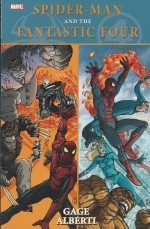
Spider-Man and the Fantastic Four


By Christos Gage & Mario Alberti with Bill Mantlo, Mike Zeck, John Byrne & various (Marvel)
ISBN: 978-0-7851-4423-6

After a shaky start in 1962, The Amazing Spider-Man quickly became a popular sensation with kids of all ages, rivalling the groundbreaking creative powerhouse that was Lee & Kirby’s Fantastic Four. Eventually the quirky, charming action-packed comics soap-opera became the model for an entire generation of younger heroes who imperceptibly began elbowing aside the staid, more mature costumed-crimebusters of previous publications and eras.

Since the 1970s the Astounding Arachnid and his hard-luck alter ego Peter Parker have become full-blown multimedia icons and survived every manner of seemingly insane reboot and upgrade to become globally real in the manner of Sherlock Holmes, Mickey Mouse, Tarzan, Superman, Batman and Harry Potter.

The Fantastic Four are – more often than not – maverick genius Reed Richards, his fiancée (later wife) Sue Storm, their trusty friend Ben Grimm and Sue’s teenaged brother Johnny, driven survivors of a independently-funded space-shot which went horribly wrong after Cosmic Rays penetrated their ship’s inadequate shielding.

When they crashed back to Earth, the quartet found that they had all been hideously mutated into outlandish freaks. Richards’ body became elastic, Sue gained the power to turn invisible and, eventually, project force-fields, Johnny could turn into living flame, and poor, tormented Ben was mutated into a horrifying brute who, unlike his comrades, could not return to a semblance of normality on command.

A core element of superhero comics is the “team-up” wherein costumed champions unite to tackle a greater than usual threat, or even each other; a sales-generating tactic taken to its logical extreme at Marvel wherein most early encounters between masked mystery men were generally prompted by jurisdictional disputes resulting in usually spectacular punch-ups before the heroes finally got on with allying to confront the real menace…

Combining Marvel’s biggest franchise and most creatively influential series, this slim, slick tome collects the 4-issue miniseries Spider-Man/Fantastic Four (from August to September 2010) by scripter Christos Gage and artist Mario Alberti, reprising their earlier trawl through key points of Marvel history affecting the wall-crawler and assorted iterations of X-Men.

Also focussing on the long, convoluted, inextricably interwoven relationship of the solitary web-spinner and the First Family of Superheroics, this compilation also offers an earlier crossover of the icons first seen in Peter Parker, the Sensational Spider-Man #42 and Fantastic Four #218 (both from May 1980).

The first chapter of the main story is set just after stuffy Mr. Fantastic and Sue Storm announced their engagement, a time when Peter Parker had just started college at Empire State University.

A ‘Crisis on Campus’ was triggered when the institution hosted a secret conference of world leaders and Victor Von Doom, absolute monarch of Balkan kingdom Latveria, demanded his arch-foes the FF should be his bodyguards. With the State Department pushing all the patriotism buttons the furious foursome had no choice but to reluctantly comply…

Intended merely as a means to aggravate and humiliate his enemies, the ploy became deadly serious when enraged Atlantean Prince Namor and his sub-sea legions attacked the meeting seeking vengeance on Doom.

Events escalated when the Iron Dictator refused to stay locked in a super-secure Panic Room and possessed the body of the Human Torch to personally rebuke the Sub-Mariner‘s insults. Total catastrophe seemed unavoidable until the physically overmatched web-spinner proffered a brilliantly sneaky way to break up the cataclysmic fight…

Unknown to all participants, however, a clandestine time-travelling foe was the chaos as cover to acquire elements necessary to bring about the downfall of his greatest foes and the very rewriting of history…

‘Symbiosis’ skips forward a few years to the time after the first Secret Wars, when Spider-Man discovered that his new smart-tech black costume was in fact an alien parasite. The uniform had attempted to bond permanently to Peter and had to be forcibly removed and contained by Reed and the FF.

The strange invader (see Spider-Man vs. Venom and Amazing Spider-Man: the Saga of the Alien Costume for further details) would eventually bond with deranged, disgraced reporter Eddie Brock, becoming Venom, a savage, shape-changing dark-side version of the Astounding Arachnid, but in this untold aside the cosmic creature broke free almost immediately, seizing control of Richards, temporary replacement She-Hulk and eventually Reed’s son Franklin.

The boy possessed dormant power on a level to reshape the universe and, as Spider-Man selflessly attempted to lure the Symbiote away by offering himself as a sacrifice, the mysterious time-thief again surreptitiously stepped in to purloin another artefact crucial to his plan…

Once the heroes had at last repelled and incarcerated the parasite peril, the saga shifted forward to the time when Skrull outlaw De’Lila invaded Earth, with her own people hot on her viridian high heels.

Evading heavy pursuit she attacked the FF and seemingly killed them. Disguised as a grieving Sue Richards she then recruited four heroes – The Hulk, Wolverine, Ghost Rider and Spider-Man – to hunt down the murderers.

Their quest took them deep into the bowels of the Earth and battle with the Mole Man and his legion of monsters, before she was exposed and defeated. The shapeshifting psionic siren had been seeking a semi-sentient ultimate weapon called a Technotroid and ‘Bizarre Love Triangle’ occurs minutes after the close of the original story (for which see Fantastic Four: Monsters Unleashed) as the temporal raider frees De’Lila from her Skrull captors as a deadly diversion whilst he takes the essence of the Technotroid for himself

Deprived of her trademark duplicity but with her telepathic abilities augmented, the temptress simply makes most of the men and Skrull cops her love-slaves and sets them upon Sue, new temp Sharon “She-Thing” Ventura and Spider-Man, forcing the irrepressible wall-crawler to use the most shocking of tactics to free the males from their murderous stupors…

The decade-long scheme of the mystery time-bandit is finally revealed in the concluding chapter ‘Family Values’ as – in the present – Spider-Man is lured to the Fantastic Four’s HQ and attacked with the rest of the team by one they had long considered to be part of their exotic extended family, lost in combat years ago…

Armoured with ultimate power and sporting a colossal chip on his shoulder, the prodigal intends to destroy Dr. Doom and offers the astounded gathering a chance to prove their loyalty by joining him…

When they try to humour the clearly disturbed assailant he cracks and all hell breaks loose…

However not all the heroes’ power can affect the attacker but Spider-Man, child of misuse, ill-fortune and isolation thinks he sees a kindred damaged spirit in the maniacal marauder…

Wry, witty, explosively action-packed, bombastic and genuinely moving, this clever re-evaluation of the bonds between the First Family and the solitary Spider-Man is a delightful celebration of everything that made Marvel such a force for change in the industry, and it’s a real shame that new readers won’t be able to pick up on the historical continuity scholarship that underpins a great fun yarn. That being said, this is still a funnybook frolic the freshest newbie to comics can easily follow…

Following the fearsome festivities is a section of sketches, pencils, unused and working drawings from Alberti, before the compilation concludes with an old-school saga from Peter Parker, the Sensational Spider-Man #42 and Fantastic Four #218.

The action begins when ESU student Peter Parker goes on a class jaunt on a party boat  and is lured into a trap by the Frightful Four in ‘Give Me Liberty of Give Me Death’ by Bill Mantlo, Mike Zeck & Jim Mooney.

The villains had broadsided the wall-crawler after new recruit Electro impersonated the Human Torch and, in the concluding ‘When a Spider-Man Comes Calling!’ (FF #218 by Mantlo, John Byrne & Joe Sinnott, the Trapster repeats the tactic to ambush the crime-busting quartet, allowing his comrades the Wizard and Sandman to take over the Baxter Building citadel of the heroes.

…At least until the fighting-mad web-spinner finally breaks free to launch an unstoppable counter attack…

Most people who read comics have a passing familiarity with all these characters, and even occasional consumers won’t have too much trouble following the backstory in this magnificently compelling Costumed Drama, so if you’re looking for some fun-friendly Fights ‘n’ Tights fantasy this could well be the one for you…
© 1980, 2010 and 2011 Marvel Characters, Inc. All Rights Reserved.
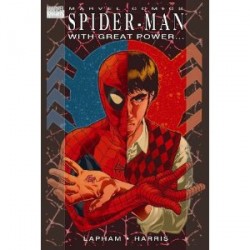
Spider-Man: With Great Power…


By David Lapham & Tony Harris, with Jim Clark, Stefano Gaudiano and Matt Milla (Marvel)
ISBN: 978-0-7851-1968-5

One of the most astounding comicbook stories ever began with the sublime origin tale of ‘Spider-Man!’ by Stan Lee & Steve Ditko in the last issue of  Amazing Fantasy #15 (cover-dated September 1962); describing in 11 captivating pages the parable of Peter Parker, a smart but alienated kid bitten by a radioactive spider on a High School science trip.

Discovering he had developed arachnid abilities – which he augmented with his own natural genius in the fields of chemistry, physics and engineering – the boy did what any lonely, geeky nerd would do when given such a gift…  he tried to milk for all it was worth in the hormone-fuelled determination to get girls, prestige, fame, money and girls.

Making a costume to hide his identity in case he made a fool of himself, Parker became a minor celebrity – and a criminally self-important one.

To his eternal regret, when a thief fled past him one night after a TV interview, the self-aggrandized Peter didn’t lift a finger to stop the felon, only to find when he returned home that his guardian and uncle Ben Parker had been murdered.

Crazy with a need for vengeance, Peter hunted the assailant who had made his beloved Aunt May a widow and killed the only father he had ever known, and tragically realised that it was the crook he couldn’t be bothered to stop.

His social irresponsibility had led to the death of the man who raised him and the boy swore to always use his powers to help others…

It wasn’t a new story, but the setting was one familiar to every kid reading it and the artwork was downright spooky. This wasn’t the gleaming high-tech world of moon-rockets, giant monsters and flying cars – this stuff could happen to anybody…

From that tortuous beginning Spider-Man swiftly evolved into one of the world’s most popular heroic characters with generations of writers returning to, mining and refining that simple tale for every possible nuance.

In 2008 star creators David Lapham and Tony Harris (with inkers Jim Clark and Stefano Gaudiano and colourist Matt Milla) took a hard look at the origin and came up with an impressive fresh avenue previously unexplored: what exactly happened during Parker’s brief fling with showbiz celebrity?

The result was a 5-issue miniseries under the elite Marvel Knights imprint that impressively added an even greater edge of tragedy and recrimination to the lad’s subsequent campaign and injustice…

Opening with the key page from the Lee/Ditko classic, most of this turbulent tale is set pretty much between those two panels and finds “the Spider-Man” signed up with a cheesy wrestling federation. The masked and obsessively secretive kid is obnoxiously revelling in his newfound power amongst these shady adult characters yet still being bullied in his “normal” life at High School: continually harassed by jock Flash Thompson whilst fruitlessly lusting after queen of the popular kids Liz Allen…

Uncle Ben and Aunt May are increasingly concerned by their sweet, clever boy. He’s become secretive, argumentative and unnaturally rebellious. Although they’ve been expecting it for years, the “Troubled Teen” phase is still a bit of shock and the solicitously understanding seniors combat it by giving the boy a clunky old car to show they accept his growing independence…

With the kid being taught all the tricks of show-fighting by the welcoming but jaded older wrestlers in the fight-stable, promoter Monty Caabash sees his compulsively anonymous new find as his ticket to the big time – and so do his gangster backers. With a lucrative West Coast TV sport show in the offing, they just can’t afford to lose their mysterious cash-cow, but the adulation and ready money is turning Peter’s head.

He dumps Uncle Ben’s gift in favour of a sports car only to wreck in a crazy drag race with Flash: an incident which puts him in an E.R., although his worried guardians have no idea since the unruly kid is frequently staying out all night these days…

As Monty invests more time and money in his prize fighter, the boy becomes a New York sensation and the promoter’s worldly-wise associate Tiffany LeBeck sees a way to use her own mature charms to win a piece of the millions Spider-Man could generate.

Before long the sex-starved kid is beguiled and besotted by the older woman’s charms and she becomes his manager; promising an inevitably clash with Monty’s ruthless backers.

At school Parker’s increased confidence has enabled him to make real headway with Liz too. With everything going right the ebullient boy spends some time back in his lab inventing a way to increase his cachet by inventing webbing and web-shooters: tricks that will make him even more spectacular in the ring and on the screen…

New York loves the mysterious celebrity and goes into media frenzy mode – all except the contrary publisher of the Daily Bugle. Inexplicably incensed, J. Jonah Jameson wants to know the truth about this Amazing Spider-Man and begins a highly provocative campaign against the wrestler and his management…

There are bigger stories. The first team of superheroes since WWII has emerged, battling monsters and villains with shining valour and full public disclosure. Spider-Man even watched the Fantastic Four in action once, battling the horrific spawn of the Miracle Man.

The kid was sitting in a safe skyscraper perch with one of his groupies nestled safely in his arms…

Peter doesn’t care about bad publicity and unfair comparisons: he’s a celebrity sportsman, not a crime-busting crusader. Even when a thief runs right past him after a TV interview, he does nothing. That’s the police’s job…

Ditching school, chasing girls, falling further under Tiffany’s slowly seductive influence, Peter gets a huge reality check when, during a confrontation with Uncle Ben outside a nightclub where he’s spent all night dancing with Liz, a colossal monster attacks the city, raining death and destruction upon hundreds of helpless citizens. Despite himself the boy explodes into action, saving Ben and his traumatised date, but horrifically failing to rescue a trapped stranger, even after the impressive man-monster dubbed The Thing comes to his assistance…

Shocked, confused and deeply upset in the aftermath, Parker gets blind drunk and returns to Tiffany’s boudoir, only to pass out too soon… Waking up face to face with Monty’s extremely unsavoury bosses he discovers the kind of people’s he’s involved with as chief hood Mr. Angel explains the facts of life.

Hollywood means big, legitimate money and Jameson’s smear campaign is making the TV execs nervous. So if everybody wants heroes like the FF, Spider-Man is going to be one – even if the mob has to set up kittens to rescue and slobs to save…

Peter complies but his heart isn’t in it: it’s only by sheer luck that he doesn’t cause the deaths of dozens of people and when that doesn’t placate Angel the racketeer opts to end his problems by shutting up Jameson for good…

Even Tiffany can’t handle that however and when she drunkenly reveals the scheme to her besotted boy Peter, he puts his mask back on and heads out to change his destiny forever…

With Jameson saved and his life back on track, Peter heads home to reconcile with Aunt May and Uncle Ben, only to find he house surrounded by police cars…

Dark, gritty, subtly sophisticated and rationally reasonable, this clever exploration of the in-between moments adds those layers of meaning to the tragic tale that modern, mature readers seem to dote on and, child of the simplistic Sixties though I am, even I found this extension of the classic story to be both beguiling and exceptionally entertaining.

This might not appeal to all readers but fans of the movie franchise will definitely find this a book worth pursuing.
© 2008 Marvel Characters, Inc. All Rights Reserved.
Gorilla-Man


By Jeff Parker, Jason Aaron, Stan Lee, Larry Lieber, Giancarlo Caracuzzo, Jack Kirby, Bob Powell, Bob Q. Sale & various (Marvel)
ISBN: 978-0-7851-4911-8

Apes have long fascinated comics audiences, and although Marvel never reached the giddy heights of DC’s slavish and ubiquitous exploitation of the Anthropoid X-factor, the House of Ideas also dabbled in monkey madness over its long years of existence.

This slim mixed-bag of a tome gathers newer adventures of happily hirsute hero Ken Hale – gregarious Gorilla-Man of resurrected 1950s super-group pioneers Agents of Atlas – culled from the eponymous 2010 three-issue miniseries and supplemented with pertinent material from Avengers vs. Atlas #4, X-Men First Class #8, plus assorted earlier interpretations of Ape Avengers culled from the company’s back catalogue of anthology horror and mystery titles: specifically Men’s Adventures #26, Tales to Astonish #28 and 30 and Weird Wonder Tales #7.

What you need to know: the Agents of Atlas comprise rejuvenated 1950s super-spy Jimmy Woo and similarly vintaged superhuman crusaders Namora (Sub-Mariner’s cousin), spurious love-goddess Venus, a deeply disturbing unhuman Marvel Boy from Uranus, primitive wonder-robot M11 and the aforementioned anthropoid avenger. As the Atlas Foundation, these veterans surreptitiously fight for justice and a free world as the nominal leaders of a clandestine crime-cult which still thinks it’s being patiently guided towards the overthrow of all governments. The real power behind the organisation however is a terrible mystical dragon named Lao…

The modern mainstream saga concentrates on ‘Ken Hale, the Gorilla-Man: The Serpent and the Hawk’ – from Jeff Parker & Giancarlo Caracuzzo – by exploring the anthropoid adventurer’s origins following a particularly bizarre battle against spidery cyborg Borgia Omega.

In search of another action-packed mission, Hale spots a familiar face on an Atlas “wanted poster” and heads for Africa, flashbacking his past for us along the way.

Missouri, 1930 and a visiting big-shot spots something in a poor orphan kid holding his own against seven bigger boys who picked the wrong dirt-grubber to bully…

J. Avery Wolward was a millionaire man-of-intrigue with interests all over the globe and for the next decade little Kenny became his companion and partner in a series of non-stop escapades that would make Indiana Jones green with envy. Ken learned a lot about life and loyalty, eventually discovering that Wolward owed much of his success to a mystical snake walking stick.

Now that cane is in the hands of an African crime-lord calling himself Mustafa Kazun who is well on the way to stealing an entire country and building an empire of blood…

Each issue of the miniseries was augmented by comedic faux email conversations between Hale and his social networking fans, which delightfully act here to buffer the transitions between modern menace and reprinted monkey mystery tales.

The first of these is ‘It Walks Erect!’ taken from 1974’s Weird Wonder Tales #7 (which itself rescued the yarn from pre-Comics Code Mystery Tales #21(September 1954).

The story (by an unknown author and illustrated by the brilliant Bob Powell) concerns compulsive rogue surgeon Arthur Nagan whose obsession with brain transplants took a decidedly outré turn when his gorilla test-subjects rebelled and wreaked a darkly ironic revenge upon him…

Slavish fanboys like me might remember Nagan as the eventual leader of arcane villain alliance The Headmen… but probably not…

Hale’s origin resumes as he and local agent Ji Banda are attacked by Kazun’s enslaved army, but that doesn’t stop the simian superman describing how a clash with Wolward’s arch-rival Bastoc to recover an ancient bird talisman in Polynesia led the then-full-grown soldier-of-fortune to split with his mentor and enlist in the US military just before Pearl Harbor…

By the time the war ended Wolward was gone and the magnate’s daughter Lily had inherited both the family business and the walking stick…

After another message-board break, the classic ‘I Am the Gorilla Man’ (from Tales to Astonish #28 February 1962, by Stan Lee, Larry Lieber, Jack Kirby & Dick Ayers) revealed how criminal genius Franz Radzik developed a mind-swapping process so that he could use a mighty ape’s body to commit robberies.

Sadly the big brain forgot that, with its personality in a human body, the anthropoid might have its own agenda and plenty of opportunity…

The conclusion of ‘The Serpent and the Hawk’ then sees Hale link up with a tribe of gorillas to overturn Kazun’s schemes and unlock the secret of the stick, even as his mind is firmly replaying his bad marriage to Lily, subsequent decline into drunken dissolution, recruitment by the arcane Mr. Lao, and eventual confrontation with the previous Immortal Gorilla-Man…

The role is an inherited one and a curse. To kill the undying Gorilla is to become him, and the previous victim had by this time had enough. Even after Hale refused to end the creature’s torment, it relentlessly followed him until it could trick the drunken mercenary into taking on the curse…

However, after linking up with 1950s heroes like Jimmy Woo and Venus, Hale found it truly liberating grew to accept his new status…

Thus when Kazun’s true identity is revealed and the weary adventurer offered a permanent if Faustian cure, Gorilla-Man makes the only choice a true champion can…

A final text presentation precedes Lee, Lieber, Kirby & Ayers’ ‘The Return of the Gorilla Man’ (from Tales to Astonish #30, April 1962) wherein Radzik, still locked in a gorilla’s body, escapes captivity and frantically attempts to prove to scientists how smart he is.

Big mistake…

Further insight into Hale is provided by ‘My Dinner with Gorilla-Man’ by Jason Aaron & Caracuzzo from Avengers vs. Atlas #4, as a desperate man with nothing to lose hunts down the ageless anthropoid, intent on fulfilling the ageless equation: “Kill the Gorilla and live forever”…

This is followed by a glorious romp from X-Men: First Class #8. ‘Treasure Hunters’ by Jeff Parker & Roger Cruz finds the debut generation of Xavier’s mutants – Cyclops, Angel, Beast, Iceman and Marvel Girl – hunting for their missing teacher in the Congo. Along the way they encounter a talking gorilla who becomes their guide, inadvertently pulling reclusive hermit Hale out of a decades-long funk…

This collection concludes with the seminal supernatural suspense thriller which first introduced ‘Gorilla Man’ to the world. Again by an anonymous writer (possibly Hank Chapman) and illustrated by the wonderful Robert (“Bob Q”) Sale, this evocative chiller from Men’s Adventures #26 (March 1954) offers a far grittier take on the origin as a man terrified of dying and plagued by nightmares of fighting apes hears a crazy legend and heads for Kenya and an inescapable, horrific destiny…

Also included is a selection of 21st century covers by Dave Johnson, Leonard Kirk, Dave McCaig, Gabrielle Dell’Otto, Humberto Ramos, Edgar Delgado & Marko Djurdjevic, with the vintage frontages represented by Jack Kirby, Larry Lieber and Dick Ayers.

Outrageous, over the top and never taking itself seriously, this is a riot of hairy scary fun-filled frolics and a perfect antidote to po-faced Costumed Dramas.
© 1954, 2007, 2010 Marvel Characters, Inc. All rights reserved.

The Incredible Hercules: the New Prince of Power


By Greg Pak, Fred Van Lente, Ariel Olivetti, Paul Tobin, Reilly Brown, Jason Paz, Terry Pallot, Zach Howard, Adam Archer & various (Marvel)
ISBN: 978-0-7851-4370-3

Comicbook Fights ‘n’ Tights dramas are serious business – but they don’t have to be.

There are too few light-hearted adventure comics around for my liking. Have readers become so sullen, depressed and angst-ridden that it takes nothing but oceans of blood and devastating cosmic trauma to rouse them?

Let’s hope not since we all adore a modicum of mirth with our mayhem, and let’s be honest, there are lashings of sheer comedic potential to play with when men-in-tights  – or in the Lion of Olympus’ case, a very short skirt and leather bondage-leggings – start hitting each other with clubs and cars and buildings.

The contemporary Marvel iteration of Hercules first appeared in 1965’s Journey into Mystery Annual #1, wherein Thor, God of Thunder fell into the realm of the Greek Gods and ended up swapping bombastic blows with the happy-go-lucky but easily-riled Hellenic Prince of Power in the Stan Lee/Jack Kirby landmark ‘When Titans Clash! Thor Vs. Hercules!’

Since then the bombastic immortal warrior has bounced around the Marvel Universe seeking out other heroes and heated fisticuffs as an Avenger, Defender, Champion, Renegade, Hero for Hire and any other super-squad prepared to take the big lug and his constant, perpetual boozing, wenching, bragging and blathering about the “Good Old Days”…

In recent years Herc got a good deal more serious, becoming a far more conventionally po-faced world-saver and even found himself a protégé – don’t call him “sidekick” – in keen teen Amadeus Cho, notionally the Seventh Smartest Person on Earth.

This deliciously wicked and engaging collection, gathering often inappropriate and simultaneously stirring and uproarious contents of Hercules: Fall of an Avenger #1-2 and the follow-up 4-issue miniseries Heroic Age: Prince of Power from 2010, is actually the prequel to a larger epic event but self-contained enough and so entertaining that readers won’t mind or feel short-changed.

The drama unfolds in the aftermath of the mighty man-god’s apparent death with the aforementioned ‘Hercules: Fall of an Avenger’, by writers Greg Pak & Fred Van Lente with art by Ariel Olivetti, as many of the Gods and mortals touched by the life of the departed legend gather at the Parthenon for a wondrous wake to memorialise his passing.

Athena now rules the gods ofOlympus and turns up stylishly late as the gathering share personal tales of the departed legend.

Whilst the he-man heroes such as Thor, Bruce Banner, Skaar, Son of Hulk, the Warriors Three, Wolverine, Angel, and Sub-Mariner dwell on their comrade’s fighting spirit, the women such as Namora, Black Widow, Inuit goddess Snowbird and Alflyse, Queen of the Dark Elves prefer to share fond reminiscences of his other prowess – despite the blushes of the congregation.

However just as Cho prepares to speak his own thoughts, Athena and the remaining Hellenic Pantheon materialise and announce the boy is to be the new commander of the globe-spanning corporation known as the Olympus Group, becoming the next Prince of Power to act as the god’s representative on Earth…

Before Amadeus can react, Athena’s decree leads to a minor rebellion in her own ranks as Apollo challenges her and the assemblage degenerates into another epic brawl. Cho doesn’t care and uses the distraction to act on a suspicion that Hercules is not actually dead. His search of Hades, however, proves fruitless…

One of the smartest humans alive, Amadeus acquiesces and takes control of the Olympus Group to further his own agenda, but makes no secret of his dislike and mistrust of Athena…

Further repercussions of Hercules’ demise are seen when Namora and fellow Agent of Atlas Venus (a seductive Greek Siren, only recently promoted to actual love goddess) are dispatched by Athena to set the Man-God’s earthly affairs in order. Over the millennia the big-hearted, happy warrior accrued vast wealth and used it to set up businesses, trusts, foundations and charities, but now the Queen of Olympus wants to absorb the profitable ones and shut down the lame ducks.

As they track down his holdings and inform administrators of the situation, the grieving wonder women uncover an unsuspected ‘Greek Tragedy’ (by Paul Tobin, Reilly Brown & Jason Paz) on a lost Greek island – a cash-sucking black hole of an orphanage caring for children who just happen to be the innocent spawn of the many monsters Hercules slew in his voyages.

How then can Namora and Venus obey the dictates of the hard-hearted Athena and still honour the spirit of their soft-hearted former lover…?

‘Heroic Age: Prince of Power’ (Pak, Van Lente, Brown, Zach Howard, Adam Archer & Pallot) then occupies the major portion of this chronicle following the progress of Cho as he settles into the uncomfortable role of divine Prince of Power and mortal Chairman of the Board. His first order of business is to divert vast funds into searching the multiverse for Hercules…

Athena’s driving motivation for recruiting Amadeus is that an Age has passed on Earth: where once brute strength was the defining characteristic of the era, the Modern Age is subject to the force of intellect. The new Prince of Power must reflect the reliance on Reason and Intelligence, especially since a long-prophesied “Great Chaos” is coming…

A cosmic congress of pantheons convenes to select a mortal to lead the fight against the on-coming threat and, after much debate, Athena gets her way: clever kid Amadeus Cho is expected to save the entirety of creation…

On Earth the unsuspecting and intolerably obnoxious seventeen-year-old is dealing with lesser problems whilst working towards his own ultimate goal – rescuing Hercules from wherever he’s gone…

The most pressing of these daily duties is defeating mutated maniac the Griffin and saving an amusement park from becoming lunch, just the latest in a procession of monsters acting as vanguards for the approaching Chaos King…

Another problem is that he’s had to lock up his girlfriend Delphyne – Queen of the Gorgons – for trying to assassinate Athena, so when Vali Halfling (son of Asgardian god of Evil Loki) comes calling offering the secret of ultimate divine power, the distracted Cho is understandably intrigued, although not enough to fall for the trickster’s devious scheme…

The vile demigod wants to gather mystical elements from assorted pantheons (Greek, Norse, Egyptian and Hindu) to create a potion that will deliver ultimate divine power and enable the upstart kids to eliminate all other deities, but Cho isn’t fooled and rather than fall for a dishonest alliance he sets out to beat Vali to the ingredients – Hellenic Ambrosia, the Apples of Idunn, the Book of Thoth and Moon-cup of Dhanvantari. The race commences in ‘Blasphemy Can be Fun’ and, after pausing for ‘The Origin of Hercules’ by Van Lente, Ryan Stegman, Michael Babinski, continues with Cho’s one-man invasion of Asgard in ‘Valhalla Blues’.

The neophyte Prince of Power has no idea that he’s been played, and whilst clashing with former idol Thor for the Apples his rival already possesses, Halfling and his super-powered human Pantheon invades and seizes control of the Olympus Group headquarters to grab the Nectar of the Gods…

After a spectacularly pointless battle Thor and Cho unite to stop Vali, heading to the EgyptianLandof the Dead to grab the Book. Again they are too late and their outrageous clash with cat-goddess Sekhmet in ‘Our Lady of Slaughter’ only allows Halfling to come closer to his ultimate goal.

With the old gods on the back foot and Athena close to death, the fate of Cho’s people falls to the furious and lethally ticked off Delphyne…

It all comes to a shattering close in ‘Omnipotence for Dummies’ as Cho ultimately and brilliantly outwits everybody, wins ultimate power, retrieves Hercules from his uncanny fate and promptly surrenders all his divine might to the returned Man-god. He has to: the Chaos King has arrived to annihilate All Of Reality and the situation demands a real hero…

To Be Continued…

With covers and variants by Olivetti, Humberto Ramos, Edgar Delgado, Khoi Pham, Carlo Pagulayan, Paz, Peter Steigerwald, Salva Espin & Beth Sotelo plus pages of character designs by Brown, this bombastic, action-packed thriller also offers scenes of genuine tear-jerking poignancy and hilarious moments of mirth (the tale is especially stuffed with saucy moments of the sort that make grandmothers smirk knowingly, and teenaged boys go as red as Captain America’s boots). An absolute joy for older fans, this epic is also a great example of self-contained Marvel Magic, funny, outrageous, charming and full of good-natured punch-ups.

This is a rare but welcome instance of the company using the continuity without unnecessarily exposing newcomers to the excess baggage which may deter some casual readers from approaching long-running comics material, and if you’re looking for something fresh but traditional, you couldn’t do better than this superb slice of modern mythology.
© 2010 Marvel Characters Inc. All rights reserved.

Agents of Atlas: Dark Reign


By Jeff Parker, Carlo Pagulayan, Gabriel Hardman, Benton Jew, Leonard Kirk, Clayton Henry & various (Marvel)

ISBN: 978-0-7851-4126-6

After the unprecedented explosion of mystery men characters during American comics’ Golden Age, the end of the 1940s saw a gradual decimation of colourful costumed marvels and the rise of genre heroes in adventure, war, western, crime, science fiction and horror titles. Fighting a rising tide, Timely Comics struggled on with the mask-and-cape crowd for quite a while; even creating new characters such as Namora (Sub-Mariner’s sexy, super-powered cousin), immortal love-goddess Venus and juvenile outer space crusader Marvel Boy, but nothing really caught the public’s attention.

In the mid-1950s the company, now known as “Atlas”, tried to revive their ‘Big Three’ – and super-heroes in general – on the back of a proposed Sub-Mariner television series, hoping to cash in on the success of the monumentally successful Adventures of Superman TV show.

This led to some impressively entertaining tales, but no appreciable results as the Atlantean anti-hero, the Human Torch and Captain America briefly returned… and just as rapidly disappeared again when theHollywood deal fell through.

When this last gasp of super-heroic shenanigans failed, the publisher once again concentrated on humour, romance and more-or-less straight adventure anthologies with the accent strongly on weird monsters, invading aliens and robotic rogues. They never stopped exploring that fantasy hero niche however, and hooded, cloaked cowboys like Apache Kid, Black Rider or Outlaw Kid and mysterious masked warriors such as the Black Knight occasionally popped up to keep the flame alive. In 1957 the little company came closest to a full revival of flamboyantly garbed wonders by creating a full-on super-villain for genre G-Men to battle.

The best of the industry’s many knock-offs of Sax Rohmer’s legendary archetype of evil Fu Manchu, The Yellow Claw menaced Freedom and Democracy in the days of Commie technological supremacy and imminent invasion by Sputniks. He was regularly thwarted by the bold endeavours of Chinese American FBI agent Jimmy Woo but he too peaked and faded too soon…

Once DC’s Showcase unleashed the Flash and the Silver Age kicked off, the 1960s saw a resurgence in costumed characters and Marvel reinvented itself and finally brought back its Golden Trio in one form or another…

Then in June 1978 with a concrete character continuity fully established, avowed Fifties-ophile and Marvel Editor-in-Chief Roy Thomas retroactively introduced a team of heroes culled from those misfiring experiments in the alternate realities book What If?

Volume 1, #9 asked ‘What If The Avengers Had Fought Evil During the 1950s?’ (by Don Glut, Paul Kupperberg & Bill Black), and although non-canonical then, the concept slowly filtered into fans’ group consciousness and over the decades a team that never existed were gradually assimilated into mainstream Marvel History…

Now official canon, it was revealed that Woo and a scratch team of contemporary super-characters briefly and clandestinely clashed with the Claw and other unearthly menaces in 1958 before being shut down by the US government. Their heroics unsung and unremarked, the team broke up and was forgotten…

Retooled and updated for the more cynical modern audience the Agents of Atlas formally debuted in 2006 when Jimmy Woo, now an aging agent of S.H.I.E.L.D., began investigating the mysterious Atlas Foundation and found it was a front for his greatest and most unforgiving enemy. Through circumstances best left to another review, Jimmy was severely injured, but eventually revived and rejuvenated to the prime of life by his old comrades Namora, Venus, vintage wonder-robot M11, immortal anthropoid avenger Gorilla-Man and the deeply disturbing Marvel Boy from Uranus whose incredible science restored Jimmy to full vitality.

Together they defeated the Claw’s ultimate plans before assuming control of his organisation, planning to subvert the evil empire from the top down and use its awesome reputation to dismantle from within other covert threats to world peace and security …

Before they could begin, however, they had to clean up the myriad messes and malevolences perpetrated by the Atlas Foundation and all without letting the public – and the burgeoning superhero community – that there had been any change in the criminal corporation’s goals or methods…

This surreptitious sea-change had begun just as the Skrulls’ Secret Invasion culminated in a world-wide crisis, the fall of S.H.I.E.L.D., and the rise to power of Norman Osborn who, as America’s new Chief of Homeland Security, instituted a Dark Reign of draconian oppression using co-opted super-villains and a new personally controlled paramilitary force dubbed H.A.M.M.E.R.…

During his Dark Reign, the former Green Goblin and recovering madman – through means fair and foul – officially worked to curb the unchecked power and threat of meta-humanity, all whilst secretly operating a cabal of major super-villains and dictators intent on divvying up the planet between them. The repercussions of Osborn’s rise and fall were felt throughout and featured in many series and collections covering the entire fictive universe.

Scripted throughout by Jeff Parker this canny collection gathers Agents of Atlas #1-5, a previously electronic adventure of Wolverine: Agent of Atlas from Marvel Digital Comics Unlimited and material from Dark Reign: New Nation, Secret Invasion: Who Do You Trust?, and Giant-Size Marvel Adventures Avengers #1; tales spanning 2007 to 2008.

It begins with ‘The Heist’ illustrated by Carlo Pagulayan, Jason Paz & Jana Schirmer from Dark Reign: New Nation wherein the newly appointed Emperor Woo has his team raid Fort Knox to “reclaim” billions in bullion with the simple intention of getting the attention of and proving their criminal credentials to Security Czar Osborn.

No one but Woo knew the former Goblin had planned to appropriate the gold himself to buy an illicit weapons system for his private use…

The full story commences in ‘First Contact’ as the Atlas agents step up the high profile pressure by stealing confiscated weapons from the ATF and forcing Osborn to deal with them personally – and by deal Woo means “collaborate”…

Even as the Security Supremo enters into an underworld alliance with Atlas, he’s looking to betray them, but Woo’s team are distracted by the politics of the evil empire they’ve secretly subverted when their long-term plans are threatened by the forced installation of a deputy leader who is still honestly dedicated to world domination.

The true power behind the globe-girdling organisation is an immortal, immensely powerful dragon named Lao, and so, with no other option, Woo’s crew cautiously welcome the Mandarin’s son Temugin to their inner circle, knowing that should he learn of their true goals the entire Atlas Empire will turn on them in a heartbeat…

Even whilst providing information and materiel to Osborn’s people the veteran heroes are uncovering more secrets about Atlas; such as how the organisation’s unique method of teleportation transport harks back to one of their most perplexing unsolved cases from 1958 in ‘The Sale/Dragon’s Corridor’ (with additional art by Gabriel Hardman, Elizabeth Dismang & Clayton Henry)…

‘Interlude at Sea’ further unravels the ancient avengers’ occluded history as Osborn at last bites and agrees to fill all his armament requirements through the Atlas Foundation’s weapon makers. However as the mutually suspicious partners meet in a ship offshore, the meeting is crashed by a certain Star Spangled Sentinel of Liberty, who has his own memories of working with Gorilla-Man during WWII and ‘Inside America’…

Woo’s subtle scheme to defang Osborn culminates in luring the Avengers (Captain America, Wolverine, Luke Cage, Ronin, Ms. Marvel and Spider-Man) into attacking Atlas’ weapons ship, capturing all the ordnance intended for the duplicitous top cop and hopefully exposing Osborn to public scrutiny whilst bolstering Woo’s own reputation as a major crime-lord. It worked too, but almost went completely awry when M-11, reacting to some long buried program, went berserk and inexplicably attacked the mutant Avenger…

The answer to the mystery came with the flashback feature ‘Wolverine: Agent of Atlas’ illustrated by Benton Jew & Dismang, which saw FBI operative Woo infiltrate Cuba in 1958 accompanied by the robot and Gorilla-Man only to encounter an alien invasion by parasitic mind-bending bugs. In stopping the infestation they were helped and hindered in equal measure by an implausible Canadian secret agent named Logan…

Next up here ‘The Resistance’ by Leonard Kirk, Karl Kesel & Michelle Madsen from Invasion: Who Do You Trust? revealed the key role played by the modern-day Agents of Atlas in repelling and overcoming the insidious occupation of the scurrilous shape-shifters who almost conquered our world…

Inter-dimensional realm-hopping and terrifying time-warping were the order of the day in the team-up tale from Giant-Size Marvel Adventures Avengers #1 (Leonard Kirk & Val Staples) wherein 40th century despot Kang attempted to destroy his greatest foes by altering history and having Woo, Venus, Marvel Boy, M-11, Namora and Gorilla-Man dig Captain America out of the ice in 1958, years before the Avengers were destined to rescue him.

In a desperate race against time itself Cap, Storm, Iron Man, Giant-Girl, Wolverine & Spider-Man had to work fast with the Atlas Agents’ contemporary selves before reality caught up with and overwrote them all in a rousing, light-hearted romp that ends this clever and enjoyable Fights ‘n’ Tights thriller on a delirious high note.

Augmenting the cunning Costumed Dramas area wealth of covers and variants by Kirk, Terry Pallot, Chris Sotomayor, Art Adams & Guru eFX, Greg Land & Justin Ponsor, Adi Granov, Stuart Immonen & John Rauch, Billy Tan & Frank D’Armata, Daniel Acuña, Phil Jimenez, Andy Lanning & Christina Strain as well as a host of pencil sketches and roughs by Ed McGuiness, giving art lovers a delicious bonus every bit as absorbing as the splendid comics story magic that preceded them.

© 2007, 2008, 2009 Marvel Characters Inc. All rights reserved.

Showcase Presents the Doom Patrol volume 2


By Arnold Drake, Bruno Premiani, Bob Brown & various (DC Comics)
ISBN: 978-1-85768-077-8

In 1963 DC/National Comics converted a venerable anthology-mystery title – My Greatest Adventure – into a fringe superhero team-book with the 80th issue, introducing a startling squad of champions with their thematic roots still firmly planted in the B-movie monster films of the era which had for so long informed the tone and timbre of the parent title.

That aesthetic subtly shaped the progression of the strip – which took control of the comic within months, prompting a title change to The Doom Patrol with #86 – and throughout a six-year run made the series one of the most eerily innovative and incessantly hip reads of that generation.

No traditional team of masked adventurers, the cast comprised a robot, a mummy and a 50-foot woman in a mini-skirt, who joined forces with and were guided by a brusque, domineering, crippled mad scientist, all equally determined to prove themselves by fighting injustice their way…

Spanning March 1966 to their radically bold demise in the September/October 1968 final issue, this concluding quirky monochrome compilation collects the Fabulous Freaks’ last exploits from Doom Patrol #102 to 121.

The dramas were especially enhanced by the superb skills of Italian cartoonist and classicist artist Giordano Bruno Premiani, whose comfortably detailed, subtly representational illustration made even the strangest situation frighteningly authentic and grimly believable.

As such he was the perfect vehicle to squeeze every nuance of comedy and pathos from the captivatingly involved and grimly light-hearted scripts by Arnold Drake who always proffered a tantalising believably world for the outcast heroes to strive in.

Those damaged champions comprised competitive car racer Cliff Steele, but only after he’d had “died” in a horrific pile up, with his undamaged brain transplanted into a fantastic mechanical body – without his knowledge or permission…

Test pilot Larry Trainor had been trapped in an experimental stratospheric plane and become permanently radioactive, with the dubious benefit of gaining a semi-sentient energy avatar which could escape his body to perform incredible stunts for up to a minute at a time. To pass safely amongst men Trainor had to constantly wrap himself in special radiation-proof bandages.

Former movie star Rita Farr had been exposed to mysterious gases which gave her the unpredictable and, at first, uncontrolled ability to shrink or grow to incredible sizes.

These outcasts were brought together by brilliant but enigmatic Renaissance Man Niles Caulder who, as The Chief, sought to mould the solitary misfits into a force for good. The wheelchair-bound savant directed the trio of solitary strangers in many terrifying missions as they slowly grew into a uniquely bonded family…

Firmly established in the heroic pantheon, the Doom Patrol teamed with fellow outsiders The Challengers of the Unknown in #102, battling murderous shape-shifting maniac Multi-Man and his robotic allies as they planned to unleash a horde of zombies from a lost world upon modern humanity in ‘8 Against Eternity’.

Meanwhile, multi-millionaire Steve Dayton – who had created the psycho-kinetic superhero persona Mento solely to woo and wed Rita, met the outrageous, obnoxious Gar Logan. It was disgust at first sight, but neither the ruthless, driven authority figure nor the wildly rebellious Beast Boy realised how their lives would soon entwine.

Whilst in Africaas a toddler Loganhad contracted a rare disease. Although his scientist parent’s experimental cure had beaten the contagion before they died, it left the boy the colour of cabbage and able to change shape at will. A protracted storyline commenced in #100 wherein the secretive, chameleonic kid revealed how he was now an abused orphan being swindled out of his inheritance by his guardian Nicholas Galtry. The greedy, conniving accountant had even leased his emerald-hued charge to rogue scientists…

Rita especially had empathised with Gar’s plight and resolved to free him from the unscrupulous Galtry whatever the cost…

DP #103 offered two tales beginning with the tragedy which ensued when Professor Randolph Ormsby asked for the team’s aid in a space shot. When the doddery savant was transformed into a rampaging flaming monster dubbed ‘The Meteor Man’ it took the entire patrol as well as Beast Boy and Mento to secure a happy outcome.

‘No Home for a Robot’, however, continued to reveal the Mechanical Marvel’s early days following Caulder’s implantation of Cliff’s brain into an artificial body. The shock had seemingly driven the patient crazy and Steele subsequently went on a city-wide rampage, continuously hunted and hounded by the police. Here the ferrous fugitive found temporary respite with his brother Randy but quickly realised that trouble would trail him anywhere…

Issue #104 astounded everybody when Rita abruptly stopped refusing the loathed Steve and became ‘The Bride of the Doom Patrol’. However the guest star-stuffed wedding was almost spoiled when alien arch-foe Garguax and the Brotherhood of Evil attempted to crash the party and murder the groom. So unhappy were Cliff and Larry with Rita’s “betrayal” that they almost let them…

Even whilst indulging in her new bride status in issue #105, Rita couldn’t abandon the team and joined them in tackling old elemental enemy Mr. 103 during a ‘Honeymoon of Terror’ whilst the back-up yarn ‘The Robot-Maker Must Die’ concluded the origin of Cliff Steele as the renegade attempted to kill the Surgeon who had imprisoned him in a metal hell… which finally give Caulder a chance to fix the malfunction in Steele’s systems…

‘Blood Brothers’ in #106 introduced domestic disharmony as Rita steadfastly refused to be a good trophy wife and resumed the hunt for Mr. 103 with the rest of the Patrol. Her separate lives continued to intersect however when Galtry hired the elemental assassin to wipe Gar Logan and his freakish allies off the books.

The back-up section then shifted focus onto ‘The Private World of Negative Man’: recapitulating Larry Trainor’s doomed flight and the radioactive close encounter which turned him into a walking mummy. However even after being allowed to walk amongst men again, the gregarious pilot found himself utterly isolated and alone…

Doom Patrol #107 began an epic story-arc which concerned ‘The War over Beast Boy’ as Rita and Steve started legal proceedings to get Gar and his money away from Galtry. The embezzler responded by opening a criminal campaign to beggar Dayton and inadvertently aligned himself with the Patrol’s greatest foes. Already distracted by the depredations of marauding automaton Ultimax, the hard-pressed heroes swiftly fell to the murderous mechanoid and Rita was dispatched to a barbaric sub-atomic universe…

Meanwhile the secret history of Negative Man continued with ‘The Race Against Dr. Death’ when fellow self-imposed outcast Dr. Drew tried to draw the pilot into a scheme to destroy the human species which had cruelly excluded them both, and the ebony energy being demonstrated the incredible power it possessed to save the world from fiery doom.

In #108 ‘Kid Disaster’ saw Mento diminished and despatched to rescue Rita whilst Galtry’s allies revealed their true nature before ambushing and killing the entire team…

… Almost.

With only Caulder and Beast Boy remaining, the exceedingly odd couple nevertheless pulled a off a major medical miracle to revive the heroes in time to endure the incredible attack of alien colossus ‘Mandred the Executioner’ whilst Larry’s ‘Flight into Fear’ at the comic’s rear proved that Drew hadn’t finished with the itinerant Negative Man yet…

DP #110 wonderfully wrapped up the Beast Boy saga as Galtry, Mandred and the Brotherhood marshalled one last futile attack before the ‘Trial by Terror’ finally found Gar Logan legally adopted by the newlywed Mr. and Mrs. Dayton, but that was mere prelude to a titanic extraterrestrial invasion which began in #111 with the arrival of ‘Zarox-13, Emperor of the Cosmos!’

The cosmic overlord and his vanguard Garguax made short work of the Fabulous Freaks and with all Earth imperilled an unbelievable alliance was formed, but nor before ‘Neg Man’s Last Road!’ ended the origin of Larry Trainor as the alienated aviator again battled Dr. Death before joining a band of fellow outcasts in a bold new team venture…

Unbelievably, the uneasy alliance of the DP with The Brain, Monsieur Mallah and Madame Rouge as ‘Brothers in Blood!’ in #112 resulted in no betrayals and the last-minute defeat of the invincible aliens – and although no rivalries were reconciled, a hint of romance did develop between two of the sworn foes. At the back, untold tales of Beast Boy began as ‘Waif of the Wilderness’ introduced millionaire doctors Mark and Marie Logan, whose passion for charity took them to deepest Africa and into the sights of native witch-man Mobu who saw his powerbase crumbling.

When their toddler Gar contracted dreaded disease Sakutia, the parents’ radical treatment saved their child and gave him metamorphic abilities, but when they subsequently lost their lives in a river accident, the baby boy didn’t understand their plight and blithely watched them die.

Orphaned and lonely, the lad inadvertently saved the life of the local chief with his animal antics and was adopted… making of Mobu an implacable, but impatient enemy…

Doom Patrol #113 pitted the team against a malevolent mechanoid one-man army in ‘Who Dares to Challenge the Arsenal’ but the real drama was manifesting in a subplot which saw Caulder attempt to seduce the schizophrenic Rouge away from the lure of wickedness and malign influence of the Brotherhood of Evil. The issue also included another Beast Boy short as ‘The Diamonds of Destiny’ saw two thieves kidnap the amazing boy, just as concerned executor Nicholas Galtry took ship for the Dark Continent to find the heir to his deceased employers millions…

Issue #114 opened with the team attempting to aid Soviet asylum seeker Anton Koravyk and becoming embroiled in a time-twisting fight against an incredible caveman called ‘Kor – the Conqueror’ whilst in the Beast Boy segment ‘The Kid who was King of Crooks’ saw young Gar turned into a thief in Johannesburg until his faginish abductors had a fatal falling out, after which #115’s ‘The Mutant Master’ pitted the Patrol against three hideous but incredibly powerful atomic atrocities determined to eradicate the world which had cruelly treated them. Things might have fared better had not the Chief neglected his comrades in his obsessive – and at last successful – pursuit of Madame Rouge…

The comic also included ‘General Beast Boy – of the Ape Brigade!’ wherein a Nazi war criminal was accidentally foiled by the lost wandering Gar. The madman’s loss was the Galtry’s gain however, as his persistent search ended with the crook “rescuing” the boy and taking him back to safe, secure America…

The mutant maelstrom concluded in #116 as ‘Two to Get Ready… and Three to Die!’ featured the ebullient Caulder save the world from mutant-created obliteration and reap his reward in a passionate fling with the cured but still fragile Rouge.

The wheelchair-bound genius took centre stage in #117 as his neglect drove the team away and left him vulnerable to attack from a mystery man with a big grudge in ‘The Black Vulture’, but it took the whole reunited squad to deal with the grotesque madman ‘Videx, Monarch of Light’ even as the Brain challenged Caulder to return his stolen chattel Rouge. Nobody asked her what she wanted, though…

Tastes and fashions were changing in those turbulent late 1960s and the series was in trouble. Superheroes were about to plunge into a huge decline, and the creators addressed the problem head-on in #119 by embracing the psychedelic culture with a clever tale of supernal power, brainwashing and behaviour modification as the DP found themselves cowering ‘In the Shadow of the Great Guru’…

An issue later they faced the furious Luddite ‘Rage of the Wrecker’ when a crazed scientist declared war on all technology – including the assorted bodies which kept Cliff Steele alive – before the then-unthinkable occurred and the series spectacularly, abruptly ended with what we all believed at the time to be ‘The Death of the Doom Patrol!’

Faced with cancellation, Editor Murray Boltinoff and creators Drake & Premiani had wrapped up all the long-running plot threads as the spurned Madame Rouge went off the deep end and declared war on both the Brain and Caulder’s “children”. Blowing up the Brotherhood, she then attacked the city until the Patrol removed themselves to an island fortress. Even there they were not safe and her forces ambushed them. Captured and facing death, she offered them mercy if they would abandon their principles and allow her to destroy a village of 14 complete strangers instead…

At a time when comics came and went with no fanfare and cancelled titles seldom provided any closure, the sacrifice and death of the Doom Patrol was a shocking event for us youngsters. We wouldn’t see anything like it again for decades – and never again with such style and impact…

With the edge of time and experience on my side, it’s obvious just how incredibly mature Drake & Premiani’s take on superheroes actually was, and these superbly engaging, frenetically fun and breathtakingly beautiful stories should rightfully rank amongst the very best Fights ‘n’ Tights tales ever told.

Even the mercilessly exploitative many returns of the team since can’t diminish that incredible impact, and no fan of the genre or comic dramas in general should consider their superhero education complete until they’ve seen these classics.
© 1966, 1967, 1968, 2010 DC Comics, Inc. All Rights Reserved.

Batman: Battle for the Cowl


By Tony S. Daniel, Sandu Florea, Fabian Nicieza & various (DC Comics)
ISBN: 978-0-4012-2417-2

I’m innately suspicious of and generally hostile to big, bombastic braided crossover events in comics.

Does any other popular art form use them yet, or are they too often simply an excuse to shear cash from hard-up fans?

(Coming Soon to Your Screen: CSIs Las Vegas, Miami, New York and Croydon must race both NCISs, all the various Law & Orders, The Bill and Inspector Montalbano to battle an international conspiracy and discover who ate all the pies on Man vs. Food, with sidebar stories on Holby City, Grey’s Anatomy and Body of Proof, whilst Cold Case investigates the connection to an unsolved Miss Marple poisoning before Dr. Who wraps it up in a time-spanning Christmas Special…)

Undoubtedly in terms of mainstream superhero stories, with some key characters spread out over many titles, epochal continuity events can and should be reflected in all the various comicbooks, but the whipping up of buyer’s frenzy until readers don’t dare miss any mention or moment of an event has always struck me as cruel and unusual punishment directed towards the people who love you most – and that’s just abuse, plain and simple…

That’s not to say that some pretty impressive yarns haven’t resulted from the practice and undoubtedly the modern wrinkle of producing discrete “Nested Storylines” within the broader framework has eased the previously daunting burden somewhat – although that might be more a necessary function of the increasingly important trade paperback/graphic novel market: after all who could even lift a book containing every episode and instalment of Civil War or Crisis on Infinite Earths?

Even so, I prefer not to get caught up in the hype and furore if at all possible, and even re-reread such blockbusters before passing my own awesome, implacable Final Judgement…

Thus with all the fervour and kerfuffle surrounding the epic death and inevitable resurrection of Batman finally finished and forgotten, now seems the moment to take another look at one the critical elements of the positively vast Batman R.I.P./Final Crisis/Last Rites/Batman Reborn/Return of Bruce Wayne affair to see how it stands bereft of hysteria…

Following a harrowing and sustained campaign of terror by insidious cabal The Black Hand, the mighty Batman was apparently killed by diabolical New God Darkseid during the “Final Crisis”. Although the news was kept from the general public, the superhero community secretly mourned and a dedicated army of assistants, protégés and allies assembled through the years by the Dark Knight formed a “Network” of champions to police Gotham City in the tumultuous days and weeks that followed…

This slim volume collects the contents of core miniseries Batman: Battle for the Cowl #1-3 plus themed anthology specials Gotham Gazette: Batman Dead? #1 and Gotham Gazette: Batman Alive? #1 (March-July 2009) recounting how with the city descended into chaos as the hard-pressed Network strive against a three-way power struggle whilst hoping to keep their patriarch’s legacy alive…

Most of the Batman-trained Network refuse to believe their inspirational mentor is dead and thus, believing him only lost, have urged Dick Grayson – first Robin , now Nightwing – to assume his teacher’s identity again (as he did post-KnightFall during the Batman: Prodigal storyline) until Bruce Wayne can find his way back to them. This, the bereaved junior hero has steadfastly refused to do…

Written and pencilled by Tony S. Daniel with inks from Sandu Florea, the epic opens during ‘A Hostile Takeover’ with third Robin Tim Drake and his British analogue The Squire valiantly battling a gang of killer clowns only to find their job finished for them by an unseen vigilante who deals out justice with extreme violence and leaves little love-notes declaring “I AM BATMAN”…

As an army of heroes – including The Knight, Wildcat, Birds of Prey, Outsiders and even a new Batwoman work with the police to maintain order, but as the Dark Knight hasn’t been seen for weeks Gotham’s criminal classes are beginning to suspect that something has happened to their greatest nemesis…

Already moving to consolidate power are The Penguin and Two-Face: each attempting to create an insurmountable powerbase and win complete control of the underworld by the time the Batman shows his face again, but unknown to each a third player has begun his own campaign.

Black Mask is a sadistic psychotic – but a methodical and strategically brilliant one. His first move is to free a busload of Batman’s most maniacal menaces being shipped back to Arkham Asylum and let them loose to add to the chaos and carnage…

Meanwhile Tim continually presses Nightwing to assume the mantle of the Bat, arguing that even a fake Caped Crusader will have a terrifying calming effect onGotham’s rampant rogues and robbers.

Moreover, it must be one of them, rather than allowing the increasingly out-of-control mystery impostor to steal the role and tarnish the legend…

Grayson again refuses before heading back to damage control leaving Tim to track the fake as he brutally demolishes and even murders malefactors throughout the city. With a chilling inkling as to the fraud’s identity, Drake himself puts on the cowl and costume to hunt the killer to his hidden lair beneath Gotham’s sewers, even as Bruce Wayne’s assassin-trained son Damian – continuing as the headstrong and potentially lethal latest iteration of Robin, the Boy Wonder – is attacked by liberated lunatics Poison Ivy and Killer Croc and a horde of lesser criminals.

Even after Nightwing swings in to assist, the odds seem hopeless …until the Fake Knight bursts in, all guns blazing…

‘Army of One’ finds Nightwing battling the killer charlatan to a standstill amidst the bodies of his dead and dying attackers and reaching the same conclusion Tim had. The blood-hungry facsimile is Jason Todd …

Another orphan taken in by Batman, Todd served valiantly as the second Boy Wonder but his psychological problems remained hidden and unresolved and the boy was murdered by the Joker. Subsequently resurrected by one of the frequent Cosmic Upheavals (Infinite Crisis if you’re interested, but it all happened off-camera and post hoc…) that plague the DC Universe, the boy took on the identity of the Red Hood and began cleaning up Gotham his way; using his Bat-training and the merciless tactics of the villains he remorselessly stalked. Now with the role of Dark Knight vacant he intends to become theBatmanGothamCity always deserved…

Unable to defeat each other, the impasse between Nightwing and the killer Caped Crusader is broken when Birds of Prey Huntress and Black Canary arrive. Todd simply shoots Damian in the chest and escapes whilst the heroes rush to tend the boy…

Black Mask, meanwhile, is deploying more of the freed Arkham inmates; using them to covertly amp up the death-struggle between Two-Face and the Penguin. Deep below Gotham Tim, still dressed as his teacher, searches Todd’s hideout and encounters a far from friendly Catwoman…

As Grayson and Alfred doctor the wounded Damian in the Batcave, Black Mask’s sinister subordinates blow up Police Headquarters, whilst Catwoman and Tim search Todd’s files for clues. Her hostility had stemmed from the lad wearing her ex-lover’s clothes, but she’s a lot angrier when the impostor returns and attacks…

Leaving them both for dead, Todd then moves to his lethal endgame intent on being the ‘Last Man Standing’…

As Nightwing gathers his Network to tackle the mounting chaos, Black Mask unobtrusively takes full control of the underworld and Grayson at last realises that only one man can be allowed to carry the burden of being Batman. All he has to do is beat Jason, who has brutally removed and almost murdered every other contender for the Cowl…

Book-ending the actual event, but safely tucked in at the back of this book, were a brace of anthology specials scripted by Fabian Nicieza and focussing on some of the supporting characters involved in the affair.

Thus Gotham Gazette: Batman Dead? #1 introduces a new player in ‘The Veil’ – illustrated by Dustin Nguyen (who also provided covers for both comics) – an enigmatic figure hidden in shadows and cogently assessing the situation for both her and our benefit, after which disgraced reporter and ex-Wayne girlfriend ‘Vicki Vale’ begins to investigate her former beau in a tantalising teaser limned by Guillem March.

Temporary hero ‘Stephanie Brown’ (The Spoiler and, briefly, Robin Mark IV) returned to the city after being run out of town by Batman and soon stumbles back into her old ways after seeing her ex-boyfriend Tim Drake hunting the deliriously larcenous Nocturna (art from ChrisCross), whilst Bruce Wayne’s closest confidante and replacement mum ‘Leslie Thompkins’ also snuck back in, determined as ever to open a free clinic for the underprivileged.

Illustrated by Jamie McKelvie, the tale showed why Batman closed her down as she quickly began treating escaped lunatics like the Cavalier, regardless of how many innocents they had harmed…

The first collection closed with a glimpse at bad cop ‘Harvey Bullock’ (Alex Konat & Mark McKenna) given one more “last chance” by Commissioner Gordon and determined to find a killer who beheaded his victims…

Gotham Gazette: Batman Alive? #1 resumed all of these opened affairs with all the same creators finishing what they started.

‘The Veil’ at last reached her conclusions and passed judgement on the new Batman whilst ‘Harvey Bullock’ identified his mystery killer and opened the doors for a new Azrael to haunt the city’s criminals and ‘Leslie Thompkins’ proved that her help could provide redemption for even the most lost and depraved souls…

‘Stephanie Brown’ then began her own road back by taking up her original costumed identity as ‘Vicki Vale’ began piecing together many threads to uncover absentee playboy Bruce’s darkest, most incredible secret…

This collection also offers the assorted covers and variants the comicbooks generated, dotted throughout the saga, and this tumultuous tome concludes with ‘Building the Network’  – a copious collection of pencilled cover art, story-pages and sketches by Daniel that will dazzle and delight those interested in the creative process.

So what’s the verdict? Actually, I’d go with a tentative “thumbs up”…

There’s not much plot to wrestle with, but the action and drama are kept to an angsty maximum and, even though not all the characters and backstory might be familiar to new or casual readers, the pace and delivery will carry fans of the genre along with suitable panache. Moreover it’s all very, very pretty to look at and even the freshest neophyte is well aware that it’s all just a prelude to the return of the real Dark Knight…

© 2009 DC Comics. All Rights Reserved.

Amazing Spider-Man: Grim Hunt


By Joe Kelly, Fred Van Lente, Zeb Wells, J.M. Dematteis, Phil Jimenez, Michael Lark, Marco Checchetto, Phillippe Briones, Max Fiumara & various (Marvel)
ISBN: 978-0-7851-4618-6

Outcast, geeky school kid Peter Parker was bitten by a radioactive spider and, after seeking to cash-in on the astonishing abilities he’d developed, suffered an irreconcilable personal tragedy. His beloved guardian Uncle Ben was murdered and the traumatised boy determined henceforward to always use his powers to help those in dire need. For years the brilliant young hero suffered privation and travail in his domestic situation, whilst his heroic alter ego endured public condemnation and mistrust as he valiantly battled all manner of threat and foe…

During this continuous war for the ordinary underdog, Parker has loved and lost many more close friends and family…

Following a particularly hellish period when a multitude of disasters seemed to ride hard on his heels and a veritable army of old enemies simultaneously resurfaced to attack him (an overlapping series of stories comprising and defined as “The Gauntlet”), Parker’s tidal wave of woes was revealed to be the culmination of a sinister, slow-building scheme by the surviving family of one of his most implacable foes – and one who had long been despatched to his final reward.

Of course in comics death is far from The End…

Collecting material in whole or in part from Amazing Spider-Man Extra! #3, Web of Spider-Man #7, Amazing Spider-Man #634-637 and the Grim Hunt Digital Prologue (cherry-picked from 2009-2011) this powerful and portentous tome opens with ‘Gauntlet Origins: Kraven – Bride of the Hunter’, written by Fred Van Lente and illustrated by Phillippe Briones, and reveals how decades ago, Russian émigré Sergei Kravinoff  – AKA Kraven the Hunter – met fellow refugee expatriate Aleksandra “Sasha” Nikolaevna and began a tempestuous relationship which took them together to the wildest corners of the earth. So drawn to each other were the bloodthirsty pair that not even inherited madness, paternal bonds and the laws of god or man could keep them apart…

‘Loose Ends’ (from Amazing Spider-Man Extra! #3 and by Phil Jimenez) is preceded by a text catch-up page revealing how years after the Russian’s’ death (See Spider-Man: Kraven’s Last Hunt), two successors and a third pretender to the name emerged. This latest was a psychotic 12-year old girl claiming to be the Hunter’s daughter and arguably the most dangerous creature the Wall-crawler had ever faced.

In a classic case of mistaken identity, Ana Kravinoff carefully trailed the Arachnid Avenger to his home but subsequently captured and tortured Parker’s roommate Vin Gonzales before escaping. Now, as Spider-Man finally finds her, the explosive, inconclusive confrontation results in more questions, extensive property damage but no real resolution…

‘Grim Hunt Prologue’ (Joe Kelly, Michael Lark & Stefano Gaudiano) commences the main event as Ana and Sasha are revealed to behind the prolonged Gauntlet of foes Spider-Man had recently faced. Moreover the driven Kravinoffs have also been targeting other Arachnoid champions, kidnapping clairvoyant Madame Web and latest Spider-Woman Mattie Franklin. As the weakened, near-exhausted Parker enjoys a rare moment of relaxation in the park, he is assaulted and tormented by an impossible psychic vision of death and worse awaiting him and all he loves…

The full drama unfolds next (from Amazing Spider-Man #634-637, crafted by Kelly, Zeb Wells, Michael Lark, Marco Checchetto & Stefano Gaudiano) – as second  son Alyosha Kravinoff gloats over the grave of his dead brother Vladimir. There he is found and recruited by Sasha and Ana. They are planning something impossibly crazy in honour of the departed clan head…

Across town Peter is woken from a troubled sleep by the warped outlaw Kaine – a last surviving Spider-Man clone created by crazed geneticist Miles Warren from Parker’s stolen cells. The formidably terrifying former thug has been brutally beaten and warns Parker that something is hunting all the earthly avatars of the primal totemic Spider-force which actually gave the hero his powers…

Following explosions across town Spider-Man finds Julia Carpenter – the former Avenger dubbed Arachne – fighting for her life against Kravens Ana and Alyosha. Even acting in concert the web-slingers barely escape with their lives, since Parker is increasingly handicapped by psychic traumas and the incessant pounding of jungle drums only he can hear…

Whilst catching their collective breaths the heroes are approached by presumed-deceased Spider-Shaman Ezekiel Sims (see Amazing Spider-Man: Coming Home) who reveals the true nature of the peril they face. At the same time the debased Kravens mercilessly sacrifice one of their Spider captives to resurrect the dead brother Vladimir. However, although risen from the grave, he is no longer even remotely human…

A dark interlude than takes us back for an untold story of Kraven as ‘Hunting the Hunter: Adrift’ (J.M. DeMatteis & Max Fiumara) found the world-weary stalker forced to work for a cheapChicago gangster until his honour could stand it no longer. When he quit in his own spectacular manner, the infuriated mobster hired a mercenary named Kaine to teach the Hunter a lesson…

The Grim Hunt continues as Ezekiel informs Spider-Man and Arachne that the Kravens are exterminating all avatars of The Spider and that teenager Añya Corazon – a neophyte crimebuster calling herself Araña – is next. Rushing toCentral Park, the delirious, exhausted Spider-Man and his allies find her and Kaine battling Ana and the bestial Vladimir. Diving in, the battered hero is ambushed by Alyosha…

As Parker succumbs to some hidden hoodoo deployed by the hunters, the fiendish family flee with their new prizes Araña and Arachne whilst the wounded Kaine is barely able to contain the increasingly out-of-control and out-on-his-feet original Spider-Man.

When Ezekiel suggests recruiting the monstrous arachnoid avatars Venom and Anti-Venom, Kaine refuses to go along, leaving Parker to walk into a trap organised by Kravinoff allies Mysterio and the Chameleon. The subsequent hunt and calamitous conflict results in Spider-Man’s death and his life energies are used to achieve Sasha’s ultimate goal – the mystic resurrection of her husband…

The next flashback ‘Hunting the Hunter’ interlude is ‘A Prophecy’ (from DeMatteis & Fiumara) as Kraven and Kaine’s first clash goes badly for the debased Spider-clone before the overarching epic resumes with the revived Kraven clearly unhappy at being brought back and extremely disappointed with his far-from beloved family. As unnatural tension grips the entire city and the curs of clan Kravinoff come to blows, Kraven turns to his latest bloody trophy and reveals that the body concealed under the uniform is not Spider-Man…

When Parker revives from a drugged sleep and finds the clone’s body it is mockingly draped in the old white-on-black Spider costume, and pinned to the chest is a taunting note “hunt me!”…

Before the fateful, game-changing conclusion, a third ‘Hunting the Hunter’ chapter by DeMatteis, Emma Rois & Fiumara describes the savage ‘War’ between Kraven and Kaine, after which part four of the Grim Hunt follows the revenge-obsessed black clad web-spinner as he finally, terrifyingly ends the threat of the Kravinoffs and rescues the captive Spider avatars… or at least the last two the crazed Sasha has left alive…

As a new normal settles on the Spider survivors this tome uses the last ‘Hunting the Hunter’ chapter by DeMatteis & Fiumara to conclude the battle between Kaine and Kraven and offers a tantalising terrifying taste of the mystic power of the Spider force in the blistering ‘Burning Bright’…

Nihilistic, dark and bloody, this tale is a far cry from the Wall-crawler’s usual fare – which is not a bad thing – but suffers here from a surfeit of unaddressed backstory… which actually is. Nonetheless, the tale is frequently compelling and beautifully illustrated throughout so art lovers and established fans have plenty to enjoy. Moreover, the bleak and occasionally confusing Fights ‘n’ Tights thriller is graced with an abundance of art extras, covers and variants by Jelena Kevic Djurdjevic, Tom Coker, Michael Lark & Jodi Wynn, Mike Fyles, Joe Quinones, Leinil Francis Yu, Gabriele Dell’ Otto, Esad Ribic, Olivier Coipel, Mark Morales, Justin Ponsor, Michael Lark & Jodi Wynn and Marco Checchetto that will delight the eyes if not soothe those tired brain cells.

All in all, this is that oddest and most disappointing of ducks; a great story but an unsatisfactory book…

© 2009, 2010, 2011 Marvel Characters, Inc. All Rights Reserved.
Amazing Spider-Man: Coming Home


By J Michael Straczynski, John Romita Jr. & Scott Hanna (Marvel/Panini UK)
ISBN: 978-1-90415-900-1(TPB)        : 978-1-90600-000-7 (HB)

Outcast, orphaned science-nerd schoolboy Peter Parker was bitten by a radioactive spider and, after seeking to cash-in on the astonishing abilities he subsequently developed, suffered an irreconcilable personal tragedy. His beloved guardian Uncle Ben was murdered by a burglar Peter could have stopped but didn’t because he didn’t want to get involved.

Too late the traumatised boy determined to always use his powers to help those in dire need and for years the brilliant young hero endured privation and travail in his domestic situation, whilst his heroic alter ego suffered public condemnation and mistrust as Spider-Man valiantly battled all manners of threat and foe…

During this perpetual war for the ordinary underdog Parker faced many uncanny, bizarre and inexplicable menaces but always clung doggedly to his scientific rationalistic view of reality, all whilst desperately trying to keep his driven double life concealed from his frail surviving guardian Aunt May…

Following a catastrophic bankruptcy scare – both money and ideas – in the late 1990s Marvel returned reinvigorated and began refitting/retooling all their core character properties. In 1999 the expansive Spider-Man franchise was trimmed down and relaunched as two new titles – Amazing Spider-Man and Peter Parker: Spiderman and the constricting, fad-chasing policy of mindlessly chasing sales at any cost was replaced by a measured concentration on solid, character-based storytelling and strong art.

This particular collection, re-presenting Amazing Spider-Man volume 2, #30-35, (June – November 2001) heralded the debut of J. Michael Straczynski as scripter and the return of fan-favourite John Romita Jr. – inked here by Scott Hanna – as well as a fundamental shift in the life of the harried hero.

The first of these issues also began the practice of double numbering: listing the issues from the beginning of Stan Lee & Steve Ditko’s original volume 1 series. Thus this book also or alternatively can be viewed as featuring issues #471-476. I’m sure that’s much clearer now…

What you need to know: after all the turbulence and tragedy in Peter’s life, he married vivacious glamour girl Mary Jane Watson but their lives were continually blighted by terror and malice. After being kidnapped and held for months by a stalker who faked her death, Mary Jane was finally rescued by Spider-Man who had never given up hope. However the constant tension had finally proved too much and the restored Mrs. Parker left Peter for a life of relative normality inHollywood…

The action begins with ‘Transformations: Literal & Otherwise’ as a bitter and shaken wall-crawler began acting out his frustrations and looking for ways to change his loser’s life. Aimlessly wandering he passes his old High School and sees how the once venerable edifice has become a grim and forbidding urban war-zone, offering not hope but brutality to all the kids trapped there…

With much to ponder Spider-Man takes to the night streets and is startlingly accosted by a mysterious old man who seems to have similar powers. The enigmatic but oddly trustworthy Ezekiel also knows his preciously-guarded secret identity and whilst leading him a merry chase over the skyscrapers casts doubt on all the assumptions Peter has cherished regarding the origins of his powers and abilities…

Meanwhile down at the Docks, a monstrous withered creature has arrived. The man-shaped beast bids his unwilling servant make preparations for the next hunt, before finally consuming the last of the captured superhero who has sustained him in his tedious journey to theNew World…

The mystery deepens in ‘Coming Home’ as the perplexed Parker makes a momentous decision and applies to become a science teacher at his old school. He is painfully unaware that both Ezekiel and the horrifying Spider hunter are making their own plans for him.

Peter’s day is not without incident however as the school is attacked by a lone gunman, hunting the bullies who made his life a living hell.

In ‘The Long, Dark Pizza of the Soul’ the new teacher suddenly becomes the Principal’s Pet when Ezekiel donates a huge sum of money in Parker’s name, and begins explaining to the baffled boffin the true nature of the legacy of Spider-Man and the ancient totemic animal spirits which have forced or enabled the creation of so many champions and monsters throughout Earth’s long history.

He also warns of the ghastly thing which has preyed upon them for millennia: a beast that is now here for the latest iteration of the Spider force. The aged arachnoid savant then offers to share the high-tech hidey hole he has had constructed to wait out the predator’s passing…

Never one to hide from trouble Peter refuses and is soon drawn into catastrophic battle with the beast who, calling himself Morlun, begins a sadistic rampage through town, determined to draw out his prey by slaughtering the mortal innocents Spider-Man so slavishly protects. Fighting with all his skill and power in ‘All Fall Down’ the embattled hero barely survives the first clash and only survives the first feeding because his implacable nemesis wants to prolong the experience…

Reeling from the impossible assault of the mystical Morlun, Parker begs assistance from Ezekiel, who after decades of hiding from the unstoppable, insatiable beast, understandably refuses. ‘Meltdown’ finds the utterly outclassed and hopeless Web-spinner preparing for his inevitable demise and making his final goodbyes when the peckish predator again begins tormenting innocents to draw out his target. Forced to fight again Peter prepares for death when Ezekiel, shamed and inspired by the youngster, attacks Morlun.

And dies.

With nothing left to lose Peter returns to the science that has always been his greatest companion in the blistering finale ‘Coming Out’ and incomprehensibly scores his greatest, as ever, unsung victory.

Shattered and broken the victor staggers back to his apartment and collapses in the tattered shreds of his costume… just as Aunt May blithely lets herself in to do her meek, mild, little boy’s laundry…

To Be Continued…

Stuffed with astounding action and with uproarious humour leavening the shocking tense suspense, this stellar tale of triumph and tragedy spectacularly repositioned Spider-Man for the next few years and kick-started a whole new kind of Arachnoid adventure, perfectly counterbalancing years of formulaic, hide-bound variations on a played out theme.

An extras-packed hardback re-issue of this tale was the first release in Panini’s ambitious Ultimate Graphic Novels Collection, and should you secure a copy of that you can also delight in a text history of Spider-Man in ‘Origins…’, biographies of Straczynski and John Romita Jr. and a thrilling artists Gallery with examples by many of the gifted creators who have limned the Wondrous Wall-crawler – namely Steve Ditko, Sal Buscema, Gil Kane, John Byrne, John Romita Sr., Todd McFarlane & Mark Bagley.

Also included is a Rogues Gallery/Call of the Wild feature depicting some of the totemic and animalistic villains who have plagued the hero over the years (Chameleon, Vulture, Doctor Octopus, the Lizard, Scorpion, Rhino, Man-Wolf, Jackal, Tarantula, Black Cat and Puma), a Further Reading list of pertinent recommendations and a selection of sketches by original comicbook cover artist J. Scott Campbell.

™ & © 2012 Marvel and subs. Licensed by Marvel Characters B.V. through Panini S.p.A, Italy. All Rights Reserved. A British edition published by Panini UK, Ltd.

Anarchy Comics – The Complete Collection


By various, compiled and edited by Jay Kinney (PM Press)
ISBN: 978-1-60486-531-8

During the “anything goes” 1960s and early1970s when issues of personal freedom, sexual liberation, mind-altering self-exploration, questioning of authority and a general rejection of the old ways gripped the young and terrified the establishment, artists and cartoonists began creating the kind of comics and art they wanted. The Underground Comix movement was at the forefront of the “radicalisation” of many young intellectuals inAmericaand throughout the world, and consequently led to the establishment of the acceptance of comics narrative for adults.

Whenever anybody discusses the history and influence of the Underground and Counter-Culture movements, the focus is generally on the exuberant and often offensive expressions of comedic or violent excess – especially in regard to sex and drugs – but that’s a rather cruel oversimplification. The whole phenomena stemmed from rebellion and the exercise of new-found freedoms and equally apparent was a striving for new ways of living one’s life – and that’s politics, pure and simple.

By 1978 that unchecked artistic flourishing had died back in every sphere – especially the creation of comics – and the mainstream world, having assimilated what it liked of the explosively fresh thought and deeds, appropriated or adopted some of the tone and tenets of the movement before getting back to making money and suppressing the masses in a “new normal”…

However once creative passions have been aroused they are had to suppress. There is no more powerful medium of expression or tool of social change than graphic narrative – although music and poetry come close – and some kids found it harder to surrender their ideals than others.

In 1977, as Disco, indolence, hedonism and the pursuit of money obsessed both media and populace, a bunch of intellectual, left-leaning liberal cartoonists got together inSan Franciscoto create a comics anthology dedicated to propounding the ideals of willing co-operation, personal responsibility and a rejection of unwanted oppressive authority – governmental, religious or corporate. By entertaining and educating through cartoons they intended to highlight issues of inequality and iniquity: in short they went to bat for Anarchy…

Just as the global Punk movement began to take hold in the next generation of angry, powerless and disenfranchised Youth, in San Francisco cartoonist, satirist designer, editor, Socialist and political activist Jay Kinney – who had co-created the seminal underground title Young Lust (and yes that was a pun; sue me…) – got in touch with some like-minded old associates such as Paul Mavrides with the intention of creating an international comicbook to promulgate their world view.

Kinney had been corresponding with British Anarchist artist Clifford Harper (Class War Comics) and had similarly inclined West German cartoonist Gerhard Seyfried kipping on his floor at that time, so the idea of a forum for the graphic expression of political ideas must have seemed like a no-brainer…

Of course there’s no such thing as slavish doctrinaire consensus in Anarchist idealism – that’s pretty much the whole point – and the comic was envisioned more as a platform to present wide-ranging Left-Libertarian ideas through satire and historical reportage as a basis for further debate.

How the project developed from there and its ultimate effects and influence is fully described in author/historian Paul Buhle’s ‘Anarchy Comics Revisited’ and Kinney’s own expansive, evocative ‘Introduction’ before the entire 4-issue, nine-year run is re-presented in all its monochrome glory beginning with Anarchy Comics #1 from 1978, sporting a witty cover by Kinney and deliciously wry intro page Inside Cover by Kinney & Seyfried.

The editor then led off the attack with ‘Too Real’ using collaged images from comicbook ads to spoof the American Dream of prosperity and suburban bliss, after which counter-culture legend Spain Rodriguez recounted the story of ‘Nestor Makhno’ whose fight for independence led to his betrayal by his Soviet allies in the early days of the Revolution.

Kinney’s ‘Smarmy Comics’ presented a decade of strip spoofs dedicated to exposing ‘Fascism: the Power to Finance Capital Itself’ after which the amazing Melinda Gebbie constructed a strident feminist call to arms against female oppression in the educational diatribe ‘The Quilting Bee’ before Spain returned with a brutal true tale of the Spanish Civil War in ‘Blood and Sky’ and an Underground superstar offered a frightening prognostication in ‘Gilbert Shelton’s Advanced International Motoring Tips’…

For someone with no appreciable budget or resources, Kinney was astonishingly successful in securing international contributions. From France’s L’echo Des Savannes #29 came a translated tale of more Bolshevik perfidy in ‘Liberty Through the Ages: Kronstadt’ by Yves Frémion AKA Épistolier & Volny (François Dupuy) wherein a local dispute escalated into a horrific early instance of merciless repression in the People’s Paradise, and Bay area cartoonist John Burnham opted to challenge the future with his polemical ‘What’s the Difference?’

True Brit Clifford Harper produced a moving and witty account of grass roots resistance in the tale of ‘Owd Nancy’s Petticoat’ set in the aftermath of the Peterloo Massacre, after which Kinney offered wry Comic Strip parodies ‘Safehouse’, ‘On Contradiction’ and ‘Today’s Rhetoric’ – complete with faux ad – before Mavrides hilariously attacked the utopian/dystopian debate with ‘Some Straight Talk about Anarchy’.

The issue ended with a stylish ad for like-minded publications from Kinney & Seyfried, which last also crafted a humorous depiction of a mass anarchist demonstration in Tiananmen Square 11 years before the tragic, monstrous real thing…

Issue #2 didn’t appear until 1979 and opened with a photographic punk cover by Ruby Ray & Kinney, whilst the latter & Seyfried collaborated on another hilarious introductory page before the fireworks kicked off with Steve Stiles’ chilling account of his brush with Military Intelligence. Once the brass realised he might have had associations with turn-of-the-century Labour Movement the Industrial Workers of the World, the baffled soldier-boy found himself suspected of crimes he didn’t know existed. How the ‘Wobblies!’ could subvert a hapless GI in 1967 is still unclear to the author of this smart but scary tale…

‘Believe It!’ by Sharon Rudahl exposed true but crazy beliefs from history whilst

‘Kultur Dokuments’ (Kinney & Mavrides) brilliantly mixed styles and metaphors to harangue the working world in a clever tale that started as pictograms and ended with a vicious swipe at Archie Comics…

Clifford Harper then powerfully adapted and co-opted “Bert” Brecht’s grim ballad ‘The Black Freighter’ (perhaps better known in English as “Pirate Jenny” from Kurt Weill’s Threepenny Opera), Spain detailed the life of Civil War freedom-fighter Buenaventura ‘Durruti’ and Dutch artist Peter Pontiac exposed sexual fantasy and other anti-spontaneity heresies in ‘Romantic! Anarchy’ before Kinney dryly restored order with his spoof talk-show ‘Radical Reflections’.

Épistolier & Michel Trublin then related how radicals Jerry Rubin and Abbie Hoffman changed the smugly complacent nature of Wall Street in ‘Liberty Through the Ages: The Yippies at the Exchange’ whilst Melinda Gebbie powerfully illustrated ‘Quotes from Red Emma’ (Goldman) after which ‘The Bizarre yet Familiar World of Commodity Fetishism!’ by Kinney embellished an Inside back-cover ad by Seyfried – and the glorious whole was finished off by a painted Black Velvet portrait of Chairman Mao by Mavrides.

Anarchy Comics #3 didn’t appear until 1981, sporting a traditional anarchic rampaging rogue by Pontiac & Guy Colwell and, after a clever introduction by Kinney & Mavrides followed up with the American Anarchist duo’s hilariously dark time-travel epic ‘No Exit’ which showed how even the perfect future can’t please some activists. Next is Épistolier & Trublin’s trenchant examination of Church repression of workers in ‘Anarchy in the Alsace: The Revolt of the Rustauds’ and a welcome appearance for Donald Rooum‘s iconic feline thought-experiment Wildcat.

Rooum is a spectacularly talented, gentle, fiercely pacifist freedom-fighter and educator who has contributed brilliant cartoons to British comics, magazines and the Anarchist press for over 60 years. His latest collection of Wildcat cartoons was released last year.

Here though, the merriment continues with ‘The Act of Creation According to Bakunin’ by Dutch cartoonist Albo Helm, giving the creation myth a thorough re-evaluation, after which Briton Clifford Harper interpreted French politician and philosopher Pierre-Joseph Proudhon’s pointed ‘What is Government?’ with telling graphic savagery.

More of Kinney’s ‘Radical Reflections’ follow before Spain (with Adam Cornford & Kinney) examined the rise of the Red Brigade through Italian labour agitation and student unrest with ‘Roman Spring’, whilst Steve Laffler restored some much-needed absurdity through the deployment of rude, anti-Capitalist superhero the ‘Naked Avenger’.

Seyfried crated a superbly sharp display of police mentality in ‘Walkie Talkie’ whilst relative newcomer Gary Panter played with the traditional bomb-throwing view of anarchists in his vicious comedy ‘Awake, Purox, Awake!’, Gebbie & Cornford collaborated to produce a psychedelic tribute to ‘Benjamin Peret: Poet as Revolutionary’ and Rudahl returned with a slyly effective castigation of workers’ children-turned-capitalists in ‘The Treasure of Cabo Santiago’.

Comix iconoclast Greg Irons is represented here with moodily scary tale ‘Who’s in Charge Here?’ whilst Canadian cartoonist David Lester tackled sexual politics and the New Man in Men Strips: ‘Men March On’, ‘The Amazing Colossal Men’ and ‘The March of Men’ and Marian (now just brooke) Lydbrooke spoofed marital oppression in ‘At Home With…’ and Kinney entered similar territory with ‘New Age Politics’.

Matt (Amazing Cynicalman) Feazell debuted here with an impressive bug-eyed view of class warfare and divisive manipulation by the bosses in the excellent ‘Pest Control’ before Kinney & Seyfried cobbled together an inside back-cover ‘Bulletin Board’ and the garrulous German ended the issue with a classy spoof ad touting ‘New! Improved! Anarchy’ to end all our global pest woes…

After the third issue Kinney’s time was increasingly taken up with other projects, and it wasn’t until 1987 that new editor Mavrides released Anarchy Comics #4, with both cover and introduction page the product of his sublimely prolific satirist’s pen.

He nonetheless collaborated again with Kinney on the apocalyptic parody on the End of Days ‘Armageddon Outahere!’ before the always challenging Harper contributed a terrifyingly true case regarding British poet Jimmy Heather-Hayes’ death in police custody at Ashford Prison, Kent ‘On the Night of March 3, 1982’.

Norman Dog crafted a choose-your-own-ending role-playing strip in ‘You Rule the World!’ and Spain detailed the fall of Emperor Napoleon III, the entire Franco-Prussian War and the meteoric coming and going of the Communards in ‘1871’ after which Melinda Gebbie detailed her own clash with British censorship in a magically metaphoric fable ‘Public Enemy’.

‘Mr. Helpful’ was a more traditional cartoon quandary posed by Norman Dog whilst S. Zorca’s prose vignette ‘Executive Terrorism’ took a welcome swipe at Presidential Privilege and “R. Diggs” went for the jugular in his logical extension of economic Darwinism ‘Korporate-Rex’.

The last issue ended with Harry S. Robins tapped into his Church of the SubGenius roots to address the apparent dichotomy of the philosophy in ‘Anarchy = Panarchy’ before Byron Werner’s ‘One-page strip’ suggested the only way we could rationally deal with intelligent extraterrestrial life, Mavrides & Kinney clashed with the Military-Industrial Complex in ‘Cover-up Lowdown’ and the final Back Cover offered a photo of Hiroshima after all the dust settled…

As you’d expect, this fabulous collection doesn’t stick to tradition, and after the standard section of contributing Cartoonist Biographies, and a sumptuous colour section including all the covers, Outtakes, Sketches Roughs and a fulsome photographic Anarchy Comics Family Album, a New Comix addendum features a stunning new strip which would certainly have been in a fifth issues if there had been one.

‘The Amazing Tale of Victoria Woodhull’ by Sharon Rudahl depicts the life of the most incredible woman you’ve never heard of: a libertine, suffragette, opportunist and crusader for women’s rights and female emancipation who started out as an American white trash huckster and died the wife of a British aristocrat.

This is followed by Sketchbook Drawings and Outtakes from Kinney, revealing abortive ideas and graphic dead ends such as Anarchy Chic, Shoot-Out at the Circle A Ranch, Revolt, Sectarianism, Marx my Words, spoof political mags, the Amazing Rhetoric Translator and the marvellous Oppressive Dichotomies – all strips that might well have found fans… if…

A wonderful reminiscence of a time when we thought the world could still be changed and, hopefully, a stark example for the current generation of kids who just won’t take it anymore, Anarchy Comics is still, funny, powerful and inspirational.

And that’s not up for debate.
© 2013 Jay Kinney, Paul Mavrides and respective writers & artists. All rights reserved.