Amazing Spider-Man: Hooky

A MARVEL GRAPHIC NOVEL

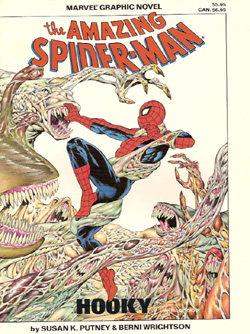
Amazing Spider-Man: Hooky

By Susan K Putney & Berni Wrightson (Marvel)
ISBN: 0- 87135-154-4

Marvel’s experiment with graphic novel publishing in the 1980s produced some classy results that the company has seldom come close to repeating since. Both original concepts and their own properties were represented in that initial run and many of the stories still stand out today – or would if they were still in print.

One such is this charming fantasy fable written by Susan K. Putney and painted by comic-book legend Berni Wrightson. Marandi Sjörokker is not the twelve year girl she appears to be. For a start she’s been twelve for over two hundred years, and when she introduces herself by calling Spider-Man “Petey” she reveals how she knew him when he was a toddler and she delivered his Uncle Ben’s newspapers.

And so begins a wild and gently charming other-dimensional romp, full of action and spectacle, as the web-slinger takes a break from his grim and grimy reality to help the permanently adolescent sorceress against the demonic and unstoppable TordenKakerlakk (which I’m reliably informed is Norwegian for Thunder Cockroach). Moreover, this witty, whimsical coming-of-age tale is beautifully and imaginatively illustrated by a master craftsman. A wonderful change-of-pace tale that perfectly displays the versatility of everybody’s favourite wall-crawler – and one long overdue for re-release.

© 1986 Marvel Entertainment Group/Marvel Characters, Inc. All Rights Reserved.

1941 – The Illustrated Story

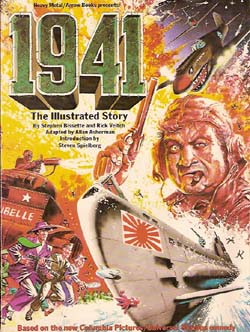
1941 - The Illustrated Story

By Stephen Bissette, Rick Veitch & Allan Asherman (Heavy Metal/Arrow Books)
ISBN: 0- 09922-720-7

It’s not often that I get to review a graphic adaptation that surpasses the source material, but this odd little item certainly does that. I’ll leave it to your personal tastes to determine if that’s because of the comic creators or simply because the movie under fire here wasn’t all that great to begin with…

Written by Robert Zemeckis, Bob Gale and John Milius, 1941 was a big budget screwball comedy starring some of the greatest comedy talents of the day and Steven Spielberg’s blockbuster follow-up to Jaws and Close Encounters of the Third Kind. It did not receive the same accolades and approbation.

The plot, adapted by Allan Asherman, concerns one night in December of that year when Hollywood was panicked by sightings of Japanese planes and submarines. One week after the devastation of Pearl Harbor, much of America, and particularly the West Coast, was terrified of an invasion by the Imperial Forces of Emperor Hirohito.

In this tale one lone sub, borrowed from the Nazis, actually fetches up on the balmy shores of La-La land, but is largely ignored by the populace. The panic actually starts when gormless Zoot-Suiters Wally and Denny use an air-raid siren to distract store patrons and staff so that they can shop-lift new outfits, and peaks later when the feckless wastrels start a fist-fight at a USO (United Services Organisation) Dance. From there chaos and commotion carry this tale to its conclusion.

For the film that isn’t too successful, burdened as it is by leaden direction and a dire lack of spontaneity, but the frenetic energy and mania that was absent on screen is present in overwhelming abundance in the comic art of Steve Bissette and Rick Veitch. Taking their cue from the classic Mad Magazine work of the 1950s, they produced a riot of colour pages for the tie-in album reminiscent of Underground Comix and brimming with extra sight-gags, dripping bad-taste and irony, and combining raw, exciting painted art with collage and found imagery.

It’s not often that I say the story isn’t important in a graphic package, but this is one of those times. 1941 – The Illustrated Story is a visual treat and a fine example of two major creators’ earlier – and certainly more experimental – days. If you get the chance, it’s a wild ride you should take.

© 1979 Universal City Studios, Inc. and Columbia Pictures Industries, Inc.

The Great Walls of Samaris

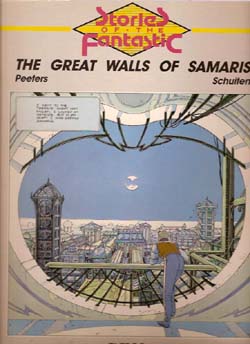
The Great Walls of Samaris

By Benoit Peeters & Francois Schuiten (NBM)
ISBN: 0-918348-36-6 (1987) ISBN: 978-0-918348-36-4 (2001)

The European manner of graphic storytelling places great emphasis on mood and style, with a much larger range of interests and themes than the English language mainstream. It is also, perforce, staggeringly accomplished in its artistic visions.

This brief (48 pages) album, the first in an occasional series entitled Cities of the Fantastic, tells the bleak, fantastic tale of Franz, a young civic official of the city state Xhystos, who accepts a mission to assess the condition of sister city Samaris.

Located far, far away, there has been no communication with the walled metropolis for a decade and all agents dispatched there have vanished with trace. The grim, arduous journey, however, is as nothing compared to the beguiling mystery Franz uncovers when he finally reaches the incredible and seductive city…

Eerie and paranoid, with architecture and design the most important characters in the tale, The Great Walls of Samaris presents a wholly believable world of familiarity and alienation, underscored with an almost Kafkaesque perversity. The aura of menace is palpable, but with only the merest hint of danger. Minds and souls are at risk here, not mere flesh and blood.

The astonishing artwork of Schuiten is entrancing, perfectly capturing – if not actually inventing – the creative anachronism of Steam-punk, but with the glistening veneer of fin de siècle pomp and the foredoomed glitter of the Belle Époque concealing the bitter content with a sheen of fragile beauty.

This is an incredibly stylish, unforgettable visual experience and a damned fine classical horror story, too. Don’t miss out on this glorious delicacy.

©1984 Casterman, Paris-Tournai. All Rights Reserved. English translation ©1987 NBM.

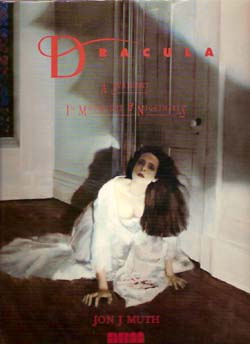
Dracula: A Symphony in Moonlight and Nightmares

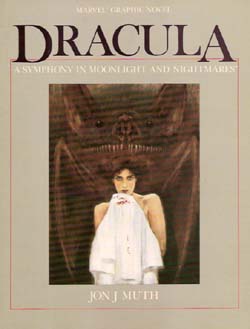
Dracula: A Symphony (Marvel)

By John J Muth (NBM)
ISBN: 1-56163-059-4 (also Marvel Graphic Novel #25; ISBN: 0-87135-171-4)

As part of an adventurous foray into the budding world of graphic albums, the Marvel Graphic Novel line combined experimental projects and storytelling alongside glorified giant comic-books. This trés arty package from illustrator Muth purloins elements of Bram Stoker’s classic novel and reweaves them as framework for a painting tour-de-force of gothic set-pieces and moving, intimate images.

Familiarity with the original’s plot is not essential – if not ill-advised – as mood rather than narrative is favoured here, and the pictures are paramount. Inexplicably, Muth’s narrative mixes first hand accounts from protagonists Lucy Seward and her father, prose and “newspaper excerpts”, with faux film-script pages in this dark tale of bloody obsession.

Dracula: A Symphony (NBM)

For all these problems, it was picked up by Nantier Beall Minoustchine in 1992 and re-issued as a gloriously large and upscale hardcover album (and eventually a paperback edition) which particularly enhanced the extended sections where Muth’s paintings were allowed to carry the story without the distraction of text.

Although this is so much more “Graphic” than “Novel” and not as clever as it seems – all beautiful surface with no depth at all – it is staggeringly pretty, and a delight for any fan with an appreciation of the visual arts.

© 1986, 1992 John J Muth. All Rights Reserved.

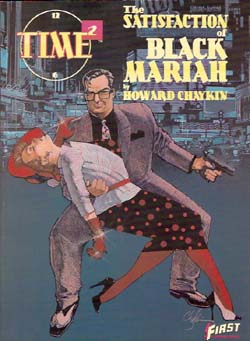
Time2: The Satisfaction of Black Mariah

Time2: The Satisfaction of Black Mariah

By Howard Chaykin, with Ken Bruzenak, John Moore, Richard Ory & Steve Oliffe (First Comics)
ISBN: 0-915419-23-8

The final foray into the fantastic night world of Howard Chaykin’s pan-fascinational universe (OK, I made that term up, but what would you call a place to tell stories in, constructed from an author’s interests, hobbies, artistic influences and bug-bears?) is an even more frenetic riot of Fashion, Jazz, robots, magic, heroism, cynicism and debauchery, delivered with astounding panache in a riot of literally Graphic Bravura.

Time2 is an impossibly engaging concept with a cast of archetypal Chaykin characters, which is welcome enough, but the deceptively easy marriage of style, design and especially Ken Bruzenak’s typography, into classically de-structured stories of a decidedly Noir-ish nature, with layer upon layer of visual information bombarding the viewer is a delight that I cannot imagine any other medium capable of. This is unique and perfect Comic Art.

The Square is a nebulous mystical, nightside place with magic and super-science equally prevalent, populated with narrative icons like gangsters, monsters, robots, zombies, feisty girl-reporters and smooth heroes, plus all the other vital extras and bit-players who populate the most memorable fiction. It is the ultimate arena for adult story-telling, and this particular one concerns the effects of a demon-possessed prostitute, a nymphomaniac police-car that’s assaulting citizens, and a deadly secret kept by corporate powerhouse Rossum’s Universal Robots that threatens to destabilise everything.

Even Bog-Monster Cop Bon Ton MacHoot is laid low leaving reluctant good-guy and oh-so-cool wise-ass Maxim Glory to sort out the mystery of the Oversoul and the Big Conk…

Hopefully that précis has left you baffled and hungry because this is another of those too-rare pieces that you should actually read and not read about. Chaykin has stated that he’s not the same person as the one who produced this and its predecessor Time2: The Epiphany (ISBN: 0-915419-07-6) so the chance of the fabled third volume ever appearing are agonisingly slim, but at least we have these and the prequel (American Flagg! Special) to admire and revel in. Have I mentioned that the entire output would fit perfectly into one average-sized modern trade paperback? Surely some publisher out there can see the commercial sense in that proposition?

Time2: The Satisfaction of Black Mariah; hunt it down and adore it!

© 1987 First Comics, Inc. and Howard Chaykin Inc. All Rights Reserved.

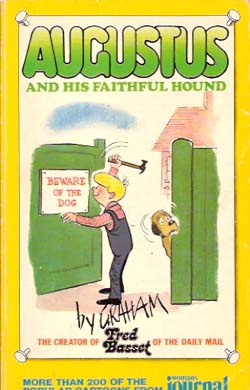
Augustus and His Faithful Hound

Augustus and His Faithful Hound

By Graham (Mirror Books)
ISBN: 0-85939-120-5

Cartoons and gag-panels are a universal medium but we purveyors of sequential narrative have an unhappy tendency to become protective and parochial about our own particular specialism within the medium. How many times have I heard an artist or writer working on a hot new comic-book property, revelling in sales of sixty-to-seventy thousand monthly copies, disparage a strip such as Hagar the Horrible or Garfield whose daily readership can be numbered in millions, if not billions? Let’s all just try to remember that tastes differ, and that we all make lines on a surface here, and most especially that TV and Computer Games are the real enemy of our industry, shall we?

Rant over.

Mainstream cartooning is a huge joy to a vast readership whose needs are quite different from those of hard-core, dedicated comic fans, or even that growing base of intrigued browsers dipping their toes in the sequential narrative pool. Even those stuck-up stickybeaks who have pointedly “never read a comic” have seen and enjoyed cartoon strips or panels, and in this arena Britain has produced more than its share of classics.

Alex Graham, best known for the charming and reassuringly middle-class Fred Bassett strip, was a jobbing cartoonist for nearly fifty years and in that time produced a vast range of work that delighted readers on a wide range of subjects. He died in 1991, and Bassett was continued by his daughter Arran and artist Michael Martin. I’ll save the details for upcoming Fred Bassett reviews.

Augustus and his Faithful Hound is a less well-known strip that appeared in the late 1970’s in The Woman’s Journal, a home-maker’s magazine with a highly specialised demographic. The strip is a perfect fit: the gently amusing and reassuring exploits of a timid young lad and his equally timid, if boisterous, dog. The drawing is highly polished, captivating and charming; the gags undemanding and very reassuring – and that’s just what they’re supposed to be. This was not a venue for sarcasm, slapstick, surrealism or brisk, salacious vulgarity. These were cartoons to make your mum laugh, and as such they are perfect.

I’m sure there’s not much chance of this collection ever being reprinted, but if you chance across a copy, try it before dismissing it. The craft and skill is just as hard-learned as any superhero, fantasy or horror artist’s, the results fitted the brief perfectly and the audience was so very happy with the result. Other than a bigger cheque and global celebrity, what more could a creator possibly want from his labours?

© 1978 Woman’s Journal. All Rights Reserved.

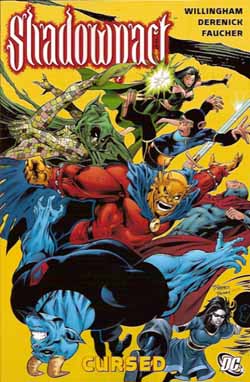
Shadowpact: Cursed

Shadowpact: Cursed

By Bill Willingham & various (DC Comics)
ISBN13: 978-1-84576-738-9

Bill Willingham shows his facility with the fight ‘n’ tights comicbook mainstream in this second collection of DC’s Supernatural Superteam reprinting tales from issues #4 and 9-13 of the monthly magazine. It all starts with ‘Blue Devil: A Night in the Life’, illustrated by Steve Scott and Wayne Faucher which focuses on the private life of the team’s demonic strongman. The action portion is provided by a couple of demons who have been dispatched to bring the hero to an audience in Hell. This tale was originally published as the fourth issue, so any ominous foreshadowing it provided is somewhat lessened, but it certainly makes more narrative sense as a prelude to the next tale.

‘The Demon Triptych’ (issues #9-11, and pencilled by Tom Derenick) finds guest host the Phantom Stranger presiding over a tale as the team goes public and begins to notice some odd behaviour from Blue Devil. In case you’re wondering, as movie stuntman Dan Cassidy he was mystically bonded into an animatronic suit he was wearing. The magic turned him into an actual devil; or so he always believed… He also “sold his soul for fame”…

Wayward Etrigan, however, is the real McCoy, and frankly the ranks of Hell are fed up with him. When they see a chance to replace him with Cassidy they take it, forcing his team-mates to invade the Infernal Realm to get him back. In the course of the mission tactical leader Nightmaster is impaled with his own magic blade, and the next tale ‘Live by the Sword, Die by the Sword’ (# 12, with art by Derenick and Faucher) is a highly enjoyable deathbed review of his origin and career.

The book concludes with ‘Bad Tidings & Evil Deeds’, illustrated by Scott Hampton, wherein ex-Justice Leaguer and actual Angel Zauriel is ordered by his celestial superiors to destroy Cassidy, but that confrontation is left for the next volume in this stylish appetite-whetter, which is just a nicer way of saying this volume ends on a bit of a cliffhanger…

Enjoyable, light-hearted and highly addictive, just like its predecessor (Shadowpact: The Pentacle Plot – ISBN: 1-84576-533-8) this is a very accessible book for newcomers and the balance of humour, drama and action is superb. Great as a gift and one you’ll be tempted to keep for yourself.

© 2006, 2007 DC Comics. All Rights Reserved.
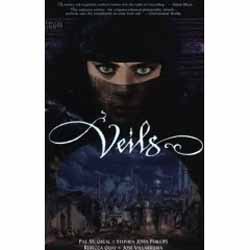
Veils

Veils

By Pat McGreal, Stephen John Phillips, José Villarrubia & Rebecca Guay (Vertigo)
Hardback ISBN: 1-56389-752-0 Softcover ISBN: 978-1-56389-561-6

Although at first glance more exercise than exposition, this undemanding and potentially prurient tale of the Seductive East is a very readable exercise in genre fiction. Victorian gentlewoman Vivian Pearse-Packard was late in marrying, and her husband is a ne’er-do-well wastrel. Her father-in-law has brought them with him as he resumes his post as British Consul to a Far Eastern Sultanate.

The new and exotic land is shocking to Vivian, and husband Harry remains a possessive and loveless beast, but her life changes when a visit to the Sultan’s Seraglio leads to a friendship with one of the ruler’s Odalisques. Vivian’s need for companionship draws her into the luxurious world but she becomes subtly aware of a hidden agenda among some of the women when she is told the ancient tale of Rosalind, a white woman who was stolen from her father and given to a Sultan, only to rise to be the second most powerful position in the land.

How the fable impacts on the increasingly desperate and repressed Englishwoman, and the choices she is subsequently compelled to make in her own life, provide a predictable but enjoyable new spin on a very clichéd plot. Moreover the combination of Phillips stagy yet compelling photography, augmented by Villarrubia’s digital enhancement, imbues the tale with a static theatrical quality that verges on abstraction in places. Rebecca Guay provides classic pen-and-watercolour art for the sections involving Rosalind’s story, which imparts the strangest inversion as her contribution is warm, sensitive, deeply alive and approachable in contrast to the cold, distant and passionless fumetti.

All that aside, this is a worthy effort to escape the traditional boundaries of our medium and serves well as a bridge to the wider public.

© 2001 Pat McGreal, Stephen John Phillips & Rebecca Guay. All Rights Reserved.

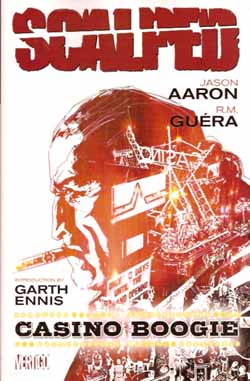
Scalped, Volume 2: Casino Boogie

Scalped, Volume 2: Casino Boogie

By Jason Aaron & R.M. Guéra (Vertigo)
ISBN: 978-1-84576-840-X

The increasingly impressive writing of Jason Aaron kicks into compellingly high gear in the second collection (issues #6-11) of the dark and nasty crime series from Vertigo. It’s set on the Prairie Rose Indian Reservation, a desolate hellhole run by gangsters and housing nothing but damaged and broken people. The biggest boss is Lincoln Red Crow, an Indian Rights activist from the 1970s who runs all the rackets and is now launching his own casino. Everybody thinks they’re going to be rich.

Dashiel Bad Horse ran away when he was fifteen. He was always trouble, even as just the son of Red Crow’s fellow militant Gina, but now he’s back and working as a sheriff and leg-breaker for the big boss. Gina is the last real rebel, and Red Crow is as much an oppressor as the White Man ever was. How would she react if she knew that her son is working for both of the forces she sees as destroying her people? It’s a good thing no one knows Dash Bad Horse is an undercover FBI agent (see Scalped vol.1 Indian Country, ISBN: 1-84576-561-3). But is it still a secret?

Moving beyond gripping Noir drama with the introduction of the shaman called Catcher, the saga moves into even more convoluted plots and schemes. As Red Crow’s plans near fruition he stands to win or lose everything. Is Catcher just another booze-raddled Indian or does he really see Visions? Can Red Crow really accept the White’s way of Sex, Power and Money, or is he as tied to his roots as even the poorest, dumbest dirt-grubber on the Rez?

Complex, atmospheric and disturbingly graphic in execution, this is a thriller with a powerful social message underpinning the action and drama, and simply goes from strength to strength. This is one of the best adult comic series being produced today and one you should see for yourselves.

© 2007 Jason Aaron & Rajko Milosevich. All Rights Reserved.

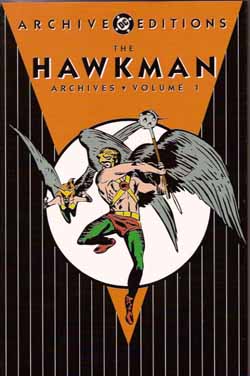
DC Archive: Hawkman

DC Archive: Hawkman

By Gardner Fox, Joe Kubert, Murphy Anderson & Carmine Infantino (DC Comics)
ISBN: 1-56389-611-7

With the superhero revival in full swing by 1961, Julius Schwartz turned to reviving one of DC’s most visually arresting and iconic Golden Age characters. Once again eschewing mysticism for science fiction (the original Hawkman was a reincarnated Egyptian prince murdered by a villainous priest), with scripter Gardner Fox and artist Joe Kubert he built a new hero for the Space Age.

Katar Hol and his wife Shayera are police officers on their own planet of Thanagar. They’ve travelled to Earth from the star system Polaris in pursuit of a spree-thief named Byth who has assaulted a scientist and stolen a drug that gives the user the ability to change into anything. ‘Creature of a Thousand Shapes’ appeared in The Brave and the Bold #34 (cover-dated February-March 1961) and is a spectacular work of graphic magic, the otherworldly nature of the premise rendered captivatingly human by the passionate, moody expressiveness of Kubert’s art. It is a minor masterpiece of comic storytelling.

The high-flying heroes returned in the next issue, stationed on Earth to study Terran police methods. In ‘Menace of the Matter Master’ they defeat a plundering scientist who has discovered a means to control elements, whilst ‘Valley of Vanishing Men’ takes them to the Himalayas to discover the secret of the Abominable Snowmen. B&B #36 saw them defeat a modern day wizard in ‘Strange Spells of the Sorcerer’ and save the world from another Ice Age whilst defeating ‘The Shadow Thief of Midway City’.

With the three-issue try-out finished the publishers sat back and waited for the fan letters and sales figures. And something odd happened. Fans were vocal and enthusiastic, but the huge sales figures just weren’t there. It was inexplicable. The quality of the work was plain to see on every page but somehow not enough people had plunked down their dimes to justify starting a Hawkman series.

A year later they tried again. The Brave and the Bold #42 (cover-dated June-July 1962) featured ‘The Menace of the Dragonfly Raiders’ and found Katar and Shayera returning to Thanagar just in time to encounter a bizarre band of alien thieves. Here was superhero action in a fabulous alien locale and the next issue maintained the exoticism – at least initially – before Hawkman and Hawkgirl returned to Midway City to defeat a threat to both worlds – ‘The Masked Marauders of Earth’. One last B&B issue followed (#44, October-November 1962), with two splendid short tales ‘Earth’s Impossible Day’ and the eerie doomsday adventure ‘The Men who Moved the World’, and then the Hawks vanished again. It certainly looked like this time the magic had faltered.

I’m a very picky cove, me, and the smallest thing can make a big difference to my reading pleasure. I’m also a huge fan of the DC Archive series, and think it’s a fine and fitting way to preserve and promote all the wonderful material created over the years. That being said, there’s a vast nostalgia component involved in re-experiencing old stories, and sometimes odd things strike you.

In 1989, when DC was first testing out the trade collection market, the six Fox/Kubert Hawkman issues were an obvious choice for packaging. Standard-sized, laminated card-covers and heavy, newsprint paper stock was used rather than the thin glossy paper used in modern Archive hardbacks. I’m looking at both now and I have to say that the colour in the old paperback just looks more appetizing, more “correct,” than the slick hues of the more expensive edition. If you are a grizzled old Fa… traditionalist like me you might want to see if you can track down Hawkman, ISBN: 0-930289-42-0.

What that old book doesn’t have, however, is the end of the saga. Convinced he was right Schwartz retrenched and in 1963 Hawkman returned! Again! Mystery in Space had been the home of Adam Strange since issue #53 (see DC Archive: Adam Strange vol. 1, ISBN: 1-4012-0148-2) and with #87 (November 1963) Schwartz moved the Winged Wonders into the back-up slot. Still written by Fox, Kubert’s moody art had been replaced with the clean, airy linework of Murphy Anderson. ‘The Amazing Thefts of the I.Q. Gang!’ was followed a month later by ‘Topsy-Turvy Day in Midway City!‘, and ‘Super-Motorized Menace!‘ the month after that.

These were brief, engaging action pieces but issue #90 was a full length story teaming the Hawks and Adam Strange in a classic end-of the-World(s) epic. ‘Planets in Peril!’, illustrated by Carmine Infantino and Murphy Anderson and the final tale in this Archive edition, was also the last Hawkman back-up. From the next month, and after three years of trying, Hawkman would star in his own title.

Comics are a funny business, circumstances, tastes and fashions often mean that wonderful works are missed and unappreciated. Don’t make the same mistake that readers did in the 1960s. Read these astounding adventures and become a fan. It’s never too late.

© 1961-1964, 2000 DC Comics. All Rights Reserved.