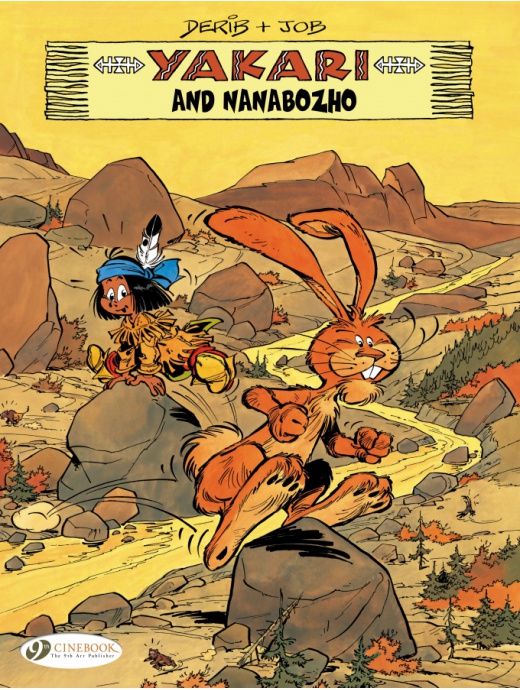
Yakari and the Beavers


By Derib & Job, translated by Erica Jeffrey (Cinebook)
ISBN: 978-1-905460-09-0 (Album PB)

Children’s magazine Le Crapaud à lunettes was founded in 1964 by Swiss journalist André Jobin who then wrote for it under the pseudonym Job. Three years later he hired fellow French-Swiss artist Claude de Ribaupierre AKA “Derib”. The illustrator had launched his own career as an assistant at Studio Peyo (home of Les Schtroumpfs/The Smurfs), working on strips for venerable weekly Le Journal de Spirou.

Together at Le Crapaud à lunettes, Derib & Job created the splendid Adventures of the Owl Pythagore before striking pure comics gold a few years later with their follow-up collaboration.

Derib – equally au fait with enticing, comically dynamic “Marcinelle” cartoon style yarns and devastatingly compelling meta-realistic action illustrated action epics – went on to become one of the Continent’s most prolific and revered creators. It’s a crime that groundbreaking strips such as Celui-qui-est-né-deux-fois; Jo (the first comic ever published dealing with AIDS); Pour toi, Sandra and La Grande Saga Indienne) haven’t been translated into English yet, but we still patiently wait in hope and anticipation…

Many of Derib’s stunning works over the decades feature his cherished Western themes; magnificent geographical backdrops and epic landscapes. Yakari is considered by fans and critics to be the strip which first led him to deserved mega-stardom.

Debuting in 1969, Yakari follows the life of a young Oglala Lakota boy on the Great Plains; set sometime after the introduction of horses by the Conquistadores but before the coming of modern Europeans.

The series – which has generated two separate TV cartoon series and a movie release – has achieved 40 albums: a testament to the strip’s evergreen vitality and brilliance of its creators, even though originator Job has moved on and Frenchman Joris Chamblain assumed the writer’s role in 2016.

Overflowing with gentle whimsy and heady compassion, young Yakari enjoys a largely bucolic existence: at one with nature and generally free from privation or strife. For the sake of our delectation, however, the ever-changing seasons are punctuated with the odd crisis, generally resolved without fuss, fame or fanfare by a little lad who is smart, brave… and can – thanks to the boon of his totem guide the Great Eagle – converse with all animals…

Published in 1977, Yakari chez les castors became the third European album, released as the strip grew in prominence and popularity. A year after, the feature began running in Le Journal de Tintin, subsequently spawning two animated TV series (1983 and 2005), all the usual merchandising spin-offs and achieving monumental global sales in 17 languages to date.

Yakari and the Beavers opens in summer as the nomadic Sioux make camp at a confluence of rivers. The children are playing, testing their strength, speed and archery skills, but with burly Buffalo Seed winning most of the honours – and the fascinated attention of pretty Rainbow – physically less-developed Yakari soon slopes off to cavort with his faithful and forthright pony Little Thunder.

As they romp and swim in the river, they encounter a strange wooden construction ranging from bank to bank and unexpectedly arouse the ire of an excitable beaver named Thousand Mouths. He is the impatient and irascible foreman of a band of buck-toothed brethren, determined to finish the family home in record time, but his fellows are far less enthusiastic…

When one – Linden Tree – spots the palomino, it starts a stampede of rodents who would all rather ride horses than chew timber and move mud. Soon, while they’re all goofing around, their boss is going ballistic and a wise old beaver is teaching a rapt Yakari everything he needs to know about dam-building…

After more idle days in camp, Yakari’s thoughts return to the beavers. Before long he and Little Thunder are heading back to the dam, but are distracted by an astonishing noise. Tracing it, they discover extremely ambitious beaver Double-Toothfar from the river, attempting to chew down a colossal tree all alone…

This eager beaver confides his dreams of being a sculptor, but their conversation is curtailed when a bad-tempered grizzly bear wanders up, menacing little straggler Wild Rose. With the ursine interloper clearly not amenable to reason, Yakari drives the surly brute off with a rough-hewn jousting lance rapidly gnawed into shape by Double-Tooth’s flashing gnashers…

On escorting the kits back to the river, Yakari is astounded to see the progress made in the wood-and-mud abode and delighted to be asked to help. In actual fact most of the assistance comes from hard-pressed Little Thunder who reluctantly becomes the engine transporting trees and saplings from the woods to the river…

Returning late to camp, Yakari is observed by Rainbow who wants to know what her friend is up to. Next morning, she invites herself along as they return to the Beaver Lodge and cannot understand why, in the midst of listening to the hairy toilers chattering, Yakari spurs his pony away and races away.

Mounted behind him she listens incredulously as the boy explains that little Linden Tree is missing and then makes him backtrack to the really important bit. Yakari understands and can talk to all birds and beasts…

Racing downriver the children are soon joined by Yakari’s totem animal, sagacious Great Eagle, who provides a telling clue to the lost beaver’s whereabouts. However, after daring subterranean depths, the little brave eventually finds his lost friend but is himself trapped. Happily, the artistic skills of late-arriving Double-Tooth prove invaluable in devising a climbing device and soon everybody – even utterly bemused Rainbow – are all celebrating back at the Lodge.

With things back to normal the irrepressible, frustrated artist corners Yakari for one last secret project. Some days later, the busy beavers are stunned to see Double-Tooth’s river-borne aesthetic magnum opus poled into the lee of the dam by the proud Yakari…

The exploits of the valiant little brave who can speak with animals and enjoys a unique place in an exotic world is a decades-long celebration of joyously gentle, moving and inexpressibly entertaining adventures honouring and eulogising an iconic culture with grace, wit, wonder and especially humour.

These gentle sagas are lost treasures of kids’ comics literature and Yakari is a series no fan of graphic entertainment should be without.
Original edition © 1977 Le Lombard/Dargaud by Derib + Job. English translation 2005 © Cinebook Ltd.

Spider-Man/Iron Man: Marvel Team-Up


By Gerry Conway, Bill Mantlo, Tony Isabella, Len Wein, Herb Trimpe, David Michelinie, Ross Andru, Jim Mooney, Sal Buscema, Greg LaRocque & various (DC Comics)
ISBN: 978-1-3029-1368-7 (TPB)

The concept of team-ups – an established star pairing or battling (usually both) with new or less well-selling company characters – has been with us since the earliest days of comics, but making the temporary alliance a key selling point really took hold with DC’s The Brave and the Bold before being taken up by their biggest competitor.

Marvel Team-Up was the second regular Spider-Man title, launching at the end of 1971. It went from strength to strength, proving the time had finally come for expansion and offering regular venue for uncomplicated action romps in addition to the House of Ideas’ complex sub-plot fare. However, even in the infinite Marvel Multiverse, certain stars shine more brightly than others and some characters turn up in team-ups more often than others…

In recent years, carefully curated themed collections from the back-catalogue have served to initiate new readers intrigued by Marvel’s Movie and TV endeavours, and this engaging trade paperback/eBook compilation gathers a selection of pairings co-starring Golden Avenger Iron Man and the wondrous wallcrawler, taken from Marvel Team-Up #9-11; 48-51; 72, 100 and 145: collectively covering May 1973 – September 1984.

It begins with a time-twisting three-part saga that exposes ‘The Tomorrow War!’ (by Gerry Conway, Ross Andru & Frank Bolle) as Iron Man and Spidey are abducted by Zarkko the Tomorrow Man to battle rival chronal creep Kang the Conqueror. The Human Torch got involved to help deal with the intermediate threat of a literal ‘Time Bomb!’ in #10 (with art by Jim Mooney & Frank Giacoia), before the entire Inhuman race led by king Black Bolt pile in to help the webslinger stop history unravelling in culminatory clash ‘The Doomsday Gambit!’ – this last chapter scripted by Len Wein over Conway’s plot for Mooney & Mike Esposito to illustrate.

The steel shod centurion next appeared in MTU #29 beside the Torch, but his next Spider-Man collaboration didn’t happen until #48 and the beginning of a suspenseful extended saga. ‘Enter: The Wraith!’ (Bill Mantlo, Sal Buscema & Esposito) introduces feisty, stylish and fiercely independent Police Captain Jean DeWolff as Spidey and Iron Man struggle to stop a mad bomber using model planes to destroy city landmarks and Stark International properties. As the heroes fruitlessly pursue leads, the enigmatic Wraith turns his attention upon them, proving to be not only connected to Jean but also some kind of psionic metahuman…

With Iron Man again the headline guest-star, issue #49 reveals that ‘Madness is All in the Mind!’ The masked maniac intensifies his irresistible psychic assaults: explosively attacking Manhattan even as the tragic story of Jean’s Police Commissioner dad and murdered cop brother comes out…

However, the connection between them and the unstoppable villain is only exposed after the webslinger and Golden Avenger recruit Master of Mystic Arts Doctor Strange who applies his unique gifts to the problem in #50’s ‘The Mystery of the Wraith!’

The saga concludes with Marvel Team-Up #51 and ‘The Trial of the Wraith!’: a legal drama and character confrontation steered by a most unusual panel of judges whose hidden abilities are not enough to prevent one last assault by the unrepentant renegade…

DeWolff features heavily in the Wraith’s demented revenge plot ‘Crack of the Whip!’ (#72; August 1978 by Mantlo & Mooney) which sees the superheroes battling Maggia stooges and assassin Whiplash whilst MTU #110 (October 1981) pitted Stark-tech and web-shooters against tectonic terror deep under the earth. Herb Trimpe plotted and pencilled breakdowns, with David Micheline scripting and Esposito inking the blistering ‘Magma Force’…

Closing the team tussles, MTU #145 (September 1984, by Tony Isabella, Greg LaRocque & Esposito) delivers ‘Hometown Boy’: coming from the period when Tony Stark first succumbed to alcoholism. He lost everything, and his friend and bodyguard Jim Rhodes took over the role and duties of Golden Avenger. As Stark tried to make good with a new start-up company, this engaging yarn sees the substitute hero still finding his ferrous feet whilst battling oft-failed assassin Blacklash (formerly Whiplash) and at a trade fair in Cleveland, as much hindered as helped by visiting hero Spider-Man who was currently wearing the black symbiote costume that would become the terrifying antihero Venom…

The book’s bonus section begins with original art from Andru, Mooney, Sal Buscema and inkers Bolle, Giacoia & Esposito plus cover-art from earlier collections courtesy of John Romita Sr., John Byrne, Bob Layton, Jeff Aclin & Al Milgrom.

These stories are admittedly of variable quality, but all stem from an honest drive to entertain and most fans will find little to complain about. Although primarily a tome for casual or new readers – who will have a blast – there’s also a ton of nostalgic delights and patented Marvel mayhem to be had by veteran viewers, and surely that’s reason enough to add this titanic tome to your library…
© 2018 Marvel Characters, Inc. All rights reserved.

X-Men Epic Collection volume 7: 1980-1981 – The Fate of the Phoenix


By Chris Claremont & John Byrne, Jo Duffy, Scott Edelman, John Romita Jr., Ken Landgraf, Brent Anderson & various (Marvel)
ISBN: 978-1-3029-2253-5 (TPB)

In autumn 1963, The X-Men #1 introduced Scott (Cyclops) Summers, Bobby (Iceman) Drake, Warren (Angel) Worthington, Jean (Marvel Girl) Grey and Hank (The Beast) McCoy: unique students of Professor Charles Xavier. Their teacher was a wheelchair-bound telepath dedicated to brokering peace and integration between the masses of humanity and the emergent off-shoot race of mutants dubbed Homo superior; considered by many who knew him as a living saint.

After almost eight years of eccentrically spectacular adventures the mutant misfits virtually disappeared at the beginning of 1970, during another periodic downturn in superhero comics sales. Just as in the 1940s, mystery men faded away as supernatural mysteries and traditional genres dominated the world’s entertainment fields. The title returned at year’s end as a reprint vehicle, and the missing mutants were reduced to guest-stars and bit-players throughout the Marvel universe. The Beast was refashioned as a monster fit for the global uptick in scary stories.

Everything changed in 1975 when Len Wein & Dave Cockrum revived and reordered the Mutant mystique with a brand-new team in Giant Size X-Men #1. To old foes-turned-friends Banshee and Sunfire were added one-shot Hulk hunter Wolverine, and new creations Kurt Wagner, a demonic German teleporter codenamed Nightcrawler; African weather “goddess” Ororo Monroe – AKA Storm; Russian farmboy Peter Rasputin, who transformed at will into a living steel Colossus and bitter, disillusioned Apache superman John Proudstar who was groomed into joining the makeshift squad as Thunderbird.

The revision was an instant hit, with Wein’s editorial assistant Chris Claremont writing the series from the second story onwards. The Uncanny X-Men reclaimed their own comic book with #94, and it quickly became the company’s most popular – and highest quality – title.

After Thunderbird became the team’s first fatality, the survivors slowly bonded, becoming an infallible fighting unit under the brusque and draconian supervision of Cyclops. Cockrum was succeeded by John Byrne and as the team roster changed the series rose to even greater heights.

This comprehensive compilation (available in trade paperback and eBook editions) is perfect for newbies, neophytes and even old lags nervous about reading such splendid yarns on fragile but extremely valuable newsprint paper. It celebrates the absolute peak of Claremont & Byrne’s collaborative synergy (with regular inker Terry Austin very much a part of the magical experience) as the mutants confirmed their unstoppable march to market dominance through groundbreaking, high-quality stories: specifically issues #129-143 of the decidedly “All-New, All-Different” – (latterly re-renamed “Uncanny”) X-Men; Annual #4, vignettes from Marvel Treasury Edition #26-27 and material from Marvel Team-Up #100, spanning January 1980 to March 1981. Also included are chronologically askew additional treats from Phoenix: The Untold Story #1 (April 1984).

Having saved Edinburgh and perhaps the world from reality-warping Proteus, Uncanny X-Men #129 sees another happy reunion as the heroes (all but the now retired Banshee) find Charles Xavier awaiting them when they reach their Westchester home in ‘God Spare the Child…’.

Thanks to sinister psionic predator Jason Wyngarde, Jean is increasingly slipping into visions of a former life as a spoiled, cruel child of privilege, contrasting sharply with her renewed love for Scott, but the home atmosphere is troubled by another discordant factor. Xavier is intent on resuming training the team, haughtily oblivious that this group are grizzled, seasoned veterans of combat, rather than the callow teenagers he first tutored.

Elsewhere, a cabal of mutants and millionaires plot murder and conquest. Black King Sebastian Shaw, White Queen Emma Frost and the rest of the Hellfire Club hierarchy know Wyngarde is an ambitious and presumptuous upstart, but the possibility of subverting the almighty Phoenix to their world-dominating agenda is irresistible…

When two new mutants manifest, Xavier splits the team to contact both, taking Storm, Wolverine and Colossus to Chicago and meeting the nervous parents of naive 13-year- old Kitty Pryde who has just realised that, along with all the other problems of puberty, she now falls through floors and walks through walls…

However, no sooner does the Professor offer to admit enrol her in his select and prestigious private school than they are all attacked by war-suited mercenaries and shipped by Emma Frost to the Hellfire Club. Only Kitty escapes, but instead of running, she stows away on the transport; terrified but intent on saving the day…

The other Homo Superior neophyte debuts in #130 as Cyclops, Phoenix and Nightcrawler head to Manhattan’s club district, tracking a disco singer dubbed ‘Dazzler’. They are unaware that they too have been targeted for capture…

However, Kitty’s attempts to free the captives at the Hellfire base forces the villains to tip their hand early and with the assistance of Dazzler Alison Blair – a musical mutant who converts sound to devastating light effects – the second mercenary capture team is defeated…

The drama concludes in #131 as Kitty is forced to frantically ‘Run for Your Life!’ – happily, straight into the arms of the remaining X-Men. Soon the plucky lass – after an understandable period of terror, confusion and kvetching – leads a strike on the lair of the White Queen: freeing Wolverine, Colossus and Xavier as Frost faces off in a deadly psionic showdown with a Phoenix far less kind and caring than ever before…

The war with the plutocratic Hellfire Club resumes in #132 as ‘And Hellfire is their Name!’ brings The Angel back into the fold. Their foes are in actuality a centuries-old association of the world’s most powerful and wealthy individuals, and Warren Worthington’s family have been members in good standing for generations. What better way of infiltrating the organisation than with someone already deep on the ultra-privileged inside?

As Wolverine and Nightcrawler scurry through sewers beneath the society’s palatial New York mansion, Warren inveigles the others in through the grand front doors, attending the year’s swankiest soiree whilst he and the Professor await events…

It’s a bold but pointless move. Although the rank and file are simply spoiled rich folk, there is an Inner Circle led by mutant supremo Sebastian Shaw comprising some of Earth’s most dangerous men and women who have been waiting and watching for the mutants-in-mufti’s countermove…

As soon as the heroes are inside, Wyngarde strikes, pushing Jean Grey until she retreats into to a manufactured persona he has woven over months to awaken her darkest desires. With the Phoenix’s overwhelming power added to the Inner Circle’s might, former friends quickly fall before the attack of super-strong Shaw and cyborg human Donald Pierce. Even Wolverine is beaten, smashed through the floor to his doom by mass-manipulating mutant Harry Leland…

As the Inner Circle gloat, Cyclops – connected to Jean by a psionic rapport – sees the world through his lover’s corrupted, beguiled eyes and despairs. However, when Wyngarde – exposed as illusion caster Mastermind – apparently stabs Cyclops, the effect on “his” Black Queen is far from anticipated…

Far below their feet, a body stirs. Battered but unbowed, ‘Wolverine: Alone!’ begins to work his ruthless, relentless way through the Club’s hired minions. His explosive entrance in #134’s ‘Too Late, the Heroes!’ gives the captive heroes a chance to break free and strike back, soundly thrashing the Hellfire blackguards. Sadly for Mastermind, not all his tampering has been expunged, and when Jean catches him, his fate is ghastly beyond imagining…

As the mutants make their escape the situation escalates to crisis level. Months of mind-manipulation finally unleash all Jean’s most selfish, self-serving desires and she shatteringly transforms into ‘Dark Phoenix’…

Manifested as a god without qualm or conscience, Jean attacks her comrades before vanishing into space. In a distant system, and feeling depleted, she casually consumes the local sun, indifferent to the entire civilisation that dies upon the planet circling it. Passing the D’Bari system is a vast and powerful ship of the Shi’ar fleet. Rushing to aid the already extinct world, they are merely a postprandial palate cleanser for the voracious Phoenix…

Uncanny X-Men #136 opens with horrified Shi’ar Empress Lilandra mobilising her entire military machine and heading for Earth, determined to end the threat of the ‘Child of Light and Darkness!’ On that beleaguered world, Cyclops has called on the Beast to build a psychic scrambler to disrupt Jean’s immeasurable psionic might, but when she cataclysmically reappears to trounce the team, the device burns out in seconds.

Jean’s gentler persona erratically appears, begging her friends to kill her before she loses control, but Dark Phoenix is close to destroying Earth before – in a cataclysmic psychic duel – Xavier shuts down her powers and establishes mental circuit breakers to prevent her ever going rogue again. With Jean left as little more than mind-maimed human, the exhausted heroes suddenly vanish in a flash of light…

The epic concludes in X-Men #137 as the outraged and terrified Shi’ar arrive in orbit to settle ‘The Fate of the Phoenix!’ With observers from the Kree and Skrull empires in attendance, Lilandra has come to exact justice and prevent the Phoenix from ever rising again. She is not prepared to accept her fiancé Charles Xavier’s word that the threat is already ended…

Summary execution is only avoided when Xavier invokes an ancient rite compelling Lilandra to instigate trial-by-combat. Relocating to the enigmatic Blue Area of the Moon (with its artificial pocket of breathable atmosphere) the mutants engage in all-out war with a brigade of cosmic champions – the Shi’ar Imperial Guard (an in-joke version of DC’s Legion of Super Heroes). However, despite their greatest efforts, the mutants are pushed to the brink of defeat.

With collapse imminent and her friends doomed, Jean’s psychic shackles slip and the Phoenix breaks free. Horrified at what will inevitably happen, Jean allows herself to be killed to save the universe…

Days later on Earth, the X-Men mourn her passing in #138’s ‘Elegy’ as Cyclops recalls his life with the valiant woman he loved so deeply – and we get a comprehensive recap of the mutant team’s career to date. Heartbroken, the quintessential X-Man resigns just as Kitty Pryde moves in…

Breaking from the monthly run, X-Men Annual #4 then describes ‘Nightcrawler’s Inferno!’ (by Claremont, John Romita Jr.& Bob McLeod) with Doctor Strange called in after Kurt Wagner is targeted by a demonic Lord of Limbo and uncovers a secret family connection to uber-witch Margali Szardos…

A new day dawns in issue #139’s ‘…Something Wicked This Way Comes!’ as the Angel returns just in time to see Nightcrawler join Wolverine in heading north for a reconciliation with the Canadian’s previous team, Alpha Flight. The visit turns into a hunt for carnivorous magical monster Wendigo, culminating in a brutal battle and an increasingly rare clean win in #140’s concluding chapter ‘Rage!’

An evocative and extended subplot opens which would dictate the shape of mutant history for years to come follows as ‘Days of Future Past’ depicts an imminently approaching dystopian apocalypse wherein almost all mutants, paranormals and superheroes have been eradicated by Federally-controlled Sentinel robots. These mechanoids rule over a shattered world on the edge of utter annihilation. New York is a charnel pit with most surviving superhumans kept in concentration camps and only a precious few free to fight a losing war of resistance.

In this dark tomorrow, aging Katherine Pryde is the lynchpin of a desperate plan to unmake history. With the aid of telepath named Rachel (eventually to escape that time-line and become a new Phoenix), Pryde swaps consciousness with her younger self in a last-ditch attempt to prevent the pivotal event which created the bleak existence where all her remaining friends and comrades are being pitilessly exterminated, one by resolute one…

‘Mind Out of Time’ sees the mature Pryde in our era, inhabiting her own 13-year-old body and leading disbelieving team-mates on a frantic mission to foil the assassination of US senator David Kelly on prime-time TV by a sinister new iteration of the Brotherhood of Evil Mutants – super-terrorists determined to make a very public example of the human politician attacking the cause of Mutant Rights…

Rocket-paced, action-packed, spectacularly multi-layered, bitterly tragic and agonisingly inconclusive – as all such time-travel tales should be – this cunning, compact yarn is one of the best individual tales of the Claremont/Byrne era, resetting the mood, tone and agenda for all the following decades of mutant mayhem…

With the timeline restored and tragedy averted, things slow down at the X-Mansion, but in the real world, John Byrne had left for pastures new. His swan song in #143 is a bombastic romp which finds lonely, homesick Kitty home alone at Christmas… except for a lone N’garai ‘Demon’ determined to eat her. Her solo trial decimates the X-Men citadel and proves once and for all that she has what it takes…

An era might have ended but mutant life goes on, as seen here in a brace of short stories taken from tabloids Marvel Treasury Edition #26 and 27.

The first is a light-hearted clash between off-duty, grouchy Logan and fun-loving, girl-chasing godling Hercules inadvertently gracing the same bar ‘At the Sign of the Lion’ (by Mary Jo Duffy, Ken Landgraf and a young George Pérez), proving exactly why most pubs reserve the right to refuse admission…

It’s accompanied by The Avenging Angel taking a ‘Joyride into Jeopardy’ courtesy of Scott Edelman, Brent Anderson & Bob McLeod before being attacked by a vengeance-crazed killer seeking payback for the sins of his father…

An intriguing safari into the unknown comes next: the untold story of how Storm and Black Panther T’Challa first met as kids in the wilds of Africa. By Claremont, Byrne & McLeod, it originated as a back-up in Marvel Team-Up #100, cunningly revealing how the kids enjoyed an idyllic time on the veldt (reminiscent of Henry De Vere Stacpoole’s 1908 novel The Blue Lagoon) until a South African commando team tried to kidnap the Wakandan prince for a bargaining chip.

Now, as adults in America they are hunted by the vicious Afrikaner Andreas de Ruyter who has returned, seeking to assassinate Ororo before exacting final revenge upon the Black Panther. Cue long-delayed lover’s reunion and team-raid on an automated House of Horrors…

Wrapping up the mutant mayhem are a selection of snippets retroactively crafted for this period of X-history. The first is a marketing oddity of the period. Phoenix: The Untold Story was released in 1984 and reprinted X-Men #137… mostly…

By all accounts, that epic conclusion was originally completed with a different ending and Jean Grey surviving the battle against the Shi’ar. That was before then Editor-in-Chief Jim Shooter overruled the outcome, decreeing she should die for her sins. You can judge the merits of the decision for yourself from the alternate version delivered here.

Also included are Jim Salicrup’s editorial ‘She’s Dead, Jim!’: ‘The Dark Phoenix Tapes – a candid conversation between Byrne, Shooter and Claremont’ on the contentious issue.

More extras include a wealth of original art pages, unseen pencils, house ads, pin-ups, lost and spoof covers; character sketches; the pertinent entry from 1981’s Marvel Comics 20th Anniversary Calendar and images from Marvel Super Hero Portfolio: The Uncanny X-Men with 4 original Byrne drawings remastered by painters Steve Fastner & Rich Larson and monochrome plates from Éditions Déese 1993 World’s Finest Comic Book Artists Portfolio by John Byrne. There’s also a gallery of X-Men collection covers by Byrne, Salvador Larroca, Bill Sienkiewicz and others.

For many fans these tales comprise the definitive X-Men. Rightly ranking amongst some of the greatest stories Marvel ever published, they remain thrilling, groundbreaking and painfully intoxicating: an invaluable grounding in contemporary fights ‘n’ tights fiction no fan or casual reader can afford to ignore.
© 2021 MARVEL

Black Panther Marvel Masterworks volume 3


By Peter B. Gillis, Don McGregor, Gene Colan, Denys Cowan, Tom Palmer & various (Marvel)
ISBN: 978-1-3029-2869-8 (HB)

Lauded as the first black superhero in American comics and one of the first to carry his own series, the Black Panther‘s popularity and fortunes have waxed and waned since the 1960s when he first attacked the FF (in Fantastic Four #52; cover-dated July 1966) as part of an elaborate plan to gain vengeance on the murderer of his father. Happy 55thAnniversary, guys!

T’Challa, son of T’Chaka was revealed as an African monarch whose hidden kingdom was the only source of a vibration-absorbing alien metal upon which the country’s immense wealth was founded. Those mineral riches – derived from a fallen meteor which struck the continent in primeval antiquity – had powered his country’s transformation into a technological wonderland. That tribal wealth had long been guarded by a hereditary feline-garbed champion deriving physical advantages from secret ceremonies and a mysterious heart-shaped herb that ensured the generational dominance of the nation’s warrior Panther Cult.

Peter Gillis’ Introduction ‘Travels with T’Challa’ details the long journey to publication for the original deeply-politicised anti-apartheid yarn and is followed by ‘To Follow the track of The Great Cat with renewed wonder on his Panther’s Quest (From “Panther’s Rage” to “Panther’s Prey”)’: a typically effulgent and informative Introduction from venerable author McGregor detailing his own lengthy association with “The Great Cat” and the landmark saga re-presented here…

Collected in this sterling hardback and digital collection is a much-delayed miniseries conceived and mostly crafted in 1984 but only completed and released between July to October 1988, as well as the astounding serial from fortnightly anthology Marvel Comics Presents # 13-37 running (February to December 1989).

As the 1980s closed, the Panther made a dynamic comeback after years of absence and occasional cameos, courtesy of writer Peter B. Gillis and illustrators Denys Cowan & Sam DeLarosa…

The Black Panthers rule over a fantastic African paradise which isolated itself from the rest of the world millennia ago. Blessed with unimaginable resources – both natural and not so much – Wakanda developed uninterrupted into the most technologically advanced human nation on Earth, utterly unmolested by rapacious European imperialism. That did not mean, however, geographical neighbours were allies, …

In ‘Cry, the Accursed Country!’ technologically-advanced white nationalist bastion Azania has subjugated and tormented its own black majority population for centuries whilst plotting Wakanda’s downfall. As global condemnation of the apartheid regime mounts, T’Challa learns that the Panther God has withdrawn its blessing: consecrating and empowering as a new Black Panther a priest imprisoned in Azania. When this savage avatar begins inflicting bloody retribution on the ruling class, the Azanians blame Wakanda…

Deprived of his feline blessings and herding war-hungry dissidents in his own nation, T’Challa faces a crisis of confidence – and faith – in ‘For Duty, For Honor, For Country!’ which is no help when Azania targets Wakanda with its own super-agents: The Supremacists…

Soon T’Challa’s people face international condemnation and nuclear Armageddon after ‘The Moorbecx Communique!’adds layers of espionage to the escalating crisis, compelling the outcast king to risk his principles and challenge his god to regain his birthright in ‘A Cat Can Look at a King…’

Most tragically, the Panther must defeat his dark mirror image and knows that, win or lose, nothing will ever be the same again…

That notion was confirmed mere months later when new fortnightly anthology Marvel Comics Presents offered a long-clamoured-for thematic sequel to a legendary epic. Lyrical intellectual Don McGregor immortalised T’Challa in a stunning 1970s periodical run which generated the revered Panther’s Rage saga and controversial Panther vs the Klan storyline. After years away from mainstream comics, crafting groundbreaking graphic novels such as Sabre: Slow Fade of an Endangered Species and Detectives Inc. and series such as Ragamuffins and Nathaniel Dusk, he was lured back to his roots to spin a shocking tale of contemporary intolerance and the end-days of Apartheid…

He was joined by a deeply sympatico, semi-regular collaborator whose credentials in crafting human-scaled tales of adventure, horror and empathetic emotional drama were second to none. He was also one the industry’s earliest exponents of strong black characters…

Eugene Jules “Gene” Colan (September 1st 1926 – June 23rd 2011) was one of comics’ greatest talents: a quietly professional artist who valued accuracy and authenticity in his work, whether science fiction, horror, war, satirical humour or the vast number of superheroes he brought to life.

A devotee of classic adventure strips, Colan studied at the Art Students League of New York, before beginning his own career in 1944 (on Wings Comics) before military service in the Philippines. The war had just ended and Colan had time to draw for local paper The Manilla Times.

By 1946 he was a civilian again, and working under Stan Lee for Atlas on supernatural, crime and other genre stories. He illustrated the last Golden Age Captain America (Captain America’s Weird Tales #75; February 1950), an all-horror issue sans any superhero material at all. It was like a sign…

As the industry radically transformed, he began freelancing at DC/National Comics whilst remaining an Atlas mainstay. His assignments increasingly focused on new genres: War and Romance.

As Superhero stories returned, he moved exclusively to Marvel (except for a range of monochrome horror stories done for Archie Goodwin at Warren Magazines), where his dynamic realism offered a powerful alternative to the graphic stylisations of Jack Kirby, Steve Ditko, John Romita and Don Heck.

Colan became renowned for Daredevil (where he created blind black detective Willie Lincoln), Captain America, Doctor Strange, Iron Man, Avengers, Sub-Mariner and Howard the Duck. During this period, he co-created Guardians of the Galaxy, two Captain Marvels (Mar-Vell and Carol Danvers), drew all of Tomb of Dracula – thereby introducing Blade the Vampire Slayer to the world – and was responsible for another black comic book icon (and the nation’s first African American costumed hero), The Falcon.

In the 1980s he returned to DC, working on Batman, Superman, Wonder Woman, and The Spectre, co-creating Night Force, Silverblade, Jemm, Son of Saturn and period private eye Nathanial Dusk before graduating into independent comics at the forefront of innovation that marked the rise of the Direct Sales Market.

His later career was blighted by health issues, but he continued drawing whenever he could, for many companies. On one of his periodic returns to Marvel he reunited with McGregor for this astounding tale: serialised in in 25 fortnightly chapters in MCP #13-37 (February to December1989).

One of the most thought-provoking mainstream comics tales ever created, Panther’s Quest added pressure to the ever-growing Anti-Apartheid movement in comics and western media, by examining not only the condition of racial inequality but also turning a damning eye on sexual oppression. Whether in his numerous solo series or as part of super-teams such as The Avengers, Fantastic Four or The Ultimates, Black Panther has always been one of Marvel’s most politically strident and socially-crusading characters.

Inked in its entirety by perfect partner Tom Palmer, it begins on a dark night as the Panther infiltrates neighbouring totalitarian South Africa where a white minority oppresses the millions of blacks who live there. T’Challa has heard ‘A Rumour of Life’ and come seeking his stepmother Ramonda. His father’s second wife had raised the bereaved boy when T’Challa’s birth mother died, but one day when he was only three, she vanished and no one would speak of her. Now, he’s invaded the most dangerous land on Earth – for his kind – in search of answers from unscrupulous information peddler Patrick Slade…

‘Forgotten Corpses’ observes that clandestine meeting savagely interrupted by white paramilitaries seeking to kill them – but without alerting police or security services…

McGregor has always a fascination with the real effects and consequences of violence, and this tale contains some pretty shocking moments that will make many readers wince. Suffice it to say I’m staying vague throughout this review, but will say that vicious brute Elmer Gore graphically tortures the Panther with barbed wire in ‘Lost Blood in Copper Dust’, leading to the maimed hero staggering into the arms of ‘The Man Who Loved Sunrise’.

Narrative voice of the ordinary man Zanti Chikane is a black miner and second-class citizen crushed by his intolerable life, but he stifles his understandable caution to offer assistance to torn, bleeding T’Challa. That leads to his own brush with death as white killers employ what they consider ‘Reasonable Force’ against the suspects, before being trounced by the still-fighting cat-man…

The scene changes with ‘Naked Exposures’ as government Magistrate of Communications Anton Pretorius orders his well-pummelled, furious minions to capture invading masked terrorist Black Panther. The invader is a threat to national security but the mercenaries need no other reasons to kill the treacherous “kaffir”. Just to be sure, though, Pretorius also uses his position to send out a nationwide TV alert…

‘Battered Artifacts’ finds T’Challa tracking Slade to an impoverished township, unaware that he’s under surveillance and about to step into the other side of the deadly politics that wracked South Africa at this time. ‘Hatred under Tears’ sees the mercenaries attack, uncaring of the small children they are endangering. As the Great Cat stops to aid a tear-gassed toddler, ‘Justifiable Action’ sees him shot for his efforts and arrested in ‘Personal Risk’ before breaking free and escaping…

‘The Official Version’ gives T’Challa a lesson in realpolitik from Slade’s wife, even as the State intensifies its hunt for him, with Security Minister Doeke Riebeek officially branding the entire emergency a communist plot…

In the township ‘Voices Heard, Voices Ignored’ finds Zanti pondering the terrifying dangers to his family before returning to aid the Panther, whilst ‘A Right to Kill’ shows Riebeek beginning to suspect Pretorius’ motives. Meanwhile, the enraged township men move against a suspected traitor determined ‘Somebody’s Going to Pay’. They’re carrying petrol and tyres needed for the appalling punishment they call “necklacing”. Do not google it or buy this book if you have a weak stomach…

When the Panther acts to save a life, he is horribly burned but events escalate to total tragedy as ‘Last Night I Wept for Freedom’ shows how the boy he helped returns the favour and pays the ultimate price, despite his own superhuman efforts and the initially-reluctant intervention of a white doctor in ‘Lost Promises’…

Traumatised and repentant, T’Challa returns to Slade whose ‘Dark Maneuvers’ lead them into a trap laid by Pretorius’ mercenaries in ‘So Many Nameless Enemies’. The battle is brief but provides a crucial clue in the true quest, as the trader reveals how, years ago, he learned of a black woman held in glittering bondage for decades in the home of a high-ranking government official…

‘Chances’ see Riebeek’s forces closing in as T’Challa follows his fresh clue to Johannesburg, confronting one merc in ‘The Great Cat in the City of Gold’. Now focused on Pretorius, the Panther and Zanti attempt to save his precious stealth-ship from being taken by Riebeek in ‘Losing Control’… but at a terrible cost…

After ‘Saying Goodbye’, the quest moves into its endgame as T’Challa assaults Pretorius’ luxurious citadel, circumventing deadly ‘Barriers’; crushing human and canine ‘Opponents’ (still more grimly authentic action in need of a strong stomach advisory…) to ultimately rescue Ramonda from the luxurious cell she has inhabited ever since Pretorius abducted her decades ago.

The tyrannical hypocrite’s obsessive, abusive passion for her was also his downfall: a secret capable of destroying him in a nation and government that decreed interracial mixing immoral, unnatural and illegal. Ultimately, it’s Ramonda who decrees his fate whilst enjoying a ‘Dawn Reunion’ with her long-lost child…

The edgily barbed political fantasy is augmented by a full cover gallery, pages and maps of Wakanda fromThe Official Handbook of the Marvel Universe, featuring T’Challa, Central Wakanda, Klaw, Klaw’s Blaster and Kiber the Cruel. There are also text features from Marvel Age #20 and #63 covering the Gillis/Cowan revival, plus pinups from Steve Rude (Marvel Fanfare #45) and Bill Reinhold (Marvel Fanfare #41), and the cover of Panther’s Quest 2017 collection it was eventually adapted for …

An explosive rocket ride of thrills, spills, chills, delayed gratification, and potent commentary, these long-lost classics confirm the Black Panther as one of the most complex and versatile characters in comics and simply scream “Read me! Read me!” You should, and you must…
© 2021 MARVEL

Osamu Tezuka’s Original Astro Boy volume 6 & 7


By Osamu Tezuka, translated by Frederik L. Schodt (Dark Horse Manga)
ISBN: 978-1-56971-681-6 (TPB 6) 978-1-56971-790-5 (TPB 7)

There’s nothing like the real thing. After a range of robotic rapscallions and kid-friendly constructions, here’s a double dose of the original and genuine mechanical marvel of any age…

From beginning his professional career in the late 1940s until his death in 1989, Osamu Tezuka generated an incomprehensible volume of quality work which transformed the world of manga and how it was perceived in his own country and, ultimately, across the globe. Devoted to Walt Disney’s creations, he performed similar sterling service with Japan’s fledgling animation industry.

The earliest stories were intended for children but right from the start Tezuka’s expansive fairy tale stylisations harboured more mature themes and held hidden pleasures for older readers and the legion of fans growing up with his manga masterpieces…

“God of Comics” was born in Osaka Prefecture on November 3rd 1928, and as a child suffered from a severe illness. The doctor who cured him inspired the lad to study medicine, and although Osamu began drawing professionally whilst at university in 1946, he persevered with college and qualified as a medical practitioner too. Then, as he faced a career crossroads, his mother advised him to do the thing which made him happiest.

He never practiced as a healer but the world was gifted with such masterpieces as Kimba the White Lion, Buddha, Black Jack and so many other graphic narratives.

Working ceaselessly over decades, Tezuka and his creations inevitably matured, but he was always able to speak to the hearts and minds of young and old equally. His creations ranged from the childishly charming to the distinctly disturbing such as The Book of Human Insects.

Tezuka died on February 9th 1989, having produced more than 150,000 pages of timeless comics; created the Japanese anime industry and popularised a uniquely Japanese graphic narrative style which became a fixture of global culture.

These monochrome digest volumes (173 x 113 mm in the physical world and any size you like if you get the eBook edition) continue to present – in non-linear order – early exploits of his signature character, with the emphasis firmly on fantastic fun and family entertainment…

Tetsuwan Atomu (literally “Mighty Atom” but known universally as Astro Boy due to its dissemination around the world as an animated TV cartoon and one of post-war Japan’s better exports) is a spectacular, riotous, rollicking sci fi action-adventure starring a young boy who also happens to be one of the mightiest robots on Earth.

The series began in 1952 in Shōnen Kobunsha and ran until March 12th 1968 – although Tezuka often returned to add to the canon in later years, both in comics but in also in other media such as the newspaper strips reprinted and repackaged here. Over that period, Astro Boy spawned the aforementioned global TV cartoon boom, starred in comic book specials and featured in games, toys, collectibles, movies and the undying devotion of generations of ardent fans.

Tezuka frequently drew himself into his tales as a commentator, and in his later revisions and introductions often mentioned how he found the restrictions of Shōnen comics stifling; specifically, having to periodically pause a plot to placate the demands of his audience by providing a blockbusting fight every episode. That’s his prerogative: most of us avid aficionados have no complaints…

Tezuka and his production team were never as wedded to close continuity as fans are. They constantly revised both stories and artwork in later collections, so if you’re a purist you are just plain out of luck. Such tweaking and modifying is the reason this series of collections seem to skip up and down the publishing chronology. The intent is to entertain at all times so stories aren’t treated as gospel and order is not immutable or inviolate.

It’s just comics, guys…

And in case you came in late, here’s a little background to set you up…

In a world where robots are ubiquitous and have won (limited) human rights, brilliant Dr. Tenma lost his son Tobio in a traffic accident. Grief-stricken, the tormented genius used his position as head of Japan’s Ministry of Science to build a replacement. The android his team created was one of the most groundbreaking constructs in history, and for a while Tenma was content.

However, as his mind re-stabilised, Tenma realised the unchanging humanoid was not Tobio and, with cruel clarity, summarily rejected the replacement. Ultimately, the savant removed the insult to his real boy by selling the robot to a shady dealer…

One day, independent researcher Professor Ochanomizu was in the audience at a robot circus and realised diminutive performer “Astro” was unlike the other acts – or indeed, any artificial being he had ever encountered. Convincing the circus owners to part with the little robot, the Prof closely studied the unique creation and realised just what a miracle had come into his hands…

Part of Ochanomizu’s socialization process for Astro included placing him in a family environment and having him attend school just like a real boy. As well as providing friends and admirers the familiar environment turned up another foil and occasional assistant in the bellicose form of Elementary School teacher Higeoyaji (AKA Mr. Mustachio)…

The wiry wonder’s astonishing exploits resume after the now traditional ‘A Note to Readers’ – explaining why one thing that hasn’t been altered is the depictions of various racial types in the stories.

The author was also keen on combining all aspects of his creation into one overarching continuity. This volume opens with ‘“Once Upon a Time” Astro Boy Tales Part 1′ January 24th – December 23rd 1967: reprinting modified strips from the serial that ran in the Sankei newspaper. In his cartoon persona, the God of Comics explains how the cliffhanger ending of the TV series (falling into the sun on a malfunctioning nuclear fusion blocker) never sat well with him.

Filling in gaps, Tezuka here reveals how the depowered robot boy was originally rescued and repaired by insectoid aliens and restored to Earth, but also how he has since rejected that plot twist and replaced it with a new one in ‘Beginning of the Contradiction’…

Now, while enjoying an evening flight over his beloved city, Astro is caught in the explosion of a crashing spaceship. He also saves a locust woman passenger who has taken more-or-less human form. After sharing her tale convoluted tale of romantic woe – involving two males determined to fight to the death for her – Scara Ohara realizes she is marooned on Earth, but that’s not the biggest problem she and her robot rescuer face. When Astro goes for help, he discovers the detonation has cracked the time barrier, plunging them back 50 years to March 1969…

While scouting ancient (by his lights) Tokyo and reeling in shock, Astro meets and befriends a little boy. He soon learns that there are no other true robots in existence and that little Shin-Chan is the world’s greatest beggar.

The diligent mendicant offers the stranded strangers accommodation in his plush house and is astounded when Astro reveals his artificial nature and great dilemma. The mechanoid needs constant atomic fuel top-ups or he will cease to function, but now – decades away from sustenance – is living on borrowed time…

‘Living on Earth 101’ finds Shin-Chan urgently schooling the strangers on the primitive, intolerant world they now live in: building a home, getting jobs as Astro deduces that – if he’s careful – he can live three more years. There are numerous embarrassing and simply dangerous moments where their secret is almost exposed, such as the time he digs up rare gems from inside a volcano but cannot explain how he got them to extremely curious diamond sellers…

Scara cannot understand the concept of work, but easily adapts to the joys of shopping, and lure of “fun” with a succession of attentive men, piling pressure on the sensible robot and triggering an encounter with ruthless thieves and the first of Astro’s contacts with people he will know half a century from “now”.

It’s the birth of the age of automation and Astro regularly meets prototype constructs that painfully remind him of home, where robots are sentient and have equal rights. Here, his kind are considered, silly fantasy, toys and potential job-stealers. Pioneering scientists often work in secret, such as the masked dabbler building his metal men in a secret underground lair.

The Birth of Neva #2′ sees a painfully young Ochanomizu take on the human-seeming weird kid Astro as an assistant… with startling repercussions.

As Scara continues to flounder in a strange world, ‘Baro, the Robot’ finds her at odds with her rescuer after she reveals that on her world, all mechanoids are slaves. Incensed, Astro rockets away, wasting precious energy to ostensibly investigate the rogue nation of Peakok, which has shocked the world with twin announcements: it is now a nuclear power, and its H-bombs are deployed by a robot delivery system…

As Astro enters the sinister police state, President Bundell is already taking charge of scientist Carpon‘s beloved brainchild Baro. The dictator has no idea that the sentient machine has the mind and personality of a human toddler, whilst the nuclear weapon really hates the idea of killing or dying: opinions fortified after meeting and debating with Astro. That all tragically changes when the President murders rebellious Carpon and Baro seeks revenge…

Squandering power, Astro only has six months energy remaining when the next crisis occurs. ‘Scara Disappears’, reveals how the emotionally dislocated alien – growing evermore discontented – flees to the mountains to escape humanity. When the boy bot returns, guilt drives him to investigate Mount Tanigawa, eventually finding Scara has changed shape and joined the bugs living there. With time running out, he and Shin-Chan make contingency plans: a scheme to store Astro’s power-depleted form for the decades necessary to catch up with the technology needed to sustain him, when the moment of total depletion finally comes…

In the meantime, Astro works with young Ochanomizu on developing robots. Faced with constant failure and the fact that society hates and does not want truly autonomous mechanoids, the boffin is despondent and Astro considers sharing his astonishing secret. Suddenly disaster strikes when a building collapses, and the heroic droid sacrifices most of his dwindling reserves to save people trapped in the wreckage. To keep his secret, Astro wears an old robot shell, but the act provokes a crisis as the authorities want the saviour machine that Ochanomizu knows could not have even moved, let alone independently rescued the victims. Revealing his true nature to the Professor, Astro accidentally sparks a national manhunt before falling into the hands of spies with only three days power remaining.

These monstrous thugs have their eyes on another nation’s top-secret technology.

‘The Energy Tube’ could preserve Astro’s existence so he reluctantly agrees to join them and is soon being smuggled out of Japan in a submarine…

This volume ends on a chilling cliffhanger as Astro’s conscience overrides his survival instincts. Refusing to be anybody’s secret weapon, he scuppers the sub and escapes, only to fly into a massacre: US jets bombing peasants. The war in Southeast Asia was in full swing when Osamu Tezuka crafted these stridently anti-war episodes which depicts the Mighty Atom routing American ground and air forces with his last vestiges of energy. When he collapses and is reverently interred, his “corpse” is disturbed and sinks into the Mekong river when the revenge-hungry Americans return to obliterate the village that even ‘The Angel of Viet Nam’ could not save…

To Be Continued…

Osamu Tezuka’s Original Astro Boy Volume 7 offers the same standard preliminaries and The Story Thus Far’ before resuming the Sankei newspaper adventure ‘“Once Upon a Time” with Astro Boy Tales Part 2′ (spanning December 24th1967 to September 27th 1968). Returning to prognostication, the master jumps to ‘The Summer of 1993’ and a world largely at peace and thriving on scientific progress. A dredger in the Mekong plucks a strange doll out of the mud, and – thanks to a handy note attached by Astro Boy – is returned to a certain person in Tokyo.

Little beggar Shin-Chan is now prestigious, powerful businessman Shingo Yamanaka, but he has never forgotten his childhood companion and despite his subordinates suspicious quibbling, spends a fortune on a new energy tube system to repower the inert doll. Marginally successful, the magnate introduces Astro to a world far closer to, but still not his own.

He and his flighty daughter Surume are the only ones who know his secret, and share his woe that although robots are now commonplace, they are still deliberately limited: a worker underclass who “know their place” and always end up on scrap heaps…

With only one day of full power, Astro knows this is not a situation he can fix. Dutiful and loyal, his first action is to check on Scara, who has been with the locusts on Mount Tanigawa for a quarter of a century now. Unsuccessful in this task, he allows Surume to show him the sights, especially the colossal Fun-Zone where humans go to release tensions, Dancing, playing or acting out their frustrated desires to kill in robot-staffed theme parks. Thy have to be careful though, unsupervised robots are illegal and subject to instant destruction if caught in human zones…

Professor Ochanomizu has not been idle. He still seeks to perfect sentient robot creation and his latest success is his pride and joy. However, its advanced nature makes the construct a perfect patsy when criminals frame it for a bold robbery. ‘Robot Chiruchiru in Danger’ finds the nobly stoic automaton on trial for its life. Surume and Astro strive mightily and heroically to save it, but tragedy strikes when the thieves outsmart the robot boy and justice takes a cruelly biased turn…

After turning the tables on the crooks ‘Astro’s Energy Runs Out’ and his day in the sun ends with him again shutting down, this time in the meadow where he had last seen Scara…

More time passes and the story almost comes full circle, as the origins of Astro Boy revisited in ‘Dr. Tenma’ with the tragedy of the deranged genius and his son Tobio expanded to reveal how parental neglect, overwork and compensating guilt all contributed to the construction of the dead boy’s synthetic substitute, and what the obsession to build him actually cost…

A further unknown complication is simultaneously beginning on Mount Tanigawa, where hibernating Scara awakes beside the eroded body of Astro Boy and realises a long-anticipated time-loop paradox is about to occur with two versions of the same person now occupying the same timeline. The solution is horrible, inevitable and ultimately miraculous…

‘The Tragedy of Bailey’ focuses on the robot boy’s painful failure to fit into the Tenma household: his mother’s anxiety and father’s spiralling into madness, and reappearance of aged Professor Ochanomizu, with constantly-baffled “Tobio” stumbling from crisis to crisis before being summarily handed over to a businessman whose behind the scenes dealings had enabled Tenma to complete his resurrection project…

This embroils him in a bizarre doomed plot to force America to recognize robot rights, but end horrifically for pioneering freedom fighter Bailey…

Returned to Japan, Tobio’s relationship with Tenma further deteriorates and ‘Astro Goes to the Circus’ sees time turn a full circle as the Science Minister wearies of the farce and sells his robot boy to inspirationally sadistic circus impresario Hamegg who renames his goldmine star attraction Astro Boy…

Subjected to an escalating round of gladiatorial combats and life-threatening stunts, Astro rebels and runs away, but even personal tragedy and the wiles of Ochanomizu are enough to keep the mighty mech out of Hamegg’s brutal clutches and despite showing his valiant mettle, this tome concludes on another cliffhanger with Astro Boy a battered slave of the worst that humanity can produce…

To Be Continued…

Breathtaking pace, outrageous invention, slapstick comedy, heart-wrenching sentiment and frenetic action are hallmarks of these captivating comics constructions: perfect examples of Tezuka’s uncanny storytelling gifts, which can still deliver a potent punch and instil wide-eyed wonder on a variety of intellectual levels. The melange of marvels is further enhanced here by an older, more sophisticated tone and the introduction of political and social commentary, proving Astro Boy to be a genuine delight for all ages.
Tetsuwan Atom by Osama Tezuka © 2002 by Tezuka Productions. All rights reserved. Astro Boy is a registered trademark of Tezuka Productions Co., Ltd., Tokyo Japan. Unedited translation © 2002 Frederik L. Schodt.

The Phantom: The Complete Newspaper Dailies volume 1 1936-1937


By Lee Falk & Ray Moore: introduction by Ron Goulart (Hermes Press)
ISBN: 978-1-932563-41-5 (HB)

There are plenty of comics-significant anniversaries this year, and this guy is probably right at the top of the birthday cake.

For such a long-lived, influential series, in terms of compendia or graphic novel collections, The Phantom has been very poorly served by the English language market (except in Australia where he has always been accorded the status of a pop culture god).

Numerous companies have sought to collect the strips – one of the longest continually running adventure serials in publishing history – but in no systematic or chronological order and never with any sustained success. At least the former issue began to be rectified with this initial curated collection from Archival specialists Hermes Press…

This particular edition is a lovely large hardback (albeit also available in digital formats), printed in landscape format, displaying two days strip per page in black and white with ancillary features and articles in dazzling colour where required.

Born Leon Harrison Gross, Lee Falk created the Jungle Avenger at the request of his King Features Syndicate employers who were already making history, public headway and loads of money with his first strip sensation Mandrake the Magician. Although technically not the first ever costumed champion in comics, The Phantom became the prototype paladin to wear a skin-tight body-stocking and the first to have a mask with opaque eye-slits…

The Ghost Who Walks debuted on February 17th 1936 in an extended sequence pitting him against an ancient global confederation of pirates. Falk wrote and drew the daily strip for the first two weeks before handing over illustration to artist Ray Moore. A spectacular and hugely influential Sunday feature began in May 1939.

In a text feature stuffed with sumptuous visual goodies like movie posters; covers for comics, Feature and Little Big Books plus merchandise, Ron Goulart’s eruditely enticing ‘Introduction: Enter the Ghost Who Walks’ tells all you need to know about the character’s creation before the vintage magic begins with ‘Chapter 1: The Singh Brotherhood’.

American adventurer Diane Palmer returns to the USA by sea, carrying a most valuable secret making her the target of mobsters, society ne’er-do-wells and exotic cultists. Thankfully, she seems to have an enigmatic guardian angel who calls himself  “the Phantom”…

As successive attacks and assaults endanger the dashing debutante, she learns that an ancient brotherhood of ruthless piratical thieves wants her secret, but that they have been opposed for centuries by one man…

Kidnapped and held hostage at the bottom of the sea, she is saved by the mystery man who falls in love and eventually shares his incredible history with her…

In the 17th century a British sailor survived an attack by pirates, and – washing ashore on the African coast – swore on the skull of his murdered father to dedicate his life and that of his descendants to destroying all pirates and criminals. The Phantom fights crime and injustice from a base deep in the jungles of Bengali, and throughout Africa is known as the “Ghost Who Walks”.

His unchanging appearance and unswerving war against injustice have led to him being considered an immortal avenger by the credulous and the wicked. Down the decades, one hero after another has fought and died in an unbroken family line, and the latest wearer of the mask, indistinguishable from the first, continues the never-ending battle. And he’s looking to propagate the line…

In the meantime, however, there’s the slight problem of Emperor of Evil Kabai Singh and his superstitious armies to deal with…

‘Chapter 2: The Sky Band’ (originally published from 9th November 1936 to April 10th 1937) finds the mystery avenger caught in love’s old game as a potential rival for Diana’s affections materialises in the rather stuffy form of career soldier Captain Meville Horton – an honourable man who sadly knows when he’s outmatched, unwanted and in the way. Mistakenly determined to do the right thing too, The Phantom concentrates on destroying a squadron of thieving aviators targeting the burgeoning sky clipper trade: airborne bandits raiding passenger planes and airships throughout the orient.

His initial efforts lead to the Phantom’s arrest: implicated in the sky pirates’ crimes, before escaping from police custody with the aid of his devoted pygmy witch doctor Guran and faithful Bandar tribe allies, he’s soon hot on the trail of the real mastermind…

On infiltrating their base, he discovers the airborne brigands are all women, and that his manly charms have driven a lethal wedge between the deadly commander and her ambitious second in command Sala…

A patient plaything of the manic Baroness, The Phantom eventually turns the tide not by force but by exerting his masculine wiles upon the hot-blooded – if psychopathic – harridan, unaware until too late that his own beloved, true-blue Diana is watching. When she sets a trap for the Sky Band, it triggers civil war in the gang, a brutal clash with the British military and the seemingly end of our hero, triggering Diana’s despondent decision to return alone to America…

‘Chapter 3: The Diamond Hunters’ opened on April 12th 1936 and revealed how the best laid plans can go awry…

In Llongo territory, white prospectors Smiley and Hill unearth rich diamond fields but cannot convince or induce local tribes to grant them mineral rights to the gems they consider worthless. Like most native Africans, they are content to live comfortably under the “Phantom’s Peace” and it takes all the miners’ guile – including kidnapping a neighbouring chief’s daughter and framing the Llongo; gunrunning and claiming the Ghost Who Walks has died – to set the natives at each other’s throats. Recovering from wounds, the Phantom is slow to act, but when he does his actions are decisive and unforgettable…

With the plot foiled and peace restored, Smiley flees, only to encounter a returned Diana who has acted on news that her man still lives. Seeing a chance for revenge and profit, Smiley kidnaps “the Phantom’s girl”; provoking his being shunned by all who live in the region, a deadly pursuit and a spectacular last-minute rescue. Smiley’s biggest and last mistake is reaching the coast and joining up with a band of seagoing pirates…

At least he is the catalyst for Diana and The Ghost finally addressing their romantic issues….

To Be Continued…

‘Afterword: For Those Who Came in Late…’ then sees editor Ed Rhoades offer his own thoughts on the strip’s achievements and accomplishments.

Stuffed with chases, assorted fights, torture, blood & thunder antics, daredevil stunts and many a misapprehension – police and government authorities clearly having a hard time believing a pistol-packing masked man with a pet wolf might not be a bad egg – this a pure gripping excitement that still packs a punch and quite a few sly laughs. …

© 2010 King Features Syndicate, Inc.: ® Hearst Holdings, Inc.; reprinted with permission. All rights reserved.


Yoko Tsuno volume 10: Message for Eternity


By Roger Leloup translated by Jerome Saincantin (Cinebook)
ISBN: 978-1-84918-251-5 (Album PB)

The uncannily edgy yet excessively accessible exploits of Japanese scientific adventurer Yoko Tsuno first graced the pages of Le Journal de Spirou in September 1970 and are still going strong, with 29th album Anges et Faucons (Angels and Falcons) released in 2019.

The eye-popping, expansively globe-girdling multi-award-winning series is the brainchild of Roger Leloup, another hugely talented Belgian who worked as a studio assistant on Herge’s Adventures of Tintin before striking out on his own. Compellingly told, astoundingly imaginative yet always grounded in hyper-realistic settings whilst sporting utterly authentic and unshakably believable technology, these illustrated epics were at the vanguard of a wave of comics featuring competent, clever and brave female protagonists that revolutionised Continental comics from the last third of the 20th century onwards and are as potently empowering now as they ever were.

The initial Spirou stories ‘Hold-up en hi-fi’, ‘La belle et la bête’ and ‘Cap 351’ were short introductory vignettes prior to the superbly capable Miss Tsuno and her always awestruck and overwhelmed male comrades Pol and Vic truly hitting their stride with premier extended saga Le trio de l’étrange (which began serialisation with the May 13th 1971 issue).

That epic of extraterrestrial intrigue was the first of many European albums, with the one here first serialised in LJdS #1882-1905 (from 9th May-17 October 17th 1974) and released a year later as Message pour l’éternité. A skilfully crafted suspenseful mystery thriller, the chronologically fifth album over there reaches us as Cinebook’s 10th translated chronicle.

It all begins as Yoko perfects her skills in a new hobby. Gliding high above Brittany. she fortuitously sets down in a field near a vast telecommunications complex. Offered a tour of the space-probing facility, she learns from one of the scientists of a fantastic “ghost message” recently picked up by their satellites: a Morse code signal from a British plane lost in 1933. Moreover, the signal is still being regularly broadcast…

As Yoko tries to arrange for her glider to be collected, a mysterious Englishman offers her a lift in his private helicopter but he has an ulterior motive. He works for the company which insured the lost flight and is looking for someone with certain exacting qualifications to trace the downed flight and recover a fortune in jewels from it. Her fee will be £20,000…

His firm has known where the plane went down for quite some time, but geographical and logistical difficulties have prevented them from undertaking a recovery mission until now. Moreover, although they have now started the process, the petite engineer is physically superior to the candidates the company are currently working with…

Cautiously accepting the commission, Yoko starts planning but even before Pol and Vic can join her the following day, strange accidents and incidents impact and imperil her life…

The boys are understandably reluctant but that attitude turns to sheer frustration and terror after someone tries to shoot Yoko down as she practises in her glider. This only makes her more determined to complete the job at all costs…

Two weeks later the trio are heading to the daunting Swiss fortress the company uses as a base, when another spectacular murder attempt almost ends their lives. Yoko remains undaunted but not so Vic and Pol, especially after overhearing that two of her fellow trainees recently died in similar “accidents” in the mountains…

Carrying on regardless, she assesses the technologically sophisticated glider-&-launch system which will take her to the previously unattainable crash site and perfects her landing technique in a fantastic training simulator. Eventually more details are provided and the real story unfolds.

In November 1933, the Handley-Page transport they are hunting was conveying diplomatic mail from Karachi to London before vanishing in a storm over Afghanistan. Decades later, a satellite somehow picked up a broken radio message stating it had landed…

Somewhere…

The businessman the trio call “Milord” identifies himself as Major Dundee – a spymaster from Britain’s Ministry of Defence – who explains how a shady American former U2 pilot approached the British government, claiming to have spotted the downed ship during a clandestine overflight of Soviet territories.

He provided purloined photos showing the plane in the centre of a vast circular crater on the Russo-Chinese border, but subsequent reconnaissance flights revealed nothing in the hole so the decision was taken to make a physical assessment, even though the already inaccessible site was deep in hostile enemy territory. Since then, it has become clear that some unidentified agent or group is acting against the recovery project, presumably intent on retrieving the ship’s mysterious but valuable cargo for a foreign power.

Events spiral out of control when a traitor in the training team attempts to kill Yoko and “Operation Albatross” is rushed to commencement before the unknown enemy can try again…

Within a day she is transported in a speedy manner around the world before her space-age glider prototype is secretly deployed over the enigmatic crater…

Narrowly avoiding patrolling Soviet jets, Yoko deftly manoeuvres into the mist-covered chasm and plunges into one of the most uncanny experiences of her life.

The old plane is certainly gone. The floor of the crater is strangely  cracked and at the centre stands a burned and blackened monolith; there are uncharacteristic animal bones everywhere and at one end of the vast cavity is a primitive but large graveyard…

When the astounded girl goes exploring, she is ambushed by her treacherous fellow trainee who has raced after her by conventional means before parachuting into the bizarre basin. However, his original plans have changed drastically since arrival, and despite the machine gun he wields, he needs Yoko’s help. He’s already located the Handley-Page – somehow manually dragged under an unsuspected overhang in the crater – but is mortally afraid of what he describes as the “tiny people” infesting the terrifying impact bowl…

As the unlikely allies head towards the eerily preserved plane, the truth about the terrifying homunculi is shockingly revealed and they encounter the last human survivor of the downed Diplomatic Flight, discovering to their cost the uncanny and ultimately deadly atmospheric anomaly which has kept the plane a secret for decades and turned the crater into a vast geological radio set…

When the dust settles, Yoko realises she is trapped in the subterranean anomaly. With all her escape plans rendered useless she must align herself with the bizarre sole survivor and his bestial, rebellious servants, but she also refuses to give up on the recovery mission. Of course, that doesn’t mean that she has to trust anything the old relic in the hole or Major Dundee has said. With that in mind she lays her own plans to settle matters…

As ever, the most potent asset of these breathtaking dramas is the astonishingly authentic and staggeringly detailed draughtsmanship and storytelling, which benefits from Leloup’s diligent research and meticulous attention to detail, honed through years of working on Tintin.

With this sleekly beguiling tale Yoko proved that she was a truly multi-faceted adventurer, equally at home in all manner of dramatic milieux and able to hold her own against the likes of James Bond, Modesty Blaise, Tintin or any other genre-busting super-star: as triumphantly capable thwarting spies and crooks as alien invaders, weird science effects or unchecked forces of nature…

This is a splendidly frenetic, tense thriller which will appeal to any fan of blockbuster action fantasy or devious espionage exploit.
Original edition © Dupuis, 1973, 1979 by Roger Leloup. All rights reserved. English translation 2015 © Cinebook Ltd.

Plastic Man Archives volume 7


By Jack Cole, with Joe Millard, Gwen Hansen, John Spranger, Alex Kotzky & various (DC Comics)
ISBN: 978-1-4012-0413-6 (HB)

Jack Cole was one of the most uniquely gifted talents of American comics’ Golden Age. Before moving into mature magazine and gag markets, he originated landmark tales in horror, true crime, war, adventure and especially superhero comicbooks, and his incredible humour-hero Plastic Man remains an unsurpassed benchmark of screwball costumed hi-jinks: frequently copied but never equalled. It was a glittering career of distinction which Cole was clearly embarrassed by and unhappy with.

In 1954 Cole quit comics for the lucrative and prestigious field of magazine cartooning, swiftly becoming a household name when his brilliant watercolour gags and stunningly saucy pictures began regularly running in Playboy from the fifth issue.

Cole eventually moved into the lofty realms of newspaper strips and, in May 1958, achieved his life-long ambition by launching a syndicated newspaper strip, the domestic comedy Betsy and Me.

On August 13th 1958, at the peak of his greatest success, he took his own life. The reasons remain unknown.

Without doubt – and despite his other triumphal comicbook innovations such as Silver Streak, Daredevil, The Claw, Death Patrol, Midnight, Quicksilver, The Barker, The Comet and a uniquely twisted and phenomenally popular take on the crime and horror genres – Cole’s greatest creation and contribution was the zany Malleable Marvel who quickly grew from a minor back-up character into one of the most memorable and popular heroes of the era.

Plastic Man debuted at the back of Police Comics #1 (August 1941) as a slight, comedy filler feature amongst the more serious Cops ‘n’ Robbers fare but “Plas” was the wondrously perfect fantastic embodiment of the sheer energy, verve and creativity of an era when anything went and comics-makers were prepared to try out every outlandish idea…

Eel O’Brian is a brilliant career criminal wounded during a factory robbery, soaked by a vat of spilled acid and callously abandoned by his thieving buddies. Left for dead, he is saved by a monk who nurses him back to health and proves to the hardened thug that the world is not filled with brutes and vicious chisellers after a fast buck.

His entire outlook altered and now blessed with incredible elasticity, Eel resolves to put his new powers to good use: cleaning up the scum he used to run with. Creating a costumed alter ego, he starts a stormy association with the New York City cops before being recruited as a most special agent of the FBI…

He soon reluctantly adopts the most unforgettable comedy sidekick in comics history. Woozy Winks is a dopey, indolent slob and utterly amoral pickpocket who once – accidentally – saved a wizard’s life. He was blessed in return with a gift of invulnerability: all the forces of nature will henceforth protect him from injury or death – if said forces feel like it…

After utterly failing to halt the unlikely untouchable’s subsequent crime spree, Plas appeals to the scoundrel’s sentimentality and, once Woozy tearfully repents, is compelled to keep him around in case he ever strays again. The oaf is slavishly loyal but perpetually back-sliding into pernicious old habits…

Equal parts Artful Dodger and Mr Micawber, with the verbal skills and intellect of Lou Costello’s screen persona or the over-filled potato sack he resembles, Winks is the perfect foil for Plastic Man: a lazy, greedy, morally bankrupt reprobate with perennially sticky fingers who gets all the best lines, possessing an inexplicable charm and habit of finding trouble. It was always the ideal marriage of inconvenience…

Despite being a fan favourite for decades and regularly reinvented for both comics and television Plas, is woefully underrepresented in the archival reprint realm. These long out-of-print Archive editions are the only seriously curated collections of his outlandish adventures, but hope springs eternal for new editions or – at the very least – a digital collection someday…

Covering May to October 1947, this sublimely sturdy seventh full-colour hardback exposes more eccentrically exaggerated exploits of the elastic eidolon from Plastic Man #7 and 8 and his regular monthly beat in Police Comics #66-71. Before the hilarious action kicks off, Bud Plant offers a historical assessment of Cole and his collaborators in the Foreword after which the power-packed contents of Plastic Man #7 (Spring 1947) commence with ‘The Evil Doctor Volt’by scripter Joe Millard and Cole, wherein an elite criminal genius’ plans are continually scuppered by common uneducated crooks and the world’s dumbest hero sidekick, after which Woozy’s eagerness to do good deeds lands him on a treasure-hunter’s ship after he’s ratcheted by a sinister seductress pressganging innocent men into a ‘One-Way Voyage of Villainy’ (by Cole with Millard & Alex Kotzky)…

Woozy had his own regular solo feature in Plastic Man, and here the Stalwart Simpleton seek to improve his deductive abilities and crimebusting skills at ‘Professor Rudge’s Mind-Training School’ (Gwen Hansen & Cole), Perhaps, he should have asked where teacher got all his knowledge and experience from…

Prose science fiction tale ‘The Glass Planet’ leads back to comical comics as Millard & Cole reveal ‘The Billboard’s Tale’, closing the issue with a skyscraper ad display detailing a war between marketing companies that endangered the entire city and made the signage feel really special again…

Cole expended most of his creative energies and multitalented attentions on the monthly Police Comics and in #66, depicts Plas trying to get the goods on ruthless construction cheat Naughty Nikko as he skimps on a new West River Tunnel. Everybody would be far better served watching stylish concubine ‘Beauteous Bessie’. Woozy sure is…

For #67, our heroes are put through the wringer by jolly joker ‘The Gag Man’ whose love of kids extends to their worth as police diversions and human shields after which Plastic Man #8 opens with ‘The Hot Rod’ (Hansen & Cole) wherein a contract killer successfully eludes all efforts to catch him until injected by one victim with a serum that turns him into a human firebrand before ‘Concerto for Murder’ (Hansen & Cole) sees Woozy join an orchestra just in time to see the conductor murdered in full view of everyone. Happily, supportive Plas is on hand…

Winks’ solo strip – by Hansen & John Spranger – sees the affable goon befriend a crazy artist who can instantly change the appearance of everything by covering it with ‘The Mystery Paint’, whilst anonymous prose vignette ‘Doomsby’s Doom’explodes a monster myth threatening a plantation crop, after which the comic concludes with the tragedy of deranged criminal Mr. Uglee who offers a huge pay-out to the person who can turn himself into ‘The Homeliest Man in the World’(Millard & Spranger)…

Police Comics #68 (July 1947) follows the FBI star – and Woozy – as he trails an escaped criminal mastermind to California and is sucked into showbiz inPlas Goes to Hollywood’ before returning home to meet his match in #69’s ‘Stretcho, the India Rubber Man’: a murderous performer who frames the hero at the behest of vengeful convicts.

Spies frantically, lethally hunting a hidden secret shade #70’s ‘It’s an Ill Wind that Blows the Hat’, with Woozy sporting a string of chapeaus likely to lose him his head before the manic mayhem pauses once more with a case in cowboy country as ‘East is East and West is West’ finds FBI tenderfeet Plas and Woozy hunting rustlers and stamp-stealers and finding an East Coast bigshot who’s gone native…

Augmented by all the astoundingly ingenious gag-packed covers, this is a true masterclass of funnybook virtuosity: still exciting, breathtakingly original, thrilling, witty, scary, visually outrageous and pictorially intoxicating eight decades after Jack Cole first put pen to paper.

Plastic Man is a unique creation and this is a magical experience comics fans should take every opportunity to enjoy, so let’s pray someone at DC is paying attention…

© 1946, 1947, 2004 DC Comics. All Rights Reserved.


29th Plas 7 (Comedy/DC Superhero/Humour/Plastic Man)

Plastic Man Archives volume 7

By Jack Cole, with Joe Millard, Gwen Hansen, John Spranger, Alex Kotzky & various (DC Comics)

ISBN: 978-1-4012-0413-6 (HB)

Jack Cole was one of the most uniquely gifted talents of American comics’ Golden Age. Before moving into mature magazine and gag markets, he originated landmark tales in horror, true crime, war, adventure and especially superhero comicbooks, and his incredible humour-hero Plastic Man remains an unsurpassed benchmark of screwball costumed hi-jinks: frequently copied but never equalled. It was a glittering career of distinction which Cole was clearly embarrassed by and unhappy with.

In 1954 Cole quit comics for the lucrative and prestigious field of magazine cartooning, swiftly becoming a household name when his brilliant watercolour gags and stunningly saucy pictures began regularly running in Playboy from the fifth issue.

Cole eventually moved into the lofty realms of newspaper strips and, in May 1958, achieved his life-long ambition by launching a syndicated newspaper strip, the domestic comedy Betsy and Me.

On August 13th 1958, at the peak of his greatest success, he took his own life. The reasons remain unknown.

Without doubt – and despite his other triumphal comicbook innovations such as Silver Streak, Daredevil, The Claw, Death Patrol, Midnight, Quicksilver, The Barker, The Comet and a uniquely twisted and phenomenally popular take on the crime and horror genres – Cole’s greatest creation and contribution was the zany Malleable Marvel who quickly grew from a minor back-up character into one of the most memorable and popular heroes of the era.

Plastic Man debuted at the back of Police Comics #1 (August 1941) as a slight, comedy filler feature amongst the more serious Cops ‘n’ Robbers fare but “Plas” was the wondrously perfect fantastic embodiment of the sheer energy, verve and creativity of an era when anything went and comics-makers were prepared to try out every outlandish idea…

Eel O’Brian is a brilliant career criminal wounded during a factory robbery, soaked by a vat of spilled acid and callously abandoned by his thieving buddies. Left for dead, he is saved by a monk who nurses him back to health and proves to the hardened thug that the world is not filled with brutes and vicious chisellers after a fast buck.

His entire outlook altered and now blessed with incredible elasticity, Eel resolves to put his new powers to good use: cleaning up the scum he used to run with. Creating a costumed alter ego, he starts a stormy association with the New York City cops before being recruited as a most special agent of the FBI…

He soon reluctantly adopts the most unforgettable comedy sidekick in comics history. Woozy Winks is a dopey, indolent slob and utterly amoral pickpocket who once – accidentally – saved a wizard’s life. He was blessed in return with a gift of invulnerability: all the forces of nature will henceforth protect him from injury or death – if said forces feel like it…

After utterly failing to halt the unlikely untouchable’s subsequent crime spree, Plas appeals to the scoundrel’s sentimentality and, once Woozy tearfully repents, is compelled to keep him around in case he ever strays again. The oaf is slavishly loyal but perpetually back-sliding into pernicious old habits…

Equal parts Artful Dodger and Mr Micawber, with the verbal skills and intellect of Lou Costello’s screen persona or the over-filled potato sack he resembles, Winks is the perfect foil for Plastic Man: a lazy, greedy, morally bankrupt reprobate with perennially sticky fingers who gets all the best lines, possessing an inexplicable charm and habit of finding trouble. It was always the ideal marriage of inconvenience…

Despite being a fan favourite for decades and regularly reinvented for both comics and television Plas, is woefully underrepresented in the archival reprint realm. These long out-of-print Archive editions are the only seriously curated collections of his outlandish adventures, but hope springs eternal for new editions or – at the very least – a digital collection someday…

Covering May to October 1947, this sublimely sturdy seventh full-colour hardback exposes more eccentrically exaggerated exploits of the elastic eidolon from Plastic Man #7 and 8 and his regular monthly beat in Police Comics#66-71. Before the hilarious action kicks off, Bud Plant offers a historical assessment of Cole and his collaborators in the Foreword after which the power-packed contents of Plastic Man #7 (Spring 1947) commence with ‘The Evil Doctor Volt’by scripter Joe Millard and Cole, wherein an elite criminal genius’ plans are continually scuppered by common uneducated crooks and the world’s dumbest hero sidekick, after which Woozy’s eagerness to do good deeds lands him on a treasure-hunter’s ship after he’s ratcheted by a sinister seductress pressganging innocent men into a ‘One-Way Voyage of Villainy’ (by Cole with Millard & Alex Kotzky)…

Woozy had his own regular solo feature in Plastic Man, and here the Stalwart Simpleton seek to improve his deductive abilities and crimebusting skills at ‘Professor Rudge’s Mind-Training School’ (Gwen Hansen & Cole), Perhaps, he should have asked where teacher got all his knowledge and experience from…

Prose science fiction tale ‘The Glass Planet’ leads back to comical comics as Millard & Cole reveal ‘The Billboard’s Tale’, closing the issue with a skyscraper ad display detailing a war between marketing companies that endangered the entire city and made the signage feel really special again…

Cole expended most of his creative energies and multitalented attentions on the monthly Police Comics and in #66, depicts Plas trying to get the goods on ruthless construction cheat Naughty Nikko as he skimps on a new West River Tunnel. Everybody would be far better served watching stylish concubine ‘Beauteous Bessie’. Woozy sure is…

For #67, our heroes are put through the wringer by jolly joker ‘The Gag Man’ whose love of kids extends to their worth as police diversions and human shields after which Plastic Man #8 opens with ‘The Hot Rod’ (Hansen & Cole) wherein a contract killer successfully eludes all efforts to catch him until injected by one victim with a serum that turns him into a human firebrand before ‘Concerto for Murder’ (Hansen & Cole) sees Woozy join an orchestra just in time to see the conductor murdered in full view of everyone. Happily, supportive Plas is on hand…

Winks’ solo strip – by Hansen & John Spranger – sees the affable goon befriend a crazy artist who can instantly change the appearance of everything by covering it with ‘The Mystery Paint’, whilst anonymous prose vignette ‘Doomsby’s Doom’explodes a monster myth threatening a plantation crop, after which the comic concludes with the tragedy of deranged criminal Mr. Uglee who offers a huge pay-out to the person who can turn himself into ‘The Homeliest Man in the World’(Millard & Spranger)…

Police Comics #68 (July 1947) follows the FBI star – and Woozy – as he trails an escaped criminal mastermind to California and is sucked into showbiz inPlas Goes to Hollywood’ before returning home to meet his match in #69’s ‘Stretcho, the India Rubber Man’: a murderous performer who frames the hero at the behest of vengeful convicts.

Spies frantically, lethally hunting a hidden secret shade #70’s ‘It’s an Ill Wind that Blows the Hat’, with Woozy sporting a string of chapeaus likely to lose him his head before the manic mayhem pauses once more with a case in cowboy country as ‘East is East and West is West’ finds FBI tenderfeet Plas and Woozy hunting rustlers and stamp-stealers and finding an East Coast bigshot who’s gone native…

Augmented by all the astoundingly ingenious gag-packed covers, this is a true masterclass of funnybook virtuosity: still exciting, breathtakingly original, thrilling, witty, scary, visually outrageous and pictorially intoxicating eight decades after Jack Cole first put pen to paper.

Plastic Man is a unique creation and this is a magical experience comics fans should take every opportunity to enjoy, so let’s pray someone at DC is paying attention…
© 1946, 1947, 2004 DC Comics. All Rights Reserved.

Batman Year 100 and Other Tales Deluxe Edition


By Paul Pope, with José Villarrubia, Ted McKeever, James Jean & others (DC Comics)
ISBN: 978-1-4012-5807-8 (HB)

Paul Pope is one of the most individualistic comics creators in the business, both in his writing and the superbly moody drawing which usually resembles a blend of manga and European modern realism.

He was born in 1970 and straddles a lot of seemingly disparate arenas. The multi award-winning raconteur began making waves in 1995 with self-published Sci-Fi caper THB, simultaneously working for Japan’s Kodansha on the serial feature Supertrouble.

Pope is dedicated to innovation and inquiry: taking fresh looks at accepted genres with works such as One-Trick Ripoff, 100%, Escapo, Heavy Liquid, Sin Titulo or his Young Adult OGN franchise Battling Boy. He’s worked on a few DC projects over the years but none quite as high-profile or well-received as his 2006 prestige mini-series Batman: Year 100.

This collection – available in hardback and digital formats – gathers the entire saga whilst also representing a few other pertinent titbits for your delectation and delight…

In Gotham City 2039AD there’s a conspiracy brewing. It’s a dystopian, authoritarian world where the Federal Government is oppressive, ruthless and corrupt, but from out of the shadows a long-vanished threat to that iron-fisted control has resurfaced. In spite of all odds and technologies of the ultimate surveillance society, a masked vigilante is once again taking the law into his own hands…

Eschewing our contemporary obsession with spoon-fed explanations and origin stories, Pope leaps head-first into the action for this dark political thriller. We don’t need a backstory. There’s a ‘Bat-Man of Gotham’ dispensing justice with grim effectiveness. There’s a good but world-wearied cop named Gordon, helpless but undaunted in the face of a bloated and happily red-handed bureaucracy. There’s a plot to frame this mysterious vigilante for the murder of a federal agent. Ready, steady, Go!

Fast paced, gripping, eerie and passionate, this stripped-down version of the iconic Batman concept taps into the primal energy of the character seldom seen since those early days of Bob Kane, Bill Finger & Jerry Robinson. Once more, a special man who – at the end – is only human fights for good against all obstacles, and uncaring of any objections… especially the police.

For me, Guys with Suits and a Plan have always been scarier than nutters in spandex and it’s clear I’m not alone in that anxiety, as Pope’s smug, officious civil servant antagonists callously and continually cut a swathe of destruction through the city and populace they’re apparently protecting. Like so many previous Administrations in US history, the objectives seem to have obscured the intentions in Gotham 2039. With such sound-bite gems as “To save the village, we had to destroy the village” echoing in your head, follow the projected Caped Crusader and his dedicated band of associates as they clean house in the dirtiest city in a dirty world.

Following that clarion call to liberty are a small selection of graphic gems beginning with Pope’s first ever Bat tale from 1997. Accompanied by a commentary, ‘Berlin Batman’ (originally published in The Batman Chronicles #11) sees Pope and colourist Ted McKeever relate the career of a German Jewish costumed avenger plaguing the ascendant Third Reich in the dark days of 1939.

Winning the 2006 Eisner Award for Best Short Story, ‘Teenage Sidekick’, from Solo #3, sees first Robin Dick Graysonescape a chilling fate and learn a chilling lesson at the hands of both his masked mentor and the Joker, before Batman: Gotham Knights #3 (May 2000) provides a black & white memory as a neophyte Dark Knight ponders the repercussions of his first ever ‘Broken Nose’ and takes a rather petty revenge on the perpetrator…

Also included here are ancillary text pages to supplement the main story, delivered as ‘Batman: Year 100 News Archives’and as plus notes, design sketches and unused artwork

All science fiction is commentary on the present, not prognostication of tomorrows. The Heroic Ideal is about wish-fulfilment as much as aspiration and escapism. Batman: Year 100 is a moody yet gloriously madcap story honouring the history and conventions of the primal Batman by speaking to modern audiences in the same terms as the 1939 prototype did. This is a book for the generations.
© 1998, 2000, 2005, 2006, 2015 DC Comics. All Rights Reserved.
Captain America – Two Americas


By Ed Brubaker, Luke Ross, Butch Guice, Rick Magyar, Dean White & various (Marvel)
ISBN: 978-0-7851-4510-3 (HB) 978-0-7851-4511-0 (TPB)

Created by Joe Simon & Jack Kirby, the Star-Spangled Avenger debuted in his own title in an era of anthology publishing. Cover-dated March 1941, Captain America Comics #1 was a shattering success. The Sentinel of Liberty was the absolute and undisputed star of Timely (now Marvel) Comics’ “Big Three” (the other two being the Human Torch and the Sub-Mariner). He was also in the first rank to fade as the war changed tastes and the Golden Age closed.

When the Korean War and Communist aggression dominated America’s collective psyche in the 1950s, he was briefly revived – with the Torch and Sub-Mariner – but sank once more into obscurity until a resurgent Timely/Atlas reinvented itself as Marvel Comics. Resurrected again in Avengers #4 (March 1964) with the Vietnam conflict just starting to pervade the minds of the American public, this time he stuck around…

Whilst perpetually agonising over the death of teen sidekick (James Buchanan Barnes AKA Bucky) in the final days of the war, living war story Steve Rogers first stole the show in the Avengers, promptly graduated to his own series and, ultimately, returned to solo stardom.

He waxed and waned through the most turbulent period of social change in US history, but always struggled to find an ideological niche and stable footing in the modern world.

In 2006-2007 – as another morally suspect war raged in the real world – he became an anti-government rebel for Marvel event Civil War: subsequently arrested and assassinated on the steps of a Federal Courthouse.

Over the course of 3 epic volumes, he was replaced by the presumed-dead sidekick. In actuality, Bucky had been captured by the Soviets in 1945 and systematically transformed into their own super-agent/assassin The Winter Soldier.

Once rescued from his unwanted enslavement, artificially young and semi-cyborg Barnes reluctantly stepped into his mentor’s big crimson boots…

Set squarely in the immediate aftermath of the original Star-Spangled Avenger’s return from the dead (see various Captain America Reborn collections), this politically-charged compilation – written by Ed Brubaker – collects one-shot Captain America: Who Will Wield the Shield? and issues #602-605 of the monthly Captain America comic book. Available in hardback, trade paperback and digitally, it explores extremism with potent passion and cynical skill…

A rabble-rousing tale of ideology and patriotism begins with ‘Who Will Wield the Shield?’ (art by Luke Ross & Butch Guice), as the liberated Winter Soldier ponders his future in the wake of the “real” Captain America’s recent return to life and considers returning the role and unique Star-emblazoned disc to its rightful owner…

Meanwhile Steve Rogers, fresh from a timeless suspension where he perpetually relived his life over and again, battles debilitating, haunting memories by prowling snow-bound streets where he encounters his replacement and immortal super-spy Black Widow in combat with the ferociously brutal Mr. Hyde.

Content to observe his old partner at first, Rogers soon joins the fray. As the dust settles, the comrades-in-arms reach an understanding: Bucky Barnes will stay as the one-&-only Sentinel of Liberty as the President of the USA has a far more strategic role in mind for his mentor Steve…

That one is the meat of a different tome. Here we jump directly to the eponymous ‘Two Americas’ (Brubaker, Ross, Guice & Rick Magyar), focussing on a deranged duplicate super-soldier who briefly played Captain America in the 1950s, whilst the original languished in icy hibernation in the arctic.

William Burnside was a student from Boise, Idaho, obsessed with the war hero. The lad had ferreted out the hero’s true name, rediscovered most of the super-soldier serum which had created the Star-Spangled Avenger and even had his name and features changed to perfectly mimic the Missing-In-Action Rogers.

Volunteering his services to the FBI, at that time conducting a nationwide war on spies, subversives and (potential) commies, Burnside and impressionable youngster Jack Monroe briefly became the new Captain America and Bucky: crushing poorly-perceived threats to the Land of the Free.

Sadly, it quickly became apparent that their definition of such included not only criminals but also non-whites, independent women and anybody who disagreed with the government…

Some months later the reactionary patriot was forcibly “retired” as the super-soldier serum he and Monroe used turned them into super-strong, raving, racist paranoids.

Years later, when the fascistic facsimiles escaped suspended animation in Federal prison, they attacked the revived real deal, only to be defeated by Cap, his new partner Sam Wilson (AKA the Falcon) and S.H.I.E.L.D. agent Sharon Carter. Monroe was eventually cured, but Burnside’s psychosis was too deeply rooted and he returned often to confront the man he felt had betrayed the real America…

Used most recently as a pawn of the Red Skull, malign psychologist Dr. Faustus and genetic wizard Arnim Zola in a plot to plant a Nazi stooge in the Oval Office, the dark Captain America escaped, fleeing to the nation’s heartland and planning…

When police in Idaho raid a den of reactionary separatist fanatics the Watchdogs, they are butchered by the delusional Burnside who has aligned himself with them in a crazed bid to take back the nation for right-thinking ordinary people like himself. Alerted by Nick Fury, Barnes and the Falcon head for the economically-depressed Midwest where crumbling economy and lack of prospects has driven hard-pressed, hardworking folk into the open arms of the seditionists.

Intending to infiltrate the movement now led by the faux Captain America, things go sideways after Burnside recognises Barnes from his college researches…

Intent on starting a second American Revolution, the crazed patriot ambushes the newest Cap and the Falcon and, whilst planning to set off the biggest bomb in history against the Hoover Dam, demands Barnes returns to his first and proper heroic identity: becoming Bucky to Burnside’s one-and-only Cap…

Determined to convince the equally time-lost Winter Soldier that modern America must be destroyed and the Good Old Days restored, Burnside is still savvy enough to use the hostage Falcon to achieve his ends, but far too prejudiced to accept that a mere black man and flunky sidekick could be competent enough to foil his schemes…

Imprisoned on a train packed with explosives, Wilson busts free, trashing his Watchdog jailers and – with the aid of a simple working Joe (yes, a true “ordinary American”) – diverts the runaway bomb. Burnside and his fanatics then invade Hoover Dam with an even more devastating device, ready to send a message that will spell the end of the failed country and signal the return of the madman’s cherished if illusory idealised America…

However, when Bucky learns the Falcon is safe, he lashes out with ruthless efficiency…

This thoroughly readable thriller is a fascinating examination of idealism and the mutability of patriotism: a sharp, scary saga that avoids the usual trap of overly-depending on a working knowledge of Marvel continuity by providing in situ what little back-story new readers might need. It thunders along to its climactic conclusion, providing thrills, spills and chills in full measure for all fans of Fights ‘n’ Tights action and – sadly – offers insights into nationalism that are more pertinent now than they ever have been…
© 2009, 2010, 2012 Marvel Characters Inc. All Rights Reserved.