Daredevil Epic Collection volume 4 1970-1972: A Woman Called Widow


By Roy Thomas, Gerry Conway, Gary Friedrich, Gene Colan, Don Heck, Alan Weiss, Barry Windsor-Smith, Bill Everett & various (Marvel)
ISBN: 978-1-3029-2034-0 (TPB)

Matt Murdock is a blind lawyer whose remaining senses hyper-compensate, making him capable of astonishing acrobatic feats, a formidable fighter and a living lie-detector.

Very much a second-string hero for most of his early years, Daredevil was nonetheless a striking and popular one, due in large part to the roster of brilliant artists who had illustrated the strip. He only really came into his own, however, after artist Gene Colan signed up for the long haul…

The natal DD battled thugs, gangsters, an eclectic mix of established and new super-villains and even the occasional monster or alien invasion. He quipped and wise-cracked his way through life and life-threatening combat, utterly unlike the grim, moody quasi-religious metaphor he became under modern authorial regimes…

In these tales from the pivotal era of relevancy, social awareness and increasing political polarisation, the Man Without Fear was also growing into the judicial conscience of a generation turning its back on old values…

Covering May 1970 -April 1972, this trade paperback and digital compilation chronologically re-presents Daredevil #64-86 plus a crossover with Iron Man #35-36 and sees the once-staid and so-very Establishment Murdock move with the shifting cultural mores as scripter Roy Thomas hands over the reins to newcomer Gerry Conway in an increasingly determined move to make the Man Without Fear cutting edge and relevant… …

The action opens here with Horn-Head prowling the rooftops of Los Angeles. He’s there to find the love-of-his-life, who quit New York when the pressure of sharing DD’s secrets proved too much…

After trailing the star-struck Karen Page to Hollywood, DD gets to take out his bad mood on a handy hood in ‘Suddenly… The Stunt-Master!’ (Thomas, Gene Colan & Syd Shores) before eventually helping his old enemy (a petty criminal biker) get a TV show of his own…

Murdock remains in LA to oversee Karen’s first acting gig – a pastiche of then-hot spooky TV phenomenon Dark Shadows – and prevents her becoming part of a murder spree in ‘The Killing of Brother Brimstone’: a classy whodunit which cataclysmically climaxes one month later in ‘…And One Cried Murder!’

Still stuck on the West Coast, DD tackles another grudge-bearing villain as ‘Stilt-Man Stalks the Soundstage’ (Gary Friedrich, Thomas, Colan & Shores) with now-respectably reformed Stunt-Master ably assisting our hero. Matt eventually leaves Karen to the vicissitudes of Tinseltown, landing back in the Big Apple just in time to become embroiled in a plot blending radical politics and the shady world of Boxing – ‘The Phoenix and the Fighter!’

The Black Panther returns seeking a favour in ‘A Life on the Line’ as kid gangs and the birth of the “Black Power” movement leap from news headlines to comic pages. The same consideration of youth in protest also inspired the seditious menace of ‘The Tribune’ (written by Friedrich) as youthful ideologues, cynical demagogues and political bombers tear a terrified and outraged city apart.

The unrest peaks in Daredevil #71 as Thomas contributes his swansong script and concludes the right-wing manufactured anarchy in ‘If an Eye Offend Thee…!’

New find Gerry Conway assumed the scripting with #72, easing himself in with an interdimensional fantasy frolic wherein the Scarlet Swashbuckler encounters a strange rash of crimes and a mirror-dwelling mystery man named Tagak in ‘Lo! The Lord of the Leopards!’ before plunging readers into an ambitious cosmic crossover yarn which begins in Iron Man #35.

Here the Armoured Avenger, seductive, morally-ambivalent free agent Madame Masque and S.H.I.E.L.D. supremo Nick Fury all seek‘Revenge!’ (illustrated by Don Heck & Mike Esposito) for various vile acts, and specifically the near-fatal wounding of valiant young American agent Jasper Sitwell at the hand of the mercenary Spymaster.

Their efforts – and those of their assembled enemies – are somehow fuelling an alien artefact called the Zodiac Key and, when its creators suck Daredevil into the mix to battle Spymaster and a bunch of super-villains affiliated to the cosmic device, everybody is ultimately shanghaied to another universe for more pointless fighting in ‘Behold… the Brotherhood!’(Daredevil #73, illustrated by Colan & Shores with plot input from Allyn Brodsky) before the epic concludes with extreme briskness in Iron Man #36.

So brisk, in fact, that only the first 8 pages of ‘Among Us Stalks the Ramrod!’ (Conway, Heck & Esposito) are reprinted here, leaving this potent brew of action and suspense to wrap up with Daredevil #74: an impressive and mercifully complete conundrum with DD trapped ‘In the Country of the Blind!’ (art by Colan & Shores) and calling on a group of sight-impaired volunteers to help him thwart a criminal plot to cripple New York…

The social upheaval of the period produced a lot of impressively earnest material that only hinted at the true potential of Daredevil. These beautifully illustrated yarns may occasionally jar with their heartfelt stridency but the honesty and desire to be a part of a solution rather than blithely carry on as if nothing was happening affords them a potency that no historian, let alone comics fan, can dare to ignore.

The Sightless Swashbuckler makes a politically-charged appearance in Daredevil #75 (April 1971) in a drama of devious intrigue and kidnapping that begins as Murdock travels to the banana republic of Delvadia where ‘Now Rides the Ghost of El Condor!’ (Conway, Colan & Shores) offers a canny yarn of revolutionary fervour, self-serving greed and the power of modern mythology.

The saga concludes in ‘The Deathmarch of El Condor!’ – wherein inker Tom Palmer (perhaps Colan’s most effective inker) starts his long association with the penciller.

Guest stars abound in ‘…And So Enters the Amazing Spider-Man!’ when an uncanny artefact appears in Central Park, inviting DD, the webspinner and the Sub-Mariner to participate in a fantastic battle in a far-flung, lost world. The adventure concludes in the Atlantean’s own comic (#40) but as our hero didn’t join the quest, that sequel isn’t included in this tome.

Issue #78 returns to more traditional territory as ‘The Horns of the Bull!’ traces the downfall of petty thug Bull Taurusafter enigmatic mastermind Mr. Kline has him transformed into a savage beast and sets him upon the Scarlet Swashbuckler…

Friedrich scripted cataclysmic conclusion ‘Murder Cries the Man-Bull!’, but plotter Conway was back the following month to spectacularly reintroduce a vintage villain ‘In the Eyes… of the Owl!’: presaging a major format change for the series…

From issue #81’s ‘And Death is a Woman Called Widow’ (inked by Jack Abel), Soviet defector Natasha Romanoff bursts onto the scene as the ubiquitous Mr. Kline is finally unmasked and revealed to be behind most of DD’s recent woes and tribulations…

Sometimes called Natalia Romanova, she is a Soviet-era Russian spy who came in from the cold and stuck around to become one of Marvel’s earliest and most successful female stars. She started life as a svelte, sultry honey-trap during Marvel’s early “Commie-busting” days, battling Iron Man in her debut exploit (Tales of Suspense #52, April, 1964).

She was subsequently redesigned as a torrid tights-&-tech super-villain before defecting to the USA, falling for an assortment of Yankee superheroes – including Hawkeye and Daredevil – before finally enlisting as an agent of S.H.I.E.L.D., freelance do-gooder and occasional leader of The Avengers.

Throughout her career she has always been considered ultra-efficient, coldly competent, deadly dangerous and yet somehow cursed to bring doom and disaster to her paramours. As her backstory evolved, it was revealed that Natasha had undergone experimental processes which enhanced her physical capabilities and lengthened her lifespan, as well as assorted psychological procedures which had messed up her mind and memories…

Following a stunning pin-up of the bodacious Black Widow by Bill Everett, the conspiracy crisis continues with ‘Now Send… the Scorpion’, as Kline – AKA the Assassin – sets a manic artificial arachnid against DD and the Widow, even as his Machiavellian master attempts to suborn Murdock’s greatest friend Foggy Nelson.

At the end of that issue the Scorpion is apparently dead and ‘The Widow Accused!’ by Nelson of the villain’s murder. A sham trial intended to railroad and pillory the Russian émigré ensues in #83, (rendered by Alan Weiss, Barry Smith & Everett), with the Assassin subsequently dispatching brutish Mr. Hyde to ensure his victory.

Against all odds, however, Murdock exonerates Natasha of the charges, prompting the hidden mastermind to take direct action in ‘Night of the Assassin!’ (Colan & Syd Shores). After attacking DD and the Widow in Switzerland – whence the jetsetting former spy had fled to nurse her wounded pride – Kline at last meets final defeat in a stunning and baroque climax to the extended saga.

In the aftermath of that cataclysmic clash, the odd couple are stranded in Switzerland before #85 sees them tentatively beginning a romantic alliance and returning to America on a ‘Night Flight!’ courtesy of Conway, Colan & Shores.

Typically, the plane is hijacked by the bloodthirsty Gladiator, after which another long-forgotten foe resurfaces – for the last time – in ‘Once Upon a Time… the Ox!’ (with stunning Tom Palmer inks) culminating in the broken romantic triangle of Matt, Karen Page and Natasha compelling a life changing relocation for our players from the Big Apple to San Francisco…

The next volume heads even further into uncharted territory…

Rounding out the comics experience are bonus pages including the covers to all-reprint Daredevil Annual #2 and 3, a selection of house ads, unused cover pencils by Colan and his contribution to the 1970 Marvel Artist Self-Portrait project.

Despite a few bumpy spots, during this period Daredevil blossomed into a truly magnificent example of Marvel’s compelling formula for success: smart, contemporarily astute stories, truly human and fallible characters and always magnificent illustration. These bombastic tales are pure Fights ‘n’ Tights magic no fan of stunning super-heroics can afford to ignore.

© 2019 MARVEL.


Firestorm the Nuclear Man: Reborn


By Stuart Moore, Jamal Igle & Keith Champagne & various (DC Comics)
ISBN: 978-1-4012-1219-3 (TPB)

One of the best “straight” superhero series of the last decade came and went with very little fanfare and only (thus far) this intriguing collection to mark its passage. Firestorm the Nuclear Man was created by Gerry Conway & Al Milgrom, launched in 1978 and promptly fell foul of the “DC Implosion” after five flamboyant, fun-filled issues.

High School Jock Ronnie Raymond and Nobel winning nuclear physicist Martin Stein were, due to a bizarre concatenation of circumstances, caught in an atomic blast that melded their bodies and minds into a fusion-powered being with extraordinary powers over matter and energy. Ronnie had conscious control of their consolidated body, and became an exuberant, flashy superhero, with a unique pantheon of villains all his own.

He was drafted into the Justice League of America, and eventually won a  well-received back-up series in The Flash (#289 to 304) which led to his second chance; Fury of Firestorm (100 issues and five Annuals between June 1982 and August 1990) before fading into the quiet semi-obscurity of team-books and guest-shots.

In 2004 Dan Jolley & Chrisscross reinvented the character. Black Detroit kid Jason Rusch was brought back from the brink of death thanks to a blazing energy ball (the Firestorm matrix seeking a new host after the murder of its previous body – although nobody discovered that for nearly a year…). This new version of the Nuclear Man can absorb any other body into the matrix, using them as a kind of battery – or more accurately spark plug – for Jason’s powers.

After impressively establishing himself as a hero in his own right he joined Donna Troy‘s Space Strike Force in the Infinite Crisis, consequently suffering hideous injuries.

Inexplicably this volume (reprinting issues #23-27 of the third Firestorm comicbook series) ignores all that back-story and begins as part of the One Year Later narrative strand. Jason can now only combine with fellow atomic hero Firehawk, and their un-combined personas cannot safely be more than a mile apart. That’s rather problematic as Jason is a student in New York and Lorraine Reilley, when not Firehawk, is a United States Senator. Jason’s teleporting girlfriend Gehennaisn’t too keen on how much time her man and that “Older Woman” spend together either…

As Firestorm they are desperately searching for Martin Stein, missing for a year and somehow connected to a plot to destroy the Earth, but their quest has also made them/him the target for some extremely dangerous people…

By trying not to give too much away I might have made this tale seem a bit daunting or confusing, but it really isn’t. This is a deliciously clever and witty adventure, providing plenty of opportunities to bring first-time fans up to speed, with likable characters, dastardly villains, an intriguing mystery, plenty of action and loads of laughs – just like the rest of the series was. It reads enchantingly and is really beautiful to look at, so I just don’t understand why newcomers’ first exposure to this material should be with the 23rd chapter and not the first…

You would have thought Firestorm’s appearances in TV animation delight the Brave and the Bold or as one of the Legends of Tomorrow would have prompted somebody to release the rest of this utterly appetising little gem in trade paperback or digital editions by now. Still it’s never too late to start agitating for change is it?
© 2006 DC Comics. All Rights Reserved.

Vixen: Return of the Lion


By G. Willow Wilson & CAFU, with Bit, Josh Middleton & various (DC Comics)
ISBN: 978-1-4012-2512-4 (TPB)

In 1978 fashion model Mari Jiwe McCabe nearly became the first black woman to star in her own American comic book. Sadly, the infamous “DC Implosion” of that year saw the Vixen series cancelled before release. She eventually premiered three years later in Action Comics #521’s ‘The Deadly Rampage of the Lady Fox’ (by creator Gerry Conway and Superman mainstays Curt Swan & Frank Chiaramonte) and remained lurking around the DC Universe until she joined a re-booted JLA (latterly dubbed JLA Detroit) in Justice League of America Annual #2.

A classic team-player, over intervening decades working within assorted JLA rosters, Suicide Squad, Ultramarine Corps, Checkmate and the Birds of Prey, Vixen’s origin has changed a lot less than most. It even remained mostly unmeddled-with when she made the jump to TV as part of the DC Legends of Tomorrow show…

Mari Jiwe comes from a line of warriors blessed by animist Trickster god Kwaku Anansi. The mythical creator of all stories claims to have designed her abilities – and those of fellow hero Animal Man – allowing Vixen, through use of an arcane artefact dubbed the Tantu Totem, to channel the attributes and power of every animal that has ever lived.

As a child in M’Changa Province, Zambesi, Mari’s mother was killed by poachers and her missionary father murdered by his own brother over possession of the Totem. To thwart her uncle, the orphan moved to America, eventually becoming a fashion model to provide funding and cover for her mission of revenge…

At first a reluctant superhero, Vixen became one of the most effective crusaders on the international scene and was a key member of the latest Justice League when her powers began to malfunction and she was forced to confront Anansi himself (for which tales see Justice League of America: Sanctuary and Justice League of America: Second Coming)…

Scripted by author, essayist, journalist and comics scribe G. Willow Wilson (Cairo, Air, Ms. Marvel, Wonder Woman) and illustrated by Carlos Alberto Fernandez Urbano AKA CAFU (Action Comics, T.H.U.N.D.E.R. Agents, Imperium, Unity), Vixen: Return of the Lion originally appeared as a 5-part miniseries in 2009 and opens here sans preamble with  ‘Predators’ wherein a League operation uncovers a plot by techno-thugs Intergang to fund a revolution in troubled African nation Zambesi. Amongst the impounded files is a record which proves that 15 years earlier, Vixen’s mother was actually killed by Aku Kwesi, a local warlord working with the American criminals…

When Mari learns the truth, not even Superman can stop her from heading straight to her old village to find the man responsible. Africa is not America, however, and the lawless settlement has no time for a woman who does not know her place – even if she does have superpowers. When Kwesi appears, Vixen’s powers are useless against him and she escapes with her life only because the warlord’s lieutenant Sia intervenes…

In ‘Prey’, broken, gravely wounded Mari is dumped in the veldt by Sia and staggers her way across the war-ravaged plain, battling beasts and hallucinating – or perhaps meeting ghosts – until she is attacked by a young lion and rescued by a holy man…

Alarmed at Vixen’s disappearance and further discoveries connecting Kwesi to Intergang, the JLA mobilise in ‘Sanctuary’as the lost Vixen gradually recuperates in a place where the constant battles of fang and claw survival are suspended and the saintly Brother Tabo offers her new perspective and greater understanding of her abilities. Her JLA colleagues, meanwhile, have exposed Intergang’s infiltration but fallen to a power even Superman could not resist…

As the League struggles against overwhelming odds, ‘Risen’ sees a transcendent Vixen flying to the rescue, and picking up some unexpected allies before facing her greatest challenge in shocking conclusion ‘Idols’, wherein more hidden truths are revealed and a greater mystery begins to unfold…

Featuring a gallery of stunning covers by Josh Middleton, this is an exceptional and moodily exotic piece of Fights ‘n’ Tights fluff to delight devotees of the genre and casual readers alike, and one long overdue for re-release and inclusion in the growing library of environmentally-beneficial digital comics and books.
© 2006, 2009 DC Comics. All Rights Reserved.

Green Lantern: The Silver Age volume 4


By Gardner Fox, John Broome, Gil Kane, Sid Greene & various (DC Comics)
ISBN: 978-1-4012-9435-9 (TPB)

After a hugely successful revival and reworking of Golden Age Great The Flash, DC (National Periodical Publications as they were then) were keen to build on a resurgent superhero trend. Showcase #22 hit newsstands at the same time as the fourth issue of the new Flash comicbook – #108 – and once again the guiding lights were Editor Julie Schwartz and writer John Broome. Assigned as illustrator was action ace Gil Kane, generally inked by Joe Giella.

Hal Jordan was a brash young test pilot in California when an alien policeman crashed his spaceship on Earth. Mortally wounded, Abin Sur commanded his ring – a device which could materialise thoughts – to seek out a replacement officer: one both honest and without fear.

Scanning the planet, the wonder weapon selected Jordan and whisked him to the crash-site. The dying alien bequeathed his ring, the lantern-shaped Battery of Power and his profession to the astonished Earthman.

In 6 pages ‘S.O.S Green Lantern’ established characters, scenario and narrative thrust of a series that would increasingly become the spine of DC continuity. Now that the concept of the superhero was swiftly being re-established among the buying public, there was no shortage of gaudily clad competition. The better books thrived by having something a little “extra”.

With Green Lantern that was primarily the superb scripts of John Broome and Gardner Fox and the astounding drawing of Gil Kane (ably abetted in this collection by primary inker Sic Greene) whose dynamic anatomy and dramatic action scenes were maturing with every page he drew. Happily, the concept itself was also a provider of boundless opportunity.

Other heroes had extraterrestrial, other-dimensional and even trans-temporal adventures, but the valiant champion of this series was also a cop: a lawman working for the biggest police force in the entire universe.

This fabulous fourth paperback and eBook compilation gathers Green Lantern #36-48 (April 1965 to October 1966) and, with Hal Jordan firmly established as a major star of the company firmament, increasingly became the series to provide conceptual highpoints and “big picture” foundations. These, successive creators would use to build the tight-knit history and continuity of the DC universe. At this time there was also a turning away from the simple imaginative wonder of a ring that could do anything in favour of a hero who increasingly ignored easy solutions in preference to employing his mighty fists.

What a happy coincidence then, that at this time artist Gil Kane was reaching an artistic peak, his dynamic full-body anatomical triumphs bursting with energy and crashing out of every page…

Scripted by Gardner Fox Green Lantern #36 cover-featured captivatingly bizarre mystery ‘Secret of the Power-Ringed Robot!’ (how can you resist a tale that is tag-lined “I’ve been turned into a robot… and didn’t even know it!”?) and followed that all-action conundrum with the incredible tale of Dorine Clay; a young lady who was the last hope of her race against the machinations of the dread alien Headmen in John Broome’s ‘Green Lantern’s Explosive Week-End!’

As previously stated, physical combat had been steadily overtaking ring magic in the pages of the series and all-Fox #37’s‘The Spies Who “Owned” Green Lantern!’ – despite being a twist-heavy drama of espionage and intrigue – was no exception, whilst second story ‘The Plot to Conquer the Universe!’ pitted the Emerald Crusader against Evil Star, an alien foe both immortal and invulnerable, who gave the hero plenty of reasons to lash out in spectacular, eye-popping manner.

For #38 (another all-Fox scripted affair), Jordan re-teamed with fellow Green Lantern Tomar Re to battle ‘The Menace of the Atomic Changeling!’ in a brilliant alien menace escapade counterpointed by ‘The Elixir of Immortality!’ wherein criminal mastermind Keith Kenyon absorbs a gold-based serum to become a veritable superman. He might be immune to Ring Energy (which can’t affect anything yellow, as eny old Fule kno) but eventually our hero’s flashing fists bring him low – a fact he will never forget on the many occasions he returns as merciless master criminal Goldface…

Green Lantern #39 (September 1965) featured two tales by world-traveller John Broome, Kane & master inker Sid Green: opening with a return engagement for Black Hand, the Cliché Criminal entitled ‘Practice Makes the Perfect Crime!’ and ending in a bombastic slugfest with an alien prize fighter named Bru Tusfors in ‘The Fight for the Championship of the Universe!’ They were mere warm-ups for the next issue.

‘The Secret Origin of the Guardians!’ was a landmark second only to ‘Flash of Two Worlds’ (see Crisis on Multiple Earths: The Team-Ups) as Broome teamed the Emerald Gladiator with his Earth-2 counterpart Alan Scott to stop Krona, an obsessed Oan scientist whose misguided attempts to discover the origins of the universe had first introduced evil into our pristine reality billions of years ago. His actions forced his immortal brethren to become protectors of life and civilisation in an unending act of group contrition – the Guardians of the Universe.

Simultaneously high concept and action packed, this tale became the keystone of DC cosmology and a springboard for all those mega-apocalyptic publishing events such as Crisis on Infinite Earths. It has seldom been equalled and never bettered…

Gardner Fox tackled issue #41 spotlighting twisted romance in ‘The Double Life of Star Sapphire!’ as an alien power-gem once more compelled Jordan’s boss and true love Carol Ferris to subjugate and marry her sometime paramour Green Lantern, and wrote another cracking magical mystery to end the issue as extraterrestrial wizard Myrwhydden posed ‘The Challenge of the Coin Creatures!’

The next release was ‘The Other Side of the World!’ wherein Fox continued a long-running experiment in continuity with a superb tale of time-lost civilisations and an extra-dimensional invasion by the Warlock of Ys co-starring the peripatetic quester Zatanna the Magician.

At that time the top-hatted, fish-netted young sorceress appeared in a number of Julie Schwartz-edited titles, hunting her long-missing father Zatarra: a magician-hero in the Mandrake mould who had fought evil in the pages of Action Comics for over a decade beginning with the very first issue.

In true Silver Age “refit” style, Fox concocted a young and equally empowered daughter, popularising her by guest-teaming her with a selection of superheroes he was currently scripting. If you’re counting, these tales appeared in Hawkman #4, Atom #19, Green Lantern #42, and an Elongated Man back-up strip in Detective Comics #355 as well as a very slick piece of back writing to include the high-profile Caped Crusader via Detective #336 before concluding after this GL segment in Justice League of America #51. You can enjoy the entire early epic by tracking down Justice League of America: Zatanna’s Search

The much-mentioned Flash guest-starred in #43: sharing a high-powered tussle with a new tectonically terrifying nemesis in Fox’s ‘Catastrophic Crimes of Major Disaster!’ and the next issue provide two tales – an increasing rarity as book-length epics became the action-packed norm.

Oddly, second-class postage discounts had for years dictated the format of comic-books: to qualify for cheaper rates periodicals had to contain more than one feature, but when the rules were revised single, complete tales not divided into “chapters” soon proliferated. Here though are two reasons to bemoan the switch; Fox’s ‘Evil Star’s Death-Duel Summons’and Broome’s Jordan Brothers adventure ‘Saga of the Millionaire Schemer!’, offering high-intensity super-villain action and a heady, witty comedy-of-errors mystery as Hal visits his family and is embroiled in new sister-in-law Sue‘s hare-brained scheme to prove her husband Jim Jordan is Green Lantern… .

Earth-2’s Green Lantern returned for another team-up in #45’s fantasy romance romp ‘Prince Peril’s Power Play’, scripted by Broome, who raised the dramatic stakes with the hero’s first continued adventure in the following issue. Preceded by a spectacular Kane pin-up, Green Lantern #46 opens with Fox’s delightfully grounded crime-thriller ‘The Jailing of Hal Jordan’, before ‘The End of a Gladiator!’ details the murder of the Earth-1 GL by old foe Dr. Polaris, concluding with his honour-laden funeral on Oa, home of the Guardians!

Broome was on fire at this time: the following issue and concluding chapter sees the hero’s corpse snatched to the 58thcentury and revived in time to save his occasional future home from a biological infection of pure evil in the spectacular triumph ‘Green Lantern Lives Again!’

Bizarrely garbed goodies and baddies were common currency at this time of incipient TV-generated “Batmania” so when gold-plated mad scientist Keith Kenyon returned it was as a dyed-in-the-wool costumed crazy for Fox’s ‘Goldface’s Grudge Fight Against Green Lantern!’, a brutal clash of opposites and perfect place to pause for the moment.

These costumed drama romps are in themselves a great read for most ages, but when also considered as the building blocks of all DC continuity they become vital fare for any fan keen to make sense of the modern superhero experience. This blockbusting book showcases the imaginative and creative peak of Broome, Fox and Kane: a plot driven plethora of adventure sagas and masterful thrillers that literally reshaped the DC Universe. Action lovers and fans of fantasy fiction couldn’t find a better example of everything that defines superhero comics.
© 1965, 1966, 2019 DC Comics. All Rights Reserved.
Marvel Masterworks Luke Cage, Power Man volume 3


By Marv Wolfman, Don McGregor, Chris Claremont, Bill Mantlo, Ed Hannigan, Roger Slifer, Frank Robbins, Lee Elias, Marie Severin, Ron Wilson, Bob Brown, George Tuska & various (Marvel)
ISBN: 978-1-3029-1635-0 (HB)

As a sickly pale kid growing up in a hugely white area of the Home Counties in the 1960s and 1970s, I got almost all my early experience of black people from television and films (for which I’m most profoundly sorry) – and, of course, comics – for which I’m not.

Blithely unaware of other people’s struggle for equality in my formative years, the incredible consciousness-raising explosion of Black Power after the 1968 Olympic Games rather politicised me, and even though some comics companies had by this time made tentative efforts to address what were national and global socio-political iniquities, issues of race and ethnicity took a long time to filter through to the still-impressionable young minds avidly absorbing knowledge and attitudes via four-colour newsprint pages that couldn’t even approximate the skin tones of African-Americans, Africans, Asians or even white folk with sun-burn or a deep tan.

As with television, breakthroughs were small, incremental and too often reduced to a cold-war of daringly liberal “firsts.” Excluding a few characters in Jungle comic-books of the 1940s and 1950, Marvel clearly led the field with a black member of Sgt. Fury’s Howling Commandos (the historically impossible Gabe Jones who debuted in #1, May 1963, and was accidentally re-coloured Caucasian at the printers – who clearly didn’t realise his ethnicity – for the debut issue), as well as the first negro superheroes Black Panther in Fantastic Four #52 (July 1966), and the Falcon in Captain America #117 (September 1969).

The honour of America’s first black hero to carry his own title came in a little-remembered or regarded title from Dell Comics. Lobo was a gunslinger/vigilante in the old west who sought out injustice just like any cowboy hero would, first appearing in December 1965, and created by artist Tony Tallarico & scripter D.J. Arneson.

Arguably a greater breakthrough was Joe Robertson, City Editor of Marvel’s Daily Bugle, an erudite, brave and magnificently ordinary mortal distinguished by his sterling character, not a costume or skin tone. He first appeared in Amazing Spider-Man # 51 (August 1967), proving in every panel that the world wouldn’t end if black folk and white folk worked and ate together…

This big change slowly grew out of raised social awareness during a terrible time in American history – although Britain had nothing to be smug about either. Following the advent of the “Windrush Generation”, race riots in Blighty had started early in the Sixties here (in all honesty, they weren’t a new thing then, either) and left simmering scars that only comedians and openly racist politicians dared to talk about. Shows such Till Death Us Do Part and Love Thy Neighbour made subtly telling headway but still raise a shudder when I see clips today…

Back in the USA, more positive ethnic characters were slowly let in, with DC finally getting a black hero in John Stewart(Green Lantern #87 December 1971/January 1972), although his designation as replacement Green Lantern might be construed as more conciliatory and insulting than revolutionary. The first DC hero with his own title was Black Lightning, who didn’t debut until April 1977, although Jack Kirby had introduced Shilo Norman as Scott Free‘s apprentice (and eventual successor) in Mister Miracle #15 (August (1973).

As usual, it took a bold man and changing economics to really promote change, and with declining comics sales at a time of rising Black Consciousness cash – if not cashing in – was probably the trigger for “the Next Step.”

Contemporary “Blacksploitation” cinema and novels had fired up commercial interests throughout America and in that atmosphere of outlandish dialogue, appalling apparel and barely concealed – if justified – outrage, an angry black man with a shady past and apparently dubious morals debuted as Luke Cage, Hero for Hire in the summer of 1972. A year later the Black Panther finally got his own series in Jungle Action #5 and Blade: Vampire Hunter debuted in Tomb of Dracula #10.

Cage’s origin was typically bombastic: Lucas, a hard-case inmate at brutal Seagate Prison always claimed to have been framed and his inflexible, uncompromising attitude made mortal enemies of the racist guards Rackham and Quirt whilst not exactly endearing him to the rest of the prison population – such as proudly adamant bad-guys Shades and Comanche…

The premiere issue was written by Archie Goodwin and illustrated by George Tuska & Billy Graham (with some initial assistance from Roy Thomas and John Romita), detailing how a new warden promised to reform the hell-hole into a proper, legal and decently administered penal institution.

Having heard the desperate con’s tale of woe, new prison doctor Noah Burstein convinced Lucas to participate in a radical experiment in exchange for a parole hearing…

Lucas had grown up in Harlem, a tough kid who’d managed to stay honest even when his best friend Willis Stryker had not. They remained friends even though walking different paths – at least until a woman came between them. To be rid of his romantic rival, Stryker planted drugs and had Lucas shipped off to jail. While he was incarcerated, Lucas’ girl Reva – who had never given up on him – was killed when she got in the way of bullets meant for Stryker…

With nothing left to lose, Lucas underwent Burstein’s process – an experiment in cell-regeneration – but Rackham sabotaged it, hoping to kill the con before he could expose the guard’s illegal treatment of convicts. It all went haywire and something incredible happened. Lucas, now incredibly strong and pain-resistant, punched his way out of the lab and the through the prison walls, only to be killed in hail of gunfire. His body plunged over a cliff and was never recovered…

Months later, a vagrant prowling the streets of New York City stumbled into a robbery. Almost casually downing the felon, he accepted a cash reward from the grateful victim, prompting a bright idea…

Super-strong, bullet-proof, street-wise and honest, Lucas would hide in plain sight while planning his revenge on Stryker. Since his only skill was fighting, he became a private paladin – A Hero For Hire…

Whilst making allowances for the colourful, often ludicrous dialogue necessitated by the Comics Code’s sanitising of “street-talking Jive” this was probably the edgiest series of Marvel’s early years (especially under the always evocative and culturally astute Don McGregor) but even so, after a few years the tense action and peripheral interactions with the greater Marvel Universe led to a minor rethink and the title was altered, if not the basic premise…

The private detective motif proved a brilliant stratagem in generating stories for a character perceived as a reluctant champion at best and anti-hero by nature. It allowed Cage to maintain an outsider’s edginess but also meant adventure literally walked through his shabby door every issue.

Cage had set up an office over a movie house on 42nd Street and met a young man who would become his greatest friend: D.W. Griffith – nerd, film freak and plucky white sidekick. Dr. Burstein resurfaced, running a rehab clinic on the dirty, deadly streets around Times Square, aided by beautiful Dr. Claire Temple. Soon, she too was an integral part of Luke’s new life…

This turbulent third hardback (or eBook) compilation collects #32-47 of Luke Cage, Power Man as well as his first Annual – spanning June 1976 through October 1977 – and begins with McGregor’s passionate Introduction ‘Luke Cage and the Big Bad City’ before the inner city, “outasight” action resumes….

Having rebranded himself Luke Cage, Power Man the urban privateer made ends meet whilst seeking a way to stay under police radar and dreamed of clearing his name. A new level of sophistication, social commentary and bizarre villainy began when McGregor took over as writer to craft a run of macabre crime sagas, culminating in saving the entire city from stolen nerve gas…

Issue #32 opens with Cage in the leafy suburbs, hired to protect a black family from literally incendiary racist super-villain Wildfire in ‘The Fire This Time!’ (by McGregor, Frank Robbins & Vince Colletta). This champion of moral outrage is determined to keep his affluent decent neighbourhood white, and even Power Man is ultimately unable to prevent a ghastly atrocity from being perpetrated…

Back in Times Square again, Cage is in the way when a costumed manic comes looking for Noah Burnstein, and learns that ‘Sticks and Stone Will Break Your Bones, But Spears Can Kill You!’ Even as shady reporters, sleazy lawyers and police detective Quentin Chase all circle, looking to uncover the Hero for Hire’s secret past in ‘Death, Taxes and Springtime Vendettas!’ (inked by Frank Springer), Cage’s attention is distracted from Burstein’s stalker by a deranged wrestler dubbed The Mangler, leading to savage showdown and near-fatal outcome in ‘Of Memories, Both Vicious and Haunting!’ (plotted by Marv Wolfman, dialogued by McGregor and illustrated by Marie Severin, Joe Giella & Frank Giacoia) wherein the reasons for the campaign of terror are finally exposed…

Power Man Annual #1 follows as ‘Earthshock!’ – by Chris Claremont, Lee Elias & Dave Hunt – takes Cage to Japan as bodyguard to wealthy Samantha Sheridan. She is being targeted by munitions magnate and tectonics-warping maniac Moses Magnum, who intends tapping the planet’s magma core, even though the very planet is at risk of being destroyed.

Thankfully not even his army of mercenary is enough to stop Cage in full rage…

Next is the cover for Power Man #36 (October 1976). Another casualty of the “Dreaded Deadline Doom”, it reprinted LCHFH #12, which featured the debut of the villain who follows in #37’s all-new ‘Chemistro is Back! Deadlier Than Ever!’ by Wolfman, Ron Wilson & A Bradford, as the apparently grudge-bearing recreant attacks Cage at the behest of a new mystery mastermind. He clarifies his position in follow-up ‘…Big Brother Wants You… Dead!’ (Wolfman, Bill Mantlo, Bob Brown & Jim Mooney) as minions Cheshire Cat and Checkpoint Charlie shadow the increasingly-frustrated PI, and repeated inconclusive and inexplicable clashes with Chemistro lead to a bombastic ‘Battle with the Baron!’ (inked by Klaus Janson) who turns out to be a rival mastermind hoping to corner the market on crime in NYC…

The crazed and convoluted clash concludes in ‘Rush Hour to Limbo!’ (Wolfman, Elias & Giacoia) as one final deathtrap for Cage turns into an explosive last hurrah for Big Brother and his crew…

Inked by Tom Palmer, a new vigilante debuts in #41’s ‘Thunderbolt and Goldbug!‘ as a super-swift masked hero makes a name for himself cleaning up low-level scum just as Cage is hired by a courier company to protect a bullion shipment. Sadly, when the van is bombed and the guards die, dazed and furious Cage can’t tell villain from vigilante and takes on the wrong guy…

Answers if not conclusions are forthcoming in ‘Gold! Gold! Who’s Got the Gold?’ (with Alex Niño on inks) as Luke learns who his real friends and foes are, only to be suckered into a deathtrap only barely escaped in #43’s ‘The Death of Luke Cage!’ In the aftermath, with the legal authorities closing in on his fake life, Cage flees town and sheds the Power Man persona, but even in the teeming masses of Chicago can’t escape his past as an old enemy mistakenly assumes he’s been tracked down by the hero he hates most in all the world…

Plotted by Wolfman and scripted by Ed Hannigan with Elias & Palmer on regular artistic duties, ‘Murder is the Man Called Mace!’ sees Luke dragged into the dishonoured soldier’s scheme to seize control of America and despite his best and most violent efforts, beaten and strapped to a cobalt bomb on ‘The Day Chicago Died!’ (Wolfman & Elias).

Sadly, after breaking free of the device, it’s lost in the sewers, prompting a frantic ‘Chicago Trackdown!’ and another savage showdown with Mace and his military madmen in a chilling ‘Countdown to Catastrophe!’ (scripted by Roger Slifer) as a fame-hungry sniper starts shooting citizens whilst the authorities are all searching for the missing nuke…

With atomic armageddon averted at the last moment, this collection – and Cage’s old life – end on a well-conceived final charge. With issue #48, Cage’s life – and his comics title – would be henceforth be shared with mystic martial artist Danny Rand in the superbly enticing odd couple feature Power Man and Iron Fist, but before that there’s still a ‘Hot Time in the Old Town Tonight!’ courtesy of Claremont, George Tuska & Bob Smith as Chicago is attacked by brain-sucking electrical parasite Zzzax! Thankfully, our steel-skinned stalwart is more than a match for the mind-stealing megawatt monstrosity…

With the comics sagas suspended, there’s still treats aplenty here, beginning with a house ad for 1976 Annuals, continuing with Wilson and Joe Sinnott’s art for the ‘Marvel Comics’ Memory Album Calendar 1977′ and ending with a short selection of original art pages by Brown, Mooney & Janson.

Arguably a little dated now (us in the know prefer the term “retro”), these tales were nonetheless instrumental in breaking down many social barriers in the complacent, intolerant, WASP-flavoured American comics landscape, and their power – if not their initial impact – remains undiminished to this day. These are tales well worth your time and money.
© 2019 MARVEL.

Marvel Team-Up Marvel Masterworks volume 4

By Len Wein, Bill Mantlo, Gerry Conway, Ross Andru, Jim Mooney, Sal Buscema, Gil Kane & various (Marvel)
ISBN:  978-1-3029-1520-9 (HB)

In the 1970s, Marvel grew to dominate the comic book market despite losing their two most innovative and inspirational creators. They did so less by experimentation and more by expanding proven concepts and properties. The only real exception to this was an en masse creation of horror titles in response to the industry down-turn in super-hero sales – a move expedited by a rapid revision in the wordings of the increasingly ineffectual Comics Code Authority rules.

The concept of team-up books was not new when Marvel decided to award their most popular hero the lion’s share of this new title, but they wisely left their options open by allocating an occasional substitute lead in the Human Torch. In those long-lost days, editors were acutely conscious of potential over-exposure – and since super-heroes were actually in a decline at that time, they may well have been right.

Nevertheless, Marvel Team-Up was the second full Spider-Man title (abortive companion title Spectacular Spider-Man was created for the magazine market in 1968 but had died after two issues). It launched in March 1972, and was a resounding hit.

This fourth fabulous compilation (in hardback or digital formats) gathers material from MTU #31-40 plus the contents of team-up styled Giant-Size Spider-Man #4-5, spanning March to December 1975, and opens with an informative recollection from former Editor Ralph Macchio in his Introduction before we plunge into the many-starred dramas…

Another attraction of those early comics combos was an earnest desire to get things “done in one”, with tales that concentrated on plot and resolution with the guest du jour. Here on the crest of a martial arts boom in film and TV, the action explosively commences with MTU #31 as the webspinner and kung fu star Iron Fist experience time unravelling whilst battling reverse-aging Drom, the Backwards Man in ‘For a Few Fists More!’ by Gerry Conway Jim Mooney & Vince Colletta.

This is followed by Giant-Size Spider-Man #4 (April 1975, by Conway, Ross Andru & Mike Esposito) which sees an eagerly-anticipated reappearance of Marvel’s most controversial antihero in an expanded role. The Giant-Size titles were quarterly double-length publications added to the schedule of Marvel’s top tier heroes, and the wallcrawler’s were used to highlight outré and potentially controversial pairings such as Dracula and Doc Savage. Here, ‘To Sow the Seed of Death’s Day’ finds the webslinger uncomfortably allied with the Punisher when ruthless arms dealer Moses Magnum perfects a diabolical chemical weapon and begins testing it on randomly kidnapped victims.

Tracking down the monster in ‘Attack of the War Machine!’, the unlikely comrades infiltrate his ‘Death-Camp at the Edge of the World!’ before summary justice is dispensed… as much by fate as the heroes’ actions…

That same month back in MTU, Conway & Colletta welcomed Sal Buscema aboard as penciller in #32 for a fiery collaboration between Human Torch Johnny Storm and Son of Satan Damian Hellstrom, who inflicts ‘All the Fires in Hell…!’ on a demon possessing Johnny’s pal Wyatt Wingfoot and assorted fellow members of his Native American Keewazi tribe.

The craving for conventional continuity commences in #33 when Spider-Man and Nighthawk acrimoniously tackle raving mega-nutcase Norton Fester – who had forgotten he had super strength – in ‘Anybody Here Know a Guy Named Meteor Man?’

Whilst Nighthawk is happy to drop the case at his earliest opportunity, Defenders comrade Valkyrie is ready to step in and help Spidey finish off the looney Looter, but they both miss the real threat: mutant demagogue Jeremiah, Prophet of the Lord, who has acquired Fester’s home to house his mind-controlled cult of human psychic batteries in ‘Beware the Death Crusade!’

The religious maniac’s predations only end in Marvel Team-Up #35 when the Torch and Doctor Strange save Valkyrie from becoming a sacrifice in the zealot’s deranged ‘Blood Church!’…

Giant-Size Spider-Man #5 (July 1975, by Conway, Andru & Esposito) offers a strange yet welcome break from conventionality as ‘Beware the Path of the Monster!’ sees Peter Parker despatched to Florida to photograph the macabre Man-Thing, only to discover the lethal Lizard is also loose and hunting ‘The Lurker in the Swamp!’

It takes all the web-spinner’s power and the efforts of a broken man in sore need of redemption to set things right in climactic conclusion ‘Bring Back my Man-Thing to Me!’…

In Marvel Team-Up #36 Spider-Man is kidnapped and shipped off to Switzerland by assuredly insane Baron Ludwig Von Shtupf, who proclaims himself The Monster Maker in ‘Once Upon a Time, in a Castle…’

The bonkers biologist wants to pick-&-mix creature traits and has already secured The Frankenstein Monster to practise on, but after the webslinger busts them both out and they stumble upon sexy SHIELD Agent Klemmer, their rapid counterattack goes badly wrong. Von Shtupf unleashes his other captive – the furiously feral Man-Wolf – and only big Frankie can prevent a wave of ‘Snow Death!’ in #37.

As writer Bill Mantlo and inker Esposito join Sal Buscema, the Amazing Arachnid is back in the USA for MTU #38, meeting again The Beast and barely surviving the ‘Night of the Griffin’ when the former X-Man’s constantly-evolving manmade monster foe goes on a ruthless murder spree…

Ending this shared glory session, another extended epic begins when Spider-Man and the Torch are simultaneously targeted by supposedly deceased archenemies Crime-Master and The Big Man in #39’s ‘Any Number Can Slay!’ The masked mobsters are fighting for control of the city and each has recruited their own specialist meta-thugs – Sandman and The Enforcers respectively – but the shady double-dealers are all utterly unprepared for the intervention of mystic kung fu collective The Sons of the Tiger in #40’s concluding ‘Murder’s Better the Second Time Around!’…

Capping off this collection is the cover to all-reprint Giant-Size Spider-Man #6 (December 1975 and starring Spidey and the Torch in tale from Amazing Spider-Man Annual #4) plus a selection from the ‘Mighty Marvel Calendar for 1975’, featuring new art by John Romita, Barry Windsor-Smith, Rick Buckler, John Buscema, Mike Ploog, Gil Kane & Sal Buscema, wedded to classic clip art from Marvel’s mightiest artists, topped off with house ads and Romita’s front and back cover art for tabloid-sized Marvel Treasury Edition #8 AKA Giant Superhero Holiday Grab-Bag.

Although not really a book for the casual or more maturely-oriented enthusiast, there’s lots of fun on hand and younger readers will have a blast, so why not make this tome part of to your comics library?
© 1974, 1975, 2018 Marvel Characters, Inc. All rights reserved.

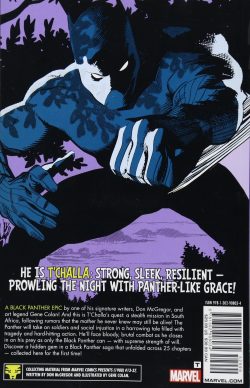
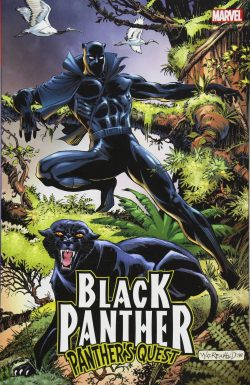
Black Panther: The Bride


By Reginald Hudlin, Scot Eaton, Klaus Janson, Dean White & various (Marvel)
ISBN: 978-0-7851-2107-7 (TPB)

If you’re still looking for a St. Valentines’ Day gift for your one and only (or one of many: I don’t judge even if I do reserve the right to scorn…), you won’t find much help here. At least you better not…

I do, however, have an intriguing, romantically-themed suggestion you can read for inspiration or, latterly, consolation…

Regarded as the first black hero in American comics and one of the first to carry his own series, Black Panther‘s popularity and fortunes have waxed and waned since July 1966 when he first attacked the Fantastic Four as part of an extended plan to gain vengeance on the murderer of his father.

T’Challa, son of T’Chaka, is an African monarch whose secluded kingdom is the only source of a miraculous alien metal upon which the country’s immense wealth is founded. Those mineral riches – derived from a fallen meteor which struck the continent in lost antiquity – enabled him to turn his country into a technological wonderland.

Moreover, the tribal resources and the people have been eternally safeguarded by a cat-like human champion deriving incredible physical advantages from secret ceremonies and a mysterious heart-shaped herb simultaneously ensuring the generational dominance of the nation’s Panther Cult.

In recent years that continuity-mythology was retooled to reveal that the “Vibranium” mound had actually made the country a secret Superpower for centuries, but now increasingly makes Wakanda a target for subversion and incursion.

This slim, unassuming but extremely engaging Costumed Drama – available in trade paperback and eBook editions – collects Black Panther volume 4 #14-18 (May – September 2006). Set during the first Superhero Civil War, it tackles a thorny, perennial political issue with earthy wit and wisdom as the Great King of Wakanda confronts the most contentious issue of his reign thus far…

Previously: the dutiful son of Queen Mother Ramonda at last accedes to her increasingly strident demands that the nation needs an heir, and goes looking for a suitable queen. That turned into a full-blown fiasco but the needs of State remain, so the drama here begins as 4-chapter quest ‘Bride of the Panther’ sees the Panther eschew new flames and set off to woo and win back the first girl he ever loved…

With streetwise Power Man Luke Cage as his smirking wingman, T’Challa recalls his early days and a certain something…

Ororo Munroe AKA Storm is actually a lost daughter of a Kenyan princess and an American journalist. She grew up an orphan in Cairo following their deaths in a war. After joining Charles Xavier‘s X-Men, she spends years fighting the world’s most deadly threats as part – and often leader – of the unloved, distrusted mutant hero horde.

As puberty triggered her mutant powers long ago, the wily thief left Egypt, walking across Africa, drawn by a yearning she could not explain. Eventually she settled with nomadic tribes, using her weather powers to ease their burdens. They called her “Goddess”. However, before she reached that part of her life, Ororo encountered a determined boy also trekking across the Dark Continent…

Young Prince T’Challa had single-handedly avenged the murder of his father T’Chaka and driven off the resource raiders of deranged scientist Ulysses Klaw, but before he could inherit the role of king and spiritual leader of his people there were certain trials and rituals to undertake.

Whilst wandering the plains of Africa in a walkabout manhood trial, he met a beautiful young girl with incredible powers trekking from Egypt to West Africa. Together they found love and survived a deadly attack by South African mercenaries. Ultimately, his sense of duty tore them apart. Years later, T’Challa found her again before once more rejecting her for the needs of Wakanda.

Now as she visits Africa, he has to make her forgive him, because no other woman can be his First Lady of Wakanda…

As Ororo makes him really earn her love, elsewhere malign forces gather. The possibility of a union between mutants and Wakandans is seen by many as a dangerous alliance. An Iraqi dictator creates his own super-powered Arabian Knight to attack them, Hydra attempts to abduct relatives Ororo doesn’t even know she has and even the Kenyan government are taking steps to maintain a status quo the gradually reunited couple couldn’t care less about…

Once Storm finally accepts the marriage offer, the insanity escalates. The Wakandans all adore their new queen-in-waiting and aren’t shy in letting her know it: the world’s fashion and media goes crazy at the prospect of a super Royal Wedding and become ultra-intrusive, and T’Challa’s old enemy Princess Zanda starts impersonating Ororo in the world’s most expensive boutiques, determined that only she shall have the Panther…

Ororo might be – grudgingly – okay with T’Challa’s old flames (the ladies in question, not so much), but tensions still abound. His formidable Dora Milaje bodyguards are imperiously withholding final judgement, SHIELD wants to take over security for the bride and groom and Cage is obnoxiously determined to organise the greatest Bachelor Party of all time…

The King only agrees after Invisible Woman Susan Richards pre-empts his stag debacle with a Bachelorette do unlike any other…

Eventually, the day arrives and a host of heroes and villains, politicos, family and journalists descend on Wakanda for the Wedding of the Century in ‘Here Comes a Storm’. It’s everything you’d expect from a ceremony packed with drunk and angry powered types, and a sinister psychic parasite hidden amongst the entourage and determined to possess the groom and rule the kingdom. Ororo is more concerned with last-minute detail. Wakanda’s god is the Panther Spirit: a live predator deity prone to eating anyone considered unworthy of joining the Royal family…

This deliciously light and frothy Fights ‘n’ Tights romp is perfectly balanced between suspense, comedy and brutal action (as all good weddings are) and also offers Jim McCann’s text feature ‘Diving the Design’ describing the creation of the wedding dress by Shawn Dudley.

What more could any True Romantic need?
© 2010 Marvel Characters, Inc. All rights reserved.

Star Trek Classics Volume 4: Beginnings


By Mike Carlin, Pablo Marcos & various (IDW)
ISBN: 978-1-61377-671-1 (TPB)

Many companies have published comic book adventures based on the exploits of Gene Roddenberry’s legendary brainchild, and the run from the 1980s produced under DC’s aegis were some of the finest. Never flashy or sensationalistic, the tales embraced the same storytelling values as the shows and movies, and were strongly character and plot-driven.

A fine example can be found in this epic primer by long-time writer Michael Carlin, illustrated by the underrated Pablo Marcos, which collects miniseries Star Trek: The Next Generation #1-6 from February – July 1988 and not to be confused with the monthly comic-book that followed it.

With inks by Carlos Garzon & Arne Starr, colours by Carl Gafford and letters from Bob Pinaha, the bold adventures – available in trade paperback or in digital formats you can scan on your personal PADDâ„¢ – commence with double length saga ‘…Where No One Has Gone Before!’

Here, the revamped and reimagined NCC-1701-D starship Enterprise heads into a completely unexplored sector of the galaxy. As freshly-installed and formidably prestigious Captain Jean-Luc Picard acclimatises to his new crew and mission, the ship is fired upon by beings unknown on recently discovered planet Syntagus Thelev.

That’s a bizarre mystery, considering the unseen inhabitants are currently negotiating with the Starfleet vessel and claim they know nothing about the attacks…Although the ship is in no imminent danger, the quandary Picard to despatch a top-level Away Team to find out where the barrages are coming from…

In the end, it requires the uncanny psychic abilities of Ship’s Counsellor Deanna Troi to reveal the uncanny source and motives of the astral assaults…

The second tale is a Christmas yarn wickedly spoofing a certain tale by Dr. Seuss, as ‘Spirit in the Sky!’ finds the Enterprise in festive mode, with the many cultures and families all celebrating their particular version of the Yule Season, before a flock of mysterious strangers invite themselves to the feasts. Happily, their obsessive covert hunt for a eerie energy spirit ends joyously… after a few tense moment and close encounters…

Issues #3-5 comprise an extended repeat confrontation with an apparently omnipotent moral gadfly. ‘Factor Q’ finds the crew assaulted by terrifying memories made real. Particularly targeted is Security Chief Tasha Yar who relives her appalling abusive early years as a survivor of The Colony, when an Away Mission traps her on an alien vessel, even as the almighty Q attempts to seduce Picard into a shooting war with an equally-manipulated stranger ship.

Events escalate in ‘Q’s Day’ as the increasing unstable instigator turns the screw: bringing Yar’s old abuser back to torment her, killing helmsman Geordi LaForge, terrifying the crew and rapidly descending into frustration-induced insanity, before the impossible becomes commonplace as more judgemental intruders from the Q Continuum manifest with their own imponderable agenda in concluding chapter ‘Q Affects!’…

Wrapping up this initial foray into the future, ‘Here Today’ sees Enterprise ordered to investigate seeming paradise planet Faltos via concealed orders somehow hardwired into android crewman Lieutenant Data. An extragalactic Shangri-La, the weird world has – over uncounted eons – been able to pacify and integrate every hostile visitor, but when the benevolent emissaries of the Foundation beam down, they find that the miraculous haven is a unique and inescapable trap…

Or is it?

These tales originate from the earliest days of the TV series so there are a few uncertain moments and quirks of characterisation obsessive fans might quibble over, but overall these are solid adventure yarns in the tried-&-trusted Rodenberry manner that will astound and satisfy Trekkies, Trekkers, comics fans and even the Next-est Generation just coming to the franchise via the current Star Trek: Picard TV revival/revamp…
® & © 2013 CBS Studios Inc. STAR TREK and related marks and trademarks of CBS Studios Inc. © 2013 Paramount Pictures Corporation. All rights reserved.

Silver Surfer Epic Collection volume 1 1966-1968: When Calls Galactus


By Stan Lee, Jack Kirby, Marie Severin, Joe Sinnott, Frank Giacoia & various (Marvel)
ISBN: 978-0-7851-9002-8 (TPB)

Cautiously bi-monthly and cover-dated November 1961, Fantastic Four #1 (by Stan Lee, Jack Kirby, George Klein & Christopher Rule) was crude: rough, passionate and uncontrolled excitement. Thrill-hungry kids pounced on it and the raw storytelling caught a wave of change starting to build in America. It and succeeding issues changed comicbooks forever.

In eight short years FF became the indisputable central title and most consistently groundbreaking series of Marvel’s ever-unfolding web of cosmic creation: bombarding readers with a ceaseless salvo of new concepts and characters at a time when Kirby was in his conceptual prime and continually unleashing his vast imagination on plot after spectacular plot. Clearly inspired, Stan Lee scripted some of the most passionate superhero sagas that Marvel – or any publisher, for that matter – had or has ever seen.

Both were on an unstoppable roll, at the height of their creative powers, and full of the confidence that only success brings, with The King particularly eager to see how far the genre and the medium could be pushed. A forge of stunning creativity and endless excitement, the title was the proving ground for dozens of future stars and mesmerising concepts; none more timely or apt than the freewheeling cosmic wanderer and latter-day moral barometer dubbed The Silver Surfer.

Collecting every scrap of pertinent material from Fantastic Four #48-50, 55-61, 72, 74-77 FF Annual #5 and Tales to Astonish #92-93, this compendium reprints all appearances of the Starry-eyed Sentinel from March 1966 to August 1968 (admittedly some only in excerpt): a chronological countdown to the outcast winning his own landmark title.

Although pretty much a last-minute addition to Fantastic Four #48-50’s Galactus Trilogy, Jack Kirby’s scintillating creation quickly became a watchword for depth and subtext in the Marvel Universe and one Stan Lee kept as his own personal toy for many years to come.

The tale was a creative highlight from a period where the Lee/Kirby partnership was utterly on fire. The tale has all the power and grandeur of a true epic and has never been surpassed for drama, thrills and sheer entertainment, so you should really read it in all its glory.

Here, however, and without preamble the wonderment commences with a mere portion of ‘The Coming of Galactus!’ (by Lee, Kirby & Joe Sinnott from FF #48) as halfway through one storyline, the origins of the Inhumans saga is swiftly wrapped up by page 6, with the entire clandestine race sealed behind an impenetrable dome called the Negative Zone(later retitled the Negative Barrier to avoid confusion with the gateway to sub-space Reed Richards worked on for years).

Meanwhile, a cosmic entity approaches Earth, preceded by a gleaming herald on a surfboard of pure, shining cosmic energy…

I suspect this experimental – and vaguely uncomfortable – approach to narrative mechanics was calculated and deliberate, mirroring the way TV soap operas were increasingly delivering their interwoven storylines, and used as a means to keep readers glued to the series.

They needn’t have bothered. The stories and concepts were enough…

Issue #49 declares ‘If this be Doomsday!’ and sees planet-eating Galactus setting up shop over the Baxter Building despite the team’s best efforts, whilst his coldly gleaming herald has his humanity accidentally rekindled by simply conversing with the Thing‘s blind girlfriend Alicia Masters.

The first 13 pages of FF #50 concludes ‘The Startling Saga of the Silver Surfer!’ as the reawakened ethical core of the Surfer and gallantry of the human heroes buys enough time for Richards and the Human Torch to literally save the world with a boldly-borrowed Deus ex Machina gadget…

Once again, the tale ends in the middle of the issue, with the remaining half concentrating on the team getting back to “normal”, but that’s the work of a different review. Here we resume with FF #55 as ‘When Strikes the Silver Surfer!’sees the naive alien exiled on Earth by his former master and locked in uncomprehending, brutal battle with the Thing, whose insecurities over his relationship with Alicia explode into searing jealousy when the soaring skyrider comes innocently calling…

A portentous excerpt from #56 then tantalisingly teases another forthcoming epic. Fantastic Four #57-60 is Lee & Kirby at their very best; with unbearable tension, incredible drama and breathtaking action on a number of fronts as the most dangerous man on Earth steals the Silver Surfer’s Power Cosmic, even as the Inhumans finally win their freedom and we discover the tragic secret of mighty mute Black Bolt in all its awesome fury.

It all begins with a jailbreak by The Sandman in #57’s ‘Enter… Dr. Doom!’, escalates in ‘The Dismal Dregs of Defeat!’ as Doom tests his limitless stolen power in acts of random cruelty and destruction; builds to a crescendo in ‘Doomsday’ with the heroes’ utter defeat and abject humiliation, before culminating in brains and valour saving the day – and all humanity – in truly magnificent manner in ‘The Peril and the Power!’

A 2-page postscript from #61 shows the return to the Silver Surfer of his purloined life-energies, but there was never a dull moment: no sooner had the exile returned to his solitary wandering than he encountered another of Earth’s incredible denizens…

It coincided with a new narrative tone for The Hulk in his strip in split-book Tales to Astonish. After months on the run, fugitive Bruce Banner reached a ‘Turning Point!’ (TtA #92, June 1967, by Lee and superb, criminally underrated Marie Severin & Frank Giacoia), as the Jade Giant – hunted through a terrified New York City – has a close encounter with a gleaming light in the sky…

Back then, the Hulk didn’t really team-up with visiting stars, he just got mad and smashed them. Such was certainly the case when he became ‘He Who Strikes the Silver Surfer!’; ironically battling with and driving off a fellow outcast who held the power to cure him of his atomic affliction…

He was only driven as far as November’s Fantastic Four Annual #5, where – after a Kirby & Giacoia pin-up depicting a colossal group shot of Galactus, The Watcher, Silver Surfer and others – a rapidly rising star-in-the-making won his first solo appearance.

‘The Peerless Power of the Silver Surfer’ (Lee, Kirby & Giacoia) is a pithily potent fable of ambition and ingratitude reintroducing and upgrading the threat-level of the Mad Thinker‘s lethal Artificial Intelligence murder-machine Quasimodo…

Things went quiet until FF #72 (March 1968) and ‘Where Soars the Silver Surfer!’ as the sky-born wanderer, cruelly imprisoned on Earth by Galactus, goes cage-crazy and attacks humanity, forcing the quarrelsome quartet to make a violent and valiant intervention. Slightly calmer, the skyrider was back in #74 ‘When Calls Galactus’ as the world-eater returns to Terran skies, demanding his one-time herald once more become his food-finding slave. However, despite his increasingly violent and world-shaking probing and the FF’s holding action against the ravenous invader’s robotic Punisher, mighty Galactus cannot locate his target.

That’s because the Surfer has already – and utterly obliviously – departed for ‘World Within Worlds!’, forcing Reed, Ben and Johnny’s pursuit to save humanity from consumption. When the pioneering micronauts are subsequently attacked by sadistic alien Psycho Man, our heroes are subsequently ‘Stranded in Sub-Atomica!’

As they struggle to survive, Galactus applies ever-more pressure in ‘Shall Earth Endure?’ until the now-fully-apprised Surfer turns himself in to save Earth by finding the great Devourer an alternative snack. His reward is to be summarily returned to his captivity here as soon as ungrateful Galactus finishes feeding (just in time to begin his own landmark series – but that’s also the subject of another review, another time…)

Art lovers and history buffs can also enjoy a boundless bounty at the end of this volume as we close with fascinating freebies such as pages of original art by Kirby, a cover reproduction of earlier collection Silver Surfer: The Coming of Galactus! (Ron Lim, Dan Panosian & Paul Mounts), composite cover art for Wizard Ace Edition: Fantastic Four(2002) #48 by Mike Wieringo, Karl Kesel & Mounts, José Ladrönn’s cover for The Fantastic Four Omnibus volume 2and Dean White’s painted cover based on FF #49 for Marvel Masterworks: The Fantastic Four volume 5.

Also on show is a gallery of new covers crafted for 1970s reprint series Marvel’s Greatest Comics (#35-7 by John Buscema & Sinnott, Sal Buscema and Gil Kane & Giacoia) and Marvel Triple Action #1-4 (John B & Giacoia, Kane & John Romita, Vince Colletta and Sal B & Sinnott) which previously reprinted the material contained herein.

Epic, revolutionary and unutterably unmissable, these are the stories which made Marvel the unassailable leaders in fantasy entertainment and which remain some of the most important superhero comics ever crafted. The verve, conceptual scope and sheer enthusiasm shines through on every page and the wonder is there for you to share. If you’ve never thrilled to these spectacular sagas then this book of marvels is the perfect key to another – far brighter – world and time.
© 2019 MARVEL. All rights reserved.

Captain America Epic Collection volume 4 1971-1973: Hero or Hoax?


By Stan Lee, Gary Friedrich, Steve Englehart, Gerry Conway, Steve Gerber, John Romita Sr., Sal Buscema, Gil Kane, Gray Morrow & various (Marvel)
ISBN: 978-1-3029-1003-7 (TPB)

Created by Joe Simon & Jack Kirby in an era of frantic patriotic fervour, Captain America was a dynamic, highly visible response to the horrors of Nazism and the threat of Liberty’s loss. He faded away during the post-war reconstruction but briefly reappeared after the Korean War: a harder, darker sentinel ferreting out monsters, subversives and the “commies” who lurked under every brave American kid’s bed.

Then he vanished once more until the burgeoning Marvel Age resurrected him just in time for the turbulent, culturally divisive 1960s where the Star-Spangled Avenger was in danger of becoming an uncomfortable symbol of a troubled, divided society, split along age lines and with many of the hero’s fans apparently rooting for the wrong side. Now into that turbulent mix crept issues of racial and gender inequality…

This resoundingly resolute full-colour Epic Collection re-presents Captain America #139-#199 (spanning July 1971 to March 1973) with the Sentinel of Liberty adjusting to having a new full-time crimefighting partner in the form of Harlem-based social worker Sam Wilson AKA the Falcon…

As the Falcon works to end a gangster’s dream of monetising New York’s racial unrest, the Good Captain is whisked away for a top-secret mission heralding the beginning of a lengthy and direction-changing saga…

For years Captain America had been the only expression of Steve Rogers‘ life, but now goes undercover as a police officer to solve a series of disappearances, subsequently regaining a personal life which would have long-term repercussions…

With the Red, White and Blue subsumed by plain Rookie Blues in ‘The Badge and the Betrayal!’ (by Stan Lee & John Romita) Steve finds himself on a Manhattan beat as the latest raw recruit to be bawled out by veteran cop Sergeant Muldoon…

As police officers continue to disappear in increasing numbers and Rogers is getting into more fights on the beat than in costume, Wilson is challenged by seductive black activist Leila Taylor and undergoes a far from voluntary and unwanted audition for S.H.I.E.L.D. …

Inked by George Roussos, issue #140 exposes the plot’s perpetrator as ‘In the Grip of Gargoyle!’ takes events in a frankly bizarre direction, with moody urban mystery inexplicably becoming super-spy fantasy as the nefarious Grey Gargoylesteals a mega-explosive from S.H.I.E.L.D. and turns the Falcon into his petrified minion.

With Joe Sinnott inking, Lee & Romita deliver ‘The Unholy Alliance!’ as the stony duo attack a secret base stockpiling ultimate explosive Element X, with Cap, recently-renewed love interest Sharon Carter and Nick Fury attempting to save the world and the Falcon from the Gargoyle…

Spectacular but painfully confusing until now, the epic is dumped on new writer Gary Friedrich to wrap up with ‘And in the End…’ (Captain America and the Falcon #142) wherein the resurgent heroes race a countdown clock of doom to save the day…

All this time Sam has been trying to get friendly with “Black Power” advocate Leila and, with the sci fi shenanigans over, a long-running subplot concerning racial tensions in Harlem boils over…

‘Power to the People’ and ‘Burn, Whitey, Burn!’ (both from giant-sized #143 with Romita inking his own pencils) sees the riots finally erupt with Cap and Falcon caught in the middle, before copping out in the final chapter by taking a painfully parochial and patronising stance and revealing that the seething unrest of the ghetto underclass has been instigated by a rabble-rousing fascist super-villain in ‘Red Skull in the Morning… Cap Take Warning!’

Nevertheless, Friedrich makes some telling and relevant points – and continues to do so in CA&F #144’s first story ‘Hydra Over All!’ (illustrated by Romita) with the creation of S.H.I.E.L.D.’s all-woman attack squad Femme Force One(stop squirming – at least they were trying to be egalitarian and inclusive…).

To facilitate their efficacy the women are assigned to train with the Sentinel of Liberty himself…

The issue also offers a solo back-up tale ‘The Falcon Fights Alone!’ (by Friedrich and drawn by the great Gray Morrow) wherein the street hero designs a new uniform and rededicates himself to tackling the real problems on his turf: drug-dealers, thieves, racketeers and thugs endangering the weakest, poorest members of society…

Captain America and the Falcon #145 expanded the Hydra storyline with ‘Skyjacked’ (stunningly limned by Gil Kane & Romita) as the hooded terrorists kidnap Cap’s students in mid-air…

Sal Buscema began his long tenure on the series with ‘Mission: Destroy the Femme Force!’ and ‘Holocaust in the Halls of Hydra!’ (#146 and inked by John Verpoorten) wherein devious dealings in the halls of power are uncovered before Falcon races to the rescue of the severely embattled and outgunned heroes, culminating in the unmasking of a hidden kingmaker in #147’s ‘And Behind the Hordes of Hydra…’: a staggering Battle Royale in Las Vegas with a hierarchy of old villains exposed, before the ultimate power behind the power reveals himself in Friedrich’s swansong ‘The Big Sleep!’

Now increasingly at odds with super-scientific government spy-agency S.H.I.E.L.D. (which back then stood for Supreme Headquarters International Espionage Law-enforcement Division) and its Director Nick Fury, the troubled Patriotic hero returned to his secret identity as a New York beat cop as Gerry Conway assumed the writing chores for issues #149-152: an uncharacteristically uninspired run that begins with ‘All the Colors… of Evil!’ (illustrated by Sal B & Jim Mooney) wherein Gallic mercenary Batroc resurfaces, kidnapping ghetto kids for an unidentified client. This turns out to be the alien Stranger (or at least his parallel universe incarnation Jakar) who intervenes personally in ‘Mirror, Mirror…!’ (inked by John Verpoorten) but is still defeated far too easily.

‘Panic on Park Avenue’ (Buscema & Vince Colletta) then pits Cap against enfeebled villains Mr. Hyde and the Scorpionas Conway sought to retroactively include Captain America in his ambitious Mr. Kline Saga. Android copies of the super-creeps had attacked Daredevil and the Black Widow in their own comic book and here we discover what happened to the originals during that period.

Assuming S.H.I.E.L.D. is responsible for their woes, the thugs target Steve Rogers and his secret agent girlfriend Sharon Carter with disastrous results, climaxing in Frank Giacoia inked ‘Terror in the Night!’ featuring all-out battles and new plot-complications for officer Rogers and his hard-boiled boss Sgt. Muldoon…

Captain America and the Falcon #153 heralded a renaissance and magical return to form for the Sentinel of Liberty as writer Steve Englehart came aboard, hitting the ground running with a landmark epic rewriting of Marvel history and simultaneously captivating jaded die-hard fans…

The wonderment opens with ‘Captain America… Hero or Hoax?’ (inked by Mooney) as Falcon, Sharon and Cap endure an acrimonious confrontation with Fury and decide to take a break from S.H.I.E.L.D.

While Sam Wilson goes back to Harlem – splitting his time between social work, chasing Leila and stamping his mark on the local gangs in his costumed persona – Steve and Sharon book a holiday in the Bahamas. Shockingly, not long after, Falcon catches Captain America committing racist attacks in New York. Enraged, he tracks down the perpetrator but is easily beaten since his partner has somehow acquired super-strength and a resurrected Bucky Barnes…

In ‘The Falcon Fights Alone!’ (Verpoorten inks) the maniac impostors claim to be “real” American heroes as they reveal what they want: a confrontation with the lily-livered, pinko wannabe who has replaced and disgraced them…

Even after torturing their captive they are frustrated in their plans until the faux Cap tricks the information out of the Avengers. Battered and bruised, Falcon heads to the Bahamian holiday refuge but is too late to prevent an ambush wherein Rogers learns ‘The Incredible Origin of the Other Captain America!’ (Frank McLaughlin inks and including repurposed excepts from the 1950s comics by John Romita): a brilliant piece of literary sleight-of-hand that ties up the Golden Age, 1950s revival and Silver Age iterations of the character in a clear, simple, devilishly clever manner, and leading to an unbelievably affecting fabulously gratifying conclusion in ‘Two into One Won’t Go!’

After meeting and defeating a shade of the nation’s ugly past, Rogers hopes for less troublesome times, but instead ‘Veni, Vidi, Vici: Viper!’ (plotted by Englehart, scripted by Steve Gerber, with Sal B & Verpoorten illustrating) begins an epic, engrossing storyline by introducing a despicable advertising executive-turned snaky super-villain ostensibly working for an enigmatic boss named the Cowled Commander.

It transpires that corrupt connections at the police precinct where Rogers serves have been stirred into murderous action by our hero’s presence, leading to good cops being framed, bombs in offices and the Viper taking out survivors with lethally experimental poisonous darts…

When Falcon follows news of Cap’s death he also succumbs to toxins until ‘The Crime Wave Breaks!’ (Englehart, Buscema & Verpoorten) sees last-second salvation, a ramping-up of criminal activity and Rogers’ abduction, leading to a ‘Turning Point!’ wherein super-scum-for-hire Porcupine, Scarecrow, Plantman and the Eel‘s ill-conceived attack give the game away and expose a hidden criminal mastermind in the heroes’ midst…

Rounding out the riotous adventure, bonus extras include the cover to the all-reprint Captain America Annual #2, assorted house ads, rare Romita colour roughs for Captain America #139 and 144, plus a stirring short selection of original art pages and covers by Romita, Morrow, Kane and Buscema…

Any retrospective or historical re-reading is going to turn up a few cringe-worthy moments, but these tales of matchless courage and indomitable heroism are fast-paced, action-packed and illustrated by some of the greatest artists and storytellers American comics has ever produced.

As the nation turbulently changed Captain America was finally discovering his proper place in a new era and would once more become unmissable, controversial comicbook reading, as we shall see when I get around to reviewing the next volume…
© 1971, 1972, 1973, 2018 Marvel Characters, Inc. All rights reserved.