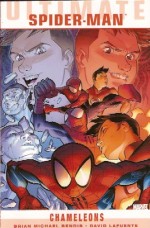
Ultimate Spider-Man book 2: Chameleons


By Brian Michael Bendis, Takeshi Miyazawa & Davis LaFuente (Marvel/Panini UK)
ISBN: 978-1-84653-466-9

The Marvel Ultimates project began in 2000 with a drastically modernizing refit of key characters and concepts to bring them into line with contemporary consumers – perceived to be a separate market to the baby-boomers and their declining descendents who seemed content with the assorted efforts which sprang from the hearts and minds of Kirby, Ditko and Lee.

Eventually the stripped-down new universe became as overcrowded and continuity-constricted as the original, leading to the 2008 “Ultimatum” publishing event which thinned the new herd – and millions of ordinary mortals into the bargain.

Although a commercial success the epic was largely slated by the fans who had bought it, and the ongoing “Ultimatum Comics” quietly soldiered on without “mentioning the War…”

The key and era-ending event was actually a colossal tsunami that drowned the superhero-heavy island of Manhattan and this second post-tidal wave collection (assembling issues #7-14 of the relaunched Ultimate Comics Spider-Man) picks up the story of young Peter Parker and his unique house-guests all slowly readjusting to their altered state.

Parker is sixteen (but looks 12), the perennial hard-luck loser kid: a brilliant geek just trying to get by in a world where daily education is infinitely more scary than monsters and villains. Between High School and slinging fast food (Burger Frog is his only source of income since the Daily Bugle drowned) he still finds time to fight crime although his very public heroics during the crisis have made him a beloved hero of police and citizenry alike – which is the creepiest thing he has ever endured.

He lives in a big house with his Aunt May, and despite his low self-image has stellar hottie Gwen Stacy for a devoted girlfriend, but perpetually endures the teen-angsty situation of equally stellar hottie Mary Jane Watson (his ex-squeeze) hanging around and acting all grown-up about it. He briefly dated mutant babe Kitty Pride: remember when not having any girlfriend was the textbook definition of “loser”?

Many kids are homeless after the deluge, with schools and accommodation stretched to breaking point, so feisty May Parker has opened her doors to a select band of orphaned super-teens like the Human Torch and Iceman, as well as Gwen. Peter’s secret identity was constantly threatened before; how can he possibly conceal his adventurous life when two such famous characters are suddenly sharing the bathroom and his exploits…?

This second delightful collection opens with a new presence in the Ultimate Universe as near-neighbour Rick Jones is possessed by an ancient intergalactic presence. Cool Youngbloods Spidey, Torch and Iceman befriend the bewildered lad and are dragged along on a tumultuous fact-finding mission to secret base Project Pegasus just in time to clash with the sexy sirens of the all-girl Serpent Squad and discover that poor Rick – now calling himself “Nova” – is a cosmic “Chosen One” destined to save the World…

That two-part, laugh-packed thriller leads into decidedly darker territory in #9 as shallow jerk Johnny Storm finds the girl of his dreams in a new mysterious Spider-Girl whilst anti-mutant feeling grows and Kitty Pryde is almost snatched from school by brutally heavy-handed government agents.

On the run, Kitty goes dangerously rogue whilst her friends attempt to go public with the Authorities’ quasi-legal black-bag operation, enlisting the Fourth Estate in the form of the newly-restored Daily Bugle…

Unfortunately whilst trying to break the story of the Government’s anti-mutant agenda Peter Parker is abducted by an enigmatic shapechanger who borrows his form, his powers and his life. Issues #11-14 detail the Chameleon’s vindictive campaign to trash Spidey’s private life whilst using his stolen powers to go on a highly profitable, very public crime spree.

Meanwhile the real Peter is the prisoner of a second psychotic shapeshifter, who also has J. Jonah Jameson under wraps. In close proximity with Pete for days, the wily veteran newsman has deduced the boy’s greatest secret… The climax is breathtaking and portentous. Although temporarily safe, Parker’s life is about to go very badly wrong…

Combining smart dialogue and teen soap opera dynamics with spectacular action – beautifully rendered by artists Takeshi Miyazawa, David Lafuente and colourist Justin Ponsor – Brian Michael Bendis blends hilarious hi-jinks with staggering tension and shocking plot-twists to produce one of the most enjoyable takes on the wall-crawler in decades.

This series goes from strength to strength: a marvellously compelling and enjoyable costumed drama that easily overcomes its troubled origins. Absolutely worth any jaded superhero fan’s time and money Ultimate Spider-Man is well on the way to becoming an unmissable hit…
™ and © 2010 Marvel Entertainment LCC and its subsidiaries. All rights reserved. A British edition released by Panini UK Ltd.

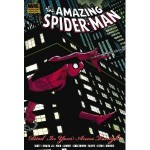
Amazing Spider-Man: Died in Your Arms Tonight


By Stan Lee, Mark Waid, Marc Guggenheim, Joe Quesada, John Romita Jr. & others (Marvel Comics)
ISBN: 978-0-7851-4485-4

When the Spider-Man continuity was drastically and controversially altered at the end of the “One More Day” publishing event a refreshed, now single-and-never-been-married Peter Parker was parachuted into a new life, so if this is your first Web-spinning yarn in a while or if you’re drawing your cues from the movies prepare yourself for a little confusion. That being said this collection of Web-spun wonderment is more accessible than most: a vast celebratory collection commemorating then 600th issue of the landmark comic-book and stuffed with vignettes, mini-masterpieces and clever nostalgia-steeped moments.

Gathering the contents of Amazing Spider-Man #600-601, material from Amazing Spider-Man Family #7 and Amazing Spider-Man Annual #36, the merry Marvel Magic leads off with the comedic ‘Identity Crisis’ by Stan Lee & Marcos Martin, a whimsical look back and shaggy psychiatrist story, Whilst Mark Waid, Colleen Doran & Jose Villarrubia’s ‘My Brother’s Son’ is a glorious sentimental glimpse into Ben Parker’s life with the child Peter that will bring a tear to every fan’s eye. Written by Marc Guggenheim and illustrated by Mitch & Elizabeth Breitweiser offers a glimpse into the heart of Aunt May on the eve of her marriage to J. Jonah Jameson’s father.

From Amazing Spider-Man Family #7 comes ‘Just an Old Sweet Story’ by Roger Stern, Val Semeiks & Mike Getty, revealing how May Reilly and Ben Parker met and married, whilst Amazing Spider-Man Annual #36 provides Guggenheim, Pat Olliffe & Andy Lanning’s ‘Peter Parker Must Die’ as the impending Bride and Groom’s families meet for the rehearsal dinner in Boston.

This romp introduces a whole new sub-cast into the Wall-Crawling mix with the rambunctious Reilly Clan and also debuts a new villain intent on Peter’s demise. Or is the Raptor actually after somebody else? Also on offer are two more enchanting mood-pieces; ‘A Night at the Museum’ by Zeb Wells, Derec Donovan & Antonio Fabela, reminiscing about one of the most embarrassing moments in Spidey history and Bob Gale & Mario Alberti’s lovely ‘If I Was Spider-Man’ as the hero overhears kids answering the age-old question with startling honesty and profundity…

The latter half of this book is taken up with the stunning lead feature and its sequel. ‘Last Legs’ by Dan Slott, John Romita Jr. & Klaus Janson is set during the wedding of Aunt May and Pa Jameson and recounts the last assault by Dr. Octopus, dying from years of being smacked around by the good guys and determined to make the City of New York remember his passing. Moreover as he almost married May Parker himself once, Ock’s not averse to playing gooseberry there if he can…

Packed with guest-stars like Daredevil, the Avengers and Fantastic Four, all of Manhattan is held hostage to the madman’s final rampage until Spider-Man and the Torch save the day and still get to the church on time. But at the reception there’s still one more shock for Peter Parker…

Issue #601 presents a trio of tales set The Day After, beginning with Waid and Alberti’s ‘Red-Headed Stranger: No Place Like Home’ as the repercussions of Peter’s drunken response to the sudden return of Mary Jane Watson (missing for months) leaves him homeless and clueless whilst ‘The Very Best Version of Myself’ by Brian Michael Bendis & Joe Quesada shows the true heroic power of the wall-crawler and the concluding ‘Violent Visions’ (Joe Kelly, Max Fiumara & Chris Chuckry launches the next big thing as a war against Spider-themed characters begins with the “death” of precognitive bit-player Madame Web…

Stuffed with a gallery of covers and alternate art-pieces by such luminaries as John Romita Jr., Joe Quesada, Joe Suitor, Olivier Coipel, Alex Ross, J. Scott Campbell and John Romita Sr. this treasury of delights proves the modern Wall-Crawler still has a broad reach and major appeal for fans old and new. This is the perfect place to rejoin or jump on if the Webbed Wonder crawled off your radar in recent years…

© 2009 Marvel Publishing, Inc, a subsidiary of Marvel Entertainment, Inc. All Rights Reserved.

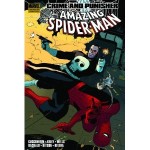
Amazing Spider-Man: Crime and Punisher


By Marc Guggenheim, Joe Kelly, Barry Kitson, Chris Bachalo & various (Marvel Comics)
ISBN: 978-0-7851-5417-6

Although a little disingenuous and rather disjointed for my tastes Crime and Punisher is a splendid slice of spidery superhero shenanigans that proves the modern Wall-Crawler still has a broad reach and plot-themes to suit many moods and occasions.

First off ignore the term “Crime” as the very best part of this collection (comprising Amazing Spider-Man #474-577, and portions of Spider-Man: Brand New Day -Extra!! #1) is a poignant and moving human interest tale with oldest friend Flash Thompson reaching a huge and shocking turning point in his life after returning from a tour of duty in Iraq.

Written by Marc Guggenheim, illustrated by Barry Kitson & Mark Farmer, this low-key tale of inspiration and ordinary heroism is a genuinely moving tribute to soldiers and one of the best Spidey tales of the last twenty years, but it is light-years away from the dark and frenetic retooling of the strictly B-List villain that follows.

‘Death of a Wise Guy’ by Joe Kelly, Chris Bachalo & Tim Townsend (from Spider-Man: Brand New Day -Extra!! #1) tells the secret history of the screen-gangster obsessed young Mafioso who became the brain-damaged cyborg Hammerhead and how his painful rehabilitation and rebuilding under the aegis of new criminal mastermind Mister Negative elevates a clownish super-thug to the top of the villain heap…

When the Spider-Man continuity was drastically and controversially altered at the end of the “One More Day” publishing event a refreshed, now single-and-never-been-married Peter Parker was parachuted into a new life, so if this is your first Web-spinning yarn in a while or if you’re drawing your cues from the movies be prepared to be a little confused.

Therefore this tale from the follow-up “Brand New Day” event sees Parker, a photographer for independent newspaper Front Line stumbling on Negative and Hammerhead’s scheme to consolidate the street gangs into a vast army of boy-soldiers, in ‘Family Ties’ (Amazing Spider-Man #475-6, with additional inks from Jaime Mendoza & Al Vey), a brooding, brutally epic clash wherein Parker puts his life on the line to save Gangsta kids from the Cyborg’s join-or-die recruitment campaign. Kelly’s signature wild comedy perfectly counterpoints the savage battles and highlights the quantum leap in malice the new Hammerhead is capable of…

The book ends with Punisher reluctantly and spectacularly reuniting with Spider-Man to stop their mutual old foe Moses Magnum, a ruthless arms-merchant who has found a way to weaponise Gamma radiation: giving any buyer a serum that producers berserker incredible Hulks to order…

‘Old Hunting Buddies’ (Amazing Spider-Man #477) parts 1 and 2 are written by Zeb Wells, drawn by Paolo Rivera and coloured by Javier Rodriguez & Dean White, with Kelly Kitson & Farmer’s ‘A Bookie Minute Mystery’ bisecting the saga. This last is a cheery little interlude that touches base with J. Jonah Jameson, recovering from heart-surgery and already making plans for his inevitable return…

Fast-paced, bold and extremely engrossing the quality of the individual tales is undeniable, but like an old time Vaudeville Show there’s a marked lack of cohesion, a start instead of a beginning and a close but no ending. Pretty even if lacking in context, it would be a shame if these stories were missed or passed over, so any Fights ‘n’ Tights fan should really give this book a look if they haven’t already…

© 2008, 2009 Marvel Characters, Inc.  All Rights Reserved.

Essential Nova volume 1


By Marv Wolfman, John and Sal Buscema, Carmine Infantino & various (Marvel)
ISBN: 978-0-7851-2093-9

By 1975 the first wave of fans-turned-writers were well ensconced at all the major American comic-book companies. Two fanzine graduates, Len Wein and Marv Wolfman had achieved stellar successes early on, and then risen to the ranks of writer/editors at Marvel, a company in trouble both creatively and in terms of sales. After a meteoric rise and a virtual root and branch overhaul of the industry in the 1960s the House of Ideas – and every other comics publisher except Archie – were suffering from a mass desertion of fans who had simply found other uses for their mad-money.

Whereas Charlton and Gold Key dwindled and eventually died and DC vigorously explored new genres to bolster their flagging sales, Marvel chose to exploit their record with superheroes and foster new titles within a universe it was increasingly impossible to buy only a portion of…

The Man Called Nova was in fact a boy named Richard Rider, a working class nebbish in the tradition of Peter Parker – except he was good at sports and bad at learning – who attended Harry S. Truman High School, where his strict dad was the principal. His mom worked as a police dispatcher and he had a younger brother, Robert, who was a bit of a genius. Other superficial differences to the Spider-Man canon included girlfriend Ginger and best friends Bernie and Caps, but he did have his own school bully, Mike Burley…

An earlier version, “Black Nova” had apparently appeared in the Wolfman/Wein fan mag Super Adventures in 1966, but with a few revisions and an artistic make-over by the legendary John Romita (Senior) the Human Rocket was launched into the Marvel Universe in his own title, beginning in September 1976, ably supported by the illustration A-Team of John Buscema and Joe Sinnott.

‘Nova’, which borrowed as heavily from Green Lantern as well as Spider-Man’s origin, was structured like a classic four-chapter Lee/Kirby early Fantastic Four tale, and rapidly introduced its large cast before quickly zipping to the life-changing moment in Rider’s life when an star-ship with a dying alien aboard transfers to the lad all the mighty powers of an extraterrestrial peacekeeper and warrior.

Centurion Rhomann Dey had tracked a deadly marauder to Earth. Zorr had already destroyed the idyllic world of Xandar, but the severely wounded vengeance seeking Nova Prime was too near death and could not avenge the genocide. Trusting to fate, Dey beamed his powers and abilities towards the planet below where Richard Rider was struck by the energy bolt and plunged into a coma. On awakening Rich realised he had gained awesome powers and the responsibilities of the last Nova Centurion.

The tale is standard origin fare, beautifully rendered by Buscema and Sinnott, but the story really begins with #2’s ‘The First Night of… The Condor!’ as Wolfman, playing to his own strengths, introduced an extended storyline featuring a host of new villains whilst concentrating on filling out the lives of the supporting cast. There was still plenty of action as the neophyte hero learned to use his new powers (one thing the energy transfer didn’t provide was an instruction manual) but battles against winged criminal mastermind Condor and his enigmatic, reluctant pawn Powerhouse plus #3’s brutal super-thug (‘…The Deadly Diamondhead is Ready to Strike!’ illustrated by new art-team Sal Buscema & Tom Palmer) were clearly not as important as laying plot-threads for a big event to come.

Nova #4 saw the first of many guest-star appearances (and the first of three covers by the inimitable Jack Kirby). ‘Nova Against the Mighty Thor’ introduced The Corruptor, a bestial being who turned the Thunder God into a raging berserker whom only the new kid on the block could stop, whilst ‘Evil is the Earth-Shaker!’ pitted the lad against subterranean despot Tyranus and his latest engine of destruction, although a slick sub-plot concerning the Human Rocket’s attempt to become a comic book star still delivers some tongue-in-cheek chuckles to this day…

Issue #6 saw those long-laid plans begin to mature as Condor, Diamondhead and Powerhouse returned to capture Nova, whilst their hidden foe was revealed in ‘And So… The Sphinx!’ (inked by Frank Giacoia), another world-class, immortal super-villain patiently waiting his turn to conquer the world. Meanwhile young Caps had been abducted by another new bad-guy who would eventually make big waves for the Human Rocket.

‘War in Space!’ found Nova a brainwashed ally of his former foes in an invasion of Rhomann Dey’s still orbiting star-ship – an invaluable weapon in the encroaching war with the Sphinx, only to be marooned in deep space once his mind cleared. On narrowly escaping he found himself outmatched by Caps’ kidnapper in ‘When Megaman Comes Calling… Don’t Answer!’ – a tumultuous, time-bending epic that concluded in #9’s ‘Fear in the Funhouse!’

Nova #10 began the final (yeah, right) battle in ‘Four Against the Sphinx!’ with Condor, Diamondhead and Powerhouse in all-out battle against the immortal mage with the hapless Human Rocket caught in the crossfire, whilst ‘Nova No More’ had the hero’s memories removed to take him out of the game; a tactic that only partially worked since he was back for the next issue’s classy crossover with the Spectacular Spider-Man.

‘Who is the Man Called Photon?’ by Wolfman, Sal Buscema & Giacoia, teamed the young heroes in a fair-play murder mystery when Rich Rider’s uncle was killed by a costumed thief. However there were ploys within ploys occurring and after the mandatory hero head-butting the kids joined forces and the mystery was resolved in Amazing Spider-Man #171’s ‘Photon is Another Name For…?’ courtesy of Wein, Ross Andru & Mike Esposito.

Joe Sinnott returned in Nova #13, as another lengthy tale began with the introduction of new hero Crime-Buster in ‘Watch Out World, the Sandman is Back!’, wherein the once formidable villain took a beating and fell under the influence of a far more sinister menace. Meanwhile Rich’s dad was going through some bad times and had fallen into the clutches of a dangerous organisation…

The story continued in the Dick Giordano inked ‘Massacre at Truman High!’ as Sandman attacked Nova’s school and the mystery mastermind was revealed for in-the-know older fans before the guest-star stuffed action-riot ‘The Fury Before the Storm!’ saw Carmine Infantino take over the pencilling and Tom Palmer return to the brushstrokes.

When a bunch of established heroes attack the newbie all at once it’s even money they’re fakes, but Nick Fury of super-spy agency S.H.I.E.L.D. was real enough and deputised the fledgling fighter for #16’s ‘Death is the Yellow Claw!’ and #17’s spectacular confrontation ‘Tidal Wave!’ As the kid came good and saved the city of New York from a soggy demise the long awaited conclusion occurred in ‘The Final Showdown!’, inked, as was ‘Beginnings’ a short side-bar story dealing with the fate of the elder Rider, by the agglomeration of last-minute-deadline busters dubbed “the Tribe.”

A new foe debuted in #19: ‘Blackout Means Business and his Business is Murder!’ opened the final large story-arc of the series as a ebon-energy wielding maniac attacked Nova, but before that epic completely engaged, the Human Rocket guest-starred with the Thing in Marvel Two-in-One Annual #3 (1978) in a simple yet entertaining tussle with god-like cosmic marauders entitled ‘When Strike the Monitors!’ an interlude crafted by Wolfman, Sal Buscema, Giacoia & Dave Hunt.

Hunt stayed on as inker for Nova #20 as the steadily improving young hero went after the cabal that had nearly destroyed his dad in ‘At Last… The Inner Circle!’ leading to a breakthrough in comics conventions as the Human Rocket revealed his alter ego to his family in ‘Is the World Ready for the Shocking Secret of Nova?’ (with art by John Buscema, Bob McLeod & Joe Rubinstein), whilst a long-forgotten crusader and some familiar villains resurfaced in ‘The Coming of the Comet!’ (#22, Infantino & Steve Leialoha) and long-hidden cyborg mastermind Dr. Sun (an old Dracula foe, of all things) revealed himself in ‘From the Dregs of Defeat!’ executing his scheme to seize control of the lost Nova Prime star-ship and its super-computers.

A huge epic was impressively unfolding but the Human Rocket’s days were numbered. Penultimate issue #24 (inked by Esposito) introduced ‘The New Champions!’ as Dr. Sun battled the Sphinx for the star-ship, with Crime-Buster, the Comet, Powerhouse and Diamondhead dragged along on a one-way voyage to the ruins of Xandar, lost home of the Nova Centurions.

This volume ends with #25, a hastily restructured yarn as the cancellation axe hit the series before it could properly conclude. ‘Invasion of the Body Changers!’ by Wolfman, Infantino & Klaus Janson saw the unhappy crew lost in space and attacked by shape-shifting alien Skrulls, all somehow implicated in the destruction of Xandar, but the answers to the multitude of questions raised were to be eventually resolved in a couple of issues of the Fantastic Four and latterly Rom: Spaceknight: episodes not included here, thus rendering this collection aggravatingly incomplete.

There’s a lot of good, solid entertainment and beautiful superhero art in this book, and Nova has proved his intrinsic value by returning again and again, but by leaving this edition on such a frustrating open end, the editors have reduced what could have been a fine fights ‘n’ tights collection into nothing more than a historical oddity. Stories need conclusions and mine is that we readers deserve so much better than this.

© 1976, 1977, 1978, 1979, 2006 Marvel Characters, Inc.  All Rights Reserved.
Essential Spider-Man volume 4


By Stan Lee, John Romita, John Buscema, Jim Mooney and various (Marvel)
ISBN: 978-0-7851-1865-7

This fourth exceptionally economical monochrome volume of chronological Spider-Man adventures sees the World’s Most Misunderstood Hero through another rocky period of transformation as the great second era of Amazing Arachnid artists comes to a close. Although the elder John Romita would remain closely connected to the Wall-Crawler’s adventures for some time to come it would be – apart from a brief return after the book had passed its first centenary – his last time as lead illustrator on the series.

Stan Lee’s scripts were completely in tune with the times – as seen by a lot of kid’s parents at least – and the increasing use of pure soap opera plots kept older readers glued to the series even if the bombastic battle sequences didn’t. The Amazing Spider-Man was a comic-book that matured with or perhaps just slightly ahead of its fan-base.

Thematically, there’s still a large percentage of old-fashioned crime and gangsterism and an increasing use of mystery plots. The dependence on costumed super-foes as antagonists was finely balanced with thugs, hoods and mob-bosses, but these were not the individual gangs of the Ditko days. Now Organised Crime and the Mafia analogue The Maggia were the big criminal-cultural touchstone as comics caught up with modern movies and the headlines.

This volume (reprinting Amazing Spider-Man #66-89 and Amazing Spider-Man Annual #5) kicks off with a sinister two-part tale featuring one of Steve Ditko’s most visually arresting villains. ‘The Madness of Mysterio’ and ‘To Squash a Spider’ (issues #66-67, by Lee, Romita, Don Heck, Mike “DeMeo” Esposito, and Jim Mooney) saw the master of FX illusion engineer his most outlandish stunt on our hero, whilst in the background the amnesiac Norman Osborn slowly began to regain his memory.

This plot thread would culminate in the first return of the Green Goblin, but frustratingly, even though there’s plenty of brooding build-up here you won’t find the actual culminating story (which appeared in the abortive magazine venture Spectacular Spider-Man #2) in this volume. Perhaps more interestingly, this yarn introduced Randy Robertson, college student son of the Daily Bugle’s city editor and one of the first young black regular roles in Silver Age comics. Lee was increasingly making a stand on Civil Rights issues at this time of unrest and Marvel would blaze a trail for African American characters in their titles. There would also be a growth of student and college issues during a period when American campuses were coming under intense media scrutiny…

However before that another mystery in the Webspinner’s life was cleared up. Amazing Spider-Man Annual #5 by Lee and his brother Larry Lieber (with inking from Esposito – still in his clandestine “Mickey DeMeo” guise) revealed the secret behind the deaths of ‘The Parents of Peter Parker’, an exotic spy-thriller which took Spider-Man to the Algerian Casbah and a confrontation with the Red Skull. Nit-pickers and continuity-mavens will no doubt be relieved to hear that the villain was in fact the second Soviet master-villain who featured in Captain America revival of 1953-1954, and not the Nazi original that Lee and Co had clearly forgotten was in “suspended animation” throughout that decade when writing this otherwise perfect action romp and heartstring-tugging melodrama…

That annual also provided a nifty Daily Bugle cast pin-up, a speculative sports feature displaying the advantages of Spider powers, a NYC street-map of the various locations where the Spidey saga unfolded and a spoof section displaying how the Wallcrawler would look if published by Disney/Gold Key, DC or Archie Comics, or drawn by Al “Li’l Abner” Capp, Chester “Dick Tracy” Gould and Charles “Peanuts” Schulz. ‘Here We Go A-Plotting!’ a comedic glimpse at work in the Marvel Bullpen, uncredited but unmistakably drawn by the wonderful Marie Severin concludes the joyous Annual extras included here.

Issue #68 (by Lee Romita & Mooney) began a long-running saga featuring the pursuit of an ancient stone tablet by various nefarious forces, beginning with The Kingpin who exploited a ‘Crisis on the Campus!’ to steal the artifact. Meanwhile Peter Parker, already struggling with debt, a perpetually at-Death’s-Door Aunt May, relationship grief with girlfriend Gwen Stacy and no time to study was accused of not being involved enough by his fellow students…

‘Mission: Crush the Kingpin!’ further tightened the screws as the student unrest exploded into violence and the corpulent crime czar framed the hero for the tablet’s theft. Hounded and harried in ‘Spider-Man Wanted!’ he nevertheless managed to defeat the Kingpin only to (briefly) believe himself a killer when he attacked J. Jonah Jameson in a fit of rage causing an apparent heart attack in the obsessive, hero-hating publisher.

At his lowest ebb, and still possessing the tablet, he was attacked by the sometime Avenger Quicksilver in ‘The Speedster and the Spider!’ in issue #71, before John Buscema came aboard as layout-man in ‘Rocked by: the Shocker!’

No sooner did Spider-Man leave the stone tablet with Gwen’s dad – Police Chief Stacy – than the vibrating villain attacked, stealing the petrified artifact and precipitating a frantic underworld Civil War as the Maggia dispatched brutal enforcer Man-Mountain Marko to retrieve it at all costs in ‘The Web Closes!’ (by Lee, Buscema, Romita & Mooney).

Upstart lawyer Caesar Cicero was making his move to depose aged Don of Dons Silvermane, but the ancient boss knew the secret if not the methodology of the tablet and had abducted biologist Curt Connors and his family to reconstruct the formula on the stone and bring him ultimate victory.

Unfortunately nobody but Spider-Man knew that Connors was also the lethal Lizard and that the slightest stress could free the reptilian monster to once more threaten all humanity. ‘If this be Bedlam!’ (illustrated by Romita & Mooney) led directly into ‘Death Without Warning!’ as the unleashed power of the tablet caused a cataclysmic battle that seemingly destroyed one warring faction forever, decimated the mobs, but also freed a far more deadly monster threat…

Amazing Spider-Man #76 saw John Buscema become full penciller because ‘The Lizard Lives!’ and the concluding ‘In the Blaze of Battle!’ found the Webspinner trying to defeat, cure and keep the tragic secret of his friend Connors all whilst preventing the guest-starring Human Torch from destroying the marauding rogue reptile forever, whilst #78’s ‘The Night of the Prowler!’ featured (probably) John Romita Junior’s first ever creator credit for “suggesting” the tragic young black man Hobie Brown, who turned his frustrations and inventive genius to criminal purposes until set straight by Spider-Man in the concluding ‘To Prowl No More!’

With #80 a policy of single-issue adventures was instituted: short snappy thrillers that delivered maximum thrills and instant satisfaction. First off was a return for the Wallcrawler’s first super-foe in ‘On the Trail of the Chameleon!’ followed by the action-packed if somewhat ridiculous ‘The Coming of The Kangaroo!’ (a clear contender for daftest origin of all time) and Romita senior returned as penciller for ‘And Then Came Electro!’

There were big revelations about the Kingpin in the three part saga that featured in issues #83-85 with the introduction of ‘The Schemer’ (Lee, Romita & “DeMeo”), a mysterious outsider determined to destroy and usurp the power of the sumo-like crime-lord. ‘The Kingpin Strikes Back!’ (art by Romita, Buscema & Mooney) and ‘The Secret of the Schemer!’ changed the Marvel Universe radically, not just by disclosing some of the family history of one of the company’s greatest villains, but also by sending Peter Parker’s eternal gadfly Flash Thompson to a dubious fate in Vietnam…

‘Beware… the Black Widow!’ saw Romita and Mooney redesign and relaunch the Soviet super-spy and sometime Avenger in an enjoyable if highly formulaic misunderstanding clash-of-heroes yarn with an ailing Spider-Man never really endangered, whilst the next issue ‘Unmasked at Last!’ found Parker, convinced that his powers were forever gone, expose his secret identity to all the guests at his girlfriend’s party…

Using the kind of logic and subterfuge that only works in comics and sitcoms Parker and Hobie Brown convinced everybody that it was only a flu-induced aberration in time for the fateful return of the Webslinger’s greatest foe in #88 as the Romita & Mooney art team bow out on a high in ‘The Arms of Doctor Octopus!’

The deranged scientist had gained telepathic control of his incredible mechanical tentacles and sent them on a rampage of destruction through New York. Freeing himself from prison the villain then seized a jet full of Chinese dignitaries and demanded a multi-million dollar ransom until once more defeated and apparently destroyed by Spider-Man.

This volume ends in the most annoying manner possible with Amazing Spider-Man #89, a turning point in the series as the undisputed master of super-heroic anatomy Gil Kane assumed the penciling role (inked by Romita) for ‘Doc Ock Lives!’ wherein the villain attacked once more and hurled the overwhelmed hero to his doom… the result of which you’ll need volume 5 to see.

Moreover that selfsame climatic conclusion signalled the tragic demise of a major character and a genuine turning point in the history of the Amazing Arachnid.

Seriously guys: you couldn’t afford 21 more pages to give this book a proper narrative resolution? What kind of editors or publishers do that to valued fans and especially any new readers you might be cultivating?

Despite that major qualification this is still a fantastic book about an increasingly important teen icon and symbol. Spider-Man at this time became a permanent, unmissable part of many youngsters’ lives and did so by living a life as close to theirs as social mores and the Comics Code would allow. Blending cultural authenticity with spectacular art, and making a dramatic virtue of the awkwardness, confusion and sense of powerlessness that most of the readership experienced daily resulted in an irresistibly intoxicating read, delivered in addictive soap-opera instalments, but none of that would be relevant if the stories weren’t so compellingly entertaining. This book is Stan Lee’s Marvel and Spider-Man at their peak.

© 1968, 1969, 1970, 2005 Marvel Entertainment Group, Inc. All rights reserved.

Spider-Man: Blue


By Jeph Loeb & Tim Sale (Marvel)
ISBN: 978-0-7851-1071-2

In Spider-Man: Blue Jeph Loeb and Tim Sale set their nostalgia-filled sights on the beginning of Peter Parker’s tragically brief romance with Gwen Stacy, encompassing the transitional period when Steve Ditko’s creepy, plucky outsider grew into the wholesome, straight-shooting, hard-luck hero designed by John Romita Senior.

Reprinting the 6-issue miniseries from 2002, this slight if readable epic reconstitutes pertinent snippets from Amazing Spider-Man # 39-49, plus a smidgeon of #63, as, on a gloomy Valentine’s Day, happily married Peter records a message to a dead once-girlfriend he hasn’t really gotten over. In the form of a reminiscence of those days when he first emerged from his solitary shell, Parker recalls how he found – and lost – a few friends and inadvertently met his future wife Mary Jane, all whilst pursuing a pure, innocent and unlikely love with a seemingly unattainable dream…

Along the way he also fought a formidable array of super-foes, including The Green Goblin, the Rhino, the Lizard, two different Vultures and Kraven the Hunter, uncomfortably re-imagined here as the kind of sinister, brooding mastermind that he simply could not ever have been.

Sadly, there’s no real tension in the saga because even the newest readers already know the inevitable romantic outcomes whilst the attempt to weave a number of isolated super-baddie clashes into a vast master-plan over and above what Lee and Romita envisioned is clumsy and ill-considered. Don’t take my word for it: the original tales are readily available for your perusal and delectation in such sterling volumes as Essential Spider-Man volumes 2 and 3, as well as assorted Marvel Masterworks and collections, should you feel the need to contrast and compare…

Jeph Loeb and Tim Sale have a prodigious track record with simultaneously retrofitting, rationalising and re-examining the pivotal moments of many comic-book icons: especially distilling the key moments of iconic characters and careers into material palatable to modern readers, but here it’s simply a waste of their time. The originals are simply still better than the slow, shallow rehashing here.  This is not one of their better efforts, and often comes perilously close to being simply maudlin far too often for comfort.

Although Sale’s art is always a joy to behold, and Loeb’s gift for dialogue is undiminished Spider-Man: Blue falls short of their best. A solid, casual affair but not a patch on the real thing …

© 2002, 2003, 2004 Marvel Characters, Inc. All Rights Reserved.
Ultimate Spider-Man Volume1: The New World According to Peter Parker


By Brian Michael Bendis & David Lafuente with Justin Ponsor (Marvel/Panini UK)
ISBN: 978-1-84653-443-0

The Marvel Ultimates project began in 2000 with a thoroughly modernizing refit of key characters and concepts to bring them into line with contemporary “ki-dults” – perceived to be a separate buying public to those baby-boomers and their declining descendents who seemed content to stick with the various efforts that sprang from the fertile, febrile gifts of Kirby, Ditko and Lee. Eventually the streamlined new universe became as crowded and continuity-constricted as its predecessor and in 2008 a publishing event dubbed “Ultimatum” culminated in a reign of terror which apparently (this is comics, after all) killed three dozen odd heroes and villains and millions of ordinary mortals.

Although a huge seller (for modern comics at least) the saga has been largely slated by the fans who bought it, and the ongoing new “Ultimatum Comics” line is quietly back-pedalling on its declared intentions…

The key and era-ending event was a colossal tsunami that drowned the superhero-heavy island of Manhattan and this post-tidal wave collection (assembling issues #1-6 of the relaunched Ultimate Comics Spider-Man) picks up the story of the survivors slowly readjusting to their altered state.

Peter Parker is sixteen years old, a perennial hard-luck kid and loser and canny geek just trying to get by. Between High School and slinging fast food (Burger Frog is his only source of income since the Daily Bugle got hit) he still finds time to fight crime although his very public heroics during the crisis have made him a beloved hero of police and citizenry alike – which is the creepiest thing he has ever endured.

He lives in a big house with his Aunt May, and despite his low self-image has stellar hottie Gwen Stacy for a devoted girlfriend, and is daily enduring the teen-angsty situation of equally stellar hottie Mary Jane Watson (his ex-squeeze) being constantly around and acting all grown-up about it. He briefly dated mutant babe Kitty Pride: remember when not having any girlfriend was the definition of “loser”?

As New York slowly recovers a new villain with a purloined name is carefully positioning himself to take full control – which he commences by murdering one of Spidey’s greatest surviving foes – whilst the wallcrawler is occupied with a resurgent pack of increasingly violent street crimes. One thing the wave didn’t wash away was greed and stupidity…

As the mastermind’s wicked plans near brutal fruition Spider-Man is being secretly helped by a new young crusader who seems determined to avoid observation at all costs, but Peter’s real problems begin when old superhero chums start returning. Kids like the Human Torch and Iceman are completely alone in the aftermath, and with schools and accommodation stretched to breaking point, what can a sweet old lady like May do but open her doors to them? His secret identity was constantly threatened before; how can he possibly conceal his adventurous life when two such famous characters suddenly move in…?

Combining smart dialogue and teen soap opera dynamics with spectacular action – beautifully rendered by artist David Lafuente and colourist Justin Ponsor – this is a surprisingly compelling and enjoyable costumed drama with plenty of laughs that easily rises above its troubled origins. Absolutely worth any jaded superhero fan’s time and money and well on the way to becoming a palpable sleeper hit…
™ and © 2010 Marvel Entertainment LCC and its subsidiaries. All Rights Reserved. A British edition released by Panini UK Ltd

Essential Spider-Man volume 3


By Stan Lee, John Romita & various (Marvel)
ISBN 0-7851-0658-8

The rise and rise of the wondrous web-spinner continued and even increased pace as the 1960s progressed, and by the time of the tales in this third spectacular volume of black and white reprints (collecting the contents of Amazing Spider-Man #44-68) Peter Parker and friends were on the way to being household names as well as the darlings of college campuses and the media intelligentsia.

The Marvel merriment begins with the return of a tragedy-drenched old foe as Stan Lee and John Romita reintroduced biologist Curt Conners in #44’s (Jan 1967) ‘Where Crawls the Lizard!’ The deadly reptilian marauder threatened Humanity itself and it took all of the wall-crawler’s resourcefulness to stop him in the concluding ‘Spidey Smashes Out!’

Issue #46 introduced an all-new menace in the form of seismic super-thief ‘The Sinister Shocker!’ whilst ‘In the Hands of the Hunter!’ brought back a fighting mad Kraven to menace the family of Peter Parker’s friend Harry Osborn. Apparently the obsessive big-game hunter had entered into a contract with Harry’s father (the super-villain Green Goblin until a psychotic break turned him into a traumatised amnesiac) and now he wanted paying off…

Luckily Spider-Man was on hand to dissuade him, but it’s interesting to note that at this time the student life and soap-opera sub-plots became increasingly important to the mix, with glamour girls Mary Jane Watson and Gwen Stacy (superbly delineated by the masterful Romita) as well as former bully Flash Thompson and the Osborns getting as much or more “page-time” as Aunt May or the Daily Bugle staff, who had previously monopolised the non-costumed portions of the ongoing saga.

Amazing Spider-Man #48 introduced Blackie Drago a ruthless thug who shared a prison cell with one of the wall-crawler’s oldest foes. At death’s door the ailing super-villain revealed his technological secrets, enabling Drago to escape and master ‘The Wings of the Vulture!’ Younger, faster, tougher the new Vulture defeated Spider-Man and in #49’s ‘From the Depths of Defeat!’ battled Kraven the Hunter until a reinvigorated arachnid stepped in the thrash them both.

Issue #50 introduced one of Marvel’s greatest villains in the first of a three part yarn that saw the beginnings of romance between Parker and Gwen Stacy and the death of a cast member, re-established Spidey’s war on cheap thugs and common criminals (a key component of the hero’s appeal was that no criminal was too small for him to bother with) and saw a crisis of conscience force him to quit in ‘Spider-Man No More!’ only to return and be trapped ‘In the Clutches of… the Kingpin!’ before tragically triumphing in ‘To Die a Hero!’ This gang-busting triptych saw Romita relinquish the inking of his art to Mike Esposito (moonlighting from DC as Mickey DeMeo).

Another multi-part saga began in #53 with ‘Enter: Dr. Octopus’ as the many-tentacled madman tried to steal a devastating new piece of technology, but after being soundly defeated the madman went into hiding as a lodger at Aunt May’s house in ‘The Tentacles and the Trap!’, regrouped and succeeded in ‘Doc Ock Wins!’ and even convinced a mind-wiped Spider-Man to join him before the astonishing conclusion in ‘Disaster!’

Shell-shocked and amnesiac, Spider-Man was lost in New York in #57 (with lay-outs by Romita, pencils from the reassuring reliable Don Heck and inking by DeMeo) until he clashed with Marvel’s own Tarzan clone in ‘The Coming of Ka-Zar!’ whilst in the follow-up ‘To Kill a Spider-Man!’ vengeance-crazed roboticist Professor Smythe convinced J. Jonah Jameson to finance another mechanical Spider-Slayer…

In Amazing Spider-Man #59 the hero returned his attention to sinister street-crime in ‘The Brand of the Brainwasher!’ as a new mob-mastermind began to take control of the city by mind-controlling city leaders and prominent cops – including Gwen Stacy’s dad. The drama continued as the mastermind was revealed to be one of Spidey’s old foes in ‘O, Bitter Victory!’ before the concluding part ‘What a Tangled Web We Weave…!’ saw our hero save the day but still stagger away more victim than victor…

‘Make Way for …Medusa!’ in #62 is a fresh change-of-pace yarn as the wall-crawler stumbled into combat with the formidable Inhuman due to the machinations of a Madison Avenue ad man, whilst ‘Wings in the Night!’ in #63 saw the old Vulture return to crush his usurper Blackie Drago, and then take on Spidey for dessert. The awesome aerial angst concluded with ‘The Vultures Prey’ which led to another art-change (from Heck and DeMeo to the sumptuous heavy lines of Jim Mooney) in #65 as Spider-Man was arrested and had to engineer ‘The Impossible Escape!’ from a Manhattan prison, foiling as mass jailbreak along the way.

The psychotic special-effects mastermind returned seeking loot and vengeance in #66’s ‘The Madness of Mysterio!’ (by Romita, Heck and DeMeo) which ended in an all-out action-packed brawl (rendered by Romita and Mooney) entitled ‘To Squash a Spider!’ This volume closes with a small tale that acts as a prologue for a greater epic to come. In ‘Crisis on the Campus!’ scripter Lee tapped into the student unrest of the times in a clever tale of fantastic skulduggery. One of Peter Parker’s tutors was deciphering an ancient tablet, unaware that the Kingpin wanted it for the world-shaking secrets it held. And such a ruthless manipulator would have no qualms in fomenting a bloody riot to mask his theft of the artefact…

Spider-Man became a permanent unmissable part of many teenagers’ lives at this time and did so by living a life as close to theirs as social mores and the Comics Code would allow. Blending cultural authenticity with beautiful art, and making a dramatic virtue of the awkwardness, confusion and sense of powerlessness that most of the readership experienced daily, resulted in an irresistibly intoxicating read, delivered in addictive soap-opera instalments, but none of that would be relevant if the stories weren’t so compellingly entertaining. This book is Stan Lee’s Marvel and Spider-Man at their peak.

© 1967, 1968, 1969, 1998, 2009 Marvel Characters, Inc. All Rights Reserved.
Spider-Man 2099: Genesis – UK Edition


By Peter David, Rick Leonardi, Al Williamson and various (Marvel/Panini Publishing UK)
ISBN: 978-1-84653-428-7

At a time when Marvel’s product quality was at an all time low, and following a purported last minute dispute between the company and prodigal son John Byrne (who had re-invented himself by re-inventing Superman) the House of Ideas launched a whole new continuity strand with all new heroes (and franchise extensions) set more than a century into the future.

The world was corporate and dystopian, the scenarios were fantastical and the initial character-pool was predictable if not actually uninspired. A lot of the early material was by any critical yardstick sub-par. But then again there was also Spider-Man 2099.

Some analogue of the wall-crawler is always going to happen in any Marvel imprint (anybody remember Peter Porker, Spider-Ham?), and in those insane days of speculator-led markets (where greedy kids and adults dreamed of cornering the market in “Hot Issues” and becoming instant squillionaires) the early episodes were always going to be big sellers. What nobody expected was just how good those stories were to actually read…

Now the first ten issues are available in a fantastic and entertaining full colour collection.

In 2099 world governments are openly in the capacious pockets of huge multi-national corporations that permeate every aspect of society. All superheroes have been gone for decades although their legends still comfort the underclass living at the fringes – and below the feet – of the favoured ones who can survive in a society based on unchecked, rampant free-marker capitalism.

Miguel O’Hara is a brilliant young geneticist fast-tracked and swiftly rising through the ranks of Alchemax. He enjoys the privileges that his work in creating super-soldiers for the company. He loves solving problems. And now despite the interference of the salary-men and corporate drudges he’s forced to work with he’s on the verge of a major breakthrough: a technique to alter genetic make-up and even instantly combine it with DNA from other organisms…

But after a demonstration goes grotesquely awry the arrogant scientist makes a big mistake when he tells his boss that he’s going to quit. Unwilling to lose such a valuable asset CEO Tyler Stone poisons O’Hara with the most addictive drug in existence – one only available from Alchemax – to keep him loyal.

Desperate, furious and still convinced he knows best the young scientist tries to use his genetic modifier to reset his physiology and purge the addiction from his cells. However one of the lab assistants he used to bully sees a chance for some payback and sabotages the attempt, adding spider DNA to the matrix…

Fast-paced and riotously tongue-in-cheek scripts from Peter David kept the series readable but the biggest asset to Spider-Man 2099 and the greatest factor in its initial success was undoubtedly the fluid design mastery and captivating rollercoaster pencilling of Rick Leonardi wedded to the legendary Al Williamson’s fine ink lines. The art just jumps off the pages at you.

After the eponymous origin issue, #2’s ‘Nothing Ventured…’, which introduced cyborg bounty hunter Venture, and the concluding chapter ‘Nothing Gained’, which saw him soundly defeat the company hired gun, the early editorial policy downplaying “super-villains” resulted in yet another hi-tech Corporate raider in ‘The Specialist’ and ‘Blood Oath’ (issues #4 and 5) going to any length to uncover the secrets of the first costumed adventurer since the mythic “Age of Heroes” ended.

In issue #6 the hero’s Pyrrhic victory leaves him wounded in the dank shanty-zone far beneath the giant skyscrapers of the productive citizens. Spider-Man has to survive ‘Downtown’, encountering an unsuspected underclass of discarded humanity, but soon falls foul of its top predator (and first super-villain) Vulture 2099 in #7’s ‘Wing and a Prayer’ and the concluding ‘Flight of Fancy’. Kelley Jones and Mark McKenna substituted for Leonardi and Williamson in #9’s ‘Home Again, Home Again’ as the reluctant hero finds himself the latest Idée Fixe of celebrity imitators – or are they John the Baptists for a brand new religion?

All through the stories a strong family cast including younger brother Gabe, girl friend Dana, annoying mother and plain-crazy personal computer Lyla have added drama and scintillating laughs in complex and enthralling sub-plots, but in the last tale of this collection ‘Mother’s Day’ they all take centre-stage as we get a peak into the childhood that made Miguel O’Hara the man he is. His reaffirmation of purpose at the end of the book closes this superb lost gem on a merry high and promises great things to come.

It’s not often that Marvel’s output reached this kind of quality after the mid-1980s, especially with a character and setting that didn’t demand prior knowledge of an entire continuity. For sheer enthusiastic enjoyment and old-fashioned Marvel Magic you simply need to step into this particular future…

© 1992, 1993, 2009 Marvel Entertainment Inc. and its subsidiaries. All Rights Reserved.

Essential Spider-Man volume 2


By Stan Lee, Steve Ditko, John Romita & various (Marvel)
ISBN: 978-0-78511-863-3

The second volume of chronological Spider-Man adventures sees the World’s Most Misunderstood Hero begin to challenge the dominance of the Fantastic Four as Marvel’s top comic book both in sales and quality. Steve Ditko’s off-beat plots and bizarre art had gradually reached an accommodation with the slick and potent superhero house-style that Jack Kirby was developing (at least as much as such a unique talent ever could), with less line-feathering, moody backgrounds and less totemic villains.

Although still very much a Ditko baby, Spider-Man had attained a sleek pictorial gloss. Stan Lee’s scripts were comfortably in tune with the times if not his collaborator, and although his assessment of the audience was probably the correct one, the disagreements with the artist over the strip’s editorial direction were still confined to the office and not the pages themselves.

Thematically, there’s still a large percentage of old-fashioned crime and gangsterism here. The dependence on costumed super-foes as antagonists was still finely balanced with thugs, hoods and mob-bosses, but those days were coming to an end too. When Ditko abruptly left the series and the company, the feared loss in quality – and sales – never happened. The mere “safe pair of hands” that John Romita (senior) considered himself blossomed into a major talent in his own right, and the Wall-Crawler continued his unstoppable rise at an accelerated pace…

This volume (reprinting Amazing Spider-Man #21-43 and Amazing Spider-Man Annual #2 and 3) kicks off with ‘Where Flies The Beetle’ featuring a hilarious love triangle as the Human Torch’s girlfriend uses Peter Parker to make the flaming hero jealous. Unfortunately the Beetle, a villain with a high-tech suit of insect armour (no sniggering, please) is simultaneously planning to use her as bait for a trap. As ever Spider-Man is in the wrong place at the right time, resulting in a spectacular fight-fest.

‘The Clown, and his Masters of Menace’ was a return engagement for the Circus of Crime (see Essential Spider-Man volume 1, ISBN: 978-0-7851-2192-3) and #23 was a superb thriller blending the ordinary criminals that Ditko loved to highlight with the arcane threat of a super-villain attempting to take over the Mob. ‘The Goblin and the Gangsters’ was both moody and explosive, a perfect contrast to ‘Spider-Man Goes Mad!’ in #24. This psychological thriller found a delusional hero seeking psychiatric help, but there’s more to the matter than simple insanity, as an old foe made an unexpected return…

Issue #25 once again saw the obsessed Daily Bugle publisher taking matters into his own hands: ‘Captured by J. Jonah Jameson!’ introduced Professor Smythe, whose robotic Spider-Slayers would bedevil the Web-Spinner for years to come, hired by the bellicose newsman to remove Spider-Man for good.

Issues #27 and 28 comprise a captivating two-part mystery featuring a deadly duel between the Green Goblin and an enigmatic new criminal. ‘The Man in the Crime-Master’s Mask!’ and ‘Bring Back my Goblin to Me!’ together form a perfect Spider-Man tale, with soap-opera melodrama and screwball comedy leavening tense thrills and all-out action. ‘The Menace of the Molten Man!’ (#28) was a tale of science gone bad and is remarkable not only for the action sequences and possibly the most striking Spider-Man cover ever produced but also as the story where Peter Parker graduated from High School.

In 1965 Steve Ditko was blowing away audiences with another oddly tangential superhero. ‘The Wondrous World of Dr. Strange!’ was the lead story in the second Spider-Man Annual, and spectacularly introduced the Web-Slinger to whole other realities when he teamed up with the Master of the Mystic Arts to battle the power-crazed wizard Xandu in a phantasmagorical, dimension-hopping masterpiece. After this story it was clear that Spider-Man could work in any milieu. Also reprinted from that impressive publication are more pin-ups of Spider-Man’s fiercest foes.

‘Never Step on a Scorpion!’ saw the return of that lab-made villain, hungry for vengeance against not just the Wall-Crawler but also Jameson for turning him into a monster. Issue #30 was another off-beat crime-thriller which laid the seeds for future masterpieces. ‘The Claws of the Cat!’ featured the hunt for an extremely capable burglar (way more exciting than it sounds, trust me!), plus the introduction of an organised mob of thieves working for the mysterious Master Planner.

The sharp-eyed will note that scripter Lee mistakenly calls their boss “The Cat” in one sequence, but really, let it go. That’s the kind of nit-picking that gives us comic fans a bad name and reduces our chance of meeting girls…

‘If This Be My Destiny…!’ in #31 concentrated on the Master Planner’s high-tech robberies and led to a confrontation with Spider-Man, as well Peter in College, the introduction of Harry Osborn and Gwen Stacy, and Aunt May on the edge of death. This saga is probably Ditko’s finest moment on the series – and perhaps of his entire career. ‘Man on a Rampage’ showed Parker pushed to the very edge of desperation as the Planner’s men made off with the only substance that could save Aunt May, with a berserk Spider-Man trying to locate them. Trapped in an underwater fortress, pinned under tons of machinery, the hero faced his greatest failure as the clock ticked down the seconds of May’s life…

Which in turn produced the most memorable visual sequence in Spidey history as the opening of ‘The Final Chapter!’ took five full, glorious pages to depict the ultimate triumph of will over circumstance. Freeing himself from the fallen debris Spider-Man gave his absolute all to deliver the medicine May needed, to be rewarded with a rare happy ending…

Kraven returned in ‘The Thrill of the Hunt!’ and so did another old foe in #35’s ‘The Molten Man Regrets…!’ a plot-light but inimitably action-packed combat classic, whilst a deranged thief calling himself the Looter proved little trouble in ‘When Falls the Meteor!’ In retrospect these brief, fight-oriented tales, coming after such an intricate and passionate tale as the Master Planner saga, should have been seen as some sort of clue that things were not going well, but the fans had no idea that ‘Once Upon a Time, There was a Robot…!’ which featured a beleaguered Norman Osborn assaulted by his disgraced ex-partner and his frankly bizarre murder machines, and the tragic comedy of ‘Just a Guy Named Joe!’ – as a hapless sad-sack gains super-strength and a bad-temper – were to be Ditko’s last arachnid adventures. When Amazing Spider-Man #39 appeared with the first of a two-part adventure that featured the ultimate victory of the Wall-Crawler’s greatest foe no reader knew what had happened – and no one told them…

In ‘How Green Was My Goblin!’ and the concluding ‘Spidey Saves the Day! (“Featuring the End of the Green Goblin!”)’ as it so facetiously and dubiously proclaimed, the arch-foes learned each other’s secret identities before the Goblin “perished” in a climactic showdown. It would have been memorable even it the tale didn’t feature the debut of a new artist and a whole new manner of story-telling…

By 1966 Stan Lee and Steve Ditko could no longer work together on their greatest creation. After increasingly fraught months the artist simply resigned leaving Spider-Man without an illustrator. Romita had been lured away from DC’s romance line and given odd assignments before settling with Daredevil, the Man Without Fear. Now he was given the company’s biggest property and told to run with it.

Issues #39 and 40 (August and September 1966) were a turning point in many ways, and inked by old DC colleague Mike Esposito (under the pseudonym Mickey Demeo) they still stand as one of the best Spider-Man yarns ever, heralding a run of classic tales from the Lee/Romita team that actually saw sales rise, even after the departure of the seemingly irreplaceable Ditko.

With #41, ‘The Horns of the Rhino!’ Romita began inking his own pencils and although the super-strong spy proved a mere diversion, his intended target, J. Jonah Jameson’s astronaut son was a far harder proposition in the next issue. Amazing Spider-Man #42 ‘The Birth of a Super-Hero!’, wherein John Jameson was mutated by space-spores and went on a rampage, was a solid, entertaining yarn but is only really remembered for the last panel of the final page.

Mary Jane Watson had been a running gag for years, a prospective blind-date arranged by Aunt May that Peter had avoided – and the creators had skilfully not depicted – for the duration of time that our hero had been involved with Betty Brant, Liz Allen, and latterly Gwen Stacy. In that last frame the gob-smacked young man finally realised that he been ducking the hottest chick in New York for two years!

‘Rhino on the Rampage!’ gave the villain one more crack at Jameson and Spidey, but the emphasis was solidly on foreshadowing future foes and building Pete and MJ’s relationship. This volume concludes with ‘…To Become an Avenger!’ (Amazing Spider-Man Annual # 3) as the World’s Mightiest Heroes offered the Web-Spinner membership if he could capture the Hulk. As usual all is not as it seems but the action-drenched epic, courtesy of Lee, Romita (on layouts), Don Heck, and Demeo/Esposito is the kind of guest-heavy package that made these summer specials a child’s delight.

This cheap and cheerful compendium is the ideal way to introduce or reacquaint readers with the early Spider-Man. The brilliant adventures and glorious pin-ups are superb value and this series of books should be the first choice of any adult with a present to buy for an impressionable child. Or for their greedy, needy selves…

© 1965, 1966, 2005 Marvel Characters, Inc. All Rights Reserved.