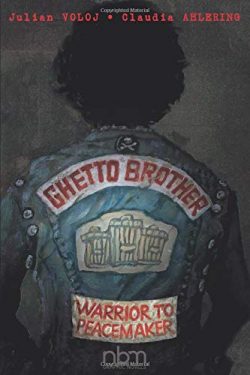
Ghetto Brother – Warrior to Peacemaker


By Julian Voloj & Claudia Ahlering (NBM)
ISBN: 978-1-56163-948-9 (TPB)

In I971 New York City was a broken, dirty metropolis increasingly divided by top-down, enforced gentrification. From the end of the 1950s the mostly ethnically European population of the Bronx had been moving out into the suburbs – a process dubbed “White Flight” – whilst poorer inner-city newcomers, mostly Blacks and Hispanics, were driven or priced out of their cheap bohemian enclaves in Greenwich Village, Little Italy, Chinatown and Soho to fill the vacated places. Those emptied Manhattan regions now comprise some of the most expensive and exclusive real estate in the Big Apple…

Further social assault came when ruthless urban reformer and City Planner Robert Moses slashed the newly-coalescing community of “foreigners” in half by steamrollering the Cross Bronx Expressway right through the formerly scenic Borough.

Subsequent urban blight, administrative neglect and lack of funding soon turned the whole region into isolated islands of forgotten residents, and their hopeless, opportunity-starved kids began forming fiercely territorial gangs to defend spurious concepts of dignity, personal honour and the little territory they called theirs…

The South Bronx became a global byword for urban decay and a breeding ground for violence by the poor upon the poor. By December 1971 it seemed inevitable that the more than 100 gangs situated in the Borough would wipe each other out and possibly take the entire city with them.

…And then something miraculous happened…

This stunning graphic testament and graphic documentary by author and photographer Julian Voloj and artist/illustrator Claudia Ahlering relates in the impassioned words of Benjamin “Yellow Benjy” Melendez how, in the year Dr. Martin Luther King Jr. and Robert Kennedy were assassinated, he formed the Ghetto Brothers, quickly turning it into the largest and most powerful Puerto Rican gang.

It further reveals how the senseless murder of one of his closest friends led to the Hoe Avenue Peace Meeting: a tense, protracted conference where rival gang-lords talked instead of fought and astonishingly agreed to a truce which all but ended gang warfare for a generation.

With fighting curtailed, all those bored, frustrated kids needed new outlets for their pent-up energies and what slowly emerged was Rap, Hip-Hop and by extension today’s big money musical industry and cultural movement of self-expression…

Melendez’s path also encompassed music, but he spent most of his time and energies on turning the Brothers into a rough and ready outreach project for the community, with the gang forming an association with organisations of Puerto Rican nationalism, including the then-new Puerto Rican Socialist Party.

Highlighting long-forgotten events of a critical time through one key individual’s incredible epiphany, this amazing tale – still available in trade paperback and digital formats – then reveals his chance discovery of a hidden and quite shocking personal truth that changed Benjy’s life forever…

Addressing a growing cultural zeitgeist attuned to that time and place as recently seen in books and movie documentaries like Fresh Dressed, Rubble Kings, 80 Blocks From Tiffany’s and Flyin’ Cut Sleeves, this utterly absorbing monochrome chronicle is bracketed by an Introduction from Jeff Chang (author of Can’t Stop Won’t Stop: A History of the Hip-Hop Generation) and the compelling, informative photo-essay ‘The Story Behind the Story’ which further explores that groundbreaking meeting at Hoe Avenue and offers biographies and further reading.
© 2015 Julian Voloj and Claudia Ahlering.
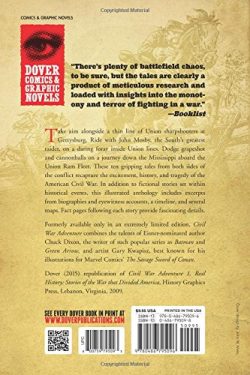
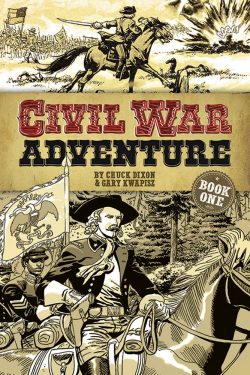
Civil War Adventure volume 1


By Chuck Dixon & Gary Kwapisz with Esteve Polls, Enrique Villagran, Silvestre & Erik Burnham and various (Dover Comics & Graphic Novels)
ISBN: 978-0-48679-509-6 (TPB)

From its earliest inception, cartooning and graphic narrative has been used to inform. In newspapers, magazines and especially comic books the sheer impact of pictorial storytelling – with its ability to distil technical recreations of time, place and personage whilst creating deep emotional affinities to past or imagined events – has been used to forge unforgettable images and characters within us. When such stories affect the lives of generations of readers, the force they can apply in a commercial, social, political or especially educational arena is almost irresistible…

Thus, the compelling power of graphic narrative to efficiently, potently and evocatively disseminate vast amounts of information and seductively advocate complex issues with great conviction through layered levels has always been most effectively used in works with a political, social or historical component.

Comics have brought the past to life since they began. Superb examples of a broad view include such triumphs as Jack Jaxon’s Los Tejanos and Comanche Moon or Of Dust and Blood by Jim Berry & Val Mayerik, but the medium is equally adept in crafting more personal biographs such as Terry Eisele & Jonathon Riddle’s With Only Five Plums and others…

And that brings us to another superb re-release from Dover Comics & Graphic Novels (available in trade paperback and digital formats) designed to bring “The War Between the States” to life for younger readers.

Originally published by History Graphics Press in 2009 as Civil War Adventure 1: Real History Stories of the War that Divided America, this marvellous monochrome tome – crafted primarily by comics veterans Chuck Dixon and Gary Kwapisz – switches between actual historical events – with handy maps, diagrams and found writings – and a fictionalised thread of tales depicting how the conflict affected one poor Southern family.

The graphic re-enactments are preceded by a ‘Map of the United States’ detailing the division of the States in 1860 and a‘Civil War Timeline’ which marks key moments and battles (sensibly linking them directly to the stories which follow), after which ‘Choice of Targets’ by Dixon and Esteve Polls offers a text vignette explaining the development of snipers and sharpshooters.

That’s counterpointed by a pithy moment during the second day of the Battle of Gettysburg in 1863 when opposing marksmen find themselves in a life-or-death duel…

‘Berdan’s Sharpshooters’ is a short cartoon lesson on the inspired Union soldier who invented the concept of snipers, and is promptly followed by a chilling and heartrending incident of battlefield misfortune in Dixon & Kwapisz’s ‘Home Again’ plus an illustrated info-&-glossary page which reproduces an actual letter from a Confederate lad the night before he fell…

All-Kwapisz affair ‘Mosby Bags a General’ combines a potted history of the South’s most successful raider with a compelling strip revealing how bold Lieutenant John Mosby infiltrated far behind Union lines to capture 58 horses, thirty prisoners and their captain, plus sleeping General Stoughton, all in one night…

‘Tempered in Blood’ (Dixon & Kwapisz) then introduces the narrative strand as the modest Campbell clan are torn apart when, after heated family discussion, both father and first son Tybalt sneak off from the farm to enlist in the Spring of 1861. Each confidently assures themselves that all the shooting will all be over long before harvest as they unknowingly individually abandon Mrs. Campbell and the little sisters to link up with overconfident volunteers massing for what everybody believes will be one fast knockout blow…

After barely surviving the brutal training that turns hunters, croppers and ploughmen into real soldiers, the Southern heroes finally learn what warfare means at Bull Run…

More contemporary terms, facts and historical insight are offered in ‘The War is Joined!’ before ‘The Devil’s Due’(Kwapisz) delves into the atrocity of total warfare as a Bluecoat patrol diligently follows its bald orders to “turn the South into a wasteland”…

A fact-feature page on ‘John Singleton Mosby’ leads to a feature on rising star and flamboyant self-aggrandiser George Armstrong Custer whose rash adventuring leads ‘The Boy General’ (Dixon & Enrique Villagran) into desperate straits against overwhelming rebel opposition… resulting in Custer’s First Stand…

Data pages on the devastating ‘Sharps Rifle’ and double-pronged naval blockade of the Mississippi River spins off into an account of the duel between ironclad vessels and the brilliant countermeasure devised by Colonel Charles Ellet in ‘Ram Squadron’ (Dixon & Silvestre), capped off by a Kwapisz segment detailing ‘Hell on the Mississippi’, as a Union flotilla horrifically fails to sneak past the naval guns established above Vicksburg…

‘Tempered in Blood II’ returns to the troubled Campbell Clan as Ty wakes in the bloody aftermath of battle to discover his best friend Seth has had enough and absconded. However, by the time he’s found and brought back Seth, Ty discovers his own father has similarly fled.

The elder is not running from bloody death but heading home to save his farm from ruin and family from fever, but that won’t make any difference if he’s picked up by ruthless and remorseless Confederate Picquets…

The tragic true tale of ‘Colonel Cocke’ and his unseemly death gives way to the ribald eccentricity of ‘Darnel Dingus is a…’ which reveals the insane and impecunious ends to which some States descended to ensure their manpower obligations were met. The tale is couched in the story of famous war artist Winslow Homer and a practical joking jackass who learns the hard way that war isn’t funny: appended by a grim examination of ‘The Ultimate Punishment’ for desertion under fire and other – even worse – infringements…

The strip section closes with a sobering and ironic tale of comeuppance in ‘The Letter’ (by Erik Burnham & Kwapisz) wherein a burned-out sawbones steals a missive from one of his less-lucky patients and chases a dream to a woman he’s fallen for based solely on her handwriting and prose…

Following one last Kwapisz-illustrated info page – on ‘Battle Field Surgery’ – this stunning introduction to the birth of modern warfare ends with a comparative list of ‘Further Reading’ and a moving notification of how to learn more in ‘If the Valley Was Lost’.

Similar in tone and style to the best of Harvey Kurtzman’s magnificent anti-war classics from Two-Fisted Tales and Frontline Combat, this is a rousing, evocative, potently instructive collection amalgamating history and horrific entertainment – and not a little grim wit and actual belly-laughs – to bring a pivotal time to vivid life.
© 2009 Chuck Dixon & Gary Kwapisz. All other material © 2015 its respective creators.

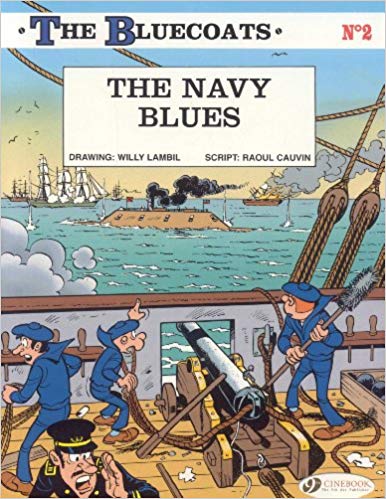
The Bluecoats volume 2: The Navy Blues


By Willy Lambil & Raoul Cauvin, translated by Erica Jeffrey (Cinebook)
ISBN: 978-905460-82-3 (Album PB)

The mythology of the American West has never been better loved or more honourably treated than by Europeans. Hergé was a passionate devotee, and the range of incredible comics material from Tex Willer to Blueberry, Yakari to Lucky Luke to Camanche display over and over again our fascination with all aspects of that legendary time and place.

Les Tuniques Bleues or Bluecoats began at the end of the 1960s, visually devised by Louis “Salvé” Salvérius with scripts by Raoul Colvin – who has also written the succeeding 63 volumes of this much-loved Belgian comedy western series. The strip was created on the fly to replace the aforementioned Lucky Luke when the great gunslinger defected from prominent weekly anthology Le Journal de Spirou to rival comic Pilote, and became another one of the most popular series on the Continent.

After its initial run, Bluecoats graduated to the collected album format (published by French publishing powerhouse Dupuis) that we’re all so familiar with in Un chariot dans l’OuestA Wagon in the West – in 1972.

Salvé was proficient in the Gallic style of big-foot/big-nose humour cartooning, and when he died suddenly in 1972 his artistic replacement Willy “Lambil” Lambillotte gradually leavened the previous broad style with a more realistic – but still crucially comedic – illustrative manner. Lambil is Belgian, born in 1936, and after studying Fine Art, joined Dupuis as a letterer in 1952.

In 1959 he created Sandy – about an Australian teen and a kangaroo – later self-parodying it and himself with Hobby and Koala and Panty et son kangaroo as well as creating the comics industry satire ‘Pauvre Lampil’.

Belgian writer Raoul Cauvin was born in 1938 and, after studying Lithography, joined Dupuis’ animation department in 1960. His glittering and prolific writing career began soon after. Almost exclusively a humourist and always for Le Journal de Spirou, other than Bluecoats he has written more than 20 long-running and award-winning series – more than 240 separate albums. Bluecoats alone has sold in the region of 23 million copies.

The protagonists are Sergeant Cornelius Chesterfield and Corporal Blutch, a hopeless double act of buffoons in the manner of Laurel and Hardy, perhaps Abbot & Costello or our own Morecambe & Wise: two hapless and ill-starred cavalrymen posted to the wilds of the arid frontier.

The first strips were single-page gags based around an Indian-plagued Wild West fort but with second volume Du Nord au Sud (North and South) the sorry soldiers went back East to fight in the American Civil War (this scenario was retconned in the 18th album Blue retro which described how the everyman chumps were first drafted into the military). All subsequent adventures, although ranging all over the planet and taking in a lot of genuine and thoroughly researched history, are set within that tragic conflict.

Blutch is your average little man in the street: work-shy, reluctant and ever-critical of the army – especially his inept commanders. Ducking, diving, deserting when he can, he’s you or me – except sometimes he’s quite smart and heroic if no other easier option is available. Chesterfield is a big man, a career soldier, who has bought into all the patriotism and esprit de corps. He is brave, never shirks his duty and wants to be a hero. He also loves his cynical little pal. They quarrel like a married couple, fight like brothers and simply cannot agree on the point and purpose of the horrendous war they are trapped in…

The Navy Blues, second book in this translated series, is actually the 7th French volume ‘Les Bleus de la marine’, and finds the lads as usual in the midst of a terrible battle. However, when Blutch is wounded, his cavalry commanders prefer to save his horse rather than aid a fallen soldier, and Chesterfield finds all his cherished dreams of camaraderie and loyalty ebbing away.

Disillusioned, he demands a transfer to the infantry and with the never-happy Blutch beside him tries to adapt to his lowered status. Sadly, Chesterfield discovers officers are the same everywhere and stupidity and cupidity are rife throughout the armed forces. A progression of calamitous transfers eventually lands the pair in the Union Navy at a time of intriguing technological advancement, playing an unfortunately ill-omened part in the development of both Submarines and armoured battleships. As always, their misadventures result in pain, humiliation and not a few explosions…

The secret of Les Tuniques Bleues success…? This is a hugely amusing anti-war saga targeting younger less cynical audiences. Historically authentic, always in good taste despite its uncompromising portrayal of violence, the attitudes expressed by the down-to-earth pair never make battle anything but arrant folly and, like the hilarious yet insanely tragic war-memoirs of Spike Milligan, these are comedic tales whose very humour makes the occasional moments of shocking verity doubly powerful and hard-hitting.

Fun, informative, beautifully realised and eminently readable, Bluecoats is the sort of war-story that appeals to the best, not worst, of the human spirit.
© Dupuis 1975 by Lambil & Cauvin. English edition © 2008 Cinebook Ltd. All Rights Reserved.

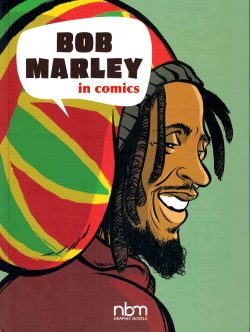
Bob Marley in Comics


By Gaets & Sophie Blitman, illustrated by Olivier Desvaux, Ammo, Didier Millotte, Tanguy Pietri, Matthieu Beaulieu, Jena, Efix, Domas, Simon Léturgie, Sarah Williamson, Cyrille Brégère, Julien Modde, Moh, Armel Ressot, Lu-K, Clément Baloup, Joël Alessandra, Julien Atika, Gil & various: translated by Montana Kane (NBM)
ISBN: 978-1-68112-250-2 (HB)

Graphic biographies are all the rage at the moment and this one – originally released on the continent in 2018 – is another cracker likely to appeal to a far larger mainstream audience than comics usually reach. It certainly deserves to as it captivatingly deconstructs the life of a truly unique force in music and popular culture…

If you’ve never heard of Bob Marley or don’t like reggae, you might still want to check this out. The singer was deeply spiritual and it’s never too late to see the light and convert or, failing that, just buy a record…

Gathered in this fetching hardback (or eBook) edition are context-providing essays backing up individual comics sections; each chronological article and comics vignettes written by the ever-informative comics scribe Gaets and journalist/children’s author Sophie Blitman, supported by a veritable legion of illustrators providing vivid and vibrant strips, beginning with ‘From Nesta to Robert’ – limned by Olivier Desvaux.

The early life of the musician introduces us to his mother Cedella Malcolm and the old white soldier she married. With Norval Marley disinherited and promptly absconding, Nesta Robert Marley spent his early years in the rural farming community of Nine Miles in Jamaica until at age six, when he was whisked away to Kingston by his dad… who simply dumped him with another woman and vanished again…

Happily, a few years later Cedella joined the boy who was already showing promise as both a fortune telling mystic and award-winning singer. Rendered in stark monochrome by Ammo, ‘The Rude Boys of Trenchtown’ exposes the appalling poverty Nesta endured and the lasting friendships that privation engendered as they played, made music and hung out together: relationships expanded upon in the essay ‘Growing Up Between Worlds’.

Working in muted full colour, Didier Millotte explores ‘Reggae in the Ghetto’ as Robert Marley – now working as a full-time (14-year-old) welder – and his mates Peter Tosh and Bunny Wailer are taken under the wing of pro musician Joe Higgs who teaches young Marley to play guitar…

‘Making Friends in Trenchtown’ details the development of the musical genre Reggae from Ska and Marley’s growing influence after which Tanguy Pietri illuminates sordid conditions and lack of opportunities which compel him to make music his life in ‘A Ray of Light in the Dark’…

Matthieu Beaulieu reveals the unique way poor Jamaicans consumed pop music in ‘Sound Systems, Ska & Studio One’, how the blossoming star is ripped off for the first – of many – times and how he meets wife-to-be Rita Anderson: a relationship which grows in Jena’s vignette ‘Is This Love?’

Efix delineates Marley’s spiritual growth in historical lecture ‘The Roots of the Rasta Movement’, whilst Domas’ ‘Tuff Gong in Nine Miles’ follows his musical journey to America – until the threat of being drafted into Vietnam – and ultimately to London, where The Wailers become stranded…

Essay ‘The Path to Success’ concentrates upon Marley’s song-writing and musical self-determination which led to the critical meeting with British Producer Chris Blackwell in ‘The Reggae Wave’ (art by Simon Léturgie) and the release of first album Catch a Fire. Now a growing global sensation among young white music fans – as detailed in essay ‘An “International Reggae”’ – Bob Marley and The Wailers retire to Blackwell’s ‘Villa Rasta’ (illustrated by Sarah Williamson), to make more music and bask in fame in their own country whilst enjoying a few rock star trappings of success…

One such is covered in ‘Bob Marley, Rita… And All the Other Women’, recounting the numerous affairs and children the singer indulged in even as the parade of mega-hits began. Cyrille Brégère encapsulates the tone of the times in ‘The Sheriff Died Tonight’ with the financial sharks already circling, as seen in ‘Around the World’ (Julien Modde), leading to the breakup of the founding members…

Throughout this period, Jamaica was descending into political chaos and gangsterism fuelled by economic disparity. This was something no amount of interviews or comments from the pacifist, life-loving musician could affect, but did result in the assassination attempt depicted by Moh in ‘Panic in the Hen House’.

The spark was believed to be proposed peace and reconciliation concert Smile Jamaica, but despite being wounded, three days later the show went on with Marley proudly in the spotlight…

Following more history in ‘The Price of Fame’, Armel Ressot graphically caters a ‘Punk Reggae Party’ as the leading proponents of two landmark musical movements meet and cross pollinate, despite falling foul of British Law, after which ‘From Exile to Exodus’ covers the creation of the classic album before ‘Red Card’ (art by Lu-K) heralds the beginning of the end after an impromptu kickabout in Paris leads to a shocking discovery…

The star’s obsessive passion for the sport of the ghettos is examined in ‘Bob Marley and His Love of Soccer’, as is his refusal to compromise his Rastafari principles by accepting medical treatments unacceptable to his faith. Clément Baloup then pictorially details the escalating civil war in Kingston and Marley’s controversial pre-election solution of a One Love Peace Concert in ‘Ablaze’.

Knowing his end was near, Marley finally visited Ethiopia in 1978 before finishing the album Survival and discovering yet another friend and manager had been stealing from him and his fans. He played controversial concerts in Africa – including the independence ceremony of recently liberated and newly-created Zimbabwe – twice in fact, as the authorities cut the first one short through force of arms – as seen Joël Alessandra’s ‘Roots’.

Penultimate essay ‘For Peace and Unity Among Peoples’ shares his philosophies, awards and legacy, via the peace concerts he headlined, backed up by a moving strip of his final days in ‘All the Way’ (by Julien Atika), after which closing essay ‘Death of the “Pope of Reggae”’ fills in the detail of his passing and ‘What Next?‘ by Gil closes the show with the events of the Tuff Gong’s state funeral and his musical legacy, courtesy of his many children.

Bob Marley in Comics is an astoundingly readable and beautifully rendered treasure for comics and music fans alike: one that resonates with anybody who loves to listen and look. Without it, you’re simply nowhere, man…

© 2016 Petit as Petit. © 2018 NBM for the English translation.
Bob Marley in Comics will be released in the UK in February 2020 and is available for pre-order now. NBM books are also available in digital formats. For more information and other great reads go to NBM Publishing at nbmpub.com

King: A Comics Biography of Martin Luther King – The Special Edition


By Ho Che Anderson (Fantagraphics Books)
ISBN: 978-1-60699-310-1 (HB)

There are books to read, books you should read – and some perhaps, more controversially, that you shouldn’t – and there are important books. The still relatively new field of graphic novels has many of the first but precious few really important books yet.

It’s hard enough to get noticed within the industry (simply excelling at your craft is not enough) but when we do generate something wonderful, valid, powerful, true to our medium yet simultaneously breaking beyond into the wide world and making a mark, the reviews from that appreciative greater market come thick and fast – so I’m not going to spend acres of text praising this superbly comprehensive examination of the man that lived beside – not “behind” or “within” – the modern myth of Martin Luther King, Jr.

Over the course of ten years (1993-2002) Canadian cartoonist Ho Che Anderson struggled to produce three comics books propounding a less hagiographic perspective of a man who was as much sinner as saint, but whose determination, passion, energy and often sheer luck (or divine inspiration?) drove a cleansing wedge into a rotting, repressive, stifled society and succeeded in opening enough doors for America’s racial underclass, so that forty years later a black American could be elected to govern the World’s greatest superpower.

Not that four decades is so brief an interlude. But then again, how many European or white Commonwealth countries can boast that their highest echelons of power have made even that much progress?

In both stark black & white and mesmerising colour, Anderson uses all the strengths and tools of sequential narrative to reveal, relate, question and challenge the oft-recounted facts of the Georgia Pastor’s life in this magnificent volume (available in luxurious hard cover and all-purpose digital editions) which was originally released to celebrate Barack Obama’s – and the American people’s – landmark achievement. From here and now he’s looking to have been the last Great – or even Sane – chief of the Land of the Free

Gathered into one compelling tome is this hard-crafted triptych of issues, including restored extra and deleted scenes; the thematically linked one-shot Black Dogs plus many bonus features, as well as a fascinating overview from Anderson; sketches and reminisces, a treatise on his working practises and a gallery of related art.

This is an authentic historical examination and a perfect example of the comics medium at its most effective – incisive biography not pictorial puff piece – and as important a landmark achievement for our art-form as Maus, American Splendor, Watchmen, Pride of Baghdad and Persepolis.

Whenever and wherever we have to defend our Art from decriers and peddlers of prejudice, King will be one of the handful of examples which cannot be refuted, contradicted or ignored. It’s a book no thinking fan or socially responsible human being can afford to miss.
King: The Special Edition © 2010 Fantagraphics Books. All content © 2010 Ho Che Anderson. All rights reserved.

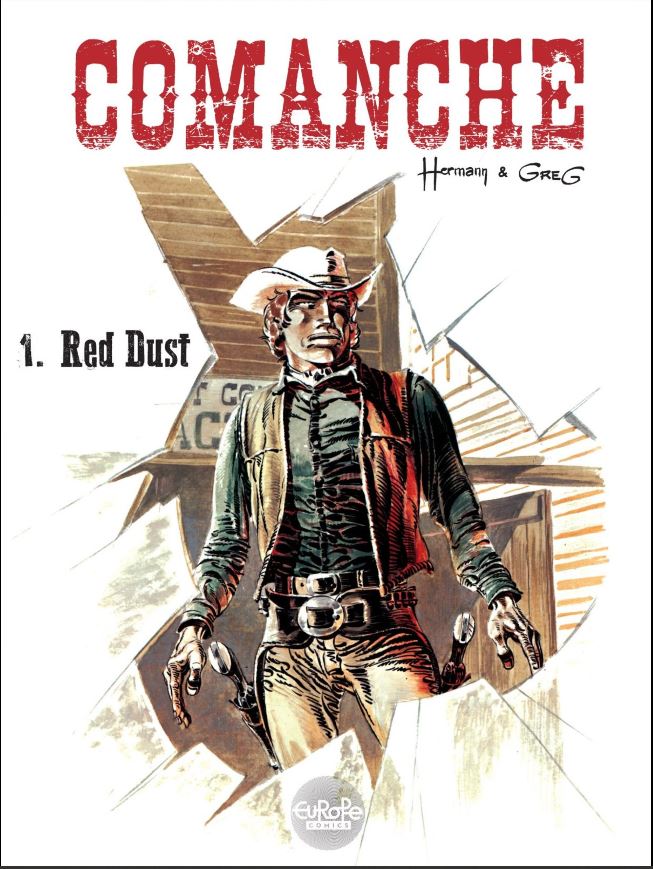
Comanche volume 1: Red Dust


By Hermann & Greg, translated by Montana Kane (Europe Comics)
No ISBN. ASIN: B000O15YBK

Welcome to another Wild West Wednesday with an self-indulgent peek at a favourite book I first read way back in the 1980s, crafted by two Belgian masters of graphic narrative.

Best known as Greg, Michel Régnier was born in 1931 in Ixelles. The cartoonist, writer editor and publisher, sold his first series – Les Aventures de Nestor et Boniface – at age 16 to Belgian magazine Vers l’Avenir and followed up over many decades with legendary strips such as Luc Orient, Bruno Brazil, Bernard Prince and Achille Talon in Héroic Albums, Le Journal de Spirou (where he scripted the title feature amongst many others), Paddy and Le Journal de Tintin (which he eventually edited from 1966-1974). One of his new finds on Spirou during this period was an artist named Hermann Huppen…

Greg is estimated to have worked as writer or artist on more than 250 strip albums during his career. He died in 1999.

Hermann Huppen entered the world on July 17th 1938 in what’s now the Malmedy region of Liège Province. He studied to become an interior architect and furniture maker but was thankfully swayed and diverted by comics. His narrative career began in 1963 but really took off three years later when he joined with writer Greg to create cop series Bernard Prince for Le Journal de Tintin. The artist then added to his weekly chores with Roman adventure serial Jugurtha(scripted by Jean-Luc Vernal).

In 1969 Hermann expanded his portfolio further, adding the Greg-penned western Comanche to his seamlessly stunning output. At his time Charlier & Jean Giraud’s epic Blueberry was reaching its peak of excellence…

Bernard Prince and Comanche made Hermann a superstar of the industry – a status built upon with further classics such as The Towers of Bois-Maury, Sarajevo-Tango, Station 16 and many more (I estimate 24 separate series and a total north of 94 albums thus far).

In 1978 Hermann bravely dropped guaranteed money-spinner Bernard Prince to create as (writer and illustrator) Jeremiah but he stayed with Comanche until 1982 (10 albums in total) because of his abiding love for western-themed yarns.

Thanks to digital-only publishing commune Europe Comics, it’s easy to see why in this first translated volume of the sprawling cowboy epic which here introduces a wandering gunslinger who finds a home – if not peace and quiet – after joining a most unlikely band of comrades on a cattle-spread in Wyoming.

Comprised of linked weekly episodes, originally published in 1978, ‘Red Dust’ finds the eponymous, lethally capable shootist wandering into a desolate cowtown just as trouble seems to be brewing.

In fact, even before he gets into Greenstone Falls, the enigmatic Mr Dust has to kill manic mercenary Wally Hondo who refuses to share “his” stagecoach with a shabby drifter…

Moreover, when the stage finally pulls into what passes for civilisation, Red is approached by unctuous fixer Mr Cathrellwho erroneously assumes him to be the latest addition to his growing army of pitiless hired guns…

The mistake is soon cleared up after the newcomer unexpectedly reacquaints himself with Cathrell’s top stooge. Red Dust and the Kentucky Kid have unsettled scores and old grievances in common…

Before long Red learns that the killer elite have all been commissioned to deal with a stubborn rancher refusing to sell out to their mysterious and always unseen boss. Mind made up, the taciturn nomad heads for the 666 Ranch and inveigles a job with crotchety ancient pioneer Ten Gallons and the new ranch owner he dotes upon: a young, lovely and immensely stubborn woman called Comanche…

She is determined to make her inheritance a successful going concern, but has been having lots of bad luck. Red Dust soon determines it’s not her luck that’s at issue after a new herd of cattle she has bought apparently come down with a mystery sickness. As well as exposing a cruel trick, Red also recruits new hands Toby and Tenderfoot following the exposure of a nefarious scam.

That, in addition to decimating Cathrell’s gunslingers when they ambush the ranchers on a shopping trip to town, soon forces the mystery mastermind into the open and reveals just why the 666 is such a valuable property… but only after a few of those old scores are finally settled…

A splendid confection of tradition western themes combined with sleek yet gritty European style, Red Dust is the kind of timeless treat comics fans and movie lover will adore. Don’t miss out on a chance to enjoy one of the most celebrated comics classics of all time…
© 2017 – LE LOMBARD – HERMANN & GREG. All rights reserved.

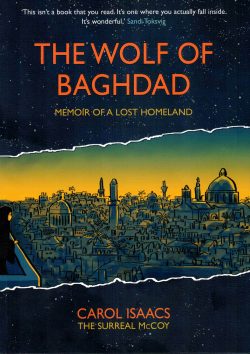
The Wolf of Baghdad


By Carol Isaacs/The Surreal McCoy (Myriad Editions)
ISBN: 978-1-912408-55-9 (TPB) eISBN: 978-1-912408-71-9

Contemporary history is a priceless resource in creating modern narratives. It has the benefits of immediacy and relevance – even if only on a generational level – whilst combining notional familiarity (could you tell the difference between a stone axe and a rock?) with a sense of distance and exoticism. In comics, we’re currently blessed with a wealth of superb material exploring the recent past and none better than this enchanting trawl through a tragic time most of us never knew of…

Carol Isaacs is a successful musician (just ask the Indigo Girls, Sinead O’Connor or the London Klezmer Quartet) and – as The Surreal McCoy – a cartoonist whose graphic gifts are regularly on show in The New Yorker, Spectator, Private Eye, Sunday Times and The Inking Woman: 250 Years of Women Cartoon and Comic Artists in Britain. She found her latest inspiration in a two-thousand-year old secret history that’s she been party to for most of her life…

British-born of Iraqi-Jewish parents, Isaacs grew up hearing tales of her ancestors’ lives in Baghdad: part of a thriving multicultural society which had welcomed – or at least tolerated – Jews in Persia since 597 BCE.

How 150,000 Hebraic Baghdadians (a third of the city’s population in 1940) was reduced by 2016 to just 5 is revealed and eulogised in this potently evocative memoir, told in lyrical pictures and the curated words of her own family and their émigré friends, as related to her over her growing years in their comfortably suburban London home.

Those quotes and portraits spark an elegiac dream-state excursion to the wrecked, abandoned sites and places of a socially integrated and vibrantly cohesive metropolis she knows intimately and pines for ferociously, even though she has never set a single foot there…

As well as this enthralling pictorial experience, the art and narrative have been incorporated into a melancholy motion comic (slideshow with original musical accompaniment) that also demands your rapt attention.

The moving experience is supplemented by an Afterword comprising illustrate text piece ‘Deep Home’ (first seen in ‘Origin Stories’ from the anthology Strumpet) which details those childhood sessions listening to the remembrances of adult guests and family elders and is followed by ‘The Making of The Wolf of Baghdad’ which explains not only the book and show’s origins, but also clarifies the thematic premise of ‘The Wolf Myth’ which permeates the city’s intermingled cultures.

‘Other Iraqis’ then reveals some interactions with interested parties culled from Isaacs’ blog whilst crafting this book, whilst the comprehensive ‘Timeline of the Jews in Iraq’ outlines the little-known history of Persian Jews and how and why it all changed, before ‘A Carpet’s Story’ details 1950’s Operations Ezra and Nehemiah which saw 120,000 Jews airlifted to Israel.

Wrapping up the show is a page of Acknowledgements and Suggested Reading.

Simultaneously timeless and topical, The Wolf of Baghdad is less a history lesson than a lament for a lost homeland and way of life: a wistful deliberation on why bad things happen and on how words pictures and music can turn back the years and make the longed for momentarily real and true.
© Carol Isaacs (The Surreal McCoy) 2020. All rights reserved.

The Wolf of Baghdad will be published on January 30th 2020 and is available for pre-order now. Isaacs will be touring the motion-comic throughout 2020 at various venues and festivals around England. For more information please check her blog.

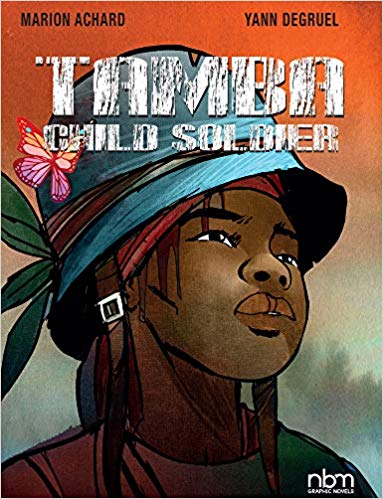
Tamba, Child Soldier


By Marion Achard & Yann Dégruel & various; translated by Montana Kane (NBM)
ISBN: 978-1-68112-236-6 (HB album)

Win’s Christmas Gift Recommendation: Potent, Powerful, Unmissable… 9/10

It may be a wonderful world but modern Earth is far too often a terrible place, especially if you’re weak and powerless.

The global scandal and shame of children forcibly co-opted into paramilitary and terrorist groups is not a new phenomenon. Throughout history boys and girls have fought in adult wars. Comic books are full of them, but there’s two big differences: they all “volunteer” without being groomed by cruel power-obsessed scum and THEY’RE NOT REAL.

So prevalent and pernicious was the practise of African and Asian militias, religious groups and other factions (even governments), that in 2000 the civilised world agreed to an Optional Protocol on the involvement of children in Armed Conflict. The OPAC accord restricts armed forces recruitment to adults of 18 years or over and has become known as the Straight 18 standard.

It’s a good start but hasn’t stopped ambitious war-criminals and monsters raiding villages for kids, who they drug, beat and starve; enslaving and brutalising them to use as cannon fodder and shock troops in hope of securing their own evil ends.

Rather than concentrate on any specific case or example (there are so damned many) this stunning oversized (216 x 279 mm) full-colour hardback and/or digital book gathers and synthesises many true incidents into the dramatised testimony of Tamba Cisso: taken aged eight from his African village – along with all of his young friends – and forcibly inducted into a scavenging band of killers.

The specifics of the tragically documented events he participated in – and the unhappier fates of his fellow abductees – are revealed through the venue of his later testimony to an initially hostile crowd at a Commission for Truth and Reconciliation. Tamba’s account of everyday life as a reluctant warrior for a jumped-up rebel warlord is no less harrowing for being one step removed from our own world’s actual atrocities…

Acutely examining the greater effect of kidnappings on generations of citizens, Young Adults author Marion Achard (Je veux un chat et des parents normaux, Pourquoi je suis devenu une fille) brings bitterness, barely harnessed anger, righteous indignation and potent empathy to an appalling subject. Tamba, l’enfant soldat is her first graphic novel – hopefully not her last – rendered with vivid virtuosity and great subtlety by artist and animator Yann Dégruel (Genz Gys Khan, Sans Famille).

Augmenting their visual narrative is Achard’s text essay Child Soldiers: describing what happens to these shunned victims of violence and sharing some extremely disturbing facts and figures, and is augmented by features on Truth and Reconciliation Commissions and Professor Laure Borgomano’s (Department of Defense, NATO) breakdown of the purpose and functions of The UN High Commissioner for Refugees: UNHCR…

Compellingly engaging and boldly, beautifully illustrated, this is a chilling, sobering yet ultimately encouraging reading experience everyone with a stake in a less toxic future must seek out and share.
© 2018 Edition Delcourt. © 2019 NBM for the English translation.

For more information and other great and challenging reads see http://www.nbmpub.com/

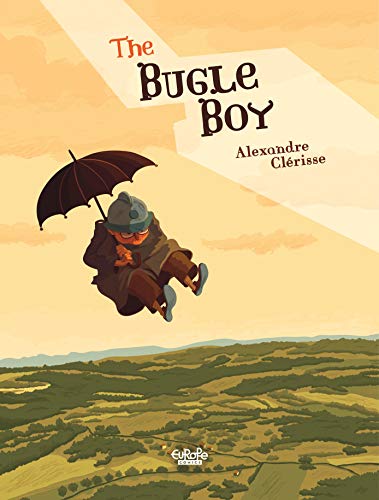
The Bugle Boy


By Alexandre Clérisse, translated by Edward Gauvin (Europe Comics)
No ISBN – digital only edition

Win’s Christmas Gift Recommendation: What All Those War Stories Really Mean… 9/10

The dead don’t care what we do, but how we treat and remember them defines who we are as a culture and species. Inspired by a true story, Trompe la mort was first published in 2009, offering a humorous, whimsical tone to what must have been a pretty depressing situation…

Translated by digital-only Europe Comics, The Bugle Boy is a story of debts paid and brothers-in-arms honoured, which begins as an ageing veteran decides to settle some long outstanding affairs…

Marcel is a surviving participant of WWII, and as a surly bugger of 85-years vintage, is inexplicably moved by an impending notion to sort out unfinished business before he joins the rest of his generation in the boneyard.

Back in the war, he was a dashing young company bugler and is now increasingly unsettled at the events which forced him to bury his beloved instrument on a battlefield. As memories of those fraught, often humiliating days keep coming to him, the gritty old sod, with his feisty and unwillingly dutiful granddaughter Andrea, embark on an unpleasant, cross-country bus trek to the distant rural region where – in 1940 – he and his comrades fought their first and last battle.
Before being captured, the idealistic lad he was buried that bugle before it could be employed as it should, and now all he can think of is getting it back.

Sadly, once all the tedious and painful travails of the journey are completed, Marcel has a still-more difficult problem to solve. The instrument has been already found and turned by the Mayor into a tourist-trap badge of French patriotism. It’s grandly installed in the local town museum – which is now dedicated to bugles of all sorts – as the heart and soul of the town’s rebirth. With elections coming, the wily demagogue is planning on exploiting it and the glorious – if comfortably mis-defined – past, as the clarion symbols of his re-election campaign. He has no intention of returning it to its rightful owner.

But not if Marcel and Andrea have anything to say about it…

Writer/artist Alexandre Clérisse was born in 1980 and began seriously making comics in 1999 through a series of experimental fanzines. In 2002 he graduated from EESI school of Visual Arts in Angoulême – where he still resides – and began releasing such superbly readable Bande Dessinee as Jazz Club, Souvenir de l’empire de l’atome (seen in English as IDW’s Atomic Empire) and all-ages Seek-&-Find book Now Playing…

Heartwarming and irreverent, poignant and deeply funny, The Bugle Boy has all the force and gently subversive wit of classic Dad’s Army episodes and cannot fail to hit home with any reader possessing grandparents who remember and kids who wonder what war is really like…
© 2019 – Dargaud – Clérisse. All rights reserved.

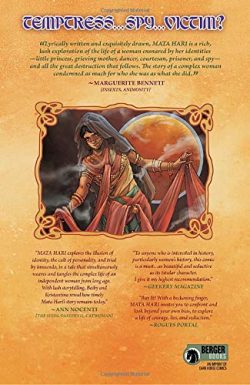
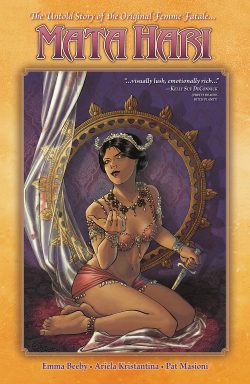
Mata Hari


By Emma Beeby, Ariela Kristantina, with Pat Masioni & Sal Cipriano (Berger Books/Dark Horse)
ISBN: 987-1-50670-561-3(TPB) eISBN: 987-1-50670-590-3

Win’s Christmas Gift Recommendation: Because History is Never Straightforward or Straitlaced… 9/10

Until relatively recently (some would argue that should read “hopefully soon”), History has never really treated women well or even fairly. When not obscured, sidelined or just written out, they have been cruelly misunderstood and misrepresented.

Moreover, we’re all painfully aware these days, a bold lie or convenient fabrication has far more veracity that simple, muddled, messy truth.

Margaretha Geertruida “Margreet” MacLeod (née Zelle) was born on August 7th 1876 in Leeuwarden, in the Dutch Netherlands, to milliner and later industrialist Adam Zelle. She was the eldest of four children and raised in wealth until her father lost it. Her life became more troubled and remarkable after that, before she died on 15th October 1917 in front of a French Firing Squad.

In between, she had married, lived in the East Indies, had children she never really knew and remade herself as a rather scandalous dancer and performer. Margreet adopted the stage name Mata Hari (it means “eye of the dawn” in Malay) and her gifts led to her becoming a courtesan in the highest circles of privileged society, with princes, ambassadors, tycoons and generals all clamouring for her attention. She was also courted by some countries – including France and Great Britain – to act as an espionage operative…

After a chequered life during a period when European society welcomed strong independent women, she was accused on meagre evidence of spying for the Germans during the Great War, and convicted.

Deemed to have caused the death of 50,000 men, and the moral ruination of countless others, Mata Hari has become the purest and most enduring symbol of the deadly, cunning femme fatale…

In the last few decades, serious historical investigation has cast a rather different, and far fairer complexion on the mythical spy in film, song, ballet, books, musicals and all arenas of popular culture, none better than an imaginative 5-issue miniseries from Dark Horse’s Berger Books imprint, a collaboration of writer Emma Beeby (Judge Dredd, Doctor Who, Judge Anderson), artist Ariela Kristantina (Wolverine: The Logan Legacy, Deep State, Insexts), colourist Pat Masioni and letterer Sal Cipriano.

Blending hard fact with emotive supposition and informed extrapolation, the sorry episode unfolds in the flashbacks and daydreams of a prisoner held at the Saint-Lazare Prison for Prostitutes in Paris in October 1917. Opening chapter ‘Bare Faced’ introduces Margreet as she desperately struggles to complete a book that will tell her story in her own words…

Against a backdrop of political and military manipulation resolved to make an example of her, ‘Bare Breast’ details her disastrous, life changing marriage and its terrible consequences whilst ‘Bare Heart’ relates her fight back to independence and notoriety after which ‘Bare Teeth’ moves on to the war and the great love for a Russian soldier that leads to her ultimate downfall in ‘Bare All’…

Real life doesn’t work the way narrative would like and the people there aren’t actors. This contemplative tale (packed with documentary photos and available in paperback and digital formats) carefully acknowledges that frustrating complexity in an account scrupulously devoid of heroes and outright villains whilst exposing centuries of institutionalised injustice – in an extremely entertaining manner. It closes with a series of textual Codas (offering many more intimate photos of the woman and her times) with ‘Mata Hari’s Conviction’ relating the oddities and strange events regarding the disposal of her body and an authorial opinion by Beeby in ‘Was Mata Hari a Martyr?’…

In both word and imagery, Mata Hari is a potent, beguiling, evocative and uncompromising retelling of a murky and long-misconceived historical moment that any fan of history and lover of comics will adore…
Mata Hari text and illustrations © 2019 Emma Beeby and Ariela Kristantina. All rights reserved.