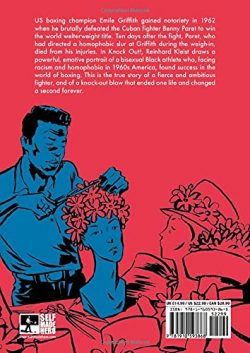
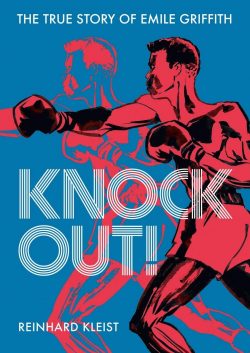
Knock Out! – The True Story of Emile Griffith


By Reinhard Kleist, translated by Michael Waaler (SelfMadeHero)
ISBN: 978-1-91059-386-8 (TPB)

Fairness and Justice are human constructs that afford many opportunities to prove that the universe works on other principles. Ritualized combat – like boxing – seeks to even out the most egregious imbalances between contestants to provide a balanced and equitable battle, but no amount of rule-making and legislation can shield participants from society, the environment they live in or the genetic heritage that shaped them.

Multi-award-winning German illustrator, designer, author, cartoonist and comics maker Reinhard Kleist (Berlinoir; Steeplechase; Das Grauen im Gemäuer) has been working in the industry since 1994: setting up a cooperative studio/atelier and beginning his professional career with graphic biography Lovecraft, and supernal dramas Minna, Das Festmahl, and Abenteuer eines Weichenstellers while still a student in Münster.

He has constantly explored and gratified his fascination with notable individuals who have overcome stacked odds and inner darkness in stellar works such as Johnny Cash: I See a Darkness; Elvis – An Illustrated Biography; Castro; An Olympic Dream: The Story of Samia Yusaf Omar and Nick Cave: Mercy on Me.

Here his powerfully moody yet joyous exuberant monochrome stylings recount the amazing life of a born fighter who triumphs in the best storybook traditions, whilst never deviating from the inescapable chains of history or escaping the sordid realms of real life…

Even if they’ve heard of him, most boxing fans don’t talk about Emile Alphonse Griffith. Born in the US Virgin Islands in 1938, Emile was black, poorly educated and endured abuse at home before moving to America. In 1956, while working in a New York hat factory, his foreman – a former boxing coach – noticed his astounding physique and encouraged the affable easy-going kid to try boxing as a way to improve his financial woes.

Although Emile preferred ping-pong, singing and making hats (later, at the height of his fame, Emile designed hats for women and made upbeat pop records), he went along with his white mentor. Turning Pro in 1958, Emile was soon a Golden Gloves winner and World Champion in the Welterweight, Junior Middleweight and Middleweight categories.

At that time in America, the sporting barriers to black boxers were mostly gone, but Emile laboured under another “handicap” – he slept with men and didn’t particularly care who knew about it.

Just like showbiz and popular entertainer Liberace, Emile’s status was an “open secret” in the 1960s Boxing community, which maintained a “don’t ask, don’t tell” mentality, but that only went so far in the days before the game-changing Stonewall Riots (look it up if you have to – its important). The happy-go-lucky pugilist’s privileged status evaporated after the third of three fights with Cuban Benny Paret, whom Emile defeated to become World Champion, before losing the rematch.

In 1962, they met one final time. After Paret taunted Griffith with homosexual and racial slurs, the match was a savage and unrelenting bout that resulted in the death of Paret…

However, that’s simply the first act of this tale, which follows Griffith – who was allowed to continue boxing until 1977 – as he confounded critics and bigots, breaking down barriers and living a full and extremely varied life… as much as his troubled conscience would allow.

This is a supremely uplifting story of triumph and tragedy which shows just how meaningless such concepts are outside of fiction. It’s a happy-sad example of how life goes on in a personal and macroscopic manner until it just ends: and it successfully argues that all you can do is the best you can…

Available in paperback and digital editions and supported by a Preface from Kleist acknowledging his influences and debt to Griffith biographer Ron Ross; Jonathan W. Gray’s context-enlightening Foreword ‘The Sweet Science and Open Secrets’ and a socio-cultural appraisal of Emile and other gay black boxers by Tatjana Eggeling (European Ethnologist and expert on Homophobia in Sports) plus a superb gallery of sketches and working drawings by Kleist, this is an unqualified hit that resonates far beyond the square ring and the closeted environs of LGBTQIA+ literature. It’s a surefire winner for everyone.
© Text and illustrations 2019 CARLSEN Verlag GmbH, Hamburg, Germany. English translation © 2021 SelfMadeHero. All rights reserved.


War Stories Volume Two


By Garth Ennis, with David Lloyd, Cam Kennedy, Carlos Ezquerra, Gary Erskine & various (Avatar Press)
ISBN 978-1-59291-241-4 (TPB)

Garth Ennis understands the point of war stories. He knows they’ve never been about gratification, glorification or even justification. Tales of combat have always been a warning from the sharp end of history to the callow, impressionable and gullible.

Humans have never needed much reason to fight, but when nations do it, it’s usually because our leaders have failed us and need a means to make citizens eager to die and cover up failings of leadership. Stories of conflict recounted by those who have actually dodged bullets and seen comrades die generally have a different flavour to histories or the memoirs of great men, and precious few academics or national leaders have ever been diagnosed with PTSD…

Although never having endured the trials of soldiering, Ennis is an empathetic, imaginative and creative soul whose heart firmly beats in tune with the common man, and a devout aficionado of the (practically anti-war, politically-charged) British combat comics, strip and stories he read as a lad. It’s what distinguishes him as a major writer of mature-audience fiction with a distinct voice and two discrete senses of humour.

In 2004, he began exploiting his lifelong passion for the past and unique viewpoint in an occasional series of WWII one-shots for DC’s Vertigo imprint. The tales were graced by an impressive cast of illustrators assembled to produce some of their finest work.

The first 8 of these were collected in two volumes of War Stories from Vertigo/DC and again in 2015 via Avatar Press in both trade paperback and digital editions. They remain a true highpoint in the history of combat comics.

This second compilation – complete with a heartfelt Ennis Afterword (and commentary, detailing the historical events that formed the basis of these astounding fictionalised encounters), plus a bibliography of sources used to craft them – rounds out the original Vertigo run, prior to later volumes which collect tales crafted since then…

It all opens with the haunting and distressing ‘J for Jenny’, exploring the stresses of a British Bomber crew as they carry out their nightly missions. The plot is carried along via a bitter row between pilot and co-pilot who constantly debate the necessity of their task; one constantly bemoaning the horrendous cost to German civilians whilst the other gloats and glories in the death of each and every woman and child.

As always, nothing is ever what it seems and the finale is a tribute to the creators’ skills and the unpredictable insanity of war itself. David Lloyd’s atmospheric meta-realistic art and colours powerfully underpin a tale few could do justice to.

With Cam Kennedy illustrating and Moose Baumann adding hues, the next yarn focuses on a ramshackle squad of hit-&-run specialists, dashing in under cover of darkness to blow up German airstrips and bases in the deserts of Africa. Apparently, this sort of tactic directly led to today’s Special Ops units and this unruly wild bunch certainly echo modern fiction’s image of beer-swilling, gung-ho nutters ready to fight and die, and always up for a bit of a giggle.

The breakneck action is laced with blackly ironic, slap-stick humour, but never permits the reader to long forget the deadly and permanent nature of the business at hand. Increasingly, conflict mars the relationship between battle-wearied team leader and his second in command: a death-or-glory obsessed Scot who likens the unit to the infallible, mythical bandit warlords his ancestors dubbed ‘The Reivers’…

Baumann also colors ‘Condors’: set during the Spanish Civil war and the war-comic equivalent of a shaggy dog story. During a particularly hectic bout of fighting four combatants crawl into the same smoking crater to wait out the shelling. There’s an Englishman, an Irishman, a Spaniard and a German – two from each side of the conflict…

To pass the time they trade life stories and philosophies. This antisocial gathering feels the most authentic to what one might deem an authorial opinion, as motivation for fighting and killing are scrutinised through eyes and ears that have seen and heard all the explanations and reasons – and still judged them wanting.

Spaniard Carlos Ezquerra perfectly captures the camaraderie and insanity in his powerfully expressive renderings. This is an absolute gem of a story.

Final tale ‘Archangel’ closes the book on a lighter note, although the premise – based on actual missions of the convoy service – is one that hardly lends itself to easy reading.

Until the cracking of the Enigma code, every Trans-Atlantic shipment of materiel – especially to our Soviet allies – was practically defenceless against Axis submarine and bomber assault. One counter-scheme was to station a fighter plane on an accompanying vessel which would be launched to fend off airborne attacks. All well and good on paper…until you realise only obsolete planes could be spared for such service, and that once launched – by rocket catapult, no less – they could not land again, but had to ditch or aim for whatever dry land could be reached on whatever fuel remained.

It should also be noted that not all land was in friendly hands, either. This tale of an RAF misfit and his arctic odyssey is full of the ‘hapless prawn triumphant’ that typified vintage post-war British films and the meticulous artwork of Gary Erskine and colourist Paul Mounts lends credibility to a tale that sheer logic just can’t manage.

Ennis’s war works are always a labour of love, and his co-creators always excel themselves when illustrating them. Combine this with a genre that commands respect most comics just don’t get and you have a masterpiece of graphic fiction to even the most discerning library or bookshelf.
© 2015 Avatar Press. Afterword © 2015 Garth Ennis. WAR STORY: J FOR JENNY © 2015 Garth Ennis & David Lloyd. WAR STORY: THE REIVERS © 2015 Garth Ennis & Cam Kennedy. WAR STORY: CONDORS © 2015 Garth Ennis & Carlos Ezquerra. WAR STORY: ARCHANGEL © 2015 Garth Ennis & Gary Erskine.

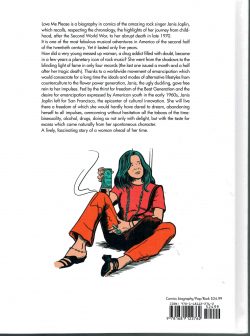
Love Me Please – The Story of Janis Joplin (1943-1970)


By Nicolas Finet, Christopher & Degreff: translated by Montana Kane (NBM)
ISBN: 978-1-681122-76-2 (HB) eISBN: 978-1-681122-77-9

The list of people who lived hard, died young and changed the world is small but still, somehow, painfully overcrowded. Possibly the most tragic, influential, yet largely unknown is a born rule-breaking rebel who defied all conventions and became almost inevitably THE icon of doomed youth-with-big-dreams everywhere…

Author, filmmaker, journalist, publisher, educator and music documentarian Nicolas Finet has worked in comics for more than three decades and also generated a bucketload of reference works – such as Mississippi Ramblin’ and Forever Woodstock. His collaborator on that last one was veteran author, journalist and illustrator Christopher (The Long and Winding Road; many other music-centred tomes and adaptor of Bob Dylan).

Their compelling treatise on misunderstood and self-destructive Janis – just like her music, poetry and art – is something to experience, not read about, but I’ll do my best to convince you anyway…

After a quick dip into early life and influences, the story proper opens in Texas in 1947 as ‘Forget Port Arthur’ zeroes in on key childhood traumas and revelations around the homelife and schooling of little Janis Lyn Joplin at the start of the most culturally chaotic and transformative period in American history…

Brilliant, multi-talented, sexually ambiguous, starved for love whilst desperately directionless, her metamorphosis through Blues music mirrors that of many contemporaries (a fair few of whom comprise the infamous “27 Club” of stars who died young). However, as this book shows, although something indefinable was always just out of Joplin’s reach, her response was never to passively accept or ever surrender…

After wildly rebellious teen years, an uncomfortable educational life, a brief brush with conventional conformity and a near-lethal counter-culture encounter in San Francisco – as detailed in ‘The Temptation of Disaster’ – her meteoric rise in the era of flower power, liberal love and drug experimentation and record company exploitation lead to her return to California and triumphant breakthrough in 1966, all carried along by ‘Spells and Charms’…

Stardom with hot band Big Brother and the Holding Company, a host of legendary encounters and even greater personal dissipation makes wild child into living myth at Monterey and other landmarks of the Summer of Love, before success and acceptance prove to be her darkest nightmare in ‘Lost and Distraught’…

Global stardom and media glorification are balanced by heartbreak, betrayal and too-many brushes with death. As Woodstock confirms her status and talent to the world, the landscape inside her head turns against Janis. Endless exhausting tours and brief amorous encounters further destabilise the girl within and the end – when it comes – is no surprise to anyone…

With a moving Preface from comics legend and childhood friend Gilbert Shelton, a huge and star-studded Character Gallery and suggested Further Reading and Viewing, this forthright, no-nonsense yet extremely imaginative interpretation of the too-short flowering of “the Rose” offers insight but no judgement into a quintessentially complex, contradictory and uncompromised life…

NBM’s library of graphic biographies are swiftly becoming the crucial guide to the key figures of modern history and popular culture. If you haven’t found the answers you’re seeking yet, then you’re clearly not looking in the right place…
© Hatchette Livre (Marabout) 2020. © 2021 NBM for the English translation. All rights reserved.

Love Me Please – The Story of Janis Joplin 1943-1970 is scheduled for release on July 15th 2021 and is available for pre-order in both print and digital editions.

Most NBM books are also available in digital formats. For more information and other great reads see http://www.nbmpub.com/

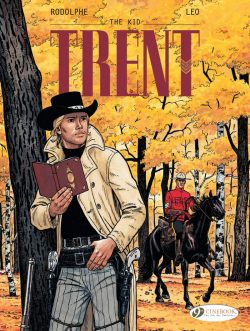
Trent volume 2: The Kid


By Rodolphe & Léo with colour by Marie-Paul Alluard, translated by Jerome Saincantin (Cinebook)
ISBN: 978-1-84918-374-1 (Album PB)

European comics audiences have long been fascinated with the mythologised American experience, whether it be the big-skied Wild West or later eras of crime-riddled, gangster-fuelled dramas. They also have a vested historical interest in the northernmost parts of the New World which has resulted in some pretty cool graphic extravaganzas.

Léo is actually Brazilian artist and storymaker Luiz Eduardo de Oliveira Filho: born in Rio de Janeiro on December 13th, 1944. Attaining a degree in mechanical engineering from Puerto Alegre in 1968, he was a government employee for three years, until forced to flee the country because of his political views. While a military dictatorship ran Brazil, he lived in Chile and Argentina before illegally returning to his homeland in 1974. To survive, he worked as a designer/graphic artist in Sao Paulo and created his first comics art for O Bicho magazine.

In 1981 he migrated to Paris, seeking to pursue a career in Bande Dessinée, and found some work with Pilote and L’Echo des Savanes as well as more advertising and graphics fare. The big break came when Jean-Claude Forest invited him to draw stories for Okapi which led to regular illustration work for Bayard Presse. In 1988 Léo began his long association with scripter and scenarist Rodolphe D. Jacquette – AKA Rodolphe.

His prolific, celebrated writing partner has been a giant of comics since the 1970s: a Literature graduate who transitioned from teaching and running libraries to creating poetry and writing criticism, novels, biographies, children’s stories and music journalism. In 1975, after meeting Jacques Lob, he expanded his portfolio to write for a vast number of artists and strip illustrators in magazines ranging from Pilote and Circus to À Suivre and Métal Hurlant. Amongst his most successful endeavours are Raffini (with Ferrandez) and L’Autre Monde (Florence Magnin) but his collaborations in all genres and age ranges are too numerous to list here.

In 1991 he began working with Léo on a period adventure series of the far north. Taciturn, introspective and fiercely driven Royal Canadian Mounted Police sergeant Philip Trent premiered in L’Homme Mort, forging a lonely path through the 19th century Dominion over eight tempestuous, hard-bitten albums between then and 2000. He also prompted the collaborators’ later fantasy classics Kenya (and its spin-offs), Centaurus and Porte de Brazenac.

Cast very much in the classic adventure mould as crafted by the likes of Jack London and John Buchan, Trent is a man of few words, deep thoughts and unyielding principles who gets the job done whilst stifling emotional turmoil boiling deep within him…

As ‘Le Kid’, this conflicted, moving second exploit originated in 1992, opening with a robbery in Blacktown, North Dakota that goes appallingly awry. The bandits are idealistic teenagers and when Laura is killed in a shootout, her poetry-obsessed partner Emile Tourneur goes completely off the rails…

With nine confirmed kills and nothing to live for, Emile heads north and becomes an RCMP problem. One of many officers assigned to catch him, Trent is despatched to Lake Manitoba with explicit orders to find but not confront the ruthless killer, aided only by faithful canine companion “Dog”.

Following sporadic poetic graffiti, the officer quickly picks up the trail and the impression that something isn’t right. For one thing, the kid is not hiding his tracks, and making plenty of friends and admirers along the way as his adds to the notches on his gun. Some think he’s only killing people who have it coming…

Eventually, Trent locates his quarry in the Frozen wastes and far-too-easily overcomes him. Their long trek back only adds to the mystery of the Rimbaud-quoting golden boy, who has a distressing knack of asking uncomfortable questions…

Brooding tensions and paradoxical revelations explosively come to a head when the now amiable fellow-travellers are ambushed by escaped convicts. Sudden, ruthless gunplay leaves the Mountie inexplicably alive, alone and still fully armed. He can only assume his recent captive is provoking him for some reason, as he traces a trail back to the scene of the kid’s last atrocity and a town full of vengeful survivors…

A beguiling voyage of internal discovery where environment and locales are as much a major character as hero and foe, The Kid offers suspense, action, humour and poignant evocation in a compelling confection that will appeal to any fan of widescreen cinematic crime fiction or epic western drama.
Original edition © Dargaud Editeur Paris 1992 by Rodolphe & Léo. All rights reserved. English translation © 2016 Cinebook Ltd.
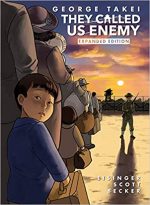
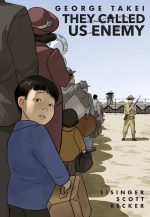
They Called Us Enemy


By George Takei, Justin Eisinger, Steve Scott & Harmony Becker (Top Shelf)
ISBN: 978-1-603094-50-4 (TPB) 978-1-603094-70-2 (Expanded HB)
eISBN 978-1-684067-51-0

Graphic biographies are a relatively new form for English-language comics, but the wealth and variety of material already available is truly breathtaking and laudable. This exemplary example is a subtly understated but deeply moving chronicle exploring the events and repercussions of a truly shameful moment in American history, recalled and relived by a global icon of popular culture who also happens to be one of the USA’s most ardent advocates of democracy, justice and equality and top-level activist in the arenas of LGBTQ and Asian-American rights.

Although George Takei has celebrated and commemorated his life in prose autobiography To the Stars, here – in collaboration with writers Justin Eisinger & Steven Scott and illustrator Harmony Becker – the Hollywood star slyly shifts focus to explore in painful and revelatory detail the early years of his life: a formative period spent as a non-person behind barbed wire in his own country.

Recounted as non-linear, non-chronological episodes, the history and self-serving actions of American leaders (like Lt. General John L. DeWitt or Los Angeles Mayor Fletcher Bowron) who systematically stripped people of Japanese ethnicity of their rights, livelihoods, possessions and autonomy are seen through the eyes of a small child: observations which inevitably shaped the actor into a crusading defender of democratic principles of later life.

I’d love to say that’s simply a thing of the past, but kids are still being locked in cages and families split up…

On February 19th 1942, following the attack on Pearl Harbor, President Franklin Delano Roosevelt signed Executive Order 9066, dividing the country into military zones and effectively declaring all American citizens of Japanese origins enemy aliens. This led to their internment for the duration of the war in 10 isolated camps between the West Coast and Mississippi river.

In surprisingly fond recollections of camp life, we share the notions of baffled children (George, brother Henry, sister Nancy Reiko and many new pals) and the lasting, post-war consequences of divisively authoritarian stunts such as legally-binding loyalty pledges, de-fanged and counterpointed by modern day discussions and triumphant moments of past injustices finally addressed.

As well as exposing the human costs of a shameful period of state-sanctioned, opportunistic profiteering and proud racism, this tale is a testament to human endurance, perseverance and innate dignity, with moments of delightful warmth and genuine humour, bolstered by actions of unsung humanitarian heroes like Takei’s own parents and pioneering civil rights lawyer Wayne M. Collins. Their tireless fortitude and resistance to oppression, along with the efforts of countless others, offers inspiration and hope for all suffering similar restraint and abuse while sadly proving that some battles may never end.

They Called Us Enemy is a compelling, charming and informative account of injustice and unchecked ignorance endured with plenty of points as pertinent now as they ever were.

In 2020 and expanded edition was released with 16 pages of extra material and is also available as both a physical hardback and in digital formats.
They Called Us Enemy © 2019 George Takei. All Rights Reserved.

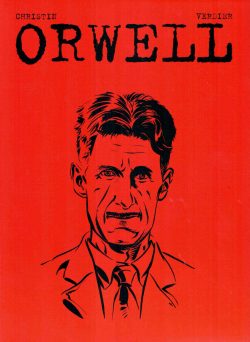
Orwell


By Pierre Christin & Sébastien Verdier, with André Juillard, Olivier Balez, Manu Larcenet, Blutch, Isabelle Merlet, Juanjo Guarnido, Enki Bilal & more: translated by Edward Gauvin (SelfMadeHero)
ISBN: 978-1-910593-87-5 (TPB)

We all have our heroes. One whom I apparently share with another of my most admired and revered favourites is Eric Arthur Blair, who you’ll know as George Orwell.

One of the most significant literary, societal, cultural and political figures of the 20th century, Orwell is also a particular fascination of comics icon Pierre Christin, co-creator of epically barbed, venerable sci fi masterpiece Valerian and Laureline. A seditiously canny political commentator in his own right – as seen in such thought-provoking graphic subversions as The Town That Didn’t Exist, The Black Order and The Hunting Party – Christin began this particular piece of literary reportage after completing a personal project investigating the world’s various functioning – if not necessarily functional – Communist regimes…

A writer to his core, Eric Blair was a true and ardent democratic socialist: an author, critic, essayist and unflinching observer of humanity saddled with a loathing of privilege and an inescapably, embarrassingly obvious upper-class education.

Blair was a solitary individual who loved people, and an angry humanist vehemently opposed to greed, stupidity, totalitarianism, extremism and oppression (equally from the Left, Right and religious alike). He fought for his ideals during the Spanish Civil War and loathed Stalin, Hitler and probably his own and all other national leaders with equanimous passion.

The complex man’s fascinating private life is brilliantly and addictively detailed in Orwell: Old Etonian, copper, prole, dandy, militiaman, journalist, rebel, novelist, eccentric, socialist, patriot, gardener, hermit, visionary: Christin’s compelling graphic biography and appreciation primarily illustrated by Sébastien Verdier (Ultimate Agency; Le marathon de Safia; Zodiaque) with additional visual contributions from André Juillard, Olivier Balez, Manu Larcenet, Blutch, Juanjo Guarnido, Enki Bilal, colourist Isabelle Merlet and more.

Divided into ‘Orwell Before Orwell’, ‘Blair Invents Orwell’ and ‘Orwellian Orwell’, with an assessment of the world ‘After Orwell’, the narrative message and potent documentary depictions are bolstered with adapted snatches from Orwell’s groundbreaking stories and non-fiction, plus plenty of quotes taken from the cultural witness/prophet’s diaries.

Moving, revelatory, potent and supplemented by a methodological Afterword from Christin, this is a captivating graphic triumph no fan of graphic biography or devotee of the only man to provably predict the future should be without.
Orwell © DARGAUD 2019, by Christin, Verdier. All rights reserved. English translation © 2021 SelfMadeHero.
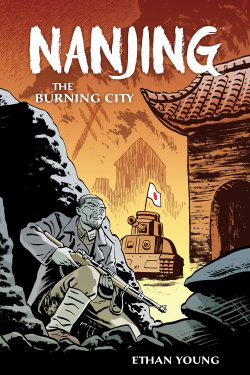
Nanjing: The Burning City


By Ethan Young (Dark Horse)
ISBN: 978-1-61655-752-2 (HB) 978-1-50671-085-3 (TPB)

Ethan Young comes from New York City, the youngest of three boys born to Chinese immigrant parents. Following studies at the School of Visual Arts, he began work as a commercial illustrator, supplementing that with debut graphic novel Tails: Life in Progress which won Best Graphic Novel award at the 2007 Independent Publisher Book Awards.

It thrived as a webcomic, as did his other ongoing all-ages project A Piggy’s Tale: The Adventures of a 3-Legged Super-Pup (created and written by Tod Emko). Later works include Firefly: Watch How I Soar; The Dragon Path; The Battles of Bridget Lee and more but they are all a far cry from this masterpiece. Nanjing: The Burning City is a stunning and excoriating anti-war parable, detailing one incomprehensibly dark night of horror in a war most of the world has conveniently forgotten about.

Whilst many Japanese – like Keiji Nakazawa (author of the astounding Barefoot Gen and a tireless anti-war campaigner for most of his life) – are fully prepared, able to acknowledge and “own” Japan’s horrific excesses throughout World War II (and the colonial expansion into China – noncommittally dubbed The Second Sino-Japanese War – which preceded it), far too many survivors of the original conflicts and – disturbingly – modern apologists and revisionists find it easier and more comfortable to excuse, obfuscate or even deny Japan’s role.

Sadly, I suspect today’s China is just as keen to systematically refute the excesses of the Maoist years and beyond…

Every nation that’s fought a war has committed atrocities, but no country or government has the right to dodge shame or excise blame by conveniently rewriting history for expediency or political gain: not Britain, not the USA, not Russia and never, ever those barbaric “Axis Powers” who tormented mankind between 1933 and 1945.

Delivered in stark, stunning yet understated black-&-white in hardback, paperback and digital editions, Young’s tale exposes callous brutality – without resorting to “us-and-them”, “good guys vs. bad guys” polemic – by simply focusing on one night and three very different military men caught up in the ghastly events.

The Second Sino-Japanese War began on July 7th 1937 when an aggressively expansionist Empire of Japan invaded complacent Shanghai. The well-equipped force moved swiftly inland towards Nanking, capital of Kuomintang Generalissimo Chang Kai-Shek’s newly established Republic of China.

The thoroughly modern Imperial army reached the city on December 12th, whereupon Nanking’s military and civil leaders fled in panic, leaving hundreds of thousands of Chinese soldiers and citizens to bear the brunt of a savage, bestial assault described by author Iris Chang as The Rape of Nanking.

Chinese Republican officers didn’t even issue orders for the soldiers they abandoned to retreat…

Over the next six weeks more than 300,000 died in a campaign of organised torture and massacre. Uncountable numbers of women and children were raped and brutalised. Before the Japanese military chiefs surrendered in 1945, they had all records of the taking of Nanking destroyed. The never-to-be-properly-accounted dead are rightly known as the Forgotten Ones…

An event almost completely overlooked for decades by western – and Japanese – historians, the torment began with a night of appalling, unparalleled atrocity with Young concentrating his tale on the efforts of a nameless Captain and a sole surviving subordinate making their way through the shredded remnants of the metropolis. The betrayed, beaten warriors harbour a fanciful hope of sanctuary in the enclave occupied by European diplomats, businessmen, missionaries and their servants: the sacrosanct “Safety Zone” where white people go about their business largely untouched by strictly Asian “local politics”…

It’s only a few kilometres to salvation, and the Zone indeed houses many sympathetic foreign souls who will risk their lives for humanitarian reasons, but to get to them the soldiers must avoid the hordes of prowling, drunken, blood-crazed conquerors and deny their own burning desire to strike back at the invaders – even if it costs their lives…

As they slowly scramble through hellish ruins, they are doggedly pursued by a Japanese colonel who apparently has no stomach for the gleeful bloody debaucheries of his soldiers but rather carries out his duties with a specialised zeal and for a different kind of reward…

Whilst the weary Kuomintang survivors make their way to the Safety Zone, however, a far more deadly hazard constantly arises: crushed, beaten, desperate fellow Chinese begging them to stop and help…

This is a gripping story with no happy ending, supplemented by Young’s large Sketchbook and Commentary sections, offering character studies, developmental insights and rejected cover roughs, as well as a formidable Bibliography for further reading…

Nanjing: The Burning City is a beautiful, haunting book designed to make you angry and curious and in that it succeeds with staggering effect. It’s not intended as a history lesson but rather a signpost for the unaware, offering directions to further research and greater knowledge, if not understanding; a provocative lesson from history we should, now more than ever, all see and learn from.
© 2015 Ethan Young. All rights reserved.
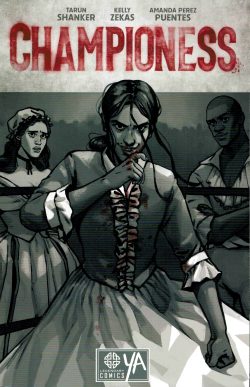
Championess


By Tarun Shanker, Kelly Zekas, Amanda Perez Puentes, & various (Legendary Comics)
ISBN: 978-1-68116-076-4 (TPB)

Legendary Comics (a print adjunct of Legendary Pictures – responsible for the Batman/Dark Knight movies as well as The Hangover, Man of Steel and 300) specialises in graphic narratives tailored for big screen film franchises, and this latest trade paperback may be a sleeper hit and potential contemporary blockbuster…

Women’s boxing is a rapidly growing sport and Britain is apparently a global leader. You might be surprised to know that – apart from an aberration of those deeply disturbed, morally hypocritical, history-rewriting Victorians – ’twas ever so…

Championess is a hugely enjoyable melodramatic romp based on Georgian Elizabeth Wilkinson (nee Stokes) of Clerkenwell: a woman bareknuckle prize-fighter active between 1722-1728, and acclaimed star of a sport deliberately excised from history by those aforementioned, socially-censorious commentators and scribes.

Here, thanks to writers Tarun Shanker and Kelly Zekas – who have themselves taken a few literary liberties to deliver a knockout blow for racial diversity and female empowerment – Wilkinson is resurrected as a shunned but determined young woman of mixed race (British and Lascar/Indian) who wants to be a champion pugilist at a time when women fighters are commonplace, but considered simply as clowns and novelties.

Elizabeth fights for money to save her poor but saintly sister – who can “pass” for English – from debtors’ prison; she does it for revenge on an old friend who betrayed her; she does it to prove men don’t run the world; she eventually does it for and beside a man she

learns to trust and love, but mostly Elizabeth fights because she wants to and she’s really good at it. All she has to do is prove it to the scurrilous, bout-fixing fight arranger who runs the game in London, the public and in the end, herself…

Illustrated in monochrome grey washes by Amanda Perez Puentes, this is a bright, breezy, modernistic costume drama that would win plenty of notice on big and small screens. There’s not much in the way of narrative nuance or novelty, but it enthusiastically follows the arc of all good sports comics like Roy of the Rovers or the Tough of the Track, and Sport’s all about the action and the moment, right?

Backed up by sketch and design pages, cover gallery and variants and a feature on the process of script to finished art page, this tale is an unsophisticated but enthralling feelgood tale which I can certainly see fulfilling Legendary Comics’ remit and being adapted – assuming I and others can stifle that old-world, chauvinistic response to seeing women (or anybody, in fact) hitting each other for money and other peoples’ gratification…
© 2021, Legendary Comics, LLC. All rights reserved. Continue reading “Championess”

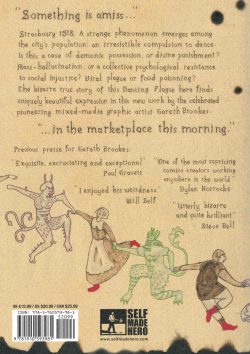
The Dancing Plague


By Gareth Brookes (SelfMadeHero)
ISBN: 978-1-910593-98-1 (PB)

Plagues, disasters and mysteries are, quite understandably, on everyone’s minds at the moment. What’s become clear over the last year is that we all react in different ways to something genuinely too big for mortals to cope with – especially those Idiots-In-Charge, universally elected almost everywhere by us idiots who aren’t…

For auteur extraordinaire Gareth Brookes, that annus horribilis of enforced confinement involved a deep delve back into history; to a strikingly different contagion that shook contemporary civilisation and tried the patience, initiative and abilities of the authorities.

It also gave him the perfect arena to examine other societal ills we haven’t cured or properly addressed – such as the role and treatment of women, the overwhelming disruptive and corrosive power of dogma and the perpetual inescapable corruption of those at the top by the very power they wield on our behalf.

Brookes is a capital-A artist, printmaker, textile creator and educator who learned his craft(s) at the Royal College of Art and who has subsequently appeared in ArtReview; Kus; The British Library’s Comics Unmasked exhibition and numerous classrooms and lecture theatres as inspirational teacher.

He began literally crafting comics in 2015 with an astounding, disturbing and hilarious epic entitled The Black Project and followed up two years later with an equally incisive take on perceptual disability – A Thousand Coloured Castles. His latest off-kilter gem harks back to a time far removed, but so-clearly beset with similar problems, demonstrating how humanity has barely changed in spite of the passing centuries, a massive shift in dominant worldview and what we’ll graciously call major advances in understanding of the universe and our place in it…

From the 11th century onward, Central European historians detail outbreaks of spontaneous, uncontrolled dancing – “choreomania” – which initially gripped and compelled women to prance and cavort without stopping. Causing great injury and always spreading to children, men and apparently, in some cases, livestock, these outbreaks were far beyond the ability of civic leaders, clergy or physicians to cure or even properly contain.

With instances cited all over the Holy Roman Empire from Saxony to Italy, the fictionalised tale here concentrates on the well-documented outbreak afflicting citizens of Strasbourg, Alsace (now France) in June 1518, which followed in the wake of a far more well-known pestilence – the Black Death.

Mary is an extraordinary girl gripped by revelations and visions: either a disruptive pawn of devils or the chosen mouthpiece of an outraged Lord and Saviour Jesus. Whatever the cause, she glimpses hidden truths and is compelled to expose the hypocrisy and corruption of high-ranking churchmen who betray their vows and faith. From near-death at her outraged and terrified father’s hands, to a truly unwise vocation as a nun who can’t stay silent, to abused wife and mother, Mary speaks out, steps out and is reviled and punished for it. Happily, something supernatural is keeping an eye on her…

Despite proof of miracles, rampant death, hunger and uncanny phenomena, Mary and her children abide and endure in acceptable normality until one day her drunken husband reports how he saw their neighbour Frau Troffea capering and hopping about in the street. What Mary sees is a woman pulled and bent by the gleefully malign ministrations of demons…

And so, another period of panic, intolerance and governmental ineptitude commences, with as usual tragic consequences for those at the bottom of the social hierarchy who get the chance to be scapegoated and gaslit yet again…

Episodically ducking and diving between 4th June 1500 and an Epilogue in March 1527, the grand dance unfolds and who knows where or how it will end?

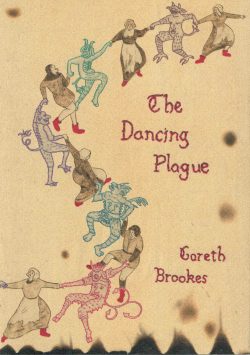
Deeply unsettling, earthily, gloriously vulgar in the manner of the Boccaccio’s Decameron or unexpurgated Chaucer, outrageously witty and slyly admonitory, The Dancing Plague is rendered with (I’m assuming, positively therapeutic) mastery in invitingly multicoloured, multi-layered linework reminiscent of woodblock prints, generated by “pyrographics” (inscribed by heated drawing tools) and painstakingly-sewn embroidery. As I’ve said in previous reviews, it’s like nothing you’ve ever seen and serves to form an equally unique narrative.

Preceded by a context-establishing Foreword by Anthony Bale – Professor of Medieval Studies, Birkbeck, University of London – providing all the factual background necessary to understand and enjoy this terpsichorean treat and details on two remarkable female historical figures whose lives inspired this yarn (sorry, I’m weak and couldn’t resist), this is another graphic triumph no fan of the medium or social redeemer should miss.
Text and images © 2021 Gareth Brookes. All rights reserved.

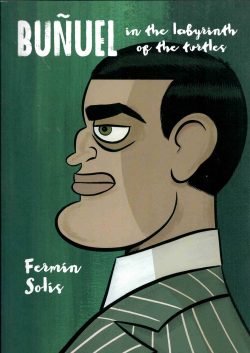
Buñuel in the Labyrinth of the Turtles


By Fermín Solís, translated by Lawrence Schimel (SelfMadeHero)
ISBN: 978-1-910593-84-4 (PB)

The places and moments where great art intersects with mundane reality have always made for great storytelling, and that’s never been more deftly demonstrated than in this highly personal interpretation of a crucial moment in the history of 20th century cinema.

Luis Buñuel Portholés (February 22nd, 1900 – July 29th 1983) was a Spanish filmmaker who renounced his citizenship in favour of Mexico, and his catholic faith in favour of truth: an iconoclastic, moralistic thinker and revolutionary who embraced surrealist doctrine and reshaped the arts of filmmaking.

If you have the stomach and suitable respect for the medium, please view Un Chien Andalou, L’Age d’Or and That Obscure Object of Desire – if not all of his heady output – but probably best leave it until after reading this engaging visual introspection from award-winning cartoonist Fermín Solís Campos.

The self-taught cartoonist, animator and illustrator of such treats as Otra Vida and El Hombre del Perrito shares many similarities with his subject and a solid yet whimsical earthy touch that is perfect for this examination of a key moment in the celluloid auteur’s rocky progression from wunderkind to industry lynchpin.

‘Do Not Disturb! Artist Dreaming’ opens with Buñuel wracked by his usual night terrors of barnyard fowl, Christian iconography and talking wildlife before an old friend calls to inform him of a cash windfall. It’s the end of 1932 and old comrade Ramón Acin trails him through the seedy warrens of the city, carousing and pontificating on past glories before deducing ‘Paris no Longer Loves Us’. Are there no challenges left? Is surrealism no longer enough to challenge the world and outrage society?

‘Ten Hours from Paris’ and months later, they and a small crew are assessing one of the most poverty-stricken regions of Europe. A Spanish region wedded to faith but so poor that the residents have no conception of even basic foodstuffs like bread. As the bizarre villagers and their weird tortoise-like huts bore into Buñuel’s fevered subconsciousness, his creative dry spell vanishes. Inspired again, he carefully concocts Las Hurdes: Tierra Sin Pan (Land Without Bread) contravening all established rules and mores to create a new genre beyond simple documentary. Alternatively called ethnofiction, pseudo-documentary or cinema verité, its cost to veracity, human compassion and even simple morality might be too much to bear…

Challenging, compelling and utterly absorbing, Buñuel in the Labyrinth of the Turtles is a superb graphic assessment of the creative process that will surprise and delight in equal measure
© 2008, 2019 Fermín Solís. © 2019 Penguin Random House Grupo Editorial, S.A.U. All rights reserved.