A Journal of my Father


By Jiro Taniguchi translated by Kumar Sivasubramanian with Chitoku Teshima (Fanfare-Ponent Mon)
ISBN: 978-1-91209-743-2 (HB)

Unless you’re a dedicated fan of manga, you probably haven’t heard of Taniguchi Jirō (14th August 1947-11 February 2017). Despite his immense talent as both writer and artist – in 2011, France knighted him a Chevalier of the Ordre des Arts et des Lettres – his “gekiga” work has been slow to reach English speakers since his 1970 debut in Young Comic with Kareta Heya (A Desiccated Summer).

With nearly 50 different series and collections to his credit – originally hard-edge crime like City Without Defense, The Wind of the West is White, Lindo 3, Blue Fighter and Knuckle Wars – the 1990s saw him move into more universal and mature themes with Kamigami no itadaki (The Summit of the Gods), Kamigami no itadaki, and – in 1997, in collaboration with Moebius – Ikaru (Icarus).

He expanded into straight drama with Botchan no Jidai, Inu o Kau and the remarkable A Distant Neighborhood (a major, albeit Belgian, motion picture since 2010).

Joking aside, Mr. Taniguchi was a major force in international comics and now his most personal masterpiece is at last available in English, thanks, I suspect to a career-long and most appreciative French connection. Hopefully, that will extend to digital editions fairly soon …

Beguilingly mild, understated and packed with suppressed and repressed emotion, Chichi no Koyami details how a quiet, diligent parent is called back to his home town after years away in Tokyo. Yoichi Yamashita has spent decades away, carving out a life and family for himself while avoiding all contact with his own father.

Now the old man is dead, and the dutiful son returns for the funeral rites. Talking with family and friends, he gradually learns of a man and life he never really knew and, as he re-examines his side of a never-changing story probably repeated in every household in the world, Yoichi reassesses and apply an uncompromising lens of hard-earned experience to the life he made after leaving so long ago.

In dignified, revelatory slices, beginning with ‘A Sunny Place on the Floor’ and ‘Traces of Spring’, he reconsiders his life. ‘Crimson Memories’, ‘New Roads’, ‘My Beautiful Mother’, ‘Summer Recollections’, ‘Separation’ and ‘Another Mother’ fill in details like a detective thriller with all the clues and evoked memories of ‘A Particular Photograph’, ‘My Uncle’s Words’, ‘Revolving Seasons’ and ‘Hometown in Spring’ drawing him into long-delayed emotional metamorphosis and catharsis…

Gentle and lyrical, rendered with staggering visual authenticity and ruthless honesty, this old, old story is mesmerising in its power to move: an emotional tonic every father and son should apply lavishly to their own experience and a truly grown-up picture book we should all use as manual to navigating family life.
Chichi no Koyami by Jiro Taniguchi © Papier/1995 Jiro Taniguchi. All rights reserved. © 2021 Potent Mon for the English language edition.
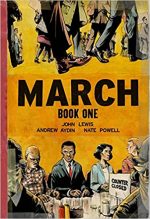
March Book One


By John Lewis, Andrew Aydin & Nate Powell (Top Shelf Productions)
ISBN: 978-1-60309-383-5 (HB) 978-1-60309-300-2 (PB)

It’s a lazy cop-out but honestly, some books just need to be read. March is one of them. It’s the story in his own words of legendary civil rights pioneer and properly-evolved human being John Lewis: the first of three describing his path from oppressed and sidelined southern child to non-violent activist to the halls of America’s Congress. Adapted by his assistant Andrew Aydin and multi award-winning cartoonist Nate Powell (Two Dead, Come Again, About Face, Any Empire, Swallow Me Whole, The Silence of Our Friends) it charts with astonishing intimacy and warmth a story of the good guys winning in the end…

The artist’s sensitive monochrome washes and tones painstakingly capture the dignity, determination, humour and pervasive quiet tension of the South during those fraught times and the growing groundswell of peaceful resistance that culminated in a very public confrontation on a bridge, a long walk to Washington and the start of a process still sadly underway every day…

It proudly celebrates everything the 45th PotUS seemed determined to roll back, and failed to accomplish, too so that’s a big Yar, Boo Sucks! to him too while we’re on the subject…

March Book One was first released in 2013 as a paperback, again as a lavish oversized (210 by 305mm) hardback three years later. It’s also available in digital formats: one of the most lauded and awarded biographies of recent times and immensely enjoyable and uplifting. You need to see it and the concluding volumes, too.
March Book One © 2013, 2016 John Lewis and Andrew Aydin. This edition © 2017 Fantagraphics Books. All rights reserved.
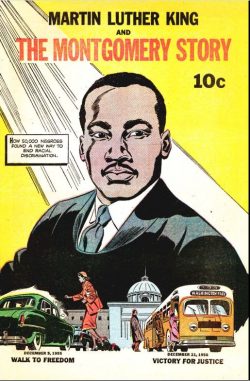
Martin Luther King and The Montgomery Story

By Alfred Hassler, Benton Resnik & Sy Barry (Fellowship of Reconciliation/Top Shelf Productions)
ISBN: N/A

When you actually read the book cited in the previous review, you’ll hopefully notice an inspirational comic book enjoyed by many at the time. A potted history and primer on non-violent resistance, Martin Luther King and The Montgomery Story was published in 1957 by the Fellowship of Reconciliation and widely disseminated and shared by Civil Rights organisations, churches, schools – and young John Lewis. When Top Shelf released The March they also revived this historical treasure, and it too can be yours.

All proceeds still go to fund the Fellowship’s ongoing work…

The Underground Abductor (Nathan Hale’s Hazardous Tales)


By Nathan Hale (Abrams/Amulet Books)
ISBN: 978-0-4197-1536-5 (HB)

Author/cartoonist Nathan Hale has a famous namesake and has been riffing on him, with great effect, for over half a decade now. I don’t know if he – and his familial collaborators – have any genealogical connection to the American spy and war hero of the same name, but the lightly comedic cartoon history books (such as One Dead Spy and Alamo All-Stars) that bear their shared name are a sheer, educative delight: making some pretty tough and harrowing material palatable and memorable by mixing fact and happenstance with a witty veneer of whimsy…

First released in 2015, The Underground Abductor traces the astounding life and exploits of Delaware slave Araminta Ross and how she saved countless black lives, ferrying them so safety in Canada in the days prior to the American Civil War on the “Underground Railway”. You probably know her as freedom fighter, abolitionist and secret agent Harriet Tubman…

Rendered in welcoming, comfortable but fact-intense muted color and monochrome cartoon strips with beguiling overtones of the Horrible History books, her incredible exploits will delight and charm you and your kids and – like the other volumes of this wonderful series – ought to be a treasured part of every school library… once we have those again…
Text and illustrations © 2015 Nathan Hale. All rights reserved.

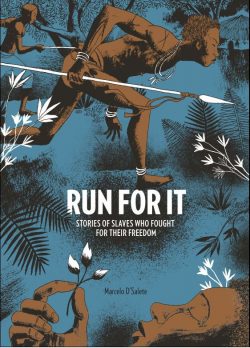
Run for It – Stories of Slaves who Fought for their Freedom


By Marcelo D’Salete, translated by Andrea Rosenberg (Fantagraphics Books)
ISBN: 978-1-68396-049-2 (HB)

Art historian Professor Marcelo D’Salete was born in 1979 and is one of Brazil’s most respected authors and graphic novelists. A graduate of Carlos de Campos College and the University of São Paulo, much of his output examines the relationship of the country to its history of slavery and issues affecting the vast Afro-Brazilian underclass resulting from it.

This multi award-winning translation (hardback and digital formats are available) of Cumbe comes from 2017 and details in stark and shocking monochrome, all but devoid of dialogue or narration, a quartet of stories of slaves who risked everything to escape their shackles and set up free villages beyond the reach of their would-be masters and owners.

A brief Introduction sets the scene and adds context to the period (1500s-1800s) and explains the exact meaning and derivation of catch-all term “cumbe”. You won’t need much more. These are timeless tales of a problem that has been plaguing humanity since long before we started counting days and years. It’s with us still: either overtly or hidden behind sly commercial subterfuges like “zero hours contracts” and “races to the bottom”…

Appreciative, informative Foreword ‘The Sun rises on Brazilian Bantu Culture’, by Allan Da Rosa, further stokes every decent person’s moral outrage before the astounding examinations of humanity at its best and worst opens with ‘Kalunga’as a young man in love plots with his beloved to run away to the endless water of the title. Tragically, Valu and Nana are not as subtle as they think, or as determined as they need to be…

The troubles caused by white debauchery and slave pregnancy are ruthlessly detailed in ‘Sumidouro’ (The Well) when a natal event leads to death and terror, after which plans for a long-overdue slave revolt stumble as the plotters succumb to fear, mistrust, treachery and incompetence in ‘Cumbe’…

‘Malungo’ means comrade and refers to a special companion sharing the journey from Africa to Brazil. As terror and superstition grips workers planning bloody reprisals against plantation-owners, the term takes on new meaning…

Accompanying these captivating parables is a full Glossary of terms and their originations, plus a copious Bibliography. Awful and beautiful, this is a superb testament to depravity and hope and one every casual consumer of corporate culture needs to see.
© 2017 Marcelo D’Salete. This edition © 2017 Fantagraphics Books. All rights reserved.
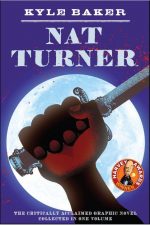
Nat Turner


By Kyle Baker (Abrams)
ISBN: 978-0-8109-9535-2 (TPB)

Nat Turner was a prophet rebel and freedom fighter who died for what he believed. As instigator and leader of a brutal, bloody and short slave uprising in Southampton County, Virginia on August 21st 1831, he shook up complacent America and paved the way to civil war and civil rights.

Anything else you need to know is provided in this powerfully evocative adaptation of Turner’s own words and actions. This award-winning, toned and tinted monochrome testament was originally released as a 4-issue miniseries through author Kyle Baker’s own publishing imprint before being picked up by the prestigious Abrams outfit.

Born in Queens, New York in 1965, Kyle John Baker is black, astoundingly gifted and blessed with an incredible sense of humour. You should read his other stuff like Plastic Man, Dick Tracy, Why I Hate Saturn, The Cowboy Wally Show, The Shadow, Truth: Red, White and Black, Damage Control, Special Forces and so much more. He does superheroes, gag stuff, political satire, commercial art and animation exceedingly well, and here he deftly relates a horrific piece of biographical history…

How and why is the subject of his brief ‘Preface’ before initial chapter ‘Home’ set the scene, by detailing a slave raid in Africa. Texture is provided by excepts from contemporary documents such as ‘The Memoir of Captain Theodore Canot: Twenty Years of an African Slaver’ and the posthumous publication ‘The Confessions of Nat Turner’, but the impetus of the tale is carried by Baker’s compelling silent illustrations: and they are uncompromising and unforgettable…

‘Education’ reveals a slave’s childhood in Virginia, and the events that led to the rebellion: how a slave somehow learned to read (an illegal act) and was transformed by Bible study into a divinely-inspired liberator driven by visions of ‘Freedom’.

The bloody actions are not downplayed or excused, and lead to ‘Triumph’ of a sort as the imprisoned Turner dictates his side of the story to journalist Thomas R. Gray…

With found print material of the period, a wide-ranging Bibliography and comprehensive ‘Notes’ explaining historical points, this is a timeless wonder you must read.
The Confessions of Nat Turner © 2008 Kyle Baker. All rights reserved.

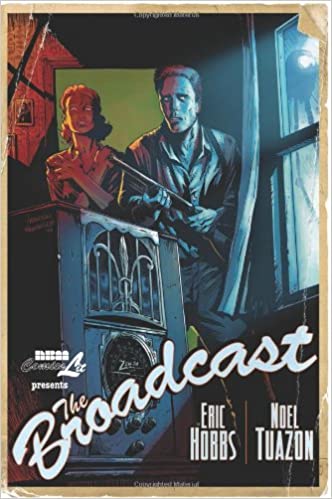
The Broadcast


By Eric Hobbs & Noel Tuazon (NBM/ComicsLit)
ISBN: 978-1-56163-590-0 (PB)

When you read that as many as one million Americans were fooled into hysterical panic by Orson Welles’ now-legendary Halloween radio broadcast of the War of the Worlds, it’s hard not to think “how dumb are you?” or “don’t you people read books?” but the sad fact remains that a vast proportion of the population heard only a piece of the innovative updating of the HG Wells classic on October 30th 1930 and genuinely thought the end of humanity had come. Or it never happened at all and the media have perpetrated one more lie upon for inexplicable reasons…

This superbly understated, low-key monochromatic tale takes a canny peek at human nature in a time of sustained privation (the Great Depression had just hit the USA a damned sight harder than any Martian death-ray could) and urgent – if only imagined – emergency as a small community in rural Indiana endures a couple of unhappy coincidences result in a horrific but very human confrontation…

At the height of a brutal storm, a small band of farmers and families huddle in a barn. It’s been a bad day all around. Young Gavin Baker has finally asked wealthy Thomas Shrader if he could marry his daughter Kim, but the meeting didn’t go well. Nevertheless, the lovers still plan to escape to New York where Kim can become a writer…

Shrader has made a killing bailing out and buying up failing farms over the past year and isn’t well liked by the newly-destitute townsfolk such as widower Jacob Lee or cropper Eli Dawson, but he’s the only employer left, so they make do…

A severely beaten, wandering Negro named Martin Steinbeck stumbles into the Baker place later that day. He’s clearly had a brutally rough encounter and is astonished when the family offer him help and sustenance rather than hatred and further violence…

Later, throughout the community townsfolk tune in their radios and catch what they believe to be newscasts reporting Martian invaders blasting New York and New Jersey. Suddenly, a storm hit and the town loses power…

With the phones and lights out, panicked, terrified people all head towards the Shrader place with its solid storm cellar but, when Kim discovers a truck with dead bodies it in, the only conclusion is that the aliens have already reached the Heartland…

When the families arrive, Shrader delivers an ultimatum: only five people will be allowed refuge: him, his wife and three others – but only if rebellious Kim is one of them…

With imminent doom lurking in the darkness, friendship, civility and human empathy star breaking down, and a very human atrocity seems inevitable…

This is an enchantingly subtle and impressive tale, deftly avoiding histrionics and bombast, and is ultimately uplifting and positive. Eric Hobbs has focused on the communal heroism of the common man, with the misty, raw line-&-wash illustration of Noel Tuazon marrying dreamy introspection with painful sufferance to bestow the ensemble cast with a look far removed from the general run of modern comics.

The book also contains a photo-&-clippings gallery displaying the media’s response to the original radio broadcast, deleted scenes, character sketches and a brief commentary on the creator’s working process. Tense, ironic and deeply moving, this is a lost gem of our art form, long overdue for some popular attention…
© 2010 Eric Hobbs.

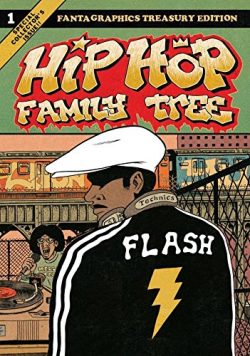
Hip Hop Family Tree Book 1: 1970s-1981


By Ed Piskor (Fantagraphics)
ISBN: 978-1-60699-690-4 (PB)

Comics is an all-encompassing narrative medium and – even after 40-plus years in the game – I’m still amazed and delighted at innovative ways creators find to use the simple combination of words and pictures in sequence to produce new and intoxicating ways of conveying information, tone, style and especially passion to their audience.

A particularly brilliant case in point was this compulsive compilation of strips and extras from self-confessed Hip Hop Nerd and cyber geek Ed Piskor (author of the astonishing Hacker graphic novel Wizzywig) which originally appeared in serial form on the website Boing Boing.

In astounding detail and with a positively astounding attention to the art styles of the period, Piskor detailed the rise of the rhyme-and-rhythm musical art form (whilst paying close attention to the almost symbiotic growth of graffiti and street art) with wit, charm and astonishing clarity.

Charting the slow demise of the disco and punk status quo by intimately following fledgling stars and transcendent personalities of the era, ‘Straight Out of the Gutter’ begins mid-1970s with South Bronx block parties and live music jams of such pioneers as DJ Kool Herc, Grandmaster Flash, Grandwizard Theodore and Afrika Bambaataa.

The new music is mired in the maze of inescapable gang culture but as early word-of-mouth success leads to first rare vinyl pressings and the advent of the next generation, the inevitable interest of visionaries and converts leads to the circling of commercial sharks…

The technical and stylistic innovations, the musical battles, physical feuds, and management races by truly unsavoury characters to secure the first landmark history-making successes are all encyclopaedically yet engaging revealed through the lives – and, so often, early deaths – of almost-stars and later household names such as Furious 4-plus-1, Kurtis Blow, The Sugarhill Gang, the Furious Five, and those three kids who became Run-DMC.

The story follows and connects a bewildering number of key and crucial personalities – with a wealth of star-struck music biz cameos – and ends with Hip Hop on the very edge of global domination following the breakout single Rapture (from new wave icons and dedicated devotees Blondie) as well as the landmark TV documentary by Hugh Downs and Steve Fox on national current affairs TV show 20/20 which brought the new music culture into the homes of unsuspecting middle America…

To Be Continued…

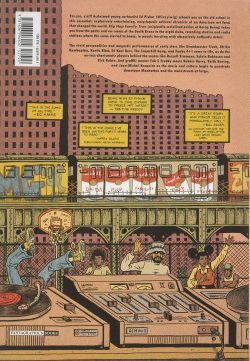
Produced in the tone and style of those halcyon, grimily urban times and manufactured to look just like an old Marvel Treasury Edition (an oversized – 334x234mm – reprint format from the 1970s which offered classic tales on huge and mouth-wateringly enticing pulp-paper pages), this compelling confection (available in very large paperback and variably-proportioned digital formats) – also includes a copious and erudite ‘Bibliography’, ‘Discography’ and ‘Funky Index’, an Afterword: the Hip Hop/Comic Book Connection (with additional art by Tom Scioli) and a fun-filled Author Bio.

Moreover, there’s also a blistering collection of ‘Pin Ups and Burners’ with spectacular images from guest illustrators including The Beastie Boys by Jeffrey Brown, Afrika Bambaataa by Jim Mahfood; Fat Boys by Scioli; Grandmaster Flash and the Furious Five by Ben Marra; Vanilla Ice by Jim Rugg; Run-DMC by Dan Zettwoch; Eric B. and Rakim by John Porcellino; Salt-n-Pepa by Nate Powell; KRS-One by Brandon Graham & Snoop Dogg by Farel Dalrymple, to get your pulses racing, if not your toes tapping…

Cool, informative and irresistible, Hip Hop Family Tree is wild, fun and deliciously addictive: sparking a revolution and sub-genre in comics creation. This is what cultural cross-pollination is all about and you should dive in right now…
This edition © 2013 Fantagraphics Books. All Hip Hop comic strips by Ed Piskor © 2013 Ed Piskor. Pin ups and other material © 2013 their respective artists. All rights reserved.

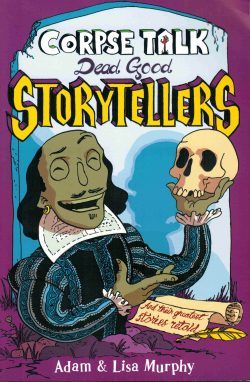
Corpse Talk: Dead Good Storytellers


By Adam & Lisa Murphy (David Fickling Books)
ISBN: ISBN: 978-1-78845-125-3 (PB)

The educational power of comic strips has been long understood and acknowledged: if you can make the material memorably enjoyable, there is nothing that can’t be better taught with pictures. The obverse is also true: comics can make any topic or subject come alive… or at least – as here – outrageously, informatively undead…

The fabulous and effective conceit in Corpse Talk is that your scribbling, cartooning host Adam Murphy (ably abetted off-camera by Lisa Murphy) tracks down (or rather digs up) famous personages from the past: all serially exhumed for a chatty, cheeky This Was Your Life talk-show interview that – in Reithian terms – simultaneously “elucidates, educates and entertains”. It also often grosses one out, which is no bad thing for either a kids’ comic or a learning experience…

Another splendid album release culled from the annals of The Phoenix, this authorially-themed collection is dedicated to not-so-private audiences with a succession of legendary and/or unsung wordsmiths, in what would almost certainly not be their own words…

Catching up in order of date of demise, these candid cartoon conferences begin by digging the dirt with ‘Enheduanna: Priestess-Poet 23rd century BCE’, who has a claim to inventing poetry with her religion themed anthems in ancient Sumeria. As always, each balmy biography is accompanied by a side-feature examining a key aspect or artefact of their lives such as here with ‘Inanna and the Mountain’ (The Corpse Talk version) illustrating the power and short temper of the primal goddess…

Moving on in time – and perhaps into fiction rather than fact – comes an intimate investigation into the truth behind Greek epic poet ‘Homer’ (8th century BCE – possibly) supplemented by a vivid and truncated Corpse Talk version of ‘The Odyssey’ which could get you a passing grade if schools and exams weren’t another thing of the past…

Astounding female and unconventional Mandarin’s daughter ‘Li Qingzhao – Lyric Poet 1084-1155’ discusses her fortunate career in the Song Dynasty: accompanied by her translated, illustrated ode ‘Like a Dream’, after which a Sufi poet spanning 1207-1273 takes centre stage.

‘Jalaluddin Rumi’ details his transformation from acerbic scholar to impassioned love poet and is backed up by his illustrated poem ‘The Guest House’ before we head into more familiar territory with Medieval poet ‘Geoffrey Chaucer – 1343-1400’ who relates the tale of his times, backed up by the pertinent facts of ‘The Canterbury Tales’ plus a Corpse Talk adaptation of ‘The Pardoner’s Tale’…

Playwright ‘William Shakespeare – 1564-1616’ tells it like it was, accompanied by the (fun) version of ‘Macbeth’ after which we go gothic by chatting with Romantic Poet ‘John Keats – 1795-1821’ and get acquainted with ‘La Belle Dame Sans Merci’ and double down with dark fantasy courtesy of Gothic Novelist ‘Mary Shelley – 1797-1851’ who candidly discloses how and why her groundbreaking novel came about, supplemented by a cartoon adaptation of ‘Frankenstein’.

Sticking with Gothic Novels, the life of ‘Charlotte Brontë – 1816-1865’ is explored, with definitive classic ‘Jayne Eyre’enjoying a Corpse Talk make-over, after which ‘Charles Dickens 1812-1870’ reviews his amazing career and endures a comics interpretation of ‘Great Expectations’, whilst Adventure Novelist ‘Alexandre Dumas – 1802-1870’ details how the son of French plantation slaves rose to pre-eminence in the literary world, accompanied by a rousing rendition of ‘The Count of Monte Cristo’…

Epic Novelist and spiritual questor ‘Count Leo Nikolayevich Tolstoy – 1828-1910’ comes under the necroscope next, with a serviceable truncation of ‘War and Peace’ in his wake, before horrorist ‘Bram Stoker – 1847-1912’ tells his life-story while the Murphys deftly adapt his undying masterpiece ‘Dracula’ and Crime Writer ‘Sir Arthur Conan Doyle – 1859-1930’ examines his serried career and influences, with Sherlock Holmes short story ‘The Speckled Band’ leading us to final interviewee Children’s Author ‘Beatrix Potter – 1866-1943’; describing a life well-lived, and a splendid legacy, backed up a fresh take on the tale of ‘Peter Rabbit’.

…And just when you think it’s all over, up pops an extra item: a cracking adaptation of ‘All the World’s a Stage…’ from Shakespeare’s ‘As You Like It’, rounding out the fun and whimsy before ushering all and sundry back to their biers and sepulchres for now.

Clever, cheeky, outrageously funny and formidably factual throughout, Corpse Talk unyieldingly tackles history’s more tendentious moments whilst personalising the great, the grim, the good and especially the greatly entertaining for coming generations.

It is also a fabulously fun read no parent or kid could possibly resist. Don’t take my word for it though, just read and enjoy…
Text and illustrations © Adam & Lisa Murphy 2021. All rights reserved.

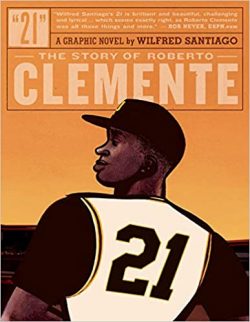
“21”: The Story of Roberto Clemente


By Wilfred Santiago (Fantagraphics Books)
ISBN: 978-1-56097-892-3 (HB) 978-1-60699-775-8 (PB)

I’m not a big fan of American Sports, favouring the ease and simplicity of our own gentle pastimes such as Rugby and, of course, the ultimate immersive experience that is Test Cricket, but I am a complete sucker for history – particularly graphic biographies. That’s especially true when they are as innovative and imaginative as this superbly passionate and evocative account of the life of a groundbreaking star, quietly philanthropic humanitarian and culture-changing champion of ethnic equality.

Roberto Clemente Walker was born in Puerto Rico on August 18th 1934, one of seven kids in a devoutly Catholic family. Baseball and, latterly, his wife Vera and three kids were his entire life. He played for a Puerto Rican team until the Brooklyn Dodgers head-hunted him.

At that time racial restrictions were dominant in the American game, so he actually only played against white people in the Canadian League for the Montreal Royals.

In 1954 Clemente finally got into the American game after signing with the Pittsburgh Pirates – a working relationship that lasted until his tragic death in a plane crash in December 1972.

During those tempestuous 18 years Clemente broke down many social barriers and became a sporting legend: the first Hispanic player to win a World Series as a starter, the first Latino to win the National League’s Most Valuable Player Award and winner of a dozen Gold Glove Awards. An all-round player, he scored 3000 hits and achieved many other notable career highlights.

He worked passionately for humanitarian causes in Latin America, believing every child should have free and open access to sports. He died delivering earthquake relief to Nicaragua after the devastating tremor of December 23rd 1972. His body was never recovered.

Clemente was posthumously elected to the Baseball Hall of Fame in 1973: the first Hispanic to receive the honour – and the only contemporary player ever to have the 5-year waiting period waived. He is a national icon in Puerto Rico and one of the leading figures in the movement to desegregate American sports.

Rather than a dry accounting of his life, author Wilfred Santiago’s tale skips forward and back, illustrated in a studied and fiercely expressionistic melange of styles which sketch in tone and mood, superbly synthesising the life of a true frontrunner and a very human hero.

With its message of success and glory in the face of poverty and discrimination “21” (available in hardback, softcover and digital formats) is potently reminiscent of James Sturm’s The Golem’s Mighty Swing, but its entrancing, vibrant visual style is uniquely flavoured with the heat of the tropics and the pride of the people Clemente loved.

Lusciously realised in sumptuous earth-tones and powerfully redolent of the spirit of Unjust Times A-Changin’, this is a fabulous book for every fan of the medium and not simply lads and sports-fans…
Art and text © 2011Wilfred Santiago. All rights reserved.

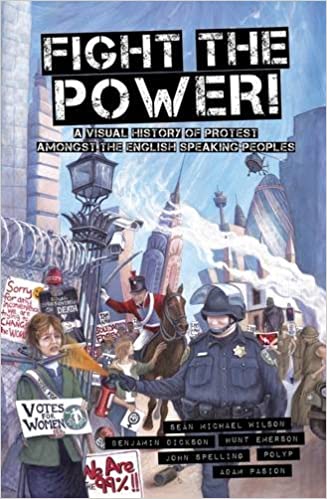
Fight the Power – A Visual History of Protest Among the English-Speaking Peoples


By Seán Michael Wilson, Benjamin Dickson, Hunt Emerson, John Spelling, Adam Pasion with additional cartoons by Polyp (New Internationalist)
ISBN: 978-1-78026-122-5 (PB)

Politics is composed of and utilised equally by firebrands and coldly calculating grandees, and that’s probably the only guiding maxim you can trust. Most normal people don’t give a toss about all that until it affects them in the pocket or impacts their kids and, no matter to what end of the political spectrum one belongs, the greatest enemy of the impassioned ideologue is apathy. This simple fact forces activists and visionaries to ever-more devious and imaginative stunts and tactics…

However, all entrenched Powers-That-Be are ultimately hopeless before one thing: collective unified resistance by the very masses they’re holding down through force of arms, artificial boundaries of class or race, capitalist dogmas, various forms of mind control like bread, circuses and religion, divisive propagandas or just the insurmountable ennui of grudging acceptance to a status quo and orchestrated fear that unknown change might make things worse.

Perhaps you can see how such musings might be of relevance in these sure to be unforgettable days?

From its earliest inception, cartooning has been used to sell: initially ideas or values but eventually actual products too. In newspapers, magazines and especially comic books the sheer power of narrative – with its ability to create emotional affinities – has been linked to the creation of unforgettable images and characters. When those stories affect the lives of generations of readers, the force that they can apply in a commercial, social or especially political arena is almost irresistible…

The compelling power of graphic narrative to efficiently, potently and evocatively disseminate vast amounts of information and seductively advocate complex issues with great conviction through layered levels has always been most effectively used in works with a political or social component. That’s never been more evident than in this stunning and scholarly graphic anthology detailing infamous and effective instances of popular protest.

In Britain the cartoonist has always occupied a perilously precarious position of power: with deftly designed bombastic broadsides or savagely surgical satirical slices ridiculing, exposing and always deflating the powerfully elevated and apparently untouchable with a simple shaped charge of scandalous wit and crushingly clear, universally comprehensible visual metaphor …or sometimes just the plain and simple facts of the matter…

For this universal and welcomingly basic method of concept transmission, levels of literacy or lack of education are no barrier. As the Catholic Church proved millennia ago with the Stations of the Cross, stained glass windows and a pantheon of idealised, sanitised saints, a picture is absolutely worth a thousand words, and as William the Conqueror saw with the triumphalist Bayeux Tapestry, picture narratives are worth a few million more…

Following a thought-provoking Introduction by author, journalist and filmmaker Tariq Ali, this procession through the history of dissent compiled and scripted by Seán Michael Wilson and Benjamin Dickson begins with an agenda-setting ‘Prologue’ – illustrated by Adam Pasion – best described – without giving the game away – as “Uncle Sam, John Bull and the Statue of Liberty (AKA ‘Liberty Enlightening the World’) walk into a bar…”

Their heated discussion on the value and need of people using their right to dissent is then captivatingly illustrated through a series of erudite, fascinating, shocking and deliciously funny tutorial episodes, beginning with a compelling account of ‘The Luddites and the Swing Riots, 1811-1832’ written by Wilson and rendered both palatable and mesmerising by comics legend Hunt Emerson.

The artist then turns his talents to recreating the horrific events and aftermath of ‘The Battle of Peterloo, 1819’ from Dickson’s script before, with Wilson, cataloguing a wave of ‘Colonial Rebellions, 1836-1865’ which the British Empire dealt with in its traditional even-handed, temperate manner (and in case you were wondering, that’s me doing sarcasm).

Wilson & Pasion then detail the global impact of the ‘Irish Rebellions, 1791-1922’ whilst Dickson & Emerson’s account of ‘The Suffragettes, 1903-1918’ follows the story of Votes for Women right up to the present. Practically forgotten and brutally savage, ‘The Australian General Strike, 1917’ (by Wilson & Pasion) and the equally appalling landmark events of ‘The Boston Police Strike, 1919’ – as told by Dickson & John Spelling – reveal a pattern to modern labour conflicts, with working folk ranged against intransigent and greedy commercial interests.

The age-old struggle escalated during the ‘UK General Strike and the Battle of George Square, 1918-1926’ (Wilson & Spelling) and reached an intolerable strike-busting peak in Ohio during ‘The Battle of Toledo, 1934’ (Wilson & Spelling): a struggle which cemented management and labour into the intractable ideologically opposed positions they still inhabit today in the aforementioned English-speaking world…

The championing of Human Rights is commemorated by Dickson & Pasion in ‘Rosa Parks and the Bus Boycott, 1955-1956’ followed by a deeply moving account of ‘The Trial of Nelson Mandela, 1964’ whilst the modern American soldier’s method of combating unwelcome or insane orders is reviewed in the brilliantly trenchant ‘Fragging’ by Wilson & Emerson…

Back home and still etched in many peoples’ memories, Dickson & Spelling’s ‘The Poll Tax Riots, 1989-1991’ offers a surprisingly even-handed account of Margaret Thatcher’s greatest political blunder, before hitting recent headlines with the origins and outcomes of ‘Occupy, 2011-‘…

Returning to that bar and Lady Liberty, Dickson, Wilson & Pasion draw a few telling Conclusions to close the cartoon course in mass resistance, after which the writers discuss their process in Authors Notes: Why This Book? before then listing the truly phenomenal rewards of all those campaigns and protests with a long list of Rights Won. These range from Women’s Suffrage to the universal formal acknowledgement of the Human Right to Protest.

Understanding the value of a strategically targeted chuckle, this fabulous monochrome chronicle concludes with one last strip as Dickson & Emerson hilariously reveal ‘The Four Stages of Protest’ courtesy of Mohandas “Mahatma” Gandhi…

More so than work, sport, religion, fighting or even sex, politics has always been the very grist that feeds the pictorial gadfly’s mill. Of course, cartooning can only accomplish so much, and whilst Fight the Power! recounts a number of instances where physical and intellectual action were necessary to achieve or maintain justice, at least comics can galvanise the unconvinced into action and help in the useful dissemination of knowledge about protest: the Who, Where, When, and How.

If you don’t understand What or Why then you’re probably already on the other side of the barricades – and complaining about who gets what vaccine…
© 2013 Seán Michael Wilson and Benjamin Dickson. Illustrations © 2013 Hunt Emerson, John Spelling and Adam Pasion. Cartoons © 2013 Polyp. All rights reserved.