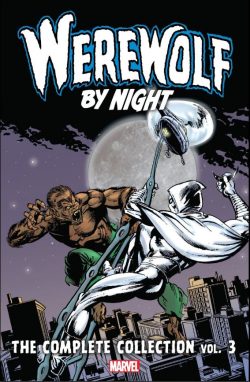
Werewolf by Night – The Complete Collection volume 3


By Doug Moench, Bill Mantlo, Marv Wolfman, Steven Grant, Michael Fleisher, Mark Gruenwald, Yong Montaño, Don Perlin, Frank Robbins, Carmine Infantino, Steve Leialoha, Bill Sienkiewicz, Tom Sutton, Win Mortimer & various (Marvel)
ISBN: 978-1-3029-1158-4 (TPB)

As Marvel slowly grew to a position of market dominance in 1970, in the wake of losing their two most innovative and inspirational creators – Steve Ditko and Jack Kirby – they did so less by experimentation and more by expanding proven concepts and properties.

The only real exception to this was a mass release of horror titles rapidly devised in response to an industry-wide downturn in superhero sales. This move was handily expedited by a rapid revision in the wordings of the increasingly ineffectual Comics Code Authority rules.

Almost overnight, nasty monsters (as well as narcotics and bent coppers – but that’s another story) became acceptable fare within four-colour pages and, whilst a parade of 1950s pre-code reprints made sound business sense (so they repackaged a bunch of those too), the creative aspect of the contemporary fascination in supernatural themes was catered for by adapting popular cultural icons before risking whole new concepts on an untested public.

As always, the watch-word was fashion: what was hitting big outside comics was to be incorporated into the mix as soon as possible.

When proto-monster Morbius, the Living Vampire debuted in Amazing Spider-Man #101 (October 1971) and the sky failed to fall in, Marvel moved ahead with a whole line of scary superstars – beginning with a werewolf and traditional vampire – before chancing something new via a haunted biker who could tap into both Easy Rider‘s freewheeling motorcycling chic and the supernatural zeitgeist.

With its title cribbed from a classic short thriller from pre-Code horror anthology Marvel Tales #116 (July 1953), Werewolf by Night debuted in Marvel Spotlight #2. It had been preceded by masked western hero Red Wolf in #1 and followed by the afore-hinted Ghost Rider revival, but this hairy hero was destined to stick around for a while. Marvel had a long-time tradition of using old (and presumably already copyrighted) names and titles when creating new series and characters. Hulk, Thor, Magneto, Doctor Strange and many others all got notional starts as throwaways before being re-imagined as major characters…

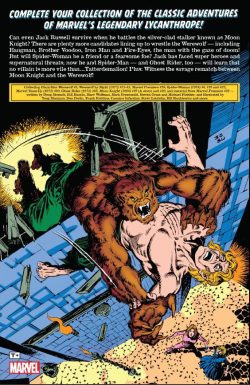
This third copious trade paperback and eBook compendium compiles more moody misadventures of a good-hearted young West Coast lycanthrope who briefly shone as an unlikely star for the entire length of a trading trend, Werewolf By Night #31-43, Giant-Size Werewolf #5, Marvel Premiere #28 & 59, Spider-Woman #6, 19 & 32, Marvel Team-Up #93, Ghost Rider #55, and Moon Knight #29-30: ending his solo run and gathering the many guest shots the lycanthrope enjoyed afterwards, collectively spanning July 1975 to April 1982.

Jack Russell is a teenager with a thankfully rare but very disturbing condition. On her deathbed, his mother revealed unsuspected Transylvanian origins to her beloved boy: relating a family curse which would turn him into a raging beast on every night with a full moon… as soon as he reached his 18th birthday.

And so it began…

After many months of misunderstanding as Jack tried to cope alone with his periodic wild side, Jack’s stepfather Philip Russell expanded the story, revealing how the Russoff line was cursed by the taint of Lycanthropy: every child doomed to become a wolf-thing under the full-moon from the moment they reached eighteen.

Moreover, the feral blight would do the same to his little sister Lissa when she reached her own majority…

As Jack tried and repeatedly failed to balance a normal life with his monthly cycle of uncontrollable ferocity, he met his eventual mentor and confidante Buck Cowan, an aging writer who became Jack’s best friend after the pair began to jointly investigate the wolf-boy’s history. Their incessant search for a cure was made more urgent by little Lissa’s ever-encroaching birthday. Along the way Jack even found a steady girlfriend who understood his needs. Of course, Topaz was a mystically empowered terror with family issues from hell…

During their researches they clashed swords with many monsters – human or otherwise – including off-the-rails cop Lou Hackett, who had been going increasingly crazy in his hunt for a werewolf nobody believed in, and fellow lycanthrope Raymond Coker who had found a shocking remedy to their condition…

For one werewolf to lift his curse he/she had to kill another one…

Following a context-expanding Introduction from former Marvel editor Ralph Macchio, the shaggy suspense resumes with Giant-Size Werewolf #5 which shifted into full-on fantasy mode. Scripted by Doug Moench and illustrated by Yong Montaño, ‘Prologue: I Werewolf’ recaps Jack’s peculiar problems before ‘The Plunder of Paingloss’ discloses how the leaders of dimensional realm Biphasia – permanently polarised between night and day – instigate a ‘Bad Deal with the Devil’s Disciple’ on Earth when demonist Joaquin Zairre kidnaps the werewolf…

With the beast dispatched though a ‘Doorway of the Dark Waters’, Jack is soon a pawn in a sorcerous war where ‘Fragile Magic’ on the world of light and darkness allows him and his allies to raid the ‘The Ark of Onom-Kra’ and expose a secret tyrant in ‘Silver Rain, Sardanus and Shadow’…

Returned to the real world, Werewolf by Night #31 (July 1975) offers a turning point as ‘Death in White’ (Moench & regular artist/co-plotter Don Perlin) sees Jack plumb depths of utter despair after a skiing weekend turns into a nightmare when the werewolf stalks a little girl and Buck nearly dies trying to save her…

WBN #32 (August 1975) then introduces mercenary Marc Spector who is hired by criminal capitalists, equipped with a silver-armoured costume and weapons and tasked with capturing Russell or his animal other as ‘…The Stalker Called Moon Knight’ (Doug & Don with the assistance of Howie Perlin).

The bombastic battle and its ferocious sequel ‘Wolf-Beast vs. Moon Knight’ received an unprecedented response and quickly propelled the lunar avenger to prominence as Marvel’s edgy answer to Batman: especially after the mercurial merc rejects his employers’ entreaties and lets the wolf, as well as collateral hostages Lissa and Topaz, run free…

Next up is a uniquely odd attempt to create a team of terrors. Marvel Premiere #28 (February 1976) introduced the initial iteration of The Legion of Monsters in ‘There’s a Mountain on Sunset Boulevard!’ courtesy of Bill Mantlo, Frank Robbins & Steve Gan.

When an ancient alien manifests a rocky peak in LA, the werewolf, Man-Thing, Morbius and Ghost Rider are irresistibly drawn into a bizarre confrontation which might have resulted in the answer to all their wishes and hopes, but instead only leads to destruction, death and deep disappointment…

In Werewolf by Night #34 (October 1975, by Moench & Perlin) another extended eerie suspense saga sees Jack, Lissa, Topaz and Buck’s girlfriend Elaine Marston brave a haunted house in search of a cure for Cowan’s werewolf-caused coma.

Elaine had lost her first husband to the doomed domicile and it takes a lot to bring her back. That triggering event is the dying Buck muttering the name of deceased spiritualist Belaric Marcosa – who apparently still roams the hell-house where ‘Not All the Shades of Death nor Evil’s Majesty’ can rein in his sadistic games…

Braving the unknown, the terrified quartet fetch up to the mansion and are soon enduring ‘Evil in Every Stone, No Longer Hiding’; becoming enmired in a war between ‘Marcosa in Death’ and the trapped spirits of the countless victims he has tortured and destroyed.

Their horrific psychological ordeal eventually results in victory for Jack and his companions as ‘The End’ produces a miraculous recovery in the dying Buck and the cessation of Marcosa’s phantom depredations…

With tastes changing, WBN #38 takes a sharp change of direction as Jack exiles himself to the wilderness, only to stumble on a desperate fugitive fighting to save his baby from a murderous gangster who had taken up with his former wife. In the midst of such mundane matters, Jack is visited by a trinity of infinite beings who threaten to alter his existence forever and ominously warn that ‘Rebirth Also Kills’…

The celestial visitants are also in touch with former werewolf Raymond Coker as he squats in a hut in distant Haiti, and even appear to Lissa and Topaz as they tend the still-recuperating Buck.

The “Three Who Are All” are subtly ensuring all players are in place for a game of cosmic consequences and in #39, when Jack races back to his friend, he finds Coker and mystic troubleshooter Brother Voodoo waiting. No sooner are introductions made than an army of zuvembies (posh name for magical zombies, okay?) attack and Russell learns that ‘Some are Born to the Night’…

Portentous proclamations of unfulfilled destinies propel the adventurers and Topaz back to Haiti where obsessed former cop Vic Northrup is looking for answers to Lou Hackett’s death. Ahead of them all is an infernal pit nurturing a shocking travesty of life with resurrected wizard Dr. Glitternight in charge of all the ‘Souls in Darkness’…

Revealed in WBN #41 as a former member of the gestalt which was once “Five Who Are All”, Glitternight’s fascination with monster-making is at last explained as the arcane abomination’s attempts to dominate reality are spectacularly thwarted through the return of the missing fourth celestial as well as the indomitable resistance of Brother Voodoo and Jack in ‘…And Death Shall be the Change’…

Key to their eventual triumph is the moment when Russell discovers how to transform into a werewolf in full control of his mental faculties; at will, day or night…

Returning to America, the Werewolf-by-Choice naturally decides to become a superhero and moves to New York in time to stumble onto a plot by the Masked Marauder. Also on scene, is a certain Armoured Avenger and, after the usual misunderstandings, Jack is shaggy knees-deep in trouble with ‘The Marauder and the Man of Iron’…

The tale – and the series – concludes in Werewolf by Night #43 (March 1977) as ensorcelled fang-&-claw unite with high-tech wizardry to destroy an awesome animalistic automaton and end the ‘Terrible Threat of the Tri-Animan’…

Despite the rather lame and ill-considered attempt to reinvent the series at the last, this moody masterpiece of macabre menace and all-out animal action covers some of the most under-appreciated magic moments and terror tales in Marvel history: tense, suspenseful and solidly compelling. The public and numerous creators must have agreed with the sentiment as Jack Russell became a regular on the guest circuit, popping up in many other ascendant titles.

One such cameo was Spider-Woman #6 (September 1978, by Marv Wolfman, Carmine Infantino & Rick Bryant) as arachnoid outcast Jessica Drew battled ancient sorceress Morgan Le Fay. ‘End of a Nightmare!!’ saw the duel impinge on Russell just as he locks himself away for the three nights of the full moon when his newfound sentience is overwhelmed by lunar lunacy. Cue vicious, inconclusive clash…

In Spider-Woman #19 (October 1979) Mark Gruenwald, Steven Grant, Infantino & Mike Esposito unleashed ‘The Beast Within’ when newly-directionless Jessica stumbles into the Werewolf again, just as Russell is hunting murderous super-criminal The Enforcer. The resultant collaboration is less than stellar and far from harmonious…

Carrying on as a clandestine crusader, the Werewolf allies with Spider-Man in Marvel Team-Up #93 (May 1980) as Grant, Tom Sutton, Infantino & Jim Mooney detail how the webslinger stumbles into Jack’s pursuit of the Enforcer only to encounter another old enemy: demented sewer-dweller Tatterdemalion. ‘Rags to Riches!’ pits the mismatched heroes against the deranged dreg before the wallcrawler is diverted by seductive sociopath Dansen Macabre, leaving Jack to soldier on until Spider-Woman #32 (November 1980), where he unwillingly subjects Jessica Drew to ‘The Fangs of Werewolf by Night’, thanks to mind-bending villain Dr. Malus and creative team Michael Fleisher, Steve Leialoha & Mooney…

Ghost Rider #55 (April 1981, by Fleisher & Perlin) sees the Werewolf’s hunt for Tatterdemalion again derailed when the lycanthrope is mistakenly intercepted by Johnny Blaze in his demon biker incarnation, after which a vignette from Marvel Premiere #59 in the same month finds Jack and Lissa forced to suffer ‘Full Moon on the Highway!’ (by Grant & Win Mortimer, April 1981) after a traffic spill delays their rush for isolation and safety.

Since his WBN debut, Moon Knight had developed into a cult classic character, lurking in his own dark corner of the Marvel Universe and allowing moodier, more experimental fare to blossom.

Moon Knight #29 and 30 (March and April 1982) offered some of the most potent material of his initial run, and most visceral art of the entire decade in ‘Morning Star’ and ‘The Moonwraith, three Sixes and a Beast’ by Moench & Bill Sienkiewicz wherein Jack Russell is targeted by a publicity-hungry band of militant Satanists led by the cunning Belial.

This savvy deceiver tries to turn the Werewolf into the biblical Beast of the Apocalypse to usher in the end of days and bolster the flagging support of his congregation. When the fugitive Russell’s flight brings him to New York, it’s just as the full moon robs him of his usual control of the predator within…

Ultimately, however, Fist of Khonshu and Wild Thing table their differences long enough to end the threat of the mobster-like cultists and save the world. …And when the fur and fists finish flying, the Werewolf lopes off into the unknown…

This classic compendium concludes with a bonanza of bonus features, beginning with Sienkiewicz’s stunning back cover portrait of the best from Moon Knight #29; assorted pin-ups, original art/ covers and text features taken from the various issues gathered here.

This moody masterpiece of macabre menace and all-out animal action covers some of the most under-appreciated magic moments in Marvel history; tense, suspenseful and solidly compelling. If you feel the urge to indulge in a mixed bag of lycanthropes, bloodsuckers and moody young misses – this is a far more entertaining mix than many modern movies, books or miscellaneous matter…
© 1975, 1976, 1977, 1978, 1979, 1980, 1981, 1982, 2018 Marvel Characters, Inc. All rights reserved.
Death Be Damned


By Acker, Blacker & Miller, Hannah Christenson, Juan Useche & various (Boom! Studios)
ISBN: 978-1-68415-039-7 (PB) eISBN: 978-1-61398-716-2

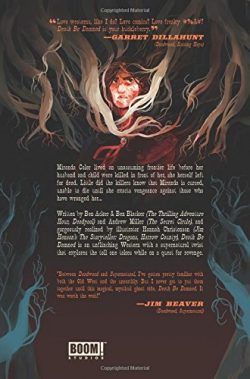
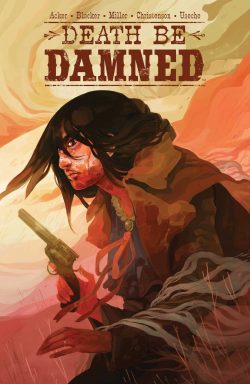
First seen as a 4-issue miniseries in 2017 written by Ben Acker, Ben Blacker (The Thrilling Adventure Hour; Deadpool; Thunderbolts; Supernatural) and Andrew Miller (Backstrom; League of Pan; The Secret Circle), spooky sagebrush saga Death Be Damned is a deft and compelling addition to the growing and cross-fertilising genre of supernatural westerns. The series was visualised by celebrated illustrator Hannah Christenson (Harrow County; Mouse Guard; Jim Henson’s Storyteller) with colours by Juan Useche and letters from Colin Bell.

In delivery the tale is stripped down, raw and utterly engaging, delivered in sweeping tributes to more than a century of high plains cinema and begins in 1873 Wyoming when brutalised settler Miranda Coler awakes face down in the river to find her entire family have been butchered. A tough, determined survivor, she buries her husband and child and, picking up her man’s rifle, sets about tracking down the gang who killed them.

By the time she reaches South Pass City, she’s ready to accept any passing pain or humiliation if it leads to her justified vengeance, but anger doesn’t make her good enough to kill one of the marauders in the town whorehouse. He casually puts a bullet in her brain…

Local undertaker Murray takes his job far too seriously. Since his wife passed, he’s become an expert of death rituals and is letting his studies affect his work. He keeps trying to raise the dead and can’t believe he’s succeeded with the crazy woman just killed in the cathouse…

Events eventually prove he hasn’t, really, but perhaps his attempts to retrieve the dead have set something incredible in motion…

And in Laramie City, mass killer Bickford hangs for his crimes. A little later he also gets up: drawn inexorably to South Pass where something unnatural needs to be quashed…

Miranda thinks Murray is crazy, but after he kills her and she comes back again, she finally hears him out. He wants the revenant to rescue his wife from Hell, but has no idea what the land of death is really like. Miranda still wants revenge though, and she’s happy to exploit the undertaker’s foolish whims if it gets her closer to her goal, no matter how many times she has to die in the doing of it…

A tale of dark obsessions played out through a nest of gradually-unfolding mysteries, the sinister saga employs all the iconography of “big sky” westerns to add mood to a blistering tale of debts incurred and accounts called due. Unstoppable Miranda even beats her devils to exact precious retribution and learns the painful truths of her life, her man and a hell of a lot of death…

Available in paperback and digital editions, Death Be Damned also offers an expansive cover gallery by Christenson and Konstantin Tarasov; as well as character designs and also reveals the secrets of the illustrator’s Cover Process.
Death Be Damned is ™ and © 2017 Workjuice Corp. & Andrew Miller.

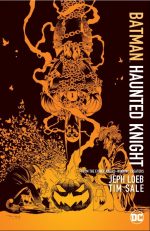
Batman: Haunted Knight


By Jeph Loeb, Tim Sale & various (DC Comics)
ISBN: 978-1 401-28486-2 (TPB)

Win’s Christmas Gift Recommendation: Timeless Seasonal Wonderment… 9/10

The creative team of Jeph Loeb & Tim Sale have tackled many iconic characters in a number of landmark tales, but their reworkings of early Batman mythology – such as The Long Halloween – must certainly rank amongst their most memorable.

Set during the Batman: Year One scenario created by Frank Miller, and originally released as a 13-part miniseries (running from Halloween to Halloween), it detailed the early alliance of Police Captain Jim Gordon, District Attorney Harvey Dent and the mysterious vigilante Batman, to destroy the unassailable mob boss who ran Gotham City: Carmine Falcone – “The Roman”.

However, even before that epic undertaking, the creators worked together on another All Hallows adventure; one that grew like Topsy to eventually become a triptych of Prestige One-Shot Specials under the aegis of Archie Goodwin’s most significant editorial project…

After the continuity-wide reset of Crisis on Infinite Earths, and with DC still in the throes of re-jigging its entire narrative history, a new Batman title launched, presenting multi-part epics refining and infilling the history of the post-Crisis hero and his entourage.

The added fillip was a fluid cast of prominent and impressively up-and-coming creators…

Batman: Legends of the Dark Knight was a fascinating experiment, even if ultimately the overall quality became a little haphazard and hit-or-miss.

Most of the early story-arcs were quickly collected as trade paperback editions – helping to jump-start the graphic novel sector of the comics industry – and the moody re-imaginings of the Gotham Guardian’s early career gave fans a wholly modern insight into the ancient yet highly malleable concept.

As explained in ‘Trick or Treat’ – Editors Goodwin’s reproduced introduction from the 1996 compilation – the first Batman: Legends of the Dark Knight Halloween Special began life as a story-arc for the monthly series before being cannily promoted to a single, stand-alone publication released for October 1993. Its success spawned the two sequels also included in this volume and the aforementioned Long Halloween epic…

Collected in one spooky stripped-down paperback and/or eBook compilation, those three scary stories comprise a raw and visceral examination of an obsessive hero still learning his trade and capable of deadly misjudgements as seen in initial yarn ‘Fears’.

Here, after spectacularly capturing terror-obsessed psychopath Jonathan Crane, the neophyte Caped Crusader leaves him to mere policemen ill-equipped to cope with the particular brand of malicious insanity cultivated by The Scarecrow…

It’s fair to say that the man behind the bat mask is distracted; still attempting to reconcile his nocturnal and diurnal activities, young Bruce Wayne is currently floundering before the seductive and sophisticated blandishments of predatory social butterfly and matrimonial black widow Jillian Maxwell. Faithful major-domo Alfred Pennyworth is not so easily swayed, however…

Left too much to his own devices, Scarecrow has run wild through Gotham, but when he abducts Gordon, he at last makes a mistake the Dark Knight can capitalise upon…

One year later another Halloween brings ‘Madness’ as rebellious teen Barbara Gordon choses exactly the wrong moment to run away from home: a night when her dad’s mysterious caped pal is frantically hunting Jervis Tetch – a certified nutcase abducting runaways to attend decidedly deadly Tea Parties orchestrated by a truly Mad Hatter…

Steeped in personal nostalgia as a maniac rampages through his city, inadvertently trampling upon some of Bruce Wayne’s only happy memories (of his mother’s favourite book), the heroic pursuer almost dies at the hands of the Looking Glass Loon, only to be saved by unlikely angel Leslie Thompkins – another woman who will loom large in the future life of the Batman…

The final fable here pastiches a Christmas classic by Charles Dickens as ‘Ghosts’ sees a delirious Bruce Wayne uncharacteristically taking to his bed early on the night before Halloween.

After socialising with young financier Lucius Fox, eating bad shrimp and crushing baroque bird bandit The Penguin, our sick and weary playboy lapses into troubled sleep, only to be visited by three spectres…

Looking like Poison Ivy, The Joker and the corpse of Batman himself, whilst representing Past, Present and inescapable Future, these phantoms prove that only doom awaits unless the overachieving hero strikes a balance – or perhaps truce – between his two divergent identities…

Trenchant with narrative foreboding – long-time fans already know the tragedies in store for all the participants, although total neophytes won’t be left wondering – these eerily enthralling Noir thrillers by Loeb perfectly capture the spirit of the modern Batman, supremely graced with startlingly powerful images of Mood, Mystery and rampant Mayhem from the magic pencil and brush of Tim Sale, vividly augmented by the colours of Gregory Wright and lettering of Todd Klein.

Adding lustre to these moody proceedings are a gallery of prior covers culled from earlier collections as well as a Sale Batman sketch, making this one of the very best Batman books you could read.
So, do…
© 1993, 1994, 1995, 2014, 2018 DC Comics. All Rights Reserved.

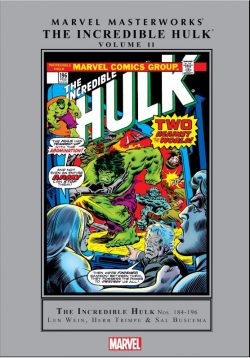
Incredible Hulk Marvel Masterworks volume 11


By Len Wein, Herb Trimpe & Sal Buscema & various (Marvel)
ISBN: 978-1-3029-0349-7 (HB)

During the 1970s, the Incredible Hulk settled into a comfortable – if cathartically destructive – pattern. A globe-trotting, monster-mashing plot formula saw tragic physicist Bruce Banner perpetually running and hiding whilst seeking cures for his gamma-transformative curse, alternately aided or hunted by prospective father-in-law General Thaddeus “Thunderbolt” Ross and his daughter – unobtainable inamorata Betty – with a non-stop procession of guest-star heroes and villains providing the battle du jour.

Herb Trimpe had made the character his own, displaying a penchant for explosive action and an unparalleled facility for drawing technology – especially honking great ordnance and vehicles. Beginning with Roy Thomas – unofficial custodian of Marvel’s burgeoning shared-universe continuity – a string of skilful scripters effectively played the afflicted Jekyll/Hyde card for maximum angst and ironic heartbreak as the Jade Juggernaut became a sturdy pillar of Marvel’s growing pantheon.

This chronologically-curated hardback and eBook compendium re-presents issues #184-196 (encompassing cover-dates February 1975-February 1976) and opens with author Dewey Cassell reviewing the end of an artistic era in his Introduction…

The action commences with ‘Shadow on the Land!’ by Len Wein & Trimpe, which finds the wandering man-mountain battling insubstantial extraterrestrial invader Warlord Kaa – a revival from the company’s pre-superhero monsters & aliens anthology era – who foolishly takes possession of the Hulk’s shadow and thinks himself indestructible…

This close encounter leads to Banner’s capture by Hulkbuster Base commander Colonel Armbruster just in time for the US President’s visit and a shocking ‘Deathknell!’ as the truth about Banner’s love rival Glenn Talbot (and Betty’s new husband) is revealed when the so-trustworthy major attempts to assassinate the Commander-in-Chief.

During the attendant death and chaos, Hulk busts out and General Ross regains his shattered credibility by recapturing the man-beast, but Soviet infiltration of the base is rife as a cunning traitor dons super-armour to continue the deadly attacks in ‘The Day of the Devastator!’

This time, when the Jade Juggernaut smashes their common foe, the American army are suitably grateful…

Sometime later, SHIELD intelligence gathers discover the real Talbot is a prisoner in Siberia and that Hulkbuster Base’s current problems have been caused by a Soviet mutant genius they’ve all battled before…

‘There’s a Gremlin in the Works!’ (Incredible Hulk #187, with Joe Staton joining the team as inker) features the return of the son of the Green Goliath’s very first foe The Gargoyle – a vicious juvenile mastermind with plans far beyond merely serving the Soviet state.

The little maniac is holding Talbot at his Bitterfrost fortress and fully prepared for Ross and SHIELD agent Clay Quartermain to stage a rescue bid, but all the cyborg super-soldiers and giant mutant monster dogs in the world are not enough when mission stowaway Bruce Banner gets scared and goes green…

The Russian fiend’s personality-altering technology is exposed in ‘Mind Over Mayhem!’, but as the heroes desperately flee the base with Talbot’s comatose body, Hulk seemingly dies in Bitterfrost’s explosive death-throes. Nothing could be further from the truth and #189 sees the monster battle the Mole Man to secure a miracle-remedy for a sightless little Russian girl in ‘None Are So Blind…!’

Veteran Hulk illustrator Marie Severin inks Trimpe on ‘The Man Who Came Down on a Rainbow!’ as alien philanthropist Glorian whisks the solitary man-monster to a veritable promised land in the stars, only to have the idyll shattered by invading Toad Men hungry for the secret power fuelling the ready-made paradise…

After murdering Glorian, ‘The Triumph of the Toad!’ (Trimpe & Staton) is short-lived and catastrophically self-destructive after the enraged Hulk and the cosmically divine Shaper of Worlds extract a measure of justice for their fallen friend…

Unwillingly banished back to Earth, the Green Giant lands in Scotland in time to get between feuding hotheads with violently opposing attitudes to ‘The Lurker beneath Loch Fear!’! after which Banner makes his way to America where Ross and Quartermain have recruited a famous psychologist to fix the catatonic Glenn Talbot…

‘The Doctor’s Name is… Samson!’ finds the formerly Gamma-powered psychiatrist falling victim to another scientific gaffe and accidentally reborn as a green-haired superhero, yet still unable to cure his patient. For that he needs Banner, but when this wish comes true, Leonard Samson just isn’t tough enough to hold onto him…

After almost a decade pencilling the strip Trimpe moved on to other things and Incredible Hulk #194 saw Sal Buscema take over in ‘The Day of the Locust!’ (with Wein & Staton still doing what they did best).

Lost in the American heartland, the Hulk stumbles upon young lovers pursued by an overly possessive dad determined to end the affair. However, this angry, overreaching parent is a former X-Men adversary who can enlarge insects to immense size, so the kids are more than grateful for the assistance of a Jolly Green Cupid…

With Samson and the US army one step behind him, the Hulk then befriends a small boy running away from home in ‘Warfare in Wonderland!’ Eager for any advantage, Ross tricks gamma-powered maniac the Abomination into attacking the Jade Giant but is unprepared for the green gladiators to team up rather than tussle in #196’s ‘The Abomination Proclamation!’

Sadly, the villain’s innate viciousness quickly alienates his temporary ally and, after winning another spectacular fight, Hulk blasts off on a runaway rocket and is apparently atomised when it blows up…

To Be Continued?

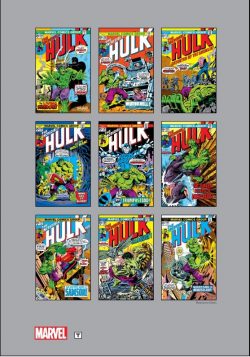
This fast and furious fun-filled tome also includes the covers from and some interior pages from Hulk-themed Marvel Treasury Edition #5, crafted by John Romita, Marie Severin and Trimpe, as well as the latter’s double page pin-up of Hulk foes from that tabloid-sized graphic treat, as well as house ads, the cover to Giant-Size Hulk #1 and a gallery of original art including unused Trimpe covers.

And gilding that bunch of viridian lilies is Sal Buscema’s 1960s try-out art page…

The Incredible Hulk is one of the most well-known comic characters on Earth, and these stories, as much as the movies, cartoons, TV shows, games, toys and action figures are the reason why. For an uncomplicated, earnestly vicarious experience of Might actually being Right, you can’t do better than these yarns, so why not Go Green – even if it’s only in monochrome and in your own delirious head?
© 1975, 1976, 2017 Marvel Characters, Inc. All rights reserved.
Internet Crusader


By George Wylesol (Avery Hill Publishing)
ISBN: 978-1-910395-51-6 (TPB)

I did consider saving this nifty novel enterprise for our upcoming Occultoberfest (not a Real Thing, except right here) month of horror and supernatural samplings, but – just like a sugar-deprived, axe-wielding kid in fancy dress – I simply couldn’t wait…

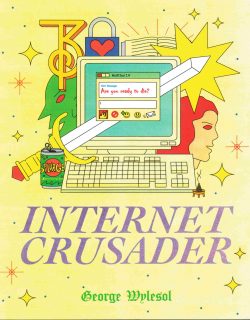
Baltimore-based George Wylesol (Ghosts, Etc.) is a cartoonist with lots to say and divers ways of doing so, and in Internet Crusader he channels his avowed fascinations (old computer kit and livery, religious iconography, the nostalgic power of commercial branding and signage) with his ongoing faith in the narrative power of milieu and environment – as opposed to characters – into a spookily sublime tale of demonic incursion and plucky outsider kids saving the world…

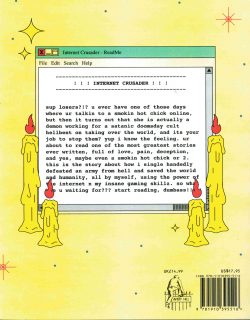
You won’t see them, however, except via their actions, as this gripping yarn is told in the form of a diabolically delightful epistolary novel, with all the action taking place on craftily reconstructed computer pages, packed with all the distracting screen furniture, intrusive pop-ups, message pings and emails and barrages of ads that infest modern tech interfaces.

And that the cleverest part here as the kid answering to the handle “Internet Crusader” is a typical, anti-social 12-year old drawn by Christian-supported porn-site come-ons into playing a game devised by the Devil to cripple Heaven through Denial-of-Service attacks and subvert humanity’s free will through similar modern arcana.

Thankfully, God still has a back door or two in reserve, and a desperate plan to save his creation from itself using the “insane gaming skillz” of select youngsters…

But in the eternal war of lies and willpower, can anyone, any message be taken at face value…?

A smart and compulsive experience seamlessly wedding plot to graphics and employing modern cinema’s ubiquitous (if perhaps comfortably obsolescent) computer interface imagery as narrative device is further enhanced for readers by the addition of a comics insert freebie: a faux users guide of the Evil One’s Portal 2 Hell Crusader’s Manual, layering in further immersive context to your reading gestalt.

Ignore the big words: this is clever and witty and fun, but not – as yet – available in electronic formats. Maybe that’s God’s Will too…

Supremely enjoyable, this is a book and experience that’s hard to fault, a joy to read and ideal to give as gift in the fraught months to come…
© George Wylesol 2019. All rights reserved.

Toys in the Basement


By Stéphane Blanquet, translated by Kim Thompson (Fantagraphics Books)
ISBN: 978-1-60699-402-6 (HB)

It’s a bumper time if you have kids who love the grimmer side of storytelling.  Here’s a superb slice of macabre all-ages Euro-whimsy, courtesy of the wildly talented and incredibly prolific Stéphane Blanquet (more than 64 art books, graphic novels, collaborative works and books for kids published since 1994 including Dungeon: Monstres volume 2, Kramer’s Ergot, and Zero Zero).

Do you remember the heart-wrenching scene in the 1964 stop-motion television classic Rudolph, the Red-Nosed Reindeer when he finds the Island of Misfit toys? Do you recall how all they wanted was children to love them? Hold on to that thought…

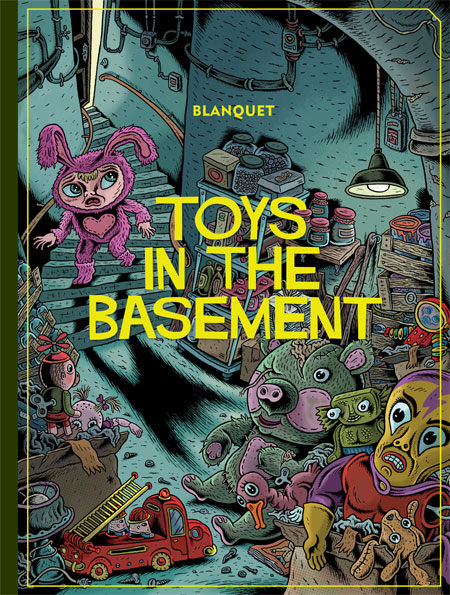
At a Halloween fancy-dress party a disgruntled little boy is sulking. In his heart he’s a vicious pirate king, but his cheapskate mother would only pay for a pink bunny costume nobody else wanted…

As the other kids tease and bully him, he retreats to a corner where he meets a geeky kid in a chicken suit.

Poultry boy has a broken leg and a raging thirst, but his friend – a girl in a kitten outfit – has been down in cellar fetching drinks for ages. After some pleading, Pink Bunny, keen to avoid further embarrassment, or to be seen with a nerd dressed like a chicken, goes after her.

At the bottom of the stairs he finds her paralysed with fear: the basement is filled with maimed and broken toys, alive, angry and determined to wreak bloody vengeance on the cruel children who maltreated and abandoned them. Luckily, because of their stupid outfits, the toys assume the kids too are dolls, because if they were real children…

Playing for time, Catgirl and Bunnyboy follow the maladjusted playthings to a vast underground cavern where all broken toys are massing, readying for the day they will rise and take over. The children gasp in horror at the artificial army’s secret weapon – a gigantic ravenous Frankensteinian beast named Amelia, cobbled together from thousands of discarded toy fragments, all hungry for righteous slaughter…

It’s at that moment Chicken-boy stumbles upon them and blows their cover…

Dosed with dry, mordant wit and just the right tone of macabre Ghost Train suspense, Toys in the Basement is a simply terrific goose-bumpy thriller rendered magical by the wildly eccentric, brilliantly imaginative and creepily fluid artwork of Blanquet. This dark delight – sadly only available in physical hardback form – also has the perfect moral message for loot-hungry, attention-deprived youngsters – and their kids and grandchildren too.
© 2005 Editions La Joie de Lire SA. This edition © 2010 Fantagraphics Books. All rights reserved.

Showcase Presents the Spectre volume 1


By Gardner F. Fox, Bob Haney, Mike Friedrich, Steve Skeates, Dennis J. O’Neil, Mark Hanerfeld, Michael L. Fleisher, Len Wein, Paul Kupperberg, Mike W. Barr, Murphy Anderson, Carmine Infantino, Ross Andru & Mike Esposito, Neal Adams, Jerry Grandenetti, Jack Sparling, Bernie Wrightson, Jim Aparo, Frank Thorne, Ernie Chan, Jim Starlin, Michael R. Adams & various (DC Comics)
ISBN: 978-1-4012-3417-1 (TPB)

Created by Jerry Siegel & Bernard Baily in 1940 and debuting via a 2-part origin epic in More Fun Comics #52 and 53, The Spectre is one of the oldest characters in DC’s vast character stable. Crucially, just like Siegel’s other iconic creation, he soon began to suffer from a basic design flaw: he was just too darn powerful.

Unlike Superman however, this relentless champion of justice was already dead, so he can’t really be logically or dramatically imperilled. Of course, in those far off early days that wasn’t nearly as important as sheer spectacle: forcibly grabbing the reader’s utter attention and keeping it stoked to a fantastic fever pitch.

Starting as a virtually omnipotent phantom, the Grim Ghost evolved, over various revivals, refits and reboots into a tormented mortal soul bonded inescapably to the actual embodiment of the biblical Wrath of God.

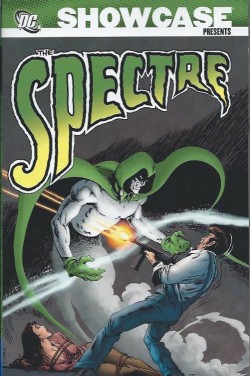
The story is a genuinely gruesome one: police detective Jim Corrigan is callously executed by gangsters before being called back to the land of the living. Commanded to fight crime and evil by a glowing light and disembodied voice, he was indisputably the most formidable hero of the Golden Age.

He has been revamped many times, and in the 1990s was revealed to be God’s own Spirit of Vengeance wedded to a human conscience. When Corrigan was finally laid to rest, Hal (Green Lantern) Jordan and murdered Gotham City cop Crispus Allen replaced him as the mitigating conscience of the unstoppable, easily irked force of Divine Retribution…

However, the true start of that radically revitalised career began in the superhero-saturated mid-1960s when, hot on the heels of feverish fan-interest in the alternate world of the Justice Society of America and Earth-2 (where all the WWII heroes retroactively resided), DC began trying out solo revivals of 1940’s characters, as a counterpoint to such wildly successful Silver Age reconfigurations as Flash, Green Lantern, Atom and Hawkman…

This sublime and colossal Showcase selection collects and documents the almighty Man of Darkness’ return in the Swinging Sixties, his landmark reinterpretation in the horror-soaked, brutalised 1970s and even finds room for some later appearances before the character was fully de-powered and retrofitted for the post-Crisis on Infinite Earths DC Universe.

As such, this mammoth monochrome tome (624 peril-packed pages!) contains Showcase #60, 61 and 64; The Spectre #1-10; team-up tales from The Brave and the Bold #72, 75, 116, 180 & 199 and DC Comics Presents #29; the lead strips from Adventure Comics #431-440 and one last hurrah from horror-anthology Ghosts #97-99, cumulatively encompassing the end of 1965 to the middle of 1983.

DC had tried a number of Earth-2 team-iterations (Starman/Black Canary – with Wildcat – in The Brave and the Bold #61-62, whilst Showcase #55 & 56 spotlighted Doctor Fate & Hourman with a cameo from the original Green Lantern), but inspirational editor Julie Schwartz and scripter Gardner F. Fox only finally achieved their ambition to launch a Golden Age hero into his own title with the revival of the Ghostly Guardian in Showcase. It was hard going and perhaps ultimately benefited from a growing general public interest in supernatural stories…

After three full length appearances and many guest-shots, The Spectre won his own solo series at the end of 1967, just as the super-hero craze went into a steep decline, but arguably Showcase #60 (January/February 1966) anticipated the rise of supernatural comics by re-introducing Corrigan and his phantom passenger in ‘War That Shook the Universe’ by Earth-2 team supreme Fox & illustrator Murphy Anderson.

This spectacular saga reveals why the Heroic Haunt had vanished two decades previously, leaving the fundamentally human Corrigan to pursue his war against evil on merely mortal terms – until a chance encounter with a psychic investigator frees the spirit buried deep within him.

A diligent search reveals that, 20 years previously, a supernal astral invader broke into the Earth plane and possessed a mortal, but was so inimical to our laws of reality that both it and the Grim Ghost were locked into their meat shells – until now…

Thus began a truly spectre-acular (feel free to groan, but that’s what they called it back then) clash with the devilish Azmodus that spans all creation and blew the minds of us gobsmacked kids…

Issue #61 (March/April) upped the ante when the even-more satanic Shathan the Eternal subsequently insinuates himself into our realm from ‘Beyond the Sinister Barrier’, stealing mortal men’s shadows until he is powerful enough to conquer the physical universe. This time The Spectre treats us to an exploration of the universe’s creation before narrowly defeating the source of all evil…

The Sentinel Spirit re-manifested in Showcase #64 (September/October 1966) for a marginally more mundane but no less thrilling adventure when ‘The Ghost of Ace Chance’ takes up residence in Jim’s body. By this time, it was established that ghosts need a mortal anchor to recharge their ectoplasmic “batteries”, and this unscrupulous crooked gambler is determined to inhabit the best frame available…

The try-out run concluded, the editors sat back and waited for sales figures to dictate the next move. When they proved inconclusive Schwartz orchestrated a concerted publicity campaign to further promote Earth-2’s Ethereal Adventurer.

The Brave and the Bold #72 (June/July 1967) saw the Spectre clash with Earth-1’s Scarlet Speedster in ‘Phantom Flash, Cosmic Traitor’ (by Bob Haney, Carmine Infantino & Charles “Chuck” Cuidera). This sinister saga sees the mortal meteor arcanely transformed into a sinister spirit-force and power-focus for unquiet American aviator Luther Jarvis who returns from his death in 1918 to wreak vengeance on the survivors of his squadron – until the Spectre intervenes…

Due to the vagaries of comicbook scheduling, Brave and the Bold #75 (December 1967/January 1968) appeared at around the same time as The Spectre #1, although the latter had a cover-date of November/December 1967. In the Batman team-up tale – scripted by Haney and drawn by Ross Andru & Mike Esposito – Ghostly Guardian joins Dark Knight to free Gotham City’s Chinatown from ‘The Grasp of Shahn-Zi!’: an ancient oriental sorcerer determined to prolong his reign of terror at the expense of an entire community and through the sacrifice of an innocent child, after which the Astral Avenger finally, simultaneously, debuted in his own title…

The Spectre #1 featured ‘The Sinister Lives of Captain Skull’ by Fox & Anderson, divulging how the botched assassination of American Ambassador Joseph Clanton and an experimental surgical procedure allows one of the diplomat’s earlier incarnations to seize control of his body and, armed with mysterious eldritch energies, run amok on Earth.

These “megacyclic energy” abilities enable the revenant to harm and potentially destroy the Ghostly Guardian and compel the Spectre to pursue the piratical Skull through a line of previous lives until he can find their source and purge the peril from all time and space…

With issue #2 (January/February 1968) artistic iconoclast Neal Adams came aboard for the Fox-scripted mystery ‘Die Spectre – Again’ wherein crooked magician Dirk Rawley accidentally manifests his etheric self and severely tests both Corrigan and his phantom lodger as they seek to end the double-menace’s string of crimes, mundane and magical. At this time, the first inklings of a distinct separation and individual identities began. The two halves of the formerly sole soul of Corrigan were beginning to disagree and even squabble…

Neophyte scripter Mike Friedrich joined Adams for #3’s ‘Menace of the Mystic Mastermind’ wherein pugilistic paragon Wildcat faces the inevitable prospect of age and infirmity even as an inconceivable force from another universe possesses petty thug Sad Jack Dold, turning him into a nigh-unstoppable force of cosmic chaos…

‘Stop that Kid… Before He Wrecks the World’ was written & illustrated by Adams with a similar trans-universal malignity deliberately empowering a young boy as a prelude to its ultimate conquest, whilst #5’s ‘The Spectre Means Death?’ (all Adams again) appears to show the Ghostly Guardian transformed into a pariah and deadly menace to society, until Jim’s investigations uncover the emotion-controlling Psycho Pirate at the root of the Heroic Haunt’s problems…

Despite all the incredible talent and effort lavished upon it, The Spectre simply wasn’t finding a big enough audience. Adams left for straight superhero glory elsewhere and a hint of changing tastes came as veteran illustrator of horror comics Jerry Grandenetti came aboard.

Issue #6 (September/October 1968) saw his eccentric, manic cartooning adding raw wildness to the returning Fox’s moody thriller ‘Pilgrims of Peril!’ Murphy Anderson also re-enlisted, applying a solid ink grounding to the story of a sinister quartet of phantom Puritans who invade the slums of Gateway City, driving out the poor and hopeless as they hunt long-lost arcane treasures. These would allow demon lord Nawor of Giempo access to Earth unless The Spectre can win his unlife or death duel with the trans-dimensional horror…

As the back of issue #7 was dedicated to a solo strip starring Hourman (not included in this collection), The Spectre saga here – by Fox, Grandenetti & Anderson – was a half-length tale which followed the drastic steps necessary to convince the soul of bank-robber Frankie Barron to move on. Since he was killed during a heist, the astral form of aversion therapy used to cure ‘The Ghost That Haunted Money!’ proves not only ectoplasmically effective but outrageously entertaining…

Issue #8 (January/February 1969) was scripted by Steve Skeates and began a last-ditch and obviously desperate attempt to turn The Spectre into something the new wave of anthology horror readers would buy.

As a twisted, time-lost apprentice wizard struggles to return to Earth after murdering his master and stealing cosmic might from the void, on our mundane plane an exhausted Ghostly Guardian neglects his duties and is taken to task by his celestial creator.

As a reminder of his error, the Penitent Phantasm is burdened by a fluctuating weakness – which would change without warning – to keep him honest and earnest. What a moment for the desperate disciple Narkran to return then; determined to secure his elevated god-like existence by securing ‘The Parchment of Power Perilous!’…

The Spectre #9 completed the transition, opening with an untitled short from Friedrich (illustrated by Grandenetti & Bill Draut) which sees the Man of Darkness again overstep his bounds by executing a criminal. This prompts Corrigan to refuse the weary wraith the shelter of his reinvigorating form and when the Grim Ghost then assaults his own host form, the Heavenly Voice punishes the spirit by chaining him to the dreadful Journal of Judgment: demanding he atone by investigating the lives inscribed therein in a trial designed to teach him again the value of mercy…

The now anthologised issue continued with ‘Abraca-Doom’ (Dennis J. O’Neil & Bernie Wrightson) as The Spectre attempts to stop a greedy carnival conjurer signing a contract with the Devil, whilst ‘Shadow Show’ – by Mark Hanerfeld & Jack Sparling – details the fate of a cheap mugger who thinks he can outrun the consequences of a capital crime…

The next issue gave up the ghost. The Spectre folded with #10 (May/June 1969), but not before a quartet of tantalising tales by – writer or writers unknown – shows what might have been…

‘Footsteps of Disaster’ with art from Grandenetti & George Roussos, follows a man from cradle to early grave, revealing the true wages of sin, whilst ‘Hit and Run’ (probably drawn by Ralph Reese) proves again that the Spirit of Judgment is not infallible and even human scum might be redeemed…

‘How Much Can a Guy Take?’ (Sparling) offers salvation to a shoeshine boy pushed almost too far by an arrogant mobster before the series closed with a cunning murder mystery involving what appeared to be a killer ventriloquist’s doll in the Grandenetti & Roussos limned ‘Will the Real Killer Please Rise?’

With that the Astral Avenger returned to comicbook limbo for nearly half a decade until changing tastes and another liberalising of the Comics Code saw him arise as lead feature in Adventure Comics #431 (January/February 1974) for a shocking run of macabre, ultra-violent tales from Michael L. Fleisher & Jim Aparo.

‘The Wrath of… The Spectre’ offered a far more stark, unforgiving take on the Sentinel Spirit; reflecting the increasingly violent tone of the times. Here, a gang of murderous thieves slaughter the crew of a security truck and are tracked down by a harsh, uncompromising police lieutenant named Corrigan. When the bandits are exposed, the cop unleashes a horrific green and white apparition from his body which inflicts ghastly punishments that horrendously fit their crimes…

With art continuity (and no, I’m not sure what that means either) from Russell Carley, the draconian fables continue in #432 as in ‘The Anguish of… The Spectre’ assassins murder millionaire Adrian Sterling and Corrigan meets the victim’s daughter Gwen. Although the now-infallible Wrathful Wraith soon exposes and excised the culprits, the dead detective has to reveal his true nature to the grieving daughter. Moreover, Corrigan begins to feel the stirring of impossible, unattainable yearnings…

Adventure #433 exposed ‘The Swami and… The Spectre’ as Gwen seeks spiritual guidance from a ruthless charlatan who promptly pays an appalling price when he finally encounters an actual ghost, whilst in #434 ‘The Nightmare Dummies and… The Spectre’ (with additional pencils by the great Frank Thorne), a plague of department store mannequins run wild in a killing spree at the behest of a crazed artisan who believes in magic – but can’t imagine the cost of his dabbling…

Issue #435 introduces journalist Earl Crawford who tracks the ghastly fallout of the vengeful spirit’s anti-crime campaign as ‘The Man Who Stalked The Spectre!’ Of course, once he sees the ghost in grisly action, Crawford realises the impossibility of publishing this scoop…

Adventure #436 finds Crawford still trying to sell his story as ‘The Gasmen and… The Spectre’ sets the Spectral Slaughterman on the trail of a gang who kill everyone at a car show as a simple demonstration of intent before blackmailing the city. Their gorily inescapable fate only puts Crawford closer to exposing Corrigan, after which, in #437’s ‘The Human Bombs and… The Spectre’ (with pencils from Ernie Chan & Aparo inks) a kidnapper abducts prominent persons – including Gwen – to further a merciless mad scheme of amassing untold wealth… until the Astral Avenger ended the depredations forever…

In #438, ‘The Spectre Haunts the Museum of Fear’ (Chan & Aparo again) sees a crazed taxidermist turning people into unique dioramas until the Grim Ghost intervenes, but the end was in sight again for the Savage Shade. Issue #439’s ‘The Voice that Doomed… The Spectre’ (all Aparo) turns the wheel of death full circle, as the Heavenly Presence who created him allows Corrigan to fully live again so that he can marry Gwen. Sadly, it is only to have the joyous hero succumb to ‘The Second Death of The… Spectre’ (#440, July/August 1975) and tragically resume his never-ending mission…

This milestone serial set a stunning new tone and style for the Ghostly Guardian which has informed each iteration ever since…

From midway through that run, Brave and the Bold #116 provides another continuity-coshing supernatural team-up with Batman – a far less graphically violent struggle against the ‘Grasp of the Killer Cult’ (Haney & Aparo). When Kali-worshipping Thugs from India seemingly target survivors of a WWII American Army Engineer unit, Detective Corrigan and the Dark Knight clash on both the method and motives of the mysterious murderers…

DC Comics Presents #29 (January 1981, by Len Wein, Jim Starlin & Romeo Tanghal) revealed what happened after Supergirl is knocked unconscious during a cataclysmic battle and sent hurtling through dimensions measureless to man. When her cousin tries to follow, the Ghostly Guardian is dispatched to stop the Metropolis Marvel from transgressing ‘Where No Superman Has Gone Before’…

By the early 1980s, the horror boom had again exhausted itself and DC’s anthology comics were disappearing. As part of the effort to keep them alive, Ghosts featured a 3-part serial starring “Ghost-Breaker” and inveterate sceptic Dr. Terry 13 who at last encounters ‘The Spectre’ in issue #97 (February 1981, by Paul Kupperberg, Michael R. Adams & Tex Blaisdell), wherein terrorists invade a high society séance and are summarily dispatched by the inhuman poetic justice of the freshly-manifested Astral Avenger…

Now determined to destroy the monstrous revenant vigilante, Dr. 13 returns in #98 as ‘The Haunted House and The Spectre’ finds the Ghost-Breaker interviewing Earl Crawford and subsequently discovering the long-sought killer of his own father. Before 13 can act however, the Spectre appears and steals his justifiable retribution from the aggrieved psychic investigator…

The drama closed in Ghosts #99 as ‘Death… and The Spectre’ (inked by Tony DeZuñiga) sees scientist and spirit locked in one final furious confrontation.

This staggering compendium of supernatural thrillers concludes with two more team-up classics from Brave and the Bold, beginning with ‘The Scepter of the Dragon God’ by Fleisher & Aparo (from #180, November 1980). Although Chinese wizard Wa’an-Zen steals enough mystic artefacts to conquer Earth and destroy The Spectre, he gravely underestimates the skill and bravery of merely mortal Batman, whilst in #199 (June 1983) ‘The Body-napping of Jim Corrigan’ (Mike W. Barr, Andru & Rick Hoberg), finds the ethereal avenger baffled by the abduction and disappearance of his mortal host. Even though he cannot trace his own body, the Spectre knows where the World’s Greatest Detective hangs out…

Ranging from fabulously fantastical to darkly, violently enthralling, these comic masterpieces perfectly encapsulate the way superheroes changed over a brief 20-year span, but remain throughout some of the most beguiling and exciting tales of DC’s near-80 years of existence. If you love comicbooks you’d be crazy to ignore this one…
© 1966, 1967, 1968, 1969, 1974, 1975, 1981, 1983, 2012 DC Comics. All Rights Reserved.

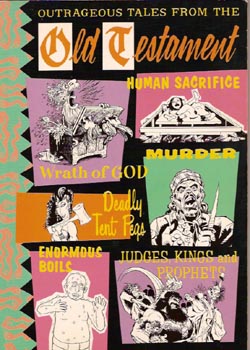
Outrageous Tales from the Old Testament


By Arthur Ranson, Donald Rooum, Dave Gibbons, Alan Moore, Hunt Emerson, Neil Gaiman, Mike Matthews, Julie Hollings, Peter Rigg, Graham Higgins, Steve Gibson, Dave McKean, Kim Deitch, Carol Bennett, Brian Bolland & various (Knockabout)
ISBN: 978-0-86166-054-4

Although I couldn’t be happier with the state of the graphic novel market these days, I do miss the early days when production costs were high and canny pioneer publishers resorted to producing anthologies of short tales.

Knockabout Comics has been providing cutting edge and controversial cartoon triumphs since 1975 and although this cracking all-star oddment is actually out of print – like far too many of the graphic novels and collections I recommend – it remains one of their most potent and engaging releases.

However, if you’re a devout Christian you be best advised to just jump to the next review.

Originally released in 1987, it features a varied band of British creators adapting – with tongues firmly in cheeks – a selection of Biblical episodes, and the results are mordantly earnest, deeply bitter and darkly funny.

‘Creation’ is the preserve of supreme stylistic realist Arthur Ranson, whilst affable anarchist legend Donald Rooum explores Eden in ‘Gandalf’s Garden’ and Dave Gibbons puts some decidedly modernistic top-spin to the saga of ‘Sodom and Gomorrah’.

Alan Moore & Hunt Emerson examine ‘Leviticus’ (that would be the one with all those pesky Commandments) after which Neil Gaiman tackles ‘The Book of Judges’ accompanied by Mike Matthews (both the introduction and ‘The Tribe of Benjamin’); with Julie Hollings (for ‘Jael and Sisera’); Peter Rigg (‘Jephthah and His Daughter’); Graham Higgins (‘Samson’) and Steve Gibson (‘Journey to Bethlehem’). He even finds time to produce ‘The Prophet Who Came to Dinner’ (From the Book of Kings) with seminal long-time collaborator Dave McKean.

Closing the slim oversized (290 x204 mm) monochrome tome are underground cartooning icon Kim Deitch with ‘The Story of Job’, ‘Daddy Dear’ (from Ecclesiastes) adapted by Carol Bennett & Julie Hollings and the intensely uncompromising ‘A Miracle of Elisha’ (also from the Book of Kings) by the magnificent Brian Bolland.

Powerful and memorable, these interpretations won’t win any praise from Christian Fundamentalists, but they are fierce, subtle and scholarly examinations of the Old Testament realised by passionate creators with something to say and an unholy desire to instruct. As free-thinking adults you owe it to yourself to read these stories, but only in the spirit in which they were created.
© 1987 Knockabout Publications and the Artists and Writers. All Rights Reserved.

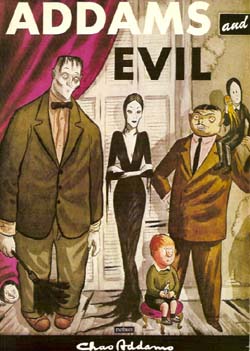
Addams and Evil


By Charles Addams Methuen)
ISBN: 978-0-413-55370-1

Charles Samuel Addams (1912 – 1988) was a cartoonist and distant descendant of two American Presidents (John Adams and John Quincy Adams) who made his real life as extraordinary as his dark, mordantly funny drawings.

Born into a successful family in Westfield, New Jersey, the precocious, prankish, constantly drawing child was educated at the town High School, Colgate University, the University of Pennsylvania, and New York City’s Grand Central School of Art, producing cartoons and illustrations for a raft of institutional publications.

In 1932 he became a designer for True Detective magazine – retouching photos of corpses – and soon after began selling drawings to The New Yorker. In 1937 he began creating the macabre ghoulish family portraits that become his signature creation. During WWII he served with Signal Corps Photographic Center, devising animated training films for the military.

Whether he artfully manufactured his biography to enhance his value to feature writers or was genuinely a warped and wickedly wacky individual is irrelevant (although it makes for great reading:- especially the stuff about his second wife – and, as always, the internet awaits the siren call of your search engine…).

What is important is that in all the years he drew and painted those creepily sardonic, gruesome gags and illustrations for The New Yorker, Colliers, TV Guide and others, he managed to enthral his audience with a devilish mind and a soft, gentle approach that made him a household name long before television turned his characters into a hit and generated a juvenile craze for monsters and grotesques that lasts to this day. That eminence was only magnified once the big screen iterations debuted…

This stunningly enticing volume is a reissue of his second collection of cartoons, first published in 1947, and semi-occasionally since then. It’s still readily available if you’ve a big bank book, but the time is ripe for a definitive collected edition, or better yet a reissue of his entire canon (eleven volumes of drawings and a biography) either in print or digitally.

Should you not be as familiar with his actual cartoons as with their big and small screen descendants you really owe it to yourself to see the uncensored brilliance of one of America’s greatest humourists. It’s dead funny…
© 1940-1947 the New Yorker Magazine, Inc. In Canada © 1947 Charles Addams.

Zombillenium volume 4: Royal Witchcraft


By Arthur de Pins, translated by Joe Johnson (NBM)
ISBN: 978-1-68112219-9- (HB)

Arthur de Pins is a British-born French filmmaker, commercial artist and Bande Dessinées creator whose strips – such as adult comedy Peccadilloes (AKA Cute Sins) and On the Crab – have appeared in Fluide Glacial and Max.

In recent years his superbly arch and beautifully illustrated supernatural horror-comedy Zombillénium has become his greatest success and lead to the overlong hiatus between the last translated volume and the cracking read under review today. The in-demand maestro was supervising and co-directing with Alexis Ducord a magnificent animated movie. If you haven’t seen it yet, check out your streaming service of choice…

The Bande dessinée it was based on is a truly addictive comics cult classic which began in 2009 (serialised in Le Journal de Spirou from #3698 on) and has now filled four albums released in English thanks to Canadian publisher NBM.

Rendered with beguiling style and sleek, easy confidence, the unfolding saga details the odd goings-on in a horror-themed amusement park staffed by actual monsters and operated and owned by a cabal of capitalistically-inclined infernal powers. They have big expansion plans that are only curtailed by the perpetually lethal jockeying for pole position on the diabolical Board of Directors…

Zombillenium is a truly magical entertainment experience celebrating every aspect of the spooky and supernatural, where (human) families can enjoy a happy day out rubbing shoulders with werewolves, witches and all breeds of bogeyman. Of course, those enthralled customers might not laugh so hard if they knew all the monsters were real, usually hungry and didn’t much like humans … except in a culinary fashion…

The inaugural volume introduced hard-working, exceedingly humane Park Director (and vampire) Francis Von Bloodt, newly-reborn Aurelian Zahner (a pathetically inept thief until he expired at the park and returned transformed into a demonic indentured employee of the business) and quirkily stroppy British Witch Gretchen: a young newcomer interning at the park whilst secretly advancing her own agenda.

As they individually toiled away at the vast entertainment enterprise its true nature was slowly revealed: for unwary, unlucky mortals the site is a conduit to the domain of the damned and its devilish overlord Behemoth: an intolerant horror ever-hungry for fresh souls…

The humans of the nearest town know the monsters are real (as work-shy absconders keep hiding from their bosses there) and undertake many schemes to evict or exorcise the inhabitants of the site. For the uncanny undead workers from the Park – who would rather be anywhere else – conditions of employment worsen every day: it is regarded as one of the least profitable holiday destinations on Earth and The Board are always threatening to make sweeping changes…

For most of its existence – despite the incredible bargaining power of the many monster Trade Unions – the only way out of a Zombillenium contract was the True Death and a final transition to Hell, but then a cascade of changes upset many apple-carts. Through it all, newcomer Aurelian was somehow always shouldering the blame for every new crisis.

Stuck between a rock and a hot place, Zahner gradually adapts to his new (un)life of constant sorrow whilst growing closer to Gretchen after she shared with him her own awful life-story; revealing what he has become whilst disclosing what her real mission is at the Park. The big boob has no idea how much she left out…

The saga moved into apocalyptic high gear in previous episode Control Freaks as Gretchen’s private plot gathered pace after she made contact with a loved one currently confined in Hell. The bold sorceress promised a seemingly impossible liberation before sneaking out, whilst in the mortal world a long-dreaded day dawns and all the arcane artisans and supernatural staff quailed at Big News…

Officially a consultant despatched to “observe” how the park was run, elite vampire Bohémond Jaggar de Rochambeau wanted to take the business by the throat and shake things up. He forces Von Bloodt, the revolting Shop-Stewards and all objectors to achieve his new business model at any cost…

One of the most unfortunate aspects of the fearsome funfair is that any human dying on Zombillenium property is instantly reborn a monster, owned by Behemoth and compelled to work eternally in the theme park until the master takes them below. Under Francis’ governance that had been wisely offset by a set of stringent rules, the first of which stated that no employee is ever allowed to attack a human. Jagger has other ideas: he impetuously killed a little girl, delivering in no uncertain terms the new working time directives to Francis and the astounded staff.

The Park was a pump designed to generate money for the shareholders and a steady supply of souls to Behemoth. Now Von Bloodt’s hands-off-humans policy was superseded by more robust policies demanding bigger returns on both sides of the investment…

The news was met with mixed feelings by the workforce: most were scared, appalled and resistant, but a significant proportion saw it as the opportunity they’ve long argued for and a chance to feed and feast and hunt all those obnoxious yet tasty human morsels…

The result of the mounting tensions was a cataclysmic battle of supernatural forces and revolt of the monsters, which triggered an evacuation of Zombillenium. Casualties were kept to a minimum but eventually, when the dust settled, Francis was out and Jaggar was in charge; actively encouraging the killing of unattached or unaccompanied humans, who now come in droves to the most exciting entertainment experience in the world…

This latest infernal escapade – released in Europe as La Fille de l’air and available in English in both oversized Hardback Album and eBook formats – opens some time later as the Board’s machinations result in the entire Park enterprise being offered as the prize in a demonic contest.

At the Park site, winter grips the land and Aurelian and Gretchen are running a dangerous side-game: smuggling monsters to freedom outside the infernal boundaries. That enterprise ends when the young witch is ambushed and defeated in a spectacular aerial duel with an even more powerful sorceress – Charlotte Hawkins – Monster Hunter!

The victor is Director Jagger’s latest attraction, but also hides a tragic and deadly secret that will shatter lives and post lives in Zombillenium. In the meantime, however, the rebels undertake a desperate scheme to oust Jaggar and replace him with Aurelian before the discorporate raider slaughters every breather in the vicinity. Sadly, it involves recruiting Lieutenant Leonie Tran: a human police officer still seething from the transformation spell Gretchen ruined her life with…

As always, nothing goes right and before long all-out magical war breaks out, with demons deviously vying for control of the site, humans screaming and running about in panic and Gretchen forced into a fatal rematch with Charlotte that leads to a most unlikely and unexpected denouement…

To Be Continued…

One of the most engaging candidates in a burgeoning category of seditiously mature and subversively ironic horror-comedies, this deliciously arch tale combines pop-cultural archetypes with smart and sassy contemporary insouciance and a solid reliance on the verities of Nature – Human or otherwise…

Sly, smart, sexy and scarily hilarious, Zombillenium masters that remarkable trick of marrying slapstick with satire in a manner reminiscent of Asterix or Cerebus the Aardvark, whilst deftly treading its own unforgettable and enticing path. You’ll curse yourself for missing out and if you don’t, there are things out there which will do it for and to you…
© Dupuis 2018 by De Pins. All rights reserved. © NBM 2019 for the English edition.