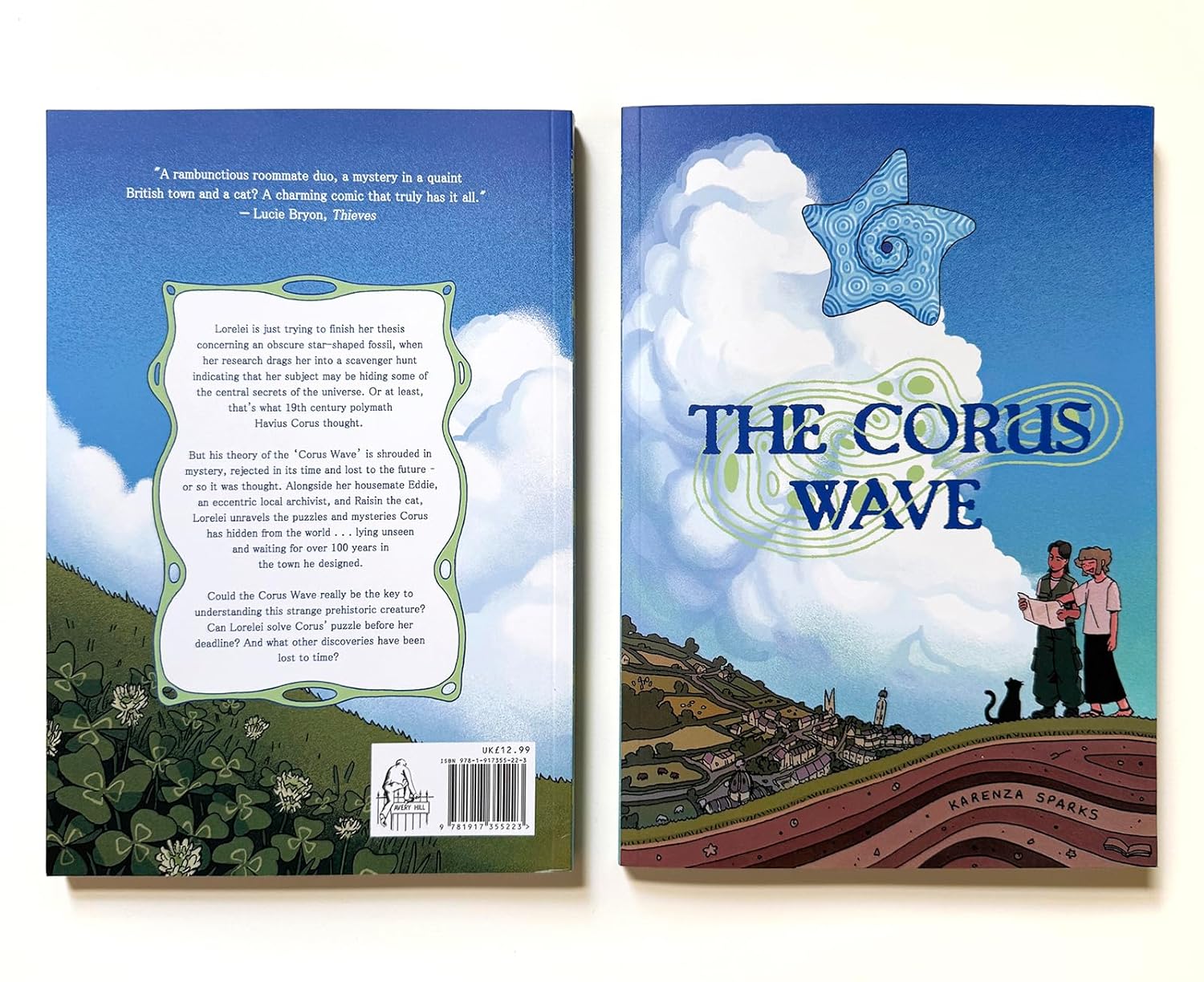
The Corus Wave


By Karenza Sparks (Avery Hill Publishing)
ISBN: 978-1-917355-22-3 (TPB/Digital edition)

The British have a tradition of quirkiness, and fondness for cosy mysteries and eccentric quests. Here’s an ideal example that combines sleuthing with SCIENCE! by way of a student days/buddy movie kind of vibe.

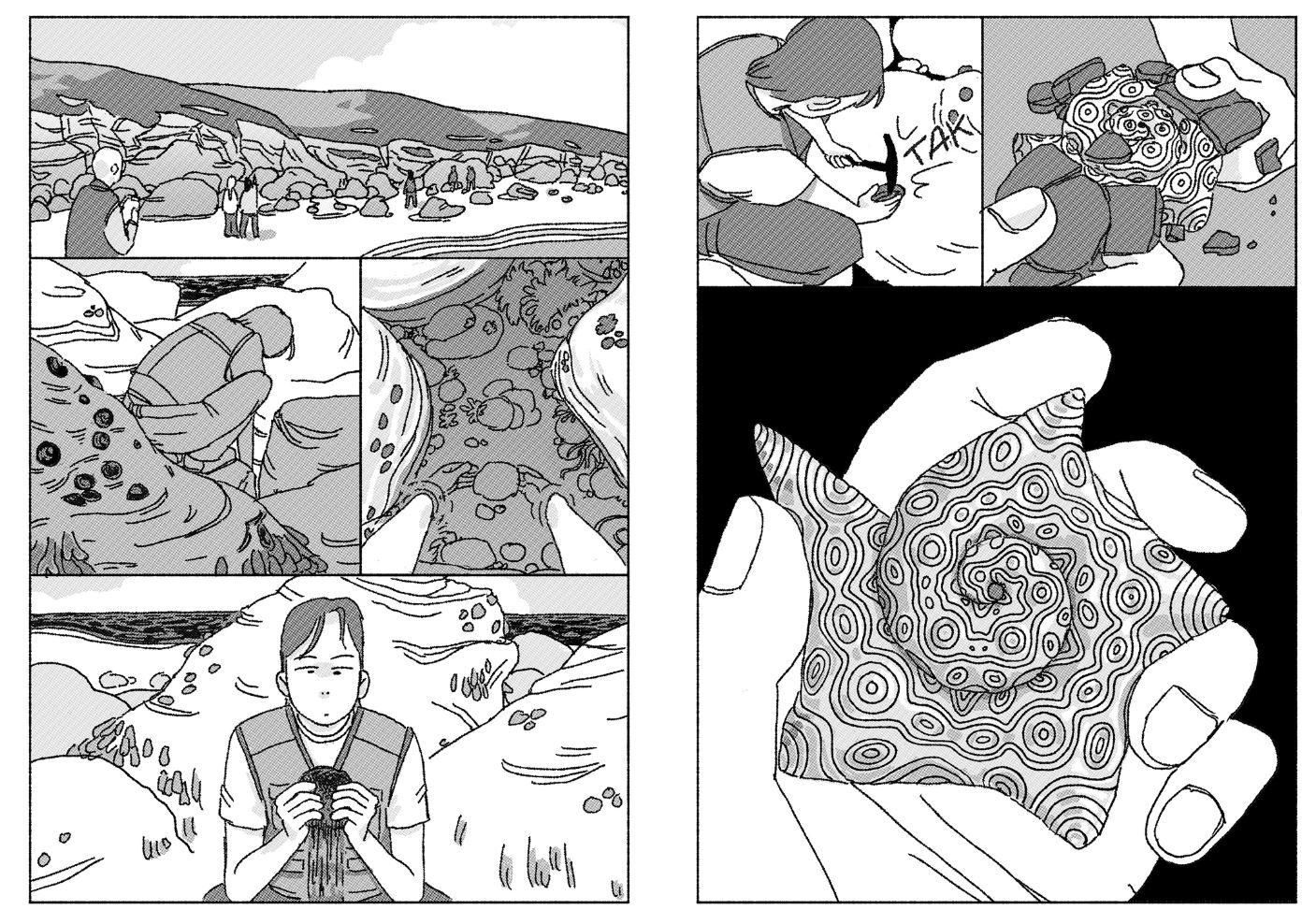
This gently genteel and genuinely refreshing mash-up offers a charming glimpse at obsession pursued and rewarded that begins when Geology student Lorelei finds a cool fossil during a beachcombing college class outing to the shore. What she found was a star-shaped fossilised Devonian-era cephalopod – what her tutor called a Palindenoid/Palindenite… and what Cornish locals used to call a “Strangely Wrinkled Potch”.

That oddment of swirling silica fascinated her and fuelled much of the toil of her last four years. Now it’s the basis of her Masters’ thesis and with final deadline and hand-in time looming, her obsessive research habits have led her into crisis. Instead of doing the bare minimum – and online – like a normal student, Lorelei has buried herself in old books and discovered the wonderful world of a lost genius. Her evaluation of the how Palindenite is formed has been derailed by one claim that they are the result of “the Corus Wave”…

Lorelei loves rocks and desperately wants to finish her thesis. She doesn’t have time for mysteries, even if they trigger old life-shaping memories. Sadly, the insubstantial legend and promise of the lost theories of Havius Corus have her now and won’t let go…

The internet is clueless over the Victorian mystery poet, scientist, mathematician, physicist, musician, historian and general polymath, but he does have a physical fan club. Having built half the great and grand buildings in Chorksbury, that admiring town now boasts the only Society dedicated to his name and works. With time pressing and time slipping away, when her pal Eddie suggests an adventure, Lorelei’s all primed for a procrastinating diversion – especially as pet cat Raisin is coming along for the ride…

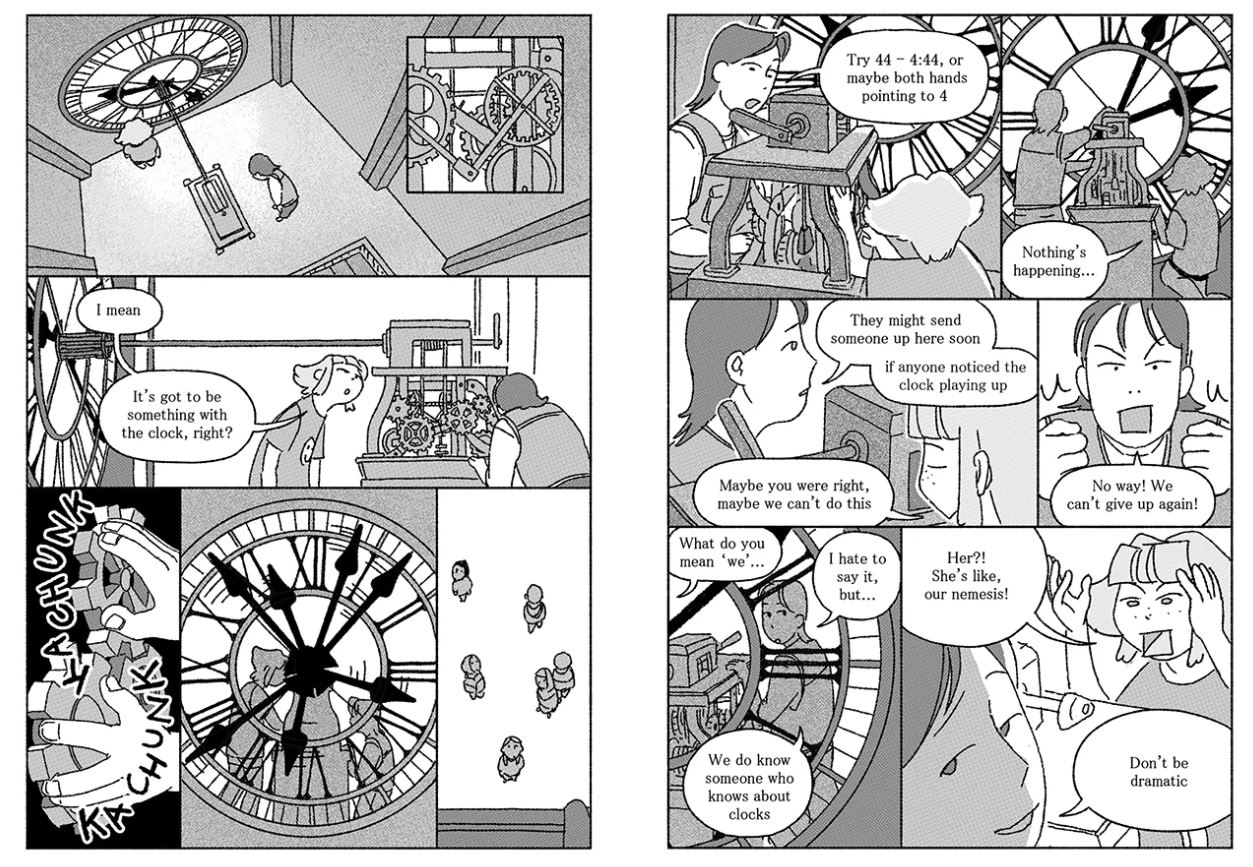
Chorksbury is a rural, very quiet town packed with oddballs, but Society chief Helen is hugely helpful in detailing the lost wonders of Corus’ rise and fall. He was good at everything and en route to global glory until he latched onto an unsustainable, unverifiable theory of universal truth underpinning existence. He dubbed it the Corus Wave, and trying to prove it destroyed him…

Once his reputation was in tatters, he returned to Chorkesbury and built stuff. In 1864 he simply stopped being seen…

Now in seeking to separate fact and fiction on the origins of Palindenite, Lorelei is about to do the same. Her pursuit of disgraced and forgotten Corus – who suggested the creation of the oddly shaped fossils was due to an unrecognised cosmic force – left physical clues to the details of his discovery.

… And when she, Eddie & Raisin start looking closely, the consensus that it’s all nonsense is shelved forever. A fresh form of physics really is scattered in relics and restrooms all over town. As the students persevere, discoveries come thick, fast and incontrovertible.

… And really, really quickly if you understand the tricks of games and puzzled Corus wrapped his messages in.

Now, “proper” scientists and historians like Dr. Lowena Marley join the hunt for Corus’ truth, as concealed in his stone & natural materials building all over Chorksbury: colossal convoluted edifices like the Public Library, Anglican Church, Railway Station and Botanical Gardens, and even – somehow – the nearby ancient standing stone circle…

The strange potch Lorelei refused to let go of is instrumental in all their finds so far, but eventually her race against time with no promise of reward except satisfaction and Just Knowing totally pays off… and Lorelei learns something no one knows.

The Corus Wave  is a delightfully engaging first graphic novel from geology buff Karenza Sparks, with heartwarming shades of Father Brown, Rosemary & Thyme, The Sister Boniface Mysteries or Marlow Murder Club – but without all the death! Despite in-world jokes this is absolutely not The Da Vinci Code or National Treasure but does wallow in hints of The Village from The Prisoner) – but without all the death!

Here a truly fun time with big sky notions and traditional mystery moves – but without all the death! Get it now!
© Karenza Sparks, 2025. All rights reserved.

Today in 1952 artist Steve Leialoha was born, followed in 1954 by Peter (TMNT) Laird and their inspiration Frank Miller in 1957. Clarifying such fare is letterer (writer/artist/publisher/designer) Richard Starkings in 1962 and illustrator Sean Phillips (Third World War, Sleeper, Criminal) in 1965.

On the downside, Belgium’s Le Journal de Spirou stalwart Jaques Devos (Victor Sébastopol, Génial Olivier, Le Chroniques d’Extra-terrestres) left us.

Robbie Burns: Witch Hunter


By Gordon Rennie, Emma Beeby, Tiernen Trevallion, Jim Campbell & Jerry Brannigan (Renegade Arts Entertainment)
ISBN: 978-0-99215-085-3 (HB/Digital edition)

This book includes Discriminatory Content included for dramatic and comedic effect.

Robert Burns was born in 1759 in Alloway. His father was a farmer who went to great lengths to ensure that his children were properly educated. Robert was schooled in the classics, French and Latin and began his creative writing when he was fifteen.

He led a successful, tempestuous life – particularly favouring boozy carousing and roistering escapades with the ladies – and died in 1796 aged 37. As well as dialectical and vernacular poetry, Burns selflessly preserved a wealth of traditional Scottish songs and folklore – particularly the bizarre arcane bestiary of supernatural entities God-fearing folk of the 18th century knew were out there (sorry, oot there) – and is more popular today than he has ever been.

He is the only poet in history to have his own globally celebrated holiday, with his birth anniversary on January 25th an affair universally honoured by food, drink, recitations and well-loved scary stories…

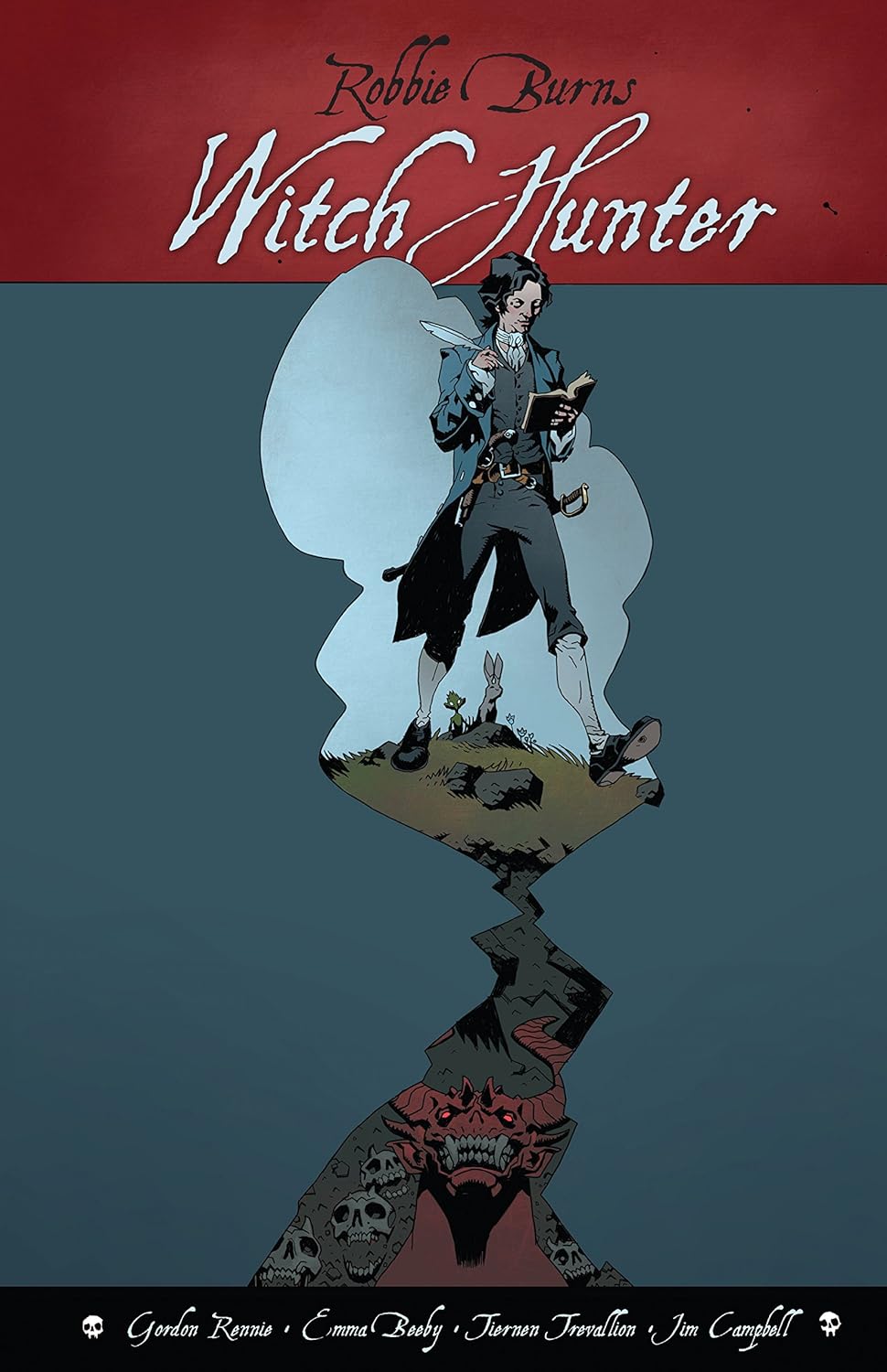
This stunning re-imagining of the venerable wordsmith by scripters Gordon Rennie (Necronauts, Cabalistics Inc., Judge Dredd) & Emma Beeby (Doctor Who, The Alienist, Judge Dredd), breathtakingly illustrated by Tiernen Trevallion (2000AD, Judge Dredd) and lettered by Jim Campbell, owes as much to the modern fashion for stylish tongue-in-cheek horror comedies as the beguiling and frequently fantastical works of the poet, but the skilful interweaving of Burns’ immortal lines with a diabolically clever but simple idea make this tale an unforgettable treat whether pages or screens float your particular boat.

Think of it this way: in all those sterling supernatural sonnets and sagas, Burns wasn’t reinterpreting his elders’ supernatural folk tales or exercising a unique imagination, he was simply quoting from his diary…

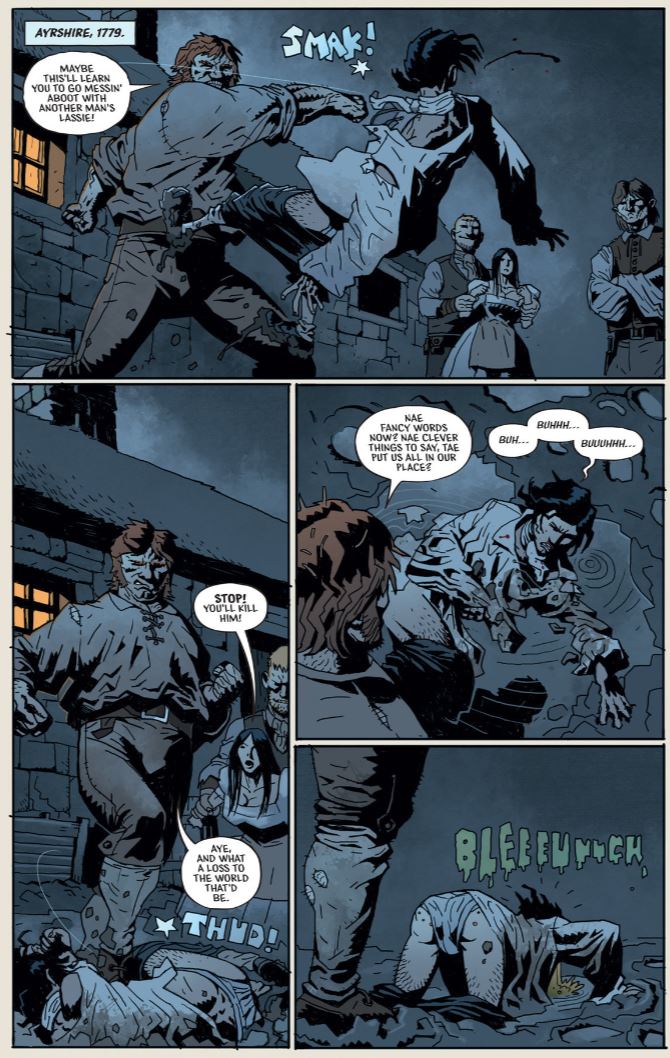
The wee drama unfolds one night in Ayrshire in 1779 when rascally young gadabout Robbie finds himself on the wrong end of an angry man’s fist after playing fast and loose with the irate hulk’s intended bride. However, even though all the lassies fall for the blithe blather of the self-proclaimed poet, our battered man himself knows he has not yet found his true muse…

Half-drunk and well-thumped, the farmer’s son heads his horse for home but is drawn to uncanny lights emanating from haunted, drear abandoned old Alloway Kirk. Perilously enthralled, he then espies a scene out of Hell itself as witches and demons cavort in a naked ecstasy of dark worship to the satanic master “Old Clootie”…

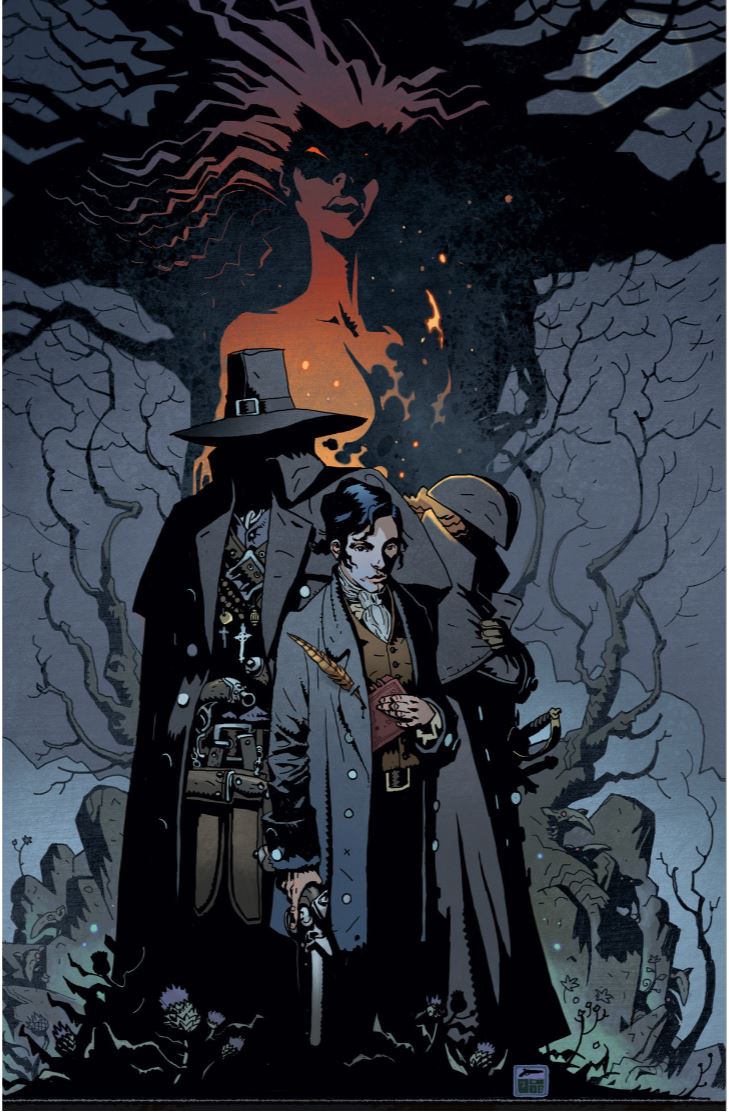
The lad’s enrapt attention is only broken by a heavy pistol shoved in his ear by a stealthy pair also watching the shocking ritual. Old Mackay is a daunting figure kitted out like a wrinkled human arsenal, but Robbie’s attention cannot stray from the dangerous codger’s comely companion Meg, the most astounding woman he has ever seen.

Unfortunately the confrontation between the mortal voyeurs has resulted in Burns’ “innocent” blood being spilled and the satanic celebrants have caught wind of it…

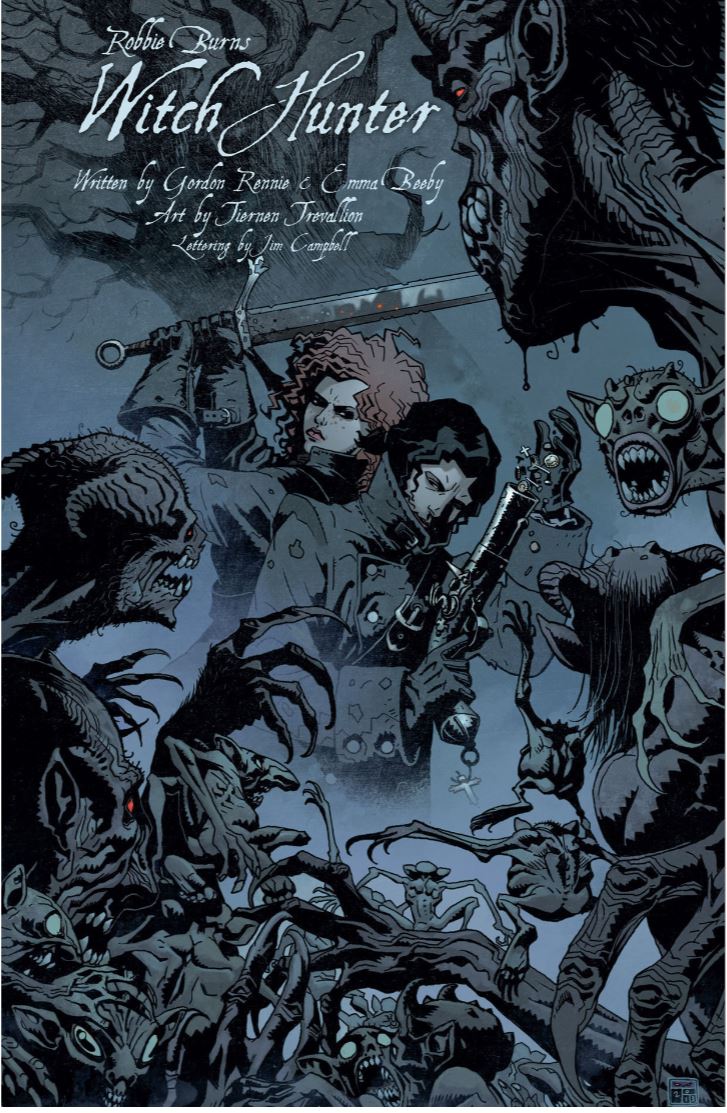
Soon all the denizens of Hell are howling after the ‘mazed mortals but things are not as they seem. The outlandish pair are actually Witch Hunters, ferocious and fully skilled in sending all Satan’s minions back to the Inferno and always armed to the teeth with a fantastic array of ingeniously inventive ordnance…

Having fought free of the black Sabbat, the mortals take flight with the screaming witches in pursuit and when one grabs Robbie as he rides pillion on Meg’s horse, the dazed, half-soused lad blasts the beast with one of his companions’ blessed flintlock pistols. Tragically, in the selfsame altercation the pursuing she-devil had opportunity to mark him with her talons and the would-be poet promptly sobers up when he is informed that he has only three days left to live…

With mounting terror he learns most mortals so infected become willing thralls of the hellions, but when a seductive minion of The Pit comes for him the next night, the scribbler somehow fends it off long enough for the suspiciously near-at-hand Meg to spectacularly despatch it back to the brimstone realms.

Concluding that’s there might be something of worth to the Burns boy, Mackay & Meg resolve to teach him how to be a true Witch Hunter so that he can defend himself when the horrors come in full strength to collect the Devil’s due. Of course that’s only three days hence…

Renegade are a publisher who value fact as well as fiction and this superb full-colour hardback comes with a fine selection of factual features beginning with a lavish history and appreciation of Scotland’s greatest poet in Robbie Burns: a Biography’ by author and historian Jerry Brannigan as well as ‘Selected Poems’ which provides a tantalising entrée into the uniquely impassioned, eerie world of the grand imagineer with a sterling sampling of some of his most famous works, all embellished and beguilingly illustrated with a wealth of Trevallion’s pencils sketches of Bogles and Brownies, Spunkies and Sirens and even senior Witch Hunter Mackay.

The rhythmic reveille includes Scots Wha Hae, totally crucial, groundbreaking spooky saga Tam o’ Shanter (A Tale), the evocative A Red, Red Rose, A Man’s A Man For A’ That, the delirious Address To The Deil and most moving lament Ae Fond Kiss, And Then We Sever…

Smart, action packed, skilfully suspenseful, uproariously funny, divinely irreverent and genuinely scary or sad by turn, Robbie Burns Witch Hunter is a gloriously compelling and truly mesmerising romp: a doom-laden, wisecracking rollicking love story no sensitive soul or jaded comics fan could possibly resist. It’s even educational too…

Robbie Burns: Witch Hunter © 2014 Renegade Arts Entertainment, Gordon Rennie, Emma Beeby and Tiernen Trevallion.

In 1926, Mad Magazine stalwart Bob Clarke was born today, as was master mangaka Shotaro Ishinomori (Cyborg 009, Super Sentai, Kamen Rider) in 1938. Dutch creator and entrepreneur Kees Kousemaker arrived in 1942 and was – as I’m sure you already know – the first person in Europe to open a comic shop.

Crusading, pioneering Alvin Phillips was born today in 1952, before becoming Turtel Onli and revolutionising the comic reading experience of American readers of colour. Onli died on January 15th 2025, aged 72. Go look him up online, it’s worth it…

In 1962, The Victor began in Britain, running until 1992, which is less long than Dan (Tarzan, Flash Gordon, The Phantom) Barry, who kept on going until 1997. Kudos…

The Adventures of Jo, Zette & Jocko: The Valley of the Cobras


By Hergé, translated by Leslie Lonsdale-Cooper & Michael Turner (Egmont UK/ Mammoth)
ISBN: 978-1-4052-1244-1 (HB) 978-0-74970-385-1 (Album PB)

This book includes Discriminatory Content produced in less enlightened times.

George Remi, world famous as Hergé, had a long creative connection to Catholicism. At the behest of Abbot Norbert Wallez, editor of Belgian Catholic newspaper Le XXe Siècle, he had created Tintin before moving on to such strips as the mischievous Quick and Flupke, Tim the Squirrel in the Far West’, ‘The Amiable Mr. Mops’, ‘Tom and Millie’ and ‘Popol Out West’ – all while expanding the globe-trotting adventures of the dauntless boy reporter and his faithful little dog.

In 1935, between working on serialised Tintin epics The Blue Lotus and The Broken Ear, Remi was approached by Father Courtois, director of French weekly newspaper Coeurs Vaillants (Valiant Hearts). The paper already carried the daily exploits of the kid and his dog, but Courtois also wanted a strip depicting solid family values and situations that the seemingly-orphaned and independent boy reporter was never exposed to. He also presumably wanted something less subversive than the trouble-making working-class boy rascals Quick and Flupke…

The proposed feature needed a set of characters typifying a decent, normal family: A working father, a housewife and mother, young boy, a sister, even a pet. Apparently inspired by a toy monkey called Jocko, Hergé devised the family Legrand.

Jacques was an engineer, and son Jo and daughter Zette were “normal” kids; bright, brave, honest, smart and yet still playful. Mother stayed home, cooking and being rather concerned rather a lot. They had a small, feisty monkey for a pet – although I suspect as Jocko was tailless, he might have been a baby chimpanzee, which “As Enny Fule Kno” is actually a species of ape.

The first adventure was a two-volume treasure: ‘The Secret Ray’; only once published in English and consequently rarer than Hen’s teeth or monkey feathers. However, I believe a soupçon of internet searching can help out the curious here…

A ripping yarn of scientific bandits, gangsters, mad professors, robots and, regrettably, some rather ethnically unsound incidences of cannibal savages, this is very much a product of its time in too many respects. Although Hergé came to deeply regret (and wherever possible amend) his many early uses of that era’s racial stereotyping, these will now always be controversial.

It’s a true pity that such masterful and joyous work must be viewed with caution, read strictly in context and ascribed subtext and values which may never have been intended, merely because the medium is pictorial and its meaning passively acquired rather than textual, and which can therefore only be decoded by the conscious effort of reading.

I also wonder how much was a quiet, sensitive artist led by an aggressively proselytising, missionary Church’s doctrine and policy…

How much Church opposition was there to Mussolini’s invasion of Ethiopia in October 1935 for example? And don’t get me started on Nazi Germany and the Vatican…

Sorry. Rant brakes have been applied now…

The last completed adventure of the boldly capable Legrand family came out in the 1950’s, when Hergé was at the peak of his creative powers. Although he found the concept a difficult one to work with, devoid of the opportunities for satire or social commentary, the wholesome derring-do of this series still provides thrilling and funny entertainment for kids of all ages…

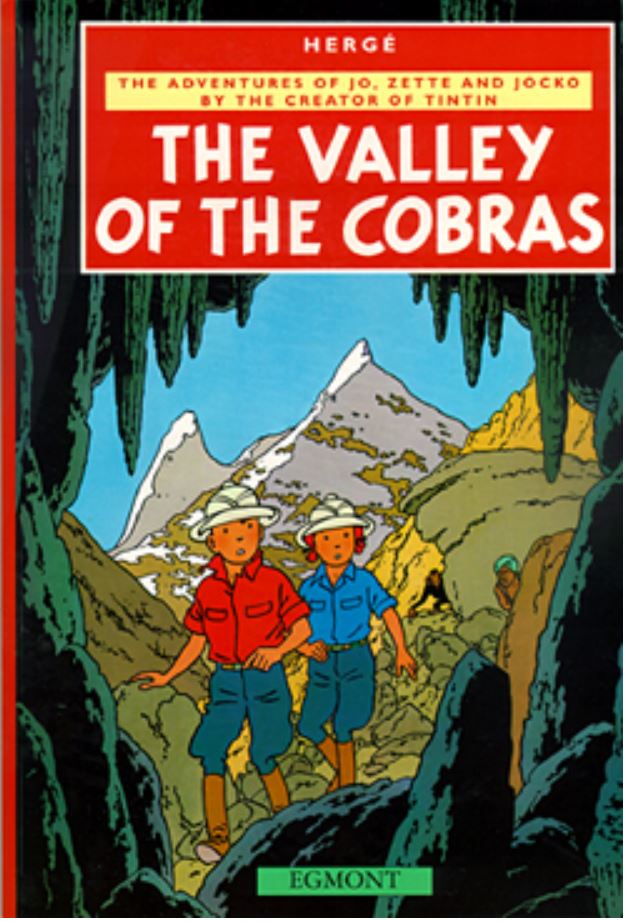
Whilst vacationing in the Alps, Jo & Zette inadvertently fall foul of the whimsically capricious Maharajah of Gopal, who is infuriated that they are better skiers than he. Matters only worsen when Jo accidentally hits the Maharajah with a snowball.

The spoiled, rich bully’s appalling behaviour escalates until eventually their father Jacques administers a long overdue spanking to the middle-aged potentate which completely changes his attitude. A far friendlier Maharajah promptly commissions the engineer to construct a bridge across the fabled Valley of the Cobras that divides his mountainous kingdom.

As the family embark for the sub-continent, all are unaware that the villainous Prime Minister of Gopal has colluded with a greedy Fakir to sabotage the project…

Actually begun in 1939 but shelved for nearly two decades, this is still a light exuberant romp, full of thrills and packed with laughs, executed with the captivating artistry that has made Tintin a global phenomenon. This is a book any child will adore and it baffles me why it and its companion volumes are out of print. Hopefully not for long though…

© 1957, 2007 Editions Casterman, Paris & Tournai. All rights reserved. English text © 1986, 2005 Egmont UK Limited. All rights reserved.


Today in 1934 Alex Raymond & Dashiell Hammett’s strip Secret Agent X-9 began, running until 1996. In 1950 artist Marshall Rogers (Batman, Silver Surfer) was born, just like Alex Ross (Marvels, Kingdom Come) in 1970.

In 1966 British weekly Lady Penelope published the first of its amazing 204 issues.

2003 saw the last of magnificent Bill Mauldin, as covered in Willie and Joe: The WWII Years and in 2017 Italian cover painter of British publications Alessandro Biffignandi.

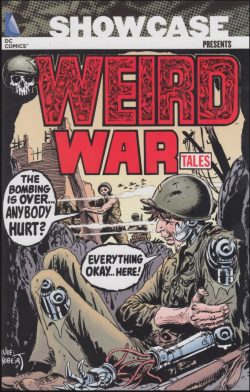
Showcase Presents Weird War Tales volume 1


By Robert Kanigher, Bob Haney, Bill Finger, Sheldon Mayer, Jack Oleck, Len Wein, Marv Wolfman, Joe Kubert, Carmine Infantino, Dennis O’Neil, Russ Heath, Mort Drucker, Frank Thorne, Alex Toth, Reed Crandall, Sam Glanzman, John Severin, Howard Chaykin, Ed Davis, Frank Robbins, Nestor Redondo, George Evans, Alex Niño, Russ Heath, Neal Adams & various (DC Comics)
ISBN: 978-1-4012-3694-6 (TPB)

This book includes Discriminatory Content produced in less enlightened times.

American comics just idled along rather slowly until the invention of Superman provided a flamboyant new genre for heroes and subsequently unleashed a torrent of creative imitation and imaginative generation for a suddenly thriving, voracious new entertainment model.

Implacably vested in World War II, these gaudily-attired mystery men swept all before them until the troops came home, but as the decade closed more traditional themes and heroes began to resurface and eventually supplant the Fights ‘n’ Tights crowd.

As a new generation of kids started buying and collecting, many of the first fans who retained their four-colour habit increasingly sought more mature themes in their pictorial reading matter. The war years and post-war paranoia had irrevocably altered the psychological landscape of the readership and as a more world-weary, cynical young public came to see that all the fighting and dying hadn’t really changed anything. Their chosen forms of entertainment (film, theatre and prose as well as comics) increasingly reflected this.

To balance the return of Western, War, Crime and imminent Atomic Armageddon-fuelled Science Fiction, comics created new genres. Celebrity tie-ins, madcap escapist or teen-oriented comedy and anthropomorphic funny animal features sprang up, but gradually another of the cyclical revivals of spiritualism and a public fascination with the arcane led to a wave of impressive, evocative and shockingly addictive horror comics. There had been grisly, gory and supernatural stars before, including a pantheon of ghosts, monsters and wizards draped in superhero trappings but these had usually been victims of circumstance: The Unknown as a power source for super-heroics. Now focus shifted to ordinary mortals thrown into a world beyond their ken with the intention of unsettling, not vicariously empowering the reader.

If we’re keeping score this was also the period in which Joe Simon & Jack Kirby identified another “mature market” gap and filled it by inventing romance comics (Young Romance #1, September 1947) and they too saw the sales potential for spooky material, resulting in the seminal Black Magic (1950) and boldly obscure psychological drama anthology Strange World of Your Dreams (1952). The company which would become DC Comics bowed to the inevitable and launched a comparatively strait-laced anthology that nevertheless became one of their longest-running and most influential titles with The House of Mystery (cover-dated December 1951/January 1952).

After the hysterical censorship debate which led to witch-hunting Senate hearings in the early 1950s was curtailed by the industry adopting a castrating straitjacket of self-regulation, titles produced under the aegis of the Comics Code Authority were sanitised, anodyne affairs in terms of Shock and Gore, but the audience’s appetite for suspense was still high and in 1956 National introduced sister titles Tales of the Unexpected and House of Secrets. Stories were dialled back from uncanny spooky yarns to marvellously illustrated, rationalistic fantasy-adventure vehicles and – eventually – straight monster-busting Sci Fi tales which dominated the market into the 1960s. That’s when superheroes – which had gradually enjoyed their own visionary revival after Julius Schwartz reintroduced The Flash in Showcase #4 – finally overtook them.

Green Lantern, Hawkman, The Atom and a rapidly-expanding coterie of costumed cavorters generated a gaudy global bubble of masked mavens which forced previously staunchly uncompromising anthology suspense titles to become super-character books. When caped crusader craziness peaked and popped, superheroes began dropping like Kryptonite-gassed flies. However, nothing combats censorship better than falling profits and, at the end of the 1960s with the cape-and-cowl boom over and some of the industry’s most prestigious series circling the drain, the surviving publishers of the field agreed to revise the Comics Code, loosening their self-imposed restraints against crime and horror comics.

Nobody much cared about gangster titles but, as the liberalisation coincided with yet another bump in public interest concerning supernatural themes, the resurrection of scary stories was a foregone conclusion and obvious no-brainer.

Thus, with absolutely no fanfare at all, horror comics came back and quickly dominated the US market for more than half a decade. DC led the pack: converting House of Mystery and Tales of the Unexpected into supernatural suspense anthologies in 1968 and resurrecting House of Secrets a year later.

Such was not the case with war comics. Tales of ordinary guys in combat began with the industry itself and although mostly sidelined during the capes-&-cowls war years, quickly re-asserted themselves once the actual fighting stopped. National/DC were one of the last publishers to get in on the combat act, converting superhero/fantasy adventure anthology Star Spangled Comics into Star Spangled War Stories the same month it launched Our Army at War (both cover-dated August 1952). They repurposed All-American Comics into All-American Men of War a month later as a “police action” in Korea escalated.

DC grew the division slowly but steadily, launching Our Fighting Forces (#1, November 1954) – just as EC’s groundbreaking combat comics were vanishing – and in 1957 added GI Combat to their portfolio when Quality Comics got out of the funnybook business.

As the 1950s closed however, the two-fisted anthologies all began incorporating recurring characters such as Gunner and Sarge – and latterly Pooch – from Our Fighting Forces #45 on, (May 1959); Sgt Rock (Our Army at War #83 (June 1959) and The Haunted Tank (G.I. Combat #87, April/May 1961). Soon all DC war titles had a lead star or feature to hold the fickle readers’ attention. The drive to produce superior material never wavered however, hugely aided by the diligent and meticulous ministrations of writer/editor Robert Kanigher.

In America after the demise of EC Comics in the mid-1950’s and prior to the game-changing Blazing Combat, the only certain place to find controversial, challenging and entertaining American war comics was DC. In fact, even whilst Archie Goodwin’s stunning but tragically mis-marketed quartet of classics were waking up a new generation of readers in the 1960s, the home of Superman, Batman and Wonder Woman was a veritable cornucopia of gritty, intriguing, beautifully limned battle tales presenting armed combat on a variety of fronts and from many differing points of view.

Whilst the Vietnam War escalated, 1960s America increasingly endured a Homefront death-struggle pitting deeply-ingrained Establishment social attitudes against a youth-oriented generation with a radical new sensibility. In response, military-themed comic books from National Periodical Publishing, as it then was, became even more bold and innovative.

However, the sudden downturn in superheroes led to some serious rethinking, and although the war titles maintained and even built sales, they also beefed up the anthological elements.

Thus in 1971 a title combining supernatural horror stories with bombastic battle yarns in an anthological setting seemed a forgone conclusion and sure thing to both publishers and readers alike…

This epic monochrome tome collects the contents of Weird War Stories #1-21 (cover-dates September/October 1971 to January 1974), offering a broad blend of genre mash-ups for readers with a taste for the dark and uncanny to relish. The series launched in a 52-page format combining new material with modified reprints featuring a veritable Who’s Who of top flight creative talent – both seasoned veterans and stars in waiting.

WWS #1 saw Editor Joe Kubert writing and illustrating an eerie linking strand entitled ‘Let Me Tell You of the Things I’ve Seen’, wherein a lost GI meets the personification of Death (the title’s long-term narrator in various blood-stained uniforms) who has a few foxhole stories to share…

The Reaper begins with ‘Fort Which Did Not Return!’ (by Kanigher & Russ Heath, as first seen in GI Combat #86), detailing how a bomber continues its mission even after the crew bail out, following up with all-new ‘The Story behind the Cover’ wherein Kubert reveals how a shunned German soldier carried on his duties after death…

From Star Spangled War Stories #71 (July 1958) Bob Haney & Kubert disclosed ‘The End of the Sea Wolf!’, as a sadistic U-Boat captain is sunk by one of his own earlier victims, whilst SSWS #116 (August/September 1964) originally debuted France Herron & Irv Novick’s ‘Baker’s Dozen’, with a fresh-faced replacement to a super-superstitious platoon battling to prove he’s not their unlucky thirteenth man…

The issue ends with that lost GI realising just who has been telling tales in Kubert’s ‘You Must Go!’…

The reprints in these early issues were all taken from a time when supernatural themes were proscribed by the Comics Code Authority, but even so they all held fast to an eerie aura of sinister uncertainty… the merest hint of the strange and uncanny to leaven the usual blood and thunder of battle books. In Weird War Tales #2, Kubert reprised his bridging vehicle as ‘Look… and Listen…’ sees a crashed Stuka pilot meeting a ghastly stranger at a battle-torn desert oasis before ‘Reef of No Return’ (Haney & Mort Drucker from Our Fighting Forces #43, March 1959) details a determined frogman’s most dangerous mission in advance of Kanigher & Frank Thorne’s new WWI silent saga ‘The Moon is the Murderer’ proving that overwhelming firepower isn’t everything…

Kubert’s ‘Behind the Cover’ features a prophetic dream and terrifying telegram, and ‘A Promise to Joe!’ (Kanigher & Novick, G.I. Combat #97 (December 1962-January 1963) sees a dead gunner seemingly save his friend from beyond the grave, after which the superb ‘Monsieur Gravedigger’ – by Jerry DeFuccio & legendary Reed Crandall – follows the follies of a sadistic Foreign Legionnaire who pushes his comrades too far. Cartoonist John Costanza delivers gag-packed ‘Military Madness’ and Kubert & Sam Glanzman offer a fact-packed ‘Sgt. Rock’s Battle Stations’ about ‘The Grenadier’ before Bill Finger, Ross Andru & Mike Esposito examine a young recruit’s rite of passage and development of ‘The Face of a Fighter’ (Our Fighting Forces #25, September 1957) before ‘Oasis’ concludes the sorry saga of that downed Aryan airman.

American Naval Aviators ditching at sea were the unwilling audience for Death’s stories as WWT #3 opens with Kubert’s ‘Listen…’ The roster starts with ‘Been Here Before!’ (Finger, Andru & Esposito, G.I. Combat #44 January 1957) as a soldier under fire turns his mind back to boyhood games to save the day, after which we see an aerial battle and parachute drop from the perspective of ‘The Cloud That Went to War!’ (Our Fighting Forces #17, January 1957) courtesy of Dave Wood, Andru & Esposito.

More Costanza comedy from ‘The Kreepy Korps!’ precedes an early tale by Len Wein & Marv Wolfman, ably illustrated by Heath as both cave tribes and modern soldiers battle to possess ‘The Pool’, before the artist’s earlier collaboration with Bob Haney reveals how ‘Combat Size!’ is all a matter of mental attitude in a tale from Our Army at War #66 (January 1958). After Glanzman’s ‘Battle Album’ explains ‘Flying Guns’, a finny friend helps a US submarine sink an aircraft carrier in Finger & Drucker’s ‘Pilot for a Sub!’ (OAaW #68, March 1958) and the issue ends as Kubert sends a ‘Lifeboat’ for those tragic aviators…

The fourth issue opens with Kubert’s final linking tale as a ‘Gypsy Girl’ and her family find wounded soldier Tony after his buddy runs off to get a medic. They kindly offer to pass the time with him, sharing stories like ‘Ghost Ship of Two Wars’ (Kanigher & Novick, All-American Men of War #81, September 1960) wherein an obsessed WWI pilot seemingly slips into 1944 while pursuing his unbeatable archenemy the Black Ace.

Kanigher & Gene Colan’s ‘Time Warp’ originally appeared as ‘The Dinosaur Who Ate Torpedoes!’ in SSWS #123 (October/November 1965 and part of the uniquely bizarre War That Time Forgot series), pitting US frogmen against colossal sea-going saurians, after which ‘The Unknown Sentinel’ (by author unknown & Mort Meskin from House of Mystery #55, October 1956) saves the lives of two soldiers lost on manoeuvres on America’s most famous battlefield.

Glanzman then offers one of his magnificently engaging autobiographical USS Stevens vignettes with all-new, elegiac ‘Prelude’ before Kubert wraps up his chilling drama as ‘I Know Them to be True’ sees medics arriving to find Tony a much-changed man, leaving Costanza to close things down with a laugh and some ‘Military Madness’.

Weird War Tales #5 opens with Haney & Alex Toth providing a book-end tale of ‘The Prisoner’ held by Nazis in Italy. Seeking a way out, he recalls tales of escape such as ‘The Toy Jet!’ (Haney & Heath, All-American Men of War#78, March/April 1960): a chilling psychological thriller about an interned pilot in North Korea. It’s followed by ‘Human Trigger’ (Herron, Andru & Esposito, Star Spangled War Stories #18, February 1954) which shows how a soldier lying on a mine deftly saves his own life…

Herron & Carmine Infantino then reveal how an US spy is forced to ‘Face a Firing Squad!’ (SSWS #14, November 1953) and Norman Maurer instructs with the history of ‘Medal of Honour: Corporal Gerry Kisters’ before Willi Franz & Heath detail the victory of a ‘Slave’ in Roman times and Haney & Toth offer final release in ‘This Is It!’

Issue #6 saw Weird War cut to a standard 36-page package and take a step into tomorrow with Haney & Toth’s battlefield test of ‘Robots’. Wolfman & Frank Thorne expanded the theme in ‘Pawns’ as humans and mechanoids finally decide who works for whom whilst ‘Goliath of the Western Front!’ (Herron, Andru & Esposito, SSWS #93 – October/November 1960) features a giant mechanical Nazi and American David who finally does for him, before Haney & Toth settle all debate with the conclusive ‘Robot Fightin’ Men’…

Wolfman & Kubert provide thematic bookends for #7, beginning with ‘Out of Action’ and wounded GIs awaiting the worst by trading tales like William Woolfolk, Jerry Grandenetti & Joe Giella’s ‘Flying Blind’ (OAaW #12, July 1953) wherein a wounded pilot must trust someone else for the first time in his life if he wants to land his burning jet. Kanigher & Kubert’s ‘The 50-50 War!’ (A-AMW #41, January 1957) finds sporting rivals forced to help each other after both suffer injuries on an alpine mission, with Costanza adding more welcome levity through his ‘Military Hall of Fame’. ‘The Three GIs’ (Finger & Heath, SSWS #62, October 1957) riffs smartly on those monkeys who respectively can’t see, hear and speak and the Purple Heart yarns end with Wolfman & Kubert’s chilling ‘I Can’t See’…

From WWT #8, editorial control switched to the Mystery division under Joe Orlando and with that reprints were shelved in favour of original material as publication frequency graduated from six times a year to monthly. This all-German-focused issue begins with a gruesome ‘Guide to No-Man’s Land’ (probably written by assistant editor E. Nelson Bridwell and illustrated by Tony DeZuñiga) before moving on to ‘The Avenging Grave’ (Kanigher & DeZuñiga) with SS officers learning too late the folly of desecrating the dead of WWI. Anonymously scripted ‘Thou Shalt Not Kill!’– with art by Steve Harper & Neal Adams – sees more gloating Nazis facing a vengeful golem. Kanigher & DeZuñiga return to reveal the fate of an arrogant 1916 air ace in the skies over No-Man’s Land in ‘Duel of the Dead’ before the artist’s ‘Epilogue’ wraps things up, whilst Weird War Tales #9 invites us to ‘Enter the Portals of War’ in an introduction drawn by Howard Chaykin, swiftly followed by a trio of Kanigher yarns illustrated by the cream of DC’s Filipino artists.

‘The Promise’ was limned by Alfredo P. Alcala, telling a tale in two eras as both Teutonic knights in 1242 and German tankers seven centuries later fail to cross frozen Lake Chud, whilst Gerry Talaoc renders the disastrous end of deathly, determined ‘Blood Brothers!’ during the American Civil War, and incomparable Alex Niño details ‘The Last Battle’ between East and West before Chaykin pops back to declare ‘Death, the Ultimate Winner’.

Sheldon Mayer & Toth open WWT #10 with a deliciously whimsical ghostly love story in ‘Who is Haunting the Haunted Chateau?’ before Raymond Marais & Quico Redondo change the tone as a Death-Camp commandant returns after the war to salvage ill-gotten gains from ‘The Room that Remembered’, whilst Wein & Walter Simonson – in the artist’s pro comics debut – reveal why invading Nazis shouldn’t abuse the town idiot, incurring the wrath of ‘Cyrano’s Army’…

Always experimental, the creative team of Mayer, DeZuñiga, Alcala, Talaoc & Niño tried their hand at a time-twisting complete adventure for #11. Occurring on ‘October 30? over 99 years beginning in 1918, the tale compares the progress of an ambitious German General granted a wish for glory by a treacherous spirit of war, with three ghostly Americans determined to fix a long-standing mistake whatever the cost…

DeZuñiga draws the introduction to #12, featuring tales of ‘Egypt’ starting with Kanigher & Talaoc’s tale of an ancient warlord who learned to regret spitting on the ‘God of Vengeance’, whilst ‘Hand of Hell’ (Kanigher & DeZuñiga) sees Anubis similarly deal with one of Rommel’s least reputable, most sadistic deputies. Arnold Drake & Don Perlin then switch locales to Roman Britain where a centurion takes an accidental time-trip and ultimately overthrows the Druids in ‘The Warrior and the Witch-Doctors!’

Weird War Tales #13 opens with Oleck & Nestor Redondo’s ‘The Die-Hards’, with Nazis realising there are even worse killers than they haunting their latest conquered village, before Drake & Niño determine that ‘Old Samurai Never Die’ when a would-be shogun offends the patron spirit of Bushido. ‘Loser’s Luck’ – by Michael J. Pellowski, George Kashdan & DeZuñiga – details harsh choices facing the unfortunate winners of the next, last war…

Mayer, DeZuñiga & Alcala reunite in #14 to tell an eerie tale of doomed love and military injustice from the days before Pearl Harbor which begins with a ‘Dream of Disaster’, incorporates a deadly flight with a ‘Phantom for a Co-Pilot’ and marines who arrive ‘Too Late for the Death March!’ before finally meeting ‘The Ghost of McBride’s Woman’ and vindicating an unsung hero…

A little lad enamoured of war’s glory learns a lesson in WWT #15 when his dead grandfather takes him back to WWI to see how ‘…Ace King Just Flew in from Hell’ (Drake & Perlin) before Oleck & Talaoc reveal the doom of ‘The Survivor’ of a Viking raid which offends a sorceress, and Oleck & Alcala detail the shocking fate of a fanatical crusader who succumbs to ‘The Ultimate Weapon’ of a Saracen wise man. Drake & Alcala describe transplant science gone mad in #16’s ‘More Dead than Alive!’, whilst the first of a Niño double bill sees him delineate Oleck’s ‘The Conquerors’ who eradicate humanity – but not the things that predate on them – whilst Drake’s ‘Evil Eye’ sees a little boy inflict hell’s wrath on both Allies and Axis alike…

In #17, Kanigher & George Evans disclose how a dishonourable French Air Ace is punished by ‘Dead Man’s Hands’ before Pellowski, E. Nelson Bridwell & Ernie Chan reveal how a murdered soldier is avenged by ‘A Gun Named Marie!’ WWT #18 has Drake & DeZuñiga sketch the brief career of ‘Captain Dracula!’ as he marauds through (mostly) German forces in Sicily before Mayer & Talaoc return for the cautionary tale of a greedy German sergeant in France whose avarice makes him easy prey for the ‘Whim of a Phantom!’

Drake & Talaoc start #19 with the full-length story of an agent who infiltrates the Nazi terror weapon known as ‘The Platoon That Wouldn’t Die!’, and #20 reverts to short stories with Oleck & Perlin’s ‘Death Watch’ of a doomed coward who should have waited one more day before deserting, before Drake & Alcala’s period saga of a witchcraft vendetta ‘Operation: Voodoo!’ and their Battle of Britain chiller wherein a burned-out fighter pilot learns ‘Death is a Green Man’.

This blockbusting blend of military mayhem, magical melee and martial madness concludes with Weird War Tales #21 and ‘One Hour to Kill!’ by Drake & Frank Robbins, wherein an American soldier is ordered to go back in time to assassinate Leonardo Da Vinci and prevent the invention of automatic weapons. Mayer & Bernard Baily then detail just how a foul-up GI becomes an unstoppable hero ‘When Death Took a Hand’…

Classily chilling, emotionally intense, superbly illustrated, insanely addictive and Just Plain Fun, this is a deliciously guilty pleasure that will astound and delight any lover of fantasy fiction and comics that work on plot invention rather than character compulsion.
© 1971, 1972, 1973, 2012 DC Comics. All Rights Reserved.

Today in 1937 Herman creator Jim Unger was born, whilst in 1967, pioneering Golden Age artist Homer Fleming (Craig Kennedy, The Whip, Chuck Dawson, Captain Jim of the Texas Rangers, Classics Illustrated) died.

Also in 1967, British weeklies Pow! and Mandy both launched, as did tabloid treasure The Beezer way back in 1956 today.

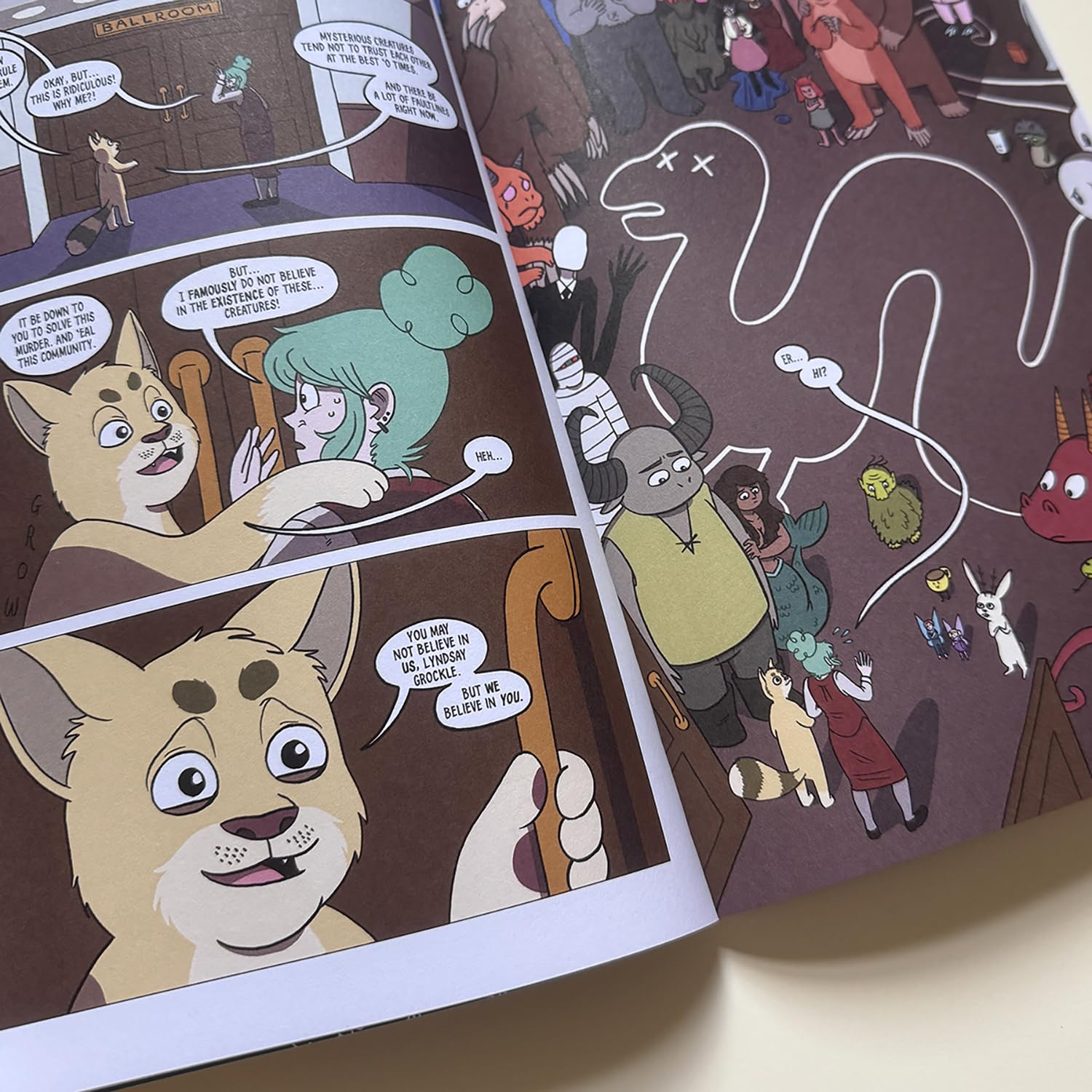
Who Killed Nessie?


By Paul Cornell & Rachael Smith (Avery Hill Publishing)
ISBN: 978-1-917355-23-0 (TPB/Digital edition)

The world is not as you imagine.

Actually, it probably is and the cosy creepy mystery that unfolds here will happily confirm it for you. It’s worth a shot, isn’t it?

The hospitality industry has been through some tough times lately and generally tries extra hard to keep even the most difficult of customers happy. That’s especially true of repeat gigs, as new hire Lindsay Grockle discovers when she’s left in sole charge of the Lakeside Hotel near Turoga, Wisconsin. She’s three weeks on the job and the entire staff have entrusted her with running, supervising and accommodating an annual convention. Apparently they’re lovely but a bit weird and she should expect a lot of strange appearances and pretty intense cosplay…

Prepped but nervous, the hordes arrive (57 guests actually!) and settle in. As she was warned Lindsay learns they take their role-playing really seriously. At least it’s all familiar stuff – monsters, cryptids, fairies, legendary beasts and the like – giving Grockle time to stew in what went wrong in her recent bust-up and ponder what life’s all about…

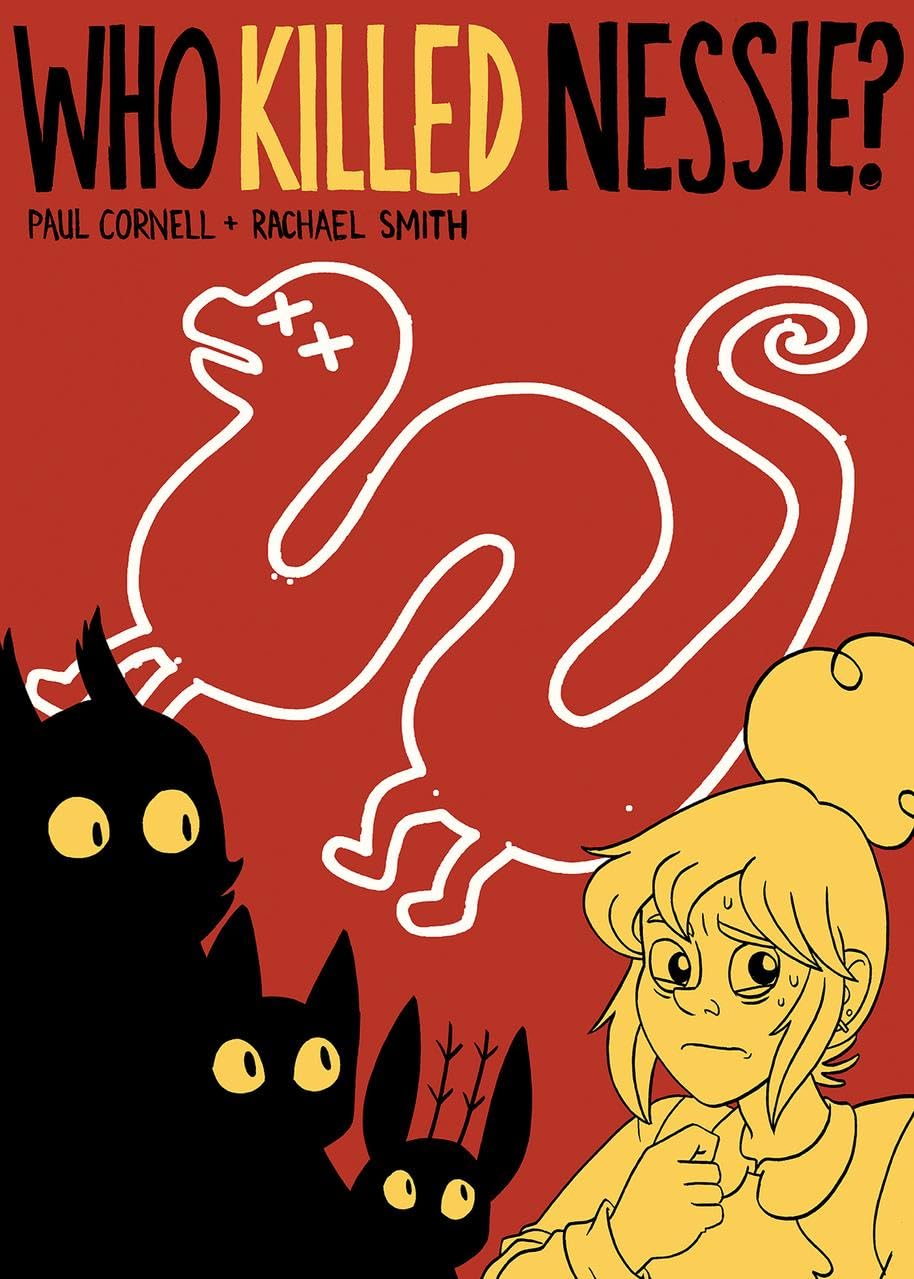
Sadly, things go south on the first night after a great deal of alcohol has been consumed all around. Awakened by a very upset but remarkably poised and composed talking cat (The Beast of Bodmin Moor or “Bob” to you) Lyndsay is informed that one of the guests – The Loch Ness Monster – has been murdered… and, by the way, all the guests are actual magic-infused monsters, fairies, legendary beasts and the like…

Once she’s properly convinced that she’s awake and it’s all happening, Grockle grudgingly takes on the job of finding the killer: trudging through bizarre relationships, outré politics, wild historical grudges and all the traditional tawdriness that comes with a domestic killing as opposed to (say) slaying a dragon or facing a gorgon…

Depressed and overwhelmed, Grockle persists against a wall of weird mis- and dis-information: probing, interviewing, crosschecking and visiting the underworld to question the victim (a rare perk in most murder cases); and slowly a pattern forms. Hopefully she can resolve it before the regular staff turn up on Monday morning and before the next murder attempt succeeds…

Crafted by multi award-winning wordsmith Paul Cornell (screen, podcast, prose and comics pages) who has crafted tales of everything from Doctor Who to Sherlock Holmes and Batman to Wolverine – as well as his many self-originated series and star, this fabulously wry and charming chiller is rendered by equally award-winning illustrator Rachael Smith, whose other delights include NAP COMIX, Doctor Who, Wired Up Wrong, Quarantine Comix and Isabella & Blodwen.

Beguiling, subversive, intensely absorbing and delightfully full-on and off-kilter, Who Killed Nessie? is a smart and witty foray of froth and fantasy no one with dreams and wishes still to enjoy should miss.
© Paul Cornell, Rachael Smith, 2025. All rights reserved.

Today in 1932 was born everyman Jack Caprio; writer, agent, artist, editor of Creator’s Syndicate and Vice President of the National Cartoonists Society. One thing he didn’t do was create Hergé’s Jo, Zette and Jocko which launched today in 1936.

In 1948 Joe (E-Man, Dick Tracy, Scooby Doo, everything) Staton was born, just like Tom (Swamp Thing, Prince Valiant) Yeates in 1955. Ella Cinders cartoonist Charles Plumb died in 1982, and we lost George Woodbridge (Mad Magazine) in 2004 as well as Dutch cartoonist Jan Kruis (Jan, Jans en de Kinderen/Jack, Jacky and the Juniors) in 2017.

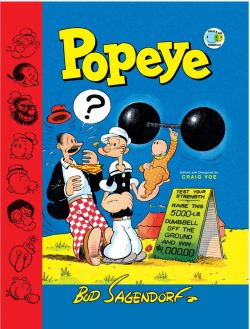
Popeye Classics volume 1


By Bud Sagendorf, edited and designed by Craig Yoe (Yoe Books/IDW)
ISBN: 978-1-61377-557-8 (HB) eISBN: 978-1-62302-264-8

This book includes Discriminatory Content produced in less enlightened times.

There are few comic characters that have entered communal world consciousness, but a grizzled, bluff, uneducated, visually impaired old sailor with a speech impediment is possibly the most well-known of that select bunch.

Elzie Segar had been producing Thimble Theatre since December 19th 1919, but when he introduced a coarse, brusque “sailor man” into the saga of Ham Gravy and Castor Oyl on January 17th 1929, nobody suspected the giddy heights that walk-on would reach…

Happy birthday, Sailor Man!

In 1924 Segar created a second daily strip The 5:15: a surreal domestic comedy featuring weedy commuter and would-be inventor John Sappo and his formidable wife Myrtle which endured – in one form or another – as a topper/footer-feature accompanying the main Sunday page throughout the author’s career. It survived his untimely death, eventually becoming the trainee-playground of Popeye’s second great stylist Bud Sagendorf.

After Segar’s tragic, far too premature death in 1938, Doc Winner, Tom Sims, Ralph Stein and Bela Zambouly all worked on the strip even as animated features brought Popeye to the entire world. Sadly, none of them had the eccentric flair and raw inventiveness that had put Thimble Theatre at the forefront of cartoon entertainments. Nonetheless, the strip continues to this day, with new Sunday episodes written and drawn by R. K. Milholland, whilst daily episodes are reprints by that man Sagendorf.

Born in 1915, Forrest “Bud” Sagendorf was barely 17 when his sister – who worked in the Santa Monica art store where Segar bought his supplies – introduced the kid to the master. Segar became his teacher and employer as well as a father-figure and, in 1958, Sagendorf took over the strip and all merchandise design duties, becoming Popeye’s prime originator…

When Sagendorf took over, his loose, rangy style and breezy inspired scripts brought the strip back to the forefront of popularity. Bud made reading it cool and fun all over again. He wrote and drew Popeye in every graphic arena for 24 years. Sagendorf died in 1994 after which Underground cartoonist Bobby London took over.

Bud had been Segar’s assistant and apprentice, and from 1948 onwards he wrote and drew Popeye’s comic book adventures in a regular monthly title published by America’s king of licensed periodicals, Dell Comics. When Popeye first appeared, he was a rude, crude brawler: a gambling, cheating, uncivilised ne’er-do-well. He was soon exposed as the ultimate working class hero: raw and rough-hewn, practical, but with an innate, unshakable sense of what’s fair and what’s not, a joker who wanted kids to be themselves – but not necessarily Good – and someone who took no guff from anyone. Naturally, as his popularity grew, Popeye mellowed somewhat. He was still ready to defend the weak and had absolutely no pretensions or aspirations to rise above his fellows, but time and popularity eroded that power.

Such was not the case in Sagendorf’s comic book yarns…

Collected in their entirety in this beguiling full-colour hardback or digital edition are the first four 52-page quarterly funnybooks produced by the Young Master, spanning February/April 1948 to November 1948/January 1949.

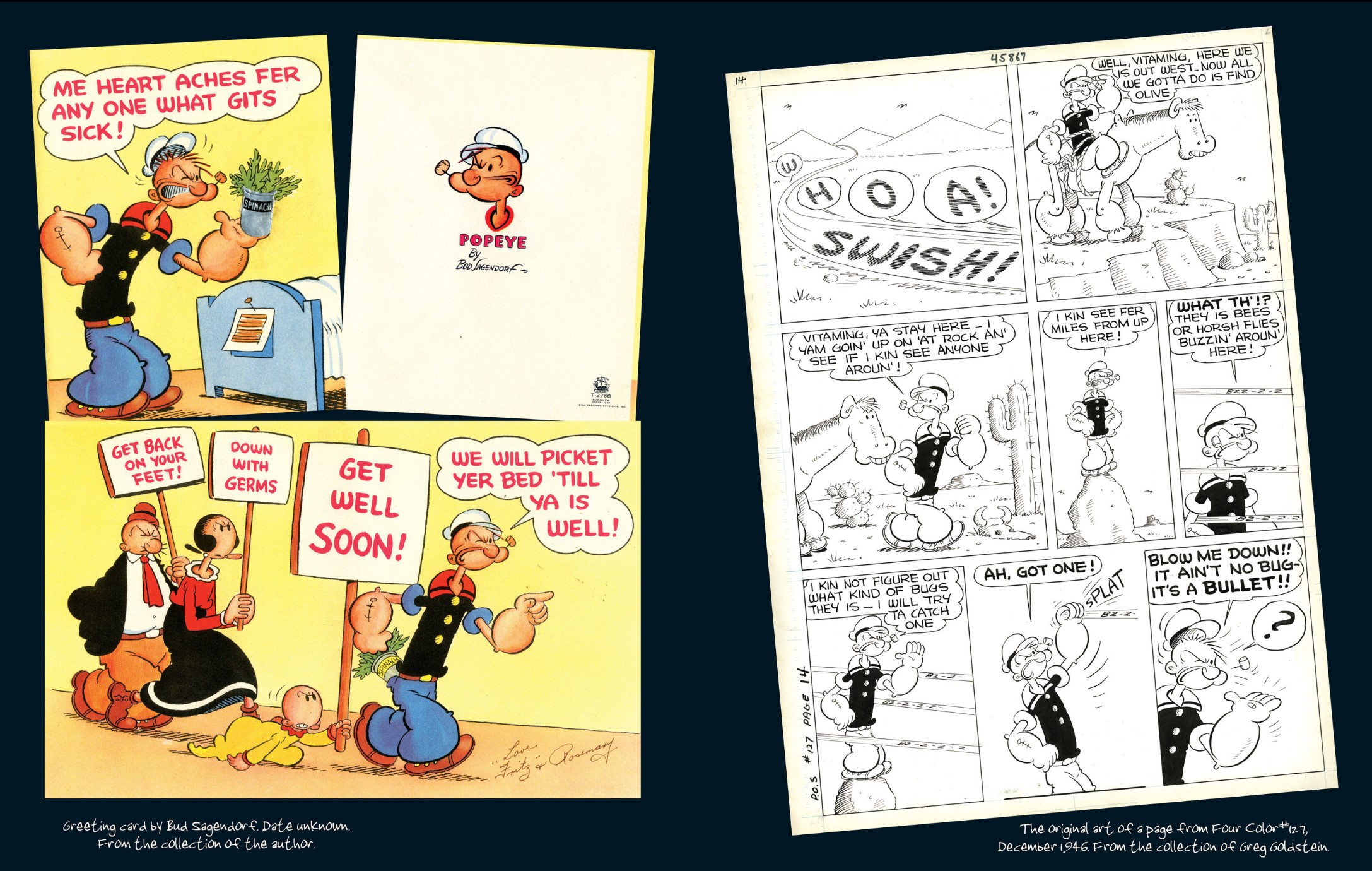
These stunning, seemingly stream-of-consciousness stories are preceded by an effusively appreciative Introduction – ‘Society of Sagendorks’ – by inspired aficionado, historian and publisher Craig Yoe accompanied by a fabulous collation of candid photos and letters, plus strip proofs, original comicbook art and commissioned paintings, an Activity Book cover and greetings card designs contained in ‘A Bud Sagendorf Scrapbook’.

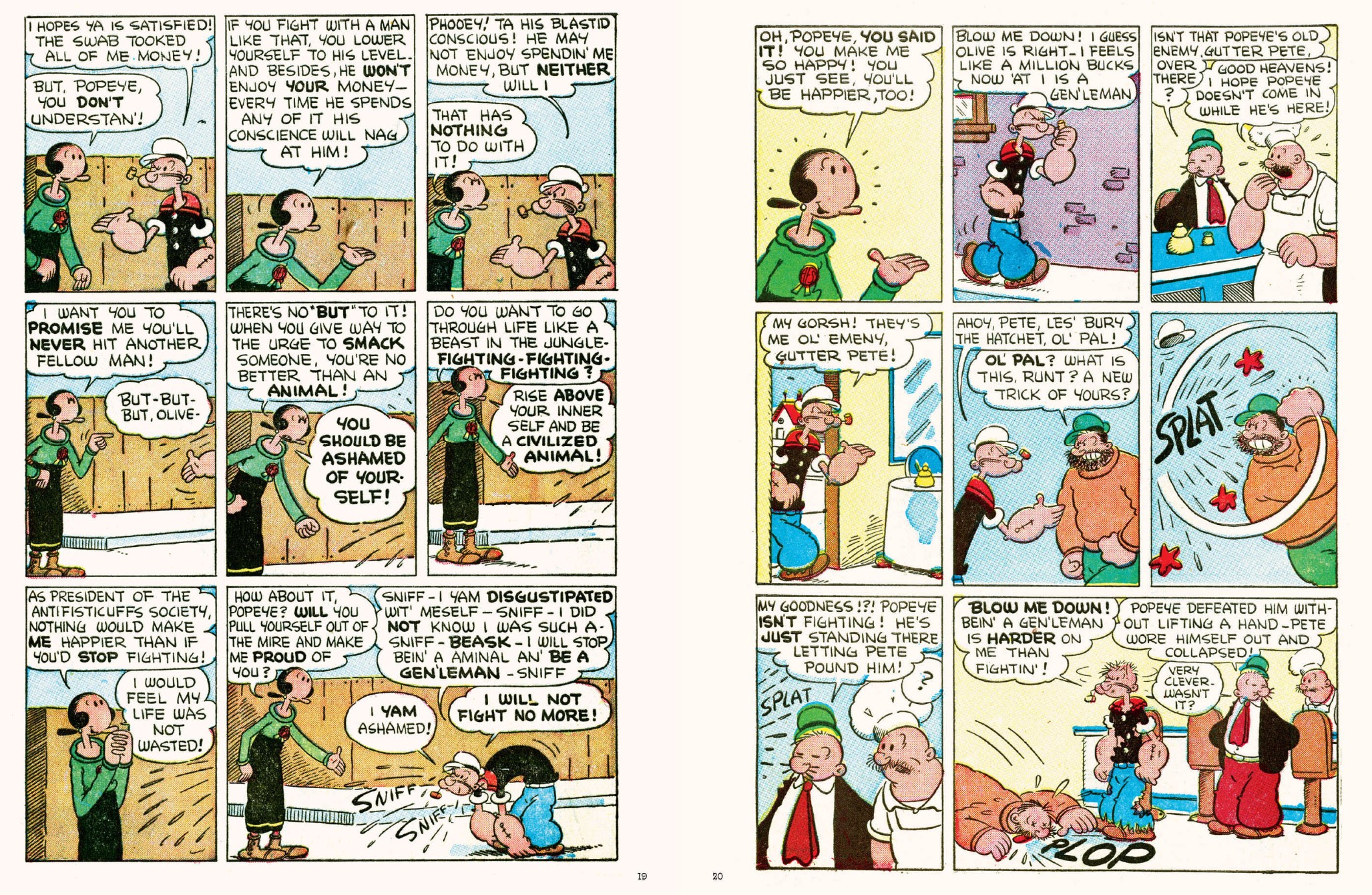
Popeye‘s fantastic first issue launched in February 1948 with no ads and duo-coloured (black & red) single page strips on the inside front and back covers. The initial instant episode finds mighty muscled, irrepressible “infink” Swee’ Pea enquiring ‘Were There Ever Any Pirates Around Here?’ before doing a bit of digging, after which full-coloured extended fun begins with ‘Shame on You! or Gentlemen Do Not Fight! or You’re a Ruffian, Sir!’

As everyone knows, the salty swab earns a lucrative living as an occasional prizefighter and here upcoming contender Kid Kabagge and his cunning manager Mr. Tillbox use a barrage of psychological tricks to put Popeye off his game. The key component is electing Olive Oyl President of the deeply bogus Anti-Fisticuff Society to convince her man to stop being a beastly ruffian and abandon violence. That only works until the fiery frail learns she’s been gulled…

Swee’ Pea then stars in ‘Map Back! Or Back Map!’ as sinister unprincipled villain Sam Snagg tattoos an invisible secret diagram onto the baby’s body(!) before falling foul of the boy’s garrulous guardian when trying to reclaim the kid and divine the location of Spinachovia’s hidden treasures. Wrapping up the full-length action is ‘Spinach Revolt’ as Popeye’s perfidious pater Poopdeck Pappy kicks up a fuss about constantly having to eat healthy food…

As the first Superman of comics, Popeye was not a comfortable hero to idolise. A brute who thought with his fists and had no respect for authority, he was uneducated, short-tempered, fickle (when hot tomatoes batted their eyelashes – or thereabouts – at him); an aggressive troublemaker, who wasn’t welcome in polite society… and wouldn’t want to be. Time changed Popeye and made him tamer but the shocking sense of unpredictability, danger and anarchy he initially provided was sorely missed… so in 1936 Segar brought it back again…

A memorable and riotous sequence of Dailies introduced ancient, antisocial crusty reprobate Poopdeck Pappy. The elder mariner was a hard-bitten, grumpy lout quite prepared – even happy – to cheat, steal or smack a woman around if she stepped out of line. He was Popeye’s prodigal dad and once the old goat was firmly established, Segar set Olive and her Sailor Man the Herculean task of “Civilizing Poppa”. Even at the time of this tale that’s still very much a work in progress…

Fed up with eating spinach, Pappy hides his meals and steals the wherewithal to secretly subsist on a diet of candy, cakes and sodas. He even inveigles the lad next door into being the mule in his scurrilous scheme, but cannot evade the digestive consequences of his actions…

The premiere outing ends with a brace of single pagers detailing how Swee’ Pea deals with persistent salesmen and a day’s fishing before issue #2 commences…

Master moocher Wellington J. Wimpy again has cause to declare ‘Sir! You are a cheapskate!’ before Swee’ Pea & Popeye are swept up in a controversial debate. In ‘That’s What I Yam! or ‘I Yam! I Yam’, the sailor believes his baby boy tough enough to wander around town unsupervised but has reasons to revise his opinion after the kid vanishes. Moreover, when he does resurface, the titanic tyke is subject to strange transformations and behaviours. It’s as if a class of trainee hypnotists have all been using the kid as a practise subject but forgot to bring him out of his trance afterward…

Pappy stars in ‘Easy Money’, with the greedy reprobate realising how much cash his sterling son earns for each boxing bout. Determined to get on the gravy train too, the oldster shaves off his beard and impersonates Popeye. By the time his boy catches wise, Pappy has conned Olive and Wimpy into his scheme and set up a punishing bout with a huge purse, so somebody is going to have to fight…

The issue ends with a two-tone short showing the hazards of bathing Swee’Pea and another full colour back cover gag as a bullying neighbour realises the folly of trying to spank Popeye’s boy…

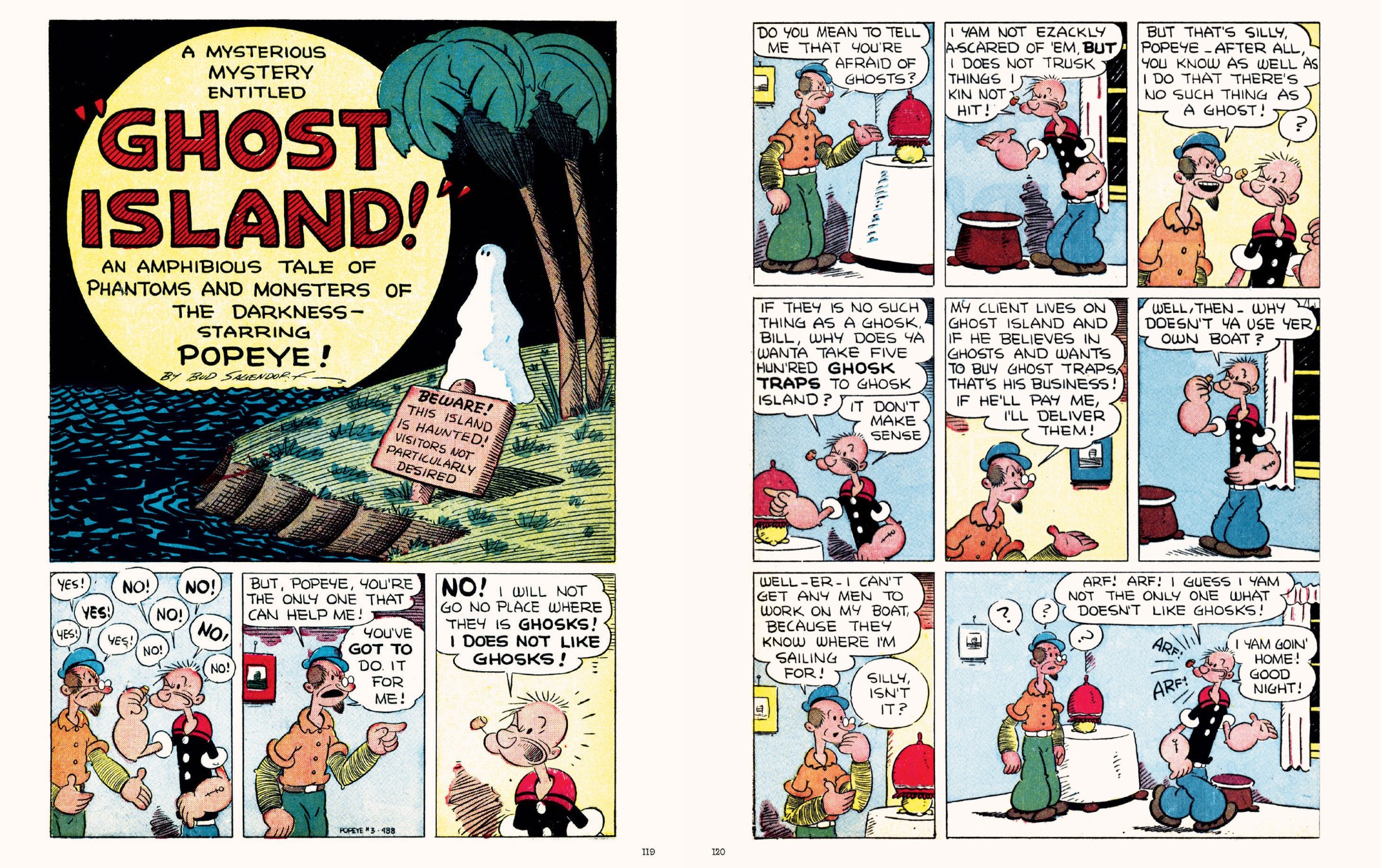
Popeye #3 leads with an epic 32-page spooky maritime epic as the superstitious sailor reluctantly agrees to transport 250 “ghosk” traps to ghastly, radish – and phantom – infested ‘Ghost Island’: a cunning yarn of mystery and over-zealous imagination starring many cast regulars and preceded by a hilarious map of the route replacing the inside-front-cover gag…

Following up is an implausible account of Popeye apparently becoming a violent bully, beating up ordinary citizens in ‘Smash! or You Can Tell She’s My Girl, Because She’s Wearing Two Black Eyes!’ Happily, a doctor at the sailor’s trial is able to diagnose the incredible truth before things go too far, after which Swee’Pea indulges in too much sugar in the red & black bit and learns the manly way to play with dolls on the colour back cover…

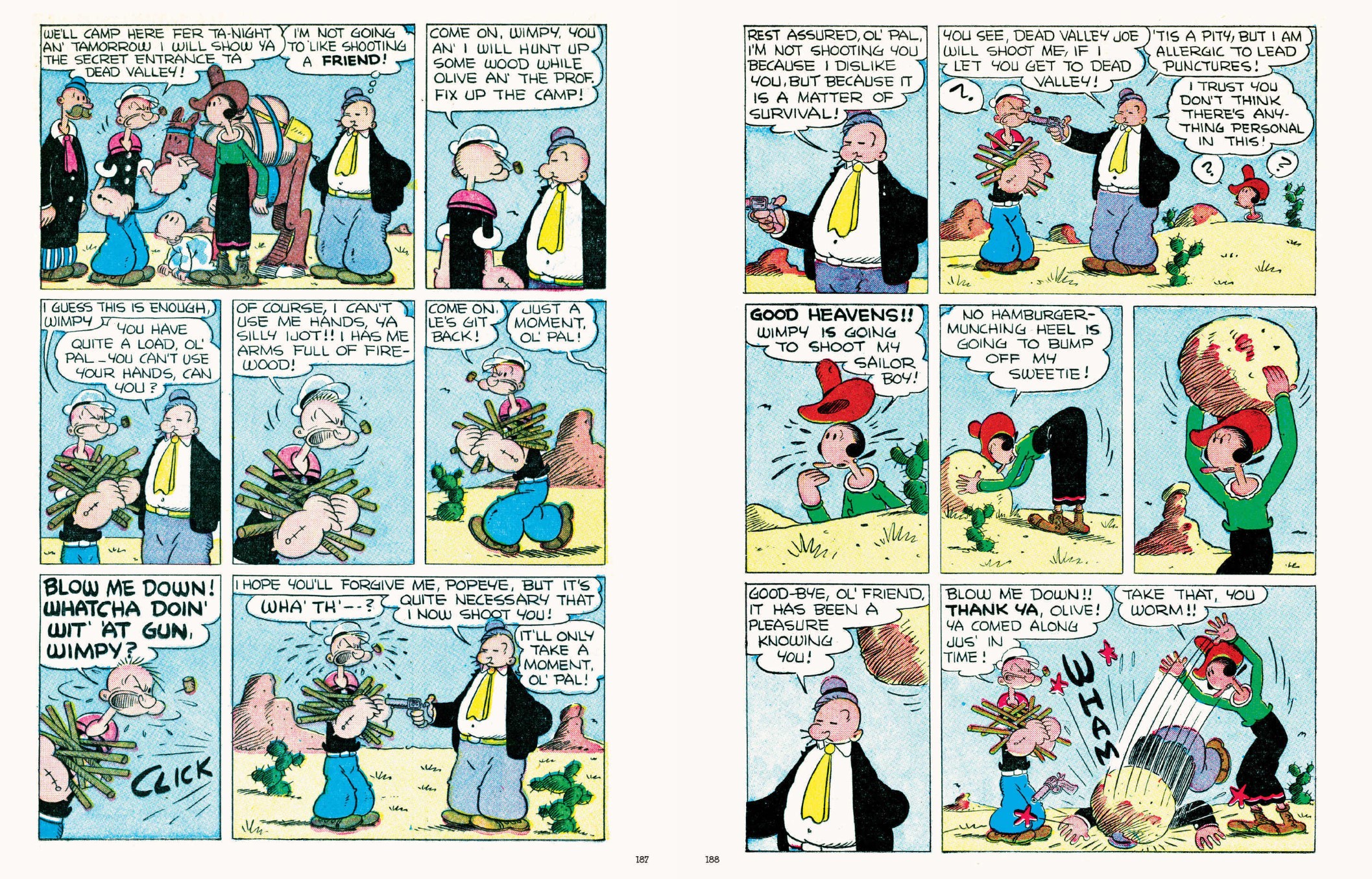
The fourth and final inclusion in this outrageous, timelessly wonderful compilation begins with Wimpy up to his old tricks whilst Popeye hunts ducks, before another extended odyssey finds the Sailor Man and hangers-on Swee’Pea, Olive & Wimpy heading West on safari to capture a rare Ipomoea from sagebrush hellhole ‘Dead Valley’…

It’s a grim wilderness Popeye has endured before: an arid inferno no sane man would want to revisit unless a scientist hired him to. Sadly, that’s not the opinion of local bandit boss Dead Valley Joe who assigns all his scurvy gang the task of dissuading or despatching the uppity easterners before they uncover the region’s incredible secret…

Back home again, Olive Oyl receives a surprise ‘Gift from Uncle Ben!’ Sadly, the strange flying beast called a Zoop prefers Swee’Pea’s company, and her warm generosity in donating the beast takes a hard knock when a stranger offers a million bucks for it…

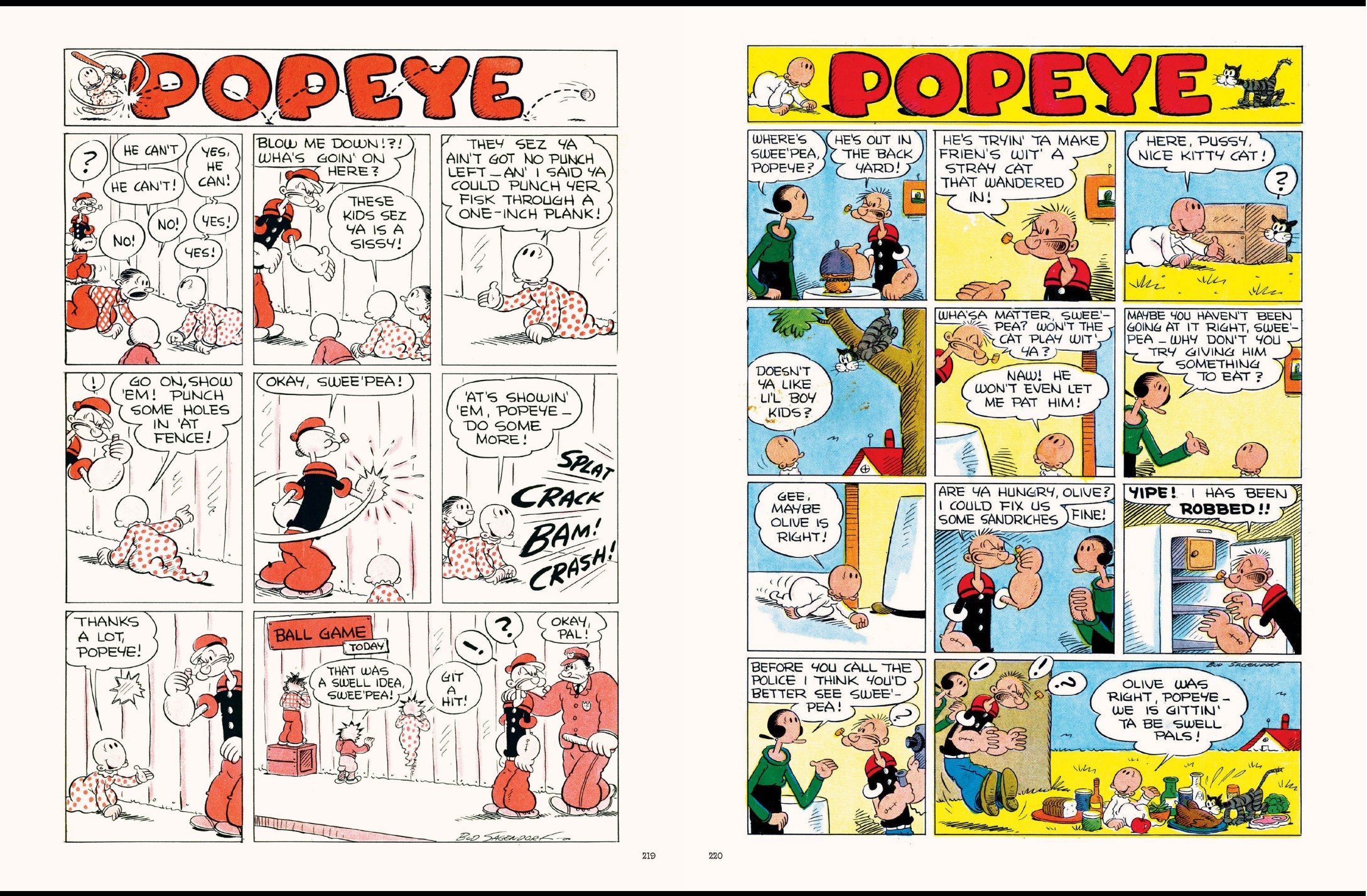
One final brace of Swee’ Pea shorts then sees the wily kid orchestrate free baseball views for his pals before indulging in food politics to win over a stray cat and wrap up in amiable style these jolly, captivating cartoon capers.

There is more than one Popeye. If your first thought on hearing the name is an unintelligible, indomitable white-clad sailor always fighting a great big beardy bloke and mainlining tinned spinach, that’s okay: the animated features have a brilliance and energy of their own (even the later, watered-down anodyne TV versions have some merit) and they are indeed based on the grizzled, crusty, foul-mouthed, bulletproof, golden-hearted old swab who shambled his way into Thimble Theatre and wouldn’t leave. But they are really only the tip of an incredible iceberg of satire, slapstick, virtue, vice and mind-boggling adventure…

There is more than one Popeye. Most of them are pretty good, and some are truly excellent. This book is definitely one of the latter and if you love lunacy, laughter and rollicking adventure you must now read this.
Popeye Classics volume 1 © 2013 Gussoni-Yoe Studio, Inc. All Rights Reserved. Popeye © 2013 King Features Syndicate. ™ & © Heart Holdings Inc.

Today in 1851 pioneering US illustrator A/B. Frost (Br’er Rabbit) was born, and in 1877 Australian artist Cecilia May Gibbs (Gumnut Babies/Bush Babies/Bush Fairies, Bib and Bub, Snugglepot and Cuddlepie, Tiggy Touchwood).

In 1920 epic UK weekly comic Film Fun began with the first of its 2225 issues. Never appearing therein was erotic cartoonist Georges (Blanche Épiphanie) Pichard who was born in the same year.

One year later Cuban Spy vs Spy/Mad magazine mastermind Antonio Prohias was born. As was Spanish artist Alfonso Azpiri (Black Hawk [UK Tornado], Bethlehem Steele, Lorna) in 1947 and Ann Nocenti in 1957 and the astonishing Genndy Tartakovsky in 1970.

Sadly we lost Belgian Pascal Garray in 2017, a quiet star who worked for years largely unheralded on The Smurfs, and Benoît Brisefer/Steven Sterk/Benny Breakiron.

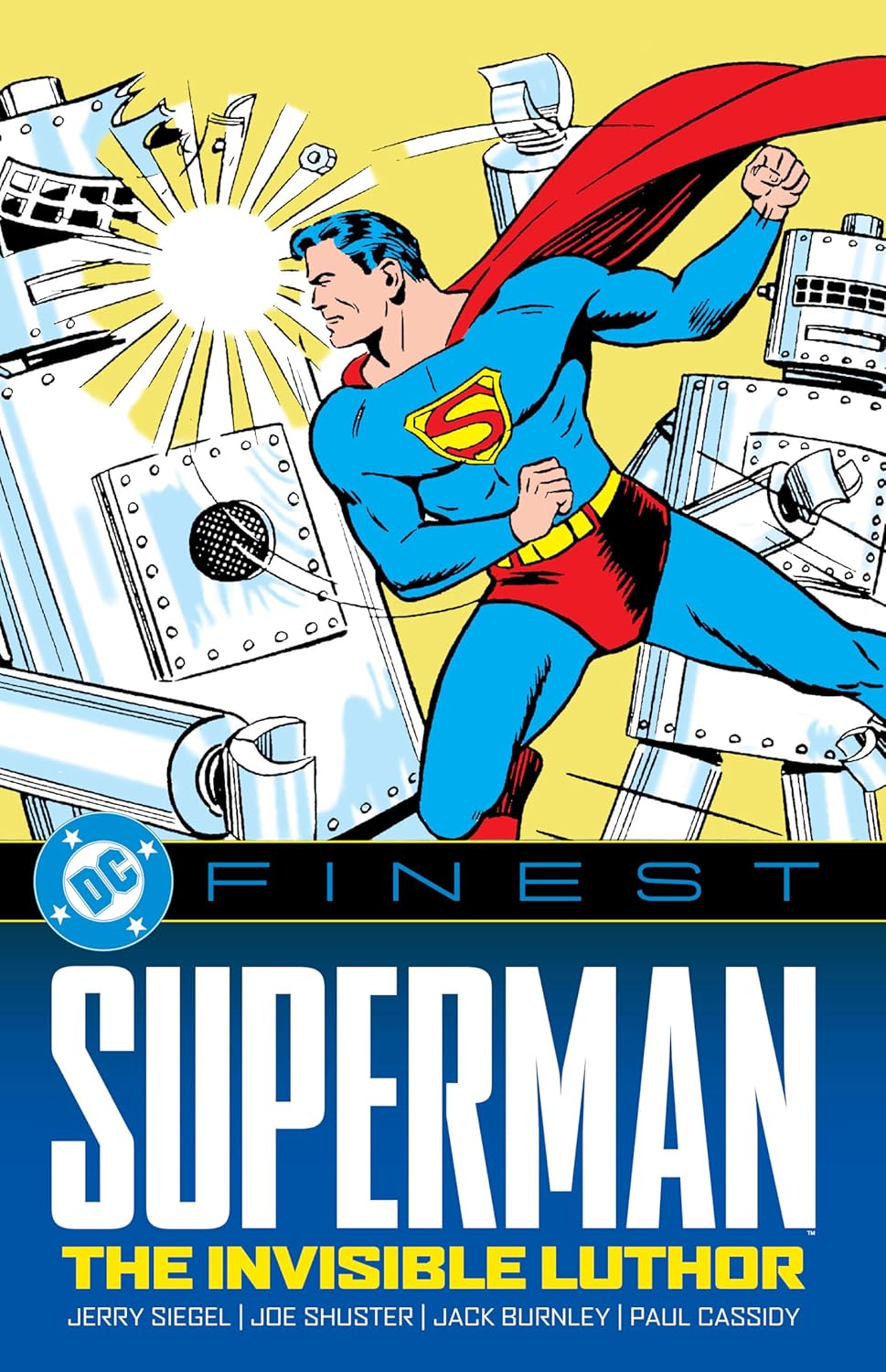
DC Finest: Superman – The Invisible Luthor


By Jerry Siegel & Joe Shuster, Jack Burnley, Paul Lauretta, Wayne Boring, Jack Burnley, Paul Cassidy, Ed Dobrotka, Leo Nowak, Fred Ray, John Sikela, Dennis Neville, Don Komisarow, lettered by Frank Shuster, Betty Burnley Bentley, the Superman Studio & various (DC Comics)
ISBN: 978-1-77950-332-3 (TPB)

This book includes Discriminatory Content produced in less enlightened times

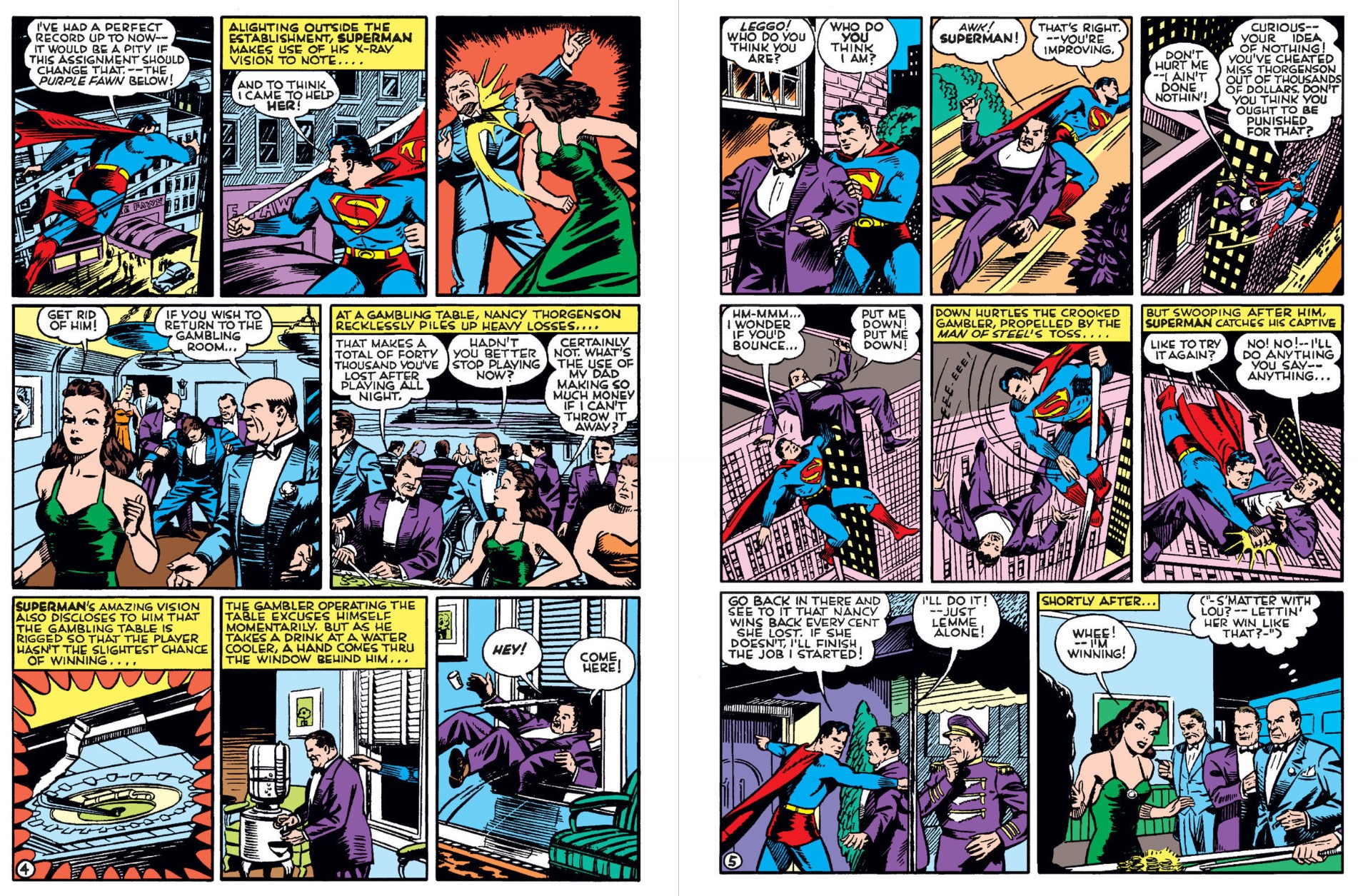
Nearly 90 years ago, Superman rebooted planetary mythology and kickstarted the entire genre of modern fantasy heroes. Outlandish, flamboyant, indomitable, infallible and unconquerable, he also saved a foundering industry by birthing an entirely new genre of storytelling: the Super Hero. Since April 18th 1938 (the generally agreed day copies of Action Comics #1 first went on sale) he has grown into a mighty presence in all aspects of art, culture and commerce, even as his natal comic book universe organically grew and expanded. Within three years of that debut, the intoxicating blend of eye-popping action and social wish-fulfilment that had hallmarked the early exploits of the Man of Tomorrow had grown: encompassing crime-busting, reforming dramas, science fiction, fantasy and even whimsical comedy. However, once the war in Europe and the East captured America’s communal consciousness, combat themes and patriotic imagery dominated most comic book covers, if not interiors.

In comic book terms alone Superman was soon a true master of the world, utterly changing the shape of the fledgling industry as easily as he could a mighty river. There was a popular newspaper strip, a thrice-weekly radio serial, games, toys, foreign and overseas syndication and as the decade turned, the Fleischer studio’s astounding animated cartoons.

Moreover, the quality of the source material was increasing with every four-colour release as the energy and enthusiasm of originators Jerry Siegel & Joe Shuster went on to inform and infect the burgeoning studio which grew around them to cope with the relentless demand.

These tales have been reprinted many times, but this latest compilation might arguably be the best yet, offering the original stories in reading – if not strictly chronological publishing – order and spanning cover-dates July 1940 to September 1941. It features landmark sagas from Action Comics #26-40 and Superman #6-11, plus pivotal appearances in New York’s World Fair No. 2, World’s Best Comics #1 and World’s Finest Comics #2 & 3 (all with eye-catching groundbreaking covers by Jack Burnley). Although most early tales were untitled, here, for everyone’s convenience, they have been given descriptive appellations by the editors, and I should also advise that as far as we know it’s written entirely by Seigel, with the majority of covers by Fred Ray (unless I say otherwise!).

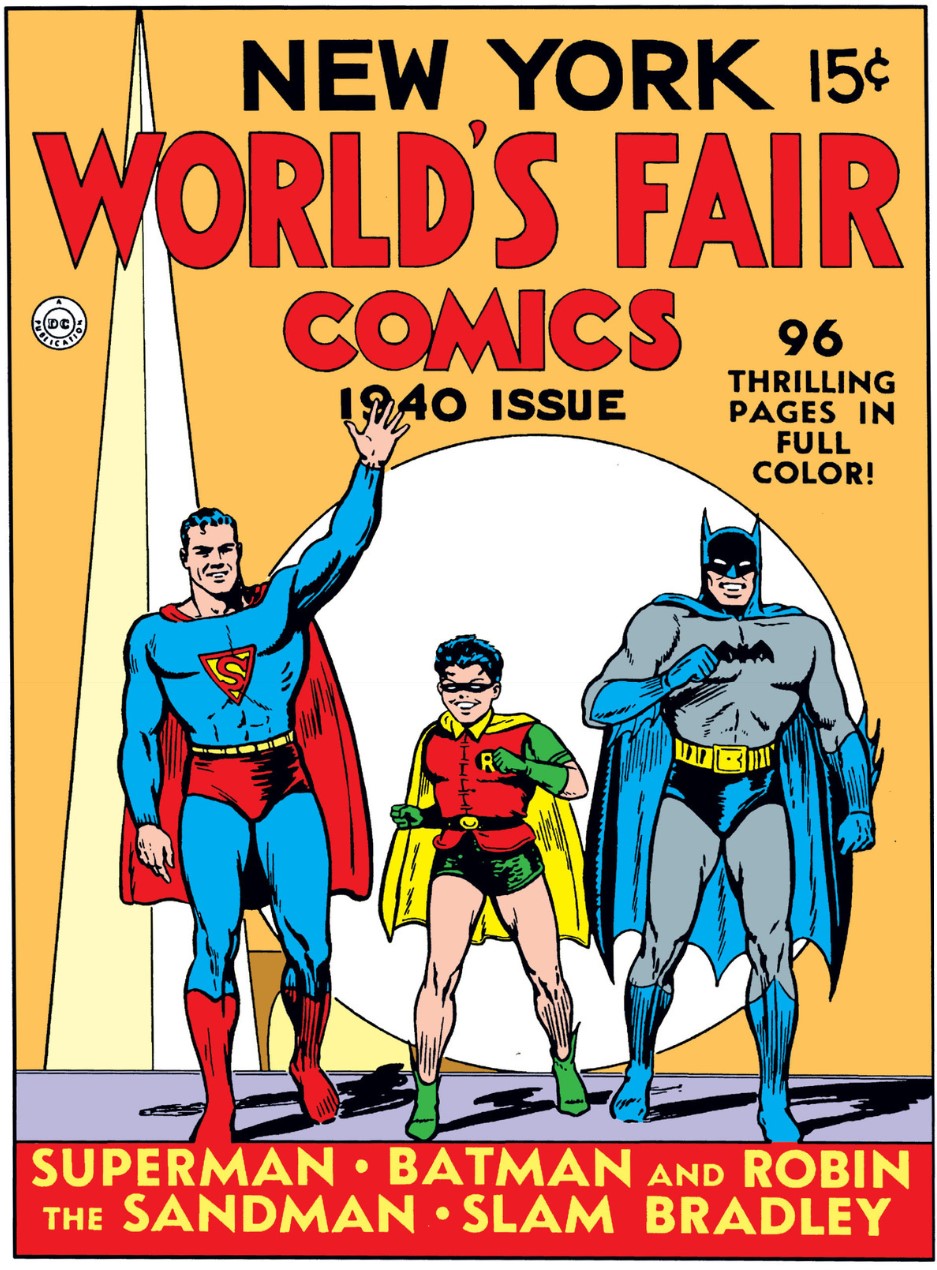
This incredible panorama of torrid tales opens with gangsters attempting to plunder jewels from exhibits at the biggest show on earth. Taken from premium package New York World’s Fair #2, ‘Superman at the 1940 World’s Fair’ is credited to Siegel & Schuster, but actually illustrated by Burnley who also provided the first ever pairing of the Man of Tomorrow with Dynamic Duo Batman and Robin on the cover to drag readers in…

Siegel & Shuster had created a true phenomenon and were struggling to cope with it. As well as monthly and bimonthly comics a new quarterly publication, initially World’s Best and ultimately World’s Finest Comics – springing from the success of the publisher’s New York World’s Fair comic-book tie-ins – would soon debut with their indefatigable hero featuring prominently in it. Superman’s daily newspaper strip began on 16th January 1939 (Yes! Today but back then!), with a separate Sunday strip following from November 5th: garnering millions of new devotees. The need for new material and creators was constant and oppressive, so expansion was the watchword at the Superman and Shuster studios.

On the primary pages though, Action Comics#26 (July 1940) introduced ‘Professor Cobalt’s Clinic’ (limned by Pauls Lauretta & Cassidy with Siegel inking and Frank Shuster lettering) wherein Clark Kent & Lois Lane expose a murderous sham Health Facility with a little Kryptonian help, whilst the following month dealt a similar blow to corrupt orphanage the ‘Brentwood Home for Wayward Youth’. September’s issue found Superman at the circus, solving the mystery of ‘The Strongarm Assaults’, a fast-paced thriller beautifully illustrated by the astonishingly talented and versatile Burnley. Whilst thrilling to all that, kids of the time could also have picked up the sixth issue of Superman (cover-dated September/October 1940). Produced by Siegel and the Superman Studio, with Shuster increasingly overseeing and only drawing key figures and faces, this contained four more lengthy adventures. Behind its Shuster & Cassidy cover, ‘Lois Lane, Murderer’, and ‘Racketeer Terror in Gateston’ by Cassidy had the Man of Action saving his plucky co-worker from a dastardly frame up and rescuing a small town from a mob invasion. An infomercial for the Supermen of America club and the secrets of attaining ‘Super Strength’ as shared by Burnley, Shuster & Cassidy follows. These lead to more adventure and action from Lauretta & Cassidy as ‘Terror Stalks San Caluma’ and ‘The Construction Scam’ sees the Man of Tomorrow foil a blackmailer who’s discovered his secret identity before spectacularly fixing a corrupt company’s shoddy, death-trap buildings.

Action Comics #29 (October 1940) again features Burnley art in a gripping tale of murder for profit. Human drama in ‘The Life Insurance Con’ was followed by deadly super-science as the mastermind Zolar created ‘The Midsummer Snowstorm’, allowing Burnley a rare opportunity to display his fantastic imagination as well as his representational acumen and dexterity. Then Superman #7 (November/December1940) marked a creative sea-change as occasional cover artist Wayne Boring became Schuster’s regular inker, whilst seeing the Man of Steel embroiled in local politics when he confronts ‘Metropolis’ Most Savage Racketeers’; quells manmade disasters in ‘The Exploding Citizens’; stamps out City Hall corruption in ‘Superman’s Clean-Up Campaign’ (illustrated fully by Boring) and puts villainous high society bandits ‘The Black Gang’ where they belong… behind iron bars.

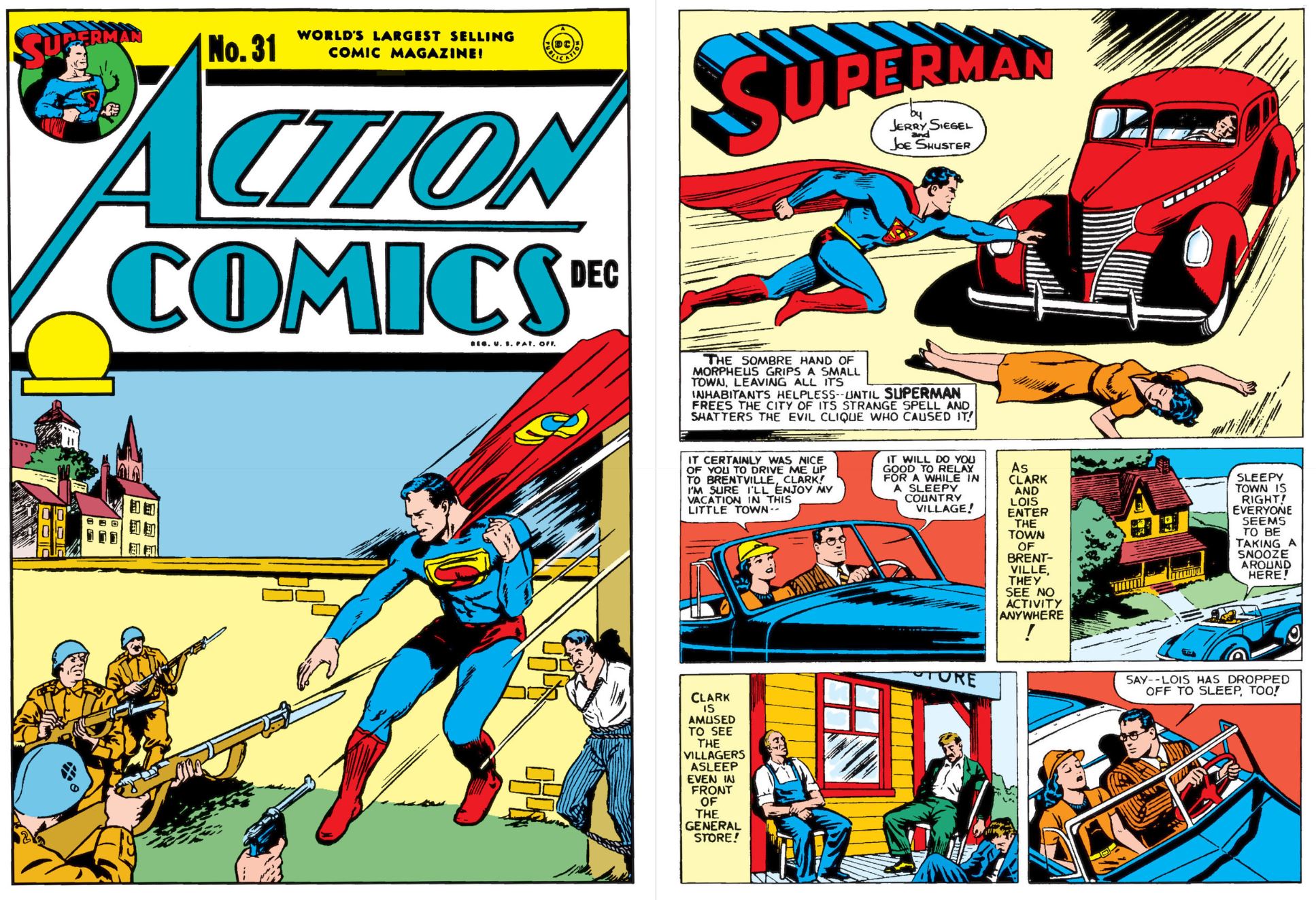
For Action # 31 Burnley draws another high-tech crime caper as crooks put an entire city to sleep and only Clark Kent isn’t ‘In the Grip of Morpheus’ after which ‘The Gambling Rackets of Metropolis’ (AC #32) finds Lois almost institutionalised until the Big Guy steps up to crush an illicit High Society operation that has wormed its nefarious way into the loftiest echelons of Government, a typical Siegel social drama magnificently illustrated.

Cover-dated January/February 1941, Superman #8 was another spectacular and wildly varied compendium containing four big adventures ranging from fantastic fantasy in ‘The Giants of Professor Zee’ (Cassidy & Boring); topical suspense in spotlighting ‘The Fifth Column’ (Boring & Komisarow) and common criminality in ‘The Carnival Crooks’ (Cassidy) before concluding with cover-featured ‘Parrone and the Drug Gang’ (Boring), wherein the Metropolis Marvel duels doped-up thugs and corrupt lawyers controlling them.

Action Comics #33 & 34 are both Burnley extravaganzas wherein Superman goes north to discover ‘Something Amiss at the Lumber Camp’, before heading to coal country to save ‘The Beautiful Young Heiress’; both superbly enticing character-plays with plenty of scope for super-stunts to thrill the gasping fans.

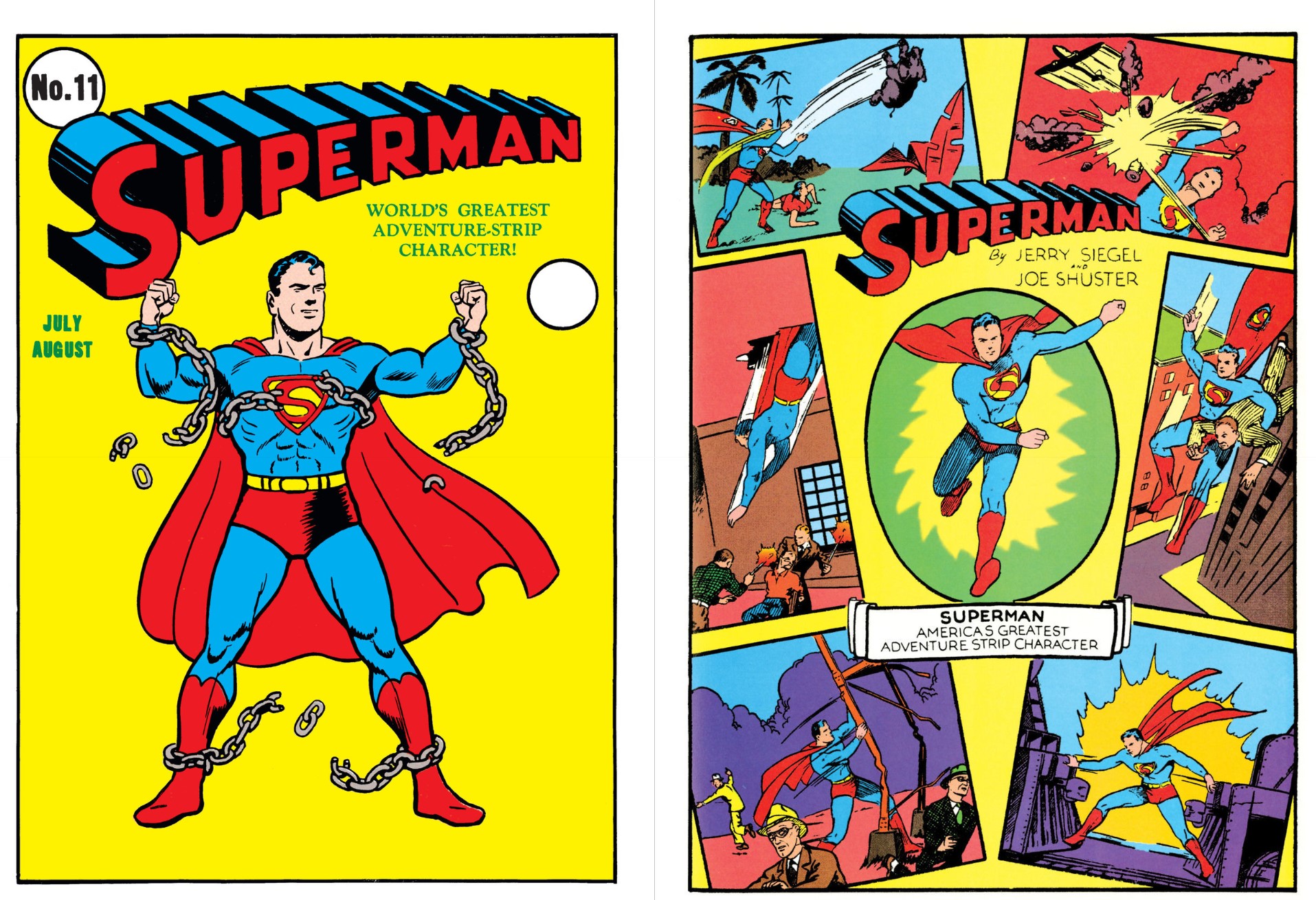
Superman #9 (March/April 1941) was another four-star thriller with all art credited to Cassidy. ‘The Phony Pacifists’ is an espionage thriller capitalising on increasing US tensions over “the European War” whilst ‘Joe Gatson, Racketeer’ recounts the sorry end of a hot-shot blackmailer and kidnapper. ‘Mystery in Swasey Swamp’ combines eerie rural events with ruthless spies whilst the self-explanatory ‘Jackson’s Murder Ring’ pits the Caped Kryptonian against an ingenious gang of commercial assassins. The issue also improves health and well-being with another Shuster & Cassidy ‘Supermen of America’ update and exercise feature ‘Super-Strength’ by Shuster.

The success of the annual World’s Fair premium comic books had convinced editors that an over-sized anthology of their characters, with Superman and Batman prominently featured, would be a worthwhile proposition even at the exorbitant price of 15¢ (most 64-page titles retailed for 10¢ and would do so until the 1960s). At 96 pages, World’s Best Comics #1 debuted with a Spring 1941 cover-date and Fred Ray frontage, before transforming into the soon-to-be-venerable World’s Finest Comics from issue #2 onwards. From that landmark one-&-only edition comes gripping disaster thriller ‘Superman vs. the Rainmaker’, illustrated by Boring & Komisarow, after which Action Comics #35 headlines a human-interest tale with startling repercussions in Boring & Leo Nowak’s ‘The Guybart Gold Mine’, before even Superman is mightily stretched to cope with the awesome threat of ‘The Enemy Invasion’ rendered by Boring & Shuster: a canny, foreboding taste of things to come if – or rather, when – America entered World War II.

Superman #10 (May/June 1941) opens with eponymous mystery ‘The Invisible Luthor’ (Nowak), follows with ‘The Talent Agency Fraud’ (Cassidy, Nowak, Siegel & the Studio), steps on the gas in ‘The Spy Ring of Righab Bey’ and closes with ‘The Dukalia Spy Ring’ (both by Boring, Siegel & the Studio): topical and exotic themes of suspense as America was still at this time still officially neutral in the “European War”. Conversely, Action Comics #37 (June 1941) returned to tales of graft, crime and social injustice in ‘Commissioner Kent’ (Cassidy) as the Man of Steel’s timid alter-ego is forced to run for the job of Metropolis’ top cop, before World’s Finest Comics #2 (Summer 1941) unleashes Cassidy & Nowak’s ‘The Unknown X’ – a fast-paced mystery of sinister murder-masterminds, before AC #38 (and Nowak & Ed Dobrotka) provide a spectacular battle bout against a sinister hypnotist committing crimes through ‘Radio Control’…

Other than a Cassidy pinup, Superman #11 (July/August 1941) was an all Nowak affair, beginning with ‘Zimba’s Gold Badge Terrorists’ wherein thinly disguised Nazis “Blitzkrieg” America, after which “giant animals” go on a rampage in ‘The Corinthville Caper’. Seeking a cure for ‘The Yellow Plague’ then takes Superman to the ends of the Earth whilst ‘The Plot of Count Bergac’ brings him back home to crush High Society gangsters. All by Nowak but accompanied by a Cassidy pinup.

Horrific mad science creates ‘The Radioactive Man’ in Action #39 (Nowak & Shuster Studios), whilst #40 featured ‘The Billionaire’s Daughter’ (by John Sikela) wherein the mighty Man of Tomorrow needs all his wits to set straight a spoiled debutante before we closing with ‘The Case of the Death Express’: a tense thriller about train-wreckers illustrated by Nowak from the Fall issue of World’s Finest (#3).

Stories of corruption and social injustice were gradually moving aside for more spectacular fare, and with war in the news and clearly on the horizon, the tone and content of Superman’s adventures changed too: the scale and scope of the stunts became more important than the motive. The raw passion and sly wit still shone through in Siegel’s stories but as the world grew more dangerous the Man of Tomorrow simply had to become stronger and more flamboyant to deal with it all, with Shuster and his team consequently stretching and expanding the iconography for all imitators and successors to follow.

These Golden Age tales are priceless enjoyment at an absurdly affordable price. My admiration for the stripped-down purity and power of these stories is boundless. Nothing has ever come near them for joyous, child-like perfection. You really should make them part of your life. In fact, how can you possibly resist them?
© 1940, 1941, 2025 DC Comics. All Rights Reserved.

Today in 1939 Jean Van Hamme (XIII, Thorgal, Largo Winch) was born, which you now know was the same moment – allowing for time zone differentials – that the Superman newspaper strip launched. It ended in 1966 but Van Hamme’s still going…

In 1960 UK comic Judy debuted, and ten years later so did Garth Ennis.

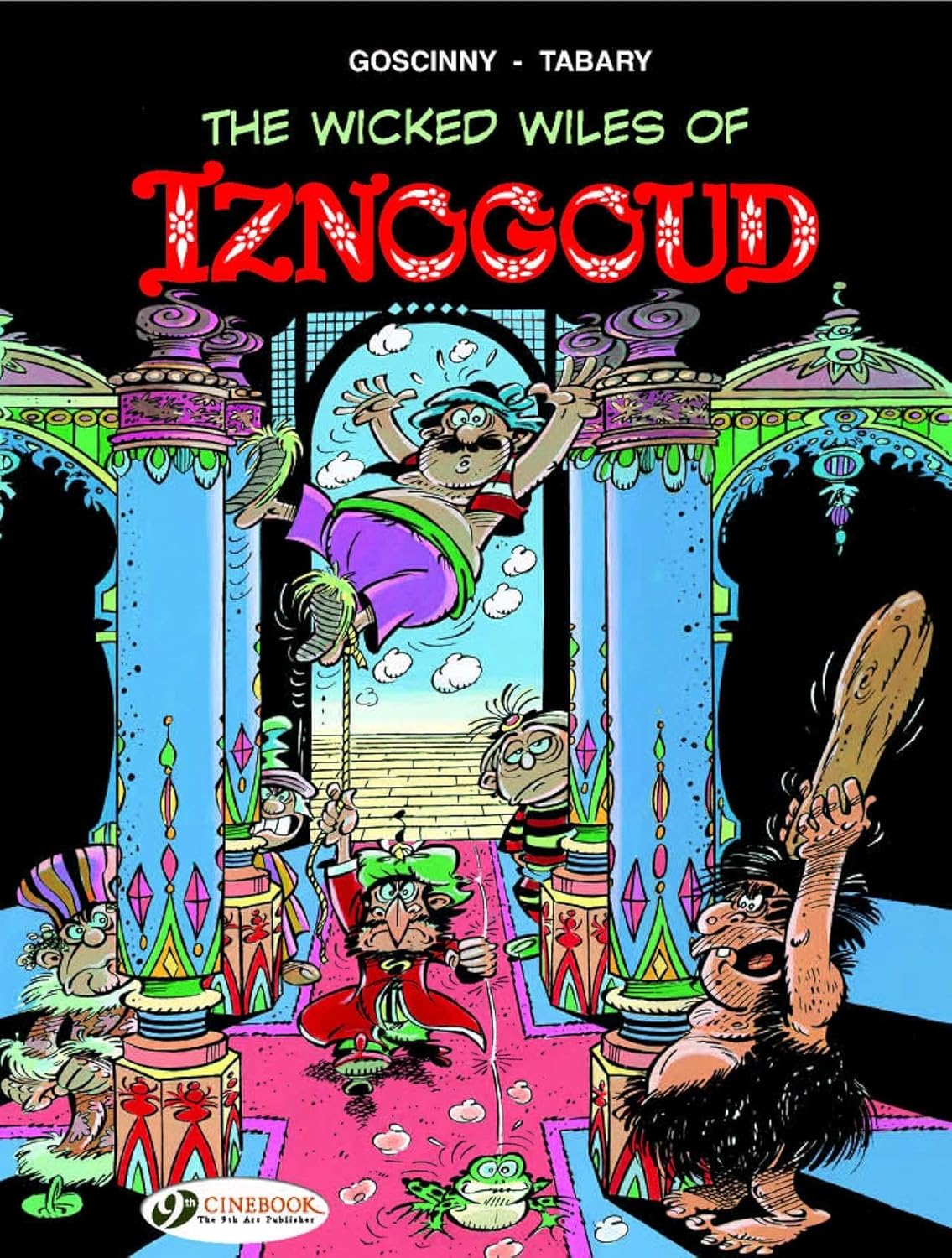
Iznogoud volume 1: The Wicked Wiles of Iznogoud


By René Goscinny & Jean Tabary, translated by Anthea Bell & Derek Hockridge (Cinebook)
ISBN: 978-1-905460-46-5 (Album TPB/Digital edition)

This book includes Discriminatory Content produced in less enlightened times.

It’s anniversary time again! Today in 1962 something smart and wildly wicked first appeared, and just hung around. Please read on…

For the greater part of his too-short lifetime (1926-1977) René Goscinny was one of (if not The) most prolific, most-read writers of comic strips the world had ever seen. He still is.

Among his most popular comic collaborations are Lucky Luke, Le Petit Nicolas and, of course, Asterix the Gaul, but there were so many others, such as the dazzling, dark deeds of a dastardly usurper whose dreams of diabolical skulduggery perpetually proved to be ultimately no more than castles in the sand…

Scant years after the Suez crisis, the French returned to those hotly-contested deserts when Goscinny teamed with sublimely gifted Swedish émigré Jean Tabary (1930-2011). He numbered Richard et Charlie, Grabadu et Gabaliouchtou, Totoche, Corinne et Jeannot and Valentin le Vagabond amongst his other hit strips but found a moment to detail the innocuous history of imbecilic Arabian (im)potentate Haroun el-Poussah. However, it was the strip’s villainous foil, power-hungry vizier Iznogoud who stole the show – possibly the conniving little imp’s only successful coup…

The notion of the series apparently came from a throwaway moment in Les Vacances du Petit Nicolas, but – once it was fully formed and independent – Les Aventures du Calife Haroun el Poussah was created to join the roster in Record, with the first episode appearing in the January 15th 1962 issue. An assured if relatively minor hit, the strip jumped ship to Pilote – a picture-packed periodical created and edited by Goscinny – where it was artfully refashioned into a starring vehicle for the devious little ratbag who had increasingly been hogging all the laughs and limelight.

Like all great storytelling, Iznogoud works on multiple levels: for youngsters it’s a comedic romp with adorably wicked baddies invariably hoisted on their own petards and coming a-cropper, whilst older, wiser heads revel in pun-filled, witty satires and astoundingly wry yet accessible episodic comic capers. Just like our Parliament today. That latter aspect is investigated in this collection of short episodes…

This same magic formula (no, I’m being figurative, not literal) made its more famous cousin Asterix a monolithic global success and – just like the saga of the indomitable Gaul – our irresistibly addictive Arabian Nit was originally adapted into English by master translators Anthea Bell & Derek Hockridge, who made those Franco-Roman Follies so very palatable to British tastes. Always, deliciously malicious whimsy is heavily dosed with manic absurdity, cleverly contemporary cultural critiques and brilliantly delivered creative anachronisms which serve to keep the assorted escapades bizarrely fresh and hilariously inventive. However, like so many comics inventions, the series grew beyond its boundaries…

The retooled series launched in Pilote in 1968, quickly growing into a massive European hit, with 31 albums to date (carried on by Tabary’s children Stéphane, Muriel & Nicolas after his passing in 2011); his own solo comic; a computer game; animated film, TV cartoon show and a live-action movie.

When Goscinny died in 1977, Tabary started scripting his own sublimely stylish tales (from the 13th album onwards), gradually switching to book-length complete adventures, rather than the compilations of short, punchy vignettes which typified the collaborations.

In October 1974, whilst the shifty shenanigans were unfolding to the delight of kids, its sand-struck star began moonlighting. Pulling double duty as a commentator and critic of real-world politics and social issues in French newspapers the little wart scored a side hustle with a sidebar series that began as a statement and grew into a separate second career for the vindictive viper. Some oiks, like sand, just get everywhere…

So, what’s it all about?

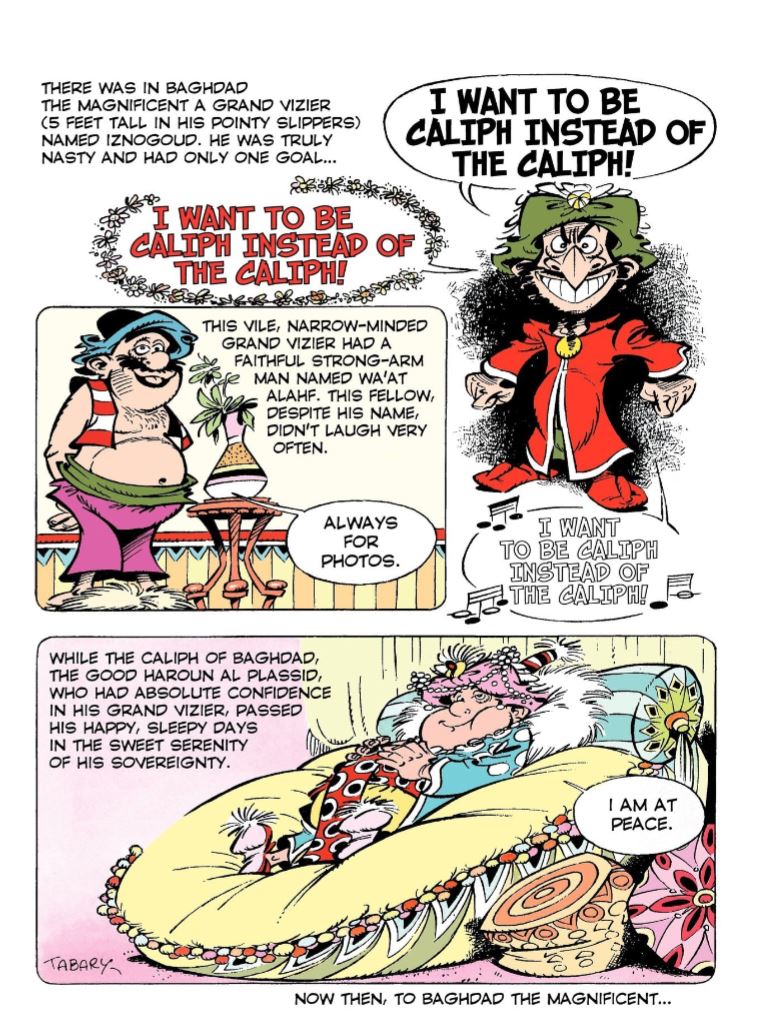
Iznogoud is Grand Vizier to Haroun Al Plassid, Caliph of Ancient Baghdad, but the conniving little shyster has loftier ambitions – or as he is always shouting it – “I want to be Caliph instead of the Caliph!”…

The vile vizier is “aided” – and that’s me being uncharacteristically generous – in his endeavours and schemes by bumbling assistant Wa’at Alahf, and in this first album they begin their campaign with ‘Kissmet’, wherein pandemonium ensues after a talking frog is revealed as an ensorcelled Prince who can only regain human form if smooched by a human being.

Iznogoud sees an opportunity if he can only trick the simple-minded Caliph into puckering up; unfortunately but typically, the little rotter forgets that he’s not the only ambitious upstart in Baghdad…

‘Mesmer-Eyezed’ finds him employing a surly stage hypnotist to remove the Caliph whilst ‘The Occidental Philtre’ sees him employ a flying potion obtained from a lost, jet-lagged western sorcerer, each with hilarious but painfully counter-productive results.

Tabary drew himself into ‘The Time Machine’ wherein a comic artist desperate to meet his deadlines falls foul of a mystical time cabinet. However, when he meets the vizier, that diminutive dastard can clearly see its Caliph-removing potential… to his eternal regret…

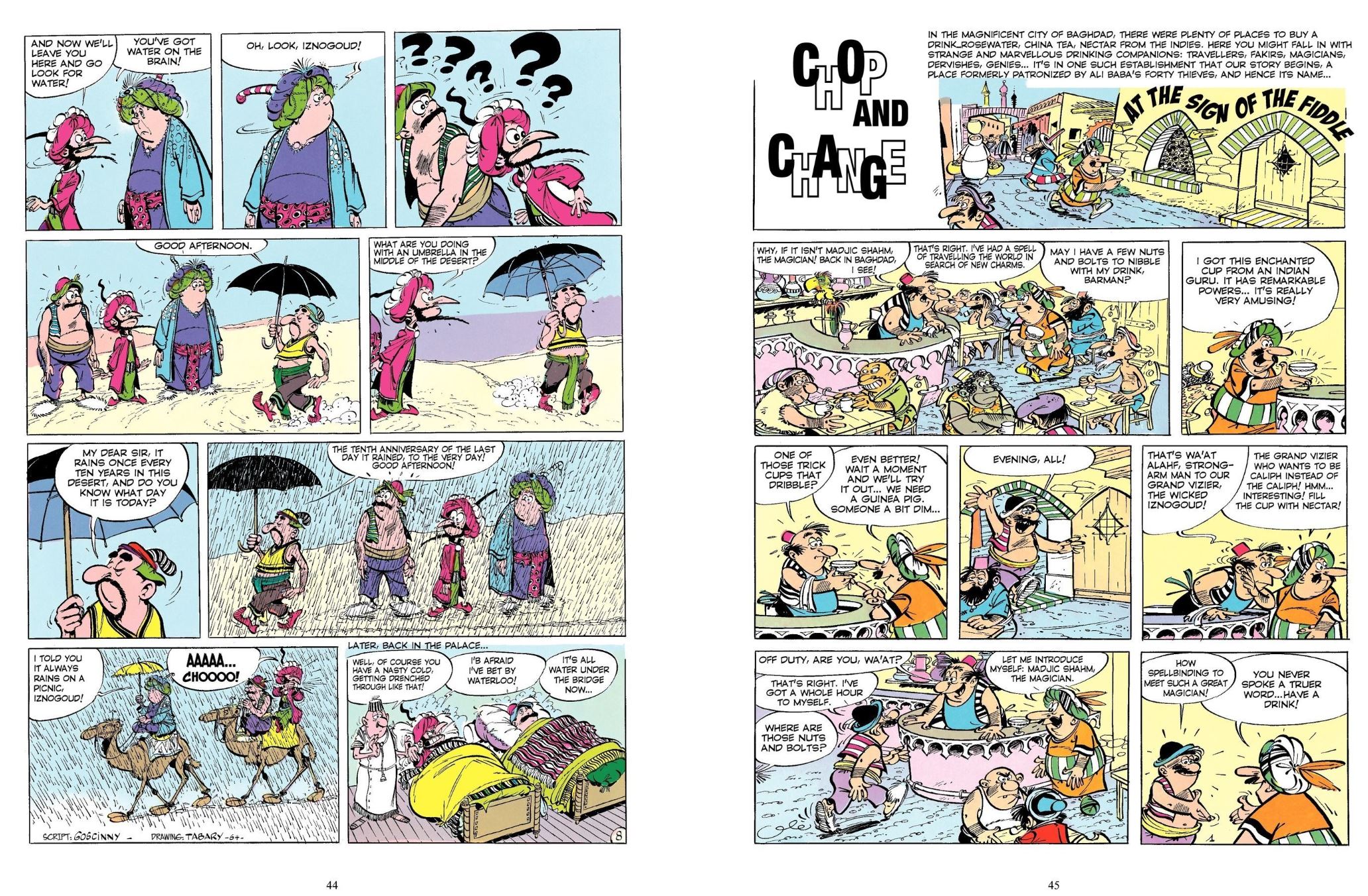
Soon after in ‘The Picnic’ Iznogoud takes drastic action, luring Haroun Al Plassid into the desert, but as usual his best-laid plans really aren’t, before we conclude with ‘Chop and Change’ as our indefatigable villain obtains a magic goblet that can switch the minds of any who drink from it, forgetting that Caliphs are important people who employ food-tasters…

Snappy, fast-paced slapstick and painfully delightful word-play abound in these mirthfully infectious tales and the series is a household name in France; said term has even entered French political life as a description for a certain type of politician: over-ambitious, unscrupulous – and usually short in stature…

Eight albums were originally translated into English during the 1970s and 1980s without really making any little impact here, but once Cinebook’s revival the vile Vizier finally caught on in a superb sequence of gloriously readable and wonderfully affordable comedy epics that found an appreciative audience among British kids of all ages. That said, it’s been a while since the last one, but perhaps that’s the setting not the stories…
© 1967 Dargaud Editeur Paris by Goscinny & Tabary. All Rights Reserved.

Today in 1905, the last episode of Gustave Verbeek’s The Upside Downs ran in the New York Herald and in 1924 writer Stan Kay (Casper the Friendly Ghost, Richie Rich, Sad Sack, Fraggle Rock, The Muppets) was born. Practically yesterday, writer Scott Snyder (American Vampire. Batman. Justice Leafue) was born in 1976 whilst ten years later we lost Alfred Bestall of Rupert Bear fame.

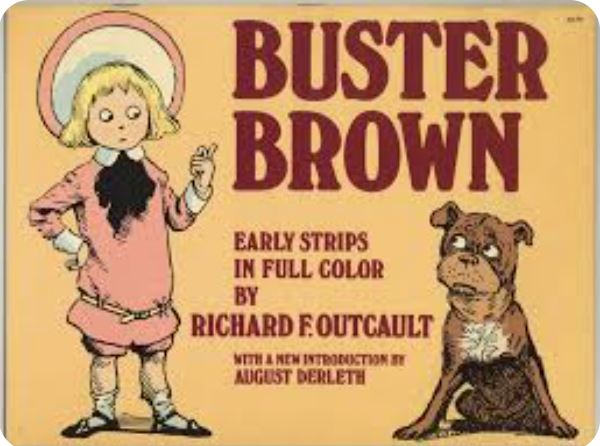
Buster Brown: Early Strips in Full Color


By Richard F. Outcault with an introduction by August Derleth (Dover Publications)
ISBN: 978- 0-1-486-23006-1 (Album PB)

This book includes Discriminatory Content produced in less enlightened times.

You probably won’t agree, but tomorrow is a very special day for our industry and art form, marking the 1863 birth of the man who invented modern comics.

Although fans and historians are never going to stop debating this one, Richard F. Outcault is credited with being the father of the modern comic strip. His breakthrough came in 1895: a scandalous creation dubbed The Yellow Kid manifested for legendary newspaperman Joseph Pulitzer and debuting in the New York World – where the feature was actually entitled Hogan’s Alley. It shared cartoon shenanigans that captivated the reading public and even led to the coining of a new term… “Yellow Journalism”…

Outcault was notoriously fickle and quickly tired of his creation, and of subsequent features he created for William Randolph Hearst in the New York Journal during a particularly grave period of bitter newspaper circulation warfare.

In 1902, he created a Little Lord Fauntleroy style moppet called Buster Brown, but the angelic looks actually acted as camouflage for a little hellion perpetually wedded to mischief, pranks and poor decision making. Yet again Outcault quickly got bored and moved on, but this strip was another multimedia sensation, capturing public attention and thus spinning off a plethora of franchises.

Our boy Buster was a merchandising bonanza. By a weird set of circumstances, Buster Brown Shoes became one of the biggest chain-stores in America, and in later years produced a periodical comic book Premium (a giveaway magazine free to purchasers) packed with some of the greatest comic artists and adventure stories the industry had ever seen. Outcault may have dumped Buster, but the little devil darling never quit comics…

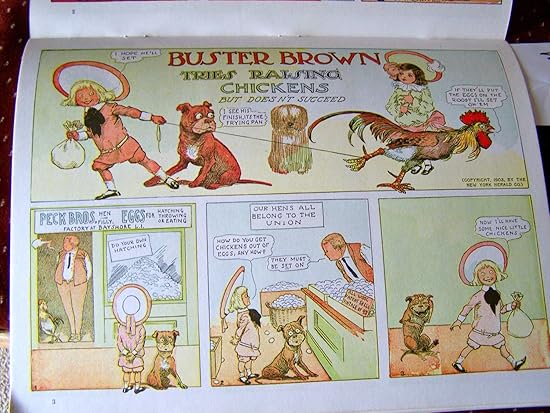
Way back in 1974 Dover Publications released this facsimile reproduction of an earlier collection from 1904, then entitled Buster Brown and his Resolutions, featuring 15 glorious full-colour strips from the first two years of the run, and it’s about time they or someone else thought about doing it again. Maybe even publishing a far more comprehensive collected edition?

Until then, though, let’s re-examine what we have here and meet the cherubic scion and his faithful dog Tige, and perhaps ponder that if indelicate or untoward happenstance doesn’t create another round of chaos in the ordered and genteel life of the well-to-do Mr. and Mrs. Brown, then little Buster is always happy to pitch in and lend a hand.

Each lavish page, rendered in a delightfully classical, illustrative line style – like Cruickshank or perhaps Charles Dana Gibson – ends with a moral or resolution, but one that is somehow subversively ambiguous.

As Buster himself is wont to comment, “People are usually good when there isn’t anything else to do”…

Historically pivotal, Buster Brown is also thematically a landmark in content, and a direct ancestor of the mischievous child strip that dominated the family market of the 20th century. Could Dennis the Menace (“ours” or “theirs”), Minnie the Minx, Cedric, Ducoboo or Bart Simpson have existed without Buster or his contemporary rivals The Katzenjammer Kids?

It’s pointless to speculate, but it’s no waste of time to find and enjoy this splendid strip.
© 1974 Dover Publications. All Rights Reserved.

Today in 1914 Belgian marvel Joseph Gillain aka Jijé was born, and in 1930 world changing strip Mickey Mouse debuted. Three years later so did creator/writer (Star Hawks)/historian Ron Goulart. You should read The Adventurous Decade – Comic Strips in the Thirties and see why I’m going on so.

In 1956 we lost The Kin-der-Kids creator Lyonel Feininger and Britain suffered double death blows in 1968 with the cancelation of Wham! and Giggle.

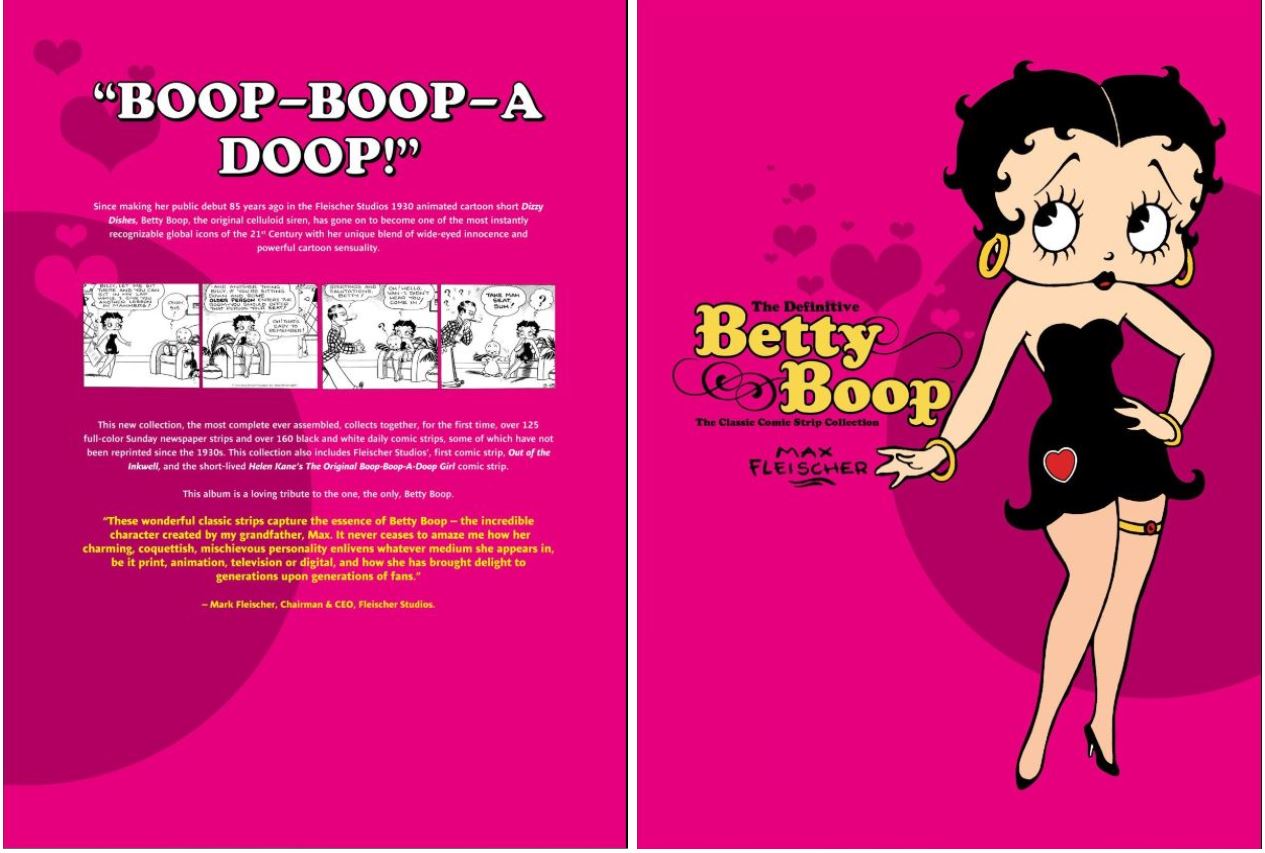
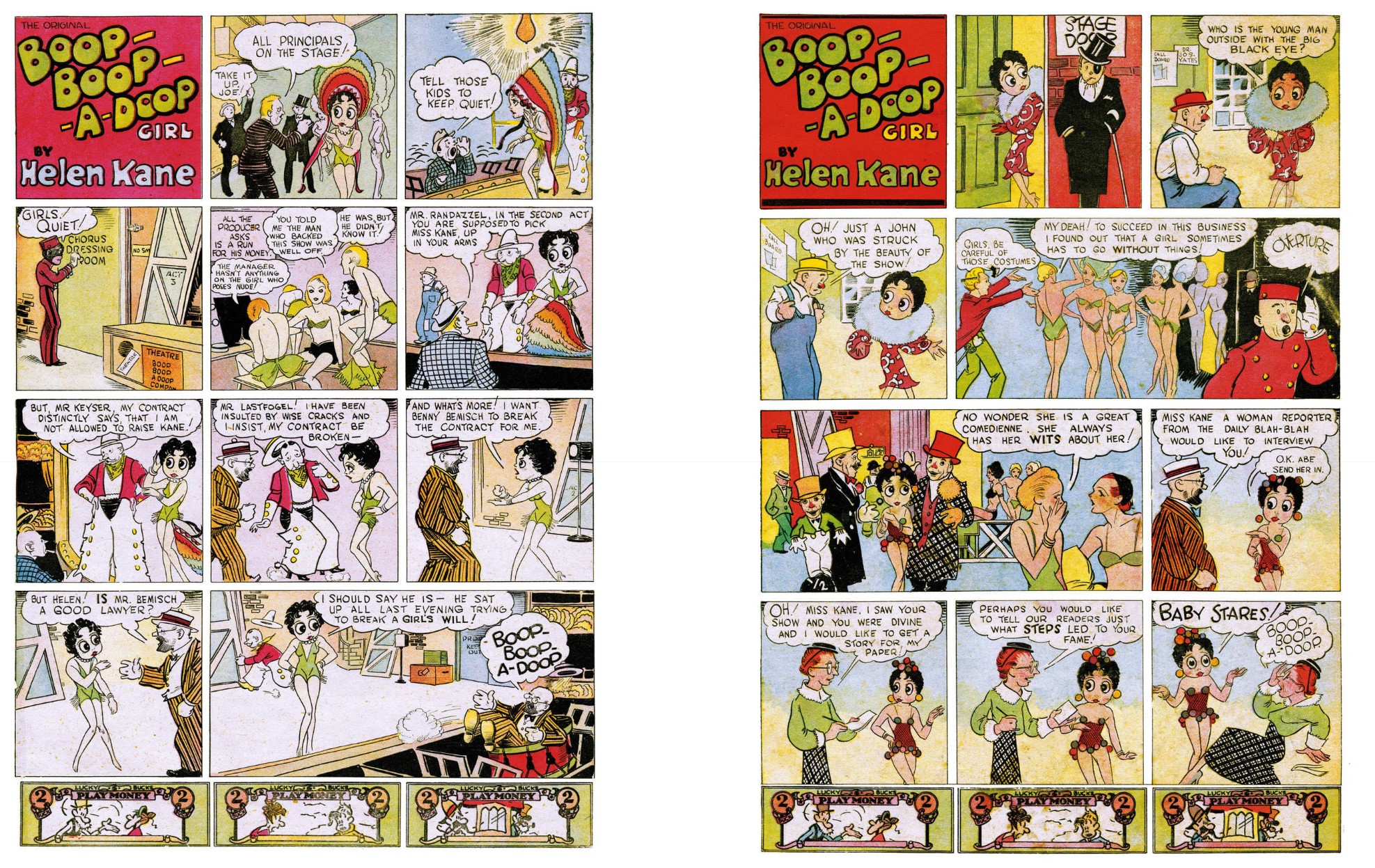
The Definitive Betty Boop: The Classic Comic Strip Collection


By Max Fleischer, Bud Counihan, with Hal Seeger & various (Titan Comics)
ISBN: 978-1-84856-707-8 (HB/Digital edition)

This book includes Discriminatory Content produced in less enlightened times.

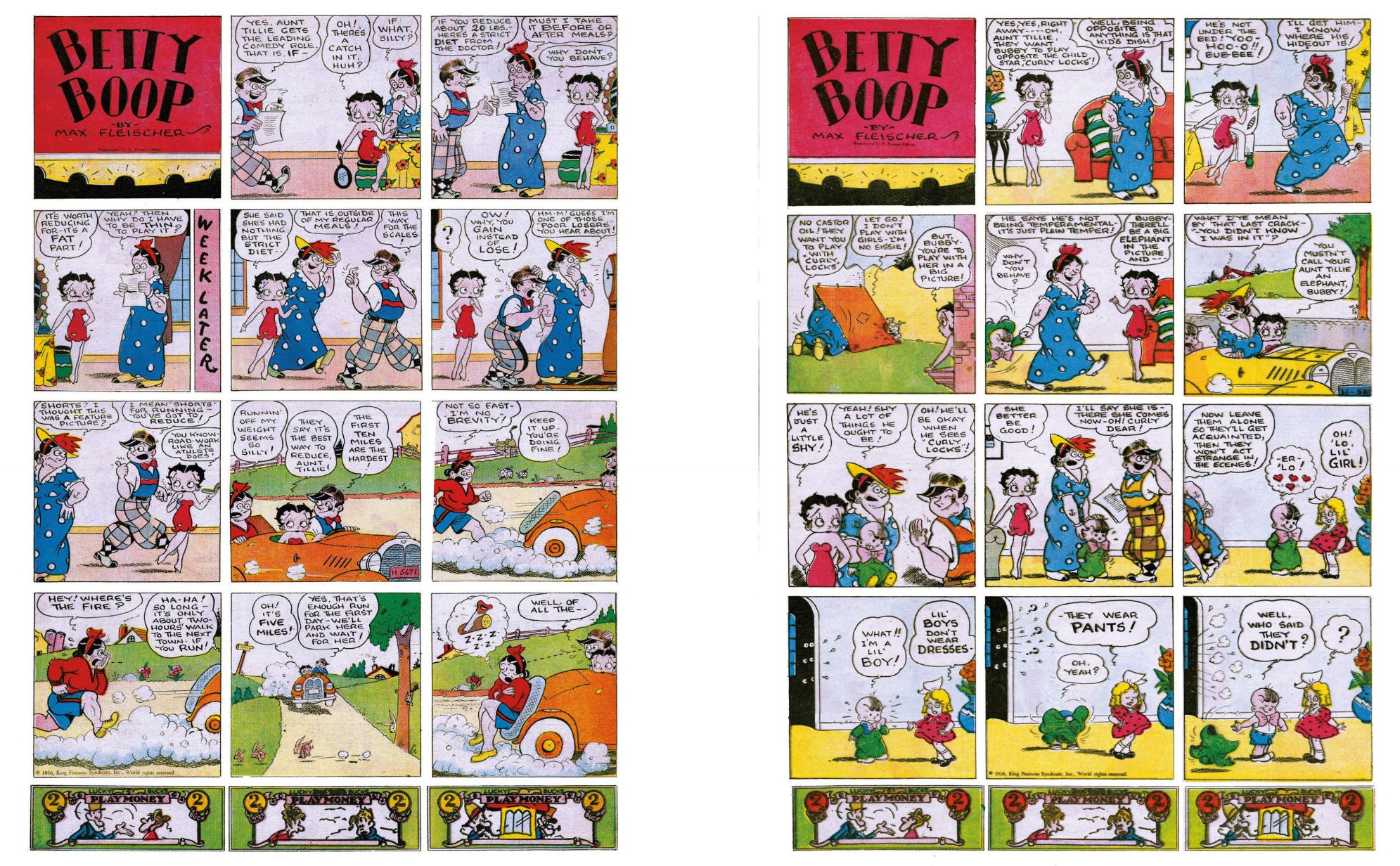
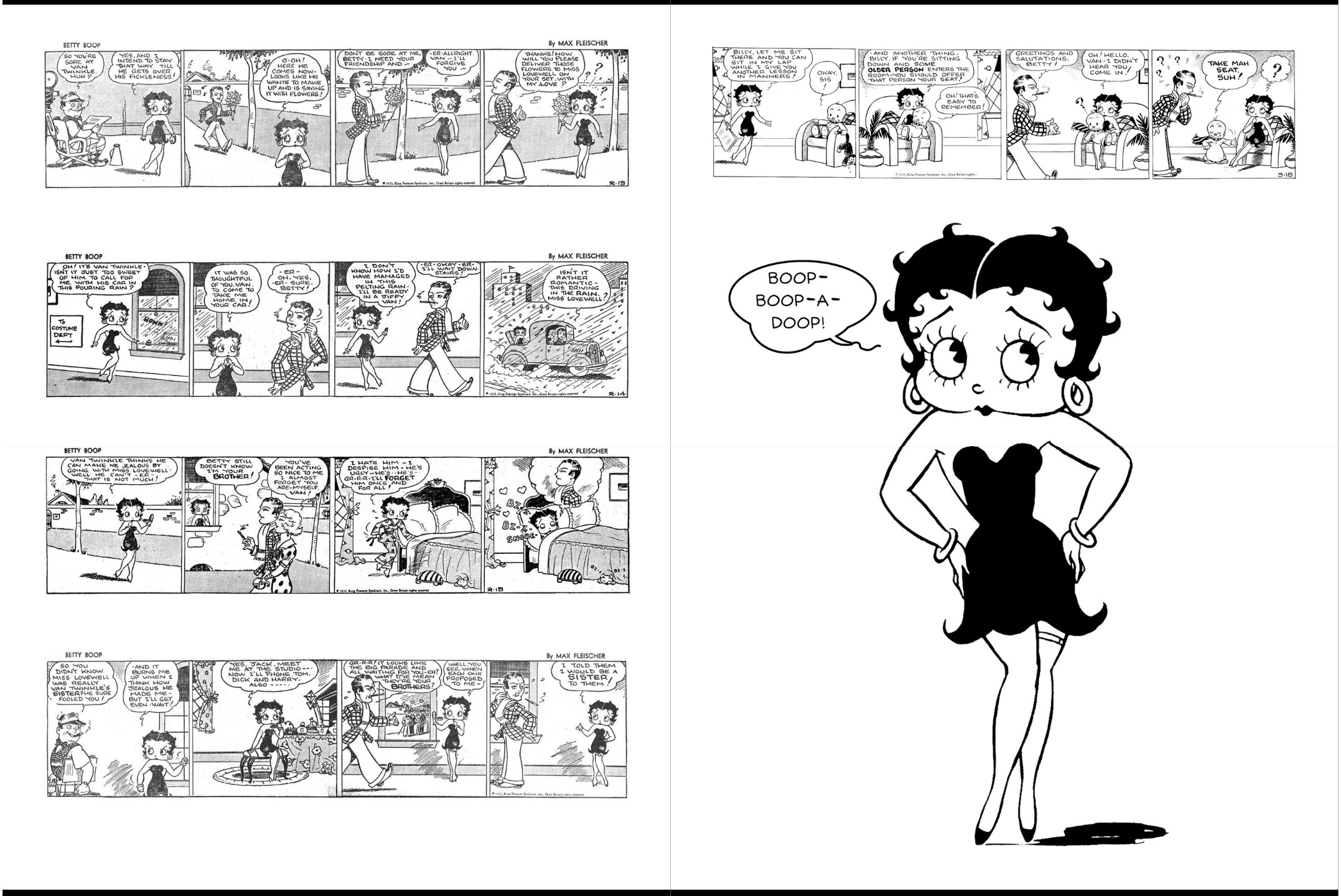
Betty Boop is one of the most famous and long-lived fictional media icons on the planet and probably the one who has generated the least amount of narrative creative material – as opposed to simply merchandise – per year since her debut.

She was created at the Fleischer Cartoon Studios, most likely by either by Max Fleischer himself or top cartoonist and animator Grim Natwick – depending on whomever you’ve just read – and had a bit part in the monochrome animated short feature Dizzy Dishes: the seventh “Talkartoon” release from the studio, screened for the first time on August 9th 1930.

A calculatedly racy sex-symbol from the start, albeit anthropomorphised into a sexy French Poodle (!!), Betty was primarily based on silent movie star and infamous “It-Girl” Clara Bow. Or, according to some historians, it was far more than just her distinctive sound Betty took from popular contemporary star Helen Kane. In those pioneering days of “talkies”, Betty was voiced by a succession of actresses including Margie Hines, Kate Wright, Ann Rothschild and ultimately Mae Questel, who all mimicked Bow’s soft, seductive (no, really!) Brooklyn accent. Or possibly Kane’s. There’s a court case involved in this history so opinions are hard held and still very divided…

Although frequently appearing beside early Fleischer Studios stars Bimbo (a homely puppy dog also called Fitz) and Koko the Clown – who both debuted in Fleischer’s earliest screen offerings Out of the Inkwell – Betty had become a fully, if wickedly shaped, human girl by 1932’s Any Rags, and she quickly co-opted and monopolised all the remaining Talkartoons, before graduating to the Screen Songs featurettes. Betty ultimately won her own animated cartoon series to become “The Queen of the Animated Screen”, reigning until the end of the decade.

A Jazz Age flapper in the Depression Era, the delectable Boop was probably the first sex-charged teen-rebel of the 20th century, yet remained winningly innocent and knowledgeably chaste throughout her career. Maybe that’s why she became so astoundingly, incredibly popular – although her appeal diminished appreciably once the censorious Hayes Production Code cleaned up all that smut and fun and sophistication oozing out of Hollywood in 1934 – even though the Fleisher Studio was proudly New York born and bred.

Saucy singer Helen Kane – who had performed in a sexy “Bow-esque” Brooklyn accent throughout the 1920s and was billed as “The Boop-Oop-A-Doop Girl” – famously sued for “deliberate caricature” in 1932. As well as a renowned actor, she was sharp enough to briefly steal the show and actually become the star of the first Betty newspaper strips…

When Kane’s lawsuit failed, Betty took over the paper outlets in her own name, but couldn’t withstand a prolonged assault by the National Legion of Decency and Hayes Code myrmidons. With all innuendo removed, salacious movements restricted and wearing much longer skirts, Betty gained a boyfriend and family, whilst newspaper strip scripts consciously targeted younger audiences. The tabloid feature folded in 1937 and her last animated cartoon stories were released in 1939. The only advantage to Betty’s screen neutering and new wholesome image was that she suddenly became eligible for inclusion on the Funnies pages of family newspapers, alongside the likes of Popeye, Little Orphan Annie and Mickey Mouse….

This superb collection gathers every pre-war iteration associated with Betty Boop – including ones she isn’t in – and is augmented by fond remembrances from Mark Fleischer and Virginia Mahoney in their Foreword ‘About our grandad, Max Fleischer…’ and comes with an informative Introduction tracing Betty’s wild ride of a career. Supplementing his text with candid behind-the-scenes photos and contemporary art as well as advertising items and memorabilia of the time, cartoonist Brian Walker (son of Beetle Bailey and Hi & Lois creator Mort Walker) traces the celluloid and tabloid star’s creation, rise, fall and latter day resurgence in ‘Made of Pen and Ink, she can win you with a Wink’.

There was a brief flurry of renewed activity during the 1980s, which led to a couple of TV specials, a comic book from First Comics (Betty Boop’s Big Break, 1990) and a second newspaper strip. Betty Boop and Felix was crafted by Walker and his brothers Neal, Greg, and Morgan, wherein the glamour queen shared adventures with fellow King Features nostalgia icon Felix the Cat. It ran from July 23rd 1984 – January 31st 1988, but even counting those – and we aren’t here – that’s still a pretty meagre complete comics canon for a lady of Betty’s longevity, pedigree and stature…

Confusion and contention abound in Betty’s print career and that’s mirrored in this book. Her first regular strip was as a daily feature in black-&-white, but you’ll see that last, because the comics experience begins in full colour with an experimental Out of the Inkwell – Koko the Klown Sunday strip starring the manic mime in silent surreal romps that have the cachet of being Fleischer’s first work for King Features Syndicate. They ran from November 25th – December 15th 1934 and are followed by The Original Boop Boop-A-Doop Girl: a Sunday feature spanning August 5th to October 12th 1934. As negotiations between Fleischer and King Features stalled in 1933, Helen Kane approached the Syndicate and offered herself as a straight knock-off for the cartoon star. The resultant domestic comedy strip ran for just 11 weeks, and only in the tabloid New York Sunday Mirror. It was dropped as soon as Fleischer signed with King Features…

Attributed to Kane and drawn by Ving Fuller, the succession of manic gag pages are basic, innocently racy vaudeville one-liners, but do still evoke a certain nostalgic charm…

Whilst we’re on a possibly touchy subject: a lot of attitudes to women and visualisations of minorities won’t really pass an earnest examination here, and readers should be aware that these were all created in a different time for far less enlightened audiences. A little patience and forbearance will be your best guides on some pages…

Running from November 25th 1934 to November 27th 1937, the full colour Sunday strips starring the original and genuine Betty Boop were drawn by Bud Counihan: a veteran ink-slinger who had created the Little Napoleon strip in the 1920s before becoming Chic Young’s assistant on Blondie. They commenced a few months after the daily feature and might be a little confusing as they encompass a large supporting cast for aspiring starlet Betty as she navigates a tiresome and treacherous career in Hollywood. I’d advise reading the dailies first and ending your reading enjoyment here, but it’s your choice…

These gag episodes feature the freshly-sanitised, family-oriented heroine of the post-Hayes Code era, but for devotees of the period and comics fans in general, the strip still retains a unique and abiding charm. Counihan’s Betty is still oddly, innocently coquettish yet confidant: a saucy thing with too-short skirts and skimpy apparel. Some outfits – especially bathing costumes – would raise eyebrows even now, and although the bald innuendo that made her a star is absent, these tales of a street-wise young thing trying to “make it” in Tinseltown are plenty sophisticated when viewed through the knowing, sexually adroit and informed eyes of 21st century readers. Well some of them, anyway…

Produced as full-page strips, the Sundays are broadly slapstick, with moments of cunning wordplay: single joke stories regarding the weirdness of acting and the travails of fandom. There’s a succession of blandly arrogant romantic leading men (mostly called Van something-or-other) but none stick around for long as Betty builds her career, and eventually scenarios change to a western setting as cast and crew begin making Cowboy Pictures, leading to many weeks’ worth of “Injun Jokes”, but ones working delightfully and hilariously counter to expected unpleasant stereotypes of those times. However, the introduction of fearsome lower-class virago Aunt Tillie – chaperone, bouncer and sometime comedy movie extra – moves the strip into an unexpected direction and begins Betty’s life as an extra in her own show…

Soon, a clear and unflinching formula sets in with Bubby (see below), Aunt Tillie and her diminutive new beau Hunky Dory increasingly edging Betty out of the spotlight and even occasionally off the page entirely. By 1937 the show was over…

The Betty Boop daily strip began on July 23rd 1934: a raw, raucous comedy gig that ran until March 18th 1935 in an extended sequence of gag-a-day encounters blending into an epic comedy-of-errors. Here Betty’s lawyers do litigious battle with movie directors and producers to arrive at the perfect contract for all parties. That’s clearly a war that still rages to this day and once again it’s happening under the cost restrictions of what is, after all, another Great Depression like the one Betty was a constant momentary antidote to…

Jokes come thick and fast in the same vein, with lawyers, entourage and all extras providing the bulk of the humour whilst Betty stands in for the Straight Man in her own strip… Except for a recurring riff about losing weight to honour her contract, which stipulates she cannot be filmed weighing more than 100 pounds! Geez! Her head alone has got to weigh at least… sorry, I know… it’s just a comic…

Like most modern stars, Betty had a dual career and there’s a lot of recording industry and song jokes as well as fan affrontery and boyfriend woes, as well as the introduction of the first of an extended cast: Betty’s streetwise baby brother Bubby (originally Billy). He’s a riotous rapscallion intended to act as a chaotic foil to the star’s affably sweet, knowingly dim complacency, and he’s another celluloid wannabe in waiting…

By no means a major effort of the Golden Age of Comics Strips, Counihan’s Betty Boop (like most licensed syndicated features the strip was “signed” by the copyright holder, in this case Max Fleischer) remains a hugely effective, engaging and entertaining work, splendidly executed and well worthy of the attentions of fans with a penchant for history or feeling for fashion.

With the huge merchandising empire built around the effervescent cartoon Gamin/Houri, (everything from apparel to wallpaper, clocks to drinking paraphernalia) surely there’s room today to address her small brief but potent contributions to the comics arts. If you think so, this book is for you…

Betty Boop © 2015 King Features Syndicate, Inc./Fleischer Studios, Inc. ™ & © Hearst Holdings, Inc./Fleischer Studios, Inc. All rights reserved. Foreword © 2015 Mark Fleischer & Ginny Mahoney. Introduction © 2015 Brian Walker.

Today in 1877, pioneering Swedish cartoonist/comics creator Oskar Emil “O.A.” Andersson was born, and in 1911 the amazing Jack Burney (Superman, Batman, Starman) also arrived. In 1957 Belgian star Bernard “Yslaire” Hislaire was born followed a year later by Ms. Tree co-creator Terry Beatty with writer/editor Bob Harras coming one year later. Sam (Zero Girl, The Maxx, Wolverine) Keith, arrived in 1963.

Sadly in 1998 we lost astoundingly adept Canadian import Win Mortimer (Superman, Batman, Legion of Super-Heroes).