The Legend of Lord Snooty and His Pals – 60 Years of Classic Cartoon Art


By Dudley D. Watkins, with Albert Holroyd, Roy Nixon, Ken Harrison & various (DC Thomson & Co)
ISBN: 978-0-85116-691-9 (tabloid HB)

This book includes Discriminatory Content produced in less enlightened times.

To commemorate Dudley D. Watkins death on August 20th 1969, I ordered some physical books rather than the digital editions I favour. In an ironic tribute to the great man and Grand British comedic traditions, said items failed to arrive on time for the scheduled tribute on that anniversary. So, here’s one of them that finally turned up and can now consequently be shared with you all. That’s egalitarianism, that is…

As an odd adjunct of being a nation perpetually embroiled in class struggle, Britain has found countless ways to apologize and humanise its blue-blooded oppressors. Here’s one of the most successful: a masterpiece of charming fraternity that undermines any anti-privilege message even as it delights and subverts. But which side is our star on, and does it even matter in the end?

Designed and mostly written by Watkins (1907-1969), and debuting in the very first issue of The Beano on 30th July 1938, the only decent posh boy this country ever produced is Marmaduke, Earl of Bunkerton: a bred-in-the-bone blue-blooded subversive and instinctive rebel anarchist… who could never decide which side of the class war and divide he and his ever-evolving pals were actually on.

Clad in Eton school uniform complete with top hat and umbrella, the little lord loathed the pointless tedium of his grand estate and constant pressure of his impending position and status. Thus, at every opportunity he bunked off, dodging pitiless and so-proper Aunt Matilda (who gradually mellowed into genteelly eccentric “Aunt Mat”) and the haughty, stiff-necked and smugly snobbish Bunkerton Castle staff to cavort and revel with the poor waifs from Ash Can Council School – thus dubbed “The Ash Can Alley kids”. Marmaduke even disguised himself as one of them to indulge in his wayward capers, and fully embraced and leaned into their barbed nickname for him – “Lord Snooty”.

Oh, what Larks!! It was like an Edwardian novel of swopped lives or The Prince and the Pauper played for laughs, with this lovable, amiable toff strongly on the side of the savvy proletariat. However, although he just wanted to have fun, there were always dangerous and unwelcome poor kids to fight in the insalubrious form of the bullies of the Gasworks Gang

The early days saw the kids mostly dodging onerous duties, tutorial tribulations and posh expectations – although everybody from every societal stratum seemed to have problems with the police force, which was depicted as officious, interfering, venal and spiteful – and usually cast as true villains…

‘The Legend of Lord Snooty and His Pals…’ opens our itinerary introducing the players and offering early exploits.

In those heady days before September 1939 (plentifully sampled here, albeit in lightly edited visual terms to cater for modern sensibilities) beginning with the very first episode, Snooty’s chums consisted of Rosie, Skinny Lizzie, Hairpin Huggins, Happy Hutton, Scrapper Smith, and Gertie the Goat, latterly joined by eternal devil-toddlers in romper suits Snitch & Snatch who arrived in Beano #18. Their amalgamated exploits included: dodging school; pinching grub; taunting the police; rushing about in goat-karts (not a misspelling!); playing cricket and football; circuses & wild animals; foiling burglars & bandits; huntin’, shootin’ and fishin’; ruining banquets and wearing the wrong clothes and enjoying/surviving the inventions of castle inventor Professor Screwtop (introduced in Beano #40, April 29th 1939). However, just as everywhere else, once World War II began, Snooty & Co were drafted…

Followed by selection of strips crafted prior to the declaration of hostilities, ‘The War Years’ delivers a potent and wildly weird sampling of how kids adapted to the crisis – albeit filtered through their adult creators’ sensibilities. After war broke out, the call for morale boosting triggered a wave of delirious and passionate fantasy yarns. As well as cops & robbers, featuring an ever-more officious police force, the anarchistic kids had countless pompous asses and ninnies of the officer classes plus Home Guards & Air Raid Wardens trying to push them around. These were almost more trouble than the nigh-infinite cadre of spies and saboteurs and the entire Nazi Wehrmacht who episodically get what they deserved in an escalating war of nerves and nonsense with the kids. As the conflict proceeded, Snooty and his pint-sized allies even made it to Hitler & Goering’s personal hit list: frequently embarrassing when not actually slapping around the Nasty Nazi nincompoops with no appreciable repercussions. This was wish-fulfilment kid power at its most delightful…

A big bunch of these strips make up a majority of this book and show Watkins at his most imaginative. A tireless and prolific illustrator equally adept at comedy, adventure, educational and drama storytelling, his style more than any other’s shaped the postwar look and form of Scottish publishing giant DC Thompson’s comics output.

He started life in Manchester and Nottingham as an artistic prodigy prior to entering Glasgow College of Art in 1924. Before long he was advised to get a job at expanding, Dundee-based DCT, where his 6-month trial illustrating prose boys’ paper stories led to comic strip specials and some original cartoon creations. Percy Vere and His Trying Tricks and Wandering Willie, The Wily Explorer made him the only contender for both lead strips in a bold new project conceived by Robert Duncan Low (1895-1980). Managing Editor of Children’s Publication and between 1921 and 1933, Low launched the company’s “Big Five” story papers for boys: Adventure, The Rover, The Wizard, The Skipper and The Hotspur. In 1936, he created the “Fun Section”: a landmark 8-page comic strip supplement for national newspaper The Sunday Post. This illustrated accessory – prototype and blueprint for every comic the company subsequently released – was launched on 8th March. From the outset The Broons and Oor Wullie were the uncontested headliners… and were both illustrated by Watkins. The other features included Chic Gordon’s Auchentogle, Allan Morley’s Nero and Zero, Nosey Parker and others. These pioneering comics laid the groundwork for the company’s next great leap. In December, 1937 Low launched DC Thomson’s first weekly all-picture strip comic, The Dandy; with The Beano Comic arriving in 1938…

Low’s irresistible secret weapon in all of these ventures was Watkins. The indefatigable cartoon stalwart drew the Fun Section signature strips The Broons and Oor Wullie from the outset and, without missing a beat, added Desperate Dan in The Dandy to his weekly workload. Seven months later, placidly outrageous social satire Lord Snooty became a big draw for freshly launched companion paper The Beano.

These war stories are interspersed with selections of colour “pic & text” stories taken from postwar annuals (‘1960s Beano Book Picture Book strip’ and ‘Beano Book 1956 Picture Book strip modified version’) somewhat chronologically undercutting the impact of Snooty’s next big adjustment. After the war, the feature was paused and retooled. Lord Snooty was dropped with #367 (30th October, 1948) and only returned in December 1950. However, #440 introduced a new supporting cast, partially comprised of past Beano stars in need of a fresh gig. This crowd included hulking Joe (initially star of Big Fat Joe who was cancelled in #35), Liz (ex-Swanky, Lanky Liz who ran from #336-368), Thomas (Doubting Thomas #90-174), Polly and her dog (originally Polly Wolly Doodle and Her Great Big Poodle, in #286-306) and Mary (Contrary Mary who graced Beano #1-97, and even had a side gig as Neddy the Cuddy in The People’s Journal), who all joined Marmaduke and inexplicably popular gremlins Snitch & Snatch. The scattering of strips from 1946 to the pause & revamp garnish informative feature ‘Out With the Old…’ which reviews strips of absorbed and failed solo stars Big Fat Joe, Doubting Thomas and Swanky Lanky Liz in their primes, and celebrates the debuts of later Snooty fill-in and replacement artists Albert Holroyd, Roy Nixon and Ken Harrison on the aristocratic anarchist trail. Then a section of ‘Fifties strips’ observe modernity and loss of empire in smart, witty strips about Christmas, prefab houses, public transport, April Fool’s stunts, homelessness, penury and death duties, rationing, recycling and animals, lots & lots of animals. Finally, ‘Sixties strips’ sees Watkins and his aides investigate increased prosperity, theft, fraud & mis-selling, shopping, the weather, Screwtop’s inventions, entertainment, proper food, etiquette and social mobility and the proper use of cannon fire…

This titanic tome terminates in a wash of colour as Watkins highlights the twins in a strip from an unspecified annual before modern juvenile paragon of protest and advocate of anarchy Dennis the Menace gets in on the act, with strip ‘Me Too, Lord Dennis’ as the ferocious little lout tries out the old ermines and privileged attitude…

This stunning and luxurious hardback commemorative celebration is exuberantly joyous in tracing one of comics most bizarre and seditious stars and is a strong – almost overwhelming – argument for a bigger and more comprehensive curated collection. Conversely it’s also a huge cartoon chronicle stuffed with strips that will make you collapse in mirth. Probably both. At least you don’t have to pick a side but just buy a book…
© D.C. Thomson & Co Ltd 1998.

On this day in 1960, Daredevil: Born Again illustrator David Mazzucchelli was born.

15 years after that Blankets author Craig Thompson also entered the world.

Captain Pugwash: A Pirate Story


By John Ryan (Frances Lincoln Children’s Books/Picture Puffin Story Books)
ISBN: 978-0140554533 (Puffin PB) 978-1-84507-821-8 (F Lincoln HB)
Ha-HA-HHARRRR! The time be here, Shipmaties! ‘Tis International Talk Like a Pirate Day again!

John Ryan was an artist and storyteller who straddled three distinct disciplines of graphic narrative, with equal qualitative if not financial success.

The son of a diplomat, Ryan was born in Edinburgh on March 4th 1921, served in Burma and India and – after attending the Regent Street Polytechnic (1946-48) – took a post as assistant Art Master at Harrow School from 1948 to 1955. It was during this time that he first began contributing strips to Fulton Press publications, for the company’s glossy distaff alternative Girl, but most especially in the pages of the legendary “boys’ paper” Eagle.

On April 14th 1950, Britain’s grey, postwar gloom was partially lifted by the premiere issue of a new comic that literally shone with light and colour. Avid children were understandably enraptured with the gloss and dazzle of Dan Dare, Pilot of the Future, a charismatic star-turn venerated to this day and by a host of cannily incorporated licensed features such as radio star turns P.C. 49 and Riders of the Range. Eagle was a tabloid-sized paper with full-colour inserts alternating with text and a range of various other comic features. Tabloid is a big page and one can get a lot of material onto each one. Ryan’s quirky, spiky style lent itself to the numerous spot illustrations required throughout the comic every week but he also offered little strip serials. Deep within, on the bottom third of a monochrome page was an 8-panel strip entitled Captain PugwashThe story of a Bad Buccaneer and the many Sticky Ends which nearly befell him

Pugwash, his harridan of a wife and the useless, lazy crew of the Black Pig ran (or more accurately capered and fell about) until issue #19 when the feature disappeared – sunk without trace! This was no real hardship for Ryan who had been writing & illustrating Harris Tweed – Extra Special Agent as a full-page (tabloid, remember – an average of 20 panels per page, per week!) from Eagle #16. (I really must reinvestigate the solidly stolid sleuth too sometime soon…) Tweed ran for three years as a full page until 1953 after which it dropped to a half-page strip and was carefully repositioned as a purely comedic venture.

In 1956 the indefatigable old sea-dog (I mean old Horatio Pugwash but it could so easily be applied to Ryan) made the jump to children’s picture books. The artist was an unceasing story-peddler with a big family, and somehow he also found time to be head cartoonist for The Catholic Herald – a side gig that lasted for 40 years.

A Pirate Story was first published by Bodley Head before switching to children’s publishing specialist Puffin for further editions and more adventures. It was the first foray of a vast (sorry, got away with myself there!) run of children’s books on a number of different subjects. Pugwash himself starred in 21 tomes; there were a dozen books based on the animated TV series Ark Stories, plus Sir Prancelot and a number of other creations. Ryan worked whenever he wanted to in the comics world and eventually the books and the strips began to cross-fertilise.

The primary Pugwash is traditional in format, with blocks of text and single illustrations to illuminate a particular moment. But by the publication of Pugwash the Smuggler (1982) entire sequences were lavishly painted comic strips, with as many as eight panels per page, and including word balloons. A fitting circularity to his careers and a nice treat for us old-fashioned comic drones.

After A Pirate Story was released in 1957 the BBC pounced on the property, commissioning Ryan to produce 5-minute episodes (86 in all from 1957 to 1968, all later reformatted in full colour and rebroadcast in 1976). In the budding 1950s arena of animated television cartoons, Ryan developed a new system for producing cheap, high quality animations to a tight deadline. He began with Pugwash, keeping the adventure milieu, but replaced the shrewish wife with a tried-and-true boy assistant. Tom the Cabin Boy is the only capable member of a crew which included such visual archetypes as Willy, Barnabas and Master Mate (fat, thin and tall – and all dim), instantly affirming to the rapt, young audience that grown-ups are fools and kids do, in fact, rule.

Ryan also drew a weekly Captain Pugwash strip for The Radio Times – lasting eight years – before going on to produce other animated series including Mary, Mungo and Midge, The Friendly Giant and the aforementioned Sir Prancelot. There were also adaptations of some of his many other children’s books. In 1997, an all-new CGI-based Pugwash animated TV series began. I don’t need to tell that we’re about due another go-round…

This first story sets the scene with a delightful clown’s romp as the so-very-motley crew of the Black Pig sail in search of buried treasure, only to fall into a cunning trap set by truly nasty Cut-Throat Jake. Luckily, Tom is as smart as his shipmates and Captain are not…

Ryan returned to pirate life in the 1980s, drawing three new Pugwash storybooks: The Secret of the San Fiasco, The Battle of Bunkum Bay & The Quest for the Golden Handshake, as well as thematic prequel Admiral Fatso Fitzpugwash, in which it’s revealed that the not-so-salty seadog had a medieval ancestor who became First Sea Lord, despite being terrified of water…

The 2008 edition of A Pirate Story (from Frances Lincoln Children’s Books) came with a free audio CD, and just in case I’ve tempted you beyond endurance here’s a full list (I think) of the good(ish) Captain’s exploits that you should make it your remaining life’s work to unearth: Captain Pugwash: A Pirate Story (1957), Pugwash Aloft (1960), Pugwash and the Ghost Ship (1962), Pugwash in the Pacific (1963), Pugwash and the Sea Monster (1976), Captain Pugwash and the Ruby (1976), Captain Pugwash and the Treasure Chest (1976), Captain Pugwash and the New Ship (1976), Captain Pugwash and the Elephant (1976), The Captain Pugwash Cartoon Book (1977), Pugwash and the Buried Treasure (1980), Pugwash the Smuggler (1982), Captain Pugwash and the Fancy Dress Party (1982), Captain Pugwash and the Mutiny (1982), Pugwash and the Wreckers (1984), Pugwash and the Midnight Feast (1984), The Battle of Bunkum Bay (1985), The Quest of the Golden Handshake (1985), The Secret of the San Fiasco (1985), Captain Pugwash and the Pigwig (1991) and Captain Pugwash and the Huge Reward (1991). All pearls beyond price and a true treasure of graphic excellence.

We don’t have that many multi-discipline successes in comics, so why don’t you go and find out why we should celebrate one who did it all, did it first and did it well? Your kids will thank you and if you’ve any life left in your old and weary soul, you will too

The quintessential pirate king appears to be generally out of print and long, long overdue for revival, so it might mean a bit of digging around to unearth copies but on this day and in the anniversary year of Eagle, surely a little effort and skulduggery is not beyond us?

© 1957, 2009 John Ryan and (presumably) the Estate of John Ryan. All rights reserved.

On this day in 1953, Paddy Brennan’s General Jumbo first appeared in The Beano, and one year later my old flatmate and artist par excellence Garry Leach was born. Both went away far too soon and are still so very much missed.

Athos in America


By Jason, coloured by Hubert, translated by Kim Thompson (Fantagraphics Books)
ISBN: 978-1-60699-478-8 (HB/Digital edition)

This book includes Discriminatory Content produced for dramatic, comedic and ironic effect.

Born in 1965 in Molde, Norway, John Arne Sæterøy is known globally by his enigmatic, utilitarian nom de plume Jason. The shy & retiring draughts-scribe started on the path to international cartoon superstardom in 1995, once first graphic novel Lomma full ay regn (Pocket Full of Rain) won Norway’s biggest comics prize: the Sproing Award. Prior to that, he had contributed to alternate/indie magazine KonK whilst, from 1987, studying graphic design and illustration at Oslo’s Art Academy, before going on to Norway’s National School of Arts. After graduating in 1994, three years later he founded his own comic book Mjau Mjau, citing Lewis Trondheim, Jim Woodring & Tex Avery as primary influences, and constantly refining his style into a potent form of meaning-mined anthropomorphic minimalism.

Moving to Copenhagen Jason worked at Studio Gimle alongside Ole Comoll Christensen (Excreta, Mar Mysteriet Surn/Mayday Mysteries, Den Anden Praesident, Det Tredje Ojet) and Peter Snejbjerg (Den skjulte protocol/The Hidden Protocol, World War X, Tarzan, Books of Magic, Starman, Batman: Detective 27). His efforts were internationally noticed, making waves in France, The Netherlands, Slovenia, Spain, Germany and other Scandinavian countries as well as the Americas. He won another Sproing in 2001 – for self-published series Mjau Mjau – and from 2002 turned nigh-exclusively to producing graphic novels, and won even more major awards.

Jason’s breadth of interest is wide and deep: comics, movies, animated cartoons, music, literature and pulp fiction all feature equally with no sense of rank or hierarchy. This puckish and egalitarian mixing and matching of inspirational sources always and inevitably produces picture-treatises well worth a reader’s time. Over a succession of tales Jason built and constantly re-employed a repertory company of stock characters to explore deceptively simplistic milieux based on classic archetypes of movies, childhood entertainments, historical and literary favourites. These all role-play in deliciously absurd and surreal sagas centred on his preferred themes of relationships and loneliness. In latter years, Jason returned to such “found” players as he built his own highly esoteric universe, and even has a whole bizarre bunch of them “team-up” or clash…

As always, visual/verbal bon mots unfold in beguiling, sparse-dialogued, or even as here silently pantomimic progressions, with compellingly formal page layouts rendered in a pared back stripped-down interpretation of Hergé’s Claire Ligne style: solid blacks, and thick outlines dominating settings of seductive monochrome simplicity augmented by a beguiling palette of stark pastels and muted primary colours.

The majority of his tales brim with bleak isolation, swamped by a signature surreality: largely populated with cinematically-inspired, darkly comic, charmingly macabre animal people ruminating on those inescapable concerns whilst re-enacting bizarrely cast, bestial movie tributes.

This perfect example of his oeuvre is something of a prequel and available as a sturdily comforting hardback or exalted eBook edition: a mild torrent of subtle wonderment that opens with understated crime thriller ‘The Smiling Horse’, wherein the last survivor of a kidnap team endures decades of tense anticipation before their victim’s uncanny avenger finally dispenses long-deferred justice.

Jason then examines his own life, career and romantic failings with harsh, uncompromising detail in ‘A Cat from Heaven’ whilst B-Movie Sci Fi informs ‘The Brain That Wouldn’t Virginia Woolf’ as a scientist spends years killing women whilst looking for a body that won’t reject the mean-spirited, constantly carping head he keeps alive in his laboratory, before ‘Tom Waits on the Moon’ inexorably draws together a quartet of introspective, isolated loners into a web of fantastic horror. Still they spend too much time thinking not doing so they get what they deserve…

A cunning period gangster pastiche rendered in subdued shades of red and brown, ‘So Long, Mary Anne’ depicts a decent woman helping a vicious escaped convict flee justice. After they snatch a hostage, the “victim” soon begins to exert an uncanny influence over the desperate killer, but is she just wicked or is there a hidden agenda in play?

Most welcome attraction here is eponymous final story ‘Athos in America’. This is a fabulously engaging “glory days” yarn, acting as a prequel to the author’s spellbinding graphic romp The Last Musketeer. That epic detailed the final exploit of the dashing Athos, who met his end bravely and improbably after 400 years of valiant adventure. But what was he doing in the years before that tragic denouement?

A guy walks into a bar… It’s America in the 1920s and the oddly-dressed Frenchman starts chatting to Bob the barman. As the quiet night unfolds the affable patron relates how he came to America to star in a movie about himself and his three greatest friends. Sadly, after he enjoyed a dalliance with the Studio’s top star, things quickly started to go wrong…

Effortlessly switching back and forth between genre, milieu and narrative pigeonholes, this grab-bag of graphic goodies again proves that Jason is a creative force in comics like no other: one totally deserving as much of your time, attention and disposable income as possible.
All characters, stories and artwork © 2011 Jason. All rights reserved.

Lucky Luke volume 9: The Wagon Train


By Morris& Goscinny translated by Luke Spear (Cinebook)
ISBN: 978-1-90546-040-3 (Album PB/Digital edition)

This book includes Discriminatory Content produced in less enlightened times.

One could quite convincingly argue that the USA’s greatest cultural export has been the Western. Everybody everywhere thinks they know what Cowboys and Indians are and do, but the genre has long migrated and informed every aspect or art and literature all over the planet. Comics particularly have benefited from the form, with Europe continuing to produce magnificent works even in these latter years when sagebrush sagas are barely visible in American entertainment and instead play out on the streets and in the courts…

This side of the pond, cowboys were a key component in all nooks & crannies of popular fiction from the earliest days. Newspapers were packed with astoundingly high-quality strips ranging from straight dramas such as Gun Law and Matt Marriott to uniquely British takes like Bud Neill’s outrageous spoof Lobey Dosser, whilst weekly kids comics anthologically abounded with episodic exploits of Texas Jack, Desperate Dan, Colorado Kid, Davy Crockett, Kid Dynamite, Buffalo Jack and more.

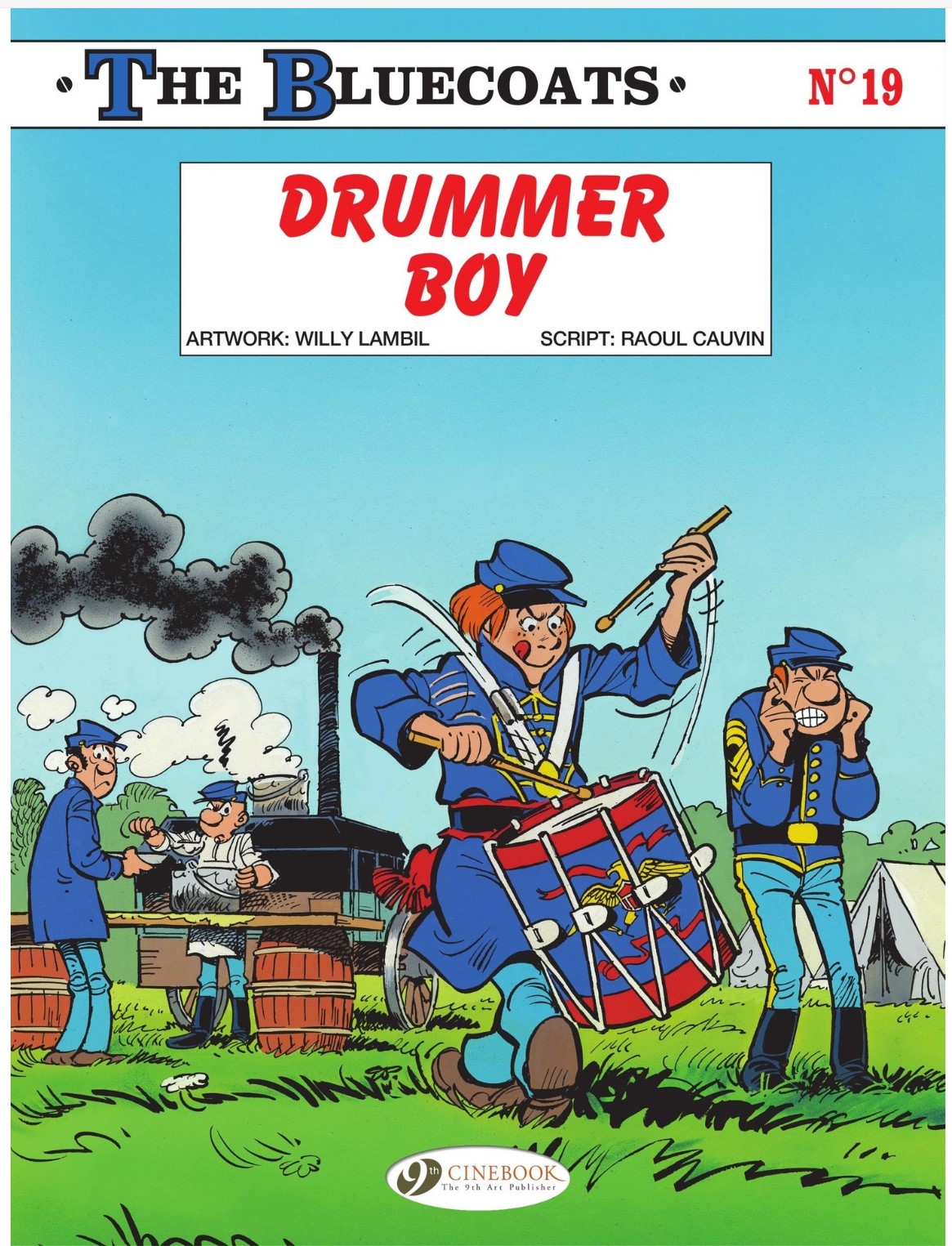
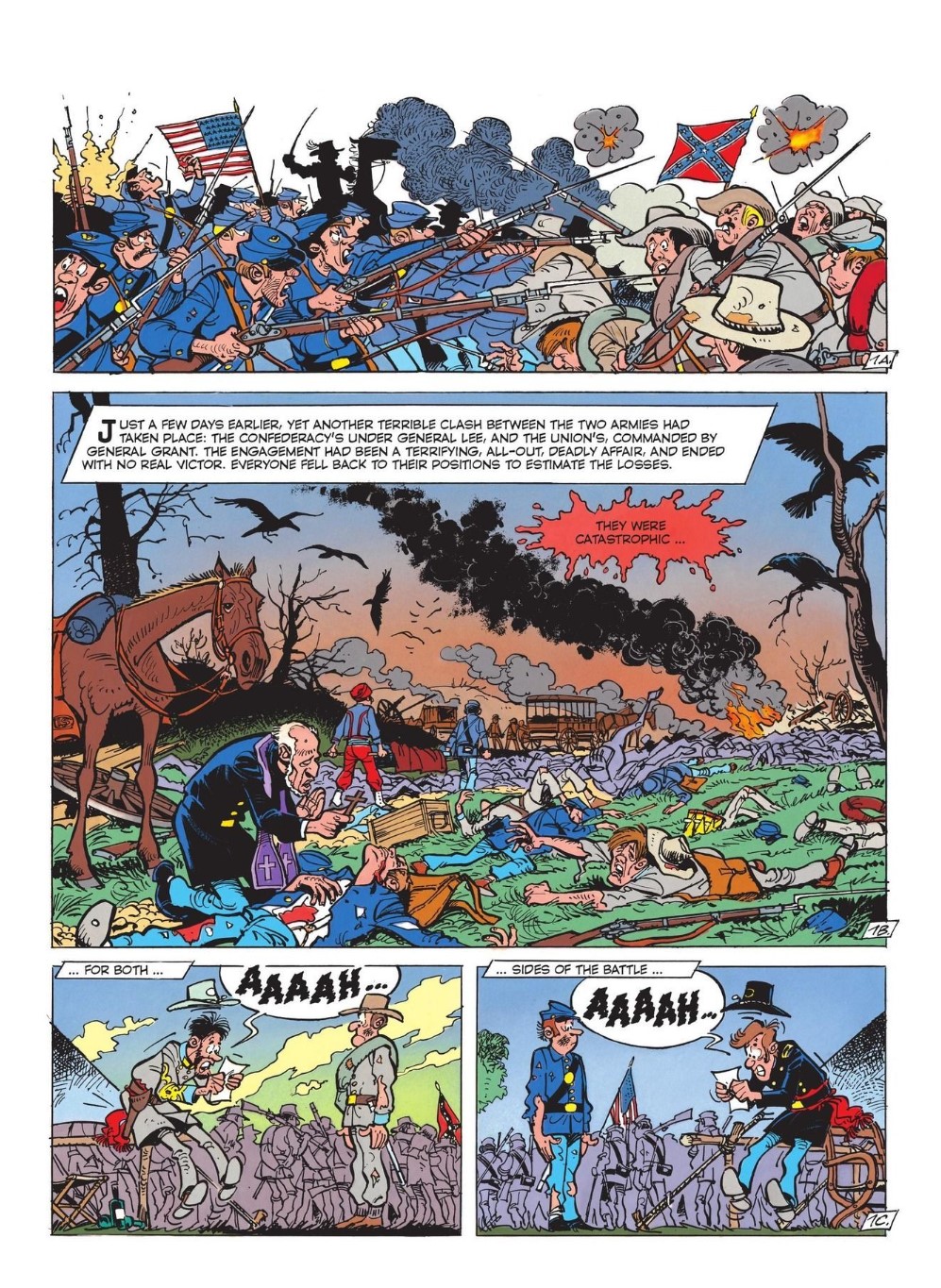
As previously mentioned, Europe especially embraced the medium and expanded the boundaries of the genre. In Italy Tex (Willer) remains as vital as ever, far outdistancing later revered and much-exported series such as Captain Miki, Il Grande Blek, Zagor, Larry Yuma, Ken Parker, Magico Vento and Djustine. The Franco-Belgian wing also has a long tradition of variety with true immortals amongst its ponderosa Pantheon: from all ages-comedic treats such as Yakari, OumPah-Pah, Chick Bill or The Bluecoats to monolithic and monumental mature-reader sagas like Jerry Spring, Comanche, Sergeant Kirk, La Grande Saga Indienne, Buddy Longway or the legendary Blueberry

Topping them all in terms of sales and fame, however, is a certain laconic lone rider…

A precocious, westerns-addicted, art-mad kid, well off and educated by Jesuits, Maurice de Bevere was born on December 1st 1923 in Kortrijk, Belgium. A far from illustrious or noteworthy scholar – except in all the ways teachers despise – Maurice later sought artistic expression in his early working life via forays into film animation before settling into his true vocation. While working at the CBA (Compagnie Belge d’Actualitiés) animation studio, “Morris” met future comics superstars Franquin & Peyo, and worked for weekly magazine Le Moustique as a caricaturist. Morris quickly became one of la Bande des quatre – The Gang of Four – comprising Jijé, Will and old comrade Franquin: leading proponents of a loose, free-wheeling artistic style known as the “Marcinelle School” which dominated Le journal de Spirou in aesthetic contention with the “Ligne Claire” style favoured by Hergé, EP Jacobs and other artists in Le Journal de Tintin.

In 1948, said Gang (all but Will) visited America, befriending many US comics creators and sightseeing. Morris stayed for six years, meeting fellow traveller René Goscinny, scoring some work from newly-formed EC sensation Mad and making copious notes and countless sketches of the swiftly vanishing Old West. That research would resonate on every page of his life’s work.

Working solo, albeit with occasional script assistance from his brother Louis De Bevere until 1955, Morris produced nine albums of affectionate sagebrush parody and comedic cinematic homage before formally uniting with Goscinny, who became the regular wordsmith as Luke attained the dizzying heights of superstardom, commencing with Des rails sur la Prairie which began in weekly LJd S from August 25th 1955. The collected album was first released for Christmas in 1957, the ninth in the series, and was followed by Morris’ final solo tale Alerte aux Pieds Bleus/The Bluefeet are Coming! in 1958.

Doughty, rangy, and dashingly dependable Lucky Luke is the likable, imperturbable, implacably even-tempered cowboy do-gooder who can “draw faster than his own shadow”. He amiably ambles around a mythic, cinematically informed Old West, having light-hearted adventures on his petulant, stingingly sarcastic wonder-horse Jolly Jumper. Over nearly nine decades, his exploits in LJdS (and from 1967, in rival periodical Pilote) made the sharp shooter a legend of stories across all media and monument of merchandising.

His exploits have made him one of the bestselling comic characters in Europe (83 collected albums plus around a dozen spin-offs and specials – totalling over 300 million books in at least 33 languages), with all the spin-off toys, computer games, puzzles, animated cartoons, TV shows and live-action movies that come with that kind of popularity.

The rapid pace and seeming simplicity of these spoof tales means older stories can generally sit quite comfortably alongside newer material crafted for a more modern readership.

In 1962 Morris & Goscinny’s 15th collaboration was serialised in LJdS #1281 – 1302 before arriving as 24th European album collection Lucky Luke et La Caravane; The Wagon Train to us…

It’s one of their most traditional tales; playing joyously with tropes and memes of the genre and clearly having as much fun as future readers were going to, and begins in dusty Nothing Gulch as a bedraggled procession of “Prairie Schooners” limp into town. Expedition head Andrew Boston is arguing with unscrupulous guide Frank Malone who’s demanding even more money before completing his commission to bring the hopeful settlers to California. When heated words are replaced with gunplay, a dusty observer ends the fracas before blood is shed…

Boston has heard a lot about Lucky Luke and promptly starts a multi-pronged charm offensive to have the Sagebrush Stalwart take over guiding the party to the fabled Golden State. Our hero is flattered but not interested… until Boston wheels out his big guns and has the kids ask in their own unique ways. Despite being prepared to use children to emotionally twist the cowboy’s arm, the twenty or so wagon-loads of pioneers are an affable if odd bunch from all over the world, and soon Luke is leading them across prairies and through deserts and mountains.

However, as days pass an extraordinarily large number of accidents and mishaps occur, and before long it cannot be denied that somebody is clearly attempting to sabotage the expedition…

With close calls and near-death escapes mounting, Lucky splits his attention between blazing a trail and playing detective but the suspect pool is just too large. Anybody from the undertaker in his hearse to the inventor in his constantly evolving horseless converter-car (there’s more than a passing similarity to TV’s Whacky Races here!); the suspiciously French Barber/Surgeon, creatively foul-mouthed mule driver or even the no-nonsense School Marm could be the culprit. But then again, there are so many others who act out of the ordinary…

Nevertheless, the voyage proceeds and as the would-be homesteaders survive the temptations of bad towns and other dens of vice and iniquity, bad food, and inclement weather a sense of community builds. Sadly, that’s soon tested to the limit when word comes that Sioux Chief Rabid Dog is on the warpath…

Despite all these traditional trials and tribulations Luke persists, and before long the Promised Land is reached and a vile villain finally exposed.

Cleverly barbed, wickedly ironic and joyously packed with classic cowboy set-pieces, this splendidly slapstick spoof of a crucial strand of the genre is another grand old hoot superbly executed by master storytellers for any kids who might have missed the romantic allure of an all-pervasive Wild West that never was…

And in case you’re worried, even though the interior art still has our hero chawin’ on that ol’ nicotine stick, trust me, there’s very little chance of anyone craving a quick snout, but quite a strong probability that they’ll be addicted to Lucky Luke Albums…
© Dargaud Editeur Paris 1971 by Goscinny & Morris. © Lucky Comics. English translation © 2007 Cinebook.

Today in 1930: French comics pioneer Jean-Claude Forest – creator of Barbarella – was born.

Today in 1954 the premier issue of Tiger went on sale. After 1555 issues and seven decades, its top star remains Roy of the Rovers (see The Bumper Book of Roy of the Rovers ).

Blondie: The Bumstead Family History/Blondie: The Complete Bumstead Family History


By Dean Young, and Melina Ryzik (Thomas Nelson/Rutledge Hill Press, U.S.)
ISBN: 978-1-4016-0322-9 (HB/Digital edition)

This book includes Discriminatory Content produced in less enlightened times

Normally I leave newspaper strip reviews for a weekend, but this is one birthday we just can’t miss. Please remember, just because you don’t read something don’t mean it ain’t popular…

Like Dagwood’s legendary sarnies, Bumstead family functions go on forever. Yesterday we learned how Chic Young’s strip Blondie began on September 8th 1930 and just kept going. The feature was inherited and carried on in 1973 by his family, chiefly son Dean with a select group of collaborators. Dean considers himself the guardian of a legacy as much as continuer of a phenomenon. In 2007, after the 75th anniversary, commemorative curated celebration Blondie: the Bumstead Family History was released to mark the occasion, and with the feature still going strong this remastered (even enjoying fancy-schmancy External hyperlinks, no less!) “Complete” edition invites a look at what he’s done to keep things fresh as much as safeguard generations of readers’ fond memories.

Combining short lavishly illustrated articles with a wealth of published strips – each attached to general topics – the raucous revery begins with ‘Chapter One: The Bumstead Family Album’, incorporating historical overviews and the traced evolutions of ‘Blondie’ and eternal, often inanimate inamorata ‘Dagwood’; firstborn son/current teen icon ‘Alexander’ (who first appeared on April 15th 1934) and his sister ‘Cookie’ who Dagwood feels is far too popular with boys). Faithful, longsuffering house mutt ‘Daisy’ gets her own section, as does abusive Boss/archnemesis ‘Mr. Dithers’, next-door-neighbours ‘The Woodleys’ (AKA Herb & Tootsie), long-suffering mailman ‘Mr. Beasley’ and cheeky, always underfoot kid/voice of a fresh generation ‘Elmo Tuttle’

The early days of the unshakable relationship are scrutinised in ‘Chapter Two: Getting Married’, tracing love’s rocky road through turbulent fast-changing times and a hugely successful publicity gimmick of young Dagwood going on extended hunger strike to force his adamant parents to allow him to wed! A massive publicity coup, the convoluted month-long storyline led to rowdy nuptials in February 1933 and is swiftly and sensibly followed by chapters on ‘Family Life’, as the couple become a nuclear unit, demographic and breadwinning paean to domesticity as ‘Dagwood at Work’ reveals what a decent man endures to bring home the bacon – and pickles and bratwurst and olives and pastrami and turkey and chicken, and salmon and lettuce and pumpernickel and lox and…

Courting middle American controversy, not to say media attention and a little homemaker wrath, ‘Blondie Goes to Work’ saw the tireless and capable stay-at-home mom and neighbour Tootsie ultimately turn those life skills into joyously fulfilling independence by starting their own catering business. This was only in 1991 and this pic-packed chapter also deals with the ridiculous amounts of outrage the world-shaking leap into the 20th century seemed to trigger in the heartland. Naturally, Dagwood was completely supportive: who else could test the new dishes and delights the girls kept inventing…

‘Chapter Six: Favourite Strips’ reviews some of the countless gags to have riffed on the series’ core themes – eating, sleeping, making and living and eating – whilst focussing on Dean Young’s constant efforts to keep the strips relevant and contemporary whilst the major industry event that evolved out of ‘The 75th Anniversary’ is described in detail. To celebrate the milestone in 2005, Dean and King Features organised a massive crossover that included VIPs like President Bush and other real-world notables as well as most of the nation’s major strips and creators wishing the happy couple all the best.

If you read Beetle Baily, Hagar the Horrible, Garfield, Rose is Rose, Wizard of Id, Dick Tracy, B.C., Mother Goose & Grimm, Family Circus, Shoe, Hi & Lois, Gasoline Alley, Sally Forth, Snuffy Smith, Buckles, Baby Blues, Zits, Mutts, Curtis, Marvin, For Better or Worse, Born Loser, Dennis the Menace (theirs not ours), Cathy, Thick Thin or Bizarro you were invited and there on the day. Disney alumni and single panel editorial cartoonists got in on it and for one moment all of America enjoyed a taste of Dagwood. Most of those strips are here as well as plenty from the months-long build up and aftermath in the actual Blondie feature.

This super memoriam concludes with a look beyond the panels as ‘Forever Young’ explores the life and achievements of Murat Bernard Young, his wife and model/inspiration Athel Lindorff née Young, Dean and sister Jeanne and the many notables who pitched in and/or assisted on Blondie’s production: Alex and Jim Raymond, Stan Drake, Mike Gersher, Ray McGill, Denis LeBrun, and John Marhall & Frank Cummings

Also included in this inescapably family function are original art and sketches, dozens of candid family portraits and photos, commentary and so, so many cartoons to wallow in. If you want a simple satisfying Good Read, this is for you your kids and your grannie, but don’t forget to bring the sandwiches… and not small ones neither…
© King Features Syndicate, Inc. 2007.

Today in 1958, Jack Kirby’s Sky Masters of the Space Force newspaper strip launched.

Star Trek: Gold Key Archives volume 1


By Dick Wood, Nevio Zaccara, Alfredo Giolitti & various (IDW)
ISBN: 978-1-61377-922-4 (HB/Digital edition)

This book includes Discriminatory Content produced in less enlightened times.

Star Trek debuted on American televisions on September 8th 1966 and ran until June 3rd 1969: three seasons comprising 79 episodes. A moderate success, it only really became popular after going into syndication, running constantly throughout the 1970s. It was also sold all over the world, popping up seemingly everywhere and developing quite a devoted fanbase.

Being a third world country, Britain didn’t see the show until July 12th 1969 during the rocket fever surrounding the Apollo moon landings, when BBC One screened “Where No Man Has Gone Before” in black-&-white before proceeding to broadcast the rest of the series in the wrong order. “Arena” was the first episode screened in colour (November 15th 1969), but viewers didn’t care. We were all hooked anyway and many of the show’s catchphrases – many erroneous and some entirely fictitious – quickly entered the popular lexicon of the nation.

The series spawned a licensed, British-originated comic strip which ran in Joe 90, TV21 and TV21 and Valiant from the late 1960s into the 1970s. These have also been collected and I’ll get to them in the fullness of time and space.

In the USA, although there was some merchandising, things were a little less enthusiastically embraced. Even though there was a comic book – from “properties magnate” Gold Key and running for almost a decade after the show’s cancellation – authenticity at the start wasn’t really a watchword. Nor was immediacy or urgency an issue. In fact, only six issues were released during the show’s entire three-season run. Published between July 1967 and December 1968, they are all gathered in this first archive Star Trek

Printing giant Whitman Publishing had been producing their own books and comics for decades through their Dell and Gold Key imprints, rivalling and often surpassing DC and Timely/Marvel at the height of their powers in sales and popularity. Famously Whitman never capitulated to the wave of anti-comics hysteria resulting in the crippling self-censorship of the 1950s and Dell Comics never displayed a Comics Code Authority symbol on their covers.

They never needed to: their canny blend of media and entertainment licensed titles were always produced with a family market in mind and the creative staff took their editorial stance from the mores of the filmic Hayes Code and the burgeoning television industry.

Just like the big and little screen, the product enticed but never shocked and kept contentious social issues implicit instead of tacit. It was a case of “violence and murder are fine, but never titillate”…

Moreover, the vast majority of their adventure comics’ covers were high quality photos or paintings – adding a stunning degree of veracity and verisimilitude to even the most outlandish of concepts for us wide-eyed waifs in need of awesome entertainment. The company seemed the only logical choice for a licensed comic book, and to be honest, these stories are cracking space opera yarns, even if they occupy an odd position in the hearts of older screen-dominant fans. In the UK, distribution of US comics was haphazard at best, but Gold Key Trek yarns were reprinted in our beloved and trusted hardback Christmas annuals. Nevertheless, the earliest ones bore little resemblance to what we’d seen on TV.

Our little minds were perplexed and we did wonder, but as the tales offered plenty of action and big sci fi concepts we just enjoyed them anyway.

Original British Star Trek yarns came in serialised comic-strip form, superbly illustrated and bearing a close resemblance to the source material. The feature only appeared as 2 or 3-page instalments in weekly anthologies, but was at least instantly familiar to TV viewers.

I discovered the answer to the jarring discrepancy, years later. Apparently scripter Dick Wood (a veteran writer who had worked on hundreds of series from Batman and the original Daredevil to Crime Does Not Pay and Doctor Solar, Man of the Atom) had not seen the show when commissioned to write the comic book iteration, and both he and Italian artists Nevio Zaccara – and latterly Alberto Giolitti – received only the briefest of outlines and scant reference materials from the show’s producers. They were working almost in the dark…

When you read these stories, you’ll see some strange sights and apparent contradictions to Trek canon lore, but they were all derived from sensible assumptions by creators doing the very best with what meagre information they had. If you’re likely to have your nostalgic fun spoiled by wrong-coloured shirts or Lasers rather than Phasers, think alternate universe or read something else. Ultimately, you are the only one missing out…

That’s enough unnecessary apologising. These splendidly conceived all-ages tales don’t deserve or need it, and even the TV wellspring was a constantly developing work-in-progress, as fan and occasional Trek scripter Tony Isabella reveals in his Introduction ‘These Are the Voyages…’

Accompanied by the stunning photo-collage covers and endpapers (an expensive rarity at the time outside Gold Key titles) the quirky collation of cosmic questing commences with ‘The Planet of No Return’ (by Wood & Zaccaria, from #1, July 1967) as the Enterprise enters a region of space oddly devoid of life and encounters predatory spores from a planet designated Kelly-Green. This is a world of horror where vegetative life contaminates and transforms flesh whilst mindlessly seeking to constantly consume and conquer. After the survivors of the landing party escape deadly doom and return to the safety of space, there is only one course of action Captain Kirk can take…

‘The Devil’s Isle of Space’ was released with a March 1968 cover-date and found the ever-advancing Enterprise trapped in a space-wide electronic net. The technology was part of a system used by an alien race to pen death-row criminals on asteroids, where they would be (eventually) executed in a truly barbarous manner. Sadly, it’s hard not to interfere in a sovereign culture’s private affairs when the doomed criminals hold Federation citizens hostage and want Kirk to hand his ship over to them…

Bombastic. beguiling and spectacular, ‘Invasion of the City Builders’ (#3, December 1968) saw legendary Alberto Giolitti take the artistic reigns. Prolific, gifted and truly international, his work and the studio he founded produced a wealth of material for three continents; everything from Le Avventure di Italo Nurago, Tarzan, The Phantom, Mandrake, Flash Gordon, Zorro, Cisco Kid, Turok, Gunsmoke, King Kong, Cinque anni dopo, Tex Willer and dozens more. In England, the Giolitti effect enhanced many magazines and age ranges; everything from Flame of the Forest in Lion to Enchanted Isle in Tammy. His textural adeptness and gritty line-work added visual terseness and tension to the mix, as seen in his first outing here, as Enterprise crewmembers land on a planet where automated machines originally programmed to build new homes and roads have been out of control for a century. Forcing the organic population to the edge of extinction, the mechs build cities no one can live in over the soil they need to grow food. The machines seem utterly indestructible, but Mr. Spock has an idea…

Social commentary gave way to action and suspense when ‘The Peril of Planet Quick Change’ (June 1969) finds the explorers investigating a world of chimerical geological instability, only to see Spock possessed by beings made of light. These creatures use him to finally stabilise their unruly world, but once the crisis is averted, one of the luminous spirits refuses to exit the Vulcan and plans to make the body its own…

‘The Ghost Planet’ (September 1969) was fast approaching parity with the TV incarnation as Enterprise reaches a world ravaged by radiation rings. Its twin rulers are eager for the star men’s help in removing the rings, but don’t want them hanging around to help rebuild the devastated civilisation. A little quiet investigation reveals that most of the carnage is due to eternal warfare which the devious despots plan to resume as soon as the Federation ship destroys the radiation rings and leaves…

Wrapping up this initial TV treasure-trove is ‘When Planets Collide’ (December 1969): a classic conundrum involving two runaway worlds inexorably drawn to each other and mutual destruction. What might have been a simple observable astronomical event becomes fraught with peril when the Enterprise’s crew discover civilisations within each world: both of which would rather die than evacuate their ancient homes…

With time running out and lives at stake there’s only one incredible chance to save both worlds, but it will take all Spock’s brains and Kirk’s piloting skill to avert cosmic catastrophe…

Bold, expansive and epic, these are great stories to delight young and old alike and well worth making time and space for. Why not explore lost worlds and sagas of guaranteed merit via the comics wayback machine? You know the one: it’s the comic shop located on the Edge of Forever?

® and © 2014 CBS Studios, Inc. Star Trek and related marks are trademarks of CBS Studios, Inc. All Rights Reserved.

Today Finnish cartoonist Lars Jansson was born today in 1926. You can see his work in Moomin Volume 9.

Today in 1937, Archie Goodwin was born: a gentle genius and still the Nicest Man in Comics, of whom you can learn more and appreciate his subtle mastery by checking Tales of the Batman: Archie Goodwin.

Blondie and Dagwood’s America or Blondie and Dagwood


By Dean Young & Rick Marschall (Harper & Row/Arthur Barker Limited)
ISBN: 978-0-21316-830-8 (Arthur Barker UK TPB) 978-0-06090-908-6 (Harper & Row US)

This book includes Discriminatory Content produced in less enlightened times.

Tomorrow marks the anniversary of one of the most popular comic strips of all time …and probably one you thought had long ended, if indeed you thought of it at all.

For decades Blondie was the most popular – for which read most commercially successful – newspaper strip in the world. Way back in 2005, the former Blondie Boopadoop and her hapless husband Dagwood Bumstead celebrated 75 years of publication are still going strong today, both in print and online.

For such a remarkable comics mainstay, there are precious few celebratory collections and commemorations, so we went even way-er back (to 1981) to focus on this fabulously inclusive authoritative anniversary compilation. Here, I’m starting early in my campaign to commemorate their 95th anniversary – that’s tomorrow, right? – by agitating for its revision and re-release.

The Blondie strip was created by Murat Bernard “Chic” Young and promoted/distributed by King Features Syndicate. It launched on September 8th 1930, as the result of a startling game of one-upmanship between feisty cartoonist Young and King’s general manager Joe Connolly. Already a roaring success and up-&-comer due to his “Flapper” strip Beautiful Bab, Young had followed up with even bigger smash hit Dumb Dora in 1924.

He was on a fast track to stardom when the stock market crash wiped out his savings in 1929. Broke and with a new bride, he wanted a new contract for a new feature that he owned and controlled. Understandably, Management had other ideas…

However, when the artist packed up and took ship for Paris, Connelly caved and Blondie was born. She was an instant print sensation, and soon spawned 28 movies starring Penny Singleton & Arthur Lake between 1938 and 1950. They also voiced a popular radio show version (1939 – 1950) and three TV series… in 1954, 1958 and 1968-69. The Bumstead couple’s comic book adventures – reprint and new stuff – have come courtesy of a variety of publishers including Ace, Big Little Books, Harvey, King & Charlton Comics, running in place from 1936 to 1976. There was all the other usual merchandising stuff too…

In the earliest days tension was high and gag ideas limitless as rich but socially inept Dagwood Bumstead’s wealthy family tried to stop their idiot scion from marrying a low, common blonde, but in 1933, with the voracious lovestruck swain disinherited but happy, the lovers finally wed and the true magic of this everyday domestic comedy began.

Chic Young drew Blondie until his death in 1973, when his son Dean took over. The inheritor worked with many artists on the strip, including Alex Raymond and his brother Jim, Mike Gersher, Stan Drake, Denis Lebrun and John Marshall. Through it all, Blondie remained uncannily popular, appearing in more than 2,300 newspapers across 55 countries and translated into 35 languages: an audience of 290 million. In 1948 Chic Young won the Reuben Award for the strip and in 1995 the feature was honoured as one of 20 selected as part of the Comic Strip Classics series of commemorative US Postage Stamps.

This still-available UK paperback edition reprints hundreds of the best strips, backed up by wonderfully chatty, informative text-pieces from the junior Young and historian Rick Marschall: offering an enchanting treat for all the family. I don’t know how easy this book is to find and of course other collections are available (most notably 2007’s Blondie: the Complete Family History, published by Thomas Nelson- ISBN-13: 978-1-40160-322-9) but I’ve never found one that featured as broad a spread of strips from this comic landmark’s incredibly long history. Good hunting, and don’t forget to bring a sandwich… and not a small one neither…

The book was initially published in the US as Blondie & Dagwood’s America, which is also still easy to get if you want…
© 1981 King Features Syndicate Inc. World Rights Reserved.

Forever Nuts: The Early Years of Mutt & Jeff (Classic Screwball Strips)


By Bud Fisher, edited by Jeffrey Lindenblatt (NBM)
ISBN 13: 978-1-56163-502-3 (HB)

This book includes Discriminatory Content produced in less enlightened times.

Today in 1954, Bud Fisher died. His landmark strip shaped the way cartoon humour worked for decades. Eerily, on the same day in 1955, Joe Palooka creator Ham Fisher (no relation), also died. There are even fewer collections of his work in print but one day we’ll get to what there is…

Here’s another wonderful historical treat that’s tragically lost to public gaze, once a welcome addition to a growing pool of classic strips that seemed to finally gain fan traction and be collected into accessible forms for posterity and enjoyment. Bud Fisher’s Mutt & Jeff is arguably the first comic strip to employ day to day carried-over continuity rather than individual escapades on a per diem basis.

Harry Conway “Bud” Fisher began the strip A. Mutt in 1907 as a topical topper added to the racing pages of the San Francisco Chronicle. The gimmick was to have his cartoon wastrel bet on the runners and riders of that day’s paper, with the results – good or bad – forming the bones of the next day’s strip.

When Fisher’s wittily funny side hustle took off – first at the more cosmopolitan San Francisco Examiner and then into national syndication – such a limited, local maguffin was impossible for a strip now seen all across the continent. Thus a vaudeville style comedy partner and more general topics were added to become the norm. The premise of two ordinary, average – if dumb – Joes remained the strip’s basis until it ultimately folded in 1983.

Although of undoubted historical value, the slapstick roots of these everyman characters meant that gags were its currency, and the sensibilities employed – and appealed to – were often harsh, sexist, and very often quite racist by today’s standards.

Or were they?

Undoubtedly the physical depiction of Negro, Mexican, British, French, Turkish and so many other non-W.A.S.P. Americans never deviated from the graphically stereotypical. Certainly young women were always sexy and older women were grim battle axes, whilst rich people were always fat. But I suspect that that more comedic social shorthand as wilful malice aforethought.

Certainly for every gag that portrayed stupid, slow or cowardly black people there was another when the stereotype outwitted the protagonist. For every dim blonde or dumb Hausfrau there was a female sharpie who made the boys into the goats. Could it be Fisher was just a child of his time, knew his audience and was just going for the laugh wherever it was with no thought of political or social relevance?

Perhaps Fisher or his innumerable and often anonymous ‘ghosts’ (among whom Ed Mack and latterly Al Smith were most prominent) weren’t as evolved as us?

Fisher was a notoriously “absentee” creator who regularly missed deadlines and had a string of substitutes to produce the strip for him once he became comics’ first millionaire. Occasionally he would even suspend the strip entirely. Yet the feature was never discarded by client newspapers who felt it mirrored their readerships. It was just that popular.

This volume assembles strips from 1909-1913 and is certainly not without flaws. Often the heroes are pretty unlikable when they aren’t being winningly daft or actually funny. There are moments of pure racism and sexism, but also uncharacteristic challenges to that woeful status quo of acceptable stereotypes.

One minor technical moan: there’s some unfortunate editing and some strips are repeated, and it’s not that some gags are so old you can’t tell them apart…

I know that last charge isn’t true. Despite the implications of the somewhat apologist introduction from historian Allen Holtz, Mutt & Jeff was a huge multimedia hit for nearly 80 years and they are still household names today. Moreover, read in context and on their own terms, they are still brilliantly hilarious slapstick gag strips. If you’re prepared to read with an open mind you might be pleasantly surprised.
No © invoked. Any helpful suggestions?

Approximate Continuum Comics


By Lewis Trondheim, edited & translated by Kim Thompson (Fantagraphics Books)
ISBN: 978-1-60699-410-8 (TPB)

With well over 100 books sporting his name (which isn’t actually Lewis Trondheim but Laurent Chabosy), the writer/artist/editor and educator is one of Europe’s most prolific comics creators: illustrating his own work and working with the industry’s top artists; overseeing animated cartoons of print successes like La Mouche (The Fly) and Kaput and Zösky and even editing younger readers book series Shampooing for Dargaud. His most famous works are the global hits Les Formidables Aventures de Lapinot (translated as The Spiffy Adventures of McConey) and, with Joann Sfar, the Donjon (Dungeon) series of nested fantasy epics (see the translated Dungeon: Parade, Dungeon: Monstres and Dungeon: the Early Years).

Tireless and prolific, he has written for everything from satirical magazine Psikopat to Le Journal de Spirou and Walt Disney. His scripts for the continent’s most popular artists include Le Roi Catastrophe and Vénézia with Fabrice Parme, Les Cosmonautes du futur (Manu Larcenet), Allez Raconte and Papa Raconte (José Parrondo), Politique étrangère (with Jochen Gerner and which Trondheim adapted into an opera in 2009) and Petit Pére Noël (Thierry Robin).

He is a cartoonist of uncanny wit, piercing, gentle perspicacity, comforting affability and self-deprecating empathy who prefers to control scrupulously what is known and said about him…

I first became aware of Lewis Trondheim’s subtly engaging comics mannerism in Fantagraphics’ Mome anthologies which reprinted excerpts of his utterly entrancing comics blog Little Nothings, wherein Trondheim’s friends and acquaintances, rendered and simultaneously masked as anthropomorphised animals (with him a dowdy, parrot-beaked central figure) revisit episodes of his life, flavoured with philosophy, personal introspection, whimsical inquiry and foible-filled observations.

These mini-treats were gathered into four terrific tomes of drawn diaries for constant re-reading (Little Nothings: Curse of the Umbrella, The Prisoner Syndrome, Uneasy Happiness and My Shadow in the Distance). You might still find the first three available as collected gift set Bigger Nothings

However, before all that, in 1993 Trondheim first explored the idea as a 4-issue American-styled comic book project and those prototypical slices of wry and winning reportage are finally available in a translated black and white softcover collection. Some of the very first autobiographical works on the French bande dessinée scene, these little gems were a genuine game-changer for cartoonists and storytellers, prompting a rise in personal stories that has generated many works to rival the best of Harvey Pekar himself and created a new (sub)genre of graphic narrative…

In this collected Approximate Continuum Comics the signature blend of visualised introspection and self-condemnatory flagellation finds the younger Trondheim questioning his own professional integrity; violently and graphically wish-fulfilling his way through rush-hour crowds (haven’t we all?); planning – for which read risk-assessing – his forthcoming marriage and dealing with his unfathomable Japanese publisher during the early days of creating his multi-media hit La Mouche.

He regularly gets lost in his own free-associating daydreams and rightly fears being castigated by his own conscience for swimming in megalomania, indecisiveness, forthrightness and deference. Trondheim’s many inner voices don’t like him very much: there are myriad incidences of self-abuse where his alternate egos beat the crap out of him; counterbalanced with gloriously loaded “real-world” episodes where he lampoons and embarrasses his fellow studio-mates of publishing collective L’Association. (To be fair these are fabulously balanced by a marvellous section at the book’s end where such maligned and injured creative colleagues as David B., Emile Bravo, Didier Tronchet, Jean-Christophe Menu, Killofer & Philippe Dupuy among others, as well as civilian friends, his wife Brigitte and even his mother all get a trenchant and routinely hilarious right-to-reply.)

The first inklings of the artist’s perennial problems with technology in general and computer games in particular appear here, as do many childhood memoirs and sundry diatribes against people and places either experienced or sometimes only imagined. One of the best sequences concerns the trip-of-a-lifetime to America (first of many, but he didn’t know that then…) and his apparent inability to think of one single strip idea about it, only surpassed by his behaviour at a raucous party held in his beloved studio.

During the course of these cartoon capers, Trondheim married his fiancée, sired his first child and moved into a new home, but although these major events are thoroughly and compellingly covered they still pale into insignificance against the spectacular battles against his inevitably spreading paunch, obsessively mean-spirited self-criticism and the thunderbolt-like occasional phone call from his mum. …And whenever that’s no longer painful enough there’s always the violent physical assaults and punishment-beatings from his inner selves…

Personal favourites of mine include Les petits riens, Tiny Tyrant, Ralph Azham, Mr. O, Archives of Lost Issues, Mister I, Infinity 8 and A.L.I.E.E.E.N. but if you fancy other kinds of fare, Trondheim’s probably covered whatever you fancy and done it with wit and aplomb…

Superbly skilled at switching imperceptibly from broad self-parody to cripplingly honest and  painful personal revelation; wild surrealism to powerful reportage and from clever humorous observation to howling existentialist inquisition, Trondheim’s cartoon interior catalogue is always a supremely rewarding and enjoyable experience and, as these ancient texts prove, always has been…
© 2001 Lewis Trondheim and Cornélius. This edition © 2011 Fantagraphics Books. All Rights Reserved.

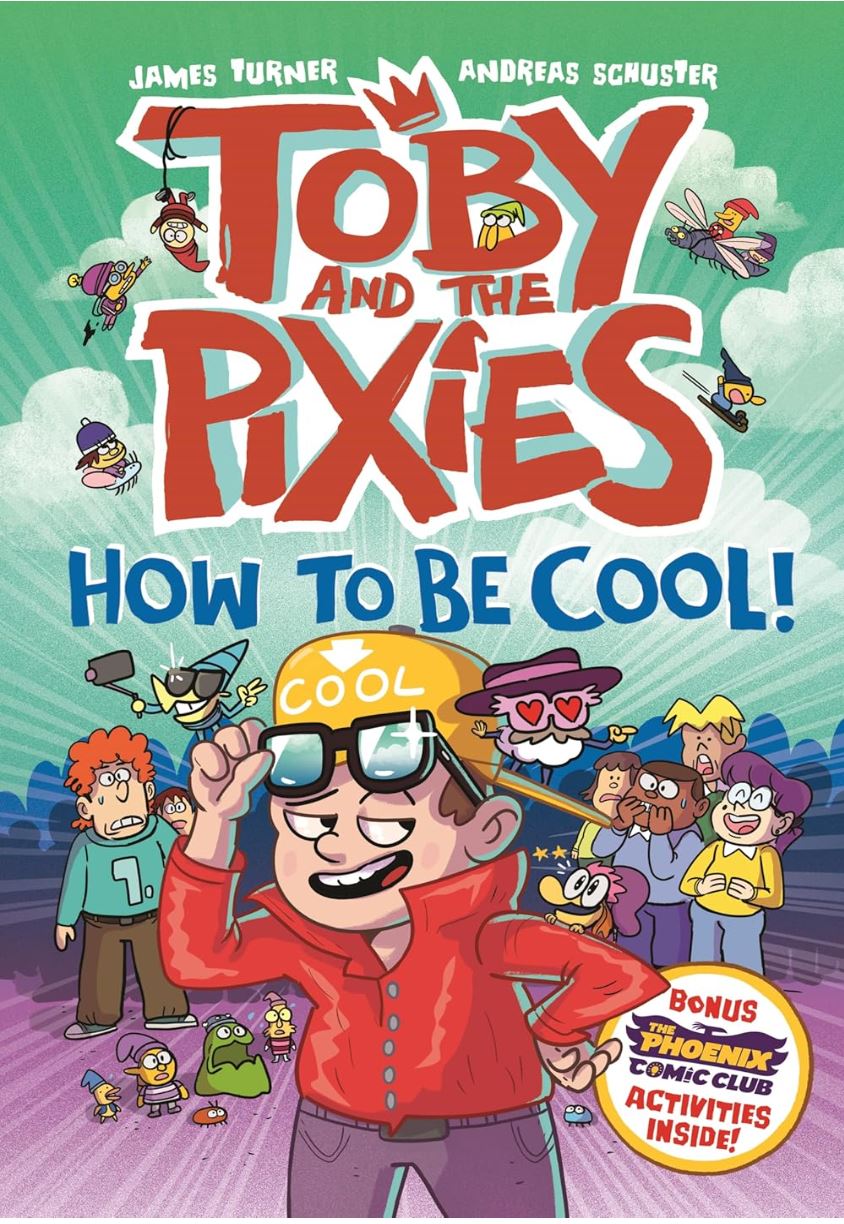
Toby and the Pixies: volume 3: Pixie Pandemonium!


By James Turner & Andreas Schuster (David Fickling Books)
ISBN: 978-1-78845-355-4 (TPB)

Way back in January 2012, Oxford-based David Fickling Books made a rather radical move by launching a traditional anthology comics weekly aimed at under-12s. It revelled in reviving the good old days of picture-story entertainment intent whilst embracing the full force of modernity in style and content.

To this day each issue features humour, adventure, quizzes, puzzles and educational material in a joyous parade of cartoon fun and fantasy. The Phoenix has successfully established itself as a potent source of children’s entertainment because, like Beano and Dandy, it is equally at home to boys and girls, and HAS mastered the magical trick of mixing amazingly action-packed adventure series with hilarious humour strip serials such as this one. Most of the strips have also become graphic collections; just like this one…

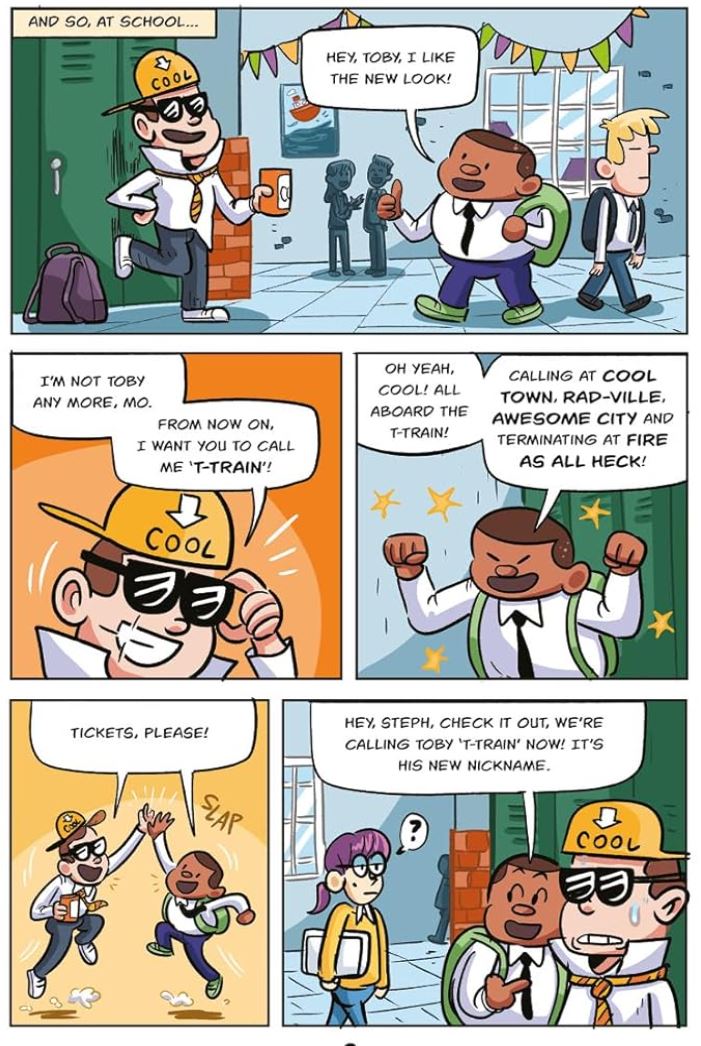
Crafted by the exceedingly clever James Turner (Star Cat, Super Animal Adventure Squad, Mameshiba, The Unfeasible Adventures of Beaver and Steve) and Canadian cartoonist/designer/animator Andreas Schuster (KLARA AND ANTON in PRIMAX Magazine), Toby and the Pixies began in January 2020 as I Hate Pixies and, once out of the compost bag of creative wonders, just wouldn’t stop. Those first forays were remastered and released as Toby and the Pixies: Worst King Ever! and follow-up fun folio Best Frenemies charting the course of a nerdy boy at a nice school – until it all goes wrong…

Unappreciated, anxious 12-year-old Toby Cauldwell was resigned to and content with his meagre, second-rate friends, dedicated personal bullies, negative charisma levels and functional classroom invisibility at Suburbiton High School, but began rapidly shedding his appallingly uncool reputation the day after his electric-toaster-obsessed Dad ordered him to sort out their unruly, out-of-control back garden…

That’s when Toby discovered that wild, jungle-like urban wilderness was – unbeknownst to any mortal – the camouflaging screen for a fabulous fey realm. The ethereal, moist and rather mucky enclave had endured unseen in the green shambles of the Cauldwell backyard for countless ages. Now – thanks to an inept and inadvertent act of emancipation triggered by Toby kicking an unfortunately placed plaster garden gnome – the status quo forever altered. A tool of fate, the reluctant lad was instantly elevated to the position of supreme overlord, by dint of accidently yet totally obliterating the sitting tyrant. It was only for a hidden kingdom of magical morons, but they were really happy to be shot of their previous mad, mean, magical master….

As interpreted by the former King’s advisors – Royal Druid Mouldwarp, wise(ish) Lore Keeper/Potion Master Gatherwool and Toadflax (she eats stuff) – deliberate or otherwise, despatching King Thornpickle made Toby new absolute monarch. Pixie law also stated said ruler could do anything they wanted… a prospect so laden with responsibility that it made Toby weep with terror…

Just coming to terms with MAGIC actually existing, and that the ever-present freaky, anarchic imps can do it whilst still being absolute idiots and morons was awful enough, without also still having to survive school’s normal horrors. Thankfully, as the little odds and sods increasingly impinged and impacted on Toby’s life, education and prospects, they also turned school upside on a daily basis, and Toby’s fellow outcast Mo soon discovered the shocking secret of their existence. And he thought it was BRILLIANT!

In the short term, it actually made things worse but now, apart from constant teasing and perpetual whining pleas to visit the magic kingdom, there is a fellow human King Toby can moan at. Two actually, as snarky bully Steph also soon discovered the secret and has since proved to not be quite as awful as she might be…

That’s good because knowledge is a dangerous, trouble-causing thing, particularly as the Pixies are now everywhere and Toby’s succession triggered many problems: especially when magic-slime wielding Princess Sugarsnap – daughter of Thornpickle and rightful heir to a job Toby really, really doesn’t want – started a war to take back the throne Toby absolutely doesn’t want…

This third fondly foetid foofaraw opens with a chance to get reacquainted with key regulars Toby, Mo, Steph, Toadflax, Gatherwool & Mouldwarp in a comprehensive double page intro. Then it’s back to school and off the deep end (or is it?) in ‘Chapter 1: Off Sick’ as Toby is confined to bed with a cold. Typically, his loyal subjects think magic is the answer, but they couldn’t be more wrong… or destructive…

‘Chapter 2: On Holiday’ finds Mr. Cauldwell attending a seaside toaster convention and “thoughtfully” leaving his son and Mo on the beach all day. The King thought he was going to have a pixie-free rest but his Royal Champion (that’s Mo. Keep up!) has kindly brought the Advisors along. They’ve never seen the sea before but think there must be sea pixies they can declare war on if they find them. That ends in frustration but they do discover the narcotic rush power of limitless sugar as delivered by candyfloss…

A systemic examination of each Advisor begins with ‘Chapter 3: Toadflax Day’ as the luckless little omnivore tries to celebrate her birthday in peace and with a minimum of injury, but still falls victim to cruel prankish fate, after which ‘Chapter 4: The Dentist’ finds Toby trapped in the dreaded gob-surgery with his extremely curious courtiers aware of his anxiety but not sure how magic can help. It doesn’t stop them trying though, with terrifying results…

‘Chapter 5: Mouldwarp’s Day’ unearths the pocket Druid’s secret desire to be a mighty – and adored – hero of the Realm, but his dreams are crushed in Gatherwool’s agenda to celebrate King Toby’s 100th visit to the Kingdom and gift the human with the nation’s most dangerous and deadly arcane artefacts. What could possibly go wrong?

Of course, it’s not just royal duties that stress Toby out. Ordinary school interactions are also a nightmare, which is why, after saying something really stupid he truly wished he hadn’t, the junior Cauldwell accepts the use of a pixie enchantment to erase that embarrassing moment. ‘Chapter 6: Time Cape’ only serves to remind him that no matter how bad a situation seems, it can always be amplified to near-cosmic armageddon by a little mucky mud magic…

In ‘Chapter 7: Bixenjammer’ Toby, despite all his past experiences, allows the Advisors to distract him from his homework with tales of the pixies’ ultimate nemesis. Happily his subsequent search for it turns up nothing, after which ‘Chapter 8: Talking to Vegetables’ sees the King foolishly accept the power to communicate with beasts only to find Gatherwool has confused the Fruit of Animal Communication with the equivalent Vegetable version. Barracked and besieged by the contents of fridge and fruit bowl, it takes mere moments to spark a retaliatory war with outraged groceries and only sheer luck saves Toby and the rest of meat world…

‘Chapter 9: Gatherwool’s Day’ reveals the depths of the Lore Keeping Potion Master’s devotion as he undertakes enlarging his beloved monarch to colossal proportions, despite every effort of everyone else to convince him he should check or at least ask first, before Romance fills the air in ‘Chapter 10: Crushed’ after Toby becomes besotted by French foreign exchange student Josephine. The milestone occurs just as the pixies are undertaking similar outreach by inviting demonic Boggart exchange student Grax’norx’ng’kk to observe their way of life. Everyone loves Love and is eager to help, but Toby – and Toadflax – really should have refused all offers to help…

‘Chapter 11: Logically Speaking’ finds Mo and his liege lord asked to advise on a trade logistics problem involving transport of grain, chickens and foxes – with predictably disastrous results – and then joining the school newspaper staff. When the pixies are introduced to the concept of journalism, ‘Chapter 12: No News’ proves their version, utilising a Magic Parchment of Truth to alter reality to match what’s been written, is far more tempting and satisfactory. Thankfully, Steph keeps her wits as Toby succumbs to his unleashed dark side and the status quo is restored before the universe ends…

Somehow, unconfident Toby lands a major part in a school theatrical production, and foolishly accepts aid from Gatherwool to calm his stage fright in ‘Chapter 13: Play Time’. Of course the resultant chaos only adds to the performance but ‘Chapter 14: It’s Snow Joke’ has far more serious repercussions after the Advisors animate the snowmen built by gleeful innocent kids – and Toby & Mo. Apparently, even happy chilly manmade ice folk can dream of world conquest…

The story portion pauses on an early seasonal saga as the pixies share their own Christmas traditions in ‘Chapter 15: A Blimpmas Carol’ whilst test-traumatised Toby humbugs all and sundry in his nervous flurry of revision. When Mo introduces the Advisors to a certain classic book, the stage is set for some life- and attitude-changing ghost action and time travel, but these are the pixies in the pilot seat and you know it won’t go as planned…

Wrapping up the fungal fun and mucky madness is a bunch of pages of related activities: a swathe of features offered under the aegis of the Phoenix Comics Club. Bring paper, pencils and you to a compact online course in all aspects of comic strip creation supervised by Andreas Schuster who helms an activity section that includes ‘Let’s Draw a Pixie!’, ‘A Square Pixie!’ ‘A Circle Pixie!’ ‘An Oval Pixie!’ ‘Expressions!’ ‘Noses!’ ‘Glasses!’ ‘Hair!’ Ideas for Hats!’ ‘Yoghurt Pots!’ ‘A Broken Cup!’ ‘Foam Darts!’ ‘Leaves!’ ‘Pinecones!’ ‘Raccoons!’ ‘Snow Pixies!’ ‘Desert Pixies!’ and ‘Jungle Pixies!’ which ends on an extensive plug for the Phoenix Comics Club website complete with instant access via a QR code.

Toby and the Pixies is a joyous concatenation of nonsense no lover of laughs and lunacy should deprive themselves of and a feast of yuckky yoks all kids will gleefully consume. What are we all waiting for?
Text and illustrations © The Phoenix Comic 2025. All rights reserved.

Toby and the Pixies: volume 3: Pixie Pandemonium! is published on 11th September 2025 and available for preorder now.