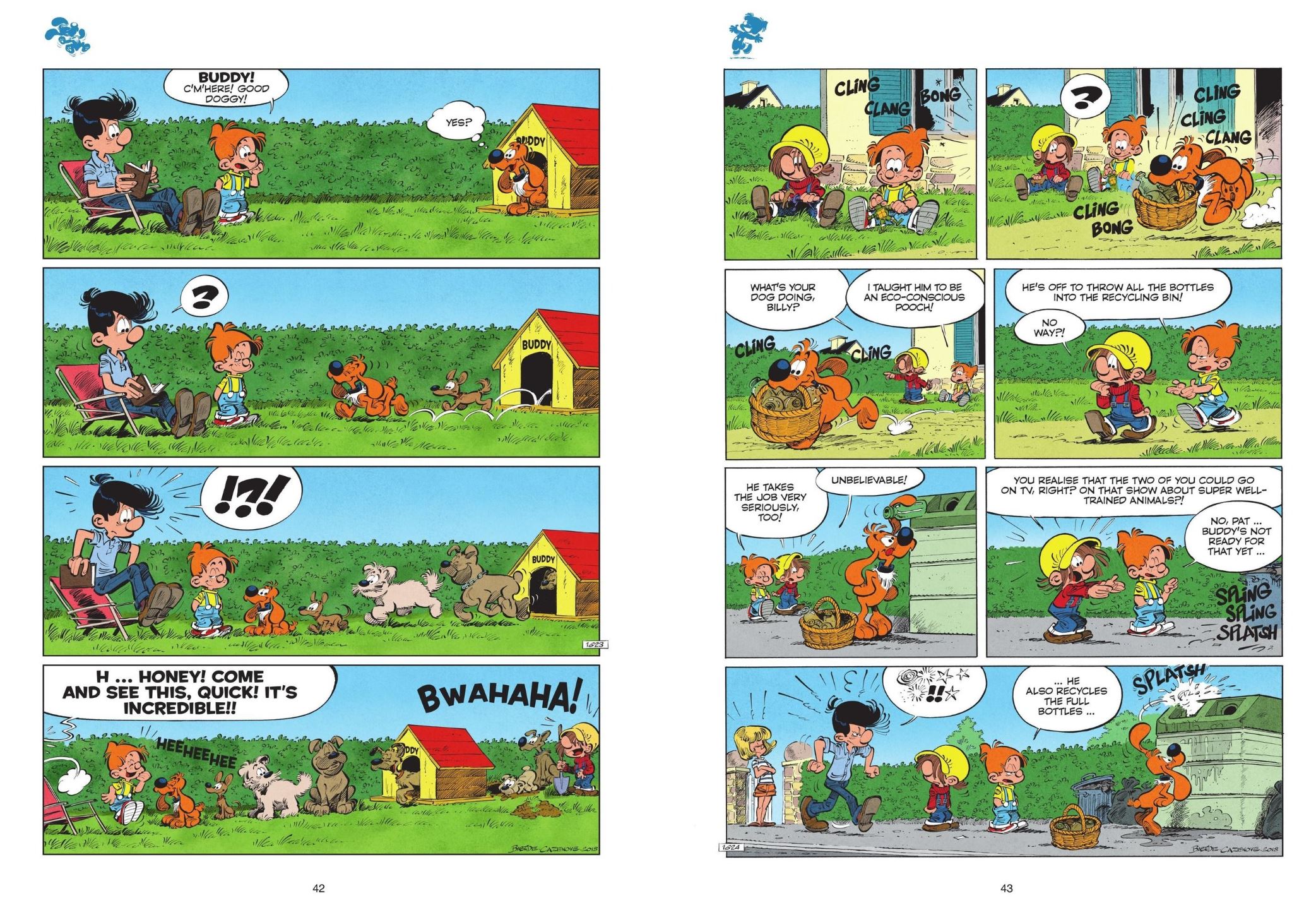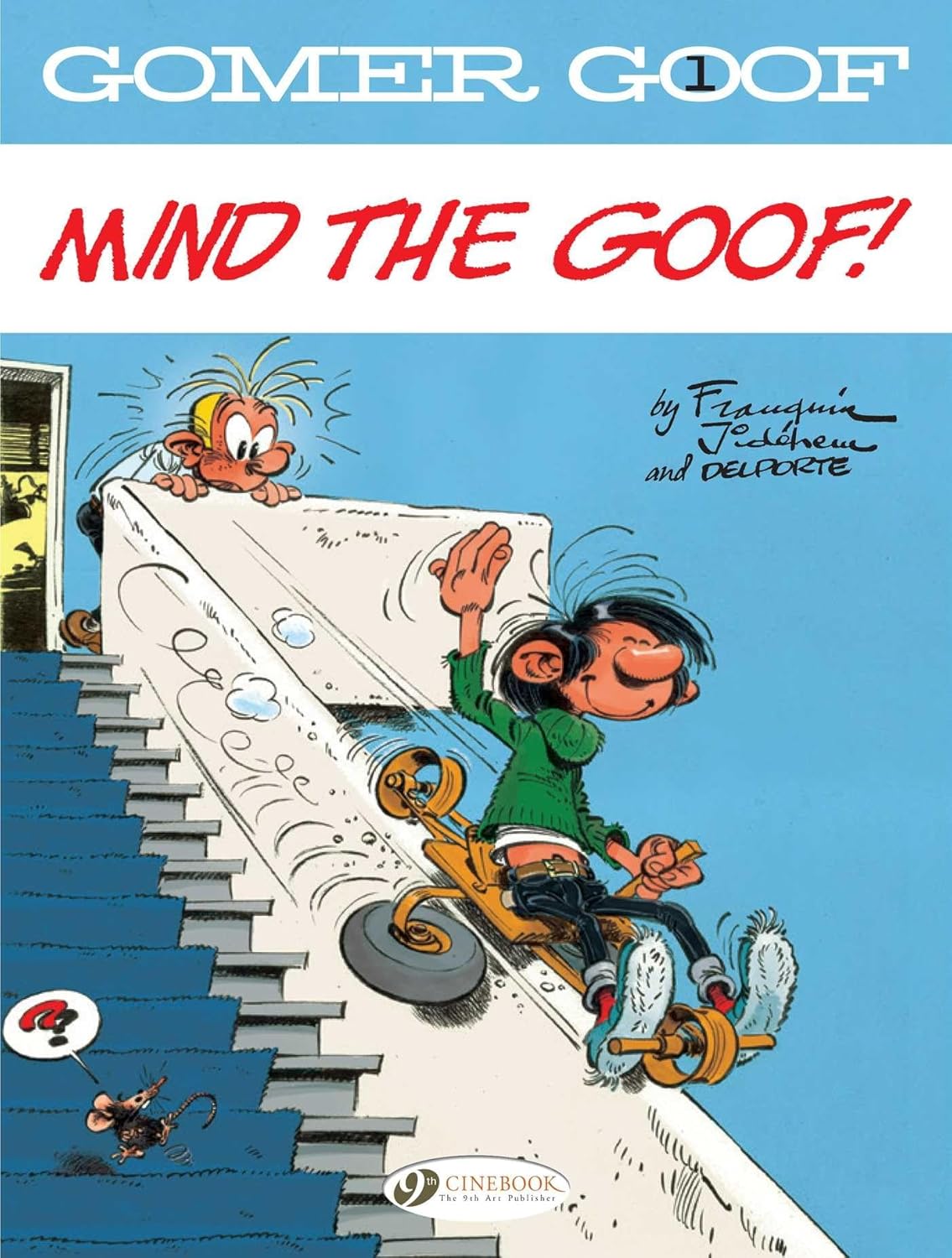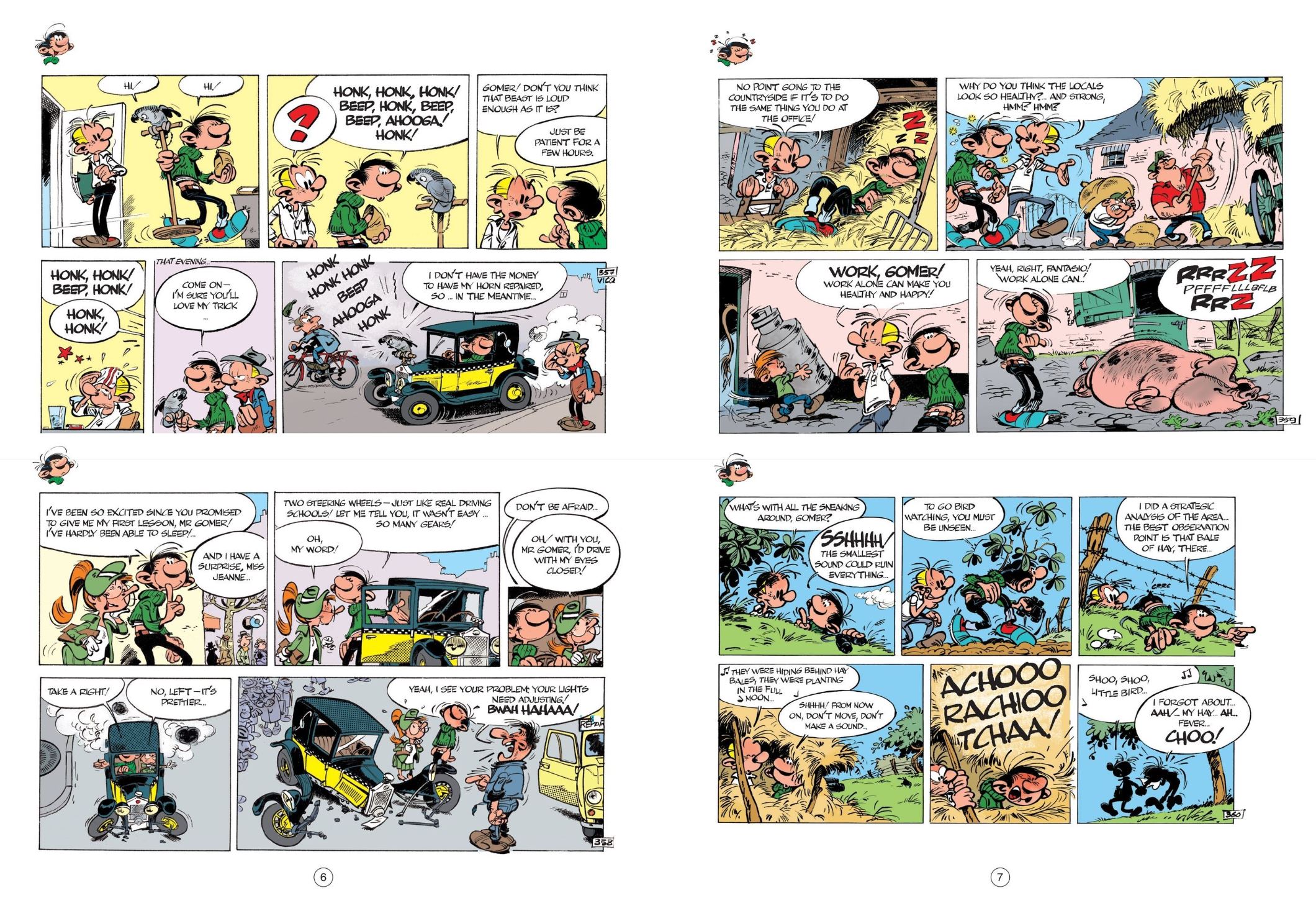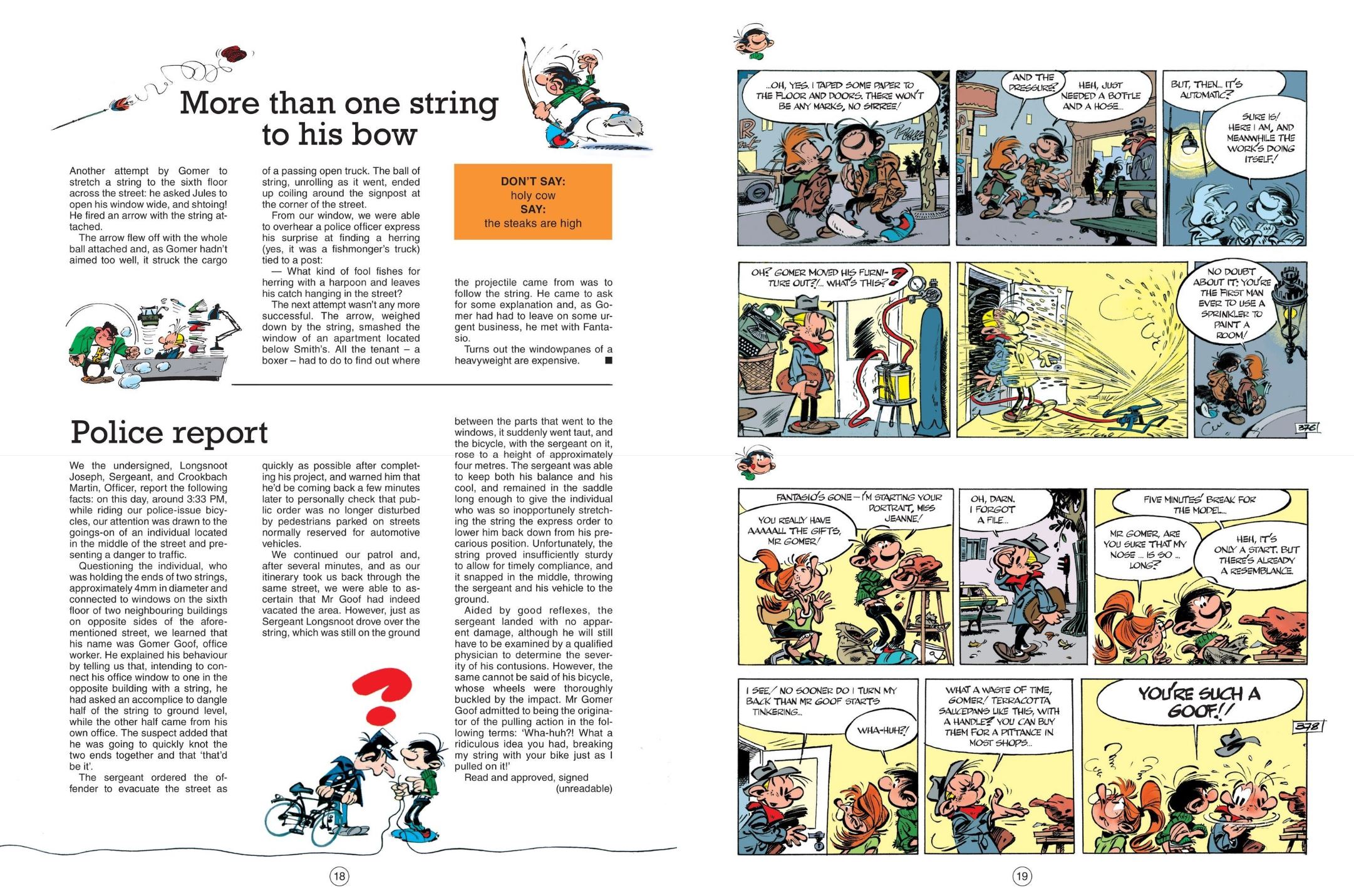
Bunny vs Monkey Book 11: Intergalactic Monkey Business!


By Jamie Smart, with Sammy Borras, Paul Duffield & Armin Roshdi (David Fickling Books)
ISBN: 978-1-78845-327-1 (Digest HB) 978-1-78845-387-5 (Waterstones Exclusive Team Bunny Edition) 978-1-78845-388-2 (Waterstones Exclusive Team Monkey Edition)

Win’s Christmas Gift Recommendation: Because… Just Because… 10/10

Bunny vs Monkey has been the inspirationally bonkers breakout star of The Phoenix since the first issue in 2012: recounting a madcap vendetta gripping animal archenemies set amidst an idyllic arcadia, masquerading as more-or-less mundane but critically endangered English woodlands. Concocted with gleefully gusto – but increasingly with cerebral cosmic crescendo in mind – by cartoonist/comics artist/novelist Jamie Smart (Fish Head Steve!; Looshkin; Max and Chaffy, Flember, Find Chaffy), these trendsetting, mind-bending yarns have been wisely retooled as best-selling graphic albums available in remastered, double-length digest softcover and hardback editions such as this one. All the tail-biting tension and animal argy-bargy began yonks ago after an obnoxious little beast plopped down in after a disastrous British space shot. OR DID IT?

Crashlanding in Crinkle Woods – scant miles from his launch site – lab animal Monkey believed himself the rightful owner of a strange new world, despite every effort of genteel, contemplative, reasonably sensible forest resident Bunny to dissuade him. For all his patience, propriety and good breeding, the laid-back lepine could not contain or control the incorrigible idiot ape, who to this moment remains a rude, troublemaking, chaos-creating, noise-loving lout intent on building his perfect “Monkeyopia” and/or being a robot, with or without the aid of evil supergenius Skunky or tagalong useless “henches” Metal Steve and Action Beaver

Daily wonders and catastrophes were exacerbated by a broad band of unconventional Crinkle creatures, none more so than monochrome mad scientist Skunky, whose intellect and cavalier attitude to life presents as a propensity for building dangerous robots, bio-beasts and sundry other super-weapons. He is, at his core, a dangerously inquisitive thinker and tinkerer…

Here – with artistic fiddling about from design deputy Sammy Borras – the war of nerves and mega-ordnances resumes as if nothing cosmic or multiverse-changing had ever happened or any hint of a restart after a cosmic culmination. See, that’s what happens if you let books pile up and don’t read them immediately! Go check out Bunny vs Monkey: The Great Big Glitch! and then come back and we’ll talk some more…

Okay then, new day, new start, same old mega mecha meta nonsense as ‘Clouding Over’ sees a suspiciously low-lying cirrus formation starts dumping rain and then increasing more noisome and noxious substances on the woodsfolk in what appear to be targeted strikes. Could there possibly be some kind of intelligence behind the atmospheric attacks?

With propriety and good taste in full retreat, the sensorial assaults resume in ‘Guts n’ Butts!’ as Monkey and Skunky debate the appalling assets and proposed “improvements” to the weaponised flatulence engine dubbed Bungamungus with no consideration of those in its path prior to the simian unleashing his own worst nightmare. The giant ‘MonkeyBot 5000’ is supposed to make life hell for his fluffy white foe, but it appears Bunny can find plenty of uses for a mechanised personal organiser that can bench press trucks, topple buildings, file and colour co-ordinate…

Reality trembles all over again when Monkey’s ‘Mum and Dad’ pop by for a visit and nice bit of tea, but nature’s innocents Weenie and Pig Piggerton are too busy having adventures with ‘Frogs!’ and their mystical king to really notice, whereas ‘Lucky… The Unluckiest Red Panda in the World!!’ stumbles into unbridled chaos (as always) when Skunky & Monkey decide to go through the forgotten inventions bin…

Worried about declining productivity, the sinister science sinner uses his 3D printer to unleash a horde of ‘Fun-Size Skunkies’ who are anything but, before Bunny learns where all the wreckage, rubbish and remains go when the latest catastrophe has finished unfolding. Sadly, there are good reasons nobody wants to see ‘Binbag Sam’ carry out his nasty but necessary job…

Always seeking peace and serene contemplation, mysterious Le Fox has found a wilderness to dig in, but when Monkey comes by and discovers gold in ‘Them Thar Hills’ that’s another dead dream, and only a prelude to planet-shaking events when Skunky’s new signal array test coincides with Monkey’s latest eating challenge. ‘Message in a Butthole’ reveals how – after, inevitably – a monumental foofie erupts across the universe, the consequences will be appalling but not at all unexpected…

In a fabulous tribute to Chuck Jones cartoons ‘Monkey vs Ai’ sees the annoying ape test a bunch of inventions that should work “in theory”, before going back to stinky basics with a cheese cannon. Sadly, the anticipated Cheesepocalyse is derailed by ‘The Turning of the Pig’ as pacifistic Piggerton reaches a limit and shows the monkey miscreant just what it all feels like…

‘Buzzing Off’ finds Skunky testing ways to end the really annoying fly suit he built for his partner in chaos and then hiding along with everyone else in ‘Who’s Afraid of the Monkey’ when the simian simpleton gets really, really hungry. Eventually sated, the little sod resumes pranks and pestiferations with a giant robot in ‘Close Encounters of the Bird Kind’. Remember that olfactory beacon blasted across infinity? This is the moment something answers that unique call…

Suddenly, in ‘You Looking at Me?’ Crinkle Woods are alive with alien weirdoes, but it’s just Skunky messing about with quantum physics and nothing to do with Monkey, because he’s currently hurtling to the other side of the Universe, testing to destruction the super-high-tech toilets of the extraterrestrials who abducted him…

He can’t be blamed for the astonishing void discovered by Pig and Weenie prompting the chilling question ‘What Lies Inside… the Hole?!’ or sensible but naïve robot Metal E.V.E.’s attempts to balance out Lucky’s cosmic misfortunes in ‘What Luck Befalls’ or even Metal Steve’s crisis of confidence and inexplicable desire to ‘Destroy’ because Monkey is currently spreading his brand of chaos while ‘Hitching a Ride’ on the ship of judgemental civilisation eradicating superior being Grand Master Nexus

Meanwhile on Earth, Skunky discovers the missing co-miscreant has left his life unfulfilled and dissatisfied and switches to a copy to serve his unsuspected emotional needs. ‘Little Monkey’ is wild, bitey, uncommunicative, un-potty-trainable and disgusting… such an improvement on the original! Enjoying his fresh start the evil inventor unleashes ‘A Clever Endeavour’ in the compulsive form of a malign puzzle box that baffles and bamboozles everyone – except the mini monkey who might just be the smartest thing in the woods now…

Pig’s penchant for peculiar pets sees the adoption of Blue-bummed Bimblebug ‘Parpy’  but the critter’s 24-hour lifespan brings near-instant woe, This leads to the advent of colossal hermit savant Capybara 5000 whose answers to all the ‘Big Questions’ are surprisingly violent. That search for truths culminates in sage advice ‘Run!’ before calm returns with Pig exploring wild water rafting and Le Fox confronting increasingly sinister Little Monkey in ‘The Happiness of the Kitsune’

In another beleaguered solar system Monkey is slowly wearing down Nexus and his minions, before accidentally warping them all back to Earth to enjoy a spontaneous battle of ‘Rather Big Lasers’ with Skunky. When that eradicates the mastermind’s secret underground lair all Skunky can think of is ‘Revenge’. With Little Monkey in tow the genius goes ‘On the Hunt’ in a unique battleship, pursuing ‘Space Wars’ even as his hirsute former best-buddy seizes control of the Nexus craft and drives it into ‘A Hella Interstellar Yeller’

Marooned on a muddy morass world, Monkey establishes his dream of a dictatorship. Sadly, ‘Chutneyopia’ is right next to the equally barren planet Skunky crashed on and war is declared as the newcomer demands an apology that just won’t be forthcoming…

Moreover, when Skunky took off after Monkey, most of Crinkle Wood went with him and as Bunny ruminates on ‘The Intergalactic Adventures of Weenie and Cinnamon Bun Pig!’ plans are underway to terraform the barren planetoid into ‘A New Home’ unfortunately undertaken by ‘Even More Skunkies’

With the enemy busy converting Chutneyopia into his other, better dream of Monkeyopia, ‘A New Plan’ is needed, but the still active Grand Master finally concedes that its superior mentality and firepower are no match for the annoying Earth ape. With its minions in revolt and resolved to blow up Earth, there nothing left for Monkey to worry about ‘Apart from the Bomb’ that’s going to end his grotty mucky dream world…

What better time for a reconciliation with Skunky?

Back on Earth, other Crinkle Wood critters have briefly enjoyed their time of growth and limelight in ‘Not Bunny vs Monkey’ but the likes of Stan Stoat and Randolph Raccoon are helpless when the minions start blasting. As Monkeyopia becomes a vast spaceship, Skunky begins his ‘Race to Save the World’ with his secret weapon Little Monkey but the outcome is never certain and our heroes all decide they’re ‘Best Off Out of It’, leaving a monumental deus ex machina to sort everything out…

Wrapping up these sidereal shenanigans and cosmic bum gags are related activities offered under the aegis of the Phoenix Comics Club. Bring paper, pencils and you to a compact online course in all aspects of comic strip creation supervised by Jamie Smart & Armin Roshdi detailing ‘How to draw King Frog!’, ‘A Bungamungous!’, ‘Capybara 5000!’ and ‘An Alien!’ before closing with an extensive plug for the aforementioned Phoenix Comics Club website complete with instant access via a QR code, plus previews of other treats and wonders available in The Phoenix to wind down from all that cosmic furore…

Another book for your kids to explain to you, the zany zenith of absurdist adventure, Bunny vs Monkey is weird wit, brilliant invention, potent sentiment and superb cartooning all crammed into one eccentrically excellent package. These tails never fail to deliver jubilant joy for grown-ups of every vintage, even those who claim they only get it for their kids. Is that you?
Text and illustrations © Fumboo Ltd. 2025. All rights reserved.

Today in 1926 Joe Sinnott was born. His inking made Fantastic Four impeccable and unmissable, but if you fancy seeing his pencilling mastery you should see Mighty Thor Omnibus volume 1.

Back in 1954 UK preschool comic milestone Playhour began its 1700+ issue run.

Hellboy: Weird Tales


By Mike Mignola, Fabian Nicieza, John Cassaday, Eric Powell, Tom Sniegoski, Tommy Lee Edwards, Randy Stradley, Joe Casey, Sara Ryan, Ron Marz, J. H. Williams III, Jim Pascoe & Tom Fassbender, Will Pfeifer, John Arcudi, Matt Hollingsworth, Jill Thompson, Alex Maleev, Jason Pearson, Scott Morse, Akira Yoshida & Kia Asamiya, Doug Petrie, Bob Fingerman, Evan Dorkin, Andi Watson, Mark Ricketts, Kev Walker, Craig Thompson, Guy Davis, Stefano Raffaele, Ovi Nedelcu, Seung Kim, Steve Parkhouse, Steve Lieber, Jim Starlin, P. Craig Russell, Simeon Wilkins, Gene Colan, Roger Langridge, Eric Wright, Dave Stewart, Clem Robins & various (Dark Horse Books)
ISBN: 978-1-61655-510-8 (HB) eISBN: 978-1-63008-121-8 (digital) 978-1506733845 (2022 Omnibus TPB)

This book includes Discriminatory Content produced in less enlightened times. It also has Discriminatory Content included for comedic and satirical effect.

After the establishment of the comic book direct market system, there was a huge outburst of independent publishers in America and, as with all booms, a lot of them went bust. Some few, however, were more than flash-in-the-pans and grew to become major players in the new world order.

Arguably, the most successful was Dark Horse Comics who fully embraced the shocking new concept of creator ownership (amongst other radical ideas). This concept – and professional outlook and attitude – drew many big-name creators to the new company and in 1994 Frank Miller & John Byrne formally instituted sub-imprint Legend for those projects major creators wanted to produce their own way and at their own pace. Over the next four years the brand counted Mike Mignola, Art Adams, Mike Allred, Paul Chadwick, Dave Gibbons and Geof Darrow amongst its ranks; generating superbly entertaining and groundbreaking series and concepts. Unquestionably the most impressive, popular and long-lived was Mignola’s supernatural thriller Hellboy.

The hulking monster-hunter debuted in San Diego Comic-Con Comics #2 (August 1993) before formally launching in 4-issue miniseries Seed of Destruction (with Byrne scripting Mignola’s plot & art). Colourist Mark Chiarello added layers of mood with his understated hues. Once the fans saw what was on offer there was no going back…

What You Need to Know: on December 23rd 1944 American Patriotic Superhero Torch of Liberty and a squad of US Rangers intercepted and – almost – foiled a satanic ceremony predicted by Allied parapsychologist Professors Trevor Bruttenholm and Malcolm Frost. They were working in conjunction with influential medium Lady Cynthia Eden-Jones. Those stalwarts were waiting at a ruined church in East Bromwich, England when a demon baby with a huge stone right hand appeared in a fireball. The startled soldiers took the infernal yet seemingly innocent waif into custody.

Far, far further north, off the Scottish Coast on Tarmagant Island, a cabal of Nazi Sorcerers roundly berated ancient wizard Grigori Rasputin whose Project Ragna Rok ritual seemed to have failed. The Russian was unfazed. Events were unfolding as he wished…

Five decades later, the baby had grown into a mighty warrior engaging in a never-ending secret war: the world’s most successful paranormal investigator. Bruttenholm spent years lovingly raising the weird foundling whilst forming an organisation to destroy unnatural threats and supernatural monsters – The Bureau for Paranormal Research and Defense. “Hellboy” quickly became its lead agent.

As the decades of his career unfolded, Hellboy gleaned tantalising snatches of his origins, hints that he was an infernal creature of dark portent: born a demonic messiah, somehow destined to destroy the world and bring back ancient powers of evil. It is a fate he despises and utterly rejects, even though the universe keeps inexorably and relentlessly moving him towards it.

Hellboy earned the status of ‘actual legend’ in the comics world, starting as the particular vision of a single creator and, by judicious selection of assistants and deputies, cementing a solid take on the character in the hearts of the public. That’s just how it worked for Superman, Batman and Spider-Man (except for the whole “owning the fruits of your own labours” thing) and a big part of the same phenomenon was the eagerness of fellow creators to play in the same universe. Just how that and this collection came about is detailed in Editor Scott Allie’s Introduction preceding a blazing welter of strange and bizarre entertainment…

Originally an 8-part comics series wherein a star-studded cast of creators tell their own stories in their own varied styles under the watchful supervision of the big cheese himself in his unique infernal playground, Hellboy’s Weird Tales was gathered into a 2-volume set in 2004. This luxurious hardback and digital reissue originated in 2014, supplementing the original miniseries with back-up stories from Hellboy: The Wild Hunt #2-4.

Dramas that add to the canon nestle alongside bizarre and humorous vignettes that simply live for the moment and begin with ‘How Koschei Became Deathless’ crafted by Mignola, Guy Davis, Dave Stewart & Clem Robins. The filler from Hellboy: The Wild Hunt #2 & 3 details the valiant trials of a noble warrior and the bad bargain he made, after which a crafty man turns the tables on the world’s wickedest witch in ‘Baba Yaga’s Feast’ (H:TWH #4).

The mother of monsters returns in Fabian Nicieza & Stefano Raffaele’s ‘The Children of the Black Mound’ wherein a future soviet dictator has his own youthful, life-altering encounter with the queen of magic.

John Cassaday spoofs classic newspaper strips with rollicking pulp science hero in ‘Lobster Johnson: Action Detective Adventure’ after which Nazi-bashing nonsense, Eric Powell explores Hellboy’s childhood and early monster-mashing in ‘Midnight Cowboy’ whilst Tom Sniegoski & Ovi Nedelcu raise our spirits with an older ghostbuster failing to tackle a playful posse of spooks in ‘Haunted’

A classical doomed East/West war romance ghost tragedy is settled by Tommy Lee Edwards & Don Cameron in ‘A Love Story’, setting a scene for more Japanese myth busting in Randy Stradley & Seung Kim’s ‘Hot’ wherein the B.P.R.D. star clashes with an unhappy Tengu (water spirit) inhabiting a mountain hot spring…

Joe Casey & Steve Parkhouse celebrate the glory days of test pilots and the right stuff in ‘Flight Risk’ when Hellboy is involved in a competition to see who’s got the best jetpack, after which ‘Family Story’ (Sara Ryan & Steve Lieber) sees him acting as counsellor to the mum and dad of a rather diabolical kid, before we slip into all-out arcane action to retrieve a time bending artefact from a Guatemalan temple in ‘Shattered’ by Ron Marz & Jim Starlin.

A stakeout with an over-amorous fellow agent leads to unanticipated consequences in J. H. Williams III’s ‘Love is Scarier than Death’, whilst Will Pfeifer & P. Craig Russell’s dalliance with an undying theatre troupe traps our hellish hero in a ‘Command Performance’ and the entertainment motif continues in John Cassaday’s ‘Big-Top-Hell-Boy’ as the B.P.R.D. try to exorcise a mass-murderous circus in Germany before Hellboy and aquatic investigator Abe Sapien battle zombies in the ‘Theatre of the Dead’ courtesy of scripters Jim Pascoe & Tom Fassbender, as illustrated by Simeon Wilkins.

Thanks to John Arcudi & Roger Langridge, the undersea avenger sort of stars in comedic daydream ‘Abe Sapien: Star of the B.P.R.D.’, after which Jill Thompson takes ‘Fifteen Minutes’ to offer us the other side’s view of the eternal struggle, whilst Matt Hollingsworth & Alex Maleev show us the struggle against evil starts before we’re even legally alive in ‘Still Born’. Indomitable psychic Firestarter Liz Sherman acknowledges personal loss and the dreadful cost of the job in Jason Pearson’s ‘The Dread Within’ before Scott Morse conjures up a calmer moment for Hellboy in ‘Cool Your Head’ and Akira Yoshida & Kia Asamiya return us to ghost-riddled Japan for an unconventional duel with childish spirits in ‘Toy Soldier’

Bob Fingerman’s ‘Downtime’ pits the cream of the B.P.R.D. against the vexatious thing inhabiting the office vending machine, after which Doug Petrie & Gene Colan follow Liz and Abe on a typical ‘Friday’, even as artificial hero Roger the Homunculus foolishly seeks ‘Professional Help’ during a devious demonic assault (as recorded by Evan Dorkin). Andi Watson tackles Hellboy’s infernal heritage and possible future during a social function where he is – as always – the ‘Party Pooper’, after which team leader/psychologist Kate Corrigan endures an acrimonious reunion with her dead-but-still-dreadful mother in ‘Curse of the Haunted Dolly’ (Mark Ricketts & Eric Wright), whilst Kev Walker pits bodiless spirit Johann Krauss against a thing from outer space in ‘Long Distance Caller’.

The narrative portion of this stellar fear & fun fest rightly focuses on Hellboy himself as Craig Thompson takes the weird warrior on an extended tour of the underworld in ‘My Vacation in Hell’ and there’s still a wealth of wonder to enjoy with Mike Mignola’s Hellboy Weird Tales Gallery offering a selection of potent images by Cameron Stewart, Maleev, Dave Stevens with Dave Stewart, Steve Purcell, William Stout, Leinil Francis Yu, Phil Noto, Gary Fields with Michelle Madsen, J. H. Williams III, Rick Cortes with Anjin, Galen Showman with Michelle Madsen, Ben Templesmith, Frank Cho with Dave Stewart, Michael Wm. Kaluta, Lee Bermejo with Dave Stewart and Scott Morse.

Baroque, grandiose, scary, hilarious and even deeply moving, these vignettes alternate suspenseful slow-boil tension with explosive catharsis, and trenchant absurdity, proving Hellboy to be a fully rounded character who can mix apocalyptic revelation with astounding adventure to enthral horror addicts and action junkies alike or enthral jaded fun-lovers in search of a momentary chuckle. This is a classic compendium of dark delights you simply must have.

™ & © 2003, 2009, 2014 Mike Mignola. Weird Tales is ® Weird Tales, Ltd.

Today in 1932 Francis Burr Opper’s landmark strip And Her Name Was Maud ended. If only someone would release a definitive archive I certainly review it!

Also today, the amazing and astounding Otto Binder died in 1974. He wrote everything from Superman to Captain Marvel to Mighty Samson so go seek him out too for a grand old time…

Melusine volume 5: Tales of the Full Moon


By Clarke & Gilson, coloured by Cerise; translated by Jerome Saincantin (Cinebook)

ISBN: 978-1-84918-212-6 (album TPB/Digital edition)

This book includes Discriminatory Content produced in less enlightened times.

Historically, whenever we used to feel out of sorts we’d consult the wise women to pull our fat out of the fire. Thus as we’re still sick and I’m out of pre-completed reviews here’s a sample of that and me being too clever for my own good.

Let’s see what tomorrow brings…

Witches – especially cute, sassy and/or teenaged ones – have a surprisingly long pedigree in all branches of fiction, and one of the most seductively engaging first appeared in venerable Belgian comic Le Journal de Spirou way back in 1992.

Mélusine is actually a sprightly (119 years old) neophyte sorceress diligently studying to perfect her craft at Witches’ School. To make ends meet she spends her off-duty moments working as au pair/general dogsbody to a shockingly disreputable family of haunts & horrors inhabiting and/or infesting a vast, monster-packed, ghost-afflicted chateau during some chronologically adrift, anachronistically awry time in the Middle-ish Ages…

Episodes of the much-loved feature are presented in every format from one-page gag strips to full-length comedy tales; each and all riffing wickedly on supernatural themes and detailing Melusine’s rather fraught existence. Our magical maid’s life is filled with daily indignities: skivvying, studying, catering to the appalling and outrageous domestic demands of the master and mistress of the castle and – far too occasionally – schmoozing with a large and ever-increasing circle of exceedingly peculiar family and friends.

The strip was devised by writer Françoise Gilson (Rebecca, Cactus Club, Garage Isidore) and cartoon humourist Frédéric Seron – AKA Clarke – whose numerous features for all-ages LJdS and acerbic adult humour Fluide Glacial include Rebecca, Les Cambrioleurs, Durant les Travaux, l’Exposition Continué… and Le Miracle de la Vie. Under the pseudonym Valda, Seron also created Les Babysitters and as “Bluttwurst” Les Enqu?tes de l’Inspecteur Archibaldo Massicotti, Mister President and P.38 et Bas Nylo.

A former fashion illustrator and nephew of comics veteran Pierre Seron, Clarke is one of those insufferable guys who just draws non-stop and is unremittingly funny. He also doubles up as a creator of historical & genre pieces like Cosa Nostra, Les Histoires de France, Luna Almaden and Nocturnes. He was obviously cursed by some sorceress and can no longer enjoy the surcease of sleep…

Collected Mélusine editions began appearing annually or better from 1995 onwards, with the 27th published in 2019. Thus far thanks to Cinebook, five of those have shape-shifted into English translations, but there have been ads for a sixth…

Continentally released in October 2002, Contes de la pleine lune was the 10th groovy grimoire of mystic mirth and is again most welcoming: primarily comprised of single or 2-page gags starring the enticing enchantress and delightfully eschewing continuity for the sake of new readers’ instant approbation. When brittle, moody, over-stressed Melusine isn’t being bullied for her inept cleaning skills by the matriarchal ghost-duchess who runs the castle; ducking cat-eating monster Winston; dodging frisky vampire The Count or avoiding unwelcome and often hostile attentions of horny peasants and over-zealous witch-hunting priests, the wily witchlette can usually be found practising spells or consoling/coaching inept, un-improvable and lethally unskilled classmate Cancrelune.

Unlike Mel, this sorry sorceress-in-training is a real basket case: her transformation spells go appallingly awry; she can’t remember incantations and her broomstick-riding makes her a menace to herself, any unfortunate observers… and even the terrain and buildings around her.

As the translated title suggests, Tales of the Full Moon dwells on demolishing fairy fables and bedevilling bedtime stories but also gives proper introduction to Mel’s best friend Krapella: a rowdy, roistering, mischievous and disruptive classmate who is the very image of what boys want in a “bad” witch…

This tantalising tome is filled with narrative nostrums featuring the traditional melange of slick sight gags and pun-ishing pranks highlighting how our legerdemainic lass finds a little heart’s ease by picturing how one day she’ll have her very own Prince Charming. Sadly, every dream ends – usually because there’s something sticky that needs cleaning up – but Melusine absolutely draws the line when Cancrelune (and even her own sweetness-&-light Fairy cousin Melisande!) start hijacking her daydreams…

This fusillade of fanciful forays concludes with eponymously titled, extended episode Tales of the Full Moon wherein Melusine is ordered to read a bedtime story to the Count’s cousin’s son: obnoxiously rambunctious junior vampire Globule, who insists on twisting her lovely lines about princesses and princes into something warped and Gothic… and even that’s before Cancrelune starts chipping in with her own weird, wild suggestions and interjections…

Wacky, wry, sly, infinitely inventive and uproariously funny, this arty arcana of arcane antics is a terrific taste of Continental comics wonderment: a beguiling delight for all lovers of the cartoonist’s art. Read well before bedtime – or you’ll be up laughing all night…
Original edition © Dupuis, 2002 by Clarke & Gilson. All rights reserved. English translation 2014 © Cinebook Ltd.

Speaking of Dark Nights, today in 1915 Bob Kane was born. Whatever happened to him?
Today in 1906 Golden Age comics scripter Joe Samachson was born. He’s all over this blog so just initiate a little search dialogue action to know more.

And in 1938 the inimitable E.C. “Elzie” Segar died. We last worshipped at his salty feet with Popeye: The E.C. Segar Popeye Sundays volume 4: Swea’Pea and Eugene the Jeep (February 1936 – October 1938); so should you as soon as possible.

Chas Addams Happily Ever After: A Collection of Cartoons to Chill the Heart of You


By Charles Addams (Simon & Schuster)
ISBN: 978-1-43910-356-2 (PB/Digital edition)

This book includes Discriminatory Content produced in less enlightened times. It also has Discriminatory Content included for comedic and satirical effect.

Cartoonist Charles Samuel Addams (1912-1988) was a distant descendant of two American Presidents (John Adams & John Quincy Adams). He compounded that hereditary infamy by perpetually making his real life as extraordinary as his dark, mordantly funny drawings.

Born into a successful family in Westfield, New Jersey, the precocious, prankish, constantly drawing child was educated at the town High School, Colgate University, the University of Pennsylvania, and New York City’s Grand Central School of Art, and apparently spent the entire time producing cartoons and illustrations for a raft of institutional publications.

In 1932 he became a designer for True Detective magazine – “retouching photos of corpses” – and soon after started selling drawings to The New Yorker. In 1937, at the peak of popular fascination in cinematic and literary horror stories, he began a ghoulish if not outright macabre sequence of family portraits that ultimately became his signature creation. However, during WWII, he toned down the terror and served with the US Signal Corps Photographic Center, devising animated training films for the military.

Whether Addams artfully manufactured his biography to enhance his value to feature writers or was genuinely a warped and wickedly wacky individual is irrelevant, although it makes for great reading – especially the stuff about his wives – and, as always, the internet is eager to be your informative friend…

What is important is that in all the years he drew and painted those creepily sardonic, gruesome gags and illustrations for The New Yorker, Colliers, TV Guide and so many others, he beguiled and enthralled his audience with a devilish mind and a soft, gentle approach that made him a household name long before television turned his characters into a hit. This was a substantial part of what generated the craze for monsters and grotesques that lasts to this day. That eminence was only magnified once the big screen iterations debuted. And now we have streaming fun too. He would have loved the sheer terrifying inescapability of it all…

As he worked on unto death, Addams got even wackier: marrying his third wife in a pet cemetery, spending an absolute fortune collecting weapons and torture devices – “for reference don’cha know” – and inventing… recipes…

There will be more on that last one another time but what really matters is that older collections of his oeuvre are finally being unearthed. This one – compiled from Addams’s personal archive, with many previously unpublished gems, explores the widest gamut of emotion, from ecstatic love to disappointed affection to murderous obsession. It’s a creepy corker demonstrating that love really does hurt…

Chas Addams Happily Ever After: A Collection of Cartoons to Chill the Heart of You opens in full scholar mode with ‘Chas Addams’ a photo-essay appreciation by H. Kevin Miserocchi, backed up by an explanation of the work of the ‘Tee and Charles Addams Foundation’ – remembering of course that the Tee here is his truly kindred spirit third wife Marilyn Matthews Miller-Addams (1926–2002).

Then the cartoon carnival commences with early works as ‘In the Beginning’ sets the cultural scene with crime, terror, murder and the ever-lurking supernatural before the remainder of the perilous pictorium offers insights into what used to be called “the war of the sexes”. This socially sensitive selection judiciously deals even handedly with ‘His Side’ and ‘Her Side’ before going on to test ‘His Resolve’ and ‘Her Resolve’

The matter is naturally settled in revelatory style with ‘The Final Score’

For clarity and pure knowledge this hilariously judgemental tome closes with a full list of ‘Dates of First Publication’ and the happy confirmation that a goodly proportion of the gags are new/unpublished until this time.

Should you not be as familiar with his actual cartoons as with the big and small screen legacy Addams unleashed, you really owe it to yourself to see the uncensored brilliance of one of America’s greatest humourists. It’s dead funny…
© 2006 by Tee and Charles Addams Foundation. All rights reserved.

Today in 1897 English writer & cartoonist Charles Henry Ross died. He’s one of the chaps accused of inventing comics with his disreputable rogue Ally Sloper. The closest we’ve got yet to exposing that rapscallion was in Great British Comics.

O Josephine!


By Jason (Fantagraphics Books)
ISBN: 978-1-68396-210-6 (HB/digital edition)

This book includes Discriminatory Content included for dramatic, comedic and ironic effect.

Born in 1965 in Molde, Norway, John Arne Sæterøy is known globally by his enigmatic, utilitarian nom de plume Jason. The shy & retiring auteur started on the path to international cartoon superstardom in 1995, once first graphic novel Lomma full ay regn (Pocket Full of Rain) won Norway’s biggest comics prize: the Sproing Award.

From 1987 he had contributed to alternate/indie magazine KonK while studying graphic design and illustration at Oslo’s Art Academy. From there he went on to Norway’s National School of Arts and, after graduating in 1994, founded his own comic book Mjau Mjau. Constantly refining his style into a potent form of meaning-mined anthropomorphic minimalism, Jason cites Lewis Trondheim, Jim Woodring & Tex Avery as primary influences. Moving to Copenhagen Jason worked at Studio Gimle alongside Ole Comoll Christensen (Excreta, Mar Mysteriet Surn/Mayday Mysteries, Den Anden Praesident, Det Tredje Ojet) & Peter Snejbjerg (Den skjulte protocol/The Hidden Protocol, World War X, Tarzan, Books of Magic, Starman, Batman: Detective 27).

His efforts were internationally noticed, making waves in France, The Netherlands, Slovenia, Spain, Germany and other Scandinavian countries as well as the Americas. He won another Sproing in 2001 – for self-published series Mjau Mjau – and in 2002 turned nigh-exclusively to producing graphic novels. He won even more major awards.

Jason’s breadth of interest is wide and deep: comics, movies, animated cartoons, music, literature and pulp fiction all feature equally with no sense of rank or hierarchy. This puckish and egalitarian mixing and matching of inspirational sources always and inevitably produces picture-treatises well worth a reader’s time. Over a succession of tales Jason built and constantly re-employed a repertory company of stock characters to explore deceptively simplistic milieux based on classic archetypes distilled from movies, childhood entertainments, historical and literary favourites. These all role-play in deliciously absurd and surreal sagas centred on his preferred themes of relationships and loneliness. Latterly, Jason returned to such “found” players as he built his own highly esoteric universe, and even has a whole bizarre bunch of them “team-up” or clash…

As always, visual/verbal bon mots unfold in beguiling, sparse-dialogued, or even as here silently pantomimic progressions, with compellingly formal page layouts rendered in a pared back stripped-down interpretation of Hergé’s Claire Ligne style: solid blacks, and thick outlines dominating settings of seductive monochrome simplicity augmented by a beguiling palette of stark pastels and muted primary colours.

The majority of his tales brim with bleak isolation, swamped by a signature surreality: largely populated with cinematically-inspired, darkly comic, charmingly macabre animal people ruminating on those inescapable concerns whilst re-enacting bizarrely cast, bestial movie tributes.

A master of short-form illustrated tales, many Jason yarns were released as snappy little albums perfect for later inclusion in longer anthology collections like this one which gathers a quartet of his very best.

Here the stream of subtle wonderment opens with a suitably understated autobiographical jaunt to the land of Erin and an uneventful but truly mind-blowing progression along ‘The Wicklow Way’. The vacation hikes might be scenic and uneventful, but you’re never alone as long as you’re stuck inside your own head…

With the addition of a jaundiced inky outlook (and employing “yellow journalism” of the most literal kind) ‘L. Cohen: A Life’ then outlines the experiences and times of the poet, musician and philosopher, with a strong emphasis on whimsical inaccuracy and factual one-upmanship, whilst cinematic classicism underpins ‘The Diamonds’ wherein a pair of softened and barely-boiled detectives lose all objectivity after their scrupulous surveillance of a simple family affects their own hidden lives…

The low-key dramatics slip back into monochrome and into the twilight zone after weary world traveller Napoleon Bonaparte returns to Paris and falls head over shiny heels for infamous exotic dancer Josephine Baker. As with all doomed romances, the path to happiness is rocky, dangerous, and potentially insurmountable, but… c’est l’amour!

These comic tales are strictly for adults but allow us all to look at the world through wide-open childish eyes, exploring love, loss, life, death, boredom and all aspects of relationship politics without ever descending into mawkishness or simple, easy buffoonery. His buffoonery is always slick and deftly designed for maximum effect.

Jason remains a taste instantly acquired: a creator any true fan of the medium should move to the top of their “Must-Have” list.
All characters, stories, and artwork © 2019 Jason. This edition © Fantagraphics Books, Inc. All rights reserved.

Today in 1913 comics legend Joe Simon was born. I’m sure you’ve read all those great books he & Jack Kirby co-created, but if you haven’t, why not try The Sandman by Joe Simon and Jack Kirby?

In 1957 French comics genius Edmond-François Calvo died. You can not until you read his masterwork La Bête Est Mort which we reviewed as The Beast is Dead: World War II Among the Animals and will probably do again real soon.

Showcase Presents Dial H for Hero


By Dave Wood, Jim Mooney, George Roussos, Frank Springer, Sal Trapani, Jack Sparling & various (DC Comics)
ISBN: 978-1-4012-2648-0 (TPB)

This book includes Discriminatory Content produced in less enlightened times.

In the mid-Sixties the entire world went crazy for costumed crusaders and every comic book publisher (and some who weren’t) frantically sought new ways to repackage an extremely exciting yet intrinsically limited concept. Perhaps its ultimate expression – for Americans at least as UK comics were always skewing the curves – came with the creation of a teen-aged everyman champion who battled crime and disaster in his little town with the aid of a fantastic wonder-tool…

This slim monochrome paperback compendium collects the entire eclectic run from House of Mystery (#156, January 1966 to #173, March-April 1968), after which the title vanished for a few months, only to re-emerge as DC’s first new anthological supernatural mystery title and next big publishing sensation…

Created by Dave Wood & Jim Mooney, Dial H For Hero detailed the incredible adventures of lonely boy genius Robby Reed who lived with his grandfather in idyllic Littleville: a genial small town where nothing ever happened…

Born in Arlington, Massachusetts on September 5th 1926, Dave Silva worked prodigiously in comics as Dave Wood, as did his brothers Bob Wood and Dick Wood. Their father was a doctor who blotted his copybook so badly that the family had their surname legally changed sometime after 1932.

Dave’s brothers got into making comics early – founding a studio shop with Charles (Airboy, Crime Does Not Pay, The Little Wise Guys) Biro – and Dave joined them before his war service as an army reporter in 1944. He returned and blossomed into a go-to writer in many genres. His prolific output really began in the post-superhero days of AUS comic books and includes such seminal classics – often with artistic legends Jack Kirby and Wally (no-relation) Wood) – as Challengers of the Unknown and seminal Space Race newspaper strip Sky Masters. A skilled jobbing writer, Wood frequently and closely collaborated with brother Dick. They bounced around the industry, scripting mystery, war, science fiction and he-man adventure yarns. Amongst his/their vast credits are stints on Danger Trail, Our Army at War, most Superman family titles, Batman, Detective Comics, World’s Finest Comics, Green Arrow, Rex the Wonder Dog, Tomahawk, Blackhawk, Martian Manhunter and so many more. As well as Dial H For Hero Dave Wood created bizarre sleeper hit Animal Man and the esoteric but fondly regarded Ultra, the Multi-Alien. He was Bob Kane’s ghost writer and co-created eccentric villains Mister Zero/Mr Freeze, Doctor Double X and the Terrible Trio/The Fox, the Shark and the Vulture. He died far, far too young on July 7th 1974

The majority of the illustration was left to capable, unflappable, slick James Noel Mooney. He started his comics career in 1940, aged 21, working for the Eisner & Eiger production shop, and at Fiction House on The Moth, Camilla, Suicide Smith and other B-features. By the end of that year he was a mainstay of Timely Comic’s vast funny animal/animated cartoon tie-in department.

In 1946, he migrated to National/DC to ghost Batman for Bob Kane & Dick Sprang. He stayed until 1968, a regular on a host of key features including Superman, Superboy, Legion of Super-Heroes, World’s Finest Comics and Tommy Tomorrow, as well as many genre short stories for the company’s assorted anthology titles like Tales of the Unexpected and House of Mystery. He famously drew Supergirl from her series debut in Action Comics #253 to #373. He returned to Marvel in the late 1960s, delivering stellar runs on Spider-Man, Marvel Team-up, Omega the Unknown, Man-Thing, Ghost Rider and a host of other features including early adults-only feature Pussycat as both penciller and inker. Prior to that move he was illustrating Dial H For Hero; the only original DC feature he co-created.

Big things were clearly expected of the new feature, which was parachuted in as lead and cover feature, demoting the venerable Martian Manhunter J’onn J’onzz to a back-up role at the rear of each issue. Cover dated January 1966 (and on sale from November 18th 1965) House of Mystery #156 kicked off the strange adventures with an untitled tale that opens in an attack on the local chemical works by super-scientific criminal organisation Thunderbolt. This occurs just as young Robby and his pals are playing in the hills above the site. As they flee, the plucky kid is caught in a landslide and falls into an ancient cave where lies hidden an obviously alien artefact… that looks like an outlandish rotary telephone dial. If these words mean nothing to you, feel free to investigate on-line…

After finding his way out of the cavern Robby becomes obsessed with the device and spends all his time attempting to translate the arcane hieroglyphs on it. Eventually he determines that they are instructions to dial the dial symbols which roughly translate to “H”, “E”, “R” and “O”…

Ever curious, Robby complies and is suddenly transformed into a colossal super-powered Giantboy, just in time to save a crashing airliner and quash another Thunderbolt raid. On returning home, he simply reverses the dialling process and goes to bed…

These were and still are perfect wish-fulfilment stories: uncluttered, uncomplicated yarns concealing no grand messages or themes: just straight entertainment expertly undertaken by experienced and gifted craftsmen who knew how to reach their young-at-heart audiences. After all, what right minded child wouldn’t rush out and DO GOOD if they got superpowers?

Thus, no-one is surprised at the ease with which Robby adapts to his new situation. When Thunderbolt strikes again next morning Robby grabs his dial but is startled to become a different hero – high-energy being The Cometeer. Streaking to the rescue Robby is overcome by the raider’s super weapon and forced dial back into being a boy again. Undeterred, he later tries again and as The Mole finally tracks the villains to their base and crushes them. The leader escapes, however, to become the series’ only returning villain…

Mr. Thunder was back in the next issue as Robby became The Human, Bullet, bestial energy-being Super-Charge and eerie alien Radar-Sonar Man to combat ‘The Marauders from Thunderbolt Island’ after which criminal scientist Daffy Dagan steals the H-Dial after defeating the boy’s next temporary alter ego Quake-Master. Dagan becomes a horrifying multi-powered monster when he learns to ‘Dial… V… For Villain’ but after the defeated hero takes back the artefact, Robby redials into techno-warrior The Squid and belatedly saves the day. Clearly the Mystery in House of… was related to where the Dial came from, what its unknown parameters were and especially who or what Robby would transform into next…

HoM #159 pitted The Human Starfish, Hypno-Man and super-powered toddler Mighty Moppet (wielding weaponised baby bottles) in single combats with a shape-shifting bandit gang dubbed ‘The Clay-Creep Clan’ whilst ‘The Wizard of Light’ played with the format by introducing a potential love-interest for Robby in his best friend’s cousin Suzy. It also saw the return of Giant-Boy, introduction of sugar-based sentinel of justice King Candy and the lad’s only transformation into an already established hero – Golden Age legend Plastic Man.

Cynical me suspects the move was a tester to see if the Pliable Paladin – who had been an inert resource since the company had bought out original publisher Quality Comics in 1956 – was ripe for a relaunch in the new, superhero-hungry environment.

DC’s Plastic Man #1 was released five months later…

House of Mystery #161 featured awesome ancient Egyptian menace ‘The Mummy with Six Heads’ who proved too much for Robby as Magneto (same powers but so very not a certain Marvel villain) and Hornet-Man, but not intangible avenger Shadow-Man who eventually triumphed, whilst in the next issue ‘The Monster-Maker of Littleville’ is proved by Mr. Echo and Future-Man to be less mad scientist than greedy entrepreneur. Then, ‘Baron Bug and his Insect Army’ almost ends Robby’s clandestine career when the boy turns into two heroes at once. However, even though celestial twins Castor and Pollux are overmatched, animated slinky-toy King Coil proves sufficient to stamp out the Baron’s giant mini-beasts. Human wave Zip Tide, living star Super Nova and Robby the Super-Robot are then increasingly hard-pressed to stop the rampages of ‘Dr. Cyclops – the Villain with the Doomsday Stare’, but eventually overcome the outrageous odds – and oddness…

Things got decidedly peculiar in #165 when a clearly malfunctioning H-Dial called up ‘The Freak Super-Heroes’Whoozis, Whatsis and Howzis – to battle Dr. Rigoro Mortis and his artificial thug Super-Hood in a bizarrely captivating romp with what looks like some unacknowledged inking assistance from veteran brush-meister George Roussos (who popped in a couple more times until Mooney’s departure).

Suzy became a fixture and moved into the house next door with ‘The King of the Curses!’ He found his schemes to plunder the city thwarted by The Yankee-Doodle Kid and Chief Mighty Arrow, a war-bonneted “Indian brave” on a winged horse, before in HoM #167, ‘The Fantastic Rainbow Raider’ easily defeated Balloon Boy and Muscle Man but had no defence against returning Radar-Sonar Man. Next ‘The Marauding Moon Man’ easily overmatched Robby as The Hoopster, but had no defence when another glitch turned old incarnations The Mole and Cometeer into a single heroic composite imaginatively christened Mole-Cometeer. The biggest shock of all came when ‘The Terrible Toymaster’ defeats Robby – AKA Velocity Kid – and Suzy cajoles the fallen hero into dialling her into the scintillating Gem Girl to finish the mission.

Of course, as it was the 1960s, plucky Suzy didn’t quite manage on her own, but after Robby transforms into psionically potent Astro, Man of Space they soon closed the case – and toybox – for good. This one was all Mooney and so was the next, which turned out to be the artist’s last hurrah with the Kid of a Thousand Capes. ‘Thunderbolt’s Secret Weapon’ saw the crooks cartel seek to steal a supercomputer, only to be stopped dead by Baron Buzz-Saw, Don Juan (and his magic sword!) and the imposing Sphinx-Man. With House of Mystery #171 a radical new look emerged, as well as a darker tone. The writing was clearly on the wall for exuberant, angst-free adventurers…

‘The Micro-Monsters!’ was illustrated by Frank Springer and saw Robby dial up King Viking – Super Norseman, Go-Go (a fab hipster who utilised the incredible powers of popular disco dances… and how long have I waited to type that line?) and multi-powered Whirl-I-Gig to defeat bio-terrorist Doc Morhar and his belligerent invaders from a sub-atomic dimension. Springer also drew ‘The Monsters from the H-Dial’, wherein the again on-the-fritz gear simultaneously turns Reed’s friend Jim into assorted ravening horrors every time Robby dials up. Luckily the unnamed animated Pendulum, Chief Mighty Arrow and the Human Solar Mirror our hero successively turns into prove just enough to stop the beasts until the canny boy can apply his trusty screwdriver to the incredible artefact once again.

In those distant days series ended abruptly, without fanfare and often in the middle of something… and such was the fate of Robby Reed. HoM #173, by Wood & Sal Trapani, saw the lad solve a mystery in ‘The Revolt of the H-Dial’, wherein the process reshapes him into water-breathing Gill-Man and a literal Icicle Man: beings not only unsuitable for life on Earth but also compelled to commit crimes. Happily by the time Robby dials into Strata Man he’s deduced what outside force is affecting his dangerously double-edged device…

And that was that. The series was gone, the market was again abandoning Fights ‘n’ Tights fantasy and on the immediate horizon lay a host of war, western, barbarian and horror comics…

Exciting, fun, inspirational, imaginatively engaging and silly in equal amounts (heck, even I couldn’t resist a jibe or too and I genuinely revere these daft, nostalgia-soaked gems), Dial H For Hero has been re-imagined many times since these innocent odysseys first ran, but never with the clear-cut, unsophisticated, welcoming charm displayed here.

This was Ben-10 (remember him?) for your granddad’s generation and perhaps your kid’s delectation: and only if they’re at just that certain age. Certainly you’re too grown up to enjoy these glorious classics. Surely you couldn’t be that lucky; could you?
© 1966, 1967, 1968, 2010 DC Comics. All rights reserved.

Today in 1950 comics iconoclast and creative pioneer Howard Chaykin was born. You should track down American Flagg! and his interpretation of The Shadow but don’t miss Ironwolf: Fires of the Revolution. One year later international comics legend Enki Bilal did likewise, before going on to create masterpieces such as Century’s End: The Black Order Brigade & The Hunting Party.

Planet of Science – The Universal Encyclopedia of Scientists


By Antonio Fischetti & Bouzard, translated by James Hogan (Europe Comics)
No ISBN: digital only

Comics and graphic novels have an inconceivable power to deliver information in readily accessible form, and – like all the best teachers – can do so in ways that are fascinating, fun and therefore unforgettable.

A prime example is 2019’s La Planète des sciences – Encyclopédie universelle des scientifiques – which is available digitally in English if STILL not yet as a solidly reassuring tome. A bright and breezy introduction to a number of researchers and discoverers, famed and not, it combines a page of personal history, biography and unflinching commentary on 37 notable personages who have added to global scientific knowledge, each accompanied by a smart, punchy and pertinent gag strip by underground cartoonist Guillaume Bouzard (Caca bemol, Je veux travailler pour le Canard enchaîné, Lucky Luke).

Presenting the facts is Dr Antonio Fischetti, author (Cats and Dogs under the scientist’s magnifying glass, Idiotic and Relevant Questions about Mankind); science journalist; educator (at the National Conservatory of Arts and Crafts, National Conservatory of Music and Dance in Paris, Louis Lumière School and La Femis); and author of a science column for illustrious truth-seeking organ Charlie Hebdo.

The Continent is happily, gloriously awash with factual albums and graphic novels – and not just biographies – and this is one of the most entertaining I’ve ever seen, opening with Dr. Fischetti’s explanatory postulate on why these particular 37 candidates and his cognitive methodology, before the visual revelations begin. Sub-divided into rough, often overlapping time frames it all starts in Ancient Greece with the lowdown and high points of Thales, Pythagoras, Hippocrates and Archimedes, before jumping to 780-850CE for the story of Al-Khwarizmi.

Traversing the 15th – 16th Century, we meet Leonardo da Vinci, Nicolaus Copernicus, Ambroise Paré, Giordano Bruno & Galileo, before 17th – 18th Century pioneers Rene Decartes, Antonie van Leeuwenhoek, Isaac Newton, Carl Linnaeus and Antoine Lavoisier get their moment in history’s hindsight and spotlight. As big, deep thinking becomes more widespread, representing the 19th Century are Charles Darwin, Claud Bernard, Gregor Mendel, Louis Pasteur, Alfred Nobel (suck it, Donny-baby!) and Dmitri Mendeleev, after which the revolutionary 19th – 20th Century hones in on Ivan Pavlov, Max Planck, Marie Curie, Albert Einstein, Alfred Wegener, Alexander Fleming, Erwin Schrödinger and Trofim Lysenko. By now it’s probably clear to most of you that this is no simple hagiography: some of the folk here are included because of their effect on scientific progress and it’s not all smiles, acclaim and awards…

The procession of progress pauses with the 20th – 21st Century (because, as of this writing, time travel has not been satisfactorily confirmed or reproduced under laboratory conditions) with controversial and occasionally still-living paragons Konrad Lorenz, Alan Turing, Alexander Grothendieck, James Watson, Peter Higgs, Yves Coppens, Emmanuelle Charpentier and the recently lost and already hugely missed Jane Goodall. Sure, you could Google them, but this book is a far more satisfying alternative…

The very fact that you probably haven’t heard of some of these latter savants – or even a few of the more ancient ones – only proves without doubt that you need this book. QED: What more can one say?
© 2020 DARGAUD – Fischetti & Bouzard. All rights reserved.

Today in 1913, comic book pioneer, cover artist and co-creator of Zatara Fred Guardineer was born, whilst in 1924 the legendary Harvey Kurtzman took his first peep at reality and probably started taking critical notes. We last spotlighted the inventor of Mad Magazine in Harvey Kurtzman’s Marley’s Ghost.

And today in 1982 the world was lessened by the passing of wondrous Noel Sickles, whom we loved most for such astounding strip work as Scorchy Smith: Partners in Danger.

The Complete Peanuts volume 1: 1950-1952


By Charles Schulz (Canongate Books/Fantagraphics Books)
ISBN: 978-1-56097-589-2 (Fantagraphics HB) 978-1-60699-763-5 (Fantagraphics TPB) 978-1-84767-031-1 (Canongate)

This book includes Discriminatory Content produced in less enlightened times.

Win’s Christmas Gift Recommendation: All that’s great about cartoon strips… 10/10

Peanuts is unequivocally the most important comics strip in the history of graphic narrative. It is also the most deeply personal. Today in 1950 it all began, and cartoonist Charles M Schulz went on crafting his moodily hilarious, hysterically introspective, shockingly surreal philosophical epic for half a century: 17,897 strips spanning October 2nd 1950 to February 13th 2000.

He died from complications of cancer the day before his last strip was printed.

At its height, Peanuts ran in 2,600 newspapers, in 21 languages and in 75 countries. Many of those venues still run it as perpetual reprints, and have ever since his death. During Schulz’s lifetime, book collections, a merchandising mountain and television spin-offs had made the publicity-shy doodler an actual billionaire at a time when that really meant something…

None of that matters. Peanuts – a title Schulz loathed, but one the syndicate forced upon him – changed the way comics strips were received and perceived: proving cartoon comedy could have edges and nuance and meaning as well as soon-forgotten pratfalls and punchlines.

Following a typically garrulous, charming and informative Introduction from fellow Minnesotan Garrison Keillor, this mammoth (218 x 33x 172 mm) landscape compendium offers the first two and a bit years. Here a prototypical, rather outgoing and jolly Charlie Brown and high-maintenance mutt Snoopy joined with bombastic Shermy and mercurial Patty in hanging out doing kid things.

These include playing, playing pranks, playing sports such as tennis, golf and baseball, playing musical instruments, teasing each other, making baffled observations and occasionally acting a bit too much like grown-ups. Fans of Bill Watterson’s Calvin and Hobbes will feel eerie familiarity with much of the hijinks and larks of these episodes.

As new characters Violet, infant prodigy Schroeder, and Lucy and her strange baby brother Linus were added to the mix, the boisterous rush of the series began to imperceptibly settle into a more contemplative pace. Charlie Brown began to adopt and embrace his eternal loser, singled-out-by-fate persona and the sheer diabolical wilfulness of Lucy began to sharpen itself on everyone around her…

The first Sunday page debuted on January 6th 1952; a standard half-page slot offering more measured fare than the daily. Both thwarted ambition and explosive frustration became part of the strip’s signature denouements…

By the end of 1952, all those the rapid-fire gags had evolved from raucous slapstick to surreal, edgy, psychologically barbed introspection, garnished by crushing judgements and deep rumination in a world where kids – and certain animals – were the only actors. The relationships, however, were increasingly deep, complex and absorbing even though “Sparky” Schulz never deviated from his core message: entertain…

David Michaelis then celebrates and deconstructs ‘The Life and Times of Charles M. Schulz’ after which Gary Groth & Rick Marschall conduct ‘An Interview with Charles M. Schulz’, rounding out our glimpse of the dolorous graphic genius with intimate revelations and reminiscences whilst a copious ‘Index’ offers instant access to favourite scenes you’d like to see again.

Readily available in hardcover, paperback and digital editions, this initial volume offers a rare example of a masterpiece in motion: comedy gold and social glue gradually metamorphosing in an epic of spellbinding graphic mastery which became part of the fabric of billions of lives, and which continues to do so long after its maker’s passing.

Happy ever afters, kids.
The Complete Peanuts: 1950-1952 (volume 1) © 2004 Peanuts Worldwide, LLC. Introduction © 2004 Garrison Keillor. “The Life and Times of Charles M. Schulz” © 2000 David Michaelis. “Interview with Charles M. Schulz” © 2004 Gary Groth and Richard Marschall. All other material copyright its respective owners. All rights reserved.

Today in 1909 Alex Raymond was born. You’ll know him best for stuff like Flash Gordon on the Planet Mongo volume 1: Sundays 1934-1937 (The Complete Flash Gordon Library. In 1916 Bob Powell, was born. He went on to do things like Bob Powell’s Complete Jet Powers.

Ramona Fradon was born in 1926, and Spirou stalwart Janry arrived in Belgium in 1957, whilst Maltese docu-comics journalist Joe Sacco was born in 1960. You can find dozens of books by the first two just by using a search box here, and I’ve almost summoned enough nerve to review Sacco’s Palestine despite – or because of – these febrile times…

Addams and Evil


By Charles Addams (Methuen/Mandarin)
ISBN: 978-0-413-55370-1 (Album PB) 978-0-413-57190-8 (Album HB) 978-0-413-55370-6 (Mandarin TPB)

This book includes Discriminatory Content produced in less enlightened times. This book also includes Discriminatory Content included for comedic and satirical effect.

Charles Samuel Addams (1912 – 1988) was a cartoonist and distant descendant of two American Presidents (John Adams & John Quincy Adams) who made his real life as extraordinary as his dark, mordantly funny drawings.

Born into a successful family in Westfield, New Jersey, the precocious, prankish, constantly drawing child was educated at the town High School, Colgate University, the University of Pennsylvania, and New York City’s Grand Central School of Art, and apparently spent the entire time producing cartoons and illustrations for a raft of institutional publications.

In 1932 he became a designer for True Detective magazine – “retouching photos of corpses” – and soon after began selling drawings to The New Yorker. In 1937 he began creating ghoulish if not outright macabre family portraits that become his signature creation. During WWII, he served with Signal Corps Photographic Center, devising animated training films for the military.

Whether he artfully manufactured his biography to enhance his value to feature writers or was genuinely a warped and wickedly wacky individual is irrelevant, although it makes for great reading – especially the stuff about his second wife – and, as always, the internet awaits the siren call of your search engine…

What is important is that in all the years he drew and painted those creepily sardonic, gruesome gags and illustrations for The New Yorker, Colliers, TV Guide and so many others, he managed to beguile and enthral his audience with a devilish mind and a soft, gentle approach that made him a household name long before television turned his characters into a hit and generated a juvenile craze for monsters and grotesques that lasts to this day. That eminence was only magnified once the big screen iterations debuted. And now we have streaming fun too. He would have loved the sheer terrifying inescapability of it all…

This stunningly enticing volume is a reissue of his second collection of cartoons, first published in 1947, and semi-occasionally since then. It’s still readily available if you’ve a big bank book, but the time is ripe for a definitive collected edition, or better yet a reissue of his entire canon (eleven volumes of drawings and a biography) either in print or digitally.

Should you not be as familiar with his actual cartoons as with their big and small screen descendants you really owe it to yourself to see the uncensored brilliance of one of America’s greatest humourists. It’s dead funny…

© 1940-1947 the New Yorker Magazine, Inc. In Canada © 1947 Charles Addams.

Today in 1909, fearless campaigner/cartoonist turned arch conservative Al Capp was born. Slightly less contentious than Li’l Abner, his Fearless Fosdick might be more to your taste.

My Dad Fights Demons


By Bobby Joseph & Abbigayle Bircham (SelfMadeHero)
ISBN: 978-1-914224-34-8 (TPB)

This book includes Discriminatory Content included for dramatic and comedic effect.

Here’s a short, sweet and sarcastically sharp poke at modern culture’s transient nature, mayfly attention-spans and perennially parlous state, delivered in a delicious ribald and deceptively irreverent tone and stylee (not a typo). The deed is done by street-wizened South Londoner and incumbent Comics Laureate Bobby Joseph (Dazed and Confused, Vice, The Guardian, Skank Magazine, Scotland Yardie) and rising star Abbigayle Bircham (Soaring Penguin Press, The Rat Pack Collective).

Anarchic, subversive and definitely NOT for little kids – unless they live inside the heads of adult-seeming types – here is a potent close-up peep at little Londoner Rye who is navigating the already-too-much-to-bear life of a kid trying to find themselves in a world of constant confliction and change-made-for-profit. The often overwhelmed and undervalued young ’un is just about coping with being vegan, addicted to sprout flavoured vapes, embarrassed by mum and her man, unappreciated by peers and schoolmates and generally not digging life when another body blow lands…

Mum and her manly beau – overly eager for a little intimate alone time – suddenly spring the news that Rye’s biological dad is in town and will be exercising visitation rights for the weekend. That’s when Rye first learns that Mr. Mantriks is not actually deceased (as was previously believed) but is in fact a wizard – “greatest sorcerer in the world” – who has been defending reality from inside a hell dimension for most of Rye’s short life.
Such reunions are always a bit uncomfortable, but this one is more fraught than most as daddy (and his appalling goblin familiar “Gobby”) are criminally unaware of how life has moved on, and are fact only really here to retrieve a lost spell of catastrophically evil potential.

However, like all such odd couple yarns, there’s the promise of reconciliation and a happy ending in store, but only if the long-parted in loco parentis pair – and Rye! – can mend long-ignored fences, avoid waves of disembodied body-parts, the allure of parallel universes (and fried chicken shops), totally solve the mystery of the lost cantrip and foil the cunning convoluted schemes of demonic social influencers who shouldn’t be here and SHOULD know better…

Manic-paced and wildly imaginative, this yarn might be impenetrable to certain ossified sections of the readership were it not for the absolutely indispensable aide memoire ‘Gobby’s Guide to UK Slang!’ Moreover, once an ending is reached, you can learn a little of the how and why thanks to ‘Sketches and development work’ provided by the creators…
Text and images © 2025 Bobby Joseph and Abbigayle Bircham. All rights reserved.

Today in 1911, artist Charles Paris was born. Although he probably inked every great pre-Silver Superman & Batman story you’ve ever read, I’d recommend checking out DC Finest: Metamorpho – The Element Man for a wilder ride.

In 1922, unsung comics icon & secret weapon Roz Kirby entered the world, whilst six years later comic strip pioneer Richard Outcault left it. I’m sure you already know all about him, but just in case why not look at Buster Brown: Early Strips in Full Color?