The Complete Crumb Comics volume 8: The Death of Fritz the Cat – New Edition


By R. Crumb & guests (Fantagraphics Books)
ISBN: 978-0-56097-076-7

This book contains really clever and outrageously dirty pictures, rude words, non-condemnatory drug references and allusions, apparent racism, definite sexism, godless questioning of authority and brilliantly illustrated, highly moving personal accounts and opinions. It also painfully displays a genius grappling with his inner demons in a most excruciatingly honest and uncomfortable manner.

If you – or those legally responsible for you – have a problem with that, please skip this review and don’t buy the book.

Really.

I mean it…

Robert Crumb is a truly unique creative force in comics and cartooning, with as many detractors as devotees. From the first moments of the rise of America’s counterculture, his uncompromising, forensically neurotic introspections, pictorial rants and invectives unceasingly picked away at societal scabs, measuring his own feelings and motives whilst ferociously ripping way civilisation’s concealing curtains for his own benefit. However, he always happily shared his unwholesome discoveries with anybody who would take the time to look…

In 1987 Fantagraphics Books began the Herculean task of collating, collecting and publishing the chronological totality of the artist’s vast output, and those critically important volumes are being currently reissued for another, more liberated generation.

The son of a career soldier, Robert Dennis Crumb was born in Philadelphia in 1943 into a dysfunctional, broken family. He was one of five kids who all found different ways to escape their parents’ highly volatile problems, and comic strips were paramount among them.

Like his older brother Charles, Robert immersed himself in the comics and cartoons of the day; not just reading but creating his own. Harvey Kurtzman, Carl Barks and John Stanley were particularly influential, but also comic strip legends such as E.C. Segar, Gene Ahern, Rube Goldberg, Bud (Mutt and Jeff) Fisher, Billy (Barney Google) De Beck, George (Sad Sack) Baker and Sidney (The Gumps) Smith, as well as classical illustrators like C.E. Brock and the wildly imaginative and surreal 1930’s Looney Tunes and Merrie Melodies animated shorts.

Defensive, introspective, frustrated, increasingly horny and always compulsively driven, young Robert pursued art and self-control through religion with equal desperation. His early spiritual repression and flagrant, hubristic celibacy warred with his body’s growing needs. …

To escape his stormy early life, he married young and began working in-house at the American Greeting Cards Company. He discovered like minds in the growing counterculture movement and discovered LSD. By 1967 Crumb had moved to California and became an early star of Underground Commix. As such he found plenty of willing hippie chicks to assuage his fevered mind and hormonal body whilst reinventing the very nature of cartooning with such creations as Mr. Natural, Fritz the Cat, Devil Girl and a host of others. He worked on in what was essentially a creative utopia throughout the early 1970’s but the alternative lifestyle of the Underground was already dying. Soon it would disappear: dissipated, disillusioned, dropped back “in” or demised.

A few dedicated publishers and artists stayed the course, evolving on a far more businesslike footing as Crumb carried on creating, splitting his time between personal material and commercial art projects whilst incessantly probing deeper into his turbulent inner world.

This eighth volume mostly covers – in chronological order – material created and published in 1971 (with the merest tantalising smidgen of stuff from 1972), when the perpetually self-tormented artist first began to experience creative dissatisfaction with his newfound status as alternative cultural icon: a period when the no-longer insular or isolated artist was at his most flamboyantly creative, generating a constant stream of new characters, gags, commercial art jobs, short strips and with longer material popping up seemingly everywhere.

It was also the moment when he began to realise the parasitic, exploitative nature of many of the hangers-on exploiting his work for profits which he never saw himself – particularly filmmaker Ralph Bakshi, whose phenomenally successful movie of Fritz the Cat prompted Crumb to kill the cunning kitty character off…

That and more are all faithfully reproduced in this compilation – which makes for another rather dry listing here, I’m afraid – but (as always) the pictorial material itself is both engrossing and astoundingly rewarding. But please don’t take my word for it: buy the book and see for yourselves…

After a passionate if meandering photo-packed Introduction from wife and collaborator Aline Kominsky-Crumb – whom he first met in 1971 – the stream of cartoon consciousness and literary freewheeling begins with the salutary tale of ‘Stinko the Clown in Stinko’s New Car’ from Hytone, rapidly followed by the strange romance of ‘Maryjane’ originally seen in Home Grown Funnies, which also provided the (now) racially controversial and unpalatable ‘Angelfood McDevilsfood in Backwater Blues’ – with that horrific homunculus The Snoid – and twisted “love” story of ‘Whiteman Meets Big Foot’…

The underground Commix scene was awash with artistic collaborations and a selection of jam sessions kicks off here with ‘Let’s Be Realistic’ from Hungry Chuck Biscuits wherein Crumb, Jay Lynch, Jay Kinney & Bruce Walthers surreally free-associated, whilst in Mom’s Homemade Comics Denis Kitchen, Don Glassford, Dale Kuipers, Jim Mitchell, Pete Poplaski, Wendel Pugh, Jay Lynch, Dave Dozier, Bruce Walthers & Dennis Brul joined forces with the bespectacled outsider to make some ‘Kumquat Jam’…

From ProJunior, ‘Perdido Part One’ and ‘ProJunior in Perdido Part Two’ saw the Dagwood-esque everyman experience the growth in social violence courtesy of Crumb and fellow legend S. Clay Wilson.

All on his own again Crumb captured the appalling nature of ‘Jumpin’ Jack Flash!’ (from Thrilling Murder) and crafted a lovely ‘Nostalgic Books catalog cover’ for their Summer/Fall 1971 issue, after which a tranche of material from Big Ass #2 (August 1971) starts with a paranoiac perusal of ‘The Truth!’, before another obnoxious jerk resurfaces to dominate sexy bird creatures in ‘Eggs Ackley in Eggs Escapes’ even as the intimately contemplative domestic explorations of  ‘A Gurl’ dissolve into the raucous, earthy humour of ‘Anal Antics’ to end the first black and white section of this challenging chronicle.

A vividly vivacious Color Section celebrates a wealth of covers, opening with ‘The Last Supplement to the Whole Earth Catalog’(March 1971), followed by ‘Home Grown Funnies’ and its angsty back cover strip ‘The Desperate Character Writhes Again!’. Moving on, ‘Big Ass #2’, ‘Mr. Natural #2’ – front and back covers – leads to ‘Bijou Funnies #6′ and the rainbows end on the sublimely subversive front for ‘The People’s Comics’.

A return to monochrome provides two more strips from Big Ass #2 beginning with the savagely ironic ‘A Word to you Feminist Women’ and the cruelly hilarious ‘Sally Blubberbutt’ after which the contents of Mr. Natural #2 (October 1971) unfold with ‘Mr. Natural “Does the Dishes”’, before ruminating and sharing more timeless wisdom with resident curious “Straight” Flakey Foont in ‘A Gurl in Hotpants’.

This leads to ‘Sittin’ Around the Kitchen Table’ and meeting ‘The Girlfriend’, after which two untitled Mr. Natural graphic perambulations result in a cult war with the adherents of the aforementioned Snoid and everything ends with the sage and his buddy The Big Baby being released from jail to go ‘On the Bum Again’…

From Bijou Funnies #6 comes another taste of ‘ProJunior’ as the poor shmuck seeks employment to keep his girlfriend quiet, whilst the jam feature ‘Hef’s Pad’ (by Crumb, Lynch & Skip Williamson) exposes the darker side of selling out for cash and fame…

A strip from Surfer Magazine vol. 12, #6 trenchantly heralds the advent of work from 1972 when ‘Salty Dog Sam “Goes Surfin’!”’, whilst the cover of Zap 7 (Spring issue) and the Nostalgia Press Book Service Catalog cover neatly segues into three superb landmark strips from The People’s Comics beginning with a deeply disturbing glimpse inside the befuddled head of the “Great Man” in ‘The Confessions of R. Crumb’.

That poignantly outrageous graphic outburst leads to a cruelly sardonic polemic in ‘The R. Crumb $uck$e$$ Story’ which merely serves as a sound narrative investment for the shockingly self-satisfied, liberating cartoon catharsis achieved by killing off his now-unwelcome signature character in ‘Fritz the Cat “Superstar”’…

If Crumb had been able to suppress his creative questing, he could easily have settled for a lucrative career in any one of a number of graphic disciplines from illustrator to animator to jobbing comic book hack, but as this pivotal collection readily proves, the artist was haunted by the dream of something else – he just didn’t yet know what that was…

Crumb’s subtle mastery of his art-form and obsessive need to reveal his every hidden depth and perceived defect – in himself and the world around him – has always resulted in an unquenchable fire of challenging comedy and untamed self-analysis, and this terrific tome shows him at last mastering – or at least usefully channelling – that creative energy for the benefit of us all.

This superb series charting the perplexing pen-and-ink pilgrim’s progress is the perfect vehicle to introduce any (over 18) newcomers to the world of grown up comics. And if you need a way in yourself, seek out this book and the other sixteen as soon as conceivably possible…

Let’s Be Realistic © 1971, 1992, 1997, 2013 Crumb, Jay Lynch, Jay Kinney, Bruce Walthers & R. Crumb. Kumquat Jam © 1971, 1992, 1997, 2013 Denis Kitchen, Don Glassford, Dale Kuipers, Jim Mitchell, Pete Poplaski, Wendel Pugh, Jay Lynch, Dave Dozier, Bruce Walthers, Dennis Brul & R. Crumb. All other material © 1971, 1972, 1992, 1997, 2013 Robert Crumb. All contributory art material and content © the respective creators/copyright holders. All rights reserved.

School Spirits


By Anya Davidson (Picturebox)
ISBN: 978-1-939799-02-9

Sometimes art – and especially comics – defy dull ration analysis and, just like the music your parents didn’t like, grabs you way below any conscious level. Such is the case here as prodigious printmaker, mini comics auteur and cult musician Anya Davidson (Barbarian Bitch/Kramer’s Ergot, Child of the Sun, Coughs & Cacaw) who at last breaks into the big leagues with a cool, cruel monochrome hardback which lifts the lid on those terrible teenager people with a wry and macabre quartet of tales defining modern School Spirits.

Through freewheeling progressions, flashbacks, daydreams and conceptual digressions, David carries her girl of the moment Oola and BFF Garf through vicious, monstrous, demonic, occasionally surreal stream-of-consciousness hallucinatory everyday escapades which eerily recapitulate and invoke the best of underground commix and modern independent cartoonists from S. Clay Wilson to Johnny Ryan…

It all begins with a quick pictorial introduction in ‘School Spirits Picturebox Brooklyn’ before ‘Ticket Thicket’ introduce our cast when radio DJ Weird Wally Walczac galvanises a generation by offering a pair of phone prize tickets to the hottest gig in town: Hrothgar‘s Halloween concert…

At ‘Vinyl Command’ we get a quick glimpse at the imagined, nigh-mythological life of the rock god Renaissance Man who wrote Blasphemous Corporeal Stench and Rotting Abortion before Oola wakes up and faints, after which the largely silent ‘Battle for the Atoll’ reveals the powers and mysteries of Primal Woman and leads us to a seat of learning…

‘No Class’ opens with a frantic chase before retreating to school where Oola’s hunger for knowledge and passionate drooling over class stud-muffin Grover is ruined by mouthy dick Jason, who spoils Art and Ceramics only to die hideously in our heroine’s fevered thoughts…

Further bouts of noxious reality – such as the affair between teachers Miss DeLeon and Mister Kirbowski – fall prey to imagination and horny supposition, all similarly despatched and destroyed in dreamscape, until break when the girls can continue planning the big magic spell they’re concocting to really shake up the town…

And thus the time passes progress until the day of the gig when Oola is caught shoplifting and stabs a guard before fleeing into another miasmic multi-reality chase which culminates at the life-changing Hrothgar show ‘In the Great Riff Valley’…

Like some fervent Archie Comics of the Damned, School Spirits readily blends the profane with the arcane, and the regimented tedium of waiting to be in charge of your life with the terrors and anticipation of the moment it all becomes Your Own Fault, in a rollercoaster ride of eclectic images Davidson describes as ‘“Beavis and Butthead” meets James Joyce’s “Ulysses”’. What I know is this: the pace, style and sheer ingenuity of this book is brutally addictive and, despite constantly playing with the vertical and horizontal holds of Reality, never slips up and never loses narrative focus.

Strong, stirring stuff, full of sex and violence, and outrageously amusing all round.
© 2013 Anya Davidson. All rights reserved.

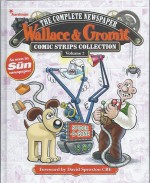
Wallace & Gromit – The Complete Newspaper Comics Strips Collection volume 1: 2010-2011


By various (Titan Comics)
ISBN: 978-1-87276-032-0

Win’s Christmas Gift Recommendation: An X-mas tradition in the making… 10/10

Hard though it is to believe, Wallace & Gromit have been delighting us for nearly 25 years and this extremely engaging compilation perfectly attests to just how much a cornerstone of British culture the potty putty pair have become.

The ingenious, quintessentially English cheese-chasing chaps were originally conceived as an ArtSchool graphic novel for the student Nick Park, before the Plasticene lure of movement and sound diverted the concept to the world of animation.

Now a multi-media success, the animator’s ingenious inventors have come full circle with this compelling compilation of the newspaper comic strip adaptation spawned by their small (and big) screen endeavours.

According to the informative Foreword by Nick Park, in his youth the affable creator was a big fan of comics, newspaper strips and those gloriously fun-filled Christmas Annuals, so this book, incorporating all three, must be a big boost to the old glee muscles…

After years of perpetually waiting for more Wallace & Gromit, the public were given a big treat after Aardman and Titan Comics put their collective creative noggins together and produced a daily, full-colour comic strip to run in Red-Top tabloid The Sun.

The series was produced by committee and actually actualised (for this edition at least) by scripters Richy Chandler, Robert Etherington, Ned Hartley, Rik Hoskin, David Leach, J.P. Rutter and Rona Simpson, with Gordon Volke, Mike Garley, & Luke Paton with art by Jimmy Hansen & Mychailo Kazybrid, Sylvia Bennion, Jay Clarke, Viv Heath & Brian Williamson, inked by Bambos Georgiou with colours by John Burns & Digikore.

The rather complex creative process is explained in the closing essay ‘Tomb of the Unknown Artist’ if you’re of an inquiring technical nature…

Despite some early controversy about the suitability of the venue, the feature launched on Monday 17th May, 2010, cleverly offering a regular weekly adventure broken down into six, complete, stand-alone gags in traditional format (three panels: Set-up, Delivery, Punchline!). What could be better?

The tone is bright and breezy, inventive family fare with all the established characters in play and the emphasis equally on weird science and appalling puns.

…And Cheese, buckets and buckets of fermented milk-curd mirth…

Dedicated to the further adventures of Northern boffin Wallace and the incomparable best-of-breed working dog Gromit, and set as ever in and around scenic 62 West Wallaby Street, Wigan, the first six-day week reveals that ‘The Tooth Hurts’ in a painful progression from agonised impacted wisdom tooth through the construction of an oddly automated – and frankly terrifying – “Cavitron” to a more traditional extraction thanks to the dog’s sensibly take-charge attitude.

This is promptly followed by similar results from the construction of washing-up robot ‘Helping Hands’, sound amplifying ‘Hear Muffs’ and the first of a dozen double-page spread photo pin-ups taken from the original animated features.

Then ever-peckish Wallace attempts to update the ancient science of apiary in ‘Knowing Bee, Knowing You’, builds his own T-Rex in ‘Jurassic Lark’, “helps” Gromit solve the mystery of missing milk with the overzealous ‘Roboplod’ and even catch a tragic dognapper in ‘Pet Detectives’…

There’s a wealth of delightful in-jokes scattered throughout the strips such as scholarly Gromit’s quirky reading habits (The Dog Delusion by Richard Pawkins, Paws by Peter Barkly, Cracking Cakes by Nigella Pawson or On the Origin of Species by Charles Darwinalot…) as well as a glorious parade of pained and hangdog expressions on the permanently perplexed pooch’s puss.

After another tasty photo-spread the lads go into ‘The Restaurant’ business with their Cheesy Way Diner, get into a bit of a kerfuffle with long-suffering Reg and Ida from ‘The House Next Door’, herald the pastapocalypse with an ultimate noodle maker that triggers ‘The Spaghetti Incident’ after which the lucky dog discovers the lost city of Wallabyzantium under the house in ‘Raiders of the Lost Bark’…

Another pin-up heralds a commission to fix the clock tower chronometer in ‘Gromit Time’ whilst ‘Life’s a Beach’ introduces rival tinkerer Otto Bahn mit his hund Wulfie at the European Inventor’s Convention, before the appallingly keen Sharp-sichord quickly graduates from honing pencils to bigger challenges in ‘Wallace’s Sharp Idea’ and football is forever changed by the old fool’s Robo-goalie in ‘A Safe Pair of Hands’.

The sport of cheese-rolling was easy meat for Wallace in ‘The Edam Busters’ after which a series of unconnected one-off strips comprising ‘Funnies #1’ is followed by the return of penguin super-thief Feathers McGraw in ‘Jolley-Goode Jewels’, the advent of ruthless twitcher Albert Ross in ‘Watch the Birdy’ and a foray into automated barber-ism in ‘A Snip Above’

Feathers made a break for it in ‘It Had to be Zoo’ whilst Wallace was beta-testing his robot-muck-spreader, and the inventor made quite a splash in his new day-job as a chauffeur ‘Driving Miss Crazy’, before Gromit registered extreme discontentment with his instant-self-assembly kennel in ‘Gone Camping’.

The lads celebrated Halloween as paranormal investigators of a haunted school in ‘Ghostblusters’, before all that cheese got to Wallace and Gromit put him on a diet in ‘A Fridge Too Far’. Then, following some more solo ‘Funnies #2’, there was monkey business aplenty when an ape went ‘Bonkers About Conkers’ before ‘A Family Affair’ unearthed a tradition for innovation in our pair’s inspirational ancestors…

The threat of Ballroom Dancing with Wendolene prompts the construction of another ill-advised training robot in ‘Strictly Wallace’, and greedy impatience the building of a ‘Cake-While-You-Wait’ oven, before the far more efficient 12 6 Days of Christmas’ celebrates the season with speedily surreal succinctness, after which a half-dozen ‘Breakfast Gags’ usher in a new year rife with catastrophic potential…

The restless dilettante then improves winter sports with jet-pack technology in ‘Ice to See You’, safeguarded Reg and Ida’s sowing season with the accidentally sinister ‘Scarecrowmatic’ and builds a Caddy-Matic contraption to take the dullness out of golf in ‘Hole in One (Hundred)’, going on to sculpt ice statues and an ‘Abominable Snowman’ before retiring with a ‘Perfect Cuppa’ courtesy of a jury-rigged Teasmaid-from-Hell…

Another cash shortfall leads to a dalliance with the arts in ‘Bona Lisa’ whilst an overabundance of soft fruit inspires a domestic mechanised revolution in ‘Bit of a Jam’, after which Albert Ross returns to squash Wallace’s sky-writing enterprise in ‘Love is in the Air’. Gromit then wants a bit of help protecting nest boxes from predatory moggies and Wallace’s solution is certainly ‘For the Birds’…

Disappearing dairy comestibles prove that ‘Sweet Dreams are made of Cheese’ and poor TV reception requires ‘Another Grand Day Out’ to clear space of accumulated junk – good thing they had that old rocket lying about – but autumnal clutter needs a more hands-on approach in ‘Leaf it to Wallace’, whilst the bonkers boffin’s attempts to mechanise newspaper delivery don’t work so well for Gromit the ‘Paper Hound’…

There were too many strings attached to ‘The Pup-Pet Show’ for the impecunious innovator, but a complete overhaul of Mr. Braddle’s little enterprise into ‘The Hard Work Hardware Shop’ paid big dividends, leaving time for a little fishing break in ‘Hook, Line and Stinker’ but it’s soon back to business when Feathers set his beady eye on the ‘The Faver-Heigh Egg’ belonging to a crusty colonel…

The chaps’ attempt to put up the official town bunting for the Queen’s visit lead to ‘A Right Royal Knees Up’ after which a Mayoral Fancy Dress affair offers real rewards for the brace of ‘Caped Crusaders’ and this initial barrage of batty bewilderments concludes with one more snack break as the boys adapt their removals firm to the needs of a catering crisis in ‘Movers and Shakers’…

Lovingly rendered and perfectly timed, the skilful blend of low comedy and whimsy is just as memorable in two dimensions as four, and this book will make a lot of kids – of all ages – extremely happy. Moreover, for all those parents who deliberately avoided the strip because of the paper which carried it, you no longer have that excuse and should now consider this annual collection a “must have” for your family bookshelf…
WALLACE & GROMIT, AARDMAN, the logos and all related characters and elements are © and ™ Aardman/Wallace & Gromit Ltd. 2013. All rights reserved.

Ray & Joe: the Story of a Man and his Dead Friend and Other Classic Comics


By Charles Rodrigues, Bob Fingerman & Gary Groth (Fantagraphics Books)
ISBN: 978-1-60699-668-3

Win’s Christmas Gift Recommendation: Sick, sick, sick – the perfect antidote to seasonal cheer overload… 9/10

Although largely unremarked and unremembered these days, Charles Rodrigues (1926-2004) is probably one of the most influential – and certainly most darkly hilarious – American cartoonists of the last century.

His surreal, absurd, insane, anarchic, socially disruptive and astoundingly memorable bad-taste gags and strips were delivered with electric vitality and galvanising energetic ferocity in a number of magazines. This was most effective in Playboy, The National Lampoon (from the debut issue) and Stereo Review – and the pinnacle of a career which began after WWII and spanned nearly the entire last half of the 20th century.

After leaving the Navy and relinquishing the idea of writing for a living, Rodrigues used his slice of the G.I. Bill provision to attend New York’s Cartoonists and Illustrator’s School (now the School of Visual Arts) and in 1950 began schlepping gags around the low-rent but healthily ubiquitous “Men’s Magazine” circuit.

He gradually graduated from girly-mags to more salubrious publications and in 1954 began a lengthy association with Hugh Hefner in his revolutionary new venture. He still contributed to what seemed like every publication in the nation using panel gags: from Esquire to TV Guide, Genesis to The Critic.

He even found time to create three strips for the Chicago Tribune-New York News Syndicate – Eggs Benedict, Casey the Cop and Charlie.

Undoubtedly, though, the quiet, genteel devout Catholic’s lasting monument is the wealth of truly appalling sick, subversive, offensive and mordantly, trenchantly wonderful strip-series he crafted for The National Lampoon, whose editor Henry Beard sought him out in the earliest pre-launch days of 1969, and offered Rodrigues carte blanche, complete creative freedom and a regular full-page spot.

He stayed aboard from the 1970 debut until 1993, a mainstay of the legendary comics section…

Bracketed by informative text pieces ‘Introduction: An Appreciation of a Goddamn Great Cartoonist’ and ‘Biography: Charles Rodrigues’ by passionate devotee Bob Fingerman, the parade of diabolical disgust and fetid fun begins with the eponymous ‘Ray and Joe – the Story of a Man and his Dead Friend’ which follows the frankly disturbing buddy-movie path of Joe – whose death doesn’t upset his wife as much as you’d expect.

In fact when the cadaver’s former pal meekly inquires, she’s more than happy to let Ray keep the body. After all, it’s cheaper than a funeral…

There’s no agenda here: Ray just wants to keep his friend around, even going so far as to have him embalmed and put on roller skates. Of course most people simply don’t understand…

Rodrigues broke all the rules in these strips: taste, decency, even the contract between reader and creator. Often he would drop a storyline and return to his notional continuities at a later date. Sometimes he would even stop mid-episode and insert a new strip or gag if it offered bigger chortles or shocks…

Next up is ‘Deirdre Callahan – a biography’, the gut-wrenching travails of a little girl so ugly she could cause people’s eyeballs to explode and make almost everyone she met kill themselves in disgust.

Of course such a pitiful case – the little lass with a face “too hideous for publication” – did elicit the concern of many upstanding citizens: ambitious plastic surgeons, shyster lawyers, radical terrorists, enemy agents, bored, sadistic billionaires in need of a good laugh, the mother who threw her in a garbage can before fully examining the merchandising opportunities…

The artist’s most long-lived and inspired creation was ‘The Aesop Brothers – Siamese Twins’ which ran intermittently from the early 1970s to 1986 in an unceasing parade of grotesque situations where conjoined George and Alex endured the vicissitudes of a life forever together: the perennial problems of bathroom breaks, getting laid, enjoying a little “me time”…

In the course of their cartoon careers the boys ran away to the circus to be with a set of hot conjoined sisters, but that quickly went bits-up, after which the sinister carnival owner Captain Menshevik had them exhibited as a brother/sister act with poor Alex kitted out in drag.

There’s a frantic escapade with a nymphomaniac octogenarian movie goddess, assorted asshole doctors, Howard Hughes’ darkest secret, a publicity-shy rogue cop, marriage (but only for one of them), their appalling early lives uncovered, the allure of communism, multiple choice strips, experimental, existential and faux-foreign episodes, and even their outrageous times as Edwardian consulting detectives.

This is not your regular comedy fare and there’s certainly something here to make you blanch, no matter how jaded, strong-stomached or dissolute you think you are…

As always with Rodrigues, even though the world at large hilariously exploits and punishes his protagonists, it’s not all one-sided. Said stars are usually dim and venal and their own worst enemies too…

Hard on their four heels comes the saga of ‘Sam DeGroot – the Free World’s Only Private Detective in an Iron Lung Machine’ an plucky unfortunate determined to make a contribution, hampered more by society’s prejudices than his own condition and ineptitude.

After brushes with the mob and conniving billionaires’ wives, no wonder he took to demon drink. Happily he was saved by kindly Good Samaritan Everett, but the gentle giant then force fed him custard and other treats because he was a patient urban cannibal. Thankfully that’s when Jesus entered the picture…

During the course of these instalments the strip was frequently usurped by short guerrilla gag feature ‘True Tales of the Urinary Tract’ and only reached its noxious peak after Sam fell into a coma…

The artist was blessed or cursed with a perpetually percolating imagination and also crafted scandalously inaccurate Biographies.

Included here are choice and outrageous insights into ‘Marilyn Monroe’, ‘Abbie Hoffman’, ‘Chester Bouvier’, ‘Eugene O’Neill’ and ‘Jerry Brown’ as well as ‘An American Story – a Saga of Ordinary People Just Like You’, ‘The Man Without a County’ and ‘Joe Marshall Recalls his Past’…

The horrific and hilarious assault on common decency concludes with a selection of shorter series collected as The Son of a Bitch et al, beginning with the exposé of that self-same American institution.

The Son of a Bitch‘ leads into the incontinent lives of those winos outside ’22 Houston Street’, the ongoing calamity of ‘Doctor Colon’s Monster’, the domestic trauma of ‘Mama’s Boy’ and the sad fate of ‘The “Cuckold”’…

‘The Adventures of the United States Weather Bureau starring Walter T. Eccleston’ is superseded by ‘Mafia Tales’ and ‘VD Clinic Vignettes’ after which ‘A Glass of Beer with Stanley Cyganiewicz of Scranton, PA’ goes down smoothly, thanks to the then-contentious Gay question addressed in ‘Lillehammer Follies’, after which everything settles down after the recipe for ‘Everett’s Custard’…

Fantagraphics Books have again struck gold by reviving and celebrating a lost hero of graphic narrative arts in this superb commemoration of a mighty talent. This is an astoundingly funny collection, brilliantly rendered by a master craftsman and one no connoisseur of black comedy can afford to miss.
All strips and comics by Rodrigues © Lorraine Rodrigues. Introduction & Biography © Bob Fingerman. All rights reserved. This edition © 2011 Fantagraphics Books.

The Best of Archie Comics Book 3


By Bob Montana and many & various (Archie Comics)
ISBN: 978-1-936975-61-7

For most of us, comicbooks mean buff men and women in capes and tights hitting each other, lobbing trees and cars about, or stark, nihilistic genre thrillers aimed at an extremely mature and sophisticated readership of confirmed fans – and indeed that has been the prolific norm for nearly twenty years.

However, over the decades since the medium was created in 1933, other forms of sequential illustrated fiction genres have held their own. One that has maintained a unique position over the years – although almost now completely transferred to television – is the teen-comedy genre begun by and synonymous with a carrot topped, homely (at first just plain ugly) kid named Archie Andrews.

MLJ were a small publisher who jumped wholeheartedly onto the superhero bandwagon following the debut of Superman. In November 1939 they launched Blue Ribbon Comics, promptly following with Top-Notch and Pep Comics. The content was the accepted blend of costumed heroes, two-fisted adventure strips and one-off gags. Pep made history with its lead feature The Shield – the industry’s first super-hero to be clad in the flag – but generally MLJ were followers not innovators

That all changed at the end of 1941. Even while profiting from the Fights ‘N’ Tights phalanx, Maurice Coyne, Louis Silberkleit and John Goldwater (hence MLJ) spotted a gap in their blossoming market and in December of that year the action strips were joined by a wholesome, ordinary hero; an “average teen” who had human-scaled adventures like the readers, but with the laughs, good times, romance and slapstick heavily emphasised.

Pep Comics #22 introduced a gap-toothed, freckle-faced, red-headed goof showing off to the pretty blonde next door. Taking his lead from the popular Andy Hardy movies starring Mickey Rooney, Goldwater developed the concept of a wholesome youthful everyman lad, tasking writer Vic Bloom and artist Bob Montana with the job of making it work.

It all started with an innocuous 6-page tale entitled ‘Archie’ which introduced Archie Andrews and pretty girl-next-door Betty Cooper. Archie’s unconventional best friend and confidante Forsythe P. “Jughead” Jones also debuted in that first story as did the small-town utopia of Riverdale.

It was an instant hit and by the winter of 1942 the feature graduated to its own title. Archie Comics #1 was the company’s first non-anthology magazine and began an inexorable transformation of the entire company. With the introduction of rich, raven-haired Veronica Lodge, all the pieces were in play for the industry’s second Phenomenon (Superman being the first).

By May 1946 the kids had taken over and, retiring its heroic characters years before the end of the Golden Age, the company renamed itself Archie Comics, becoming to all intents and purposes a publisher of family comedies.

Its success, like the Man of Tomorrow’s, forced a change in the content of every other publisher’s titles and led to a multi-media industry including TV, movies, pop-songs and even a chain of restaurants.

Over the decades those costumed cut-ups have returned on occasion but Archie Comics now seem content to specialise in what they do uniquely best.

The eponymous Archie is a good-hearted lad lacking common sense and Betty – the pretty, sensible, devoted girl next door, with all that entails – loves the ridiculous redhead. Veronica is spoiled, exotic and glamorous and only settles for our boy if there’s nobody better around. She might actually love him too, though. Archie, of course, can’t decide who or what he wants…

This never sordid eternal triangle has been the basis of seventy years of charmingly raucous, gently preposterous, frenetic, chiding and even heart-rending comedy encompassing everything from surreal wit to frantic slapstick, as the kids and an increasing cast of friends grew into an American institution.

Adapting seamlessly to every trend and fad of the growing youth culture, the host of writers and artists who’ve crafted the stories over the decades have made the “everyteen” characters of utopian Riverdale a benchmark for youth and a visual barometer of growing up American.

Archie’s unconventional best friend Jughead is Mercutio to Archie’s Romeo, providing rationality and a reader’s voice, as well as being a powerful catalyst of events in his own right. There’s even a scurrilous Tybalt figure in the Machiavellian shape of Reggie Mantle who first popped up to cause mischief in Jackpot comics #5 (Spring 1942).

This beguiling triangle (and annexe) has been the rock-solid foundation for decades of comics magic. Moreover the concept is eternally self-renewing…

Archie has thrived by constantly reinventing its core characters, seamlessly adapting to the changing world outside the bright, flimsy pages, shamelessly co-opting youth, pop culture and fashion trends into its infallible mix of slapstick and young romance.

Each and every social revolution has been painlessly assimilated into the mix with the editors tastefully confronting a number of social issues affecting the young in a manner both even-handed and tasteful over the years.

The cast is always growing and the constant addition of new characters such as African-American Chuck – who wants to be a cartoonist – his girlfriend Nancy, fashion-diva Ginger, Hispanic couple Frankie and Maria and a host of like spoiled home-wrecker-in-waiting Cheryl Blossom all contribute to a wide and refreshingly broad-minded scenario. In 2010 Archie jumped the final hurdle with Kevin Keller, an openly gay young man and clear-headed advocate capably tackling and dismantling the last major taboo in mainstream comics.

Of course such a wealth of material has provided for a splendid library of trade paperbacks and collected editions since the dawn of the Graphic Novel market at the beginning of the 1980s. In recent years the company has found many clever ways to repackage their irresistible product such as a series of reprint volumes examining the progress decade-by-decade.

This particular iteration of The Best of Archie Comics tweaks that idea by providing a sampling from each era in one big book, with the further fillip of the tales being favourites personally selected by editorial staff like Editor in Chief Victor Gorelick and Ellen Leonforte, creators – vintage and current – like J. Torres, Dan Parent and Fernando Ruiz or avowed celebrity fans such as Kyle Gass (Tenacious D), Joel Hodgson (Science Mystery Theater 3000), Tom Root (Robot Chicken) and Stan Lee.

Archie in ‘The 1940s’ is superbly represented by a wealth of wry and riotous slapstick shenanigans beginning with ‘The 3-11 Club’ (by Bob Montana from Pep #36, 1943) which finds the young sap drawn into a duel with a Prep School cadet after taking haughty, fickle Veronica to a swanky night spot.

Co-creator Montana supplied most of these early episodes, such as the medieval fantasy-fest ‘Sir Archibald of the Round Table’ (Archie #2 1943) and the delightfully heart-warming tale of a boy and his dog – and the ten puppies which resulted when everybody misapprehended the gender of ‘Oscar’ (Pep #37 1943)…

Ed Goggin, Harry Sahle – and his favourite inker “Ginger” – captured the contentious boisterousness of ‘Spring Fever’ (Archie #2 1943), after which the red menace got another irksome pet in ‘Monkey Shines’ (by Montana from Archie #6, 1945), before a broken School clock made ‘Time for Trouble’ (Sahle & Ginger, Archie #7, 1945), with the decade closing for us with a catalogue of calamity in the Goggin/Sahle/Ginger exposé ‘Camera Bugs’ from Pep #48, 1946.

An era of conformity, stability and expansion, ‘The 50s’ open with ‘The Cook-Off’ (Little Archie #2, 1956) as Bob Bolling expertly extrapolates on the grade school years of that eternal love triangle and the boy learns early the wages of “sin” is bewilderment and a headache. Teen Veronica then takes centre stage in ‘Poor Little Rich Whirl’ by George Frese & Terry Szenics (Archie Annual #8, 1956-1957) flaunting her wealth to poor little Betty, and the section concludes with a rare full-length 5 part yarn from Jughead #1, 1957.

Here the ravenous nonconformist discovers the downside of becoming a global singing sensation in ‘Jughead’s Folly’ by the amazing Joe Edwards.

‘The 1960s’ were a time when youth culture took over everything and ‘Over-Joyed’ by Frank Doyle, Harry Lucey & Marty Epp (Archie #123, 1961) begins a second Golden Age for laughter as the carrot-topped Lothario endures a self-inflicted barrage of silent comedy catastrophes, before ‘Hi-Jinx and Deep Divers’ (by Bob White from Life with Archie #16, 1962) cleverly changes tack for a sub-sea science fiction adventure which finds Messrs. Andrews and Mantle battling mermen at the bottom of the sea…

In Archie’s Pals and Gals #29, 1964 Doyle, the brilliant Samm Schwartz & Epp superbly spoofed the British Pop Invasion by having the disgruntled lads of Riverdale form their own mop-top band in the still-hilarious ‘Beetlemania’, after which ‘The Hold Up’ by Doyle, Dan DeCarlo, Rudy Lapick & Vince DeCarlo offers a sharp and silly pre-Pussycats tale from She’s Josie #19, 1966.

In it rich brat Alexander Cabot III expends insane amounts of energy trying to get robbed because he hates anybody thinking he might be poor…

Apparently the most disturbing thing about Jughead is that he prefers food to girls – a situation the torrid teen temptresses of Riverdale High attempt to correct through modern technology in ‘Pardon My Computer’ by George Gladir, Schwartz & Epp (Jughead #119, 1966), after which the lad proves his love for cunning pranks in ‘Voice Control’ (Doyle & Schwartz from Jughead #120, 1966).

Practical jokes are an Art form in Riverdale – as seen in ‘Stick with It’ (Archie #178 Doyle, Lucey, Bill Yoshida & Barry Grossman) and the kids played with reality itself in ‘Visit to a Small Panic’ (Everything’s Archie #1 Gladir, Lucey, Epp & Yoshida) when they all visited the Hollywood animation studios then creating their Saturday Morning Cartoon Show.

A time of style-challenged sensuous silliness and ethical questing, ‘The ’70s’ is represented here with ‘The Bye Bye Blues’ (Laugh #276, 1974, Doyle, Lucey, Yoshida & Grossman) wherein the kids practise their life-governing philosophies to great effect, whilst Reggie’s adoption of the wrong spirit after watching ‘Kong Phoo’ (Archie at Riverdale High #18, 1974) by Doyle & Lucey only leads to personal pain and sorrow…

‘Minding a Star’ (Archie #264, 1977, by Doyle, Dan & Jim DeCarlo & Grossman) finds our brick-topped hero babysitting a TV celebrity chimp, whilst the Star Wars phenomena hit mean Mantle hard in ‘Costume Caper’ from Reggie and Me #104 (1978, Doyle, Dan DeCarlo Jr., Jim DeCarlo, Yoshida & Grossman).

The girls had their own pet passions as seen in the superb spoof ‘Melvin’s Angels’ (Betty & Veronica #277, 1979) from Doyle, Dan & Jim DeCarlo, Yoshida & Grossman.

‘The ’80s’ are still with us, of course, so the green message of ‘Verve to Conserve’ (by Gladir, DeCarlo Jr., Lapick & Yoshida from Archie # 292, 1980) retains much of the original merit and mirth, whilst Josie’s ongoing war with the Cabot clan on Sports Day results in ‘Scratch One Clown’ (Archie’s TV Laugh-Out #86, 1982, by Dan DeCarlo Jr., Jim DeCarlo & Yoshida).

Parental control and filial responsibility result in upset and big laughs in ‘Saturday’s Child’ (Archie #331, 1984 Doyle, Dan DeCarlo Jr. & Jim DeCarlo), whilst ‘The Plight of the Perilous Pike’ by Bolling, Bob Smith & Yoshida from Archie and Me #144 offers another view of the kids – one that displays their warmth, generosity and good hearts.

Around the same time that DC were first rationalising their sprawling universe, after years of unqualified success Archie Comics similarly undertook a massive gamble in the MTV, computer-game, reading-reduced decade by rebooting and updating the entire franchise.

Betty’s Diary #1, 1987 saw ‘The Art Lesson’ – by Kathleen Webb, Dan & Jim DeCarlo & Yoshida – in which the wholesome blonde showed her character by refusing an award she felt she hadn’t earned. Then ‘Back from the Future’ (Archie Giant Series #590, October 1988, by Rich Margopoulos, Rex Lindsey, Jon D’Agostino, Yoshida & Grossman and supplemented here by the cover) offers a fanciful comedy drama as the Jones boy is deputised by pretty red-headed, be-freckled mystery girl January McAndrews into the Time Police.

She believes that the slovenly moocher is the only one who can help her save history from malignant chronal crooks. Scary…

‘The ’90s’ section begins with the uncanny ‘Mystery of the Mummy’s Curse’ (New Archies Digest #10, 1990, by Mike Pellowski, Henry Scarpelli, Yoshida, Grossman, Nanci Tsetsekas & Gregg Suchow), a caper very much in the manner of TV’s Scooby Doo – but with the kids as pre-teens. Next, fame chasing Cheryl Blossom (#15 1995 by Dan Parent, D’Agostino, Yoshida & Grossman) takes time off from trying to steal Archie from Betty and Veronica to briefly pursue a life in reality TV by organising ‘Cheryl’s Beach Bash’…

That Scooby Gang motif was a popular one. In ‘The 2000s’ ‘A Familiar Old Haunt’ (Archie’s Weird Mysteries #6, 2000 by Paul Castiglia, Fernando Ruiz, Rick Koslowski, Vickie Williams & Rick Taylor) found the teenaged Riverdalers exposing charlatan monster-hunters, whilst a manga-style re-imagining of Sabrina (#70, 2005 by Tania Del Rio, Jim Amash, Jeff Powell, Ridge Rooms & Jason Jensen – and see Sabrina the Teenage Witch: The Magic Within Book 1) – found the student sorceress dealing with both mundane and mystical school tests in ‘Spell it Out’…

This marvellous meander down memory lane concludes with ‘2010 and Beyond’ and ‘Something Ventured, Something Gained’ (from Jughead #200, 2010 by Tom Root, Lindsey, Jack Morelli, Parent & Rosario “Tito” Peña) which sees young Forsythe sell his most unappreciated, vital characteristic to a conniving witch and only survive due to the self-sacrifice of his friends…

Also on show are some thoroughly modern spoof and pastiche ‘Variant Covers’ by Andrew Pepoy, Fiona Staples, Ramon Perez & Phil Jimenez from 2012-2013, before everything ends on a delirious dilemma in ‘The Great Switcheroo!’ (Archie #636, 2012 by Del Rio, Gisele, Koslowski, Morelli & Digikore Studios) as well-intentioned magic turns the town into in Reverse-dale and all the boys and girls unknowingly swap genders and problems…

Spanning the entire history of comicbooks and featuring vintage yarns, landmark material and up-to-the-minute modern masterpieces, this is a terrific tome for anybody looking for light laughs and the acceptable happy face of the American Dream.
© 2013 Archie Comics Publications, Inc. All rights reserved.

When I Was a Kid – Childhood Stories by Boey


By Cheeming Boey (Last Gasp)
ISBN: 978-0-86719-785-3

The ability to go back into our childhoods and relive those bizarre, baffling and brilliantly fierce thoughts and every brand-new-day discoveries is a wondrous mixed blessing, but being able to share those recaptured experiences with jaded world-weary adults is a truly miraculous gift and thus utterly evergreen.

A recent admission to the select but august crowd of halcyon salad-days wranglers is Malaysian animator, illustrator, educator, video game developer and cartoonist Cheeming Boey – who also produces gallery art on Styrofoam coffee cups and draws an autobiographical webcomic about his life in America, entitled I Am Boey.

You should really check it out…

As a kind of prequel to his blog – if indeed growing up can be considered an introduction to a main event – Boey has collected a huge number of visual memoirs and epigrams about his im-maturing years in Asia, bundling them up in a beguiling paperback that emphasises both the exoticism of life in Malaysia and the universal similarities and solidarities of being a kid.

Warm, sensitive, intimate, uproarious, disarmingly honest as well as on occasion brutal, shocking and sad, these 103 visual monologues (with heart-warming family photos scattered throughout) are invitations into a world of wonder, rivalry, confusion, punishment, resentment, humiliation, anticipation, frustration, greed, glee and always the security of family.

They all begin with “When I was a kid…” and prove that, apart from the odd surface detail, every happy, loving childhood is identical…

The stand-out incidents include such salutary universal reminiscences as ‘My First Pet’, ‘Baby Powder’, ‘Bedtime Stories’, ‘Bad for your Eyes’, ‘Grandma’s Leg’, ‘Nasal Noodles’, ‘R-Rated’, ‘Stealing Money’, ‘Sunday Cartoons’, ‘Not a Genius’ and of course ‘Failing Math’ but with such a wide catalogue to choose from, every little cartoon episode will resonate with somebody. Especially you…

© 2011, 2013 Cheeming Boey. All rights reserved.

…And remember to visit www.iamboey.com
Win’s Christmas Gift Recommendation: a total treat for the big kids paying for all the presents this year and every year… 9/10

Last of the Mohicans: Ten-Cent Manga Series volume 1


Freely adapted from the novel by James Fenimore Cooper by Shigeru Sugiura, edited & translated by Ryan Holmberg (PictureBox)
ISBN: 978-0-985195-6-6

Those of us in the know tend to believe that Japanese comics began with Osamu Tezuka in the years following the end of World War II – and indeed in most ways that assessment is reasonable.

However, as the superbly informative article bolstering this superb and timely translation attests, there has been a thriving manga business operating in Japan since the 1930s, and one of its greatest proponents was artist and author Shigeru Sugiura.

This superb black and white hardback volume re-presents one of his greatest triumphs as the initial volume in a proposed series of “Ten-Cent Manga” collections translated and edited by Ryan Holmberg which will highlight lost works displaying not simply indigenous Japanese virtuosity but also the influence of cross-cultural contact and pollination with other countries such as America.

In his erudite and lavishly illustrated essay and appreciation ‘Shigeru Sugiura and his Mohicans’ Holmberg describes in fascinating and forensic detail the origins of the project, the state of play in Japan pre-and-post WWII and the absorbing life and career of an artist who began as a jobbing strip cartoonist yet elevated himself to the status of Psychedelic, Surrealist Pop Art icon – one utterly addicted to American movies and comicbooks.

The treatise is fully supported by documentary excerpts from the 1950s magazines and strips Sugiura scrupulously homaged and swiped from: Jesse Marsh’s Tarzan, Alex Toth’s Johnny Thunder, and particularly Fred Ray’s Tomahawk being the most common amongst a wealth of graphic treasures synthesised and transformed into something fresh, vibrant and, most crucially, relevant to the entertainment-starved kids of occupied Japan.

Also included is an article by the artist himself, written in 1988 and describing his life-long passion for and debt of influence to American cinema – most especially ‘Silent Movies’…

However, although scholarly and revelatory, the text portions of this delightful tome pale beside the sheer exuberant energy and B-movie bravura of James Fenimore Cooper’s text…

Shigeru Sugiura (1908-2000) studied painting before becoming an art assistant to comics pioneer Suihō Tagawa. By 1933 he was creating his own strips for the gags and boys’ own adventure style comics that proliferated prior to the war. He returned to the industry when hostilities ended, producing more of the same but now influenced far more by the ubiquitous comicbooks of the occupying G.I.s than the silent Westerns and baggy-pants comedies he had voraciously consumed in his youth.

His blended comedy/action stories for children achieved great success throughout the 1950s, based on well known characters such as the ninja Sasuke Sarutobi or Chinese classics like Journey to the West, and he adapted modern themes like wrestling, science fiction and even Gojira/Godzilla to his fun-filled weekly pages in a most prolific and influential career.

…And Westerns; he did lots of rootin’ tootin’ shoot ’em up cowboy stories…

He very loosely adapted Last of the Mohicans in 1953 (when it was already a very familiar tale to Japanese readers) for Omoshiro Manga Bunko – a line of books presenting world classics of literature in comics form – albeit not exactly in any form recognisable to literary purists…

He retired in 1958 but returned in 1970, reworking old stories and creating new pieces from the fresh perspective of a fine artist, not a mere mangaka earning a precarious living.

In 1973 he was already refining and releasing his classic tales for paperback reprints when he was approached by Shōbunsha to update another. The 1953 Mohicans became the latest re-released tale, slyly reworked as a wry pastiche which kick-started Sugiura’s second career as a darling of the newborn adult manga market…

One word of warning: This is not your teacher’s Last of the Mohicans, any more than The Shining resembles Stephen King’s actual novel or the way the musical South Pacific could be logically derived from James Michener’s Tales of the South Pacific – or indeed how anything Alan Moore wrote could be found in films like From Hell or League of Extraordinary Gentlemen…

Sugiura’s updated 1973-74 iteration forms the majority of this chronicle; a fast-paced story of non-stop adventure, greed, pride, tragedy and whacky humour where both the heroic frontiersman Leatherstocking and noble savage Chingachgook are re-imagined as bold young lads in bad times, their desperate quest punctuated with weirdly clashing moments of slapstick, creative anachronism, cross-cultural in-jokes and plain outright peculiarity…

It all works impossibly well, beginning with the introduction of Hawkeye, ‘La Carabine Kid’: a young but doughty colonial scout and spy for the British.

The Empire is at war with the French for possession of the New World, and the Kid and his companions have suffered many reverses at the brutal hands of the Mingos – a tribe allied to France and responsible for reducing the mighty Mohicans to two survivors; Chief Chinga and his son Uncas. 

The plot thickens when the Mingo Chief and his manic son Magua threaten to abduct Cora and Alice, daughters of British Colonel Munro, in an attempt to force the soldier to surrender his command East Fort to the French.

After a savage assault, Hawkeye, the Mohicans and dashing Major Duncan decide to escort the girls to the safety of Fort Henry, with the hostiles close behind…

En route they pick up itinerant preacher Father Gamut, before fighting their way on through wilderness and repeated Mingo attacks, always one step ahead of ‘Magua’s Pursuit’.

The struggle is not one-sided. The wily fugitives manage to blow up a French fort and even link up with a war party of Delas who subsequently reduce the ravening Mingos to scattered remnants – but not before the pursuers succeeding in carrying off ‘The Abducted Sisters’…

The scene is set for the heroes to rescue the girls and end Magua’s threat forever – but the showdown is costly and there is a high price to pay in ‘The Sad Ending’…

Sheer graphic escapism, spectacular storytelling and a truly different view of a time-honoured masterpiece make this an unmissable treat for all lovers of world comics.

This book is printed in ‘read-from-back-to-front’ manga format.

© 2013 the Estate of Shigeru Sugiura. Translation and essay © 2013 Ryan Holmberg. All rights reserved.
Win’s Christmas Gift Recommendation: An ideal present for comics connoisseurs… 8/10

Nudnik Revealed!


By Gene Deitch (Fantagraphics Books)
ISBN: 978-1-60699-651-5

Kim Deitch has been one of the leading lights of America’s Comix Underground since its earliest days. He probably got his artistic acumen, narrative know-how and skewed raconteur’s view from his dad…

Eugene Merril “Gene” Deitch was born in 1924 and began his astounding career as a graphic designer and art director before eventually moving into animation. Over a 65-year career working as producer, scripter, artist, designer and Director for UPA/Columbia Pictures, MGM, Terrytoons/20th Century Fox, King Features and Paramount Pictures, he created cartoons for both movie audiences and television consumption.

In 1961 his cartoon feature of Jules Feiffer’s Munro won the Oscar® for Animated Short Film, and he numbers Tom Terrific, Tom and Jerry, Popeye and Krazy Kat amongst his other major successes. Deitch directed Alice of Wonderland in Paris, adapted the animated feature of Maurice Sendak’s Where the Wild Things Are and is credited with the first ever Tolkien film adaptation with The Hobbit in 1966.

Gene Deitch has resided in Prague for decades where he established a long and fruitful working relationship with Krátký Film s.r.o. studios. This partnership led, in 1964-1965, to a uniquely personal and brilliant run of movie cartoon shorts starring the latest in a shabby yet unbroken line of good-natured, ingenuously bumbling, impoverished cinematic victims of cruel circumstance.

The very first Nudnik cartoon garnered Deitch another Academy Award® nomination and led to the commission of 11 more shorts starring the luckless loafer, conceived and mapped out by Deitch to be constructed by his Iron Curtain cousins …and delivered just as the American tradition of preceding main movie blockbusters with brief cartoons was ending….

Now with those lost classics restored and collected on a commemorative DVD, Deitch has also compiled a glorious oversized (310 x 236mm) full-colour hardback compendium detailing the history and genesis of Nudnik as an accompaniment.

Dedicated to and enamoured of the hallowed concept of the lonely loser, Deitch famously got the idea for his favourite creation after a piece of office machinery tried to kill him. From there the concept of a down-and-out hobo who was a magnet for ever-increasing disaster just seemed to gel…  

Liberally illustrated throughout with original art and documents scrupulous hoarded by Deitch, the disclosures begin in the introductory ‘Here’s Nudnik’ after which the physical genesis of the character is revealed in ‘Nudnik, Master of Failure’…

In ‘What’s a Nudnik?’, Deitch traces the development of his ultimate baggy-pants clown, revealing his personal empathy with his creation, after which ‘The Nudnik Plot’ examines the narrative thrust of the two brief series.

Historical antecedents, poster art and some of the merchandising intended to supplement the character launch all contribute to the story of ‘The Nudnik Look’ before the real meat of this tome begins with Production Scrapbook – Capturing Ideas on Paper’.

This vast collection of utterly fascinating development sketches, preparatory roughs, scene layout drawings, models sheets, animation tests, character designs, episode models, gags, pictorial story snippets and even a complete 1967 “flip-book” adventure (‘The Cut Finger Fumble’ produced for the Montreal World’s Fair) plus more merchandise prototypes all show just how much work goes into making animation.

Then Film Setups – Some actual camera setups, cels, and backgrounds’ reproduces many actual finished scenes from the cartoons whilst Gags – Nudnik gag sketches, some of which were produced as 30-second “blackout” gag films’ reprints whole raw story sequences which show just how similar cartons and comics strips truly are.

At the time, Deitch was still learning how to work with his Czech team and thus his visual instructions were often excessively detailed.

The next section fills out the book with a magical treat for fans and students of the medium: three complete production storyboards, exactly as the actual animators received them and which they used to turn Deitch’s script, ideas and drawings into six minutes of slapstick action and outré sound effects.

The actual tales are all 18 to 20 pages of nine frames each, ‘Home Sweet Nudnik’ (episode 7), ‘Welcome Nudnik’ (episode 3) and ‘Good Neighbor Nudnik’ (episode 11), and work perfectly as comics even as they reveal the secret of animation magic…

This terrific tome then closes with additional features ‘To Russia With Love’ featuring a modern performer celebrating the cartoon clown’s shtick, a salutary example of the unwanted influence of Studio bosses in ‘Peeing in the Soup’ and a warm plug for that aforementioned DVD collection in ‘Nudnik Lives Again’…

Long regarded as a lost masterpiece of the art form, Nudnik Revealed! is a wonderful visual memoir which offers stunning insights into the history of cartoon creation and the mind of a brilliantly imaginative creative force.

Nudnik Revealed! is © 2013 Fantagraphics Books Inc. All contents © 2013 Gene Deitch. All rights reserved.

The Complete Crumb Comics volume 5: Happy Hippy Comix – New Edition


By R. Crumb & various (Fantagraphics Books)
ISBN: 978-0-930193-92-8

This book contains really clever and outrageously dirty pictures, rude words, non-condemnatory drug references and allusions, apparent racism, definite sexism, godless questioning of authority and brilliantly illustrated, highly moving personal accounts and opinions.

If you – or those legally responsible for you – have a problem with that, please skip this review and don’t buy the book.

Really. I’m not kidding…

Robert Crumb is a unique creative force in comics and cartooning, with as many detractors as devotees. His uncompromising, excoriating, neurotic introspections, his pictorial rants and invectives, unceasingly picked away at societal scabs and peeked behind forbidden curtains for his own benefit, but he has always happily shared his unwholesome discoveries with anybody who takes the time to look…

In 1987 Fantagraphics Books began the nigh-impossible task of collating, collecting and publishing the chronological totality of the artist’s vast output and those critically important volumes are now being reissued.

The son of a career soldier, Robert Dennis Crumb was born in Philadelphia in 1943 into a functionally broken family. He was one of five kids who all found different ways to escape their parents’ highly volatile problems, and comic strips were paramount among them.

As had his older brother Charles, Robert immersed himself in the comics and cartoons of the day; not just reading but creating his own. Harvey Kurtzman, Carl Barks and John Stanley were particularly influential, but also comic strip masters such as E.C. Segar, Gene Ahern, Rube Goldberg, Bud (Mutt and Jeff) Fisher, Billy (Barney Google), De Beck, George (Sad Sack) Baker and Sidney (The Gumps) Smith, as well as illustrators like C.E. Brock and the wildly imaginative and surreal 1930’s Looney Tunes and Merrie Melodies animated shorts.

Defensive, introspective and always compulsively driven, young Robert pursued art and self-control through religion with equal desperation. His early spiritual repression and flagrant, hubristic celibacy warred with his body’s growing needs…

From this point onwards, the varied and exponentially impressive breadth of Crumb’s output becomes increasingly riddled with his often hard-to-embrace themes and declamatory, potentially offensive visual vocabulary as his strips grope towards the creator’s long-sought personal artistic apotheosis, and this third volume covers material created and published between 1960-1966 as the self-tormented artist began to find a popular following in a strangely changing world.

Escaping his stormy early life, he married young and began working in-house at the American Greeting Cards Company. He discovered like minds in the growing counterculture movement and discovered LSD. By 1967 Crumb had moved to California and became an early star of Underground Commix. As such he found plenty of willing hippie chicks to assuage his fevered mind and hormonal body whilst reinventing the very nature of cartooning with such creations as Mr. Natural, Fritz the Cat, Devil Girl and a host of others. It is from this period that the engrossing, amazing and still shocking strips in this book stem…

He worked on in what was essentially a creative utopia throughout the early 1970’s but the alternative lifestyle of the Underground was already dying. Soon it would disappear: dissipated, disillusioned, dropped back “in” or demised. A few truly dedicated publishers and artists stayed the course, publishing on a far more businesslike footing as Crumb carried on creating, splitting his time between personal material and commercial art projects whilst incessantly probing deeper into his turbulent inner world.

This particular collection covers the period when the insular, isolated Crumb first began to make a name for himself with a flood of gags, posters, commercial art jobs, short strips and longer material popping up seemingly everywhere. All are faithfully reproduced in this compilation – which makes for a rather dry listing here, I’m afraid – but (trust me) the pictorial output is both engrossing and legendary.

Actually, don’t trust me: buy the book and see for yourselves…

After a photo and cartoon-stuffed (from 1968 sketchbooks) Introduction from the old scallywag himself, praising the effects of mind-altering chemicals and recalling the first heady days of Counter-Culture celebrity, the wave of visual excess and literary freewheeling begins with ‘The Old Pooperoo Pauses to Ponder’: a baroque procession of his fun-loving characters rounded off with a micro strip at the bottom, revealing Eggs Ackley’s opinion that ‘This Kid’s a Scream!’, after which Mr. Natural, Angelfood McSpade and all the rest are reassured that ‘You’re Gonna Get There Anyway’ (all from East Village Other December 1-16, 1967).

Next ‘Mr. Natural, the Man from Affiganistan’ shares more timeless wisdom with resident curious “Straight” Flakey Foont (EVO December 15-30 1968), after which a rush of shorts from EVO January 12-17 begins.

‘Sky-Hi Comics’, ‘Then on the Other Hand…’ are followed by ‘Nuttin’ but Nuttin’, ‘Here She Comes! It’s Hippy!’ and ‘Junior High & his Sidekick Judy Holiday’ from the January 19-25 edition whilst ‘Those Cute Little Bearzy Wearzies/George Gwaltny’ (EVO January 26-February 1 1968) precedes Natural’s inevitable return to act as guru to ‘Schuman the Human’ from EVO February 9-15th.

The Wise one continues in revelatory style when ‘Mr. Natural Meets God’ (supplemented by) ‘Gail Snail and The Walkie Talkies’ from EVO February 16-22, whilst the next weekly issue described how ‘Mr. Natural Gets the Bum’s Rush’, and Schuman declared ‘Let’s Be Honest’ before Crumb confronted the period’s racism head on with customary shocking frankness in ‘Mr. Natural Repents’, ‘Hey, Mom!’ and attendant strip ‘Let’s Have Nigger Hearts For Lunch’ (EVO March 1-7 1968).

Zap #2 June 1968, then provided wry ‘Hamburger Hi-Jinx’ with Cheezis K. Reist and shockingly introduced iconic Bête Noir ‘Angelfood McSpade’ before closing with a warning to avoid cheap imitations from ‘Mr. Natural’.

Bijou #1, from Summer 1968, then supplies a wealth of intriguing, astonishing fare leading with ‘Neato Keano Time!’ before ‘The Big Little Boy’ and ‘Bo Bo Bolinski, He’s a Clown!’ went through their paces. Following that ‘Mr. Spiff’ makes a call and ‘Here They Are! Puppets of your favourite cartoon characters!’ provides paper-dolls of Angelfood and Mr. Natural. The harsh, ironic hilarity all ends with a laidback Bijou Funnies Ad…

The inescapably controversial Ms. McSpade and friends then cropped up in ‘All Asshole Comics’ (Chicago Seed, July 1968), after which covers for ‘Nope #6’ and ‘Nope #7’ (both 1968) are followed here by ‘The Zap Show’ – a captivating art jam with Rick Griffin, Victor Moscoso & S. Clay Wilson.

A ‘Fritz the Cat title page’ then acts as prologue to an outrageous tale of student terrorism and teen licentiousness in ‘Fritz the No-Good’ (taken from Cavalier, September/October 1968), after which you’ll need to rotate the book to be shocked by the interiors of digest-sized Snatch #1 (October 1968): rude and raunchy spoofs such as ‘The Adventures of Andy Hard-on’, ‘Krude Cut-Ups’ and ‘The Fight’ plus assorted gags like ‘Jailbait of the Month’, ‘Hi, Swingers’ and much more…

A rather lovely ‘Janis Joplin: original cover for Cheap Thrills (1968) is followed by

‘The Phonus Balonus Blues’ and ‘Where the Action Isn’t’ (EVO September 27 1968) as well as the cover of that issue – ‘Can the Mind Know it?’

From the October 11 issue of East Village Other comes a barrage of strips: ‘Sleezy Snot Comics’, ‘Mr. Natural’, ‘Booger Buddies’ and more plus an ‘Ad for Head Comix’ whilst the October 18th edition provided both ‘Angelfood McSpade’ and ‘Cum Comix’, and October 25th a ‘Mr. Natural, disguised as a vacuum cleaner salesman, talks to the Housewives of America’ cover.

‘Edgar and Maryjane Crump’ and ‘Crime in the Streets’ both originated in EVO November 1) after which an ‘alternate cover for Zap #3′ segues into the infamous ‘Dirty Dog’ strip from Zap #3 (December 1968).

That underground classic also premiered ‘Mr. Goodbar “Off his Rocker”’, an astounding

‘Atomic Comics Jam’ with S. Clay Wilson, Gilbert Shelton, Victor Moscoso & Rick Griffin, grotesque shorts ‘Let’s Eat’ and ‘Mr. Natural’, ‘Hairy’ and ‘Street Corner Daze.’

Another digest-sized landscape section next reproduces the XXX-rated contents of Snatch #2′ (January 1969) including ‘Look Out Girls!! The Grabbies are Coming’, ‘Down on the Farm’, ‘The Family that Lays Together Stays Together’ and far more before an ‘ad for San Francisco Comic Book Company’ from Bogeyman #2, 1969, leads seamlessly into ‘Don’t Gag On It… Goof On It!’ (Gothic Blimp Works, Ltd. #1, March 1969).

The April 1969 ‘cover for Creem #2′ precedes a stunning spoof of Romance comics with ‘The Bleeding Heart Syndrome’ (Tales from the Ozone #1, 1969) before ‘Shoo Shoo Baby’ and ‘The Pricksters’ (GBW #2, 1969) suspends the black and white barrage to briefly usher in a spectacular ‘Color Section’…

The polychromatic madness begins with ‘Head Comix covers’ (front and back and 1968), keeping up the pressure with the Zap Comix #2 covers’ from December, as well as a ‘Fritz the Cat cover’, the ‘Cheap Thrills’ record cover for Big Brother and the Holding Company and the December 1968Snatch #1 covers’.

The ribald rainbows end with Snatch #2 covers’ (January 1969) before ‘Flower Children on Broadway’ from Bijou #2 (1969) return us to monochrome merriment, ‘Nutsboy’ (Bogeyman #2, 1969) presages today’s teen obsession with “Slasher-flicks” and ‘Mr. Know-It-All and his pal Diz in What the Fuck’ (with S. Clay Wilson from GBW #3, 1969) continues the dark and bloody mood.

This landmark compilation concludes with Crumb’s contributions to Motor City #1 (April 1969) starting with ultra-independent femme fatal ‘Lenore Goldberg and her Girl Commandos’, after which cool dude ‘The Inimitable Boingy Baxter’ turns Detroit on its head, and mini-mystic Savannah Foomo explores reality with ordinary folk and ‘The Desperate Character’ in ‘Deep Meaning Comics’ and ‘More Deep Meaning Gommigs’, leaving good old Eggs Ackley to wrap thing up in macabre style with ‘Eyeball Kicks’…

If Crumb had been able to suppress his creative questing, he could easily have settled for a lucrative career in any one of a number of graphic disciplines from illustrator to animator to jobbing comic book hack, but as this pivotal collection readily proves, the artist was haunted by the dream of something else – he just didn’t yet know what that was…

Crumb’s subtle mastery of his art-form and obsessive need to reveal his most hidden depths and every perceived defect – in himself and the world around him – has always resulted in an unquenchable fire of challenging comedy and riotous rumination, and this chronicle begins to show his growing awareness of where to look.

This superb series charting the perplexing pen-and-ink pilgrim’s progress is the perfect vehicle to introduce any (over 18) newcomers to the world of grown up comics. And if you need a way in yourself, seek out this book and the other sixteen as soon as conceivably possible…
© 1967, 1968, 1969, 1989, 2004, 2013 Robert Crumb. All contributory art material and content © the respective creators/copyright holders. All rights reserved.

Dark Horse Book of Witchcraft


By various, edited by Scott Allie (Dark Horse)
ISBN: 978-1-59307-108-0

Scary stories have always been a staple of comics, and anthology collections invariably offer fearsome fun and the biggest Boo for your buck so I’m taking a skittish peek at one that has definitely stood the test of time.

Following a bucolic Introduction by series Editor Scott Allie, this glorious hardback grimoire of ghoulish delights and funny fables opens with an illustrated extract from ‘Macbeth’ (guess witch bit) chillingly adapted by Tony Millionaire, after which comics and movie fans get a treat all their own.

This captivating “Book of…” mystery compilation is part of a series that spun out of Dark Horse Comics’ legendary monster-hit Hellboy, and ‘The Troll Witch’ by Mike Mignola presents a terrific vignette of the hulking demon foundling who visits Norway in 1963 and has a tense conversation with a very peculiar Wise-woman.

Next up is a classic prose short story by Weird Tales horror star Clark Ashton Smith. Illustrated by Gary Gianni, ‘Mother of Toads’ offers the chilling and ghastly feudal tale of a lusty peasant, love philtres and the consequences of cavorting with strange women who live far off the beaten track…

Editor Scott Allie and artists Paul Lee and Brian Horton briefly abandon their Devil’s Footprint series to recount the chilling choice of ‘The Flower Girl’ who, pushed to the limits by her diabolically spoiled and obnoxious little sister, is offered a vile solution by a neighbour with very dark secrets of her own…

Set in Louisiana in 1838 ‘The Gris-Gris’, by Jim & Ruth Keegan, blends the rich dark earth of voodoo with the theme of witchcraft as a cowardly Southern Gentleman picks the wrong crone to trifle with when trying to cheat his way out of a duel of honour, after which 1938 Mississippi hosts the ‘Golden Calf Blues’, by Mark Ricketts & Sean Phillips, exploring the power of an accursed guitar and the Devil’s Music to seduce the supposedly righteous…

‘The Truth About Witchcraft’ is an extended and fascinating interview with attorney, advocate and Wiccan High Priestess Phyllis Curott, after which the comics wonderment resumes with a stunning tale from the height of the infamous “Witch Trials” in ‘Salem and Mary Sibley’ by Scott Morse, before everything ends in an engaging and hilarious romp wherein the neighbourhood mutts and a deeply confused cat join forces to thwart the Forces of Darkness and the local coven of Crones in ‘Unfamiliar’, scripted by Evan Dorkin and magnificently rendered by Jill Thompson.

As anthologies go, horror and mystery are never out of style and collections like this serve as the ideal vehicle for pulling resistant readers into our world of comics. When they can be this diverse whilst maintaining such a staggering level of craft, variety and quality, they should be mandatory for any proselytizing fan, and hold pride of place on any aficionado’s bookshelf
Dark Horse Book of Witchcraft ™ and © 2004 Dark Horse Comics, Inc. All Rights Reserved. All interior stories and features © their respective copyright holders.