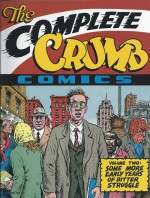
Complete Crumb Comics volume 2: Some More Early Years of Bitter Struggle – New Edition


By Robert Crumb & Charles Crumb, edited by Gary Groth with Robert Fiore (Fantagraphics Books)
ISBN: 978-0-93019-362-1

This book contains controversially clever ideas, outrageously rude drawings, intemperate language, positive drug references and allusions, godless questioning of authority and brilliantly witty, culture-reshaping, personal accounts and opinions.

If you – or those legally responsible for you – might have problems with any of that, please skip this review and don’t buy the book. I’m sure we’ll all know better next time…

Robert Crumb is a unique creative force in the world of cartooning with as many detractors as devotees. His uncompromising, excoriating, neurotically obsessive introspections, pictorial rants and invectives unceasingly picked away at society’s scabs and forever peeked behind forbidden curtains – and all apparently for his own benefit – but he has always happily invited us to share his unwholesome discoveries with anybody with the time and temperament to look…

Way back in 1987 Fantagraphics Books began the nigh-impossible task of collating, collecting and publishing the chronological totality of the tireless artist’s vast output and now, after far too long out-of-print, those engrossing cartoon compendia are being reissued. The earliest volumes have been constantly described as the least commercial but now, with Crumb at last an acknowledged global art-treasure, those volumes are back for your perusal…

The son of a career soldier, Robert Dennis Crumb was born in Philadelphia in 1943 into a functionally broken family. He was one of five kids who all found different ways to escape their parents’ shattering problems, and comics were always paramount amongst them.

As had his older brother Charles, Robert immersed himself in the strips and cartoons of the day; not simply reading but also feverishly, compulsively creating his own. Harvey Kurtzman, Carl Barks and John Stanley were particularly influential, as were newspaper artists like E.C. Segar, Gene Ahern, Rube Goldberg, Bud Fisher, Billy De Beck, George (Sad Sack) Baker and Sidney Smith as well as “straight” illustrators like C.E. Brock and the wildly imaginative, frantically surreal 1930’s Looney Tunes and Merrie Melodies animated shorts.

Defensive and introspective, the young Robert pursued art and torturous self-control through religion with equal desperation. His early spiritual repression and flagrant, hubristic celibacy constantly warred with his body’s urgently growing base needs and desires…

Escaping his stormy family, Crumb married young and began working in-house at the American Greeting Cards Company. He also found like minds in the growing hippie and counterculture movements where he discovered LSD. In 1967 he upped sticks to California to become an early star of the burgeoning Underground Commix scene. As such he found plenty of willing “hippie-chicks” eager to assuage his fevered mind and hormonal body whilst he gradually reinvented the very nature of cartooning with such creations as Mr. Natural, Fritz the Cat, Devil Girl and a host of others.

The rest is history – or perhaps, sociology…

The tortured formative years provided meat for the first collection (The Early Years of Bitter Struggle) and those revelations resume right here, right now as the second volume continues the odyssey to acceptance after ‘The Best Location in the Nation…’; a comprehensive reminiscence and introduction from lifelong confidante Marty Pahls who describes the swiftly maturing and deeply unsatisfied Crumb’s jump from unhappy home to the depressing, dispiriting world of work.

‘Little Billy Bean’ (April 1962) reprises the hapless, loveless nebbish of yore whilst ‘Fun with Jim and Mabel’ revisits Crumb’s first bulky, morally-challenged domestic amazon, after which the focus shifts to her diminutive and feeble companion ‘Jim’. Next, an almost fully-realised ‘Fritz the Cat’ finally gets it on in a triptych of saucy soft-core escapades from R. Crumb’s self-generated Arcade mini-comic project.

From this point onwards, the varied and exponentially impressive breadth of Crumb’s output becomes increasingly riddled with his often hard-to-embrace themes and declamatory, potentially offensive visual vocabulary as his strips grope towards the creator’s long-sought personal artistic apotheosis.

His most intimate and disturbing idiosyncrasies regarding sex, women, ethnicity, personal worth and self-expression all start to surface here…

Working in the production department of a vast greetings card company gave the insular Crumb access to new toys and new inspiration as seen in the collection of ‘Roberta Smith, Office Girl’ gag strips from American Greetings Corporation Late News Bulletins (November 1963-April 1964), followed here by another Fritz exploit enigmatically entitled ‘R. Crumb Comics and Stories’ which includes just a soupçon of raunchy cartoon incest, so keep the smelling salts handy…

A beautiful 10-page selection of sketchbook pages comes next and then a burst of black-&-white and full-colour covers: the satirical 1960 election duel of Kennedy and Nixon, an Arcade gag, 13 letters to Pahls and Mike Britt disguised as ‘Farb’ and ‘Note’ front images as well as a brace of Arcade covers and the portentously evocative front for R. Crumb’s Comics and Stories #1 from April 1964.

The rest of this pivotal collection is given over to 31 more superb pages culled from Crumb’s sketchbooks; a vast and varied compilation that ably displays the artist’s incredible virtuosity and proves that – if he had been able to suppress his creative questing – he could easily have settled for a lucrative career in any one of a number of graphic disciplines from illustrator to animator to jobbing comic book hack.

Crumb’s subtle mastery of his art-form and overwhelming drive to expose and reveal his most hidden depths and every perceived defect – in himself and the world around him – has always been an unquenchable fire of challenging comedy and riotous rumination, and this evocative tome is crucial to understand the creative causes, if not the artistic affectations, of this unique craftsman and auteur.

This superb series, charting the perplexing pen-and-ink pilgrim’s progress, is the perfect vehicle to introduce any (over 18) newcomers to the world of grown up comics, and if you need a way in yourself, seek out this and all the other books in this incomparable sequence as soon as conceivably possible…

Art and stories © 1969, 1974, 1988, 1996, 2013 Robert Crumb. All rights reserved. Introduction © 1988 Marty Pahls.

The Wasteland


By Dave Louapre & Dan Sweetman (Piranha Press/DC Comics)
No ISBN, ASIN: B000UE4MBE

During the anything-goes 1980s the field of comics publishing expanded exponentially with new companies offering a vast range of fresh titles and ideas. To combat the upstart expansion, Marvel and DC also instigated innovative material for those freshly growing markets with the latter colossus especially targeting readers for whom old-fashioned funnybooks were anathema …or at least a long-abandoned childhood flirtation.

DC pioneered new, more mature-oriented niche imprints such as Vertigo and Helix, but undoubtedly some of the most intriguing treats came out of their Piranha Press line, formed in 1989 and re-designated Paradox Press in 1993.

When DC founded this off-key, adult special projects imprint, both the resultant releases and reader’s reaction to them were passionately mixed.

It had long been a Holy Grail of the business to produce comics for people who don’t read comics and, despite the inherent logical flaw, that’s a pretty sound and sensible plan, but the delivery is always problematic.

Is the problem resistance to the medium? Then try radical art or narrative styles, unusual design or typography, and use talent from outside the medium to fill your books: you get some intriguing results, but risk still not reaching a new audience whilst alienating those readers already on board…

This superbly eclectic and overwhelmingly effective collection partially mitigated that risk by using new creators with an already established pedigree outside the comics industry and material which had found a fan-base elsewhere in publishing…

It’s also was one of the best and most wickedly addictive books Piranha produced…

Dave Louapre & Dan Sweetman had worked together since college, producing self-published illustrated stories which they sold direct to local bookstores. This led to a macabre and deliciously dark panel-gag series published in the L.A. Reader and movie magazine Fangoria and the creation of stunningly off-kilter, ironically post-modern and media-celebrated cartoon-fiction analect Beautiful Stories for Ugly Children, which winningly combined outré, edgy domesticity with the aesthetic sensibilities of Jean Paul Sartre, Ambrose Bierce, O. Henry, Charles Addams, Aubrey Beardsley and Gahan Wilson. It was not your average comicbook…

The Piranha Press experiment was always a tenuous dream in a cutthroat business, and though BSFUC was undoubtedly its greatest triumph – 41 delirious issues, some specials and a “Best Of” collection – the imprint was radically restructured in 1992 and Dave and Dan moved on and out to Hollywood.

Before they finally left, however, the company published also The Wasteland: a compilation – with some new material – of that aforementioned gag feature…

Produced as a single captioned panel, the strip offered the trademarked weird ideas and compelling, alluring prose rendered (sur)real via lovely, sketchy, scratchy, frantically evocative monochrome illustrations with the same skewed worldview, supplemented with a heaping helping of mordant Gary Larson wryness added to the mix.

There’s no point my trying to relate the contents of this superb, tragically out-of-print but mercifully still available tome: 128 pages of graphic imagery blending the cute with the grotesque, the mundane with the bizarre and the unexpected with the cheerily distasteful which you just have to see to believe.

All I can do here is tease you with a few atypically typical sample subject-lines such as ‘Men without Women meet Dogs without Snouts’, ‘The Little Cyclops Puppy Nobody Would Play With’, ‘Cheerleaders on Fire’, ‘Lover’s Hop, for the Less-than-Devastated’, ‘The Substitute Executioner’, ‘My Dinner with Medusa’, ‘Jump-Starting the Dog’, ‘We Got Along Swimmingly Once I Learned They Hated Me’, ‘A Day at the Nun Jousts’ ‘Rudolph the Red Light Reindeer’, ‘Zero-Gravity Autopsy’, ‘The Gas Chambermaid’ and ‘Rumble Monks’, and rest assured that some of you will now be unable to rest until you experience the sheer creative anarchy for yourselves…

Happy Easter, comic fans…
The Wastelands © 1989 Dave Louapre & Dan Sweetman. All Rights Reserved.

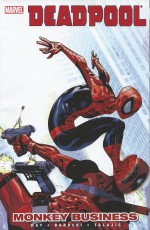
Deadpool volume 4: Monkey Business


By Daniel Way, Carlo Barberi, Tang En Huat, Dalibor Talajić & various (Marvel)
ISBN: 978-0-7851-4531-8

Bloodthirsty, stylish killers and mercenaries craving something more than money have long made for popular comics protagonists. Deadpool is Wade Wilson (and yes he is a thinly disguised knockoff of DC’s Slade Wilson AKA Terminator: get over it – DC did), a hired killer and survivor of genetics experiments that have left him a scarred, grotesque bundle of scabs, scars and physical unpleasantries but practically invulnerable and capable of regenerating from any wound.

The wisecracking high-tech “Merc with a mouth” was created by Rob Liefeld and Fabian Nicieza, debuting in New Mutants #97, another product of the Canadian “Weapon X” project which created Wolverine and so many other mutant/cyborg super-doers. He got his first shot at solo stardom with a couple of miniseries in 1993 (Deadpool: the Circle Chase & Sins of the Past) but it wasn’t until 1997 that he finally won his own title, which blended 4th-wall busting absurdist humour (a la Ambush Bug) into the mix and secured his place in Marvel history.

Since then he has come and gone with frightening frequency, undergoing radical rethinks, identity changes and reboots, but always inevitably reverting to irascible, irreverent, intoxicating type in the end…

This gloriously continuity-light and baggage-free romp collects issues #19-22 of Deadpool volume 4 and also includes the (originally digital) One-Shot origin tale of Simian Sensation and World’s Greatest Assassin Hit-Monkey, all from 2010.

A sucker for sentiment and plagued with an urge to be better than he is, in the extended saga ‘Whatever a Spider Can’ (Daniel Way, Carlo Barberi, Juan Vlasco & Sandu Florea), Wade Wilson has decided to give up the murder-for-profit business model in favour of a life as a conventional superhero, but lacks both a mentor and commitment. Thus in ‘Start Spreadin’ the News’ he turns up in New York City looking to learn the ropes from a far-from-welcoming web-spinner, just as Spider-Man discovers a massacre in the back of his favourite Deli…

Wrong conclusions are reached on all sides: the copious blood-spatter indicates a killer who hops about and shoots from walls and ceiling and the wall-crawler knows it wasn’t him…

Tracking down Deadpool – who has set his incredible healing factor the nigh-impossible task of saving his intestines and dignity from the effects of forty street-vendor hotdogs – the Amazing Arachnid takes a lot of convincing before he believes the Merc wasn’t responsible for the murders… but only the merest hint to stay well downwind of the reformed killer’s turbulent digestive process…

After Wade examines the crime scene he has only one suggestion as to the actual perpetrator: a stone-cold killer who’s a legend in the assassin community and never takes just one job per city. Moreover he only goes after really unique targets like a hit-man with a healing factor…

The four-handed hunter has other killers in his sights too and, as Spider-Man and Deadpool bicker and snipe, Hit-Monkey is dispassionately dispatching a couple of cops using their positions for ruthless gain. Soon however he has tracked down Wade and it seems the only way to stop the anthropoid assassin is to just let him shoot the Merc with the mouth until he finally shuts up…

Sadly the simian soon learns that it takes more than just bullets to keep Wade down, and Spider-Man becomes an unwilling pawn and collateral damage in Deadpool’s sorry excuse for a plan to get the monkey off their backs forever…

In the explosive aftermath of the killers’ final confrontation Wade sneaks out of town and heads south, only to have his bus hijacked by cops pretending to be robbers in rural Georgia. Unfortunately, them Good Ol’ Bad Boys has a electrically-charged super-hick on their side and, when the astonished Deadpool finally recovers, the keen wannabe-hero resolves to clean up the county in ‘Do Idiots Dream of Electric Stupidity?’ (with art by Tang En Huat.

Luckily, even though it is really hard to tell the good guys from the robber scum in Dukes of Hazzard territory, the former killer has unsuspected help from the most unlikely sources…

The remainder of this slim engaging tome is given over to the anthropoid super-star discovery of the decade…

Something of an overnight sensation, ‘Hit-Monkey’ quickly graduated to an online solo story on Marvel Digital Comics Unlimited and that weirdly moving eponymous origin tale was rapidly reprinted in comicbook format in April 2010, written by Way and illustrated by Dalibor Talajić.

The fabled furball’s history was revealed as, years ago, a desperate killer for hire fled the authorities in the heart of a chilling Asiatic winter and almost died before being found by loving monkeys living near and often within the hot springs of a mountain thermal pool.

All but one of the simians welcomed the human in their wordless, loving way, and that young dissident assiduously watched the interloper, keenly observing as the human practised all his killing arts in preparation for the day when the cops and soldiers would find him.

When they finally came and the winter night erupted into hot brutal butchery, there was only one to avenge the slaughter – and he was far from human as he extracted his bitter brand of justice…

Although staying close to his superhero roots and the X-franchise that spawned him, Deadpool is more often than not a welcome break from the constant sturm und drang of his Marvel contemporaries: weird, wise-cracking, and profoundly absurd on a satisfyingly satirical level. This is a great reintroduction to comics for fans who thought they had outgrown the fights ‘n’ tights crowd.

Including covers and variants by Jason Pearson, Marko Djurdjevic & Frank Cho, this frenetic blend of light-hearted, surreal, fighting frolics and incisive, poignant relationship drama is absolutely compulsive reading for dyed-in-the-wool Fights ‘n’ Tights fans who might be feeling just a little jaded with four-colour overload.
© 2010 Marvel Characters, Inc. All rights reserved.

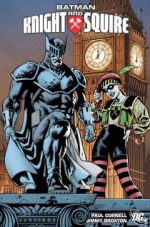
Batman: Knight and Squire

Batman - Knight and Squire
By Paul Cornell & Jimmy Broxton with Staz Johnson (DC Comics)
ISBN: 978-1-4012-3071-5

British Dynamic Duo Knight and Squire first appeared in the cheerfully anodyne, all-ages 1950s – specifically in a throwaway story from Batman #62 (December 1950/January 1951) – as ‘The Batman of England!’

Earl Percy Sheldrake and his son Cyril returned a few years later as part of seminal assemblage ‘The Batmen of All Nations!’ (Detective Comics #215 January 1955) – a tale retrieved from the ranks of funnybook limbo in recent times and included in Batman: Black Casebook – with sequel ‘The Club of Heroes’ appearing in World’s Finest Comics #89, July-August 1957. That one’s reprinted in Showcase Presents World’s Finest volume 1.

The characters had languished in virtual obscurity for decades before fully entering modern continuity as part of Grant Morrison’s build-up to the Death of Batman and Batman Incorporated retro-fittings of the ever-ongoing legend of the Dark Knight dynasty…

They floated around the brave New World for awhile with guest shots in places like Morrison’s JLA reboot and Battle For the Cowl before finally getting their own 6-issue miniseries (December 2010 – May 2011), courtesy of scripter Paul Cornell and artist Jimmy Broxton (with some layout assistance from Staz Johnson), who rather bit the hand that fed them by producing a far from serious, but captivating quirky and quintessentially English frolicsome fantasy masterpiece.

It all begins, as most things boldly British do, down the pub. However The Time in a Bottle is no ordinary boozer but in fact the favourite hostelry for the United Kingdom’s entire superhuman community: the worthy and the wicked…

Hero and villain alike can kick back here, taking a load off and enjoying a mellow moment’s peace thanks to a pre-agreed truce on utterly neutral ground, all mystically enforced by magics and wards dating back to the time of Merlin…

As the half-dozen chapters of ‘For Six’ open it’s the regular first Thursday of the month – and that’s an in-joke for Britain’s comics creator community – with the inn abuzz with costumed crusaders and crazies, all determined to have a good time.

Cyril Sheldrake, current Earl of Wordenshire and second hero to wear the helm and mantle of The Knight, sends his trusty sidekick Beryl Hutchinson – AKA The Squire – to head off a potential problem as established exotics Salt of the Earth, The Milkman, Coalface, The Professional Scotsman and the Black and White Minstrels all tease nervous newcomer The Shrike.

He’d do it himself but he’s chatting with Jarvis Poker, the British Joker…

The place is packed tonight in honour of visiting yank celebrity Wildcat, and a host of strange, outrageous and even deadly patrons all bustle about as Beryl chats to the formerly cocky kid who’s also getting a bit of grief because he hasn’t quite decided if he’s a hero or villain yet…

She’s giving him a potted history of the place when the customary bar fight breaks out but things take an unconventionally dark turn and an actual attempted murder occurs. It would appear that two of these new gritty modern heroes have conspired to circumvent Merlin’s pacifying protections…

Each original issue was supplemented with a hilarious text page which here act as chapter breaks, so after ‘What You Missed If You’re A Non-Brit’ (a glossary of national terms, traits, terminology and concepts adorned with delightful faux small ads), the tale continues as Beryl and Cyril spend a little down-time in rural Wordenshire where the local civilians tackle the insidious threat of The Organ Grinder and his Monkey so as not to bother the off-duty Defenders.

However the pair do rouse themselves to scotch the far more sinister schemes of inter-dimensional invader Major Morris and the deadly Morris Men…

That’s supplemented by the far-from-serious text feature ‘What Morris Men are Like’…

The saga then kicks into high gear with the third instalment as Britain’s Council for Organised Research announces its latest breakthrough.

C.O.R.’s obsessively romantic Yorkist Professor Merryweather had no idea that her DNA reclamation project would lead to a constitutional crisis after she reconstituted Richard III, but it seems history and Shakespeare hadn’t slandered the Plantagenet at all. The wicked monarch was soon fomenting rebellion, using his benefactor’s technology to resurrect equally troublesome tyrants Edward I, Charles I, William II and the ever-appalling King John and even giving them very modern superpowers…

Of course Knight, Squire and her now besotted not-boyfriend Shrike were at the vanguard of the British (heroic) Legion mustered to fight for Queen and Country and repel the concerted criminal uprising…

Following a history lesson on ‘Cabbages and Kings’, Beryl invited the Shrike back to the Castle for tea, teasing and some secret origins, but things went typically wrong when Cyril’s high tech armour rebelled, going rogue and attacking them all.

The text piece deals with ‘Butlers and Batmen’ before it all goes very dark when lovable celebrity rogue Jarvis Poker gets some very bad news from his doctor and a terrifying follow-up visit from the real Joker.

The CampCriminal was desperately concerned about his national legacy but GothamCity’s Harlequin of Hate is just keen on increasing his ghastly and frankly already astronomical body-count. First on the list is that annoying Shrike kid, but the American psycho-killer has big, bold, bizarre plans to make the UK a completely good guy-free zone…

Broken up with a two-part ‘The Knight and Squire Character List’, it all culminates and climaxes with a spectacular and breathtaking showdown after the malevolent Mountebank of Mirth goes on a horrendously imaginative hero-killing spree that decimates the Costumed Champions of Albion: a campaign so shocking that even Britain’s bad-guys end up helping to catch the crazed culprit…

Rewarding us all for putting up with decades of “Gor, blimey guv’nor” nonsense in American comics whilst simultaneously paying the Yanks back for all those badly researched foggy, cobbled-rooftops-of-London five minutes from Stonehenge stories which littered every aspect of our image in the USA, this witty, self-deprecating, action-packed and deucedly dashing outing perfectly encapsulates all the truly daft things we noble Scions of Empire Commonwealth love and cherish about ourselves.

Stuffed with surreal, outrageous humour, double entendres, quirky characters, catchphrases and the comedy accents beloved by us Brits – Oh, I say, Innit Blud? – and rife with astonishingly cheeky pokes at our frankly indefensible cultural quirks and foibles, this is the perfect book for anyone who loves grand adventure in the inimitable manner of Benny Hill, Monty Python and the Beano.

Also included are covers and variants from Yanick Paquette & Michel Lacombe and Billy Tucci & HiFi, plus a wealth of working art, character designs and sketches by Jimmy Broxton and an unpublished spoof cover in tribute to the immortal Jarvis Poker…

Buy this book. It’s really rather good. Oh, go on, do: you know you want to…
© 2011, DC Comics. All Rights Reserved.

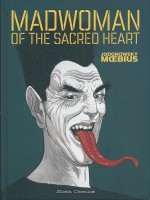
Madwoman of the Sacred Heart


By Jodorowsky & Moebius, translated by Natacha Ruck & Ken Grobe (Sloth Publishing)
ISBN: 978-1-908830-01-2

Here’s a modern masterpiece of comics creativity at last available to English-speaking audiences, one of the most intriguing and engaging works by two creative legends of sequential narrative. To some people, this superb piece of thought provoking fiction might be shocking or blasphemous however, so if you hold strong views on sex or religion – especially Christianity – stop right now, spare yourself some outrage and come back tomorrow.

Alejandro Jodorowsky Prullansky is a filmmaker, playwright, actor, author, comics writer, world traveller, philosopher and spiritual guru, born in Tocopilla, Chile in 1929. He is most widely known for his films Fando y Lis, El Topo, The Holy Mountain, Sante Sangre, The Rainbow Thief and others, as well as his vast comics output, such as Anibal 5, (created whilst living in Mexico) Le Lama blanc, Aliot, The Meta-Barons, Borgia and more, co-created with some of South America and Europe’s greatest artists. His nigh decade-long collaboration with Moebius on the Tarot-inspired adventure  The Incal (1981-1989) completely redefined and reinvented what comics could aspire to and achieve.

Best known for his violently surreal avant-garde films, loaded with highly-charged, inspird imagery blending mysticism and “religious provocation” and his spiritually informed fantasy and science fiction comics, Jodorowsky is also fascinated by the inner realms and has devised his own doctrine of therapeutic healing: Psychomagic, Psychogenealogy and Initiatic massage. He still remains fully engaged and active in all these creative areas today.

Jean Henri Gaston Giraud was born in the suburbs of Paris in 1938 and raised by his grandparents. In 1955 he attended the Institut des Arts Appliqués where he became friends with Jean-Claude Mézières who, at 17, was already selling strips and illustrations to magazines such as Coeurs Valliants, Fripounet et Marisette and Spirou. Giraud apparently spent most of his time drawing cowboy comics and left after a year.

In 1956 he travelled to Mexico, staying with his mother for eight months, before returning to France and a full-time career in comics, mostly westerns such as Frank et Jeremie for Far West and King of the Buffalo, A Giant with the Hurons and others for Coeurs Valliants in a style based on French comics legend Joseph “Jijé” Gillain.

Giraud spent his National Service in Algeria in 1959-1960, where he worked on military service magazine 5/5 Forces Françaises and, on returning to civilian life, became Jijé’s assistant in 1961, working on the master’s long-running (1954-1977) Western epic Jerry Spring. A year later, Giraud and Belgian writer Jean-Michel Charlier launched the serial ‘Fort Navajo’ in Pilote #210, and soon its disreputable, anti-hero lead character Lieutenant Blueberry became one of the most popular European strips of modern times. In 1963-1964, Giraud produced strips for satire periodical Hara-Kiri and, keen to distinguish and separate this material from his serious day job, first coined his pen-name “Moebius”.

He didn’t use it again until 1975 when he joined Bernard Farkas, Jean-Pierre Dionnet and Philippe Druillet – all rabid science fiction fans – to become the founders of a revolution in narrative graphic arts as “Les Humanoides Associes”. Their groundbreaking adult fantasy magazine Métal Hurlant utterly enraptured the comics-buying public and Giraud again wanted to utilise a discrete creative persona for the lyrical, experimental, soul-searching material he was producing: series such as The Airtight Garage, The Incal (with Alejandro Jodorosky) and the mystical, dream-world flights of sheer fantasy contained in Arzach…

To further separate his creative bipolarity, Giraud worked inks with a brush whilst the futurist Moebius rendered with pens. Both of him passed away on March 10th 2012.

Jodorowsky and Moebius’ second groundbreaking co-creation was originally released in three albums from Les Humanoïdes Associés as La Folle du Sacré CÅ“ur (1992), Le Piège de l’irrationnel (1993) and Le Fou de la Sorbonne (1998) before the saga was collected into one massive, ecstatic and revolutionary volume in 2004.

The company’s American arm Humanoids, Inc. translated it into English in 2006, which forms the basis for this comprehensive new edition from fledgling British publisher Sloth Comics.

Professor Alan Mangel is a world-renowned aesthete, deep thinker and chief lecturer at the celebrated Sorbonne. As such he is the focus of much student attention – particularly female – but none as fervent as that of the insular, fanatically bible-bashing Christian and deeply disturbed Elisabeth.

When the teacher’s shrewish wife Myra denounces, shames and impoverishes him at the moment of his greatest triumph, the arrogantly cerebral, proudly austere, violently chaste and determinedly sexually abstinent Mangel loses the awed respect of his once doting students and disciples who shun his once overcrowded classes and even mock and assault him.

Only Elisabeth remains devoted to him but she has designs both carnal and divine on the aging, flabby, secular, lapsed and born-again Jew. To make matters worse, when she throws herself at him and is repulsed, this awakens the philosopher’s own lustful youthful libido which takes form as a gadfly ghost constantly urging him to indulge in acts of vile debauchery and rampant lust.

Eventually the pressure is too great and Mangel agrees to meet Elisabeth at the Church of the Sacred Heart. The journey there is awful: even the universe seems set against him as rude taxi-drivers, a mad old lady tramp and even dogs further humiliate the broken old man.

In the holiest part of the church Elisabeth again attempts to seduce the long sterile and wilfully impotent Alan, explaining that her researches have revealed him to be the biblical Zacharias reborn, destined to impregnate her with a son: the Prophet John who would in turn herald the rebirth of Jesus…

Again the rational scientist baulks at her words but Elisabeth promises a miracle and when Mangel’s horny, ghostly other self “possesses” him the dotard loses control and finally gives the mad girl what she’s been begging for…

Plagued with shame and remorse, still tormented by his inner letch and broke, Mangel resumes lecturing and slowly rebuilds his reputation until one day Elisabeth returns, her nude body declaring her to be forever the property of Alan Zacharias Mangel. She is three months pregnant with the sterile man’s baby and has already recruited the St. Joseph who will help them fulfil their sacred mission…

The divinely-dispatched protector, a drug addict and petty criminal previously called Muhammad, already has a line on The Mary: she’s his girlfriend Rosaura, currently imprisoned in a secure mental hospital. She’s also in a coma…

Dragged against the will he no longer seems capable of exerting, Mangel experiences his latest ongoing tribulation when St. Joseph breaks The Mary out with the aid of a gun and his distressed guts give way to what will be, for all of the chosen ones, an uncomfortable and prolonged period of stress-related explosive diarrhoea…

Against all his rational protests and worries, things just seem to keep falling into place for the pilgrims. Rosura is no longer comatose, and they get away without a single problem – if you don’t count the olfactory punishment the Professor’s rebellious innards are repeatedly inflicting upon them all…

“Mary” is the most ravishing creature he has ever seen, but as crazy as her friends. When she cavorts naked in a field during a midnight thunderstorm, frantically imploring God to impregnate her with the second Jesus, Mangel’s lustful ghost again overtakes him and he surreptitiously copulates with the wildly bucking lascivious loon…

The next day reality hits hard when he reads of two nurses executed when the comatose daughter of an infamous Columbian drug baron was abducted from a certain institution…

The second chapter opens with the four fugitives hiding out in a lavish seaside house and Mangel – as always – arguing with both his priapic phantom and rationalist conscience. His so impossibly, imperturbably, persuasive companions are untroubled: they are simply passing the days until the birth of John the Baptist and the Second Coming of Christ…

The next crisis is pecuniary as the lavish spending of the trio soon exhausts the Professor’s funds and they are reduced to their last 100 franc note…

Elisabeth is unconcerned and simply places a bet with it. Operating under divine guidance the horse race wins the quartet three and half million Francs, but before the reeling rationalist can grasp that, there’s another insane development as Mary/Rosaura declares herself to be the Androgynous Christ – both male and female – reborn and made manifest to save us all.

She still looks devastatingly all-woman however, and when she kisses the old fool and sends him back to the Church of the Sacred Heart to “obtain” a vial of holy Baptismal oil, he goes despite himself, arguing all the way with his imaginary sex-obsessed younger self.

It’s another humiliating and deranged debacle. The famous house of worship is hosting an ecumenical convention of argumentative theologians of all religions and that self-same crazy woman is still there, claiming to be God and challenging them all.

After driving them away she even tries to have sex with the bewildered fallen philosopher who barely escapes with the stolen oil. The worst of it all is that, based on recent evidence, Mangel can’t even say with any certainty that the ill-smelling harridan isn’t telling the truth…

Driving back through the fleshpots of the city with his ghost tempting him every inch of the way, the weary savant is dragged back to appalling reality by a newspaper headline declaring that the police have a witness in the murder/abduction of Rosaura Molinares, daughter of the most wanted drug trafficker on Earth.

However, when the nigh-unhinged thinker reaches his sanctuary from reason, the true believers already know. They taped the TV news and show him the witness describing a completely different killer: El Perro, chief hitman of Pedro Molinares‘ Medellin Cartel…

With the last foundations of precious logic crumbling, Mangel reaches an emotional tipping point and when The Androgynous Christ demands he make love to her, the old fool submits to stress – and his ever-horny spectral alter ego – by surrendering to his lusts. Before long he is in the throes of a bizarre, eye-opening, life-altering four-way love session with all the mad people he has wronged in his head and heart…

The epiphanic moment is rather spoiled when the wall explodes and a cadre of mercenaries working for a rival cartel burst in, looking for Rosaura’s father. They’re followed by the Columbian Secret Service, also hunting the drug lord and quite prepared to kill everybody to find him.

…And they in turn are ambushed by American DEA agents who slaughter everybody in their sights in their desperation to capture Molinares’ daughter and her weirdo friends. The illegally operating Yanks drag their captives to a submarine waiting offshore just as French police hit the beach and El Perro attacks the sub, spectacularly rescuing the quartet and transporting them to safety by helicopter and cargo plane…

The concluding chapter opens with all of France astonished by the kidnapping of its most beloved thinker, even as in a Columbian Garden of Eden a newly-enlightened and happy Mangel and his heavily pregnant Elisabeth prepare for the birth of The Child.

The Androgynous Christ too has changed and grown, easily converting the hard-bitten drug gangsters into a holy army of believers in the redeemer Jesusa…

Top dog Pedro Molinares is dying from cancer and his devoted army are fully, fanatically in tune with Jesusa’s plans, especially after an impossible blood miracle seemingly proves their new leader’s earthbound divinity. Equally astounded, Mangel too reaches a spiritual crisis as he accompanies Elisabeth deep into the jungle to give birth.

Mangel’s journey and ultimate transformation at the hands of rainforest shaman Doña Paz then lead to even more astonishing revelations, changes and shocks that I’m just not prepared to spoil for you…

Controversial, shocking, challenging, fanciful, enchanting and incredibly funny, this a book you must read and will always remember.
™ Les Humanoïdes Associés, SAS, Paris. English version © 2011 Humanoids, Inc., Los Angeles. All rights reserved.

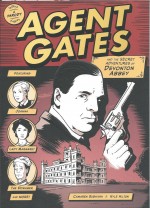
Agent Gates and the Secret Adventures of Devonton Abbey (a Parody)


By Camaren Subhiyah & Kyle Hilton (Andrews McMeel Publishing)
ISBN: 978-1-4494-3434-2

Parody has been a major staple of the comics and cartooning world ever since the days of Hogarth and Cruickshank, so it’s marvellous to see that our colonial cousins are keeping the home fires burning in this sublimely over the top tribute to blockbuster British Television export Downton Abbey, which mingles devastatingly wry observation with outrageously surreal exaggeration to top-hole effect.

I’m not actually a follower or fan of the source material but I know great art and witty writing when I see it, and this supremely daft delight certainly rings both those bells…

The aristocratic Crawhill family has occupied stately Devonton Abbey for centuries and now – in April 1914 – the current Earl Richard is master of a house that consists of his unfortunately American wife Cora, wilful daughters Margaret, Cynthia and Flora. Also firmly in residence is his formidable mother the Dowager Countess Viola; an acid-tongued basilisk who knows all the family’s secrets and is the true ruler of the richly furnished and well-upholstered roost.

Below stairs, although head butler Mr. Larson runs the estate’s affairs, lamed valet and under-butler Jack Gates is also privy to much that goes on and is far more important that most realise…

With the winds of a Great War mustering on the idyllic horizon, unscrupulous German Foreign Minister Gottlieb von Jagow pays a formal visit. The filthy Boche spy and warmonger is well aware that Devonton and its façade of foppish, old-world primness and decadence conceals the clandestine HQ of the British Empire’s Secret Intelligence Service and their exotic super-powered operatives, but has not reckoned on the sheer pluck and determination of the bionic Agent Gates, nor his mysterious handler Agent Hera…

Still, all does not goes as anybody planned and the mad Hun expires before disclosing any useful intelligence. The covert operatives continue blithely on preparing for the visit of Austro-Hungarian Arch-Duke Franz Ferdinand, unaware that traitors and agents of the Kaiser have penetrated into the very heart of the household.

Lord Richard and Lady Cora are far more concerned with prestige, aristocratic rivalries, maintaining the proper niceties regarding their property and their deucedly useless daughters – all far too wrapped up in their silly “causes” such as animal husbandry, parties, any husbandry, marrying cousins, the estate Petting Zoo, Trousers For Women and such déclassé tosh and taradiddle – to concentrate on the things that truly matter.

Happily above and below stairs Lady Viola and Gates are on the case, ensuring the succession of Devonton and safety of the nation by bringing in new if not actually blue blood…

A touch of Bullshot Crummond, a dash of League of Extraordinary Gentlemen and just a hint of Blackadder, not to mention heaping helpings of Richard Hannay and his illustrious True Brit ilk, all served up with lashings of superbly silly hijinx inform this brilliant bash at the award-winning show, with Steampunk plotlines working in perfect tandem with deliriously funny and absurdist stabs and japes involving the perfectly rendered cast of that most proper of serials.

If you love the show enough to see it successfully spoofed or just love outstanding comedy adventure this is a pictorial billet doux to a bygone era that you won’t want to miss…
© 2013 Kyle Hilton and Camaren Subhiyah. All rights reserved.

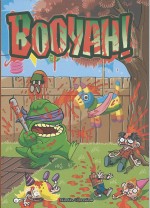
Booyah!


By Loran, translated by FNIC (Sloth Publishing)
ISBN: 978-1-908830-00-5

The Continent has long been the home of superbly crafted, challenging comics fare – unbelievable amounts of it in all manner of styles and genres – and English readers have suffered for decades due to the paucity of decent translations to our churlish mother tongue.

That’s not to say that what we have seen (especially recently with the advent of the wonderful Cinebook line of European classics) hasn’t been wonderful; it’s simply that there’s so very much we still haven’t…

Thus I’m delighted to welcome a new company into the Anglo-arena with this gloriously anarchic offering from cartoon wild-man Laurent Crenn AKA Loran and his horrifically hilarious Bouyoul, who’s jumped the Pond and had his passport stamped – in blood – as the cute and cuddly catastrophe-in-action Booyah!

Loran’s work was first seen in Anus Horibilis, working with co-founders Fred and Jean-Louis Marco, producing the shocking shenanigans of not only this effervescent, well-meaning pariah but also Captain Caca, Gringo Malo and Les Rangers de l’Espace and latterly at Atelier du Préau and Le Cycliste.

The little devil’s – Bouyoul, not Loran’s – second swing at fame is covered in this delicious initial translated collection and commence with ‘Happy Birthday’ as the well-intentioned green gargoyle hosts a celebration for the local kids, before his customary lack of fine coordination and impulse control, combined with sheer bad luck, turn the joyous anniversary into a bloodbath that is many attendees’ last…

A little old lady, her cat ‘Domino’ and Booyah’s determination to prove he’s not a monster all conspire to ruin the emerald atrocity’s day before ‘Mr. Sandman, Bring Me a Scream’ reveals a disastrous, savage and surreal encounter with the master of dreams which clearly shows why neither of them should be trusted as babysitters, whilst the short, sharp ‘Interlude’ features a silent exploit that proves the amiable horror is no fisherman’s friend…

The rest of this supremely engaging, perilously poor taste comedy of terrors features the epic extravaganza ‘Night of the Living Dead Scout Zombies from Hell’ as a troupe of pious lads and their redoubtable guardian Father Barnaby come upon Booyah asleep in the woods. After an initial misunderstanding where the aged cleric tries to exorcise “the demon” and dies of a heart attack, the affable abnormality takes charge of the cub pack and tries to lead them out of the wilderness. Tragically the earth where they first bury poor old Barnaby is a secret testing ground for a new genetically modified crop – one the scurrilous Monsanlys© Corporation are only just discovering has some rather terrifying side-effects…

By the time Booyah gets the scouts to the edge of the forest he’s lost two more kids to tragic, explosively explicit accidents. They too have rejoined the bosom of the earth and the kingdom of heaven. As darkness falls the soil is ruptured by ghastly vegetable zombies sporting the standard super-infectious bite and soon the green goon and his last two charges (no longer good clean-living Christian boys, alas) are fighting for all they’re worth to suppress the horticultural horrors who have decimated the National Scout Jamboree…

Outrageously off-kilter, starkly sardonic and brutally hysterical, Booyah is the absolute antidote to anodyne touchy-feely cartoon capers, and if you love your comedy dark and your fantasy unexpurgated and splashed with spurting gut-bustingly jovial gore, this manically inventive immature-readers-only hoot (think of The Simpsons‘ Itchy and Scratchy with the kid gloves off) is definitely worth a few moments of your time.
© 2011 La Martiniere. English translation © 2011 Sloth Publishing, Ltd.

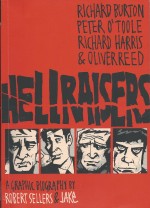
Hellraisers – a Graphic Biography


By Robert Sellers & JAKe (SelfMadeHero)
ISBN: 978-1-906838-36-2

I’m a sucker for comics biographies, and when I saw this superbly engaging and imaginative one on the shelves of my local library I just couldn’t resist a peek…

Robert Sellers is a former stand-up comedian and current film journalist with prose biographies of Sting, Tom Cruise, Sean Connery and the Monty Python phenomenon to his name, as well a regular contributor to periodicals and magazines such as The Independent, Empire, Total Film, SFX and Cinema Retro. He has also been seen on TV.

In 2009 he published a magnificent history of brilliance and excess in his “Life and Inebriated Times of Burton, Harris, O’Toole and Reed” in 2011 in collaboration with prestigious illustrator, designer and animator JAKe (How to Speak Wookiee, cartoon series Geekboy, Mighty Book of Boosh, The Prodigy’s Fat of the Land and so much more, both singly and with the studio Detonator which he co-founded). The artist keeps himself to himself and lets his superb artistry do all the talking.

Self-adapted from his prose history of the iconic barnstorming British film and theatre legends Richard Burton, Richard Harris, Oliver Reed and Peter O’Toole, Sellers here transformed Hellraisers into a pictorial feast, featuring the unique lives of a quartet of new wave, working class thespian heroes – more famed for boozing and brawling than acting – into a masterful parable and celebration of the vital, vibrant creative force of rebellion, interpreted with savage, witty style in ferociously addictive and expressive monochrome cartoon and caricature by the enigmatic artist.

Working on the principle that a Hellraiser is “a person who causes trouble by violent, drunken or outrageous behaviour” and cloaked in the guise of Charles Dickens’ A Christmas Carol, the salutary fable opens as another drunken reprobate is thrown out of another pub. It’s Christmas Eve at the Rose & Crown of Broken Dreams and Martin should be home with his wife and son.

After again disgracing himself the pathetic drunk staggers back, shaking with DT’s and unexpunged rage to his loving but scared family, only to pass out. He is awoken by his hellraising father who drank and smoked himself to death seven years ago…

Told that he has one last chance to save himself, Martin is warned that he will be visited by four spirits (no, not that sort) who will regale him with the stories of their lives and fates and failures and triumphs …

What follows is a beguiling journey of bitter self-discovery as Burton, Harris, Reed and O’Toole (still alive but part of the visitation of “spooky buggers” since it’s just a matter of time, my dear boy) recount their own sodden histories, experiences and considerations in an attempt to turn the neophyte around.

They’re certainly not that repentant, however, and even proud of the excesses and sheer exuberant manly mythology they’ve made of their lives…

Managing the masterful magic trick of perfectly capturing the sheer charismatic force and personality of these giants of their craft and willing accomplices in their own downfalls, this superb saga even ends on an upbeat note, but only after cataloguing the incredible achievements, starry careers, broken relationships, impossibly impressive and frequently hilarious exploits of debauchery, intoxication and affray perpetrated singly and in unison by the departed, unquiet soused souls…

Filled with the legendary exploits and barroom legends of four astoundingly gifted men who couldn’t stop breaking rules and hearts (especially their own), blessed or cursed with infinitely unquenchable thirsts for the hard stuff and appetites for self-destruction, this intoxicating and so very tasty tome venerates the myths these unforgettable icons promulgated and built around themselves, but never descends into pious recrimination or laudatory gratification.

It’s just how they were…

Sellers has the gift of forensic language and perfectly reproduces the voices and idiom of each star even as JAKe perfectly blends shocking historical reportage with evocative surreal metafiction in this wonderful example of the power of sequential narrative.

Clever, witty and unmissable.
© 2010 Robert Sellers and JAKe. All rights reserved.

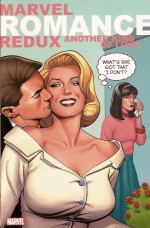
Marvel Romance Redux


By various (Marvel)
ISBN: 978-0-7851-2090-2

Trust me: when you get to my age, Love is Funny.

For years romance comics were a solid staple of Marvel and most other publishing houses. It’s also a truism that girls are pickier than boys – just look at your own track record with the opposite sex or gender of your predisposition (and yes, I know that’s a cheap shot, but it’s also hard to contest!) – so most of those titles, whilst extremely limited in the stories they offered, were generally graced with some of the best artwork the industry could offer.

Those love-starved chicks might be happy to absorb the same old perpetually regurgitated characters and plot pablum but they definitely, defiantly wanted it all to look the best it possibly could…

Having accepted that the art for comics aimed at females has always been of a higher standard and observed that many of Marvel’s greatest illustrators have secretly toiled in the tear-sodden Hearts and Flowers mines, in recent years wisely cynical Editorial heads at The House of Ideas realised that even though the tales might be dull, dated, sexist and largely objectionable to Modern Misses, with a hefty dose of irreverence, a touch of tongue-in-cheek and a heaping helping of digital Tippex, much of that fallow material could be profitably retuned and recycled for today’s shallow crowd of callow youths.

Moreover, if you tap some of the funniest and most imaginatively warped scribes currently working in the industry you might even make that mushy stuff accessible to the jaded, worldly-wise, nihilistic, existentialist, and oh-so-lonely post-Generation X voidoids who think love is for cissies…

Thus in 2006 Marvel Romance Redux was to blame for five issues of raucous and occasionally ribald mockery that took the hallowed love comicbook to new depths, resulting in this deliciously offbeat confection a year later. Behind new covers by Keith Giffen, Pond Scum & Christina Strain, Amanda Conner & Jimmy Palmiotti, Greg Land, Kyle Baker and Frank Cho, 21st century sentiment met timeless 1950s, 1960s and 1970s artwork in a bizarre but highly successful marriage…

The fist issue was subtitled But I Thought He Loved Me and opened with ‘President Stripper’ (rescripted by Jeff Parker from ‘I Do My Thing… No Matter Whom it Hurts’) by John Buscema & Romita Sr., revealing how a daring Go-Go dancer heartbreakingly failed to find happiness using her daring moves and raunchy routines to run America.

Roger Langridge then twisted the words of ‘I Mustn’t Love You, My Darling!’ illustrated by  Dick Giordano & Vince Colletta to the tragic cautionary tale of a tattooed temptress who had to cover up the fact that ‘I Was Inked by Sparky Hackworth!’…

‘The Summer Must End’ by Stan Lee, Jack Kirby & Colletta became under John Lustig, the sordid saga of a savage sexy relationship-wrecker in ‘I Was a Beach Blanket Barbarian!’ whilst Jimmy Palmiotti retained the title of Kirby’s ‘If Your Heart I Break…!’ but shifted the cause for the end of the affair to the unpalatable fact that hunky beddable Matt was a hopeless comicbook geek…

The first issue then closed with ‘Hit or Miss’ as Giffen transformed Lee, Gene Colan & Jim Mooney’s bittersweet ‘The Boy Who Got Away’ fable into a war of words and weapons between rival hot assassins…

Guys & Dolls opened with ‘The Dinner Demon’ as Parker rewrote diner love story ‘One Day a Week’ by Jim Starlin & Jack Abel into a creepy tales of greed and Satanism, whilst Lustig took the already outrageous ‘Please Don’t Let Me Be a… Spinster!’ by Don Heck & Colletta, and concocted a modern parable of a girl who knew that money made the world go around in ‘Love Ain’t Cheap…Especially at these Prices!’

Sixties college affair ‘Formula for Love!’ by Jean Thomas, Colan & Bill Everett was seamlessly evolved into a yarn of faux feminism and dangerous psychobabble under Zeb Wells, whilst Palmiotti also kept the original title of Lee, Buscema & Romita Sr.’s ‘I Love Him… But He’s Hers!’ but happily messed with our heads in an account of petty jealousy and government conspiracies…

‘Love Isn’t in the Cards for Me’ from Lee, Buscema & Frank Giacoia became, under Frank Tieri ‘A (Former Child) Star is Born!’ and showed just what a poor ambitious girl would endure to secure a man with money…

Love is a Four-Letter Word started with the magically surreal ‘Hot Alien Love’ (Jeff Parker making over Lee & Buscema & Colletta’s ‘Another Kind of Love’) as Gail – a dedicated agent of Homeworld Security – falls for the kinky tricks of an extraterrestrial Casanova, before Michael Lieb & Giffen introduced ‘Buffy Willow, Agent of A.D.D.’ (formerly ‘He Never Said a Word’ by Colan) as possibly Freedom and Democracy’s most inept honey-trap, and Joe R. Lansdale refitted Kirby & Colletta’s ‘By Love Betrayed’ into ‘Mice and Money’ wherein a hunky guy finally broke up gal-pals with the strangest tastes imaginable…

‘Love Me, Love my Clones!’ was originally ‘Jilted!‘ by Jean Thomas, Heck & Romita) until Paul Di Fillipo added his own ideas on buying the ideal bespoke companion, whilst Peter David converted ‘Someday He’ll Come Along’ by Heck & Colletta into the death-affirming ‘They Said I was… Insane!’

…And “They” were right.

Robert Loren Fleming opened Restraining Orders are for Other Girls with the utterly hilarious ‘Too Smart to Date!’ (originally ‘The Dream World of Doris Wilson’ by Kirby & Al Hartley), after which ‘Callie Crandall: Co-Ed Campus Undercover Cutie’ laid out her Federally-mandated lures for radicals and subversives as Lieb overhauled Dick Giordano & Colletta’s ’50’s filler ‘No Dates for the Dance’.

The art team was one of the most prolific of the period and Fred Van Lente turned their ‘The Only Man for Me’ into ‘Psycho for You’ which showed the upside of stalking and celebrity religious cults, whilst Kyle Baker performed similar duties on their ‘A Teenager Can also Love’, turning simple romance into psychedelic horror in ‘My Magical Centaur!’

Kirsten Sinclair then wrapped it all up by upgrading Kirby & Colletta’s ‘Give Me Back My Heart!’ into a fable of crime and obsession in ‘Give Me Back My Heart! (Dame Mi Carozan)’…

I Should Have Been a Blonde devoted much of its content to adapting a full length tale of Marvel’s secret star Patsy Walker (of Patsy & Hedy and a number of spin-off titles most Marvel Zombies refuse to acknowledge the existence of). Under the sinister influence of Peter David, ‘Patsy’s Secret Boyfriend’ by Lee & Sol Brodsky became the uproariously self-censorious and rudely self-referential ‘Patsy Loves Satan’, sublimely supplemented by ‘Hedy’s Uncomfortable Fanmail’ and ‘Patsy Walker’s Battlesuits!’

Also included to balance the passionate madness was ‘The Language of Love’, wherein Matthew K. Manning converted Giordano & Colletta’s ‘The Last Good-By’ into a good old-fashioned laugh at immigrants’ expense, before Lustig wrapped it all up by turning Gary Friedrich, Colan & Giordano’s ‘As Time Goes By’ into a bizarro tale of superstar possession as a pretty film fan became ‘The Girl With Bogart’s Brain!’

Yes, it’s pretty much a one-trick pony but it is an endlessly amusing one and the tendency towards wry comics-insider gags is far outweighed by the plethora of absurd, surreal, sly outlandish and wickedly risqué spoofs and devastating one-liners.

Moreover, the art is still stunning…

Daft, pretty and compellingly witty, this is a lovely antidote to the wave of mawkish sentiment doled out in motion picture RomComs and a welcome rare chance to see some of the industry’s greatest graphic talents’ most sidelined artistic triumphs.
© 2006, 2007 Marvel Characters, Inc. All rights reserved.

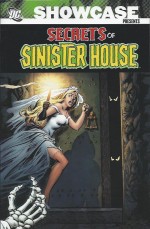
Showcase Presents Secrets of Sinister House


By Jack Oleck, Frank Robbins, Sheldon Mayer, Robert Kanigher, Tony DeZuniga, Alex Toth, Mike Sekowsky, Alex Niño, Sergio Aragonés & various (DC Comics)
ISBN: 978-1-4012-2626-8

American comicbooks just idled along rather slowly until the invention of Superman provided a flamboyant new genre of heroes and subsequently unleashed a torrent of creative imitation and imaginative generation for a suddenly thriving and voracious new entertainment model.

Implacably vested in World War II, these Overmen swept all before them until the troops came home. As the decade closed, however, more traditional themes and heroes resurfaced and eventually supplanted the Fights ‘n’ Tights crowd.

Whilst a new generation of kids began buying and collecting, many of the first fans also retained their four-colour habit but increasingly sought more mature themes in their reading matter. The war years had irrevocably altered the psychological landscape of the readership and as a more world-weary, cynical young public came to see that all the fighting and dying hadn’t really changed anything, their chosen forms of entertainment (film, theatre and prose as well as comics) increasingly reflected this.

As well as Western, War and Crime comics, celebrity tie-ins, madcap escapist comedy and anthropomorphic funny animal features were immediately resurgent, but gradually another of the cyclical revivals of spiritualism and a public fascination with the arcane led to a wave of impressive, evocative and shockingly addictive horror comics.

There had been grisly, gory and supernatural stars before, including a pantheon of ghosts, monsters and wizards draped in mystery-man garb and trappings (the Spectre, Mr. Justice, Sgt. Spook, Frankenstein, The Heap, Sargon the Sorcerer, Zatara, Zambini the Miracle Man, Kardak the Mystic, Dr. Fate and dozens of others), but these had been victims of circumstance: The Unknown as a power source for super-heroics. Now the focus shifted to ordinary mortals thrown into a world beyond their ken with the intention of unsettling, not vicariously empowering, the reader.

Almost every publisher jumped on the increasingly popular bandwagon, with B & I (which became the magical one-man-band Richard E. Hughes’ American Comics Group) launching the first regularly published horror comic in the Autumn of 1948, although their Adventures Into the Unknown was technically pipped by Avon.

The book and comics publisher had released an impressive single issue entitled Eerie in January 1947 but didn’t follow-up with a regular series until 1951. Classics Illustrated had already secured the literary end of the medium with child-friendly comics adaptations of the Headless Horseman, Dr. Jekyll and Mr. Hyde (both 1943), The Hunchback of Notre Dame (1944) and Frankenstein (1945) among others.

If we’re keeping score this was also the period in which Joe Simon & Jack Kirby identified another “mature market” gap and invented Romance comics (Young Romance #1, September 1947) but they too saw the sales potential for spooky material, resulting in the seminal Black Magic (launched in 1950) and boldly obscure psychological drama anthology Strange World of Your Dreams (1952).

The company that would become DC Comics bowed to the inevitable and launched a comparatively straight-laced anthology that nevertheless became one of their longest-running and most influential titles with the December 1951/January 1952 launch of The House of Mystery.

After the hysterical censorship debate which led to witch-hunting Senate hearings in the early 1950s was curtailed by the industry adopting a castrating straitjacket of self-regulation, titles produced under the aegis of the Comics Code Authority were sanitised and anodyne affairs in terms of Shock and Gore, but the audience’s appetite for suspense was still high and in 1956 National introduced sister titles Tales of the Unexpected and House of Secrets.

Stories were soon dialled back from uncanny spooky phenomenon yarns to always marvellously illustrated, rationalistic fantasy-adventure vehicles and eventually straight monster-busting Sci Fi tales which dominated the market until the 1960s.

That’s when super-heroes – which had begun to revive after Julius Schwartz began the Silver Age of comics by reintroducing the Flash in Showcase #4 – finally overtook them.

Green Lantern, Hawkman, the Atom and a growing coterie of costumed cavorters generated a gaudy global bubble of masked mavens which forced even dedicated anthology suspense titles to transform into super-character books. Even ACG slipped tights and masks onto its spooky stars.

When the caped crusader craziness peaked and popped, superheroes began dropping like Kryptonite-gassed flies. However nothing combats censorship better than falling profits and, at the end of the 1960s with the cape-and-cowl boom over and some of the industry’s most prestigious series circling the drain, the surviving publishers of the field agreed on revising the Comics Code, loosening their self-imposed restraints against crime and horror comics.

Nobody much cared about gangster titles but, as the liberalisation coincided with yet another bump in public interest in supernatural themes, the resurrection of scary stories was a foregone conclusion and obvious “no-brainer.” Even ultra-wholesome Archie Comics re-entered the field with their rather tasty line of Red Circle Chillers…

Thus, with absolutely no fanfare at all spooky comics came back to quickly dominate the American funnybook market for more than half a decade. DC led the pack by converting The House of Mystery and Tales of the Unexpected into mystery-suspense anthologies in 1968 and resurrected House of Secrets a year earlier.

However horror wasn’t the only classic genre to experience renewed interest. Westerns, war, adventure and love-story comicbooks also reappeared and, probably influenced by the overwhelming success of the supernatural TV soap Dark Shadows, the industry mixed a few classic idioms and invented gothic horror/romances. The mini-boom generated Haunted Love from Charlton, Gothic Romances from Atlas/Seaboard and from undisputed industry leader National/DC Dark Mansion of Forbidden Love and Sinister House of Secret Love.

The 52-page Sinister House of Secret Love launched with an October/November 1971 cover-date, offering book-length graphic epics in the manner of gothic romances such as Jane Eyre, before transforming into a more traditional anthology package as Secrets of Sinister House with #5 (June/July 1972) and reducing to the traditional 36-page format with the next issue. The format remained until its cancellation with #18 in June/July 1974.

In keeping with the novel enterprise, the dark, doomed love stories were extra-long affairs such as the 25-page Victorian period chiller ‘The Curse of the MacIntyres’ (by Mary Skrenes & Don Heck) which opened issue #1 and recounted how recently-bereaved Rachel lost her scientist father and fell under the guardianship of her cousin Blair. Moving into his remote Scottish castle she readily befriended Blair’s son Jamie but could not warm to the dwarfish cousin Alfie.

As the days and weeks passed however she became increasingly disturbed by the odd household and the family’s obsessive interest in “mutations”…

There was even room for a short back-up and the Jane Eyre pastiche was nicely balanced by a contemporary yarn of hippies in love. Undying passion and ghostly reincarnation in ‘A Night to Remember – A Day to Forget!’ by an unknown author, effectively illustrated by John Calnan & Vince Colletta.

Editor Joe Orlando and scripter Len Wein closely collaborated on the Tony DeZuniga limned ‘To Wed the Devil’ in the next issue, wherein beautiful, innocent Sarah returns to her father’s estate and discovers the place to be a hotbed of Satanism where all the old servants indulge in black magic rituals.

Moreover her father is forcing her to abandon true love Justin and wed the appalling and terrifying Baron Luther Dumont of Bohemia to settle an outstanding debt. This grim bodice-ripper tale saw the return of Victorian devil-busting duo Father John Christian and Rabbi Samuel Shulman who appeared far too infrequently in succeeding years (see also Showcase Presents the House of Secrets volume 1 and Showcase Presents the Phantom Stranger volume 2) whose last-minute ministrations saved the day, quelled an unchecked evil and of course provided the obligatory Happy Ever After…

Sinister House of Secret Love #3 was the most impressive of these early issues and ‘Bride of the Falcon’ was a visual feast from Alex Toth, Frank Giacoia & Doug Wildey, as author Frank Robbins detailed a thoroughly modern-day mystery. American proof-reader Kathy Harwood answers one of the Lonely Hearts ads in her own magazine and finds herself in Venice, Italy, trapped on the isolated Isola Tranquillo with the tragic, scarred and lovelorn heartsick Count Lorenzo Di Falco and his paralysed mother.

Something isn’t right, though, and as the wedding day approaches, a series of inexplicable deaths occurs. Soon, the romance-obsessed dreamer realises she is in deadly danger. Luckily, poor but handsome gondolier Roberto has constantly refused her demands that he stop bothering her…

The gripping psychological thriller is supplanted by prose ghostly romance ‘Will I Ever See You Again’ illustrated by Jack Sparling…

‘Kiss of the Serpent’ by Mary DeZuniga, Michael Fleisher & Tony DeZuniga in #4 takes us to Bombay (you can call it Mumbai if you’re feeling modern and PC) where freshly orphaned teacher Michelle Harlinson has taken a job arranged by her uncle Paul.

Dazed by loss and the sheer exoticism of India, she is soon drawn into a terrible vendetta between her gorgeous wealthy employer Rabin Singh and his jealous brother Jawah. But as the American finds herself falling under the seductive sway of Rabin, she uncovers a history of murder and macabre snake-worship that can only end in more death and heartbreak…

With the next extra-sized issue the title became Secrets of Sinister House (June/July 1972), and Lynn Marron, Fleisher, Mike Sekowsky & Dick Giordano produced the eerie ‘Death at Castle Dunbar’ where modern American Miss Mike Hollis is invited to the desolate Scottish manse to complete a history of Clan Dunbar. However most of the family and staff are inexplicably hostile, even though they are unaware of the writer’s true agenda…

Mike’s sister Valerie was married to the Laird Sir Alec and apparently drowned in an accident. The author is even more convinced when, whilst snooping in the darkened midnight halls, she meet’s Val’s ghost…

Certain of murder, Mike probes deeper uncovering a deeply-concealed scandal and mystery, becoming a target herself. However when there are so many suspects and no one to trust, how long could it be before she joins her sibling in the spirit world?

In #6 the transition to a standard horror-anthology was completed with the introduction of a schlocky comedic host/raconteur along the lines of Cain, Abel and the Mad Mod Witch.

Charity offered her laconic first ‘Welcome to Sinister House’ (presumably scripted by Editor Orlando and illustrated by the astonishingly gifted Michael Wm. Kaluta), before pioneering industry legend Sheldon Mayer – who would briefly act as lead writer for the title – replaced romance with mordant terror and gallows humour by asking ‘When is Tomorrow Yesterday?‘ (art by Alfredo Alcala) for a genre-warping tale of time-travelling magic and medicine.

‘Brief Reunion!’ by John Albano, Ed Ramos & Mar Amongo showed a hitman the inescapable consequences of his life, and veterans Robert Kanigher & Bill Draut showed a murdering wife that Karma was a vengeful bitch in ‘The Man Hater’.

Issue #7 began with ‘Panic!’ by Mayer and the sublimely talented Nestor Redondo, who together taught a mobster’s chiselling bookkeeper a salient lesson about messing with girls who know magic, Sergio Aragonés opened an occasional gag feature of ‘Witch’s Tails’ and Mayer & June Lofamia futilely warned a student taking ship for America ‘As Long as you Live… Stay Away from Water!’

Sam Glanzman then illustrated Mayer’s twice-told tale of ghostly millennial vengeance in ‘The Hag’s Curse and the Hamptons’ Revenge!’ before cartoonist Lore Shoberg took a turn at the ‘Witch’s Tails’ to end the issue.

‘The Young Man Who Cried Werewolf Once Too Often’ illustrated by Draut in #8 found a most modern manner of dealing with lycanthropes, after which Maxene Fabe & Ruben Yandoc’s ‘Playing with Fire’ saw a bullied boy find a saurian pal to fix all his problems and E. Nelson Bridwell & Alex Niño again featured a wolf-man – but one who mistakenly believed lunar travel would solve his dilemma during a ‘Moonlight Bay’…

Secrets of Sinister House #9 showed what could happen if impatient obnoxious neighbours were crazy enough to ‘Rub a Witch the Wrong Way!’ (Mayer & Abe Ocampo), and Kanigher & Rico Rival revealed ‘The Dance of the Damned’, wherein an ambitious ballerina learned to regret stealing the shoes and glory of her dead idol, before Jack Oleck & Rival depicted obsessive crypto-zoologists learning a hard lesson and little else whilst hunting ‘The Abominable Snowman’…

In #10 Steve Skeates & Alcala’s ‘Castle Curse’ saw a family torn apart by vulpine heredity, whilst Gerry Taloac’s ‘The Cards Never Lie!’ saw a gang turf war end badly because nobody would listen to a fortune teller, and a greedy hunchback went too far and learned too much in his drive to surpass his magician master in ‘Losing his Head!’ by Larry Hama, Neal Adams & Rich Buckler.

Following another Kaluta ‘Welcome to Sinister House’, Fabe & Yandoc crafted a period tale of greedy adventure and just deserts in ‘The Monster of Death Island’, after which all modern man’s resources were unable to halt the shocking rampage of ‘The Enemy’ (by persons unknown). More Aragonés ‘Witch’s Tails’ then preceded an horrific history lesson of the 18th century asylum dubbed ‘Bedlam’ by John Jacobson, Kanigher & Niño and generations of benighted, deluded exploited souls…

Sekowsky & Wayne Howard led off in #12 with the salutary tale of a greedy, ruthless furrier who became to his horror ‘A Very Cold Guy’, after which Oleck & Niño explored ‘The Ultimate Horror’ of a hopeless paranoid whilst, following more Aragonés ‘Witch’s Tails’, Bridwell & Alcala adapted W. F. Harvey’s classic chiller of ravening insanity ‘August Heat’.

Shock and awe was the order of the day in #13 when giant animals attack a horrified family in the decidedly deceptive ‘Deadly Muffins’ by Albano & Alcala, whereas Oleck & Niño wryly combined nuclear Armageddon and vampires in ‘The Taste of Blood’, before Albano & Jess Jodloman wrapped everything up with a nasty parable about great wealth and prognostication in ‘The Greed Inside’.

‘The Man and the Snake’ was another Bridwell & Alcala adaptation, this time depicting Ambrose Bierce’s mesmerising tale of mystery and imagination, but the original thrillers in #14 were just as good. In ‘The Roommate’ by Fred Wolfe, Sekowsky & Draut, a college romance is destroyed by a girl with an incredible secret whilst ‘The Glass Nightmare’ by Fleisher & Alcala taught an opportunistic thief and killer the reason why you shouldn’t take what isn’t yours…

Issue #15 began with ‘The Claws of the Harpy’ (Fleisher & Sparling), wherein a very human murdering monster reaped a whirlwind of retribution, followed up with Oleck & Romy Gamboa’s proof that there are more cunning hunters than vampires in ‘Hunger’ and culminating with a surprisingly heart-warming and sentimental fable in Albano & Jodloman’s ‘Mr. Reilly the Derelict!’

Despite the tone of the times, Secrets of Sinister House was not thriving. The odd mix of quirky tales and artistic experimentation couldn’t secure a regular audience, and a sporadic release schedule exacerbated the problems. Sadly the last few issues, despite holding some of the best original material and a few fabulous reprints, were seen by hardly any readers and the series vanished with #18.

Still, they’re here in all their wonderful glory and well worth the price of admission on their own.

An uncredited page of supernatural facts opens #16, after which George Kashdan & Don Perlin proffered a tale of feckless human intolerance and animal fidelity in ‘Hound You to Your Grave’, whilst the superb Vicente Alcazar traced the career of the infamous 18th century sorcerer the Count of St. Germain who proudly boasted ‘No Coffin Can Hold Me’ (possibly scripted by Leo Dorfman?), before Kashdan returned with newcomer Ernie Chan to recount the sinister saga of the world’s most inhospitable caravan in ‘The Haunted House-Mobile’.

Perhaps ironic in choice as lead #17’s ‘Death’s Last Rattle’ (Kashdan & the uniquely marvellous Ramona Fradon) combined terror with sardonic laughs as a corpse went on trial for his afterlife, even as an innocent living man was facing a jury for the dead man’s murder, whilst ‘Strange Neighbor’ by Howard Chaykin and ‘Corpse Comes on Time’ from Win Mortimer told classic quickie terror tales in a single page each.

To close the issue, the editor raided the vaults for one of the company’s oldest scary sagas.

‘Johnny Peril: Death Has Five Guesses’ by Kanigher, Giacoia & Sy Barry was first seen in Sensation Mystery #112 (November/December 1952) and pitted the perennial two-fisted trouble-shooter against a mystery maniac in a chamber of horrors. But was Karl Kandor just a deranged actor or something else entirely?

The curtain fell with #18, combining Kashdan & Calnan’s all-new ‘The Strange Shop on Demon Street’ – featuring a puppet-maker, marauding thugs and arcane cosmic justice – with a selection of reprints. From 1969 ‘Mad to Order’ by Murphy Anderson was another one page punch-liner and Dave Wood – as D.W. Holtz – & Angel B. Luna offered New Year’s Eve enchantment in ‘The Baby Who Had But One Year to Die’, whilst ‘The House that Death Built’, by Dorfman & Jerry Grandenetti, saw plundering wreckers rap the watery doom for their perfidy.

Once again the best was left till last as ‘The Half-Lucky Charm!’ by an unknown writer and artists Gil Kane & Bernard Sachs from Sensation Mystery #115 (May 1953) followed a poor schmuck who could only afford to buy 50% of Cagliostro’s good luck talisman and found his fortune and life were being reshaped accordingly…

With superbly experimental and evocative covers by Victor Kalin, Jerome Podwell, DeZuniga, Nick Cardy, Kaluta, Sparling and Luis Dominguez, this long-overlooked and welcomingly eclectic title is well overdue for a critical reappraisal, and fans of brilliant comics art and wry, laconic, cleverly humour-laced mild horror masterpieces should seek out this monochrome monolith of mirth and mystery.

Trust me: you’ll love it…
© 1971, 1972, 1973, 1974, 2010 DC Comics, Inc. All Rights Reserved.