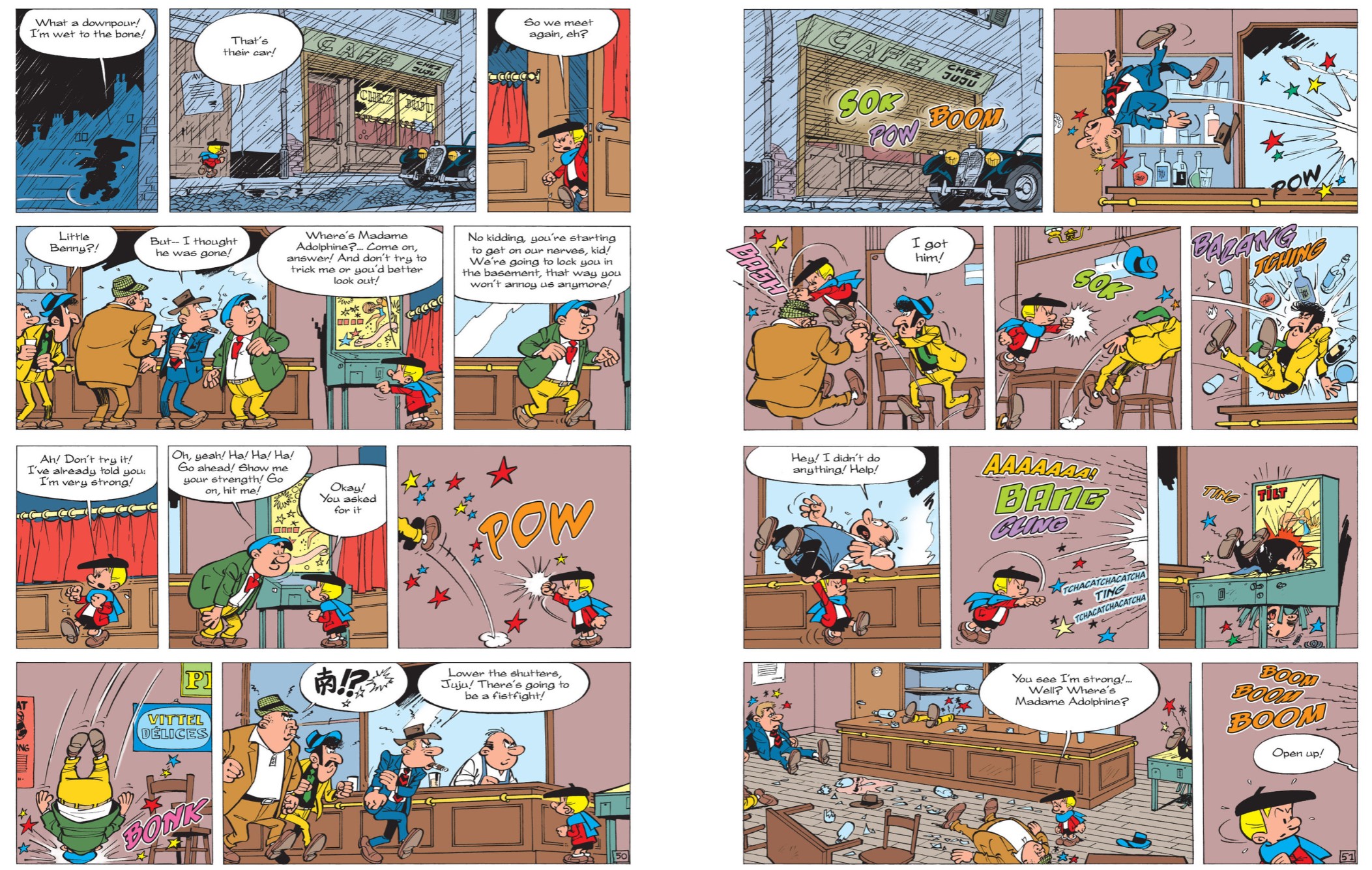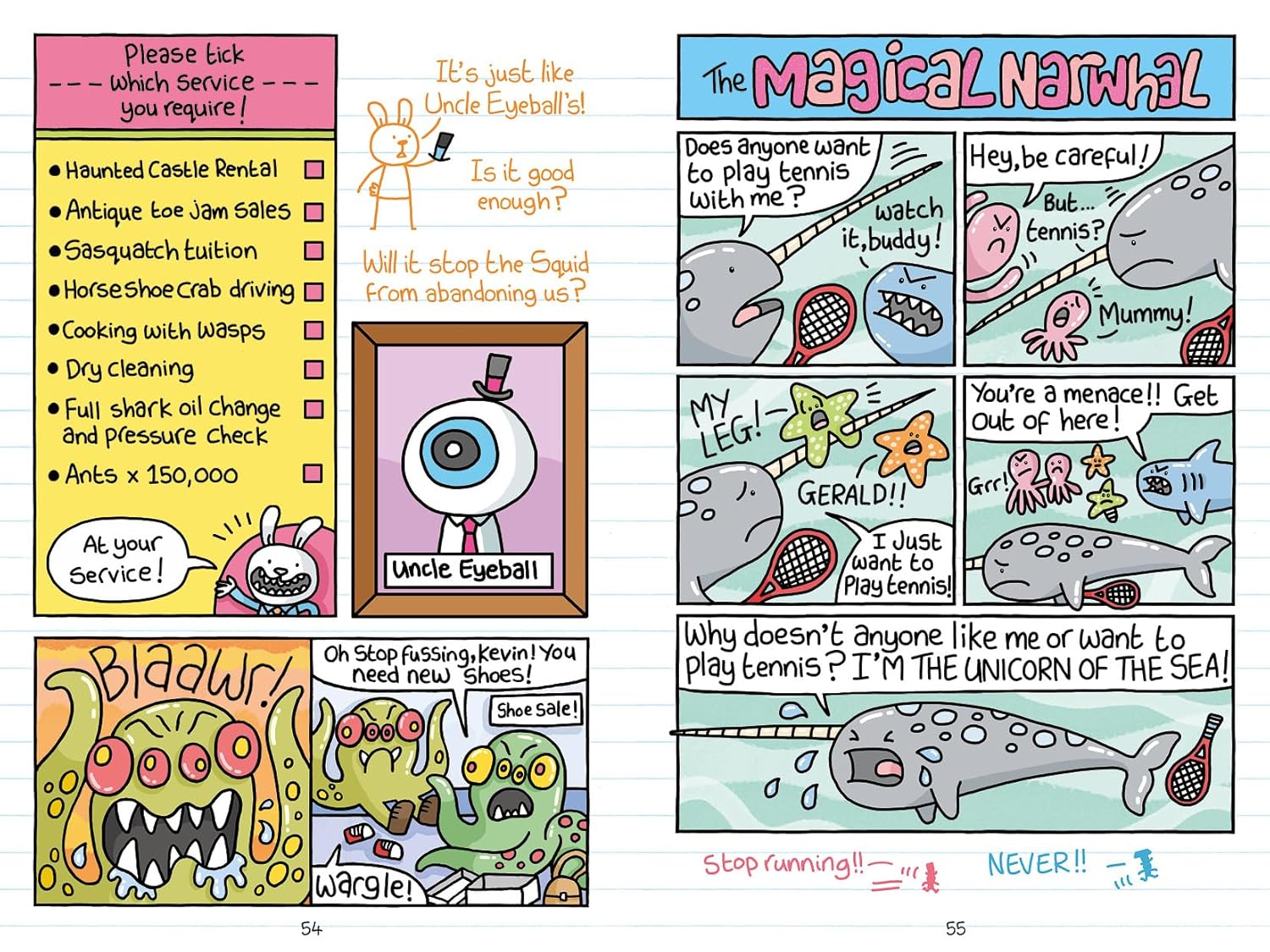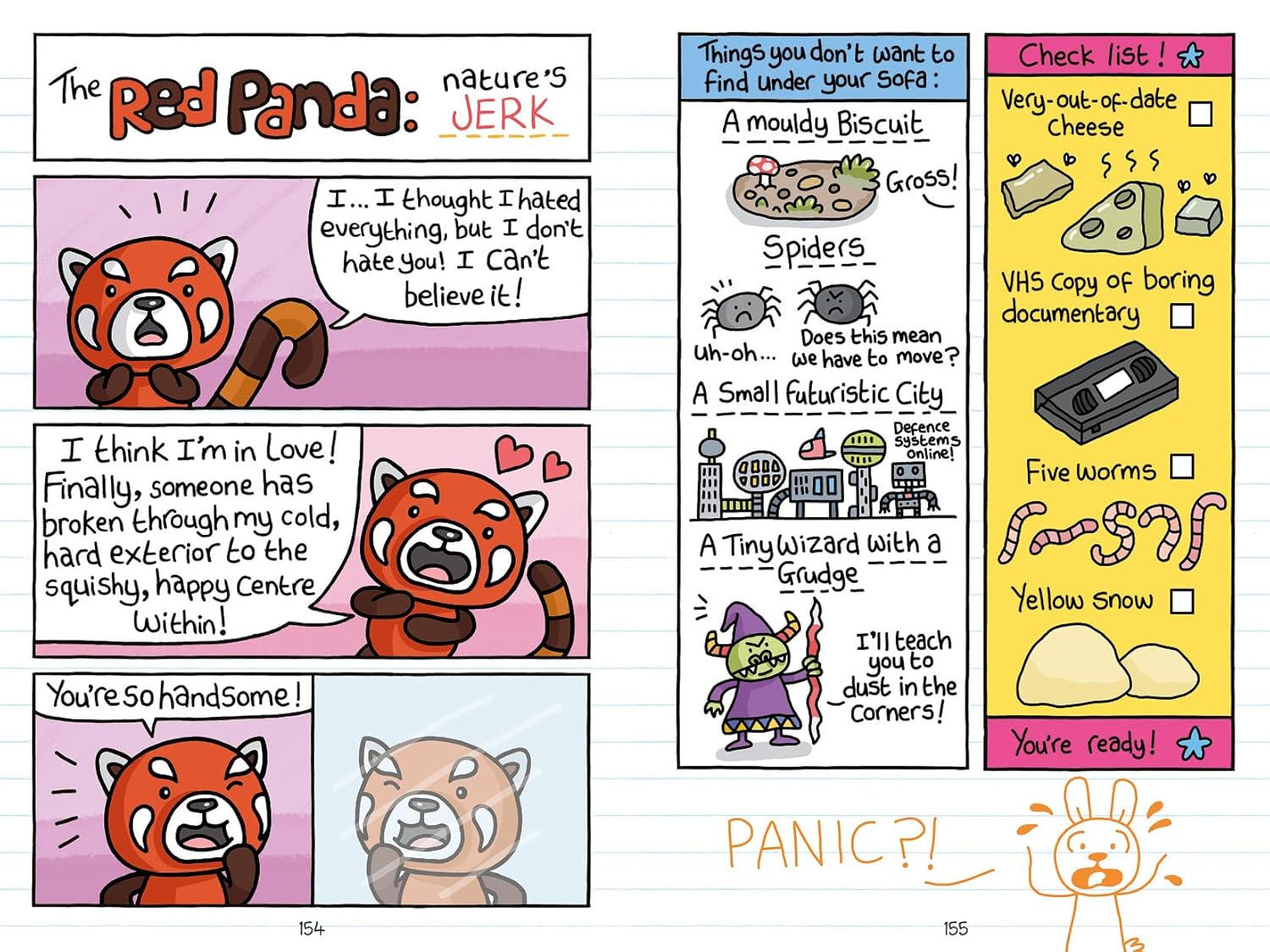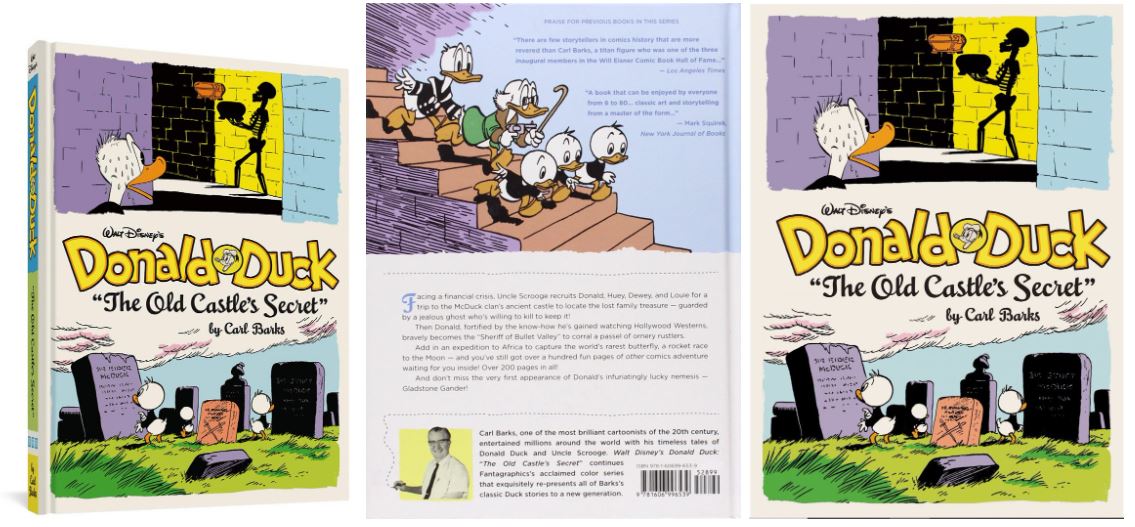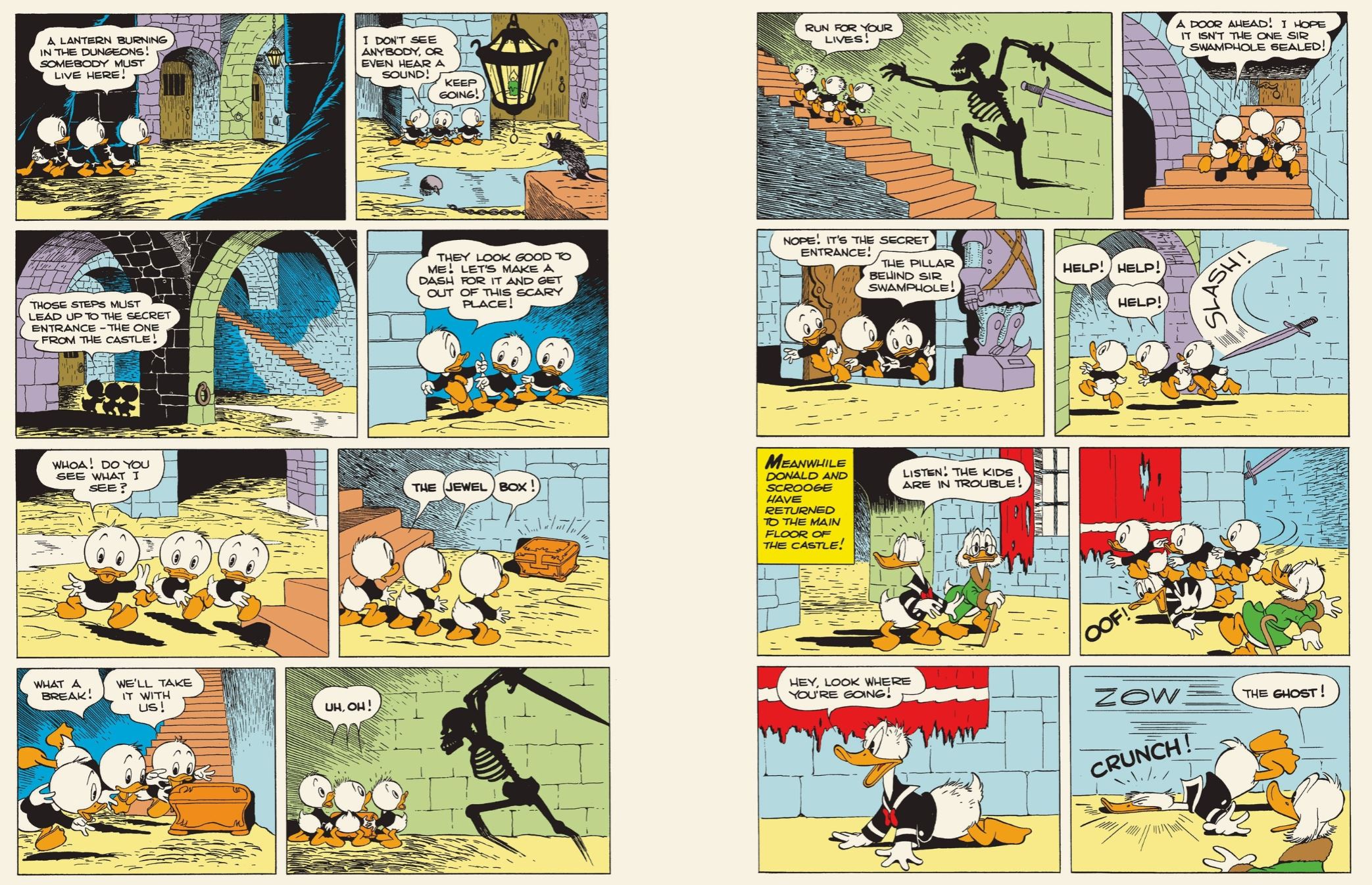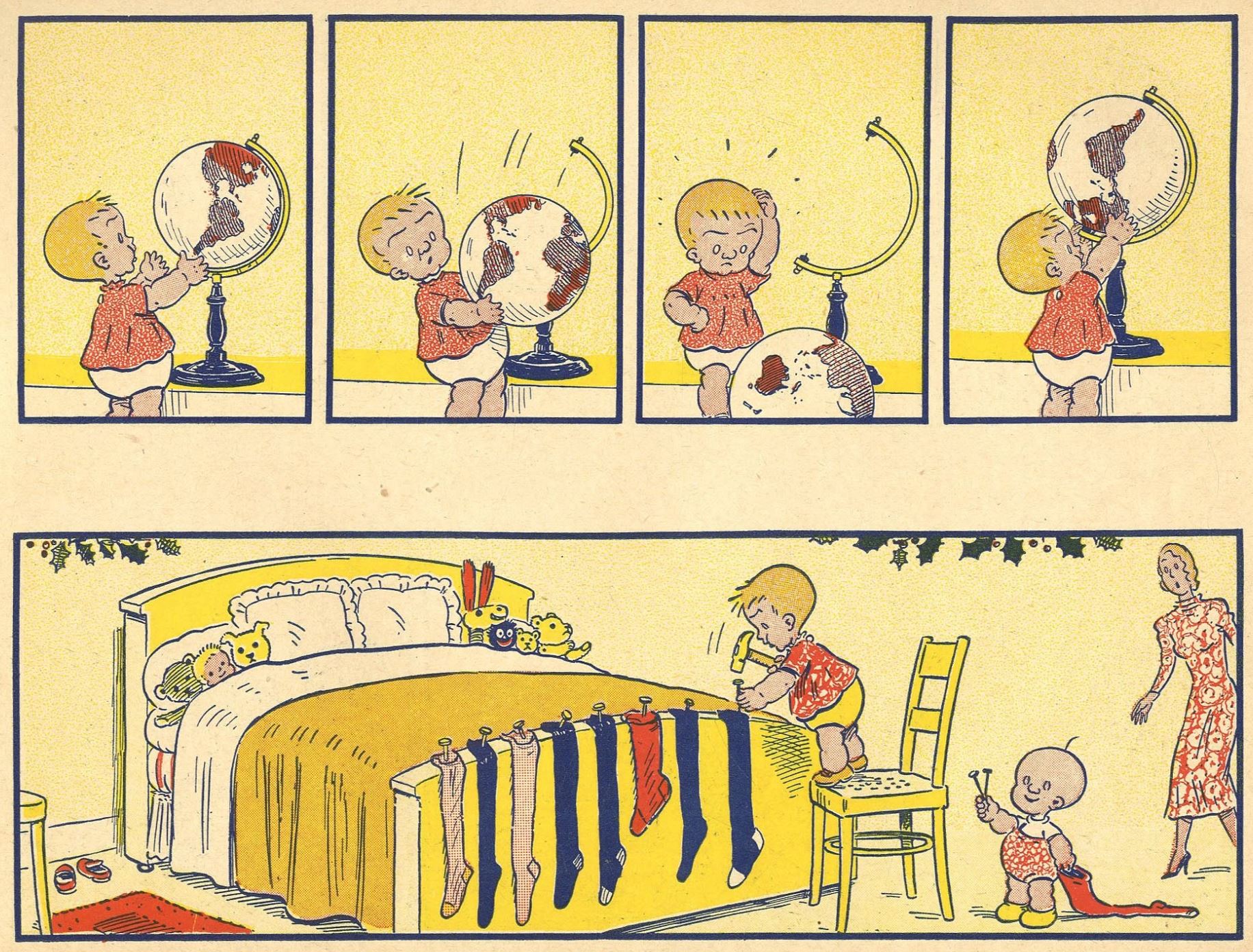
Billy and Buddy volume 10: Walks on the Wild Side


By Christophe Cazenove & Jean Bastide in the style of Roba, translated by Jerome Saincantin (Cinebook)
ISBN: 978-1-80044-186-6 (Album PB/Digital edition)

Known as Boule et Bill in Europe (at least in the French speaking bits – the Dutch and Flemish call them Bollie en Billie or perhaps Bas et Boef if readers first glimpsed them in legendary weekly Sjors), this evergreen, immensely popular cartoon saga of a dog and his boy first debuted at Christmas in 1959. The perennial family favourite resulted from Belgian writer-artist Jean Roba (Spirou et Fantasio, La Ribambelle) putting his head together with Maurice Rosy: the magazine’s Artistic Director and Ideas Man, who had also ghosted art and/or scripts on Jerry Spring, Tif et Tondu, Bobo and Attila during a decades-long, astoundingly productive career at the legendary periodical.

Intended as a European answer to Charles Schulz’s Peanuts, Boule et Bill quickly went its own way, developing a unique style and personality to become Roba’s main occupation for the next 45 years. He had launched the feature as a mini-récit (32-page, half-sized freebie inserts) in the December 24th edition of Le Journal de Spirou.

Like Dennis the Menace in The Beano, the strip was a huge hit from the start, and for 25 years held the coveted and prestigious back-cover spot. It was even syndicated to rival publishers and became a popular feature in Le Journal de Mickey, rubbing shoulders with Walt Disney’s top stars. Older Brits might recognise the art as early episodes – retitled It’s a Dog’s Life – ran in Fleetway’s prestigious weekly Valiant from 1961 to 1965…

A cornerstone of European life, the strip has generated a live-action movie, four animated TV series, computer games, permanent art exhibitions, sculptures and even postage stamps. As with a select few immortalized Belgian comics creations, Bollie en Billie were awarded a commemorative plaque and have a street named after them in Brussels…

Large format album compilations began immediately, totalling 21 volumes throughout the 1960s and 1970s from publisher Dupuis. These were completely redesigned and re-released in 1985 when Roba moved to Dargaud and became his own editor. The standard albums (44 to date) are supplemented by a range of early-reader books for toddlers. Assorted collections are available in 14 languages, selling well in excess of 25 million copies.

Roba crafted more than a thousand pages of gag-strips in his beguiling, idealised domestic comedy setting, all about a little lad and an exceedingly smart Cocker Spaniel. Long before his death in 2006, the auteur wisely appointed successors for the strip, which has thus continued to this day. He began by surrendering art chores to his long-term assistant Laurent Verron in 2003, and the successor subsequently took on the scripting too upon Roba’s passing. Verron was soon joined by gag-writers Veys, Corbeyran, Chric & Cucuel whilst this tome comes courtesy of latest team Christophe Cazenove & Jean Bastide. For this collection Verron is still present, as illustrator of the “cabochons”: illustrated icons at the top of each strip. They’re what old folks like us employed before emoticons…

As Billy and Buddy, the strip returned to British eyes in 2009: stars of enticing Cinebook compilations introducing to 21st century readers an endearingly bucolic sitcom-styled nuclear family set-up consisting of one bemused, long-suffering and short-tempered dad; a warmly compassionate but constantly wearied and distracted mum; a smart but mischievous son and a genius dog who has a penchant for finding bones, puddles and trouble. As the feature accommodates the passage of time, we see a few more mod-cons and a bigger role for girls – such as dog-loving Hazel but, in essence, nothing has changed… and that’s the whole point…

Y a d’la promenade dans l’air was the 39th European collection, comfortingly resuming in the approved manner and further exploring the evergreen relationship of a dog and his boy (and tortoise) for our delight and delectation. Available in paperback and digital editions and delivered as a series of stand-alone rapid-fire, single-page gags, Walks on the Wild Side is packed with visual puns, quips, slapstick and jolly jests and japes: all affirming the gradual socialisation and behaviour of little Billy as measured in carefree romps with four-footed friends and an even split between parental judgements and getting away with murder…

This time though those pawed pals are extensively featured in many human-free romps with the proudly affable pooch’s ever-growing street pack: Muffin, Scamp, Vix and the rest…

Buddy is the perfect pet for an imaginatively playful lad, although the manipulative mutt is still far too fond of purloined food, buried bones (ownership frequently and raucously to be determined), and, as seen in this volume, sleeping where he really shouldn’t. However, when not being a problem, he’s a unique helper when dad plays plumber and also ferociously protective of his boy, tortoise and ball and even down-on-their-luck strangers…

The pesky pooch simply cannot understand why everyone wants to constantly plunge him into foul-tasting soapy water, but it’s just a sacrifice he’s prepared to make to be with Billy, and as seen here a trial he’s prepared to endure for peace, pieces of food and the occasional Psy-ops/April’s Fool gag…

Buddy’s fondly platonic relationship with tortoise Caroline is heavily emphasised here and his knack for clearing off whenever Dad has one of his explosive emotional meltdowns (over the cost of treats, repair bills or other impositions) is again dialled down, but most traditional themes and schemes are revisited abundantly albeit with novel twists like taking the dog(s) for a nice drive…

Our inseparable duo interact with many pals (particularly Billy’s school chum and cavalry-loving playmate Pat – who acts as confidante and best two-legged crony in all mischief making) and at every carefree moment they all play pranks, encounter other animals, dodge surveillance, hunt and hoard (bones, toys, shoes, phones and other crucial household items), rummage in bins, wilfully and/or honestly misunderstand adults, cause accidents and cost money, with both kid and mutt equally adept at all of the above.

This time, domestic chaos is heightened by many visits to wild country and green pastures and Buddy’s new passion for recycling/pre-cycling…

And of course, hostile neighbour Madame Stick and her evil cat Corporal are on hand to spoil all fun and frustrate their frolics…

Roba was a master of this cartoon art form and under his successors the strips remain genially paced, filled with wry wit and potent sentiment: enchantingly funny episodes running the gamut from heart-warming to hilarious, silly to surreal and thrilling to just plain daft.

This collection is exactly what fans would expect and deserve: another charming homage to and lasting argument for a child for every pet and vice versa. Here is a supremely engaging family-oriented compendium of cool and clever comics no one keen on introducing youngsters to the medium should be without.
Original edition © Dargaud, 2018 by Cazenove & Bastide in the style of Roba © Studio Boule & Bill 2018. English translation © 2025 Cinebook Ltd.
Today in 1902 Bud Fisher’s Mutt & Jeff successor Al Smith was born, followed in 1904 by Theodor Seuss Geisel AKA Dr Seuss. In 1913 Fred Bassett creator Alex Graham was born, with German colour artist Tatjana Wood arriving ten years later and the amazing, beguiling Mark Evanier coming along in 1952.

In 1962 we lost cartoonist/author/critic/Member of Parliament J.F. Horrabin, originator of wonders such as The Adventures of the Noah Family and Dot and Carrie.

Gomer Goof volume 1: Mind the Goof!


By André Franquin, Delporte & Jidéhem: translated by Jerome Saincantin (Cinebook)
ISBN: 978-1-84918-358-1 (Album TPB/digital edition)

This book includes Discriminatory Content produced during less enlightened times and some used for dramatic and comedic effect.

Born in Etterbeek, Belgium on January 3rd 1924, André Franquin began his astounding career in the golden age of European cartooning. In 1946, as assistant to Joseph “Jijé” Gillain on top strip Spirou, he inherited sole control of the keynote feature, and creating countless unforgettable characters like Fantasio and The Marsupilami. Over two decades Franquin made the strip purely his, expanding its scope and horizons, as co-stars Spirou & Fantasio – with hairy Greek Chorus Spip the squirrel – became globetrotting troubleshooters visiting exotic places, exposing crimes, exploring the incredible and clashing with bizarre, eccentric arch-enemies. Throughout all that, Fantasio remained a full-fledged – albeit entirely fictional – reporter for Le Journal de Spirou, popping back to base between assignments. Regrettably, ensconced there like a splinter under a fingernail was an arrogant, accident-prone office junior. He was Gaston Lagaffe; Franquin’s other immortal – or peut-être unkillable? – conception…

There’s a hoary tradition of comics personalising fictitiously back-office creatives and the arcane processes they indulge in, whether it’s Marvel’s Bullpen or DC Thomson’s lugubrious Editor and underlings at The Beano and Dandy; it’s a truly international practise. Somehow though, after debuting in LJdS #985 (February 28th 1957), the affable dimwit grew – like one of his own monstrous DIY projects – beyond all control. Whether guesting in Spirou’s sagas or his own strips/faux reports for the editorial pages, Lagaffe became one of the most popular and ubiquitous components of the comic he was supposed to paste up.

In initial cameos or occasional asides on text pages, well-meaning foul-up and ostensible studio gofer Gaston lurked and lounged amidst a crowd of diligent toilers until the workshy slacker employed as a general assistant at LJdS’s head office became a solid immovable fixture. Ultimately the scruffy bit-player shambled into his own star feature…

In terms of schtick and delivery, older readers will recognise favourite beats and elements of well-intentioned helpfulness wedded to irrepressible self-delusion as seen in Benny Hill or Jacques Tati vehicles and recognise recurring riffs from Only Fools and Horses and Mr Bean. It’s blunt-force slapstick, using paralysing puns, fantastic ingenuity and inspired invention to mug smugness, puncture pomposity, lampoon the status quoi? (and that’s British punning, see?) and ensure no good deed goes noticed, rewarded or unpunished…

As previously stated, Gaston/Gomer can be seen (if you’re very quick or extremely patient) toiling at Le Journal de Spirou’s editorial offices. At first he reported to Fantasio, but as pressure of work took the hero away, the Goof instead complicated the lives of office manager Léon Prunelle and other harassed and bewildered staffers, all whilst effectively ignoring any tasks he’s paid to actually handle. These notionally include page paste-up, posting packages, filing, clean-up, collecting stuff inbound from off-site and editing readers’ letters – the reason why fans’ requests/suggestions are never acknowledged or answered…

Gomer is lazy, hyperkinetic, opinionated, ever-ravenous, impetuous, underfed, forgetful and eternally hungry: a passionate sports fan, self-proclaimed musician maestro and animal lover whose most manic moments all stem from cutting work corners, stashing or consuming contraband nosh in the office or inventing the Next Big Thing. This situation leads to constant clashes with colleagues and draws in notionally unaffiliated bystanders like increasingly manic traffic cop Longsnoot and fireman Captain Morwater, plus ordinary passers-by who should know by now to keep away from this street.

Through it all, the obtuse office oaf remains affable, easy-going and incorrigible. Only three questions matter: why everyone keeps giving him one last chance, what does gentle, lovelorn Miss Jeanne see in the self-opinionated idiot, and will perpetually-outraged and accidentally abused capitalist financier De Mesmaeker ever get his perennial, pestiferous contracts signed?

If you’re old, new to this and yet experiencing a dose of déjà vu, it might be because the big idiot appeared in a 1970s Thunderbirds annual, rechristened Cranky Franky. Perhaps they should have kept the original title…

This premier compilation consists of half-page shorts and comedic text story “reports” from the LJdS’s editorial page before ultimately unleashing full episodes of madcap buffoonery. As previously stated Gomer is employed (let’s not dignify his position by calling it “work”) at the Spirou offices, reporting to go-getting Fantasio and foolishly left in charge of minor design jobs like paste-up and reading readers’ letters and general dogs-bodying. He’s lazy, opinionated, forgetful and eternally hungry. Many of his most catastrophic actions revolve around cutting corners and caching illicit food in the office…

Following 26 short, sharp two-tier gag episodes – involving Gomer’s office innovations, his hunt for food, assorted pets and livestock, sporting snafus and his appallingly decrepit and dilapidated Fiat 509 auto(barely)mobile – the first of numerous prose vignettes ‘On the Line’ exposes the fool’s many delusional attempts to become an inventor. Other text forays – punctuated by more pint-sized gag-strips – follow. These comedy briefs include ‘More Than One String to his Bow’, ‘Police Report’, ‘Open Letter to Mr De Mesmaeker’ (Jean De Mesmaeker being the real name of collaborator and background artist Jidéhem and taken for the self-important businessman who became Gomer’s ultimate foil), ‘Winter Stalactites’, ‘Red vs Blue’, ‘Noise Pollution’, ‘Presence of Mind’, ‘Gomer’s stethoscope’, ‘The Firebug Fireman’, ‘Gas-powered bicycle’ and ‘Definitely-not-surreptitious advertising’.

The print then gives way to a long-running procession of half-page strips with our editorial idiot causing a cataclysm of cartoon chaos.

Further prose pieces slip into extended continuity when Fantasio embargoes all canned food (potentially explosive and always a bio-hazard) and Gomer applies all his dubious ingenuity to beating the ban in ‘The tin wars’, ‘Ticking tin bombs’, ‘Diary of a War correspondent’ and ‘Blockade’ before one final strip flurry brings the hilarity to temporary pause…

Far better enjoyed than précised or described, these strips allowed Franquin, fellow scenarist Yvan Delporte and Jidéhem to flex their whimsical muscles and subversively sneak in some satirical support for their political beliefs in pacifism and environmentalism, but at their core remain supreme examples of all-ages comedy: wholesome, barbed, daft and incrementally funnier with every re-reading.

So why not start now?
© Dupuis, Dargaud-Lombard s.a. 2017 by Franquin. All rights reserved. English translation © 2017 Cinebook Ltd.

Today in 1907, comic strip god Milton Caniff was born, as was – in 1913 – John Carter of Mars illustrator John Coleman Burroughs. Ditto Japanese teacher/political cartoonist Taizo Yokoyama (Pu-san, Eheh) in1917. Reading wise, André Franquin’s Gaston Lagaffe debuted in 1957.

If there was a February 29th this year, tomorrow we’d be commemorating the birth of Italian superstar Paolo Eleuteri Serpieri (Druuna) in 1944 and the launch of Bil Keane’s The Family Circus in 1960… but we don’t so we ain’t.

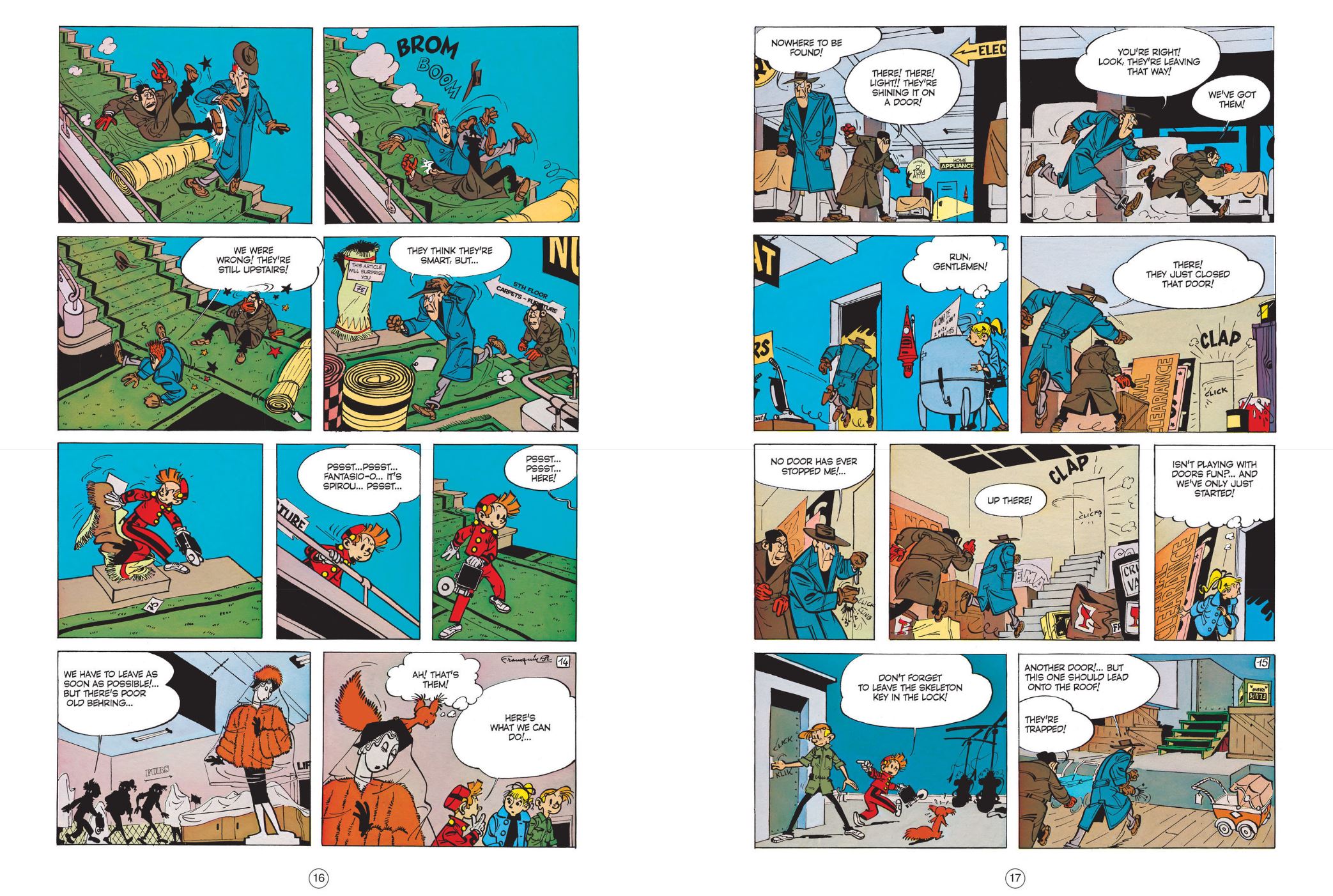
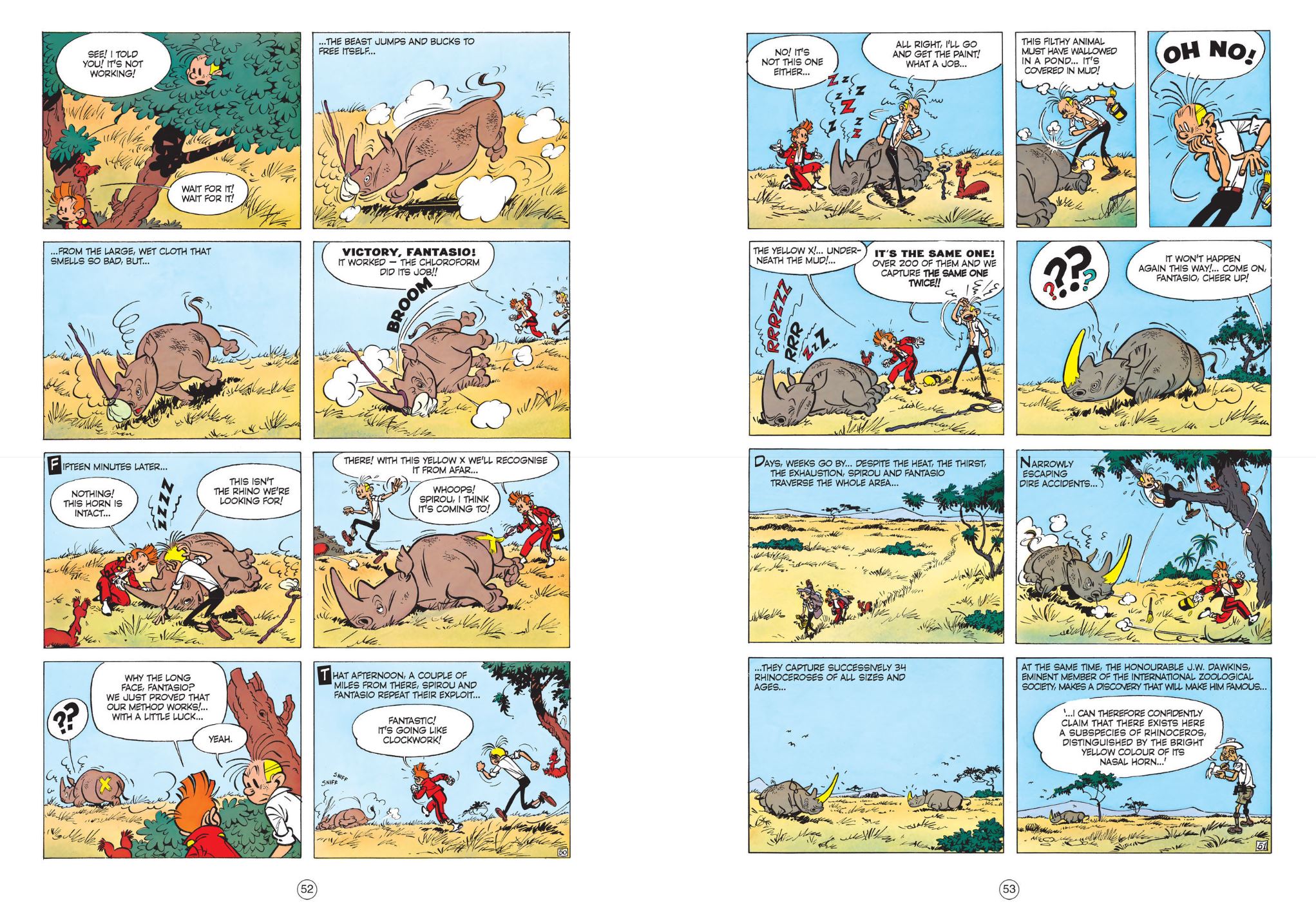
Spirou and Fantasio volume 11: The Wrong Head


By André Franquin, translated by Jerome Saincantin (Cinebook)
ISBN: 978-1-84918-313-0 (Album PB/Digital edition)

This book includes Discriminatory Content produced in less enlightened times. This book also contains Discriminatory Content included for comedic effect.

André Franquin was born in Etterbeek, Belgium on January 3rd 1924 and died on January 5th 1997. In between there were good times and bad, which he offset by creating the most incredible characters and stories, and by making people laugh and think – but mostly laugh. This is one of the very best you can find translated into English.

Adventure-seeking Spirou headlined the magazine he was named for from the first issue (dated April 21st 1938). He was created by French cartoonist Françoise Robert Velter using his pen-name Rob-Vel for Belgian publisher Éditions Dupuis. This was in direct response to the success of Hergé’s Tintin for rival outfit Casterman.

Originally a plucky bellboy/lift operator employed by the Moustique Hotel (a sly reference to the publisher’s premier periodical Le Moustique), his improbable exploits with pet squirrel Spip gradually grew into high-flying, far-reaching, surreal comedy dramas. That evolution was mainly thanks to Velter’s wife Blanche “Davine” Dumoulin who took over the strip when her husband enlisted in 1939 and Belgian artist/assistant Luc Lafnet… at least until 1943 when Dupuis purchased all rights to the property, after which comic-strip prodigy Joseph Gillain (Jijé) took the helm.

Our interest really begins when Jijé handed his own trainee assistant complete responsibility for the flagship strip part-way through Spirou et la maison préfabriqué (Le Journal de Spirou #427, June 20th 1946). André Franquin ran with it for two decades; enlarging the scope and horizons until it became purely his own. Almost every week fans would meet startling new characters such as comrade/rival Fantasio or crackpot inventor and Merlin of mushroom mechanics the Count of Champignac. Spirou and Fantasio became globe-trotting journalists, travelling to exotic places, uncovering crimes, exploring the fantastic and clashing with a coterie of exotic arch-enemies such as Zorglub and Fantasio’s unsavoury cousin Zantafio.

Franquin, plagued in later life by bouts of depression, passed away in 1997 but his legacy remains; a vast body of work which reshaped the landscape of European comics.

Here then as originally serialised in LJdS #840-869 in 1954 and subsequently released on the continent in 1957 as hardcover album Spirou et Fantasio 8La Mauvaise Tête, this sinister yarn begins as Spirou visits short-tempered pal Fantasio and finds the house a shambles. The intrepid investigator has ransacked his own home in search of missing passport photos with his insensate fury only abating (a bit!) after Spirou convinces him to come play paddleball.

Later, whilst looking for a lost ball in the woods, Spirou finds one of the missing photos but thinks nothing of it…

That evening strange events begin: Spirou sees Fantasio acting oddly in town and when a jeweller is robbed, the brutalised merchant identifies Fantasio as the smash-and-grab thief…

More seeds of suspicion are sown and Spirou doesn’t know what to think when a solid gold Egyptian mask is stolen on live TV. The bandit is clearly seen to be his best pal…

Spirou is still seeking to reason with Fantasio when the cops arrive and, with nobody believing the reporter’s ridiculous story of being in Paris on a spurious tip, watches with helpless astonishment as the accused makes a bold escape bid…

Still astounded, Spirou wanders to the ramshackle house where he found the missing photo and finds a strange set-up: a plaster cast of Fantasio and weird plastic goo in a mixing bowl…

His snooping is suddenly disturbed by screams and sounds of a struggle. Chasing the cacophony, he finds one man holding the stolen gold mask and another on the floor. The standing man is too quick to catch and drives away with a third stranger, but as Spirou questions the beaten victim he learns that the loser of the fight is a sculptor who was hired to make astounding life-like masks of some journalist…

Soon Spirou is hot on the trail of the criminal confederates, uncovering a diabolical scheme to destroy Fantasio by an old enemy they had both discounted and almost forgotten. He has not forgotten them, however, and soon everything is up in the air and beyond belief. Even the nation’s sacrosanct sport of cycle racing is not beyond the scope of the vile manipulator’s brazen scheming…

Fast-paced, compellingly convoluted and perfectly blending helter-skelter excitement with keen suspense and outrageous slapstick humour, the search for The Wrong Head is an utterly compelling romp to delight devotees of easy-going adventure.

As if criminal capers and a spectacular courtroom drama climax is not enough, this tome also includes a sweet early solo outing for the marvellous Marsupilami as ‘Paws off the Robins’ finds the plastic pro-simian electing himself guardian of a nest of newborn hatchlings in Count Champignac’s copious gardens, and resolved to defend the chicks from a marauding cat at all costs…

Stuffed with fabulously fun, riotous chases and gallons of gags, this exuberant tome is a joyous example of angst-free action, thrills and spills. Readily accessible to readers of all ages and drawn with beguiling style and seductively wholesome élan, this is pure cartoon gold: an enduring comics treat, destined to be as much a British household name as that other kid reporter and his dog…
Original edition © Dupuis, 1957 by Franquin. All rights reserved. English translation 2016 © Cinebook Ltd.

Today in 1897 British illustrator and cartoonist Edgar Henry Banger was born, as was our graphic comedy god Dudley D. Watkins in 1907. In the US, Norm (Batman) Breyfogle and Jeff (Bone) Smith arrived in 1960, and Andy Kubert in 1962.

Big day for departures too, with “Father of Turkish Comics” Cemal Nadir leaving in 1947; Bill Everett in 1973; Italy’s Carlo (Sor Pampurio) Bisi in 1982 and both Bill (Smokey Stover) Holman and Darrell Craig MacClure (Little Annie Rooney) in 1987.

Achievement-wise, UK pre-school comic Jack and Jill began its 1600+ week run today in 1954.

A Portrait in Poems: The Storied Life of Gertrude Stein & Alice B. Toklas


By Evie Robillard & Rachel Katstaller (Kids Can Press)
ISBN: 978-1-5253-0056-1 (HB/Digital edition)

We don’t cover nearly enough kids’ books here, nor those with an Arts or Educational underpinning, and that’s because I lazily prefer to read stuff that’s entertaining, worthwhile and well-produced. And yes, I know they’re not necessarily mutually exclusive but somehow, so often, they are. Happily, this gloriously inclusive biographical primer into one of the world’s most interesting and accomplished women and her life partner is all of that and more.

A delicious, enthralling picture book for 6 to 9-year-olds, A Portrait in Poems précis’ and shares some notable Parisian moments in the life of author Gertrude Stein and her muse Alice B. Toklas. This unconventional couple led the upcoming arts glitterati of Europe and collected one of the most astounding art collections in history prior to one World War and before the next. The book is drafted in episodic free verse by librarian, teacher and writer Evie Robillard and painted with idyllic verve by El Salvadoran illustrator Rachel Katstaller in a superbly subtle manner guaranteed to get youngsters addicted to learning more.

In short order you’ll visit the protagonists’ first home at ’27 Rue de Fleurus’, observe as ‘Picasso Paints a Portrait’, share ‘Saturday Evenings’ and enjoy ‘The Room with All the Paintings’ before meeting ‘Gertrude Stein, the Genius’

The couple shared their exalted Salon existence with ‘A Dog Named Basket’ (two actually) and we see more of them all in ‘Gertrude & Alice & Basket in a Book’ before wrapping up the history with what happened ‘After’

Adding learning and lustre a ‘Time Line’ supplies dates and hard facts, while glimpses of character shine in a trio of epigrammatic ‘Snapshots’, whilst ‘Sources’ offers some of Gertrude’s best works to check out and a bibliography reveals more books about her, before a final ‘Author’s Note’ deals with the contentious period when the couple abided under Nazi occupation in Vichy France.

It’s never too early to give children a hunger to know stuff, and this bright, inclusive foray into the mind and life of one of our most remarkable thinkers is a welcome addition to any junior library or kids’ book stash because it simply cries out for readers to go absorb more…
Text © 2020 Evie Robillard. © 2020 Rachel Katstaller. All rights reserved.

Today in 1877, pioneering comics wonder Rudolph (Katzenjammer Kids/The Captain and the Kids) Dirks was born, with French writer/illustrator/publisher Jean Bruller following in 1902, Cuban cartoon everyman Ric Estrada in 1928, and journeyman comic book standby John Calnan in 1932.

At the mature ends of the industry curve, UK satirist Steve Bell was born in 1951 – just as the Empire changed forever – and two years later so was Canadian David (Reid Fleming – World’s Toughest Milkman) Boswell, with Argentinian Enrique Alcatena coming along in 1957 and Karen Berger in 1958.

French pioneer Emmanuel Poiré – aka Caran d’Ache – died today in 1909, but his legacy includes stuff like Natacha by François Walthéry in Le Journal de Spirou today in 1970, and 2000 AD which launched in 1977 and is still on sale this week…

Toby and the Pixies volume 4 How to Be Cool!


By James Turner & Andreas Schuster, with Emily Kimball & Leanne Daphne (David Fickling Books)
ISBN: 978-1-788453-77-6 (TPB)

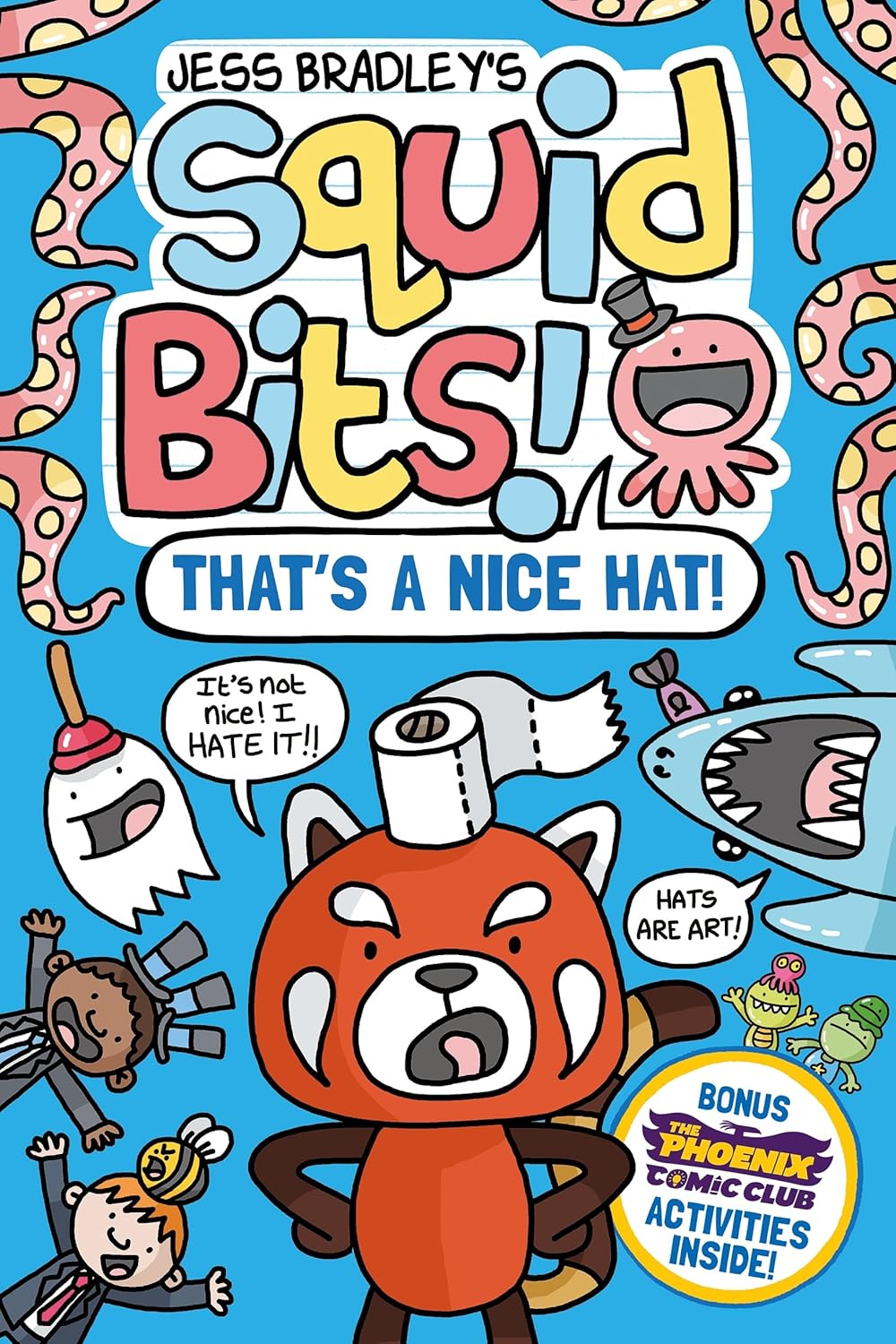
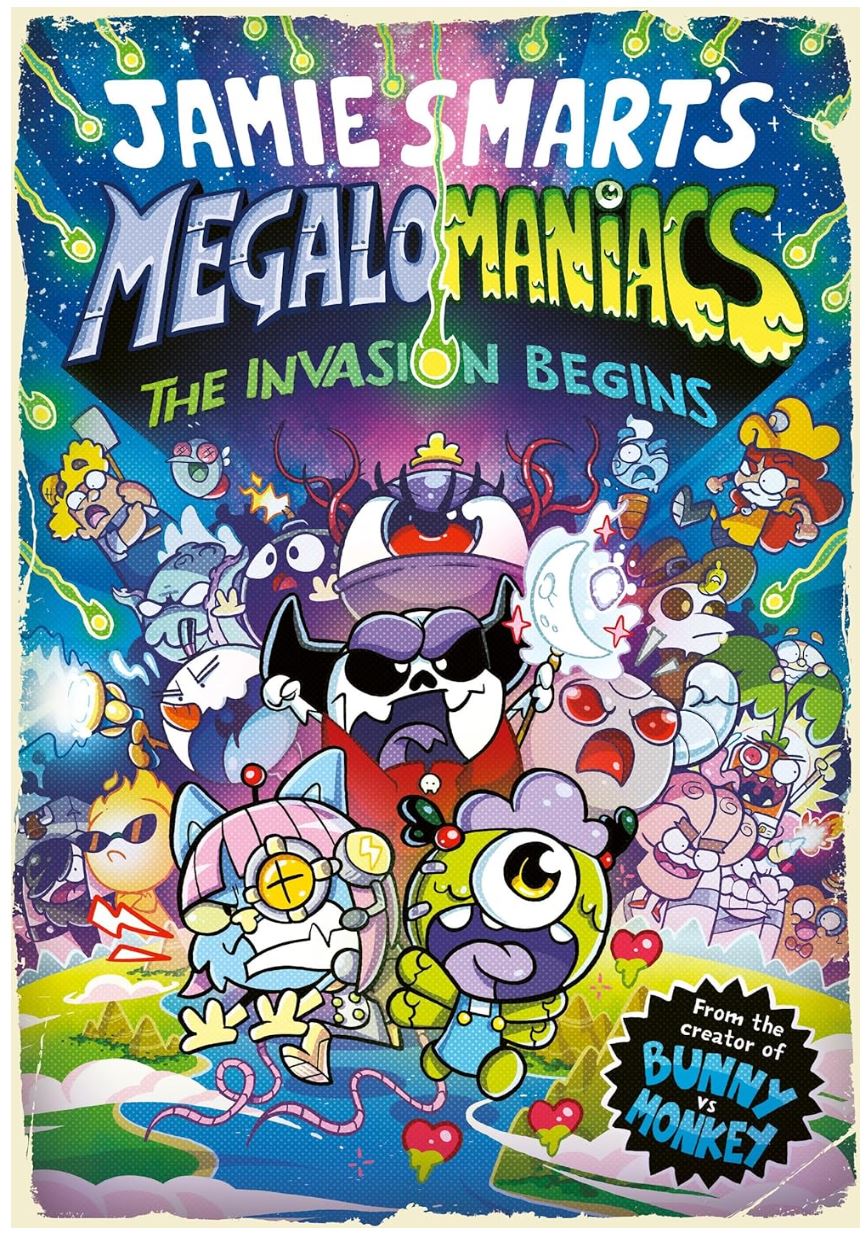
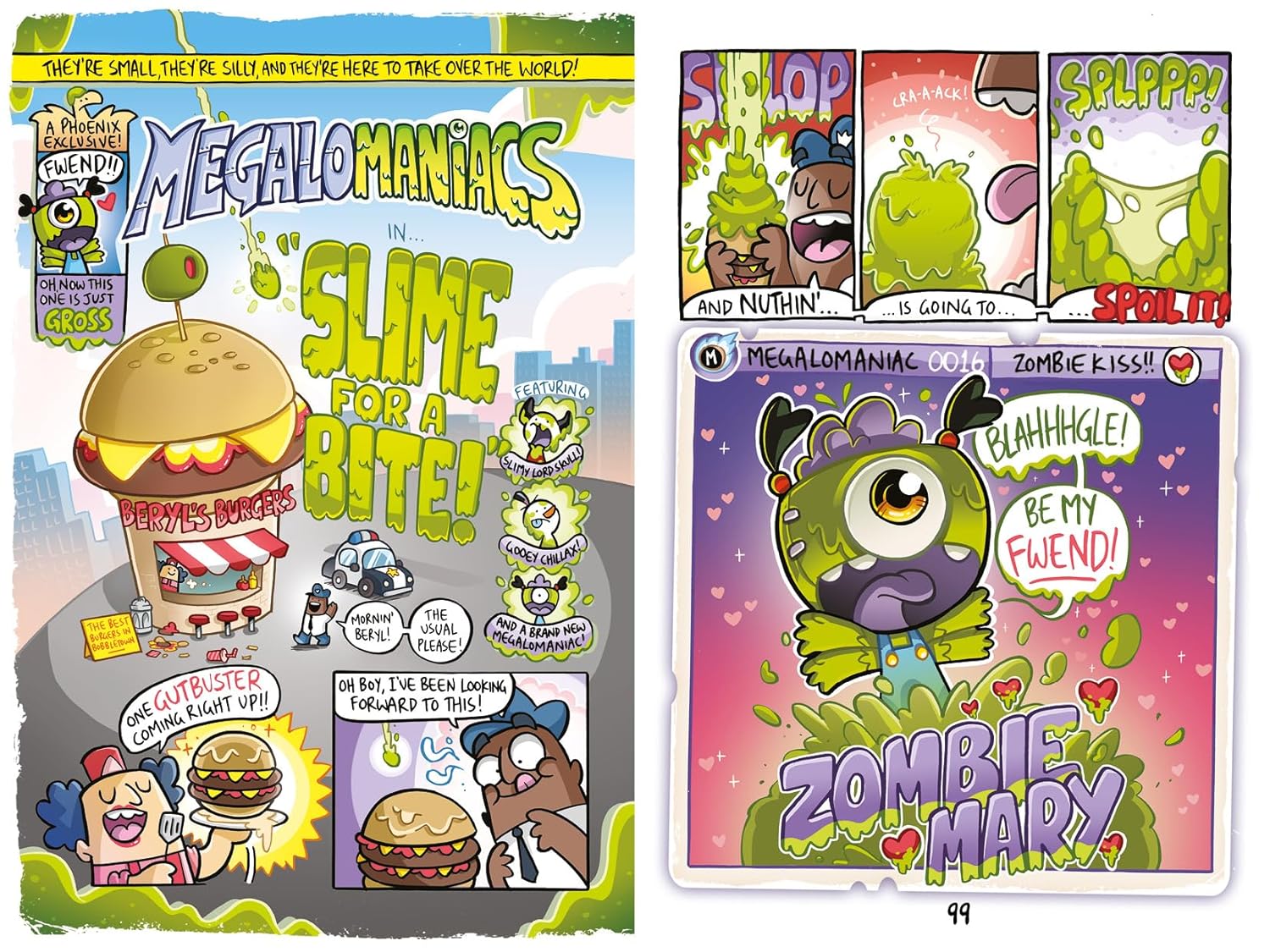
Way back in January 2012, Oxford-based David Fickling Books made a rather radical move by launching a traditional anthology comics weekly aimed at under-12s. It revelled in reviving the good old days of picture-story entertainment intent whilst embracing the full force of modernity in style and content.

To this day each issue features humour, adventure, quizzes, puzzles and educational material in a joyous parade of cartoon fun and fantasy. The Phoenix has successfully established itself as a potent source of children’s entertainment because, like Beano and Dandy, it is equally at home to boys and girls, and HAS mastered the magical trick of mixing amazingly action-packed adventure series with hilarious humour strip serials such as this one. Most of the strips have also become graphic collections; just like this one…

Crafted by James Turner (Star Cat, Super Animal Adventure Squad, Mameshiba, The Unfeasible Adventures of Beaver and Steve) and Canadian cartoonist/designer/animator Andreas Schuster (KLARA AND ANTON in PRIMAX Magazine), Toby and the Pixies began in January 2020 as I Hate Pixies and, once out of the compost bag of creative wonders, just wouldn’t stop. Those first forays were remastered and released as Toby and the Pixies: Worst King Ever! and follow-up fester forays Best Frenemies & Pixie Pandemonium!, charting the course of a nerdy boy at a nice school… until it all goes wrong…

Unappreciated, anxious 12-year-old Toby Cauldwell was resigned to and content with his meagre, second-rate friends, dedicated personal bullies, negative charisma levels and functional classroom invisibility at Suburbiton High School, but began rapidly shedding his appallingly uncool reputation the day after his electric-toaster-obsessed Dad ordered him to sort out their unruly, out-of-control back garden…

That’s when Toby discovered that wild, jungle-like urban wilderness was – unbeknownst to any mortal – the camouflaging screen for a fabulous fey realm. The ethereal, moist and rather mucky enclave had endured unseen in the green shambles of the Cauldwell backyard for countless ages. Now, thanks to an inept and inadvertent act of emancipation triggered by Toby kicking an unfortunately placed plaster garden gnome, the status quo forever altered. A tool of fate, the reluctant lad was instantly elevated to the position of supreme overlord, by dint of accidently yet totally obliterating the sitting tyrant. It was only for a hidden kingdom of magical morons, but they were really happy to be shot of their previous mad, mean, magical master…

As interpreted by the former King’s advisors – Royal Druid Mouldwarp, wise(ish) Lore Keeper/Potion Master Gatherwool and Toadflax (she eats stuff) – deliberately or otherwise, despatching King Thornpickle made Toby new absolute monarch. Pixie law also stated said ruler could do anything they wanted… a prospect so laden with responsibility that it made Toby weep with terror…

Just coming to terms with MAGIC actually existing, and that the ever-present freaky, anarchic imps can do it whilst still being absolute idiots and morons was awful enough, without also still having to survive school’s normal horrors. Thankfully, as the little odds and sods increasingly impinged and impacted on Toby’s life, education and prospects, they also turned school upside on a daily basis, and Toby’s fellow outcast Mo soon discovered the shocking secret of their existence. And he thought it was BRILLIANT!

In the short term it actually made things worse but now, apart from constant teasing and perpetual whining pleas to visit the magic kingdom, there is a fellow human King Toby can moan at. Two, actually, as snarky bully Steph also soon discovered the secret and has since proved to not be quite as awful as she might be…

That’s good because knowledge is a dangerous, trouble-causing thing, particularly as the Pixies are now everywhere and Toby’s succession triggered many problems: especially when magic-slime wielding Princess Sugarsnap – daughter of Thornpickle and rightful heir to a job Toby really, really doesn’t want – started a war to take back the throne Toby absolutely doesn’t want…

This fourth folio of foolishly foetid foofaraw opens with a fresh chance to get reacquainted with musty regulars Toby, Mo, Steph, Sugarsnap, Toadflax, Gatherwool & Mouldwarp in a comprehensive triple page intro. Then it’s back to school and off the deep end (or is it?) in ‘Chapter 1: T Train’ as Toby – under the Advisors’ suggestions and fed up with his old nickname (“Trousers”) – decides to reboot his image. Sadly, using magic to remove everyone’s memories of old Toby to make room for supercool “T-Train” is a complete disaster… as usual.

‘Chapter 2: Pet Project’ sees the rickety ruler granted extra responsibility – looking after the class goldfish – before disaster immediately strikes when it dies. No appreciable use (as usual!) the pixies take away the wrong message from Toby’s humiliating tragedy and over-explore the fascinating human notion of “pets” by concentrating on “can anybody be one…?”

Pixies are willing, compliant slaves to their King, so only chaos can result from Steph finally making overburdened Mouldwarp understand the concepts of consent and refusal in ‘Chapter 3: The More You “No”’. Rebellion can be an ugly thing to witness…

Social horror blends with the squishy icky kind in ‘Chapter 4: Spot On’ when Toby allows his advisors to “treat” the unsightly blemish on his forehead. Soon, the unsightly pimple is not only bigger than his original head, but far smarter and more erudite, too. Of course, it cannot last…

The young king hates grooming and his much-deferred barber appointments finally come home to roost in ‘Chapter 5: Hair Today, Gone Tomorrow’, paying dank, dandruffy dividends after the Advisors’ first suggestion (hungry goat) is superseded by manic tonsorial magic and grows well beyond anyone’s control. Sadly, that catastrophe is rapidly eclipsed in ‘Chapter 6: Penguin Peril’ when an impending appearance on TV show “That’s Sciency” becomes just the latest way his Advisors cannot help. Here an ecology project involving papier mache penguins and global climate crises suddenly becomes a disaster of cosmic proportions when the pixies soup it up. Now, only devious Princess Sugarsnap seems able to assist… and only for a most outrageous price…

In ‘Chapter 7: Lore Unto Themselves’ a dose of school library cleaning results in the fetid fey folk experiencing sugar-stoked culture shock after seeing in something called “a book” what proper Pixies are…

After realising the King is constantly being saved by his loyal Champion Mo, Sugarsnap bounces back with her most wicked plan yet in ‘Chapter 8: Getting the Hump’. To succeed, all she has to do is break up their friendship, and what better way than by exploiting their shared passion for video games? And THAT is best accomplished by entering the game itself via magic, yes? Well, no, actually…

Writing is hard even if you have great ideas like scholastic King Toby, but if you let your Advisors remove the Self Doubt Critter in your head via a Magical Brain Beret, all manner of plots, schemes and characters are able to unstoppably manifest. Thus, in ‘Chapter 9: Critical Thinking’ as Toby generates a torrent of unwanted essay pages, his freedom of thought increasingly and dangerously impacts on his actions. The solution is to put the SDC back in the king’s head, but it’s perfectly happy squatting in Mouldwarp’s bonce and not keen on being evicted, so it’s a happy thing that when it goes on a rampage Toby has few ideas…

When Toadflax discovers advertising and psychology it soon spawns sheer anarchic trouble in ‘Chapter 10: Choco Crisis’ as the Advisors’ addiction to sugar leads them to magically manifest idols and monsters only a hasty human ad campaign can counter…

Echoes of that encounter reverberate as Christmas rolls around again and ‘Chapter 11: Advent Adventure’ finds Mo, Steph and Toby confronting the Pixies’ newfound love of doors that open onto presents and the ultimate terror that leads to…

The storytelling terminates with one more trial as Sugarsnap returns with her ultimate gambit: suing Toby for the Kingdom of Pixies. However, nobody can win when the law is such an ass that it allows Gatherwool to be judge and book-eating Toadflax and Mouldwarp to be defence counsel. As chaos mounts in ‘Chapter 12: Court Out’, Toby has never been more happy to have Stepha and Mo acting as his behind the scenes advocates…

Ordinary school interactions can be a nightmare, but with the reading done for now, keen types can learn useful stuff from pages of related activities grouped under the banner of the Phoenix Comics Club. Bring paper, pencils and you to a selection of items from the compact online course detailing all aspects of comic strip creation supervised by Andreas Schuster.

Here that includes ‘Let’s Draw a Pixie! Castle’; ‘Pixie Magic!’; ‘Character class: Ducks!’; ‘Duckification!’ and ‘By the Power of Art, COMBINE!’ backed up by an extensive peek at other Fickling books and treats plus a plug for the Phoenix Comics Club website complete with instant access via a QR code.

Toby and the Pixies is a fabulous fabrication of festery fun and nonsense no lover of laughs and lunacy should deprive themselves and which all kids will gleefully consume. What are we all waiting for?
Text and illustrations © The Phoenix Comic 2026. All rights reserved.

Toby and the Pixies: volume 4: How to Be Cool! is published on 12th February 2026 and available for preorder now.

Today in 1898 the previous Frank Miller (who produced aviation strip Barney Baxter in the Air) was born, as was eternal letterer Irv Watanabe in 1919. In 1957 Leonard Starr’s Mary Perkins on Stage opened, but strips lost to us on this day include DC’s The World’s Greatest Superheroes in 1985 and Secret Agent X-9 in 1996.

Crucially and painfully, in 1987 Diabolik co-creator Angela Giussani died, as did the uniquely irreplaceable Steve Gerber in 2008.
Barnaby volume 1: 1942-1943


By Crockett Johnson (Fantagraphics Books)
ISBN: 978-1-60699-522-8 (HB/Digital edition)

This book includes Discriminatory Content produced in less enlightened times.

Here is one of those books that’s worthy of two reviews, so if you’re in a hurry…

Buy Barnaby now – it’s one of the most wonderful strips of all time and this superb hardcover compilation and its digitised equivalent have lots of fascinating extras. If you harbour any yearnings for the lost joys of childish glee and simpler, more clear-cut world-ending crises, you would be crazy to miss this…

However, if you’re still here and need a little more time to decide…

As long ago as August 2007 I started whining that one of the greatest comic strips of all time was criminally out of print and in desperate need of a major deluxe re-issue. So – as if by the magic of a fine Panatela – Cushlamocree! – Fantagraphics came to my rescue.

Today’s newspapers – those that still cling on by ink-stained fingernails – have precious few continuity drama or adventure strips. Indeed, if a paper has any strips, as opposed to single panel editorial cartoons at all, chances are they will be of the episodic variety typified by Jim Davis’ Garfield or reruns of old favourites like Calvin and Hobbes or Peanuts.

You can describe most of these as single-idea pieces with a set-up, delivery and punchline, rendered in sparse, pared-down-to-basics drawing style. In that at least, they’re nothing new. Narrative impetus comes from the unchanging characters themselves, and a building of gag-upon-gag in extended themes. The advantage to the newspaper was obvious. If readers liked a strip it encouraged them to buy the paper. If one missed a day or two, they could return fresh at any time having, in real terms, missed nothing.

Such was not always the case, especially in America. Once upon a time the Daily “funnies” -comedic or otherwise – were crucial circulation builders and sustainers, with lush, lavish and magnificently rendered fantasies or romances rubbing shoulders beside, above and across from thrilling, moody masterpieces of crime, war, sci-fi and mundane modern melodrama. Even the legion of humour strips actively strived to maintain an avid, devoted following.

…And eventually there was Barnaby which in so many ways bridged the gap between Then and Now…

On April 20th 1942, with America at war for the second time in 25 years, liberal New York tabloid PM (a later iteration of which – The New York Star – launched and hosted Walt Kelly’s wonderful Pogo) began running a new, sweet strip for kids which happened to be the most whimsically addicting, socially seditious and ferociously smart satire since the creation of Al Capp’s Li’l Abner… another utter innocent left to the mercy of scurrilous worldly influences…

Crockett Johnson’s outlandish regimented 4-panel daily was the brainchild of a man who didn’t particularly care for comics, but who – according to preeminent strip historian Ron Goulart – just wanted steady employment. David Johnson Leisk (October 20th 1906 – July 11th 1975) was an ardent socialist; passionate anti-fascist; gifted artisan and brilliant designer who had spent much of his working life as a commercial artist, Editor and Art Director.

Born in New York City, he was raised in the outer borough of Queens (when it was still semi-rural and apparently darn-near feral), very near the slag heaps which would eventually house two New York World’s Fairs in Flushing Meadows. Leisk studied art at Cooper Union (for the Advancement of Science and Art) and New York University before leaving early to support his widowed mother. This entailed embarking upon a hand-to-mouth career drawing and constructing department-store advertising. He supplemented that income with occasional cartoons to magazines such as Collier’s before becoming an Art Editor at magazine publisher McGraw-Hill. He also began producing a moderately successful, “silent” strip called The Little Man with the Eyes.

Johnson had divorced his first wife in 1939 and moved out of the city to Connecticut, sharing an oceanside home with student (and eventual bride) Ruth Krauss: always looking to create that steady something, when, almost by accident, he devised a masterpiece of comics narrative. However, if his friend Charles Martin hadn’t seen a prototype Barnaby half-page lying around the house, the series might never have existed. Happily, Martin hijacked the sample and parlayed it into a regular feature in prestigious highbrow left-leaning tabloid PM simply by showing the scrap to the paper’s Comics Editor, Hannah Baker.

Among her other finds was a strip by cartoonist Theodor Seuss Geisel (who called himself “Dr. Seuss”) which would run contiguously in the same publication. Despite Johnson’s initial reticence, within a year Barnaby had become the new darling of the intelligentsia…

Soon there were hardback book collections, talk of a radio show (in 1946 it was adapted as a stage play), accolades and rave reviews in Time, Newsweek and Life. The small yet rabid fanbase ranged from politicians and the smart set such as President and First Lady Roosevelt, Vice-President Henry Wallace, Rockwell Kent, William Rose Benet and Lois Untermeyer to cool celebrities like Duke Ellington, Dorothy Parker, W. C. Fields and legendary New York Mayor Fiorello La Guardia.

Of course, those last two might only have been checking the paper because the undisputed, unsavoury star of the cartoon show was a scurrilous if fanciful amalgam of them both…

Not since George Herriman’s Krazy Kat had a scrap of popular culture so infiltrated the halls of the mighty, whilst largely passing way over the heads of the masses or without troubling the Funnies sections of big circulation papers. Over its 10-year run – from April 1942 to February 1952 – Barnaby was only syndicated to 64 papers nationally, with a combined circulation of just over 5½ million, but it kept Crockett (his childhood nickname) & Ruth in relative comfort whilst America’s Great & Good constantly agitated on the kid’s behalf.

This splendid collection opens with a hearty appreciation from Chris Ware in the Foreword before cartoonist and historian Jeet Heer provides critical appraisal in ‘Barnaby and American Clear Line Cartooning’, after which the captivating yarn-spinning takes us from April 20th 1942 to December 31st 1943.

There’s even more elucidatory content after that, though, as education scholar and Professor of English Philip Nel provides a fact-filled, picture-packed ‘Afterword: Crockett Johnson and the Invention of Barnaby’. Dorothy Parker’s original ‘Mash Note to Crockett Johnson’ is reprinted in full, and Nel also supplies strip-by-strip commentary and background in ‘The Elves, Leprechauns, Gnomes, and Little Men’s Chowder & Marching Society: a Handy Pocket Guide’

The real meat (and no rationing here!) begins in the strip itself and starts when ‘Mr. O’Malley Arrives’. This saga ran from 20th to 29th April 1942, setting the ball rolling as a little boy wishes one night for a Fairy Godmother and something strange and disreputable falls in through his window…

Barnaby Baxter is a smart, ingenuous and scrupulously honest pre-schooler (4-year-old to you) whose ardent wish is to be an Air Raid Warden like his dad. Instead he is “adopted” by a short, portly, pompous, mildly unsavoury and wholly discreditable windbag with pink wings.

Jackeen J. O’Malley, card carrying-member of the “Elves, Gnomes, Leprechauns and Little Men’s Chowder and Marching Society” (although he hasn’t paid his dues in years) installs himself as the lad’s Fairy Godfather. A lazier, more self-aggrandizing, mooching old glutton and probable soak (he certainly frequents taverns but only ever raids the Baxter’s icebox, pantry and humidor, never their drinks cabinet) could not be found anywhere.

Due more to intransigence than evidence – there’s always plenty of physical proof whenever O’Malley has been around – Barnaby’s father and mother adamantly refuse to believe in the ungainly, insalubrious sprite, whose continued presence hopelessly complicates the sweet boy’s life. The poor parents’ greatest abiding fear is that Barnaby is cursed with Too Much Imagination…

In fact, this entire glorious confection is about our relationship to imagination. This is not a strip about childhood fantasy. The theme here, beloved by both parents and children alike, is that grown-ups don’t listen to kids enough, and that they certainly don’t know everything.

Despite looking like a complete fraud – he never uses his magic and always wields one of Pop’s stolen cigars as a substitute wand – O’Malley is the real deal, he’s just incredibly lazy, greedy, arrogant and inept. He does (sort of) grant Barnaby’s wish though, as his midnight travels in the sky trigger a full air raid alert in ‘Mr. O’Malley Takes Flight’ (30th April-14th May)…

‘Mr. O’Malley’s Mishaps’ (15th – 28th May) offer further insights into the obese ovoid elf’s character – or lack of same – as Barnaby continually fails to convince his folks of his newfound companion’s existence, before the bestiary expands into a topical full-length adventure when the little guys stumble into a genuine Nazi plot with supernatural overtones in the hilariously outrageous ‘O’Malley vs. Ogre’ from 29th May through 31st August.

‘Mr. O’Malley’s Malady’ (1st – 11th September) dealt with the airborne oaf’s brief bout of amnesia, even as Mom & Pop, believing their boy to be acting up, take him to a child psychologist. However, ‘The Doctor’s Analysis’ (12th to 24th September) doesn’t help…

The war’s effect on the Home Front was an integral part of the strip and ‘Pop vs. Mr. O’Malley’ (25th September – 6th October) and ‘The Test Blackout’ (7th – 16th October) see Mr. Baxter become chief Civil Defense Coordinator despite – not because of – the winged interloper, but not without suffering the usual personal humiliation. There is plenty to go around and, when ‘The Invisible McSnoyd’ (17th – 31st October) turns up, O’Malley gets it all.

The Brooklyn Leprechaun, although unseen, is O’Malley’s personal gadfly: continually barracking, and offering harsh, ribald counterpoints and home truths to the Godfather’s self-laudatory pronouncements. In ‘The Pot of Gold’ (2nd – 20th November) perpetually taunting and tempting JJ to provide a treasure trove of laughs.

When Barnaby wins a scrap metal finding competition and is feted on radio, O’Malley co-opts ‘The Big Broadcast’ (21st – 28th November) and brings chaos to the airwaves, but once again Mr. Baxter won’t believe his senses. Pop’s situation only worsens after ‘The New Neighbors’ (30th November – 16th December) move in and little Jane Shultz also starts candidly reporting Mr. O’Malley’s deeds and misadventures…

Barnaby’s faith is only near-shaken when the Fairy Fool’s constant prevarications and procrastination mean Dad Baxter’s Christmas present arrives late. The Godfather did accidentally destroy an animal shelter in the process, so ‘Pop is Given a Dog’ (17th – 30th December) which brings a happy resolution of sorts. A perfect indication of the wry humour that peppered the feature is seen in ‘The Dog Can Talk’ – which ran from 31st December 1942 to 17th January 1943. New pooch Gorgon can indeed converse – but never when parents are around, and only then with such overwhelming dullness that everybody listening wishes him as mute as all other mutts…

Playing in an old abandoned house (don’t you miss those days when kids could wander off for hours, unsupervised by eagle-eyed, anxious parents; or were even able to walk further than the length of a garden?) serves to introduce Barnaby & Jane to ‘Gus, the Ghost’ (18th January – February 4th) which in turn involves the entire ensemble with ration-busting thieves after they uncover ‘The Hot Coffee Ring’ (5th – 27th February). Barnaby is again hailed a public hero and credit to his neighbourhood, even as poor Pop Baxter stands back and stares, nonplussed and incredulous…

As Johnson continually expanded his gently bizarre cast of Gremlins, Ogres, Policemen, Spies, Ghosts, Black Marketeers, Talking Dogs and even Little Girls (all of whom can see O’Malley), the unyieldingly faithful little lad’s parents were always too busy and too certain that the Fairy Godfather and all his ilk are unhealthy, unwanted, juvenile fabrications.

With such a simple yet flexible formula Johnson made pure cartoon magic. ‘The Ghostwriter Moves In’ (1st – 11th March) finds Gus reluctantly relocating to the Baxter abode, where he’s even less happy to be cajoled into typing out O’Malley’s odious memoirs and organising ‘The Testimonial Dinner’ (12th March – 2nd April) for the swell-headed sprite at the Elves, Leprechauns, Gnomes, and Little Men’s Chowder & Marching Society clubhouse and pool hall…

With the nation urged to plant food crops, ‘Barnaby’s Garden’ (3rd – 16th April) debuts as a another fine example of the things O’Malley is (not) expert in, whilst ‘O’Malley and the Lion’ (17th April – 17th May) finds the innocent waif offering sanctuary to a hirsute circus star even as his conniving, cheroot-chewing cherub contemplates his own “return” to showbiz, after which ‘Atlas, the Giant’ (18th May – 3rd June) wanders into the serial. At only 2-feet-tall, the pint-sized colossus is not that impressive… until he gets out his slide rule to demonstrate that he is, in fact, a mental giant…

‘Gorgon’s Father’ (4th June – 10th July) turns up to cause contretemps and consternation before disappearing again, before Barnaby & Jane are packed off to ‘Mrs. Krump’s Kiddie Kamp’ (12th July – 13th September) for vacation rest and the company of “normal” children. Sadly, despite the wise matron and her assistant never glimpsing O’Malley and Gus, all the other tykes and inmates are more than happy to associate with them…

Once the kids arrive back in Queens – Johnson had set the series in the streets where he’d grown up – the Fairy Fathead shows off his “mechanical aptitude” on a parked car with its engine wastefully running… and breaks the idling getaway car just in time to foil a robbery…

Implausibly overnight he becomes an unseen and reclusive ‘Man of the Hour’ (14th – 18th September) before preposterously translating his new cachet into a political career by accidentally becoming patsy for a corrupt political machine in ‘O’Malley for Congress!’ (20th September – 8th October). This strand gave staunchly socialist cynic Johnson ample opportunity to ferociously lampoon the electoral system, pundits and even the public. Without spending money, campaigning – or even being seen – the pompous pixie wins ‘The Election’ (9th October – 12th November) and actually becomes ‘Congressman O’Malley’ (13th – 23rd November), with Barnaby’s parents perpetually assuring their boy that this guy was not “his” Fairy Godfather”…

The outrageous satire only intensified once ‘The O’Malley Committee’ (24th November – 27th December 1943) began its work – by investigating Santa Claus – despite the newest, shortest Congressman in the House never actually turning up to do a day’s work. Of course that can’t happen these days…

Raucous, riotous sublimely surreal and adorably absurd, the untrammelled, razor-sharp whimsy of the strip is instantly captivating, and the laconic charm of the writing well-nigh irresistible, but the lasting legacy of this groundbreaking feature is the clean, sparse line-work that reduces images to almost technical drawings: unwavering line-weights and solid swathes of black that define space and depth by practically eliminating it, without ever obscuring the fluid warmth and humanity of the characters. Almost every modern strip cartoon follows the principles laid down here by a man who purportedly disliked the medium…

The major difference between then and now should also be noted, however. Johnson despised doing shoddy work, or short-changing his audience. On average each of his daily, always self-contained encounters built on the previous episode without needing to re-reference it, and offered three to four times as much text as its contemporaries. It’s a sign of the author’s ability that the extra wordage is never unnecessary, and often uniquely readable, blending storybook clarity, the snappy pace of Screwball comedy films and the contemporary rhythms and idiom of authors like Damon Runyan.

Johnson managed this miracle by typesetting narration and dialogue and pasting up the strips himself – primarily in Futura Medium Italic, but with effective forays into other fonts for dramatic and comedic effect. No sticky-beaked educational vigilante could claim Barnaby harmed children’s reading abilities by confusing the tykes with non-standard letter-forms (a charge levelled at comics as late as the turn of this century), and the device also allowed him to maintain an easy, elegant, effective balance of black & white which makes the deliciously diagrammatic art light, airy and implausibly fresh and accessible.

During 1946-1947, Johnson surrendered the strip to friends as he pursued a career illustrating children’s book such as Constance J. Foster’s This Rich World: The Story of Money, but eventually he returned, crafting more magic until he retired Barnaby in 1952 to concentrate on books. When Ruth graduated she became a successful children’s writer and they collaborated on four tomes – The Carrot Seed (1945), How to Make an Earthquake, Is This You? and The Happy Egg – but these days Crockett Johnson is best known for his seven Harold books, which began in 1955 with the captivating Harold and the Purple Crayon.

During a global war with heroes and villains aplenty, where no comic page could top the daily headlines for thrills, drama and heartbreak, Barnaby was an absolute panacea to the horrors without ever ignoring or escaping them.

For far too long, Barnaby was a lost masterpiece. It is influential, groundbreaking and a shining classic of the form. It is also warm, comforting and outrageously hilarious. You are diminished for not knowing it, and should move mountains to change that situation.

I’m not kidding.

Liberally illustrated throughout with sketches, roughs, photos and advertising materials as well as Credits, Thank You and a brief biography of Johnson, this big book of joy will be a welcome addition to 21st century bookshelves – especially yours.
Barnaby and all its images © 2013 the Estate of Ruth Kraus. Supplemental material © 2013 its respective creators and owners.

Today in 1940 science fiction author and Buck Rogers scripter Philip Francis Nowlan died as did fellow pulp star and DC comics writer Edmond Hamilton in 1977. Birthdays include Editor/writer Dian Schutz (1955), Love and Rockets superstar Gilbert Hernandez (1957) and superhero artist Ron Frenz (1960).

In 2003 Ryan North launched his Dinosaur Comics webcomic dodging so much tribulation print stuff endures. For example legendary French magazine Charlie Mensuel launched today in 1969, closed today in 1986 and merged with Pilote to form Pilote et Charlie which ran for only 27 issues before dying in 1988 – but in July.

Papyrus volume 2: Imhotep’s Transformation


By Lucien De Gieter, coloured by Colette De Gieter: translated by Luke Spear (Cinebooks)
ISBN: 978-1- 905460-50-2 (Album PB/Digital edition)

This book includes Discriminatory Content produced in less enlightened times.

British and European comics have always been happier with historical strips than our cousins across the pond (a pugnacious part of me wants to say that’s because we have so much more past to play with – and yes, I know they can claim Prince Valiant, but it’s an exception, not a rule), and our Franco-Belgian brethren in particular have made an astonishing art form out of days gone by.

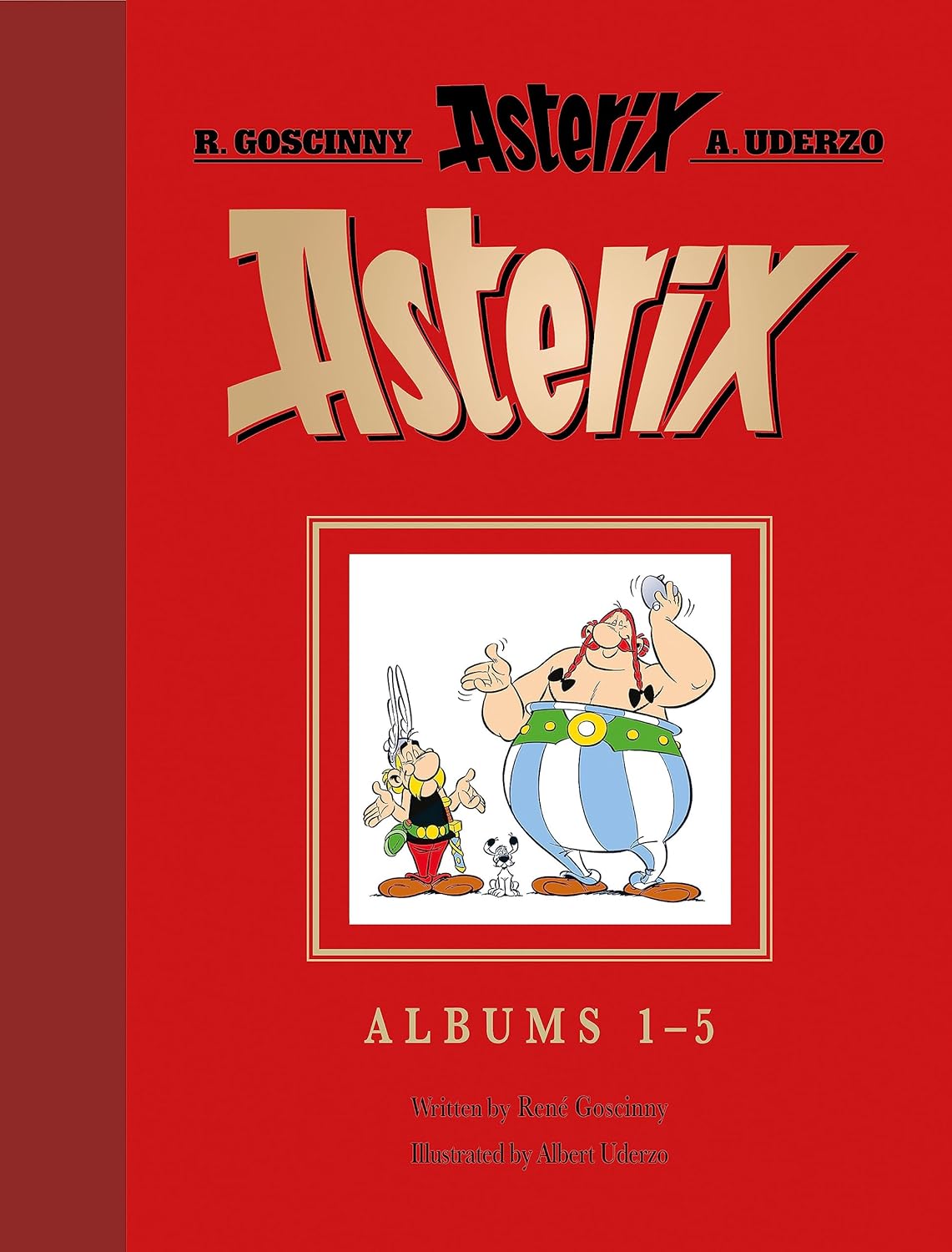
The happy combination of past lives and world-changing events blended with drama, action and especially broad humour has generated a genre uniquely suited to beguiling readers of all ages and tastes. Don’t take my word for it – just check out Asterix, Adele Blanc-Sec, The Towers of Bois-Maury, Empress Charlotte, Iznogoud or Thorgal to name the merest few which have made it into English, or even our own much missed classics such as Olac the Gladiator, Dick Turpin, Heros the Spartan or Wrath of the Gods – all long overdue for collection in mass market album form and on the interweb-tubes…

Papyrus is the spectacular magnum opus of Belgian cartoonist Lucien de Gieter. It began in 1974 in the legendary weekly Le Journal de Spirou, running to 36 albums, plus a wealth of merchandise, a television cartoon show and a video game.

The plucky “fellah” (go look it up) was blessed by the gods and gifted with a magic sword courtesy of the daughter of crocodile-headed Sobek. His original brief was to free supreme Horus from imprisonment in the Black Pyramid of Ombos and thereby restore peace to the Two Kingdoms. More immediately however the lad was also charged with protecting Pharaoh’s wilful and high-handed daughter Theti-Cheri – a princess with an unmatchable talent for finding trouble…

De Gieter was born in 1932 and studied at Saint-Luc Art Institute in Brussels before going into industrial design and interior decorating. He made the logical jump into sequential narrative in 1961, first through ‘mini-récits’ inserts (fold-in, half-sized-booklets) for Le Journal de Spirou of his jovial little cowboy Pony, and later by writing for established regular art stars as Kiko, Jem, Eddy Ryssack and Francis.

He then joined Peyo’s studio as inker on Les Schtroumpfs – AKA The Smurfs – and took over the long-running newspaper strip Poussy. In the mid-1960s he created South Seas mermaid fantasy Tôôôt et Puit’, even as Pony was promoted to the full-sized pages of Spirou, so De Gieter deep-sixed his Smurfs gig to expand his horizons, producing work for Le Journal de Tintin and Le Journal de Mickey. From 1972-1974 he assisted cartooning legend Berck on Mischa for Germany’s Primo, whilst putting finishing touches to his new project. This creation would occupy his full attention – and delight millions of fervent fans – for the next 40 years.

The annals of Papyrus encompass a huge range of themes and milieus: blending boys-own adventure with historical fiction and interventionist mythology, gradually evolving from traditionally appealing Bigfoot cartoon content towards a more realistic, dramatic and authentic iteration. Throughout, these light fantasy romps depict a fearless, forthright boy fisherman favoured by the gods as a hero of Egypt and friend to Pharaohs.

Imhotep’s Transformation was the second Cinebook translation (and 8th yarn, originally released in 1985 as La Métamorphose d’Imhotep): opening with our hero and his one-legged friend Imhotep (no relation) paddling a canoe through the marshes of the Nile. The peaceful idyll is wrecked when Theti-Cheri and her handmaidens hurtle by in their flashy boat, but the boys don’t mind as they have a message for the princess and were looking for her…

The new sacred statue of her father has arrived from the Priests of Memphis and the daughter of Heaven is required at the ceremony to install it at the pyramid of Saqqara before the annual Heb Sed King’s Jubilee. As girls and boys race back, an old peasant is attacked by a crocodile and diving after him; Papyrus wrestles the reptile away. He is about to kill it when Sobek appears, beseeching him to spare it.

On the surface Theti-Cheri and her attendants are ministering to the aged victim and the princess can’t help noticing how he bears an uncanny resemblance to her dad…

By the time they all reach the pyramid, the monumental task of hauling the statue into place is well under way, but suddenly blood begins pouring out of the monolith’s eyes. Terrified workers panic and the colossal effigy slips, crashing to destruction. The populace are aghast and murmurs of curses and ill omens abound. Rather than running away, Imhotep heads for the rubble and discovers the statue’s head is hollow. Moreover, inside there is a dead dwarf and a smashed flask which had held blood…

Papyrus is in the royal compound where recent events have blighted the anticipation of the court. During Heb Sed, the Pharaoh has to run around the sacred pyramid three times and fire his bow at the four corners of the kingdoms to prove his fitness to rule, but now it appears the gods have turned against their chosen emissary on Earth…

Papyrus is not so sure and when he tries to speak to a royal server the man bolts. Giving chase, the lad is in time to prevent the attendant’s murder, but not his escape. Then a cry goes up: Pharaoh has been poisoned…

Knowing there is no love lost between the Memphis Priests of Ptah and loyal Theban clerics doctoring the fallen king, Papyrus warns of a possible plot, but can offer no proof. What is worse, Chepseska, leader of the Memphis faction, is of royal blood too and will inherit the kingdom if Pharaoh is unable to complete the Heb Sed ritual. As loyal physicians and priests struggle to save their overlord’s life, Theti-Cheri remembers the old man in the swamp. If only the crocodile bite has not left him too weak to run…

The doughty dotard is willing to try and also knows of a wise woman whose knowledge of herbs can cure Pharaoh. However, ruthless Chepseska is on to the kids’ ploy and dispatches a band of killers to stop Papyrus and Imhotep.

The gods, however, are behind the brave kids and after the assassins fall to the ghastly judgement of Sobek, the boys rush an antidote back to Saqqara, only to fall into the lost tomb of Great Imhotep, first Pharaoh, builder-god and divine lord of the Ibis.

With time running out for his distant descendent, the resurrected ruler rouses himself to administer justice for Egypt and inflict the punishment of the gods upon the usurpers…

This is an amazing exploit to thrill and astound fans of fantastic fantasy and bombastic adventure. Papyrus is a brilliant addition to the family-friendly pantheon of continental champions who marry heroism and humour with wit and charm. Anybody who has worn out those Tintin, Lucky Luke or Asterix tomes would be wise beyond their years in acquiring these classic chronicles tales.

… And Cinebook would be smart to resume translating these magical yarns, too…
© Dupuis, 1985 by De Gieter. All rights reserved. English translation © 2008 Cinebook Ltd.

Born today in 1920 was pioneering woman mangaka Machiko Hasegawa (Sazae-san) as was Belgian auteur Jef Nys (Jommeke) in 1927. Writer Dann Thomas (Conan, All-Star Squadron, Young All-Stars, Arak, Son of Thunder, Crimson Avenger, Avengers West Coast) turned up in 1952 with comics cartoonist and satirist Fred Hembeck arriving a year later. It’s also Denys Cowan’s birthday (1961), Rhoda (Pakkin’s Land) Shipman (1968) and Michael Avon-Oeming (1973); and in 1971 we saw the last episode of Abbie an’ Slats.

The Adventures of Jo, Zette & Jocko: The Valley of the Cobras


By Hergé, translated by Leslie Lonsdale-Cooper & Michael Turner (Egmont UK/ Mammoth)
ISBN: 978-1-4052-1244-1 (HB) 978-0-74970-385-1 (Album PB)

This book includes Discriminatory Content produced in less enlightened times.

George Remi, world famous as Hergé, had a long creative connection to Catholicism. At the behest of Abbot Norbert Wallez, editor of Belgian Catholic newspaper Le XXe Siècle, he had created Tintin before moving on to such strips as the mischievous Quick and Flupke, Tim the Squirrel in the Far West’, ‘The Amiable Mr. Mops’, ‘Tom and Millie’ and ‘Popol Out West’ – all while expanding the globe-trotting adventures of the dauntless boy reporter and his faithful little dog.

In 1935, between working on serialised Tintin epics The Blue Lotus and The Broken Ear, Remi was approached by Father Courtois, director of French weekly newspaper Coeurs Vaillants (Valiant Hearts). The paper already carried the daily exploits of the kid and his dog, but Courtois also wanted a strip depicting solid family values and situations that the seemingly-orphaned and independent boy reporter was never exposed to. He also presumably wanted something less subversive than the trouble-making working-class boy rascals Quick and Flupke

The proposed feature needed a set of characters typifying a decent, normal family: A working father, a housewife and mother, young boy, a sister, even a pet. Apparently inspired by a toy monkey called Jocko, Hergé devised the family Legrand.

Jacques was an engineer, and son Jo and daughter Zette were “normal” kids; bright, brave, honest, smart and yet still playful. Mother stayed home, cooking and being rather concerned rather a lot. They had a small, feisty monkey for a pet – although I suspect as Jocko was tailless, he might have been a baby chimpanzee, which “As Enny Fule Kno” is actually a species of ape.

The first adventure was a two-volume treasure: ‘The Secret Ray’; only once published in English and consequently rarer than Hen’s teeth or monkey feathers. However, I believe a soupçon of internet searching can help out the curious here…

A ripping yarn of scientific bandits, gangsters, mad professors, robots and, regrettably, some rather ethnically unsound incidences of cannibal savages, this is very much a product of its time in too many respects. Although Hergé came to deeply regret (and wherever possible amend) his many early uses of that era’s racial stereotyping, these will now always be controversial.

It’s a true pity that such masterful and joyous work must be viewed with caution, read strictly in context and ascribed subtext and values which may never have been intended, merely because the medium is pictorial and its meaning passively acquired rather than textual, and which can therefore only be decoded by the conscious effort of reading.

I also wonder how much was a quiet, sensitive artist led by an aggressively proselytising, missionary Church’s doctrine and policy…

How much Church opposition was there to Mussolini’s invasion of Ethiopia in October 1935 for example? And don’t get me started on Nazi Germany and the Vatican…

Sorry. Rant brakes have been applied now…

The last completed adventure of the boldly capable Legrand family came out in the 1950’s, when Hergé was at the peak of his creative powers. Although he found the concept a difficult one to work with, devoid of the opportunities for satire or social commentary, the wholesome derring-do of this series still provides thrilling and funny entertainment for kids of all ages…

Whilst vacationing in the Alps, Jo & Zette inadvertently fall foul of the whimsically capricious Maharajah of Gopal, who is infuriated that they are better skiers than he. Matters only worsen when Jo accidentally hits the Maharajah with a snowball.

The spoiled, rich bully’s appalling behaviour escalates until eventually their father Jacques administers a long overdue spanking to the middle-aged potentate which completely changes his attitude. A far friendlier Maharajah promptly commissions the engineer to construct a bridge across the fabled Valley of the Cobras that divides his mountainous kingdom.

As the family embark for the sub-continent, all are unaware that the villainous Prime Minister of Gopal has colluded with a greedy Fakir to sabotage the project…

Actually begun in 1939 but shelved for nearly two decades, this is still a light exuberant romp, full of thrills and packed with laughs, executed with the captivating artistry that has made Tintin a global phenomenon. This is a book any child will adore and it baffles me why it and its companion volumes are out of print. Hopefully not for long though…

© 1957, 2007 Editions Casterman, Paris & Tournai. All rights reserved. English text © 1986, 2005 Egmont UK Limited. All rights reserved.


Today in 1934 Alex Raymond & Dashiell Hammett’s strip Secret Agent X-9 began, running until 1996. In 1950 artist Marshall Rogers (Batman, Silver Surfer) was born, just like Alex Ross (Marvels, Kingdom Come) in 1970.

In 1966 British weekly Lady Penelope published the first of its amazing 204 issues.

2003 saw the last of magnificent Bill Mauldin, as covered in Willie and Joe: The WWII Years and in 2017 Italian cover painter of British publications Alessandro Biffignandi.

Popeye Classics volume 1


By Bud Sagendorf, edited and designed by Craig Yoe (Yoe Books/IDW)
ISBN: 978-1-61377-557-8 (HB) eISBN: 978-1-62302-264-8

This book includes Discriminatory Content produced in less enlightened times.

There are few comic characters that have entered communal world consciousness, but a grizzled, bluff, uneducated, visually impaired old sailor with a speech impediment is possibly the most well-known of that select bunch.

Elzie Segar had been producing Thimble Theatre since December 19th 1919, but when he introduced a coarse, brusque “sailor man” into the saga of Ham Gravy and Castor Oyl on January 17th 1929, nobody suspected the giddy heights that walk-on would reach…

Happy birthday, Sailor Man!

In 1924 Segar created a second daily strip The 5:15: a surreal domestic comedy featuring weedy commuter and would-be inventor John Sappo and his formidable wife Myrtle which endured – in one form or another – as a topper/footer-feature accompanying the main Sunday page throughout the author’s career. It survived his untimely death, eventually becoming the trainee-playground of Popeye’s second great stylist Bud Sagendorf.

After Segar’s tragic, far too premature death in 1938, Doc Winner, Tom Sims, Ralph Stein and Bela Zambouly all worked on the strip even as animated features brought Popeye to the entire world. Sadly, none of them had the eccentric flair and raw inventiveness that had put Thimble Theatre at the forefront of cartoon entertainments. Nonetheless, the strip continues to this day, with new Sunday episodes written and drawn by R. K. Milholland, whilst daily episodes are reprints by that man Sagendorf.

Born in 1915, Forrest “Bud” Sagendorf was barely 17 when his sister – who worked in the Santa Monica art store where Segar bought his supplies – introduced the kid to the master. Segar became his teacher and employer as well as a father-figure and, in 1958, Sagendorf took over the strip and all merchandise design duties, becoming Popeye’s prime originator…

When Sagendorf took over, his loose, rangy style and breezy inspired scripts brought the strip back to the forefront of popularity. Bud made reading it cool and fun all over again. He wrote and drew Popeye in every graphic arena for 24 years. Sagendorf died in 1994 after which Underground cartoonist Bobby London took over.

Bud had been Segar’s assistant and apprentice, and from 1948 onwards he wrote and drew Popeye’s comic book adventures in a regular monthly title published by America’s king of licensed periodicals, Dell Comics. When Popeye first appeared, he was a rude, crude brawler: a gambling, cheating, uncivilised ne’er-do-well. He was soon exposed as the ultimate working class hero: raw and rough-hewn, practical, but with an innate, unshakable sense of what’s fair and what’s not, a joker who wanted kids to be themselves – but not necessarily Good – and someone who took no guff from anyone. Naturally, as his popularity grew, Popeye mellowed somewhat. He was still ready to defend the weak and had absolutely no pretensions or aspirations to rise above his fellows, but time and popularity eroded that power.

Such was not the case in Sagendorf’s comic book yarns…

Collected in their entirety in this beguiling full-colour hardback or digital edition are the first four 52-page quarterly funnybooks produced by the Young Master, spanning February/April 1948 to November 1948/January 1949.

These stunning, seemingly stream-of-consciousness stories are preceded by an effusively appreciative Introduction‘Society of Sagendorks’ – by inspired aficionado, historian and publisher Craig Yoe accompanied by a fabulous collation of candid photos and letters, plus strip proofs, original comicbook art and commissioned paintings, an Activity Book cover and greetings card designs contained in ‘A Bud Sagendorf Scrapbook’.

Popeye‘s fantastic first issue launched in February 1948 with no ads and duo-coloured (black & red) single page strips on the inside front and back covers. The initial instant episode finds mighty muscled, irrepressible “infink” Swee’ Pea enquiring ‘Were There Ever Any Pirates Around Here?’ before doing a bit of digging, after which full-coloured extended fun begins with ‘Shame on You! or Gentlemen Do Not Fight! or You’re a Ruffian, Sir!’

As everyone knows, the salty swab earns a lucrative living as an occasional prizefighter and here upcoming contender Kid Kabagge and his cunning manager Mr. Tillbox use a barrage of psychological tricks to put Popeye off his game. The key component is electing Olive Oyl President of the deeply bogus Anti-Fisticuff Society to convince her man to stop being a beastly ruffian and abandon violence. That only works until the fiery frail learns she’s been gulled…

Swee’ Pea then stars in ‘Map Back! Or Back Map!’ as sinister unprincipled villain Sam Snagg tattoos an invisible secret diagram onto the baby’s body(!) before falling foul of the boy’s garrulous guardian when trying to reclaim the kid and divine the location of Spinachovia’s hidden treasures. Wrapping up the full-length action is ‘Spinach Revolt’ as Popeye’s perfidious pater Poopdeck Pappy kicks up a fuss about constantly having to eat healthy food…

As the first Superman of comics, Popeye was not a comfortable hero to idolise. A brute who thought with his fists and had no respect for authority, he was uneducated, short-tempered, fickle (when hot tomatoes batted their eyelashes – or thereabouts – at him); an aggressive troublemaker, who wasn’t welcome in polite society… and wouldn’t want to be. Time changed Popeye and made him tamer but the shocking sense of unpredictability, danger and anarchy he initially provided was sorely missed… so in 1936 Segar brought it back again…

A memorable and riotous sequence of Dailies introduced ancient, antisocial crusty reprobate Poopdeck Pappy. The elder mariner was a hard-bitten, grumpy lout quite prepared – even happy – to cheat, steal or smack a woman around if she stepped out of line. He was Popeye’s prodigal dad and once the old goat was firmly established, Segar set Olive and her Sailor Man the Herculean task of “Civilizing Poppa”. Even at the time of this tale that’s still very much a work in progress…

Fed up with eating spinach, Pappy hides his meals and steals the wherewithal to secretly subsist on a diet of candy, cakes and sodas. He even inveigles the lad next door into being the mule in his scurrilous scheme, but cannot evade the digestive consequences of his actions…

The premiere outing ends with a brace of single pagers detailing how Swee’ Pea deals with persistent salesmen and a day’s fishing before issue #2 commences…

Master moocher Wellington J. Wimpy again has cause to declare ‘Sir! You are a cheapskate!’ before Swee’ Pea & Popeye are swept up in a controversial debate. In ‘That’s What I Yam! or ‘I Yam! I Yam’, the sailor believes his baby boy tough enough to wander around town unsupervised but has reasons to revise his opinion after the kid vanishes. Moreover, when he does resurface, the titanic tyke is subject to strange transformations and behaviours. It’s as if a class of trainee hypnotists have all been using the kid as a practise subject but forgot to bring him out of his trance afterward…

Pappy stars in ‘Easy Money’, with the greedy reprobate realising how much cash his sterling son earns for each boxing bout. Determined to get on the gravy train too, the oldster shaves off his beard and impersonates Popeye. By the time his boy catches wise, Pappy has conned Olive and Wimpy into his scheme and set up a punishing bout with a huge purse, so somebody is going to have to fight…

The issue ends with a two-tone short showing the hazards of bathing Swee’Pea and another full colour back cover gag as a bullying neighbour realises the folly of trying to spank Popeye’s boy…

Popeye #3 leads with an epic 32-page spooky maritime epic as the superstitious sailor reluctantly agrees to transport 250 “ghosk” traps to ghastly, radish – and phantom – infested ‘Ghost Island’: a cunning yarn of mystery and over-zealous imagination starring many cast regulars and preceded by a hilarious map of the route replacing the inside-front-cover gag…

Following up is an implausible account of Popeye apparently becoming a violent bully, beating up ordinary citizens in ‘Smash! or You Can Tell She’s My Girl, Because She’s Wearing Two Black Eyes!’ Happily, a doctor at the sailor’s trial is able to diagnose the incredible truth before things go too far, after which Swee’Pea indulges in too much sugar in the red & black bit and learns the manly way to play with dolls on the colour back cover…

The fourth and final inclusion in this outrageous, timelessly wonderful compilation begins with Wimpy up to his old tricks whilst Popeye hunts ducks, before another extended odyssey finds the Sailor Man and hangers-on Swee’Pea, Olive & Wimpy heading West on safari to capture a rare Ipomoea from sagebrush hellhole ‘Dead Valley’

It’s a grim wilderness Popeye has endured before: an arid inferno no sane man would want to revisit unless a scientist hired him to. Sadly, that’s not the opinion of local bandit boss Dead Valley Joe who assigns all his scurvy gang the task of dissuading or despatching the uppity easterners before they uncover the region’s incredible secret…

Back home again, Olive Oyl receives a surprise ‘Gift from Uncle Ben!’ Sadly, the strange flying beast called a Zoop prefers Swee’Pea’s company, and her warm generosity in donating the beast takes a hard knock when a stranger offers a million bucks for it…

One final brace of Swee’ Pea shorts then sees the wily kid orchestrate free baseball views for his pals before indulging in food politics to win over a stray cat and wrap up in amiable style these jolly, captivating cartoon capers.

There is more than one Popeye. If your first thought on hearing the name is an unintelligible, indomitable white-clad sailor always fighting a great big beardy bloke and mainlining tinned spinach, that’s okay: the animated features have a brilliance and energy of their own (even the later, watered-down anodyne TV versions have some merit) and they are indeed based on the grizzled, crusty, foul-mouthed, bulletproof, golden-hearted old swab who shambled his way into Thimble Theatre and wouldn’t leave. But they are really only the tip of an incredible iceberg of satire, slapstick, virtue, vice and mind-boggling adventure…

There is more than one Popeye. Most of them are pretty good, and some are truly excellent. This book is definitely one of the latter and if you love lunacy, laughter and rollicking adventure you must now read this.
Popeye Classics volume 1 © 2013 Gussoni-Yoe Studio, Inc. All Rights Reserved. Popeye © 2013 King Features Syndicate. ™ & © Heart Holdings Inc.

Today in 1851 pioneering US illustrator A/B. Frost (Br’er Rabbit) was born, and in 1877 Australian artist Cecilia May Gibbs (Gumnut Babies/Bush Babies/Bush Fairies, Bib and Bub, Snugglepot and Cuddlepie, Tiggy Touchwood).

In 1920 epic UK weekly comic Film Fun began with the first of its 2225 issues. Never appearing therein was erotic cartoonist Georges (Blanche Épiphanie) Pichard who was born in the same year.

One year later Cuban Spy vs Spy/Mad magazine mastermind Antonio Prohias was born. As was Spanish artist Alfonso Azpiri (Black Hawk [UK Tornado], Bethlehem Steele, Lorna) in 1947 and Ann Nocenti in 1957 and the astonishing Genndy Tartakovsky in 1970.

Sadly we lost Belgian Pascal Garray in 2017, a quiet star who worked for years largely unheralded on The Smurfs, and Benoît Brisefer/Steven Sterk/Benny Breakiron.

Iznogoud volume 1: The Wicked Wiles of Iznogoud


By René Goscinny & Jean Tabary, translated by Anthea Bell & Derek Hockridge (Cinebook)
ISBN: 978-1-905460-46-5 (Album TPB/Digital edition)

This book includes Discriminatory Content produced in less enlightened times.

It’s anniversary time again! Today in 1962 something smart and wildly wicked first appeared, and just hung around. Please read on…

For the greater part of his too-short lifetime (1926-1977) René Goscinny was one of (if not The) most prolific, most-read writers of comic strips the world had ever seen. He still is.

Among his most popular comic collaborations are Lucky Luke, Le Petit Nicolas and, of course, Asterix the Gaul, but there were so many others, such as the dazzling, dark deeds of a dastardly usurper whose dreams of diabolical skulduggery perpetually proved to be ultimately no more than castles in the sand…

Scant years after the Suez crisis, the French returned to those hotly-contested deserts when Goscinny teamed with sublimely gifted Swedish émigré Jean Tabary (1930-2011). He numbered Richard et Charlie, Grabadu et Gabaliouchtou, Totoche, Corinne et Jeannot and Valentin le Vagabond amongst his other hit strips but found a moment to detail the innocuous history of imbecilic Arabian (im)potentate Haroun el-Poussah. However, it was the strip’s villainous foil, power-hungry vizier Iznogoud who stole the show – possibly the conniving little imp’s only successful coup…

The notion of the series apparently came from a throwaway moment in Les Vacances du Petit Nicolas, but – once it was fully formed and independent – Les Aventures du Calife Haroun el Poussah was created to join the roster in Record, with the first episode appearing in the January 15th 1962 issue. An assured if relatively minor hit, the strip jumped ship to Pilote – a picture-packed periodical created and edited by Goscinny – where it was artfully refashioned into a starring vehicle for the devious little ratbag who had increasingly been hogging all the laughs and limelight.

Like all great storytelling, Iznogoud works on multiple levels: for youngsters it’s a comedic romp with adorably wicked baddies invariably hoisted on their own petards and coming a-cropper, whilst older, wiser heads revel in pun-filled, witty satires and astoundingly wry yet accessible episodic comic capers. Just like our Parliament today. That latter aspect is investigated in this collection of short episodes…

This same magic formula (no, I’m being figurative, not literal) made its more famous cousin Asterix a monolithic global success and – just like the saga of the indomitable Gaul – our irresistibly addictive Arabian Nit was originally adapted into English by master translators Anthea Bell & Derek Hockridge, who made those Franco-Roman Follies so very palatable to British tastes. Always, deliciously malicious whimsy is heavily dosed with manic absurdity, cleverly contemporary cultural critiques and brilliantly delivered creative anachronisms which serve to keep the assorted escapades bizarrely fresh and hilariously inventive. However, like so many comics inventions, the series grew beyond its boundaries…

The retooled series launched in Pilote in 1968, quickly growing into a massive European hit, with 31 albums to date (carried on by Tabary’s children Stéphane, Muriel & Nicolas after his passing in 2011); his own solo comic; a computer game; animated film, TV cartoon show and a live-action movie.

When Goscinny died in 1977, Tabary started scripting his own sublimely stylish tales (from the 13th album onwards), gradually switching to book-length complete adventures, rather than the compilations of short, punchy vignettes which typified the collaborations.

In October 1974, whilst the shifty shenanigans were unfolding to the delight of kids, its sand-struck star began moonlighting. Pulling double duty as a commentator and critic of real-world politics and social issues in French newspapers the little wart scored a side hustle with a sidebar series that began as a statement and grew into a separate second career for the vindictive viper. Some oiks, like sand, just get everywhere…

So, what’s it all about?

Iznogoud is Grand Vizier to Haroun Al Plassid, Caliph of Ancient Baghdad, but the conniving little shyster has loftier ambitions – or as he is always shouting it – “I want to be Caliph instead of the Caliph!”…

The vile vizier is “aided” – and that’s me being uncharacteristically generous – in his endeavours and schemes by bumbling assistant Wa’at Alahf, and in this first album they begin their campaign with ‘Kissmet’, wherein pandemonium ensues after a talking frog is revealed as an ensorcelled Prince who can only regain human form if smooched by a human being.

Iznogoud sees an opportunity if he can only trick the simple-minded Caliph into puckering up; unfortunately but typically, the little rotter forgets that he’s not the only ambitious upstart in Baghdad…

‘Mesmer-Eyezed’ finds him employing a surly stage hypnotist to remove the Caliph whilst ‘The Occidental Philtre’ sees him employ a flying potion obtained from a lost, jet-lagged western sorcerer, each with hilarious but painfully counter-productive results.

Tabary drew himself into ‘The Time Machine’ wherein a comic artist desperate to meet his deadlines falls foul of a mystical time cabinet. However, when he meets the vizier, that diminutive dastard can clearly see its Caliph-removing potential… to his eternal regret…

Soon after in ‘The Picnic’ Iznogoud takes drastic action, luring Haroun Al Plassid into the desert, but as usual his best-laid plans really aren’t, before we conclude with ‘Chop and Change’ as our indefatigable villain obtains a magic goblet that can switch the minds of any who drink from it, forgetting that Caliphs are important people who employ food-tasters…

Snappy, fast-paced slapstick and painfully delightful word-play abound in these mirthfully infectious tales and the series is a household name in France; said term has even entered French political life as a description for a certain type of politician: over-ambitious, unscrupulous – and usually short in stature…

Eight albums were originally translated into English during the 1970s and 1980s without really making any little impact here, but once Cinebook’s revival the vile Vizier finally caught on in a superb sequence of gloriously readable and wonderfully affordable comedy epics that found an appreciative audience among British kids of all ages. That said, it’s been a while since the last one, but perhaps that’s the setting not the stories…
© 1967 Dargaud Editeur Paris by Goscinny & Tabary. All Rights Reserved.

Today in 1905, the last episode of Gustave Verbeek’s The Upside Downs ran in the New York Herald and in 1924 writer Stan Kay (Casper the Friendly Ghost, Richie Rich, Sad Sack, Fraggle Rock, The Muppets) was born. Practically yesterday, writer Scott Snyder (American Vampire. Batman. Justice Leafue) was born in 1976 whilst ten years later we lost Alfred Bestall of Rupert Bear fame.