
Bigby Bear: For All Seasons


By Philippe Coudray, translated by Miceal Beausang-O’Griafa (BiG/Humanoids)
ISBN: 978-1-64337-990-6(HB)

Born in Bordeaux in March 1960, writer, photographer and illustrator Philippe Coudray specialises in cartoons and books for children. Working with brother Jean-Luc, they co-crafted the Drôles sequence of books and comics series Théocrite. However, Philippe conceived and executed his signature creation L’Ours Barnabé – the philosophically absurdist ruminations of an artistically-inclined bear and his woodland companions – all on his own…

When not crafting kids’ comics or surreal otherworldly gags (such as Loin de Tout) Philippe writes articles and such like for magazines such as Capsule Cosmique, Psikopat, Perlin and Fripounet as well as books such as Guide to Hidden Animals: Treatise on Cryptozoology. His works have been used by the French government to combat illiteracy and translated into many languages; none more so than L’Ours Barnabé which has appeared in Japan, China, Germany Sweden, and a couple of times in America. The first time was as Benjamin Bear (twice nominated for Eisner Awards and winning China’s 2012-2013 Panda Prize) and latterly here as the beguiling and frequently beguiled Bigby…

Often employing puzzles and riddles and as much children’s storybook of episodic vignettes as graphic novel, these particular collected strips offer charming, visually challenging riffs on the impact of the year’s divisions, as seen through the eyes of an affably gentle bruin living wild and honing his artistic skills.

Bigby and his animal entourage reside in a bucolic forest, coastal and mountain idyll, where they observe tentatively interact with the wider world, pondering big questions in a surreal and often absurdist daze.

Visual tricks and double-takes abound as Bigby and his rabbit chum play with universal constants, carve, sculpt, paint, compose, garden and wander for the sheer joy of creativity. Almost in passing the gags subtly pose questions to make youngsters think – about art, science, psychology, mathematics, ecology and much more – but Coudray never misses an opportunity to share a solid laugh with his readers and reinforce his message that life is great if we all just mellow out and cooperate with each other.

He’s also more than happy to pepper the strips with the occasional telling moment of social commentary if the chance arises…

In this second translated volume exploring the wonders of the annual cycle, ‘Fall’ opens the fun with a wealth of cartoon ruminations on harvest, climate, travel and occupying spare time before ‘Winter’ centres on snow, chills and Christmas with the big guy eschewing hibernation for the joys of playing with his cub and chums.

A time of renewal and abundance is enjoyed in ‘Spring’ as the bear hunts early fruit and honey – as well as cold, hard cash – and languishes in paradisiacal field and stream before ambling into ‘Summer’ where fishing, swimming, visiting, hobbies and games fill every endless day

Genteel fun, bemusing whimsy and enchanting illustration cloaking a supremely inclusive philosophy of curiosity, enquiry and cohabitation, Bigby Bear is an excellent, irrepressible example of how to enjoy life and crucial reading for young and old alike. Get the digital edition immediately before backing it up with the wonderfully tactile, sturdy hardback your kids will want to paw and peer at over and over again…
Bigby Bear: For All Seasons © 2012-2018 La Boîte à Bulles and Philippe Coudray. All rights reserved.

Attack of the Stuff – “The Life and Times of Bill Waddler”


By Jim Benton (Papercutz)
ISBN: 978-1-54580-498-8(HB) 978-1-54580-499-5(PB)

Jim Benton began his illustration work making up crazy characters in a T-Shirt shop and designing greetings cards. Born in 1960, he’d grown up in Birmingham, Michigan before studying Fine Arts at Western Michigan University.

Tirelessly earning a living exercising his creativity, he started self-promoting those weird funny things he’d dreamed up and soon was raking in the dosh from properties such as Dear Dumb Diary, Dog of Glee, Franny K. Stein, Just Jimmy, Just Plain Mean, Sweetypuss, The Misters, Meany Doodles, Vampy Doodles, Kissy Doodles, jOkObo and It’s Happy Bunny via a variety of magazines and other venues…

His gags, jests and japes can most accessibly be enjoyed on Reddit and are delivered in a huge variety of styles and manners: each perfectly in accord with whatever sick, sweet, clever, sentimental, whimsical or just plain strange content each idea demanded, and his SpyDogs effortlessly made the jump to kids animated TV success.

He seamlessly segued into best-selling cartoon books (those are the best kind) such as Man, I Hate Cursive, Clyde, Catwad and Dog Butts and Love. And Stuff Like That. And Cats) and now joins the glorious pantheon of authors and artists championed by Papercutz with his latest creation…

Based in New York, Papercutz are committed to publishing comics material for younger readers, combining licensed properties such as The Smurfs and Nancy Drew with intriguing and compelling new concepts such as The Wendy Project and this supremely surreal and outrageous outing…

In a primary-coloured anthropomorphic world, Bill Waddler is a distressed duck with a lot on his mind. His nights are plagued with nightmares about farting snakes inundating him whilst his days make him feel out of touch with hectic modern ways. Is it so hard to just sell his hay the way he always has?

Since Bill has a rather unique talent, his waking life is a bit of a misery too. Whether he wants to or not – and he doesn’t – Bill can communicate with stuff. Appliances, electronics and household objects of every sort all talk to him. Or more accurately they all whine and carp and moan at him. No one wants the toilet expressing her dreams and aspirations during those sacrosanct private moments, or to be mocked by the cruet set or told to stop snoring by the alarm clock…

Moreover, nothing he owns or people he knows care about Bill’s lifelong frustrations at never becoming a musician…

Stuck in this depressing rut, Bill’s life changes the day a curmudgeonly bear has a rant and sets the duck thinking about abandoning civilisation to become a hermit in the wilds of nature…

However, as he vanishes into the wilds to commune with snakes, a global crisis kicks off. The Internet gets into a tizzy and completely shuts down. As the entire planet descends into a chaos of non-communication and everything stops working, someone suggests the baffled experts track down that weird guy who could talk to stuff and see if he can help…

Bizarre, tetchy and hilariously off-kilter, Benton’s daft duck deliverer fends off a very modern apocalypse with astoundingly infectious grumpiness in this fabulously inventive fable that combines gently-barbed social commentary (such as when a cop stands on Bill’s neck and is shamed by his own taser!) and delicious swipes at sexism and gender stereotyping with wild laughs and devious subversion in an ultimately upbeat tale about doing the right thing…

Attack of the Stuff is sheer irresistible fun and on-target educational messaging no one should miss.
© 2020 Jim Benton. All rights reserved.

Cedric volume 1: High Risk Class


By Laudec & Cauvin with colours by Leonardo and translated by Erica Jeffrey (Cinebook)
ISBN: 978-1-905460-68-7 (Album pb)

Raoul Cauvin is one of Europe’s most successful comics scripters. Born in Antoing, Belgium in 1938, he joined Dupuis’ animation department in 1960 after studying the dying and much-missed print production technique of Lithography.

Happily he quickly discovered his true calling – comedy writing – and began a glittering and prolific career at Le Journal de Spirou where he devised (with Salvérius) the astoundingly successful Bluecoats as well as dozens of other long-running, award winning series such as Sammy, Les Femmes en Blanc, Boulouloum et Guiliguili, Cupidon, Pauvre Lampil and Agent 212: cumulatively shifting more than 240 separate albums. Bluecoats alone has sold more than 15 million copies so far.

His collaborator on kid-friendly family strip Cedric is Italian born, Belgium raised Tony de Luca who studied electro-mechanics and toiled as an industrial draughtsman until he could make the break into comics.

After a few fanzine efforts in the late 1970s, in 1979 as Laudec he landed soap-style series Les Contes de Curé-la-Fl’ûte at Spirou and built it into a brace of extended war-time serials (L’an 40 in 1983 and Marché Noir et Bottes à Clous in 1985) whilst working his way around many of the title’s other strips.

In 1987 he united with Cauvin on the first Cédric shorts and the rest is history… and science and geography and PE and…

We have Dennis the Menace and the Americans have one too – but he’s not the same – whilst the French-speaking world has Cédric: a charming little rapscallion with a heart of gold and an irresistible streak of mischief dogging his heels. Collected albums of the short, sharp strips – ranging from a ½ page to half a dozen – began appearing in 1989 (with 31 released so far) and are always amongst the most popular and best-selling on the continent, as is the animated TV show spun off from the strip.

Available in paperback album and digital formats, this first Cinebook translation – from 2008 and originally continentally released as Classe tous risques in 1990 – was the third compilation and hauls straight in to the action as the little lout is surprised by the introduction of ‘The New Girl’ to the class.

Previously, overly-imaginative Cedric had been utterly enamoured of his teacher Miss Nelly but when Chen is introduced his mind and heart go into fantasy overdrive. She’s different, her skin isn’t the same colour as everybody else’s and she talks really funny.

Of course a proper gentleman would have a better and less dangerous way of saying that to a newcomer’s face. Happily, however, Cedric’s gaffe is an opportunity for demure but feisty Chen to properly break the ice…

When the restless lad and his best friend Christian get hold of some stink bombs an awful lot of surprised adults are forced to cry ‘What Stinks?’ but the peewee pranksters eventually go too far and are trapped in their own efforts, whereas when Cedric attempts to cheat in a geography competition involving ‘Balloons’ the repercussions are all on him alone…

His deviltry actually succeeds with no comeback when he sabotages the ‘Olympic Disciplines’ of excessively keen Games Master Mr Oliver but when Cedric tries to obscure his latest bad report card by getting injured and crying for ‘Nurse Mum’ his tactics are sorely mistaken…

There’s more social angst – and unleashed aggression – in store when Christian confuses Chinese Chen with Vietnamese ‘Boat People’ and shares his “expertise” with our gullible star but the boys are soon pals again and summarily run amok with a radio-controlled car in ‘Driving Under the Influence of Laughter’ after which Grandpa lands in the doghouse when Cedric steals his champagne and gets disastrously hammered on his ‘First Sip’…

Disclosing he is over Miss Nelly, the love-struck lad goes completely over the top with ‘The Gift’ he has chosen to win Chen, which leads to near disaster when he manfully decides he must let his deserted older woman down gently in ‘One Love Follows Another…’

Typically, Cedric picks the very moment after his teacher has received some extremely upsetting news…

Focus satirically switches to conservative, reactionary Grandpa who takes the news that Cedric is seeing a Chinese girl with an appalling lack of understanding, taste or decorum in ‘The Oil Can’ but it’s the boy who’s soon back in everyone’s bad books when he swaps suntan oil for toothpaste in ‘Bathing Beauties’.

At least his classmates still respect him, especially Freddy who needs all the escape tips he can get after delivering ‘The Report’ of his latest scholastic disgraces to his own furious father whilst Cedric’s family are subjected to cruel and unusual punishment when neighbours ‘Crazy for Television’ invite themselves over…

The introductory antics hilariously conclude as Cedric decides to use a school ‘Picnic’ to tell Chen of his feelings, despite the sustained mockery of his mates. Of course his courage is no substitute for discretion or tact and when he goes too far again, at least the boys are there to console and medicate him…

Rapid-paced, warm and witty, the adventures of this painfully keen, young romantic scallywag are a charming example of how all 8-year-old boys are just the same and infinitely unique. This is a solid family-oriented comics book no one trying to introduce youngsters to the medium should be without.
© Dupuis 1990 by Cauvin & Laudec. All rights reserved. English translation © 2008 Cinebook Ltd.

Spidey volume 2: After-School Special


By Robbie Thompson, André Lima Araújo, Nathan Stockman & various (Marvel)
ISBN: 978-0-7851-9676-1 (TPB)

Since its earliest days the publishing company now known as media monolith Marvel always courted the youngest of comicbook consumers. Whether through animated tie-ins and licensed properties such as Terrytoons Comics, Mighty Mouse, Duckula, assorted Hanna-Barbera and Disney licenses and a myriad of others, or original characters such as Millie the Model, Homer the Happy Ghost and Calvin, the House of Ideas always understood the necessity of cultivating the next generation of readers.

These days, however, kids’ interest titles are a tricky balancing act and, with the Marvel Universe’s characters all over screens large and small, the company usually prefers to create child-friendly versions of its own proprietary pantheon in their own playground, making that eventual hoped-for transition to more mature comics and other venues as painless as possible.

In the 1980s-1990s Marvel published an entire line of kiddie titles through its Star Comics line and, in 2003, the company created a Marvel Age line to update and retell classic original tales by Stan Lee, Jack Kirby & Steve Ditko, mixing it in with the remnants of its manga-inspired Tsunami imprint: again, all intended for a younger readership.

The experiment was tweaked in 2005, becoming the Marvel Adventures line, with titles reflecting the most popular characters and whatever was on TV screens at the time. In 2012 these were superseded by specific comicbook titles tied to Disney XD TV shows designated as “Marvel Universe cartoons”.

Today’s featured item – Spidey: After-School Special – is a horse of a different colour: similar but different…

Rather than simply crafting a wallcrawler for younger sensibilities, this iteration – presumably sparked by the teenaged, light-adventure version seen in the Spider-Man: Homecoming movie – innovates and modernizes by once again looking back and superbly succeeds in recapturing a sense of the madcap gaiety that counterbalanced the action and pathos of the earliest Lee/Ditko stories. This series is all about thrills and fun…

Scripted throughout by Robbie Thompson and re-presenting Spidey#7-12 (originally released from August 2016 to January 2017), the non-stop, youngster-appropriate mayhem recommences with a cracking catch-up origin-page illustrated by Nick Bradshaw and colourist Jim Campbell.

Firmly set in The Now, our hero is still and once again a callow schoolboy, fighting crime and making enemies between High School classes. In his off-hours he’s also a crimefighting sensation of the internet and social media whenever he puts on his blue-&-red duds. As ever, news magnate J. Jonah Jameson is there to vilify the webslinger at every opportunity…

Sadly, thanks to the kid’s double life, Peter Parker‘s grades – except for science and maths – are tanking now, and the secret superhero is forced to accept Popular Girl Gwen Stacy as a much-needed history tutor. Not only is she the hottest girl in school, but she also decks Flash Thompson with one punch after the jocks starts bullying “Puny” Parker again…

That tricky triangle develops in captivating manner over the next half dozen arachnid escapades, starting with an untitled team-up co-starring African monarch T’Challa the Black Panther and illustrated by André Lima Araújo. Here, the tutoring of classmates is counterbalanced by a spectacular teaching moment as the schoolboy hero stumbles into a subterranean smuggling operation masterminded by the diabolical and unhuman Klaw, Master of Sound…

Peter Parker’s dream “maybe date” with Gwen takes an even-more terrifying turn in ‘Blackout!’ (art by Nathan Stockman) as voltaic villain Electro assaults the city in a deadly but foredoomed attempt to kill Spider-Man. His spectacular trouncing is only slightly mitigated when he is sprung from custody by a band of fellow murderous Arachnophobes…

Peter’s desperate schemes to earn enough cash for Aunt May’s birthday present lead to confrontations with occasional-employer Jameson and all-out war with psycho-stalker Kraven the Hunter in ‘To Catch a Spider’ after which the wallcrawler’s media-created ‘Bad Reputation’ is temporarily redeemed after a dynamic team-up with Captain America against AIM and their lethal leader M.O.D.O.K.

The year-long story arcs detailing the tricky triangle of Gwen, Flash and Peter and the gradual coalition of a new Sinister Six coalesce in ‘Missing Out’ as the kids take their dreaded exams and Spidey attempts to join in a mass battle against Galactus, only to stopped at every stage by a far more important and immediate crisis – such as an unrelenting attack by brainwashed villain Scorpion – before the drama magnificently concludes in the boy hero’s best day ever. Unless, of course, Doctor Octopus, Mysterio, Sandman, Kraven, Electro and the Vulture succeed with their plan in ‘Spidey No More!’…

Supplemented with a wealth of behind-the-scenes artwork and illustration secrets from Lima Araújo and Stockman, this is a sublime slice of fun and action, referencing the intoxicating days of Stan Lee & Steve Ditko whilst offering an enthrallingly refreshing reinterpretation of an evergreen heroic icon. Here is an intriguing and more culturally accessible means of introducing character and concepts to kids born two and three generations or more away from those far-distant 1960s originating events. These Spidey super-stories are outrageously enjoyable yarns, and well worth seeking out.
© 2016 Marvel Characters, Inc. All rights reserved.

Popeye Classics volume 5

.
By Bud Sagendorf, edited and designed by Craig Yoe (Yoe Books/IDW)
ISBN: 978-1-63140-175-6(HB) eISBN: 978-1-62302-720-9

How many cartoon classics can you think of still going after a century? Here’s one…

There are a few fictional personages to enter communal world consciousness – and fewer still from comics – but a grizzled, bluff, uneducated, visually impaired old sailor with a speech impediment is possibly the most well-known of that select bunch.

Elzie Crisler Segar was born in Chester, Illinois on 8th December 1894. His father was a general handyman, and the boy’s early life was filled with the kinds of solid, dependable blue-collar jobs that typified his generation of cartoonists. He worked as a decorator, house-painter and also played drums; accompanying vaudeville acts at the local theatre.

When the town got a movie-house, he played for the silent films, absorbing all the staging, timing and narrative tricks from keen observation of the screen. Those lessons would become his greatest assets as a cartoonist. It was while working as the film projectionist, at age 18, that he decided to become a cartoonist and tell his own stories.

Like so many others in those hard times, he studied art via mail, in this case W.L. Evans’ cartooning correspondence course out of Cleveland, Ohio, before gravitating to Chicago where he was “discovered” by Richard F. Outcault – regarded by most in the know today as the inventor of modern newspaper comic strips with The Yellow Kid and Buster Brown.

The celebrated pioneer introduced Segar around at the prestigious Chicago Herald. Still wet behind the ears, the kid’s first strip, Charley Chaplin’s Comedy Capers, debuted on 12th March 1916.

In 1918, Segar married Myrtle Johnson and moved to William Randolph Hearst’s Chicago Evening American to create Looping the Loop, but Managing Editor William Curley saw a big future for Segar and packed the newlyweds off to New York, HQ of the mighty King Features Syndicate.

Within a year Segar was producing Thimble Theatre, which launched December 19th 1919 in the New York Journal. It was a smart pastiche of cinema and knock-off of movie-inspired features like Hairbreadth Harry and Midget Movies, with a repertory of stock players to act out comedies, melodramas, comedies, crime-stories, chases and especially comedies for vast daily audiences. It didn’t stay that way for long…

The core cartoon cast included parental pillars Nana and Cole Oyl; their lanky, highly-strung daughter Olive, diminutive-but-pushy son Castor and the homely ingenue’s plain and (very) simple occasional boyfriend Horace Hamgravy (latterly, just Ham Gravy).

Segar had been successfully, steadily producing Thimble Theatre for a decade when he introduced a brusque, vulgar “sailor man” into the everyday ongoing saga of hapless halfwits on January 29th 1929. Nobody suspected the giddy heights that stubborn cantankerous walk-on would reach…

In 1924 Segar created a second daily strip The 5:15: a surreal domestic comedy featuring weedy commuter and would-be inventor John Sappo and his formidable wife Myrtle. This one endured – in one form or another – as a topper/footer-feature accompanying the main Sunday page throughout the author’s career. The feature even survived his untimely death, eventually becoming the trainee-playground of Popeye’s second great humour stylist: Bud Sagendorf.

After Segar’s far-too-premature death in 1938, Doc Winner, Tom Sims, Ralph Stein and Bela Zambouly all worked on the strip, even as the Fleischer Studio’s animated features brought Popeye to the entire world, albeit a slightly different vision of the old salt of the funny pages. Sadly, none of them had the eccentric flair and raw inventiveness that had put Thimble Theatre at the forefront of cartoon entertainments. But then, finally, Bud arrived…

Born in 1915, Forrest “Bud” Sagendorf was barely 17 when his sister – who worked in the Santa Monica art store where Segar bought his drawing supplies – introduced the kid to the master cartoonist who became his teacher and employer as well as a father-figure. In 1958, after years on the periphery, Sagendorf finally took over the strip and all the merchandise design, becoming Popeye’s prime originator…

When Sagendorf became the main man, his loose, rangy style and breezy scripts brought the strip itself back to the forefront of popularity and made reading it cool and fun all over again. Bud wrote and drew Popeye in every graphic arena for 24 years and when he died in 1994, he was succeeded by controversial “Underground” cartoonist Bobby London.

Young Bud had been Segar’s assistant and apprentice, and from 1948 onwards was exclusive writer and illustrator of Popeye’s comicbook adventures. These launched in February of that year in a regular monthly title published by America’s unassailable king of periodical licensing, Dell Comics.

When Popeye first appeared, he was a rude, crude brawler: a gambling, cheating, uncivilised ne’er-do-well. He was soon exposed as the ultimate working-class hero: raw and rough-hewn, practical, but with an innate, unshakable sense of what’s fair and what’s not; a joker who wanted kids to be themselves – but not necessarily “good” – and someone who took no guff from anyone…

Naturally, as his popularity grew, Popeye mellowed somewhat. He was still ready to defend the weak and had absolutely no pretensions or aspirations to rise above his fellows, but the shocking sense of dangerous unpredictability and comedic anarchy he initially provided was sorely missed… but not in Sagendorf’s comicbook yarns…

Collected in their entirety in this beguiling full-colour hardback (also available in digital editions) are issues #20-24 of Popeye‘s comic book series, produced by the irrepressible Sagendorf and collectively spanning April-June 1952 to April-June 1953.

The stunning, almost stream-of-consciousness slapstick stories are preceded as ever by an effusively appreciative Foreword‘Society of Sagendorks’– by inspired aficionado, historian and publisher Craig Yoe, offering a mirthful mission statement.

Every volume includes a collation or ephemera and merchandise courtesy of the ‘Bud Sagendorf Scrapbook’. Included here are newspaper clippings, ads and assorted trivia such as packaging for candy, toys, stationery, fridge magnets, plates, Dutch newspaper strips & comics covers plus a selection of images from a colouring book.

We rejoin the ceaseless parade of laughs, surreal imagination and thrills with #20 which opens and closes with a prose yarn adorning both inside front and back covers. ‘Big House Bill in “House for Rent”’ reveals how a churlish sea snail is inveigled to join the other molluscs’ games…

Sagendorf was a smart guy who kept abreast of trends and fashions as well as understanding how kids’ minds worked and these tales are timeless in approach and delivery. In the era of rapid television expansion, cowboys were King, with westerns dominating both large and small screens as well as plenty of comics. Thus, many sagas featured Popeye as a horse-riding sagebrush wanderer who ran a desert railroad when he wasn’t prospecting…

The comics kick off with ‘Here Comes the Bride!!’ detailing how the saddle-sore Sailor-Man upsets a lost tribe of Indians and can only end his sea of trouble by marrying the chief’s beautiful daughter. Of course, that assuming his ferociously possessive – and possibly psychic – sweetie-pie Olive doesn’t find him first…

‘Little Kids Should Have Ice Cream! or Swee’ Pea Gets It!’ then pictures the precocious kid pushing the limits of everyone’s patience to score a cold treat, after which back-up feature Sherman sees another bright spark youngster become an inadvertent counterfeiter – and getaway driver – in ‘Rolling Along!’ The issue concludes with a salutary back cover Popeye gag as Swee’ Pea digs a backyard well with catastrophic results…

Issue #21 of the quarterly delight covered July-September 1952 and again offered a Sagendorf illustrated prose yarn on the interior covers: this one detailing how ‘Harry the People Horse’ attempts to assimilate with humanity by wearing clothes…

The comics commence with ‘Interplanetary Battle’ which taps into the era’s other mass obsession: a growing fascination with UFOs. On Earth prize fighter Popeye cannot find an opponent brave enough to face him, so Wimpy innocently seeks to aid his old pal by broadcasting a message to the universe. Sadly, what answers the clarion call is a bizarre, shapeshifting swab with sneaky magic powers…

An engaging Micawber-like coward, cad and conman, the insatiably ravenous J. Wellington Wimpy debuted in the newspaper strip on May 3rd 1931 as an unnamed and decidedly partisan referee in one of Popeye’s pugilistic bouts. The scurrilous yet scrupulously polite oaf struck a chord and Segar gradually made him a fixture. Always hungry, keen to solicit bribes and a cunning coiner of many immortal catchphrases – such as “I would gladly pay you Tuesday for a hamburger today” and “Let’s you and him fight” – Wimpy is the perfect foil for a simple action hero who increasingly stole the entire show… and anything else unless it was extremely well nailed down…

After an unseemly moment of jealousy, Popeye is compelled to take over the redecoration of Olive’s house in ‘Paper and Paste’, but his lack of experience and Wimpy’s assistance soon combine to create the usual chaos after which the back-up feature – now redubbed Sherm – finds the kid in dire straits after leaving his wiener dog Winky alone in the ‘Dog House!’…

Proceedings again conclude with a back-cover gag involving Swee’ Pea and eggs…

Another prose ‘Horse Tale’ brackets the interiors of #22 (October-December 1952), detailing a desert steed’s gold prospecting woes before the Old Salt suffers a tragic reversal of fortune during a shortage of his favourite vegetable. Sadly, starting a ‘Spinach Farm’ and making a go of it prove distressingly difficult once Wimpy starts helping…

‘Swee’ Pea’s Vacation!’ then sees the valiant nipper take an eventful voyage to Spinachovia, that shatters the island’s economy and devastates their armed forces, before Sherm takes ‘The Long Way Home!’ in a wry episode incorporating a host of puzzles and mazes to keep reader interest honed and the back cover Popeye gag sees Swee’ Pea become a dirt magnet…

Popeye #23 (January-March 1953) opens and closes with prose tale ‘The Rocket Horse’ detailing a non-consensual trip to Mars, whilst lead strip ‘Boom! Boom! or Pirates is Rodents!’ returns the Sailor-Man to his nautical roots to eradicate scurvy corsairs besmirching his beloved seven seas. His only miscalculation is bringing Olive and Wimpy with him…

His sweety takes centre stage in ‘Ship Shape!’ as she tries to make Popeye and his dad Poopdeck Pappy clean up their scruffy sea-going vessel, whist Sherm indulges in winter sports and a spot of detecting when Pa goes missing in ‘Snow-Father!’, and the issue closes with Popeye and Swee’ Pea disastrously disputing ownership of a dingy in the traditional back-cover vignette.

Closing this vivid and varied volume is #24 (April-June), which begins and ends with text triumph ‘Apple House’ – highlighting a housing crisis for cute maggot Vernon Greentop – before cartoon chaos ensues with ‘Popeye an’ Pappy in Golden Street!’ as the seasoned mariners become western prospectors and the incorrigible elderly reprobate finds gold in the most likely place imaginable, leaving Popeye to fix the mess as usual…

Fantasy reigns supreme in ‘Hole in the Mountain!’ as Popeye & Swee’ Pea discover a fantastic unknown kingdom on a desert island ruled by a perilously familiar tyrant before more puzzles and mazes bedevil automobile-mad Sherm and the readership in ‘The Race!’ The last word again goes to a short sharp back-page gag starring innocent demon Swee’ Pea to wrap up another treasure trove of timeless entertainment…

Outrageous and side-splitting, these all-ages yarns are evergreen examples of surreal narrative cartooning at its most inspirational. Over the last nine decades Thimble Theatre and its most successful son have unfailingly delighted readers and viewers around the world. This book – available in sturdy hardback or accessible eBook formats – is simply one of many but definitely top-tier entertainment for all those who love lunacy, laughter, frantic fantasy and rollicking adventure. If that’s you, add this compendium of wonder to your collection.
Popeye Classics volume 5 © 2014 Gussoni-Yoe Studio, Inc. All Rights Reserved. Popeye © 2014 King Features Syndicate. ™ Heart Holdings Inc.

Clara


By Cécile & Christophe Lemoine, translated by Kevin Sullivan (Europe Comics)
No ISBN: digital only

It’s a truly horrific realisation that 2020 has brought the concept of imminent mortality back to the forefront of societal consciousness in way we in the west thought gone with gaslight, horse-brasses and Victorian ornaments. Now you’re truly lucky indeed if death hasn’t touched you, your family or circle of friends.

So, with the subject now truly unavoidable, how do you explain it to those who most need to understand what as much as why things have suddenly changed?

Originally released in Europe in May 2012, Clara is a children’s comic book tackling exactly that thorny issue in a potent – but ultimately uplifting – fantasy splendidly reminiscent of kindergarten classic The Velveteen Rabbit…

Written by actor, novelist and script doctor Christophe Lemoine and illustrated by artist, cartoonist and designer Cécile Brosseau, the tale reveals how the idyllic life of a bright, imaginative seven-year old changes forever when her devoted mother receives some terrifying news from her doctors.

In the days before and after her mother’s death, little Clara experiences a wave of unwelcome and uncontrollable emotions, barely held in check by the attentions of her equally-shattered dad and grandmother and centred around the scruffy old doll mummy gave her before everything changed…

However, at her lowest point, a journey into a bleak and terrifying fantasy world offers Clara revelation and perspective to balance the loss and grief and provides a chance of working out for herself the mystery of being left behind…

Balancing the largely unformed emotions of a child suffering bereavement with the escapist fantasy of saving a cherished toy is not a new concept, but it’s done here with style, aplomb and scrupulous sensitivity. Lemoine & Cécile focus clearly and efficiently on their message that death is not abandonment: accepting that kids do not process reality the same way adults do, but never sugar-coating or downplaying the tragedy.

Clara is a powerful tale impeccably told and one many adults would be well-advised to add to their armoury of learning aids to life…
© 2016 – LE LOMBRD – CÉCILE & LEMOINE. All rights reserved.

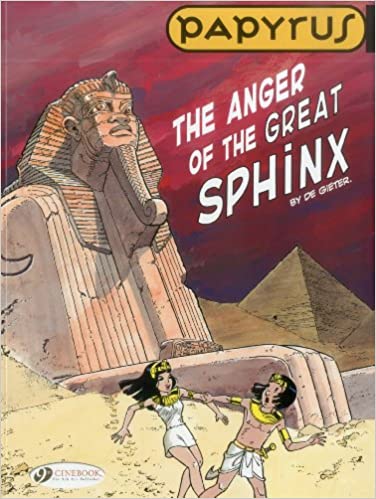
Papyrus volume 3: Tutankhamun, the Assassinated Pharaoh


By Lucien De Geiter, coloured by G. Vloeberghs & translated by Luke Spear (Cinebook)
ISBN: 978-1-90546-084-7 (Album PB)

British and European comics have always been happier with historical strips than our American cousins (a pugnacious part of me wants to say that’s because we have so much more past to play with – and yes, I know they’re responsible for Prince Valiant, but he’s an exception, not a rule).

Our Franco-Belgian brethren in particular have made an astonishing art form out of days gone by. The happy combination of familiar exoticism, past lives and world-changing events blended with drama, action and especially broad humour has resulted in a genre uniquely suited to enchanting readers of all ages and tastes. Don’t take my word for it – just check out Asterix, Adèle Blanc-Sec, The Towers of Bois-Maury, Iznogoud or Thorgal to name but a few which have made it into English, or our own much missed period classics such as Olac the Gladiator, Dick Turpin, Janus Stark, Heros the Spartan or Wrath of the Gods; all far too long overdue for collection in archival form, I might add…

Papyrus is the magnificent magnum opus of Belgian cartoonist Lucien de Gieter. He first saw the light of day in 1974 in legendary weekly Le Journal de Spirou, running to 35 albums thus far, as well as a wealth of merchandise, a television cartoon show and a video game.

De Gieter was born in 1932 and studied at Saint-Luc Art Institute in Brussels before going into industrial design and interior decorating. He made the jump into sequential narrative in 1961, first through ‘mini-récits’ (fold-in, half-sized-booklets) inserts for Spirou, starring his jovial little cowboy ‘Pony’, and later by writing for art-star regulars such as Kiko, Jem, Eddy Ryssack and Francis. He then joined Peyo’s studio as inker on Les SchtroumpfsAKA The Smurfs – and took over the long-running newspaper strip Poussy .

In the 1960s, De Gieter launched South Seas mermaid fantasy Tôôôt et Puit whilst Pony was promoted to the full-sized interior pages of Spirou, deep-sixing the Smurfs gig to expand his horizons working for Le Journal de Tintin and Le Journal de Mickey.

From 1972-1974 De Gieter assisted cartooning legend Berck on Mischa for Germany’s Primo, whilst applying the finishing touches to his dream project: a historical confection which would occupy his full attention and delight millions of fervent fans for the next forty years…

The annals of Papyrus encompass a huge range of themes and milieus, blending Boys’ Own adventure with historical fiction and interventionist mythology, gradually evolving from traditionally appealing “Bigfoot” cartoon style and content towards a more realistic, dramatic and authentic iteration. The journey came through light fantasy romps leavened and flavoured with the latest historical theories and discoveries and starring a fearlessly forthright boy fisherman favoured by the gods to become a hero of Egypt and friend to Pharaohs…

As a youngster the plucky “fellah” was blessed by the gods and given a magic sword courtesy of the daughter of crocodile-headed Sobek, and the lad’s initial task was to free supreme god Horus from imprisonment in the Black Pyramid of Ombos: thereby restoring peace to the Double Kingdom, but his most difficult and never-ending duty was to protect Pharaoh’s wilful, high-handed and safety-averse daughter Theti-Cheri – a princess with an unparalleled gift for seeking out trouble…

Now available digitally as well as in traditional paperback album format, Tutankhamun, the Assassinated Pharaoh was the third Cinebook translation – 17th in the series and originally released in 1994 as Toutânkhamon, le Pharaon assassiné. The sand and sandals mystery skilfully blends fact and fantasy into a strange and disturbing tale of grave robbery, unquiet ghosts and madness…

It all begins with a squabble between the Mayor of the City of the Dead and his equivalent civil servant for the City of Thebes. The vast, desolate region of imperial tombs, sepulchres and lesser burials is being systematically ransacked by blasphemous thieves and, whilst the aforementioned Executive of the Interred Paur claims the sacrilegious raids must be the work of roving Bedouins, Thebes’ Mayor Paser posits that the vile defilers’ knowledge of the holy sites indicates they must be Egyptians… perhaps even some of Paur’s workers or tomb guards…

Bored with the interminable bickering, Theti-Cheri drags Papyrus and court jester Puin away, demanding they join her father’s lion hunt in the deep desert. Amidst the hustle and bustle, the jolly dwarf is left behind and forced to frustratingly follow on his astoundingly smart donkey Khamelot.

Naturally, this leads to him being attacked by the self-same decrepit man-eater Pharaoh is trying to eradicate, but as Puin frantically flees the hungry cat he sees chariot-borne scout Papyrus save a fellah from brutal grave guards. The grateful peasant is a plant, however, and secretes a golden tomb treasure on the boy hero before knocking him out…

When Papyrus comes to, he is surrounded by soldiers and accused by Paur’s captain Rhama of tomb-robbing. A crowd of suspiciously overly-incensed citizens even try to stone him to death and Pharaoh has no choice but to have the boy imprisoned for trial. However, before the doughty lad can gather his wits, Paur attempts to assassinate the boy hero with snakes and then kidnaps him from his temple cell, hiding his drugged, unconscious form in a secret access shaft to the grave of tragic boy king Tutankhamun…

Falling through into the tomb proper, Papyrus’ spirit is suddenly accosted by the ghost of Ankhsenamun and discovers from Tutankhamun’s beloved child-bride how his own peasant great-grandfather played a major role in their tragic romance and the brief, complex reign of the murdered Boy-King…

As Papyrus learns the incredible, unpalatable truth about the legendary ruler’s fate, in the physical world Puin – and Khamelot – have informed Theti-Cheri of the plot. The impetuous Princess rushes to the site and subsequently traps herself in the tomb whilst gold-crazed Paur’s men close in to murder everybody who knows of the Mayor of the City of the Dead’s perfidy. However, the blasphemous bandits have not reckoned on Pharaoh’s cunning perspicacity or a certain donkey’s loyal ingenuity…

This astounding, amazing adventure will thrill and enthral fans of fabulous fantasy – although some of the finer points of Pharaonic marriage customs might distress fainter-hearted parents and guardians – and De Gieter’s clever merging of archaeological revelation with gothic romance and ghost story make for a particularly impressive treat…

Papyrus is a brilliant addition to the family-friendly pantheon of continental champions who marry heroism and humour with wit and charm, and anybody who has worn out those Tintin, Asterix or Lucky Luke volumes would be wise beyond their years in acquiring all these classic chronicles. Even smarter would be publisher Cinebook finally releasing the rest of the translated canon before much more sand passes through the hourglass…
© Dupuis, 1994 by De Gieter. All rights reserved. English translation © 2009 Cinebook Ltd.

Usagi Yojmbo: Yokai


By Stan Sakai (Dark Horse)
ISBN: 978-1-59582-362-5 (HB)

One of the very best and most adaptable survivors of the 1980s black-&-white comic book explosion/implosion is a truly bizarre and wonderful synthesis of historical Japanese samurai fiction and anthropomorphic animal adventure, as well as a perfect example of the versatility and strengths of a creator-owned character.

Usagi Yojimbo (which translates as “rabbit bodyguard”) first appeared as a background character in multi-talented Stan Sakai’s peripatetic anthropomorphic comedy feature The Adventures of Nilson Groundthumper and Hermy, which launched in 1984’s furry ‘n’ fuzzy folk anthology Albedo Anthropomorphics #1. The shaggy samurai subsequently appeared there on his own terms, as well as in Amazing Heroes, Furrlough and the Munden’s Bar back-up strips in Grimjack. The Lepine Legend also appeared in Albedo #2-4, The Doomsday Squad #3 and seven issues of Critters (#1, 3, 6-7, 10-11 and 14) before leaping into his own series…

Sakai is almost as widely-travelled and far-ranging as his signature creation. He was born in 1953 in Kyoto, Japan before the family emigrated to Hawaii in 1955. He attended University of Hawaii, graduating with a BA in Fine Arts, and pursued further studies at Pasadena’s Art Center College of Design after moving to California.

His first comics work was as a letterer, most famously for the inimitable Groo the Wanderer, before his nimble pens and brushes – coupled with a love of Japanese history and legend and hearty interest in the filmic works of Akira Kurosawa and his peers – combined to turn a proposed story about a historical human hero into one of the most enticing and impressive – and astoundingly authentic – fantasy sagas of all time.

The deliciously rambling and expansive period fantasy series is nominally set in a world of sentient animals and specifically references the Edo Period of Feudal Japan (how did we cloth-eared Westerners ever get “Japan” from Nihon” anyway?) as well as classic cultural icons as varied as Lone Wolf and Cub, Zatoichi and even Godzilla, by way of detailing the exploits of Ronin (masterless, wandering freelance Samurai) Miyamoto Usagi, whose fate is to be drawn constantly into a plethora of incredible situations.

And yes, he’s a rabbit – a brave, sentimental, indomitable, gentle, long-suffering, honourable, conscientious and heroic bunny who cannot turn down any request for help…
The Sublime Swordsbun has changed publishers a few times but has been in continuous publication since 1987 – with dozens of graphic novel collections to date – and has guest-starred in numerous other series, such as Teenage Mutant Ninja Turtles and its TV incarnation. There are high-end collectibles, art prints, computer games and RPGs, a spin-off sci fi comics serial and lots of toys, and he even almost made it into his own small-screen show, but there’s still time yet and fashions can revive as quickly as they die out…

Sakai and his creation have won numerous awards both within the Comics community and amongst the greater reading public and in 2009 Dark Horse Comics commissioned an all-new, fully painted Silver Anniversary tale to celebrate 25 stunning years, which allowed the creator to hone his considerable skills with watercolours…

Yokai is a generic term that translates (as required) as ghosts, phantoms, spirits or even strange, otherworldly apparitions, all of whom hold a peculiarly eclectic place in Japanese folklore, being simultaneously mischievous and helpful, malevolent and miraculously beneficial. Generally, they have animal heads or are amalgams of diverse objects or body parts…

This scintillating scary story occurs over one night – an Oborozuki-Yo (“Night of the Hazy Moon”) – when Yokai are particularly restless, and this is a tale that grippingly explores the Japanese equivalent of our Halloween as the noble, gloom-shrouded Rabbit Ronin wanders lonely roads in search of a bite to eat and a place to sleep.

Seeing a light in the nearby woods, Miyamoto leaves the path, hoping to find a welcoming peasant hearth for the evening but is harassed by a taunting Kitsune (trickster-fox spirit) and becomes lost. Soon, however, he hears sobbing and is drawn to a weeping noblewoman…

The lovely distressed lady is Fujimoto Harumi whose pilgrimage to a temple was disrupted when a Kitsune stole her young daughter Hanako away. Pleading with the wisely reluctant Ronin, the lady convinces the wayfarer to plunge deeper into the wild woods to rescue the lost girl, leading to an epic series of contests against a horde of fantastic hostile creatures. The valiant warrior almost succumbs until he is unexpectedly saved by an old comrade, the mystic demon-queller Sasuke…

It seems that this very evening is the dreaded Hyakki Yako, “Night Parade of a Hundred Demons”, when haunts and horrors of the netherworld form a procession into the world of people, seeking to subjugate all mortals. They simply need a living soul to lead them, a final sacrifice to light their way here…

Terrified for the stolen waif, Ronin and devil-slayer engage with an army of horrific, shape-shifting, fire-spitting, tentacle-wielding monstrosities to save an innocent and the entire world, but there are forces in play that the rapidly-tiring Miyamoto is painfully unaware of, and without the luck of the gods and the tragedy of an old friend, all will be inescapably lost…

Fast-paced yet lyrical, funny, thrilling and stuffed with spooky, all-ages action and excitement, Yokai is a magical tribute to and celebration of the long-lived Lepus’ nigh-universal irresistible appeal that will delight devotees and make converts of the most hardened hater of “funny animal” stories. This petite but power-packed chronicle – available in sturdy hardback and ethereal digital editions – also contains a fascinating behind-the-scenes look at how the artist created the stunning visuals in ‘The Real Magic Behind Yokai: an interview with Stan Sakai’ that will further beguile any prospective creators and cartooning hopefuls in the audience.

Sheer comicbook poetry, this is book to revisit time and time again…
Text and illustrations © 2009 Stan Sakai. All rights reserved.

Bigby Bear Book One


By Philippe Coudray, translated by Miceal Ogriefa (BiG/Humanoids)
ISBN: 978-1-59465-806-8(HB)

Bordeaux-born in March 1960, writer, photographer and illustrator Philippe Coudray specialises in cartoons and books for children. Working with his brother Jean-Luc, he co-crafted the Drôles sequence of books and comics series Théocrite.

Howevwr, Philippe conceived and executed his signature creation L’Ours Barnabé – the philosophically absurdist ruminations of an artistic bear and his woodland companions all on his own…

When not crafting kids’ comics or surreal otherworldly gags (such as Loin de Tout) Philippe writes articles and such like for magazines such as Capsule Cosmique, Psikopat, Perlin and Fripounet as well as books such as Guide to Hidden Animals: Treatise on Cryptozoology. His works have been used by the government to combat illiteracy in France and translated into many languages; none more so than L’Ours Barnabé which has appeared in Japan, China, Germany Sweden, and twice in America. The first time was as Benjamin Bear (twice nominated for Eisner Awards and winning China’s 2012-2013 Panda Prize) and latterly here as the beguiling and frequently beguiled Bigby…

As much children’s storybook – although having no narrative structure and relying on episodic vignettes to deliver charming and visually challenging puzzles and riddles – as graphic novel, these collected strips feature an affably gentle bruin living wild and honing his artistic skills in a bucolic forest and mountain idyll, observing the world and pondering big questions in a surreal and often absurdist daze.

Visual tricks and double-takes abound as he and his rabbit chum encounter other animals and aliens, ignore the laws of the universe, carve, sculpt, paint, compose, garden and wander for the sheer joy of creativity. Subtly posing questions to make youngsters think – about art, science, psychology, mathematics, ecology and much more – Coudray never misses an opportunity to share a solid laugh with his readers and reinforce his message that life would be great if we all just mellowed out and got along with each other.

He’s also more than happy to pepper the strips with the occasional telling moment of social commentary if the chance arises…

Genteel fun, bemusing whimsy and enchanting illustration cloaking a supremely inclusive philosophy of curiosity, enquiry and cohabitation, Bigby Bear is a delightful example of how to enjoy life and crucial reading for young and old alike. Get the digital edition immediately before backing it up with the wonderfully tactile, sturdy hardback your kids will want to paw and peer at over and over again…
© 2012-2018 La Boîte à Bulles and Philippe Coudray. All rights reserved.

Violette around the world volume 1: My Head in the Clouds

By Teresa Radice & Stefano Turconi, translated by Terrence Chamberlain (EuroComics/IDW) ISBN: 978-1-68405-188-5 (HB Album) eISBN: 978-1-68406-411-3

Globetrotting Viola volume 1: Treasure Everywhere!
By Teresa Radice & Stefano Turconi, translated by Terrence Chamberlain (Europe Comics – Digital Only) No ISBN

There’s never been a more fruitful time for comics and graphic novels than today but the digital revolution has thrown up a few confusing moments for dithery old guard reviewers like me. Here’s a perfect case in point.

Europe comics is a collective syndicate of continental publishers from numerous countries collaboratively releasing the best of European material in translated digital formats. They also act as agents, so many of their digital releases eventually end up as physical books for English-language publishers like NBM, IDW and Cinebook.

Quite rightly, these publishers also have their own digital editions, and naturally these feature small variations and deviations in the final product. All in all, however, it’s no big deal. There is no “correct” edition and the art and story reman fundamentally the same. You pays yer money and takes yer choice…

In this instance I bought and reviewed both, so could you, if you so pleased…

Scripted by Teresa Radice and painted by Stefano Turconi – a prolific Italian husband-&- wife team who have co-created many books for varying ages of kids, such as Mickey and the Great Sea of Sand, The Forbidden Harbour and the Orlando Curioso series – this award-winning historical romp from 2013 follows the life of a young circus girl in very memorable times…

Alternatively dubbed Violette or Viola Vermeer, our young star – daughter of a cannonball woman and an insect trainer – is a fourth-generation performer of the Cirque de la Lune, currently chafing under the strictures of having to attend a draconian school for ladies in fin de siècle Paris.

She would far rather be travelling the land with her friends and family, and her scholastic inattention – and love of animals – keeps landing her in hot water with the stuffy schoolmarms of the posh institution she’s trapped in…

Her life takes an interesting and life-changing turn after meeting an itinerant painter named Henri. She ends up trailing him all over the metropolis, trying to return a lost sketchbook to the absent-minded dauber. The quest takes her all over the City of Lights and into places I am not going far more educational than her usual classroom: even to the resplendently scandalous Moulin Rouge, resulting in her downtrodden attitude being replaced by a new zest for living and a brand-new sense of adventure and purpose…

A breezy, light-hearted coming of age tale about diversity and acceptance set in a glamourous historical wonderland, this superb yarn also includes loads of captivating extra art by Turconi and a potted biography of Henri de Toulouse-Lautrec to aide amusement and elucidation…
Globetrotting Viola: Treasure Everywhere! © 2016 TUNUÉ (Tunué s.r.l.) – Teresa Radice & Stefano Turconi
Violette around the world: My Head in the Clouds text and illustrations © 2013 Teresa Radice & Stefano Turconi – Tunué. All rights reserved.