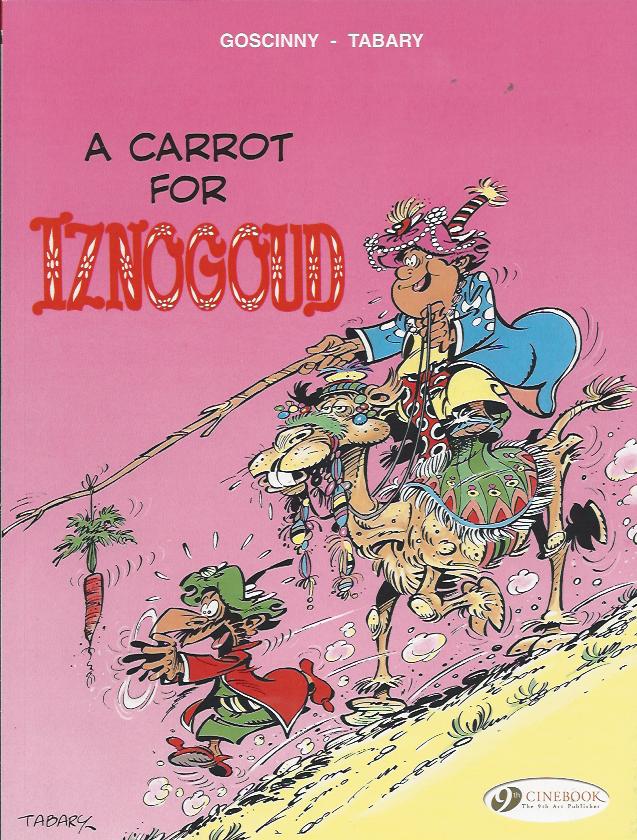
Iznogoud and the Magic Computer (volume 4)


By Goscinny & Tabary translated by Anthea Bell & Derek Hockridge (Cinebook)
ISBN: 978-1-905460-79-3 (PB Album)

How are you coping with voluntary incarceration? If you’re feeling a little frustrated, why not chill out with a good book – instantly available via digital purchasing and still accessible if you go the physical delivery route as a spiffy paperback tome – and see what real frustration looks like and costs…

During his too-short lifetime (1926-1977) René Goscinny was one of the most prolific, most read writers of comic strips the world has ever seen.

He still is.

Among his most popular comic collaborations are Lucky Luke, Le Petit Nicolas and, of course, Asterix the Gaul. There are so many others, too such as this timeless classic…

Scant years after the Suez crisis, the French returned to the deserts when Goscinny teamed with sublimely gifted Swede Jean Tabary (1930-2011) who numbered Richard et Charlie, Grabadu et Gabaliouchtou, Totoche, Corinne et Jeannot and Valentin le Vagabond amongst his other hit strips.

Together they produced imbecilic Arabian (im)potentate Haroun el-Poussah. However, it was the strip’s villainous foil, power-hungry vizier Iznogoud who stole the show – possibly the conniving little weasel’s only successful scheme.

Les Aventures du Calife Haroun el Poussah was created for Record, with the first instalment appearing in 1962 in the January 15th issue. A minor hit, it latterly jumped ship to Pilote – a magazine created and edited by Goscinny – where it was refashioned into a starring vehicle for the devious little rat-bag who had increasingly hogged all the laughs and limelight.

Like all great storytelling, Iznogoud works on two levels: for younger readers as a comedic romp with sneaky baddies coming a cropper, and as a pun-filled, witty satire for older, wiser heads, much like its more famous cousin Asterix. Happily, it’s also translated here by master translators Anthea Bell & Derek Hockridge who made the indomitable little Gaul so very palatable to the English tongue. Best of all, the deliciously malicious whimsy is always heavily-laden with manic absurdity and brilliantly applied creative anachronism to keep the plots bizarrely fresh and inventive.

Our insidious anti-hero is Grand Vizier to affable, generous, easy-going Haroun Al Plassid, Caliph of Ancient Baghdad, but the sneaky little toad has loftier ambitions, or as he is always shouting “I want to be Caliph instead of the Caliph!”…

The revamped series launched in Pilote in 1968, quickly becoming a huge European hit, with 29 albums so far (with 14 translated into English to date). The series has been carried on by Tabary’s children Stéphane, Muriel and Nicolas, in his own solo comic, and has spun-off into a game, TV cartoon show and live action movie.

Goscinny died in 1977, having completed a dozen book’s worth of wonderment and Tabary assumed the scripting as well as the superbly stylish illustration, moving to book-length complete tales, rather than the compilations of short punchy stories that typified their collaborations.

This fourth Cinebook album was the sixth French album (released in 1970 as L’ordinateur magique) and features a clenched and grasping fistful of short, sharp salutary tales beginning – after a handy catch-up profile page – with ‘A Calculated Risk’, wherein the cunning conniver, desperate to forestall a pact between the Caliph and mighty military neighbour Sultan Pullmankar, hires forward-thinking I-Bee’Em and his ponderous problem-solving “computer” to stop the signing of the treaty. The big grey box might be brilliant, but it’s agonisingly slow in reaching its infallible conclusions…

Things then get hilariously surreal after Iznogoud and his long-suffering, bumbling assistant Wa’at Alahf discover a mystic crossroads that can lead unwary travellers onto an unending, pointless journey from which they can neither escape nor return. Dashing back to Baghdad to lure the Caliph onto ‘The Road to Nowhere’, our wicked wayfarers eventually realise that they’ve been stuck on it all along…

Eventually reality resumes and back home and itching to take over, the Vile Vizier then seeks to employ the tragic gifts of lonely hermit Ghoudas Gho’ld: a direct descendent of legendary King Midas in ‘The Golden Handshake’. All Iznogoud has to do to remove the Caliph is get the accursed involuntary metal-maker back to the palace without him touching anything. Easy, no? No…

There’s more tacit skulduggery afoot in ‘The Caliph’s Sceptre’ when Iznogoud hires a master thief to sneak him into the high-security vault where the Staff of Office is cached. If he can prevent the Caliph from presenting it to the people in the annual reaffirmation of worthiness to rule ceremony, the Vizier can legally assume control of the country. Of course, it doesn’t quite play out that way…

This fine kettle of funny fish concludes with ‘The Mysterious Ointment’ as fabled explorer Notsobad the Sailor returns to the port of Basrah. Having forgotten to bring the undetectable Occidental poisons he promised the Vizier, the wily voyager palms him off with a tube of “Schpouk toothpaste’.

Assured the container holds a lethal and undetectable toxin, Iznogoud embarks on an eccentrically convoluted campaign to convince the Caliph and the court that cleaning one’s choppers is the latest and most beneficial of scientific advancements. Care to guess how well that goes?

Snappy, fast-paced hi-jinks and gloriously agonising pun-ishing badinage abound in this mirthfully infectious series which is a household name in France where “Iznogoud” is common parlance for a certain type of politician: over-ambitious, unscrupulous – and often of diminutive stature.

When first released here in the 1970s, these tales made little impression, but hopefully have finally found an appreciative audience among today’s more internationally aware, politically jaded comics-and-cartoon savvy Kids Of All Ages…
© 1970 Dargaud Editeur Paris by Goscinny & Tabary. All rights reserved.

Perfect Nonsense: The Chaotic Comics and Goofy Games of George Carlson


By George Carlson, edited by Daniel F. Yezbick & Rick Marschall (Fantagraphics Books)
ISBN: 978-1-60699-508-2 (HB)

The art and calling of mesmerising children is a rare one, but the masters of such an imaginative discipline – whether through words or pictures – have generally become household names.

Lewis Carroll (although that’s really two people, Charles Lutwidge Dodgson & Sir John Tenniel), Edward Lear, J.M. Barrie, L. Frank Baum, Enid Blyton, Maurice Sendak, Kenneth Graham, Arthur Rackham and their ilk, or cartoon-oriented craftsmen such as Winsor McCay, Sheldon Mayer, Theodor “Dr. Seuss” Geisel, George Herriman, Elzie Segar, S.J. Perelman, Alfred Bestall, Crockett Tubbs, Milt Gross, Carl Barks, Bill Holman and others have all garnered some degree of undying fame for their sublime cannons of entertainment, but apparently, these days, nobody remembers George Carlson.

Carlson was both unique and prolific: a surreal absurdist and sublimely stylised magician of children’s entertainments as well as a diligent commercial artist, tireless, dedicated educator, print illustrator and designer.

He absolutely loved games and puzzles and was besotted with all aspects of print media. A son of Swedish immigrants, he plied his trade(s) from New York and Connecticut between 1903 to 1962, producing everything from editorial cartoons, book jackets – including the iconic first edition of Margaret Mitchell’s Gone with the Wind – magazine illustration, typographical design, games, sheet-music, utterly unique advertising materials, books, pamphlets and so much more.

Let’s not forget comics: some of the original, eccentric and captivating comics for youngsters America or the world has ever seen…

This superb and colossal compendium, the brainchild and magnum opus of extreme fan Daniel Yezbick, is the result of 15 years toil, superbly detailing every aspect of the lost master’s life, stuffed to overflowing with intimate photos, wonderful anecdotes and page after page of glorious, enchanting stories, poems, puzzles and pictures that still have the power to take your breath away, no matter how old you are.

This tool of resurrection for a lost giant begins with ‘Preface: Great Gran’pa Gookel’ by Carlson’s descendent Allison Currie, and an effulgent Introduction by author, critic, historian and cartoonist R.C. Harvey who kindles the lost days in ‘A Very Admiring and Well-Plumbed Apostrophe to George Carlson, Cartooning Genius’, whilst Yezbick’s own fulsome Foreword declares ‘At Long Last, the Carnival’s Come Back’…

Firstly, Yezbick takes us through the great man’s multi-faceted career, beginning with ‘The Jolly Books of the Puzzling Private’, describing early works and the artist’s two decades writing, illustrating, designing and creating engaging and educational games and puzzles for influential children’s pulp magazine John Martin’s Book. Also heavily featured is Carlson’s first great creation Peter Puzzlemaker, whose visual and verbal conundrums fascinated and expanded the minds of generations of kids.

‘The Whimsical Wizard of Fairfield, Connecticut: Family Life and Commercial Art in the 1920s and 1930s’ details his most productive period, not just as a consummate long-distance entertainer of kids, but in local and publishing national arenas. For years the tireless scribbler ghosted Gene Ahern’s classic newspaper strip Reg’lar Fellers and was engaged during WWI as an army cartographer…

Whilst addressing Carlson’s lifelong fascination with transport – especially his astounding illustrations of ships and trains – ‘Gone With the Wiggily: Flirting with Fame in the 1930s and 1940s’ covers the infamous Mitchell cover-creation and other book jackets, as well as Carlson’s far more lasting and influential contributions to children’s literature.

Most important of these are his superb illustrations for Howard R. Garis’ ubiquitous and bucolic tales of venerable rabbit grandfather figure Uncle Wiggily and the artist’s wholly originated series of Puzzles, Fun Things to Do, Play and Colouring books, as well as a succession of “How to” books disclosing the secrets of drawing and creating your own cartoons.

The origin of his short but incredible funnybook career is covered in ‘The Road to Pretzleburg: George Carlson and Self-Destructing Comic Book Narrative’ and the latter disappointing years of changing public tastes in ‘Slouching Towards Fumbleland: The Restoration of the Whifflesnort’ which prompted his just-too-soon abortive creation of graphic novels (in 1962) with the never published Alec in Fumbleland plus the artist’s immortalisation as the creator of a series of images locked in a time capsule that won’t be opened until 8113AD…

The major portion of this sturdy compendium is taken up with hundreds of astounding reproductions of Carlson’s vast and varied output, beginning with ‘Early Works and Illustrations’, including scenes from numerous classical tales such as Icarus, Neptune and Amphitrite, Aesop’s Fables, The Legend of Sleepy Hollow, Tom Sawyer and full colour cover and plates for such books as The Magic Stone, Uncle Wiggily, The Prince Without a Country and more…

Also included are examples of ‘Adult and Genre Works’ such as Broncho Apache, Death on the Prairie and Scouting on the Mystery Trail

‘Pulps, Poems and Pixies: John Martin’s Books’ offers a treasure trove of images and designs from Carlson’s 20-year tenure as contributing editor on America’s premiere pulp publication for children.

A master of what we now call paper and print technologies, with the budget and freedom to go wild, he concocted covers, frontispieces, book plates, Holiday editions, graphically integrated poem pages, astounding layouts, games pages, riddles, nonsense word glossaries, animal alphabets and so many other ways to educationally enthral, engage and stretch growing minds…

The artist was also a brilliant composer of clever, witty limericks, odes, riddles, gags and brainteasers: an advocate and devotee of whacky word play in the manner of Lear and Carroll. ‘Carlson’s School of Nonsense’ catalogues many of his most impressive cartoon-garnished confections whilst ‘Jolly Books’ displays his creations and tales for premium pamphlets (a forerunner of comicbooks) commissioned as give-aways by department stores, all dutifully crafted and packaged by the John Martin team.

As the magazine refused to carry straight advertising – feeling it was an abuse and betrayal of their young readers’ trust – Carlson and brilliant co-editor Helen Waldo devised a sponsorship method which name-checked at one remove selected backers and commercial interests through ingenious story-puzzle pages, rebuses, acronyms and acrostics…

Once upon a time, paper and printing were the internet: a nigh-inexhaustible, readily available resource providing stories, games and puzzles, information and diversions which only required a creator’s imagination and ingenuity. There was nobody more skilled, adept or inspired than Carlson, whose life-long fascination with language, crosswords, puns, riddles, rebuses, maths, wordplay and graphic invention seemingly occupied every non-working, waking moment.

He also knew music (his wife Gertrude was a professional pianist and gave lessons from their home) and here ‘Songs, Games and Other Pastimes’ displays his charming amalgamations of graphics and terpsichorean instruction, as well as science-based features, articles and books. ‘Tutorial Cartooning and Art Instruction’ offers concrete examples of the artist’s many years of publishing tracts and tomes intended to teach young and old alike the fundamentals of narrative art before ‘Trains and Transportation’ reveals in spectacular detail Carlson’s fascination with engineering, locomotives and all aspects of shipping – including the revolutionary, mindboggling Queen Mary Comparisons – after which ‘Portraits, Presidents and Personalities’ displays a selection of his superb commemorative images whilst ‘Adventures in Advertising’ shows his unbelievable versatility in putting across ideas and selling. This includes many examples of those aforementioned John Martin stealth ads, plus a plethora of delightful make-them-yourself Premiums he concocted for youngsters.

‘Original Art, Lost Works, and Forgotten Frolics’ explores tantalising might-have-beens, unearthing many treasures before the groundbreaking kids comics are highlighted in ‘Laughter, Puns, and Speed’.

Subtitled ‘The Whifflesnorting Thrills of George Carlson’s Eastern Color Comics’, a brief essay reveals the history of the illustrator’s short foray into comicbooks and the creation of legendary anthology Jingle-Jangle Comics – which launched in February 1942. Running until 1949 it headlined two features exclusively written and drawn by Carlson.

‘The Pie-Faced Prince of Old Pretzleburg’ was a manic, pun-filled procession of insane and wholesome nonsense related the fast-&-frantic screwball adventures of royal mooncalf Prince Dimwitri and his inept inamorata Princess Panetella Murphy, and a too short collection of complete capers commences here with the furiously frenetic debut from #1, in which he saves the King’s breakfast pretzel from the insidious Green Witch.

Also included are escapades from issues #11, #15, #16, #20, #35, #36 and #41, absurdist adventures in rumbling, tumbling happily tumultuous word-&-picture parables involving living jet-powered kites, assorted bandits, scurrilous scarecrows, stolen violins, fabulous beasts, living jet-mobiles, talking animals, baking, belligerent unicorns and more.

Carlson brought a deliciously skewed viewpoint to the still-evolving syllabary of comics: there are hilariously punny labels and signs everywhere and in some shots, weary birds rest on free-floating word balloons…

Without doubt, however, Carlson reserved his greatest flights of fancy for the inventive fractured fairy stories that comprised the eponymous ‘Jingle Jangle Tales’ – one-off fables starring peculiarly reinvented standbys like princesses and knights, interacting with astonishing animals and far-from-inanimate objects all imbued with a bravura lust for life and laughs.

Included here are ‘The Moon-Struck Unicorn and the Worn-Out Shadow’ from #13, ‘The Straight-Shooting Princess and the Filigree Pond-Lily’ (#22), ‘The Musical Whifflesnort and the Red-Hot Music Roll’ (#23), ‘The Rocketeering Doodlebug and the Self-Winding Horsefly’ (#25); extraordinarily mirthful mystical melanges augmented by a brace of outrageously wry spoofs of American classics ‘Skip van Wrinkle, the High-Hatted Hunter’ from #28 and impossibly raucous, breathtaking lunacy in ‘Sleepy Yollow, the Bedless Norseman’ (#31).

Harlan Ellison correctly dubbed Carlson’s sublimely inviting whimsy for the very young as “Comics of the Absurd” and these cartoon capers are urgently in need of their own complete and comprehensive collection – preferably in a lush and lavish full colour hardback archive edition…

If you have an abiding love of creative fantasy and access to pre-reading-age children (boy, that came out creepier than I imagined!), you simply must try this terrific tome and open their eyes to wonderment, enlightenment, entertainment and education in this timelessly addictively accessible chronicle.
Perfect Nonsense © 2013 Fantagraphics Books. All images and articles © their respective creators or owners. All rights reserved.

Take it Away, Tommy! – a Breaking Cat News Adventure


By Georgia Dunn (Andrews McMeel)
ISBN: 978-1-5248-6209-1 (PB)

Cats rule the world. Everybody knows it. Just ask social media and the internet. Those of us “blessed” with designated feline overlords also learn pretty quickly that they run the house too.

Some years back, illustrator and cartoonist Georgia Dunn found a way to make her hairy housemates earn their keep after watching them converge on a domestic accident and inquisitively – and interminably – poke their little snouts into the mess.

Thus was born Breaking Cat News: a hilariously beguiling web-based comic strip detailing how – when no-one is looking – her forthright felines form their own on-the-spot news-team with studio anchor Lupin, and field reporters Elvis (investigative) and Puck (commentary) delivering around-the-clock reports on the events that really resonate with cats – because, after all, who else matters?

Here then, after far too long an interlude, is the third collection of outrageous, alarming, occasionally courageous but always charming – and probably far too autobiographical for comfort – romps, riffs and rather moving moments starring a growing family of people and the cats and assorted critters that share space with them.

If you’re a returning customer or already follow the strip, you’re already au fait with the ever-expanding cast and ceaseless surreality, but this stuff is so welcoming even the merest neophyte can jump right in with no confusion other than which the author intends……

Dunn is a master of emotional manipulation and never afraid to tug heartstrings, and this time around a more formal narrative underpins the episodic joys. We learn more about the old converted mansion house the cats inhabit – as well as the history of the previous inhabitants and their humans – in an extended ghost story filled with chuckles and shattering poignancy. I’m not kidding. Bring hankies. Many, many hankies.

The first hints come in ‘The People have abandoned the Children’, build in ‘Something’s gotten into Puck’ and ‘There’s been… a disturbance… on the ceiling’ before ‘Things are getting Strange’ prompts The People into doing a little research and discovering what occurred in the old pile they are abiding in amongst numerous other cat-owning tenants. The mystery is finally resolved in a long-delayed ceremony and ethereal reunion in ‘The People are going outside’

More recognisable comedy fare comes as ‘Bacon has been spotted on the breakfast table!’, ‘It’s fuzzy blanket season!’, ‘The laundry is out of control’ and ‘Elvis has a new toy’ whilst the team expands after ‘There’s a new cat in the backyard’ introduces cocksure barn moggy Burt (who ultimately takes on the role of AV facilitator) and ancient wisdom source and problem-solver Baba Mouse (she’s a barn cat too and has been for a very long time)…

Recently rehabilitated wandering cat Tommy introduces his four-footed home-share companion Sophie. Could she be more than just a talented creative type? ‘Local artist creates magnetic masterpieces’ suggests otherwise, but Tommy is hopeful and persistent…

Covering traditional festive cat events such as Thanksgiving and Christmas, an edge of drama creeps in after the Robber Mice Gang abducts Puck’s greatest friend and toy, demanding an impossible ransom…

Outright war ensues until sagacious Baba intervenes, ensuring the Holiday Season and New Year’s are times of joy and rapprochement…

The rolling news continues with such items as ‘The Man has been groomed’, ‘The new plant is armed and dangerous’, ‘Elvis got into the butter’ and ‘Vacuum Cleaner Preparedness’.

Augmenting the tons of mirth and moving moments are further activity pages courtesy of Breaking Cat News: More to Explore! close out this tome: sharing how to create your own ‘Pet Rock Reporters!’, as well revealing the details of ‘The Big Pink House’ comprising their home, a map of ‘The Apartment’ . 

Warm, witty, imaginative, deliciously whimsical and available instantly in digital formats – as well as paperback should you be so inclined – this glorious romp of joyous whimsy will brush away the blues and dangle hopes of better times in your face until you swipe at with a frantic paw (well, probably not, but you know what I mean…).

Breaking Cat News is a fabulously funny, feel-good feature rendered with great artistic élan and a light and breezy touch that will delight not just us irredeemable cat-addicts but also anyone in need of good laugh. And there’s no better time than now for those, right?
Take it Away, Tommy! © 2020 Georgia Dunn. All rights reserved.

Barnaby volume 1: 1942-1943


By Crockett Johnson (Fantagraphics Books)
ISBN: 978-1-60699-522-8 (HB)

This is one of those books that’s worthy of two reviews, so if you’re in a hurry…
Buy Barnaby now – it’s one of the most wonderful strips of all time and this superb hardcover compilation – and its digitised equivalent – has lots of fascinating extras. If you harbour any yearnings for the lost joys of childish glee and simpler, more clear-cut world-ending crises, you would be crazy to miss this book…

However, if you’re still here and need a little more time to decide…
As long ago as August 2007 I started whining that one of the greatest comic strips of all time was criminally out of print and in desperate need of a major deluxe re-issue. So – as if by the magic of a fine Panatella… Cushlamocree! – Fantagraphics came to my rescue…

Today’s newspapers – those that still cling on by an ink-stained fingernail – have precious few continuity drama or adventure strips. Indeed, if a paper has any strips, as opposed to single panel editorial cartoons at all, chances are they will be of the episodic variety typified by Jim Davis’ Garfield or Scott Adams’ Dilbert – or reruns of old favourites like Calvin and Hobbes or Peanuts.

You can describe most of these as single-idea pieces with a set-up, delivery and punch-line, rendered in sparse, pared-down-to-basics drawing style. In that they’re nothing new. Narrative impetus comes from the unchanging characters themselves, and a building of gag-upon-gag in extended themes. The advantage to the newspaper was obvious. If readers liked a strip it encouraged them to buy the paper. If one missed a day or two, they could return fresh at any time having, in real terms, missed nothing.

Such was not always the case, especially in America. Once upon a time the Daily “funny” – comedic or otherwise – was a crucial circulation builder and preserver, with lush, lavish and magnificently rendered fantasies or romances rubbing shoulders with thrilling, moody masterpieces of crime, war, sci-fi and everyday melodrama. Even the legion of humour strips actively strived to maintain an avid, devoted following.

And eventually there was Barnaby which in so many ways bridged the gap between then and now…

On April 20th 1942, with America at war for the second time in 25 years, liberal New York tabloid PM (a later iteration of which – The New York Star – debuted Walt Kelly’s wonderful Pogo) began running a new, sweet strip for kids which was the most whimsically addicting, socially seditious and ferociously smart satire since the creation of Al Capp’s Li’l Abner – another complete innocent left to the mercy of scurrilous worldly influences…

The outlandish 4-panel Daily, by Crockett Johnson, was the brainchild of a man who didn’t particularly care for comics, but who – according to celebrated strip historian Ron Goulart – just wanted steady employment…

David Johnson Leisk (October 20th 1906-July 11th 1975) was an ardent socialist, passionate anti-fascist, gifted artisan and brilliant designer who had spent much of his working life as a commercial artist, Editor and Art Director.

Born in New York City and raised in the outer borough of Queens (when it was still semi-rural – very near the slag heaps which would eventually house two New York World’s Fairs in Flushing Meadows) Leisk studied art at Cooper Union (for the Advancement of Science and Art) and New York University before leaving early to support his widowed mother. This entailed embarking upon a hand-to-mouth career drawing and constructing department-store advertising.

He supplemented that income with occasional cartoons to magazines such as Collier’s before becoming an Art Editor at magazine publisher McGraw-Hill. He also began producing a moderately successful, “silent” strip called The Little Man with the Eyes.

Johnson had divorced his first wife in 1939 and moved out of the city to Connecticut, sharing an ocean-side home with student (and eventual bride) Ruth Krauss, always looking to create that steady something, when, almost by accident, he devised a masterpiece of comics narrative…

However, if his friend Charles Martin hadn’t seen a prototype Barnaby half-page lying around the house, the series might never have existed. Happily, Martin hijacked the sample and parlayed it into a regular feature in prestigious highbrow leftist tabloid PM simply by showing the scrap to the paper’s Comics Editor, Hannah Baker.

Among her other finds was a strip by a cartoonist dubbed Dr. Seuss which would run contiguously in the same publication. Despite Johnson’s initial reticence, within a year Barnaby had become the new darling of the intelligentsia…

Soon there were hard-back book collections, talk of a Radio show (in 1946 it was adapted as a stage play), rave reviews in Time, Newsweek and Life. The small but rabid fan-base ranged from politicians and the smart set such as President and First Lady Roosevelt, Vice-President Henry Wallace, Rockwell Kent, William Rose Benet and Lois Untermeyer to cool celebrities such as Duke Ellington, Dorothy Parker, W. C. Fields and even legendary New York Mayor Fiorello La Guardia.

Of course, the last two might only have checking the paper because the undisputed, unsavoury star of the show was a scurrilous if fanciful amalgam of them both…

Not since George Herriman’s Krazy Kat had a scrap of popular culture so infiltrated the halls of the mighty, whilst largely passing way over the heads of the masses and without troubling the Funnies sections of big circulation papers. Over its 10-year run – from April 1942 to February 1952 – Barnaby was only syndicated to 64 papers nationally, with a combined circulation of just over five and a half million, but it kept Crockett (a childhood nickname) and Ruth in relative comfort whilst America’s Great and Good constantly agitated on the kid’s behalf.

This splendid collection opens with a hearty appreciation from Chris Ware in the Foreword before cartoonist and historian Jeet Heer provides a critical appraisal in ‘Barnaby and American Clear Line Cartooning’, after which the captivating yarn-spinning takes us from April 20th 1942 to December 31st 1943.

There’s even more elucidatory content after that, though, as education scholar and Professor of English Philip Nel provides a fact-filled, picture-packed ‘Afterword: Crockett Johnson and the Invention of Barnaby’; Dorothy Parker’s original ‘Mash Note to Crockett Johnson’ is reprinted in full, and Nel also supplies strip-by-strip commentary and background in ‘The Elves, Leprechauns, Gnomes, and Little Men’s Chowder & Marching Society: a Handy Pocket Guide’…

The real meat begins with the strip itself and starts when ‘Mr. O’Malley Arrives’. This ran from 20th to 29th April 1942, setting the ball rolling as a little boy wishes one night for a Fairy Godmother and something strange and disreputable falls in through his window…

Barnaby Baxter is a smart, ingenuous and scrupulously honest pre-schooler (4-year-old to you) whose ardent wish is to be an Air Raid Warden like his dad. Instead he is “adopted” by a short, portly, pompous, mildly unsavoury and wholly discreditable windbag with pink wings.

Jackeen J. O’Malley, card carrying-member of the “Elves, Gnomes, Leprechauns and Little Men’s Chowder and Marching Society” – although he hasn’t paid his dues in years – installs himself as the lad’s Fairy Godfather. A lazier, more self-aggrandizing, mooching old glutton and probable soak (he certainly frequents taverns but only ever raids the Baxter’s icebox, pantry and humidor, never their drinks cabinet…) could not be found anywhere.

Due more to intransigence than evidence – there’s always plenty of physical proof whenever O’Malley has been around – Barnaby’s father and mother adamantly refuse to believe in the ungainly, insalubrious sprite, whose continued presence hopelessly complicates the sweet boy’s life. The poor parents’ greatest abiding fear is that Barnaby is cursed with Too Much Imagination…

In fact, this entire glorious confection is about our relationship to imagination. This is not a strip about childhood fantasy. The theme here, beloved by both parents and children alike, is that grown-ups don’t listen to kids enough, and that they certainly don’t know everything.

Despite looking like a fraud – he never uses his magic and always wields one of Dad’s stolen cigars as a substitute wand – O’Malley is the real deal: he’s just incredibly lazy, greedy, arrogant and inept. He does – sort of – grant Barnaby’s wish though, as his midnight travels in the sky trigger a full air raid alert in ‘Mr. O’Malley Takes Flight’ (30th April-14th May)…

‘Mr. O’Malley’s Mishaps’ (15th-28th May) offer further insights into the obese elf’s character – or lack of same – as Barnaby continually fails to convince his folks of his newfound companion’s existence, before the bestiary expands into a topical full-length adventure when the little guys stumble into a genuine Nazi plot with supernatural overtones in the hilariously outrageous ‘O’Malley vs. Ogre’ – which ran from 29th May through 31st August.

‘Mr. O’Malley’s Malady’ (1st – 11th September) deals with the airborne oaf’s brief bout of amnesia, even as Mum and Dad, believing their boy is acting up, take him to a child psychologist. However, ‘The Doctor’s Analysis’ (12th – 24thSeptember) doesn’t help…

The war’s effect on the Home Front is an integral part of the strip and ‘Pop vs. Mr. O’Malley’ (25th September – 6thOctober) and ‘The Test Blackout’ (7th – 16th October) see Mr. Baxter become chief Civil Defense Coordinator despite – not because of – the winged interloper, but not without suffering the usual personal humiliation.

There is plenty to go around and, when ‘The Invisible McSnoyd’ (17th – 31st October) turns up, O’Malley gets it all.

The Brooklyn Leprechaun, although unseen, is O’Malley’s personal gadfly: continually barracking, offering harsh, ribald counterpoints and home truths to the Godfather’s self-laudatory pronouncements, and in ‘The Pot of Gold’ (2nd – 20thNovember) perpetually taunting and tempting JJ to provide a treasure trove of laughs…

When Barnaby wins a scrap-metal finding competition and is feted on radio, O’Malley co-opts ‘The Big Broadcast’ (21st – 28th November) and brings chaos to the airwaves, but once again Mr. Baxter won’t believe his senses. Dad’s situation only worsens after ‘The New Neighbors’ (30th November – 16th December) move in and little Jane Shultz also starts candidly reporting Mr. O’Malley’s deeds and misadventures…

Barnaby’s faith is only near-shaken when the Fairy Fool’s constant prevarications and procrastination mean Dad Baxter’s Christmas present arrives late. The Godfather did accidentally destroy an animal shelter in the process, so ‘Pop is Given a Dog’ (17th – 30th December) which brings a happy resolution of sorts…

A perfect indication of the wry humour that peppered the feature can be seen in ‘The Dog Can Talk’ – which ran from 31stDecember 1942 to 17th January 1943. New pooch Gorgon can indeed converse – but never when the parents are around, and only then with such overwhelming dullness that everybody listening wishes him as mute as all other mutts…

Playing in an old abandoned house (don’t you miss those days when kids could wander off for hours, unsupervised by eagle-eyed, anxious parents – or were even able to walk further than the length of a garden?) serves to introduce Barnaby and Jane to ‘Gus, the Ghost’ (18th January to February 4th) which in turn involves the entire ensemble with ration-busting thieves after they uncover ‘The Hot Coffee Ring’ (5th – 27th February). Barnaby is again hailed a public hero and credit to his neighbourhood, even as poor Dad stands back and stares, nonplussed and incredulous…

As Johnson continually expanded his gently bizarre cast of Gremlins, Ogres, Ghosts, Policemen, Spies, Black Marketeers, Talking Dogs and even Little Girls, all of whom can see O’Malley, the unyieldingly faithful little lad’s parents are always too busy and too certain that the Fairy Godfather and all his ilk are unhealthy, unwanted, juvenile fabrications.

With such a simple yet flexible formula Johnson made pure cartoon magic. ‘The Ghostwriter Moves In’ (1st – 11th March) finds Gus reluctantly relocating to the Baxter abode, where he is even less happy to be cajoled into typing out O’Malley’s odious memoirs and organising ‘The Testimonial Dinner’ (12th March – 2nd April) for the swell-headed sprite at the Elves, Leprechauns, Gnomes, and Little Men’s Chowder & Marching Society clubhouse and pool hall…

With the nation urged to plant food crops, ‘Barnaby’s Garden’ (3rd – 16th April) debuts as a another fine example of the things O’Malley is (not) expert in, whilst ‘O’Malley and the Lion’ (17th April – 17th May) finds the innocent waif offering sanctuary to a hirsute circus star even as his conniving, cheroot-chewing cherub contemplates his own “return” to showbiz, after which ‘Atlas, the Giant’ (18th May – 3rd June) wanders into the serial. At only 2-feet tall, the pint-sized colossus is not that impressive… until he gets out his slide-rule to demonstrate that he is, in fact, a mental giant…

‘Gorgon’s Father’ (4th June – 10th July) turns up to cause contretemps and consternation before disappearing again, after which Barnaby and Jane are packed off to ‘Mrs. Krump’s Kiddie Kamp’ (12th July – 13th September) for vacation rest and the company of normal children.

Sadly, although the wise matron and her assistant never glimpse O’Malley and Gus, all the other tykes and inmates are more than happy to associate with them…

Once the kids arrive back in Queens – Johnson had set the series in the streets where he’d grown up – the Fairy Fool is showing off his “mechanical aptitude” on a parked car with its engine wastefully running and breaks the idling getaway car just in time to foil a robbery…

Implausibly overnight he becomes an unseen and reclusive ‘Man of the Hour’ (14th – 18th September) before preposterously translating that cachet into a political career by accidentally becoming a patsy for a corrupt political machine in ‘O’Malley for Congress!’ (20th September – 8th October).

This strand gave staunchly socialist cynic Johnson ample opportunity to ferociously lampoon the electoral system, the pundits and even the public. Without spending money, campaigning – or even being seen – the pompous pixie wins ‘The Election’ (9th October – 12th November) and actually becomes ‘Congressman O’Malley’ (13th – 23rd November), with Barnaby’s parents perpetually assuring their boy that this guy was not “his” Fairy Godfather’…

The outrageous satire only intensified once ‘The O’Malley Committee’ (24th November – 27th December 1943) began its work – by investigating Santa Claus – despite the newest, shortest Congressman in the House never actually turning up to do a day’s work…

Raucous, riotous sublimely surreal and adorably absurd, the untrammelled, razor-sharp whimsy of the strip is instantly captivating, and the laconic charm of the writing well-nigh irresistible, but the lasting legacy of this ground-breaking feature is the clean, sparse line-work that reduces images to almost technical drawings: unwavering line-weights and solid swathes of black that define space and depth by practically eliminating it, without ever obscuring the fluid warmth and humanity of the characters. Almost every modern strip cartoon follows the principles laid down here by a man who purportedly disliked the medium…

The major difference between then and now should also be noted, however. Johnson despised doing shoddy work, or short-changing his audience. On average each of his daily, always self-contained encounters built on the previous episode without needing to re-reference it, and offered three to four times as much text as its contemporaries. It’s a sign of the author’s ability that the extra wordage is never unnecessary, and often uniquely readable, blending storybook clarity, the snappy pace of “Screwball” comedy films and the contemporary rhythms and idiom of authors such as Damon Runyan.

He managed this miracle by type-setting the dialogue and pasting up the strips himself – primarily in Futura Medium Italic but with effective forays into other fonts for dramatic and comedic effect.

No sticky-beaked educational vigilante could claim Barnaby harmed children’s reading abilities by confusing the tykes with non-standard letter-forms (a charge levelled at comics as late as the turn of this century), and the device also allowed him to maintain an easy, elegant, effective balance of black and white which makes the deliciously diagrammatic art light, airy and implausibly fresh and accessible.

During 1946-1947, Johnson surrendered the strip to friends as he pursued a career illustrating children’s book such as Constance J. Foster’s This Rich World: The Story of Money, but eventually he returned, crafting more magic until he retired Barnaby in 1952 to concentrate on books.

When Ruth graduated she became a successful children’s writer and they collaborated on four tomes – The Carrot Seed(1945), How to Make an Earthquake, Is This You? and The Happy Egg, but these days Crockett Johnson is best known for his seven “Harold” books. These began in 1955 with the captivating Harold and the Purple Crayon.

During a global war with heroes and villains aplenty, where no comic page could top the daily headlines for thrills, drama and heartbreak, Barnaby was an absolute panacea to the horrors without ever ignoring or escaping them.

For far too long, Barnaby was a lost masterpiece. It is influential, ground-breaking and a shining classic of the form. It is also warm, comforting and outrageously hilarious. You are all poorer for not knowing it, and should move mountains to change that situation. I’m not kidding.

Liberally illustrated throughout with sketches, roughs, photos and advertising materials as well as Credits, Thank You and a brief biography of Johnson, this big book of joy will be a welcome addition to 21st century bookshelves – especially yours…
Barnaby and all its images © 2013 the Estate of Ruth Kraus. Supplemental material © 2013 its respective creators and owners.

Rosa Goes for a Walk


By Nic Lawson (Nic Lawson Comics/Canberra)
ISBN: 978-0-646-90434-4 (PB)

The current comics/graphic novel market is a true wonderland these days. For every planetary megastar and proprietorial blockbuster romp or spectacular action thriller, staggering horror yarn or historical journey there are incisive, revelatory biographies, archival collections of veteran properties, self-exploratory observations and deeply personal reminiscences as well as cartoon stars of every era revived for modern delectation.

…And the wealth of internationally generated, globally-sourced book for kids is mouth-watering in its vast variety…

In that nigh-infinite cauldron of choice, there’s even room for small, personal works that defy ready categorisation and shine through sheer novelty, innovation, whimsy, talent and charm. Just like Rosa Goes for a Walk, the very best adventure comic you’ve not read yet…

Nicole Lawson (If a Tree Falls, Pretty in Pink, Nic and Craig Go to Japan) is an Australian painter, illustrator and storyteller who creates wonderful comics. Her work has been mostly self-published but she has also appeared in Canberra Zine Machine and Supanova. This particular tale was shortlisted for a Ledger Award…

Seditiously eccentric, the story begins as we ‘Meet Rosa’, a faded flower of an old lady who resides in a distressed hotel (“the Discovery”) in a deserted outback ghost town. There’s a road, but nobody ever stops for food or fuel or conversation…

Rosa’s days are pretty much identical, but she maintains her standards and keeps the old place ready for guests who never come, which leaves her lots of time to remember the good old days. Hers were especially good. Rosa Philips used to be a globe-girdling adventurer, explorer and treasure-hunter. She’s even got the scrapbooks and press-cuttings to prove it… if anybody was around to see…

And so her days pass, until one morning ‘The Adventure Begins’ after she spots an inexplicable alteration to the stunning but so-familiar landscape. Plagued with curiosity, Rosa tools up one last time and heads for the distant horizon. Making her rickety way through the bush, she eventually encounters something utterly astonishing which changes her knowledge of how the entire world works before ‘The Conclusion’ reveals even more shocking secrets both personal and profound…

Largely free of dialogue and narration, rendered in a simplified but compelling watercolour manner and wistfully tinged with the emotive impact of the best of Raymond Briggs, Rosa Goes for a Walk is a superb exploration of isolation, abandonment and life passed by, elevated by a brilliant twist of imagination. This a lovely, moving story of old age and past glories as it affects a person and a planet. Moreover, while we’re all pining away in necessary solitude, it’s a tale full of the perspective and uplift we can all do with. Do yourself a favour and track it down – preferably in digital format and beamed to you behind your own sealed doors – and feel a part of something bigger and better, supremely well-crafted and with some inkling of where we’re all going…
© 2013 Nicole Lawson All rights reserved.

A Portrait in Poems: The Storied Life of Gertrude Stein & Alice B. Toklas


By Evie Robillard & Rachel Katstaller (Kids Can Press)
ISBN: 978-1-5253-0056-1 (HB)

We don’t cover nearly enough kids’ books here, nor those with an Arts or educational underpinning, and that’s because I lazily prefer to read stuff that’s entertaining, worthwhile and well-produced. And yes, I know they’re not necessarily mutually exclusive but somehow, so often…

Happily, this gloriously inclusive biographical primer into one of the world’s most interesting and accomplished women and her life partner is all of that and more.

Delivered as a delicious and enthralling picture book for 6 to 9-year-olds, A Portrait in Poems précis’ and shares some notable Parisian moments in the life of author Gertrude Stein and her muse Alice B. Toklas. This unconventional couple led the upcoming arts glitterati of Europe and collected one of the most astounding art collections in history prior to one World War and before another. The book is drafted in episodic free verse by librarian, teacher and writer Evie Robillard and painted with idyllic verve by El Salvadoran illustrator Rachel Katstaller in a superbly subtle manner guaranteed to get youngsters addicted to learning more.

In short order you’ll visit the protagonists’ first home at ’27 Rue de Fleurus’, observe as ‘Picasso Paints a Portrait’, share ‘Saturday Evenings’ and enjoy ‘The Room with All the Paintings’ before meeting ‘Gertrude Stein, the Genius’…

The couple shared their exalted existence with ‘A Dog Named Basket’ (two actually) and we see more of them all in ‘Gertrude & Alice & Basket in a Book’ before wrapping up the history with what happened ‘After’…

Adding learning and lustre a ‘Time Line’ supplies dates and hard facts, while glimpses of character shine in a trio of epigrammatic ‘Snapshots’, whilst ‘Sources’ offers some of Gertrude’s best works to check out and a bibliography reveals more books about her, before a final ‘Author’s Note’ deals with the contentious period when the couple abided under Nazi occupation in Vichy France.

It’s never too early to give children a hunger to know stuff, and this bright, inclusive foray into the mind and life of one of our most remarkable thinkers is a welcome addition to any junior library or kids’ book stash because it simply cries out for readers to go absorb more…
Text © 2020 Evie Robillard. © 2020 Rachel Katstaller. All rights reserved.

Chloe & Cartoon volume 1: When Chloe First Met Her Cat, Cartoon


By Greg Tessier & Amandine, translated by Joe Johnson (/Charmz/Papercutz)
ISBN: 978-1-5458-0430-8 (HB) 978-1-5458-0431-5 (TPB)

Let’s close cat week (not an actual thing… yet) with another superbly inclusive and entertaining European import, debuting under Papercutz’s new Charmz imprint aimed at a Pre and Early Teen female readership (let’s go with 9-13, but I don’t register on any of those metrics and still enjoyed it immensely).

Chloe & Cartoon is actually a prequel, set before Charmz’s splendid, school series Chloe which originally began in 2017 and 2018 as French series Mistinguette & Cartoon. When Chloe First Met Her Cat, Cartoon compile first two Euro-tomes Chat Arrive! and Deuxieme Chat Pitre into a bold and charming collation of consecutive vignettes detailing how the ever-so-tense Blin family take possession of a 3-month old kitten. Chloe is still in elementary school and her brother Arthur is just a toddler, it’s nearly Christmas and tetchy Mr. Blin is about to reluctantly capitulate to a sustained campaign by his wife and first-born to get a cat. He is NOT KEEN.

Knowing when to give in, he scopes out three likely candidates and make the rookie mistake of picking the chubby, lazy sleeping one, on the absurd assumption that it will cause the least mess and trouble…

Dad learns his lesson over the following months as the little tyke settles in with the exact opposite of the minimum of fuss and destruction. Nevertheless, Cartoon changes Chloe’s life and the family dynamic forever. Days pass in a flurry of little adventures as the girl learns responsibility, how to let go, and patience while dad becomes more and more of an ogre before admitting his own affection for the fuzzy brute….

These short strips are not only fun and supremely entertaining but also subtly reinforce ideas of proper pet care and are augmented by ‘Tips from Chloe’: illustrated text features ‘Welcoming a Kitten to Your Home’ and behavioural hints in ‘Understanding a Kitten’.

Available in Hardback, Softcover and digital editions, When Chloe First Met Her Cat, Cartoon is the brainchild of author Greg Tessier, a relative newcomer who spent much of his career as a cultural and historical development specialist, overseeing public reading projects in France, and veteran illustrator Amandine. She’s been active in the business since 2006, with alternative projects as part of the Nekomix collective; mainstream illustration work for Disney, Hachette Presse, Playbac, Fleurus Presse; children’s series Valentin, and since 2011 Mistinguette.

As well as being a delightful comic for readers of all ages, Chloe & Cartoon is a wonderful argument for the proposition that every kid should grow up a with a pet. If that’s a quandary currently vexing you, consider this as definite tick in the “pro” column…
Mistinguette [CHLOE] & Cartoon volume 1 “Chat Arrive!” © Jungle! 2017 and Mistinguette [CHLOE] & Cartoon volume 1 “Deuxieme Chat Pitre” © Jungle! 2018. All rights reserved. User license. English translation and all other material © 2020 by Papercutz. All rights reserved.

Brina the Cat volume 1: The Gang of the Feline Sun


By Giorgio Salati & Christian Cornia, with Erika Turbati, translated by Olivia Rose Doni (Papercutz)
ISBN: 978-1-5458-0425-4 (HB) 978-1-5458-0426-1 (TPB)

As I believe I’ve already mentioned, there’s an awful lot of cat comics around these days. As owning the internet is clearly not enough for the hairy little blighters, here’s the gen on another one I think might be worth your time and money…

Originally published in 2017 as Brina e la Banda del Sole Felino and another newly-translated all-ages gem from the astute folk at Papercutz, the first volume of Brina the Cat is an engaging tale of ownership versus liberty in the grand Walt Disney manner. That’s not surprising as it’s scripted by Italian Disney Academy veteran and professor Giorgio Salati (Topolino, Disney Hamlet; Il lato obscure della legge) and painted by his college colleague Professor Christian Cornia (Yogi Bear, Scooby Doo, When Unicorns Poop) – assisted by co-colourist Erika Turbati.

The story is delicious and bittersweet, and preceded by a delightful comics Foreword from Frédéric Brrémaud & Federico Bertolucci before the main feature begins, revealing how pampered city housecat Brina accompanies the young human couple she lives with on a summer vacation to the mountains. Once there, she has the run of their chalet and the gardens and discovers her inner apex predator, as well as how annoying dogs can be…

All too soon however, she meets the seductively free cats of The Gang of the Feline Sun, and strange stirrings are provoked within her…

Pack leader Vespucci is particularly convincing and before long Brina has broken her ties with her beloved humans and reclaimed her heritage. Running free with the gang, she leaves her heartbroken humans to go through all the motions necessary to retrieve a lost cat…

Although not without qualms, Brina quickly adapts to her life of liberty, but as the summer passes the unity of the gang is slowly eroded and Brina comes to a shocking conclusion about Vespucci and is forced to reassess her decision…

But can she decide before the humans dejectedly return to the city…

Available in hardcover, paperback and digitally and augmented by illustrated poem ‘Brina’s Tale’ this is a superb yarn blending charm and wit with plenty of fun and imagination and like all the best kids’ stories is not afraid to mix a bit of terror and heartbreak into the mix. It can also be readily enjoyed by cat-loving adults… as long as they have tissues handy…
© 2020 TUNUÉ (Tunué s.r.l.) – Giorgio Salati & Christian Cornia. All other material © 2020 Papercutz. All rights reserved.

Cat & Cat volume 1: Girl Meets Cat


By Christophe Cazenove, Hervé Richez & Yrgane Ramon, translated by Joe Johnson (Papercutz)
ISBN: 978-1-54580-427-8 (HB) 978-1-54580-428-5 (TPB)

There’s an amazing abundance of comics about cats being sent to me these days, so – in anticipation of our furry feline overlords finally taking full possession of the planet – I’m thinking of an imminent solid week of cat-themed coverage. Until then though, let’s make do with this recent addition to the genre, courtesy of those fine folk at Papercutz and pray that it’s enough to hold the cute little brutes at bay (the cats, I mean, not the all-ages readership)…

Debuting in Europe as Cath et son chat in 2012’s in initial volume Virus au bahut (they’re up to 8 books by now), the series details the grudging accommodations made by a single-parent father, his naively optimistic daughter and a rather strong-willed, painfully adventurous cat they name Sushi…

Girl Meets Cat sees young Catherine gradually getting to know the newest addition to the household, although dad isn’t really acclimatising that well to the hairy third wheel. In this delightful paperback or digital catalogue (tee hee) of short strips, you’ll see the hapless humans discover Tomcat Sushi’s darling little tricks – such as shredding carpets, wallpaper, drapes and furniture (“broderie de chat” as actor Leslie Phillips once dubbed it), shunning expensive cat-toys, sleeping for eons and utterly failing to understand the principles of cat doors or the off-limits sanctity of Christmas trees and decorations…

Enthralling episodes cover where cats sleep, opening the fridge, food, litter trays, learning to use pet-carriers, professional cat groomers, holiday provision, fishbowls, what cats do to tech – especially computers – the joy of cardboard boxes, hiding, marking territory and presenting prey (generally garden gnomes in this case).

These commonplace activities are often complicated by the fact that Sushi has a rich and imaginative dream life which frequently has painful real-world repercussions. He’s been an astronaut cat, polar explorer, pirate, ghost and Victorian detective Catlock Holmes and is particularly partial to those five-hour long sessions of vigorous violent exercise cats compress into six minutes – generally known as “the Rips”. Most importantly, he is implacable in the never-ending war that ensues over who gets to sit in the best spot in the house…

In this tome you will also learn of Sushi’s nine lives through the length of human history from Jurassic times to WWII, and understand humanity’s true place in the Grand Scheme of Things.

Rendered by Yrgane Ramon in a frantic and frenetic modern animation style, and scripted – probably from painful personal experience – by veteran comedy scripters Christophe Cazenove (Les Pompiers; Les Fondus; Les Petits Mythos) and Hervé Richez (Buzzi; L’Effaceur; Les Poulets du Kentucky), this a wonderfully bright and breezy sitcom cat lovers and cartoon connoisseurs will adore.
© 2012-2020 Bamboo Édition. All other material © 2020 Papercutz. All rights reserved.

Sundiata, the Lion of Mali – a Legend of Africa


Retold by Will Eisner (NBM)
ISBN: 978-1-56163-332-6(HB)  978-1-56163-340-1(TPB)

It’s pretty much accepted today that Will Eisner was one of the pivotal creators who shaped the American comicbook industry, with most – but not sadly, all – of his works more or less permanently in print – as they should be.

Active and compellingly creative until his death in 2005, Eisner was the consummate storysmith and although his true legacy is making comics acceptable fare for adult Americans, his mastery and appeal spanned the range of human age and he was always as adept at beguiling the young as he was enchanting their elders…

William Erwin Eisner was born on March 6th 1906 in Brooklyn and grew up in the ghettos. They never left him. After time served inventing much of the visual semantics, semiotics and syllabary of the medium he dubbed “Sequential Art” in strips, comicbooks, newspaper premiums and instructional comics, he then invented the mainstream graphic novel, bringing maturity, acceptability and public recognition to English language comics.

From 1936 to 1938 he worked as a jobbing cartoonist in the comics production hothouse known as the Eisner-Eiger Shop, creating strips for both domestic US and foreign markets. Using the pen-name Willis B. Rensie, he created and drew opening instalments for a huge variety of characters ranging from funny animal to historical sagas,

Westerns, Detectives, aviation action thrillers… and superheroes – lots of superheroes …

In 1940 Everett “Busy” Arnold, head honcho of the superbly impressive Quality Comics outfit, invited Eisner to take on a new challenge. The Register-Tribune newspaper syndicate wanted a 16-page weekly comicbook insert for the Sunday editions and Eisner jumped at the opportunity, creating three series which would initially be handled by him before two of them were delegated to supremely talented assistants. Bob Powell inherited Mr. Mystic and distaff detective Lady Luckfell into the capable hands of Nick Cardy (then still Nicholas Viscardi) and later the inimitable Klaus Nordling.

Eisner kept the lead feature for his own, and over the next twelve years The Spirit became the most impressive, innovative, imitated and talked-about strip in the business. However, by 1952 Eisner had more or less abandoned it for more challenging and certainly more profitable commercial, instructional and educational strips. He worked extensively for the US military in manuals and magazines like Army Motors and P*S, the Preventative Maintenance Monthly, generally leaving comicbooks behind.

After too long away from his natural story-telling arena, Eisner creatively returned to the ghettos of Brooklyn where he was born and capped a glittering career by inventing the mainstream graphic novel for America, bringing maturity, acceptability and public recognition to English language comics. After that he just kept on going…

In 1978 a collection of four original short stories in strip form were released as a single book: A Contract With God and Other Tenement Stories. All four centred around 55 Dropsie Avenue, a 1930’s Bronx tenement, housing poor Jewish and immigrant families. It changed the American perception of cartoon strips forever. Eisner wrote and drew a further 20 comics masterworks, opening the door for all other comics creators to escape the funnybook and anodyne strip ghettos of superheroes, funny animals, juvenilia and “family-friendly” entertainment. At one stroke comics grew up.

Eisner was constantly pushing the boundaries of his craft, honing his skills not just on the Spirit but with years of educational and promotional material. In A Contract With God he moved into unexplored territory with truly sophisticated, mature themes worthy of Steinbeck and F. Scott Fitzgerald, using pictorial fiction as documentary exploration of social experience.

If Jack Kirby was the American comicbook’s most influential artist, Will Eisner remains undoubtedly its most venerated and exceptional storyteller. Contemporaries originating from strikingly similar Jewish backgrounds, each used comic arts to escape from their own tenements, achieving varying degrees of acclaim and success, and eventually settling upon a theme to colour all their later works. For Kirby it was the Cosmos, what Man would find there, and how humanity would transcend its origins in The Ultimate Outward Escape. Will Eisner went Home, went Inward and went Back, concentrating on Man as he was and still is…

Naturally that would make him a brilliant choice to illustrate primal folktales and creation myths from our collective past. This stunning, slim yet over-sized tome (288 x 224mm) again proves his uncanny skill in exhibiting the basic drives and passions of humanity as he lyrically recounts a key myth of West Africa. Although I can’t find it in any digital editions, at least it’s still widely available in print formats…

The historical Sundiata Keita brought the Mandinka People out of bondage and founded the Mali Empire in the 13thcentury AD. He is still celebrated as a staple of the oral tradition handed down by the tribal historians, bards and praise-singers known as “Griots”.

Rendered in a moody, brooding wash of sullen reds, misty greys and dried out earth-tones, the tale begins; narrated by the Great Gray Rock, foundation stone of the world.

Once only the beasts were masters of Africa, but when people came, they sought to rule the land. The newcomers consulted the ghosts of Good and soon became the masters of the beasts and the land.

However, Evil ghosts also lurked. Once ambitious, greedy Sumanguru, King of Sasso had conquered all he could see, he still seethed with dissatisfaction, and the Gray Rock of Evil accosted him…

Sasso was a poor, arid country and when the wicked stone offered the king dark magical powers to conquer all the surrounding lands, Sumanguru eagerly accepted. Soon all the neighbouring nations were smouldering ruins as Sasso warriors and their mad lord’s control of the elements demolished all resistance.

Still Sumanguru was not content and, when a trader brought news of a rich, fertile land settled by peaceful gentle people, the king wanted to rule them too. The unctuous merchant also related how Nare Famakan, wise king of Mali, had recently passed away, leaving eight youthful healthy sons and a ninth who was weak and lame…

Ignoring the rock of Evil’s advice to beware the “frog prince”, Sumanguru led his mighty armies against Mali, unaware the double-dealing trader – denied a reward due to the mad king’s parsimony – had warned the nine princes that warriors of Sasso were coming.

Lame little Sundiata also wished to defend his land, but his brothers laughed and told him to stay home, trusting to their superior tactics to repel the invasion. Indeed, their plans were effective, and the battle seemed to go their way… until Sumanguru summoned an eldritch wind to destroy the army of Mali and added the defeated land to his possessions.

Gloating, he mocked Sundiata but, ignoring the advice of the Gray Rock of Evil, foolishly allowed the frog prince to live…

As unstoppable, insatiable Sumanguru ravaged every tribe and nation, an aged shaman showed Sundiata how to overcome his physical shortcomings. Years passed and the boy learned the ways of the forests, growing tall and mighty. Now a man, he prepared for vengeance and when Sumanguru heard and tried to have him killed, he fled and rallied an army of liberation.

On the eve of battle an uncle revealed Sumanguru’s one mystic weakness to Sundiata and the stage was set for a spectacular and climactic final confrontation before, as will always happen, Evil inevitably betrayed itself…

Although there might be something a little disquieting about an old Jewish white guy appropriating and retelling African myths and legends, this is an epic and intensely moving, all-ages fable re-crafted by a master storyteller: one well-versed in exploring the classic themes of literature and human endeavour, whilst always adding a sparkle and sheen of his own to the most ancient and familiar of tales.

A joy not just for Eisner aficionados but all lovers of mythic heroism.
© 2002 Will Eisner. All rights reserved.