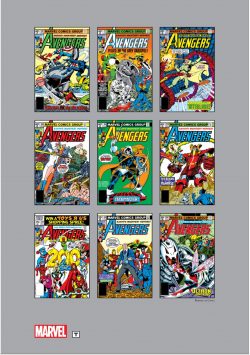
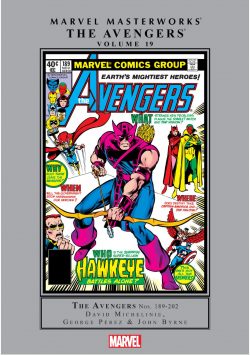
The Avengers Marvel Masterworks volume 19


By David Michelinie, Steven Grant, Roger Stern, Mark Gruenwald, Jim Shooter, Bob Layton, Tom DeFalco, John Byrne, George Pérez, Sal Buscema, Carmine Infantino, Arvell Jones, Ron Wilson, John Fuller, Dan Green, Ricardo Villamonte, Josef Rubinstein, Jack Abel, Gene Day, Mike Esposito, Brett Breeding, Joe Sinnott, Bruce Patterson & various (MARVEL)
ISBN: 978-1-3029-1637-4 (HB/Digital edition)

This book includes Discriminatory Content produced in less enlightened times.

The Avengers have always proved that putting all one’s star eggs in a single basket pays off big-time: even when all Marvel’s classic all-stars such as Thor, Captain America and Iron Man are absent, it merely allows the team’s lesser lights to shine more brightly. Of course, all founding stars were regularly featured due to the rotating, open door policy, which means that every issue includes somebody’s fave-rave – and the boldly grand-scale impressive stories and artwork are no hindrance either. With the team now global icons, let’s look again at the stories which form the foundation of that pre-eminence.

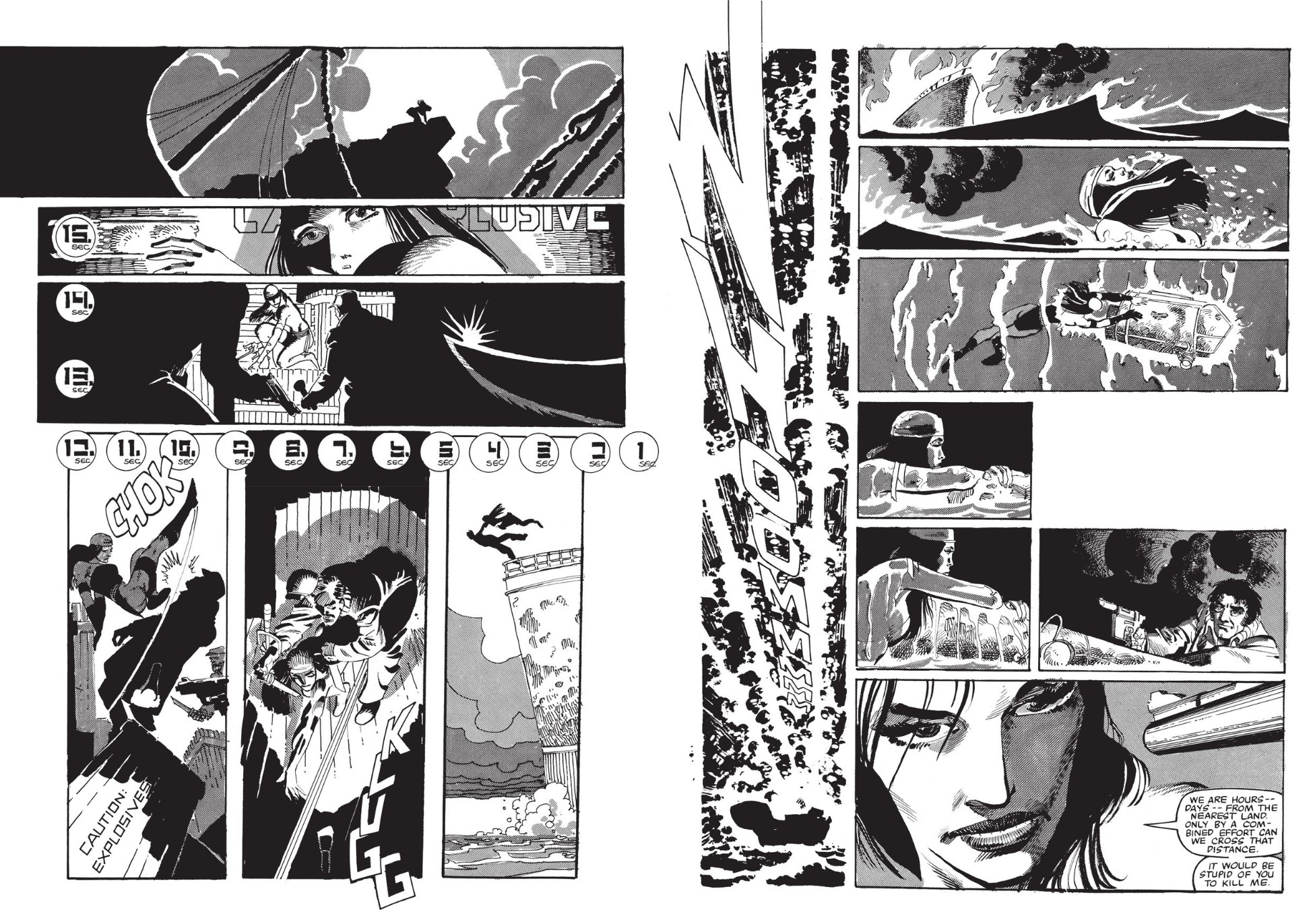
Re-presenting Avengers #189-202, plus a pertinent tale from Marvel Premier #55 (August 1980) and a lost snippet from Tales to Astonish (vol. 2 #12, November 1980) these sagas encompass cover-dates November 1979 to December 1980. Jim Shooter, having galvanised and steadied the company’s notional flagship moved on, leaving David Michelinie to impress his own ideas and personality upon the team,. However such transitions are always tricky and a few water-treading fill-ins were necessary before progress resumed. For behind the scenes details you can read of his recollections in his fascinating ‘Introduction by David Michelinie’ before diving in to the fabulous action and drama. Another Introduction by latterday editor Tom Brevoort can be found in the book’s Bonus Section, eulogising and appreciating the return of George Pérez to the Avengers before diving in to the fabulous action and drama…

Previously: After defeating the Absorbing Man, apparently resolving the convoluted origins of Quicksilver and the Scarlet Witch, inviting Ultron’s robot bride Jocasta into their midst, defeating vintage murder-mech enigma Arsenal and stopping world conquering sentient elements, the team were ready for a break but would be disappointed…

Avengers #189 reveals how deeply unhappy official reservist Hawkeye takes a day job at (corrupt and EVIL) tech company Cross Technological Enterprises and inadvertently begins his steady march to solo stardom. When the current administration began interfering in Avengers business intrusive and obsessive NSA Agent Henry Peter Gyrich laid down the law and winnowed the army of heroes down to a federally acceptable (and “manageable”) seven-and-a-spare: Captain America, Iron Man, Falcon, Scarlet Witch, Vision, Wasp, Beast and Ms. Marvel. Gyrich had spitefully rejected the in-your-face archer in favour of Falcon – who was parachuted in (against his own wishes!) to conform to government affirmative action quotas…

Feeling rejected by the team and definitely still persona non grata to the obnoxious pencil-pushing Government gadfly, Hawkeye goes corporate in ‘Wings and Arrows!’ (Steven Grant, John Byrne & Dan Green). It’s not too long before he’s earning every penny as the new security chief by battling alien avian interloper Deathbird of the Shi’ar…

As a terrifying horror from space crashes to Earth and rampages through Manhattan, the Avengers ae summoned to tribunal seeking to close down the group. However, with a monster in the streets, Beast sees a way to dent Gyrich’s credibility and win back Avengers autonomy in chilling monster-mash ‘Heart of Stone’. Despatched to stop the thing, their subsequent battle draws in scarlet swashbuckler Daredevil who helps expose an old enemy in disguise…

Scripted by Micheline, concluding chapter ‘Back to the Stone Age!’ sees the assemblage overwhelmed by petrifying space pirate The Grey Gargoyle and the Falcon prove his worth until the team can rally and render the marauder helpless, after which artists Arvell Jones & Ricardo Villagran limn #192’s ‘Steel City Nightmare!’ When former industrialist/inventor and occasional Avenger Simon Wonder Man Williams visits Detroit to finalise selling his old steel mill to Tony Stark, they uncover an old but lasting connection to Thor’s uru hammer and the site’s new covert status as a centre of organised crime activity. When a whistle-blower is murdered only to return as a rampaging vengeance-driven flame monster, the call goes out and the Avengers find ‘Battleground Pittsburgh!’ (illustrated by Sal Buscema & Green) to be almost more than they can handle.

Inked by Josef Rubinstein, George Pérez draws the Micheline-scripted ‘Interlude’ in #194, as roster changes saw the Scarlet Witch (briefly) and Falcon leave and Wonder Man return. With Jocasta destabilizing the Vision’s marriage, tensions are high but the later discovery that wannabe actor Simon Williams is moonlighting as a clown on children’s television takes off a lot of edges. Focus abruptly shifts when an apparent escaped mental patient circumvents Avengers security, breaks into the mansion and begs for help. Returned to his carers at the Solomon Institute, Selbe’s plight remains uppermost in Wasp’s thoughts. When she investigates the facility she exposes an horrific science abomination in progress before vanishing without trace…

New Ant-Man Scott Lang got his first dose of team action in Avengers #195 (May 1980) in Michelinie, Pérez, Jack Abel & Green’s ‘Assault on a Mind Cage!’ When his benefactor Hank Pym/Yellowjacket asks Lang to help infiltrate the suspect Solomon asylum he believes holds the Wasp hostage the miniature marvels uncover illegal cloning for spare parts and a murderous madman also capitalising on the facilities to profitably train better henchmen for major villains and mob bosses…

The climactic clash resulting from ‘The Terrible Toll of the Taskmaster’ (by Michelinie, Pérez & Abel) wrecks the joint but leaves former burglar and convict Lang one step closer to true redemption…
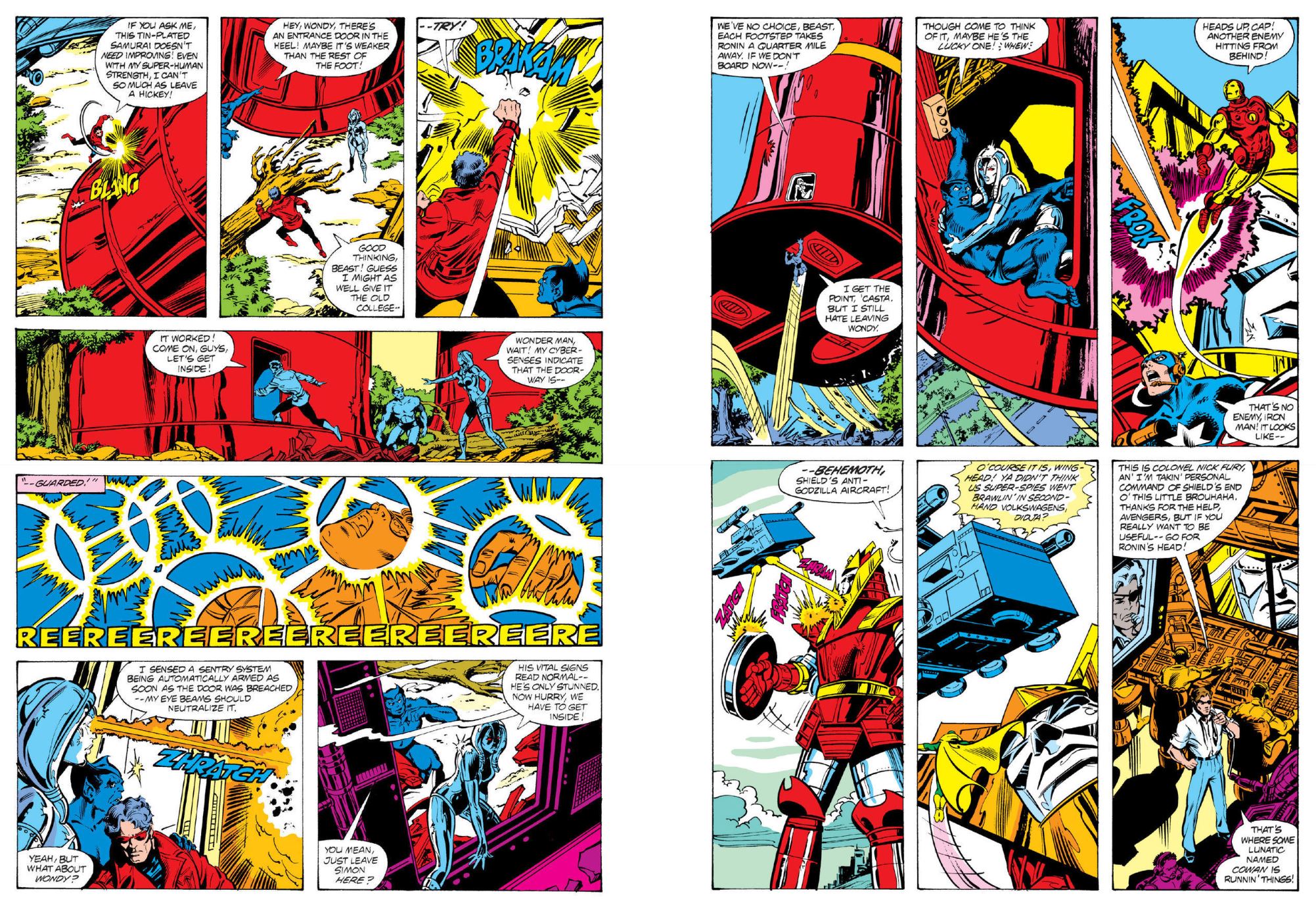
Cold War paranoia fuels Avengers #197’s ‘Prelude to the War-Devil!’ (illustrated by Carmine Infantino, Abel and a horde of helpers) wherein overwrought scientist Dr. Cowan absconds from Stark Detroit facilities inside a super-mecha warrior initially built to destroy the undisputed king of Kaiju (see Godzilla: The Original Marvel Years). Unable to stand the tension any longer, the boffin intends triggering WWIII and ending the anxiety of humankind once and for all, but must first face the deployed and increasingly desperate Avengers in ‘Better Red Than Ronin!’ (art by Pérez, Brett Breeding & Gene Day) and cataclysmic climax ‘Last Stand on Long Island’ (inked by Dan Green).

Away from the mounting carnage, a disturbing subplot played out as a strange, terrifyingly rapid transformation sees Carol Danvers (Ms, and these days Captain Marvel) impossibly pregnant and bringing an unknown baby with no father to term in a matter of days. Reaching out to the Scarlet Witch, the hasty decision is to call in the full resources of the Mighty Avengers…

The mystery is solved in bonanza anniversary issue #200 (October 1980 by plotters, Jim Shooter, Pérez & Bob Layton; scripter Michelinie, and artists Pérez & Green). In ‘The Child is Father To…?’ with almost the entire past roster on hand, the miracle baby is born without incident, but consequently hyper-rapidly matures as time goes wild around the city. With different eras overwriting the present, the unearthly boy begins building a machine to stabilise the chaos despite the profoundly suspicious heroes misunderstanding his motives. Marcus claims to be the son of time-master Immortus, seeking to escape eternal isolation in transdimensional Limbo by implanting his essence in a mortal tough enough to survive the energy required for the transfer.
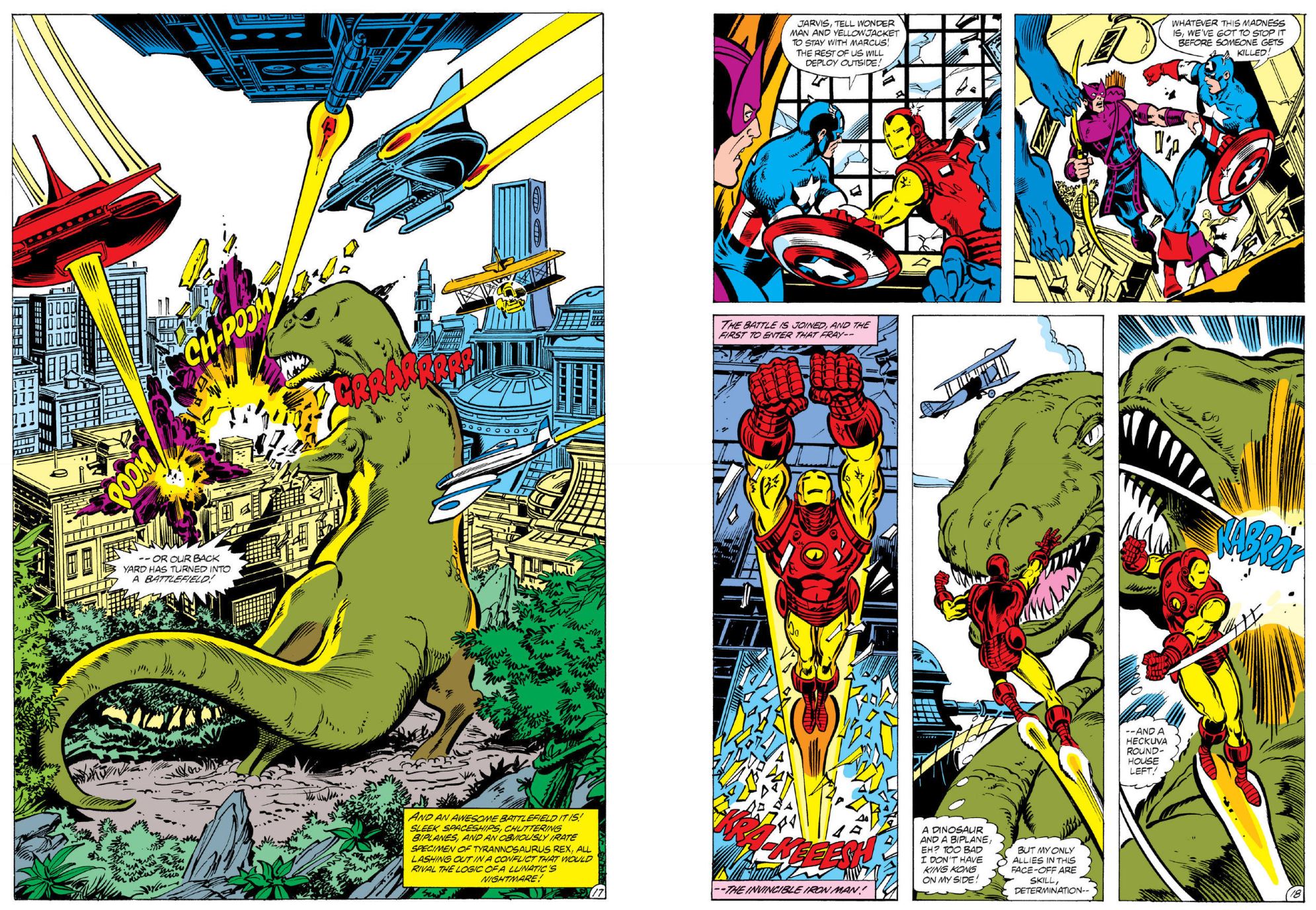
Literally reborn on Earth, his attempts to complete the process are foiled by the World’s Most Confused Heroes and he is tragically drawn back to his timeless realm. Carol, suddenly declaring her love for Marcus, unexpectedly goes with him. The heroes unquestioning acceptance of the result might well be the greatest failure and betrayal in Avengers history…

The clean-up begins in #201 where ‘The Evil Reborn’ sees Michelinie, Pérez & Green adapt a Jim Shooter short story as Tony Stark succumbs to previous, deep-buried hypnotic programming to reconstruct cybernetic conqueror Ultron…

The tale is cut short as back-up strip ‘Bully!’ by Michelinie, Roger Stern, Pérez & Day explores the off-duty life of butler Edwin Jarvis as he improves his home neighbourhood with a little human-scaled heroism and defiance in the face of insurmountable odds…

The Avenging escapades pause for now with bombastic brutal closing chapter ‘This Evil Undying’ (Micheline, Pérez & Mike Esposito) as the team (Captain America Thor, Wasp, Vision, Scarlet Witch, Hawkeye and Jocasta free Iron Man from the metal maniac’s domination and apparently end the threat forever…

Supplementing the main drama are a brace of contemporaneous tales beginning with the first Wonder Man solo saga, as published in Marvel Premiere #55 (August 1980). ‘A Force of Two!’ by Micheline, Layton, Ron Wilson & Joe Sinnott sees Simon Williams return to another of his old factories (in Brooklyn this time) to clean out the criminal trash who took over after his “death” and eventual resurrection as being of ionic energy. Even he isn’t quite enough to oust entrenched Maggia mobsters – and their lawyers – and requires a little offbeat assistance from an old pal who risks everything to atone…

Next comes a six-page vignette starring The Vision, created during a rookie initiative program in 1976 by Tom DeFalco, John Fuller & Bruce Patterson, ‘Double Vision’ sat in the inventory drawer until seen in Tales to Astonish (vol 2 #12, November 1980) and relates how the eerie android saves a diplomat and other caught in a plane hijacking…

With covers by Byrne, Pérez, Frank Miller, Dave Cockrum, Wilson, Sinnott, Green, Bob McLeod, Rubinstein and Terry Austin; original art pages from Byrne, Pérez, Green & Day; the Pérez/Tom Smith painted cover to Avengers Visionaries: George Pérez (1999) and the aforementioned Brevoort appreciation of the artist from that tome, this compelling collection is available in hardback and digital iterations, and a must-read moment of wonder every fan must see.
© 2019 MARVEL.

Today in 1877 Catalan comics creator and pioneer Tomàs Padró died, as did French surrealist cartoonist and multimedia maven Roland Topor in 1997. In 1934 Chilean Disney artist Vicar (Víctor José Arriagada Ríos) was born, as was arch-stylist Paul Rivoche (Mister X, Batman, Exile of the Aeons) in 1959.

On this date in 1990 The Times of India supplement Indrajal Comics published its last issue. Started in 1964 its 805 issues brought The Phantom, Flash Gordon, Mandrake, Garth, Rip Kirby, Phil Corrigan, Buz Sawyer, Mike Nomad, Kerry Drake, and others to millions of readers, and in 1976 debuted homegrown Indian hero Bahadur by Aabid Surti.
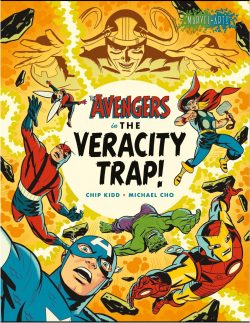
The Avengers in the Veracity Trap


By Chip Kidd & Michae Cho & various (Abrams Comic Arts/MARVEL Arts)
ISBN: 978-1-4197-7067-8 (HB) eISBN: 979-8-88707-137-4

Jacob Kurtzberg (AKA Jack Curtiss, Curt Davis, Lance Kirby, Ted Grey, Charles Nicholas, Fred Sande, Teddy, “The King” and others) did lots of stuff but most significantly inspired millions if not billions of people by drawing his ideas. This book is one of the most engaging examples of how that process has become self-sustaining…

After a period of meteoric expansion, in 1963 the blossoming Marvel Universe was finally ready to emulate the key DC concept that had cemented the legitimacy of the Silver Age of American comics. The notion of putting a bunch of all-star eggs in one basket had made the Justice League of America an instant winner and subsequently inspired the moribund Atlas outfit – primarily Stan Lee, Jack Kirby & Steve Ditko – to conceive “super-characters” of their own. The initial result, in 1961, was The Fantastic Four

After 18 rollercoaster months, the fledgling House of Ideas had generated a small but popular stable of costumed leading men (but still only 2 sidekick women!), allowing Lee & Kirby to at last assemble a select handful of them into an cross-branding squad, moulded into a force for justice and soaring sales.

Seldom has it ever been done with such style and sheer exuberance. Cover dated September 1963, The Avengers #1 launched as part of an expansion package which also included Sgt. Fury and his Howling Commandos and The X-Men: all glorying in the full, unfettered  force of imagination unleashed. Each change-packed revolutionary issue by Kirby, Lee and their confederates stirred a pot filled with hyperdynamic characters and layers of compelling world-building.

For the Avengers it had all started in Asgard, where immortal trickster Loki was imprisoned, hungry for vengeance on his noble half-brother Thor. Malevolently observing Earth, the vile divinity had espied the monstrous, misunderstood Hulk and mystically engineered a situation whereby the man-brute seemingly went wild, all with the intention of having the Thunder God fight the monster. When Hulk’s teen sidekick Rick Jones called the FF for help, devious Loki had scrambled and diverted the transmission and awaited the carnage that must follow.

Sadly for the schemer, Iron Man, Ant-Man and The Wasp also caught the redirected SOS. As heroes converged to search for the Jade Giant, they realised something was amiss, leading led their first assembled assault on Loki. It was the beginning of a legend and over the next seven issues (plus guest shots in other titles!) it sparked heroes coming and going, and villains without peer setting new standards for wickedness…
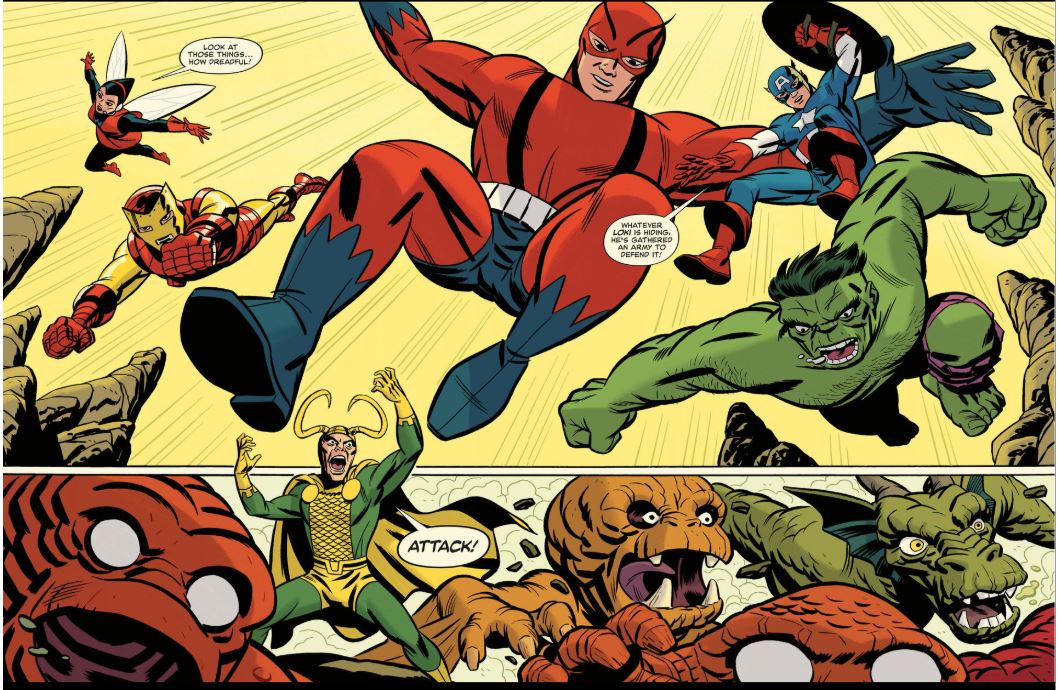
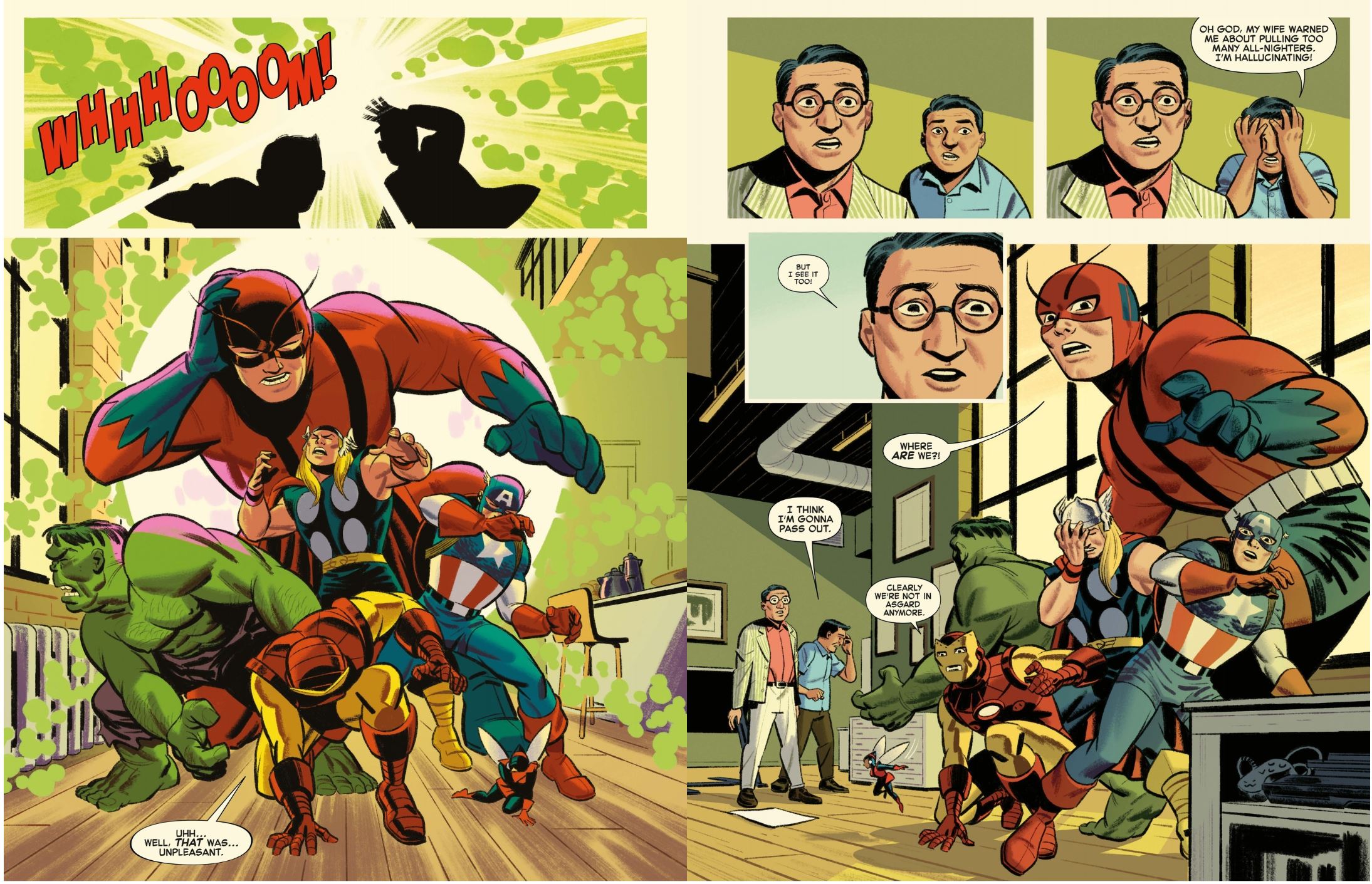
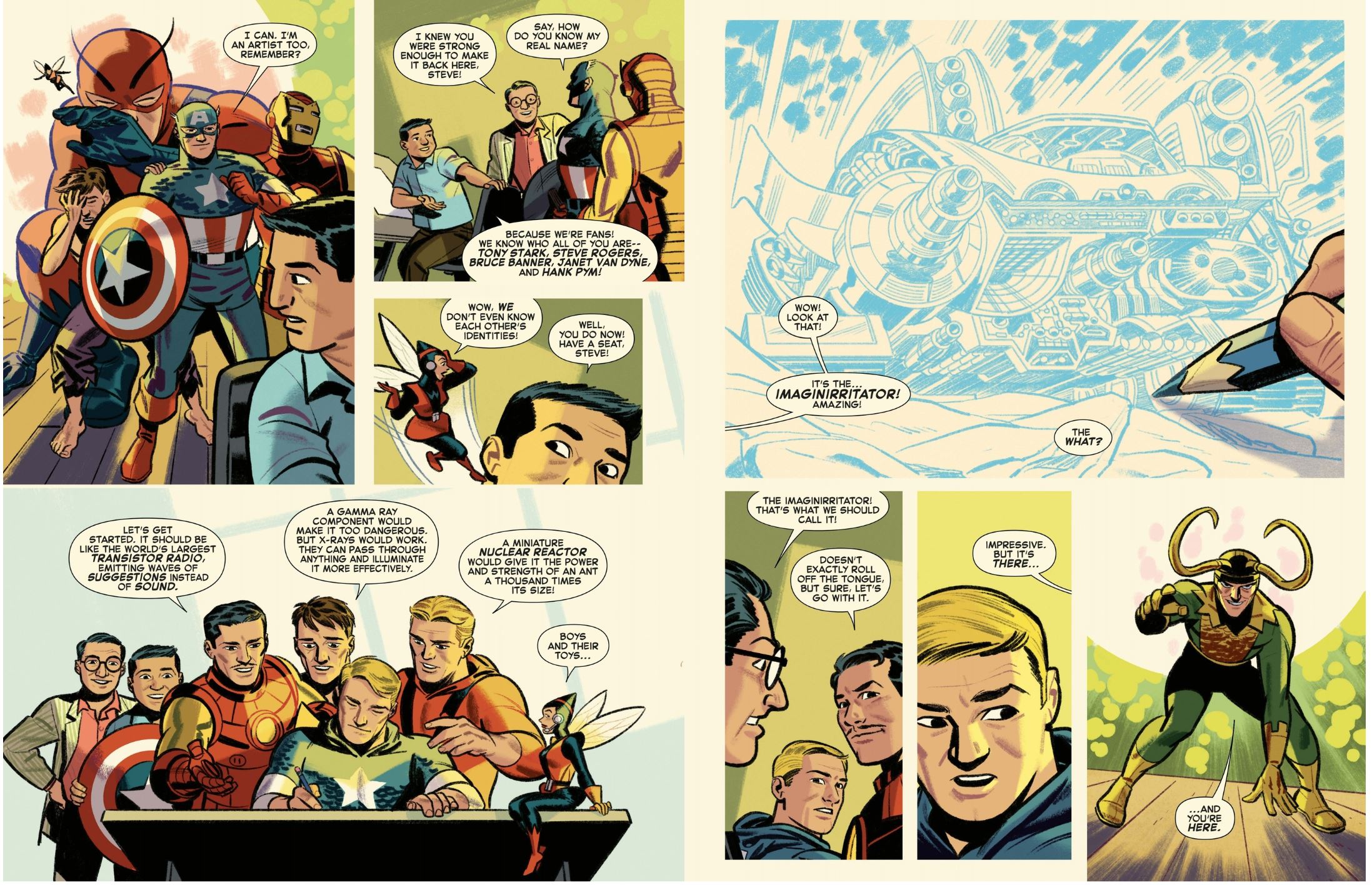
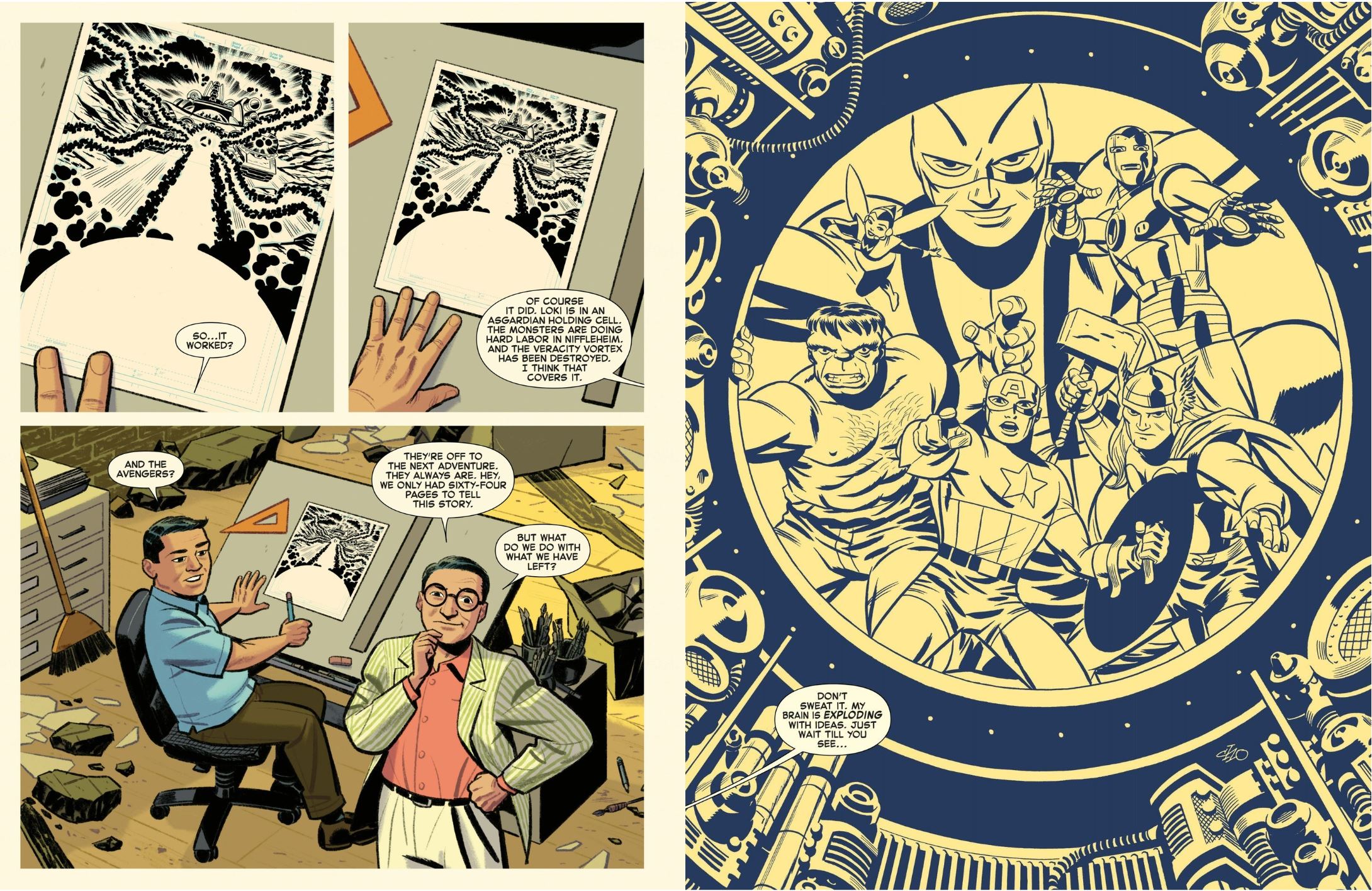
That primordial period of Kirby-limned luminal ideas and escalating inspirational influences is a mini halcyon era: one potently, evocatively addressed and revered in this very special project from two iconic modern award-winners and devout comics lovers. With their “Veracity Trap” designer/author/historian Chip Kidd (Batman: Death by Design, Jack Cole and Plastic Man, The Cheese Monkeys) and designer/author/illustrator Michael Cho (Papercut, Shoplifter, hundreds of DC and Marvel covers) cheerfully knock down all the fourth walls and puckishly inject themselves into the medium and their message to deliver a compelling pastiche of all that too-brief Kirby-spawned early Avengers wonderment.
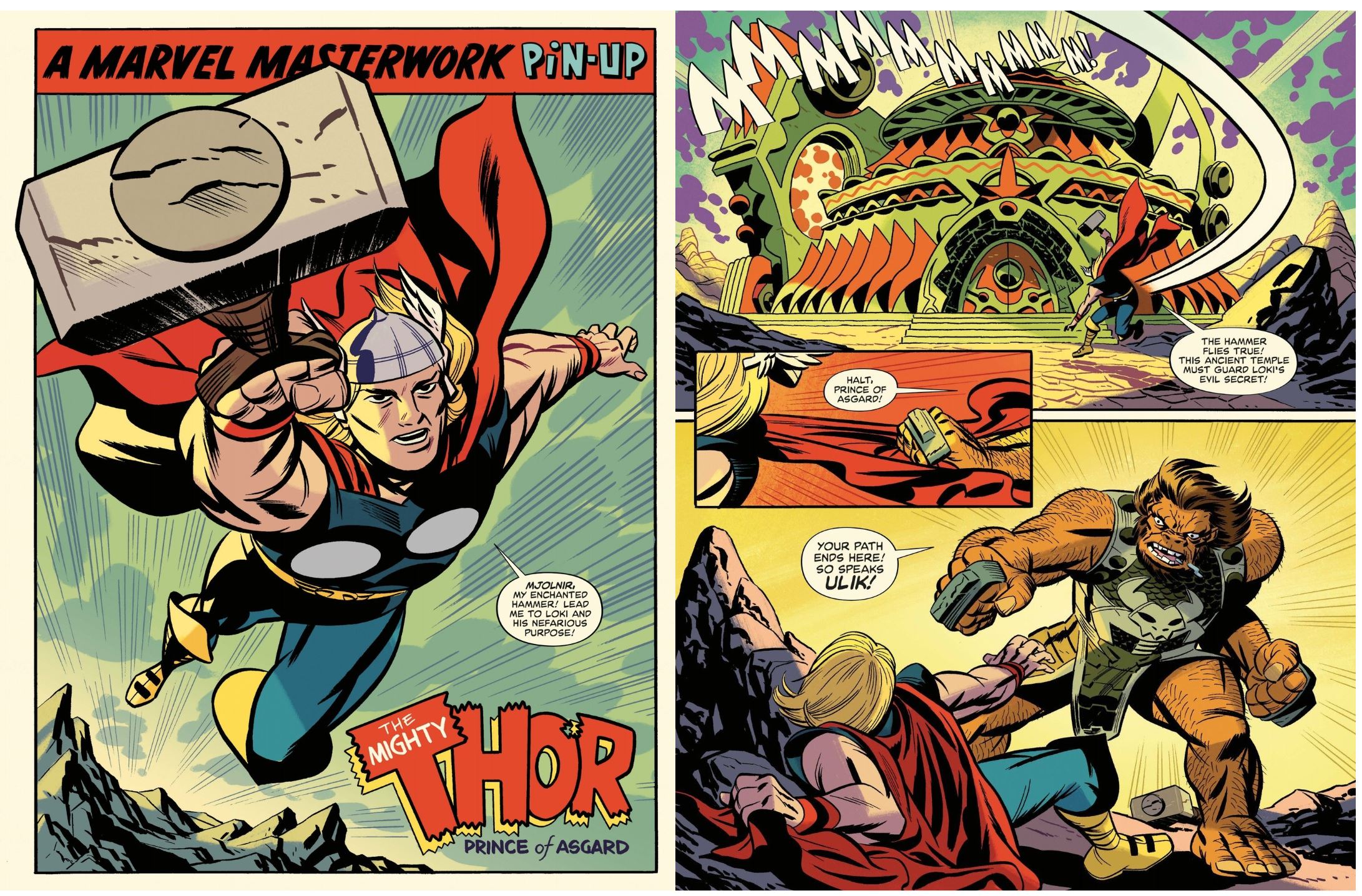
Suitably packed with stirring tribute moments from eye-bending wonder-machines to stellar landscapes, and packed to the scaly oversized gills with charmingly monstrous “Kirby-Kritters” aiding and abetting the heroes and villains, this rocket-paced epic sees a team that never quite was – Thor, Iron Man, Giant-Man, The Wasp, Captain America and The Hulk – unite to battle Loki once more, only to be booby-trapped and portentously propelled beyond their home universe into a Greater (albeit still Four-Colour) Reality where godlike cartoonists and pen-pushers casually dictate their fates… until the malevolently malign God of Mischief usurps their elevated position and endangers all layers of existence!

Co-produced by Marvel and Abrams ComicArts, The Avengers in the Veracity Trap is a gleefully witty homage sampling and extrapolating upon all those beloved graphic and narrative landmarks and milestones of early Marvel – even incorporating pages of ‘Mighty Mavel Pin-ups!’ – and sending waves of crushing nostalgia through those of us who were there and curious neophytes alike…

Although this hark-back to halcyon days is literally all about the visual verve, fanboys like me can also be assured that continuity and characterisation are also faithful extrapolations – albeit with the painful Sixties gender stereotyping given a thorough going over – of what has gone before, augmenting a spectacular paean of praise and wishful thinking to those gone but never forgotten glory days…
© 2025 MARVEL.

A date for firebrands and iconoclasts, today in 1925 conspiracy-theorist/ judgemental Christian fundamentalist comics creator Jack Chick was born, as was award-winning French satirist and bane of conservatism Jean-Marc Reiser (Hara-Kiri, Charlie Hebdo) in 1941. Less controversially we also welcomed Argentine comics artist Ricardo Villagran (Tarzan, Evangeline) in 1938, and in 1987 said farewell to mighty Joe Colquhoun (Paddy Payne; Roy of the Rovers; Saber, King of the Jungle; Football Family Robinson; Soldier Sharp, the Rat of the Rifles; Kid Chameleon, Adam Eterno; Charley’s War et al). In 2005 Italo-Argentine art ace Juan Zanotto (War Man, Henga, Bárbara, Falka) died too.

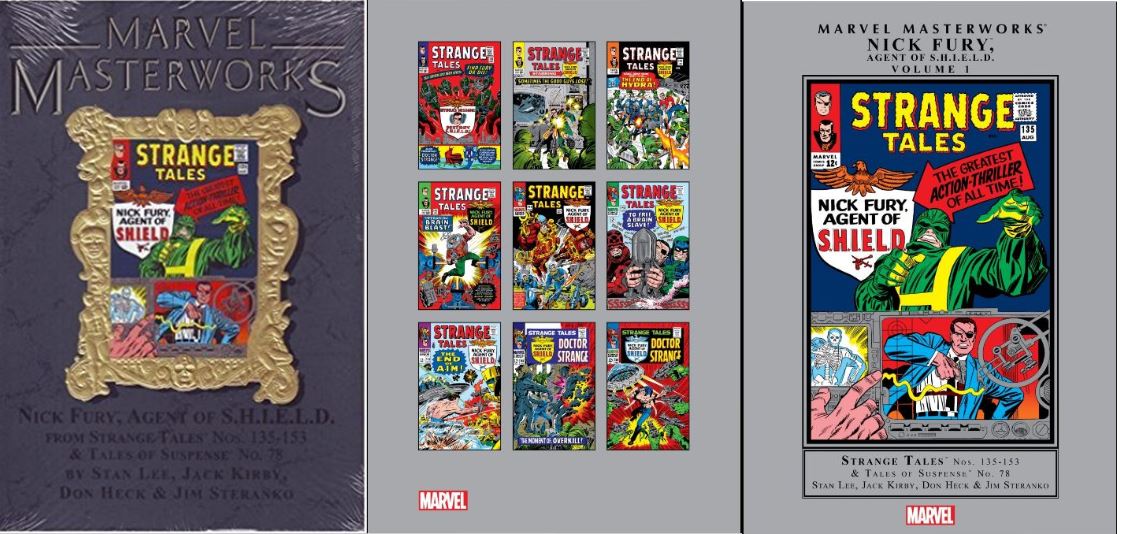
Nick Fury, Agent of S.H.I.E.L.D. Marvel Masterworks volume 1


By Stan Lee, Jack Kirby, Dennis O’Neil, Roy Thomas, John Severin, Joe Sinnott, Don Heck, Howard Purcell, Ogden Whitney, John Buscema, Joe Sinnott, Frank Giacoia, Mike Esposito, Jim Steranko & various (Marvel)
ISBN: 978-0-7851-2686-7 (HB)

This book includes Discriminatory Content produced in less enlightened times.

Veteran war-hero and superspy Nick Fury debuted in Fantastic Four #21 (cover-dated December 1963): a grizzled, world-weary and cunning (but innately Good) CIA Colonel at the periphery of the really big adventures in a fast-changing world.

What was odd about that? Well, the gruff, crudely capable combat everyman was already the star of the reemergent publisher’s only war comic, set twenty years earlier in – depending on whether you were American or European – the beginning or middle of World War II. Sgt. Fury and his Howling Commandos was an improbable, decidedly over-the-top and raucous combat comics series, similar in tone to later movies such as The Wild Bunch or The Dirty Dozen and had launched in May of that year.

Nevertheless, Fury’s latterday self became a big-name star as espionage yarns continued guiding a global zeitgeist in the wake of popular TV sensations like Danger Man and The Man From U.N.C.L.E. and Bond movies (and many imitators) so the contemporary iteration was granted a second series. It began in Strange Tales #135 (cover-dated August 1965).

Nick Fury, Agent of S.H.I.E.L.D. combined Cold War tensions with sinister schemes of World Conquest by a subversive, all-encompassing, hidden enemy organisation. The ever-unfolding saga came with captivating Kirby-designed super-science gadgetry and – eventually – iconic, game-changing imagineering from Jim Steranko, whose visually groundbreaking graphic narratives took the comics art form to a whole new level…

For those few brief years with Steranko in charge, the S.H.I.E.L.D. series was one of the best strips in America (if not the world) but when the writer/artist left just as the global spy-fad was giving way to supernatural mystery and horror stories, the whole concept faded into the fundamental background architecture of the Marvel Universe…

This astounding full-colour compendium (available in hardcover and digital editions) deals with the outrageous, groundbreaking, but still notionally wedded-to-mundane-reality iteration which set the scene.

Here Jack Kirby’s genius for graphic wizardry and gift for dramatic staging mixed with Stan Lee’s manic melodrama to create a tough and tense series which the new writers and veteran artists that followed turned into a non-stop riot of action and suspense, with Steranko’s late arrival only hinting at the magic to come…

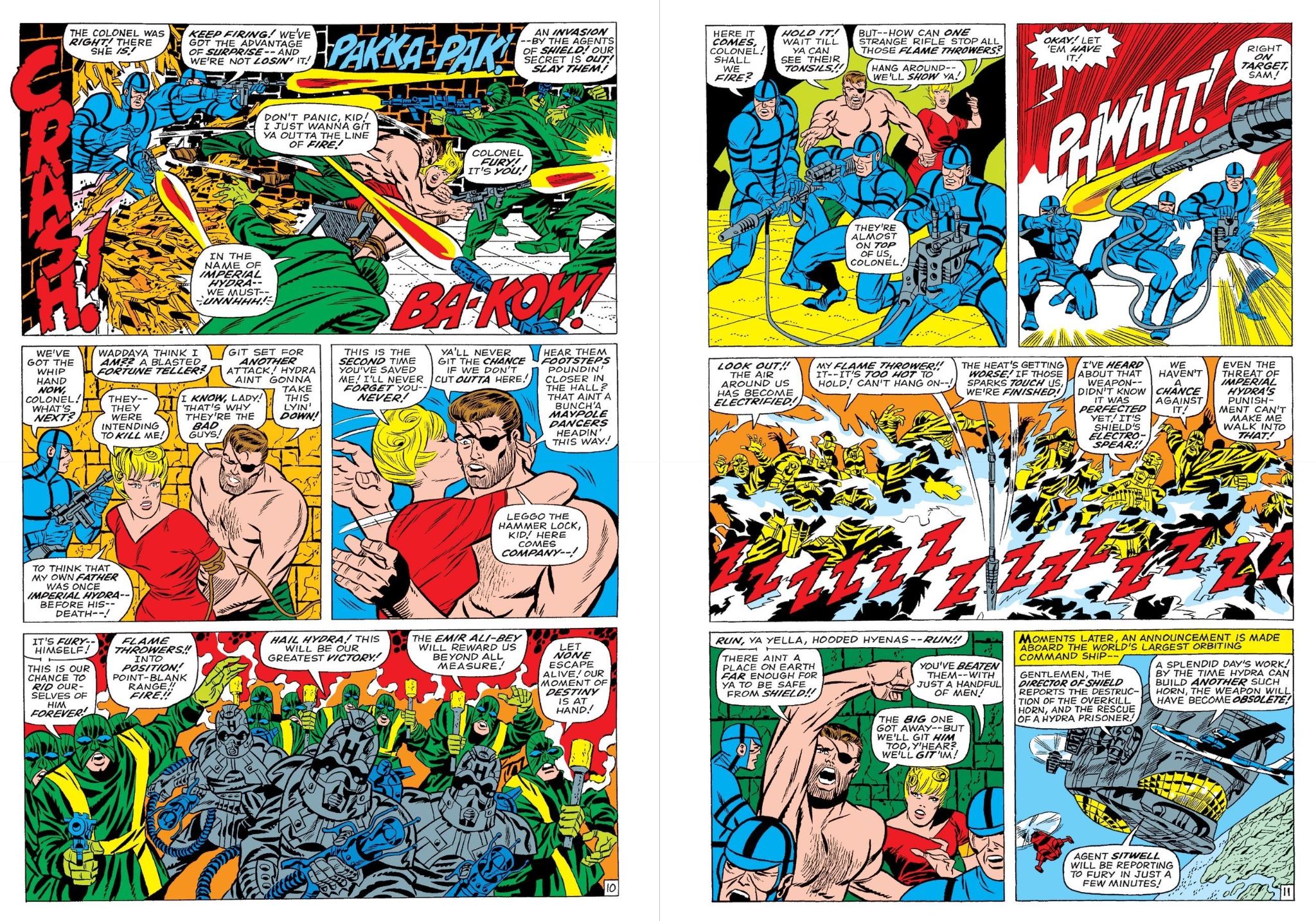
These epic early days of spycraft encompass Strange Tales #135-153 and Tales of Suspense #78, collectively covering August 1965 – February 1967 and guaranteeing timeless thrills for lovers of adventure and intrigue. Following a history lesson from Kirby scholar John Morrow in his Introduction, the main event starts in at full pelt in ST #135 as the Human Torch solo feature was summarily replaced by Nick Fury, Agent of S.H.I.E.L.D. (which back then stood for Supreme Headquarters International Espionage Law-enforcement Division). In the rocket-paced first episode, Fury is asked to volunteer for the most dangerous job in the world: leading a new counter-intelligence agency dedicated to stopping secretive subversive super-science organisation Hydra. With assassins dogging his every move, the Take-Charge Guy with the Can-Do Attitude quickly proves he is ‘The Man for the Job!’ in a potent 12-page thriller from Lee, Kirby and inker Dick Ayers.

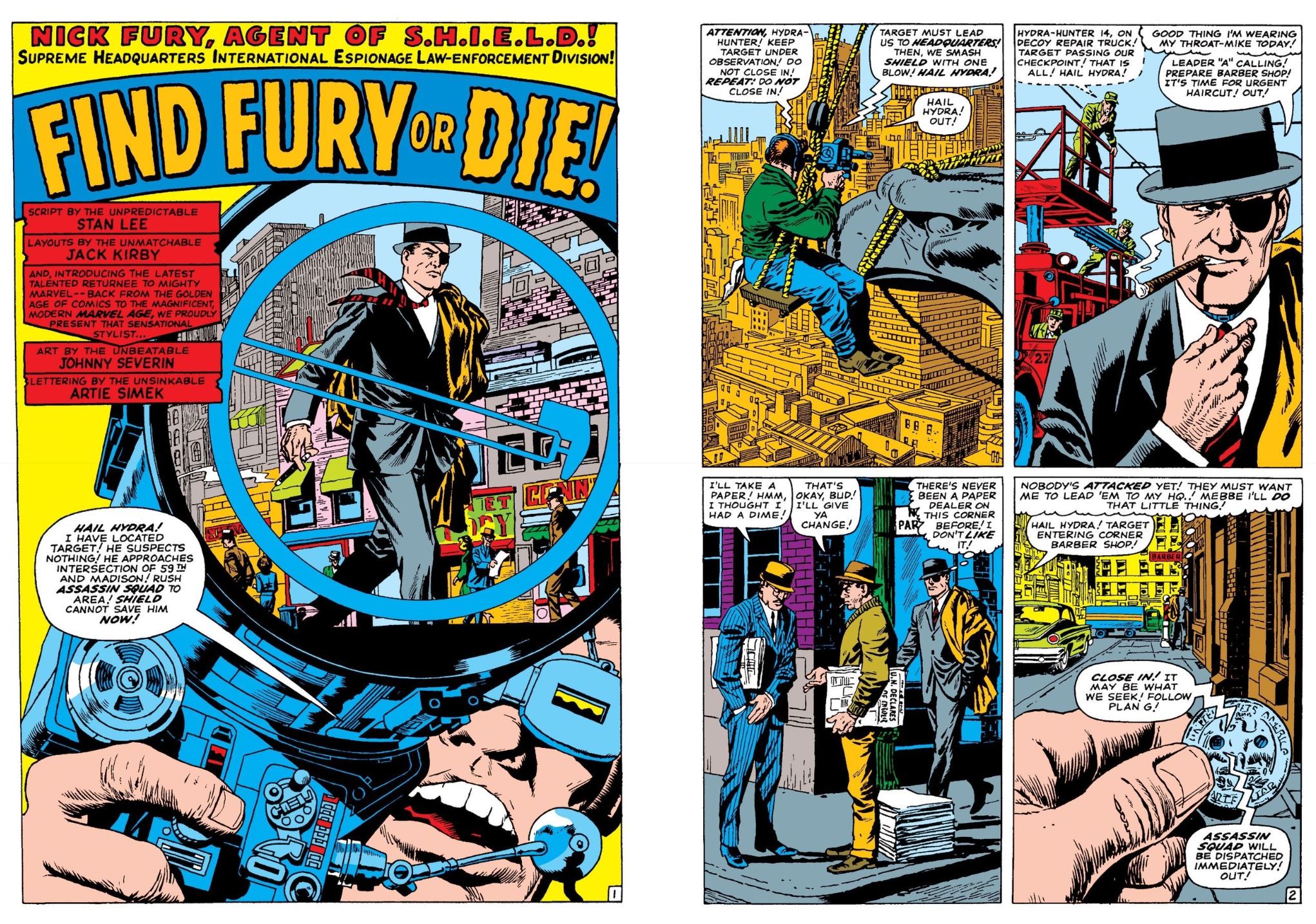
Even an artist and plotter of Kirby’s calibre couldn’t handle another strip at that busiest of times, so from the next issue “The King” cut back to laying out episodes, allowing a variety of superb draughtsmen to flesh out the adventures. Happily, however, there’s probably a stunning invention or cool concept on almost every page that follows so the Kirby Touch was fully upon the unfolding suspense and intrigue. ‘Find Fury or Die!’ brought veteran draughtsman John Severin back to the company that used to be Atlas. He pencilled and inked Jack’s blueprints as – aided and abetted by full-on patriotic weaponsmith Tony Stark – the new Director of the latest spy-agency becomes the target of incessant assassination attempts as we meet mysterious masked maniac the Supreme Hydra

The tension ramps up for the next instalment as a number of contenders are introduced – any of whom might be the obscured overlord of evil – even as S.H.I.E.L.D. strives mightily but fails to stop Hydra launching its deadly Betatron Bomb in ‘The Prize is… Earth!’ Despite the restrictions of the Comics Code, these early S.H.I.E.L.D. stories were bleakly grim and frequently carried a heavy body count. Four valiant agents died in quick succession in #137 and the next issue underscored the point in ‘Sometimes the Good Guys Lose!’, with further revelations of Hydra’s inner workings.

Fury and fellow WWII era Howling Commando stalwarts Dum-Dum Dugan and Gabe Jones meanwhile played catch-up after Hydra assassins invade S.H.I.E.L.D., almost eliminating Fury and Stark – the only man capable of destroying an atomic sword of Damocles hanging over the world. Although Fury saves the munitions genius, he is captured in the process…

Tortured by Hydra in #139’s ‘The Brave Die Hard!’ (with Joe Sinnott replacing Severin as finisher), Fury latches on to an unlikely ally in Laura Brown, the Supreme Hydra’s daughter and a young woman bitterly opposed to her father’s megalomaniacal madness. Even with only half a comic book per month to tell a tale, creators didn’t hang around in those halcyon days, and #140 promised ‘The End of Hydra!’ (Don Heck & Sinnott over Kirby) as a S.H.I.E.L.D. squad invades the enemy’s inner sanctum to rescue the already-free-&-making-mayhem Fury. In the meantime, Stark travels into space to remove the orbiting Betatron Bomb with his robotic Braino-Saur system. The end result leaves Hydra temporarily headless…

Strange Tales #141 sees Kirby return to full pencils (inked by pseudonymous Frank Giacoia, moonlighting as Frank Ray) for the mop-up, prior to ‘Operation: Brain Blast!’ introducing Mentallo – a mutant and career criminal renegade from S.H.I.E.L.D.’s ESP division. He joins technological savant The Fixer to assail the organisation as their first step in an ambitious scheme to rule Earth. The momentous raid begins in ‘Who Strikes at… S.H.I.E.L.D.?’ (illustrated by Kirby & Mike Demeo – AKA Mike Esposito) with the ruthless rogues hitting hard and fast: seizing and mind-controlling Fury before strapping him to a mini H-bomb. With Howard Purcell & Esposito embellishing Kirby’s layouts, Dum-Dum and the boys come blasting in ‘To Free a Brain Slave’ in #143. A new and deadly threat emerges in #144’s ‘The Day of the Druid!’ as a mystic-seeming charlatan targets Fury and his agents with murderous flying techno-ovoids. Happily, new S.H.I.E.L.D. recruit Jasper Sitwell is on hand to augment the triumphant fightback in ‘Lo! The Eggs Shall Hatch!’ (finished by Heck & Esposito).

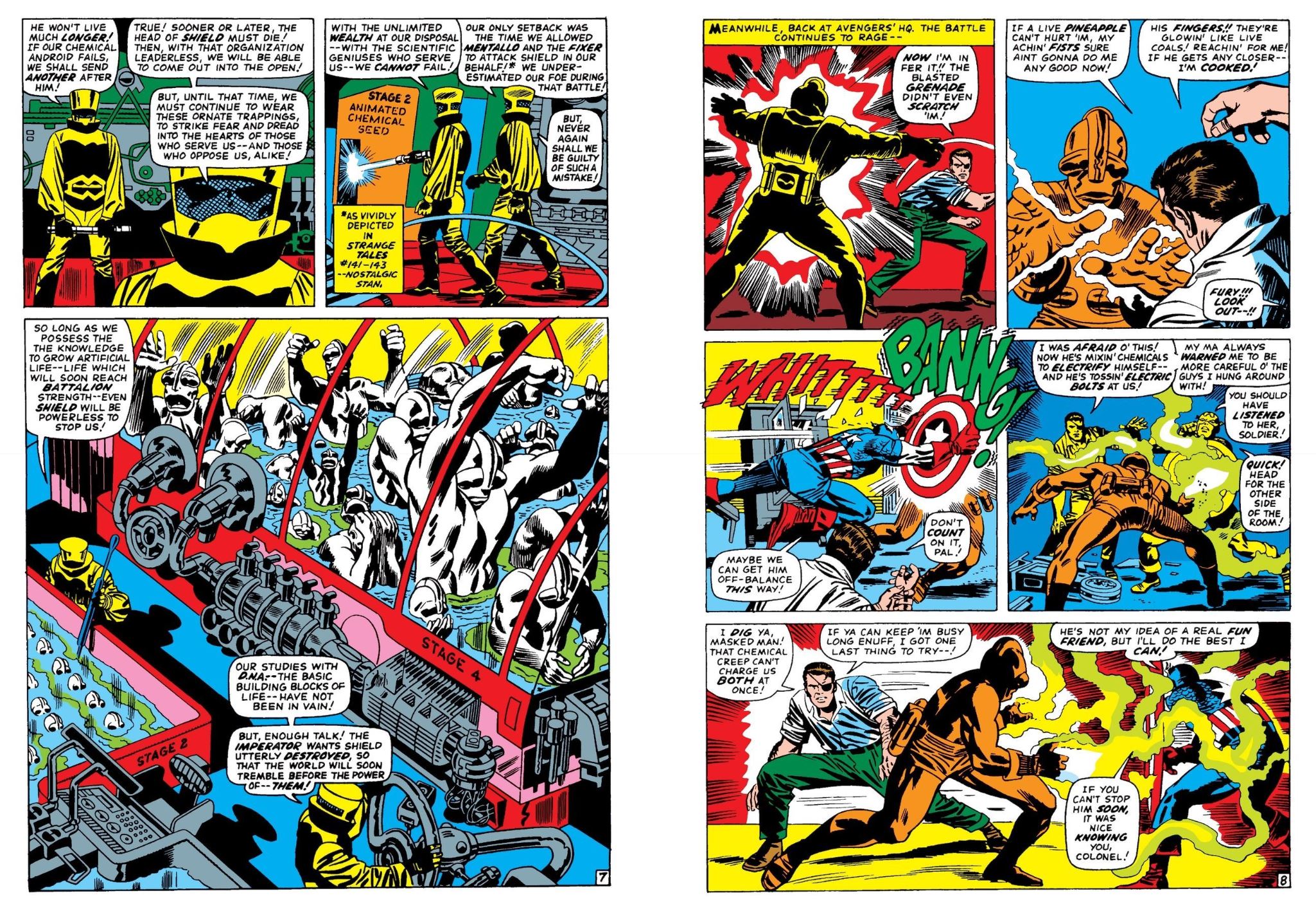
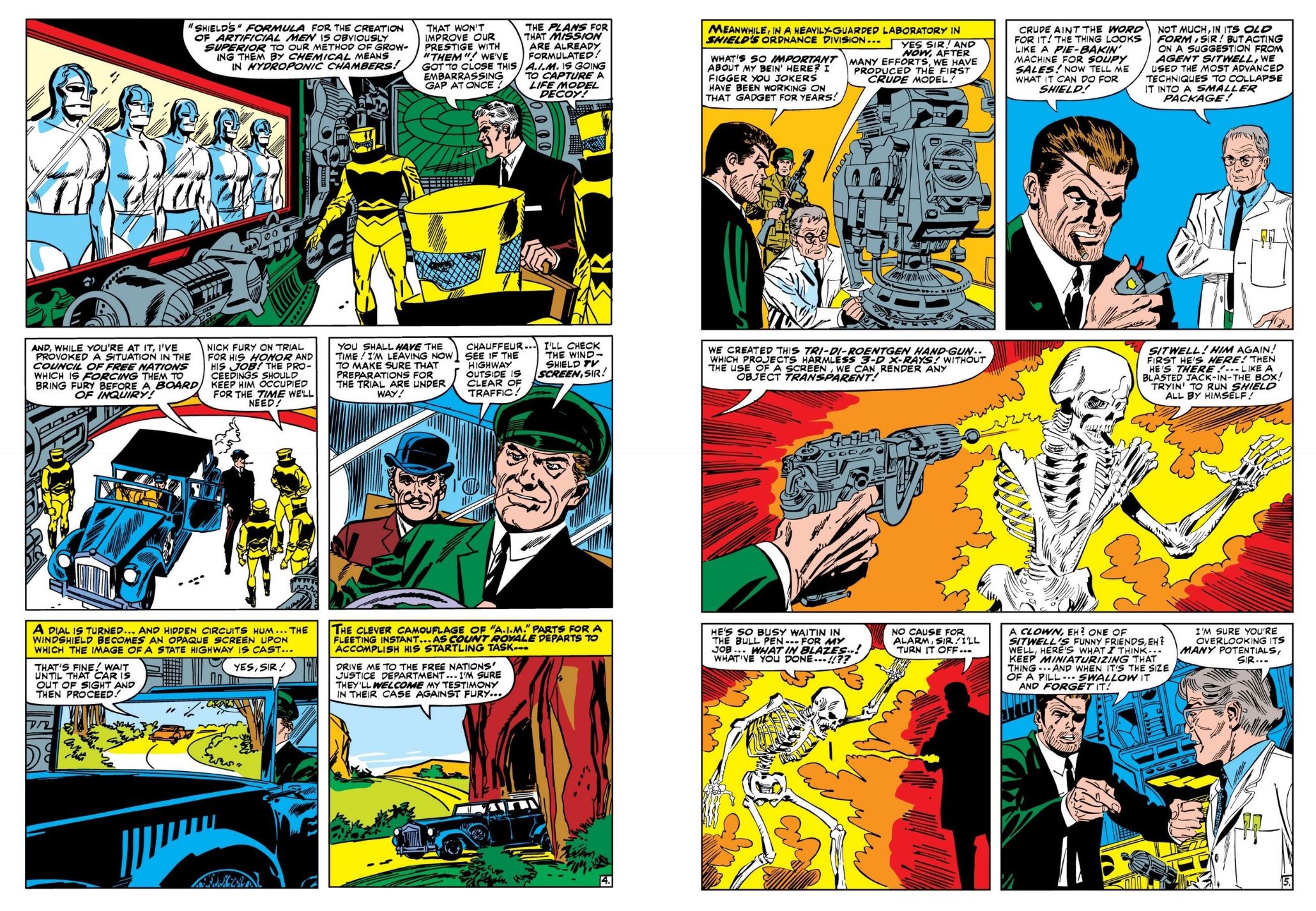
As Marvel continuity grew evermore interlinked, ‘Them!’ details a Captain America team-up for Fury in the first of the Star-Spangled Avenger’s many adventures as a (more-or-less) Agent of S.H.I.E.L.D. Taken from Tales of Suspense #78 (June 1966): scripted by Lee with Kirby on full pencils and Giacoia inking, the story depicts the WWII wonders battling an artificial assassin with incredible chemical capabilities, after which Nick seeks the creature’s mysterious makers in ST #146, ‘When the Unliving Strike!’(Kirby, Heck & Esposito).

Proclaiming themselves a technological Special Interests group, Advanced Idea Mechanics courts S.H.I.E.L.D.’s governmental and military masters (and contracts), promising potent and incredible new weapons if only they would sack that barbaric slob Fury. However, the surly supremo is getting close to exposing A.I.M.’s connection to “Them” …and an old enemy thought long gone.

A concerted whispering campaign and briefing-against seemingly sees Fury ousted in ‘The Enemy Within!’, before being put on trial in ‘Death Before Dishonor!’ (scripted by Kirby with Heck & Esposito finishing his layouts), but it’s all part of a cunning counterplan which delivers a shattering conclusion and ‘The End of A.I.M.!’ (ST #149, dialogued by Denny O’Neil with art by Kirby & Ogden Whitney). Then, revealed by Lee, Kirby, John Buscema & Giacoia, a malign, devilishly subtle plan is finally exposed in Strange Tales #150 as Fury’s team compares clues from all the year’s past clashes to come to one terrifying conclusion… ‘Hydra Lives!’

The shocking secret also hints at great events to come as newcomer Steranko assumes the finisher’s role over Lee & Kirby for ‘Overkill!’ with Fury targeted by the new – true – Supreme Hydra who devises a cunning scheme to infiltrate America’s top security agency and use his enemy as the means of triggering global Armageddon…

Although the Good Guys seemingly thwart that scheme, ‘The Power of S.H.I.E.L.D.!’ is actually helpless to discern the villain’s real intent as this initial dossier of doom pauses on a cliffhanger after ‘The Hiding Place!’ (ST #153, scripted by Roy Thomas) closes with the archvillain comfortably ensconced in Fury’s inner circle and ready to destroy the organisation from within.

To Be Continued…

Although the S.H.I.E.L.D. saga stops here, there’s an added bonus still to enjoy: the aforementioned FF #21. This depicted Fury as a wily CIA agent seeking the team’s aid against a sinister demagogue ‘The Hate-Monger’ (Lee & Kirby, inked by George Roussos, under protective nom-de-plume George Bell) just as the 1960s espionage vogue was taking off. Here Fury craftily manipulates Marvel’s First Family into invading a sovereign nation reeling in the throes of revolution in a yarn crackling with tension and action…

Fast, furious and fantastically entertaining, these high-octane vintage yarns from a time when the US were global Good Guys and “World Police” are a superb snapshot of early Marvel Comics at their creative peak and should be part of every fanboy’s shelf of beloved favourites.

Don’t Yield! Back S.H.I.E.L.D.!

© 1965, 1966, 1967, 2018 Marvel Characters, Inc. All rights reserved.

Today in 1907, Belgian artist Jacques Laudy (Le Journal de Tintin) was born, as was occasional Green Lantern scripter Henry Kuttner in 1915 and Canadian cartoonist Jacques Boivin (Melody) in 1952. In 2007, B,C. creator Johnny Hart died.

Today in 1935 Dr. Seuss launched his short lived but influential strip Hejji and, in 1992, Art Spiegelman received a Special Pulitzer Prize for Maus.

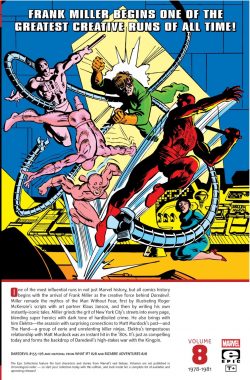
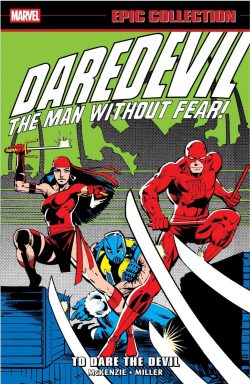
Daredevil Epic Collection volume 8: To Dare the Devil (1978-1981)


By Roger McKenzie, Frank Miller, David Micheline, Jo Duffy, Michael Fleischer, Mike W. Barr, Frank Robbins, Gene Colan, Steve Ditko, Klaus Janson, Frank Springer, Josef Rubinstein & various (MARVEL)
ISBN: 978-1-3029-60537 (TPB/Digital edition)

This book contains Discriminatory Content included for dramatic effect.

Matt Murdock is a blind lawyer whose remaining senses hyper-compensate, making him an astonishing acrobat, formidable fighter and living lie-detector. He also developed a kind of biological radar, granting him complete awareness of his immediate environment. A second-string hero for much of his early career, Daredevil was nonetheless a striking and popular one, due mostly to the captivatingly humanistic art of Gene Colan. DD fought gangsters, super-villains and even the occasional monster or alien invasion, quipping his way through life and life-threatening combat, utterly unlike the grim, moody, quasi-religious metaphor of justice and retribution that he became.

Under the auspices of Jim Shooter, Roger McKenzie and finally Frank Miller & Klaus Janson, the character transformed into a grimly modern figure, but here we find him navigating choppy relationship waters. After a disastrous on-again, off-again relationship with his secretary Karen Page, Murdock took up with Russian émigré Natasha Romanoff, infamous and notorious former soviet spy Black Widow, but their similarities and incompatibilities led to her leaving and Matt taking up with flighty, fun-loving trouble-magnet heiress Heather Glenn

Spanning cover-dates November 1978 to October 1981, this crucial compilation comprises relevant material from Daredevil #155-176, plus spin-off material generated for a readership that simply could not get enough of their newly darkened avenging devil and his secret paramour, as first seen in What If? #28 & Bizarre Adventures #28. The visual tumult and tension begin sans any delay or debate…

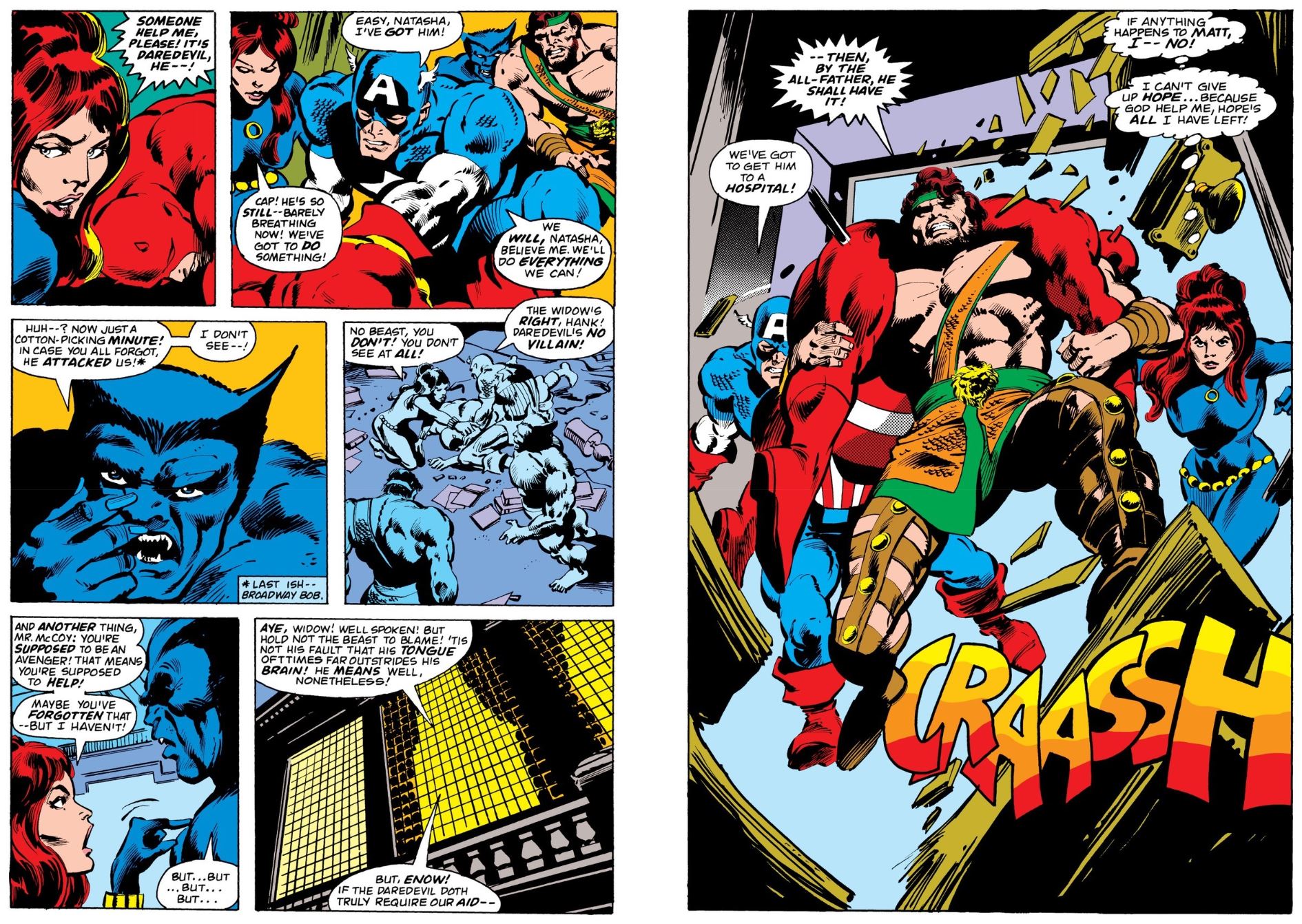
Heroic endeavours resume with writer Roger McKenzie describing the repercussions of a massive ambush on the hero by his worst enemies. Guest-starring Black Widow, Hercules and The Avengers, aftermath episode ‘The Man Without Fear?’ is illustrated by Frank Robbins & Frank Springer, wherein a brain-damaged Murdock repeatedly attacks innocent bystanders and his allies before collapsing. Keenly observing, macabre mystery menace Death-Stalker spots an opportunity and follows the hospitalised hero into #156’s ‘Ring of Death!’ (McKenzie, Colan & Klaus Janson). As DD undergoes surgery and suffers deadly delusions of fighting himself, the teleporting terror with a death-touch seeks to end the scarlet swashbuckler’s meddling forever, but finds the Avengers almost too much to handle…

The assault ends in DD #157’s ‘The Ungrateful Dead’, with Mary Jo Duffy scripting from McKenzie’s plot. Now, after frustrating the vanishing villain, Matt is cruelly kidnapped by a new squad of the Ani-Men (Ape-Man, Cat-Man & Bird-Man) all leading to Miller’s debut as penciller in #158’s ‘A Grave Mistake!’ With McKenzie writing and Janson inking, all plot threads regarding Death-Stalker spectacularly conclude as the monster gloatingly shares his true origins and reasons for haunting the Sightless Swashbuckler for so long. As always, Villain underestimates Hero and the stunning final fight in a graveyard became one of the most iconic duels in superhero history…

From this point on, Daredevil was increasingly repositioned as an outcast urban defender and compulsive vengeance-taker: a tortured demon dipped in blood. The character makeover was carried on initially by McKenzie from his predecessor Jim Shooter, and fully manifested in collaboration with Miller until the latter fully took control to deliver audacious, shocking, groundbreakingly compelling dark delights, making Daredevil one of comics’ most momentous, unmissable, “must-read” series.

That revitalisation resumes with ‘Marked for Murder!’ (McKenzie, Miller & Janson) wherein infallible assassin-broker Eric Slaughter comes out of retirement for a very special hit on the hero of Hell’s Kitchen. Meanwhile elsewhere, veteran Daily Bugle reporter Ben Urich works a nagging hunch: slowly piecing together dusty news snippets that indicate a certain sight-impaired attorney might be far more than he seems……

The spectacular showdown between the Crimson Crimebuster and Slaughter’s hit-man army inevitably compels his covert client to eventually do his own dirty work: brutally ambushing and abducting former flame Natasha Romanoff, aka The Black Widow…

After a single-page fact-feature on ‘Daredevil’s Billy Club!’, the saga continues in #160 with our hero having no choice but to place himself ‘In the Hands of Bullseye!’ – a stratagem culminating in a devastating duel and shocking defeat for the villain in cataclysmic conclusion ‘To Dare the Devil!’

Next issue offered a fill-in tale by Michael Fleisher & Steve Ditko wherein another radiation accident impairs our hero’s abilities and induces amnesia just as a figure from his father’s pugilistic past resurfaces. Becoming a boxer for crooked promoter Mr. Hyle, Murdock unknowingly relives his murdered dad’s last days in ‘Requiem for a Pug!’… until his own memories return and justice is served…

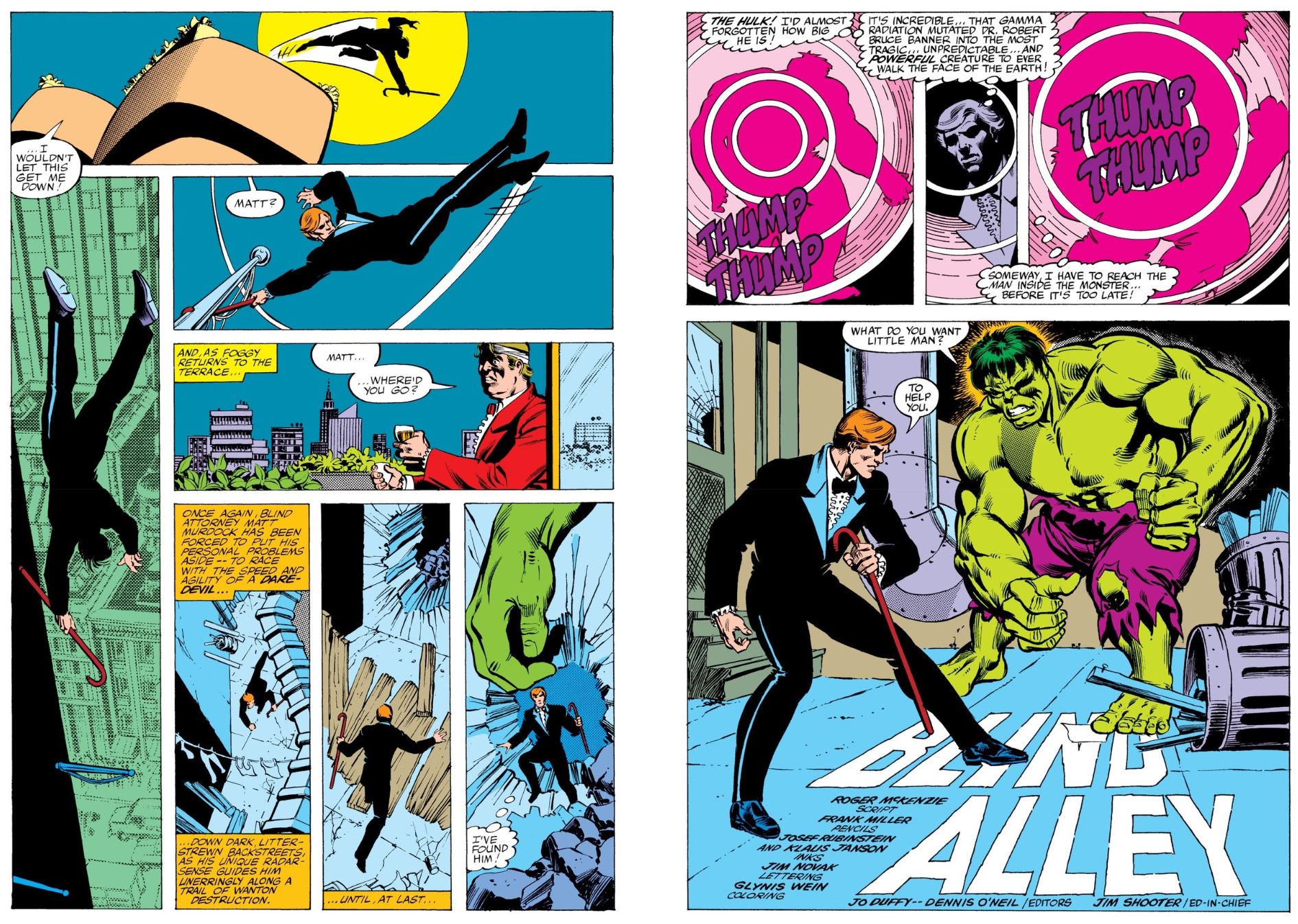
Stunning David & Goliath action belatedly comes in #163 as the merely mortal Man Without Fear battles The Incredible Hulk in ‘Blind Alley’ (McKenzie & Miller, inked by Josef Rubenstein & Janson) wherein Murdock’s innate compassion for hounded Bruce Banner inadvertently endangers Manhattan and triggers a desperate, bone-breaking, but ultimately doomed attempt to save his beloved city…

In #164 McKenzie, Miller & Janson deliver an evocative ‘Exposé’, retelling the origin saga as meticulous, dogged Urich confronts the hospitalised hero with inescapable conclusions from his diligent research and a turning point is reached…

The landmark tale is followed by accompanied by Miller’s unused cover for Ditko’s fill-in yarn, and precedes a mean-&-moody modern makeover for a moribund and over-exposed Spider-Man villain. DD #165 finds the Scarlet Swashbuckler in the ‘Arms of the Octopus’ when Murdock’s millionaire girlfriend Heather is kidnapped by Dr. Otto Octavius. Her company can – and do – rebuild his mechanical tentacles with Adamantium, but “Doc Ock” stupidly underestimates both his hostage and the seemingly powerless Man Without Fear…

A long-running plot thread of Matt’s best pal Foggy Nelson’s oft-delayed wedding finally culminates with some much-needed comedy in #166’s ‘Till Death Do Us Part!’, with true tragedy coming along too as old enemy Gladiator has a breakdown and kidnaps his parole officer. With visions of Roman arenas driving him, tormented killer Melvin Potter only needs to see Daredevil to go completely over the top…

David Michelinie wrote #167 for Miller & Janson, with a cruelly wronged employee of tech company the Cord Conglomerate stealing super-armour to become ‘…The Mauler!’ and exact personal justice. Constantly drawn into the conflict, DD finds his sense of justice and respect for the law at odds when another avoidable tragedy results…

The tale is backed up by an info feature revealing the ‘Dark Secrets’ of DD’s everyday life before segueing neatly into the story that changed everything.

With Daredevil #168 Miller took over the writing and with Janson’s art contributions increasing in each issue, rewired the history of Matt Murdock to open an era of noir-tinged, pulp-fuelled, Eisner-inspired innovation. It begins when Daredevil encounters a new bounty hunter in town which prompts recall of lost college-days first love. Back then, diplomat’s daughter Elektra Natchios shared his secrets – until her father was kidnapped and murdered before her eyes, partly due to Matt’s hasty actions. She left him and vanished, apparently becoming a ninja assassin, but is now tearing up the town hunting Eric Slaughter. Matt cannot help but get involved…

When Daredevil last defeated Bullseye, the psycho-killer was diagnosed with a brain tumour, and in #169 escapes from hospital to enact another murder spree. He is deep in a delusional state where everyone he sees are horn-headed scarlet-draped ‘Devils’. A frenetic chase and brutal battle results in countless civilian casualties and great anxiety as Daredevil has a chance to let the manic die… but doesn’t.

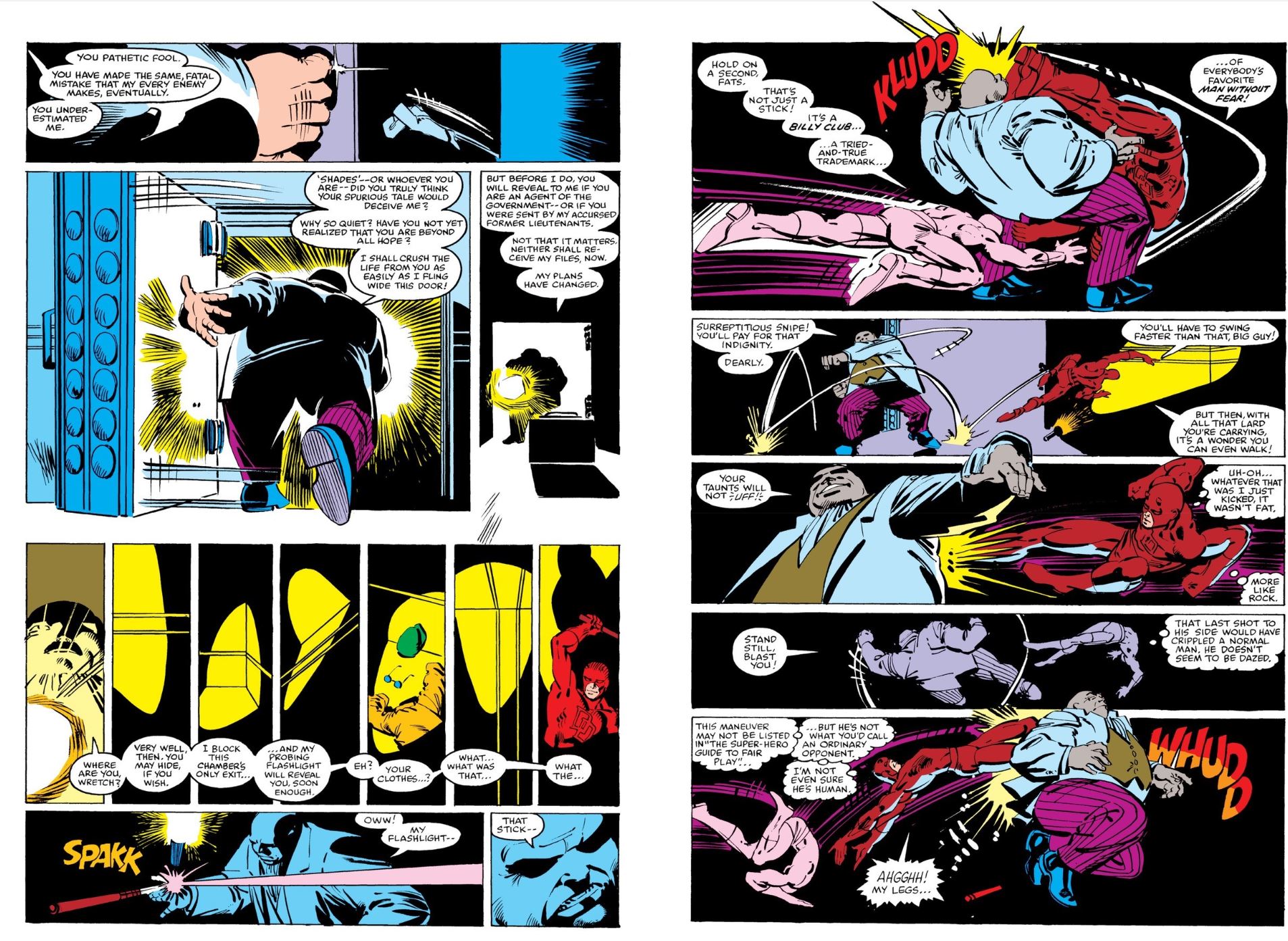
Yet another landmark resurrection of a tired villain begins in DD #170 as Miller & Janson decree ‘The Kingpin Must Die’. The former crimelord of New York had faded into serene retirement in Japan by impassioned request of his wife Vanessa, until this triptych of terror sees him return, more powerful and resourceful than ever. It all begins when the Devil of Hell’s Kitchen hears rumours the syndicate that replaced Wilson Fisk are trying to kill their old boss. Apparently, he has offered all his old records to the Feds…

When Vanessa hires Nelson & Murdock to broker the deal, all hell breaks loose, assassins attack and Mrs Fisk goes missing. Further complicating matters, having survived brain surgery, Bullseye now offers his services to the syndicate, mercenary killer Elektra senses a big business opportunity and a murderously resolute Kingpin sneaks back into the country resolved to save his Vanessa at any cost…

The title at last returned to monthly schedule with #171 as the city erupted into sporadic violence with civilians caught in the crossfire. DD dons a disguise and goes undercover but is soon ‘In the Kingpin’s Clutches’, and seemingly sent to a watery grave prior to Fisk gambling and losing everything.

The saga ends in all-out ‘Gangwar!’ as, with Vanessa lost and presumed dead, Wilson Fisk destroys the in situ Syndicate and takes back control of New York’s underworld. At least Daredevil scores a small-yet-toxic victory by apprehending the Kingpin’s assassin, all the while aware that every death since Bullseye’s operation has been because Murdock was not strong enough to let the monster die…

… And deep in the bowels of the city, an amnesiac woman wanders, a future trigger for much death and destruction to come…

With the city increasingly awash in mobsters, monsters, assassins and deviants, Daredevil 173 returns to the difficult, painful redemption of mentally-ill former foe The Gladiator. Having suffered an emotional crisis Melvin Potter prays his violent old life is over, but when a woman is brutalised in the streets, she identifies the anxious supervillain as her attacker. Murdock begins a stout defence of the ‘Lady Killer’, but despite his truth-sensing abilities, even his confidence takes a battering when his own assistant Becky Blake reveals Potter is the man who put her in a wheelchair years previously. Shocked and betrayed on all sides, Matt lets DD take charge and exposes a world of horror and abuse while tracking down a cunning, opportunistic human beast who tortures women just for kicks…

Elektra co-stars in #174 as her former master The Jonin demands ‘The Assassination of Matt Murdock’, introducing resurrecting zombie ninja cult The Hand just when the Potter trial is going badly and faithful partner Foggy Nelson has abandoned him. The cult’s expansion into America is lethally and effectively countered by Elektra, but when Daredevil joins the fight he is wounded and loses his greatest supersense, leaving him to depend on her and Melvin reluctantly returned to his Gladiator persona…

Now targeted by immortal super ninja Kirigi, Elektra goes after Jonin in ‘Gantlet’ and leaves DD to his own devices prior to ‘Hunters’, showing severely impaired Matt hunting for the old guy who first taught him to use his super senses. He rattles his old foes and street sources so badly that even Z-grade thugs Turk and Grotto are scared enough to steal a super-armour suit and settle with the Scarlet Swashbuckler for good…

To Be Continued…

Here, however, the events sparked a number of ancillary delights represented here by What If? #28’s ‘Matt Murdock, Agent of S.H.I.E.L.D.’ (by Mike W. Barr, Miller & Janson, and cover-dated August 1981), seeing what might have been had Anthony Stark and Nick Fury been nearby when young Matt was hit by that senses-altering radioactive cannister. That’s followed by spectacular monochrome prequel ‘Elektra’, crafted by Miller for Bizarre Adventures #28 (October 1981) with the hired killer going off-book after she finds out an unsavoury truth about her client.

Supplementing throughout with the covers by Colan, Springer, Janson, Rubinstein, Al Milgrom, Miller, Ditko, Bob McLeod, George Roussos and Bob Larkin, this roster depicting the resurgent rise in comics form is further bedecked and bedazzled with contemporary house ads; the Marvel Bullpen Bulletins page heralding Miller’s debut; original art and Miller’s full Daredevil character bible, written in 1980 as he prepared to take over the writing. Also on view are Miller & Janson’s pages from Marvel Comics 20th Anniversary Calendar 1981 (June) and their Spider-Man vs DD plate from Marvel Team-Up Portfolio One. Those are supplemented by Miller covers & frontispieces for Daredevil Visionaries: Frank Miller volume 1 & 2 (with Steve Buccellato) before closing with M&J’s iconic Amazing Heroes #4 cover from September 1981.

As the decade closed, these gritty tales set the scene for truly mature forthcoming dramas, promising the true potential of Daredevil was finally in reach. Their narrative energy and exuberant excitement are dashing delights no action fan will care to miss.

… And the next volume heads full on into darker shadows, the grimmest of territory and the breaking of many more boundaries…
© MARVEL 2025.

In 1958 horror artist John Totleben was born, as was Italy’s Antonio Serra (Nathan Never) in 1963, Tim Bradstreet in 1967 and Warren Ellis one year later.

We lost letterer/colourist/comics artist/animator Frank Engli in 1977 but we can still enjoy Popeye, Betty Boop, Terry and the Pirates, Male Call, Steve Canyon, Scorchy Smith and his own creations On the Wing and Rocky the Stone Age Kid. Don’t you want to go look him up now?

In 1963 UK standby Knockout finally lay down after 24 years and in1980 Nutty launched with the debut of Bananaman. And in 2017 dutchman designer Dick Bruna died, having introduced us all to his bunny star Miffy way back in 1955.

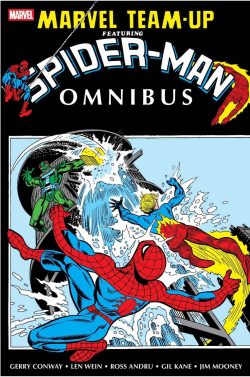
Marvel Team-Up Omnibus volume 1


By Roy Thomas, Gerry Conway, Len Wein, Steve Gerber, Ross Andru, Gil Kane, Jim Mooney, Sal Buscema, Don Heck, Mike Esposito, Frank Giacoia, Steve Mitchell, Frank Bolle, Don Perlin, Sal Trapani, Wayne Howard, Dave Hunt, Vince Colletta & various (MARVEL)
ISBN: 978-1-3029-6699-7 (HB/Digital edition)

This book includes Discriminatory Content produced in less enlightened times.

Inspiration isn’t everything. In fact, as Marvel slowly grew to a position of market dominance in the wake of losing their two most innovative and inspirational creators, they did so less by experimentation and more by expanding proven concepts and properties. The only real exception to this was the assembly line creation of horror and horror-hero titles in response to the industry down-turn in super-hero sales – a move expedited by a rapid revision in the wordings of the increasingly ineffectual Comics Code Authority rules.

The concept of team-up books – an established star pairing or battling (usually both) with less well-selling company characters – was not new when Marvel decided to award their most popular hero the lion’s share of this new title, but they wisely left their options open by allocating an occasional substitute lead in the Human Torch. In those long-lost days editors were acutely conscious of potential over-exposure – and since superheroes were actually in a decline they may well have been right.

Marvel Team-Up was the second regular Spider-Man title (abortive companion title Spectacular Spider-Man was created for the magazine market in 1968 but died after two issues). MTU launched at the end of 1971 and went from strength to strength, proving the time had finally come for expansion and a concentration on uncomplicated action over sub-plots…

This engaging hardback and/or eBook compilation gathers the first 30 issues of Marvel Team-Up (spanning cover-dates March 1972 to February 1975) and includes crossover fun from Daredevil (and the Black Widow) #103, plus double length larks from Giant-Size Super Heroes #1 and Giant-Size Spider-Man #1-3. As well as a monolithic assortment of nostalgic visual treats at the back, this mammoth tome is dotted throughout with editorial and letters pages (from ‘Team-Up’ to ‘Mail it to Team-Up’) and also includes recycled Introductions from previous Marvel Masterworks editions (namely Gerry Conway’s ‘Behold: An Introduction’ and Roy Thomas’ ‘A Long, Loose Leash’ and ‘Full Credit – or Blame’) plus other contemporary editorial announcements as seen in each original issue, just to enhance overall historical experience…

Marvel Team-Up #1was crafted by Roy Thomas, Ross Andru & Mike Esposito as a mutual old enemy reared his gritty head in charming seasonal saga ‘Have Yourself a Sandman Little Christmas!’. A light-heated romp full of Christmas cheer, rambunctious action and seasonal sentiment, the story set the tone for all epics to follow. Merry Marvelite Maximii can award themselves a point for remembering which martial arts/TV hero debuted in this issue, but folk with lives can simply take my word that it was Iron Fist’s sometimes-squeeze Misty Knight

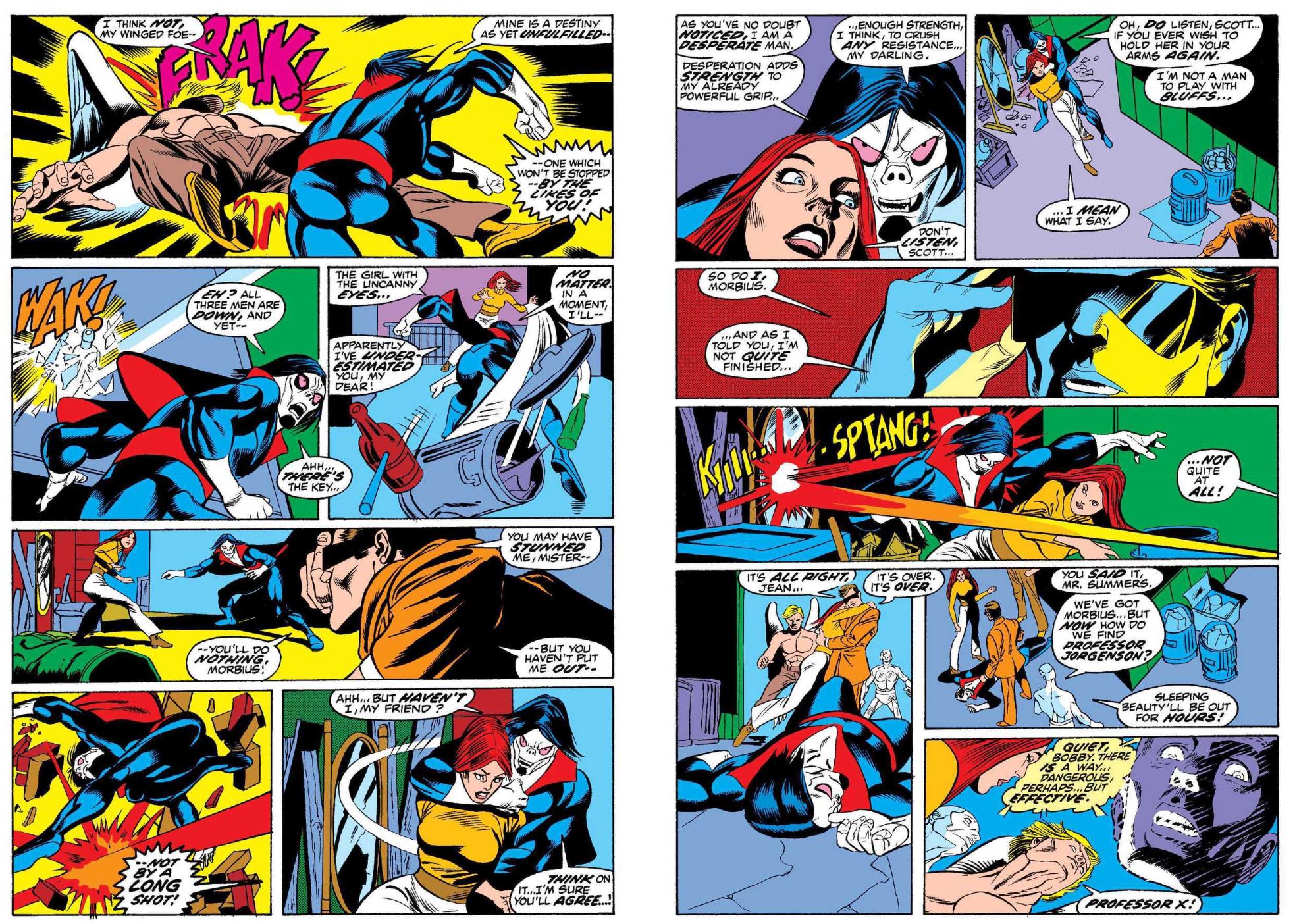
Gerry Conway assumed the writer’s role and Jim Mooney the inks for ‘And Spidey Makes Four!’ in the succeeding issue as our hot and sticky heroes then take on and trounce the Frightful Four and Negative Zone bogeyman Annihilus before without pause going after Morbius the Living Vampire in #3’s ‘The Power to Purge!’ (as inked by Frank Giacoia). The new horror-star was still acting the villain in MTU #4 as the Torch was replaced by most of Marvel’s sole mutant team (The Beast having gone all hairy – and solo) in ‘And Then… the X-Men!’

Inked by Steve Mitchell, this boldly enthralling thriller was illustrated by magnificent Gil Kane at the top of his form. Kane became a semi-regular penciller, and his dynamic style and extreme-action anatomy lifted many pedestrian tales such as #5’s ‘A Passion of the Mind!’ (Conway script & Esposito inks), pitting Spidey and The Vision against manipulative mesmeric Puppet Master and robotic assassin the Monstroid. The bad guy again carried over to the next issue and joined by the Mad Thinker in ‘…As Those Who Will Not See!’ pitted the wallcrawler and The Thing against cerebral scoundrels in a cataclysmic battle no Fights ‘n’ Tights fan could be unmoved by…

MTU #7’s ‘A Hitch in Time!’ was produced by Conway, Andru & Mooney: guest-starring Thor with otherworldly Trolls freezing Earth’s time-line as a prerequisite step to conquering Asgard, after which #8 provides a perfect example of the team-up comic’s other function – to promote and popularise new characters. ‘Man-Killer Moves at Midnight!’ was most fans’ first exposure to The Cat (later retooled as Tigra the Were-Woman) in a painfully worthy if ham-fisted attempt to address feminist issues from Conway & Mooney. The hard-pressed heroes joined forces here to stop a male-hunting murderer paying back abusive men. These days we’d probably be rooting for her…

Iron Man collaborated in the opening foray of 3-part tale ‘The Tomorrow War!’ (Conway, Andru & Frank Bolle) as he & Spidey are kidnapped by Zarkko the Tomorrow Man to battle Kang the Conqueror. The Torch returned to help deal with the intermediate threat of a ‘Time Bomb!’ (with art by Mooney & Giacoia) before the entire race of Black Bolt’s Inhumans pile in to help Spidey stop history unravelling in culminatory clash ‘The Doomsday Gambit!’ – this last chapter scripted by Len Wein over Conway’s plot for Mooney & Esposito to illustrate.

Deftly delineated by Andru & Don Perlin, Wein scripted a Conway plot for ‘Wolf at Bay!’ in MTU #12 wherein wallcrawler meets Werewolf By Night Jack Russell to maul malevolent mage Moondark in foggy San Francisco, after which we divert to the Man Without Fear’s own title. Here they share some left coast limelight as Daredevil and the Black Widow #103 (Steve Gerber, Don Heck & Sal Trapani). This sees them join the still-California-bound wallcrawler as a merciless cyborg attacks the odd couple while they pose for roving photojournalist Peter Parker in ‘…Then Came Ramrod!’

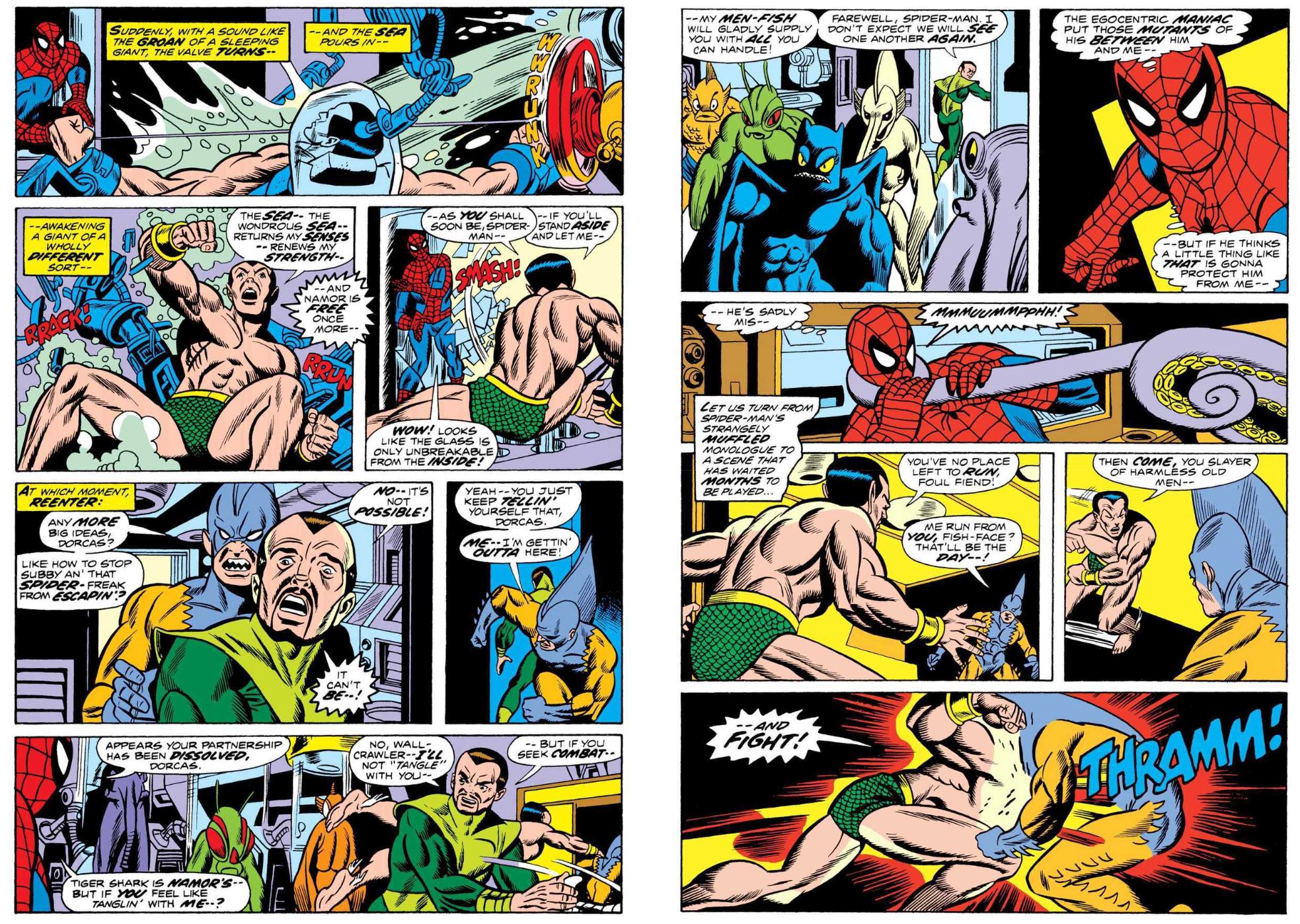
Kane & Giacoia limned ‘The Granite Sky!’ wherein Wein pits Spidey & Captain America against Hydra and Grey Gargoyle in a simple clash of ideologies, after which ‘Mayhem is… the Men-Fish!’ (inked by Wayne Howard – and, yes bad grammar, but great action-art!) matches the webslinger with the savage Sub-Mariner against vile villains Tiger Shark and Doctor Dorcas as well as an army (navy?) of mutant sea-beasts.

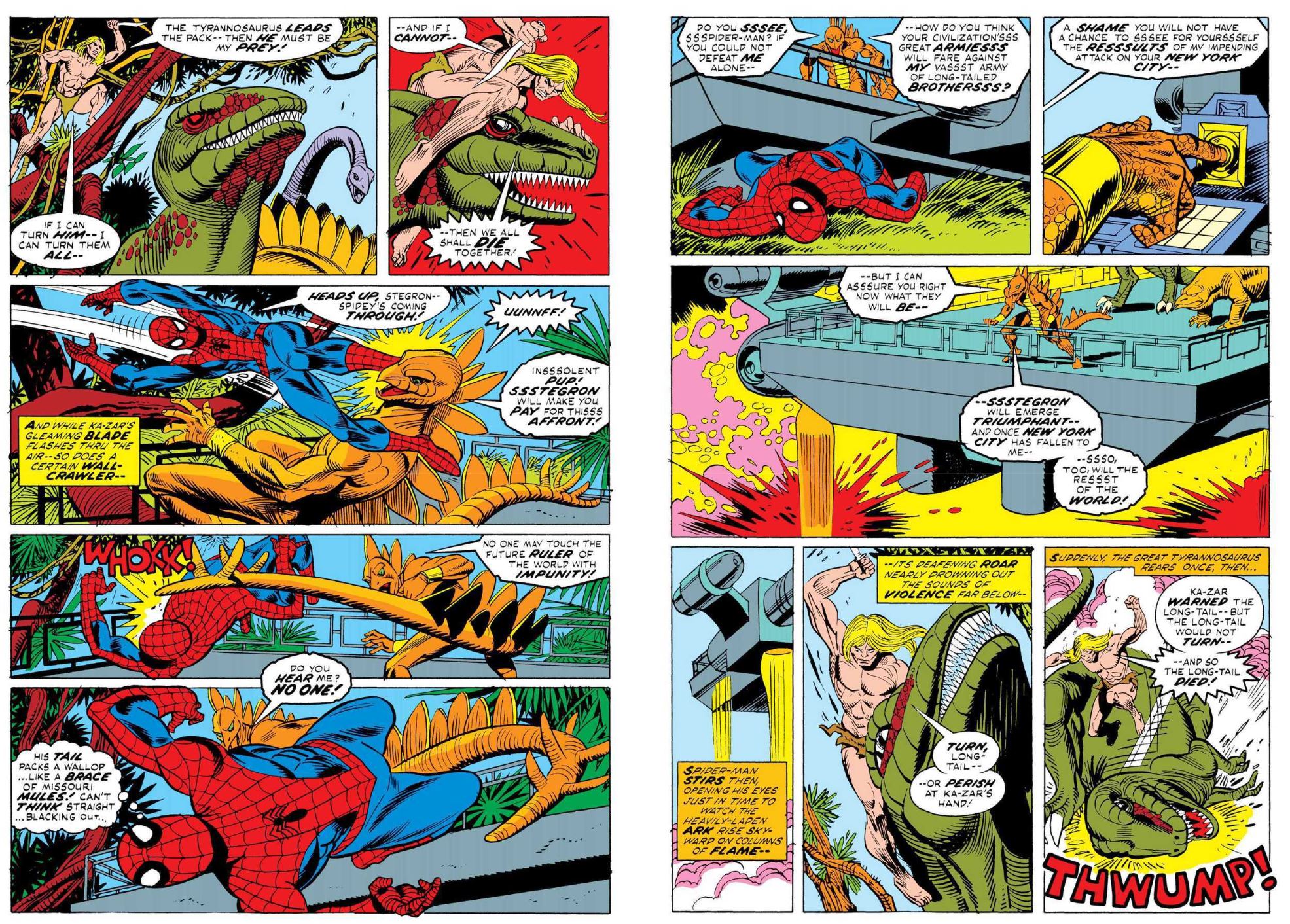
Wein, Andru & Perlin created The Orb to bedevil Spidey and Ghost Rider in ‘If an Eye Offend Thee!’ in #15 before Kane & Mooney limn ‘Beware the Basilisk my Son!’: a gripping romp featuring (the original Kree) Captain Marvel, concluding with ‘Chaos at the Earth’s Core!’ (inked by “everybody”!), as Mister Fantastic joins the fracas to stop Mole Man inadvertently blowing up the world. Human Torch Johnny Storm teams with The Hulk in MTU #18 to stop antimatter malcontent Blastaar in ‘Where Bursts the Bomb!’ (Giacoia & Esposito inks), but Spidey blazes back a month later with Ka-Zar in situ to witness ‘The Coming of… Stegron, the Dinosaur Man!’ (Wein, Kane & Giacoia). His plans to flatten New York by releasing ‘Dinosaurs on Broadway!’ is foiled with Black Panther’s help… as well as the artistic gifts of Sal Buscema, Giacoia & Esposito.

Dave Hunt replaced Esposito inking ‘The Spider and the Sorcerer!’ in #21 as Spidey and Doctor Strange once more battled Xandu, a wily wizard first seen in Spider-Man Annual #2, before we pause for a brief lecture.

Giant-Size titles were quarterly double-length publications added to the schedule of Marvel’s top tier heroes, and the wallcrawler’s were used to highlight outré or potentially controversial pairings such as Dracula and Doc Savage. Here they are represented by try-out Giant-Size Super Heroes #1 which pitted the wallcrawler against Living Vampire Morbius as well as hirsute and manic Man-Wolf. In a classic clash by Conway, Kane & Esposito. Within months a quarterly double-length Spider-Man team vehicle was added to Marvel’s schedule….

Back in MTU #22, Wein, Sal B & Giacoia’s ‘The Messiah Machine!’ brings the monthly story glories to a brief pause after depicting Hawkeye and the Amazing Arachnid frustrating deranged computer Quasimodo‘s ambitious if absurd mechanoid invasion. Then – cover-dated July 1974 and courtesy of Conway, Andru & Heck – Giant-Size Spider-Man #1 saw the webspinner in frantic pursuit of an experimental flu vaccine, improbably carried on an ocean liner in ‘Ship of Fiends!’ The quest brought him into chilling contact with newly-revived vampire lord Dracula and a scheming Maggia Capo at ‘The Masque of the Black Death!’

Here that bizarre battle is accompanied by its original editorial text feature ‘An Illuminating Introduction to Giant Size Spider-Man’ before we move on to monthly MTU wherein the Torch & Iceman fractiously unite to stop Equinox, the Thermo-Dynamic Man on ‘The Night of the Frozen Inferno!’ (Wein, Kane & Esposito). Still embracing supernatural themes and trends, the webslinger learns ‘Moondog is another Name for Murder!’ in a defiantly quirky yarn illustrated by Mooney & Trapani which brings the decidedly offbeat Brother Voodoo to the Big Apple to quash a Manhattan murder cult…

Wein, Mooney & Frank Giacoia then determine that ‘Three into Two Won’t Go!’ as Daredevil joins Spider-Man in thrashing inept kidnappers Cat-Man, Bird-Man and Ape-Man, after which Giant-Size Spider-Man #2 sees the amazing arachnid drawn into battle with Shang-Chi, Master of Kung Fu as sinister immortal Fu Manchu frames Spider-Man in ‘Masterstroke!’ The duped heroes clear the air in ‘Cross… and Double-Cross!’ before uniting to foil the cunning Celestial’s scheme to mindwipe America from the ‘Pinnacle of Doom!’

MTU #26 finds the Torch and Thor battling to save the world from Lava Men in The Fire This Time…’ by Wein, Mooney, Giacoia & Hunt. At this time, in a desperate effort to build some internal continuity into the perforce brutally brief encounters, the scripters introduced a shadowy trio of sinister observers with an undisclosed agenda who would monitor superhero episodes and eventually be revealed as providers of outrageous technologies for many of the one-shot villains who came and went so quickly and ignominiously…

They weren’t involved when the Chameleon frames Spider-Man (again) and tricks the Hulk into freeing a man – for the most unexpected reason of all – from the New York Men’s Detention Center in #27’s ‘A Friend in Need!’ (Wein, Mooney & Giacoia). They did, however, have a cloaked hand in ‘The City Stealers!’ (#28 by new regular creative team Conway, Mooney & Vince Colletta) when strange mechanoids swipe the island of Manhattan, necessitating Spidey and Hercules (mostly Hercules) having to drag it back to its original position…

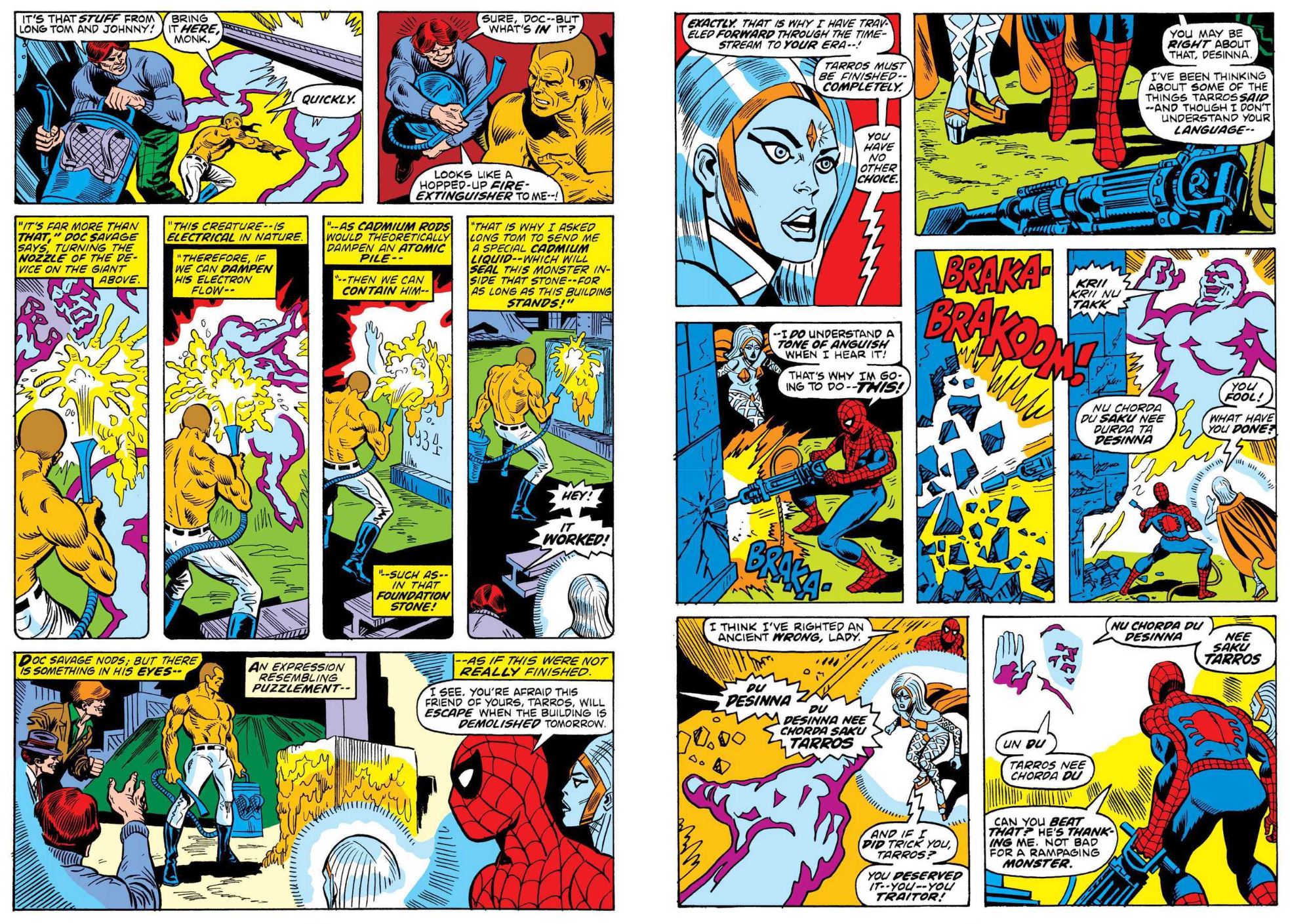
After that implausible minor miracle Spider-Man experiences time-displaced disaster as Giant-Size Spider-Man #3 (Conway, Andru & Esposito) explores ‘The Yesterday Connection!’ Now lovely alien Desinna seeks the aid of Spidey in 1974 and – in ‘The Secret Out of Time’ – the hands-on help of legendary 1930s adventurer Doc Savage. Across a gulf of four decades the heroes individually discover something is not right in ‘Other People in Other Times!’ With the escape of a savage rampaging monster, two eras seem doomed to destruction, at least until wiser, more suspicious heads and powers prevail in ‘Tomorrow is Too Late’ ensuring that ‘The Future is Now!’

Marvel Team-Up #29 displays a far less constrained – or even amicable – pairing as flaming kid Johnny Storm and patronising know-it-all Iron Man butt heads whilst tracking a seeming super-saboteur in ‘Beware the Coming of Infinitus! or How Can You Stop the Reincarnated Man?’ before in #30 Spider-Man and The Falcon find ‘All That Glitters is not Gold!’ whilst tracking a mind-control drug back to its crazy concoctor Midas, the Golden Man.

However, adding extra lustre are visual treats aplenty in the form of contemporaneous house ads; covers and frontispieces from seasonal tabloid treasury Giant Superhero Holiday Grab-Bag (with art from John Buscema & John Romita Sr.) and original art pages and covers from Andru, Kane, Esposito, Perlin, Mooney, & Giacoia plus Kane pencil layouts. Also on view are covers from Marvel Tales #234, 249, 254, by Todd McFarlane, Marshall Rogers, Brian Stelfreeze, complete with new bridging pages by Jae Lee. Jan Harpes & Renee Witterstatter, and another gallery of Spider-Man Megazine covers (#1-6) by James Fry, Hector Collazo, Stelfreeze, Jung Choi, Ron Frenz, Al Milgrom, Stuart Immonen, Kirk Jarvinen, Jason Moore and Mark Buckingham, plus the unpublished cover of #7 as crafted by John Romita Sr & Jr.. Closing the book is a truly unique unused cover for #8 by Brian Bolland.

These stories are of variable quality but nonetheless all exhibit an honest drive to entertain and please. Artistically the work is superb, and most fans of the genre would find little to complain about so, although not really a book for casual or more maturely-oriented readers, there’s bunches of fun on hand and young readers will have a blast, so there’s no real reason not to add this tome to your library…
© 2025 MARVEL.

Today in 1892 Korky the Cat creator James Crighton was born as was Golden Age great Creig Flessel in 1912 and Al McWilliams in 1916. Writer/editor/publisher Bob Shreck joined the party in 1955, three years after Crocket Johnson released the final episode of Barnaby.

Back in 1938, the very first Donald Duck newspaper strip was syndicated and in 1987 the astounding Ken Reid drew his last breath – as did Dutch comics maestro Lo Hartog van Banda in 2006. As always, look in the blog for more or just buy anything with these guys’ names on it…

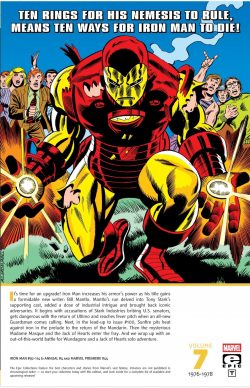
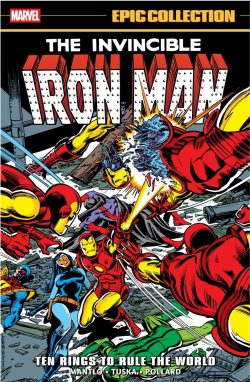
Invincible Iron Man Epic Collection volume 7 (1976-1978): Ten Rings to Rule the World


By Bill Mantlo, Gerry Conway, Herb Trimpe, Roger Stern, George Tuska, Keith Pollard, Keith Giffen, Carmine Infantino, Jeff Aclin, Mike Esposito, Don Perlin, Jack Abel, Fred Kida, Alfredo Alcala, Rudy Nebres, Bruce Patterson, Josef Rubinstein, Bob Wiacek, Pablo Marcos, Don Newton & various (MARVEL)
ISBN: 978-1-3029-6059-9 (TPB/Digital edition)

This book includes Discriminatory Content produced in less enlightened times.

Arch-technocrat and supreme survivor Tony Stark has changed profile and rebuilt himself many times since debuting in Tales of Suspense #39 (March 1963). There and then, as a VIP visitor to Vietnam assessing the efficacy of munitions he had designed, the inventor was critically wounded and captured by sinister, savage Communists. Put to work building weapons with the dubious promise of medical assistance upon completion, Stark instead crafted the first of innumerable technologically-augmented protective suits to keep himself alive and deliver him from his oppressors. From there it was a simple – transistor-powered – jump to full time superheroics as a modern Knight in Shining Armour…

Conceived after the Cuban Missile Crisis at a time when Western economies were booming and “Commie-bashing” was America’s obsession, a dashing new Thomas Edison employing Yankee ingenuity, wealth and invention to safeguard the Land of the Free and better the World seemed an obvious development. Combining then-sacrosanct faith that technology and business in unison could solve any problem, with the universal imagery of noble knights battling evil, Stark – the Invincible Iron Man – seemed an infallibly successful proposition.

Of course, whilst he was the acceptable face of 1960s Capitalism – a glamorous, benevolent, rich, technocratic and all-conquering hero when clad in super-scientific armour – the turbulent tone of the 1970s soon relegated his suave, “can-do” image to the dustbin of history. With ecological disaster and social catastrophe from myriad big business abuses new zeitgeists of the young, the Golden Avenger and Stark International were soon confronting some tricky questions from an increasingly politically savvy readership.

With glamour, money and fancy gadgetry not quite so cool anymore the questing voices of a new generation of writers began posing uncomfortable questions in the pages of a series that was once a bastion of militarised America. Collectively accommodating cover-dates November 1976 to October 1978, this Epic chronological epistle completes that transitional period, reprinting Iron Man #92-114, plus Annual #4 and a guest yarn from Marvel Premiere #44 as Bill Mantlo’s passionate writing triggered a minor renaissance in the Steel Sentinel’s chrome-plated chronicles that resulted in some of the best stories of the Eighties era. It also returned Iron Man to the top-rank of Marvel stars.

If you’re a fan thanks to the movie interpretation, that iteration starts right here, right now…

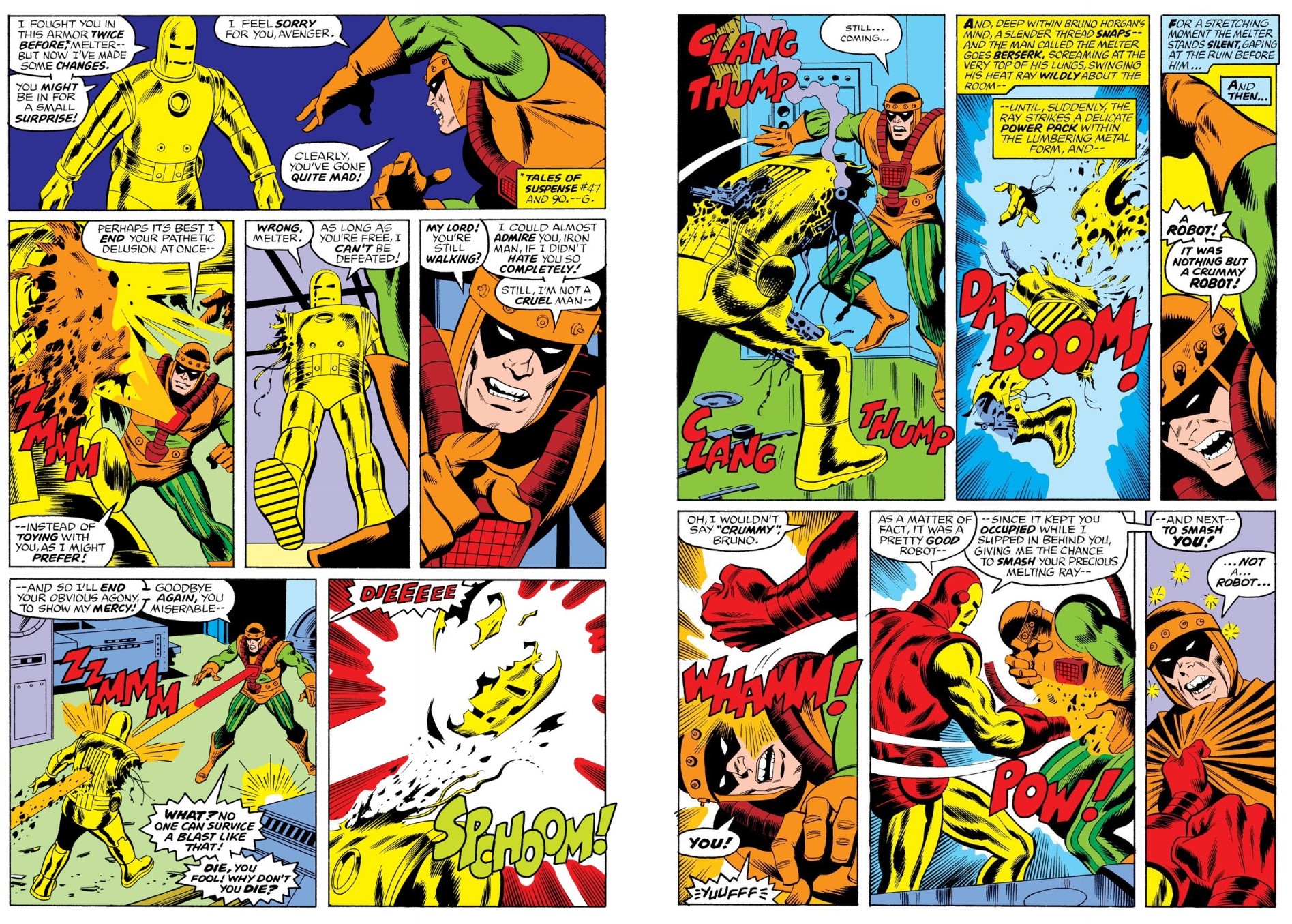
The mettle majesty opens with manic menace The Melter who soon regrets an ill-advised grudge rematch in ‘Burn, Hero… Burn!’ (Gerry Conway, George Tuska & Jack Abel) before Herb Trimpe returns to plot and pencil Iron Man #93. Pitting Old Shellhead against a British-based modern-day pirate in ‘Kraken Kills’ (Conway script & Abel inks), the self-declared Commander deduces Stark’s secret identity before blackmailing the inventor into building weapons for his super-submarine fleet. Never at a loss, though, Stark turns the tables, sparking ‘Frenzy at Fifty Fathoms!’ to scupper the madman’s plans…

Invincible Iron Man Annual #4 (August 1977) offers an all-action alliance with newly constituted super-team The Champions by Mantlo, Tuska & inker Don Perlin. When psychic assassin M.O.D.O.K. overwhelms the Golden Avenger, Iron Man calls in old allies Black Widow and Hercules (plus teammates Ghost Rider, Iceman, Darkstar and The Angel) to thwart ‘The Doomsday Connection!’

Also from that issue comes an out-of-place martial arts vignette by Roger Stern, Jeff Aclin & Don Newton. ‘Death Lair!’ stars former Master of Kung Fu villain Midnight on a mission of murder against old Iron Man enemy Half-Face

The regular monthly climb to reclaimed pole position resumes with veteran Iron Man artist Tuska joining plotter Conway, scripter Mantlo and inker Perlin in unleashing giant android ‘Ultimo!’ (IM #95, cover-dated February 1977) against Washington DC. Clad in upgraded armour and in the Capitol to answer congressional questions about his company, Stark is targeted by a vengeful hidden nemesis who activates the mountainous monster for a classic B-movie sci fi rampage in the streets, with the Golden Avenger supplementing hard pressed Army and National Guard units… before falling in ignominious defeat due to sabotage…

Mantlo, Tuska & Abel prove you can’t keep a good Iron Man down as the embattled hero rallies and retaliates in ‘Only a Friend Can Save Him’ as former close ally and dutiful S.H.I.E.L.D. agent Jasper Sitwell joins the counterattack. Meanwhile, a long-simmering plotline advances as NYPD detective Michael O’Brien – who holds Stark responsible and accountable for the death of his brother Kevin – finally allows his obsession with a cover-up to pull him across legal lines and into collusion with shady PI Harry Key, whose latest client also has nasty plans for the playboy inventor…

Thanks to ingenuity and sheer guts, Stillwell & Iron Man seemingly destroy Ultimo deep below DC, but their triumph is short lived as a return to Stark’s Long Island factory provokes a ‘Showdown with the Guardsman!’ (Conway, Mantlo, Tuska & Perlin). When Mike takes PA Krissy Longfellow hostage, steals the armour suit that drove his brother insane and ambushes the Golden Avenger wearing it, the clash is swift and brutal. Thankfully this time, the blockbusting battle ends before another good man dies…

Whilst subsequently treating O’Brien, another distraction comes when an old frenemy attacks the facility and US interventionist economic practises. ‘Sunfire Strikes Again!’ sees the Japanese ultra-nationalist mutant warrior again seek to derail progress, unaware that he’s a pawn of the lurking presence gunning for Stark. However, the harried hero’s problems start with the fact that his greatest weapon is offline and he’s fighting in borrowed Guardsman armour. When the conflict frees imprisoned Michael O’Brien, the cop seeks to make amends by joining the battle in an obsolete Iron Man outfit, but – even with Mike Esposito inking – the new allies rapidly find themselves ‘At the Mercy of the Mandarin!’

During the melee, Key tries his luck in the Stark vaults once too often and encounters an unexpected problem, thanks to another insidious infiltrator planted by a different scheming mastermind. However, having freed himself, Tony is too now busy rushing to a far-distant, potentially world-ending final battle in anniversary issue #100. Invading China, Iron Man faces horrors, homunculi Death Squads, nuclear armageddon and his most obsessive enemy whose ‘Ten Rings to Rule the World!’ ultimately prove insufficient to the task…

With the tyrant’s countless plots to discredit Stark now exposed, our hero starts a long journey home, even as in Long Island, Harry Key, Sitwell and one of the traitors in Stark’s midst begin a cautious espionage dance…

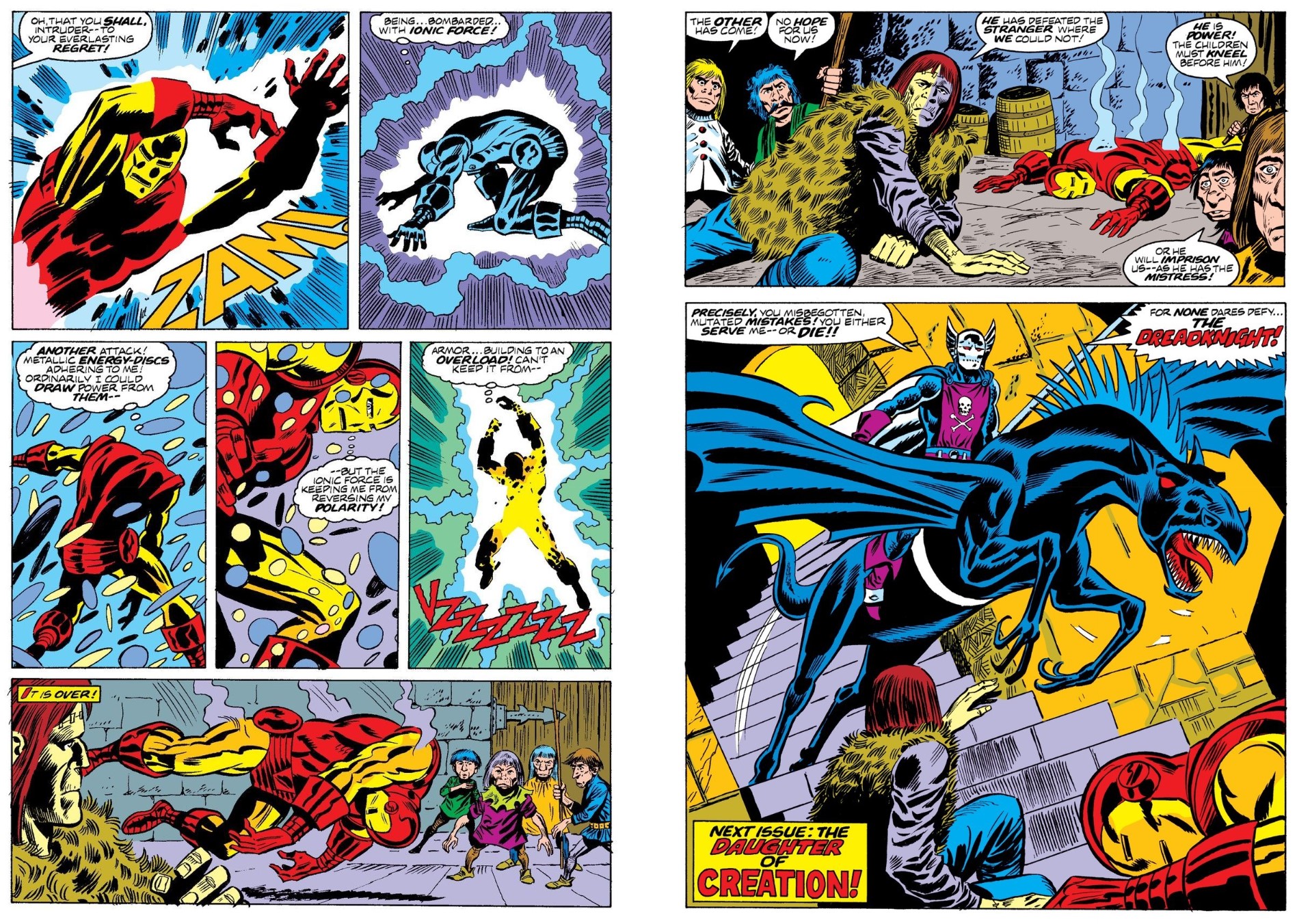
Iron Man’s trip stalls when he’s shot down over Yugoslavia (just google it) and awakens in a creepy old castle filled with freaks and outcasts safeguarded by a familiar – to elderly or dedicated Marvelites at least – huge and daunting figure. Recovering in ‘Then Came the Monster!’ our weary voyager views Castle Frankenstein and panics: clashing with the gentle “Modern Prometheus” before the real menace emerges.

Inked by Esposito & Pablo Marcos, ‘Dreadknight and the Daughter of Creation!’ channels old Marvel horror tales as a brutal and brutalised escaped experiment of Doctor Doom’s laboratories seeks to compel the great granddaughter of Victor Frankenstein to share with him the secrets of creating life…

This ruthless high-tech paladin’s sadistic efforts are eventually thwarted by Iron Man and the original (good) Monster, after which the Steel-Shod Sentinel at last arrives home in #103’s ‘Run for the Money!’ by Mantlo, Tuska & Esposito. Sadly, it’s just in time for the next domestic crisis as Sitwell exposes the traitor only to be captured by revolting corporate villain Midas, who – patience exhausted – launches a truly hostile takeover using tanks, mercenaries, lawyers and the Stock Market…

He is temporarily checked by itinerant junior hero/innocent bystander Jack of Hearts who – as per standard Marvel protocol – is attacked by weary, late arriving Iron Man who misconstrues events and assaults the well-meaning stranger. Shock follows shock as Midas’ legal chicanery forces Iron Man’s surrender, ceding control of Stark International to his enemy, even as the villain’s agent and top lieutenant Madame Masque quits to ally herself with the defeated hero and his ousted, outmanoeuvred alter ego Tony Stark.

In the aftermath, repercussions of the takeover ripple outwards. With Stark no longer paying her bill, deeply disturbed super-telepath (and former Stark inamorata) Marianne Rodgers is kicked out of the sanatorium that has been keeping her psionic deadly tendencies in check…

The fightback begins in ‘Triad! (Mantlo, Tuska & Esposito) after Stark initially refuses the help of Masque. Thus she instead allies with former lover/patsy Sitwell whilst elsewhere, interested parties Michael O’Brien and Jack of Hearts also seek to stop Midas converting Stark’s purloined resources into a world-conquering armed force. Also heading slowly towards a showdown, Marianne graduates towards Long Island, leaving a trail of bodies in her wake…

With ‘Every Hand Against Him!’ and despite the stakes being so high, Tony has quit forever, preferring to hide in his father’s old house with Madame Masque. Less sanguine over the crisis and National Security threat, many of Iron Man’s allies join a volunteer force recruited by psychic superhero The Wraith and eventually consisting of Police Captain Jean de Wolf, former Iron Man stand-in Eddie March, The Guardsman & Jack of Hearts, covertly backed up by Sitwell and (the first) Nick Fury

Still short of power, they co-opt through blackmail, Masque’s lethal skills and Tony’s last remaining armour suit to take out Midas. ‘Then There Came a War!’ (#106) sees the squad invade SI to face a legion of automated Iron Men. At the height of battle Marianne Rodgers – in a fugue state – finally reaches her destination. As Keith Pollard & Fred Kida step in to illustrate the catastrophic conclusion, ‘And, in the End…’ sees her power tip the scales, uncovering even more treachery in Tony’s inner circle and inspiring the despondent hero to take back his heritage, his company and his honour…

With most of his allies apparently dead, Iron Man calls in Avenging ally Yellowjacket (AKA original Ant-Man Henry Pym) to help whip up a miracle cure in #108 (Mantlo, Carmine Infantino & Bob Wiacek). This incurs some ‘Growing Pains!’ and a palate-cleansing action-filled monster-bash as the clear-up somehow reactivates Kang the Conqueror’s devastating Growing Man android to add to the wreckage and rubble…

Once the fighting is finished, rebuilding Stark International begins, with Mantlo, Infantino & Kida dictating the pace prior to another crisis after Jack of Hearts traces the Growing Man’s programming commands as emanating from Luna. Thus Iron Man and his superhero apprentice board a Quinjet and experiences a very painful ‘Moonrise!’ when their mission intersects a secret sortie by Soviet Super-soldiers Darkstar, Vanguard & Crimson Dynamo. The Communist cosmonauts are only investigating a bizarre alien artefact, but entrenched political and personal animosities spark a savage clash. Both sides are preoccupied when the silver egg activates, transporting those closest to it – the Americans – to somewhere far, far away…

Mantlo, Pollard & Kida stretch their fantasy muscles in an astral epic as the heroes materialise aboard a vast ship bearing Colonizers of Rigel to their next conquest. Sadly, these ‘Sojourners Through Space!’ have targeted Wundagore II – used by animal-enhancing man-made deity the High Evolutionary to store former experiments – and are soon caught up in a battle against formidable space Knights of Wundagore and two devastating late-arriving, quickly escaping human captives within their colossal Command ship…

When an alliance of humans and hyper-evolved Earth beasts proves too costly, the Rigellian venture is called off in ‘The Man, the Metal, and the Mayhem!’  but this in turn leads to renegade Colonizer subcommander Arcturus spitefully targeting Earth with a robot stolen from Galactus (the original Punisher from Fantastic Four #48-50). Upon its despatch, closing instalment ‘Moon Wars!’ (IM #112, July 1978 by Mantlo, Pollard & Alfredo Alcala) sees a swift, unauthorised Colonizer strike prompt a desperate dash back to Luna and shattering descent to Detroit for Iron Man, resulting in blistering battle with the cosmic weapon of chastisement and a new definition of the word “invincible” for the triumphant Golden Avenger…

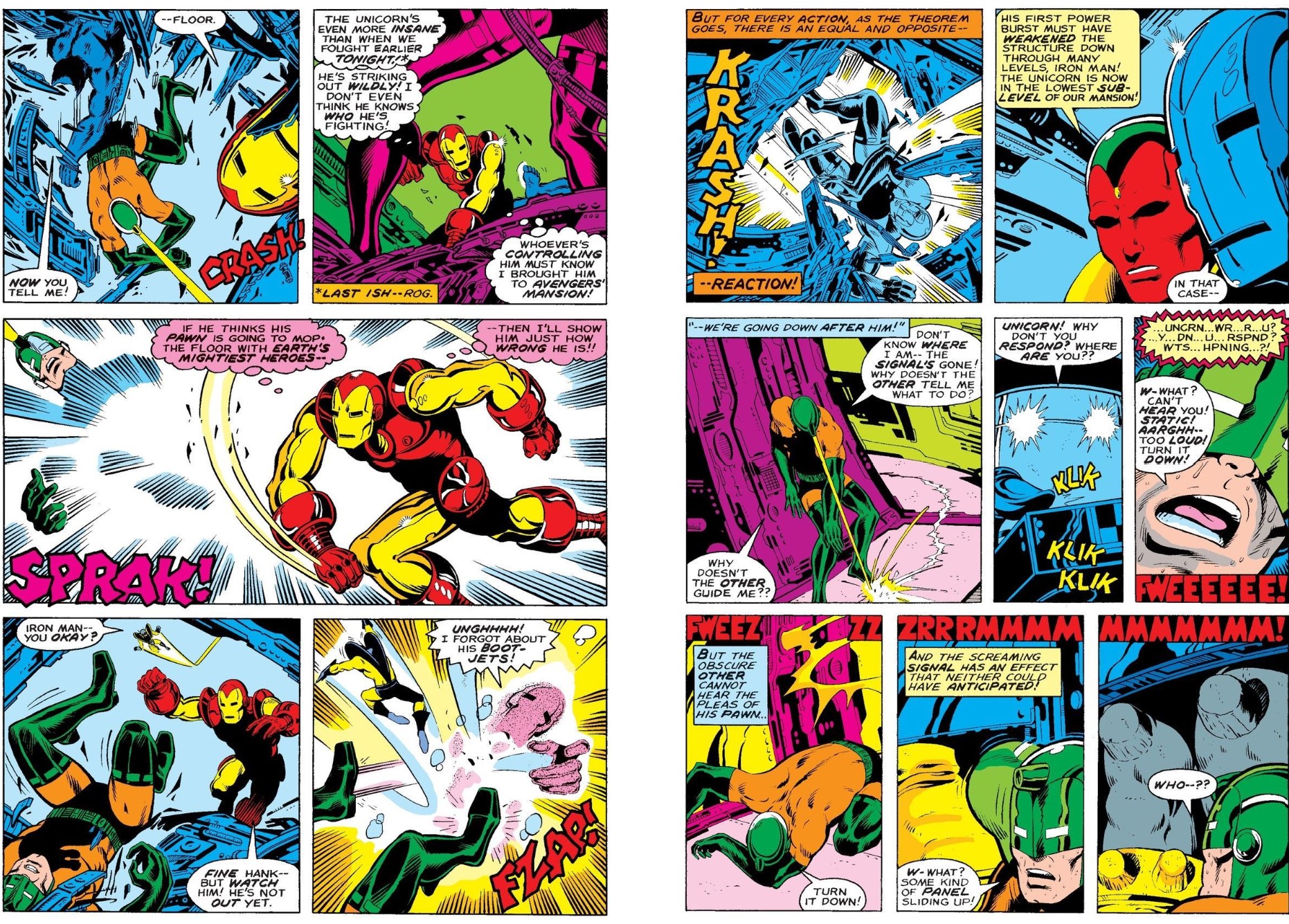
With Mantlo scripting, Pollard layout pages and Trimpe’s pencilling for inker Josef Rubinstein, Iron Man #113 trumpeted a fresh beginning for Stark International after defeating the bloody takeover bid of Mr Midas. However, as the new complex opened for business, an old enemy is already infiltrating the company whilst a more brazen assault comes after a dying foe is manipulated into attacking the complex using ‘The Horn of the Unicorn!’

Seeking help for the beaten-and-at-death’s door Unicorn, the Metal Marvel consults The Avengers and inadvertently triggers a second assault by the villain who also activates a long-interred robotic threat that seems agonisingly familiar in ‘The Menace of… Arsenal!’ (Mantlo, Giffen & Bruce D. Patterson) leading to a turning point moment you’ll need the next book or another collection to enjoy…

To Be Continued…

Here, however, one last narrative nubbin comes from Marvel Premiere #44 (October 1978): the one-shot try-out of Stark’s former apprentice, by Mantlo, Giffen & Rudy Nebres). ‘The Jack of Hearts!’ reexamines the origin of trust fund brat Jack Hart, who was inundated in the experimental “zero fluid” invented by his murdered father. Seemingly resurrected and imbued with incredible energy and computational powers, Jack hunts The Corporation who ordered the hit and here – thanks to new connection in S.H.I.E.L.D. – inconclusively clashes with their preferred hitman Hemlock

With covers throughout by Jack Kirby, Al Milgrom, Abel, Ron Wilson, Dan Adkins, Gil Kane, Dave Cockrum, Sal Buscema, Jim Starlin, Val Mayerik, George Pérez, Terry Austin, Frank Giacoia, Joe Sinnott, Joe Rubinstein, John Byrne, Wiacek, Pollard, John Romta Jr., Ed Hannigan & Frank Giacoia, other extras include house ads, cartoon fan letter ‘Printed Circuits’ (by Fred Hembeck from #112); editorial pages and style sheets from Marvel Premiere #44 and original art covers by Starlin, Mayerik & Cockrum.

From our distant vantage point the polemical energy and impact might be dissipated, but the sheer quality of the comics and cool thrill of the eternal aspiration of man in perfect partnership with magic metal remains. These Fights ‘n’ Tights classics are amongst the most underrated but impressive tales of the period and are well worth your time, consideration and cold hard cash
© 2025 MARVEL.

You’d think we barely have room for a review this time as it’s such an auspicious day for comics…

In 1912 today creepy cartoon colossus Charles Addams was born, and in 1929 both Buck Rogers by Dick Calkins and Hal Foster’s Tarzan strips debuted. In 1934 Alex Raymond & Don Moore launched Jungle Jim and a year later combined it with new idea Flash Gordon.

Underground and Mad magazine artist Jay Lynch was born in 1945 and two years later Milton Caniff premiered his other masterpiece with the launch of Steve Canyon. That ran until 1988.

In 1953, Bob Wiacek joined the party as did Karl Kesel in 1959, and publisher Fabrice Giger (Les Humanoïdes Associés) arrived in 1965. Surely by coincidence, two years after, that nativity was followed by the launch of Greg & Eddie Paape’s Luc Orient in Le Journal de Tintin.

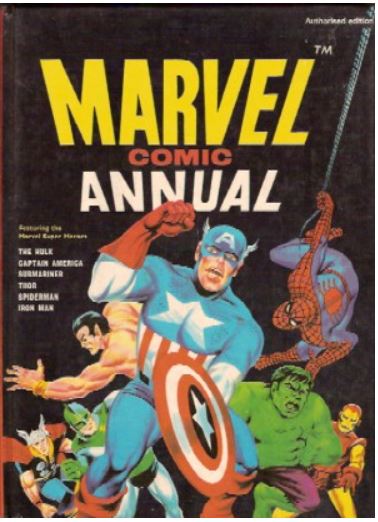
Marvel Comic Annual 1969


By Stan Lee, Larry Lieber, Jack Kirby, Steve Ditko, John Romita, Bill Everett, Don Heck, Chic Stone, Dick Ayers, Mick Anglo Studios & various (World Distributors, Ltd.)
No ISBN ASIN: B001G8UJME

This book includes Discriminatory Content produced in less enlightened times.

When Stan Lee rejuvenated the US comic-book industry in the early 1960s, his biggest advantage wasn’t the small but superb talent pool available, but rather a canny sense of marketing and promotion. DC, Dell/Gold Key and Charlton all had limited overseas licenses (usually in dedicated black-and-white anthologies like the much beloved Alan Class Comics such as Suspense) but Lee – or his business managers – went further, sanctioning Marvel’s revolutionary early efforts in regular British weeklies like Pow!, Wham!, Smash! and even the venerable Eagle. There were two wholly Marvel-ised papers, Fantastic! & Terrific! which ran from 1967 to 1968. These featured a plethora of key Marvel properties, and, appearing every seven days, soon exhausted the back catalogue of the company.

After years being a guest in other publications Marvel finally secured their own UK Annuals through World Distributors’ publishing arm and packaged courtesy of jobbing comics content outfit Mick Anglo Studios. This sparkling collection is one of the very best. Completely absent are the text pieces, quizzes and game pages that filled out British Christmas books, replaced with cover-to-cover superhero action mimicking the emergent House of Ideas at the very peak of their creative powers. It even includes a few almost Golden Age classics. Moreover it’s in full colour throughout – almost unheard of at the time.

A closer look by Marvel scholars would ascertain that all of the strips published here were actually taken from the wonderful 25¢ giants (Marvel Tales, Marvel Collector’s Item Classics and Marvel Superheroes) released during the preceding year, perfectly portioned out to fit into a book intended for a primarily new and young audience.

Behind the delightful painted cover the enchantment commences with a John Romita drawn Captain America tale from 1954, as the Sentinel of Liberty & Bucky lay waste to a scurvy gang of Red Chinese dope smugglers in ‘Cargo of Death’, followed by a spectacular Thor saga from Lee, Jack Kirby & Chic Stone as the Thunder God tackled ‘The Cobra and Mr. Hyde’, complete with cameo from the mighty Avengers.

The first of two Hulk shorts comes next, another Commie-busting classic with sci-fi overtones. Lee, Kirby & Dick Ayers’s ‘The Gladiator from Outer Space’ is a terrific all-action mini-blockbuster, perfectly complimented by Lee & Steve Ditko’s sinister crime shocker wherein Spider-Man is trapped between ‘The Goblin and the Gangsters!’

Unsung genius Bill Everett provided a brace of sublime Sub-Mariner tales, both from the fabulous 1950s. The secret origin saga ‘Wings on his Feet’ is the first and undeniable best of these, his magical line-work wonderfully enhanced by a bold colour palette and the crisp white paper stock of this comfortingly sturdy tome.

He’s followed by a masterful clash of titans as ‘Iron Man Faces Hawkeye the Marksman’ (Lee & Don Heck) before ‘The Hulk Triumphant’ (concluding chapter of the very first appearance wherein the Green Goliath ends the menace of Soviet mutation The Gargoyle)/ The book then closes with another enthralling Everett Sub-Mariner epic as the Prince of Atlantis defeats mad scientists and monsters ‘On a Mission of Vengeance!’

These oft-reprinted tales have never looked better than on the 96 reassuringly stout pages here: bold heroes and dastardly villains running riot and forever changing the sensibilities of a staid nation’s unsuspecting children. Magic, utterly Marvellous Magic!
© 1969 Perfect Film & Chemical Corporation, Marvel Comics Group. All rights reserved.

Today is pretty auspicious for births! In 1893 Robert Ripley (Ripley’s Believe It or Not!) was whelped, as was Red Ryder co-creator Stephen Slesinger in 1907, whilst Tarzan maestro and educational powerhouse Burne Hogarth showed up in 1911. Two years after that, Elliot Caplin (The Heart of Juliet Jones & Abbie an’ Slats) joined the party, whilst in 1920 Letterer Joe Rosen who lettered all the other Marvel classic stories was born.

Season’s Greetings, Boys, Girls and especially those Still Thinking About It!

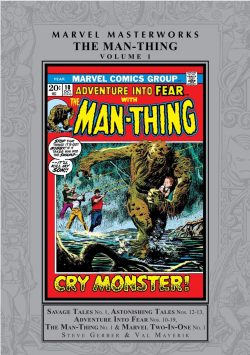
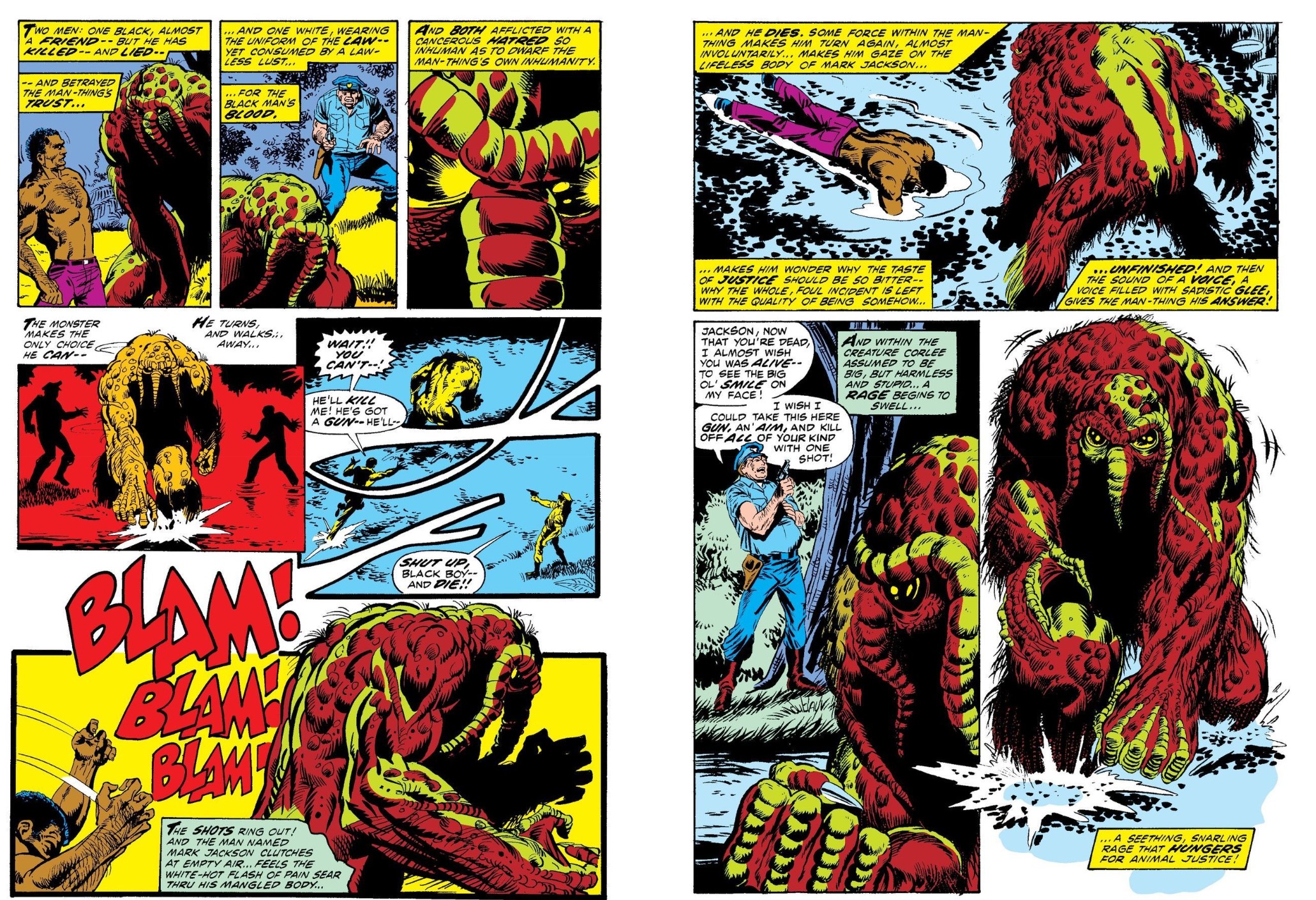
Man-Thing Marvel Masterworks volume 1


By Steve Gerber, Roy Thomas, Len Wein, Gerry Conway, Val Mayerik, Gray Morrow, Rich Buckler, John Buscema, Neal Adams, Howard Chaykin, Jim Starlin, Gil Kane, Dan Adkins, Jim Mooney, Frank Bolle, Chic Stone, Frank McLaughlin, Sal Trapani, Joe Sinnott, Frank Brunner, Mike Ploog & various (MARVEL)
ISBN: 978-1-3029-5547-2 (HB/digital edition)

This book includes Discriminatory Content produced in less enlightened times. This book also includes some Discriminatory Content included for dramatic and literary effect.

Win’s Christmas Gift Recommendation: Timeless, Remorseless, Evergreen Scary Stuff to Make You Think… 9/10

At the end of the 1960s American comic books were in turmoil, much like the youth of the nation they targeted. Superheroes had dominated for much of the decade; peaking globally before explosively falling to ennui and overkill. Older genres such as horror, westerns and science fiction returned, fed by radical trends in movie-making, where the kids who had grown up with Marvel now fulfilled the bulk of their young adult entertainment needs.

Inspiration isn’t everything. In fact as Marvel slowly grew to a position of market dominance in the wake of the losing their two most innovative and inspirational creators, they did so less by experimentation and more by expanding proven concepts and properties. The only real exception to this was the hasty hyper-generation of multiple horror titles in response to the industry down-turn in super-hero sales – a move vastly expedited by a rapid revision in the wordings of the increasingly ineffectual Comics Code Authority rules.

The switch to supernatural stars had many benefits. Crucially it brought a new readership to Marvel comics, one attuned to the global revival in spiritualism, Satanism and all things sinisterly spooky. Almost as important, it gave the reprint-crazy company an opportunity to finally recycle old 1950s horror stories that had been rendered unprintable and useless since the Code’s inception in 1954.

A scant 15 years later the Comics Code prohibition against horror was hastily rewritten – amazing how plunging sales can affect ethics – and scary comics came back in a big way with a new crop of supernatural heroes and monsters popping up on the newsstands to supplement the ghosts, ghoulies and goblins already infiltrating the once science-only scenarios of the surviving mystery men titles. In fact lifting of the Code ban resulted in such an en masse creation of horror titles (both new characters and reprints from the massive boom of the early 1950s) that it probably caused a few more venerable costumed crusaders to (temporarily, at least) bite the dust.

Almost overnight nasty monsters (and narcotics – but that’s another story) became acceptable fare on four-colour pages and whilst a parade of pre-code reprints made sound business sense, the creative aspect of the contemporary buzz for bizarre themes was catered to by adapting popular cultural icons before risking whole new concepts on an untested public. As always in entertainment, the watch-world was fashion: what was hitting big outside comics was to be incorporated into the mix as soon as possible.

The first fan-sensation of the modern era, (now officially enshrined as the Bronze Age of US comic books) Swamp Thing had powerful popular fiction antecedents and in 1972 it was seemingly a concept whose time had come again. Prime evidence was the fact that Marvel were also working on a man-into-mucky, muddy mess character at the very same time. Both Swampy and the Macabre Man-Thing were thematic revisions of Theodore Sturgeon’s classic novella It, and bore notable resemblances to a hugely popular Hillman Comics star dubbed The Heap.

He/it sloshed through the back of Airboy Comics (née Air Fighters Comics) from 1943 until the end of the Golden Age, and my fanboy radar suspects Roy Thomas’ marsh-monster The Glob (Incredible Hulk #121-November 1969 & #129-June 1970) either inspired both DC and Marvel’s creative teams, or was part of that same zeitgeist. It must also be remembered that in the autumn of 1971 Skywald – a very minor player with big aspirations – released a monochrome magazine in their Warren knock-off line entitled The Heap.

For whatever reason, by the end of the 1960s superhero comics were in another steep sales decline, again succumbing to a genre boom led by a horror/mystery resurgence. A swift rewriting of the Comics Code Authority augmented the changeover and at National/DC, veteran EC comics star Joe Orlando became editor of House of Mystery and sister title House of Secrets. These were short story anthologies embracing gothic mystery scenarios, taking their lead from TV triumphs like Twilight Zone and Rod Serling’s Night Gallery, but a horror themed lead meant a focus on character not plot, tragedy and empathy over twist endings and most precious of all, continuity…

No one was expecting satire and social commentary but that came along for the ride too!

Remarkably soon after the Comics Code prohibition against horror being amended, scary comics returned in force and a fresh crop of supernatural superheroes and monsters began appearing on newsstands to supplement the ghosts, ghoulies and goblins already infiltrating the once science-only scenarios of the surviving Fights ‘n’ Tights titles.

In fact, the lifting of the Code ban resulted in such an avalanche of horror titles in response to the industry-wide downturn in superhero sales, that it probably caused a few more venerable costumed crusaders to – albeit temporarily – bite the dust.

When proto-horror Morbius, the Living Vampire debuted in Amazing Spider-Man #101 (cover-dated October 1971) and the sky failed to fall in, Marvel moved ahead with a line of shocking superstars. They began with a traditional werewolf and a vampire before chancing something new: a haunted biker who tapped into both Easy Rider’s freewheeling motorcycling chic and the prevailing supernatural zeitgeist: the all-new Ghost Rider (in Marvel Spotlight #5, August 1972). He had been preceded by western hero Red Wolf in #1 and the aforementioned Werewolf by Night in #2-4. From these beginnings spooky floodgates opened to such an extent there was even room for non-white stars like The Living Mummy and ultimately today’s star turn…

This quirky compendium collects the earliest exploits of Marvel’s muck monster, and not at all coincidentally traces the rise of a unique comics voice. Steve Gerber was a sublimely gifted writer with a ferocious social conscience who combined a deep love of Marvel’s continuity minutiae with dark irrepressible wit, incisive introspection, barbed cultural criticism, a barely reigned-in imagination and boundless bizarre surrealism. His stories were always at the extreme edge of the company’s intellectual canon and never failed to deliver surprise and satisfaction, especially when he couched his sardonic sorties as thinly veiled attacks on burgeoning cultural homogenisation and commercial barbarity. Via material from Savage Tales #1, Astonishing Tales, #12-13, Adventure into Fear #10-19, The Man-Thing #1 & Marvel Two-In-One #1 (communally spanning May 1971 to January 1974) we’ll see how Marvel increasing became the voice of a lost and dissatisfied liberality…

The revolution begins after an erudite Introduction by authorial everyman Steve Orlando (Scarlet Witch, Wonder Woman, Ben 10, Heavy Metal Magazine), before we trudge back to very different times and the beginning of a new kind of comics experience and Marvel’s continued experiments with the monochrome, mature reader marketplace…

Ranged amidst the grittier-than-usual adult-oriented material (that meant partial nudity and more explicit violence back then) Savage Tales #1 (cover-dated May 1971) was a mixed bag of sword & sorcery, sci fi, crime and horror stories featuring Conan, Ka-Zar and more. That line-up included a powerfully enthralling horror yarn entitled ‘Man Thing!’ Scripted by Gerry Conway & Roy Thomas, it offered a fairly traditional spooky story elevated to sublime heights by Gray Morrow’s artwork. It related how government biochemist Ted Sallis was hiding out in the swamps whilst finishing a new/recreated iteration of the much-prized Super-soldier formula that had created Captain America

Sadly, his live-in lover Ellen is an agent for the opposition and when she and her minions made a play for the formula, Ted is wounded and flees into the murky mire. To preserve the only sample of his life’s work, the desperate, possibly dying boffin injects himself with it… and the bog mingles with the mix to spawn something tragic and uncanny…

Barely conscious or sentient, a shambling muck-monster emerges, apparently set on justice or vengeance…

Savage Tales was not a success and who knows how many manic Marvelites actually saw the anthology, but creators are stubborn brutes who can’t let things lie, so some months later the muck monster shambled back via a tenuous mainstream comic book connection…

Cover-dated June 1972, Astonishing Tales #12 sees the Savage Land’s self-appointed Sovereign Ka-Zar – and morphologically unsubstantiated primaeval saber-cat Zabu – abruptly relocating to Florida in pursuit of S.H.I.E.L.D. agent Barbra “Bobbi” Morse only to find that ‘Terror Stalks the Everglades!’ Here Thomas, John Buscema & Dan Adkins deftly recast the Jungle King as a freelance “consultant” for the superspy network, assisting aging biologist Dr. Wilma Calvin – who just happens to be Morse’s mentor – in tracking down a missing scientist named Ted Sallis.

What Ka-Zar doesn’t know is that the project all of them are working on is the recreation of the super-soldier serum that created Captain America and what nobody (technically) alive knows is that Sallis succeeded before he vanished. However, when Advanced Idea Mechanic agents tried to steal it. Sallis had injected himself and the chemicals reacted with the swamp’s magical energies to create a mindless shambling monster.

Readers are clued in thanks to a lovely unused interlude intended for Savage Tales #2, with Wein & Neal Adams providing a chilling recap sequence detailing the macabre Man-Thing’s previous relationship with Calvin, before back in the now, AIM attacks, trapping Ka-Zar with the bog-beast…

In AT #13 (Thomas, J. Buscema, Rich Buckler & Adkins), the mystery grows as the Jungle Lord escapes the ‘Man-Thing!’ to focus on the real monsters, subsequently routing out a traitor and defeating AIM… for now. With the attention-grabbing overlap with mainstream Marvel done for the moment the path was clear if muddy for a new horror hero to forge ahead, but what was needed was the right tone of voice…

Steve Gerber was a uniquely gifted writer who combined a deep love of Marvel’s continuity minutiae with dark irrepressible wit, incisive introspection, barbed socio-cultural criticism, a barely reigned-in imagination and boundless bizarre surrealism. His stories were always at the extreme edge of the company’s intellectual canon and never failed to deliver surprise and satisfaction, especially when he couched his sardonic sorties as thinly veiled attacks on burgeoning cultural homogenisation and commercial barbarity. With Man-Thing he held up a peculiarly scummy mirror to many cordoned-off and taboo subjects and made history – and enemies – over and over again. However before him, Conway & Morrow returned, aided by Howard Chaykin as the bog beast won its own series, beginning in (Adventure into) Fear #10. Cover-dated October 1972, ‘Man Thing!’ (Say it again! Again!) saw the monster defy all odds to return an abandoned baby to a daddy who just did not want him… and would not take no for an answer…

After that conceptual interlude Gerber, Buckler & Jim Mooney opened an extended mystic parable in Fear #11 on the ‘Night of the Nether-Spawn!’ Gerber’s take was that the beast was empathic and all-but-mindless, reacting and responding to those in its vicinity, but having practically no personal volition. Here that relationship draws in teenagers Jennifer Kale and her little brother Andy who are about to get into all sorts of trouble because they stole something from their grandpa. Sadly, when you play with a magical tome belonging to an ancient cult, handed down over eons to the latest in a long line of guardian wizards, sinister stuff is likely to happen…

The upshot is that a demonic force comes looking for little Miss Kale and its evil emanations make it a painful intrusion the maddened muck monster cannot abide. With diabolical Thog the Nether-Spawn thus preoccupied battling the bonkers bog-brute all through small-town Citrusville, Andy & Jennifer are free to try to fix what they broke. All appearances and happy endings to the contrary, it’s too little, too late…

The nation’s racial tensions boiled over into Fear #12 as Gerber, Jim Starlin & Buckler discovered ‘No Choice of Colors!’ after the moss-heap slurped into a far-too-personal vendetta linking racist white sheriff Wallace Corlee and fugitive black murder suspect Mark Jackson. After initially and instinctively saving the wounded runner, Man-Thing is helpless against the literally paralysing hatred of both men: one condemned for loving the wrong shade of woman and the just other happy to have a legal reason to kill another “coloured man”…

Only after one of the enraged obsessives is no more can the swamp beast freely act against the other…

In #13, Val Mayerik begins his fruitful association with the series as – inked by Frank Bolle – ‘Where Worlds Collide!’ finds Gerber in universe-building mode: introducing Jennifer Kale’s Grandpa Joshua as high priest of a cult that has thrived secretly since Atlantis sank beneath the waves. They have safeguarded the world for eons, handing down the sacred Tome of Zhered-Na, but now Jennifer’s meddling as she innocently answered the call of her heritage has opened a portal to infernal terror that begins by taking Jen’s not-boyfriend Jaxon and opening pathways to devil-infested dimensions. When the Man-Thing follows, he finds a place where Ted Sallis is made manifest again and where Thog offers to make it permanent if the human will betray his world…

Ted’s violent refusal coincides with Joshua and the grandkids showing up and, in the flush of frantic battle and escape to consensus reality, the Kales discover Jennifer’s uncanny link to the mindless (again) monster…

Veteran Chic Stone inks #14’s ‘The Demon Plague!’ as, all over America, hate and insanity blossom. Everywhere, humans attack those nearest, dearest or even largely indifferent to them; and the deluge of violence even affects the wildlife in Florida’s swamps with Man-Thing pitilessly assaulted by everything that walks or hops or crawls or swims…

Joshua Kale soon determines that the not properly sealed dimensional portal is permitting demons to pass and possess mortals, and convenes a cult ceremony to close it from within the swamp – which just happens to be the Nexus of All Realities…

Despite best efforts the ritual goes awry and, curiously spying on them, Jennifer and the bog-beast are abducted from existence by a major mage dubbed Dakimh the Enchanter. Forced into gladiatorial actions to retain the sacred tome that only Jennifer knows no longer exists, everybody underestimates the shambling compost heap with flamethrower hands, and the Earthlings are promptly returned without giving away any more arcane secrets…

With Frank McLaughkin as guest inker this time, Gerber & Mayerik probe ‘From Here to Infinity!’ in Fear #15. With chaos gripping the entire planet, the Man-Thing seemingly killed by invading demons and no sacred tome to consult, Joshua Kale visits ancient Atlantis, seeing how mystic Zhered-Na personally dealt with the last such incursion, learning of an eternal war between divine realms – shining Therea and dark Sominus…

As the current cult leader views how his inspiration met her end, elsewhere Dakimh recruits promising potential sorceress Jennifer, revives the bog-beast and takes them both an a trans-dimensional voyage to save reality and stop the sorcerous shooting war…cat least for now and at the cost of the link to the swamp totem…

Abruptly switching tack and tone, Fear #16 ‘Cry of the Native!’ (inked by Sal Trapani) explores themes of Native American rights, ecological barbarism and callous capitalism run amok, when developer F A Schist attempts to drain the swamp and relocate its Indian occupants to facilitate his new airport complex. Complex issues of new jobs versus already broken treaties and promises lead to sabotage, riots and civil unrest, but what concerns the Kales most is how the disruption might affect the shaky barriers holding back the hungry hordes of Sominus…

This time, however, simply human pride, greed, bigotry and love of violence – all agonising felt by mindless, empathic Man-Thing – is enough to spark riot and butchery, and stall the project. In the aftermath (and with Trapani sticking around as inker) #17’s ‘It Came Out of the Sky!’ offers dark, wry parody as the bog-beast curiously opens a long-submerged space capsule buried in the hidden mire. Within is a super-powered baby sent from a world believed by one scientist/loving father to be on the imminent edge of extinction due to environmental collapse…

The capsule had fed and sustained the godlike being within for 22 years, but when Wundarr emerged to immediately imprint on the Man-Thing, nothing could convince the educationally and emotionally challenged – and fully-grown – waif that the unthinking moss-mass was not his mother. The rejection and indifference proved unbearable and the violent tantrums that resulted almost destroy the airport construction site and Citrusville…

The story notionally carries over into debuting superhero team-up book Marvel Two-In-One #1 (cover-dated January 1974) where, after a desert clash with Thanos, Fantastic Four stalwart Ben Grimm accidentally and improbably ends up in Florida for the premier issue of his own title. Crafted by Gerber, Gil Kane & Joe Sinnott, the ‘Vengeance of the Molecule Man!’ sees The Thing learn some horrifying home truths about what constitutes being a monster when battling with and beside ghastly, grotesque anti-hero Man-Thing after the essence of the reality-warping villain starts possessing bodies in the swamps

Back in Fear #18, Gerber, Mayerik & Trapani resume straight terror tropes and real-world controversy in ‘A Question of Survival!’ as a bus load of ordinary people and a drunk driver catastrophically intersect on a highway through the Everglades. Drawn to the emotional turmoil, the mire monster becomes unwilling witness and unintentional guide as the survivors learn about each other (this at a time when women and minorities were still legally second-class citizens, and pacifists & warhawks violently clashed over Vietnam) whilst trekking back to civilisation and medical treatment. Sadly, one of them really needs to be the only survivor and is not averse to more killing…

The series truly hit its innovative stride with its final appearance in (Adventure into) Fear #19 – cover-dated December 1973 – wherein Thog makes his grand move to conquer all realities and destroy the benign over-gods of Therea. That’s when Jennifer Kale officially becomes ‘The Enchanter’s Apprentice!’ (Gerber, Mayerik & Trapani) and joins another trans-planar trek as the formerly regulated realms of existence begin to collide, clash and combine. First task is to gather the heroes needful to the task and her far-from-united party rapidly expands to include tutor Dakimh, the mindless Man-Thing, a burly barbarian (Korrek, Warrior Prince of Katharta!) and a brusquely cynical talking mallard who calls himself Howard

Hounded by Thog’s forces, their task is to traverse the twisting paths of existence and save the gods with the chase leading directly into The Man-Thing #1 (January 1974) and a world-shattering ‘Battle for the Palace of the Gods!’ Along the way, Howard is an early casualty, lost in a plunge through cascading universes and the chaos even briefly encompasses baffled heroes Daredevil and Black Widow; and all seems lost when the malign Congress of Realities smashes into seemingly undefended Therea. However, there are forces at play that are beyond even demons and devils, and the mysterious Man-Thing is their unknowing yet willing tool; and ultimately realties are rebalanced and life goes on…

With covers by John Buscema, Buckler, Morrow, Adams, Starlin, Kane, John Romita Snr., Alan Weiss, Frank Brunner, Sinnott, Frank Giacoia, Herb Trimpe & Ernie Chan, the extras in this moody tome of terror and extrospection also include – from November 1970 – Thomas’ original plot for the short story in Savage Tales #1; an original grey-toned art page by Morrow; more by Buscema & Adkins, Buckler, Mooney, Weiss, Brunner, Mayerik & McLaughlin. For your perusal, Gerber’s plot for Fear #16 follows, with lettering notes and Brunner’s cover for #17. More original art includes Romita’s cover for #18 plus interior art by Mayerik & Trapani. The cover art for #19 by Kane & Chan opens another gallery before segueing into house ads, Adams’ cover for Monsters Unleashed #3 and a cover gallery for reprint title Book of the Dead #1-3 (1993-1994) by Tennyson Smith & Morrow, and Ariel Olivetti’s cover to the 2012 Man-Thing Omnibus.

We – me especially – apply the terms milestone, landmark and groundbreaking as guarantors of quality that change the way comics are perceived and even created. It has never been more true or accurate than with these game-changing, socially aware horror yarns. These are stories you must not miss…
© 2024 MARVEL.

Today in 1894 the magnificent Elzie Segar was born. Go read some Popeye or even Thimble Theatre if you can find it.

In 1980 Berke Breathed chose the day to begin his almost-as-magnificent Bloom County strip, as we last saw in Bloom County: Real, Classy, & Compleat 1980-1989. Some of that last factoid is made up by me, but it could have happened…

The Mighty Thor Epic Collection volume 25: The Dark Gods (1998-1999)


By Dan Jurgens & John Romita Jr., Tom DeFalco, Howard Mackie, J.M. DeMatteis, Klaus Janson, John Buscema, Ramon Bernado, Klaus Janson, Mark Pennington, Scott Hanna, Jerry Ordway & various (MARVEL)
ISBN: 978-1-3029-6411-5 (TPB/Digital edition)

This book includes Discriminatory Content produced in less enlightened times.

Win’s Christmas Gift Recommendation: Punch-Punch! Smite-Smite! Gosh Wow!… 8/10

In the middle of 1962, Stan Lee & Jack Kirby launched their latest offbeat superhero creation in anthology monsters-and-mysteries title Journey into Mystery #83. The edifying epic introduced meek, disabled American doctor Donald Blake who took a vacation in Norway only to encounter the vanguard of an alien invasion. Fleeing in terror, he was trapped in a cave and found an old, gnarled walking stick. When, in helplessness and frustration, he smashed the cane into a huge boulder obstructing his escape, his insignificant frame was transformed into the hulking and brawny Norse God of Thunder, Thor!

The series grew from formulaic beginnings battling aliens, commies and cheap thugs into a vast, breathtaking cosmic playground for Kirby’s burgeoning imagination with Journey into Mystery inevitably becoming The Mighty Thor. After years of celestial adventuring, the peculiarities and inconsistencies of the Don Blake/Thor relationship were re-examined – as well as his doomed romance with his nurse Jane Foster – and all was finally clarified and explained regarding how an immortal godling could also be frail Dr. Blake.

The saga took the immortal hero back to his long-distant youth, ultimately revealing that the mortal surgeon was no more than an Odinian deception: a living shell designed to teach the Thunder God humility and compassion…

Time passed, Kirby left and the Thunderer’s fortunes waxed and waned. During the troubled mid-1990’s the title vanished, culled with The Avengers, Iron Man, Captain America and Fantastic Four and subcontracted out to Image creators Jim Lee & Rob Liefeld during 1996-1997 in a desperate attempt to improve sales after Marvel’s apocalyptic Onslaught event.

In 1998 Heroes Return and Heroes Reborn saw those properties rejoin the greater Marvel Universe, relaunched with new first issues. The Thunder God reappeared a few weeks later as in July, Mighty Thor volume 2 launched. This compendium gathers # Mighty Thor #1-13, plus Silver Surfer & Thor Annual 1998; Thor Annual ’99 & Peter Parker, Spider-Man #2 spanning July 1998 to July 1999.

It begins with ‘In Search of the Gods’ by Dan Jurgens, John Romita Jr. & Klaus Janson, finding the Thunderer back on Midgard after more than a year away from the home cosmos, and instantly involved in a desperate hostage situation. Acting immediately, he ends the crisis only to discover the perpetrator is a currently-powerless Guardian God Heimdall. Recently in contemporaneously relaunched Avengers #1, Thor had found Asgard devastated and deserted and now that shocking mystery has been further compounded on Earth…

Elsewhere, Death Goddess Hela and Volla the Prophetess conspire in anticipation of cosmic calamity and desires finally reaching fruition, even as a military shipment goes badly awry at New York’s docks where EMT/paramedic Jake Olsen gets the call to assist…

Before leaving Heimdall with (now) Doctor Jane Foster, Thor and the sentinel Asgardian explored shattered Asgard again, inadvertently liberating an unknown horror from ancient captivity, but all that is forgotten as the docks situation worsens and Thor joins the hard-pressed Avengers in battling reawakened Odinian ultimate weapon The Destroyer

Despite the best efforts of the World’s Mightiest Heroes, the carnage is shattering and people die. People like Olson… and Thor…

Thor’s story nevertheless continues as his journey to Hela’s realm is interrupted by disturbing new cosmic entity Marnot who claims the Thunderer’s soul and returns it to the living world, bound to equally-miraculously resurrected Olsen in a reprise of the spell that created Don Blake… and just in time to stop The Destroyer. However, the new-old arrangement will prove to be a true ‘Deal with the Devil!’

Reborn as ‘God and Man’ in #3, the Storm Lord again walks the Earth – but only as the dormant-until-summoned alter-ego of another frail mortal host with a painfully complex personal life. It makes battling the sea-monsters of beguiling sea-goddess Sedna beside former Avenger Namor the Sub-Mariner a far from friendly reunion in ‘From the Ashes’

Next comes a notional prequel tale from Silver Surfer & Thor Annual 1998, courtesy of Tom DeFalco, Ramon Bernado & Mark Pennington. ‘Millennius!’ finds the Silver Surfer beset by frost giants that have somehow escaped the confines of Asgard. After thrashing and returning them whence they belong, investigation beside the stormy Prince uncovers a plot by an exiled vengeful if not utterly deranged primal god determined to wreak havoc upon the modern universe and resume reshaping what remains to his dark whims. Thanks to the valour of the heroes he does not succeed…

TMT #5 finds the Thunderer still acclimating to his personal new normal and the decidedly different requirements of mortal crimes and crises. This somehow leads to Mjolnir rebelling after Thor’s take-charge personality overrules Olsen’s legal authority when the still readjusting godling compels his paramedic self to perform illegal surgery to save a life in ‘Heroes’

The wreckers of Asgard and Marnot have been manoeuvring in the background throughout and following a flashback to Asgardian childhood, ‘What’s a God to Do?’ sees Thor edging closer to the truth after another pointless clash with best pal Hercules. Once the dust has settled, Thor finds his people have been framed for attacking Olympus even as in Asgard, the fate of the vanquished All-Father is revealed. However, this ‘Deception’ has proven effective, and Thor & Hercules are attacked by the entire outraged Hellenic pantheon…

The true architects of most of this mayhem are a pantheon of previously unknown Dark Gods – Perrikus, Adva, D’Chel, Slottoth, Tokkots and Majeston Zelia – so powerful that they have managed to take possession of the fallen Fabled Realm, consistently attacking Thor since his return; now barring him entirely from reaching his sundered home…

We diverge briefly for Mighty Thor Annual ‘99 which at last revealed why Thor arrived back in our universe so much later than his Avenging Allies. Written and pencilled by Jurgens with inks from Janson, ‘The Tears of a God’ found Thor visiting The Fantastic Four and describing the dimensional rip which left him partially amnesiac and filled with ineffable sadness, before – for our eyes only – the story is fully disclosed…

After battling Doctor Doom in the void between worlds, Thor and the Iron Dictator were cast onto an alien planet where the wounded Thunderer was nursed to health by a mysterious outcast named Ceranda. Somehow unable to leave the desolate world, the lost scion of Asgard grew slowly closer to the beautiful hermit, whilst elsewhere Doom was taking control of a subterranean society: co-opting their technology and resources to his selfish needs…

The last thing the Lord of Latveria needed for escape was Thor’s dimension-spanning hammer and he knew the true reason why it wasn’t working. This tale of dark desire and selfish love ended badly all round so perhaps its best that after the battle and return to Earth Thor had no memory of weeks spent with bewitching Ceranda…

Back at now, a stellar crossover between hammer-hurler and webspinner opens in Thor #8 as the Thunder God encounters the astounding arachnid as Tokkots goes on an Earthly rampage in ‘…and the Home of the Brave!’ prior to being spectacularly defeated and despatched to enslaved Asgard in ‘Plaything of the Gods’ (as seen in Peter Parker, Spider-Man #2, by Howard Mackie, Romita Jr. & Scott Hanna).

The end of the reinvigorated Storm Lord’s first extended story-arc comes with ‘Answers’ by regular writer Jurgens and guest illustrators John Buscema & Jerry Ordway when a vintage robotic menace returns. Here a couple of young punks luck into the operating system for android bandit Replicus and whilst the earthbound Thunder God is taking care of business in Asgard, dark usurpers are crowing over the ravaged, tortured bodies of his best friend Balder, eternally betrothed Lady Sif and mighty sire Odin, all the while scheming how to destroy the last remaining free Asgardian…

Thor is just as keen on facing his elusive tormentors and finally gains insight from enigmatic Marnot, who teasingly reveals a long-ago day when the early Asgardians encountered a rival pantheon: happily cruel gods dominating and enslaving the realm of Narcisson and just begging to begin a brutal all-out war with new foes. Against all logic the Narcissons won and were on the verge of eradicating the Asgardians until a juvenile Thor turned the tide, enabling Odin and his surviving warriors to carry the day. With these Dark Gods routed and captive, the All-Father wiped the memories of his own triumphant warriors to spare them the trauma and loss of so many comrades and loved ones. Now, however, the Narcisson gods were somehow free and had at last conquered the Eternal Realm. Armed with knowledge, Thor began to prepare for the invasion and liberation of Asgard…

The final campaign began in the three chapter saga ‘The Dark Wars: part I’, by Jurgens, Romita Jr. & Janson as human Jake Olsen frantically starts setting his complex human affairs in order. The conjoined hero is utterly unaware that colleague Dr. Foster has deduced his godly secret and that an unknown mortal enemy is setting him up to take the fall for selling stolen hospital drugs…

Before the exiled prince is ready to act, Perrikus attacks New York City, demanding a duel with the Odin-son and threatening to kill Lady Sif if the Thunderer doesn’t show. With the gateway to Asgard clear, Thor’s rapid response finds the city as bad as ever and his loved ones broken toys of the Dark Gods. Enraged, he attacks but the blockbusting battle sees his magic mallet cloven in half and he feels himself impossibly transforming back into mortal Jake…

Taking cover in a sewer, Olsen discovers an horrific underworld beneath the shattered city and is taken by trolls to the very bowels of Asgard. Soon, the frail human is being worked to death whilst far above the black pantheon are unable to detect any trace of vanished Thor. However, the broken hero feels untrammelled hope and joy when he discovers many of his missing Asgardian comrades are also enslaved in the noisome pits…

Sadly, before Olsen can even attempt to rescue them, vile Tokkots appears and whisks him back to the throne-room and the waiting Narcissons. Perrikus is furious that he cannot battle his true enemy, only a mortal shell, but everything changes when the broken, battered Midgardian falls on the remnant of Mjolnir and is mystically metamorphosed into a fighting mad Storm Lord…

Unexpectedly, Thor flees into inter-dimensional space, realising that pride and fury are not enough and that what he really needs are potent allies…

The fearsome finale comes in ‘The Dark Wars: part III’ as the conflicted champion convinces the deadly Destroyer and Hercules to raid his once-Golden Realm in a blistering last charge against the Dark Ones and their massed minions whilst he raids the depths to free Asgardian survivors and activates a cleverly concealed ally. Soon Odin, Sif and Balder are free and the fall of the Narcissons is seemingly assured – but the malignant invaders still have one last nasty card to play…

It proves not enough and eventually the brutalised Asgardians are triumphant, after which epilogue ‘The Work of Odin’ answers many questions; such as the identity of manipulative schemer Marnot, the ultimate fate of the human trapped within the deadly Destroyer’s shell and the future of both light and dark gods…

Backed up by a wealth of covers and variants by Romita Jr., Janson, Hanna, Bernado, Jurgens Joe Jusko & Mark Farmer; developmental sketches; house and trade press ads (from Marvel Vision, Marvel Catalog, Marvel Monthly, Wizard #80) supplemented with interviews & previews – ‘Juggling with Jurgens’, ‘Dan Jurgens’ and ‘Working the Second Shift with John Romita Jr.’ – the extras also include the cover to rushed-out reprint Thor: Resurrection by Romita Jr., Janson & Gregory Wright and editor Tom Brevoort’s Afterword from it, before closing on Thor #7’s stunning original art cover.

This almost excessively action-packed if plot light chronicle is an all-out, rocket-paced return to comic book basics, and, whilst perhaps not to everyone’s taste (it’s woefully short of anything even approaching a funny moment), is a blistering epic to delight the Fight’s ‘n’ Tights faithful, with the artwork undeniably some of the best of the modern Marvel Age. If you want your pulses to pound and your graphic senses to swim, this is the ideal item for you.
© 2025 MARVEL.

Today in 1921 Len Dworkins was born. He took over drawing the Buck Rogers newspaper strip in 1949 and also handled aviation standard Skyroads from 1939 using nom de plume Leon Gordon. More significantly, today is the anniversary of The Dandy’s debut in 1937, which I’ve gone on about incessantly for the last few months. Feel free to scroll back and check…

In 1961 cartoonist Don “Megaton Man” Simpson was born and in 1984 the UK saw the last War Picture Library comic digest released into newsagents, sweetshops and railway kiosks. It was #2103 if you’re counting…

Captain America Marvel Masterworks volume 3


By Stan Lee, Jack Kirby, Jim Steranko, Syd Shores, Dan Adkins, Frank Giacoia, Joe Sinnott, George Tuska, Tom Palmer & various (MARVEL)
ISBN: 978-0-7851-2063-6 (HB) 978-0-7851-8803-2 (TPB)

This book includes Discriminatory Content produced in less enlightened times.

Win’s Christmas Gift Recommendation: Pure Superhero Swashbuckling… 10/10

During the Marvel Renaissance of the early 1960’s Stan Lee & Jack Kirby imitated the tactic that had worked so tellingly for DC Comics, but with mixed results. Julie Schwartz had scored an incredible success with his revised versions of the company’s Golden Age greats, so it seemed natural to try and revive the characters that had dominated Timely/Atlas in those halcyon days.

A new Human Torch premiered as part of the revolutionary Fantastic Four, and in the fourth issue of that title Sub-Mariner resurfaced after a 20-year amnesiac hiatus (everyone concerned had apparently forgotten the first abortive attempt to revive an “Atlas” superhero line in the mid-1950s). The Torch was promptly given his own solo feature in Strange Tales beginning in #101, and in #114 the flaming teen fought an acrobat pretending to be Captain America.

With reader reaction strong, the “real” thing promptly resurfaced in Avengers #4 and, after a captivating, centre-stage hogging run in that title, the Sentinel of Opportunity was granted his own series as half of “split-book” Tales of Suspense (from #59, cover-dated November 1964).

However, Marvel’s inexorable rise to dominance in the American comic book industry really took hold in 1968 when many of their characters finally got their own full length titles. Prior to that and due to a highly restrictive distribution deal, the company was tied to a limit of 16 publications per month. To circumvent this, Marvel developed those titles with two series per publication, such as Tales of Suspense where original star Iron Man shared honours with Cap. When the division came, Shellhead started afresh with a big deal First Issue, whilst Cap retained the numbering of the original title; thereby premiering with #100.

This resoundingly resolute full-colour collection spanning May 1968 to May 1969 – and available in hardcover, trade paperback and digital editions – re-presents Captain America #101-113 and also includes a fervent Introductory reminiscence from arch-Kirby appreciator John Morrow, plus a fascinating Afterword by industry legend Jim Steranko wherein he meticulously and methodically deconstructs the landmark epic that comprises the end of this titanic tome…

Crafted by Stan Lee, Jack Kirby & legendary 1940s Cap illustrator Syd Shores, Captain America #101-102 recount the return of fascist revenant the Red Skull who here deploys yet another appalling Nazi revenge-weapon in ‘When Wakes the Sleeper!’ This results in boatloads of furious action and a classic clash of wills and ideologies in furious finale ‘The Sleeper Strikes!’ It all began as our hero and his trusty support crew Agent 13 & Nick Fury hunt a murderous mechanoid capable of ghosting through solid Earth and blowing up the planet…

Although the immediate threat is quickly quashed, the instigator remains at large and #103 exposes ‘The Weakest Link!’ as the budding romance with S.H.I.E.L.D. Agent 13 (finally revealed after two years as Sharon Carter) is cruelly interrupted by the nefarious Nazi. The über-fascist’s latest scheme of nuclear blackmail also extends to a second issue, wherein his aging band of war-criminal assassins, The Exiles, sequentially test Cap nigh to destruction on the hidden isle where our hero becomes the ‘Slave of the Skull!’

That issue and following super-villain team-up – wherein Living Laser and The Swordsman ally with another flamboyant Cap foe to battle ‘In the Name of Batroc!’ – feature the loose, flowing inking of Dan Adkins, before Frank Giacoia embellishes all-action, sinister spies-&-devious-doppelgangers romp ‘Cap Goes Wild!’ in #106.

Shores spectacularly returns in #107 embellishing sinister mystery ‘If the Past Be Not Dead…’: a panic-paced-paced psycho-thriller introducing malevolent, mind-bending world-conquering psychiatrist Doctor Faustusâ’…

The Star-Spangled Avenger is once again rescuing Agent 13 – or at least he thinks he is – in breakneck thriller ‘The Snares of the Trapster!’ before Captain America #109 redefines his origin for the Sixties generation with ‘The Hero That Was!’: a blistering and bombastic wrap-up to Kirby’s run on the Sentinel of Liberty… at least for the moment.

Comics phenomenon and one-man sensation Jim Steranko then took over the art – and art direction – with #110 for a far-too-brief stint that was to become everybody’s favourite Star Spangled epic for decades to come.

After a swift and brutal skirmish with the Incredible Hulk, teen appendage Rick Jones becomes the patriotic paladin’s new sidekick in ‘No Longer Alone!’, just in time for the pair to tackle the memorably lascivious, ferociously fetishistic Madame Hydra – and her eerily obedient hordes – in #111’s ‘Tomorrow You Live, Tonight I Die!’ Both are inked by Joe Sinnott in a landmark saga that inspired and galvanised a generation of would-be comics artists.

With the Avenger seemingly killed at the issue’s close, the next month saw a bombastic account of Captain America’s serried career by fill-in superstars Kirby & George Tuska, before Lee, Steranko & Tom Palmer returned to conclude the Hydra affair with ‘The Strange Death of Captain America’ in #113.

This yarn reset the veteran warrior’s character and dictated his heroic trajectory; and led to a whole new career path…

Also on offer are a selection of Kirby’s original art pages and covers, including rejected and unseen pencil versions prior to editing and the draconian interference of the Comics Code Authority…

These are tales of dauntless courage and unmatchable adventure, fast-paced and superbly illustrated, which rightly returned Captain America to the heights that his Golden Age compatriots Human Torch and Sub-Mariner never regained. They are pure escapist magic: glorious treats for the eternally young at heart, and episodes of sheer visual dynamite that cannot be slighted and should not be missed.
© 1968, 1969, 2016 Marvel Characters, Inc. All rights reserved.

Today in 1914, Timely Marvel founding force Vince Fago was born, as was contemporary universe-builder Jerry Ordway. In 2012 utterly unique commix creator Spain Rodriguez died. He probably saw it coming… and you can learn all you should already know about him by viewing Spain: Rock, Roll, Rumbles, Rebels & Revolution.