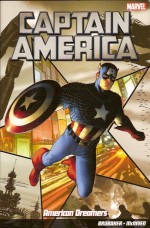
Captain America: American Dreamers


By Ed Brubaker, Steve McNiven, Giuseppe Camuncoli & various (Marvel/Panini UK)
ISBN: 978-1-84653-505-5

One of the key moments in Marvel Comics history occurred when the Mighty Avengers recovered a tattered body floating in a block of ice (issue #4, March 1964) and resurrected the World War II hero Captain America. With this act bridging the years to Timely and Atlas Comics (begun with the return of the Sub-Mariner in Fantastic Four #4), Marvel confirmed and consolidated a solid, concrete, potential-packed history and created an enticing sense of mythic continuance for the fledgling company that instantly gave it the same cachet and enduring grandeur of market leader National/DC.

It’s just that rich heritage and history which informs and embellishes this grand old fashioned Fights ‘n’ Tights romp by Ed Brubaker and artists Steve McNiven, Giuseppe Camuncoli, Mark Morales, Jay Leisten & Matteo Buffagni which featured in the first five issue of the Captain America monthly comicbook (volume 6 September 2011 – February 2012).

After too long on the sidelines Steve Rogers has again taken up the uniform and shield of the Star Spangled Avenger but is soon forced to confront his tragic past when his WWII paramour Peggy Carter passes away. Whilst attending her funeral with fellow veterans Nick Fury and “Dum Dum” Dugan the trio are targeted by a sniper and plunged back into long unfinished business…

Back in 1944 Peggy and the young warriors were in Paris to destroy an advanced weapons facility operated by Nazi technocrat Baron Zemo and budding conquest-cult Hydra. With the aid of costumed crusader Agent Bravo and Jimmy Jupiter – a boy with the ability to enter dreams and travel to a dimension where wishes became reality – the Allied operatives infiltrated the factory but the mission went terribly wrong, leaving Jimmy a comatose vegetable and Bravo trapped inside the timeless meta-realm with no hope of return.

Now Bravo is somehow back on Earth and working with a new Hydra Queen. Equipped with impossible new armaments and teamed up with the latest Zemo, the vengeful veteran wants to destroy Cap and Fury, romance/abduct the Avenger’s current girlfriend Agent 13 and obtain vengeance on the world which had forgotten him…

As part of that ambition Bravo recruits a long-forgotten Cap adversary. Lyle Dekker was a Nazi scientist and certified lunatic who had long harboured a festering hatred for the Red, White and Blue champion. After the hero had thawed out in modern times Dekker tried to assassinate him and take his place by having his mind permanently transferred into an 18-foot tall Cap robot dubbed The Ameridroid.

When the manic automaton attacks it is but the prelude to Bravo’s masterstroke: exiling Steve Rogers to Jimmy Jupiter’s fantasy dimension and a darkly seductive faux existence Captain America would never dream of escaping, whilst merging the Dream Dimension with the plane of reality: a new kind of American nation he would control…

With an added-value gallery of alternative covers by Art Adams, Olivier Coipel, Neal Adams, Dale Eaglesham, John Romita Sr. and Salvador Larroca, as well as anniversary and Movie variant edition covers, this superbly fast-paced and action-packed adventure is a stirring, thrilling and immensely entertaining confection that will delight old aficionados, impress new readers and should serve to make many fresh fans for the immortal Sentinel of Liberty.

™ & © 2011 and 2012 Marvel & Subs. Licensed by Marvel Characters B.V. through Panini S.p.A. Italy. A British Edition by Panini UK Ltd.

Essential Human Torch

New, extended review –
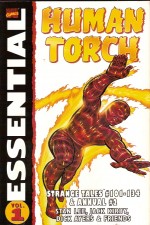

By Stan Lee, Jack Kirby, Dick Ayers & various (Marvel)
ISBN: 978-0-7851-1309-6

Hot on the heels (Sorry, sorry – I simply couldn’t help myself) of the runaway success of Fantastic Four, Stan Lee & Jack Kirby spun the most colourful and youngest member of the team into his own series, hoping to recapture the glory of the 1940s when the Human Torch was one of the company’s “Big Three” superstars.

This captivating, esoteric and economical collection of pure 1960s superhero shenanigans gathers those eclectic but crucial yarns (no less than five major Marvel villains debuted in blistering battle against the Flaming Kid) between Strange Tales #101 and 134 (October 1962- July 1965) and this searing monochrome compendium also includes the team-up of the Torch and Spider-Man from the second Annual.

Within a year of FF #1, the monster anthology title Strange Tales became the home for the hot headed hero. In issue #101, young Johnny Storm started his ancillary solo career in the eponymous ‘The Human Torch’ – a run-of-the-mill script by Larry Lieber (over a plot by his brother Stan) superbly illustrated by Jack Kirby & Dick Ayers wherein Johnny Storm investigated sabotage at a new seaside amusement park and promptly discovered Commie conniving by a Red spy called the Destroyer. Kirby would pencil the first few adventures before moving on after which inker Ayers would assume control of the series’ look for most of its run – although Kirby would generate some of the best covers of his Marvel career throughout the Torch’s tenure.

An odd inconsistency or, more likely, tension and drama-inducing gimmick did crop up here. Although public figures in the Fantastic Four, Johnny and his sister Sue lived part-time in the rural New York hamlet of Glenville and despite the townsfolk being fully aware of her as the glamorous and heroic Invisible Girl, they seemed oblivious to the fact that her baby brother was the equally famous Torch. Many daft pages but ingenious pages of Johnny protecting his secret identity would ensue before the situation was brilliantly resolved.

Although something of a hit-or-miss proposition, the strip was the origin point for many of Marvel’s greatest villains. The first of these appeared in the very next tale ‘Prisoner of the Wizard’ (Lee, Lieber, Kirby & Ayers) wherein a spiteful and publicity-hungry intellectual giant determined to crush the Torch to prove his superiority to the callow kid who stole all the newspaper headlines and the same creative team, then produced the captivating classic ‘Prisoner of the 5th Dimension’, as Johnny defeated a potential invasion and freed a captive populace from tyranny before easily trashing adhesive-toting adversary ‘Paste-Pot Pete!’ (later revamped as the terrifying Trapster), before teaming with sister Sue to tackle the deadly ‘Return of the Wizard’.

When Kirby moved on to engineer and design a host of new characters and concepts (occasionally returning as necessity or special events warranted) Ayers assumed full art duties beginning with Strange Tales #106 (March 1963). This yarn was notable in that it revealed that the entire town of Glenville had always known the Torch’s secret identity but were just playing along to keep him happy.

When Acrobat Carl Zante knocked on Johnny’s door and offered him a better-paying gig in ‘The Threat of the Torrid Twosome’ the kid’s head was swelled and swayed but he soon discovered he had been played by a master conman and diabolical bandit…

This first hint of tongue-in-cheek whimsy presaged an increasing lightness of touch which would come to characterise the Marvel style as much as the infighting between team-mates. The villainous Acrobat would return in another milestone in issue #114…

Issue #107 would be Lieber’s last as Ayers drew a splendid punch-up with the ‘Sub-Mariner’ – a tale reminiscent of the spectacular and immensely popular Golden Age battles of their publishing forebears. Veteran writer Robert “Berns” Bernstein scripted the next two, frankly daft yarns over Lee’s plots, but the saving grace of both ‘The Painter of a Thousand Perils!’(empowered by an alien art kit which brought illustrations to life in ST #108) and ‘The Sorcerer and Pandora’s Box’ (#109, with monstrous demons attacking humanity) was the brief return of King Kirby to the pencilling.

H.E. Huntley (Ernie Hart) typed the words for Ayers to illustrate in ‘The Human Torch vs. the Wizard and Paste-Pot Pete!’ a cunning clash which presaged the villain’s eventual evolution into the FF’s evil counterparts the Frightful Four. In #111 the Torch made short work of ‘Fighting to the Death with the Asbestos Man!’ – yet another demented scientist experiencing the travails and tragedies of simpler times.

Strange Tales #112 (scripted by Jerry Siegel under the pen-name Joe Carter) introduced murderous electrical marauder the Eel who accidentally swiped and activated a miniature A-Bomb in the tense, multifaceted thriller ‘The Human Torch Faces the Threat of the Living Bomb!’ after which Strange Tales Annual #2, featured ‘The Human Torch on the Trail of the Amazing Spider-Man!’ a terrific romp by Lee, Kirby & Steve Ditko wherein the wall-crawler was framed by international art thief The Fox, whilst back in the regular comicbook, “Carter” created another long-term baddie in ‘The Coming of the Plantman!’

Strange Tales #114 changed the face of the Marvel Firmament forever…

Written by Stan Lee himself, illustrated by Kirby & Ayers, it featured the return of the third of Timely Comics’ Golden Age Big Three – or at least an impersonation of him by the insidious Acrobat – in a blockbusting battle entitled ‘The Human Torch meets…Captain America!

Here’s a quote from the last panel…

“You guessed it! This story was really a test! To see if you too would like Captain America to Return! As usual, your letters will give us the answer!” I wonder how that all turned out?

Lee took over as scripter with ST #115’s ‘The Sandman Strikes!’ as Johnny impersonated Spider-Man to defeat the deadly atomic thug Flint Marko, after which the Torrid Teen and team-mate Ben (The Thing) Grimm battled each other ‘In the Clutches of the Puppet Master!’ in #116, with Ayers inked by George Roussos in his own secret identity of George Bell.

‘The Return of the Eel! proved far more of a challenge in #117 after which the Wizard had another go as ‘The Man Who Became the Torch!’, consequently nearly killing the Thing and Reed Richards besides.

A first brush with Marvel’s soon-to-be core readership came in #119 when ‘The Torch Goes Wild!’ due to a Commie Agent called the Rabble Rouser who mesmerised decent citizens, making them surly and rebellious, after which Kirby stepped in for #120 as ‘The Torch Meets Iceman!’, a terrific action extravaganza that pretty much ended the glory days of this strip. From then on, despite every gimmick and occasional burst of sheer inspiration the Bullpen could muster, a slow decline set in as the quirky back-up strip Doctor Strange grew in popularity – and cover space…

Issue #121 saw Johnny as ‘Prisoner of the Plantman!’ (Lee & Ayers) and #122 found a brute, conman and yogi all augmented by Dr. Doom and mustered as the woefully lame Terrible Trio launch an ill-conceived attack in ‘3 Against the Torch!’

Strange Tales #123 saw a creepy inventor build himself an impressive insectoid exo-suit to get rich the easy way as in an effort to boost ratings, The Thing became a permanent fixture in ‘The Birth of the Beetle!’ This so-so saga was most notable for the pencil job by Golden Age Torch creator Carl Burgos, after which Johnny and Ben tackled a fully re-designed ‘Paste-Pot Pete’ (inked by Paul Reinman) and then went after another old adversary in ‘The Sub-Mariner Must Be Stopped!’

‘Pawns of the Deadly Duo!’ saw the Puppet Master return, allied to the Mad Thinker in a clever but shallow yarn whilst #127 pitted Ben and Johnny against a bizarre puzzle and ‘The Mystery Villain!’

After a stunning Kirby Thing pin-up the Fantastic Two then unwillingly battled ‘Quicksilver and the Scarlet Witch’ in #128 (inked by Frankie Ray, AKA Frank Giacoia), as the Homo Superior siblings made an abortive first attempt to quit Magneto’s Brotherhood of Evil Mutants, after which ‘The Terrible Trio!’ once more failed to impress or assassinate the heroes…

Pop culture reeled and staggered with #130 in ‘Meet the Beatles’ (some sort of popular musical combo, not villains, and they actually didn’t meet them at all) although the brilliant Golden Age artist Bob Powell (with inking from Chic Stone) did take over the art chores for the comedy of errors/crime caper. Ayers returned to ink #131, the dire ‘Bouncing Ball of Doom!’ with the Mad Thinker siccing a cybernetic bowling bowl on the pair but Larry Ivie then wrote a capable Space Race thriller in ‘The Sinister Space Trap!’ inked by Mike Esposito under his Mickey DeMeo alias.

Stan Lee returned for the last two tales in ST #133 and #134; ‘The Terrible Toys’ wherein the Puppet Master tried a new modus operandi and ‘The Challenge of… The Watcher!’ (inked by the majestic Wally Wood) with the Torch and Thing transported to legendary Camelot to battle time-reaver Kang the Conqueror, but it was clear that the writer’s mind was elsewhere, most likely with the new Nick Fury, Agent of S.H.I.E.L.D. strip that would replace the Torch and thing in Strange Tales #135.

It is interesting to note that as the parent Fantastic Four title grew in scope and quality The Human Torch’s own series diminished. Perhaps there is something to be said for concentrating one’s efforts or not overexposing your stars. What was originally a spin-off for the younger audience faded as Marvel found its voice and its marketplace, although there would be periodic efforts to reinvigorate the Torch.

Sadly the historic value often supersedes the quality of most of these strange tales, but there’s still a good deal that’s great about this series and Fights ‘n’ Tights fans with a sense of tradition and love of fun will find this book irresistible and unmissable.
© 1962, 1963, 1964, 1965, 2003 Marvel Characters, Inc. All rights reserved.

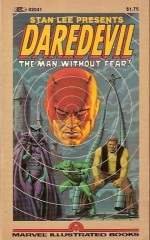
Stan Lee Presents Daredevil


By Stan Lee & Wally Wood (Marvel Illustrated Books)
ISBN: 0-939766-18-3

Here’s another look at how our industry’s gradual inclusion into mainstream literature began and one more pulse-pounding paperback package for action fans and nostalgia lovers, offering yet another chance to enjoy some of the best and most influential comics stories of all time.

After a few abortive attempts in the 1960s to storm the shelves of bookstores and libraries, Marvel made a concerted and comprehensive effort to get their wares into more socially acceptable formats. As the 1970s closed, purpose-built graphic collections and a string of new prose adventures tailored to feed into their all-encompassing continuity began oh, so slowly to appear.

Whereas the merits of the latter are a matter for a different review, the company’s careful reformatting of classic comics adventures were generally excellent; a superb and recurring effort to generate continuity primers and a perfect – if fickle – alternative venue to introduce fresh readers to their unique worlds.

The dream project was never better represented than in this classy little crime-busting cornucopia of wonders with crisp black and white reproduction, sensitive editing, efficient picture-formatting and two superb epics from the first “hot run” of the very variable Man Without Fear …

Matt Murdock is a blind lawyer whose remaining senses hyper-compensate, making him an astonishing acrobat, mind-blowing martial artist and living lie-detector. Very much a second-string hero for most of his early years, Daredevil was nonetheless a striking and popular one, due in large part to the captivatingly humanistic art of such modern Michelangelos as Wally Wood, John Romita and Gene Colan.

DD fought thugs, gangsters, a variety of super-villains and even the occasional monster or alien invasion. He quipped and wise-cracked his way through life and life-threatening combat, before under the auspices of Jim Shooter, Roger McKenzie and Frank Miller, the character transformed into a dark, moody avenger and grim, quasi-religious metaphor of justice and retribution…

After a shaky start, with the fifth issue Wally Wood assumed the art chores where his lush and lavish work brought power, grace and beauty to the series. At last this mere costumed acrobat seemed to spring and dance across the rooftops and pages. Wood’s contribution to the plotting didn’t hurt either. He actually got a cover plug on his first issue.

This brilliant black and white collection begins with the Daredevil #6’s ‘Trapped by the Fellowship of Fear!’: a minor classic wherein the Sightless Swashbuckler had to defeat not only the blockbusting Ox and electric assassin The Eel but his own threat-specific foe Mr. Fear who could instil terror and panic in victims, courtesy of his deadly gas-gun…

Another villain debuted in #8’s gripping industrial espionage thriller with meek, mild Wilbur Day hiring Nelson & Murdock to retrieve the rights to a stolen technology patent from industrialist Carl Kaxton. However, the case led to a clash with a bizarre and terrifying menace in ‘The Stiltman Cometh!’ Moreover Day proved to be far more than he at first appeared…

It’s easy to assume that such resized, repackaged mass market paperback collections were just another Marvel cash-cow in their tried-and-tested “flood the marketplace” sales strategy – and maybe they were – but as someone who has bought these stories in most of the available formats over the years, I have to admit that these handy back-pocket books are among my very favourites and ones I’ve re-read most – they’re handier, more accessible and just plain cool – so why aren’t they are available as ebooks yet?
© 1965, 1982 Marvel Comics Group, a division of Cadence Industries Corporation. All rights reserved.

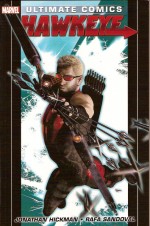
Ultimate Comics Hawkeye


By Jonathan Hickman, Rafa Sandoval, Jordi Tarragona & Brad Anderson (Marvel/Panini UK)
ISBN: 978-1-84653-464-5

Marvel’s Ultimates imprint launched in 2000 with major characters and concepts re-imagined to bring them into line with the presumed different tastes of modern readers.

Eventually the alternate, darkly nihilistic universe became as continuity-constricted as its predecessor and in 2008 the cleansing event “Ultimatum” culminated in a reign of terror which apparently (this is comics, after all) killed dozens of super-humans and millions of lesser mortals.

The era-ending event was a colossal tsunami triggered by Magneto which inundated the superhero-heavy island of Manhattan and devastated the world’s mutant population. The X-Men as well as many other superhuman heroes and villains died and in the aftermath anybody classed as a ‘”Homo Superior” had to surrender to the authorities or be shot on sight. Understandably most survivors as well any newly emergent X-people kept themselves well hidden. The world quickly became a far more deadly and fast-changing place with science and paranoia running rampant…

Before the Deluge S.H.I.E.L.D. director Nick Fury ran an American Black Ops team of super-humans called the Avengers, but he was eventually toppled from his position for sundry rule-bending antics – and being caught doing them.

Now Fury’s back, once more running the Federal Security Agency: firmly re-established and in charge of both secret agents and the official superhero team for public consumption whilst running another clandestine super-squad doing stuff the officially sanctioned Ultimates wouldn’t dream of…

As well as the pick of remaining and new superhumans, Fury’s sometime secret army consists of James Rhodes: a fanatical soldier wearing devastating War Machine battle armour; the Hulk, ruthless super-spy Black Widow, resurrected WWII super soldier Captain America (part of the bright and shiny public Image company but always happy to slum it when necessary) and the infallible professional fixer Hawkeye – the man who never misses…

This compilation collects the Ultimate Comics: Hawkeye four part miniseries from August to November 2011, which acted as prelude and sidebar to yet another relaunch of the constantly-changing grim and gritty alternate universe. Also on view in this tale is a new take on mainstream Marvel’s hidden race concepts of metahumans and monsters The Eternals, Deviants and Celestials and offers a big tip of the hat to Jack Kirby’s other paranormal alien-nation the Inhumans…

In this apocalyptic modern world individual metahumans can be Weapons of Mass Destruction and personal superpowers are now the focus of a terrifying new global arms race. When the new nation SEAR (SouthEast Asian Republic) devolves into civil war the outside world learns that they have developed a serum that will randomly spark fantastic abilities in anybody dosed with it.

To achieve a monopoly in metahuman resources the SEAR rulers have also released an artificial virus to eradicate the X-Gene: as it spreads around the planet it destroys the potential for any more mutants to be born. There will never again be naturally occurring challengers to “The People”…

Unfortunately for the SEAR government – and thus their ally America – the insurrectionists rampaging through the ambitious new nation comprise the now uncontrollable unwilling first test subjects of the chemical trigger they have dubbed “The Source”…

When S.H.I.E.L.D. is ordered to assist the beleaguered SEAR authorities, Fury sends his very best and most trusted agent but events too quickly spiral out of control as a race of belligerent New Gods go wild in the streets. Moreover, Hawkeye’s true mission is not to save some tin pot dictators from their own folly but to secure a sample of the source for the good old USA…

When the situation becomes irretrievable Fury dispatches covert Ultimate-X and the Hulk but even these formidable fighting forces are ill-equipped to halt the carnage; especially since the “The People of the Source” have decimated the capital city and already fractionated into two philosophically opposed sub-groups led by two feuding brothers Zorn and Xorn: the vengefully aggressive Eternals and pacific, philosophical Celestials.

Sadly for humanity, the former far outnumber the latter…

However one thing both factions agree on is that Earth now belongs to their kind and anybody – powered or merely human – are lowly “Deviants”…

Featuring some valuable hints on the history and abilities of Olympic champion and reformed felon Clint Barton and his close association with Fury, this intriguing tome is a terse and straightforward do-or-die action rollercoaster and classy “gathering doom” tale in its own right but was only ever intended as an introduction to bigger events in the core title The Ultimates.

However the always entertaining Jonathan Hickman and cruelly underrated Rafa Sandoval (augmented by the inks of Jordi Tarragona and colourist Brad Anderson) make this a sleek and glossy simple pleasure for older Fights ‘n’ Tights fans and the impressive cover gallery by such stars as Neal Adams, Adam Kubert and Kaare Andrews add immeasurably to the book’s visual appeal.

Even though far more upbeat and exuberant that the usual Ultimate fare, the trademark post-modernity and cynical, dark action is still here to deliver the visceral punch fans insist on, so this is a pretty good book for anybody thinking on jumping on to the decidedly different world of Wonder: one which will resonate with older readers who love the darkest side of superheroes and casual readers who know the company’s movies better than the comic-books.

A British edition licensed and published by Panini UK, Ltd. ™ & © 2012 Marvel Entertainment LLC and its subsidiaries. Licensed from Marvel Characters B.V. All Rights Reserved.

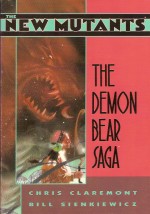
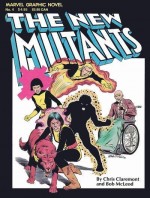
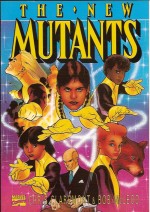
The New Mutants – Marvel Graphic Novel #4


By Chris Claremont & Bob McLeod (Marvel)
ISBN: 978-0-93976-620-8   1994 edition 0-939766-20-5

Midway through an extended X-Men storyline wherein the maligned mutants were lost in space and Professor X was infected with a telepathic parasite which urged him to gather similarly super-powered, potential hosts for parasitic aliens The Brood, Marvel launched a spin-off X-series which returned thematically to the core concept of heroes-in-training.

This fresh yet retro venture was dubbed The New Mutants and to fully capitalise on the landmark undertaking the junior class debuted in the company’s hot new format as a Marvel Graphic Novel.

At that time Marvel led the field of high-quality original graphic novels: offering big event tales set in the tight continuity of the Marvel Universe, series launches, creator-owned properties, movie adaptations and licensed assets in lavishly expansive packages based on the well-established European Album format with bigger, almost square pages (285x220mm rather than the customary 258x168mm) which felt and looked instantly superior to the gaudily standard flimsy comicbook pamphlets – irrespective of how good, bad or incomprehensible the contents proved to be.

After the immensely successful in-House epic ‘The Death of Captain Marvel’, two licensed properties ‘Elric: the Dreaming City’ and ‘Dreadstar’ set the seal on Marvel’s dedication to experimentation. The New Mutants then proved the growing power of the burgeoning Comicbook Direct Sales Market as this introductory graphic novel (only available in those still-few emporia) led directly into a nationally distributed new monthly series. Some fans had to jump through incredible hoops to pick up that all-important initial adventure…

Entitled ‘Renewal’ the school days saga finds sometime X-Men doctor Moira MacTaggert in the Scottish Highlands saving lupine metamorph schoolgirl Rahne Sinclair from a lynch mob led by a pious religious demagogue. The action then switches to Brazil where millionaire’s son and sporting golden boy Roberto DaCosta transforms into an eerie ebony monster in the middle of a soccer match. With the massed spectators appalled and terrified, only Bobby’s girlfriend Juliana Sandoval rushes to his aid…

In Kentucky, 16 year old Sam Guthrie trudges toward the coalmine. With his father recently dead, the boy now has to forget dreams of higher education and provide for his brothers and sisters. However when a cave-in buries him and his crew Sam unexpectedly blasts his way out in an explosive burst of power…

Meanwhile in the Medicine Bow Mountains of Colorado, reclusive Cheyenne maiden Danielle Moonstar is appalled to hear that her beloved grandfather is about send her to live with a white man named Xavier. Old Black Eagle fears her uncanny psychic abilities will overwhelm her and menace everybody around her…

None of these widely scattered waifs is aware that a manic mutant-hater has made them targets of his obsessive hatred. Dani is the first to suffer as her grandfather is murdered by armoured warriors…

Meanwhile in Westchester, Charles Xavier is examining Rahne and another young mutant. Xi’an Coy Manh is a Vietnamese refugee whose ability to possess people led her into conflict with her crime-lord uncle and the Amazing Spider-Man under the soubriquet Karma. When news of Black Eagle’s death arrives, Xavier rushes to Colorado with the two girls in tow, arriving in time to help Moonstar drive off more armoured assassins.

Discerning that Hellfire Club villain Donald Pierce is behind the murders and attempted abduction, the group then travels to Rio de Janeiro but arrives too late to save Roberto and Juliana from being kidnapped by Pierce’s agents…

Juliana dies saving DaCosta during a botched rescue mission and the grieving boy swears to have his full measure of vengeance…

Pierce has not been idle: he has already deceived and recruited gullible, desperate Sam Guthrie and sent the superhuman Cannonball to capture Xavier, leaving only the mutant kids, codenamed Wolfsbane, Mirage, Sunspot and Karma, to save him and thwart Pierce’s mad schemes. In this they are helped in no small part by the conflicted but rapidly reconsidering Guthrie…

Beautifully illustrated by Bob McLeod this fast-paced rollercoaster of drama and action was the first step in the inexorable expansion of the X-Universe franchise and still reads amazingly well – especially for new fans – even after that Homo Superior bubble has long burst…

A slightly re-proportioned and reformatted edition was released in 1994, reduced in size to approximate standard comicbook proportions and the tales has also been reprinted, albeit in proportionally much-reduced standard format as the first chapter of New Mutants Classic Volume 1 TPB (from 2006) which also includes the comicbooks New Mutants #1-7 and Uncanny X-Men #167 within its 240 pages.
© 1982, 1994 Marvel Entertainment Group, Inc. All rights reserved.
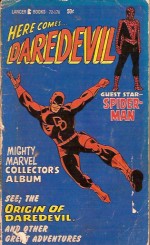
Here Comes… Daredevil


By Stan Lee, Bill Everett, John Romita, Gene Colan & various (Lancer)
ISBN: 72170 ASIN: B000EQWXLE

This is one solely for chronic nostalgics, consumed collectors and historical nit-pickers… As Marvel grew in popularity in the early 1960s it gradually replaced its broad variety of genre titles with more and more super-heroes. The rapidly recovering publishing powerhouse was still hampered by a crippling distribution deal limiting the company to 16 titles (which would curtail their output until 1968), so each new comicbook would have to fill the revenue-generating slot (however small) of an existing title.

Moreover since the costumed characters were selling, each new title would limit the breadth of genres (horror, western, war, etc). It was putting a lot of eggs in one basket, and superheroes had failed twice before for Marvel.

In the 1960s on the back of the “Batmania” craze, many comics publishers repackaged their old comics stories in cheap and cheerful digest-sized monochrome paperbacks, and it’s easy to assume that those rapidly resized, repackaged book collections of the early exploits and extravaganzas were just another Company cash-cow in their perennial “flood the marketplace” sales strategy. Maybe they were, but many funnybook publishers – including National/DC, Tower and Archie – were also desperate to add some credibility and even literary legitimacy to their efforts, and as well as increased profits these forays onto the world’s bookshelves offered the prospect of fresh new markets and a wider acceptance. Considering how many different prose publishing houses chanced their arm on such projects, their editors also believed there was money to be made from comics too…

Also it’s hard to deny that the book editions were just, plain cool…

As someone who bought these stories in most of the available formats over the years – including constantly recycled reprints in British weeklies from the mid-sixties to the 1980s – I have to admit that the sleek classic paperback editions have a charm and attraction all their own…

Most of the US Marvel collections from Lancer generated smaller (and inferior) British editions from Four Square Books but as far as I know Daredevil never crossed the pond except as a remaindered import…

Heavily abridged and edited and disturbingly printed in both portrait and landscape format, Here Comes… Daredevil was the sixth and last Lancer publication (the others being two Fantastic Four compilations and one apiece for Thor, Spider-Man and The Hulk) and touted a guest-appearance by Spidey, reprinting most of the two-part battle against the mysterious Masked Marauder from issues #16 and 17. Originally entitled ‘Enter… Spider-Man!’ and ‘None are so Blind…’ by Stan Lee, John Romita Sr. & Frank Ray Née Giacoia) the tale recounted how the cunning criminal manipulated the Wall-Crawler into attacking DD whilst his gang of futuristic cut-throats attempted to steal a new super-engine…

This is followed by ‘The Origin of Daredevil’ from issue #1, recounting how young Matt Murdock grew up in the New York slums, raised by his father Battlin’ Jack Murdock, a second-rate prize-fighter. Determined that the boy will be something, Jack extracts a solemn promise from him never to fight. Mocked by other kids and called “Daredevil”, Matt abides by his vow, but secretly trains his body to physical perfection.

One day he saves a blind man from being hit by a speeding truck, only to be struck in the face by its radioactive cargo. His sight is burned away but his other senses are super-humanly enhanced and he gains a sixth: “radar-sense”. He tells no-one, not even his dad.

Battlin’ Jack is in dire straits. As his career declined he signed with The Fixer, knowing full well what the corrupt promoter expected from his fighters. Yet his career blossomed. Unaware that he was being set up, Murdock got a shot at the Big Time, but when ordered to take a dive he refused. Winning was the proudest moment of his life. When his bullet riddled corpse was found, the cops had suspicions but no proof…

Heartbroken, Matt graduated college with a law degree and set up in business with his room-mate Franklin “Foggy” Nelson. They hired a lovely young secretary named Karen Page. With his life on track young Matt now had time to solve his father’s murder. His promise stopped him from fighting but what if he became “somebody else”…?

Scripted by Stan Lee and magically illustrated by the legendary Bill Everett (with assistance from Steve Ditko) this is a rather nonsensical yet visually engaging yarn that just goes through the motions and completely omits the dramatic denouement wherein Matt finally deals with his father’s killers…

Originally tipped for a fill-in issue, Gene Colan came aboard as penciller with Daredevil #20’s ‘The Verdict is: Death!’, inked by Mike Esposito moonlighting as Mickey Demeo. Colan’s superbly humanistic drawing and facility with expressions was a little jarring at first since he drew Daredevil in a passable Romita imitation and everything else in his own manner, but he soon settled in and this cunning two-part revenge thriller – featuring The Owl who had trapped the sightless adventurer on a hidden island overrun with robot raptors and brutal thugs – is a stunning action rollercoaster which perfectly illustrates the hero’s swashbuckling acrobatic combat style.

The spectacular battle concluded with ‘The Trap is Sprung!’ (from #21, inked by Giacoia, Dick Ayers & Bill Everett) and began the artist’s long and brilliant run on the series.

If you’ve not read these tales before then there are certainly better places to do so (such as the Essential Daredevil volume 1) but even with all the archaic and just plain dumb bits in this book these are still fine super-hero tales with beautiful art that will never stale or wither, and for us backward looking Baby-boomers these nostalgic pocket tomes have an incomprehensible allure that logic just can’t fight or spoil…
© 1967 Marvel Comics Group. All Rights Reserved.

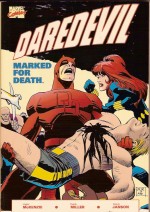
Daredevil: Marked for Death


By Roger McKenzie, Frank Miller & Klaus Janson (Marvel)
ISBN: 978-087135-351-1

Matt Murdock is a blind lawyer whose remaining senses hyper-compensate, making him an astonishing acrobat, formidable fighter and living lie-detector. Very much a second-string hero for most of his early years, Daredevil was nonetheless a striking and popular one, due in large part to the captivatingly humanistic art of Gene Colan. He fought gangsters, a variety of super-villains and even the occasional monster or alien invasion. He quipped and wise-cracked his way through life and life-threatening combat, but under the auspices of Jim Shooter, Roger McKenzie and finally Frank Miller himself, the character transformed into a dark, moody avenger and grim, quasi-religious metaphor of justice and retribution…

Here’s another slim, sleek and sublimely enticing lost treasure from the early days of graphic novel compilations that will undoubtedly enthral fans of hard-bitten, high-calibre Masked Manhunter melees.

Released in 1990, this full-colour 96-page compendium first collected the landmark stories which so quickly confirmed the Man Without Fear as the new face of comics action.

Daredevil #159-161 and 163-164 from July 1979 – May 1980 completed the gradual transformation of DD – begun by Marv Wolfman and Jim Shooter – from bold, apparently carefree Scarlet Swashbuckler to driven, terrifying urban avenger: a Demon dipped in blood. What Roger McKenzie began here Miller would finish in an audacious groundbreaking run of shocking, compelling dark masterpieces… a momentous, unmissable, “must-read” series.

The groundbreaking adventure begins with ‘Marked for Murder!’ (McKenzie, Miller & Klaus Janson) as infallible assassin Mr. Slaughter is brought out of retirement for a very special hit on the Sightless Superhero. Meanwhile veteran Daily Bugle reporter Ben Urich starts to slowly piece together snippets which indicate that blind attorney Matt Murdock might be far more than he seems…

The spectacular showdown between the Crimson Crimebuster and Slaughter’s army of killers compels the mysterious client to do his own dirty work and, after brutally abducting DD’s old girlfriend the Black Widow, the hero has no choice but to put himself ‘In the Hands of Bullseye!’, culminating in a devastating duel and ultimate defeat for the psychopathic villain in ‘To Dare the Devil!’

Issue #162 featured a fill-in tale by Michael Fleisher & Steve Ditko and is not included here – although Miller’s rejected cover for that issue is part of the gallery section – so after a one-page info-feature on ‘Daredevil’s Billy Club!’ the stunning David and Goliath action resumes as the merely mortal Man Without Fear battled the Incredible Hulk in ‘Blind Alley’ (inked by Josef Rubenstein & Janson) in a desperate and ultimately hopeless attempt to save his beloved city…

This superb compilation concludes with an evocative retelling of his origin in ‘Exposé’ as the meticulous and dogged Urich confronts the hospitalised hero with the inescapable conclusions of his research…

Tense, tough, dramatic, disturbing, clever, beautiful and astoundingly visceral, these stories turned a popular costumed hero into an icon of the modern comics industry and are still amongst the best tales in the character’s long history.

Available in a number of collections these epics should be compulsory reading for any action fan or comics aficionado.
© 1990 Marvel Entertainment Group, Inc. All rights reserved.

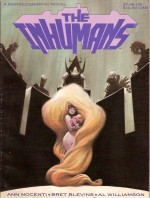
The Inhumans – A Marvel Graphic Novel


By Anne Nocenti, Brett Blevins & Al Williamson (Marvel)
ISBN: 0-87135-435-7

Conceived as another fantastic lost civilisation and debuting in 1965 (Fantastic Four #44-48) during Stan Lee & Jack Kirby’s most fertile and productive creative period, The Inhumans are a race of incredibly disparate (generally) humanoid beings genetically altered by aliens in Earth’s pre-history, consequently becoming technologically advanced far ahead of emergent Homo Sapiens.

Subsequently they isolated themselves from the world and the barbarous dawn-age humans, first on an island and latterly in a hidden valley in the Himalayas in a fabulous city named Attilan. After untold centuries in hiding, increasing global pollution levels began to attack their elevated biological systems and the Inhumans relocated their entire city-civilisation to the Moon. This bold act exposed them to military scrutiny and they became known at last to the ordinary citizens of Earth.

The Attilan mark of citizenship is immersion in the mutative Terrigen Mists which further enhance and transform individuals into radically unique and generally super-powered beings. The Inhumans are necessarily obsessed with genetic structure and heritage, worshipping the ruling Royal Family as the rationalist equivalent of mortal gods.

In this controversial tale from 1988, scripter Anne Nocenti and artists Brett Blevins & Al Williamson (with letters from Jim Novak & Gaspar Saladino and colours by Mike Higgins) took a hard look at the underbelly of the concept in a stark examination of personal rights vs. civic responsibility…

With such an unstable potential breeding pool, the right to have children has been taken away from individuals and delegated to a Genetic Council. If, on occasion their mandates break hearts or even lead the desperate and lovelorn to commit suicide, that’s sad but just a price the race must pay…

After witnessing one such tragic demise on the day of the annual pronouncement of who may and may not sire offspring, bellicose, passionate and deeply conservative Gorgon has much to ponder upon. Even his own cousin Karnak sympathises with the growing public movement to abolish the Council and let citizens choose their own breeding partners, and the princes have, as usual, come to blows over their always opposing views…

It all becomes agonisingly personal when their cousin Medusa, wife and voice of the mighty but voluntarily mute King Blackbolt (whose softest syllable could shatter a mountain) announces she is already pregnant and the Council summarily decree the unsanctioned and potentially ultra-destructive fetus must be destroyed…

Horrified when her shocked but resigned family agrees to the horrifying Eugenics dictat, Medusa flees Attilan with the unsuspected aid of deranged psychopathic genius (and brother-in-law) Maximus. She hides on Earth, preferring to risk death by pollution rather than the arbitrary murder of unborn child.

Amongst the Inhumans the rebellious act divides both royal and commoner families and looks certain to foment civil war. Blithely unaware, on Earth Medusa and faithful companion Minxi are sequestered in a deserted garbage dump on the outskirts of Las Vegas where her soon-to-be-born baby begins to increasingly make its presence – and power – felt…

In Attilan, Blackbolt is crushed and paralysed by the weight of duty and his own indecision whilst Maximus schemes to win Medusa for himself. At last united but still bickering, the Royal Family, Gorgon, Karnak, Triton and Medusa’s sister Crystal travel to Earth to stand by the defiant mother-to-be. The elemental Crystal uses her ability to collect and banish all the toxins in the air to produce a thirty-mile wide “clean-zone” for Medusa, but as her time nears, strange, unnatural phenomena begin to occur throughout the region…

At last Blackbolt comes to a shattering decision and Maximus makes his final sinister move, Medusa goes into labour and the tortured, twisted environment comes to ghastly unnatural life just as and the full extent of the newborn’s abilities are revealed…

Even after all the horror, death and disaster, there is one last shock and betrayal when the Inhumans return to the Moon under a dubious amnesty…

Evocative, challenging and powerfully unsettling, this dark and impressive yarn goes far beyond the normal parameters of cosmic Fights ‘n’ Tights shenanigans; forcing readers to think as well as feel.

Marvel don’t generally publish original material graphic novel anymore but once they were market leader in the field with a range of “big stories” told on larger pages emulating the long-established European Album (285 x 220mm rather than the standard 258 x 168mm of today’s books) featuring not only proprietary characters in out-of-the-ordinary adventures but also licensed assets like Conan, creator-owned properties like Alien Legion and new character debuts.

This extended experiment with big-ticket storytelling in the 1980s and 1990s produced many exciting results that the company has never come close to repeating since. Most of the stories still stand out today – or would if they were still in print. The Inhumans is a beautiful, extremely uncompromising and occasionally explicit tale delivering action, tension and soul-searching drama and is something no unabashed older fan of superhero sagas should miss….
© 1988 Marvel Entertainment Group, Inc. All Rights Reserved.

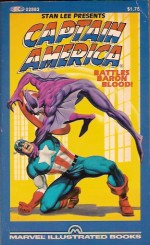
Stan Lee Presents Captain America


By Stan Lee, Jack Kirby & various (Marvel/Pocket Books)
ISBN: 0-671-82581-X-225

Perhaps I have a tendency to overthink things regarding the world of graphic narrative, but it seems to me that the medium, as much as the message, radically affects the way we interpret our loves and fascinations. Take this pint-sized full-colour treat from 1979.

It’s easy to assume that a quickly resized, repackaged paperback book collection of the early comics extravaganzas was just another Marvel cash-cow in their perennial “flood the marketplace” sales strategy – and maybe it was – but as someone who bought these stories in most of the available formats over the years I have to admit that this version has a charm and attraction all its own…

During the Marvel Renaissance of the early 1960’s Stan Lee & Jack Kirby followed the same path which had worked so tellingly for DC Comics, but with less obviously successful results.

Julie Schwartz had changed the entire comics scene with his revised versions of the company’s Golden Age greats, so it seemed natural to revive those characters who had dominated Timely/Atlas in days past.

A new Human Torch had premiered as part of the revolutionary Fantastic Four, and in the fourth issue of that title the Sub-Mariner resurfaced after a twenty year amnesiac hiatus (everyone concerned had apparently forgotten the first abortive attempt to revive their superhero line in the mid 1950s). All that was left was to complete the triangle by bringing back the Star Spangled Sentinel of Liberty…

However although the teen Torch had won a solo-spot in Strange Tales he hadn’t set the World on fire there (sorry, utterly irresistible and I’m truly ashamed – just not enough to hit “delete”) so it was decided to revive the Company’s biggest Golden Age gun within the fledgling company’s star-packed team-book.

This carefully reformatted digest delight opens with the fabled contents of Avengers #4 (March 1964, inked by George Roussos) an epic landmark wherein ‘Captain America joins the Avengers!’ in a blockbusting tale which had everything which made the company’s early tales so fresh and vital. The majesty of a legendary warrior returned in our time of greatest need: stark tragedy in the loss of his boon companion Bucky, time-lost aliens, gangsters, Sub-Mariner and even wry social commentary all couched in vast amounts of staggering Kirby Action.

Six months later the Old Soldier won his own solo-series in Tales of Suspense #59 (cover-dated November 1964), initially in a series of short, self-contained action romps such as ‘Captain America’, (scripted by Lee and illustrated by the staggeringly perfect team of Jack Kirby & Chic Stone): an unapologetic rocket-paced fight-fest wherein an army of thugs invaded Avengers Mansion since only the one without superpowers was at home…

The next issue held more of the same, when ‘The Army of Assassins Strikes!’, this time attempting to overwhelm the inexhaustible human fighting machine at the behest of arch foe Baron Zemo, whilst ‘The Strength of the Sumo!’ was insufficient when Cap invaded Viet Nam to rescue a captured US airman, after which he took on an entire prison’s population to stop the ‘Break-out in Cell Block 10!’

After these gloriously visceral and bombastic escapades the series took an abrupt turn and began telling tales set in World War II. From ToS #63, March 1965, ‘The Origin of Captain America’, by Lee, Kirby & Frank Ray (AKA veteran artist Frank Giacoia) recounted, recapitulated and expanded the manner in which physical wreck Steve Rogers was selected as the guinea pig for a new super-soldier serum, only to have the genius responsible die in his arms, cut down by a Nazi bullet.

Now forever unique, Rogers became the living, breathing, fighting symbol and guardian of America, but spent his quieter moments as a husky but easygoing ordinary G.I. in boot camp at Fort Lehigh.

It was there he was accidentally unmasked by Camp Mascot Bucky Barnes, who blackmailed the hero into making the boy his sidekick. The next issue kicked off a string of spectacular thrillers as the Red, White and Blue Boys defeated enemy saboteurs Sando and Omar in ‘Among Us, Wreckers Dwell!’ before Chic Stone returned for the next tale ‘The Red Skull Strikes!’ in which the daring duo met and first foiled the Nazi mastermind’s schemes of terror and sabotage in America.

‘The Fantastic Origin of the Red Skull!’ saw the series swing into high gear and switch settings to Europe as sub-plots and characterisation were added to the all-out action and spectacle. With Cap captured by his bragging fascist foe and brainwashed into attacking his own commanders, the Master of Menace felt smug enough to reveal his own rise to power after which ‘Lest Tyranny Triumph!’ and ‘The Sentinel and the Spy!’ (both inked by Giacoia) combined espionage with stunning combat and sinister subversion with mad science as the plot to murder the head of Allied Command segued into a battle with a German infiltrator who had stolen Britain’s latest secret super-weapon.

The heroic duo stayed in England for ‘Midnight in Greymoor Castle!’ (with art by Dick Ayers over Kirby’s) as English and Nazi collaborator scientist Cedric Rawlings captured Bucky whist Ranger Steve Rogers participated on an Army raid in France. The second part ‘If This be Treason!’ had Golden Age veteran and Buck Rogers newspaper strip artist George Tuska perform the same function as the hero deserts his comrades to rush back to Young Ally’s rescue before the final part (and last wartime adventure) ‘When You Lie Down with Dogs…!’ neatly wrapped up the saga, with Joe Sinnott inking a rousing conclusion involving repentant traitors, military madmen and handy terror weapons…

These mini-masterpieces of tension, action and suspense perfectly demonstrated the indomitable nature of this perfect American hero and I suppose in the final reckoning how you come to the material is largely irrelevant as long as you do, but I’m certain that different people are receptive to different modes of transmission and we should endeavour to keep all those avenues open…
© 1979 Marvel Comics Group, a division of Cadence Industries Corporation. All rights reserved.

Uncanny X-Men: From the Ashes


By Chris Claremont, Paul Smith, Walt Simonson, John Romita Jr. & Bob Wiacek (Marvel)
ISBN: 0-87135-6155

In 1963 X-Men #1 introduced Cyclops, Iceman, Angel, Marvel Girl and the Beast: very special students of Professor Charles Xavier, a wheelchair-bound telepath dedicated to brokering peace and integration between the masses of humanity and the emergent off-shoot race of mutants dubbed Homo Superior. After years of eccentric and spectacular adventures the mutant misfits disappeared at the beginning of 1970 during a sustained downturn in costumed hero comics as supernatural mystery once more gripped the world’s entertainment fields.

Although their title was revived at the end of the year as a cheap reprint vehicle, the missing mutants were reduced to guest-stars and bit-players throughout the Marvel universe and the Beast was made over into a monster until Len Wein, Chris Claremont & Dave Cockrum revived and reordered the Mutant mystique with a brand new team in Giant Size X-Men #1 in 1975.

To old foes-turned-friends Banshee and Sunfire was added a one-shot Hulk villain dubbed Wolverine, and all-original creations Kurt Wagner, a demonic German teleporter codenamed Nightcrawler, African weather “goddess” Ororo Monroe AKA Storm, Russian farmboy Peter Rasputin, who transformed at will into a living steel Colossus and bitter, disillusioned Apache superman John Proudstar who was cajoled into joining the makeshift squad as Thunderbird.

The revision was an unstoppable hit and soon grew to become the company’s most popular and high quality title. In time Cockrum was succeeded by John Byrne and, as the team roster shifted and changed, the series rose to even greater heights, culminating in the landmark “Dark Phoenix” storyline which saw the death of (arguably) the series’ most beloved and groundbreaking character.

In the aftermath, team leader Cyclops left and a naive teenaged girl named Kitty Pryde signed up just as Cockrum returned for another spectacular sequence of outrageous adventures.

The franchise inexorably expanded and in 1982 a fresh generation of students enrolled in Xavier’s School for Gifted Youngsters…

Released in 1990, as Marvel was tentatively coming to grips with the growing trend for “trade paperback” collections, this sturdy 228 page full-colour compendium collects a supremely impressive run of issues of the Uncanny X-Men (#168-172, from April-December 1983) which perfectly encapsulated everything that made the outrageous outcasts such an unalloyed triumph and touchstone of youthful alienation.

The action opens as Kitty Pryde reacts badly to the news that she is being transferred to the student team of New Mutants… or as she calls them, “X-Babies”…

‘Professor Xavier is a Jerk!’, by Chris Claremont, new star art-find Paul Smith and inker Bob Wiacek, related the battled-hardened Pryde’s reaction to the arbitrary declaration as the team enjoyed a little downtime following a stupendous battle in space against the ghastly alien body-stealers The Brood. The sulking quickly escalated into a cataclysmic life-or-death struggle as Pryde and her little space-dragon Lockheed accidentally uncovered an infestation of alien predators which had remained undiscovered in the depths of the X-Mansion for months…

Meanwhile, original X-Man Cyclops had left the team again to catch up with rebound girlfriend Lee Forrester but discovered a new woman who was the exact duplicate of his dead one-and-only Jean Grey…

‘Catacombs’ plunged head-on into a new crisis as the team are called in when the Angel is abducted by a hitherto undiscovered enclave of outcast mutants dwelling beneath the streets of New York. With Kitty as part of the rescue team the X-Men descended into the tunnels and battled the horrific Morlocks and their charismatic leader Callisto.

Easily outmatched and overpowered the heroes were helpless until Storm took a radical, irreversible step: defeating Callisto in a death-duel and becoming the new ruler and protector of the subterranean deviants in ‘Dancin’ in the Dark’. Above their heads in the halls of the wealthy and powerful, the Hellfire Club was under sustained attack by a telepath of incredible power and spiteful intensity whilst in Alaska Scott Summers had fallen deeply in love with disturbing doppelganger Madelyne Pryor despite fearing she might be some new aspect of the immortal cosmic Phoenix…

Pencilled by Walt Simonson, issue 171 saw a major new player join the misunderstood mutants when ‘Rogue’ – a powers and memory leeching teen who had nearly murdered Carol Danvers – knocked on the mansion door begging for sanctuary and medical help.

It seemed her uncontrollable ability was afflicting her with stolen personalities and slowly driving her crazy. When the former Ms. Marvel, now a cosmic powered entity dubbed Binary, saw the girl who had stolen her life become a guest of the X-Men, sparks and fists inevitably flew…

Wolverine had been absent for weeks on a personal quest to Japan (see Marvel Platinum – the Definitive Wolverine or any number of collected editions of the first Wolvie miniseries by Claremont & Frank Miller), which culminated with the announcement of his impending marriage to Japanese aristocrat Mariko Yashida.

‘Scarlet in Glory’ found the rest of the team in Japan for the impending nuptials and poisoned by vengeful villains leaving Logan and Rogue – whom he deeply distrusted – to seek out an antidote. At the same time the transformation of Storm from nature goddess to grim-and-gritty bad-ass was completed by the mercenary maniac Yukio as the last X-Men raced their fast-approaching toxic deadline…

The result was sheer carnage as the feral Wolverine went wild. With desperate-to-please Rogue in tow Wolverine carved a bloody trail to Yakuza mercenary (and Mariko’s rival for the rule of Clan Yashida) Silver Samurai and psychopathic mastermind Viper in ‘To Have and Have Not’…

Although the bold champions were eventually triumphant, the victory came at great cost. Wolverine returned to America alone and unwed… and all the while, the long-hidden presence manipulating events had jockeyed for position, pushing the globally scattered heroes to one inescapable conclusion…

‘Romances’ opened with Binary choosing to leave Earth with the swashbuckling Starjammers and ended with Scott returning to the X-Men to announce his own imminent marriage to Madelyne. This calm before the storm led into the spectacular issue #175 with the revelation that one of the X-Men’s oldest enemies had returned to unleash the ultimate destructive force, culminating in the end of the world and the seeming ultimate revenge of ‘Phoenix!’ (with additional art from John Romita Jr.).

The issue also saw Scott and Madelyne tie the knot before slipping away for a honeymoon from hell in the concluding episode ‘Decisions’.

Setting the scene for upcoming epics, there was a final meeting between Logan and Mariko, the US Government sought new and permanent ways to curb mutant power and Callisto returned to the Morlocks but the main focus was the newlyweds’ crash-landing in monster-plagued seas…

These character driven tales proved conclusively that the X-Men phenomenon was bigger than any single creator and that the series was capable of infinitely renewing itself. The stories here opened up a whole sub-universe of action and adventure that fuelled more than a decade of expansion and are still some of the best comics of that distant decade.

Compelling, effective, moving and oh, so pretty, From the Ashes is a book no Fights ‘n’ Tights fan can do without.
© 1983, 1990 Marvel Entertainment Group, Inc. All Rights Reserved.