
Black Hole


By Charles Burns (Jonathan Cape)
ISBN: 978-0-37542-380-2 (HB) 978-0-22407-778-1 (TPB)

On this day in 2019, those happy Big Science people at the Event Horizon Telescope Project released the first picture of a black hole as located at the centre of galaxy M87. No one’s done a graphic novel of that yet but there’s this superb tome that seems to have slipped from common consciousness…

One of the most impressive and justifiably lauded graphic novels ever, Black Hole is a powerfully evocative allegorical horror story about sex, youth and transformation, but don’t let that deter you from reading it. It’s also a clever, moving, chilling and somehow uplifting tale displaying the bravura mastery of one of the greatest exponents of sequential narrative the English language has ever produced – even if he has found his spiritual and commercial home producing comics in Europe.

Originally released as a 12-issue limited series under the aegis of Kitchen Sink Press, the tale was rescued and completed through Fantagraphics when the pioneering Underground publisher folded in 1999. On completion, Black Hole was promptly released in book form by Pantheon Press in 2005, although many fans and critics despaired at the abridged version which left out many of Burns’ most potent full-page character studies of the deeply troubled cast “an error of economy” corrected in subsequent editions. It won eleven of the comic world’s most prestigious awards and I’m revisiting my battered Jonathan Cape UK edition because it’s still not available digitally

It’s the 1970s in Seattle, and there’s something very peculiar happening amongst local teens out in the safe secure suburbs. In ‘Biology 101’, Keith Pearson can’t concentrate on properly dissecting his frog because his lab partner is Chris Rhodes, the veritable and literal girl of his dreams.

Trying to keep cool only makes things worse and when he suddenly slips into a fantastic psychedelic daydream, the swirling images resolve into a horrific miasma of sex, torn flesh and a sucking void. Suddenly he’s regaining consciousness on the floor with the entire class standing over him. They’re all laughing at him… all except Chris.

‘Planet Xeno’ is a quiet patch of woodland adults don’t know about, where kids can kick back, drink, smoke, get stoned and just talk. The big topic among the guys is “the bug”: a sexually transmitted disease that causes bizarre, unpredictable mutations like uncontrolled growths, extra digits, pigmentation changes, and new orifices that don’t bleed…

As Keith and best buds Dee and Todd shoot the breeze and goof off, they discover an odd encampment, strewn with old toys and bottles and junk. Some of the sufferers of the “Teen Plague” have relocated here to the forest, founding a makeshift camp away from prying eyes and wagging tongues. When Keith finds a girl’s shed skin hanging from a bush, he fears creepy mutants are closing in and suffers a crazy disorienting premonition…

In ‘SSSSSSSSSS’ Chris is dreaming: a ghastly phantasmagoria involving naked swimming in pollution, a bunch of strange guys, monsters and that fainting kid Keith turning into a serpent. It all ends with her examining the new holes in her body before ripping off her old skin and leaving it hanging on a bush…

She’s drinking illicit beer by the lake in ‘Racing Towards Something’, remembering that wild party a week ago and what she did with the cool guy Rob Facincanni. As she came on to him he kept trying to tell her something but she was in no mood to listen. She just didn’t want to be the good girl anymore…

She recalls the moment of explosive climax and horror when she discovered a hideous second mouth in his neck… and the noises. It seemed to be speaking…

In the sordid guilty aftermath she felt awful but had no idea what that furtive, disappointing assignation had done to her.

Rob is still sleeping with Lisa. She’s accepted the cost of the curse and the ghastly changes in her body, but what she won’t take is him screwing around. She has heard Rob’s second mouth talking as they lay together and needs to know ‘Who’s Chris?’

Keith and his bros are getting stoned again when he hears some guys have just watched the so-virginal Chris skinny-dipping and seen her sex-caused mutation. The virgin queen isn’t any more…

In ‘Cut’ their teasing proves too much and he storms off into the scrub, accidentally spotting the object of his desire as she gets dressed again. Guiltily voyeuristic, he’s prompted to action when she steps on broken glass and cries out. Dashing to her rescue he bandages her foot, too ashamed to admit just how much of her he’s really seen. All Keith knows is that someday he will be with her. Fate was obviously on his side…

‘Bag Action’ finds him and Dee trying to buy weed from some skeevy college guys, but our frustrated romantic is utterly unable to get lascivious, furtive, distracting naked images of Chris out of his mind.

However, after sampling some of the dope in the Frat boys’ dilapidated house, he meets their housemate Eliza: an eccentric artist extremely high, nearly naked and very hungry. Just as baked, achingly horny and fascinated by her cute tail (not a euphemism), Keith almost has sex with her but is interrupted by his idiot pal at just the wrong moment…

Many of those infected by The Bug are camped out in the woods now and ‘Cook Out’ finds them having a desperate party around a roaring fire. Rob is there, bemoaning the fact Lisa has kicked him out, but he’s also acutely aware that the sex-warped kids are getting oddly wild, manic, even dangerous…

‘Seeing Double’ finds downcast, devastated Chris talking things over with Rob at the outcast encampment. The naive fool has just discovered what’s she got and what it means. Lost and disgusted, convinced she’s a dirty monster with a biological Scarlet Letter as part of her flesh, Chris drinks and talks and, eventually, finds comfort in her bad boy’s arms…

In ‘Windowpane’ Pearson, Dee and Todd drop their first tabs of acid and head for a party at Jill’s house. Increasingly morose and troubled Keith is feeling ever-more isolated and alienated and the LSD coursing through his system isn’t helping, When Dee and Jill start to make out, he leaves and finds her big sister crying outside. After she shouts at him he turns and, still tripping off his nut, heads into the woods.

Lost and confused, he sees horrific and bizarre things in the trees and bushes before stumbling into some of the infected kids around their fire. In a wave of expiation he begins to talk and keeps on going, slowly coming down amongst temporary friends. Keith has no suspicion that some of the things he saw were not imaginary at all…

‘Under Open Skies’ sees Chris and Rob playing hooky. Fully committed to each other now, they head to the coast and a perfect solitary day of love at the beach. They think it’s all going to be okay but the voice from Rob’s other mouth says otherwise…

Back home again, Chris’ recent good times are ruined by her parents’ reaction. Grounded, the former good girl makes up her mind and, gathering a few possessions, elopes with her lover to a new life in ‘The Woods’ where grotesquely bestial but kindly Dave Barnes takes them under his wing.

Although they have bonded, Rob cannot stay with Chris and returns to his home and High School. Although he spends as much time as possible at the encampment, Chris is too often alone and on one of her excursions into the wilds finds a bizarre and frightening shrine. Little does she know it’s one of the things the tripping Keith thought he’d hallucinated…

Summer grinds on and Pearson plucks up nerve to go back to the college guys’ house. ‘Lizard Queen’ Eliza is on the porch, drawing but obviously upset by something. Confused, scared and without knowing what they’re doing. they end up in bed consummating that long-postponed act of drug-fuelled passion…

Chris’ days of innocent passion end suddenly when Rob is brutally attacked by a lurking intruder in ‘I’m Sorry’. She descends into a stupor for days until spotting nice safe Keith at one of the camp’s evening bonfire parties. Soon, he’s arranged for her to move into an empty property he’s housesitting over ‘Summer Vacation’ but even though he’s attentive, kind, solicitous and so clearly wants to be with her, he’s just not Rob.

Chris has been going slowly crazy since her beloved boy vanished: reliving memories good and bad, feeling scared and abandoned, playing dangerously with the gun he left her “for protection”. Keith is still plagued by nightmares and X-rated thoughts of Eliza in ‘A Dream Girl’, but hopeful he now has a chance with Chris. That swiftly changes when he checks on her and discovers the house he’s supposed to be guarding has been trashed. There’s garbage everywhere, a bunch of her fellow outcasts have moved in and she’s clearly avoiding him, locked in a room, constantly “sleeping”…

Despondent, confused Pearson doesn’t know what to do. Chris is having some kind of breakdown and the house – his responsibility – is a wreck. The lovesick fool is trapped and crumbling when Eliza breezes back into his life. If only his own bug mutation wasn’t so hideous…

Heading back to the home once more he finds Chris has gone and the pigsty has become a charnel house. All summer there has been a frightening, oppressive presence in the woods and with the Fall coming the mood is beginning to darken. When Dave is barracked and abused whilst trying to buy takeout food, he snaps and pulls out Chris’ gun. Calmly taking his fried chicken from the crime-scene he walks back to the woods and the troubled soul known as ‘Rick the Dick’. It’s going to be their last meal…

Keith meanwhile has found his own happy ending, ‘Driving South’ with gloriously free spirited, undemanding Eliza, but is still gripped by what he found at the house. At least he and Eliza helped survivors get away, but now – happily content with his idyllic artist girl and after all the horrible secrets they’ve shared – he can’t help wondering what happened to Chris.

That mystery and how Dave got the gun are only revealed in the compulsively low key and wildly visual climax ‘The End’…

Complex, convoluted, utterly compelling, expressive, evocative and deeply, disturbingly phantasmagorical, Black Hole is a comics masterpiece of graphic genius and astoundingly utilised allegory and metaphor merged with the eternal dissatisfaction and alienation of youth. It explores and reexamines evolution and cultural ostracization as well as the verities of love, aspiration, jealousy and death to concoct a tale no other medium could (although perhaps Luis Buñuel, David Lynch or David Cronenberg might have made a good go of it in film).

If you are over 16 and haven’t read it, do – and soon.
© 2005 Charles Burns. All rights reserved.

Elektra Lives Again


By Frank Miller & Lynn Varley (Marvel/Epic Comics)
ISBN (hardback):0-87135-738-0 ISBN13 (softcover): 978-0-7851-0890-0

Matt Murdock is a blind lawyer who fights crime and injustice as Daredevil: a costumed acrobat and martial artist whose other senses are so hyper-sensitive he can track a bullet leaving a gun, hear pulse-rates across a street and identify felons by their scent. In college he loved and lost a girl named Elektra Natchios, whose father was murdered before her eyes. She left Matt and became a ninja assassin. Years later they briefly reunited before she was murdered by Bullseye, one of Daredevil’s greatest foes.

Ninja masters The Hand brought Elektra back from death before Murdock granted her final redemption and peace. He was left not knowing if she was actually dead or alive.

Now plagued by nightmares in which her murdered victims are pursuing her, sightless Murdock is being driven mad by visions of her. In the waking world, The Hand are back too and plan to kill Bullseye and reanimate him as their Prime Assassin. Elektra is definitely alive now and intends to stop them…

This cold, lyrical tale of love and horror is a powerful example of Frank Miller’s ability to tell a raw, stripped-down iconic story. Although an uncomfortable fit for the continuity conscious, its bleak and desolate scenario, the balletic grace of the action sequences – all superbly finished with the icy palette of Lynn Varley’s painted colours – and the sheer depth of characterisation makes this one of the most compelling Daredevil stories ever told, although not one to read if unfamiliar with Elektra’s back-story.

Best to track down those stories – collected as Daredevil Visionaries: Frank Miller: Volume II, or in Daredevil Masterworks and Epic Collection editions – first then …

I’m looking at the superb hardback released in 1990, but the most recent release was as part of the ultra-rare, digitally unavailable Elektra by Frank Miller & Bill Sienkiewicz Omnibus from 2016: one of number of revived editions spanning 2002 to 2008. It will be worth your efforts as this multi-award-winning saga is a remarkably impressive and contemplative psychological thriller of obsession and loss and one of the high points in Daredevil’s 60-year history.
© 1990 Epic Comics. © 2002 Marvel Characters, Inc. All Rights Reserved.

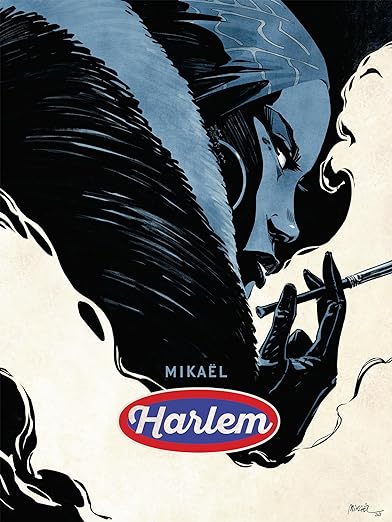
Harlem


By Mikaël, translated by Tom Imber (NBM)
ISBN: 978-1-68112-328-8 (HB) eISBN: 978-1-68112-329-5

Certain eras and locales perennially resonate with both entertainment consumers and story makers. The Wild West, Victorian London, the trenches of the Somme, and so many more quasi-mythological locales instantly evoke images of drama and tension, and prompt tales just begging to be told. In these modern times of environmental doom, global brush wars and economic privation, one of the most evocative is Depression-era America’s “Big City”.

Perhaps because it feels so tantalisingly within living memory, or maybe thanks to its cachet as the purported land of promises and untapped opportunity, America has always fascinated storytellers – especially comics creators – from the “Old World” of Europe. This inclination has birthed many potent and rewarding stories, and none more so than this continentally-published yarn from multi-disciplinary, multi-award-winning French-born, Quebeçois auteur and autodidact Mikaël (Giant; Bootblack, Junior l’Aventurier; Rapa Nui, Promise), who has been creating comics wonders since 2001.

First published in Europe in 2018, Giant told linked stories of little people – many of them newcomers to America – who built the Empire State Building in 1932, lensed through the interplay between immigrants and the underworld that offered so many their only chance to survive and thrive. Mikaël returned to the milieu with Bootblack, which originated as twin albums before being released as a brace of English-language digital tomes courtesy of Europe Comics. It finally found a worthy home as an oversized (229 x 305mm) resoundingly resilient hardback edition from NBM that got the entire story done-in-one. Now designated “The New York Trilogy”, the evocative venture concludes in a powerful fictionalised account of a minor but ferociously real celebrity of that faraway era…

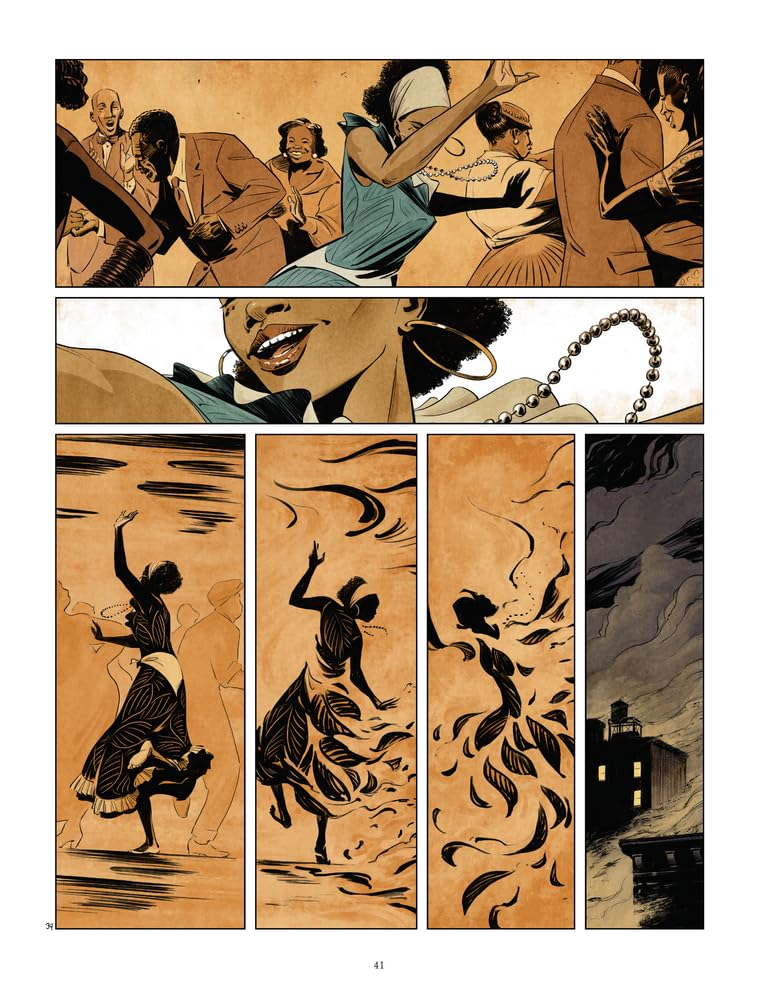
Originally released au Continent as two tomes in January 2022 and August 2023, Harlem unfolds as a complex sequence of overlapping flashbacks, telling (part of) the story of crime boss, shady entrepreneur and unlikely civil rights crusader Stéphanie St. Clair (December 24th 1897 – December 1969). Regarded as a French migrant, she was actually born in Martinique (West Indies) before becoming a domestic servant in Quebec and moving to New York in 1912. From then she went by many names but most notably Queenie…

By 1931 the infamous elegant mobster, popularly adored social climber and “richest black woman in the country” had instituted and was running Harlem’s numbers racket. Other people’s penny bets made her rich, lifting her above and beyond alleys and gutters via a meticulously organised, savagely administered – by poet turned enforcer/lover Ellsworth “Bumpy” Johnson and slick white lawyer Mr. Mahoney – (generally) harmless gambling enterprise that provided work for hundreds of poor black residents…

As the drama shows, Queenie has a man who supports her every decision and a close circle of women friends who enable her to occasionally drop her austere and steely public façade. Cushioning glamourous notoriety allows her to live away from sordid poverty in a posh enclave of wealthy and influential “negro intelligentsia” – at 409 Edgecomb Avenue: the palatial apartment building on “Sugar Hill”…

Everything starts to collapse when her activities increasingly chafe with cops who take her bribes whilst despising her skin colour, intelligence and “uppity” attitudes, just as ruthless outsiders Lucky Luciano and Dutch Schultz – deprived of their former revenue streams by the repeal of Prohibition – turn envious eyes on the district north of 110th Street – the no-go region for decent folk commonly called Harlem…

The actual trigger is well-meaning white reporter Robert Bishop whose love for the glitz of the Harlem Renaissance and a “miscegenating” dalliance with Queenie’s pal Tillie Douglas brings him to a jazz nightclub on the night “The Dutchman” tries to seize Queenie’s territory by force, only to be humiliatingly faced down by the proud celebrity. Outraged by her usual treatment from Irish cops led by corrupt racist Captain McCann, Madame St Claire starts writing opinion pieces denouncing police corruption and Mafia encroachment, also advocating militant change and offering legal advice for the disenfranchised. These she forces local paper New York Amsterdam News to publish. She soon hires Bishop to proofread and edit them, but when his close access turns into his subsequent articles in support of black advancement in white newspapers, it augurs disaster and the beginning of the end…

As a battle for turf collides with the deepening Great Depression, socialist agitation in the streets, an influx of Mafia drug pushers and murder pushes the district into chaos. With Shultz and McCann closing in and Queenie’s old allies and even friends turning against her, St Claire makes a bold and unpredictable move, retaliating in the only way she can…

Intercut with nightmarish scenes of her childhood, island life and gradual move to America, Queenie’s rise and fall occurs in a cultural melting pot of oppressed peoples just starting to feel the faint stirrings of equal treatment. Everything about this stylish drama is potently mythic and tragically foredoomed in a sincerely Shakespearean manner as it completes the auteur’s epic and ambitious New York Trilogy. Packed with period detail and skilfully tapping into the abundance of powerful, socially-aware novels, plays and movies which immortalised pre-WWII America, this tale is all the more enticing for what it doesn’t reveal… the truly remarkable turns Stéphanie St. Clair’s life took after this story ends. Hopefully there’s someone ready to translate the latterday activist’s exploits after WWII into graphic immortality…

This book includes poems by Langston Hughes – Harlem and I, Too – and dozens of stunning pencil studies of key locations and characters at the back. Moreover, if you’re sharp, you can find the Easter eggs throughout the text where this tale intersects with and overlaps the previous parts of the trilogy…

Harlem is moving, memorable and momentous, a graphic narrative triumph you must not miss.
Harlem volumes 1 & 2 © DARGAUD BENELUX (DARGAUD-LOMBARD S.A.) 2022 – 2033 by Mikaël.

Harlem is scheduled for UK release 16th April 2024 and available for pre-order now.

Most NBM books are also available in digital formats. For more information and other great reads go to NBM Publishing at nbmpub.com.

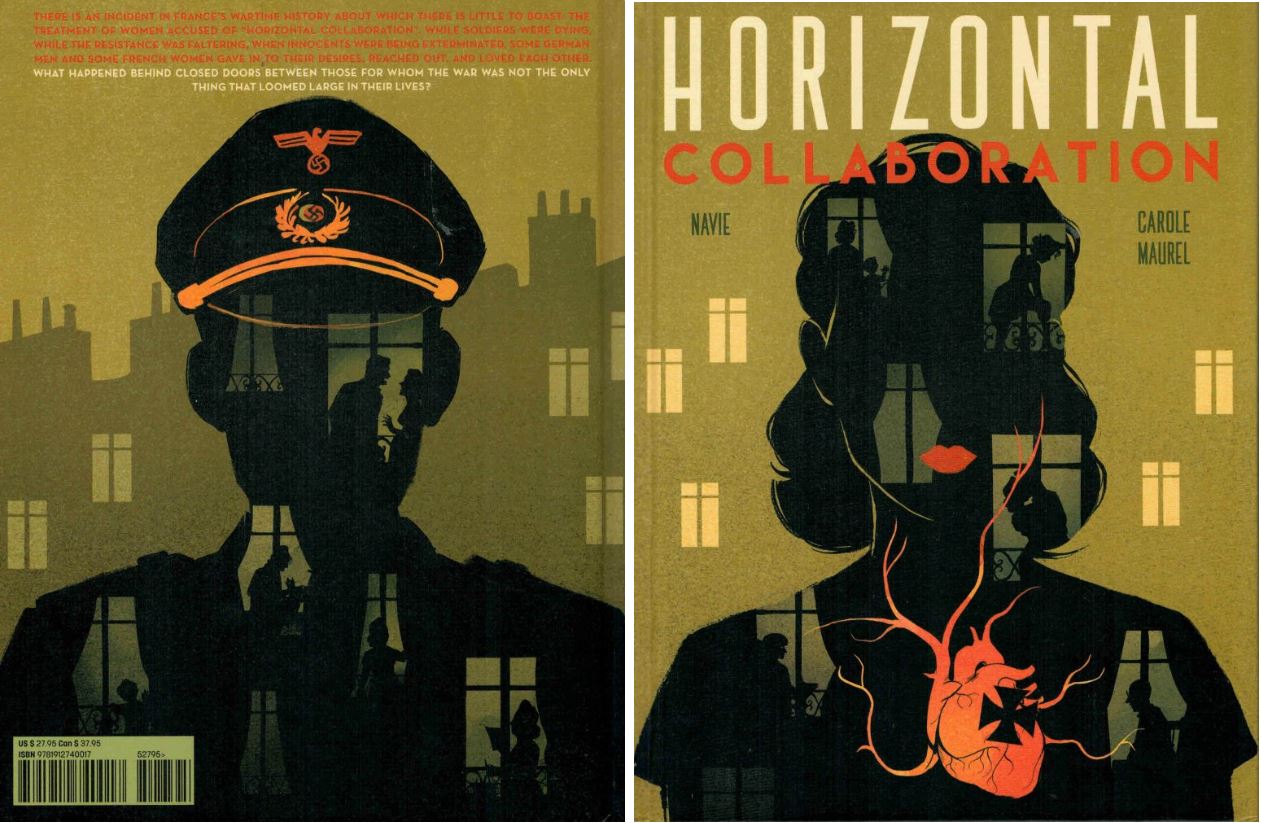
Horizontal Collaboration


By Navie & Carole Maurel, translated by Margaret Morrison (Korero Press)
ISBN: 978-1-91274-001-7 (HB)

With its world-shaking reordering of society and all the consequent, still-felt repercussions World War II remains very much in people’s minds. This translated European tale is a potent counterpoint to the usual commemorative bombast, devoting much-delayed attention to the ever-dwindling last of “The Few”. Here, as well as the valiant men, we see acknowledgment of the nigh-universally disregarded contributions of women caught up in the conflict, not to mention unsung heroes of all nations who were drawn into the horror.

Horizontal Collaboration is not about heroes. It deals with people: civilians and fugitives, women and invading occupiers: the ones who are seldom celebrated but who also confronted the triumph of global darkness, all in their own small, unnoticed way…

France was taken by the Nazi war machine in 1940: occupied and partitioned on June 22nd, with the Germans holding the industrial north and central regions whilst Marshal Philippe Pétain’s puppet protectorate Régime de Vichy was allowed to govern the south and pacified colonies such as Algeria. When France was liberated in September 1944, a wave of retaliation began against those who “cooperated” with the conquerors in all ways great and small.

A sordid time of scores (real, imagined or fabricated) settled and cruel abuses arbitrarily inflicted on guilty and innocent alike plagued France for years afterwards. The most telling indignities were perpetrated upon women – wives, mothers, sisters or strangers – accused of fraternising with or giving comfort to the enemy. Such liaisons were called “Collaboration Horizontale” and even the most nebulous or unfounded accusation carried a heavy and immediate price…

Just about now, a grandmother listens to her granddaughter unload about her current amour and her mind drifts back to the war and a secret she has never shared with anyone…

In 1942, a large apartment house on Passage de la Bonne-Graine is filled with families, all dealing with the German conquerors in their own way. Despite the change in their fortunes, they have not found any way to overcome the petty grudges and ingrained social difficulties that have always kept them at odds with each other… even before war broke out.

Surly aged crone Madame Flament is rude to everyone. She spends all her time complaining or disappearing into the cellars to feed her cats. What secret is she really hiding?

Old Camille is deemed the man of the house, but he is gentle, ineffectual and blind: blithely letting life go on around him and apparently noticing nothing. His wife is the building’s concierge. Brusque matron Martine Andrae is a snooping busybody loudly championing decency and family values, but her home life is nothing to envy and her sharp tongue scores points off family, friends and foes indiscriminately. She despises the younger women and their families in the building, especially pretty Joséphine Borgeon who makes ends meet through her theatre act. Surely, everybody knows what she really does to survive?

Also viewed with suspicion is young mother Rose. Her husband Raymond has been taken away to work for the Nazis, so his friend and neighbour Leon – a gendarme – has been keeping a “friendly” eye on her, even though his own pregnant wife Judith keeps clumsily falling and hurting herself and certainly needs proper supervision…

Strangely boyish artist Simone keeps to herself as much as she can and – originally – there was also a Jewess called Sarah Ansburg and her little son. They somehow disappeared before the Germans could find them. That must be the reason Abwehr intelligence officer Mark Dinklebauer spends so much time in the building. It couldn’t possibly be that he has fallen in love with one of the occupants, or that this most forbidden of passions is dangerously, illegally reciprocated, can it?

Crafted with deft incisiveness by media writer and historian (Mademoiselle) Navie and rendered in a beguiling style (powerfully reminiscent of Will Eisner in his later years) by seasoned illustrator/author Carole Maurel (Luisa: Now & Then, Waves, L’apocalypse selon Magda), this is a meditative but uncompromising glance at ordinary lives under relentless pressure: an ensemble piece of human drama taking as its heart and centre point an unlikely flowering of true but doomed love…

Moving, beguiling and evocatively rewarding, Horizontal Collaboration is a beautiful tragedy and potent reminder that love takes no prisoners while enslaving all it touches.
© Editions Delcourt – 2017. All rights reserved.

Axa Adult Fantasy Color Album


By Enrique “Enric” Badía Romero & Donne Avenell (Ken Pierce Books/Eclipse Comics)
ISBN: 0-912277-27-0 (TPB)

Born in 1930 Enrique “Enric” Badía Romero’s comics career began in his native Spain fifteen years later when he was apprenticed to popular creator Emilio Freixas. By 1949 – as “Badia” – he was drawing strips for Susy and other publications, and in 1953, launched his own magazine Alex, before going on to found publishers Ruiz Romero where he produced everything from westerns, sports, war stories and trading cards – mostly in conjunction with his brothers Jorge and Jordi. Their most memorable series were Cromos, Hombres de Lucha and Historia de la Guerra.

“Enric” began working for the higher-paying UK market in the 1960s, on strips such as ‘Cathy and Wendy’, ‘Isometrics’ and ‘Cassius Clay’ before successfully assuming drawing duties on the high-profile Modesty Blaise adventure-serial in 1970. He left in 1978 when an enticing new prospect appeared whilst he was simultaneously illustrating Modesty and Rahan with André Chéret for Franco-Belgian weekly Pif gadget. Even for the prolific artist something had to give…

Axa ran in The Sun Monday to Saturday from 14th July 1978 to her abrupt cancellation on November 16th 1986 – purportedly a victim of political and editorial intrigue which saw the strip cancelled in the middle of a story. Other than the First American Edition series from strip historian Ken Pierce and this colour collection, there has never been a definitive English language collection. It should be noted also that at the time of this book she was still being published with great success and to popular acclaim.

Back then in Britain it often appeared the only place where truly affirmative female role-models appeared to be taken seriously were cartoon sections, but even there the likes of Modesty Blaise, Danielle, Scarth, Amanda, Wicked Wanda and all the other capable ladies who walked all over the oppressor gender – both humorously and in straight adventure scenarios – lost clothes and shed undies repeatedly, continuously, frivolously and in the manner they always had…

Nobody complained (at least no one important or who was ever taken seriously): it was just tradition and the idiom of the medium… and besides, artists have always liked to draw bare-naked ladies as much as blokes liked to see them. It was even “educational” for the kiddies – who could buy any newspaper in any shop without interference, even if they couldn’t get into cinemas to view Staying Alive, Octopussy or Return of the Jedi without an accompanying adult…

Tough ’n’ sexy take-charge chicks (without clothes) were a comic-strip standard by the time the Star Wars phenomenon rekindled interest in science fiction, and the infallible old standby of scantily-clad, curvy amazons in post-apocalyptic realms never had greater sales-appeal than when The Sun – Britain’s sleaziest yet best-selling tabloid – hired Romero & Donne Avenell to produce a new fantasy feature for their already well-stacked cartoon section.

This beautifully illustrated but oddly out of kilter collection doesn’t bear much similarity in terms of tone or format to the (ostensibly) family-oriented daily strip, and features none of the regular supporting cast like long-suffering lover Matt or robotic companion Mark 10, which leads me to suspect it was created independently for a European market, perhaps as a Sunday page in Romero’s homeland or elsewhere where attitudes and mores were more liberal.

Certainly in the early 1980s Axa appeared in adult bande dessinée icon Charlie Mensuel (which reprinted many classic newspaper strips from around the world) and after that closed in Swedish publication Magnum.

Whatever their origin, the tales collected here are far stronger and more explicitly sexual in nature; occasionally coming close to being macho rape-fantasies, so please be warned as such content, no matter how winningly illustrated, will certainly offend most modern consumers.

The eponymous heroine was raised in a stultifying, antiseptic and emotionless domed city: a bastion of technological advancement in a world destroyed by war, pollution and far worse. Chafing at the constricting life of loveless living dead men, Axa broke out and, ancient sword in hand, chose to roam the shattered Earth searching for something real and true and free…

This slim oversized tome opens with Axa crossing trackless wasteland under a scorching sun until she finds a hidden grotto beneath a ruined building. The coolly sensual hidden pool is a welcome delight but harbours a ghastly monster and mutant voyeur…

Captured by a hideously scarred human degenerate Axa discovers his gentle nature but is soon abducted by his far-less sympathetic brethren who want to use her as a brood mare for their next generation. Ultimately, fate, her newfound friend and that ever-present longsword combine to effect her escape…

Resuming aimless exploration, Axa encounters a coastal village and is almost killed by wild dogs. Desperate flight takes her to a lighthouse on the promontory above the deserted town where ruggedly handsome Juame and his teenaged daughter Maria have been trapped for months. Swiftly, sexual tension between Axa and Jaume culminates in the only way it can as Maria is driven mad by jealousy she can barely comprehend. When a roving band of vicious post-apocalyptic Hell’s Angels hits town hungry for slaughter and kicks, the conflicted teen opens the tower doors for them…

The brutes casually murder her father and are intent on adding her and Axa to their string of human playthings, when a terrific storm hits and Axa breaks loose to become the bloody tool of harsh, uncompromising and final fate…

This incarnation of the warrior wanderer is certainly harder-hitting and more visceral than the British strip version and has little of the feature’s sly, dry humour, but art-lovers cannot fail to be impressed by Romero’s vibrant mixed-media illustration and imaginative, liberating page compositions.

Lush, lavish, luxurious and strictly for adventure-loving adults, Axa is long overdue for a comprehensive ethical overhaul and definitive comics collection. Is there a bold publisher out there looking for the next big thing and prepared to face a barrage of ethical vituperation?
Axa © 1985 Enrique Badia Romero. Previously © 1983, 1984 in Spanish. Express Newspapers, Ltd.

The Cabbie volume 1


By Marti, with an introduction by Art Spiegelman (Fantagraphics Books)
ISBN: 978-1-60699-4504 (HB/Fantagraphics) 978-0874160420 (Album PB Catalan Communications)

Although out of print since 1987, in 2011 Fantagraphics rescued from relative obscurity one of the darkest yet most grimly illuminating classics of European cartooning in this remastered and augmented reissue of The Cabbie: a stylish, nightmarish psycho-sexual noir thriller that has as much seedy kick now as it had when first translated by Catalan Communications…

Now as the macabre maestro has died, my conscience prompts me to pay for neglecting such wonderful comics and it’s only right we should pause to revisit his greatest achievement. Maybe some publisher will endeavour to bring some of his other dark wonders – like Doctor Vertigo, Propaganda Moderna, crime fantasy-thriller Calvario Hills, Cien dibujos por la libertad de Prensa or Terrorista – to a wider international audience.

Marti Riera Ferrer (1955 – 19th January 2024) was born in Barcelona during the heyday of fascist rule. He studied at the Massana School of Arts and Crafts where his efforts coincided with the Generalissimo’s death, and from 1975 to 1979 a liberalisation saw “Marti” creating comics for alterative magazines like Rock COMIC and Star.

From its launch in 1979 he also began contributing to apocalyptic iconoclast El Vibora: short stories and series such as Tony Nuevaola and – with Rodolfo – Lola Lista contra los Nada. These efforts brought international interest and Marti began appearing in Raw and Drawn & Quarterly. Il Taxista – The Cabbie – began in 1982 and he episodically added to the canon over succeeding years, and although semi-retired from the early Nineties he continued generating other material at his own pace for the magazine Makoki and Tobalina. These tales varied from erotic fiction to general illustrated fare.

Dick Tracy is one of the most well-known strips on Earth and the super-cop’s contributions to the art form are many and indisputable. They occurred over many decades and the medium of graphic narrative grew up with it. Imagine the effect instant exposure – or overexposure – to such an uncompromising, bombastic, iconic property on the artists of a nation where free-expression and creative autonomy was suppressed for generations. That’s what happened when the death of General Franco (who had held Spain in a fascistic time-warp from his victory in April 1939 until his death in November 1975) opened up and liberalised all aspects of Spanish life. When Marti saw the strip he was changed for life…

As Art Spiegelman says in his introduction, “decades of political and social repression gave way to a glorious eruption of creativity that allowed a full-fledged counterculture to come to life at just about the same time that America’s “Love Generation” gave way to what Tom Wolfe labelled the “Me Generation.””

How odd yet fitting then that an American symbol of “The Establishment” so enchanted and captivated young cartoonist Marti Riera that he assimilated every line and nuance to create a bleak, stripped-down and extremely angry homage detailing the tribulations of a seedy, desperate taxi-driver trapped in an abruptly vanished past and prey to a world at once free and dangerous, ungoverned and chaotic…

Driving around the seediest part of town our hero picks up a high-rolling gambler who’s just won big, but the driver’s night goes horribly wrong when a knife-wielding thief hijacks the cab and robs his passenger. Luckily, the Cabbie can handle himself and he quickly, brutally subdues the thug.

Our protagonist is a decent, hard-working man who lives with his ailing mother, humouring her talk of a mysterious inheritance, and allowing her to keep the embalmed cadaver of his father in the spare bedroom, but he’s tragically unaware that his citizen’s arrest will have terrible repercussions for them both. When the son of the thief he captured is released from prison, the ingrate immediately begins a grim campaign of retribution against the Cabbie that creates a maelstrom of tragedy, degradation and despair.

This is a harsh, uncompromising tale of escalating crime and uncaring punishments: blackly cynical, existentially scary and populated with a cast of battered, desolate characters of increasingly degenerate desperation. Even the monsters are victims, but for all that The Cabbie is an incredibly compelling drama with strong allegorical overtones and brutally mesmerizing visuals.

Any mature devotee of comics should be conversant with Marti’s superb work, and with a second volume out there and the hope of digital editions (One bloody Day!), hopefully we soon all will be…
The Cabbie (Taxista) © 2011 Marti. Introduction © 2011 Art Spiegelman. This edition © 2011 Fantagraphics Books.

Shaft volume 2: Imitation of Life


By David F. Walker, Dietrich Smith & various (Dynamite Entertainment)
ISBN: 978-1-52410-260-9 (TPB/Digital edition)

For most of modern history black consumers of popular entertainments in what used to be called the “Free West” have found far too few fictive role models. In the English-speaking world that began changing in the turbulent 1960s as America’s Civil Rights Movement gained traction and truly took hold during the decade that followed. Many characters stemming from those days come from a commercially-led cultural phenomenon called Blaxploitation.

Although criticised for seedy antecedents, stereotypical situations and extreme violence, the films, books, music and art were the first mass-market examples of minority characters in charge and in leading roles, rather than as fodder, flunkies or flamboyant villains. One of the earliest movie icons of the genre was the man called Shaft. His filmic debut in 1971 was scripted by journalist and screenwriter Ernest Tidyman (The French Connection; High Plains Drifter; A Force of One) adapting his own 1970 novel. Tidyman authored six more between 1972 and 1975, with his urbane urban warrior simultaneously starring in numerous films and a (far, far tamer) TV series. He even had in his own retro-themed, adults-only comic book.

An eighth prose novel – Shaft’s Revenge – was released in 2016, written by David F. Walker. Amongst his many talents – you should hunt down his online culture-crunching ’zine BadAzzMoFo and you won’t be sorry – Walker numbers writing intriguing, hard-edged comics (Occupy Avengers, Cyborg, Red Sonja, Tarzan on the Planet of the Apes and many more), so in 2014 it was probably inevitable he be invited to write that long-overdue comics iteration…

Blockbusting premier miniseries Shaft: A Complicated Man – relating the lone wolf’s origins – led to this sequel, illustrated by Dietrich Smith and coloured by Alex Guimarães, with Walker himself lettering the series. Whereas that comic book took its look, settings and tone from the novels more than the Richard Roundtree (whom we tragically lost in October last year) films, this one carefully refocuses and aims for a satisfactory blending of prose and film iterations.

Originally released as a 4-issue miniseries, Imitation of Life finds the detective ‘Before and After’, regretting his life choices, successes and recent notoriety as the highly publicised rescue of an abducted girl suddenly make him a famous – if not actually notorious – man. It’s nothing he wanted: Shaft was literally forced to take the job by a major mobster no one in their right mind ever refuses, and now, after sorting the problem in his inimitably pitiless manner, the gumshoe is slowly drinking himself to death on the huge fee he also couldn’t safely turn down…

Eventually guilt and boredom compel him to get back in the game and, free of money worries, he can pick and choose from a big list of inquiries. That said, Shaft can’t explain just why he takes on the pointless problems of the Prossers: a hick white couple desperate to find their son. Mike is 18; a good-looking homosexual kid (we say “gay” today, apparently) swallowed up by the sleaze-peddlers of 1970s Times Square. The kid’s legal and not even a real missing person, but there’s something Shaft can’t get out of his head about this particular runaway…

Convinced it’s all pointless, Big John hits appropriate bars and clubs but no one knows anything: they never do. And then a kid named Tito recognizes him and just like that, the violence starts coming.

Surviving a homophobic attack – and teaching a few bigots the cost of intolerance – Shaft finds his case abruptly stalled just as shady wannabe filmmakers seeks to hire him to consult on their new (blaxsploitation) flick “The Black Dick”. It promises to be an easy gig, but they never are…

Before long, Shaft is writhing in discomfort as the script ludicrously bastardises his career and reputation, but when Tito turns up and bamboozles the detective into facing off with a Mafia pornographer just as the secret moneyman behind his own filmic fiasco starts demanding an early return on his investment, it all stops being a laugh and becomes deadly serious again. Once more, he remembers there’s no such thing as ‘Easy Money’…

As fictional and real worlds increasingly intersect, Vice cops contact Shaft and he sees that somehow all his irons seem to be stacked in the same fire. When the ludicrous leading man is abducted and troublemaking Tito pops up again with some very perilous photographs from his own incessant snooping, Shaft discovers in penultimate chapter ‘Love & Loss’ just what happened to Mike Prosser before tooling up to rescue one bad actor while invading a film set where pornos and snuff films are the preferred hot product…

The strands all pull together in a typically cathartic climax as ‘All the World’s a Stage’ sees order restored, bad guys righteously dealt with and even sets up a delicious funny ending to usher us out…

Revisiting a legendarily foetid cesspool of civic corruption, warring mobsters and get-rich-quick chancers, this tour of a mythic milieu is another wry and intoxicating crime thriller no fan of the genre should miss.
Shaft is ™ & © 2016 Ernest Tidyman. All rights reserved.

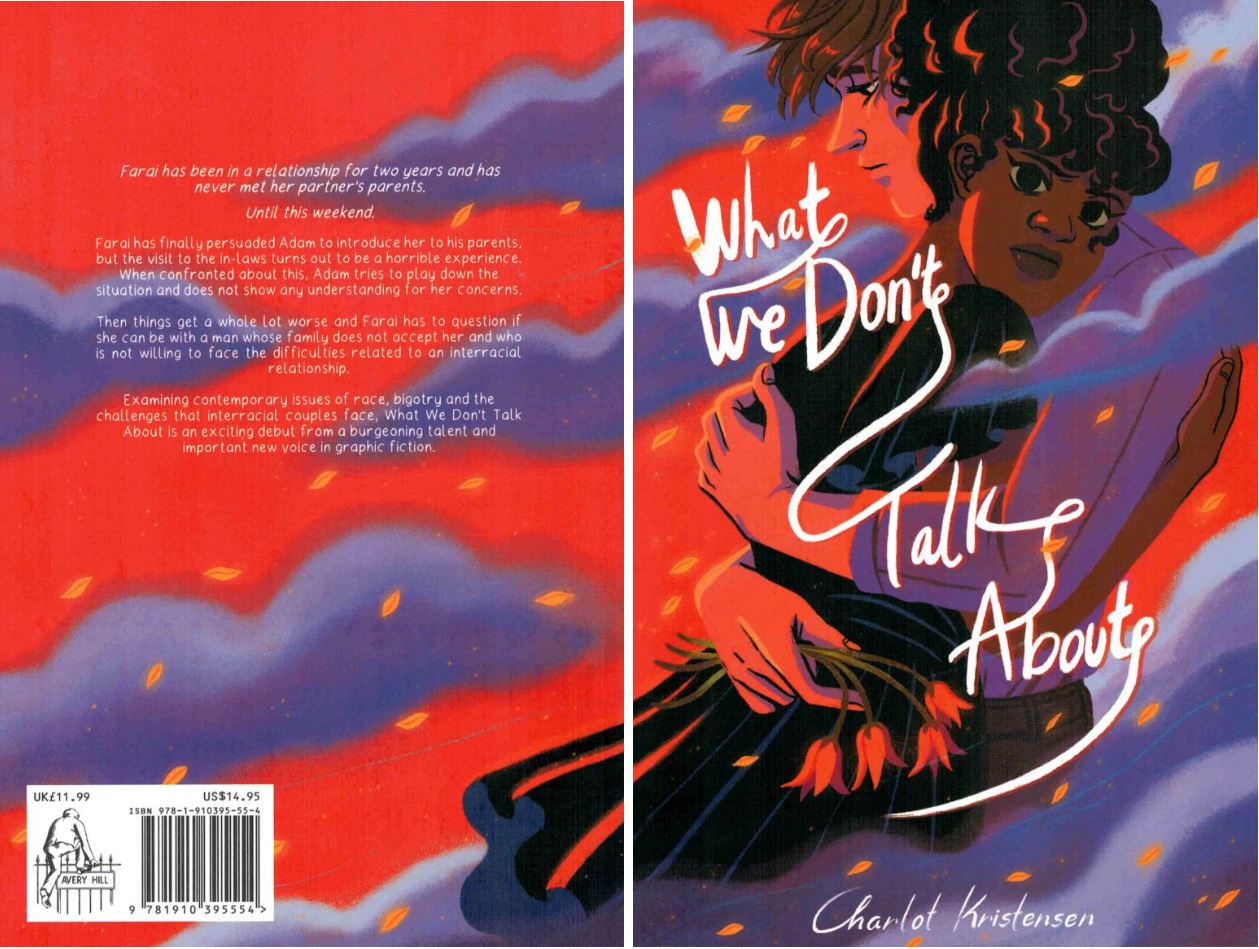
What We Don’t Talk About


By Charlot Kristensen (Avery Hill)
ISBN: 978-1-91039-555-4 (TPB/digital edition)

There’s plenty wrong with the world, but most of it could probably be sorted if people got together and discussed things rationally and honestly. Some individuals, however, don’t want to change positions or even agree that there even is a problem. This book isn’t for them, and we’ll have to find more drastic ways to deal with their nonsense…

Charlot Kristensen graduated from Middlesex University in 2015 with a degree in Illustration and thereafter pursued a career in the arts. Her visual and narrative gifts are prodigious and superbly highlighted in this vibrant examination of an interracial relationship in crisis. Kristensen is of Afro-Danish descent and clearly knows what she’s talking about and how best to depict it…

Painted in lavish and mood-setting colours, What We Don’t Talk About focuses on an idyllic modern romance as (demi-autobiographical?) artist Farai accompanies her white English boyfriend Adam to Lake Windemere to finally meet his parents. The young couple have been lovers for two years now, ever since University, but her beautiful gentle musician soulmate is uncharacteristically nervous – even short-tempered – as the journey begins. Farai almost regrets the trip, even though she’s been pushing for it from the start. Her nerves and his tension dissipate on the trip north, but are all revived when she meets Charles and Martha. The look on their faces and the tone of the greeting tell Farai an old story…

In frosty diffidence, the social amenities are followed but it’s not just a barely suppressed attitude of polite condescension Farai experiences. Martha’s blunt opinions extend to all aspects of her son’s life. Although she clearly opposes Adam’s choice of career, after meeting the girlfriend, Mother now has a new problem to gnaw at…

As the weekend progresses Martha’s sneering, passive aggressive comments go from dismissive to openly hostile: mocking Farai’s clothes and denigrating the achievements of her Zimbabwean parents (a doctor and engineer respectively). It soon becomes clear that it’s not just her who’s a problem: people with funny names or difficult accents and all Muslims also fail Martha’s tests of decency and acceptable standards. The matriarch also thinks the world should be grateful for British colonialism…

And Adam? He’s loving and conciliatory but ultimately weak and keen to avoid the issue. He knows what his mum says is objectionable, offensive and just plain wrong, but can’t or won’t bring himself to say anything or rebuke his parents. He seeks to divert conversations rather than defend Farai, even employing the “just a joke” defence at a most distressing family dinner. He doesn’t seem to believe their attitudes are unacceptable or that it even matters. Farai’s seen it all before. This is a love story that cannot possibly end well…

Like a contemporary Guess Who’s Coming to Dinner, this powerful graphic drama forensically picks open the sores underlying so much of modern society’s attempts to integrate and assimilate long-entrenched attitudes: revealing not just how far we’ve all come, but how far we still have to go.

Comics have always had an admirable record in addressing issues of bigotry and racial injustice, and this tale takes that to the next level with potent moving empathy displayed and seen through the eyes of someone who’s clearly “been there, done that” all too often…

That ignorance and intolerance still daily endured by so many today is perpetually ignored, diminished and dismissed by those in charge has never been more effectively shown as in this unforgettable tale. Luxuriant colours and a welcomingly accessible cartoon style subversively act to devastatingly prove that prejudice doesn’t just lurk in dark corners any more but instead proudly rears its head everywhere it can. But that just means we must slap it down more forcefully and decisively.
© 2020 Charlot Kristensen.

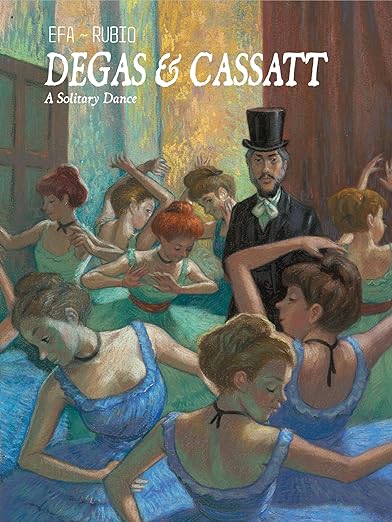
Degas & Cassatt: A Solitary Dance


By EFA & Rubio, translated by Edward Gauvin (NBM)
ISBN: 978-1-68112-324-0 (Album HB) eISBN: 978-1-68112-325-7

NBM’s line of graphic biographies never fails to delight, and this oversized luxury hardcover (also available digitally) is one of the most fascinating thus far: exploring one of painting’s greatest yet least understood masters and – deducing by inference – one of the most occluded, protracted and certainly frustrated romances in history…

Degas & Cassatt: A Solitary Dance reunites award-winning screenwriter, historian and novelist Salva Rubio (Max, The Photographer of Mauthausen) with animator/illustrator Ricard Fenandez AKA “Efa” (Les Icariades, Rodriguez, Le Soldat, L’Ãme du Vin: L’ail et l’huile). Their previous collaborations are also beautiful biographies – Monet: Itinerant of Light and Django, Hand on Fire: The Great Django Reinhardt.

First released in France, the translated Degas: La danse de la solitude is preceded by mood-setting quotes from Baudelaire and Shakespeare and closes with a detailed Bibliography of suggestions for further study and appreciation. Between those points is a compelling exploration of one of the most turbulent periods in European and Art history, as impacted upon and partially shaped by a controversial, conflicted, contradictory and misunderstood master of line, colour and form…

This pictorial conjecture gently deconstructs enigmatic Edgar Degas is rendered by EFA in the manner of the pastel crayon drawings so beloved and powerfully utilised by Hilaire-Germain-Edgar De Gas (July 19th 1834 – September 27th 1917). It affords a mistily miasmic uncertainty which never obscures detail whilst shaping a mystery to confound and unsettle readers. The stunning confection of painterly images traces – via flashback and supposition – the life of a troubled artistic genius raised almost completely by male relatives to covet success, scorn women and criticise himself mercilessly.

In Paris during the 1870s, a graciously-barbed, polite war of wills and conception began. The creative world was formalised and controlled by a hidebound elite – “The Salon” – dictating what could and could not be ART. The convention-constricted organisation even dictated form, method and content until that stultifying impasse was challenged by a haphazard band of free thinkers who would become derisively dubbed “The Impressionists”.

Among their most outspoken and headstrong proponents were Manet, Monet, Cezanne, Renoir, Berthe Morisot, Sisley, Bazille and others, but they only really started making waves once staid, bellicose and unfathomable Degas began associating with them. He bemused and bewildered his fellow outriders and the Bohemian set they congregated with, but never felt himself part of the group… or any human affiliation.

His story is seen from its conclusion as ‘1: Solitude’ opens on Saturday, 29th September 1917 with an elderly lady staring at a crypt in the Montmartre Cemetery in Paris. She is American painter Mary Cassatt who probably knew Degas better than any other person. On visiting his empty studio, sentiment swallows her as she opens his abandoned notebooks, thinks back and wonders…

In ‘2: Monsieur Degas’ the odd bourgeois’ formative days are selectively reviewed and his misanthropic, misogynistic, chauvinistic and racist stances are quizzed through his problems with his own output. Degas’ work does not and has never satisfied him and he can only find inspiration in places no decent person belongs. It seems the austere bookish elitist cannot open up to his peers but is addicted to being an anonymous, masked and untouchable patron of brothels, bawdy houses and ballet… where only the most degraded – or poverty stricken – go.

As his renown grows a meeting with an art dealer from the USA leads to a possibility of a different life in ‘3: Miss Cassatt’, but the voluntary hermit’s true genius appears to be self-sabotage. Even as the impressionists gradually destroy the influence of The Salon, Degas finally starts generating work worthy of his talent whilst sinking deeper into isolation and pushing away all those who could be friends… or perhaps more…

The story ends with ‘4: The Dance’, allowing some fanciful elaboration on the biographers’ part as the elderly artist confronts his muse and inhibitions in a kind of Happy Ever After that concludes with Rubio’s prose rumination ‘Did Monsieur Degas ever find peace?’

Enchanting, thought-provoking and supremely enthralling, Degas & Cassatt: A Solitary Dance is a soft-focus voyage of illicit discovery no lover of unforgettable pictures can be without.
© EFA/RUBIO/ ÉDITIONS DU LOMBARD (DARGAUD- LOMBARD S.A.) 2021. All rights reserved.

Degas & Cassatt: A Solitary Dance will be published on March 12th 2024 and is available for pre-order. For more information and other great reads see http://www.nbmpub.com/

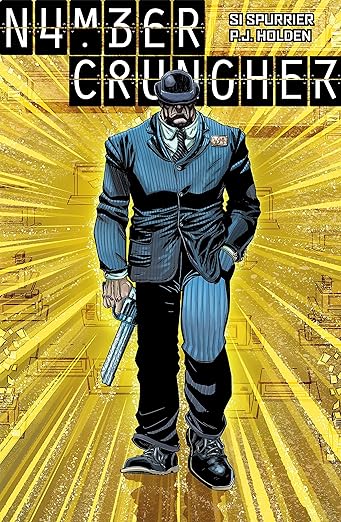
Numbercruncher


By Simon Spurrier & P.J. Holden, with Jordie Bellaire (Titan Comics)
ISBN: 978-1-78276-004-7 (HB/Digital edition)

Sometimes a story just cries out to be told – especially if your tastes run to the sentimentally cynical, soppily savage or wide-eyed yet jaded. If that’s you, Numbercruncher will confirm all your suspicions about life whilst providing a really good time.

The tale – by Simon Spurrier (Judge Dredd, X-Men: Legacy, Six-Gun Gorilla, Damn Them All, John Constantine: Hellblazer) & P.J. Holden (also your man Dredd, Rogue Trooper, Battlefields, Terminator/Robocop Skullduggery Pleasant, The Moon Looked Down and Laughed) – began as a creator-owned project in The Judge Dredd Megazine before being expanded into a 4-issue miniseries at Titan Comics: a clever, controversial confection that will confound, delight and astound lovers of metaphysical whimsy, romantic fantasy and unnecessarily extreme violence.

Like 1939’s The Wizard of Oz, Werewolf by Night (2022) and especially A Matter of Life and Death, this unearthly tale is told on two separate levels of existence, differentiated by full-colour mundanity sections and monochrome views of The Afterlife. Unlike those movies, it’s a nasty and wittily vicious piece of work; just like handy geezer Bastard Zane, AKA operative #494, employed by The Divine Calculator to enforce Karmic Accountancy and keep souls circulating through the great cosmic All.

The Universe is just numbers and God is a mean, pedantic bean-counter, only concerned with the smooth running of his Grand Algorithm. Unfortunately, it all starts to fall apart when Zane is tasked by the weaselly Big Boss with stopping an in-love but dying young mathematician from gaming the system. SuperGenius Richard Thyme in his final seconds of mortal life, has a Eureka moment and divines the true and exact nature of everything… and how to manipulate it…

Armed with that inspirational knowledge, Thyme’s soul arrives before the Writer in the Grand Ledger and wheedles another spin on the Karmic Wheel – Reincarnation.

Brilliant Richard had been utterly in love with a dippy hippy chick named Jessica Reed, and when he bargains for another chance at a life with her, the petty-minded Divine Calculator gleefully accepts the proposition. Thyme will be reborn, with all memories intact, but when this second life ends, his soul will be gainfully employed – just like Zane – by the Karmic Accountancy Agency as a collector. Standard term of employment is for eternity… unless he can convince someone to take his place. The indentured operatives call it “Recirculation”…

There is only one get-out: a “Zero-clause” which means that if Thyme can live a life completely and totally without sin, his contract becomes null and void. But who could possibly live a mortal life without the slightest transgression?

Naturally, The Accountant won’t play fair: stacking the deck so reborn Richard is unable to even get near his lost love until it’s too late. However, when Zane finally shows up in AD 2035, eagerly expecting to close the case-file and retire with Thyme taking his long-suffering place in The Register, the frustrated, cheated SuperGenius plays his own trump card…

He’d always expected to be short-changed and made his own Karmic side-deal. By selling his contract to another Accountancy operative, he had bought another life, and as psychotically furious Bastard Zane soon sees, Thyme has pulled this trick over and over again. No matter how often Richard dies, he’s already being born again somewhere else…

With the mathematician’s sold-&-resold soul promised to practically every agent in the Afterlife, Zane’s only hope of retirement rests in killing the canny lad’s each and every reincarnation whilst simultaneously slaughtering every Karmic operative who’s been suckered into a deal with the lovesick little sod… On Earth, despite perpetual setbacks, each brief existence inches Richard slowly ever closer to Jess. That should make his eventual capture inevitable – but even here the smart guy has an incredible Plan B in operation: one even the Supreme Architect of the Cosmos didn’t see coming and one which may well undo the Algorithm underpinning Everything That Is…

Poignant, funny, outrageously gory, gloriously rude and wickedly clever, this is a ferociously upbeat, hilariously dark black comedy no insufferable incurable romantic could possibly resist. Moreover, for all us dyed-in-the-wool comics freaks, there’s a host of background features included. Interspersed between a gallery of covers and variants plus unused iterations and loads of original art, roughs and sketches, an ‘Author’s Note’ explores the genesis of the tale, further expanded upon in ‘A Comic for Talking to God – an interview with Brian Truitt of USA Today’. A discussion and explanation of Jordie Bellaire’s colouring process is the focus of ‘Working Flat-Out’ and ‘Birth Placement’ details the procedure for creating a cover, before the usual Creator’s Biographies ends things on a knowledgeable note.

Love, Death, Sex, more Death, Rebirth, lots of Death and Numbers: there’s your Meaning of Life right there…
™ & © 2013 Simon Spurrier & P.J. Holden. All rights reserved.