
My Pretty Vampire


By Katie Skelly (Fantagraphics Books, Inc.)
ISBN: 978-1-68396-020-1 (HB) 978-1-68396-194-9 (PB)

Illustrator Katie Skelly hails from Brooklyn by way of Bethlehem, Pennsylvania and caught the comics bug early, thanks to her newsstand owner dad. Her Barbarella-inspired series Nurse, Nurse began after graduating from Syracuse University with a BA in Art History and becoming a postgrad at City College of New York.

Thanks to her inquisitive insights, striking art style and potent narrative voice, Skelly has been the subject of many gallery shows and is a star on the global lecture circuit.

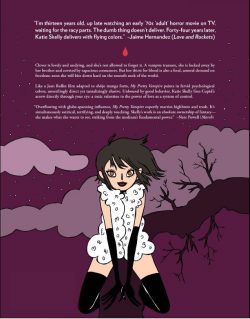
My Pretty Vampire was her first graphic novel. Released in 2017 it is a psychedelia-tinged, torrid terror tome – again inspired by Jean-Claude Forrest but also horror-meister director Dario Argento – and followed by Operation Margarine, The Agency and 2020’s historical reappraisal of an infamous murder-pact Maids.

All her works ask uncomfortable questions about the role and permitted position of women in society, as seen through exploitation genres of mass entertainment, and that’s never been more effectively seen than in this “semi-autobiographical” tome (available in present-worthy luxury hardback and accessible eBook formats) recounting the story of Clover, who was a spoiled rich brat until she was turned by a vampire. It did nothing for her disposition and four years later she is a prisoner in a gilded cage, forced to subsist on ox blood as her controlling brother Marcel keeps her “safe”.

Clover has other ideas: most significantly, feeding on what vampires are supposed to…

Finally, she makes her move, escaping up into the grimy sordid world of daylight, downtown sleaze and booze, drugs and debauched walking snacks. Innocently slaughtering her way across town, Clover is pursued by a canny mortal cop, who fixes all of Marcel’s mortal world problems, but his dogged pursuit is methodical and far too slow…

As the naively innocent killer luxuriates in her freedom, the world inexorably closes in and she realises she needs to change…

Amusingly raunchy, stunningly psychedelic and deviously asking very pointed questions about personal liberty and the constricting power of love as a tool of control, My Pretty Vampire is a vivid splash of vibrant, gory fun every contemplative connoisseur of sexual politics and social inequity will adore.
© 2017 Katie Skelly. This edition © 2017 Fantagraphics Books, Inc.

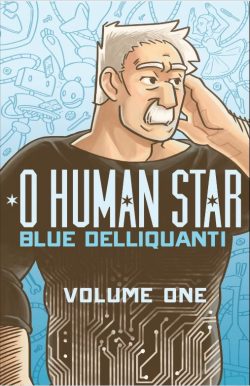
O Human Star volume One


By Blue Delliquanti (Blue Delliquanti)
ISBN: 978-0-9909956-0-9 (TPB)

Sexuality and identity appear to be inextricably conjoined. We’re not quite there yet in the disappointingly real world, but fiction and fantasy have extensively explored the potential ramifications and repercussions of the topic, and none more so or as stylishly as self-identified non-binary creator Blue Delliquanti (Meal; Smut Peddler; The Sleep of Reason & Beyond) in compelling voyage of personal discovery O Human Star.

The epic tale launched as a weekly webcomic on January 25th 2012 and ran until 27th August 2020, with the first collection (compiling chapters 1-3 in paperback and digital formats) released in book and digital formats in 2015.

The plot premise is potently simple and delivered through a complex network of enticingly engaging characters, beginning as mystery with ‘His Own Image’ wherein inventor Alastair Sterling dies alone and wakes up 16 years later. In the future, robotic lifeforms are simply part of the world, “Synthetic Beings” who comprise everything from simple manufacturing tools to fully autonomous independent individuals.

Apparently, Sterling’s discoveries changed everything and now his personality has been installed in a fully-artificial replica of his failed body. The creatures who greet him on awakening seem benevolent, and inform that his return has been commissioned by the estate of his former protégé, assistant beneficiary and lover Brendan Pinsky.

Bizarrely, after a fraught reunion with the angry, confused middle-aged guardian and administrator of his legacy, Alastair realises he’s been lied to. Of course, Brendan has tried to revive Sterling in the past, but without success. The who, how and why of the unasked-for true return is a complete – and very suspicious – mystery…

Part of the reason for Brendan’s reticence becomes apparent when a precocious young female synthetic flies into the compound and, with a storm of inexpressible emotions, Alastair realises Sulla is a teenaged girl version of himself…

She didn’t start out that way, though. Originally, the body was a gradually, methodically constructed boy child, but three years previously she chose to become female…

With no place to go, Alastair settles in and attempts to come to terms with an incredible new world, new lives and disappointment and confusion beyond belief…

Chapter Two ‘In the Morning of the Magicians’ finds the aggrieved resurrected man still bewildered as Sulla – desperately seeking his approval – appoints herself his guide and protector. This causes ructions with notional father Brendan who has spent his years trying to restore Alastair, while turning their company – Sterling Inc. – into one of the most powerful organisations on Earth. He also cannot navigate the situation as a flashback draws him back to the day when a shy young MIT graduate first met maverick inventor Alastair Sterling and sparks first flew…

Ostensibly trapped in the big house with his memories and constant unbelievable new experiences, Sterling relives his relationship with Brendan and seeks shards of himself in Sulla until eventually everyone agrees it’s time for him to explore the world his ideas built in concluding chapter ‘Mansions of the Soul’…

When corporate duties call Brendan away, Alastair is left with Sulla who treats his growing future shock with rowdy enthusiasm as they tour the city. Dumbfounded, Sterling thinks back to the moment of his greatest breakthroughs, but still cannot decide if that was opening his protective emotional shell and accepting young Brendan as a lover or finding ways to liberate robotic consciousness.

A possible clue then presents itself when he uncharacteristically convinces Sulla to go and join a group of similarly aged human kids and talk to one who has particularly caught her attention…

After an eventful day all around, human and synthetics head home to the safety of the mansion compound, each profoundly changed by their recent interactions and all terrified that further revelations cannot help but spark further transformations…

Powerfully but subtly gripping, and rendered in a mesmerising, manga-influenced style, O Human Star is fundamentally a love story that explores notions of identity, perception, inclusion, gender and the drive to belong via the comfortably familiar cultural neutral zones of science fiction standards and landscapes. It also powerfully pulverises the concept of what “normal” means: using emotional conflict and the apparent quest for factual knowledge to unearth the spiritual data that makes humanity universal.

The series concluded last year and has been collected in three volumes which – just like this one – also offer story extras; behind-the-scenes notes; commentary and design sketches.

Absolutely one of the best graphic novels you’ll ever read, so don’t let this star pass you by.
© 2015 Blue Delliquanti. All rights reserved.

The System


By Peter Kuper (DC-Vertigo/PM Press)
ISBN: 978-1-60486-811-1 (PMP HB) 978-1-56389-322-3 (Vertigo TPB)

Artist, storyteller and activist Peter Kuper was born in Summit, New Jersey in 1958, before the family moved to Cleveland when he was six. There the youngster met fellow comics fan Seth Tobocman and they progressed through the school system together, catching the bug for self-publishing early.

They then attended Kent State University together. On graduation in 1979, they moved to New York and – whilst both studying at Brooklyn’s Pratt Institute – created groundbreaking political art/comics magazine World War 3 Illustrated.

Both separately and in conjunction, in comics, illustration and through art events, Kuper & Tobocman have championed social causes, highlighted judicial and cultural inequities and spearheaded the use of narrative art as an effective means of political activism.

Many of Kuper’s most impressive works have stemmed from his far-flung travels but at heart he is truly a son of New York, with a huge amount of his work using the city as bit player or star attraction.

In 1993, he created Eye of the BeholderThe New York Times‘ first continuing strip – and adapted such modern literary classics as Franz Kafka’s Give It Up! (1995) and The Metamorphosis (2003) to strip form, whilst always creating his own canon of intriguing graphic novels and visual memoirs.

Amongst the many strings to his bow – and certainly the most high-profile – has been his brilliant stewardship of Mad Magazine‘s beloved Spy Vs. Spy strip which he inherited from creator Antonio Prohias in 1997.

In 1995 he undertook a bold creative challenge for Vertigo (DC’s Mature Reader imprint) by crafting a mute yet fantastically expressive 3-part thriller and swingeing social commentary released under the Vertigo Verité imprint. The System was repackaged and released as a softcover graphic album in 1997 and evolved into a magnificent and lavish hardback edition from PM Press. It now also accessible as an eBook.

Following a moving Preface from the author describing the genesis of the project, Senior News Editor at Publisher’s Weekly, Carl Reid offers an effusive appreciation in ‘Bright Lights, Scary City’ before the truly urban drama begins…

As if relating a beguiling, interlinked portmanteau tale of many lives interweaving and intersecting – and often nastily ending – in the Big City without benefit of word-balloons, captions or sound effects was not challenge enough, Kuper pushed his own storytelling abilities to the limit by constructing his pages and panels from cut stencils, creating the narrative in a form akin to street art.

It is astoundingly immediate, evocative and effective…

A stripper is murdered by a maniac. An old, weary detective ruminates on his failures. A boy and girl from different neighbourhoods find love. A derelict and his dog eke out a precarious daily existence and a beat cop does his rounds, collecting payoffs from the crooked dealers and helpless shopkeepers he’s supposed to protect. Religious zealots harass gay men and an Asian cabbie gets grief from white fares who despise him whilst depending on his services.

The streets rattle with subway trains below and elevated trains above.

Strippers keep dying, children go missing, love keeps going and the airport brings a cruel-faced man with radioactive death in his carry-on luggage…

There are so many million stories in The City and they are all connected through the unceasing urban pulse and incessant, unending forward motion of The System…

Clever, compulsive and breathtakingly engrossing, this delicious exercise in dramatic interconnectivity and carefully constructed symbolism is a brilliant example of how smart and powerful comics can be.
© 2014 Peter Kuper. All rights reserved.

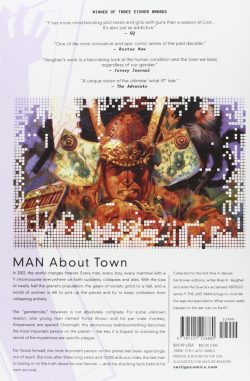
Y: The Last Man Book Four


By Brian K. Vaughan, Pia Guerra, Goran Sudžuka, José Marzán Jr. & various (DC/Vertigo)
ISBN: 978-1-4012-2888-0 (HB) 978-1-4012-6168-9 (TPB)

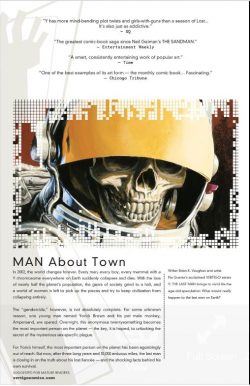
Back in 2002, an old, venerable and cherished science fiction concept got a smart and satirical updating in Vertigo comic book series Y: The Last Man. These days it’s more relevant than ever as the premise explores the aftermath and consequences of a virulent global plague.

Fresh, pithy and wry, the Vertigo Comics version begins with a mystery plague destroying every male mammal on Earth, along with all the foetuses.

If it had a Y chromosome it croaked, except, somehow, for college-boy slacker and amateur escapologist Yorick Brown – and his pet monkey Ampersand. One night the guy goes to bed pining for his absent girlfriend Beth DeVille (an anthropology grad on a dig in Australia) and the next day Ampersand is the only male animal on Earth and he’s the last man alive…

Yorick’s mum, part of the new (for which read Still Standing after a failed power-grab by the assembled widows of Republican Congressmen) Presidential Cabinet, is by default a Leader of the Free World until the New President can get to Washington to take office.

Yorick made his way to her through a devastated urban landscape (the plague hit during rush-hour on the East Coast and we all know that chicks can’t even parallel park let alone wrestle the controls from the hands of a dead bus driver, subway steersman or airline pilot…) but had to escape from her half-hearted attempt to lock him in a bunker. Forthwith the lad immediately set off for the Land Down Under and his one true love.

Over three years, he made his peril-packed way from the East Coast overland to California, getting ever closer to his fiancée, who he assumed had been stranded in Oz since civilisation ended. Accompanying him on his westward trek were secret agent/bodyguard 355 and geneticist Dr. Allison Mann, who sought to solve his mysteriously continued existence whilst secretly suspecting she might have caused the plague by giving birth to the world’s first parthenogenetic human clone.

Also out to stake their claim and add to the general tension were a crack squad of Israeli commandos led by the steely-willed General Tse’Elon, equipped with the latest high-powered weapons and a hidden agenda, plus post-disaster cult Daughters of the Amazon who want to ensure there really are no more men left to mess up the planet.

To further complicate matters, for much of that journey Yorick’s occasionally insane sister, Hero, was stalking them across the ultra-feminised, ravaged and now generally dis-United States.

On finally arriving in San Francisco, Agent 355 and Dr. Mann discover the truth of Yorick’s immunity but before they can capitalise on it, Ampersand is snatched by a ninja. Apparently, all along the monkey had held the secret to the plague which killed all us mouth-breathing, unsanitary louts…

Following a violently revelatory time and lots of aggravation, this fourth grand compilation – available in hardcover, trade paperback and eBook formats – collects issues #37-48, spanning November 2005 to October 2006, and opens with a 3-parter by originators and co-creators Brian K. Vaughan & Pia Guerra with additional pencils by Goran Sudžuka. In case you were wondering, the entire book is inked by José Marzán Jr, coloured by Zylonol and lettered by Clem Robbins.

Originally published in #37-39, ‘Paper Dolls’ (pencilled by Guerra & Sudžuka) introduces hard-bitten reporter Paloma West, haunting Sydney docks, seeking to verify rumours that a living man has been sighted. Whilst 355 and Mann are insistent that they travel on to Japan where Ampersand has been spotted, all Yorick can think of is that after years of struggle he’s finally where he needs to be…

Technically under arrest themselves, the determined but well-intentioned custodians succumb to Yorick’s whining, granting him 24 hours to find Beth. It’s not much of a chance but love will find a way… Nobody, however, takes Paloma seriously, and that’s a big, big mistake…

With his existence about to be made globally public, Yorick learns a few tantalising secrets about enigmatic Agent 355 before they confront West. The bodyguard wants her dead, but the reporter claims to know where Yorick’s beloved is right now…

With Time Up, the last man and his minders follow Ampersand to Japan and the secret of the plague, even though Beth has left on an epic trek to Paris – the French one…

Meanwhile in Washington, Yorick’s mother and General Tse’Elon have a fatal confrontation before the scene shifts to the Midwest for ‘The Hour of Our Death’ (rendered by Sudžuka & Marzán Jr.). Here, Hero meets one of her brother’s past indiscretions and realises she’s about to become an aunt, just as a band of Vatican-despatched nuns arrive to grab what might be the last child ever born. Seems they’re in the market for a new Madonna and Child…

‘Buttons’ finally focuses on the tragic past of 355, exposing how she became an agent of the insidious Culper Ring, whilst our unhappy voyagers flee from savages in New Guinea. Craftily shifting scenes to follow that darn monkey, ‘1,000 Typewriters’ details exactly how the male-specific mass-extinction came about, just as the cast reach Japan and the dramatic last act is set to open…

With Pia Guerra back on pencils for #43-46, Yorick and his extremely tolerant minders reach Japan, following the ninja who stole his crucially important monkey. ‘Kimono Dragons’ finds the wanderers in Yokogata Port, joined by Rose, a ship’s captain who befriends them on their voyage. They soon split up though, when Ampersand’s tracking device starts working again: Yorick and 355 follow it to Tokyo, whilst Rose and Dr. Mann explore a different path.

Allison Mann is a brilliant scientist, but nowhere near as smart as her parents – both radical geneticists with major personal issues. Allison is convinced her mother had something to do with the plague and Ampersand’s abduction. She’s right too, but as she and Rose approach the elder Doctor’s rural laboratory, they have no idea the pesky little simian has already escaped and is loose somewhere in Tokyo. They are equally unaware the lethally ruthless ninja is also hunting the lost capuchin…

Meanwhile, heavily disguised Yorick and 355 roam Tokyo with relative ease. It is a city seemingly unchanged by the disaster, but appearances can be horrifyingly deceiving…

Back in Kansas though, Yorick’s sister finds a hidden enclave where she sees proof that he is no longer the last male alive (see Y: The Last Man Book Two)…

Ampersand’s trail draws Yorick and 355 into conflict with the now all-female Yakuza gangs. They find an ally in undercover cop You, but her plan doesn’t inspire much confidence…

…And when Allison’s mother – let’s capriciously call her Dr. Matsumori – finally appears, Rose and Allison are too slow to prevent a bloody assault. As the aging doctor works to save a life, she reveals the hidden agendas and reasons why American politicians, Israeli soldiers and greedy opportunists around the globe have been hunting Yorick and Ampersand for the last four years…

In Tokyo, the scheme to recover Ampersand has also gone brutally awry, but the big surprise is in Yokogata, where Allison learns who employed the Ninja and orchestrated the whole affair… and who designed and released the plague…

As renegade General Tse’Elon invades the Kansas enclave where Hero Brown is helping raise the last children born on Earth, ‘Tin Man’ (rendered by Sudžuka & Marzán Jr.) traces the convoluted history of Allison Mann as her parents shattered scientific barriers, ethical codes and each other’s hearts fighting over her affections. It also reveals implications of the broken family’s genetic meddling, before closing with ‘Gehenna’, an equally illuminating examination of Tse’Elon’s past: what fuelled her rise to power before the fall of man, and how far she’ll go to achieve her ends, ending the book on a chilling cliffhanger…

Before that close, however, devotees and wannabes can bask in behind-the-scenes revelations as ‘Y: The Script’ reprints Vaughn’s full script for #42’s ‘1,000 Typewriters’.

By crafting their slow-burning saga to highlight carefully sculpted, credible characters and probable situations, Vaughan & Guerra built an intellectually seductive soap-opera fantasy of telling power. As the impressive conclusion neared, this enchantingly-paced, dryly ironic, chilling, moving and clever tale blossomed into a very special epic to delight and beguile any fan of mature fiction. Bear down, the best is yet to come…
© 2006 Brian K Vaughan & Pia Guerra. All Rights Reserved.

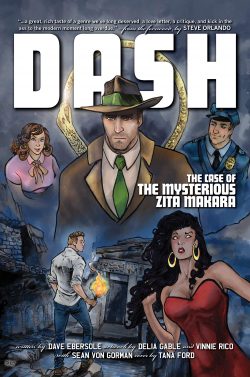
Dash: The Case of the Mysterious Zita Makara


By Dave Ebersole, Delia Gable, Vinnie Rico, Sean Von Gorman, Tana Ford, Josh Lester & various (Northwest Press)
ISBN: 978-1-94-389055-2 (TPB) eISBN 978-1-94-389056-9

The 1930s were a golden age of fantasy fiction, particularly in the genres of pulp adventure, crime stories and supernatural horror. As such it’s a time period accessible to some degree by most modern consumers of escapist entertainment. It was also a time of great hypocrisy, social conservatism – except in the arts and politics – and enforced conformity.

All that gets a great big “So What?” in this deliriously rambunctious melange of mixed media forms wherein writer Dave Ebersole and illustrator Delia Gable finally complete their long-delayed epic tale of boozy, proudly unrepentant queer private eye Dashell Malone, who cautiously negotiates the hostile environment of pre-WWII Los Angeles and outraged former colleagues from the LAPD in search of the mystic horror that destroyed the man he loved…

It all begins in 1940 when exotic and sultry Zita Makara hires him to act as go-between in a shady deal. She is exceptionally unforthcoming with useful details and not a little annoyed at his easy resistance to her charms and attentions… much to the amusement of Dash’s sassy but efficient secretary Cindy Crenshaw…

The PI’s attention is further derailed by the return of his lover, shady ne’er-do-well Johnny Plinketts, so when his diligent investigations of Zita take him to a travelling Egyptian antiquities exhibition, Dash is totally unprepared for the appalling consequences. Dash still has friends on the force – such as patrolman Sal McGillicutty – who is there to break the shocking news that “Plink” has been found dead in incredible circumstances. Moreover, he’s not the first. LA has become the hunting grounds for a ghastly beast…

A convenient suspect for bigoted detective Bruno Perez, Dash is eventually released and falls into a depression until Cindy and Sal get him moving on finding the real killer, but before long the trail leads to an ancient Egyptian heretic cursed by the gods and an undying predator active for ages. This terror has been methodically preparing to turn back time and remake the world and Plink was not only his latest meal but also deeply involved in the plot from the start…

As events spiral and supernatural Hell inescapably comes to Earth, Dash is thrust into the role of mystic avenger and saviour of humanity, but it’s a job the grieving shamus neither wants nor feels qualified to handle…

Augmented by an effusive Introduction and appreciation from Steve Orlando, the book also includes a background-packed ‘Interlude’ from Ebersole and artist Vinnie Rico, as well as a trio of brief ‘Further Cases’.

‘The Case of the Man in the Mask’ (art by Sean Von Gorman) sees Dash dismantle a devious blackmail scheme, whilst Rico’s ‘The Case of the Best Friend on the Police Force’ traces the story of LAPD officers Malone and McGillicutty before Cindy’s origins are explored in ‘The Case of the Wisecracking Secretary’ (Rico again). Rounding up the fun is early promotional art, Afterwords and thank-yous, plus a recipe section inviting you to “make the cocktails you just read about” in ‘You Don’t Have to Drink, But If You Do… Drink Well!’

A superbly engaging romp in the manner of The (1999) Mummy whilst tipping its battered, dusty fedora to classics of film noir and latter-day pulp homages like Raiders of the Lost Ark and Hooten and the Lady, this is a splendid excursion categorically proving that not all rugged he-men get the girl in the end…
© 2020 Dave Ebersole. Dash co-created by Dave Ebersole and Delia Gable. All rights reserved.

Ofelia – A Love and Rockets Book: 11


By Gilbert Hernandez (Fantagraphics Books)
ISBN: 978-1-60699-806-9 (TPB)

Please pay attention: this book contains stories and images of an extremely adult nature – specifically designed for consumption by mature readers – as well as coarse vulgar language most kids are fluent in by the age of ten.

If reading about such things offends you, please stop now and go away. Tomorrow I’ll do something with violence and explosions, so come back then.

In addition to being part of the ongoing graphic literary revolution that is Love and Rockets (where his astonishingly compulsive tales of Palomar gained vast critical acclaim), Gilbert Hernandez has produced stand-alone tales such as Sloth, Girl Crazy, Julio’s Day and Hypnotwist: all distinguished by his bold, simplified line artwork and sensitive use of the literary techniques of Magical Realist writers Carlos Fuentes and Gabriel García Márquez: techniques which he has added to and made his own.

Love and Rockets – by Gilbert and brothers Jaime and Mario – was/is an anthology comics publication featuring sleek, intriguing, sci-fi-ish larks, heart-warming, gut-wrenching soap-opera fantasies, terrifying manic monster stories and experimental comic narratives that pretty much defy classification. To this day, the Hernandez boys continue to captivate with incredible stories sampling a thousand influences conceptual and actual – everything from Archie Comics and alternative music to German Expressionism and masked wrestlers.

Originally conceived for extended serial Heartbreak Soup, Palomar was a conceptual playground and cultural toybox; an impoverished Latin-American village with a vibrant, funny and fantastically quotidian cast. Everything from life, death, adultery, alien infiltration, magic making, hauntings, serial-killing and especially gossip happened in its meta-fictional environs as Gilbert plundered his own post-punk influences – comics, music, drugs, comics, strong women, gangs, sex, family and comics – in a style informed by everything from Tarzan strips to Saturday morning cartoons and The Lucy Show.

Beto – as he signs himself – returns to Palomar constantly, usually with tales involving formidable matriarch Luba, who ran the village’s bath house and cinema; acted as Mayor and sometimes law enforcer – as well as adding regularly and copiously to the general population. Her children, brought up with no acknowledged fathers in sight, are Maricela, Guadalupe, Doralis, Casimira, Socorro, Joselito and Conchita.

Luba is a character who defies easy description and I don’t actually want to: As one of the most complex women in literature, let alone comics, she’s somebody you need to experience, not learn of second-hand. You will certainly notice that she has absolutely enormous breasts. Deal with it. These stories are casually, graphically, sexually explicit, and appalling violence is also never far from the players lives…

Luba’s story is about Life, and sex and death happen, casually and often, usually to and with the wrong people at the wrong time. If harsh language and cartoon nudity (male and female) are an insurmountable problem for you, don’t read these tales; but it is genuinely your loss.

Throughout all those eventful years, normally always in the background and frequently sidelined, was Luba’s cousin Ofelia: confidante, babysitter, surrogate mum, family conscience and keen – if not especially detached – observer…

After a run of spectacular stories (all of which have been collected in a variety of formats and editions which I really must get around to reviewing in their entirety), the first incarnation of Love and Rockets ended. Luba and her extended family graduated to a succession of mini-series which focussed on her relocation to the USA to reunite with her half-sisters Rosalba (“Fritz”) and Petra Martinez. The tone and content ranged from surreal to sad to funny to thrilling. The entire world can be found in those pages.

Although in an ideal world you would read that aforementioned older material first, there’s absolutely no need to. Reminiscence and the force of memory are as much a part of this potent passion-play as family feeling, music, infidelity, survival, punk rock philosophy, and laughter – lots and lots of laughter.

Brilliantly illustrated, these are human tales as earthy any as any Chaucer’s Pilgrims could tell, as varied and appetising as any of Boccaccio’s Decameron and as universally human as the best of that bloke Shakespeare…

This particular monochrome family album – available in paperback and digital editions -compiles assorted material first seen in Luba #3-9; Luba’s Comics and Stories #2-5 and Measles #3 and sees so-often sidelined “sister” Ofelia notionally promoted to headliner. Following a pictorial reintroduction to ‘Luba’s Family’, the ever-unfolding saga resumes with ‘Remember Me’ as the youngest kids swap tales of the fathers they have never known.

‘Luba and the Little Ones’ finds the ferocious matron calming down her very excitable progeny, beforeSocorro…’details that girl’s educational problems. Apparently, she is too smart and her teachers want her transferred to a special school…

‘The Book of Ofelia Part One’ sees Luba and her mute, maimed and possibly former gangster husband Khamo reeling from the news that their faithful major domo is considering writing a book based on her cousin’s drama-drenched life. With friction mounting, the frustrated author and perennial babysitter casts her mind back to Palomar, where she sacrificed her relationship with lover Rico (“call me Ooli”) to raise a wild toddler called Luba.

Back in the now, wise-beyond-her-years Casimira knows her quiet guardian is in contact with an old flame on the internet…

‘The Book of Ofelia Part Two’ expands on the theme as the prospective writer recalls years of fighting with her wilful, almost elemental charge, whilst pondering a too-long deferred decision…

‘Spot Marks the Ex’ then exposes more family scandals as entrepreneurial Pipo tries to get rid of her former husband Gatoand deal with the ongoing problems caused by Luba’s daughter Doralis.

Much to the sponsors’ horror the teen star of Pipo’s popular Spanish-language kid’s show plans to come out as a lesbian, someone at the studio is giving the newspapers salacious scandals for their holier-than-thou gossip pages and her beloved son Sergio Jimenez (a soccer superstar and celebrity bad boy) is having an affair with Fritz Martinez – the very woman Pipo cannot get out of her own libidinously supercharged mind…

Fritz is a terrifyingly complex creature: psychiatrist, therapist, B-Movie actress, belly dancer, amorous drunk, gun-fetishist, sexually aggressive and a manipulative serial spouse. Beautiful, enticingly emotionally damaged, her “high soft lisp” more likely an affectation than genuine speech impediment, she sashays from crisis to triumph and back again, and (almost) everybody who wants hers can apparently have her – except increasingly impatient Pipo…

Moreover, as strident accountant Boots signs on to save Pipo’s company, the stressed and busy businesswoman begins to suspect Sergio and his stepfather Gato have some strange connection and are up to no good…

‘El Show Super Duper Sensacional Fantastico de Doralis’ reveals the controversial gay star’s story of the irresistibly beguiling merfolk who live in secret amongst us, after which ‘Snail Trail’ introduces well-meaning young Hector who rescues Socorro and Joselito after they steal and crash a car.

He sees and is instantly enchanted by their Tia (that’s Aunt in Spanish, hombre) Fritz in ‘Bromear’ and in ‘Meeting Cute, Fucking Cuter’ falls hopelessly for the sexual predator: so much so, in fact, that he agrees to her request to date her quirky, buff, bodybuilding older sister Petra, thus leaving Fritz free for a sordid secret affair with toyboy acquaintance Sergio…

Sadly, whipped Hector finds he has more in common with Petra’s little daughter Venus. They both love the same comicbooks, movies and music and she doesn’t make him do things he’d rather not…

A garden party bids ‘Buen Viaje, Socorro’ and sees the smart girl’s last family fun before heading off to smart kid boarding school, after which ‘Luba One’ finds the downhearted mum dragged to a fetish party by Fritz and Pipo where she finds blonde sex god Fortunato: a man no woman can resist and a perfect lover who derives no joy from his conquests…

Boots, mindful of the merman legend, speculates on his origins in ‘The Fortunato Files’ after which ‘The Goddess and the Goof’ finds Hector finally capitulating to pressure and taking gloriously gorgeous, Amazonian Petra out only to discover she is every inch as bewitching and satisfying as her sister. Conflicted by a surfeit of physical riches he ponders a big decision…

After a little dance madness in ‘El Biale’, Venus and Doralis share a moment with one of the fallen star’s fans in ‘The Glamorous Life’ whilst ‘Boots Takes the Case’ has the tenacious little accountant assume a larger role. With Gato exposed as the source of the leaks and sorrowfully reaping his reward in ‘And So…’, Boots proceeds to pry out more secrets in ‘Kisses for Pipo’; appraising key moments since the entrepreneur entered America as a teen, disclosing her past interactions with Sergio, Gato (and his current wife Guadalupe), Fortunato and Pipo’s latest fling Igor…

‘In Bed with Pipo’ targets her bizarrely twisted relationship with gun-obsessed Fritz, the men they occasionally share and a terrifying past experience when both were stranded in a country in the midst of an anti-Christian genocide…

Revelations include the horrific tale of how High-School junior Rosalba fell into an abusive relationship with a middle-aged cop, offering telling insights for her modern personas…

‘Luba Two’ delves deep into Khamo’s off-kilter arrangements with both cops and drug dealers whilst – after surreal sight-gag ‘Uno Dos Tres’‘The New Adventures of Venus’ proves the latest generation can be just as determined and violently forceful. When the little comics lover discovers her best friend is a potential romantic rival, Venus takes excessive punitive action on the soccer field…

With the entire world on tenterhooks as a colossal meteor hurtles towards Earth, Fritz’s exploitative ex-husband Scott gets up to his old tricks in ‘The Beloved and the Damned’. He couldn’t have expected the savage beating a mysterious stranger delivers after ripping off kickboxing Petra’s baby sister though.

Unfortunately, the Avenger in question gets a taste for vigilantism and begins looking for other jerks in need of straightening out…

Khamo’s underworld connections then lead to a disquieting abduction and ‘Luba’s Science Lesson’ before ever-more conflicted Hector returns, still unable to choose between Petra and Fritz but currently distracted by his ex-girlfriend taking him to court as part of a whacko ploy to get him back in ‘And Justice for Some’.

That plan goes badly wrong after a stranger beats her to a pulp in the parking lot of the strip club she works at…

Boot’s ongoing investigations resurface as she explains ‘The Tao of Doralis’ before a very stoned ‘Hector‘ rescues non-English-speaking Luba from a bar, leading into flashbacks of ‘Khamo’ and her early days. That long, weird walk home also delivers more revelations about the enigmatic Fortunato before Luba and her taciturn husband at last reconcile in ‘Lovers and Hector’…

Events then take a dark turn in ‘Sergio Rocks’ as the wild child is targeted by gangster gamblers, even as belly-dancing novice ‘Guadalupe’ strives to escape the overwhelming influence of her charismatic Tia Fritz…

Receding Ofelia resurfaces in ‘Luba Again’ as the cousins bitterly and violently argue over the proposed warts-and-all book and, after visual aside ‘Click!’, the determined author visits Socorro in ‘La Luba’ whilst long ostracised Maricela has a rather one-sided chat with step-dad Khamo in ‘Burning for You’…

‘Pipo’s Burden’ revisits her still-growing obsession with Fritz whilst ‘Of Two Minds’ highlights Hector’s suspicions when he attends one of Petra’s boxing bouts and Fortunato works his magic on schoolteacher Guadalupe and Ofelia in ‘But the Little Girls Understand’ after which ‘Luba Three’ ushers in the beginning of the end of this family’s affairs…

‘Fritz and Pipo, Sittin’ in a Tree’ sees Sergio growing aggressively intolerant of his mother’s dilemma whilst still making casual use of Fritz himself. Soon the still-active vigilante has hospitalised the entrepreneur, and more tragedy strikes when Ofelia has a heart attack in ‘God Willing’…

Once the violence begins it seems impossible to stop and in ‘Luba Four’ the so-dysfunctional family splinters even further when an abduction and punishment beating goes too far…

I’m certainly more obtuse – just plain dense or blinkered – than most, but for years I thought this stuff was all about the force of Family Ties, but it’s not: at least not fundamentally. Palomar is about love. Not the sappy one-sided happy-ever-after stuff in chick-flicks, but LOVE, that mighty, hungry beast that makes you instinctively protect the child that betrays you, that has you look for a better partner whilst you’re in the arms of your one true love, and hate the place you wanted to live in all your life. The love of cars and hair-cuts and biscuits and paper-cuts and stray cats that bite you: selfish, self-sacrificing, dutiful, urgent, patient, uncomprehending, a feeling beyond words. A Love that can hurt and even kill…

A bit like the love of a great comic…

Funny, deeply moving, compelling and deftly capable of delivering shock after breathtaking shock, Ofelia is remarkable and unmissable: no true fan of the medium can afford to forego this treat.

All contents © 2015 Gilbert Hernandez. This edition © 2015 Fantagraphics Books. All rights reserved.

Positive


By Tom Bouden, translated by Yves Cogneau with Charles “Zan” Christensen (Northwest Press)
ISBN: 978-0-98459409-2 (PB)

Here’s something short, sweet and utterly, comfortingly satisfying. Please enjoy.

Human Immunodeficiency Virus is a Lentivirus that attacks the jbody’s immune system. If untreated, the infection usually leads to Acquired Immunodeficiency Syndrome – commonly known as AIDS. For the longest time, the condition was a killer, but can be controlled quite successfully now through a variety of medications, treatments and lifestyle modification.

At its height, the disease ravaged the world, and has killed approximately 38 million people and completely changed global society.

Sadly, how those testing positive for HIV were treated also revealed a lot about the people around them…

This powerful but truly uplifting graphic tome was created in 2008 by Belgian cartoonist Tom Bouden (Max and Sven; The Importance of Being Earnest; In Bed with David & Jonathan; Queerville): a means of exploding idiotic myths and explaining how a positive diagnosis actually changes the life of a someone with the disease and affects those around them.

Subtitled “A Graphic Novelette of Life with Aids”, the charming tale is rendered in a traditional and welcoming Ligne Claire (like Tintin or Blake and Mortimer) style, and laced with plenty of warm humour to balance the tension, fear and pain, and begins eight years ago as young marrieds Sarah and Tim‘s latest row is interrupted by a visit from their doctor…

He has results that explain Sarah’s recent bout of assorted maladies, but needs her to take a second, confirmatory test…

And so begins a methodical discourse as the couple carefully share her diagnosis with friends, family and past intimates, delivered with compassion and sensitivity and braced with actual facts throughout. Navigating various treatments, dealing with work issues and living as normal as life as feasible, Sarah and Tim build support networks, while moving ever onward, embracing bucket lists and pill packs, discarding despair and fostering hope until they reach the stage where they can consider the next positive step… having a child…

Fronted by an emphatically positive Introduction from activist and Gay League executive Joe Palmer, this is a lovely, sensible and above all straightforward examination of HIV in the real world, but parents might want to police these pages if young children are around, as it contains forthright depictions of nudity and lovemaking.
© 2013 Tom Bouden. All rights reserved.

The Killer Condom and Down to the Bone


By Ralf König: translated by Jim Steakley and Jeff Krell (Northwest Press/Ignite! Entertainment)
ISBN: 978-0-96563-238-6 (Killer Condom PB) 978-0-96563-239-3 (Down to the Bone PB)
Digital editions by Northwest Press – no ISBN

Standard Disclaimer: These comedy stories contain rude words, explicit nudity, depictions of graphic and hilarious sexual situations and normal non-Biblical lifestyles. If any of these are likely to offend, what the hell are you doing here anyway?

I’d like to think that most social problems humanity suffers from can be fixed by a little honesty and a lot of communication – especially when it comes to relationships. Being able to laugh together probably helps too. In regard to sexual politics and freedom it’s an attitude Germany adopted decades ago. As a result, the country has an admirable record of acceptance of the LGBTQIA+ community and a broad penetration (yes, I’m awful! And Not Funny!) of gay comics into the general population.

Undisputed king of home-grown graphic novels is Ralf König, a multi-award-winning cartoonist, filmmaker and advocate with almost fifty titles – such as Suck My Duck; Santa Claus Junior; Prototyp; Archetyp; Antityp and Stehaufmännchen– under his belt.

He was born in August 1960 and came out in 1979, crafting an unceasing parade of incisive and hilarious strips and sagas set in and around the nation’s ever-evolving gay scene. Much to his own surprise, he discovered that his work had vaulted the divide from niche market to become a staple of popular mass market book sales. Many of his works have been rereleased as eBooks from Northwest Press.

The two volumes covered here were major sellers all over the world: blending the sordid shock-chic of 1970s American crime films and TV shows like Dirty Harry, The Warriors or Kojak and schlocky Sci Fi-horror (as in Scanners or Critters) with absurdist humour and the delicious notion of New York’s toughest Top Cop being Out, Loud and obnoxiously Proud…

First released in Britain in 1991 and wholly embracing the conceit of being an art house movie, The Killer Condom originally debuted in 1987 as Kondom des Grauens: a whole-hearted genre spoof introducing disgraced and disgraceful New York detective Luigi Macaroni, called on by his reluctant and harassed boss to solve a rash of gory emasculations plaguing the area around the notorious pay-by-the-hour Hotel Quickie.

Brash, gruff and deliberately sleazy, Macaroni is too good a cop to get rid of, despite his brazen attitude, and begins to work just like in every other case his straight colleagues won’t touch. However, as he investigates the brutal street scene he quickly realizes that no human agency is biting the dicks off an escalating stream of unfortunate sinners…

When he picks up a rent boy for a little relief, they too go to the Quickie and soon face terror beyond imagination and every man’s darkest nightmare…

Crafted at a time when HIV/AIDS was ravaging the gay community and scaring the pants off the wider world, this darkly trenchant satire adds a bizarre codicil to the still-ongoing debate about safe sex and condom use, but remains at its core an outrageously funny romp for grown-ups. In 1996, it and sequel Down to the Bone were adapted as a German comedy horror movie, latterly released in America as Killer Condom.
The Killer Condom © 1988 by Editions Kunst der Comics/Ralf König. Revised Edition © 2009, Published by Ignite! Entertainment. All rights reserved.

Down to the Bone emerged in 1990. As Bis Auf die Knochen, it heralded the triumphant return of Detective Inspector Macaroni – an even-more embittered man following his failure to maintain a loving relationship. It’s New Year’s in New York and the city is darker and nastier than ever. In the dead of winter, a fresh horror stalks the streets…

When a man hungry for negotiable affection encounters an oddly familiar “leatherman” hooker, it turns into the last trick of his life. Meanwhile, celebrity restauranteur Joe Baluga meets a similar fate, as does another hapless John triggering another campaign of atrocity in the mouldy, worm-infested Big Apple.

This time, it’s not dicks that are disappearing: now entire bodies are being instantly reduced to bleached skeletons and the Captain needs the department’s top Queer to stop the rot. As the third victim is the wealthy son of an infamous billionaire, and just to be safe, the embattled chief assigns painfully straight whitebread Detective Brian Plumley to assist him – affording Macaroni an irresistible opportunity to play pranks and reaffirm his reputation as a total bastard…

As they trawl the leather bars and other outposts of “the scene” they quickly establish an apparent link to the gay porn industry. But other than providing the inspector with a celebrity hook-up, the investigation stalls until a bizarre find proves that what they’re all hunting is far from human…

From there the pieces swiftly fall into place and the escalating horror leads back to an old case involving carnivorous latex prophylactics. With bodies still dropping, Macaroni and a far-more woke Plumley track down an old mad scientist and his ghastly creation and encounter a deranged fundamentalist determined to enforce Biblical mandates at all costs…

Wry, witty, coarsely hysterical, these books marry the surly, unsavoury thrills of urban cop fiction with a bawdily outrageous whimsy that sadly won’t appeal to everybody, but if you love big raucous ludicrous belly laughs with your thrills and chills, these might well become some of your favourite reads.
Down to the Bone © 1990 by Editions Kunst der Comics/Ralf König. Revised Edition © 2011, and published by Ignite! Entertainment. All rights reserved.

John Constantine, Hellblazer volume 3: The Fear Machine (New Edition)


By Jamie Delano, Richard Piers Rayner, Mike Hoffman, Mark Buckingham, Alfredo Alcala & various (Vertigo/DC Comics)
ISBN: 978-1-4012-3519-2 (TPB)

You’ve either heard of John Constantine by now or you haven’t, so I’ll be as brief as I can. Created by Alan Moore during the early days of his groundbreaking run on Swamp Thing, John Constantine is a mercurial modern wizard, a dissolute chancer who plays like an addict with magic on his own terms for his own ends. He is not a hero. He is not a nice person. Sometimes though, he’s all there is between us and the void…

Given his own series by popular demand, he premiered in the dying days of Reaganite Atrocity in the US but at the height of Thatcherite Barbarism in England, so as we’re singing the same song now – but with second-rate Britain’s Got Talent cover-artist wannabes as leaders – I thought I’d cover a few old gems that might be regaining relevance in the days ahead…

In 1987 Creative Arts and Liberal attitudes were dirty words in many quarters and the readership of Vertigo was pretty easy to profile. Jamie Delano began the series with relatively safe horror plots, introducing us to Constantine’s unpleasant nature, chequered history and odd acquaintances but even then, discriminating fans were aware of a joyously anti-establishment political line and wildly metaphorical underpinnings.

Skinheads, racism, Darwinian politics, gender fluidity, plague, famine, gruesome supernature and more abound in the dark dystopian present of John Constantine – a world of cutting edge mysticism, Cyber-shamanism and political soul-stealing. In Delano’s world the edges between science and magic aren’t blurred – they simply don’t exist.

Some terrors are eternal and some seem inextricably tied to a specific time and place. The Fear Machine (available in paperback and digital formats and collecting issues #14-22 spanning December 1988-September 1989) is an engrossing extended epic which begins in ‘Touching the Earth’ (by Delano, Richard Piers Rayner & Mark Buckingham) as the wizard goes on the run thanks to the tabloid press pillorying him as a sex-crazed Satanist serial killer.

Forced to flee his London comfort-zone, Constantine is adopted by neo-pagan Travellers and journeys through the heartland of Britain. Apparently, these dangerous non-conformists are responsible for all the ills plaguing society of the 1980s and 1990s, just like fat people, the poor and immigrants are today…

Going native amongst the drop-outs, druggies, bath-dodgers and social misfits, Constantine buddies up with an immensely powerful psychic girl named Mercury and her extremely engaging mum, Marj, but even amidst these freewheeling folks he can feel something nasty and unnatural building. The first inkling occurs in ‘Shepherd’s Warning’when Mercury discovers an ancient stone circle has been fenced off by a quasi-governmental company named Geotroniks. It seems someone is trying to shackle Mother Earth’s circulatory system of Ley lines.

Meanwhile elsewhere, people are compelled to kill and mutilate themselves while Geotroniks boffins watch and take notes…

Mercury is abducted when police raid the Travellers’ campsite in ‘Rough Justice’. Imprisoned in a secret complex where the mind’s limits and the Earth’s hidden forces are being radically tested, she witnesses horrors beyond imagining and cutting-edge science. If only the subjects and observing scientists can be persuaded to stop committing suicide…

Mike Hoffman illustrates fourth chapter, ‘Fellow Travellers’ wherein Constantine heads back to London for help in finding Mercury and uncovering Geotroniks’ secrets. He gains one horrific insight when the train he’s on is devastated by a psychic assault which forces the passengers to destroy themselves…

With Buckingham & Alfredo Alcala assuming the art duties, ‘Hate Mail & Love Letters’ begins two months later. Marj and the travellers are hiding in the Scottish Highlands with a fringe group called the Pagan Nation, led by the mysterious Zed – an old friend of the wily trickster. Constantine keeps digging, but across the country, suicide and self-harm are increasing. Society itself seems diseased, but at least the Satanist witch hunt has been forgotten as the bloody pack of Press vultures rage on to their next sanctimonious cause celebre …

Touching base with his precious few police contacts and pet journalists, the metropolitan mage soon stumbles into a fresh aspect of mystery when a Masonic hitman begins removing anyone who might further his enquiries in ‘The Broken Man’. Constantine saves journalist Simon Hughes from assassination in a particularly exotic manner guaranteed to divert attention from his politically-damaging investigations, and discovers new clues. It all points the psychic horror and social unrest being orchestrated by reactionary factions of the government employing a sinister and all-pervasive “Old Boy network”…

And somewhere dark and hidden, Mercury’s captors are opening doors to places mortals were never meant to go…

As the Pagan Nation’s priestesses work subtle magics to find the missing girl and save humanity’s soul, a disgusting, conglomerate beast-thing is maturing, made from fear and pain, greed, suffering and deep black despair: provoking a response from and guest-appearance by Morpheus, the Sandman, which prompts Constantine, Hughes and possibly the last decent copper in London to go hunting…

After picking up another recruit in the form of KGB scientist Sergei in ‘Betrayal’, events spiral ever faster as the Freemasons – or at least their “Magi Caecus” elite – are revealed as organisers of the plot to combine Cold War paranormal research, economic imperialism, divisive Thatcherite self-gratification and the Order’s own quasi-mystical arcana to create a situation in which their guiding principles will dominate society and the physical world. It’s nothing more than a greedy, sleazy power-grab using blood and horror to fuel the engines of change…

All pretence of scientific research at Geotroniks is abandoned in ‘The God of All Gods’ as Masonic hitman Mr. Webstergoes off the deep end, ignoring his own Lodge Grandmaster’s orders to abort the project amidst an escalating national atmosphere of mania. He is determined to free the fearful thing they’ve created and unmake the modern world at all costs. Constantine’s allies are all taken and the wizard is left to fight on alone.

Knee deep in intrigue, conspiracy and spilled guts, humanity is doomed unless Constantine’s band of unhappy brothers and a bunch of Highland witch-women can pull the biggest, bloodiest rabbit out of the mother of all hats in spectacular conclusion ‘Balance’…

The heady blend of authoritarian intransigence, counterculture optimism, espionage action, murder-mystery, conspiracy theories and ancient sex-magic mix perfectly to create an oppressive tract of inexorable terror and shattered hope before an astounding climax forestalls – if not saves – the day of doom, in this extremely impressive dark chronicle which still resonates with the bleak and cheerless zeitgeist of the time.

This is a superb example of true horror fiction, inextricably linking politics, religion, human nature and sheer bloody-mindedness as root cause of all ills. That our best chance of survival is a truly reprehensible, exploitative monomaniac seems a perfect metaphor for the world we’re locked into…

Clever, subversive and painfully prophetic, even at its most outlandish, this tale jabs at the subconscious with its scratchy edginess and jangles the nerves from beginning to end. An unmissable feast for fear fans, humanists and political mavericks everywhere…
© 1989, 2012 DC Comics. All Rights Reserved.

Julio’s Day


By Gilbert Hernandez (Fantagraphics Books)
ISBN: 978-1-60699-606-5 (HB)

In the 1980s a qualitative revolution forever destroyed the clichéd, stereotypical ways different genres of comic strips were produced and marketed. Most prominent in destroying the comfy pigeonholes we’d built for ourselves were three guys from Oxnard, California: Jaime, Mario (occasionally) and Gilberto Hernandez.

Love and Rockets was an anthology magazine featuring slick, intriguing, sci-fi tinted hi-jinx of punky young things Maggie & Hopey – the outrageously beguiling las Locas – as well as heart-warming, terrifying, gut-wrenching soap-opera fantasies from the rural Central American paradise of Palomar.

Supreme synthesists, Los Bros Hernandez enthralled and enchanted with incredible stories that sampled a thousand influences, conceptual and actual; everything from Comics, TV cartoons, masked wrestlers and the emergent exotica of American Hispanic pop culture to iconic German Expressionism. There was also a perpetual backdrop displaying the holy trinity of the young: Sex and Drugs and Rock and Roll – for which please hear alternative music and punk rock.

The result was dynamite. Mario only officially contributed on rare occasions, but Jaime’s slick, enticing visual feasts explored friendship and modern love whilst destroying stereotypes of feminine attraction through his fetching coterie of Gals Gone Wild, whilst “Beto” exhaustively crafted a hyper-authentic rural landscape and playground of wit and passion created for his extended generational saga Heartbreak Soup: a quicksilver chimera of breadline Latin-American village life with a vibrant, funny and fantastically quotidian cast.

Everything from life, death, adultery, magic, serial killing and especially gossip could happen in Palomar’s meta-fictional environs, as the artist mined his own post-punk influences through a powerfully effective primitivist style which blended the stylised mythologies and iconographies of comics, music, recreational drugs, gangs, sex, forceful, capable, dominating women and the inescapable bonds of family using a narrative format which is at the graphic vanguard of Magical Realism.

There’s fiction, there’s Meta-fiction and then there’s Gilbert Hernandez. In addition to his astonishingly captivating Palomar tales he has authored stand-alone books such as Sloth, Grip, Birdland and Girl Crazy, all marked by his boldly compelling, disingenuous artwork and a mature, sensitive adoption of literary techniques by writers like Carlos Fuentes and Gabriel García Márquez: techniques which he has amplified and, visually at least, made his own.

He later played with his own filmic and literary influences – Roger Corman, John Cassavetes, Elmore Leonard and Jim Thompson – breaking new ground by reprocessing the cultural influences forming all us baby-boomers, through “adaptations” of the trashy B-Movies which were perennial plot “maguffins” in his stories. Those became a little more actual in his “adaptations” of thrillers like Chance in Hell, The Troublemakers and Love from the Shadows…

Accruing critical acclaim but seldom financial reward, the brothers eventually went their own ways, but a few years ago creatively reunited to produce annual collections of new material in their particularly peculiar shared – or, rather, adjacent – pen-and-ink universes. This beguiling pictorial elegy began in Love and Rockets volume II, #1 but remained unfinished until completed in this stark evocative monochrome hardback and digital delight.

Here, Gilbert foregoes many signature elements and the frenetic youth-fuelled backdrop he’s famous for to methodically detail the moving life-story of an ordinary man.

Of course, once you start looking. you realise there’s really no such thing as ordinary…

It’s about families and friends, the secrets we must keep and how, even though the World changes, sometimes we just can’t…

I’d be doing you and the author a huge disservice by going into too much detail, but suffice to say that somewhere in Southern California a baby is born in 1900. From the start Julio is nourished and cherished by a loving family – excepting his uncle Juan, whom only the infant’s older sister Sofia realises should be kept well away from all children at all costs…

Over 100 pages, until his passing in 2000, Julio grows up with friends Tommy and Araceli, dimly aware of yet barely affected by humanity’s great crises. Sadly, the uncompromising nature of the times, elements and environment shape the people of the village just as powerfully as any global war or Stock Market crash. One slip in a mere mudslide affects the family for three tragic generations. Moreover, even in such placid outreaches, bullying, cruelty, bigotry and intolerance exist in abundance to mould young hearts and minds…

As he grows to maturity, Julio loses family, makes new friends and comes to realises he has a secret he cannot share with anyone: one that, despite the way the times change society before his very eyes, he simply cannot admit or acknowledge…

Dedicated to the proposition that big history happens somewhere else even as its effects touch us all, this warm-hearted, deceptively heartrending, challenging, and incontrovertibly groundbreaking epic is a grown-up comics fan’s dream come true; proving again just how far the medium has progressed.

From traditional world-saving, anodyne fist-fights, fanciful fantasies and children’s escapism to the likes of Maus, One Bad Rat, Palestine, Persepolis, Pride of Baghdad, Sailor Twain and so many more, comics have evolved until they not only produce material equal to other art forms, but with Julio’s Day – a diamond point at the cutting edge of graphic narrative – have arrived at masterpieces which can only be truly told as graphic narratives…

…As you will surely see…
© 2013 Gilbert Hernandez. This edition © 2013 Fantagraphics Books, Inc. All Rights Reserved.