Mesmo Delivery


By Rafael Grampá, with Marcus Penna, translated by Júlio Mairena (Dark Horse Books)
ISBN: 978-1-61655-457-6 (HB) 978-1-59582-465-3 (TPB)

In an industry and art form that has become so very dependent on vast interlocking storylines, an encyclopaedic knowledge of a million other yarns and the tacit consent to sign up for another million episodes before reaching any kind of narrative payoff, the occasional short, sharp, intensely stand-alone tale is as welcome and vital as a cold beer in the noon-day desert.

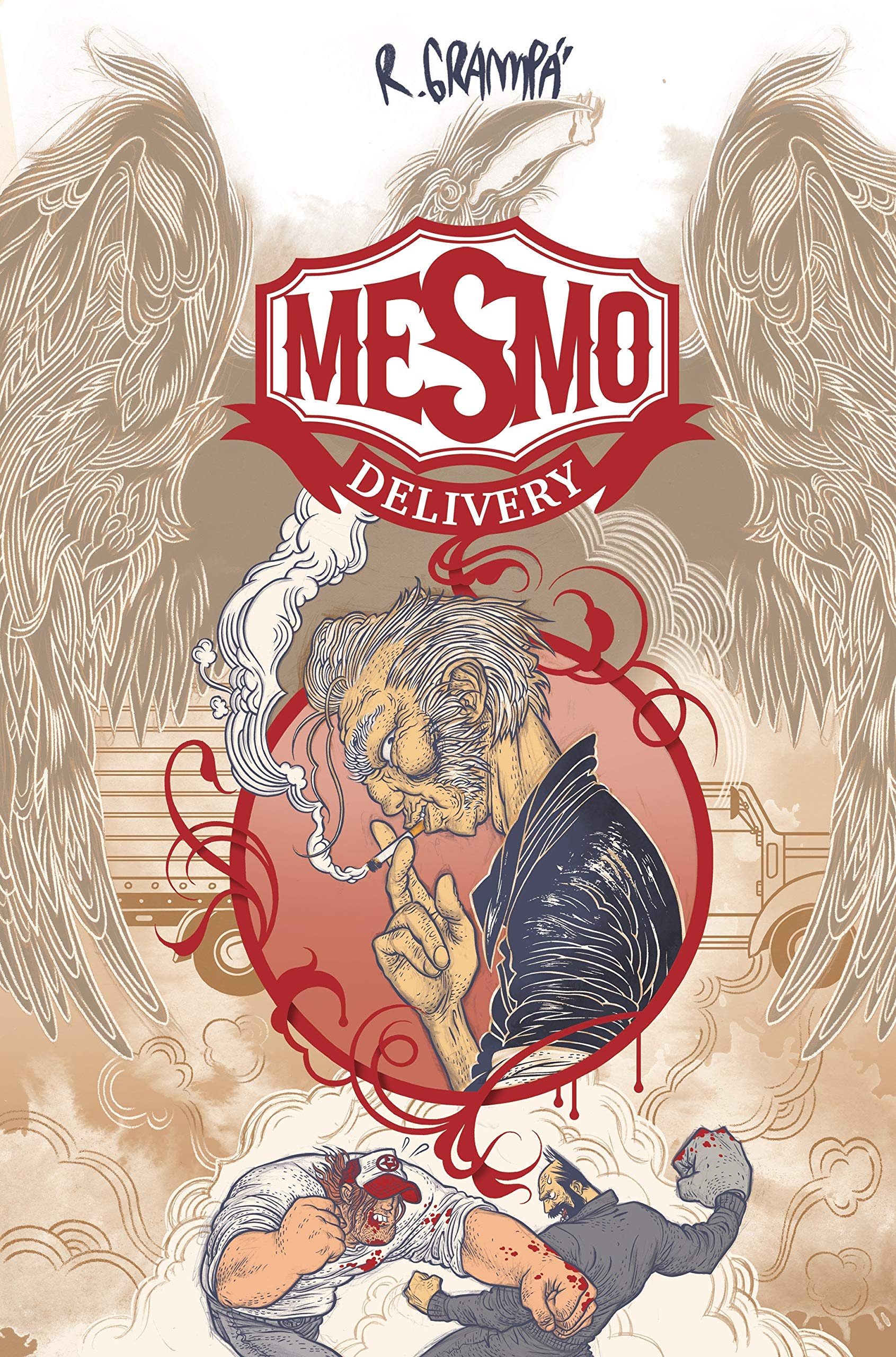
Just such a salutary singleton was Mesmo Delivery, first solo English-language release of singularly gifted writer/artist Rafael Grampá, who originally devised the macabre and gritty thriller in his native Brazil back in 2008.

Picked up and translated by Dark Horse two years later, this stark and spookily effective grindhouse/trucker movie amalgam delivers dark chills, gritty black humour and eerie, compulsive mystery in equal, intoxicating amounts… and it all starts, unfolds and ends right here. No muss, no fuss, no busload of tie-ins.

Aging, raddled Elvis impersonator Sangrecco is an extremely odd deliveryman, working for a rather unique haulage business. For a start, he can’t actually drive, which is why hulking, gentle, cash-starved ex-boxer Rufo has been temporarily hired by the boss to operate the truck on a run through some very bleak bad country.

Rufo doesn’t ask questions. He just pilots that huge container rig with its mysterious and unspecified cargo – that he’s not allowed to see – to God knows where, listening to the obnoxious, pompous Sangrecco mouth off about his many, unappreciated talents.

Things take a bad turn when they break at the isolated Standart Truck Stop. The Elvis freak is too lazy to even fetch his own beer, and when Rufo takes care of business and grudgingly tries to pay, a sleazy pack of locals trick him into an impromptu street fight on a cash-bet.

The ploy is a set-up and when Rufo proves unexpectedly tough, the prize-fight gets too serious and results in a fatality – and possibly more…

Street-fighting boss tough Forceps then convinces his “townie” cronies and the other onlookers that they need to get rid of all the witnesses. And that’s when old Sangrecco reveals what his speciality is…

Stark, brutal, rollercoaster-paced and rendered with savage, exhilarating bravura, this thundering, down-and-dirty fable grips like a vice and hits like a juggernaut, providing the kind of excitement every jaded thriller fan dreams of.

Also included in this brief, slim, scary and mesmerising tome is an effusive Introduction from Brian Azzarello, pin-ups by Mike Allred, Eduardo Risso, Craig Thompson and Fábio Moon plus stunning 16-page sketch, design and commentary section ‘Making of Mesmo Delivery’.

Since Mesmo Delivery, Grampá has gone on to shine with his deliciously eccentric Furry Water as well as on such established titles like Hellblazer, American Vampire, Strange Tales and Uncanny X-Force amongst others, but this superbly visceral, raw storm of sheer visual dexterity and narrative guile is an ideal example of pared back, stripped down, pure comics creativity that no mature lover of the medium can afford to miss.
Mesmo Delivery ™ & © 2008, 2010, 2014 Rafael Grampá. All rights reserved.

These Savage Shores


By Ram V, Sumit Kumar, Vittorio Astone, Aditya Bidikar & various (Vault Comics)
ISBN: 978-1-93942-440-2 (TPB/Digital edition)

Rapidly becoming a force to be reckoned with in western comics, award-winning writer Ram V has been making waves since 2016. I will surprise absolutely no one by revealing that Ram Venkatesan’s career actually began in his birthland of India as early as 2012, and we in the west barely noticed…

While resident in Mumbai, he created acclaimed series Aghori before moving to Britain to take a Creative Writing MA at the City of London University. Since then he’s co-created series such as The Many Deaths of Laila Starr; Ruin of Thieves; Paradiso; Blue in Green; Black Mumba and Brigands. He’s also made serious inroads into the US superhero mainstream with stints on Marvel’s Venom and DC’s Justice League Dark; Catwoman, the reinvented Swamp Thing and Batman: Gotham Nocturne.

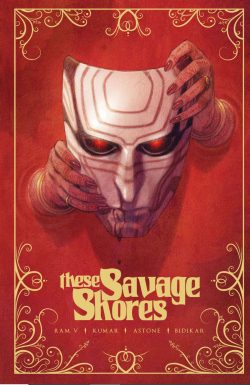
His stellar trajectory was enhanced by two projects for America’s Vault Comics: Radio Apocalypse and – spanning October 2018 to October 2019 – 5-issue miniseries These Savage Shores. Illustrated by Sumit Kumar, coloured by Vittorio Astone and lettered by Aditya Bidikar, this brooding, violent tale of timeless love and undying monsters is an historical drama tainted with horror overtones, combining gothic pastiche with the enticing mystique of colonial India, even if the events actually occur in the years before England officially conquered the “Sub-Continent” and became the British Empire…

Most enticingly and powerfully appealing, it takes the form of a bande dessinée-styled tale with broad cross genre appeal and is tailor-made for conversion to the large or small screen…

It begins in a paradisical garden where dancer Kori teasingly tests her lover Bishan, coquettishly enquiring what he is and how he was made…

The year is 1766 and, miles distant, a sailing ship of the East India Company carries a most unwelcome cargo. Disgraced scion of English Society’s most dangerous secret, Lord Alain Pierrefont has been exiled for breaking the cardinal rule of his class: being found out…

Eternal, patient and few in numbers, vampires have infested the aristocracy for centuries, leading discreet lives of bloody privilege while literally feeding off the poor. Those humans who reluctantly share the secret also know their place and keep quiet about the occasional atrocity. However, there are some mortals who ruthlessly hunt the clandestine overlords.

When one team almost ends the slumming predator, his peers and kin have no choice but to banish him for the shameful indiscretion of continuing to feed under the shocked gaze of crowds of no longer complacently ignorant human cattle…

With the discretion that sustains them as much as blood imperilled, vampire lords convene and Count Jurre Grano is compelled to despatch his favourite offspring to the ends of the Earth. In this case it’s also a promising new outpost of expansion: the squalid, unprepossessing port of Calicut on the Malabar Coast. The prodigal is left to the dubious care of his representative Colonel James Wilson Smith: a man of vision with dreams of controlling the immensely profitable wares previously carried by the fabled Spice Road of the East…

The merchant soldier’s plan is to divide and conquer for mercantile gain by grooming child-prince Vikram of the Zamorin, but impatient, spoiled Pierrefont will not be reasoned with. Calicut is just another playground to him and Kori his next meal. However, when the vampire traps her, his last thought is that he should have paid more attention to the Prince’s hulking masked bodyguard Bishan – a being also pretending to be merely mortal…

By October 2nd 1766, vampire hunter Zachariah Sturn has reached Calicut, determined to finish his business with Pierrefont. He believes the monster has found powerful and wealthy new allies to shield him and is unaware of the vampire’s actual fate. Reporting meagre progress in a letter to his clergyman brother, Sturn lays plans to topple these obstacles, assuming the boy Vikram has already been turned into a royal vampire…

Meanwhile in Mysore, young prince Tipu (Sultan Fatah Ali Sahab Tipu, known historically as Tipu Sultan, The Tiger of Mysore) meets his father Sultan Hyder Ali, Sahab to discuss the East India Company and their blatant plans for the always-warring rival kingdoms of India. The English are already destabilising the regions and are clearly going to use Vikram of the Zamorin as their wedge for further progress. The prophetic debate is derailed when recently-rejected Smith receives word that Pierrefont is dead – permanently dead – and realizes that there will be Hell to pay once the exile’s unholy family in England learn of it…

As the Sultan attempts to parlay with the Zamorim faction, their rebellious Prince Vikram has decreed a royal hunt to catch the “man-eater” that killed Pierrefont and Bishran bids farewell to Kori. The blatant cover-up does not deter Sturn, who stalks Vikram only to discover there are other, greater monsters serving those in the power in this land…

Pierrefont’s death gives the English justification to attack Mysore, but the international crisis has dangerously personal implications too. In England, Grano has learned of his kin’s death and reacts with typically ruthless disregard for human life. As the western invaders cut inland, Hyder Ali’s pleas for aid from Vikram fall on deaf ears, but his immortal guardian Bishram agrees to help fight the English. In March 1767 as a climactic battle looms, the eternal man-beast ponders how his endless ages of existence have been briefly brightened by love for the mortal Kori, before returning to the current war. Two months later, as Wilson’s soldiers remorselessly advance, Calicut greets another ship from Britain, carrying Grano and a contingent of vampires resolved to lay down their law and avenge a slain kinsman…

The fate of a nation is decided without them, as betrayal leads to British triumph. After waiting too long, Bishan unleashes the legendary beast inside him, but now only spiteful vengeance-taking is possible…

It is too little, too late. In November, the battle-ravaged land endures more horror as freshly-turned vampires roam by night: an undead army commanded by Grano who still obsessively hunts Pierrefont’s killer. The arrogant peer underestimates Vikram and his allies, however, almost losing everything in a brutal clash at the palace gates. His forces devasted, the vampire lord nevertheless succeeds, finally learning how his progeny died, and when Bishran returns a month later, he finds the malign bloodletter has returned to England, but left behind him a keepsake: one who will also abide forever…

The spectacular conclusion comes as Bishan voyages to London for definitive confrontation with Grano: one that will change many lives and determine the future of two kingdoms…

Superbly blending a sparkling and terrible time in history with classic horror themes, dark romance with canny political machinations and stunning action, These Savage Shores is a potent examination of power in all forms and its misuses, gloriously realised by illustrator Kumar (Batman; Justice League; Man-Bat) who also provides a large and lovely gallery of covers and variants here.

Beguiling, exotic wonderment for fear-loving older readers, this is a tale of the east no one should miss.
© 2019 Ram V & Sumit Kumar. All rights reserved.

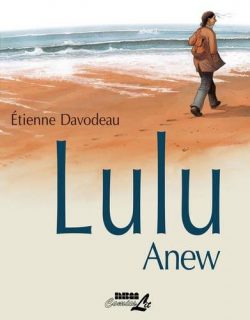
Lulu Anew


By Étienne Davodeau, translated by Joe Johnson (NBM/Comics Lit)
ISBN: 978-1-56163-972-4 (HB/Digital)

In 2010 Bande Dessinée artist, writer and designer Étienne Davodeau completed a 2-volume tale he’d started in 2008. He was already popular, award-winning and extremely well-regarded for his reality-based and reportage style comics work, but Lulu femme nue was something that was special even for him. Within a year the story had been made into a much lauded and celebrated film by Solveig Anspach.

Davodeau was born in 1965 and, whilst studying art at the University of Rennes, founded Psurde Studios with fellow comics creators Jean-Luc Simon and Marc “Joub” Le Grand. His first album – L’Homme qui aimait pas les arbres (The Man Who Did Not Like Trees) – was released in 1992.

He followed up with a string of thoughtful, passionate and beautifully rendered books like The Initiates, Les Amis de Saltiel, Un monde si tranquille, Anticyclone, Les Mauvaises Gens: une histoire de militants, Le Chien Qui Louches and Le Droit du sol : Journal d’un vertige. Consequently he is now regarded as an integral part of the modern graphic auteur movement in French and Belgian comics.

NBM translated and collected both volumes of the dreamily moody mystery into a stunning hardback edition and Lulu Anew is now regarded as one of the very best graphic novels of its genre…

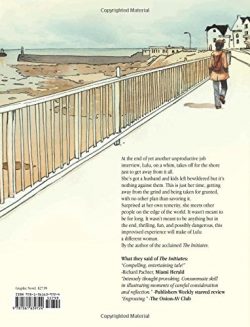
It begins with a kind of Wake where a number of friends gather to learn the answers to a small, personal but immensely upsetting event which has blighted their lives of late. Xavier is the first to speak and relates what they all already know. Lulu, a frumpy 40-something with three kids and a very difficult husband, has been missing for weeks. She went off for yet another distressing job interview and never came back…

It wasn’t some ghastly crime or horrible abduction. Something simply happened when she was in the city and she called to say she wasn’t coming home for a while…

The sun sets and the attendees calmly imbibe wine and eat snacks. A number of friends and family share their independently gleaned snippets of the story of Lulu’s aberration: a moment of madness where she put everything aside – just for a little while – and what happened next…

Bizarre unsettling phone calls to the raucous family home precede a quiet revolution as Lulu, without any means of support, inexplicably goes walkabout along the magnificent French Coast: living hand-to-mouth and meeting the sorts of people she never had time to notice before. Through interactions with strangers she learns about herself and at last becomes a creature of decisions and choices, rather than shapeless flotsam moved by the tides of events around her…

Related with seductive grace in captivating line-&-watercolours, here is a gently bewitching examination of Lulu’s life, her possible futures and the tragic consequences of the mad moment when she rejects them all. Unfolding with uncanny, compulsive, visually magnetic force, and told through and seen by the people who think they know her. This isn’t some cosmic epic of grand events, it’s a small story writ large with every bump in the road an unavoidable yet fascinating hazard. None of the so-very-human characters are one-sided or non-sympathetic – even alcoholic, often abusive husband Tanguy has his story and is given room to show it.

Ultimately, Lulu’s gradual, hard-earned resolution is as natural and emotionally rewarding as the seemingly incomprehensible mid-life deviation which prompted it…

Slow, rapturous and addictively compelling, Lulu Anew is a paragon of subtlety and a glowing example of the forcefully deceptive potent power of comics storytelling. Every so often a book jumps comics’ self-imposed traditional ghetto walls of adolescent fantasies and rampaging melodrama to make a mark on the wider world. This elegiac petit-epic makes that sort of splash. Don’t hesitate: dive right in.
© Futuropolis 2008, 2010. © NBM 2015 for the English translation.

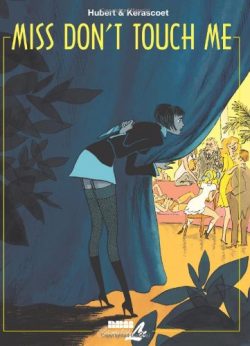
Miss Don’t Touch Me volumes 1 and 2


By Hubert & Kerascoët, translated by Joe Johnson (NBM)
ISBN: 978-1-56163-544-3 (TPB) & 978-1-56163-592-4 (TPB)

Hubert Boulard was a French comics writer and colourist who died suddenly on February 12th 2020. He is criminally unknown in the English-speaking world.

“Hubert” was born on January 21st 1971, and after graduating in 1994 from the École régionale des beaux-arts d’Angers, began his comics career as an artist for seasoned pros such as Éric Ormond, Yoann, Éric Corberyan, Paul Gillon and others. He started writing strips for others in 2002, with Legs de l’alchimiste limned by Herve Tanquerelle, followed up with Yeaux Verts for long-term collaborator Zanzim.

He produced another 14 separate series – many of them internationally award winning like Les Ogres-Dieux and Monsieur désire? – and in 2013 contributed to collective graphic tract Les Gens normaux, paroles lesbiennes gay bi trans: released to coincide with France’s national debate on legalizing same sex marriage.

His final book was with artist Zanzim. Peau d’homme – a comedy exploring gender and sexuality at the height of an era of medieval religious intolerance and social stratification – was posthumously published in June 2020… and is as yet unavailable in English translation.

Debuting in 2006, Miss Pas Touche was Hubert’s third scripting venture and remains arguably his most successful. It was originally released as four volumes in France, which – when translated by NBM – were delivered as two deliciously wicked tomes…

This slim, sleek initial translated tome offers a superb period murder mystery from visual creators probably best known in the English speaking world as contributors to Joann Sfar & Lewis Trondheim’s Dungeon series of interlinked fantasy books.

Here, Paris at the end of the 19th century is plagued by its very own Jack the Ripper – a knife-wielding maniac dubbed “the Butcher of the Dances” because he picks his victims from lower class girls frequenting suburban Tea-dances where the young people gather…

Blanche is a maid in a fine socially prestigious house: pious, repressed and solitary, unlike her sister Agatha – also a maid in the same residence – who is fun-loving and vivacious. They share the attic room at the top of the house where one night, Blanche accidentally sees “the Butcher” at his bloody work through a crack in the wall.

He sees her too, and some nights later she finds Agatha dead, as if by her own hand. Blanche knows what must have really happened…

Anxious to avoid scandal, the mistress of the house dismisses Blanche, who is forced to fend for herself on inhospitable streets. Through a combination of detective enquiry and sheer luck, she finds a lead to the killer and secures a position in The Pompadour, the most exclusive brothel in the city. By catering to a rich and powerful elite, here she will find the Butcher and exact her revenge…

Originally published in France as La Vierge du Bordel and Du Sang sur le Mains, this witty, and hugely engaging crime conundrum cleverly peels back its layered secrets as our star finds a way to turn her steadfast virginal state and overwhelming frustration to her advantage amidst the decadent rich and sexually bored of Paris. Maintaining her virtue against all odds, Blanche discovers the other side to a world she previously despised, while valiantly achieving her goal, even though it threatens to topple two empires!

Feeling very much like a cheeky grown-up version of Frances Hodgson Burnett’s 1905 novel A Little Princess, this saucy confection from writer/colourist Hubert is delightfully realized with great panache by the Kerascoët to the delight of a wide variety of grown-up readers.


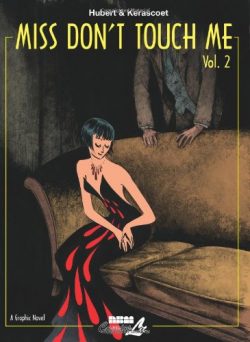
Miss Don’t Touch Me volume 2

Let’s return to the eclectic world of the French demi-Monde – in the oddly inappropriate guise of formerly naive and still virginal ex-housemaid Blanche, who one night espied a psychopathic murderer at work. Intent on silencing the pesky witness, “the Butcher of the Dances” mistakenly killed Blanche’s sister Agatha in her stead, before the surviving sibling was unceremoniously sacked by her employers to avoid scandal.

Thrown onto the streets of fin de siècle Paris, our pious innocent found refuge and unique employment within the plush corridors of the city’s most exclusive and lavishly opulent bordello. Fiercely hanging on to her virtue against all odds, Blanche became Miss Don’t Touch Me: a spirited – and energetic – proponent of the “English Method” – specifically, an excessively enthusiastic flagellating dominatrix, beating the dickens out of men who delighted in enduring exquisite pain and exorbitant expense. The first volume ended with justice for both Blanche and the Butcher but her adventures were not over…

This delightfully audacious and risqué sequel opens with Blanche – virtue still notoriously and profitably intact – as the Pompadour’s most popular attraction, even though the magnificent edifice is undergoing an expensive and disruptive refit.

However, she is deeply unhappy with her life and tries to flee, buy and even blackmail herself out of her onerous contract. She is soon made brutally aware of how business is really done in the twilight world of the courtesan-for-hire…

Utterly trapped, Blanche loses all hope, even while becoming gradually enamoured of Apollo-like young dandy Antoine: one of the wealthiest men in the country and a man apparently content to simply talk with her. Complications mount when her unscrupulous, conniving mother returns to Paris and begins to avail herself of the surviving daughter’s guilt-fuelled generosity and social contacts…

Blanche’s velvet-gloved imprisonment seems set to end when her bonny bon vivant boy begins to talk of marriage, but just as suddenly, her life at the brothel begins to radically unravel. Obviously the aristocrat’s dowager mother has no stomach for the match, but social humiliation is not the same as the malicious lies, assaults, attacks and even attempted poisoning Blanche experiences.

Moreover, the genteel dominatrix’s mother seems to hold a hidden secret concerning Antoine’s family and, if they are to be wed, why doesn’t the prospective groom want his bride-to-be to give up her day – or more accurately – evening job?

Originally published in France as Le Prince Charmant and Jusqu’à ce que la Mort Nous sépare, this enticing, knowing and hugely enthralling tale trumps the inspired murder-mystery of the introductory volume with a turbulent period melodrama of guerrilla Class Warfare that promises tragic and shocking consequences, especially after Antoine abruptly vanishes and the apparently benevolent brain surgeon Professor Muniz begins his terrifying work…

A compelling saga stuffed with secrets, this engagingly sophisticated confection from writer/colourist Hubert, illustrated with irrepressible panache by Kerascoët (married artistic collaborators Marie Pommepuy & Sébastien Cosset) will further delight the wide variety of grown-up readers who made the first book such a popular and critical success.
© 2007 Dargaud by Kerascoet & Hubert. All Rights Reserved. English Translation © 2007, 2008, 2010 NBM.

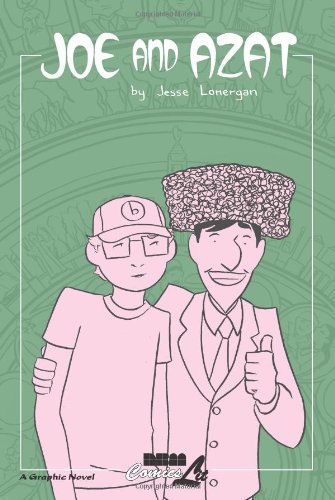
Joe and Azat


By Jesse Lonergan (NBM/ComicsLit)
ISBN: 978-1-56163-570-2 (TPB)

I’m writing this well in advance of publication, with the British media resolutely awash with the worst of all possible candidates for a new Prime Minister. That is of course excluding the one we still have – and cannot seem to pry loose from office. It’s actually comforting to remember that it could always be worse. Here’s a delicious example of a true tale with a hidden message…

Global traveller and cartoonist Jesse Lonergan (Flowers and Fade; Hedra) was born in Sacramento, California, raised in Saudi Arabi and Vermont and then spent two years as an American Peace Corps volunteer, before settling down as an artist and storyteller.

That stint was in the nation of Turkmenistan in the days when the Soviet Union’s collapse released many countries from seven decades of iron repression…

Granted autonomy and self-rule virtually overnight, a lot of Warsaw Pact countries didn’t fare well with instant democracy or Free Market Capitalism. In Turkmenistan, their new leader was also their old one.

Saparmurat Atayevich Niyazov became First Secretary of the Turkmen Communist Party in 1985, and was leader of the country until the 1991 coup and revolt that established an independent Turkmenistan. Then – as “Turkmenbashy” – he ruled as president until his sudden and suspicious death in 2006.

The election was on 21st June 1992 and he was the only candidate running, and in 1994 extended his term of office until 2002 through a plebiscite whose official result gave him 99.9% of the vote (because “everybody likes him”). In December 1999, Parliament  – all of whom he hand-picked – spontaneously appointed him President for Life…

As you’d expect, he was a real pip, renaming the days of the week after himself, adding portions of his autobiography to the official driving test requirements and using the nation’s entire budget to send a book of his poetry into space. In a pitifully arid country, he built a river through his capital city – because all great cities have rivers running through them. Images of the ruthless potentate were everywhere: it’s a shame nobody ever found oil in the country… oh wait. They did…?

Seriously though, if you admire the precept that “truth is stranger than fiction”, you will have as much fun reading his Wikipedia page as this superb, charmingly subtle tale of culture shock pretensions and national misapprehensions that begins as young Joe grapples with the outrageous differences between his (mostly) liberal and wealthy homeland and the rules, laws and ingrained prejudices of a newly liberated society still reeling from the scary potentials of liberty and personal autonomy.

Nervous and alone, the Yankee lad slowly finds a friend in the astonishingly upbeat and forward looking Azat: an ambitious Turkmen convert and eager zealot for “The American Way”. Subsequently, most of Joe’s time is spent futilely apologising and explaining what that term actually means, since current reality is as far removed from the US Movies Azat is addicted to as the decades of Russian propaganda he grew up with.

Becoming almost part of the family – as complex and dysfunctional as any western one – Joe is caught in the tidal wave of Azat’s enthusiastic aspirations and daily frustrations, but never seems able – or willing – to staunch or crush them, even though he knows how hopeless they ultimately are…

Poignant, bittersweet, with an end but no conclusion, this is a superbly understated graphic dissertation on the responsibilities and power of friendship, the toxicity of unattainable dreams and the unthinking cruelty of cultural imperialism and unchallenged tyranny. Illustrated in a magically simplistic and irresistibly beguiling manner, Joe and Azat is a delight for any reader searching for more than simple jokes and action. Reading this would actually be time very well spent and could easily change your outlook…
© 2009 Jesse Lonergan. All rights reserved.

Lost Cat


By Jason, translated by Kim Thompson (Fantagraphics Books)
ISBN: 978-1-68396-009-6 (HB/Digital)

A global star among comics cognoscenti, coining numerous major awards from all over the planet, Jason is secretly John Arne Saeterrøy. Born in Molde, Norway in 1965, he’s been an international cartoon superstar since 1995 when his first graphic novel Lomma full ay regn (Pocket Full of Rain) won that year’s Sproing Award (Norway’s biggest comics prize). He won another Sproing in 2001 for his series Mjau Mjau and in 2002 turned almost exclusively to producing graphic novels.

The stylised artwork is delivered in formalised page layouts rendered in a minimalist take on Hergé’s Claire Ligne style: solid blacks, thick outlines and settings of seductive simplicity – augmented here by mesmerising hints in earth-tones enhancing the hard, moody, suspenseful and utterly engrossing appreciation of the ambience of France’s Cinema Verité movement.

Jason’s work always jumps directly into the reader’s brain and heart, using beastly and unnatural repertory players to gently pose eternal questions about basic human needs in a soft but relentless quest for answers.

That you don’t ever notice the deep stuff because of clever gags and safe, familiar “funny-animal” characters should indicate just how good a cartoonist/storyteller he is. This would be a terrific yarn even without Jason’s understated art, but in combination with his dead-on, deadpan pastiche of The Big Sleep and other movies, the result is outrageous narrative dynamite.

This gem sees the artist’s return to full length tales (160 pages) after some years producing shorter album-style pieces, and in Lost Cat he lends his uniquely laconic anthropomorphic art-stylings to a surprisingly edgy, delicious tale of lost loves, scurrilous misdeeds and uncanny sinister secrets.

This a scarily evocative romantic puzzle with its roots in Raymond Chandler mysteries, tipping a slouched hat to Hollywood Noir, B-Movie sci-fi and psychologically underpinned melodramas, with Jason’s traditionally wordless primal art supplemented by sparse and spartan “Private Eye” dialogue, enhanced to a macabre degree by solid cartooning and skilled use of silence and moment.

This sly and beguiling detective story opens as seedy shamus Dan Delon – a specialist in tawdry divorce cases – sees a poster about a lost cat and, upon accidentally encountering the missing moggy, returns it to solitary, sombre yet oddly alluring bookshop proprietor Charlotte.

The two lonely people enjoy a coffee and stilted conversation before Dan departs, but in his head his calm, pleasant night with the quiet lady continues to unfold…

Life goes on, but even after taking on a big case – tracking the lost nude painting of a rich man’s long-gone inamorata – Delon just cannot get Charlotte out of his mind. Despite knowing better, he inserts himself into the woman’s staid, sedate life and slowly realises that their pleasant evening together was a complete tissue of lies.

Moreover, his grail-like quest for the truth leads the dowdy gumshoe into deadly danger and shocking revelations of Earth-shaking consequences…

Utilising with devastating effect that self-same quality of cold, bleak yet perfectly harnessed stillness which makes Scandinavian crime dramas such compelling, addictive fare, Lost Cat resonates with the artist’s favourite themes and shines with his visual dexterity, disclosing a decidedly different slant on secrets and obsessions, in a tale strictly for adults which nonetheless allows us to look at the world through wide-open young eyes.
All characters, stories and artwork © 2013 Jason. All rights reserved.

Stumptown volume 1: The Case of the Girl Who Took her Shampoo (But Left her Mini)


By Greg Rucka, Matthew Southworth & various (Oni Press)
ISBN: 978-1-93496-437-8 (HB) 978-1-62010-440-8 (TPB) eISBN: 978-1-62010-068-4

Plenty of superhero, supernatural and sci fi comics make the jump to TV and movies these days, but not so many straightforward down to earth crime sagas. One that did came from the ever-entertaining, prodigiously prolific, multi award-winning Greg Rucka: a screenwriter (The Old Guard) and novelist (Atticus Kodiak crime sequence, Jad Bell series and half a dozen general thrillers).

Rucka has also crafted astounding graphic thrillers like Whiteout, Queen & Country and Lazarus and excelled working on prime properties and characters Star Wars, Superman, Batman, Gotham Central (co-scripted by Ed Brubaker), Wonder Woman, Grendel, Elektra, the Punisher and Wolverine and been a major contributor to epic events such as 52, No Man’s Land, Infinite Crisis and New Krypton.

One of HIS most engaging concepts features a private eye barely getting by in the writer’s own backyard: Portland Oregon – AKA “Stumptown”…

The series launched in November 2009 as a 6-issue miniseries from Oni Press, with modern day Portland locales a vibrant and integral part of the story. A huge hit, the series was indefinitely extended and ran until #19. The TV show launched September 25, 2019 and was equally entertaining and initially successful, before dying after one superb season during the worst days of the pandemic.

Preceded by Matt Fraction’s Introduction ‘On Stumptown’, and illustrated by Matthew Southworth (Savage Dragon, Ares, Infinity Inc.) with additional colour from Lee Loughridge & Rico Renzi, ‘The Case of the Girl Who Took her Shampoo (But Left her Mini)’ introduces Dexadrine Callisto Parios, private detective and sole owner of Stumptown Investigations.

She’s struggling with bills, two mortgages, a gambling problem, and dangerous impulses whilst looking after dependent brother Ansel and ignoring other people’s constant grief because of her bisexuality – or more likely her attitude to them shoving their noses into problems she doesn’t want to confront yet…

Here, things kick off with Dex being executed by two low grade thugs before we spin back 27 hours to the Whispering Winds casino, where her latest binge and sky high tab have won her a face-to-face meeting with the owner Native American matriarch Sue-Lynne Suppa.

The bosslady also has problems. Wayward granddaughter Charlotte has gone missing – probably with a girl this time – and Dex’s unique skillset, unusual connections and urgent need makes her the perfect hunter to track down and bring home the truant. In return, the casino will forgive the PI’s entire debt.

Its easy to decide what to do if you’ve got no choice…

However, as soon as Dex finishes checking out Charlotte’s apartment, she’s roughed up by moronic thugs Dill and Whale, who also want to find the missing bad girl. Message delivered, the idiots drive off, and Dex is immediately abducted by far more professional goons working for hugely wealthy (don’t ask how he made his pile) Hector Marenco.

Hector has pressing family problems too, but he’s not talking about his sexually-predatory firebrand daughter Isabel or ambitious idiot son Oscar. He needs Charlotte found too, and is willing to pay twice what Sue-Lynne’s offering… but only if Dex tells him first when she finds the lost girl.

Checking in with Ansel (Rucka’s superbly positive and inclusive take on a neuro-atypical character – he has Downs Syndrome but is a realistically rendered, sensitively realised actor who fully participates in the stories), Dex gets a late call from a terrified Charlotte and cautiously arranges a secret meeting…

The staggered flashbacks catch up to now as Dex’s body is dragged out of the river. Her foresight in wearing body armour pays off in more aches, pains and arrest by the Portland Police Bureau, but at least now she knows how serious Charlotte’s problem is and has a good idea who’s involved, if not why…

Diligent research provided by close friend police detective Tracy Hoffman – and an unpleasant but mercifully brief reunion with precinct captain Volk – gives Dex the identity of one of her would-be killers, but as she doggedly proceeds, ambush interviews with the evermore intrusive Marenco siblings lead to a big break. At least it’s not a missing persons gig anymore…

Now helplessly enmired in a federal crime scenario and escalating civil war within a ruthless family trapped in centuries-old bigotries, face-saving and macho posturing, Dex has to negotiate her way out and keep her meagre supply of friends safe as ancient prejudice and modern crime meet head-on and a father ruthlessly resolved to maintain his position and defend the old ways goes into merciless clean-up mode.

Thankfully, Parios is tough, thinks fast and has a gift for making plans on the fly…

A superbly stylish thriller perfectly exploiting changing society and the nature of Oregon myth and culture, this initial yarn was originally collected as a hardback in 2011 with subsequent volumes in both luxury and trade paperback editions. All are available digitally.

Winningly, there are also wonderful extras included in this first tome, starting with Artifacts of Stumptown – a photo feature of cool promotional objects (“tchotchkes”) released to market the series. There was an 8-page monochrome promo micro-comic (printed at the size of a business card and packaged with a magnifying glass) reprinted at full size here as ‘Dex Parios of Stumptown Investigations in “Mustang Ranch”’; t-shirt designs; art prints and a poster mimicking a yellow pages ad for Stumptown Investigations deigned by Eric Trautman.

If you love crime drama, detective fiction, strong female role models or just bloody great storytelling, you need to pay a visit to Stumptown.
Stumptown ™ & © 2011 Greg Rucka & Matthew Southworth. All rights reserved.

Heathen volume 1


By Natasha Alterici with Rachel Deering (Vault Comics)
ISBN: 978-1-939424-18-1 (TPB) ISBN: eISBN: 978-1-939424-19-8

The creation myths and heroic sagas of Scandinavia are part of a global grand storytelling heritage: classic epics of paragons that have been constantly retold and reinvented for more than a thousand years, subtly reshaded to suit every generation. Here’s one that’s boldly innovative and very much in tune and in demand at this moment in time.

In 2017 Natasha Alterici (Gotham Academy, Women of Marvel) began retelling those myths through a lens of female empowerment in an age still too much mired in gender subjugation. There are still talking beasts, fantastic beings and big brawny warriors aplenty and some of them are women, but here we get a look at what the consequences of a maiden bearing arms meant and what any act of female independence actually cost…

Modern iterations of historical/fantasy scenarios are rife with glamorous women warriors, but whether the goal is prurient pandering (and what idiot believes skimpy chainmail bikinis and saucer-encased boobs count as armour?) or a well-meant attempt to balance scales of omission with the Sword & Sorcery equivalent of “colourblind casting”, the truth is that that very few women fought beside male combatants in any combat. Against, most definitely, but that’s a wholly different scenario with their struggles being more in the nature of a violently resisting prize or momentary diversion from the macho business of butchery…

Okay, maybe some pirates and legendary queens have been recorded as having joined in physical fighting, but traditionally, most women in combat were reduced to side roles or forced to disguise themselves AS MEN to even have a chance of surviving the attentions of their own allies and comrades…

A far more reasonable and rational scenario underpins this vivid reworking of the Valkyries’ legend, with fugitive Norsewoman Aydis riding out on a most private mission. Capable and doughty as any male, she shares with her horse Saga how Godking Odin created the fierce and beautiful Choosers of the Slain to escort men’s souls to Valhalla …if they fell in battle. She also relates how their leader Brynhild once disobeyed micromanaging, conniving, petty Odin and was punished by exile and compelled to marry a mortal.

Crafty Brynhild thought she had the last word, convincing her creator to allow her to test her suitors’ mettle. This was done by confining her atop a mountain behind a wall of magic fire, where only the bravest, strongest and most worthy would dare to go…

Aydis is inspired by this tale as she hunts a deer and meets again Liv, reexperiencing the moment they kissed and how it changed both lives. Their act of deviancy could only be expunged by death or marriage, but while Liv’s father married her off immediately, Aydis’ sire had apparently opted to execute the degenerate fruit of his loins…

Now, the almost-lovers meet over a slaughtered stag and ruefully ponder what might have been and how it might feel to not be man’s property. They are interrupted by a rampaging bull…

Aydis easily defeats the maddened beast only to find it is shapeshifting trickster god Ruadan who lets slip that he is watching her on behalf of an intrigued god and that immortals live cyclic lives, reliving the same stories over and again…

Aydis is resolved her existence will break the eternal mould. Bidding farewell to Liv, she fashions a warrior helmet from the stag and sets out to free Brynhild and chart the course of her own life…

This initial collection gathers the first four issues of Heathen, and chapter 2 opens with wolf gods Skull and Hati idly debating food, entertainment and ending the world until one sibling steps into a metal trap he cannot break. Happily, Saga – whom they were disinterestedly stalking – is a most unique special steed and frees the godling’s paw, even as high above them all, Aydis clears the flame wall and rouses Brynhild.

She does not seek to marry the Valkyrie, but rather prove her own bravery and liberate a fellow captive of fate from male-ordained doom, but it’s not that simple. Nothing ever is…

When they reach solid ground again, Brynhild reveals a shocking secret about Saga just as other Valkyries arrive, led by their new chieftain – love divinity Freyja. The scheming immortal takes one look and kidnaps Aydis to her heavenly citadel…

The saga diverges here as Aydis becomes a guest of hedonistic Freyja, leaving the defrocked Chooser of the Slain and Saga to roam the Nordic lands, seeking allies to help them challenge the gods in their own kingdom. More secrets are shared and Aydis learns hard truths in heaven, winning an ally in mute mortal Shannon, even as on Earth, Brynhild experiences the unjust status and roles women must endure. Eventually, she reunites with a tragic hero. Centuries previously, Sigurd was the last man to free her from the flames and in these new times, he still lives, thanks to wily Odin’s divinely pedantic curse…

The final chapter sees an end to Aydis’ time in heaven, while on Earth, her would-be rescuers wander into another savage situation caused by humanity’s hidebound rules on who and how to love. This situation is further exacerbated by a new sect called Christians, who not only frown on “unnatural” love, but will not tolerate wise women and witches dispensing potions and advice. Typically, Brynhild has a most forceful and fast-acting resolution to a growing hostage situation and building riot…

And for Aydis and Shannon, a Rubicon is crossed as the outcast warrior declares war on the father of the gods…

Thrilling, compelling and beautifully illustrated, Heathen ran to 3 volumes (now available as a Complete Omnibus edition since a movie adaptation imminently looms), but here the epic concludes with a gallery of the original wraparound covers rendered by Tess Fowler & Tamra Bonvillain, with variants from Alterici, Jen Bartel and Nathan Gooden sweetening the deal.

A delicious and wry alternate take on primal heroic myths, this book offers fresh ideals and a fair shake at last while proving the Good Fight can be fought by anybody for everybody.
© 2017 Natasha Alterici. All rights reserved.

[Low Moon]


By Jason, translated by Kim Thompson (Fantagraphics Books)
ISBN: 978-1-60699-155-8 (HB/Digital edition)

In 1965, John Arne Saeterrøy, who creates under the pen-name Jason, was born in Molde, Norway. At age 30, he burst onto the international cartoonists scene with his first graphic novel Lomma full ay regn (Pocket Full of Rain) which won that year’s Sproing Award (Norway’s biggest comics prize).

Jason followed up with the series Mjau Mjau and won another Sproing in 2001. The following year he turned almost exclusively to produce graphic novels. He is now internationally renowned and (probably quite self-consciously) basks in the glow of critical acclaim for his 24 books to date and for winning so many major awards as far afield as France, Slovakia, the USA and all areas in-between.

His stories utilise a small cast of anthropomorphic animal characters (and occasional movie and pop culture monsters): a repertory company of cartoon colleagues, acting out on a stage of stiffly formal page layouts recounting dark, wry and sardonically bleak tales – often pastiches, if not outright parodies – in a visually welcoming yet coldly austere and Spartan narrative manner. This seemingly oppressive format somehow allows a vast range of emotionally telling tales – on a wide spectrum of themes and genres – to hit home like rockets whether the author’s intention was to make the reader smile or cry like a baby.

Drawing in a minimalist evolution of Hergé’s Claire Ligne style, Jason’s work bores right into the reader’s core, and this movie-themed collection of short tales is arguably his best work.

Redolent of quintessential Film Noir and especially the hard-boiled writing of Jim Thompson, poignant tale of vengeance ‘Emily Says Hello’ precedes what is billed as the World’s “first and only Chess Western”.

The eponymous ‘Low Moon’ was originally serialized in The New York Times Sunday Magazine in 2008: a splendidly surreal spoof of Fred Zinnemann’s 1952 classic High Noon wherein an old menace returns to terrorise the town… until at last the Sheriff capitulates to the incessant demands for one final return match…

‘&’ is a tragic anecdote of love, loss and marital persistence related in terms and stylings of Hal Roach’s silent comedies. ‘Proto Film Noir’ owes an inspirational tip of the thermally insulated hat to Tay Garnett’s The Postman Always Rings Twice (the 1946 version with John Garfield and Lana Turner) – by way of The Flintstones and Groundhog Day, whilst a concluding tale of love, family and abandonment assumes science-fictional trappings to relate the soap-opera, generational tale of a mother kidnapped by aliens and the effects it inflicts on the husband and son she left behind. ‘You Are Here’ is bemusing, evocative and moving, yet manages to never fall off the narrative tightrope into mawkishness or buffoonery.

Jason’s comic tales are strictly for adults but allow us all to look at the world through wide-open childish eyes. He is a taste instantly acquired and a creator any true fan of the medium should move to the top of the “Must-Have” list. This superb compendium could be your entry into a brave, old world, so get it while you can because stuff this good never lasts long…
© 2009 Jason. All right reserved.

Artifice


By Alex Wolfson & Winona Nelson (AMW Comics)
ISBN: 978-0-9857604-0-3 (TPB/Digital edition)

Deacon sits in a featureless cell. He doesn’t look like much but has caused a lot of trouble and his two guards are each reacting in their own way: one with mounting aggression and bluster and the other with fear for his job and his life. When the taunting bigotry and disgust-fuelled bravado reach a tipping point, the immobile captive finally shows them both why they have every right to be scared…

Later, Deacon is debriefed by an interrogator. Dr. Maven is a highly qualified therapist highly ranked at NoNeCo: tasked with and determined to find out what went wrong on the mission to Da Vinci Four. It is crucial that she learns the truth. The Corporation has spent unimaginable sums building and programming Deacon and his four siblings, and can’t afford to casually scrap them. They were a highpoint in synthetic servants: stronger, smarter, faster than humanity and therefore the greatest potential threat to Man’s dominance ever encountered. Thus, he cannot be permitted further existence if what is reported to have happened there is even partially true…

When the puritanical colony needed pacifying, Deacon and his super-soldier kin eliminated all but one human being. The last battle left the other artificials destroyed in a trap. Now, Deacon explains how he allowed one organic – “Jeff” – to live because the colony systems were inoperable by synthetics and he needed to remain functional until relief arrived. Only organics could operate the rechargers supplying the artificial man with energy and life.

Deacon claims it was simply strategy. The young man was already an outcast, shunned and despised because of his genetic abnormality, and easy to psychologically manipulate. Deacon simply played on his uncorrected homosexual flaw to sustain his own existence until a scheduled follow-up mission landed four months later.

Deacon claims everything he subsequently did with Jeff and to the rescuers was simply to complete the mission, but the doctor isn’t fooled. She realises this android is even smarter and more devious than anyone imagined, but allows one final meeting with Jeff to test her theory… and discovers to her cost just how human and well-constructed the synthetic is, and how powerful is the outdated concept of love…

Alex Wolfson (The Young Protectors) writes a smartly compelling drama about intolerance and forbidden love overcoming all odds, whilst Winona Nelson (If You Lived During the Plimoth Thanksgiving) provides bleak, regimented and powerfully understated realism to the art that makes it so very believable.

A dystopian fable that ends on a note of hope and promise of a sequel, Artifice began life as a webcomic serial dealing in forthright manner with violence and sexual situations in service to a superbly engaging and enthralling drama that would already be a major motion picture if close-minded, parochial movie producers could get past the fact that it depicts guys snogging.

Thankfully, you aren’t so emotionally stunted and can enjoy the tale which closes here with ‘Reader Questions’ answered by the creative team, ‘Writer’s Notes’ by Wolfson describing the project’s genesis and ‘Artist’s Notes’ from Nelson, plus a fully illustrated run-down on their collaborative ‘Process’ and even faux press releases and reader response from evil mega-corp in ‘NoNeCo Responds’.

Proving yet again that there’s absolutely no appreciable difference in sexual orientation when telling wonderful stories of heroes, villains and lovers, Artifice is a lost treat you will definitely delight in, whoever you are and want to be.
© 2011, 2012, 2013 Alex Wolfson. All rights reserved. All characters, distinctive names and likenesses and all related elements are trademarks of Alex Wolfson and AMW Comics.