

Angola Janga: Kingdom of Runaway Slaves


By Marcelo D’Salete, translated by Andrea Rosenberg (Fantagraphics Books)
ISBN: 978-1-68396-191-8 (HB/Digital edition)

Art historian Professor Marcelo D’Salete is one of Brazil’s most respected authors and graphic novelists. Born in 1979 and a graduate of Carlos de Campos College and the University of São Paulo, he currently resides in Italy. Despite this, the majority of his comics examines Brazil’s history of slavery and consequent issues affecting the vast Afro-Brazilian underclass resulting from it.

After freelancing as an illustrator, D’Salete’s first graphic novel Noite Luz was released in 2008, followed by Encruzilhada in 2011. He acquired a greater degree of fame after his 2014 book Cumbe was translated into English by Fantagraphics in 2017: subsequently garnering a boatload of prizes as Run For It: Stories of Slaves Who Fought for their Freedom.

Technically, the professor followed that multi award-winning volume with this even more ambitious tome, but Angola Janga actually took eleven years to complete and its initial release that same year was simply a fortunate convergence…

This epic expands the story of that escaped slave culture, detailing how Palmares Quilombos (“war camps of runaway slaves”) were crushed by colonisers. Before the story opens, Introduction ‘Mocambos and Plantations’ explains how 16th century Portuguese occupiers moved from enslaving local peoples to importing millions of Africans. These supplemented a huge indigenous workforce toiling to exploit timber, sugarcane and other natural resources for ruthless masters on increasingly prolific and profitable plantations.

Over centuries – but largely due to Dutch attempts to seize control from the Portuguese between 1630-1654 – generations of black slaves (designated “units”) in the Pernambuco region had escaped into the forests and Serra da Barriga hills: founding an outlaw nation of semiautonomous settlements: “mocambos”.

By the time events open here, Palmares or Angola Janga (“Little Angola” in Bantu language Kimbundu) comprised an estimated 20,000 free-living rebellious “blacks”, “Indios”, “mulattos” and other demeaning and pointless designations of mixed race all considered to be property not humanity…

This astounding dramatised examination is delivered in brief vignettes torturously following the entwined paths of key individuals like black leaders Soares, Ganga Zumbi and Ganga Zamba, numerous religious and civic figures and Domingos Jorge Velho: pitiless commander of “Paulista” mercenaries hired to reimpose order and crush the beacon of hope Angola Janga represented.

Crafted in stark edgy monochrome with dialogue and narration at a bare minimum, it begins with ‘The Way to Angola Janga’. Each chapter is preceded by pertinent excerpts from contemporary accounts by the victorious colonisers and historians.

In 1673, two frantic runaways crash through trees and brush. Soares was promised freedom by dying plantation owner Mistress Catarina, but her son Gonçalo chose not to honour her wishes and brutally punished the mulatto (“mixed race”) for demanding his Letter of Emancipation. Now he and companion Osenga are fleeing, searching for a mocambo to take them in. Soares’ past is complex and complicated, but common gossip amongst the slave catchers preparing to bring him back…

‘Birth’ wings back to 1655 and the controversial origins of the “half-caste”: revealing connections that have church and military authorities clashing and colluding in a conspiracy of silence, whilst revealing the inner workings and defence strategies of mocambos and their leaders before the fate of Angolan enclave ‘Aqualtune’ introduces more charismatic defenders of liberty in episodes set in 1677…

When Palmares warriors attack white plantations, outraged plantation owners declare implacable war, but instead of engendering alliances, tribal and sibling rivalries undermine the rebels’ unity with catastrophic consequences…

Moreover, devious white masters employ cruel tactics to regain their valuable Units and maintain the status quo: combining religious tyranny, disease, relentless police actions and bounty hunting with spurious offers of amnesty, designated black Reservations and valueless treaties. These slowly chip away at the hidden free kingdoms, as seen in ‘Scars’, ‘Cucaú’ and ‘Encounters’, with even free-born and emancipated blacks experiencing a rise in intolerance, prejudice and white exceptionalism.

Resistance was common and reprisals inescapable. Always the mocambos called to those brave enough to stand up and fight back, but increasingly they were fighting their own kind rather than their oppressors… sometimes, even their own families…

The saga explores a subtext of religious and political beliefs in opposition, complementing the physical and geographical struggle. ‘Savages’ reveals the turbulent and traumatic early years of Domingos Jorge Velho and how white leaders suborned and seduced native tribes like the Oruazes into joining their ‘War’ against Palmares…

Beginning in 1691 the savage strands converge, as raids by belligerent mocambo warriors and sorties to recapture lost slaves reach lethal levels. With the entire region in turmoil, and death toll mounting, many scared officials and churchmen petition for blanket emancipation to end the bloodshed. However, a final clash is imminent and – risen to high office amongst the runaways – Soares endures the ‘Sweet Hell’ of vindication or defeat, unaware that the foe has deployed the latest weapons technology to conclusively end the struggle …

The triumphant mopping up operation is covered in ‘The Embrace’ as defeated Soares flees, descending into delusion and worse before gaining the truest freedom of all in one last battle, before the end of the campaign and what came after is explored in terms of spirituality and symbolic prognostication with ‘Footsteps in the Night’

Augmenting this tragic history is a full Glossary of terms, concepts and characters and their originations, and Author’s Afterword ‘Trails and Dreams’ explores the exponential growth of the Portuguese slave trade. Also on view are a ‘Chronology of the Palmares War 1597-1736’, ‘Summary of the Palmares War’, maps and text pieces on ‘Pernambuco, Palmares, towns, mocambos (seventeenth century)’, ‘Principal quilombo and quilombola regions in Brazilian territory’, ‘The region of Angola – one of the largest sources of Africans sent to Brazil’ and truly disturbing charts and maps disclosing ‘Estimates of embarkation and disembarkation of enslaved Africans between 1501 and 1900’. These shocking visual aids are supported by a copious bibliography of References and biography of the author.

Appalling and beautiful, this is a superb testament to the power of resistance and hope: one that should be compulsory reading in every school and college.
© 2019 Marcelo D’Salete. Glossary © 2019 Marcelo D’Salete, Allan da Rosa & Rogério de Campos. Original edition published by Editora Veneta © 2017. All rights reserved.
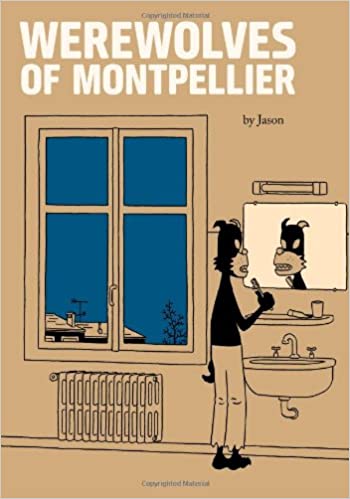
Werewolves of Montpellier


By Jason, translated by Kim Thompson (Fantagraphics Books)
ISBN: 978-1-60699-359-0 (HB/Digital edition)

Jason is secretly John Arne Saeterrøy: born in Molde, Norway in 1965 and an overnight international cartoon superstar since 1995 when his first graphic novel Lomma full ay regn (Pocket Full of Rain) won Norway’s biggest comics prize A Sproing Award.

He won another in 2001 for the series Mjau Mjau and by 2002 was almost exclusively producing graphic novels. Now a global star, he has won many more major awards from such disparate regions as France, Slovakia and the USA.

Rife with his signature surreality, this novella was first released in 2010; populated with cinematic, darkly comic anthropomorphs and featuring more bewitching ruminations on his signature themes of relationships and loneliness, viewed as ever through a charmingly macabre cast of bestial movie archetypes and lost modern chumps.

Here he focuses on the hollow life of expatriate Swede Sven, a purposeless artist who has gravitated into a stagnant, romance-lite existence in a provincial French town. Sven fritters away his days just like his close friend Audrey – another listless intellectual looking for the right lady to love.

The only thing quickening his pulse these days is the occasional nocturnal foray over the rooftops: burglarizing houses dressed as a werewolf. Unfortunately, Montpellier already has a genuine lycanthrope community and they don’t look kindly upon gauche parvenus intruding into their world with criminal cosplay…

This post-modern short-&-spooky fable unfolds in Jason’s beguiling, sparse-dialogued, pantomimic progressions delivering resonances of Hitchcock’s bubbly comedy-thrillers, quirkily blended with Bergman’s humanist sensibilities. The enchantingly formal page layouts are rendered in his minimalist evolution of Hergé’s Claire Ligne style: solid blacks, thick lines and settings of seductive simplicity augmented here by a stunning palette of stark pastels and muted primary colours.

Jason’s work always jumps directly into the reader’s brain and heart, deftly probing the nature of “human-ness” by using the beastly and unnatural to ask persistent and pertinent questions. Although the clever sight-gags are less prominent here, his repertory company of “funny-animal” characters still uncannily displays the subtlest emotions with devastating effect, proving again just how good a cartoonist he is.

This comic tale is best suited for adults but makes us all to look at the world through wide-open childish eyes. Jason is instantly addictive and a creator every serious fan of the medium should move to the top of the “Must-Have” list. Buy, borrow or even steal it if you must, but be aware that actions have consequences… even for faux monsters…
© 2010 Jason. All rights reserved.

Superdupont – The Revival


By Marcel Gotlib, François Boucq & Karim Belkrouf, translated by Edward Gauvin (Europe Comics)
No ISBN: Digital only release

In a world that has apparently devolved far beyond the reach of satire and parody – if not quite yet grotesque caricature – it’s always comforting to look back and recall a time when such creative acts had some effect on morality if not actual behaviour. Once upon a time everyone in Europe believed that the French, British, Germans, Italians, Spanish, Belgians, Irish, Scots and all the rest languished, locked into cultural acts and idiom that made them all unique unto themselves, even as politicians became unwilling “guest stars” in numerous strips.

These days we just call it racism and acknowledge that nearest neighbours are the ones we argue with most, but that doesn’t mean that Asterix, Spirou, Lucky Luke, Clifton and all the rest aren’t still hilarious…

The most comforting aspect of the situation was that the nationalistic, jingoistic True Believers of every nation have always been best taken to task by their own fellow citizens, calling out their innate idiocies via comedy and cartoons. In France, the tradition achieved greater impact when adult comics pioneer Marcel Gotlib (1934-2016: Les Dingodossiers; Rubrique-à-Brac; Clopinettes; Gai-Luron; Pervers Pépère; Hamster Jovial) united with artist Jacques Lob (1932 – 1990): maker of Jerry Spring; Ténébrax; Submerman; Blanche Épiphanie; Ulysse; Snowpiercer and more. As a united front they confronted Gallic nationalism head-on by pinching an idea from America to create a Patriotic Superhero for the post-De Gaulle era…

Superdupont was a strip spoof of patriotic costumed crusaders, targeting France’s ingrained national attitudes in the manner many British comedians today have used when lampooning “frothing Gammons” and “Little Englanders”. Feel free to carry out your own research on those terms…

The strip debuted in the September 21st 1972 issue of increasingly radical comic Pilote, prior to colonising Gotlib’s own mature-reader publication Fluid Glacial three years later. The reason for Superdupont being a collaborative effort is wonderfully egalitarian and fraternal too. When writer/artist Gotlib and Jacques Lob discovered they had both simultaneously come up with the same idea, they joined forces and achieved an even greater satirical synergy as “GotLob”!

They soon relinquished art duties to Alexis (Dominique Vallet) until that artist died in 1977, and thereafter workshopped irregularly seen releases over the years: episodes encompassing visual and verbal contributions from and joint efforts with Jean Solé, Daniel Goossens, Al Coutelis, François Boucq & Karim Belkrouf, Lefred-Thouron and even original American inspiration Neal Adams, who all contributed after Lob’s untimely death in 1990. Sadly, no-one has felt able to continue the feature since Gotlib’s passing in 2016…

In that year, the six original collected Superdupont tomes were at last supplemented by one final sally from Gotlib, in conjunction with modern marvel François Boucq (La Vie, La Mort et Tout le Bazar, Les Leçons du Professeur Bourremou, The Magicians Wife, Face de Lune, Bouncer, Le Janitor, Jérôme Moucherot), and his frequent work-partner Karim Belkrouf (Rock Mastard, Cocktail Transgenic). Superdupont: Renaissance introduced a fresh face to the francophone oeuvre as the mighty modern champion of all things Gaul returned in the role of proud father…

One point to remember here: a big part of Gotlib’s legacy was the brutal enforcement of a modern adult sensibility to the previous kid’s only comics biz. It shows in much of his comics work and particularly in his editorial stance and choices as co-founder of Fluide Glacial and L’Écho des savanes. In Superdupont, it’s seen as deliberately crass and vulgar situations, scenarios and language as well as cruelly satirical social commentary. If you can’t handle it, don’t look, but truly it’s no worse than late night TV or the cartoon equivalent of modern radio “shock jocks”…

In the original texts the beret-bedecked wonder was the son of the Unknown Soldier entombed beneath the Arc de Triomphe: super-powered, manically chauvinistic and resolute in his defence of all things French – especially business, colonialism and women. He battled terrorist gang Anti-France and foreigners in general, who all spoke an unruly linguistic polyglot of English, Spanish, Italian, German and Russian he dismissed as “Anti-Français”…

Clad in slippers, baggy slacks with a tricolour belt, striped jersey beret and safety-pinned cape, he led the resistance against modernism and foreign contamination, swilling red wine, smoking Gauloises and eating far too much soft cheese. Despite his powers, the champion of Camembert prefers to punish his many foes with his mastery of boxe française …what us interlopers would likely call “Savate”…

Translated as Superdupont: The Revival, the fun-filled French lessons restart following Gotlib’s fond reminiscences on the creation of the Gallic Guardian – and his reasons for returning – in revelatory Introduction ‘The Birth of a Legend’, after which the Good Old Days resume with some shocks and surprises…

The cosmos reels like a DC Comics mega-crossover as a nervous, flying, chain-smoking figure circles the maternity wing of a hospital. Inside the doctors and midwives are panicking at a most unusual birth. After some frantic – not to say gross – moments, Superdupont greets his new son: a bonny baby even more gifted and glorious than his proud sire…

After a rapid flashback précising his parents’ amorous assignation and precarious natal achievement, the early days of Superdupont Jr. detail why and how papa takes over the childrearing in a series of spectacular stunts and training exercises – whilst poor mummy recuperates in the ICU…

The infant’s sky-rending antics and fabulous frolics alarm the nation’s trigger-happy military and – after ‘Superdupont Changes a Diaper!’ – lead to a spot of civil unrest when the nipper starts interacting with alarmed ground-based mortals, prompting Da-Da to deliver a quick lecture on power and responsibility in Real Man style.

Tragically, as Superdupont demonstrates the fine art of saving plunging passenger jets, ruthlessly relentless, ever-present evil strikes, abducting his titanic toddler!

Plunged into despondency, Superdupont digs deep into ‘Le Coeur d’un Père’ before renewing his search, unaware that human devil The Pope of Darkness and his lamentable legion of malign malcontents is trying to contaminate the innocent babe with their own wickedness and create an appalling counterpoint to the champion of goodness…

However, as the furious father closes in, wrecking the assembled arsenal of evil, neither he nor his fetid foes have considered how junior might feel about being a pawn in someone else’s game…

Surreal, splendidly self-deprecating and self-referential whilst unceasingly breaking fourth walls – and a bit of the ceiling too – these raucous romps continually play with the accepted tropes and memes of superheroic fiction and even the graphics and visual lexicon of superhero idiom; adding layers of mirth and meta-meaning to the barbed, concealed critiques of the doomed and decaying world we’re now lumbered with…

If you have a quick mind, strong stomach and a dry wit in need of whetting, this is a ludicrous but lovely laugh-bomb you should not miss. Just don’t do the accent, okay?
© 2015 – DARGAUD – BOUCQ, GOTLIB & BELKROUF. All rights reserved.

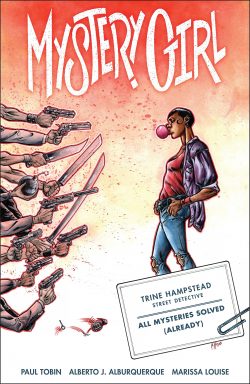
Mystery Girl


By Paul Tobin, Alberto J. Albuquerque, Marissa Louise & Marshall Dillon (Dark Horse Books)
ISBN: 978-1-61655-959-5 (TPB/Digital edition)

There are many fabulous smartly entertaining stand-alone comics collections on the market these days, offering readers a single done-in-one hit of graphic entertainment without the grief of buying into massive back-history or infinite cross-continuity.

One of the best I’ve ever seen compiles a fierce, frenetic and funny 4-issue miniseries from 2015, starring the most infallible detective of all time. No sequel yet, but I live in hope, which is a rather apposite thing to say here…

As crafted by American author Paul Tobin (Marvel Adventures Spider-Man, Plants vs. Zombies, Bandette, Colder) and Spanish artist Alberto Jimenez Albuquerque (Les Fugitifs de l’Ombre, Letter 44, Generation X, Wakanda Forever) – with colours by Marissa Louise and letters from Marshall Dillon – this slim, sleek, slick yarn simply screams for more enigmas to be excitingly unravelled by this sleuthing star in waiting.

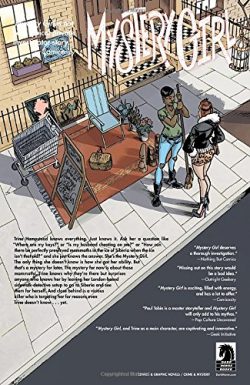
Like any ancient city, London has its fair share of unique characters and unsolved mysteries, but that’s never the case whenever Trine Dorothy Hampstead sets up her “office” on the pavements and begins chatting…

The effusive, ebullient young woman has an incredible gift. She knows the answer to any question she’s asked. Instantly and infallibly. “Where are my keys?” “Did Dad leave a will?” “Where is my missing son’s body…?”

All inquiries get an instant response and every answer is correct!

Trine is a local celebrity in her community, not only for the fact that she’s never judgemental or exploits her gift, but also because everyone knows there’s only one mystery the poor lass can’t solve: how she got her uncanny power…

Trine has an immense taste for life at full throttle and abiding desire to help those in need: regularly consulting with local private eye Alfie and aiding her perpetually sceptical boyfriend Ken Bloke – a Metropolitan police constable – in his work, even though he refuses to believe in her gift…

Her already extraordinary life takes a big step into the unknown when ancient DNA specialist Jovie Ghislain comes to Trine with a fascinating query. The biologist had been researching a 1930’s expedition to the wild Sakha region of Siberia. In the notes of the fabled Weimar-Steinberg trek, the explorers detailed how they uncovered a frozen mammoth carcass so perfectly preserved that the meat was still fresh and edible. Their records are tragically incomplete and Ghislain – desperate to secure viable DNA from the deceased giant – wants to know where the rest of the body is now…

The answer is not immediately forthcoming. In fact, Trine refuses to say anything unless she can join Jovie’s new expedition to personally show the scientists where it is.

Trine thrives on new experiences and this time her gift pays a huge dividend. As preparations are made, she shrugs off all questions from friends and acquaintances, but does confide in her pet budgie Candide. The reason that mammoth meat was so fresh is obvious. It hadn’t been dead long. Now she’s off to see its kin in the only place on earth where the mighty beasts still live…

Sadly, the original expedition – and its journals – are also the subject of a search by wealthy and far less friendly folk. However, when a mystery billionaire commissions a psychopathic hitman to find and secure all the original journals and stop the new expedition, even deadly Linford is taken with Trine. Foregoing his usual callous efficiency, the murdering mercenary takes his time, insinuating himself into the life of all her friends. It’s all working out just fine until the Mystery Girl is asked about her pal’s latest boyfriend and suddenly “knows” all about the new beau – including his actual profession.

Miss Hampstead’s plan to deal with him is shockingly effective, but doesn’t go nearly far enough…

Believing the coast clear, Trine and Jovie head for the Arctic Circle, blissfully unaware that their trail is being dogged by Linford’s sinister paymaster or that the killer himself is down, but not out. Instead, he has devised a cunning method to turn his opponent’s gift against her…

Even so, the obsessive hitman has underestimated Trine’s power, ingenuity and ruthless resolve. However when finesse fails, he can always fall back on overwhelming firepower and direct action…

With the steadfast explorers nearing their frozen El Dorado, the bad guys make their move, revealing what’s actually behind all the death and destruction. Now it no longer matters if Trine is asked the right question or not…

As the ghastly truth of the Weimar-Steinberg expedition is exposed, their heirs and inheritors prove willing to commit mass murder to keep the bloody secret covered up. Happily, Trine asks herself a different question and a life-saving solution pops into her head…

Fast-paced, spectacularly action-packed, witty and superbly balanced as hero and villain play cat-&-mouse around the world, Mystery Girl is funny, imaginative and savagely uncompromising: a superb introduction to a potent and engaging new female character who seems destined for greatness.

Also included are satisfyingly informative bonus features including a copious and heavily annotated Sketchbook section with commentary from Tobin & Albuquerque; concept to finished art examples; cover roughs: designs and unused cover art, all revealing the masses of effort that went into making this such a treat.

Don’t ask why you weren’t in at the beginning of her climb to stardom: get Mystery Girl and become someone with (some of) the answers…
Mystery Girl ™ & © 2015, 2016 Paul Tobin and Alberto J. Albuquerque. Mystery Girl and all prominently featured characters are trademarks of Paul Tobin and Alberto J. Albuquerque.

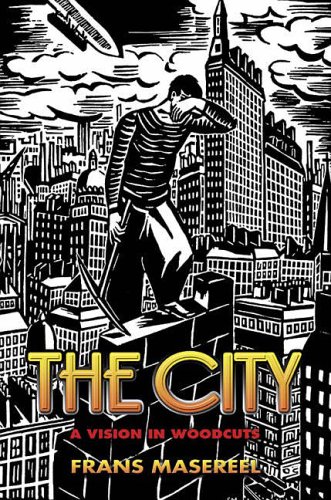
The City: A Vision in Woodcuts


By Frans Masereel (Dover Publications)
ISBN: 978-0-486-44731-5 (TPB/Digital Edition)

We tend to think of graphic novels as being a late 20th century phenomenon, and one that fought long and hard for legitimacy and a sense of worth, but the format was pioneered popularised much earlier in the century… and utilised for the most solemn, serious and worthy purposes.

At the same time as the earliest newspaper strips were being rebound as collected editions, European Fine Artists were addressing the world’s problems in “Wordless Novels”: assembling individual artworks – usually lino or sometimes woodcuts – into narrative sequences which, as the name implies, used images, not dialogue or captions, to tell a story. This also accounts for the other names of the articles – Woodcut Novels/Novels in Woodcut.

The fashion grew out of the German Expressionist movement of the early 20th century which revived and repurposed medieval woodblock printing techniques and even imagery for its own artistic agenda and purposes and was most popular during the 1920s and 1930s. The undisputed master of the form was Flemish artisan Frans Masereel, whose many works were phenomenally popular in German and whose influence spread far and wide – particularly to Depression-era America where Lynd Ward adopted the process for his many sallies against social iniquity, and Giacomo Patri unleashed his anti-capitalist salvo in the wordless novel White Collar as well as comedic parodies such as Milt Gross’ He Done Her Wrong

Masereel (1899-1972) was born in Blankenberge, Belgium and raised by his stepfather, an avowed socialist. He left home to study art in Paris supporting himself through magazine and newspaper illustration, political cartooning and his earliest woodcut prints. He was also a devout pacifist, refusing to fight in WWI, where he instead acted as a translator for the Red Cross. As a result he was unable to return to his homeland and lived most of his life in Germany, Switzerland and France.

In 1918 he created his first narrative: 25 Images of a Man’s Passion and followed up a year later with his masterpiece Passionate Journey. Masereel crafted more than 40 wordless novels, primarily woodcuts, but also a quartet of traditional pen & brush sagas, plus countless illustrations, commissioned paintings, animation works and more. Always stridently and forcefully defending the ordinary man from the horrors of capitalism, disaster and especially warmongering, his potent ability to hone meaning and capture emotion in singular images influenced generations of artists and cartoonists including Ward, Georg Grosz, Will Eisner, Art Spiegelman, Clifford Harper, Eric Drooker, Otto Nückel, Peter Kuper, George Walker and Peter Arno.

The book under review today was first released in 1925 as La Ville: cent bois gravés in France and as Die Stadt in Germany. Originally comprising 100 prints (13cm x 8cm) bound into book form, it quickly became a touchstone for many artists and critics and was hailed as the precursor of a film genre which made environment the focus of narrative (like Berlin: Symphony of a Metropolis or Man With a Movie Camera) and subsequently rereleased in 1961, 1972 and 1988 before this definitive 21st century Dover edition.

The City: A Vision in Woodcuts is translated from the German version as produced by Kurt Wolff Verlag AG (Munich 1925): seeking to forego actual sequential narrative by delivering its stark and startling images encapsulating the modern urban existence. Of course, humans being what we are, readers will find themselves unconsciously imposing form on those unfolding, uncompromising extremely explicit images anyway…

The candid exploration encompasses the highest and lowest echelons of society all rubbing up against each other, zeroing in page by page on the emotions, reactions and consequent horrors such friction creates…

There are bawdy entertainments, diligent toil, crimes of all kinds, quiet times almost unnoticed. We see smoke stacks, railway lines, canals, ports, traffic jams, subways and stations. There are rush hour crowds, fights, civil protests and always personal tragedies: accidents, bad births, thefts, affray, rape murder…

Buildings go up and come down, there is rush and rubbish and courtroom drama: vast office regiments, factory lines and foundry creations. Opulence and desperate poverty co-exist, with the exploited, maimed, forgotten and unwanted ignored by those enjoying themselves at all costs. The masses sing, dance, imbibe carouse and even indulge themselves being part of a grand State funeral. Always people come and people go, some for a different life and others to a “better world”…

It’s a place of constant change and the pace never slows… education, celebration and pauses for thought embrace art edification and human degradation on demand but there is also – for the bold and unbroken – a glimmer of hope…

Stirring, evocative and still movingly inspirational as the world returns to those dark days of Haves, Have-Nots and Why-Should-I-Cares?; this magnificent rediscovery is inventive, ferocious in its dramatic delivery, instantly engaging and enraging: a book long overdue for revival and reassessment and one every callous “I’m All Right” Jackass and “Why Should I Pay For Your…” social misanthrope needs to see or be slapped with…
No © asserted.

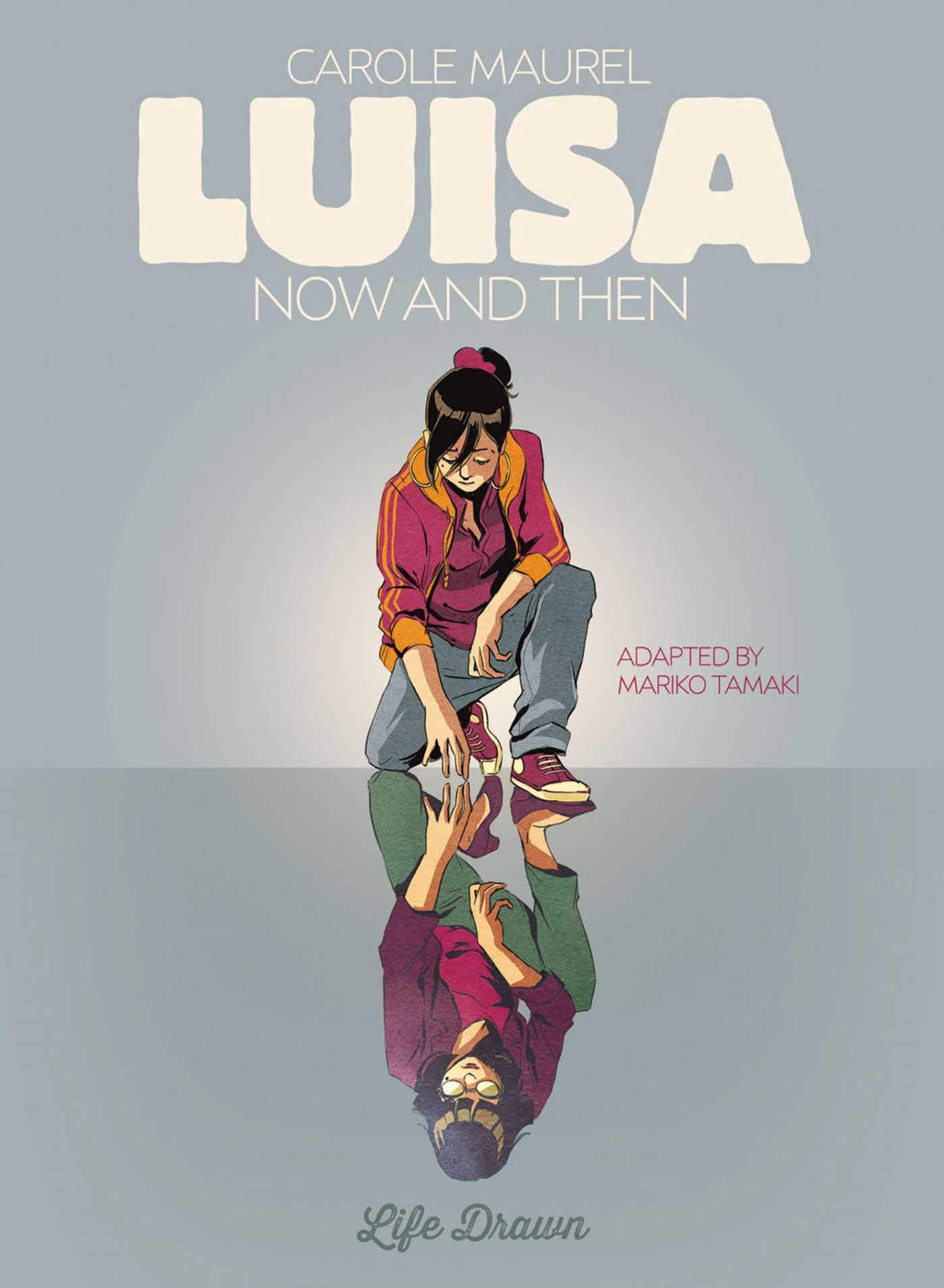
Luisa: Now and Then


By Carole Maurel, adapted by Mariko Tamaki & translated by Nanette McGuiness (Humanoids/Life Drawn)
ISBN: 978-1-59465-643-9 (TPB/Digital edition)

Win’s Christmas Gift Recommendation: Beguiling Fantasy Unwrapped… 9/10

The concept of time travel is infinitely appetising and irresistibly seductive. The literary conceit offers limitless potential for stories ranging from colossal cosmic Armageddons to last-chance salvation gambits; all of history and the imagination as playground and stage; the use of past and future as a Petrie dish for social satire and cultural exploration, and even fantastical magical quests course-correcting lives and providing deeply personal, painfully intimate second chances for the confused, bewildered or simply lovelorn.

Luisa, Ici et là is one of the latter: a compelling and beguiling small story and little miracle by Carole Maurel that first appeared in 2016 and finds us English-speakers courtesy of Humanoid’s Life Drawn imprint.

It’s a sweet and oft-told tale given a stylish and welcoming contemporary gloss thanks to its wonderfully engaging lead character(s) who transforms a regulation coming-of-age parable into a heart-warming plea for understanding and – where necessary – forgiveness.

It begins as 15-year old Luisa Arambol gets off a bus. Exhausted and frustrated by discord at home in Chartres, she’s fallen asleep, missed her stop and awoken in Paris. She’s not aware of it yet, but she’s also journeyed from 1995 to 2013…

Across town, 33-year old Luisa Arambol is bitching to friend and workmate Farid. He’s heard it all before: the job sucks, she’s getting old, she drinks too much and has accomplished nothing. Worst of all, yet another man didn’t work out…

After panicking whilst trying to buy a phonecard – even the money is different here and everyone has a phone in their pocket now! – young Luisa is rescued by concerned observer Sasha who tries to help out the increasingly distressed kid. The child wants to ring her mother but cannot get through and is spiralling…

Hearing her talk and seeing what she’s wearing and carrying, Sasha soon suspects something incredible has occurred. After all, what teenager doesn’t recognise a computer tablet?

A quiet chat stabilises the kid long enough for Sasha to learn that Luisa has an aunt living in the same building she’s just moved into. It turns out Aurelia Arambol’s fifth floor flat is directly opposite Sasha’s new home, but it’s no longer occupied by the odd, ostracised single lady nobody back home will ever talk about. Little Luisa gets a big shock when that door opens and she meets her world-weary, dream-crushed, spinster older self.

Moreover, both versions instantly and instinctively realise who the other is…

Once upon a time an ambitious schoolgirl had dreams of being an art photographer but life has whittled that dream down to something far more mundane. Full grown her was left the flat by Aurelia – for reasons she still can’t fathom – and her spiky, frosty, naturally defensive state is inexplicably heightened by Sasha. Despite herself, older Luisa can’t stop staring at her new neighbour, even taking covert pictures of her, and is deeply troubled by an erotic dream featuring her…

When the object of her fascination is abruptly called away, Luisa reluctantly takes charge of the underage runaway and the situation worsens. Shared stories of mutual pasts and futures take a wild turn as aspects of their so-different personalities begin to transfer. Now-Luisa rediscovers her endless, long-vanished joie-de vivre and party spirit – and even 20-20 vision – and seems to look younger every day, just as Then-Luisa becomes sullen, responsibility-burdened, grey-haired, morose and short-sighted. Moreover, when they touch, their bodies seem to merge and coalesce…

And so begins a clash of wills and resolution of long-unfinished business found to have started on the day teen Luisa cruelly spurned an innocently impulsive overture from “out” and persecuted classmate Lucy.

That event was exacerbated by increased bullying at school and brutally reinforced at home by her own mother’s rigorous rejection of such shocking deviant behaviour as utterly unnatural, sparking a decades-long crusade to find Luisa a man…

Confused and upset, little Luisa acted up, got on a bus and ended up now while her older self just lived a lie for years…

The merging and trading of characteristics lends urgency to affairs before a long-deferred and dreaded confrontation with the Luisas’ mother generates surprising revelations about Aurelia, exposes the unknown fate of Lucy and prompts a complete revision of those attitudes that have shaped and repressed the modern-day doppelganger…

Addressing her family’s ingrained bigotry and intolerance and at last acknowledging and accepting she doesn’t just like boys or have to settle for a man is merely the first step in Luisa’s reunification and readjustment, auguring massive changes for all and forever that will begin when her fresher self at last boards a bus for home…

Refreshingly honest, charmingly blunt and captivatingly funny whist maintaining a sensitive neutrality of opinion – or prejudice – over sexuality and choices, Luisa: Now and Then sparkles with wit and charm: a sophisticated yet simple saga of self-examination that will delight all who read it, embracing the fanciful whimsy of cinema classics like The Enchanted Cottage or the Peter Ustinov’s 1948 film Vice Versa.
Luisa, Ici et là © 2016 La Boîte à Bulles et Carole Maurel. All rights reserved.

Almost Silent


By Jason, translated by Kim Thompson (Fantagraphics Books)
ISBN: 978-1-606-99315-6 (HB/Digital edition)

John Arne Saeterrøy, who works under the pen-name Jason, was born in Molde, Norway in 1965, and appeared on the international cartoonists’ scene at age 30 with his first graphic novel Lomma full ay regn (Pocket Full of Rain) which won that year’s Sproing Award (Norway’s biggest comics prize).

He followed with the series Mjau Mjau (winning another Sproing in 2001) and in 2002 turned almost exclusively to producing graphic novels. Now an international star, he has won seven major awards from such disparate regions as France, Slovakia and the USA.

Here the fine folks at Fantagraphics collected four of his earliest graphic novels in a superb hardback companion to the 2009 classic [Low Moon] which provides more of Jason’s surreal and cinematic, darkly hilarious anthropomorphic ruminations on his favourite themes of relationships and loneliness, viewed as ever through a charmingly macabre cast of silent movie archetypes, cinematic monsters and sad sack chumps.

Told in pantomimic progressions rather than full stories – and often as classical chase scenes reminiscent of Britain’s The Benny Hill Show – the wonderment begins with breakthrough album ‘Meow, Baby’ wherein a mummy goes walkabout from his museum sarcophagus encountering bums and gamins, vampires, aliens, angels, devils, skeletons and cops – always so many cops – in hot pursuit…

This primarily monochrome collection is called Almost Silent because it mostly is. Moreover, what dialogue appears is never informative or instructive, merely window dressing. The artwork is displayed in formalised page layouts rendered in a minimalist evolution of Hergé’s Claire Ligne style: solid blacks, thick lines and settings of seductive simplicity unwinding like an unending, infinite zoetrope show. These early works are collections of gags and situations more experienced than read.

A second untitled tale follows the perceived social inadequacies of males hungry for love: a werewolf, caveman – complete with courting cudgel, a Martian, Frankenstein’s monster and even Elvis. All try and die in the modern dating whirl…

The next sequence introduces cannibal ghouls and a movie-buff Travis Bickle/Arnold Schwarzenegger wannabe also starving for acceptance, and continues with the bleakly comedic ‘Return of the Mummy’ and a delightfully tongue in cheek pastiche of Tintin and Blake and Mortimer entitled ‘The Mummy’s Secret’, featuring the entire ghastly cast, before ending with a fascinating selection of 3-panel gag strips.

The next featured volume is ‘Tell Me Something’: a more ambitiously visual outing that acknowledges its antecedents and influences by using silent movie dialogue cards instead of word balloons. It follows a plucky heroine as she searches for affection in all the wrong places with her Harold Lloyd-like would-be beau. Also in attendance are the usual cast of filmic phenomenons…

‘You Can’t Get There from Here’ concentrates mainly on the 1930s movie Frankenstein cast: the monsters, their equally artificial wives, their lovelorn and covetous creators and even the Igors: misshapen, wizened assistants also all seeking that one special person – or thing. Here the art is supplanted by the startling and highly effective addition of bronze inks for a compelling duo-tone effect that sits oddly well with the beast’s bittersweet search for his stolen, bespoke bride.

We conclude with a rather riotous adventure romp. ‘The Living and the Dead’ details a perfect first date interrupted by the rising of the unquiet dead and end of civilisation in the rotting teeth of carnivorous zombies on their final march – possibly the funniest and most romantic yarn in the whole book.

Jason’s work always jumps directly into the reader’s brain and heart, using the beastly and unnatural to ask gentle questions about basic human needs in a wicked quest for answers. That you don’t ever notice the deep stuff because of the clever gags and safe, familiar “funny-animal” characters should indicate just how good a cartoonist he is.

His comic tales are strictly for adults but allow us all to look at the world through wide-open childish eyes. He is a taste instantly acquired and a creator any fan should move to the top of the “Must-Have” list, so consider this superb hardback your guaranteed entry into his fabulous fun world…
© 2009 Jason. All rights reserved.

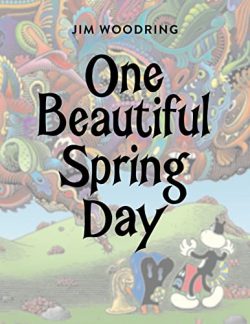
One Beautiful Spring Day


By Jim Woodring (Fantagraphics Books)
ISBN: 978-1-68396-555-8 (TPB/Digital edition) 978-1-68396-588-6 (slipcased HB)

There have always been uniquely gifted, driven comics creators who defy categorisation… or even description. My picks for that elite pantheon of artisans includes Kirby, Ditko, Segar, Hergé, Herriman, Will Eisner, Osamu Tezuka, Robert Crumb, Daniel Clowes, Franquin, Frank Bellamy, Basil Wolverton, Mort Meskin, Kim Deitch, Joe Kubert, Carmine Infantino, Eric Bradbury, Frank Hampson, Tony Millionaire, Alex Niño, Neal Adams, Richard Corben, Wally Wood and a few others who all brought something utterly personal and universally influential to their work just beyond the reviewer’s skills (mine certainly) to elucidate, encapsulate or convey.

They are all perfect in their own way and so emphatically wonderful that no collection of praise or analysis can do them justice. You just have to read their stuff for yourself.

Arguably at the top of that distinguished heap of graphic glitterati sits Jim Woodring. It’s a position he has maintained for years and appears capable of holding for generations to come.

Woodring’s work has always been challenging, funny, spiritual, grotesque, philosophical, heartbreaking, beautiful and extremely scary. Moreover, even after reading and believing that sentence you will still be absolutely unprepared for what awaits the first time you encounter any of his books – and even more so if you’ve already seen everything he’s created.

Celebrated as a cartoonist, animator, fine artist, toy-maker and artistic Renaissance man, Woodring’s eccentric output has delighted far too small and select an audience since 1980 and his official mini-comics forays. Born in Los Angeles in 1952, Woodring suffered delusions and hallucinations as a child and regularly believed his parents wanted to kill him.

These traumas seemingly sensitized and attuned him to symbolism and pictorial expression as well as opening him to assorted philosophies and belief systems. The young lad managed his “apparitions” by drawing them as strips in the waking world where he had control of them. Overcoming problems with school, drugs and alcohol, Woodring was eventually diagnosed with autism and prosopagnosia, but by then he had a discovered the power of Art.

He turned his life around through his own determination and by the inspiration of comics masters like Kirby, Ernie Bushmiller, Gil Kane and Crumb, classical fantasists such as Pieter Brueghel, Hieronymus Bosch and particularly Salvador Dali, and the animations of the Fleischer Brothers, Tex Avery and Walt Disney.

Woodring found surcease from a lifetime of punishing dreams by pictorializing nightmares and through following Buddhism, Taoism and the Hindu philosophy of Vedanta. After working as a farm labourer, garbageman and TV cartoon animator – with occasional comics side jobs like colouring the Roy Thomas/Gil Kane adaptation of the Ring of the Nibelungs, illustrating 1997’s Smokey the Bear, Friend of the Forest, and scripting stints on Aliens and Star Wars – Woodring began fully sharing the messages from his subconscious. He had begun self-publishing his autobiographical, “autojournal” comics in 1980, and seven years later was picked up by Fantagraphics Comics and thereafter all of us…

Readers who avidly adored his groundbreaking, oneirically autobiographical magazine Jim and its notional spin-off series Frank (with graphic novel Weathercraft winning The Stranger 2010 Genius Award for Literature) were joined by fans of Tantalizing Stories, Seeing Things or more mainstream features like his Star Wars and Aliens tales for Dark Horse Comics but, always, there was the promise of greater surprises in his next story…

An accomplished storytelling technician these days, Woodring grows rather than constructs solidly surreal, abstractly authentic, wildly rational, primal cartoon universes, wherein his meticulous, clean-lined, sturdily ethereal, mannered blend of woodblock prints, R. Crumb landscapes, expressionist dreamscapes, religious art and monstrous phantasmagoria all live and play …and far too often, eat each other.

His stories follow a logical, progressional proto-narrative – often a surging, non-stop chase from one insane invention to the next – layered with multiple levels of meaning yet totally devoid of speech or words, boldly assuming the intense involvement of the reader will complete the creative circuit.

This compelling collection is available digitally but works best as the spiffy vellum-cased archival paperback or limited edition boxed hardback: each iteration a superbly recomposed compilation combining earlier segments of his constantly unfolding and refolding saga, now justifiably treated as a treasured artefact… and ideal gift…

Gathered – or maybe corralled – here are the previously-published contents of Congress of the Animals, Fran and Poochytown, all deftly rearranged and supplemented by a hundred pages of new and previously unseen material.

Set in the general environs of Woodring’s wickedly warped other place – “The Unifactor” – here is a wild, weird and welcome return to a land of constant change and intense self-examination, where all motives are suspect and all rewards should be regarded as a trap. And here cheerfully upbeat Frank goes for another exceptionally eventful walk in the sunshine…

Laminating this vertiginous vehicle with an even crueller patina is lovelorn tragedy and loss as Fran adds to the ongoing tribulations of dog-faced Frank: her own perilous perambulations of innocence lost displays pride, arrogance, casual self-deceit, smug self-absorption and inflated ego as big as her former beau’s and leads to a shattering downfall just as punishing.

Put bluntly, Fran was Frank’s wonderful girlfriend and through mishap, misunderstanding, anger and intolerance he lost her. Now, no matter what he does or wheresoever he wanders with his faithful sidekicks at his side, poor Frank just can’t make things right and perfect and good again. Through madcap chases, introspective exploration and the inevitable direly dreadful meetings and menacings in innumerable alternate dimensions, True Love takes a kicking …and all without a single word of dialogue or description.

Here, the drawn image is always king, even if the queen has gone forever – or is it just a day?

Many Woodring regulars return, as both Krazy Kat-like ingénues work things out on the run through a myriad of strange uncanny places. There are absolute mountains of bizarre, devilish household appliances, writhy clawing things, toothy tentacle things and the unspeakable Thingy-things inhabiting the distressingly logical traumic universe.

Jim Woodring’s work is not to everyone’s taste or sensibilities – otherwise why would I need to plug his work so earnestly? – and, as ever, these drawings have the perilous propensity to repeat like cucumber and make one jump long after the book has been put away, but he is an undisputed master of graphic narrative and affirmed innovator, always making new art to challenge us and himself. His is a dreamscape of affable terror and he is can make us love it and leave us hungry for more.

Are you feeling peckish yet…?
© 2022 Jim Woodring. This edition © 2022 Fantagraphics Books. All rights reserved.

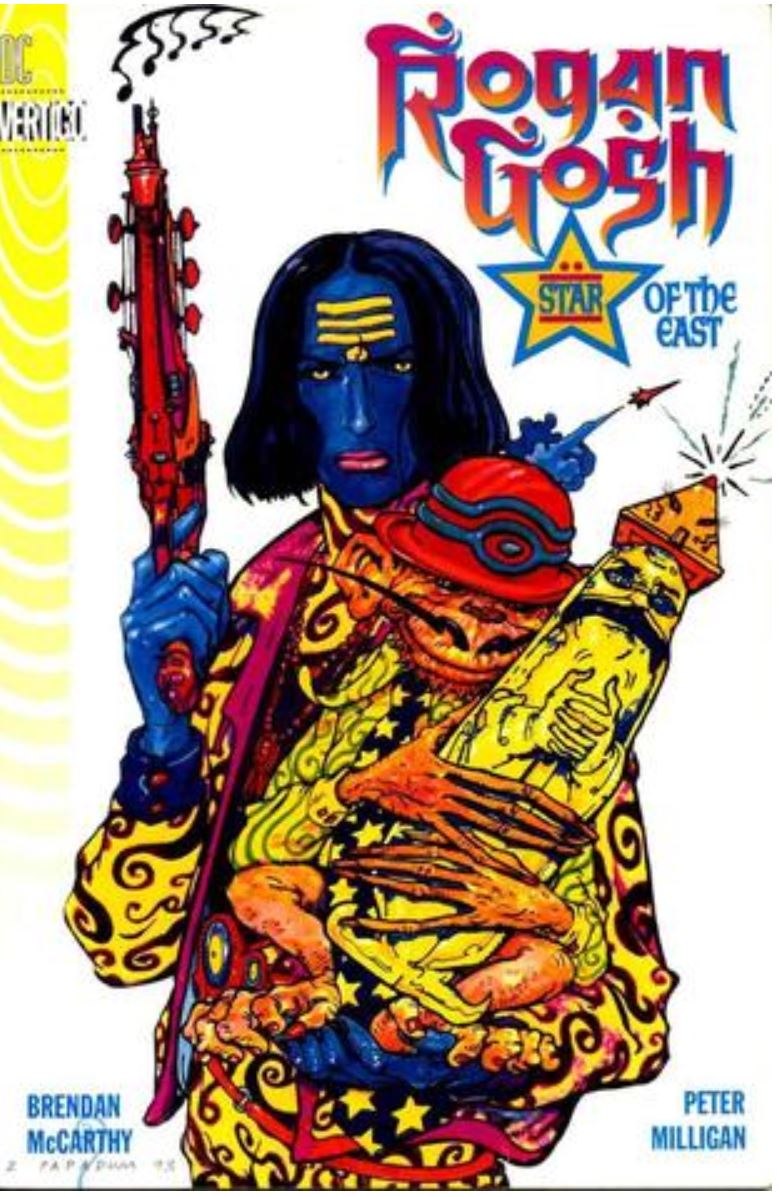
Rogan Gosh: Star of the East


By Pete Milligan & Brendan McCarthy with Tom Frame (Vertigo/Little, Brown & Co)
ISBN: 978-1-56389-143-4 (Vertigo TPB) 1-85386-253-3 (Little, Brown PB)

It feels like a cop-out and total dereliction of duty, but none the less true that some graphic novels simply defy categorisation and defeat the reviewers’ dark arts: they just have to be read, experienced and judged on a personal basis. We could stop there and it’s over to you…

However, should you require more…

Rogan Gosh is a short serial by Pete (Skin; John Constantine, Hellblazer; Strange Days; The Human Target; Batman; Red Lanterns; Shade, the Changing Man; Enigma; The Extremist; X-Statix; Johnny Nemo, Bad Company) Milligan and Brendan (Dream Gang; Mad Max: Road Fury; Judge Dredd; Spider-Man: Fever; ReBoot; Zaucer of Zilk; Skin; Swimini Purpose; Strange Days; Sometime Stories) McCarthy with notable contributions from letterer/colourist Tom Frame.

It first appeared in short-lived, controversial, cutting edge, experimental British comic magazine Revolver – specifically issues #1-6 spanning July-December of the Fleetway Publication. It was later collected into a graphic album by DC/Vertigo in 1994. I’m pretty sure there was also a Fleetway collection, but if so, it’s nigh impossible to find now, and that was a lifetime ago, so I might be dreaming of another reality…

Like companion/precursor title Crisis, Revolver’s brief was to make comics for people who had outgrown funny picture stories and adults who claimed to have never read them. It was supposed to be political, fashionable, contemporary and contentious, and it succeeded over and over again, in strips like Dare, Purple Days, Happenstance and Kismet, God’s Little Acre, Pinhead Nation and Plug Into Jesus.

For many, the jewel in the crown was a bizarre and beautiful, sardonically surreal saga incorporating English curry houses, karmic renewal and exploration, science fiction iconography, cultural commentary and (in)appropriation, ferociously irreverent satirical comedy, and – apparently – concealed creator autobiography. It referenced Indian philosophy and religions, British colonial history and modern urban street life in an onrushing miasma of visual and ideological concepts that blew the mind and generated outrageous belly laughs. There were loads of guns and rockets and tons of sex too…

Like many Milligan & McCarthy creations the strip is often described as “post-modern psychedelia”, evolving from channelled childhood experiences of two white art school kids who had grown up amidst the burgeoning fallout of the Desi Diaspora. That’s when families from the countries of the Asian sub-continent – specifically Pakistan, Bangladesh and India – migrated to western countries like Britain, bringing new thought, music, fashions, scents and especially food to broaden and enrich an evolving multiculture. There were even comics unlike any we’d ever seen before when cruising the streets of Southall or Brick Lane…

Proud products of such an environment and rising superstars thanks to 2000AD, writer Milligan and co-plotter/illustrator McCarthy had planned to deliver a kind of “Bollywood Blade Runner”, but the story sort of got away from them… as is often the case with passion projects…

I’m feeling truly redundant trying to precis the plot, but for the sake of form, try this…

The universe exists on many levels and at all times. In Raj-era India Rudyard Kipling has shamed himself with a native houseboy and now roams the streets of Lahore, seeking a holy man to save his sanity and reputation by putting him in touch with the fabled Karmanauts.

His quest succeeds and the author is – via drugs and magic and ancient wisdom – elevated to a state where he witnesses a future where laddish London oaf Dean Cripps escapes stroppy girlfriend Mary Jane to go for a curry at the magnificent Star of the East in Stoke Newington.

When Dean feels a frisson of connection with beautiful waiter Raju Dhawan, the energy unleashes time-travelling wonder warrior Rogan Gosh just in time to defend enlightenment and all realities from the clandestine attacks of destructive Kali and her malign vampiric agent the Soma Swami

It all gets a bit strange after that, what with audacious experimental love, devastation and recreation, Karma Kops, and that pest monkey god Hanuman, but rest assured that by the end, what you presume to be the regulation natural universe is back near where it belongs…

Although the story and events might bewilder, what is beyond question is the astounding art by Brendan McCarthy: utilising a blend of pen, paint and early digital technology to create a lush and vibrant homage to the startlingly bright colours of the subcontinent and plush décor of favourite London curry houses and tapping the wellsprings of a fevered and sublimely seasoned imagination to beguile the eyes. This stuff is just so damn pretty…

Hard to find in its original form, the entire trip is reprinted in 2013 anthology The Best of Milligan & McCarthy beside lots of other great stuff like Freakwave, Paradax! and Skin. The collection (which is on my to-do list…) is also available in digital format so there’s no need to wait.

Your destiny awaits, you only have to choose to embrace it…
™ & © 1990, 1994, 2013 Peter Milligan & Brendan McCarthy. All rights reserved.

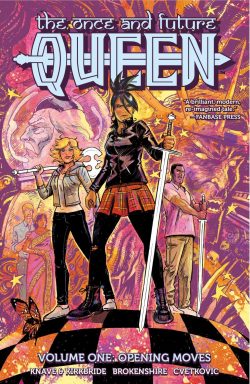
The Once and Future Queen volume 1: Opening Moves


By Adam P. Knave & D. J. Kirkbride, Nick Brokenshire, Frank Cvetkovic & various (Dark Horse Books)
ISBN: 978-1-50670-250-6 (TPB) eISBN: 978-1-63008-793-7

Critics and creative writing lecturers would have you believe all of drama can be reduced to Seven Basic Plots, and all else is mere garnish. Having, in my far-too-long and not-quite-sedentary-enough life, been both (teacher and critic, not edible decoration), I can only say “I can neither deny nor confirm…”

What does happen – a lot! – is that vastly popular and memorable myths, stories and legends are continually reinterpreted and remodelled for new generations. Go reread or see Gilgamesh, Beowulf and Person of Interest or the biblical story of David, Cinderella, Jayne Eyre, Tiger! Tiger!/The Stars My Destination or Slumdog Millionaire… then go play some more on your own. We have pressing business here…

One of the most comforting and potent of these recurring themes is that of a great king or hero waiting to return and redeem us. We probably see it most often in riffs on King Arthur, which are everywhere. If you like such works as Alan Garner’s Brisingamen trilogy (The Weirdstone of Brisingamen, The Moon of Gomrath and Boneland). newspaper strip Buck Rogers, TV’s Adam Adamant and even Camelot 3000, you’ll probably also love this wry, witty and sublimely inclusive spin on the old standard.

Crafted by writers Adam P. Knave & D. J. Kirkbride and illustrated by Nick Brokenshire (the team behind the magical Amelia Cole adventures), The Once and Future Queen features a mixed race (multi-ethnic?), bisexual (or is it non-binary?) girl revealed as destiny’s child and rightful sovereign of England as well as foreordained saviour of the world. No pressure, then…

It begins in Portland Oregon, where youthful chess prodigy Rani Arturus is panicking over her imminent flight to Cornwall for an important tournament. For her dad William, it’s a trip to the “old country” and mum Durga is American by way of India, so it counts as her and her daughter’s roots, too. Rani has no idea how incredibly accurate and life-changing that assessment is…

The tournament is a disaster. All her planning and strategizing go out the window when Rani is distracted by – and fatally attracted to – a pretty blonde girl in the audience. It’s not just her clearly reciprocated attentions: the chess master is convinced she somehow knows her …

Rani doesn’t make it past the first round, and ashamed and furious at the waste of time, money, failure and her own previously unsuspected feelings, walks a scenic Cornish clifftop when a misstep sends her over the edge and into a hidden cave…

Meanwhile, on the clifftop she just disastrously vacated, the subject of Rani’s ruminations is absentmindedly tracing her footsteps. Gwen was irresistibly fascinated by the American contestant, but is used to having instant crushes on girls by now. What is new is how familiar this one seemed, so when she spots the object of her desires entering a cave with glowing light coming from it, she follows…

Rani is beguiled. The cave is an obvious tourist trap and contains a sword stuck in a stone anvil, but she finds herself compelled to tug on it anyhow. As Gwen watches, a flash of light transforms the American into an armoured vision and an old geezer in a space suit appears…

Merlin is time adrift and pretty confusing, but adamantly insists Rani is the long-awaited “Arthur foretold”: the Once and Future Queen (Ruler?) destined to unite the world.

It’s just in time too, as long-exiled magical monster race the Fae are running out of room and resources and are ready eager to return and conquer Earth…

Rani is not convinced. She knows all the stories about King Arthur and the Knights of the Round Table, and knows what a hero should be. However, according to the wizard, lots of things got lost in translation and that guy was simply a well-meaning fraud: a place holder dragged in to cope with a momentary crisis in lieu of the big event kicking off just about now…

Gwen has already impetuously left for Portland by the time Rani’s incredulous parents are brought up to speed and when the girls finally meet in a park, they head for a diner to get to know each other, only to discover their server Lance went to school with Rani and, like Gwen, is also part of the magic revival. In a corner booth sits world-renowned and beloved fantasy author Morgan Pari: also a key actor in the replaying saga, but before the celebrity-struck kids can get near her, a squad of War Fae materialise and savage battle for Earth is joined…

Merlin’s magic has made Excalibur and Rani’s armour instantly accessible and also imparts warrior skills to the Queen. Shockingly, the same is true for Gwen and Lance who at last realise they are physical echoes of past legendary beings too…

Having survived their trials by combat, the heroes reborn are whisked away by Merlin who tells them the true story of the human history and the war against the  malign King in Shadow to prepare them for the forthcoming greatest fight in human history…

Sadly, as they train and repeatedly skirmish with the Fae, what’s also inescapably repeating is the romantic triangle that destroyed the Camelot they all draw their preconceptions from…

Not all is written in stone. As the heroes move their already-targeted loved ones to a safe space, and strategize their next moves, a key component of the Fae army goes off-script, splitting the enemy’s forces and resolve, but also sparking a brutal, highly public clash that serves to put blinkered humanity on terrified high alert…

Now, with everything to play for, the endgame has become utterly new territory and all the reborn champions can do is ready themselves for anything…

To Be Continued…

Fast-paced, action-packed, bright, breezy and slyly funny, The Once and Future Queen: Opening Moves is a delight to read, with this opening chapter augmented by extras including a design sketchbook with commentary from all concerned; cover concept roughs; selections from the minicomic used to pitch the series to Dark Horse; colour palette roughs and an alternate ending. If you’re in the mood for something familiar that enticingly fresh and new, your quest ends and begins here…
The Once and Future Queen™ & © 2017 Adam P. Knave, D. J. Kirkbride & Nick Brokenshire. All rights reserved.