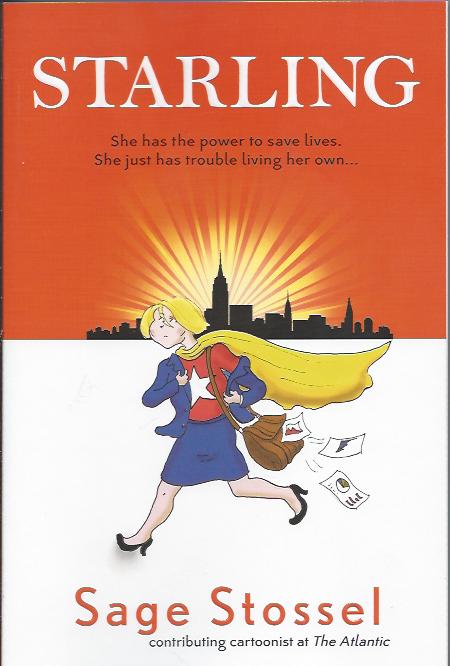
Starling


By Sage Stossel (Penguin/InkLit)
ISBN: 978-0-42526-631-1 (PB)

Once upon a time only little boys (of any age from 3 to 99) liked superheroes.

That’s all different now.

Just like always, girls eventually steal boy’s stuff and break it or point out how stupid it is and ruin it or decorate and fancy it up so that it makes proper sense and is generally better, but it was still ours first though…

Let’s start again.

Sage Stossel is a children’s book author (On the Loose in Boston, On the Loose in Washington DC, We’re Off to Harvard Square), editorial cartoonist (Sage, Ink.) and Editor at The Atlantic, whose smart, wry, ostensibly innocuous efforts have also appeared in The Boston Globe, CNN Headline News, New York Times Week in Review and scads of other extremely prominent and worthily impressive places. You can go online and see how much fun and work she got out of the 45th President…

A native Bostonian, she majored in English and American Literature and Languages at Harvard where she permanently succumbed to the cartooning bug, producing student-life strip Jody for The Harvard Crimson. She was instrumental in creating The Atlantic‘s online iteration.

Starling is a superbly knowing sideswipe at the world’s newest fiction archetype, cleverly delving deep into the psyche of the kind of person who might actually fight crime if they had superpowers and how such a “career” might actually impact upon a sensible person.

Stossel also manages to tell a winning story about overcoming adversity, finding oneself and even having a shot at achieving true love, all lovingly ladled out in a savvy, self-deprecating, droll, artfully humorous manner…

Amy Sturgess has a secret. Up until now she’s only shared it all with her therapist, but balancing her job in the back-stabbing world of Marketing with the constant demands of the Vigilante Justice Association (who perpetually text her about occurring crimes she’s expected to foil immediately, no matter what she’s doing) is taking its toll.

At the Agency, a conniving male co-worker is actively stealing her work and sabotaging her career. Her cat-hoarder mom lives in a world of her own. Her brother Noah is a druggie lowlife – but at least he’s trying to get his life together, whilst her own (especially as regards dating) is a stalled and floundering disaster…

No wonder she relies so heavily on prescription meds and is plagued by bouts of crippling procrastination…

Things take a tortured upturn when her college sweetheart resurfaces. Russell is married to a wonderful woman (who actually becomes one of Amy’s best friends) but is clearly trying to rekindle those heady student passions with Amy and the situation soon begins to affect both sides of Amy’s work.

B-list costumed crusader Starling even begins to let certain offenders go: robbers stealing from banks who repossessed their homes, a homeless man trying to free his dog from the Animal Control impound…

A crisis point is reached when rival gangs begin a turf war and a modern Artwork is stolen. It doesn’t take much investigation to link Noah to both crimes, but when he disappears and Starling frantically hunts for him, she is incessantly stymied and interrupted by the hunky rogue and illicit gambling organiser Matt McRae.

The enigmatic hustler seems to have connected Amy to Starling and says he only wants to help, but he’s a crook.

A really, really good-looking, apparently unattached crook…

Amy isn’t Wonder Woman or Ms. Marvel. She’s just a well-intentioned young woman who found she was different and got pushed into a second (full time, secret and unpaid) career when she couldn’t even decide on how to make her first one work. Talk about your Mental, Emotional and Ethical Loads…

Now she has a really serious crime to solve, a brother to save, a romantic triangle to square and an unsuitable suitor to sort out…

More RomCom than Summer Blockbuster, Starling is a slow-paced, lovingly crafted, laconic, ironic and purely humorous tonic for lovers of the medium reared on adolescent wish-fulfilling, juvenile male power-fantasies who now yearn for something a little different. It even deliciously points out all the reasons why superheroes are dumb before wittily showing how that’s not necessarily bad and showing one way of making them better…
© 2013 Sage Stossel.

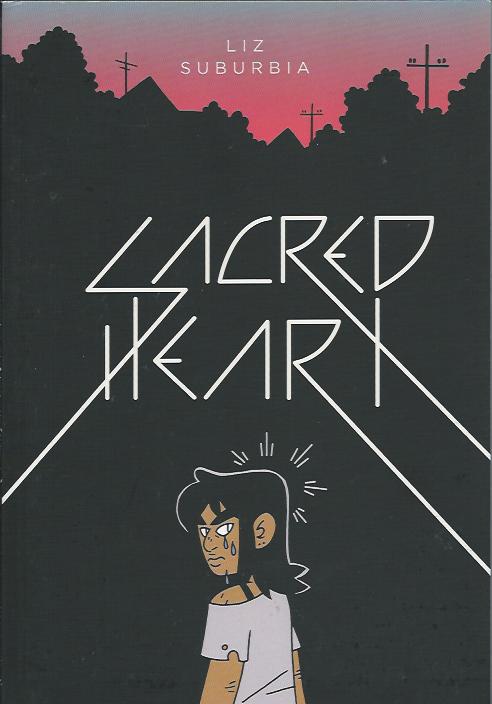
Sacred Heart


By Liz Suburbia (Fantagraphics Books)
ISBN: 978-1-60699-841-0

What would have happened when you were a teenager and your parents went away for the weekend?

What if they didn’t come back for four years? And what if the same thing happened to every household in your little town at the same time?

Visually, elements of Charles Burns and Johnny Ryan crackle and charm beside graphic echoes of the Hernandez Brothers in Sacred Heart: the stunning graphic novel which tackles the conundrum with perspicacity, near-feral insight, righteous anger and a great deal of sentiment-free warmth.

As much mystery thriller as “Having Come of Age” tale, the mesmerising story opens in little everytown Alexandria which at first glance seems to have gotten a little rowdy of late, but for all the late-night drinking, hot-rodding, incessant partying, lewd behaviour and hijinks is carrying on as best it can.

The older teens are looking after the little kids, school is still attended, the local store still carries provisions and life goes on pretty much as before, even though there hasn’t been a responsible adult in situ for years…

Ben Schiller cares for her rapidly maturing – and consequently increasingly difficult – little sister Empathy; her life-long nerdy punk friend Otto still works part-time at the video store – when he’s not stealing girls’ panties – and he and she still watch weird movies most evenings, trading gossip and stories about who they’re currently seeing…

Elsewhere in their unique community, local garage-band The Crotchmen are the only good thing to see of an evening and Erica‘s baby still hasn’t come.

Jocks still act like meatheads and the pretty girls still chase them whilst standoffish Ben remains involved but apart. She isn’t ignored or reviled these days as she’s devised a method of tattooing which makes her a vital component of the new society…

Recently though, some of the little kids have been acting a little weird: descending into mysticism and fortune telling whilst default storekeeper Jack Brown is claiming that soon he won’t be able to get any more booze or gas for the town’s remaining functional cars, but of course the real downer is how many of the older teens have been found murdered in the last few weeks…

The kids all apparently accept the growing “Dead Kids Club” as a part of life in their little town, but as the summer of excess rolls on towards Fall, things start to change. Firstly Ben and Otto endanger the perfect friendship by bringing sex into the equation, after which an actual adult is seen in town but escapes and Crotchmen’s lead singer joins the casualty list and is replaced with a girl.

Hulking drummer Hugo starts planning how to take his little charges and break out to freedom as the kindergarten seers all predict the end of everything is coming, but worst of all, as colossal storm clouds gather, when Ben discovers who the serial killer is, she can do nothing about it…

Compiled and cunningly rearranged from her webcomic, Liz Suburbia’s chilling yarn is potent, uncompromising yet guardedly hopeful: a glimpse at teenagers who terrify all us old farts as they deal with a dangerous world not by crumbling as we assume they will, but by rising to the challenge and accepting the responsibilities we probably wouldn’t.

Gripping, compelling, rewarding and astoundingly readable, this is a book to exult in.
Sacred Heart © 2015, Liz Surburbia. This edition © 2015 Fantagraphics Books, Inc.

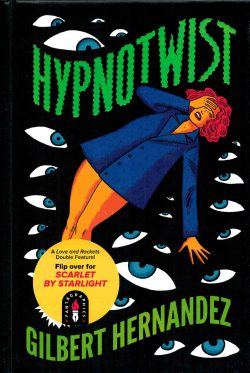
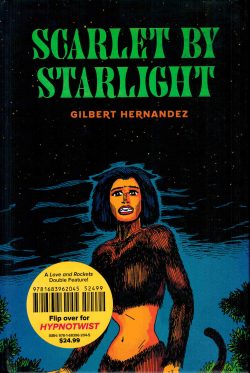
Hypnotwist/Scarlet by Starlight


By Gilbert Hernandez (Fantagraphics Books)
ISBN: 978-1-68396-204-5 (HB)

In addition to being part of the graphic/literary revolution of Love and Rockets (where his astonishingly addictive tales of rural Palomar first garnered overwhelming critical acclaim), Gilbert Hernandez has produced stand-alone books such as Sloth, Birdland, Grip and Girl Crazy: all graced with his bold, compellingly simplified artwork and inspired adaptation of literary techniques used by Magical Realist writers such as Carlos Fuentes and Gabriel García Márquez – techniques which he has amplified and, visually at least, made his own.

Hernandez also frequently acknowledges such outré mainstream influences as filmmakers Roger Corman and John Cassavetes, and crime writers Elmore Leonard and Jim Thompson, as he explores new territories and reforms the cultural influences which shaped all us baby-boomers.

In Luba we glimpsed the troubled life of the lead character’s half-sister Rosalba “Fritzi” Martinez: a brilliant, troubled woman, speech-impaired psychotherapist, sex-worker, belly-dancer and “B-movie” starlet of such faux screen gems as We Love Alone, Seven Bullets to Hell, Chest Fever, Blood is the Drug and Lie Down in the Dark.

Although Fritzi only had a bit part in it, Hernandez “adapted” one of those trashy movies into a graphic novel (Chance in Hell, 2007) and repeated the story-within-a-story-within-a-story gimmick in 2009 with The Troublemakers – a frantic, hell-bent pulp fiction crime thriller which was part of the screen queen’s canon – and did it again in 2011 with Love from the Shadows.

Here, he’s gone a step further by revisiting the tone of those tales in the format of the 1960’s publishing trend for two-cover paperback releases offering a double-bill of exceedingly eccentric adult-themed sagas drawn from the schlocky, sleazy B-movie subculture of those times.

Deftly mimicking a compelling-but-trashy post-Noir psycho thriller and titillating Sci-Fi melodramas, both of these tales originated a decade ago in Love and Rockets: The New Stories and have been expanded for this volume.

You can start at whatever end you like – it’s a democracy, after all – and I’ll go with the wildly experimental graphic mime Hypnotwist. With overtones of Justine (or The Misfortunes of Virtue, the 1791 novel by Donatien Alphonse François de Sade), this eerie meander through the perils of modern debauchery follows a lost and vulnerable young woman on an astonishingly bizarre voyage of discovery…

If you flip to the far end, you’ll then be regaled by Scarlet by Starlight: a multi-perspective narrative that appears at first to be a science fictional fable of humanity despoiling a primitive Eden, before evolving into something far more disturbing. On a distant world, a team of three earthling explorers are helpless to prevent themselves becoming far too intimate with the primitive yet buxom anthropoids that populate the planet. As the human relationships break down, unwise new bonds are formed with unpleasant and even harrowing results…

Savage and sexually explicit, this exploration of drives and desires takes a further step into forbidden territory after the bold explorers return home…

Dark, evocative and astoundingly compelling, these are perfect pastiches of revered genres from a time period growing increasingly remote and fabulous. This slim hardback/digital delight is a stunning graphic rollercoaster ride of sex, violence, greed and obsession: a mesmerising treat jam-packed with Hernandez’s coolly understated narrative suspense, intoxicating illustration, brutally raw tension, sly elements of filmic surrealism and sheer surreal excess which carry and beguile the reader in classic style.
Hypnotwist/Scarlet by Starlight © 2021 Gilbert Hernandez. This edition © 2021 Fantagraphics Books, Inc. All rights reserved.

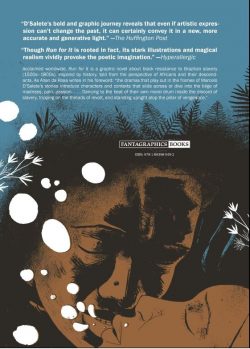
Run for It – Stories of Slaves who Fought for their Freedom


By Marcelo D’Salete, translated by Andrea Rosenberg (Fantagraphics Books)
ISBN: 978-1-68396-049-2 (HB)

Art historian Professor Marcelo D’Salete was born in 1979 and is one of Brazil’s most respected authors and graphic novelists. A graduate of Carlos de Campos College and the University of São Paulo, much of his output examines the relationship of the country to its history of slavery and issues affecting the vast Afro-Brazilian underclass resulting from it.

This multi award-winning translation (hardback and digital formats are available) of Cumbe comes from 2017 and details in stark and shocking monochrome, all but devoid of dialogue or narration, a quartet of stories of slaves who risked everything to escape their shackles and set up free villages beyond the reach of their would-be masters and owners.

A brief Introduction sets the scene and adds context to the period (1500s-1800s) and explains the exact meaning and derivation of catch-all term “cumbe”. You won’t need much more. These are timeless tales of a problem that has been plaguing humanity since long before we started counting days and years. It’s with us still: either overtly or hidden behind sly commercial subterfuges like “zero hours contracts” and “races to the bottom”…

Appreciative, informative Foreword ‘The Sun rises on Brazilian Bantu Culture’, by Allan Da Rosa, further stokes every decent person’s moral outrage before the astounding examinations of humanity at its best and worst opens with ‘Kalunga’as a young man in love plots with his beloved to run away to the endless water of the title. Tragically, Valu and Nana are not as subtle as they think, or as determined as they need to be…

The troubles caused by white debauchery and slave pregnancy are ruthlessly detailed in ‘Sumidouro’ (The Well) when a natal event leads to death and terror, after which plans for a long-overdue slave revolt stumble as the plotters succumb to fear, mistrust, treachery and incompetence in ‘Cumbe’…

‘Malungo’ means comrade and refers to a special companion sharing the journey from Africa to Brazil. As terror and superstition grips workers planning bloody reprisals against plantation-owners, the term takes on new meaning…

Accompanying these captivating parables is a full Glossary of terms and their originations, plus a copious Bibliography. Awful and beautiful, this is a superb testament to depravity and hope and one every casual consumer of corporate culture needs to see.
© 2017 Marcelo D’Salete. This edition © 2017 Fantagraphics Books. All rights reserved.

Red Range: A Wild West Adventure


By Joe R. Lansdale, Sam Glanzman & various (It’s Alive!/IDW)
ISBN: 978-1-63140-994-3 (HB)

Once upon a time, not that very long ago, nearly all of popular fiction was obsessed with tales of Cowboys and Indians. As always happens with such periodic popular phenomena – for example the Swinging Sixties’ Superspy and Batmania booms or the recent trend for Vampire and/or Werewolf Boyfriends – there was a tremendous amount of momentary merit, lots of utter dross and a few irrefutable gems that would affect public tastes from then on.

Most importantly, once such surges have petered out, there’s generally a small cadre of frustrated devotees who mourn its passing and, on growing up, resolve to do something to venerate or even revive their lost and faded favourite fad…

Following World War II, the American family entertainment market – for which read comics, radio and the nascent but burgeoning television industry – became comprehensively enamoured of the clear-cut, simplistic sensibilities and easy, escapist solutions offered by the antiseptic anodyne branch of Tales of the Old West; already a firmly established favourite of paperback fiction, movie serials and feature films.

I’ve often pondered on how almost simultaneously a dark, bleak, nigh-nihilistic and oddly left-leaning Film Noir genre quietly blossomed alongside that wholesome revolution, seemingly for the cynical minority of entertainment intellectuals who somehow knew that returned veterans still hadn’t found a Land Fit for Heroes… but that’s a thought for another time and a different review.

Even though comic books embraced six-gun heroes from the very start – there were cowboy crusaders in the premier issues of both Action Comics and Marvel Comics – the post-war years saw a vast outpouring of anthology titles with new gun-slinging idols to replace the rapidly-dwindling supply of costumed Mystery Men, and true to formula, most of these pioneers ranged from transiently mediocre to outright appalling. And they were all white.

With every comics publisher turning hopeful eyes westward, it was natural that most of the historical figures would quickly find a home and of course facts counted little, as was always the case with cowboy literature…

Despite minor re-flowerings in the early 1970s and mid-1990s, for the longest time cowboy comics largely vanished from graphic pages: seemingly unable to command enough mainstream commercial support to survive the crushing competition of garish wonder-men and the furiously seductive future-scapes.

Europe and Britain heartily embraced the Sagebrush zeitgeist, producing some pretty impressive work, with France and Italy eventually making the genre their own by the end of the 1960s. They still make the best straight Western strips in the world…

Happily, however, an American revolution in comics retailing and print technologies at the end of the 20th century allowed fans to create and disseminate relatively inexpensive comic books of their own and – happier still – many of those fans are incredibly talented creators in other genres. A particularly impressive case in point is this captivating lost treasure originally published by independent, creator-led outfit Mojo Press.

The brainchild of Richard Klaw (publisher, reviewer, essayist, writer, historian and self-confessed geek maven), the little outfit published amazing and groundbreaking horror, fantasy, science fiction and Western graphic novels – plus some prose books – between 1994 and their much-lamented demise in 1999.

As revealed in Klaw’s informative Introduction ‘When Old is New and New Old‘, Red Range was probably their most controversial release: an uncompromising adventure tale and deftly-disguised (a tad too much so, apparently) attack on contemporary racism and institutionalised bigotry, astoundingly couched as an ultra-violent cowboy revenge yarn.

Originally published in stark monochrome in 1999, Joe E. Lansdale & Sam Glanzman’s amazing unfinished odyssey was remastered and adapted to full-colour (courtesy of Jorge Blanco & Jok and letterer Douglas Potter) and given a new lease of life in this sublime hardcover/digital edition, just as America’s worst President seemed set to return the nation to those days of implicit supremacism, casual segregation and wealth-based Jim Crow laws…

A Word of Warning: if your sensibilities and senses are liable to freak out at profoundly yet historically accurate scenes of violence or repeated use of the “N” word as used by drawn representations of murdering racist bastards in white sheets, don’t buy this book. Actually, do buy it; just don’t whine that you weren’t warned…

Texas in the late 19th century: a band of Klansmen brutally torture a black family who have the temerity to buy land and plant crops. The ignorant butchers’ repugnant fun is mercilessly interrupted when a masked negro vigilante known as TheRed Mask attacks, killing many and driving off their leader Batiste.

The unlikely avenger is too late to save the parents, but takes their son Turon under his wing. As they ride to his hideout, the lone rider confides in his youthful new companion. Caleb Range‘s story is appallingly similar to the boy’s own tragedy. It’s probably one repeated hundreds of times every day in America since the Black Man was first emancipated…

Back in town, Batiste recruits a specialist tracker and plenty more white men eager to teach “coloureds” their rightful place. Hunting down Red Mask, the bigot again underestimates his quarry’s determination and facility with weapons…

Angry, frustrated and humiliated, Batiste gathers yet more men and sets out to end his nemesis forever. Relentless pursuit leads into the desert wastes and straight out of any semblance of rationality as Caleb and Turon survive one more cataclysmic battle before falling into a lost world of ancient tribes and ravenous dinosaurs, with Batiste and his few surviving killers hard on their heels…

In this place however, it’s the so-superior white men who are seen as less than human by the indigenous inhabitants: nothing more than prey and provender. Regrettably, they hold pretty much the same opinion regarding Caleb and Turon, who quickly discover they might not just be lost in space but also time…

To Be Continued…

Vivid, shocking, staggeringly exciting, ferociously uncompromising and often outrageously, laugh-out-loud funny, Red Range has both message and moral, but never for a moment lets that stand in the way of telling a great story.

Adding value and enlightenment, this opening chapter in an extended saga is augmented by ‘Beneath the Valley of the Klan Busters: (A Sort of) Afterword by Stephen R. Bissette’ which offers historical and social context to the proceedings and inside gen on creators Lansdale & Glanzman, as well as a potted history of the role of black people in western movies from 1920s star-turn Bill Pickett to Jamie Foxx in Django Unchained.

The bonus goodies continue with a silent monochrome masterpiece of action and bleak, black humour. ‘I Could Eat a Horse!’ was first seen in Wild West Show (1996) with the artist displaying a firm grip of both killer slapstick and grim irony as Cowboy, Indian and other beasts go in search of a meal, before Bissette rides us into the sunset with an erudite and fascinating trip down memory lane for “Pop Culture Cowpokes and Carnosaurs” with ‘A Brief History of Cowboys & Dinosaurs’…

These fresh looks at an overexposed idiom prove there’s still meat to found on those old bones, and cow-punching aficionados, fans of nostalgia-tainted comics and seekers of the wild and new alike can all be assured that there’s a selection of range-riding rollercoaster thrills and moody mysteries still lurking in those hills and on that horizon…
Red Range: A Wild West Adventure © 1999-2017 Joe R. Lansdale. “I Could Eat a Horse” © 2017 Sam Glanzman. “When Old is New and New Old” © 2017 Richard Klaw. “Beneath the Valley of the Klan Busters” and “A Brief History of Cowboys & Dinosaurs” © 2017 Stephen R. Bissette. All rights reserved.

The Mythology of S. Clay Wilson: volume 1: Pirates in the Heartland


By S. Clay Wilson, edited by Patrick Rosenkranz (Fantagraphics Books)
ISBN: 978-1-60699-747-5 (HB)

Once more, I’m altering the fixed schedules to note the passing of a giant. Everybody’s losing loved one in far greater numbers than we can really afford or cope with, but this one is even more poignant and powerful: the death of one of the most vital and vigorous cartoonists we’ve ever been privileged to enjoy. Here’s a parental warning to prove it…

This book is filled with dark, violent sexual imagery and outrageous situations intended to make adults laugh and think. If that hasn’t clued you in, please be warned that this book contains images of nudity, extreme violence, sexual intimacy and excess – both hetero- and homosexual – and language commonly used in the privacy of the bedroom, drunken street brawls and school playgrounds whenever adults aren’t present.

If the thought of all that offends you, read no further and don’t buy the book. The rest of us will just enjoy some of the most groundbreaking cartoon experiences ever created without you.

Steve Clay Wilson was a pioneering light of America’s transformative Underground Commix movement: an uncompromising, controversial, in-your-face pioneer of the counterculture, constantly challenging attitudes and sensitivities whilst telling the kind of cartoon tales he wanted – or perhaps had – to.

Something of a contradiction to those who knew him, charming, charismatic Wilson lived life to the full and took his art seriously.

And what art! Stark, complex, shocking, incredibly detailed tableaux jumping with modern Rabelaisian content: mesmerising scenes packed with intense multi-layered busyness, crammed with outrageous, iconic characters in constant surging motion – mostly combative and hilariously violent.

The manly, hedonistic exuberance of frantic fighters rejoicing in the wild freedom as exemplified by bikers, cowboys, pirates, bull dykes and devils, augmented by other violent ne’er-do-wells, grotesques, human-scaled beasts and things which could be drawn but never described…

His work seethed and abounded with excess: monsters, mutilations, booze and drug-fuelled romps populated with priapic plunderers and ravening beasts, dangerous and disturbed women and always, always unsettling scenes of society’s biggest taboos – sex and personal freedom.

All Americans already worshipped violence; Wilson just pushed the visuals for that sacrament as far as he could into surreal parody. Everybody who knew Wilson adored him, but around him they were usually a little nervous and stepped lightly…

The modern successor to Pieter Bruegel and Hieronymus Bosch moved on to other artistic arenas when the Underground movement foundered, but he never toned down his visions. In 2008 he suffered massive brain damage in mysterious circumstances and underwent full-time palliative care ever since. He died aged 79, on Sunday February 7th 2021.

This intimate and informative oversize (286 x 202mm) hardcover biography and graphic overview – also available in digital formats – is compiled from previous writings and extensive interviews with the people he grew up with and who shared his eventful life.

Moreover, each telling anecdote and reminiscence is augmented with photos, paintings, illustrated letters and private or previously-unpublished artworks, and each chapter offers a wealth of gloriously outrageous strips: comprising all of his published comics work from the heady days of America’s counterculture explosion in 1968 to its virtual demise in 1976.

It opens with a warm, picture-packed, fact-filled Introduction by college pal and flatmate John Gary Brown before the hagiography of horrors begins with ‘Wilson’s Childhood’.

Described by Robert Crumb as “the strongest, most original artist of my generation” Steven Clay Wilson grew up in down-home Lincoln, Nebraska, thriving on a diet of EC comics (especially Piracy), post-war prosperity and Great Plains sensibilities. His early life was filled with good family, cool pets, cycling, school and drawing.

Lots of drawing (much of it impressively included in the first chapter) takes us out of High School and into college, but before that unfolds there’s a gory welter of early triumphs in the black and white comics section which includes such classics as ‘Shorts in the Bowl’ (from Gothic Blimp Works #1), ‘River City Shoot-Out’ from the second issue and ‘No Loot for You, Captain Namrooth’ from Gothic Blimp Works #6, all circa 1969, followed by a ‘Goodtimes Front Cover’for May 1st 1970.

The entirety – 26 images – of the mega-successful arts project which became ‘S. Clay Wilson Portfolio Comix’ leads into the strip ‘Afterwards’ (Hydrogen Bomb Funnies, 1970) and the tableaux ‘It’s a Thrill to Kill’ from Thrilling Murder Comics, 1971 and ‘The 137th Dream of Lester Gass’ (Illuminations, 1971).

A productive strip period begins with ‘Insect Paranoia’ (Insect Fear #1),‘Insect Angst’ (#2, both 1970) and ‘Insomnia Angst’ (#3, 1972), followed by ‘Boogie Boogie Horror Yarn’ (Laugh in the Dark, 1971) and closes with ‘Whip Tip Tales’and ‘Soft Core Porn Yarn’ from San Francisco Comic Book issues #1 and #3 in 1970.

Wilson’s turbulent brush with art school and academia at the University of Nebraska is detailed in ‘Higher Education’ as is his understandably less than glorious military service and adoption of the drop-out life style, topped off by more manic strips and panels (he called them “Deep Scenes”) beginning with ‘The Hog Ridin’ Fools’ (Zap Comix #2, 1968 and featuring a very early appearance of Wilson’s signature character the Checkered Demon). That issue also supplies ‘Just as you said Madge… He’s Shitting’ and ‘Head First’, whilst from the third comes ‘Captain Pissgums and His Pervert Pirates’, ‘Gilded Moments’, ‘Captain Edwards St. Miguel Tilden Bradshaw and his crew come to Grips with bloodthirsty foe pirates’, ‘Come Fix’ and ‘Arnie, my bra ain’t on’.

Wilson drew at a phenomenal rate and Zap Comix #4 1969 unleashed ‘A Ball in the Bung Hole’, an untitled phantasmagorical double-spread, ‘Leather Tits’ and the debut of his occasional lewd lead ‘Star-Eyed Stella’. Zap #5 (1970) barely contained ‘Lester Gass the Midnight Misogynist’, ‘Ruby the Dyke Meets Weedman’ and ‘Snake Snatch Tale’.

At the end of 1966 Wilson relocated to ‘Lawrence, Kansas’: a burgeoning Midwestern oasis of countercultural thought and self-expression, and a useful place to concentrate creative energies before his inevitable move to the West Coast. This chapter is abutted by another wave of glorious filth and ferocity, comprising non-biblical epic ‘The Felching Vampires Meet the Holy Virgin Mary’ (Felch Cumics, 1975), adult fairy tale ‘Puducchio’ from Pork (1974), which also offers a quartet of single-frame gags, after which Bent (1971) provides Deep Scene ‘Dwarf Snuffing Station #103’, ‘Pendants’; a return engagement for ‘Star-Eyed Stella’ and ‘Nail Tales’.

Declaring “Art is Therapy”, Wilson always saw its creation as a collaborative process: one which demanded a response. On reaching the golden lands of ‘The Barbary Coast’ his artistic jams with the likes of Crumb – who claims the flatlander inspired him to completely release all his artistic inhibitions – and creative compadrés like Spain Rodriguez, Rick Griffin, Robert Williams and Victor Moscoso, made them royalty in the San Francisco heart of the revolution.

That star-studded, astounding period and how it began to fade makes up the last revelatory chapter in this initial volume (of three) and concludes with one last selection of colour and monochrome masterpieces including eye-popping ‘Deranged doctors perform operational experiments on mutated patients under the antiseptic incandescent gaze of the Big Daddy Devil Doctor’ from Arcade #3, 1975; illustrations for William Burroughs’ seminal short story ‘Fun City in Badan’ (Arcade #4), ‘The Corpse Gobblin’ Ogre of Columbite Mountain’(Arcade #5), ‘Monster Bride’ (Arcade #6) and ‘Vampire Lust’ (Arcade #7, 1976).

Also on show are multi-hued strip ‘Last Foe’ (Apple Pie July 1975), the cover from Zap Comix #3, front-&-back covers from S. Clay Wilson Portfolio Comix, Bent and Pork; ‘It’s a treat to blast away the flat foot’s feet’ from Tales of Sex and Death #1 (1971), 8-page, in-record minicomic insert ‘The Saga of Yukon Pete’ from the vinyl platter of the same name by Son of Pete and the Muffdivers, wrapping up in fine style with the infernally euphoric ‘Surfsup’ strip from Tales from the Tube #1, 1972.

Scholarly yet surprisingly engaging, this superb collation, contrived and shepherded by Patrick Rosenkranz, offers an amazingly and unforgettable close-up view of one of the most important cartoonists in American history. This is a book no serious lover of the art form or devotee of grown-up comics can afford to miss.
The Mythology of S. Clay Wilson volume one: Pirates in the Heartland © 2014 Fantagraphics Books. All comics and images by S. Clay Wilson © 2014 S. Clay Wilson. All biographical text © 2014 Patrick Rosenkranz. All other material © 2014 its respective creators and owners. All rights reserved.

QU33R


By various; edited by Rob Kirby (Northwest Press)
ISBN: 978-1-93872-038-3 (HB) 978-1-93872-036-9 (TPB)

It’s long been an aphorism – if not cliché – that LGBTQ comics are the only place in the graphic narrative business to regularly portray real romance.

It’s still true: an artefact, I suppose, of a society which seems determined to demarcate and separate sex and love as two utterly different – and possibly even opposite – things. I’d like to think that here and now – in most places – we’ve outgrown the juvenile, judgemental, bad old days and can simply appreciate powerful, moving and funny comics about people of all sorts without any kind of preconception, but that battle’s still not completely won yet. Compendia such as this classic tome – available in hardback, paperback and digital editions – helped and continues to aid the fight…

In this superb anthology – with contributions from 33 Lesbian, Gay, Bisexual, Transgender and/or Queer (IE- questioning their sexual identity) craftspeople and creators – love stories are not all that’s on offer. The authors and artists cajoled and shepherded by Rob Kirby (Curbside Boys, The Books of Boy Trouble) have produced revelatory ponderings, satires, comics-reportage, pastiches, comedies, thrillers, horror stories and superhero adventures, as well as many superb pictorial narrative diaries and autobiographical pieces to complement the wild, heady romances inescapably on offer.

Oh, and (hold on while I switch to bold) there’s sex and swearing: rather a lot and sometimes a bit graphic, so if you’re liable to be upset by words and pictures of an adult nature (such as joyous, loving fornication between two people separated by age, wealth, social position and race who happily possess and constantly employ the same type of naughty bits on each other) then go away and read something else.

In fact, just go away.

It all begins with a Foreword by Justin Hall (No Straight Lines: Four Decades of Queer Comics, Glamazonia, True Travel Tales, Hard to Swallow) recapitulating just how far the industry and society have come since Mary Wing’s self-published Come Out Comix in 1973. That breakthrough opened doors for thousands of other non-hetero creators, and here editor Rob Kirby’s Introduction places this contemporary compendium of “Alt/Queer comics” in its contextual place leaving nothing for us to do except enjoy the ride…

It all begins with ‘Porno’ by Eric Orner, wherein the artist beguilingly relates key moments and situations from his past whilst ruminating upon his relationship with his dad, after which Annie Murphy’s ‘Mother’s Sisters’ offers similar family insights by searching through the pages of a faux-photo-album.

MariNaomi then beautifully explains how, if not why, ‘Three’s a Crowd’ for a date-shy lass, whilst Ed Luce’s dance hall days in a Death-Metal mosh pit are hilariously described in ‘Wuvable Oaf presents Kindness of Strangers’.

‘The Transformers – a True Story’ (by Dylan Edwards) is a moving, memorable account of growing up “different”; an oft-repeated experience recapitulated in Diane DiMassa’s girlish tale of young love ‘Born Qu33r’.

Always compelling and challenging, Justin Hall hits home hard here with ‘Seductive Summer’ and the doomed affair of two young men with very different causes for their feelings of attraction, isolation, alienation despair and doom. ‘Just Another Night in Carbon City’ (Jennifer Camper) then offers a grimly witty noir crime tale with not a Tough Guy in sight…

‘Sissy That Walk’ by Eric Kostiuk Williams incisively relates the fan reaction to RuPaul’s Drag Race show before a meaningful conversation occurs between two old friends in Kris Dresen’s ‘Chop Suey’ and Tyler Cohen presents us with one enigmatic possible tomorrow in ‘Flux’…

‘So Young, So Talented, So What?!’ is an engaging and often scary comic jam by Jennifer Camper & Michael Fahy, couched in the cautionary tale of a young artistic boy lost even before he reaches the Big City; followed by a triptych of Fahy’s narrative gallery images and strips entitled ‘Found’, ‘O’Hara Song’ and ‘Hazily Remembered Drag Queens’.

Edie Fake then plays coy and arch at the ‘Sex Club’, whilst José-Luis Olivares indulges in ‘Online Fantasy’ and Steve MacIsaac lets his mind wander back into thoughts of unpleasant school days in ‘Vacant Lots’, before wishful thinking and wistful hope poignantly meet in ‘For Fletch and Ruski, Spooner, and Calico’ by Rick Worley.

‘Life’s but a Walking Shadow’ (Christine Smith) silently scours the college scene with a couple of kids who haven’t found their way yet whilst ‘Political Will’ by Carlo Quispe reveals the inescapable highs and lows of the party scene

Do you remember Private Manning? The young soldier was an intelligence analyst in Iraq in 2009, releasing thousands of classified documents to the horrified world. The records were leaked via a hacker named Lamo and the then-transgender Bradley was communicating via electronic media. Here Andy Hartzell imaginatively and mesmerising illustrates those game-changing chat logs in ‘Manning/Lamo Project’ to create possibly the most engrossing piece in this wonderful book.

‘Toot Toot Heyyyyyyy Beep Beep’ by Carrie McNinch describes a first emotional connection and the fall of Skylab before Rob Kirby recounts his own dating dilemma in ‘Music for No Boyfriends’ and local London lad Sina Sparrow proves there’s no such thing as carefree love in ‘If You Want Me to I Will Be The One Who Is Always Good’…

Superheroes and wry humour inform Ivan Velez, Jr.’s ‘Oso Oro – the night I got my hero card…’ with the protagonist falling foul of the masked community’s precarious pecking order after which ‘Coming Out With the Bunksteads’ (by Arch-Bishop of Gay Comics Howard Cruse) hilariously turns venerable family strip Blondie on its head with a little coming-out confession, whilst author and “Officially Out” professional wrestler Terrance Griep relates ‘The Second Most Asked Question’ about his grappling career, with Rob Kirby supplying the excruciating visual details…

A different type of “tension and differences in the band” are disclosed in Craig Bostick’s ‘Guitar Bass Drums’before‘Burger Meister: a Story of Love and Loss’ by Amanda Verwey focuses on a tragic miscommunication and Comedy of desperate-dating Errors, before Nichole J. Georges describes just another date in the whimsically wonderful ‘Grief’.

David Kelly helpfully shares a few very sensible ‘Tips to a Teen-Age Me’ whilst Marian Runk offers some captivating memories and suggestions of her own in ‘This Winter, I Practiced Being Alone’…

‘Miss Sasha Velour’ (by Sasha Steinberg) then shows you don’t need to be armed to be Fabulous, and Jon Macy graphically examines his relationship with his heroes in a powerfully self-searching untitled graphic musing on Oscar Wilde, Frankenstein’s Monster, Djuna Barnes, Raymond Chandler and Charles Mingus before ‘Confession’ (L. Nichols) rounds off the comics cavalcade with a light-hearted affirmation about finding yourself…

Situated between pin-up Drag in 1969 (Sasha Steinberg), and untitled pieces from MariNaomi and L. Nichols – plus one last strip starring ‘School Girls’ by Camper – About the Creators then briefs you on the talented story-makers and where else to find their work whilst a copious Special Thanks section gratefully name-checks the contributors and the investors on KickStarter who paid to make the project happen, ending this glorious rainbow-hued book of bright ideas and colourful yarns on an exceedingly positive and life-affirming note.

QU33R remains a superb example of comics celebrating determination and difference: sensitive, evocative, romantic and humorously engaging “people stories” which any open-minded fan can’t help but adore. There’s not much fighting but plenty of punch, and in an ideal world this book would be readily available in every school and library for any confused kid in need of inspiration, comfort, understanding, encouragement and hope.
QU33R, the collection is © 2014 Rob Kirby. The individual art and writing contributions are © 2014 the original artists and writers. All rights reserved.

The Amazing, Enlightening and Absolutely True Adventures of Katherine Whaley


By Kim Deitch (Fantagraphics Books)
ISBN: 978-1-60699-631-7 (HB)

Ever got a hankering for a certain flavour, and nothing seems to satiate it? Some people are like that with comics…

Kim Deitch has been one of most consistently effective stars of America’s Commix Underground for decades, although as with Harvey Pekar’s American Splendor, it’s only relatively recently that he’s won wider acclaim: primarily through interconnected prose-&- strip fantasies such as Boulevard of Broken Dreams, Shadowland, The Search for Smilin’ Ed and other multi-layered alternative history/faux biographies.

Much of his feverish output has been short stories about a down-at-heel carnival and the shabby, eccentric no-hopers who have populated it throughout the 150 years of its existence, the eerie aliens who have preserved its posterity and, of course, the immortal Waldo the Cat.

That saga organically grew into explorations of the minor characters they encountered and soon a great big narrative snowball started rolling…

In The Amazing, Enlightening and Absolutely True Adventures of Katherine Whaley (available in hardback or digital formats) we return to the increasingly formalised, craftily chronicled Deitch Universe, albeit tangentially, as the author focuses on other members of his inexhaustible cast, all the while tellingly revealing lost secrets of American history through a lens of scholarly examination and conspiracy theory woven through popular culture scenarios of the past.

Notionally picking up on a minor player last seen in Deitch’s Pictorama, the story here explores the incredible life of an unprepossessing little old lady, as disclosed in a letter left as part of a bequest…

The story-within-a-story begins in the grotty logging town of Lumberton, New York State. It is 1908, and demure Katherine Whaley, after failing as librarian and school teacher, takes a job playing piano in the brand-new movie theatre operated by old man Braunton. It’s just another way to deprive lumberjacks and dissolute townies of their hard-earned cash…

The early 20th century was a time of immense and radical social change and, after a brush with movie stardom – courtesy of a roving chapter-play Production Company – Katherine makes the acquaintance of the charismatic Charles Varnay and his super-intelligent dog Rousseau. The man’s esoteric and beguiling beliefs in the nigh-mystical powers of “Enlightenment” carry her off her on an odyssey of self-discovery…

Varnay sees her as the personification of that noble conceptual ideal and wants her to star in a movie serial that will spread his life-changing philosophy to the world’s masses. Naturally, much of her part as The Goddess of Enlightenment involves acting sans costume of any sort…

Covering the major cultural landmarks of the early century, from movie mania, the Jazz Age, Great War and Prohibition, Katherine’s account swings between dubious memoir to laudatory manifesto as her perceptions and opinions of the mysterious Varnay swing from philandering charlatan to messianic superman.

Whilst she might find it hard to accept that the philosopher possesses actual recordings of Jesus Christ delivering his teachings, undiluted by millennia of obfuscating organised religion, there is no doubt that Varnay has great power: after all he stopped her aging and may himself be more than 200 hundred years old…

The beauty of this tale is the complex detail with which it unfolds: the grace and wit with which Deitch overlays historical fact with brilliant fabrication. I’m certainly not going to spoil the sheer revelatory enchantment for you by giving anything away…

With this surreal historiography of the little-known peripheries of the birth of cinema, Deitch concocted another utterly unique and absorbing graphic treat – delivered in a lavish widescreen format – once again sharing the intoxicating joys of living in the past and dwelling in shared social memories.

Combining science-fiction, conspiracy theory, pop history, fact and legend, show-biz razzmatazz and the secret life of Beavers; displaying a highly developed sense of the absurdly meta-real, Dietch once more weaves an irresistible spell that charms, thrills and disturbs whilst his meticulous drawing holds the reader in a deceptively loose yet inescapable grip.

Follow the secret saga of the World According to Deitch and you too will succumb to the arcane allure of his ever-unfolding cartoon parade revealing the “Americana Way”. In Fact – or Fiction – you might already be there, but you’ll never know unless you look…
© 2013 Kim Deitch. This edition © 2013 Fantagraphics Books, Inc. All Rights Reserved.

Shadowland


By Kim Deitch (Fantagraphics Books)
ISBN 978-1-56097-771-1 (PB)

Roll, up! Roll, up!

Kim Deitch has been one of the leading lights of America’s Comix Underground since its earliest days, although as with Harvey Pekar and American Splendor, it was only relatively late on that he has won wider acclaim: in his case for 2002’s Boulevard of Broken Dreams and 2010’s The Search for Smilin’ Ed. For much of his cartooning career he has crafted occasional short stories about a down-at-heel carnival and the shabby, eccentric no-hopers that have populated it through-out the 150 years. Shadowland – available in paperback or digital formats – was the first complete collection, and also features a splendid colour gallery of supplemental artwork.

Combining science-fiction, conspiracy theory, urban history and legend, show-biz razzmatazz, Film Noir and an outrageously honed sense of the absurd, Deitch weaves an irresistible spell that charms, thrills and disturbs whilst his meticulous black and white drawing holds the reader in a deceptively fluffy grip.

Dripping authentic loving nostalgia and oozing the sleazy appreciation everyone secretly harbours for trashy entertainments, the story of clown and Carny Al Ledicker Jr. as he shambles his way through the sleaziest parts of the 20th century in this wonderful compendium and critique of the “Americana Way” is a truly unmissable, fabulously guilty pleasure. Fill yer boots, folks!
Text, art & characters © 2006 Kim Deitch. All rights reserved.

Invisible ink: My Mother’s Secret Love Affair with a Famous Cartoonist


By Bill Griffith (Fantagraphics Books)
ISBN: 978-1-60699-895-3 (HB)

Starting life as an underground feature in 1971, Bill Griffith’s absurdist commentary on American society Zippy the Pinhead has grown into such a prodigious and pervasive counter-culture landmark that it’s almost a bastion of the civilisation it constantly scrutinises and ridicules.

What I never suspected before and – according to the revelations stunningly catalogued and depicted in this powerful and absorbing Graphic Memoir, nor did he – was the subtle influence the gods of cartooning had been constantly exerting upon his family’s lives for generations…

As much a detective yarn and fond memorial to simpler (but just as complex) times as a straight biography, Invisible Ink: My Mother’s Secret Love Affair with a Famous Cartoonist reveals how the cartoonist and social commentator (already long-schooled in the proud achievements of artistic ancestor and photographic pioneer William Henry Jackson) uncovered further pictorial predecessors and briefly became an impassioned genealogist and investigator after an elderly uncle decided it was time to pass on a boxful of dusty family memorabilia.

An uneventful yet evocative journey from Connecticut to North Carolina – miles slowly passing as the traveller is immersed in internet research – starts memories flowing and when Uncle Alan hands over a historical treasure trove the naturally contemplative cartoonist’s childhood memories are triggered and his instincts for a good story are piqued…

Griffith’s thoughts continually return to his own childhood in Levittown when he and his passionate, beautiful, aspiring-author mother regularly posed for neighbour and legendary pulp illustrator Ed Emshwiller‘s many magazine covers. By the time the voyager stops discussing the past, Bill is powerfully aware of just how real and earthy and fallibly human his relatives were. As yet, however, the discourse still offers no insight into why his own cold, abusive father turned out the way he did…

Meticulous Alan is a mine of useful minutiae with his catalogue of familial foibles and passed-down stories, but even he is un aware of Barbara Griffith (nee Jackson)’s greatest indiscretion: a 15-year, full-on, tempestuous love affair with cartoonist, cartooning-teacher, publisher, comicbook pioneer, crime-writer and indefatigably restless entrepreneur Lawrence Lariar: an innocuously smooth operator who, although moderately successful for his entire life, was, in many ways, the Forgotten Man of Comics.

With the flow of information now going both ways, Bill shares the day in 1972 when word came of his dad’s imminent death and of how, in a moment of overwhelmed, grieving guilt  – and with the family all gathered at the hospital – his mother-the-widow of mere minutes confessed that she had been wife in all but name to another man since 1957…

As Bill further re-examines his own memories, cross-referencing with pictures, diaries and his mother’s epic unpublished novel which clearly and cleanly transfers her complicated life into the refuge of putative fiction, a series of pictures begins to form…

Startlingly frank, scrupulously detailed, diligently analytical and brilliantly reconstructed using a variety of styles, this is a fact-filled, graphic tour de force elevating the players to the rank of archetypes whilst still leaving them authentic, living creatures we are convinced we know.

Superbly applying the techniques of fiction to the discipline of documentary, Invisible Ink (available in hardback and digital editions) is a wonderful exemplar of real-world comics and one no serious reader can afford to miss.
© 2015 Bill Griffith. All rights reserved.