Private Beach


By David Hahn (Dover Comics & Graphic Novels)
ISBN: 978-0-486-80749-2

Win’s Christmas Gift Recommendation: Epic and Intriguing… 8/10

Most of these reviews follow a strict formula. Say something to prove how clever I am, offer a smidgen of background and context, list the contents, précis the story in the book and then urge you to buy it.

That’s not just going to work with this astoundingly beguiling collection, gathering a cherished personal project from Montana-based artist and writer David Hanh, who first came to mass popular attention with Bite Club, Robin, Fables, Batman: The Ultimate Training Guide and Lucifer; before gaining more acclaim and career traction on Ultimate X-Men, The Escapist, Marvel Adventures: The Fantastic Four and Spider-Man Loves Mary Jane, as well as his 2011 creator-owned series All Nighter.

His most recent successes include Erfworld and Batman ’66 Meets the Man From UNCLE…

In 1995 at Antarctic Comics, Hahn had begun an oddly quirky, semi-surreal slice-of-life drama with distinct overtones of Twin Peaks and the witty, sleek flavours of Love and Rockets. It was entitled Fun and Perils in the Trudyverse but became Private Beach when the increasingly overworked creator transferred the series to Slave Labor Graphics. That latter revision comprises the seven issues (released between February 2001 to December 2002) collected and reprinted in this splendid monochrome tome. Of course, the pot is infinitely sweetened for long-term devotees with an all-new 30-page concluding chapter plus many pages of pictorial and text extras.

Following an Introduction from Jeff Parker and Preface by Hahn we are ushered into the beguiling life of affably ordinary but enchantingly engaging wage-slave Trudy Honeyvan and her interesting pal Sharona Cupkey – but that’s only after a brief scene-setting aside from God…

‘Slappy’ opens in 1978 where teen Trudy sees something strange in the night sky, and thereafter begins a lifelong relationship with the numeral 8. Moving to now, forthright adult and crappily employed clerical drone Miss Honeyvan heads to the beach with Sharona to acerbically pass judgement on movies, culture and the other sun-worshippers whilst watching a celebrity seal being returned to the wild.

It is a memorable moment for all the wrong reasons…

Everyday weirdness begins to mount in ‘Doors Opening’ as strangers and old friends all uniformly take on a fresh significance and Trudy is offered a bizarre second job in new nightclub Heaven’s Rift. Then there are the visions and the impossible messages on Trudy’s cherished Magic Eightball…

‘Land of Sam’ focuses on outer entourage Siobhan Cupkey, Sam Murphy and Junior Watkins as a succession of petty, minor and increasingly bizarre events threaten Trudy’s coolly cynical, socially-aware mellow, after which ‘Three Wishes’ finds our increasingly off-kilter star moving towards making a life-altering decision…

The pressures of Sharona’s soul-crushing nursing job, Sam’s disability and Junior’s lack of direction are explored in ‘Wednesday as Usual’ whilst Trudy adds to her growing collection of tension-boosting written warnings from persons unknown before breaking down in ‘Gears Shifting’; destroying her eightball, enduring a mind-altering experience and surviving a life-threatening criminal encounter…

When her dire clerical job abruptly ends, Trudy surrenders to whatever the universe is trying to tell her and hires out to drive a classic car across America to its new owner. All geared up to start ‘Counting Horizons’, she nervously agrees to turn the job into a road trip by inviting Sharona and Siobhan to share the tedium. Before too long all the encircling oddity and ominous events converge in bloody tragedy and a confrontation with something incredible…

It was 14 years before fans and addicts were to receive the incredible answers to the sly parade of astounding events which are shared here in ‘CHAPTER 8’. Happily, it was worth every moment as a horrifying confrontation explains what has been going on around Trudy since 1978 and sets her on a most unique and dangerous path.

I, for one, couldn’t be more content and if you are reading these adventures for the first time you are in for the ride of your life…

Supplementing the grand progression is a collection of Beach Shorts from Hanh and his friends, starting with a traumatic formative moment ‘Alone’, after which Trudy and Sharona suffer traffic jams and introspection in ‘Boxed’.

‘Mall Watching in the Trudyverse with Trudy and Sharona’ dates from 1994 and depicts the friends in gobby, declarative mode whilst ‘Faithless’ – illustrated by Mike Worley in a delightful Archie Comics pastiche – displays the abiding patience Sharona applies to her patients every day.

The perils of casual encounters are explored in Hahn’s experimental vignette ‘Inklings’ before the author shares ‘7 Things About the Movies That Make Me Want to Vomit’, and invites David Membiela, John Kissee & Ray Villarosa to show Sam Murphy’s contemplative mood in ‘Footwork’.

Trudy and Sharona then blend pop-cultural hot-dogging with the ancient art of shopping in ‘Mabel & Gloria’ before this marvellous confection concludes with a ‘“Sharona and Trudy” Pin-up’ by Kerry Callan and a ‘“Pie Fan” Pin-up’ from Hahn & Chad Smith.

Blending the easy female camaraderie of Walking and Talking with the existentialist unease of Blue Velvet or the latest iteration of Westworld – sweetened by stunning black-&-white art and breathtakingly smart dialogue – Private Beach is a captivating tale to ponder and savour over and over again.
© 2016 by David J. Hahn. Foreword © 2016 by Jeff Parker. All rights reserved.

Shame


By Lovern Kindzierski, John Bolton & Todd Klein (Renegade Arts Entertainment)
ISBN: 978-1-987825-04-6

Win’s Christmas Gift Recommendation: An adult Fairy Tale for when the kids have all passed out… 10/10

Life is full of folk-loric warnings:

  • Red Sun at Morning: Sailor take Warning.
  • Don’t Eat the Yellow Snow.
  • Appearances can be Deceiving.

A cliché is a truth repeated so often you get bored and stop listening to the message…

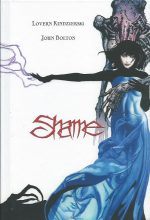
It’s an unshakable adage that comics are a visual medium and that’s never been more clearly demonstrated than in this seductive and bewitching allegorical fable for full-sized folk from writer Lovern Kindzierski, painter John Bolton and letterer Todd Klein. Originally released as a 3-part prestige format miniseries between 2011 and 2013 the saga has now been collected in a lavish and sublime full-colour hardback garnished with a selection of beguiling bonus features.

Once upon a time in ‘Conception’ a benevolent but painfully unprepossessing witch named Mother Virtue spent all her days doing grand good deeds for the unfortunate, and for these kind actions she was beloved by all. Spiritually, she was probably the most perfect woman in the world…

She lived life well and grew old and content, but one day a selfish thought flashed idly through her mind. Momentarily she longed for a daughter and wished for it to be true: that she be a mother in fact as well as name…

It was just the opening malign Shadow of Ignorance Slur needed. Employing dark magics he instantly impregnates the champion of Good with a malign evil seed and in gloating triumph brags to the wise-woman that her daughter will be a diabolical demon deserving of the name Shame…

Deeply repenting that selfish whim and now dreading the horrors yet to come, Mother Virtue methodically transforms her idyllic cottage into a floral prison dubbed Cradle; repurposed to eventually isolate and contain the thing cruelly growing in her belly.

The miserable mother-to-be also assembles a contingent of Dryads to care for and guard the baby. Once Virtue finally births Shame, she quickly abandons the devil’s burden to be reared in the mystic compound, where it grows strong and cruel but so very beautiful…

Eventually, however, slavish minions of Shame’s sire breach the green ramparts and begin schooling the child in vile necromancy and her dire, sordid inheritance. Armed with malefic potency, Shame slowly refashions her garden guardians into something more pliable and appropriately monstrous…

As she physically ripens, Slur himself comes to his evil child and through him Shame learns the power of sex. With the aid of an infernal incubus which has stolen seed from many men, she quickens a child in her own belly and births a baby girl.

Into that infant Slur pours Mother Virtue’s soul; gorily ripped from the despondent dotard’s aging carcase at the moment of delivery. Even the nunnery Virtue had locked herself within was no proof against the marauding Shadow of Ignorance…

And with her despised mother now her own child, securely bound within the selfsame floral penitentiary, Shame goes out into the world to make her mark…

‘Pursuit’ takes up the story sixteen years later. The Virtue infant has grown strong and lovely, despite every effort of the malformed and mystically mutated Dryads and Shame’s diabolical sorcery which have toiled mightily and made every day of her young life a savage test of survival.

This daily failure makes Shame – now queen of a mortal kingdom – furious beyond belief. When not burning witches and wise women who might threaten her absolute domination or having her unconquerable armies ravage neighbouring realms, the haughty hell-spawn spies upon her mother/child with infernal devices, but is always disappointed….

Elsewhere a valiant knight lies dying and bids his simple, ugly son Merritt farewell. Even with his last breaths, the father dreads how his foolish, naive boy will fare in a world ruled by the Queen who has ended him…

The hopeless dreaming youth is stubborn if nothing else, and when Merritt discovers the vegetable hell-mound of Cradle, stories his mother told him run again through his head. A strange, inexplicable yearning compels him to overcome the appalling arcane odds to break in and liberate the beautiful prisoner… although she actually does most of the work…

Free of the mound, all Virtue’s mystic powers return and, far away, Shame’s world reels. Mocking Slur cares little for his daughter but much for his plans and thus reveals Merritt is Destiny’s wild card: a Sword of Fate who might reshape the future of humanity. Of course it all depends on whose side he joins…

As the young heroes near the capital they are ambushed. After a tremendous mystic clash, Merritt awakens in a palace with a dark-haired angel ministering to his every need and desire. Far below in a rank, eldritch dungeon Virtue languishes and patiently adjusts her plans…

This eldritch erotic epic concludes in classic fashion with ‘Redemption’ as Merritt falls deeper under the sultry sway of the dark queen. As he slowly devolves into her tool of human subjugation, in a fetid subterranean stinkhole, Virtue – under the very noses of her tormentors – weaves her magic with the paltry materials at hand…

Even cradled in the Queen’s arms Merritt is still a child shaped by his mother’s bedtime stories and when Virtue contacts him he readily sneaks down to her cell, dreams of nobility and valiant deeds filling his slow, addled head…

Now the scene is set for a final fraught confrontation between mother and daughter, but first Virtue sends Merritt straight to Hell on a vital quest to recover the Hope of the World…

The narrative core of all fairytales is unchanging and ever powerful, so tone and treatment make all the difference between tired rehashing and something bold, fresh and unforgettable.

Moreover, the photo-based hyper-realised expressionism of John Bolton’s lush painting transforms the familiar settings of fantasy standards and set-pierces into something truly bleak and bizarre to match the grim, earthily seedy meta-reality of Kindzierski’s script.

Bracketed with a Foreword by Colleen Doran and Preface from author Kindzierski at the front and creator commentary courtesy of ‘From the Imagination of John Bolton and Lovern Kindzierski’ at the back – featuring an in-depth interview adjudicated by publisher Alexander Finbow and supplemented with a stunning treasure trove of pre-production art, designs and sketches – this astounding tale also includes a tantalising glimpse of things to come in the shape of an 8-page preview of forthcoming sequel Tales of Hope…

Dark, nasty and packed with sumptuous seductions of every stripe, the salutary saga of Shame is every adult fantasist’s desire made real and every comic fan’s most fervent anticipation in one irresistible package…
Shame the story, characters, world and designs are © Lovern Kindzierski, John Bolton and Renegade Arts Canmore Ltd.

Vampirella Archives volume One


By Forrest J. Ackerman, Don Glut, Nicola Cuti, Tom Sutton, Neal Adams, Ernie Colon, Billy Graham, Jeff Jones, Dan Adkins, Frank Frazetta & various (Dynamite Entertainment)
ISBN: 978-1-60690-175-5

After years of stifling restriction, the American comic book industry finally started to break out of a self-imposed straitjacket in the mid 1960s. The kids of the Counterculture had begun creating and disseminating material relevant to their lives in largely self-produced “Underground Commix” whilst other publishers sought other ways around the draconian Comics Code applied to comic books.

The most elegant solution was the one chosen by Jim Warren, who had originally established himself with black and white B-Movie fan periodical Famous Monsters of Filmland and satire magazine Help!

In 1965 he took his deep admiration of the legendary 1950s EC Comics to its logical conclusion: reviving the concept of anthology horror short stories and pitching them at older fans. Creepy was stuffed with clever, sardonic, tongue-in-cheek strip chillers illustrated by the top artists in the field (many of them ex-EC stars). Warren circumvented the all-powerful Comics Code Authority – which had ended EC’s glory days and eventually their entire comics line – by publishing his new venture as a newsstand magazine.

It was a no-lose proposition. Older readers didn’t care to be associated with “kid’s stuff” comic-books whilst magazines had tempting cachet (i.e. mild nudity and a little more explicit violence) for readers of a transitional age; moreover the standard monochrome format was a quarter of the costs of colour periodicals.

Creepy was a huge and influential hit, especially among the increasingly rebellious, Rock ‘n’ Roll crazed teen market; often cited as a source of inspiration for the nascent underground commix movement and now furiously feeding on the growing renewed public interest in the supernatural.

In true Darwinian “Grow or Die” mode, Warren looked around for new projects, following up with companion shocker Eerie and the controversial war title Blazing Combat.

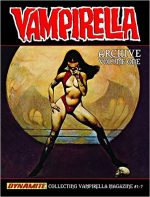
As the decade closed he launched a third horror anthology, but Vampirella was a little bit different. Although it featured the now traditional “host” to introduce and comment on the stories, this narrator was a sexy starlet who occasionally participated in the stories. Before too long she actually became the hero and crowd-pulling star of her own regular feature, but that’s material for a later volume…

The other big change was that here female characters played a far more active role. They were still victims and target but increasingly, whether name stars or bit players, they were as likely to be the big menace or save the day. Whatever their role, though, they were still pretty much naked throughout. Some traditions must be protected at all costs…

Another beguiling Warren staple was the eye-catching painted cover on every issue. Here they are the only full colour pages in an otherwise magnificently monochrome or duo-toned tome, crafted by Frank Frazetta, Bill Hughes, Larry Todd & Vaughn Bodé, Jeff Jones & Bodé and Ken Kelly. However to be fair I must say that the reproduction on some black-&-white pages leaves a lot to be desired…

This massive magazine-size (216 x 32 x 279 mm) hardback collection gathers – in their entirety – the contents of the first seven issues (spanning September 1969 to September 1970). This was a crucial transitional period which saw superheroes dying out at every publishing company; replaced by a genre revival and spearheaded by a tidal wave of horror titles after the Comics Code was frantically rewritten to combat plunging sales.

This volume begins with Vampirella #1, that aforementioned painted cover and a black-&-red Frazetta frontispiece – probably scripted by Editor Bill Parente – setting the blackly humorous tone for a fearsome fangtastic fun fest.

The original contents page follows – as do they all in their appropriate place. This compendium also includes every letters page and fan feature – and even the nostalgia-triggering ads of the era. If you are a modern monster fan or kit collector you’ll probably simultaneously weep and drool at the sight of these lost treasures…

The strip sensationalism begins with ‘Vampirella of Drakulon’ by Forrest J. Ackerman & Tom Sutton; introducing a planet where the rivers ran with blood and life evolved to drink it.

However, following a withering drought Drakulon was dying. Happily for the sultry starving vampire a ship from Earth arrives, full of people with food in their veins and a ship that can take her to where there’s plenty more.

Vampi’s role from the outset was to be another story host and for the rest of this collection that’s what she mostly is. Her role as an active adventurer didn’t properly begin for quite awhile…

So here the chills continue with ‘Death Boat!’ by Don Glut & Billy Graham with the survivors of a shipwreck being picked off one by one by a bloodsucker in their midst. They perish one per night but when the mortals number just two both are still wrong about who the killer is…

Glut & master draughtsman Reed Crandall conspired on ‘Two Silver Bullets!’ as a trapper fights to save his daughter from a werewolf after which ‘Goddess from the Sea’ by Glut and Neal Adams offers a splendid treat for art-lovers: the story of a man seduced by a sea-siren was shot directly from the illustrator’s incredible pencil art.

Glut & Mike Royer offer a timely Halloween warning in ‘Last Act: October!’ whilst ‘Spaced-Out Girls!’ (Glut & Tony Tallarico) sees a saucer full of extraterrestrial honeys come shopping for husbands before the premier package closes with Nicola Cuti & Ernie Colon’s mindbending magical murder mystery ‘A Room Full of Changes’.

The spooky story-bonanza resumes in issue #2, opening with coming attraction featurette ‘Vampi’s Feary Tales…’ – courtesy of Sutton – after which Vampi’s putative cousin ‘Evily’ is introduced by Bill Parente & veteran horror-meister Jerry Grandenetti. Here Drakulonian émigré and Earthly sorceress climactically clash over star-billing and bragging rights…

‘Montezuma’s Monster’ is scripted by R. Michael Rosen (incorrectly credited to Glut) and illustrated by Bill Fraccio & Tallarico in their composite identity of Tony Williamsune, detailing the fate of a treasure-hungry explorer who doesn’t believe in feathered serpents whilst ‘Down to Earth!’ by Ackerman & Royer leaves the hosting to Vampirella’s blonde counterpart Draculine as our star auditions for a film role…

That theme continues in ‘Queen of Horror!’ (Glut & Dick Piscopo) wherein a B-Movie starlet uses unique and uncanny advantages to get everything she deserves whilst Cuti & William Barry reveal the tragedy of two brothers who discover a new predatory species of inland cephalopod in ‘The Octopus’.

Cuti & Colon’s ‘One, Two, Three’ then explores the power of love in a world of robots and Glut & Graham render a ‘Rhapsody in Red!’ with a weary travellers fetching up at a lonely house to deliver a big surprise to the resident vampire…

The third issue augmented ‘Vampi’s Feary Tales…’ with correspondence section ‘Vampi’s Scarlet Letters’ before ‘Wicked is Who Wicked Does’ features the return of Evily in a short shocking battle against ogres by Parente & Sutton.

Al Hewetson & Jack Sparling count ‘4- 3- 2- 1- Blast Off! To a Nightmare!’ in the tale of a spaceship full of 24-hour party people who end up as hors d’oeuvres for something very nasty even as ‘Eleven Steps to Lucy Fuhr’ (by Terri Abrahms [story]; Nick Beal [adaptation] and art by Ed Robbins) sees many men drawn to a bizarre bordello and a sinister fate… until the unlikeliest of saviours takes a hand…

‘I Wake up… Screaming!’ is an all Billy Graham affair as a frightened girl is made aware of her true nature in a sci fi chiller whilst Cuti & Piscopo plunder mythology to deliver a salutary tale of fairy tale oppression and bloody liberation in ‘The Calegia!’

A cunning vampire meets his lethal match in Graham’s ‘Didn’t I See You on Television?’ after which Rosen & Sparling close the issue detailing the downfall of a vicious spoiled brat caught in ‘A Slimy Situation!’

Vampirella #4 opened with Sutton revealing past episodes of witch killing in ‘Vampi’s Feary Tales: Burned at the Stake!’ before Parente & David StClair reach psychedelic heights in a tale of alien amazons and their deadly ‘Forgotten Kingdom’ whilst Cuti & Royer combine murder and time travel in ‘Closer than Sisters’…

A city-slicker falls for a hillbilly hottie and gets sucked into a transformative shocker after trying ‘Moonshine!’ (Glut & Barry), Bill Warren & Sparling reveal the fate of a beautiful and obsessive scientist who bends the laws of God and Man ‘For the Love of Frankenstein’ and a very modern black widow asks a controlling stalker to ‘Come Into My Parlor!’ in a wry yarn by Rosen & Piscopo.

Richard Carnell (story); Jack Erman (adaptation) & Sparling then close the show with a weird and nasty tale of a nobleman auditioning women for marriage in ‘Run for Your Wife!’

The fifth issue begins with the usual ‘Vampi’s Feary Tales…’ as Sutton exposes ‘The Satanic Sisterhood of Stonehenge!’ before Glut, Fraccio & Tallarico see a greedily impatient heir speed his benefactress to her ultimate end, unheeding of her beloved pets and ‘The Craft of a Cat’s Eye’.

Cavemen battle dinosaurs in an arena of ‘Scaly Death’ in a visceral treat from Glut & Graham whilst the astounding Jeff Jones lends fine art sensibilities to the murderous saga of a girl, a guy and ‘An Axe to Grind’ after which Parente & Sutton detail the crimes of a sadistic Duke whose fate is sealed by an aggrieved astrologer and astrally ‘Avenged by Aurora’…

Glut, Fraccio & Tallarico see graves robbed and corpses consumed in neat bait-&-switch thriller Ghoul Girl’ whilst T. Casey Brennan & Royer reveal the solution of a bereaved husband who finds an ‘Escape Route!’ back to his dead beloved before Glut & Sparling end it all again via an implausible invasion from the moon in ‘Luna’.

Vampi’s Feary Tales…’ in Vampirella #6 features Dan Adkins’ graphic discourse on centaurs acting as a prelude to romantic tragedy the ‘Curse of Circe!’ as Gardner Fox & Grandenetti combine to relate how a strange sea creature offers the witch’s latest conquest his only certain method of escape.

Cuti & Sparling then share a story of civil war in the land of ghosts and how love toppled ‘The Brothers of Death’ whilst ‘Darkworth!’ by Cuti & Royer shows how a stripper graduates to murdered assistant of a stage magician and pulls off her own amazing trick in the name of vengeance after which Fox & Adkins explore the lives of the recently dead with ‘New Girl in Town!’ and Vern Burnett & Frank Bolle return to gothic roots to depict embattled humans outwitting nocturnal predators by volunteering a ‘Victim of the Vampyre!’

Larry Herndon, Fraccio & Tallarico (as Tony Williamsune) get creepily contemporary as a doctor tries to fix an overdosed patient and sends him way, way out on a ‘One Way Trip!’ before Buddy Saunders & Bolle combine adultery and attempted murder in ‘The Wolf-Man’: a wickedly scientific shocker about a very different kind of feral killer…

Vampirella #7 saw Archie Goodwin join as Associate Editor and perhaps his influence can be seen as the issue experiments with a connected theme and extended tale scripted by Nicola Cuti. Graham and Frazetta start the ball rolling by explaining ‘Why a Witch Trilogy’ and Vampirella introduces ‘Prologue: The Three Witches’ before Sutton to segues into the sad story of ‘The White Witch’ who could never feel the sunlight.

Ernie Colon picks up the experimental progression as ‘The Mind Witch’ trades magic for science to expose the fate of a psychic predator, after which Graham closes the deal with ‘The Black Witch’ who thought she could conquer love but failed to realise its appalling power…

After Cuti & Sutton’s palate-cleansing ‘Epilogue: The Three Witches’, Doug Moench graduates from letter writer in #3 to scripter as ‘Plague of the Wolf’ – illustrated by Bolle – tracks a bloody serial killer’s progress under the full moon and ‘Terror Test’ offers a shocking psychological thriller by Rosen & “Williamsune” with more than one sting in the tail.

In ‘The Survivor’, Saunders & Colon unite to explore a post-apocalyptic world where dedicated archaeologists still struggle to escape their bestial natures and this mammoth first compilation concludes with Rosen & Grandenetti viewing ‘The Collection Creation’ with an artist who finds the wrong kind of immortality…

Stark, surprisingly shocking and packed with clever ideas beautifully rendered, this epic tome (narrowly) escapes and transcends its admittedly exploitative roots to deliver loads of laughs and lots of shocks: a tried and true terror treat for fans of spooky doings and guiltily glamorous games.
© 2012 DFL. All rights reserved.

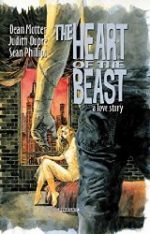
Heart of the Beast – A Love Story


By Dean Motter, Judith Dupré & Sean Phillips (Dynamite Entertainment)
ISBN: 978-1-60690-491-6

What is art? Does it have anything to do with creativity? What is its value and what is the cost?

Originally released as an original hardback graphic novel in 1994 as one of the early experimental triumphs of DC’s Vertigo imprint, this evocatively disturbing reworking – or more accurately contemporary sequel – to one of literature’s greatest stories of mystery and gothic imagination features a tragic, doomed love triangle and carefully unravelled mystery.

In August 2014 this remastered 20th Anniversary commemorative hardcover edition was released by Dynamite, re-presenting the tale in all its subtly sinister glory, bolstered with a few textual extras for the inquiring, bonus-hungry minds of post-Millennials.

The first of those is ‘Circa Soho’: an atmospheric mood-enhancing and memory-intensive reminiscence from co-scripter Judith Dupré; now a globally celebrated author, commentator and critic on The Arts, but back then a fully active participant and observer in the scene.

As a self-confessed “Gallerina” making a living amongst the wild creatives and greedy lampreys attached to the arena of contemporary art burgeoning in the former no-go areas of New York City she was the perfect partner for writer, illustrator and designer Dean Motter.

Having worked on Mr. X, The Prisoner: Shattered Visage, Batman: Black and White, Electropolis and many more projects for young and old, Dean Motter is a creator with a singularly unique voice and style. Here his collaboration with Dupré on this striking addendum to a classic literary marvel and social critique of the price of creation adds chilling edges to a fantasy suitably sub-titled “a love story”…

The saga tells of Sandra, who spends a fateful night tending bar at a so-fashionable Gallery opening paid for by the rich but creepy celebrity plastic surgeon Dr. Andrew Wright. Even in the supremely decadent world of the Art Glitterati the surgeon is infamous, with dubious connections to both the high and mighty and the down and dirty. His patronage of bellicose wunderkind Jacob Sistine is fraught with haughty tension, pompous one-upmanship and barely suppressed loathing…

Drowning in the self-serving, pretentious pontificating of this week’s models, Sandra is surprised when she meets beautiful, sensitive Victor, a poetic rose among crass, wealthy thorns. Despite herself, she is drawn to the mysterious paragon who seems so much more than just Dr. Wright’s factotum and dogsbody.

A man of many secrets, Victor is almost the ideal (and – most frustratingly – reluctant and still largely prospective) lover, but his devotion to the shadier side of the doctor’s dealings with gangsters, fame-chasing poseurs and art forgers augers nothing but disaster for their budding relationship. Furthermore, there is some hideous secret Victor is keeping from her – an undisclosed past and unmoving obstacle not even the truest love or most forgiving nature can overcome…

I’ve endeavoured to obscure the originating source work since the unfolding secret is cleverly handled and the growing realisation adds to the dawning horror of the situation. The love-story spirals to its tragic conclusion, helped in no small part by the beguiling painted art of young Sean Phillips evoking the distant past and spotlighting the harsh modern world with equal skill and sensitivity.

In the intervening years the illustrator has risen to a position of revered prominence in the comics business and this collection closes with a fascinating ‘Codex’ with Phillips plundering his files and wracking his memory in an interview and commentary section packed with photos, layouts, roughs and sketches detailing the development of the project, whilst Motter enthusiastically shares his childhood obsession with scary movies and horror tales in a picture-packed Afterword ‘Frankenstein & Me’…

This cunning yarn failed to find its proper audience when first released, but is a solid story superbly told for all that and might well be the treat that turns your film freak into a comicbook zombie…
Heart of the Beast – A Love Story © 2014 Dean Motter, Judith Dupré & Sean Phillips. All Rights Reserved.

White Collar – a Novel in Linocuts


By Giacomo Patri (Dover Comics & Graphic Novels)
ISBN: 978-0-486-80591-7

Win’s Christmas Gift Recommendation: An Epic Reminder that not everyone enjoys the same joys and benefits we do… 10/10

We tend to think of graphic novels as being a late 20th century phenomenon – and one that had to fight long and hard for legitimacy and a sense of worth – but as this stunning over-sized (286 x 218 mm) two-colour hardback reveals, the format was known much earlier in the century… and utilised for the most solemn and serious of purposes.

White Collar was created by jobbing illustrator, artist, educator and activist Giacomo Patri in 1937: encapsulating the tenor of the times as America endured the Great Depression with a view to inspiring his fellow creatives…

Unable to find a publisher for his shocking and controversial pictorial polemic, Patri and his wife Stella self-published their first edition, but happily found publishers for subsequent releases, if not the huge, hungry, underprivileged and angry audience it deserved…

Patri (1898-1978) was born in Italy but raised in America. Living in San Francisco from 1916 he overcame the handicap of polio and worked at many menial jobs until his interest in art carried him through the California School of Fine Arts. Thereafter he became an illustrator for the San Francisco Examiner, San Francisco Chronicle and other newspapers.

Patri had been interested in social justice and labour issues since the late 1920s and once the Depression struck those beliefs only crystallised. Manual or “blue collar” workers had long organised and unionised to secure their bargaining rights and fair wages and Patri saw that office workers like himself were as likely to need such power and autonomy too. This book was his way of convincing them…

A compelling Introduction by his descendents Tito Patri & Georges Rey offers context, historical background and technical information on the production of linocut art as well as revealing how the creation of such cheap, language-transcending visual tracts became a relatively common method of dissemination.

Also included is the story of the artist/author’s troubles during the repressive, red-baiting Joe McCarthy years and beyond…

Following the salutary lesson is the Original Introduction by fellow artistic agitator and creative pioneer Rockwell Kent before Patri senior’s endeavours to arouse his fellow illustrators and clerical staff unfold in 128 bold images of stark metaphor and rousing symbology: an astounding visual record and call to arms tracing one family’s struggle between 1929 and 1933, delivered with beguiling subtlety and shocking silent potency in plates of deepest black or startling orange.

The ‘Novel in Linocuts by Tito Patri’ is dedicated “To the great progressive Labor Movement, the Congress of Industrial Organisations” and remained both obscure and controversial for years not just for its left leaning content but due to its uncompromising depiction of the abortion catch-22: a truly heart-rending depiction of a family too poor to survive another mouth to feed but without the cash to pay a back street quack for an [illegal] termination…

Stirring, evocative and still movingly inspirational as the world staggers closer and closer to replicating those dark days of Haves, Have-Nots and Why-Should-I-Cares?; this magnificent rediscovery closes with a final assessment and plea from cartoonist, designer and contemporary activist Peter Kuper in his trenchant Afterword and the Original Epilogue by John L. Lewis…

Inventive, ferocious in its dramatic effects, instantly engaging and enraging, this is a book long overdue for revival and reassessment and one every callous “I’m All Right” Jackass and “Why Should I Pay For Your…” social misanthrope needs to see or be struck with…
© 1987 by Tamara Rey Patri. Introduction © 2016 by Tito Patri. Afterword © 2016 by Peter Kuper. All rights reserved.

Dreadstar – The Beginning

By Jim Starlin (Dynamite Entertainment)
ISBN: 978-1-60690-119-9

The creative renaissance in comics during the 1980s resulted in some utterly wonderful strip sagas which shone briefly and brightly within what was still a largely niche industry before passing from view as the business and art form battled spiralling costs, declining readerships and the perverse and pervasive attitude in the wider world that comicbooks were the natural province of mutants, morons and farm animals (I’m paraphrasing).

Unlike today, way back then most grown-ups considered superheroes as adolescent power fantasies or idle wish-fulfilment for the uneducated or disenfranchised, so an entertainment industry which was perceived as largely made up of men in tights hitting each other got very little approval – or even notice – in the wider world of popular fiction.

All that changed with the advent of the comic book Direct Sales Market. With its more targeted approach to selling, specialist vendors in dedicated emporia had leeway to allow frustrated creators to cut loose and experiment with other genres – and even formats.

All the innovation back then led inescapably to today’s high-end, thoroughly respectable graphic novel market which, with suitable and fitting circularity, is now gathering and re-circulating many of the breakthrough tales from those times; not as poorly distributed serials and sequences, but in satisfyingly complete stand-alone books.

Marvel was the unassailable front-runner in purveying pamphlet fiction back then, outselling all its rivals and monopolising the lucrative licensed properties market (like Star Wars and Indiana Jones) which once been the preserve of the Whitman/Dell/Gold Key colossus. This added to a zeitgeist which proved that for open-minded readers, superheroes were not the only fruit…

As independently published titles hit an early peak, Marvel instigated its own creator-owned, rights-friendly fantasy periodical in response to the overwhelming success amongst older readers of Heavy Metal magazine. Lush, slick and lavish, HM had even brought a fresh, music-&-literature based audience to graphic narratives…

That response was Epic Illustrated: an anthological magazine offering stunning art and an anything-goes attitude – unhindered by the censorious Comics Code Authority – which saw everything from adaptations of Moorcock’s Elric and Harlan Ellison novellas to ‘The Last Galactus Story’, plus numerous stories which would become compelling forerunners of today’s graphic novel industry.

The first issue also discretely started a very gradual introduction to one of the era’s biggest Indie sensations: Vanth Dreadstar…

This collection gathers a number of stories originally culled from an assortment of different places. The saga started in Epic Illustrated (#1-9, 12 and 15, spanning Spring 1980 to December 1982), whilst tangentially diverting in 1981 to Eclipse Graphic Album Series #5 (The Price) and then 1982’s Marvel Graphic Novel #3: Dreadstar: all laying the groundwork for one of the most successful independently-owned comic book characters of the era, and one of the most long-lived…

This stellar hardback re-presents those tales in the original monochrome or painted full-colour, with writer/artist Starlin aided and abetted by letterer by Tom Orzechowski. For this edition the art has been remastered by Jerron Quality Color, Mike Kelleher and Digikiore Studios.

Already a big gun thanks to his run on Captain Marvel, the engendering of mad Titan Thanos and the reinvention of Adam Warlock, Starlin cemented his cosmic creator credentials and seeming preoccupation with death and nihilism through the grandiose saga Metamorphosis Odyssey.

Delivered in painted grey-tones, the serialised tale began with the introduction of mighty alien wizard ‘Aknaton’: savant of ancient and benevolent race the Osirosians. These masters of the cosmos were perturbed by the advent of rapacious barbarian species the Zygoteans who were slowly and inexorably conquering planets and eradicating all life in the Milky Way galaxy.

Aknaton’s people fought back on behalf of all creation, but knew that their resistance was numbered in mere millennia before the predators would win.

Unsettled by the prognostication, Aknaton set out on a desperate tour of the galaxy, planting life seeds weaving a web of possibility and even depositing an incredible sword of power in a last-ditch plan which would take a million years to complete…

The first seed flowered in the form of spiritually advanced intellectual monster ‘Za!’, whilst another blossomed into 15-year old ‘Juliet’, taken by Aknaton from Earth in 1980 just as the Zygoteans arrived to eradicate the rest of her species.

The mage’s last living puzzle component was butterfly winged psychic ‘Whis’par’ whose gifts and sensitivities easily divined the dark underpinnings of Aknaton’s ambitions…

During this chapter the artwork transitioned into full-painted colour, and by the time the wizard reached war-torn ice-world Byfrexia to recruit ‘Vanth’ the cosmic conflict was in full phantasmagorical flow. This emotionless resistance leader battling the Zygoteans was a man with incredible physical powers, bequeathed by a magic sword he had found: the very weapon Aknaton has planted eons previously…

‘The Meeting’ between Vanth and his notional maker was interrupted by Zygotean killers, affording the wizard opportunity to assess his handiwork in action. He quickly realised the hero was far more powerful than he had intended….

Nevertheless the quest moved on to a recently-razed paradise, but ‘Delloran Revisited’ was merely a step tin a search for an ultimate weapon so long lost, so well hidden that Aknaton had no clue to its current location…

Appraising his unique team of one final push, Aknaton enjoyed ‘Sunrise on Lartorez’ before absenting himself to meet God and discuss ‘Absolution’, after which a ‘Requiem’ sounded for life as the Zygoteans found them and lit the skies with ‘Nightfire’.

Forced into precipitate action, ‘Dreamsend’ turned into ‘Doomsday!’ as Aknaton’s plan finally came into play… with cataclysmic effect…

A million years later, an energy bubble bursts in another galaxy and sole survivors Aknaton and Vanth find themselves on a rural world not much different from any other. They still have business to settle and only one will walk away from the ‘Aftermath’ of what they’ve done…

With the illustration reverting to painted monochrome, The Price is set in that new Empirical Galaxy: one riven by an unending war between intergalactic robber barons the Monarchy and omnipresent mystico-political religious order the Instrumentality. Over 200 years these instinctive enemies have taken half a galaxy each and now battle to maintain a permanent stalemate. The economies of both factions depend on constant slaughter but no outright victory…

At the heart of that strained environment, rising Instrumentality bishop Syzygy Darklock is drawn by arcane forces and the diabolical plotting of terrorist mage Taurus Killgaren onto a path of inescapable doom and destruction.

It begins with the demonic assassination of Darklock’s brother; leading the outraged cleric on a path of damnation and revelation, gaining immense mystic power and wisdom but only at the cost of sacrificing everything he ever loved.

He also is forced to share Killgaren’s infallible vision of the fearful future and the role a man named Dreadstar will play in the fate of the universe…

After the huge success of ‘The Death of Captain Marvel’ (Marvel Graphic Novel #1), Starlin was eagerly welcomed back for the third release. Here he finally launched Dreadstar as a creator-owned property that would kickstart the Epic Comics line into life.

The full-colour painted story focused on Vanth the man, as the immortal Cold Warrior abandoned his sword and warlike ways, settling down to decades of farming on isolated agri-world Caldor with retired Instrumentality researcher Delilah.

Toiling beside the gentle gengineered cat-people operating the farm planet, Vanth found a kind of contentment, which was only slightly spoiled when a bizarre creature named Syzygy Darklock set up his tent in the mountain wilderness and began tempting the old soldier with tales of the outer world and veiled promises of great knowledge and understanding .

Vanth was with the savant when Monarchy ships found Delilah and the cat-people. In the wake of their casual atrocities he renounced his vow of peace and resolved to end the stupid, commercially expedient war his way…

The drama concludes with ‘Epilogue’: one last black-&-white tale first seen in Epic Illustrated #15, and designed as bridging introduction to the hero’s comic book debut. Vanth and his cat-man ally Oedi are trying to quietly get off Instrumentality mining colony the Rock, but Dreadstar is nigh-fatally distracted by a worker who is the very image of his dearly departed Delilah.

Before he can do anything really stupid however the mine roof caves in and threatens all his ambitious plans to bring peace and stability to the Empirical Galaxy…

Bold, bombastic and potently cathartic, this is no-nonsense space opera with the just the right amount of deep thought, comforting cynicism and welcoming pop philosophy added to flavour the action and spice up the celestial grandeur. Above all this is smart, trenchant, uncomplicated fun for grown-up space freaks and well worth a few moments of your time…
© 2010 James Starlin. All rights reserved. Dreadstar is a registered trademark of James Starlin, and the Dreadstar logo and all characters and content herein and the likenesses thereof are also trademarks of James Starlin unless otherwise expressly noted.

Serenity: Firefly Class 03-K64 volume 3 – The Shepherd’s Tale


By Joss Whedon, Zack Whedon, Chris Samnee & various (Dark Horse Books)
ISBN: 978-1-59582-561-2

For those far too few people who actually saw it, Firefly remains one of the best science fiction TV shows ever created.

It was cancelled after one season. Buy the box set or seek it out from an on-demand/streaming media outlet as soon as you possibly can.

The select dejected fanbase were eventually delighted by the superb Serenity – one of the best science fiction movies ever released.

Rent it, buy it, watch it however you can.

Once you’ve done those things you’ll be properly primed to enjoy this superb and lavish full-colour hardback which offers long-awaited details into the troubled life of enigmatic preacher Book who joined reluctant freedom fighter Malcolm Reynolds and his oddball crew of reprobates aboard an independent trader starship of the Firefly class, under the most peculiar of circumstances…

If you aren’t au fait with “the ‘Verse” yet – and did I mention the live action iterations are readily available and extremely entertaining? – here’s a little background.

After they used up Earth, humanity migrated to the stars and settled another star-system packed with hundreds of more or less hospitable planets and satellites. Now it’s the 26th century and mankind is living through the aftermath of a recent punishing internecine conflict known – by the victors – as the Unification War.

This still-sore and rankling clash saw the outer Colonies crushed after attempting to secede from the authoritarian Alliance of first-settled inner planets. Reynolds fought valiantly on the losing side and now spends his days eking out a living on the fringes of an increasingly repressive and dangerous universe: taking cargo and people from world to world – and hopefully avoiding the ever-expanding Alliance representatives – as a free agent skippering a small Firefly class cargo transport called Serenity.

It’s hard, risky work: often illegal and frequently dangerous – especially as the outer regions are where the insane cannibal berserker savages dubbed Reavers restlessly prowl.

Life changed forever after Serenity gave passage to Alliance doctor Simon Tam who was on the run after stealing his seemingly-psychic sister River from a top secret research project.

The Government spared no effort or expense to get her back and hounded the fugitives from pillar to post until Reynolds and his crew finally decided to push back.

At the cost of too many friends, the reluctant rebels uncovered the horrific secrets the Alliance were so desperate to keep hidden and broadcast them to the entire ‘Verse …

During their TV voyages the Firefly crew was supplemented by a wise and gentle cleric of the Shepherd religion on a pilgrimage to who knew where. He offered moral guidance (mostly ignored), philosophical debate and emotional support as required, but every so often something Derrial Book said or did gave hints of lethal capabilities and a dangerous past the holy man always deftly avoided discussing…

Written by (series creator) Joss Whedon and Zack Whedon, illustrated by super-star in the making Chris Samnee (Daredevil, Thor: The Mighty Avenger, The Rocketeer: Cargo of Doom) and sporting colours from Dave Stewart and letters by Steve Morris, this compelling book of revelations finally exposes the secrets and tells the life story of the show’s most intriguing character…

The episodic saga is told in flashes and snippets from end to beginning; starting with his eventual glorious passing and working backwards in dramatic instalments to the way and why it all began…

Along the road we see his turbulent time aboard Serenity, before moving into unexplored territory at placid Southdown Abbey where after much soul-searching he elected to rejoin the dangerous, tempting outer world…

From then it’s a jump back a full decade to when a drunken derelict near death received one more well-deserved beating and awoke to a moment of holy clarity in a bowl of soup…

From then a time-cut slashes back to the moment when Alliance high-flyer Officer Book personally oversaw the military’s greatest defeat and was cashiered out of the service with extreme prejudice…

Years prior to that another scene shows how far ambitious cadet Derrial would go to further his career before a further flashback reveals that the man we’ve been reading about was never Derrial Book at all, but instead a murderous sleeper agent planted within the Alliance.

And even further back we travel, learning what makes a boy into the kind of man who would endure mutilation and worse; contemplate constantly betraying everything he cares for in a dark yet redemptive tale exploring the most basic and abiding aspects of human nature…

With narrative tones reminiscent of Christopher Nolan’s Memento, this powerful testament to the force of personality, the bondage of upbringing and man’s infinite capacity for change is accompanied by an incisive and heartfelt Afterword – ‘The Journey is the Worthier Part…’ from scripter Zack Whedon, detailing the inspirations which fuelled many of the story’s most memorable scenes.

Poignant, compelling and explosively engaging, this is a tale no devotee should miss and a comic experience well able to stand apart from its live action roots.
Serenity © 2010 Universal Studios. Firefly™ and Serenity: Firefly Class 03-K64™ and © 2014 Twentieth Century Fox Film Corporation. All rights reserved.

Edgar Allan Poe’s Spirits of the Dead


Adapted by Richard Corben, with Beth Corben Reed & Nate Piekos (Dark Horse Books)
ISBN: 978-1-61655-356-2

Richard Corben is one of America’s greatest proponents of graphic narrative: an animator, illustrator, publisher and cartoonist, catapulting from the tumultuous wave of independent counterculture commix of the 1960s and 1970s to become a major force in comic storytelling with his own unmistakable style and vision.

He is equally renowned for his mastery of airbrush, captivatingly excessive anatomical stylisation and delightfully wicked, darkly comedic horror, fantasy and science fiction tales. In later years he has become an elder statesman of horror and fantasy comics lending his gifts and cachet to such icons as John Constantine, Hulk, Hellboy, Punisher and Ghost Rider as well as new adaptations and renditions of literary classics by the likes of William Hope Hodgson, Lovecraft and the master of gothic terror Edgar Allan Poe.

Corben didn’t sell out; American publishing simply caught up, finally growing mature enough to accommodate him, due in no small part to his own broad and pervasive influence…

Born in Anderson, Missouri in 1940, he graduated with a Fine Arts degree in 1965 and found work as an animator. At that time, the neutered comicbooks of the Comics-Code Authority era were just starting to lose disaffected, malcontent older fans to the hippy-trippy, freewheeling, anything-goes publications of independent-minded creators across the continent who were increasingly making the kind of material Preachers and Mummy and her Lawyers wouldn’t approve of…

Creativity honed by the resplendent and explicitly mature 1950s EC Comics, Carl Barks’ perfectly crafted Duck tales and other classy early strips, a plethora of young artists like Corben responded with a variety of small-press publications – including Grim Wit, Slow Death, Skull, Fever Dreams and his own Fantagor – which featured shocking, rebellious, sexed-up, raw, brutal, psychedelically-inspired cartoons and strips blending the new wave of artists’ unconventional lifestyles with their earliest childhood influences… honestly crafting the kind of stories they would like to read.

Corben inevitably graduated to more professional – and paying – venues. As his style and skills developed he worked for Warren Publishing in Eerie, Creepy, Vampirella, Comix International and outrageous adult science fiction anthology 1984/1994. He famously coloured some strips for the revival of Will Eisner’s The Spirit.

Soon after he was producing stunning graphic escapades for a number of companies, making animated movies, painting film posters and producing record covers such as the multi-million-selling Meatloaf album Bat Out of Hell. He has never stopped creating comics but prefers personal independent projects or working with in-tune collaborators such as Bruce Jones, Jan Strnad and Harlan Ellison.

In 1975 Corben approached French fantasy phenomenon Métal Hurlant and quickly became a fixture of its American iteration Heavy Metal, cementing his international reputation in the process. Garnering huge support and acclaim in Europe, he has been regularly collected in luxurious albums even as he seemingly fell out of favour – and print – in his own country. Through it all he has never strayed far from his moss-covered roots.

This particular tome gathers a recent return to adaptations of the classic Poe canon; all-new, 21st century, often rather radical reinterpretations of the troubled author’s greatest works, as published in The Fall of the House of Usher #1-2, one-shots The Conqueror Worm, The Raven and the Red Death, The Premature Burial and Morella and the Murders in the Rue Morgue plus some short tales originally published in Dark Horse Presents #9, #16-18 and #28-29; collectively spanning the period November 2012-April 2014.

The horrific hagiography – each tale attributed with its year of publication and adapted with the colouring assistance of Beth Corben Reed and lettering expertise of Nate Piekos of Blambot® – opens following an erudite, informative and compelling Introduction ‘Masters of the Macabre: Edgar Allan Poe and Richard Corben’ by university professor, author, Poe expert and comics scholar Thomas M. Inge and the mood-setting poem ‘Spirits of the Dead (1827)’ before the artistic extravaganza unfolds with aged, one-eyed crone Maggy as host and guide to the selection which follows.

In ‘Alone (1828)’ morbid, death-haunted Solomon discusses his distressing dreams with the intoxicating but strangely unmoved Liea whilst ‘The City in the Sea (1831)’ sees a shipwrecked sea captain forced to explain his recent dramatic actions to a dank and unforgiving tribunal who have markedly different views to him on what constitutes duty, business sense, cargo and humanity…

Many of these interpretations employ embedded lines of Poe’s verse, such as ‘The Sleeper (1831)’ which sees a well-deserved fate meted out to a rich philanderer who had his wife and her murderer killed to further his own carnal desires whilst ‘The Assignation (1834)’ examines a toxic relationship where husband and wife cannot live together… or apart…

‘Berenice (1835)’ is one of Poe’s most stomach-churning, nerve-jangling yarns and Corben does it full justice as bereaved Egaeus watches over the corpse of his recently-deceased betrothed. However, even in death he cannot turn his mind away from an overwhelming fascination with her perfect teeth…

The deeply unsettling story of ‘Morella (1835)’ reveals how a vain witch orchestrates her own death and resurrection as her own daughter to keep her husband properly seduced and in line, before focus shifts to ancient Greece and the inevitable approach of death amongst the warriors at a funeral: a wake tainted by the unquiet dead and an oppressive ‘Shadow (1835)’…

In the luxuriously expansive The Fall of the House of Usher (1839)’ artist and traveller Allan is broaches a befuddling, bilious and deadly swamp to reach the ancestral seat of the ancient Usher clan and visit an old school chum.

Like the family, the vast manse is slowly dissolving into the mire that surrounds and supports it. The decadent, failing blood of melancholic master and obsessive portraitist Roderick Usher masks many bizarre behaviours, but not even that can excuse his vile attitude to his seemingly subjugated, clandestinely closeted, sumptuously seductive deranged sister Madeline whose essence he is determined to capture on canvas at any cost…

As he stares at the too-intimate pencil studies, Allan too is drawn to the girl: a feeling only intensified once they actually meet…

By secret means she makes the visitor aware of a unique plight and urges him to assist her escape but Roderick will go to any lengths to keep his sister with him and would rather extinguish the family line rather than lose her.

That is unless the repelled, rebellious Earth doesn’t reclaim the crumbling house and the decadent Ushers first…

Infamous for his dark, doom-laden horror stories, Poe was also a pioneer of crime fiction and next up is a grimly effective and trenchantly black-humoured adaptation of the debut tale starring French gentleman detective Le Chevalier C. Auguste Dupin and his partner in peril Beluc.

Here the dandified dynamic duo put their heads together to solve an impossible locked room mystery which resulted in the brutal dismemberment of two women in ‘The Murders in the Rue Morgue (1841)’: a crime with a callous perpetrator but no culpable killer…

‘The Masque of the Red Death (1842)’ then returns to classical themes and supernal horror as plague grips the lands of regal Prospero. Faced with difficult choices, the lord opts to bring his richest cronies within his opulent castle to safely disport themselves in debauched revelry whilst the contagion burns itself out on the peasantry. Sadly, the foolish sybarite has made one grave and arrogant error which will cost him everything…

Under Corben’s imaginative purview, grim gloomy ode ‘The Conqueror Worm (1843)’ is transformed into a salutary saga of inescapable vengeance as proud Colonel Mann kills his errant wife and her lover but is tainted with a maggot that burrows into his body and soul.

Feigning innocence and ignorance, Mann salves his “tragic loss” by employing an itinerant puppet show for a family party but the mummers expose that most proper paragon’s sins before utterly consuming him, whilst in ‘The Premature Burial (1844)’ a close shave with attempted murder and molestation of the dead turns Lucian into a man obsessed with being buried alive and Arnold‘s inability to forget his dead Lenore leads to an unforgettable encounter with ‘The Raven (1845)’ in a visual tour de force every inch as potent as Poe’s poem.

Wrapping up the journey into mysteries is a deft retelling of ‘The Cask of Amontillado, (1846)’ wherein aging Montressor at last shares a long-held secret with the wife of his old friend Fortunato, now missing for many a year.

As he guides her through his deep vaults, filled with the remains of his ancestors and his precious wine collection, gloating Montressor tells the increasing nervous widow of her husband’s ghastly fate and why and how the poor, bibulous buffoon vanished so completely that long-ago night…

Accompanied by a stunning Cover Gallery, this compelling collection of classic chillers is a modern masterpiece of arcane abomination and human horror no shock addict of mystery lover will want to miss.
Spirits of the Dead™ © 2012, 2013, 2014 Richard Corben. All rights reserved.

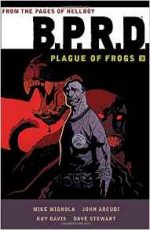
B.P.R.D.: Plague of Frogs volume 2


By Mike Mignola, John Arcudi, Guy Davis, Herb Trimpe, John Severin, Peter Snejbjerg, Karl Moline & various (Dark Horse Books)
ISBN: 978-1-59582-672-5

Hellboy is a creature of vast depth and innate mystery; a demonic baby summoned to Earth by Nazi occultists at the end of Word War II but subsequently raised, educated and trained by parapsychologist Professor Trevor “Broom” Bruttenholm to destroy unnatural threats and supernatural monsters as the lead field-agent for the Bureau for Paranormal Research and Defense.

After decades of unfailing, faithful service in 2001 he became mortally tired and resigned. Itinerantly roaming the world, he still managed to constantly encounter weird happenstances, never escape trouble or avoid his own sense of duty. This book is not about him.

The massive full-colour hardback collection under review here (also available in digital formats) instead features the trusty comrades he left behind: valiant champions of varying shades of human-ness who also deal with those occult occasions which typically fall under the remit of the Enhanced Talents task force of the B.P.R.D.

If you’re having trouble with the concept, think of a government-sanctioned and internationally co-sponsored Ghostbusters dealing with Buffy-style threats to humanity.

The B.P.R.D. rapidly established itself as a viable publishing premise in its own right through a succession of interlinked miniseries, confronting an ancient, arcane amphibian menace to humanity in an immense epic which spanned eight years of comicbook releases.

Periodically collected as a series of trade paperbacks during that time, the entire supernatural saga – latterly dubbed Plague of Frogs – was remastered as a quartet of monumental full-colour volumes, of which this is the sinister second.

Gathering material from Hellboy Premiere Edition, MySpace Dark Horse Presents #8-9, B.P.R.D.: The Dead, B.P.R.D. volume 5: The Black Flame and B.P.R.D. volume 12: War on Frogs, this macabre triumvirate of terror opens with a handy recap page identifying key personnel of the B.P.R.D. before an equally handy Introduction from series editor Scott Allie provides context and background in the organisation’s struggle against the eons-old supernal force mutating humans into terrifying frog-monsters…

From there it’s a short hop (sorry, sorry!) to ‘Book One: The Dead’, written by Mignola and John Arcudi, illustrated by Guy Davis, lettered as always by Clem Robins and with colours from Dave Stewart. Firstly though that supernatural storm of woe is preceded by the prologue ‘Born Again’ (from Hellboy Premiere Edition) wherein pyrokinetic Liz Sherman, amphibious Abe Sapien, man-made marvel Roger the Homunculus and disembodied psychic Johann Krauss break into a secret tomb beneath a suburb of Chicago and arouse an extremely angry monster spirit warning of worse to follow.

In the aftermath of their spectacular triumph, Roger casually pockets a weird little artefact…

B.P.R.D. volume 4: The Dead properly begins a little later in North Dakota, when an investigation team is wiped out after discovering another nest of Frogs. At the organisation’s HQ in Fairfield, Connecticut the assessment is that the amphibian incursions are growing too rapidly and drastic measures are now called for…

Johann suggests that rather than instant eradication perhaps the answer is translating the bizarre glyphs found at every site. Abe is absent from this meeting, having travelled to Littleport, Rhode Island with psychologist Kate Corrigan in search of his own obscure origins…

Back at base the team meet new field commander Benjamin Daimio, a former marine and Green Beret officer. His qualifications for the new militaristic role include an impressive but classified record in covert operations and the still-unexplained fact that he came back to life on a morgue slab three days after dying in the line of duty…

A brusque man with deep pentagon connections, he quickly arranges for the entire B.P.R.D. to relocate to a super-secret, mothballed military complex in Colorado, much to the suspicious disgust of volatile Liz…

In Littleport, Abe locates the long abandoned house of Langdon Everett Caul and ponders its disturbing but undisclosed link to his own shrouded past…

The next few days are filled with busywork as the B.P.R.D. relocate to Colorado and strive to bring the vast Cold War mountain fortress up to speed and into the 21st century.

Tensions are high in the Enhanced Talents unit as Liz constantly rails against the new military style of working whilst worrying that impressionable Roger is being unduly influenced by Daimio’s forceful, take-charge personality.

Johann is also a cause for concern as his psychic talents seem to be drawing him into himself after he casually mind-scans the ancient edifice they now occupy…

Back in Rhode Island, Abe disturbs a ghost and is drawn into a trap baited with past happiness and bitter memories whilst in Colorado Liz awakens from a nightmare to find Johann acting as if possessed. With Roger in tow, she follows the bodiless medium down into the bowels of the base: a level not listed on any official map or blueprint, blocked by a colossal door covered in strange markings…

Breaking into a hidden chamber, Daimio and the investigators discover a huge cavern filled with skeletons covered in mushrooms, strange machinery and an old German who has been living there since the 1950s…

Quantum physicist Dr. Gunter Eiss worked for the Nazis on mystic science projects. He was sidelined after Hitler ditched his “Operation Himmelmacht” in favour of the Ragna Rok operation which brought Hellboy to Earth. The fringe scientist was scooped up by American forces and brought to Colorado when WWII ended to work on alternative energy research.

Then there was a catastrophic disaster which devastated the still under-construction base and when he regained consciousness Gunter had been entombed with all the dead: lost and forgotten…

Although Eiss seems harmless, nobody is comfortable with his inexplicable survival and reappearance and, all too soon, those misgivings prove well-founded as strange events start plaguing the fortress. Clarity comes when Johann, pressured by odd notions and weird warnings, makes contact with the spirits of Eiss’ dead colleagues.

It’s too late, but as the aged revenant unleashes a storm of insectile horrors inside the base and tries to complete his long-delayed Himmelmacht project, Johann and the recovered dead men are frantically cobbling together a countermeasure of last resort.

…And whilst the team strive to prevent a disaster of literally biblical proportions, in Rhode Island, Abe Sapien struggles to free himself from a ghostly prison of memories and, to his eternal regret, at last succeeds…

War on Frogs began life as a series of one-shots issued in 2008 and 2009. They were collected with ‘Revival’ from MySpace Dark Horse Presents #8-9 as the 12th B.P.R.D. trade paperback volume in April 2009, but as those tales are all set in 2005 during the early days of the battle against the manphibians, they appear next in this remastered compilation.

Each story focuses on one character and many are by guest illustrators, but the “bug-hunt” begins with an all-action engagement from Mignola, Arcudi, Davis, Stewart & Robins featuring Daimio, Liz, Roger and Johann as the enhanced heroes and an army of military specialists clear out a tunnel system overflowing with Frogs only to discover the site is a breeding nest…

Davis then inks Marvel superstar artist Herb Trimpe on an Arcudi script as Abe Sapien removes himself from active duty for a desk job, leaving an increasing martial-minded and bellicose Roger to lead the ground war. The struggle takes him back to Lake Talutah, New York where Hellboy and Abe first battled the Frog things and where the Homunculus discovers those original monsters never left…

Mignola, Arcudi, Davis & Stewart then combine in ‘Revival’ as travelling faith healers spread the Frog contagion throughout the American heartland until Captain Damio tracks them down and deals with the problem in his usual lethally efficient manner…

Arcudi, Stewart and Robins are then joined by the astounding John Severin, who etches a macabre masterpiece as a strictly human team of soldiers attempts to clear out a Frog-infested warship and succumb one by one to the terrors in the darkness.

Then Arcudi & Peter Snejbjerg (with colourist Bjarne Hansen and letterer Robins) depict a turning point in the conflict as psychic Johann realises he can see and communicate with the spirits of dead Frog monsters. Compelled to help the horrors move on, Krauss’ attempt only opens the door to greater terrors and deeper mysteries…

Moving on to B.P.R.D. volume 5: The Black Flame, Mignola, Arcudi, Davis, Stewart & Robins reveal how corrupt and complicit Zinco Industries executive Mr. Pope tries to convert Nazi sympathies and closeted secret knowledge into personal power by using the Frogs’ magic to turn himself into a super-villain.

Beyond his laboratories, the war seems to be going well. Roger has become a fierce and effective warrior, leading many sorties to stamp out the amphibian invaders. However that is about to change as Pope succeeds in cracking the language barrier and learning how to talk to the Frogs. Now, as the Black Flame, he seems to be their uncontested master…

During one battle Liz is given a strange blossom by a bystander and falls into a coma. In a misty dreamworld she is approached by a shrouded stranger who reveals that things are not as they seem and that the war is about to take a very bad turn as far as mankind is concerned…

Further research triggers a panic in B.P.R.D. boffin Professor O’Donnell who flies into a panic after realising Liz’s vision is a warning that antediluvian demon-deity Katha-Hem is coming back and all living things will transform at his vile touch. Suitably chilled, firestarter Liz tries to rouse and warn the Enhanced team, but is too late to save one of them…

As the Black Flame leads his gathered amphibian legions into a cavern system in Idaho, Abe, afflicted by guilt, returns to active duty even as Liz succumbs to further astral communications. The shaken team is far from combat-ready when news comes that Lincoln, Nebraska has been overrun. Before they can react, news comes of concerted attacks all over the North American continent. The Frogs are inexorably on the move and the summons has gone out. Katha-Hem is coming…

As a colossal horror beyond imagining starts destroying man’s cities, Pope realises he is a pawn in a far greater, incalculably older game, whilst Liz confronts her mystery informant before a clue to destroying the monster is grudgingly given. All she has to do is find an artefact Roger once idly picked up on an early mission against the Frogs…

The scene is set for an incomprehensible last battle, but the will the beaten and broken Black Flame remain a thrall of the foe or find redemption and his lost humanity in the final accounting…?

Wrapping up the strip thrills and chills, Arcudi and illustrator Karl Moline focus on the repercussions of the team’s victory in a trenchant Epilogue as shell-shocked, traumatised Liz goes through the motions of mopping-up, possibly finding a new significant other to lean on, but still plagued by visions of the enigmatic man in the mists…

Bonus features included here comprise an informative Afterword by Arcudi describing the behind-the-scenes scripting system he shared with Mignola, plus Notes from Scott Allie and a huge Sketchbook section offering roughs, designs and preliminary artwork from Davis and Mignola on The Dead, The Black Flame and War on Frogs.

With supernatural fantasy now a staple of TV and movie fashion, these unlikely heroes must be a top pick for every production company out there. Until then, why not stay ahead of the rush by reading these truly magical tales?
B.P.R.D. ™: Plague of Frogs volume 2 © 2004, 2005, 2006, 2008, 2009, 2010, 2011, 2015 Mike Mignola. Abe Sapien™, Liz Sherman™, Hellboy™, Johann™, Lobster Johnson™ and all other prominently featured characters ™ Mike Mignola. All rights reserved.


Hellboy volume 6: Strange Places


By Mike Mignola with Dave Stewart & Clem Robbins (Dark Horse)
ISBN: 978-1-59307-475-3

Hellboy is a creature of vast depth and innate mystery; a demonic child summoned to Earth by Nazi occultists at the end of World War II. Intercepted and rescued by allied troops, the infernal infant was reared by Allied parapsychologist Professor Trevor “Broom” Bruttenholm. After years of devoted intervention, education and warm human interaction, in 1952 Hellboy began destroying unnatural threats and supernatural monsters as lead agent for the Bureau for Paranormal Research and Defense.

As the decades of his career unfold, Hellboy gleans snatches of his origins, learning he is an infernal creature of dark portent: born an infernal messiah, somehow destined to destroy the world and bring back ancient powers of evil. It is a fate he despises and utterly rejects…

This sinister sixth spellbinding compendium of pictorial paranormality and grave wit collects micro-series Hellboy: The Third Wish #1-2 (July-August 2002) and Hellboy: The Island #1-2 (June and July 2005); the latter augmented with a new 6-page Epilogue for this trade paperback edition.

Following an engaging Introduction from fellow multi-talented macabre-ist Gary Gianni, Mignola briefly explains the origins and antecedents of the marine marvel which follows after which the eldritch enigmas unfold.

At the bottom of the sea three mermaid sisters implore the mighty Bog Roosh to grant their wishes. Her compliance comes at a cost however: the marine maidens must somehow hammer a mystic nail into the head of her great enemy…

Hellboy is currently in Africa, estranged from the B.P.R.D. but still encountering mystic menaces that need stopping. Eventually he stops to listen to the tales of witch-man Mohlomi and is soon under the spell of the tale-teller. Falling into a deep sleep, he dreams of lions who foretell his future…

He awakens to find they have somehow moved to the coast. When Mohlomi tells him the ocean is calling, the baffled but resigned parapsychologist enters the roaring surf and is promptly dragged under the waves, protected only by a bell-charm the witch-man has given him…

Attacked by sea creatures and the three sisters, Hellboy is overcome as soon as he lets go of the jingling trinket and is helpless to prevent them driving in the nail…

Bound and helpless in the Bog Roosh’s power, Hellboy can only watch as the sisters are given theirs hearts’ desires and – in the usual manner of such things – suffer the cruel consequences of double-dealing demonry.

Wise in such matters, Hellboy tries to help the third mermaid avoid her fate but is powerless to prevent the sea witch granting the last wish. The kind act touches the mermaid’s heart and – whilst the witch tries to dismember Hellboy and all the powers of The Pit stand helpless to prevent the end of all their hopes and dreams – she sneaks back and frees him.

Released to vent his considerable anger, Hellboy ends the Bog Roosh and decimates her power, but is ultimately unable to save his saviour…

According to Mignola’s commentary, The Island was a tough tale to write and underwent many strange transmutations and permutations. When it finally appeared it signalled the grand finale of the First Chapter in Hellboy’s life. None of that difficulty is apparent in the tale that follows though: a bleak, moody suspense saga filled with all the answer fans had been craving since the hero’s debut…

Hellboy wades ashore in a drear limbo of shattered ships and broken vessels. Anxious but resolved, he trudges on and joins a motley assemblage of mariners in a protracted boozing session, only later realising he had been drinking with dead men.

A further shock to his system is delivered by old enemy Hecate, who appears gloating and glad that the Bog Roosh failed to kill him. As long as Hellboy lives she can still corrupt or conquer him…

Shunning the Goddess of the Damned, Hellboy wanders on and enters a dilapidated castle where he is sucked into an ancient vision which offers potential clues to his past and future but now only results in him battling ferociously but with little success against yet another gargantuan monster…

He awakes an unknowable time later on a dry, dusty plain with Mohlomi who offers yet more occluded, oblique advice before a revived ghost joins the conversation with the tale of his mortality in ancient Tenochtitlan.

This story of life, death and resurrection coincidentally reveals the secret history of creation, the inevitable end of mankind, what will follow and – most terrifyingly – the truth of Hellboy’s stone hand and his intended role in the ghastly Grand Scheme of Cosmic Doom…

Wrapping up the spectral showcase is an ominous all-new Epilogue as the arcane and infernal powers confer over what the revelations mean to Hellboy. The Fated One is now armed with knowledge but is only drifting closer to his future, no matter how hard he struggles to turn away from it…

Rounding out this apocalyptic endeavour is a stunning Bonus Section which includes the decidedly different first eight pages of the original iteration of The Island – specially inked and coloured for this book – followed by seven powerfully potent, all-action pencil art pages created and then abandoned in the second attempt to tell the tale. Wrapping up the behind-the-scenes extras is a selection of character designs and roughs to sweeten the pot for every lover of great comics art.

Baroque, grandiose, alternating suspenseful slow-boiling tension with explosive spectacle, Strange Places inexorably increases the pace in the race to Armageddon. Blending revelation with astounding adventure to enthral horror addicts and action junkies alike, it is another cataclysmic compendium of dark delights no comics fan or fear fanatic should miss.
™ and © 2006, 2005 and 2002 Mike Mignola. Hellboy is ™ Mike Mignola. Introduction © 2006 Gary Gianni. All rights reserved.