Lone Wolf and Cub volume 1: The Assassins Road


By Kazuo Koike & Goseki Kojima, translated by Dana Lewis (Dark Horse Manga)
ISBN: 978-1-56971-502-4

Whichever English transliteration you prefer – Wolf and Baby Carriage is what I was first introduced to – the grandiose, thought-provoking hell-bent Samurai tragedy created by Kazuo Koike & Goseki Kojima is without doubt one of those all too rare breakthrough global classics of comics literature.

The epic Kozure Okami began as a serial in Weekly Manga Action, running from September 1970 to April 1976, and was immediately followed by a direct sequel (Shin Lone Wolf & Cub) as well as science fiction offshoot Lone Wolf 2100. The story has broken out into other media, spawning six movies, four plays, two TV series, games and merchandise. The property is notoriously still in pre-production as a big Hollywood blockbuster.

The 7000 thousand pages of staggeringly beautiful black and white narrative art produced by these gifted creators eventually filled 28 tankobon volumes, gripping and captivating generations of readers around the world. More importantly, the sensitively nihilistic saga, with its timeless themes and iconic visuals, has influenced hordes of other creators.

The many manga, comics and movies the stories have inspired are impossible to count. Frank Miller, who illustrated the cover of this particular edition, has referenced the series in his science fiction saga Ronin, The Dark Knight Returns, and Sin City. Max Allan Collin’s Road to Perdition is an unashamed tribute to this Japanese masterpiece. Even children’s cartoons such as Samurai Jack can be seen as direct descendants of this astounding achievement in graphic literature.

We in the West first saw the series as 45 Prestige Format editions from First Comics beginning in 1987. The company foundered before getting even a third of the way through the canon. Then, from September 2000 to December 2002, Dark Horse Comics assumed the rights, systematically reprinting and translating the entire epic into 28 tankobon-style editions (petite 153 x 109 mm monochrome trade paperbacks, about 300-ish pages per), before recently putting the entire sequence online through its Dark Horse Digital project.

This initial lean, mean, martial edition offers a Glossary providing detailed context on the term used in the stories, plus profiles of author Koike Kazuo and illustrator Kojima Goseki and the first instalment of ‘The Ronin Report’: an occasional series of articles offering potted history essays on the period of the Tokugawa Shogunate.

Of course the true meat is the captivating, grimly compelling combination of revenge fable and action-adventure which opens here with intriguing episodes of stripped-down mystery, gripping intensity and galvanic bloodletting as the first tale introduces a scruffy indigent pushing a homemade bamboo pram with a 3-year-old boy in it.

A banner on the contraption proclaims ‘Son for Hire, Sword for Hire’ and as the man stoically ignores mockery and derision from louts on the road, his advert soon attracts the attention of four deadly men who have been warned of an assassin carrying his baby boy with him…

A certain formula informs all the early episodes: the acceptance of a commission to kill an impossible target, a cunning plan and inevitable success, all underscored with bleak philosophical musings alternately informed by Buddhist teachings in conjunction with or in opposition to the unflinching personal honour code of Bushido. The protagonist is also possibly the most dangerous swordsman in the world…

You won’t learn it until the end of this tome, but the fore-doomed killer-wanderer was once the Shogun’s official executioner, capable of cleaving a man in half with one stroke. An eminent individual of esteemed imperial standing, elevated social position and impeccable honour, ÅŒgami Ittō lost it all and now roams feudal Japan as a doomed soul hellbent for the dire, demon-haunted underworld of Meifumado.

When the nomad’s wife was murdered and his clan dishonoured due to the machinations of the treacherous and politically ambitious Yagyu Clan, the Emperor ordered ÅŒgami to commit suicide. Instead, he rebelled, choosing to become a despised Ronin (masterless samurai) and assassin, pledging to revenge himself on the Yagyus until they were all dead or Hell claimed him. His son, the toddler Daigoro, also chose the way of the sword and together they roamed the grim and evocative landscapes of feudal Japan, one step ahead of doom and with death behind and before them.

Frequently the infallible assassin’s best ploy is to allow himself to be captured, endure unimaginable torture and then fight his way out having slaughtered his target…

The tactic is again employed in ‘A Father Knows His Child’s Heart, as Only a Child Can Know His Father’s’ as the wolf sends willing Daigoro to penetrate the unyielding defences of Takai Han so that Papa can kill a dishonourable usurper…

Another aspect of ÅŒgami’s methodology emerges in ‘From North to South, From West to East’. The assassin insists on a personal interview with all his clients and demands not only who is to die, but why. Perhaps the cautious killer only wants to know the extent of what he’s getting into, but we know he’s judging: seeing whether the target deserves death… or if the client does…

The legend of the Lone Wolf and Cub quickly spreads and when faithful guards briefly hire Daigoro to help their beloved mistress, it is with full knowledge of what the boy’s father is. In ‘Baby Cart on the River Styx’ that knowledge is crucial to ÅŒgami’s plan for quashing a gang turf-war before it begins even whilst bringing down a corrupt yet untouchable lord…

Shocking to us is the accepted conceit that the father is fully prepared to sacrifice his son to achieve his mission and fulfil his promises. In ‘Suio School Zanbato’ little Daigoro willingly becomes a hostage to fortune so that his dad can lure a swords-master – and all his honourless students – into an officially sanctioned duel, and kill with no legal ramifications or repercussions…

A lyrical twist on the theme of star-crossed lovers, ‘Waiting for the Rains’ then sees the little boy befriending a dying woman even as his father waits to carry out his next commission – expunging the man she so patiently awaits…

These stories are deeply metaphorical and work on a number of levels most of us westerners just won’t grasp on first reading – even with the contextual help provided by the bonus features. That only makes them more exotic and fascinating. Also, a little unsettling is the even-handed treatment of women in the tales. Within the confines of the incredibly stratified culture being depicted, females – from servants to courtesans, prostitutes to highborn ladies – are all fully-rounded characters, with their own motivations and drives. His female allies are valiant and dependable, and his foes, whether ultimate targets or mere enemy combatants in his path, are treated with professional respect by ÅŒgami. He kills them just as if they were men…

In ‘Eight Gates of Deceit’ the indomitable killer is ambushed by an octet of female assassins hired by the wolf’s latest client who foolishly chooses to discount the professional honour of his hireling in favour of clearing up loose ends. That’s his last mistake…

‘Wings to the Birds, Fangs to the Beast’ finds the tireless wanderer stumbling into a hot-spa village recently taken over by bandits. To their eternal cost, and despite the newcomer’s every forbearing effort, the human animals refuse to believe the man with the baby-carriage wants no trouble…

This first stunning collection ends with some of the answers the reader has been looking for as the scene shifts to the recent past and Shogun’s palace in Edo for an origin. There, thanks to the political manoeuvrings of ambitious Lord Yagyu, the Shogun’s Executioner ÅŒgami Ittō has been ousted and his clan disgraced. With wife Asami dead, the austere warrior outfoxes his opponent – who thought an honourable suicide the only option he’d left his enemy – by opting to travel ‘The Assassin’s Road’ with his baby son momentously choosing to follow him to Meifumado or victory…

A breathtaking tour de force, these are comics classics you must not miss.
© 1995, 2000 Kazuo Koike & Goseki Kojima. All other material © 2000 Dark Horse Comics, Inc. Cover art © 2000 Frank Miller. All rights reserved.

Murder by Remote Control


By Janwillem van de Wetering & Paul Kirchner (Dover Comics & Graphic Novels)
ISBN: 978-0-486-80560-3

“Graphic novels” are utterly ubiquitous these days, even though a huge part of the population can’t or won’t differentiate between the big books we insiders mean and the flimsy, pamphlet periodicals comprising the bulk of items on sale.

Can I at least muddy the waters a little more?

Yes I Can.

Something that gathers a selection of previously-published material – strips, comicbook issues, selected stories on a theme – used to be an Album, Collection, or even, God help us, an Omnibus or Trade Paperback. These included any re-presentation of superhero sagas like Archives or Essentials, themed conglomerations like Greatest Batman Stories Ever Told or Marvel Visionaries or even the groundbreaking Cerebus “phone-book” editions.

Anything serialised in periodicals, but intended from conception to be eventually gathered into one unified form, was a graphic novel (Maus, Watchmen, Persepolis or Cerebus – confusing ain’t it?)

Any long-form tale utilising sequential narrative (A Contract with God, Sabre, Pride of Baghdad) released in one big bite is a true Graphic Novel. That’s what Will Eisner, Jim Steranko and Neal Adams were getting at when they started using the term in the late 1970s and it’s what we should mean when lobbing these terms about willy-nilly.

For every person who agrees with those categorisations, there are a dozen who violently disagree and can cite at least one package which correctly refutes and defies the definition. And because I’m a wilfully contrary pixie, I’ll just remind you that Charles Dickens published his greatest books as periodical magazine part-works before some bright spark stitched them all together in single complete editions called novels…

I don’t care: just remember all modern comics publishers crave the cachet of the term graphic novel attached to their product but it is one that has been adopted and most ardently championed by retailers and distributors who – from the moment big books of drawn stories started appearing – needed some way to pigeon-hole and differentiate them from cookbooks, coffee-table tomes, kids story-books and other releases packed with pictures.

Murder by Remote Control is a true Graphic Novel – arguably one of the very first planned and premeditated examples of the form – and after decades in obscurity you have the chance to see it in all its intended glory…

In the 1980s American comics got a huge creative boost with the advent of high quality magazines such as Heavy Metal and Epic Illustrated which showcased adult-oriented material with high quality graphics and formats such as had taken Europe by storm a decade earlier.

Previous US experience of such work had been limited to the Underground Comix scene – in terms of content if not production values, at least – and the occasional independent, out-market experiment of such maverick luminaries as Wally Wood, Steve Ditko and Steranko.

When Heavy Metal premiered in April 1977 – looking very much like its French conceptual “parent” Métal Hurlant – there was precious little original American material to supplement the sumptuous continental work therein. One of the first US creators to join the magazine was Paul Kirchner (The Bus, Realms, Dope Rider), who had worked as an assistant to Wood in the early 1970s, contributing to such projects as Big Apple Comics.

Born in 1952, Kirchner was in his third year at Cooper Union School of Art in New York when Neal Adams and Larry Hama introduced him to the horror editors at DC, whose anthology titles always needed fresh blood. He thereafter assisted Tex Blaisdell on Little Orphan Annie and in 1973 joined Ralph Reese at Wood’s studio.

A young man in tune with many of the spiritual and conceptual tropes prevalent during those culturally cosmopolitan times, there was a thoughtful, underplayed intensity in his meticulously-crafted work, but Kirchner was hampered by his slow working-speed, at a time when quick turnaround always trumped artistic merit and quality. He eventually drifted out of comics to find far better-paying work in the advertising, animation and design trades.

Part of the reason for the transition is explained in his Introduction, which describes his meeting with Dutch expatriate author Janwillem Lincoln van de Wetering (The Empty Mirror, Grijpstra and de Gier crime novels, Hugh Pine (the Porcupine), Judge Dee Plays His Lute); a global-traveller and Zen Buddhist scholar who eventually settled in Maine. Under circumstances best enjoyed first hand by reading the actual Intro, the exuberant writer and jaded cartoonist met in 1981 and decided to work together on a dream project: a crime mystery in comics form…

The project took Kirchner a few years to complete but when ready for publication the real hard work began. Most publishers prefer to work in 20-20 hindsight: happy to jump on a successful bandwagon but preferring to chew off their own arms rather that risk money on being first with something new that can’t be easily categorised…

The completed work was schlepped around for two years until in 1986 Ballantine bought it. This was the period in which Maus, The Dark Knight Returns and Watchman all simultaneously slapped the world in the face and the public went ga-ga for graphic narratives.

Ballantine – who had decades earlier introduced America to comicstrip paperbacks with its digest-sized collections of Mad reprints – was willing to take a chance on a mass-market edition, albeit in a diminished size and format, even though as Moord Op Afstand the tale had been a success in Holland and elsewhere as a lavish, full-sized hardback album. Despite favourable coverage from Gahan Wilson in The New York Times Book Review, the bowdlerised Murder by Remote Control sank without trace and the creators reluctantly moved on to other things.

Now, after far too long, I can retire my battered old copy since Dover have added the sublime metaphorical masterpiece in monochrome to their crucial list of rescued comics treasures, restored to its intended page size (278 x 218 mm) and with the original cover replacing the sliced-&-sampled multiple-panel mock-up of the 1986 edition…

The story itself would have been groundbreaking if it had been released in 1983 and remains decidedly off-key and devilishly off-beat. Resonances of Agent Dale Cooper, Blue Velvet and later cult entertainment icons eerily abound here…

After obnoxious property speculator Mr. Jones starts buying up sections of idyllic Maine coastline, he suddenly turns up dead in his little fishing dingy. The death occurs in full view of four residents who each might have a strong motive to remove the interloper, but the County Sheriff is extremely keen on ruling the case an accidental death.

However, his report results in the unwelcome arrival of agonisingly restrained and refined – almost emotionless – Detective Jim Brady from the Augusta Office. Cool and preternaturally calm, the self-effacing little man has a way of seeing deep into the hearts and minds of everybody, and he quickly rules it a homicide by most arcane means.

Now he’s going to stick around, probing the characters and backgrounds of the uniquely baroque quartet of suspects and undoubtedly sticking his nose where it doesn’t belong…

Informed by Zen principles, the story unfolds as Brady flamboyantly deconstructs each potential suspect, consequently uncovering far more secrets than any little rural enclave could possibly contain before reaching his conclusions.

However, even with the case closed his actions remain at odds with your run-of-the-mill Copper, and there’s one last twist still in store…

Cool, surreal and challengingly psychedelic, the plot is realised with sleek and understated panache; mixing the welcoming warmth and idiosyncratic style of Ditko’s figure-work and facial expressions with the glossy sleek glamour and factual solidity of Wally Wood. This book is a delicious treat for the eyes and a therapeutic exercise for the mind…

Supplemented by Stephen R. Bissette’s incisive and expansive Afterword ‘A Man, A Boat, A Bay, A Bite, A Beer Can…’ offering historical context and artistic commentary, this is a magnificent lost gem, rightly restored to its place in the history of our art form, but it’s also a beautifully-crafted, intellectually challenging Bloody Good Read.

Go get it.
© 1986, 2016 by The Wetering Family Trust and Paul Kirchner. Afterword © 2016 by Stephen R. Bissette. All rights reserved.

Murder by Remote Control will be published on 24th June 2016 and is available for pre-order now. Or if you still wander actual streets it might already be on the shelves of your local comic shop…

The Story of My Tits


By Jennifer Hayden (Top Shelf Productions)
ISBN: 978-1-60309-054-4

Here’s a short sharp review for an exceedingly weighty and fabulously entertaining tome. If the word “Tits” offends you in any way – GOOD! – that’s partly the point and besides, now that you’ve been sufficiently outraged you might as well read on before dashing off and buying the book…

This huge monochrome tome (198 x 203 x 28 x mm) is an agonisingly hilarious cartoon autobiography by an astonishingly funny, amazingly forthright and relentlessly brave woman dealing with far more than her fair share of misfortune. As her tale captivatingly depicts, Jennifer Hayden (Underwire, Rushes, S’crapbook) came to cartooning late after years muddling through as a commercial writer and children’s book illustrator. Her artistic epiphany came when she was dealing with a ghastly medical diagnosis and stumbled upon a fellow sufferer’s own cancer-narrative graphic journal…

Comprising a breathtaking assemblage of key moments, this quirky quilt of rib-ticklers and gut-punches opens with the author’s early days with ‘No Tits’ describing a life “flat as a board” until biology finally works its inevitable magic. It also introduces her uniquely human and utterly irresistible family…

The amiable amble towards adulthood continues in ‘Still No Tits!’ before ‘What, Tits?’ sees little Jenny’s dreams start to come true after a big change that strangely coincides with an increased awareness of Boys…

As is so often the case, life should come with a warning to be careful what you wish for as ‘What Tits!’ concentrates on college days and boyfriends, eventually introducing musician Jim who will play a major role in the decades to come. More important, however, is his wonderful mother and boisterous brothers…

Real life thunders in with ‘Sick Tits’ when Jennifer’s mum gets a devastating diagnosis and has a mastectomy. Her reaction is far from what her excitable daughter expects or understands…

With the family in turmoil ‘Tits in Philly’ sees Jenny upping stakes to get away; living with Jim until ‘Tits in Jersey’ sees them both move in with his mother. Life goes on and the lovers make a pretty good go of being just like grown-ups. Then once again cancer hits someone they both can’t do without…

‘Tits Al Fresco’ pithily observes the modern trauma of dealing with divorce and the unwholesome fallout of having to handle three “mothers”…

The long-dreaded inevitable finally happens in ‘Tender Tits’ but after the birth of their first child (hah, gotcha!) life gets even more convoluted for Jennifer and Jim with ‘Tits at Dawn’. With the extended family gradually dying away, it’s only after Jennifer’s second child and her development of ‘Mom Tits’ that years of ordinary living narrow down to the moment of her own breast-cancer diagnosis thanks to mammography and ‘Tits on Film’.

Jennifer Hayden was 43 when she made the bold decision which changed and probably saved her, and these scenes and snapshots of her life as it changed to accommodate breast cancer are some of the bravest, most poignant and blackly funniest in this journal. Her world becomes increasingly filled with doctors, counsellors, well-wishers, survivors and fellow patients. Through it all though, that big, big family is there… even if her closest acquaintances aren’t…

‘No More Tits’ shares the days of surgery and beyond, leading to an oddly circular regression to her earliest days whilst coping strategies and mundane daily adjustments vie for attention in ‘Goddess Tits’ before the contemporary world catches up and the tale moves away from us in ‘The End: UnTITled’… (although there is a heart-warming Epilogue sent from idyllic sunny ‘Titaly’…

Potent, honest, passionately matter-of-fact and phenomenally entertaining, this is a marvel of philosophical resolve and practical defiance that nobody can read without laughing, crying, getting scared and feeling lucky.
© & ™ 2015 Jennifer Hayden.

Wet Moon volume 1: Feeble Wanderings


By Sophie Campbell (Oni Press)
ISBN: 978-1-93266-407-2

Wet Moon seems like one of grown-up comics’ biggest secrets. Published intermittently by Oni Press since 2004, it’s a winning blend of the literary traditions of Southern Gothic with experimental comic strip endeavours like Glenn Head’s Chicago – a Comix Memoir, Brian O’Malley’s Lost at Sea or Liz Suburbia’s Sacred Heart …

Looking like a beautifully rendered young adult soap opera filmed in monochrome, the story unfolds in the bayou-lapped Deep South, where the eponymous township of Wet Moon is the venue for an art school and home of a thriving Goth/Newest Wave/counterculture scene.

If you’re my age you could think of it as a modern corollary to Athens, Georgia when REM were attending college at U of G or the B-52s were learning to play…

The focus of our attention is pensive, introspective young student Cleo Lovedrop; a bespectacled, overweight, marginally-pierced, heavily made-up Goth-girl attending the aforementioned college. Like every teen she’s a mess of insecurities and irrepressible urges, but all she wants to do is understand both the world and herself. She also has her fair share of dark melancholic secrets…

Cleo is still finding her feet after moving into shared digs, but her mind is elsewhere; something from her past that she doesn’t even want to think won’t shut up even now that she’s here and starting fresh. Thankfully, her best friends Trilby Bernarde and Mara Zuzanny are scoping out the place with her and are proving to be the usual distraction…

Elsewhere, absent pal Audrey Richter is with Martin. They are busy avoiding Pete, the “Pringles Guy”.

He’s one of those pests who always has to show you his artwork. Whilst dodging him, Audrey hides in the public toilets and sees lots of graphitti. The only bit she remembers however, is the clearly scrawled legend “Cleo eats it” boldly adorning the stall partition…

Cleo spends a lot of time examining herself in mirrors. At first the reader is unsure exactly what she’s looking for or at and Campbell is smart enough and bold enough to let the art advance these scenes, using silence as a method of conveying both meaning and mood; letting the observer reach their own conclusions, right or wrong…

What Cleo cannot know is that the girl in the apartment next door is doing the same thing, and will soon become very important to her…

Audrey rushes off to warn Cleo and – after a deputation examines the offending libel – agrees it must be aimed at their friend: after all, Cleo is a pretty rare name…

Also at last agreed that it’s a damn lie, they go their separate ways. Still feeling sick and uncomfortable, Cleo heads home and meets another room-mate: pretty, standoffish Natalie Ringtree who seems to live in a world of her own…

Soon after, Cleo visits her older sister Penny and walks home humiliated after another one of “those” fights…

She would have caught the bus back but when she boarded “he” was there and she had to dash off and puke up her guts…

Back at the flat, she’s still throwing up when final flatmate Malady Mayapple introduces herself at Cleo’s moment of maximum embarrassment…

Audrey lusts for the girl at the Head-Butt Video, but when the delicious Myrtle Turenne surprisingly responds a certain way, the panicked Ricter bolts and flees the store. Luckily big, dependable, dumb-as-dirt Slicer is there when she stumbles right into another petty domestic crisis…

That night Trilby is rescued from a pathetic evening watching Star Trek when Cleo and Mara turn up and drag her to Goth nightclub House of Usher. It’s an eventful soiree. Cleo has a close encounter with a self-obsessed art-weirdo and Mara punches out the girl who stole her boyfriend…

Everything freezes when Fern walks in. She’s the most amazing and breathtaking vision anybody has ever seen… even with her unseeing eyes and malformed, withered hand…

That night is a revelation for so many lonely, hungry people, but all Trilby remembers is that she got really, really drunk and made a pass at Cleo…

A hangover breakfast at the local Denny’s then devolves into an over-heated debate about suicide, potential partners and worse before breaking up acrimoniously. Then as they pass the video store, Audrey tells Cleo about what till-girl Myrtle did and, curiosity piqued, Lovedrop has to see for herself. The so-casual meeting does not pan out anything like she expected…

Making her way home, Audrey finds “Cleo Eats It” fliers all over the place, and while she’s disposing of them, deep in the bayou Penny Lovedrop is at Fern’s palatial mansion applying for a job. This strange client, however, seems far more interested in her annoying half-sister Cleo…

The girl in question’s day keeps getting worse. She can’t avoid “him”. Everywhere she turns that bastard Vincent shows up: not following, just always waiting for her…

And when she reaches the apartment, she learns from Malady that the tenant she replaced vanished one night. She was there at bedtime and gone by breakfast. Nobody saw her go…

Clutching her always roiling stomach, Cleo heads to bed and just can’t rest. Even so, she oversleeps, and dashing out next morning, crashes late into her first class. When she sees “him” sitting there, she hurtles right out again, plunging down the stairs, landing on the girl who will change her life forever…

And deep in the Bayou, other people manoeuvre into position; ready to make their own dramatic entrances…

To Be Continued…

This initial, introductory book is the tantalising tip of a vast iceberg of inter-related life-stories which, like alligators in a swamp, present only the merest hint of what lurks beneath. An ongoing saga encompassing the mystery of a missing girl, lost babies, sinister plots and a malicious hidden enemy utilising the power of lies and innuendo, this engrossing ongoing epic ferociously targets the contemporary battleground of appearance, sexual orientation, acceptance and self-identification, exploring themes of isolation, friendship, trust and body dysmorphia with great wit, keen insight, clever characterisation and immense heart.

Before finding higher profile work in the mainstream with series like Glory, Teenage Mutant Ninja Turtles and Jem and the Holograms Sophie (Ross) Campbell was astounding readers with this sprawling yarn (six collected volumes thus far and at least two more planned) and this edition comes with a large selection of extras.

As well as ‘Older Wet Moon Artwork’ pages, there are developmental sketches and an abortive introductory sequence which works perfectly as a 5-page silent vignette introducing pre-college Cleo, plus an absolutely crucial ‘Who’s Who in Wet Moon’

With welcoming echoes of Gilbert Hernandez’s complex and delicious celebrations of unique, flawed yet uncompromisingly human communities in Love and Rockets as well as off-kilter televisual landmarks like Twin Peaks, Maximum Bob or American Gothic, this is a series at the fringes, but make no mistake, Wet Moon is every inch its own creature: sinisterly enticing, seductively unconventional and emotionally compelling.
™ and © 2004 (Sophie) Ross Campbell. All rights reserved.

Criminal volume 4: Bad Night


By Ed Brubaker & Sean Phillips (Image Comics)
ISBN: 978-1-63215-260-2

Do you recall the early 1950s? I wasn’t actually there, but for comics fans it was a time of astounding promise. Every conceivable genre of funnybook could be found on US newsstands (except porn, I guess): children’s fantasies, teen comedies, licensed books, war, super-heroes, horror, science fiction and especially crime stories.

Bad guys living (and dying) bad lives were everywhere, and don’t even get me started on movies. Technicolorâ„¢ was still expensive so the concerns and sensibilities of the public were most commonly realised through gritty, grainy, moody Film Noir vehicles.

This populist pulp-paperback and B-Movie movement towards cynical post-war realism grew into an art form all its own while nobody was looking…

What has this to do with the book in question? Nothing really except that when this series first came out the comics industry was enjoying a mini-revival and resurgence of straight crime thrillers. Moreover, collaborators Ed Brubaker and Sean Phillips were then forging a creative partnership that seemed incapable of setting a foot wrong: each stand-alone story arc building on the previous caper, getting tougher, stronger, meaner and better…

The entire series was repackaged and re-released as a uniform set of trade paperbacks in 2015 with this fourth captivating collection featuring Criminal volume 2 #4-7 (July-November 2008) – possibly the most experimental tale in the entire canon.

Jacob Kurtz has got a lot of rage to deal with. The mild-mannered sap was never an angel. In fact he used to be a pretty good counterfeiter. However, when his wife disappeared he was the cops’ prime suspect in her murder until the body finally turned up, clearly the result of an automobile accident.

In the meantime of course Jake had been targeted by remorseless, hard-line Police Detective Max Starr, who had gone totally old school on him to secure a confession the widower could not make. Those injuries healed pretty quickly but were nothing compared to what his wife’s mobster uncle Sebastian Hyde did to him…

Crippled, ostracised and a total recluse, these days Jacob spends his time and makes his living crafting the savagely ironic comic strip Frank Kafka, Private Eye, gaining petty points by making the cops – especially the funnybook version of Starr – look like utter idiots.

Still, things are tough. Kurtz is in constant pain and afflicted with crippling insomnia, and even when he does drop off for a couple of hours the idiot vigilante haunting his neighbourhood pulls some crazy stunt like torching a drug-house and another night gets shot to hell…

When all else fails, Jacob heads for the all-night Blue Fly Diner to pass the time reading and shooting the breeze with Bob and Pat…

This one Bad Night, however, even that surcease is denied him as a young punk starts beating on the girl he’s with and Jacob is drawn in. Nobody thanks him for it; not the girl and certainly not cartoon super-Dick Frank Kafka who is always beside him, annoyingly telling the pen-pusher what a real man would have done…

Driving home in the pouring rain, Jacob picks up a drenched hitchhiker and is horrified to discover it’s the girl from the diner…

And so starts a devious and convoluted saga of sexual obsession, subterfuge, big scores, torture and vengeance as she seduces Jacob into theft and murder and far, far worse. Iris is a crazy lady with lots of problems and a body to die for, but she’s working to someone else’s hidden agenda and, after all the double-dealing and bloodletting peaks, the slick conspirators learn a dreadful truth: it’s Noir; everybody’s got a secret they haven’t shared yet…

What they should have wondered from the start is where would a counterfeiter-turned-cartoonist could learn so much about violent crime… and especially how to get rid of bodies?

Filled with twists, turns and even the occasional stunning plot-somersault, this viciously effective and deceptively scary yarn is dark, brutal and fearfully compelling: a tale of the other side of society which affords an irresistible view of raw humanity. These are stories that can’t be ignored… so don’t.
© 2008, 2015 Ed Brubaker & Sean Phillips. All rights reserved.

Harvey Pekar’s Cleveland


By Harvey Pekar & Joseph Remnant (Zip Comics/Top Shelf)
ISBN: 978-1-60309-091-9

Before finding relative fame in the 21st century, Harvey Pekar occupied that ghastly niche so good at trapping the truly creative individual: lots and lots of critical acclaim, and occasional heart-breakingly close brushes with super-stardom (which everyone except him felt he truly deserved) without ever actually getting enough ahead to feel secure or appreciated.

In the 1970s whilst palling around with Robert Crumb, Pekar began crafting compelling documentary narratives of ordinary, blue-collar life – primarily his own – and over the following decades invented “literary comics”. Despite negligible commercial success, the activity fulfilled some deep inner need and he persevered in his self-publishing and soul-searching.

One of those aforementioned brushes with the Big Time came in the 1980s with the release of two compilations by mainstream publisher Doubleday of selected strips from his American Splendor comicbooks. To this day those tomes remain some of the most powerful, honest and rewarding comics ever seen.

By mercilessly haranguing, begging and even paying (out of his meagre civil service wages and occasional wheeler-deal) any artists who met his exacting intellectual standards Pekar soldiered on, inadvertently creating the comics genre of autobiographical, existentially questing, slice-of-life graphic narratives whilst eking out a mostly solitary, hand-to-mouth existence in Cleveland, Ohio.

How the irascible, opinionated, objectionable, knowledge-hungry, self-educated, music-mad working stiff came to use the admittedly (then) impoverished comicbook medium to make a fiercely vital social commentary on American life for the “ordinary Joe” is a magical journey into the plebeian far better read than read about, so go do that if you haven’t already.

Life picked up late for Harvey Pekar – mostly through an award-winning movie of his career and the publication of Our Cancer Year (a stunning documentation of his and third wife Joyce Brabner’s response to his disease). This all led to an elevated and celebrated intellectual status, allowing him to the opportunity to produce even more personal and compelling tales such as The Quitter, The Beats and Not the Israel My Parents Promised Me. Harvey Pekar died in 2010, aged 70.

For all of that time he lived in Cleveland, Ohio and the city is as much a character in all his autobiographical works as the man himself. This book was his last, published posthumously and offering in his own simple, informative, plain spoken words – beguilingly illustrated by the inspirationally diligent Joseph Remnant (Blind Spot) – the history, geography and cultural lowdown of the legend-laden conurbation alternatively dubbed the “the best location in the nation” and “the mistake by the lake”…

An irrepressible autodidact in the truest sense of the term, Pekar made it his business to learn everything about anything he was interested in… and he could be initially interested in everything.

Keeping his mercurial engaged attention, however, was a far harder task. One thing which held his attention on many levels – from first breath to last – was the city he was born in.

Cleveland is an erudite, eyes-wide-open appreciation, encompassing the shrinking metropolis’ creation, rise, fall, descent into mediocrity and position as media whipping-boy as well as the truth behind all the myths.

Walking through town pictorially and in full avuncular academician mode, Pekar shares facts, opinions and judgments with equal passion and force: detailing simultaneously both treasures and flaws like a man happily married to the same bride for seven decades. The result is magical…

There’s the expected and welcome incisive examination of socio-political changes, employment and race issues, a broad inclusion of the author’s love of sporting achievement and his obsessive collecting: startling moments of intimate revelation and, as ever, his miraculous gift of sharing his passions as he blends historical insights, family milestones and oddments of existence with deft dexterity.

Harvey Pekar was called the “poet laureate of Cleveland” and this superb paean to the home he never abandoned is a graphic delight to equal any literary travelogue commemorating Defoe’s London or Damon Runyon’s New York.

Remnant’s monochrome line-work is remarkably effective: mixing reportage with architectural acuity and wrapping it all in a fulsome vivacity reminiscent of the best of underground art. These pictures pop; whether illuminating the Cleveland Indians’ 1948 victory over the Boston Braves, city landmarks like the Terminal  Tower and Rock ‘n’ Roll Hall of Fame; depicting gang fights in Woodhill Park or young Harvey’s first Chocolate Frosty Malt and first marital mismatches …

With an effusive and lyrical Introduction by Alan Moore and closing with ‘A Pal’s Goodbye’ from Harvey’s friend, associate and fellow Clevelander Jimi Izrael, this wry, witty, enchanting atlas of Middle America Then and Now is a book you must see if you love the art form of comics and magic of storytelling.
© & ™ 2012 Harvey Pekar and Joseph Remnant.

Silent Invasion volume 2: Red Shadows


By Michael Cherkas & Larry Hancock (NBM)
ISBN: 978-0-91834-850-0

During the vast expansion of opportunity and outpouring of innovation that graced comics during the 1980s, much of the “brain-rotting trash” or “silly kid’s stuff” stigma which had plagued the medium was finally dispelled. America started catching up to the rest of the world; acknowledging sequential narrative as an actual Art-Form, and their doors opened wide open for foreigners to make a few waves too…

One of the most critically acclaimed and just plain fun features of the period came from semi-Canadian outfit Renegade Press which set up shop in the USA and began publishing at the very start of the black & white comics bubble in 1984. They quickly established a reputation for excellence, with a strong line of creator-based properties and some genuinely remarkable series such as Ms. Tree, Journey: the Adventures of Wolverine MacAlistaire, Normalman, Flaming Carrot and the compulsively backwards-looking Cold War/UFO/paranoia-driven The Silent Invasion.

That last was a stunningly stylish saga, bolting 1950s domestic terrors (invasion by Reds; invasion by aliens; invasion by new ideas…) onto Film Noir chic and employing 20-20 hindsight to produce a phenomenally fresh and enticing delight for the strangely similar Reagan era.

I firmly believe that in this business nothing good stays lost, but I’m fed up waiting for it to be rediscovered so I’m continuing to revisit my battered old copies of the original album compilations as no one has tried to revive it yet. At least they’re all still readily available if I successfully brainwash you…

This second superbly oversized monochrome tome – a whopping 298 x 2058 mm – gathers the lead story from issues #4-6, with co-creators Michael Cherkas & Larry Hancock piling on the paranoiac pressure in a delightful confection combining all the coolest genre elements of classic sci-fi, horror, spy, conspiracy theory, crime, romance and even comedy yarns…

The 1950s in American were a hugely iconic and paradoxical time. Incredible scientific and cultural advancements and great wealth inexplicably arose amidst an atmosphere of immense social, racial, sexual, intellectual and political repression with an increasingly insular populace seeing avaricious plots and subversive attacks in every shadow and corner of the rest of the world.

Such a melting pot couldn’t help but be fertile soil for imaginative outsiders to craft truly incisive and evocative tales dripping with convoluted mystery and taut tension, especially when wedded to the nation’s frenzied obsessions with gangsterism, rogue science, flying saucers and espionage…

Last Time: In April 1952, famed Union City private eye Dick Mallet saw a strange light in the night sky. Next morning the cops found his empty, crashed car. A month later reporter Matt Sinkage was still getting grief from Frank Costello, his Editor on the Union City Sentinel. Matt wanted to expose “The Truth behind Flying Saucers” but was quickly becoming a laughing stock. He was also starting to think his foreign-sounding neighbour Ivan Kalashnikov was a Russian spy….

Sinkage was alienating his family and worrying his fiancée Peggy Black. All he could think about was that night six months back in Albany when he saw a UFO and impetuously chased after it: a crazy night everyone but him remembers…

Getting drunk, Matt broke into Ivan’s apartment where a quick glance revealed the foreigner and others in front of a huge, weird machine. It confirmed his suspicions that they were Atomic spies!

Days later Matt collided with Mr K’s pretty friend Gloria Amber, and asked her out to lunch. Things developed when Gloria begged him to save her from what she claimed were Red operatives. They subsequently claimed to be Federal agents…

Hiding out at his brother’s Walter‘s place, Matt was still seeing flying saucers everywhere and could not understand why everybody else thought they were just jets. Back in Union City, Frank was being pressured by FBI Agent Phil Housley: an old acquaintance who regularly forced him to suppress news items…

This time though, he wanted Sinkage. What no newsman knew was that Housley was also working for a shadowy agency calling itself the Council. What Housley didn’t know was that he was not their only operative in this matter…

Back in suburbia, Walter’s wife Katie – convinced Matt and his new floozy were up to no good – had contacted the FBI…

Fugitives Matt and Gloria were heading out in Walter’s car when Peggy showed up. She couldn’t understand why her man was with a flashy trollop even though Gloria had told Matt the Reds were after Kalashnikov’s memoirs and files. Although Matt knew Gloria was playing double game, he agreed to go with to a remote town where a “contact” could protect them both…

Mr K meanwhile had called in his own heavies to hunt the couple. All were unaware that the FBI had visited Katie and a net was closing around Sinkage and the mystery woman…

As the Council discussed their Sinkage problem and heard Housley’s reports, they learned the reporter was involved in the “Albany event” and near-panic ensued. Matt meanwhile had succumbed to suspicion. Gloria kept vanishing and refused to acknowledge it. Later, she helped Kalashnikov’s hoods Zanini and Koldst abduct her and rough up Matt. After that the FBI interviewed Walter and Katie about Matt, and let slip that they were the only Feds working the case, denying any other government officials were involved…

Katie spilled all she knew and the agents went into overdrive, marshalling all their forces and heading for sleepy Stubbinsville. Matt meanwhile had called the only guy he still trusted. Fellow researcher Dan Maloney warned him of the confusing profusion of agents all claiming to be working for the government, before sharing the same info with Costello…

As Housley’s team flew in, Matt decided to push on, hitchhiking to a rendezvous with destiny. En route he reunited with the oddly-compliant Gloria, and they battled on to Stubbinsville in a stolen car. With less than 100 miles to go she fell ill but made him promise to get her there at all costs…

As the assorted pursuers converged, she directed Matt to a lonely wilderness region. The net closed around them as a fantastic and terrifying light-show ignited the dark skies. By the time Housley reached them Gloria had vanished and Sinkage was slumped in a coma…

Days later, Matt was freed and all charges dropped. He was strangely content. Despite another blatant cover-up and no clue as to whom all the various parties hounding them really were, Sinkage knew what he had seen when Gloria vanished. Now he could only wait for her inevitable return…

Preceded by Max Allan Collins’ expansive Introduction ‘Dick Tracy, Tintin and Serious Comics’, this titanic tale resumes with ‘Chapter One: A Pink Slip for a Pink’. It’s June 1952 and Matt Sinkage is tormented by nightmares of lights in the sky, Housley hunting him and Gloria beseeching him to join her kind…

His life has gone rapidly downhill. Stories of his being a “Commie” are everywhere, the FBI shadows his every move and the oppressive tension is becoming overwhelming. When he gets a phone call from long-missing Dick Mallet, Matt arranges to meet the PI, consequently noticing sister-in-law Katie is always listening and has become very chummy with his ominously ever-present FBI surveillance detail…

First, though, Matt has to get the last of his belongings: the “Red” smear has allowed his landlord to terminate his lease. Aided by faithful fiancée Peggy and ever-friendly custodian Mr. Schneider, Sinkage collects his things and has an uncomfortable meeting with Kalashnikov. Almost in passing Matt notices that he now has a different team of Feds dogging him.

When he finally meets Mallet, the detective shows him an incredible set of photos: interior and exteriors shots of the flying saucers taken by the aliens…

At the Sentinel, Dan Maloney has made progress investigating Kalashnikov and Gloria but wants to finish his research before sharing. Sinkage has bigger problems though, his fellow workers have sent him Coventry and the paper’s owner wants the “Commie” fired. Costello is fighting back though. He suspects Housley is behind the smear tactics targeting Matt.

Staying with Walter and Katie isn’t helping his mental state. As visions of the Albany event haunt him, Matt’s life takes another plunge as he finds Mallet murdered. Housley is there but frankly admits he knows Sinkage is innocent and (probably) the patsy of a cunning contrived frame-up. That doesn’t stop him trying to pump Matt for further information – just as his Council bosses ordered him to…

When Matt is finally fired and Maloney is killed in a freak accident he knows is murder-by-aliens, Sinkage feels the walls closing in and makes a run for it…

‘Chapter Two: Identity Crisis’ opens one night in July 1952 with Matt holed up in Maloney’s old hunting shack. He’s been utterly alone for weeks but is still seeing flying saucers in the night skies. He’s also reliving past events, helplessly mixing memories of Gloria with other moments. He’s so confused that when Peggy suddenly turns up he mistakes her for his missing blonde mystery-woman…

Peggy visits him every night, offering food and company. She seems so different, warm and vivacious, but is always gone when he blearily wakes up in the morning.

Back in Union City, Housley and his secretary Meredith Monroe are going over the facts and reach a disturbing conclusion. Somebody on Phil’s team has their own agenda. He fears it’s his own boss – and Council stooge – Buzz Brennan but can’t find reasons to ignore their orders. Both his official employers and the secret ones want Sinkage found at all costs…

In the wilderness Matt is starting to crack. Anonymously buying a gun from a local store he travels back to the city for Dan’s funeral and sees Housley and Brennan clash with Costello. He then sneaks back to his old building and breaks into Kalashnikov’s apartment. He finds a cache of files and as he reads them experiences a horrifying flashback: he’s strapped into some sort of brainwashing machine in a spaceship…

Matt is roused from the memories by Ivan’s return and bolts, leaving the scattered files behind. He then visits Peggy’s house where her mother’s hostile reception confirms a suspicion that has been growing in his mind…

His intended is waiting in the truck he borrowed, and as they furtively drive out to the country Matt drops his bombshell. He believes he’s an alien consciousness improperly overlaid on a human mind and he knows Peggy is too: the same one he used to know as Gloria Amber…

‘Chapter Three: What We Really Know about Flying Saucers’ pushes the drama into overdrive as Peggy frantically tries to dissuade Matt. He is adamant and, as Peggy storms off, Matt goes to Costello. They compare notes, unaware that the Council is mobilising all its covert assets in Housley’s FBI team to get Sinkage at all costs…

It might have worked had not Matt surprised everybody by turning himself in and sharing what he saw in Kalashnikov’s files with Housley and Meredith. Sadly, as he’s being taken to a safe-house Zanini and Koldst kidnap Sinkage and drag him back to Ivan… and Peggy!

By the time Housley realises what’s occurred and rushed to the apartment, it’s too late. The files are gone, but no one can determine whether they were cleared out by the foreigners or simply lost in the fire set by the Council’s inside man…

Matt has a different story. He survived the conflagration by rushing to the roof where he saw a saucer pick up one of his abductors, coldly leaving the rest to perish. It was a story he stuck to, even after he was committed…

To Be Continued…

Potently evocative, impeccably tailored and fabulously cool, The Silent Invasion remains a unique, boldly imagined and cunningly crafted adventure. Rendered in a style then considered revolutionary and even today still spectacularly expressionistic, this is a classic epic long-overdue for a modern revival: an unforgettable gateway to an eerily familiar yet comfortably exotic era of innocent joy and a million “top secrets” which no fan of fantastic thriller fiction should ignore.
© 1988 Michael Cherkas & Larry Hancock. Introduction © 1988 Max Allan Collins. All rights reserved.

The Deliverer


By Nemanja Moravic Balkanski & various (the Publishing Eye)
ISBN: 978-0-986844-01-0

As I’ve often stated, some comics creators seduce and beguile whilst others choose to inform and affect with confrontational shock tactics. One of the most evocative and uncompromising efforts that I’ve ever seen came from Belgrade émigré Nemanja Moravic “NeMo” Balkanski. Don’t just take my word for it, track down his stunning FIB Chronicles, compiling much of his early material. …And now he’s done it again…

Balkanski was born in Belgrade in 1975 and, after indulging in and mastering a multitude of artistic disciplines from comics to graphic design, theatre arts to film-making, and poetry to performance, emigrated to Vancouver in 2007. When not working as an Art Director or storyboard artist for big and little screen productions he continues to produce thought-provoking comics.

It has all clearly been an inspirational experience and NeMo – a skilful plunderer of social tropes and cultural memes – has absorbed the meat and ephemera of his new environs to produce a stunningly confrontational allegory and state-of-the-union fairy tale with plenty of bite.

Canada, not long from now: society is on the edge of collapse and has been for as long as anyone can recall. And that’s not long: crass, shallow media has all but lobotomised the people, making them sensation-seeking celebrity-hungry drones told how to think and act and especially what to buy from the rich bastards to own everything.

King of those rats is the aged billionaire whose Watchmaker Labs and Watchmaker Studios strives tirelessly to mechanise and monetise every last iota of humanity and spirituality. They have already successfully commoditised sport and sex and are close to replacing their fragile flesh-&-blood customer base with mechanical hybrids…

A land like that expects its citizens to do nothing more than work and be consumers, so it employs a certain kind of lawkeeper: semi-cyborg sadists like Canuck, macho psychotics such as talking police dog Le Chien, lickspittles like Token Indian Winnetou and even sometimes starry-eyed do-gooders like hapless Mountie Sergeant Prickstone, but they’re just not enough to keep order in a city which – although tacitly owned by Watchmaker – still moves to its own decadent rhythms…

When uncompromising natural force Cayenne the Shark eats half of Vancouver – despite the army of gigantic robotic buildings and trucks slowly superseding humanity – a new kind of champion emerges.

The Deliverer used to bring pizza to the slavishly mass media-addicted self-medicating hoi-polloi, making money to buy time with certified sex-worker Lula, but as the end rushes closer he finds that selfishly helping himself is actually working to repair the world…

Clearly the world is made up of far more than what Watchmaker can grasp in his withered, grasping hands and as Prickstone and the Deliverer join the Vancouverite Underground to help the declining First Nation regain their stolen mystic Mojo a concatenation of unlikely circumstances look like turning them into Canadian humanity’s last hope of survival…

Abstruse, blackly humorous, shockingly explicit, complacently violent and bleakly hilarious, this disquieting parable uses the modern go-to story form of the summer Action Blockbuster to tenaciously attack media mass-produced self-image and the casual hypocrisy which runs the world and picks enough scabs off that you simply have to stop and think.

This substantial full-colour landscape-format  hardback is another strident, sardonically whimsical cartoon diagnosis of the state of our society: a uniquely entertaining read the brave and bold and reasonably old must not miss…
© 2015 The Publishing Eye.

Why not scope out the official website and trailer at http://www.thepublishingeye.com/books/the-deliverer/

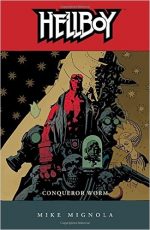
Hellboy volume 3: The Chained Coffin and Others


By Mike Mignola with James Sinclair, Matt Hollingsworth & Dave Stewart (Dark Horse Books)
ISBN: 978-1-59307-091-5

Hellboy is a creature of vast depth and innate mystery; a demonic baby summoned to Earth by Nazi occultists at the end of World War II before being intercepted and subsequently reared by parapsychologist Professor Trevor “Broom” Bruttenholm. After years of devoted intervention and education, in 1952 Hellboy began destroying unnatural threats and supernatural monsters as the lead agent for the Bureau for Paranormal Research and Defense.

This third epic collection gathers a number of shorter sagas: The Wolves of August originally serialised in Dark Horse Presents #88-91, Advance Comics/Hellboy: The Corpse and the Iron Shoes, Hellboy: Almost Colossus plus material from Dark Horse Presents 100 #2 and Hellboy: Christmas Special, communally spanning 1994-1997 and leads off with an enthusiastic appreciation from devoted fan P. Craig Russell in his Introduction. Mignola also offers directors’ notes on all the spooky stories contained herein…

The supernatural superstar was never conventional, especially in his publication schedule. Hellboy’s shorter adventures materialised in many different venues whilst his own title had the appearance of a succession of one-shots and limited series. Mignola, however, had a solid marketing plan from the start. The stories had an internal numbering system (if you’re that interested check it out on Wikipedia and leave them a donation while you’re at it) which allowed him to make stops back and forth along his proposed timeline and build years of continuity in mere months…

Thus this collection of brief, bold blockbusters opens with ‘The Corpse’ which first saw print in monochrome in Advance Comics catalog. Here an old Irish fairytale is expanded and remastered in full colour as Hellboy’s attempts to rescue a baby stolen by the Little People one night in 1959 results in the unlikely hero making a fool’s bargain.

All the graves are full but he must find a final and proper resting place for a very vocal cadaver before the sun rises…

The action-packed errand leads to confrontations with ghosts, devils and worse before our scarlet champion parks the body and gets back the bairn…

Immediately following is thematic epilogue ‘The Iron Shoes’ which rapidly relates another Celtic saga set two years later when Hellboy drags a goblin out of the holy site it’s defiling before laying it at the feet of Father Edward Kelly…

‘The Baba Yaga’ was created specially for this compilation and describes in dire detail how the legendary Russian witch lost her eye to Hellboy in their first confrontation. Thereafter, ‘A Christmas Underground’ (from 1997’s Hellboy: Christmas Special) offers eerie and ethereal miasmic horror in the best seasonal manner. England, Christmas Eve, 1989 and Hellboy is on a death-watch. Aged and ailing Mrs. Hatch talks of her long-lost baby girl Annie. Leaving her, the un-horned hero follows a trail to a graveyard and down beneath it. Soon he is attending a dark soiree to rescue the child, now the restless bride of a prince of the Pit. After a most brutal struggle Hellboy celebrates the nativity by setting two souls to rest…

In 1995 Dark Horse Presents 100 #2 debuted ‘The Chained Coffin’. Here Mignola has partially redrawn the tale and Dave Stewart has added colour to the story of Hellboy’s return to the English church where he first arrived on Earth in 1943. Fifty years of mystery have passed, but as the demon-hunter observes ghostly events replay before his eyes and learns the truth of his origins, Hellboy devoutly wishes he had never come back…

‘The Wolves of Saint August’ ran in Dark Horse Presents #88-91 during 1994 before being reworked a year later for the Hellboy one-shot of the same name. Set in 1994 it sees the red redeemer working with BPRD colleague Kate Corrigan, investigating the death of Hellboy’s old friend Father Kelly in the Balkan village of Griart. It’s not long before they realise the sleepy hamlet is a hidden den of great antiquity where a pack of mankind’s most infamous and iniquitous predators thrive…

Mignola has a sublime gift for setting mood and building tension with great economy. It always means that the inevitable confrontation between Good and Evil has plenty of room to unfold with capacious visceral intensity. This clash between unfrocked demon and alpha lycanthrope is one of the most unforgettable battle blockbusters ever seen…

The story-portion of this magnificent terror-tome concludes with the 2-part miniseries ‘Almost Colossus’ from 1997 wherein traumatised pyrokinetic BPRD agent Liz Sherman awaits test results.

During her mission to Castle Czege (Hellboy volume 2: Wake the Devil) her team uncovered a hidden alchemy lab with a stony homunculus inside. When she touched the artificial man Liz’s infernal energies rushed uncontrollably into the creature and brought it to life…

Now as her own gradually slips away, Hellboy and Corrigan are back in the legend-drenched region, watching a graveyard from which 68 bodies have been stolen…

Elsewhere the fiery homunculus is undergoing a strange experience: he has been abducted by his older “brother” who seeks through purloined flesh, blackest magic and forbidden crafts to perfect their centuries-dead creator’s techniques.

Before the curtain falls, Hellboy, aided by the ghosts of repentant monks and the younger homunculus, is forced to battle a metal giant determined to crown itself the God of Science and save the world if he can and Liz because he must…

Wrapping up the Grand Guignol show is another splendid and whimsical ‘Hellboy Gallery’, featuring stunning efforts from Kevin Nowlan, Matt Smith, Duncan Fegredo, Dave Johnson, Thierry Robin and B.C. Boyer…

Bombastic, lightning-paced, moody and astonishingly addictive, this will delight adventure and horror fans in equal amounts: an arcana of thrills and chills no comics fan should be without.
™ and © 1994, 1995, 1996, 1997, 1998 and 2003 Mike Mignola. Introduction © 1998 P. Craig Russell. Hellboy is ™ Mike Mignola. All rights reserved.

Small Press Sunday


I started out in this game when marks on paper were considered Cutting Edge, making minicomics, collaborating on fanzines and concocting stripzines with fellow weirdoes, outcasts and comics addicts. Even today, seeing the raw stuff of creativity in hand-crafted paper pamphlets still gets me going in ways that threatens my tired old heart…
With that in mind, here’s a selection of tantalising treats that have landed in my review tray recently…
A few days before I began a major writing project with an insane deadline, I reviewed the magnificent GoodCopBadCop collections (still readily available and waiting to make your existence worthwhile…). In the same package was the first issue of the latest storyline and now that my day job’s back to normal – and with deepest apologies to Jim and the lads – here’s that promised review of the new follow-up case…

GoodCopBadCop Casebook #3.1 ‘Only Pigs and Horses’ Part 1
By Jim Alexander and Aaron Murphy, with Chris Twydell & Jim Campbell (Planet Jimbot Comics)

As well as mind-boggling graphic albums, independent publisher Planet Jimbot (Jims Alexander & Campbell with an ever-shifting pool of graphic talent) also delivers proper black-&-white comicbooks: none better than the continuing exploits of the most challenging rozzer in the history of crime.

City of Glasgow Police Inspector Brian Fisher is a worthy, weary, dedicated public servant with the oddest partner an honest copper could ever imagine – his own ruthless, rule-less crazy-man bad side…

Following directly on from the last book collection (GoodCopBadCop Casebook volume 2) this deceptively moody yarn finds Fisher about to start work again after a long period of sick leave. He’s been stood down ever since he caught catching a macabre, mutilating serial killer who left his bloody mark on the seemingly inoffensive Inspector.

Also out of sorts is his assistant Detective Sergeant Julie Spencer, who’s presently kipping on his couch. She was starting to piece together the truth about Fisher’s condition, but just stopped caring when her mother died…

Before he was a quietly effective Detective, Fisher learned his trade in the mounted police division and spent many educational hours doing community policing for the Violence Reduction Unit, visiting schools where the kids were more ruthlessly ferocious than any full-grown bad guy. Moreover, Brian’s condition is not a total secret. Certain higher-ups know that he goes off the rails but no one important has complained yet and the clean-up rate is phenomenal…

Those halcyon days on horseback come back to haunt Brian here and now as a ghastly atrocity is invoked when a new nutter hits the streets and, with astounding overkill, butchers two beat coppers.

Back in the saddle, Brain immediately makes a connection to the events at the Tannoch police stables thirteen years previously and heads to Barlinnie jail to interview an old lag who knew the original perpetrator “Peter the Horse”.

For a sordid and risky moment of quid pro quo, Michael offers Brian the full SP on the maniac – including the fact that he’s been dead for year…

He also reveals that Peter had an acolyte: another Peter the Horse in the making and one that been out in the real world for six months now…

To Be Continued…

This is another beautifully paced, chillingly unfolding mystery soaked in chilling complexity and shocking moments, tailor made to be a movie or late-night Scandi-style drama serial…

This deftly underplayed, chillingly believable and outrageously black-humoured serial is a magnificent addition to the annals of Tartan Noir: smart, compelling, compassionate and fiercely engaging. If you like your crime yarns nasty and your heroes deeply flawed, GoodCopBadCop is a series you must not miss.
GoodCopBadCop Casebook #3.1 © 2016 Jim Alexander (story) and Aaron Murphy (art.)

Planet Jimbot has a splendid online shop so why not check it out?