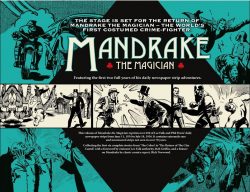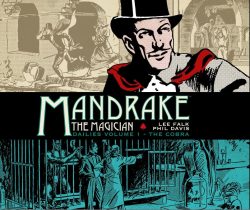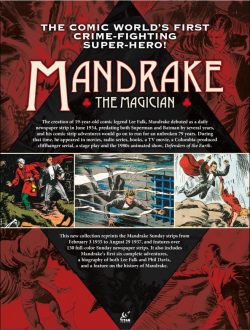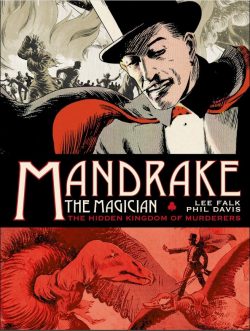
Mandrake the Magician: The Hidden Kingdom of Murderers – Sundays 1935-1937


By Lee Falk & Phil Davis (Titan Books)
ISBN: 978-0-85768-572-8 (HB)

Win’s Christmas Gift Recommendation: Because We Believe in Magic… 10/10

Regarded by many as the first superhero, Mandrake the Magician debuted as a daily newspaper strip on 11th June 1934. An instant hit, it was soon supplemented by a full-colour Sunday companion page which launched on February 3rd 1935.

Creator Lee Falk had actually sold the strip to King Features Syndicate years earlier as a 19-year old college student, but asked the monolithic company to let him finish his studies before dedicating himself to it full time. With his schooling done, the 23-year old master raconteur settled in to begin his life’s work: entertaining millions with his astounding tales.

Falk – who also created the first costumed superhero in moodily magnificent mystery man The Phantom – spawned an actual comicbook subgenre with his first creation. Most publishers of the Golden Age boasted at least one (and usually many more) nattily attired wonder wizards amongst their gaudily-garbed pantheons; all roaming the world making miracles and defeating injustice with varying degrees of stage legerdemain or actual sorcery.

Characters such Mr. Mystic, Ibis the Invincible, Sargon the Sorcerer, and an assortment of “…the Magicians” such as Zanzibar, Zatara, Kardak and so many, many more, all borrowed heavily and shamelessly from the uncanny exploits of the elegant, enigmatic white knight who graced the pages of the world’s newspapers and magazines.

In the Antipodes, Mandrake was a stalwart regular of the Australian Women’s Weekly, and also became a cherished star in the UK, Italy and Scandinavia. Over the years he has been a star of radio, movie chapter-serials, a theatrical play, television and animation as part of the cartoon series Defenders of the Earth. With that has come the usual merchandising bonanza of games, toys (including magic trick kits), books, comics and more…

Falk worked on Mandrake and “The Ghost who Walks” until his death in 1999 (even on his deathbed he was laying out one last story) but he also found time to become a playwright, theatre producer and impresario, as well as an inveterate world-traveller.

A man of many talents, Falk drew the first few weeks himself before uniting with sublimely imaginative cartoonist Phil Davis, whose sleekly understated renditions took the daily strip – and especially these expansive full-page Sunday offerings – to unparalleled heights of sophistication: his steady assured realism the perfect tool to render the Magician’s mounting catalogue of wondrous miracles…

Those in the know are well aware that Mandrake was educated at the fabled College of Magic in Tibet, thereafter becoming a suave globe-trotting troubleshooter, always accompanied by his faithful African partner Lothar and beautiful, feisty companion (and eventually, in 1997, bride) Princess Narda of Cockaigne, solving crimes and fighting evil. Those days, however, are still to come as the comics section opens in this splendidly oversized (315 x 236 mm) full-colour luxury hardback – and digital equivalents – with ‘The Hidden Kingdom of Murderers’ (which ran from February 3rd to June 2nd 1935) as the urbane Prince of Prestidigitation and his herculean companion are approached by members of the international police to help expose a secret society of criminals and killers acting against the civilised world from their own hidden country.

After officer Duval is assassinated, Mandrake and Lothar – accompanied by panther woman Rheeta and surviving cop Pierce – embark upon a multi-continental search which, after many adventures, eventually brings them to a desolate desert region where they are confronted by bloody-handed Bull Ganton, King of Killers.

With the master murderer distracted by Rheeta, Mandrake easily infiltrates the odious organisation and quickly begins dismantling the secret society of two million murderers. By the time Ganton wises up and begins a succession of schemes to end Mandrake, it’s too late…

That deadly drama concluded, Mandrake and Lothar head to India to revisit old haunts and end up playing both peacemaker and cupid in the ‘Land of the Fakirs’ (running from June 9th to October 6th).

When Princess Jana, daughter of Mandrake’s old acquaintance Jehol Khan is abducted by rival ruler Rajah Indus of Lapore, the Magician ends his mischievous baiting of the street fakirs to intervene. In the meantime, Captain Jorga – who loves Jana despite being of a lower caste – sets off from the Khan’s palace to save her or die in the trying…

After many terrific and protracted struggles, Mandrake, Lothar and Jorga finally unite to defeat the devious and duplicitous Rajah before the westerners set about their most difficult and important feat; overturning centuries of tradition so that Jorga and Jana might marry…

Heading north, the peripatetic performers stumble into amazing fantasy after entering the ‘Land of the Little People’ (13thOctober 1935 to March 1st 1936), encountering a lost race of tiny people embroiled in a centuries-long war with brutal cannibalistic adversaries. After saving the proud warriors from obliteration, Mandrake again plays matchmaker, allowing valiant Prince Dano to wed brave and formidable commoner Derina who fought so bravely beside them…

With this sequence illustrator Davis seemed to shake off all prior influences and truly blossomed into an artist with a unique and mesmerising style all his own. That is perfectly showcased in the loosely knit sequence (spanning 8th March to 23rd August 1936) which follows, as Mandrake and Lothar return to civilisation only to narrowly escape death in an horrific train wreck.

Crawling from the wreckage, our heroes help ‘The Circus People’ recapture and calm the animals freed by the crash, subsequently sticking around as the close-knit family of nomadic outcasts rebuild. Mighty Lothar has many clashes with jealous bully Zaro the Strongman, culminating in thwarting attempted murder, whilst Mandrake uses his hypnotic hoodoo to teach sadistic animal trainer Almado lessons in how to behave, but primarily the newcomers act as a catalyst, making three slow-burning romances finally burst into roaring passionate life…

Absolutely the best tale in this tome and an imaginative tour de force which inspired many soon-to-be legendary comicbook stars, ‘The Chamber into the X Dimension’ (30th August 1936 to March 7th 1937) is a breathtaking, mind-bending saga starting when Mandrake and Lothar search for the missing daughter of a scientist whose experiments have sent her literally out of this world.

Professor Theobold has discovered a way to pierce the walls between worlds but his beloved Fran never returned from the first live test. Eager to help – and addicted to adventure – Mandrake and Lothar volunteer to go in search of her and soon find themselves in a bizarre timeless world where the rules of science are warped and races of sentient vegetation, living metal, crystal and even flame war with fleshly humanoids for dominance and survival.

After months of captivity, slavery, exploration and struggle our human heroes finally lead a rebellion of the downtrodden fleshlings and bring the professor the happiest news of his long-missing child…

Concluding this initial conjuror’s compilation is a whimsical tale of judgement and redemption as Mandrake uses his gifts to challenge the mad antics of ‘Prince Paulo the Tyrant’ 14th (March 14th – 29th August 1937).

The unhappy usurper stole the throne of Ruritanian Dementor and promptly turned the idyllic kingdom into a scientifically created madhouse. Sadly, Paulo had no conception of what true chaos and terror were until the magician exercised his mesmeric talents…

This epic celebration also offers a fulsome, picture-packed and informative introduction to the character – thanks to Magnus Magnuson’s compelling essay ‘Mandrake the Magician Wonder of a Generation’ – plus details on the lives of the creators (‘Lee Falk’ and ‘Phil Davis Biography’ features) plus a marvellous Davis pin-up of the cast to complete an immaculate confection of nostalgic strip wonderment for young and old alike.
Mandrake the Magician © 2016 King Features Syndicate. All Rights Reserved. “Mandrake the Magician Wonder of a Generation” © 2016 by Magnus Magnuson.
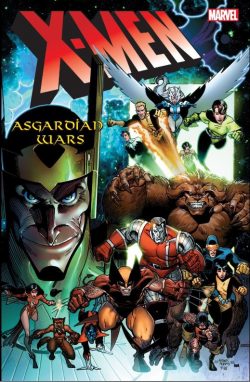
X-Men: Asgardian Wars


By Chris Claremont, Paul Smith, Bob Wiacek, Arthur Adams, Terry Austin, Alan Gordon & Mike Mignola (Marvel)
ISBN: 978-0-7851-4148-8 (HB) 978-0-7851-8872-8 (TPB)

In 1963, X-Men #1 introduced Cyclops, Iceman, Angel, Marvel Girl and the Beast: very special students of Professor Charles Xavier, a wheelchair-bound telepath dedicated to brokering peace and integration between the masses of humanity and the emergent off-shoot race of mutants dubbed Homo Superior. After years of eccentric and spectacular adventures, the mutant misfits disappeared at the beginning of 1970 during a sustained downturn in costumed hero comics whilst fantasy and supernatural themes once more gripped the world’s entertainment fields.

Although the title was revived at the end of the year as a reprint vehicle, the missing mutants were reduced to guest-stars and bit-players throughout the Marvel universe and the Beast was made over into a monster until in 1975 Len Wein, Chris Claremont & Dave Cockrum revived and reordered the Mutant mystique with a stunning new iteration in Giant Size X-Men #1.

To old foes-turned-friends Banshee and Sunfire was added a one-shot Hulk villain dubbed Wolverine, and all-original creations Kurt Wagner, a demonic German teleporter codenamed Nightcrawler, African weather “goddess” Ororo MonroeAKA Storm, Russian farmboy Peter Rasputin, who transformed at will into a living steel Colossus, and bitter, disillusioned Apache superman John Proudstar who was cajoled into joining the makeshift squad as Thunderbird.

The revision was an unstoppable hit and soon grew to become the company’s most popular and high-quality title. In time Cockrum was succeeded by John Byrne and, as the team roster shifted and changed, the series rose to even greater heights, culminating in the landmark “Dark Phoenix” storyline which saw the death of (arguably) the series’ most beloved and groundbreaking character.

In the aftermath, team leader Cyclops left and a naive teenaged girl named Kitty Pryde signed up just as Cockrum returned for another spectacular sequence of outrageous adventures.

The franchise inexorably expanded with an ever-changing cast and in 1985 a new slant was added as author Claremont began to forge links between Marvel’s extemporised Norse mythology and the modern mutant mythos through the two series he then scripted.

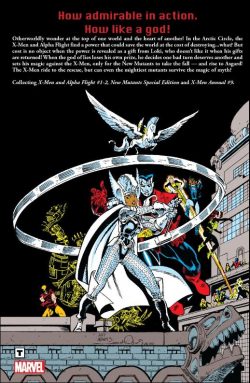
First released in 1990 as Marvel was tentatively coming to grips with the growing trend for “trade paperback” collections, this full-colour compendium (available as a deluxe hardcover, trusty trade paperback and digital delight) collects the 1985 two-issue Limited Series X-Men and Alpha Flight, plus The New Mutants Special Edition and X-Men Annual #9 which, taken together, comprise a vast saga of staggering beauty and epic grandeur…

Two-part tale ‘The Gift’ – illustrated by Paul Smith & Bob Wiacek, saw the retired Scott Summers and his new girlfriend Madelyne Prior ferrying a gaggle of environmental scientists over Alaska in a joint American/Canadian survey mission, only to fall foul of uncanny weather and supernatural intervention…

When the X-Men receive a vision of Scott’s crashed and burning body they head North and attack Canadian team Alpha Flight under the misapprehension that the state super-squad caused the disaster. Once the confusion has been cleared up and a tenuous truce declared, the united champions realise that mystic avatar Snowbird is dying: a result of some strange force emanating from the Arctic Circle…

In another time and place, Asgardian god Loki petitions a conclave of enigmatic uber-deities “They Who Sit Above in Shadow” for a boon, but their price is high and almost beyond his understanding…

When the assembled teams reach the crash site, they find not a tangle of wreckage and bodies but a pantheon of new gods dwelling in an earthly paradise, and amongst them Scott and Madelyne, also transformed into perfect beings. These recreated paragons are preparing to abolish illness, want and need throughout the world by raising all humanity to their level and most of the disbelieving heroes are delighted at the prospect of peace on Earth at last.

However, Kitty Pryde, Talisman and Rachel Summers (the Phoenix from an alternate future) are deeply suspicious and their investigations uncover the hidden cost of this global transfiguration. Once they convince Wolverine, Loki’s scheme begins to unravel like cobwebs in a storm. Soon all that is left is anger, recrimination and savage, earth-shaking battle…

Once the God of Mischief’s plan was spoiled, the malignant Prince of Asgard plots dark and subtle revenge which begins with ‘Home is Where the Heart is’ (Claremont, Arthur Adams & Terry Austin from The New Mutants Special Edition)when he recruits the Enchantress to abduct the junior X-Men-in-training whilst he turns his attentions to the adult team’s field commander Storm.

Sunspot, Magik, Magma, Mirage, Cannonball, Wolfsbane, Karma, Warlock and Doug Ramsey are dragged to the sorceress’ dungeon in Asgard, but manage to escape through a teleport ring. Unfortunately, the process isn’t perfect and the kids are scattered throughout the Eternal Realm; falling to individual perils and influences, ranging from enslavement to adoption, true love to redemption and rededication…

Most telling of all, Mirage AKA Danielle Moonstar rescues a flying horse and becomes forever a Valkyrie, shunned by the living as one of the “Choosers of the Slain”…

With such power at her command Mirage soon gathers her scattered mutant comrades for revenge on the Enchantress before the dramatic conclusion in ‘There’s No Place Like Home’ (X-Men Annual #9, by Claremont, Adams, Alan Gordon & Mike Mignola)…

Loki, who has elevated the ensorcelled Storm to the position of Asgardian Goddess of Thunder, is simultaneously assaulted by a dimension-hopping rescue unit consisting of Cyclops, Wolverine, Nightcrawler, Rogue, Kitty Pryde, Colossus and future Phoenix as well as the thoroughly “in-country” New Mutants for a spectacular and cosmic clash which, although setting the worlds to rights, ominously promises that worse was yet to come…

This expansive crossover epic proved that, although increasingly known for character driven tales, the X-Franchise could pull out all the stops and embrace its inner blockbuster when necessary, and opened up a whole sub-universe of action and adventure which fuelled more than a decade of expansion. More than that, though, this is still one of the most entertaining mutant masterpieces of that distant decade or now.

Embellishing even this glittering prize, is a gallery of previous reprint covers and a total treasure trove of original pencil art too…

Compelling, enchanting, moving and oh, so very pretty, The Asgardian War is a book no Fights ‘n’ Tights fantasy fan can afford to miss.
© 1985, 1988, 1990 Marvel Entertainment Group, Inc. All rights reserved.

Umbrella Academy volume 1: Apocalypse Suite


By Gerard Way & Gabriel Bá (Dark Horse)
ISBN: 978-1-50671-547-6 (HB) 978-1-59307-978-9 (TPB)

Superheroes have been around long enough now that they’ve even evolved into different sub-sets: straight Save-the-World continuity types as championed by DC and Marvel, obsessively “real” or realist iterations such as Marvelman,Masked Man, Crossfire or Kick-Ass, comedy versions like Justice League International, Ambush Bug, Unbeatable Squirrel-Girl, Deadpool, She-Hulk or Gwenpool and some truly rare ducks that straddle a few barstools in between.

Cut from the same cloth of Edgy, Catastrophic Absurdism as Scott McCloud’s Zot!, Brendan McCarthy’s Paradax and especially Grant Morrison’s Doom Patrol and Flex Mentallo, the archly anti-didactic antics of The Umbrella Academy offers readers a subtly subversive take on the idiom which impressed the heck out of everybody and lured many disillusioned fans back to the pitifully tired and over-used genre when first released in 2012…

The debut collected volume gathers the initial 6-issue miniseries as well as a 2-page online tease from MySpace Dark Horse Presents and an introductory short story from the company’s Free Comic Book Day issue in 2007.

Once upon a time a strange event occurred. All across Earth 43 babies were unexpectedly born as the result of apparent immaculate conceptions – or perhaps some kind of inexplicable parthenogenesis. The births even surprised the mothers, most of whom abandoned or put up for immediate adoption their terrifying newborns.

Seven of these miracle babies were acquired by esteemed inventor and entrepreneur Sir Reginald Hargreeves. The inventor of the Levitator, mobile umbrella communicator, Clever Crisp cereal, Televator and a process which enabled chimps to speak was, in actuality, an over-achieving alien with a secret plan, and he raised the children to become superheroes to enact it.

He was not a good or caring parent…

The callously experimental family, after a number of early spectacular successes such as ‘The Day the Eiffel Tower Went Berserk’, soon proved to be unmanageable and the Umbrella Academy – created and trained “to save the World” – sundered in grief and acrimony, but not before poor Ben, Number 6 or “The Horror”, pointlessly lost his brave young life, and Number 5 – “The Boy” – took a short trip into the future and never came back…

An utterly dysfunctional superhero team, the children parted, but now, twenty years later, the surviving members gather again at the news that Hargreeves – whose nom de crime was The Monocle – has died…

In the interim, Number 1 son Luther became an off-earth defender and pioneer, but was hideously damaged on a doomed journey to Mars. To save him, The Monocle grafted his head onto the body of a colossal Martian Gorilla, but the “Spaceboy” found it far easier to live alone on the Moon than stay with his saviour and family.

Poor, neglected Vanya however – whose musical gifts Hargreeves deemed utterly useless – became a drop-out and wrote a scandalous tell-all book before becoming a voluntary exile amidst Earth’s lowest dregs…

In ‘We Only See Each Other at Weddings and Funerals’, the disparate clan gathers and Luther discovers The Boy has returned, looking not a day different. He isn’t – but his mind is 60-years old and has experienced horrors beyond all imagining…

Made welcome by technologist, housekeeper and talking chimp Dr. Pogo, Luther is startled by the return of Allison(Number 3, The Rumor). She’s changed a lot since her marriage – although she’s now single again – but Diego (Number 2, The Kraken) and Klaus (Number 4, The Séance) are just the same: physically mature but still completely, scarily demented…

The interment ceremony is a complete fiasco and descends into a brawl, but the savage bitterness the family exhibits towards each other is as nothing compared to the carnage caused by the arrival of merciless robotic Terminauts tasked with stopping the Umbrella Academy reforming at any cost…

Across town, poor forgotten Vanya has an audition with some very special musicians. The Orchestra Verdammten need only the best if their unconventional maestro, The Conductor is to perfectly premiere his latest opus – The Apocalypse Suite…

As the reluctantly reunited Academy fall into old habits and dash off to save innocents from slaughter, The Boy drops his final bombshell: in the future he’s returned from, Earth was destroyed three days after the Monocle died…

Built by a long-vanquished foe, the killer mechanoids are ‘Dr. Terminal’s Answer’ to the pesky kids who ruined his plans, although they don’t fare well against Spaceboy, Rumor, Séance and The Kraken.

Dr. Pogo has stayed to examine The Boy and finds him exceedingly strange: a 60-year old mind wearing a 10-year old body that hasn’t aged a single second since it reappeared. There’s even stranger stuff going on which the monkey medic can’t detect, though…

Diego never stopped fighting monsters and has become a darkly driven vigilante, who even now has ignored the flamboyant threat of the robots to save imperilled kids. However, when Vanya – fresh from fleeing the deranged Conductor – stumbles into the conflagration he disparages her; calling her useless, just like Hargreeves used to.

As her strange siblings wrap things up and return to puzzle out exactly how the Earth will end in a matter of days, dejected, rejected Number 7 returns to The Orchestra Verdammten…

Subjected to outrageous experiments in ‘Baby, I’ll be Your Frankenstein’, Vanya is quickly transformed into a finely-tuned instrument to shatter reality, even as Pogo and The Boy stop for coffee and meet time-travelling trouble.

…And at the Icarus Theatre, the once disregarded and discarded White Violin makes her deadly, devastating debut…

At a certain Diner, distressed waitress Agnes tells Police Inspector Lupo how a veritable army of futuristic thugs were reduced in seconds to scarlet shreds and tatters by a little boy who politely said ‘Thank You for the Coffee’ before leaving with his chimpanzee friend. Lupo has endured a long and difficult unofficial association with ruthless avenger Kraken which has kept the city’s worst criminals from running riot, but when the old cop casually remarks that a lot of violinists have suddenly vanished, even he is quite unprepared for the vigilante’s reaction…

The family gathers at the Academy: Luther and Rumor slowly rekindling a long suppressed relationship even as The Boy makes the huge mistake of looking through Hargreeves’ trademark Monocle just as prodigal sister Vanya knocks on the door – with shattering, killing force…

The shocked stunned survivors quickly marshal their forces for ‘Finale or, Brothers and Sisters, I Am an Atomic Bomb’, but even though they achieve some sort of victory and save reality, it’s at a terrible, World-shattering cost…

Following Editor Scott Allie’s Afterword on the trials, tribulations and triumph of working with a big-name rock-star (yes, that Gerard Way: multi-talented musician/writer/artist/designer who once fronted My Chemical Romance…) whilst trying to maintain a comicbook schedule, illustrator Gabriel Bá and the author then reveal a host of production secrets in ‘Designing the Umbrella Academy’.

But that’s not all: the introductory ‘Short Stories’ – with notes and commentary from Bá – follow, revealing a lighter side to the team in ‘“Mon Dieu!”’ and a surprisingly deft surreal murder mystery in‘…But the Past Ain’t Through with You’(first seen in MySpace Dark Horse Presents and Dark Horse Free Comic Book Day 2007 respectively).

Whilst happily swiping, homaging, sampling and remixing the coolest elements from many and varied comics sources, The Umbrella Academy created a unique synthesis and achieved its own distinctive originality within the tired confines of the superhero genre. Maybe because it stylishly combines the tragic baroque tone of a La Belle Époque scenario with an ironic dystopian fin de siècle sensibility and repackages it all as a wittily post-modern heroic fable, or perhaps more likely simply because it’s all just really damned good, darkly sardonic fun, conceived with love and enthusiasm and crafted with supreme skill and bravura by extremely talented people who love what they do…?

A few years ago, the saga was adapted to television and became 2019’s most watched Netflix show. In response, a spiffy deluxe oversized hardcover was released, boasting an extra 50 pages of sketches and such. So you could opt for that or the digital edition if you love trees…

Read The Umbrella Academy: Apocalypse Suite if you’re smart, read it if you’re bored, read it because I said so, but if you too love the medium and the genre, read it, read it, read it.
™ © 2008 Gerard Way. All rights reserved.

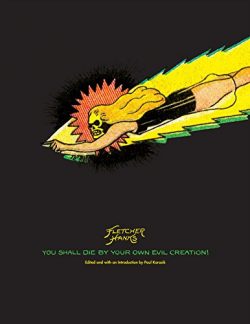
You Shall Die by Your Own Evil Creation!: More Comics by Fletcher Hanks


By Fletcher Hanks, edited by Paul Karasik (Fantagraphics Books)
ISBN: 978-1-606699-160-2 (TPB)

Although he was a pioneering auteur and prolific creator, the work of troubled artisan Fletcher Hanks (December 1st 1889 – January 22nd 1976) was all-but lost to posterity for decades following the Darwinian dawn of the American comic book. Happily, he was rediscovered relatively recently by comics’ intelligentsia in such magazines as Raw!

Hank’s unique visual style and frankly histrionic manner of storytelling resulted in only 51 complete stories created over less than three years (1939-1941) – but those were during the make-or-break, crucially formative times that would shape the industry for decades to come.

Like so many of his contemporaries, Hanks was an artist plagued by a dependence on alcohol and a tendency to violence. Surviving on odd jobs and as a mural painter, he abandoned his wife and four children in 1930 and disappeared until the incredible commercial drive to fill comic book pages saw him resurface in 1939 as part of the Jerry Iger/Will Eisner production “Shop”. Here he generated whole stories (script, art, lettering and probably even colour-guides) for some of the most successful publishers of the Golden Age. All were fast-paced, action-packed, relentless blood-&-thunder thrillers, underpinned by what might well be hallucinogenic delirium…

Hanks is now globally prominent in art circles and regarded as a key Outsider Artist – defined by critic Roger Cardinal as an English-language equivalent to the French movement Art Brut or Raw/Rough Art: works created outside the boundaries of official culture. Jean Dubuffet connected the phenomenon especially and specifically to the paintings and drawings of insane asylum inmates but Cardinal extended the definition to include Naïve art, some Primitivism and sustained bodies of work by creators working at all fringes of the mainstream.

In his woefully short career, the impact of those 51 stories were further reduced since he only worked in a few returning characters. This book follows on from and concludes the complete works compilation begun in editor Karasik’s I Shall Destroy all the Civilized Planets! (which I simply must track down and review too).

Presented in chronological order, this book contains seven Space Smith adventures – ‘Captured by Skomah!’ (Fantastic#1, December 1939), ‘The Martian Ogres!’ (Fantastic #2, January 1940), ‘The Leopard Women of Venus’ (#3, February), ‘The Thinker’ (#4, March), ‘The Hoppers’ (#5, April), ‘The Vacuumites’ (#6, May) and ‘Planet Bloodu’ (#8, July): a single tale of Tabu, Wizard of the Jungle from Jungle Comics #1 (‘The Slave Raiders’, January 1940) plus a batch of red-blooded lumberjack yarns starring Big Red McLane: ‘King of the North Woods’, ‘The Timber Thieves’, ‘The Lumber Hijackers’, ‘The Sinister Stranger’, ‘The Paper Racketeers’, ‘Sledge Sloan Gang’, ‘The Monk’s War Rockets’ and ‘Searching for Sally Breen’ from the monthly Fight  Comics (#1, January 1940, and #3 through 9).

The incomparable Stardust the Super-Wizard (whose slick, sleek costume surely influenced Britain’s Mick Anglo when he redesigned Captain Marvel into All-English Marvel Man in 1954!) is stirringly represented by ‘Rip the Blood’(Fantastic #2 January 1940), ‘The Mad Giant’ (#4), ‘The Emerald Men of Asperus’ (#8) ‘The Super Fiend’ (#10), ‘Kaos and the Vultures’ (#12), ‘The Sixth Columnists’ (#14) and ‘The World Invaders’ (Fantastic #15, February 1941).

No violent genre was beyond Hanks and prototype sword-wielding barbarian hero Tiger Hart rousingly romped through the jungles of Saturn in ‘The Dashing, Slashing Adventure of the Great Solinoor Diamond’ in Planet Comics #2 (February 1940).

From early 1940, Daring Mystery #4 and #5 supply ‘Mars Attacks’ and ‘Planet of Black-Light’, two exploits of brawny, clean-limbed Whirlwind Carter of the Interplanetary Secret Service, whilst Yank Wilson, Super Spy Q-4 performed much the same role for the contemporary USA in ‘The Saboteurs’ from Fantastic #6 (May 1940).

For me the biggest, most enjoyable revelation is the captivating batch of uncanny tales featuring the frankly indescribable Fantomah. The “Mystery Woman of the Jungle” – a blend of witch, goddess and reanimated corpse – used startling magic to monitor and defend the green places of the world against all manner of threats from poachers to mad scientists and aliens.

Her beguiling feats open with ‘The Elephants Graveyard’ (Jungle Comics #2, February 1940) and just get wilder and wilder, continuing with ‘The Super-Gorillas’ (#4), ‘Mundoor and the Giant Reptiles’ (#5), ‘Phantom of the Tree-Tops’(#6), ‘The Temple in the Mud Pit’ (#8), ‘The Scarlet Shadow’ (#11), ‘The New Blitzers’ (#12) and ‘The Tiger-Women of Wildmoon Mountain’ before ominously concluding with ‘The Revenge of Zomax’ from February 1941’s Jungle #14.

These stunningly surreal and forceful stories created under the pseudonyms Barclay Flagg, Hank Christy, Henry and Chris Fletcher, Charles Netcher, C.C. Starr and Carlson Merrick are a window into a different, bolder, proudly unconventional era and the troubled mind of a true creative force. Seen in conjunction with Karasik’s insightful introduction and the many early sketches and illustrations from before that too-brief foray into comics, these pages present an intimate glimpse of a fascinating man at a crossroads he was clearly able to shape but never grasp.

This is a magical book for both fans of classical comics and the cutting edge of modern art: and just in case you were wondering, the stories are weird but read wonderfully.

It Must Be Yours!!!

All stories are public domain but the specific restored images and design are © 2009 Fantagraphics Books.

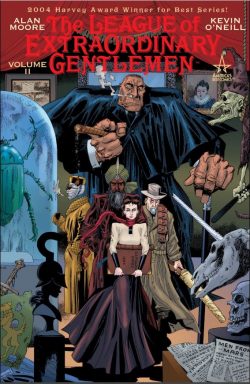
League of Extraordinary Gentlemen volume II


By Alan Moore & Kevin O’Neill & various (Americas Best Comics/WildStorm/DC)
ISBN: 978-1-4012-0118-0 (TPB)

The Victorian era saw the birth of both popular and populist publishing, particularly the genres of fantasy and adventure fiction. Writers of varying skill but possessing unbounded imaginations expounded personal concepts of honour and heroism, wedded unflinchingly to the innate belief in English Superiority. In all worlds and even beyond them the British gentleman took on all comers for Right and Decency, viewing danger as a game and showing “Johnny Foreigner” just how that game should be played.

For all the problems this raises with our modern sensibilities, many of the stories remain uncontested classics of literature and form the roadmap for all modern fictional heroes. Open as they are to charges of Racism, Sexism (even misogyny), Class Bias and Cultural Imperialism the best of them remain the greatest of all yarns.

An august selection of just such heroic prototypes were seconded – and slyly re-examined under modern scrutiny – by Alan Moore & Kevin O’Neill for a miniseries in 1999 that managed to say as much about our world as that long gone one, and incidentally tell a captivating tale as compelling as any of its antecedents.

In short succession there was an inevitable sequel, once more pressing into service vampire-tainted Wilhelmina Murray, aged Great White Hunter Allan Quatermain, Invisible Man Hawley Griffin, the charismatic genius Captain Nemo and both cultured Dr. Henry Jekyll and his bombastic alter-ego Mister Hyde. The tale also added cameos from the almost English Edwin Lester Arnolds’ Gullivar Jones, Edgar Rice Burroughs’ John Carter of Mars and even many creatures from C.S. Lewis’ allegorical sequence Out of the Silent Planet.

The idea of combining shared cultural brands is evergreen: Philip Jose Farmer in particular spun many a yarn teaming such worthies as Sherlock Holmes, Doc Savage, Tarzan and their like; Warren Ellis succumbed to similar temptation in Planetary and Jasper Fforde worked literary miracles with the device in his Thursday Next novels, but the sheer impetus of Moore & O’Neill’s para-steampunk revisionism, rush of ideas (and the stunning, startling visuals that carry them) make this book (and all the previous ones) form an irresistible experience and absolute necessity for every fiction fan, let alone comic collector…

In ‘Phases of Deimos’, as London rebuilds after the cataclysmic denouement of the previous volume, a savage planetary conflict on the fourth planet ends with the firing of gigantic projectiles at our fragile, unsuspecting world …

The barrage hits home in ‘People of Other Lands’ and the cohort of reluctant agents is on hand when hideous otherworldly invaders begin incinerating the best that Britain can offer. One of the operatives considers treachery as more cylinders arrive in ‘And Dawn Comes Up Like Thunder’ and acts upon the temptation as the incursion renders Earth’s most advanced defenders helpless…

With the Empire being dismantled by Tripods and other supra-scientific engines of destruction, ‘All Creatures Great and Small’ finds half of the chastened and dispirited agents seeking other allies and ideas, even as ‘Red in Tooth and Claw’ sees the traitor exposed and dealt with despite the inexorable advance of the Martian horde before the tide unexpectedly and shockingly turns in ‘You Should See Me Dance the Polka…’

This startlingly impressive and beguilingly effective interleaving of HG Wells’ landmark fantasy classic with the skewed but so-very plausible conceit that all the great adventurers of literature hung out together captures perfectly the feeling of a world and era ending. As one would expect, internal conflicts pull apart the champions – at no time do they ever even slightly resemble a team – and Moore’s irrepressible imagination and vast cultural reservoir dredges up a further elite selection of literary touchstones to enhance the proceedings.

Dark and genuinely terrifying, the tale unfolds largely unchanged from the original War of the Worlds plot, but a string of parallel side-stories are utterly gripping and unpredictable, whilst the inclusion of such famed and/or lost characters as Bill Samson, Doctor Moreau, Tiger Tim and even Rupert Bear (among others) sweetens the pot for those in the know.

Those who aren’t you can always consult A Blazing World: the official companion to the drama…

This book is an incredible work of scholarship and artistry recast into a fabulous pastiche of an entire literary movement. It’s also a stunning piece of comics wizardry of a sort no other art form can touch, and as with the other Moore & O’Neill collaborations there are wry visual supplements (including, activity pages, puzzles and mazes, faux ads and a board game) plus a substantial text feature – The New Traveller’s Almanac – at the back, in-filling the alternative literary history of the League.

It is quite wordy, but Read It Anyway: it’s there for a reason and is more than worth the effort as it outlines the antecedents of the assorted champions in a fabulously stylish and absorbing manner. It might also induce you to read a few other very interesting and rewarding books…
© 1999, 2000 Alan Moore & Kevin O’Neill. All Rights Reserved.
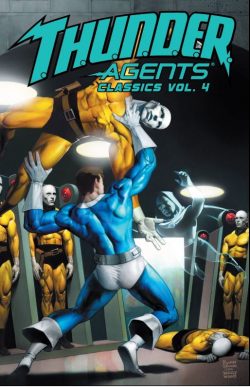
T.H.U.N.D.E.R. Agents Classics volume 4


By Wally Wood, Steve Skeates, Ralph Reese, Dan Adkins, Ogden Whitney, Chic Stone Mike Sekowsky, George Tuska, John Giunta, Frank Giacoia & various (IDW)
ISBN: 978-1-63140-084-1(TPB) eISBN: 978-1-62302-611-0

The meteoric lifespan and output of Tower Comics is one of the key creative moments in American comicbook history. The brief, bombastic saga of The Higher United Nations Defense Enforcement Reserves was a benchmark of quality and sheer bravura fun for fans of both the then-still-reawakening superhero genre and that era’s spy-chic obsession.

In the early 1960s, the Bond movie franchise was going from strength to strength, with blazing action and heady glamour utterly transforming the formerly low-key espionage genre. The buzz was infectious: soon Men like Flint and Matt Helm were carving out their own piece of the action as television shanghaied the entire bandwagon with Danger Man and the irresistible Man from U.N.C.L.E. – premiering in September 1964 – bringing the whole shtick inescapably into living rooms across the planet.

Archie Comics editor Harry Shorten was commissioned to create a line of characters for a new distribution-chain funded publishing outfit – Tower Comics. He brought in creative maverick Wally Wood, who sensibly called on some of the biggest names in the industry to produce material in the broad range of genres the company demanded (there was magnificent anthology war-comic Fight the Enemy and wholesome youth-comedy Tippy Teen as well as T.H.U.N.D.E.R. Agents and its spin-offs Undersea Agent, Dynamo and NoMan).

Samm Schwartz & Dan DeCarlo handled the funny stuff – which outlasted everything else – whilst Wood, Larry Ivie, Len Brown, Bill Pearson, Steve Skeates, Dan Adkins, Russ Jones, Gil Kane and Ralph Reese contributed scripts for themselves and the industry’s other top talents to illustrate on the interlinked adventure series.

With a ravenous appetite for super-spies and costumed heroes growing in comic-book popularity and amongst the general public, the idea of blending the two concepts seemed inescapable…

T.H.U.N.D.E.R. Agents #1 appeared with no fanfare or pre-publicity on newsstands in August 1965 (with a cover off-sale date of November). Better yet, all Tower titles were in the beloved-but-rarely-seen 80-page Giant format, offering a huge amount of irresistible action and drama in every issue.

All that being said, these tales would not be so revered if they hadn’t been so superbly crafted. As well as Wood, the art accompanying the compelling, subtly more mature stories was by some of the greatest talents in comics: Reed Crandall, Gil Kane, George Tuska, Mike Sekowsky, Dick Ayers, Joe Orlando, Frank Giacoia, John Giunta, Steve Ditko and others.

This fourth fabulous compilation compiles and collates T.H.U.N.D.E.R. Agents #11, Dynamo #3 and includes both issues of second spin-off No-Man – all originally released between November 1966 and March 1967 – with the incomparably cool concept and characters going from strength to strength and a spirit of eccentric experimentation and raucous low comedy slipping in to sweeten the pot…

For those who came in late: When brilliant Professor Emil Jennings was attacked by the forces of the mysterious Warlord, the savant perished. Happily, UN troops salvaged some of his greatest inventions, including a belt that increased the density of the wearer’s body until it became as hard as steel, a cloak of invisibility and a brain-amplifier helmet…

The prototypes were divided between several agents to create a unit of super-operatives to counter increasingly bold attacks of multiple global terror threats such as the aforementioned Warlord.

First chosen was affable, honest but far from brilliant file clerk Len Brown who was, to everyone’s surprise, assigned the belt and codename Dynamo. T.H.U.N.D.E.R. Agent NoMan was once decrepit Dr. Anthony Dunn who chose to have his mind transferred into an android body and was then gifted with the invisibility cape. If his artificial body was destroyed Dunn’s consciousness could transfer to another android body. As long as he had a spare ready, he could never die…

Indomitable operative Guy Gilbert of crack Mission: Impossible style T.H.U.N.D.E.R. Squad was asked to beta-test an experimental super-speed suit. As gung-ho Lightning, he was proud to do so, even if every activation of the hyper-acceleration gimmick shortened his life-span…

After the death of telepathic agent Menthor, T.H.U.N.D.E.R. bigwigs created a new – flying – agent. Worryingly, the only operative capable of piloting the heavily-armed aerial warsuit was unscrupulous former mercenary Craig Lawson. Although ruthlessly effective, his attitude continues to give cause for concern …

The super-science spookshow resumes – in both paperback and digital formats – with the November 1966 debut issue of a second spin-off title. NoMan #1 was another sterling selection of superspy sagas with most of the writer credits once again an unresolved secret lost to posterity…

However, we know Gil Kane & Paul Reinman tackled the art for ‘Fingers of Fate’ as a robbery spree seems to implicate famed personages and celebrities in crimes they could not have committed. The trail of the real culprits leads the android agent to India to scotch a scheme to discredit global fingerprinting databases…

John Giunta illustrates ‘Secret in the Sky’ as NoMan battles criminal genius The Gnome after the diminutive demon seizes control of the world’s weather, after which Lightning foils ‘The Warp Wizard’s Master Plan’ (scripted by Steve Skeates with art from Chic Stone), when the teleporting bandit devises a seemingly unbeatable new weapon…

Subtly entrancing art veteran Ogden Whitney limns NoMan as the android agent is ‘Trapped in the Past’ by aliens and remains to render the tragedy of ‘The Good Subterranean’ who tried to reform despite a wave of human intolerance…

Next up is T.H.U.N.D.E.R. Agents #11 (March 1967) which opens with the team’s top agent in big trouble and replaced by a deadly duplicate. ‘The Death of Dynamo’ (art by Dan Adkins & Wood) sees criminal society S.P.I.D.E.R. almost succeed but for one crucial oversight…

Steve Skeates, Mike Sekowsky & Frank Giacoia the detail ‘Lightning vs The Vortex’, pitting T.H.U.N.D.E.R.’s super-speedster against a wily crook with the – stolen – power to create tornados before immortal android NoMan escapes ‘The Trap’ set by telepathic tyrant The King and saves Humanity from mental enslavement in a terse thriller by Skeates & Giunta.

Drama gives way to sly whimsy in ‘Understudy for Dynamo’ (illustrated by Stone) wherein T.H.U.N.D.E.R. Agent Dan Atkins – AKA Dynamite – is tapped to wear the power-inducing Thunderbelt until Dynamo recovers from exhaustion and pneumonia. Sadly, the substitute is keen but not so able…

The anthological exploits conclude with another quirky outing for winged wonder Raven written and illustrated by legendary craftsman Manny Stallman. ‘The Case of Jacob Einhorn’ finds robot-obsessed Mayven the Poet hired to kill a celebrated Nazi-hunter before he can expose escaped war criminals to the UN. Determined to stop her is a former mercenary who can still learn a few things about being a hero…

A star from the get-go, Dynamo quickly won his own giant-sized solo title. With a March 1967 cover-date, issue #3 kicked off with the husky hero spectacularly battling an alien invasion inside T.H.U.N.D.E.R. HQ that quickly escalates to endanger the entire city. Illustrated by Stone, Wood & Adkins, ‘The Unseen Enemy’ is a potent blockbuster yarn that promises an unmissable return match…

Ralph Reese scripted hilarious romp ‘Bad Day for Leonard Brown’ for Stone to draw as the simplistic hunky he-man hero falls foul of regular girlfriend Alice, sultry fellow agents Diana Dawn and Kitten Kane as well as steely sex siren Iron Maiden all whilst diligently trying to keep a new laser weapon out of the hands of diabolical demagogue Demo…

Stone sticks around to limn Dynamo’s battle against middle eastern despot Phyllis Tyne, as the strongman is forced to reprise ‘The Feats of Samson’ after which Paul Reinman renders a sham marriage to T.H.U.N.D.E.R. Agent Kitten which exposes S.P.I.D.E.R.’s high crimes in the oil industry and leads to ‘Honeymoon or High Noon?’

The issue ends with another lighthearted romp for Wally Wood’s cartoon alter ego as wily Agent William “Weed” Wylie tries to quell a South American revolution sponsored by rival cabals S.P.I.D.E.R. and Red Star. Drawn by George Tuska, ‘Weed Vs T.H.U.N.D.E.R.’ results in the scrawny pragmatist punching way above his weight when the villains co-opt the super-agents with mindbending gases…

This volume closes with the contents of NoMan #2 (March 1967) as Whitney illustrates ‘Dynamo vs NoMan’ – wherein Spider technologist Doctor Cyber usurps control of the Invisible Agent’s legion of android bodies – and follow-up thrill ‘The Weird Case of the Kiss of Death’ as a reincarnated Egyptian queen sustains her immortal life by consuming life force. Not, however, one enclosed in a plastic body…

Skeates & Stone then detail how battle-wounded Lightning loses his memory of a hidden S.P.I.D.E.R. stronghold in ‘The Web Tightens’ before Whitney returns for ‘Target NoMan’ as hidden organisation Reconquer schemes to resurrect the most evil man in history, before the espionage excitement pauses with Skeates & Whitney’s ‘A Quick Change of Mind’. Here a madman pillages scientists’ mentalities in pursuit of the ultimate weapon, only to fail thanks to the ultimate secret agent…

With stories all shaded in favour of fast pace, sparse dialogue, explosive action and big breathtaking visuals, T.H.U.N.D.E.R. Agents was decades ahead of its time and certainly informed everything in Fights ‘n’ Tights comics which came after it. These are truly timeless comic classics which improve with every reading, so do yourself a favour and add these landmark super-sagas to your collection.
T.H.U.N.D.E.R. Agents Classics volume 4 © 2014 Radiant Assets, LLC. All rights reserved.

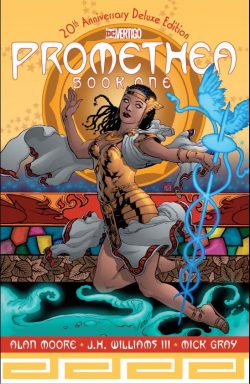
Promethea: Book One – 20th Anniversary Deluxe Edition


By Alan Moore, J H Williams III & Mick Gray, with Charles Vess, José Villarrubia & Jeromy Cox (America’s Best Comics)
ISBN: 978-1-40128-866-2 (HB)

After far too long away, let’s welcome back a notable addition to the canon of not-embarrassing, happily recommendable “Strong Female Characters” in hardback and digital editions that do her justice

I wonder if, when Alan Moore first conceived this series as part of his private superhero universe (now inexorably subsumed into the greater DC cosmology), he realised quite how far he would take this tale, or just how far he and long-haul collaborators J H Williams III & Mick Gray would push the boundaries of Graphic Narrative?

Ignoring the superficial resemblances to Wonder Woman – herself more archetype than property these days, but don’t tell the lawyers I said that – what’s on offer here? Promethea #1-12 are collected in this first Deluxe volume and are preceded by Moore’s introduction: ‘The Promethea Puzzle : An Adventure in Folklore’ (clipped from the first issue)…

Sophie Bangs lives in the big city, in a world of Science Heroes, multi-powered villains and real, scary monsters. She’s a smart kid, if not traditionally pretty, doing teen-age things with her best friend Stacia. She’s also a student researching a term paper on a name that has cropped up in esoteric poems, art and popular culture since the 5th century AD. Sophie seems inexplicably fascinated by and drawn to the concept of Promethea…

After interviewing the widow of the writer of a Promethea comic book, she’s attacked by a shadowy demon and rescued by the widow, who is the comic heroine she’s been researching. It transpires Promethea is a little girl taken into the Immateria, the Realm of Imagination. She became a concept.

Throughout history, she has since become real by incarnating in women who inspire art and creativity. These women – and even some men – have been able to manifest as incarnations of a Spirit of Imagination residing in the greater world of the unconscious. The Immateria is where all Gods, Stories and Ideas dwell. As the shadow-monster returns, Sophia finds her own artistic method of contacting the fable realm and becomes its latest physical incarnation…

Having discovered the metaphysical nature of Promethea Sophie begins to adjust. In real terms that means she can transform into a super-powerful flying Amazon, and perhaps join the legions of Science Heroes who protect – and frequently endanger – the world, but as her story unfolds, she begins to see just how different her version of the old story can be. Sophie is not some frustrated do-gooder suddenly flush with new-found power; she is and always has been concerned with knowing things.

Thus begins a journey of metaphysical as well as metahuman adventure. Sophie fights monsters and meets heroes, but the never-ending battle is not what this series is about. She obsessively wants to know more, and whilst various flamboyant forces array themselves against her, she is constantly seeking deeper answers for questions she never knew she had.

As various real-world forces align themselves in response to the latest resurgence of Promethea, Sophie explores the Immateria, hunting answers and examining the careers of her predecessors. When those antithetical forces attack the hospital where her new friend Barbara is slowly dying, the resultant battle with the forces of Hell reveal just how potent a weapon Promethea can be. The serious reader is advised to examine closely the running sub-plot with hero team The Five Swell Guys and psychotic serial killer The Painted Doll. As well as divertingly action-packed in an otherwise very cerebral tale, the long-running side-bar will have major repercussions in volumes to come.

Having dealt with the demon-horde, and the secret organisation that summoned them, Sophie again deviates from the expected in her dealings with infamous sorcerer Jack Faust, and has a Y2K monster battle before the volume ends with a mystical primer on the history, meaning and symbolism of The Tarot that is the closest I’ve seen the printed page get to a multi-media experience.

Moore’s sly and subversive scripting, in a superhero universe pushed to its illogical extreme, is superbly matched by artists Williams III & Gray, who increasingly raise the bar on graphic creativity and printing technology for a visual experience that is simply staggering to behold.

Adding extra lustre to the affair, Brad Meltzer offers an Afterword asking ‘Who Wants to Read a Fantasy Comic?’ and Moore’s script for issue #3 a fascinating diagnostic appointment with the creative process, augmented by Williams III’s artwork for the issue.

Promethea always had the most experimental aspirations. It will never have universal appeal, but if you are serious about comics it is an experience you owe yourself to try. And don’t be fooled. This book isn’t a lecture or a lesson, it’s a journey…
© 1999, 2000, 2001, 2009, 2019 DC Comics. All Rights Reserved.

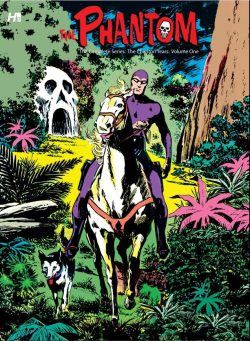
The Phantom – The Complete Series: The Charlton Years Volume One


By Dick Wood, Steve Skeates, Bill Harris, D. J. Arneson, Jim Aparo, Frank McLaughlin, Pat Boyette, Bill Lignante & various (Hermes Press)
ISBN: 978-1-61345-006-2 (HB)

In the 17th century a British sailor survived an attack by pirates, and, washing ashore on the African coast, swore on the skull of his murdered father to dedicate his life and that of all his descendants to destroying all pirates and criminals. The Phantom fights crime and injustice from a base deep in the jungles of Bengali, and throughout Africa is known as the “Ghost Who Walks”.

His unchanging appearance and unswerving war against injustice have led to him being considered an immortal avenger by the credulous and the wicked. Down the decades one hero after another has fought and died in an unbroken family line, and the latest wearer of the mask, indistinguishable from the first, continues the never-ending battle…

Lee Falk created the Jungle Avenger at the request of his syndicate employers who were already making history, public headway and loads of money with his first strip sensation Mandrake the Magician, and although technically not the first ever costumed hero in comics, The Phantom became the prototype paladin to wear a skin-tight body-stocking and the first to have a mask with opaque eye-slits.

He debuted on February 17th 1936 in an extended sequence pitting him against a global confederation of pirates called the Singh Brotherhood. Falk wrote and drew the daily strip for the first two weeks before handing over the illustration side to artist Ray Moore. A hugely successful Sunday feature began in May 1939.

For such a long-lived and influential series, in terms of compendia or graphic novel collections, The Phantom has been very poorly served by the English language market (except in Australia where he has always been accorded the status of a pop culture god).

Various companies have tried to collect the strips – one of the longest continually running adventure serials in publishing history – but in no systematic or chronological order and never with any sustained success.

But, even if it were only of historical value (or just printed for Australians), surely “Kit Walker” is worthy of a definitive chronological compendium series?

Happily, his comic book adventures have fared slightly better – at least in recent times…

From November 1962 through July 1966 all new adventures were published by West Coast giant Gold Key Comics after which King Features Syndicate dabbled with a comicbook line of their biggest stars – including Popeye, Flash Gordon, Mandrake and The Phantom – between 1966 and 1967. When they gave up the ghost, plucky dependable, cheap Charlton Comics were there to pick up the slack…

The Phantom was no stranger to funnybooks, having been featured since the Golden Age in titles such as Feature Book and Harvey Hits, but only as reformatted newspaper strip reprints. The Gold Key exploits were tailored to a big page and a young readership, a model King maintained for their own run but which was tweaked when Charlton took over the license.

This splendid full-cover hardcover – or eBook for the modern minded – gathers the contents of The Phantom #30-38 (originally released between February 1969 and June 1970) and opens with an erudite Introduction from Christopher Irving relating all you need to know about ‘The Phantom and Charlton Comics’, illustrated by the first of many pages of original art by Jim Aparo.

As with previous publishers, the majority of the stories are scripted by Dick Wood (with some contributions from Bill Harris and Charlton mainstay Steve Skeates) but the big attraction here is a large body of illustration by up-&-coming superstar Jim Aparo in his last work for CC before moving to DC…

Opening the Charlton archive is a brace of thrilling escapades by Dick Wood and Frank McLaughlin (with possibly some inking assistance from Sal Trapani?) beginning with ‘The Secret of the Golden Ransom’ as Julie – sister of the Ghost Who Walks – again dons the purple long-johns to secretly save her brother from a devilish trap, after which the ‘The Living Legend’ sees the jungle guardian put the fear of god into an western-educated tribesman who no longer believes in ghosts…

Issue #31 sees an epic full-length tale by Wood and Aparo as ‘The Phantom of Shang-Ri-La’ finds the hero on a rescue mission to the fabled Valley of the Sun to save his best friend from devious crooks masquerading as benevolent immortals…

Following more original art, #32’s ‘The Pharaoh Phantom’ takes the masked marvel to Egypt and an impossible confrontation with a freshly-revived mummy who claims to be the original and genuine Ghost Who Walks…

Pat Boyette & Nick Alascia limn Wood’s lead story in The Phantom #33 as ‘The Curse of Kallai’ exposes an ancient mystery wherein an Indian death cult returns to plunder Africa, claiming an earlier Phantom was their bound and sworn ally, after which Steve Skeates & Aparo detail how a young native boy is pivotal in reversing ‘The Phantom’s Death’…

Using the nom de plume Norm Dipluhm, D. J. Arneson scripts a brace of tales for Aparo in #34 beginning with ‘The Cliff Kingdom’ as the Phantom destroys a tribe hunting low flying aircraft before going on to defeat the far-fromxsupernatural menace dubbed ‘The Giant Ape of Tawth’…

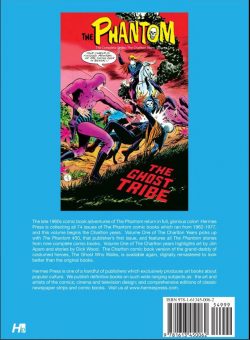
Veteran team Bill Harris & Bill Lignante return in #35 to reveal the sinister secret of ‘The Ghost Tribe’ plundering and slave-taking in Bengali, but not before the Phantom infiltrates the marauders’ inner circle and is ‘Trapped’ in an almost inescapable situation. Almost…

Dipluhm & Aparo open #36 with ‘The River That Never Ends’ as the Phantom is drawn into a subterranean underworld whilst battling merciless modern pirates, and close with a pithy smuggling yarn as the spectral avenger intercepts some ‘Very Special Timber’ to punish a very ingenious evildoer…

In #37 the format changes to shorter stories beginning with ‘Bandar Betrayers’ as a strange blossom warps the minds of the Phantom’s greatest friends and allies whilst ‘Skyjack’ sees him undercover as Kit Walker, flying to America when his plane is attacked by a fanatic, and a last exploit sees him back in Africa as a new commander for the private jungle police force is almost compelled to ‘Disband the Patrol’…

Wrapping up these volatile verdant voyages, #38 starts on ‘The Dying Ground’ as rogue hunters trap the hero in hopes of learning the location of the fable Elephant’s Graveyard before a crisis of conscience and capability is countered by uncanny natural phenomena in ‘The Phantom’s New Faith’ after which Jungle Patrol intel allows The Phantom to save his ever-so-patient intended bride Diana Palmer from murderous art-thieves setting ‘The Trap’…

Packed with original art by Aparo, this is another riveting, nostalgia-drenched triumph: straightforward, captivating rollicking action-adventure that has always been the staple of comics fiction.

If that sounds like a good time to you, this is a traditional action-fest you must not miss…
The Phantom® © 1969-1970 and 2012 King Features Syndicate, Inc. ® Hearst Holdings, Inc. Reprinted with permission. All rights reserved.

Jack Kirby’s Silver Star


By Jack Kirby, with Mike Royer, D. Bruce Berry, Janice Cohen, Erik Larsen & Eric Stephenson (Image)
ISBN: 978-1-58240-764-7 (HB)

Win’s Christmas Gift Recommendation: Monumental Marvel Magic for Fun Seekers… 8/10

Jack Kirby was – and remains – the most important single influence in the history of American comics. There are millions of words about what the man has done and meant, and you should read those if you are at all interested in our medium.

Of course I’m going to add my own two-bobs’-worth, pointing out what you probably already know: Kirby was a man of vast imagination who translated big concepts into astoundingly potent and accessible symbols for generations of fantasy fans. If you were exposed to Kirby as an impressionable kid you were his for life. To be honest, the same probably applies whatever age you jump aboard the “Kirby Express”…

For those of us who grew up with Jack, his are the images which furnish our interior mindsets. Close your eyes and think “robot” and the first thing that pops up is a Kirby creation. Every fantastic, futuristic city in our heads is crammed with his chunky, towering spires. Because of Jack, we all know what the bodies beneath those stony-head statues on Easter Island look like, we are all viscerally aware that you can never trust great big aliens parading around in their underpants and, most importantly, we know how cavemen dressed and carnosaurs clashed…

Kirby’s creations are magical: they all inspire successive generations of creators to pick up the ball and keep running with it…

In the late 1930s, it took a remarkably short time for Kirby and his creative partner Joe Simon to become the wonder-kid dream-team of the new-born comic book industry. Together they produced a year’s worth of pioneering influential monthly Blue Bolt, rushed out Captain Marvel Adventures (#1) for overstretched Fawcett and, after Martin Goodman appointed Simon editor at Timely Comics, co-created a host of iconic characters such as Red Raven, the original Marvel Boy, Mercury, Hurricane, The Vision, Young Allies and of course million-selling mega-hit Captain America.

When Goodman failed to make good on his financial obligations, Simon & Kirby were snapped up by National/DC, who welcomed them with open arms and a fat chequebook. Bursting with ideas the staid company were never really comfortable with, the pair were initially an uneasy fit, and were given two moribund strips to play with until they found their creative feet: Sandman and Manhunter.

They turned both around virtually overnight and, once established and left to their own devices, switched to the “Kid Gang” genre they had pioneered at Timely. Joe and Jack created wartime sales sensation Boy Commandos and a Homefront iteration dubbed the Newsboy Legion before being called up to serve in the war they had been fighting on comicbook pages since 1940.

Once demobbed, they returned to a very different funnybook business and soon left National to create their own little empire…

Simon & Kirby heralded and ushered in the first American age of mature comics – not just by inventing the Romance genre, but with all manner of challenging modern material about real people in extraordinary situations – before seeing it all disappear again in less than eight years.

Their small stable of magazines – generated for the association of companies known as Prize, Crestwood, Pines, Essenkay and/or Mainline Comics – blossomed and as quickly wilted when the industry abruptly contracted throughout the 1950s.

After years of working for others, Simon & Kirby had finally established their own publishing house, producing comics for a far more sophisticated audience, only to find themselves in a sales downturn and awash in public hysteria generated by an anti-comicbook pogrom.

Hysterical censorship-fever spearheaded by US Senator Estes Kefauver and opportunistic pop psychologist Dr. Frederic Wertham led to witch-hunting Senate hearings. Caving in, publishers adopted a castrating straitjacket of draconian self-regulatory rules. Horror titles produced under the aegis and emblem of the Comics Code Authority were sanitised and anodyne affairs in terms of Shock and Gore, even though the market’s appetite for suspense and the uncanny was still high. Crime comics vanished and mature themes challenging an increasingly stratified and oppressive society were suppressed…

Simon quit the business for advertising, but Jack soldiered on, taking his skills and ideas to a number of safer, if less experimental, companies. As the panic abated, Kirby returned briefly to DC Comics where he worked on mystery tales and Green Arrow (at that time a mere back-up, page-filler in Adventure Comics and World’s Finest Comics) whilst concentrating on his long-dreamed-of newspaper strip Sky Masters of the Space Force.

During that period Kirby also re-packaged an original super-team concept that had been kicking around in his head since he and Joe Simon had closed their innovative, ill-timed ventures. At the end of 1956 Showcase #6 premiered the Challengers of the Unknown…

After three more test issues the “Challs” won their own title with Kirby in command for the first eight issues. Then a legal dispute with Editor Jack Schiff exploded and the King was gone…

He found fresh fields and an equally hungry-for-change new partner in Stan Lee at ailing Atlas Comics (which had once been mighty Timely) and there created a revolution in superhero comics storytelling…

After just over a decade of never-ending innovation and crowd-pleasing wonderment, Kirby felt increasingly stifled. His efforts had transformed the little publisher into industry-pioneer Marvel but now felt trapped in a rut. Thus, he moved back to DC for another burst of sheer imagination and pure invention.

Kirby always understood the fundamentals of pleasing his audience and strived diligently to combat the appalling state of prejudice about the comics medium – especially from industry insiders and professionals who despised the “kiddies’ world” they felt trapped in.

After his controversial, grandiose Fourth World titles were cancelled, Kirby looked for other concepts which would stimulate his own vast creativity yet still appeal to a market growing evermore fickle. His follow-ups included science fiction themed heroes Kamandi and OMAC, supernatural star The Demon, a run of war stories starring The Losers, and even a new Sandman co-created with old Joe Simon, but although the ideas kept coming (Atlas, Kobra, Dingbats of Danger Street), yet again editorial disputes ended up with him leaving for promises of more creative freedom elsewhere…

Jack Kirby’s return to Marvel in 1976 was much hyped at the time but again turned out to be controversial. His new works and creations (2001: A Space Odyssey, The Eternals, Devil Dinosaur, Machine Man) found friends rapidly, but his return to earlier creations Captain America and Black Panther divided the fanbase.

Kirby was never slavishly wedded to tight continuity, and preferred, in many ways, to treat his stints on titles as another “Day One”: a policy increasing at odds with the close-continuity demanded by a strident faction of the readership…

They were apparently blind to the unfettered, joyous freedom of imagination run wild, the majesty of pulse-pounding thrills and galvanising BIG ART channelling BIG IDEAS!

The end of the 1970s saw Kirby drift into animation: designing characters and scenarios for shows such as Turbo-Teen, Thundarr the Barbarian and even The New Fantastic Four. His comics efforts included graphic novel The Hunger Dogs and Super Powers for DC, and an adaptation of movie The Black Hole for syndicated strip Walt Disney’s Treasury of Classic Tales.

However, his most memorable move was to validate the newly-minted Independent Comics/Direct Sale Market sector where he launched bombastic sci fi shocker Captain Victory and the Galactic Rangers for distributor-turned-publisher Pacific Comics.

For Eclipse, he co-created with Steve Gerber the industry-excoriating symbol of creative rebellion Destroyer Duck (part of a grass-roots campaign that ultimately destroyed the iniquitous work-for-hire business model that had made creators little more than indentured servants for decades).

Also for Pacific at that time, Kirby crafted a 6-issue miniseries returning to his cherished themes of human advancement and perfection. The lure of these projects was that after decades of toil and unleashed genius, now Jack owned his stuff and had complete editorial control…

That’s paid off here in this deluxe hardback and digital edition celebrating the sheer power and exuberance of The King’s gifts. Kirby never threw away a notion or design, and from his copious “Maybe Later/Maybe One Day” file in 1983, he crafted this frantic, frenetic superhero/espionage/doomsday thriller based on an unsuccessful screenplay he and then-assistant Steve Sherman had put together in the 1970s.

Accompanied by an early concept drawing, the origins and impact of the original Silver Star miniseries – which ran from February 1983 to January 1984 – are discussed by Pacific’s editorial director Dave Scroggy in his Introduction before we meet Morgan Miller: Homo Geneticus! in premiere outing ‘Silver Star is here!!’ as, via a communal psychic network, the next stage in human evolution reveals his secrets…

Morgan’s incredible powers come from prenatal genetic tampering by his father Dr. Bradford Miller, who was seeking to offset the repercussions of prospective atomic war, and the son is apparently not the only one of this “Next Breed”.

He soon might be though, since earlier prototype Darius Drumm is methodically and ruthlessly exterminating them whenever he tracks them down…

Morgan’s powers manifest when he comes under heavy fire as a good soldier fighting in another American overseas war. After such a public debut, he’s quickly co-opted by Secret Service agent Floyd Custer to protect America, but Drumm’s campaign of terror against ‘The Others’ continues, not just with uncanny powers in the all-too-frail physical world, but also in torment-fuelled sorties into the communal astral plane where Morgan seeks to preserve the life and sanity of mysterious gamin Tracy Coleman…

Sadly, the hero’s success rate is pretty abysmal, and Drumm’s twisted religious mania gives him an advantage in the war, as seen in ‘The Super-Normals: Are they God’s or Satan’s Children?’  It seems the tireless demagogue is also charismatic leader of a vast, anti-happiness and wellbeing cult…

The first four issues were inked & lettered by Mike Royer with colours from Janice Cohen, but the remaining two chapters (which coincided in the 1980s with Pacific moving to more experimental print processes and paper stock, with a noticeable loss of reproduction quality) are graced with the pens and brushes of D. Bruce Berry. They have been re-coloured for this edition by Erik Larsen & Eric Stephenson, who usher in a climactic showdown and moment of global revelation as ‘The World According to Drumm!’ finds hard-pressed hero Silver Star and his surviving species-mates zeroing in on the killer, who has expanded his remit to encompass all Earth, forcing the hero to battle a science-spawned ‘Angel of Death!’

Peppered with concept and developmental sketches, unused artwork and covers, plus pin-ups and designs inked by the likes of Jim Lee and Joe Sinnott, Kirby’s self-described and long-awaited Visual Novel also offers a lavishly illustrated look at his and Steve Sherman’s Silver Star Original Screenplay.

Jack Kirby’s commitment to wholesome adventure, breakneck action and breathless wonderment, combined with his absolute mastery of the comic page and unceasing quest for the Next Big Thrill always makes for a captivating read. His comics should be compulsory for all and found in every home…
© 2007 the Jack Kirby Estate. All rights reserved.

Doctor Solar, Man of the Atom Archives volume 1


By Paul S. Newman, Matt Murphy, Bob Fujitani, Frank Bolle & various (Dark Horse Books)
ISBN: 978-1-59307-285-8 (HB) 978-1-59582-586-5 (TPB)

Win’s Christmas Gift Recommendation: Epic Atom Age Adventure… 9/10

The comics colossus identified by fans as Dell/Gold Key/Whitman had one of the most complicated publishing set-ups in history but that didn’t matter one iota to the kids of all ages who consumed their vastly varied product.

Based in Racine, Wisconsin, Whitman had been a crucial part of the monolithic Western Publishing and Lithography Company since 1915 and could draw on the commercial resources and industry connections that came with editorial offices on both coasts (and even a subsidiary printing plant in Poughkeepsie, New York).

Another connection was with fellow Western subsidiary K.K. Publications (named for licensing legend Kay Kamen who facilitated extremely lucrative “license to print money” merchandising deals for Walt Disney Studios between 1933 and 1949).

From 1938, Western’s comicbook output was released under a partnership deal with a “pulps” periodical publisher under the umbrella imprint Dell Comics – and again those creative staff and commercial contacts fed into the line-up of the Big Little, Little Golden and Golden Press books for children. This partnership ended in 1962 and Western had to swiftly reinvent its comics division as Gold Key.

As previously cited, Western Publishing had been a major player since comics’ earliest days, blending a huge tranche of licensed titles such as newspaper strip, TV and Disney titles, (such as Nancy and Sluggo, Tarzan, or the Lone Ranger) with home-grown hits like Turok, Son of Stone and Space Family Robinson.

In the 1960s, during the camp/superhero boom these original adventure titles expanded to include Brain Boy, M.A.R.S. Patrol, Total War (created by Wally Wood), Magnus, Robot Fighter (by the incredible Russ Manning) and – in deference to the atomic age of heroes – Nukla and another brilliantly cool and understated nuclear white knight…

Despite supremely high quality and passionate fan-bases, they never really captured the media spotlight of DC or Marvel’s costumed cut-ups. Western eventually shut up their comics division in 1984 having lost or ceded their licenses to DC Marvel and Charlton.

All this and much more can be found far more clearly explained by the wonderful Mark Evanier in this hardback or trade paperback collection’s Foreword – ‘The Golden Years’ – as well as a fond critical appraisal of the superb comics yarn-spinning that follows…

As a publisher, Gold Key never really “got” the melodramatic, breast-beating, often-mock-heroic Sturm und Drang of the 1960s superhero boom – although for many of us, the understated functionality of Silver Age classics like Magnus, Robot Fighter or the remarkably radical concepts of atomic crusader Nukla and crime-fighting iterations of classic movie monsters Dracula, Frankenstein and Werewolf were utterly irresistible. The sheer off-the-wall lunacy of features like Neutro or Dr. Spektor I will save for a future occasion…

The company’s most recognisable stab at a superhero was an understated nuclear era star with the rather unwieldy codename Dr. Solar, Man of the Atom who debuted in an eponymous title dated October 1962, sporting a captivating painted cover by Richard M. Powers that made the whole deal feel like a grown up book rather than a mere comic.

Crafted by writers Paul S. Newman & Matt Murphy with art by Bob Fujitani, the 2-part origin ‘Solar’s Secret’ and ‘An Atomic Inferno’ detailed how a campaign of sabotage at research base Atom Valley culminates in the death of Dr. Bentley and the accidental transmutation of his lab partner Doctor Solar into a (no longer) human atomic pile with incredible, impossible and apparently unlimited powers and abilities. Of course, his very presence is lethal to all around him…

The espionage and murder are at the instigation mysterious Bad Actor Nuro, who wants the monopoly on atomic science and when his operative targets Solar’s girlfriend Gail Sanders, the reluctant hero – still learning his potential and limitations – is forced to act fast…

Powers painted a second rousing cover (before handing the job over to Gold Key mainstay George Wilson for the rest of this collections inclusions) and #2 (December) opens with Nuro’s latest plot: using radio implants to turn Gail into ‘The Remote-Control Traitor’ before unwise atomic testing triggers tectonic terror for the entire region on ‘The Night of the Volcano’…

By the time of Dr. Solar, Man of the Atom #3 (March 1963), a solid pattern was in place. Solar continued his researches aided by his two confidantes, Gail and project leader Dr. Clarkson, facing a wide variety of nefarious challenges and unnatural disasters at a rate of two stories per issue.

In ‘The Hidden Hands’ the science hero becomes a clandestine globetrotter to foil a plundering terrorist with the power of invisibility, whilst Atom Valley’s own prototype weather satellite triggers atmospheric conditions which split the hero into polar opposites in ‘Solar’s Deadly Double’.

June 1963 brought #4 atomic contamination to the Atlantic as Solar scuppers a certain mystery mastermind’s gold extraction engine in ‘The Deadly Sea’ before ‘The Treacherous Trap’ finds the Atomic Man – who must regularly absorb lethal amounts of radiation to live – accidentally imperilled by fellow scientist Thor Neilsen‘s radical rad poisoning cure. The good-looking swine has also turned poor Gail’s head with romantic notions…

A big change came with #5 in September as the until-now top-secret activities of Solar are first exposed to a ruthless thief trying to steal the Atomic Ace’s latest elemental discovery in ‘The Crystallized Killers’. This, and his advancing mutation, leads to ‘The New Man of the Atom’ as Solar adopts a public masked persona and finally dons a costume: all whilst stopping an incipient atom war…

With #6 (November 1963) illustrator Frank Bolle joins Newman & Murphy to detail Solar’s stories, beginning with ‘The Impostor’ wherein Nuro despatches a face-shifting automaton to infiltrate Atom Valley and discover the masked hero’s true identity: a saga which concludes in spectacular nuclear combat in ‘Android Against the Atom’…

This volume’s action concludes with #7 (March 1964), beginning with a drastic drop in sea levels. Upon investigation Solar discovers malevolent extraterrestrials are behind the ‘Vanishing Oceans’ but no sooner does he deal with them than ‘The Guided Comet’ covertly controlled by Nuro, simultaneously threatens human existence and acts as an almost-foolproof deathtrap for the Man of the Atom. Almost…

Augmented by fulsome ‘Biographies’ of the creative personnel, this charismatic collection offers potently underplayed and scientifically astute (as far as the facts of the day were generally known) adventures blending the best of contemporary movie tropes with the still fresh but burgeoning mythology of the Silver Age super hero boom. Enticingly restrained, these Atom Age action comics offered a compelling counterpoint to the eccentric hyperbole of DC and Marvel and remain some of the most readable thrillers of the era.

These tales are lost gems from a time when fun was paramount and entertainment a mandatory requirement. This is comics the way they were and really should be again…
DOCTOR SOLAR®, MAN OF THE ATOM ARCHIVES Volume 1 ™ and © 2010 Random House, Inc. Under license to Classic Media, LLC. All rights reserved.