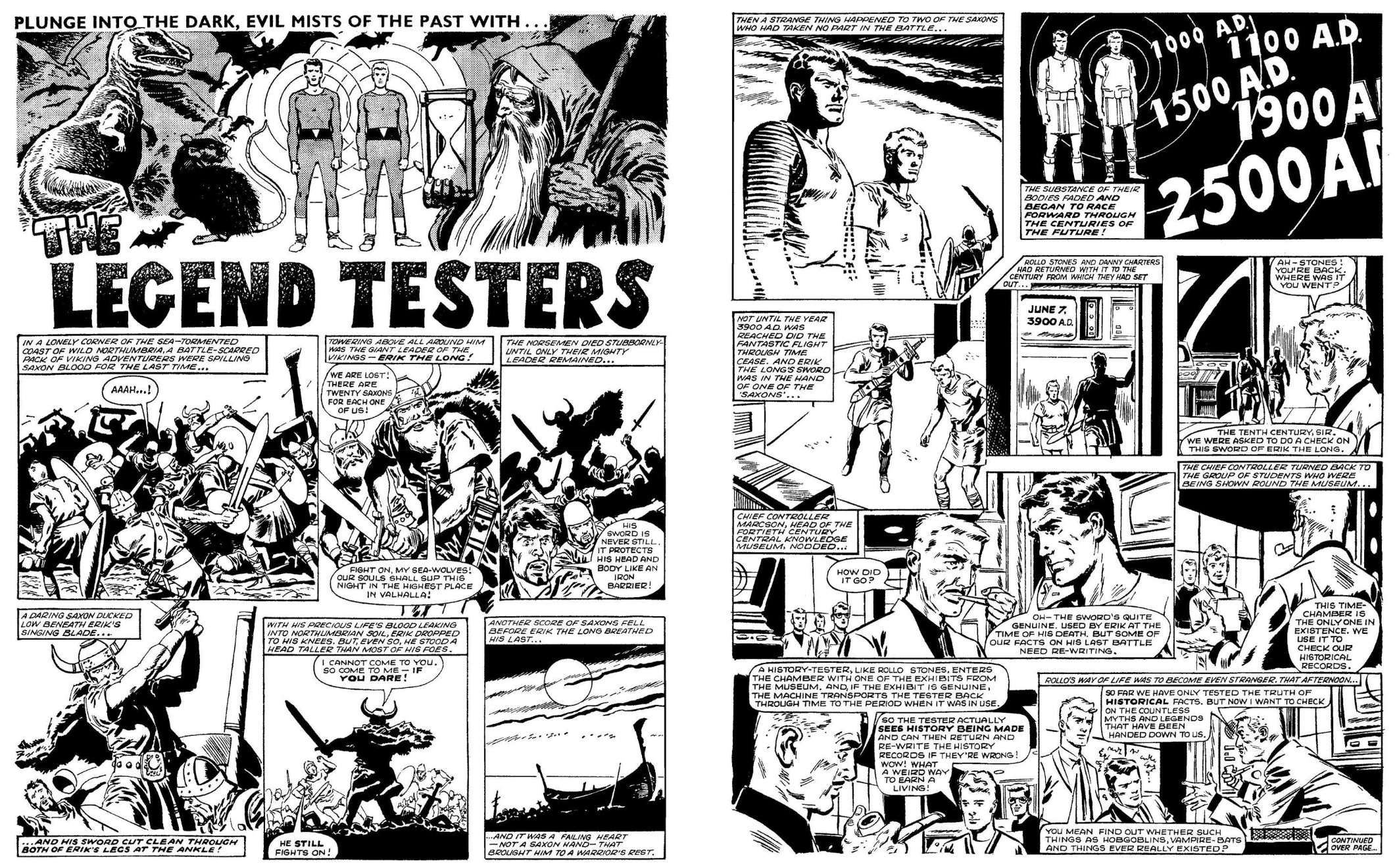
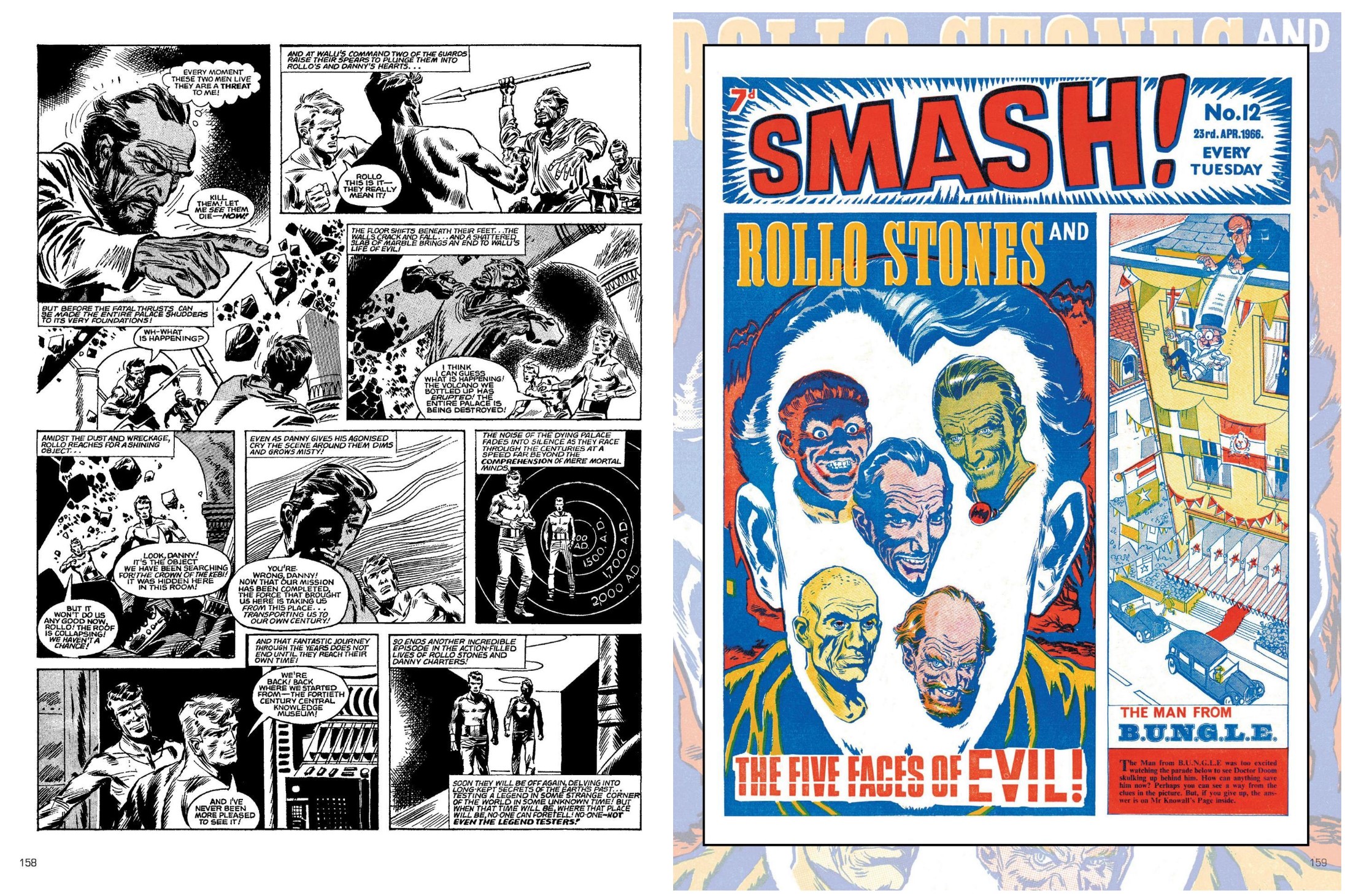
Ant Wars


By Gerry Finley-Day, José Luis Ferrer, Alfonso Azpiri, Luis Bermejo, Lozano, Peña, Simon Spurrier & Cam Kennedy & various (Rebellion/REBCA)
ISBN: 978-1-78108-622-3 (HB/Digital edition)

This book includes Discriminatory Content produced in less enlightened times.

The sun’s out and the sarnies are packed so let’s shamble down memory lane with a bug-beguiling packed lunch for all us oldsters which might, perhaps, offer a fresh, untrodden path for younger fans of the fantastic in search of a typically quirky British comics experience.

This stunning paperback/eBook package provides another knockout nostalgia-punch from Rebellion Studios’ scintillating 2000 A.D. treasure-trove, gathering the 15 weekly episodes of seminal shocker Ant Wars as first seen in Progs #71-85 (July 1st – 7th October 1978). There’s also a later resurgence of creepy creatures, which initially infested The Judge Dredd Megazine (#231-233, May to July 2005).

The strip debuted with ferociously prolific writer Scots Gerry Finley-Day (Ella on Easy Street, The Camp on Candy Island, Rat Pack, The Bootneck Boy, D-Day Dawson, The Sarge, One-Eyed Jack, Hellman of Hammer Force, Sgt. Streetwise, Dredger, Dan Dare, Invasion, Judge Dredd, Harry 20 on the High Rock, The V.C.s, Rogue Trooper, Fiends of the Eastern Front and dozens more) establishing a contemporary scenario to explore human greed and venality against a setting of increased pollution and eco-barbarism in the heart of the Amazon basin. The creepily compelling visuals came via an international tag team of illustrators – beginning with co-creator José Luis Ferrer, and followed by Alfonso Azpiri, Luis Bermejo, Lozano and Peña -who skilfully combined local knowledge of Central/South American locales with old fashioned monster movie riffs to deliver a wicked and wild cautionary tale.

In an era of burgeoning eco-politics, increasing environmental awareness and growing advocacy for Indigenous rights, the saga confronted entrenched corporate greed, Military-Industrial Complex arrogance and political complacency in a rip-roaring, grossly anarchic Doomwatch scenario that revelled in an innate love of irony married to macabre and bloody carnage. It was also pretty cool to see an utter absence of Yanks or Brits casually saving the day…

It begins in the depths of the Brazilian rain forest as helicopter-borne soldiers descend on “wild Indians” they find eating ants. After despatching the disgustingly primitive indigenes, the troops complete their mission, expediting a test of GGS: a new super-insecticide created by a multinational corporation which needs testing without too much oversight…

Some months later captive natives are being forcibly “civilised” by those soldiers in a Reservation Camp. The captives (grudgingly) wear clothes and can speak to their “benefactors” now, but recidivism remains stubbornly high. When one youngster is caught eating ants again, he endures another punishment beating before escaping. Delighted to have something to do, the soldiers board their copters and track him into the verdant hell all around them. That’s when they discover skyscraper-sized anthills and are ambushed by hungry Formicidae the size of buses and far smarter than they are or, indeed, most humans…
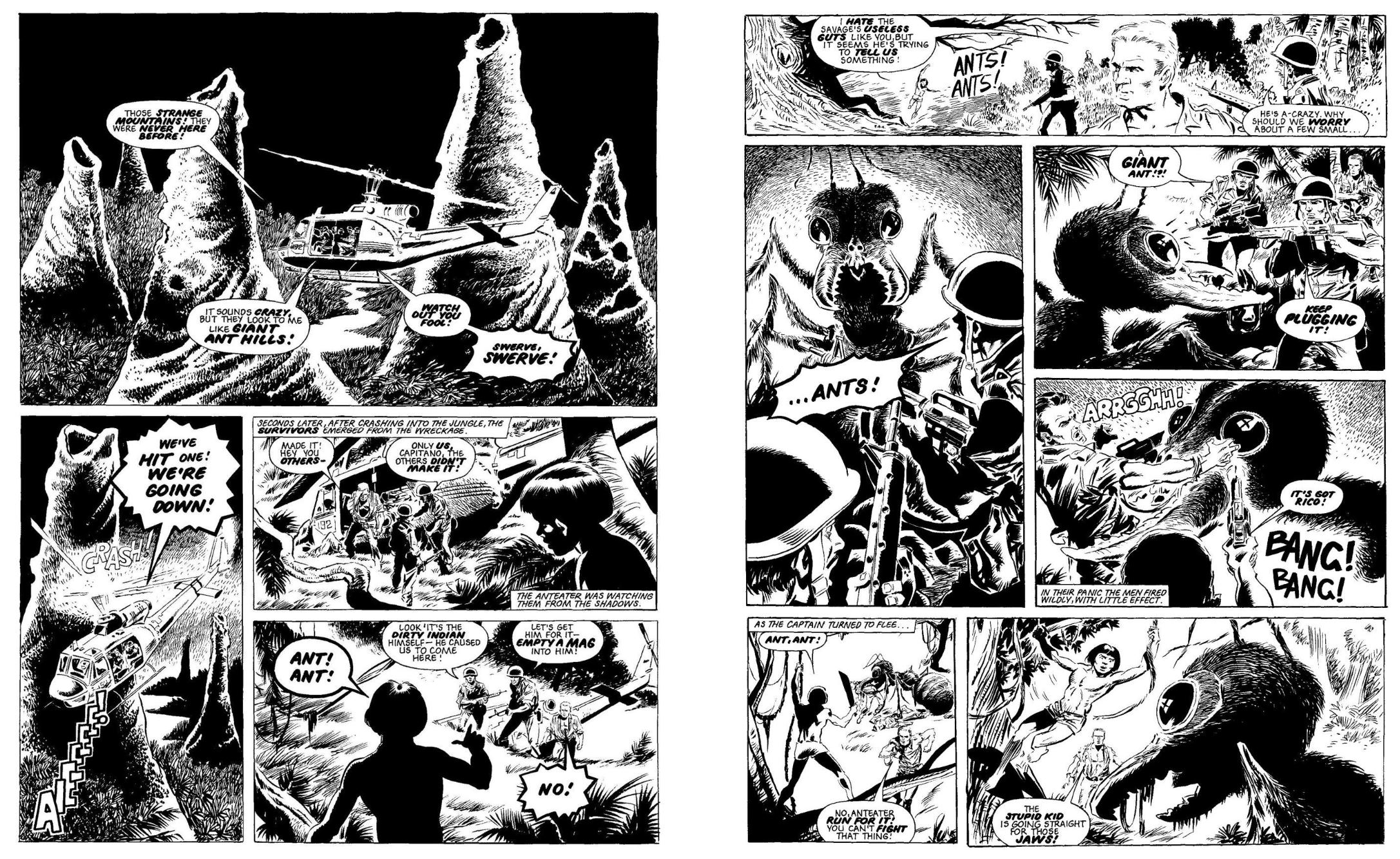
The squad are wiped out, but Captain Villa survives, aided by the Indian boy they had disparagingly dubbed “Anteater”. His speed, agility and dexterity with a machete are the only counter to the big bugs – which readily dismember troops and destroy aircraft – so the enemies form a reluctant partnership to escape the ant-controlled jungles and alert humanity to the imminent peril they all face. The boy understands bugs implicitly and his knowledge saves them over and again as they struggle through green hells barely ahead of an endless army of colossal soldier ants apparently intent on eradicating humankind.
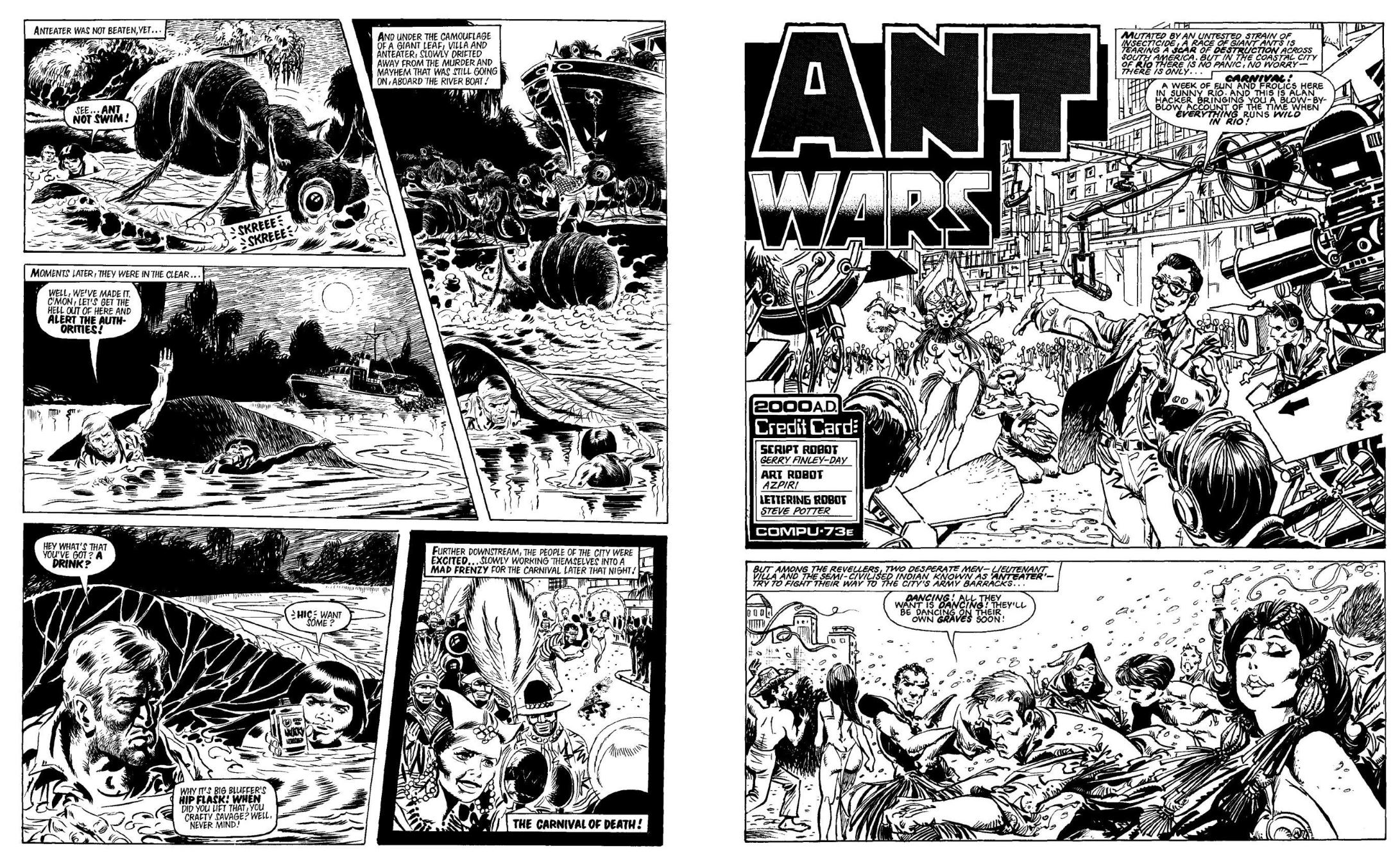
After many close calls and stomach-churning hairsbreadth escapes – avoiding the plantation-consuming, outpost-conquering, riverboat-confiscating bugs, Villa and Anteater reach Rio de Janeiro, and at last convince people with actual power and authority of the existential threat, but it is far too late. Ant queens have already established forward bases there and as the humans waste time and resources partying at Carnival, a horrific battle for control of the continent and ultimately the planet begins.

Soon ant colonies are found in Argentina, Bolivia and beyond and the struggle must be decided by humanity’s most unforgivable armaments…

And in the aftermath, there are many profitable opportunities to test even better bug sprays and formulations…

In 2005 the concept was retooled, crafted in tribute to the original by Simon Spurrier & Cam Kennedy. A notional sequel set in the future world of Mega-cities and mass madness where Judges like Joe Dredd were sworn to curtail and control Zancudo was a short serial running across 2000 A.D. spin-off title The Judge Dredd Megazine (issues #231-233). It focused on less-than-upstanding Judges Xavi Ancizar and Sofia Perez as they escort sociopathic “mutie” telepath Fendito “El Bandito” in a medical-supply flyer bound for the penal facility in La Paz. It’s 2171 and they have left sprawling metropolis Cuidad Barranquilla to risk the perils of the Peruvian rainforest, but don’t get far. When the ship is brought down, and even after surviving the crash, their chances diminish every second as they are attacked by giant intelligent mosquitos. They are also blithely unaware that the device neutralising El Bandito’s psionic powers has malfunctioned…

Although Judges are trained to resist, smart giant bugs are easier to handle, and it might have all worked out differently for the mind-thief if they hadn’t stopped to save a little girl and stumbled into Los Zancudo Pichu. This bizarre embattled colony is home to human natives enslaved to Mosquito queens and where all inhabitants – even the big bugs – are slowly expiring of a malarial infection they call The Blight…

Those downed Judge medical supplies promise a cure for the dying city and all its inhabitants, and Fendito is delighted to betray his own (more or less) kind to save his skin, but even corrupted, debased Judges have standards, so their discovery of the original purpose of Zancudo prior to the insects’ triumphal takeover offers a slim chance of atonement if not personal survival…
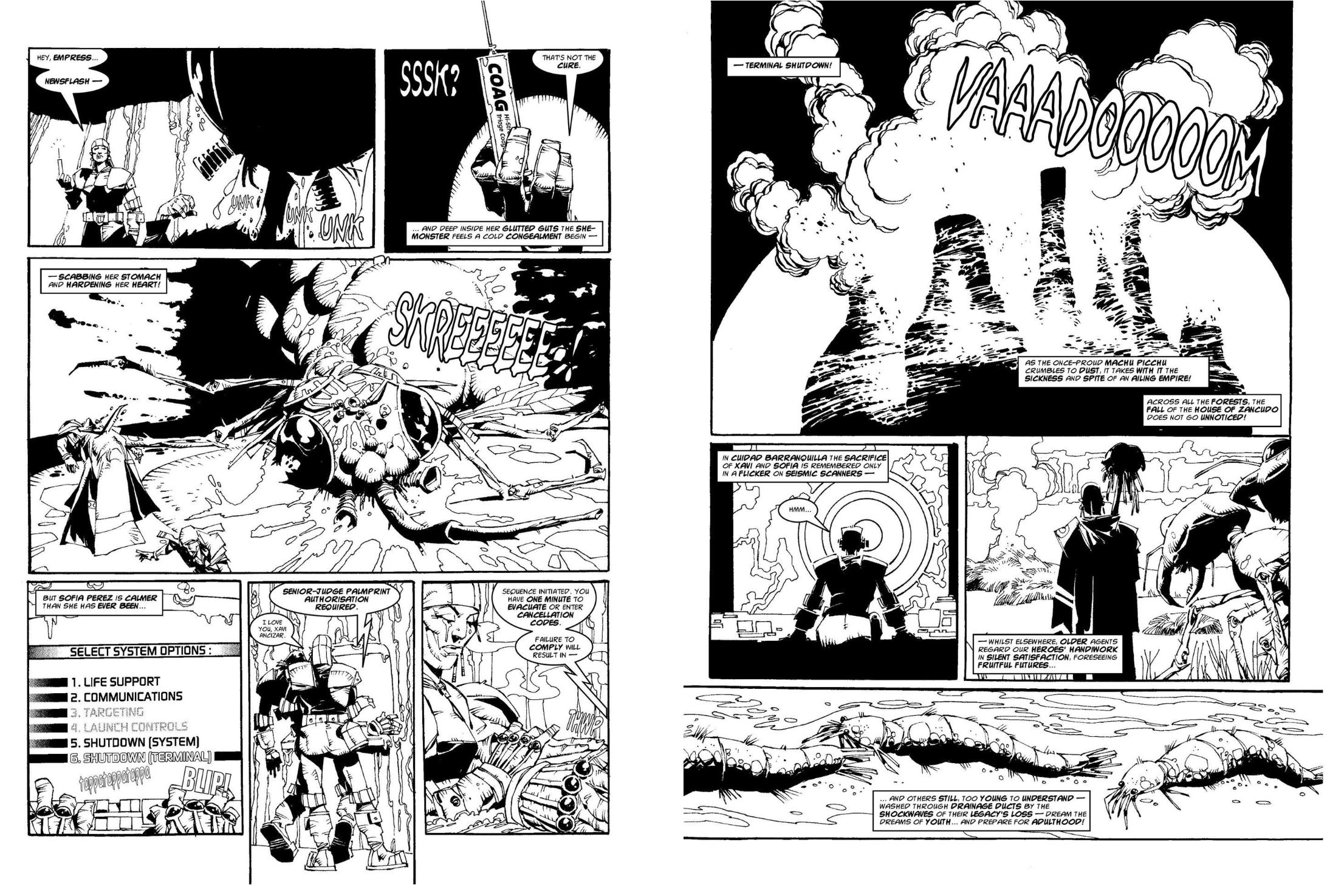
A grand, old fashioned Mankind vs Monsters yarn dripping with wit and edgy social commentary, Ant Wars is an unreconstructed romp to while away a little time with and a splendid way to prepare for the long hot and possibly few days ahead.
© 1978, 2005 & 2018 Rebellion A/S. All Rights Reserved.

Today in 1828 trailblazing cartoonist, caricaturist and author Frank Bellew was born, with Marvel bulwark Carl (Human Torch) Burgos coming along in 1916 and – in 1986 – mainly-Marvel comic book illustrator Paulo Siqueira.

Ken Reid’s Roger the Dodger debuted in The Beano this date in 1953, but we lost British underground star and newspaper cartoonist Edward Barker (International Times, The Largactilites, The Galactilites) in 1997 and Steve Canyon artist Dick Rockwell in 2006.
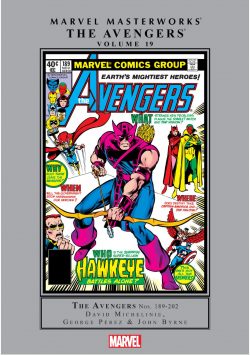
The Avengers Marvel Masterworks volume 19


By David Michelinie, Steven Grant, Roger Stern, Mark Gruenwald, Jim Shooter, Bob Layton, Tom DeFalco, John Byrne, George Pérez, Sal Buscema, Carmine Infantino, Arvell Jones, Ron Wilson, John Fuller, Dan Green, Ricardo Villamonte, Josef Rubinstein, Jack Abel, Gene Day, Mike Esposito, Brett Breeding, Joe Sinnott, Bruce Patterson & various (MARVEL)
ISBN: 978-1-3029-1637-4 (HB/Digital edition)

This book includes Discriminatory Content produced in less enlightened times.

The Avengers have always proved that putting all one’s star eggs in a single basket pays off big-time: even when all Marvel’s classic all-stars such as Thor, Captain America and Iron Man are absent, it merely allows the team’s lesser lights to shine more brightly. Of course, all founding stars were regularly featured due to the rotating, open door policy, which means that every issue includes somebody’s fave-rave – and the boldly grand-scale impressive stories and artwork are no hindrance either. With the team now global icons, let’s look again at the stories which form the foundation of that pre-eminence.

Re-presenting Avengers #189-202, plus a pertinent tale from Marvel Premier #55 (August 1980) and a lost snippet from Tales to Astonish (vol. 2 #12, November 1980) these sagas encompass cover-dates November 1979 to December 1980. Jim Shooter, having galvanised and steadied the company’s notional flagship moved on, leaving David Michelinie to impress his own ideas and personality upon the team,. However such transitions are always tricky and a few water-treading fill-ins were necessary before progress resumed. For behind the scenes details you can read of his recollections in his fascinating ‘Introduction by David Michelinie’ before diving in to the fabulous action and drama. Another Introduction by latterday editor Tom Brevoort can be found in the book’s Bonus Section, eulogising and appreciating the return of George Pérez to the Avengers before diving in to the fabulous action and drama…

Previously: After defeating the Absorbing Man, apparently resolving the convoluted origins of Quicksilver and the Scarlet Witch, inviting Ultron’s robot bride Jocasta into their midst, defeating vintage murder-mech enigma Arsenal and stopping world conquering sentient elements, the team were ready for a break but would be disappointed…

Avengers #189 reveals how deeply unhappy official reservist Hawkeye takes a day job at (corrupt and EVIL) tech company Cross Technological Enterprises and inadvertently begins his steady march to solo stardom. When the current administration began interfering in Avengers business intrusive and obsessive NSA Agent Henry Peter Gyrich laid down the law and winnowed the army of heroes down to a federally acceptable (and “manageable”) seven-and-a-spare: Captain America, Iron Man, Falcon, Scarlet Witch, Vision, Wasp, Beast and Ms. Marvel. Gyrich had spitefully rejected the in-your-face archer in favour of Falcon – who was parachuted in (against his own wishes!) to conform to government affirmative action quotas…

Feeling rejected by the team and definitely still persona non grata to the obnoxious pencil-pushing Government gadfly, Hawkeye goes corporate in ‘Wings and Arrows!’ (Steven Grant, John Byrne & Dan Green). It’s not too long before he’s earning every penny as the new security chief by battling alien avian interloper Deathbird of the Shi’ar…

As a terrifying horror from space crashes to Earth and rampages through Manhattan, the Avengers ae summoned to tribunal seeking to close down the group. However, with a monster in the streets, Beast sees a way to dent Gyrich’s credibility and win back Avengers autonomy in chilling monster-mash ‘Heart of Stone’. Despatched to stop the thing, their subsequent battle draws in scarlet swashbuckler Daredevil who helps expose an old enemy in disguise…

Scripted by Micheline, concluding chapter ‘Back to the Stone Age!’ sees the assemblage overwhelmed by petrifying space pirate The Grey Gargoyle and the Falcon prove his worth until the team can rally and render the marauder helpless, after which artists Arvell Jones & Ricardo Villagran limn #192’s ‘Steel City Nightmare!’ When former industrialist/inventor and occasional Avenger Simon Wonder Man Williams visits Detroit to finalise selling his old steel mill to Tony Stark, they uncover an old but lasting connection to Thor’s uru hammer and the site’s new covert status as a centre of organised crime activity. When a whistle-blower is murdered only to return as a rampaging vengeance-driven flame monster, the call goes out and the Avengers find ‘Battleground Pittsburgh!’ (illustrated by Sal Buscema & Green) to be almost more than they can handle.

Inked by Josef Rubinstein, George Pérez draws the Micheline-scripted ‘Interlude’ in #194, as roster changes saw the Scarlet Witch (briefly) and Falcon leave and Wonder Man return. With Jocasta destabilizing the Vision’s marriage, tensions are high but the later discovery that wannabe actor Simon Williams is moonlighting as a clown on children’s television takes off a lot of edges. Focus abruptly shifts when an apparent escaped mental patient circumvents Avengers security, breaks into the mansion and begs for help. Returned to his carers at the Solomon Institute, Selbe’s plight remains uppermost in Wasp’s thoughts. When she investigates the facility she exposes an horrific science abomination in progress before vanishing without trace…

New Ant-Man Scott Lang got his first dose of team action in Avengers #195 (May 1980) in Michelinie, Pérez, Jack Abel & Green’s ‘Assault on a Mind Cage!’ When his benefactor Hank Pym/Yellowjacket asks Lang to help infiltrate the suspect Solomon asylum he believes holds the Wasp hostage the miniature marvels uncover illegal cloning for spare parts and a murderous madman also capitalising on the facilities to profitably train better henchmen for major villains and mob bosses…

The climactic clash resulting from ‘The Terrible Toll of the Taskmaster’ (by Michelinie, Pérez & Abel) wrecks the joint but leaves former burglar and convict Lang one step closer to true redemption…

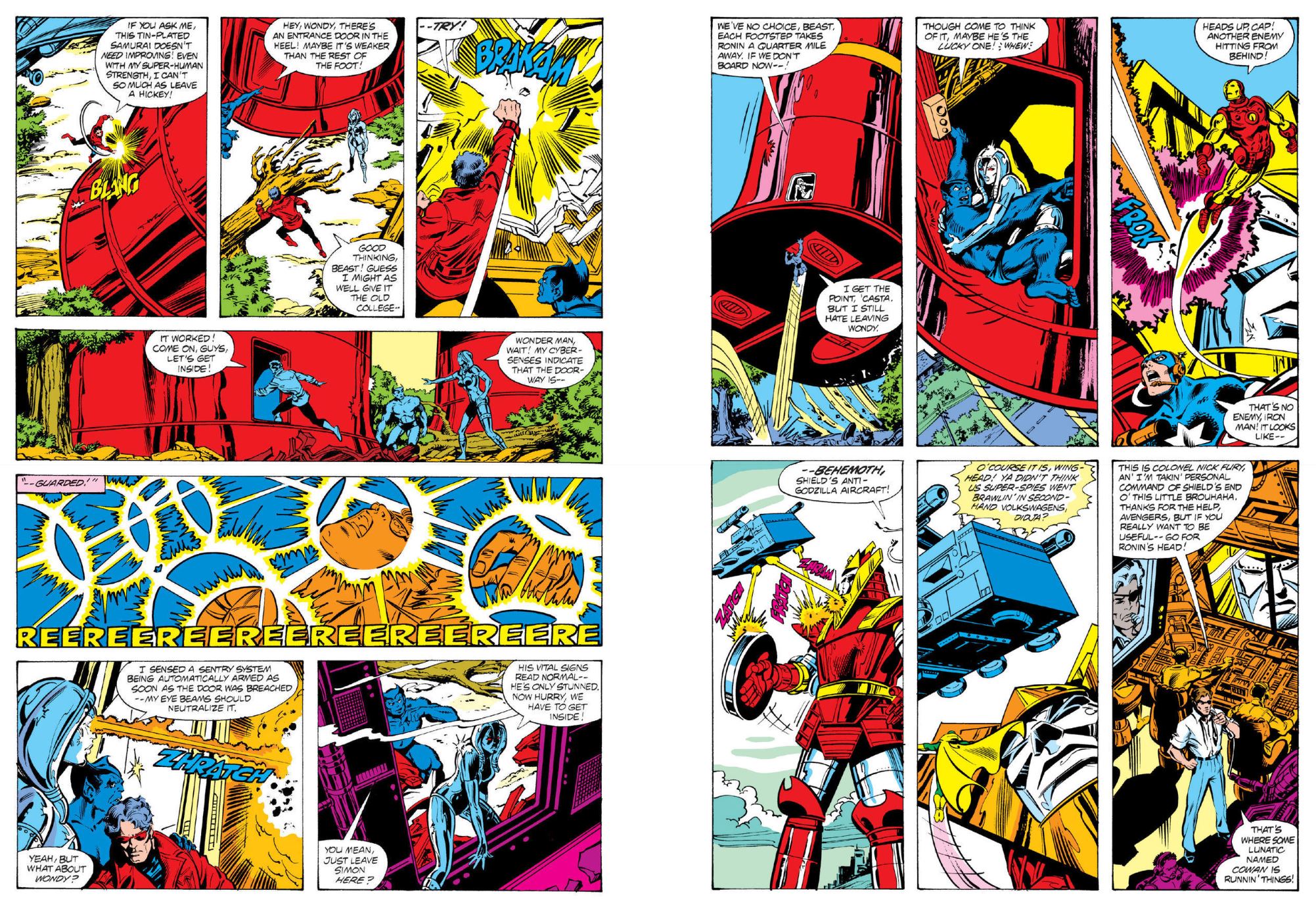
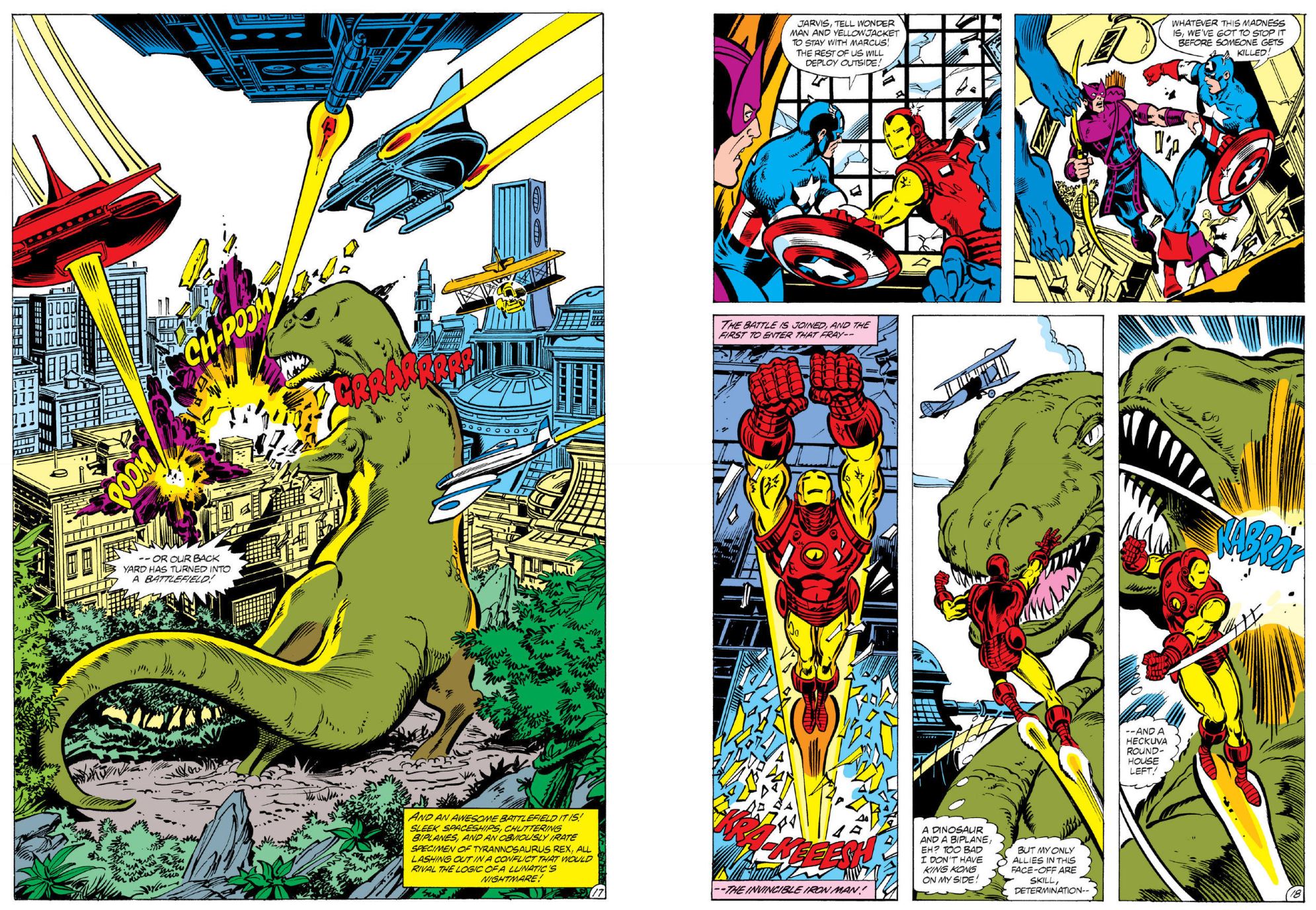
Cold War paranoia fuels Avengers #197’s ‘Prelude to the War-Devil!’ (illustrated by Carmine Infantino, Abel and a horde of helpers) wherein overwrought scientist Dr. Cowan absconds from Stark Detroit facilities inside a super-mecha warrior initially built to destroy the undisputed king of Kaiju (see Godzilla: The Original Marvel Years). Unable to stand the tension any longer, the boffin intends triggering WWIII and ending the anxiety of humankind once and for all, but must first face the deployed and increasingly desperate Avengers in ‘Better Red Than Ronin!’ (art by Pérez, Brett Breeding & Gene Day) and cataclysmic climax ‘Last Stand on Long Island’ (inked by Dan Green).

Away from the mounting carnage, a disturbing subplot played out as a strange, terrifyingly rapid transformation sees Carol Danvers (Ms, and these days Captain Marvel) impossibly pregnant and bringing an unknown baby with no father to term in a matter of days. Reaching out to the Scarlet Witch, the hasty decision is to call in the full resources of the Mighty Avengers…

The mystery is solved in bonanza anniversary issue #200 (October 1980 by plotters, Jim Shooter, Pérez & Bob Layton; scripter Michelinie, and artists Pérez & Green). In ‘The Child is Father To…?’ with almost the entire past roster on hand, the miracle baby is born without incident, but consequently hyper-rapidly matures as time goes wild around the city. With different eras overwriting the present, the unearthly boy begins building a machine to stabilise the chaos despite the profoundly suspicious heroes misunderstanding his motives. Marcus claims to be the son of time-master Immortus, seeking to escape eternal isolation in transdimensional Limbo by implanting his essence in a mortal tough enough to survive the energy required for the transfer.

Literally reborn on Earth, his attempts to complete the process are foiled by the World’s Most Confused Heroes and he is tragically drawn back to his timeless realm. Carol, suddenly declaring her love for Marcus, unexpectedly goes with him. The heroes unquestioning acceptance of the result might well be the greatest failure and betrayal in Avengers history…

The clean-up begins in #201 where ‘The Evil Reborn’ sees Michelinie, Pérez & Green adapt a Jim Shooter short story as Tony Stark succumbs to previous, deep-buried hypnotic programming to reconstruct cybernetic conqueror Ultron…

The tale is cut short as back-up strip ‘Bully!’ by Michelinie, Roger Stern, Pérez & Day explores the off-duty life of butler Edwin Jarvis as he improves his home neighbourhood with a little human-scaled heroism and defiance in the face of insurmountable odds…

The Avenging escapades pause for now with bombastic brutal closing chapter ‘This Evil Undying’ (Micheline, Pérez & Mike Esposito) as the team (Captain America Thor, Wasp, Vision, Scarlet Witch, Hawkeye and Jocasta free Iron Man from the metal maniac’s domination and apparently end the threat forever…

Supplementing the main drama are a brace of contemporaneous tales beginning with the first Wonder Man solo saga, as published in Marvel Premiere #55 (August 1980). ‘A Force of Two!’ by Micheline, Layton, Ron Wilson & Joe Sinnott sees Simon Williams return to another of his old factories (in Brooklyn this time) to clean out the criminal trash who took over after his “death” and eventual resurrection as being of ionic energy. Even he isn’t quite enough to oust entrenched Maggia mobsters – and their lawyers – and requires a little offbeat assistance from an old pal who risks everything to atone…

Next comes a six-page vignette starring The Vision, created during a rookie initiative program in 1976 by Tom DeFalco, John Fuller & Bruce Patterson, ‘Double Vision’ sat in the inventory drawer until seen in Tales to Astonish (vol 2 #12, November 1980) and relates how the eerie android saves a diplomat and other caught in a plane hijacking…

With covers by Byrne, Pérez, Frank Miller, Dave Cockrum, Wilson, Sinnott, Green, Bob McLeod, Rubinstein and Terry Austin; original art pages from Byrne, Pérez, Green & Day; the Pérez/Tom Smith painted cover to Avengers Visionaries: George Pérez (1999) and the aforementioned Brevoort appreciation of the artist from that tome, this compelling collection is available in hardback and digital iterations, and a must-read moment of wonder every fan must see.
© 2019 MARVEL.

Today in 1877 Catalan comics creator and pioneer Tomàs Padró died, as did French surrealist cartoonist and multimedia maven Roland Topor in 1997. In 1934 Chilean Disney artist Vicar (Víctor José Arriagada Ríos) was born, as was arch-stylist Paul Rivoche (Mister X, Batman, Exile of the Aeons) in 1959.

On this date in 1990 The Times of India supplement Indrajal Comics published its last issue. Started in 1964 its 805 issues brought The Phantom, Flash Gordon, Mandrake, Garth, Rip Kirby, Phil Corrigan, Buz Sawyer, Mike Nomad, Kerry Drake, and others to millions of readers, and in 1976 debuted homegrown Indian hero Bahadur by Aabid Surti.

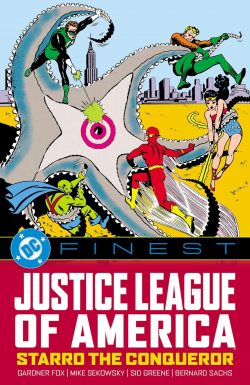
DC Finest: Justice League of America – Starro the Conqueror


By Gardner F. Fox, Mike Sekowsy, Carmine Infantino, Bernard Sachs, Murphy Anderson, Joe Giella & various (DC Comics)
ISBN: 978-1-79950-773-4 (TPB)

This book includes Discriminatory Content produced in less enlightened times.

After the actual invention of the comic book superhero – by which we mean the launch of Superman in 1938 – the most significant event in the industry’s progress was to combine individual sales-points into a group. Thus what seems blindingly obvious to us with the benefit of four-colour hindsight was irrefutably proven: a number of popular characters could multiply readership by combining forces. Plus, of course, a whole bunch of superheroes is far cooler than just one – or even one and a sidekick…

Thus the Justice Society of America is rightly revered as a true landmark in the development of comic books and – when Julius Schwartz began reviving and revitalising the nigh-defunct superhero genre in 1956 – the next key moment would come a few years with the inevitable teaming of reconfigured mystery men. The League launched in The Brave and the Bold #28 (cover-dated March 1960 but actually on sale from December 29th 1959) and cemented the growth and validity of the revived subgenre, triggering an explosion of new characters at every company producing comic books; even spreading to the rest of the world as the 1960s progressed.

Spanning March 1960 to May 1963, this full-colour paperback collection of timeless classics re-presents The Brave and the Bold #28-30, issues #1-19 of the epochal first series of Justice League of America and a crucial early cross-branding event from Mystery in Space #75, with scripter Gardner Fox and illustrators Mike Sekowsky & Bernard Sachs – with the support of Joe Giella, Carmine Infantino & Murphy Anderson – seemingly able to do no wrong. That moment that changed everything for us baby-boomers came in The Brave and the Bold #28, a classical adventure title that had recently become a try-out magazine like Showcase. Just in time for Christmas 1959 ads began running…

“Just Imagine! The mightiest heroes of our time… have banded together as the Justice League of America to stamp out the forces of evil wherever and whenever they appear!…”

When it came that first tale was written by the indefatigable Gardner Fox and illustrated by quirky, understated virtuoso Mike Sekowsky, and inked by Bernard Sachs, Joe Giella & Murphy Anderson. ‘Starro the Conqueror!’ saw Flash, Wonder Woman, Aquaman, J’onn J’onzz – Manhunter from Mars and recent debutante Green Lantern defeat a marauding alien starfish whilst Superman and Batman stood by as a reserve. In those naive days, editors feared their top characters could be “over-exposed” and consequently lose popularity. The team also picked up an average American kid as a mascot. “Typical teenager” Snapper Carr would prove a focus of fan controversy for decades to come, and the yarn was/is supplanted by fact page ‘The “Starfish” Family!’ crafted by clever persons currently unknown…

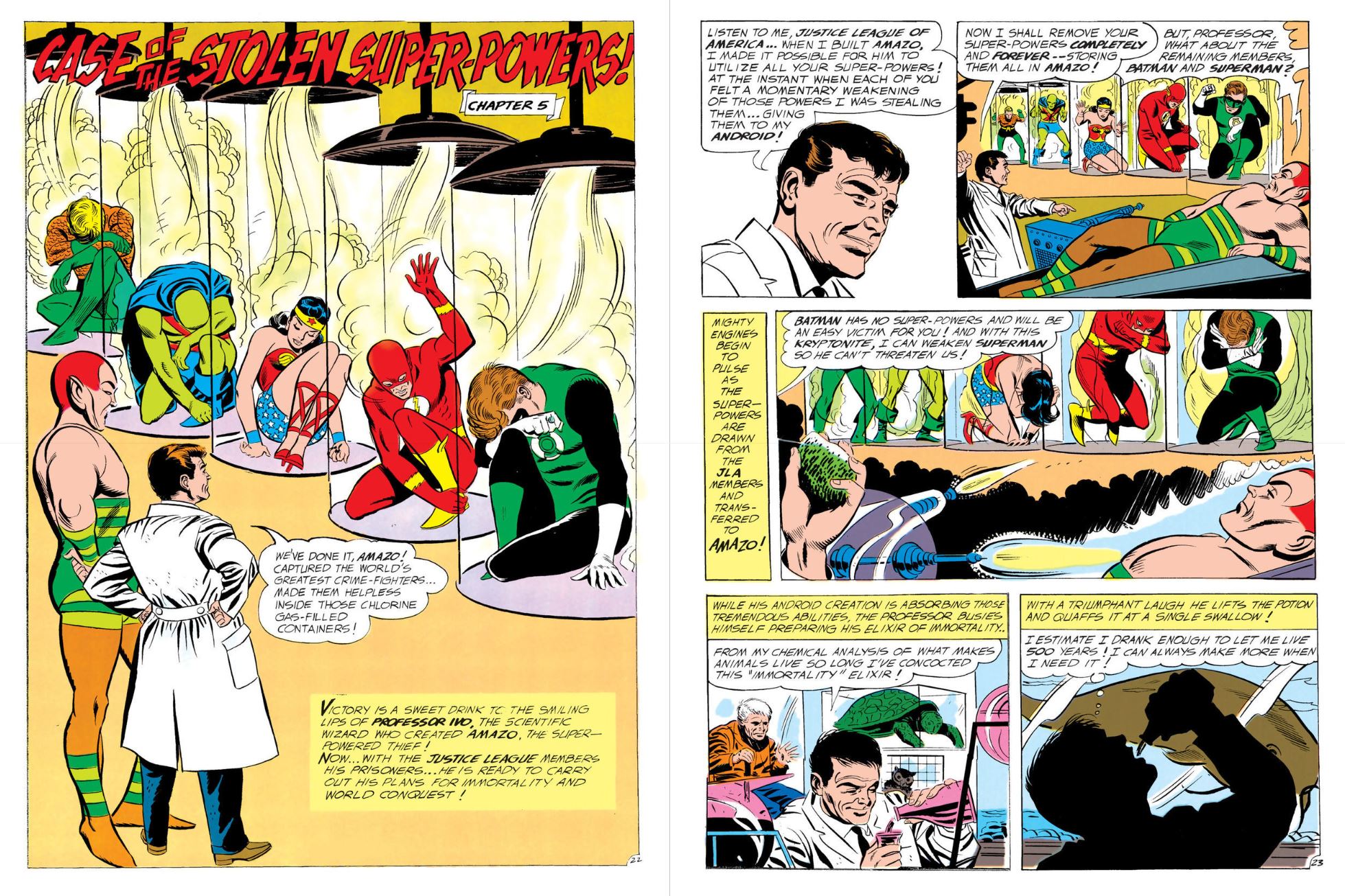
Confident of his material and the superhero genre’s fresh appeal, Schwartz had two more thrillers ready for the following issues. B&B #29 saw the team defeat a marauder from the future who apparently had history on his side in ‘The Challenge of the Weapons Master!’ (inks by Sachs and Giella) whilst #30 saw the debut of the team’s first mad-scientist archvillain in the form of Professor Ivo who employed and his super android Amazo in ‘The Case of the Stolen Super Powers’ (Fox, Sekowsky & Sachs) to  end the try-out run. Three months later a new bi-monthly title debuted…

Perhaps somewhat sedate by histrionic modern standards, the JLA was revolutionary in a comics marketplace where less than 10% of all sales featured costumed adventurers. Not only consumer imagination was struck by hero teams either. Stan Lee was apparently given a copy of Justice League by his boss Martin Goodman and told to do something similar for the tottering comics company he ran… and look what came of that…

Justice League of America #1 offered a voyage to ‘The World of No Return’, in the insalubrious company of trans-dimensional tour-guide and tawdry tyrant Despero who bedevilled the World’s Greatest Heroes until, once again, plucky Snapper Carr became the key to defeating the villain and saving the day. As previously mentioned, although Superman and Batman were included in the membership their participation was strictly limited as editorial diktat at the start to avoid possible reader ennui and saturation from over-exposure. That ended from this point forward as they joined the regulars in all their games.

The second issue’s ‘Secret of the Sinister Sorcerers!’ presented an astounding conundrum as the villains of Magic-Land sneakily transposed the location of their dimension with Earth’s, causing the Laws of Science to be replaced with the Lore of Mysticism. The true mettle of the costumed heroes (with Superman & Batman fully participating in the proceedings) was shown when they had to use ingenuity rather than their powers to defeat fearsome foes and set two worlds to rights.

JLA #3 introduced despicable despot and slimy sentient trafficker Kanjar Ro who attempted to turn the team into his personal army in ‘The Slave Ship of Space!’, before the next episode was the first of many to feature a new member joining the team. Green Arrow saved the day in science-fiction thriller ‘Doom of the Star Diamond’, but was almost kicked out in #5 as the insidious evil genius Doctor Destiny inadvertently framed him ‘When Gravity Went Wild!’

The glory days of full-on “costumed crazies” was still in the future and most tales of this period involved extraterrestrial or fringe technology-triggered emergencies such as the mad scientist who encountered them next. ‘The Wheel of Misfortune!’ saw the debut of pernicious and persistent master of wild science Professor Amos Fortune, who weaponised luck to challenge the masked marvels, whilst #7 was another alien invasion plot (Agellaxians this time) who used an amusement park as a live-weapons lab, using humans to beta test their tech and eerily transform the swiftly-investigating heroes infiltrating ‘The Cosmic Fun-House!’

Organised crime then collided with cruel happenstance in January 1962’s JLA #8. ‘For Sale… the Justice League!’ offered a smart gangster caper wherein cheap hood Pete Rickets finds a prototype teaching tool and misuses it as mind-control weapon to enslave the superhero team before simple Snapper once again saves the day.

As often remarked, back then origins and character background were not as important as delivering solid entertaining stories and it was not until Justice League of America #9 (cover-dated February 1962 and on sale from December 21st 1961) that the group shared its motivating first case with enthralled readers via the narrative engine of curious Snapper Carr. Nigh-mythic now and oft-recounted. ‘The Origin of the Justice League’ recounts the circumstances of the team’s birth in an alien invasion saga as mighty space warriors seeking to use Earth as a gladiatorial arena in which to decide the future ruler of their distant world Appellax…

It’s followed by the series’ first continued story. ‘The Fantastic Fingers of Felix Faust!’ finds the World’s Greatest Superheroes already battling a marauder from the future – the Lord of Time – when they’re spellbound by a vile sorcerer. Faust has awoken three antediluvian demons (Abnegazar, Rath and Ghast) and sold them the world in exchange for 100 years of unlimited power. Although the heroes eventually outwit and defeat Faust they have no idea that the demons are loose…

Although chronologically and sequentially adrift, next up is  Mystery in Space #75 (May 1962), wherein the worlds-beating team guest-star in a full-length thriller in Adam Strange’s ongoing, off-world epic adventures. Strange is an Earth archaeologist who regularly teleports to a planet circling Alpha Centauri where his wits and ingenuity saved the citizens of Rann from all manner of interplanetary threats and menaces. In ‘The Planet that came to a Standstill!’, Kanjar Ro attempts to conquer Strange’s adopted home, and our gallant hero must enlist the aid of the JLA before once again saving the day himself. This classic team-up was written by Fox, and illustrated by Carmine Infantino & Murphy Anderson.

Then, back in JLA #11 (also cover-dated May 1962) concluding chronological conundrum ‘One Hour to Doomsday!’ sees the JLA pursue and capture initial target The Lord of Time, before becoming trapped a century from their home-era by the awakened, re-empowered demons. This level of plot complexity hadn’t been seen in comics since the closure of EC Comics, and never before in a superhero tale. It was a profound acknowledgement by the creators that the readership was no longer simply little kids – if indeed it ever had been…

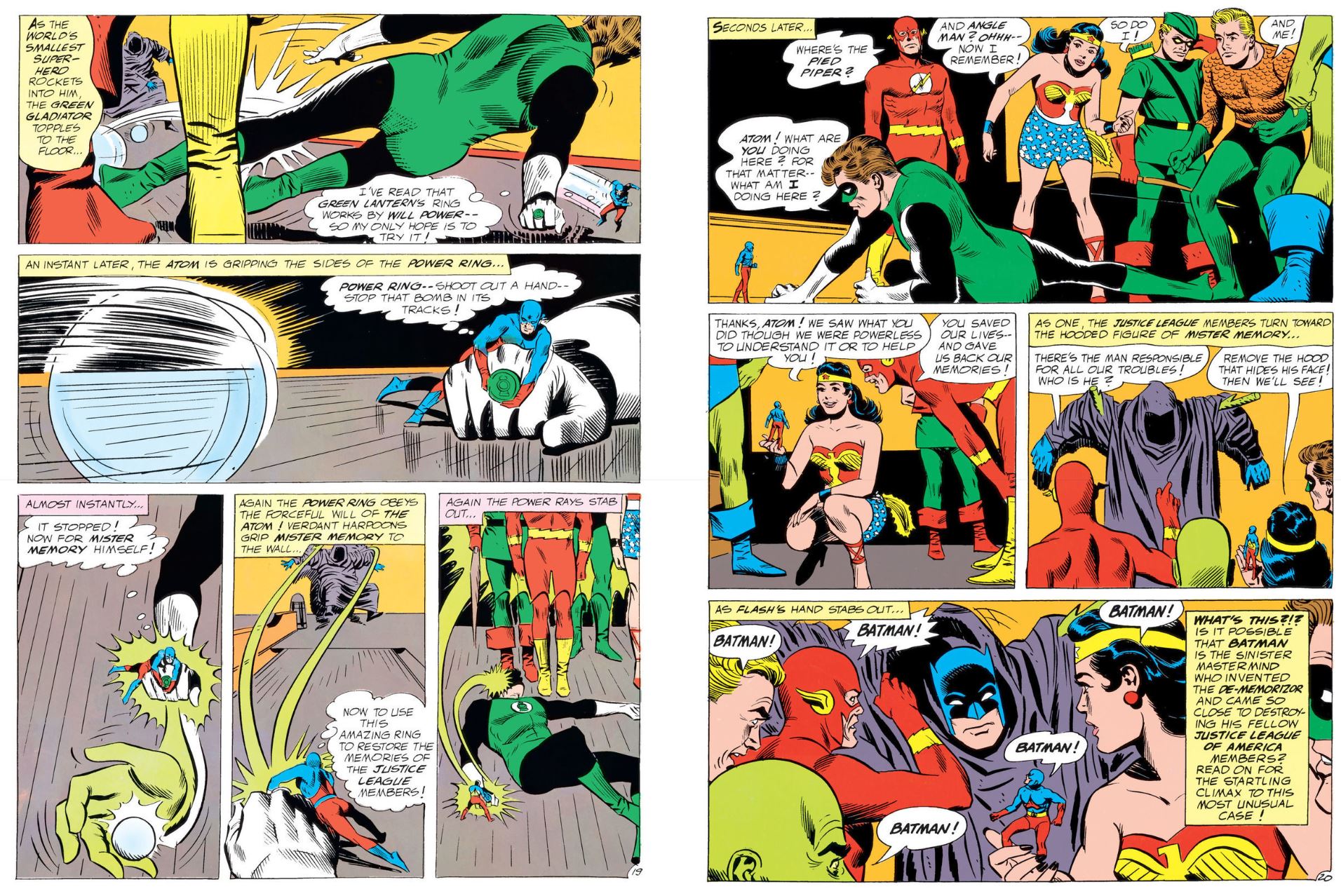
Perennial archvillain Doctor Light debuted in #12, attempting a pre-emptive strike on the team by transporting them to carefully selected sidereal worlds where their abilities would be useless, but ‘The Last Case of the Justice League’ proved to be anything but, and in the next issue the heroes saved our entire reality by solving ‘The Riddle of the Robot Justice League’: sinister simulacra created to stop the champions from halting the theft of our life-energy by agents of another cosmic realm. Then ‘The Menace of the “Atom” Bomb!’ in #14 proved to be  a neat way of introducing latest inductee The Atom whilst showing a fresh side to an old villain masquerading as new nemesis Mister Memory…

‘Challenge of the Untouchable Aliens’ in JLA #15 added some fresh texture to the formulaic plot of extra-dimensional invaders out for our destruction before ‘The Cavern of Deadly Spheres’ delivered a deceptive change-of-pace tale with a narrative technique that just couldn’t be used on today’s oh-so-sophisticated audience, but still has the power to grip a reader. Ever challenging and always universal continuity building, more links between heroes were formed in #17’s ‘Triumph of the Tornado Tyrant!’ Here a sentient cyclone that had once battled indomitable Adam Strange (in Mystery in Space #61) set up housekeeping on an desolate world and ponder the very nature of Good and Evil and even roleplay out its deliberations. It soon realised that it needed the help of the Justice League to reach a survivable conclusion…

Teaser Alert: As well being a cracking yarn, this story is pivotal in the development of the android hero Red Tornado…

JLA #18 found the heroes forcibly summoned to a subatomic universe by three planetary champions whose continued existence now threatened to destroy the very world they were designed to protect. ‘Journey to the Micro-World’ found the JLA compelled to defeat opponents who were literally unbeatable and discovering yet again that Batman’s brains were a super power no force could thwart…

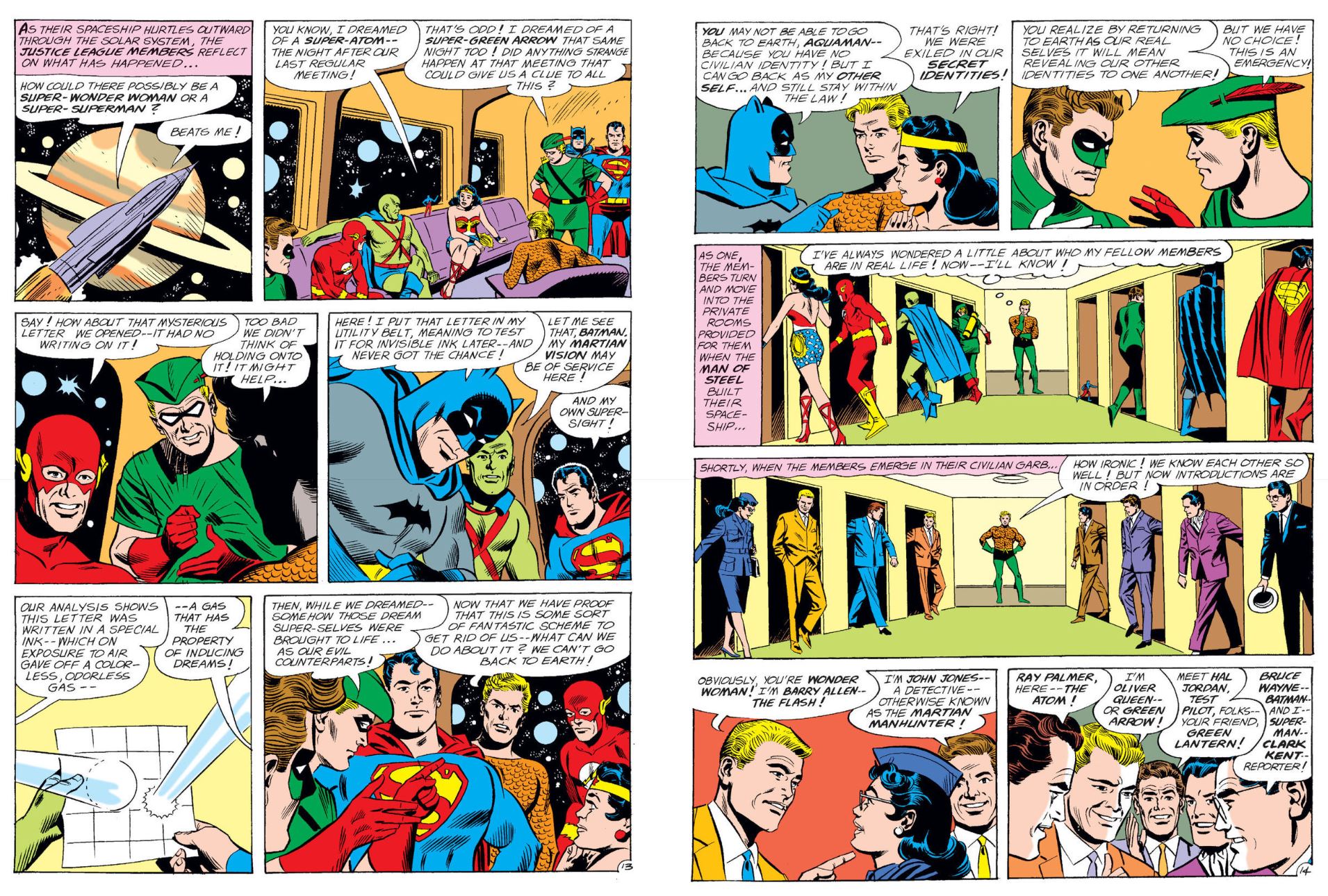
One final perplexing puzzle was posed in ‘The Super-Exiles of Earth’ after unstoppable duplicates of the heroes go on a crime-spree, forcing global governments to banish the League into space. Breaking rules and laws whilst battling undercover in their civilian identities, the team prove too much for the mystery mastermind behind the plot and return to public acclaim in a stellar wrap-up to another fabulous feast of four-colour fun.

With iconic covers by Sekowsky, Infantino and Anderson, these tales are a perfect example of all that was best and purest about US comics’ Silver Age: combining optimism and ingenuity with bonhomie and adventure. This slice of better times also has the benefit of cherishing wonderment whilst actually being historically valid for any fan of our medium. Best of all the stories here are still captivating and enthralling transports of delight.

These classical compendia are a dedicated fan’s delight: an absolute gift for modern fans who desperately need to catch up without going bankrupt. They are also perfect to give to youngsters as an introduction into a fabulous world of adventure and magic…
© 1960, 1961, 1962, 1963, 2026 DC Comics. All Rights Reserved.

Today in 1883 trailblazing strip creator Frank King (Gasoline Alley) was born, as was trendsetting illustrator Mac Raboy (Captain Marvel Junior, Green Lama, Flash Gordon) in 1914; German comics legend Rolf Kauka (Dagobert, Fix und Foxi) in 1917 and Gerard Way (Umbrella Academy, Doom Patrol, some music and TV and movies ‘n’ stuff) in 1977.

In 1978, DC’s The World’s Greatest Superheroes newspaper strip premiered.

The Spider’s Syndicate of Crime


By Ted Cowan, Jerry Siegel & Reg Bunn (Rebellion)
ISBN 978-1-78108-905-7 (Album TPB/Digital edition)

This book includes Discriminatory Content produced in less enlightened times.

As religions, faiths and nations all over the world celebrate their apparently God-given right to kill each other in monumental numbers and vile ways, I’m again retreating into childhood days and safely fictional conflicts this Easter.

At least the adventures of the macabre and malevolent Spider and his personal redemption arc are as engrossing and enjoyable as I always recalled and will provide the newest, most contemporary reader with a huge hit of superb artwork, compelling, caper-style cops ‘n’ robbers fantasy, and thrill-a-minute adventure with no threat to soul or sanity.

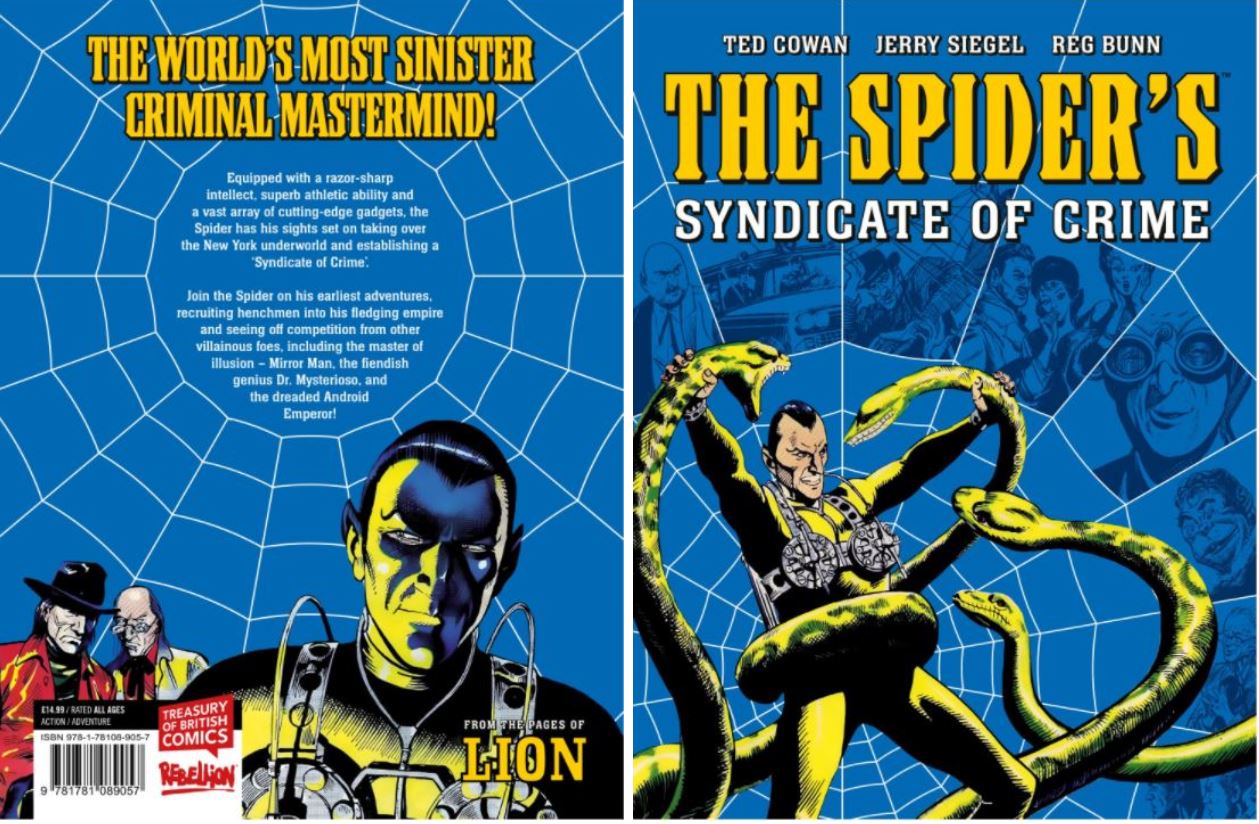
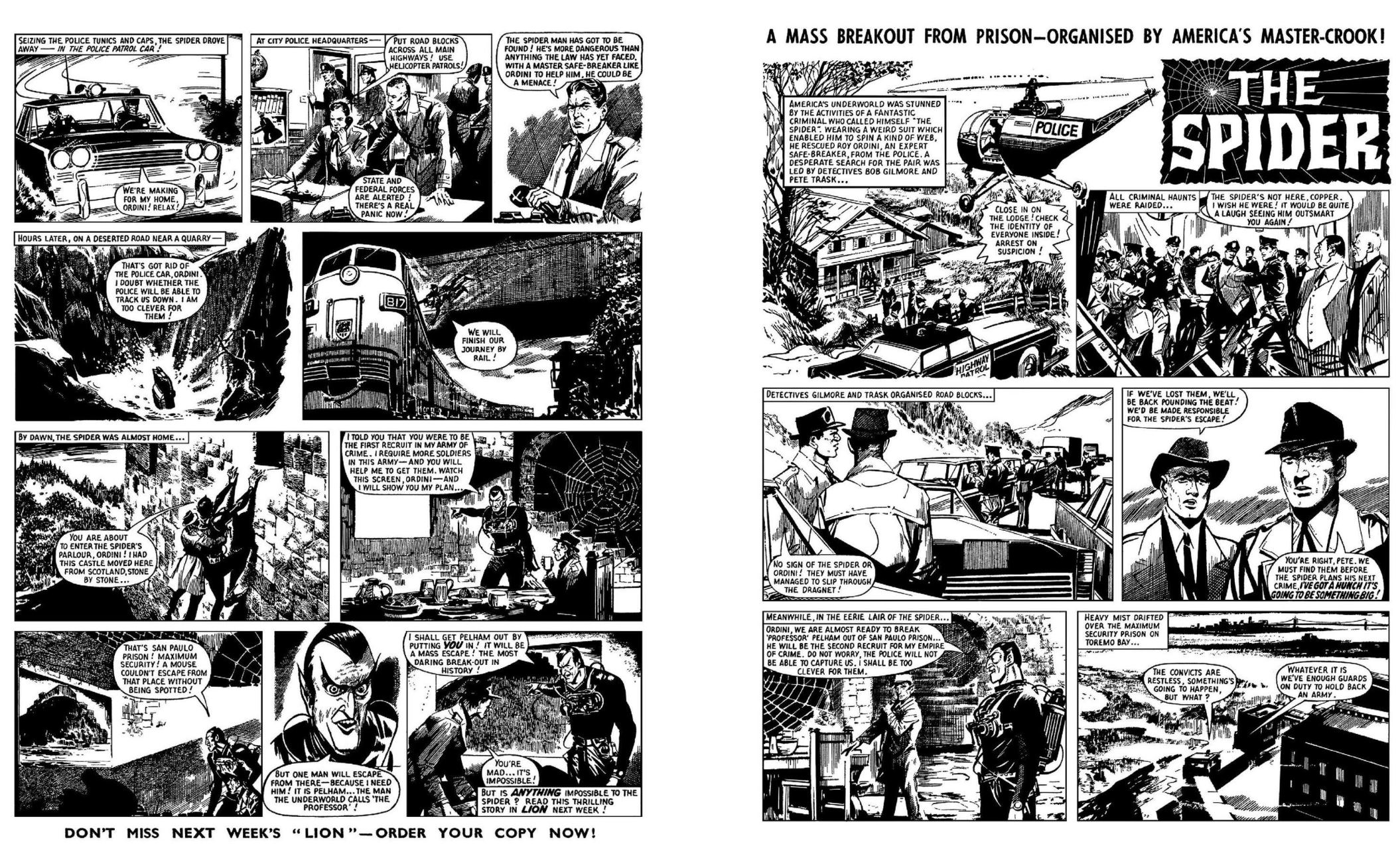
Part of Rebellion’s Treasury of British Comics strand, The Spider’s Syndicate of Crime was the opening salvo of (hopefully) a full and complete reprinting of arachnid amazements. It gathers material from peerless weekly anthology Lion, spanning June 26th 1965 – June 18th 1966 and that year’s Lion Annual which for laborious reasons is designated 1967.

What’s it all about? The Spider is a mysterious super-scientist whose goal is to be the greatest criminal of all time. As conceived by writer/editor Ted Cowan – who among many venerable triumphs created the much-revered Robot Archie feature and also scripted Ginger Nutt, Paddy Payne, Adam Eterno, and more – the flamboyantly wicked narcissist begins his public career by recruiting crime specialists. With moronic master safecracker Roy Ordini and evil inventor Professor Pelham he then attempts a massive gem-theft from a thinly veiled New York’s World Fair. This introduces Gilmore and Trask, the two crack police detectives cursed with the task of capturing the arrogant archvillain.

A major factor in the eerily eccentric strip’s success and reason for the reverence with which it is held is the captivating – not to say downright creepy – artwork of William Reginald Bunn. His intensely hatched linework was perfect for towering establishing shots, arcane angle views and catastrophic chases… and nobody ever drew moodier webbing or more believable weird weapons and monsters. Bunn was an absolute master of his field and much beloved. His work in comics (such as Robin Hood, Buck Jones, Black Hood, Captain Kid and Clip McCord) spanned 1949 to his death in 1971: once the industry found him, he was never without work. He died on the job and is still much missed. For The Spider there was the ultimate accolade as, after opening on two pages per episode, the feature kept winning a bigger page count. Even so, a lot had to happen in pretty short order and Bunn never stinted or short-changed his audience…

Similarly scripted by Cowan, second adventure ‘The Return of the Spider’ sets the tone for the rest of the strip’s run, as the unbelievably colossal vanity of the Spider is assaulted by a pretender to his title. The Mirror Man is a swaggering arrogant super-criminal who uses lethally credible optical illusions to carry out his crimes, and the Spider must crush him to keep the number one most wanted spot – and to satisfy his own vanity. Moreover, pitifully outmatched Gilmore & Trask return to chase the Spider, but must settle for his defeated rival after weeks of devious plotting, bold banditry and spectacular serialized thrills and chills.

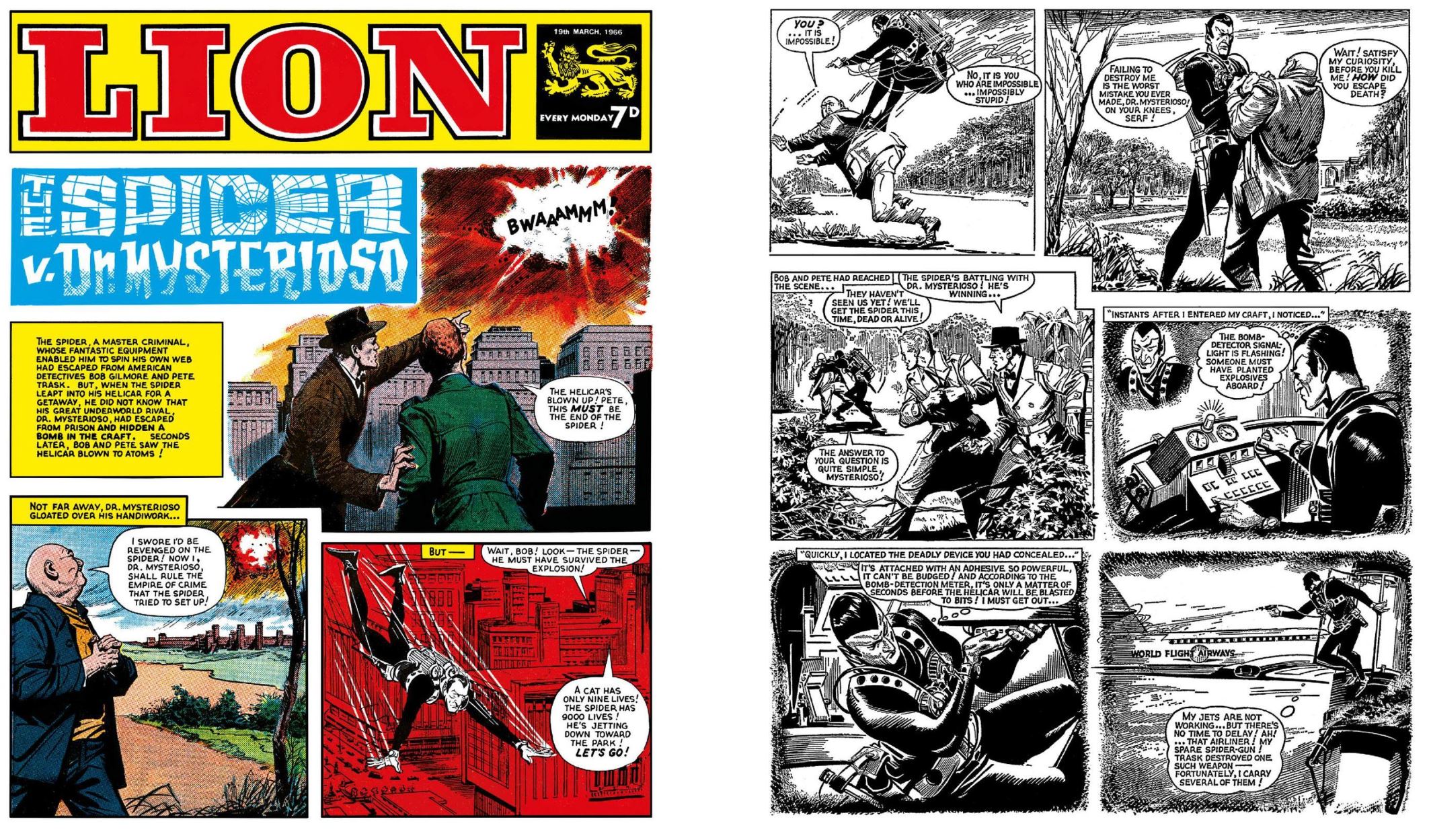
‘Dr. Mysterioso’ is the first adventure penned by Jerry Siegel, who was forced to look elsewhere for work after an infamous falling out with DC Comics over the rights to the Man of Steel.

The aforementioned evil genius/criminal scientist of the title is another contender for the Spider’s crown. Their extended battle – paused repeatedly by a crafty subplot wherein the arachnid mastermind’s treacherous, newly-expanded gang of thugs (The Syndicate of Crime) seek to abscond with his stockpiled loot whenever he appears to have been killed – is a retro/camp masterpiece of arcane dialogue, insane devices and rollercoaster antics.

By the time of the final serialised saga here – ‘The Spider v. The Android Emperor’– the page count was up to 4 a week (and now included occasional cover slots): packed with fabulous fantasy and increasingly surreal exploits as the Arachnid Archvillain battles the super science of a monster-making maniac who might (maybe, perhaps?) have survived the sinking of Atlantis, but somehow gets his fun from baiting and tormenting the self-styled king of crime. Big mistake…

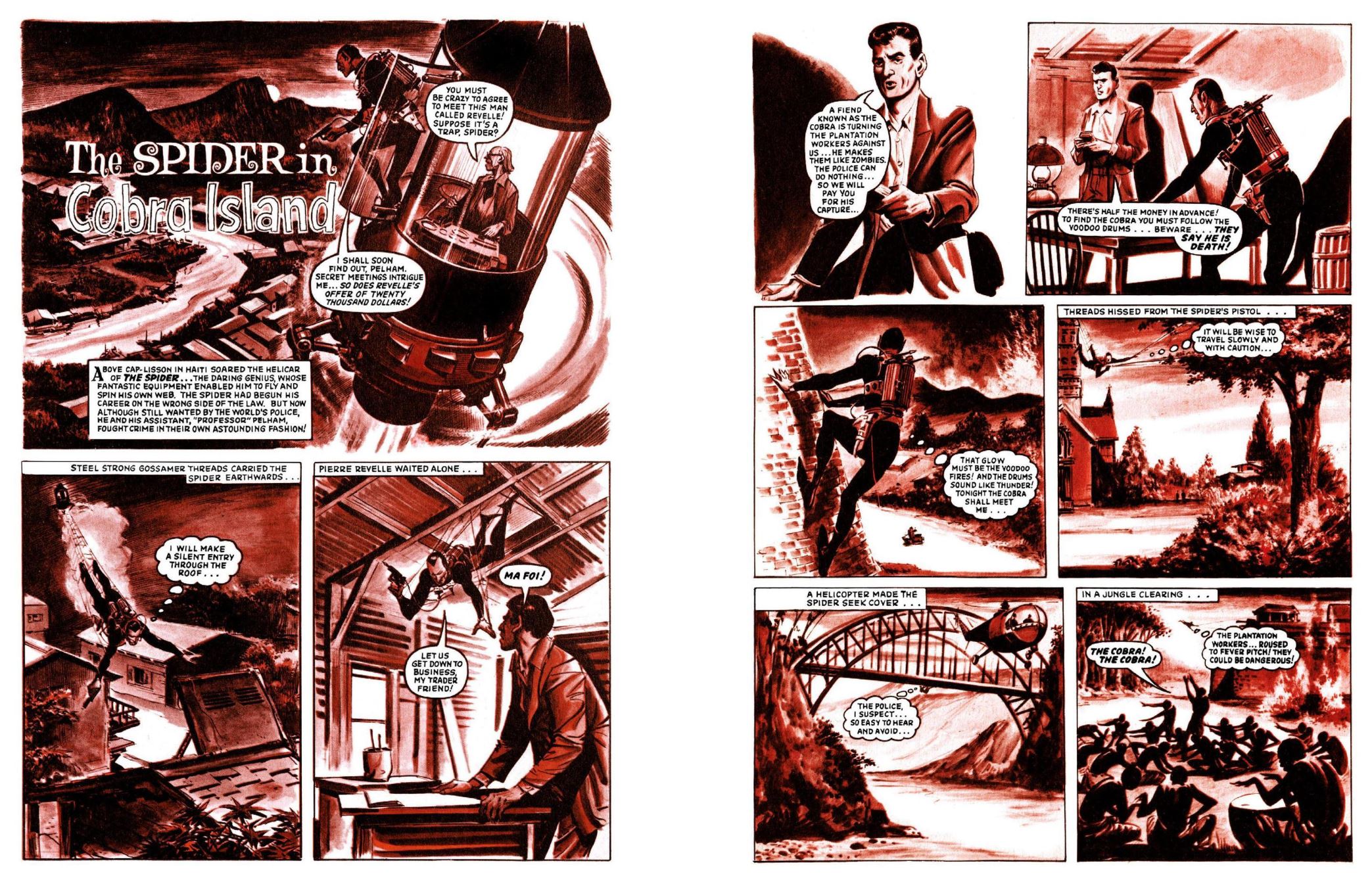
Thos initial curated commemoration concludes with a short yarn from the 1967 Lion Annual. ‘Cobra Island’ gives Bunn a chance to show off his skill with brushes and washes as the piece was originally printed in the double-tone format (in this case black and red on white) that was a hallmark of British annuals. It finds the mighty Spider and Pelham drawn to an exotic island where plantation workers are falling under the spell of a demonic lizard being – but all is not as it seems and the very real danger is more prosaic than paranormal…

With an introduction from Paul Grist and full creator biographies, this collection confirmed that the Lord of modern misrule was back at last and should find a home in every kid’s heart and mind, no matter how young they might be, or threaten to remain. Bizarre, baroque and often simply bonkers, The Spider proves that although crime does not pay, it always provides a huge amount of white-knuckle fun…
© 1965, 1966, 1967 & 2021 Rebellion Publishing IP Ltd. All Rights Reserved.

Today in 1885, Mutt and Jeff originator Bud Fisher was born, just like Dylan Dog author Tiziano Sclavi in 1953; auteur Yves Chaland (Spirou, Freddy Lombard) in 1957 and Jamie Hewlett (Tank Girl) in 1968.

The Little King creator Otto Soglow died on this date in 1975, but the day did give us comics-packed youth supplement ‘t Kapoentje’t in Flemish newspaper Het Volk in 1947 whilst later signalling the end of UK weekly Smash! in 1971.

Megalomaniacs: The Invasion Begins!


By Jamie Smart, with Sammy Borras, coloured by John Cullen (David Fickling Books)
ISBN: 978-1-78845-384-4 (PB)

Everybody loves rampaging monsters right? So what happens when someone too clever for his own good wants a go at the old traditional yarn-spinning and combines thrills and chills with manic intervention, all-ages cheeky vulgarity and excessive invention?

That’s right, kids – you get Megalomaniacs!

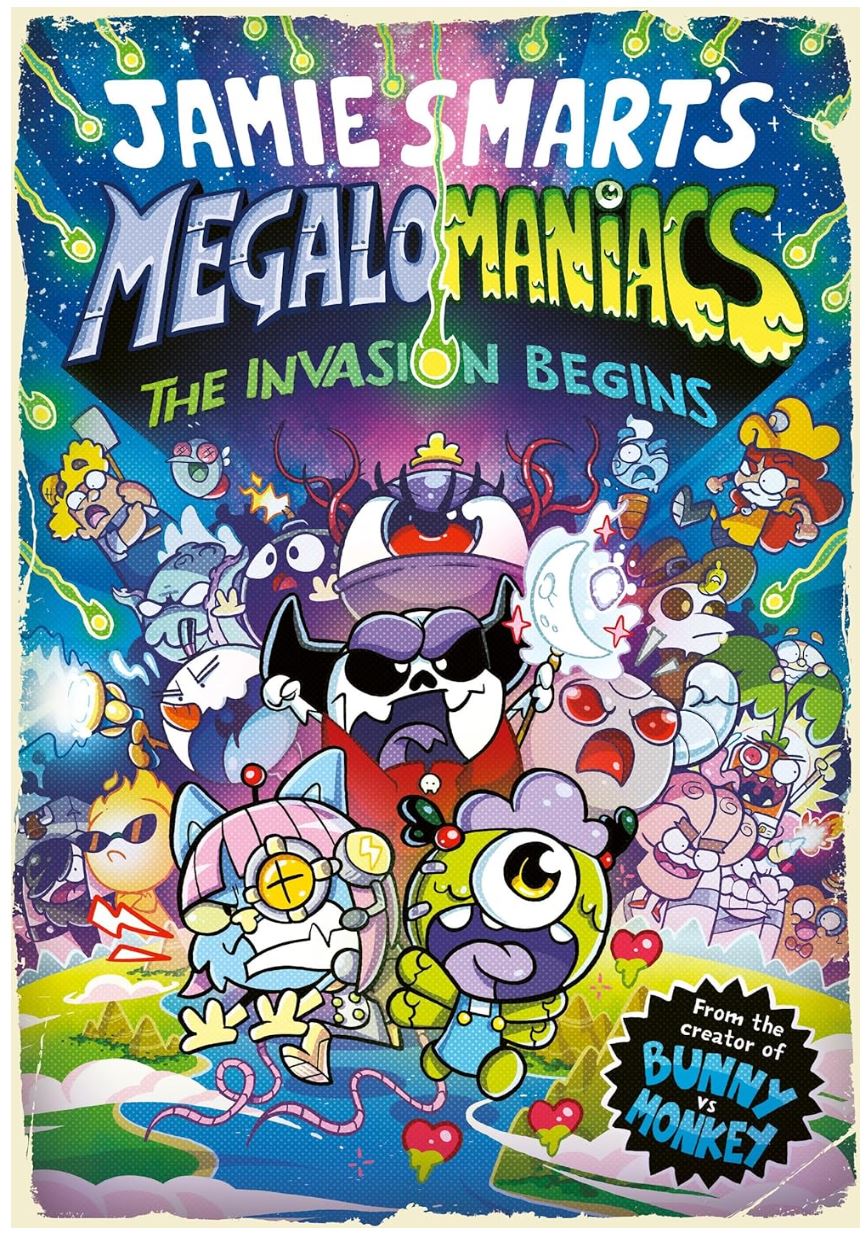
The Next Big Thing (that’s irony there, but you won’t get it yet) from multi award-winning cartoon wizard, comics artist and old-fashioned novelist Jamie Smart (Bunny vs. Monkey, Flember Looshkin – the Adventures of the Maddest Cat in the World!!, Max & Chaffy, Fish Head Steve!, Corporate Skull, Space Raoul, and many brilliant strips for The Beano, Dandy and others) is vividly vibrant, compellingly contagious comics nonsense in the grand manner which feels sublimely nostalgic to old attention-stunted duffers like me, who also demand constant engagement and entertainment… and bright shiny colours…

Yet another magnificent graduate of UK kids periodical The Phoenix, this unsavoury-starred silly saga thematically resembles the wonder years of fantasy yarns: delivering a series of wicked spoofs of Silver Age superhero comics liberally ladled with classic B-movie sci fi schmutter…

In the dark of night over go-getting metropolis Bobbletown, the sky is lit with sinister sky-fire as a rain of asteroids delivers fiercely competitive monsters and mechanoids to menace our already-embattled planet. Constantly-warring rival conquerors irregularly arrive, all intent on making our world theirs. The assorted fiercely combative rivals are fantastically powerful beasts, boggles, robots, devils and worse… but are also unfortunately quite teeny-weeny and have some trouble making themselves feared, obeyed or even noticed… at first…

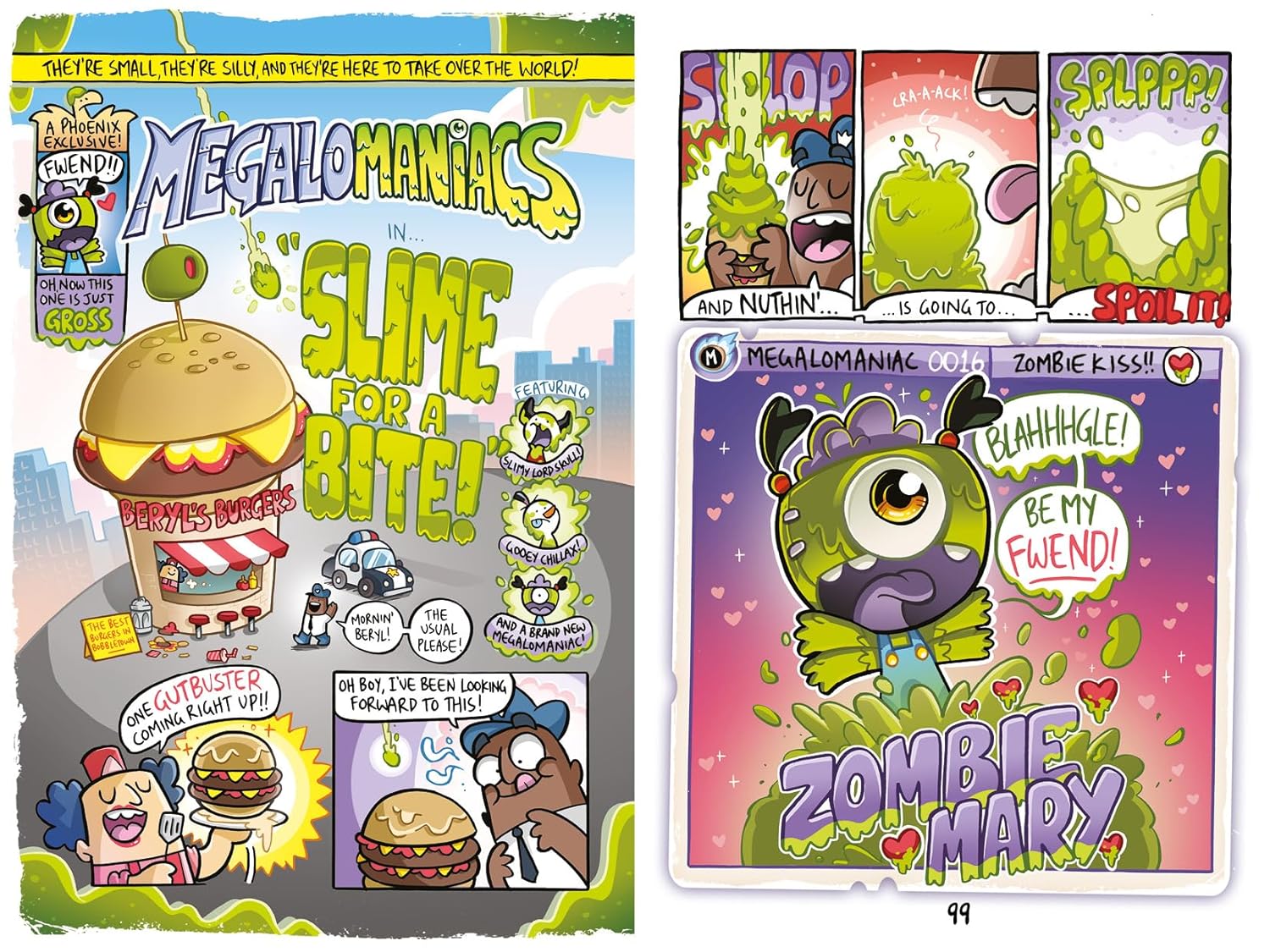
Rendered as complete insert minicomics – complete with dramatically deceptive covers! – the legend of the Megalomaniacs opens with super special prologue chapter ‘They Came From Outer Spaaace!’ and features an “Idiot Human” and “Some Pigs” who become spectators/victims/participants in the advent of our future overlords. Primary peril is laser-emitting, mesmerising Queen Eyeball arriving mere moments before her despised archfoe Lord Skull and who immediately does battle with the mystical space vampire… until rowdy robot ravager Crusher crashes to Earth and joins the fight.

These marauding terrors from beyond the stars are insanely single-minded and awesomely powerful and just keep coming, as seen in ‘Welcome to the Town of Bobbletown’ wherein catastrophically cute Cyber Kitten joins the ever-expanding melee, but is equally unprepared for the beguiled response of the cretinous colossi stomping about and “aww cu-uuute”…

The witless humans are less sanguine when another meteor delivers bug bloodsucker Mozzz who pillages their plasma in ‘Prangs for the Memory!’ prior to icily animated gruesome gelato taste-treat Mister Scoopy bending minds through the massed morons’ tastebuds in ‘Oh, What a Meltdown!’ after which extraterrestrial oik/bovver boy from beyond The Fist belts Lord Skull and late-arriving literal hottie Sun-Girl in ‘Who Will Escape… the Hand of Fate?’

Tiny tyrants trying to topple Earth, the invaders experience ‘A Bad Case of the Sniffles!’ when ambulatory ambulance-filler The Sickness plagues the already-engaged Megalomaniacs in beleaguered Bobbletown, before the beaches disgorge diminutive diabolist demon of the depths K-Thulu in ‘The Wet Terror!’ after which human resistance is mustered by school nerds the Bobbletown Science Club (Rosie, Debbie & Fibius). They contest Crusher, whose plan to ‘Destroy All Science!’ is proved to be a non-starter…

‘Stay Cool!’ sees star-borne snowball Chillax mutate into a so-far-from-massive marauding  snowman after which the duelling dilemmas detail ‘The (Not So) Great Escape!’ as the already entrenched  old foes meet hirsute newcomer The Hound prior to a petite pause as Bonus comic ‘A Wheel-y Good Idea’ sees Lord Skull find a better way to keep his cumbersome coffin close before we segue into ‘Unicool vs The Fist’ wherein a new pointy headed horsey horror who’s good with rainbows blasts down to kick up a fuss…

‘A Beautiful Day on the Farm!’ introduces spoiled-brat smarty-pants Riley who thinks the invaders are perfect pets… until Grandpa becomes the latest meat-chariot for Queen Eyeball.

As alliances form, shift and inevitably shatter, ‘What a Hot-Head!’ greets explosive new guy Bombybo who scuppers his own bid for stardom by making a fireworks shop his lair even as Cyber Kitten and The Hound endure a rematch in ‘The Fur and the Fury!’ and the mechanical misanthrope gets a bizarre, gender-challenging upgrade into deadly debutante Posh Crusher! in ‘How Delightful!’ whilst ‘Bob, the Invisible Blob!’ debuts and almost bows out when Chillax ambushes him…

Things get nasty in ‘Slime for a Bite!’ as Zombie Mary stumbles into town in search of new – but necessarily living – fwends: an offer Lord Skull and Chillax are delighted to decline, before the star voyagers discover the delights of go karts in ‘Mega Racers’ and the Mayor of Bobbletown gets organised enough to mount a resistance effort…

Things get really dicey in ‘How My Invasion Began by The Goofy Carrot!’ when the smartest vegetable in the universe co-opts the local observatory, whilst ‘Sun-Girl!’ stops humanity’s mass-escape to Croydon but still finds ‘Time to Shine!’ after barbarous oaf Gurf literally hits town and Zombie Mary shambles back still craving ‘Fwends!’ to boss about in the local human school.

Still keen to corner the paralyzing fear concession, Lord Skull overdoes things with his ‘Spooky Scheming!’ and is overwhelmed when the Mayor retaliates in ‘Bobbletown Fights Back!’ With an astronomer doing science-y things with lasers, the advent of astral interloper The Sandwich is missed by most, but not the hairy space horror Terry Beard who determines that ‘Everyone Looks Better… With a Beard!’ His Megalomaniac cohort disagree but what do they know, really?

The closest thing to space Satan surfaces next as corrupting conjuror Shazm-o! goes to birthday party and confirms the sense of the adage ‘Don’t Try This At Home!’

‘The Pigeon’s Barely in the Episode!’ – but Riley is – and observes Eyeball’s elevation to bad beast Oculus (the All-Seeing Eye!) in time to team up with other, lesser alien outcasts, prompting ‘A Brief Recap – Riley, Saviour of the World!’ as the united contestants war against the peepy blinder. Sadly, they soon learn ‘None Shall Escape… the All-Seeing Eye of Oculus!’ and it’s all up to Riley and her favourite heavy kitchen utensil to save the day and the world…

The crisis may have passed but there are still tales to tell such as late-maturing saga ‘If You Cheese!’ as Riley and her chastened new pals meet animated fearsome fromage Stink-o just before Halloween Special ‘What Spooks the Spooksters?’ sees all concerned, very concerned indeed, when deadly drop-in Pumkinella starts marshalling her arcane forces, after which the terrors temporarily terminate in ‘Meanwhile, Back on the Farm!’ as body-hogging Queen Eyeball (nee Oculus) merges with Grandpa again to form the mesmerising Meatbag, but forgets to stay away from the pigs at feeding time…

As always, wrapping up these sidereal shenanigans and cosmic contumely are opportunities to gt involved via activities offered under the aegis of the Phoenix Comics Club. Bring paper, pencils and you to a compact online course in all aspects of comic strip creation supervised by Jamie Smart detailing ‘How to draw Lord Skull’, ‘Zombie Mary’ and ‘The Goofy Carrot’ , before closing with an extensive plug for the aforementioned Phoenix Comics Club website complete with instant access via a QR code, plus previews of other treats and wonders available from M Smart and The Phoenix, to wind down from all that cosmic furore…

Another book for your kids to explain to you, Megalomaniacs is a zany zenith of absurdist all-ages (and species) cage-fighting delight, whacked up on weird wit, brilliant invention and superb cartooning, all crammed into one eccentrically excellent package. Make your move now if you think you’re hard to please enough…
Text and illustrations © Fumboo Ltd. 2026. All rights reserved.
Today in 1917, certified comics genius Sheldon Mayer (Sugar and Spike, all things DC) was born as were Doggyguard creator Michel Rodrigue in 1961, Mark (Northguard) Shainblum and James (London’s Dark, Starman) Robinson in 1963, and Brad (Identity Crisis) Meltzer in 1971.

Reading wise, in 1961 Eric Roberts’ Winker Watson debuted today in The Dandy, David Sutherland’s Billie the Cat launched in 1967’s weekly Beano, and TV Action (the reboot of Countdown) began in 1972. In 1973, Zach Mosely’s The Adventures of Smilin’ Jack ended today, followed one year later by Go Nagai’s final instalment of robot revenge manga Cutey Honey. In 1997, 46 US strip creators traded places for a day in the unbelievably tricky but cool publishing event Comic Strip Switcheroo (AKA  the Great April Fools’ Day Comics Switcheroonie)…

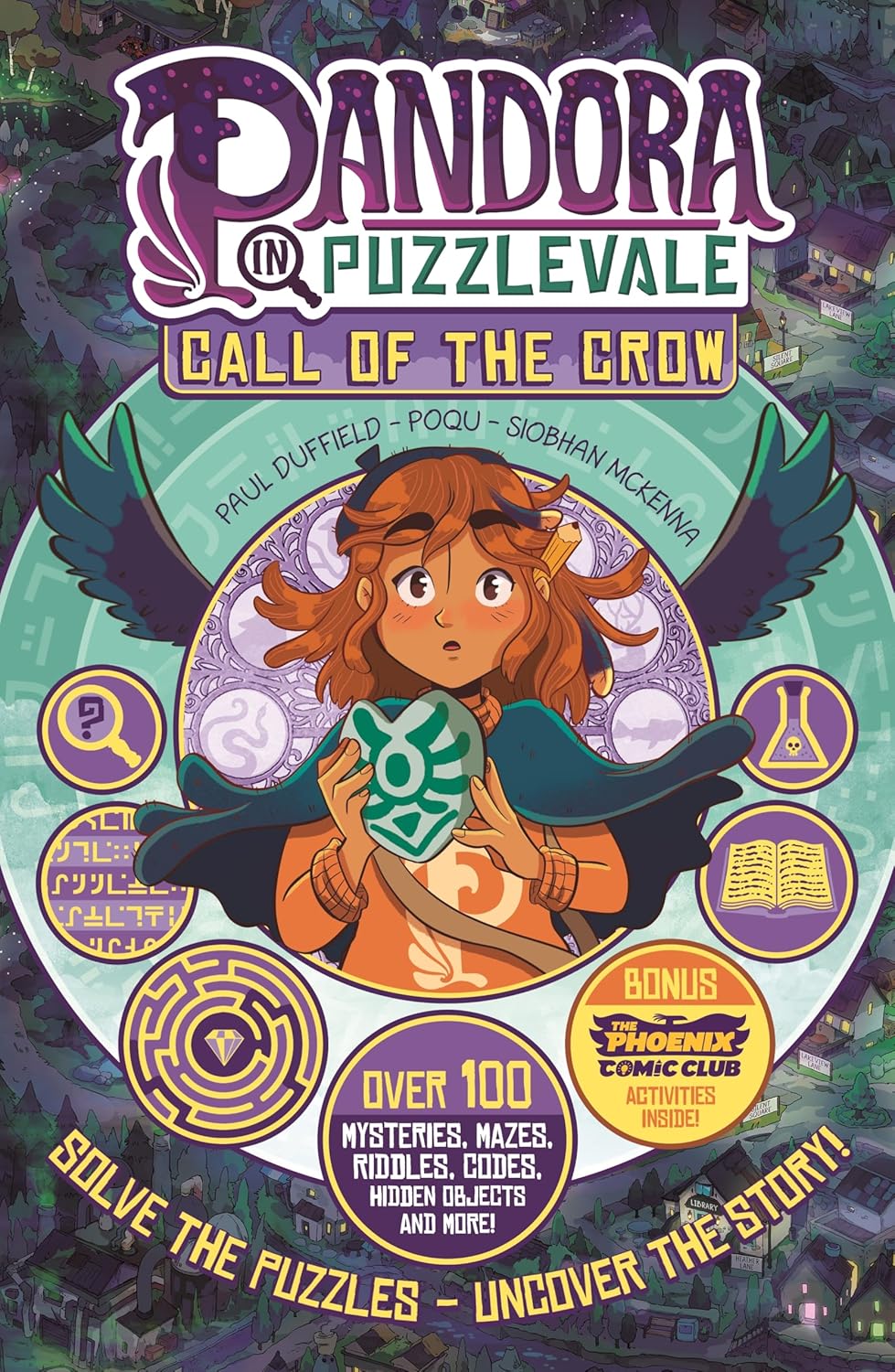
Pandora in Puzzlevale: (volume 2) Call of the Crow


By Paul Duffield, Poqu, Siobhan McKenna & various (DFB/Phoenix)

ISBN: 978-1-78845-3769 (TPB)

These days, kids are more likely to find their formative strip narrative experiences online or in specially tailored graphic novels than the anthological, pick ‘n’ mix of pictorial periodicals that defined my long-dead youth. Such was not always the case, but at least comics like The Phoenix are still plugging away, blending the best of the old days with modern appurtenances of all types, just like this splendid sequel saga, culled from the sagacious periodical’s pages.

Pandora in Puzzlevale: The Secret Town debuted a comic strip mystery that progressed as our plucky protagonist solved assorted tests and conundra to recover the parents who had vanished from her side as they all enjoyed a little road trip.

It began as the aspiring crimebuster and Detective Crow C fan was dragged from her comic long enough to realise the tedious drive to their holiday home had been paused. Although the route to the much-anticipated “secrets-themed” village seemed straightforward, the road was long, winding and confusing. When heavy mists descended and the satnav packed in, Mum & Dad pulled up at a petrol station for directions. Engrossed in reading, Pandora eventually looked up to discover she was all alone. Her parents were gone…

Her catalogue of confusion and casebook of ratiocinative deduction filled up quickly as she was drawn into a schema apparently designed to test her physical and mental abilities. That meant taking up precarious residence in a strange hamlet with all odd cons: somewhere everyone had a secret that they wouldn’t share unless Pandora played their games…

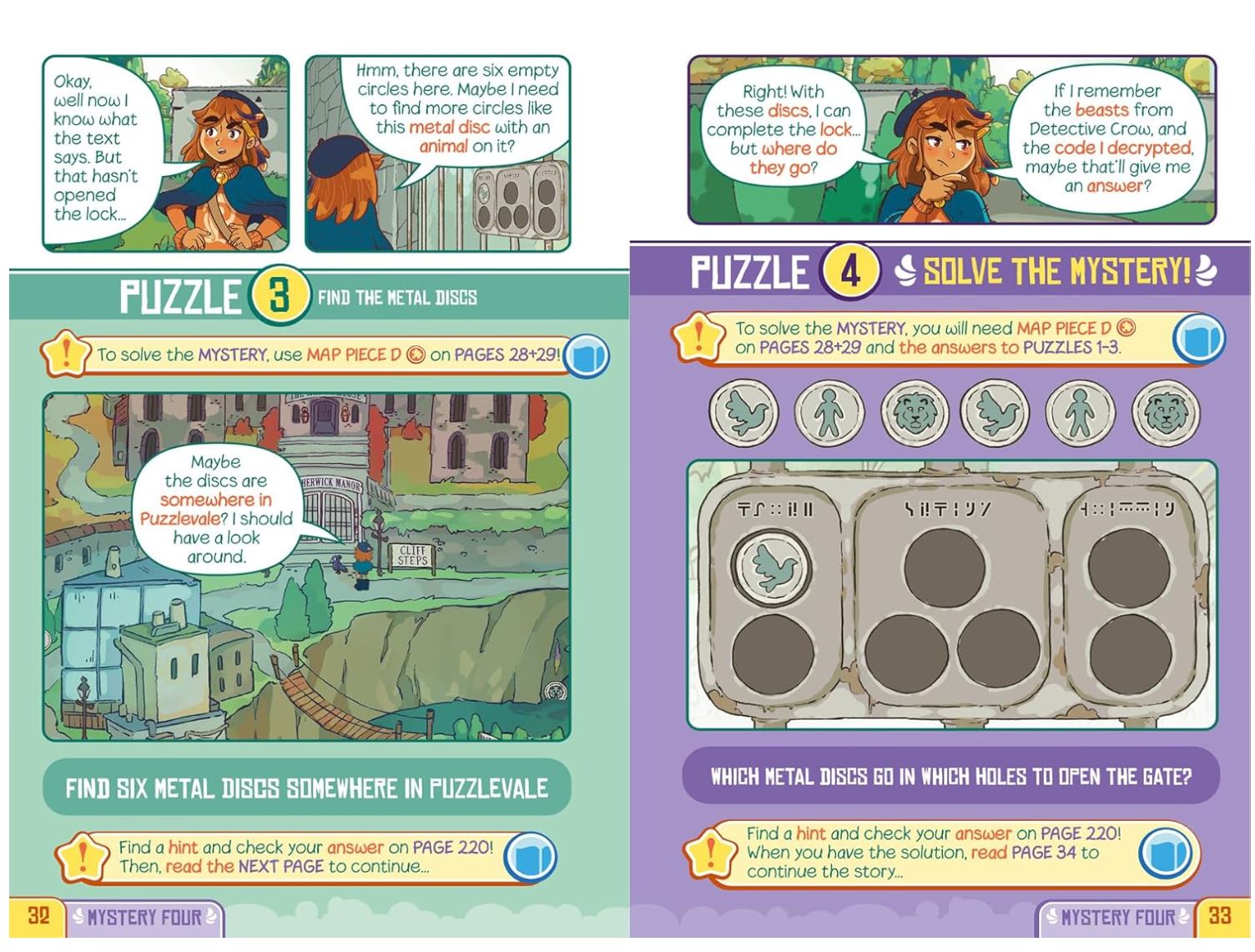
In case you’re still wondering, this book – like its predecessor – is all about active participation. By accessing these pages and selecting an action at a critical moment in each episode, you/Pandora are directed to another page to experience the ramifications of that choice. The final objective is still to find the folks uncover the nested truths of the village… and escape Puzzlevale… but it’s you who will be doing the work.

In-world, seemingly helpful people are plentiful in the mist-shrouded village – like fortune tellers, tea shop staff, rambling bystanders and potential witness/gossip Granny Garnett and enigmatic rhymer Rita Idyll, but most welcoming and useful is a were-wolfly hotel clerk. Max/Monster Max is positively friendly but in truth everyone’s motives and accounts are unverifiable and not to be trusted, so Pandora is ultimately left to fend for herself.

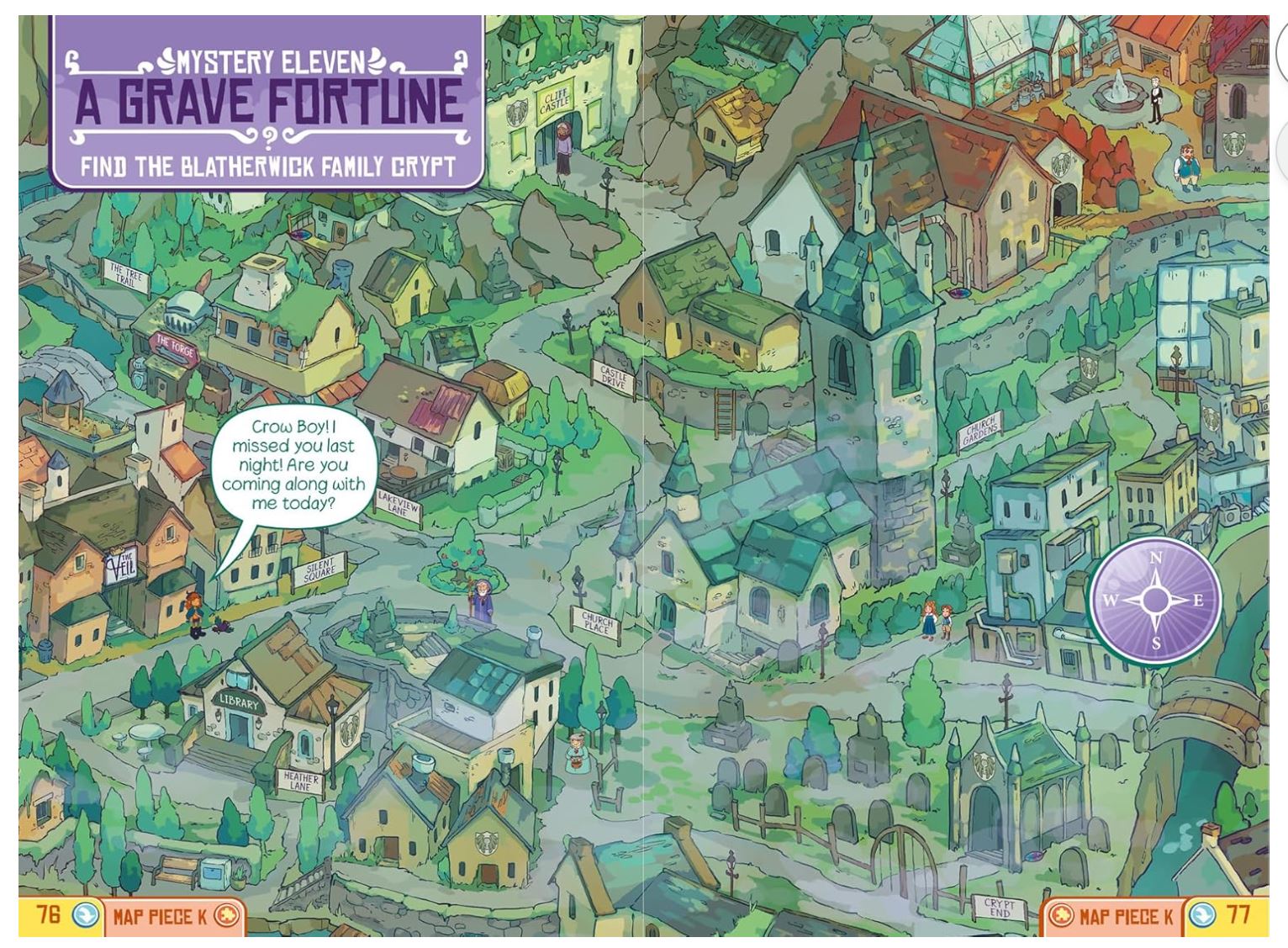
At least in this very strange and mutable place, she increasingly has Magically Real Detective Crow by her side and steering her path, and relative stability in a room at local hotel The Veil. Pandora’s methodology includes clue finding, location identification, map-making, maze-defeating, symbol deciphering, wordsearch weaving, witness statement verifying, code-breaking, rune reading, message translating, riddle-solving, character assessing, crossword completing, key & lock retrieving, object unearthing, back-story compiling and comparison testing as well as frequent odd behaviour explanation, with facts meticulously forming a working hypothesis and dictating her plan of action: all jotted down in her trusty, ever-present notebook. She needs all that and more, this time…

After a moody recap, the next morning sees Pandora and her crow companion reviewing the case and wishing the ever-encroaching mists would let up, before a querulous, decision-loaded morning learning the hotelier’s secrets from Max’s sister ensues. This belatedly occurs in The Grand Gardens of Blatherwick Manor. However, getting to the silent sibling means foiling snooty question master/butler Reeves, and steadfast truth obstacle/fount of knowledge Lord Blatherwick…

As unceasing enigmas unfold. Pandora and former fictional detective Crow Boy join new ally (or is she?) Aunty Amethyst in overcoming intellectual and physical challenges, but there are so many! She still hasn’t solved the old ones, like why do the buildings shift, and why do so many wear masks and all-concealing costumes? It isn’t long before she decides “when in Rome…”

Pandora’s quest is divided into 25 sequential ‘Mysteries’ undertaken across four chapters – ‘Trapped in Puzzlevale’, ‘A Family Secret’, ‘Bridging the Divide, and ‘To Raven City’ – each with its own set of tests and challenges contributing to a Big Picture solution, but even after Pandora completes them, she’s left with more to solve and another weird path to follow…

Now with an abrupt hard-earned elevation to official status, magical transformation and the end in clear sight, how can this be anything but To Be Continued…

Pandora in Puzzlevale: Call of the Crow is the second in a serialised sleuth-fest offering a dazzling display of cartoon virtuosity and brain-busting challenges co-composed by writer/art director Paul Duffield, graphic staging scenarist Poqu & illustrator Siobhan McKenna. Their compelling blend of Story! Games! & Action! offers beguiling mystery to be unravelled in the manner of multiple-choice decisions and all there in the irresistible shape of entertaining pictures. How much cooler can a book get?

Well, quite a lot actually, since this tome devotes posterior pages to related activities and features offered under the aegis of the Phoenix Comics Club. Here are tips by Duffield & McKenna on ‘Drawing Crow Boy’, ‘Building blocks’ to ‘Final details’ as well as how to craft puzzles, whilst Poqu shares constructing ‘Secret woodland’, before we conclude with a full list of solutions, clues and hints in closing glimpses at ‘The Final Mystery’ and ‘Pandora’s Notes’…

Bring paper, pencils and your intellectual A-game, and have the time of your life…
Text and illustrations © The Phoenix Comic, 2026. All rights reserved.

Today in 1893 Josette Frank was born. Go look her up now. She earned it. In 1901 Carl Barks was born. Absolutely him too.

If you’re not all worthied out, Hy Eisman (who walked in giants’ footsteps on Popeye and Katzenjammer Kids) arrived in 1927 as did writer/entrepreneur/ publisher/agent Mike Friedrich in 1947.

We lost attorney, psychologist and Wonder Woman co-creator Elizabeth Holloway Marston today in 1993 – so look her up too – as well as Dick Giordano who died in 2010. Italian spaghetti westerner Leone Cimpellin AKA “Ghilbert” (Red Carson, Casey Ruggles, Jonny Logan) bit his last bullet in 2017.

In 1982 Eagle relaunched in Britain. It was pretty good, had lots of cool contributors, but just wasn’t the same…

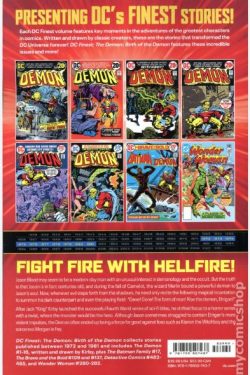
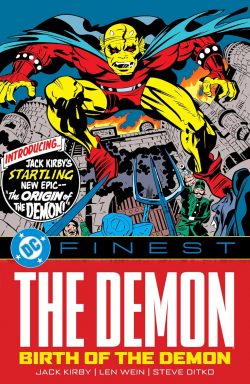
DC Finest: The Demon – Birth of the Demon


By Jack Kirby with Mike Royer, Bob Haney, Bob Rozakis, Len Wein, Gerry Conway, Jim Aparo, John Calnan, Mike Golden, Steve Ditko, José Delbo, Bob McLeod, Dick Giordano, Dave Hunt & various (DC Comics)
ISBN: 978-1799507437 (HB/Digital edition)

This book includes Discriminatory Content produced in less enlightened times.

Jack “King” Kirby shaped the very nature of comics narrative. A compulsive storyteller, Jack was an astute, spiritual man who had lived through poverty, gangsterism, the Depression and World War II. He had seen Post-War optimism, Cold War paranoia, political cynicism and the birth and death of peace-seeking counter-cultures. He was open-minded and utterly wedded to the making of comics stories on every imaginable subject. He began at the top of his game, galvanising the comic book scene from its earliest days with long-term creative partner Joe Simon: creating Blue Bolt, drawing Captain Marvel and adding lustre to Timely comics with creations such as Red Raven, Hurricane, Captain America and The Young Allies.

In 1942 Simon & Kirby moved to National/DC and hit even more stellar highs with The Boy Commandos, Newsboy Legion, Manhunter and The Sandman before the call of duty saw them inducted into the American military.

On returning from World War II, they reunited, forming a studio working primarily for the Crestwood/Prize publishing outfit. Here they invented the entire genre of Romance comics. Amongst that dynamic duo’s other concoctions for Prize was a noir-ish, psychologically underpinned supernatural anthology Black Magic and its short-lived but fascinating companion title Strange World of Your Dreams. All their titles eschewed traditional gory, heavy-handed morality plays and simplistic cautionary tales for deeper, stranger fare. Until the EC comics line hit their peak, S&K’s were far and away the best and most mature titles on the market.

Kirby understood the fundamentals of pleasing his audience and always strived diligently to combat the appalling state of prejudice about the comics medium – especially from industry insiders and professionals who despised the “kiddies world” they felt trapped in. When the 1950s anti-comics comics witch hunt devastated the industry, Simon & Kirby parted ways. Jack went back to DC briefly and created newspaper strip Sky Masters of the Space Force before partnering with Stan Lee at what remained of Timely Comics to create the monolith of stars we know as Marvel. After more than a decade there he felt increasingly stifled and side-lined and in 1970 accepted an offer of complete creative freedom at DC. The jump resulted in a root and branch redefinition of superheroes in his quartet of interlinked Fourth World series.

When those controversial, grandiose, groundbreaking titles were cancelled, Kirby looked for other concepts to stimulate his vast creativity and still appeal to an increasingly fickle and divided market. General interest in the Supernatural was peaking, with books and movies exploring the unknown in gripping and stylish new ways, and the Comics Code Authority had already released its censorious choke-hold on mystery and horror titles, thereby saving the entire industry from implosion when the superhero boom of the 1960s fizzled away.

At DC’s suggestion, Kirby had already briefly returned to his supernatural experimentation in a superb but poorly received and largely undistributed monochrome magazine. Spirit World launched in the summer of 1971, but as before, editorial cowardice and back-sliding scuppered the project before it could get going. You can see what might have been in a collected edition re-presenting the sole published issue and material from a second, unreleased sequel in Jack Kirby’s Spirit World…

With most of his ideas misunderstood, ignored or side-lined by the company, Kirby opted for more traditional fare. Never truly defeated though, he cannily blended his belief in the marketability of the mystic unknown with flamboyant super-heroics to create another unique and lasting mainstay for the DC universe: one whom lesser talents would make a pivotal figure of the company’s continuity.

This compilation collects The Demon #1-16 (1972-1973), classic team-ups from The Brave and the Bold #109 & 137 and key appearances from Batman Family #17, Detective Comics #482-485 and Wonder Woman volume 1 #280-282, cumulatively spanning cover dates August/September 1972 through August 1981, providing a comprehensive introduction to one of Kirby’s most broadly reinterpreted and reimagined characters.

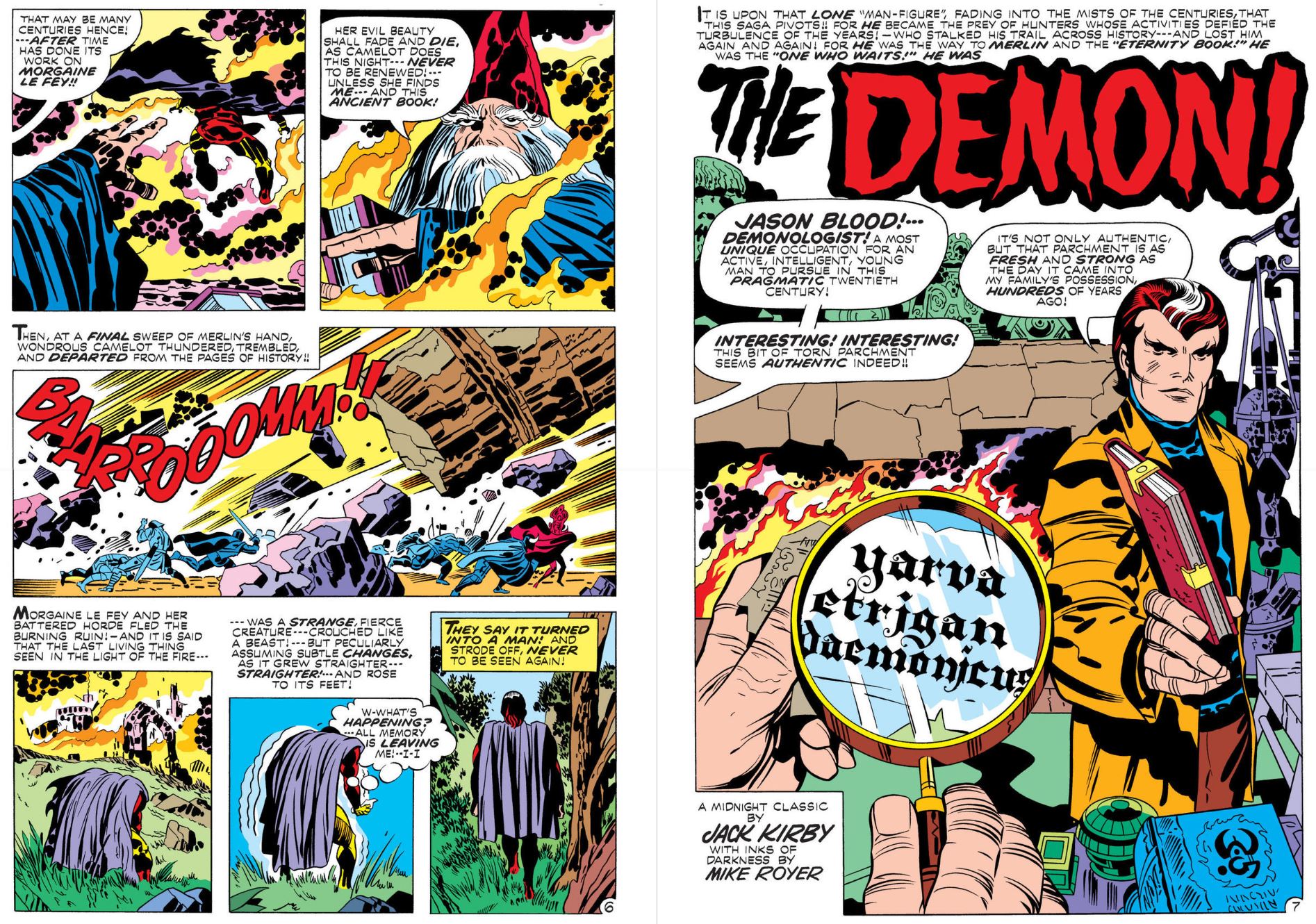
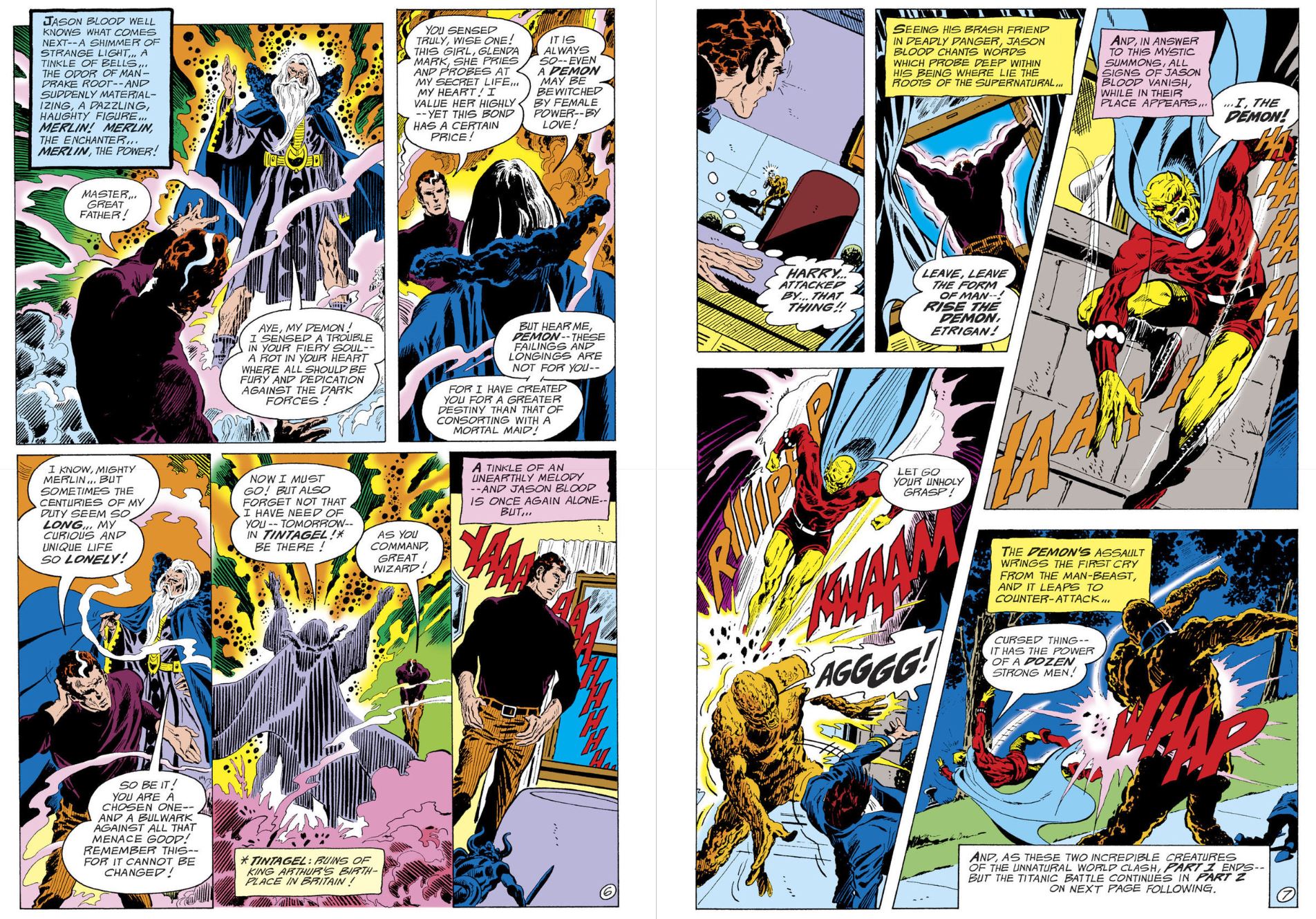
Inked by Mike Royer, The Demon #1 introduces a howling, leaping monstrosity (modelled after a 1939 sequence from Hal Foster’s Arthurian epic Prince Valiant) in ‘Unleash the One Who Waits’. This shocking force of un-nature battles beside its master Merlin as Camelot dies in flames, a cataclysmic casualty of the rapacious greed of sorceress Morgaine Le Fey. Out of that apocalyptic destruction, a man arises and wanders off into the mists of history…

In our contemporary world (or at least the last quarter of the 20th century) demonologist and paranormal investigator Jason Blood has a near-death experience with an aged collector of illicit arcana. This culminates in a hideous nightmare about a demonic being and the last stand of Camelot. He has no idea that Le Fey is still alive and has sinister plans for him…

And in distant Moldavia, strange things are stirring in crumbling Castle Branek, wherein lies hidden the lost Tomb of Merlin…

Blood is wealthy, reclusive and partially amnesiac, but one night he agrees to host a small dinner party, entertaining acquaintances Harry Mathews, psychic UN diplomat Randu Singh and his wife Gomali plus their flighty young friend Glenda Mark.

The soiree does not go well. Firstly, there is the painful small talk, and the sorcerous surveillance of Le Fey, but the real problems start when an animated stone giant arrives to “invite” Blood to visit Castle Branek. This shattering voyage leads to Merlin’s last resting place but just as Blood thinks he may find some answers to his enigmatic past, Le Fey pounces. Suddenly he starts to change, transforming into the horrific beast of his dreams…

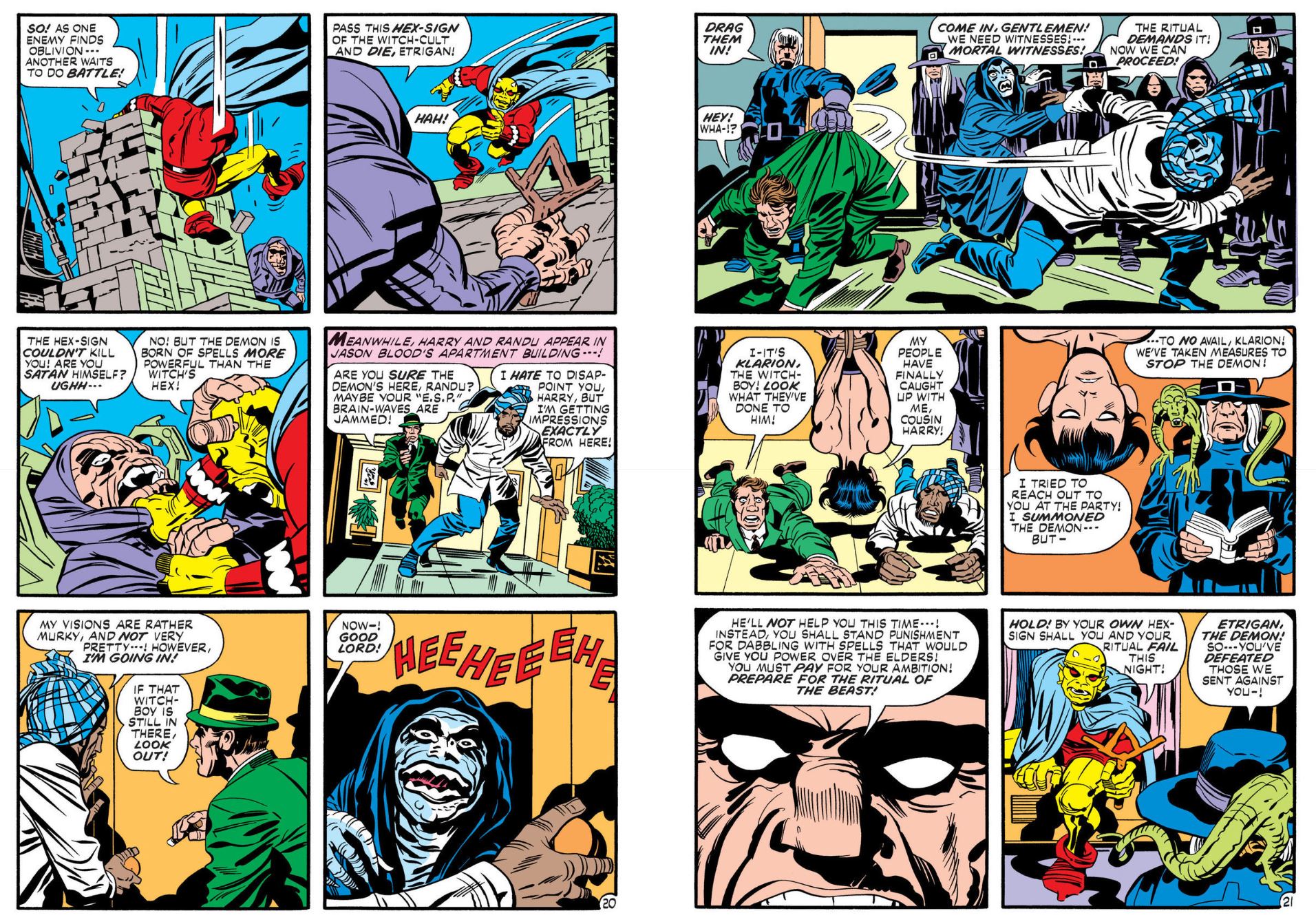
Issue #2 – ‘My Tomb in Castle Branek!’ – opens with wary villagers observing a terrific battle between a yellow monster and Le Fey’s forces, but when the Demon is defeated and Blood arrested, only the telepathic influence of Randu back in America can help him. Le Fey is old, dying, and needs Merlin’s grimoire, the Eternity Book, to extend her life.

Thus, she manipulates Blood – who has existed for centuries, completely unaware that Merlin’s hellish attack dog the Demon Etrigan is chained inside him – to regain his memories and awaken the slumbering master mage. It looks like the last mistake she will ever make…

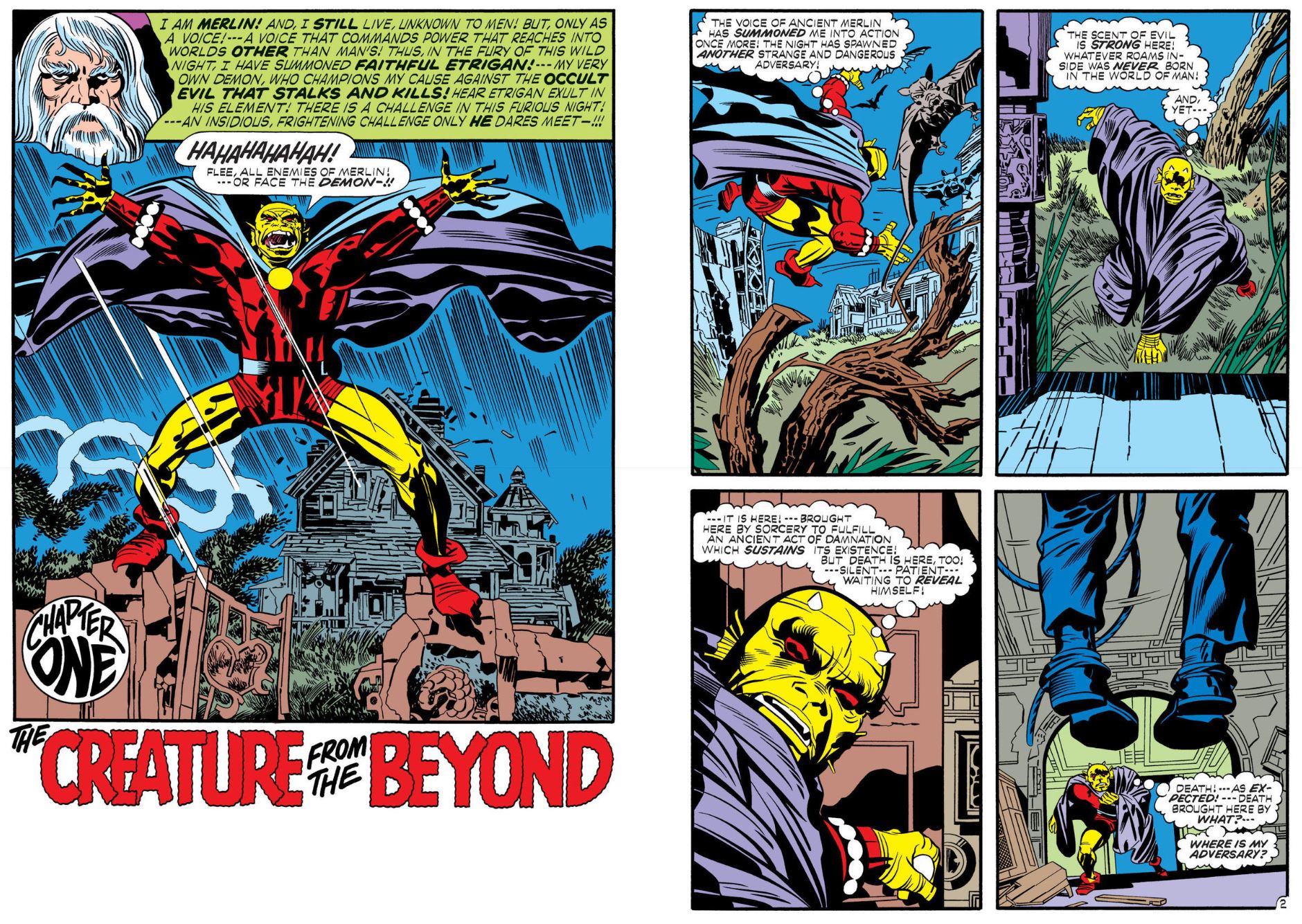
Kirby’s tried-&-trusted approach was always to pepper high concepts throughout blazing, breakneck action, and #3 was one of the most imaginative yet. ‘Reincarnators’ finds Blood back in the USA, aware at last of his tormented history, and with a small but devoted circle of friends. Adapting to a less lonely life, he soon encounters a cult able to physically regress people to a prior life… and use those time-lost beings to commit murder. The Demon #4-5 comprise one single exploit, wherein a simple witch and her macabre patron capture the reawakened, semi-divine Merlin. ‘The Creature from Beyond’ and ‘Merlin’s Word’s …Demon’s Wrath!’ introduce cute little monkey Kamara the Fear-Monster (later used with devastating effect by Alan Moore in Saga of the Swamp Thing #26-27) and features another startling “Kirby-Kritter”: Somnambula, the Dream-Beast…

It seems odd in these blasé, anything goes modern times but The Demon was a deeply controversial book in its day – cited as providing the first post-Comics Code depiction of Hell, and one where problems were regularly solved with sudden, extreme violence. ‘The Howler!’ in issue #6 is a truly spooky yarn with Blood hunting a primal entity of rage and brutal terror that transforms victims into murderous lycanthropic killers, whilst #7 debuts a spiteful, malevolent young fugitive from a mystical otherplace.

‘A Witchboy!!’’ introduces Klarion and his cat-familiar Teekl – utterly evil little sociopaths in a time where all comic book politicians were honest, cops only shot to wound and “bad” kids were only misunderstood: thus, another Kirby first…

An extended epic, ‘Phantom of the Sewers’ skilfully combines movie and late-night TV horror motifs in the dark and tragic tale of actor Farley Fairfax, cursed by the witch he once spurned. Unfortunately, Glenda is the spitting image of the departed Galatea, and when, decades later, the demented thespian kidnaps her (in ‘Whatever Happened to Farley Fairfax?!!’) to raise the curse, it could only end in a flurry of destruction, death, consumed souls and ‘The Thing That Screams’…

In case you were wondering: the first musical adaption of The Phantom of the Opera (by Ken Hill) was in 1976, and the one you’re thinking of launched in 1986. The King was always ahead of the curve and subtly influential…

This 3-part thriller is followed by another moody, multi-part masterpiece (The Demon #11-13). ‘Baron von Evilstein’, ‘Rebirth of Evil!’ and ‘The Night of the Demon!’ comprise a powerful parable about worth and appearance, featuring the ultimate mad scientist and the tragic, misunderstood monster he so casually builds. It’s a truth that bears repeating: ugly doesn’t equal bad…

An opportunity to widen the horror-hero’s appeal came next in The Brave and the Bold #109: as Bob Haney & Jim Aparo unship superb supernatural thriller ‘Gotham Bay, Be My Grave!’ wherein the Caped Crusader and Kirby’s Kritter Etrigan the Demon fractiously unite to battle an unquiet spirit determined to avenge his own execution after nearly a century…

Despite the King’s best efforts The Demon was not a monster hit – unlike his science-fiction disaster drama Kamandi – and by #14 it’s clear the book was in its last days. Not because the sheer pace of imagination, excitement and passion diminished – far from it – but because the well-considered, mood-drenched stories were suddenly replaced by rocket-fast, eldritch romps populated with returning villains. First back was Klarion in ‘Return of the Witchboy!’ who creates a deadly doppelganger to replace Jason Blood and kill his friends in ‘The One Who Vanished!!’ (#14-15) before the series succumbed to irresistible economic forces with #16 (cover dated January 1974) in a climactic if hasty showdown with ‘Immortal Enemy’ Morgaine Le Fey…

Etrigan and cohort resurfaced in 1977 and B&B #137 (October) as Haney, John Calnan & Bob McLeod subjected Batman, Jason Blood’s friends and The Demon to war with resurrected Chinese wizard Shahn-Zi at ‘The Hour of the Serpent!’ before in a guest shot led to short revival. In Batman Family #17 (cover-dated April/May 1978), the Man-Bat serial saw Bob Rozakis & Mike Golden celebrate a happy event as the Chiropteran Crusader awaited the natal event of his firstborn child only to learn ‘There’s a Demon Born Every Minute!’ with devil babies infesting the maternity ward the hero welcomes the arrival of Etrigan (eventually) before teaming up to again thwart the diabolical schemes of malign Morgaine Le Fey.

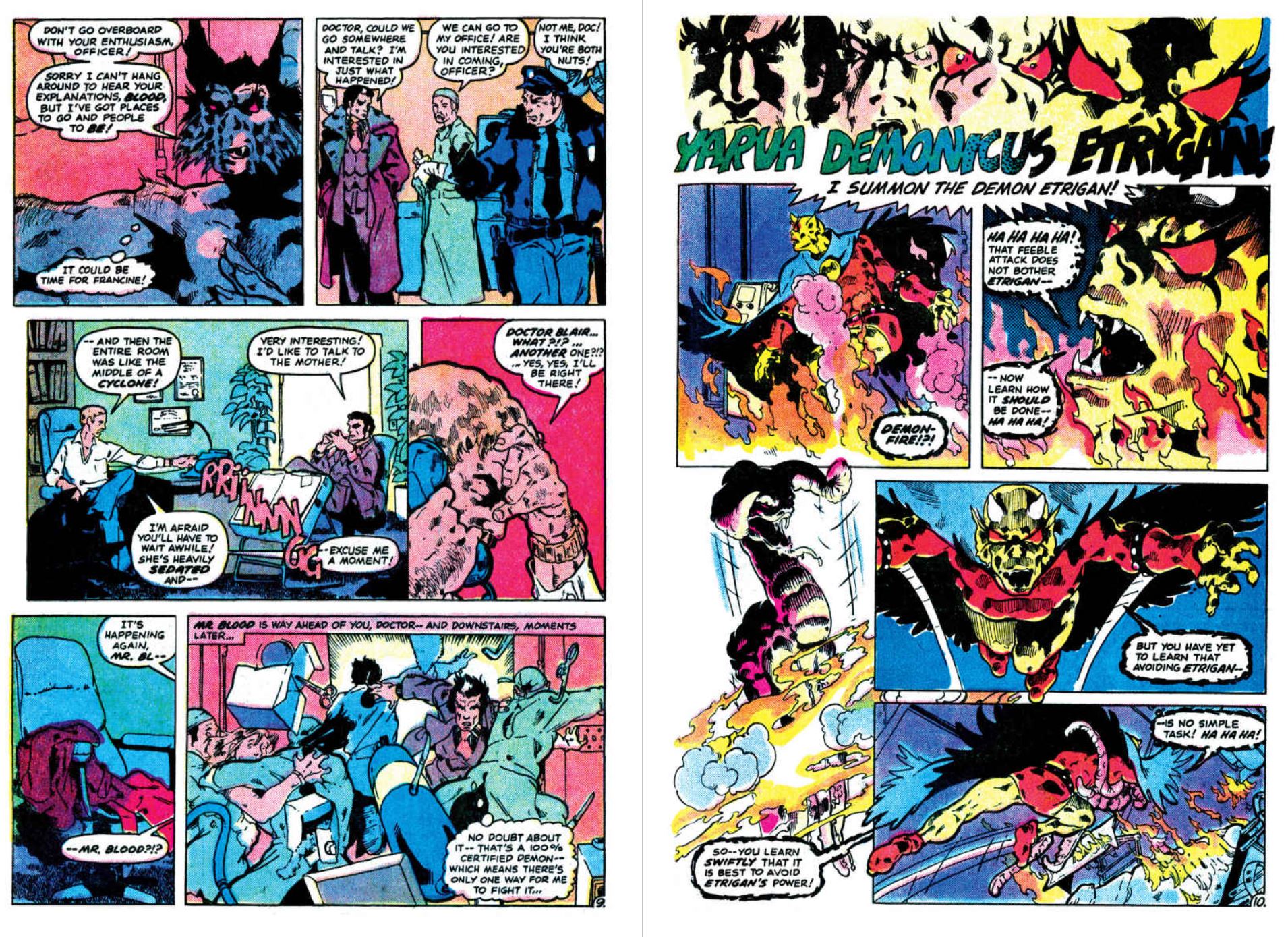
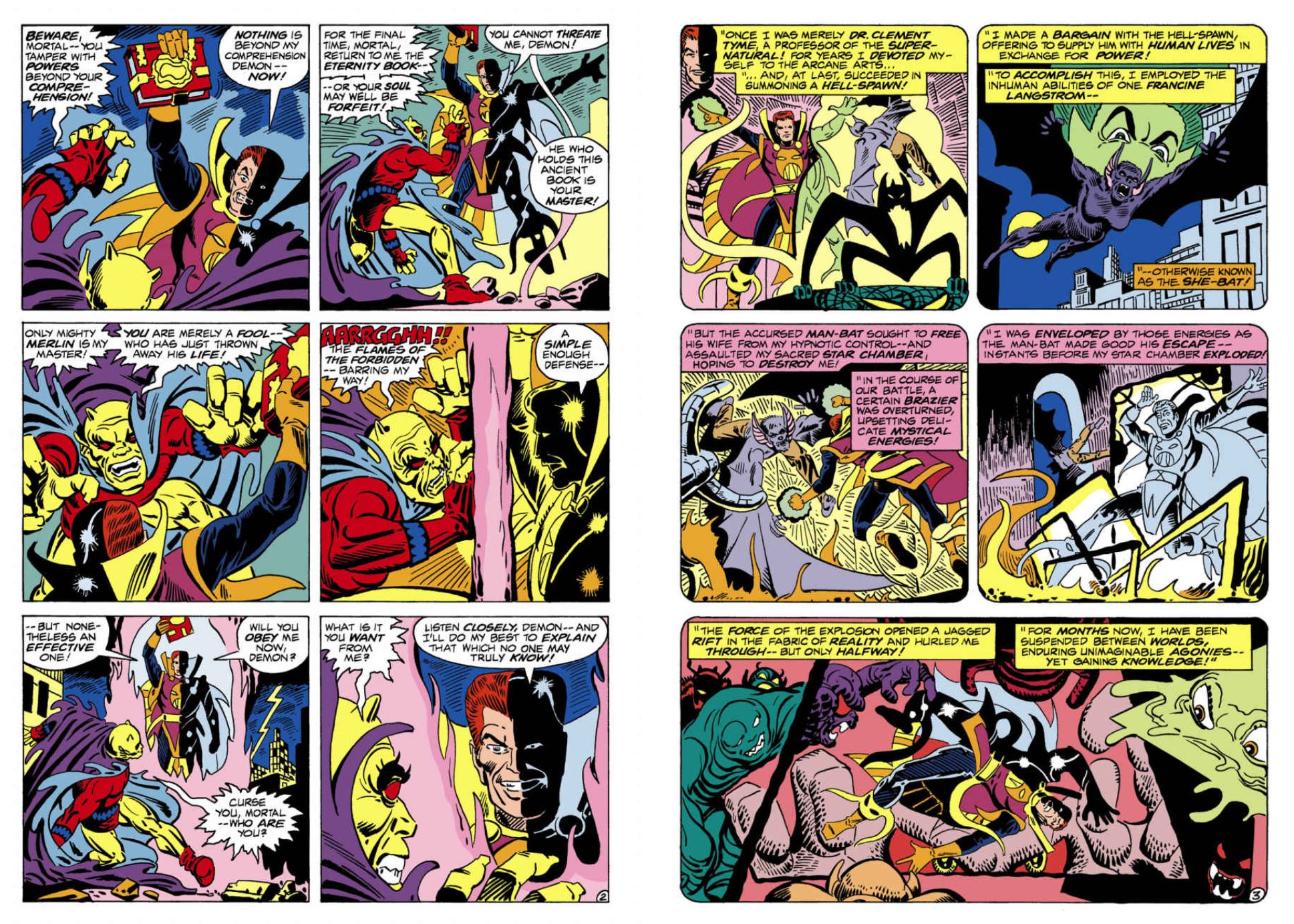
Implicit invite accepted, Gotham resident The Demon took up residence in anthological blockbuster Detective Comics beginning with #482 (February/March 1979). Here Len Wein, Golden & Dick Giordano opened a tense quest for ‘The Eternity Book’ of Merlin. As Steve Ditko added his unique vision to the optics, the chase caught Etrigan clashing with mad mystic academic Baron Tyme in DC #483’s ‘Return to Castle Branek!’ before hurtling to a chaotic, cataclysmic conclusion in #484’s ‘Tyme Has No Secrets!’ and furious finish in #485’s ‘The Fatal Finale!’

The riotous revelries conclude with an often overlooked team-up. For Wonder Woman #280 (volume 1, June 1981), Gerry Conway, José Delbo & Dave Hunt detail how Air Force officers Diana Prince and Steve Trevor investigate the prestigious Delphi Foundation after demon Baal-Satyr abducts their friend Etta Candy. They uncover senatorial corruption and insidious infiltration by witchboy Klarion and use arcane connections to link up with Randu Singh, Blood and his infernal alter ego prior to a rescue raid on ‘The Castle Outside Time!’ (WW #281), enduring more hellish treatment prior to #282’s triumphant, resurgent ‘Return and Redemption’…

With covers by Kirby, Royer, Tatjana Wood, Aparo, Rich Buckler, Ross Andru & Dick Giordano, this is a sublime slice of Right Place, Wrong Time entertainment: a wondrously economical collection every comics fan of today should have and cannot help but enjoy.
© 1972, 1973, 1977, 1978, 1979, 1981, 2026 DC Comics. All Rights Reserved.

Today comic strip master Sy Barry arrived in 1928, whilst Graham Nolan didn’t turn up until 1962 and much-missed Italian artist Massimiliano Frezzato (I custodi del Maser, Margot) in 1967.

We lost Barney Baxter cartoonist Frank Miller in 1949, and the amazing Arnold (Deadman, Doom Patrol, Guardians of the Galaxy) Drake in 2007 but could enjoy Treasure Chest comics from 1946 and Hank Ketchum’s (US) Dennis the Menace from 1951.

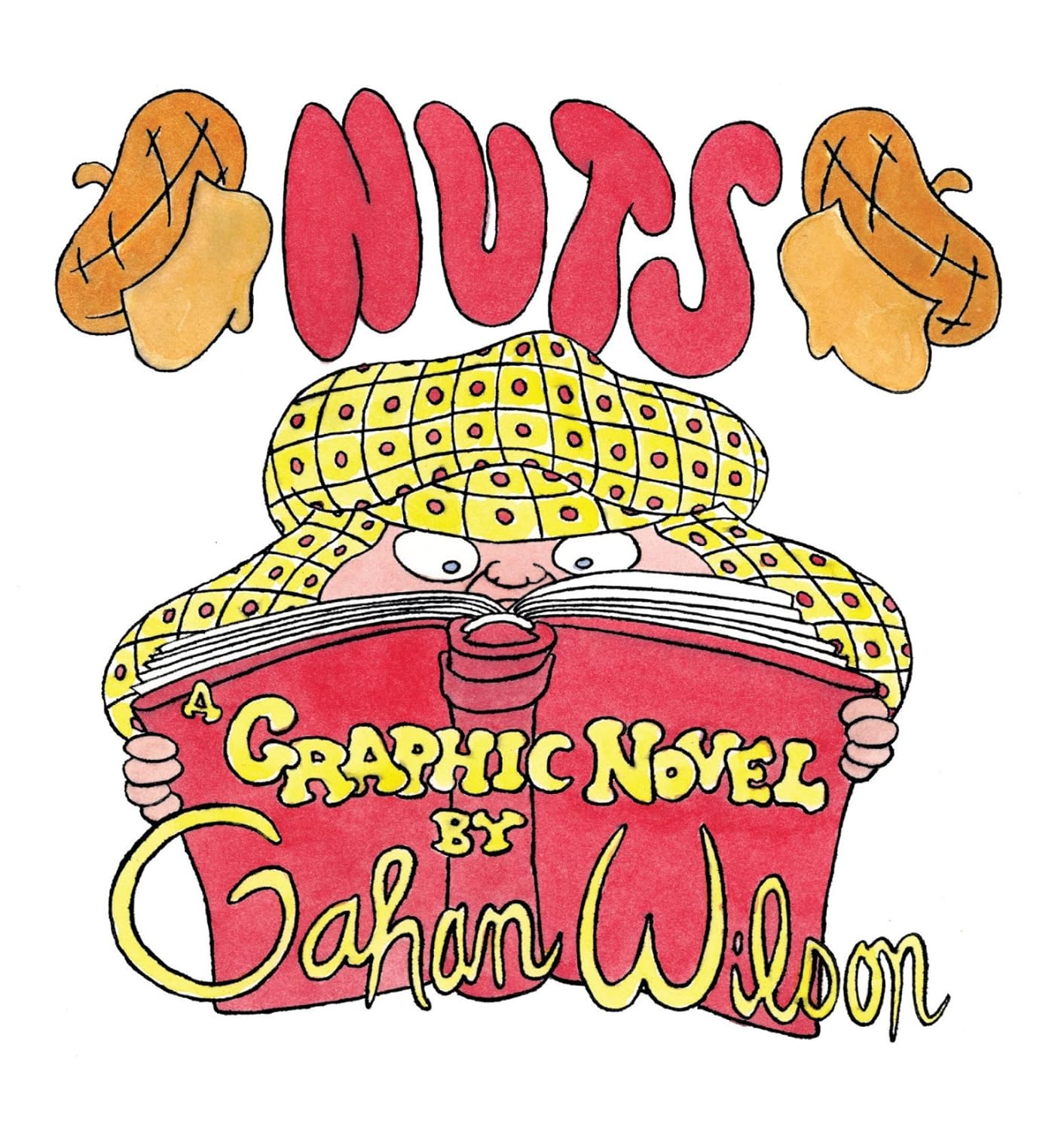
Nuts


By Gahan Wilson (Fantagraphics Books)
ISBN: 978-1-60699-454-2 (HB/Digital edition

This book includes Discriminatory Content produced in less enlightened times.

Born on February 18th 1930 and dying November 21st 2019, Gahan Allen Wilson was an illustrator, cartoonist, essayist and author who always had his eyes and heart set on the future. According to Gary Groth, the artist/author grew up reading comic strips as much as fantasy fiction.

It always showed.

The mordantly macabre, acerbically wry and surreal draughtsman tickled funnybones and twanged nerves with his darkly dry graphic confections from the 1960s onwards; contributing superb spoofs, sparklingly horrific and satirically suspenseful drawings and strips and panels as a celebrated regular contributor in such major magazines as Playboy, Collier’s, The New Yorker and others. He also wrote cutting edge science fiction for Again Dangerous Visions, The Magazine of Fantasy & Science Fiction, The Twilight Zone Magazine and Realms of Fantasy as well as contributing criticism, book and film reviews for them all.

In an extremely broad and long career he wore dozens of creative hats, even embracing the modern digital universe by creating – with Byron Preiss – his own supernatural computer game Gahan Wilson’s the Ultimate Haunted House.

When National Lampoon first began its devastatingly satirical (geez, do modern folk even recognize satire anymore?) all-out attack on the American Dream, Wilson was invited to contribute a regular strip to their comics section. His sublimely semi-autobiographical, darkly hilarious paean to lost childhood ran from 1972 and until 1981 and was collected as Nuts, another superb compilation from this publisher that you should own and share. Few people – me included – knew that during that period he also, apparently more for fun and relaxation than profit, produced his own syndicated Sunday strip feature. For two years – beginning on March 3rd 1974 – Gahan Wilson Sunday Comics appeared in a small cross-section of newspapers from Boston to Los Angeles and, as with all his work, it bucked a trend.

At a time when most cartoonists were seeking a daily continuity strip, building a readership and eking jokes out with sensible parsimony, Wilson let himself go hog-wild, generating a half-dozen or so single-shot gags every Sabbath, blending his signature weird, wild monsters, uncanny aliens and unsavoury scenes with straight family humour, animal crackers, topical themes and cynically socio-politically astute observations.

Looking at them here it’s clear to me that his intent was to have fun and make himself laugh as much or even more than his readership: capturing those moments when an idea or notion gave him pause to giggle whilst going about his day job…

I’m not going to waste time describing individual cartoons: there are just too many and despite being a fascinating snapshot of ancient life, they’re almost all still outrageously funny in the way and manner that Gary Larson’s Far Side was a scant six years later.

I will say that even whilst generating a storm of humorous, apparently unconnected one-offs, consummate professional Wilson couldn’t restrain himself and eventually the jokes achieved an underlying shape and tone with recurring motifs (clocks, beasts, wallpaper, etc), and features-within-the-feature such as The Creep and Future Funnies…

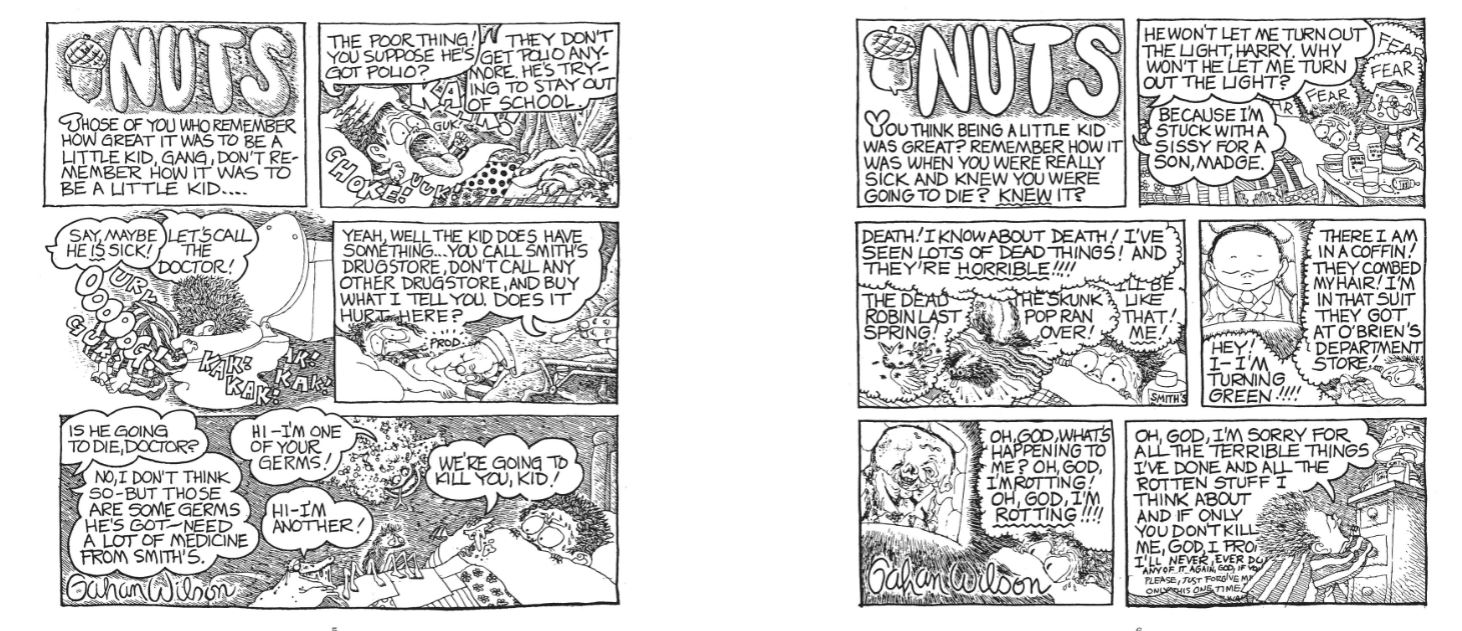
Here, generally a single-page complete graphic epigram “star” a grotty little chubby homunculus dubbed The Kid. This fabulous monochrome (and occasionally colour) collection gathers that complete serial for collectors and potential addicts in a perfect package that readers will dip into over and over again.

Taking his lead from popular sickly-sweet strips about or starring little children and the brilliant but definitely not jejune Peanuts (which was populated, to all intents and purposes, with teeny-weeny neurotic middle-aged midgets), Wilson sought to do the exact opposite and attempt to access the fear, frustration, confusion and unalloyed joy of being a young, impressionable, powerless, curious and demanding…

… and magnificently succeeded.

Dense, claustrophobic, intense and trenchantly funny, these self-contained strips range from satire to slapstick to agonising irony, linking up over the years to form a fascinating catalogue of growing older in the USA: a fearfully faithful alternate view of childhood and most importantly, of how we adults choose to recall and process those distant days…

Each strip begins with the question “Remember how…?” or “One of the…” or some equally folksy enquiry before unveiling bafflement, bewilderment, night-terrors or a deeply-scarring embarrassment which haunts us till doomsday, all wrapped in a comradely band-of-brothers, shared-coping-mechanism whimsy that is both moving and quintessentially nostalgic.

Topics include the unremitting horror of germs; sudden death; being ill; inappropriate movies; forced visits; grandparents; things adults do that they don’t want you to see; unexplained noises; the butcher’s shop; accidents and rusty nails; things in closets; doctors and needles; dying pets; Santa Claus; seasonal disappointments; summer camp; sleep; bodily functions; school and lessons (two completely different things); fungus; bikes and toys; haircuts; comic books; deaths of relatives; hot weather; candy; overhearing things you shouldn’t; stranger danger; hobby-kits and glue; daydreaming; babies and so many other incomprehensible daily pitfalls on the treacherous path to maturity…

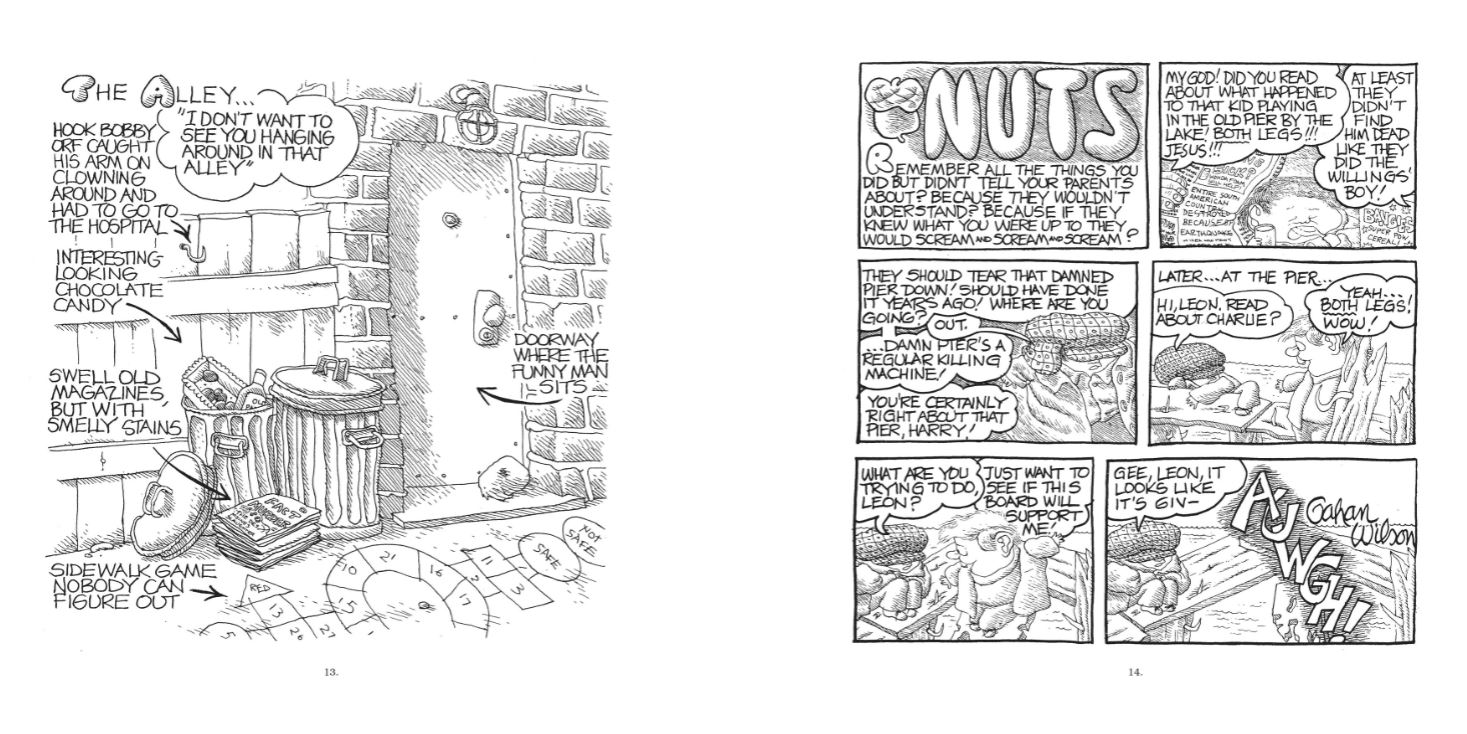
Peppered also with full page, hilariously annotated diagrams of such places of enduring childhood fascination as ‘The Alley’, ‘The Kit for Camp Tall Lone Tree’, ‘Mr. Schultz’s Cigar Store’, ‘The Movie Theater Seat’, ‘Table Set Up For Making Models’, ‘The Doctor’s Waiting Room’, ‘The Closet’, ‘The Sick Bed’ and ‘The Private Drawer’, this glorious procession also covers occasions of heartbreaking poignancy and those stunning, blue moon moments of serendipity and triumph when everything is oh-so-briefly perfect…

Complete with a 3-D strip and ‘Nuts to You’ – a comprehensive appreciation and history by Gary Groth – this funny, sad, chilling and sublimely true picture-passport to growing up is unmissable cartoon gold.
© Fantagraphics Books. All Nuts strips © 2011 Gahan Wilson. All rights reserved.

Today in 1917, Golden Age writer/editor Ruth Roche was born, followed by forgotten genius Joe Maneely in 1926, Gahan Wilson in 1930, Johnny Hart in 1931 and both comic book artist Doug Mahnke and cartoonist Mark Bodé in 1963.

We lost Belgian megastar and Marcinelle School founder Willy Maltaite (“Will”) in 2000 and lifelong multi-style achiever Bob Oksner in 2007.

Comics wise, UK standby Radio Fun (published since 1938) folded today in 1961 and Power Comic Fantastic launched today in 1967.

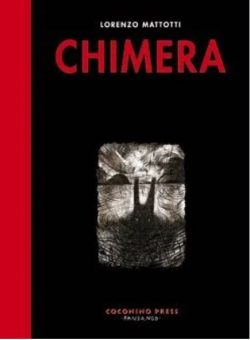
Chimera


By Lorenzo Mattotti (Fantagraphics Books and Coconino Press)
ISBN-13: 978-1-56097-763-6 (TPB)

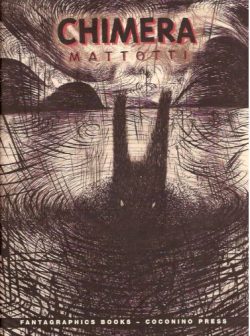
The sixth release – I hesitate to call it a volume, as the format, though bold and wonderful, is far more than a magazine but not quite a book – from the eclectic European publications imprint designated The Ignatz Collection, this fabulous item features an uncharacteristic and unforgettable look at the monochrome work of one of the world’s most talented colour artists.

Today in 1954, Lorenzo Mattotti was born in Brescia, Italy. He grew up and studied at the Faculty for Architecture in Venice before beginning a career as a comics storyteller in 1975 in French magazine Circus. Whether alone or with long-time collaborator Fabrizio Ostani (AKA Jerry Kramsky – they often used the single pen-name “Kleidebistro”) Mattotti’s incredible, nigh-abstract designs and pictorial narratives rapidly won him a huge following, with work appearing in Métal Hurlant, L’Écho des Savanes (France), Rumbo Sur (Spain), Frigidaire, Secondamano and Alter Alter (Italy), Raw (USA) and The Face (UK) among many others.

In 2002 Mattotti and Kramsky produced Docteur Jekyll & Mister Hyde (based on the Robert Louis Stevenson classic) for Casterman, and the English translation won Mattotti an Eisner Award the following year. As an illustrator, Mattotti has worked for Vanity Fair, The New Yorker, Cosmopolitan, Vogue and Le Monde, and has produced a number of startling and beautiful children’s books. His absolute masterpiece thus far is – to my mind at least – Fires.

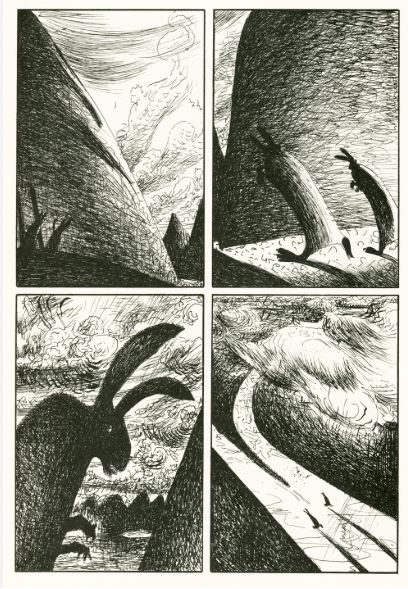
Behind a deeply unsettling gate-fold wraparound cover, but printed throughout on reassuringly solid cream-coloured card-stock, lurks a startling journey from idyllic cloud-gazing through vaguely erotic musings on gods and giants to the depths of a terrifying and oppressive forested hell. Rendered in bravura line-and-dry-brush style that ranges from seductive and cajoling, through airy tumult to raw, fierce, bestial rage and horror, Mattotti uses the reader’s eyes to pull the viewer on a chaotic descent reminiscent of Mussorgsky’s “A Night on Bald Mountain” (in the manner of Disney’s Fantasia version, with just a shade of Watership Down thrown in).

Comics aficionados might also recognize a touch of the panning-in technique used by the great André Barbe where small pictorial changes lead to a total transformation, not only to the graphic representations but also to the mental or spiritual state of the object and observer. But where Barbe wanted to languidly surprise and seduce you, Mattotti is here to make you squirm…

Even if the “how” isn’t your major concern, the whole pictorial experience of Chimera is one headlong rush, and a supreme lesson in the power and virtuosity of dark lines against the light. This is probably the only white-knuckle ride you can put on a bookshelf… so why don’t you?

Story and art © 2005 Lorenzo Mattotti. Book edition © 2005 Fantagraphics Books and Coconino Press.

Also Today but in 1910, Noel (Scorchy Smith) Sickles was born. He shares the day with Mattotti, inker Bruce D, Berry (1924), and John Romita Senior in 1930.

In 1943 morale-boosting Miss Lace debuted in Milt Caniff’s Male Call strip, and in Britain once the shooting stopped in 1948, The Beano unleashed Biffo the Bear for the first time.

In 1977 we lost the wonderful John Rosenberger (The Fly, The Jaguar, Young Dr Masters, Lady Cop, Supergirl, Lois Lane) and in 2002, sublime Kurt Schaffenberger (Captain Marvel, Shazam, Lois Lane, Superboy, Supergirl, Superman, Super Friends). All of these stars are worth your time and attention whether here or best yet in their actual collected works, so go do that.

The Legend Testers 60th Anniversary Edition


By Graham Baker, Jordi Bernet, with Alf Wallace & various (Rebellon Studios/ treasury of British Comics)
ISBN: 978-1-83786-654-0 (TPB/Digital edition), 978-1-83786-681-6 (Webshop edition)

This book includes Discriminatory Content produced in less enlightened times.

British comics always enjoyed an extended love affair with what can only be described as “unconventional” (for which substitute “bizarre” or “creepy”) stars. So many notional role models we grew up reading were outrageous or just plain “off”: self-righteous voyeur / vigilantes like Jason Hyde, sinister foreign masterminds like The Dwarf or Black Max, affable criminals such as Charley Peace, arrogant ex-criminals like The Spider or outright racist Overmen like manic white ideologue Captain Hurricane…

Prior to game changers Action, 2000AD and Misty, our comics fell into fairly ironclad categories. Back then, you had genial and/or fantastic preschool fantasy; many, many licensed entertainment properties; action; adventure; war (especially ones “We” were in or had started); school dramas; sports; and straight comedy strands. Closer examination could confirm that there was always a subversive merging, mixing undertone, especially anarchic antiheroes like Dennis the Menace or our rather strained interpretation of costumed crime-busters. Just check out Phantom Viking, Kelly’s Eye or early Steel Claw stories…

Over and again British oddness would combine with or react to long-standing familiarity with soft oppression, leading to sagas of overwhelming, imminent conquest and worse. With our benighted shores existentially threatened, entertainment sources responded with a procession of doughty resistors facing down doom from the deepest depths of perfidy and menace… especially as churned up by the scary results of foolish modern SCIENCE!

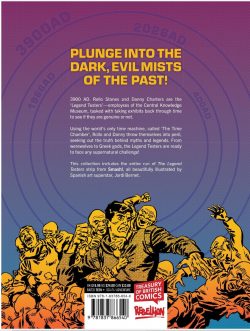
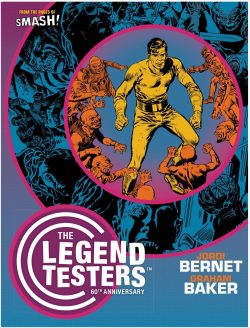
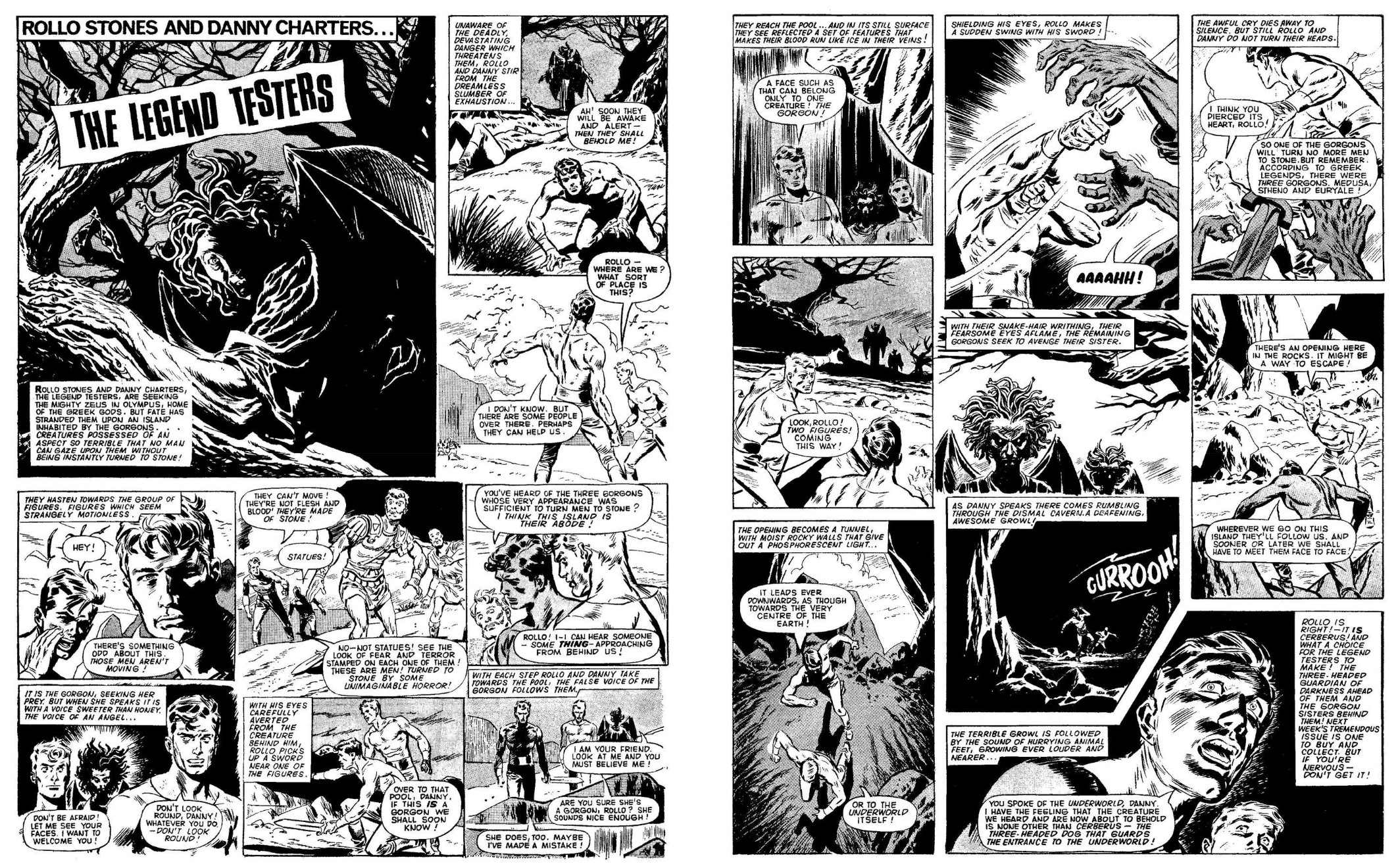
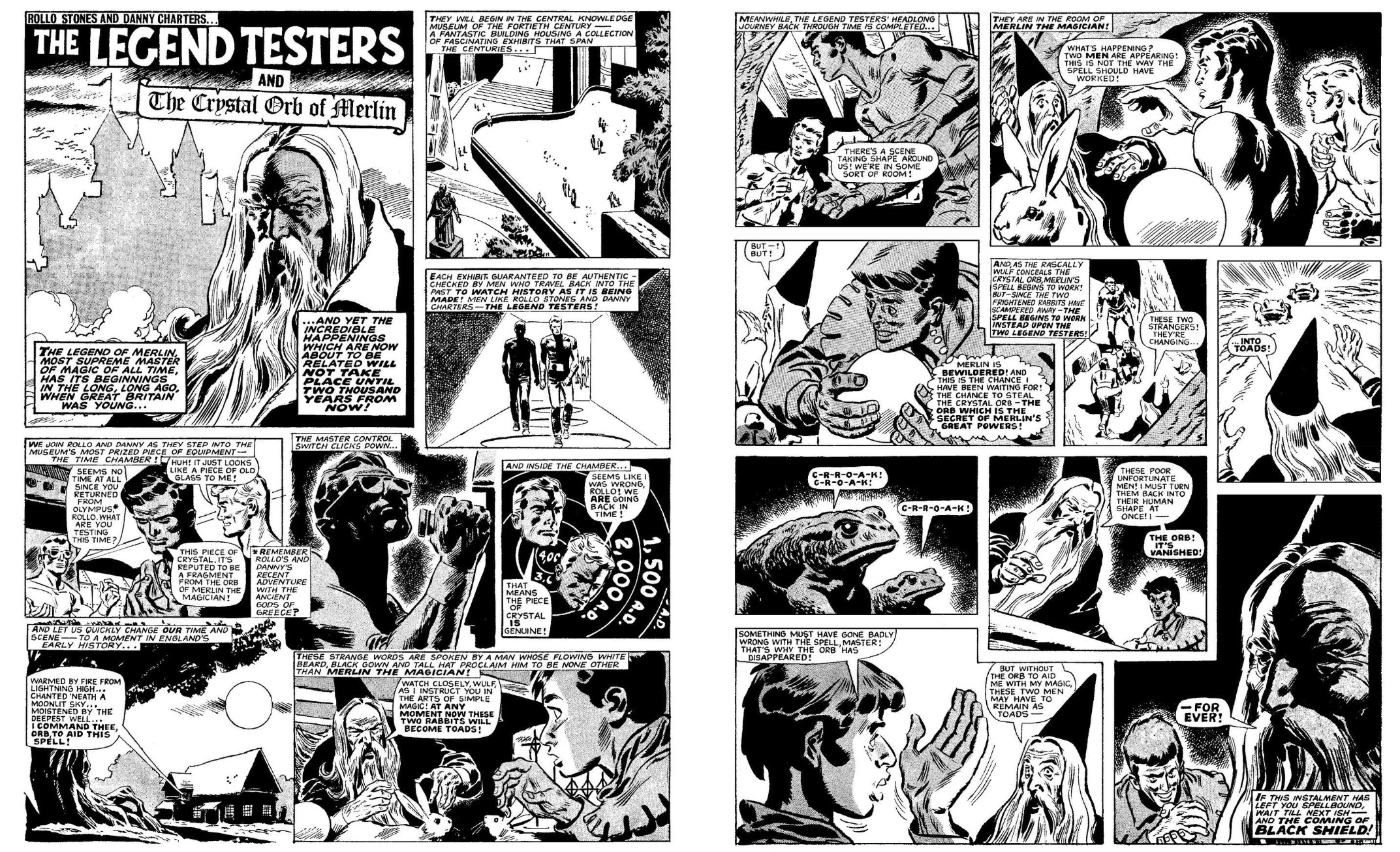
That’s not to say we didn’t appreciate less outrageous adventurers as with this notional precursor (or synchronistic zeitgeist?) to TV’s Time Tunnel, with a brace of straightlaced but tough-as-nails He-Men heroes Rollo Stones and Danny Charters who dared the unknown weekly in the name of SCIENCE! – and history of course…

Cover-dated February 5th 1966, Smash! launched as just another standard Odhams anthology weekly until abruptly re-badged as a “Power Comic” at the end of the year. It combined homegrown funnies and British originated thrillers with resized US strips to capitalise on the superhero bubble created by the Batman TV series. Power Comics was a sub-brand used by Odhams to differentiate those periodicals which contained reprinted American superhero material from the company’s regular blend of sports, war, western, adventure and funny strips – like Buster, Valiant, Lion or Tiger. During the Swinging Sixties, Power weeklies did much to popularise budding Marvel Universe characters in this country, which were still poorly served by distribution of the original US imports.

The increasingly expensive American reprints were dropped in 1969 and Smash! was radically retooled with the traditional mix of action, sport and humour strips. Undergoing a full redesign, it was relaunched on March 15th 1969 with all-UK material (mostly drawn by overseas artists) and finally disappeared into Valiant in April 1971 after 257 issues. Seasonal specials remained a draw until October 1975 when Smash Annual 1976 properly ended the era. From then on, the new Fleetway brand had no room for the old guard – except as re-conditioned reprints in cooler, more modern books…

Thanks to economic vagaries and spiralling costs in publishing, the mid 1960s and early 1970s were particularly wild and desperate for comics: inspiring a wave of innovation most fondly remembered for more of those aforementioned darkly off-kilter heroes, beguiling monsters and charismatic villains.

Gathering serialised episodes from Smash! 2nd April 1966 to 8th July 1967, this complete compilation delivers fantastic threats and menaces in a traditional weekly manner, as a pair of dedicated and competent white blokes diligently push back the boundaries of ignorance. As was usual for these times, what was popular on screens large & small affected what arrived on the picture-packed pages Probably committee created with majority input from supervising editor Alf Wallace (Missing Link, Johnny Future) and sub-editor/scripter Graham Baker with new kid Jordi Bernet involved from the get-go, this series is one of many lost delights crafted by world stars in waiting and the observant will see Bernet improving and pushing himself on every page…

Jordi Bernet Cussó was born in Barcelona in 1944, son of a prominent, successful humour cartoonist. When his dad died suddenly 15-year-old Jordi took over his strip Doña Urraca (Mrs. Magpie). A huge fan of Alex Raymond, Hal Foster and especially Milton Caniff, Jordi yearned for less restrictive horizons and left Spain in the early 1960s and moved into dramatic storytelling.

He worked for Belgium’s Le Journal de Spirou, and Germany’s Pip and Primo, before finding a home in British weeklies. Bernet worked for UK publishers between 1964 and 1967, and as well as Odhams/Fleetway/IPC anthologies Smash!, Tiger and War Picture Library, produced superb pages for DC Thomson’s Victor and Hornet. He even illustrated a Gardner Fox horror short for Marvel’s Vampire Tales #1 (1973), but mainstream America was generally denied his mastery (other than translated Torpedo volumes and a Batman short story) until the 21st century reincarnation of Jonah Hex… which he truly made his own.

His most famous strips include thrillers Dan Lacombe (written by his uncle Miguel Cussó), Paul Foran (scripted by José Larraz) the saucy Wat 69 plus spectacular post-apocalyptic barbarian epic Andrax (both with uncle Cussó again). When fascist dictator Franco died, Bernet returned to Spain and began working for Cimoc, Creepy and Metropol, collaborating with Antonio Segura on adult fantasy Sarvan and dystopian SF black comedy Kraken, as well as with Enrique Sánchez Abuli on the gangster and adult themed tales that made him one of the world’s most honoured artists. These culminated with the incredibly successful crime saga Torpedo 1936.

For now though and way back then, following a heartwarming reminiscence and proud career resume from the series illustrator himself, we launch at full pelt with inaugural serial ‘Death Castle’ which ran from 2nd April (Smash! #9) to 25th June 1966.

In that wild innovative era, the creators were looking to be fresh and new so here logos and layout and even the narrative tone changed from week to week as the storytellers shuffled to make something fresh instantly compelling out of old themes and plots. That even included on-again, off-again individual chapter titles like ‘Man into Monster’ and ‘The 5 Faces of Evil!’ before settling down and just opting to tell tense, gripping yarns…

The premise is simple: in the 40th century the Central Knowledge Museum is a vast research and storage repository of all things historical. Now top investigators Rollo Stones and Danny Charters have used its time machine to confirm the veracity of the last artefact and corrected (by first person observation) the mistaken data that has come down with it, their boss Marcson has a new mission for them. It’s June 7th 3900 AD and with no more history mysteries, he asks them to start testing the large collection of unknown and myth-based items in their cupboard.

Apart from the potential death and danger, it’s practically foolproof. The machine only works if the objects the newly-appointed Legend Testers are holding are in some way authentic, as with the supposed werewolf skull that catapults them both back to feudal Europe and an encounter with a magical coalition of diabolical monsters.

In short order Rollo & Danny survive on wits and fists against a citadel of devils comprising sorcerer Necro, vampire Draca, sadistic torturer/inventor Love, Balbin, Prince of Trolls. bodyguard brute Happy (the werewolf in question) and notional leader Count Cadavo. Each in turns tries to break the strangers with their personalised hordes of monster minions but in the end the myths are confirmed at the cost of the vile villains’ unlives…

One of the most complex and trippy exploits of the era, ‘Eterno’ ran in issues between 2nd July and 20th August. This time the suspect object pulled our investigators back beyond humankind to a previous civilisation that was destroyed by a vampiric alien that consumed their planetary life energies. Millions of years later, humankind evolved and developed a very similar existence which drew Eterna back to Earth and the Testers on his heels to that time and place. As the monster and his robots began preparing to absorb a second course of earthlings Rollo & Danny were in the right place and time to end the terror forever…

Channelling the contemporary cinematic trend for Grecian myths and heroes, the boys spend half a year authenticating ‘The Crown of Zeus’ (27th August – 24th December), enduring an avalanche of peril and near-death escapes to categorically verify their chunk of diadem – and by extension the ancient lives of gods and monsters. After facing cyclopes, centaurs, gorgons, Cerberus, the Minotaur, Lernaean ghosts and hydras, man-eating horses, Pegasus, Poseidon, Proteus, Janus, sky-propping Atlas, petty-minded Bacchus, satyrs and earth-shaking Titans the lads learn just how the gods died…

At least demi-gods Hercules and Hermes (AKA “Quicksilver”) were on their side until it was all over and the time machine called them home…

The days of Camelot called when the Testers touched fragments of ‘The Crystal Orb of Merlin’ (December 31st 1966 to 4th March 1967) but sparked chronal catastrophe as the wise wizard’s talisman was stolen by anti-Arthurian despot Black Shield, who used it to arm his troops with 20th century weapons from pistols and hand grenades to tanks and an atomic bomb. The conclusion left everyone gasping and still does today…

Published from 11th March to 15th April, ‘The King of the Beasts’ saw Rollo & Danny divine how an idyllic land of talking animals living in harmony and seclusion was destroyed by greed and ambition, after which aliens are the order of the day when Marcson hands the investigators a piece of metal not of this Earth. A simple touch then takes them to 12th century Europe where ‘The Metal Men’ (22nd April – 3rd June) are seeking to strip-mine the world for life-generating minerals. The Testers’ interference only results in their rendition to embattled, civil war-torn planet Meturn, but too late to do any good as the metalloids descend into mutually assured destruction. Thankfully, the confusion allows the boys to frantically steal the last space bus out of town…

The temporal turbulence terminates rather timidly with ‘The Crown of Kebi’ (10th June to 8th July 1967) as Marcson sends his gone-to guys to an utterly unknown destination where again greed and ambition trigger the end of a fabulous civilisation. Rollo & Danny’s very conspicuous arrival makes them unwitting tools of shady priest Walu on the island kingdom of Kebi, but their scruples mean he soon prefers them dead to alive. After tricking them into a voyage into “the underworld” beneath a mountain, the boys battle beastly apes, demon dwarves and worse, but their refusal to be suitably sainted and sent to heaven ultimately stymies the witch doctor and sinks the island nation…

Closing this epic outing of spookily spectacular saga is a compelling ‘Covers gallery’ of thrilling (albeit limited-colour) clashes courtesy of Bernet and the editorial paste up squad, plus the now traditional creator briefings.

For British, Commonwealth and European readers of a certain age and prone to debilitating nostalgia, the comic works gathered in this titanic tribute gig are an exciting, engaging, done-in-one delight that’s undemanding and rewarding; and a rare treat these days.

If that appeals, go hit this book, it’s how history – and SCIENCE! – should be made.
© 1966, 1967, & 2026 Rebellion Publishing IP Ltd. All Rights reserved.

Today in 1883, French artist, printmaker, illustrator, painter, caricaturist, sculptor and comic dabbler Gustave Doré died. However, one year later comics strip genius George (Jiggs & Maggie, Bringing Up Father) McManus was born. In 1952 Klaus (Daredevil, Batman) Janson joined the party, but probably missed the 1930 debut of Hergé’s Quick & Flupke in Le Petit Vingtième and launch of UK weekly Sparky in 1965.

In 1988, UK icon Battle Picture Weekly shut up shop and in 2001 Makoto Yukimura’s manga masterpiece Planetes began.