Willie Nelson: A Graphic History – softcover edition


By T.J. Kirsch, Adam Walmsley, Jeremy Massie, Jason Pittman, Håvard S. Johansen, J.T. Yost, Coşkun Kuzgun, Jesse Lonergan, & various (NBM)
ISBN: 978-1-68112-332-5 (HB) eISBN: 978-1-68112-263-2

I live a pretty blessed life these days. I love history and am addicted to comics and many of the best ones are just sent to me. The present trend is to combine both of my passions in graphic biographies – or even autobiographies. Our European cousins have pretty much collared the market on the former, with a range of personal histories featuring the great, the good and especially the extremely cool, but today we’re happily revisiting via a nifty, thrifty paperback and All-American(ish) confection that deftly hits that elusive sweet spot.

Whether you’re a fan or not of the music, you can’t deny the tenacity and enormous spirit of musician, writer, actor, filmmaker and activist Willie Nelson… the outsider’s outsider.

Utilising the talents of a group of indie artists, writer T.J. Kirsch has compiled an effective, effusive and moving monochrome testament to the troubadour’s talent, determination and resilience, which begins in 1933 in ‘Hill County, Texas’.

Rendered throughout in evocative, dried & dusty monochrome, the history begins with Coşkun Kuzgun detailing a hard life for a young boy wedded to mischief and addicted to music.

As they grew, Willie and sister Bobbie became local celebrities – but not rich ones – through performing, so he began a career in radio, using the opportunity to plug his own material. Never finding that elusive hit, Willie joined the Air Force in 1951, serving until a persistent back injury forced him out of the armed forces, just in time to stumble into matrimony. ‘A Humble Picker’ (limned by Jeremy Massie) traces that tempestuous relationship and Willie’s attempts to feed his family in and out of showbiz, before sliding back into disc jockeying and discovering marijuana…

The slow painful climb begins in Håvard S. Johansen’s ‘Country Willie’, continues in ‘Grinding Away’ (Jesse Lonergan) and culminates in professional breakthroughs and personal breakdowns in ‘Austin, Texas’ (art by Jason Pittman) as 1970 sees the true commencement of the legend…

J.T. Yost then depicts a life hard-lived but well worth the effort in ‘Honeysuckle Rose’ before the saga sparkles to a close – for now – in the all-T.J. Kirsch chapter ‘Elder Statesman’, revealing that music and legends just keep on going. That’s where the 2020 edition ended but here an ‘Epilogue’ by Kirsch catches us up, detailing the COVID days, “Sister Bobbie” Nelson’s passing and the outlaw gigs where Willie – well into his 90’s – still commands attention and applause. As of 20 minutes ago, and as far as I know, Willie’s still going strong…

Another addition is a bonus feature going behind-the-scenes into the book’s genesis and completion, complete with deleted pages, studies and sketches, embellished with creator commentary to back up original extras including Intro, Outro, Chapter and Endpaper illustrations by Adam Walmsley, ‘Bibliography’ and ‘Song Credits’ listing. This is an immensely likable pictorial testament that feels like a journey shared with a most interesting stranger. You may or may not like the music – yet – but you’ll be unable to not love the indomitable, irrepressible man.
© 2020 T.J. Kirsch. All rights reserved and managed by NBM Publishing, Inc.

Most NBM books are also available in digital formats. For more information and other great reads see NBM Graphic Novels

Abandoned Cars


By Tim Lane (Fantagraphics Books)
ISBN: 978-1-60699-341-5 (HB) 978-1-60699-3415 (TPB/Digital edition)

This book includes Discriminatory Content included for dramatic effect.

Do you remember America? It’s clearly not the place it used to be. Maybe it never was.

Tim Lane is a post-war American. His inner landscape is populated with B-Movies, Rock & Roll, junk-memorabilia, big cars with fins, old TV shows, Jack Kerouac, the seven ages of Marlon Brando, pulp fictions, young Elvis, distilled Depression-era experiences (all of them from “The Great” to the latest), black & white images on TV, loss of faith in old values, Mad Avenue propaganda, compromised ideals, frustrated dreams and waking nightmares. Lane calls that oh-so-plunderable societal gestalt and psychic landscape “The Great American Mythological Drama”, and for this first compilation of his stark, intriguing comic strips dipped deep to concoct his own striking contributions to the Great Double Martini of Life…

Many contemporaries used that shared popular culture to create new paintings and sculptures (see any of the many “lowbrow” or “pop surrealist”  tomes by Schorr, Ryden, Ledbetter et al that we’ve previously reviewed) but Lane eschewed the gallery art arena for his explorations, opting instead for the only true American medium of expression, the story, and toils bombastically in its ugly bastard offspring: Comics.

He draws in stunning monochrome: hard-edged, uncompromising and enticingly moody, and these short stories, vignettes, observations and sequential investigations are far from the usual stock of funnies. The compelling contents are culled from varied sources like Legal Action Comics, Hotwire, Typhon, Riverfront Times and Lane’s self-published magazine Happy Hour in America from 2003 to 2008, ranging from tales of dark, eccentric whimsy (‘American Cut-Out Collectibles’, ‘The Manic-Depressive from Another Planet’ and ‘The Aries Cow’) to philosophically charged musings (‘Ghost Road’, ‘To Be Happy’ and ‘The Drive Home’). There are Pop cultural pastiches (‘Outing’ and ‘Doo-Wop and Planet Earth’), fascinating autobiography and reportage (‘Spirit’ parts 1-3, ‘In My Dream’ and ‘You Are Here: the Story of Stagger Lee’) to just plain old-fashioned noir-tinted thrillers like ‘Cleveland’ and ‘Sanctuary’.

Also included are numerous untitled, enigmatic and addictive short pieces, and for my money the most evocative and powerful piece herein is an all-but-wordless, 2-page rumination on age and loss: ‘Those Were Good Years’. You’d have to be made of stone to be unmoved…

Crafting comics is clearly not a job or hobby for Lane. Serious artists have always struggled to discover greater truths through their creative response to the world, and he has obviously found his instrument in black line on white and his muse in the shabby, avuncular, boisterous, scary detritus of our everyday, blue-collar communal past. The result is stunning and highly intoxicating.

Questing, introspective, insightful, melancholic and as desperately inquiring as the young Bob Dylan, with as many questions, even fewer answers and just as much lasting, life-altering entertainment to be derived…

Why haven’t you got this book yet?… And once you’ve sorted that, why not try his 2014 graphic novel The Lonesome Go or 2020’s Toybox Americana: Characters Met Along the Way?
© 2003-2008, 2010 Tim Lane. All rights reserved.

Django, Hand on Fire: The Great Django Reinhardt


By Salva Rubio & Efa, translated by Matt Madden (NBM)
ISBN: 978-1-68112-287-8 (HB) eISBN: 978-1-68112-288-5

This book includes Discriminatory Content included for dramatic effect.

The world has now formally and officially gone to hell in a handcart, so how about some soothing, jolly music – or at least some comics about that music?

Publisher NBM’s line of European-originated biographies never fails to delight, with this oversized luxury hardcover (also available in digital formats) one of the most engaging thus far: skilfully deconstructing – when not actually aiding and adding to – the myths and legends surrounding a top contender for the title of greatest guitar player of all time…

Django, Hand on Fire rewardingly reunites award-winning screenwriter, historian and novelist Salva Rubio (Max; The Photographer of Mauthausen) with animator/illustrator Ricard Fenandez (AKA Efa of Les Icariades; Rodriguez; L’Âme du Vin; Le Soldat). Their other collaborations are also beautiful biographies – Monet: Itinerant of Light and Degas & Cassatt: A Solitary Dance.

Originally released in France, the translated story of Django, main de feu is preceded here by an introductory prose appraisal from Thomas Dutronc before a stunning confection of painterly images traces the life of the troubled and unfortunate Roma musician from his fraught birth in a frozen field in Belgium to his second birth and reunion with the true love he threw away and found again. That natal moment was in 1910 as his father and the other itinerant performers of their tribe were eking out a wage entertaining outworlders.

By 1922, the troupe were resident in Paris’ “Zone”: an enclave for “his sort” where social outcasts like gypsies could reside until posh folks found a use for them. The lad was cocky and troublesome, an arrogant illiterate born for mischief but blessed with astounding musical skill. His life turned around when his mama acquired a six-string banjo for him and all his energies suddenly refocussed on mastering music. Soon Django was making money – and losing it gambling – even before he was considered a man…

Still an emotional child, he became the star of a professional (adult) band but his actions and attitude lost him many friends and family and ultimately the girl who adored him: Irma AKA Naguine. She faithfully trailed in his wake as producers and record publishers tracked the young man and watched in resignation as he succumbed to the shining blonde glory of faux flower artisan Florine/Bella. Naguine left the Zone entirely when Django and the flower girl wed, but swore to return…

The musician’s meteoric rise stalled only as he awaited his first child’s birth. As they slept in their wagon, it caught fire and although Bella got out, Django was badly burned on his legs and left hand. How – driven by his formidable mother – he battled back to overcome his life-changing injuries and, by changing his style, mastered another instrument, found undying fame and finally realized where his true love lay is a fabulous (if not strictly accurate) tale to warm the heart and gladden the eyes…

The pictorial paean to persistence and testament to passion is supported by a Bibliography and Creator Biographies plus ‘Django Reinhardt, from mystery to legend… In the light of History’: a fulsome, copiously-illustrated essay detailing the author’s factual choices and path to this particular truth, categorised and examined in ‘A mythical birth’; ‘The Zone’; ‘An interloper in the world of bal-musette’, ‘J’ai deux amours: Naguine and …le jass…’, ‘The Cross of Blood…’; ‘…and the fiery flowers’; ‘Hospital for the Poor’ and ‘Hand on fire’…

Sparkling and inspirational, this is treat for every music historian and intrigued dilettante: a beguiling magic window into another world and one you should seek out tout de suite…
© DUPUIS 2020 by Rubio, Efa. All rights reserved.

Gomer Goof volume 11: Goof-Off at the Gomer Corral


By Franquin, translated by Jerome Saincantin (Cinebook)
ISBN: 978-1-80044-128-6 (PB Album/Digital edition)

Win’s Christmas Gift Recommendation: A Little Euro-Sparkle for Any Occasion …9/10

This book includes Discriminatory Content produced in less enlightened times.

Born in Etterbeek, Belgium on January 3rd 1924, André Franquin began his astonishing comics career in a golden age of European cartooning. As assistant to Joseph “Jijé” Gillain on the strip Spirou, he inherited sole control of the keynote feature in 1946, and went on to create countless unforgettable new characters like Fantasio and The Marsupilami. Over two decades Franquin made the strip purely his, expanding Spirou & Fantasio’s scope and horizons, as they became globetrotting journalists who visited exotic places, exposed crimes, explored the incredible and clashed with bizarre, exotic arch-enemies. Throughout, Fantasio remained a full-fledged – albeit entirely fictional – reporter for Le Journal de Spirou, popping back to base between assignments. Sadly, ensconced there was an arrogant, accident-prone office junior tasked with minor jobs and general dogs-bodying. This was Gaston Lagaffe; Franquin’s other immortal – or peut-être unkillable? – conception…

There’s a hoary tradition of comics personalising fictitiously back-office creatives and the arcane processes they indulge in, whether it’s Marvel’s Bullpen or DC Thomson’s lugubrious Editor and underlings at The Beano and Dandy; it’s a truly international practise. Somehow though, after debuting in LJdS #985 (February 28th 1957), the affable dimwit grew – like one of his monstrous projects – beyond control, becoming one of the most popular and ubiquitous components of the comic, whether guesting in Spirou’s adventures or his own strips/faux reports on the editorial pages he was supposed to paste up. Initial cameos in Spirou yarns or occasional asides on text pages featured well-meaning foul-up and ostensible gofer Gaston lurking and lounging amidst a crowd of diligent toilers: a workshy slacker employed as a general assistant at LJdS’s head office. The scruffy bit-player eventually and inevitably stumbled into his own star feature…

In terms of schtick and delivery, older readers will recognise favourite beats and elements of well-intentioned helpfulness wedded to irrepressible self-delusion as seen in Benny Hill or Jacques Tati vehicles and recognise recurring riffs from Only Fools and Horses and Mr Bean. It’s blunt-force slapstick, paralysing puns, fantastic ingenuity and inspired invention, compiled to mug smugness, puncture pomposity, lampoon the status quoi? (that there’s British punning, see?) and ensure no good deed goes noticed, rewarded or unpunished…

As previously stated, Gaston/Gomer can be seen (if you’re quick) toiling at Spirou’s editorial offices: initially reporting to Fantasio, but latterly complicating the lives of office manager Léon Prunelle and other harassed and bewildered staffers, all whilst effectively ignoring any tasks he’s paid to actually handle. These include page paste-up, posting packages, filing, clean-up, collecting stuff inbound from off-site and editing readers’ letters (the real reason fans’ requests and suggestions are never acknowledged or answered)…

Gomer is lazy, hyperkinetic, opinionated, ever-ravenous, impetuous, underfed, forgetful and eternally hungry: a passionate sports fan and animal lover whose most manic moments all stem from cutting work corners, stashing or consuming contraband nosh in the office or inventing the Next Big Thing. It leads to constant clashes with colleagues and draws in notionally unaffiliated bystanders like increasingly manic traffic cop Longsnoot and fireman Captain Morwater, plus ordinary passers-by who should know by now to keep away from this street. Through it all, the obtuse office oaf remains affable, easy-going and incorrigible. Only three questions matter: why everyone keeps giving him one last chance, what does gentle, lovelorn Miss Jeanne see in the self-opinionated idiot, and will perpetually-outraged capitalist financier De Mesmaeker ever get his perennial, pestiferous contracts signed?

In 1979, after a long pause while the auteur dealt with his mental health issues, Gaston – Lagaffe mérite des baffes became the 13th collected album and in 2023 was Cinebook’s 11th translated compilation. As Goof-off at the Gomer Corral, it offers single page bursts and half-page gags in non-stop all-Franquin jabs and japes. From this point on the frequency of Gaston collections reduced by 50%…

A brighter spotlight falls upon Longsnoot (AKA Joseph Longtarin in European editions) too, a protracted war of nerves across future volumes as Gomer increasingly clashed with forces of authority, and revealed here via many car-based clashes and a cold war involving parking meters culminating in the Goof’s invention of mobile dummy replicas of the despised coin collectors.

As always, forward looking Gomer is blind to the problems his antiquated automobile causes, despite numerous attempts to soup up, cleanse, modify and mollify the motorised atrocity he calls his. The decrepit, dilapidated Fiat 509 is more in need of assisted execution than his many well-meant engineering interventions, as seen in its brief conversion to natural gas fuel, petrol-powered gassifiers, onboard coal-burners and addition of crash bags years ahead of anything produced by hitmen or torturers. With travel so important, it’s no wonder he also finds time to similarly improve his motor bike with augmented horns and lethally heated seats…

Work gets tougher as a succession of nightmares plague Gomer even as unanswered mail piles up, making more trouble for Prunelle and in-house staff artist Yves (occasionally “Yvon”) Lebrac who often act as unwilling, inadvertent beta testers for our well-meaning, overly-helpful, know-it-all office hindrance. This time the poor saps are at ground zero for numerous moments of projectile madness after Gomer improves the pedal bin lid springs…  Devoted to his inhouse menagerie (Cheese the mouse, goldfish Bubelle, an adopted feral cat and a black-headed gull) our loving lad adds doors and passages and even teaches them all to blow gum bubbles. It doesn’t take long, but the clean-up sure does… almost as long as training a troupe of snails to perform a nightclub act…

Although there’s less opportunity to invent interesting foodstuffs, Gomer has leisure enough to augment office traffic, filing and even automate suitcase usage, but his greatest triumph this time round is renovating the office reference library, creating a thing of architectural wonder and lethal imprecision…

At least lovely Miss Jeanne and forever faithful pal Jules-from-Smith’s-across-the-street are able to appreciate the efforts made to improve the world, even if it seems at the cost of a few paltry lives and much municipal and private property…

Far better enjoyed than précised or spoken of, these strips allowed Franquin to flex whimsical muscles, subversively sneak in satirical support for their environmental beliefs, pacifism and animal rights and remain sublime examples of all-ages comedy: wholesome, barbed, daft and incrementally funnier with every re-reading. Why haven’t you got your Goof on yet?

Isn’t it time you started Goofing around?
© Dupuis, Dargaud-Lombard s.a. 2009 by Franquin. All rights reserved. English translation © 2023 Cinebook Ltd.

They Shot the Piano Player – A Graphic Novel


By Fernando Trueba & Javier Mariscal, translated by Mediasaur (SelfMadeHero)
ISBN: 978-1-91422-424-9 (HB)

Win’s Christmas Gift Recommendation: Look, Listen and Learn …8/10

Comics are serious business in South and Central America, but not as much as Music is. Add to that the fact that all of us hate evil and love a mystery and the result is a captivating read. It’s also a captivating film but that’s not my point today…

As much a treatment on the power of obsession and curiosity as a (fictionalised) account of one creator’s fascination with another, They Shot the Piano Player is a lovely, tortured beast: an account of how a multi-award-winning writer, director, producer and documentarian became obsessed with the forgotten fate of a “disappeared” musician Francisco Tenório Cerqueira Júnior and went looking for answers – albeit at one remove and using a made-up “journo” as his literary bloodhound.

The story is true. Tenório lived, loved and died through the most appalling of times, for the most stupid and venal of reasons and the world moved on. At least, until one man heard some old Bossa Nova records and decided to know more about the incredibly talented man who made them…

Delivered in a parade of vivid and captivating styles by major mainstream artist/designer Javier Mariscal, the dry obsession blossoms into a captivating murder mystery with clues unpicked and suspects followed until an awful truth about governments and power is exposed. There’s no restorative justice to be found here, just an acknowledgement of unpunished wickedness and sombre warnings that it can still happen again…

Devious, relentless and compelling, the multimedia masterwork concludes with a copious section on the how the book/film came to be. ‘Searching for Tenório’ combines Trueba’s research notes, visits and interviews across Central and South America and through generations with photos and Mariscal’s amazing art and sketches. These are subdivided into ‘The Characters’, ‘The Family’, ‘The Buenos Aires Group’, ‘Musicians’, ‘Argentina’, ‘Guest Artists’, and ‘The Tragedy’, and precede a glorious gallery of ancillary art studies from the book itself.

Reading like no other graphic biography you’ve ever seen but subtly gripping like the most potent crime fiction or UN report on war crimes, They Shot the Piano Player is a ferociously addictive read you will never forget.
© 2023, Fernando Trueba. © 2023, Javier Mariscal. Originally published as DISPARARON AL PIANISTA © 2023, Penguin Random House Grupo Editorial S.A.U. Travessera de Gracia, 08021 Barcelona

The British Invasion


By Hervé Bourhis, translated by James Hogan (NBM)
ISBN: 978-1681123424 (HB/Digital edition)

Win’s Christmas Gift Recommendation: Pourquoi pas, non?… 9/10

Despite a thousand years of “not getting on”, Britain and France are neighbours who have bathed and basked in the glow of each other’s culture, arts, achievements… and failures… with remarkable constancy and consistency. For as long as each nation has existed, this peculiarly dysfunctional relationship has periodically cross-fertilised the lives and adventures and judgements of all of us. We love their stuff and apparently they’re pretty cool about ours. The strange state of affairs (oh tee hee!) has also baffled countless observers from other countries and probably always will. C’est la vie, innit?

Now and here, music writer, graphic novelist, culture vulture and avowed anglophile Hervé Bourhis (The Little Book of Rock) has encapsulated his – possibly forbidden – love for les anglaise and all their works in a fabulously eclectic years-by-year catalogue of events, achievements, style-&-fashion forays, music-&-movie moments, and less definable landmarks. Beginning in 1962, and meandering all the way to 2022, the best, worst, weirdest, and wildest pub talking points, quiz question fodder and modern minutia of pop culture have been assiduously counted and crafted into a dossier of our innate spiffiness.

These are all graphically combined with listicles, celebrity call-outs, name checks, scandals, disasters, tragic passing (and a few who are probably still feeling someone’s boots dancing on their tombs, even through six feet of well-packed Albion dirt) and all the kinds of True Brit bewilderments that provoke our always astonished amis to doff their berets, scratch their pomaded bonces and mutter “sacred blue et focquinelle”…

Joking, japing and jesting aside, this is a superbly astute, stunning researched and wittily wrought dose of weaponised memorabilia, stuffed with fun facts captivating drawn and even offers the best index I have ever seen in its ‘Britbook Playlist’ section. This is something so many boomers deserve in their wrinkled gabardine (or latex: live and let live sez me) stocking this year.

I’ve been around – if not always awake – for all of the stuff cited here, and while I can’t say it was all as much fun as what’s on show on these crisp, fab-hued pages, it does stir memories, bouts of quiet pride and an odd urge to mumble “been there, did that, gottit, mum threw it away,” and “where are they now?”

Gosh, I say! Do you think the Germans could be induced to commit their thoughts on how terrific we’ve been to paper too?
Le Britbook, © DARGUAD 2023, by Hervé Bourhis, All rights reserved. © 2024 NBM for the English translation.

The British Invasion is published on November 12th 2024 and is available for pre-order now.
Most NBM books are also available in digital formats so for more information and other great reads see http://www.nbmpub.com/

Gomer Goof volume 10: Gomers Goons


By Franquin, translated byJerome Saincantin (Cinebook)
ISBN: 978-1-80044-092-0 (PB Album/Digital edition)

This book includes Discriminatory Content produced in less enlightened times.

André Franquin was born in Etterbeek, Belgium on January 3rd 1924 and began his astonishing comics career in a golden age of European cartooning. Beginning as assistant to Joseph “Jijé” Gillain on the strip Spirou, he inherited sole control of the keynote feature in 1946, and went on to create countless unforgettable new characters like Fantasio and The Marsupilami.

Franquin – with Jijé, Morris (Lucky Luke) and Willy “Will” (Tif et Tondu) Maltaite – was co-founder of creative powerhouse La bande des quatre: “the Gang of Four” who reshaped and revolutionised Belgian comics and all European cartooning with their prolific and engaging “Marcinelle school” graphic style.

Over two decades Franquin made the strip purely his, expanding Spirou & Fantasio’s scope and horizons, as they became globetrotting journalists who visited exotic places, exposed crimes, explored the incredible and clashed with bizarre, exotic arch-enemies. Throughout, Fantasio remained a full-fledged – albeit entirely fictional – reporter for Le Journal de Spirou, popping back to base between assignments. Sadly, ensconced there was an arrogant, accident-prone office junior tasked with minor jobs and general dogs-bodying. This was Gaston Lagaffe – Franquin’s second immortal invention…

There’s a long tradition of comics personalising fictitiously back-office creatives and the arcane processes they indulge in, whether it’s Marvel’s Bullpen or DC Thomson’s lugubrious Editor and underlings at The Beano and Dandy – it’s a truly international practise. Somehow though after debuting in Le Journal de Spirou #985 (February 28th 1957), the affable dimwit grew beyond control to become one of the most popular and ubiquitous components of the comic, whether as a guest in Spirou’s adventures or his own comedy strips and/or faux reports on the editorial pages he was supposed to paste up. Initial cameos in Spirou yarns or occasional asides on text pages featured well-meaning foul-up and ostensible gofer Gaston lurking and lounging amidst a crowd of diligent toilers: a workshy slacker employed as a general assistant at Le Journal de Spirou’s head office. The scruffy bit-player eventually and inevitably shambled into his own star feature…

In terms of schtick and delivery, older readers will recognise favourite beats and elements of well-intentioned helpfulness wedded to irrepressible self-delusion as seen in Benny Hill or Jacques Tati vehicles and recognise recurring riffs from Some Mothers Do Have ’Em and Mr Bean. It’s all blunt-force slapstick, paralysing puns, fantastic ingenuity and inspired invention, compiled to mug smugness, puncture pomposity, lampoon the status quoi? (that there’s some British punning, see?) and ensure no good deed goes noticed, rewarded or unpunished…

As previously stated, Gaston/Gomer obtains a regular salary – let’s not dignify what he does as “earning” a living – from Spirou’s editorial offices: initially reporting to top journalist Fantasio, and latterly complicating the lives of office manager Léon Prunelle and the other staffers, all whilst effectively ignoring any tasks he’s paid to actually handle. These include page paste-up, posting packages, filing, clean-up, collecting stuff inbound from off-site and editing readers’ letters (the real reason fans requests and suggestions are never acknowledged or answered)…

Gomer is lazy, hyperkinetic, over-opinionated, ever-ravenous, impetuous, underfed, forgetful and eternally hungry: a passionate sports fan and animal lover with his most manic moments all stemming from cutting work corners, stashing or consuming contraband nosh in the office or inventing the Next Big Thing. It leads to constant clashes with colleagues and draws in notionally unaffiliated bystanders like traffic cop Longsnoot and fireman Captain Morwater, as well as ordinary passers-by who should know by now to keep away from this street.

Through it all the office oaf remains affable, easy-going and incorrigible. Only three questions really matter: why everyone keeps giving him one last chance, what does gentle, lovelorn Miss Jeanne see in the self-opinionated idiot and will perpetually-outraged capitalist financier De Mesmaeker ever get his perennial, pestiferous contracts signed?

In 1974 Gaston – Le gang des gaffeurs was the 12th collected album and in 2023 became Cinebook’s 10th translated compilation, offering single page bursts and some half-page sight gags: non-stop all-Franquin comics jabs and japes, with a few ideas and contributions from colleagues Joop, Degotte and Yvan (The Smurfs, Steve Severin, Idées noires) Delporte.

The assistants were necessary as Franquin’s mental health was increasingly being affected by stress. After this album the frequency of Gaston collections reduced by 50%…

Here an increased spotlight falls upon distressed in-house staff artist Yves (occasionally called Yvon) Lebrac who often acted as unwilling, inadvertent beta tester for our well-meaning, overly-helpful, know-it-all office hindrance. This tome is packed with innovations that make Lebrac’s life increasingly annoying and unnecessarily hazardous, such as super-amped central heating so workers can make toast on radiators, a retractable, ceiling-mounted eraser, assorted games, further experiments with (light-repelling) aerosol air-fresheners and paste-up adhesives that just should not be allowed under the Geneva Convention…

Crucially, Gomer’s pets regard Lebrac’s desk and drawing board as their playground but are always ready to have him join in their games…

Whilst concentrating on avoiding his job, The Goof always seeks to improve life for his animal pals. The adopted feral cat and black-headed gull still accompany illicit studio companions Cheese the mouse in many destructive romps but it’s studio goldfish Bubelle who really benefits this time as Gomer installs several solutions to improve mobility and grant the water-dweller FULL access to the building…

When not pursuing illicit culinary dreams – like lighter-than-air pancakes made on a desktop crêpe fryer – Gomer is quick to solve pressing problems such as a cat very stridently trapped in a bass tuba, but even that paralysing din is as nothing to the near-lethal advent of ultrasonic violin tuning, A.I. cup-&-ball machine, casual/office-wear robot suits, self-emptying pedal bins, recycling Soviet components for airplane models, the most wonderful couch on Earth, Inter-Office ski-lift systems and accidentally perfecting the most volatile motion-sensitive explosive ever to grace an art kit…

The installation of roller towels in the toilets sparks a wave of (dangerous) inspiration and innovation and when Gomer’s like-minded chum, opposite number and born accomplice Jules-from-Smith’s-across-the-street joins him in moonlighting as advertising prop makers, the resulting giant shoe fiasco sets the entire city panicking. Ever-eager to slope off for a chat, Jules is also a confirmed devotee of Gomer’s sporting methods for passing the time at work and complicit in seducing the office redecorators: turning hard-working diligent toilers to their laggardly ways, and introducing them to the joys of adventure cooking, citizen chemistry and colossally big bangs…

Semi-regular burglar Freddy falls foul of Gomer’s lethal filing system – something Prunelle also suffers from often – but both are mercifully absent when the inventor’s inquiries into aural animal attractant whistles (affecting owls, mosquitos, moles, and a certain (uniformed) species of “Pig”) make an extended camping trip to “Gus’s farm” a weird nightmare…

Also on view are more skirmishes in the ongoing car-parking war with Longsnoot and a succession of sporting gags including a clash with a karate master, snow paddleball and swamp football, but in the end even our recumbent genius has no cure for peasouper fog – although his quick work-around does get the city moving… in the wrong direction…

Far better enjoyed than précised or described, these strips allowed Franquin and his occasional co-scenarists to flex whimsical muscles, subversively sneak in satirical support for their beliefs in pacifism, environmentalism and animal rights and sometimes even appear in person…

These are sublime examples of all-ages comedy: wholesome, barbed, daft and incrementally funnier with every re-reading. Why haven’t you got your Goof on yet?
© Dupuis, Dargaud-Lombard s.a. 2009 by Franquin. All rights reserved. English translation © 2023 Cinebook Ltd.

Pink Floyd in Comics


By Nicolas Finet, Tony Lourenço, Thierry Lamy, Céheu, Samuel Figuiére, Alex Imé, Abdel de Bruxelles, Joël Alessandra, Gilles Pascal, Christelle Pécout, Antoine Pédron, Léah Touitou, Yvan Ojo, Toru Terada, Christopher, Antoane Rivalan, Martin Texier, Martin Trystram, Romain Brun, Will Argunas, Estelle Meyrand, Fred Grivaud, Georges Chapelle, Chandre, Kongkee, Christophe Kourita, Juliette Boutant, Afuro Pixe, Lauriane Rérolle, Pierre Vrignaud , Mathilde d’Alençon, Emmanuel Bonnet & various: translated by Peter Russella (NBM)
ISBN: 978-1-68112-336-3 (HB) eISBN: 978-1-68112-337-0

Graphic biographies are all the rage these days and this one – originally released on the continent in 2016 – is one of the most comprehensively researched and emotionally rewarding that I’ve seen yet: part of NBM’s Music Star in Comics series guaranteed to appeal to a far larger audience than comics usually reach. It certainly deserves to and might make a perfect gift if any of us make it to the Great December fun-fest/Gig in the Sky…

If you’ve never heard of Pink Floyd there may not be much point in you carrying on past this point, but if you are open to having your mind blown visually whilst visiting wild spaces, please carry on and perhaps invest some time and effort into checking out the music too…

Still with us? Okay then…

As if cannily re-presented popular culture factoids and snippets of celebrity history – accompanied by a treasure trove of candid photographs, song lyrics, posters and other memorabilia – aren’t enough to whet your appetite, this addition to the annals of arguably the most creative and conflicted assemblage of musicians ever bundled in the back of a tour bus also offers vital and enticing extra enticements.

Author, filmmaker, journalist, publisher, educator, translator/music documentarian Nicolas Finet has worked in comics over three decades: generating a bucketload of reference works – such as Mississippi Ramblin’ and Forever Woodstock. He adds to his graphic history tally (Prince in Comics; Love Me Please – The Story of Janis Joplin 1943-1970 and David Bowie in Comics) with this deep dive into the crazed career of the ultimate cosmic explorers and rebellious cultural pioneers. His scripts of the comics vignettes compiled here are limned by international strip artists, providing vividly vibrant key moments in the band’s progress, with each augmented by photo/prose feature articles by Tony (Prince in Comics) Lourenço on chapters #1-14 and Thierry (David Bowie in Comics) Lamy for chapters #15-28.

The ever-growing show starts small and quite quietly in ‘1962-1967: Psychedelia and Light Shows’, as envisioned by Céheu with the meeting of school chums and enthusiastic Blues lovers in Cambridge. Roger Waters, Dave Gilmour and Roger “Syd” Barrett were all middle-class intellectual teens certain of succeeding in life – although no strangers to personal tragedy. However, as they progressed educationally and moved towards London – meeting Rick Wright and Nick Mason on the way – Music increasingly stole their souls…

Illustrated by Samuel Figuiére, the new band was making waves by 1965 and awash in the euphoria of first gigs by ‘1967: Dazzling Beginnings’: even taking on ardent fans Peter Jenner and Andrew King as their managers whilst they mixed fantasy, science fiction concepts and art school psychology with Avant Garde lighting effects in increasingly expansive live performances…

Alex Imé and colourist Mathilde d’Alençon depict ‘1968: A New Team’ as Mason, Waters, Wright & Syd capped off a perfect start with hit singles Arnold Layne and See Emily Play with a breakthrough album Piper at the Gates of Dawn, as creative touchstone Barratt butted heads with dogmatic recording bosses and labels. Soon drugs, pressure and his own shaky mental health would push Syd into relinquishing touch with reality…

After introducing Storm Thorgerson and design specialists Hipgnosis (a lifelong secret weapon in Floyd’s conceptual arsenal), Abdel de Bruxelles’ ‘1967-1968: Syd Barrett, A Genius Struck Down’ reveals how a Rock & Roll lifestyle irreparably damaged the fragile genius who was the soul of the group and what happened with him after he left, whilst Joël Alessandra illuminates the next stage of the band’s creative growth in ‘1969 – Pink Floyd at the Movies: MORE’…

Hungry to prove their creative worth and collaborative ethic, the unstoppable rise of the band is further explored in ‘1969 – A Record or Two’ by Gilles Pascal, whilst less happy film fun manifests in Christelle Pécout’s ‘1970 – Pink Floyd at the Movies: ZABRISKIE POINT’.

Internationally renowned, critically adored and hugely popular across the globe, a string of hit albums and monster tours are detailed (as Dave Gilmour returns to the line-up) in Antoine Pédron’s ‘1970 – A Cow and a Full Orchestra’ and ‘1971 – Welcome to Trippy Rock’ by Léah Touitou. Then Yvan Ojo shares the story of the world’s weirdest live gig in ‘1971 – A Day in Pompeii’, before Toru Terada depicts another astounding art-driven side project in ‘1972 – Pink Floyd at the Movies: OBSCURED BY CLOUDS’…

The band’s world was about to change forever, even as internal dissent heralded a moment to pause and reflect. Christopher’s oblique approach illustrates ‘1973 – A Lunar Journey in the Form of Cosmic Validation’ as 8th album The Dark Side of the Moon elevated Pink Floyd to another level of success… and pressure.

This is counterpointed by Antoane Rivalan’s flashback moment ‘1967-1994 – Hipgnosis: Music to Look At’ and further revelations regarding Thorgerson and his designers before Martin Texier focuses on what true innovators do once they’ve done everything in ‘1971-1974 – Wavering: The Household Objects’. The answer for the group was individual endeavours and looking backwards as ‘1975 – Wish You Were Here’ by Martin Trystram honoured old mate Syd, just as internal tensions were peaking…

For years deeply politicised, antiwar activist Roger Waters had been seeking to appoint himself leader of a creative collective that didn’t want one, and his campaign to take charge – which eventually ruptured the band – really began with ‘1977 – Dogs, Sheep, Pigs’ as captured by Romain Brun. Incensed by the Falklands War but creating masterpieces despite breaking childhood bonds as seen in Will Argunas’ ‘1979-1982 – The Wall’ (album, tour and movie), the inevitable occurred in Estelle Meyrand’s ‘1983 – Break Up’…

Dark days of dissolution and dispute are exposed in ‘1985 – The Great Beanpole Throws in the Towel’ by Fred Grivaud, ‘1987 – Pink Floyd Rolls the Dice Again’ by Georges Chapelle and Terada’s tour overview ‘1966-2005 – Absolutely Live’.

Reconciliatory moments triggered by time apart are seen in ‘1994 – Recapturing the Magic’ (by Chandre, coloured by Emmanuel Bonnet) as work on new album The Division Bell leads to the surviving but separate players partially reuniting for Kongkee’s ‘1996 – In the Pantheon of Rock’ before political protest movement Live 8 brought them together as seen in Christophe Kourita’s ‘1996-2005 – On the Back Burner’.

As friends and old enemies passed away with increasing frequency, their era’s end is acknowledged by Juliette Boutant in ‘2006-2012 – To its Dead, a Grateful Pink Floyd’ and Afuro Pixe’s ‘2014 – One More for the Road’, with speculative appraisal coming in ‘1967-2014 – Four Inspired Boys’ by Lauriane Rérolle and an exploration of legacy visualised in Pierre Vrignaud’s ‘2015-Infinity – Pink Floyd’s Children’…

This compelling and remarkable catalogue of cultural heritage and achievement concludes with Pink Floyd’s Discography (including all solo and off-brand releases), listings of Films, DVD, and Videos, Websites of Note, Bibliography and Recommended Reading plus a copious Acknowledgements section.

Pink Floyd in Comics is an astoundingly readable, beautifully realised treasure for comics and music fans alike: one to resonate with all who love to listen, look and fritter and waste the hours in an off-hand way…
© 2022 Editions Petit as Petit. © 2024 NBM for the English translation.

Pink Floyd in Comics will be published on 13th August. 2024 and is available for pre-order now. NBM books are also available in digital editions. For more information and other great reads see http://www.nbmpub.com/

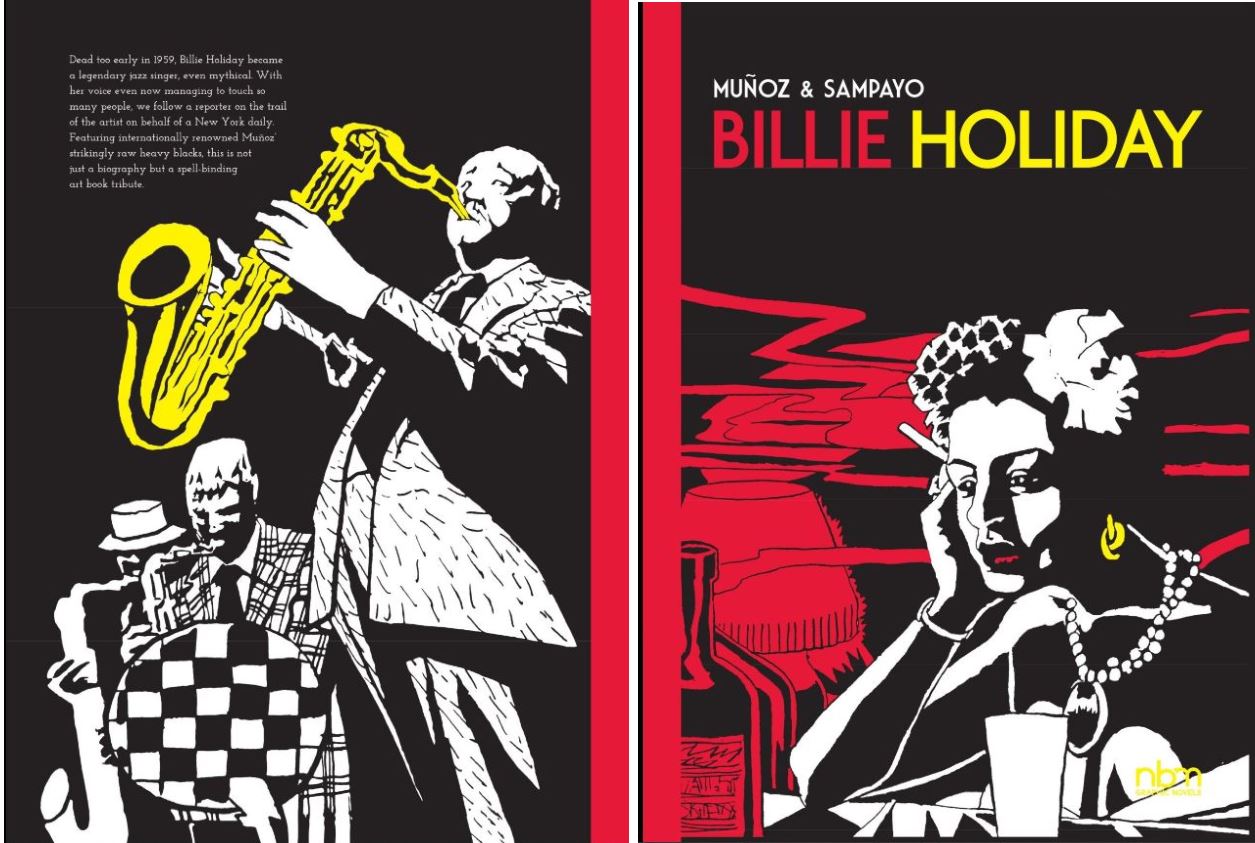
Billie Holiday


By José Muñoz & Carlos Sampayo, translated by Katy MacRae, Robert Boyd & Kim Thompson (NBM)
ISBN: 978-1-68112-093-5 (HB/Digital Edition)

Argentinian José Antonio Muñoz was born on July 10th 1942 in Buenos Aires and studied at the prestigious Escuela Panamericana de Arte de Buenos Aires, under comics geniuses Hugo Pratt and Alberto Breccia. Aged 18, he joined the prolific and prestigious Francisco Solano Lopez studio and soon his work was appearing in Hora Cero and Frontera Extra all whilst ghosting episodes of legendary serial Ernie Pike for his old tutor Pratt.

Through the Argentine-based Solano Lopez outfit, he found work on strips for UK publishing giant Amalgamated Press/IPC, but had no real feeling for the material he was producing. Moreover, like so many others, he was increasingly uncomfortable living in his homeland. Eventually (in December 1972) he was compelled to leave Argentina as the military junta tightened its totalitarian grip on the country, clamping down on free expression and the arts, as well as all forms of overt or covert dissent.

Moving to England, Spain and later Italy, in 1974 Muñoz met again fellow émigré and creative soul-mate Carlos Sampayo in Barcelona and convinced the poet, music critic, copywriter and author to try his hand at comics. The result was a stunning expressionistic noir Private Detective masterpiece of loss and regret called Alack Sinner.

Born in 1943, Sampayo grew up with all the same formative experiences as his artistic comrade and, after a similar dispiriting start (he’d tried writing and being a literary editor before resigning himself to work in advertising), moved to Spain in 1972. The pair were first introduced in 1971 when mutual friend Oscar Zarate left Argentina at the forefront of the creative exodus sparked by the rise of “the Colonels”…

Urgently urged by mentor Hugo Pratt to “do something of your own”, Muñoz & Sampayo started producing grimly gritty adventures of an ex-New York cop-turned-shamus haunting the shadows of the world’s greatest, darkest city, encountering the bleak underbelly of the metropolis and all the outcasts, exiles and scum thrown together at its margins. Alack Sinner debuted in experimental Italian anthology Alter Linus, was picked up by Belgian giant Casterman for A Suivre and latterly compiled in albums across the continent. The feature was set solidly in history, confronting issues of prejudice, bigotry and corruption head-on through shocking words and imagery. In one of their stories Sinner played merely a bit part as the pages examined the life, times and fate of one of the most ill-starred women in the history of Jazz and modern America.

And that’s where this powerfully moving biography finds us…

Originally translated and published by Fantagraphics in the early 1990s, NBM’s Billie Holiday takes us into the heart and soul of the doomed and self-destructive nightingale whose incredible voice was all-but-lost to the world for decades before kinder, more evolved ears of all colours rescued her works from oblivion. This epic tome dissects her life and influence through the eyes of distant observers, opening with Francis Marmande’s essay ‘Billie Holiday: Don’t Explain’ providing a fact- and photo-packed biographical appreciation of the singer in her heyday.

Eleanora Holiday – also known as Billie and “Lady Day” – was born April 7th 1915, and died July 17th 1959. In between those dates she won many fans and earned tons of money, but it never bought her acceptance in a world where black skin provoked revulsion, cruelty and smug superiority. It didn’t even buy her protection from New York cops who considered her a prostitute made good, and an uppity subhuman who never knew her proper place…

Billie lost money as quickly – or even faster – as she earned it: to unscrupulous friends and management, or corrupt officials, although most of it was frittered away by the succession of cheating, brutal men she was hopelessly drawn to and whom she could never resist.

A short, stark story of graphic flair offering many powerful full-page images, the tale begins in 1989 as a journalist is assigned to write a feature commemorating the 30th anniversary of a Jazz singer. He’s never heard of Billie Holiday but is good at his job and starts digging…

He reads about a poor black girl raped as a child and forced into child prostitution who (almost) escaped a commonplace fate by singing. She became successful, but never dodged the traps and pitfalls of her life: booze, drugs, sleazy men, manipulative bosses and her own seeming hunger for conflict. Even so, the way she sang was uniquely hers and changed lives forever. She called herself Billie and always performed with a flower in her hair…

For a while the great and good came to watch and hear, and jazz greats like Louis Armstrong and Lester Young came too. Their gifts also gave them limited entry to the privileged life – but never enough acceptance – but they seemed to understand. Never enough, though, to save Billie from herself.

This intensely personal interpretation is less biography and more a heartfelt paean of appreciation, channelling and exploring the hard, harsh tone of those troubled times where talented, dogged souls fought for recognition and survival at the fringes of a world determined to exploit and consume them. In that respect, no one was more exploited than Lady Day…

Also included here, ‘Jazz Sessions’ offers a stunning gallery of a dozen stark, chiaroscuric, powerfully evocative images based on scenes from Holiday’s short, sad life and dedication to the freedom of the musical form of Blues and Jazz that she graced and transformed through her vocalisations.

Moving, justifiably angry and pitifully sad, this tale holds the singer up to the light and must be read. Just remember, there’s no Happy Ever After here.
© 1991 Casterman. All rights reserved. © 2017 NBM for the English version.

Nina Simone in Comics


By Sophie Adriansen; with Antoane, Romain Brun, Domenico Carbone, Gabriele Di Caro, Mademoiselle Caroline, Samuel Figuiére, Dario Formisani, Sandrine Fourrier, François Foyard, Christian Galli, Chadia Loueslati, Walter Pax, Isa Python, Benjamin Reiss, Riccardo Randazzo, Adrien Roche, Anne Royant, Cynthia Thiéry, Mayeul Vigouroux, Lysandre Vanhoutvenne, Sara Colella, François Renaud & various (NBM)
ISBN: 978-1-68112-326-4 (HB) eISBN: 978-1-68112-327-1

Nina Simone was a mighty voice dedicated to freedom of expression and emancipation of body and soul. This powerful collaborative visual investigation probes her troubled life, failures and achievements, and highlights a life-long war between family pressures, her own frustrated desires, search for autonomy and the spurious divide between classical music and The Blues.

Another stunning musical biography, this book was released continentally in 2023 and is certain to appeal to readers all over the English-speaking world. Nina Simone in Comics joins NBM’s superb and sublime graphic narrative sub-strand, probing the history of a globally significant performer and musical phenomenon whose works and deeds shook the planet and changed society…

Following a full ‘Discography’ (mirroring a ‘Further Reading and viewing’ section at the end of the book) we have context-providing, photo-packed prose essays augmenting stylish individual comics snippets. Both educative articles and chronological character-confirming visual vignettes are penned by French author, biographer and journalist Sophie Adriansen (La menace des fantômes & Musiques diaboliques [Scooby-Doo], Grace Kelly – D’Hollywood à Monaco, le roman d’une légende, Le Syndrome de la vitre étoilée) who steers a coterie of cartoonists and illustrators dramatising the history and demystifying the myths for us. Each combined chapter opens with a quote from the star or close associates…

Anne Royant opens the show with ‘Music As Company’ detailing early days of a musical prodigy born into a strict Christian “negro” household in proudly segregated Tryon, North Carolina. It’s 1935 and Eunice Kathleen Waymon is growing up in a blanketing swathe of religious music, and utterly unable to keep her little hands off her mother’s beloved pedal organ. Eunice is barely three and plays it better than her astounded mother Mary Kate…

Textual assessment ‘In the Beginning’ sees how the family moved socially upwards thanks to Eunice’s gifts, before Christian Galli reveals in images how the toddler decided ‘I’m Going To Be A Classical Pianist When I Grow Up’. Prose supplement ‘Two Pivotal Figures in her Life’ reveals the influence of Mary Kate’s employer Mrs Miller – who sponsored music lessons for the maid’s kid and organised a fund fuelled by Eunice’s recitals that made enough money to carry the child to music college. The other founding spirit was English music teacher Muriel “Miz Mazy” Massinovitch who taught the wonder girl poise, erudition and Bach: inculcating a love of “real music” that carried Eunice to the top of the world but also tainted her life with bitter disappointment…

Growing into a teen hampered by ingrained prejudice and restricted by repressive “Jim Crow” laws prompts the question ‘Do You Feel Black?’ (illustrated by Samuel Figuiére) before support feature ‘Eunice Discovers the World’ shows her dream to be a classical performer continually challenged by blinkered society, before Dario Formisani and colourist Lysandre Vanhoutvenne share heartbreaking revelations as the high school graduate’s dream of attending a prestigious music academy founders due to skin colour in ‘Early Setbacks.’ Her transition to Philadelphia and New York is explored through prose and photos in ‘Talent to Develop’…

Mother Mary Kate was a hard, pious woman and when Eunice adopted a stage name to play nightclubs and earn money, her surrender to ‘The Devil’s Music’ (art by Mademoiselle Caroline) sparked years of bitter contention. That transition and its repercussions is covered in ‘Eunice Becomes Nina’ before Adrien Roche draws ‘Pivotal Figures’ and an essay follows Nina ‘Back to Atlantic City’ for a new life of overnight popularity and appreciation but utterly at odds with her childhood aspirations…

A lifetime of poor choices in men and managers is first touched upon in the Antoane-illustrated ‘We Start Recording Tomorrow’ whilst bizarre circumstances leading to ‘The First Album’ are seen, prior to François Foyard’s cartoon crescendo ‘Patience…’ detailing how Nina responded to learning her life and music were controlled by men because she never read contracts: a situation expanded upon in ‘An Underwhelming Success.’

Cynthia Thiéry shows ‘A New Star Is Born!’ after playing a landmark gig at a legendary venue, further explored in text supplement ‘The Town Hall’, after which Chadia Loueslati depicts Nina’s marriage and reasons for staying with an abusive controller whose love manifested in bouts of violence and deep remorse in ‘A Hold On Me’, and ‘A Time of Conflicts’ adds much-needed context to the mystery…

Limned by Riccardo Randazzo and fleshed out by colourist Sara Colella, ‘I’ll Be Back’ and text titbit ‘Marriage and Travel’ follow Nina – a mother with no control of her work or finances – as she visits Africa and becomes even more consumed by civil rights issues, leading to her learning ‘Your Weapon Is Music!’ (Isa Python art) whilst ‘1963’ recapitulates the state of the world. Sandrine Fourrier realises Simone’s progress ‘Towards a Music of Protest’, with a prose precis spotlighting Nina’s ‘Time to Get Involved’…

Romain Brun illustrates the birth and spreading social impact of breakthrough composition ‘Young, Gifted and Black’ (co-created with black poet Weldon Irvine) as historical context comes via support feature ‘The Fight Intensifies’, before Gabriele Di Caro revisits public event ‘Human Kindness Day’ (AKA “The Summer of Soul”, and “Black Woodstock”) as a prose essay asks was that ‘The Moment It All Collapsed?’

A decade of letting men control her life and money left Nina Simone a target of the IRS and international exile, as revealed by Benjamin Reiss who draws her ‘In A Pub In Paris’ with prose synopsis ‘An Eventful Decade’ tracking a tragic decline highlighted by a diagnosis of bi-polar disorder. A monumental reversal began when a forgotten track – added as an afterthought to her very first album – was used in a perfume commercial and set the world aglow. Domenico Carbone & François Renaud light up the comeback trail in ‘My Baby Just Cares For Me’, with ‘Nina’s Back’ adding detail to a career resurrection prior to declining mental health triggering a crisis. Limned by Walter Pax & Renaud, ‘That’s Enough!’ with text support ‘Tragedy at Bouc-Bel-Air’ expands on an incident that almost ended Nina’s life…

This compelling journey through oppression and injustice chooses to focus on upbeats at the close, with Nina’s presence at Nelson Mandela’s 80th birthday/third wedding in ‘Happy Birthday, Mister President’ – visualised by Mayeul Vigouroux augmented with essay ‘Swan Song’ – before Royant illustrates the world’s too-late knee-jerk approbation in ‘God Be With You Till We Meet Again’ with a pithy summation ‘Keeping the flame alive’…

In so many ways, Activist Nina Simone was more important than the performer/composer, but whether her actions or her music drew you to her, this book will remind you why and make you miss her all the more. Nina Simone in Comics is an astoundingly readable and beautifully rendered treasure for narrative art and music fans alike: one to resonate with anybody who loves to listen and look. If you love pop history and crave graphic escape, this will truly feed your soul.
© 2023 Editions Petit à Petit. © 2024 NBM for the English translation.

Nina Simone in Comics is scheduled for UK release February 13th 2024 and available for pre-order now. Most NBM books are also available in digital formats. For more information and other wonderful reads see http://www.nbmpub.com/