Merry Christmas, Boys and Girls!

In keeping with my self-imposed Holiday tradition here’s another pick of British Annuals selected not just for nostalgia’s sake but because it’s my house and my rules…

After decades when only American comics and memorabilia were considered collectable or worthy, the resurgence of interest in home-grown material means there’s lots more of this stuff available and if you’re lucky enough to stumble across a vintage volume or modern facsimile, I hope my words convince you to expand your comfort zone and try something old yet new…

Still topping my Xmas wish-list is further collections from fans and publishers who have begun to rescue this magical material from print limbo in (affordable) new collections…

Great writing and art is rotting in boxes and attics or the archives of publishing houses, when it needs to be back in the hands of readers once again. As the tastes of the reading public have never been broader and since a selective sampling of our popular heritage will always appeal to some part of the mass consumer base, let’s all continue rewarding publishers for their efforts and prove that there’s money to be made from these glorious examples of our communal childhood.

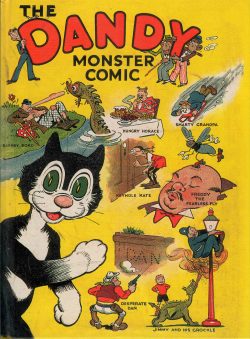
The Dandy Monster Comic (Dandy Annual 1939 Special Facsimile Edition)
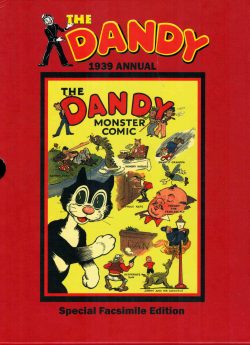
By Many and various (DC Thomson & Co/Aurum Press)
ISBN: 978-1- 84513-217-0

This one’s actually older than me – at least in its original incarnation…

Until it folded and was reborn as a digital publication on 4th December 2012, The Dandy was the third longest running comic in the world (behind Italy’s Il Giornalino – launched in 1924 – and America’s Detective Comics in March 1937).

Premiering on December 4th 1937, The Dandy broke the mould of traditional British predecessors by using word balloons and captions rather than narrative blocks of text under the sequential picture frames.

A colossal success, it was followed eight months later (on July 30th 1938) by The Beano and together they completely revolutionised the way children’s publications looked and, most importantly, how they were read.

Over the decades the “terrible twins” spawned a bevy of unforgettable and beloved household names who delighted generations of avid and devoted readers, and the end of year celebrations were graced with bumper bonanzas of the comics’ weekly stars in extended stories in magnificent bumper hardback annuals.

As WWII progressed, rationing of paper and ink forced the “children’s papers” into an alternating fortnightly schedule: on September 6th 1941 only The Dandy was published. A week later just The Beano appeared. They only returned to normal weekly editions on 30th July 1949…

As of this grand festive feast however that’s all in the future. Here, masterfully restored, is a treasure trove of joyous pranks and all-ages adventure to delight and enthral. It should be noted however, that all this buffoonery and jolly japery was crafted at a time socially far-removed from our own, and there are some terms and racial depictions that wouldn’t be given houseroom in today’s world. That was then, this is now, and that’s another thing you can be grateful for…

It all opens in classis DCT manner with the entire cast chowing down to a monumental feast – a staple reward of those leaner, impoverished times – before James Crichton’s ‘Korky the Cat’ kicks things off with spot of calamitous dockside fishing after which ‘Jimmy and his Grockle’ – a kind of Doberman dragon – foils a dognapping ring. Illustrated by James Clark, the strip was recycled from prose “Boys Paper” The Rover (where it was “Jimmy Johnson’s Grockle” in 1932).

Most pages come with riddles, jokes or single panel gags and many of the strips are delivered in the signature two colour process that typifies British Annuals and as usual none of the writers are named and precious few of the artists are credited. As always, I’ve offered a best guess as to whom we should thank, and of course I would be so very happy if anybody could confirm or deny my suppositions…

The prolific Allan Morley then details how ‘Keyhole Kate’ falls foul of a burglar and cowboy superman ‘Desperate Dan’ – by indisputable key man Dudley D. Watkins – braves harsh winter clime, before Morley’s ‘Freddy the Fearless Fly’ thwarts a human bully and thrashes a predatory spider.

These colossal tomes were all about variety and value for money and next up is a heavily-illustrated prose story enthrallingly detailing the feudal adventure of young shepherd-boy Gingan‘s dragon-slaying quest with magical weapon ‘The Sword of Crad’ after which wandering tramp ‘Barney Boko’ comes a-cropper after defacing public property in a wordless strip from John R. Mason.

As depicted by the superb Eric Roberts, ‘Podge’s Frame-Up’ sees the junior entrepreneur confusing art galleries with glaziers whilst nattily-dressed ‘Archie the Ape’ deals with a hungry lion and ‘Smarty Grandpa’ (by Watkins and a double for strip veteran Pa Broon) has a racially-charged moment at a minstrel show before anthropomorphic tortoise ‘Dan the Night-watchman’ confronts a gang of thieving rats…

‘The Boy that Beat the Band’ is another prose drama (illustrated by Fred Sturrock?) with a young orphan acrobat saving a disabled boy and rewarded with his heart’s desire – a job – after which Jack Glass’ text-block and pic strip ‘The Daring Deeds of Buck Wilson’ sees the singing cowboy battle kidnappers before the animal antics in ‘Bamboo Town’ see daring duo Bongo and Pongo organise a therapeutic gymnasium in a typically busy romp limned by Charlie Gordon.

Sam Fair’s ‘Wig and Wam the Skookum Kids’ were prank-playing Red Indian lads who here trick the Big Chief into baiting a bear before ‘Flippy the Sea Serpent’ – by Frank Minnitt – settles the hash of a snooty octopus whilst Smarty Grandpa fails to steal a pie…

Boneless Bill was a long-running but sadly anonymous strip starring an affable contortionist. Here he astounds an army recruiting officer before ‘Marmaduke Mean the Miser’ pays painfully for stealing a little lad’s Dandy comic before ‘Hungry Horace’ (Morley) finds his appetite briefly diminished after illicitly tapping the wrong barrel and a cunning old codger prevents a mugging in ‘Old Beaver’s Brainwaves’.

‘Wee Tusky’ was long-running prose feature and here the baby elephant’s propensity for trouble leads to deadly danger but secures him a human friend in the end, after which Roberts’ ‘Helpful Henry’ adjusts seating arrangements despite his history of calamitous consequences just as pompous (idiot) detective ‘Trackem Down’ botches another “case”…

Korky the Cat masters the fundamentals of golf whilst Jimmy and his Grockle find fun – and bananas – at the docks, after which Keyhole Kate’s snooping drenches a helpful bystander and Desperate Dan proves that building sites can be dangerous places… at least for other people…

After another get-rich-quick scheme from Podge, sausage-snaffling ‘Dipper the Dodger’ falls foul of the law. Probably drawn by James Jewell, Dipper is a dead ringer for Beano and The People’s Journal cartoon stalwart Wee Peem (“He’s a Proper Scream”), so there might have been some cross-pollination back then.

Freddy the Fearless Fly turns arsonist to escape a spider’s trap before Helpful Henry learns the perils of electricity, after which Jimmy Denton tries rodeo riding to save the ranch with the invaluable assistance of ‘White Star’s Star Turn’ in a prose thriller that leads seamlessly to Podge setting up his own postal service before ‘Bobby, the Boy Scout’ goes too far in his scheme to help a hobo…

Boneless Bill artfully apprehends a thief and Archie the Ape find busking hazardous to health, whilst Hungry Horace loses his lunch to a quick-witted sprinter, but savvy navies ‘Nick & Nack’ find a smart way to keep the cops from confiscating their grub.

Interfering busybodies Bobby, the Boy Scout and Helpful Henry both get it wrong again, after which we head west to see Wig and Wam the Skookum Kids prank their dad yet again even as Desperate Dan falls asleep in the park but still causes chaos

‘Willing Willie and his Pa’ experience decorating woes before we revisit the days of the Raj in prose thriller ‘Pam the Peace-Maker’ wherein a little girl prevents an outbreak of war after which Helpful Henry confuses radio and electric irons and Korky triumphs over a tiger when he goes on safari.

Jimmy and his Grockle clash violently with shopkeepers and Old Beaver’s Brainwaves sees the gamey geezer getting back at the thug who pinched his job after which itinerant Barney Boko pays through the nose for watching football without a ticket.

Dipper the Dodger meets a theatrical strongman and the Bamboo-Town boys convene a swimming class that would certainly have benefitted ‘Sandy Starfish, the Shipwrecked Sailor’ before Fred Sturrock illustrates a prose battle of wits between stubborn old men in ‘The House that Jack the Joker Built’.

More musical mayhem from Archie the Ape precedes Hungry Horace outwitting municipal bylaws in search of a big scoff, even as Podge dupes another crowd of sensation hungry oafs and Helpful Henry wrecks a house before it’s even built: a trick even Desperate Dan can’t match, even if he wasn’t so thirsty…

Mini vignettes for Podge, Barney Boko and Boneless Bill lead into a riotous schoolboy romp in prose – probably illustrated by George Ramsbottom – that I want you to be grown up about. ‘Invisible Dick Spoofs the Spoofer’ is a smart tale from a venerable feature that ran in The Rover for years and when he turns the tables on a cruel stage magician humiliating his school chums you should be proud and not titter or snigger…

A rapid-fire tranche of cartoon antics, starring Bobby the Boy Scout, Podge, Marmaduke Mean the Miser, Flippy the Sea Serpent, Boneless Bill and Willing Willie and his Pa, lead us to another text tale as animal-raised orphan ‘Buffalo Boy’ discovers toffee and begins his slow march back to civilisation…

From here it’s cartoon strip all the way with Korky, Keyhole Kate, Freddy the Fearless Fly, Helpful Henry, Wig and Wam the Skookum Kids, Smarty Grandpa and Dipper the Dodger all doing what they do best before Bamboo-Town brings down the curtain as Bongo and Pongo build an all-animal skating rink…

A marvel of nostalgia and timeless comics wonder, the true magic of this facsimile edition is the brilliant art and stories by a host of talents that have literally made Britons who they are today, and bravo to DC Thomson for letting them out for a half-day to run amok once again.

The DANDY is a trademark of and © D. C. Thomson & Co. Ltd. 2006. Associated characters, text and artwork © D. C. Thomson & Co. Ltd. 2006. All rights reserved.

Valiant Annual 1968
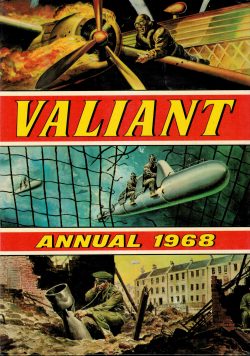
By Many & various (Fleetway)
No ISBN

From the late 1950s and increasingly through the 1960s, Scotland’s DC Thomson steadily overtook their London-based competitors – monolithic comics publishing giant Amalgamated Press.

Created by Alfred Harmsworth at the beginning of the twentieth century, AP perpetually sought to regain lost ground, and the sheer variety of material the southerners unleashed as commercial countermeasures offered incredible vistas in adventure and – thanks to the defection of Leo Baxendale and Ken Reid to the enemy – eventually found a wealth of anarchic comedy material to challenge the likes of the Bash Street Kids, Dennis the Menace, Minnie the Minx and their unruly ilk.

During the latter end of that period the Batman TV show sent the entire world superhero-crazy. Amalgamated had almost finished absorbing all its other rivals such as The Eagle‘s Hulton Press to form Fleetway/Odhams/IPC and were about to incorporate American superheroes into their heady brew of weekly thrills.

Once the biggest player in children’s comics, Amalgamated had stayed at the forefront of sales by latching onto every fad: keeping their material contemporary, if not strictly fresh. The all-consuming company began reprinting the early successes of Marvel comics for a few years; feeding on the growing fashion for US style adventure which had largely supplanted the rather tired True-Blue Brit style of Dan Dare or DC Thompson’s Wolf of Kabul.

Even though sales of all British comics were drastically declining, the 1960s were a period of intense and impressive innovation with publishers embracing new sensibilities; constantly trying new types of character and tales. At this time Valiant and its stable-mate Lion were the Boys’ Adventure big guns (although nothing could touch DC Thomson’s Beano and Dandy in the comedy arena).

Valiant was conceived as a “Boys’ Paper” in 1962 as the indigenous comics industry struggled to cope with a sudden importation of brash, flashy, full-colour comics from America. A weekly anthology concentrating on adventure features and offering a constantly changing arena of action, the magazine was the company’s most successful title for over a decade: absorbing many less successful periodicals between its launch and eventual amalgamation into new-styled, hugely popular Battle Picture Weekly in 1976.

There were 21 Annuals between 1964 to 1985, combining original strips with prose stories; sports, science and general interest features; short humour strips and – increasingly from the 1970s onwards – reformatted reprints from IPC/Fleetway’s vast back catalogue.

From their creative heyday (this book would have been on sale from the autumn of 1967) and sporting a gripping Don Lawrence cover, the all-boys excitement begins with a frontispiece spread of medal-winning British hero war heroes: a typical illustrated historical feature of the era.

The drama continues with a fictionalised full-colour tale of smugglers and the development of the customs men in ‘Contraband’ before ‘Kelly’s Eye’ – sublimely painted by Carlos Cruz (I think) – sees the indestructible adventurer saving beleaguered Coroba from revolutionaries and radioactive doom.

Kelly’s Eye featured ordinary, thoroughly decent chap Tim Kelly who came into possession of the mystical “Eye of Zoltec”: a fist-sized gem that kept him free from all harm… as long as held on to it.

You won’t be surprised to discover that, due to the demands of weekly boys’ adventures, Tim lost, dropped, misplaced and was nefariously deprived of that infernal talisman pretty darned often – and always at the most inopportune moment…

The moody and compelling artwork of Argentinean Francisco Solano Lopez was the prime asset of this series, with Tom Tully and Scott Goodall the usual scripters for this little gem of a series.

Resorting to economical monochrome, we come to ‘The House of Dolmann’. The weekly strip was a curious and inexplicably absorbing blend of super-spy and crime-buster strip from Tully and utterly wonderful master illustrator Eric Bradbury. Dolman’s cover was as a shabby ventriloquist (I digress, but an awful lot of “our” heroes were tatty and unkempt – we had “Grunge” down pat decades before the Americans made a profit out of it!) who designed and constructed an army of specialised robots which he disguised as his puppets.

Using these as his shock-troops, the enigmatic Dolman waged a dark and crazy war against the forces of evil…

Here, he and his hand-crafted squad hunted a scientific maniac pulling satellites out of the sky with a super-magnet.

The first photo/fact feature of the book is a thinly-disguised infomercial for a popular outdoor activity charity, propounding readers get ‘Outward Bound – to Adventure’ after which ‘The Steel Claw’ battles a madman and his gang determined to destroy Britain’s navy (illustrated, it seems to me, by Massimo Belardinelli).

One of the most fondly-remembered British strips of all time, the Steel Claw, ran from 1962- 1973 with Jesús Blasco and his small family studio enthralling the nation’s children through the breakneck adventures of scientist, adventurer, spy and even costumed superhero Louis Crandell. Initially written by novelist Ken Bulmer, the majority of the character’s career was scripted by Tully. Crandall had an artificial hand packed with gimmicks and possessed the disquieting ability to turn invisible whenever he was electrocuted…

‘The Astounding Jason Hyde’ was a series that ran in prose form, written by Barrington J. Bayley with spot illos from Bradbury. Hyde was a blind telepath with an “X-Ray mind” who here tracks missing potholers to an unsuspected cave civilisation populated by brutes and monsters…

After all that action and suspense it’s past time for some light relief and a brace of comedy capers follows: frenetic trend-chasers and backyard inventors ‘The Nutts’ cause carnage with their climate-challenging antics in a superb extended yarn from Spanish cartoonist Ángel Nadal whilst the astoundingly slick and wonderful ‘Sporty’ by Reg (Sporting Sam) Wootton learns a lesson about truth in advertising…

Appalling racist by today’s standards, ‘Captain Hurricane’ was a hugely popular strip for its entire decades-long run. Written by Scott Goodall or Jon Rose, he was originally drawn by R. Charles Roylance, but I think it’s either Jack Pamby or Fred T. Holmes limning this bizarre yarn as – thanks to skiving batman Maggot Malone – the marines are forced to fight their way through Japanese-controlled Malayan jungles to Singapore, armed with nothing but cricket equipment……

Brilliant Reg Parlett’s ‘The Crows’ see the youngest corvid cavorting with bats before – in scintillating pink duo-tones – ‘The Wild Wonders’ (Mike Western and probably Tully on script) offer comedic drama capers. Here Rick and Charlie Wilde and their long-suffering guardian Mike Flynn face ski-slope thrills with a side-order of kidnap and skulduggery… Shipwrecked on remote Worrag Island in the Hebrides, two toddlers were raised by animals and survived to become almost superhuman specimens. When rescued by Olympic swimmer Mike they became sporting sensations able to out-compete most adult athletes in any discipline. They could also talk to animals…

‘Tatty-Mane, King of the Jungle’ offers raucous animal antics as the regal rogue seeks to update his look, but the artist remains a mystery to me. Likely candidates include Nadal or Martz Schmidt (suggested by Steve Holland – you really should read his Bear Alley blog)…

A ‘Sporting Roundabout’ of facts lead into a prose tale of exploration and treasure hunting – illustrated by Weston – with the good guys using an ambulatory super-jeep dubbed ‘The Jungle Walker’ after which venerable schoolboy comedy property ‘Billy Bunter’ quits school and heads out to sea, encountering spies in a quirky yarn possibly illustrated by Parlett but it seems reminiscent of Frank Minnitt to me…

‘Legge’s Eleven’ was a typical example of the humorous freak-show football strip. Lanky player-manager Ted Legge took over failing Rockley Rangers and fields a team of misfits and individualists he struggles to make work together. Here the lads are trapped in a spiral of superstition and missing mascots in the run-up to a crucial international second leg…

Following ‘The Crows’ fowling up a wildlife film, ‘Operation “Rescue”’ (by Mike White?) recreates the 1957 efforts to save Royal Army Air Servicemen lost in the jungles outside Kuala Lumpur before a double dose of ‘“Horse” Laughs’ gags segues into a photo-packed footballing essay on ‘Great Moments with Great Clubs’.

Back in comics, ‘Captain Hurricane’ and crew are in the Western Desert in 1940, battling Italian infantry even as Maggot Malone spreads disorder with his latest fad: weightlifting…

‘Sporty’ disastrously discovers Squash and ‘The Nutts’ cause carnage on a film set before ‘Billy Bunter’s enforced diet creates carnage for the entire county after which another ‘Sporting Roundabout’ leads to a prose thriller about a multi-talented circus performer battling crooks attempting to fix his championship boxing match in ‘The Flying Fighter’.

‘Gabby McGlew – his yarns aren’t true’ is an example of recycled Buster strip Barney Bluffer by Nadal with boastful braggart channelling his inner Baran Munchausen after which photo-history feature ‘A Champion Champion’ details the career and achievements of Henry Cooper before everything wraps up with what I’m sure is another re-tread, even if I can’t find out where.

‘No. 13 Grimm Street’ sees Fleet Street reporter “Hack” Mackenzie struggling to solve a spree of daring art robberies and a house that seems to vanish at will: the answer to both mysteries leads to madness and death…

Eclectic, wide-ranging and always of majestically high quality, this blend of fact, fiction, fun and thrills is a splendid evocation of lost days of joy and wonder. We may not be making books like this anymore but at least they’re still relatively easy to track down. Of course, what’s really needed is for some sagacious publisher to start re-issuing them…
© Fleetway Publications Ltd., 1967

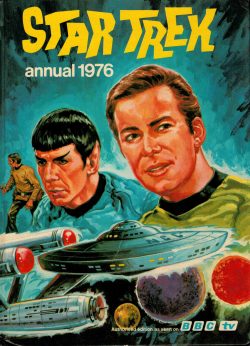
Star Trek Annual 1976
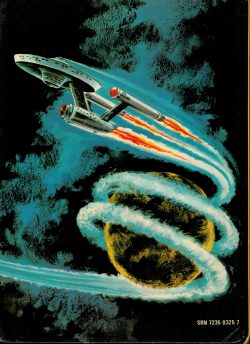
By John David Warner, Allan Moniz, Alberto Giolitti & various (World Distributors)
SBN: 7235-0325-7

British Comics have always fed heavily on other media and as television grew during the 1960s – especially the area of children’s shows and cartoons – those programmes increasingly became a staple source for the Seasonal Annual market. There would be a profusion of stories and strips targeting not readers but young viewers and more and more often the stars would be American not British.

Much of this stuff wouldn’t even be as popular in the USA as here, so whatever comic licenses existed usually didn’t provide enough material to fill a hardback volume ranging anywhere from 64 to 160 pages. Thus, many Annuals such as Daktari, Champion the Wonder Horse, Lone Ranger and a host of others required original material or, as a last resort, similarly-themed or related strips.

This book was produced in a non-standard UK format, with limited but full-colour for both the American comics reprints and the remainder: brief prose pieces, puzzles, games and fact-features on related themes. As for the writers and artists of the originated material your guess is, sadly, as good as or better than mine, but almost certainly generated by the wonderful Mick Anglo’s publishing/packaging company Gower Studios (these yearly slices of screen-to-page magic were an intrinsic part of growing up in Britain for generations and still occur every year with only the stars/celebrity/shows changing, not the package.

Star Trek launched in the USA on September 8th 1966, running until June 3rd 1969: three seasons comprising 79 episodes. A moderate success, the show only really achieved its stellar popularity after going into syndication; appearing in all American local TV regions perpetually throughout the 1970s and beyond.

It was also sold all over the world, popping up seemingly everywhere and developing a fanatically devoted fanbase.

Comicbook franchising specialist Gold Key produced a series which ran for almost a decade beyond the show’s cancellation. Initially these were controversially quite dissimilar from the screen iteration, but by the time of the tales in this sturdy Holidays hardback (reprinting Gold Key’s Star Trek issues #27and #30 from November 1974 and May 1975), quibbling fans had little to moan about and a great deal to cheer as the series was the only source of new adventures starring the beloved crew of the Starship Enterprise.

John David Warner scripted ‘Ice Journey’ and it was illustrated by the ever-amazing Alberto Giolitti. Here the Enterprise is conducting a highly-suspect population survey on sub-arctic world Floe I which soon drops Captain Kirk, Mr. Spock and evolutionary specialist Dr. Krisp into the middle of a eugenics-fuelled race war…

Dividing the tale are a brace of UK generated features a compendium of ‘Star Facts’ offering seven salient snippets of astronomical amazement and a ‘Cosmic Crossword’ to challenge your knowledge of the infinite unknown.

Following the conclusion of ‘Ice Journey’, there’s a board game to play at ‘Warp Factor Eight’ before a second serving of ‘Star Facts’ ushers in another comics adventure.

Bisected by an illustrated glossary of ‘Space Age Vocabulary’, Death of a Star’ (by Allan Moniz & Giolitti) comes from Star Trek #30 and finds Enterprise on site to observe a star going nova. The ship is subsequently catapulted into calamity as sensors pick up a planet full of life-readings where none should be. Moving swiftly to evacuate the endangered beings, the crew are astonished to discover only one creature: an old woman who claims to be the dying sun…

Thanks to the vagaries of image licensing, one thing you won’t find herein is a single photograph of any cast member, but there are plenty of nostalgia-tinged, all-ages sci fi thrills and dashing derring-do to delight not just TV devotees and comics fans but also any reader in search of a pictorially powerful grand adventure.
© MCMLX, MCMLXI, MCMLXXII, MCMLXXV Paramount Pictures Corporation.
(These days Star Trek and related marks are trademarks of CBS Studios, Inc.) All Rights Reserve
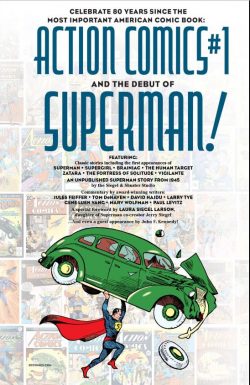
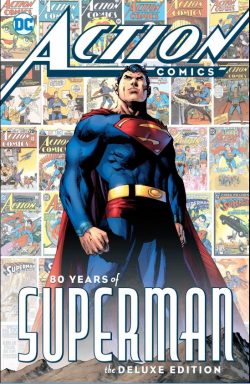
Action Comics: 80 Years of Superman the Deluxe Edition


By Jerry Siegel & Joe Shuster, Fred Guardineer, Don Cameron, Mort Weisinger, Jerry Coleman, Otto Binder, Edmond Hamilton, Len Wein, Cary Bates, Marv Wolfman, John Byrne, Roger Stern, Joe Kelly, Grant Morrison, Paul Levitz, Mort Meskin, Ed Dobrotka, Fred Ray, Wayne Boring, Al Plastino, Jim Mooney, Curt Swan, Carmine Infantino, Gil Kane, Dick Giordano, Kerry Gammill, Bob McLeod, Ben Oliver, Neal Adams plus Many & various (DC Comics)
ISBN: 978-1-4012-7887-8

Win’s Christmas Gift Recommendation: the Ultimate Stocking Stuffer… 9/10

It’s a fact (if such mythological concepts still exist): the American comicbook industry would be utterly unrecognisable without the invention of Superman. His unprecedented adoption by a desperate and joy-starved generation quite literally gave birth to a genre if not an actual art form.

Within three years of his June 1938 debut, the intoxicating blend of eye-popping action and social wish-fulfilment which hallmarked the early Man of Steel had grown to encompass cops-and-robbers crime-busting, socially reforming dramas, science fiction, fantasy, whimsical comedy and, once the war in Europe and the East embroiled America, patriotic relevance.

In comicbook terms at least Superman is master of the world, having utterly changed the shape of a fledgling industry and modern entertainment in general. There have been newspaper strips, radio and TV shows, cartoons games, toys, merchandise and blockbusting movies. Everyone on Earth gets a picture in their heads when they hear the name.

It all started with Action Comics #1 and this bold compilation celebrates the magic, not just with the now-traditional re-runs of classic Superman tales, but with informative articles and fascinating glimpses of some of the other characters who shared the title with him.

Available as a bonanza hardback and in various digital formats, this epic album offers material from Action Comics #0, 1, 2, 42, 64, 241, 242, 252, 285, 286, 309, 419, 484, 554, 584, 655, 662 and 800, and opens with an Introduction by Paul Levitz, a fond Foreword from Laura Siegel Larson and Jules Feiffer’s scene-setting, context-creating essay ‘The Beginning’ before the immortal wonderment commences…

Most of the early tales were untitled, but for everyone’s convenience have been given descriptive appellations by the editors. Thus, after that unmistakeable, iconic cover and a single page describing the foundling’s escape from exploding Planet Krypton (also explaining his astonishing powers in nine panels), with absolutely no preamble ‘The Coming of Superman’, by Jerry Seigel & Joe Shuster introduces a costumed crusader – masquerading by day as reporter Clark Kent – averting numerous tragedies.

As well as saving an innocent woman from the electric chair and roughing up a wife-beater, the tireless crusader works over racketeer Butch Matson – consequently saving suave and feisty colleague Lois from abduction and worse since she is attempting to vamp the thug at the time!

The mysterious Man of Steel makes a big impression on her by then outing a lobbyist for the armaments industry currently bribing Senators on behalf of greedy munitions interests fomenting war in Europe…

To say the editors were amazed by Superman’s popularity was an understatement. They had their money bet on a knock-off Mandrake the Magician crafted by veteran cartoonist Fred Guardineer. Zatara: Master Magician‘s mystic/illusion powers were fully demonstrated in ‘The Mystery of the Freight Train Robberies’ but it’s still a run-of-the-mill and rather sedate affair when compared to the bombastic stunts of the Caped Kryptonian.

Next up is a sneak peek at ‘The Ashcans’: unused and alternative illustrations that didn’t make that crucial first cut after which Action #2 (with a Leo O’Mealia generic adventure cover) supplies the conclusion of Superman’s first case as ‘Revolution in San Monte’ finds the mercurial mystery-man travelling to the war-zone before spectacularly dampening down the hostilities already in progress…

‘The Times’ by Tom DeHaven deconstructs the mythology of the title before Fred Ray’s Superman cover (from November 194)1 introduces Action #42’s ‘The Origin of the Vigilante’ by Mort Weisinger & the amazing Mort Meskin. This spectacular western-themed hero-romp proves that the anthology title had plenty of other captivating characters to enchant audiences…

Issue #64 debuted ‘The Terrible Toyman’ (Don Cameron, Ed Dobrotka & George Roussos), wherein an elderly inventor of children’s novelties and knick-knacks conducts a spectacular campaign of high-profile and potentially murderous robberies, with Lois as his unwilling muse and accessory, and is followed by a little tale of serendipity as Marv Wolfman harks back to his early days and explains ‘How I Saved Superman’…

That’s followed by a genuine lost treasure as ‘Too Many Heroes’ offers an unpublished 1940s Superman tale – credited to Siegel & Shuster – that was rescued from destruction and obscurity. What a gift!

David Hajdu then reveals the allure of the alter ego in ‘Clark Kent, Reporter’ after which we jump to June 1958 and the beginning of the Silver Age. Action Comics #241 cover-featured ‘The Key to Fort Superman’: a fascinating and clever puzzle-play guest-featuring Batman. Scripted by Jerry Coleman with art from Wayne Boring & Stan Kaye, here an impossible intruder vexes the Man of Steel in his most sacrosanct sanctuary…

One month later Otto Binder & Al Plastino introduced both the greatest new villain and most expansive new character concept the series had seen in years. ‘The Super-Duel in Space’ saw evil alien scientist Brainiac attempt to add Metropolis to his collection of miniaturised cities in bottles.

As well as a titanic tussle in its own right, this tale completely changed the mythology of the Man of Steel: introducing Kandor, a city full of Kryptonians who had escaped the planet’s destruction when Brainiac captured them. Although Superman rescued his fellow survivors, the new villain escaped to strike again, and it would be years before the hero could restore the Kandorians to their true size.

After a few intriguing test-runs, a future star of the ever-expanding Superman universe launched in Action Comics #252. In ‘The Supergirl from Krypton!’ (May 1959), Superman discovers he has a living relative. Cousin Kara Zor-El had been born on a city-sized fragment of Krypton, hurled intact into space when the planet exploded. Eventually Argo City turned to Kryptonite like the rest of the detonated world’s debris, and her dying parents, observing Earth through their scopes, sent their daughter to safety as they perished.

Landing on Earth, she met Superman and he created the cover-identity of Linda Lee, hiding her in an orphanage in small town Midvale so that she could master her new powers in secrecy and safety.

‘Endurance’ by Larry Tye discusses longevity and political merit before we return to Superman’s official Action Comics co-star…

Hogging the cover (by Super-stalwarts Curt Swan & George Klein) the simpler times of practicing in secret ended as a big change in the Maid of Might’s status occurred. When her new adoptive parents learn of their new daughter’s true origins, Superman allows cousin Kara to announce her existence to the world in 2-part saga ‘The World’s Greatest Heroine!’ (#285 February 1962) and ‘The Infinite Monster!’ (#286, March 196). Here Jerry Siegel & Jim Mooney detail how Supergirl becomes the darling of the universe: openly saving planet Earth and finally getting all the credit for it.

/telethon to pose a tricky puzzler in the hoary old secret-identity save plot. Written by Edmond Hamilton and illustrated by Swan & Klein, it sets up a scene where the Man of Tomorrow can use none of his usual tricks to be both Superman and Clark simultaneously, then delivers a truly shocking and utterly era-appropriate solution…

Hurtling forward to December 1972 and Action #419 we meet a surprisingly successful back-up feature created by Len Wein, Carmine Infantino & Dick Giordano. Debuting in‘The Assassin-Express Contract!’ Christopher Chance is the Human Target: hiring himself out to impersonate endangered individuals such as the businessman “accidentally” sitting in the sights of a hitman, thanks to a disgruntled employee dialling a wrong number…

From a period where Golden Age stories where assumed to have occurred on parallel world Earth-Two, ‘Superman Takes a Wife’ first appeared in 40th Anniversary issue #484 (June 1978).

Here Cary Bates, Curt Swan & Joe Giella detail how the original Man of Tomorrow became editor of the Metropolis Daily Star in the 1950s and married Lois. Thanks to villainous rogues Colonel Future and the Wizard who had discovered a way to make Superman forget his own existence, only she knew that her husband was once Earth’s greatest hero…

‘If Superman Didn’t Exist’ by Marv Wolfman & Gil Kane comes from Action #554 (April 1984) and posits an alien-invaded Earth deprived of heroes until two kids with big dreams invent one…

In 1985 DC Comics rationalised, reconstructed and reinvigorated their continuity with Crisis on Infinite Earths. They then used the event to regenerate their key properties at the same time. The biggest gun they had was Superman and it’s hard to argue that the change was not before time.

The big guy was in a bit of a slump, but he’d weathered those before. So how could a root and branch retooling be anything but a pathetic marketing ploy that would alienate the real fans for a few fly-by-night Johnny-come-latelies who would jump ship as soon as the next fad surfaced? This new Superman was going to suck…

He didn’t.

The public furore began with all DC’s Superman titles being “cancelled” (actually suspended) for three months, and yes, that did make the real-world media sit-up and take notice of the character everybody thought they knew for the first time in decades. However, there was method in this seeming corporate madness.

The missing mainstays were replaced by a 6-part miniseries running from October to December 1986. Entitled Man of Steel it was written and drawn by Marvel’s mainstream superstar John Byrne and inked by venerated veteran Dick Giordano.

The bold manoeuvre was a huge and instant success and the retuned Superman titles all came storming back with the accent on breakneck pace and action. Action Comics #584 had a January 1987 cover-date and featured a team-up with the Teen Titans as the young heroes had to battle an out-of-control hero with a ‘Squatter’ in his head…

Following a gentle cartoon “roasting” by Gene Luen Yang in ‘Supersquare’, ‘Ma Kent’s Photo Album’ (by Roger Stern, Kerry Gammill & Dennis Janke from #655, July 1990) offers some insights into growing up different before a major turning point began.

As the years passed Lois Lane and Clark gradually grew beyond professionalism into a work romance but the hero had always kept his greatest secret from her. That all changed after the Man of Tomorrow narrowly defeated mystic predator Silver Banshee and decided there would no more ‘Secrets in the Night’ between him and his beloved (Action Comics #662, February 1991, by Stern & Bob McLeod)…

Action #800 (April 2003) then offers a reverential examination of the ongoing myth thus far as ‘A Hero’s Journey’ combines a Joe Kelly script with art from Pasqual Ferry, Duncan Rouleau, Alex Ross, Tony Harris, Bill Sienkiewicz, Dave Bullock, Ed McGuiness, J.H. Williams III, Dan Jurgens, Klaus Janson, Killian Plunkett, Jim Lee, Tim Sale, Lee Bermejo, Cam Smith, Marlo Alquiza & Scott Hanna: cherry-picking unmissable moments from a life well lived…

In 2011 DC again rebooted their entire line and Superman was reimagined once more. ‘The Boy Who Stole Superman’s Cape’ by Grant Morrison & Ben Oliver comes from Action Comics #0, (November 2012) and focusses on a decidedly blue-collar champion just learning the game and painfully aware of the consequences if he makes a mistake…

Wrapping up the celebrations in April 2018’s ‘The Game’ by Levitz & Neal Adams wherein the ultimate enemies Superman and Luthor face off for another round in their never-ending battle…

Before the curtain comes down, though there’s still more unbridled joy and rekindled memories as ‘Cover Highlights’ brings a selection of stunning examples from the Golden, Silver, Bronze, Dark and Modern ages of the Man of Tomorrow, as well as the very best of Action Comics ‘Now’.

Should you be of a scholarly or just plain reverential mood you can then study the copious ‘Biographies’ section so you know who to thank…

Exciting, epochal and unmissable, this is book for all fans of superhero stories.
© 1938, 1941, 1943, 1958, 1959, 1961, 1963, 1972, 1978, 1984, 1986, 1990, 1991, 2003, 2012, 2018 DC Comics. All Rights Reserved.

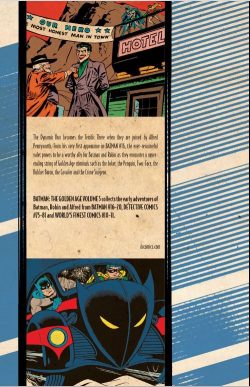
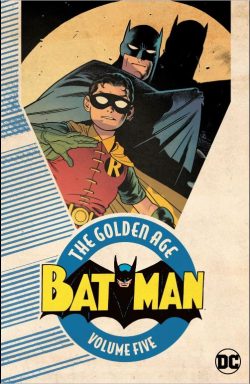
Batman: The Golden Age volume 5


By Bill Finger, Don Cameron, Ruth “Bunny” Lyon Kaufman, Horace L. Gold, Joseph Greene, Joe Samachson, Bob Kane, Jerry Robinson, George Roussos, Dick Sprang, Jack Burnley, Ray Burnley, Fred Ray, Norman Fallon & various (DC Comics)
ISBN: 978-1-4012-8461-9 (TPB)

Win’s Christmas Gift Recommendation: Timely and Evergreen Family Adventure… 10/10

Debuting a year after Superman, “The Bat-Man” (and latterly Robin, the Boy Wonder) confirmed DC/National Comics as the market frontrunner and conceptual leader of the burgeoning comicbook industry.

Having established the parameters of the metahuman with their Man of Steel, the physical mortal perfection and dashing derring-do of the strictly-human Dynamic Duo rapidly became the swashbuckling benchmark by which all other four-colour crime-busters were judged.

Batman: The Golden Age is a series of paperback feasts (there are also weightier, pricier, more capacious hardback Omnibus editions available, and digital iterations too) re-presenting the Dark Knight’s earliest exploits.

Presented in original publishing release order, the tomes trace the character’s growth into the icon who would inspire so many and develop the resilience needed to survive the stifling cultural vicissitudes that coming decades would inflict upon him and his partner, Robin.

Re-presenting a glorious and astounding treasure-trove of cape-&-cowl classics and iconic covers from Detective Comics #75-81, Batman #16-20 plus contemporary companion tales from World’s Finest Comics #10-11: this book covers groundbreaking escapades from April/May 1943 to December/January 1944: as the Dynamic Duo continually develop and storm ahead of all competition.

I’m certain it’s no coincidence that many of these Golden Age treasures are also some of the best and most reprinted tales in the Batman canon. With chief writers Bill Finger and Don Cameron at a peak of creativity and production, everybody on the Home Front was keen to do their bit – even if that was simply making kids of all ages forget their troubles for a brief while. These tales were crafted just as the dark tide was turning and an odour of hopeful optimism was creeping into the escapist, crime-busting yarns – and especially the stunning covers – seen here in the work of Jerry Robinson, George Roussos, Bob Kane Jack Burnley, Dick Sprang, Fred Ray and Stan Kaye…

The supplemental writers all pushed the boundaries of the adventure medium whilst graphic genius Sprang began to slowly supersede Kane and Burnley: making the feature uniquely his own while keeping the Dynamic Duo at the forefront of the vast army of superhero successes.

War always stimulates creativity and advancement and these sublime adventures of Batman and Robin more than prove that axiom as the growing band of creators responsible for producing myriad adventures of the Dark Knight hit an artistic peak which only stellar stable-mate Superman and Fawcett’s Captain Marvel were able to equal or even approach.

with

The compelling dramas open with the landmark Batman #16 (cover-dated April/May 1943) and one of three tales by Cameron. ‘The Joker Reforms!’ (Kane, Robinson & Roussos art) sees the Clown Prince suffer a blow to the head and enjoy a complete personality shift… but not for long…, after which Ruth “Bunny Lyons” Kaufman scripted a bold and fascinating Black Market milk caper in ‘The Grade A Crimes!’ for Ray & Jack Burney to dynamically delineate.

‘The Adventure of the Branded Tree’ (Cameron and the Burnleys) has the Gotham Gangbusters heading to lumberjack country for a vacation to become embroiled in big city banditry before the issue wraps up with hilarious thriller-comedy ‘Here Comes Alfred!’ (Cameron, Kane, Robinson & Roussos) which foists a rotund, unwelcome and staggeringly faux-English manservant upon the Masked Manhunters to finally complete the classic core cast of the series in a brilliantly fast-paced spy-drama with loads of laughs and buckets of tension…

Detective Comics #75 (May 1943) introduces a new aristocrat of crime in pompous popinjay ‘The Robber Baron!’ (Cameron, Jack Burnley & Roussos) before the Joker resurfaces in #76 to ‘Slay ’em With Flowers’: a graphic chiller by Horace L. Gold, Robinson & Roussos.

Next up is Batman #17 which opens with the gloriously human story of B. Boswell Brown: a lonely, self-important old man who claims to be ‘The Batman’s Biographer!’ Unfortunately, ruthless robber The Conjurer gives the claim far more credence than most in a tense thriller by Cameron, Kane, Robinson & Roussos…

Counterbalancing the dark whimsy is ‘The Penguin Goes A-Hunting’ (Cameron, Jack & Ray Burnley): a wild romp wherein the Perfidious Popinjay undertakes a hubris-fuelled crime-spree after being left off a “Batman’s Most Dangerous Foes” list.

The same creative team concocted ‘Rogues Pageant!’ wherein murderous thieves in Western city Santo Pablo inexplicably disrupt the towns historical Anniversary celebrations after which Joe Greene, Kane & Robinson detail the Dynamic Duo’s brutal battle with a deadly gang of maritime marauders in the appealing ‘Adventure of the Vitamin Vandals!’

The creation of Superman propelled National Comics to the forefront of their fledgling industry and in 1939 the company was licensed to produce a commemorative comicbook celebrating the start of the New York World’s Fair, with the Man of Tomorrow prominently featured among the four-colour stars of the appropriately titled New York World’s Fair Comics.

A year later, following the birth of Batman and Robin, National combined Dark Knight, Boy Wonder and Action Ace on the cover of the follow-up New York World’s Fair 1940.The spectacular 96-page anthology was a tremendous success and the oversized bonanza format was established, becoming Spring 1941’s World’s Best Comics#1, before finally settling on the now-legendary title World’s Finest Comics from the second issue, beginning a stellar 45-year run which only ended as part of the massive clear-out and de-cluttering exercise that was Crisis on Infinite Earths.

Until 1954 and the swingeing axe-blows of rising print costs, the only place Superman and Batman ever met was on the stunning covers by the likes of Burnley, Fred Ray and others. Between those sturdy card covers, the heroes maintained a strict non-collaboration policy.

Here World’s Finest Comics #10 (Summer 1943) features Finger, Robinson & Roussos’ ‘The Man with the Camera Eyes’: a gripping battle of wits between the Gotham Guardians and a crafty crook with an eidetic memory, before Finger, Kane & Roussos introduce a fascinating new wrinkle to villainy with the conflicted doctor who operates ‘The Crime Clinic’ in Detective #77. Crime Surgeon Matthew Thorne would return many times over the coming decades…

Issue #78 (August 1943) pushes the patriotic agenda with ‘The Bond Wagon’ (Joseph Greene, Burnley & Roussos) as Robin’s efforts to raise war funds through a parade of historical look-alikes is targeted by Nazi spies and sympathisers, after which Batman #18 starts with a spectacular, visually stunning crime-caper wherein the Gotham Gangbusters clash again with rascally rotund rogues Tweedledum and Tweedledee whilst solving ‘The Secret of Hunter’s Inn!’ (Samachson & Robinson).

‘Robin Studies his Lessons!’ (Samachson, Kane & Robinson) sees the Boy Wonder grounded from all crime-busting duties until his school work improves – even if it means Batman dying for want of his astounding assistance!

Bill Finger and the Burnley bros craft ‘The Good Samaritan Cops’: another brilliantly absorbing human interest drama focused on the tense but unglamorous work of the Police Emergency Squad before the action culminates in a shocking and powerful final engagement for manic physician and felonious mastermind Matthew Thorne. ‘The Crime Surgeon!’ (Finger, Kane & Robinson) here tries his deft and devilish hand at masterminding other crooks’ capers…

Over in Detective Comics #79 ‘Destiny’s Auction’ – Cameron & Robinson – offers another sterling moving melodrama as a fortune teller’s prognostications lead to fame, fortune and deadly danger for a failed actress, has-been actor and superstitious gangster…

World’s Finest Comics #11’s Batman episode reveals ‘A Thief in Time!’ (Finger & Robinson inked by Fred Ray), pitting our heroes against future-felon Rob Callender, who falls through a time-warp and thinks he’s found the perfect way to get rich.

Detective #80 sees the turbulent tragedy of deranged, double-edged threat Harvey Kent, finally resolved after a typically terrific tussle with ‘The End of Two-Face!’ (Finger, Kane, Robinson & Roussos), after which Batman #19 unleashes another quartet of compelling crime-busting cases.

There’s no mistaking the magnificent artwork of rising star Dick Sprang who pencilled every tale in this astounding issue, beginning with Cameron’s ‘Batman Makes a Deadline!’ as the Dark Knight investigates skulduggery and attempted murder at the City’s biggest newspaper. He also scripted breathtaking fantasy masterpiece ‘Atlantis Goes to War!’ with the Dynamic Duo rescuing that fabled submerged city from overwhelming Nazi assault.

The Joker rears his garish head again in anonymously-penned thriller ‘The Case of the Timid Lion!’ (perhaps William Woolfolk or Jack Schiff?) with the Harlequin of Hate enraged and lethal whilst tracking down an impostor committing crazy capers in his name… Samachson, Sprang and inker Norman Fallon then unmask the ‘Collector of Millionaires’ with Dick Grayson covertly investigating his wealthy mentor’s bewildering abduction and subsequent replacement by a cunning doppelganger…

‘The Cavalier of Crime!’ (Detective #81, by Cameron, Kane & Roussos) introduces another bizarre, baroque costumed crazy who tests his rapacious wits and sharp-edged weapons against the Dynamic Duo – naturally and ultimately to no avail…

The Home Front certainly seemed a lot brighter, as can be seen in Batman #20 which opens with the Joker in ‘The Centuries of Crime!’ (Cameron, Jack & Ray Burnley) with the Mountebank of Mirth claiming to have discovered a nefariously profitable method of time-travelling, whilst ‘The Trial of Titus Keyes!’ (Finger, Kane & Robinson) offers a masterful courtroom drama of injustice amended, focussing on the inefficacy of witness statements…

‘The Lawmen of the Sea!’ (Finger & the Burnley boys) finds the Dynamic Duo again working with a lesser known Police Division as they join The Harbor Patrol in their daily duties, uncovering a modern-day piracy ring, before the issue and this collection concludes on an emotional high with ‘Bruce Wayne Loses Guardianship of Dick Grayson!’ as a couple of fraudsters claiming to be the boy’s last remaining relatives petition to adopt him. A melodramatic triumph by Finger, Kane & Robinson, there’s still plenty of action, especially after the grifters try to sell Dick back to Bruce Wayne…

This stuff set the standard for comic superheroes. Whatever you like now, you owe it to these tales. Superman gave us the idea, and writers like Finger and Cameron refined and defined the meta-structure of the costumed crime-fighter. Where the Man of Steel was as much social force and wish fulfilment as hero, Batman and Robin did what we ordinary mortals wanted and needed to do.

They taught bad people the lesson they deserved.

The history of the American comicbook industry in almost every major aspect stems from the raw, vital and still powerfully compelling tales of DC’s twin icons: Superman and Batman.

It’s only fair and fitting that both those characters are still going strong and that their earliest adventures can be relived in chronological order in a variety of formats from relatively economical newsprint paperbacks to deluxe hardcover commemorative Archive editions – and digital formats too.

These are the stories that cemented the popularity of Batman and Robin and brought welcome surcease to millions during a time of tremendous hardship and crisis. Even if these days aren’t nearly as perilous or desperate – and there ain’t many who thinks otherwise! – the power of such work to rouse and charm is still potent and just as necessary. You owe it to yourself and your family and even your hamster to Buy This Book…
© 1943, 1944, 2018 DC Comics. All Rights Reserved.

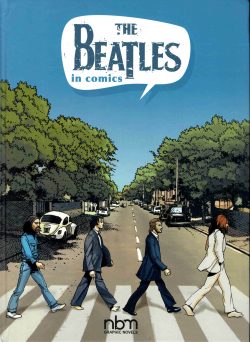
The Beatles in Comics


By Michels Mabel, Gaet’s, Lu-K, Vox, Anne-Sophie Servantie, Ludivine Stock, Amandine Puntous, Romuald Gleyse, Julien Lamanda, Efix, Pierre Braillon, Ben Lebègue, Anthony Audibert, Bloop, Victor Giménez, Akita, Laurent Houssin, Richard Di Martino, Piero Ruggeri et Filipo Neri, Martin Trystram, Clément Baloup, Edwina Cosme et Christophe Billard, Patrick Lacan, Virginie de Lambert, Joël Alessandra, Odile Santi & various: translated by Joe Johnson (NBM)
ISBN: 978-1-68112-187-1 (HB)

Win’s Christmas Gift Recommendation: A Magical Mystery Tour for All… 10/10

Graphic biographies are all the rage at the moment and this one – originally released on the continent in 2016 – is one of the best I’ve seen and the most likely to appeal to a far larger mainstream audience than comics usually reach. It certainly deserves to…

If you’ve never heard of the Beatles there’s very little point in you carrying on any further.

Still with us? Okay then…

As if cannily repackaged popular culture factoids and snippets of celebrity history – accompanied by a treasure trove of candid photographs, song lyrics, posters and other memorabilia – aren’t enough to whet your appetite, this addition to the lore of the Fab Four adds a vital and enticing extra element.

The individual chronological articles and the comics vignettes they each precede are all written by Michels Mabel & Gaet’s, with an army of illustrators providing vivid and vibrant mini-strips, beginning with the meeting of ‘John, Paul and George’, as envisioned by Lu-K.

Vox details the euphoria of the first gigs in ‘Hamburg’ before Anne-Sophie Servantie details the iconic contribution of photographer ‘Astrid Kirchherr’ to the band’s growing mystique after which the crucial contribution of their tragedy-marked manger is explored in ‘Mister Epstein’ with vivid illustration from Ludivine Stock.

A tone of smug schadenfreude tinges Amandine Puntous’ ‘The Man Who Refused to Sign the Beatles!’ before Romuald Gleyse recalls the moment the magic finally gelled as a proper music producer takes the rowdy kids in hand with ‘George Martin’s Wager’.

With the world at their feet, a close brush with respectability and civil honours are covered in

‘The Queen’s Rebels’ by Julien Lamanda after which Efix encapsulates conquest of the New World and ‘The Beginning of Beatlemania’; with Pierre Braillon tackling key appearances on ‘The Ed Sullivan Show’ and Ben Lebègue depicting ‘Shea Stadium and the American Tour’.

Once they started getting successful, tensions began to fracture the band’s enthusiastic solidarity. The creation of the song ‘Yesterday’ (Anthony Audibert art) and an anticlimactic meeting of giants, as seen in Bloop’s ‘The Beatles and Elvis’ starts tracing the cracks, whilst movie sensation ‘A Hard Day’s Night’ – by Victor Giménez – and Akita’s visualisation of ‘John’s Opinion’ reinforce the tensions.

Courtesy of Laurent Houssin, ‘New Musical Horizons’ are explored, and Richard Di Martino celebrates ‘The Triumph of Sgt. Pepper’s Lonely Hearts Club Band’ before the hammer falls with the death of their protective manager. ‘Goodbye Brian’ by Piero Ruggeri et Filipo Neri signals a creative explosion and the beginnings of financial disaster as conmen target the band resulting in a fractious ‘Trip to India’ (by Martin Trystram), the advent of ‘Yoko Ono’ (from Clément Baloup) and the musical masterpiece that is ‘The White Album’ as depicted by Edwina Cosme & Christophe Billard.

Patrick Lacan then visually traces the insane and inane conspiracy theories claiming ‘Paul is Dead’ before more artistic triumphs are balanced by incipient catastrophe in Virginie de Lambert’s ‘Abbey Road/Let it Be’.

From there it’s all about ‘The Break-up’ (Joël Alessandra) after which Odile Santi scrapbooks 1971 to now in the postscriptive ‘Post Beatles’ section…

The compelling and remarkable biography concludes on a deliciously whimsical note as ‘Do you want to know a secret?’ offers 18 absurd anecdotes to delight everyone who loves to hear classic absurdism. The Beatles in Comics is an astoundingly readable and beautifully rendered treasure for comics and music fans alike: one that resonates with anybody who loves to listen and look. Without it, you’re simply nowhere, man…

© 2016 Petit as Petit. © 2018 NBM for the English translation.
NBM books are also available in digital formats. For more information and other great reads see http://www.nbmpub.com/

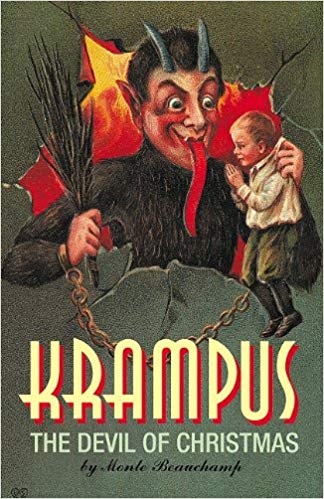
Krampus: The Devil of Christmas


By various, edited by Monte Beauchamp (Last Gasp)
ISBN: 978-0-86719-747-1

Win’s Christmas Gift Recommendation: Horrid Holiday Cheers… 8/10

When I lived in New York, the morning after Thanksgiving was when retailers committed Christmas. Staggering out into chilly morning air (I wonder if they still have that?) after a surfeit of everything, one’s eyes would boggle at a profusion of tinsel, glitter and lights with entire buildings done up like stockings or giant parcels.

These utterly mindboggling tributes to understatement would make any stolid Englander quail with disquiet and I still get tremors occasionally around postmen bearing packages… Another way to bring on Christmas chills is with a good book, and this delightfully engrossing hardback celebration from artist, historian and designer Monte Beauchamp (a welcome expansion on his 2004 book The Devil in Design) focuses on a long-lost aspect of the Season of Good Will that’s found renewed interest in recent times thanks to a film franchise and the general malaise affecting glum modern humans…

For decades Monte Beauchamp’s iconic, innovative narrative and graphic arts magazine Blab! highlighted the best and most groundbreaking trends and trendsetters in cartooning and other popular creative fields.

Initially published through the auspices of the much-missed Kitchen Sink Press it moved first to Fantagraphics and carried on as the snazzy hardback annual Blabworld from Last Gasp. Here however Beauchamp looks back not forward to revel in the lost exuberance and dark creativity of a host of anonymous artists whose seasonal imaginings spiced up the Winter Solstice for generations of guilty-until-proven-innocent nippers…

In Western Europe – especially the German-speaking countries but also as far afield as Northern Italy and the Balkans – St Nicholas used to travel out with gifts for good children, accompanied by a goat-headed, satanic servant. Fur-covered, furtive, chain-bedecked, sinister and all-knowing, the beast-man with a foot-long tongue and one cloven hoof wielded a birch switch to thrash the unruly and a copious sack to carry off disobedient kinder.

The Krampus was a fixture of winter life in Austria, Switzerland and the German Principalities, with his own special feast-day (December 5th – just before St. Nikolaus’ Day), parades, festivals and highly enjoyable (for parents, at least) ceremonial child-scaring events. Back then we really knew how to reward the naughty and the nice…

This compelling and enchanting hardback tome – still readily available but not yet as a digital delivery – celebrates the thrilling dark edge of the Christmas experience as depicted through the medium of the full-colour postcards that were a crucial facet of life in Europe from 1869 to the outbreak of World War I.

However, even with fascinating histories of the character and the art-form related in ‘Greetings From Krampus’, ‘Festival of the Krampus’ and ‘Postal Beginnings’, the true wide-eyed wonder and untrammelled joy of this compendium is the glorious cacophony of paintings, prints, drawings collages – and even a few primitive and experimental photographic forays – depicting the delicious dread scariness of the legendary deterrent as he (it?) terrifies boys and girls, explores the new-fangled temptations of airplanes and automobiles and regularly monitors the more mature wicked transgressions of courting couples…

A feast of imagination and tradition ranging from the wry, sardonic and archly-knowing to the outright disturbing and genuinely scary, this magical artbook is a treasure not just for Christmas but for life…

And it’s not nearly as environmentally harmful as coal…
© 2010 Monte Beauchamp. All rights reserved.

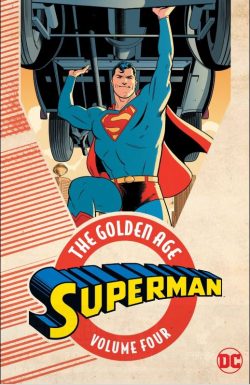
Superman: The Golden Age volume 4


By Jerry Siegel & Joe Shuster, Paul Cassidy, Ed Dobrotka, Leo Nowak, John Sikela, Fred Ray & various (DC Comics)
ISBN: 978-1-4012-7867-0

Win’s Christmas Gift Recommendation: Vital Vintage Superhero Fun and Fantasy… 9/10

As his latest record-breaking anniversary year rapidly approaches its end, the popularity of Superman is on the climb again. The American comicbook industry – if it existed at all by now – would have been an utterly unrecognisable thing without The Man of Tomorrow. His unprecedented invention and adoption by a desperate and joy-starved generation gave birth to an entire genre if not an actual art form.

Imitation is the most honest compliment and can be profitable too. Superman triggered an inconceivable army of imitators and variations and, within three years of his Summer 1938 debut, the intoxicating blend of action and social wish-fulfilment which hallmarked the early Action Ace had grown to encompass cops-and-robbers crime-busting, socially reforming dramas, science fiction, fantasy, whimsical comedy.

Once the war in Europe and the East finally involved America, to that list was added patriotic relevance for a host of gods, heroes and monsters – all dedicated to profit through exuberant, eye-popping excess and vigorous dashing derring-do.

In comicbook terms at least, Superman was master of the world. He had already utterly changed the shape of the fledgling industry by the time of these tales. There was a successful newspaper strip, foreign and overseas syndication and the Fleischer studio was producing some of the most expensive – and best – animated cartoons ever conceived.

Thankfully the quality of the source material was increasing with every four-colour release, and the energy and enthusiasm of Jerry Siegel & Joe Shuster had infected the burgeoning studio that grew around them to cope with the relentless demand.

This latest addition to the splendid Golden Age/Silver Age strand of DC reprint compendia presents more of an epochal run of raw, unpolished but viscerally vibrant stories by Siegel, Shuster and the sterling crew of their ever-expanding “Superman Studio” who were setting the funnybook world on fire: crude, rough, uncontrollable wish-fulfilling, cathartically exuberant exploits of a righteous and superior man dealing out summary justice equally to social malcontents, exploitative capitalists, thugs and ne’er-do-wells that initially captured the imagination of a generation.

This fourth remastered paperback collection (also available digitally) of the Action Ace’s early exploits – reprinted in the order they first appeared – covers the turbulent, times spanning September 1941 to April 1942: encompassing escapades from Action Comics #41-47, Superman #12-15 and solo-adventures from World’s Finest Comics #3-5 (an oversized anthology title where he shared whimsical cover-stardom with Batman and Robin).

As always, every comic appearance is preceded by the original cover illustration, all captivating graphic masterpieces from Fred Ray whilst each tale is credited to co-originator Siegel.

Although he & Shuster had very much settled into the character by now, the latter was increasingly involved with the Superman newspaper strip. Even so, the buzz of success still fired them both and innovation still sparkles amidst the exuberance.

Written entirely by Seigel this incredible panorama of torrid tales opens with ‘The Case of the Death Express’: a tense thriller about train-wreckers illustrated by Nowak from the Fall issue of World’s Finest (#3).

Due to the exigencies of periodical publishing, although the terrific tales collected in this compendium take the Man of Steel to December 1941 and beyond, they were all prepared well in advance of Japan’s sneak attack on Pearl Harbor.

Even though spies and sabotage plots were already a solid standby of the narrative currency of the times and many in America felt war was inevitable (patriotic covers were beginning to appear on many comic books), the war was still a distant and exotic affair, impersonal and at one remove from daily life as experienced by the kids who were as the perceived audience for these four-colour fantasies.

That would change radically in the months and issues to come…

Most stories of the time were untitled; these have been named post-hoc simply to provide differentiation and make my task simpler …

Leo Nowak was drawing most of the comic output at this time and is responsible for the lion’s share of these adventures, beginning with the first three from Superman #12 (September/October 1941). ‘Peril on Pogo Island’ sees Lois Lane and Clark Kent at the mercy of rampaging tribesmen, although spies from a certain foreign power are at the back of it all, whilst ‘The Suicide Murders’ finds them facing a particularly grisly band of gangsters. John Sikela inked Nowak on ‘The Grotak Bund’ wherein seditionists attempt to destroy vital US industries, and fully illustrated the final tale as an old foe rears his shiny head once more in ‘The Beasts of Luthor’, accompanied by a spectacular array of giant monsters…

Action Comics #41 (October 1941) exposes ‘The Saboteur’ in a terse tale of a traitor motivated by greed rather than ideology illustrated by Paul Cassidy, whilst Nowak’s ‘City in the Stratosphere’ (Action #42) reveals that a trouble-free paradise floating above Metropolis has been subverted by an old enemy. He also handled most of Superman #13 (November/December 1941).

This issue led with a Cassidy pin-up after which ‘The Light’ debuts an old foe in a new super-scientific guise after which ‘The Archer’ pits the Man of Steel against his first costumed villain. ‘Baby on the Doorstep’ took an opportunity for fun and the feel-good factor as Clark becomes a temporary parent in a tale of stolen battle plans before ‘The City Beneath the Earth’ (illustrated by Sikela) returns to the serious business of action and spectacle as our hero discovers a subterranean kingdom lost since the Ice Age.

World’s Finest Comics #4 (Winter 1941) offers ‘The Case of the Crime Crusade’: another Nowak-rendered socially relevant racketeering yarn before ‘The Crashing Planes’ – from Action #43 and with Superman attacking Nazi paratroopers on the cover – sees the Man of Tomorrow smashing a plot to destroy a commercial airline.

Even though war was undeclared DC and many other publishers had struck their colours well before December 7th. When the Japanese attack filtered through to the gaudy pages the patriotic indignation and desire for retribution would generate some of the very best art and stories the budding art-form would ever see.

Superman’s rise had been meteoric and inexorable and seemed to never stall. He was the indisputable star of Action, World’s Finest Comics and his own dedicated title. A daily newspaper strip had begun on 16th January 1939, with a separate Sunday strip following from November 5th that year, garnered millions of new fans and a thrice-weekly radio serial launched on February 12th 1940. With a movie cartoon series, games, toys, apparel and a growing international media presence, Superman was swiftly becoming everybody’s hero…

Although the gaudy burlesque of monsters and super-villains still lay years ahead of our hero, these captivating tales of villainy, criminality, corruption and disaster are just as engrossing and speak powerfully of the tenor of the times. A perilous parade of rip-roaring action, seedy hoods, vile masterminds, plagues, disasters, lost kids and distressed damsels are all dealt with in a direct and captivating manner by our relentlessly entertaining exemplar in summarily swift and decisive fashion.

No “to be continueds” here!

The sheer escapism continues with ‘The Caveman Criminal’ (Action #44, illustrated by Nowak & Ed Dobrotka), wherein crooks capitalise on a frozen “Dawn Man” who thaws out and goes wild in crime-ridden Metropolis, after which Superman #14 (January/February 1942 begins.

Again primarily a Nowak art affair – following a fabulous page of ‘Superman’s Tips for Super-Health’ by Shuster & Cassidy – the drama commences with ‘Concerts of Doom!’. Here a master pianist learns just how mesmerising his recitals are and joins forces with unpatriotic thieves and dastardly saboteurs, after which the tireless Man of Tomorrow is hard-pressed to cope with the diabolical destruction caused by ‘The Invention Thief’.

Sikela inks Nowak’s pencils in a frantic high fantasy romp resulting from the Man of Steel’s discovery of a friendly mermaid and malevolent fishmen living in ‘The Undersea City’ before Nowak solos again for more high-tension catastrophic graphic destruction signalling Superman’s epic clash with sinister electrical savant ‘The Lightning Master’.

Action #45 (Nowak & Dobrotka) sees ‘Superman’s Ark’ girdle the globe to repopulate a decrepit and nigh-derelict city zoo, whilst issue #46 features ‘The Devil’s Playground’ (Cassidy) wherein masked murderer The Domino stalks an amusement park wreaking havoc and instilling terror.

Spring 1942’s Finest Comics #6 explores the mystery of a flying castle as Superman breaches ‘The Tower of Terror’ to confront an Indian curse and an unscrupulous businessman, whereas in the bimonthly Superman #15 a dandy exercise regimen from Shuster (‘Attaining Super-Health: A few Hints from Superman!’) leads to Nowak’s ‘The Cop Who was Ruined’ wherein the Metropolis Marvel clears framed detective Bob Branigan – a man who even believes himself guilty – before scurvy Orientals menace the nation’s Pacific fleet in ‘Saboteurs from Napkan’ with Sikela again lending his pens and brushes to Nowak’s pencil art.

Thinly-veiled fascist oppression and expansion is spectacularly nipped in the bud with ‘Superman in Oxnalia’– an all-Sikela art job, before Nowak returns to pencils concluding science fiction thriller ‘The Evolution King’. Here, a malignant mastermind artificially ages his wealthy, prominent victims until the invulnerable Man of Steel storms in…

This splendid compilation concludes with a blockbusting, no-holds-barred battle which was only the opening skirmish in a bigger campaign. Action #47 (by Sikela) reveals how Lex Luthor gains incredible abilities after acquiring the incredible ‘Powerstone’, making the mad scientist temporarily Superman’s physical equal – if not mental – match…

As fresh and thrilling now as they ever were, the endlessly re-readable epics are perfectly housed in these glorious paperback collections where the savage intensity and sly wit still shine through in Siegel’s stories – which literally defined what being a Super Hero means – whilst Shuster’s shadows continued to create the basic iconography of superhero comics for all others to follow.

Such Golden Age tales are priceless enjoyment at an absurdly affordable price and in a durable, comfortingly approachable format. What dedicated comics fan could possibly resist them?
© 1941, 1942, 2018 DC Comics. All Rights Reserved.

The Great North Wood


By Tim Bird (Avery Hill)
ISBN: 978-1-910395-36-3 (PB)

Win’s Christmas Gift Recommendation: A Glorious Ramble to Shake Loose the Cerebral Cobwebs… 9/10

Lots of comics, and most forms of fiction, in fact, depend on strong – or at least memorable – characters and plenty of action to capture the attention. You need to be really good and quite brave to try anything outside those often-infantile parameters.

That’s actually a pretty good description of London-based cartoonist and author Tim Bird whose sundry works explore themes of time and place, history, memory and myth as well as our connection to the planet in such comics as the award-winning From The City To The Sea. He calls these forays psychogeography…

Here that empathy is transformed into a far-too-brief lyrical travelogue and sharing of lost folklore as this oversized (178 x 279 mm) colour paperback traces the slow decline and curtailment of the vast forest that swathed Britain before humanity, whilst highlighting those icons of modernity and great survivors who seem to adapt to all changes with dogged aplomb.

As Man took hold, the trees grew small and fragmented, so our far-ranging focus takes in the range of Southern England described in the title and relates experiences from before writing to just a few moments from now…

The scene is set with symbolic guile in ‘An Ancient Forest’ before focusing in to define ‘The Great North Wood’ then and now. The origins of place names such as ‘Norwood’ and its satellites are accompanied by captivating expositions on local tales such as ‘The Vicar’s Oak’. It’s interesting to consider just how many comics artisans and popular arts creators have lived in the many sites listed in Bird’s introductory map. I’m just one of them. I could list dozens more…

The origin of the ‘Honor Oak’ leads to outlaw glamour in ‘The Story of Ned Righteous’ whilst ‘Gipsy Hill’ (a place and a person) segues beguilingly into ‘Bombs’ after which a visit to the still relatively-abundant ‘Sydenham Hill Woods’ takes us to a hopeful note in ‘A Forest Again’…

Even now I’ll recite the chapter headings like a mantra and remember the places cited herein where I’ve lived over the last four decades and feel I’m also part of something bigger than me…

This paean to a feeling of belonging – to both time and space – evokes the same vibrant elegiac tone as Harry Watt and Basil Wright’s 1936 documentary Night Mail (with its evocative poem/soundtrack by W. H. Auden and score by Benjamin Britten). It’s a feeling no one can decry or wish to end…

Sadly, this glorious celebration is not available digitally yet, but that just means you can give physical copies to all your friends, suitably gift-wrapped and ready to be properly appreciated by all the tactile senses as well as cerebral ones…

A graphic marvel to savour and ponder over and over again.
© Tim Bird 2018. All rights reserved.

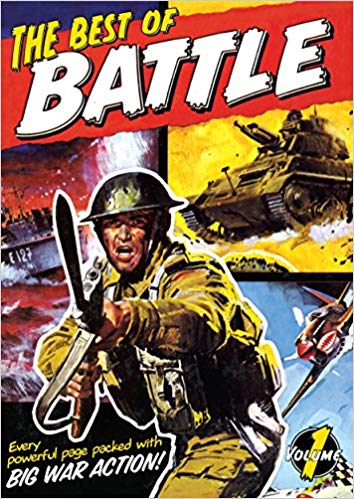
The Best of Battle


By Pat Mills, John Wagner, Tom Tully, Steve McManus, Eric & Alan Hebden, Mark Andrew, Gerry Finley-Day, Mike Western, Joe Colquhoun, Eric Bradbury, Carlos Ezquerra, Geoff Campion, Cam Kennedy, Colin Page, Pat Wright, Giralt, Jim Watson, Mike Dorey, John Cooper & various (Titan Books)
ISBN: 978-1-84856-025-3 (PB)

For most of the medium’s history, British comics have been renowned for the ability to tell a big story in satisfying little instalments and this, coupled with superior creators and the anthological nature of our publications, has ensured hundreds of memorable characters and series have seared themselves into the little boy’s psyche inside most British adult males.

One of the last great weekly anthology comics was the all-combat Battle, which started service as Battle Picture Weekly – launched on 8th March 1975.

Through absorption, merger and re-branding (becoming in swift succession Battle Picture Weekly & Valiant, Battle Action, Battle, Battle Action Force and Battle Storm Force) it was eventually subsumed into the revived, faltering but too-prestigious-to-fail Eagle on January 23rd 1988. For 673 blood-soaked, testosterone-drenched issues, it had fought its way into the bloodthirsty hearts of a generation, consequently producing some of the best and most influential war stories ever told.

This action-packed compendium features the opening salvos of some of the very best from those 13-odd years produced by a winning blend of Young Turk writers – Pat Mills, John Wagner, Steve McManus, Mark Andrew and Gerry Finley-Day – and stalwarts of the old guard – Tom Tully, Eric and Alan Hebden. The art comes from Colin Page, Pat Wright, Giralt, Carlos Ezquerra, Geoff Campion, Jim Watson, Mike Western, Joe Colquhoun, Eric Bradbury, Mike Dorey, John Cooper and Cam Kennedy.

The strips featured are D-Day Dawson (a sergeant with only a year to live and nothing to lose) by Gerry Finley-Day, Ron Carpenter & Colin Page, spy serial Day of the Eagle (by ex-SOE agent Eric Hebden and artist Pat Wright), The Bootneck Boy (a little lad who lives his dream by becoming a Marine), by Finley-Day, Ian McDonald & Giralt, and the legendary Dirty Dozen-inspired Rat Pack, by Finley-Day and featuring some of the much-missed Carlos Ezquerra’s earliest UK artwork.

Ezquerra also shone on Alan Hebden’s anti-establishment masterpiece Major Eazy, whilst Fighter from the Sky is the first of the comic’s groundbreaking serials telling World War II stories from a German viewpoint. Written by Finley-Day and drawn by the superb Geoff Campion, it tells of a disgraced paratrooper fighting for his country, even if they hated him for it…

Hold Hill 109 by Steve McManus & Jim Watson was a bold experiment: basically a limited series as a group of Eighth Army soldiers have to hold back the Afrika Korps for seven days, with each day comprising one weekly episode. Unbelievably, only the first three days are collected here, though, as apparently there wasn’t room for the complete saga!

Darkie’s Mob (John Wagner & Mike Western) is another phenomenally well-regarded classic wherein a mysterious British (?) maniac takes over a lost and demoralised squad of soldiers in the Burma jungles, intent on using them to punish the Japanese in ways no man could imagine.

Then Finley-Day & Campion’s Panzer G-Man tells of a German tank commander demoted and forced to endure all the dirty jobs foisted on the infantry that follow behind the steel monsters, before Johnny Red – by Tom Tully and the great Joe Colquhoun – follows a discharged RAF pilot who joins the Russian air force to fight in the bloody skies over the Soviet Union.

Joe Two Beans by Wagner & Eric Bradbury traces an inscrutable Blackfoot Indian through the Hellish US Pacific campaign, The Sarge (Finley-Day& Mike Western) reveals the trials of a WWI veteran as he leads Dunkirk stragglers back to England and then on to North Africa, and Hellman of Hammer Force (Finley-Day, Western, Mike Dorey & Jim Watson) follows a charismatic and decent German tank commander as he fights Germany’s enemies and the SS who want him dead.

Alan Hebden and Eric Bradbury’s Crazy Keller is an US Army maverick who steals, cheats and breaks all the rules. He was also the most effective Nazi-killer in the invasion of Italy, whilst The General Dies at Dawn sees Finley-Day and John Cooper repeat the miniseries experiment of Hold Hill 109 (this time in 11 instalments, each representing one hour – pre-dating Jack Bauer by two decades) as Nazi General and war hero Otto von Margen tells his jailor how he came to be sentenced to the firing squad by his own comrades even as Berlin falls to the allied forces.

I don’t really approve of Charley’s War being in this book. Despite it being the very best war story ever written or drawn, uncompromising and powerfully haunting, as well as Pat Mills & Joe Colquhoun’s best-ever work, it’s already available in beautiful hardback collector volumes and economical paperback editions so the 15 pages here could have been better used to complete Hold Hill 109 or even reprint some of the wonderful complete-in-one-part war tales the comic often carried.

Enough barracking: Fighting Mann, by Alan Hebden & Cam Kennedy, was the first British strip set in Viet Nam, and follows the hunt of retired US Marine Walter Mann who goes “in-country” in 1967 to track down his son, a navy pilot listed as a deserter. This terrific tome (still unavailable in any digital format, as far as I can tell) then concludes with Death Squad!: A kind of German Rat Pack full of Wehrmacht criminals sent as a punishment squad to die for the Fatherland in the icy hell of the Eastern Front. Written by Mark Andrew and illustrated by the incomparable Eric Bradbury, this is one of the grittiest and most darkly comedic of Battle‘s martial pantheon.

This spectacular blend of action, tension and drama, with a heaping helping of sardonic grim wit from both sides of World War II – and beyond – offers a unique take on the profession of soldier, and hasn’t paled in the intervening years. These black-&-white gems are as powerful and engrossing now as they’ve ever been.

Fair warning though: Many of the tales here do not conclude. For that you’ll have to campaign for a second volume…
© 2009 Egmont UK Ltd. All rights reserved.

Golden Age Human Torch Marvel Masterworks: volume 1 #2-5A


By Carl Burgos, Bill Everett, Paul Reinman, Joe Simon, Al Gabriele, Harry Sahle, George Mandel, Stan Lee, Sid Greene & others (Marvel)
ISBN: 978-0-7851-1623-3 (HB)                    978-0785167778 (TPB)

Win’s Christmas Gift Recommendation: A little fireside fun and frolic… 8/10

During the early Golden Age, a novel idea and sheer exuberance could take you far, and since the alternative means of entertainment escapism for most kids were severely limited, it just wasn’t that hard to make a go of it as a comic book publisher.

Combine that once in a life-time moment with a creative work-force which kept being drafted, and it’s clear to see why declining standards of story and art didn’t greatly affect month-to-month sales during World War II, but promptly started a cascade-decline in super-hero strips almost as soon as GI boots hit US soil again.

In 1940 the comicbook industry was in frantic expansion mode and every publisher was trying to make and own the Next Big Thing. The Goodman pulp fiction outfit leapt into the new industry and scored big through debut anthology Marvel Comics in the Fall of 1939 (becoming Marvel Mystery with its second issue), with both the Human Torch and Sub-Mariner finding huge favour amongst the burgeoning, fickle readership. Two out of seven was pretty good: Action and Detective Comics only had the one super-star apiece…

An editorial policy of rapid expansion was in play: release a new book filled with whatever the art and script-monkeys of the comics “shop” had dreamed up and not yet sold. Shops – freelance creative studios who packaged material on spec for publishing houses – were the big facilitators of the early days, and Martin Goodman bought all his product from Lloyd Jacquet’s Funnies Inc.) Like every other money-man, he kept the popular hits and disregarded everything else as soon as sales reports came in.

In quick succession Daring Mystery Comics #1 (January. 1940) and Mystic Comics #1 (March 1940) followed, with limited success and a rapid turnover of concepts and features. Timely Comics – or occasionally Red Circle – as the company then called itself, had a huge turnover of characters who only made one or two appearances before vanishing, never to be seen again until various modern revivals or recreations produced new, improved versions of heroes like Black Widow, Thin Man, the original Angel, Citizen V or Red Raven.

That last one is especially relevant here. Although fresh characters were plentiful, physical resources were not and when the company’s fourth title Red Raven #1 was released with an August 1940 cover-date it failed to ignite any substantial attention with either title character or B-features Comet Pierce, Mercury, Human Top, Eternal Brain and Magar the Mystic, despite being crammed with the stunning early work of young Jack Kirby.

The magazine and its entire cast was killed and the publishing slot and numbering handed over to a proven seller. Thus, Human Torch launched with #2 (Fall 1940) – the first issue to solo star the flammable android hero, and one which introduced his own fiery side-kick.

Just so’s you know; the next two releases fared a little better: Captain America Comics #1 (March 1941) and inevitably, a singular title for Sub-Mariner (Fall 1941)…

Although the material in this collection is of variable quality and probably not to the tastes of modern fans, for devotees of super-heroes, aficionados of historical works and true Marvel Zombies there’s still lots to offer here. It’s probably best to also remind readers that these stories were created in far less enlightened times and racial depictions and treatments leave a lot to be desired. But that’s history, and we need to see it, warts – not to mention slurs and gross misconceptions – and all…

After a knowledgeable and informative introduction by Roy Thomas, the hot-dogging begins with ‘Introducing Toro – the Flaming Torch Kid’ by Carl Burgos wherein the blazing star discovers a circus boy possessing all his own incendiary abilities, before fighting a criminal strongman with a ray-gun.

The misnamed elder Torch was actually a miraculous android and not at all human, but here he acquires a plucky, excitable teen assistant who would become his faithful comrade for (almost all) the remainder of his career…

This is followed by Bill Everett’s ‘Sub-Mariner Crashes New York Again!!!’ as sub-sea stalwart Prince Namor once more attacks America, after which ‘Carl Burgos’ Hot Idea’ and ‘Bill Everett’s Hurricane’ provide text features supposedly detailing how the respective creators came up with their tempestuous brain-children…

The remaining stories are pretty pedestrian. ‘The Falcon’ by Paul Reinman features a young District Attorney who corrects legal shortcomings and miscarriages of justice as a masked vigilante, ‘Microman’ (Harold Delay & Paul Quinn) stars a young boy exploring his own garden at insect-size before Mandrake knock-off ‘Mantor the Magician’ (by Al Gabriele) saw a fez-topped modern wizard battle crooks posing as ghosts.

Joe Simon’s Fiery Mask actually debuted in Daring Mystery #1 and ended his career here with ‘The Strange Case of the Bloodless Corpses’, with the multi-powered physician hunting a remorseless mad doctor terrorising the city…

Issue #3 is actually pretty impressive, with an ambitious and spectacular untitled 40-page Torch epic which reveals Toro seduced by Nazism, before seeing the patriotic light and burning off Hitler’s moustache, whilst John H. Compton’s text piece ‘Hot and Wet’ has the two elemental stars debate whose creator is best before a 20-page Sub-Mariner crossover (anticipating Marvel’s successful policy of the 1960s onward) finds Namor and the Torch teaming up to trash Nazi vessels sinking Allied convoys, and latterly scuttling a full invasion together.

By Human Torch #4 much of the work is clearly being ghosted to a greater or lesser degree. The Torch takes far too long solving the ever-so-simple ‘Mystery of the Disappearing Criminals’, after which Ray Gill introduces star-spangled hero The Patriot in a 2-page text piece.

At least Everett is still very much in evidence and on top form when the Sub-Mariner takes ten beautiful pages to save an Alaskan village from plague, blizzards, an onrushing glacier and incendiary bombs in a genuine forgotten classic, before lacklustre Captain America knock-off The Patriot shambles through a proper comic-strip tale of Bundist (that’s German/American Nazi sympathizers to you, kid) saboteurs to close the issue.

That line-up continued in the last issue reprinted here (Human Torch #5A, Summer 1941, and the “A” is because the series did a little lock-step to catch up with itself: the next issue would also be a #5). Here, however, the fiery star and his Flaming Kid clash in a two-part epic with a mad scientist named Doc Smart in ‘The March of Death’, then join forces again with Namor in a Stan Lee scripted prose vignette entitled ‘The Human Torch and Sub-Mariner Battle the Nazi Super Shell of Death!’

Sub-Mariner and guest-star the Angel followed, fighting Nazi zombies in ‘Blitzkrieg of the Living Dead’ (attributed to Bill Everett, but clearly overwhelmed by lesser hands in the inking and perhaps even pencilling stages) after which The Patriot wraps thing up in a bold and experimental job from future art great Sid Greene. Here the Red, White and Blue Home-front Hero tracks down a Nazi who kills by playing the violin…

I’m happy to have this book (available in premium hardback, trade paperback and digital formats), even with all the quibbles and qualifications, but I’m a funnybook addict and can understand why anyone other than a life-long Marvel fan would baulk at a rather steep price-tag, with a wealth of better-quality and more highly regarded Golden Age material available. Still, value is one thing and worth another, so in the end it’s up to you…
© 1940, 1941, 2018 Marvel Characters, Inc. All rights reserved.

Edgar Rice Burroughs’ Tarzan: The Complete Joe Kubert Years


By Joe Kubert with Burne Hogarth, Hal Foster, Frank Thorne, Robert Kanigher, Russ Heath & various (Dark Horse)
ISBN: 978-1-61655-982-3 (PB)

Win’s Christmas Gift Recommendation: Captivating Classic Comics Entertainment… 9/10

Soon after first publication in 1912 Tarzan of the Apes became a multi-media sensation and global brand. More novels and many movies followed; a comic strip arrived in 1929, followed by a radio show in 1932 with the Ape-Man inevitably carving out a solid slice of the comicbook market too, once that industry was firmly established.

Western Publishing were a big publishing and printing outfit based on America’s West Coast, rivalling and frequently surpassing DC and Marvel at the height of their powers. They specialised in licensed properties and the jewels in their crown were all the comics starring the Walt Disney and Warner Brothers cartoon characters.

The publishers famously never capitulated to the wave of anti-comics hysteria that resulted in the crippling self-censorship of the 1950s. Dell Comics – and latter imprints Gold Key and Whitman – never displayed a Comics Code Authority symbol on their covers. They never needed to…

Dell also sought out other properties like movie or newspaper strip franchises, and would become inextricably associated with TV adaptations once the small screen monopolised modern homes.

In 1948 Dell produced the first all-new Tarzan comicbook. The newspaper strip had previously provided plenty of material for expurgated reprint editions until Dell Four Color Comic #134 (February 1947).

This minor milestone featured a lengthy, captivating tale of the Ape-Man scripted by Robert P Thompson – who wrote both the Tarzan radio show and aforementioned syndicated strip – with art by the legendary Jesse Marsh.

Marsh & Thompson’s Tarzan returned with two further tales in Dell Four Color Comic #161, cover-dated August 1947. This was a frankly remarkable feat: Four Colour was a catch-all umbrella title that showcased literally hundreds of different licensed properties – often as many as ten separate issues per month – so such a rapid return meant pretty solid sales figures.

Within six months the bimonthly Tarzan #1 was released (January/February 1948), beginning an unbroken run that only ended in 1977, albeit by a convoluted route…

After decades as solid Whitman staples, licensing of Edgar Rice Burroughs properties was transferred to DC – not just Tarzan and his extended family, but also fantasy pioneers John Carter of Mars, Carson of Venus, Pellucidar and others – with the new company continuing the original numbering.

Tarzan #207 had an April 1972 cover-date and the series carried on until February 1977 and issue #258. From then on Marvel, Malibu and Dark Horse extended the jungle Lord’s comicbook canon…

The early 1970s were the last real glory days of National/DC Comics. As they slowly lost market share to Marvel, they responded by producing controversial and landmark superhero material, but their greatest strength lay – as it always had – in the variety and quality of its genre divisions.

Mystery and Supernatural, Romance, War and Kids’ titles remained strong or even thrived and the company’s eye for a strong brand was as keen as ever.

The Ape Man and his family had been a mainstay of Dell/Gold Key, as well as a global multi-media phenomenon, so when DC acquired rights they justifiably trumpeted it out, putting one of their top creators in sole charge of the legendary Ape-Man’s monthly exploits, as well as generating a boutique bunch of ERB titles in a variety of formats.

The DC incarnation premiered in a blaze of publicity at the height of a nostalgia boom and was generally well received by fans. For many of us, those years provided the definitive graphic Tarzan, thanks solely to the efforts of the Editor, publisher and illustrator who shepherded the Ape-man through the transition.

They were all the same guy: Joe Kubert.

Kubert was born in 1926 in rural Southeast Poland (which became Ukraine and might be Outer Russia by the time you read this). At age two his parents took him to America and he grew up in Brooklyn. According to his Introduction his earliest memory of cartooning was Hal Foster’s Tarzan Sunday strips…

Joe’s folks encouraged him to draw from an early age and the precocious kid began a glittering career at the start of the Golden Age, before he was even a teenager. Working and learning at the Chesler comics packaging “Shop”, MLJ, Holyoke and assorted other outfits, he began his close association with National/DC in 1943.

A canny survivor of the Great Depression, he also maintained outside contacts, dividing his time and energies between Fiction House, Avon, Harvey and All-American Comics, where he particularly distinguished himself on The Flash and Hawkman.

In the early 1950s he and old school chum Norman Maurer were the creative force behind publishers St. Johns: creating evergreen caveman Tor and launching the 3D comics craze with Three Dimension Comics.

Joe never stopped freelancing, appearing in EC’s Two-Fisted Tales, Avon’s Strange Worlds, Lev Gleason Publications & Atlas Comics until 1955 when, with the industry imploding, he took a permanent position at DC, only slightly diluted whilst he illustrated the contentious and controversial newspaper strip Tales of the Green Berets from 1965 to 1968. From then on, he split his time drawing Sgt. Rock and other features, designing covers and editing DC’s line of war comicbooks.

And then DC acquired Tarzan…

This monumental paperback archive (also available in digital formats) collects the entirety of his work with the Ape-Man: stories from Tarzan #207-235 (April-November 1972 to February/March 1975); a tour de force of passion transubstantiated into stunning comic art, with Kubert writing, illustrating and lettering.

Moreover, the vibrant colours in this epic re-presentation are based on Tatjana Wood’s original guides, offering readers a superbly authentic and immersive experience whether you’re coming fresh to the material or joyously revisiting a beloved lost time.

The only disconcerting things about this stellar compilation are the cover reproductions, which appear in all their iconic glory but manipulated to remove DC’s trademark logos. The mightiest force in the modern jungle is still Intellectual Property lawyers…

The tense suspense begins with Kubert’s Introduction to earlier collections before an adaptation of debut novel Tarzan of the Apes opens with a safari deep in the jungle.

A pretty rich girl is driving her white guide and native bearers at a ferocious pace as she desperately hunts for her missing father.

When a bronzed god bursts into view battling a panther, she watches aghast as human impossibly triumphs over killer cat and then pounds his chest whilst emitting an astounding scream. As the terrifying figure vanishes back into the green hell the girl’s questions are grudgingly answered by the old hunter who relates a legend he has heard…

‘Origin of Tarzan of the Apes’ reveals how, following a shipboard mutiny, John Clayton, Lord Greystoke and his wife Lady Alice are marooned on the African coast with all their possessions, including the vast library of books and Primers intended for their soon-to-be-born baby…

Against appalling odds, they persevered with Greystoke building a fortified cabin to shelter them from marauding beasts, especially the curious and savage apes which roam the region. Despite the birth of a son, eventually the jungle won and the humans perished, but their son was saved by a grieving she-ape who adopted the baby to replace her own recently killed “Balu”…

The ugly, hairless boy thrived under Kala’s doting attentions, growing strong but increasingly aware that he was intrinsically different. He only discovered the how and why after years of diligent effort: through sheer intellectual effort and the remnants of his father’s books and papers, Tarzan learned to read and deduced that he was a M-A-N…

The tale within a tale continues in ‘A Son’s Vengeance: Origin of the Ape-Man Book 2’ as the boy rises to prominence amongst his hirsute tribe and through imagination and invention masters all the beasts of his savage environment. Eventually a brutal, nomadic tribe of natives settle in the area and Tarzan has his first contact with creatures he correctly identifies as being M-E-N like him…

The new situation leads to the greatest tragedy of his life as a hunter of M’Bonga‘s tribe kills beloved, devoted Kala and Tarzan learns the shock of loss and overpowering hunger for revenge…

Issue #209 revealed how civilisation finally caught up with Tarzan as ‘A Mate For the Ape-Man: Origin of the Ape-Man Book 3’ saw him meet and save American Jane Porter, her elderly father and his own cousin…

Just as had happened years earlier, these unlucky voyagers were marooned by mutineers. Discovering John Clayton’s cabin, the castaways find the lost peer’s diary, which is of especial interest to William Clayton, the current Lord Greystoke. As tensions rise and humans die, Tarzan takes his golden-haired mate deep into the impenetrable verdure…

It all concludes neatly and tantalisingly in ‘Civilisation: Origin of the Ape-Man Book 4’ wherein the innately noble Tarzan returns Jane to her fiancé William just in time for the westerners to be rescued by Naval Officer Paul D’Arnot.

When the dashing French Lieutenant is captured and tortured by M’Bonga’s tribesmen, Tarzan rescues him and nurses him back to health. In return, the grateful sailor teaches him to speak human languages that up until that moment he could only read and write in…

By then, however, the navy vessel and saved souls have all sailed away, each carrying their own secrets with them…

With no other options, lovelorn Tarzan agrees to accompany D’Arnot back to civilisation. The eternal comrades eventually settle in Paris with Tarzan practically indistinguishable from other men…

Even today ‘Origin of the Ape-Man’ is still the most faithful adaptation of ERB’s novel in any medium: potent and evocative, fiercely expressive, a loving and utterly visceral true translation of the landmark saga.

Kubert’s intent was to adapt all 24 Burroughs novels and intersperse them with short, complete tales but the workload, coupled with his other editorial duties, was crippling. To buy some time #211 combined old with new as ‘Land of the Giants’ partially adapted and incorporated Don Garden & Burne Hogarth’s newspaper classic ‘Tarzan and the Fatal Mountain’: Sunday strip pages #582-595 which had originally ran from May 3rd to August 2nd 1942.

You can see that saga in all its uncut glory by tracking down Tarzan versus the Barbarians (Complete Burne Hogarth Comic Strip Library volume 2.

Here, however, a battle with crocodiles lands Tarzan in a lost valley where giant natives are persecuted by deformed, diminutive outworlder Martius Kalban; a sadist who hungers for the secrets of their prodigious size and strength. Even after gaining his dark desire, Kalban finds himself no match for the outraged Ape-Man…

It’s followed by ‘The Captive!’, a latter-day exploit beginning a run of yarns based on the short stories comprising ERB’s book Jungle Tales of Tarzan as the relationship between Ape-Man and elephants is explored with each saving the other from the ever-present threat of the hunters of M’Bonga…

The Jungle Tales reworkings continue with ‘Balu of the Great Apes’ as childhood friends of Tarzan becomes incomprehensibly aggressive after the birth of their first baby and this first astounding compilation ends with ‘The Nightmare’ as starving Tarzan steals and gorges on meat and drink from the native village.

The resultant food poisoning takes him on a hallucinogenic journey never to be forgotten: one that almost costs his life when he can no longer tell phantasm from genuine threat…

Following Kubert’s Introduction to Tarzan #215-#224, the pictorial wonderment resumes with another vintage visual treat as ‘The Mine!’ (Tarzan #215, December 1972) incorporates material originally seen in 1930s Sunday newspaper strips (by Hal Foster & George Carlin) embedded in an original tale by Kubert.

As previously deadline pressure again compelled Kubert to combine original with found material, detailing how the Ape-Man is captured by slavers and pressed into toil deep in the bowels of the earth for a sadistic mine owner.

Naturally, Tarzan soon chafes at enforced servitude and quickly leads a savage workers’ revolt to overturn and end the corporate bondage…

Issue #216 took another route to beating deadlines with old pal Frank Thorne pencilling Kubert’s script for ‘The Renegades’, leaving hard-pressed Joe to ink and complete the story of a murderous raid which wipes out a Red Cross mission.

Investigating the atrocity, Tarzan discovers the “maddened savages” responsible are actually white men masquerading as natives; stealing supplies for a proposed expedition to plunder a lost treasure vault. When he catches the culprits, Tarzan’s vengeance is terrible indeed…

‘The Black Queen!’ is an all-new, all-Kubert affair wherein the Jungle Lord almost saves a man from crocodiles. Acceding to the ravaged victim’s last wish, Tarzan then travels to his distant homeland and overturns the brutal regime of tyrannical Queen Kyra who rules her multicultural kingdom with whimsy, ingrained prejudice and casual cruelty…

The equally selfish choices of American millionaire tycoon Darryl T. Hanson blights his family as his search for ‘The Trophy’ decimates the fauna of Tarzan’s home and leads to a clash of wills and ideologies which can only end in tragedy…

With #219, Kubert began an epic 5-issue adaptation of ERB’s sequel novel The Return of Tarzan. It opens in Paris as the unacknowledged son of long-vanished Lord Greystoke tries to adapt to his new life as a civilised man of leisure.

One night his natural gallantry draws him to the side of a woman screaming for help and he is attacked by a gang of thugs. After easily thrashing the brigands he is astounded to find her accusing him of assault and simply bounds effortlessly away from the gendarmes called to the disturbance.

This entire trap has been engineered by a new enemy; Russian spy and émigré Nikolas Rokoff and his duplicitous toady Paulvitch…

The rightful heir to the Greystoke lands and titles silently stood aside and let his apparently unaware cousin William Cecil Clayton claim both them and the American Jane Porter after Tarzan rescued her from attacking apes in the jungle. Missing her terribly, Tarzan had chosen to make his own way in the human world beside French Naval Officer Paul D’Arnot.

In the course of his urbane progression, the Ape-Man had exposed the Russian cheating at cards to blackmail French diplomat Count De Coude and earned himself a relentless, implacable foe forever.

When Rokoff subsequently tries to murder Tarzan, the vile miscreant agonisingly learns how powerful his jungle-bred enemy is…

With physical force clearly of no use, Rokoff’s latest plan is to put the Ape-Man through a ‘Trial by Treachery’; manufacturing “evidence” that Tarzan is having an affair with the Comte’s wife. Once again, the civilised beast underestimates his target’s forthright manner of dealing with problems and is savagely beaten until he admits to the plot and clears the innocent woman’s name…

With news of Jane’s impending marriage to Clayton, Tarzan seeks to ease his tortured mind with action and the next chapter sees him travel to Algeria where, sponsored by the grateful, ashamed Count, he begins working for the French Secret Service in Sidi Bel Abbes, ferreting out a traitor in the turbulently volatile colony…

His hunt soon leads him to a likely turncoat and subsequent brutal battle with Arab agent provocateurs, but things start to turn his way after he liberates a dancing slave who is the daughter of a local sheik.

When word of Jane comes from D’Arnot, Tarzan throws himself even more deeply into his tasks and falls into another ambush organised by Rokoff. This time his ‘Fury in the Desert’ seems insufficient to his needs until his newfound friend the Sheik rides to the rescue…

The intrigue continues to unfold in ‘Return of the Primitive’ as Tarzan finally uncovers a link between Rokoff and the espionage at Sidi Bel Abbes. Mission accomplished, he is then posted to Capetown and aboard ship meets voyager Hazel Strong, a close friend of Jane’s who reveals the heiress had never forgotten her tryst with an Ape-Man.

Unable to watch Jane enter into a loveless marriage, Hazel took off on an ocean cruise…

The story rocks Tarzan’s mind, but not so completely that he fails to notice Rokoff is also aboard and murderously dogging his footsteps. This time, however, the Russian is properly prepared and that night the jungle man vanishes from the ship…

Rokoff’s act of assassination is a purely pyrrhic victory. Soon after reaching Capetown the villain insinuates himself into the Clayton wedding party but when their yacht’s boilers explode next morning, he, Hazel, Clayton, Jane and her father are left adrift in a lifeboat…

Tarzan, meanwhile, has survived being tumbled overboard and spent days swimming hundreds of miles. He now washes up on the same beach his parents were left upon decades ago. Staggering inland, he finds himself in the cabin his father built before being stolen and adopted by Kala the She-Ape.

John Clayton is forgotten, for fate has brought Tarzan home…

A man changed by his time amongst other men, the Jungle Lord instinctively saves a native warrior from certain death and is astonished to find himself declared chieftain of the noble Waziri tribe.

…And off the coast, a lifeboat filled with dying travellers espies land and wearily sculls towards a welcoming beach in the heart of primeval forests…

Revelling in his newfound status, popularity and freedom, Tarzan enquires about the fabulous jewelled ornaments of his new friends and learns of an incredible lost metropolis. Soon he is curiously journeying to ‘The City of Gold’ where he encounters debased, degenerate sub-men led by a gloriously beautiful Queen.

La is high priestess of forgotten Atlantean outpost Opar, but can barely control her subjects enough to allow the perfect specimen of manhood to escape to safety. Both she and Tarzan know they are destined to meet again…

Refusing to be cheated of their sacrifice, the bloodthirsty Oparian males search far into the jungle and soon encounter the Clayton yacht survivors. When the primitives attack the human strangers and carry off Jane, Rokoff shows his true colours, leaving William to his fate. This callous act also inadvertently clears the path for Tarzan to finally claim his inheritance and reunite with Jane…

All the Jungle Lord has to do is break back into Opar, save his one true love from ‘The Pit of Doom!’ and escape the wrath of jealous Queen La…

That mission accomplished, he and Jane return to the beach in time to witness William’s dying confession and accept the succession to the estates and title of Lord Greystoke…

The adaptation is followed by an original adventure codicil, seeing Tarzan rescue a beautiful maiden from attacking apes and discovering she is a messenger from La, who is in peril of her life…

In Opar another insurrection by the Beast Men has left the Queen imperilled by her subjects and threatened by a gigantic mutant whom she tearfully reveals is her sibling in ‘Death is My Brother!’ With no choice, Tarzan regretfully battles the nigh-mindless brute and proves to the insurgents that his wrath is greater than their malice…

A third and final text missive of fond reminiscences from Kubert regarding the material from Tarzan #225-235 then leads into original tale ‘Moon Beast’ which sees a mother and child brutally slaughtered and Tarzan captured: framed for the hideous crime by cunning medicine man Zohar.

When the vile trickster overreaches himself, the captive Ape-Man breaks free but still has to deal with the mutant brute Zohar employed to perpetrate the atrocity…

Kubert only produced the cover for #226 as the crushing deadline pressures finally caught up with him. The contents – not included here – featured a retelling of the Ape-Man’s origins by Russ Manning, taken from the Sunday newspaper strips of 15th November 1970-7th February 1971.

Back for #227, Joe took Tarzan out of his comfort zone as ‘Ice Jungle’ saw young native warrior Tulum endure a manhood rite at the top of a mountain. Also converging on the site for much the same reason is American trust-fund brat J. Pellington Stone III, determined to impress his father by bagging a legendary snow ape. Sensing impending doom, Tarzan follows them both and is proved correct in his assessment…

After single-handedly killing an immense Sabretooth tiger in an unexplored region of the continent, Tarzan is captured by pygmies intent on offering him as sacrifice to a mighty monster who has terrorised them for years. However, his ‘Trial By Blood!’ sees Jungle Lord cleverly outwit giant lizard and teach the tribal elders a valuable lesson in leadership, after which albino queen Zorina seeks to extend her power by making him her consort.

The Ape-Man wants nothing to do with ‘The Game!’, and, after the kingdom descends into savage civil war, sees ironic Fate deal the white queen a telling death blow…

With Tarzan #230 (April/May 1974), the title transformed into a sequence of 100-page giants, mixing new material with reprints of ERB characters and thematically-aligned stars from DC’s vast back-catalogue.

Leading off that issue was a brief all-Kubert vignette as ‘Tarzan’ saves a deer from a lioness. That neatly segues into ‘Leap into Death’ starring Korak, Son of Tarzan and written by Robert Kanigher, with Kubert pencilling and inks from Russ Heath.

Here the titanic teen nomad hunted for his stolen true love Meriem and the barbarian Iagho who had abducted her, before stumbling into a nest of aggressively paranoid bird-people who learn to respect his courage but still fly away with his lover…

The next issue featured the start of another-Kubert-adapted Burroughs novel: possibly the most intriguing conception of the entire canon.

‘Tarzan and the Lion Man Part One’ saw a movie company on location in the deep jungle. They are making a picture about a white man raised by animals who becomes undisputed master of all he surveys. The chain of coincidences grows more improbable as actor Stanley Obroski is a dead ringer for Tarzan… which probably explains why he is taken by savages set on torturing him to death…

Rescued by Tarzan, Stanley explains how the expedition was attacked, unaware exactly how much trouble his fellow actors are in. During Obroski’s absence, stand-in Rhonda Terry and starlet Naomi Madison are kidnapped by El Ghrennem‘s Arab bandits who believe the production’s prop map leads to an actual valley of diamonds…

When Tarzan find the rest of the film crew he is mistaken for Stanley and drawn into their search for the missing women. The plucky Americans have already made a mad dash for freedom, however, and Rhonda has been captured by creatures she simply cannot believe…

After a fascinating bonus section revealing Kubert’s ‘Layouts and Thumbnails’ for the opening chapter, ‘Tarzan and the Lion Man Part Two’ reveals Rhonda taken by apes who speak Elizabethan English, and made the subject of a fierce debate. Half of the articulate anthropoids want to take her to “God” whilst the other faction believes her a proper prize of their liege lord “King Henry VIII”…

After being briefly recaptured by El Ghrennem, Naomi too is taken by the talkative Great Apes. When Tarzan discovers the kidnapper’s corpses, he follows the trail up an apparently unscalable escarpment. Rescuing and returning Miss Madison to her surviving friends, “Stanley” then returns to ascend the stony palisade and discover an incredible pastoral scene complete with feudal village and English castle…

Tracking Rhonda, he enters the citadel and meets a bizarre human/ape hybrid calling himself God. The garrulous savant explains that once he was simply a brilliant Victorian scientist pursuing the secrets of life. When his unsavoury methods of procuring test-subjects forced him to flee England and relocate to this isolated region of Africa, he eventually resumed his experiments and transformed himself into a superior being and apes into fitting servants.

Now they have a society of their own – based on the history books he brought with him – and his experiments are nearing completion. Having already extended his life and vitality far beyond its normal span by experimenting upon himself, God is now ready to attain immortality and physical perfection. All he has to do is consume Tarzan…

Of course, the madman has no conception of his captive’s capabilities, and when the Ape-Man and Rhonda promptly vanish from their dungeon it sends the palace into turmoil and God into a paroxysm of insanity…

The chaos also prompts already ambitious apostate King Henry to begin a revolution to overthrow his creator. As ‘Tarzan and the Lion Man Part Three‘ opens, the war between Church and State is in full swing and Tarzan battles to rescue Rhonda whilst God’s castle becomes a flaming hell.

Losing her in the chaos Tarzan is forced into a hasty alliance with God, unaware that maniacal monarch Henry has taken her back to the jungles below the escarpment and into a region where God casts his scientific failures…

All too soon Henry is dead and Rhonda is facing beings even stranger than talking apes. Thankfully, ‘Tarzan and the Lion Man Part Four‘ (preceded by another fascinating Kubert Layout spread) sees the Ape-Man arrive in time to save her from incredible peril before returning her to the film party in the dazzling, tragic conclusion…

Kubert ended his close association with Tarzan in #235’s ‘The Magic Herb’. Here the jungle hero saves a couple from a crashed aeroplane and siblings Tommy and Gail urge him to help them find a legendary flower that might cure the man’s fatal ailment. However, something about them makes Tarzan deeply suspicious…

Nevertheless, he takes them to the primeval lost valley where it grows, only to be betrayed as the intruders frame him: throwing the jungle lord to the resident lizard men whilst fleeing with specimens that will make them millionaires in the outside world.

Sadly, the treacherous pair have completely misunderstood the powers of the plant and pay the ultimate price all betrayers must…

Wrapping up the astounding thrills and captivating artistry (splendidly remastered by Sno Cone Studious & Jason Hvam) are more revelatory treasures from ‘Joe Kubert’s Tarzan Sketchbook’ tracing the art process from page-roughs to competed page

Supplemented by Creator Biographies of Burroughs and Kubert, this tome is another unmissable masterpiece of comics creation and wild adventure no lover of the medium or fantasy fan can afford to be without.
Edgar Rice Burroughs’ The Complete Joe Kubert Years © 1972, 1973, 1974, 1975, 2005, 2016 Edgar Rice Burroughs, Inc. All rights reserved. Trademark Tarzan and Edgar rice Burroughs Inc. All rights reserved.