Superman: The Greatest Stories Ever Told, Vol Two

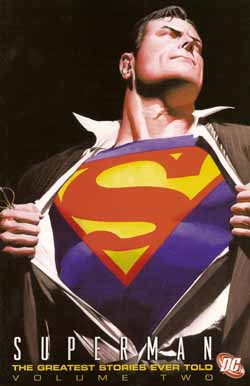
Superman: The Greatest Stories Ever Told, Vol Two 

By various

(DC Comics)  ISBN 1-84576-391-2

Here’s another collection of tales tracing the Man of Steel’s history and development, this time seemingly concentrating on character rather than physical achievement. First off is the much-reprinted, but always glorious, The Mysterious Mr. Mxyztplk (which was later Anglicised to Mxyzptlk, presumably to make it easier to spell) from Superman #30 (1944). Jerry Siegel and artist Ira Yarbrough created a cornerstone of the Superman myth with this screwball other-dimensional pixie, against whom all Superman’s strength and power are useless. From then on brains were going to be as important as brawn as they introduced frustration as the Big Guy’s first real weakness.

By the mid-1950s Superman had settled into an ordered existence. Nothing could really hurt him, nothing would ever change, and thrills seemed in short supply. With the TV show cementing the action, writers increasingly concentrated on supplying wonder instead. Superman’s Other Life by Otto Binder, Wayne Boring and Stan Kaye (Superman #132, 1959) shows what might have happened if Superman had grown up on an unexploded Krypton, courtesy of Batman and the projections of a super-computer.

Superman’s Return to Krypton (Superman #141, 1960) by Siegel, Boring and Kaye shoots successfully for Grand Tragedy as Kal-El is trapped in the past on his doomed home-world. Reconciled to dying there, he finds love with his ideal soul-mate, only to be torn from her side and returned to Earth against his will. This tale was a fan favourite for decades thereafter, and it’s truly deserving of a place in this volume, as is The Team of Luthor and Brainiac (Superman #167, 1964), a kid’s dream of an adventure by Edmond Hamilton (from a Cary Bates plot), Curt Swan and George Klein – possibly the most effective art team ever to work on the Man of Steel.

When Julie Schwartz took over the editorial duties, he decided to shake things up — with spectacular results. Superman Breaks Loose (Superman #233, 1971) by Denny O’Neil, Swan and Murphy Anderson, revitalised the Man of Tomorrow and began a period of superb stories that made him a ‘must-buy’ character all over again.

The Legend from Earth-Prime (Superman #400, 1984) is a clever little pastiche by Elliot S. Maggin and Frank Miller, and The Secret Revealed by John Byrne and Terry Austin comes from the second issue of the remodelled, Post-Crisis, Superman (1987), and reveals just how differently the new Luthor thinks and works. Following that is Life after Death (Adventures of Superman #500, 1993), by Jerry Ordway, Tom Grummett and Doug Hazlewood, the concluding episode of the infamous Death of Superman story-arc.

After a pin-up by Scott McDaniel and Andy Owens the volume concludes, symmetrically, with a recent, and absolutely hilarious, Mxyzptlk tale from Greg Rucka, Matthew Clark and Andy Lanning (Adventures of Superman #638, 2005).

Every generation has its own favourite Superman. This selection has the potential to make a fan reconsider just which one that might be. It’s probably wiser to just love them all.

© 1944, 1959, 1960, 1964, 1971, 1984, 1987, 1993, 2005 DC Comics. All Rights Reserved.
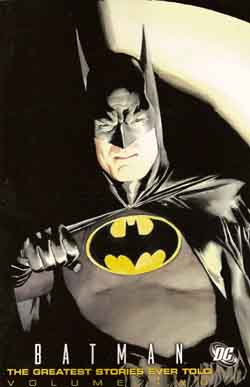
Batman: The Greatest Stories Ever Told, Vol Two

Batman: The Greatest Stories Ever Told Vol Two 

By Bob Kane & various

(DC Comics)  ISBN 1-84576-427-7

If you buy into the myth, then there are actually many great Batman stories. Over the decades lots of very talented creators have excelled themselves within Gotham City. Often the real problem is one of context, as many adventures worry reprint editors in terms of Sell-By Date, as if nearly seven decades of creativity can avoid looking dated to some modern consumers. Guys, who cares? They’re the ones who want to remake The Ladykillers and never read any book written before 1989. If they can’t understand history unless it’s got an American accent then they’re not worth the effort.

This selection has opted for a more open-minded interpretation and there is probably something that will appeal to every disparate sub-section of Bat-fan, from Dark Knight to Alien-Busting Boy Scout, since one of the big secrets of the Caped Crusader’s success has been his adaptability. There really is a Batman-for-all-seasons, and I’m sure someone, somewhere has written a thesis on his social mirroring of each popular societal trend.

For us though, there’s a charming and rewarding blend of Dark and Light as we walk the streets of Gotham from the late 1930’s to today.

One smart move is opening with a modern(ish) retelling of the origin and first case by reprinting Roy Thomas and Marshall Rogers’ excellent tale of the Golden Age Batman from Secret Origins #6 (1986) and following with Hugo Strange and the Monsters (Batman #1, 1940), Bill Finger, Bob Kane and Jerry Robinson’s pulp masterpiece that was recently reworked by Matt Wagner as Batman and the Monstermen.

From the idyllic 1950s period comes The Career of Batman Jones (Batman #108, 1957), a tale of a boy who wants to be a crime-fighter, by Finger, Sheldon Moldoff and Charles Paris. And the same team produced Prisoners of Three Worlds, a trans-dimensional sci-fi drama featuring Batwoman and the very first of many Batgirls (Batman #153, 1963). How Many Ways can a Robin Die? (Batman #246, 1972) comes from that edgier period when Batman first regained his grim mystique, and has the hero hunting for his missing partner and an axe-wielding psycho-killer, courtesy of Frank Robbins, Irv Novick, Dick Dillin and Dick Giordano.

The Batman’s Last Christmas comes from Brave and the Bold #184 (1982), a potentially confusing tale for some, as the daughter of the deceased Earth II Batman crosses the dimensional divide to spend the holidays with our hero. Mike W. Barr and Jim Aparo keep the scorecards there. Detective #526 (1983) gave us All My Enemies Against Me! an anniversary tale featuring a huge punch-up against nearly two dozen bat-foes and the origin of a new Robin, written by Gerry Conway, drawn by the shamefully neglected and much missed Don Newton, and inked by Alfredo Alcala.

The more-or-less modern Batman is represented by Of Mice and Men (The Batman Chronicles #5, 1996) by Alan Grant, Scott McDaniel and Ray McCarthy and Cave Dwellers by Scott Beatty, Chuck Dixon, Marcos Martin and Alvaro Lopez (Batgirl: Year One #4, 2003), both reinterpreting the early days of the characters for a modern and ostensibly more sophisticated audience, and both doing a good job of it. The volume closes with a stylish pastiche of black and white movie classics with the decidedly odd but engaging Citizen Wayne by Brian Michael Bendis and Michael Gaydos from The Batman Chronicles #21, 2000.

With judicious selection, there’s probably a good few more tales that could appear in successive volumes, but I’m still a little hesitant with that ‘Greatest Ever’ tag. Surely they can’t all be … No wait, I actually think they can.

© 1940, 1957, 1963, 1972, 1982, 1983, 1986, 1996, 2000, 2003, 2007 DC Comics. All Rights Reserved.

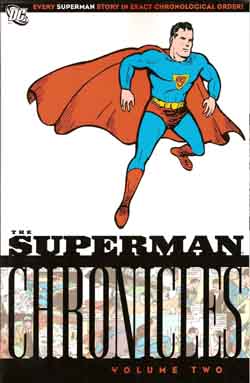
Superman Chronicles Volume 2

Superman Chronicles Volume 2 

By Jerry Siegel & Joe Shuster

(DC Comics) ISBN 1-84576-435-8

Here’s another welcome cheap-and-cheerful soft-cover collection of the earliest stories of the Man of Steel who quite literally spawned a genre, if not an actual art form. The rough, uncontrollable, wish-fulfilling exuberance is still present throughout, although Siegel and Shuster are swiftly polishing their craft with each story. These tales of the righteous, empowered man dealing out summary justice to wife-beaters, reckless drivers and exploitative capitalists as well as thugs and ne’er-do-wells captured the imagination of a generation, and are presented in totality and chronological order from Action Comics #14 (July 1939) through #20 (January 1940), and issues #2 and 3 of his own solo title.

To be strictly accurate, only the first and last strips from issue 3 appear in this volume, but they’re still great and I’m sure the remainder of the issue will appear in the next volume.

In this volume you’ll meet the first ever returning foe (us lags call ’em “arch-enemies”), The Ultra Humanite – twice!, plus a rip-roaring mix of hoods, masterminds, plagues, disasters, lost kids and distressed damsels – all dealt with in a direct and captivating manner by our relentlessly entertaining champion in summarily swift and decisive fashion. No continued stories here!

Read these yarns and you’ll understand why today’s creators keep returning to this material every time they need to revamp the big guy. They are simply timeless, enthralling, and great.

© 1939, 1940, 2007 DC Comics. All Rights Reserved.

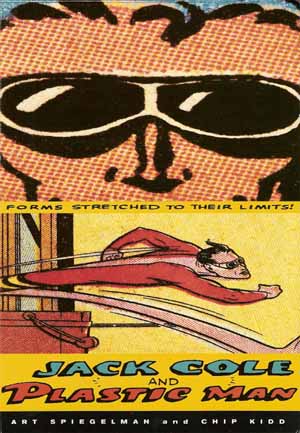
Jack Cole and Plastic Man

Jack Cole and Plastic Man 

By Art Spiegelman and Chip Kidd

(Chronicle Books)  ISBN 0-8118-3179-5

This eccentric tribute to the genius of cartoonist Jack Cole combines all the love and design skills of Spiegelman and Kidd with innovative print and paper techniques, a sharp biography and heart-felt appreciation of this inspired and tragic creator, and a wonderful selection of complete story reprints from Cole’s incredible fund of work.

The comic sections, printed of artificially browned newsprint — for that old comic feel — include The Eyes Have It (Police Comics #22, 1943), Burp the Twerp (Police Comics #29, 1944), Sadly-Sadly (Plastic Man #20, 1949), Plague of the Plastic People and Woozy Winks on Dopi Island (both from Plastic Man #22, 1950) and the legendary, if not infamous, Murder, Morphine and Me from True Crime Comics #1 (1947) cited often and tellingly by Dr. Frederick Wertham in his attacks on comics in the 1950s.

Although he would probably hate it said, Jack Cole is one of the key innovators in the field of comics and strip cartoons and this book is a fine tribute. Let’s get it reprinted right now!

Edition © 2001 DC Comics. All Rights Reserved. Text © 2001 Art Spiegelman

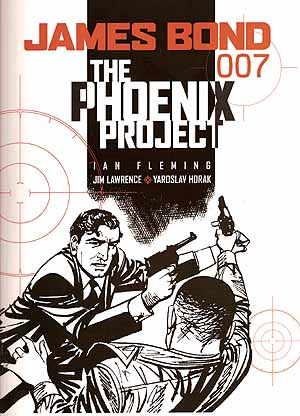
James Bond 007: The Phoenix Project

James Bond: The Phoenix Project 

By Jim Lawrence & Yaroslav Horak

Titan Books ISBN: 1-84576-312-2

Titan’s run of the newspaper strip Bond nears its inevitable conclusion in these tales from the mid-1970s, but the superlative work of scripter Jim Lawrence doesn’t slacken its pace or its grip on our action-hungry imaginations. The Phoenix Project examines some of the super-agent’s darker edges as he deals with the threat of a technological battle-suit that could revolutionise the way war is fought.

The Black Ruby Caper once again features a black lead heroine in a convoluted yet enthralling tale of duelling subversive organisations and a mysterious plot known only as Operation: Black Storm. As well as the usual fights and chases Bond has to use blackmail and coercion to achieve his goals. The exotic locales of Zurich, Paris and Ghana are no challenge to Horak’s gifted pens and brushes, and the increasing abundance of beautiful, naked women (it is the mid-1970s, after all) keeps everybody’s attention focussed.

Till Death Do Us Part is more traditional 007 fodder, as Bond kidnaps/rescues the daughter of a foreign “asset” to prevent a scandal. This is notable more for the inevitable introduction of the eccentric gadgets that had become an increasingly large part of the film version than for the adventure itself, but there are still thrills and flesh aplenty on view.

The volume closes with the brief but enthralling The Torch-Time Affair, wherein the search for a list of Latin American communist secrets leads to bodies on the beach, breathtaking chases over roads and through jungles and an intriguing detective mystery as 007 must save the girl, get the goods and kill the villain. Or must he..?

All the glamour and menace of James Bond is here in abundance and the chance to see two comic strip masters at their peak is very welcome and oh, so satisfying.

© 1974, 1975, 1976 Glidrose Productions Ltd/ Express Newspapers Ltd.
James Bond newspaper strip is © Express Newspapers Ltd 1987. All Rights Reserved