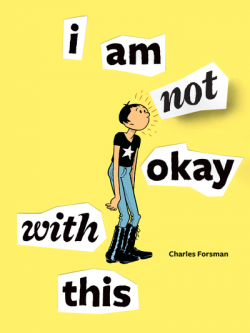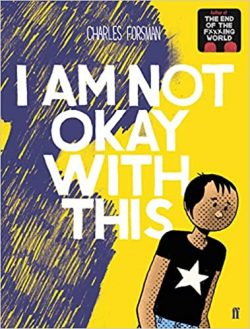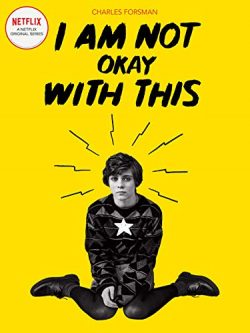
I Am Not Okay with This


By Charles Forsman (Fantagraphics Books)
ISBN: 978-1-68396-193-2 (FB PB) 978-0-57135-012-4 (Faber & Faber PB)

Teenage rites of passage are an evergreen source for dramatic material – and comedy too, if you’re fortunate enough to survive the inescapable maturation process relatively unscathed and not too warped – especially when viewed from a bit of distance and with the right perspective.

Even so, it certainly seems that the problems faced get worse for each successive generation. I can remember my lot facing peer and parental pressure, sexual and/or gender confusion, the war against conformity, political despair and general powerlessness, all while trying to stay sober enough to finish A-Level exams and ponder our employment futures, but trolls and invisible bullies you can’t escape or confront? No, thanks…

Today’s issues have a unique (devil’s) advocate however, in a brilliant cartoonist who combines keen insight, devilish imagination and an uncanny ear for dialogue to make stories it’s impossible to not respond to, no matter your specific age or circumstance…

Charles Forsman is a multi-award-winning graduate of Vermont’s celebrated Center for Cartoon Studies, whose previous releases include Celebrated Summer, The End of the Fucking World, Hobo Mom and self-published minicomics such as Snake Oil, Revenger and Slasher…

Already into its third physical printing, readily available digitally and the basis for an equally evocative – but by no means identical – TV adaptation, I Am Not Okay with This is rendered in a powerfully deceptive and underplayed cartoon primitivist manner which deviously disguises the fact that this yarn has the shock value and emotional impact of a chunk of concrete chucked through your windscreen from a motorway overpass…

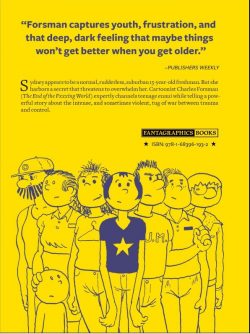
The tale for our times opens with troubled outsider Sydney reluctantly complying to a school counsellor’s urgings to start a journal to catalogue and confront her feelings. Syd is 15 and confused: she’s so far from pretty, a poor student, and recently lost her war-veteran dad in a most unconventional manner.

She’s fighting with her mom – who wastes all her time at her crappy waitressing job – and idiot little brother Liam. Her only friend Dina is now ghosting her, having just discovered boys in the incomprehensibly form of vile jock Brad. He wants to keep the freak away from his “property” and calls Syd a dyke. Maybe she is? So what?

…And now – as if sexual confusion, family insecurity and disgusting body breakouts aren’t enough – Syd discovers a hidden and uncontrollable ability to cause harm and destruction with her mind. She also thinks someone dark and dangerous is dogging her heels and knows all her secrets…

The similarities to the broader elements of Stephen King’s epistolary landmark Carrie or Kazuya Kudō & Ryoichi Ikegami’s Mai the Psychic Girl soon vanish in this tale, as the progression of diary entries intimately expose a succession of poor decisions and relationship mistakes that reshape and transform Syd and everyone she knows.

Sadly, the choices made by one lost soul are increasingly irredeemable. They will never get the chance to live down or move away from the events that soon overtake them all, bringing tragedy and disaster in their wake…

Potent and moving, I Am Not Okay with This is a devastatingly affecting variation on a teenage theme, and an unforgettable exploration of becoming human everyone with a heart and mind must read.
© 2018 Charles Forsman. This edition © 2018 Fantagraphics Books Inc. All rights reserved.

Blue is the Warmest Color


By Julie Maroh, translated by Ivanka Hahnenberger (Arsenal Pulp Press)
ISBN: 978-1-55152-514-3

Blue is the Warmest Color won the Palme d’Or at the 2013 Cannes Film Festival. Sadly the buzz around this big screen interpretation – it is not an adaptation – concentrated on the “excessive and prolonged lesbian sex scenes“ (decried and disowned by graphic novel author Julie Maroh) rather than the story.

We’re only really about comics here: it’s the words and pictures on paper that matter to me and hopefully to you too…

And what a wonderful marriage they make in Maroh’s moodily pensive exploration of prejudice and acceptance in a straightforward but devastating coming-of-age love story.

Le bleu est une couleur chaude was first published in France by Glénat in 2010, five years after Maroh originally began the tale as a 19-year old student studying Visual Arts and Lithography/Engraving at the Institut Saint-Luc and Académie Royale des Beaux-Arts (Brussels).

The collected album won the fan-determined Fnac-SNCF Essential prize (Audience Award) at the 2011 Angoulême International Comics Festival, subsequently garnering many more international accolades. Sadly, no American publisher was brave enough to tackle the English language translation, but that’s why indie outfits like Canada’s Arsenal Pulp exist…

The story opens as Emma returns to a house she was unceremoniously banished from decades ago. Beloved Clementine is dead, but her last wish was that her one true love have her journals; books which described the thoughts and fears, ambitions and dreams of a confused 15-year old girl who struggled to accept her nature in a toxic school and home environment where loving someone of your own sex was considered an abomination…

Emma stays overnight in a home scarred by tragedy and steeped in tension, repentance and still-undispelled animosity, reading of how, in 1994, fraught and frantic high schooler Clementine saw a girl with blue hair and just couldn’t forget her…

This is a beautiful, simple, evocative and ultimately tragic story about how two very young people fell in love and what eventually happened to them. It’s not polemical or declamatory and doesn’t have points to score. That the Romeo and Juliet are both female is sublimely irrelevant except in the ways and manners it shaped the problems the lovers had to overcome…

Depicted alternately in a beguiling wash of misty full colour and stark dichromatic tones, the images are subdued and enthralling, not dynamic or overblown, and although there are some explicit love scenes, they are vital to the tale’s context and utterly subsumed by the overwhelming tide of elegiac sadness, political and social turmoil and doom-laden mystery which permeates the proceedings.

This is a masterful and compellingly human story that will astound lovers, loving grown-ups and all lovers of comics narrative.

Yes, there is a movie, but for pity’s sake read this first…

English Language edition © 2013 Arsenal Pulp Press. First published in French as Le bleu est une couleur chaude by Julie Maroh © 2010 Glénat Editions. All rights reserved.

Life with Kevin


By Dan Parent, J. Bone & various (Archie Comics)
ISBN: 978-1-68255-940-6 (TPB)

Created by writer/artist Dan Parent and inker Rich Koslowski, Kevin Keller debuted in Veronica #202 (September 2010): a charming, good-looking and exceedingly together lad who seemingly disrupted the eternal cartoon triangle of Archie Andrews, Veronica Lodge and Betty Cooper. Keller utterly bowled over the rich go-getter and she was totally smitten with him, although he was far more interested in food, sports and hanging out with the boys… especially JugheadJones…

The new kid was a much-travelled, journalism-obsessed “Army Brat”, who in short order was elected Class President, made loads of friends and came out as Riverdale High School’s first openly gay student. When Kevin finally explained to Veronica why she was wasting her time, she became his best buddy: after all they had a lot in common – stylish clothes, shopping and good-looking guys…

Immensely popular from the outset (Veronica #202 was the first comic book in the company’s long history to go to a second printing), Kevin struck a deep and abiding chord with the readership. Soon guest shots evolved into a miniseries before the new kid on the block inevitably won his own ongoing title.

In recent years the company has created related strands for their iconic characters to explore other realities. Archie has married both Betty and Ronnie, been assassinated, faced supernatural horrors of every kind and even entered the 21stcentury. These parallel lives projects have proved immensely popular and so have quite sensibly been extended to include the other inhabitants of Riverdale…

In 2017, a 5-issue miniseries by Parent, inker J. Bone and letterer Jack Morelli focused on Kevin after finishing at Riverdale and graduating from college. Trade paperback & eBook compilation Life with Kevin – delivered in a limited but superbly effective palette of black, white and blue – follows his career as he moves to New York City and joins a major metropolitan news outlet…

Referencing TV sitcoms such as 30 Rock or Rhoda, and subtitled ‘Kevin in the City’ the fun begins in ‘You’re Gonna Make it After All! (Maybe)’ as young Keller moves into a grim apartment, meets his interesting neighbours and makes an unforgettable impression on his new boss at station NYC-TV.

Sadly, his views on what constitutes journalism don’t match hers in the cutthroat era of click-bait and Twitterstorms. Even more tragically, the fact that the camera loves and viewers adore him means Kevin might be forced into becoming a useless, vapid Screen Celeb himself…

The day ends perfectly when Veronica shows up. On Kevin’s advice, his BFF talked back to daddy and now she’s disinherited, broke and homeless…

‘Room for Change’ resumes a short while later with Kevin finding his love life and dating days seriously curtailed by roommate Ronnie, who, unsurprisingly, cannot hold on to any job she finds and whose efforts to help inevitably go badly awry…

After building a profile on a dating app and then accidentally outing himself on live TV – a strict policy no-no at NYC-TV- Kevin’s life gets even crazier. In ‘I’m Dancing as Fast as I Can!’ his boss Babs is ordered to exploit her camera-shy protégé onscreen as much as legally possible. This leads to Ronnie accidentally endangering the mental health of a shy young gay student Kevin is helping through some difficult times…

The gathering storm breaks on social media in ‘Past Tense!’ with Bab’s ruthless attempt to capitalise on the personal crisis for ratings compelling Kevin to make a world-changing decision, but only after a chaotic comedy of errors devastates the station’s schedules…

The story pauses for now with ‘Moving Forward!’ as the progression of roommate dramas, two-timing bad boyfriends, family health scares and career calamities lead to Kevin taking charge of his life and making the future he wants and deserves…

A charming, feel-good comedy romp, Kevin in the City reads like a pilot for a TV series, packed with tension and hilarity whilst delivering the kind of joyous, life-affirming frolics modern folk enjoy. It also succeeds in being about the characters themselves and the situations they endure, not the inconsequential logistics of who they fancy…

Augmenting the saga is a cover gallery by Parent, and a few bonus stories, all taken from Your Pal Archie #1, and set in modern-day Riverdale.

The madness begins with ‘The Road Worrier’ courtesy of scripter/inker Ty Templeton, penciller Dan Parent, colourist Andre Szymanowicz and letterer Morelli. Here high schoolers Betty, Ronnie, Archie and Jughead plan out their summer holidays before an ordeal of shocking terror is unleashed as that Andrews boy attempts to teach Juggie how to drive…

The main event and compelling cliffhanger comes with ‘A Night at the Opera’ as Ronnie gives Archie the brush-off for a sophisticated sophomore. Once again driven astray by Jughead, Archie then buys a lotto ticket that will change his life forever…

Of course, you’ll have to buy that graphic novel to see what happens next, but at least Life with Kevin is a complete experience, at once hilarious, enthralling and magically inclusive for you, your kids and grandparents to enjoy over and over again…
™ & © 2017 Archie Comics Publications, Inc. All rights reserved.

Fires Above Hyperion


By Patrick Atangan (NBM/Comics-Lit)
ISBN: 978-1-56163-986-1 (TPB)

Bad times for human beings, these days. With people dying in incalculable numbers and denied the simple solace of friendly or familial contact at the end, with most of the world’s leaders fumbling the ball as the planet dies from commercial abuse and exploitation and with haters and bigots proudly – and without a trace of shame – spreading their bile again, it seems odd to moan about comparatively minor issues.

Nevertheless, I’m adding another sin to the menu. Perhaps the cruellest and most pitiful of the minor horrors besieging us at the moment is the simple absence of a chance to congregate with friends and assert the right to live life your own way (hypocritically, that’s a right I’d happily deny every racist, fascist and homophobe in existence, but hey, I’m “complicated”)…

After millennia of struggle, a large proportion of mankind eventually decided it was okay for men to love men, women to love women and in fact every variety of person to enjoy the company of any other person or persons as long as it was consenting.

I know it’s hard for some to let go of hate and fear, but we’d made a good honest start. Over time people even convened in vast, colourful bustling parades and parties: a rowdy affirmation of a struggle that was generally being won.

That’s not happening this year, but LGBTQ+ folk are resilient and have adapted. Go join an online or distanced event if you can. And then there’s books and comics. The fraternity is superbly proficient at using art and narrative and the Queer comics genre is vast, expansive and astoundingly worthwhile and entertaining. Here’s one of my favourites, still available in paperback and many digital formats that you really should see…

It’s long been an aphorism – if not outright cliché – that LGBTQ+ comics are the only place in the graphic narrative game where real romance still thrives. As far as I can see though it’s true; an artefact, I suppose, of a society which seems determined to demarcate and separate sex and love as two utterly different – and even opposite – things.

I’d prefer to think that in the 21st century – at least the more civilised bits which actually acknowledge and welcome that times have changed – we’ve outgrown those juvenile, judgemental, religion-blighted bad old days and can simply appreciate powerful, moving, wistful, sad and/or funny comics about ordinary people without any kind of preconception. That battle’s still not completely won yet, but hopefully thoughtful, inspirational memoirs such as this will aid the transition…

Californian Patrick Atangan (Songs of Our Ancestors, Invincible Days) is a multi-talented Filipino-American creator with many strings to his creative bow: as deft and subtle in his computer-generated comic tales and retellings of Asian myths as with the tools he uses to craft high-end designer furniture.

Here, to his printed canon for youngsters, he’s added a wry, charming yet deeply moving collection of short intimate musings and recollections on his “romantic gaffes and failures” and the results are enough to make the toughest cookie crumble…

Pitched as if “Sex and the City had been created by a gay Charlie Brown” these utterly compelling, seditiously humorous slices of a life lived a little too much inside one’s own head kick off with chronological logic as the still-closeted Patrick attends his ‘Junior Prom’. The problem is that he is escort to obsessive beard Mildred, whose attention to detail and determination to make the event “absolutely perfect” cannot help but fail. At least the string of disasters the fervent Promzilla endures takes the spotlight off his own failings, petty jealousies and perceived inadequacies…

‘Secrets’ skips ahead to the emotional liberation of college as our introvert resolves to reinvent himself and begins an ongoing process of Outing which gradually encompasses friends, family and everybody new in his life. Sadly, that in turn leads to a sort-of romance with Calvin who never really comes to terms with his own sexual identity…

On leaving academe, another character-building debacle involves ‘Gary’; someone our author judged far too lovely for a dweeb like himself – and therefore something of a self-fulfilling prophecy – before eponymous vignette ‘The Fires Above Hyperion’ turns the screws even tighter.

The tale finds Patrick coolly contemplating the now-annual forest fires threatening Los Angeles whilst foolishly attempting to rekindle or reinvent the three-year relationship he has just ended with Roger…

Eschewing his usual ‘New Year’s Eve’ ritual, the narrator attends a big party and suffers inebriation, gastric trauma and the humiliation of mistakenly putting the moves on a chain-smoking straight guy before ‘APE Shit’ reveals the sorry fallout of a trip to San Francisco to attend his first Alternative Press Expo in a decade: a concatenation of domestic disasters comprising old friends with new children, commuter congestion and a total change in the way Indy comics are sold.

At least he connects with gorgeous, seemingly ideal Bryan – before Fate and Patrick’s own conscience play a few pranks to spoil what might have been a perfect moment…

More notionally self-inflicted trauma comes out of ignoring the custom of a lifetime and attending a wedding as a ‘Plus One’. Naturally he didn’t mind his “date” Julia going off with a guy, but when Patrick zeroes in on wonderful, apparently available Peter, events and the author’s own treacherous tuxedo conspire to make the soiree memorable for all the wrong reasons…

A heartbreakingly harsh assessment of Patrick’s failings then lead to the awful conclusion that he is ‘Nobody’s Type’before the excoriating romantic recriminations end with another ill-fated, self-sabotaged first date that founders because of too much introspection and an accumulation of ‘Baggage’…

Insightful, penetrating, invitingly self-deprecating, guardedly hopeful and never afraid to be mistaken for morose when occasion demands, this collection of misjudged trysts and missed chances offers a charming glimpse at the eternally hopeful way most folks of every persuasion live their love-lives and the result is magical and unforgettable.

This is a must-have item for anyone graced with heart and soul…
© 2015 Patrick Atangan.

Sickness Unto Death volumes 1 & 2


By Hikaru Asada & Takahiro Seguchi (Vertical)
ISBN: 978-1-939130-09-9(tankōbon PB vol. 1) 978-1939130105(tankōbon PB vol. 2)

Here’s an intriguing and tragically underrated and sadly forgotten saga deftly examining the devastating effects of despair that still has plenty to say and much to offer…

Takahiro Seguchi’s gripping psychological melodrama Sickness Unto Death is a bleak and enthralling, emotionally complex tale of love, compulsion and dependency, transformed into spellbinding comics by artist Hikaru Asada.

Inspired by Danish philosopher Søren Kierkegaard’s treatise Sygdommen til Døden (The Sickness Unto Death – a Christian existentialist examination of the “Sin of Despair”), this extremely accessible tale began in 2009 as Shi ni Itaru Yamai; serialised in Hakusensha’s fortnightly Seinen magazine Young Animal.

This translated version opens with a Professor standing beside a student over the grave of his first case – and greatest love…

A flashback begins revealing how, as a young man, Kazuma Futaba came to the city to study clinical psychology, and how he was lucky to find lodgings in an old house. However, on his way there he encountered a young girl with white hair suffering a crushing anxiety attack in the street. Although everybody ignored the crippled creature, he rushed to her assistance and happily complied with her desperate need to be held.

‘Emiru’ was impossibly cold to the touch and although both were merely 18 years old, she seemed inexorably gripped by an ancient despondency and overwhelming gloom…

After she recovered, he hurried on to find his new digs in a vast old house, meeting the butler Kuramoto who reveals the place belonged to the orphan Emiru Ariga, a beautiful, vivacious creature who had within the last two years suddenly succumbed to a crushing ‘Despair’ so great it had bleached her hair, triggered drastic weight-loss, weakened her heart and caused her body temperature to fall to far below normal. He describes it as a “terminal illness of the spirit”. She now spends most of her time locked in her room, drawing monsters and waiting to die…

Intrigued, desperate to help but painfully aware of how inexperienced he is, Futaba examines the compliant, barely-living corpse and determines to somehow help her. At least she shows some animation when he is near. Both Kuramoto and his young mistress want Futaba to fix her…

In ‘Haunted Mansion’ the relationship develops further as the student transfers what he learns by day at school into evening therapy. Emiru seems brighter, even though she believes the house harbours ghosts…

When Kuramoto is called away for a few days, he leaves Futaba in charge, but after the frail girl spends too long in a bath, the boy panics. Breaking in, he sees her painfully thin, nude form for the first time. Embarrassed and confused, he dashes away and stumbles upon a mystery room, its door nailed shut with heavy planks.

Emiru sees ghosts: a crying, lonely child and a monster with teeth but no face…

Her sleep is perpetually disturbed, and Futaba – after learning about Night Terrors in class – agrees to ‘Sharing a Bed’, even though he is no longer certain his own motives are strictly professional. Nevertheless, resolved to save her he begins a ‘Psych Assessment’, gathering facts and personal history, but learns little more than once she was normal and then, suddenly, she wasn’t…

Emiru is increasingly time-locked in lengthy periods of despair, weeping outside the barred room; her traumatic nights eased by Kazuma’s platonic presence, although she feels the spectral presence of ‘The One in the Mansion’ whenever he goes away…

In the present, Professor Futaba and student Minami – who thinks she too can see a ghost in the abandoned dwelling – explore the deserted, decrepit mansion which housed his greatest regret. When they stop at a monster drawing scrawled on a wall, it takes him back to those troubled years…

A setback in Emiru’s recovery occurs when another ghost sighting unleashes a wave of depression and young Futaba learns of her carefree ‘High School Years’ from fellow psych student Koizumi – a former classmate of Emiru when she a healthy, happy, raven-haired ball of wild energy, fun and adventure…

Koizumi ardently believes she became burdened with some terrible secret that overnight transformed her into the frail, fading creature Futaba describes, prompting the floundering lad to confer with his tutor Professor Otsuki. The mentor responds by lending him a copy of Kierkegaard’s infamous tract…

For such a weakened patient, even a cold might be fatal, but with Futaba at her side Emiru pulls through. However, after recovering, she entices him into crossing a ‘Forbidden Line’ but neither as therapist nor lover is young Futaba assured of securing her ‘Happiness and Beauty’ until and unless he can her unburden her obsessive soul of the dark secret strangling it from within…

Beguiling and hypnotic, this exceptional medical mystery/ghostly love story is far from the familiar – to Western eyes at least – explosive bombast and action slapstick normally associated with Japanese comics. As such it might just make a few manga converts amongst die-hard holdouts who prefer sensitive writing, deep themes and human scale to their comics.

Moody, moving and far more than just another adult manga, Sickness Unto Death is that rarest of things: a graphic novel for people who don’t think they like comics…
© 2010 Hikaru Asada. © 2010 Takahiro Seguchi. All rights reserved.

A City Inside


By Tillie Walden (Avery Hill)
ISBN: 978-1-91039-541-7 (HB) 978-1-91039-520-2 (TPB)

Transitions are important. In fact, they are literally life changing. Here’s another one captured and shared by the amazing Tillie Walden…

We usually attribute wisdom and maturity in the creative arts to having lived a bit of life and getting some emotional grit in our wheels and sand in our faces, but maybe that’s not the case for Texas-raised Tillie, whose incredible string of releases include I Love this Part, Spinning, On a Sunbeam, and Are You Listening? and award-winning debut graphic novel The End of Summer.

A City Inside is another seamlessly constructed marriage of imagination and experience to unflinching self-exploration, constructing a perfect blend of autobiography and fantasy into a vehicle both youthfully exuberant and literary timeless.

Opening in a therapy session, the story delves intimately into a woman’s past, from isolated southern days to bold moments of escape – or is that simply drifting away? – in search of peace and a place to settle. We all leave home and then grow up, and here that transition is seen through the tentative alliance with an ideal first love. That fumbles and fails, thanks to the dull oppression of the Happy Ever After part that no fairy tale ever warns you about…

Eventually life builds you into the being you are – hence the symbolism of a vast internal metropolis – and life goes on, or back, or away, or just somewhere else. That’s pretty much the point…

Supremely engaging, enticingly disturbing and ultimately utterly uplifting, this shared solo voyage to another county is a visual delight no lover of comics can possibly resist. Apart from the graceful honesty on show, the most engaging factor is the author’s inspired rearrangement of visual reality. These dictate mood and tone in a way a million words can’t, supplying a sense of grace and wistful whimsy to the affair.

You’d have to be bereft of vision and afflicted with a heart of stone to reject this comic masterpiece – available in hardback, softcover and digital formats – which no one should miss.
© Tillie Walden 2016. All rights reserved.

House of Clay


By Naomi Nowak (NBM)
ISBN: 978-1-56163-511-5 (TPB)

Not every story should be about overcoming great odds, or triumphing over the impossible. Sometimes it’s enough just to keep going…

Painter, illustrator and graphic novelist Naomi Nowak (Unholy Kinship; Graylight) crafts in painted style a dreamy yet potent exploration of the uses and abuse of love in her tale of a young girl who turns her back on a wealthy family and identity. Calling herself Josephine she journeys to the coast, taking a dreadful job in a sweatshop, amongst broken women and girls, and sewing clothes for unpleasant bosses. The only one she can truly confide in and share her thoughts with is a mute work companion…

Restless and roaming, Josephine’s off-duty wanderings bring her to an obnoxious old fortune teller while her unconfined fantasies lead into a romantic entanglement and some life-changing conclusions in a stylish tale of emancipation and empowerment that manages to stay firmly grounded in the unreal, but important.

Colourful, lyrical, sometimes bordering on the pretentious, but eminently readable and beautiful to look at, this different sort of graphic narrative has a great deal to offer the reader looking for more than fistfights or funny stuff.
© 2007 Naomi Nowak. All rights reserved.

Hi Score Girl


By Rensuke Oshikiri translated by Alexander Keller-Nelson (Square Enix Manga & Books)
ISBN: 978-64609-076-7 (Tankōbon PB)

I’ve been dreadfully longwinded of late so here’s a quick review of a book I didn’t expect to like at all, but which happily surprised me.

Let me start by admitting I’m old and slow and physically decrepit. Computer gaming of all stripes and sorts has completely passed me by, and even when I was a fit, demi-god-like Adonis, I was completely immune to the allure of moving screens, ghastly cartoon explosions and things that went blip or bleep. I knew other folk liked them, but I couldn’t care less.

I still don’t, but they’ve been around long enough to have entertained generations and acquire some vintage, and this delightful manga (and the usual anime and movie/TV spinoffs) cannily access that sense of time well spent and happy childhoods to splendid effect for a very human story.

Created by Rensuke Oshikiri, the strip Hai Sukoa Gāru began in October 2010 in Monthly Big Gangan, running until September 2018 and filling ten Tankōbon volumes with the collected adventures. There is talk of a sequel series soon…

It’s actually a slow-burning romcom that begins in 1991, concerning poor schoolboy Haruo “Mighty Fingers” Yaguchi. He hasn’t got much, but he’s the king of his local video game arcade – and any other he can find money to enter. At least, that is, until little perfect miss Akira Oona comes in and starts trashing his scores…

She’s in his sixth-grade class: pretty, rich, aloof. Everybody loves her – even the teachers – even though she never speaks to anyone. What right – or need – has she to invade his sordid dominions?

He hates her.

As she continually and constantly wrecks his rep on a variety of games that will cripple fans and cognoscenti with overpowering nostalgia, his ire grows. However, as shared interests and surprisingly similar domestic problems push them together, his attitudes begin to change. Hers are harder to fathom. Like Tommy in that rock opera, she only seems to come alive in front of a console…

Packed with the kind of technical detail and historical background all geeks – gamers, comics, whatever – and surprise features, this is a truly engaging yarn that ends on a potentially tragic cliffhanger that will have you clamouring for more…
© 2016 Rensuke Oshikiri/SQUARE ENIX CO., LTD. English translation © 2020 SQUARE ENIX CO., LTD.

I Love This Part


By Tillie Walden (Avery Hill)
ISBN: 978-1-91039-532-5(HB) 978-1-91039-517-2 (TPB)

Happy St. Valentines’ Day. I’m stifling my usual curmudgeonly attitudes for a while and reviewing a book that’s solidly on the side of being in love, but not so disingenuous as to tell you that it’s all hearts and flowers…

Sweet but not calorific, I Love This Part deliciously pictorializes the happy, introspective, contemplative and aspirational moments of two schoolgirls who have found each other. Shared dreams, idle conversations, disputes and landmark first steps, even fights and break-ups are seen and weathered. Novelty, timidity, apprehension, societal pressure and even some unnecessary shame come into it, but generally it’s just how young people learn to love and what that inevitably entails…

Apart from the astoundingly graceful and inviting honesty of the tale, the most engaging factor is the author’s brilliant dismissal of visual reality. These interactions are all backdropped by wild changes in dimension and perspective, abrupt shifts in location and landscape and shots of empty spaces all adding a sense of distance and whimsy to very familiar proceedings.

Tillie Walden is a great admirer of Little Nemo so fellow afficionados will feel at home even if neophytes might experience the odd sensation of disorientation and trepidation. Like being in love, I suppose…

Glorying not just in the relationships but also in the sheer joy of drawing what you feel, Texas-raised Tillie is still a relative newcomer – albeit a prolific and immensely gifted one – who has garnered heaps of acclaim and awards. Whether through her fiction or autobiographical works (frequently combined in the same stories), she always engenders a feeling of absolute wonder, combined with a fresh incisive view and measured, compelling delivery in terms of both story and character. Her artwork is a sheer delight.

Before globally turning heads with such unforgettable tales as On a Sunbeam, A City Inside, Spinning, and Are You Listening? she followed up on her Ignatz Award-winning debut graphic novel The End of Summer with this fluffy yet barbed coming-of-age tale.

You’d have to be bereft of vision and afflicted with a heart of stone to reject this comic masterpiece – available in hardback, softcover and digital formats – which no one should miss.
© Tillie Walden 2016. All rights reserved.

Liberty Meadows: Sundays Book One


By Frank Cho (Image/Monkey Boy Press)
ISBN: 978-1-60706-564-7 (HB)

It’s ALMOST too late to concoct a suitable St Valentine’s Day extravaganza worthy of the one who puts up with you, so let todays review serve to remind you that not only is love strange but it can also tolerate an incredible amount of unsavoury behaviour – it just shouldn’t have to…

Like many wonderful modern comics strips, Liberty Meadows grew out of a prototype college newspaper incarnation: specifically, the University of Maryland (College Park) student periodical The Diamondback.

Back then the strip was called University² but it still revealed the warped genius and stunning graphic virtuosity of native Marylander Frank Cho. As a syndicated strip Liberty Meadows launched on March 31st 1997, running until December 30th 2001. It also enjoyed a respectable run as a comic book released through Insight Studios.

The strip which won a hoard of awards before going on hiatus (hey, if Bloom County can come back after decades, so long as the artist’s still alive, I’m keeping the faith for this and Calvin & Hobbes), is a whimsical masterpiece of comedy appealing to anyone afflicted with a love of pop culture, wistfulness, slacker-ness and unrequited passions. This first hardcover (or digital) compilation of full-colour Sunday strips cover the first three years and is saucily appreciated by Cho’s great pal and confederate Mike McSwiggin in his Introduction.

What’s it About, I hear you enquire? Easier asked than answered…

Exhibiting elements of the aforementioned Berkely Breathed’s magnum about Opus, and cheekily pilfering and channelling every comicbook, TV, movie and trash culture icon you might imagine, the episodes occur in and around the animal sanctuary of Liberty Meadows and generally revolve around the ever-so-patient animal psychologist Brandy Carter as she blithely tries to circumvent her innate hottie-ness and get on with her job.

The major obstacles to this simple ambition include not just human impediments such as shyly adoring vet Frank Melisch, clumsily dangerous janitor Tony, sanctuary owner Julius, and Brandy’s super sexy roommate Jen (she’s a rocket scientist who loves to toy with men…) but also the scene-stealing frequently obnoxious smart alec talking animals such as midget circus bear Ralph, literally sexist pig Dean, hypochondriac frog Leslie, innocent waif – and duck – Truman, mute dachshund Oscar, OCD-suffering raccoon Mike, Khan the catfish and an evil cow dubbed The Cow…

Further turning this small word upside down are conspiracy-theorist and local barkeep Al, Brandy’s ex Roger, her parents (say no more), and a couple of duplicates from a mirror universe: Evil Brandy and Alternate Frank…

You’ll thank me for not giving away any of the 138 beautifully rendered, seditiously surreal gags, but I will push my luck by stating Cho insinuates himself into proceedings on a regular basis (as forth-wall busting chimpanzee Monkey Boy) and warning you to watch out for low flying dinosaurs, wandering daydreams, outbursts of 3-D, and constant outbreaks of strip and movie spoofs such as Prince Valium, Mighty Shmoe Pong, Jungle Gym and Flush Gordon…

Frank Cho is a very funny guy and also one of the best dramatic illustrators in the business, so you’ll also appreciate the spiffy Sketch Gallery featuring pencils, inks, roughs and some delicious images of Brandy as your favourite female superheroes.

Magnificently redolent of (and proudly swiping from) Walt Kelly, Dave Stevens, Frank Frazetta, Barry Windsor-Smith, Michelangelo (not the turtle), and others of their prestigious ilk as the gag demands, Cho’s blend of anthropomorphic anarchy, sublimely lavish glamour illustration and devilish wit means this is a timeless treat and treatise on love you simply must see…
™ and © 2012 Frank Cho, Monkey Boy Press. All rights reserved.