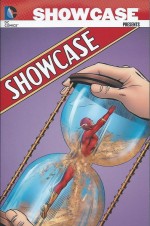
By various (DC Comics)
ISBN: 978-1-78116-364-1
This review is incredibly long. If you want to skip it and just buy the book – because it’s truly brilliant – then please do. I won’t mind and you won’t regret it at all…
In almost every conceivable way the “try-out title†Showcase created the Silver Age of American comicbooks and is responsible for the multi-million dollar industry and nascent art form we all enjoy today.
For many of us, the Silver Age is the ideal era and a still-calling Promised Land of fun and thrills. Varnished by nostalgia (because it’s the era when most of us caught this crazy childhood bug), the clean-cut, uncomplicated optimism of the late 1950s and early 1960s produced captivating heroes and compelling villains who were still far less terrifying than the Cold War baddies then troubling the grown-ups. The sheer talent and professionalism of the creators working in that too-briefly revitalised comics world resulted in triumph after triumph all of which brightened our young lives and still glow today with quality and achievement.
The principle was a sound one and graphically depicted in the very first issue: the Editors at National were apparently bombarded with readers’ suggestions for new titles and concepts and the only possible way to feasibly prove which would be popular was to offer test runs and assess the fans reactions…
This magnificent monochrome tome starts firmly ensconced in the age of genre thrillers and human adventurers, covering the first 21 issues from that historic series, spanning March/April 1956 to July/August 1959, and starts the ball rolling with the first and last appearances of Fireman Farrell in a proposed series dubbed Fire Fighters.
Following the aforementioned short ‘The Story Behind Showcase’ by Jack Schiff & Win Mortimer, the realistic dramas begin in ‘The School for Smoke-Eaters’ by Schiff and the superb John Prentice, which introduced trainee fireman Mike Farrell during the last days of his training and desperate to simultaneously live up to and escape his father’s fabulous record as a legendary “smoke-eaterâ€.
The remaining stories, both scripted by Arnold Drake, dealt with the day-to-day drama of the job: first in ‘Fire under the Big Top’ wherein an unscrupulous showman ignored Farrell’s Fire Inspection findings with tragic consequences, then in ‘Fourth Alarm’ which mixed an industrial dispute over fireman’s pay, a crooked factory owner and a waterfront blaze captured on live TV in a blisteringly authentic tale of human heroism.
Showcase #2 featured Kings of the Wild: tales of animal bravery imaginatively related in three tales scripted by Robert Kanigher – who had thrived after the demise of superheroes with a range of fantastical genre adventures covering western, war, espionage and straight adventure. ‘Rider of the Winds’, stunningly illustrated by Joe Kubert, told the tale of a Native American lad and his relationship with his totem spirit Eagle, ‘Outcast Heroes’ (Ross Andru & Mike Esposito) related how an orphan boy’s loneliness ended once he befriended a runaway mutt who eventually saved the town’s kids from a flood and ‘Runaway Bear’, drawn by Russ Heath, used broad comedy to describe how an escaped circus bruin battled all the horrors of the wilderness to get back to his comfortable, safe life under the Big Top.
Issue #3 debuted Kanigher & Heath’s The Frogmen in an extended single tale following candidates for a US Underwater Demolitions Team as they moved from students to successful undersea warriors. Beginning with ‘The Making of a Frogman’ as the smallest diver is mocked and chided as a ‘Sardine’ by his fellows – especially the ones nicknamed ‘Shark’ and ‘Whale’ – but persevering and forging bonds until the trio were dumped into blazing Pacific action in ‘Flying Frogmen’, eventually learning the worth of teamwork and sacrifice by destroying a Japanese Sub base in ‘Silent War’…
The feature, if not the characters, became a semi-regular returning strip in All-American Men of War #44 (April #1957) and other Kanigher-edited war comics: making Frogmen the first but certainly not the last graduate of the try-out system. The next debut was to be the most successful but the cautious publishers took a long, long time to make it so…
No matter which way you look at it, the Silver Age of the American comic book began with The Flash. It’s an unjust but true fact that being first is not enough; it also helps to be best and people have to notice. The Shield beat Captain America to the news-stands by over a year yet the former is all but forgotten today.
The industry had never really stopped trying to revive the superhero genre when Showcase #4 was released in late summer of 1956, with such precursors as The Avenger (February-September 1955), Captain Flash (November 1954-July 1955), Marvel’s Human Torch, Sub-Mariner and the aforementioned Sentinel of Liberty (December 1953-October 1955) and even DC’s own Captain Comet (December 1953-October 1955) and Manhunter from Mars (November 1955 until the end of the 1960’s and almost the end of superheroes again!) still turning up in second-hand-stores and “Five-and-Dime†half-price bins. What made the new Fastest Man Alive stand out and stick was … well, everything!
Once the DC powers-that-be decided to try superheroes once more, they moved pretty fast themselves. Editor Julie Schwartz asked office partner and Golden-Age Flash scripter Robert Kanigher to recreate a speedster for the Space Age, aided and abetted by Carmine Infantino & Joe Kubert, who had also worked on the previous incarnation.
The new Flash was Barry Allen, a forensic scientist simultaneously struck by lightning and bathed in the exploding chemicals of his lab. Supercharged by the accident, Barry took his superhero identity from a comic book featuring his predecessor (a scientist named Jay Garrick who was exposed to the mutagenic fumes of “Hard Waterâ€). Designing a sleek, streamlined bodysuit (courtesy of Infantino – a major talent who was rapidly approaching his artistic and creative pinnacle), Barry Allen became the point man for the spectacular revival of a genre and the entire industry.
‘Mystery of the Human Thunderbolt’ (scripted by Kanigher) and ‘The Man Who Broke the Time Barrier’ (written by the superb John Broome) are polished, coolly sophisticated short stories that introduce the comfortingly suburban superhero and firmly establish the broad parameters of his universe. Whether defeating bizarre criminal masterminds such as The Turtle or returning the criminal exile Mazdan to his own century, the new Flash was a protagonist of keen insight and sharp wits as well as overwhelming power. Nonetheless the concept was so controversial that despite phenomenal sales, rather than his own series the Fastest Man Alive was given a second Showcase tryout almost a year later…
Showcase #5 featured the last comics concept in years that didn’t actually develop into an ongoing series, but that’s certainly due to the changing fashions of the times and not the quality of the work that made up the three crime yarns comprising the cops-&-robbers anthology Manhunters. ‘The Greatest Villain of all Time’ by Jack Miller & Mort Meskin told how Hollywood screenwriter-turned-police detective Lt. Fowler was dogged by a madman who was playing for real all the fantastic bad guys the mystery author had once created, whilst in ‘The Two Faces of Mr. X’ (Miller, Curt Swan & Sy Barry) a male model was drafted by the FBI to replace a prominent mob-boss. Unfortunately it was the day before the gangster was scheduled for face-changing plastic surgery.‘The Human Eel’ (Miller & Bill Ely) pitted a cop unable to endure heights against an international high-tech rogue who thought he knew all the answers…
The next tryout was on far firmer fashion grounds and was the first feature to win two issues in a row.
The Challengers of the Unknown were a bridging concept. As the superhero genre was ever so cautiously being alpha-tested in 1956 here was a super-team – the first new group- entry of the still-to-be codified Silver Age – but with no uncanny abilities or masks, the most basic and utilitarian of costumes, and the most dubious of motives: Suicide by Mystery…
If you wanted to play editorially safe you could argue that were simply another para-military band of adventurers like the long running Blackhawks… but they weren’t.
A huge early hit – winning their own title before the Flash (March 1959) and just two months after Lois Lane (March 1958, although she had been a star in the comics universe since 1938 and even had TV, radio and movie recognition on her side), the Squad struck a chord that lasted for more than a decade before they finally died… only to rise again and yet again. The idea of them was stirring enough, but their initial execution made their success all but inevitable.
Jack Kirby was – and still is – the most important single influence in the history of American comicbooks. There are quite rightly millions of words written about what the man has done and meant, and you should read those if you are at all interested in our medium. I’m going to add a few words to that superabundance in this review of one of his best projects, which like so many others, he perfectly constructed before moving on, leaving highly competent but never as inspired talents to build upon.
When the comic industry suffered a collapse in the mid 1950’s, Kirby returned briefly to DC Comics where he worked on mystery tales and the Green Arrow back-up strip whilst creating the newspaper strip Sky Masters of the Space Force. He also re-packaged for Showcase an original super-team concept that had been kicking around in his head since he and long-time collaborator Joe Simon had closed the innovative but unfortunate Mainline Comics.
After years of working for others, Simon and Kirby had finally established their own publishing company, producing comics with a much more sophisticated audience in mind, only to find themselves in a sales downturn and awash in public hysteria generated by the anti-comic book pogrom of US Senator Estes Kefauver and the psychologist Dr. Frederic Wertham. Simon quit the business for advertising, but Kirby soldiered on, taking his skills and ideas to a number of safer, if less experimental, companies.
The Challengers of the Unknown were four extraordinary mortals; heroic adventurers and explorers brought together for a television show who walked away unscathed from a terrible plane crash. Already obviously what we now call “adrenaline junkiesâ€, they decided that since they were all living on borrowed time, they would dedicate what remained of their lives to testing themselves and fate. They would risk their lives for Knowledge and, of course, Justice.
Showcase #6, dated January/February 1957 – which meant it came out in time for Christmas 1956 – introduced pilot Ace Morgan, wrestler Rocky Davis, daredevil acrobat Red Ryan and scholarly marine explorer “Prof†Haley in a no-nonsense short by Kirby, scripter Dave Wood and inkers Marvin Stein and Jack’s wife Roz, before devoting the rest of the issue to a spectacular epic with the doom-chasers hired by duplicitous magician Morelian to open an ancient container holding otherworldly secrets and powers in ‘The Secrets of the Sorcerer’s Box!’
This initial story roars along with all the tension and wonder of the B-movie thrillers it emulates, and Kirby’s awesome drawing resonates with power and dynamism as the heroes tackle ancient horrors such as ‘Dragon Seed!’, ‘The Freezing Sun!’ and ‘The Whirling Weaver!’
The fantasy magic continued in the sequel, a science fiction crisis caused when an alliance of Nazi technologies and American criminality unleashed a terrible robotic monster. Scripted by Kirby himself, ‘Ultivac is Loose!’ (Showcase #7, dated March/April 1957) introduced the beautiful and capable boffin Dr. June Robbins, who became the fifth Challenger at a time when most comic females had returned to a subsidiary status in that so-conservative era. As her computers predicted ‘A Challenger Must Die!’ the lads continued their hunt for the astonishing telepathic, sentient super-robot who inadvertently terrorised ‘The Fearful Millions’ but soon found their sympathies with the tragic artificial intelligence after ‘The Fateful Prediction!’ was fulfilled…
Showcase #8 (June 1957) again featured the Flash and led with another Kanigher tale. ‘The Secret of the Empty Box’, a perplexing but pedestrian mystery, saw Frank Giacoia debut as inker, but the real landmark was the John Broome thriller ‘The Coldest Man on Earth’.
With this yarn the author confirmed and consolidated the new phenomenon by introducing the first of a Rogues Gallery of outlandish super-villains. Unlike the almost forgotten Golden Age the new super-heroes would face predominantly costumed foes rather than thugs and spies. Bad guys would henceforth be as visually arresting and memorable as the champions of justice. Captain Cold would return time and again as the pre-eminent Flash Foe and Broome would go on to create every single member of Flash’s classic pantheon of super-villains.
The issue and this compilation also includes a filler reprint ‘The Race of Wheel and Keel’ by Gardner Fox, Gil Kane & Harry Lazarus, probably from Real Fact Comics and recounting the true story of how in 1858 a shipping magnate and stagecoach tycoon devised a contest to show which method of transportation was the fastest…
When Lois Lane – arguably the oldest supporting character/star in the Superman mythology if not DC universe – finally received her own shot at a solo title, it was very much on the terms of the times.
I must shamefacedly admit to a deep, nostalgic affection for her bright and breezy, fantastically fun adventures, but as a free-thinking, (nominally) adult liberal of the 21st century I’m simultaneously shocked nowadays at the jolly, patronising, patriarchally misogynistic attitudes underpinning too many of the stories.
Yes, I’m fully aware that the series was intended for young readers at a time when “dizzy dames†like Lucille Ball or Doris Day played to the popular American gestalt stereotype of Woman as jealous minx, silly goose, diffident wife and brood-hungry nester, but to ask kids to seriously accept that intelligent, courageous, ambitious, ethical and highly capable females would drop everything they’d worked hard for to lie, cheat, inveigle, manipulate and entrap a man just so that they could cook pot-roast and change super-diapers is just plain crazy and tantamount to child abuse.
I’m just saying…
Showcase #9 (cover-dated July/August 1957) featured Superman’s Girl Friend Lois Lane in three tales by Jerry Coleman, Ruben Moreira & Al Plastino and opened with the seminal yarn ‘The Girl in Superman’s Past’ wherein Lois first met red-headed hussy Lana Lang, childhood sweetheart of Superboy and a pushy conniving go-getter out to win Lois’ intended at all costs. Naturally Miss Lane invited Miss Lang to stay at her apartment and the grand rivalry was off and running…
‘The New Lois Lane’ aggravatingly saw Lois turn over a new leaf and stop attempting to uncover his secret identity just when Superman actually needed her to do so and the premier concludes with the concussion-induced day-dream ‘Mrs. Superman’ as Lois imagines a life of domestic super-bliss…
The next issue (September/October 1957) featured three more of the same, all illustrated by Wayne Boring & Stan Kaye, beginning with ‘The Jilting of Superman’ scripted by Otto Binder, wherein the Man of Tomorrow almost fell for an ancient ploy when Lois pretended to marry another man to make the alien oaf realise what she meant to him…
‘The Sightless Lois Lane’ by Coleman told how a nuclear accident temporarily blinded the journalist, but her unexpected recovery almost exposed Clark Kent‘s secret when he callously changed to Superman in front of the blind girl, after which Binder delightfully detailed the contents of ‘The Forbidden Box from Krypton’: a cache of devices dug up by a Smallville archaeologist originally packed by Jor-El and intended to aid the infant superbaby on Earth. Of course when Lois opened the chest all she saw was a way to become as powerful as the Man of Steel and soon became addicted to being a super-champion in her own right…
Superman’s Girlfriend Lois Lane launched into her own title scant months later, clearly exactly what the readers wanted…
Showcase #11 (November/December 1957) saw the Challengers return to combat an alien invasion on ‘The Day the Earth Blew Up’, with the unique realist Bruno Premiani inking a taut doomsday chiller that keeps readers on the edge of their seats even today, as whilst searching for missing Antarctic explorers the lads discovered an under-ice base where double-brained aliens were preparing to explosively alter the mass and gravity of Earth.
‘The Tyrans’, although intellectually superior, are no match for the indomitable human heroes and with their Plan A scotched, resort to brute force and ‘The Thing That Came out of the Sea’ even as Prof scuttles their aquatic ace in the hole with ‘One Minute to Doom’…
By the time of their last Showcase issue (#12, January/February 1958) they had already won their own title. ‘The Menace of the Ancient Vials’ was defused by the usual blend of daredevil heroics and ingenuity (with the wonderful inking of George Klein, not Wally Wood as credited here) as international spy and criminal Karnak stole a clutch of ancient chemical weapons which created giants and ‘The Fire Being!’, summoned ‘The Demon from the Depths’ and created ‘The Deadly Duplicates!’ before the pre-fantastic four were able to put their enemy down.
Flash zipped back in Showcase #13 (March/April 1958) in a brace of tales pencilled by Infantino and inked by Joe Giella. ‘Around the World in 80 Minutes’, written by Kanigher, followed the Scarlet Speedster as he tackled atomic blackmail in Paris, foiled kidnappers and rebuilt a pyramid in Egypt, dismantled an avalanche in Tibet and scuttled a pirate submarine in the Pacific whilst Broome’s ‘Master of the Elements’ introduced the outlandish chemical criminal Al Desmond who ravaged Central City as Mr. Element until the Flash outwitted him.
One final try-out issue – inked by Giacoia – cemented the Flash’s future: Showcase#14 (May/June 1958) opened with Kanigher’s eerie ‘Giants of the Time-World!’ as the Fastest Man Alive smashed dimensional barriers to rescue his girlfriend Iris West from uncanny cosmic colossi and stamped out an alien invasion plan, after which Al Desmond returned with an altered M.O. and new identity as Doctor Alchemy whose discovery of the mystic Philosopher’s Stone made him ‘The Man who Changed the Earth!’ This stunning yarn was a memorable and worthy effort to bow out on, but it would still be a nearly a year until the first issue of his own title finally hit the stands.
To reiterate: Showcase was a try-out comic designed to launch new series and concepts with minimal commitment of publishing resources. If a new character sold well initially a regular series would follow. The process had been proved with Frogmen, Lois Lane, Challengers of the Unknown and Flash and Editorial Director Irwin Donenfeld now urged his two Showcase editors to create science fiction heroes to capitalise on the twin zeitgeists of the Space Race and the popular fascination with movie monsters and aliens.
Jack Schiff came up with a “masked†crimefighter of the future who debuted in issues #15 and 16 whilst Julie Schwartz decided to concentrate on the now in the saga of a contemporary Earth explorer catapulted into the most uncharted territory yet imagined.
Showcase #15 (cover-dated September/October 1958) commenced without fanfare or origin the ongoing adventures of Space Ranger in ‘The Great Plutonium Plot’ plotted by Gardner Fox, scripted by pulp sci-fi veteran Edmond Hamilton and illustrated by Bob Brown.
The hero was in actuality Rick Starr, son of a wealthy interplanetary businessman who spent his free time battling evil and injustice with incredible gadgets and devices and the assistance of his shape-shifting alien pal Cryll and capable Girl Friday Myra Mason. When Jarko the Jovian space pirate began targeting only ships carrying the trans-uranic element, Rick suspected a hidden motive and donning his guise of the Space Ranger laid a cunning trap, which revealed a hidden mastermind and a deadly ancient device which endangered the entire solar system…
From his base in a hollow asteroid, Space Ranger ranged the universe and ‘The Robot Planet’ took him and his team to Sirius after discovering a diabolical device designed to rip Sol’s planets out of their orbits. At the end of his voyage Starr discovered a sublime civilisation reduced to cave-dwelling and a mighty computer intelligence intent on controlling the entire universe unless he could stop it…
Issue #16 opened with ‘The Secret of the Space Monster’ (plot by John Forte, scripted by Hamilton, illustrated by Brown) as Rick, Myra and Cryll investigated an impossible void creature and uncovered a band of alien revolutionaries testing novel super-weapons after which ‘The Riddle of the Lost Race’ (Fox, Hamilton & Brown) took the team on a whistle-stop tour of the Solar system in pursuit of a vicious criminal and the hidden treasures of a long-vanished civilisation.
A few months later Space Ranger was transported to science fiction anthology Tales of the Unexpected, beginning with issue #40 (August 1959) and holding the lead and cover spot for a six year run…
One of the most compelling stars of those halcyon days was an ordinary Earthman who regularly travelled to another world for spectacular adventures, armed with nothing more than a ray-gun, a jetpack and his own ingenuity. His name was Adam Strange, and like so many of that era’s triumphs, he was the brainchild of Julius Schwartz and his close team of creative stars.
Showcase #17 (cover-dated November-December 1958) proclaimed Adventures on Other Worlds, courtesy of Gardner Fox, Mike Sekowsky & Bernard Sachs, and told of an archaeologist who, whilst fleeing from enraged natives in Peru, jumped a 25 foot chasm only to be hit by a stray teleport beam from a planet orbiting Alpha Centauri. He materialised on another world filled with giant plants and monsters, and was rescued by a beautiful woman named Alanna who taught him her language via a cunning contrivance.
‘Secret of the Eternal City!’ revealed that Rann was a planet recovering from atomic war, and the beam was in fact a simple flare, one of many sent in an attempt to communicate with other races.
In the four years (speed of light, right? As You Know, Bob, Alpha Centauri is about 4.3 light-years from Sol) that the Zeta-Flare travelled through space, cosmic radiation converted it into a teleportation beam. Until the radiation drained from his body Strange was to be a very willing prisoner on a fantastic world of mystery, adventure and romance…
And an incredibly unlucky one apparently, as no sooner had Adam started acclimatising than an alien race named The Eternals invaded, seeking a mineral that would grant them immortality. Strange’s courage and sharp wits enabled him to defeat the invaders only to have the radiation finally fade, drawing him home before his adoring Alanna could administer a hero’s reward.
…And thus was established the principles of this beguiling series. Adam would intercept a Zeta-beam hoping for some time with his alien sweetheart, only to be confronted with a planet-menacing crisis.
The very next of these, ‘The Planet and the Pendulum’ saw him obtain the crimson-and-white spacesuit and weaponry that became his distinctive trademark in a tale of alien invaders, attacking a lost colony of Rannians on planetary neighbour Anthorann which also introduced the subplot of Rann’s warring city-states, all desperate to progress and all at different stages of recovery and development….
The next issue featured the self-explanatory ‘Invaders from the Atom Universe’ with sub-atomic marauders displacing the native races until Adam unravelled their nefarious plans and ‘The Dozen Dooms of Adam Strange’ wherein the hero had to outfox the dictator of Dys who planned to invade Alanna’s home-city Rannagar.
With this last story Sachs was replaced by Joe Giella as inker, although the former did ink Showcase #19’s stunning Gil Kane cover, (March/April 1959) which saw the unwieldy Adventures on Other Worlds title replaced with the eponymous logo Adam Strange.
‘Challenge of the Star-Hunter’ and ‘Mystery of the Mental Menace’ were classic puzzle tales wherein the Earthman had to outwit a shape-changing alien and an all-powerful energy-being, and after so doing Adam Strange took over the lead spot and cover of the anthology comic Mystery in Space with the August issue of that year.
Clearly on a creative high and riding a building wave, Showcase #20 (May/June 1959) introduced Rip Hunter… Time Master and his dauntless crew as ‘Prisoners of 100 Million BC’ (by Jack Miller & Ruben Moreira in a novel-length introductory escapade which saw the daredevil physicist, his engineer friend Jeff Smith, girlfriend Bonnie Baxter and her little brother Corky travel back to the Mesozoic era, unaware that they were carrying two criminal stowaways.
Once there the thugs hi-jacked the Time Sphere and held it hostage until the explorers helped them stock up with rare and precious minerals. Reduced to the status of castaways Rip and his team became ‘The Modern-Day Cavemen’ but when an erupting volcano caused ‘The Great Beast Stampede’ the chrononauts finally turned the tables on their abductors…
Miller was always careful to use the best research available but never afraid to blend historical fact with bold fantasy for Hunter’s escapades, and this volume concludes with an epic follow-up in ‘The Secret of the Lost Continent’ (Showcase #21, July/August, 1959, illustrated by Sekowsky & Joe Giella) wherein the Time Masters jumped progressively further back in time in search of Atlantis.
Starting with a dramatic meeting with Alexander the Great in 331BC, the explorers follow the trail back centuries to ‘The Forbidden Island’ of Aeaea in 700BC and uncover the secret of the witch Circe before finally reaching 14,000BC and ‘The Doomed Continent’ only to find the legendary pinnacle of early human achievement to be a colony of stranded extraterrestrial refugees…
Rip Hunter would appear twice more in Showcase before winning his own comic and the succeeding months would see the Silver Age kick into frantic High Gear with classic launches coming thick and fast…
These stories from a uniquely influential comicbook truly determined the course of the entire American strip culture and for that alone they should be cherished, but the fact they are still some of the most timeless, accessible and entertaining graphic adventures ever produced is a gift that should be celebrated by every fan and casual reader.
Buy this for yourself, get it for your friends and get a spare just because you can…
© 1956, 1957, 1958, 1959, 2012 DC Comics. All Rights Reserved.