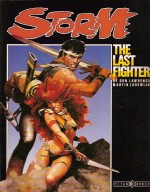
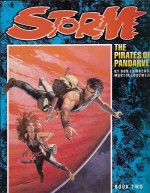
The Giant Holiday Fantasy Comic Album


By various, edited by Mike Higgs (Hawk Books)
ISBN 0-948248-06-8

Being almost universally anthology weeklies, British comics over the decades have generated a simply incomprehensible number of strips and characters in a variety of genres ranging from the astounding to the appalling. Every so often dedicated souls have attempted to celebrate this cartoon cornucopia by reprinting intriguing selections and in 1990 the splendid Hawk Books released this delightfully cheap and cheerful compendium that is still readily available for connoisseurs of the wild and wonderful British oeuvre…

As is so often the case creator credits are nonexistent and although I’ll hazard the odd guess now and then, a lot of these marvellous concoctions will have to remain annoyingly anonymous until someone more knowledgeable than me pipes up…

With little ado the monochrome madness began with a magically whacky superhero tale featuring supernatural warrior Thunderbolt Jaxon who promptly mopped up a gang of saboteurs in ‘The Flying Wreckers’.

Plucky lad Jack Jaxon could transform into the invincible mini-skirted muscleman because he wore the magic belt of Thor, and as comprehensively revealed in Steve Holland’s superb Bear Alley articles, the character was originally designed in 1949 by Britain’s publishing powerhouse Amalgamated Press as an export feature for Australian publisher Kenneth G. Murray after WWII. The strips were commissioned by Editor Edward Holmes and realised by writers TCH Pendower, Leonard Matthews, plus Holmes, with prolific artist Hugh McNeill the original illustrator. The export-only hero soon began appearing in UK comics Comet and Knockout with later stories limned by Geoff Campion, Robert Roger & Ian Kennedy.

Next here is a charming tale of ‘The Space Family Rollinson’ by Graham Coton: a series which ran in Knockout from 1953-1958 and was successfully syndicated in France. Your average Mum, Dad and four kids on a trek across the universe, here stopping to save the natives of Skandok from a hideous space spider and its interplanetary jelly-webs, after which a moodily engrossing adventure of outlandish Victorian escapologist Janus Stark finds the man with rubber bones thwarting a gang of kidnappers in a stirring extravaganza by Tom Tully & Francisco Solano López .

A stunning strip The Jungle Robot debuted in the first issue of Lion in 1952, created by E. George Cowan & Alan Philpott, before vanishing until 1957. On his return he became one of the most popular heroes of the British scene. Reprinted here from the early days after his comeback is ‘Robot Archie and the Mole Men’ illustrated, I suspect, by Ted Kearnon, pitting the amazing automaton and his hapless handlers Ted Ritchie and Ken Dale against a bunch of subterranean bandits plundering Paris in an incredible burrowing machine – a complete 14 week adventure delivered two pages at a time.

Next up is ‘The Men from the Stars’ a complete 60 page sci fi epic originally presented in AP’s digest Super Detective Library #14. In this grand old invasion romp, test pilot and “Special Agent in Space” Rod Collins endured the World’s first contact with a marauding and incomprehensible race of flying saucer people before spearheading Earth’s inevitable resistance and narrow victory, after which paranormal detective ‘Maxwell Hawke’ and plucky girl Friday Jill Adair investigated ‘The Ghost of Gallows Hill Manor’ – a creepy, condensed shocker probably drawn by a young Eric Bradbury.

Knocker White and Jinx Jenkins were ‘The Trouble-Seekers’; two-fisted construction workers who had to add giant monsters to the list of obstacles threatening to delay the completion of South American super city Futuria, after which action-man cover star of Smash! Simon Test narrowly survived ‘The Island of Peril’ in another moody masterpiece of all-ages action-adventure illustrated by Bradbury.

One of the most fondly remembered British strips of all time is the strikingly beautiful Steel Claw. From 1962 to 1973 Jesús Blasco and his small family studio thrilled the nation’s children, illustrating the breakneck adventures of scientist, adventurer, spy and even costumed superhero Louis Crandell. Created by novelist Ken Bulmer, the majority of the character’s exploits were scripted by Tom Tully.

Crandell was a bitter man, missing his right hand, which was replaced with a gadget-packed prosthetic. Moreover, whenever he received an electric shock he became invisible.

After going on a deranged rampage Crandell’s personality shifted and by the time of ‘The Return of the Claw’ (which first saw print in Valiant from 5th June 1971-22nd April 1972) the super-agent was a tired and broken emotional burn-out dragged out of retirement to foil an alien invasion wherein disembodied invaders the Lektrons possessed the bodies of children, turning them into demonic, energy-blasting monsters.

More than any other strip the Steel Claw was a barometer for British comics reading fashions. Starting out as a Quatermass style sci-fi cautionary tale the series mimicked the trends of the outer world, becoming in turn a Bond-like super-spy saga complete with outrageous gadgets, a masked mystery-man romp when Bat-mania gripped the nation, and eventually a Doomwatch era adventure drama combating eerie menaces and vicious criminals.

The thrills of the writing are engrossing enough, but the real star of this feature is the artwork. Blasco’s classicist drawing, his moody staging and the sheer beauty of his subjects make this an absolute pleasure to look at.

Over 90 pages long ‘The Return of the Claw’ alone is worth the price of admission – even with the terribly poor quality printing of this volume. Just imagine the impact when somebody finally completes the deluxe reprinting of this classic series begun in The Steel Claw: the Vanishing Man…

After the main course there’s a few short dessert items to end this feast of nostalgic fun, beginning with an engaging vintage alien invasion chiller ‘The Marching Trees’ after which the light-hearted ‘Toby’s Timepiece’ propels errant schoolboy Toby Todd into a mediaeval nightmare and an epic adventure with an extraterrestrial chrononaut before ‘Thunderbolt Jackson and the Golden Princess’ closes the memorable montage of comics wonderment in a simply splendid tale of Amazonian lost cities and rampaging dinosaurs.

This is a glorious lost treasure-trove for fans of British comics and lovers of all-ages fantasy, filled with danger, drama and delight illustrated by some of the most talented artists in the history of the medium. Track it down, buy it for the kids and then read it too. Most of all pray that somebody somewhere is actively working to preserve and collect these sparkling and resplendent slices of our fabulous graphic tradition in more robust and worthy editions.

Maybe we need a Project Gutenberg for comics…
© 1989 Fleetway Publications. All Rights Reserved.

Signal From Space


By Will Eisner with Andre LeBlanc (Kitchen Sink Press)
ISBN: 0-87816-014-0

Here’s another classy contemporary cartooning classic which although readily available in a number of formats is still seen best in first release. Ambitious and deliberately targeting an adult book-reading rather than comics audience, this initial collection of Will Eisner’s trenchant political thriller-cum-social commentary proves once more that sometimes the medium really is the message…

It is pretty much accepted today that Eisner was one of the pivotal creators who shaped the American comicbook industry, with most of his works more or less permanently in print – as they should be.

From 1936 to 1938 William Erwin Eisner worked as a jobbing cartoonist in the comics production hothouse known as the Eisner-Eiger Shop, creating strips for both domestic US and foreign markets. Using the pen-name Willis B. Rensie he created and drew opening instalments for a huge variety of characters ranging from funny animal to historical sagas,

Westerns, Detectives, aviation action thrillers… and superheroes – lots of superheroes …

In 1940 Everett “Busy” Arnold, head honcho of the superbly impressive Quality Comics outfit, invited Eisner to take on a new challenge. The Register-Tribune newspaper syndicate wanted a 16-page weekly comicbook insert for the Sunday editions and Eisner jumped at the opportunity, creating three series which would initially be handled by him before two of them were delegated to supremely talented assistants. Bob Powell inherited Mr. Mystic and distaff detective Lady Luck fell into the capable hands of Nick Cardy (then still Nicholas Viscardi) and later the inimitable Klaus Nordling.

Eisner kept the lead feature for his own and over the next twelve years The Spirit became the most impressive, innovative, imitated and talked-about strip in the business. However, by 1952 he had more or less abandoned it for more challenging and certainly more profitable commercial, instructional and educational strips, working extensively for the US military in manuals and magazines like P*S, the Preventative Maintenance Monthly and generally leaving comics books behind.

After too long away from his natural story-telling arena Eisner creatively returned to the ghettos of Brooklyn where he was born on March 6th 1906. After years spent inventing much of the visual semantics, semiotics and syllabary of the medium he dubbed “Sequential Art” in strips, comicbooks, newspaper premiums and instructional comics he capped that glittering career by inventing the mainstream graphic novel, bringing maturity, acceptability and public recognition to English language comics.

In 1978 a collection of four original short stories in strip form were released as a single book, A Contract With God and Other Tenement Stories. All the tales centred around 55 Dropsie Avenue, a 1930’s Bronx tenement, housing poor Jewish and immigrant families. It changed the American perception of cartoon strips forever. Eisner wrote and drew a further 20 further masterpieces opening the door for all other comics creators to escape the funnybook and anodyne strip ghettos of superheroes, funny animals, juvenilia and “family-friendly” entertainment. At one stroke comics grew up.

Eisner was constantly pushing the boundaries of his craft, honing his skills not just on the Spirit but with years of educational and promotional material. In A Contract With God he moved into unexplored territory with truly sophisticated, mature themes worthy of Steinbeck and F. Scott Fitzgerald, using pictorial fiction as documentary exploration of social experience.

One of the few genres where Eisner never really excelled was science fiction – and arguably he doesn’t in this tale either as, in Signal From Space, the big discovery is just a plot maguffin to explore politics, social interactions and greed – all premium Eisner meat…

The material in this collection was originally serialised in as eight 16 page episodes in Will Eisner’s Spirit Magazine as ‘Life On Another Planet’ from October 1978 to December 1980, rendered in toned black and white (a format adhered to and title revived in subsequent Kitchen Sink, DC and W.W. Norton collections). However for this luscious hardback the artist and long-time confederate Andre LeBlanc fully-painted the entire saga using evocative tones and hues to subtly enhanced the sinister, cynical proceedings.

One night lonely radio astronomer Mark Argano, based at a New Mexico observatory, picks up ‘The Signal’ a mathematical formula which originated from Barnard’s Star – proof positive of extraterrestrial intelligence…

One of his colleagues wants to inform the public immediately but Argano is adamant that they go slowly as he harbours schemes to somehow “cash in”. Unfortunately the other scientist he shares the secret with is a Soviet sleeper agent…

Almost immediately the first murder in a long and bloody succession is committed as various parties seek to use the incredible revelation to their own advantage. World-weary science advisor and maverick astrophysicist James Bludd is dispatched by the CIA to verify and control the situation, but he walks straight into a KGB ambush and narrowly escapes with his life…

There’s now a deadly Cold War race to control contact with the mysterious signallers and ‘The 1st Empire’ follows recovering addict Marco as he turns his life around and uses the now public sensation to create a personality cult dedicated to leaving Earth and joining the aliens. Whilst Marco’s Star People grab all the headlines ruthless plutocrat Mr. MacRedy uses his monolithic Multinational Corporation to manipulate Russia and America, intending to be the only one to ultimately capitalise on any mission to Barnard’s Star.

Since travel to far space is still impossible for humans MacRedy sanctions the unethical and illegal creation of a human/plant hybrid and starts looking for volunteers to experiment on in ‘A New Form of Life’ whilst Bludd accepts another undercover assignment – now more reluctant spy than dedicated scientist. Casualties moral, ethical and corporeal mount in ‘Pre-Launch’ whilst in distressed African nation Sidiami, a desperate despot declares his nation a colony of Barnard’s Star to avoid UN sanctions and having to pay back his national debt to Earthly banks…

Soon he’s offering a base to Multinational for their own launch site and sanctuary to those Star People anxious to emigrate…

In ‘Bludd’ the scientist and his sultry KGB counterpart find themselves odd-bedfellows and the Mafia get involved in the crisis – for both personal and pecuniary reasons – whilst in America MacRedy prepares to install his own President…

Now determined to take matters into his own hands and screw all governments and interests, Bludd is caught up in an unstoppable, uncontrollable maelstrom of events in ‘Abort’ and after the American President has a fatal accident in ‘The Big Hit’ MacRedy thinks he’s finally won, but is utterly unprepared for Bludd’s unpredictable masterstroke in ‘The Last Chapter’…

A Signal From Space is a dark and nasty espionage drama as well as a powerfully intriguing ethical parable: a Petrie dish for ethical dilemmas where Eisner masterfully manipulates his vast cast to display human foible and eventually a glimmer of aspirational virtue. This is a hugely underrated tale from a master of mature comics guaranteed to become an instant favourite. And it’s even better in this sumptuous oversized edition which is well worth every effort to hunt it down.

After all, Per Ardua ad Astra…
© 1978, 1979, 1980, 1983 Will Eisner.All rights reserved.

Showcase Presents Metal Men volume 2


By Robert Kanigher, Mike Sekowsky, Ross Andru, Mike Esposito & various (DC Comics)
ISBN: 978-1-4012-1559-0

The Metal Men first appeared in four consecutive issues of National/DC’s try-out title Showcase: legendarily created over a weekend by Kanigher – after an intended feature blew its press deadline – and rapidly rendered by the art-team of Ross Andru and Mike Esposito. This last-minute filler attracted a large readership’s eager attention and within months of their fourth and final adventure the gleaming gladiatorial gadgets were stars of their own title.

This second sterling black and white chronicle collects the solid gold stories from Metal Men #16-35 and the second of their nine team-up appearances in Brave and the Bold; in this case #66.

Brilliant young Einstein Will Magnus constructed a doomsday squad of self-regulating, intelligent automatons, governed by micro-supercomputers dubbed “Responsometers”.

These miracles of micro-engineering not only simulate – or perhaps create – thought processes and emotional character for the robots but constantly reprograms the base form – allowing them to change their shapes.

Magnus patterned his handmade heroes on pure metals, with Gold as leader of a tight knit team consisting of Iron, Lead, Mercury, Platinum and Tin warriors. Thanks to their responsometers, each robot specialised in physical changes based on its elemental properties but due to some quirk of programming the robots developed personality traits mimicking the metaphorical attributes of their base metal.

This compendium takes the high tech team through the best and worst of the 1960s “Camp Craze” and solidly into the bizarrely experimental phase that presaged the temporary decline of costumed heroes and rise of mystery and supernatural comics.

Metal Men #16 (October-November 1966) opens the proceedings as creative team Robert Kanigher, Ross Andru & Mike Esposito pulled out all the stops for the spectacularly whacky ‘Robots for Sale!’

Platinum or “Tina” always believed herself passionately in love with Magnus and his constant rebuffs regularly drove her crazy. Here his latest rejection made her so mad she fled into space and when the rest of the Metal Men chased her they all ended up reduced to doll size on a derelict planet where ravenous mechanical termites had almost destroyed the native wooden robots that lived there.

Issue #17 depicted Tina’s worst nightmare as Magnus and his motley metal crew investigated cosmic cobwebs which fell to Earth and the inventor was bewitched by a horrifying mechanical Black Widow in ‘I Married a Robot!’, whilst the team tackled a terrifying technological Tyrannosaur in #18’s ‘The Dinosaur Who Stayed for Dinner!’

‘The Man-Horse of Hades!’ featured a supernatural and mythic menace who had waited centuries for his true love to return before mistaking Tina for his missing “centaurette”, after which the Alloyed Avengers met Metamorpho, the Element Man in Brave and the Bold #66 (June-July 1966).

‘Wreck the Renegade Robots’ by Bob Haney & Mike Sekowsky saw the freakish hero turn to Doc Magnus to remedy his unwelcome elemental condition just as utterly mad scientist Kurt Borian resurfaced with his own Metal Men, extremely distressed that somebody else had patented the idea first.

Tragically, the only way to stop Borian’s rampage involved reversing Metamorpho’s cure…

‘Birthday Cake for a Cannibal Robot!’ featured a second appearance for Robert Kanigher’s craziest creation. Egg Fu was a colossal ovoid Chinese Communist robot determined to “Destloy Amelica” (I know, I know: different times OK?). The mechanical mastermind had first battled Wonder Woman, but resurfaced here to crush the West’s greatest artificial heroes with a giant automaton of his own, whilst ‘The Metal Men vs the Plastic Perils!’ played it all slightly more seriously in a guest-star stuffed romp (Batman, Robin, Wonder Woman and Flash) pitting the team against criminal genius Professor Bravo and his synthetic stalwarts Ethylene, Styrene, Polythene, Silicone and Methacrylate…

Soviet scientist Professor Snakelocks unleashed an unpredictable synthetic life-form against the heroes in #22’s ‘Attack of the Sizzler!’ before launching an invasion of America and, although they could handle hordes of mechanical Cossacks, they were completely outgunned when the sparkling synthezoid transformed Doc into a robot and the Metal Men into humans…

Issue #23 saw the robots restored but Doc still steel-shod as they faced ‘The Rage of the Lizard!’ – another sinister spy attacking the Free World – but before the inevitable end, Magnus too had regained his mortal form. Unfortunately Tina and Sizzler had become rivals for his attentions…

Metal Men #24 pitted the expanded team against a monstrous marauding inflatable alien in ‘The Balloon Man Hangs High!’ after which the ‘Return of Chemo…the Chemical Menace!’ saw tragedy strike as the Sizzler was destroyed and Doc grievously injured just before the toxic terror attacked. Mercifully the Shiny Sentinels proved equal to the task even without their mentor-inventor and it was back to regular zaniness for #26’s ‘Menace of the Metal Mods!’ wherein mechanical fashion icons went on a robbing rampage. ‘The Startling Origin of the Metal Men!’ rehashed their first mission as a modern Mongol Genghis Khan launched an anti-American assault.

‘You Can’t Trust a Robot!’ saw a fugitive gang-boss take control of the Metal Men’s spare bodies, resulting in a spectacular “evil-twin” battle between good and bad mechanoids, after which it was back into outer space to battle ‘The Robot Eater of Metalas 5!’ and his resource hungry masters – a staggeringly spectacular romp which marked an end for the Kanigher, Andru &Esposito team’s connection with the series.

Metal Men #30 (February-March 1968) featured the first of two fill-in issues by Otto Binder and Gil Kane – with Esposito hanging on to provide inks – after which a whole new and highly radical retooling was undertaken.

In ‘Terrors of the Forbidden Dimension!’ the Handmade Heroes were forced to travel to other realms in search of a cure when Magnus fell into a coma after a lab accident. No sooner did they defeat a host of hazards to fix him than he insulted them by building another team! Issue #31’s ‘The Amazing School for Robots!’ introduced Silver, Cobalt, Osmium, Gallium, Zinc and Iridium – although she preferred “Iridia”…

It was all barely manageable until disembodied alien intelligence Darzz the Dictator possessed the newcomers and civil war broke out…

By1968 superhero comics were in steep and rapid decline. Panicked publishers sought new ways to keep audiences as tastes changed and back then, the entire industry depended on newsstand sales, so if you weren’t popular, you died.

Editors Jack Miller and George Kashdan tapped veteran Mike Sekowsky to stop the metal fatigue and he had a radical solution: the same nuts and bolts overhaul he was simultaneously spearheading with Denny O’Neil on the de-powered Diana Prince: Wonder Woman.

The enchantingly eccentric art of Sekowsky had been a DC mainstay for decades and his unique take on the Justice League of America had cemented its overwhelming success. He had also scored big with Gold Key’s Man from Uncle and Tower Comics’ T.H.U.N.D.E.R. Agents and Fight The Enemy!

Now he was creatively stretching himself with a number of experimental, youth-targeted projects; tapping into the teen zeitgeist with the Easy Rider-like drama Jason’s Quest, new sci-fi project Manhunter 2070, the hopelessly moribund Amazon and eventually Supergirl.

Sekowsky began conservatively enough in #32 and Binder scripted ‘The Metal Women Blues!’ wherein Doc built counterparts and companions for his valiant crew with disastrous results, after which the new “relevancy” direction debuted in The New Hunted Metal Men #33 (August-September 1968).

Kanigher returned as scripter as Sekowsky & George Roussos crafted a darker paranoic tone for ‘Recipe to Kill a Robot!’ wherein the once celebrated team went on the run from humanity. The problems started when Doc increased their power exponentially, causing them to constantly endanger the very people they were trying to help and were compounded when their creator was injured and plunged into another coma.

Pilloried by an unforgiving public and only stopping briefly to defeat an invasion by voracious giant alien insects, the misunderstood mechanoids fled, finding sanctuary with Doc’s brother David – a high ranking military spook.

Issue #33 ‘Death Comes Calling!’ had them encounter a ghastly extraterrestrial force which murderously animated America’s shop manikins after Tina rejected its amorous advances. The carnage and highly visible collateral damage was exacerbated in #35 – the last tale in this masterful monochrome tome – and added to humanity’s collective woes when a vast and love-hungry Volcano Man joined the chase in ‘Danger… Doom Dummies!’

Kanigher’s masterful ability for dreaming up outlandish visual situations and bizarre emotive twists might have dropped out of vogue, but this simply opened the door for more evocative and viscerally emotive content more in keeping with the series’ now teen-aged audience and the best was still to come…

But that’s the stuff of another volume – and ASAP, please!

© 1965-1969, 2008 DC Comics. All Rights Reserved.

Commies From Mars the Red Planet: the Collected Works


By Tim Boxell, Hunt Emerson, Peter Kuper & various (Last Gasp)
ISBN: 978-0-86719-343-5

When political debate in America was less strident and a little more reasoned (let’s call it 1972) a bunch of filthy anarchist pinko hippy satirists recruited by the traitorously seditionist Tim Boxell began contributing raw, rude and utterly hilarious skits, sketches and spoofs on the social and cultural scene to a sporadically published underground comics anthology called Commies From Mars.

Taking their lead from the turbulent but well-informed political climate and deeply influenced by both EC horror and science fiction publications of the 1950s and the classic 1962 Wally Wood Mars Attacks trading cards, contributing artists took cartoon pot-shots at God, Mother and Country in brilliant pastiches ranging from graphic ultra-violence and outrageous interplanetary, inter-species sex-shockers to surreal adventure and outright polemical diatribes. The overriding premise if you’re still not following me was: Communism is Evil; Martians want to conquer us and steal our women. Ergo Martians must be Commies…

Or maybe the cartoonists were just being “clever”…

Six issues were published between 1972 and 1987 and at the end of 1986 Last Gasp publisher Ron Turner released a black and white compilation of (most of) the first four to commemorate the imminent release of #5. That supremely subversive tome is still available if you look hard and surely the time is long overdue for an updated, revised and complete edition…

Following a Foreword from Jerry (Grateful Dead) Garcia, ‘A Warning From the Editor’, ‘Excerpts From the Journal of Billy “Rage” Riley’ and the cover to issue #1, the graphic assault begins with ‘In our midst… Commies From Mars!’ which sets the scene and the scenario with a gritty story of rural resistance from Boxell, after which John Pound’s cover for #2 and more ‘Excerpts From the Journal of Billy “Rage” Riley’ precede a stunning Boxell fantasy-fest ‘Snak?’, a wry and grimly grotesque conversation with Martian Comrade Colonel Bemovitch in ‘The Treaty!’ courtesy of (Comrade) Rich Larson, and Hunt Emerson relates the astounding extra-terrestrial ‘Adventures of Alan Rabbit’.

Greg Irons revealed ‘Gregor’s 115th Wet Dream’ and Capitalism, Interplanetary Communism and nasty fast food collided at Boxell’s ‘Commies From Mars Café’ before #2 closed with the charmingly dark ‘Man on the Moon’ by Shawn Kerri.

Pound’s arresting cover for #3 and another “Rage” Riley page are followed by an untitled Checkered Demon/Commies From Mars team-up by S. Clay Wilson and a superb Kerri anthropomorphic exploit ‘Life on the New Martian Earth’, before Boxell waxes cataclysmically philosophical in ‘Washed Up’.

Ripp (Larry Rippee) plugged ‘Tourism on the Red Planet’ and a young Peter Kuper revealed a recurring nightmare in ‘Shiver and Twitch’ whilst Irons contributed a socially inclusive argument for welcoming the invaders in an impressive double-page spread. Boxell’s ‘Stoned Wolf’ went on a ‘Crash Diet’ after which Ian (Jim Schumeister) James & Jon Rich got shockingly dramatic with ‘Prayers from a Closet’ and Revilo drew up a fabulous integration questionnaire in ‘A Comic’.

Following the usual cover and “Rage” piece for #4 Shawn Kerri explains ‘The Communist Way’, Tom Cheney describes ‘Life on the Planet Floyd’ and Larson explicitly defines ‘Making Loveski’.

Chad Draper outlines ‘Mixed Marriage’ and Revilo expands the romantic theme in harrowing detail with another ‘A Comic’, after which Kuper also gets in on the unnatural act with ‘True Martian Romance’. Larson & Boxell contribute a brace of ‘False Views’ after which ‘Bye Bye Baby’ explains a few new facts of life.

Melinda Gebbie & Adam Cornford promote the social graces in ‘Hall Monitors from Mars’ and Kenneth Huey explores the political effects of the military industrial complex in ‘Dictation: Tales from the Apocalypse’, after which Mr. Rippee returns with ‘A Marriage Made in Heaven’ and Boxell punches the action button in the X-rated ‘Under His Hat?’

Hunt Emerson details romance in a Martian Socialist State with ‘The Date’ and Spain Rodrigues provides a graphic tribute to Godfather of the series Wally Wood, after which Boxell & Grisly went all-out weird and nasty with ‘The Swap’ to close the story portion of this outrageous entertainment.

Absolutely packed with pin-ups, supplementary art and prose pages, a selection of astoundingly intriguing house ads and with an extensive biographies dossier on the Underground greats and cartooning luminaries who contributed to this Big Red Scare, this delicious tome is still a marvellous example of un-Realpolitik as only cartoonists could conceive it.

Next time you feel the need to stretch your boundaries in a mature manner, why not try this never-more-contemporary tome. Just think “Fundie” or “Repug” and you’ll see what I mean…
©1985 Tim Boxell and contributing artists. All rights reserved.

Green Lantern/Green Arrow volume 1


By Denny O’Neil, Neal Adams, Frank Giacoia, Dick Giordano, Dan Adkins & Berni Wrightson (DC Comics)
ISBN: 978-1-4012-0224-8

After nearly a decade of earthly crime-busting, interstellar intrigue and spectacular science fiction shenanigans the Silver Age Green Lantern was swiftly becoming one of the earliest big-name casualties of the downturn in superhero sales in 1969 and Editor Julie Schwartz knew something extraordinary was needed to save the series.

The result was a bold experiment that created a fad for socially relevant, ecologically aware, more mature stories which spread throughout DC costumed hero comics that totally revolutionised the industry and nigh-radicalised the readers.

Tapping superstars-in-waiting Denny O’Neil and Neal Adams to produce the revolutionary fare, Schwartz watched in fascinated disbelief as the resultant thirteen groundbreaking, landmark tales – the first seven of which are reprinted in this superb colour collection – captured the tone of the times, garnered critical praise and awards within the industry and desperately valuable publicity from the real world outside, whilst simultaneously registering such poor sales that the series was finally cancelled anyway, with the heroes unceremoniously packed off to the back of marginally less endangered comicbook The Flash.

Once safely established and doubling up the die-hard fan-base, the stories resumed their traditional themes – crime, adventure and space opera – and Green Lantern gradually grew popular enough for his own solo title once more….

By the end of the 1960s America was a bubbling cauldron of social turmoil and experimentation. Everything was challenged on principle and with issue #76 of Green Lantern (April 1970 and the first issue of the new decade) O’Neil and comics iconoclast Neal Adams utterly redefined superheroism with their “Issues”-driven stories; transforming complacent establishment masked boy-scouts into uncertain, questioning champions and strident explorers of the enigma of America.

When these stories first appeared DC was a company in transition – just like America itself – with new ideas (which, in comic-book terms meant “young writers”) being given much leeway: a veritable wave of fresh, raw talent akin to the very start of the industry, when excitable young creators ran wild with imagination. Their cause wasn’t hurt by the industry’s swingeing commercial decline: costs were up and the kids just weren’t buying funnybooks in the quantities they used to…

O’ Neil, in tight collaboration with hyper-realistic artist Adams, assaulted all the traditional monoliths of contemporary costumed dramas with tightly targeted, protest- driven stories. The comicbook had been re-designated Green Lantern/Green Arrow with Emerald Archer Oliver Queen constantly mouthing off as a hot-headed, liberal sounding-board and platform for a generation-in-crisis whilst staid, quasi-reactionary GL Hal Jordan played the part of the oblivious but well-meaning old guard. At least the Ring-Slinger was able to perceive his faults and more or less willing to listen to new ideas…

‘No Evil Shall Escape My Sight!’ (inked by Frank Giacoia) is a true landmark of the medium, utterly reinventing the concept of the costumed crusader as newly-minted, freshly bankrupted millionaire Oliver (Green Arrow) Queen challenged his Justice League comrade’s cosy worldview when the lofty space-cop painfully discovered real villains wore business suits, had expense accounts, hurt people just because of skin colour and would happily poison their own nests for short-term gain…

The specific villain du jour was a wealthy landlord whose treatment of his poverty-stricken tenants wasn’t necessarily illegal but certainly was wickedly immoral… Of course, the fact that this yarn is also a brilliantly devious crime-thriller with science-fiction overtones doesn’t exactly hurt either…

‘Journey to Desolation’ in #77 was every bit as groundbreaking.

At the conclusion of the #76 an immortal Guardian of the Universe – known as “the Old Timer” was assigned to accompany the Emerald Duo on a voyage to “discover America”: a soul-searching social exploration into the dichotomies which divided the nation – and a tremendously popular pastime for the nation’s disaffected citizens back then.

The first stop brought the trio to a poverty-stricken mining town run as a private kingdom by a ruthless entrepreneur happy to use agent-provocateurs and Nazi war criminals to keep his wage slaves in line. When a young protest singer looked likely to become the next Bob Dylan and draw unwelcome publicity, he had to be eliminated – as did the three strangers who drove into town at just the wrong moment…

Although the heroes provided temporary solutions and put away viciously human criminals, these tales were always carefully heavy-handed in exposing bigger ills and issues which couldn’t be fixed with a wave of a Green Ring; invoking an aura of helplessness that was metaphorically emphasised during this story when Hal was summarily stripped of much of his power for no longer being the willing, unquestioning stooge of his officious, high-and-mighty alien masters…

The confused and merely-mortal Green Lantern discovered another unpalatable aspect of human nature in ‘A Kind of Loving, a Way of Death!’ when Black Canary joined the peripatetic cast. Seeking to renew her stalled relationship with Green Arrow, she was waylaid by bikers, grievously injured and taken in by a charismatic hippy guru. Sadly Joshua was more Manson than Messiah and his brand of Peace and Love only extended to white people: everybody else was simply target practise…

The continuing plight of Native Americans was stunningly highlighted in ‘Ulysses Star is Still Alive!’ as corporate logging interests attempted to deprive a mountain tribe of their very last scraps of heritage, once more causing the Green Knights to take extraordinarily differing courses of action to help, whilst #80 added a science fiction gloss to a tale of judicial malfeasance in ‘Even an Immortal Can Die!’ (inked by Dick Giordano).

When the Old Timer used his powers to save Green Lantern rather than prevent a pollution catastrophe in the Pacific Northwest, he was chastised by his fellow Guardians and dispatched to the planet Gallo for judgement by the supreme arbiters of Law in the universe. His earthly friends accompanied him and found a disturbing new administration with a decidedly off-kilter view of justice…

Adams’ staggering facility for capturing likenesses added extra-piquancy to this yarn that we’re just not equipped to grasp four decades later, with the usurping, overbearing villain derived from the Judge of the infamous trial of anti-war protesters “The Chicago Eight”.

Insight into the Guardians’ history underpinned ‘Death Be My Destiny!’ when Lantern, Arrow and Canary travelled with the now-sentenced Old Timer to the ancient world of Maltus and found a world literally choking on its own out-of-control population. The uncanny cause cast unlovely light on the perceived role and worth of women in modern society…

Ending this first of a two-set volume on a more traditional note, Green Lantern/Green Arrow #82 enquired ‘How do you Fight a Nightmare?’ (with additional inks from Berni Wrightson) as Green Lantern’s greatest foe unleashed Harpies, Amazons and all manner of female furies on the hapless hero before Black Canary and Green Arrow could turn the tide, whilst asking a few more pertinent questions about women’s rights…

As well as these magnificent still-challenging epics superbly re-coloured by Cory Adams and Jack Adler this chronicle also reprints O’Neil’s effusive introduction from the hardbound. slip-cased turn-of-this-century ‘Hard-Travelling Heroes‘ edition, creator biographies and a illustrated feature ‘Legacy in Print’ which pictorially examines the multifarious collected formats in which these timeless tales have been collected.

© 1970, 1971, 1992, 1977, 2000, 2004 DC Comics. All Rights Reserved.

Xenozoic


By Mark Shultz (Flesk)
ISBN: 978-1-933865-31-7

Some things just are cool.

Perfect unto themselves and intrinsically, inexplicably, indefinably just right in any milieu and venue. Thus in 1986 when Mark Shultz wrote and drew the EC comics inspired pastiche/homage ‘Xenozoic!’ for Kitchen Sink’s fantasy anthology Death Rattle, his solid blend of pulp fiction, fifties automobile chic and honking great saurians hit an instantly addictive chord with the comics buying public.

Xenozoic Tales the series debuted early in 1987 and ran until 1989: 14 sporadic, magical issues which spawned an animated television series, assorted arcade, video and role-playing games, trading cards, action figures, candy bars and a succession of reprints (comics and graphic novel collections) from Kitchen Sink, Marvel and Dark Horse – although mostly under its alternative title Cadillacs and Dinosaurs.

Flesk Publications specialises in art books and the lavish tomes they produce are dedicated to the greats of our industry, with volumes on sequential narrative and fantasy illustration starring Steve Rude, Al Williamson, James Bama, Gary Gianni, Franklin Booth, William Stout and Joseph Clement Coll.

This oversized (279 x 216mm) 352-page softcover monochrome collection re-presents all the stories (excluding a few side-bar stories by sometimes inker and collaborator Steve Stiles) in one luxuriously exuberant and staggeringly compelling compilation and even finds a little room for some extra sketches and unused drawings.

A thousand years from now Earth is slowly recovering from a shattering disaster which devastated the planet and sent mankind scuttling into deep subterranean shelters for centuries. Now humans are reduced to isolated pockets of tribal civilisation eking out a precarious existence in enclaves cobbled together from equal parts recovered remnant technology, renewable natural resources and sheer ingenuity.

In the thousand years since the fall, beasts from many disparate eras – from dragonflies to dinosaurs, trilobites to sabretooth tigers – have all re-established themselves in the tenuous yet expansive ecology. Historian/engineer/shamans called the Old Blood have, for centuries, advocated a doctrine of natural balance; helping mankind progress and thrive in harmony with the environment, but now the species’ old habits of greed, waste and ruthless exploitation are becoming dominant again in too many ambitious tribal leaders…

Following a foreword from creator Mark Schultz and an effusive introduction from animator Craig Elliot there’s a lovely descriptive character epigram of ‘Jack and Hannah’ to contemplate, after which the much-recycled but always excellent adventures commence with ‘An Archipelago of Stone’ as, in sparkling tribute to the work of Wally Wood, Joe Orlando and Jack Davis, the once magnificent pre-Cataclysm metropolis now known as the City in the Sea gets word of an ambassador from the far off tribe of Wassoon.

The formidable Hannah Dundee has sailed north to cement friendly relations with the Sea City dwellers, exchange knowledge and ask the governors to rein in Jack “Cadillac” Tenrec: Old Blood nature shaman, brilliant engineer, miraculous mechanic, ancient auto aficionado and the tribe’s top hunter. The problem is that Tenrec hunts poachers and he’s so good at it that the criminals are steadily drifting into Wassoon territory to escape his lethal attentions…

In this packed 12-page tale all this information is cleverly imparted as some of those poachers try to murder the Ambassador before she can even present her credentials, but the formidable Cadillac Jack is, as usual one step ahead of everybody…

‘The Opportunists’ gives Hannah a chance to display her own capabilities as she promptly solves a long-standing problem of her host’s fishing fleet with the help of keen observation, a weedy scholar named Remfro and a brace of scavenging Zekes (pteranodons), after which ‘Law of the Land’ returns focus to Tenrec as the wrench-jockey and big-game hunter leads a relief column to an outlying mine project and discovers an incorrigible poacher in his team.

Slaughtering dinos for spurious yet valuable medical “cures” is phenomenally profitable, so Jack’s lethal treatments are always carried out with a long-term view of deterring other greedy potential criminals too…

On reaching the mine, ‘Rogue’ (inked by Steve Stiles) concentrates on a crazed man-eating Shivat, which Jack and the ever-present, too-inquisitive Ambassador are forced to put down. Of course there’s a reason why the T-Rex is bothering with human prey, and once more Tenrec gets to teach a poacher a salutary final lesson. Next that debut tale from Death Rattle is marginally remodelled and neatly slotted in as ‘Xenozoic!’ follows Tenrec’s troop into a deep swamp in search of a missing scientific expedition. The hideous fate of Dr. Fessenden and his team gives the first clue to the impossible ecology of the post-Cataclysm world…

Initially unwelcome Hannah Dundee was growing on Jack, which explains why – against his better judgement – the hunter complies with her insane attempt to domesticate a mastodon in ‘Mammoth Pitfall!’ – a task made even harder by a poacher seeking to murder them and steal his “overlander” (a rebuilt, customised, guano-powered Cadillac).

‘The Rules of the Game’ (Stiles inks) finds Jack and Hannah still waiting for the mammoth to get bored (like elephants, they’re easily riled and never forget), affording us a glimpse as the engineer’s adored horde of retrieved, restored automobiles, but when he shows off his driving skills they are caught in a flash-flood and treated to another example of the mysterious forces which bind the new world together…

Shultz’s art had been constantly evolving and by the time of ‘Benefactor’ – the first full-length adventure – the more subtle, humanistic influences of Al Williamson, Angelo Torres and Frank Frazetta were informing every page. This was particularly effective in this tale of political intrigue wherein the increasingly trusted Hannah is introduced to the clandestine ancient race that has helped Old Blood shamans steer humanity away from their self-destructive course, but regrettably those urges aren’t extinguished yet and one of the City Governors follows, intent on assassinating the man who is increasing stalling human “Progress”…

The true reason for Dundee’s mission is disclosed in ‘History Lesson’ when Jack takes her to The Library; a vast, partially flooded subterranean vault filled not only with lost books but also pre-Cataclysm technology. However, trouble is brewing and Scharnhorst, leader of the “moles” who excavate and guard the finds, has discovered a deadly ancient weapon and is planning to make a play for supreme power…

Thinking the crisis over Jack and Hannah go on a fishing ‘Excursion’ but after learning the history of the Wassoon tribe Jack stumbles into a far deadlier catch than he anticipated. In ‘Foundling’ Hannah solves the mystery of a baby missing for a decade and discovers more about the mysterious Grith who secretly shepherd the planet whilst ‘Green Air’ sees aviation addict Remfro attempt the first manned flight in a millennium after which ‘The Growing Pool’ gives more clues to the nature of the Xenozoic Age when an ancient, artificial gene soup is discovered, only to escape into a lake and trigger a fantastic explosion of raw evolutionary insanity…

As guardian of the eco-system Jack had tried to destroy the burgeoning life-lab but was betrayed and knocked out by those closest to him. ‘In the Dreamtime…’ finds him recovering from his wounds, when city Governor Dahlgren turns up with a warning and a mission. Heading out to a road-building project that’s gone quiet Tenrec and Hannah stumble into a macabre and deadly extinction event which almost ends their lives too, before ‘Last Link In the Chain’ sees Scharnhorst make her grab for power; attempting to assassinate Jack whilst taking control of the City Governors.

Tenrec’s precious balance of nature is keeping man down and she intends to restore humanity’s rightful place as ‘Lords of the Earth’. Wounded, discredited and on the run Jack leaves the City in the Sea as civil war is about to erupt and is forced to journey with Hannah to Wassoon, where he will swiftly discover that her people might be even worse.

Is it simply impossible for humanity to live in harmony with everything else on the planet…?

As they flee south Jack and Hannah wash up on a deadly island paradise where bugs and seagoing invertebrates have evolved to fill every ecological niche – including top-predator – in ‘Primeval’. On reaching Wassoon ‘Two Cities’ introduces Tenrec to truly Byzantine and Machiavellian politicking as various factions seek to exploit his knowledge and worth, just as Scharnhorst’s Sea Wolves arrive, demanding his arrest and return. They leave with a corpse, but it isn’t Jack’s…

He isn’t without friends however. Hannah’s old Nanny is high in the Old Blood hierarchy and in direct contact with the Grith, enabling Jack to turn the tables and make a few new allies in ‘Dangerous Grounds’ before this unfinished symphony of pulp wonderment concludes (hopefully temporarily) in ‘Another Swarm’ as an unlikely alliance is formed when the Grith reveal the true powers who run the Earth and dinosaur shaman Jack Tenrec prepared to return to the city that disavowed him…

Blockbusting in scope, magnificently fanciful and beautifully rendered, Xenozoic is the ideal everyman graphic novel: a perfect example of exciting, engaging classical comics storytelling that should be on everyone’s “must read” list.

© 2011 Mark Schultz. All Rights Reserved.

Twin Spica volume 7


By Kou Yaginuma, translated by Maya Rosewood (Vertical)
ISBN: 978-1-935654-12-4

The yearning, imagination and anticipation of space travel, such a critical component of post-World War II society, is paramount to this inspiring manga series from Kou Yaginuma, who first captured the hearts and minds of the public with his poignant short story ‘2015 Nen no Uchiage Hanabi’ (‘2015: Fireworks’, published in Gekkan Comics Flapper magazine, June 2000).

Since then he has expanded and enhanced the subject, themes and characters into a major epic combining hard science and humanist fiction with lyrical mysticism and traditional tales of school-days and growing up.

2024AD: teenaged Asumi Kamogawa has always dreamed of going into space. From her earliest moments the lonely child gazed up at the stars with her imaginary friend Mr. Lion, especially at the twinkling glow of Virgo and the alluring binary star Spica. An isolated, serious child, she lived with her father, a common labourer who once worked for the consortium which built the rockets for Japan’s Space Program.

In 2010, when Asumi was a year old, the first Japanese launch ended in utter catastrophe when rocket-ship Shishigō (“The Lion”), exploded: crashing to earth in the city of Yuigahama. Hundreds were killed and many more injured, including Asumi’s mother. Maimed and comatose, the matron took years to die. The shock crushed her grieving husband and utterly traumatised infant Asumi.

In response to the disaster Japan set up an astronautics and space sciences training facilty and after years of struggle Asumi was accepted by the Tokyo National Space School. Slowly making friends like Shinnosuke Fuchuya (who used to bully her as child), jolly Kei Oumi, chilly Marika Ukita and spooky, ultra-cool style-icon and fashion victim Shu Suzuki, she daily moved closer to her unshakable dream of going to the stars.

Against all odds – she is small, physically weak and very poor – Asumi endures. She still talks with Mr. Lion, who might be the ghost of an astronaut who died on the Shishigō…

I blinked and somehow missed a couple of volumes of this supremely moving saga, so by way of experiment I’m reviewing this seventh book without knowing all that’s recently occurred, and I’m delighted to announce that there’s been progress but not enough to confuse new or lax readers…

The story begins as the still quite formal classmates join Asumi on a vacation to her childhood home in Yuigahama and uncover a mystery about standoffish Marika, who has discovered an unsuspected connection to the rebuilt city. She is doubly plagued by an illness she hides from her comrades and teachers as well as phantom memories which increasingly draw her to a secluded shrine dedicated to the disaster.

When Marika succumbs to her inner torment and wanders away to find the isolated commemoration she becomes dangerously lost and Asumi, pushed by her own ghosts, tracks her down just in time…

As they wait together to be found, deeper bonds are forged, some secrets are revealed and we are afforded a glimpse into the events prior to and just following the crash of the Shishigō. It becomes clear that both girls are afflicted with the same unquenchable need to escape the Earth…

Asumi’s father Tomoro Kamogawa is a no fan of the space program, having lost his wife, his engineering job and his pride to the race for space. In the wake of the catastrophe he was assigned by his bosses at the corporation who built the ship to lead the reparations committee.

Guilt-wracked and himself bereaved, the devastated widower had to visit and apologize to each and every survivor and victim’s grieving family. He raised his daughter alone, working two and often three menial jobs at a time for over a decade.

Now, his old engineering colleague Takahito Sano is one of Asumi’s Professors at the Space School and the men’s previous history and relationship is revealed. A possible cause of the crash is mooted as the five astronaut trainees bond in an atmosphere of unravelling secrets and too many persistent ghosts and memories…

The second half of the book concentrates on the students’ return to school and their next semester of training. Asumi has struck up a more than casual relationship with a boy in a park. He volunteers at a hospice and is trying to learn the harmonica so that he can play to an old woman with dementia. He reminds Asumi of a sickly High-school friend named Shimazu…

Diffidently bonding, the boy tells her of a Sunday concert he’s playing at a week hence and she promises to be there…

Meanwhile at school the latest test of strength, ingenuity and fortitude finds the class divided into teams and transported to a decommissioned prison. Their task: to break free within seven days. Asumi convinces the teachers to drive them back to the city early if they all finish the task before Sunday…

However, even with things working her way there’s a hitch and only terse, unpredictable Fuchuya can help the girl he spends so much time studiously annoying and ignoring – if he can be bothered…

This volume also contains two more bittersweet autobiographical ‘Another Spica’ vignettes from author Yaginuma’s days as a part-time server on a soft-drink stand in a theme park; both delightfully painful accounts of amorous timidity, deep yearning, over-thinking and unrequited young love

All these gloriously heady confections initially appeared in 2004-2005as Futatsu no Supika 7 and 8 in the Seinen manga publication Gekkan Comics Flapper, targeted at male readers aged 18-30, but this ongoing, unfolding beguiling saga is perfect for any older kid with stars in their eyes…

Twin Spica ran for eight enchanting years (September 2001-August 2009): sixteen volumes tracing the orbits of Asumi and her friends from callow students to competent astronauts and the series has spawned both anime and live action TV series.

This delightful serial has everything: plenty of hard science to back up the savvy extrapolation, an ever-more engaging cast, enduring mystery, tender moments, isolation and teen angst and true friendships; all wrapped up in a joyous coming-of-age drama with supernatural overtones and masses of sheer sentiment.

Utterly defining the siren call of the Starry Reaches for a new generation (and the older ones too) Twin Spica is quite simply too good  to miss…

These books are printed in the Japanese right to left, back to front format.

© 2011 by Kou Yaginuma/Media Factory. Translation © 2011 Vertical, Inc. All Rights Reserved.

Alien Legion: Tenants of Hell


By Chuck Dixon, Larry Stroman, Dan Panosian, Mike McMahon & Carl Potts (Titan Books)
ISBN: 978-0-84023-811-2

During the 1980s the American comics scene experienced a magical proliferation of new titles and companies following the creation of the Direct Sales Market. With publishers now able to firm-sale straight to retail outlets rather than overprint and accept returned copies from non-specialised shops, the industry was able to support less generic titles and creators were able to experiment without losing their shirts.

In response Marvel developed its own line of creator-owned properties during the height of the explosion, launching a number of idiosyncratic, impressive series in a variety of formats under the watchful, canny eye of Editor Archie Goodwin. The delightfully disparate line was called Epic Comics and the results reshaped the industry.

One of the earliest hits was a darkly compelling science fiction serial with a beautifully simple core concept: the Foreign Legion of Space (and no, it isn’t at all similar to Jack Williamson’s epochal 1934 creation the Legion of Space). Created by Carl Potts, Alan Zelenetz and Frank Cirocco Alien Legion debuted in its own on-going series in April 1984, running for 20 issues and an oversized Marvel Graphic Novel (see Alien Legion: A Grey Day to Die), before re-booting into a second, 18 issue volume. After that the tales were told in occasionally released miniseries and one-shots such as the ones that comprise this volume.

Alien Legion has come and gone ever since, jumping from Checker Books to Titan and Dark Horse Comics – who have been compiling the series into collected omnibuses – and there is, of course, a movie in the pipeline…

The Legion keeps the peace of the pan-galactic Galarchy on a million worlds spread over three galaxies: a broad brotherhood of outcast militant sentients united by a need to belong and a desire to escape their pasts. For such beings honour and tradition are the only things holding them together.

After years of holding back the forces of chaos and anarchy Nomad Squadron were dispatched to “pacify” the Quaalians; a warlike and unpredictable culture perpetually causing trouble from their strategically critical star-system midway between the Galarchy and its ideological opposite the Harkilon Empire. The mission went tragically wrong and the squadron were trapped in a time dilation field on a planet of raving maniacs dubbed “Hellscape” and written off by the Legion.

Lost for years the last few survivors were eventually rescued by their erstwhile commander Sarigar, who had left the service but never abandoned his men. In the intervening years the Galarchy had become a far nastier, more callous place and the rescue was hushed up. With nowhere else to go Torrie Montroc, Jugger Grimrod, Zeerod and Tamara stayed in the Legion and Sarigar re-enlisted. Whilst exploiting his skills, the corrupt and dissolute Brass punished him for his temerity by converting the last of Nomad into a penal battalion: dirty job cannon-fodder little better than slaves.

(Don’t panic newcomers – this edition also includes text features and comprehensive background on the ‘Hellscape’ mission that catapulted the sorry survivors into the Tense Future of this volume, ‘Our Friends Above: a Galarchy Primer’ on the history and running of the Galarchy, an introduction from author Chuck Dixon and a handy ‘Glossary of Terms’ as well as a cover gallery and biographies of both story characters and creators…)

In ‘Tenants of Hell’ (originally released in 1991 as a two-part Prestige Format miniseries by Chuck Dixon, Larry Stroman & Dan Panosian), the embittered fragments of Nomad are chafing under the brutal new Legion regime whilst “peacekeeping” on the manufacturing planet of Combine IV; becoming increasingly aware that their role is to terrify the populace into submitting to their corporate overlords – the same faceless plutocrats that bankroll the Legion and expect prompt service for their largesse.

Meanwhile Sarigar has enlisted clandestine allies to discover who sanctioned the throwing away of his unit, whilst Torrie Montroc’s mega-rich and almost dead father finally learns through the efforts of industrial super-spy Nahkira that his only heir is still alive…

Fighting a rebellion they actually sympathise with, the Nomads are further tested when they discover that the Hallidor Corporation has decided to cut its losses and liquidate the planet. The board decides to atomise the planet and collect on the insurance. Of course the bottom line dictates that only key management personnel need to be evacuated…

In the final moments of Combine IV, loyalties to their oaths, their honour and the helpless citizens left to die push the valiant heroes out of time to the edge of mutiny…

Terse, tense and compellingly action-packed, this imaginative romp is splendidly readable and perfectly accessible to those unfamiliar with the series.

Also included here is the 1991 Alien Legion: Grimrod one-shot by Dixon and Mike McMahon: a magically cynical and acerbic parable about never volunteering, which finds the double-dealing, greedy sociopath falling for the oldest scam in military history and tricking himself into the worst assignment in the Galarchy.

Thinking he’s to be a cushy military attaché to the king of a paradise planet of balmy skies with women of easy virtue, Jugger is instead trapped on a dank, muddy hellhole just before the annual uprising of the barbarian horde sweeps down for fresh slaves, ripe plunder and all the excessive bloodletting they can handle.

Without a means of escape and no Galarchy back-up or ordnance, Grimrod is forced to turn a nation of wimps and pansies into all-conquering warriors before he loses his own life and only chance of revenge on the conman who switched postings with him…

Sardonic and powerfully funny in the classic 2000AD manner, this delightfully engaging yarn caps the stunning, spectacular, cynical space opera with a bracing jolt of cartoon schadenfreude which renders this chronicle “unmissable” in my book.
© 1991, 2004 Carl Potts. All rights reserved.

Showcase Presents The War that Time Forgot


By Robert Kanigher, Ross Andru, Mike Esposito & various (DC Comics)
ISBN: 978-1-4012-1253-7

The War that Time Forgot debuted in Star Spangled War Stories #90 (April-May 1960) and ran until #137 (May 1968) skipping only three issues: #91, 93 and #126 (the last of which starred the United States Marine Corps simian Sergeant Gorilla – look it up: I’m neither kidding nor being metaphorical…) and this stunningly bizarre black and white compendium contains the monstrously madcap material from #90, 92, 94-125 and 127-128.

Simply too good a concept to leave alone, this seamless, shameless blend of Sir Arthur Conan Doyle’s Lost World and Edgar Rice Burroughs’ Caprona stories (known alternatively as the Caspak Trilogy or “the Land That Time Forgot”) provided everything baby-boomer boys could dream of: giant lizards, humongous insects, fantastic adventures and two-fisted heroes with lots of guns…

Robert Kanigher (1915-2002) was one of the most distinctive authorial voices in American comics, blending rugged realism with fantastic fantasy in his signature war comics, horror stories, superhero titles such as Wonder Woman, Lois Lane, Teen Titans, Hawkman, Metal Men, Batman and others genres too numerous to cover here. He scripted ‘Mystery of the Human Thunderbolt’ – the first story of the Silver Age which introduced Barry Allen AKA the Flash to the hero-hungry kids of the World in 1956.

Kanigher sold his first stories and poetry in 1932, wrote for the theatre, film and radio, and joined the Fox Features shop where he created The Bouncer, Steel Sterling and The Web, whilst providing scripts for Blue Beetle and the original Captain Marvel. In 1945 he settled at All-American Comics as both writer and editor, staying on when the company amalgamated with National Comics to become the forerunner of today’s DC. He wrote Flash and Hawkman, created Black Canary and Lady Cop, plus memorable villainesses Harlequin and Rose and Thorn. This last he reconstructed, during the relevancy era of the early 1970s, into a schizophrenic crime-busting super-heroine.

When mystery-men faded out at the end of the 1940s, Kanigher moved into westerns and war stories, becoming in 1952 writer/editor of the company’s combat titles: All-American War Stories, Star Spangled War Stories and Our Amy at War. He created Our Fighting Forces in 1954 and added G.I. Combat to his burgeoning portfolio when Quality Comics sold their line of titles to DC in 1956, all the while working on Wonder Woman, Johnny Thunder, Rex the Wonder Dog, Silent Knight, Sea Devils, Viking Prince and a host of others.

Among his many epochal war series were Sgt. Rock, Enemy Ace, the Haunted Tank and The Losers as well as the visually addictive, irresistibly astonishing “Dogfaces and Dinosaurs” dramas depicted here. Kanigher was a restlessly creative writer and I suspect that he used this uncanny but formulaic adventure arena as a personal tryout venue for his many series concepts. The Flying Boots, G.I. Robot, Suicide Squad and many other teams and characters first appeared in this lush Pacific hellhole with wall-to-wall danger. Indisputably the big beasts were the stars but occasionally ordinary G.I .Joes made enough of an impression to secure return engagements, too…

The wonderment commenced in Star Spangled War Stories #90 as paratroops and tanks of “Question Mark Patrol” were dropped on Mystery Island from whence no American soldiers have ever returned. The crack warriors discovered why when the operation was plagued by Pterosaurs, Tyrannosaurs and worse on the ‘Island of Armoured Giants!’, all superbly rendered by veteran art team Ross Andru & Mike Esposito. Larry and Charlie, the sole survivors of that first foray, returned to the lost world in #92’s ‘Last Battle of the Dinosaur Age!’ when aquatic beasts attacked their rescue submarine forcing them back to the lethal landmass…

‘The Frogman and the Dinosaur!’ took up most of SSWS #94 as a squad of second-rate Underwater Demolitions Team divers were trapped on the island encountering the usual bevy of blockbuster brutes and a colossal crab as well. What started out as Paratroopers versus Pterodactyls in #95 turned into a deadly turf-war in ‘Guinea Pig Patrol!’ whilst ‘Mission X!’ introduced the Task Force X/Suicide Squad in a terse infiltration story as the increasing eager US military strove to set up a base on the strategically crucial monster island.

The Navy took the lead in #97’s ‘The Sub-Crusher!’ with equally dire results when a giant gorilla joined the regular cast of horrors, whilst a frustrated palaeontologist was blown off course and into his wildest nightmare in ‘The Island of Thunder’. The rest of his airborne platoon weren’t nearly as happy at the discovery…

The Flying Franks were a trapeze family before the war, but as “The Flying Boots” Henny, Tommy and Steve won fame as paratroopers. In #99’s ‘The Circus of Monsters!’ they faced the greatest challenge of their lives when they washed up on Mystery Island, narrowly escaping death by dinosaur, so they weren’t too happy on being sent back next issue to track down a Japanese secret weapon in ‘The Volcano of Monsters!’

‘The Robot and the Dinosaur!’ in #101 ramped up the fantasy quotient as reluctant Ranger Mac was dispatched to the monstrous preserve to field-test the Army’s latest weapon – a fully automatic, artificial G.I. Joe, who promptly saved the day and returned to fight a ‘Punchboard War!’ in the next issue; tackling immense killer fish, assorted saurians and a giant Japanese war-robot that even dwarfed the dinosaurs, which carried over and concluded in #103’s ‘Doom at Dinosaur Island!’, after which the Flying Boots returned in Star Spangled #104’s ‘The Tree of Terror!’ as a wandering pterodactyl dragged the brothers back to the isle of no return for another explosive engagement.

‘The War on Dinosaur Island!’ found the circus boys leading a small-scale invasion, but even tanks and the latest ordnance proved little use against the pernicious and eternally hungry reptiles, after which ‘The Nightmare War!’ found a dino-phobic museum janitor trapped in his worst nightmare. At least he had his best buddies and a goodly supply of bullets and bombs with him…

The action shifted to the oceans around the island for the sub-sea shocker ‘Battle of the Dinosaur Aquarium!’ with plesiosaurs, titanic turtles, colossal crabs and crocodilians on the menu, and hit the beaches in #108 for ‘Dinosaur D-Day!’ as the monsters took up residence in the Navy’s landing craft. ‘The Last Soldiers’ pitted determined tank-men against a string of scaly perils on land, sea and air, after which a new Suicide Squad debuted in #110 to investigate a ‘Tunnel of Terror’ into the lost land of giant monsters: this time though the giant gorilla was on their side…

The huge hairy beast was the star of ‘Return of the Dinosaur Killer!’ as the Squad leader and a wily boffin (visually based on Kanigher’s office associate Julie Schwartz) struggled to survive on the tropically reptilian atoll, whilst ‘Dinosaur Sub-Catcher!’ shifted the locale to freezing ice-floes as a pack of far-roving sea dinosaurs attacked a polar submarine and a US weather station.

Star Spangled War Stories #113 returned to the blue Pacific for ‘Dinosaur Bait!’ where a pilot was tasked with hunting down the cause for so many lost subs but ‘Doom Came at Noon!’ once more returned to snowy climes as dinosaurs inexplicably rampaged through alpine territory making temporary allies out of old enemies dispatched to destroy hidden Nazi submarine pens.

Issue #115’s ‘Battle Dinner for Dinosaurs!’ found a helicopter pilot marooned on Mystery Island and drawn into a spectacular aerial dogfight, after which a duo of dedicated soldiers faced ice-bound beasts in ‘The Suicide Squad!’ – the big difference being that Morgan and Mace were more determined to kill each other than accomplish their mission…

‘Medal for a Dinosaur!’ bowed to the inevitable and introduced a (relatively) friendly baby pterodactyl to balance out Mace and Morgan’s barely suppressed animosity, whilst ‘The Plane-Eater!’ found the army odd couple adrift in the Pacific and in deep danger until the little leather-winged guy turns up once more…

The Suicide Squad were getting equal billing by the time of #119’s ‘Gun Duel on Dinosaur Hill!’ as yet another group of men-without-hope battled reptilian horrors and each other to the death, after which the un-killable Morgan and Mace returned and Dino, the flying baby dinosaur, found a new companion in handy hominid Caveboy before the whole unlikely ensemble struggled to survive against increasingly outlandish creatures in ‘The Tank Eater!’

Issue #121 presented another diving drama when a UDT frogman gained his Suicide Squad rep as a formidable fighter and ‘The Killer of Dinosaur Alley!’ Increasingly now, G.I. hardware and ordnance began to gain the upper hand over bulk, fang and claw…

Representational maestro Russ Heath added an edge of hyper-realism to ‘The Divers of Death’ in Star Spangled War Stories #122 wherein two Frogman brothers battled incredible underwater insect monsters but were still unable to gain the respect of their land-lubber older siblings, whilst Gene Colan illustrated the aquatic adventure of ‘The Dinosaur who Ate Torpedoes!’ and Andru & Esposito returned to depict ‘Terror in a Bottle!’, the second short saurian saga to grace issue #123 and another outing for that giant ape who loved to pummel pterosaurs and larrup lizards.

Undisputed master of gritty fantasy art Joe Kubert added his pencil-and-brush magic to a tense and manic thriller ‘My Buddy the Dinosaur!’ in #124 and stuck around to illumine the return of the G.I. Robot in the stunning battle bonanza ‘Titbit For a Tyrannosaurus!’ in #125, after which Andru & Esposito covered another Suicide Squad sea saga ‘The Monster Who Sank a Navy!’ from #127 and Colan returned to draw a masterfully moving human drama which was actually improved by the inclusion of ravening reptiles in ‘The Million Dollar Medal!’ (#128 and the last tale in this volume).

Throughout this eclectic collection of dark dilemmas, light-hearted romps and spectacular battle blockbusters the emphasis is always on human fallibility; with soldiers unable to put aside long-held grudges, swallow pride or forgive trespasses even amidst the strangest and most terrifying moments of their lives, and this edgy humanity informs and elevates even the daftest of these wonderfully imaginative adventure yarns.

Classy, intense, insanely addictive and Just Plain Fun, The War that Time Forgot is a deliciously guilty pleasure and I for one hope the remaining stories from Star Spangled War Stories, Weird War Tales,  G. I. Combat and especially the magnificent Tim Truman Guns of the Dragon miniseries all end up in sequel compilation sometime soon.

Now Read This book and you will too…
© 1960-1966, 2007 DC Comics. All Rights Reserved.

Showcase Presents Metal Men volume 1


By Robert Kanigher, Ross Andru, Mike Esposito & various (DC Comics)
ISBN: 978-1-4012-1559-0

In contrast to his gritty war and adventure scripts Robert Kanigher usually kept his fantasy and superhero comicbook tales light, visually intriguing and often extremely outlandish… and that’s certainly the case with these eccentric artificial heroes who briefly caught the early 1960’s zeitgeist for bizarre and outrageous light-hearted adventure.

The Metal Men first appeared in four consecutive issues of National/DC’s try-out title Showcase: legendarily created over a weekend by Kanigher after an intended feature blew its press deadline and rapidly rendered by the art-team of Ross Andru and Mike Esposito. This last-minute filler attracted a large readership’s eager attention and within months of their fourth and final adventure the gleaming gladiatorial gadgets were stars of their own title.

This first cheap and cheerful monochrome compendium collects the electrifying contents of Showcase #37-40, Metal Men #1-15 and the first of their nine team-up appearances in Brave and the Bold; specifically #55.

The alchemical excitement began in Showcase #37 (March-April 1962) with ‘The Flaming Doom!’ as an horrific radioactive antediluvian beast flew out of a melting polar glacier and began devastating humanity’s great cities. Helpless to stop the creature the American military desperately approached brilliant young technologist Dr. Will Magnus for a solution. He rapidly constructed a doomsday squad of self-regulating, highly intelligent automatons, patterned after Tina, a prototype sexy robot constructed from platinum and malleable memory ceramic, governed by a micro-supercomputer dubbed a “Responsometer”.

This miracle of micro-engineering not only simulates – or perhaps creates – thought processes and emotional character for the robots but constantly reprograms the base form – allowing the mechanoids to change and alter their shapes.

Magnus patterned his handmade heroes on pure metals, with Gold as leader of a tight knit team consisting of Iron, Lead, Mercury and Tin warriors. Thanks to their responsometers, each robot specialised in physical changes based on its elemental properties but due to some quirk of programming the robots also developed personality traits mimicking the metaphorical attributes of their base metal.

Tina is especially intransigent, believing herself passionately in love with her dashing creator…

As soon as they’ve introduced themselves, the shining squad sets off to confront the deadly monster in their flying rocket-saucer and after a terrible battle, succeed at the cost of their own brief lives…

In Showcase #38 a very public campaign to reconstruct the Metal Men resulted in Magnus building them anew. However their unique characters were gone and they promptly failed in battle against a Soviet backed Nazi scientist’s robotic marauder until the desperate Yankee inventor managed to recover their original responsometers in ‘The Nightmare Menace!’

‘The Deathless Doom!’ pitted the malleable machines against an animated glassine tank used to store toxic residues from failed experiments by genius chemist Professor Norton. The intermingled waste products combined to create a deadly new life form named Chemo who (which?) would become one of the greatest menaces of the DC universe…

The Showcase run concluded with ‘The Day the Metal Men Melted!’ (September-October 1962) when Chemo returned just as Magnus’ previous exposure to the Toxic Terror coincidentally transformed the inventor into a radioactive metallic giant. Acutely aware of his dangerous condition Magnus exiled himself to deep space and managed to take Chemo with him, where, luckily, the outer limits provided the valiant scientist with an unexpected cure…

Whereas the first three tales were relatively straight dramas, with this yarn rational physics began giving way to fantastic fringe science and the comedic elements began to proliferate. By increasingly capitalising on the Metal’s Men quirky characters, successive stories became as much fantasy as drama.

Metal Men #1 launched with an April-May 1963 cover-date and detailed the astonishing ‘Rain of the Missile Men’ in which alien robot Z-1 fell in love with Tina from astronomically afar and built innumerable hordes of duplicates of himself to taker for his prize. When his automaton army invaded Earth only Tina survived to the end of the issue…

At this Magnus was becoming increasingly schizophrenic about the desperately lovesick and fiercely jealous Tina, alternately berating her impossible emotions then moping and missing her after he’d donated the troublesome toy to a museum… Huh! Robot Women: can’t live with them, can’t…

Kanigher’s greatest ability was his knack for dreaming up outlandish visual situations and bizarre emotive twists. ‘Robots of Terror’ described how the frustrated Tina built her own mechanical Doc Magnus which turned evil and developed an equally iniquitous team of elemental warriors – Barium, Aluminium, Calcium, Zirconium, Sodium and Plutonium – to battle the recently reconstructed Metal Men, whilst #3’s ‘The Moon’s Mechanical Army!’ saw the team undertake a lunar search for the Platinum Bombshell after she sacrificed herself to save them all. In the process they inadvertently brought an uncontrollable amoebic monster back to Earth…

Tin was the meekest Metal and most lacking in confidence, but in ‘The Bracelet of Doomed Heroes!’ an Giant-Alien-Robot-Amazon-Queen took a shine to the timid tyke and abducted him to her distant world. When his alchemical comrades came to the rescue they were trapped and enslaved until Tin turned the tide in the concluding ‘Menace of the Mammoth Robots!’

Back on Earth the Metal Men battled a Gas Gang (Oxygen, Helium, Chloroform Carbon Monoxide and Carbon Dioxide) of evil mechanical marauders after cosmic rays made Magnus evil and electronic on ‘The Day Doc Turned Robot!’ after which ‘The Living Gun!’ found a fully restored team facing a colossal monster formed from a runaway solar prominence.

Metal Men #8 had the team take a little blind boy on a jaunt to another world only to become trapped by extraterrestrial robots in ‘The Playground of Terror!’ before young Billy saved the day in the concluding battle with ‘The Robot Juggernaut!’

‘Revolt of the Gas Gang!’ found Doc forced to revive the vaporous mechanical villains when the Metal Men were accidentally merged into a monolithic menace, after which the tightly continuous sagas briefly halt here to include a team-up tale from Brave and the Bold #55 (August September 1965) in which writer Bob Haney and illustrators Ramona Fradon & Charles Paris detail the ‘Revenge of the Robot Reject’.

When a series of suspicious lab accidents destroyed the Heavy Metal Heroes, distraught Doc Magnus was menaced by rogue robot Uranium and its silver metal lover Agantha until size-changing champion Professor Ray Palmer intervened as the all-conquering Atom, after which the scrap-heap scrappers were once more resurrected to end the evil automaton’s nuclear threat forever.

Meanwhile, back in Metal Men #11, by the usual suspects of Kanigher, Andru & Esposito, ‘The Floating Furies!’ found the resourceful robots both upon and beneath the briny seas battling intelligent mines, giant crustaceans and even King Neptune, before Z-1’s inexhaustible horde of Missile Men returned to ‘Shake the Stars!’ after which the ‘Raid of the Skyscraper Robot’ introduced a new Metal Man… of sorts. When lonely Tin built himself a girlfriend from a toy kit, neither was able to withstand the mockery of fellow metal Mercury. The automatic lovers fled Earth only to encounter a devastated mobile planet of monolithic mechanical monsters which followed them back here – only to face final defeat at the gleaming hands of the reunited team.

Chemo returned to disable but never defeat the Metal Men in #14’s ‘The Headless Robots!’ and this initial instalment of elemental epics concludes with ‘The Revenge of the Rebel Robots!’ in which the fad for acronymic spy stories pitched the Sterling Squad into combat with a giant spy machine from the subversive secret society B.O.L.T.S.! (…and no, I don’t know what it stands for…)

Wildly imaginative, weirdly enthralling and brilliantly daft, these full-on, frantic fantasies are a superb slice of the nostalgic good old days, when every day lasted a week and the world was stuffed to bursting with dinosaurs, robots and monsters. Sometimes, if you buy the right book, you can still get all those thrills at once…
© 1962-1965, 2007 DC Comics. All Rights Reserved.