The Odd Comic World of Richard Corben


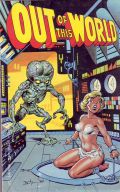
By Richard Corben & various (Warren Adult Fantasy)
ISBN: 84-85138-21-X

Richard Corben flowered in the independent counterculture commix of the 1960s and 1970s to become a globally revered, multi-award winning creator. He is most renowned for his mastery of the airbrush and his delight in sardonic, darkly comedic horror, fantasy and science fiction tales.

Although never a regular contributor to the comicbook mainstream, the animator, illustrator, publisher and cartoonist is one of America’s greatest proponents of sequential narrative: an astoundingly accomplished artist with an unmistakable style and vision.

Violent, cathartically graphic and often blackly hilarious, his infamous signature-stylisation always includes oodles of nudity, ultra-extreme explicit violence and impossibly proportioned male and female physiques – and nobody should be disappointed as there’s plenty of all that in here.

From a time when graphic novels and book-bound comics collections were almost unheard of, this quirky, racy collection opens after an effusive introduction by Will Eisner with ‘The Dweller in the Dark’ (co-written with Herb Arnold) – an early exploration of the artist’s fascination with and facility for depicting lost civilisations. Rain-forest dwellers Bo Glan and Nipta break tribal taboo to explore a dead city, and learn pain and sorrow when they fall foul of rapacious, invading white men and ancient things far worse…

‘Razar the Unhero’ (written in 1970 by Arnold as “Starr Armitage”) is a dark and sexily violent spoof with a deprecating edge, deliciously lampooning the Sword and Sorcery epics dominating paperback bookshelves of the day whilst the silly, saucy ‘Mangle, Robot Mangler’ does the same to classic comicbook hero Magnus with a sexy, seditious rabbit-punch parody.

‘How Howie Made it in the Real World’ jumps wholeheartedly into adult science fiction territory with a sinister gore-fest for unwary space-tourists whilst ‘For the Love of a Daemon’ – opening the full-colour section of this volume and showing the first hints of the artist’s later airbrush expertise – returns to traditional fantasy themes for a boisterous black comedy of Barbarians and mega-hot naked babes in distress.

The1973 collaboration with Doug Moench ‘Damsel in Dragon Dress’ is a gleeful witches’ brew of fantasy, fairytale foible and a curious cautionary tale about the unexpected dangers of drug abuse, whilst worlds-within-worlds alien romance ‘Cidopey’ conceals a tragic twist as well as the artist’s softer and more contemplative side.

The final tales in this collection are both from 1972. ‘Space Jacked’ blends Corben’s mordant sense of humour with a darkly cynical streak in the twisty-turny tale of an outer space Bonnie and Clyde who think they might be Adam and Eve, and ‘Going Home’ closes the show in a contemplative, poignant manner as the last man of Earth bequeaths the universe far better caretakers…

Mad, moody and magnificent, these early exotic episodes are too-long overdue for a proper re-evaluation but until some publisher finally wises up, at least there’s a still a goodly number of older editions just waiting to be found and treasured…
© 1971-1977 Richard Corben/Warren Publishing Co. All Rights Reserved.

World of Krypton


By Paul Kupperberg, Howard Chaykin, Murphy Anderson & Frank Chiaramonte (DC/Tor Books)
ISBN: 0-523-49017-8

For fans and comics creators alike continuity can be a harsh mistress. These days, when maintaining a faux-historical cloak of rational integrity for the made-up worlds we inhabit is paramount, the worst casualty of the semi-regular sweeping changes, rationalisations and reboots is great stories that suddenly “never happened”. The most painful example of this – for me at least – was the wholesale loss of the entire charm-drenched mythology that had evolved around Superman’s birthworld in the wonder years between 1948 and 1985.

Silver Age readers buying Superman, Action Comics, Superman’s Girlfriend Lois Lane, World’s Finest Comics and Superman’s Pal Jimmy Olsen (not forgetting Superboy and Adventure Comics) would delight every time some fascinating snippet of information leaked out. We spent our rainy days filling in the incredible blanks about the lost world through the delightful and thrilling tales from those halcyon publications.

Throughout the 1970s and into the 1980s Superman – and an issue of Superman Family – carried a back-up series entitled ‘The Fabulous World of Krypton’ relating “Untold Tales of Superman’s Native Planet” (so long overdue for a complete trade paperback collection) by a host of the industry’s greatest talents which further explored that defunct wonderland.

Many of those twenty-seven vignettes were referenced alongside the key Krypton-starring issues of the Superman franchise in 1979 when scripter Paul Kupperberg and artists Howard Chaykin, Murphy Anderson & Frank Chiaramonte synthesised the scattered back-story details into DC’s first miniseries World of Krypton.

Although never collected into a graphic novel, this glorious indulgence was resized into a nifty black and white paperback book in 1982, supervised by and with an introduction from the much-missed, multi-talented official DC memory E. Nelson Bridwell (who was always the go-to guy for any detail of fact or trivia concerning the company’s vast comics output). This magical celebration of life on the best of all fictional worlds is a grand old slice of comics fun and nostalgia long overdue for a critical reappraisal and a wider audience.

The story opens with Superman reviewing a tape-diary found on the moon: a document from his deceased father Jor-El which details the scientist’s life, career and struggle with the nay-saying political authorities whose inaction doomed the Kryptonian race to near extinction.

As the Man of Steel listens on, he hears how Jor-El wooed and won his mother Lara Lor-Van despite all the sinister efforts of the planetary marriage computer to frustrate them, how he discovered anti-gravity and invented the Phantom Zone ray, uncovered the lost technology of a dead race which provided the clues to Kal-El’s escape rocket, and learns his father’s take on Superman’s many time-twisting trips to Krypton…

He feels his father’s pain when Brainiac stole the city of Kandor, when rogue scientist Jax-Ur blew up the inhabited moon of Wegthor, when civil war almost wracked the planet thanks to the deranged militarist General Zod and when his own cousin Kru forever disgraced the noble House of El…

Heavily referencing immortal classics such as ‘Superman’s Return to Krypton’ (Superman volume 1 #141, November 1960), Fabulous World of Krypton mini-epics ‘Jor-El’s Golden Folly’, ‘Moon-Crossed Love’, ‘Marriage, Kryptonian Style’ and a host of others, this epochal saga from simpler and more wondrous times is a sheer delight for any fan tired of unremitting angst and non-stop crises…

Moreover the sensitive and meticulous reformatting of the original miniseries by editor Bridwell and designers Bob Rozakis, Shelley Eiber & Alex Saviuk makes this book one of the most smoothly readable of all paperback comic collections.

Although not that easy to find, World of Krypton is still worth tracking down and until DC get around to gathering the Krypton chronicles into the kind of compendium they deserve this is still your best shot at seeing the evolution of a world we all wanted to live on back in the heady days of yore…
© 1982 DC Comics Inc. All Rights Reserved.

Showcase Presents Green Lantern volume 5


By Denny O’Neil, Neal Adams, Dick Giordano, Mike Grell & various (DC Comics)
ISBN: 978-0-85768-224-6

Returning to the usual phonebook-sized black and white tome, this fifth collection starring the Emerald Gladiator of Earth-1 (re-presenting the contents of Green Lantern/Green Arrow #76-89 – barring the all-reprint #88and the emerald back-up strips from Flash #217-221, 223-224, 226-228, 230-231, 237-238, 240-243, 245-246) generated groundbreaking, landmark tales from Denny O’Neil & Neal Adams that totally revolutionised the industry, whilst registering such poor sales that the series was cancelled and the heroes unceremoniously shipped into the back of another comicbook. Gradually the emphasis shifted back to crime, adventure and space opera and Green Lantern grew popular enough for his own solo title once more….

By the end of the 1960s America was a bubbling cauldron of social turmoil and experimentation. Everything was challenged and with issue #76 (April 1970 and the first issue of the new decade) Denny O’Neil and comics iconoclast Neal Adams utterly redefined superhero strips with their relevancy-driven stories; transforming complacent establishment masked boy-scouts into uncertain, questioning champions and strident explorers of the revolution.

‘No Evil Shall Escape My Sight!’ (inked by Frank Giacoia) is a landmark in the medium, utterly re-positioning the very concept of the costumed crusader as newly-minted ardent liberal Green Arrow challenged GL’s cosy worldview when the lofty space-cop painfully discovered real villains wore business suits, had expense accounts, hurt people just because of skin colour and would happily poison their own nests for short-term gain…

Of course, the fact that the story is a brilliant crime-thriller with science-fiction overtones magnificently illustrated doesn’t hurt either…

O’ Neil became sole scripter with this story and, in tight collaboration with ultra-realistic art-genius Adams, instantly overturned contemporary costumed dramas with their societally-targeted relevancy-driven protest-stories. The book became Green Lantern/Green Arrow with Emerald Archer Oliver Queen constantly mouthing off as a radical, liberal sounding-board and platform for a generation-in-crisis whilst staid, quasi-reactionary GL Hal Jordan played the part of the oblivious but well-meaning old guard.

At least the Ring-Slinger was aware of his faults and more or less willing to listen to new ideas…

At the time this compendium of stories first appeared DC was a company in transition – as indeed was America itself – with new ideas (which, in comic-book terms meant “young writers”) being given much leeway: a veritable wave of fresh, raw talent akin to the very start of the industry, when excitable young creators ran wild with imagination… Their cause wasn’t hurt by an industry in rapid commercial decline: costs were up and the kids just weren’t buying funnybooks in the volumes they used to…

‘Journey to Desolation’ in #77 was every bit as groundbreaking.

At the conclusion of the last issue an immortal Guardian of the Universe – hereafter known as “the Old Timer” was assigned to accompany the Emerald Duo on a voyage to “discover America”: a soul-searching social exploration into the dichotomies which divided the nation. First stop brought the trio to a poverty-stricken mining town run as a private kingdom by a ruthless entrepreneur happy to use agent-provocateurs and Nazi war criminals to keep his wage slaves in line.

When a young protest singer looked likely to become the next Bob Dylan and draw unwelcome publicity, he had to be eliminated – as did the three strangers who drove into town at just the wrong moment…

Although the heroes provided temporary solutions and put away viciously human criminals, these tales were remarkably blunt in exposing bigger ills and issues that couldn’t be fixed with a wave of a Green Ring; invoking an aura of helplessness that was metaphorically emphasised during this story when Hal was summarily stripped of much of his power for no longer being the willing, unquestioning stooge of his officious, high-and-mighty alien masters…

The confused and far-more-mortal Green Lantern discovered another unpalatable aspect of human nature in ‘A Kind of Loving, a Way of Death!’ when Black Canary joined the peripatetic cast. Seeking to renew her relationship with Green Arrow, she was waylaid by bikers, grievously injured and taken in by a charismatic hippy guru. Unfortunately Joshua was more Manson than Messiah and his brand of Peace and Love only extended to white people: everybody else was simply target practise…

The plight of Native Americans was stunningly high-lighted in ‘Ulysses Star is Still Alive!’ as corporate logging interests attempted to deprive a mountain tribe of their very last scraps of heritage, once more causing the Green Knights to take extraordinarily differing courses of action to help, whilst #80 added a science fiction gloss to a tale of judicial malfeasance in ‘Even an Immortal Can Die!’ (inked by Dick Giordano).

When the Old Timer used his powers to save Green Lantern rather than prevent a pollution catastrophe in the Pacific Northwest, he was chastised by his fellow Guardians and dispatched to the planet Gallo for judgement by the supreme arbiters of Law in the universe.

His earthly friends accompanied him and found a disturbing new administration with a decidedly off-kilter view of justice…

Adams’ staggering facility for capturing likenesses added extra-piquancy to this yarn that we’re just not equipped to grasp four decades later, with the usurping, overbearing villain derived from the Judge of the infamous trial of anti-war protesters “The Chicago Eight”.

Insight into the Guardians’ history underpinned ‘Death Be My Destiny!’ when Lantern, Arrow and Canary travelled with the now-sentenced Old Timer to the ancient world of Maltus (that’s a pun, son: just type Thomas Robert Malthus into your search engine of choice or even look in a book) and found a world literally choking on its own out-of-control population. The uncanny cause cast unlovely light on the perceived role and worth of women in modern society…

Green Lantern/Green Arrow #82 returned briefly to traditional yarn-spinning in ‘How do you Fight a Nightmare?’ (with additional inks from Berni Wrightson) as Green Lantern’s greatest foe unleashed Harpies, Amazons and all manner of female furies on the hapless hero before Black Canary and Green Arrow could turn the tide, whilst ‘…And a Child Shall Destroy Them!’ crept into Hitchcock country to reintroduce Hal Jordan’s old flame Carol Ferris and take a pop at education and discipline in the chilling tale of a supernal mutant in thrall to a doctrinaire little martinet.

Wrightson also inked #84’s staggering attack on out-of-control consumerism, shoddy cost-cutting and the seduction of bread and circuses in ‘Peril in Plastic’ before the comics world changed forever in the two-part saga ‘Snowbirds Don’t Fly’ and ‘They Say It’ll Kill Me…But They Won’t Say When!’

Depiction of drug abuse had been strictly proscribed in comicbooks since the advent of the Comics Code Authority, but by 1971 the elephant in the room was too big to ignore and both Marvel and DC addressed the issue in startlingly powerful tales that opened Pandora’s dirty box forever. When the Green Gladiators were drawn into conflict with a vicious heroin-smuggling gang Oliver Queen was horrified to discover his own sidekick had become an addict…

This sordid, nasty tale did more than merely preach or condemn, but actively sought to explain why young people turned to drugs, just what the consequences could be and even hinted at solutions older people and parents might not want to consider. Forty years on it might all seem a little naïve, but the earnest drive to do something and the sheer dark power of the story still delivers a stunning punch.

For all the critical acclaim and astonishingly innovative work done, sales of Green Lantern/Green Arrow were in a critical nosedive and nothing seemed able to stop the rot. Issue #87 featured two solo tales, the first of which ‘Beware My Power!’ introduced a bold new character to the DCU. John Stewart was a radical activist: an angry black man always spoiling for a fight and prepared to take guff from no-one. Hal Jordan was convinced the Guardians had erred when they appointed Stewart as Green Lantern’s official stand-in, but when a bigoted US presidential candidate tried to foment a race war the Emerald Gladiator was forced to change his tune.

Meanwhile bankrupted millionaire Oliver Queen was faced with a difficult decision when the retiring Mayor of Star City invited him to run for his office. ‘What Can One Man Do?’ written by Elliot Maggin, posed fascinating questions for the proud rebel by inviting him to join “the establishment” he despised, and do some lasting good. The decision was muddied by well-meaning advice from his fellow superheroes and the tragic consequences of a senseless street riot…

Issue #88 was a collection of reprints (not included here) and the series went out on an evocative, allegorical high note in #89 as ‘…And Through Him Save a World…’ (inked by Adams) pitted jobs and self-interest at Carol Ferris’ aviation company against clean air and pure streams in an naturalistic fable wherein an ecological Christ-figure made the ultimate sacrifice to save our planet and where all the Green Heroes’ power could not affect the outcome…

Although the groundbreaking series folded there, the heroics resumed a few months later in the back of The Flash #217 (August-September 1972). ‘The Killing of an Archer!’ began a run of short episodes which eventually led to Green Lantern regaining his own solo series. The O’Neil, Adams & Giordano thriller related how Green Arrow made a fatal mistake and accidentally ended the life of a criminal he was battling. Devastated, the broken swashbuckler abandoned his life and headed for the wilderness to atone or die…

The next episode ramped up the tension as a plot against the Archer was uncovered by Green Lantern and Black Canary in ‘Green Arrow is Dead!’ whilst ‘The Fate of an Archer’ saw Canary critically injured and GL track down Oliver Queen just in time to save her life…

Dick Giordano assumed full illustration duties with ‘Duel for a Death List!’ and the concluding ‘Death-Threat on Titan!’ (Flash #220-221) as the feature returned to its science fiction roots to concentrate solely on Green Lantern once more. In this pacy yarn aliens with an ancient link to the GL Corps began eliminating ring-wielders in preparation for a fantastic strike against the Guardians of the Universe.

Issue #223 continued the interstellar intrigue as an alien interloper attacked in ‘Doomsday… Minus Ten Minutes!’ whilst the next issue presented a clever, thoroughly grounded crime-caper ‘Yellow is a Dirty Little Color!’

In #226-Neal Adams drew his last GL tale ‘The Powerless Power Ring!’ before Dick Dillin, Giordano & Giacoia completed the trilogy in #227-228 with ‘My Ring… My Enemy!’ and ‘My Enemy… Myself!’ wherein atmospheric phenomena, bad mushrooms and invading aliens all combined to make the will-powered weapon a lethal liability.

Flash #230-231 featured ‘The Man From Yesterday!’ and ‘The Man of Destiny!’ (Dillin & Tex Blaisdell) as GL saved one of America’s Revolutionary heroes from aliens who had shanghaied him centuries previously, whilst #233-234 ‘World That Bet on War!’ & ‘And the Winner is Death!’ (Dillin, Terry Austin & Giordano) pitted the Emerald Avenger against gambling-crazed extraterrestrials who used soldiers from Earth history as their games-pieces…

With Flash #237-238 and 240-243 new art sensation Mike Grell came aboard for a six part saga that precipitated Green Lantern back into his own title. Beginning with ‘Let There Be Darkness!’ (inked by Bill Draut) the watchword was “cosmic” as the extra-galactic Ravagers of Olys undertook six destructive, unholy tasks in Green Lantern’s space sector. After thwarting their scheme to occlude the sun over planet Zerbon, destroying the photosynthetic inhabitants, the hero picked up a semi-sentient starfish sidekick in ‘The Day of the Falling Sky!’(Blaisdell inks) whilst preventing the artificial world of Vivarium from collapsing in upon itself.

‘The Floods Will Come!’ brought the Olys to planets Archos, where they attempted to submerge all the landmasses and drown the stone-age dwellers thriving there and Jotham, where the Ravagers almost extinguished the sun in ‘To Kill a Star!’

Earth was the target in ‘All Creatures Great and Small!’ as the Olys used their incredible technology to shrink all mammals but no sooner had Green Lantern negated that threat than the invaders’ de-evolutionary weapons were activated in ‘Dust of the Earth!’ (Austin inks).

Luckily a hominid GL was even more formidable than his Homo Sapiens self…

The buzz of the O’Neil/Grell epic assured Green Lantern of his own series once more, but before the re-launch Flash #345-346 presented one last two-part, back-up bonanza as Dillin & Austin illustrated the eerie mutation of vegetable-themed villain Jason Woodrue who transformed himself into a horrendous monster in ‘Perilous Plan of the Plant Master!’ before subjecting GL to ‘The Fury of the Floronic Man!

From challenging tales of social injustice back to plot-driven sagas of wit and courage, packed with a shining, optimistic sense of wonder and bristling with high-octane action, these evergreen adventures signalled the end of the Silver Age of Comics. Illustrated by some of the most revered names in the business, the exploits in this volume closed one chapter in the life of Green Lantern and opened the doors to today’s sleek and stellar sentinel of the stars.

© 1970, 1971, 1972, 1973, 1974, 1975, 1976, 1977, 2011 DC Comics. All Rights Reserved.
Grimjack: Demon Knight


By John Ostrander & Flint Henry with an introduction by Roger Zelazny (First Publishing)
ISBN: 978-0-91541-970-8

Grimjack originally appeared during the American comic industry’s last great flourishing in the 1980’s. Created by playwright John Ostrander and Young Turk Tim Truman as a back-up feature for Mike Grell’s Starslayer, the series ran in issues #10-18 before graduating to its own title at First Comics. It almost survived the company’s demise more than a decade later. In a crowded marketplace, and almost irrespective of who was doing the drawing, this hard-boiled-detective/fantasy action strip was a watchword for quality entertainment.

The ’80s were a fantastic time for comics creators and consumers. It was like an entire new industry opening up within the original, moribund mainstream; the proliferation of the Direct Sales market and dedicated specialist retail outlets allowed new companies to start experimenting with format and content, whilst punters had a bit of spare cash to play with. Moreover much of the “kid’s stuff” stigma had finally dissipated – the country was catching up to the rest of the world in acknowledging that sequential narrative might just be an actual art-form…

Consequently many new companies began competing for the attention and cash of punters who had grown accustomed – or resigned – to getting their four-colour kicks from DC, Marvel Archie and/or Harvey Comics. European and Japanese material had been slowly creeping in but by 1983 a host of young companies such as WaRP Graphics, Pacific, Eclipse, Capital, Now, Comico, Dark Horse and First among others had established themselves and were making impressive inroads into traditional markets.

New talent, established stars and fresh ideas all found a thriving forum to try something a little different both in terms of content and format. Chicago-based First Comics was an early frontrunner, with Frank Brunner’s Warp, Starslayer and Jon Sable from Mike Grell and Howard Chaykin’s iconic American Flagg!, as well as an impressive line of comicbooks targeting a more sophisticated audience.

In 1984 they followed Marvel and DC’s lead with a line of impressive, European-styled over-sized graphic albums featuring new, out-of-the-ordinary comics sagas (see Time2, Time Beavers, Mazinger or Beowulf to see just how bold, broad and innovative the material could be)…

John Gaunt is a perpetually reincarnating warrior-mercenary calling himself Grimjack: a combination private eye, Ronin and problem-solver-of-last-resort, just scratching out a living in the fantastic pan-dimensional city of Cynosure. This incalculably vast metropolis intersects with every place in the multiverse at one time or another and the strangest of the strange inhabit its core regions.

All manner of beings constantly rub shoulders (if they have them) with gods, monsters, robots and things less quantifiable in a cruelly capitalistic commercial wonderland where the laws of physics can change from house to house but the law of supply and demand is utterly inviolable…

In his long lives Gaunt has been many things, but first and foremost he is a hero of the Demon Wars – a period in Cynosure’s history when the city overlapped the assorted regions of Hell and unspeakably vile devils from a host of infernos ran amok in the metropolis until the valiant Demon Knights drove them off forever.

Now, in this all-new tale, Gaunt is hired by the Office of the Chronost-Marshall to find who has interfered with the city’s chronology, unleashing a devastating time-storm. Surly, rebellious and unpleasant, Gaunt is still the only operative tough and crazy enough to brave the fourth dimensional vortex and shut down the maelstrom. Unfortunately, he never reckoned on stumbling into his own tragic past and meeting again his one true love…

As the Demon Wars reached their crescendo long ago a sorely wounded John Gaunt stumbled into a paradise dimension named Pdwyr and found brief bliss with the glorious, pacifist princess Rhian, before his companion Major Lash betrayed the entire race to the infernal hordes and watched their paradise become a last bastion of Hell…

Now Gaunt has arrived in Pdwyr once more – just after his earlier self departed – and faces the ultimate temptation: changing history to save the only woman he ever loved and the only place he ever felt at peace, or letting events unfold again in all their horrific predestined brutality…

Whatever he decides will be wrong…

The combination of cynical dry wit, mordant, bitter-edged fantasy and spectacularly imaginative action made Grimjack one of the best series of the era and the ghastly human tragedy of this epic aside is a treat no comics fan should miss. Moreover, this graphic narrative, beautifully illustrated by Flint Henry and colourist Martin Thomas, is designed with new readers in mind so there’s no reason for anyone to avoid a brutally magical encounter with a genuine original of the genre(s)…
© 1989 First Publishing, Inc. All Rights Reserved.

Hawkmoon: the Jewel in the Skull


By Michael Moorcock, adapted by Gerry Conway, Rafael Kayanan, Rico Rival & Alfredo Alcala (First Publishing)
ISBN: 0-915419-32-7

Michael Moorcock began his career as a comics writer and editor at age 15, writing and editing such classic strips as Tarzan, Dogfight Dixon, Jet Ace Logan, Captain Condor, Olac the Gladiator and many, many other British stalwarts before making the jump to prose fiction, where he single-handedly revitalised the genre with the creation of Elric and the high-concept of the Eternal Champion.

As literary fantasy heroes began finding comicbook outlets and analogues it was only a matter of time before Moorcock’s astonishing pantheon of paladins began making inroads into the graphic adventure market. After a series of superlative adaptations of his epochal Elric epics were released by Marvel and First Publishing in the 1980s, the latter company expanded the franchise and began publishing miniseries of the darkly satirical and highly engaging History of the Runestaff.

Also part of Moorcock’s vast and expansive “Eternal Champion” shared universe, the novels comprising The Runestaff detail the struggles of an embattled and beleaguered band of heroes in a dystopic future Europe struggling to survive the all-conquering armies of decadent and fascistic superpower Granbretan. The astonishingly addictive and archly hilarious core books The Jewel in The Skull, The Mad God’s Amulet, The Sword Of The Dawn, and The Runestaff have been collected into an omnibus edition entitled The History of the Runestaff if you feel the inclination to check out the source material…

In a mischievous reversal of British comics tradition the proto-steampunk Dark Empire of Granbretan are ruthless, rapacious, all-conquering bad-guys whilst the beleaguered underdog heroes are French and the star is a German!

Stuffed with English phonetic in-jokes and puns the series is a deeply witty and sardonic critique on the times it was written in. Wicked Baron Meliadus is ruler of the fabulous duchy of Kroiden – famed today for its trams and… well, not even trams really… and the debased gods the Wicked Englander marauders worship include Aral Vilsn, Chirshil, Jhone, Phowl, Jhorg and Rhunga – sound ’em out; we’ll wait…

In this adaptation of the first novel, originally released as a four issue miniseries in1987, the wonderment begins as doughty warrior Count Brass inspects the land of the Kamarg; domains he won after destroying the previous demented, despotic incumbent. After an eventful tour Brass returns home and renews a long-standing debate with his aide and friend Bowgentle about the relative merits of the burgeoning Empire of Granbretan.

A seasoned campaigner, the Count feels the Empire’s initial depredations are acceptable if the world stands united at the end whilst the philosopher/poet feels that there’s a creeping sickness corrupting the souls of the agents of expansion. The comrades get a chance to assess for themselves when Ambassador Baron Meliadus of Kroiden arrives seeking a non-intervention pact with the tiny but powerful state Brass shepherds.

Offering every courtesy to the visiting dignitary the Count allows himself to be swayed by the Baron’s honeyed words until the Granbretanian, obsessed with Brass’ daughter Yisselda, refuses to take “no” for an answer and attempts to abduct her. After grievously wounding Bowgentle, Meliadus is soundly thrashed and sent packing by the outraged father and henceforth a state of war exists between the Empire and the Karmarg.

Frustrated and humiliated Meliadus swears an oath by the mythical Runestaff to defeat Count Brass, possess Yisselda and ravage the Kamarg. Returning to the dark heart of the Empire the Baron plots a horrible revenge, unaware of the staggering forces his incautious oath has set in motion…

His vile thoughts turn to Duke Dorian Hawkmoon von Köln, a recently captured prince who valiantly resisted the Empire’s brutal conquest of his nation. Now a broken toy of Granbretan’s debased scientists, Hawkmoon will be the perfect instrument of revenge once the devilish doctors of Londra have done with him…

Meliadus offers Hawkmoon freedom if the broken hero will infiltrate the Karmarg and steal Yisselda and the Duke agrees, but rather than accept his word Meliadus takes the precaution of having a black jewel inserted into Dorian’s skull. Not only will it relay back all the Duke sees, but should he rebel it will eat into his skull and consume his brain…

The second chapter opens with Hawkmoon’s cunningly staged epic escape and soon the Hero of Köln is welcomed into the safe haven of Count Brass’ castle. His mission well underway the princely pawn is troubled by dreams of a Warrior in Jet and Gold, but his waking hours are filled with spiritual healing as the champions of the Kamarg and especially lovely Yisselda mend his broken warrior’s soul.

Moreover Brass is not fooled for a moment and undertakes to free Hawkmoon from the influence and lethal effects of the ebony jewel…

The reprieve is temporary and the Jewel in the Skull is only rendered dormant. To completely remove its threat Hawkmoon must travel to far Hamadam in search of the wizard Malagigi, who holds the secret of neutralising the brain-devouring bauble. However, before that can be contemplated the little kingdom must face the massed armies of Granbretan under the furious command of twice-thwarted Baron Meliadus…

With a revitalised Hawkmoon commanding a troop of harrying rough-riders the impossible feat is accomplished in grand style (thanks in no small part to the powerfully imaginative illustration of Rafael Kayanan and inkers Alfredo Alcala & Rico Rival) and as the Dark Empire retreats in stunned astonishment to lick its wounds and assuage its shaken pride, the tormented Duke heads East to Turkia seeking his personal salvation.

The final chapter sees him find his destined squire/companion Oladahn (smallest of the Mountain Giants), finally meet the mysterious warrior in Jet and Gold, defeat decadent sorcerer Agonosvos the Immortal and forge a new alliance when he rescues warrior-queen Frawbra and her city from insurrection instigated by Granbretan.

Masterminding the attempt is the rapacious and quite mad Meliadus, leading to a fate-drenched final confrontation…

There’s a tremendous amount of plot stuffed into each issue, often giving a feeling of ponderous density to the proceedings but it’s always leavened with plenty of action and one spectacular high concept idea after another. Whilst no substitute for Moorcock’s stunning fantasy tour de force, the graphic novel Jewel in the Skull is a bombastic and devastatingly effective adaptation that will delight all fans of fantastic fantasy.
© 1988 First Publishing, Inc and Star*Reach Productions. Original story © 1967 Michael Moorcock; used with permission.

Y: the Last Man volume 10: Whys and Wherefores


By Brian K Vaughan, Pia Guerra & José Marzán Jr. (Vertigo)
ISBN: 978-1-84576-903-1

Some sense of disappointment is probably unavoidable when an acclaimed and beloved serial finally ends, but at least there’s a sense of accomplishment to savour and if you’re lucky perhaps a hint of more to be said and an avenue for further wonderment…

When every male creature on Earth suddenly dropped dead, only student Yorick Brown and his pet monkey Ampersand survived in a world instantly utterly all-girl. Unexpectedly a crucial natural resource, the wilful lad was escorted across the unmanned American continent to a Californian bio-lab by a government super-spy and a prominent geneticist, but all he could think of was re-uniting with his girlfriend Beth, trapped in Australia when the disaster struck.

With his reluctant companions Agent 355 and Dr. Allison Mann – who were trying to solve the mystery of his continued existence – the romantically determined oaf trekked from Washington DC to California, getting ever closer to his fiancée… or so he thought…

Each of his minders harboured dark secrets: Dr. Mann was crucially connected to the plague and the lethally competent 355 had hidden allegiances to organisations far-more far-reaching than the First Ladies of the remaining American government….

Also out to stake a claim and add to the general tension were renegade Israeli General Alter Tse’Elon and a post-disaster cult called “Daughters of the Amazon” who wanted to make sure that there really were no more men left to mess up the planet. Further complications included Yorick’s sister Hero, who stalked him across the ultra-feminised, ravaged and completely dis-United States and the boy’s own desirability to numerous frustrated and desperate women he encountered en route to Oz…

After four years and incredible adventures Yorick (a so-so scholar but a proficient amateur magician and escapologist) reached Australia only to discover Beth had embarked on her own odyssey to Paris. During the trek Dr. Mann discovered the inconvenient truth: Yorick was only alive because his pet Ampersand (an escaped lab-specimen) was immune and had inoculated his owner via his disgusting habit of chucking crap which Yorick didn’t always avoid. He didn’t keep his mouth closed enough either…

With this book, reprinting issues #55-60 of the award-winning series, comes to a final full-stop in ‘Whys and Wherefores’ wherein the various cast members all rendezvous in Paris. As well as Yorick and 355, his sister  Hero is there, having successfully escorted baby boys born in a hidden Space sciences lab to the City of Lights as well as Yorick’s baby daughter and the determined would-be mother who raped him to conceive her…

Also on scene and hungry for blood is General Tse’Elon with a dwindling squad of Israeli commandoes: rapidly diminishing because of their leader’s increasing instability and her habit of killing anybody who crosses her.

At long last the Last Man is reunited with his long lost true love, only to find that she wasn’t…

Tragically though his actual one-and-only is forever lost to him when Tse’Elon captures him and the babies, leading to a shocking final confrontation…

For the last chapter ‘Alas’ the action switches to Paris sixty years later. Thanks to cloning and gene manipulation the human race is secure and other species are returning too. Men are still rarer than hen’s teeth though, as the women seem to prefer girl babies…

The geriatric Yorick is saviour of humanity, but since he keeps trying to kill himself he has to be locked up and constantly guarded. In a desperate attempt to cure his seeming madness the leaders of the matriarchal new world – which suffers just as much from most of the problems and stupidities of the old – have brought in the best of the Last Man’s seventeen viable clones to talk him round and find out what’s bugging him. However the intervention doesn’t go as planned and the old escapologist has one last trick up his straitjacketed sleeve…

Illustrated by Pia Guerra & José Marzán Jr. these concluding adventures are packed with revelation, closures and disclosures plus some moments of genuine painful tragedy, so keep tissues handy if you’re easily moved.

The last of Y the Last Man is as controversial and challenging as ever it was: perfectly providing an ending to everything; lifting you up, breaking your heart and still leaving the reader hungry for more. And that’ just the way it ought to be…

© 2006, 2007 Brian K Vaughan & Pia Guerra. All Rights Reserved.

Al Williamson Archives volume 1


By Al Williamson with an introduction by Angelo Torres (Flesk)
ISBN: 978-1-933865-29-4

Al Williamson is one of the greatest draughtsmen ever to grace the pages of comicbooks and newspaper comics sections. He was born in 1931 before his family moved from New York City to Bogota Columbia at the height of the Golden Age of syndicated adventure strips.

The lad’s passion for strips – especially Alex Raymond’s Flash Gordon and Jungle Jim – was broadened as he devoured imported and translated US material as well as the best that Europe and Latin America could provide in such anthology magazines as Paquin and Pif Paf. Aged 12 Williamson returned to America and, after finishing school, found work in the industry that had always obsessed him.

In the early 1950s he became a star of E.C. Comics’ science fiction titles, beside kindred spirits Joe Orlando, Wally Wood, Roy G. Krenkel, Frank Frazetta and Angelo Torres, and drew Westerns Kid Colt and Ringo Kid for Atlas/Marvel. During the business’ darkest days he gravitated to newspaper strips, assisting John Prentice on Rip Kirby – another masterpiece originally created by Alex Raymond.

When comicbooks gradually recovered, Williamson drew Flash Gordon for King Comics and worked on mystery tales and westerns for DC whilst drawing such globally distributed newspaper features as Secret Agent Corrigan plus groundbreaking film adaptations of Bladerunner and Star Wars.

His stunning poetic realism, sophisticated compositions and fantastic naturalism graced many varied tales, but in later years he became almost exclusively a star inker over pencillers as varied as John Romita Jr., Larry Stroman, Rick Leonardi, Mark Bright, José Delbo and a host of others on everything from Transformers to Spider-Man 2099, Daredevil to Spider-Girl.

Al Williamson passed away in June 2010.

Flesk Publications is an outfit specialising in art books and the tomes dedicated to the greats of our industry include volumes on sequential narrative and fantasy illustration starring Steve Rude, Mark Shultz, James Bama, Gary Gianni, Franklin Booth, William Stout and Joseph Clement Coll. The guiding light behind the company is devoted and passionate art lover John Fleskes.

This initial oversized (305 x 232mm) 64 page collection of sketches, working drawings, unused and unfinished pages from one of the stellar creators of our art form stars captivating heroines, lusty barbarians, space heroes, beasts, aliens and so many wonderful dinosaurs, but also presents lesser known western scenes, science fiction tech, character sketches, duels, action sequences, nudes and glamour studies, unfinished pages from Xenozoic tales and John Carter of Mars, religious scenes and delicious unseen excerpts from Rip Kirby, as well as a glimpse into Williamson’s creative process.

The beautifully intimate glimpses of a master at work, with full colour reproduction capturing every nuance of Williamsons’ gorgeous pencil strokes, make this a book a vital primer for anybody dreaming of drawing for a living and the stirring lavish material revealed here will enthral and entice every fan of wondrous worlds and fantastic forgotten realms.

© 2010 Al Williamson. All Rights Reserved.

Yeah!


By Peter Bagge & Gilbert Hernandez, with Jaime Hernadez & Eric Reynolds (Fantagraphics Books)
ISBN: 978-1-60699-412-2

More generally known for their challenging (I so loathe that word “alternative”) material for mature audiences, cartooning legends Peter (Neat Stuff, Hate, Buddy Bradley) Bagge and Gilbert (Love & Rockets, Birdland, Sloth) Hernandez collaborated in 1999 on an intriguing and manically enticing, all-ages cartoon romp for the grievously underserved juvenile girls market, published by mainstream industry leader DC under their WildStorm imprint.

Said feature has finally been collected – regrettably without the gloriously vivid colour – in a superbly silly upbeat collection that will hopefully, in these more enlightened graphic times, find the approving audience it deserved.

As Bagge relates in his introduction, the original concept was an updating of Dan DeCarlo’s Josie and the Pussycats (voluntarily created under the strictures of the Comics Code) which would appeal to a pre-teen market; inspired by the writer’s complete immersion in the Girl-Power culture of the Spice Girls and their many imitators, thanks to his own daughter turning eight and discovering pop music…

Yeah! follows the trials and tribulations of fresh young New Jersey girls Woo-Woo, Honey and Krazy, who with their on-again, off-again, sleazy-hippie-burn-out manager Crusty seek stardom and a steady paycheque. Naturally it’s not quite that straightforward…

The girls’ extremely unique situation is introduced in ‘Everybody Say Yeah!’ as they finish a tour of the galaxy which sees them crowned “the Most Popular Band in the History of the Universe” before returning to Earth where they are still completely unknown and unable to land a single gig. Crusty has unique contacts and connections but none of them are on the planet of his birth. The best he can manage here is a cheesy school talent contest with their arch rival boy-band The Snobs…

Fed up, fame-hungry keyboardist Woo-Woo sets up a meeting with disgusting mega-millionaire Mongrel Mogul, who agrees to manage and promote them – but only if guitarist Krazy agrees to marry him. Although Woo-Woo thinks it’s worth it the girls eventually decline and Mogul instead aligns himself with their arch-enemy Miss Hellraiser…

None of the performers in Yeah! are ordinary or average. Woo-Woo’s ambitions are all-encompassing, diminutive drummer Honey is a Vegan eco-activist with a befuddled hippie boyfriend called Muddy and Krazy has telepathic powers. … And old Crusty really does commune regularly with extraterrestrials…

We meet the parents in ‘Woo-Woo, Phone Home!’ as the girls fail at a succession of menial jobs whilst waiting for the Big Time (alien money being useless on Earth) before giving up and moving to the Planet Erb where they’re properly appreciated. Unfortunately they – and especially Muddy’s goat – can’t handle the food and they have to go back when Woo-Woo’s terrifyingly blue-collar dad gets ill – but not before Crusty signs up and then abandons an Erbian tribute act called “!yaeH”…

‘Stalky’ reveals that whilst they’ve been gone an alien has been crashing at Krazy’s place, consuming her stupendous stash of junk-food (the only thing she ever eats), but the girls have bigger problems: Crusty has lined them up to be Miss Hellraiser’s backing band – and for free!

‘The Origins of Yeah!’ reveals how the girls met, when The Snobs became their enemies and why Hellraiser isn’t in Yeah! anymore, whilst ‘Yeah! Takes Off!’ uncovers Crusty’s alien connections and the girls first intergalactic successes, before ‘Honey’s Crisis!’ highlights corporate skulduggery and girly passions as Krazy and Woo-Woo become rivals for the attention of Hobo Cappilletto – the most successful boy pop-star in the World – culminating in the minor mega-sensation making his romantic play in ‘Hobo’s in Love!’

The band gets caught up in an interplanetary conflict when ‘Yeah! Goes to War!’, unexpectedly becoming folk heroes of planet Sunburnia before the fight for fame comes to an abrupt end in ‘Make Way for !yaeH’ as the erstwhile Erbian trio become a sensation on Earth whilst Yeah! still can’t get arrested in their own home town…

The volume ends with creator biographies and a mini-saga written and illustrated by Bagge hilariously depicting ‘A Day in the Life of The Snobs’…

There’s precious little around for kids and especially girl readers in American funnybooks: their options relegated to Archie Comics’ prodigious, but generally safe, output or whatever manga makes it into English translation so this intriguing and wildly imaginative series which seamlessly combined fantasy, science fiction, fashion, pop and school cultures in a wild blend of frantic fun and thoroughly deserves another chance to shine.

Moreover let’s hope the publishers follow up with more of the same and Bagge’s marvellous warts-and-all comedic comics-industry expose Sweatshop is soon to follow…

© 2011 Peter Bagge. This edition © 2011 Fantagraphics Books. All Rights Reserved.

Alien Legion: A Grey Day to Die – An Epic Graphic Novel


By Carl Potts, Alan Zelenetz, Frank Cirocco, Terry Austin & Steve Oliff (Marvel)
ISBN: 0-87135-207-9

During the 1980s the American comics scene experienced a magical proliferation of new titles and companies following the creation of the Direct Sales Market. With publishers now able to firm-sale straight to retail outlets rather than overprint and accept returned copies from non-specialised shops, the industry was able to support less generic titles and creators were able to experiment without losing their shirts.

In response Marvel developed its own line of creator-owned properties during the height of the creative explosion, generating a number of supremely impressive, idiosyncratic series on better quality paper in a variety of formats under the watchful, canny eye of Editor Archie Goodwin. The delightfully disparate line was called Epic Comics and the results reshaped the industry.

One of the earliest hits was a dark, lovely and compelling science fiction serial with a beautifully simple core concept: the Foreign Legion of Space. Created by Carl Potts, Alan Zelenetz and Frank Cirocco, The Alien Legion debuted in its own on-going series in April 1984, running for 20 issues, before re-booting into a second, 18 issue volume. The series has come and gone ever since, most recently from Dark Horse Comics – who have begun compiling the series into collected omnibuses -and there is, of course, a movie in the offing…

In 1986 the creators produced an all-new one-shot for the satisfyingly oversized Marvel Graphic Novel line (#25 if you’re counting): a venue for a variety of  “big stories” told on larger than normal pages (285 x 220mm rather than the now customary 258 x 168mm, similar to the standard European format of the times) featuring not only proprietary characters but also licensed assets like Conan, creator-owned properties like Jim Starlin’s Dreadstar and media tie-ins like Willow or Who Framed Roger Rabbit?

The Legion keeps the peace of the pan-galactic Galarchy on a million worlds spread over three galaxies: a broad brotherhood of outcast sentients united by a need to belong and a desire to escape their pasts. For such beings honour and tradition are the only things holding them together.

This grimly engaging tale finds series regular Commander Sarigar dispatching his best troops from Nomad Squadron (humanoid liberal Torrie Montroc, self-serving sociopath Jugger Grimrod, telepathic Meico, serving grunts Durge and Torqa Dun plus despondent retiring veteran Skathe Mescad) to a distant world for a dirty “wet-work” mission. Although most find the task distasteful, Grimrod is eager to practise the skills the Legion usually punishes him for indulging in…

The Technoids are a growing movement among many sentient species, espousing participant evolution and the replacement of organic features with cybernetic and mechanical parts. These aggressive cyborgs believe flesh is outmoded and aren’t too fussy about whether the surgeries are voluntary…

Technoids have battled the forces of the Galarchy for decades: in fact the most cherished victory legend of the Legion involves four heroic troopers who held off a thousand cyborg foes and chose death before surrender…

Now the Technoid leader Deathron has moved into politics and stands ready to convince an entire planet to trade their flesh for steel and plastic – a perfect opportunity to assassinate the head of the insidious movement. However nothing is ever easy for Nomad and Dethron has a hidden surprise waiting for the already unsettled and disconcerted soldiers…

Terse, tense and compellingly action-packed, this imaginative yarn by Potts and Zelenetz is splendidly readable and instantly accessible to those unfamiliar with the series, whilst the larger pages allow Cirocco and Terry Austin’s magnificent art and the inspired colouring of Cirocco and Steve Oliff to leap out and grab the reader. Sheer space opera gold and well worth tracking down.
© 1986 Carl Potts. All Rights Reserved.

Axa volumes 5 and 6


By Donne Avenell & Enrique Badia Romero (Ken Pierce Books)
Vol. 5 ISBN: 0-912277-21-1   Vol. 6 no ISBN: 0-912277-22-X

Although the “Swinging Sixties” is thought of as the moment when we all lost our prudish innocence, the real era of sexual liberation was the early 1970s. In that period of swiftly shifting social and cultural morés and rapidly evolving attitudes to adult behaviour British newspapers radically altered much of their traditional style and content in response to the seemingly inexorable wave of female social emancipation and reputed sexual equality.

All the same, this still allowed newspaper editors plenty of leeway to squeeze in oodles of undraped women, who finally escaped from the perfectly rendered comics strips and onto the regular pages (usually the third one), the centre-spreads, pop pages and fashion features…

However the only place where truly affirmative female role-models appeared to be taken seriously were the aforementioned cartoon sections, but even there the likes of Modesty Blaise, Danielle, Scarth, Amanda and all the other capable ladies who walked all over the oppressor gender, both humorously and in straight adventure scenarios, lost clothes and shed undies repeatedly, continuously, frivolously and in the manner they always had…

Nobody complained (no one important or who was ever taken seriously): it was just tradition and the idiom of the medium… and besides, most artists have always liked to draw bare-naked ladies as much as blokes liked to see them and it was even educational for the kiddies – who could buy any newspaper in any shop without interference even if they couldn’t get into cinemas to view Flashdance, Trading Places or Spacehunter: Adventures in the Forbidden Zone without an accompanying adult…

Sales kept soaring…

Take-charge chicks were practically commonplace when the Star Wars phenomenon reinvigorated public interest in science fiction and the old standby of scantily-clad, curvy amazons and post-apocalyptic wonderlands regained their sales-appeal. Thus The Sun hired Enrique Badia Romero and Donne Avenell to produce just such an attention-getter for their already well-stacked cartoon section.

Romero had begun his career in Spain in 1953, producing everything from westerns, sports, war stories and trading cards, often in conjunction with his brother Jorge Badía Romero. He even formed his own publishing house. “Enric” began working for the higher-paying UK market in the 1960s on strips such as ‘Cathy and Wendy’, ‘Isometrics’ and ‘Cassius Clay’ before successfully assuming the drawing duties on the high-profile Modesty Blaise strip in 1970 (see Modesty Blaise: The Hell Makers and Modesty Blaise: The Green Eyed Monster), only leaving when this enticing new prospect appeared.

In 1986 political and editorial intrigue saw Axa cancelled in the middle of a story and Romero returned to the bodacious Blaise until creator/writer Peter O’Donnell retired in 2001. Since then he has produced Modesty material for Scandinavia and a number of projects such as Durham Red for 2000AD.

Axa ran in The Sun Monday to Saturday from 1978 to her abrupt disappearance in 1986 and, other than these slim volumes from strip historian Ken Pierce, has never been graced with a definitive collection. It should be noted also that at the time of these books the strip was still being published to great acclaim.

In ‘Axa the Eager’ opens with the winsome wanderer and her current paramour Dirk drifting along barren coastlines until they encounter a bird-like man-creature and are drawn inescapably into a clash of ideologies between two factions of tree-dwelling humanoids.

One, led by the boisterous dreamer Zeph, wishes to remain in the safety of the canopies until they evolve into true fliers whilst his brother Galen wishes to return the Sky People to the Earth and the ways of technological progress. The division also splits Dirk and Axa and to complicate matters further the solid ground they’re all squawking about is surrounded by deadly mutated toad monsters…

Powerful and impressively philosophical, this tale of family discord could only end in tragedy…

‘Axa the Carefree’ finds the chastened explorers travelling inland to a new and desolate landscape concealing a sedate well-hidden village. Impossibly it seems to have escaped unscathed the horrors of the Great Contamination and investigating further Axa and Dirk discover a population of simple peasants blithely thriving, unaware of the horrors of the last hundred years. However, as always, things are not as they seem and the farmers are only a satellite branch of specialist technological guilds collectively dubbed “The Artisans”.

Ever curious the nubile nomad sneaks into the mountain citadel of the Artisans to find a virtual paradise where her wild beauty captivates one too many of the masters of the Craft Guilds that run the place. She is also reunited with her lost companion Mark 10, a robotic servant she won and lost in Axa volume 3.

Tensions are already rising when the bored and enamoured Galen stumbles onto the scene and, as her very presence incites the normally-stable creative types into a kind of madness, there looks to be a revolution in the Artisans’ immediate future unless Axa can broker a return to productive rationality…

Axa 6 dispenses with tedious text and dashes straight into the graphic action of ‘Axa the Dwarfed’ with the glorious gladiatrix and Mark 10 abandoning the Artisans to trek across a bleak wasteland until they stumble into an old government research facility where the flora and insect life has grown to immense proportions. Moreover, truly advanced and properly civilised scientists appear to be running the whole show…

Typically however, even this technological Garden of Eden has a serpent in the form of one boffin with a little too much ambition, so it’s a lucky thing old flame Matt has been tracking Axa for months and finally reunites with her just as the unscrupulous mastermind makes his move…

‘Axa the Untamed’ finds the fiery fury dragging Matt and Mark 10 into a different kind of danger when the trio encounter a tribe of Gipsies who have proliferated into a modern horde of nomadic Mongol plainsmen, trading horses and other valuable commodities in a mad, macho wonderland of testosterone and arrogance.

Even Axa’s freedom-fuelled head is turned by the attentions of Gipsy Prince Django, much to Matt’s dismay, but it isn’t too long before the glamour fades and the worth of women in Django’s world leads her to reassess its value. It’s a lot harder to cure her love affair with his magnificent horses though…

These tales are superb examples of the uniquely British newspaper strip style: lavishly drawn, subversively written, expansive in scope and utterly enchanting in their basic simplicity – with lots of flashed flesh, emphatic action and sly, knowing humour. Eminently readable and re-readable (and there’s still that dwindling promise of a major motion picture) Axa is long overdue for a definitive collection. Here’s hoping there’s a bold publisher out there looking for the next big thing…
© 1984 Express Newspapers, Ltd.