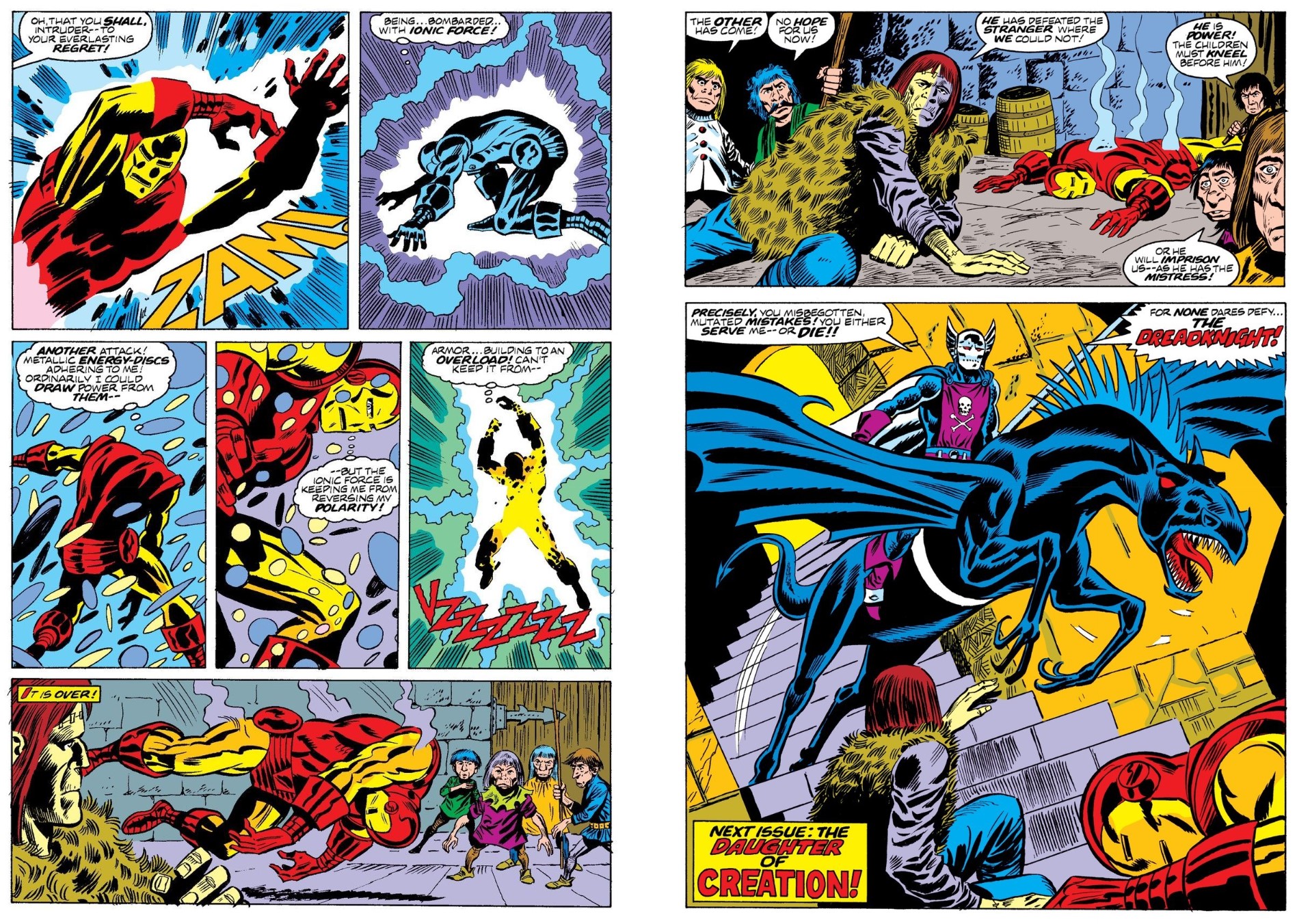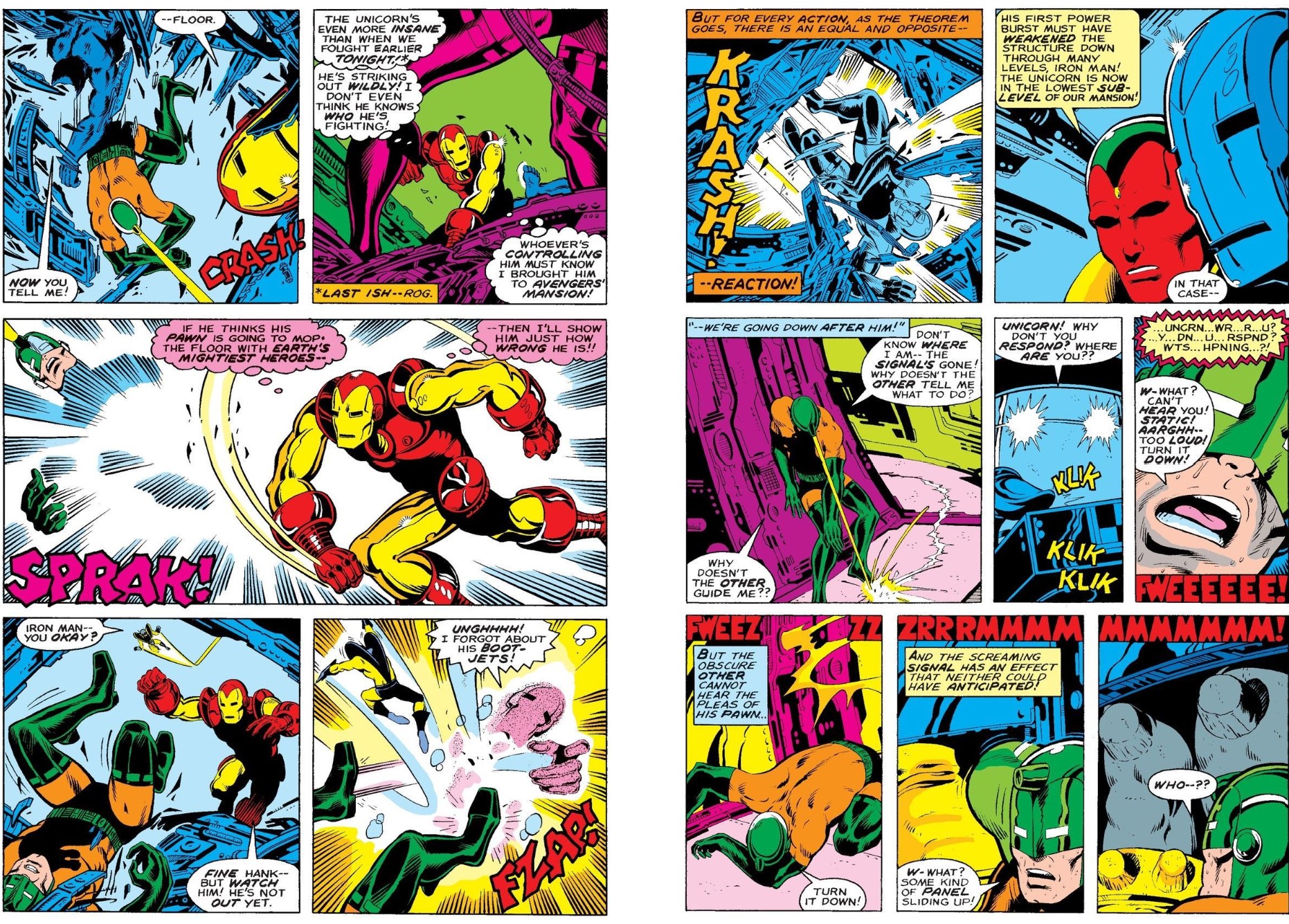
Batman: The Dark Knight Archives volume 8


By Bob Kane, Don Cameron, Bill Finger, Joe Samachson, Alvin Schwartz, Dick Sprang, Jerry Robinson, Ray Burnley & various (DC Comics)
ISBN: 978-1-4012-3744-8 (HB)

This book includes Discriminatory Content produced in less enlightened times.

It’s an absolute crime that the comics stories of Richard W. Sprang have never been gathered in a properly curated edition. On the 110th anniversary of his birth in Fremont, Ohio, I’m flogging another dead comics horse by re-reviewing one of my favourite collections, but even that is a venue he shared with others. Surely his astounding, compelling contributions particularly to DC key icons Batman & Superman have earned him a dedicated Sprang Legends or Tales of omnibus or compendium?

Dick Sprang (July 28th 1915 – May 10th 2000) began earning money from art and narrative early on, working as a designer and illustrator in Ohio whilst still in high school: editing and contributing art to magazines and pulps from the early 1930s onwards. On graduation in 1934 he joined the bullpen of Toledo, Ohio publishing chain Scripps-Howard delivering deadline-busting ads, editorial cartoons and illustrations. Working with the company engravers Sprang mastered every aspect of print technology before moving to New York City in 1936 to illustrate pulps – everything from westerns to detective to general adventure yarns.

Regular clints included Popular Detective, Popular Western, Phantom Detective, G-Men, Detective Novels Magazine, Crack Detective & Black Hood Detective/Hooded Detective, for which he also wrote stories. In 1937, Sprang began ghosting/assisting on newspaper strips including Secret Agent X-9 and The Lone Ranger, which led to his scripting episodes of the latter’s radio show.

As pulps declined and comic books proliferated, he capitalised on the trend, forming a studio shop with Ed Kressy (Fact Finders, The Lone Ranger, Power Nelson) & Norman Fallon (Speed Comics, Shock Gibson, World’s Finest Comics). In 1941 they were hired by DC supremo Whitney Ellsworth who anticipated with dread Bob Kane being drafted. The trio began crafting inventory material to offset that inevitable day, which gradually slipped out over the course of the conflict. His first newsstand appearance was on part of the cover for Batman #18 (August/September 1943) whilst his first full outing was the next issue. For Batman #19, he pencilled all four stories and the cover, but only inked the first three (!) leaving Fallon to embellish the fourth yarn. By 1946, and although utterly uncredited, Sprang was the leading artist on Batman comic book material, which marrying and moving to Sedona, Arizona barely impacted. In fact, he taught commercial photographer/new bride Lora Ann Neusiis to letter and colour his pages and, as “Pat Gordon”, she took off some of the load until their divorce in 1951. Gordon carried on working for DC until around 1961…

In 1955, despite still being unknown to fans, Sprang took on the Superman/Batman team-up feature in World Finest Comics and soldiered on with it, newspaper strips, countless covers and more. His astounding artistry enhanced DC titles for 20 years, including Real Fact Comics #1–3, 18, Strange Adventures #1, Superman, Superman’s Girl Friend, Lois Lane & Superman’s Pal, Jimmy Olsen, and he fully recreated Batman’s look for the forward-facing 1950s, with a new Batplane, Batmobile and other paraphernalia. Sprang’s Joker was definitive and he also co-created the Riddler and the character who became Supergirl.

That all ended on his retirement in 1963. When he wasn’t beguiling sedentary adventure fans, Sprang had become a noted explorer and historian of Arizona, Utah and Colorado, and happily commenced a career that brought him the fame comics hadn’t. His many celebrated discoveries and contributions are on show at Northern Arizona Universities Cline Library Special Collections in Flagstaff and the Utah Historical Society in Salt Lake City.

Under recommendation here in my What the £*^&$!? section is a tome chockfull of Sprang in full bloom, but which still only has him as just one of the guys. Nevertheless what is there is totally unmissable and on the 110th anniversary of his birth there’s something to look for as the material is rarely reprinted and utterly eternally beguiling…

Batman: The Dark Knight Archives volume 8

Launching a year after Superman, “The Bat-Man” (and latterly Robin, the Boy Wonder) cemented DC/National Comics as the market frontrunner and conceptual leader of the burgeoning comic book industry. Having established the fantastic parameters of metahumans with their Man of Tomorrow, the strictly mortal physical perfection and dashing derring-do of DC’s Dynamic Duo then became the swashbuckling benchmark by which all other four-colour crimebusters were measured.

This luxuriously lavish hardback Archive Edition covers another bevy of Batman adventures (#32-37 from his solo title, spanning December 1945/January 1946 to October/November 1946), with the Gotham Gangbusters resolutely returned to battle post-war perils and peacetime perfidies of danger, doom and criminality…

These Golden Age greats comprise many of the greatest tales in Batman’s decades-long canon, as lead writers Bill Finger & Don Cameron, supplemented by Joe Samachson, Alvin Schwartz and other – sadly unrecorded – scripters, pushed the boundaries of the medium. On the visual side, graphic genius Dick Sprang superseded and surpassed freshly-returned originator Bob Kane – who had been drawing Batman’s daily newspaper exploits until its cancellation – making the feature utterly his own in all but name whilst keeping the Dauntless Double-act at the forefront of a legion of superhero stars, just as veteran contributor Jerry Robinson was reaching the peak of his illustrative powers and preparing to move on to other artistic endeavours. The sheer creativity exhibited here proved the creators responsible for producing the bi-monthly adventures of the Dark Knight were hitting their own artistic peak: one few other superhero titles might match. Within scant years they would be one of the only games in town for Fights ‘n’ Tights fans…

Following a fascinatingly fact-filled and incisive Foreword from the inestimable Roy Thomas, the all-out action begins with Batman #32 and another malevolently marvellous exploit of The Joker whose ‘Racket-Rax Racket!’ (by Cameron & Sprang) finds its felonious inspiration in college-student hazing and initiation stunts, after which Finger scripted ‘Dick Grayson, Boy Wonder!’ for your man Sprang, reprising the jaunty junior partner’s origins to reveal how the lad earned the right to risk his life every night beside the mighty Batman in a blisteringly tense first case…

Light-hearted supplemental feature ‘The Adventures of Alfred’ provides thrills and laughs in equal measure as the dutiful retainer reluctantly baby-sits a posh pooch and ends up ‘In the Soup’ after stumbling upon a gang of high society food smugglers (Samachson & Robinson), before Cameron & Sprang spectacularly combine a smidgen of sci fi flair and a dash of historical conceit to the regular adventure mix when Professor Carter Nichols uses his hypnosis-powered time-travel trick to send Bruce & Dick to the court of Louis XIII to work with D’Artagnan and the Three Musketeers in ‘All for One, One for All!’

Issue #33 was 1945’s Christmas issue – complete with seasonal cover by Sprang – but is otherwise an all-Win Mortimer art-fest; beginning with Finger’s ‘Crime on the Wing’, wherein the Penguin pops up with a renewed campaign of crime employing trick umbrellas, just to prove to modern mobsters that he’s still a force to be reckoned with, after which anonymously-scripted thriller ‘The Looters!’ has the Dynamic Duo hunting a heartless pack of human hyenas led by the Jackal: raiding cities struck by disasters natural and not…

As if that wasn’t vile enough, the shameless exploiter also tries to steal or sabotage the invention of a dedicated seismologist who thought he’d found a way to predict earthquakes. Thankfully, the Batman & Robin are on site to rock the Jackal’s world…

The issue ended with a similarly uncredited Holiday treat as ‘The Search for Santa Claus’ sees three broken old men redeemed by the season of goodwill. After selflessly standing in for Saint Nick, an innocent man who’d spent 25 years in jail, an over-the-hill actor and a millionaire framed and certified insane by unscrupulous heirs all find peace, contentment and justice after encountering our industriously bombastic caped & masked elves…

Three quarters of issue #34 was crafted by Finger & Sprang, beginning with ‘The Marathon of Menace!’ as an old man who dedicated his life to speed records organises a cross-country race across the US with enough prize cash to interest crooks – and the ever-vigilant Gotham Gangbusters, after which an insufferable chatterbox deafeningly returns in ‘Ally Babble and the Four Tea Leaves!’; in which the chaos-causing manic maunderer consults a fortune teller and accidentally confounds a string of dastardly desperadoes…

Robinson limned an anonymous yet timely tale as ‘The Adventures of Alfred: Tired Tracks’ finds the veteran valet stumbling upon opportunistic thieves before the issue ends with Finger & Sprang detailing ‘The Master Vs. the Pupil!’ Here Batman tests his partner’s progress by becoming the quarry in a devious manhunt, but Robin’s early confidence and success take a nasty nosedive after an embarrassing gaffe which proves the danger of too much success…

Finger, Bob Kane & Ray Burnley crafted the lion’s share of Batman #35, beginning with the landmark ‘Nine Lives has the Catwoman!’ wherein the slinky thief finally emerged as the Dark Knight’s premier female foil. Escaping prison and going on a wild crime spree, the feline felon convinces the world – and possibly the Caped Crusaders – that she cannot die, after which the equally auspicious and influential ‘Dinosaur Island!’ catches the heroes performing a sociology experiment in a robotic theme park, only to find the cavemen and giant beasts co-opted by a murderous enemy looking to become king of the criminal underworld by orchestrating their deaths…

An unknown creator scripted the whimsical exploits of ‘Dick Grayson, Author!’ (Kane & Burnley art) as the young daredevil deems comic book stories too unrealistic and is offered the opportunity to write some funnybook dramas which would benefit from actual crime-fighting experience. Of course, all that typing and plotting are harder than they look…

Kane & Burnley also illustrated all the Batman tales in #36, beginning with Alvin Schwartz’s ‘The Penguin’s Nest!’ wherein the podgy Bird of Ill-Omen starts imperilling his new, successful – and legitimate – restaurant venture by committing minor misdemeanours just to get arrested. Unsure of what he’s up to, the Masked Manhunters spend an inordinate amount of time and energy keeping him out of jug… until they finally glean his devious, million-dollar scheme…

When Hollywood’s top stuntman suffers a head injury on set and begins acting out assorted past roles in the real world, the panicked studios call in Batman as ‘Stand-In for Danger!’ (Cameron, Kane & Burnley), whilst Robinson’s ‘The Adventures of Alfred: Elusive London Eddie!’ sees the mild-mannered manservant ferreting out a British scallywag gone to ground in Gotham, after which the issue ends on a spectacular high with another terrific time-travel trip. Courtesy of Finger, Kane & Burnley ‘Sir Batman at King Arthur’s Court!’  sees our compulsive chrononauts crisscrossing fabled Camelot and battling rogue wizards to verify the existence of enigmatic Round Table legend Sir Hardi Le Noir

This stunning and sturdy compilation concludes with the all-Robinson, all anonymously scripted #37, beginning with ‘Calling Dr. Batman!’ wherein the wounded crimebuster is admitted to hospital and uncovers dark doings and radium robbery. As if that wasn’t enough, a very sharp nurse seems to have suspicions regarding the similarity of the masked celebrity’s wounds to those of a certain millionaire playboy she recently tended to…

Batman & Robin are back in Tinseltown to solve a dire dilemma as ‘Hollywood Hoax!’ sees them hunt thieves and blackmailers who have swiped the master print of the latest certified celluloid smash before the dauntless derring-do ends with a magnificent clash of eternal adversaries when ‘The Joker Follows Suit!’ Fed up with failing in all his felonious forays, the Clown Prince of Crime decides imitation is the sincerest form of theft and begins swiping the Dark Knight’s gimmicks, methods and gadgets; using them to profitably come to the aid of bandits in distress…

Accompanied as always by a full creator ‘Biographies’ section, this superb collection of comic book classics is a magnificent rollercoaster ride back to an era of high drama and breathtaking excitement: a timeless, evergreen delight no addict of graphic action can ignore.

And it’s got lots of Dick Sprang in it!
© 1945, 1946, 2012 DC Comics. All Rights Reserved.

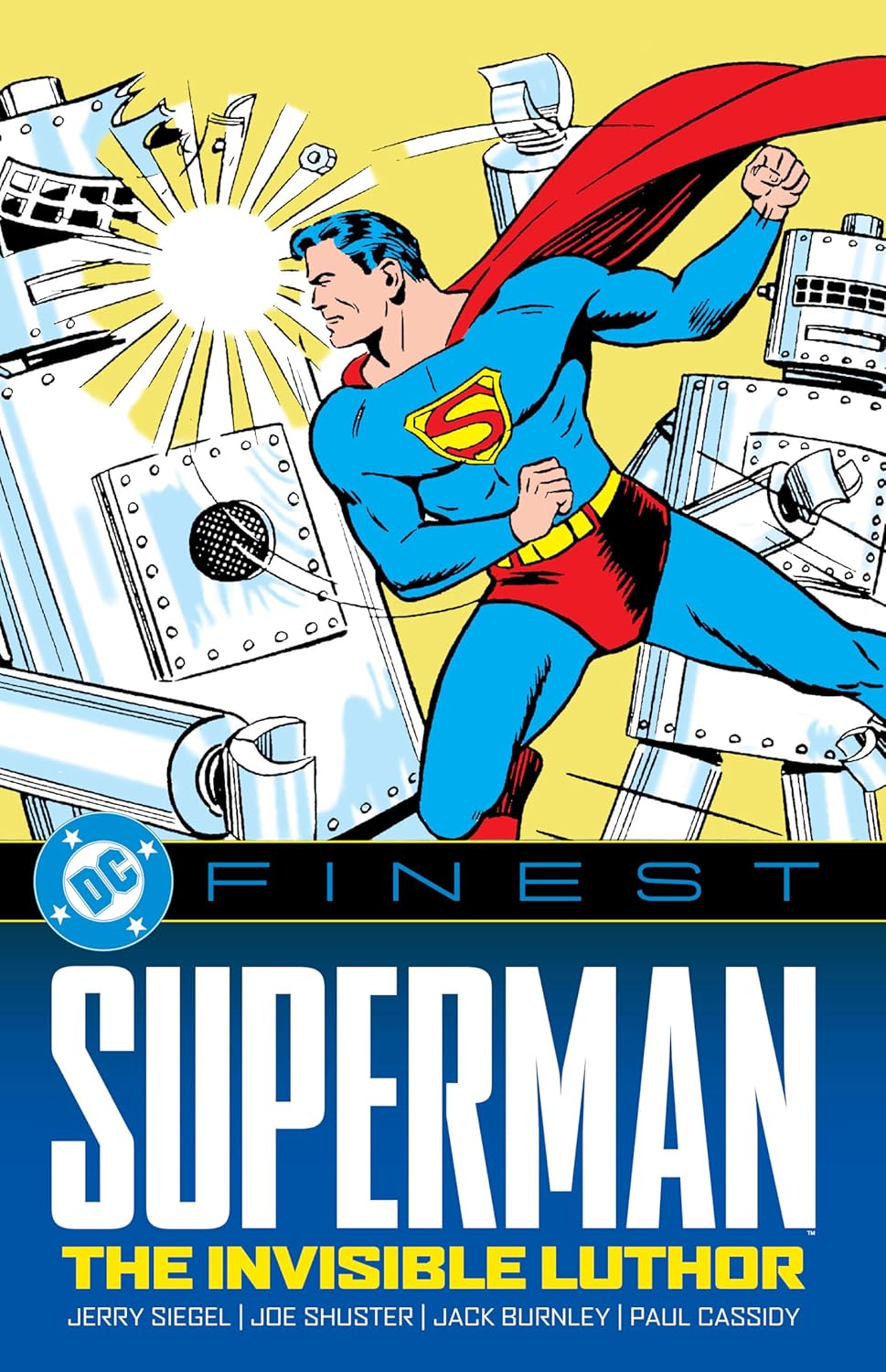
DC Finest: Superman – The First Superhero


By Jerry Siegel & Joe Shuster, Paul Cassidy, Paul Lauretta, Wayne Boring, Dennis Neville, Creig Flessel, Bernard Baily, Bob Kane, Leo O’Mealia, Jack Burnley, Fred Guardineer & various (DC Comics)
ISBN: 978-1-77952-833-9 (TPB)

This book includes Discriminatory Content produced in less enlightened times

Here’s another stunning and timely compilation comprising the best of vintage comics in another astounding and epic DC Finest edition. These full colour treasure troves are chronologically curated themed tomes highlighting past glories from the company that invented superheroes and so much more. Sadly, they’re not yet available digitally, as were the last decade’s Bronze, Silver and Golden Age collections, but we live in hope…

Just over 87 years ago, Superman rebooted planetary mythology and kickstarted the whole modern era of fantasy heroes. Outlandish, flamboyant, indomitable, infallible and unconquerable, he also saved a foundering industry by birthing an entirely new genre of storytelling: the Super Hero. Since April 18th 1938 (the generally agreed day copies of Action Comics #1 first went on sale) he has grown into a mighty presence in all aspects of art, culture and commerce, even as his natal comic book universe organically grew and expanded. Within three years of that debut, the intoxicating blend of eye-popping action and social wish-fulfilment that had hallmarked the early exploits of the Man of Tomorrow had grown: encompassing crime-busting, reforming dramas, science fiction, fantasy and even whimsical comedy. However, once the war in Europe and the East seized America’s communal consciousness, combat themes and patriotic imagery dominated most comic book covers, if not interiors.

In comic book terms alone Superman was soon a true master of the world, utterly changing the shape of the fledgling industry as easily as he could a mighty river. There was a popular newspaper strip, a thrice-weekly radio serial, games, toys, foreign and overseas syndication and as the decade turned, the Fleischer studio’s astounding animated cartoons.

Moreover, the quality of the source material was increasing with every four-colour release as the energy and enthusiasm of originators Jerry Siegel & Joe Shuster went on to inform and infect the burgeoning studio which grew around them to cope with the relentless demand.

These tales have been reprinted many times, but this latest compilation might arguably be the best yet, offering the original stories in reading – if not strictly chronological publishing – order and spanning cover-dates June 1938 to December 1939. It features the groundbreaking sagas from Action Comics #1-25 and Superman #1-5, plus his pivotal first appearance in New York’s World Fair No. 1. Although most early tales were untitled, here, for everyone’s convenience, they have been given descriptive appellations by the editors.

Thus – after describing the foundling’s escape from exploding planet Krypton and offering a scientific rationale for his incredible abilities and astonishing powers in 9 panels – with absolutely no preamble the wonderment begins with Action #1’s primal thriller ‘Superman: Champion of the Oppressed!’ Here, an enigmatic oddly-clad caped crusader – who secretly masquerades by day as mild-mannered reporter Clark Kent – begins publicly averting numerous tragedies and righting injustices…

As well as saving an innocent woman from the Electric Chair and roughing up an abusive “wife beater”, the tireless paragon works over racketeer Butch Matson and consequently saves feisty colleague Lois Lane from abduction and worse at his hands. Then he exposes a lobbyist for the armaments industry bribing Senators on behalf of the greedy munitions interests fomenting the war in Europe…

One month later Action #2 offered the next breathtaking instalment wherein the mercurial mysteryman travels to that benighted war-zone to spectacularly dampen down hostilities already in progress in ‘Revolution in San Monte Part 2’ before it’s back to the US where ‘The Blakely Mine Disaster’ finds the Man of Steel responding to a coal-mine cave-in and landing the blame squarely on corrupt corporate practises, before cleaning up gamblers ruthlessly fixing games and players in #4’s ‘Superman Plays Football’.

The Action Ace’s untapped physical potential is explored in AC #5 as ‘Superman and the Dam’ pits the human dynamo against the power of a devastating natural disaster, after which #6 sees canny chiseller Nick Williams attempting to monetise the hero – without asking first. ‘Superman’s Phony Manager’ (with Paul Lauretta adding inks to increasingly overworked Shuster’s art) even seeks to replace the real thing with a cheap knock-off, but quickly learns a most painful and memorable lesson in ethics…

Although Superman starred on the first cover, National’s cautious editors were initially dubious about the alien strongman’s lasting appeal and fell back upon more traditional genre scenes for the following issues (all by Leo E. O’Mealia and all included here). The Man of Tomorrow’s – and Joe Shuster’s – second cover graced Action Comics #7 (on sale from October 25th but cover-dated December 1938) and sparked a big jump in sales, even as the riotous romp inside revealed why ‘Superman Joins the Circus’ – with the mystery man crushing racketeers taking over the Big Top and illustrated by new kid Wayne Boring. Fred Guardineer produced genre covers for #8 & 9 whilst their interiors saw Siegel, Shuster & Lauretta’s ‘Superman in the Slums’ working to save young delinquents from a future life of crime and depravity before latterly detailing how city cops’ disastrous decision to stop the costumed vigilante’s unsanctioned interference plays out in the Boring-inked ‘Wanted: Superman’. That manhunt ended in an uncomfortable stalemate and ambiguous relationship with the authorities that endured for years…

Action Comics #7 had been one of the publisher’s highest-selling issues ever, so #10 again sported a stunning Shuster shot, whilst Siegel’s smart story ‘Superman Goes to Prison’ limned by Shuster, Lauretta & Boring struck another telling blow against institutionalised injustice and stacked odds, as the Man of Tomorrow infiltrated a penitentiary to expose the brutal horrors of State Chain Gangs. The next month saw a maritime cover by Guardineer whilst inside heartless conmen driving investors to penury and suicide rued the Metropolis Marvel intercession in ‘Superman and the “Black Gold” Swindle’ as illustrated by Paul Cassidy.

Guardineer’s spectacular cover of magician hero Zatara for issue #12 was a shared affair, incorporating another landmark as the Man of Steel was given a cameo badge declaring his presence inside each and every issue. Between those covers, Siegel, Shuster & Cassidy revealed how ‘Superman Declares War on Reckless Drivers’ – a hardhitting tale of joy-riders, cost-cutting automobile manufacturers, corrupt lawmakers and dodgy car salesmen who all feel the wrath of the human dynamo after a friend of Clark Kent dies in a hit-&-run incident…

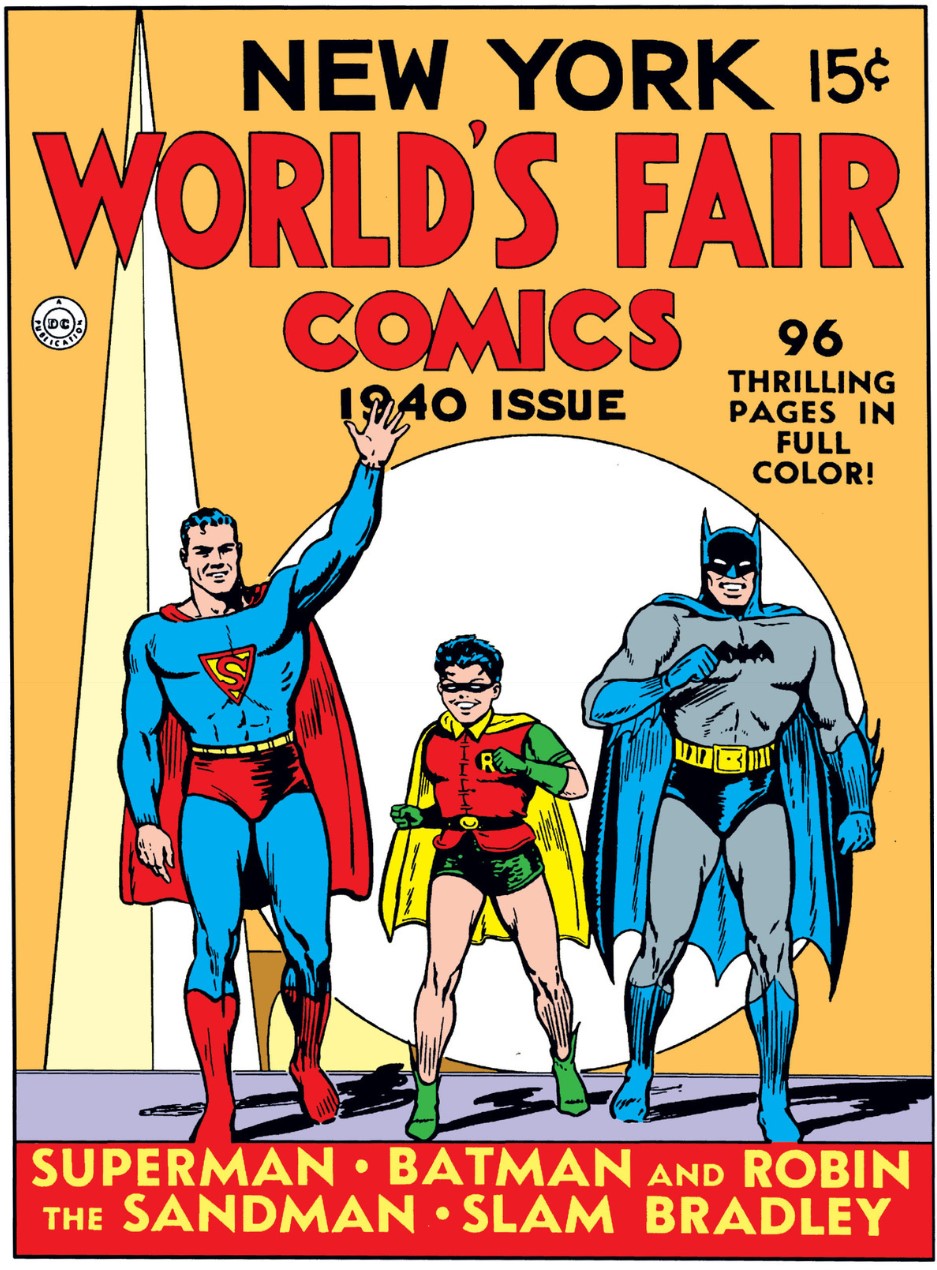
By now, the editors had realised Superman had propelled National Comics to the forefront of the new industry, and in 1939 the company won a license to create a commemorative comic book edition celebrating the opening of the New York World’s Fair. The Man of Tomorrow naturally topped the bill on the appropriately titled New York World’s Fair Comics at the forefront of such early DC four-colour stars as Zatara, Butch the Pup, Gingersnap and gas-masked vigilante The Sandman.

Following an inspirational cover by Sheldon Mayer, Siegel & Shuster’s ‘Superman at the World’s Fair’ describes how Lois and Clark are dispatched to cover the event, giving our hero an opportunity to contribute his own exhibit and bag a bunch of brutal bandits to boot…

Back in Action Comics #13 (June 1939 and another Shuster cover) the road-rage theme of the previous issue continued with Cassidy-rendered ‘Superman vs. the Cab Protective League’ as the tireless foe of felons faces murderous racketeers trying to take over the city’s taxi companies. The tale also introduces – in almost invisibly low key – The Man of Steel’s first recurring nemesis The Ultra-Humanite

Next follows a truncated version of Superman #1. This is because the industry’s first solo-starring comic book simply reprinted the earliest tales from Action, albeit supplemented with new and recovered material – which is all that’s featured at this point.

Behind the truly iconic and much recycled Shuster & O’Mealia cover, the first episode was at last printed in full as ‘Origin of Superman’, describing the alien foundling’s escape from doomed planet Krypton, his childhood with unnamed Earthling foster parents and eventual journey to the big city…

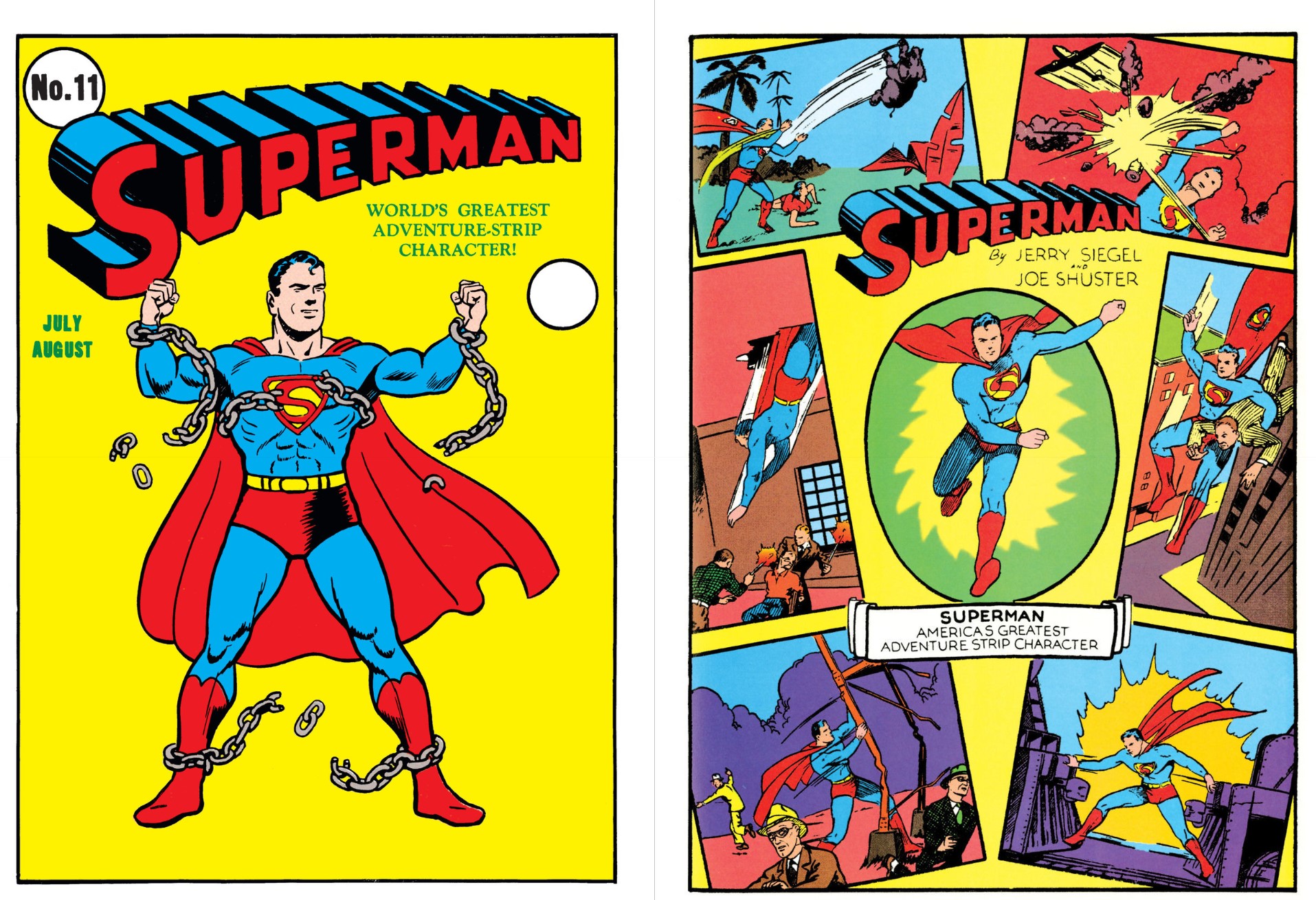
Also included in those 6 pages (cut from Action #1, and restored to the solo vehicle entitled ‘Prelude to ‘Superman, Champion of the Oppressed’) is the Man of Steel’s routing of a lynch mob and capture of the actual killer which preceded his spectacular saving of the accused murderess that started the legend. Rounding off the unseen treasures is the solo page ‘A Scientific Explanation of Superman’s Amazing Strength!’, a 2-page ‘Superman text story’, and ‘Meet the Creators’ – a biographical feature on Siegel & Shuster. The landmark closed with a pinup of Superman breaking chains by breathing out: an image the tuned in will recognise as the basis of DC Studios’ animation ident…

Sporting another Guardineer Zatara cover, Superman in Action #14 (as realised by Cassidy) featured the return of a manic, money-mad supergenius deranged scientist in ‘Superman Meets the Ultra-Humanite’ as the mercenary malcontent switches his incredible intellect from incessant graft, corruption and murder to an obsessive campaign to destroy the Man of Steel. Whilst Cassidy concentrated on interior epic ‘Superman on the High Seas’ – wherein the hero tackles subsea pirates and dry land gangsters – Guardineer then made some history as illustrator of an aquatic Superman cover for #15. He also produced the Foreign Legion cover on #16, wherein ‘Superman and the Numbers Racket’ by Siegel, Shuster & Cassidy sees the hero save an embezzler from suicide before wrecking another wicked gambling cabal.

Superman’s rise was meteoric and inexorable. He was the indisputable star of Action, with his own dedicated solo title. Moreover, a daily newspaper strip had begun on 16th January 1939, with a separate Sunday strip following from November 5th of that year. The fictive Man of Tomorrow was the actual Man of the Hour and was swiftly garnering millions of new fans. A thrice-weekly radio serial was in the offing, and would launch on February 12th 1940. With games, toys, and a growing international media presence, Superman was swiftly becoming everybody’s favourite hero…

Inked by Cassidy, overworked Siegel & Shuster’s second issue of Superman opened with ‘The Comeback of Larry Trent’ – a stirring human drama wherein the Action Ace clears the name of the broken heavyweight boxer, and coincidentally cleans all the scum out of the fight game, followed by ‘Superman’s Tips for Super-Health’, as ‘Superman Champions Universal Peace!’ depicts the hero once more tackling unscrupulous munitions manufacturers and crushing a gang who had stolen the world’s deadliest poison gas. The pictorial dramas end with ‘Superman and the Skyscrapers’ which finds newshound Kent investigating suspicious deaths in the construction industry, before committing his alter ego to conflict with mindless thugs and their fat-cat corporate boss, after which a contemporary ad and a ‘Superman Text Story’ bring the issue to a close…

Action #17 declared ‘The Return of the Ultra-Humanite’ in a vicious and bloody caper realised by Shuster & Cassidy, involving extortion and the wanton sinking of US ships, and featured their classic Super-cover as the Man of Steel was awarded all the odd-numbered issues for his attention-grabbing playground. That didn’t last long: after Guardineer’s final adventure cover – a bi-plane dog fight on #18, which fronted the Cassidy-limned ‘Superman’s Super-Campaign’ with both Kent and the Caped Kryptonian determinedly crushing a merciless blackmailer, Superman monopolised every cover from #19 onwards. That issue disclosed the peril of ‘Superman and the Purple Plague’ as the city reeled in the grip of a deadly epidemic created by Ultra-Humanite.

The truncated contents of Superman #3 offer only the first and last strips originally contained therein, as the other two were reprints of Action Comics #5 and 6. “The Superman Studio” was constantly expanding to meet spiralling demand and Dennis Nevillie inked Shuster on ‘Superman and the Runaway’ – a gripping, shockingly uncompromising exposé of corrupt orphanages, after which – following a cartoon briefing on ‘Attaining Super-Health: a Few Hints from Superman!’ – Lois finally goes out on a date with hapless Clark – but only because she needs to get close to a gang of murderous smugglers. Happily, Kent’s hidden alter ego is on hand to rescue her in bombastic gang-busting style in ‘Superman and the Jewel Smugglers’ by Shuster & Cassidy…

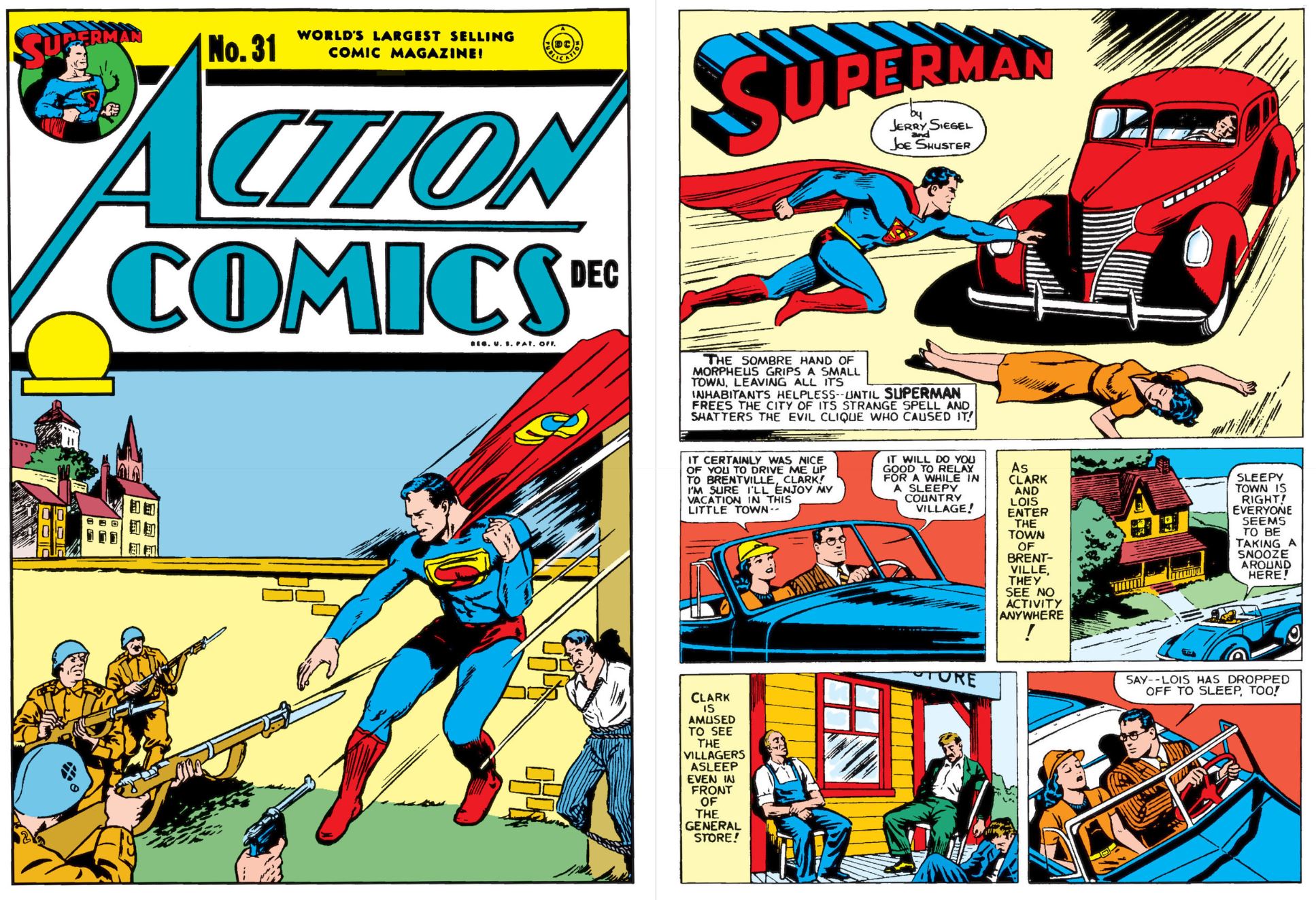
Cover dated January 1940 and on sale from November 24th 1939, Action Comics #20 notionally opened a new decade and, although Siegel & Shuster had very much settled into the character by now, the buzz of success still fired them, Innovation still sparked and crackled amidst the exuberance and drudgery of churning out more and more material. Moreover, Shuster’s eyesight was failing, demanding his sure signature touch be parcelled out parsimoniously and judiciouly. Collabotative creativity was the order of the day in the Superman Studio …

This conveyor belt process was absent in ‘Superman and the Screen Siren’ as Cassidy pencilled and inked a moving masterpiece wherein beautiful actress Delores Winters is revealed not as another sinister super-scientific megalomaniac but the latest tragic victim – and organic ambulatory hideout – of aged male menace Ultra-Humanite who perfected his greatest horror… brain transplant surgery!

This is followed with an immediate sequel from Shuster & Cassidy as “Delores” seeks to steal another scientist’s breakthrough and oblierate the Action Ace with ‘The Atomic Disintegrator’ before #22 loudly declares ‘Europe at War (Part One)’: a tense, thinly disguised call to arms to a still neutral USA. It too was a continued story – almost unheard of in those early days of funnybook publishing and spectacularly concluded in #23 with ‘Europe at War (Part Two)’.

Cover-dated Spring 1940, Superman #4 featured four big new adventures, and the debut of more creative stars in the making, beginning with a succession of futuristic assassination attempts in ‘Superman versus Luthor’ by omnipresent author Siegel, Shuster & Bernard (The Spectre) Baily. After an educational cartoon vignette on ‘Attaining Super-Strength’, the original Man of Might battles dinosaurs and bandits in ‘Luthor’s Undersea City’, by Shuster, Cassidy & Creig (The Sandman) Flessel, before saving the whole world from financial and literal carnage by ferreting out ‘The Economic Enemy’: a prophetic espionage yarn about commercial sabotage instigated by an unspecified foreign power and artistically crafted by Shuster, Cassidy and Bob Kane – yes, that Bob Kane…

The issue closed with a tale of gangsters intimidating Teamsters and union workers in Siegel, Shuster & Cassidy’s‘Terror in the Trucker’s Union’.

Simultaneously, in Action Comics #24,‘Carnahan’s Heir’ (Shuster & Cassidy) becomes Superman’s latest social reclamation project when the Metropolis Marvel promises to turn a drunken wastrel into a useful citizen, whilst in #25 Cassidy rendered the tale of ‘Amnesiac Robbers’ compelled to crime by an evil hypnotist, before this initial DC Finest compilation closes with the contents of Superman #5: a superb combination of human drama, crime and wickedly warped science augmented by a flurry of gag cartoons by the burgeoning Superman Studio.

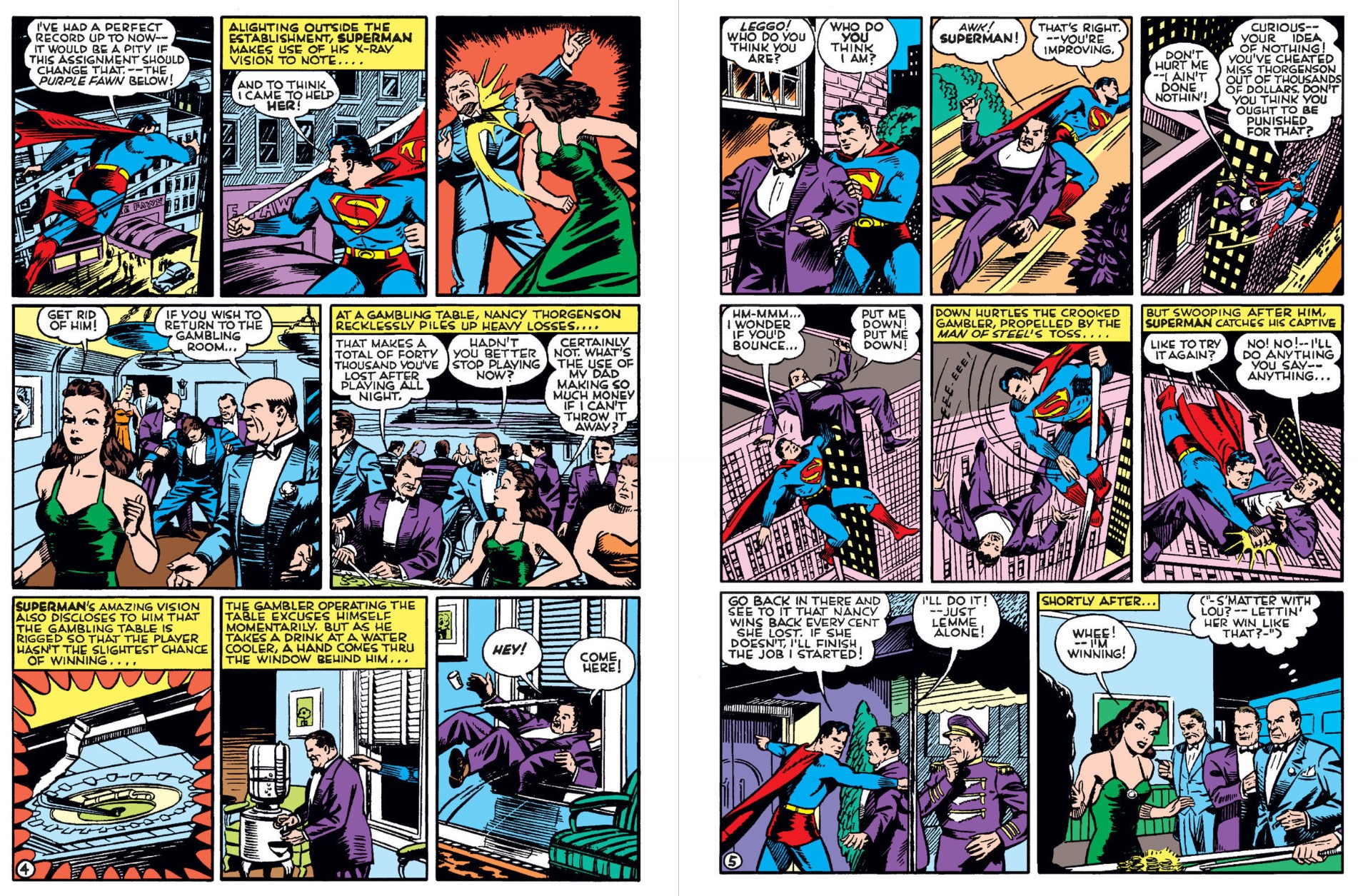
As ever scripted throughout by Siegel, it begins with our crimebusting hero crushing ‘The Slot Machine Racket’ (Cassidy, Boring & Lauretta) before pausing to promote health and exercise, via feaurette ‘Super-Strength: Rules for Summer Living’. Without pausing for breath he then – couertsy of Cassidy – foils a rival newspaper’s ‘Campaign Against the Planet’. Limned by Shuster & Boring, the awesome, insidious threat of ‘Luthor’s Incense Machine’ is similarly scuttled, before finally Big Business chicanery is exposed and severly punished whilst a decent simple chemist is cleared of a felonius frame-up in Cassidy’s ‘The Wonder Drug Racket’.

Re-presenting the epochal run of raw, unpolished but viscerally vibrant stories by Siegel & Shuster and their merry band who collectively and until now largely anonymously set the funnybook world on fire, this chronicle compellingly recaptures the sheer thrill of those pioneering days. As fresh and absorbingly addictive now as they ever were, these endlessly re-readable epics perfectly display the savage intensity and sly wit of Siegel’s stories – which literally defined what being a Superhero means – whilst Shuster formulated the basic iconography for all others to follow.

The crude, rough, uncontrollable wish-fulfilling, cathartically exuberant exploits of The First Superhero reveals a righteous, superior champion of the helpless and outmatched dispensing summary justice equally to social malcontents, exploitative capitalists, thugs and ne’er-do-wells that initially captured the imagination of a generation. Although the gaudy burlesque of monsters and super-villains lay years ahead of Superman, these primitive, raw, captivating tales of corruption, disaster, moral deviancy and social injustice are just as engrossing and speak as powerfully of the tenor of the times then and now. Such Golden Age tales are priceless enjoyment. What comics fan could possibly resist them?
© 1938, 1939, 1940, 2025 DC Comics. All Rights Reserved.

The 10,000 Disasters of Dort


By Mike Butterworth, Luis Bermejo, José Ortiz Moya & various (Rebellion)
ISBN: 978-1-78618-949-3 (TPB/Digital Edition)

This book includes Discriminatory Content produced in less enlightened times.

It’s time for another sortie down memory lane for us rapidly diminishing oldsters, but hopefully opening a fresh, untrodden path for new fans of the fantastic seeking a typically quirky British comics experience.

British comics have always enjoyed an extended love affair with what can only be described as “unconventional” (for which feel free to substitute “bizarre” or “creepy”) stars. So many notional role models in our strips have been outrageous or just plain “off”: self-righteous voyeur/vigilantes like Jason Hyde, sinister masterminds in the manner of The Dwarf or Black Max, arrogant ex-criminals like The Spider or outright racist overmen such as fearsome white ideologue Captain Hurricane

At first glance, prior to the advent of game changers Action and 2000AD, British comics seemingly fell into fairly ironclad categories. Back then, you had genial and/or fantastic preschool fantasy; a large selection of licensed entertainment properties; action; adventure; war; school dramas, sports and straight comedy strands. Closer examination would confirm that there was always a subversive merging, mixing undertone, especially anarchic antiheroes like Dennis the Menace or our rather strained interpretation of costumed crime-busters. Just check out Phantom Viking, Kelly’s Eye or early Steel Claw stories…

Following post-war austerity, the 1950s ushered in a comics revolution. With British printing and paper restrictions gone, a steady stream of titles emerged from companies new and old, aimed at the many different levels of childish attainment from pre-school to young adult. When Hulton Press launched Eagle in April 1950, the very concept of what weeklies could be changed forever. That oversized prestige package with photogravure colour was expensive, however, and when London-based publishing powerhouse Amalgamated Press retaliated, it was a far more economical affair. I’m assuming AP only waited so long before the first issue of Lion launched (cover-dated February 23rd 1952) to see if their flashy rival was going to last. Lion – just like Eagle – was a mix of prose stories, features and comic strips and even offered its own cover-featured space-farer in Captain Condor – Space Ship Pilot. Initially edited by Reg Eves, Lion’s 1156 weekly issues ran until 18th May 1974, when it merged with sister-title Valiant. Along the way, in the tradition of British publishing which had always subsumed weaker-selling titles to keep popular strips going, Lion absorbed Sun (1959) and Champion (1966) before going on to swallow Eagle itself in April 1969, with the result soon thereafter merging with Thunder (1971).

In its capacity as one of the country’s most popular and enduring adventure comics, the last vestiges of Lion only vanished in 1976 during Valiant’s amalgamation with Battle Picture Weekly. Despite that demise, there were 30 Lion Annuals between 1953 – 1982, benefitting from our lucrative Christmas market, and combining original strips with historical prose adventures; sports, science/general interest features; short humour strips and – increasingly from the 1970s – reformatted reprints from IPC/Fleetway’s back catalogue.

Of course, our pictorial kids’ stuff was always unlike any other kind: always enjoying -especially when “homaging” such uniquely American fare as masked superheroes – a touch of insouciant rebelliousness. Until the 1980s, UK comics employed an anthological model, offering variety of genre, theme and character. Humour vehicles like The Beano and Dandy were leavened by action-heroes such as Billy the Cat or General Jumbo whilst adventure papers like Smash, Hotspur or Valiant offered palate-cleansing gagsters including The Cloak, Grimly Feendish, Mowser and sundry other titter-treats. Originally presenting a cosy façade of genial comedic antics or school follies, cheery cowboys, staunch soldiery and moonlighting light entertainment stars, before long there increasingly lurked behind and below the surface dark and occasionally utterly deranged fantasy fare. These included marauding monsters and uncanny events upsetting a comfy status quo. Perhaps it was all just a national shared psychosis triggered by war, rationing, nightly bombing BUT NO SUCCESSFUL INVASION SINCE 1066, DAMMIT!…

Over and over British oddness seemingly combined with or reacted to our long-standing familiarity with soft oppression, leading to stories of overwhelming, imminent conquest and worse. With our benighted shores existentially threatened, the response from entertainment sources was a procession of doughty resistors facing down doom from the deepest depths of perfidy and menace… especially from the stars. Moreover, thanks to an economic downturn and spiralling costs in publishing, the mid 1960s and 1970s were particularly wild and desperate for UK comics: inspiring a wave of innovation most fondly remembered for darkly off-kilter heroes, beguiling monsters and charismatic villains. The 10,000 Disasters of Dort pretty much ticks all those boxes.

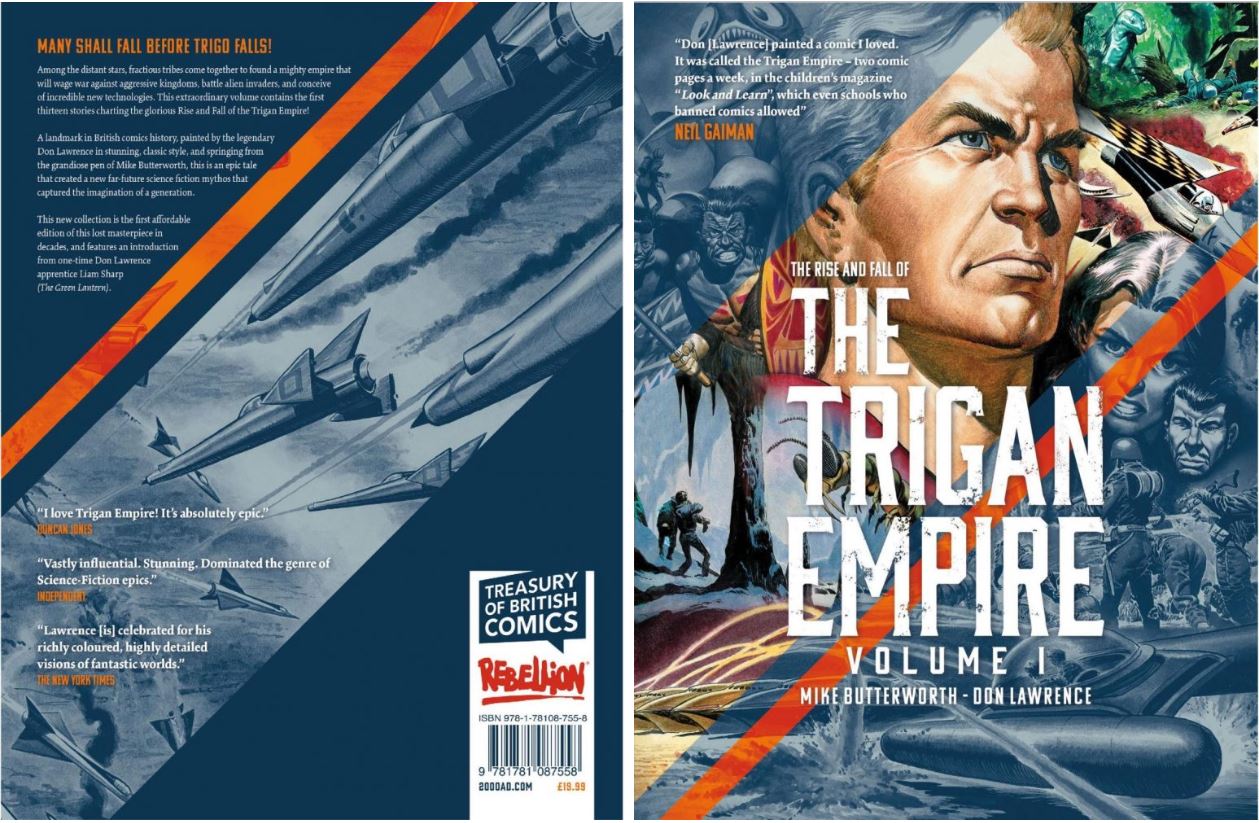
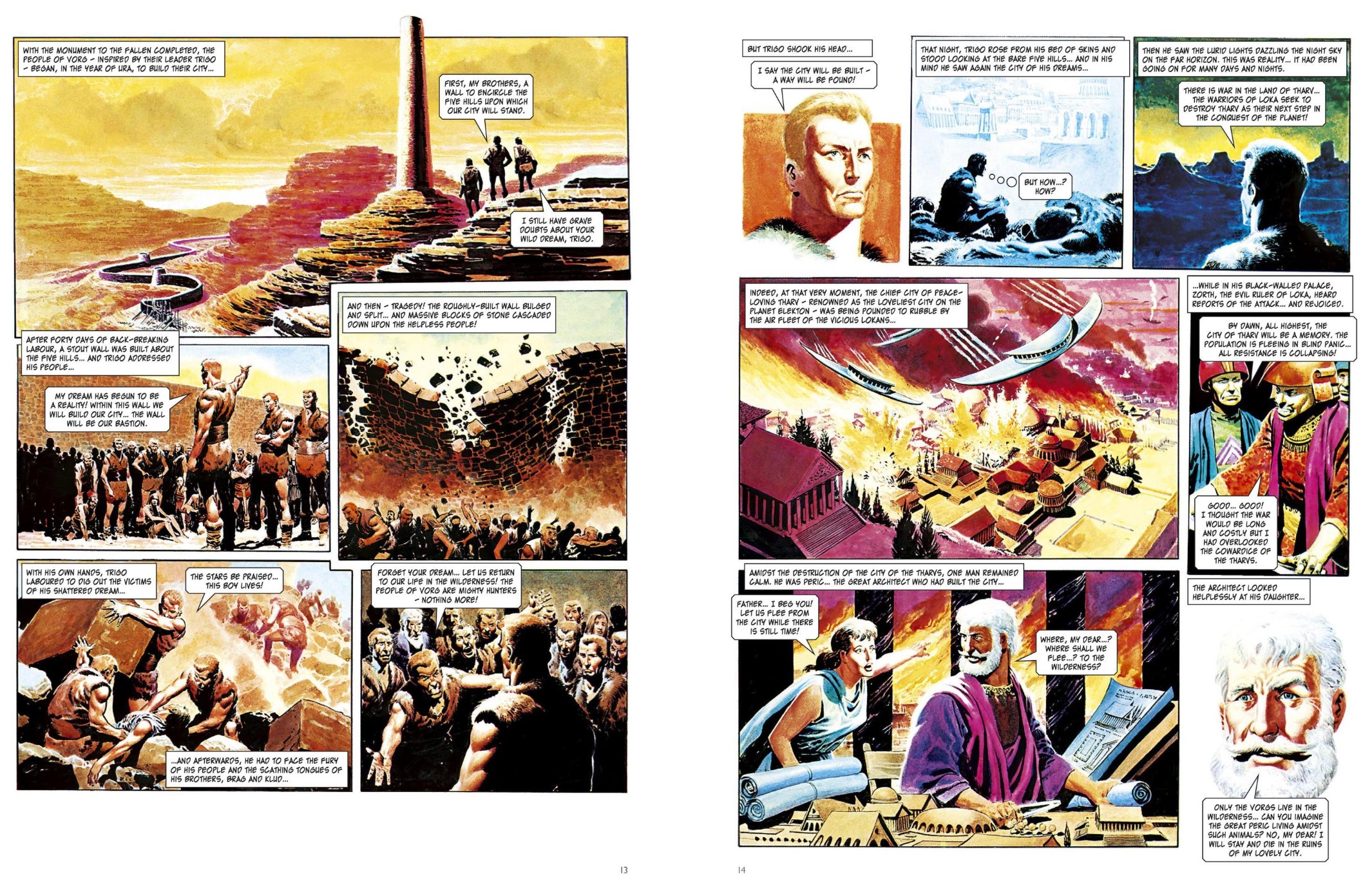
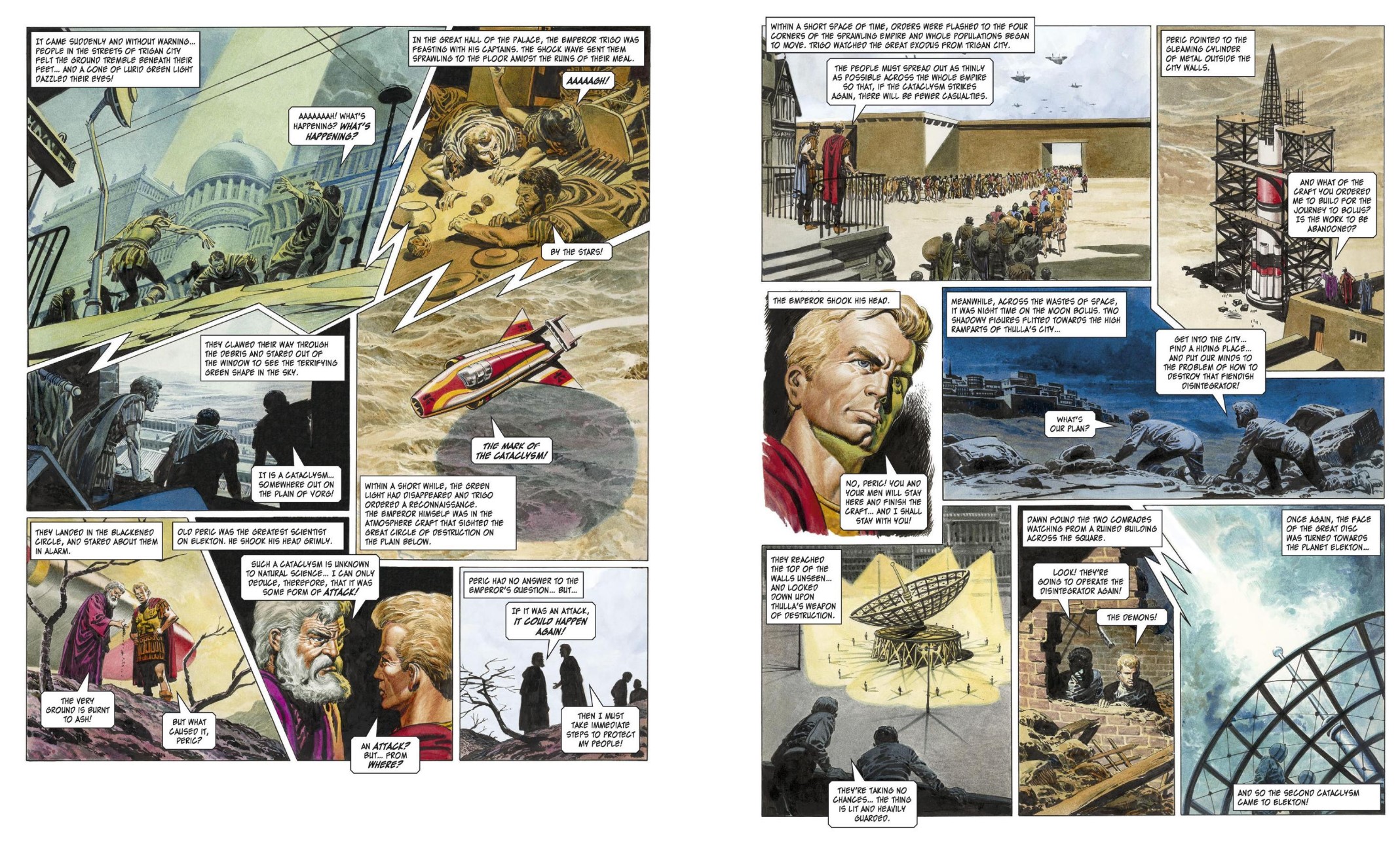
A trained artist, Mike Butterworth wrote for many comics titles: historical strips such as Buffalo Bill, Max Bravo, the Happy Hussar, Battler Britton and Billy the Kid as well as the epic Rise and Fall of the Trigan Empire. He simultaneously and latterly became a Crime and Gothic Romance novelist with more than 20 books to his assorted pen names. The 10,000 Disasters of Dort was simply another bread-&-butter B-feature assignment; albeit an extremely popular one that probably took off thanks not just to his terse, imaginative scripts and the tone of the times but also the astounding visual vivacity of its illustrators, Luis Bermejo and José Ortiz…

The astoundingly gifted Luis Bermejo Rojo was a star of Spanish comics forced to seek work abroad after their domestic market imploded in 1956. He became a prolific contributor to British strips, working on a succession of moody masterpieces across many genres. These included The Human Guinea Pig, Mann of Battle, Pike Mason, Phantom Force Five and Heros the Spartan, in Girls Crystal, Tina, Tarzan Weekly, Battle Picture Library, Thriller Picture Library, Eagle, Buster, Boys World, Tell Me Why, Look and Learn and many more. Bermejo finally achieved a modicum of his long-deserved acclaim in the 1970s, after joining fellow studio mates José Ortiz, Esteban Maroto & Leopoldo Sanchez who all worked on adult horror stories for US magazines Creepy, Eerie and Vampirella and their Spanish spin-offs.

José Ortiz Moya’s 60 plus year career began after he won a contest in Spanish magazine Chicos. In the 1950s, he worked on digest strips for Editorial Maga, including Capitan Don Nadie, Pantera Negra and Jungla, and agency work saw him produce several strips for foreign publishers, particularly Britain. Here he memorably illustrated Caroline Barker, Barrister at Law for The Daily Express; Smokeman and UFO Agent in Eagle magazine and The Phantom Viking in top seller Lion. Over the 1970s & 1980s Ortiz worked on several popular British strips including The Tower King and House of Daemon for the new Eagle, Rogue Trooper, The Helltrekkers and Judge Dredd for 2000 AD and The Thirteenth Floor for Scream! This last was another stunning horror-show Ortiz co-created with John Wagner & Alan Grant. Whilst doing all of this work on UK kid’s comics, in the US Ortiz was also working on – and is arguably best known for – stories for Warren’s Eerie and Vampirella.

Here the meat of the matter is enthralling episodes delivering a stunning nostalgia-punch via Rebellion’s superb Treasury of British Comics imprint, collecting a seminal sci fi shocker unleashed on the “Juvenile Boys’ periodical” as the print equivalent of Saturday night at the movies…

This slim tall tome gathers the original saga as played out in Lion from 18th May to 23rd November 1968, and also includes the altered ending added when the saga was rerun eight years later. Rebellion have spared readers from redundancy by only adding the episodes from Lion for 11th & 18th May 1974, but have also kindly included pertinent items from Lion Annuals for 1970 & 1971; ta very much…

The premise is simple and effective, as decades from “now” on March 18th of super-advanced year 2000 AD, the last great Atlantic liner HMS Royalty approaches New York City, only to see the mega metropolis crumble to ruin before succumbing to disaster herself. Scientists around the world rally to investigate and Cambridge Professor Mike Dauntless discovers that all the steel for 50 miles around the city had become like rubber…

His rash deduction that Earth was under attack from space is confirmed 24 hours later as a colossal crystal cylinder materialises outside Moscow and a giant extraterrestrial calling itself Ratta, Dictator of Dort serves notice to humanity. With its own world doomed to expire in 50 years, Ratta intends to move his subjects to Earth. The resident population can move or endure 10,000 manufactured super-science generated trials and terrors that will sufficiently depopulate the region and thin the herd…

Responding to the sadistic ultimatum, Dauntless determines to foil or counter each “disaster”, and is soon called to Paris to destroy rampaging giant vines erupting from the sewers, consequently gaining a teen sidekick in newly orphaned Gaston

… And that how the drama proceeded with Mike & Gaston plus occasional local co-stars countering or at least stalling each of smugly gloating Ratta’s doom ploys, and facing the best and worst of human behaviours as society crumbles. The star assaults include enlarging beasts and birds in Melbourne, drenching Britain with waves of hatred turning the population into marauding murderers by tainting the nations favourite tipple and dropping irresistible superweapons into the greedy hands of desert bandits in Central Arabia. In every instance Dauntless manufactures solutions at the risk of his life, never having time enough to stop, think, anticipate or plan a counter attack…

As Mike leads a spirited ground defence of Cairo, Ratta ups the stakes with a global attack that neutralizes electricity and follows up with a new ice age before teleporting to Earth and walking amongst embattled humanity to enjoy the agonies of his victims. The Dictator of Dort also infiltrates Mike Dauntless’ team with a view to ending the world’s resistance in one stroke, but shoots himself in the scaly foot after playing chess to decide humanity’s fate… and losing…

Temporarily stalled but undeterred, Ratta resumes his attacks by unleashing a billion bugs on Bavaria and going on to inundate Earth in ants, after which the alien turns the unchecked power of the sun upon the world. This Ninth Disaster necessitates Mike & Gaston seeking a solution in orbit and when they are posted as lost in space, newly-appointed alien attack tsar Tom Burley is quickly overwhelmed when men and women begin devolving into brutes and beasts…

Convinced of victory, Ratta declares the war over and orders all Dort to be evacuated and sets forth for the newly conquered territory, but the Dictator has made a grievous error…

With Earth ultimately saved, the feature ended, but under approved kids’ comics protocols was rerun after five years. Editorial policy dictated the entire readership would change approximately every 4 to 5 years as they grew older and sought other entertainments. Deemed still of interest despite the time required for a complete turnover of readership the Disaster unfolded again but with a new more relevant conclusion. Included here are the two new episodes commissioned and tacked on to the run which spanned 22nd December 1973 to May 4th 1974.

Sadly we don’t know wrote or drew the instalments for 11th & 18th May, and can only assume who was responsible for complete yarn ‘Plague of Locusts’: a comics sidebar story set in the same continuity as the main story included Lion Annual 1970, which would have been published in autumn 1969.

Here, Dauntless & Gaston aid London’s war against massive marauding monster locusts and learn that not all threats to humanity originated on Dort, before Lion Annual 1971 provides a tantalising text feature by artist and writers unknown asking ‘Do You Believe in Flying Saucers? and gathering in evidence a number of documented close encounters.

Also on view is s stirring Cover Gallery, Creator biographies and an always-welcome excerpt from Siegel & Bunn’s The Spider’s Syndicate of Crime vs. The Crook from Space.

An exciting, engaging, done-in-one delight that’s undemanding and rewarding is a rare treat these days. If that appeals, this is what you want. What you really, really want…
© 1968, 1970, 1971, 1974 & 2023 Rebellion Publishing IP Ltd. All Rights reserved.

Yoko Tsuno volume 19: The Astrologist of Bruges


By Roger Leloup, coloured by Beatrice of Studio Leonardo & translated by Jerome Saincantin (Cinebook)
ISBN: 978-1-80044-130-9 (Album PB)

This book includes Discriminatory Content produced in less enlightened times.

On September 24th 1970, “electronics engineer” Yoko Tsuno began her troubleshooting career as an indomitable intellectual adventurer. Her debut in Le Journal de Spirou was realised in “Marcinelle style” cartoonish 8 page short ‘Hold-up en hi-fi’ but although she is still delighting readers and making new fans to this day, her action-packed, astonishing, astoundingly accessible exploits quickly evolved into a highpoint of pseudo-realistic fantasies numbering amongst the most intoxicating, absorbing and broad-ranging comics thrillers ever created. Her globe-girdling mystery cases and space-&-time-spanning epics are the brainchild of Belgian maestro Roger Leloup who launched his own solo career in 1953 after working as studio assistant/technical artist on Hergé’s Adventures of Tintin.

Compellingly told, sublimely imaginative and – no matter how implausible the premise of an individual yarn – always firmly grounded in hyper-authentic settings underpinned by solidly-constructed, unshakably believable technology and unswerving scientific principles, Leloup’s illustrated escapades were at the vanguard of a wave of strips revolutionising European comics. Very early in the process, he switched from loose illustration to a mesmerising nigh-photo realistic style that is a series signature. That long-overdue sea-change in gender roles and stereotyping heralded a torrent of clever, competent, brave and formidable women protagonists taking their rightful places as heroic ideals and not romantic lures, consequently elevating Continental comics in the process. Such endeavours are as engaging and empowering now as they ever were, none more so than the travails of Miss Tsuno.

Her first outings (the aforementioned, STILL unavailable Hold-up en hi-fi, and co-sequels La belle et la bête and Cap 351) were mere introductory vignettes prior to epic authenticity taking a firm grip in 1971 when the unflappable problem solver met valiant but lesser (male) pals Pol Paris and Vic Van Steen. Instantly hitting her stride in premier full-length saga Le trio de l’étrange (in LJdS’s May 13th edition), from then on, Yoko’s efforts encompassed explosive exploits in exotic corners of our world, sinister deep-space sagas and even time-travelling jaunts. There are 31 European bande dessinée albums to date, with 19 translated into English thus far, albeit – and ironically – none of them available in digital formats…

Initially serialised in LJdS #2923 to 2943 and spanning April 20th to September 7th 1994, L’astrologue de Bruges became the 20th collected Yoko Tsuno album that same year. Following chronologically on from The Rhine Gold, it weaves a tale of Earth-bound archaic mystery as our tireless troubleshooter visits a living historical treasure trove for answers to a contemporary conundrum…

Walking the scenic canals of Bruges – “the Venice of the North” – Yoko strikes up a fortuitous conversation with a painter who is actually a very open-minded archaeologist and imaginative historian. Tsuno is there to meet another artist; one who has painted her portrait in local period dress. She thinks it’s from magazine photos of her, but Mr. Jos knows much of the confounding Jan Van Laet who has contacted Yoko, and none of what he knows is good…

Jos shows her the quiet passages and waterways of a renaissance city barely altered since the 16th century and offers to stay close during her interview with Van Laet: a man he seriously considers to be in league with the Devil…

Soon after her interview with the extremely off-kilter portraitist begins, Tsuno begins to agree with that assessment as Van Laet seeks to convince her that he captured her image from life, not photos, and that she had posed for him in 1545 Anno Domini. Her doubts take a hard knock when he also reveals ancient pictures and sketches of her with her friend Monya and foster daughter Morning Dew.

That’s when Van Laet’s patron and master the Marquis of Torcello joins the interview, claiming Yoko has lived since those Renaissance days afflicted by amnesia. Incensed and threatening, he also accuses her of holding his property: a vial containing an elixir of youth and another carrying the secret of a deadly biological super-weapon bottled by legendary, infamous natural philosopher, astrologer and alchemist Zacharius..

Escaping by hurling herself out of a window to be plucked from a canal by Mr. Jos, Yoko is pretty sure she knows the How if not Why of this situation. After all, Monya is a cherished comrade who was born in the far future and possesses a working time machine…

Resolved to learn everything and foil Torcello & Van Laet’s scheme to reintroduce the Black Death to the modern world, Yoko recruits steadfast comrades Pol & Vic to join her, Monya and Dew in an era of pestilence, intrigue, Inquisitions and ongoing Wars of Religion. She has no choice over the child… the painting already incontrovertibly proves Dew was present and in just as much danger as everyone else…

Mr Jos is vital in the planning and reconnaissance stages of the proposed mission. He now owns the fantastic house occupied by the undying villain in 16th century and allows Yoko access to all its many levels of subterranean cellars and workshops, and provides access to clothing of the era. Monya delivers everything else needed and during a terrific storm the party nervously head back to a time of terror and travail…

Befriending poverty-stricken flower seller Mieke on arrival, the time travellers are soon embroiled in an ongoing and escalating calamity involving Zacharius’ deranged-but-brilliant apprentice Balthazar, a scheme stripping churches of gold and portraitist Van Laet’s insidious human trafficking business selling his poor but honest models to the rich men who purchase his paintings. The true threat though is always Torcello who wants to spread doom and destruction in every era and gets his big chance after capturing Monya and stealing her Time Shifter…

The monster’s fate is someone else’s boon, however, as the doomed brief encounter of flirtatious Pol and meek Mieke suddenly grows into something much greater and happier ever after…

As ever, the most assured assets of these edgy endeavours are astonishingly authentic settings, benefitting from Leloup’s diligent research and meticulous attention to detail. A magnificently complex twisty thriller with doomsday overtones, displaying our valiant troubleshooter and her team triumphant in a taut, tense thriller of time bending terror, The Astrologist of Bruges is tense, moody, slow-burning, deviously twisted and potently plausible: a fable confirming how smarts and combat savvy are pointless without compassion, integrity and a sense of moral responsibility.
Original edition © Dupuis, 1994 by Roger Leloup. All rights reserved. English translation 2024 © Cinebook Ltd.

Fantastic Four: The Life Fantastic


By J. Michael Straczynski, Karl Kesel, Dwayne McDuffie, Mike McKone, Drew Johnson, Casey Jones, Lee Weeks & various (Marvel)
ISBN: 978-0-7851-1896-1 (TPB/Digital edition)

Today sees the UK general release of the latest cinematic interpretation of the “World’s Greatest Comics Magazine”. Here’s a quirky book you could and should buy online and read in your Imax seat while all those other, lesser trailers waste your time prior to the big event. Thus we prove once again that it’s never too late to catch up to the really good stuff…

The Fantastic Four has long been rightly regarded as the most pivotal series in modern comic book history, responsible for introducing both a new style of storytelling and a radically different manner of engaging the readers’ impassioned attentions. More family than team, the line-up has changed frequently over the years before always eventually and inevitably returning to Stan Lee & Jack Kirby’s original configuration of Mister Fantastic, Invisible Woman, Human Torch and The Thing, who jointly comprised the vanguard of modern four-colour heroic history.

The quartet are maverick supergenius Reed Richards, his wife Susan, their trusty college friend Ben Grimm and Sue’s obnoxious, impetuous younger brother Johnny Storm; survivors of an independent space-shot which went horribly wrong once ferociously mutative Cosmic Rays penetrated their ship’s inadequate shielding. When they crashed back to Earth, the foursome found all been hideously changed into outlandish freaks. Richards’ body became elastic, and Sue gained the power to turn herself and other objects invisible – and latterly form forcefields. Johnny could more-or-less at will turn into self-perpetuating living flame, whilst poor, tormented Ben transformed into a horrifying brute. However, unlike his comrades, Grimm could not return to a semblance of normality on command… or at all…

The sheer simplicity of four B-movie archetypes – mercurial boffin, self-effacing distaff, solid everyman and hot-headed youth – uniting to triumph over accident and adversity shone under Lee’s irreverent humanity, coupled to Kirby’s rampant imagination and tirelessly emphatic sense of adventure.

Decades of erratic quality and floundering plotlines followed the original creators’ departures, but from the beginning of the 21st century Marvel’s First Family experienced a steady and sustained escalation in quality which culminated in repeated film attempts and a string of top-flight, radical reboots in their comic incarnations.

The return to peak quality was the result of sheer hard work by a number of “Big Ideas” writers and this slim compilation – re-presenting Fantastic Four #533-535, and spanning January to April 2006, is one of the best, especially as its content is supplemented and bolstered by a selection of celebratory one-shots -specifically Fantastic Four Wedding Special (January 2006), Fantastic Four Special 2005 and Fantastic Four: A Death in the Family (July 2006). These tales wrapped up a brief but splendidly entertaining tenure in the typist’s chair by comics and screen writer J. Michael Straczynski (Babylon 5, Sense8, Amazing Spider-Man, Superman, Wonder Woman, Before Watchmen, Captain America).

Illustrated by Mike (Amazing Spider-Man, Punisher War Zone, Exiles, assorted X-Men, Justice League International/Justice League of America) McKone – with inkers Andy Lanning, Simon Coleby & Cam Smith – the never-ending excitement and frenetic fun opens with a bombastic 3-part tale offering arguably the ultimate clash between the Thing and The Incredible Hulk… and possibly the funniest yet most heart-rending FF story ever written.

‘What Happens in Vegas, Stays in Vegas’ opens as the Hulk – currently green, governed by Bruce Banner’s intellect and working for S.H.I.E.L.D. – dramatically fails to defuse a gamma bomb and is subsequently caught in the resulting detonation…

Meanwhile in Manhattan, Reed & Sue are facing their greatest battle; attempting to stop civil servant Simone Debouvier of New York’s Division of Child Welfare from placing their children Franklin and Valeria into State custody to protect them from the FF’s life-threatening influence and circumstances. It’s almost a relief for the embattled parents to despatch their boisterous and understandably furious team-mates to Nevada so they can concentrate on navigating the tricky legal maze of the Social Services system…

By the time the Torch & Thing arrive, it’s to their worst nightmare: the gamma blast has seemingly devolved the Hulk’s mind back to his primitive, enraged and devastatingly destructive state and supercharged his body. The heroes are all that stand between the unstable grey juggernaut and the utter destruction of the city…

Utterly overmatched, Ben is pushed to his limits in ‘Shadow Boxing’ the rampaging beast, but even amidst the hurricane of shattering violence, he realises it’s not rage but guilt that’s pushing the uber-Hulk to such brutal excesses, even as back East Reed & Sue take a desperate gamble to keep their family together…

The transcontinental confrontations crash into a pair of stunning victories for heart and brains over brawn in the climactic finale ‘To Be This Monster’

The rest of this sleek celebratory volume concentrates on special editions and follows up with Fantastic Four Wedding Special wherein Karl Kesel, Drew Johnson, Drew Geraci & Drew Hennessy combine to venerate the past and offer tantalising glimpses of things to come as Sue & Reed go for a quiet meal and – thanks to the technological miracle of time travel – discover that every guest is the happy couple themselves, plucked from key moments of their fantastic past and incredible future…

That gloriously heart-warming spectacle is followed by a far more tense but no less intriguing yarn from Fantastic Four Special #1 with Dwayne McDuffie, Casey Jones & Vince Russell depicting ‘My Dinner with Doom’ as Reed opts for fine dining and frank conversation as a way of finally ending the long-standing feud between him and the relentless, duplicitous Iron Dictator. If only Doom was as open-minded about the eventual outcome…

Focus shifts to Johnny for the last epic as Fantastic Four: A Death in the Family (Kesel, Lee Weeks, Rob Campenella & Tom Palmer) sees the frat-boy goof suddenly forced to wise up, man up and make a horrific choice to save his beloved, fractious family from certain doom in another time-travel-tinged tale.

In this story, however, there is no happy ending…

A stellar combination of apocalyptic action, heartbreak, suspense and hilarious low comedy, this exhilarating compilation also includes stunning covers by McKone, Gene Ha, Leinil Yu, Morry Hollowell & Weeks for a warm, fast-paced, tension-soaked Fights ‘n’ Tights chronicle which will provide all the thrills and chills a devoted Costumed Drama lover or freshly-turned film freak could ever want.
© 2005, 2006, 2016 Marvel Characters, Inc. All rights reserved.

Fantastic Four: Behold… Galactus! (Marvel Select Edition)


By Stan Lee, Jack Kirby & Joe Sinnott; Lee, John Buscema & Sinnott; and John Byrne & various (MARVEL)
ISBN: 978-1-3029-1887-3 (HB/Digital edition)

This book includes Discriminatory Content produced in less enlightened times.

With today’s World Premier of the latest cinematic interpretation of the “World’s Greatest Comics Magazine” (Phew!!), here’s a cool collected assemblage of the stuff we comics geeks tuned into seven decades ago – and with sequels! – to prove that it’s never too late to catch up to the really good stuff…

Cautiously bi-monthly, cover-dated November 1961, and hiding timidly amidst the company’s standard monster ‘n’ aliens fare, Fantastic Four #1 – by Stan Lee, Jack Kirby, George Klein & Christopher Rule – was crude and rough-hewn, but concealed on its pages a revolution of raw passion and uncontrolled excitement. Thrill-hungry readers pounced on it and the raw storytelling caught a wave of change starting to build in America. It and the succeeding issues changed comic books forever.

In eight short years FF became the indisputable core and most consistently groundbreaking series of Marvel’s ever-unfolding ridiculously enthralling web of creation, bombarding readers with ceaseless salvos of fresh concepts and new characters. Kirby was in his conceptual prime, unleashing his vast imagination on plot after spectacular plot. Clearly inspired, Lee scripted some of the most passionate superhero sagas that Marvel – or any publisher – had or has ever seen. Both were on an unstoppable roll, at the height of their creative powers, and full of the confidence only success brings. The King was particularly eager to see how far the genre and medium could be pushed. A forge of stunning creativity and endless excitement, Fantastic Four was the proving ground for dozens of future stars and mesmerising concepts, none more timely or apt than freewheeling cosmic wanderer and moral barometer The Silver Surfer.

Collecting every cosmic crumb of pertinent material from Fantastic Four #48-50, 120-123, and #242-244, this compendium reprints a trilogy of landmark sagas of a morally ambiguous Stellar Sentinel, his globe-gobbling master and the greatest Explorers in Humanity’s history, spanning March 1966 to July 1982. The epic opens with elucidation as Ralph Macchio offers background and appreciation in his Introduction to one the greatest comics sagas ever made prior to the tale again being told…

Although pretty much a last-minute addition to Fantastic Four #48-50’s Galactus Trilogy, Kirby’s scintillating creation quickly became a watchword for depth and subtext in Marvel’s Universe, one Stan Lee kept as his own personal toy for many years to come. The debut was a creative highlight from a period where the Lee/Kirby partnership was utterly on fire. The tale is all power and epic grandeur and has never been surpassed for drama, thrills and sheer entertainment, so you should really read it in all its glory.

Here, without further preamble, the wonderment commences with ideas just exploding from The King. Despite being only halfway through one storyline, FF #48 trumpeted ‘The Coming of Galactus!’ with the Inhumans’ saga swiftly but satisfyingly wrapped up (by page 6!) as the entire clandestine race were sealed behind an impenetrable dome called the Negative Zone (later retitled Negative Barrier to avoid confusion with the subspace gateway Reed worked on for years). Meanwhile, a cosmic entity approaches Earth, preceded by a gleaming herald on a board of pure cosmic energy…

I suspect this experimental – and vaguely uncomfortable – approach to narrative mechanics was calculated and deliberate, mirroring how TV soap operas increasingly delivered their interwoven, overlapped storylines, and used here as a means to keep readers glued to the series. They needn’t have bothered. The stories and concepts were more than enough…

‘If this be Doomsday!’ sees planet-eating Galactus setting up shop on top of the Baxter Building despite the FF’s best efforts, whilst his coldly gleaming herald has his humanity accidentally rekindled by simply conversing with The Thing’s blind girlfriend Alicia Masters. Issue #50’s ‘The Startling Saga of the Silver Surfer!’ climaxes the epic in grand manner as the Surfer’s reawakened ethical core and FF’s sheer heroism buy enough time for supergenius leader Reed RichardsMister Fantastic – to literally save the world with a boldly-borrowed Deus ex Machina gadget…

Once again, the tale ends in the middle of the issue, with the remaining half concentrating on the team getting back to “normal”. To that extent, Human Torch Johnny Storm finally enrols at Metro College, desperate to forget Inhuman lost love Crystal and his unnerving jaunts to the ends of the universe. On his first day, the lad meets imposing and enigmatic Native American Wyatt Wingfoot, who is destined to become his greatest friend…

Jumping to 1972 long after Kirby had moved to DC to create his New Gods saga, revamp Superman’s Pal Jimmy Olsen and create new wonders such as Kamandi and The Demon, the Fantastic Four had carried on under Lee and a succession of more traditional illustrators. The Surfer had briefly enjoyed his own critically acclaimed but financially unhealthy title and been relegated to guest star status, especially if allegorical metaphors were required…

Joined by inker Joe Sinnott, Fantastic Four #120-123 (cover-dated March-June of that year) rather overplayed the biblical allusions for a blockbuster 4-parter. The ‘The Horror that Walks on Air!’ heralded the bellicose arrival of a seemingly omnipotent invader claiming to be an angel sent to scour and scourge Earth. Utterly unstoppable, this he does before revealing himself as the new herald of Galactus and declaring humanity doomed.

The tale vividly yet laboriously continues in ‘The Mysterious Mind-Blowing Secret of Gabriel!’ with the recently divided but now reunited quartet utterly overmatched in their resistance and only saved by the late-arriving Silver Surfer, before facing off against world-devouring ‘Galactus Unleashed’, who rampages like Godzilla through the city’s streets before an unexpected end comes and humanity survives another day thanks to Reed Richards who again outsmarts the cosmic god and prevents the consumption of ‘This World Enslaved!’

A lot can happen – and did – in ten years, and the last story here (from #242-244, May-July 1982) is another spectacular and rather revolutionary epic, as crafted by John Byrne soon after he took total creative control of the Quirky Quartet.

‘Terrax Untamed’ sees the team and Johnny’s new girlfriend Frankie Raye (who has fire powers mimicking his own) attacked by Galactus’ most recent herald – someone who quite justifiably bears them a grudge as the FF formerly dethroned him from the world he had conquered before handing him over to the Planet Devourer to use as his cosmic food-finder. Now, still possessing the “Power Cosmic” all heralds share, Terrax hits Earth like an extinction event and, after causing immense destruction across the city, uproots and maroons Manhattan Island 100 miles above the rest of the planet…

Terrax’s demand is simple and clear cut. Galactus is currently starving and depleted, so unless the FF kill him, the fugitive tyrant will drop the most populated rock on Earth with catastrophic effect…

The crisis takes a crazy turn next as the reluctant assault leads to the defeat and downfall of Terrax instead of Galactus and a surprise restoration of New York. Events evolve and go bad quickly however as the cosmic consumer runs out of power and seeks to refuel by eating the world to save himself. The question ‘Shall Earth Endure?’ is shockingly answered when an army of superheroes topple Galactus and watch aghast as the space god begins to expire…

They are even more astounded when Richards and Captain America successfully argue that they must all save his life and allow him to continue predating planets – if not necessarily civilisations – leading to triumph and, for Johnny, more tragedy in ‘Beginnings and Endings’ and a raft of star-borne consequences to come…

A perfect primer for beginners and welcome reminder for the faithful, this bombastic breviary comes equipped with plenty of art extras including cover reproductions for 1972 reprint title Marvel’s Greatest Comics #33-37 by John & Sal Buscema, Gil Kane, Frank Giacoia & Sinnott; back over art from Essential Fantastic Four vol. 3 (2007 by Kirby & Ian Hannin) and Essential Fantastic Four vol. 6 (2007 by John B & Hannin); composite cover art for 2002’s Wizard Ace Edition: Fantastic Four #48 (Mike Wieringo, Karl Kesel, Paul Mounts); the wraparound cover for 1992’s Silver Surfer: The Coming of Galactus! (Ron Lim, Dan Panosian & Mounts); Kirby & Dean White’s painted cover based on FF #49 (from Marvel Masterworks: The Fantastic Four vol. 5) and José Ladrönn’s cover for The Fantastic Four Omnibus vol. 2 HC (2007).

Completing the iconic art odyssey are the covers from Marvel Treasury Editions #21 by Bobs Budiansky & McLeod and Byrne’s cover for 1989’s Fantastic Four: The Trial of Galactus TPB.

Epic, revolutionary and unutterably unmissable, these stories made Marvel the unassailable leaders in fantasy entertainment and remain some of the most important superhero comics ever crafted. The verve, conceptual scope and sheer enthusiasm shines through on every page and the wonder is there for you to share. If you’ve never thrilled to these spectacular sagas then this book of marvels is the perfect key to another – far brighter – world and time.
© 2019 MARVEL. All rights reserved.

Fantastic Four Marvel Masterworks volume 19


By Marv Wolfman, Bill Mantlo, George Pérez, Peter Gillis, John Byrne, Keith Pollard, Sal Buscema, Joe Sinnott, Pablo Marcos, “D Hands” (Al Milgrom, Frank Giacoia, Frank Springer), Stan Lee, John Buscema, Rudy Nebres, Rick Veitch, Bob Budiansky, Bob McLeod & various (MARVEL)
ISBN: 978-1-3029-0347-3 (HB/Digital edition)

This book includes Discriminatory Content produced in less enlightened times.

As Marvel’s cinematic arm tries once again to get it right with their founding concept, expect to see a selection of fabulous FF material here culled from their prodigious paginated days…

For Marvel everything started with The Fantastic Four.

Monolithic modern Marvel truly began with eccentric monster ‘n’ alien filled adventures of a compact superteam as much squabbling family as coolly capable costumed champions. All that Modern Marvel is, company and brand, stems from that quirky quartet and the inspired, inspirational, groundbreaking efforts of Stan Lee & Jack Kirby…

Cautiously bi-monthly and cover-dated November 1961, Fantastic Four #1 – by Stan, Jack, George Klein and/or Christopher Rule – was raw and crude even by the ailing publisher’s standards; but it seethed with rough, passionate, uncontrolled excitement. Thrill-hungry kids pounced on its dynamic storytelling and caught a wave of change beginning to build in America. It and every succeeding issue changed comics a little bit more… and forever. As revealed in that premier issue, maverick scientist Reed Richards, fiancée Sue Storm, close friend Ben Grimm and Sue’s bratty teenaged brother survived an ill-starred private spaceshot after cosmic rays penetrated their ship’s inadequate shielding.

All permanently mutated: Richards’ body became elastic, diffident Sue became (even more) invisible, Johnny Storm burst into living flame and tragic Ben shockingly devolved into a shambling, rocky freak. After the initial revulsion and trauma passed, they solemnly agreed to use their abilities to benefit mankind. Thus was born The Fantastic Four – you can add your own fanfare and timpani here if you wish…

Throughout the 1960s it was indisputably the key title and most consistently groundbreaking series of Marvel’s ever-unfolding web of cosmic creation: a forge for new concepts and characters. Kirby was approaching his creative peak: unleashing his vast imagination on plot after spectacular plot, and intense, incredible new characters whilst Lee scripted some of the most passionate superhero sagas ever seen. Both were on an unstoppable roll, at the height of their powers and full of the confidence only success brings, with The King particularly eager to see how far the genre and the medium could be pushed… which is rather ironic since it was the company’s reticence to give the artist more creative freedom that led to Kirby’s moving to National/DC in the 1970s.

Without Kirby’s soaring imagination the rollercoaster of mindbending High Concepts lost out to traditional tales of characters in conflict, with soap opera leanings and supervillain-heavy Fights ‘n’ Tights forays abounding. With Lee & Kirby long gone but their mark very much still stamped onto every page of the still-prestigious title, this full-colour luxury compendium collects Fantastic Four #204-218 and Annual #14, spanning March 1979 to May 1980.

What You Should Know: After regaining his lost stretching powers in a regime-changing war against Doctor Doom, instituting the reign of Latverian leader Prince Zorba Fortunov and formally reuniting the team family, Reed Richards and the FF were attacked in their own restored Baxter Building by a mystery presence using Iron Man armour and pacified a child with out-of-control cosmic powers, before settling into some well-earned family time…

Following writer/editor Marv Wolfman’s ruminatory reminiscence in his backward-looking Introduction, the drama resumes with a return for the FF’s second oldest enemies: scurrilous shapeshifting Skrulls. In FF #204, Wolfman, Keith Pollard & Joe Sinnott address ‘The Andromeda Attack!’ as Johnny goes out gallivanting and governess/guardian/witch queen Agatha Harkness picks up little Franklin Richards. With only grown-ups in residence, Reed’s supercomputers pick up an astral anomaly, materialising an alien princess in the lab. She’s instantly followed by a Super-Skrull who blasts her before falling to the team’s counterattack. Interrogating the wounded woman, they learn she has come seeking help for her shattered world and near extinct civilisation of Xandar…

Already illicitly supported by a Watcher breaking his oath of non-intervention, the last survivors of Andromeda’s most benign culture have been reduced to a quartet of domed stations linked together and careening through space, defended only by the last of their peacekeeper Nova Corps. Now the fugitives are being targeted for extinction by rapacious Skrulls and desperately need someone’s… anyone’s… assistance…

The FF are keen to help Suzerain Queen Adora return and happy to help the Xandarians, but the Human Torch has a new girlfriend and opts to stay behind for now to woo enigmatic Frankie Ray. He’s also set on finally following up on his long postponed higher education commitments and has enrolled in specialist academic institution Security College. Naturally, Johnny promises to catch up later, but no sooner do his partners beam out to the stars than he’s attacked on campus by an old foe…

In #205, ‘When Worlds Die!’ Reed, Sue & Ben arrive with Adora at New Xandar. Finding the planetary remnants under attack by a Skrull war fleet, they join the Nova Corps to repel the assault, consequently driving closely-monitoring Skrull Emperor Dorrek insane with fury. Although Xandar’s physical resources are almost gone, he actually wants their greatest asset and treasure – a repository of their knowledge and power stored in an awesome array of superprocessors linking countless generations of expired citizens together… the Living Computers of Xandar!

Chief administrator Prime Thoran and severely wounded Nova Centurion Tanak have been holding back the storm with ever-diminishing forces, but now need the FF to turn the tide, while back at Security College, Johnny has stumbled into mystery and peril too, as a strange force seizes control of the students…

In Andromeda, his family’s first foray against the Skrulls leads to their defeat and capture. Humiliated, tortured and put on display in a cruel show trial, they are ultimately blasted with a ray that will inescapably result in ‘The Death of… The Fantastic Four!’, rapidly aging them to the end of their natural lifespans in a matter of days. Dorrek’s gleeful gloating is spoiled, however, by the arrival of his terrifying, ambitious wife Empress R’kylll, the increased resistance of the Xandarians and, inevitably, the escape of the fast-aging Fantastic Four…

Ordering all-out assaults on the battered prey, Dorrek is further frustrated by Prime Thoran who gains astounding power by merging with the Living Computers of Xandar and the arrival of a colossal ship from Earth…

Here the saga dovetails with another Wolfman series that recently ended its run on a cliffhanger. The Man Called Nova was in fact a boy named Richard Rider, a working-class nebbish in the tradition of Peter Parker, except he was good at sports and bad at learning, attending Harry S. Truman High School, where his strict dad was the principal. His mom worked as a police dispatcher and he had a younger brother, Robert, who was a bit of a genius. There were many more superficial similarities and cosmetic differences to Spider-Man. For more, you can either check out our numerous reviews or better yet, the actual comics tales, best seen in Nova Classic volumes #1-3.

The 2-year saga culminated with Nova joining despised enemies The Sphinx (last seen battling the FF and Inhumans in Fantastic Four Annual #12), Chinese superbrain-in-a-robot-body Doctor Sun, dastardly thug Diamondhead and hero-team The New Champions (The Comet, Crime-Buster and Xandarian refugee Powerhouse) aboard a pre-programmed, out-of-control spaceship hurtling towards Andromeda. Nova volume 1 ended with #25, with the unhappy crew lost in space and attacked by very angry Skrulls…

Meanwhile back at this review, the newcomers’ arrival piled on the pressure and concatenated the chaos as both the magical ancient immortal and futuristic Sino-cyborg abandoned ship, each determined to take the limitless power of Xandar’s Living Computer network for their own…

Back on Earth for #207, Wolfman, Sal Buscema & Sinnott tune in on the Torch and favourite frenemy Spider-Man as they unite to expose the scandals of Security College, deprogram its students and almost fall foul of the sheer destructive ‘Might of the Monocle!’, after which the Torch joins his team in Andromeda. Aghast at the ongoing death sentence they’re enduring, Johnny is just as helpless before ‘The Power of The Sphinx!’ (Sal B & inking cavalry “D Hands” AKA Al Milgrom and Franks Giacoia & Springer), which is boosted even further by stealing all the wisdom of the Living Computer system…

With hyper-energised Prime Thoran busy battling Skrulls, the Sphinx soon solves the eternal secrets of the universe and heads back to Earth, resolved to turn back time and prevent his agonising eons of existence even happening, whilst seeing all reality endangered, increasingly elderly Reed has only one gambit to try…

John Byrne begins his first tenure on the Fantastic Four with #209 (August 1979) as the reunited team seek to enlist the aid of cosmic devourer Galactus, pausing only long enough for Reed to construct – with Xandarian aid and resources – an all-purpose aid. The result is the Humanoid Experimental Robot, B-type, Integrated Electronics (latterly, Highly Engineered Robot Built for Interdimensional Exploration; don’cha just love nominative deterministic acronymics?).

At this time, an FF cartoon show had rejected fire hazard Johnny for a cutely telegenic robot, and Wolfman cheekily made that commercial rejection in-world canon here, dividing fans forever after, as the bleeping bot is pure Marmite in most readers eyes…

Riding the mile-long starship Nova & Co arrived in, the FF’s search takes them across the universe before leaving them ‘Trapped in the Sargasso of Space!’ to face murderous aliens determined to use the new vessel to escape their stasis hell. Meanwhile, the New Champions and Xandar’s forces prepare to face their final battle, just as impatient R’kylll divorces her husband with a single ray gun blast and changes the course of history…

Despite odd, inexplicable increasingly hazardous incidences, the FF continue ‘In Search of Galactus!’ and at last locate him, causing chaos in his colossal world-ship. Ultimately, they convince the Devourer to stop the Sphinx, but only by rescinding the vow that prevents Galactus from consuming Earth, and if the humans first bring him a new herald…

That occurs in ‘If This Be Terrax’, on a distant world enslaved by brutal despot Tyros, when the pitiless killer is painfully subdued by the heroes and converted by Galactus into a being who will rejoice in finding worlds to consume irrespective of whether civilisations will be consumed with them…

In #212, Earth trembles as the Devourer unleashes his herald to cow humanity whilst his master faces The Sphinx, but ‘The Battle of the Titans!’ is subject to mission creep when the immortal Egyptian wizard sees his new knowledge as a way to restore his own past glories. With his master fully occupied in cosmic combat, Terrax the Tamer seeks to settle scores with the humans who toppled Tyros’ kingdom, only to fall ‘In Final Battle!’ for a ploy devised by Reed and executed by H.E.R.B.I.E. It is the last hurrah as Reed joins Sue and Ben in cryo-suspension, seconds from death, barely aware that Galactus has triumphed, but at immense cost…

Fantastic Four #214 (January 1980) reveals ‘…And Then There Was… One!’ as Johnny frantically seeks a cure for his family. When S.H.I.E.L.D., the Avengers and others all prove helpless, a fortuitous attack by vengeful cyborg Skrull-X offers a germ of hope, but one necessitating a huge gamble: defrosting Reed and hoping he can use what the defeated alien revealed before decrepitude ends the Smartest Man on Earth…

Of course, it all works out, and a revived and even excessively rejuvenated team are in fine fettle for Fantastic Four Annual #14 as Wolfman, George Pérez & Pablo Marcos put Franklin and his nanny Agatha Harkness in the spotlight for ‘Cats-Paw!’ When magical cult Salem’s Seven abduct and brainwash the adult FF in hopes of resurrecting their master Nicholas Scratch, even the Avengers are helpless to stop the carnage unleashed, but the extra-dimensional mission of the kid and the crone is enough to set everything right…

The arcane epic is augmented by ‘A Gallery of the Fantastic Four’s Most Famous Foes!’ by Keith Pollard & Marcos, giving the lowdown on late-debuting villains and ne’er-do-wells including Invincible Man, Attuma, Gideon, Dragon Man, The Frightful Four and Quasimodo, before monthly FF #215 and Wolfman, Byrne & Sinnott reintroduce Negative Zone terror ‘Blastaar!’ who somehow escapes the antimatter universe and takes over the Baxter Building just as a reinvigorated Reed Richards is distracted by former colleague Professor Randolph James who has hyper-evolved himself to offset an otherwise fatal beating by thugs…

Sadly, his accelerator device has not advanced James’ ethical outlook, and after taking vengeance on his attackers, the future man proves that ‘Where There Be Gods!’ there be trouble, as the mental marvel aligns with Blastaar only to fall before a far greater power… angry cosmic child Franklin…

Bill Mantlo scripts #217 for Byrne & Sinnott, as ‘Masquerade!’ at last exposes the viper in the team’s midst: an inimical force responsible for most of the recent setbacks and accidents, and almost the deaths of the heroes and Johnny’s new intended girlfriend Dazzler

No spoilers here this time, but back then we all just knew who the hidden villain actually was…

This compilation concludes with the last half of an old-school saga that, for completeness, means you need to read Peter Parker, the Sensational Spider-Man #42 before enjoying the contents of FF #218. What’s not here is how ESU student Peter Parker goes on a class jaunt on a party boat and is lured into a trap by the Frightful Four (‘Give Me Liberty or Give Me Death’ by Bill Mantlo, Mike Zeck & Jim Mooney if you were wondering). The villains had broadsided the wallcrawler after new recruit Electro impersonated the Human Torch and, in the concluding chapter ‘When a Spider-Man Comes Calling!’ (cover-dated May 1980 by Mantlo, John Byrne & Joe Sinnott), the Trapster repeats the tactic to ambush the comfortably at home quartet, allowing his comrades The Wizard and Sandman to take over the Baxter Building citadel of the heroes… at least until the fighting-mad webspinner finally breaks free and launches an unstoppable counterattack…

Although that satisfactorily settles affairs for now, the bonus section opens with a lost yarn first seen in Archie Goodwin’s mature comics magazine Epic Illustrated #1 from Spring 1980. An existential dialogue between master and servant, ‘The Answer: A Tale of the Silver Surfer’ was written by Stan Lee, pencilled by John Buscema, inked by Rudy Nebres and coloured by Rick Veitch, with noble Norrin Radd seeking and failing to solve the ultimate mystery of universal existence…

With covers by Milgrom, Sinnott, Pollard, Dave Cockrum, Frank Giacoia, Walter Simonson, Byrne, Ron Wilson & Joe Rubinstein, and Rich Buckler, also on show are the covers for Marvel Treasury Editions #21 by Bobs Budiansky & McLeod; Budiansky’s pencils for the cover of F.O.O.M. #22 and the printed final result from Autumn 1978 as inked by Sinnott as well as interior features ‘HERBIE the Robot Blueprints!’ and ‘Stan Lee Presents: The Fantastic Four Cartoon Show’, plus a wave of  house ads, and a Sinnott cast pinup.

Although the “World’s Greatest Comics Magazine” never quite returned to the stratospheric heights of the Kirby era, this collection offers an appreciative and tantalising taste-echo of those heady heights and a tantalising taste of fresher thrills still to come. These extremely capable efforts are probably most welcome to dedicated superhero fans and continuity freaks like me, but will still thrill and delight the generous and forgiving casual browser looking for an undemanding slice of graphic narrative excitement – especially if this time the upcoming movie delivers on its promise…
© 2017 Marvel Characters, Inc. All rights reserved.

Superman: The Many Worlds of Krypton


By E. Nelson Bridwell, Denny O’Neil, Cary Bates, Marv Wolfman, Elliot S. Maggin, Paul Kupperberg, John Byrne, Murphy Anderson, Dick Giordano, Gray Morrow, Michael Kaluta, Dave Cockrum, Dick Dillin, Marshall Rogers, Howard Chaykin, Paul Kupperberg, Mike Mignola, Rick Bryant, Carlos Garzon & various (DC Comics)
ISBN: 978-1-4012-7889-2 (TPB/Digital edition)

This book includes Discriminatory Content produced in less enlightened times.

For fans and comics creators alike, continuity can be a harsh mistress. These days, maintaining a faux-historical cloak of rational integrity for the made-up worlds we inhabit is paramount, and the worst casualty of the semi-regular sweeping changes, rationalisations and reboots is great stories that suddenly “never happened”. A most painful example of this – for me at least – was the wholesale loss of the entire charm-drenched mythology that had evolved around Superman’s birthworld in the wonder years between 1948 and 1985.

Silver Age readers avidly consuming Superman, Action Comics, Superman’s Girlfriend Lois Lane, World’s Finest Comics and Superman’s Pal Jimmy Olsen (not forgetting Superboy and Adventure Comics) would delight every time some fascinating snippet of information leaked out. We spent our rainy days filling in incredible blanks about the lost world through the tantalising and thrilling tales from those halcyon publications.

Throughout the 1970s, The Fabulous World of Krypton was a back-up feature in Superman specifically revealing intriguing glimpses from the history of that lost world. But during Crisis on Infinite Earths and it’s in its wake that was all unmade. Happily, however, these days a far wiser DC has opened the doors to all those lost moments with a more inviting and inclusive definition of continuity, so a “yay them” all around!

Throughout the 1970s and into the 1980s – and an issue of giant-sized anthology Superman Family – the peripatetic feature delivered 27 “Untold Tales of Superman’s Native Planet” (and is long overdue for a complete archival collection; perhaps as a DC Finest edition?) by a host of the industry’s greatest talents all further exploring that defunct wonderland. A far-too-small selection of those are re-presented in this beguiling commemoration, taken from Superman #233, 236, 238, 240, 248, 257, 266 and Superman Family #182, to augment a brace of miniseries World of Krypton #1-3 and World of Krypton (vol. 2) #1-4. These collectively span 1971-1988 and, following enticing scene-setting introduction ‘The World (of Krypton) According to Paul (Kupperberg)’, kick off Chapter 1: Fabulous World of Krypton with E. Nelson Bridwell (always the go-to guy for any detail of fact, or trivia concerning the company’s vast comics output) & Murphy Anderson’s trendsetting, groundbreaking yarn ‘Jor-El’s Golden Folly’.

Follow-up tales would alternate between glimpses of historical or mythological moments in the development of the Kryptonians and tales of the House of El, such as this astoundingly concise and tension-soaked drama which in seven pages introduces Superman’s father, traces his scholastic graduation and early triumphs in anti-gravity physics & rocketry and reveals how he met his bride-to-be, trainee astronaut Lara Lor-Van. The story also reveals how she stows away on a test rocket, crashes on the (luckily) habitable moon Wegthor and survives until her infatuated suitor finds a way to rescue her…

This a superb adventure in its own right and, set against what we fans already knew about the doomed planet, augured well what was to follow…

The remaining tales in this section concentrate on non-Jor-El episodes – presumably in lieu of what follows – so the next fable comes from Superman #236 with Green Arrow & Black Canary hearing their Justice League colleague recount the story of ‘The Doomsayer’ (by Denny O’Neil & Dick Giordano). This eco-terror tale reveals how scientist Mo-De detected mounting tectonic pressures at the planet’s core but was silenced by modern day lotus eaters who didn’t want to hear any unpleasant truths…

In the guise of a Kryptonian kindergarten class story time session, Cary Bates & Gray Morrow devised a hard science creation myth for Superman #238 as ‘A Name is Born’ details how two marooned – and initially mutually antagonistic – aliens crashed on the primeval planet and joined to birth a new race together…

Bates & Michael Kaluta united in #240 for a cunning, irony-drenched murder mystery as ‘The Man Who Cheated Time’ details the unexpected consequences of an ambitious scientist who stole from and slaughtered his rivals only to pay for his crimes in a most unexpected manner. Then, Kryptonian archaeologists unearth a lost moment in planetary history as ‘All in the Mind’ (Marv Wolfman & Dave Cockrum from #248) discloses how war between ancient city states Erkol and Xan resulted in a generation of mutants. If only the parents had been more understanding and less intolerant, those super-kids could have saved their forebears from extinction…

Superman #257 (October 1972) generated a timeless instant classic wherein Elliot S! Maggin and illustrators Dick Dillin & Giordano celebrated ‘The Greatest Green Lantern of All’. Here avian GL Tomar-Re reports his tragic failure in preventing Krypton’s detonation, unaware that the Guardians of the Universe had a plan to preserve and use that world’s greatest bloodline – or at least its last son…

Maggin, Dick Dillin & Joe Giella then emphasised a long-hidden connection between Earth and Krypton in #266 as ‘The Face on the Falling Star’ reveals how, in eons past, two Kryptonian children were saved from doom by a strange device fallen from the sky: a machine sent from a lost civilisation on pre-historic Terra…

Wrapping up this section is Paul Kupperberg, Marshall Rogers & Frank Springer’s ‘The Stranger’ as first seen in Superman Family #182: an analogue Christmas fable explaining how four millennia past a holy man named Jo-Mon sacrificed his life to liberate the people and end the depredations of tyrannical despot Al-Nei

The second section – Chapter 2: The Life of Jor-El – reprints a pioneering miniseries that referenced many of those 27 vignettes, as well as the key Krypton-focussed yarns of the Superman franchise. In 1979 – when the first Superman movie had made the hero a global sensation once more – scripter Paul Kupperberg and artist Howard Chaykin (assisted and ghost-pencilled by Alan Kupperberg) plus inkers Murphy Anderson & Frank Chiaramonte, synthesised many scattered back-story details into DC’s first limited series World of Krypton.

Although never collected into a graphic novel, this glorious indulgence was resized into a monochrome pocket paperback book in 1982, supervised by and with an introduction from much-missed, multi-talented official DC memory E. Nelson Bridwell. That enchanting, magical celebration of life on the best of all fictional worlds remains a grand old slice of comics fun and forms the spine of the new composite compilation.

It opens on ‘The Jor-El Story’ with Superman reviewing a tape-diary found on Earth’s moon: a record from his long-deceased father detailing the scientist’s life, career and struggle with nay-saying political authorities whose inaction doomed the Kryptonian race to near-extinction. As the Man of Steel listens, he hears how Jor-El wooed and won his mother Lara Lor-Van despite sinister and aberrant efforts of the planetary marriage computer to frustrate them; how his sire discovered anti-gravity and invented the Phantom Zone ray; uncovered lost technology of a dead race that provided the basis of Kal-El’s escape rocket, and learns his father’s take on Superman’s many time-twisting trips to Krypton…

In ‘This Planet is Doomed’ the troubled orphan feels his father’s pain when android marauder Brainiac steals the city of Kandor, reels as rogue scientist Jax-Ur blows up inhabited moon Wegthor, and is revolted as civil war almost crushes civilisation thanks to deranged militarist General Zod – and how and when his own cousin Kru-El forever disgraced the noble House of El. The countdown to disaster continues until ‘The Last Days of Krypton’, as political intrigue and exhaustion overwhelm the distraught scientist and – all avenues closed to him – Jor-El takes drastic action…

Heavily referencing immortal classics such as ‘Superman’s Return to Krypton’ (Superman vol. 1 #141, November 1960), Fabulous World of Krypton mini-epics ‘Jor-El’s Golden Folly’, ‘Moon-Crossed Love’, ‘Marriage, Kryptonian Style’ and a host of others, this epochal saga from simpler and more wondrous times is still a sheer delight for any fan tired of unremitting angst and non-stop crises…

Final section Chapter 3: The World of Krypton is John Byrne, Mike Mignola, Rick Bryant & Carlos Garzon’s dark reworking of the myth, depicting a radically different planet which came with the reordering of reality. In 1985, when DC decided to rationalise, reconstruct and reinvigorate their continuity via Crisis on Infinite Earths, they used the event to regenerate key properties at the same time. The biggest gun they had was Superman and it’s hard to argue that the change was not before time. This new Superman repurposed the hero into a harsher, more uncompromising hero who might be alien in physicality but completely human in terms of feelings and attitudes. As seen in Man of Steel #1 (not included here), ‘From Out of the Green Dawn’ traced the child’s voyage in a self-propelled birthing matrix to a primitive but vital and vibrant world. He had escaped from a cold, sterile, soulless and emotionally barren planet barely glimpsed before it was gone in a cosmic flash.

As the reconfigured hero’s new adventures became a sensational success, his creators felt compelled to revisit his bleakly dystopian birthworld. It was however, now conceived of as a far darker and more forbidding place and 1987’s 4-issue miniseries opted to reveal how that transformation came about.

Scripted by Byrne, it all begins in ‘Pieces’ (art by Mignola & Bryant) as an indolent hedonistic scientific paradise comes crashing into ruin after the age’s greatest moral dilemma boils over into global civil war. For 10 thousand generations, Kryptonians enjoyed virtual immortality thanks to the constant cultivation of clones to use for medical spare parts. The rights of the clones had been debated for centuries, but recently resulted in sporadic violence. The situation changes after ultra-privileged Nyra is exposed as having stolen one of her supposedly braindead clones for an act of shockingly aberrant social abomination. Her exposure leads to murder, suicide and a rapidly escalating collapse of social cohesion…

Centuries ‘After the Fall’, technologist Van-L wanders a planet shattered by devastating war technologies, surviving only because of his nurturing war suit. The grand planetary society is gone, replaced by constantly warring pockets of humanity, but Van needs allies, be they former lovers or despised foes. He has learned that the original instigator of the collapse still lives and plans to assuage accumulated shame and guilt by blowing up the planet…

For the third issue, the scene shifts to millennia later as young scholar Jor-El immerses himself in a traumatic ‘History Lesson’. This distant descendant of Van-L obsessively probes the last days of the conflict and the nuclear annihilation scheme of terrorist cell Black Zero, but his compulsion causes him to almost miss a crucial social obligation: meeting his father and the grandparent of Lara, selected by The Masters of the Gestation Chamber as his ideal DNA co-contributor to what will be the first Kryptonian allowed to be born in centuries…

Carlos Garzon steps in to finish Mignola’s pencils for concluding chapter ‘Family History’ as, in contemporary times, Superman agrees to an interview with Daily Plant reporter Lois Lane. The subject is how Krypton died, and why…

Recapping the intervening millennia of history and stagnation, the Last Son of Krypton reveals how his own birth-father uncovered a shocking secret, rebelled against his moribund, morbid and repressed culture, and found brief comfort with perhaps the last kindred spirit on his world. Kal-El then tells of how they ensured his survival at the cost of their own…

Celebrating the many and varied Worlds of Krypton, this is a magnificent tribute to the imagination of many creators and the power of modern mythology: the ever-changing evolution of a world we all wanted to live on back in the heady Days of Yore(-El)…
© 1970, 1971, 1972, 1973, 1976, 1977, 1979, 1987, 2008, 2018 DC Comics. All Rights Reserved.

Action Comics: 80 Years of Superman the Deluxe Edition


By Jerry Siegel & Joe Shuster, Fred Guardineer, Don Cameron, Mort Weisinger, Jerry Coleman, Otto Binder, Edmond Hamilton, Len Wein, Cary Bates, Marv Wolfman, John Byrne, Roger Stern, Joe Kelly, Grant Morrison, Paul Levitz, Mort Meskin, Ed Dobrotka, Fred Ray, Wayne Boring, Al Plastino, Jim Mooney, Curt Swan, Carmine Infantino, Gil Kane, Dick Giordano, Kerry Gammill, Bob McLeod, Ben Oliver, Neal Adams plus Many & various (DC Comics)
ISBN: 978-1-4012-7887-8 (HB/Digital edition)

This book includes Discriminatory Content produced in less enlightened times.

It’s a fact (if such mythological concepts still exist): the American comic book industry would be utterly unrecognisable without the invention of Superman. His unprecedented adoption by a desperate and joy-starved generation quite literally gave birth to a genre if not an actual art form. Within three years of his June 1938 debut, the intoxicating blend of eye-popping action and social wish-fulfilment which hallmarked the early Man of Steel had grown to encompass cops-and-robbers crime-busting, socially reforming dramas, science fiction, fantasy, whimsical comedy and, once the war in Europe and the East embroiled America, patriotic relevance. He’s also been regular blockbuster business in his many and varied screen interpretations, too.

In comic book terms, though, Superman is master of the world, having utterly changed the shape of a fledgling industry and modern entertainment in general. There were newspaper strips, radio & TV shows, cartoons, games, toys, mountains of merchandise and those movies mentioned. Everyone on Earth gets a picture in their heads when they hear his name.

It all started with Action Comics #1 and continues to this day, so this bold compilation (presumably soon to be superseded by a 90th Anniversary edition) celebrates the magic, not just with the now-traditional re-runs of classic Superman tales, but with informative articles and fascinating glimpses of some of the other characters who shared the title with him. This epic album gathers material from Action Comics #0, 1, 2, 42, 64, 241, 242, 252, 285, 286, 309, 419, 484, 554, 584, 655, 662 & 800, opening with writer/DC publisher Paul Levitz’s Introduction, a fond Foreword from Laura Siegel Larson and Jules Feiffer’s scene-setting, context-creating essay ‘The Beginning’ before the immortal pictorial wonderment commences.

Most early tales were untitled, but for everyone’s convenience have been given descriptive appellations by the editors. Thus, after that unmistakeable, iconic cover and a single page describing the foundling’s escape from exploding Planet Krypton (also explaining his astonishing powers in 9 panels), with absolutely no preamble ‘The Coming of Superman’ by Jerry Seigel & Joe Shuster introduces a costumed crusader – masquerading by day as reporter Clark Kent – averting numerous tragedies. As well as saving an innocent woman from the electric chair and roughing up a wife-beater, the tireless crusader works over racketeer Butch Matson – consequently saving suave and feisty colleague Lois Lane from abduction and worse since she is attempting to vamp the thug at the time!

The mysterious Man of Steel makes a big impression on her by then outing a lobbyist for the armaments industry bribing Senators on behalf of greedy munitions interests fomenting war in Europe…

To say the editors were amazed by Superman’s popularity was a gross understatement. They had their money bet on a knock-off Mandrake the Magician crafted by veteran cartoonist Fred Guardineer as graphic top dog. Here, Zatara: Master Magician’s mystic/illusion powers are fully demonstrated in ‘The Mystery of the Freight Train Robberies’ but it’s still a run-of-the-mill, rather sedate affair when compared to the astounding exploits of the Caped Wonder.

Next up is a sneak peek at ‘The Ashcans’: unused and alternative illustrations that didn’t make that crucial first cut, after which Action #2 (with a Leo O’Mealia generic adventure cover) supplies the conclusion of Superman’s first case as ‘Revolution in San Monte’ finds the mercurial mystery-man travelling to the war-zone to spectacularly dampen down hostilities already in progress…

‘The Times’ by Tom DeHaven deconstructs the mythology of the title before Fred Ray’s Superman cover (November 194)1 introduces Action #42’s ‘The Origin of the Vigilante’ by Mort Weisinger & and incredible Mort Meskin. This spectacular western-themed hero-romp proves the anthology title had plenty of other captivating characters to enchant audiences…

AC #64 debuted ‘The Terrible Toyman’ (Don Cameron, Ed Dobrotka & George Roussos), wherein an elderly inventor of children’s novelties and knick-knacks conducts a spectacular campaign of high-profile and potentially murderous robberies, with Lois as his unwilling muse and accessory, and is followed by a little tale of serendipity as Marv Wolfman harks back to his early days and explains ‘How I Saved Superman’. That’s followed by a genuine lost treasure as ‘Too Many Heroes’ offers an unpublished 1940s Superman tale – credited to Siegel & Shuster – rescued from destruction and obscurity. What a gift!

David Hajdu exposes the allure of the alter ego in ‘Clark Kent, Reporter’, after which we jump to June 1958 and the beginning of the Silver Age. Action Comics #241 cover-featured ‘The Key to Fort Superman’: a fascinating, clever puzzle-play guest-featuring Batman, scripted by Jerry Coleman and limned by Wayne Boring & Stan Kaye as an impossible intruder vexes the Man of Steel in his most sacrosanct sanctuary. One month later Otto Binder & Al Plastino introduced both the greatest new villain and most expansive new character concept the series had seen in years.

‘The Super-Duel in Space’ has evil alien scientist Brainiac attempt to add Metropolis to his collection of miniaturised cities in bottles. As well as a titanic tussle in its own right, the tale totally changed the Man of Steel’s internal mythology: introducing Kandor, a city packed with Kryptonians who all escaped the planet’s destruction when Brainiac abducted them. Although Superman rescues his fellow survivors, the villain escaped to strike again, and it would be years before the hero could restore Kandorians to their true size.

After some intriguing and noteworthy test-runs, a future star of Superman’s ever-expanding universe launched in Action Comics #252. ‘The Supergirl from Krypton!’ (May 1959), saw Superman discover he has a living relative in cousin Kara Zor-El who had been born on a city-sized fragment of Krypton, which was hurled intact into space when the planet exploded. Eventually Argo City turned to Kryptonite like the rest of the detonated world’s debris, and her dying parents repeated recent history as, observing Earth through their scopes, they despatched Kara to safety as they perished.

Landing on Earth, she met Superman and he created the cover-identity of Linda Lee, hiding her in an orphanage in small town Midvale so that she could master her new powers in secrecy and safety. Larry Tye’s ‘Endurance’ discusses longevity and political merit before we return to Superman’s official Action Comics co-star throughout the 1960s…

Hogging the cover (by Super-stalwarts Curt Swan & George Klein) the simpler times of practicing in secret ended as a big change in the Maid of Might’s status occurred. When her new adoptive parents learned of their new daughter’s true origins, Superman allowed cousin Kara to announce her existence to the world in 2-part saga ‘The World’s Greatest Heroine!’ (#285 February 1962) and ‘The Infinite Monster!’ (#286, March). Here Siegel & Jim Mooney detail how Supergirl becomes the darling of the universe, openly saving planet Earth and finally getting the credit for it.

Those long-standing TV connections were exploited in Action Comics #309 (February 1964) for hoary secret-identity save plot ‘The Superman Super-Spectacular!’ as a telethon posed a puzzle for the always overbooked Man of Steel. Written by Edmond Hamilton and illustrated by Swan & Klein, it sets up a scene where the Action Ace can use none of his usual tricks to be both Superman and Clark simultaneously, and delivers a truly shocking and utterly era-appropriate solution…

Hurtling forward to December 1972 and Action #419 we meet a surprisingly successful back-up feature created by Len Wein, Carmine Infantino & Dick Giordano. ‘The Assassin-Express Contract!’ introduced Christopher Chance as the Human Target, hiring himself out to impersonate endangered individuals such as the businessman “accidentally” sitting in the sights of a hitman, thanks to a disgruntled employee dialling a wrong number…

From a period where Golden Age stories were assumed to have occurred on parallel world Earth-Two, ‘Superman Takes a Wife’ first appeared in 40th Anniversary issue #484 (June 1978). Here Cary Bates, Swan & Joe Giella detail how the original 1938 Man of Tomorrow became editor of the Metropolis Daily Star in the 1950s and married Lois Lane. Thanks to villains Colonel Future and The Wizard who had discovered a way to make Superman forget his own existence, only she knew that her husband was once Earth’s greatest hero…

More meta-realistic meandering led to ‘If Superman Didn’t Exist’ (by Marv Wolfman & Gil Kane in Action #554 (April 1984) which posits an alien-subjugated Earth deprived of heroes until two kids with big dreams invent one…

In 1985 DC Comics rationalised, reconstructed and reinvigorated their continuity with Crisis on Infinite Earths. They also used the event to regenerate key properties at the same time. The biggest gun they had was Superman and it’s hard to argue that the change was not before time. The big guy was in another slump, but he’d weathered those before. So how could a root and branch retooling be anything but a pathetic marketing ploy that would alienate the real fans for a few fly-by-night Johnny-come-latelies who would jump ship as soon as the next fad surfaced? This new Superman was going to suck…

But he didn’t.

Public furore began with all DC’s Superman titles being “cancelled” (actually suspended) for three months, and yes, that did make the real-world media sit-up and take notice of the character everybody thought they knew for the first time in decades. However, there was method in this seeming corporate madness.

The missing mainstays were replaced by a 6-part miniseries running from October to December 1986. Entitled Man of Steel it was written and drawn by Marvel’s mainstream superstar John Byrne and inked by venerated veteran Dick Giordano. The bold manoeuvre was a huge and instant success and the retuned Superman titles all came storming back with the accent on breakneck pace and action. Superman had always enjoyed brief or lengthy partnerships with other if lesser heroes and Action Comics was confirmed as a team-up vehicle for the Man of Steel. Issue #584 had a January 1987 cover-date and featured a case fighting with and beside the Teen Titans as the young heroes had to battle an apparently out-of-control Caped Kryptonian with a ‘Squatter’ secretly riding in his head…

Following a gentle cartoon “roasting” by Gene Luen Yang in ‘Supersquare’, Roger Stern, Kerry Gammill & Dennis Janke review ‘Ma Kent’s Photo Album’ (from AC #655, July 1990) offering some insights into growing up different before a major turning point began…

As years passed, Lois and Clark gradually grew beyond professionalism into a work romance but the hero had always kept his greatest secret from her. That all changed after the Man of Tomorrow narrowly defeated mystic predator Silver Banshee and decided no more ‘Secrets in the Night’ between him and his beloved (by Stern & Bob McLeod: #662, February 1991).

Action #800 (April 2003) offers a reverential examination of the ongoing myth thus far as ‘A Hero’s Journey’ combines a Joe Kelly script with art from Pasqual Ferry, Duncan Rouleau, Alex Ross, Tony Harris, Bill Sienkiewicz, Dave Bullock, Ed McGuiness, J.H. Williams III, Dan Jurgens, Klaus Janson, Killian Plunkett, Jim Lee, Tim Sale, Lee Bermejo, Cam Smith, Marlo Alquiza & Scott Hanna: cherry-picking unmissable moments from a life well lived…

In 2011, DC again rebooted their entire line and Superman was reimagined once more. ‘The Boy Who Stole Superman’s Cape’ by Grant Morrison & Ben Oliver comes from Action Comics #0, (November 2012), focussing on a decidedly blue-collar champion just learning the game and painfully aware of the consequences if he makes a mistake, before we wrap up the celebrations with April 2018’s ‘The Game’ by Levitz & Neal Adams. Here primal archenemies Superman and Luthor face off for another round in their never-ending battle…

Before the curtain comes down, there’s still more unbridled joy and rekindled memories as ‘Cover Highlights’ resurrects stunning examples from the Golden, Silver, Bronze, Dark and Modern ages of the Man of Tomorrow, as well as the very best of Action Comics ‘Now’.

Should you be of a scholarly or just plain reverential mood you can then study the copious ‘Biographies’ section so you know who to thank…

Exciting, epochal and unmissable, this is a book for all fans of superhero stories and the man who started them all.
© 1938, 1941, 1943, 1958, 1959, 1961, 1963, 1972, 1978, 1984, 1986, 1990, 1991, 2003, 2012, 2018 DC Comics. All Rights Reserved.

DC Finest: Superman – Kryptonite Nevermore


By Dennis O’Neil, Leo Dorfman, Cary Bates, Len Wein, Curt Swan & Murphy Anderson, Ross Andru & Mike Esposito, Dick Giordano, Carmine Infantino, Neal Adams & various (DC Comics)
ISBN: 978-1-79950-165-7 (TPB/Digital edition)

This book includes Discriminatory Content produced in less enlightened times

This stunning compilation is part of the DC Finest editions line: full colour chronologically curated paperback compilations delivering “affordably priced” comic books generally around 600 pages and highlighting past glories.Whilst primarily and understandably concentrating on the superhero character pantheon, there will also be genre selections like horror and war books, and themed compendia. Sadly, they’re not yet available digitally, as were the last decade’s Bronze, Silver and Golden Age collections, but we live in hope…

Superman is the comic book champion who started the whole genre and, in the decades since his 1938 debut, has probably undertaken every kind of adventure imaginable. With that in mind it’s tempting and very rewarding to gather up whole swathes of his inventory and periodically re-present them in specific themed collections, such as this one commemorating one his greatest extended adventures. The episodes contained herein were originally released just as comics fandom was becoming a powerful – if headless – lobbying force reshaping the industry to its own specialised desires and remains a true landmark of the superhero genre. Moreover the brand overhaul seen here was a major concerted effort to re-energise the Man of Steel at a time when comics superheroes were experincing a major die-back…

When Julie Schwartz took over editorial responsibility for the Superman title in 1970, he was expected to shake things up with nothing less than spectacular results. To that end, he incorporated many key characters and events simultaneously developing as part of fellow iconoclast Jack Kirby’s freshly unfolding “Fourth World”. That bold experiment was a breathtaking tour de force of cosmic wonderment which brought a staggering new universe to fans: instantly and permanently changing the way comics were perceived and how the entire medium could be received. Don’t think for a moment that the 1985 reboot triggered by Crisis on Infinite Earths was new or innovative… just necessary…

As the Sixties closed, Schwartz was again breathing fresh life into a powerful but moribund icon – a job he had been excelling at since more-or-less singlehandedly kickstarting the Silver Age of Comics. Superman had been a mega-media star since his launch, with internationally syndicated comics, books, newspaper strips, movie and cinema serials plus hugely successful radio and TV shows (live action and animated) making the franchise globally recognizable. Whenever that happens, inevitably overkill and overexposure inescapably set in and the core property needs to be carefully overhauled or vanish forever. I’ll bet you can think of plenty of really famous and ubiquitous things from your childhood that one day you simply stopped noticing. Happily, sometimes they can be reborn…

Schwartz knew his market and was open to new ideas, and his creative changes were just appearing in 1971. The new direction was also vanguard and trigger for a wealth of controversial, socially-challenging “realistic” story content unseen since the feature’s earliest days: a wave of tales ultimately described as “Relevant”…

With iconic covers by Curt Swan, Carmine Infantino, Neal Adams, Dick Giordano, Murphy Anderson & Jack Adler, this titanic tome collects in whole or in part the Man of Steel’s first comics renaissance through exploits from Action Comics #393-406 and Superman #233-238 and #240-242, spanning cover dates October 1970 to December 1971.

On sale from 27th August 1970, Action Comics #393 hinted at rather than heralded a new era as ‘Syperman Meets Super-Houdini!’ In a tale by prolific lead super-scribe Leo Dorfman and artists Curt Swan & Murphy Anderson (AKA “Swanderson”) the ultimate hero faces a moral dilemma when reformed crimnal turned escape artist “Hair-breadth” Holahan is blackmailed to resume his criminal ways – or lose his abducted son. Of course, Superman can help…

Following a Superman Scrapbook Pinup, with Swanderson reworking a classic Golden Age Superman contents page, second strip ‘The Day Superboy Became Superman!’ (by Dorfman as Geoff Brown with Ross Andru & Mike Esposito illustrating) depicts a pivotal moment for college boy Clark Kent as radical student Marla Harvey showed the so-conservative law-&-order adherent what those concepts meant to people trapped in poverty and privation…

The updating of an icon continued in AC #394 with Swanderson illustrating both ‘Midas of Metropolis’ and low key “Geoff Brown” character vignette ‘Requiem for a Hot Rod’. The lead yarn pits Superman against world’s richest man Cyrus Brand, who seemingly infects the Action Ace with his own all-encompsing lust for money, only to find the hero is incorruptible and knows actual crime when he sees it, whilst a humourous follow-up sees Clark and Lois Lane at a vintage car event, cleverly exposing a bully rigging games of chicken for cash…

Action #395 revealed ‘The Secrets of Superman’s Fortress’ with a dynamic cutaway spread fuelling an “untold tale” of an early romantic encounter with a sexy alien Superman could have loved. Sadly, super-powered Althera was of an incompatible species… and also a slaver…

Dorfman was the go-to guy for supernatural tales and weird phenomena articles, and at the forefront of a shift in tone as DC characters and titles embraced the global resurgence in spooky horror and mystery fare. Next here a back-up guest starring Supergirl explores the uncanny powers and shocking truth of accident inducing accessory ‘The Credit Card of Catastrophe’, but comes down down heavily on the side of rationality and confidence trickery in the end…

As the sixties closed and with his various screen appearances a thing of the past, Superman was soon in dire need of an editorial overhaul. That officially began with Superman #233 in a groundbreaking epic serial edited by incoming reboot wunderkind Julius Schwartz that was heavily promoted in advance. Crafted by scripter Dennis J. “Denny” O’Neil, and ubiquitous illustrators Swan & Anderson – although stand-in Dick Giordano inked #240 – a deliberate and very public abandonment of tired old super-villains, fanciful Kryptonian scenarios and otherworldly paraphernalia instantly poked the readership and revitalised the Man of Tomorrow, attracting new readers and beginning a period of engagingly human-scaled stories making Superman a “must-buy” character all over again.

The innovations began with ‘Superman Breaks Loose’ as a government experiment to harness Kryptonite as an energy source goes explosively wrong. Closely monitoring the test, the Metropolis Marvel is blasted across the desert surrounding the isolated lab, but somehow survives a supposedly fatal radiation-bath. Then, reports begin filtering in from all over Earth: every piece of the deadly mineral has been transformed to harmless, common iron! As he goes about his protective, preventative patrols, the liberated hero experiences an emotional high at the prospect of all the good he can now accomplish. He isn’t even phased when the Daily Planet’s new owner Morgan Edge – a key character created by Jack Kirby for his soon to unfold Fourth World Saga – shakes up Clark Kent’s cosy civilian life: summarily ejecting him from the print game and remaking him as a roving TV journalist…

Meanwhile, the desert site of his recent crashlanding offers a moment of deep foreboding as Superman’s irradiated imprint in the sand shockingly grows solid and shambles away in ghastly parody of life…

Over in Action Comics #396, editors Murray Boltinoff & E. Nelson Bridwell continued in their editorial positions (right up until #419 December 1972) but heralded the beginning of a radical new age with a 2-chapter Imaginary Story (hey, didn’t Alan Moore do that too?) ‘The Super-Panhandler of Metropolis!’ was set years from “now”, where a highly advanced Earth wonders why and how Superman disappeared. Media mogul Jimmy Olsen discovers the shocking truth of the hero’s degrading decline in #397 as ‘Secret of the Wheel-Chair Superman!’ sentimentally focuses on a pitiable but still valiant do-gooder giving everything for those in need, and thereby saving himself too.

For this colossal collection, each issue’s stand-alone back-up has been moved to allow an uninterrupted lead story and for reader convenience of comprehension. Thus, next comes #396’s Brown/Swanderson teaser ‘The Invaders from Nowhere!’: an intellectual mystery with Superman perplexed and imperiiled by super-technological aliens somehow living inside his own infallible arctic citadel. It is bolstered by the legendary ad that announced the big change in Metropolis…

Rendered by Swan & Vince Colletta, ‘A New Year Brings a New Beginning for Superman 1971’ announced Clark’s job change and enhanced cast, trumpeted that Jimmy Olsen and Lois Lane would be joined by The Newsboy Legion and Rose and the Thorn and that Supergirl would get a new look, as well as suspending the venerable World’s Finest team of Superman, Batman & Robin, with the title becoming a Superman team-up book…

‘The Super-Captive of the Sea!’ was AC #397’s closer, wherein the Man of Tomorrow is indefinitely trapped beneath the oceans thanks to aquatic aliens flooding Earth’s skies with red sun refracting crystal clouds. They wanted Superman for their own world, but foolishly understimated his ingenuity and determination…

O’Niel & Swanderson’s intensely sophisticated suspenseful overhaul properly resumes in Superman #234’s ‘How to Tame a Wild Volcano!’ as an out-of-control, politically untouchable plantation owner/human trafficker refuses to let his indentured workforce flee an imminent eruption on the island of Boki. Handicapped by international laws, the Man of Steel can only fume helplessly as the UN blunders towards a diplomatic solution, and his anxiety intensifies when a sinister sand-thing inadvertently and agonisingly drains him of his powers. Crashed to Earth in a turbulent squall, the de-powered champion is attacked by work boss Boysie Harker’s thugs and instantly responds to the foolish provocation, relying for a change on determination rather than overwhelming might to save the day…

In #235, the ‘Sinister Scream of the Devil’s Harp’ tacitly acknowledged fasionable arcane influences – remember, the comics industry and wider world was enjoying a periodic revival of interest in supernatural themes and stories – as mystery musician and apparent polymath Ferlin Nyxly reveals the secret of his ever-growing aptitudes and gifts is an archaic artefact which steals from living beings knowledge, talents and even Superman’s alien abilities. The Man of Steel is initially unaware of the drain as he’s trying to communicate with his eerily silent dusty doppelganger, but once Nyxly graduates to a full-on raving super-menace self-proclaimed “Pan”, the taciturn homunculus unexpectedly joins its living template to trounce the power plunderer…

“The Youth” and their music take centre stage in Action #398 as Kent’s news round-up of the college campus scene unmasks sinister sonic skulduggery that – accidentally combined with Kryptonian recording tech – makes Superman an out-of-control rioter thanks to ‘The Pied Piper of Steel’, after which Dorfman/Brown reveal a horrifiying transformation for Supergirl into a ‘Spawn of the Unknown’

Superman #236 offered a Batman cameo and science fictional morality play when cherubic E.T.’s seek Superman’s assistance to defeat a band of devils and rescue Kent’s friends from Hell. However, the ‘Planet of the Angels’ proves to be nothing of the kind, and the Man of Steel must pull out all the stops to save his adopted homeworld from a very real Armageddon, whilst in Action #399 ‘Superman, You’re Dead… Dead… Dead!’, finds the hero trapped with other great men of the past abducted by future historians and accidentally discovering a ghastly end that awaits him, before realising that something’s not quite right, whilst B-feature ‘Superbaby’s Lost World’ sees the Tot of Tomorrow lost in a theme park and exploited as cover by charismatic bandits Connie & Hyde. Of course this innocent waif is far more than anyone can handle…

Superman #237 sees him save an astronaut only to see him succumb to a madness-inducing mutative disease. After another savage confrontation with the Sand-thing further debilitates him, the harried hero is present as more mortals fall to the contagion. Convinced he is both carrier and cause, the ‘Enemy of Earth’ considers quarantining in space. Meanwhile, Lois tumbles into another lethal predicament and Kal-el’s instinctive intervention seemingly confirms his earlier diagnosis, before another clash with the sandy simulacrum on the edge of space presents an incredible truth.

Painfully debilitated, Superman nevertheless saves Lois and again meets the ever-more human creature. Now able to speak, it offers a chilling warning and the Man of Steel realises exactly what it is taking from him and what it might become…

In Action #400 ‘My Son… Is He Man or Beast?’ sees Superman made reluctant guardian to troubled teen Gregor Nagy: an angry boy with astounding shapeshifting powers that will inevitably kill him, whilst back-up ‘Duel of Doom!’ offers an untold Tale of Kandor as students, rivals and lovers Yllura and Arvor vie for academic awards, almost die together and ultimately learn the value of teamwork and togetherness…

The Man of Tomorrow is a mere shadow of his former self in Superman #238, unable to prevent terrorists taking over a magma-tapping drilling rig and endangering all Earth in ‘Menace at 1000 Degrees!’ With Lois among their hostages and the madmen threatening to detonate a nuke in the pipeline, the Action Ace desperately begs his doppelganger to assist him, but its cold rejection forces the depleted hero to take the biggest gamble of his life…

Superman #239 was an all-reprint giant featuring the hero in his incalculably all-powerful days – so not included here – before Action Comics #401 & 402 address the growing contemporary political crisis of First Nations’ rights in ‘Invaders Go Home’ and ‘This Hostage Must Die!’ The continued tale sees Superman taken hostage by Indian protesters seeking to stop the US government taking a piece of sacred ground for a rocket base. Despite being apparently helpless before the magic of Angry Young Medicineman Dan Red Hawk the Action Ace is playing a covert game and hunting a criminal profit motive behind all the passionate rhetoric and popular dissent…

Cary Bates scripted #401’s back-up yarn as ‘The Boy Whe Begged to Die!’ sees our hero forced to use his superwits when he’s accidentally activates a mega-timebomb and fails to evacuate every civilian in time whilst Brown delivers #402’s ‘The Feud of the Titans!’ as Superman and Supergirl inexplicably go to war for possesion of the Fortress of Solitude…

The physically diminished Caped Kryptonian returned in Superman #240 (O’Neil, Swan and Dick Giordano inks) to confront his own lessened state and seek a solution. In ‘To Save a Superman’, his inability to extinguish a tenement fire and the wider world’s realisation that their unconquerable champion is now vulnerable and fallible makes his dilemma dangerously common knowledge. Especially interested are the Anti-Superman Gang who immediately allocate all resources to destroying their nemesis. After one particularly close call, Clark is visited by an ancient Asian sage who somehow knows his other identity and offers an unconventional solution…
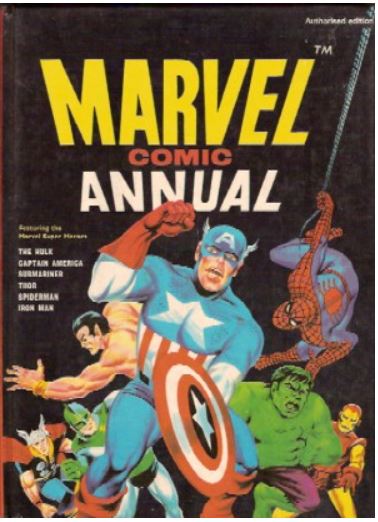
From 1968 superhero comics began to decline – just as they had at the end of the 1940s – so publishers sought fresh ways to maintain their readerships as tastes changed. Back then, the industry depended on newsstand sales, and if you weren’t popular, you died. Editor Jack Miller, innovating illustrator Mike Sekowsky and relatively new scripter Denny O’Neil came up with a radical proposal and made history by depowering the only female superhero then in the marketplace. They had the mystical Amazons leave our dimension, taking with them all their magic – including Wonder Woman‘s powers and all her weapons…

Reduced to humble humanity she chose to stay on Earth, assuming and legitimising her own secret identity of Diana Prince and resolved to fighting injustice as a mortal. Tutored by blind Buddhist monk I Ching, she trained as a martial artist, and quickly became a formidable enemy of contemporary evil. Now, I Ching claims he can repair Superman’s difficulties and restore his dwindling might, but evil eyes are watching. Arriving clandestinely, Superman allows the adept to remove his remaining Kryptonian powers as a precursor to fully regaining them, allowing the ASG opportunity to strike. In the resultant brutal melee, the all-too-human hero triumphs in the hardest fight of his life…

The saga continues with Swanderson back on art in #241, withSuperman overcoming momentary but nigh-overwhelming temptation to put down his oppressive burden of duty and lead a normal life. Admonished and resolved, he submits to Ching’s resumed remedy ritual and finds his spirit soaring to where the sand-being lurks, before explosively reclaiming the stolen powers. Leaving the gritty golem a shattered husk, the astral Kal-El brings the awesome energies back to their true owner and a triumphant hero returns to saving the world…

Over the next few days, however, it becomes clear that something has gone wrong. The Man of Tomorrow has become arrogant, erratic and unpredictable, acting rashly, overreacting and even making stupid mistakes. In her boutique, Diana Prince discusses the problem with Ching and the sagacious teacher deduces that whilst merely mortal and fighting ASG thugs, Superman received punishing blows to the head which have caused a brain injury that did not heal when his powers returned…

When the out-of-control hero refuses to listen, Diana & Ching track down the dying sand-thing and beg its aid. The elderly savant recognises it as a formless creature from other-dimensional Quarrm and listens to the amazing story of its entrance into our world. He also suggests a way for it to regain some of what it recently lost…

Superman, meanwhile, has blithely gone about his deranged business until savagely attacked by a statue of a Chinese war-demon. Also able to steal his power, it has been possessed by a second fugitive from Quarrm. It has no conscience and wears ‘The Shape of Fear!’…

The shocking saga concludes in ‘The Ultimate Battle’ as the second Quarrmer falls under the sway of two petty thugs who use it to put freshly de-powered Superman into hospital…

Rushed into emergency surgery, the Kryptonian fights for his life as sand-thing confronts war-demon in the streets. Events take an even more bizarre turn once the latter drives off its foe and turns towards the hospital to finish off the flesh-&-blood Superman…

Regaining consciousness – and a portion of his power – the Metropolis Marvel battles the beast to a standstill but needs the aid of his silicon stand-in to drive the thing back beyond the pale. With the immediate threat ended, Man of Steel and Man of Sand face off one last time, each determined to ensure his own existence no matter the cost…

The stunning conclusion was a brilliant stroke on the part of the creators, one which left Superman approximately half the Man of Tomorrow he used to be. Of course, he eventually returned to his unassailable, god-like power levels but never quite regained the tension-free smug assurance of his pre-1970s self…

For now though, with the epic ended day-to-day dilemmas resume with Action #403 and Bates & Swanderson’s ‘Attack of the Micro-Murderer’, wherein the Krptonian is attacked and fatally infected by sentient time-travelling micobe Zohtt before millions of earthlings donate blood to flush his system clean, after which Brown channels Daniel Keyes’ Flowers for Algernon for ‘The Man With the X-Ray Mind’ as an intellectually-challenged janitor develops and tragically loses astounding mental abilities…

Dorfman scripted #404’s ‘Kneel to Your Conqueror, Superman!’ wherein governemntal secret weapon/supergenius Rufus Caesar goes rogue and devises tech to steal The Action Ace’s powers, before inevitably overreaching and reaping every tyrant’s fate. As Geoff Brown, the multi-faceted writer offers another glimpse at our hero’s college years with ‘The Day They Killed Clark Kent’ relating a memorable teaching moment after a hazing incident is covertly commandeered and redirected by the Adolescent of Steel. Then Bates introduces ‘The Starry-Eyed Siren of Space!’ in Superman #243, as cosmic catastrophe catapults the Caped Kryptonian into an encounter with disembodied ultra-mentalities Kond & Rija. Sadly, the latter recalls the long forgotten joys of physicality and constructs an organic form to woo Superman, leaving Rija no choice but to do similar and win back his mate…

‘Superman, Bodyguard or Assassin?!’ leads in Action #405, as Bates posits an Imaginary Story near future where a Psy-ops expert turns the Man of Steel into an assassin pointed at the US President. He follows up with regulation continuity thriller ‘The Most Dangerous Bug in the World?’ as Clark Kent is swept up in a product demo that threatens to expose his secret identity. Over in Superman #244, O’Neil anticipates early AI anxiety and human responses via the rampages of ‘The Electronic Ghost of Metropolis!’, before AC #406 sees Dorfman deal with the rise of counter cultures and semi-religious cults as telejournalist Clark Kent investigates a charismatic ‘Master of Miracles’. What he discovers is a devious plot orchestrated by someone very close to his home and his heart…

For the same issue, the writer dons his “Brown” mantle to expose a restless and beleagured supernatural alchemist inhabiting the Tower of London for centuries as ‘The Ghost That Haunted Clark Kent’ before the wraparound superhero-bedecked cover for all reprint giant Superman #245 and Curt Swan’s pencilled model sheet ‘The Man of Many Faces’ penultimately usher in final wonder ‘Danger… Monster at Work!’ from #246, with Len Wein debuting as super-scribe and introducing an extended cast of Clark Kent’s neighbours in a wry and witty warning tale of pollution gone mad and monsters in Metropolis’ sewers, perfectly limned by Swan & Anderson…

A fresh approach, snappy dialogue and more human-scaled concerns to balance outrageous implausible fantasy elements all wedded to gripping plots and sublime art make Kryptonite Nevermore one of the very best Superman sagas ever created, and its wonderful to see the other stories of the time included for balance and to prove that this was very much the Man of Steel getting his long-needed second wind for the next comics age.

A must-have graphic collection to sit on the same shelf as Watchmen, Batman: Year One, Segar’s Popeye, Gottfredson’s Mickey Mouse, The Fourth World Saga, Kirby & Lee’s Galactus Trilogy and Chaykin’s American Flagg!, this is a shining exemplar of action- adventure comics captured at their most perfect moment. Why don’t you have this yet?
© 1970, 1971, 2025 DC Comics. All Rights Reserved.