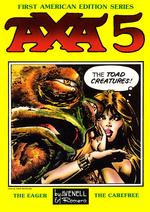

Flash Gordon: complete daily strips – 19th November 1951-20th April 1953


By Dan Barry & Harvey Kurtzman, with Frank Frazetta (Kitchen Sink Press)
ISBN: 978-0-86801-969-7

By most lights Flash Gordon is the most influential comic strip in the world. When the hero debuted on Sunday January 7th 1934 (with the superb Jungle Jim running as a supplementary “topper” strip) as an answer to the revolutionary, inspirational, but rather clunky Buck Rogers strip of Philip Nolan and Dick Calkins (which also began on January 7th, but five years earlier) two new elements were added to the wonderment; Classical Lyricism and astonishing beauty.

Where Rogers blended traditional adventure and high science concepts, Flash Gordon reinterpreted Fairy Tales, Heroic Epics and Mythology, spectacularly draping them in the trappings of the contemporary future, with varying ‘Rays’, ‘Engines’ and ‘Motors’ substituting for spells, swords and steeds – although there were also plenty of those – and exotic craft and contraptions standing in for Galleons, Chariots and Magic Carpets.

Most important of all, the sheer artistic talent of Raymond, his compositional skills, fine line-work, eye for sumptuous detail and just plain genius for drawing beautiful people and things, swiftly made this the strip that all young artists swiped from.

When all-original comicbooks began a few years later, dozens of talented kids weaned on the strip’s clean-lined, athletic Romanticism entered the field, their interpretations of Raymond’s mastery a ticket to future success in the field of adventure strips. Almost as many went with Milton Caniff’s expressionistic masterpiece Terry and the Pirates (and to see one of his better disciples check out Beyond Mars, illustrated by the wonderful Lee Elias).

For over a decade sheer escapist magic in a Ruritanian Neverland, blending Camelot, Oz and every fabled paradise that promised paradise yet concealed hidden vipers, ogres and demons, enthralled the entire world, all cloaked in a glimmering sheen of sleek art deco futurism. Worthy adversaries such as utterly evil, animally magnetic Ming, emperor of a fantastic wandering planet; myriad exotic races and fabulous conflicts offered a fantastic alternative to the drab and dangerous real world…

Alex Raymond’s ‘On the Planet Mongo’, with Don Moore doing the bulk of the scripting, ran every Sunday until 1944, when the artist joined the Marines. On his return he would create the gentleman detective serial Rip Kirby. The one continuous, unmissable weekly appointment with sheer wonderment, continued under the artistic auspices of Raymond’s assistant Austin Briggs who had drawn the daily instalments since 1940.

That Monday to Saturday black and white feature ran from 1940-1944 when it was cancelled to allow Briggs to take over the Sunday page. Often regarded as the poor relation, the daily strip got an impressive reboot in 1951 when King Features, keenly aware of the science fiction zeitgeist of the post-war world, revived it, asking Dan Barry to produce the package. The Sunday was continued by Austin Briggs until 1948 when Mac Raboy assumed artistic control, beginning a twenty year resurgence of classical brilliance. On Raboy’s death Barry added the Sunday to his workload until he quit over a pay dispute in 1990.

Barry (1911-1997) started as a jobbing artist in comicbooks, a contemporary of Leonard Starr and Stan Drake. Like them and his brother Seymour “Sy” Barry (who produced The Phantom newspaper strip for three decades) Dan worked in a finely detailed, broadly realistic style, blending esthetic sensibility with sharp detail and strong, almost burly virile toughness – a gritty “He-man” attitude for a new era and defined as “New York Slick”.

Dan Barry drew such varied comicbook series as Airboy, Skywolf, Boy King, Black Owl, Spy Smasher and Doc Savage before joining the Air Force. Returning after the hostilities he drew The Heap and assorted genre shorts for new titles such as Crimebusters. He also started his own business producing educational and informational comics.

He began the gradual departure from funny-books as early as 1947 when he took over the Tarzan daily strip for a year but he was still gracing DC’s crime, mystery and science fiction anthologies as late as 1954. When offered Flash Gordon he agreed, intending to write the feature himself. However, the financial rewards were meager and soon he was looking for a scripter.

The story of how cartoon genius Harvey Kurtzman came aboard (probably in February 1952) makes a fascinating postscript in this magnificent volume so I won’t spoil the revelations of the text feature at the back: a section which also contains a wealth of the new writer’s rough-penciled script layouts, sketches, ghosted pencils from young Frank Frazetta and a selection of Flash Gordon spoofs from other magazines. (If you’re interested, they include ‘Flesh Garden’ by Wally Wood from Mad #11 (May 1954), ‘Flyashi Gordonovitch’ (Jack Davis, Humbug #10, June 1958), ‘Little Annie Fanny’ (Playboy 1962, Will Elder) and Kurtzman’s own art for the cover of Snarf #5, September 1972).

This huge black and white tome, 320mm x 260mm, available as both hardback and softcover, reprints the entire run until Kurtzman’s departure with the 20th April episode. Later Flash Gordon story collaborators included writers Harry Harrison and Julian May and art assistants Bob Fujitani and Hillman Publications comrade Fred Kida – more magical material well worth collecting someday….

The new Flash Gordon daily debuted on 19th November 1951 with all the beloved history and scenarios of Mongo and the Ruritanian universe sidelined in favour of a grittier, harder-edged pulp fiction atmosphere. Sometime in the near future astronaut Flash launches into space, part of an expedition to Jupiter, However technical trouble forces the ship to stop at the Space Prison Station.

Docked for repairs the crew inadvertently triggers a riot as the ruthless convicts take a once-in-a-lifetime opportunity to escape the space rock… Terse and gripping, this two-fisted yarn rockets along with Flash, Dale and the crew fighting for their lives before finding an ally among the rioters, one who would eventually join them on their voyage to the gas giant and beyond…

With new iconoclastic tone and milieu firmly established, ‘Man Against Jupiter!’ began on Monday, February 25th 1952 (with Kurtzman’s first scripts appearing sometime in April). The crew orbiting the colossal globe once more experiences terrifying malfunctions and their atomic ship “Planet Pioneer” heads to the moon Ganymede to effect repairs. On landing the bold explorers discover a subterranean civilisation within the icy satellite and a young Earth boy…

Ray Carson was the son of a lost lunar scientist and his presence halfway across the solar system is but one of the intriguing mysteries challenging Flash and Dale as they battle alien madmen and malicious monsters in the hidden City of Ice… Of course the real threat is the willful, voluptuous Queen Marla who abducted Ray and his father…

Using teleport technology she had dispatched the missing scientist to another star-system to search for an element vital to the Ganymedan’s survival but when upheaval and revolution tear the city apart Flash, Dale, Ray and Marla can only escape by following the missing savant into an unknown universe…

Slowly the old accoutrements of the classic strip had been returning: lost civilizations, monsters, arena duels… and with this new sequence (beginning 17th June 1952) the creators brought back more fantasy elements as the survivors explore this new world hunting Dale, who had been lost in transit. After an intriguingly off-beat encounter with Butterfly Men and a grueling ocean odyssey the Flash, Marla and Ray discover a feudal race of horned and tailed, cloven-hoofed warriors in the devil city of Tartarus and an old friend making earth weapons for them as they strive to overthrow their tyrannical warlord…

Wherever Flash Gordon goes war and revolution seem to follow, but once the devil-men have settled their differences Flash, Marla and Ray resume the search for Dale, and stumble into the bizarrely advanced city of Pasturia, ruled by masters of the mind…

With “Planet Pioneer” crewman Bill Kent, the trio press on and soon make the most astounding discovery of all: this distant world is the retirement home of legendary Earth wizard Merlin, whose super technology includes a time-machine which not only recovers Dale and returns them all to Earth but subsequently endangers our home world by accidentally allowing criminals from the future to poison the planet…

Gripping, alluring, stunningly well illustrated (did I mention that the incomparable Frank Frazetta penciled a long sequence of incredible strips?) this lost treasure is pure graphic gold, presented on huge pages that perfectly display the virtuosity of all involved. Perfect, perfect comic strip wonderment…
© 1988 King Features Syndicate. Additional material © 1988 its respective copyright holders. This edition © 1988 Kitchen Sink Press. All Rights Reserved.

Mac Raboy’s Flash Gordon: Volume 1 Sunday Strips from 1948-1953


By Don Moore & Mac Raboy (Dark Horse)
ISBN: 978-1-56971-882-7

By most lights Flash Gordon is the most influential comic strip in the world. When the hero debuted on Sunday January 7th 1934 (with the superb Jungle Jim running as a supplementary “topper” strip) as an answer to the revolutionary, inspirational, but quirkily clunky Buck Rogers by Philip Nolan and Dick Calkins (which also began on January 7th, but in 1929) two new elements were added to the wonderment; Classical Lyricism and poetic dynamism. It became a weekly invitation to stunning exotic glamour and astonishing beauty.

Where Rogers blended traditional adventure and high science concepts, Flash Gordon reinterpreted fairy tales, heroic epics and mythology, spectacularly draping them in the trappings of the contemporary future, with varying ‘Rays’, ‘Engines’ and ‘Motors’ substituting for trusty swords and lances – although there were also plenty of those – and exotic craft and contraptions standing in for galleons, chariots and magic carpets. It was a narrative trick that kept the far-fetched satisfactorily familiar – and was continued by Raboy and Moore in their run. Look closely and you’ll see cowboys, gangsters and of course, flying saucer fetishes adding contemporary flourish to the fanciful fables in this volume…

Most important of all, the sheer artistic talent of Raymond, his compositional skills, fine line-work, eye for unmuddled detail and just plain genius for drawing beautiful people and things, swiftly made this the strip that all young artists swiped from.

When all-original comic books began a few years later, literally dozens of talented kids used the clean-lined Romanticism of Gordon as their model and ticket to future success in the field of adventure strips. Almost all the others went with Milton Caniff’s expressionistic masterpiece Terry and the Pirates (and to see one of his better disciples check out Beyond Mars, illustrated by the wonderful Lee Elias).

Flash Gordon began on present-day Earth (which was 1934, remember?) with a rogue planet about to smash the World. As global panic ensued, polo player Flash and fellow passenger Dale Arden narrowly escaped disaster when a meteor fragment downed their airliner. They landed on the estate of tormented genius Dr. Hans Zarkov, who imprisoned them in the rocket-ship he had built.

His plan? To fly the ship directly at the astral invader and deflect it from Earth by crashing into it…!

Thus began a decade of sheer escapist magic in a Ruritanian Neverland: a blend of Camelot, Oz and every fabled paradise that promised paradise yet concealed hidden vipers, ogres and demons, all cloaked in a glimmering sheen of sleek futurism. Worthy adversaries such as utterly evil but magnetic Ming, emperor of the fantastic wandering planet; myriad exotic races and shattering conflicts offered a fantastic alternative to drab and dangerous reality for millions of avid readers around the world.

Alex Raymond’s ‘On the Planet Mongo’ with Don Moore doing the bulk of the scripting, ran every Sunday until 1944, when the artist joined the Marines. On his return he eschewed wild imaginings for sober reality and created the gentleman detective serial Rip Kirby. The continuous, unmissable weekly appointment with sheer wonderment, continued under the artistic auspices of Austin Briggs – who had drawn the daily black and white instalments since 1940.

In 1948, eight years after beginning his career drawing for the Harry A. Chesler production “shop” comicbook artist Emanual “Mac” Raboy took over the illustration of the Sunday page. Moore remained as scripter and began co-writing with the artist.

Raboy’s sleek, fine-line brush style, heavily influenced by his idol Raymond, had made his work on Captain Marvel Jr., Kid Eternity and the especially Green Lama a benchmark of artistic quality in the proliferating superhero genre. His seemingly inevitable assumption of the extraordinary exploits led to a renaissance of the strip and in the rapidly evolving post-war world Flash Gordon became once more a benchmark of timeless, escapist quality that only Hal Foster’s Prince Valiant could touch.

This first 260 page volume, produced in landscape format and printed in bold stark monochrome (although one or two strips appear to have been scanned from printed colour copies) covers the period January 8th 1948 to May 10th 1953 and opens with Flash as President of Mongo when Slyk, a refugee from the believed-uninhabited moon of Lunita, arrives. Beseeching assistance to liberate his world from the tyrannical depredations of the wicked siblings Rudo and Lura, the Lunite accompanies Flash, Dale Arden and Dr. Zarkov to his hidden moon where the heroes are soon captured before Slyk saves the day.

This short transitional tale set up an unfailingly popular formula of nightmarish beasts, distressed damsels and outrageous adventure that would last until Raboy’s death in 1967.

Returning to Mongo Flash and Co. discovered a red comet hurtling towards that fabulous world. Whilst trying to deflect it they become trapped by the civilisation who inhabit its interior, creatures to whom gravity is but a toy… Once more romance, intrigue and beautifully depicted action were the order of many days until the trio toppled the masters and placed far more agreeable rulers in charge, saving their adopted world and the greater universe.

The saga lasted until June of 1949 and was promptly followed by a stunning undersea odyssey as a brief trip to Mongo’s beaches led Flash and Dale into murky waters when they rescued captivating Merma from monstrous sub-sea marauder Sharki and became enmeshed in a watery range-war and tricky romantic quadrangle involving hidden kingdoms, scaly savages and outrageous leviathans and sea-beasts.

It was off to the frozen principality of Polaria next where ambitious Prince Polon was covering up a plague of giant monsters preying on the people. Of course the scurvy villain was behind the plot, using size-shifting rays and his ultimate aim was to become dictator of all Mongo…

The scheme obviously gave other regional rulers ideas. No sooner did President Flash return than he was off again to the Tropix Islands where “Queen” Rubia had fomented rebellion and seceded from the democratic federation of Mongo States. Hands-on Flash went undercover with Dale in an Arabian adventure to rival Sinbad’s greatest: before the people were liberated and the despots destroyed there was a panoply of spectacular action and fantastic creatures to survive…

Rubia, defeated, was dispatched to the prison moon Exilia, but all was not right on that grim penal colony. Once more surreptitiously investigating our hero discovered that villains had taken over the penal-planet and were preparing to attack civilized Mongo. Luckily Rubia and criminal mastermind Zin believed Flash to be his own double, dispatched to Exilia for impersonating the President – but they’re were not fooled for long…

This awesome extended epic ran from 6th March to November 5th 1950 and was followed by a proposed change-of-pace as Flash and Dale took off for a much-needed vacation on Earth. Unfortunately ever-malicious Rubia sabotaged their ship and they crash-landed on the unexplored Planet Zeta. It surely came as no surprise to fans when they discovered another beautifully barbarous lost civilisation there…

Zeta was a world of colossal plants and feudal warriors, but hid a dangerous secret. Something in the environment consumed metal. Within minutes Flash and Dale saw their ship and weapons melt away… Befriended instead of attacked the castaways found the inhabitants lived on a world seemingly immune to technological advancement, controlled by “wizards” who soon decided that Flash was a threat…

Flash discovers the metal-eating plague was artificial and helped the Zetans rebel and they helped him construct a new ship. Once more en route for Earth Flash and Dale encountered a stranger meteor, but without further mishap arrived safely. On March 25th 1951 (17 years and some months after they departed) two of earth’s first star-travellers finally returned to their birthworld and were feted like royalty. Sadly they should have paid closer attention to that vagrant space-rock as soon, Earth was under attack by strategically aimed meteors.

With Einsteinish Professor Brite in tow, Flash and Dale tracked the attacks to the Moon where they met beetle-men and human dictator Rak who planned to conquer Earth with his lunar meteor gun. He had never encountered a man like Flash Gordon before…

With Rak’s threat ended Flash helped Earth build a sentinel Space Platform, but when he, Dale, engineer Dr. Ruff and his annoying niece Ginger began work 1000 miles up they clashed with a strange race of flying saucer-riding space gnomes from Mars…

At this time Mars clearly preferred, if not actually needed, Earth women and with Dale and Ginger abducted, another sterling romp ensued. Flash outfoxed the malign gnome-king Toxo before subsequently leading a full expedition to the Red planet where he discovered another advanced feudal civilisation and that Martian women – or at least their Queen, Menta – had no worries, looks-wise…

Menta was however, a spoiled and murderous psychopath determined to conquer Earth…

This epic ran until February 24th 1952, whereupon Flash returned to Earth to discover his homeworld gripped in a new Ice Age. Jetting to the Arctic the good guys found Frost Giants from Saturn (the fifth moon Rhea to be exact) and that the big Freeze was artificially induced. Although he destroyed their forward base the Giants dragged Flash back to Rhea and inadvertently introduced human smallpox into their population…

Earth commander “Icy” Stark abandoned Dale after a space battle but Flash, with new Rhean allies rescued her and once more led a hostage society to overthrow its unfit rulers. On the return to Earth the fleet encountered a guided comet and met a new foe in Pyron the Comet Master.

Reunited with Dr. Zarkov the heroes battled the demented scientist’s horrendous creatures, saving Earth from flaming doom but were catapulted helplessly to the surface of enigmatic Venus for the last complete adventure in this stellar collection.

Not only is our solar system teeming with unsuspected life, but it appeared most of it was ruled by complete sods, as Flash, Dale and Zarkov battled winged tree-men, swamp horrors and the nefarious overlord Stang, enduring staggering hardship and hazard before crushing the tyrant and freeing two separate races from terror.

With a new ship, the far-flung travellers set off for Earth but were forced to land on the Moon where a secret human base had been established. For unknown reasons Dr. Stella and her thuggish aide Marc detained and delayed them, but when an increasing number of close shaves and mysterious accidents occurred, a little digging revealed that they were the unwitting guests of ruthless space pirates…

As is probably fitting for one of the world’s greatest continuity strips this first volume ends on a gripping cliffhanger, but with so much incredible action, drawn with such magnificent style there’s no way any fan of classic adventure can possibly feel short-changed

Mac Raboy was the last of the Golden Age of romanticist pencillers; his lush and lavish flowing adoration of the perfect human form was already fading from popular taste (for example the Daily feature at this time switched to the solid, chunky, He-manly burly, realism of Dan Barry and even Frank Frazetta) but here at least the last outpost of beautiful heroism and pretty perils prevailed, and thanks to Dark Horse you can visit as easily and often as Flash and Dale popped between planets, just by picking up this book and ones which followed…
© 2003 King Features Syndicate Inc. ™ Hearst Holdings, Inc. All Rights Reserved.

Nightwings (DC Science Fiction Graphic Novel #2)


By Robert Silverberg, adapted by Cary Bates, Gene Colan & Neal McPheeters (DC Comics)
ISBN: 0-930289-06-04

During the 1980s DC, on a creative roll like many publishers large and small, attempted to free comics narrative from its previous constraints of size and format as well as content. To this end, legendary editor Julie Schwartz called upon contacts from his early days as a Literary Agent to convince major names from the prose fantasy genre to allow their early classics to be adapted into a line of Science Fiction Graphic Novels.

In the far future Earth has aged into a somnolent, semi-feudalistic place of fantastic creatures and shabby glories. An old man from the Guild of Watchers is making his way to the fabled city of Roum, accompanied by an innocent gamin and a sardonic lizard-man outcast.

Watchers scan the heavens using portable technology and inherent psychic sensitivity, seeking the earliest inklings of a predicted alien invasion: this one has wandered the entire world and used up his life doing so. Impoverished and frail he makes his way to the greatest city on Earth with the beautiful Avluela, a creature who can fly like a butterfly – but only in darkness when the fierce solar winds have subsided. The old fool loves and yearns for the alluring nymph as does Gormon, their other companion. This reptilian goliath from the shunned guild of sub-humans carries with him a dark secret…

Each has their own reasons for going to the Eternal City, but as they make their way to the palace of the Prince, greatest ruler of this diminished globe they see evidence that all glory has faded and Roum is just as corrupted, decadent and increasingly bestial as everywhere else. Denied accommodation and food even from their own Guilds, appalled by the poverty and cruelty around them, the trio find tainted shelter within the Prince’s Palace but only because the arrogant, radiant ruler desires the fragile, gossamer Avluela and what he wants, he takes…

Disillusioned and at his lowest ebb the Watcher wonders if this world might actually benefit from the invasion he has wasted his life searching for. When heartbroken and vengeful Gormon reveals his own secret the Watcher’s equipment finally sounds the alarms he has waited all his life to hear…

Silverberg’s deeply moving, Hugo Award winning story of faded glories and mistimed love was first published in Galaxy Magazine in 1968 and was followed by two sequel novellas, Perris Way and To Jorslem which were promptly edited together to form the novel Nightwings.

Adaptors Cary Bates and Gene Colan, ably assisted by lettering legend Gaspar Saldino and painter/colourist Neal McPheeters, perfectly capture the debilitating aura of inescapable, inexorable loss and dissolution, but as always, any adaptation – no matter how well executed – is absolutely no substitute for experiencing a creator’s work the way it was originally intended, so Go Read The Story too.

However, as this is a place to review graphic novels, please be assured that this is one that works excessively well; moody, portentous and beautifully realised.

This refined, stoic interpretation is welcomingly traditional in its delivery, allowing the tale to creep into your hearts and is a perfect companion to DC’s other adaptations in this series. It’s an inexpressible pity they’re all currently out of print and this is an experiment the company should seriously consider resuming. Moreover as I’ve said before: these DC Science Fiction Graphic Novels would make an irresistible “Absolute” compilation…
© 1968, 1969 Robert Siverberg. Adapted with permission of the author and Agberg Ltd. All text and illustrations © 1985 DC Comics Inc. All rights reserved.

The Outer Space Spirit: 1952


By Will Eisner, Jules Feiffer & Wally Wood (Kitchen Sink Press)
ISBN: 0-87816-012-4

In keeping with the dolorous nature of this time of year I’m concentrating on a few missed opportunities in this period between the dubious joys of Christmas and the nervous anticipation of the New Year so here’s a graphic novel that in some ways didn’t live up to all it could have been – not necessarily because of the material itself but because of the kind of world we live in…

It is pretty much accepted today that Will Eisner was one of those pivotal creators who shaped the American comic book industry, with most of his graphic works more or less permanently in print – as they should be. However, although the story can be found as part of the recent Spirit Archive volume 24, this classy monochrome volume from much-missed independent publisher Kitchen Sink in 1983 released in both hardback and softcover, is by far a better reading experience.

Sometimes the Medium is the Message, especially when the artefact is a substantially solid tome delivering magical artwork in crisp, breathtaking black and white which details – not only in the reprinted strips but also sketches, incidental artwork and author’s breakdown layouts – the last and most striking saga of one of the world’s greatest fantasy characters.

From 1936 to 1938 Eisner worked as a jobbing cartoonist in the comics production firm known as the Eisner-Eiger Shop, creating strips for both domestic US and foreign markets. Using the pen-name Willis B. Rensie he created and drew opening instalments for a huge variety of characters ranging from funny animal to historical sagas,

Westerns, Detectives, aviation action thrillers… and superheroes – lots of superheroes …

In 1940 Everett “Busy” Arnold, head honcho of the superbly impressive Quality Comics outfit, invited Eisner to take on a new challenge. The Register-Tribune newspaper syndicate wanted a 16-page weekly comicbook insert to be given away with the Sunday editions. Eisner jumped at the opportunity, creating three strips which would initially be handled by him before two of them were handed off to his talented assistants. Bob Powell inherited Mr. Mystic and distaff detective Lady Luck fell into the capable hands of Nick Cardy (then still Nicholas Viscardi) and later the inimitable Klaus Nordling.

Eisner kept the lead feature for his own playground and over the next twelve years The Spirit became the most impressive, innovative, imitated and talked-about strip in the business. However, by 1952 he had more or less abandoned it for more challenging and certainly more profitable commercial, instructional and educational strips, working extensively for the US military in manuals and magazines like P*S, the Preventative Maintenance Monthly, and generally leaving comics books behind.

For the final year or so the bulk of Spirit tales were produced by other hands with assistant Jules Feiffer handling the bulk of the scripts and diverse artists producing the art. Feiffer preferred to map out his episodes in rough pencil with word balloons and captions fully scripted: once approved by Eisner the roughs would then be interpreted by the assigned artist for the individual episodes. The long-term plan was not to cancel The Spirit but to redefine it for a new decade and expand the Eisner studio/company beyond and around it – but that’s not quite how it played out.

As seen in the scholarly introduction by Cat Yronwoode and Eisner’s own director’s commentary ‘Reminiscence’, the plans to reposition The Spirit were not welcomed by the client papers buying the strip; the creators handling the feature had different creative goals and drives and Eisner himself couldn’t quite let go of his precious baby.

Even though society and comicbooks were wildly in love with the bold new genre of space opera science fiction and Eisner had previously dabbled with the form in a few previous adventures, a large number of Spirit clients and readers did not want any “flying saucer spacey stuff” on their Sunday funnies pages. Moreover the brilliantly sardonic, existentialist and sensitively satirical Feiffer was approaching the tales in a bleak, almost nihilistic way, emphasising existentialist isolation, human frailty and the passing of an era rather than rugged he-men with hot babes in bikinis and fishbowl helmets…

After a succession of fill-in draughtsmen Wally Wood was selected as artist, a stunningly gifted imaginer who had been reaching unparalleled heights with his work for EC and other comicbook Sci Fi publishers. Wood had actually begun his professional career on the Spirit in the 1940s as a letterer and was fantastically keen on the new project, but the merciless deadlines and his overwhelming desire to surmount his own high standards soon had the saga experiencing deadline problems on top of everything else…

After the text features, the first episode ‘Outer Space’ begins, preceded as are most of the strips here by Feiffer’s meticulous and detailed script layouts. First appearing on Sunday, July 27th 1952, it saw Denny Colt, The Spirit, managing a crew of convict volunteers on an American rocketship to the moon, at the insistent request of eminent space scientist Professor Hartley Skol. However this was a new hero for an uncertain age. The tough, fun-loving, crime-fighting daredevil had become a cautious, introspective leader, feeling fully the weight of his mission and the burden of unwelcome responsibilities.

‘Mission: the Moon’ (August 3rd 1952), follows Colt, Professor Skol and the pardoned felons onto the satellite’s barren surface and recounts the Spirit’s first victory as he heads off a potential mutiny with reason, not force, whilst ‘A DP on the Moon’ reveals how closely Eisner still monitored the series.

DP’s were “Displaced Persons” a common term in the post-war world, and when the explorers find a diary in the lunar dust, it reveals that the world’s greatest dictator and his inner circle fled to the moon to escape Allied justice. Unfortunately they could not outrun their own paranoia and madness…

In the original script and finished art the diarist is Adolf Hitler, but the grim fate that befell his fellow Nazis was altered at the very last moment by Eisner, who felt the plot already old hat. Swift retouching transformed Der Fuehrer into fictitious Latin American dictator Francisco Rivera and the revised version ran on August 10th 1952. It still reads well but if you look carefully those uniforms in the background flashbacks are hauntingly familiar…

With ‘Heat on the Moon’ the deadline crunch hit, and one and a half pages of spectacular Lunar exploration by Wood abruptly segue to a “meanwhile back on Earth” scene by Eisner, featuring Chief Dolan, daughter Ellen and a criminal with a vested interest in assuring that at least one of the moon volunteers isn’t pardoned.

Following their first fatality the mission began to go swiftly awry and ‘Rescue’ (the instalments now cut to only four pages in an attempt to fight the deadline doom) saw another body-blow to the expedition. Defeated and demoralised Spirit decided to return the survivors to Earth…

‘The Last Man on the Moon’ depicted the launch from the moon as on Earth another gangster attempted to scotch the return trip. The mission, clearly cursed, suffered one more disaster as a convict sneaks away before take-off, becoming, with the September 7th episode ‘The Man in the Moon’.

On September 14th the inevitable occurred and the feature was forced to run a modified reprint (‘The Amulet of Osiris’ from the late 1940s) before Wood resurfaced to illustrate the philosophically barbed ‘Return from the Moon’ on September 21st. As Denny Colt and the remaining lunar-nauts debate the nature of reality, Eisner stepped in with the help of Al Wenzel to produce ‘The Return’ a hasty wrap-up that still found room for a close encounter with a flying saucer.

A scheduling blip saw an alternate version of the return a week later (not included here) and the last episode ‘Denny Colt, UFO Investigator’ ran on October 5th 1952: an inconclusive new beginning illustrated by Klaus Nordling. The strip died with that episode as Eisner, increasingly occupied with military work, and bleeding client-papers, terminated the feature.

But that isn’t quite the end: this book also includes in various forms what would have been the next three chapters, discovered in Eisner’s extensive file vault in the early 1980s. First is a fully lettered Feiffer layout, followed by a sequence of lettered pages prior to the art being drawn and the first (and only) typed script from assigned new creator Nordling.

Tense, suspenseful, dark and fearsomely compelling, these are the stories that killed off the Spirit for nearly two decades, but today they stand as a mini-masterpiece of modern comics storytelling that was quite simply, too far advanced for its audience. For we survivors of Cold War, Space Race and Budget-cut scientific exploration they are a chilling and intensely prophetic examination of human nature in a Brave New World rendered with all the skill and frantic passion of some of comics’ greatest talents.

What wonders could have followed if the readers had come along with them?
© 1983 Kitchen Sink Press. © Art and stories 1983 Will Eisner. All rights reserved.

Beyond Mars volumes 1 & 2


By Jack Williamson & Lee Elias (Blackthorne)
ISBNs: 0-932629-82-2 and 0-932629-84-9

The 1950s was the last great flourish of the American newspaper strip. Always intended as a way of boosting circulation and encouraging consumer loyalty, the inexorable rise of television and spiraling costs of publishing gradually ate away at all but the most popular cartoon features as the decade ended, but the earlier years saw a final, valiant, huge burst of creativity and variety as syndicates looked for ways to recapture popular attention whilst editors increasingly sought ways to maximise every fraction of an inch for paying ads, not expensive cost-centers.

No matter how well produced, imaginative or entertaining, if strips couldn’t increase sales, they weren’t welcome…

The decade also saw a fantastic social change as a commercial boom and technological progress created a new type of visionary consumer – one fired up by the realization that America was Top Dog in the world. The optimistic escapism offered by the stars above led to a reawakening in the moribund science fiction genre, with a basic introduction for the hoi-polloi offered by the burgeoning television industry through such pioneering if clunky programmes as Tom Corbett, Space Cadet and movies from visionaries like Robert Wise (Day the Earth Stood Still) and George Pal (Destination Moon, When Worlds Collide, War of the Worlds and others).

For kids of all ages conceptual fancies were being tickled by a host of fantastic comicbooks ranging from the blackly satirical Weird Science Fantasy to the welcoming and openly enthusiastic Strange Adventures and Mystery in Space. In the digest magazines master imagineers such as Heinlein, Bradbury, Asimov, Clarke, Sturgeon, Dick, Bester and Farmer were transforming the genre from youthful melodrama into a highly philosophical art form…

With Flying Saucers in the skies, Reds under the Beds and adventure in mind, the Worlds of Tomorrow were common currency and newspaper strips wanted more. Established features such as Buck Rogers, Brick Bradford and Flash Gordon were no longer enough and editors wanted new fresh visions to draw in a wider public, not just the steady fans who already bought papers for their favourite futurian.

John Stewart “Jack” Williamson was one of the first superstars of American science fiction, a rurally raised, self-taught author with more than 50 books, 18 short story collections and even volumes of criticism and non-fiction to his much lauded name. Born in Arizona in 1908, he was raised in Texas and sold his first story in 1928 to Amazing Stories.

Williamson created a number of legendary serials such as the Legion of Space, The Humanoids and the Legion of Time and is credited by the OED with inventing “terraforming” and “genetic engineering.” He was one of the first literary investigators of anti-matter with his Seetee novels.

“See Tee” or “Contra Terrene Matter” is at the heart of the strip under discussion here, collected in two oversized black and white paperback volumes by Blackthorne in 1987 as part of their Comic Strips Preserves project.

A damning newspaper review of Seetee Ship, Williamson’s second novel in that sequence, claimed the book was only marginally better than a comic strip, prompting the editor of a rival paper to engage Williamson and artist Lee Elias to produce a Sunday page based in the same universe as the books. With Dick Tracy maestro Chester Gould as adviser for the early days, the strip ran exclusively in the New York Daily News from 17th February 1952 to May 13th 1955, a glorious high-tech, high-adventure romp based around Brooklyn Rock in 2191AD, a commercial space station bored into one of the rocky chunks drifting in the asteroid belt ‘Beyond Mars’ -the ideal rough-and-tumble story venue on the ultimate frontier of human experience.

The nominal star is Spatial Engineer Mike Flint, an independent charter-pilot based on the rock (although as the series progressed a progression of sexy women and inspired extraterrestrial sidekicks increasingly stole the show) and the first tale begins with Flint selling his services to pluck Becky Starke who has come to the edge of humanity in search of her missing father, although she cloaks that in the quest for a city-sized solid diamond asteroid floating in the deadly “Meteor Drift”…

Soon Mike and his lisping ophidian Venusian partner Tham Thmith are contending with Brooklyn Rock’s crime boss Frosty Karth, a fantastic raider dubbed the Black Martian, a super-criminal named Cobra and even more unearthly menaces in a stirring tale of interplanetary drug dealers, lost cities, dead civilisations and a fantastic mutation – a semi-feral terran boy who can breathe vacuum and rides deep space on a meteor!

With that tale barely concluded the crew, including the rambunctious space boy Jimikin, fell deep into another mystery – Brooklyn Rock was missing!

However Flint had no time to grieve for the family and friends left behind as he intercepted an inbound star-liner and discovered an old flame and a smooth thug bound for the now-missing space station – moreover, one of them knew where it went…

Unknown to even this mastermind, the Rock, stolen by pirates, was out of control and drifting to ultimate destruction in a debris field, but no sooner wais that crisis averted than the heroes became entangled in a “First Contact” situation with an ancient alien from beyond Known Space – or at least with the devilish devices he/she/it left running…

With Book 1 ending on that dramatic cliffhanger, the concluding chronicle opens with Mike, Tham, Jimikin and curvaceous Xeno-archeologist Victoria Snow narrowly escaping alien vivisection from the robotic relics before the tragic, inevitable conclusion.

Snow’s brother Blackie was a fast-talking ne’er-do-well and when he showed up old enemy Karth took the opportunity to try and settle some old scores, leading Flint into a deadly trap on Ceres and a slick saga of genetic manipulation, eugenic supermen and bonanza wealth…

Meanwhile on an interplanetary liner, a new cast member “resurfaced” in the shape of crusty old coot and Mercurian ore prospector Fireproof Jones, just in time to help Flint and Sam mine their newfound riches. As ever Karth was looking to make trouble for the heroes but he invited some for himself when his young daughter suddenly turned up on the Rock accompanied by the gold-digging Pamela Prim. And suddenly the murderous raider Black Martian returned to plague the honest pioneers of the Brooklyn frontier…

Glamour model Trish O’Keefe caused a completely different kind of trouble when she arrived looking for her fiancé, but Tack McTeak wasn’t the humble space-doctor he claimed to be but a cerebrally augmented criminal mastermind, and his plans to snatch the biggest prize in space led to a sequence of stunning thrills and astonishing action.

The scene switched to Earth as the cast visited “civilisation” and found it far from hospitable, so the chance to battle manufactured monsters and the mysterious Dr. Moray on his private tropical island was something of a welcome, if mixed, blessing.

By this time the writing must have been on the wall, as the strip had been reduced to a half page per week, but the creators had clearly decided to go out in style. The sheer bravura spectacle was magnificently ramped up and all the tools of the science fiction trade were utilized to ensure the strip went out with a bang. Moray’s plans were catastrophically realised when the villain used an anti-gravity bomb to steal Manhattan, turning it into a deadly Sword of Damocles in the sky…

The series ended when the paper changed its editorial policy and dropped all comics from its pages. The decision was clearly a quick one as the saga finished satisfactorily but quite abruptly on Sunday 13th March 1955.

Beyond Mars is a breathtaking lost gem from two master craftsmen that successfully blended the wonders of science and the rollicking thrills of Westerns with broad, light-hearted humour to produce a mind-boggling, eye-popping, exuberantly wholesome family space-opera the likes of which wouldn’t be seen again until Star Wars put the fun back into futuristic fiction. This is a saga crying out for a definitive collectors edition.
© 1987 Lee Elias Jack & Williamson. Lee Elias. All rights reserved.

The Last Days of American Crime


By Rick Remender & Greg Tocchini (Radical Books)
ISBN: 978-0-935417-06-4

Win’s Christmas Gift Recommendation: Perfect for thrillseekers needing to get that pulse pounding again…  8/10

If you’re in need of a sobering dose of deeply disturbing hyper-reality then I thoroughly recommend this brilliant, extremely adult, cross-genre thriller which posits a fascinating premise, starts the countdown clock ticking down and delivers a killer kick to finish the rollercoaster ride.

America is a mess and the government need to take drastic action if they want to keep control. Terrorism and crime are rampant but luckily the boffins have come up with a radical solution: the American Peace Initiative – a broadcast frequency that utterly suppresses the ability to knowingly break a law. Any law.

Taking the radical decision to make all lawbreaking impossible (which is the only logical flaw I can find: what politician is ever going to make bribery obsolete?), and fearing a social meltdown in the run-up to going live, the powers-that-be also set up a distraction in the form of a complete switch-over from a cash economy to universal electronic transfers – an unstealable digital currency.

From D-Day on citizens will top up pay-cards from charging machines which are tamper-proof and impossible to hack and from that day every transaction in the USA will be recorded and traceable and every illegal purchase – drugs, guns, illicit sex – impossible…

In the weeks before the big switchover there is a huge exodus for the borders of Canada and Mexico and a total breakdown of law and order in the country’s most degenerate areas, but generally everybody seems resigned to the schemes – even when the anti-lawbreaking API broadcast plan is leaked…

With the world about to change forever low-rent career criminal Graham Bricke spots a chance for the biggest score of his life. He’s working as a security guard in one of the banks that will house the new currency technology and has an unmissable opportunity to steal one of the charging machines before the system is locked down forever. Unfortunately because of the API broadcast he has to pull off the caper before it becomes impossible to even contemplate theft…

In a hurry and needing specialised help Bricke and his silent partner are forced to hire a crew of strangers, but as the days dwindle he realises that safecracker Kevin Cash and hacker Shelby Dupree are trouble: a murderous psychotic and crazed libidinous wild-child with daddy issues. If only he can work out which is which…

Moreover there are other distractions. Graham is being hunted by a manic gangbanger and his posse and there’s a good chance at least one of his team are planning a double-cross…

This is a fascinating idea carried out with dizzying style and astounding panache: smart, sexy, unbelievably violent and utterly compelling, combining all the brooding energy of The Wire, the unremitting tension of 24‘s first season and the off-centre charm of Reservoir Dogs. It has blockbuster movie written all over it – which is no surprise as Remender’s previous efforts include comicbooks, like All-New Atom , X-Men and Punisher, computer games Dead Space and Bulletstorm and the animated feature Titan A.E.

Cannily concocted by Rick Remender and stunningly executed in dazzling colour by Greg Tocchini, this economical paperback also includes an extensive sketch and design section, an interview with the author and a lavish cover gallery which includes variants from Alex Malleev, Jerome Opeña & Matt Wilson and Joel dos Reis Viegas.

Short. Sharp. Shocking. Let’s hope they can do it again…

© 2010 Rick Remender and Radical Publishing, Inc. All rights reserved.

Networked: Carabella on the Run


By Gerard Jones & Mark Badger (Privacy Activism/NBM)
ISBN: 978-1-56163-586-3

Comics are an immensely effective teaching tool and not just for youngsters, either. The organisation Privacy Activism is a non-profit organisation which seeks to educate and inform the public about online safety, democratic principles in a global commercial environment and personal information protection through a variety of methods and after a couple of video game projects has worked here with comicbook creators Gerard Jones and Mark Badger and publisher NBM to produce a graphic novel starring their proprietary character Carabella; a blue-skinned teenaged girl from someplace stranger and nastier than here…

In Networked: Carabella on the Run the defensive, secretive lass is starting college and horrified at how easily her anonymity can be destroyed by even well-meaning friends through online social networking and messaging. Even her picture is soon being beamed all over the planet – all without her permission or knowledge.

Still, it’s not as if she has anything to hide, is it?

She soon strikes up a tentative relationship with Nick, an engineering student who has invented shoes which can film and monitor the wearer’s movement’s, record and broadcast physical responses and generally turn each owner into a walking market research report. Of course that wasn’t his intention – he just though it would be cool for friends to share their lives with others…

Unfortunately where Carabella comes from such information has long been used to oversee, segregate, program and control the population, so when hunters seeking her return align themselves with aggressive venture capitalists and sections of the Government she realises that the privacy, liberty and choices available to her and her friends might become just as obsolete as on her own world…

Combining a sensible, well-reasoned argument for common sense and practical personal protection with solid adventure-thriller plotting and the requisite amount of romance, action and fun, this is a great read with an important message that doesn’t overload the necessity to keep things interesting and enjoyable.

Most of Networked is available online in a slightly altered form if you want a peek, and the printed form is a perfect and potentially reassuring gift for parents to buy their kids alongside the mobile-phones and think-pods they’ll be clamouring for this year.

© 2010 Privacy Activism.

Ronin


By Frank Miller with Lynn Varley (DC Comics)
ISBN: 978-0-930289-21-8

I always feel a bit daft reviewing stuff that everyone already knows about, but I’m constantly being reminded that even though somebody talks about the classics of our art-form it doesn’t mean they actually have read them. Moreover, the great thing about comics is that they’re meant to be re-experienced, over and over and over…

So here’s a quick look at Frank Miller’s breakthrough epic: a canny blending of East and West, ancient and futuristic, mythical and technological, all used to scrutinise the unchanging nature of human passion, readily available in a number of paperback versions and even as an Absolute Ronin edition, released in 2008…

Set mostly in a near future where society has irretrievably broken down, our story actually opens eight centuries ago in feudal Japan, where a beloved, noble lord and his youngest, most untried samurai are besieged by the forces of a terrible demon named Agat who wants the mystical sword the old daimyo protects.

Eventually the unrelenting attacks succeed and Lord Ozaki is compromised and murdered. Shamed at his failure and maimed by the shape-shifting demon, the samurai becomes a masterless warrior, a Ronin, forced to wander the Earth until he can regain his honour…

Meanwhile in the 21st century, New York City and indeed the entire planet are dying, destroyed by economic, industrial and societal abuse. However at the heart of the dystopian nightmare a small team of free-thinking and idealistic scientists are pioneering a scheme to save humanity from itself.

Technological wizard Peter McKenna has invented self-replicating “bio-circuitry” that feeds itself from the polluted earth to grow clean buildings and even new prosthetic limbs. His greatest achievement is the Aquarius complex, a self-staining habitat governed by a benevolent Artificial Intelligence dubbed Virgo. Peter’s wife Casey runs the security of the complex whilst their friend Taggart runs the corporation they jointly founded, selling their world saving tech – and message – to the rest of humanity.

The maternal Virgo is increasingly becoming the fourth member of the team: making autonomous decisions for the benefit of all. She works closely with Billy Challas, an extreme congenital quadriplegic with latent psionic abilities. His hidden mental abilities have enabled Virgo to make huge leaps in replacement limbs, but recently his dreams have been disturbed by visions of Ozaki, Agat and the Ronin. Virgo is troubled by how historically accurate the nightmares are…

In ancient Japan the Ronin has wandered for years continually defending the magic sword from Agat’s forces, until in one self-sacrificing final duel demon and hero are both killed by the eldritch blade…

When Virgo’s researches uncover the dream Katana in a junk shop eight centuries later she accidentally causes an explosion which decimates part of the Aquarius complex, releasing Agat into our world again. Mercifully the spirit of the Ronin simultaneously enters Billy, who uses his submerged mind-powers to reconfigure his deformed flesh into the form of the ancient warrior.

Lost, dazed and confused, the Ronin wanders through the horrific landscape of post-civilised New York amongst a debased and corrupted populace whilst the demon possesses the body of Taggart and begins to subvert the pacifist, redemptive mission of Aquarius.

Casey McKenna, as head of security, begins to dig (quite literally) into the problem and with Virgo’s help is able to track down Billy/Ronin, but rather than saving the lad she is terrifyingly drawn into his mystical confusion. Meanwhile, as “Taggart” retools the complex into a munitions super-factory, Peter McKenna begins unravelling the mystery and discovers that nothing is as it seems and that there are far more sinister threats than debased gang-mutants and ancient demonic creatures. The entire world is under imminent threat and the clock is ticking…

This tale was not well received when it initially launched: the heady mix of manga influences (particularly Kazuo Koike and Goseki Kojima’s stunning Lone Wolf and Cub saga which permeates and guides this tale like a ghostly grandfather), science fiction, social politics and supernatural ultra violence was clearly not what the superhero reading fans had expected. Although some of the thematic overtones remained this was clearly no continuation of Miller’s landmark Daredevil run for Marvel: those issues were returned to in successive DC epics The Dark Knight Returns and Batman: Year One.

However Ronin did effectively alter the comicbook marketplace forever, allowing the adult sensibilities that had flourished in Europe and Japan for decades to finally gain a solid foothold in the dogmatically juvenile American comics market. Of course it wasn’t alone, but with American Flagg! and a few precious others it was at the vanguard of the zeitgeist that put style and mature content above Fights, Tights and empty frights…

Oppressive, exhilarating and scarily mystifying, Ronin is a spectacular visual tour de force that reshaped what we read and how we read it. As a fan you have a divine obligation to see it for yourself…
© 1983, 1984, 1987 Frank Miller, Inc. All Rights Reserved.

Annihilation Conquest Book 1


By various (Marvel)
ISBN: 978-0-8751-2782-6

Annihilation was another of those company-wide publishing events that “Changed The Marvel Universe Forever” (and don’t they all?) which ran for most of 2006, and involved most of the House of Ideas’ outer space outposts and cosmic characters. Among the stalwarts in play were Silver Surfer, Galactus, Firelord (and a host of previous heralds of the world-eater), Moondragon, Quasar, Star-Lord, Thanos, Super-Skrull, Tana Nile, Gamora, Ronan the Accuser, Nova, Drax the Destroyer, a Watcher and a host of alien civilisations such as the Kree, Skrulls, Xandarians, Shi’ar et al., all falling before a invasion of rapacious negative zone bugs and beasties unleashed by the insectoid horror Annihilus.

If you’re new to the Marvel universe and that bewildering list of daunting data didn’t leave you screaming in frustration, then please read on…

As is usual in these public thinnings of the herd, a number of good guys and bad died and had their trademark assumed by a new and glitzier model whilst some moribund careers got a successful and overdue shot in the arm…

The event spawned a number of specials, miniseries and new titles, (subsequently collected as three volumes plus a Classics compilation that reprinted key appearances of a number of the saga’s major players) and inevitably led to a follow-up event: Annihilation: Conquest.

The first volume of this surprisingly engaging sequel series collects Annihilation: Conquest Prologue, Annihilation: Conquest Quasar #1-4, Annihilation: Conquest Star-Lord #1-4 and Annihilation Saga, opening on a scarred and war-torn realm of known space, decimated and still reeling from the chaos of the Annihilation Wave and its aftermath.

The Kree and Skrull empires are splintered, the Nova Corps of Xandar reduced to a single agent, ancient gods are loose and a sizable portion of the Negative Zone invaders have tenuously established themselves in territories stolen from the billions of dead sentients that once populated the cosmos. The Supreme Intelligence is gone and arch-villain Ronan has become a surprisingly effective ruler of the Kree remnants. Cosmic Protector Quasar is dead and Phyla-Vel, daughter of the first Captain Marvel has inherited both his powers and name…

In ‘Prologue’ (written by Dan Abnett & Any Lanning, illustrated by Mike Perkins and coloured by Guru eFX) Phyla-Vel and psychic demi-goddess Moondragon are working with the pacifist Priests of Pama to relieve the suffering of starving survivors, whilst Peter Quill, one time cosmic champion Starlord, is working with Ronan and the remnants of the warlike Kree on the planet Hala to shore up the battered interstellar defences of the myriad races in the sector.

Quill has brokered an alliance with the Spaceknights of Galador (an old noble cyborg species most famously represented by 1980s hero Rom) that should enhance the all-pervasive etheric war-net, but once uploaded the date instantly causes disastrous problems throughout the system. In seconds all technology in the region is compromised: overruled by a murderous, electronic sentient parasitic species known as the Phalanx, whose cybernetic credo is “peace and order through assimilation”. Once more organic life is facing total extinction…

On planet Pama, Phyla and Moondragon are targeted by enslaved Kree automatons as the Phalanx attempt to destroy any credible resistance before spectacularly cutting off the entire quadrant from the rest of the universe. If life is to survive this threat it must be saved by the champions trapped inside…

The miniseries ‘Starlord’ (written by Keith Giffen, with art from Timothy Green II, Victor Olazaba & Nathan Fairbairn), finds the one-time Cosmic Avenger stripped of his powers and technological enhancements – all now liabilities when facing a predator species that infests electronic devices – and seconded to a Kree resistance division. Here he is tasked with turning Kree prisoners into a Penal Strike Force (a highly engaging intergalactic Dirty Half-Dozen) and taking out the Phalanx base where the invaders are perfecting a more efficient way to assimilate organics into their mechanistic hive-mind.

Once a major bad-guy race in the Marvel mainstream, whoever the Kree consider criminals look surprising like failed heroes to me. Firstly there’s Galactic Warrior Bug (originally from the 1970’s phenomenon Micronauts), the current Captain Universe (ditto), the Shi’ar berserker Deathcry, failed Celestial Madonna Mantis, anamorphic adventure Rocket Raccoon and the gloriously whacky “Kirby Kritter” Groot, a Walking Tree and one-time “Monarch of Planet X.”

With this reluctant team in tow and using natural abilities and decidedly primitive weapons the squad invades Hala, now the central beachhead of the Phalanx, to discover and destroy the augmented assimilation project, but they have drastically underestimated the remorseless ingenuity and creative callousness of the electronic invaders…

Sharp, witty and ingenious, this is a magnificent romp full of thrills and worthy sacrifice that no comic fan could possibly resist, and is promptly followed by the epic tragedy of Phyl-Vel, the new Quasar as she and her lover Moondragon endure a terrible quest to the heart of the imprisoned Quadrant, following a mysterious voice that urges them to save the one being who could possibly turn back the seemingly irresistible tide of Phalanx assimilation.

‘Quasar: Destiny’ (written by Christos N. Gage, illustrated by Mike Lilly, Bob Almond, Scott Hanna, Mark McKenna, Roland Paris & Stephane Peru) sees the couple journey to a hidden world of hope, dogged by the deadly Earth automaton Super-Adaptoid, now a fully-integrated Phalanx super-warrior possessing the powers of the Avengers and Phyla’s father the first Captain Marvel. Moreover, even plagued by overwhelming berserker rages and cut off from her power source, the untried Quasar must succeed before her abilities fade forever…

Little does she realise that Moondragon, her bedrock in these times of overwhelming trouble, is slowly undergoing an inevitable contamination potentially more hideous than Phalanx assimilation…

This epic race across the universe ends in a tragic surprise and one final glimmer of hope for the desperate champions of organic life – which will have to wait until the second volume to flourish or die.

This tome doesn’t end here, though. Rounding out the book is a selection of design sketches from Timothy Green II & Nathan Fairbairn and the invaluable and incisive Annihilation Saga, written by Michael Hoskin – a 34 page text précis using a huge selection of illustrations from the various Annihilation storylines to fill in and bring up to speed any readers (such as myself at the time so I can verify its usefulness and efficacy) who missed the original event.

Artists and writers sampled here include Aleksi Briclot, Nic Klein, Matt Wilson, Andrea DiVito, Laura Villari, Mitch Breitweiser, Scott Kolins, Ariel Olivetti, Kev Walker, Rick Magyar, Renato Arlem, Gregory Titus, Jorge Lucas, Giuseppe Camuncoli, Mike McKone & Sean Chen.

I admit to having a deep-seated antipathy to and suspicion of these vast inter-connected, braided mega series; always worrying that readers are subjected to unnecessary pressure to include titles and tales they normally wouldn’t care to try (and usually subsequently discovering that they needn’t have once the super-sagas are concluded) but every so often the publishing stunt is elevated by sheer quality of material and those rare instances result in pure comics gold. Annihilation: Conquest, with its blend of bombastic derring-do, metaphorical war allegories, dashing adventure, dry humour and Armageddon politics is one such example and I wholeheartedly commend it to your house…

© 2007, 2008 Marvel Characters, Inc. All Rights Reserved.

Dr. Watchstop: Adventures in Time and Space


By Ken Macklin (Eclipse Books)
ISBN: 0-913035-85-8

Before becoming a successful games artist for LucasArts graphic adventure games (I don’t actually grok push-button fun but I gather that Maniac Mansion, Loom, the second and third Monkey Island contraptions and the character Bubsy the bobcat number among his electronic hits) Ken Macklin was an underground/small press creator who delighted in cleverly whimsical and witty funny animal strips during the late 1970s in indy publications such as Quack!

Married to equally talented anthropomorphic raconteur Lela Dowling, he assisted and contributed to her marvelously manic Weasel Patrol tales, which were published in the lost and long-lamented sci-fi anthology Fusion whilst producing his own diabolically wonderful one-shot space opera romp Contractors and the stimulating vignettes gathered here.

As well as a talented designer and illustrator Macklin is a gifted painter and slyly devious writer and in 1982 he began selling brief, luxurious mini-epics starring an astonishingly brilliant but outrageous innocent multi-discipline savant named Dr. Watchstop to Epic Illustrated and Fusion: high quality graphic fantasy magazines aimed at older readers.

In an era where science fiction was synonymous with and indistinguishable from cops and cowboys with blasters, Watchstop’s antics were contemplative, slapstick, wickedly ironic, eyes wide-open wonderments that only saw the ridiculous side of technology and the future cosmos…

Still readily available this oversized compilation gathers all those marvelously intellectual, winningly funny spoofs and japes, opening in glorious painted colour with ‘Dr. Watchstop Faces the Future’ (Epic #10 February 1982), possibly the last word in time paradox tales, followed by an amoebic dalliance ‘One Cell at a Time’ before demonstrating the downside of ancient alien artifacts in ‘Time Bomb’ (Epic #14 and #17 respectively).

If possible Macklin’s art is even better as monochrome tonal washes, as perfectly illustrated in the hilarious ‘Unique Specimen’ (Fusion #1, January 1987), life-through-a-lens fable ‘Modern Culture’ (Fusion #3) and natural history segments ‘Right Stuff’ (Fusion #7) and ‘Bugs’ (Fusion #5).

‘Relic’ (Fusion #2) is pure Future Shock whilst full-colour ‘The Single Electron Proof’ from Epic #21(September 1983, and with the timely assistance of Toren Smith) will stretch the higher mathematics prodigies amongst us with a little metaphysical tomfoolery.

Epic #29 provided a first home for ‘In Search of Ancient Myths’, #33 both ‘Reaching Out’ and ‘Beating the Heat’ whilst the last colour cosmic conundrum ‘Wasting Time’ debuted in #34. The remainder of this collection features more black and white antics from Fusion, beginning with the vaudevillian ‘Gone Fishing’ (#4), moving adroitly into ‘Xlerg’s Fossil Emporium’ (#8) and anarchically culminating in a riotous Weasel Patrol collaboration enigmatically entitled ‘The Weasels Fill In’ from Fusion #9 (May 1988)

Sheer artistic ability and incisive comedy for smart people is never going to be out of style and this stellar compilation will be a constant joy for any fan smart enough to unearth it.
© 1989 Ken Macklin, and where appropriate Raymond E. Feist, Toren Smith, Lela Dowling and LX Ltd. All rights reserved.