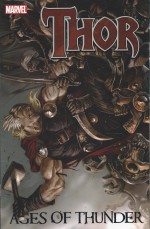
Thor: Ages of Thunder


By Matt Fraction, Patrick Zircher, Khari Evans, Clay Mann, Dan Brereton, Doug Braithwaite, Michael Allred, Miguel Ángel Sepúlveda, Victor Olazaba & various (Marvel)
ISBN: 978-0-7851-3568-5

Since his creation by Stan Lee & Jack Kirby in Journey into Mystery #83 (August 1962), the spectacular adventures of Thor have encompassed everything from crushing petty crime capers to saving universes from cosmic doom. As the decades passed he has also survived numerous reboots and re-imaginings to keep the wonders of fabled Asgard appealing to an easily jaded readership.

An already exceedingly broad range of milieux and scenarios spawned even greater visual variety after the Thunderer’s recent introduction to the pantheon of cinematic Marvels and his ongoing triumphs as a bona fide burgeoning movie franchise.

From the cod mythology of the company’s own bowdlerized Aesir whilst simultaneously drawing upon established ancient of Scandinavia, in 2008 Matt Fraction and a doughty band of artists crafted a saga spanning a number of specials and one-shots which riotously examined the early days of the bellicose Lord of Storms in the fantastic prehistory of the Nine Realms of existence, and this slim bombastic fantasy tome collects the opening blasts with Thor: Ages of Thunder (June 2008), Thor: Reign of Blood (August), Thor: Man of War (January 2009) and Thor: God-Sized Special (February 2009).

The legendary adventure opens with the eponymous ‘Ages of Thunder’ – rendered in painterly manner by Patrick Zircher, Khari Evans & Victor Olazaba – which sees the gods of Asgard arrogantly gloating after their gory victory against the ferocious Frost Giants of Jotunheim; monsters who had rampaged to the very gates of the city and even breached one of the great walls before Thor’s mighty hammer ended their threat with lethal finality.

The complacent victors then feasted mightily, gorging themselves on the golden apples of immortality which were the source of their power and could only be gathered from the magnificent World Ash Yggdrasil by lovely enchantress Idun.

…All but dour Thor, who shunned the festivities and as usual saved his share of the magic fruit against imagined times of future peril…

Some time later a human stonemason came to the gates of Asgard and bargained to repair the broken wall. Sensing sport, Allfather Odin and duplicitous Loki dickered with the mortal and imposed what they considered impossible conditions and a ludicrous deadline for the task, secure in the knowledge that what the man promised was impossible and they would never have to pay his preposterous price…

Of course the smug war gods were completely wrong and in a terrifyingly short time the mason was almost done: looking forward to carrying off his reward… beautiful, irreplaceable Idun…

Faced with humiliation and the loss of the source of all his people’s strength, Odin ordered the master of mischief to fix the problem, which the conniving cheat accomplished with barely a day to spare. Unfortunately this only provoked the furious mason to reveal his true identity – one of the recently defeated Frost Giants – and his bloody revenge was only ended by the arrival of the red-handed, increasingly aloof Thunder God.

For his part in the near-calamity Loki was banished to the icy wastes where, amidst horrendous cold and privation, he was approached by a giant eagle – another shapeshifting giant – who offered to save and feed him in return for Idun…

This bargain the trickster kept, delivering the golden goddess to the giant’s icy harem. Soon the Aesir were ailing as their mighty powers faded with the last of the apples they once devoured so profligately…

As heroic gods searched the Nine Realms for the missing enchantress, Odin and the court resolved to beg Thor for apples from his miserly hoard, but the Thunderer refused their entreaties. All-wise Odin reasoned Loki was the cause of their trouble and with dire threats forced him to retrieve Idun, but knowing his adopted son’s nature then beseeched Thor to follow and make sure the task was done properly…

This the murderous, sour- spirited Thor accomplished but an awful rift was driven between Allfather and sons…

The tale resumes in ‘Thor: Reign of Blood’ (illustrated by Evans, Zircher & Olazaba) as the Frost Giant’s tragic yet formidable daughter enacts a plan of icy vengeance which begins as a savagely relentless winter grips Asgard. Sheltered in his cavernous, echoing Great Hall, Odin reveals that in his youth he had a dalliance with the icy maiden which almost cost his life and has despised her ever since.

Nevertheless Spring must come so they will negotiate…

With Loki as envoy she is invited to Asgard and demands the greatest treasure in existence before she will rescind her endless freeze. Charged with cleaning up the mess, the trickster commissions three wondrous artefacts from the artisan dwarves of Nidavellir: a gold-propagating armband, a magical necklace and a giant-killing broadsword…

Unable to help himself, Loki then enters into a deadly side bet with the craftsmen over which treasure Odin will deem best…

When the gifts are displayed, the Allfather suddenly succumbs to his long-suppressed hatred and uses the sword to dispatch the Frost Giant’s Daughter before she can choose her tribute, effectively, if dishonourably, ending the eternal winter.

Once Loki weasels his way out of his bet with the dwarves the matter seems settled, but Idun is increasingly beguiled by the metal-smiths’ magical necklace…

Travelling to Nidavellir she sells herself for the gleaming trinket, and when Odin learns what she has done his rage knows no bounds. In response The Enchantress curses the entire world, causing legions of the dead to arise and attack the helpless living.

Once more mighty Thor is called upon to risk everything and end an overwhelming threat created by his family’s arrogance and cupidity…

‘Thor: Man of War’ (Clay Mann, Zircher & Olazaba) finds the Thunderer driven into berserker rage by the antics of his people, rampaging like a maniac through all the Nine Worlds. Enraged at the disruption of the natural order, Odin orders his beloved Valkyries to stop his errant heir by any means necessary.

Soon their leader Brunnhilda has engaged the demented Thor in all-out combat, but their cataclysmic clash awakens a colossal Storm Giant and soon both Asgardians are battling for their live against the ravaging pernicious primal entity. Before it finally falls, the furious fighters need the timely assistance of godly comrades Balder, Hogun, Fandral and Volstagg …

However, rowdily celebrating their victory in Svartalfheim, the victorious heroes and war women soon fall into fighting each other and watchful Odin is compelled to personally teach his wayward son the meaning and responsibilities of godhood…

Closing the chronicle, from Thor: God-Sized Special #1 comes ‘The Death and Life of Skurge the Executioner’ by Dan Brereton, Doug Braithwaite, Michael Allred & Miguel Ángel Sepúlveda, which traces the life of a former villain who redeemed his many grievous sins at the gates of the underworld to save the hosts of Asgard and Earth.

After a rousing visual recap, the saga moves on to a bizarre mystery as the assembled warriors of the golden realm realise that their memories of Skurge have been tampered with.

Travelling to the underworld, Thor, Loki and Balder find that even Death Goddess Hela has succumbed to the mystic meddling.

Given leave to continue by the terrifying queen of the damned, the voyagers press on and find that the cause of all their woes is the seductive Enchantress… but her motives for the worlds-shaking spell are nothing they could have suspected…

With extra features including covers by Marko Djurdjevic, a section on his preliminary production process and impressive pencil sketches and roughs by Zircher, this is a bloodily beautiful fairytale fable which would not be out of place amongst the true Elder Eddas.

Frantic, furious and ferociously enthralling, Ages of Thunder is a superb slice of mythic Marvel madness no action-loving fantasy fan could possibly resist.
© 2008, 2009, Marvel Characters, Inc. All rights reserved.

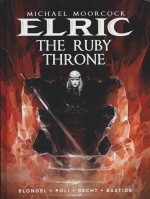
Michael Moorcock’s Elric volume 1: The Ruby Throne


By Julien Blondel, Didier Poli, Robin Recht & Jean Bastide, translated by Nora Goldberg (Titan Comics)
ISBN: 978 -1-78276-124-2

Michael Moorcock began his career as a comics creator aged 15; writing and editing such classic strips as Tarzan, Dogfight Dixon, Jet Ace Logan, Captain Condor, Olac the Gladiator and many, many other British stalwarts before making the jump to prose fiction, where he single-handedly revitalised a genre in 1961 with the creation of Elric and the high-concept notion of the Eternal Champion.

Elric is a landmark of the Sword and Sorcery genre: fore-doomed last ruler of the pre-human civilisation of Melniboné, a race of cruel, nigh-demonic sorcerers.

These arrogant, dissolute creatures are in a slow, decadent decline after millennia of dominance over the Earth.

An albino, Elric is physically weak and of a brooding, philosophical temperament, caring for nothing save his beautiful cousin Cymoril, who will die one day soon whilst he battles her loathsome usurping brother Prince Yyrkoon.

The White Wolf doesn’t even really want to rule, but it is his duty, and he is the only one of his debased race to see the (comparatively) freshly evolved race of Man as a threat to the Empire.

He owns or is possessed by a black sword called Stormbringer: a magical blade that steals the souls of its victims and feeds their life and vitality to the pale and pallid physical weakling.

Moreover, Elric is a tragic incarnation of the restless Eternal Champion, reincarnated in every time, place and alternate dimension. His life is blood and tragedy, exacerbated by his dependence on that soul-drinking black sword and his sworn allegiance to the chimerical Lords of Chaos.

Everybody knows all that, right?

Now, however, the creator of the iconic wanderer – and arguably a whole sub-genre of fantasy fiction – has allowed his premiere paladin to undergo a moody, spectacular and enchanting make-over under the auspices of a team of premiere French graphic masters. Tasking themselves to re-adapt, augment and expand Moorcock’s tales and novels (with his willing and eager permission and supervision), writer Julien Blondel, penciller Didier Poli, inker Robin Recht and colour-artist Jean Bastide – with some preliminary design input from Jean-Baptiste Hostache – in 2013 released Elric: Le Trône De Rubis…

As Moorcock avers in his Author’s Introduction and recapitulation of previous adaptations by the truly stellar artists who have worked on his bony warrior since he and the wonderful James Cawthorn first imagined him, the result is magnificent. Following that hearty endorsement the chance to see how far modern latitude and Continental sensibilities have taken the appalling empire of decadence begins…

Deep in the unholy exquisite fastnesses of the Dreaming City Imrryr, the recent history of the casually sadistic Melnibonéans plays out. The birth of flawed albino prince Elric cost the life of his mother and broke his once relentless, remorseless father Sadric, but now that young Emperor sits on the Ruby Throne of office; buoyed up by drugs, blood and dark magic administered by his consort-cousin Cymoril.

Across the vast court chamber her brother Yyrkoon gazes with undisguised hate. He longs for the throne and a return to the days when Melnibonéans scourged the other races of the world for profit and pleasure. Knowing it will mentally vex and physically tax his hated overlord, the dissident goads Elric into performing a summoning: a call to the patron gods of Chaos whose power first made the city great.

However, before the covert challenge can amount to anything, military commander Dyvim Tvar breaks in with urgent news. The supposedly impenetrable Sea Maze which protects the island city has been breached by ships of the upstart humans. Captives interrogated by macabre Doctor Jest speak of mercenaries, invasion and possibly a traitor…

The timing could not be worse: the deadly dragons employed as skyborne defenders by Melniboné for millennia are all in their crucial sleep cycle and so Elric has no choice but to call on the golden battle barges of his navy. First though he must replenish his energies through Cymoril’s eldritch ministrations and physical charms…

Even though she is his true love and closest ally, he refuses to listen to her entreaties that her vile brother Yyrkoon be permanently dealt with…

When the navy intercepts the human invaders the carnage is incredible and Elric, powered by sacrificial magic, fights like a true emperor of devils, invoking an army of dead warriors to rise from the sea and destroy the upstart monkey people who would challenge their betters.

However, at the moment of victory, a vengeful straggler tips the fully armoured Elric into the bloody waters and Yyrkoon, the only witness, turns away…

With the Emperor drowned Yyrkoon wastes no time in declaring himself the successor to the Ruby Throne and exultantly plans a bloodbath against the lower kingdoms, but Elric is not dead. Deep beneath the sea he has been snatched up by ferocious sea god Straasha, who honours an ancient contract with the rulers of Melniboné and hints of imminent dooms and endings to come…

Yyrkoon’s debauched celebrations are interrupted by Elric’s appalling surprise entrance and cool reclaiming of his exalted position, but the albino again scorns Cymoril’s advice to kill her incorrigible brother quickly and painfully. It is a mistake that will cost Elric dear as later, pent in a dank cell, the usurper summons demonic Aaven’Kar, Devourer of the Depths.

The hungry hellbeast rampages through the palace and by the time the Emperor confronts his challenger, Yyrkoon has fed the thing Cymoril…

As the gloating villain flees, enraged and helpless Elric breaks, calling out to prime Chaos Lord Arioch in his pain and fury.

…And after a chilling, anticipatory moment, the callous, calculating, so very patient dark deity replies…

To Be Continued…

This sumptuous oversized (284x212mm), painted colour hardback album also includes a stunning behind-the-scenes look at the unique (for France) creative process from origination in ‘Genesis’, through pages of design sketches (Elric, Stormbringer, Cymoril, Yyrkoon, Dyvim Tvar, The Melnibonéans, Arioch and Doctor Jest), and a glimpse at preliminary artwork by Hostache in ‘Lavishness and Excess’.

Topping things off are intriguing first imaginings of ‘Dragon Isle’ and ‘Palace of Imrryr’, a feature on ‘Collaborative Development’; creator biographies and a tantalising peek at the next volume…

Elric is a primal character whose sheer imaginative force has inspired a host of superb graphic interpretations – and probably daunted many eager movie producers – with the astonishing complexity and emotional power of his dying, dawning world. This latest tremendously dark and deeply engaging graphic extravaganza again raises the creative bar and proves why he is the leading star of fantasy fiction.

Elric: Le Trône De Rubis and all contents are © 2013 Éditions Glénat. This Translated Edition © 2014 Titan Comics. Adapted from the works of Michael Moorcock related to the character of Elric of Melniboné © 2013, Michael & Linda Moorcock. Introduction © 2014, Michael Moorcock. All characters, the distinctive likenesses thereof and all related indicia are ™ and © Michael Moorcock and Multiverse Inc.

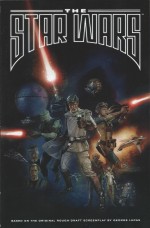
The Star Wars


By George Lucas, J.W. Rinzler, Mike Mayhew & Rain Beredo (Titan Books)
ISBN: 978-1-78329-498-5

I’m sure we all know the modern mythology of Star Wars and its mindbendingly expansive continuity to a greater or lesser extent. The problem with any such monolithic achievement is an eventual loss of spontaneity and freshness, but now true disciples and occasional dabblers alike have another, new-old strand to follow…

In September 2013 Dark Horse Comics began a 9-issue adaptation (#0-8) of George Lucas’ 1974 original draft for a science fiction movie romp of epic scope, expanded and interpreted by scripter Jonathan W. Rinzler, illustrator Mike Mayhew and colour-artist Rain Beredo, which offered fans of both the franchise and action comics another bite from a very different cherry.

Sadly, what most die-hards will want is to seek out the similarities and differences but, as tempting as that is, I’d like to concentrate on what makes this a good graphic novel and leave the cinematic nitpicking to those more adept and so inclined…

If you had somehow come from another planet and picked up The Star Wars, what you would have is a grandiose space-opera thriller with quite a few similarities to Frank Hebert’s epochal Dune saga and redolent of Alex Raymond’s Flash Gordon, jam-packed with valiant champions fighting a last-ditch rearguard action against an oppressive, tyrannical Empire which wants to run everything…

The warriors called Jedi-Bendu whose martial skills carved out a benevolent galactic coalition are in decline, hunted near to extinction by a rival cult known as the Knights of Sith. As the martial sects waged their war, the nature of politics changed and a new, rapacious government sought to consolidate a league of voluntarily participant systems into an overweening monument to iron-handed control.

On the fourth moon of Utapau aged, ravaged Kane Starkiller is training his sons in the all-but lost martial arts of Jedi-Bendu when the hunters who have eradicated almost all of his kind appear. When the family heroes finally escape the trap they are reduced to only Kane and his elder son Annikin…

Heartbroken, they head for Aquilae, unaware that their homeworld has been targeted by the New Empire. The autonomous system is the last free star kingdom, all others having capitulated to pressure and been absorbed into the burgeoning governmental/commercial juggernaut.

The Emperor, Governor Hoedaack and taciturn General Vader don’t expect too much trouble with this last campaign, but tribunal member Vantoss Coll believes otherwise. He knows Aquilae’s planetary defences are commanded by the mythic Jedi-Bendu Luke Skywalker…

It won’t be enough. Skywalker has the ears of King Kayos and Queen Breha but their parliament is riddled with cowards, appeasers and outright traitors like Count Sandage…

When the attack comes it is in the form of a colossal, moon-sized space-station and Skywalker’s forces are overwhelmed, even with the help of the recently returned Kane and Annikin and a desperate warning from Aquilae’s top agent Clieg Whitsun who arrives moments before the first shattering assault.

With hell about to rain down Skywalker orders Annikin to collect and protect wayward heir Princess Leia whilst he leads the planet’s space forces against the encroaching death star. During the battle two argumentative imperial droids, Artwo and Threepio, eject from the station and meet up with Annikin and Leia in the deep deserts below.

With Kayos murdered, Sandage happily capitulates and orders Skywalker to surrender, but the old soldier refuses…

With Captain Whitsun in tow he absonds, choosing to save the young Princes Biggs and Windy by getting them off-planet. Intending to link up with Annikin at distant Gordon Spaceport where his old alien smuggler pal Han Solo lurks, their flight is harried by faceless waves of white armoured troopers but the real trouble starts when despicable Vader reluctantly accepts the advice and aid of formidable Sith legend Prince Valorum…

After a stunning and non-stop procession of increasingly brutal fights – and with their numbers tragically reduced by the death of two valiant stars – the surviving fugitives get off-planet and make it to primitive frontier world Yavin where Skywalker and Annikin find not only danger and betrayal but an unlikely turncoat ally and a potential game-changing army of bellicose giant beasts called Wookies…

Of course it’s all far more complex and intriguing than that, with young love, dastardly betrayals, tragic sacrifice, plentiful comedy moments and above all astounding, rocket-paced action to carry readers along, and lovers of blaster-blazing action will be well served by the raw energy and lovely artwork.

It would appear that there is an inexhaustible demand for stories from “A Galaxy Far, Far Away…” but this time as another tale of noble rebels and dastardly Empires unfolds the big difference is that you don’t really know what’s coming next. If you’re a movie maven you could call it an alternate universe yarn if you wanted to, but this is a book no lover of great comics will want to miss.
The Star Wars and Star Wars © 2014 Lucasfilm Ltd. & ™. All rights reserved. Used under authorisation. Text and illustrations for Star Wars are ©, 2013, 2014 Lucasfilm

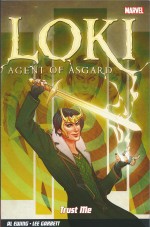
Loki Agent of Asgard: Trust Me


By Al Ewing, Lee Garbett & Nolan Woodard (Marvel/Panini UK)
ISBN: 978-1-84653-600-7

One of Marvel’s richest seams of pure imagination, the Nine Realms impacted by the mighty races of Asgard and its satellites have always offered stirring, expansive tales of a non-traditional nature to comicbook readers.

As iconic a character as his adoptive sibling Thor, God of Evil Loki has worked his vile, self-serving machinations for millennia and was rightly deemed one of the most diabolical villains in creation.

Things are different now.

What you need to know: after millennia of doctrinaire double-dealing and abusive micro-management All-Father Odin is gone, and the governance of his puissant kingdom, having been briefly misruled by his sons Thor and Balder, has been left to his wife Freyja and sister goddesses Idunn and Gaea who act in concert as a co-operative “All-Mother”.

The city they rule from now resides on Earth a few paltry feet above the ground of Broxton, Oklahoma and has been renamed Asgardia…

Moreover the eternally capricious and malign Loki has undergone some shocking changes too. Resurrected from death and hell by his eternally optimistic half-brother Thor, the trickster has recently endured life as a woman and been reborn again as an (ostensibly) innocent boy-child whilst his long-suffering and constantly betrayed family attempt one final gambit to reform the villain and raise a true and decent scion of Asgard.

Collecting Loki Agent of Asgard issues #1-5, published between April and August 2014 and captivatingly concocted by scripter Al Ewing, illustrator Lee Garbett and colour artist Nolan Woodard, this initial compilation traces the latest career path of the apparently reformed great trickster.

Now, after mooching around being generally benevolent and non-threatening as one of the Young Avengers, the former menace is approaching physical maturity and discovers that the All-Mother of Asgardia have a use for a smart young man who is still at heart the wily, devious God of Mischief – nor will they take nay for an answer…

Asgardians all understand the overwhelming, inescapable force and power generated by Stories, and the triumvirate have an intriguing proposition for Loki. In ‘Trust Me’, as payment for his performing certain tasks as a one-man Asgardian Secret Service, they will delete select portions of his appalling life history from every record in the Nine Realms, one insidious exploit per mission.

It’s a most tempting deal. For as long as that fearsome history remains it will always pull at him, dragging him back to what he once was, so the reincarnated godling is keen to diminish the temptations of his past, escape the heavy chains of reputation and prophecy and be his own man at last…

With the promise of becoming less potentially evil through each successive task, Loki sets out on his first case. Over the years there has been a slow, steady bleed of gods and artefacts from Asgard to the lesser realms and now the All-Mother wants those things back where they belong.

Thus the callow trickster invades Avengers Tower and battles Earth’s Mightiest Heroes, messing with their extensive database on him whilst extracting a horrific Asgardian monster secretly possessing noble Thor.

However, as always with the Trickster, things are not quite what they seem…

In ‘Loki and Lorelei, Sitting in a Tree’ he is despatched to retrieve the seductively wanton sorceress who has been preying on humans, gods and monsters for years and, during an unlikely night of Speed Dating, makes the charming acquaintance of Verity Willis, a mortal with the unfortunate gift of being able to see through any lie, subterfuge of illusion…

Lorelei’s trail leads to Monte Carlo and a monumental heist – which the Asgardian agent takes for his own – but he subsequently lets the witch go. The mischief-maker has a plan brewing and is putting together select crew. He might be working for the authorities now and trying to modify his behaviour, but he is still Loki…

Nobody is playing a straight game. In ‘Your Life is a Story I’ve Already Written’ the shocking identity of the vile spirit that possessed Thor is revealed. Despite being a prisoner of the All-Mother, the most wicked creature in the Nine Realms reveals thus how in ages past he deviously implicated the boy Odin in senseless murder and orchestrated the conditions whereby proto-god Sigurd the Ever-Glorious came to possess the unrelenting, unstoppable, truth-rending sword Gram.

As a result of many Machiavellian machinations, young Odin became Lord of all the Realms years before his time, Gram was safely locked away until Loki could claim it and Asgard grew to be mighty and all-conquering… but now the devil in his dungeon waits for the final pieces in his astoundingly long game to fall into place…

The saga returns to the present where ‘Lets You & Him Fight’ finds the long absent Sigurd attempting to reclaim the irresistible Gram from young Loki but subsequently press-ganged into the trickster’s secret service.

These diversions are also starting to gain the unwelcome attention of the All-Mother who have also tasked their Earthly Agent with bringing back in the millennially truant Sigurd.

To expedite matters they have cited the ferocious Exdesir as back-up, but a bunch of short-tempered Valkyries is the last thing Loki needs watching him at this fragile juncture.

…And that’s before arch tempter Mephisto involves himself in the scheme, seeking to gull a few unwary gods into signing infernal contracts of damnation by flaunting hidden truths like jewels…

All the crafty conniving results in a cosmic confrontation in Asgardia with ‘This Mission Will Self-Destruct in Five Seconds’ as Loki’s crew breach the mythical city-state in search of answers to the All-Mother’s increasingly off-kilter behaviour and the truth about the creature not so safely locked in the citadel’s deepest dungeon…

Sly, cool and witty, exceedingly engaging, fast and funny – like all the very best caper stories – this canny, time-bending chronicle succeeds in deftly delineating the reborn Loki as a sharp operator doing good deeds whilst never actually proving whether he’s really reformed or is still a subtle and beguiling Master of Evil…

This delicious Costumed Drama also offers digitally-diverting extra content for tech-savvy consumers courtesy of AR icon sections all accessible through a free digital code and the Marvel Comics app for iPhone®, iPad®, iPad Touch® & Android devices at Marvel’s Digital Comics Shop as well as a glorious covers-and-variants gallery by Jenny Frison, Frank Cho, Mike Del Mundo & Olivier Coipel.
™ and © 2014 Marvel & Subs. Licensed by Marvel Characters B.V. through Panini S.p.A. All rights reserved. A British Edition published by Panini Publishing, a division of Panini UK, Ltd.

Vowels


By Skye Ogden (Gestalt Publishing)
ISBN: 978-0-9775628-1-7

I’ve long admitted my love for comics in black and white and frequently expressed my admiration for creators who can tell a tale in utter silence, without benefit of text, and when this lavish and splendid digest sized (212 x 144mm) paperback arrived in my Review copies mailbag, it immediately became my favourite example of the form.

Created by Australian cartoonist, designer and illustrator Skye Ogden, Vowels is a phenomenally engaging sequence of five linked fables which mesmerically examines aspects of the human condition, all played out in an oddly welcoming, if harsh, desert landscape that houses hulking cavemen and their suitably formidable women, adorable lizards, wide eyed aliens and, latterly, extremely unpleasant invading soldiery…

This is one of those books you’ll thank me for staying non-specific about, so I’ll only go so far as to say that ‘a’ is a broadly comedic chase vignette starring the aforementioned dawn people and the unlucky reptile, whilst ‘e’ introduces a diminutive alien wanderer to the happy, hirsute couple before following the unhappy voyager into a most peculiar afterlife and rebirth…

In ‘i’ the little guy’s distant relatives take the stage in a bustling marketplace for a dose of Romeo and Juliet frustration and tragedy before overwhelming, abiding loss is expressively characterised in ‘o’ after which the fascinating, universally accessible discussion on the nature of existence concludes with the brutal horrors of war, occupation and vengeance…

Depicted in a beguiling timelessly engaging cartoon style, deliciously reminiscent of the legendary Vaughn Bode and employing all the devastatingly expressive, pantomimic artifices of Charlie Chaplin, Vowels is a masterpiece of the cartoonist’s craft where life, death, love, hate, jealousy, obsession, protectiveness, greed, raw naked aggression and cruelty are pared down to the bone and graphically, forensically explored in a manner which only makes us hungry for more.

Deeply enticing, appealingly slick and intoxicatingly addictive, Vowels is an irresistible torrent of purely visual drama and which will delight all aficionados of the medium who value comics for their own sake, and don’t need a route map or score card to enjoy themselves.
© 2007 Skye Ogden. All rights reserved.

Twin Spica volume 4


By Kou Yaginuma (Vertical)
ISBN: 978-1-934287-93-4

The hungry fascination, hopeful imagination and fevered anticipation of space travel which was an integral component of post-World War II society is the compulsive narrative engine for this inspiring manga epic from Kou Yaginuma, who began his voyage of discovery with his poignant short story ‘2015 Nen no Uchiage Hanabi’ (‘2015: Fireworks’), published in Gekkan Comics Flapper magazine in June 2000.

The author subsequently expanded and enhanced his subject, themes and characters into an all-consuming epic coming-of-age spellbinder blending hard science and humanist fiction with lyrical mysticism and traditional tales of school-days and growing up.

Small unassuming Asumi Kamogawa always dreamed of going into space. From her earliest moments the lonely child had gazed with intense longing up at the stars, her only companion and confidante the imaginary friend Mr. Lion.

When Asumi was a year old, the first Japanese space launch ended in catastrophe when rocket-ship Shishigō (“The Lion”) exploded: crashing back to earth on the city of Yuigahama where the Kamogawas lived. Hundreds were killed and many more injured.

Among the cruellest casualties was Asumi’s mother. Maimed and comatose, the matron took years to die and the long, drawn-out tragedy deeply traumatised her tiny, uncomprehending daughter.

The shock also crushed her grieving husband who had worked as a designer on the rockets for Japan’s fledgling Space Program.

In the wake of the disaster, Tomoro Kamogawa was assigned by the corporation who had built the ship to head the reparations committee. Guilt-wracked and personally bereaved, the devastated technologist visited and formally apologised to each and every survivor or victim’s grieving family. The experience crushed him.

He is certainly no fan of the space program now; having lost his wife, his beloved engineering career and his pride to the race for the heavens. He raised his daughter alone, working two – and often three – menial jobs at a time for over a decade and cannot countenance losing the very last of his loved ones to the cold black heavens…

In response to the Lion disaster, Japan set up an Astronautics and Space Sciences Academy. After years of passionate struggle and in defiance of her father’s wishes, in 2024 Asumi – an isolated, solitary, serious but determined teenager – was accepted to the Tokyo National Space School. Without her father’s blessing, she reluctantly left Yuigahama and joined the new class.

Amongst the year’s fresh intake were surly, abrasive Shinnosuke Fuchuya (an elementary school classmate who used to bully her as a child back in Yuigahama), jolly Kei Oumi, chilly Marika Ukita and spooky, ultra-cool style-icon and fashion victim Shu Suzuki who soon became the shy introvert’s closest acquaintances.

Every day Asumi nudged inexorably towards her goal: the stars. Ever since the crashing rocket had shattered her family, she had drawn comfort from the firmament, with Mr. Lion staring up at the heavens at her side – especially drawn to the twinkling glow of Virgo and the alluring binary star Spica. And now she was so tantalisingly close…

Small, poor, physically weak but resolutely capable, Asumi endures and triumphs over every obstacle and she still talks with Mr. Lion – who might just be the ghost of the Shishigō’s pilot…

All any student can think of is going to space, but they are harshly and perpetually reminded that most of them won’t even finish their schooling…

At just four feet, eight inches tall Asumi is constantly struggling to meet the arduous physical requirements dictated by the Academy but has already survived far greater problems. She is only slowly adjusting to life in Tokyo, sleeps in tawdry communal women’s dorm “The Seagull”, struggles with many of her classes and subsists on meagre funds, supplemented by part-time jobs.

She had also inexplicably incurred the obsessive hostility of astrophysics lecturer Professor Sano. Unbeknownst to Asumi, he had a long-hidden grievance with her father and was determined to kick her out of the school at all costs. Now even his threat has been surprisingly neutralised by high-ranking friends she is still blithely unaware of and the scurrilous martinet has been abruptly replaced by the far more amenable and encouraging Mr. Shiomi …

Individual stories are broken up into “Missions” and this mesmerising fourth volume covers numbers 14-18, and also offers a trio of sidebar stories including another autobiographical vignette about the author’s own teenage years.

‘Mission: 14’ begins with the class reassembling after summer vacation. Asumi and Oumi have returned to the Seagull hostel, but most of their attention is taken up with the even more strenuous new training program.

This semester they are dealing with weightlessness training and again Asumi’s small stature is a hindrance as they all toughen up in the gigantic buoyancy water tank used to teach and refine motor skills in spacesuits.

Although all the students struggle with the arduous regime and humiliating indignities of working for hours without toilet breaks, a more pressing problem for Asumi is the muscle weakness in her left hand. As a telling flashback reveals, the deficit is a result of injuries from the disaster, but back then her new friend Mr. Lion taught her exercises and tricks to strengthen it.

Now she realises she has to start doing them again…

A big shock occurs later when, following revelations about her immense wealth and a clash with her father, the still abrasive Marika Ukita is moves into the Seagull with them…

‘Mission: 15’ finds the class observing a satellite-rocket takeoff at Ogasawara Launch Centre only to encounter a strident demonstration by anti-spaceflight protestors. Although the government is keen to push through a full space program, many people still live in dread of another Lion disaster and feelings run high and scared…

Amongst the demonstrators is a young man who achingly reminds Asumi of a boy she used to know, but when she approaches he is less than friendly…

As she determinedly cracks the books and writes reports, Mr. Lion turns up in a playful mood and offers her some sage advice, even as elsewhere Marika has another unpleasant confrontation with her father who tries to drag her out of the Seagull and Space school…

Later when Asumi goes to the local planetarium for star gazing solace, the mystery boy is there…

More hints into the unique situation of Marika are disclosed in ‘Mission: 16’ as the girl ponders and discards her father’s assertion that she is “not normal”, swearing never to quit. He, unable to convince her and after cruelly cutting her off from all support, secretly pays all her bills and leaves Asumi and Oumi with a huge bag of cash to ensure all his stubborn child’s needs are met…

Later, cool Suzuki takes Asumi on a “date”, but only to show her the secret telescope he has stashed on a rooftop, and when she gets home she finds Marika sleeping and accidentally uncovers another aspect of her enigmatic origins…

Later as the girls struggle with Robot Arm training, Suzuki quizzes Fuchaya about Asumi and learns that she had a boyfriend in Middle School who died of cancer. They both agree that nobody can compete with a dead guy…

Later, wandering through the city, Mr. Lion sees Ukita pensively dump a handful of pills off a bridge…

It’s Christmas during ‘Mission: 17’ so Asumi takes Marika to a shrine. The willowy recluse has never been before, and their journey strangely coincides with the usually befuddled Mr. Lion reliving the time shortly after he died in the crash before again trying to sort the odd scraps into some kind of sensible order.

Clear-headed for the first time he makes his own pilgrimage and movingly bids farewell to someone he had tragically forgotten…

After a day of bonding Asumi then tries to get Marika talking to her dad, but the gesture misfires…

The unfolding epic pauses here with ‘Mission: 18’ as Asumi finds a rocket-shaped trinket which inexplicably links her to her somehow ubiquitous unfriendly mystery boy, after which the girls get their first real taste of the wild blue yonder by enduring an hour of recurring, momentary weightlessness in the training exercise known as the “vomit comet”…

In the disgusting aftermath, the new puke buddies are forced to clean up the jet and Oumi tells Marika of a friend who claims to be able to sense ghosts. She also pointedly asks if Ukita thinks the hostel is haunted. The pensive Marika says nothing but heads straight for Asumi’s private bolt hole…

To Be Continued…

Although the main event is temporarily suspended there are still some more affecting revelations in store, beginning with the ancillary tale ‘This Star Spica’ which again draws on Elementary school days in Yuigahama, where obnoxious little Fuchuya is tasked by his teacher with befriending and looking after that weird, lonely little girl who has an imaginary lion for a friend…

Then ‘Sentimental’ follows young artist Kamoi back down memory lane to his first love Kasumi after the school sweethearts have a brief encounter on a train years later, before ‘Another Spica’ finds author Yaginuma in autobiographical mode and back in his ambition-free teens, enjoying fireworks and relating his own experience with an inspirational, phantom king of beasts…

These powerfully unforgettable tales originally appeared in 2003 as Futatsu no Supika and in the Seinen manga magazine Gekkan Comics Flapper,targeting male readers aged 18-30, but this ongoing, unfolding beguiling saga is perfect for any older kid with stars in their eyes…

Twin Spica filled sixteen collected volumes from September 2001 to August 2009, tracing the trajectories of Asumi and friends from callow students to competent astronauts and the series has spawned both anime and live action TV series.

This sublime serial has everything: plenty of hard science to back up the informed extrapolation, an engaging cast, mystery, frustrated passion, alienation, angst, enduring friendships and just the right touch of spiritual engagement and wild-eyed wonder; all welded seamlessly into a joyous, evocative, addictive drama.

Rekindling the magical spark of the Wild Black Yonder for a new generation, this is a treat no imagineer with head firmly in the clouds can afford to miss…
© 2010 by Kou Yaginuma. Translation © 2010 Vertical, Inc. All rights reserved.

This book is printed in the Japanese right to left, back to front format.

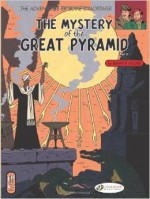
The Adventures of Blake & Mortimer: The Mystery of the Great Pyramid part 2 – The Chamber of Horus


By Edgar P. Jacobs, translated by Clarence E. Holland & Erica Jeffrey (Cinebook)
ISBN: 978-1-905460-38-0

Master storyteller Edgar P. Jacobs pitted his distinguished duo of Scientific Adventurers Captain Francis Blake and Professor Philip Mortimer against a wide variety of perils and menaces in stunning action thrillers which merged science fiction, detective mysteries and supernatural thrillers in the same timeless Ligne claire style which had done so much to make intrepid boy reporter Tintin a global sensation.

The strip debuted in Le Journal de Tintin #1 (26th September 1946): an anthology comic with editions in Belgium, France and Holland. The new anthology was edited by Hergé, with his eponymous star ably supplemented by a host of new heroes and features…

Le Mystère de la Grande Pyramide was the second extended exploit of the peerless pair, originally running in Le Journal de Tintin from March 23rd 1950 to February 21st 1951 and, as seen yesterday, it saw the True Brits investigating murder, mayhem and mystery in modern Egypt…

With his great friend murdered, Mortimer is resolved to finish the case himself and begins by visiting the decidedly odd Doktor Grossgrabenstein in his mansion. He hasn’t made up his mind about the German, but the archaeologist’s staff – especially his thuggish foreman Sharkey – are definitely playing some deeper game…

The visit almost ends in disaster but once again a mysterious warning in Egyptian tips Mortimer off and he leaves before the gang can grab him. Later that night he meets again the aged holy man Sheik Abdel Razek and the enigmatic cleric gives him a strange talisman and a warning of the arcane forces he faces.

Rationalist sceptic though he is, the physicist keeps the artefact near and that night, when another vicious attempt is made on his life, the charm proves its worth…

Instructing Nasir to make discreet inquiries, Mortimer returns to the Giza excavation, unaware that he has picked up a silent shadow. A commotion then brings him to Razek’s dwelling where Sharkey is threatening the old man, but before the Professor can intervene the bully is sent scurrying by a shocking display of spooky pyrotechnics…

The house is incredibly ancient, built from reclaimed materials, and as he chats with the sheik Mortimer sees glyphs and symbols etched into the walls which can only have come from the original pyramids.

Razek is charmingly evasive however and Mortimer eventually leaves, but on his way back sees figures lurking around Grossgrabenstein’s work site.

Although he loses them, the chase gives him an opportunity to inspect the tunnels under the tomb. However further investigation is cut short when he clashes with native worker Abbas whom he suspects has been following him…

Things take a dangerous turn the next night when he returns to the German’s grand home. A sudden slip by Grossgrabenstein tips off Mortimer that the boisterous historian has at some stage been replaced by gifted mimic Olrik. After a mighty struggle, the Professor is captured and soon after Nasir too is bundled into the opulent cell he has been dumped in…

Their bacon is saved by the unexpected arrival of the police who storm the mansion with guns blazing. In the confusion a beloved old comrade resurfaces as Francis Blake sheds his own disguise to rescue his beleaguered friends.

When the gunfire subsides the triumphant police try to arrest the real Grossgrabenstein and, as they blunder around, slippery Olrik again escapes…

With all their nefarious opposition seemingly routed, Blake and Mortimer are free to concentrate on solving the mystery of the Chamber of Horus and why ultra-modern super-criminal Olrik was so obsessed by it.

Soon they are carefully exploring the claustrophobic tunnels beneath the Great Pyramid and eventually discover not only the incredible treasures of the pharaohs but their old arch-foe plundering the sacrosanct horde.

Olrik is as hard-headed and no-nonsense as his British adversaries and puts no faith in curses, talismans or magic, but the sudden arrival of Razek teaches all of the western heretics a lesson they will never forget… before carefully erasing their memories to protect the secrets his line has spent millennia protecting…

Fast-paced, action-packed, wry and eerie, this spectacular conclusion is a thunderous rollicking conclusion to the moody, mystery of the ancient world and a superb treat for fans of blockbuster sagas like The Mummy or Indiana Jones.

A sheer delight for lovers of fantastic fiction, Blake & Mortimer are the graphic personification of the Bulldog Spirit and worthy successors to the likes of Sherlock Holmes, Allan Quatermain, Professor Challenger, Richard Hannay and all the other valiant stalwarts of lost Albion…

Original editions © Editions Blake & Mortimer/Studio Jacobs (Dargaud – Lombard s.a.). © 1987 by E.P. Jacobs. All rights reserved. English translation © 2008 Cinebook Ltd.

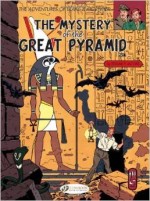
The Adventures of Blake & Mortimer: The Mystery of the Great Pyramid part 1 – The Papyrus of Manethon


By Edgar P. Jacobs, translated by Clarence E. Holland (Cinebook)
ISBN: 978-1-905460-37-3

Brussels-born Edgar P. Jacobs was a prodigy who drew from an early age and was besotted by music and the performing arts – especially opera. Upon graduation from commercial school in 1919, he promptly rejected safe, steady office work and instead avidly pursued his artistic passions…

A succession of odd jobs at opera-houses (everything from scene-painting to set decoration and even performing as both an acting and singing extra) supplemented private performance studies, and in 1929 Jacobs won an award from the Government for classical singing.

His dream of operatic glory was crushed by the Great Depression, and when arts funding dried up following the global stock market crash he was forced to pick up whatever dramatic work was going, although this did include more singing and performing. He moved into illustration in 1940, with regular work for Bravo magazine and some jobs for short stories and novels and, when the occupying Nazi authorities in Belgium banned Alex Raymond’s quintessentially All-American Hero Flash Gordon, Jacobs famously took over the syndicated strip to complete the saga.

His ‘Stormer Gordon‘ lasted less than a month before being similarly embargoed by the Occupation dictators, after which the man of many talents simply created his own epic science-fantasy feature in the legendary Le Rayon U, a milestone in both Belgian comics and science fiction adventure.

During this period Jacobs and Tintin creator Hergé got together, and whilst creating the weekly U Ray strip the younger man began assisting on Tintin, colouring the original black and white strips from The Shooting Star (originally run in newspaper Le Soir) for an upcoming album collection.

By 1944 Jacobs was performing similar duties on Tintin in the Congo, Tintin in America, King Ottokar’s Sceptre and The Blue Lotus. He was contributing to the drawing too, working on the extended epic The Seven Crystal Balls/Prisoners of the Sun.

Following the Liberation, publisher Raymond Leblanc convinced Hergé, Jacobs and a few other comicstrip masters to work for his bold new venture. Founding publishing house Le Lombard, Leblanc also launched Le Journal de Tintin, an anthology comic with editions in Belgium, France and Holland. It was edited by Herge and would star the already legendary intrepid boy reporter plus a host of new heroes and features.

Beside Hergé, Jacobs and writer Jacques van Melkebeke, Le Journal de Tintin featured Paul Cuvelier’s Corentin and Jacques Laudy’s The Legend of the Four Aymon Brothers.

Laudy had been a friend of Jacobs’ since their time together on Bravo, and the epic thriller serial ‘Le secret de l’Espadon’ starred Captain Francis Blake: an English Military Intelligence officer closely modelled on him. The debonair spy was to be partnered with a bluff, gruff excitable British boffin – Professor Philip Mortimer…

The serial ran from issue #1 (26th September 1946 to September 8th 1949) and cemented Jacobs’ status as a star in his own right. In 1950, with the first 18 pages slightly redrawn, The Secret of the Swordfish became Le Lombard’s very first album release with the concluding part published three years later. The volumes were reprinted nine more times between 1955 and 1982, supplemented in 1964 by a single omnibus edition.

In 1984 the saga was repackaged for English translation as three volumes during a push to win some of Britain’s huge Tintin and Asterix market, but failed to find an audience. The venture ended after seven magnificent, under-appreciated volumes.

Cinebook have had far more success publishing Blake and Mortimer since 2007 and recently completed a triptych of the very first adventure…

Chronologically, the next epic was this eerily exotic thriller which originally ran in Tintin as Le Mystère de la Grande Pyramide from March 23rd 1950 to February 21st 1951.

These are the second and third volumes of the current Cinebook series and pick up the ongoing adventures in the months following the defeat of Tibetan warlord Basam-Damdu and liberation of the planet from his monomaniacal tyranny…

The Mystery of the Great Pyramid, part 1 opens with the author’s fascinating and pertinent feature on everything Ancient Egyptian – complete with extremely handy maps and plans – before the story proper begins with fretful Professor Philip Mortimer taking some time off to pursue his occasional hobby.

A keen amateur archaeologist, the boffin has flown to Cairo with devoted assistant Nasir for a holiday and to help Egyptologist Ahmed Rassim Bey translate an astounding new find. However as they debark at the airport, the vigilant Indian thinks he spots an old enemy…

When no sign can be found the travellers move on, and the following morning Mortimer is examining some fragile scraps of papyrus attributed to legendary contemporary archivist Manethon. The ancient priest’s writings indicate that a secret treasure is hidden beneath a certain pyramid in a “Chamber of Horus”…

Cautious of the effect of such a sensationalistic discovery, the scientists decide to proceed carefully, blithely unaware that trusted assistant Abdul Ben Zaim is in the employ of a cruel and dangerous enemy…

Even after an evening of socialising the learned men are keen to get to work. Returning late to the laboratory of the Egyptian Museum they discover Abdul furtively loitering and Mortimer’s suspicions are aroused. When nobody is watching, the physicist craftily secures a portion of the papyrus and talks Ahmed into conducting a clandestine test…

Abdul is indeed playing a double game and his mysterious master is a man both subtle and exceedingly dangerous.

That night the leader tries to steal the documents but is surprised by Mortimer who has anticipated such a move. The canny scientist is just as surprised when the villain is revealed as Colonel Olrik.

The wily war criminal has been missing since the fall of warlord Basam-Damdu but has lost none of his lethal skills. Overpowering Mortimer, the rogue escapes, taking with him the last shred of papyrus the Professor had been holding…

In his lair, Olrik presses Abdul, who hastily translates the assembled fragments and declares the Chamber of Horus must be in the Great Sphinx on the Giza Plateau…

Under constant surveillance by Olrik’s gang, Mortimer and Nasir warily go about their business, hoping to lure the mastermind out of hiding. Meanwhile Abdul, believing himself undiscovered, returns to work at the museum, where flashy German Egyptologist Herr Doktor Grossgrabenstein is loudly informing everyone of his latest search for the tomb of Tanitkara.

The bombastic treasure-hunter invites Mortimer to visit him and view his unique collection but the boffin is too absorbed with shadowing Abdul – a task made far harder by the inept assistance of the local police.

When a lucky clue leads the resolute researcher to an antique store, Olrik’s scurrilous henchman Basendjas ambushes and imprisons Mortimer in the basement, but after a tremendous, extended battle the doughty doctor breaks free and calls in the cops.

Sadly, even on the defensive, Olrik is formidable and fights free of the encroaching authorities before vanishing into the warrens of the city…

After Abdul is killed by a hit-and-run driver the effusive Doktor Grossgrabenstein is present when Mortimer admits defeat and calls in a seasoned professional…

In London, Captain Francis Blake receives a cablegram and takes a leave from desk duty at security organisation I5. The Scotland Yard department is already investigating a surge of criminal activity in Northeast Africa and is happy to have their top man take a personal interest.

Blake heads out to Egypt by devious and complex means but, despite his circuitous route and customary caution, does not make it. Mortimer becomes increasingly impatient as he awaits the espionage expert’s arrival and to kill time finally accedes to his German colleague’s repeated requests to visit his dig at Giza.

When he arrives Mortimer finds bullying foreman Sharkey whipping native workers and is just in time to thrash the brute as he tries to attack an old Holy Man who has objected…

The enraged thug pulls a gun but is admonished by Grossgrabenstein, who then reluctantly allows the Professor to inspect the recently cleared chambers below the pyramid.

As Mortimer climbs back to the surface, a hasty, anonymous cry alerts him and he narrowly dodges a huge rock which crashes into the space where he stood. The area it stone fell from is empty and nobody recognises the voice which called out…

Making his way back to his hotel the weary scientist is then crushed to receive news that his best friend has been shot to death in a phone booth at Athens airport…

Bitter and enraged, Mortimer swears to make Olrik pay…

To Be Concluded…

Beguiling, suspenseful and fantastic in the grandest tradition of epic intrigue, The Adventures of Blake & Mortimer is the very epitome of dogged heroic determination; delivering splendid Blood-&-Thunder thrills and spills in timeless fashion and with breathtaking visual punch. Every kid of any age able to suspend modern mores and cultural disbelief (call it alternate earth history or bakelite-punk if you want) can’t help but revel in the adventure of their lives… and so will you.

Original editions © Editions Blake & Mortimer/Studio Jacobs (Dargaud – Lombard s.a.). © 1986 by E.P. Jacobs. All rights reserved. English translation © 2007 Cinebook Ltd.

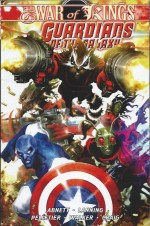
Guardians of the Galaxy volume 2: War of Kings Book 1


By Dan Abnett & Andy Lanning, Paul Pelletier, Brad Walker, Carlos Magno, Wes Craig & various (Marvel)
ISBN: 978-0-7851-3339-1

Following twin cosmic catastrophes (the invasion of our cosmos by Annihilus and legions of Negative Zone monsters plus a subsequent assault on the shattered survivors by parasitical invading Phalanx techno-horrors) our corner of the universe was left reeling and frantically trying to rebuild.

During that period of instability and crisis, Star-Lord Peter Quill assembled a rag-tag team of alien warriors with the intention of acting as a pre-emptive peace-keeping and disaster management force.

They comprised Quill, Adam Warlock, Gamora “the Deadliest Woman in the Galaxy”, Drax the Destroyer, latest Quasar Phyla-Vell, anamorphic adventurer Rocket Raccoon and gloriously whacky “Kirby Kritter” Groot, a constantly regenerating killer tree and one-time “Monarch of Planet X”.

The squad was supported by telepathic precog and failed Celestial Madonna Mantis and Cold War Soviet superdog Cosmo, both high in the controlling hierarchy of intergalactic research think-tank Knowhere, situated in the hollowed-out skull of a dead Celestial Space God…

Before too long they were battling on many fronts after discovering that the fabric of the cosmos – stretched, mauled, abused and abraded by continual crises – had begun to unravel in various hotspots, allowing access to things from outside reality: very nasty things that really, really wanted to come and play in our universe…

Whilst closing one such rift the team recovered a huge chunk of “limbo-ice” and found the temporal effluvia was encasing a chunk of Avengers Mansion, an appalling atrocity hungry for slaughter and a strange costumed hero holding Captain America‘s legendary shield…

The amnesiac outcast alternately called himself Vance Astrovik and Major Victory, claiming to be part of a 30th century group of freedom-fighters called The Guardians of the Galaxy. He had travelled back from the future but could not remember what for, why or even if he had eventually arrived in the right universe…

Before the suspicious heroes could explore further, Knowhere and especially Astrovik were targeted by another future-born being – Starhawk – and the base was subject to infiltration by shapeshifting Skrulls.

In fighting off the attack Quill’s team accidentally discovered that when they initially convened, Star-Lord had urged Mantis to telepathically “nudge” the war-weary warriors into joining his proposed team.

Quite understandably on hearing this, they all quit…

Perhaps a better term would be mutinied as weeks later the majority were still putting out cosmic brush fires, but without the manipulative betrayer Star-Lord…

This particular collection – gathering Guardians of the Galaxy volume 2 #7-12 spanning November 2008 to April 2009 – acts as prologue to yet another cosmos-rending crisis wherein the battered Shi’ar Empire, ruled at this time by mutant Vulcan (half brother of Scott and Alex Summers) battled for its very existence against the resurgent Kree, led at first by Ronan the Accuser but eventually Black Bolt of the earthborn genetic weapons known as Inhumans.

The convoluted saga involved a host of space-themed characters, crossed over into many titles and served to forge closer links between the Earth-based Marvel Universe and its far-flung intergalactic outliers, eventually encompassing and engulfing such diverse elements as the X-Men, Nova Corps, Darkhawk, Starjammers and many more…

Here however there is the barest inkling of what is to come as writers Dan Abnett & Andy Lanning describe ‘No Future’ (illustrated by Paul Pelletier & Rick Magyar) wherein the constantly gender-shifting captive Starhawk shares his/her shaky memories of the future and the fall of tomorrow’s galactic guardians with telepathic canine émigré Cosmo whilst elsewhere Rocket, Groot, Mantis, Major Victory and Galactic Warrior Bug (from 1970’s phenomenon The Micronauts) struggle to prevent a Spartoi colony world from being ravaged by technologically enhanced undead monsters.

In a flash of memory Astrovik recognises them as precursors of the Badoon terror battalions he knows as “Zoms” just as he discovers a colossal factory churning out fresh horrors from the remains of the colony’s populace…

Half a galaxy away Adam Warlock and Gamora have invaded a citadel of the Universal Church of Truth responsible for the latest rips in the fabric of space/time whilst Drax and Phyla-Vell are searching a planet of spiritualists and get a disturbing message from someone long dead…

And, further still from any of them, Peter Quill wakes up a captive of bombastic tyrant Blastaar, deep inside the subspace hell of the Negative Zone…

How he got there is revealed in ‘Past Mistakes’ (with art by Brad Walker & Victor Olazaba), disclosing how the guilt-ridden Star-Lord returned to Kree homeworld Hala to aid their resistance only to be ambushed by notional leader Ronan who has commissioned the reconstruction of a lethal atrocity weapon dubbed the Babel Spire…

Quill’s moral and physical objections were overruled by superior force before the fallen hero was cast into the N-Zone whilst all his erstwhile comrades soldiered on without him in their own sectors of a growing universal disaster…

The self-appointed lord of the Negative Zone and unlikely ally of the Accuser wants Quill’s help. King Blastaar has a plan to invade Earth again…

At that time Earth’s smartest minds had built an other-dimensional jail – codenamed 42 – where they unceremoniously dumped a wide variety of super-felons and enhanced maniacs. ‘Prison Break’ (Walker, Carlos Magno, Olazaba & Jack Purcell) found Blastaar pitting his armies against the supposedly impenetrable fortress, determined to capture its single portal back the positive matter universe…

The penitentiary, long abandoned by its correctional officers, was being run by some of the less crazy inmates such as vigilante and former Captain America sidekick Jack Flag who had organised a stiff resistance to Blastaar’s bloody, besieging legions.

Quill, sent in by Blastaar as an ambassador to convince the humans to surrender, instead links up with the cons and they hatch a plan to unlock the one-way transmat portal and ship the surviving cons back home, but dealing with maniacs like Gorilla-Man Arthur Nagan, hacker Skeleton Ki, winged killer Condor and mutated mauler Bison proves as fraught with peril as betraying Blastaar…

In the outer universe, whilst Drax and Quasar seek a way to reunite with dead and possessed champion Moondragon, Quill uses a captive telepath to send a message to his former comrades. In response Cosmo uses Knowhere’s tech to despatch Rocket, Bug, Groot, Mantis and Major Victory to his aid…

Unfortunately they materialise on the wrong side of the invading forces just as a traitor opens the doors to the killer king’s forces…

‘Blastaared!’ (Walker, Olazaba, Rodney Ramos & John Livesay) finds the reunited heroes battling for their lives inside 42 as, on the throneworld of the Universal Church of Truth, Warlock confronts his own appalling future before regretfully taking control over the merciless theocracy.

Pulling off a minor miracle, the Guardians and last penal survivors beam back to our reality, even as in a dark cell Starhawk realises that the war she/he had fought so hard to forestall is beginning…

The last two tales in this collection (illustrated by Wes Craig) yield focus to Drax and Phyla-Vell, beginning with ‘Welcome to Oblivion’ wherein the recently murdered duo awake in a deathlike dimension to be challenged by a number of deceased heroes and villains such as her father Mar-Vell and murderous maniac Maelstrom. The Avatar of Oblivion has been slowing leading the seekers to this pocket purgatory with psychic breadcrumbs of Moondragon’s essence in a scheme to escape back to the lands of the living…

The resurrection shuffle spectacularly concludes in ‘Sacrifice’ as ghostly champion Wendell Vaughn – the first Quasar – boldly appears to aid Drax and Phyla’s rescue of Moondragon before sending them all back to the world of breath and light.

However plots within plots are constantly unfolding and in truth a new Avatar of Death has manifested, allowing the cosmic entity known as Oblivion to anticipate a forthcoming “End War”…

This stunning stellar treasure-chest also includes a covers-&-variants gallery by Clint Langley, Jim Valentino, Brandon Peterson, David Yardin and Paul Renavo to complete a sharp, breathtaking adventure with loads of laughs and tremendous imagination.

On its own terms this is superb stuff well worth seeking out, but Fights ‘n’ Tights completists might be wise to remember this is only the tip of a cataclysmic cosmic iceberg and the full picture spans at least six other volumes…
© 2009 Marvel Characters, Inc. All rights reserved.

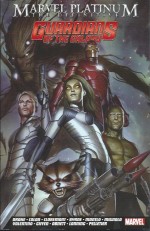
Marvel Platinum: The Definitive Guardians of the Galaxy


By Arnold Drake, Chris Claremont, John Byrne, Bill Mantlo, Jim Valentino, Keith Giffen, Dan Abnett & Andy Lanning, Gene Colan, Mike Mignola, Timothy Green, Paul Pelletier & various (Marvel/Panini UK)
ISBN: 978-1-84653-601-4

With another Marvel filmic franchise kicking off around the world, here’s a timely tie-in trade paperback collection designed to perfectly augment the cinematic exposure and cater to movie fans wanting to follow up with a comics experience.

Part of the always rewarding Marvel Platinum/Definitive Edition series, this treasury of tales reprints intriguing landmarks and key moments from Marvel Super Heroes #18, Marvel Preview #11, Rocket Raccoon #1-4, Guardians of the Galaxy volume 1, #1, Annihilation Conquest: Star-Lord #1-4 and Guardians of the Galaxy volume 1, spanning January 1969-July 2008, and hopefully answering any questions the silver screen story might throw up whilst providing an immense amount of spectacularly bombastic fighting fun.

One thing to recall at all times though is that there are two distinct and separate iterations of the team. The film concentrates on the second but there are inescapable connections between them so pay attention here…

Moreover, in addition to the sparkling Brady Webb Foreword, this compendium contains text features detailing the secret history and statistics of Drax, Gamora, Groot, Rocket Raccoon and Star-Lord, plus Mike Conroy’s scholarly trawl through comicbook history in ‘The True Origin of the Guardians of the Galaxy’.

Although heralded since its genesis in the early 1960s with making superheroes more realistic, The House of Ideas has also always maintained its close connection with outlandish and outrageous cosmic calamity (as best exemplified in their pre-superhero “monster-mag” days), and their pantheon of much-travelled space stalwarts maintain that delightful “Anything Goes” attitude in all of their many and varied iterations.

This titanic tome’s blistering battle-fest begins with ‘Guardians of the Galaxy: Earth Shall Overcome!’ first seen in combination new-concept try-out/Golden Age reprint vehicle Marvel Super Heroes #18 (cover-dated January 1969). The terse, gritty episode introduced a disparate band of freedom fighters battling to save Earth from occupation and humanity from extinction at the scaly hands of the sinister, reptilian Brotherhood of Badoon.

It all starts when Jovian militia-man Charlie-27 returns home from a six month tour of scout duty to find his entire colony subjugated by invading aliens. Fighting free, he jumps into a randomly programmed teleporter and emerges on Pluto, just in time to scotch the escape of crystaline scientist Martinex.

Both are examples of human genetic engineering: subspecies designed to populate and colonise Sol system’s outer planets but now potentially the last of their kinds. After helping the mineral man complete his mission of sabotage – blowing up potentially useful material before the Badoon can get their hands on it – the odd couple set the teleporter for Earth and jump…

Unfortunately the invaders have already taken the homeworld.

The Supreme Badoon Elite are there, busily mocking the oldest Earthman alive. Major Vance Astro had been the world’s first intersolar astronaut; solo flying in cold sleep to Alpha Centauri at a fraction of the speed of light.

When he got there 1000 years later, humanity was waiting for him, having cracked trans-luminal speeds a mere two centuries after he took off. Now he and Centauri aborigine Yondu were a comedy exhibit for the cruel reptilian conquerors who were eradicating both of their races…

The smug invaders were utterly overwhelmed when Astro broke free, utilising the psionic powers he had developed in hibernation before Yondu slaughtered them with the sound-controlled energy arrows he carried.

In their pell-mell flight the pair stumbled across the incoming Martinex and Charlie-27 and a new legend of valiant resistance was born…

The eccentric team, as originally envisioned by Arnold Drake, Gene Colan & Mike Esposito in 1968, were presented to an audience undergoing immense social change, with dissent in the air, riot in the streets and with the Vietnam War on their TV screens every night.

Perhaps the jingoistic militaristic overtones were off-putting or maybe the times were against the Guardians since costumed hero titles were entering a temporary downturn, but whatever the reason the feature was a rare “Miss” for Marvel and the futuristic freedom fighters were not seen again for years.

They floated in limbo until 1974 when Steve Gerber incorporated them into some of his assigned titles (Marvel Two-In-One and The Defenders), wherein assorted 20th century champions travelled a millennium into the future to ensure humanity’s survival. Rejuvenated by exposure the squad rededicated themselves to liberating star-scattered Mankind, and eventually gained a short-lived series in Marvel Presents (#3-12, February 1976-August 1977, but not represented here) before cancellation left them roaming the Marvel Universe as perennial guest-stars in such cosmically-tinged titles as Thor, Marvel Team-Up, Marvel Two-in-One and most significantly The Avengers.

In June 1990 they secured a relatively successful relaunch (#62 issues + annuals and spin-off miniseries) before cancellation again claimed them in July 1995.

However before we get there this volume highlights two seemingly unrelated characters who made their debuts elsewhere in the 20th century Marvel Universe.

Starlord (without the hyphen) premiered in black-&-white mature-reader magazine Marvel Preview # 4 in 1976, appearing thrice more – in #11, 14 and 15 – during the height of the Star Wars inspired Science Fiction explosion.

Years previously a warrior prince of an interstellar empire was shot down over Colorado and had a brief fling with solitary Earther Meredith Quill. Despite his desire to remain in idyllic isolation, duty called the starman back to the battle and he left, leaving behind an unborn son and a unique weapon…

A decade later, the troubled boy saw his mother assassinated by alien lizard men. Peter Jason Quill vengefully slew the creatures with Meredith’s shotgun, before his home was explosively destroyed by a flying saucer.

The orphan awoke in hospital, his only possession a “toy” ray-gun his mother had hidden from him his entire life. Years later his destiny found him, as the half-breed scion was elevated by the divinity dubbed the “Master of the Sun”, becoming StarLord. Rejecting both Earth and his missing father Peter chose freedom, the pursuit of justice and the expanse of the cosmos.

In his second outing (Marvel Preview #11, Summer 1977) Chris Claremont, John Byrne & Terry Austin crafted a classic space opera which saw the deity-appointed galactic policeman scupper a slaving ring and follow a string of clues back to his own incredible origins.

Presented here in the original monochrome, that tale opens on decimated agrarian planet ‘Windhölme’ where fisherman’s son Kip sees his entire community abducted like cattle by alien criminals. Aboard their vessel he is befriended by feisty fellow abductee Sandy but before they can enact their childish dreams of revenge the slaver dreadnought is attacked by Starlord and his sentient super vehicle “Ship”…

The traffickers are no match for the aggrieved heroes and, after the victims have been repatriated, psychic interrogation leads Kip, Sandy and the stellar paladin up the criminal chain to flesh-peddler and imperial favourite Kyras Shakti on his debauched pleasure world ‘Cinnibar’.

The monolithic battle there reveals even greater Royal involvement, drawing Starlord to ‘Sparta’, and a shocking family connection before ‘The Hollow Crown’ sees Quill uncover his true origins when he is unexpectedly reunited with his alien father. Despite renewed emotional ties the hero forswears a life of impossible luxury for the heavens, duty and justice…

Rocket Raccoon was a minor character who appeared in backup serial ‘The Sword in the Star’ (Marvel Preview #7 in 1976). He won a larger role in Incredible Hulk #271 (May 1982), and like Wolverine years before refused to go away quietly.

Reprinted here in its entirety is the 4-issue Rocket Raccoon miniseries (cover-dated May to August 1985 and crafted by Bill Mantlo, Mike Mignola, Al Gordon & Al Milgrom), a bizarre and baroque sci-fi fantasy which blended the charm of Pogo with the biting social satire of One Flew Over the Cuckoo’s Nest all whilst ostensibly describing a battle between Good and Evil in a sector of space crazy even by comicbook standards.

Rocket was one of many talking animals in the impenetrable, inescapable Keystone Quadrant; a Ranger in charge of keeping the peace as robots and anamorphic beasties went about their holy tasks of caring for the distinctly odd and carefree humans known as The Loonies on their idyllic, sybaritic planet Halfworld.

However when a brutal shooting war between voracious apex toymakers Judson Jakes and Lord Dyvyne led to Rocket’s girlfriend Lylla Otter being kidnapped, the planet went wild, or perhaps… ‘Animal Crackers’.

In rescuing her, Rocket and his faithful deputy Wal Rus had to contend with a murderous army of mechanised Killer Clowns, face an horrific, all-consuming bio-weapon at ‘The Masque of the Red Breath’, and even team up with arch-foe and disreputable mercenary bunny Blackjack O’Hare before uncovering the horrendous truth behind the mad society he so tirelessly defended in ‘The Book of Revelations!’

The final chapter then shook everything up as ‘The Age of Enlightenment’ saw the end of The Loonies, allowing the Raccoon and his surviving companions to escape the confines of the eternally segregated Keystone Quadrant into the greater universe beyond…

Back on Earth, a speculator-fuelled boom in comics sales led to Marvel launching a bunch of new titles in the early 1990s. Amongst them was Guardians of the Galaxy volume 1, #1, once again focusing on the 31st century centurions.

Conceived, written and drawn by Jim Valentino – with Steve Montano inking – the debut issue reprinted here reprised the entire eccentric combined careers of Vance, Yondu, Charlie and Martinex (plus later recruits Mercurian Nikki and Starhawk – an alien god who shared a single body with his estranged wife Aleta) as the team set off on a quest.

They were following a string of ancient clues to recover Captain America‘s legendary shield, only to fall foul of cyborg-enhanced warrior ‘Taserface!’

For the rest of that epic journey and their battle against the alien Stark race who had based their entire warrior culture on Iron Man‘s armour, you’ll need to track down one of the many other GotG collections flooding out now…

In 2006 a massive crossover involved most of Marvel’s 21st century space specialists in a spectacular Annihilation Event, leading writing team Dan Abnett & Andy Lanning to confiscate and reconfigure the Guardians concept for modern times and tastes.

Among the stalwarts in the big event were Silver Surfer, Galactus, Firelord (and other previous heralds of the world-eater), Moondragon, Quasar, Star-Lord, Thanos, Super-Skrull, Rigellian Colonizer Tana Nile, Gamora (“Deadliest Woman in the Galaxy”), Ronan the Accuser, Nova, Drax (the Destroyer), a Watcher and many previously established alien civilisations such as the Kree, Skrulls, Xandarians, Shi’ar et al., all falling before an invasion of rapacious Negative Zone bugs and beasties unleashed by insectoid horror Annihilus..

After that shooting match subsided the decimated sectors and empires were left helpless as sentient, aggressive all-subsuming technological parasite The Phalanx struck, absorbing and thriving inside all the machines and electronic engines the shaken civilisations were using to rebuild in a follow-up apocalypse designated Annihilation: Conquest.

From that second sidereal saga came the beginnings of the Guardians the world has gone crazy over – specifically the side-bar miniseries Annihilation Conquest: Star-Lord #1-4 from September-December 2007 and which is reprinted here in full.

What You’ll Need to Know: in the scarred and war-torn realm of known space, still reeling from the chaos of the Annihilation Wave and its aftermath, both the Kree and Skrull empires are splintered, Xandar‘s Nova Corps (the universal police force) has been reduced to a single agent, ancient gods are loose and a sizable number of the Negative Zone invaders have tenuously established themselves in territories stolen from the billions of dead sentients that once populated the cosmos.

The Supreme Intelligence is gone and arch-villain Ronan has become a surprisingly effective ruler of the Kree remnants. Cosmic Protector Quasar is dead and Phyla-Vell, daughter of the first Captain Marvel has inherited both his powers and name…

Whilst Phyla and psychic demi-goddess Moondragon were working with the pacifist Priests of Pama to relieve the suffering of starving survivors, Peter Quill (no longer Star-Lord) was working with Ronan and the pitiful Kree remnants on Hala to shore up the battered communal interstellar defences of the myriad races in the sector.

Quill had brokered an alliance with the Spaceknights of Galador (an old noble cyborg species most famously represented by 1980s hero Rom) which should enhance the all-pervasive etheric war-net, but once uploaded the data instantly causes disastrous problems throughout the system.

In seconds all technology in the region is compromised: overruled and overwritten by a ruthlessly efficient electronic sentience whose cybernetic credo is “peace and order through assimilation”. Once more organic life is facing total extinction…

On Pama, Phyla and Moondragon are targeted by repurposed Kree automatons as the Phalanx attempt to destroy any credible resistance before cutting off the entire quadrant from the rest of the universe.

If life was to survive this threat it must besaved by the champions trapped inside…

The 4-part miniseries Annihilation Conquest: Star-Lord – written by Keith Giffen and illustrated by Timothy Green II, Victor Olazaba & Nathan Fairbairn, finds the former Cosmic Avenger stripped of his powers and hi-tech enhancements – all liabilities when facing a predator species that infests electronic devices – and forcibly seconded to a Kree resistance division.

Here he is tasked with turning a bunch of Kree convicts into a Penal Strike Force (a highly engaging intergalactic Dirty Half-Dozen) to take out the complex where the Phalanx are perfecting an efficient way to assimilate organics into their electro-mechanistic hive-mind.

The Kree were once the major bad-guy race in the Marvel mainstream, so whoever they consider criminals look surprising like failed heroes to us. Firstly there’s Galactic Warrior Bug (originally from 1970’s phenomenon Micronauts), the current Captain Universe (ditto), the Shi’ar berserker Deathcry, failed Celestial Madonna Mantis, the so-very-far-from-home Rocket Raccoon and gloriously whacky “Kirby Kritter” Groot: a Walking Tree and one-time “Monarch of Planet X.”

With this reluctant team in tow and using natural abilities and decidedly primitive Earth weapons the squad invades Hala – central beachhead of the Phalanx – to discover and destroy the augmented assimilation project, but they have drastically underestimated the remorselessly callous creativity of the electronic invaders…

Happily the Phalanx have no grasp of the ingenuity, bloody-minded determination and willingness to die stupidly for a cause that afflicts organics and heroes…

Sharp, witty and engaging, this is a magnificent romp full of humour, shocks and thrills no comic fan could possibly resist…

The roaring success of all that intergalactic derring-do led to a new rootin’, tootin’, blaster-shootin’ conclave of outer space reprobates who formed a new 21st century iteration and this titanic tome concludes its comics cavalcade with Guardians of the Galaxy volume 2, #1, (July 2008) wherein some of those recently acquainted adventurers get back into the business of saving the universe…

‘Somebody’s Got To Do It’ – by Abnett, Lanning, Paul Pelletier & Rick Magyar – reveals how, due to fellow Earthling Nova’s prompting, Star-Lord forms a pro-active defence force to handle the next inevitable cosmic crisis as soon as – if not before – it starts.

To that end he convinces Phyla-Vell, Drax, Gamora, Groot, Warlock and the Raccoon to relocate with him to the pan-species science-station Knowhere (situated in the hollowed-out skull of a dead Celestial Space God) and start putting out a never-ending progression of interstellar brush-fires before they become really serious…

The station is guarded and run by Cosmo – an elderly Soviet dog with astounding telepathic abilities – and is where Mantis now works as chief medic. It also offers unlimited teleportational transport which the team soon needs as it tries to prevent an out-of-control Universal Church of Truth Templeship from crashing into a time/space distortion and shredding the fabric of reality…

Soon the surly scratch squad are battling savage, crazed missionary-zealots empowered by the worship of enslaved adherents channelled through the Templeship’s colossal Faith Generators whilst desperately attempting to divert the vessel before it impacts the fissure in space.

Such a collision would cause catastrophic destruction to the galaxy but the UCT crusaders only see heretics trying to interfere with their mission to convert unbelievers…

The crisis is exacerbated by another small problem: there are very nasty things on the other side of the fissure that really want to come and play in our universe, and when one of them breaks through the only thing to do is destroy the Templeship…

In the aftermath, Warlock reveals that the non-stop string of cosmic Armageddons since Annihilus’ invasion has fundamentally damaged the substance of space and inevitably more fissures will appear. He wants to repurpose the team to find and close them all before anything else escapes.

And on Sacrosanct, homeworld of the Universal Church of Truth, the Matriarch issues a decree for her Cardinals to deal with the interfering unbelievers…

With covers by Colan & Esposito, Ken Barr, Mignola & Gordon, Valentino, Nic Klein, and Clint Langley, this spectacular slice of riotous star-roving is a non-stop feast of tense suspense, surreal fun and blockbuster action: another well-tailored, on-target tool to turn curious movie-goers into fans of the comic incarnation and another solid sampling to entice the newcomers and charm even the most jaded slice ‘n’ dice fanatic.

© 2014 Marvel. Licensed by Marvel Characters B.V. through Panini S.p.A. All rights reserved. British edition published by Panini UK.