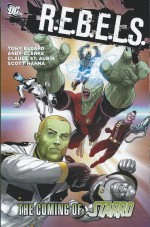
R.E.B.E.L.S. volume 1: the Coming of Starro


By Tony Bedard, Andy Clarke, Claude St. Aubin, Scott Hanna & various (DC Comics)
ISBN: 987-1-4012-2589-6

Once upon a time, DC’s vast pantheon of characters was sensibly scattered, segregated and wholly distinct: separated and situated on a variety of alternate Earths which comprised Golden Age hold-overs, contemporaneous Silver Age stars and later-created heroes. Further Earths were subsequently introduced for every superhero stable the company scooped up in a voracious and protracted campaign of acquisition over the decades. Charlton, Fawcett, Quality Comics and others characters resided upon their own globes, occasionally meeting in trans-dimensional alliances and apparently deterring new readers from getting on with DC.

Latterly, when DC retconned their entire ponderous continuity following Crisis on Infinite Earths in 1985-1986, ejecting the entire concept of a multiverse and re-knitting time so that there had only been one world literally festooned with heroes and villains, many of their greatest characters got a unique restart, with the conceit being that the characters had been around for years and the readership were simply tuning in on just another working day.

Of course now the multiverse concept is back and not confusing at all (no! seriously?) but whatever the original reasons, that dramatic 1980s refit did provide for some utterly astounding and cleverly cohesive stories…

In the aftermath of that event, the hero-packed planet Earth was targeted by a coalition of alien races and endured a full-on Invasion which was repulsed by the indomitable resistance of the World’s assembled heroes and villains and a few selected extraterrestrial allies. When the cosmic dust settled a few of these stayed together and formed cops-for-profit outfit dubbed L.E.G.I.O.N., led by a lying, scheming, manipulative obsessive super-genius bastard named Vril Dox: notional son of the villainous super-villain Brainiac of Colu and one of the most superciliously smug creatures in creation.

Overcoming all odds and the general distaste of his own chief lieutenants, Dox moulded his organisation into a force for justice and peace in the universe, with over 80 client worlds happily prospering, until his own son Lyrl – whilst still a baby – usurped control of the organisation: hunting Vril and his core agent team across the universe as desperate R.E.B.E.L.S. ruthlessly pursued by their own intergalactic commercial police force.

By the end of that run of comicbooks in 1996, order and the status quo were fully restored and the Licensed Extra-Governmental Interstellar Operatives Network went back to scrupulously and competently doling out all the peace and security solvent worlds could afford…

All that background is largely superfluous to the enjoyment of this latest iteration of the splendidly wry and cynical sci fi adventure series as history repeated itself in 2008, and another cosmic event forced DC’s assorted space sentinels into action again. Adam Strange, the Omega Men, Captain Comet and Dox’s L.E.G.I.O.N. again came to the fore and their intergalactic exploits again began to impinge on the fate of this island Earth…

Collecting the first six issues of the revived R.E.B.E.L.S. comicbook series concocted by scripter Tony Bedard, the superbly intoxicating action begins in ‘The Future is Now’ (illustrated by Andy Clarke) as a fugitive Vril Dox crashes on Earth fleeing from a team of bounty hunters.

To ensure no further insurrections by greedy – or worse yet, moralistic – employees, the 10th Level Intellect had largely replaced all his annoyingly autonomous agents with robotic units, but that had simply enabled some bright spark to co-opt his entire intergalactic army – again! – and Dox was now a target for assassination by L.E.G.I.O.N.’s new owner, as well as many of the criminals and warlords the Coluan had previously antagonised…

Within mere moments of reaching our embattled world Dox, hotly pursued by monstrous alien powerhouse Tribulus, its cyborg controller Getorix, super-psychic Skwaul and former elite L.E.G.I.O.N.-ary Amon Hakk, is confronted by Supergirl, keen on stopping the sheer carnage caused by the invaders’ battles.

Freshly returned from an extended stay in the 31st century, the teenaged Kryptonian had been turned into the unwitting receptacle of a message from Dox’s distant descendent Brainiac 5, conveying data and specifications for Vril to construct a precursor brigade of the Legion of Super-Heroes to combat an imminent threat to the universe…

Dox, contrary as ever, was more impressed with the files on the LSH’s terrifying enemies…

Elsewhere the outlaw warriors dubbed the Omega Men had learned of Dox’s predicament and become aware what a powerful, if untrustworthy, ally he would make…

The action resumed at the South Pole as the ousted Coluan cop and the Girl of Tomorrow defeated the alien hunters and turned the nigh-mindless Tribulus into ‘The First Recruit’. Dox then fled Earth in search of fresh cannon-fodder for his future-foretold team and exploited rather than allied himself with the Omega Men before heading to a lost colony of Amerindian ex-slaves for his next target.

Nearly a millennium before, an entire tribe of Native Americans had been stolen and dumped on the distant world Starhaven where they had evolved into the Anasazi, winged trackers of immense power and sensitivity. Now Dox arrived and offered to give a weak and feeble outcast the gifts fate and feeble genetics had denied her. However, even though he kept his word, the thing that Wildstar became had good reason to regret her devil’s bargain…

‘A World of Hurt’ saw the new R.E.B.E.L.S. take the battle to the usurped L.E.G.I.O.N. hierarchy; along the way picking up old comrade and dedicated Dox-hater Strata – a woman of living stone and high moral standards – plus energetic new recruit Bounder.

Just as the robotic forces now commanded by artificial life-form and ambulatory computer server Silica begin mercilessly eradicating anybody connected with the Coluan’s old organisation, the utterly dispensible Omega Men attack L.E.G.I.O.N.’s HQ on Maltus and destroy the traitorous living computer which had taken over the organisation.

Covertly despatched by the manipulative Dox, the Omegans have inadvertently handed back control of the rent-a-cops to Dox, but in the digital woman’s corpse the victors find the first clues as to the real threat: an eerie starfish creature capable of controlling anything it possesses. Tragically, before they can react another Starro beast arrives – wearing the body of a brutal alien war goddess named Astrid Storm-Daughter…

With Claude St. Aubin & Scott Hanna taking over the art chores, ‘From Beyond’ kicks the already fast-paced thriller into maximum overdrive as Amon Hakk, Getorix and Skwaul are rescued from earthly imprisonment by Durlan shapeshifter Ciji, unaware that Dox is no longer the problem…

On Maltus, the surviving Omega Men narrowly escape the new threat but discover the entire planet – the most populous in the galaxy – has been taken: each citizen wearing a Starro seed and contributing their enslaved psychic resources to a hidden master…

Meanwhile in another part of space the aggressive space faring hive-culture known as the Dominators are also under attack by the Starro slaves. However this is unlike any previous incursion by the frequently occurring stellar starfish: there’s an implacable devouring consciousness behind the assaults. Even the inimical, scientifically sadistic Psions are scared – as evidenced by their rescuing of their greatest enemies the Omega Men – and propose an alliance to defeat a threat that is pouring into our galaxy from a cosmic hole into another existence…

As ‘The Stars We Are’ opens, in the strategically crucial Xylon Expanse a vast subspace rift is disgorging a host of ships and super-powered slaves into one of the most populous areas of the galaxy – and a centre of L.E.G.I.O.N. influence. Even as the Dominator’s mighty empire falls in hours, Astrid Storm-Daughter attacks Dox’s ship just as Ciji’s forces arrive. With all sentient life threatened, this initial collection concludes with the superb ‘Dominator’ as Dox again pulls an intellectual rabbit out of his hat and traps the entire invasion force – and their space rift – behind an impenetrable, quadrant-wide force field. Locked within an inescapable, parsecs-wide box of force, the terrifying humanoid master of the Starros is safely contained in a relatively small buffer zone and prevented from all further expansion.

Of course stuck on the wrong side of the fence with him are Dox, his unwilling newfound enemies-turned-allies and billions of potential slave-sentients on hundreds of sitting-duck worlds…

To Be Continued…

With a spectacular cover gallery by Andy Clark, Ed Benes, Rob Hunter, Kalman Andrasofszky, this slim tome offers a deliciously intoxicating blend of space opera and cosmic Fights ‘n’ Tights action that will push every button for fans of staggering science fiction thrills, cut with sharp, mature dialogue and sublimely beautiful artwork. Plain and simple rip-roaring, rollercoaster rocket riding fun that no devotee of the genres should miss…

© 2009, 2010 DC Comics. All Rights Reserved.

Secret Identities


By Jeff Yang, Parry Shen, Keith Chow, Jerry Ma & various (The New Press)
ISBN: 978-1-59558-824-1

A little while ago I reviewed Shattered: a splendid anthology of superhero-related stories by and about Asian Americans which, although self-contained, stemmed out of a previous and equally innovative Fights ‘n’ Tights assemblage. Secret Identities was designed to craft an alternative American history and milieu for heroes and villains more in tune with the needs and interests of a vast, neglected sector of the Republic’s readership, and having acquired a copy of that previous tome – still available and worth every penny – I thought I’d share a few further details with you…

Devised and supervised by life-long fans and mature creative types Jeff Yang, Parry Shen, Keith Chow & Jerry Ma, Secret Identities blends enchantingly intimate thoughts and reminiscences about the comics we all grew up knowing with a decidedly fresh approach to old plots, characters and treatments. Featuring the talents of exclusively Asian American creators from comics, the arts, design and computer gaming who smartly re-examine the USA’s signature sequential narrative genre from the social, cultural perspective of a non-WASP, non-Jewish experience, this compilation is a sharply different yet familiar take on the marvellous world of Men in Tights and Women in Control…

Following a close-knit over-arching timeline the book opens with a wonderful Marvel Comics Spoof – The Y-Men #1 – as the editors recall their childhood love affair with costumed characters and reveal how the project really got started. ‘Preface: In the Beginning’ by Jeff Yang & Jef Castro leads seamlessly into the Brave New World as ‘Prologue’ and ‘Driving Steel’ by Yang & Benton Jew take us to the 19th century American West, where immigrant workers struggle to build the trans-continental railroad and Irish Navvies ruthlessly compete with their Chinese counterparts. Sabotage, skulduggery and ill-will run rampant, and only little Negro lad John Henry is party to the fiery true nature of indomitable – and undying – labourer Master Jimson Fo…

‘S.A.M. meets Larry Hama’ by Tak Toyoshima is a breezy interview with the venerable veteran creator on the sense of cartoon affirmative action, after which the saga proper continues with ‘Section One: War and Remembrance’ as Parry Shen & Alexander Tarampi begin to examine the fictional history of Asian American mystery men and metahumans during WWII.

‘9066’ by Jonathan Tsuei & Jerry Ma then details the tragedy of a dedicated crusader who couldn’t get his country to look beyond the colour of his skin and shape of his eyes, whilst in ‘Heroes Without a Country’ (Daniel Jai Lee & Vince Sunico) the same anti-Jap furore almost deprived American super-unit the Sunset Squad of their most valuable asset when raiding a Nazi laboratory of horror…

‘Gaman’ by Jamie Ford & Tarampi reveals the generational fallout of those embattled days to a modern student who learns the hard way just what makes him so different from his school friends, whilst in ‘The Hibakusha’ Shen & Glenn Urieta reveal the secrets and latent dangers of the children born from the atomic devastation of Hiroshima and Nagasaki. So amazing were they that America’s interned them in Area 52 for years…

Marvel, DC and others generously allowed their characters to appear in the autobiographical sections of this collection, and a big-name writer and movie-maker shared a few insights about creativity with Keith Chow & A. L. Baroza in ‘Re-Directing Comics: Greg Pak’ before debuting his spectacular tension-drenched anti-hero after President Obama pardoned a dishonoured hero and potential assassin in ‘The Citizen’ by Pak & Bernard Chang…

‘Sidekicks: Gene Yang & Michael Kang’ finds the editors debating the Asiatic ghetto of faithful retainerdom (Chow & Baroza) after which ‘The Blue Scorpion & Chung’ by Yang & Sonny Liew provides an outrageous and wryly hilarious alternative to the traditional set-up, whilst the tragic story of ‘James’ (Kang & Erwin Haya) shows that the solution is usually in the assistant’s hands all the time…

‘Section Two: When Worlds Collide’ opens with another take on the strange visitor from an alien world scenario, courtesy of Chow & Chi-Yun Lau, after which another long-established comics creator speaks out in ‘Now There’s Something: Greg LaRoque’ (Chow & Alexander Shen), which leads into a compelling genre-bending fantasy of good, evil and family peccadilloes with ‘Trinity’ written and drawn by LaRoque himself.

‘No Exit’ by Naeem Mohaiemen & Urieta is a beautifully sharp examination of dignity and morality set in a Guantanamo-style camp not so very different from the shamefully real one, whilst ‘S.O.S.’ blends outsourcing to India with the back-office requirements of the busy, cost-conscious American superhero crowd in a delightful yarn from Tanuj Chopra & Alex Joon Kim.

Many of the tales in this tome take place in the modern metropolis of Troy, although New York City is the eventual location of Clarence Koo & Jerry Ma’s ‘The Wallpasser’, which mixes people-trafficking and illegal immigration with dark, super-normal forces and broken families before ‘Section Three: Girl Power’ takes a look at the distaff side of culture and super-society, starting with a hilarious silent and salutary fable from Kripa Joshi, whilst ‘You Are What You Eat’ (Lynn Chen & Paul Wei) finds a cake-loving lass given the greatest possible gift by her aged grandmother… and she can fight crime with it too…

‘Sampler’ by Jimmy Aquino & Haya also confronts long-held assumptions and prejudice when a Troy laundry/dry cleaning store frequented by costumed heroes provides a shy retiring seamstress with the opportunity to use her own long-unsuspected super-power, whilst ‘Learn to Share’ by Keiko Agena & Ming Doyle offers a disturbing look at the ethnic adoption experience through the malfunctioning eyes of a little girl with a dark past and terrifying power…

‘A Day at CostumeCo’ by Yang & Baroza introduces a magical family of metas-in-waiting in a masterfully enticing riff on the theme of superhero dynasties. When Vernon and Vivie Chang finally get rebellious big sister Valerie to accept her true nature All Heck breaks loose, after which Hellen Jo discusses the nature of female furies in ‘Supergrrrls’ before Jason Sperber & Chi-Yun Lau open ‘Section Four: Many Masks’; examining the nature of assumed identities in advance of a brief colour section introducing a barrage of new characters and concepts in one-page pinups.

Meta-merc ‘Agent Orange’ by Dustin Tri Nguyen & Dustin Nguyen is followed by supernatural judge ‘Gaze’ (Sung Kang, Billy Tan, Walden Wong & Sean Ellery) and acupuncture-activated go-girl ‘Flight’ by Ian Kim & Jeff Yang. Adulation-powered ‘Shine’ (Leonardo Nam, Anthony Tan & Ruben de Vela) and immortal avenger ‘Jia’ (Kelly Hu, Mark Allen & Cliff Chiang) are followed by Yul Kwon & Deodato Pangandoyon’s escaped North Korean lab rat ‘Cataclysm’ and one-man alien invasion resister ‘Go’ by Kazu Kibuishi, after which Anthony Wu’s army-of-one ‘Parallel Penny’ closes the file on this tantalising taster of things – hopefully – to come…

Returning to moody monochrome, ‘Section Five: Ordinary Heroes’ begins with Raymond Sohn depicting real folks’ definition of heroes before ‘Just Ordinary’ by Nick Huang & Shen takes a trenchant look at society and the media’s unhelpful expectations of what constitutes a champion, whilst ‘Twilight’ (Ted Chung & Anuj Shrestha) takes a hard look at alienation and self-discovery amidst the aftermath of disaster, and only a little time-travelling intervention at last saves ‘David Kim’ from his annoying match-making parents in a light and lovely super-folks RomCom by John Kuramota & Christine Norrie…

‘Meet Joe’ by Koji Steven Sakai & John Franzese shows how a determined kid-hero can buck both public expectations and family pressure, little So-Geum at last develops a super-power ‘On the Third Day’ (Johann Choi) – although not in the way his pushy parents wanted – and ‘Long’ perfectly captures the sheer exuberant joy of extra abilities in a brash bold pantomime by Martin Hsu. The chapter then closes with ‘Justified’ by Ken Wong & Tiffanie Hwang as a young hopeful innocently upsets ingrained ignorance and complacency during an open audition for aspiring mystery men…

‘Section Six: From Headline to Hero’ commences with a discussion of real-world American Asian heroes by Parry Shen & Jeremy Arambulo, after which ’16 Miles’ by Shen & Sarah Sapang extrapolates a poignant story of love and sacrifice in the midst of total terror whilst ‘Taking Back Troy’ (Yang & Francis Tsai) shows the downside of living with superhumans as a school party night goes tragically bad, before the action ends on a promising introductory note as ‘Peril: By the Time I Get to Arizona’ (Chow & Castro) introduces a desperate young man dragged into a world of impossible danger when the father he never knew goes missing and is branded a traitor. Dr. Won Kin Lun was the world’s greatest authority on super-powers and nano-tech and everybody wants his discoveries – except the unwilling, angry, betrayed son he secretly, arbitrarily inflicted them upon…

In ‘Epilogue’ Yang & Castro pensively wrap things up and consider the future but there’s still much to enjoy here. After full contributor biographies the added attractions start with ‘The One that Got Away’ by Larry Hama and there’s also a selection of Behind the Scenes concept art as well as ‘Our Favourite “Dear John” Letter’ – a brilliant manga cartoon apology for not contributing from eventual and actual contributor Jeremy Arambulo. The immersive experience then ends with a complete time-line chart and annotated score-card, ranging from the portentous beginnings in the 1800s to the unleashed future of 2020 and beyond.

Combining the best aspects of many storytelling traditions and artistic styles, utilised by a volunteer army of talented creators whose origins stem from Asia, India and all points East but whose ethnicity is definitely All-American, Secret Identities began a bold experiment in cultural assimilation that will amaze comics fans in search of something a little different…
Compilation © 2009 Jeff Yang, Parry Shen, Keith Chow and Jerry Ma. Individual pieces © 2009 each author. All rights reserved.

Shattered: the Asian American Comics Anthology – A Secret Identities Book


By Jeff Yang, Parry Shen, Keith Chow, Jerry Ma & various (The New Press)
ISBN: 978-1-59558-824-1

The very best thing about old comics periodicals, and a factor sadly deficient in most graphic novels these days, is the lack of variety. Those venerable weeklies and monthlies were generally stuffed with different strips and features offering a host of entertainment options that contemporary books just can’t match.

That’s certainly not the case in this marvellous collection of new stories supervised by Jeff Yang, Parry Shen, Keith Chow and Jerry Ma, who first came to Funnybook fans’ attention in 2009 with the satirical shared-universe superhero book Secret Identities. That tome showcased the talents of exclusively Asian American creators in comics amalgamating the US industry’s signature genre with the social, cultural and entertainment influences of a non-WASP, non-Jewish (it’s easy to argue that the American comicbook was primarily invented by immigrants – and largely Jewish ones at that) talent pool to produce a whole new take on the sequential narrative experience.

Now this fresh collection expands on that initial offering with new adventures set in that New Universe, as well as many sidebar and only notionally linked cartoon yarns, from a host of gifted writers and artists whose origins and ethnicity stem from Asia, India and all points East.

An overarching storyline links the tales here as the Eastern archetypes which permeate Western fiction – the Brute, the Brain, the Temptress, the Alien and the Manipulator – are reclaimed and transformed into the motivating force which links the Secret Identities tale into one longer epic, with each chapter then supplemented by additional, less canonical strips.

Thus the prologue set up of ‘The Sacrifice’ written by Yang, Shen & Chow and illustrated by Ma introduces a quintet of otherworldly demons who want to break back into our helpless world. Bo-Kwun the Manipulator, Kum-Sau the Brute, Zhi-Lik the Brain, Yi-Heung the Alien and Ngau-Yun the Temptress – collectively known as Ng Duk, the Five Venoms – were long ago banished and barred by two ancient Djinn heroes. Their tenuous triumph is now sustained by a cult of ever vigilant warrior priests…

The saga further builds in ‘Burn’, by Jimmy & Jerry Ma, as a masked westerner in 19th century China brought poisonous flowers to destroy the people’s way of life, even contaminating the soul of their greatest champion The Commissioner…

The story proper begins in America during the Gold Rush with ‘The Brute – Driving Steel: the Breaking’ by Yang & Krishna M. Sadasivam, as wandering oriental outcast Ifrit and his negro partner John Henry are tricked into breaking the Mirror of Divine Immortals and release the Five Venoms…

Tangential follow-ups then offer a new perspective on an old story in ‘Master Tortoise & Master Hare’ by Howard Wong & Jamie Noguchi, Bernard Chang’s ‘Showtime’ begins a demonic basketball battle resolved on the artist’s own website, whilst ‘Solitary’ (Michael Kang, Edmund Lee & Glenn Urieta) examines the contemporary gang scene and family bonds before ‘Clean Getaway’ (Jamie Ford & A.L. Baroza) perfectly pastiches EC crime comics, complete with faux cover from Tales of the Orient #12…

‘The Temptress’ leads off the next chapter of the ongoing epic with ‘Bai, Bai, Bai Tsai’ by Yang, Martin Hsu & Sophia Lin as the creators reference manga styles to relate how second generation kid heroes Magical Girl, Super Deformed and Hell Kitty solve an ancient mystery and uncover sinister exploitation involving a cancelled cartoon show after which ‘Ching Shih, Queen of Pirates’, by Natalie Kim & Robin Ha, details the history of a 19th century demimonde who uniquely took control of her own destiny.

Another kind of seductress figures in the bittersweet romantic fable ‘The Regrets We Talk About’ by Fred Chao whilst ‘Heroes Without a Country: Tokyo Rose’ from Daniel Jae Lee & Dafu Yu provides a delightfully smart WWII superhero spy-thriller and Amy Chu, Larry Hama & Craig Yeung cleverly recall a bad time for Japanese-American Nisei in ‘The Date’…

A full-colour glossy ‘Gallery’ of concepts and characters follows featuring art and synopses for ‘Adam Warrock’ by Eugene Ahn & Ming Doyle, ‘Revolution Shuffle’ by Bao Phi & GB Tran, ‘Tempest’ from Kai Ma & Eric Kim, ‘The Walkman’ hilariously conceived by Aaron Takahashi & Mukesh Singh, ‘Angry Asian Man’ Phil Yu & Jerry Ma, the utterly enchanting ‘Mei the Alien’ by Koji Steven Sakai & Deodata Pangandoyon, ‘Camp Mech’ by Eric Nakamura & Sara Saedi, and Thenmozhi Soundararajan & Saumin Suresh Patel’s ‘The Death Stalker’…

‘The Brain’ then takes centre stage for the unfolding epic in ‘Hide and Sikh’ from Parry Shen & Jeremy Arambulo wherein the atomic children born of the nuclear devastation of Hiroshima and Nagasaki grow into their dormant power and uncover a huge secret of metahuman genesis…

The remainder of the chapter then focuses on the dreaming world described by ‘The Power of Petunia’ (Joy Osmanski & Yasmin Liang), Paul Wei & Chi-Yun Lau’s classy future shocker ‘Drones and Droids’, a parable of High School popularity contests resulting in ‘Camden’s Revenge’ by Keiko Agena & Louie Chin and a darkly traumatic decision made in ‘Metatron’ by Stuart Ng.

Possibly my very favourite tale in this masterful monochrome compilation is Greg Pak & Takeshi Miyazawa’s ‘Los Robos, Arizona’, joyously referencing the wide-eyed wonder of manga boys and their giant alien Mecha as a young cadet is selected by fate to befriend an incredible metal visitor, whilst Ford & Baroza again charm with new nostalgia in ‘A Cut Above’ parodying EC horror with a snippet from Weird Asian Science #46…

The over-epic resumes with ‘The Alien’ in ‘Peril: Welcome to the Terror’ from Keith Chow & Jerry Castro, returning to Goldfield, Arizona in 1900 and an outrage against the Chinese immigrant workers, before jumping to today and a manhunt for a misunderstood hero steeped in the horrors of then and the technology of tomorrow…

Kripa Joshi then takes a swingeing pot-shot at a culture of callous bullying in ‘Miss Moti, Shattered’, Johann Choi reveals the darkness of ‘The Stranger’ and Traci Honda deliciously, wordlessly plays childish games with ‘Personal Monsters’.

Tanji Chopra & Alice Meichi Li take a long dark look at the sordid future of negotiable affection in ‘Weightless’, whilst Angela Veronica Wong, Reinhardt Suarez, Christine Norrie & Craig Yeung explore the endless anticipation of kid superhumans and their insatiable aspirations in ‘A Dream of Flying’, before ‘Fashion Never Dyes’ again displays Ford & Baroza’s delight with EC thrillers by providing a shocker from the tragically non-existent Uncanny Tales of the Yellow Peril #27.

‘The Manipulator’ at last steps up in Hibakusha: Secrets’ by Shen & Sean Chen as a determined team of atomic heroes uncover the clandestine nature of the Arizona scandal in a spectacular action adventure, whilst the ancillary aspects include ‘Push’ (Jennifer S. Fang, Ace Continuado & Julian San Juan) which reveals what happens when Yankee superhero brawn meets studious Asian serial killer planning, whilst ‘Persons of Mass Destruction’, by Gary Jackson & Cesar P. Castillo, offers a chilling dose of metahuman realpolitik in relation to the “threat” of North Korea.

Also on view are Ren Hsieh & Bryan Lee’s alien incursion ‘The Merciful’, stunning kung fu doomsday parable ‘Qi Lai!’ by Roger Ma, Dheeraj Verma & Tak Toyoshima, the indescribably odd ‘Occupy Ethnic Foods’ courtesy of a solo flying Toyoshima, and the gloriously hip strip featuring the maternal tribulations of a rather harried ‘Shadow Hero’ by Gene Luen Yang & Sonny Liew…

Yang, Shen, Chow & Urieta then bring it all to a triumphal finale in ‘The Sealing’ as the disparate heroes unite to battle the Five Venoms and restore the Mirror of Divine Immortals through an ultimate sacrifice or two, wrapping up this stirring and staggeringly impressive anthology celebration in grand manner.

Finally the publishing project further underscores its debt of thanks to the constantly-changing nature of the American Experiment in illustrated Epilogue. ‘The Vilcek Story’ (by Jeff Yang & Wendy Xu) précis the history of the family of Czechoslovakian Jews who fled to the USA during the years of Nazi atrocity and, after building successful lives, set up a foundation which celebrates and supports the ongoing immigrant experience – and funded this collection…

Combining the best aspects of a vast panoply of storytelling traditions and artistic styles, Shattered is a bold experiment in identity and assimilation that will amaze comics fans in search of something a little different…
Compilation © 2012 Jeff Yang, Parry Shen, Keith Chow and Jerry Ma. Individual pieces © 2012 each author. All rights reserved.

Planetes volume 2


By Makoto Yukimura, translated and adapted by Yuki Nakamura & Anna Wenger (TokyoPop)
ISBN: 978-1-59182-509-8

These days nobody does gritty, authentic, fun hard-tech comics science fiction like the Japanese (although for sheer tight-lipped underplayed drama I’d still place Sydney Jordan’s Jeff Hawk, Frank Hampson’s Dan Dare and most of Warren Ellis’ SF work ahead of even Manga’s greatest masters…).

The tough, no-nonsense, gritty mystery and refined imagination of space travel – so much a component of immediate post-World War II industrial society in the West – began to once again captivate a legion of level-headed imagineers at the end of the 20th century when Japanese tales first began to be translated into English. One superb exponent of that mini-boom was relative newcomer Makoto Yukimura who rekindled interest in near-space exploration in all its harsh and grimy glory with an inspiring “nuts-and-bolts” manga series which scrupulously explored the probable rather than the possible…

Yukimura (born in Yokohamain 1976, just as the once-ambitious American space program was languishing in cash-strapped doldrums and five long years before the first space shuttle launch) began his professional life as an assistant to veteran creator Shin Morimura before launching his independent career with the Planetes.

Working exclusively for Kodansha, his award-winning premier Seinen series ran in Weekly Morning magazine from January 1999-January 2004 and was later collected as four tankōbon volumes. The serial easily made the jump to a popular anime series and since then Yukimura, after producing Sayōnara ga Chikai node for Evening magazine, has since 2005 abandoned the future for the past and concentrated his creative energies on the monolithic historical epic Vinland Saga – serialized in Weekly Shōnen Magazine and Afternoon – and filling 11 bloodcurdling volumes to date…

The grimly existential premise of Planetes is devilishly simply and powerfully engaging. Humanity is a questing species but cannot escape its base origins. In 2075 space travel and exploitation is practically commonplace but, as we’ve conquered the void between Earth and the asteroid belt and prepare to exploit the outer planets, the once-pristine void around us has become clotted with our obsolete tech and casually discarded rubbish.

Even the most minuscule piece of junk or debris falling through hard vacuum is a high-speed, potentially deadly missile and to keep risk to a minimum, hardy teams of rugged individualists have to literally sweep the heavens free of our discarded crap.

The stories revolve around youthful trashman Hachimaki Hoshino whose greatest dream is to become a true deep-space astronaut and famous explorer like his famous – if disreputable – father. The boy has his future all mapped out: a similar career-path to dear old dad will lead to fame and wealth and then he can buy his own spaceship and be really free…

Sadly the incessantly dull toil of his deep night day-job is wearing away at the passionate, excitable Hachi who is becoming swiftly disenchanted with the whole dreary, disgusting drudgery aboard DS-12 – a standard sanitation/cargo ship fondly dubbed Toybox…

The first episode in this stunning second volume begins with ‘Running Man’ as the Toybox’s weary crew visit Moon Orbital Space Port and the obsessively training Hachimaki is approached by an unctuous business type looking for his infamous dad. Werner Locksmith is the head and chief designer of the Earth Development Community-sponsored manned mission to Jupiter and, unknown to the starry-eyed kid, had pegged Hachi’s father as the only man capable of piloting the innovative new vessel on the five year mission: one the boy would give anything to be on.

However the elder explorer doesn’t want to go and has actually absconded from the Private/Public sector project and is currently a fugitive…

The old rogue has had enough of space-faring: a fact he finds impossible to relate to his furious son when they meet. The old spacer intends to retire to Earth and make things right with the wife he’s abandoned…

Meanwhile Locksmith has been called away. Something has gone disastrously wrong with the Jupiter ship Von Braun…

Above Luna as Hachi argues with his dad, another crisis occurs as a devastating explosion rips through the station and everybody evacuates. In the safe chill of the void, Hachi and the crew see a phenomenal debris field emanating from the moon’s surface. The Von Braun’s experimental engines have failed and an entire lunar base has been evaporated…

Following the tragedy the ruthlessly cool Locksmith unswervingly starts to rebuild and the senior Hoshino breathes a sigh of relief. Hachi is undeterred. He resumes his training, knowing that when the Von Braun is ready to fly, he will be ready to join it…

Acknowledging their comrade’s impossible dream, stoic Russian Yuri Mihairokov and commander Fee Carmichael have inducted by a raw new recruit to the Toybox team and tasked Hachi with training her to be his eventual replacement. According to the ambitious lad, however, Ai ‘Tanabe’ is a hopeless case, fruitlessly wasting valuable time he could be using to train and study for his application to the Jupiter Mission. Suffering mightily from having to baby-sit the useless girl, he only discovers her suppressed inner fire after a 50-year old space coffin is recovered from the dark expanse and provokes a bitter dispute about love, passion and man’s place in the cold, lonely universe…

Hachi’s dream comes a giant leap closer to reality in ‘A Black Flower named Sakinohaka Part 1’ as he finally begins his official audition for the Von Braun. The boy has become an emotional void with nothing but his cold ambition driving him. He can’t even process the deadly and constant threat posed by increased sabotage activity from the terrorist SDL; a group determined to keep space free of Man’s toxic presence.

Despite the more than 20,000 applicants, Hoshino is beginning to distinguish himself when a series of bomb blasts rocks the controversial project. Narrowly escaping death, Hachi is visited by his old friends who are horrified by the obsessed spacer’s blasé attitude and apparent disregard for the pain and suffering of his rival candidates who were caught in the detonations. Is he truly so determined to get on the mission that all he sees are fewer competitors?

Only fellow applicant and new buddy Hakimu seems to understand that any sacrifice and personal misery are worth the prize…

Soon the testing is in its final stages and Werner Locksmith lectures the remaining candidates from the bridge of the almost completed Von Braun. Only nine of the desperate spacers will make this final cut but the big day is again delayed after Hachi confronts the insidious saboteur and fails to stop him…

The tale resumes six months later as the last twenty three candidates await the final call whilst in ‘A Black Flower named Sakinohaka Part 2’ Hachi’s still-fugitive father is targeted by SDL assassins and heads back to the son who has disowned him. His arrival coincides with young Tanabe’s visit to deliver the boy’s belongings from Toybox, leading to an embarrassing confusion as to her amatory status, but before things can be fully clarified the terrorists attack again, determined to ensure the death of the “only man who could pilot the Von Braun”…

Fleeing through the lowest levels of the Moon’s Oriental Basin Underground Tunnel City the trio are more of a danger to each other than their murderous pursuers and after another catastrophic explosion Hachi again confronts the traitor who sabotaged his last attempt to join the mission and almost commits an unpardonable act until gentle Tanabe talks him off the emotionally-charged metaphorical ledge…

‘Lost Souls’ sees the lad successfully in final training for the mission that has become his life when a lunar accident strands Hachi and new comrade Leonov on the unforgiving surface with only hours of oxygen and a 40 kilometre walk to the nearest relief station. It would have been impossible even if the co-pilot wasn’t wounded with a slowly-leaking suit.

By the time rescue arrived Hachi had reached the stage where he fought his saviours, frantic to prove that he truly needs no one’s help to achieve his goals…

This sublime saga concludes here with ‘СПАСИБО’ (or “Spasibo” which can be either “thank you” or “God save you”) as the recuperating Hachi returns to the family home in Japan, accompanied by his penitent father, and is visited by Leonov’s grateful mother. Although he doesn’t understand a word she says, the old lady still makes far more sense than his constantly warring family and, after another drunken fight with his dad, events come to tragic, galvanising crisis which at last crushes the walls around the traumatised young man’s head and heart…

Also included are working sketches, pin-ups, a bunch of four-panel sidebar humour strips ‘A Four Panel Comic’, ‘Namao-san (Presumably Male)’, ‘Eat? That Thing?’, ‘Drinking Hot Coffee through a Straw’ and prose biographies of revered and inspirational author Kenji Miyazawa and pioneer Cosmonaut Yuri Alexeyevitch Gagarin in ‘Conceptualising Space Travel’.

Suspenseful, funny, thrilling and utterly absorbing, these tales readily reinvigorate and reinvent the magical allure of the Wild Black Yonder for newer generations, and this authentic, hard-edged and wittily evocative epic is a treat no hard-headed dreamer with head firmly in the clouds can afford to miss…

This book is printed in the traditional Japanese right to left, back to front format.
© 2001 Makoto Yukimura. All rights reserved. English text © 2004 TOKYOPOP Inc.

Johnny Hazard – The Gold of Thal


By Frank Robbins (Pacific Comics Publications)
No ISBN

Johnny Hazard was a newspaper strip created in the style and manner of Terry and the Pirates, but in many ways the steely-eyed hero most resembles – and indeed presages – Milton Caniff’s second magnum opus Steve Canyon.

Unbelievably, until 2011 this stunningly impressive and enthralling adventure strip was never comprehensively collected in graphic novels – at least in English – although selected highlights had appeared in nostalgia magazines such as Pioneer Comics and Dragon Lady Press Presents.

However, sporadic compendiums of full-colour Sunday pages have popped up over the years, such as this gloriously huge (340 x 245mm) landscape tabloid produced by re-translating a collected Italian edition back into English, courtesy of the Pacific Comic Club.

Frank Robbins was a brilliant all-around cartoonist whose unique artistic and lettering style lent itself equally to adventure, comedy and superhero tales, whilst his expansive raconteur’s gifts made him one of the best writers of three generations of comics.

He first came to fame in 1939 when he took over newspaper strip Scorchy Smith (from the astounding Noel Sickles), creating a Sunday page for the feature in 1940. Robbins was then offered the high-profile Secret Agent X-9 but instead created his own lantern jawed, steely-eyed man of action.

A tireless and prolific worker, even whilst producing a daily and Sunday Hazard (usually a separate storyline for each), Robbins freelanced as an illustrator for The Saturday Evening Post, Look, Life and a host of other mainstream magazines.

In the 1960s and 1970s he moved into comicbooks, becoming a key contributor to Batman, Batgirl, Detective Comics (where he created Man-Bat with Neal Adams) and The Flash, followed Michael Kaluta on The Shadow and contributed to humour mag Plop! as well as DC’s mystery anthologies. Moving to Marvel in the early 1970s, Robbins concentrated on drawing a variety of titles including Captain America, Daredevil, Ghost Rider, Morbius, Human Fly, Man from Atlantis, Power Man and The Invaders, which he co-created with Roy Thomas.

When Johnny Hazard launched on Monday June 5th 1944, its star was an aviator in the United States Army Air Corps who, when hostilities ceased, became for a while a freelance charter pilot and secret agent before settling into the bombastic life of a globe-girdling trouble-shooter, mystery-solver and modern day Knight Errant babe-magnet.

The strip ended in 1977: another victim of diminishing panel-sizes and the move towards simplified, thrill-free, family-friendly gag-a-day graphic fodder to wrap around small-ads.

With the release at long last of a dedicated collection of the black and white Daily strips, I thought I’d spotlight a few of those fabulous landscape tomes which kept the Amazing Aviator alive in fans’ hearts in the years since it ceased publication.

In a previous review remarkably similar to this one, we saw the Rangoon-based World-Wide Airline head-honcho handle a madly muddled movie crew in Mammoth Marches On, battle a Japanese war-criminal with atomic aspirations in ‘The Hunted’ and bring to book a gang of highly sophisticated plane-wrecking ‘Scavengers’ in the jungles between Vietnam and Cambodia, before heading off on his next incredible adventure which barely began before that particular collection concluded. This particular tome re-presents sequences which first appeared in American Sunday Supplements between April 19th 1953 and July 4th 1954, and depict a time of wild globetrotting exploits and increasingly exhilarating fantasy frolics…

Ceiling Zero-Minus’ found Johnny and trusty pals Don and Cutout hired to take a new type of helicopter down into the deepest, widest hole on Earth in search of missing miners, and this sensational storyline continues with an astounding discovery as their vertical vehicle is trapped in a net nine thousand feet below the surface…

The unbelievable follow-up is even more amazing as the trio are taken prisoner by a Herculean giant and introduced to a fantastic subterranean civilisation built over eons by cavemen fleeing Earth’s last Ice Age.

Moreover the ambitious super-scientific overlords of the sub-city state of Namron are in the final stages of a complex and long-planned invasion of the surface world. They already have spies and fifth columnists placed in the most unsuspected places…

With the upper lands exhausted by recent wars and divided by ideology the crucial day is fast approaching, especially as wicked dictator Nallor has captured the beautiful Princess Alba…

It transpires that the rival city of Justus has long held the subterranean tyrant’s insane ambitions in check, but with their ruler’s daughter now a hostage Nallor feels confidant enough to start his campaign, but hasn’t reckoned on the capable Hazard’s ability to make trouble. Soon the escaped surface-men are dashing the rescued Alba back to Justus through the underworld with all the unimaginably resources of the invaders at their heels, but they have not reckoned on the fact that one of them is a Namronian double-agent…

Fantastic and eerily spectacular, the fantasy epic ends with the heroes triumphant and Upper Earth saved, so seven days later it was back to rip-roaring adventure in a traditional vein with ‘Deadly Game!’ (August 30th 1953-January 24th 1954) as Johnny is chartered to ferry a chess master to a bizarre competition in the heart of the Burmese jungle. Little do the plucky pilot or Señor Professor Eduardo Estaban realise just how seriously enigmatic plantation owner Mr. Basil takes his games…

The first hint comes when the tea-farmer’s lovely young wife starts passing terrified notes, but the clincher is when Johnny discovers the bodies of previous players in the Room of Death…

Things come to a head when the pilot then finds out what Basil is really cultivating in his vast, isolated fields and leads to a deadly duel of wits …and bombs and bullets…

The furious finale finds Hazard, Estaban and Valerie Basil fleeing a scene of deadly devastation on the packet boat of corpulent rogue Captain Shark as ‘Monkey See…Monkey Do!’ (running from January 31st to May 9th 1954) draws the stunned survivors into an ancient feud. Whilst torturously returning to civilisation along the sluggishIrrawaddy, Hazard finds a stuffed monkey in the captain’s cabin – one bedecked with thousands of dollars worth of ancient jewellery…

Years ago Shark and his thieving colleague Peter “Three-Eyes” Lynch had fought over a treasure map which led to a lost city deep in the jungle. Ever since Three-Eyes went overboard with half the map and a bullet-hole in him, Shark has travelled the river as an itinerant courier searching in vain for his prize, but now the battle at Basil’s plantation has uncovered a hidden tributary and the unlucky passengers have no choice but to go along with the obsessed Captain…

Things take a terrifying turn when the boat is invaded by gun-toting monkeys who take them all captive and bring the vessel to that much-sought lost city…

Three-Eyes didn’t die that night. Instead he drifted to the ancient ruin and spent long months training the anthropoids to do his bidding. All this time he’s been waiting for somebody to find the desolated ruins and provide him with a means of transporting back to civilisation the tons of gold and gems he’s been impatiently sitting on…

Things are tense enough with the wanderers as simple captives of the crazy monkey- man, but when Three-Eyes realises just how long it’s been since he touched a human woman, the situation escalates…

Although the chivalrous pilot successfully defends Valerie, they and Estaban can only watch in horror as Shark and Lynch finally take their long-deferred dispute to its ultimate, foregone conclusion…

This volume – like its predecessor – then carries on into the next saga and ends on a tantalising cliffhanger as, after dragging his charges back to Rangoon and safety, Hazard is then hired by a climber who claims to have been the first person to actually scale Mount Everest. Surprisingly, Virgil Dale isn’t too fussed about not getting the credit for such an incredible achievement: he’s since hooked up with returning villainess/entrepreneur Baroness Flame who wants to fund an expedition to the High Himalayas and capture the beast he discovered there – ‘The Abominable Snowman!’

To be continued…

These exotic action-romances perfectly captured the mood and magic of a distant but so incredibly familiar time; with cool heroes, hot dames and exceedingly intemperate bad-guys encountering exotic locales and stunning scenarios, all peppered with blistering tension, slyly mature humour and vivid, visceral excitement.

Johnny Hazard is a brilliant two-fisted thriller-strip and even if you can’t easily locate these fantastic full-colour chronicles, at least the prospect of an eventual new Sunday strip collection is a little closer at last…
© 1953-1954 King Features Syndicate. © 1980 Pacific C.C.

The Incredible Adventures of Professor Branestawm


By Norman Hunter, illustrated by W. Heath Robinson (Puffin/Red Fox and others)
ISBNs: PSS33 (1969 Puffin edition)             978-1-86230-736-0 (Red Fox 2008)

Although I’m pushing a number of comic-based kids books this week I’d be utterly remiss if I didn’t also include at least one example of the venerably traditional illustrated novel which used to be the happily inescapable staple of bedtime for generations. This particular example is particularly memorable, not simply because it’s a timeless masterpiece of purely English wit and surreal invention, but also because most editions are blessed with a wealth of stunning pictures by an absolute master of absurdist cartooning and wry, dry wit.

Norman George Lorimer Hunter was born on November 23rd, 1899in Sydenham; a decade after that part of Kentbecame part of the ever-expanding Countyof London. He started work as an advertising copywriter and moved into book writing soon after with Simplified Conjuring for All: a collection of new tricks needing no special skill or apparatus for their performance with suitable patter, Advertising Through the Press: a guide to press publicity and New and Easy Magic: a further series of novel magical experiments needing no special skill or apparatus for their performance with suitable patter published between 1923 and 1925.

He was working as a stage magician in Bournemouthduring the early 1930s when he first began concocting the genially explosive exploits of the absolute archetypical absent-minded boffin for radio broadcasts. The tales were read by the inimitable Ajax – to whom the first volume is dedicated – as part of the BBC Home Service’s Children’s Hour.

In 1933 The Incredible Adventures of Professor Branestawm was published in hardback with 76 enthrallingly intricate illustrations by W. Heath Robinson to great success, prompting the sequel Professor Branestawm’s Treasure Hunt (illustrated by James Arnold & George Worsley Adamson) four years later.

During WWII Hunter moved back to Londonand in 1949 emigrated to South Africawhere he worked outside the fiction biz until his retirement. He returned to Britainin 1970, following the release of Thames Television’s Professor Branestawm TV series which adapted many of the short stories from the original books in the summer of 1969.

Following the show Hunter resumed writing: another 11 Branestawn tomes between 1970-1983, plus a selection of supplemental books including Professor Branestawm’s Dictionary (1973), …Compendium of Conundrums, Riddles, Puzzles, Brain Twiddlers and Dotty Descriptions (1975), …Do-it-yourself Handbook (1976) and many magic-related volumes.

Norman Hunter died in 1995.

William Heath Robinson was born on May 31st 1872 into something of an artistic dynasty. His father Thomas was chief staff artist for Penny Illustrated Paper. His older brothers Thomas and Charles were also illustrators of note.

After schooling William tried unsuccessfully to become a watercolour landscape-artist before returning to the family trade and in 1902 produced the fairy story ‘Uncle Lubin’ before contributing regularly to The Tatler, Bystander, Sketch, Strand and London Opinion. During this period he developed the humorous whimsy and penchant for eccentric, archaic-looking mechanical devices that made him a household name.

During the Great War he uniquely avoided the Jingoistic stance and fervour of his fellow artists, preferring instead to satirise the absurdity of conflict itself with volumes of cartoons such as The Saintly Hun. Then, after a 20-year career of phenomenal success and creativity in cartooning, illustration and particularly advertising, he found himself forced to do it again in World War Two.

He died on13th September 1944.

Perhaps inspired by the Branestawm commission, Heath Robinson’s 1934 collection Absurdities hilariously describes the frail resilience of the human condition in the Machine Age and particularly how the English deal with it all. They are also some of his funniest strips and panels. Much too little of his charming and detailed illustrative wit is in print today, a situation that cries out for Arts Council Funding or Lottery money, perhaps more than any other injustice in the sadly neglected field of cartooning and Popular Arts.

The first inspirational Professor Branestawm storybook introduces the dotty, big-domed, scatterbrained savant as a ramshackle cove with five pairs of spectacles – which he generally wears all at once – and his clothes held together with safety pins …probably because the many explosions he creates always blow his buttons off.

The wise buffoon spends most of his days thinking high thoughts and devising odd devices in his “Inventory” whilst his mundane requirements are taken care of by dotty, devoted, frequently frightened or flustered housekeeper Mrs. Flittersnoop. Branestawm’s best chum is the gruff Colonel Dedshott of the Catapult Cavaliers, although said old soldier seldom knows what the scientist is talking about…

The over-educated inspirationalist and his motley crew first appeared in ‘The Professor Invents a Machine’ which saw the debut of an arcane device that moved so quickly that Branestawm and Dedshott were carried a week into the past and accidentally undid a revolution in Squiglatania – and ended up upsetting everybody on both sides of the argument.

In ‘The Wild Waste-Paper’ Mrs. Flittersnoop’s incessant tidying up caused a spill of the Professor’s new Elixir of Vitality and the consequent enlargement and animation of a basket full of furiously angry bills, clingy postcards and discarded envelopes, whilst in

‘The Professor Borrows a Book’ the absent-minded mentor mislaid a reference tome and had to borrow another from the local library.

A house full of books is the worst place to lose one, and when the second one went walkies Branestawm had to borrow a third or pay the fine on the second. By the time he’d finished the Professor had checked out fourteen copies and was killing himself covertly transporting it from library to library…

When his stuff-stuffed house was raided by ‘Burglars!’ the shocked and horrified thinker was driven to concoct the ultimate security system. It was the perfect device to defend an Englishman’s Castle – unless he was the type who regularly forgot his keys and that he had installed an anti-burglar machine…

When he lost a day because he hadn’t noticed his chronometer had stopped, the Professor invented a new sort of timepiece that never needed winding. Even the local horologist wanted one.

Sadly the meandering mentalist had forgotten to add a what-not to stop them striking more than twelve and as the beastly things inexorably added one peal every hour soon there were more dings than could fit in any fifty-nine minutes. ‘The Screaming Clocks’ quickly became most unwelcome and eventually an actually menace to life and limb…

The Professor often thought so hard that he ceased all motion. Whilst visiting ‘The Fair at Pagwell Green’ Mrs. Flittersnoop and Colonel Dedshott mistook a waxwork of the famously brilliant bumbler for the real thing and brought “him” home to finish his pondering in private. Sadly the carnival waxworks owner alternatively believed he had a wax statue that had learned to talk…

‘The Professor Sends an Invitation’ saw the savant ask Dedshott to tea but forget to include the laboriously scripted card. By means most arcane and convoluted, the doughty old warrior received an ink-smudged blotter in an addressed envelope and mobilised to solve a baffling cipher. Of course his first port-of-call had to be his clever scientific friend – who had subsequently forgotten all about upcoming culinary events…

‘The Professor Studies Spring Cleaning’ found Branestawm applying his prodigious intellect and inventive acumen to the seasonal tradition that so vexed Mrs. Flittersnoop before inevitably finding a way to make things worse. He thus constructed a house-engine that emptied and cleaned itself. Of course it couldn’t really tell the difference between sofa, couch cupboard or housekeeper…

‘The Too-Many Professors’ appeared when the affable artificer invented a solution which brought pictures to life. Flittersnoop was guardedly impressed when illustrations of apples and chocolates became edibly real but utterly aghast when a 3-dimensional cat and elephant began crashing about in the parlour.

So it was pretty inevitable that the foul-smelling concoction would be spilled all over the photograph albums…

In a case of creativity feeding on itself, ‘The Professor Does a Broadcast’ relates how the brilliant old duffer was asked to give a lecture on the Wireless (no, not about radio, but for it…). Unaccustomed as he was to public speaking, the tongue-tied boffin had Dedshott rehearse and drill him until he could recite the whole speech in eleven minutes. Of course the scheduled programme was supposed to last half an hour…

A grand Fancy Dress Ball resulted in two eccentric pillars of Pagwell Society wittily masquerading as each other. Naturally ‘Colonel Branestawm and Professor Dedshott’ were a great success but when the Countess of Pagwell‘s pearls were purloined whilst the old duffers changed back to their regular attire nobody noticed the difference or believed them…

‘The Professor Moves House’ found the inventor forced to rent larger premises because he had filled up the old one with his contraptions. However Branestawm’s attempts to rationalise the Moving Men’s work patterns proved that even he didn’t know everything. At least the disastrous ‘Pancake Day at Great Pagwell’ rescued his reputation when his magnificent automatic Pancake-Making Machine furiously fed a multitude of friends and civic dignitaries. The Mayor liked it so much he purchased it to lay all the municipality’s pavements…

This gloriously enchanting initial outing ends with ‘Professor Branestawm’s Holiday’ as the old brain-bonce finally acquiesced to his housekeeper’s urgent urgings and went for a vacation to the seaside. Keen on swotting up on all things jellyfish the savant set off but forgot to check in at his boarding house, prompting a desperate search by Dedshott, Flittersnoop and the authorities.

Things were further complicated by a Pierrot Show which boasted the best Professor Branestawn impersonator inBritain: so good in fact that even the delinquent dodderer’s best friends could not tell the difference.

With the performer locked up in a sanatorium claiming he wasn’t a Professor, it was a lucky thing the one-and-only scatty scholar was unable to discern the difference between a lecture hall and a seaside show-tent…

As I’ve already mentioned, these astonishingly accessible yarns were originally written for radio and thus abound with rhythmic cadences and onomatopoeic sound effects that just scream to be enjoyed out loud. This eternally fresh children’s classic, augmented by 76 of Heath-Robinson’s most memorable character caricatures and insane implements, offer some of the earliest and most enduring example of spiffing techno-babble and fabulous faux-physics – not to mention impressive iterations of the divine Pathetic Fallacy in all its outrageous glory – and no child should have to grow up without visiting and revisiting the immortal, improbable Pagwell Pioneer.

In 2008 a 75th Anniversary edition of The Incredible Adventures of Professor Branestawm was released by Red Fox but you’re just a likely to find this uproarious ubiquitous marvel in libraries, second-hand shops or even jumble sales – so by all means do…
© 1933 Norman Hunter. All rights reserved.

Doctor Who Graphic Novels volume 14: The Child of Time


By Jonathan Morris, Mike Collins, David A. Roach, Roger Langridge, Martin Geraghty, Dan McDaid, Rob Davis, Geraint Ford, Adrian Salmon, & James Offredi (Panini Books)
ISBN: 978-1-84653-460-7

Win’s Christmas Gift Recommendation: scintillating, superior sci fi for the bigger kids cluttering up the house and waiting for the TV Specials to start … 8/10

Doctor Who launched on television in the first episode of ‘An Unearthly Child’ on November 23rd 1963. Less than a year later, his decades-long run in TV Comic began with issue #674 and the premier instalment of ‘The Klepton Parasites’. On 11th October 1979 (although adhering to the US off-sale cover-dating system so it says 17th) Marvel’s UK subsidiary launched Doctor Who Weekly, which became a monthly magazine in September 1980 (#44) and has been with us under various names ever since.

All of which only goes to prove that the Time Lord is a comic hero with an impressive pedigree…

Panini is in the ongoing process of collecting every strip from its archive in a uniform series of over-sized graphic albums, each concentrating on a particular incarnation of the deathless wanderer. This particular one gathers stories short and long which, taken together comprise a two-year extended epic. From Doctor Who Magazine (or DWM) #421-441 (originally published between 2010-2011), this run features the strip debut of the Matt Smith incarnation of the far-flung, far-out Time Lord as well as his foremost companion Amy Pond.

None of which is relevant if all you want is a darn good read. All the creators involved have managed the ultimate task of any comics-creator – to produce engaging, thrilling, fun stories which can be equally enjoyed by the merest beginner and the most slavishly dedicated – and opinionated – fans imaginable.

With all tales written by Jonathan Morris (plus, according to the author, liberal input from editors Scott Gray & Tom Spilsbury), coloured by James Offredi and lettered by Roger Langridge, the drama kicks off in ‘Supernature’ (illustrated by Mike Collins & David A. Roach, from DWM #421-423, May-July 2010).

Arriving on a jungle paradise world The Doctor and Amy quickly discover Earthling colonists in the midst of a terrifying plague…

The humans – all convicts press-ganged and abandoned to turn the planet into a suitable home – are being transformed into uncanny mutant beasts, and even the Time Lord and his new companion are monsterised before the crisis is solved. However when they depart they take part of the problem with them…

A rare but very welcome art job for regular letterer Langridge results in a bizarre and wonderful spoof on ‘Planet Bollywood!’ when warring factions of an ancient empire – and a romantic leading man – all struggle to possess a sexy humanoid device which compels listeners to break out in song and dance routines, after which a trip to Tokyo found fresh horror in the metamorphosis of innocent – if educationally lacking – children into a deadly fifth column…

‘The Golden Ones’ (#425-428, by Martin Geraghty & Roach) is a grand old-fashioned blockbuster invasion saga with a huge body-count, valiant armed resistance by dedicated UNIT soldiers, a classic villain’s return, a brilliant scientific solution and a slew of subtle clues to the greater saga unfolding. Just who is that strange little girl who keeps popping up everywhen?

From #429 comes the literary fantasy-homage ‘The Professor, the Queen and the Bookshop’ (Rob Davis & Geraint Ford) wherein our heroes meet a reclusive writer and evacuee children Amy – and hubby-to-be Rory – encounter a strange man in an infinite shop which can travel anywhere…

It’s back to Paris in 1858 for Dan McDaid’s ‘The Screams of Death’ as aspiring but hopeless singer Cosette is taken under the wing of impresario Monsieur Valdemar and develops a voice that could shake the Opera House to its foundations. Of course, the Svengali-like Fugitive from the Future had far grander plans for his many captive songbirds until Mam’selle Pond and M’sieu le Docteur turned up to foil a mad scheme to rewrite history…

The over-arching epic takes a big step forward in #432’s ‘Do Not Go Gentle into that Good Night’ (featuring a welcome full-art outing for the splendid David Roach) as the Tardis turns up in an old people’s home staffed by robots, haunted by children and plagued by a vanishing roster of residents, whilst Adrian Salmon gets his freak on in the trippy terror-tale ‘Forever Dreaming’ (#433-434) as Amy is apparently trapped in a 1960’s seaside town with a dark secret, a phantom octopus and a host of psychedelic icons who really should be dead…

The saga swings into full acceleration with ‘Apotheosis’ (DWM #435-437 and limned by McDaid) as the Doctor and Amy land aboard a derelict space station and walk into the closing act of a galaxy-spanning war between humanity and their scheduled replacements: the awesome autonomous androids of Galatea.

Aboard the station, a cadre of warrior Space Nuns are seeking an ultimate weapon to tip the scales of the conflict, but with lethal sanitation robots everywhere and rogue time-distortion fields making each step a potential death-march, the hunt is hard-going. With everybody – even the Time Lord – hyper-aging at vastly different rates, when the Tardis then mutates into something impossible, the stage is set for a spectacular threat to all of creation to be born…

Of course, first the Machiavellian, monstrously manipulative and atrociously amoral creature calling herself Chiyoko must carry out a number of crucial appointments in Eternity to ensure the existence and consolidate the celestial dominance of ‘The Child of Time’ (with art from Geraghty & Roach from (DWM #438-441 August -November 2011).

Two years’ worth of cleverly-concocted mystery and imagination are then wrapped up in a staggering, creatively-anachronistic display of temporal hocus-pocus by scripter Morris as The Doctor, Amy and allies Alan Turing and the Bronte Sisters ward off the unmaking of time, the end of humanity and eradication of all life in the universe before the tragic finale and a happy ever after of sorts…

Dedicated fans can also enjoy a treasure-trove of background information in the 25-page  text Commentary section at the back, comprising chapter-by-chapter background, history and insights from the author and each of the illustrators, supplemented by happy horde of sketches, roughs, designs, production art and even excised material from all concerned.

We’ve all have our private joys and hidden passions. Sometimes they overlap and magic is made. This is another superb set of supremely satisfying comic strips, starring an absolute Pillar of the British Fantasy pantheon.

If you’re a fan of only one, The Child of Time should certainly spark your hunger for the other. This is a fabulous book for casual readers, a fine shelf addition for devotees of the show, the ideal opportunity to cross-promote our particular art-form and the perfect present for the Telly Addict haunting your house…

All Doctor Who material © BBCtv. Doctor Who logo © BBC 2012. Tardis image © BBC 1963. Doctor Who, Tardis and all logos are trade marks of the British Broadcasting Corporation and are used under licence by BBC Worldwide. Published 2012 by Panini Publishing, Ltd. All rights reserved.

Planetes volume 1


By Makoto Yukimura, translated and adapted by Yuki Nakamura & Ann Wenger (TokyoPop)
ISBN: 978-1-59182-262-2

The hard, gritty mystery and imagination of space travel, so much a component of immediate post-World War II industrial society, once again captivated a legion of level-headed imagineers at the end of the 20th century when relative newcomer Makoto Yukimura rekindled interest in near-space exploration in all its harsh and grimy glory with this inspiring “nuts-and-bolts” manga series which explored the probable rather than the possible…

Yukimura (born in Yokohamain 1976, just as the once-ambitious American space program was languishing in cash-strapped doldrums and five long years before the first space shuttle launch) began his professional life as an assistant to veteran creator Shin Morimura before launching his independent career with the Planetes.

Working exclusively for Kodansha, his award-winning premier Seinen series ran in Weekly Morning magazine from January 1999-January 2004 and was later collected as four tankōbon volumes. The serial easily made the jump to a popular anime series and Yukimura – after producing Sayōnara ga Chikai node for Evening magazine – has since 2005 abandoned the future for the past and concentrated his creative energies on the monolithic historical epic Vinland Saga – serialized in Weekly Shōnen Magazine and Afternoon – and filling 11 bloodcurdling volumes to date…

The premise of Planetes is devilishly simply and powerfully engaging. Humanity is a questing species but cannot escape its base origins. In 2074 space travel and exploitation is practically commonplace but as we’ve conquered the void between Earth and the asteroid belt and prepare to exploit the outer planets, the once-pristine void around us has become clotted with our obsolete tech and casually discarded rubbish.

Even the most minute piece of junk or debris falling through hard vacuum is a high-speed, potentially deadly missile, and to keep risk to a minimum hardy teams of rugged individualists have to literally sweep the heavens free of our discarded crap.

‘A Stardust Sky’ begins with the death of a passenger on a commercial low-orbit space liner before jumping six years forward to introduce a trio of these celestial dustbin-men scooping up Mankind’s negligent cast-offs and unconsidered detritus.

Hachirota Hoshino is the newest member of the team, a kid who craves becoming a real astronaut and famous explorer like his dad and even dreams of one day owing his own prestige spaceship. However excitable “Hachimaki” is quickly becoming disenchanted with the dreary, dull and disgusting daily life of drudgery aboard DS-12 – a sanitation/cargo ship fondly dubbed Toybox but little better than the discards he and his two comrades daily scoop up or destroy…

These days there’s something wrong with the sombre, stoic Russian, Yuri Mihairokov.

The big man is increasingly distracted, blanking out, staring vacantly into the Wild Black Yonder as the cleaners orbit the Earth at 8 kilometres per second. Events come to head when a shard of micro-debris holes their ramshackle vessel and an old timer reveals the Russian’s tragic secret.

Long ago Yuri and his wife were on that shuttle and when it was holed she died. Heartbroken, her husband – one of the few survivors – returned to space to clear the deadly trash that took his wife, but he never forgot her.

Later, whilst drifting in the void the solitary astronaut sees a glitter, and her keepsake compass just floats into his hand, brought back to him by the winds of space. Beguiled, Yuri falls into Earth’s Gravity Well and only Hachimaki’s most frantic efforts save his comrade from a fiery death.

Safely back in free orbit, the Russian opens his gauntleted fist. On the compass are scratched his wife’s final thoughts as death took her – “please save Yuri”…

The poignant, bittersweet and deeply spiritual initial episode is followed by ‘A Girl from Beyond the Earth’ wherein young Hoshino slowly and impatiently recovers from a broken leg in the hospital of the moon colony Archimedes Crater City.

These tales are laced with the most up-to-date space science available to author Yukimura, and the recent discovery that extended time spent in low or zero-gravity radically weakens bones and muscles was the lynchpin of this moving brush with another youngster bound irrevocably to the void.

When a doctor suggests returning to full-gravity Earth to recuperate the easy way, Hachi is in two minds and sorely tempted. His commander and fellow debris-destroyer Fee Carmichael and an old 20-year veteran pour scorn on the quitter’s option. All real astronauts know that once back on the home world few ever return to space.

The lad is still tempted though until he strikes up a friendship with a thin, wasted young woman. Nono has been on Luna for twelve years and dreams of blue skies and open seas but will never see them. After aged Mr. Roland chooses to spend the rest of his life among the stars, Hachimaki learns Nono’s incredible sad secret and at last abandons all thoughts of forsaking the stars…

The focus stays on nicotine-fiend Fee Carmichael as she struggles to enjoy a well-deserved vice in ‘A Cigarette under Starlight’ in Orientale Basin Underground City a few months later. With breathing-oxygen at a premium, smokers must juggle their addiction for the weed with their dedication to life in space and poor Fee has been Jonesing for a drag for far too long. Now though, even whilst on shore-leave at a station big enough and sufficiently civilised to house a designated smoking area, the Toybox’s chief is still unable to indulge her vice.

An ideological terrorist group called the Space Defense Fighters want to keep the void pristine and free of Mankind’s polluting influence and have been detonating bombs in outposts all over the moon. Their latest outrages targeted the base’s vending machines and smoking rooms so the authorities have sealed them all in the name of public safety.

Driven near to distraction, Fee snaps and lights up in the public toilets, forgetting that smoke detection devices and fire countermeasures are automatic, incredibly sensitive and painfully effective…

Humiliated, sodden but undeterred, she takes off for another city and a solitary snout (for all you non-Brits that’s a particularly derogatory term for having a smoke) and finds the only guy more in need of a drag than her. Of course setting bombs is nervous work and a quick ciggy always calms his nerves…

The frustration is too much and Fee returns to her job but the SDF’s explosive campaign doesn’t end. Their latest scheme is the creation of deadly Kessler Syndrome wave (a blast or impact which changes the trajectories of free-floating orbital scrap and debris, making even more debris/shrapnel and aiming it like a hard rain of lethal micro-missiles)…

With a commandeered satellite directed inexorably at a space station, the terrorists intend to detonate their captured vehicle and shred the habitat – which coincidentally carries the last smokes in space – shooting it out of the sky and creating a lethal chain reaction making high-orbit space forever un-navigable…

Unsure of her own motives Fee uses the DS-12 to suicidally shove the stolen projectile away from the station and into Earth’s atmosphere…

In ‘Scenery for a Rocket’, as Fee recuperates in Florida, Hachimaki brings Yuri to visit Japan and falls back into a violent and historic sibling rivalry with baby brother Kyutaro, a rocketry prodigy even more determined to conquer space than his surly fanatical brother or their absentee astronaut father Goro…

Happily the Russian’s calming influence begins to repair fences between the warring Hoshino boys, but not before a series of explosive confrontations lead to Yuri finally passing on his beloved wife’s compass…

This first passionately philosophical and sentimentally suspenseful chronicle concludes with ‘Ignition’ as Fee, Yuri and Hachimaki reunite in time for the junior junkman to suffer an almost career-ending psychological injury. Although utterly unharmed by a rogue solar flare, the lad was completely isolated in the void for so long that he developed post-traumatic “Deep-Space Disorder”.

If he could not shake off the debilitating hallucinatory condition his life in space was over. Nothing the experts of the Astronaut Training Center did seemed to work, but fortunately Yuri knew just what prodding could awaken the wide-eyed, Wild Black Wonder in his feisty little comrade…

Tense, sensitive and moodily inspirational, these tales readily reinvigorate and reinvent the magical allure of the cold heavens for newer generations and this authentic, hard-edged and wittily rational saga is a treat no hard-headed dreamer with head firmly in the clouds can afford to miss…

This book – which also includes prose biographies of Konstantin Tsiolkovsky, Robert H. Goddard, Herman Julius Oberth & Werhner von Braun in ‘A Brief History of Modern Rocket Science’ – are printed in the traditional Japanese right to left, back to front format.
© 2001 Makoto Yukimura. All rights reserved. English text © 2003 TOKYOPOP Inc.

Brain Camp


By Susan Kim, Laurence Klavan & Faith Erin Hicks, coloured by Hilary Sycamore & Sky Blue Ink (First Second)
ISBN: 978-1-59643-366-3

When I was a kid comics were cheap, plentiful and published in cognitive strands: Pre-school stuff read to you, kindergarten magazines read with someone, “Juvenile” stories for boys and girls together and “Post-juvenile” material you bought for yourself, generally divided by both genre and gender (although that’s not a consequence of old fashioned parochial prejudice these days, but more a sales-sensitive concern when getting simply boys to read anything at all is a tricky problem…).

Irrespective of quality, quantity or historical significance, that long-gone wealth and riot of affordable personal and private entertainment taught kids of all ages how to absorb and enjoy illustrated narratives, but although I can still lay claim to premature juvenility most days, in latter times the sheer cost of producing comics items have all but killed the market. If younger kids read printed comics at all these days it’s almost certainly as graphic novels.

So it’s a good thing that there are so many good ones around and – just like the good old days – separated into bands for kids of differing ages, temperaments, interests and cognitive abilities.

A sterling case in point is this moody, paranoiac fantasy chiller by writers Susan Kim and Laurence Klavan (more usually known as kids’ TV scripter and novelist as well as playwrights), beguilingly interpreted by cartoonist and pictorial tale-teller Faith Erin Hicks, which compellingly addresses children’s issues of parental pressure, self-worth and achievement whilst relating a rollicking rollercoaster scary story…

In the deep woods two kids from a Summer Camp are undertaking an orienteering exercise when one of them is taken ill. One minute Clerkson is his usual obnoxious self and then he’s having a fit, choking, and coughing up feathers…

Soon after in New Jersey, Jenna Chun is still disappointing her go-getting doctor parents with her useless obsession about art, and over in Queens, New York, slacker Lucas Meyer is also a problem for his mother. Stealing cars, goofing off and generally wasting everybody’s time, he’s certainly destined for jail, just like his dad…

However things change radically when mysterious distinguished gentlemen turn up and offer both families a last-minute place for their problem children at Camp Fielding: America’s most successful educational institution for hot-housing failing kids and difficult “late bloomers”. Some all-expenses-paid places have suddenly become vacant, but if the parents want to guarantee that their problem children will grow into successful, contributing citizens one day they must start them the very next day…

Set in isolated woodlands the camp doesn’t seem that different from other Summer catch-up boarding schools but there are a few oddities. No electronic devices, cellphones or games, no outside food  – and the dorm rooms are filthy. There are no lessons or teaching, just activities you can join if you want to, regular time-trials to solve a giant maze in the middle of the compound and, strangest of all for a specialist educational centre, the kids seem to be the usual mix of morons, geeks and bullies, some of whom suddenly become brilliant…

Lucas quickly makes a friend in perennial victim Dwayne, but when the new kid meets fellow late-starter Jenna it’s a case of mutual hate at first sight…

That soon passes as Dwayne and a friendly girl named Sherry clue them in to the lay of the land; which kids to avoid, Cabins Three and Six where the genius boys and girls sleep, and the cafeteria with its nauseating beige and grey goo-food, bizarre nutritional regime and ice cream-based reward system.

Thanks to disgust, stubbornness, ill-grace, Jenna’s first period and Dwayne’s illicit stash of cash, the kids manage to survive without eating much of the goo, whilst their attention is frequently diverted by a range of odd events: strange lights and sounds in the woods, personality and intellect changes in some of the kids, odd lesions and growths on others, and Jenna even finds a strange featherless dead bird behind one of the cabins…

After a night in the woods (somehow nobody noticed she was missing), Jenna makes a map of the area and Lucas decides to use it to run away – at least as far as the nearest fast-food diner. Accompanied by Dwayne and Jenna they set off and discover a secret lab in the woods, where more kids are locked in. Their faces are grossly malformed and they are spitting out feathers. One of them is the presumed flunked-out-and-sent-home Sherry…

Caught and hauled up before Director Fielding, the kids play dumb and are talked out of quitting camp and further disappointing their parents. But whilst eating Pizzas stolen from theCampCounsellors’ regular takeaway deliveries, the trio compare notes and theories, theorising that Fielding is covering up a disease outbreak in hisCampCash-cow.

The boys organise the other kids in their hut to attempt a mass breakout, but in Jenna’s cabin it’s too late: all the other girls have become smart and snarky, cackling at her like crows…

That night Lucas wakes from a disturbing dream about Jenna, and whilst cleaning his shorts in the sink spies two of the counsellors secretly injecting all the sleeping boys with a mystery drug. Next morning before he can tell anyone he realises how much smarter they have all become after the regular maze-run – even Dwayne…

Terrified and using his old bad-boy skills, Lucas hotwires a car and drives off with Jenna but they are quickly caught and returned, just in time for Parents’ Day. Again their punishment is negligible and, after stuffing themselves on the event’s catered food, the pair confront Fielding who surprisingly admits that they were right…

There is a medical emergency amongst the children and unless they also take the vaccine which the staff have been secretly dosing their classmates with, Jenna and Lucas could die horribly, just like Sherry…

Moreover, a side-effect of the necessary drug will increase their intelligence…

Complying with the inevitable Jenna and Lucas take their medicine, and with their intellects rapidly expanding, the still-suspicious kids spy on Fielding and his crew, only to discover the terrible truth: the Director is in league with extraterrestrials, using dumb kids as hosts for alien avian spawn!

Even worse, the conspiracy reaches high up into government and the exploited children’s ambitious parents were in on it from the start…

Something is different however: even with the embryos growing in their heads Lucas and Jenna are still resisting the change-over, still basically themselves, and with time running out, their intelligence increasing every minute and their feelings for each other growing too, they hatch a desperate last-minute plan to destroy the infestation and save all the implanted kids, even if their parents won’t…

Dark, seditious and creepily effective, this is a thriller with a bark and a bite that will satisfy the most demanding teen reader or aged savant, rendered in a loose and beguiling manner that easily combines innocent charm with clinical precision.
Text © 2010 Susan Kim and Laurence Klavan. Illustrations © 2010 FaithErinHicks. All rights reserved.

Lost in Time:


By Jean-Claude Forest & Paul Gillon with an introduction by Alex Toth (NBM)
ISBN: 0-918348-18-8

France has had an ongoing love affair with science fiction that goes back at least to the works of Jules Verne and – depending upon your viewpoint – possibly even as far back as Cyrano de Bergerac’s posthumously published fantasy stories L’Autre Monde: ou les États et Empires de la Lune (The Other World: or the States and Empires of the Moon) and Les États et Empires du Soleil (The States and Empires of the Sun) published in 1657 and 1662, and their comic iterations have always been groundbreaking, superbly realised and deeply enjoyable.

A perfect case in point is Les Naufragés du Temps (alternately translated as either Castaways in Time or, as here, Lost in Time) created in 1964 byJean-ClaudeForest and classical master-draughtsman Paul Gillon.

Forest(1930-1998) was a Parisian and graduate of the Paris School of Design who began selling strips while still a student. His Flèche Noire (Black Arrow) led to a career illustrating for newspapers and magazines such as France-Soir, Les Nouvelles Littéraires and Fiction in the 1950s, all whilst producing the Charlie Chaplin-based comic series Charlot and acting as chief artist for publisher Hachette’s science fiction imprint Le Rayon Fantastique, for whom he produced illustrations and covers for imported authors A. E. Van Vogt, Jack Williamson, and others.

In 1962 he created Barbarella for V-Magazine and the sexy icon quickly took the county and the world by storm, consequently generating an explosion of SF Bandes dessinées features. Forest never looked back, subsequently creating Baby Cyanide and more serious tales like Hypocrite; the Verne-inspired Mysterious Planet; La Jonque Fantôme Vue de l’Orchestre and Enfants, c’est l’Hydragon qui Passe.

He also found time to script for other artists: Ici Même for Jacques Tardi, occult detective series Leonid Beaudragon for Didier Savard and with Gillon on the subject of today’s review – a classic of both comics and science fiction inexplicably all-but-ignored by English language publishers since the 1980s…

Paul Gillon (1926-2011) was also born inParisand suffered from debilitating Tuberculosis in early life. After his full recovery the isolated shut-in became something of a brilliant wild child, being expelled from many schools including the prestigious Ecole des Arts Graphiques.

As a teenager he considered a career in film, theatre or fashion but slipped almost accidentally into the world of cartooning and caricature, working freelance for such arts magazines as Samedi-Soir, France Dimanche and Gavroche.

The end of the war created chaotic circumstances in France and gave birth to a whole new comics industry and in 1947 Gillon began illustrating for the popular weekly Vaillant, both on existing adventures strips such as Wango and Lynx Blanc (both written by Roger Lécureux) and Jean Ollivier’s Le Cormoran as well as the later spin-off Jérémie which Gillon also scripted.

In 1950 he created Fils de Chine (Sons of China) with Lécureux which ran for three years.

Working in a refined and highly classicist style as personified by the likes of industry giants Alex Raymond, Milton Caniff and Hal Foster, Gillon also wrote and drew shorter complete pieces for titles such as 34 Camera, Femmes D’Aujourd’hui, Reves and Radar but his big break came in September 1959 when he began illustrating a daily soap-opera strip for national newspaper France Soir.

He would render the stunningly beautiful human heartbreaks of ’13, rue de l’Espoir’ until the end of 1972, becoming a household name in the process…

Based on the American serial The Heart of Juliet Jones and scripted by Jacques and François Gall, the feature followed the fortunes of vivacious Parisienne Françoise Morel, and unfolding daily took the heroine and the Family Morel through some of the most tumultuous years of modern European social change in nearly 4200 strips which were naturally compiled into two collected Albums – something else which should be translated into English but probably won’t be…

Throughout that period Gillon continued in comics, producing Jérémie, working for the Disney comic Journal de Mickey and other magazines and trying out new venues and genres.

Les Naufrages du Temps first appeared in 1964, part of the line-up in short-lived French comic Chouchou. A decade after the periodical closed the strip was reprinted and completed in daily newspaper France-Soir before being released as 2 bichromic (two-coloured) albums from major publisher Hachette in 1974 and 1975.  Two further book full-colour volumes followed in 1976.

In 1977 the saga was serialized in groundbreaking Sci-fi magazine Metal Hurlant, prompting publisher Les Humanoides Associes to re-release the four albums (L’Etoile Endormie or The Sleeping Star, La Mort Sinueuse – The Creeping Death, Labyrinthes – Labyrinths – and L’Univers Cannibale – The Cannibal Universe) in colour, before continuing the series with Gillon scripting as well as illustrating until its end in 1989: a total of six further volumes.

Never idle, Gillon then created spy-thriller Les Leviathans (The Leviathans) for Les Humanoides and adult science fiction epic La Survivante (The Survivor) for L’Echo des Savanes, adapted literary classics such as Victor Hugo’s Notre Dame de Paris and Herman Melville’s Moby Dick and re-imagined the legend of Joan of Arc as the erotic  epic Jehanne. His later efforts included Processus de Survie (Survival Process) in 1984 and La Derniere des Salles Obscures (The Last of the Dark Rooms) in 1998.

He remains one ofFrance’s most honoured, celebrated and revered comics creators and just why so few of his incredibly illustrated tales have been translated is an utter mystery to me.

One that did make the jump was Lost in Time: Labyrinths, released as a spectacular hardback by NBM in 1987 and one of the few European imports to be seen “cold” in the USA (i.e. without first running as a serial in Heavy Metal magazine).

As I’ve previously mentioned Labyrinths was the third album of the French series and opened with a neceassry preamble…

So just to recap something we hadn’t actually seen: at the end of the 20th century humanity was imperilled by “the Scourge” – a plague of extraterrestrial spores and/or a global sickness of its own negligent making. Chris Cavallieri and Valerie Haurele were selected for a shot at survival and placed in suspended animation in individual space-capsules to preserve the best of our race and possibly reconstruct our lost glories in a newer age.

A thousand years later Chris was awakened into a bewildering but thriving multi-species civilisation in deadly danger. Earth was a derelict, plague world inhabited by mutant monsters, and a multi-species civilisation had abandoned it and grown to inhabit a hugely re-configured Solar system.

Helping the inhabitants of the patchwork “System” – ex-pat human, alien and genetically altered/hybridised animal-beings – to defeat an invasion by alien winged rats dubbed the Thrass, Chris fortuitously found Valerie’s lost capsule and revived her – but the longed-for happy event led to utter disaster.

Throughout their millennial slumber both ancient human lovers had dreamt of each other and their perfect reunion, but once they were together again in a furious new future they discovered that they could not stand each other…
This tale begins after the defeated Thrass have fled the System and Valerie, rejected by Chris, has disappeared. The resurrected Ancient and his new-found true love Mara (one of the scientists who first recovered and rehabilitated Christopher) are the topic of much discussion amongst his new friends Dr. Otomoro and military cyborg Major Lisdal, whilst Chris himself haunts morgues and seedy dives of the pan-cosmopolitan city of Roobo-ein-Sarra on System capital Limovan, unable to shake his destructive and obsessive fear for the fate of his millennial ex-lover…

Depressed, despondent and bitterly confused, Chris wanders the exotic streets and bazaars where hordes of newly-liberated beings manically celebrate their hard-won safety and security, unaware that he has been targeted by sinister plotters. An old “frenemy”, Morfina, accosts him and, past injuries and seductions forgotten, lures the old Earthman to the Mood Market, a vast, baroque area of bordellos run by legendary criminal overlord The Boar, a burly, erudite and unctuous humanoid with a Tapir’s head.

(In the original this major series villain is in fact the Tapir – I’ve no idea why he was so erroneously renamed but have a sneaking suspicion that it involves European prejudices about English and American educational attainment…)

Completely off-guard, Chris succumbs to sybaritic release and is framed for the murder of a diplomat and his companion whilst out of his head. Once awake and panicked by the corpses around him, the Last Earthman accepts the extremely costly aid of the Boar to escape…

Even Christopher believes himself guilty until he discusses the affair with Mara, Lisdal and Otomoro in the cold light of day. However, even as the wool is pulled from his eyes and he realises his precarious predicament, the bamboozled ancient is utterly unaware that The Boar is working with the compliant vindictive Valerie, who is briefing the crime-lord on all Chris’s secrets…

When Lisdal suggests seeking help from brilliant scientific maverick Saravon Leobart the friends are welcomed by the aged sage, but the Boar moves quickly, sending his gamin cyber-assassin Baby to quickly whisk Chris and Mara away under the pretext that the police have arrested Lisdal and Otomoro…

It’s all a colossal bluff: the Boar needs Chris to recover a deadly pre-Scourge secret weapon cached away at the time of humanity’s fall and all the data needed to find and operate it lies buried in the Ancient’s subconscious. Chris is completely unaware that the thing even exists: his mind was re-programmed before his hibernation and only the vengeful Valerie holds the secret of retrieving it…

Soon the Boar and his “guests” are hurtling deep into the outer system with Leobart, Morfina and Chris’ friends in hot pursuit. After a brutal clash in space Chris and Mara are rescued but the Boar is ready and willing to retaliate and even the benevolent Leobart is not all he seems…

To Be Continued…

This is a beautiful, stately and supremely authoritative adult fantasy thriller, tantalisingly teasing the reader with the promise of so much more. The second part was released in English as Lost in Time: Cannibal World in 1987, but even that only moved the saga forward without comfortably ending things. As far as I know the only other Gillon works to make it into English are the first two volumes of The Survivor…

Mature, solid science fiction with thoroughly believable and pettily human characters confronted with fantastic situations, lots of action and loads of nudity: how on Earth has this sublime series remained a secret French Possession for so very long?
© Les Humanoides Associes. © NBM 1986 for the English edition.