Alien Worlds


By Bruce Jones, William F. Nolan, Al Williamson, John Bolton, Adolpho Buylla, Tim Conrad & various (Blackthorne)
ISBN: 0-932629-53-9

The 1980s were a hugely fertile time for American comics-creators. An entire new industry had been started with the birth of the Direct Sales market and, as dedicated specialist retail outlets sprung up all over the country operated by fans for fans, new companies began to experiment with format and content, whilst eager readers celebrated the happy coincidence that everybody seemed to have a bit of extra cash to play with.

Most importantly, much of the “kid’s stuff” stigma had finally dissipated and America was catching up to the rest of the world in acknowledging that sequential narrative might just be a for-real actual art-form…

Consequently many new publishers were soon competing for the attention and cash of punters who had grown resigned to getting their on-going picture stories from DC, Marvel, Archie and/or Harvey Comics. European and Japanese material had been creeping in and by 1983 a host of young companies such as WaRP Graphics, Pacific, Eclipse, Capital, Now, Comico, Dark Horse, First and many others had established themselves and were making impressive inroads.

New talent, established stars and fresh ideas all found a thriving forum to try something a little different both in terms of content and format. Even smaller companies had a fair shot at the big time and a lot of great material came – and too often, as quickly went – without getting the attention or success it warranted.

A perfect example was distributor/retailer-turned-publisher Pacific Comics who entered the arena at the start in 1981 with a terrific line of genre titles by the industry’s top talents, from accomplished titans like Jack Kirby to new headliners like Mike Grell and unknowns such as Dave Stevens.

The fledglings over-extended themselves and were gone by 1984 with less than thirty titles published but their superb product, creator-favourable commercial ethic and key properties were rapidly snapped up by other independents such as Eclipse, Topps, Sirius First, Blackthorne and others.

Probably their best two titles were a brace of EC inspired anthologies entitled Twisted Tales and Alien Worlds, both edited by Bruce Jones and April Campbell, which presented short stories in the cynically scary, blackly funny manner perfected by Bill Gaines and Al Feldstein in the gory glory days before the Comics Code Authority aborted the birth of American adult comics in 1954.

Alien Worlds ran for nine stunning full-colour issues – one of then a 3-D special – from Pacific (and latterly Eclipse) before dying, and in 1986 Jones and Blackthorne gathered 10 of the very best into a black and white trade-paperback collection that went practically unnoticed in the tide of innovative books that year, but which is still one of the high points of American graphic science fiction.

With almost all the stories written by Jones in full-on Ray Bradbury mode, this intriguing compendium opens with ‘Deep Secrets’ from issue #4 (September 1983, illustrated by Jeff Jones), a chilling murder plot sparked by a broken heart and twisted love after which John Bolton drew ‘Lip Service’ (#5, December 1983) wherein a Earth civil servant discovers a nasty bedroom secret about the natives on Cylis 4, whilst Brent Andersen’s ‘Small Change’ from April 1984’s seventh issue puckishly depicts a tale of clandestine interstellar cooperation in a kid’s Frisbee duel…

Also from #4 ‘Girl of my Schemes’ illustrated by Bo Hampton deliciously takes computer-dating and adventure holidays to the ultimate extreme whilst ‘Wasteland’ (#5, with art by Tom Yeates) finds a hospital shut-in helplessly watching his friend accidentally unravel history on a malfunctioning TV set and ‘Talk to Tedi’ (#1, December 1982, by Tim Conrad) will break your heart as it delineates the story of marooned spacer John Hagarty as he survives on a hostile world with only his son’s robotic cuddly toy for company…

Also from that premiere issue, ‘The Few and the Far’ is another magnificent visual tour de force for EC veteran Al Williamson which shows the hidden costs of inter-species warfare when two embattled survivors cannot see eye to eye, after which Williamson adapts SF author William F. Nolan’s ‘…And Miles to go Before I Sleep’ (#8, November 1984) wherein a dying spaceman goes to extraordinary lengths to see his parents one final time…

Adolpho Buylla illustrated the future-shocker ‘Plastic’ (#5 again) with the inevitable result of permanent warfare surprising no-one, not even the dying, and this collection ends with an engaging yet poignant, post-apocalyptic tale of a robot-boy and his monkey set ‘One Day in Ohio’ by Ken Steacy from Alien Worlds #4.

Stunning suspense sagas, swingeing satirical swipes and the very best art ever seen in pulp science fiction set these creepy, clever, sexy thrillers at the forefront of that decade’s comics classics and still deliver an overwhelmingly impressive rollercoaster of shocks, twists and heartbreaks today.

If you’re in the mood for some grand old-fashioned space-opera, magnificently illustrated and exciting as all get-out, then you can’t go far wrong with this lost gem, although, once again these and the tales not retold here are long overdue for a 21st century revisitation…
© 1986 Bruce Jones, William F. Nolan and the respective illustrators.
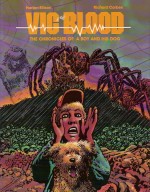

Vic and Blood – the Chronicles of a Boy and his Dog


By Harlan Ellison & Richard Corben (St. Martin’s Press/NBM/IBooks)
ISBNs: NBM edition 978-0-31203-471-9   IBooks edition: 978-0-74345-903-7

Richard Corben is one of America’s greatest proponents of graphic narrative: a legendary animator, illustrator, publisher and cartoonist surfing the tumultuous wave of independent counterculture commix of the 1960s and 1970s to become a major force in pictorial storytelling with his own unmistakable style and vision. He is renowned for his mastery of airbrush and captivatingly excessive anatomical stylisation and infamous for delightfully wicked, darkly comedic horror and beguiling eroticism in his fantasy and science fiction tales. He is also an acclaimed and dedicated fan of the classics of gothic horror literature…

Always garnering huge support and acclaim in Europe, he was regularly collected in luxurious albums even as he fell out of favour – and print – in his own country.

This album adapts a short story by science fiction iconoclast Harlan Ellison which turned the medium on its head when first published in 1969, spawning an award-winning cult-film and perpetually dangling the promise of a full and expansive prose novel before the eager fans. Much of that intention is discussed in Ellison’s After Vic & Blood: Some Afterthoughts as Afterword which ends the 1989 edition…

I suspect I’ll be long dead by the time the nigh-legendary Blood’s a Rover novel is finally released but at least this stunning graphic novel gilds the apocalyptic lily by also adapting the author’s prequel and sequel novelettes to produce a tale with a beginning, a middle and an ending of sorts…

The post-apocalyptic milieu was one Corben would return to over and over again but it never looked better (if that’s not a grim contradiction in terms) than in the triptych of survivalist terror that begins here with ‘Eggsucker’ as genetically-engineered telepathic war-mutt Blood relates how he and his 14 year old human partner Vic (don’t call him “Albert”) survive on a daily basis amidst the shattered ruins of America after the final war.

Vic is a “solo”, unaffiliated to any of the assorted gangs that have banded together in the radioactive aftermath, scavenging and trading and never staying in one place too long. Blood has looked after him for years: faithful, valiant and protective. The dog has taught the lad everything, even how to speak properly…

After a booze-for-bullets swap goes hideously wrong the partners have a falling-out, but that only lasts until Vic stumbles into trouble again and Blood dashes to his rescue…

Next up is the pivotal tale ‘A Boy and his Dog’ wherein Vic and his canine mentor find a healthy and nubile girl from the sunken puritanical subterranean enclaves known as “Downunders” slumming amongst the ruins of civilisation.

Hungry for something other than rancid rations, Vic follows her and is forced to kill a number of other lustful hunters to possess the tantalising Quilla June Holmes, who bamboozles the horny lad with all her talk of love…

However, it’s all part of an elaborate trap and before long the born survivor is trapped by his own teenaged hormones in the parochial, backward-looking New Topeka underground refuge, destined to be the stud to sire a new generation of humanity for the aging and increasingly sterile Downunder men…

Of course nobody thought to ask the putative mares what they thought of the plan and Quilla June quickly rebels, helping Vic to kill her father and escape back to the dangerous freedom of the surface.

Up above faithful Blood has not fared well: slowly starving whilst waiting for Vic to sow his wild oats and return. He is near death when the fugitives reappear and only an act of true love can save him…

The saga-so-far concludes with a shocking surprise in ‘Run, Spot, Run’ as the increasingly acrimonious Vic and Blood squabble and fall out, whilst starvation, toxic food and savage ghosts torment them both, resulting in a momentary lapse of concentration which leads the pair into ghastly peril…

Fair Warning: many readers will probably feel short-changed by the cliff-hanging ending but there is a conclusion of sorts and the astounding power of the artwork should offset any potential feeling of unfulfilled drama.

This superb collection was re-released in 2003 by IBooks in a celebratory edition which also contained the original short-stories in prose form as well as added extras such commentaries and The Wit and Wisdom of Blood.

Corben’s unique vision captures the weary, doom-laden atmosphere, charged hunger and despondent denouement of the original with devastating effect and this seminal, seductive work is undoubtedly a true classic of the Day-After-Doomsday genre. The artist’s sublime acumen in depicting humanity’s primal drives and the grim gallows humour of the situation has never been bettered than with these immortal stories. This is a book no comics or horror fan should be without.
Artwork © 1987 Richard Corben. “Eggsucker” © 1977 Harlan Ellison. “A Boy and his Dog” © 1969 The Kilimanjaro Corp. “Run, Spot, Run” © 1980 The Kilimanjaro Corp. Adapted versions © 1987 The Kilimanjaro Corp. Colour & cover © 1989 NBM.

Zora and the Hibernauts


By Fernando Fernández (Catalan Communications)
ISBN: 978-0-87416-001-7

Multi-disciplinary Spanish artist Fernando Fernández began working to help support his family at age 13 whilst still at High School. He left in 1956 and immediately began working for British and French comics publishers. In 1958 his family relocated to Argentina and whilst there he added jobs for El Gorrión, Tótem and Puño Fuerte to his ongoing European and British assignments for Valentina, Roxy and Marilyn.

In 1959 he returned to Spain and began a long association with Fleetway Publications in London, producing mostly war and girls’ romance stories.

During the mid-1960’s he began to experiment with painting and began selling book covers and illustrations to a number of clients, before again taking up comics work in 1970, creating a variety of strips (many of which found their way into US horror magazine Vampirella), the successful comedy feature ‘Mosca’ for Diario de Barcelona and educational strips for the pubshing house Afha.

Becoming increasingly experimental as the decade passed, Fernández produced ‘Cuba, 1898’ and ‘Círculos’ before in 1980 beginning his science fiction spectacular ‘Zora y los Hibernautas’ for the Spanish iteration of fantasy magazine 1984 which was eventually seen in English in Heavy Metal magazine. His later graphic spectacles include ‘Dracula’ for the Spanish iteration of Creepy, mediaeval fantasy thriller ‘La Leyenda de las Cuatro Sombras’ (working with Carlos Trillo), ‘Argón, el Salvaje’ and a number of adaptations of Isaac Asimov tales in ‘Firmado por: Isaac Asimov’ and ‘Lucky Starr – Los Océanos de Venus’.

His last comics work was ‘Zodíaco’ begun in 1989, but his increasing heart problems soon curtailed the series and he returned to painting and illustration. He passed away in August 2010, aged 70.

The stunning adult epic Zora and the Hibernauts exploits classic science fiction themes of sexual politics to explore the perceived role and character of men and women and opens, after a truly breathtaking biography and gallery section, with the first staggeringly lush chapter as, far into the future, warrior-women from the artificial moon Honeycomb (home to the censorious, draconian colony of the Sisterhood) land on the deadly and biologically inimical planet Earth searching for lost technology and other objects of interest or value.

The crew is led by the competent Zora, a space veteran who has won the love and devotion of her crew through years of sterling service. The ancient birthplace of humanity has long been quarantined: a pestilential hell-hole where radiation and disease have created unspeakable horrors, but the explorers have no idea what shocks await their first forays into the unknown landscape they call Terra-Lune…

The search goes badly and crew-women are lost to plants, beasts and things which qualify as both and neither, but Zora is intent on finding some specific unknown treasure. Meanwhile, back on Honeycomb, scientist Nylea breaks the Queen’s taboo and searches the ancient archives for proscribed information on the extinct creature once called “man”…

On Terra-Lune the invaders have broached a long-hidden chamber and found six hibernation pods from before the Earth died…

They contain frozen men and Zora, defying orders and centuries of custom, decants and revives the perfectly preserved creatures rather than destroy them, setting herself on a path that will lead to civil war and the restoration of the natural order…

She is strangely drawn to one of the men: Astronaut Commander Amon, who holds crucial knowledge of the fall of humanity and whose presence stirs the quizzical Zora in ways she doesn’t understand…

Taking her prizes back to Honeycomb where they are interviewed by Supreme Sister Rasam, Zora is ordered to keep the hibernauts in personal custody, but isn’t surprised when Nylea informs her that the queen is planning to destroy her and the men who threaten the hegemony and beliefs of the all-female, in vitro parthenogenetic culture.

Following a brutal battle, Zora, Nylea and the males take refuge on toxic Terra-Lune where they encounter another man: an incredible immortal named Rob who has survived on the poisoned planet for uncounted ages and aids the fugitives when the Sisterhood ships come hunting them…

Escaping the stalkers, the refugee band hides deep within the horror-world and inevitably Zora and Amon perpetrate an act of love not seen on Earth for millennia, after which Rob reveals the location of a fully-functioning ancient starship and offers them a means of fighting back against the tyranny of Rasam.

But whilst Rob relates the secret of his incredible longevity, on Honeycomb long-suppressed antagonisms begin to re-emerge.

Terra-Lune still holds many threats and horrors however, and whilst the outcasts battle for survival against beasts and monstrous sub-men on the debased planet, a deadly civil war erupts on the artificial satellite led by ambitious hardliner and second-in-command Sharta. By the time Zora and her followers are ready to attack Rasam, Honeycomb is in the midst of civil war…

Just when events are their most fraught, the universal implications of the struggle are revealed when a god-like timeless entity appears, disclosing Zora’s cosmic importance and that her womb now carries the first naturally conceived and developing human baby in thousand of years. Zora has been chosen by the higher powers of the universe to restore and perpetuate the human species…

The grand concepts come thick and fast in Zora and the Hibernauts and although the narrative is a little muddled in consequence, this breathtaking yarn delivers fast paced, action-packed, staggeringly beautiful and astoundingly exciting adult science fiction thrills in the tradition pulp manner. Being Spanish, however there’s a slight tinge of macho, if not subverted sexism, on display and of course, there is extensive female nudity throughout – so much so that by half-way through you won’t even notice…

If naked bald women are liable to offend you, give this as miss, but for all the normal red- blooded fans out there this is a superb tale by a master craftsman you’ll certainly want to track down and savour.

© 1981 Fernando Fernández. English edition © 1984 Catalan Communications. All rights reserved.

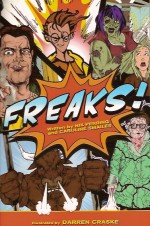
Freaks!


By Nik Perring, Caroline Smailes & Darren Kraske (The Friday Project/HarperCollins)
ISBN: 978-0-00-744289-8

We’ve all been in the know for years, us comics fans, but it’s only recently that the big wide world got into the whole mind-boggling realm of superpowers and scary monsters. With such self-aware and crafty shows as Misfits, Being Human, No Heroics and even US imports like as No Ordinary Family, Alphas, The Cape and numerous others, the concept of powers and abilities which take us above and beyond the norm have become as much part of common parlance as “Beam me up Scotty” and “These are not the droids you’re looking for” – and remember when grown-ups and your dad had no idea what those meant either?

Freaks! is a stunning collection of themed prose pieces ranging from compulsively brief vignettes to devastatingly effective epigrams which examine the concept of having a super-power, from the broadly literal such as ‘The Photocopier’ wherein the daughter of a lady who can duplicate herself waits impatiently for her own gift to develop, or ‘Statuesque’ wherein a passionate woman gradually petrifies herself, to far more cerebral and metaphysical forays into the weird world like the bittersweet ‘Clipped Wings’, heartrending ‘Invisible’ or piteous ‘Fifty Per Cent’…

Some are just plain creepy like ‘In her Basket’ and ‘Faulty Baby’ or gut-wrenchingly horrific as with ‘The Boner’ or ‘Damaged’…

Sometimes you can only stop and wonder if the abilities are real at all or just in your head…

Or theirs…

Blending paranormal paranoia with self-delusion and pitting incisive, instinctive intuition against genuine contemplative otherworldliness, these yarns by Carol Smailes and Nik Perring (working individually and in tandem) describe ordinary folk with uncanny gifts and extraordinary people who have mastered the mundane horrors of the world.

These 47 individual slices of kitchen sink fantasy are written with scathing wit, measured surreality, biting venom and shattering poignancy, all graced and augmented with lavish and plentiful monochrome illustrations by author/artist Darren Kraske.

If you’re looking for alien invasions or flamboyant punch-ups you’ll be left wanting, but if you fancy some exceedingly adult and mostly mature laughs and tears, a few chills and a lot of clever, thought-provoking entertainment then Freaks! is definitely the book for you.
© 2012 Caroline Smailes and Nik Perring. Illustrations © 2012 Darren Kraske. All rights reserved.

This book is part of publisher HarperCollins’ experimental Friday Project where the traditional modes of book creation are augmented by concentration on new digital technology and disciplines as well as innovative methods of acquiring, publishing, selling and promoting their product. For more details you should check out http://www.harpercollins.co.uk/about-harpercollins/Imprints/the-friday-project/Pages/The-Friday-Project.aspx
To learn more about the creators please go to http://www.carolinesmailes.co.uk/
http://nikperring.com/ and http://theargonautsalmanac.blogspot.com/
Freaks! is scheduled for release on April 12th 2012.

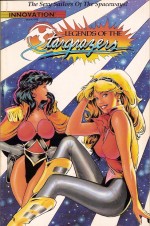
Legends of the Stargrazers Book 1


By Cynthy J. Wood & David Campiti, Matt Thompson, Tom Yeates & various (Innovation)
No ISBN:

It’s hard to deny or justify, and sometimes a little embarrassing to explain these days, but for a goodly proportion of readers, comics have always been a source of low-level, innocent titillation.

In the far-off days when comicbooks were expressly for kids, scantily clad, perfectly sculpted exemplars of the human form – female and male – were perhaps the first introduction to innocent psyches of the turbulent world of sex and relationships and sex and hormones and sex, so it’s not surprising that there’s a whole fan sub-culture dedicated to Cheesecake (also, to be fair and to a lesser extent, Beefcake) collectively known as Good Girl Art.

From the late 1980s onward with internet porn and far more explicit (photographic) publications readily accessible to youngsters, you would have thought that the simple allure of drawn hotties and totties would have waned but you’d be wrong. Some folk just seem to prefer illustrated hormonal icons to “real” (albeit implausibly airbrushed or photoshopped) ones…

Artists skilled in delineating these impossibly perfect visions number amongst our most celebrated but the stories generally took a back-seat as the characters posed and strutted in beguiling, distracting and generally improbable fashions and stances, so it’s nice to be able to cite a rare occasion when plot and dialogue were as well developed as the stars’ physical characteristics…

The Legends of the Stargrazers was created by Cynthy J. Wood and Innovation publisher David Campiti as a light-hearted space-opera in 1989, running six issues and almost immediately collected as two of the industry’s earliest trade-paperback graphic novels.

The premise is both simple and enchantingly beguiling: in the future humanity has spread throughout the galaxy, bringing commerce and advancement to many races: and of all the independent traders plying the space winds the strictly female crews of vessels calling themselves Stargrazers are the most successful.

This initial volume opens with ‘Here be Dragons’ by Wood & Campiti, drawn by Matt Thompson and inked by Randy Elliott & Nestor Redondo, which introduced Captain Rachel Lacey, Sherree Rhys-Holm, Karry Vistaas and Carla Withers; the all-girl crew of Stargrazer merchant ship Crock of Gold, plying their trade across the galaxy and dreading the arrival of their latest recruit-replacement.

It’s a cut throat, hand-to-mouth life of boom and bust for the traders and the last thing they need is to be breaking in another star-struck newbie. Even after the appropriate winnowing process the successful candidate seems painfully typical: cute, perky, hyper-enthusiastic…

However apprentice trader Julie Green is a girl with an astonishing secret…

During her first voyage, after a fairly typical piece of business which ended up in the usual fire-fight and frantic flight, Julie witnesses an incredible sight – the first appearance in decades of the almost-mystical sun-feeding space dragons from which the Stargrazers took their name.

Enthralled she learned the voyagers’ secret history and the cosmic connection between the fantastic creatures and the fleets of star-wanderers who will do anything to protect the fabulous saurians from unscrupulous planet-dwellers…

‘The Smithfield Incident’ holds a story within a story as the crew rescue imperial super-spy Smithfield Cobb from certain death in deep space only to slowly fall under the sway of his irresistible manly charm and artificially-enhanced pheromone count. Cobb is the Empress’ secret weapon in an ongoing war against rebel forces and this tale is little more than a framing sequence for his solo story ‘Libretto’ (by Campiti, Tom Yeates & Rick Bryant, and looking suspiciously like a tale left over when early Indy pioneer Pacific Comics went bankrupt).

Rendered in the manner of classic Al Williamson’s EC sci fi thrillers, the flashback saga of Cobb’s clash with rebel agents and love affair with the soul of a planet adds a hint of stabilising tragedy to the flash-and-dazzle light-heartedness of the Stargrazers’ exploits, as he drags the neutral merchant maids into conflict with Rebellion forces. However his philandering tactics backfire and Cobb learns a salutary lesson when the girls switch his prized info tape for Julie’s diary… without her knowledge or permission…

‘Ghost Ship’ finds the girls enjoying a rare shore-leave when Lacey is framed for illegal trading, piracy and slave-taking. The furious Captain immediately takes off in pursuit of impostors using her name and discovers not only the secret of the mythic phantom star-trader Vanderdecken but also uncovers a race of men like angels who have an unsuspected connection to Julie…

This first collection concludes with ‘Gossamer’ as the origins of the winged men are revealed and the history of humanity’s expansion into space is disclosed.

To Be Continued…

Although certainly designed and intended as captivating but cheesy eye-candy, the broad scope of this fantasy saga and the light touch of authors Wood and Campiti, packing their scripts with wry humour and sci fi in-jokes, elevates Legends of the Stargrazers far above the usual “look, don’t think” level of Good Girl material and it’s a genuine pity the series died so young.
™ and © 1989 Cynthy J. Wood & Innovative Corp. Main story artwork © 1989 Matt Thompson. “Libretto” art © 1989 Tom Yeates. All rights reserved.

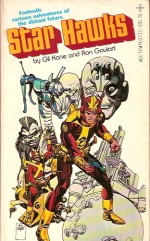
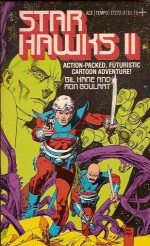
Star Hawks & Star Hawks II


By Ron Goulart & Gil Kane (Ace/Tempo Books)
ISBNs: 0-448-17311-5 & 0-448-17272-0

Although comicbook publishers worked long and hard to import their colourful wares to the more popular and commercially viable shelves of bookshops, newspaper strips (and episodic humour magazines like Mad) had been regular visitors since the 1950s.

By dint of more accessible themes and subjects, simpler page layouts and just plain bigger core-readerships, comedy and action periodical serials were easy to translate to digest-sized book formats and sell to a broad base of consumers. Because of this the likes of Peanuts, B.C., Wizard of Id, Broom Hilda, Rick O’Shay, Flash Gordon, Mandrake and many others were an entertainment staple of cartoon-loving, fun-hunting kids – and adults – from the 1960s to the 1990s.

Comedies and gag books far outweighed dramas however: by the 1970s the era of the grand adventure strip in newspapers was all but over, although there were still a few dynamic holdouts and even some few new gems still to come.

One such was this unbelievably addictive space opera/cop procedural which debuted on October 3rd 1977. Created by novelist, comics scripter and strip historian Ron Goulart on the back of the revival in Science Fiction following the release of Star Wars (and later continued by the legendary Archie Goodwin who all-but sewed up the sci-fi strip genre at the time by also authoring the Star Wars newspaper serial which premiered in 1979)… Star Hawks was graced by the dazzlingly dynamic art of Gil Kane and blessed with an innovative format for such strips: a daily double-tier layout that allowed far bigger, bolder graphics than the traditional single bank of three or four frames.

The core premise was also magically simple: in our future, man has spread throughout the galaxy and now inhabits many worlds, moons and satellites. And wherever man goes there’s a need for policemen and peacekeepers…

Goulart began with the working title “Space Cops” but that was eventually superseded with the more dashingly euphonious and commercially vibrant Star Hawks.

In the late 1980s four comicbook-sized collections were published by Blackthorne, followed by a wonderful collectors volume from Hermes Press in 2004, but these are all now out-of-print and hard to acquire, so I’m concentrating here on the much more accessible brace of mass-market digest paperbacks released whilst the strip was still running…

Both these stirring tomes are printed in landscape format with each instalment fitting neatly onto a page: thus the black and white art (almost original publication size) is clean, crisp and tight as Book 1 steams straight in by introducing the villainous Raker and his sultry, sinister boss Ilka, hunting through the slums and ruins of alien world Esmeralda for a desperate girl plagued by dark, dangerous visions…

Enter Rex Jaxan and the ladykiller Latino Chavez, two-fisted law-enforcing Star Hawks on the lookout for trouble, who promptly save the lass from slavers only to become embroiled in a dastardly plot to overthrow the local Emperor by scurrilous arms merchants. Also debuting in that initial tale is the cops’ sexy boss Alice K. Benyon (far more than just a romantic foil for He-Hunk Jaxan), the awesome space station “Hoosegow” and Sniffer, the snarkiest, sulkiest, snappiest robo-dog in the galaxy. The mechanical mutt gets all the best lines…

Barely pausing for breath the star-born Starsky and Hutch (that’s Goulart’s take on them, not mine) are in pursuit of an appalling new weapons system developed to topple the military dictatorship of Empire 13 – the “Dustman” process. Before long however the search for the illegal WMD develops into a full-on involvement in what should have stayed a local matter – civil war…

Book 2 opens with the pair investigating the stupendous resort satellite Hotel Maximus, with Alice K. along to bolster their undercover image. On Maximus every floor holds a different daring delight – from dancing to dinosaur wrangling to Alpine adventure – but the return of the malevolent Raker heralds a whole new type of trouble as he is revealed to be an agent of the pan-galactic cartel of criminals known only as The Brotherhood.

Moreover, the Maximus is the site of their greatest coup – a plot to mind-control the universe’s richest and most powerful citizens. So pernicious are these villains that the Brotherhood can even infiltrate and assault Hoosegow itself…

Foiling the raiders Jaxan and Chavez quickly go on the offensive, hunting the organisation to the pesthole planet Selva, a degraded world of warring tribes and monstrous mutations, where new recruit Kass distinguishes himself, but the Brotherhood is deadly and persistent and new leader Master Jigsaw has a plan to destroy the Star Hawks from within…

Star Hawks ran until 1981, garnering a huge and devoted audience, critical acclaim and a National Cartoonists Society Award for Kane (Story Comic Strip Award for 1977). It is, quite simply one of the most visually exciting, rip-roaring and all-out fabulous sci-fi sagas in comics history and should be part of every action fan’s permanent collection. In whatever format you can find, these tales are a “must-have” item.
© 1977, 1978, 1979, 1981 United Features Syndicate, Inc. All rights reserved.

Al Williamson Archives volume 2


By Al Williamson with an introduction by Victor Williamson (Flesk)
ISBN: 978-1-933865-34-8

Al Williamson was one of the greatest draughtsmen ever to grace the pages of comicbooks and newspaper comics sections. He was born in 1931 in New York City, after which his family relocated to Bogotá, Columbia just as the Golden Age of syndicated adventure strips began.

The lad’s passion for “the Comics” – especially Alex Raymond’s Flash Gordon and Jungle Jim – was broadened as he devoured imported and translated US material as well as the best that Europe and Latin America could provide in such anthology magazines as Paquin and Pif Paf. When he was twelve the Williamsons returned to America and, after finishing school, the artistic prodigy found work in the industry that had always obsessed him.

In the early 1950s he became a star of E.C. Comics’ science fiction titles beside kindred spirits Joe Orlando, Wally Wood, Roy G. Krenkel, Frank Frazetta and Angelo Torres, and drew Westerns Kid Colt and Ringo Kid for Atlas/Marvel. During the industry’s darkest days he found new fame and fans producing newspaper strips, first by assisting John Prentice on Rip Kirby – another masterpiece originally created by Alex Raymond – and from 1967 with Secret Agent Corrigan.

As comicbooks recovered in the 1960s Williamson drew Flash Gordon for King Comics and worked on mystery tales and westerns for DC whilst drawing Corrigan, later becoming the go-to guy for blockbuster sci-fi film adaptations with his stunning interpretations of Blade Runner and Star Wars.

His stunning poetic realism, sophisticated compositions, classicist design and fantastic naturalism graced many varied tales, but in later years he became almost exclusively a star inker over pencillers as varied as John Romita Jr., Larry Stroman, Rick Leonardi, Mark Bright, José Delbo and a host of others on everything from Transformers to Spider-Man 2099, Daredevil to Spider-Girl and his magical brushes and pens embellished many of Marvel’s Graphic Novel productions such as The Inhumans or Cloak and Dagger/Predator and Prey.

Al Williamson passed away in June 2010.

After a memory-soaked celebratory introduction from his son Victor, this second oversized (305x229mm) 64 page collection features more sketches, working drawings, doodles, unlinked pages, model sheets, unused and unfinished pages as well as a few completed but unseen treasures from one of the stellar creators of our art form.

In assorted media and forms from quick line sketches in ink, broad brush and tonal studies, full pencils and finished illustrations, Williamson displays his mastery in magical pictures ranging from intoxicating fantasy and barbarian women, valiant sword-wielding warriors, wondrous dinosaurs, Cowboys and Indians, rockets and robots, sports heroes, period drama scenes, cosmic adventurers, beasts and monsters, aliens, action sequences, beguiling nudes and glamour studies, his delicious trademark cute lizards, and so much more.

Standout and extra-inspiration pieces include a fabulous page of the Rocketeer, a Reef Ryan pulp page, many 1960s Flash Gordon sketches, more glorious John Carter of Mars illustrations and a few hard-boiled crime scenes…

The beautifully intimate glimpses of a master at work, with full colour reproduction capturing every nuance of Williamsons’ gorgeous pencil strokes, make this a book a vital primer for anybody dreaming of drawing for a living and the astounding breadth and scope of work presented here make me itch to pick up my pencil and draw, draw, draw some more myself.

Enticing, revealing, rewarding and incredibly inspirational, no lover of wonder or art lover can fail to be galvanised by this superb portfolio of excellence.

© 2011 The Estate of Al Williamson. Introduction © 2011 Victor Williamson. Rocketeer illustration © 1984 The Rocketeer Trust. All Rights Reserved.

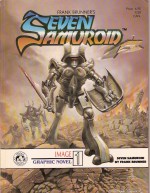
Frank Brunner’s Seven Samuroid


By Frank Brunner (Image International)
ISBN: 0-943128-06-4

The 1980s were a fertile time for American comics-creators. It was as if a brand new industry had been born with the proliferation of the Direct Sales Market and dedicated specialist retail outlets; companies were experimenting with format and content and economically, times were good so punters even had a bit of spare cash to play with.

Moreover much of the “kid’s stuff” stigma had finally been invalidated and America was catching up to the rest of the world in acknowledging that sequential narrative might just be a for-real, actual art-form…

Consequently many young start-up companies began competing for the attention and leisure-dollars of fans grown accustomed – or resigned – to getting their on-going picture stories from DC, Marvel, Archie and/or Harvey Comics. European and Japanese material had been creeping in and by 1983 a host of young companies such as WaRP Graphics, Pacific, Eclipse, Capital, Now, Comico, Dark Horse, First and many others had established themselves and were making impressive inroads, all supplemented by the rapid rise of a healthy plethora of comics criticism, collection and informational magazines…

New talent, established stars and fresh ideas all found a thriving forum to try something a little different both in terms of content and format. Even smaller companies had a fair shot at the big time and a lot of great material came – and too often, quickly went – without getting the attention or success it warranted.

One of the most overlooked but just plain fun features came from an unlikely paring of star artist Frank Brunner and a printing company based in New Zealand, which tapped into the growing zeitgeist of Japan’s burgeoning robotic warrior knights or “mecha” and the modern pulp space opera of the first Star Wars generation…

In the future the great Galactic Union succumbed to war brought about by political ambition and economic greed. At the height of the conflict a group of wise men created a small force of super-robots hardwired with the unflinching principles of ancient Earth’s noblest warriors; dedicated to preserving all innocent life and defending the oppressed; whether organic or mechanical.

These Samuroids were then bonded with the personalities of valiant volunteers whose intellects were transcribed into the awesome automatons. However after decades of constant struggle even the unceasing efforts of the puissant mechanicals were not enough to stave off an era of darkness, decline and destruction…

Two millennia later the universe is a place of chaos and anarchy dotted with small emergent enclaves of brutal feudal “civilisation” still limited to their own isolated, hostile star-systems. On the planet Ion, freedom fighter Zeta leads a band of rebels battling the rise of a new Dark Imperium. Hunted by sky-borne troops in deadly gun-ships, she falls into a cave and discovers a ponderous solitary figure: Ultek the Samuroid.

The tragic undying warrior has stood sentinel in this dark hole since he and his fellows failed in their appointed task centuries ago, contemplating the horrors he was built to prevent and all the lives he was forced to take. However his broken soul is fired up at last when the Imperium troops savagely attack, wounding Zeta.

Roused to action, Ultek destroys the monstrous thugs and joins Zeta’s cause, determined to thwart the expansionist horrors of the voracious Imperium and its mad monarch, The Mikado…

To this end he seeks out the other surviving Samuroids, who have indeed fallen low…

After millennia their quasi-mystical power-source Reiki is all but exhausted. Another mecha Sarr donates his reserves to scientists in hope of their synthesising a substitute fuel whilst Ultek returns to the stars in search of more old comrades. He finds two aboard an ancient Galaxy-Union Star Battle Wagon, converted into a vast and corrupt travelling carnival. They are unresisting slaves of its vile master, Strom Bolla…

Sark and Gorr have bartered their honour for dwindling rations of Reiki, but Ultek finds a valuable friend in the brave but inconsequential droid Toto who describes himself as an “honorary Samuroid”. With precious time passing and desperately determined to free and rehabilitate his fallen comrades Ultek joins the Carnival as a gladiator, but before he can make his move events spiral out of control when the decrepit warship is attacked by two more Samuroids Hum-Run and Dagg…

United at last the Seven Samuroid return to Ion where the rebellion has fared badly under the Mikado’s barbarous assaults and horror, glory and restored honour await them…

That or final irrevocable death and darkness…

At first this book (published in the overlarge 285 x 220mm European Album Format) might seem a creature of unlikely marriages: adapting the classic plot and ever-so-serviceable themes and motifs of Akira Kurosawa’s Shichinin no Samurai to the heavily technocratic milieu of Star Wars and Battlestar Galactica is not so big a leap, but much of this sci fi romp is exceedingly dark and decidedly mature in content and Brunner’s superbly humanistic illustration is often at odds with the grubby, grimy tone and faceless  dehumanising technology and hardware of the storyline.

Stuffed with in-jokes and dry asides, this tales also skirts rather than embraces the spiritual aspects of the original Seven Samurai but does pay lip-service to the all-embracing warrior code of Bushido as well as finding room for romance and a happy ending of sorts.

All in all this is a very queer beast indeed from a time when anything seemed possible, but in the final analysis provides a huge amount of old-fashioned thrills, chills and spills, making it well worth the time and effort of fans of movie and cartoon fantasy as well as classic comics adventure.
© 1984 Frank Brunner. All rights reserved.

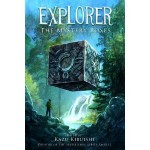
Explorer – The Mystery Boxes


By various, edited by Kazu Kibuishi (Amulet)
ISBNs: HB 978-1-4197-0010-1   PB 978-1-4197-0009-5

Here’s another superb entry into the burgeoning Young Adults graphic novel market that offers a wonderful alternative to Fights ‘n’ Tights furores and interminable extended storylines that will appeal to fans of the art form and fantasy freaks alike.

Edited by Kazu Kibuishi who created the impressive sorcerous saga Amulet, this captivating anthology collection offers seven thought-provoking and decidedly different tales by a coterie of animators and comics-creators all turning their fertile imaginations and illustrative talents to expanding and elucidating upon the core concept of an enigmatic container…

The wonderment begins with a spooky fable by Emily Carroll wherein a solitary and much put-upon girl discovers a very special doll and far more than she bargained for ‘Under the Floorboards’…

‘Spring Cleaning’ by Dave Roman & Raina Telgemeier is a wry and jolly escapade with lazy Oliver finally picking up his toys and discovering a puzzle box he didn’t know he owned. When he tries to sell the thing online all manner of very strange and insistent people start making outrageous and impossible offers…

Jason Caffoe follows a more tradition route as his young warrior overcomes all manner of fantastic odds to win ‘The Keeper’s Treasure’. Of course not everybody agrees on what constitutes fabulous wealth…

‘The Butter Thief’ by Rad Sechrist sees a little girl discover her grandmother’s ineffable wisdom and magical practicality after freeing a thieving spirit from a kitchen trap and undergoing a startling metamorphosis whilst ‘The Soldier’s Daughter’ (by Stuart Livingston with Stephanie Ramirez) reveals the true cost of vengeance as young Clara picks up her murdered father’s sword and mission. Mercifully a mysterious stranger shows her another path in his enthralling cask of wonders…

Johane Matte & Saymone Phanekham display stunning comic timing and astounding fast-paced imagination in the wicked tale of ‘Deet’; a much-maligned junior intergalactic shipping clerk dealing with workplace bullying in the most effective manner conceivable after which editor Kazu Kibuishi brings the perplexing odyssey of a spectacular close with ‘The Escape Option’ as a troubled boy finds an incredible artefact and is presented with an impossible, life-changing, world altering choice…

These dark, beguiling, funny and enticing adventures blend traditional story elements with an inspired eye for the contemporary kid’s broad spectrum of fascinations: warriors, aliens, robots, cartoon animals, rocket-ships, monsters, isolation, alienation, magical quests and glorious battles; all delivered with sly wit and breathtaking exuberance to create a splendid portmanteau rollercoaster ride of laughter, tears, terrors and triumphs.

This a perfect introduction or reintroduction to comics for kids of all ages looking for something beyond the ordinary and hopefully the start of a long line of thematic sequels…

Explorers is scheduled for a March 2012 release in the UK but available for pre-order now in both hardback and paperback editions.

Cover and The Escape Option © 2012 Kazu Kibuishi. Under the Floorboards © 2012 Emily Carroll. Spring Cleaning © 2012 Dave Roman & Raina Telgemeier. The Keeper’s Treasure © 2012 Jason Caffoe. The Butter Thief © 2012 Rad Sechrist. The Soldier’s Daughter © 2012 Stuart Livingston. Whatzit © 2012 Johane Matte. Published by Amulet Books, an imprint of Abrams. All rights reserved.

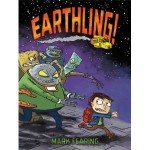
Earthling!


By Mark Fearing, with Tim Rummel; coloured by Ken Min (Chronicle Books)
ISBNs: HB 978-0-81187-106-8   PB 978-1-45210-906-0

In the past I’ve banged on about the dearth of good comics for kids – as opposed to the vibrant and thriving children’s prose book markets or the slavish and impenetrable dead-end niche-genres and daunting cross-marketing of contemporary comicbooks – and at last, some interesting developments in strip-book publishing look like setting that imbalance to rights…

Earthling! is the first graphic novel by animator Mark Fearing (with some initial creative input from TV producer Tim Rummel) and tells the tale of solitary, nerdy lad Bud, dragged by his astronomer dad to the literal middle of nowhere to take up residence at the vast Von Lunar Radio Telescope Array in the dry wilds of New Mexico.

The place is weird and a little spooky, but with his Mum gone and his father preoccupied with work Bud’s getting used to coping on his own…

The real trouble starts the next morning when he dashes for the school bus. Late and in the middle of a storm Bud inadvertently stumbles into the wrong vehicle and finds himself stuck on a malfunctioning intergalactic shuttle taking a bunch of alien students to Cosmos Academy where all the kids in the Galactic Alliance are educated.

Being the new kid in school is always bad news, but when you’re the only one of your species…

Luckily geeky pariah Gort GortGort McGortGort takes Bud under his wing and steers him through the worst of the culture shock, but the human’s urgent desire to go home is countered by one overwhelming fact: Earth is the most feared planet in the Galaxy, its inhabitants are despised and reviled by every sentient race in creation and its spatial coordinates are a closely guarded secret…

Thinly disguised as a sporty, athletic Tenarian, Bud tries desperately to fit in and luckily fellow outcast Gort is determined to help him return home, but the Academy is almost as dangerous as an Earth school.

There are jocks and bullies and cliques everywhere, the cool sapients run everything and snarky sarcasm is a deadly threat at all times. Although there are some decent and friendly teachers, the robots, rogue or escaped science experiments and especially the cafeteria make daily life an incredible and potentially lethal prospect.

Moreover, Principal Lepton and his administration are brutal bureaucrats with an excessive punishment regime (this is one deep-space satellite school you do not want to be “expelled” from) who have a pretty cavalier attitude to student safety – or even survival – and a hidden agenda which involves using Academy resources to build super-weapons for use against Bud’s lost or hidden home-world…

Gradually though, the boy adjusts, even finding an unexpected flair for the terrifying null-gravity sport of ZeroBall, which is lucky as Gort has deduced that the immensely prestigious championship Tournament is being held tantalisingly close to the diabolical Planet Earth – close enough that a stolen space-pod could reach it, if by some miracle Bud’s team qualified for the finals…

Funny, thrilling, wildly imaginative and utterly engrossing, Earthling! blends elements of Tom Brown’s Schooldays with Joe Dante’s Explorers and Harry Potter’s best bits with the anarchic wit of Rocko’s Modern Life or Camp Lazlo to produce a delightfully compelling adventure yarn with endearing characters and a big, big payoff.

This is a book any sharp, fun-loving kid can – and should – read… and so should the rest of you…

Earthling! is scheduled for release in the UK February 2012 but available for pre-order right now in both hardback and paperback editions.

© 2012 by Mark Fearing. All rights reserved.