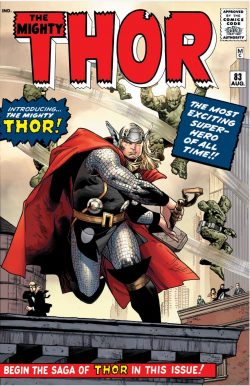
Mighty Thor Omnibus volume 1


By Stan Lee & Jack Kirby, Larry Lieber, Robert Bernstein, Joe Sinnott, Al Hartley, Don Heck, Chic Stone, Frank Giacoia, Vince Colletta & various (MARVEL)
ISBN: 978-0-7851-8835-3 (B/Digital edition)

Win’s Christmas Gift Recommendation: A Yule Jewel of Great Import… 9/10

Even more than The Fantastic Four, The Mighty Thor was the arena in which Jack Kirby’s restless fascination with all things Cosmic was honed and refined through dazzling graphics and captivating concepts. The King’s string of power-packed signature pantheons began in a modest little fantasy/monster title called Journey into Mystery where – in the summer of 1962 – a tried-and-tested comic book concept (feeble mortal transformed into god-like hero) was revived by the fledgling Marvel Comics to add a Superman analogue to their growing roster of costumed adventurers.

This monumental tome re-presents the pioneering Asgardian exploits from JiM #83-120 and Journey into Mystery Annual #1, spanning cover-dates August 1962 to September 1965 in a blazing blur of innovation and seat-of-the-pants myth-revising and universe-building.

It is lettered throughout by unsung superstars Art Simek, Sam Rosen, Ray Holloway, Terry Szenics and Martin Epp and sadly an anonymous band of colourists. As well as a monolithic assortment of nostalgic treats at the back, this mammoth tome is dotted throughout with recycled Introductions by Stan Lee, taken from the earlier Marvel Masterworks editions and includes editorial announcements and ‘The Hammer Strikes!’ newsletter pages for each original issue to enhance overall historical experience…

The eternal Edda unfolds with the lead feature of Journey into Mystery #83 (August 1962) which saw a brawny bold warrior jostle aside the regular roster of monsters, aliens and sinister scientists in a brash, vivid explosion of verve and vigour. The initial exploit follows disabled American doctor Donald Blake who takes a vacation in Norway only to encounter the vanguard of an alien invasion. Fleeing, he is trapped in a cave and finds an old, gnarled walking stick. When in his frustration he smashes the stick into a huge boulder obstructing his escape, his puny frame is transformed into the Norse God of Thunder, Mighty Thor!

Officially plotted by Stan Lee, scripted by his brother Larry Lieber and illustrated by Kirby and inker Joe Sinnott (at this juncture a full illustrator, Sinnott would become Kirby’s primary inker for most of his Marvel career), ‘The Stone Men of Saturn’ is pure early Marvel: bombastic, fast-paced, gloriously illogical and captivatingly action-packed. The hugely under-appreciated Art Simek was the letterer and logo designer.

It was clear that they whey were making it up as they went along – not in itself a bad thing – and that infectious enthusiasm shows in the next adventure. ‘The Mighty Thor Vs. the Executioner’ is a “commie-busting” tale of its time with a thinly disguised Fidel Castro wasting his formidable armies in battle against our hero.

The tale introduced Blake’s nurse Jane Foster: at this point a bland cipher adored from afar by the Norse superman’s timid alter-ego. The creative team settled as Dick Ayers replaced Sinnott, and with #85’s ‘Trapped by Loki, God of Mischief!’, the final element fell into place with the “return” of a suitably awesome arch-foe – the hero’s half-brother. This evil magician and compulsive trickster escaped divine incarceration and his first thought was to bedevil Thor by causing terror and chaos on the world of mortals he was so devoted to.

Here, a new and greater universe was revealed with the first tantalising hints and glimpses of the celestial otherworld and more Nordic gods…

JiM #86 introduced another recurring villain. Zarrko, bristling at the sedentary ease of 23rd century life, travels to 1962 to steal an experimental “C-Bomb”, forcing the Thunderer into a stirring sortie through time and inevitable clash with super-technology ‘On the Trail of the Tomorrow Man!’ With his return, Blake became a target of Soviet abductors: the sneaky spies even managed to make Thor a ‘Prisoner of the Reds!’ before he eventually emerged unscathed and triumphant…

JiM #88 saw ‘The Vengeance of Loki’ as the malevolent miscreant uncovered Thor’s secret identity and naturally menaced Jane whilst ‘The Thunder God and the Thug’ offered drama on a human scale as a gang boss runs riot over the city and roughshod over a good woman’s heart, giving the Stormbringer a chance to demonstrate his sympathetic side by crushing Thug Thatcher and freeing poor abused Ruby from his influence.

Issue #90 was an unsettling surprise as the grandeur of Kirby & Ayers was replaced by the charming yet dynamism-free art of Al Hartley, who illustrated Lee & Lieber’s stock alien-invasion yarn ‘Trapped by the Carbon-Copy Man!’ A month later the Storm Lord took on ‘Sandu, Master of the Supernatural!’, with Sinnott pencilling and inking a thriller starring a carnival mentalist who – augmented by Loki’s magic – came catastrophically close to killing our hero. Sinnott limned JiM #92’s ‘The Day Loki Stole Thor’s Magic Hammer’ – scripted by Robert Bernstein over Lee’s plot – which moved the action fully to Asgard for the first time as Thor sought to recover his stolen weapon after Loki ensorcelled the magnificent mallet. Kirby & Ayers momentarily returned for Cold War/Atom Age thriller ‘The Mysterious Radio-Active Man!’ Again scripted by Bernstein it sees “Mao Tse Tung” unleash an atomic assassin in retaliation for Thor thwarting China’s invasion of India. Such “Red-baiting” fare was common for early Marvel, but their jingoistic silliness can’t mar the eerie beauty of the artwork. With this tale, rangy, raw-boned Thor completed his slow metamorphosis into the husky, burly blonde bruiser who dominated any panel he was in.

Sinnott returned for the next three (somewhat pedestrian) adventures. ‘Thor and Loki Attack the Human Race!’, ‘The Demon Duplicator’ and ‘The Magic of Mad Merlin!’, but these mediocre tales of magic-induced amnesia, science-generated evil doppelgangers and an awakened ancient mutant menace were the last of an old style of comics. Stan Lee took over scripting with Journey into Mystery #97 and a torrent of action wedded to soap opera melodrama began a fresh style for a developing readership.

‘The Lava Man’ in #97 was drawn by Kirby, with subtly textured inking by Don Heck adding depth to the tale of an invader summoned from subterranean realms to menace humanity at the behest of Loki. More significantly, a long running rift between Thor and his stern father Odin was established after the Lord of Asgard refused to allow his son to love mortal Jane.

This acrimonious triangle was a perennial subplot attempting to humanise Thor, because already he was a hero too powerful for most villains to cope with.

Most importantly, this issue launched a spectacular back-up series. ‘Tales of Asgard – Home of the Mighty Norse Gods’ gave Kirby a vehicle to indulge his fascination with legends. Initially adapting classic tales but eventually with all-new material particular to the Marvel pantheon, he built his own cosmos and mythology, which underpinned the company’s entire continuity. This first saga, scripted by Lee and inked by George Bell (AKA Jack’s Golden Age collaborator George Roussos), outlined the origin of the world and the creation of the World Tree Yggdrasil.

‘Challenged by the Human Cobra’ introduced the serpentine villain (bitten by a radioactive cobra, would you believe?) in a tale by Lee & Heck, whilst Kirby – with them in attendance – offered ‘Odin Battles Ymir, King of the Ice Giants!’: a short, potent fantasy romp which laid the groundwork for decades of cosmic wonderment of years to come.

The format held for issues #99 & 100 with the lead story (first 2-parter in the run) introducing the ‘Mysterious Mister Hyde’ – and concluding a month later with ‘The Master Plan of Mr. Hyde!’ The modern yarn featured a contemporary chemist who could transform into a super-strong villain at will who framed Thor for his crimes whilst in primordial prehistory Kirby detailed Odin’s war with ‘Surtur the Fire Demon’, and latterly (with Vince Colletta inking) crafted an exploit of the All-Father’s so different sons in ‘The Storm Giants – a Tale of the Boyhood of Thor’ (Paul Reinman inks). As always, Lee scripted these increasingly influential histories…

Breaking for another recycled Lee Introduction, the modern myth-making resumes with JiM #101 (entirely inked by Roussos) which saw Kirby finally assume pencilling on both strips. In ‘The Return of Zarrko, the Tomorrow Man’ Odin halves Thor’s powers for disobedience just as the futuristic felon abducts the Thunderer to conquer the 23rd century. Another 2-parter, it’s balanced by another exuberant tale of boy Thor. ‘The Invasion of Asgard’ sees the valiant lad fight a heroic rearguard action introducing a host of future villainous mainstays such as Rime Giants and Geirrodur the Troll.

Epic conclusion ‘Slave of Zarrko, the Tomorrow Man’ is a tour de force notable for Chic Stone’s debut as inker. To many of us dotards, his clean, full brush lines make him The King’s best embellisher ever. The triumphant futuristic thriller is balanced by brooding Reinman-inked short ‘Death Comes to Thor!’ as the teen tyro faces his greatest challenge yet. Two women who would play huge roles in his life premiered in this 5-pager: young goddess Sif and Hela, Queen of the Dead.

Lee, Kirby & Stone introduced more memorable misanthropes in ‘Menaced by The Enchantress and The Executioner!’: ruthless renegade Asgardians resolved to respectively seduce and destroy the warrior prince in the front of JiM #103 whilst the rear revealed ‘Thor’s Mission to Mirmir!’ and how the gods created humanity. That led one month later to a revolutionary saga when ‘Giants Walk the Earth!’.

At last Kirby’s imagination was given full play as Loki tricks Odin into visiting Earth, and subsequently liberates ancient elemental enemies Surtur and Skagg, the Storm Giant from Asgardian bondage to ambush the absent All-Father…

This cosmic clash saw noble gods battling demonic devils in a new Heroic Age, with the greater role of the Norse supporting cast – especially noble comrade-in-arms Balder. This was reinforced by a new Tales of Asgard backup feature focussing on individual Gods and Heroes. ‘Heimdall: Guardian of the Mystic Rainbow Bridge!’ was first, with Heck inking.

Issues #105-106 teamed two old foes in ‘The Cobra and Mr, Hyde!’ and ‘The Thunder God Strikes Back!’: another continued story stuffed with tension and spectacular action, proving Thor was swiftly growing beyond the constraints of traditional single issue adventures. Respective back-ups ‘When Heimdall Failed!’ (Lee, Kirby & Roussos) and ‘Balder the Brave’ (Lee, Kirby & Colletta) further fleshed out the Asgardian pantheon deviating by more and more from the classical Eddas and Sagas.

JiM #107 premiered a petrifying villain ‘When the Grey Gargoyle Strikes!’: a rare yarn highlighting the fortitude of Dr. Blake rather than the Thunder God who was increasingly reducing his own alter-ego to an inconsequentiality. Closing the issue, the Norn Queen debuted in ‘Balder Must Die!’: a quirky reinterpretation of myth by Kirby & Colletta.

After months of manipulation, the God of Evil once again took direct action in ‘At the Mercy of Loki, Prince of Evil!’, With Jane Foster a victim of Asgardian magic, the willing assistance of new Marvel star Doctor Strange made this a captivating team-up must-read, whilst ‘Trapped by the Trolls!’ (Colletta inks) showed the power and promise of tales set solely on the far side of the Rainbow Bridge as Thor liberates Asgardians from subterranean bondage.

Journey into Mystery #109 was another superb infomercial adventure and a plug for a recent addition to the Marvel roster. ‘When Magneto Strikes!’ pits Thor against the X-Men’s greatest foe and his Brotherhood of Evil Mutants in a cataclysmic clash of fundamental powers, but you couldn’t really call it a team-up since the heroic mutants are never actually seen. Tantalising hints and cropped glimpses are fascinating teasers now, but the kid I then was felt annoyed not to have seen these new heroes – Oh! wait… maybe that was the point?

Young Thor feature ‘Banished from Asgard!’ is an uncharacteristically lacklustre effort as Odin and Thor enact a devious plan to trap a traitor in Asgard’s ranks. This issue also saw the launch of the letters page The Hammer Strikes and a Special Announcements Section, all included from here on for your delectation…

By #110 the ever-expanding world of Asgard was fully established: a mesmerising milieu for Thor’s earlier adventures and exotic setting for fresh wonders all hinting at a forthcoming era of cosmic fantasy to run beside the company’s signature Manhattan-based superhero sagas. ‘Every Hand Against Him!’ (Lee, Kirby & Stone) combines both, as Loki has earthly miscreants Cobra and Mr. Hyde kidnap and wound nigh unto death Thor’s mortal beloved Jane, even as Odin again overreacts to Thor’s affections for the human.

Following a stunning Kirby & Stone Thor Pin-up, and balancing that tension-drenched clash of Good and Evil, is a crafty vignette of Young Thor describing ‘The Defeat of Odin!’ in an old and silly plot sweetened by breathtaking battle scenes. It’s followed by another Lee Introduction before the concluding clash with Cobra & Hyde redefining ‘The Power of the Thunder God!’ With a major role for Balder the Brave and further integrating “historical” and contemporary Asgard in a spellbinding epic of triumph and near-tragedy, it’s complimented by a Loki Pin-up and precedes a fable co-opting a Greek myth (Antaeus if you’re asking) as ‘The Secret of Sigurd!’ (inked by Colletta).

Journey into Mystery #112 gave readers what they had been clamouring for with ‘The Mighty Thor Battles the Incredible Hulk!’: a glorious gift to all those fans who perpetually ask “who’s stronger…”? Arguably Kirby & Stone’s finest collaborative moment, it details a private duel that apparently appeared off-camera during a free-for-all between in The Avengers #3 when the heroes battled Sub-Mariner and the eponymous Green Goliath. The raw aggressive power of that clash is balanced by an eagerly anticipated origin in ‘The Coming of Loki!’ (Colletta inks): a retelling of how Odin adopts the baby son of Laufey, the Giant King.

In #113’s A World Gone Mad!’ the Thunderer – after saving the Shining Realm from invasion – again defies Odin to court Jane:  a task made hazardous by the return of the Grey Gargoyle. A long-running plot strand – almost interminably so – was the soap-opera tangle caused by Don Blake’s love for his nurse – a passion his alter ego shared. Sadly, the Overlord of Asgard could not countenance his son with a mortal, in another heavy-handed example of that acrimonious triangle.

The mythic moment at the back then exposed ‘The Boyhood of Loki!’ (inked by Colletta), a pensive, brooding foretaste of the villain to be, before JiM #114 opened a 2-part tale starring a new villain of the kind Kirby excelled at: a vicious thug who suddenly lucked into overwhelming power.

‘The Stronger I Am, The Sooner I Die!’ finds Loki imbuing hardened felon Crusher Creel with the ability to duplicate the strength and attributes of anything he touches, but before Creel endures ‘The Vengeance of the Thunder God’ (inked by Frank Giacoia as “Frankie Ray”) we’re graced with another Asgardian parable – ‘The Golden Apples!’

Issue #115’s back-up mini-myth ‘A Viper in our Midst!’ sees young Loki clandestinely cementing relations with the sinister Storm Giants, before a longer Thor saga began in #116, with Colletta becoming regular inker for both lead and support features. ‘The Trial of the Gods’ disclosed more aspects of Asgard as Thor and Loki undertake a brutal ritualised Trial by Combat, with the latter cheating at every step, after which ‘Into the Blaze of Battle!’ finds Balder protecting Jane even as her godly paramour travels to war-torn Vietnam seeking proof of his step-brother’s infamy.

These yarns are supplemented by stellar novellas ‘The Challenge!’ and ‘The Sword in the Scabbard!’, wherein Asgardian cabin-fever informs an official Quest instituted to expose a threat to the mystic Odinsword, the unsheathing of which will destroy the universe…

Journey into Mystery #118’s ‘To Kill a Thunder God!’ ramps up the otherworldly drama as Loki, to cover his tracks, unleashes an ancient Asgardian WMD – The Destroyer. When it damages the mystic hammer of Thor and nearly kills The Thunderer in ‘The Day of the Destroyer!’, the God of Mischief is forced to save his step-brother or bear the brunt of Odin’s anger.

Meanwhile in Tales of Asgard The Quest further unfolds with verity-testing talisman ‘The Crimson Hand!’ and ‘Gather, Warriors! as a band of literally hand-picked “Argonauts” join Thor’s flying longship in a bold but misguided attempt to forestall Ragnarok…

With The Destroyer defeated and Loki temporarily thwarted, Thor returns to America and then Asgard ‘With My Hammer in Hand…!’ only to clash once more with the awesome Absorbing Man in the start of another multi-part saga that will continue in the next volume…

However, before that bombastic battle there’s not only the next instalment of the Asgardian Argonauts who boldly ‘Set Sail!’ but also the superb lead story from Journey into Mystery Annual #1, wherein in undisclosed ages past the God of Thunder fell into the realm of the Greek Gods for a landmark heroic hullabaloo When Titans Clash! Thor vs. Hercules!’

This incredible all-action episode is augmented here by a stunning and beautiful double-page pin-up of downtown Asgard – a true example of Kirby magic – plus one last Lee Intro essay.

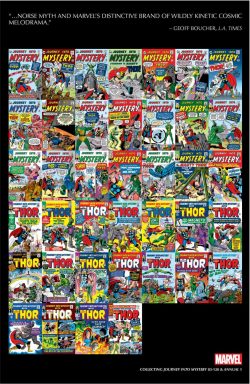
There’s a relative paucity of bonus material here but it’s all first rate: including unretouched original artwork, house ads and a full run of covers from Marvel Tales #1, 3-27 and Special Marvel Edition #1-2 from the 1960s where his early exploits were first reprinted. Closing the section is the cover art for this collection by Olivier Coipel, Mark Morale & Laura Martin.

These early tales of the God of Thunder show the development not only of one of Marvel’s core narrative concepts but, more importantly, the creative evolution of perhaps the greatest imagination in comics. Set your common sense on pause and simply wallow in the glorious imagery and power of these classic adventures and revel in what makes comic book superheroes such a unique experience.
© 2022 MARVEL.
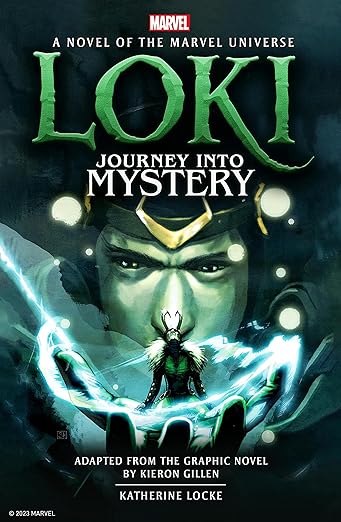
Loki: Journey into Mystery


By Katherine Locke (Titan Books)
ISBN: 978-1-80336-254-0 (HB) eISBN: 978-1-80336-255-7

Win’s Christmas Gift Recommendation: Marvelous Mischief and Merriment … 7/10

Modern Marvel is a truly multimedia entertainment colossus but all those many branches and subdivisions ultimately derive from stories in comic books. Thanks to recent developments in movie and television interpretations, primal Marvel Age villain Loki is now a hot property, which no doubt inspired this prose reinterpretation based on his comics reinvention in the early 21st century…

Marvel’s sustained presence on non-graphic bookshelves began in the 1990s with a string of hardback novels. Since then, those who want to supply their own pictures to gripping MU exploits have enjoyed a successive string of text-based thrills in all book formats. Titan Books has been supplying such powerhouse prose publications and here addresses the interests of fans brought in by the Thor and Avengers movies as well as those lifelong devotees of the ever-enlarging continuity who can’t bear to miss a single instance of their fave raves.

Written by Katherine Locke (The Girl with the Red Balloon, This Rebel Heart, The Spy with the Red Balloon), Loki: Journey into Mystery magically transforms a classic comic book saga: component parts of 2011’s publishing event Fear Itself and later tales spinning out of it. Primarily interpreting expanding and elaborating upon work by Keiron Gillen, these delve into what happened to an inveterate villain desperately seeking renewal and salvation… or is that one last Hail Mary ploy to escape an apparently inescapable fate?

All You Need to Know: as his last wicked scheme was spectacularly failing, the Asgardian God of Evil seeming had a too-late change of heart, but perished anyway and was reborn as a young boy…

What May Help: running from April to November 2011, Fear Itself shook up the Marvel Universe. In its wake, Gillen’s spin-off Loki Series appeared in Journey into Mystery starring a rejuvenated and mostly repentant (for which perhaps read forewarned and “once-bitten-twice-shy”) juvenile and rejuvenated God of Mischief, Stories and Lies, trying to be helpful, and keen to not end up like and dying just like his previous self …

The multi-part, intercompany braided comic book megasaga Fear Itself focused on Captain America, Iron Man, Thor and The Avengers, recounting how an ancient Asgardian menace was aroused by the Red Skull. Awake and hungry Asgard’s primordial fear-god possessed seven of Earth’s mightiest mortals, compelling them to wreak unimaginable death and destruction on the global population whilst he drank in the terror the rampages generated. In response, Odin decided to deprive The Serpent of sustenance by destroying Earth…

The core miniseries was supported by dozens of sidebar series and tie-ins focussing on peripheries of the main event. The saga of an antediluvian Asgardian menace sparking a terrifying bloodbath of carnage to feed on the fear of mankind and topple the established Norse pantheon was the stepping stone to Loki’s advancement. With all that spiritual energy unleashed other supernatural entities felt threatened and boy Loki realised that it was up to him to do what he could. The Nine Realms were grievously disrupted and the nation-city of Asgard crashed to Earth in Broxton, Oklahoma. The merging of human and godly culture was a shock to all but at least now “Kid Loki” could get Wi-Fi and good phone reception…which was immeasurably helpful as his old magic was curtailed by his new principles…

By tangentially recapitulating, extrapolating and embellishing what a scared, guilt-ridden and forewarned potential universal nemesis did next is observed against a background of crises that saw the destruction of Odin’s Asgard, imprisonment, death and resurrection of Thor and other heroes (don’t panic: in comics nobody dies forever) and the rise of opportunistic mystic forces seeking to capitalise on the upheaval.

Just how self-interest and self-revulsion in equal measure drive the magical lad in a vastly changed multiverse is the meat of this missive: encompassing teen Loki’s diligent struggles against his own nature as he tries to be better, tries to be different and tries to avoid making all his old mistakes again. It would have been far easier if he wasn’t taking advice from his old adult self (manifested as bird of ill omen Ikol) or increasingly infatuated with Leah, an age-appropriate and distracting potential paramour who is also a handmaiden of death goddess Hela ordered to keep him on mission and report any problems to truly unrepentant villains…

Loki’s rite of passage sees him face the consequences of The Serpent’s fall, and scam dream demon Nightmare and a coterie of rival fear-lords whilst manipulating Asgard’s death goddess Hela and her nemesis – multiversal arch-devil Mephisto. He then – as a secret agent for Asgard-on-Earth/Asgardia and its devious ruling triumvirate The All-Mother – must mediate between predatory new pantheon The Manchester Gods and the realm of Otherworld to redefine the spiritual identity of Britain: allowing the concepts of Faerie, Avalon, Albion, Celtic gods, Industrial Revolution, Capitalism, Marxism, Pop and Punk to co-exist. It does not go according to plan and in the final reckoning everything burns when the well-meaning kid unleashes and refuels ultimate universal ravager Surtur

Loki’s enigmatic voyages span the Nine Realms, a range of Hells, the Dream Dimension, Camelot and even wilder places with MU guest-stars including Daimon Hellstrom, (The Son of Satan), Captain Britain, and all Asgardian favourites but I fear that this might be one of those rare occasions where fullest understanding and enjoyment might require a brief refresher course via the original comics. At least everything you need is readily available in collected editions and it will definitely enhance your enjoyment of this skilful and evocative peek inside the head of a Lordly boy who wants to be good and not misunderstood…
© 2023 MARVEL.

Loki: Journey into Mystery will be released on December 19th 2023 and is available for pre-order now.

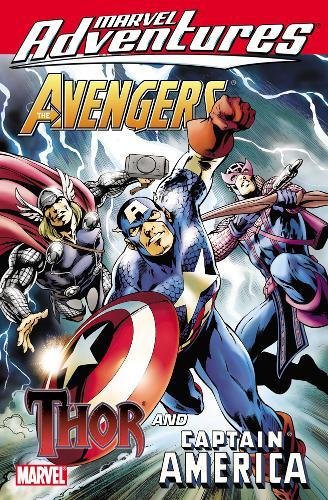
Marvel Adventures Avengers: Thor and Captain America


By Paul Tobin, Scott Gray, Todd DeZago, Ronan Cliquet, Ron Lim, Lou Kang & various (Marvel)
ISBN: 978-0-7851-5584-3 (Digest PB)

In 2003 the House of Ideas instituted a Marvel Age line: an imprint updating classic original tales and characters for a newer, younger readership. The enterprise was modified in 2005, with core titles reduced to Marvel Adventures: Fantastic Four and Marvel Adventures: Spider-Man. The tone was very much that of the company’s burgeoning TV cartoon franchises, in delivery if not name.

Supplemental series including Super Heroes, The Avengers, Hulk and Iron Man chuntered along merrily until 2010 when they were cancelled. In their place came new volumes of Marvel Adventures: Super Heroes and Marvel Adventures: Spider-Man.

Most of the re-imagined tales were collected in gleefully inviting digest-sized compilations and digitised; this – except for a electric version – was the case with this engaging ensemble featuring fabulous  forays starring the God of Thunder or Sentinel of Liberty and their Avenging allies: a quartet of all-ages tales from the second volume of Marvel Adventures Super Heroes (#13-16, spanning June-September 2011).

The action opens with a mythological masterpiece by Paul Tobin, Ronan Cliquet & Amilton Santos wherein plucky novice hero Nova is invited by Avenging comrades Thor and Valkyrie to accompany them on an annual errand for All-Father Odin.

In the distant past when Asgardians warred with Trolls, godling messenger Glane failed in his mission and was banished to the ghastly Fields of the Fallen to pay penance by continually battling the Golden Realm’s vilest enemies. Periodically, Thor has been sent to add new tasks to the sinning failure’s heavy burden, and this year – as the Thunderer and Valkyrie ready themselves for the trip – they invite starstruck neophyte Nova along.

However, as the trio war their way through horrific monsters and overwhelming odds, Nova finds himself increasingly uncomfortable with the sentence meted out to Glane. He even begins doubting the motives of his immortal mentors. All that changes once he meets and battles beside the convicted penitent…

Originating in MASH #14, ‘Out of Time!’ is by Todd DeZago, Ron Lim & Scott Koblish (inspired by Gerry Conway & Ross Andru’s tale from the original Marvel Team-Up #7). Here, the Lord of Storm intercepts Spider-Man after the wallcrawler is blasted high into the sky whilst battling raving maniac the Looter.

That happy coincidence occurs just a bizarre force freezes time around them. When the heroes discover that only they have escaped a devastating weapon deployed by Trollish tyrant Kryllk the Conqueror to paralyze and overwhelm both Asgard and the mortal plane, they must divide their strength to simultaneously smash the conqueror in Manhattan and Asgard if they are to set time running free again…

Captain America takes the spotlight in #15 as ‘Back in Time’ (Tobin, Cliquet & Santos) finds him battling Neanderthals with ray-guns in a National Forest after tracking down rogue geneticists who have stolen a huge amount of plutonium.

A mere mile away, Peter Parker’s girlfriend Sophia Sanduval is getting back to nature and chilling with her furry, scaly and feathered friends. As Chat, the mutant teen’s power to communicate with animals makes her a crucial component of the mystery-solving Blonde Phantom Detective Agency, but even she has never seen anything like the wave of extinct creatures which appear after Cap begins battling the tooled-up cavemen.

Soon Chat has been briefed on the deadly experiments of rogue technologist Jerrick Brogg. The villain’s ambition is to build an army out of revived extinct creatures, but she and helps The Star-Spangled Avenger frustrate those save all the beasts he has re-created from short painful lives of terror and brutal exploitation, before putting the maniac away for good.

Wrapping up the action comes ‘Stars, Stripes and Spiders!’ by DeZago, Lou Kang & Pat Davidson (based on Len Wein & Gil Kane’s tale from Marvel Team-Up #13). When a certain wallcrawling high-school student/occasional masked hero stumbles into Captain America tackling an AIM cadre stealing super-soldier serum, the nervous lad learns a few things about the hero game from the legendary guy who wrote the book. Sadly, not making that lesson any easier is petrifying supervillain Grey Gargoyle, whose deadly touch almost ends Spidey’s homework worries – and continued existence – forever…

Fast, furious, funny and enthralling, these riotous mini-epics are extremely enjoyable yarns, although parents should note that some of the themes and certainly the level of violence might not be what everybody considers “All-Ages Super Hero Action”…
© 2011 Marvel Characters, Inc. All rights reserved.

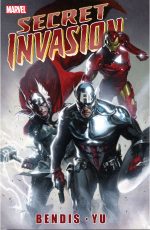
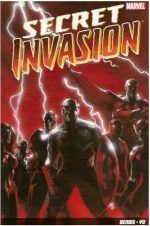
Secret Invasion


By Brian Michael Bendis, Leinil Francis Yu, Mark Morales & various (Marvel)
ISBN: 978-0-7851-3297-4 (TPB/Digital edition Marvel) 978-1-84653-405-8 (TPB Panini/Marvel UK)

The Skrulls are shape-shifting aliens who have threatened Earth since the second issue of Fantastic Four, and have long been a cornerstone of the Marvel Universe. After decades of use and misuse the insidious invaders were made the stars of a colossal braided mega-crossover event beginning in April 2008 and running through all the company’s titles until Christmas. That landmark worlds-shaking epic has since been adapted to the company’s burgeoning, blockbuster Marvel Cinematic Universe. If you were a real fan, you’d have already seen the first episode…

We, however, are all about the comics so let’s revisit the stunning and all-pervasive source material. The premise is simple enough: the everchanging, corruptive would-be conquerors have undergone a mass religious conversion and are now utterly, fanatically dedicated to taking Earth as their new homeworld. To this end they have replaced over an unspecified time a number of key Earth denizens – including many of the world’s superheroes.

When the lid is lifted on the simmering plot, no defender of the Earth truly knows who is on their side…

Moreover the cosmic charlatans have also unravelled the secrets of humanity’s magical and genetic superpowers, creating amped-up equivalents to Earth’s mightiest. They are now primed and able to destroy the heroic defenders in face-to-face confrontations.

With the conquest primed to launch, everything starts to unravel when Elektra dies in battle and is discovered to be an alien, not a ninja. Soon, two teams of Avengers (Iron Man, The Sentry, Wonder Man, Daredevil, Ms. Marvel, Spider-Woman, Wolverine, Luke Cage, Iron Fist, Ronin, Echo, Cloak and Black Widow) and certain agents of S.H.I.E.L.D.  are covertly investigating in discrete operations. All are painfully aware that they have no way of telling friend from foe…

Crisis and confusion are compounded when a Skrull ship crashes in the primordial Savage Land, releasing a band of missing heroes claiming to have been abducted and experimented on. Among them are another Spider-Man, Luke Cage, recently killed Captain America Steve Rogers, Phoenix/Jean Grey and Thor, plus other heroes believed gone forever. Some must be Skrull duplicates but are they the newcomers or the ones facing them…?

As the champions second guess each other, the second strand triggers. Earths space defence station S.W.O.R.D. is blown up and a virus rips through the internet shutting down crucial systems including the Starktech comprising the operating systems of S.H.I.E.L.D. and Iron Man’s armour…

Now all over Earth, Skrulls attack and heroes – and even villains such as Norman (Green Goblin) Osborn – respond and retaliate in a last ditch effort to survive: a war of survival that ends in shock, horror and unforeseen disaster…

Rather than give any more away, let me just say that if you like this sort of blockbuster saga you’ll be in seventh heaven, and a detailed familiarity is not vital to your understanding. However, for a fuller understanding, amongst the other Secret Invasion volumes accompanying this, you should particularly seek out Secret Invasion: the Infiltration, Secret War (2004), Avengers Disassembled, and Annihilation volumes 1-3, as well as the Avengers: Illuminati compilation.

This American volume contains all 8 issues of the core miniseries plus a monumental covers-&-variants gallery (31 in total) by Gabriele Dell’Otto, Steve McNiven, Leinil Yu, Mel Rubi, Frank Cho, Laura Martin and Greg Horn, and a series of chilling house ads imploring us to ‘Embrace Change’, but is just one of 22 volumes comprising the vast number of episodes in convergent storylines of the saga.

Fast-paced, complex, superbly illustrated and suitably spectacular, this twisty-turny tale and its long-term repercussions reshaped the Marvel Universe, heralding a “Dark Reign” that pushed all the envelopes. If you are a comics newcomer, and can find the British edition from Panini, it also includes one-shot spin-off Who Do You Trust? and illustrated data-book Skrulls which claims to provide a listing and biography for every shapeshifter yet encountered in the Marvel Universe (but if they left any out, could you tell?).
© 2017 Marvel Characters, Inc. All rights reserved.

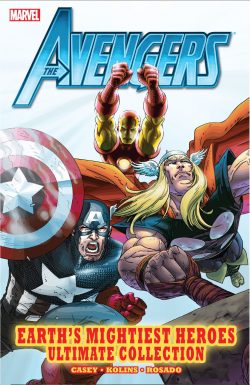
The Avengers: Earth’s Mightiest Heroes Ultimate Collection


By Joe Casey, Scott Kolins, Will Rosado, Tom Palmer & various (Marvel)
ISBN: 978-0-7851-5937-7 (TPB/Digital edition)

Time for another 60th Anniversary shout out…

One of the most momentous events in Marvel Comics history occurred in 1963 when a disparate array of individual heroes banded together to stop apparently marauding monster The Incredible Hulk.

The Avengers combined most of the company’s fledgling superhero line in one bright, shiny and highly commercial package. Over decades the roster has continually changed until now almost every character in their universe has at some time numbered amongst the team’s colourful ranks…

For Marvel’s transformational rebirth in the early 1960’s, Stan Lee & Jack Kirby took their lead from a small but growing band of costumed characters debuting or reimagined and revived at the Distinguished Competition. Julie Schwartz’ retooling of DC’s Golden Age stars had paid big dividends for the industry leader, and as the decade turned Managing Editor Lee’s boss (uncle/publisher Martin Goodman) insisted his company should go where the money was.

Although National/DC achieved incredible success with revised and updated versions of the company’s old stable, the natural gambit of trying the same revivification process on characters who had dominated Timely/Atlas in those halcyon days didn’t go quite so well.

The Justice League of America-inspired Fantastic Four indeed featured a new Human Torch, but his subsequent solo series began to founder almost as soon as Kirby stopped drawing it. Sub-Mariner was soon returned too, but as a deadly vengeful villain, as yet incapable of carrying his own title…

So a procession of new costumed heroes was created, with Lee, Kirby and Steve Ditko focussing on all-original inventive and inspired “super-characters”…

Not all caught on: The Hulk folded after six issues and even Spider-Man would have failed if writer/editor Lee hadn’t really, really pushed Uncle Martin…

After nearly 18 months, during which the fledgling House of Ideas churned out a small stable of leading men (but only two sidekick women), Lee & Kirby finally had enough players to stock an all-star ensemble – the precise format which had made the JLA a commercial winner – and thus swiftly assembled a handful of them into a force for justice and higher sales…

Cover-dated September 1963, The Avengers #1 launched as part of an expansion package which also included Sgt. Fury and his Howling Commandos and The X-Men, and, despite a few rocky patches, the series grew into one of the company’s perennial best sellers.

The early Avengers yarns became a cornerstone of the company’s crucially interlinked continuity. As decades passed they were frequently revisited and re-examined, and in 2005 Joe Casey and artist Scott Kolins (with colourists Morry Hollowell & Will Quintana) took the occasional exercises in creativity a little further: offering an 8-issue modernising miniseries adding devious – some would say cynically calculating – back-writing to the original stories. The epic was packed with post-modern in-filling for a more mature readership, exposing secrets and revealing how the team actually came to hold its prominent and predominant position in the Marvel Universe…

Avengers: Earth’s Mightiest Heroes #1-8 ran fortnightly from January to April 2005 and was successful enough to warrant a second season. Avengers: Earth’s Mightiest Heroes II #1-8 repeated the gambit from January to May 2007, and with both epics gathered in this splendid, no-nonsense compilation.

Chronologically set between Avengers #1 and 2, the drama begins as industrialist Tony Stark reviews media coverage of the coalition of mystery men currently residing in his family’s townhouse. He ponders how best to keep such diverse and headstrong personalities as Ant Man, The Wasp, Thor and the Hulk together. Across town in a seedy bar, young troublemaker and pool-hustler Clint Barton can’t understand why folks are so nervous about the “masked freaks”…

Two weeks later, the team has fallen apart and the Avengers are actually hunting their gamma-fuelled former colleague. In the course of calamitous events they unexpectedly recover a legendary form from a coffin of ice floating in sea…

The gradually assimilation of partially amnesiac WWII legend Captain America into a terrifying and seemingly mad new era is not without problems, and the iconic, grimly experienced warrior is soon keenly aware of seething tensions besetting the team he has joined.

Iron Man still fervently pursues an exalted Federal status for the Avengers, but the Army are baulking: clearly set on putting the wilfully independent powerhouses under military jurisdiction. After a ferocious clash with Lava Men from Earth’s deep interior, word finally comes. The powers that be have created an all-encompassing “Avengers Priority Security Status” – but only for as long as the fickle public’s new darling and National Treasure Captain America stays with them…

Self-made scientific genius Hank Pym created the roles of Ant Man and the Wasp (AKA debutante girlfriend Janet Van Dyne) but his inherent and growing mental instability has caused him to push further and harder ever since he joined the ranks of a group that includes a patriotic living legend, an infallible metal juggernaut and an apparent god.

Now operating as Giant Man he is letting feelings of inadequacy drive a wedge between him and his lover, even as the Army ups the pressure to take over the team. Meanwhile, modern-day Rip Van Winkle Steve Rogers increasingly sinks into survivor’s guilt over the comrades he failed to save in the war. That internalised torment kicks into overdrive when Nazi war criminal and archfoe Baron Zemo comes out of hiding to attack the Avenger through his Masters of Evil

When an invader out of time strikes, the Avengers finally and very publicly prove their worth to the nation and its government, and with Kang the Conqueror sent packing, the team at last secures favoured-but-fully-independent security clearance.

…And in the streets, a wanted vigilante dubbed Hawkeye saves Avengers butler Edwin Jarvis from muggers and they strike up a most irregular friendship…

Missions come thick and fast but the internal tensions never seem to dissipate. In far distant Balkan Transia fugitive mutants Wanda and Pietro desperately search for a place where they can feel safe, whilst in America Cap is increasingly fixated on tracking down Zemo.

After a battle with crime syndicate leader Count Nefaria leaves the Wasp near death, Giant Man also edges closer to a complete breakdown. With a surgeon battling to save her, Pym swears he’s going to quit and take her away from all the madness. Before that can happen, Zemo returns, abducting the Sentinel of Liberty’s teenaged friend Rick Jones

In response, the team acrimoniously divides, with Cap trailing the monomaniac to Bolivia whilst the majority of Avengers remain for a final battle against the Masters of Evil. Meanwhile below stairs, Jarvis and Clint are concocting a sneaky scheme of their own…

As the death-duel in Bolivia concludes, in Germany two restless young mutants orchestrate their return to America and – with some collusion from Jarvis – Hawkeye “auditions” for Earth’s Mightiest Heroes…

As Cap and Rick wearily and so slowly make their way back to civilisation, Iron Man deals with Government fallout after learning that their Red, White and Blue poster boy is missing. Soon news leaks out that the rest of the team are quitting and that Stark has lined up a wanted vigilante and two outlaw mutants to replace them…

The initial secret history lesson concludes with astounded Captain America’s re-emergence and reluctant accession to leadership: riding herd on a team of obnoxious, arrogant young felons he is expected to mould into true champions…

The rest is history…

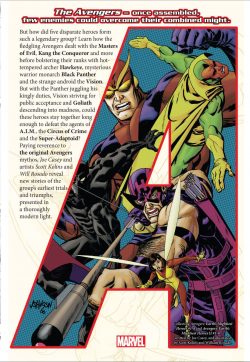
The second bite of the cherry (by Casey, Will Rosado, Tom Palmer & Quintana) focuses on a later time when the Avengers are in resurgent form. The Founders have all returned at a time when Pym (now calling himself Goliath), The Wasp and Hawkeye are joined by enigmatic African monarch The Black Panther. The action commences immediately following the expanded team’s being attacked by an android called The Vision – whom they promptly signed up (in Avengers #58, if you’re keeping count). Apparently the density-shifting “synthezoid” was created by robotic nemesis Ultron – a murderous AI created by Pym whilst suffering one of his frequent psychotic breaks – before switching allegiances…

We open as the highly-suspect new Avenger is impounded by S.H.I.E.L.D. for investigation and clearance. Their ostensible reason is that another autonomous murder mechanism – Super-Adaptoid – has escaped from custody and humanity can’t be too careful…

In the Philippines, the real cause of all the anti-technology tension and overweening suspicion are busy. Science terrorists Advanced Idea Mechanics have secretly stolen the Adaptoid and are seeing how they can improve an already ultimate killing machine…

At a clandestine S.H.I.E.L.D. base, interrogator Jasper Sitwell has met his match in The Vision, but perseveres in trying to dig out dirt on the android and its “master” Ultron. The Panther meanwhile has foregone his status as a VIP dignitary to teach at an inner city school under the alias Luke Charles. What he finds there is a true education…

Hawkeye too is under pressure as his lover The Black Widow reveals she’s going back into the spy-game. With Pym close to apoplexy at the government’s quasi-legal rendition of the Vision, nobody is in a particularly good mood when S.H.I.E.L.D.  supremo Nick Fury (the white one who fought in WWII) demands the team head to the Philippines to investigate A.I.M.’s latest enterprise.

With Fury’s carrot-&-stick pep talk ringing in their ears the heroes – rejoined by the just released Vision – jet away, unaware that in Manhattan an assassination plot against King T’Challa/Mr. Charles has brought one of Panther’s greatest enemies to America…

The heroes are challenged over the Pacific skies by a mass-produced army of Super-Adaptoids and are soon engaged in the fight of their lives…

Overwhelmed, they are in danger of being swamped before Goliath valiantly turns himself into as colossal human rampart to stem the tide and save the endangered island population whilst his comrades rush to destroy A.I.M.’s superbase…

Left all alone, Pym fights in maddened frenzy and becomes increasingly obsessed with how human the things he is incessantly slaughtering seem to be. By the time the triumphant team get Goliath home, he is a deeply traumatised shell of a man…

Luke Charles returns to school in time to be deeply embroiled in a bullying case that will inevitably end in gunplay and tragedy. And then the apparently recuperating Hank Pym goes missing…

Soon after, a new, excessively brutal hero named Yellowjacket is making news even as Agent Sitwell again targets the Vision for further debriefing: specifically, Pym’s “massacre” of mechanical lifeforms on A.I.M. Island. This time he’s brought in S.H.I.E.L.D.’s top psychologist Agent Carver to try and get under the subject’s artificial skin…

The spies are in heated argument with Hawkeye when Yellowjacket breaks in, claiming to have murdered the Man of Many Sizes and demanding to take Goliath’s place on the team…

Nobody is fooled. Everyone recognises the abrasive stranger as Pym gone far off the deep end, but Carver prevents them from saying anything. She advises that he is clearly inches from being utterly incurable and devises a treatment to cure him which basically comprises “play along and don’t do anything to upset the crazy man”…

That even includes allowing Yellowjacket to kidnap the Wasp and agreeing to let him marry his hostage…

The wedding is held at Avengers Mansion and includes a Who’s Who of heroes along for the ride (The Fantastic Four, X-Men, Spider-Man, The Black Knight and Doctor Strange) but the scheme spirals out of control when The Circus of Crime – not privy to the details of the service – use the gathering as an opportunity to kill all America’s costumed champions in one go…

With Hawkeye and the blushing bride hostages and the first to be despatched, the deadly dilemma shocks Pym back to his rightest senses, but in the aftermath many S.H.I.E.L.D. agents are butchered as Wakandan assassin Death Tiger gets ever closer to fulfilling his own mission of murder…

To cap off all the chaos, the still-at-large Super-Adaptoid also attacks, determined to expunge “race-traitor” The Vision who has perpetrated the ultimate betrayal by siding with inferior humanity and denying the innate superiority and inevitable ascension of mechanical and artificial lifeforms…

Politically savvy, wryly trenchant and compellingly action-packed, this extremely impressive Fights ‘n’ Tights chronicle is a superb addition/codicil to the annals of The Avengers and would serve as perfect comics vehicle for movie fans in search of a print-fix for their costumed crusader cravings…
© 2021 MARVEL.

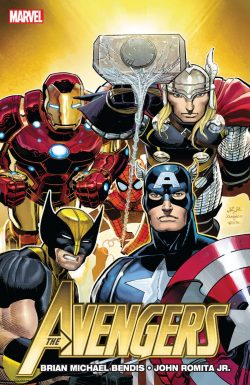
Avengers by Brian Michael Bendis volume 1


By Brian Michael Bendis, John Romita Jr., Klaus Janson, Tom Palmer& various (MARVEL)
ISBN: 978-0-7851-4500-4 (HB/Digital Edition) 978-0-7851-4501-1 (TPB/ Digital Edition)

Probably Marvel’s biggest global franchising success, The Avengers celebrate their 60th anniversary in September 2023, so let’s again acknowledge and anticipate that landmark event with another glorious past triumph…

Once upon a time Norman Osborn was America’s Security Czar: an untouchable “top-cop” in sole charge of a beleaguered nation’s defence and freedom, especially in regard to the USA’s costumed and metahuman community.

When the former-but-still-deranged Green Goblin at last but inevitably overplayed his hand, a coalition of outlawed champions united to defeat him, and his fall from grace was staggering and total.

The chaos and carnage led to a new Age of Heroes, and as part of that resurgence, original Captain America Steve Rogers was appointed Supreme Commander of US metahuman resources. He promptly set about redefining the what, who and how of the World’s Mightiest Heroes which launched a flotilla of new teams and titles, with Avengers volume 4 being the official spine of the comic book franchise.

Available in a number of formats, this initial collection gathers issues #1-6 as written by Brian Michael Bendis and illustrated by John Romita Jr. with inkers Klaus Janson & Tom Palmer colourist Dean White and letterer (VC’s) Cory Petit adding to the spectacle and wonderment. The book spans cover-dates July to December 2010) and opens with a peek at a terrifying future before skipping back to Now where a triumphant, reunited army of heroes is trying to democratically decide just who goes where and does what…

Those deliberations are rudely interrupted in ‘Next Avengers Part One’ when time-tyrant Kang the Conqueror beams in with a frantic warning. He barely opens his mouth before he’s blasted across the city by the wary, twice-shy heroes, but as they converge to press their attack the Conqueror stops all hostilities by brandishing an ultimate weapon.

Iron Man Tony Stark prevents his comrades from finishing off Kang as he recognises the Dark Matter Accelerator. It’s something he thought up and swore never to build. The only way the future Fuhrer can have it is if Stark made it and gave it to him…

In the cautious ceasefire that follows, Kang explains he’s come to beg the aid of the Avengers. In his current future he is one of a team that includes the children of the Avengers, united to stop life-loathing Artificial Intelligence Ultron from exterminating humanity.

They have at last succeeded in destroying the mechanoid marauder but the children are now an even greater menace. Moreover, Kang’s attempts to stop them have resulted in time itself shredding… and all of reality is now collapsing…

The arrogant time-terrorist expects the Avengers to stop their errant offspring, but as Rogers heads off all debate to arbitrarily assemble teams, back in the future Kang and his hidden allies make preparations to carry out their true scheme…

Not every past Avenger is keen to answer the call to reassemble. Simon Williams has come to believe the team has done more harm than good and threatens to stop them if they start up again. ‘Wonder Man Attacks?!!’ sees him make good on his warning whilst a small squad locate Kree outcast Noh-Varr The Protector to request his expertise in time travel.

As the alien and Stark’s efforts finally bear fruit, Wonder Man brutally engages the entire team. In the resultant blockbusting battle, something goes terribly wrong, and an alternate Apocalypse and his horrendous Horsemen materialise, intent on ending mankind.

As the embattled titans swiftly mobilise to tackle the next crisis, a ‘Menace from Beyond Time’ manifests as various time-streams and realities begin to coalesce and overlap in New York City. With All of Everything endangered, a unit of heroes heads into the unhappy future leaving their harried comrades to hold back a tidal wave of time-tossed menaces – and the occasional misplaced hero such as Killraven and Devil Dinosaur

Far away from now, Iron Man, Wolverine, replacement Captain America James “Bucky” Barnes and Noh-Varr witness first-hand the cataclysmic war against Ultron before being ambushed by the next generation in ‘Only the Good Die Young’.

Back in their home era, a multitude of past menaces – from cavemen to cowboys to cosmic devourer Galactus – are keeping the majority of Avengers busy, whilst in the foredoomed tomorrow the questing quartet are painfully discovering they’ve been played by Kang yet again…

Full explanations are promised by an incredibly aged Tony Stark and the architect of the chronal rescue plan: Bruce Banner in his gamma-charged arch-villain persona of ‘The Maestro’

With two Starks, an incredibly sagacious and experienced Banner and new element Noh-Varr all intent on fixing the problem, the sorry story soon comes out. All of creation’s future is stuck in a temporal loop: a cosmic “Groundhog Day” with Kang interminably trapped battling Ultron. Now, with the odds altered by the historical Avengers, there’s a real chance to make things right in one final ‘Battle for the Future’

Tragically, as Thor’s clash with Galactus escalates and the assembled Avengers resolutely resist Apocalypse and his minions in the now, there may not be a past to return to…

Layers of murderous duplicity are peeled back in ‘Next Avengers Part 6: Conclusion’ as a cunning solution to the Ultron-Kang impasse is conceived. However, even as reality reasserts itself and four weary heroes return home, old man Stark takes the risky chance of giving his younger self a deadly device and a portentous warning from the future…

Epic in scale, vast in scope and overflowing with action, this a magnificently rendered tale that might bewilder new readers looking for a post-movie fix, but will delight dyed-in-the-wool Fights ‘n’ Tights fanatics. It comes with a gallery of covers-&-variants by Romita Jr., Janson & Dean White, John Romita Sr., Greg Land & Morry Hollowell, Jim Cheung & Justin Ponsor, Alan Aldridge, Phil Jimenez & D’Armata, plus a massive combined variant cover by Marko Djurdjevic.
© 2018 MARVEL.

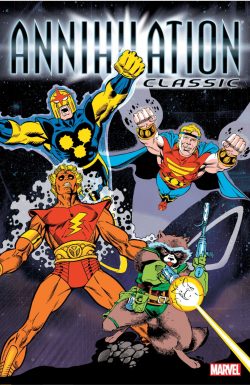
Annihilation Classic


By Todd Dezago, Stan Lee, Larry Lieber, Marv Wolfman, Mark Gruenwald, Bill Mantlo, Doug Moench, Scott Edelman, Roy Thomas, Pat Broderick, Fred Hembeck, Derec Aucoin, Jack Kirby, John Buscema, Paul Ryan, Mike Mignola, Tom Sutton, Mike Zeck, Gil Kane & various (MARVEL)
ISBN: 978-0-7851-3410-7 (TPB/Digital edition)

With the third Guardians of the Galaxy movie set to open on May 5th, here’s a brief reminder of what comics did to inspire the phenomenon: still a grand example of cosmic hero wonderment…

Annihilation was another of those company-wide publishing events that “Changed the Marvel Universe Forever” (and don’t they all?). which ran for most of 2006, involving most of the House of Ideas’ outer space outposts and cosmic characters. Among the stalwarts in play were Silver Surfer, Galactus, Firelord, Moondragon, Quasar, Star-Lord, Thanos, Super-Skrull, Gamora, Ronan the Accuser, Nova, Drax the Destroyer, The Watchers and a host of alien civilisations such as the Kree, Skrulls, Xandarians, Shi’ar, et al, all falling before an invasion of rapacious Negative Zone bugs and beasties unleashed by the insectoid horror Annihilus.

If you’re new to the Marvel universe and that bewildering list of daunting data didn’t leave you screaming in frustration, then please read on…

As is usual in these public herd-thinnings, a number of good guys and bad died and had their trademark assumed by newer, glitzier models whilst some moribund careers got a successful and overdue shot in the arm…

The event spawned a number of specials, miniseries and new titles (subsequently collected as three volumes plus this Annihilation Classic compilation reprinting key and origin appearances of some major players) and led to follow-up event Annihilation: Conquest. Of particular interest to fun-loving screen-watchers might be early appearances of Galaxy Guardians Rocket Raccoon, Groot, Starlord and Adam Warlock

This sharp selection comprises of and contains pertinent material from Bug #1, (March 1997), Tales to Astonish #13, (December 1960), Nova #1, (September 1976), Quasar #1 (October 1989), Rocket Raccoon #1-4 (May-August 1995) ,Marvel Spotlight #6 (May 1980), Logan’s Run #6 (June 1977) and Marvel Premiere #1 (April 1972) and opens with the frenetic and light-hearted solo outing for Galactic Warrior Bug (originally a cheeky stalwart from the 1970’s toy-license phenomenon Micronauts)…

In ‘Apples and Oranges’ by Tod Dezago, Derec Aucoin, Rich Farber & Ralph Cabrera, the insectivorid from the Microverse accidentally clashes with all-consuming cosmic menace Annihilus and gets stuck in a time/space warp.

Bounced around the history of the Marvel Universe, the warring weirdoes reveal their unheralded contributions to the origin stories of a number of the company’s greatest stars before Bug finally triumphs…

With accompanying pinup by Pat Broderick and hilarious game pages by Fred Hembeck including ‘Bug’s Brain-Tik-lers’, ‘The Help Bug Right the Time/Space Continuum Board Game’, ‘What’s Wrong with This Picture?’ and ‘Bug’s Catch-All Activity Page’, this is a splendidly engaging and irreverent treat, followed by an absolute classic of the gloriously whacky “Kirby Kritter” genre as a humble biologist saved earth from a rapacious walking tree in ‘I Challenged Groot! The Monster from Planet X!’ (Tales to Astonish #13 by Stan Lee/Larry Lieber, Jack Kirby & Dick Ayers).

Next to grab the spotlight is The Man Called Nova who was in fact a boy named Richard Rider. A working-class nebbish in the tradition of Peter Parker – except he was good at sports and bad at learning – Rich attended Harry S. Truman High School, where his strict dad was the principal. His mom worked as a police dispatcher and he had a younger brother, Robert, who was a bit of a genius. Other superficial differences to the Spider-Man canon included girlfriend Ginger and best friends Bernie and Caps, but Rich did have his own school bully, Mike Burley…

An earlier version, “Black Nova” had apparently appeared in the author Marv Wolfman’s fan-mag Super Adventures in 1966 (produced with fellow writer Len Wein), but following a few revisions and artistic make-over by the legendary John Romita (Senior) the Human Rocket launched into the Marvel Universe in his own title, beginning in September 1976, ably supported by the illustration A-Team of John Buscema & Joe Sinnott.

‘Nova’ – borrowing heavily from DC’s Silver Age Green Lantern franchise as well as Spider-Man’s origin – is structured like a classic 4-chapter Lee/Kirby early Fantastic Four fable, and rapidly introduced its large cast before quickly zipping to the life-changing moment in Rider’s life when a star-ship with a dying alien aboard transferred to the lad all the mighty powers of an extraterrestrial peacekeeper and warrior.

Rhomann Dey tracked a deadly marauder to Earth. Zorr had already destroyed the idyllic world of Xandar, but the severely wounded vengeance-seeking Nova Prime was too near death and could not avenge the genocide. Trusting to fate, Dey beams his powers and abilities towards the planet below where Rider is struck by the energy bolt and plunged into a coma. On awakening the teen realises he has gained awesome powers …and the responsibilities of the last Nova Centurion…

Wendell Vaughn debuted in 1977 as S.H.I.E.L.D. super-agent Marvel Boy (Captain America #217), graduating and rebranding as Quasar during a stint as security chief of Project Pegasus during the early 1980s. He finally got an origin with his own title Quasar #1 (cover-dated October 1989).

He learned ‘The Price of Power!’ courtesy of Mark Gruenwald, Paul Ryan & Danny Bulanadi in a rousing romp wherein he washes out of agent training for lack of a killer instinct. Whilst acting in a security detail, Wendell dons alien quantum wrist-bands to stop them being stolen by AIM, even though they had vaporised every S.H.I.E.L.D. operative who had test-piloted them.

As well as not dying, he gained incredible quantum light powers and began a brief but glorious career as an Avenger and Protector of the Universe…

Rocket Raccoon was a minor character who appeared in brief backup sci fi serial ‘The Sword in the Star’ (specifically in Marvel Preview #7 in 1976). He won a larger role in Incredible Hulk #271 (May 1982), and like Wolverine years before, refused to go away quietly.

Reprinted here in its entirety is the 4-issue Rocket Raccoon miniseries (May to August 1985, as crafted by Bill Mantlo, Mike Mignola, Al Gordon & Al Milgrom): a bizarre, baroque sci-fi fantasy blending the edgy charm of Pogo with the biting social satire of One Flew Over the Cuckoo’s Nest, all whilst ostensibly describing a battle between Good and Evil in a sector of space completely crazy even by comicbook standards.

Rocket was one of many talking animals populating the impenetrable, inescapable Keystone Quadrant; a Ranger in charge of keeping the peace as robots and anamorphic beasties went about their holy, ordained task of caring for the distinctly odd and carefree humans known as The Loonies on their idyllic, sybaritic planet Halfworld.

However when a brutal shooting war between voracious apex toymakers Judson Jakes and Lord Dyvyne led to Rocket’s girlfriend Lylla Otter being kidnapped, the planet went wild, or more accurately… Animal Crackers’

In rescuing her, Rocket and his faithful deputy Wal Rus had to contend with a murderous army of mechanised Killer Clowns, face an horrific, all-consuming bio-weapon at ‘The Masque of the Red Breath’ and even team up with arch-foe and disreputable mercenary bunny Blackjack O’Hare before uncovering the horrendous truth behind the mad society he so tirelessly defended in ‘The Book of Revelations!’

The final chapter then shook everything up as ‘The Age of Enlightenment’ saw the end of The Loonies, allowing Rocket and his surviving companions to escape the confines of the eternally segregated Keystone Quadrant into the greater universe beyond…

Starlord (without the hyphen) premiered in 1976, headlining monochrome mature-reader magazine Marvel Preview # 4. He appeared thrice more – in #11, 14 and 15 – during the height of a Star Wars inspired Science Fiction boom.

Years previously, the warrior prince of an interstellar empire was shot down over Colorado and had a fling with solitary Earther Meredith Quill. Despite a desire to remain in idyllic isolation, duty called her starman back to battle and he left, leaving behind an unborn son and a unique weapon. A decade later, the troubled boy saw his mother assassinated by alien lizard men.

Peter Jason Quill vengefully slew the creatures with Meredith’s shotgun, before his home was explosively destroyed by a flying saucer.

The newly-minted orphan awoke in hospital, his only possession a “toy” ray-gun his mother had hidden from him his entire life. Years later his destiny found him, as the half-breed scion was elevated by the divinity dubbed the “Master of the Sun”, becoming StarLord. Rejecting both Earth and his missing father, Peter chose freedom, the pursuit of justice and the expanse of the cosmos…

Here, from Marvel Spotlight volume 2 #6, Doug Moench & Tom Sutton revisit and clarify that origin as the pacifistic Quill and his sentient starship return to Sol and discover the truth about his nativity and ascension as well as the true nature of The Master of the Sun…

Logan’s Run was a short-lived licensed property tie-in, and #6 incongruously featured a 5-page short starring mad Titan Thanos in battle against his precision-crafted nemesis Drax the Destroyer: a typically inconclusive, explosively violent out-world clash over ‘The Final Flower’ crafted by Scott Edelman & Mike Zeck.

This star-studded compilation then concludes with an allegorical masterpiece by Roy Thomas, Gil Kane & Dan Adkins from Marvel Premiere #1. During a time of tremendous social upheaval Thomas transubstantiated an old Lee/Kirby Fantastic Four throwaway foe into a potent political and religious metaphor. Debuting as a dreaded mystery menace, the character dubbed Him was re-imagined as a contemporary interpretation of the Christ myth and placed on a world far more like our own than the Earth of Marvel’s superhero-stuffed universe.

‘And Men Shall Call Him… Warlock!’ adroitly recapitulates the artificial man’s origins as a lab experiment concocted by rogue geneticists eager to create a superman they could control for conquest. After facing the FF, Him subsequently escaped to the stars and later initiated a naive clash with Thor over the rights to a mate before returning to his all-encompassing cocoon to evolve a little bit more.

Now that stellar shell is picked up by the moon-sized ship of self-created god The High Evolutionary who is obsessed with a bold new experiment. Our hand-made hero observes as the savant creates a duplicate Earth on the far side of the sun, fast-forwarding through billions of years of evolution in mere hours. The man-god’s intent is to create a civilisation without aggression or rancour, but the Evolutionary collapses from exhaustion just as proto-hominid becomes Homo Sapien and his greatest mistake takes instant advantage of his exhaustion to meddle with fate…

Years previously Man-Beast had been hyper-evolved from a wolf and instantly became his creator’s nemesis. Now he and his equally-debased minions invade the ship and interfere with the experiment: reintroducing evil to the perfect creatures below and, in fact, making them just like us. At incredible speed Earth’s history re-ran with the creature in the cocoon afforded a ring-side seat to humanity’s fall from grace…

When the High Evolutionary awakes to fight Man-Beast’s army, Him explodes from his shell to help rout the demons, who flee to despoiled Counter-Earth. With calm restored, the science-god prepares to sterilise his ruined experiment: a world now indistinguishable from our own. No superheroes; disease and poverty rampant; injustice in ascendance and moments away from nuclear Armageddon… but the cosmic newborn begs him not to.

He claims the evil tide can be turned and pleads for the Evolutionary to stay his hand. The grieving, despondent creator agreed… but only until the rechristened Adam Warlock should admit that humanity is beyond redemption…

This ends a magnificent compendium of genuine magical Marvel moments: an eclectic but hugely entertaining procession of thrills, spectacle and laughs no comic fan or interested neophyte could possibly resist. And when you’ve read all this, you’ll be properly primed for some wide screen wonders too…
© 2020 MARVEL.

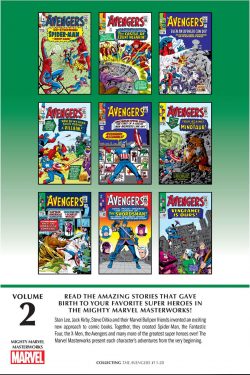
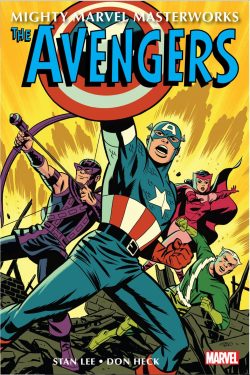
Mighty Marvel Masterworks The Avengers volume 2: The Old Order Changeth


By Stan Lee, Larry Lieber, Larry Ivie, Don Heck, Jack Kirby, Dick Ayers, Chic Stone, Mike Esposito, Wallace Wood & various (MARVEL)
ISBN: 978-1-3029-4613-5 (PB/Digital edition)

Probably Marvel’s biggest global franchise success, The Avengers celebrate their 60th anniversary in 2023, so let’s again acknowledge that landmark event and offer a promise of more of the same…

These stories are timeless and have been gathered many times before but here we’re enjoying an example of The Mighty Marvel Masterworks line: designed with economy in mind and newcomers as target audience. These books are far cheaper, on lower quality paper and smaller – like a paperback novel. Your eyesight might be failing and your hands too big and shaky, but at 152 x 227mm, they’re perfect for kids. If you opt for the digital editions, that’s no issue at all.

After a period of meteoric expansion, in 1963 the burgeoning Marvel Universe was finally ready to emulate the successful DC concept that had cemented the legitimacy of the Silver Age of American comics. The notion of putting a bunch of all-star eggs in one basket had made the Justice League of America a winner and subsequently inspired the moribund Atlas outfit – primarily Stan Lee, Jack Kirby & Steve Ditko – into conceiving “super-characters” of their own. The result – way back in 1961 – was the Fantastic Four

After 18 months, the fledgling House of Ideas had generated a small successful stable of costumed leading men (but still only 2 sidekick women!), allowing Lee & Kirby to at last assemble a select handful of them into an all-star squad, moulded into a force for justice and soaring sales…

Cover dated September 1963, and on sale from Early July, The Avengers #1 launched as part of an expansion package which also included Sgt. Fury and his Howling Commandos and The X-Men. This sequel edition collects The Avengers #11-20 (cover-dates December 1964 to September 1965): a stellar sequence of groundbreaking tales no lover of superhero stories can do without…

The tense action resumes with the team supreme of Iron Man, Thor, Captain America, Ant-Man & the Wasp still together after numerous attempts to destroy them or shatter their unity. An eagerly anticipated meeting delighted fans when #11 declared ‘The Mighty Avengers Meet Spider-Man!’: a clever and classy cross-fertilising tale from Lee and Don Heck, inked by Chic Stone. It features the return of the time-bending tyrant Kang the Conqueror, who attempts to destroy the team by insinuating a robotic duplicate of the outcast arachnid within their serried ranks. It’s accompanied by Heck’s Marvel Master Work Pin-up of ‘Kang!’ and preceded a cracking end-of-the-world thriller with guest-villains Mole Man and the Red Ghost, doing their very best to avoid another clash with the Fantastic Four.

This was another potent Marvel innovation, as – according to established funnybook rules – bad guys stuck to their own nemeses and didn’t clash outside their own backyards…

Inked by Dick Ayers, ‘This Hostage Earth!’ is a welcome return to grand adventure with lesser lights Giant-Man and the Wasp taking rare lead roles, but is trumped by a rousing gangster thriller of a sort seldom seen outside the pages of Spider-Man or Daredevil. The saga premiered Marvel universe Mafia analogue The Maggia and another major menace in #13’s ‘The Castle of Count Nefaria!’

After crushingly failing in his scheme to frame the Avengers, Nefaria’s caper ends on a tragic cliffhanger as Janet Van Dyne is left gunshot and dying, leading to a peak in melodramatic tension in #14 – scripted by Larry Ivie (as Paul Laiken) & Larry Lieber over Stan’s plot – as the traumatised team scour the globe for the only surgeon who can save her.

‘Even Avengers Can Die!’ – although of course she doesn’t – resolves into an epic alien invasion tale with overtones of This Island Earth, with Kirby stepping in to lay out the saga for Heck & Stone to illustrate. This only whets the appetite for the classic climactic confrontation that follows one month later as the costumed champions finally deal with the Masters of Evil and Captain America at last avenges the death of his dead partner Bucky.

‘Now, by My Hand, Shall Die a Villain!’ in #15 (laid-out by Kirby, pencilled by Heck and inked by Mike Esposito) features the final, fatal confrontation between Cap and Baron Zemo in the heart of the Amazon, whilst the other Avengers and the war-criminal’s cohort of masked menaces (Enchantress, Executioner, Black Knight and The Melter) battle once more on the streets of New York City…

It all ends as ‘The Old Order Changeth!’ (broken down by Kirby before being finished by Ayers) presages a dramatic change in concept for the series; presumably because, as Lee increasingly wrote to the company’s unique strengths – tight continuity and strongly individualistic characterisation – he found juggling individual stars in their own titles as well as a combined team episode every month was just incompatible if not impossible…

As Cap and substitute sidekick Rick Jones fight their way back to civilisation, the Avengers institute changes. The big-name stars retire and are replaced by three erstwhile villains: Hawkeye, Quicksilver and The Scarlet Witch.

Eventually, led by perennial old soldier Captain America, this relatively powerless group with no outside titles to divide the attention (the Sentinel of Liberty did have a regular feature in Tales of Suspense but at that time it featured adventures set during WWII) evolved into another squabbling family of flawed, self-examining neurotics, enduring extended sub-plots and constant action as valiant underdogs; a formula readers of the time could not get enough of and which still works today…

Acting on advice from the departing Iron Man, the neophytes seek to recruit The Hulk to add raw power to the team, only to be ambushed by Mole Man in #17’s ‘Four Against the Minotaur!’ (Lee, Heck & Ayers), after which they fall foul of a dastardly “commie” plot ‘When the Commissar Commands!’ – necessitating a quick trip to thinly-disguised Viet Nam analogue Sin-Cong to unwittingly battle a bombastic android…

These relatively low-key tales are followed by an ever-improving run of mini-masterpieces, the first of which wraps up this compilation with a 2-part gem providing Hawkeye’s origin and introducing a roguish hero/villain.

‘The Coming of the Swordsman!’ introduces a dissolute, disreputable swashbuckler – with just a hint of deeply-buried flawed nobility – who attempts to force his way onto the highly respectable team to avoid outstanding international arrest warrants. His immediate and total rejection leads to him becoming an unwilling pawn of a far greater menace after being kidnapped by A-list would-be world despot The Mandarin.

The conclusion comes in the superb ‘Vengeance is Ours!’ – sublimely inked by the one-&-only Wally Wood – wherein the constantly-bickering Avengers finally pull together as a supernaturally efficient, all-conquering team…

These are immortal tales that defined the early Marvel experience and are still a joy no fan should deny themselves or their kids. How can you survive without them?
© 2022 MARVEL.

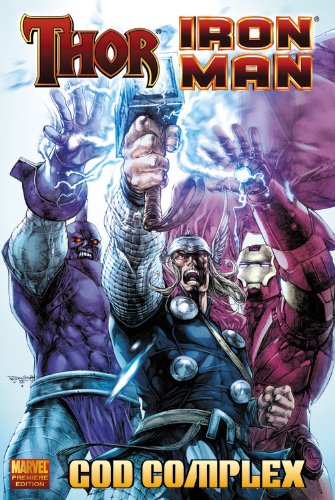
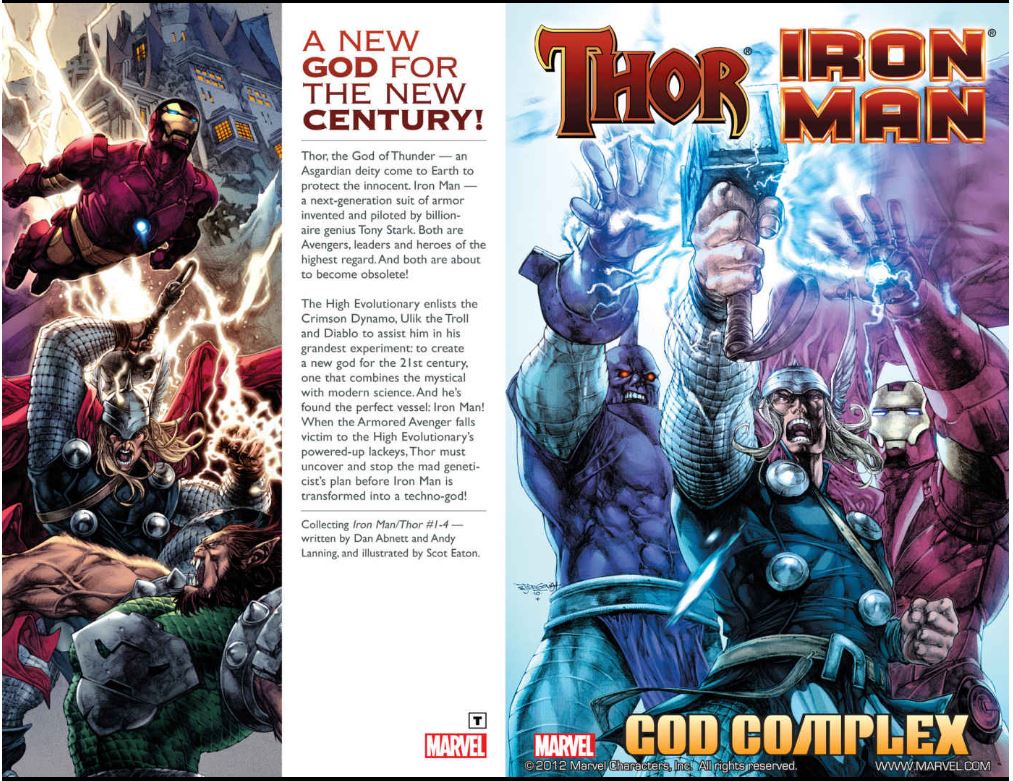
Thor/Iron Man: God Complex (AKA Iron Man/Thor: God Complex


By Dan Abnett, Andy Lanning, Scot Eaton, Jaime Mendoza, Jeff Huet, Lorenzo Ruggiero & Veronica Gandini (Marvel)
ISBN: 978-0-7851-5161-6 (HB), 978-0-7851-5162-3 (TPB/Digital edition)

Two of Marvel’s oldest stars and perennial fan favourites – the Norse God of Thunder and Armoured Avenger – have in their long and chequered careers been the staunchest of allies, fiercely squabbling brothers-in-arms and latterly sworn foes.

In this short, sweet and fabulously straight-shooting traditional team-up, however, past grudges are largely forgotten when old foes return with a formidable new master on a fantastic crusade to forever change the world.

Gathering a bombastic 4-issue miniseries from 2010 entitled Iron Man/Thor: God Complex (but presumably switching ranking name positions due to a movie popularity moment), this modern fable opens with a horrific assault by a brooding brute on mystic miscreant Baron Mordo, resulting in the theft of the evil magician’s mightiest talisman. Simultaneously, the latest ultra-high tech orbital weapons platform of avaricious armaments magnate Moses Magnum is destroyed and its key systems stolen by a mysterious armoured figure…

In Oklahoma the rubble that was once eternal Asgard (for full details see Siege and Siege: Dark Avengers) is being slowly checked and cleared by American emergency teams and latter-day Norse Gods… until the weary responders free a very excitable and ticked-off dragon. Happily, recently reunited Avengers Thor and Iron Man are there to restrain the irked fire-drake until the beast’s owner Volstagg can calm his poor pet down…

With the infernal rampage suppressed, the work is then interrupted by Steve Rogers – former Captain America and current Chief of National Security – who dispatches the Armoured Avenger to Russia to investigate a runaway Particle Accelerator…

It’s a trap and Iron Man is attacked by the latest upgrade of the Crimson Dynamo just as back in Oklahoma, Thor is ambushed by ultimate troll Ulik, tasked with retrieving the formidable, unstoppable Asgardian war-armour dubbed the Destroyer.

Although more than a match for their old enemies, the heroes are surprised and subsequently defeated by hidden adversary Diablo and a former ally: the High Evolutionary.

The latter – an obsessive human geneticist who evolved animals into New Men before turning himself into a cosmic deity – has long dreamed of creating his own gods and now, allied with the malign immortal alchemist, has embarked on his latest experiment: to marry science to sorcery and produce a new supreme being: the one true God of the 21st Century…

For raw material, his willing subordinates have been gathering magical artefacts and the most cutting-edge technological components. The last thing needed was a suitable human Petri-dish and vessel. Brilliant, bold Tony Stark ideally qualifies on all counts…

However, even as the Evolutionary begins Iron Man’s enforced apotheosis, the hero counterattacks, whilst bruised but unbowed Thor and an unlikely ally hunt for the villains who stole the Destroyer, tracking the sinister god-makers to their unlikely lair. The consequent catastrophic clash looks set to end in victory for the heroes when the demonic Diablo turns the Avengers against each other with his mystic potions…

Even as the triumphant High Evolutionary begins the longed-for final transformation, Diablo finally shows his true colours: hijacking the metamorphosis, just as he’d always intended, transcending his merely human villainy to become an omnipotent modern God of Evil…

Unsurprisingly, even with the ambitions of centuries at last fulfilled, Diablo has not reckoned on the unfailing courage and determination of heroes or the anger of a master of science frustrated and betrayed…

Splendidly spectacular and visually stunning, this blistering action-epic concludes with one of the best and certainly most literal Deus ex Machina moments ever seen in comics: one to leave lovers of the genre breathless in wonder and appreciation.

This tumultuous tome also includes text features from movie tie-in Thor Spotlight, including ‘Abnett/Lanning on Iron Man/Thor: a DnA Q&A’ conducted by Jess Harold; the comedic ‘Iron Man/Thor: Behind the Scenes’; a look at ‘Classic Thor/Iron Man Team-Ups’ from Dana Perkins and a fabulous sneak-peak at Scot Eaton’s many Design Sketches for Crimson Dynamo, Mordo’s Amulet, Ulik and his upgrades and the all-important Cloaking Circuit…

Impossibly recapturing and even improving upon those hallowed, traditionally clear-cut, uncomplicated cataclysmic cosmic conflicts of yore, scripters Abnett & Lanning, penciller Eaton, inkers Jaime Mendoza, Jeff Huet & Lorenzo Ruggiero and colourist Veronica Gandini all splendidly collaborate here: making God Complex a pure joy that will delight fans and readers old and new.
© 2010, 2011 Marvel Characters, Inc. All rights reserved.

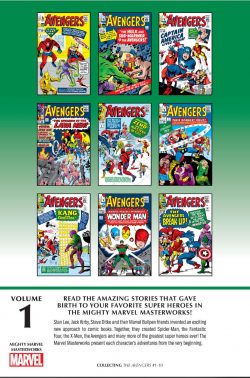
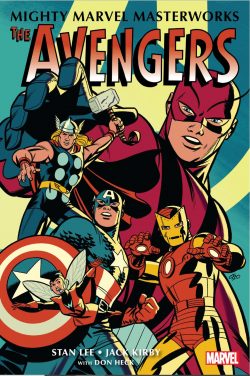
Mighty Marvel Masterworks The Avengers volume 1: The Coming of The Avengers


By Stan Lee & Jack Kirby, Don Heck, Dick Ayers, Paul Reinman, George Roussos, Chic Stone, Sam Rosen, Art Simek & various (MARVEL)
ISBN: 978-1302929787 (TPB/Digital edition)

Probably Marvel’s biggest global franchise success, The Avengers celebrate their 60th anniversary in September 2023, so let’s start the New Year with acknowledgement of that landmark event and a promise of more of the same over the next 12 months…

These stories are timeless and have been gathered many times before but here we’re looking at The Mighty Marvel Masterworks line: designed with economy in mind and newcomers as target audience. These books are far cheaper, on lower quality paper and smaller – about the dimensions of a paperback book. Your eyesight might be failing and your hands too big and shaky, but at 152 x 227mm, they’re perfect for kids. If you opt for the digital editions, that’s no issue at all.

After a period of meteoric expansion, in 1963 the burgeoning Marvel Universe was finally ready to emulate the successful DC concept that had cemented the legitimacy of the Silver Age of American comics. The notion of putting a bunch of all-star eggs in one basket had made the Justice League of America a winner and subsequently inspired the moribund Atlas outfit – primarily Stan Lee, Jack Kirby & Steve Ditko – into conceiving “super-characters” of their own. The result – way back in 1961 – was the Fantastic Four

Nearly 18 months later, the fledgling House of Ideas had generated a small and (mostly) successful stable of costumed leading men (but still only 2 sidekick women!), allowing Lee & Kirby to at last assemble a select handful of them into an all-star squad, moulded into a force for justice and soaring sales…

Seldom has it been done with such style and sheer exuberance. Cover dated September 1963, and on sale from Early July, The Avengers #1 launched as part of an expansion package which also included Sgt. Fury and his Howling Commandos and The X-Men

This premier volume gathers The Avengers #1-10 (running to cover-date September 1965): a stellar sequence of groundbreaking tales no lover of superhero stories can do without…

The tense action kicks off with ‘The Coming of the Avengers! where – rather than starting at a neutral beginning – Stan & Jack (plus inker Dick Ayers) assumed buyers had a passing familiarity with Marvel’s other heroes and wasted very little time or space on introductions.

In Asgard, immortal trickster Loki is imprisoned on a dank isle, hungry for vengeance on his noble half-brother Thor. Whilst malevolently observing Earth, the god of evil espies the monstrous, misunderstood Hulk and mystically engineers a situation wherein the man-brute seemingly goes on a rampage, simply to trick the Thunder God into battling the monster.

When the Hulk’s teen sidekick Rick Jones radios the FF for assistance, Loki scrambles and diverts the transmission, smugly awaiting the blossoming of his mischief. Sadly for the schemer, Iron Man, Ant-Man and the Wasp also pick up the redirected SOS…

Only after the alerted heroes all converge on the American Southwest to search for the Jade Giant, do they realise that something is oddly amiss…

This terse, epic, compelling and wide-ranging yarn (New York, New Mexico, Detroit and Asgard in 22 pages) is Lee & Kirby at their bombastic best, and remains one of the greatest stories of the Silver Age (it’s certainly high in my own top ten Marvel Tales) and is followed by ‘The Space Phantom(Lee, Kirby & Paul Reinman), wherein an alien shape-stealer infiltrates and almost destroys the team from within.

With latent animosities exposed by the malignant masquerader, the epic ends with the volatile Hulk quitting the team in disgust, only to return in #3 as an outright villain in partnership with ‘Sub-Mariner!This globe-trotting romp delivers high-energy thrills and one of the blistering best battle scenes in comics history as the assorted titans clash in abandoned World War II tunnels beneath the Rock of Gibraltar. The tale was preceded hereby the galvanic house ad announcing the clash as seen in Avengers #2…

Inked by George Roussos, Avengers #4 was an indisputable, game-changing landmark as Marvel’s greatest Golden Age sensation returns for another increasingly war-torn era. ‘Captain America joins the Avengers!has everything that made the company’s early output so fresh and vital. The majesty of a legendary warrior returned in our time of greatest need; stark tragedy in the loss of his boon companion Bucky; aliens, gangsters, tragedy-drenched antagonist The Sub-Mariner and even subtle social commentary, all naturally wrapped up in vast amounts of staggering Kirby Action. It even begins with a cunning infomercial as Iron Man unsuccessfully requests the assistance of the company’s other fresh young stars, giving readers a taste of the other mighty Marvels on offer to them…

Reinman returned to ink ‘The Invasion of the Lava Men!: another staggering adventure romp wherein the team – with the unwilling assistance of the ever-incredible Hulk – battle incendiary subterraneans and a world-threatening mutating mountain…

However, even all that pales before the supreme shift in artistic quality that is Avengers #6.

Chic Stone – arguably Kirby’s most effective inker of the period – joined the creative team just as a classic arch-foe was born. ‘The Masters of Evil!reveals how Nazi super-scientist Baron Zemo (who debuted that same month as a Nazi scientist in Sgt. Fury and his Howling Commandos #8) returns from self-exile in South America.

The petty tyrant is forced by his own arrogance and paranoia to emerge from the anonymity of the jungle he’s been skulking in since the Third Reich fell, after learning his despised nemesis Captain America has returned from the dead…

To this end, the war-criminal recruits a gang comprising previously established supervillains to attack New York City and destroy the Avengers. The unforgettable clash between valiant heroes and vile murdering mercenaries Radioactive Man, Black Knight (Nathan Garrett) and The Melter is to this day an unsurpassed example of prime Marvel magic.

Issue #7 followed up with two more malevolent recruits for the Masters of Evil, as Asgardian outcasts Enchantress and The Executioner are exiled to Midgard by Odin and waste no time allying with Zemo. This coincides with Iron Man being suspended from the team, due to “misconduct” occurring in his own series at that time. This was the start of the era of close-continuity where events in one series were regularly referenced and built upon in others. The practise quickly became a rod for the creators’ own backs and led to a radical rethink…

It might have been ‘Their Darkest Hour!, but follow-up Avengers #8 delivered the team’s greatest triumph and tragedy as Kirby (inked with fitting circularity by Ayers) relinquished his full drawing role with a superbly entrancing invasion-from-time thriller. Riffing on The Day the Earth Stood Still, the B-movie-toned classic introduced ‘Kang the Conqueror!: depicting an impossible powerful foe defeated by the cunning of ordinary teenagers and the indomitable spirit of Earth’s Mightiest Heroes…

Whenever Kirby left a title he’d co-created, it took a little while to settle into a new rhythm, and none more so than with these collectivised costumed crusaders. Although Lee and the fabulously utilitarian Don Heck were perfectly capable of producing cracking comics entertainments, they never had The King’s uncanny sense of panoramic scope and scale which constantly sought bigger, bolder blasts of excitement.

The Avengers evolved into an entirely different series when the subtle approachability of Heck’s human-scaled vision replaced Kirby’s larger-than-life bombastic bravura. The series had advanced to monthly circulation and even King Kirby could not draw the massive number of pages his expanding workload demanded.

Heck was a gifted and trusted artist with a formidable record for meeting deadlines and, progressing under his pencil, sub-plots and character interplay finally got as much space as action and spectacle. After Kirby, stories increasingly focused on scene-stealing newcomer Captain America: concentrating on frail human beings in costumes, rather than wild modern gods and technological titans bestriding and shaking the Earth…

Inked by Ayers, Heck’s first outing was memorable tragedy ‘The Coming of the Wonder Man!wherein the Masters of Evil plant superhuman Trojan Horse Simon Williams within the heroes’ ranks, only to have the conflicted infiltrator find deathbed redemption by saving them from the deadly deathtrap he creates…

Another Marvel mainstay debuted with the introduction of (seemingly) malignant master of time Immortus, who briefly combines with Zemo’s devilish cohort to engineer a fatal division in the ranks by removing Cap from the field in ‘The Avengers Break Up!A sign of the Star-Spangled Sentinel’s increasing popularity, the issue is augmented by a Marvel Masterwork Pin-Up of ‘The One and Only Cap, courtesy of Kirby & Ayers, and is followed by a 1963 house ad for Avengers #1 to close this pocket-sized bombshell of wonders.

These are immortal tales that defined the early Marvel experience and are still a joy no fan should deny themselves or their kids. How can you survive without them?
© 2021 MARVEL.