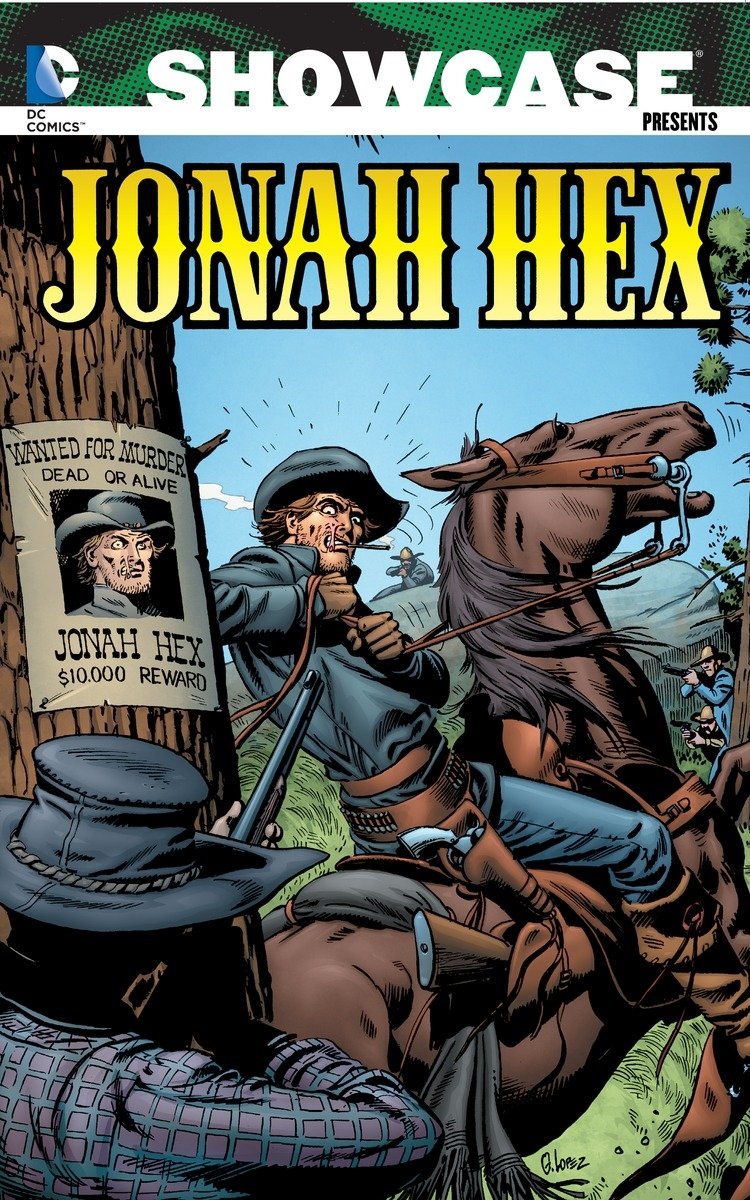
Showcase Presents Jonah Hex volume 2


By Michael Fleisher, David Michelinie, John Albano, Jose-Luis GarcíaLópez, Vicente Alcazar, Ernie Chan, Rich Buckler, Tony DeZuñiga, & various (DC Comics)
ISBN: 978-1-4012-4106-3 (TPB)

The Western is an oddly forgiving genre which can be pragmatically sub-divided into two discrete halves: the sparkly, shiny version that dominated kids’ books, comics and television for nearly a century, best typified by Zane Grey stories and heroes such as Roy Rogers and Gene Autry – and the other stuff…

That sort of cowboy tale is grimy, gritty, excessively dark and nihilistic, and was done best for years by Europeans in such strips as Jean-Michel Charlier’s Lieutenant Blueberry or Bonelli and Galleppini’s Tex Willer before making their way into US culture through the films of Sam Peckinpah and Sergio Leone.

Jonah Hex is the very best of this latter sort.

DC (or National Periodicals as it then as) stocked up a stable (sorry!) of clean-cut gunslingers at the collapse of the superhero genre in 1949, creating such dashing – and highly readable – luminaries as Johnny Thunder, The Trigger Twins, Nighthawk, Matt Savage, Strong Bow and dozens of others in a marketplace that seemed limitless in its voracious hunger for chaps in chaps. All things end, however, and by the early sixties this sagebrush brigade had dwindled to a few venerable properties. The flurry of superheroes increasingly hogged the newsstands during the Silver Age starting as early as 1956, but by the end of the 1960s they were waning again, and thematic changes in the cinematic Cowboy filtered through to a comics industry suffering its second superhero retreat in twenty years…

A critical success, light-hearted Western Bat Lash never secured a solid following, but DC, keen to sustain a genre its dwindling readership could warm to, retrenched and revived an old title, gambling once again on heroes who were no longer simply boy scouts with six-guns.

Cover-dated August/September 1970, All-Star Western (volume 2) #1 launched with Pow-Wow Smith reprints, transforming to an all-new anthology format with its second bi-monthly issue. The title featured many creative big guns, including Robert Kanigher, Neal Adams, Gray Morrow, Al Williamson, Gil Kane, Angelo Torres, and Dick Giordano, working on such strips as Outlaw!, Billy the Kid and cult sleeper-hit El Diablo: combining shoot-’em-up shenanigans with supernatural chills, in unavoidable deference to the real hit genre-type that saved comics in those dark days… supernatural horror.

It wasn’t until the tenth issue and the introduction of a disfigured, irascible and shockingly lethal bounty hunter – created by writer John Albano & Tony DeZuñiga – that the company found its greatest and most enduring Western Warrior…

Jonah Hex is the very model of the modern anti-hero: a coarse, callous, proudly uneducated manhunter. Clad in a battered Confederate Grey tunic and hat with half his face lost to some hideous past injury, he is a brutal thug little better than the scum he hunts – and certainly a man to avoid …or so you’d think on first appearances…

The greatest gunfighter in the world was introduced in ‘Welcome to Paradise’: a powerful thriller with a subtle sting of sentimentality that anyone who has seen the classic western Shane could not fail to appreciate. From the first, Albano constantly hinted at tortured depths hidden behind Hex’s hellishly scarred visage and deadly proficiency…

The comic had been re-titled Weird Western Tales (aligning it with the company’s highly successful horror/mystery line) and subsequent tales of the gunman combined charm, bleak, black comedy and tragedy in equal amounts: a formula that rocketed Hex to the forefront of critical and popular acclaim.

From the very start, the series sought to redress some of the most unpalatable motifs of old style cowboy literature and any fan of films like Soldier Blue and Little Big Man or Dee Brown’s iconoclastic Bury My Heart at Wounded Knee could derive a grim sense of vicarious satisfaction at most of the stories. There was also a huge helping of world-weary cynicism that wasn’t found in other comics until well past the Watergate Scandal, when America as a whole lost its social and political innocence…

Even though Hex was a unique feature from the outset – thanks to the efforts of writers like Albano and Arnold Drake – the series didn’t truly hit its stride until Michael Fleisher (assisted at first by Russell Carley) became lead scripter.

This second superb monochrome tome of Jonah Hex’s grittily unsavoury yet extraordinarily appealing adventures combines his final appearances from Weird Western Tales #34-38 with #1-22 of his own spun-off solo title, collectively ranging from May 1976 to March 1979. As in so many cases, the material here is currently unavailable in modern colour editions, either on paper, or in digital formats, but we can always hope…

In all honesty: the stories may be printed in black-&-white, but here that’s mostly a benefit as the wealth of overseas illustrators employed were masters of line art and their efforts are actually better without the cheap colour used on comics back then.

The previous book revealed how back during the Civil War, whilst fighting for the South, Hex was framed for a massacre at Union prison camp Fort Charlotte. He subsequently became the sole target of a conspiracy led by an aggrieved Southern autocrat Quentin Turnbull. The schemer set a veritable battalion of Confederate veterans and survivors relentlessly on the trail of the man they all considered the worst traitor in the history of the South…

The dark dramas resume with Weird Western Tales #34 (cover-dated May/June 1976) as Michael Fleisher & George Moliterni’s ‘Death of a Bounty Hunter’ reveals the gunslinger being cheated of a bounty by lazy, ruthless rivals who see him as a meal ticket to success. Adding to his irritation, Hex is saddled with a dime novel writer who has paid a lot of money to dog his tracks for “research”. When both annoyances attempt to treacherously exploit Hex, he proves too much for them all…

Next, the wandering gunman fetches up in a law-abiding town with a nasty secret. Even a mercenary like Hex has some scruples, especially when municipal policy involves using a weekly execution of outlaws to boost city coffers. With sideshow attractions and tourist traps thriving, the bounty hunter protests vigorously when an old man he befriended is condemned to be the next cash-cow of a sheriff who is judge, jury and… ‘The Hangman!’ Moreover, Hex’s objections aren’t overruled by legal appeals or commercial considerations…

Fleisher, Bill Draut, Luis Dominguez & Oscar Novelle detail differences between cultures when an old opponent returns in WWT #36. Hired to broker a peace treaty between the Paiute Nation and Washington, Hex is forced to kill someone who doesn’t deserve to die after a cavalry scout’s atrocities almost triggers a bloodbath, leaving the only way to redeem honour through ‘Bigfoot’s Death Song!’

Hex’s well-intentioned efforts to teach a young man to shoot costs him dearly when he learns he’s been fed a devious sob-story and unleashed a crazed killer in #37. Illustrated by Rich Buckler & Frank Springer, Fleisher’s compact, irony-drenched tale leads to a necessary and final course correction in ‘Requiem for a Gunfighter!’

Against all odds and industry norms, Jonah Hex – and western comics – were an increasingly viable proposition for DC at this time. Thus, the bounty hunter closed his account in Weird Western Tales #38 – cover-dated January/February 1977 and on sale at the end of 1976. He was promoted to his own eponymous series while the anthology book began (from #39) the adventures of “white Indian”  Scalphunter.

Hex’s last WWT exploit was an epic, cynically salutary saga as Fleisher partnered with the magnificently gifted José Luis GarcíaLópez, whose art would also grace the first issues of Hex’s new home, augmented and followed by many of the superb overseas draughtsmen who’d been hired to draw DC’s horror stories, but who found an equally comfortable fit producing the baroque yet naturalistic adventures of the grungy gunslinger…

‘Track of the Wolf… Claw of the Bear!’ finds Hex hired in the depths of winter to catch a white wolf that has killed a banker. When the beast and the mountain man who lives with it save Jonah from death, their growing friendship unravels a skein of embezzlement and murder, with Hex’s sheepherder clients provoking tragedy and justifiable vengeance…

Jonah Hex #1 launched with a March/April 1977 cover-date, wherein Fleisher & GarcíaLópez concocted ‘Vengeance for a Fallen Gladiator!’ as the West’s greatest manhunter is hired to find a rich man’s son. The trail leads to a travelling show forcing boys to fight for the delectation of bloodthirsty townsfolk and an unhappy resolution for all involved…

Hex is then forced to infiltrate ‘The Lair of the Parrot’ at the orders of Federal fixer Ned Landon. Flamboyant Mexican bandit El Papagayo is the gunslinger’s supposed target, but after barely escaping with his life, Hex returns to America to discover he’s been framed for the Secret Serviceman’s murder…

Despite having a price on his head, ‘The Fugitive’ still finds time to thwart a vicious land grab for a blind rancher’s home in #3 before more strands of a complex plot are revealed in ‘The Day of the Chameleon!’ as an actor further impersonates Hex: heaping even greater crimes onto the bounty hunter’s ever-escalating-but-unjustified rap-sheet. The plot takes an even more byzantine twist when Hex is briefly sheltered by outcast widow Joanna Mosby, seemingly destroys his evil twin, restores his good name and reels in shock after his most relentless foe reveals who’s behind his current situation…

An expanded reprint of Hex’s debut from All-Star Western #10 follows as Albano, Fleisher, DeZuniga & GarcíaLópez collectively revisit better days in #5’s ‘Welcome to Paradise’, with a new framing sequence detailing how Hex finds brief respite in Paradise Corners after which he’s caught by aging and honest marshal Toby Ruster: another dutiful innocent dragged down and doomed by association.

Despite having cleared his name, the many wanted posters issued mean Hex is still regarded by many as an outlaw. When a storm deposits ‘The Lawman’ and his captive in an isolated town, Hex almost bluffs his way out of trouble until his ornery nature and hatred of criminals ruins his refuge and triggers another frenzied exit in a convoluted yarn by Fleisher, Ernie Chan & Noly Panaligan…

With Hex still on the run, the same creative team uses the next two issues to finally reveal the manhunter’s origins, beginning in #7 as 13-year old Jonah is sold into slavery by his father. Raised a ‘Son of the Apache’, the white boy becomes a mighty young warrior adopted into the tribe with honour, but cannot escape the jealous schemes of his envious native brother Noh-Tante. How that poisonous rivalry ultimately led to Hex’s escape, rehabilitation and eventual disfigurement with ‘The Mark of the Demon’ adds even greater poignancy to his tragedy-struck saga and shows why the manhunter never quits…

Another diversion drags Hex back over the Mexican Border as he’s tricked into working for the government of President Porfirio Diaz. The gunman is required to escort the recovered golden hoard of the former Empress in ‘The Carlota Conspiracy!’ (illustrated by Chan & Danny Bulanadi), but the vast wealth inevitably draws in old enemy El Papagayo and plenty of brand new double-crossing skunks eager to make a killing…

GarcíaLópez returns to limn concluding chapter ‘Violence at Veracruz’ in #10, and with bodies dropping everywhere Hex realises he’s been duped from the start and wearily cuts his losses..

Rich Buckler & Dick Giordano illustrate ‘The Holdout!’ as Joanna returns to redeem herself after Hex is maimed and can no longer hold his guns in a cruel tale of card cheats and vengeance, after which ‘The Search for ‘Gator Hawes’ sees the gunman captured by crazed swamp-dwellers obsessed with their rigged “rassling” games, whilst #13’s ‘The Railroad Blaster’ – by David Michelinie & Alcazar – finds the gunslinger hired to stop a saboteur attacking Union Pacific trains. Sadly, he quickly finds himself once again on the wrong side of a painful moral dilemma…

Michelinie then details the saga of ‘The Sin Killer!’ in #14 as Hex encounters old comrade Jedediah Kane: a first class killer who apparently found peace in The Lord and new passion as a travelling preacher. Unfortunately, due to his family being killed in a crossfire, Kane had merely redirected his efforts and now only killed bounty hunters…

Hiding in plain sight as a trick-shot artist, Hex survives ‘Sawdust and Slow Death’ after uncovering a circus’ true purpose as a wandering band of thieves. Framed for the murder of acrobatic rider Sally Colter, he faces the judgement of the freak show before pulling off his own show-stopping climax…

The extended outlaw saga moves to a conclusion as Fleisher rejoins Alcazar for #16’s ‘The Wyandott Verdict’ which opens with Hex being lynched by masked and hooded men. He is saved by pioneering criminologist Tobias Nostrum and his servant, much to the delight of one cautious observer. The Chameleon has dogged Hex for months, awaiting a moment of perfect revenge and takes his chance when the scientist’s new-fangled forensics lead to a trial that could exonerate the bounty hunter…

Warping the entire affair, the deranged actor almost succeeds in dooming Hex, but wasn’t expecting Quentin Turnbull to overplay his own hand in the conspiracy…

Restored and renewed, Hex refuses a commission to ride a hot air balloon in #17 but is still trapped on a ‘Voyage to Oblivion’ when the client won’t take “no” for an answer. His desperate escape lands him aboard a slave ship bound for Brazil and leading a revolt of the human cargo before alone and adrift he lands in a green hell…

Crafted by Fleisher, Val Mayerik & Bulanadi, #18 depicts ‘Amazon Treasure… Amazon Death!’ as the castaway saves a native boy from white rubber plantation owners. The civilised colonisers then try to trick Hex into exterminating the entire indigenous tribe. They aren’t the first to assume the crude, vulgar cowboy is as dumb as he sounds, and like all the rest, don’t live long enough to revise their opinions, once the Indios unleash the horrors of the jungles upon the treasure-hunting interlopers…

With Fleisher & Alcazar crafting the remainder of this volume, #19 introduces ‘The Duke of Zarkania!’ Freshly-returned to the US, Hex is hired by visiting European royalty one step ahead of an accession rival and must battle roving assassins. It’s not long before the manhunter suspects he’s working for the wrong noble and ultimately realises there is no good side in old world affairs…

The bounty hunter’s past rears up to bite him when he foils a stagecoach robbery and inadvertently saves the father who sold him into slavery. The reprobate is unrepentant and as depraved as ever, but still convinces Hex to hire on as guard for a theft-plagued coach company. However, when riding the ‘Phantom Stage to Willow Bend!’ the son yet again learns a life lesson in parenthood as Pa Hex fakes his own death and uses ‘The Buryin’!’ to cover a quarter million dollar robbery. Sadly, he can’t help cheating his own accomplices either, but saves his own skin by “revealing” that Jonah has the money now. Cue more horrific gunplay and even greater familial regret…

The sagebrush sagas are reined in with #22 as ‘Requiem for a Pack Rat!’ explores the repercussions of Hex’s job. When child killer Lobo hangs for his crimes, his brothers come looking for the bounty hunter who brought him in and – caught in the crossfire – an old prospector pal pays the price for knowing Jonah. Shot, broken-legged and left for dead, Hex has to survive the desert and rampaging savages and save a hostage mining family before at last reuniting Lobo with his sinister siblings…

These potent, timeless tales come with a stunning cover gallery from Luis Dominguez, Moliterni, Chan, GarcíaLópez, Buckler, Frank Springer, Bernie Wrightson, Gray Morrow, Giordano, Jim Starlin and  Frank Giacoia: a powerful evocation of a lost era, different tastes and sensibilities that never change but can always surprise.

Jonah Hex is one of the most unique and original characters in cowboy comics: richly ironic, darkly comedic, rousing, chilling and cathartically satisfying. This is a Western for those who despise the form whilst being the perfect modern interpretation of grand storytelling tradition. No matter what your reading preference, this is a collection you don’t want to miss.
© 1976, 1977, 1978, 1979, 2014 DC Comics. All Rights Reserved.
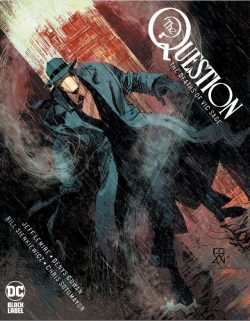
The Question: The Deaths of Vic Sage


By Jeff Lemire, Denys Cowan, Bill Sienkiewicz, Chris Sotomayor, Willie Schubert & various (DC Comics)
ISBN: 978-1-7795-0558-3 (HB/Digital edition)

One of DC’s best 1980s comics series was – for the longest time – out of print and unavailable digitally. It more or less still is, except for a prohibitively expensive Omnibus edition, and if you have strong arms and a big budget you should really track those stories down, whilst the rest of us wait for more reasonable trade paperbacks and eBook editions…

As devised and delivered by Steve Ditko in the 1960s – as he sank ever more deeply into the Objectivist philosophy of Ayn Rand – The Question was Vic Sage: a driven, implacable, justice-obsessed journalist seeking out crime and corruption uncaring of the consequences.

The Charlton “Action-Line Hero” was acquired by DC when the Connecticut outfit folded and was the template for compulsive vigilante Rorschach when Alan Moore & Dave Gibbons first drafted the miniseries that would become the groundbreaking Watchmen.

The contemporary rumour-mill had it that since the creators couldn’t be persuaded to produce a spin-off Rorschach comic, DC went with a reworking of the Ditko original…

As revised by writer Denny O’Neil and illustrators Denys Cowan & Rick Magyar, Vic Sage was an ordinary man pushed to the edge by his obsessions, using his fists and a mask that made him look utterly faceless to get answers (and justice) whenever standard journalistic methods failed. After a few minor appearances around the DC universe, Sage got a job in the town where he grew up and resumed his campaign for answers…

Always more cult hero than classic crusader, The Question revival carved a unique niche for itself as “comics grew up” post Crisis on Infinite Earths and Watchmen. The character was periodically radically rebooted and reimagined, but here scripter Jeff Lemire (Sweet Tooth, The Underwater Welder, Trillium, Black Hammer, Descender, Ascender, Gideon Falls, Essex County) returns to O’Neil’s canon to tell a revelatory tale of reincarnation, zen mystery and undying evil. The project was part of DC’s latest high end mature reader imprint Black Label: released as four single issues before becoming a spiffy hardback with a digital equivalent…

Hub City is a hell-hole, the most corrupt and morally bankrupt municipality in America. Mayor Wesley Fermin is a slick, degenerate crook, but real power resides in his Special Counsel Holden Malick, political cronies, a hand-picked gang of “heavies” and the largely corrupt and racist police force…

Originally, Sage was supported by college lecturer Aristotle “Tot” Rodor: the philosopher-scientist who created his faceless mask and other gimmicks as well as being a sounding board for theories and plans and ethical bellwether. He remains so here but is also increasingly challenging his former pupil’s motives and methods…

After being killed by Fermin’s forces The Question was revived and retrained by O’Neil’s other legendary martial arts creation, Richard Dragon, Kung Fu Fighter . A year passed and a reenergised, faceless avenger began cleaning up Hub City…

The saga opens with the city rushing into chaos and the Question busting a brothel trafficking children to city officials. Later, when reporting the raid on his TV show, Sage ambushes former lover Myra Fermin (the mayor’s sister and oblivious City Alderman) with the fact that the Councilman he left for the cops has mysteriously been erased from all official reports. Shocked and outraged, Fermin continues deluding herself about her brother and the administration, but the damage has been done and she starts looking where she shouldn’t…

When Malick arrives to clean up the mess, Sage notices a ring the politico wears: something old and somehow deeply disturbing…

Tot is no help, but the ring sticks in Sage’s mind and eventually he uncovers a historical organisation called the Hub City Elder Society that all wore such symbols and draws some telling conclusions to today’s political elite…

Hot on the trail he moves, unaware that events are converging into a dark miracle. At the exact moment The Question uncovers an ancient den of occult ceremony, an innocent black man is gunned down by a racist cop and Myra Fermin bursts in on her beloved brother committing savage atrocities on a bound captive. The concatenation of blood climaxes as The Question finds an old faceless mask with a bullet hole through the forehead in a cavern under the city. It’s not one of his, but he is assaulted by a wave of memories and images of supernal evil when he holds it…

Barely conscious, he retreats from the underground lair into streets awash with blood as a protest march becomes a race riot. Urged by Tot to go on TV to calm the tide, all Sage can think of is finding Dragon and getting some metaphysical first aid…

What he gets is doped, as the hermit applies zen hoodoo and drugged tea, despatching the unwilling rationalist sceptic on a vision quest into the past…

Sage awakens in the wilderness that will one day be his home town, bare-footed and wearing a faceless mask…

In Hub City 1886, Viktor Szasz is a blacksmith desperately seeking to escape the vile acts he committed as a soldier fighting the Comanche, in a frontier outpost well on its way to becoming truly civilised. Silent and solitary Viktor intervenes when negro settler Irving Booker and his family are repeatedly harassed and ultimately murdered by the local priest and his devout flock. Szasz reverts to his gun-toting ways to save or avenge them but is outmatched until rescued by a red-headed Indian woman. She shares some secrets about true evil, most notably that a mystical “Man with a Thousand Faces” can only be killed by someone named “Charlie”.

Delirious and experiencing hallucinations of himself in different times, agnostic Szasz still refuses to believe in devils, which is probably why the thing in pit under the town gets the drop on him…

In 1941, Hub City private eye Charlie Sage groggily looks at his notebook, where someone has written “Man with no face” and “man with a thousand faces???”. Blaming too much booze, he cleans himself up whilst glimpsing flashes of unknown dead people and adds “red-haired woman” to the page for no reason he can think of…

When red-haired walk-in client Maggie Fuller hires him to investigate her brother Jacob’s disappearance, he has no idea it will be his last case. They are both union organisers and prime targets for the bosses and the city officials they own, and before long the shamus has annoyed all the wrong people, ending up attacked by thugs wearing fancy rings…

Even his one pal on the Police Force – veteran patrolman “Tot” – can’t help him. But does reluctantly pass him a file full of juicy potential prospects for Fuller’s absence. Still enduring staggering western visions and brutal flashforwards, Charlie becomes lost in civil violence in three eras, and succumbs to another ring-wearer ambush.

The PI awakes in a subterranean chapel in the middle of some kind of crazy black mass, meets a devil and is never seen again…

Awaking from his vision-quest, present-day Sage leaves Dragon, set on sorting his city’s real world distress: braving riot and savage, premeditated retaliation by the administration and cops hungry to put the rabble back in their place. Unable to stop the carnage with his fists, The Question instead uses mass media to deliver a stunning counterstroke, turning the tables and critically destabilising Firmin and Malick.

He also has Tot build a permanent solution to the thing in the pit under Hub City, but has gravely underestimated the horror and indeed his own childhood connection to it…

Even after overcoming the odds, the illusion of victory is tenuous and insubstantial, leaving The Question still looking for answers in all the wrong places…

This book also offers covers and a gallery of variants by Cowan, Sienkiewicz & Sotomayor, Lemire & Marcelo Maiolo; Eduardo Risso; Howard Chaykin & Gustavo Yen, Andrea Sorrentino plus Cowan & Sienkiewicz’s sketchbook section ‘Questionable Practises’ with roughs, finished pencils pages and covers, portraits, finished pre-colour inks, unused cover art and creator bios.

Combating Western dystopia with Eastern Thought and martial arts action is not a new concept, but here the problems of a society so utterly debased that the apocalypse seems like an improvement are also lensed though a core of absolutism. Is man good? Is there such a thing as True Evil? What can one man do?

Who’s asking..?

Although the creators keep the tale focused on dysfunction – social, societal, civil, political, emotional, familial and even methodological – the core motivation for today’s readers has shifted, with the horror show that is and always has been Hub City now arguably attributed to an eternal supernatural presence. Regulation masked avenger tactics don’t work in such a world, and some solutions require better Questions…
© 2019, 2020 DC Comics. All Rights Reserved.
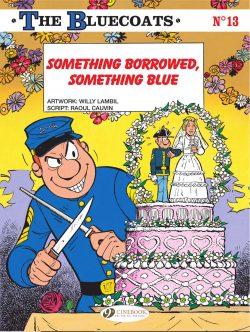
Bluecoats volume 13: Something Borrowed, Something Blue


By Willy Lambil & Raoul Cauvin, translated by Jerome Saincantin (Cinebook)
ISBN: 978-1-84918-531-8 (Album PB/Digital edition)

Devised by Louis “Salvé” Salvérius & Raoul Cauvin – who scripted the first 64 volumes until retirement in 2020 – Les Tuniques Bleues (or Dutch co-incarnation De Blauwbloezen) debuted at the end of the 1960s: created to replace Lucky Luke when that laconic maverick defected from weekly anthology Le Journal de Spirou to rival publication Pilote.

From its first sallies, the substitute strip swiftly became hugely popular: one of the most popular bande dessinée series in Europe. In case you were wondering, it is now scribed by Jose-Luis Munuera and the BeKa writing partnership…

Salvé was a cartoonist of the Gallic big-foot/big-nose humour school, and after his sudden death in 1972, successor Willy “Lambil” Lambillotte gradually adopted a more realistic – but still overtly comedic – tone and manner. Lambil is Belgian, born in 1936 and, after studying Fine Art in college, joined publishing giant Dupuis in 1952 as a letterer.

Born in 1938, scripter Cauvin was also Belgian and – before entering Dupuis’ animation department in 1960 – studied Lithography. He soon discovered his true calling – comedy – and began a glittering, prolific writing career at Le Journal de Spirou. In addition, he scripted dozens of long-running, award winning series including Cédric, Les Femmes en Blanc and Agent 212: more than 240 separate albums. Les Tuniques Bleues alone has sold more than 15 million copies of its 66 (and counting) album sequence. Cauvin died on August 19th 2021, but his vast legacy of laughter remains.

Here, as The Bluecoats, our long-suffering protagonists are Sergeant Cornelius Chesterfield and Corporal Blutch; worthy fools in the manner of Laurel & Hardy: hapless, ill-starred US cavalrymen defending America during the War Between the States.

The original format offered single-page gags set around an Indian-plagued Wild West fort, but from the second volume – Du Nord au Sud – the sad-sack soldiers were situated back East, fighting in the American Civil War. All subsequent adventures – despite ranging far beyond the traditional environs of America and taking in a lot of genuine and thoroughly researched history – are set within the timeframe of the Secession conflict.

Blutch is your run-of-the-mill, whinging little-man-in-the street: work-shy, mouthy, devious and ferociously critical of the army and its inept commanders. Ducking, diving, or deserting whenever he can, he’s you or me – except at his core he’s smart, principled and even heroic …if no easier option is available.

Chesterfield is a big, burly professional fighting man; a proud career soldier of the 22nd Cavalry who passionately believes in the patriotism and esprit-de-corps of the Military. He is brave, never shirks his duty and hungers to be a medal-wearing hero. He also loves his cynical little troll of a pal. They quarrel like a married couple, fight like brothers and simply cannot agree on the point and purpose of the horrendous war they are trapped in: a situation that once more stretches their friendship to breaking point in this cunningly conceived instalment.

Des bleus et des dentelles was originally serialised in 1983 in Le Journal de Spirou (#2384-2387) before collection into another mega-selling album in 1985. It was the 22nd European release and in 2020 became Cinebook’s 13th translated volume. As Something Borrowed, Something Blue it offers a lighter touch and tone than many, with the underlying horror salved by a kind-of romance and ridiculously surreal black comedy.

Once again Union forces are stalemated with no advance possible. Even the cavalry – under the leadership of utterly deranged, apparently invulnerable maniac Captain Stark – are stuck in dugouts, dodging enemy artillery fire beside ordinary foot soldiers. The zealot’s constant, costly, pointless charges at Confederate gun emplacements have left them short of riders and out of horses…

Sergeant Chesterfield is furious, but Blutch is perfectly happy keeping his head down and playing cards… until a shell lands on his position. By some miracle, he survives, but as Chesterfield brings him to the casualty-packed field hospital, it becomes clear that the odds of remaining so are against him.

Only the sarge’s armed intimidation can get a doctor to even look at his pal, and when they try to hack off Blutch’s leg, only the little man’s hidden gun stops them from completing the unnecessary surgery…

Suddenly, the entire camp’s attention is switched to the hospital, as the General’s latest morale-boosting scheme arrives: volunteer medical assistants – all women…

Suddenly, the entire army is stricken with some malady or other. Even Stark abandons the joy of slaughter to secure some female attention, and a top level secret plan is enacted to retore order. It involves scrupulous triage before any soldier can be admitted for treatment and to make doubly sure of weeding out malingerers, the formidable Miss Bertha will examine every man claiming injury.

The most secret part is that she is actually the hugely unhappy Private Burke in drag. His greatest fear is dying in a dress, but at least he won’t have to explain his new “uniform” to the wife and kids…

Meanwhile, actually injured Blutch is slowly recovering, thanks in great part to the diligent ministrations of nurse Jenny. Angel and patient are always together now, and Chesterfield finds himself increasingly lonely and jealous …but not as much as Blutch’s incredibly smart horse Polka

As the shirker heals, the military situation is worsening. The unassailable artillery is grinding the Union stronghold to rubble and ruin, but things start changing after another futile Stark sortie leads to the enemy troops learning there are women in their enemies’ camp. Soon, Rebel wounded are demanding that they be treated in the Union hospital too…

The situation is untenable and Chesterfield is going crazy, but the biggest bombshell comes not from enemy guns but little Blutch, as he hobbles around on crutches. The little guy is going to marry Jenny…

Initially horrified, the General unexpectedly agrees to the match, but as preparations take the men’s minds off the perpetual bombardment another shock lands after Stark requests he be allowed to wed “Bertha”…

Moreover, as Mr and Mrs Blutch ride a buggy back to safety and civilisation, Chesterfield discovers the truth about Bertha and is ordered to take his place as a female-presenting triage nurse. When “Miss Cornelia” then discovers how Blutch and Jenny have fooled everybody and escaped the war, he goes ballistic and sets off after the delinquents. He finds them frantically coming towards him scant yards ahead of a Confederate sneak attack approaching the Union camp from the rear.

Suddenly, it’s time for everyone to get back to the real business of war, with the Bluecoats survival dependant on Stark’s insane tactics…

Combining searing satire with stunning slapstick, Something Borrowed, Something Blue deftly delivers a beguiling message about the sheer stupidity of war equally clear  to younger, less world-weary audiences and old lags who have seen it all.

These stories weaponise humour, making occasional moments of shocking verity doubly powerful and hard-hitting. Funny, thrilling, beautifully realised and eminently readable, Bluecoats is the kind of war-story and Western, appealing to the best, not worst, of the human spirit.
© Dupuis 1985 by Lambil & Cauvin. All rights reserved. English translation © 2020 Cinebook Ltd.

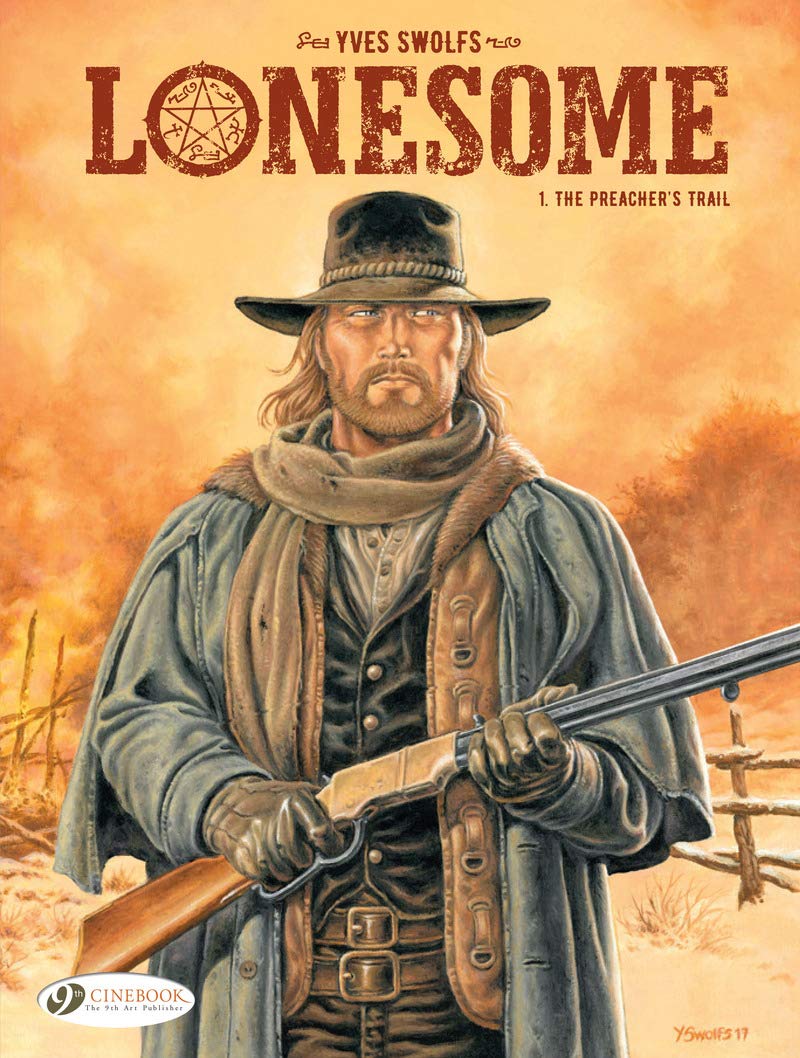
Lonesome volume 1: The Preacher’s Trail


By Yves Swolfs, coloured by Julie Swolfs; translated by Jerome Saincantin (Cinebook)
ISBN: 978-1-80044-000-5 (Album PB/Digital edition)

In comics, Western skies are at their most moody and iconic when seen through European eyes.

On the Continent, the populace has a mature relationship with comics. They collectively recognise what too many here still dismiss as “kids’ stuff” as having academic and scholarly standing, as well as meritorious nostalgic value and the validation of acceptance as a true art form.

Myths and legends of the American Old West have fascinated Europeans virtually since the actual days of stagecoaches and gunfighters. Hergé and Moebius were passionate devotees of cowboy culture and stand at the forefront of the wealth of stand-out Continental comics series. These range from Italy’s Tex Willer to such Franco-Belgian classics as Blueberry, Comanche and Lucky Luke, and tangentially even children’s classics like Yakari or colonial dramas such as Pioneers of the New World and Milo Manara & Hugo Pratt’s superbly evocative Indian Summer.

Lonesome: La piste du prêcheur debuted in 2018, the first volume of a gritty, historically-grounded drama with supernatural overtones, similar in tone and mood to Clint Eastwood’s High Plains Drifter.

It is crafted by veteran Belgian taleteller Yves Swolfs, who was born in April 1955 and – like most kids of that generation and geographical location – probably grew up surrounded by imported and home-generated cowboy culture.

He studied Literature and Journalism at Brussels’ Saint-Luc Institute before joining Claude Renard’s Atelier R comics studio, in 1978. His first stories were published in the studio’s own Le Neuvième Rêve magazine before stepping out into the field of commercial design and illustration. His first success was a western: Durango was published by Éditions des Archers in 1980 and ran for four decades, under various publishers. The feature was inspired by cinematic spaghetti westerns of the 1970s and served as  a staple source of income as Swolfs experimented with other genres: French Revolution-set historical drama Dampierre (1987); horror fantasy Le Prince de la Nuit (1991); dystopian sci fi thriller Vlad (2000) and contemporary thriller James Healer (2002).

Always busy, in 1999 Swolfs scripted western Black Hills 1890 for illustrator Marc-Renier and in 2003 wrote and drew medieval fantasy saga Légendes, amongst a host of other comics projects. He relaxes by playing in a rock band.

The Preacher’s Trail opens in 1861, with a solitary rider trekking through snow-enveloped wastes in the savage period of mounting tensions leading to the American Civil War. Newly-created territories Nebraska and Kansas have been a proxy battleground for the North and South since 1854, with slave-owners’ agents and radical Abolitionists clashing and stirring up the citizens for religious, political and commercial reasons. Blood has been spilled by anti-slavery “Jayhawkers” and Missouri’s “Border Ruffians” indiscriminately and the entire region is a powder keg waiting to explode.

Into this disaster-in-waiting rides the determined searcher. He’s hunting a proselytizing preacher, and easily overcomes the murderous bushwhackers Abolitionist Reverend Markham stationed in an isolated saloon to deter his enemies. However, before the last gunman dies, the stranger touches him and is granted a vision of where his target is heading…

In nearby township Holton City, the Reverend – surrounded by an army of gunslingers – stridently entreats the people to join his crusade against the abomination of slavery. Many are not roused or fooled, but all are keenly aware that the holy man care nothing for their lives…

The town banker/Mayor Harper may be throwing his support behind the rabblerouser, but local newspaper publisher Marcus has been doing some research and has reached a dangerous conclusion…

As the rider beds down for the night, his thoughts go back to the Indian medicine man who raised him after his family were murdered and he ponders his eerie gift. At that moment elsewhere, farming family the Colsons are being butchered by the Preacher’s acolytes. Markham has judged them to be immoral sinners, but the atrocities he personally inflicts upon the woman prove it’s no God driving his campaign of terror…

Next morning the rider stumbles across the massacre. By now, he’s fully conversant with the Preacher’s methods and ignores the faked “evidence” of South-supporting Border Ruffians, but is astounded and delighted to discover a survivor…

Taking the child to Holton, the stranger is unsurprised to see his accounts of the crime and description of the perpetrators ignored. He knows Markham always finds influential supporters like bankers and local politicians. The townsfolk are shaken though. First the newspaper office burns down and Marcus vanishes, and now a massacre…

After ignoring an unsubtle warning to mind his own business from Harper’s hired gun Clayton, the rider’s breakfast is interrupted by Sheriff Abel. He’s more inclined to believe stories about the Preacher, but knows who runs things, if not why…

When the rider leaves town in the morning, it’s with new knowledge gained through his strange gift and furtive conversations with bargirl Lucy, an ally of Marcus. Well versed in the brutal whims of men like Harper and Markham. Unfortunately, her allegiance is uncovered and she pays a heavy price after the stranger leaves…

On the trail, the stalker meets fugitive Marcus and hears what the idealistic journalist has uncovered of an international plutocratic plot to instigate war, but his sole concern is catching the Preacher. Debate distracts them and almost costs their lives when Clayton’s gang ambushes them after they stop at a friend’s cabin. The shootout leaves the stranger with Marcus’ notebook and the psychometrically derived knowledge of what Harper and Clayton did to Lucy, as well as a fierce determination to fix things in Holton before resuming his pursuit of Markham… and this time, the rider will be the one dictating how and where the final clash takes place…

Dark, uncompromisingly gritty, diabolically clever and lavishly limned in a style reminiscent of Jean Giraud’s Blueberry, this is as much conspiracy drama as revenge western with an enigmatic figure slowly discovering himself whilst derailing a plot to change the world. Here the inescapable war that’s looming is not due to a crusade of opposing beliefs but a devious scheme by commercial interests to foment war for profit and their own gain.

Before publication by Cinebook, Lonesome was initially released in digital-only English translation by Europe Comics, so if you don’t want to wait for later Cinebook editions, you can satisfy your impatience that way. Regardless, this is a superb example of a genre standard done right and if you like your west wild and wicked you won’t be sorry…
© Editions du Lombard (Dargaud-Lombard s.a.) 2018 by Yves Swolfs. All rights reserved. English translation © 2020 Cinebook Ltd.

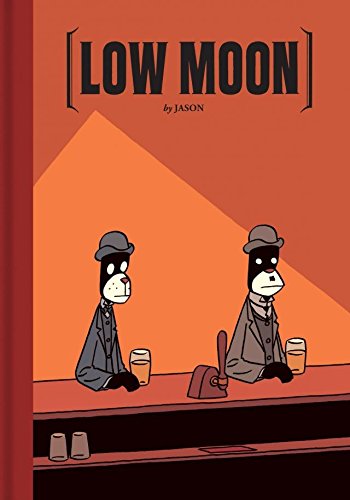
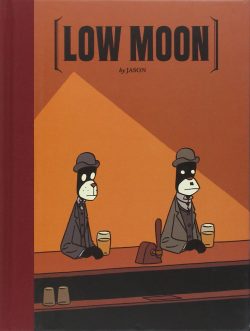
[Low Moon]


By Jason, translated by Kim Thompson (Fantagraphics Books)
ISBN: 978-1-60699-155-8 (HB/Digital edition)

In 1965, John Arne Saeterrøy, who creates under the pen-name Jason, was born in Molde, Norway. At age 30, he burst onto the international cartoonists scene with his first graphic novel Lomma full ay regn (Pocket Full of Rain) which won that year’s Sproing Award (Norway’s biggest comics prize).

Jason followed up with the series Mjau Mjau and won another Sproing in 2001. The following year he turned almost exclusively to produce graphic novels. He is now internationally renowned and (probably quite self-consciously) basks in the glow of critical acclaim for his 24 books to date and for winning so many major awards as far afield as France, Slovakia, the USA and all areas in-between.

His stories utilise a small cast of anthropomorphic animal characters (and occasional movie and pop culture monsters): a repertory company of cartoon colleagues, acting out on a stage of stiffly formal page layouts recounting dark, wry and sardonically bleak tales – often pastiches, if not outright parodies – in a visually welcoming yet coldly austere and Spartan narrative manner. This seemingly oppressive format somehow allows a vast range of emotionally telling tales – on a wide spectrum of themes and genres – to hit home like rockets whether the author’s intention was to make the reader smile or cry like a baby.

Drawing in a minimalist evolution of Hergé’s Claire Ligne style, Jason’s work bores right into the reader’s core, and this movie-themed collection of short tales is arguably his best work.

Redolent of quintessential Film Noir and especially the hard-boiled writing of Jim Thompson, poignant tale of vengeance ‘Emily Says Hello’ precedes what is billed as the World’s “first and only Chess Western”.

The eponymous ‘Low Moon’ was originally serialized in The New York Times Sunday Magazine in 2008: a splendidly surreal spoof of Fred Zinnemann’s 1952 classic High Noon wherein an old menace returns to terrorise the town… until at last the Sheriff capitulates to the incessant demands for one final return match…

‘&’ is a tragic anecdote of love, loss and marital persistence related in terms and stylings of Hal Roach’s silent comedies. ‘Proto Film Noir’ owes an inspirational tip of the thermally insulated hat to Tay Garnett’s The Postman Always Rings Twice (the 1946 version with John Garfield and Lana Turner) – by way of The Flintstones and Groundhog Day, whilst a concluding tale of love, family and abandonment assumes science-fictional trappings to relate the soap-opera, generational tale of a mother kidnapped by aliens and the effects it inflicts on the husband and son she left behind. ‘You Are Here’ is bemusing, evocative and moving, yet manages to never fall off the narrative tightrope into mawkishness or buffoonery.

Jason’s comic tales are strictly for adults but allow us all to look at the world through wide-open childish eyes. He is a taste instantly acquired and a creator any true fan of the medium should move to the top of the “Must-Have” list. This superb compendium could be your entry into a brave, old world, so get it while you can because stuff this good never lasts long…
© 2009 Jason. All right reserved.

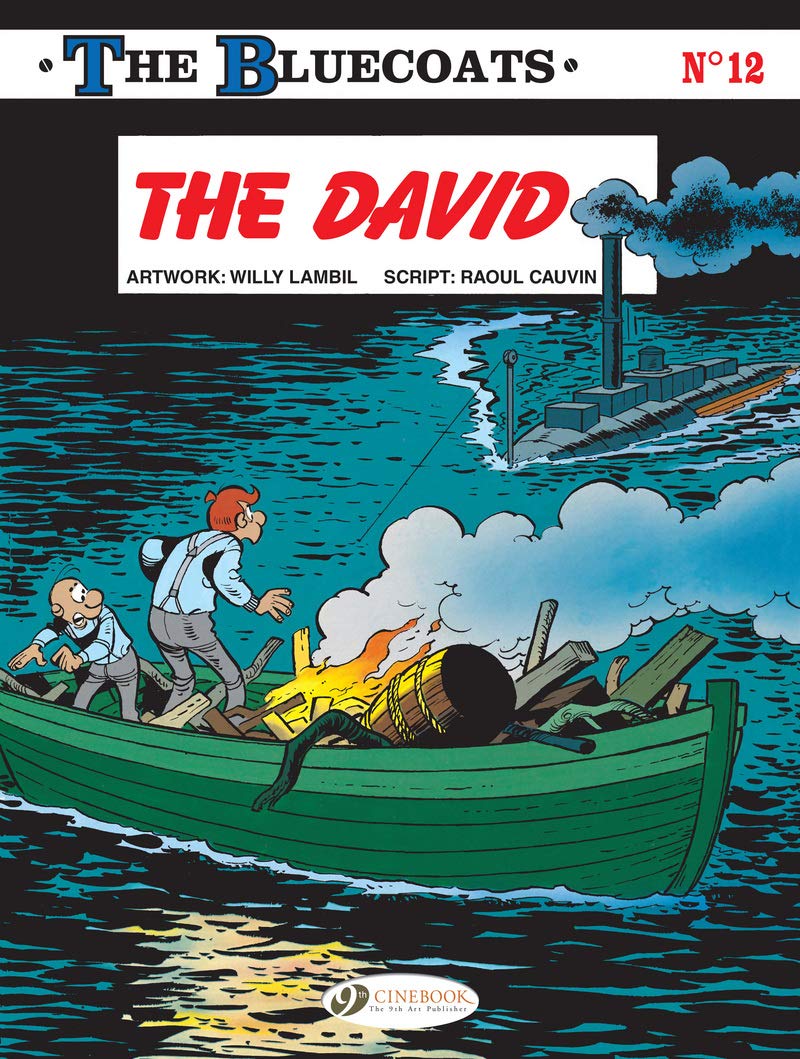
Bluecoats volume 12: The David


By Willy Lambil & Raoul Cauvin, translated by Jerome Saincantin (Cinebook)
ISBN: 978-1-849184-30-4 (Album PB/Digital edition)

Devised by Louis “Salvé” Salvérius & Raoul Cauvin – who scripted the first 64 best-selling volumes until retirement in 2020 – Les Tuniques Bleues (The Bluecoats) debuted at the end of the 1960s, specifically created to replace Lucky Luke when the laconic maverick defected from weekly anthology Le Journal de Spirou to rival publication Pilote.

From its first sallies, the substitute strip swiftly became hugely popular: one of the most popular bande dessinée series in Europe. In case you were wondering, it is now scribed by Jose-Luis Munuera and the BeKa writing partnership…

Salvé was a cartoonist of the Gallic big-foot/big-nose humour school, and after his sudden death in 1972, successor Willy “Lambil” Lambillotte gradually adopted a more realistic – but still overtly comedic – tone and manner. Lambil is Belgian, born in 1936 and, after studying Fine Art in college, joined publishing giant Dupuis in 1952 as a letterer.

Born in 1938, scripter Cauvin was also Belgian and – before entering Dupuis’ animation department in 1960 – studied Lithography. He soon discovered his true calling – comedy – and began a glittering, prolific writing career at Le Journal de Spirou. In addition to Bluecoats he scripted dozens of long-running, award winning series including Cédric, Les Femmes en Blanc and Agent 212: more than 240 separate albums. The Bluecoats alone has sold more than 15 million copies of its 65 (and counting) album sequence. Cauvin passed away on August 19 2021 but his vast legacy of laughter remains.

Here, our long-suffering protagonists are Sergeant Cornelius Chesterfield and Corporal Blutch; worthy fools in the manner of Laurel & Hardy: hapless, ill-starred US cavalrymen defending America during the War Between the States.

The original format featured single-page gags set around an Indian-plagued Wild West fort, but from the second volume – Du Nord au Sud – the sad-sack soldiers were situated back East, fighting in the American Civil War. All subsequent adventures – despite ranging far beyond the traditional environs of America and taking in a lot of genuine and thoroughly researched history – are set within the timeframe of the Secession conflict.

Blutch is your run-of-the-mill, whinging little-man-in-the street: work-shy, mouthy, devious and especially critical of the army and its inept commanders. Ducking, diving, even deserting whenever he can, he’s you or me – except sometimes he’s smart. principled or heroic if no easier option is available.

Chesterfield is a big, burly professional fighting man; a proud career soldier of the 22nd Cavalry who passionately believes in the patriotism and esprit-de-corps of the Military. He is brave, never shirks his duty and hungers to be a medal-wearing hero. He also loves his cynical little troll of a pal. They quarrel like a married couple, fight like brothers and simply cannot agree on the point and purpose of the horrendous war they are trapped in… a situation that stretches their friendship to breaking point in this deceptively edgy instalment.

The David is the 12th translated Cinebook volume and 19th sequential European release. As Les Tuniques Bleues: Le David it was originally serialised in Le Journal de Spirou #2265-2275 before collection as another mega-selling album in 1982, with C.H.A.B. & Philippe Francart credited for additional research.

The comedic drama is another based on – but broadly extrapolating upon – actual historical events, specifically the deployment of the CSS David: an early success in the development of submarine warfare. Built in 1863 by businessman T. Stoney in Charleston, South Carolina, it was a 4-man, steam-powered submersible torpedo boat used by the Confederate States Navy to challenge the Union’s shipping blockade. David was largely unsuccessful and one of many different protypes built to challenge the North’s “Ironclads”, with its last recorded action occurring on April 18, 1864. As is usually the case, legend far exceeds factual truth, but that’s no bad thing here as the unlikely warriors undertake one of their most dangerous ventures…

Off the Carolina coast, a Union warship spots a blockade-runner trying to reach port with desperately-needed supplies. As the warship confidently closes in, the steamer sends a signal to shore, and within minutes disaster strikes…

Days later, in Washington DC, Abraham Lincoln and the War Cabinet argue the impossibility of fighting an invisible enemy. With the almost-accomplished siege of attrition endangered, the President orders the mystery solved and neutralised at any cost…

Meanwhile inland, Blutch has had enough of the bloodbath battle tactics of utterly deranged, apparently invulnerable maniac Captain Stark. That glory-addicted cavalry charger has caused the deaths of more Union soldiers than the enemy ever could. Thus, at the end of his tether, the little man has downed tools. Refusing to ride again directly into Confederate guns – apparently 11 times in one day is his limit – he has gone on strike. This leads to detention in a stockade where he happily awaits execution by firing squad. At least, at last, his worries will be over…

Nothing loyal Chesterfield can do will change his mind, but when the time comes, typical army inefficiency keeps Blutch impatiently hanging on. In the meantime, the Generals receive orders to send two spies into Charleston to discover the secret of the invisible ship-killer. Knowing no regular soldiers are crazy enough to volunteer, they ask Gung Ho Chesterfield, and offer his inseparable little pal a full discharge from the army if he goes with him. The wily “Brass” are confident neither pest will return…

It’s not quite a done deal or easily achieved, but eventually the pair roll up in Charleston, disguised as wounded soldiers proudly wearing their grey uniforms. Blutch is feigning blindness whilst Chesterfield sits comfortably in a chair with wheels and directs… as usual!

As well as providing plenty of slapstick moments for us, the disguise works well for them and their calamitous progress through the enemy port is painful but largely unimpeded. One very public accident dumps them onto a German-flagged steamer unloading provisions, where – over a little schnapps – the Captain volubly discloses that the South have a diabolical machine ensuring his safe arrivals and departures…

Almost immediately after, Chesterfield and Blutch join crowds rushing towards the seafront to see it in action, and witness the deadly power of the secret weapon sinking another Union ship. When their imposture as veterans fails to get them inside the shipyard housing the devil boat, they resort to cruder methods, ultimately discovering the secret of The David – but only at the cost of their liberty.

Indomitable and utterly dedicated to preserving their own skins, the Odd Couple soon escape, and after failing spectacularly to destroy the weapon, flee desperately for their own lines, frantically pursued by the Confederate army. A sublime chase sequence across swathes of enemy territory proves their wiliness and when the spies are finally recaptured, it’s by their own side and the last person they ever wanted to see again…

With their information changing the shape of the war, Blutch and Chesterfield can only wait for their eagerly anticipated rewards (the big man was promised promotion to Lieutenant if he survived) but there’s a double sting in store as ponderous military procedure glacially expedites their cases…

Combining searing satire with stunning slapstick, this yarn delivers a hugely gratifying poke at the blood-&-glory boys of history. Deftly delivering its anti-war message to younger, less world-weary audiences, The David weds fact to fiction while delivering an uncompromising portrayal of state-sanctioned mass-violence and government’s callous disregard for individual citizens.

These stories weaponise humour, making occasional moments of shocking verity doubly powerful and hard-hitting. Funny, thrilling, beautifully realised and eminently readable, Bluecoats is the kind of war-story and Western to appeal to the best, not worst, of the human spirit.
© Dupuis 1982 by Lambil & Cauvin. All rights reserved. English translation © 2019 Cinebook Ltd.

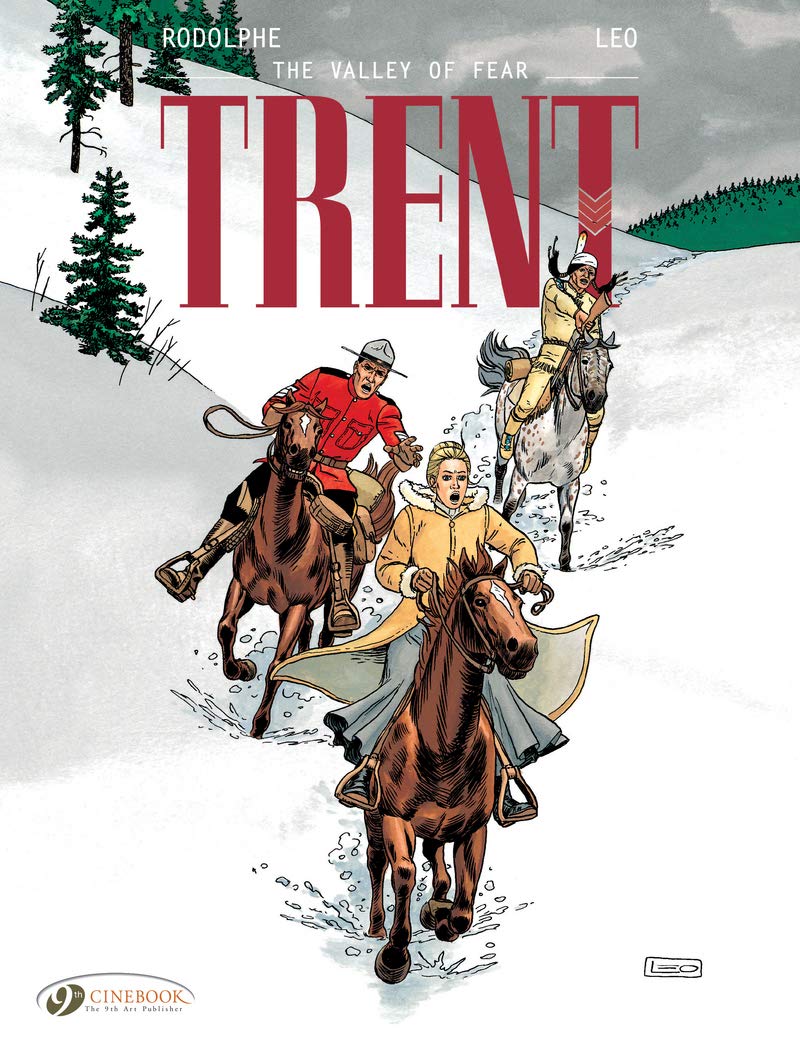
Trent volume 4: The Valley of Fear


By Rodolphe & Léo, coloured by Marie-Paule Alluard, translated by Jerome Saincantin (Cinebook)
ISBN: 978-1-84918-394-9 (Album PB/Digital edition)

Continental audiences have an abiding fascination with the mythologised American experience, whether it be the Big Sky Wild West or later eras of crime-riddled, gangster-fuelled dramas. They also have a vested historical interest in the northernmost parts of the New World which has resulted in some pretty cool graphic extravaganzas if comics are your entertainment drug of choice…

Born in Rio de Janeiro on December 13th 1944, Léo is actually Brazilian artist and storyteller Luiz Eduardo de Oliveira Filho. After attaining a degree in mechanical engineering from Puerto Alegre in 1968, he was a government employee for three years, until forced to flee the country because of his political views. While a military dictatorship ran Brazil, he lived in Chile and Argentina before illegally returning to his homeland in 1974.

To survive, he worked as a designer and graphic artist in Sao Paulo whilst creating his first comics art for O Bicho magazine. In 1981 he migrated to Paris, pursuing a career in Bande Dessinée, and found work with Pilote and L’Echo des Savanes as well as more advertising and graphics fare. His big break came when Jean-Claude Forest invited him to draw stories for Okapi, leading to regular illustration work for Bayard Presse.

In 1988 Léo began his long association with scripter and scenarist Rodolphe D. Jacquette – AKA Rodolphe. The prolific, celebrated writing partner had been a giant of comics since the 1970s: a Literature graduate who transitioned from teaching and running libraries to creating poetry and writing criticism, novels, biographies, children’s stories and music journalism.

After meeting Jacques Lob in 1975, Jacquette expanded his portfolio: writing for a vast number of strip artists in magazines ranging from Pilote and Circus to À Suivre and Métal Hurlant. Amongst his most successful endeavours are Raffini (with Ferrandez) and L’Autre Monde (Florence Magnin), but his triumphs in all genres and age ranges are too numerous to list here.

In 1991 “Rodolphe” began working with Léo on a period adventure of the “far north”. Taciturn, introspective, bleakly philosophical and driven Royal Canadian Mounted Police sergeant Philip Trent premiered in L’Homme Mort, forging a lonely path through the 19th century Dominion generating eight tempestuous, hard-bitten, love-benighted albums between then and 2000. Their creative collaboration prompted later fantasy classic Kenya and its spin-offs Centaurus and Porte de Brazenac.

Cast very much in the classic mould perfected by Jack London and John Buchan, Trent is a man of few words, deep thoughts and unyielding principles who gets the job done whilst stifling emotional turmoil boiling deep within him: the very embodiment of the phrase “still waters run deep”…

As La Vallée de la peur, this fourth saga comes from 1995, with the solitary sentinel of justice and his faithful hound “Dog” initially absent from the scene. Instead, we see rail engineer George Petterson arriving at desolate shanty town White Pass and Rail Camp Seven. Here, navvies are laboriously hacking their way through a mountain, advancing the iron line inch by frozen inch.

It’s a strangely unsettling set-up, as Petterson finds when he moves into the cabin of the man he’s replacing as site manager. There’s an atmosphere of surly secrecy and every window of his new home has been nailed shut…

The first inclination of real trouble brewing comes as George tries to stop native labourers quitting. After two whites were injured and one of their own killed in tunnel accidents, they refuse to stay and be killed by “Hoppo”. The locals know it’s the work of a “demon-bear”, but the engineers will only admit to ordinary, natural problems and mock the silly superstitions. Nevertheless, when night falls they all bolt their doors. Every cabin has its windows nailed shut…

The account closes with reports of more accidents and problems as Mrs. Petterson completes her request to the RCMP to send someone to White Pass, which has been silent and out of touch for many days now…

Trent is assigned the mission and it’s a painful shock to meet again the woman he knows as Agnes. Years ago he had saved her – but not her beloved brother – and was given a clear invitation from her that he never acted upon. Eventually, he made his decision, travelling all the way to Providence with marriage in mind, only to learn that his Miss St. Yves had reached her own conclusion years previously…

Now she stubbornly accompanies him into unknown danger at White Pass. She is resolved to find her missing husband and Trent is wracked with indecision and other darker emotions he refuses to acknowledge…

Travelling to Fraser by train, the rescue party switches to horseback and picks up Trent’s occasional partner Mokashi. The First Nations scout also knows Agnes of old, and has his own reasons for leaving the comforts of family and civilisation, despite having already learned that Hoppo haunts Camp Seven…

After crossing the snowy beautiful wilderness – rendered as always by Leo with staggering craft and force – the riders arrive in a desolate Camp Seven with no sign of life. Seemingly abandoned, the cabins which once held more than fifty men are cold and empty, but it’s not long before Mokashi uncovers some of the former inhabitants…

As they batten down for the night in a reasonably defensible shack, the rescuers are keenly aware of eerie silence punctuated by erratic bursts of animal noise. Eventually sleep comes… until the implacable Mountie and Mokashi are roused by the sounds of an intruder furtively seeking entry…

When Trent investigates, he is ambushed by a beast out of his maddest nightmares. Barely escaping with his life, his frantic flight brings him to an even greater horror – George Petterson, more dead than alive and apparently the only survivor of a supernatural atrocity…

As dawn comes, Agnes is reunited with her husband and the lawmen begin the task of tracking what can only be an exceptionally clever and cunning beast. Trent, however, cannot shake the notion that he heard it speak as it shrugged off his rifle shots…

Tension mounts as both romantic triangle and murderous rampage bloodily converge, but even after the Mountie solves one mystery and the evacuation of George Petterson begins, there is more heartbreak and loss to come before civilisation reclaims them. And as ever, Trent is left to struggle with his solitary thoughts, loss and loneliness…

Another beguilingly introspective voyage of internal discovery, where environment and locales are as much lead characters as hero and villain, The Valley of Fear delivers mystery, epic scope, sinister suspense, action and poignant drama in a compelling concoction to satisfy any fan of widescreen cinematic crime fiction or grandiose western.
Original edition © Dargaud Editeur Paris 1993 by Rodolphe & Léo. All rights reserved. English translation © 2017 Cinebook Ltd.

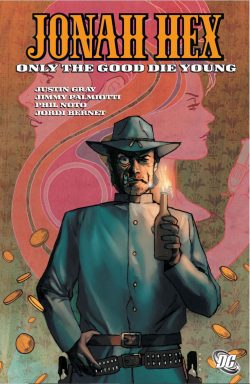
Jonah Hex volume 4: Only the Good Die Young


By Justin Gray, Jimmy Palmiotti, Phil Noto, Jordi Bernet, David Michael Beck & various (DC Comics)
ISBN13: 978-1-84576-786-0 (TPB/Digital edition)

Confident enough to apply fantasy concepts to this grittiest of human heroes, the assembled creators working on the last successful incarnation of Jonah Hex blended a darkly ironic streak of wit with a sanguine view of morality and justice to produce some of the most accessible and enjoyable comics fiction ever seen.

This collection, reprinting issues #19-24 of that series, served up six discrete tales revealing how the ravaged and dissolute bounty hunter will takes everything the universe can throw at him with the same irascible aplomb and give back double…

‘Texas Money’, ‘Unfinished Business’ and ‘The Current War’ are all illustrated by Phil Noto; compelling vignettes which well display the thread of black humour that runs through these stories. The first sees Hex hire out to notorious saloon boss Wiley Park for a rescue mission, only to become distracted by the West’s Most Inhospitable Brothel Madam.

The second sees Hex paying for a little jest he had at Park’s expense: a truly iconic tribute to a classic Conan the Barbarian scene, before reuniting with an old stooge to settle all accounts with the shifty saloon owner.

Jordi Bernet handled interlude issue ‘Devil’s Paw’: a seemingly more traditional yarn of deserts and mesas, galloping posses and awful “injuns”, but this dark tale of outrage and revenge is conceptually the most adult and brutal in the book, showing the inner core of righteousness that drives Hex, whatever his aspect and actions might hint to the contrary – and no one concerned about derogatory depictions of minorities should have anything to worry about…

‘The Current War’ offers an elegiac flavour of the Doomed Wild West and Hex gets an unsettling glimpse of things to come when he is hired to retrieve a prototype robot stolen from an inventor by Thomas Edison. Once more, and as always, the wryly cynical authorial voices of Justin Gray & Jimmy Palmiotti make this dark prophecy work in what should be an uncomfortable milieu.

Bernet returns to illustrate a superbly chilling tale of US Cavalry atrocity in ‘Who Lives and Who Dies’, which to my mind is the perfect modern Western tale and this volume concludes with a no-holds-barred supernatural thriller painted by David Michael Beck: ‘All Hallows Eve’.

Called to a haunted saloon where ghostly spirit of Justice and sometime ally El Diablo seeks his aid against the bloodthirsty Prairie Witch, Hex plus – in a delightful comic turn – cowboy vagabond Bat Lash must defeat the harridan’s plot to bloodily sacrifice the entire town of Coffin Creek. In tone, quite similar to a contemporary teen horror flick, this too works perfectly as a vehicle for the best Western Anti-hero ever created.

Dark, bloody and wickedly funny, this sly blend of action and social commentary is an unmissable treat for readers of an adult temperament and a mind open to genre-bending.
© 2007 DC Comics. All Rights Reserved.
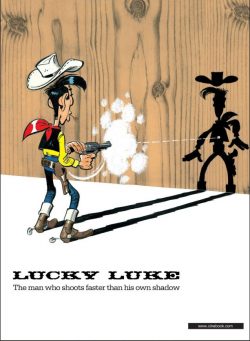
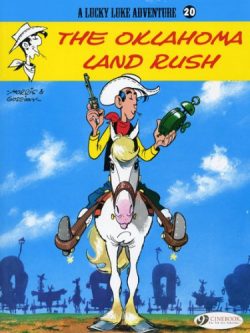
Lucky Luke volume 20: The Oklahoma Land Rush


By Morris & Goscinny, translated by Luke Spear (Cinebook)
ISBN: 978-1-84918-008-5 (PB Album/Digital edition)

Doughty, dashing and dependable cowboy champion Lucky Luke is a rangy, implacably even-tempered do-gooder able to “draw faster than his own shadow”. He amiably ambles across the fabulously mythic Old West, enjoying light-hearted adventures on his rather sarcastic wonder-horse Jolly Jumper. The taciturn trailblazer regularly interacts with a host of historical and legendary figures as well as even odder folk in tales drawn from key themes of classic cowboy films – as well as some uniquely European notions, and interpretations…

Over 8 decades, his exploits have made him one of the top-ranking comic characters in the world, generating upwards of 85 individual albums with sales totalling in excess of 300 million in 30 languages thus far. That renown has led to a mountain of spin-off albums, plus toys, computer games, animated cartoons, a plethora of TV shows and live-action movies and even commemorative exhibitions. No theme park yet, but you never know…  when…?

The brainchild of Belgian animator, illustrator and cartoonist Maurice de Bévère (“Morris”) and first officially seen in Le Journal de Spirou‘s seasonal Annual L’Almanach Spirou 1947, Luke sprang to laconic life in 1946, before inevitably ambling into his first weekly adventure ‘Arizona 1880’ on December 7th 1946.

Working solo until 1955, Morris produced nine albums of affectionate sagebrush spoofery before teaming with old pal and fellow trans-American tourist Rene Goscinny. When Rene became his regular wordsmith, Luke attained dizzying, legendary, heights starting with Des rails sur la Prairie (Rails on the Prairie) which began serialisation on August 25th 1955. In 1967, the six-gun straight-shooter switched sides, joining Goscinny’s own magazine Pilote for La Diligence (The Stagecoach).

Goscinny co-created 45 albums with Morris before his untimely death, whence Morris soldiered on both singly and with other collaborators. The artist died in 2001, having drawn fully 70 adventures, plus numerous sidebar sagebrush sagas crafted with Achdé, Laurent Gerra, Benacquista & Pennac, Xavier Fauche, Jean Léturgie, Jacques Pessis and others, all taking their own shot at the venerable vigilante…

Lucky Luke has history in Britain too, having first pseudonymously amused and enthralled young readers during the late 1950s, syndicated to weekly anthology Film Fun. He later rode back into comics-town in 1967 for comedy paper Giggle, using nom de plume Buck Bingo.

Ruée sur l’Oklahoma was Morris & Goscinny’s 5th collaboration, originally serialised in 1960 before becoming the 14th album release: a wryly satirical romp based on the actual property reallocation event of 1889, and is delivered with only the slightest application of a little extra whimsical imagination to the actual brutal skulduggery and chicanery of history…

In the real world, President Benjamin Harrison signed a proclamation on March 23rd 1889 opening the “Unassigned Lands” of Oklahoma to non-Indian settlers. Citing the 1862 Homestead Act, it promised any white who could stay on and improve a parcel of land for five years would own it free, clear and without cost. It led to a free-for-all scramble on April 22nd year with an estimated 50,000 people looking for a prime location to put down roots…

The comic version begins on the inhospitable plains of the Oklahoma territory where a representative of the American government trades a pile of trinkets and baubles to the resident Cherokee, Creek, Chickasaw, Choctaw and Seminole tribes who were originally dumped there against their collective will by white soldiers.

They are more than happy to leave those dry, dusty, dull, decidedly depressing regions…

In Washington DC, Senators are gloating over opening the region to colonisation, but troubled that all the settlers eager to own their own land and property might one day be accusing them of negligence or worse unless the allocation process is scrupulously fair. Agreeing on a strictly-monitored race as the most transparent method, the statesmen then need to ensure it’s an honest one, and call in American legend Lucky Luke to oversee the process and adjudicate disputes.

Heading westward on Jolly Jumper, the lone rider’s first task is removing the white folk already occupying their own parcels of land before the official start date. Some are there innocently and others have decided to get a head start and secure prime locations, but eventually all are moved back (some into makeshift jails) beyond the notional starting line of the great Oklahoma rush for land…

Backed up by the cavalry and a horde of lawyers Lucky leaves the “Promised Land” clean and clear for the big day, but is kept busy stopping cheating “sooners” from sneaking in early and staking claims illegally: wicked men and enterprising criminals like Beastly Blubber or Coyote Will and his simple stooge Dopey. Their escapades grow increasingly wild as the start day approaches, but Lucky can handle them. What’s more troubling is the ordinary everyday one-upmanship scurrilously employed by the “honest” citizen-contestants: sabotaging each other’s transport, doping their draft animals and worse.

Eventually, the moment comes, cannons boom and the race for space begins…

Humans being what they are, however, every competitor heads for the same few miles of the two million acres (8100 square kilometres) and overnight the mangy metropolis of Boomville springs up. Despite being held until the race was well underway Beastly Blubber, Coyote Will and Dopey are quick to capitalise on the progress and jealous hostility of the settlers, forcing Lucky to step in repeatedly and – ultimately – ban booze and all guns in the city…

Gradually civilisation blossoms and Luke thinks his job is done when the citizens call an election for Mayor. He couldn’t be more wrong, but the plebiscite does signal the end in another painfully ironic and tragically foreboding way…

Employing classic set-piece slapstick and crafty cinematic caricature but layering on an unusually jaundiced – but frighteningly accurate – view of politicians, government and human nature, The Oklahoma Land Rush deftly weaponizes history (Indian displacement, the future Dust Bowl and the billions of barrels of unexploited oil beneath that unhappy soil) to deliver a funny story with plenty of sharp edges and ends, and a sharp twist to keep readers smugly satisfied. Here is another wildly entertaining all-ages confection by unparalleled comics masters, affording an enticing glimpse into a unique genre for today’s readers who might well have missed the romantic allure of an all-pervasive Wild West that never was…
© Dargaud Editeur Paris 1971 by Goscinny & Morris. © Lucky Comics. English translation © 2009 Cinebook Ltd.

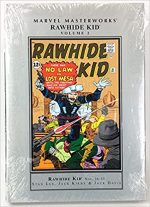
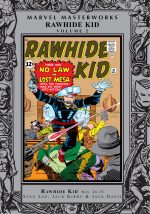
Rawhide Kid Marvel Masterworks volume 2


By Stan Lee, Jack Kirby, Jack Davis, Dick Ayers, with Don Heck, Paul Reinman, Al Hartley, Sol Brodsky, Gene Colan & various (MARVEL)
ISBN: 978-0-7851-2684-3 (HB/digital edition)

For most of the 1960s nobody did superheroes better than Marvel Comics. However, even fully acknowledging the stringencies of the Comics Code Authority, the company’s style for producing their staple genre titles for War, Romance and especially Western fans left a lot to be desired. Hints at sex, the venality of authority figures, or using proper guns the way they were meant to be used, capitulated to overwhelming caution and a tone that wouldn’t be amiss in kids’ cartoons or pre-Watershed family TV shows.

Eventually, though, the company’s innate boldness and hunger for innovation overwhelmed common sense. Moreover, and mercifully for revivals of pre-superhero veterans like Rawhide Kid, their meagre art-pool consisted of such master craftsmen as Jack Kirby, Dick Ayers and others…

Technically the Kid is one of the company’s older icons, having debuted in his own title with a March 1955 cover-date. A stock and standard sagebrush centurion clad in a buckskin jacket, his first adventures were illustrated by jobbing cartoonists such as Bob Brown and Ayers but the comicbook became one of the first casualties when Atlas’ distribution woes forced the company to cut back to 16 titles a month in the autumn of 1957.

With Westerns huge on the small screen and youthful rebellion a hot societal concept in 1960, owner/publisher Martin Goodman – via Stan Lee & Jack Kirby – unleashed a brand new six-gun stalwart – little more than a teenager – and launched him in summer of that year, economically continuing the numbering of the failed original…

Crucial to remember is that these yarns are not even trying to be gritty or authentic: they’re accessing the vast miasmic morass of wholesome, homogenised Hollywood mythmaking that generations preferred to learning of the grim everyday toil and terror of the real Old West, so sit back, reset your moral compass to “Fair Enough” and relax and revel in simple Black Hats vs. White Hats delivered with all the bombast and bravura Jack Kirby and his stellar successors could so readily muster…

It all (re) began when Lee, Kirby & Ayers introduced adopted teenaged Johnny Bart who showed all and sundry what he was made of after his retired Texas Ranger Uncle Ben was gunned down by a fame-hungry cheat. After very publicly exercising his right to vengeance, the naive kid fled Rawhide before explanations could be offered, resigned to life as an outlaw…

Reprinting Rawhide Kid #26-35, spanning February1962 to August 1963, this second selection offers another eclectic mix of hoary clichés, astounding genre mash-ups and the occasional nugget of pure wild west story-gold with some of the King’s most captivating and impressive art augmented by significant contributions from a number of other laudable pencil-pushers comprising the first inkling of the fabled Marvel Bullpen.

Following an outrageous introduction by dis-honorary owlhoot Mark Evanier, describing the publishing theories of Publisher Martin Goodman, the bangs for your buck begin with #26 and lead yarn ‘Trapped by the Bounty Hunter’ with Lee, Kirby & Dick Ayers showing how The Kid falls for a smarter man’s snare before impressing him with his honesty and earning another chance. Uncredited prose piece ‘Stagecoach Race’ describes a battle of wits and a risky wager after which comic action turns to melodrama as the ‘Shoot-Out in Scragg’s Saloon’ sees the Rawhide Ripsnorter mistaken by a tragic old man for his missing son. At this time comic books needed to offer a variety of material to qualify for cheaper postage rates and as well as prose shorts would include one generic cowboy tale per issue.

Here, it’s the uncredited ‘Strong Man’ – probably a Lee script limned by veteran by Bob Forgione – which could easily have fitted into one of the company’s mystery titles. Town bully Slade always gets his way but when he steals a mine map he also gets what he deserves…

The issue concludes with The Kid exposing the seeming miracle of ruthless gunslinger ‘The Bullet-Proof Man’…

Rawhide Kid #27 opens ‘When Six-Guns Roar!’, as the restless wanderer finds honest work on a ranch. If only the other hands had welcomed rather than bullied the diminutive newcomer, a lot of violence might have been avoided and history quite different A text story about a ‘Mustang Maverick’ then leads to action-packed hokum as ‘The Girl, the Gunman, and the Apaches!’ finds our hero saving a captive from the repercussions of her idiot father taking pot-shots at innocent Indians after which ‘The Fury of Bull Barker!’ (illustrated by Don Heck) turns the cliché of rough cowboy and slick city dude on its head before Lee Kirby & Ayers reveal how ‘The Man who Caught the Kid!’ had a change of heart and gave the outlaw his freedom…

The team are on top form for ‘Doom in the Desert!’, which opens #28, as the Kid survives a ruthless predator’s trap thanks only to his tragic sister, whilst text treat ‘The Travelling Show’ details a cunning robbery scheme foiled in advance of ‘The Guns of Jasker Jelko!’ Here a circus shootist gone bad is taught a salutary life-lesson by someone used to facing as well as firing hot lead, after which Paul Reinman draws the stand-alone saga of ‘The Silent Gunman’ who taught a town what is more powerful than a fast draw before Rawhide indulges in some relatively gentle remonstration ‘When a Gunslinger Gets Mad!’ Of course, it’s arguably provocation on his part to order milk in a saloon…

Our hero’s perennial search for a little peace and quiet is again scuttled in #29’s opening story as he accepts a dying sheriff’s deal to capture an outlaw in return for a pardon. Sadly ‘The Trail of Apache Joe!’ is long and the battle to subdue him hard and by the time he gets back both the lawman and the deal are dead…

Deceptively anodyne prose vignette ‘Warpath’ segues  in to action interval ‘The Little Man Laughs Last!’ as The Kid’s small scrawny physique attracts bullies who soon regret their actions just as Lee & Ayers’ done-in-one diversion ‘Yak Yancy, the Man who Treed a Town’ reinforces the point that brawn does not trump brains, before Rawhide saves a starry-eyed boy from a life of delinquency in ‘The Fallen Hero!’

Rawhide Kid #30 was cover-dated October 1962 and big things were happening. That month also saw the release of Fantastic Four #7; Strange Tales #101 (debut of the Human Torch in a solo series); Tales to Astonish #36 (second costumed Ant-Man); Journey into Mystery #85 (third Thor), and the Incredible Hulk #4 was due four weeks later. Although the company’s standard genre fare was still popular, it was gradually disappearing as Lee reallocated his top creative resources to what was rapidly becoming the “Marvel Age of Comics”. Thus it was approaching High Noon for Rawhide artisans Lee, Kirby & Ayers when hypnotist Spade Desmond rolled into a western town, and his uncanny influence showed everyone what happened ‘When the Kid Went Wild!’, after which an intolerant biddy from “Back East” learns her lesson in prose tale ‘The Silent Man’. The Kid’s ‘Showdown with the Crow Mangum Gang!’ saves an embattled family of homesteaders and Lee & Heck trace the story one particular sidearm in ‘This is… a Gun!’ before his slight stature again gets The Kid in trouble with bullies, and his response triggers a ‘Riot in Railtown!’

Issue #31 replays the theme as a prelude to Rawhide battling a greedy land baron seizing spreads and leading to a ‘Shoot-Out with Rock Rurick!’, after which a mild replay of the war between ranchers and homesteaders is re-examined in cheery text titbit ‘Sheep Run’. The Kid is easily outfoxed and ‘Trapped by Dead-Eye Dawson!’, but earns his freedom thanks to his noble nature, unlike the prodigal brother who features in Lee & Heck’s solo yarn ‘Return of Outlaw!’ Rawhide rides into the wrong town and is jumped by many old enemies in ‘No Law in Lost Mesa!’ before showing just why he’s a legend…

Rawhide Kid #32 (cover-dated February 1963) signalled the end of an era. It opened with Beware of the Barker Brothers!’ as the Kid exposed gunrunners masquerading as local dignitaries and philanthropists and was followed by Home Trail’ – a prose homily on welcoming strangers and a comic advocating guns over gavels in ‘The Judge!’ by Lee & Al Hartley. Kirby’s last hurrah was ‘No Guns for a Gunman!’ as our hero fails to fall for a rigged scam that would leave other gunfighters helpless…

Although he remained as cover artist, this was Kirby’s swan song issue. Ultimately, and via a brief Ayers solo art run, the series would end up as a vehicle for writer/artist Larry Lieber – but before that Lee latched onto another artistic legend who was at that moment in the process of becoming synonymous with America’s favourite humour magazine: Jack Davis.

John Burton Davis Jr. (1924-2016) is probably one of the few strip art masters better known outside the world of comics than within it. His paintings, magazine covers, advertising work and sports cartoons reached more people than his years of comedy cartooning for such magazines as Mad, Panic, Cracked, Trump, Sick, Help!, Humbug, Playboy, etc., but few modern collectors seem aware of his horror and war and western masterpieces for EC, his pivotal if seminal time at Jim Warren’s Eerie and Creepy magazines, and his westerns for Marvel Comics. And that’s a true shame, because they’re quirky but terrific: rough, rowdy, loose and rangy, just like The Kid himself…

Scripted throughout by Lee, three issues of Jack Davis’ bombastic action, comedy and drama begin in #33 (April 1963) with ‘The Guns of Jesse James’, as the perpetually hunted Kid swallows pride and caution and joins the infamous outlaw’s gang. Initially swayed by James’s story of being misunderstood and unfairly accused, Rawhide soon realises he’s been gulled by a master conman and quits in his own unmistakable fashion…

Following the prose fable of a kid finding his place in ‘The Tenderfoot’, Lee & Sol Brodsky play with archetypes in ‘There’s a Shoot-Out Comin’!’ before Davis wraps up his debut with a tale of a young heart broken for the best of reasons in ‘The Gunfighter and the Girl!’

Issue #34 added to The Kid’s growing posse of returning villains as our hero proves utterly unable to beat ‘The Deadly Draw of Mister Lightning!’ however the carnival showman turned gunslinger learns a valuable lesson in their rematch…

Text vignette ‘Bushwacked!’ sees a young man trick his father’s killer into jail before Davis resumes with ‘Prisoner of the Apaches!’ as Rawhide again sacrifices himself to save idiot settlers with no respect for the First Nations. The issue is rounded off with an epic elegiac independent story perfectly capturing that era’s mythology and world view. Crafted by Lee, Kirby, Ayers, ‘Man of the West!’ details one man’s pioneering spirit and achievements. Beautiful and haunting, it’s possibly the most dated and contentious thing in this collection: venerating – like John Ford/John Wayne’s The Searchers – an attitude of exceptionalism and manifest destiny that will appal most modern readers…

Our sagebrush storytelling concludes with Rawhide Kid #35 and another nod to changing times as our hero is inexplicably targeted by a costumed crazy in ‘The Raven Strikes!’ Following a text tale of an old salt proving his worth in ‘Man to Remember’ and a wry rewriting of history by Lee & Gene Colan in ‘The Sheriff’s Star’ everything ends up in a charming tall tale as The Kid overhears boasting bar hounds relating ‘The Birth of a Legend!’ and scarcely recognises himself amidst the blather…

Also included is a bonus cover gallery by John Severin, Gil Kane, Joe Sinnott, Ayers, Frank Giacoia, Alan Weiss, Rick Buckler, Mike Esposito & Larry Lieber of reprint series The Mighty Marvel Western (#17-32; June 1972- June 1974), where many of these tales also appeared.

To be frank, although the art is astounding, the stories here are mostly mediocre. Unless you’re an old school western buff, what’s on offer is derivative, formulaic, occasionally insensitive, and once or twice borderline offensive. If the social climate and your own conscience trouble you, stay away. If, however, you can see this stuff in historical context – created by genuine reformers who pioneered diversity in comics and created breakthrough characters like Wyatt Wingfoot or Black Panther together – take a look. Here is work that stoked the boilers of the Marvel revolution, blessed with some of the very best narrative artwork ever seen.
© 2021 MARVEL.