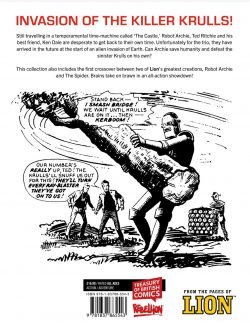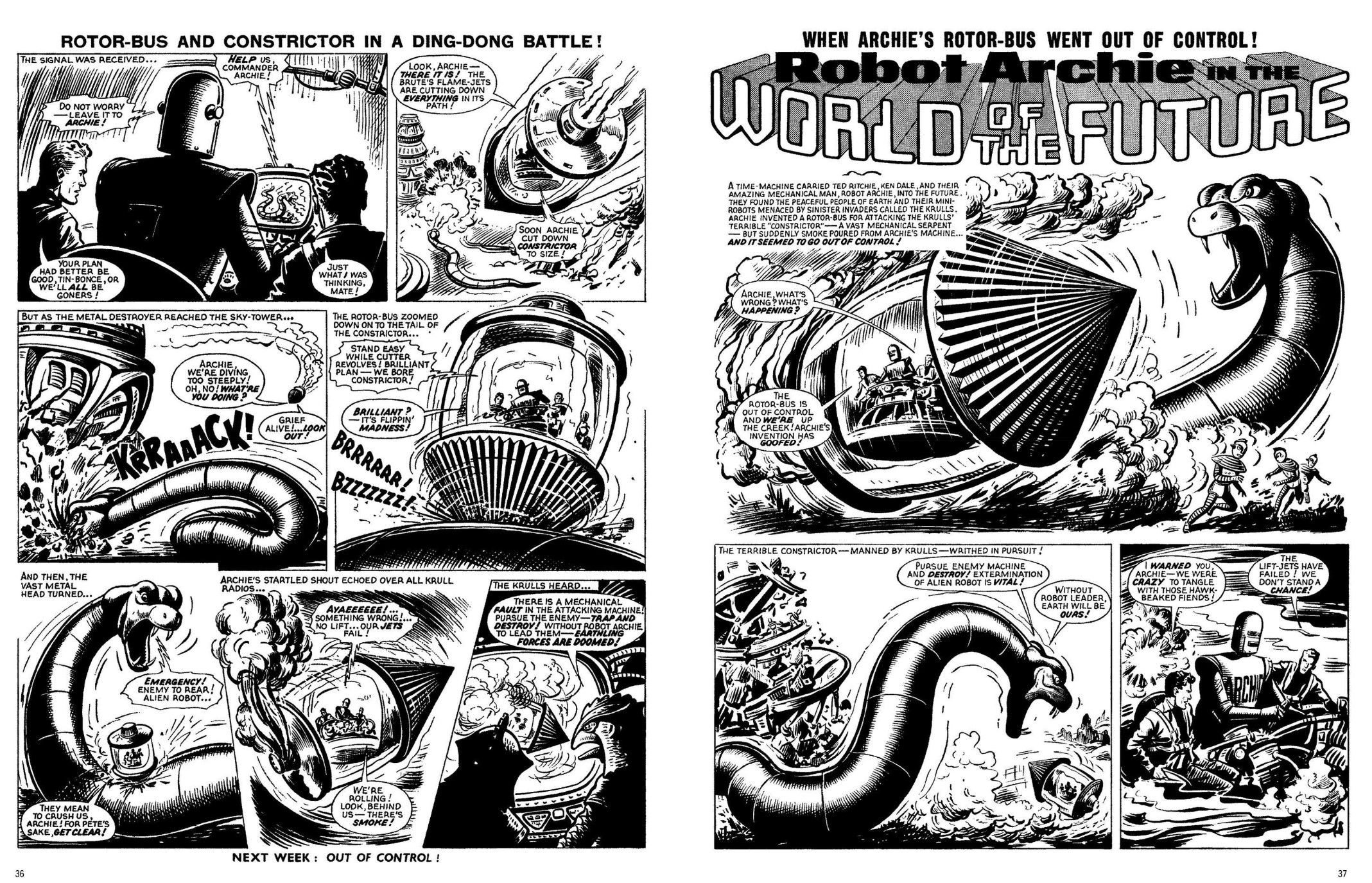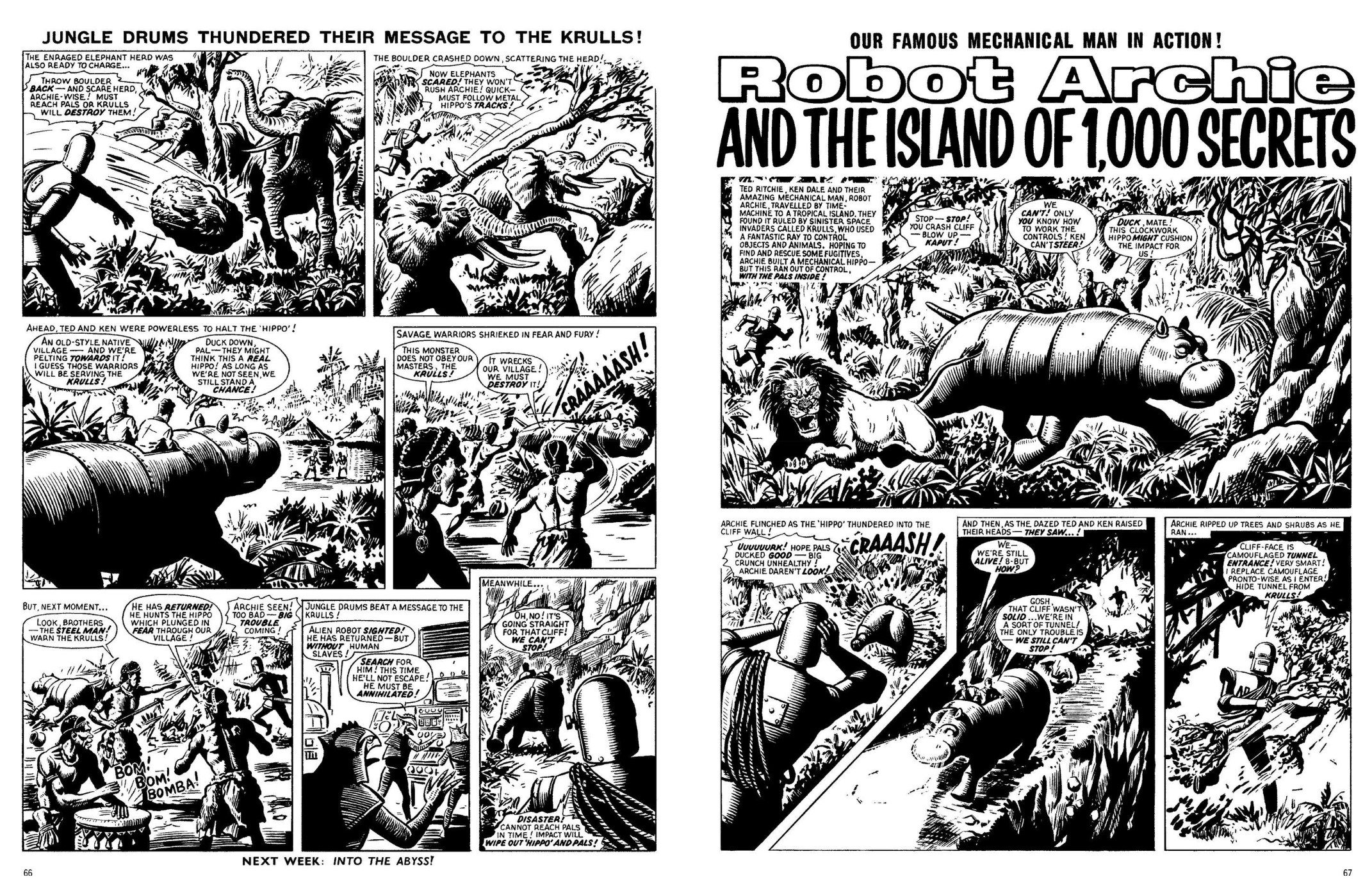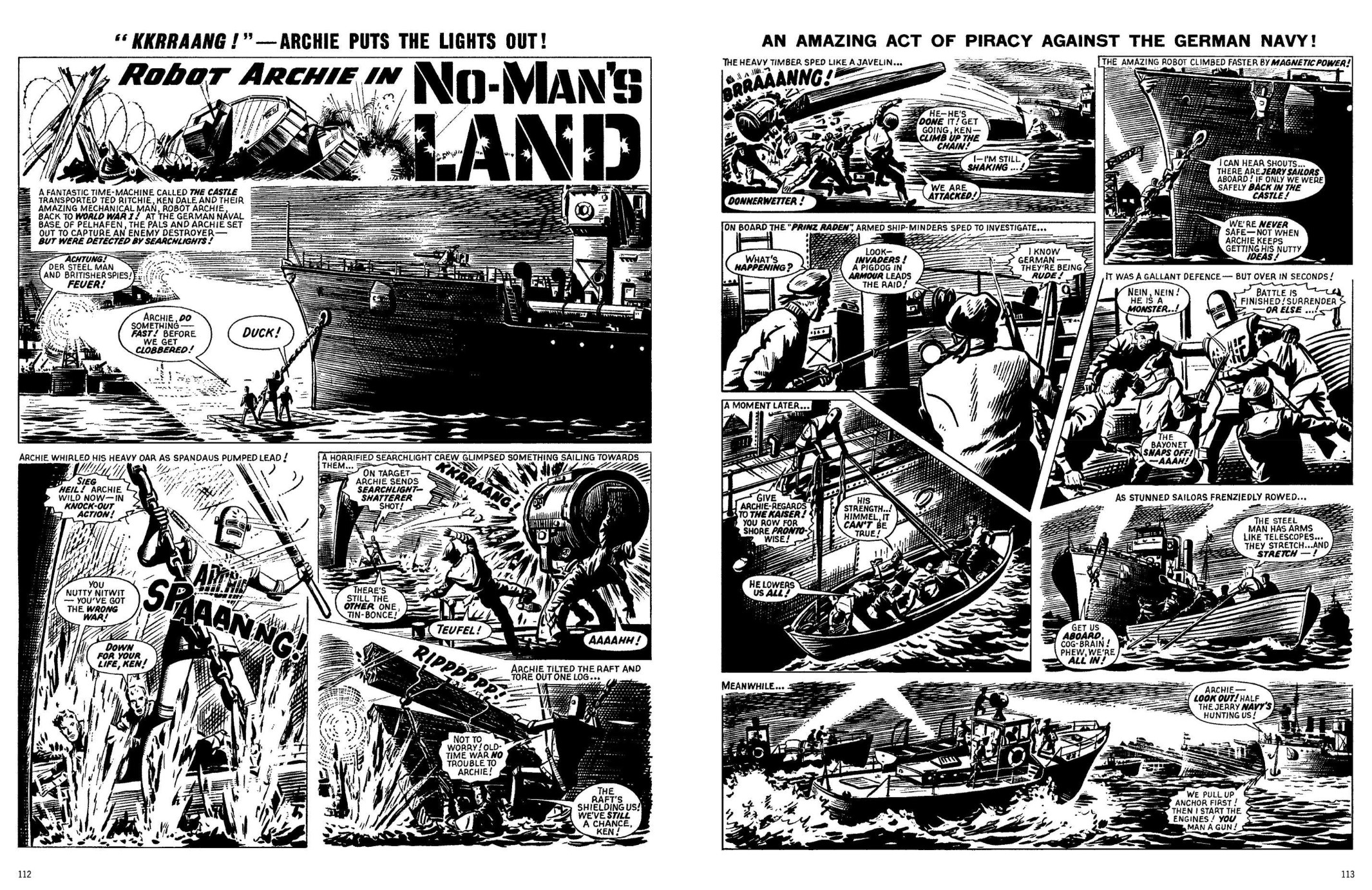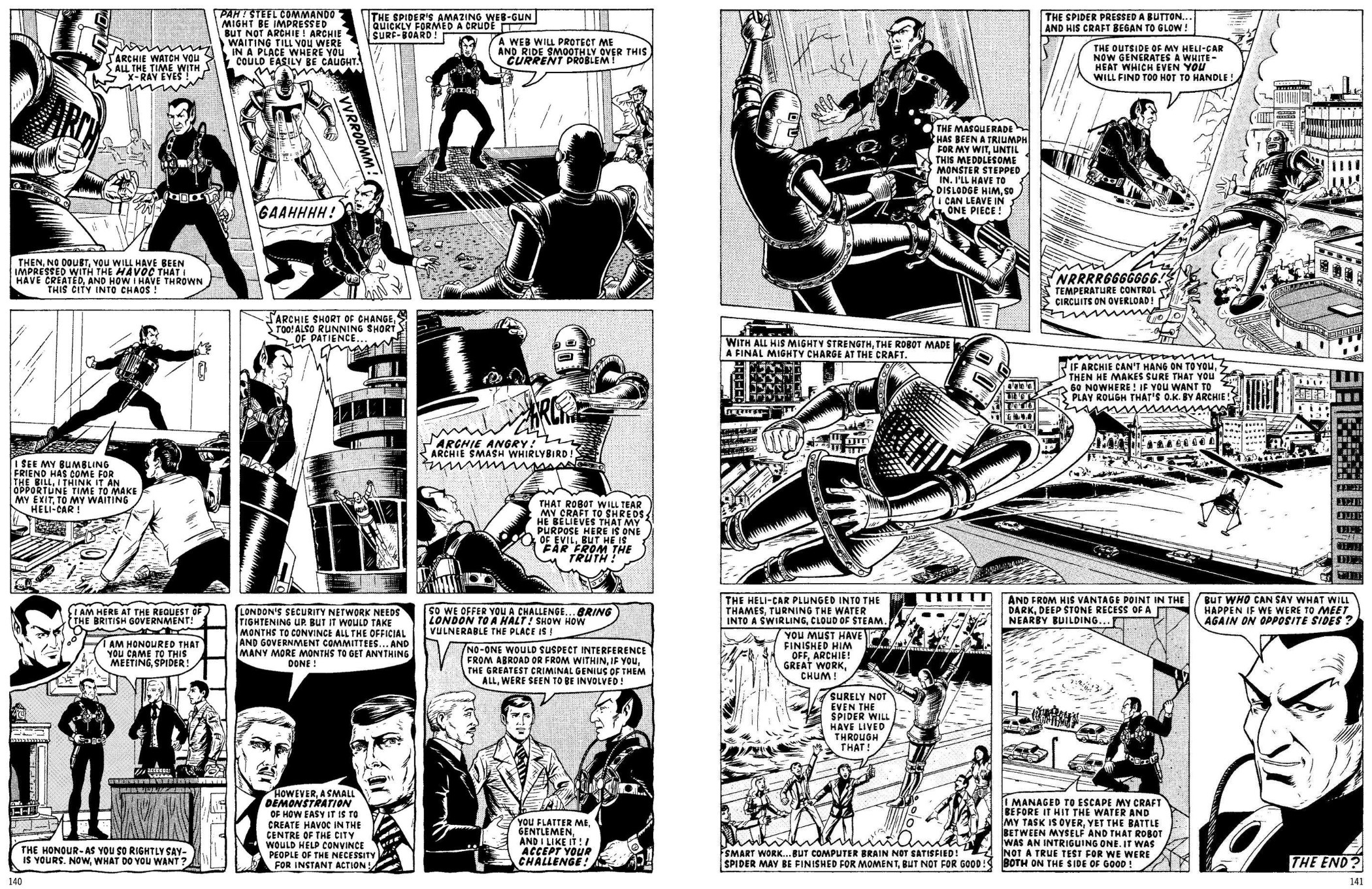
Adam Eterno book 2: Grunn the Grim


By E. George Cowan, Chris Lowder, Tom Tully, Francisco Solano López, John Catchpole, Eric Bradbury, with Jack Le Grand, Geoff Kemp, Tom Kerr & various (Rebellion)
ISBN: 978-1-83786-470-6 (TPB/Digital edition) 978-1-83786-480-5 (Exclusive edition)

This book includes Discriminatory Content produced in less enlightened times.

Win’s Christmas Gift Recommendation: History in the Unmaking… 9/10

British comics had a strange and extended love affair with what can only be described as “unconventional” (for which feel free to substitute “creepy”) heroes. So many of the stars and potential role models of our serials and strips were just plain “off”: self-righteous, moody voyeurs-turned vigilantes like Jason Hyde, sinister masterminds like The Dwarf, deranged geniuses like Eric Dolmann, so many reformed criminals like The Spider or just outright racist supermen like Captain Hurricane

… And don’t get me started on our legion of lethally anarchic comedy icons or that our most successful symbol of justice is the Eagle-bedecked jack-booted poster boy for a fascist state. Perhaps that explains why these days we can’t even imagine or envision what a proper leader looks like and keep on electing clowns, crooks and oblivious privileged simpletons…

All joking aside, British comics are unlike any other kind and simply have to be seen to be believed and enjoyed. One of the most revered stars of the medium has finally begun to be collected in archival editions, and perfectly encapsulates our odd relationship with heroism, villainy and particularly the murky grey area bridging them…

Until the 1980s, comics in the UK were based on an anthological model, offering variety of genre, theme and character on a weekly – or sometimes fortnightly – basis. Humorous periodicals like The Beano were leavened by thrillers like Billy the Cat or General Jumbo and adventure papers like Lion or Valiant always included gag strips such as The Nutts, Grimly Feendish, Mowser and a wealth of similar quick laugh treats. Thunder and Jet were amongst the last of this fading model. Fleetway particularly was shifting to themed anthologies like Shoot, Action and Battle, whilst venerable veterans like Lion, Valiant and Buster hung on and stayed fresh by absorbing failing titles.

Thunder ran for 22 weeks before being absorbed by a stronger title to become Lion & Thunder. The merger/acquisition brought Black Max, The Steel Commando, The Spooks of Saint Luke’s and Adam Eterno to the new combined roster. With Steel Commando, time travelling tramp Adam would survive and thrive, as the periodical later merged into Valiant & Lion (June 1974) until the ultimate end in 1976. He also appeared in numerous Annuals and Specials thereafter.

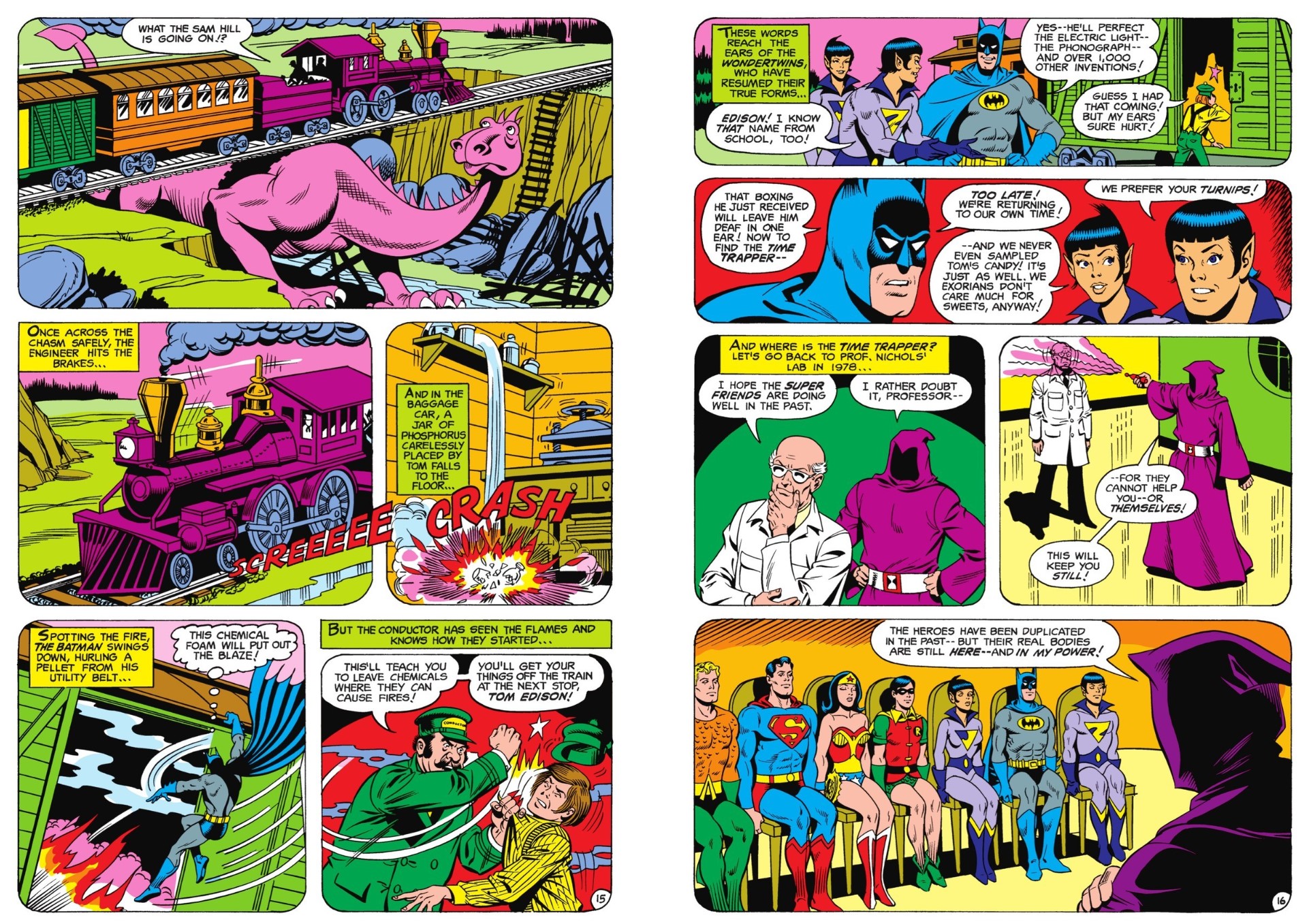
Eterno was initially devised by Thunder assistant editor Chris Lowder – AKA “Jack Adrian” – and editor Jack Le Grand, with top flight artist Tom Kerr (Monty Carstairs, Rip Kerrigan, Kelly’s Eye, Charlie Peace, Captain Hurricane, Steel Claw, Kraken, Mary-Jo, Tara King/The Avengers, Billy’s Boots) initially designing and visualising the frankly spooky antihero. He also drew the scene-setting first episode. The feature was scripted by equally adept and astoundingly prolific old hand Tom Tully (Roy of the Rovers, Heros the Spartan, Janus Stark, The Wild Wonders, Dan Dare, Johnny Red, The Leopard from Lime Street), who only finally left it in 1976. Kerr, Donne Avenell, Scott Goddall &Ted Cowan would also write subsequent adventures. In fact, Tully might have scripted some of the material in this collection including the first instalment here: a handy recap/catchup limned by Francisco Solano López (and his family studio) that swiftly shifts to a gripping tale of “Conquistadore” atrocity…

Thanks to spotty record keeping, like so much in life and comics, it’s all a big mystery…

Gathering episodes from weekly Lion & Thunder spanning March 20th through August 28th 1971, plus pertinent material from Lion & Thunder Holiday Special 1971 & 1972, the chronal calamities and dark doings resume following Chris Lowder’s informative flashback essay ‘A Writer’s Trip Through Time’.

What you need to know: Delivered in stark, moody monochrome, the saga tales of tragic immortal chronal castaway Adam Eterno began life in the 16th century. He was an ambitious apprentice and less than sterling moral character, indentured to alchemist Erasmus Hemlock. When Adam’s master perfected an immortality serum, the headstrong, impatient acolyte sampled the potion against the sage’s express command. This precipitated the ancient’s death and a fiery conflagration that gutted the house. Hemlock’s last act was to curse his faithless student to live forever and “wander the world through the labyrinths of time”. Surcease would come from a mortal blow struck by a weapon of gold…

The curse was truly effective and as centuries passed, Adam became a recluse: his never-changing appearance driving him away from superstitious mortals and perpetually denying him simple contact with humanity. He fought in all of Britain’s wars, but hard-earned combat comradeships always ended whenever a seemingly fatal blow or wound left him unharmed…

Everything changed and the second part of the alchemist’s curse came true in 1970 when the traumatised, barely sane 421-year-old tramp staggered into a bullion robbery. He was shot by the thieves who rapidly realised that their victim was invulnerable, and attempted to use him in a raid on the Bank of England. When that went sideways too, Adam was struck by a fully-gold-plated limousine of a speeding millionaire…

The impact would be fatal for any other being, but for Adam Eterno it was the beginning of redemption as the shock hurled him into the timestream to land over and again in different eras…

The drama continues in that opening recap as Adam drops out of the timestream and is immediately cut down and hurled into quicksand by rapacious Spaniard Don Morto and his pitiless mercenarios, seeking the Incas fabled City of Gold. Dragging himself out of the mire, soon Adam is sought out by an Inca shaman and undergoes outrageous trials (many involving bonds and weapons of gold!) to become their champion in defeating the merciless invaders and liberating hostage king Tazuma Capa

The resistance is long and bloody but ultimately triumphal after Eterno introduces and mass-produces a weapon from the future that turns the tables on the armour, powder and shot of the invaders…

The bittersweet victory – after all, the traveller already knows more invaders will follow and ultimately succeed – sees Adam returned to chronal limbo only to rematerialise for the first time in the far future: a totalitarian dictatorship policed by brutes and thugs in armour of gold led by a monstrous tyrant: Grunn the Grim. The extended war to liberate tomorrow ends successfully but with the wanderer again returned to falling through eras, with the first hints that the penitent troubleshooter is not randomly drawn to rising manifestations of evil and crossroad moments of menace…

The latest stopover is Dark Ages Eastern Europe where a struggle for the throne sees an evil yet trusted relative seeking to usurp Duke Ctharmis of Carathia, after abducting the prince and true heir. Now as a local wild-child terrorises the populace, and packs of (were?)wolves congregate everywhere, a tatty stranger arrives and starts making trouble. Nobody knows Adam has been recruited by local wizard Mageis to set destiny aright and end the schemes of wicked Baron Draxa, before being deposited in far more familiar territory: England during the Civil War…

Obsessive anti-royalist Captain Raker ravages the locality searching for Lord Benham and the funds he holds in the King’s name. His brutal acts draw the immortal man into the pointless conflict, despite persistent, prophetic visions of doom hampering the antihero… until a final face-to-face duel ends matters and catapults Adam into the New World and a new kind of wickedness. In 1920s New York City, money not power motivates mobster Rikki Delgano, but his tactics are just as cruel and just as ineffectual against an enemy who will not die…

The crook’s hash soon settled, Eterno next appears in the skies over London amidst a storm of ack-ack fire and Luftwaffe planes. Furious and fighting mad, the traveller captures a Nazi bomber and follows the raiders back to their base, delivering a deadly dose of “how do you like it?” before ghosting on to land in the wild west and exonerate unjustly accused drifter the Durango Kid when both are charged with stagecoach robbery. Dodging gunplay and lynchings, Apache tortures and worse, Adam deftly exposes the real bandit before moving on to save all of humanity…

Lost in the early years of the stone age over 35,000 years before his own birth, Eterno roams amidst mammoths, neanderthals and dawn men, but must battle beast men armed with ray guns to foil a plan by alien colonisers. They seek to eradicate emerging humankind and take the world for their own, but Adam is greatly aided by prescient sage Kathon-the-Wise, who seems to see all his past and future secrets… and bears a remarkable resemblance to so many other wizards and mages the nomad of the ages has met…

After a cataclysmic pitched battle, humanity is saved and the spacers defeated, but there’s no rest for the (gradually redeeming) wicked and Eterno lands in shark-filled waters just in time to become the latest target of pirate lord Blackbeard. On foiling that felon, the winds of time waft him to a Viking raid in Anglo-Saxon England where pitiless reiver Geflin One-Eye seems set on taking the kingdom, unless some brave soul can retrieve the fabled Gold Sword of Wulfric from the abbey where it lies and lead the counterattack. Obviously, Adam is not keen on getting that close to his metal nemesis but if the situation demands it…

Bombastic, blood-soaked, inspirational and creepier than you’d imagine possible or permissible in a kids’ comic. the exploits of Adam Eterno are dark delights impossible to put down, so it’s fortunate that there are two more longer complete yarns still to come here.

Taken from Lion & Thunder Holiday Special 1971, the first sadly uncredited yarn (as regards the writer at least) was illuminated by veteran comics illustrator John Catchpole. He was the first to draw Kelly’s Eye – in 1962 for Knock-Out – and limned The Shadow of the Snake & sequel serial Master of Menace between 1972-1974 in Lion where he was part of a rotating team crafting Adam Eterno. As well as Annuals material like Black Bedlam (1975) he inked Jack (Charlie Peace) Pamby on The Potters from Poole Street in Valiant (1976) and was also a book illustrator.

Here all that skill and aplomb is used to detail a moody Victorian mystery as the immortal nomad helps the last of the Calcott line locate a lost family fortune and avoid murder by a monster…

Wrapping up proceedings on a true high (and also lacking a writer credit) the 1972 Adam Eterno special tale was illustrated by the magnificent and prolific Eric Bradbury (1921-2001) began in 1949 in Knockout.

Frequently working with studio mate Mike Western, Bradbury drew strips like Our Ernie, Blossom, Lucky Logan, Buffalo Bill, No Hiding Place, The Black Crow and Biggles. He was an “in-demand” illustrator well into the 1990s, on landmark strips such as The Avenger, Cursitor Doom, Phantom Force 5, Maxwell Hawke, Joe Two Beans, Mytek the Mighty, Death Squad, Doomlord, Darkie’s Mob, Crazy Keller, Hook Jaw, The Sarge, Invasion 1984, Invasion (the unrelated 2000 AD strip), Mean Arena, The Fists of Jimmy Chang, The Dracula Files, Rogue Trooper, Future Shocks, Tharg the Mighty and much more…

All that imagination and experience are seen here, when Adam appears in ancient Atlantis: a dinosaur-infested paragon of human ingenuity and political depravity where a tyrannical queen and audacious space shot lead to the destruction of Earth’s first human civilisation…

Closing with biographies on the creators featured herein and ads for other British lost wonders Adam Eterno – Grunn the Grim is enthralling astonishment awaiting your gaze: a riotously rewarding rollercoaster ride to delight readers who like their protagonists dark and conflicted and their history in bite-sized bursts.
© 1971, 1972, & 2025 Rebellion Publishing IP Ltd. All Rights Reserved.

Today in 1952 the last weekly instalment of Will Eisner’s Spirit Comics Section was published, whilst in 1974 the final Shiver and Shake entertained diehard UK readers.

In 1994, comics and animation giant Doug Wildey went to the final roundup. Remembered for Tarzan, The Saint newspaper strip and Jonny Quest, he’d prefer you read his elegiac westerns like Doug Wildey’s Rio: The Complete Saga.

Love Me Please – The Story of Janis Joplin (1943-1970)


By Nicolas Finet, Christopher & Degreff: translated by Montana Kane (NBM)
ISBN: 978-1-681122-76-2 (HB) eISBN: 978-1-681122-77-9

Gosh, aren’t real people interesting… especially in comics?

The list of people who lived hard, died young and changed the world is small but still, somehow, painfully overcrowded. Possibly the most tragic, influential, yet these days largely unknown was a born rule-breaking rebel who defied all conventions to become almost inevitably THE icon of doomed youth-with-big-dreams everywhere…

Author, filmmaker, journalist, publisher, educator and music documentarian Nicolas Finet has worked in comics for more than three decades – generating a bucketload of reference works like Mississippi Ramblin’ and Forever Woodstock. His collaborator on that last one was veteran author, journalist and illustrator Christopher (The Long and Winding Road; many other music-centred tomes and adaptor of the wonderful Bob Dylan). Their compelling treatise on misunderstood and self-destructive Janis – just like her music, poetry and art – is something to experience, not read about, but I’ll do my best to convince you anyway…

After a quick dip into early life and influences, the story proper opens in Texas in 1947 as ‘Forget Port Arthur’ zeroes in on key childhood traumas and revelations around the homelife and schooling of little Janis Lyn Joplin (January 19th 1943 – October 4th 1970) at the start of the most culturally chaotic and transformative period in American history…

Brilliant, multi-talented, sexually ambiguous, starved for love and desperately directionless, her metamorphosis through Blues music mirrors that of many contemporaries (a fair few of whom comprise the infamous “27 Club” of stars who died young). However, as this book shows, although something indefinable was always just out of Joplin’s reach, her response was never to passively accept or ever surrender…

Barely surviving her wildly rebellious teen years, an uncomfortable educational life, brief brush with conventional conformity and near-fatal counter-culture encounter in San Francisco – as all detailed in ‘The Temptation of Disaster’ – her meteoric rise in the era of flower power, liberal love and drug experimentation and record company exploitation lead to her return to sunny California and triumphant breakthrough in 1966, all carried along by ‘Spells and Charms’

Stardom with hot band Big Brother and the Holding Company, and a host of legendary encounters affording even greater personal dissipation, makes wild child into living myth at Monterey and other landmarks of the Summer of Love, before success and acceptance prove to be her darkest nightmare in ‘Lost and Distraught’

Global stardom and media glorification are balanced by heartbreak, betrayal and too many brushes with death. As Woodstock confirms her status and talent to the world, the landscape inside her head turns against Janis. Endless exhausting tours and brief amorous encounters further destabilise the girl within and the end – when it comes – is no surprise to anyone…

With a moving Preface from comics legend and childhood friend Gilbert Shelton, a huge, star-studded Character Gallery and suggested Further Reading and Viewing, this forthright, no-nonsense, extremely imaginative interpretation of the too-short flowering of “the Rose” offers insight but never judgement into a quintessentially complex, contradictory and uncompromised life…

NBM’s library of graphic biographies are swiftly becoming the crucial guide to the key figures of modern history and popular culture. If you haven’t found the answers you’re seeking yet, then you’re clearly not looking in the right place. Just remember that, as you gear up for what might well be the last Christmas you’ll spend with loved ones…
© Hatchette Livre (Marabout) 2020. © 2021 NBM for the English translation. All rights reserved.

Most NBM books are also available in digital formats. For more information and other great reads see NBM.

Today in 1931 comics changed forever with the first published episode of Chester Gould’s detective innovation. We last saw his impact in The Dick Tracy Casebook – Favourite Adventures 1931-1990 but there are loads and they’re all great. The same holds true for Walt Kelly’s scathing, sweetly savage political satire which debuted today in 1948. If you’re as yet unconverted why not check out Pogo: The Complete Syndicated Comics Strips volume 1 – Through the Wild Blue Wonder?

Planet of Science – The Universal Encyclopedia of Scientists


By Antonio Fischetti & Bouzard, translated by James Hogan (Europe Comics)
No ISBN: digital only

Comics and graphic novels have an inconceivable power to deliver information in readily accessible form, and – like all the best teachers – can do so in ways that are fascinating, fun and therefore unforgettable.

A prime example is 2019’s La Planète des sciences – Encyclopédie universelle des scientifiques – which is available digitally in English if STILL not yet as a solidly reassuring tome. A bright and breezy introduction to a number of researchers and discoverers, famed and not, it combines a page of personal history, biography and unflinching commentary on 37 notable personages who have added to global scientific knowledge, each accompanied by a smart, punchy and pertinent gag strip by underground cartoonist Guillaume Bouzard (Caca bemol, Je veux travailler pour le Canard enchaîné, Lucky Luke).

Presenting the facts is Dr Antonio Fischetti, author (Cats and Dogs under the scientist’s magnifying glass, Idiotic and Relevant Questions about Mankind); science journalist; educator (at the National Conservatory of Arts and Crafts, National Conservatory of Music and Dance in Paris, Louis Lumière School and La Femis); and author of a science column for illustrious truth-seeking organ Charlie Hebdo.

The Continent is happily, gloriously awash with factual albums and graphic novels – and not just biographies – and this is one of the most entertaining I’ve ever seen, opening with Dr. Fischetti’s explanatory postulate on why these particular 37 candidates and his cognitive methodology, before the visual revelations begin. Sub-divided into rough, often overlapping time frames it all starts in Ancient Greece with the lowdown and high points of Thales, Pythagoras, Hippocrates and Archimedes, before jumping to 780-850CE for the story of Al-Khwarizmi.

Traversing the 15th – 16th Century, we meet Leonardo da Vinci, Nicolaus Copernicus, Ambroise Paré, Giordano Bruno & Galileo, before 17th – 18th Century pioneers Rene Decartes, Antonie van Leeuwenhoek, Isaac Newton, Carl Linnaeus and Antoine Lavoisier get their moment in history’s hindsight and spotlight. As big, deep thinking becomes more widespread, representing the 19th Century are Charles Darwin, Claud Bernard, Gregor Mendel, Louis Pasteur, Alfred Nobel (suck it, Donny-baby!) and Dmitri Mendeleev, after which the revolutionary 19th – 20th Century hones in on Ivan Pavlov, Max Planck, Marie Curie, Albert Einstein, Alfred Wegener, Alexander Fleming, Erwin Schrödinger and Trofim Lysenko. By now it’s probably clear to most of you that this is no simple hagiography: some of the folk here are included because of their effect on scientific progress and it’s not all smiles, acclaim and awards…

The procession of progress pauses with the 20th – 21st Century (because, as of this writing, time travel has not been satisfactorily confirmed or reproduced under laboratory conditions) with controversial and occasionally still-living paragons Konrad Lorenz, Alan Turing, Alexander Grothendieck, James Watson, Peter Higgs, Yves Coppens, Emmanuelle Charpentier and the recently lost and already hugely missed Jane Goodall. Sure, you could Google them, but this book is a far more satisfying alternative…

The very fact that you probably haven’t heard of some of these latter savants – or even a few of the more ancient ones – only proves without doubt that you need this book. QED: What more can one say?
© 2020 DARGAUD – Fischetti & Bouzard. All rights reserved.

Today in 1913, comic book pioneer, cover artist and co-creator of Zatara Fred Guardineer was born, whilst in 1924 the legendary Harvey Kurtzman took his first peep at reality and probably started taking critical notes. We last spotlighted the inventor of Mad Magazine in Harvey Kurtzman’s Marley’s Ghost.

And today in 1982 the world was lessened by the passing of wondrous Noel Sickles, whom we loved most for such astounding strip work as Scorchy Smith: Partners in Danger.

The Complete Peanuts volume 1: 1950-1952


By Charles Schulz (Canongate Books/Fantagraphics Books)
ISBN: 978-1-56097-589-2 (Fantagraphics HB) 978-1-60699-763-5 (Fantagraphics TPB) 978-1-84767-031-1 (Canongate)

This book includes Discriminatory Content produced in less enlightened times.

Win’s Christmas Gift Recommendation: All that’s great about cartoon strips… 10/10

Peanuts is unequivocally the most important comics strip in the history of graphic narrative. It is also the most deeply personal. Today in 1950 it all began, and cartoonist Charles M Schulz went on crafting his moodily hilarious, hysterically introspective, shockingly surreal philosophical epic for half a century: 17,897 strips spanning October 2nd 1950 to February 13th 2000.

He died from complications of cancer the day before his last strip was printed.

At its height, Peanuts ran in 2,600 newspapers, in 21 languages and in 75 countries. Many of those venues still run it as perpetual reprints, and have ever since his death. During Schulz’s lifetime, book collections, a merchandising mountain and television spin-offs had made the publicity-shy doodler an actual billionaire at a time when that really meant something…

None of that matters. Peanuts – a title Schulz loathed, but one the syndicate forced upon him – changed the way comics strips were received and perceived: proving cartoon comedy could have edges and nuance and meaning as well as soon-forgotten pratfalls and punchlines.

Following a typically garrulous, charming and informative Introduction from fellow Minnesotan Garrison Keillor, this mammoth (218 x 33x 172 mm) landscape compendium offers the first two and a bit years. Here a prototypical, rather outgoing and jolly Charlie Brown and high-maintenance mutt Snoopy joined with bombastic Shermy and mercurial Patty in hanging out doing kid things.

These include playing, playing pranks, playing sports such as tennis, golf and baseball, playing musical instruments, teasing each other, making baffled observations and occasionally acting a bit too much like grown-ups. Fans of Bill Watterson’s Calvin and Hobbes will feel eerie familiarity with much of the hijinks and larks of these episodes.

As new characters Violet, infant prodigy Schroeder, and Lucy and her strange baby brother Linus were added to the mix, the boisterous rush of the series began to imperceptibly settle into a more contemplative pace. Charlie Brown began to adopt and embrace his eternal loser, singled-out-by-fate persona and the sheer diabolical wilfulness of Lucy began to sharpen itself on everyone around her…

The first Sunday page debuted on January 6th 1952; a standard half-page slot offering more measured fare than the daily. Both thwarted ambition and explosive frustration became part of the strip’s signature denouements…

By the end of 1952, all those the rapid-fire gags had evolved from raucous slapstick to surreal, edgy, psychologically barbed introspection, garnished by crushing judgements and deep rumination in a world where kids – and certain animals – were the only actors. The relationships, however, were increasingly deep, complex and absorbing even though “Sparky” Schulz never deviated from his core message: entertain…

David Michaelis then celebrates and deconstructs ‘The Life and Times of Charles M. Schulz’ after which Gary Groth & Rick Marschall conduct ‘An Interview with Charles M. Schulz’, rounding out our glimpse of the dolorous graphic genius with intimate revelations and reminiscences whilst a copious ‘Index’ offers instant access to favourite scenes you’d like to see again.

Readily available in hardcover, paperback and digital editions, this initial volume offers a rare example of a masterpiece in motion: comedy gold and social glue gradually metamorphosing in an epic of spellbinding graphic mastery which became part of the fabric of billions of lives, and which continues to do so long after its maker’s passing.

Happy ever afters, kids.
The Complete Peanuts: 1950-1952 (volume 1) © 2004 Peanuts Worldwide, LLC. Introduction © 2004 Garrison Keillor. “The Life and Times of Charles M. Schulz” © 2000 David Michaelis. “Interview with Charles M. Schulz” © 2004 Gary Groth and Richard Marschall. All other material copyright its respective owners. All rights reserved.

Today in 1909 Alex Raymond was born. You’ll know him best for stuff like Flash Gordon on the Planet Mongo volume 1: Sundays 1934-1937 (The Complete Flash Gordon Library. In 1916 Bob Powell, was born. He went on to do things like Bob Powell’s Complete Jet Powers.

Ramona Fradon was born in 1926, and Spirou stalwart Janry arrived in Belgium in 1957, whilst Maltese docu-comics journalist Joe Sacco was born in 1960. You can find dozens of books by the first two just by using a search box here, and I’ve almost summoned enough nerve to review Sacco’s Palestine despite – or because of – these febrile times…

Vixen: Return of the Lion


By G. Willow Wilson & CAFU, with Bit, Josh Middleton & various (DC Comics)
ISBN: 978-1-4012-2512-4 (TPB)

This book includes Discriminatory Content produced in less enlightened times.

Welcome to Black History Month UK 2025. The theme this year is “Standing Firm in Power and Pride” and nobody ever accused us of being subtle…
In 1978 fashion model Mari Jiwe McCabe nearly became the first black woman to star in her own American comic book. Sadly, the infamous “DC Implosion” of that year saw the Vixen series cancelled before release. She eventually premiered three years later in Action Comics #521’s ‘The Deadly Rampage of the Lady Fox’ (by creator Gerry Conway and Superman mainstays Curt Swan & Frank Chiaramonte) and thereafter remained, lurking around the DC Universe until she joined a re-booted JLA (latterly dubbed “JLA Detroit”) in Justice League of America Annual #2.

A classic team-player, over intervening decades working within assorted JLA rosters, Suicide Squad, Ultramarine Corps, Checkmate and the Birds of Prey, Vixen’s origin has changed a lot less than most. It even remained mostly un-meddled-with when she made the jump to TV as part of the DC Legends of Tomorrow show.

Mari Jiwe comes from a line of warriors blessed by animist Trickster god Kwaku Anansi. The mythical creator of all stories claims to have designed her abilities – and those of fellow bestial hero Animal Man – allowing Vixen, through use of an arcane artefact dubbed the Tantu Totem, to channel the attributes and signature abilities of every animal that has ever lived.

As a child in M’Changa Province, Zambesi, Mari’s mother was killed by poachers and her missionary father murdered by his own brother over possession of the Totem. To thwart her uncle, the orphan moved to America, eventually becoming a fashion model to provide funding and cover for her mission of revenge…

At first a reluctant superhero, Vixen became one of the most effective crusaders on the international scene and was a key member of the Justice League (the one just before the New 52 Reboot). Previously, when her powers began to malfunction she was forced to confront Anansi himself (for which tales see Justice League of America: Sanctuary and Justice League of America: Second Coming).

Scripted by author, essayist, journalist and comics scribe G. Willow Wilson (Cairo, Air, Ms. Marvel, Wonder Woman) and illustrated by Carlos Alberto Fernandez Urbano AKA CAFU (Action Comics, T.H.U.N.D.E.R. Agents, Imperium, Unity), Vixen: Return of the Lion was originally seen as a 5-part miniseries in 2009. We open here with ‘Predators’ wherein a League operation uncovers a plot by techno-thugs Intergang to fund a revolution in troubled African nation Zambesi.

Amongst impounded files is a record “proving” that 15 years earlier, Vixen’s mother was actually killed by Aku Kwesi, a local warlord working with the American criminal organisation. When Mari learns this truth, not even Superman can stop her from heading straight to her old village to find the man responsible. Africa is not America, however, and the lawless settlement has no time for a woman who does not know her place – even if she does have superpowers. When Kwesi appears, Vixen’s abilities are useless against him and she escapes with her life only because the warlord’s lieutenant Sia intervenes…

In ‘Prey’, broken, gravely wounded Mari is dumped in the veldt by Sia and staggers her way across the war-ravaged plain, battling beasts and hallucinating – or maybe meeting real ghosts – until she is attacked by a young lion and rescued by a holy man.

Alarmed at Vixen’s disappearance and further discoveries connecting Kwesi to Intergang, the JLA mobilise in ‘Sanctuary’ as lost Vixen slowly recuperates in a place where the constant conflicts of fang & claw survival are suspended. Here, saintly Brother Tabo offers Mari new perspective and greater understanding of her abilities. Her JLA colleagues, meanwhile, have exposed Intergang’s infiltration but fallen to a power even Superman could not resist…

As the League struggles against overwhelming odds, ‘Risen’ sees a transcendent Vixen flying to the rescue, and picking up some unexpected allies before facing her greatest challenge in shocking conclusion ‘Idols’, wherein more hidden truths are revealed and a greater mystery begins to unfold…

Featuring a gallery of stunning covers by Josh Middleton, this is an exceptional and moodily exotic piece of Fights ‘n’ Tights fluff to delight devotees of the genre and casual readers alike, and one long overdue for re-release and inclusion in the growing library of environmentally-beneficial digital comics and books. This gem isn’t even available digitally and that’s just a crime against comics consuming nature…
© 2006, 2009 DC Comics. All Rights Reserved.

Today in 1940 was the birthday of groundbreaking comics auteur Richard Corben, creator of Den, although we rather liked his Haunt of Horror: Lovecraft. It also marks the first appearance of Zack Mosely’s Smilin’ Jack newspaper strip, and the passing of Golden Age great Bob Powell, who we most recently lauded via Bob Powell’s Complete Cave Girl.

Predator vs Black Panther


By Benjamin Percy, Chris Allen, Sean Damien Hill, Lee Ferguson, Craig Yeung, Jonas Trindade, Erick Arciniega, VC’s Travis Lanham & various (20th Century Studios/ MARVEL)
ISBN: 978-1-3029-6034-6 (TPB/Digital edition)

Win’s Christmas Gift Recommendation: Purely Perfect Irresistible Primal Pandering… 8/10

Although I’ve striven long and hard(ish) to validate and popularise comics as a true art form here and elsewhere, it’s quite hard to escape one’s roots, and every so often the urge to revel in well-made, all-out mindless violence and crass commercialism confidently assuming it is what the reader wants just takes me over. If there’s a similar little kid inside you, this unchallenging, no-brainer team-up property might just clear the palate for the next worthy treat I’ll be boosting…

Predator was first seen in the eponymous 1987 movie and started appearing in comic book extensions and continuations published by Dark Horse with the 4-issue miniseries Predator: Concrete Jungle spanning June 1989 to March 1990. It was followed by 39 further self-contained outings and (by my count thus far) 14 crossover clashes ranging from Batman and Superman to Judge Dredd, Archie Andrews and Tarzan, keeping the film franchise alive and kicking whilst actual movie iterations waxed and waned. We’ll no doubt be adjusting those figures soon enough, but two of the most recent involve stalwart comic stars with their own movie machismo: Wolverine and Black Panther

The core premise started simply enough. For countless millennia a race of beings that prize hunting, trophy-taking and bragging rights/“honour” over all else have been using Earth – and by extension other worlds and civilisations – as private sports preserves. These “Yautja” – who prefer to stalk hotter climes – come to our world expressly to test themselves and to thrill to the heady rush of killing animals…

The Black Panther rules over a fantastic African paradise which isolated itself from the rest of the world millennia ago. Blessed with unimaginable resources – both natural and not so much – the nation of Wakanda developed unhindered by European imperialism into the most technologically advanced human nation on Earth. It has never been conquered, with the main reason being an unbroken line of divinely-sponsored warrior kings who safeguard the nation. The other is a certain miraculous super-mineral found nowhere else on Earth…

In contemporary times that chieftain is (usually) T’Challa: an unbeatable, physically perfect feline-empowered strategic genius dividing his time between ruling at home and serving abroad in superhero teams such as The Avengers and The Ultimates beside costumed champions like Iron Man, Mr. Fantastic, Thor, Captain Marvel and Captain America. However, in this version he’s a proud and defiant isolationist…

Acclaimed as the first black superhero in American comics and one of the first to carry his own series, the Black Panther’s popularity and fortunes have waxed and waned since he first appeared in the summer of 1966. As originally created by Jack Kirby & Stan Lee T’Challa, son of T’Chaka was an African monarch whose secretive kingdom is the only source of vibration-absorbing wonder mineral Vibranium. The miraculous alien metal – derived from a fallen meteor which struck the continent in lost antiquity – is the basis of Wakanda’s immense power and prosperity, allowing the isolationist nation to become one of the wealthiest and most secretive on Earth. When T’Chaka was assassinated by white invader Ulysses Klaw, these riches enabled the young king to radically remake his country, even more so after leaving Africa to fight as an Avenger.

For much of its history Wakanda was a phantom, utopian wonderland with tribal resources and people safeguarded and led since time immemorial by a warrior-king deriving cat-like physical advantages from secret ceremonies and a mysterious heart-shaped herb. This has ensured the generational dominance of the nation’s Panther Cult and Royal Family. The obsessively secured “Vibranium mound” guaranteed the nation’s status as a clandestine superpower for centuries, but recent times increasingly saw Wakanda a target of incursion, subversion and invasion as the world grew ever smaller. Here however, in a tale notionally removed from mainstream continuity T’Challa and his sister Princess Shuri discover the nation’s borders are not, nor ever have been totally secure…

Scripted by Bejamin Percy, this trans-galactic saga of families at war sees sibling rivalry lead to civil conflict in one of the dominant clans of the Yautja. One prince, physically far weaker than his brother and even missing a limb, survives only because his superior brother heaps further shame upon him, constantly proving to their sire how unworthy the weakling truly is.

A life of woe and degradation seems likely to end in inconceivable agony and shame, but the pariah pursues an ancient prize trophy: a sample of a wonder element dubbed “godmetal” that has utterly reshaped his prospects. The treasured token of a long-ago hunt, it comes from favoured preserve Earth where some of the indigenous prey have fabulously prospered and gained advantage from it. There, they call it Vibranium and he will have it…

Although they’re indisputably barbaric and revel in getting their clawed hands dirty, Yautja are an ancient galaxy-spanning species and the outcast instantly finds new ways to use the miracle metal. Escaping to Earth with his surviving faithful retainers he goes about securing the only known source of his salvation…

On Earth, Black Panther T’Challa bickers with smugly-superior Shuri during a live fire training exercise pitting his bodyguard Dora Milaje against male warrior elite the Hatut Zeraze and everybody against the King. Although good natured, the competition is fierce but everything changes when the renegade arrives and infiltrates. Deftly penetrating the country’s electronic and advanced energy defence shields screening Wakanda from the rest of humanity, the Yautja takes command of human mechanical systems and begins collecting trophies: not just skulls and spines of the greatest warriors in the region, but most crucially all the Vibranium and ordnance the prey have developed from it…

With Wakanda locked down and T’Challa hard-pressed just to survive. it’s a good thing Shuri never lost trust in the ancient mystical ways (or contact with extremely gifted spirit medium Maji Kina), and is, moreover, open to a surprise offer of assistance from visiting American superhero Sam Wilson, the high-flying high-tech Falcon

As the alien renegade musters its newfound resources and Wakandans bloodily strive on, stubborn T’Challa consults his dead ancestors to learn how his grandfather Azzuri the Wise dealt with the last visitation before all the scattered human resistors convene to end the threat… if only for now…

Savage and bloody but with room for character moments and even gallows humour, the tale is visually detailed by Chris Allen, Sean Damien Hill, Lee Ferguson, Craig Yeung, Jonas Trindade and coloured by Erick Arciniega with letters by VC’s Travis Lanham. Ultimately, plot-wise there’s not much to this – and a good thing too as it would get in the way of the action…

Like the films, what’s on offer is a thinly disguised excuse for mindless, cathartic violence and rollercoaster thrills and chills, and it’s all accomplished with compelling style and dedication. Wild, grim, edgy and utterly entertaining, the original  4-part miniseries came with a variety of cover choices and capping the furious fun is an extended gallery with gory stories enshrined in single visual vistas of line, colour, paint & pixels, courtesy of Ken Lashley & Juan Fernandez – AKA Ledkilla, Edwin Galmon & Federico Blee, Chris Allen, Leinil Francis Yu & Romulo Fajardo Jr., Pete Woods, Philip Tan, Mark Morales & Frank Martin, Skottie Young, Doaly, Rahzzah, Rose Besch, Andrei Bressan & Ceci De La Cruz, Junggeun Yoon and Mateus Manhanini.

Hunt this down for simple fun and pure escapist shocks and shudders.
© 2025 20th Century Studios. Marvel, its characters and its logos are ™ Marvel Characters, Inc.

On this day in 1987 master raconteur screenwriter and occasional comics author Alfred Bester died. His visual feasts included lots of DC comics stars such as the first Green Lantern, and newspaper strips The Phantom and Mandrake the Magician. You should consider yourself an incomplete human if you haven’t read The Demolished Man, The Stars My Destination (aka Tiger, Tiger) and Who He?

The Shadow 1941: Hitler’s Astrologer


By Dennis O’Neil, Michael William Kaluta & Russ Heath with Mike Kelleher, Mark Chiarello, Nick Jainschigg, John Wellington, Phil Felix & various (Dynamite Entertainment)
ISBN: 978-1-60690-429-9 (HB/Digital edition)

This book includes Discriminatory Content included for dramatic effect.

Russ Heath would have been 99 years old today: a master comics craftsman so few have ever heard of. I don’t think there’s even a definitive collection or a signature title to his name. He did his job masterfully and always moved on, and remains almost practically unknown. The pages of Sgt Rock original art I own are among my most treasured possessions, and every baby boomer who read US comics knew his work because of this and others like it.

Russell Heath Jr. was born in New York City on September 29th 1926 and raised in New Jersey. Influenced by cowboy artist Will James and others, Heath was self-taught and fiercely diligent, demanding authenticity of himself in all his work. This helped him break into comic books while still at High School (episodes of naval strip Hammerhead Hawley for Captain Aero Comics beginning with vol. 2, #2 in September 1942).

Eager to serve his country, Heath left Montclair High School early in 1945 for the Air Force. Whilst in the military he contributed cartoons to the Camp newspaper before shipping out. When peace broke out, he worked briefly as an ad agency gofer until in 1947 he landed a regular job with Timely Comics. Now married, Heath started working from home, drawing Kid Colt and Two Gun Kid, offerings for the dwindling superhero market and sundry horror stories and covers. He hit an early peak in the 1950s, with a wealth of western and horror features as well as co-creating Marvel Boy, limning Venus and The Human Torch during the abortive attempt to revive superheroes in 1953, whilst mostly crafting crime and romance tales,

He branched out: trying his hand on EC’s Mad and Frontline Combat, 3D comics for St. John’s and earned a reputation for gritty veracity in war and straight adventure stories (such as Robin Hood and Golden Gladiator for DC’s The Brave and the Bold). Heath started contributing to DC’s war line in early 1954, with strips in Our Army at War #23 and Star Spangled War Stories #22. It was good fit and he spent the next 15 years working with writer/editor Robert Kanigher, with whom he co-created The Haunted Tank, Losers and Sea Devils. All along he remained a stalwart of anthological compact combat yarns, but increasingly guested on and eventually took over full time illustrating prestigious Sgt. Rock.

Infamously and unjustly, many of his panels were co-opted by pop artist Roy Lichtenstein as the basis of his paintings (specifically Whaam!, Blam, Okay Hot-Shot, Okay!, and Brattata). Heath’s other contributions to American pop culture include those iconic ads for toy soldiers and a stint on Harvey Kurtzman and Will Elder’s ubiquitous Playboy satire strip Little Annie Fanny. Later landmarks include launching a new Lone Ranger newspaper strip with Cary Bates in 1981, and illustrating Michael Fleisher’s infamous Death of Jonah Hex story. Eventually he moved into animation and out to the west coast, but remained in contact with his comics roots, providing occasional returns on titles such as Planet of the Vampires, Mister Miracle, Ka-Zar, The Punisher, Shadowmasters, G.I. Joe and Immortal Iron Fist among others. Having been awarded almost every award going, Heath was in semi-retirement when he died on the 23rd August 2018.

Despite adoring all that apparently unhip war and western stuff, we’re being contrary as ever and highlighting something a little different, but as it’s a special occasion you might want to also track down Hearts and Minds: A Vietnam War Story please link to 29th August 2018. Not our review, the actual book. It’s a Lost Treasure…

Here and now though let’s pop back to the early 1930s, when The Shadow gave thrill-starved Americans their measured doses of extraordinary excitement via cheaply produced pulp periodical novels and over the mood-drenched airwaves via his own radio show. Like comics once upon a time, “Pulps” were published in every style and genre in their hundreds every month, ranging from the truly excellent to the pitifully dire, but for exotic or esoteric adventure-lovers there were two stars who outshone all others. The Superman of his day was Doc Savage, whilst the premier dark, relentless creature of the night dispensing terrifying grim justice was the putative hero featured here…

Radio series Detective Story Hour (based on stand-alone yarns from Street & Smith publication Detective Story Magazine) used a spooky-toned narrator (variously Orson Welles, James LaCurto or Frank Readick Jr.) to introduce each tale. He was dubbed “the Shadow” and from the very start on July 31st 1930 was more popular than the stories he related. The Shadow rapidly evolved into a hands-on hero, solving instead of sharing mysteries and, on April 1st 1931, started starring in his own printed adventures. These were written by astonishingly prolific Walter Gibson under house pseudonym Maxwell Grant. On September 26th 1937 the radio show officially became The Shadow with the eerie mantra “Who knows what evil lurks in the hearts of Men? The Shadow knows!” unforgettably ringing out over the airwaves.

Over the next 18 years 325 novels were published, usually at two a month. The creepy crusader spawned comic books, movies, a newspaper strip and all the merchandising paraphernalia you’d expect of a smash-hit superstar brand. The pulp series officially ended in 1949, although Gibson and others added to the canon during the 1960s when a pulp/fantasy revival gripped the world, generating reprinted classic yarns and a run of new stories as paperback novels. There are also new yarns turning up to this day…

In graphic terms The Shadow was a major player. His national newspaper strip by Vernon Greene launched on June 17th 1940, and when comic books really took off, the Man of Mystery had a four-colour title; running March 1940 to September 1949. Thanks to Robert Bernstein, Jerry Siegel, John Rosenberger & Paul Reinman, Archie Comics published a controversial contemporary reworking in 1964-1965 for their Radio/Mighty Comics imprint.

In 1973 DC acquired rights to produce a captivating, brief but definitive series of classic comics unlike any other superhero title then on the stands. DC periodically revived the venerable vigilante and after the runaway success of Crisis on Infinite Earths, The Dark Knight Returns and Watchman, Howard Chaykin was allowed to utterly overhaul the vintage feature for an audience finally recognised as grown-up enough to handle more sophisticated fare. This led to further, adult-oriented iterations and one cracking outing from Marvel before Dark Horse assumed the license of the quintessential grim avenger for the latter half of the 1990s and beyond.

Dynamite Entertainment secured that option in 2011 and, whilst reissuing much of those earlier efforts, began a series of new monthly Shadow comics. A year after Chaykin and DC catapulted The Shadow into the grim ‘n’ grungy contemporary consumer arena, the dream-team that had first returned him to comics prominence reunited for a larger-than-life grand romp, ably abetted by the inking skills of master artist Russ Heath.

In the early 1970s Denny O’Neil & Michael Kaluta had produced a superb series of adventures (collected as The Private Files of the Shadow plee link to January 19th 2009), set in the mad scientist/spy/gangster-ridden ‘thirties. When they reunited to produce a Marvel Graphic novel, expectations were high, and in many ways that complex, devious yarn was the final chapter of that astounding graphic procession. Dynamite’s 2013 re-release of Hitler’s Astrologer saw the entire affair re-mastered by Mike Kelleher, finally doing justice to the colouring of Mark Chiarello, Nick Jainschigg and John Wellington – as well as letterer Phil Felix – which had not fared well under Marvel’s production processes of that earlier time.

On Easter Sunday 1941 a beautiful woman is pursued through the teeming crowds of Times Square theatre-goers by sinister thugs until rescued in the nick of time by agents of The Shadow. She is Gretchen Baur, personally despatched to America by Josef Goebbels to gather astrological data for the Reich’s Ministry of Propaganda. However, now the confused fräulein cannot understand why agents of her own government have tried to abduct her… until The Shadow reveals that she is an unwitting pawn in a deadly battle for supremacy within the Nazi Party. It all revolves around her father, Der Führer’s personal astrologer…

And thus begins a tense, intricate conspiracy thriller ranging from the bloody streets of New York through the shell-pocked skies of Europe to the very steps of Hitler’s palace in Berlin, as a desperate plan to subvert the course of the war comes up hard against a twisted, thwarted love and a decades-long hunt for vengeance…

Deliciously deranged and suitably Wagnerian in style, this action-packed mystery drama exudes period charm. Nobody has ever realised The Shadow and his cohorts as well as Kaluta, whilst Russ Heath’s sleek mastery adds weight and volume to the cataclysmic proceedings.

This sinister saga of the man in the black slouch hat with the girasol ring is another superb addition to the annals of the original Dark Knight, and one no one addicted to action and mystery should miss.

The Shadow ® & © 2013 Advance Magazine Publishers Inc. ® ™ & © Conde Nast. All Rights Reserved.

Today in 1916 was born Britain’s master of mordant wit Carl Giles. Last time we shared a laugh with him was Giles: the Collection 2014, whilst in 1947 underground legend Greg Irons first checked in. Our proudest moment is reviewing his outrageous The Wyf of Bath (The Wife of Bath) please link to March 9th 2018. Good luck finding that, but his other stuff is darn good too!

In 1988 utterly urbane arcane cartoonist Charles Addams went to his – or at least somebody’s – grave. You can check him out just by scrolling back to yesterday

Addams and Evil


By Charles Addams (Methuen/Mandarin)
ISBN: 978-0-413-55370-1 (Album PB) 978-0-413-57190-8 (Album HB) 978-0-413-55370-6 (Mandarin TPB)

This book includes Discriminatory Content produced in less enlightened times. This book also includes Discriminatory Content included for comedic and satirical effect.

Charles Samuel Addams (1912 – 1988) was a cartoonist and distant descendant of two American Presidents (John Adams & John Quincy Adams) who made his real life as extraordinary as his dark, mordantly funny drawings.

Born into a successful family in Westfield, New Jersey, the precocious, prankish, constantly drawing child was educated at the town High School, Colgate University, the University of Pennsylvania, and New York City’s Grand Central School of Art, and apparently spent the entire time producing cartoons and illustrations for a raft of institutional publications.

In 1932 he became a designer for True Detective magazine – “retouching photos of corpses” – and soon after began selling drawings to The New Yorker. In 1937 he began creating ghoulish if not outright macabre family portraits that become his signature creation. During WWII, he served with Signal Corps Photographic Center, devising animated training films for the military.

Whether he artfully manufactured his biography to enhance his value to feature writers or was genuinely a warped and wickedly wacky individual is irrelevant, although it makes for great reading – especially the stuff about his second wife – and, as always, the internet awaits the siren call of your search engine…

What is important is that in all the years he drew and painted those creepily sardonic, gruesome gags and illustrations for The New Yorker, Colliers, TV Guide and so many others, he managed to beguile and enthral his audience with a devilish mind and a soft, gentle approach that made him a household name long before television turned his characters into a hit and generated a juvenile craze for monsters and grotesques that lasts to this day. That eminence was only magnified once the big screen iterations debuted. And now we have streaming fun too. He would have loved the sheer terrifying inescapability of it all…

This stunningly enticing volume is a reissue of his second collection of cartoons, first published in 1947, and semi-occasionally since then. It’s still readily available if you’ve a big bank book, but the time is ripe for a definitive collected edition, or better yet a reissue of his entire canon (eleven volumes of drawings and a biography) either in print or digitally.

Should you not be as familiar with his actual cartoons as with their big and small screen descendants you really owe it to yourself to see the uncensored brilliance of one of America’s greatest humourists. It’s dead funny…

© 1940-1947 the New Yorker Magazine, Inc. In Canada © 1947 Charles Addams.

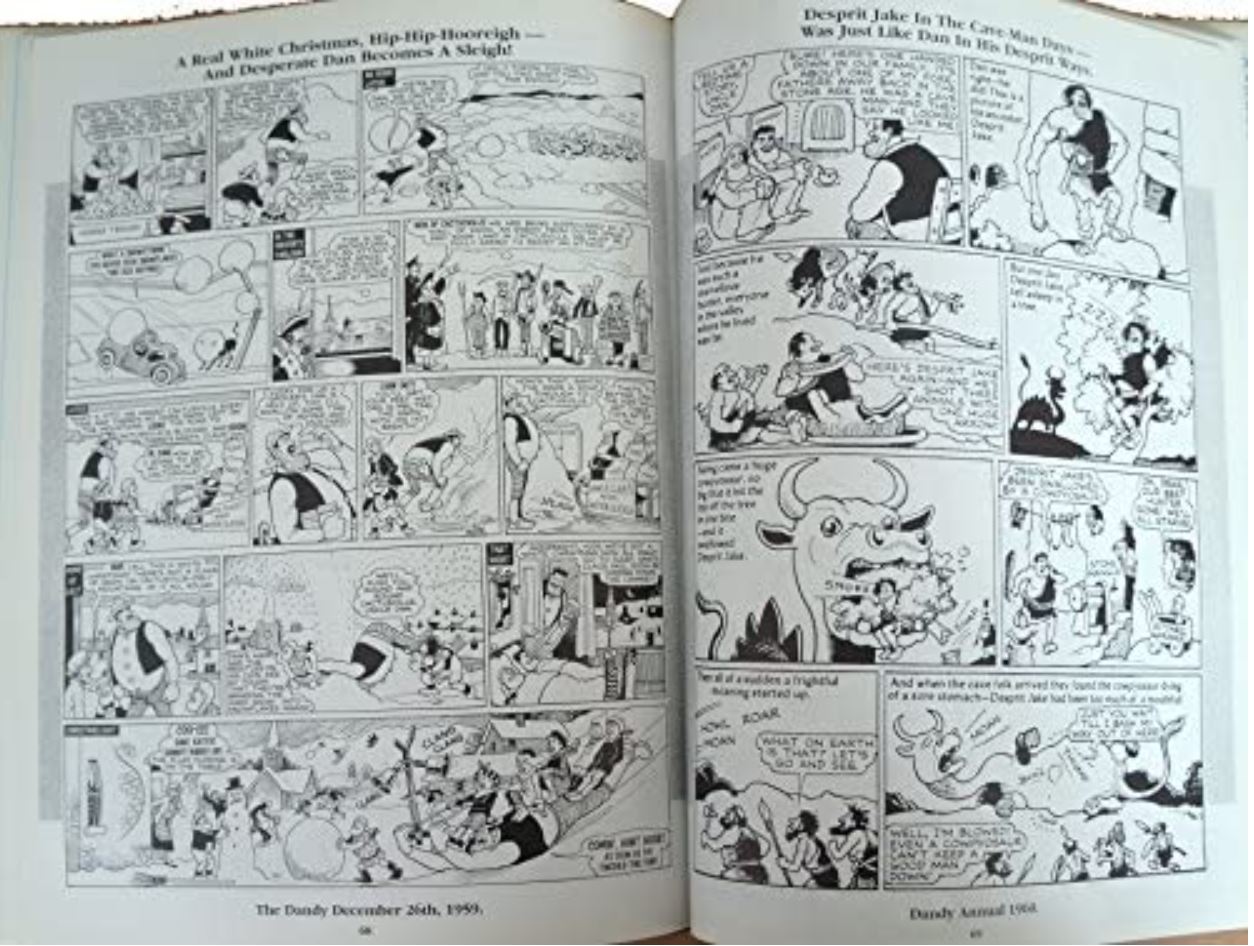
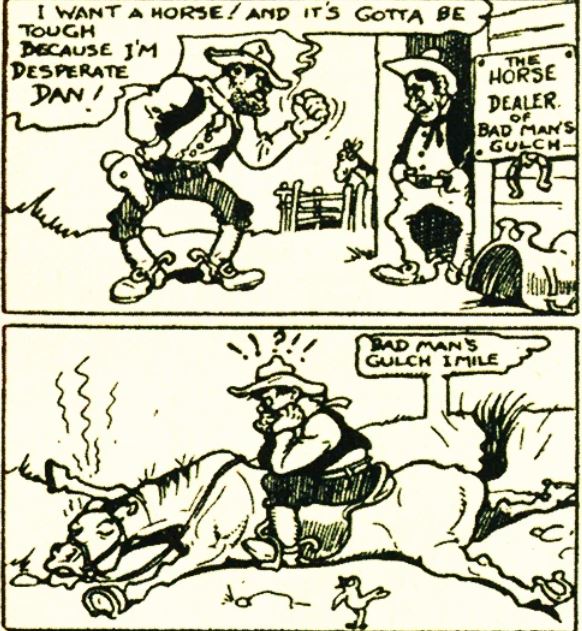
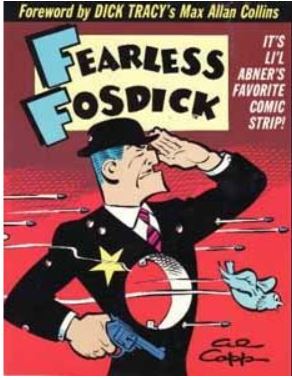
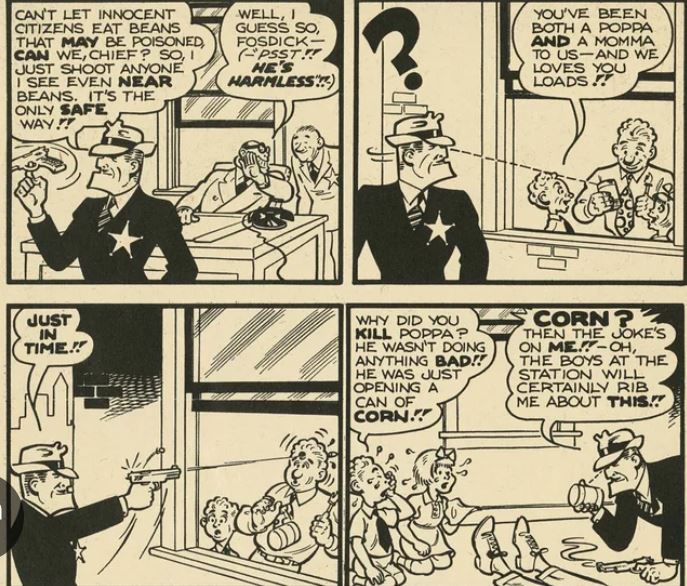
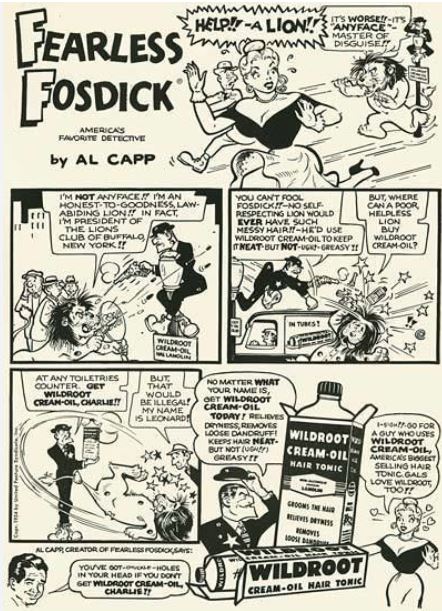
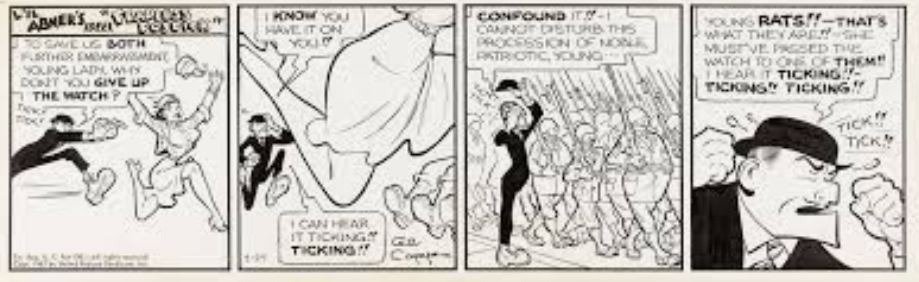
Today in 1909, fearless campaigner/cartoonist turned arch conservative Al Capp was born. Slightly less contentious than Li’l Abner, his Fearless Fosdick might be more to your taste.

Vlad the Impaler: The Man Who Was Dracula


By Sid Jacobson & Ernie Colón (Plume/Penguin Group USA)
ISBN: 978-1-59463-058-3 (HB) 978-0-452-29675-2 (PB)

Here’s a handy Heads-Up and Horrible History hint if you’re looking for something to set the tone for the Halloween we’re probably ALL NOT GOING TO ENJOY THIS YEAR. It’s available in hardback, soft cover and digital editions and well worth staying in with.

As writer and editor, Sid Jacobson masterminded the Harvey Comics monopoly of strips for younger US readers in the 1960s and 1970s, co-creating Richie Rich and Wendy, the Good Little Witch among others. He worked the same magic for Marvel’s Star Comics imprint, overseeing a vast amount of family-friendly material, both self-created – such as Royal Roy or Planet Terry – and a huge basket of licensed properties.

In latter years, he worked closely with fellow Harvey alumnus Ernesto Colón Sierra, aka Ernie Colón, on such thought-provoking graphic enterprises as The 9/11 Report: a Graphic Adaptation and its sequel, After 9/11: America’s War on Terror. In 2009 their epic Che: a Graphic Biography was released: separating the man from the myth of Ernesto Guevara de la Serna, universal icon of cool rebellion.

Colón was born in Puerto Rico in 1931: a creator whose work has been loved by generations of readers. Whether as artist, writer, colourist or editor his contributions have benefited the entire industry from the youngest (Monster in My Pocket, Richie Rich and Casper the Friendly Ghost for Harvey, and a ton of similar projects for Star Comics), to the traditional comic book fans with Battlestar Galactica, Damage Control and Doom 2099 for Marvel, Arak, Son of Thunder and Amethyst: Princess of Gemworld, the Airboy revival at Eclipse, Magnus: Robot Fighter for Valiant and so very many others.

There are also his sophisticated experimental works such as underground/indie thriller Manimal and his seminal genre graphic novels Ax and the Medusa Chain. From 2005 until his death in 2019 he created the strip SpyCat for Weekly World News. Working together Jacobson & Colón are a comics fan’s dream come true and their bold choice of biography and reportage as well as their unique take on characters and events always pays great dividends.

Vlad the Impaler is by far their most captivating project: a fictionalised account of the notorious Wallachian prince raised by his mortal enemies as a literal hostage to fortune, only to reconquer and lose his country not once, but many times.

The roistering, bloody, brutal life of this Romanian national hero and basis of Bram Stoker’s Count Dracula is a fascinating, baroque, darkly funny yarn, capturing a troubled soul’s battle with himself as much as the Muslim and Christian superpowers that treated his tiny principality as their plaything.

With startling amounts of sex and violence this book makes no excuses for a patriot and freedom fighter driven by his horrific bloodlust and (justifiable?) paranoia to become a complete beast: clearly the very worst of all possible monsters: a human one.

Sharp, witty, robust and engaging, with a quirky twist in the tale, this is a good old-fashioned shocker that any history-loving gore-fiend will adore.
Text © 2009 Sid Jacobson. Art © 2009 Ernie Colón. All rights reserved.

Today in 1927 graphic novel trailblazer Jack Katz was born. If any of us live, expect us to finally cover his epic First Kingdom sometime soon. Also making their first appearances in 1927 and 1955 respectively were Italian Disney cartoonist Romano Scarpa – as seen in Walt Disney’s Donald Duck Volume 2: The Diabolical Duck Avenger – and the inestimable Charles Burns whose Black Hole is only one of many Must-Read-Before-You-Die classics.

Don’t let anyone tell you that CoVid is done and dusted. The fact that you’re again reading reprint reviews should be a clue that the entire office – except maybe the cats – are down with the most debilitating bug we’ve ever seen… since the last one.

Stop touching each other, use separate air supplies if you can, stay safe and avoid all people until further notice.

G#G$£~!!@&-Dammit, is that cat sneezing or wheezing?