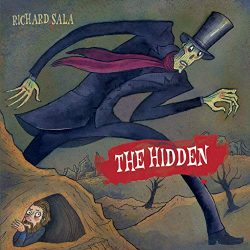
The Hidden


By Richard Sala (Fantagraphics Books)
ISBN: 978-1-60699-385-6 (HB)

One of the cruellest side-effects of the current pandemic is its power to cut you down emotionally and fill you with guilt over things you have no power to control. Prime offender for me is finding out people I like admire or just simply know have gone, and I’m probably the last to know. Just like this guy…

Richard Sala was a lauded and brilliantly gifted exponent and creator of comics who deftly blended beloved pop culture artefacts and conventions – particularly cheesy comics and old horror films – with a hypnotically effective ability to tell a graphic tale.

A child who endured sustained paternal abuse, Sala grew up in Chicago and Arizona. Retreating into childish bastions of entertainment he eventually escaped family traumas and as an adult earned a Masters Degree in Fine Arts. He became an illustrator after rediscovering the youthful love of comic books and schlock films that had brightened his youth.

His metafictional, self-published Night Drive in 1984 led to appearances in legendary 1980s anthologies Raw, Blab! and Prime Cuts and animated adaptations of the series were produced for Liquid Television.

His work remains welcomingly atmospheric, dryly ironic, wittily quirky and mordantly funny; indulgently celebrating childhood terrors, gangsters, bizarre events, monsters and manic mysteries, with girl sleuth Judy Drood and the glorious trenchant storybook investigator Peculia the most well-known characters in his gratifyingly large back catalogue.

Sala’s art is a joltingly jolly – if macabre – joy to behold and has also shone on many out-industry projects such as his work with Lemony Snickett, The Residents and even Jack Kerouac; illustrating the author’s outrageous Doctor Sax and The Great World Snake.

One of my personal favourites is The Hidden which revels in the seamy, scary underbelly of un-life: an enigmatic quest tale following a few “lucky” survivors who wake up one morning to discover civilisation has succumbed to an inexplicable global Armageddon. The world is now a place of primitive terror, with no power, practically no people and ravening monsters roaming everywhere.

Trapped on in the fog on a mountain, Colleen and Tom emerge into the world of death and destruction before promptly fleeing back to the wilderness. As they run, they encounter an amnesiac bum, who uncomprehendingly leads them to other young survivors – each with their own tale of terror – and together they seek a place of sanctuary in the desert and the shocking true secret of the disaster…

Clever, compelling and staggeringly engaging, this fabulous full-colour hardback (also available in digital formats) is a perfect introduction to Sala’s world: a sublimely nostalgic escape hatch back to those days when unruly children scared themselves silly under the bedcovers at night. It is an ideal gift for the big kid in your life – whether he/she/they are just you, imaginary or even relatively real…
© 2011 Richard Sala. All rights reserved.

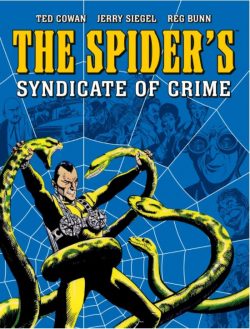
The Spider’s Syndicate of Crime


By Ted Cowan, Jerry Siegel & Reg Bunn (Rebellion)
ISBN 978-1-78108-905-7 (TPB)

I find myself in a genuine quandary here. When you set up to review something you need to always keep a weather eye on your critical criteria. The biggest danger when looking at certain comic collections is to make sure to remove the nostalgia-tinted spectacles of the excitable, uncritical scruffy little kid who adored and devoured the source material every week in the long ago and long-missed.

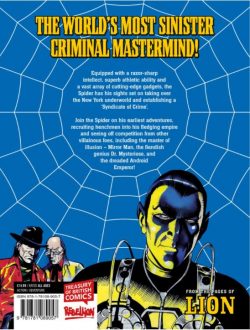
However, after thoroughly scrutinising myself – no pleasant task, I assure you – I can honestly say that not only are the adventures of the macabre and malevolent Spider as engrossing and enjoyable as I remember but also will provide the newest and most contemporary reader with a huge hit of superb artwork, compelling, caper-style cops ‘n’ robbers fantasy and thrill-a-minute adventure. After all, the strip usually ran two (later three) pages per episode, so a lot had to happen in pretty short order.

Part of Rebellion’s Treasury of British Comics strand and available in paperback and digital editions, The Spider’s Syndicate of Crime is the opening salvo of what I hope is many welcome returnees. It gathers material from peerless weekly anthology Lion spanning June 26th 1965 to June 18th 1966 and that year’s Lion Annual which for laborious reasons is designated 1967.

What’s it all about? The Spider is a mysterious super-scientist whose goal is to be the greatest criminal of all time. As conceived by writer/editor Ted Cowan – who among many other venerable triumphs, also scripted Ginger Nutt, Paddy Payne, Adam Eterno, and created the much-revered Robot Archie strip – the flamboyantly wicked narcissist begins his public career by recruiting a crime specialists safecracker Roy Ordini and evil inventor Professor Pelham before attempting a massive gem-theft from a thinly veiled New York’s World Fair. It also introduces Gilmore and Trask, the two crack detectives cursed with the task of capturing the arachnid arch-villain.

A major factor in the eerily eccentric strip’s success and reason for the reverence with which it is held is the captivating – not to say downright creepy – artwork of William Reginald Bunn. His intensely hatched line-work is perfect for the towering establishing shots and chases, and nobody ever drew moodier webbing or more believable weird weapons and monsters.

Bunn was an absolute master of his field art whose work in comics – spanning 1949 to his death in 1971 – such as Robin Hood, Buck Jones, Black Hood, Captain Kid and Clip McCord – was much beloved. Once the industry found him, he was never without work. He died on the job and is still much missed.

Also scripted by Cowan, second adventure ‘The Return of the Spider’ sets the tone for the rest of the strip’s run as the unbelievably colossal vanity of the Spider is assaulted by a pretender to his title. The Mirror Man is a swaggering arrogant super-criminal who uses incredible optical illusions to carry out his crimes, and the Spider must crush him to keep the number one most wanted spot – and to satisfy his own vanity.

The pitifully outmatched Gilmore and Trask return to chase the Spider but must settle for his defeated rival after weeks of devious plotting, bold banditry and spectacular serialized thrills and chills.

“Dr. Mysterioso” is the first adventure by Jerry Siegel, who was forced to look elsewhere for work after an infamous falling out with DC Comics over the rights to the Man of Steel.

The aforementioned criminal scientist of the title here is another contender for the Spider’s crown and their extended battle – broken on repeated occasions by a crafty subplot wherein the mastermind’s treacherous, newly-expanded gang of thugs seek to abscond with his stockpiled loot whenever he appears to have been killed – is a retro/camp masterpiece of arcane dialogue, insane devices and rollercoaster antics.

By the time of the final serialised saga herein contained – ‘The Spider v. The Android Emperor’ – the page count was up to 4: packed with fabulous fantasy and increasingly surreal exploits as the Arachnid Archvillain battles the super science of a monster-making maniac who might have survived the sinking of Atlantis but somehow gets his fun from baiting and tormenting the self-styled king of crime. Big mistake…

The book concludes with a short yarn from the 1967 Lion Annual. ‘Cobra Island’ gives the artist a chance to show off his skills with brushes and washes as the piece was originally printed in the double-tone format (in this case black and red on white) which was a hallmark of British annuals.

It finds the mighty Spider and Pelham drawn to an exotic island where plantation workers are falling under the spell of a demonic lizard being… but all is not as it seems and the very real danger is more prosaic than paranormal…

Also offering an introduction from Paul Grist and full creator biographies, this initial collection confirms that the King is back at last and should find a home in every kid’s heart and mind, no matter how young they might be, or threaten to remain.

Bizarre, baroque and often simply bonkers, The Spider proves that although crime does not pay, it always provides a huge amount of white-knuckle fun…
© 1965, 1966, 1967 & 2021 Rebellion Publishing IP Ltd. All Rights Reserved.

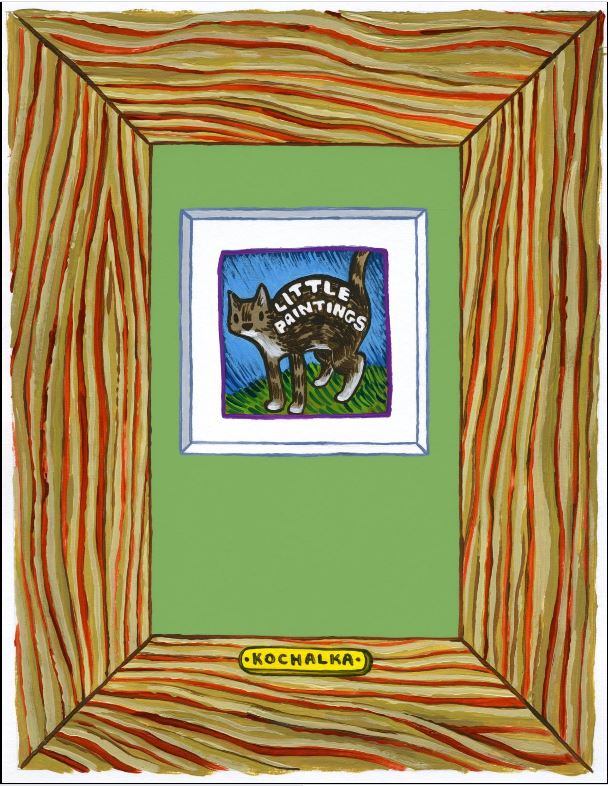
Little Paintings


By James Kochalka (Top Shelf Productions)
ISBN: 978-1-60309-017-9 (HB)

James Kochalka is a prolific and always entertaining giant of comics creation, whose vast, sublimely surreal, enticing works range from kid-friendly romps such as the Glorkian Warrior and Johnny Boo series, to self-examining daily journal strip American Elf and the indescribably fun SuperF*ckers (and that’s my censorious edit there, not his…)

The author, artist, animator and rock musician is utterly wedded to the energies of creativity and this tantalizing tome gathers hundreds of mini-paintings he knocked up to sell at various conventions between 2001 and 2007. All the old familiar face are there: cats, ghosts, robots, monsters, aliens, bathrooms, birds, chicks and dudes, animals, cats, mushrooms, landscapes and weather, cats, machines and random images, all apparently arranged in no particularly order and inviting your response. Did I mention, there’s cats?

There is a narrative here, but it’s completely generated by the viewer who can’t help but create a story around the hundreds of thumbnail paintings of gloriously hued things and folks and stuff, and a lot to read in if you’re willing to take some time.

Go on, you know you want to…
© James Kochalka 2011. All rights reserved.

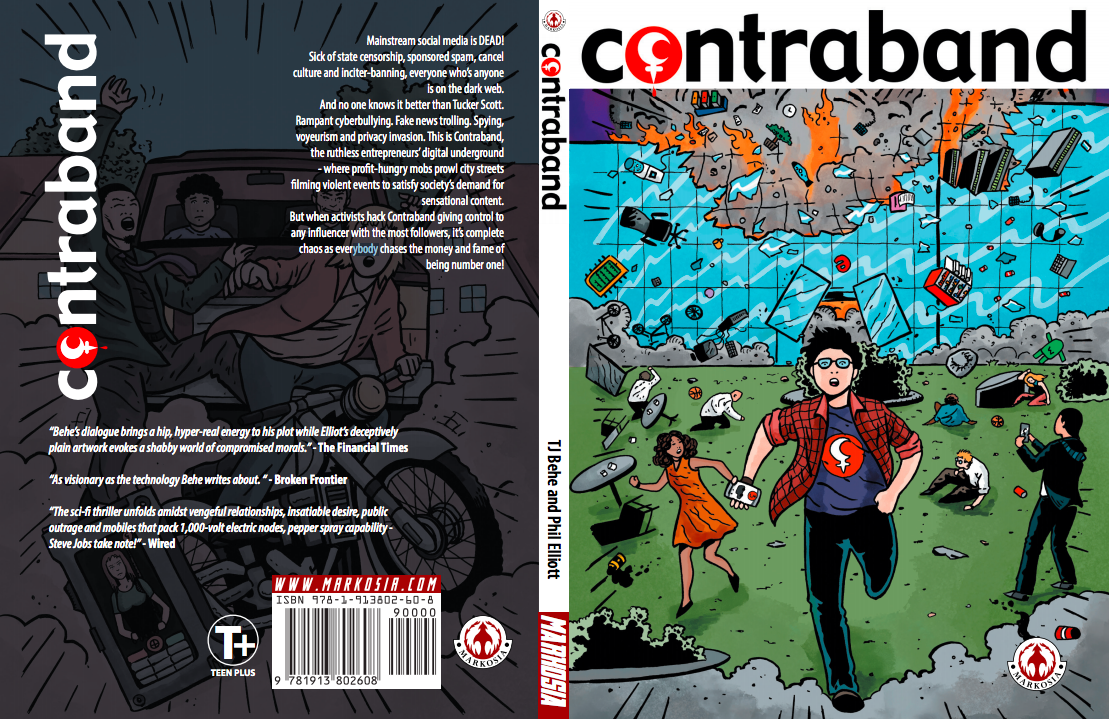
Contraband


By Thomas J. Behe & Philip Elliott(Markosia)
ISBN: 978-1913802608 (TPB)

For old geezers like me, the world is a rapidly changing, increasingly dangerous, infinitely incomprehensible and ultimately uncomfortable place. Thankfully, there are still a few things I recognise and understand – like human nature and good comics.

Those are the prime points of graphic salutary warning Contraband, as crafted by doodling veteran Phil Elliott (Tales from Gimbley; The Real Ghostbusters; Illegal Alien and many more) and hopefully not-too prescient scribe Thomas J. Behe. Here they communally invite you into a very imminent tomorrow (heck, it actually feels like the proverbial “20 minutes into the future”, in some places), proving that no matter how much things change, they basically stay the same…

Quite soon now, the utter ubiquity of mobile phones, cameras, social media platforms, greed and human hunger for attention will create a new industry. Everybody films stuff on their phones – and criminal lawyers and cops are all too grateful for that – but when video clips can be uploaded for untraceable cash and kudos to dark web app Contraband, that content is increasingly skewed towards cruel, erotic, violent, humiliating or simply disgusting criminal acts.

Successful contributors earn plenty, but the true draw is the cachet of topping the highly-competitive chart of Likes, with the public being the truly democratic arbiters of modern taste and morality…

The world is still recovering from spirit-crushing and corporation-enhancing middle eastern wars, but back in ostensibly unshaken London, all anyone can think of is getting something juicy onto social media. One of those ambitious dreamers is self-styled citizen-journalist Toby, whose recording of an illegal act propels him into the middle of a secret war for control of the voyeurs’ underworld.

His brief moment of fame leads to his being targeted by villainous wideboy Tucker, who – since his return from Afghanistan – has embraced private enterprise as boss of Contraband, aided only – it would seem – by his hulking, deceptively deep henchman and technical adviser Plugger.

Their sordid lives are not all sunshine, roses and sleaze. A bill is going through Parliament to limit online abuse, and an anti-violence campaign led by charismatic demagogue Jarvis Stevens is stirring up the wrong kind of muck and attention. Most importantly, Tucker’s former Afghan associate Charlotte is in hiding. She has access to very damaging dirt that the internet entrepreneur needs to neuter now…

That’s where Toby comes in. For absolutely inexplicable reasons, Tucker believes the baffled neophyte can prise her from whatever bolthole she’s in and makes life extremely uncomfortable until he agrees to try. However, as he sets to, the digital innocent is swamped by conflicting stories and vile revelations, quickly learning no one can trust anyone else…

That’s especially after discovering a rogue program is loose out in the wild, able to switch absolute control of Contraband’s codes, cash resources and library to one person. Now, rivalling the hunt for Charlotte, is a desperate race to find the magic gimmick and become king of the ghastly hill…

Oppressive, paranoid, violent and disturbing, this sublimely inventive yarn combines crime thriller with spy mystery and delivers a splendid sequence of byzantine futuristic shocks, deliciously delineated in a potently understated fashion.

First published by Slave Labor Graphics in 2008, this dark and timely construction gets a fresh lease on life – and possible repeat fees – thanks to Markosia, so don’t miss the opportunity to safely see the world that’s coming… before it sees you.
™ & © Thomas Behe & Phil Elliott. All rights reserved.

Contraband is scheduled for publication on May 10th 2021 and is available for pre-order now.

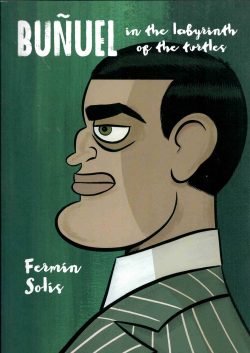
Buñuel in the Labyrinth of the Turtles


By Fermín Solís, translated by Lawrence Schimel (SelfMadeHero)
ISBN: 978-1-910593-84-4 (PB)

The places and moments where great art intersects with mundane reality have always made for great storytelling, and that’s never been more deftly demonstrated than in this highly personal interpretation of a crucial moment in the history of 20th century cinema.

Luis Buñuel Portholés (February 22nd, 1900 – July 29th 1983) was a Spanish filmmaker who renounced his citizenship in favour of Mexico, and his catholic faith in favour of truth: an iconoclastic, moralistic thinker and revolutionary who embraced surrealist doctrine and reshaped the arts of filmmaking.

If you have the stomach and suitable respect for the medium, please view Un Chien Andalou, L’Age d’Or and That Obscure Object of Desire – if not all of his heady output – but probably best leave it until after reading this engaging visual introspection from award-winning cartoonist Fermín Solís Campos.

The self-taught cartoonist, animator and illustrator of such treats as Otra Vida and El Hombre del Perrito shares many similarities with his subject and a solid yet whimsical earthy touch that is perfect for this examination of a key moment in the celluloid auteur’s rocky progression from wunderkind to industry lynchpin.

‘Do Not Disturb! Artist Dreaming’ opens with Buñuel wracked by his usual night terrors of barnyard fowl, Christian iconography and talking wildlife before an old friend calls to inform him of a cash windfall. It’s the end of 1932 and old comrade Ramón Acin trails him through the seedy warrens of the city, carousing and pontificating on past glories before deducing ‘Paris no Longer Loves Us’. Are there no challenges left? Is surrealism no longer enough to challenge the world and outrage society?

‘Ten Hours from Paris’ and months later, they and a small crew are assessing one of the most poverty-stricken regions of Europe. A Spanish region wedded to faith but so poor that the residents have no conception of even basic foodstuffs like bread. As the bizarre villagers and their weird tortoise-like huts bore into Buñuel’s fevered subconsciousness, his creative dry spell vanishes. Inspired again, he carefully concocts Las Hurdes: Tierra Sin Pan (Land Without Bread) contravening all established rules and mores to create a new genre beyond simple documentary. Alternatively called ethnofiction, pseudo-documentary or cinema verité, its cost to veracity, human compassion and even simple morality might be too much to bear…

Challenging, compelling and utterly absorbing, Buñuel in the Labyrinth of the Turtles is a superb graphic assessment of the creative process that will surprise and delight in equal measure
© 2008, 2019 Fermín Solís. © 2019 Penguin Random House Grupo Editorial, S.A.U. All rights reserved.

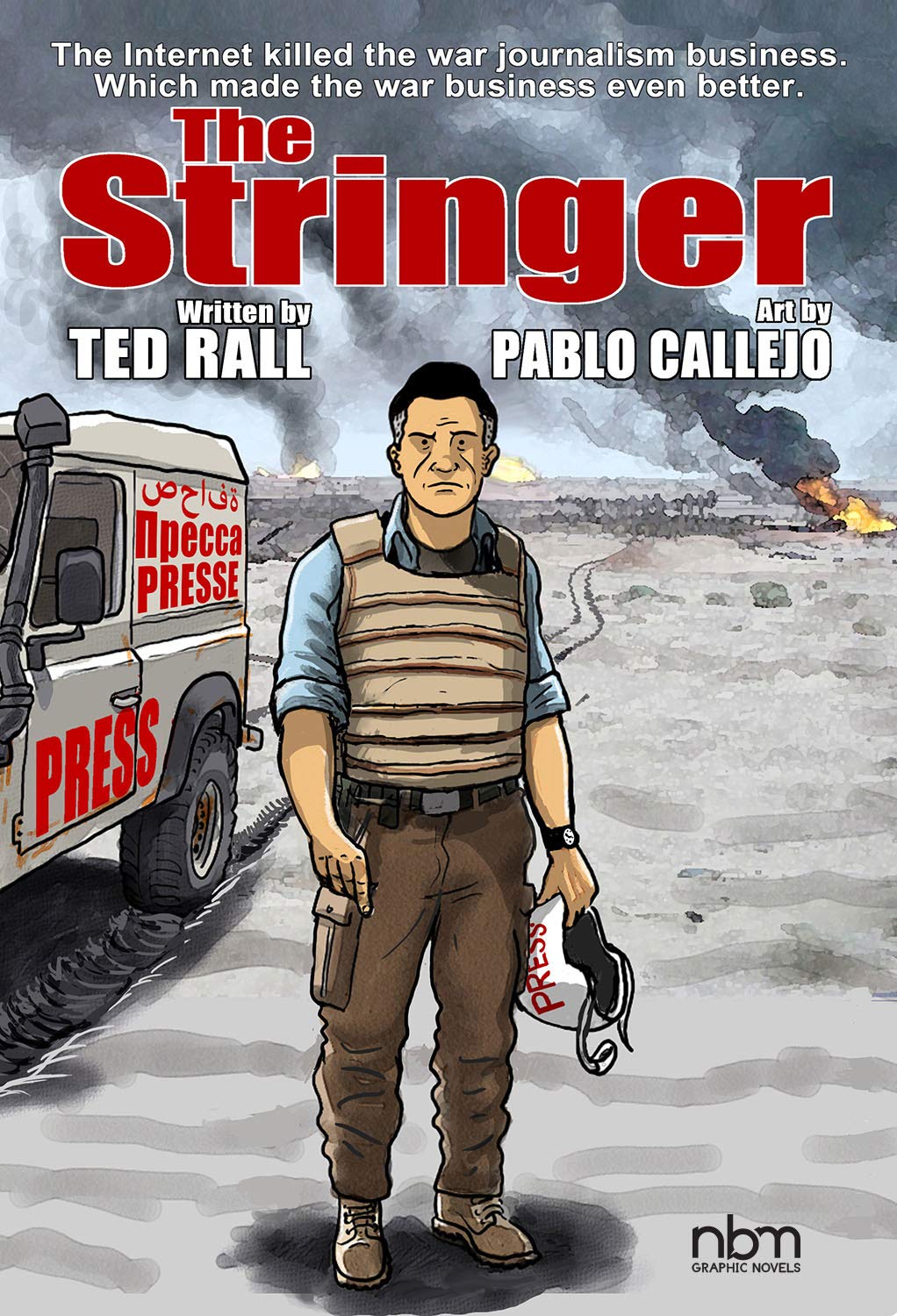
The Stringer


By Ted Rall & Pablo Callejo (NBM)
ISBN: 978-1-68112-272-4 (Album HB) eISBN: 978-1-68112-273-1

How many times have you heard it? “Print is dead”, “there’s no money in news” and other crass judgements solving a thorny problem by simply dismissing and diminishing it.

Thankfully folk like Ted Rall don’t always accept what they’re told in the way they’re meant to and have the ability to counterpunch with counterpoints…

Frederick Theodore Rall III was born in 1963, so he’s grown up with the gradual defanging and commercial contamination of journalism in an era of increased distrust of democracy and unchecked political malfeasance. A figure of constant controversy, he works widely as an editorial cartoonist, columnist and author of such books as Waking Up in America, The Year of Loving Dangerously, Meet the Deplorables: Infiltrating Trump America, To Afghanistan and Back and many more.

Equally adept with outrageous but well-reasoned fantasy as compelling non-fiction, Rall has reunited with Pablo Callejo (Bluesman, The Castaways, The Year of Loving Dangerously) for a frighteningly convincing extrapolation of the way things are, that is one of the most entertaining books I’ve read in the last decade.

Mark Scribner is a highly experienced, world-weary investigative journalist who has also grown old in the above-cited decades. A veteran observer of conflicts, police actions, interventions and wars, with contacts from every stratum of all those zones and scenes and bars. He literally knows everyone in the global conflict game while viewing the advance of citizen reportage and click-bait editorialising with increasing despair.

However, when a crisis of conscience finally comes in a crisis barely making headlines anywhere, Scribner – always somehow in the right place at the right time – makes a bold new decision and picks a path far less, if indeed ever, travelled…

However, although his new lifepath carries incredible rewards as well as danger, Scribner is still tied to his old self and the values that elevate or destroy all humans alike, and his successes carry seeds of awful destruction…

Gripping, smart and scarily plausible, this potent dose of realpolitik is a supremely engaging yarn no news junkie or comics addict can afford to miss. Maybe you can’t handle the truth, but you should definitely handle this…
© 2021 Ted Rall & Pablo G. Callejo. © 2021 NBM for the English translation.

The Stringer is scheduled for physical release in the UK on May 25th 2021, with digital editions available now. For more information and other great reads please see http://www.nbmpub.com/

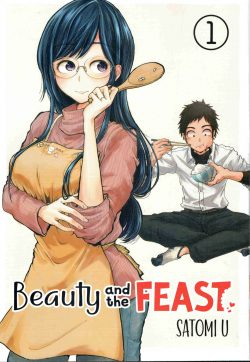
Beauty and the Feast volume 1


By Satomi U, translated by Sheldon Drzka (Square Enix)
ISNB: 978-1-64609-062-4 (Tankōbon PB)

Not all manga is gorily action-packed and overflowing with astoundingly robust wonder warriors or deeply introspective and socially redeeming: some Japanese comics just want you to have a good time and some gentle enjoyment.

Here’s one of those in the form of a jolly and uncomplicated semi rom-com, rich and redolent with cultural confusion and pretty illustration from enigmatic creator Satomi U.

It all begins with a revelation in ‘Yakumo-San Wants to Feed You!’ as pretty widow Shuko Yakumo invites a rather unprepossessing young man into her apartment. It’s not the first time Shohei Yamato has come around from his next door flat and, without preamble or converse, tucks into a vast display of succulent home-cooked food.

He’s a first year High School student at prestigious Tosei Academy, on the equivalent of a baseball scholarship, with strict orders to bulk up. Shohei sees nothing amiss in a stranger and single lady indulging him in a strictly-platonic relationship: feeding up the socially-awkward, tongue-tied baseball prodigy who is unable gain necessary poundage due to a lack of funds…

He doesn’t seem very bright – or even communicative – but sure can pack away the glorious meals she happily produces, apparently, just for the sheer joy of cooking again.

It’s not a normal relationship, but both seem to get what they need out of the ritual…

Determined to be the best she can, the delirious domestic goddess constantly considers new recipes and bigger portions before ‘Yakumo-San Buys a Rice Cooker’ sees a change in the status quo as the human locust gradually shares details of his past before we see what his life currently demands in ‘A Day in the Life of Shohei Yamato’.

‘A Day in the Life of Shuko Yakumo’ moves into new territory as school pressure makes the lad miss a few visits, prompting his culinary custodian to start following him with mobile morsels and picnic treats, culminating in an actual and mutual emotional connection on ‘A Night for Cherry Blossoms’…

An old complication resurfaces as ‘Enter Rui, the Reckless High School Girl’ sees an extremely raucous and proprietary former classmate of the sporting cadet reinsert herself in his life. Little Rui Nishihara believes she’s responsible for Shohei’s accomplishments and intends to be the wife of a major baseball superstar, and instantly recognizes a potential rival in the “old lady” with the big boobs and always-open kitchen…

Given to histrionics, Rui is determined to regain the boy’s attention, and refuses to listen to the advice of her super-sensible best pal Ritsuko Nagai, who calmly and constantly reminds her that she never had it in the first place…

Shuko is largely unaware of the impending storm, spending a day at her husband’s grave and catching up with old friend Yuri who reminds her that ‘Nothing Stays the Same’. It’s a fact hammered home that night when Shohei again decimates her larder, only this time something else – something new – happens…

Supplemented by Bonus Manga ‘A Day in the Life of Rui and Ritsuko’ offering insight into the little firecracker’s backstory; design and fact pages on Shuko, Shohei, Rui and Ritsuko via ‘The Inside Scoop’ before ending on a slapstick excerpt from Satomi U’s ‘Baseball Team Research Journal’, this is a bright, breezy and silly, salivatory saga that will satisfy any cravings for something more tastily intriguing than substantial and heavy.
Beauty and the Feast volume 1 © 2016 Satomi U/SQUARE ENIX CO., LTD. English translation © 2021 SQUARE ENIX CO., LTD. All rights reserved.

All the Places in Between


By John Cei Douglas (Liminal 11)
ISBN: 978-1-912634-23-1 (PB)

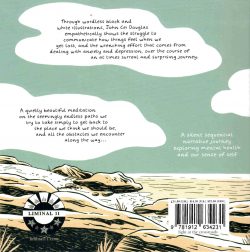
We’re all been locked up in our own heads as much as in our homes recently, constantly in search of solutions to ease anxiety, however we can. Here then – in timely fashion and most serendipitously – is a sublime gem in the conceptual mould of Tove Janson, laced with oblique yet helpful ruminations on healing mindfulness and enjoyed as a voyage of genuine inner discovery.

Not only is the message calming and helpful – and delivered in beguiling imagery guaranteed to restore your weary disposition – but it also guarantees a solidly entertaining mystery journey helping to moderate your hunger for physical travel and fresh experience.

Crafted in dreamy, silent passages, All the Places in Between follows a pensive girl by a barren seashore as she fretfully, nervously but determinedly passes from ‘All the places we’ve been’ to ‘All the places we’re going’

On the way she meets her exact opposite and is cast ‘adrift’: occupying ‘the lighthouse’ before finding civilisation drowned and devastated. Time drags ‘between’ before isolation draws her to ‘the city’ where she finds ‘a companion’ to care for. Eventually that temporary relationship sunders, ‘buried’ in the wreckage of the world and dwarfed by insurmountable chasms and a ‘tsunami’ that brings resolution of sorts as ‘the lighthouse returns’, prompting a revelatory resolution in ‘space’…

Not a book to summarise, but definitely one to look at and wonder, John Cei Douglas’ oneiric ramble is a calming and enticing trip we can all benefit and draw comfort from.

Filled with delightful human moments.
© 2020 John Cei Douglas. All rights reserved.

All the Places in Between is scheduled for release on April 29th 2021 and is available for pre-order now.

Michael Jackson in Comics


By Céka, illustrated by Patrick Lacan, Filippo Neri & Piero Ruggeri, JGSB, Laurent Houssin, Lu-K, Guillaume Griffon, Sarah Williamson, BiG ToF, Nikopek & Lou, Vox, Domas, Clément Baloup, Martin Trystram, Bast, Guillaume Tavernier, Aurélie Neyret, Anthony Audibert, Yigaël, Julien Akita, Lapuss, Kyung-Eun Park, Jean-Christophe Pol & Vallale; translated by Montana Kane (NBM)
ISBN: 978-1-68112-228-1 (Album HB) eISBN: 978-1-68112-230-4

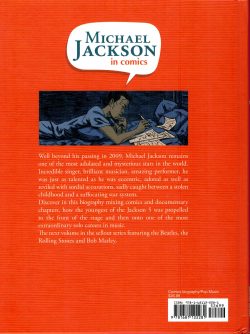
Graphic biographies – especially those produced in Europe dissecting the lives of iconic celebrities and artists – are incredibly popular these days. This one was originally released in 2018: an inevitable but accessible addition and one featuring probably the most popular and controversial musical star of all time.

If you’ve never heard of Michael Jackson, there’s very little point in you carrying on any further.

Still with us? Okay then…

Offering cannily repackaged popular culture factoids and snippets of celebrity history, this tome – written by journalist Céka, with a legion of illustrators providing vivid and vibrant mini-strips – hones in on key moments in the controversial star’s career: detailing them through brief text essays.

It all began at ‘2300 Jackson Street’ where an extended family of juvenile performers were harshly schooled by their ruthless dad, after which the inner life of an abused kid is depicted in ‘I Wish I Could Have Been… A Child’, as portrayed in strip-form by Patrick Lacan.

The euphoria of winning talent contests and getting picked up by a major label is described in text article ‘From the Apollo Theater to Motown’ before Filippo Neri & Piero Ruggeri detail the draconian rehearsal regimen forced on the Jackson 5 by ambitious father Joe.

As their fame grew, little Michael constantly sought surrogate maternal relationships from a string of female celebrities. This is detailed in ‘One Father and Five Mothers’, with vividly lurid cartoon extrapolation ‘Diana Ross: THE Lady in his Life’ exploring the situation courtesy of JGSB.

‘From the Jackson 5 to Michael’ details the fractious move to solo stardom and hard-won autonomy ‘Made in Motown’(art by Laurent Houssin), whilst ‘5% Talent, 95% Hard Work’ explore the boy star’s ultimate idol in Lu-K’s ‘James Brown, the Mentor’.

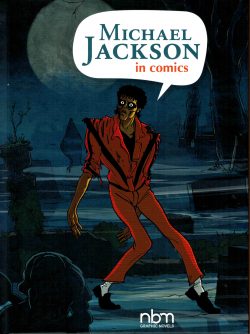
The start of autonomy comes with ‘The Quincy Jones Trilogy’, depicting the global-shocks attending the making of‘Thriller: No Mere Mortal Can Resist!’ by Guillaume Griffon. Status is confirmed by ‘Birth of an Icon’ and attendant Moonwalk step-chart ‘An Extraterrestrial on Earth’ (Sarah Williamson art) before I Have a Dream’ starts tracing the cracks, and ‘The MTV Blackout’ – by Big ToF – discloses the colour bar keeping certain performers’ videos off pioneering music channels…

‘Jackson’s Jackpot’ and Nikopek & Lou’s linked visualisation of ‘A 47-and-a-Half Million-Dollar Blunder’ explore the tensions between the young star and Paul McCartney as well as music ownership rights, whilst – courtesy of Vox – carton strip ‘The Man with the White Socks’ illustrates the consequences of Prince of Pop’s style decisions as textually defined and described in ‘Fashionista’. ‘Dancing Machine’ examines signature moves, with Domas limning the steps in cartoon guide ‘The Man Who Slides on Clouds’. Before, social conscience engaged, ‘We are the World’ recalls the era of charity mega-records, with Clément Baloup depicting how the song was written in ‘Check Your Egos at the Door’.

The crown starts to wobble as ‘Neverland’ reveals how the fabulous ranch of dreams began, with Martin Trystram illustrating ‘Now Go Go Go Where you Want’, after which the media rumour mill runs wild in ‘Animal Spirit’, with Bast fancifully sketching out the story of exotic pets like ‘Bubbles, Muscles, and Co.’

Once unleashed, the press is relentless and ludicrous, as exposed in ‘Tabloid of Fact?’, with Guillaume Tavernier offering a strip further covering ‘The Rumor Mill’, whilst Aurélie Neyret’s cartoon tale of ‘Ryan White: Gone Too Soon’ adds balance to the uncomfortable reports of child-centred indiscretions recounted in ‘The Lost Children’…

Excesses real or otherwise dominate in ‘Tabloid Junkie’, with Anthony Audibert vignetting ‘The Elephant Man Case’before the years of defensive self-isolation are detailed in ‘Blood on the Dance Floor’ and Yigaël draws the benefits – and not – of ‘Privacy’.

‘Scandal at Neverland’ leads to Julien Akita’s sensitive exploration of ‘Jordan Chandler vs Peter Pan’, a review of ‘Family Life’ with attendant strip ‘Once Upon a Time’ from Lapuss, after which ‘The Man With 240 Awards’ reveals ‘The Whims of a Star’ thanks to cartoonist Kyung-Eun Park.

The final days approach, as seen in essay ‘Fans, I Love You More!’ with Jean-Christophe Pol & Vallale visually enquiring ‘What Kind of Fan Are You?’ of the music man’s broad church of devotees.

The star-studded, star-crossed story concludes with ‘Never Can Say Goodbye’ as Clément Baloup draws things to a close with ‘Michael Forever’…

Although intellectually slight and far from incisive or comprehensive in addressing the many controversies surrounding the star in question, Michael Jackson in Comics is far from a concealing hagiography either and presents a remarkably readable and beautifully rendered confection for comics and music fans alike.
© 2018 Editions Petit a Petit. © 2021 NBM for the English translation.

For more information and other great reads see http://www.nbmpub.com/

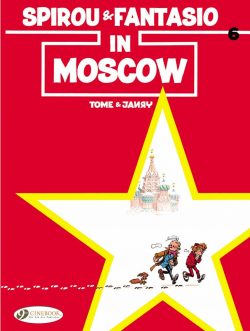
Spirou & Fantasio in Moscow (volume 6)


By Tome & Janry, coloured by Stephane De Becker & translated by Jerome Saincantin (Cinebook)
ISBN: 978-1-84918-193-8 (Album PB)

For most English-speaking comics readers, Spirou & Fantasio might be Europe’s biggest secret. The phenomenally long-lived character was a rough contemporary – and shrewdly calculated commercial response – to Hergé’s iconic Tintin, whilst the fun-filled periodical he has headlined for decades is only beaten in sheer longevity and manic creativity by Detective Comics and our own Beano.

Since launching on January 10th 1929 in Le Petit Vingtième – junior supplement to Belgian newspaper Le Vingtième Siècle – the phenomenal success of the carrot-topped boy reporter had become a money-spinning phenomenon for publisher Casterman and rival printing house Éditions Dupuis saw opportunity knocking…

Conceived in 1936 by boss-man Jean Dupuis, a proposed new magazine targeting juvenile audiences launched on April 21st 1938; debuting neatly between DC Thomson’s The Dandy (4th December 1937) and The Beano (July 30th 1938) in the UK. In America at that time a small comicbook publisher was preparing to release a new anthology entitled Action Comics. Ah, good times…

Le Journal de Spirou – the publication – was to be edited by 19-year-old Charles Dupuis, deriving its name from the lead feature, which related the improbable adventures of a plucky bellboy/lift operator employed at the glamorous Moustique Hotel (a sly in-joke reference to the publisher’s premier periodical Le Moustique).

Spirou – the hero, whose name translates as both “squirrel” and “mischievous” in the Walloon language – was first realised for his Belgian bosses by French cartoonist François Robert Velter under his pen-name Rob-Vel.

The magazine premiered with the plucky bellboy – and pet squirrel Spip – as leads in an anthology weekly which bears his name to this day; featuring fast-paced, improbable cases which gradually evolved into high-flying surreal comedy dramas.

Spirou and his pals have spearheaded the magazine for most of its life, with a phalanx of truly impressive creators carrying on Velter’s work, beginning with his wife Blanche “Davine” Dumoulin who took over the strip when her husband enlisted in 1939. She was aided by Belgian artist Luc Lafnet until 1943 when Dupuis purchased all rights to the feature, after which comic-strip prodigy Joseph Gillain (“Jijé”) took over.

In 1946 Jijé‘s assistant André Franquin assumed the reins, slowly sidelining shorter, gag-style vignettes in favour of longer adventure serials whilst introducing a wide and engaging cast of regulars. Eventually he added a animal act Marsupilami to the mix (first seen in Spirou et les héritiers in 1952 and now a spin-off star of screen, plush toy store, console games and albums all his own), crafting increasingly fantastic tales until he resigned in 1969.

He was then succeeded by Jean-Claude Fournier who updated the feature over the course of nine stirring adventures that tapped into the rebellious, relevant zeitgeist of the times with tales of environmental concern, nuclear energy, drug cartels and repressive regimes.

By the 1980s the series seemed outdated and without direction and three different creative teams were commissioned to alternate on the serial, until it was at last revitalised by Philippe Vandevelde writing as Tome and artist Jean-Richard Geurts AKA Janry.

Their winning approach was to carefully adapt, reference and, in many ways, return to the cherished and revered Franquin era. Their sterling efforts consequently revived the floundering feature’s fortunes, resulting in 14 wonderful albums between 1984 and 1998.

This one, originally entitled Spirou & Fantasio à Moscou from 1990, was their 10th collaboration and the 42nd collected exploit of the tireless wanderers.

Set just after the fall of the Berlin Wall – and effective end of Soviet socialism – there’s a lot of editorial footnoting going on to maintain understanding and sustain context but it’s all done in a witty and amusing manner, so there’s no loss of narrative traction or forced suspension of willing disbelief…

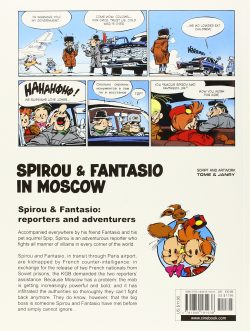
The drama begins with Spirou, Fantasio and Spip heading for a well-deserved vacation in the sweltering heat of Tahiti when they are suddenly abducted by a gang of spooks. As the lads groggily recover from cruelly applied chemical coshes, their assailants offer a (hilariously shaded) review of Russian character and recent history since the end of the Communist State. They pay special attention to the fact that even in the newly capitalist country, the KGB are still in charge…

Russia is in big trouble. The fall of the Iron Curtain has resulted in an influx of gangsterism, with the Mafia paramount in seeking out new territory for their nasty old rackets. Lacking experience in this kind of struggle, the security forces have requested the assistance of experts, and the French government – for it is they who have shanghaied our heroes – are happy to serve up Spirou and Co in return for the return of a couple of well-connected teenagers who got themselves arrested for protesting at the Kremlin…

By the time the pressganged press-men are conscious enough to refuse, they are already on the chilly tarmac of Moscow Airport and being handed badges as fully-accredited – if temporary – members of the KGB…

As they drive via a torturous and convoluted secret route into the city under the care of rowdily boisterous Colonel Dubyoutyev, they are briefed on the untenable situation.

It is not only the newcomers’ past record of success against the Mob which has brought them, albeit unwillingly, to this sorry state of affairs, but also the fact that they aren’t Russian.

When the Mafia first started operating, they were quickly infiltrated by KGB operatives, whilst the gangsters did exactly the same thing to the state police. Now nobody can trust anybody else and the authorities are forced to outsource credible and dependable assistance…

Just as they pull up at the Kremlin, the Colonel shows them a fuzzy photo of an oddly familiar face: suspected top mobster and fellow outsider Ivan Ivanovich Tanaziof. Then a shot rings out and the chauffeur slumps down. With the out-of-control car crashing onto the frozen river, in an office of the ministry, Count Nikita Bloyuredov places a call to his boss to claim “mission accomplished”…

Crawling from the wreckage, our battered but still intrepid lads opt to use their freshly-minted credentials to get to the French Embassy. En route in a commandeered taxi, Spirou shares his suspicions. Perhaps the ruthless westerner Tanaziof has some previous connection to them? Perhaps he’s Fantasio’s insane and merciless cousin Zantafio, back with another murderous scheme to grab power and wealth, no matter who has to suffer?

Arriving just as a grand Fancy Dress Ball commences, they are refused entry by security guards. They do, however, let them see the Embassy Chief of Protocol. Bloyuredov is absolutely delighted to meet them… until he sees his master Prince Tanaziof crash the party with a gang of armed heavies…

Happily, Spirou and Fantasio also spot the intrusion and take cover whilst the mobsters boldly rob the gathering. The jumped-up aristocrat arrogantly boasts his next move to reclaim Russia for his family will be to steal the sacred relic of Lenin’s embalmed body from its utterly secure tomb in Red Square…

As the gangsters gleefully exit, agents “Spirov” and “Fantasiev” are contacted by the miraculously alive and rather wisely deep, deep, deep undercover Dubyoutyev, who has also survived the crash…

Trading information, they all agree Tanaziof/Zantafio is fraudulently proclaiming himself “White Prince of the Russian Mafia” whilst attempting to pass himself off as the next Tsar. The KGB Colonel is horrified to hear of the sacrilegious plot to desecrate Lenin’s mausoleum and dashes off to implement the appropriate security measures, but his reluctant agents know it won’t be enough…

Returning to a now quiet Embassy the rightly suspicious visitors finally meet the Ambassador, who merely tells them it’s a Russian matter. On their way out the disgruntled pair receive an anonymous note promising the whereabouts of Tanaziof. Despite certain knowledge that it’s a trap, the neophyte spies later rendezvous at the spectacular outdoor spa known as the Moskva Pool…

When a horrific “accident” once again kills the wrong people, delighted and oblivious Bloyuredov heads straight for Tanaziof’s palatial hideout to share the good news, utterly unaware of two men and a squirrel on his tail…

The plan to steal Lenin is about to commence and without a moment’s pause Spirou and Fantasio disguise themselves and join the raiding party…

Cannily blending wry humour, broad slapstick, light-hearted action and rollicking adventure with a swift-paced espionage caper, all topped-off with the so-satisfying return of a world-class arch villain to sweeten the deal, this rollercoaster romp builds to a brilliantly madcap conclusion as funny as it is breathtaking… and all lavishly smothered in oodles of wicked irony.

This kind of lightly-barbed, keenly-conceived, fun thriller is a sheer joy in an arena far too full of adults-only carnage, testosterone-fuelled breast-beating, teen-romance monsters or sickly-sweet fantasy. Readily accessible in print and digitally to readers of all ages, drawn with all the beguiling style and seductively wholesome élan which make Asterix,Lucky Luke, Blake & Mortimer and Iznogoud so compelling, this is another cracking read certain one day to be as much a household name as that other pesky kid with the white dog…
Original edition © Dupuis, 1990 by Tome & Janry. All rights reserved. English translation 2014 © Cinebook Ltd.