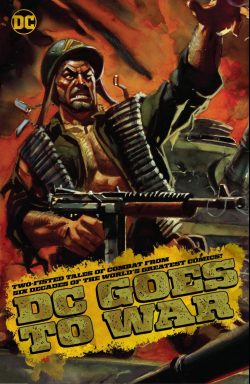
By Will Eisner, Bob Powell, Jon L. Blummer, Joe Simon & Jack Kirby, Robert Kanigher, Ed Herron, Len Wein, Marv Wolfman, David Michelinie, Chuck Dixon, Garth Ennis, Chuck Cuidera, John Severin, Joe Kubert, Jerry Grandenetti, Mort Drucker, Russ Heath, Jack Abel, Alex Toth, Gerry Talaoc, Judith Hunt, Sam Glanzman, Eduardo Barreto, Chris Weston, Christian Alamy & various (DC Comics)
ISBN: 978-1-7795-0015-1 (HB)
Win’s Christmas Gift Recommendation: Blockbuster Thrills No Movie Could Match… 9/10
For America, the genre of war comics only really took in 1950, as the Korean War scared the pants off a world still recovering from WWII. Even so, while war was current affairs, publishers didn’t shirk making stories and heroes amidst the bomb blasts and strafing runs…
Many publishers fed the trend, but although a firm fan fave, the sector soon settled into mediocrity. However, after the meteoric rise and sudden demise of EC Comics in the mid-1950’s and prior to the game-changing Blazing Combat, the only sure place to find controversial, challenging, exceptional and entertaining combat comics was DC.
In fact, even whilst Archie Goodwin’s stunning but tragically mis-marketed quartet of classics were waking up a generation, the home of Superman, Batman and Wonder Woman (herself a true “war babyâ€) was a veritable cornucopia of gritty, intriguing and beautifully illustrated battle tales presenting combat on a variety of fronts and from many differing points of view.
As the Vietnam War escalated, 1960s America increasingly endured a Home Front death-struggle pitting deeply-ingrained Establishment social attitudes against a youth-oriented generation with a radical new sensibility. In response, DC/National Periodical Publications’ military-themed comic books became even more bold and innovative…
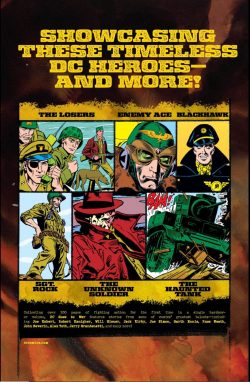
That stellar creative period came to an end as all strip trends do, but a few of the more impressive and popular features (Sgt. Rock, Haunted Tank, The Losers) survived well into the second superhero revival.
Currently, English-reading fans of the genre are grievously underserved in both print and digital formats, but this magnificent hardback and digital compendium is hopefully the vanguard of a change of fortune…
Re-presenting material from Military Comics #1; All-American Comics #48; Boy Commandos #1; Our Army at War#67, 83, 233, 235; Our Fighting Forces #49, 102; Star Spangled War Stories #87, 183; G.I. Combat #87; Showcase#57; Weird War Stories #3; The Losers Special #1; Sgt. Rock Special #2 and Enemy Ace: War in Heaven #1-2 spanning August 1941, this epic package chronologically samples the company’s wide and deep well of war tales…
Tales of ordinary guys in combat began with the industry itself and although mostly sidelined during the capes-&-cowls war years, they quickly re-asserted themselves again once the actual fighting stopped. Those early days of the industry were awash with both opportunity and talent, and these factors coincided with a vast population hungry for cheap entertainment. Comics had no acknowledged fans or collectors; only a large, transient clientele open to all varied aspects of yarn-spinning and tale-telling – a situation which persisted right up to the end of the 1960s. Thus, the action here starts before it started for America…
Even though loudly isolationist and more than six months away from active inclusion in the Second World War, creators like Will Eisner and publishers like Everett M. (“Busyâ€) Arnold felt Americans were ready for the themed anthology title Military Comics.
Nobody was ready for Blackhawk.
Military Comics #1 launched on May 30th 1941 (August cover-dated) and included in its line-up Miss America, Jack Cole’s Death Patrol, Fred Guardineer’s Blue Tracer, X of the Underground, The Yankee Eagle, Q-Boat, Shot and Shell, Archie Atkins and Loops and Banks (by “Bud Ernest†– actually aviation-nut and unsung comics genius Bob Powell).
None of the strips – not even Cole’s surreal and suicidal team of hell-bent fliers – had the instant cachet and sheer appeal of Eisner & Powell’s “Foreign Legion of the Airâ€, led by the charismatic Dark Knight of the airways known only as Blackhawk.
Happy Anniversary “Magnificent Sevenâ€!
Chuck Cuidera, famed for creating Blue Beetle for Fox, drew ‘The Origin of Blackhawk’ wherein a lone pilot fighting the Nazi invasion of Poland in 1939 is shot down by Nazi Ace Von Tepp, only to rise bloody and unbowed from his plane’s wreckage to form the World’s greatest team of airborne fighting men…
This mysterious paramilitary squadron of unbeatable fliers, dedicated to crushing injustice and smashing the Axis war-machine, battled on all fronts during the war and stayed together to crush Communism, international crime, Communism and every threat to democracy from alien invaders to supernatural monsters – and more Communism – becoming one of the true milestones of the US industry.
There were many melodramatic touches that made the Blackhawks so memorable in the eyes of a wide-eyed populace of thrill-hungry kids. There were the cool, black leather uniforms and peaked caps. The unique, outrageous – but authentic – Grumman F5F-1 Skyrocket planes they flew from their secret island base, and of course, their eerie battle-cry “Hawkaaaaa!â€
But perhaps the oddest idiosyncrasy to modern readers was that they had their own song (would you be more comfortable if we started calling it an international anthem?) which Blackhawk, André, Stanislaus, Olaf, Chuck, Hendrickson and Chop-Chop would sing as they plummeted into battle…
This is a good place to remind everyone that historically, war comics have never been a place with comfortable depictions of race, ethnicity or creed. Please treat the material as necessarily historically authentic or simply find other more evolved and comfortable books to read…
Quality Comics adapted well to peacetime demands: Plastic Man and Doll Man lasted far longer than other superhero titles, whilst the rest of the line adapted into tough-guy crime, war, western, horror and racy comedy titles. The Blackhawks soared to even greater heights, starring in their own movie serial in 1952. However, the hostility of the marketplace to mature-targeted titles after the adoption of the self-censorious Comics Code was a clear sign of the times. In 1956 Arnold sold most of his comics properties and titles to DC and set up as a general magazine publisher.
Many of the purchases were a huge boost to National’s portfolio, with titles such as G.I. Combat, Heart Throbs and others running into the 1980s whilst the appeal and potential of characters such as Uncle Sam, assorted Freedom Fighters, Kid Eternity and others keep them coming back to this day…
Next up is Jon L. Blummer’s Hop Harrigan, America’s Ace of the Airways. He debuted in All-American Comics #1 in April 1939 as a dashing aviator: becoming a radio show phenomenon and ultimately a movie serial star. Harrigan was a serving pilot throughout the war and in this tale from All-American Comics #48 March 1943 tests a secret weapon launched from a B-24 bomber to inflict hell on the Japanese.
When Timely Comics failed to make good on financial obligations, Captain America creators Joe Simon & Kirby jumped ship to National/DC, who welcomed them with open arms. After establishing themselves with The Sandman and Manhunter, they returned to the “Kid Gang†genre they had created with The Young Allies and devised a juvenile Foreign Legion entitled The Boy Commandos.
These bellicose brats initially shared – or stole – some of the spotlight from Batman & Robin in flagship title Detective Comics before and whilst their solo title became one of the company’s top three sellers.
Frequently cited as the biggest-selling American comic book in the world at that time, Boy Commandos was such a success that the editors – knowing “The Draft†was lurking – green-lit the completion of a wealth of extra material to lay away for when their star creators were called up. S&K produced so much four-colour magic in a phenomenally short time that Publisher Jack Liebowitz suggested they retool some of it into adventures of a second kid gang… and thus was born Home Front heroes The Newsboy Legion…
We never learn how American Captain Rip Carter got to command a British Commando unit nor why he was allowed to bring a quartet of war-orphans with him on a succession of deadly sorties into “Festung Europaâ€, North Africa, the Pacific or Indo-Chinese theatres of war. All we had to do was realise that cockney urchin Alfy Twidgett, French lad Pierre –latterly and unobtrusively renamed Andre Chavard – little Dutch boy Jan Haasen and rough, tough little lout Brooklyn were fighting the battles we would, if we only had the chance…
Boy Commandos #1 (Winter 1942-1943) here visits ‘The Town that Couldn’t be Conquered!’ as Rip leads the lads back to Jan’s home village to terrify the rapacious occupiers and start a resistance movement…
National/DC were one of the last publishers to fully embrace the end of decade combat trend, converting superhero/fantasy adventure anthology Star Spangled Comics into Star Spangled War Stories the same month it launched Our Army at War (both cover-dated August 1952). All-American Comics was repurposed as All-American Men of War one month later as the “police action†in Korea escalated.
They grew the division slowly but steadily, adding Our Fighting Forces #1 (November 1954) – just as EC’s groundbreaking war comics were vanishing – and in 1957 added G.I. Combat to their portfolio when Quality Comics quit the funnybook business.
As the 1950s closed however, the two-fisted anthologies all began incorporating recurring characters such as Gunner and Sarge – and latterly Pooch – from Our Fighting Forces #45 on (May 1959) – soon to be followed by Sgt. Â Rock and The Haunted Tank. Ultimately, all war titles had a lead star or feature to hold the fickle readers’ attention.
The potency of the anthological model is demonstrated here by ‘Push-Button War!’ by Ed Herron & John Severin from Our Army at War #67, (February 1958) as a bombardier learns how the rest of his flight crew do their deadly jobs after which Our Army at War #83 (June 1959) depicts the birth of a legend…
Crafted by Robert Kanigher & Joe Kubert, ‘The Rock and the Wall!’ was actually the fourth appearance of a character undergoing constant revision. G.I. Combat #68 has an anonymous boxer who simply refused to be beaten. When ‘The Rock!’ enlisted in the US Army, that Horatian quality attained mythic proportions as he held back an overwhelming Nazi attack by sheer grit and determination, remaining bloody but unbowed on a field littered with dead and broken men.
Dubbed “Rockyâ€, the character returned as a sergeant in Our Army at War #81, again facing superior forces as ‘The Rock of Easy Co.!’ in a brief but telling vignette before finally winning a personal and extremely individualistic identity in the next issue. This was ‘Hold Up Easy!’: another harsh and declarative mini-epic from Kanigher which saw hard-luck heroes Easy Company delayed and then saved by callow replacements who eventually came good…
Only now can we see the story reprinted here as the true debut of the immortal everyman hero. Kanigher & Kubert’s ‘The Rock and the Wall!’ features a tough-love, battlefield tutor shepherding his men to competence and survival amidst the constant perils of war. Here the grizzled noncom meets a rival for his men’s admiration in the equally impressive Joe Wall…
Sgt Rock and the “combat-happy Joes†of Easy Company are one of the great and enduring creations of the American comic-book industry. The gritty meta-realism of Robert Kanigher’s ordinary guys in life-or-death situations captured the imaginations of generations of readers, young and old. So pervasive is this icon of comic book combat, that’s it’s hard to grasp that Rock is not an immortal industry prototype like Superman, Batman and Wonder Woman – with us since the earliest moments of the industry – but is, in fact, a late addition to and child of the Silver Age of Comics.
For most fans, DC’s war comics are synonymous with two names. Individually and in partnership, Kanigher & Kubert built the combat division.
Robert Kanigher (1915-2002) was one of the most distinctive authorial voices in American comics, blending rugged realism with fantastic fantasy in his signature war comics, as well as horror stories, westerns and superhero titles likeTeen Titans, Hawkman, Metal Men, Batman plus other too numerous to cover here. A restlessly creative writer, he frequently used his uncanny but formulaic adventure arenas as a testing ground for future series concepts. Among the many epochal war features he created were Sgt. Rock, The War that Time Forgot, The Haunted Tank, The Losers and the controversial star of this stupendously compelling war-journal.
He sold his first stories and poetry in 1932, wrote for the theatre, film and radio, joined the Fox Features shop and created The Bouncer, Steel Sterling and The Web, whilst providing scripts for Blue Beetle and the original Shazam!-shouting Captain Marvel.
In 1945, he settled at All-American Comics as both writer and editor, staying on when the company amalgamated with National Comics to become the forerunner of today’s DC. He wrote Flash and Hawkman, created The Black Canaryand many memorable female villains such as Harlequin and Rose and the Thorn. This last turbulent terror he redesigned during the relevancy era of the early 1970s into a schizophrenic crime-busting vigilante who haunted the back of Superman’s Girlfriend Lois Lane – which he also scripted.
When the taste for mystery-men faded at the end of the 1940s, Kanigher moved seamlessly into adventure, westerns and war yarns: becoming in 1952 writer/editor of the company’s combat titles.
As well as scripting for All-American War Stories, Star Spangled War Stories and Our Army at War, he created Our Fighting Forces in 1954 before adding G.I. Combat to his burgeoning portfolio when Quality sold their titles to DC in 1956. This was whilst still working on Wonder Woman, Johnny Thunder, Rex the Wonder Dog, Silent Knight, Viking Prince and so many others.
In 1956 he scripted ‘Mystery of the Human Thunderbolt’ – the first story of the Silver Age which introduced Barry Allen as the new Flash to the hero-hungry kids of the world. Drawn by Carmine Infantino, the risky experiment included multi-talented veteran Joe Kubert as inker for the crucially important debut issue…
Kubert was born in 1926 in rural Southeast Poland (which became Ukraine and might be Outer Russia by the time you read this). At age two, his parents took him to America and he grew up in Brooklyn.
His folks encouraged Joe to draw from an early age and the precocious kid began a glittering career at the start of the Golden Age, before he was even a teenager. Working and learning at the Chesler comics packaging “Shopâ€, MLJ, Holyoke and assorted other outfits, he began his close association with National/DC in 1943, whilst still dividing his time and energies between Fiction House, Avon, Harvey and All-American Comics, where he particularly distinguished himself on The Flash and Hawkman.
In the early 1950s he and old school chum Norman Maurer were the creative force behind publishers St. Johns: creating evergreen caveman Tor and launching the 3D comics craze with Three Dimension Comics.
Joe never stopped freelancing, appearing in EC’s Two-Fisted Tales, Avon’s Strange Worlds, Lev Gleason Publications & Atlas Comics until 1955 when, with the industry imploding, he took a permanent position at DC, only slightly diluted whilst he illustrated the contentious and controversial newspaper strip Tales of the Green Berets (from 1965 to 1968). An elder statesman of the industry, he was creating new works and passing on knowledge and experience through his world-famous Joe Kubert School until his death in August 2012.
Here ‘Blind Gunner’ from Our Fighting Forces #49, (September 1959 by Kanigher & Jerry Grandenetti) revisits Pacific Theatre warriors Gunner and Sarge as the sharpshooter looses his sight and is paired up with an astounding – and scene-stealing – K-9 star… “Poochâ€.
With Mort Drucker, Kanigher then hits a ‘T.N.T. Spotlight!’ (Star Spangled War Stories #87, November 1959) as French Resistance leader Mlle Marie defeats a Nazi manhunt and retains her reputation for ruthless infallibility before we witness the birth of another genuine phenomenon.
In G.I. Combat #87 (April/May 1961), Kanigher & Russ Heath launched one of the strangest and most beloved war series ever conceived. ‘Introducing – the Haunted Tank’ sees boyhood friends Jeb Stuart Smith, Arch Asher, Slim Strykerand Rick Rawlins all assigned to the same M-3 Stuart Light Tank, named for the legendary Confederate Army General who was a genius of cavalry combat. During a patrol they somehow destroy an enemy Panzer even though they were all knocked unconscious…
Narrated by Jeb in the Commander’s spotter-position (head and torso sticking out of the top hatch and completely exposed to enemy fire whilst driver Slim, gunner Rick and loader Arch remain inside), he recounts how a ghostly voice offered advice and prescient, if veiled, warnings, all while enduring the jibes of fellow soldiers who drive bigger, tougher war machines. Eventually the little tank proves its worth and Jeb wonders if he imagined it all due to shock and his injuries, but we know better – as decades of further exploits proved…
The war department was always pushing envelopes and experimenting and the next star is one of the most notorious and remarkable.
Enemy Ace first appeared as a back-up in flagship title Our Army at War in tales loosely based on “Red Baron†Manfred von Richthofen. The stories were a magnificent, thought-provoking examination of and tribute to the profession of soldiering, whilst simultaneously condemning the madness of war, produced by dream team Kanigher & Kubert during a period when the ongoing Vietnam conflict was beginning to tear American society apart.
An immediate if seminal hit, the series told bitter tales of valour and honour from the point of view of German WWI fighter pilot Hans von Hammer: a hidebound, noble warrior fighting for his country in a conflict that was swiftly excising all trace of such outmoded concepts from the business of government sanctioned mass-killing.
Mere months later, he starred in a brace of full-length thrillers for prestigious try-out vehicle Showcase. Issue #57 (July/August 1965) here declares him ‘Killer of the Skies!’: recapitulating all that had gone before whilst introducing a potential equal in the form of Canadian ace “The Hunterâ€. A new wrinkle was added to the mix as Von Hammer now perpetually agonised and bemoaned his inability to save the human conveyor belt of naive, foolish replacement pilots to his Jagdstaffel from killing themselves through enthusiasm, bravado and youthful stupidity…
Eventually the real war hit DC’s comic pages as Capt. Hunter began a personal crusade in Vietnam. Green Beret Captain Phil Hunter debuted in Our Fighting Forces #99, drawn to the conflict to find his twin brother Nick: shot down and now M.I.A. ‘Cold Steel for a Hot War!’ comes from Our Fighting Forces #102 (August 1966 by Kanigher & Jack Abel) and sees the obsessed warrior training child soldiers beside enigmatic turncoat femme fatale Kewpie Doll…
Whilst the Vietnam War escalated, 1960s America increasingly endured a Home Front death-struggle pitting deeply-ingrained Establishment social attitudes against a youth-oriented generation with a radical new sensibility. In response DC’s military-themed comics became even more bold and innovative. However, the sudden downturn in superheroes led to some serious rethinking. Although war titles maintained and even built sales, they beefed up the anthological elements and began expressing anti-war sentiments…
Sgt, Rock increasingly became a mouthpiece for such sentiment: experiencing the horror and stupidity of fighting and revealing what lay behind the glory and patriotic fervour. Kanigher & Kubert’s ‘Head-Count!’ (Our Army at War #233, June 1971) detailed a new replacement to Easy Co who used the conflict to feed his own sick appetites, after which Kanigher & Alex Toth reveal how boyhood dreams turn to nightmares in shocking US Civil War vignette ‘The Glory Boys!’ (Our Army at War #235, August 1971)
The theme is revisited in ‘The Pool…’ from Weird War Stories #3 (January/February 1972): an early tale by relative newcomers Len Wein & Marv Wolfman, ably illustrated by Heath which shows how both cavemen tribes and modern soldiers battle eternally to possess the only source of water in a trackless wasteland…
Times and tastes constantly evolved, and simple fighting was no longer satisfactory…
One of the very best concepts ever devised for a war comic, The Unknown Soldier was a spin-off, first appearing as a walk-on in a 1966 Sgt. Rock story (Our Army at War #168, by Kanigher & Kubert). His later series featured a faceless super-spy and master-of-disguise whose forebears had proudly fought and died in every American conflict since the birth of the nation.
The strip became one of DC’s most popular and long-lived: Star Spangled morphed into Unknown Soldier in 1977 with #205: only folding in 1982 (#268) when sales of traditional comic books harshly declined. Since then the character has frequently been rebooted and reinvented: each iteration moving further and further way from the originating concept.
His origin revealed how two inseparable brothers joined up in the days before America was attacked and were posted together to the Philippines just as the Japanese began their seemingly unstoppable Pacific Campaign. Overwhelmed by a tidal wave of enemy soldiers one night the brothers held their jungle posts to the last and when relief came only one had survived, his face a tattered mess of raw flesh and bone…
As US forces retreated from the islands the indomitable survivor was evacuated to a state-side hospital. Refusing medals, honours or retirement, the recuperating warrior dedicated his remaining years to his lost brother Harry and determinedly retrained as a one-man-army intelligence unit. His unsalvageable face swathed in bandages, the nameless fighter learned the arts of make-up, disguise and mimicry, perfected a broad arsenal of fighting skills and offered himself to the State Department as an expendable resource who could go anywhere and do anything.
After a long run by numerous stellar creators, shifting fashions provoked a shift in emphasis. Relative neophytes David Michelinie & Gerry Talaoc came aboard with SSWS #183, resulting in an evocative change of direction with ‘8,000 to One’.
The horror boom peaked in 1974 and new editor Joe Orlando capitalised on that fascination with a few startling changes – the most controversial being to expose the Unknown Soldier’s grotesque, scar-ravaged face – presumably to draw in monster-hungry fear fans…
The story itself goes back to the Immortal G.I.’s earliest days as an American agent as he’s despatched to Denmark to rescue a ship full of Danish Jews destined for Hitler’s death camps. Disguised as SS Captain Max Shreik, the Soldier is forced to make an unconscionable choice to safeguard his mission. The degree and manner of graphic violence was also exponentially increased to accommodate the more mature readership as the Soldier took a very personal revenge…
Another result of changing tastes was teaming older strip stars. The Losers were an elite unit of American soldiers formed by amalgamating three old war series together. Gunner and Sarge – supplemented by Fighting Devil Dog Pooch – were Pacific-based Marines, debuting in All-American Men of War #67 (March1959). They ran for 50 issues in Our Fighting Forces (#45-94, May1959-August 1965), whilst Captain Johnny Cloud – Navajo Ace and native American fighter pilot – shot down his first bogie in All-American Men of War #82. He flew solo until issue #115 (1966), whilst the final component of the Land/Air/Sea team was filled by Captain Storm, a disabled PT Boat commander (he had a wooden leg) who had his own 18 issue title from 1964 to 1967. All three series were created by warlord Kanigher.
They had all pretty much passed their sell-by dates when they teamed-up as guest-stars in a Haunted Tank tale in 1969 (G.I. Combat #138 October), but these “Losers†found a new resonance together in the relevant, disillusioned, cynical Vietnam years, and their rather nihilistic, doom-laden anti-hero adventures took the lead spot in Our Fighting Forces#123 (January/February 1970), written by Kanigher with art from giants like Ken Barr, Russ Heath, Sam Glanzman, John Severin and Joe Kubert.
With the tag-line “even when they win, they lose†they saw action all over the globe, winning critical acclaim and a small, passionate following until #181 (September/October 1978) – when the comic was cancelled – and one last hurrah in 1982’s Unknown Soldier #265.
When DC revised its entire continuity in 1985 for Crisis on Infinite Earths a final tale was devised by Kanigher, Judith Hunt, Sam Glanzman & Mike Esposito in a one-shot. The Losers Special #1 saw the doomed heroes perish saving the war effort by destroying a German missile base. That’s not a spoiler: It’s comics and they haven’t all stayed dead…
Readers’ understanding and appreciation of war stories constantly matured over the decades and by the time of ‘Hammer and Anvil’ (Sgt. Rock Special #2, 1992 by Chuck Dixon & Eduardo Barreto) the tales were practically indistinguishable from film or TV fare. Seldom a matter of good versus evil, here, war itself and weather are the enemy as Easy Company endure the horrors of Bastogne and clash with Nazi infiltrators indistinguishable from G.I.’s at the Battle of the Bulge…
Ending this sortie of superb classics is a brilliant extrapolation by modern day keeper of the war flame Garth Ennis, ably assisted by Christian Alamy, Chris Weston & Russ Heath. Released in 2001 as a 2-issue miniseries, Enemy Ace: War in Heaven takes another look at the flyer on the other side, now transplanted to World War II and a far less defensible position…
Bavaria 1942, and 46 years old Baron Hans von Hammer is visited by an old flying comrade urging him to come out of retirement and serve his country. No lover of Nazism, the old ace has remained isolated until now, but Germany’s attack on Russia has proven a disastrous blunder, and this last plea is a much warning as request.
Neophyte pilots on the Eastern Front need his experience and leadership, whereas Hitler’s goons don’t need much excuse to remove a dissident thorn…
Based loosely on the lives of such German pilots as Adolf Galland, book 1 – rendered by Weston – finds von Hammer as indomitable as ever in the killer skies but unable to stomach the increasing horror and stupidity of the conflict and its instigators. The phrase “My Country, Right or Wrong†leaves an increasingly sour taste in his mouth as the last of his nation’s young men die above Soviet fields…
Book 2 is set in 1945 with Germany on the brink of defeat and von Hammer flying an experimental jet fighter (a Messerschmitt 262, if you’re interested): shooting down not nearly enough Allied bombers to make a difference and still annoying the wrong people at Nazi High Command.
He knows the war is over but his sense of duty and personal honour won’t let him quit. He is resigned to die in the bloody skies that are his second home, but is shot down and parachutes into a concentration camp named Dachau…
With art from comics legend Russ Heath, this stirring tale ends with a triumph of integrity over patriotism: a perfect end to the war record of a true soldier and another compelling, deeply incisive exploration of war, its repercussions, both good and bad, and the effects that combat has on singular men. This should be mandatory reading for every child who wants to be a soldier…
With covers Will Eisner & Gil Fox, Simon & Kirby, Grandenetti, Kubert, Dan Brereton and Alamy, this monument to combat comics is a stunning example of passion in play and a clarion call to publishers to return to their archives and release many more such tomes.
© 1941, 1943, 1958, 1959, 1961, 1965, 1966, 1971, 1972, 1974, 1985, 1994, 2001, 2020 DC Comics. All Rights Reserved.