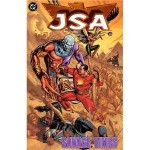
JSA volume 6: Savage Times


By Geoff Johns, David Goyer, Leonard Kirk & Keith Champagne (DC Comics)
ISBN: 1-84023-984-0
New Extended Review

When they’re producing what their confirmed readership wants, today’s mainstream comics publishers seem to be on comfortably solid ground, so perhaps I shouldn’t be so harsh in my judgements when they seemingly go berserk with multi-part, braided mega-crossovers. The tale collected as Savage Times is top notch, well crafted, standard comic book fare, but I just can’t escape the nagging worry that by only regurgitating the past – no matter how well – ultimately you’re only diminishing the business and the medium.

This volume gathers together issues #39-45 of the monthly JSA title, and as costumed capers go, it is a saga packed with action, excitement, soap opera tension , humour and that heady mix of continuity in-filling we fan-boys adore…

The drama begins with two stand-alone tales ‘Power Crush’ by Goyer, Johns, Patrick Gleason and Christian Alamy, starring the unfeasibly pneumatic and feisty Power Girl as she deals in characteristically direct manner with a metahuman stalker obsessed with her prodigious physical charms, before moving into far more sinister territory with ‘…Do No Harm’ (by Leonard Kirk & Keith Champagne who also illustrated the rest of this book) as Star-Spangled Kid and Captain Marvel must use extreme care to rescue an entire school from a sadistic telepathic suicide bomber, whilst Doctor Mid-Nite struggles to keep the monster’s geriatric master alive on the operating table…

The main event begins in the ‘Unborn Hour’ as a time-travelling villain accidentally shifts some of the Justice Society back to 1944 and a climactic meeting with the first Mister Terrific. In ‘Paradox Play’ the malfunctioning time vehicle sends Captain Marvel to ancient Egypt, and after defeating the chronal marauder, Hawkgirl and Terrific’s modern successor follow the world’s mightiest mortal into a spectacular confrontation with the immortal conqueror Vandal Savage and an elemental metamorph determined to lay waste the Black Lands.

Meanwhile the new Doctor Fate is in another dimension seeking answers to the mystery of his comatose wife…

‘Yesterday’s War’ unites the modern heroes with Egypt’s champions Nabu, Prince Khufu, Chay-Ara (Hawkgirl’s own earlier incarnation) and Black Adam – who is both hero and villain in the JSA’s own time – but as the war goes against the beleaguered defenders Marvel and Adam are dispatched to the Land of the Dead to seek godly aid in ‘The Tears of Ra’, wherein the Black Marvel’s tragic history is poignantly revealed…

With Savage defeated and history restored, the book closes on a treble cliffhanger in ‘Princes of Darkness Prologue: Peacemakers’ as Doctor Fate returns to discover the true nature of the woman he believed to be his long-lost wife, the genocidal terrorist Kobra smugly escapes his long-deserved fate and the Society’s most powerful foe reveals how he has manipulated the team from the start…

It’s always unsatisfying to reach the end of a book but not the story, so even though this is a class superhero act it is hard to not feel a bit resentful, even though the next volume promises everything a fan could wish for.

At least the thing has already been published. Maybe you shouldn’t wait for my impending follow-up graphic novel review but just get this book and JSA: Princes of Darkness right away…
© 2002, 2003 DC Comics. All Rights Reserved.

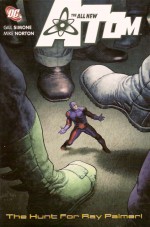
The All-New Atom: The Hunt for Ray Palmer


By Gail Simone, Mike Norton, Dan Green & Trevor Scott (DC Comics)
ISBN: 978-1-4012-1782-2

After the events of Identity Crisis and 52, size-changing physicist Professor Ray Palmer disappeared, leaving his world behind him. But life goes on, and his teaching chair at Ivy University was offered to a young prodigy from Hong Kong who just happened to be Palmer’s pen-friend and confidante: privy to his predecessor’s secrets ever since he was a child.

This neophyte, Ryan Choi, soon inherited his predecessor’s super-hero career as well – under some rather suspicious circumstances – battling super-villains, monsters and seemingly random chronal catastrophes that are making Ivy Town a viper’s nest of bizarre occurrences.

With this third volume (collecting issues #12-16 of the much missed All-New Atom comic-book) the so-likable legacy hero joins an eccentric team of heroes to track down his missing mentor in a story-arc that coincides with the events of the mega-crossover ‘Countdown to Final Crisis.’

Written by the always enjoyable Gail Simone and illustrated by Mike Norton, Dan Green and Trevor Scott, the saga begins with ‘Never Too Small to Hit the Big Time’ as shrinking homicidal maniac Dwarfstar returns, swiftly followed by a gallery of Palmer’s oddly unique Rogue’s Gallery. Temporal anomalies are devastating the city and Choi’s only chance to sort it all is the creepily coincidental alliance offered by the legendary time-thief Chronos…

‘Second Genesis’ finds Choi and that Tempus Fugitive lost in the South American jungles encountering the tiny alien barbarians Palmer once lived with (see Sword of the Atom) before the new Tiny Titan links up with Donna Troy, Jason Todd and the Monitor (protagonists of the aforementioned Countdown to Final Crisis) joining forces in a search of the entire multiverse. First stop in ‘Heavens to Bitsy’ takes them from the super-scientific civilisation located on the bottom of Choi’s pet dog (no not his underside, the bit by the tail…) and from there to the paradise where all dead superheroes go – featuring cameos from a host of departed DC stars…

Nothing is as it seems though, and by the time they reach neutral ground and a rendezvous with Green Lantern Kyle Rayner it’s clear that something is sabotaging them. ‘Loss Leader’ sees Choi impossibly yanked from his quest and returned to Earth to save Ivy Town from the effects of the accelerating time-storm one: of the funniest and grossest hero exploits ever recorded – or as Choi puts it “Ewwww…”

The book ends on a hilarious action-packed high note with ‘Forward! Into the Past!’ as more hints on the mastermind behind all the Atom’s troubles are revealed when Ivy Town takes a reality-warping, mind-bending trip back into the Summer of Love. Ghosts, aliens, monsters, naff villains and Hippies, plus a guest-shot for the clearly inadequate guardians of the Time Stream, the Linear Men: this fun-filled frantic frolic is a joyous return to clever, light-hearted adventure.

These tales are everything a jaded superhero fan needs to clear the palate and revive flagging interests. Get them all!

© 2007, 2008 DC Comics. All Rights Reserved.

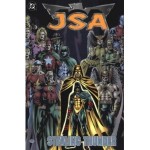
JSA volume 5: Stealing Thunder


By Geoff Johns, David Goyer & various (DC Comics)
ISBN: 978-1-84023-667-5

The groundbreaking reinvention of the World’s first super-team continued apace with these compelling thrillers which originally appeared in JSA #32-38, beginning with a chilling peek into the life of the new Crimson Avenger: a haunted woman compelled to hunt down murderers by her own magic guns. Her irresistible compulsion has brought her to her next target – one of the Society’s greatest heroes…

‘Death Duty’ is illustrated by Peter Snejbjerg who also provided the pictures for the ‘Stealing Thunder Prologue’ wherein octogenarian hero Johnny Thunder, miraculously cured of senile dementia, reclaimed his magical Thunderbolt genie from his successor Jakeem. Unfortunately it’s all a macabre plot constructed by the body-hopping Ultra-Humanite…

The epic begins in ‘Wish Fulfillment’ (with art by Keith Giffen & Al Milgrom, Leonard Kirk & Keith Champagne), as, an unspecified time later, silicon superhero Sand awakens to discover that the Ultra-Humanite has usurped the power of the Thunderbolt and taken control of Earth. Those superbeings not directly mind-controlled and used as storm troopers are all stored in a giant body-bank.

Escaping with homicidal foe the Icicle in tow, Sand accidentally makes contact with the last free minds on the planet: Jakeem, Crimson Avenger, Power Girl, Hourman and Captain Marvel…

Kirk and Champagne continue in ‘Troublestruck’, ‘Lightning Storm’ and ‘Time-Bound’ as the desperate rebels risk everything to liberate the enslaved electric genie whilst being pursued by an murderous armada of their oldest friends before the tragic, spectacular finale returns the World to its original state in ‘Crossing Over’.

This volume ends with one of those touching “after the Apocalypse” tales: quiet, reflective and focusing on the heirs of lost heroes as Jakeem and the second Hourman contemplate their legacies and new responsibilities on ‘Father’s Day’, movingly illustrated by Stephen Sadowski and Andrew Pepoy.

By this time a fully realised superhero soap opera, Geoff Johns and the soon to depart David Goyer had made the Justice Society of America a stunning mix of old and new by blending cosmic action and human scaled drama with a memorable cast of characters. These tales are among the very best “fights and tights” adventures in contemporary comics, and should be on every old fan and potential convert’s “must-have” list.

© 2002, 2003 DC Comics. All Rights Reserved.

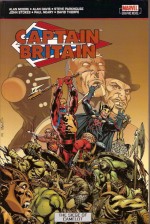
Captain Britain: the Siege of Camelot


By various (Marvel/Panini UK)
ISBN: 978-1-84653-433-1

This fourth wonderful volume collecting the complete adventures of Marvel’s Greatest British super-hero gathers together the remaining black and white episodes of The Black Knight strip from Hulk Comic (# 42-55 and 57-63, 1979) in which Captain Britain co-starred, before going on to his peripatetic wanderings through a number of UK titles beginning with Marvel Super Heroes #377-389 and continuing in The Daredevils #1-11. Eventually he got his own second short-lived title, but that’s a bunch of tales for another time and hopefully a future graphic novel review…

The Lion of Albion was in character limbo until March 1979, when a new British weekly, Hulk Comic, launched with an eclectic, if not eccentric, mix of Marvel reprints the editors felt better suited the British market. There were some all-new strips featuring Marvel characters tailored, like the reprints, to appeal to UK kids.

The Hulk was there because of his TV show, Nick Fury (drawn by the incredibly young Steve Dillon) – because Brits love their spies, and the all-original period pulp thriller Night Raven by David Lloyd, John Bolton and Steve Parkhouse. Hidden deep within and almost trying not to be noticed was The Black Knight.

The Knight was a sometime member of the super-team The Mighty Avengers but in this engrossing epic, costumed shenanigans were replaced by a classical fantasy quest which began in modern Britain but soon evolved into a desperate search through the Tolkien-esque (or perhaps Alan Garner derived) myth-scape of legendary England in a last ditch attempt to save the soul of the land by locating the spirit of our Arthurian/Celtic roots. At that time the addled wits and broken soul of Captain Britain would also be restored…

This comprehensive volume continues and concludes the quest with the discovery of Camelot, the rebirth of the legendary King (originally seen in issues #42-55 and #57 through 63 at which time Hulk Comic folded) and a cataclysmic last battle with the forces of evil. These two and three page episodes are a truly classy act executed with great panache by writer Steve Parkhouse and John Stokes (with occasional penciling from the multi-talented Paul Neary) which captured the imagination of the readership, becoming the longest-running original strip in the comic (even The Hulk itself reverted to reprints by #28) and often stole the cover spot from the lead feature.

After a brief informative afterword and some impressive colour covers – including a pin-up of Captains Britain and America by Jack Kirby – the drama resumes with the return of Captain Britain, revamped and redesigned by Editor/plotter Neary and a new creative team; neophytes writer Dave Thorpe and artist Alan Davis for the monthly reprint anthology Marvel Super-Heroes (#377, September 1981).

Lost in the gaps between alternate worlds the hero and his elf sidekick Jackdaw are drawn back to Earth but upon arrival they discover it is a hideous parody of Britain, bleak, distressed, hopeless and depressed – a potent analogue of the country Margaret Thatcher was then dismantling. Thorpe’s desire to inject some subversive social realism into the feature – and the resistance he endured – is documented in his commentary in this volume but suffice to say that although the analogies and allegories are there to be seen, pressure was exerted to keep the strip as escapist as possible, and avoid any controversy…

That’s not to say that the awkward-but-improving-with-every-page tales weren’t a dynamic, entertaining breath of fresh air, with striking superhero art delivering a far more British flavour of adventure. In short order the confused Captain met anarchic bandits The Crazy Gang, reality-warping mutant Mad Jim Jaspers, British Nazis and a truly distressed population in ‘Outcasts’ (MSH #378), an animated rubbish monster (‘The Junkheap that Walked Like a Man’ (#379), and was introduced to the pan-Reality colossus The Dimensional Development Court and its sultry, ruthless operative Opal Luna Saturnyne, who intended to compulsorily evolve the whole dimension, beginning with ‘In Support of Darwin!’, ‘Re-Birth!’, ‘Against the Realm’ and ‘Faces of Britain!’ #380-383).

‘Friends and Neighbours’ is a pretty-looking and thoroughly de-clawed examination of sectarianism and racism (see Thorpe’s commentary for clarification) which was followed in #385 by an “untold tale” by Neary and Davis. To get the saga back on track this diversion related an event that occurred in Limbo – the ‘Attack of the Binary Beings!’

Now deeply involved in Saturnyne’s plan to make humanity evolve (just like forcing Rhubarb) Captain Britain was trapped in a clash between the underclasses and the government in Thorpe’s last story ‘If the Push Should Fail?’ which heralded the beginning of Alan Moore’s landmark tenure on the character.

Marvel Super-Heroes #387 is the first of the full-colour tales in this volume (presumably thanks to the frequent reprinting of these stories in America), and instantly kicks the series into high gear with ‘A Crooked World’ as the dying dimension unleashes its greatest weapon: a relentless, unstoppable artificial killer called the Fury.

Killing Jackdaw, reintroducing Jim Jaspers and setting the scene for a monolithic epic in ‘Graveyard Shift’ by vaporising Captain Britain, the series then folded.

After a brief text interlude from Mr. Moore (from Marvel Super-Heroes #389) the saga started again in a new home, as the lead feature in The Daredevils #1, with a revelatory new origin ‘A Rag, a Bone, a Hank of Hair…’ and a rebuilt hero returned to his own Earth just in time to see that world assaulted by another reality-warping Jim Jaspers intent on destroying all superbeings in ‘An Englishman’s Home…’

In issue #3 Brian Braddock’s sister Betsy reappeared in ‘Thicker than Water’ a purple-haired telepath being hunted by an assassin destroying all the old esper-agents recruited by British covert agency S.T.R.I.K.E – and yes she is the girl who became Psylocke of the X-Men. The battle against the killer Slaymaster concluded in a spectacular in-joke clash among the shelves of the Denmark Street Forbidden Planet – in 1982 arguably the country’s best fantasy store – so any old fans might want to try identifying the real staff members who “guest-star” – in ‘Killing Ground.’

Keen on creating a cohesive Marvel UK universe the Alan’s brought back another creation for their next tale. The Special Executive was a team of time-travelling mercenaries introduced in Dr. Who Monthly #51 (April, 1981), and in ‘Target: Captain Britain – Recommendation: Executive Action’ saw the legion of super-weirdoes dispatched to Braddock Manor to forcibly bring the hero as a witness in the trial of Saturnyne by the Supreme Omniversal Tribune in ‘Judgement Day’.

Meeting a number of alternate selves such as Captains Albion and England was disturbing enough but the trial was a sham, merely rubber-stamping the accession of Saturnyne’s successor Mandragon. His first act was to destroy the tainted universe that failed to evolve in The Push. Unfortunately for everybody the Fury survived, falling into another universe where it began again to eradicate all heroes…

Issue #7 ‘Rough Justice’ found Britain and the Special Executive in the middle of a pan-dimensional brawl to save Saturnyne whilst back on (his own) Earth, a woman was plagued by dreams of the Fury and Jaspers. In ‘Rivals’ the defenders finally escape back home to find the woman – Captain UK of the recently destroyed alternate universe – waiting with a warning and a prediction…

The Daredevils #9, ‘Waiting for the End of the World’ begins the final story-arc in this volume (and starts a plot picked-up by Chris Claremont for about ten years worth of X-Men and Excalibur storylines), a fascinating compelling war against an invincible, implacable foe, which was truly shocking at the time and still carries a potent emotional punch now, as cast-members and fan-favourites were slaughtered in the Fury’s unstoppable onslaught.

‘The Sound and the Fury’ continues the murderous mayhem before a surprise hero saves the day in the epic ‘But They Never Really Die’ to perfectly wrap up the story just in time for the Captain and his surviving crew to return in his own comic.

With the inclusion of some insightful and elucidating text pieces and plenty of cover reproductions this fourth volume of the chronicles of Captain Britain sees the character finally reach the heights of his potential. Here is not only a wonderful nostalgic collection for old-timers and dedicated fans but also a book full of the best that comics can offer in terms of artistry, imagination and gripping creative energy.

Some of the very best material produced by Marvel, this is a book every reader must have…

© 1979, 1980, 1981, 1982, 1983, 2009 Marvel Entertainment, Inc. and its subsidiaries, licensed by Marvel Characters, Inc. All Rights Reserved. (A British edition from PANINI UK LTD)

Graylight


By Naomi Nowak (NBM)
ISBN13: 978-1-56163-567-2

There are a number of uncomfortable if not altogether unpleasant truisms that still dominate the narrative arts, particularly in terms of gender appeasement: most prevalent and dominant of those – after “chuck in some sex scenes” – are “males need to see mindless action as often as possible” and “women require moments of pretty, contemplative stillness in their stories.”

Mercifully these Hollywood-originated dictums are being challenged and disproved in recent years (just take a look at the frighteningly charged stillness of the “quiet bits” in such European screen gems as “Wallander”), especially in the burgeoning and still largely experimental graphic novel market, where the rules of narration are still being discovered…

In her third book, Graylight, painter and illustrator Naomi Nowak composes another dreamy, symbol-drenched inquiry into the complexities of love in a surreal, quasi-mystical tale of a troubled young woman whose complacency and bad habits get her into an unimaginable amount of difficulty.

Sasha is beautiful, affable, friendly, utterly self-absorbed and an unrepentant thief. If she sees something see likes, she simply knows it will be better off with her. Sadly that can also apply to people as well as objects…

Years ago, a man killed himself, and his widow swore to their infant son Edmund that she would always protect her baby boy from bad things – such as women who drive their husbands to their deaths…

As usual Sasha is the centre of attention in the bar when the journalist Erik spots her. She is holding court, shocking friends with her honesty about how wicked she is. She can feel no remorse for taking the things she wants. Erik is in town to interview a reclusive author, Aurora, and besotted with Sasha, brings her with him as his “photographer.”

The interview goes badly. Aurora is hostile and has a son nobody knew of: a sheltered young man called Edmund, who is protective of his mother but drawn to the moodily effervescent Sasha. Flirting with the reclusive boy as a matter of habit, Sasha is most attracted to an antique book, so she takes it.

Edmund sets out to retrieve the book but is increasingly ensnared in Sasha’s charismatic spell. Aurora, seeing Sasha to be just the kind of woman she swore to protect her son from, knows a few spells of her own, and is quite prepared to use any and every means to keep her ancient promise…

Colourful in misty pastels and shockingly bold lines, this oneiric, supernaturally-tinged drama blends the sensibilities of shōjo manga (romantic stories for young girls) with the bleak, moody naturalism of Scandinavian landscape painting and the rich, sexually charged texture of teen soap operas to produce a compellingly sinister love story of desire and consequence that is lyrical, often reflective and occasionally pretentious, but always eminently readable and totally beautiful to look upon.

And here’s my point: this quiet, contemplative breed of graphic narrative has a great deal to offer the reader looking for something a little different. As an old unrepentant heterosexual male I felt no need for a fistfight or car chase to keep my attention from wandering, and those dreamy, floaty moments greatly added to the atmosphere and mood. If the action is starting to pall, why not try a little mood magic…?

© 2007 Naomi Nowak. All Rights Reserved.

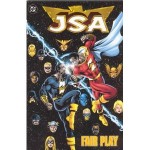
JSA volume 4: Fair Play


By Geoff Johns & various (DC Comics)
ISBN: 978-1-84023-628-6

Now firmly re-established as a major force in the DC universe as well as the commercial comics market, the Justice Society of America went from strength to strength after the rebirth of the seminal, eternal hero Hawkman (see the previous volume JSA: the Return of Hawkman), with Geoff Johns writing increasingly grander epics, tinctured with intriguing soap-opera sub-plots whilst scrupulously exploring and reinventing the internal mythology that has kept the characters as beloved best friends for generations of fans.

This volume, collecting issues #26-31 of the monthly comic and pertinent selections from JSA Secret Files #2, leads off with ‘Breaking Storms’ (co-plotted by Davis S. Goyer and illustrated by Javier Saltares & Ray Kryssing) finding assorted members of the team getting reacquainted, generally carrying out day-to-day business, but beyond the rewarding view of heroes behind their masks, the groundwork for two upcoming epics were stylishly foreshadowed as a pair of old enemies made their first cautious moves…

‘Who Do You Trust?’ (with art from Rags Morales & Michael Bair) found the nominally reformed villain Black Adam making himself less than welcome with his new team-mates until magical boy-scout Captain Marvel intervened, and it was back to all-out action in ‘Upping the Ante’ (illustrated by Derec Aucoin) when extreme gambler Roulette laid plans to pressgang the JSA for her next cage-fighter gladiatorial tournament.

The plan got underway in ‘Thunderstruck’ (Morales & Bair) as the team elected a new chairman only to find themselves abducted and enslaved; forced to fight each other to the death for the edification of super-villains and evil millionaires. Throughout it all Roulette was playing a double-game: something other than greed for profit and blood was fuelling her actions…

The big climax began in a ‘Face-Off’ (by Stephen Sadowski, Christian Alamy & Dave Meikis) but the saga paused – if not digressed – for a short interlude featuring the team’s youngest members, Jakeem Thunder and Star-Spangled Kid (with art from Peter Snejbjerg), who were caught up in a battle with a “Jokerised” Solomon Grundy.

‘Kids’ was part of a braided crossover event that spanned the entire DC pantheon (see Batman: the Joker’s Last Laugh for more details and murderous high jinks) but scripter Johns also cannily used the opportunity to advance one of those aforementioned big plots by bringing back the original Johnny Thunder – who wanted his magic genie back from Jakeem…

Roulette’s motives were revealed even as her illicit fight-club went down in flames when the triumphant JSA overwhelmed her assembled hordes in ‘Fair Play’ (Sadowski & Keith Champagne) and this volume concludes with a team field trip to Gotham City and a terse encounter with the Dark Knight in ‘Making Waves’ (chillingly executed by Snejbjerg) as the assembled heroes raced to rescue a kidnapped baby…

Superhero stories simply aren’t to everybody’s tastes, but if the constant and continuous battle of gaudy costumes and flashy personas must be part of the graphic narrative arts market then high quality material like this should always be at the top of the list. If you haven’t been tempted yet these sterling stirring tales might make a convert of you yet…

© 2001, 2002 DC Comics. All Rights Reserved.

Iron Man: Enter: the Mandarin


By Joe Casey & Eric Canete (Marvel)
ISBN: 978-0-7851-2522-5

With the blockbuster sequel to the Iron Man movie imminently expected, there’s a lot of shiny glittery product out there devoted to the Golden Avenger and this impressive reworking of Tales of Suspense #50-55, which introduced his greatest foe, is still available and probably one of the most accessible to new readers as well as being a cast-iron cracker in its own right (and for a highly recommended look at those original masterpieces see Marvel Masterworks: Iron Man 1963-1964 – other reprint editions are available…).

The excellent Joe Casey has taken the events of that landmark sequence created by Stan Lee and Don Heck and first published from February to July 1964, at the height of the Cold War, and by refocusing on the villain rather than the hero has managed the tricky task of updating without radically counteracting or denying what has gone before.

Originally released as a six issue miniseries it shows how the oriental mastermind was a Chinese aristocrat who discovered ten rings in the belly of a crashed spacecraft, but due to his arrogance simply retired to await the moment when the world would eventually become his. Calling himself The Mandarin he idled away his days until the communist government provoked him into an angry life. Unfortunately, this unforeseen activity provoked American intelligence agency S.H.I.E.L.D. into action too…

Convincing weapons-technocrat Tony Stark to investigate, they are unaware that they are sending Armoured Avenger Iron Man to a meeting with destiny: his initial clash with the Chinese warlord will set the Mandarin on an obsessive, aggressive vendetta against both Stark Industries and the entire debased modern world…

As well as featuring a delightfully entertaining take on supporting cast favourites Pepper Potts and Happy Hogan this epic includes skirmishes with the deadly Scarecrow, Crimson Dynamo and the Mandarin’s own son, but the real graphic rewards come in the form of the spectacular, devastating clashes with the inimical Master of Menace that open and close this great tale, illustrated with clunky, retro-magnificence (think of Art Deco with all the nuts and bolts on show) by Eric Canete (whose sketchbook of covers is also included at the back of the book), winningly coloured by Dave Stewart.

Enter: the Mandarin is quite simply one of the best Iron Man books in years. What are you waiting for…?

© 2007, 2008 Marvel Publishing, Inc. All Rights Reserved.

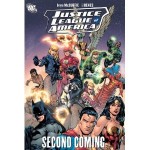
Justice League of America: Second Coming


By Dwayne McDuffie, Ed Benes & various (DC Comics)
ISBN: 978-1-84856-253-0

By the time of the stories in this collection (issues #22-26 of the most recent incarnation of the World’s Greatest Superhero team) writer Dwayne McDuffie has his feet comfortably under the table and begins to play with the secondary characters that always offer the most narrative opportunity in such large congregations of major and minor stars.

Beginning with ‘The Widening Gyre’, illustrated by Ed Benes, he also cleans up some of the longer-running plot threads as the Red Tornado finally gets a new body, after months of inhabiting the JLA computers after being destroyed by the killer android Amazo (see Justice League of America: the Tornado’s Path). Sadly, whilst his relationship with his human wife and child looks set to resume, the tempestuous affair between Red Arrow and Hawkgirl is rapidly spinning out of control and beast-empowered heroine Vixen has finally come clean to her team-mates about her out-of-control abilities, Amazo reveals he is neither gone nor forgotten…

Once more assuming control of the Tornado’s new body in ‘Things Fall Apart’ the parasitic automaton resumes its programmed task of destroying the JLA, but as it again crashes to defeat in ‘The Blood-Dimmed Tide’ (this chapter illustrated by Alan Goldman, Prentis Rollins, Rodney Ramos & Derek Fridolfs), Vixen and guest-star Animal Man realise that something is terribly amiss with their powers, origins and even reality itself…

‘The Best Lack All Conviction’ (with art from Benes, Doug Mahnke, Darick Robertson, Shane Davis, Ian Churchill, Ivan Reis, Christian Alamy, Rob Stull, & Joe Prado) finds one faction of the team tracking down Amazo’s creator whilst the other half are drawn into a reality-warping battle with the trickster god Kwaku Anansi. The mythical creator of all stories claims to have designed Vixen (and Animal Man’s) abilities, and now forces the malfunctioning warrior into curing her current maladies – even if she has to die in the process.

With her comrades re-imagined into a plethora of disturbing alternate incarnations Vixen battles to overcome her own failings and rescue “the Real World” from a creature utterly beyond good and evil, and with a particularly unpleasant method of teaching salutary lessons in the climactic ‘Spiritus Mundi’, a impressive and quirky conclusion from McDuffie and Benes that proves that you don’t need A-List stars to tell great stories…

Sleek, glossy, action-packed and leavened with great characterisation and sharp one-liners, the JLA‘s continuing adventures are still among the very best modern superhero sagas around. If you’re not a fan yet, reading these books will swiftly and permanently alter that reality…

© 2008, 2009 DC Comics. All Rights Reserved.

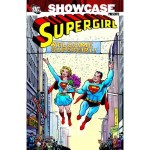
Showcase Presents Supergirl volume 2


By Jerry Siegel, Leo Dorfman, Jim Mooney & various (DC Comics)
ISBN: 978-1-84856-055-0

Superhero comics don’t often do whimsical and thrilling anymore. They especially don’t do short or self-contained. The modern narrative drive concentrates on extended spectacle, major devastation and relentless terror and trauma. It also helps if you’re a hero who has come back from the dead once or twice or wear a combat thong and thigh boots…

Although there’s nothing intrinsically wrong with that, sometimes the palate just craves a different flavour. Once this continued cosmic cataclysm was the exception not the rule, and this second enchanting black and white compendium of the early career of Superman’s cousin Kara Zor-El of Argo City happily displays why.

After a few intriguing test-runs Supergirl began as a future star of the expanding Superman pocket universe in Action Comics #252 (May 1959). Superman’s cousin Kara had been born on a city-sized fragment of Krypton, hurled intact into space when the planet exploded. Eventually Argo City turned to Kryptonite like the rest of the detonated world’s debris, and her dying parents, observing Earth through their scopes, sent their daughter to safety as they perished. Landing on Earth, she met Superman who created the identity of Linda Lee and hid her in an orphanage in small town Midvale whilst she learned of her new world and powers in secrecy and safety.

This second collection, encompassing all the Girl of Steel’s adventures from the back of Action Comics #283 (December 1961) to #321 (February 1965), finds the young heroine still in training, her very existence kept secret from the general public and living with adoptive parents Fred and Edna Danvers – who are also completely unaware that the orphan they have recently adopted is a Kryptonian super-being.

The accent on these stories generally revolves around problem-solving, identity-preserving and loneliness, with both good taste and the Comics Code ensuring that readers weren’t traumatised by unsavoury or excessively violent tales. Such plots, akin to situation comedies, often pertained, as in the first story represented here: ‘The Six Red “K” Perils of Supergirl!’, by Jerry Siegel and regular artist Jim Mooney.

Peculiar transformations were a mainstay of 1960s comics, and although a post-modern interpretation might discern some metaphor for puberty or girls “becoming” women, I rather suspect the true answer can be found in the author’s love of comedy and an editorial belief that fighting was unladylike. Red Kryptonite, a cosmically altered isotope of the radioactive element left when Krypton exploded, caused temporary physical and sometimes mental mutations in the survivors of that doomed world – a godsend to writers in need of a challenging visual element when writing characters with the power to drop-kick planets…

Here the wonder-stuff generates a circus of horrors, transforming Supergirl into a werewolf, shrinking her to microscopic size and making her fat (I’m not going to say a single word…).

The drama continued in the next instalment, ‘The Strange Bodies of Supergirl!’ wherein she grew a second head, gained death-ray vision (ostensibly!) and changed into a mermaid. This daffy holdover to simpler times presaged a big change in the Maid of Might’s status as with the next issue her parents learned her true origins and her existence was revealed to the world in the two-part saga ‘The World’s Greatest Heroine!’ and ‘The Infinite Monster!’ both appearing in issue #285, as Supergirl became the darling of the universe: openly saving the planet and finally getting the credit for it.

Action #286 pitted her against her cousin’s greatest foe in ‘The Death of Luthor!’, whilst ‘Supergirl’s Greatest Challenge!’ saw her visit the Legion of Super-Heroes (quibblers be warned: initially their far-future era was the 21st century. It was quietly retrofitted to a thousand years from “now” after the tales in this volume) and save the Earth from invasion. She also met the telepathic descendent of her cat Streaky. His name was Whizzy (I could have left that out but chose not to – once more for smug, comedic effect…).

‘The Man who Made Supergirl Cry!’ signaled the beginning of Leo Dorfman’s run as scripter. Little is known about this prolific writer, other than he also worked under the name Geoff Brown, producing quality material continuously from the Golden Age until his death in 1974. In this tight little thriller Phantom Zone villains took control of Supergirl’s new dad in a plot to escape their ethereal dungeon dimension, whilst #289’s ‘Superman’s Super-Courtship!’ is something of a classic, as the Girl of Steel scoured the universe for an ideal mate for her cousin. Charming at the time, modern sensibilities might quail at the conclusion that his perfect mate was just like Supergirl herself, but older…

‘Supergirl’s Super Boy-Friends!’ saw both human Dick Malverne and Atlantean mer-boy Jerro catch super-powers after kissing her (I’m again saying nothing here) whilst she didn’t actually become ‘The Bride of Mr. Mxyzptlk!’ when the fifth dimensional prankster transferred his unwanted attentions to her in Action #291.

An extended storyline began in the next issue when the girl got a new “pet”. ‘The Super-Steed of Steel!’ was a beautiful white horse who helped her stave off an alien invasion, but the creature had a bizarre and mysterious past, revealed in ‘The Secret Origin of Supergirl’s Super-Horse!’, and a resolution of sorts was reached in ‘The Mutiny of Super-Horse’.

A new cast member joined the series in ‘The Girl with the X-Ray Mind!’, a psychic with a shocking connection to the Superman Family, and her secrets were further revealed in ‘The Girl who was Supergirl’s Double!’ It was the beginning of an extraordinarily tense and epic continued storyline that featured Phantom Zone villains, Luthor, Supergirl’s arch enemy Lesla Lar, the destruction of Atlantis and genuine thrills and excitement. Earth was threatened by ‘The Forbidden Weapons of Krypton!’ and it took ‘The Super-Powers of Lex Luthor!’ to finally save the day.

Action #299 returned to whimsical normality with ‘The Fantastic Secret of Superbaby II!’, and the anniversary 300th issue featured ‘The Return of Super-Horse!’: another multi-part tale that revealed ‘The Secret Identity of Super-Horse!’ in #301, only to suffer ‘The Day Super-Horse went Wild!’ in the next episode.

By this time Supergirl was featured on every second Action Comics cover, and was regularly breaking into the lead Superman story. All those covers, by art dream-team Curt Swan and George Klein are collected herein, as is their Dorfman-scripted Man of Steel tale ‘The Monster from Krypton!’ from #303, with Supergirl having to battle her Red K transformed cousin. Sadly the art is misattributed to Mooney in the credits, but he actually did draw the moving tragedy of ‘Supergirl’s Big Brother!’ for his regular second-feature in that issue.

Supergirl got a new arch-enemy in ‘The Maid of Menace!’ but Black Flame was not as problematic as ‘The Girl Who hated Supergirl!’ (again solely credited to Mooney but I’m pretty sure its at least part-inked by John Forte). Action #306 was a pure mystery thriller as Girl of Steel became ‘The Maid of Doom!‘ whilst ‘Supergirl’s Wedding Day!’ almost proved that no girl can resist a manly man… almost!

‘The Super-Tot from Nowhere!’ proved to be a most difficult adventure in babysitting and #309’s ‘The Untold Story of Argo City!’ began another long saga revealing the true fate of Kara’s Kryptonian mum and dad, whilst ‘Supergirl’s Rival Parents!’ saw her having to chose between them and her Earth family.

More equine revelations came on ‘The Day Super-Horse Became Human!’ whilst eerie coincidence was examined in ‘The Fantastic Menace of the “LL’s”.’ ‘Lena Thorul, Jungle Princess!’ brought the troubled psychic back into the Girl of Steel’s so-complicated life, and the soap opera screws began really tightening when parent trouble resumed in ‘Supergirl’s Tragic Ordeal!’

It was the start of another wicked plot, continued in ‘The Menace of Supergirl’s Mother!’ and concluded in ‘Supergirl’s Choice of Doom!’, but the heroine’s problems were only beginning. In Action #317, Luthor’s latest scheme resulted in ‘The Great Supergirl Double-Cross!’, after which her life changed forever when ‘Supergirl Goes to College!’

Now nominally on her own at sedate Stanhope College, the dramas of catty rival and suspicious sorority sisters were added to identity preserving, boy-chasing and superhero-ing, but first she had to prove she wasn’t ‘The Super-Cheat!’ to keep her place at university. ‘The Man Who Broke Supergirl’s Heart!’ was not only a cad but an alien one, and this volume finishes on an emotional high with #321’s ‘The Enemy Supergirl!’ stuffed with intrigue, imposters and even coma-patients…

Throughout this four-odd year period Kara of Krypton underwent more changes than most of her confreres had in twenty years, as the editors sought to find a niche the buying public could resonate with, but for all that these stories remain exciting, ingenious and utterly bemusing. Possibly the last time a female super-character’s sexual allure and sales potential wasn’t freely and gratuitously exploited, these tales are a link and window to a far less crass time and display one of the few strong female characters that parents can still happily share with their youngest girl children. I’m certainly not embarrassed to let any women see this book, unlike any “Bad-Girl” book you could possibly name.

© 1961-1964, 2008 DC Comics. All Rights Reserved.

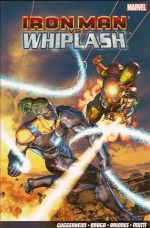
Iron Man Vs. Whiplash


By Marc Guggenheim, Brannon Bragga, Briones & Steve Mutti (Marvel/Panini UK)
ISBN: 978-1-84653-460-8

In the mainstream Marvel universe the citizenry are recovering from an interminable series of major catastrophes such as the Civil War and a Secret Invasion by shape-shifting Skrulls. In this heady age of confusion technical wizard and billionaire weapon-smith Tony Stark has been revealed to the world as the armour-clad superhero Iron Man.

After a similarly-armoured invader destroys a village full of Russian dissidents in a high-tech bloodbath captured on Stark-constructed satellites and seen around the world, the bewildered inventor finds himself on trial for crimes against humanity. Accused of acting as a mercenary for the Russian government Stark has been perfectly framed. Found guilty, he is to be interned for life when lucky disaster strikes.

The village of Volstok was full of discredited scientists and anti-Putin agitators when the Iron assassin struck, and one of them managed to fatally damage the attacker. This survivor used the fragments to create his own armoured energy weapons, and crazed by a need for revenge, goes after Stark as the deadly Whiplash.

In prison, Stark has been busy. Knowing he can’t prove his innocence from behind bars he has constructed a ramshackle suit of armour from odds and ends he has scrounged or stolen. When the vengeance hungry Whiplash attacks, Stark seizes his chance and escapes after an inconclusive clash with the Russian.

With his faithful assistant Pepper in tow Stark goes on the run, ferreting out the hideous secret of the men who destroyed his reputation, but even cleared of the crime he has made an implacable enemy in Whiplash, who holds his inventions, if not his actions, as responsible as the Russian government for the Volstok massacre.

This simple, uncomplicated action-yarn is a palatable piece of eye-candy, capably concocted by scripters Marc Guggenheim and TV writer/producer Brannon Braga (Star Trek, Threshold, 24, Flash Forward), enticingly realised by artists Phillippe Briones & Andrea Muti and colourist Matt Milla. Originally released as a four-issue miniseries, this book happily falls into a category of accessibility that will please fans of the film franchise who don’t want or need to bone up on Iron Man’s near fifty year publishing history.

Fast and furious fun and frolics with an iron-clad satisfaction guarantee…
™ and © 2010 Marvel Entertainment LCC and its subsidiaries. All Rights Reserved. A British edition released by Panini UK Ltd.