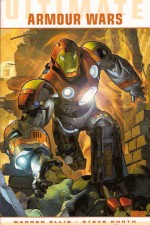
Ultimate Armour Wars


By Warren Ellis & Steve Kurth (Marvel/Panini UK)
ISBN: 978-1-84653-441-6

The Marvel Ultimates project began in 2000 with a thoroughly modernizing refit of key characters and concepts to bring them into line with contemporary “ki-dults” – perceived to be a separate buying public to we baby-boomers and our declining descendents who seemed content to stick with the various efforts that sprang from the fantastic talents of Kirby, Ditko and Lee. Eventually this streamlined new universe became as crowded and continuity-constricted as its predecessor and in 2008 the cleansing publishing event “Ultimatum” culminated in a reign of terror which apparently (this is comics, after all) killed three dozen odd heroes and villains and millions of ordinary mortals.

Although a huge seller (in contemporary terms, at least) the saga was largely trashed by the fans who bought it, and the ongoing new “Ultimatum Comics” line is quietly back-pedalling on its declared intentions…

The key and era-ending event was a colossal tsunami that drowned the superhero-heavy island of Manhattan and this post-tidal wave collection (assembling issues #1-4 of the miniseries Ultimate Comics Armor War – and yes, it has been spelled differently for this British Edition) picks up the story of the survivors as well as the new world readjusting to their altered state.

Young Tony Stark is a tech-genius weapon-smith – and amiable drunk – from a family of armaments manufacturers. When the wave hit, his greatest treasure was lost in his state-of-the-art Manhattan Corporate HQ. A public figure in his trademarked Iron Man war-suit, he is down to his last few million bucks and sifting through the wreckage of his building when a cybernetic super-thief called The Ghost steals his precious strongbox, and would have killed the billionaire brat if not for the intervention of Justine Hammer, daughter of Stark’s greatest enemy: a girl dying from her father’s abusive attempts to giver her marketable super-powers.

Wearing a suit painfully similar to the Iron Man suit the Ghost vanishes, leaving Stark with the realisation that his technology has been pirated and sold to unscrupulous monsters. Although spoiled and dissolute even Stark can’t drink enough to wash away all the blood his inventions could spill if he doesn’t take control back…

With Justine in tow he follows the bloody trail, finding and neutralising all illicit incidences of his armour from malevolent arms dealer Dr. Faustus to deviant Balkan mad scientist Bram Velsing to the ever-OTT Metropolitan Police Force (who use their Stark-based tin-suits to quell political protest and civil disobedience… same as it ever was…)

Eventually the trail leads to the shocking mastermind behind the plot, with plenty of twisty-turny revelations in store – or not, depending on how astute you are, how much attention you’ve been paying and of course on whether you’ve read the original tale this was based on (see the graphic novel Iron Man: the Armor Wars as well as our review of same).

Visually stunning (True Brits especially will revel in the spectacular battle in the skies over London) thanks to artist Steve Kurth and the colouring magic of Guru EFX, Warren Ellis’s tale is sharp and witty, if fairly predictable: heavy on attitude and action, and over almost too quickly, leaving the reader genuinely hungry for more…

Once removed from the market hype and frantic, relentless immediacy of the sales arena there’s a chance to reassess these tales on merit alone, and given such a opportunity you’d be foolish not to take a good hard look at this solid, accessible superhero yarn.
™ and © 2010 Marvel Entertainment LCC and its subsidiaries. All Rights Reserved. A British edition released by Panini UK Ltd

JSA: volume 3 The Return of Hawkman


By David S. Goyer, Geoff Johns & various (DC Comics)
ISBN 1-84023-628-0

The third collection of the revered, revived and very legendary Justice Society of America continued the crusade to resurrect or re-induct all the classic big names by reviving the biggest name and most visually arresting of the original team: Hawkman.

However, before that epic unfolds this volume (reprinting issues #16-26 of the monthly comic and portions of JSA Secret Files #1) kicks off with a triumphant extended return engagement for some old foes with ‘Injustice Be Done’. The first chapter ‘Divide and Conquer’ (illustrated by Stephen Sadowski and Michael Bair) finds an expanded Injustice Society in possession of the heroes’ most intimate secrets, ambushing them whilst they’re off guard with significant success.

In ‘Cold Comfort’ mastermind Johnny Sorrow reveals his plans as the heroes begin their fight back, and we see his horrific origins in ‘Sorrow’s Story’ (with additional art Steve Yeowell), before the World goes to Hell with ‘Into the Labyrinth’ (extra inks by Keith Champagne) and the ghostly Spectre returns to save the day.

And spectacularly fails…

The saga concludes in cataclysmic fashion with ‘Godspeed’ as Black Adam and Jakeem, the heir of genie-wielding Johnny Thunder join the team, but not before Jay Garrick the veteran Flash is lost in time and space…

Compelling as it was the entire saga was just a set-up for the eponymous ‘Return of Hawkman’ which I’ll get to after this necessary diversion…

Hawkman is one of the oldest and most revered heroes in comic-books, premiering in Flash Comics #1 (January 1940), created by Gardner Fox and Dennis Neville, although the most celebrated artists to have drawn the Winged Wonder are Sheldon Moldoff and Joe Kubert, whilst a young Robert Kanigher was justly proud of his later run as writer.

Carter Hall was a playboy archaeologist until he uncovered a crystal knife that unlocked his memories. He realised that once he was Prince Khufu of ancient Egypt, and that he and his lover Shiera had been murdered by High Priest Hath-Set. Moreover with his returned memories came the knowledge that his love and his kicker were also nearby.

Using the restored knowledge of his past life he fashioned a costume and flying harness, hunting his killer as the Hawkman. Once his aim had been achieved he and Shiera maintained their “Mystery-Man” roles to fight modern crime and tyranny with weapons of the past.

Disappearing at the end of the Golden Age they were revived by Julie Schwartz’s crack creative team in the early 1960s (see Showcase Presents Hawkman volume 1 for further details), and after a long career involving numerous revamps and retcons  the Pinioned Paladin “died” during the Zero Hour crisis.

Now the lost Jay Garrick awakens in old Egypt greeted by a pantheon of that era’s superheroes. Nabu, the Lord of Order who created Doctor Fate, the original incarnation of Black Adam and Khufu himself reveal the true origins of Hawkman whilst in the 21st century the JLA‘s heavenly hero Zauriel tells the modern Hawkgirl just who and what she really is in ‘Guardian Angels’.

The epic further unfolds as a major connection to the alien Hawkworld of Thanagar is clarified and explored in ‘Lost Friends’ and as Garrick returns to his home time Hawkgirl is abducted to the aforementioned Thanagar by its last survivors, desperate to thwart the schemes of the insane death-demon Onimar Synn who has turned the entire planet into a zombie charnel house.

As the JSA frantically follow their abducted member to distant Polaris in ‘Ascension’ Carter Hall makes his dramatic return from beyond and saves the day in typical fashion before leading the team to magnificent victory in the concluding ‘Seven Devils’.

Illustrated by Buzz, Rags Morales, Sadowski, Bair, David Meikis and Paul Neary, this latest return not only led to Hawkman regaining his own title (more graphic novel magic to review soonest!) but also stands as one of the most cosmic and grand-scaled of all the JSA‘s adventures.

Complex, enticing, thrilling and full of the biggest sort of superhero hi-jinks, if costume drama is your meat, this book should be your prey…

© 2001, 2002 DC Comics.  All Rights Reserved.

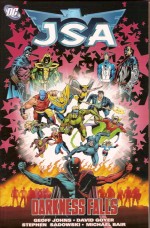
JSA volume 2: Darkness Falls


By Geoff Johns, David S. Goyer, Stephen Sadowski, Michael Bair & various (DC Comics)
ISBN: 978-1-56389-739-9

Following hard on the heels of their successful revival of the industry’s first super-team, the assorted creators hit the ground running and began expanding the roster and finding bigger and bolder cataclysms for the multi-generational army to combat.

The Justice Society of America was created in the third issue of All-Star Comics (Winter 1940/1941), an anthology title featuring established characters from various All-American Comics publications, by the simple expedient of having the heroes gather around a table and tell each other their latest adventure. From this low key collaboration it wasn’t long before the heroes joined forces to defeat the greatest villains and social ills of their generation.

Gathering issues #6-15 of the monthly JSA comicbook in one mighty tome, this volume begins with the official relaunch of the team in ‘Justice. Like Lightning…’ (illustrated by Marcos Martin & Keith Champagne) as the veteran members Flash, Sentinel and Wildcat assume the role of mentors for both current and future champions only to be attacked by a demented super-human named Black Adam. The bombastic battle serves to introduce some very far-reaching plot threads as the new incarnations of Doctor Fate, Hourman and Hawkgirl journey to ancient Egypt to solve the mystery of the Black Marvel’s madness, before the second major story-arc of the series begins.

In ‘Darkness Falls’ (art by Stephen Sadowski & Michael Bair) Sentinel’s troubled son Obsidian, haunted by his own powers, seemingly goes mad and attempts to drag the world into a supernatural realm of dark despondence. Naturally there’s more to the mess that might first appear, and when the new Doctor Mid-Nite appears it’s not long before the black tide begins to turn…

The epic concludes in a savage battle for the ‘Black Planet’ and Wildcat then takes centre-stage for a magnificent solo stint against the entire Injustice Society in ‘Wild Hunt’ – the best “Die Hard” tribute ever seen in comics.

Beginning with ‘Split’ (by Bair & Buzz) the next extended saga pits the team simultaneously against serpentine super-terrorist Kobra and the time-bending villain Extant (who killed many of the original team in Zero Hour) forcing the still largely untested JSA to divide its forces between a world in peril and a continuum in crisis.

‘The Blood-Dimmed Tide’ concentrates on the anti-Kobra contingent but their swift victory is spoiled when the sole survivor of the other team appears to bring them into battle against Extant in ‘Time’s Assassin’, ‘Chaos Theory’ and the spectacular ‘Crime and Punishment’ wherein reality is stretched beyond its limits, the gates of the afterlife are propped open and more than a few dead heroes return…

Complex and enthralling, these super shenanigans are the very best of their genre, filled with wicked villains and shining, triumphant heroes, cosmic disaster and human tragedies, always leavened by optimism and humour.

As such they’re simply not for every graphic novel reader, but if you can put yourself into the head and heart of a thrill-starved ten year old and handle the burden of seven decades of history, these tales will supercharge your imagination and restore your faith in justice…

© 2000, 2002 DC Comics. All Rights Reserved.

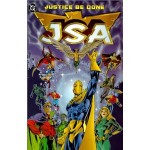
JSA volume 1: Justice Be Done


By James Robinson, David S. Goyer & various (DC Comics)
ISBN: 978-1-56389-620-0

After the actual invention of the comicbook superhero – for which read the launch of Superman in 1938 – the most significant event in the genre, and indeed industry’s progress was the combination of individual sales-points into a group. Thus what seems blindingly obvious to us with the benefit of four-colour hindsight was proven – a number of popular characters could multiply readership by combining forces and readerships. Plus of course, a whole bunch of superheroes is a lot cooler than just one – or even one and a sidekick.

The Justice Society of America was created in the third issue of All-Star Comics (Winter 1940/1941), an anthology title featuring established characters from various All-American Comics publications, by the simple expedient of having the heroes gather around a table and tell each other their latest adventure. From this low key collaboration it wasn’t long before the guys – and they were all guys (except Red Tornado who pretended to be one – don’t ask!) until Wonder Woman premiered in the eighth issue regularly joined forces to defeat the greatest villains – and social ills of their generation.

Within months the concept had spread far and wide…

And so the Justice Society of America is rightly revered as a true landmark in the development of comic books, and, when Julius Schwartz revived the superhero genre in the late 1950s, the key moment would come with the inevitable teaming of the reconfigured mystery men into a Justice League of America. From there it wasn’t long until the original and genuine returned. Since then there have been many attempts to formally revive the team’s fortunes but it wasn’t until 1999 on the back of both the highly successful revamping of the JLA by Grant Morrison and Howard Porter and the seminal but critically favoured new Starman by Golden Age devotee James Robinson, that the multi-generational team found a concept and fan-base big enough to support them.

This first volume collects the prequel tale from JSA: Secret Files #1 and the first complete story-arc from JSA #1-5, detailing with great style and remarkable facility (considering the incredibly convoluted continuity of the feature) how the last active survivors of the original team, Wildcat, Flash and Green Lantern/Sentinel, unite with the inheritors of the veteran team’s legacy to continue the tradition, train the next generation of heroes and battle one of the oldest evils in the universe.

It all begins with the death of the Sandman, octogenarian Wesley Dodds, who beats the odds one last time to thwart an unstoppable ancient foe and warn his surviving comrades of the peril to come…

At Dodds’ funeral a horde of death-demons attack the mourners after the hero known as Fate is murdered, and the assembled mourners – legacy heroes Sand, Stargirl, Hourman, Atom Smasher, Starman and Obsidian, plus Black Canary, Wonder Woman (actually her mother Hippolyta) and the aforementioned trio above are sent on a tripartite mission to rescue three babies; one of which is the new incarnation of the magical hero Doctor Fate.

Meanwhile, unbeknownst to all, a wild card has been introduced with the unexpected return of another departed comrade in the guise of a new and deeply troubled Hawkgirl…

Although deeply fixed in the vast backstory of the DC universe, ‘Gathering Storm’, ‘The Wheel of Life’, ‘Old Souls’ and ‘Ouroboros’, illustrated by Scott, Benefiel, Stephen Sadowski, Mark Propst and Michael Bair, is a accessible superhero-rebirth saga, wonderfully compelling with a frenetic pace that keeps the reader barrelling along. The struggle against the mystery villain is pitched perfectly, with plenty of clues for the old-timers and enough character illustration to educate and satisfy those who have never heard of “the Dark Lord…”

With the revival and reintroduction of Hawkgirl and Doctor Fate achieved, the volume concludes with ‘Grounded’ (illustrated by Derec Aucoin and Bair) focusing on the history and new powers of the latest Sandman and introducing a new Mister Terrific to the team, whilst foreshadowing horrors yet to come…

Complex, thrilling, breathtaking; this is the very best modern superhero comics can aspire to: adding to rather than subtracting from the shared mythology whilst not afraid to dump the utterly unsalvageable bits of stuff that just won’t play today – never once forgetting that it’s all about entertainment…

Although this will never be a universally acclaimed graphic novel like Maus or Watchmen, for dyed-in-the-wool tights and fights fans JSA: Justice Be Done is just what the Doctor ordered and what Fate decrees…
© 1999 DC Comics. All Rights Reserved.

Modesty Blaise: Green Cobra


By Peter O’Donnell, John Burns & Pat Wright (Titan Books)
ISBN 13: 1-84576-420-3

Titan Books’ marvellous series re-presentation the classic British newspaper strip continues and concludes a period of artistic instability with this fourteenth volume (encompassing April 2nd 1979 to May 23rd 1980) as the superb John M. Burns finishes his groundbreaking and far too brief tenure as illustrator on the World’s Greatest Adventure Heroine, abruptly replaced mid-strip by veteran Pat Wright – who also didn’t stick around for very long…

Burns had worked on Junior Express and School Friend but really began his auspicious rise as part of the team of artists who worked on the Gerry Anderson licensed titles TV Century 21 and its sister magazines (he is fondly remembered for Space Family Robinson in Lady Penelope). He drew strips for The Daily Sketch, Daily Mirror and Sun with long, acclaimed runs on The Seekers and the saucy strip Danielle, before briefly and controversially taking over Modesty Blaise.

He has since worked on TV-based series for Look-In and Countdown and found a welcome home in the legendary British science fiction comic 2000AD, where he works on Judge Dredd, Nikolai Dante and his own Bendatti Vendetta.

Although Burns only drew 272 consecutive daily strips, his influence on Modesty was marked and long-lasting. His deft ability with nib and brush are highlighted here with a further complimentary feature reprinting 6 more of the illustrations he drew for O’Donnell’s Modesty prose novels. Also included is another text feature on the oddly arbitrary editorial censorship the strip endured at this period, and particularly the rather heavy-handed manner in which Cartoon Editor Gerald Lip was ordered by Evening Standard Editor Charles Wintour to summarily fire Burns, and ten months later, after only 198 strips, Wright as well, in just as brusque and inexplicable a manner. To this day no one why they were dismissed.

Of Pat Wright himself I know very little, other than he is an exceptionally talented draughtsman, well capable of handling a dramatic feature like Modesty, and also a highly skilled comedy cartoonist working in both line and painted colour. He looks to have been one of the artists used by Fleetway in the late 1970’s on such titles as Action and Valiant (but I’m only guessing here). Just another unsung hero of an industry far too reticent in giving credit where it’s due…

Modesty and Willie Garvin are ex-criminals who retired young, rich and healthy from a career where they made far too many enemies. They were slowly dying of boredom in England when British Spymaster Sir Gerald Tarrant offered them a chance to have fun, get back into harness and do a bit of good in the world. Accepting, they have never looked back…

This volume begins with the eponymous ‘Green Cobra’ and finds Burns at his most effective in a sly and gripping tale of intrigue wherein a band of professional espionage agents kidnap Tarrant’s right hand man Fraser, with a view to breaking and selling him to the highest bidder.

This is a tale rich in character, which spends some welcome time on the bit-players for a change, although when Modesty and Willie go into action against the devilish Dr. Vigo and Pandora, an death-crazed assassin who covets Modesty’s hard-earned reputation, the pace is hectic and the action non-stop. Full of twists and clever subterfuge, this tripartite struggle between Tarrant’s agents, established enemy network Salamander Four and the mysterious new organisation Green Cobra all add to one of the most captivating Modesty yarns ever.

‘Eve and Adam’ is a deliciously quirky tale blending whimsy with terrifyingly grim geopolitical horrors as millionaire philanthropist Dan Galt throws a party for Modesty and Willie, before drugging and transporting them to an isolated part of Africa. It transpires that Galt is dying and believes that humanity will soon follow him. Determined that the race will not be lost he dumps his guests naked and helpless in his new Garden of Eden expecting them to repopulate the world after we’re all gone.

Sadly the old duffer has made a few wrong assumptions. Firstly, Modesty and Willie are simply unable to relate to each other sexually – their bond is far deeper than that. Secondly, the world just isn’t that big anymore: Galt’s oasis in the middle of a desert is disputed territory warring African nations are seeking to control, and finally, his new Adam and Eve are never helpless…

As the pair are preparing to trek out of the desert a satellite crashes into their garden, carrying geological data that the state of Burenzi and its opponent nations will kill to possess. Before too long a small unit from the former and a large troop of mercenaries from the latter have invaded paradise, and they’re not the kind of people who leave witnesses…

Burns was fired without warning or explanation four weeks into this saga and Pat Wright deftly took over just as the bloodshed of a brutal war of attrition escalated, with Modesty and Willie making alliances and picking off ruthless soldiers in a gritty, effective contemporary thriller.

This volume, and Wright’s artistic tenure end with a thoroughly engaging Christmas themed crime-mystery ‘Brethren of Blaise’ which finds our tarnished heroes exposing a criminal scheme perpetrated against one of England’s most impoverished aristocratic families. Hidden treasure, nasty murders and a delightfully thrilling supernatural frosting combined with superb humour and action make this an exception tale in an often grim canon.

During this tale, and once more for no apparent reason, Editor Wintour had Modesty’s illustrator fired. His replacement, Neville Colvin, managed to survive a while longer…but that’s a tale for another graphic novel and a different review.

Originally a newspaper strip created by Peter O’Donnell and drawn by the brilliant Jim Holdaway, Modesty and her charismatic partner in crime (and latterly crime-busting) Willie Garvin have also starred in 13 prose novels and short story collections, two films, one TV pilot, a radio play and nearly one hundred comic strip adventures between 1963 and the strip’s conclusion in 2002. She has been syndicated world-wide, and Holdaway’s version has been cited as an artistic influence by many major comic artists.

These are unbeatable stories from a brilliant writer and his greatest creation; timeless tales of crime and punishments more enthralling now than ever, and which never fail to deliver maximum thrills and enjoyment. It’s never too late to embrace your Modesty…

© 2008 Associated Newspapers/Solo Syndication.

Ultimate Spider-Man Volume1: The New World According to Peter Parker


By Brian Michael Bendis & David Lafuente with Justin Ponsor (Marvel/Panini UK)
ISBN: 978-1-84653-443-0

The Marvel Ultimates project began in 2000 with a thoroughly modernizing refit of key characters and concepts to bring them into line with contemporary “ki-dults” – perceived to be a separate buying public to those baby-boomers and their declining descendents who seemed content to stick with the various efforts that sprang from the fertile, febrile gifts of Kirby, Ditko and Lee. Eventually the streamlined new universe became as crowded and continuity-constricted as its predecessor and in 2008 a publishing event dubbed “Ultimatum” culminated in a reign of terror which apparently (this is comics, after all) killed three dozen odd heroes and villains and millions of ordinary mortals.

Although a huge seller (for modern comics at least) the saga has been largely slated by the fans who bought it, and the ongoing new “Ultimatum Comics” line is quietly back-pedalling on its declared intentions…

The key and era-ending event was a colossal tsunami that drowned the superhero-heavy island of Manhattan and this post-tidal wave collection (assembling issues #1-6 of the relaunched Ultimate Comics Spider-Man) picks up the story of the survivors slowly readjusting to their altered state.

Peter Parker is sixteen years old, a perennial hard-luck kid and loser and canny geek just trying to get by. Between High School and slinging fast food (Burger Frog is his only source of income since the Daily Bugle got hit) he still finds time to fight crime although his very public heroics during the crisis have made him a beloved hero of police and citizenry alike – which is the creepiest thing he has ever endured.

He lives in a big house with his Aunt May, and despite his low self-image has stellar hottie Gwen Stacy for a devoted girlfriend, and is daily enduring the teen-angsty situation of equally stellar hottie Mary Jane Watson (his ex-squeeze) being constantly around and acting all grown-up about it. He briefly dated mutant babe Kitty Pride: remember when not having any girlfriend was the definition of “loser”?

As New York slowly recovers a new villain with a purloined name is carefully positioning himself to take full control – which he commences by murdering one of Spidey’s greatest surviving foes – whilst the wallcrawler is occupied with a resurgent pack of increasingly violent street crimes. One thing the wave didn’t wash away was greed and stupidity…

As the mastermind’s wicked plans near brutal fruition Spider-Man is being secretly helped by a new young crusader who seems determined to avoid observation at all costs, but Peter’s real problems begin when old superhero chums start returning. Kids like the Human Torch and Iceman are completely alone in the aftermath, and with schools and accommodation stretched to breaking point, what can a sweet old lady like May do but open her doors to them? His secret identity was constantly threatened before; how can he possibly conceal his adventurous life when two such famous characters suddenly move in…?

Combining smart dialogue and teen soap opera dynamics with spectacular action – beautifully rendered by artist David Lafuente and colourist Justin Ponsor – this is a surprisingly compelling and enjoyable costumed drama with plenty of laughs that easily rises above its troubled origins. Absolutely worth any jaded superhero fan’s time and money and well on the way to becoming a palpable sleeper hit…
™ and © 2010 Marvel Entertainment LCC and its subsidiaries. All Rights Reserved. A British edition released by Panini UK Ltd

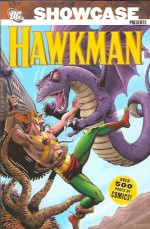
Showcase Presents Hawkman volume 2


By Gardner Fox, Murphy Anderson, Bob Haney, Dick Dillon & various (DC Comics)
ISBN13: 978-1-4012-1817-1

After fighting long and hard to win his own title it was such a pity that time and fashion seemed to conspire against the Winged Wonder…

Katar Hol and his wife Shayera Thal were police officers on their own highly advanced planet of Thanagar. They originally travelled to Earth from the star system Polaris in pursuit of a shape-changing spree-thief named Byth but stayed to study Earth police methods in the cultural metropolis of Midway City. This all occurred in the wonderful ‘Creature of a Thousand Shapes’ which appeared in The Brave and the Bold #34 (cover-dated February-March 1961), but the public was initially resistant and it was three years and many further issues, guest-shots and even a back-up feature in Mystery in Space before the Winged Warriors finally won their own title

Hawkman #1, cover-dated April-May 1964, signalled the beginning of a superb run of witty, thrilling, imaginative and hugely entertaining science fiction, crime-mystery and superhero adventures that captivated the devoted but still painfully small audience.

This second, concluding volume, reprinting in crisp efficient black and white Hawkman #12-27, Brave and the Bold #70, The Atom #31 and the avian portions of the last-ditch combination-comic The Atom and Hawkman #39-45, recommences the magic with another large-scale cosmic epic that originally debuted in February-March 1966 (issue #12). ‘The Million-Year-Long War!’ is pure Gardner Fox storytelling, recounting how a Thanagarian exploration team awakened two aliens determined to kill each other even after eons of suspended animation and whose enmity drove them to possess all of Thanagar, turning Hawkman’s homeworld into one huge weapon. As usual Fox’s imaginings were gloriously illustrated by Murphy Anderson – as they would be until Julie Schwartz surrendered editorial control with issue #22.

Hawkman #13 featured a startling time-bending saga ‘Quest of the Immortal Queen!’ wherein a Valkyrie from Earth’s far future decided to add the Winged Wonder to her seraglio of lusty warriors plucked from history. Happily his wife Shayera strenuously objected and is both smart and tough enough to sort things out. Fox’s treatment of female characters was highly unique for those pre-feminist times: all his heroines – a large number of them wives, not wishy-washy “girlfriends” – were capable, intelligent and most importantly, wholly independent individuals.

Hawkgirl was written as every bit her husband’s equal and the Hawks had one of the most subtle and sophisticated relationships in the business. Like Sue and Ralph Dibney (Elongated Man and wife) Katar and Shayera were full partners, (both couples were influenced by the Nick and Nora Charles characters of the Thin Man movies) and the interplay between them was always rich in humour and warmth.

As a sign of the times super-secret criminal conspirators C.A.W. returned to seize control of the ‘Treasure of the Talking Head!’ – an ancient computer which held all the world’s knowledge, built before the birth of Christ, and the Pinioned Paladins then faced a fantastic monster in ‘Scourge of the Human Race!’, an encounter which revealed the true history of humanity as the last surviving specimen of Homo Sapiens’ earliest rival for mastery of the planet attempts to reverse evolution…

Issue #16 was a dimension-hopping sequel to Hawkman #6 (‘World Where Evolution Ran Wild’): an incredible Lost Worlds romp which combined secret history, fantastic fantasy and DC’s signature fascination with apes and simians in ‘Lord of the Flying Gorillas!’ whilst #17’s ‘Ruse of the Robbing Raven’ changed pace with a clever costumed crook caper. The issue also contained the first short back-up tale in over a year – another science based mystery entitled ‘Enigma of the Escape-Happy Jewel Thieves!’

Hawkman then guest-starred – and clashed – with Batman in The Brave and the Bold #70 (February-March 1967): ‘Cancelled: 2 Super-Heroes’ by Bob Haney, EC legend Johnny Craig and Chuck Cuidera saw the usually comradely crime-busters at each others throats due to the machinations of a manic millionaire who collected secret identities, whilst later that month in his own title the Winged Wonder teamed with Adam Strange against the malevolent Manhawks to locate the ‘World That Vanished!’ The planet in question was Thanagar and when it went it took Hawkman’s beloved Shayera with it…

This colossal tale concluded in the next issue with the action-packed ‘Parasite Planet Peril!’ and the Avian Ace then joined his old friend in The Atom #31 for ‘Good Man, Bad Man, Turnabout Thief!’ (by Fox, Gil Kane & Sid Greene) to battle a phantom super-criminal hidden within the brain of an innocent man, before returning to home ground for Hawkman#20’s ‘Death of the Living Flame’ a classy anthropological tomb-raiding yarn and the introduction of a new and persistent foe in ‘Lion-Mane… the Tabu Menace!’

The alien-infected leonine marauder returned in the very next issue ‘Attack of the Jungle Juggernaut!’– a typically classy thriller for Fox and Anderson to bow out with. With issue #22, George Kashdan took over the editorial reins, tapping Bob Haney, Dick Dillin and Charles “Chuck” Cuidera to continue the adventures of the Winged Wonders in a market increasingly indifferent to costumed characters. ‘Quoth the Falcon “Hawkman Die!”’ certainly hit the ground running as the tale of extraterrestrial paranoia and civil unrest resulted in Hawkman revealing his secret identity and alien heritage to a hostile Earth…

‘The Hawkman from 1,000,000 B.C.!’ was another dark, moody tale wherein a mad scientist’s time-plundering ray inflicts dinosaurs, ancient warriors and an amnesiac Hawkman on the shell-shocked citizens of Midway City. Arnold Drake scripted the alien invasion saga ‘The Robot-Raiders from Planet Midnight!’ and Haney resurfaced for ‘Return of the Death Goddess!’ and Shayera’s brief but ghastly possession by the ghost of the mythical Medusa.

The writing was on the wall by June-July 1968 and the prophetically entitled ‘Last Stand on Thanagar!’(issue #26) scripted by Raymond Marais, was a rushed inconsequential affair before the final tale ‘…When the Snow-Fiend Strikes!’ ended Hawkman’s solo career with a muddled tale of Communist agents and Yetis in the Himalayas.

It was a bad time for superheroes. Buying tastes had changed and a drop in comic sales and attendant rise in interest in supernatural themes prompted publishers to drop or amend much of the anti-horror provisions of the Comics Code Authority. Tales of mystery and imagination were returning after nearly a decade-and-a-half, but sales figures notwithstanding, Julie Schwartz had worked too hard to just let Hawkman die.

Just as Marvel were converting their double-feature split books into solo titles Hawkman was crammed into the equally struggling Atom comic for one last year of adventures.

The Atom and Hawkman, beginning with #39 (October-November 1968, carrying on the numbering of the Tiny Titan’s publication) featured some of Schwartz’s biggest creative guns, alternating short solo stories with shared adventures. The first of these was ‘Vengeance of the Silver Vulture!’ an epic battle against a resurgent Mayan death-cult written by Bob Kanigher, illustrated by Anderson and Joe Giella, with cover art by Joe Kubert – who would also contribute interior art to the feature he struggled so long and hard to create.

Written by Fox, pencilled by Kubert and inked by Anderson, the Hawkman portion of #40, ‘Man with the Inbuilt Panic Button!’ and its sequel ‘Yo-Yo Hangup in the Sky!’ from #41 are one last splendid slice of the “Good Old Days” – an intriguing mystery about a ordinary man who suddenly develops the power of teleportation – but only from one life-threatening crisis to a greater one…

Denny O’Neil joined Dick Dillin and Sid Greene for ‘When the Gods Make Madness!’, a full-length team-up which pitted the heroes against Hindu gods, and Kanigher revived the Golden Age Hawkman’s greatest foe in the two part saga of The Gentleman Ghost ‘Come to my Hanging!’ and the concluding ‘The Ghost Laughs Last’, both illustrated by Anderson.

The Atom and Hawkman #45 was the final issue, a revelatory psycho-drama featuring both heroes by O’Neil, Dillin and Greene that wrapped up their comic tenure and set them up with a prolonged series of further adventures in Justice League of America: a veritable lifeboat for cancelled costumed crime-fighters at that time.

‘Queen Jean, Why Must We Die?’ revealed that the Atom’s fiancée Jean Loring was the descendent of aliens who had crashed on Earth in the Stone Age. Returned from sub-molecular exile the survivors drove her insane – because their hereditary rulers must be free of all care – before the heroes could rescue – but not cure her. This tale would provide much of the basis for Loring’s actions in contemporary sagas Identity Crisis and Countdown to Final Crisis…

And then , but for the JLA, occasional guest-spots or back-up features in Action or Detective Comics that was it for the Winged Wonders until changing tastes and times gave them another, indeed many other, shots at the stars.

Hawkman briefly grew into one of the most iconic characters of the second superhero boom, not just for the superb art but also because of brilliant, subtle writing and incomparable imagination. These tales are comfortably familiar but grippingly timeless. Yet comics are a funny business; circumstances, tastes and fashions often mean that wonderful works are missed and unappreciated.

Don’t make the same mistake readers did in the 1960s. Together with its first volume this book captures and perfectly preserves the very essence of the Silver Age of Superheroes. Whatever your own vintage, read these astounding adventures and become a fan. It’s never too late.
© 1966, 1967, 1968, 1969, 2008 DC Comics. All Rights Reserved.

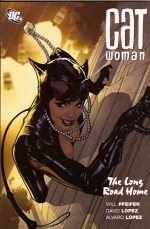
Catwoman: the Long Road Home


By Will Pfeiffer, David Lopez & Alvaro Lopez (DC Comics)
ISBN: 978-1-84856-181-6

After a phenomenal relaunch (see Catwoman: Selina’s Big Score, The Dark End of the Street and Crooked Little Town) the feline felon motored along nicely for years before falling prey to her most telling weakness: she is inextricably bonded to the Bat Franchise and as it turns, so does she.

Despite some sterling work from Will Pfeiffer, David Lopez & Alvaro Lopez, the series was marked for cancellation and the final days saw her sucked into both the Amazons Attack and Salvation Run publishing events (see particularly Wonder Woman: Amazons Attack!, Justice League of America: Sanctuary, JLA: Salvation Run and the previous volume Catwoman: Crime Pays).

So it is that this final compilation (collecting issues #78-82 of her gone-but-not-forgotten monthly comic) opens with the urban defender of Gotham City’s downtrodden underclass marooned on a distant deadly planet where America’s super-criminals have been clandestinely deported by the government, trying to avoid being killed by her own rogues gallery (Russian émigrés Hammer & Sickle and Cheetah most notably) whilst back on Earth old friend Slam Bradley’s search for her has led him into a murderous deathtrap…

One Final Whine (and you just know that’s not true): as I’ve said in many a review, graphic novels are different from simultaneously published periodicals, and lots of the tricks that augment sales in the latter are actual hindrances in the former. This first chapter is the ideal example of that observation.

In the comic-books this story culminates with a cataclysmic death-duel on the alien Hellworld, and a Slam Bradley teaser/cliffhanger after which the informed reader turns to Salvation Run issues #6 and 7 to discover what happens next. In this collection we simply, inexplicably find Catwoman back on Earth and coming to Slam’s rescue. Bast help you if you’re on a tight budget or only collect Catwoman books…

Feel free to consider that an advisory to buy Salvation Run too.

After saving Bradley Selina returns to unfinished business: chiefly tracking down The Thief, an obnoxious upstart who stole all her possessions and reputation to augment his own, which she does with panache and perhaps excessive force and zeal, before settling a few other old scores, most notably with criminal information broker The Calculator, and drives off into the sunset after one final fight with Batman.

This is a readable if necessarily bitty clean-up operation prior to Catwoman joining the cast of the ensemble series “Gotham City Sirens”, but there are still moments of the old magic to be found here. A rather unfortunate end to a superb series and a wrap-up only the most dedicated fans should have to endure.

© 2008 DC Comics. All Rights Reserved.
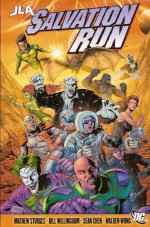
JLA: Salvation Run


By Matthew Sturges, Bill Willingham, Sean Chen, Walden Wong & others (DC Comics)
ISBN: 978-1-84576-981-9

It all makes sense really: if you’re normal folks in a world of casually destructive gods and monsters wouldn’t you want to get rid of them? That’s the premise of this dark and sardonic take on George II’s “Wahr on Turrrism” as seen through the gaudy lens of the DC universe.

Salvation Run was a seven part miniseries which spilled over most prominently into Justice League of America (see Sanctuary) and Catwoman (both Catwoman: Crime Pays and Catwoman: the Long Road Home), although the build-up, which saw a large number of DC super-villains seemingly vanish was featured in a quite a number of disparate DC titles.

The first chapter ‘Hellish New World’ (by Willingham, Chen & Wong) follows the murder of Bart Allan in Flash – Fastest Man Alive: Full Throttle and concentrates on that hero’s killers as they try to survive on a deadly alien world. They had been captured and sent there by the hard-line political animal Amanda Waller and her pet penal battalion The Suicide Squad, a government-controlled team of super-villains acting as a black-ops team in return for (limited) freedom. It’s not long before a multitude of metahumans ranging from cheap thugs like Black Spider and Hyena to “aristocrats” such as Cheetah, Clayface and the Joker are also unceremoniously dumped and forgotten…

Clandestinely deported without trial, they were told their new world had everything they needed to survive, but when they fell out of teleportational Boom Tubes they all quickly discovered that somebody lied: everything animal, vegetable and mineral on this Hellworld has been programmed to kill them…

In ‘Take this World and Shove It!’ the body-count of (admittedly minor) bad-guys begins to mount and in a grisly echo of Lord of the Flies the Joker takes charge – until the final batch of transportees arrive: a group which includes Lex Luthor, Catwoman and an incredibly scared and angry Suicide Squad, finally betrayed by their Government taskmasters…

Matthew Sturges took over the scripting with ‘All You Need is Hate’ and the trenchant black comedy was cranked up as rivalries and philosophical differences divided the villains on all but one point – that there were enough mad scientists on hand to find a way back to Earth…

‘Life is But a Nightmare’ revealed that the never-unaware Batman had planted a heroic infiltrator among the villains, and as immortal Vandal Savage lured a small harem of Bad Girls to a distant “safe area” to begin populating the planet with his progeny, the civil war among the factions claimed its first major player, whilst ‘Through a Glass Deadly’ (illustrated by Joe Bennett and Belardino Brabo) saw the morally ambivalent Catwoman forced to betray Batman’s spy to the villains just as the true masters of Hellworld reveal their own long-range plans for the deported villains.

‘Burning Down the World’ saw open warfare break out as Luthor and Joker attempt to beat each other to death whilst all about them Hellworld’s creators attack and the violent deadly affair ends with a mass prison break when Luthor’s genius returned them all (the survivors anyway) to Earth with renewed hatred of society and a huge simmering grudge to work off… ‘We Gotta Get Out of this Planet’ (by Sturges, Chen, Wong and Wayne Faucher) ends in spectacular fashion a hard look at DC’s dark side and firmly re-establishes the pecking order of the underworld just in time for the ultimate shake-up of Final Crisis.

Wicked, funny and grimly gory this is a fascinating look at the other costumes in the DCU, but there’s enough high concept and clever subtext to delight those casual readers who look beyond the normal “who’s tougher than who” antics.

For clearer comprehension I advise reading Justice League of America: Sanctuary before attempting this book.

© 2008 DC Comics. All Rights Reserved.
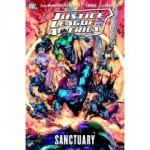
Justice League of America: Sanctuary


By Alan Burnett, Dwayne McDuffie, Ed Benes & various (DC Comics)
ISBN: 978-1-84856-051-2

The fourth volume of the latest Justice League of America incarnation (collecting issues #17-22 of the monthly comic) sees a changing of the creative guard as the always impressive Alan Burnett splits the scripting duties with equally impeccable Dwayne McDuffie to tie-in the Worlds Greatest Heroes to a company-wide storyline that wasn’t quite a braided-mega-crossover but was more than a shared plotline.

The graphic novel (or album or trade paperback collection: take your pick) is a wonderful vehicle for a complete reading experience in an industry and art-form that has always suffered from its own greatest strength – vitality and immediacy due to being periodically published.

Simply stated: you can generate huge enthusiasm for your product if it comes out frequently (or constantly), and more so if your product shares a storyline with a congruent product. That simple maxim gave early Marvel an insurmountable advantage in the 1960s and DC, being slow to catch on is still playing Catch-Up in the cross-selling stakes.

Unfortunately that advantage becomes a hazard once these parallel sagas are bundled up into what ought to be cohesive one-off packages, i.e. books, as inevitably backstory and initiating events have to be ignored, précised or included. One day all periodical material will be downloadable on demand and I’ll go back to reviews of actual comics…

The epic in question here is Salvation Run: a miniseries which spilled over most prominently into Catwoman (see both Catwoman: Crime Pays and Catwoman: the Long Road Home), although the build-up, which saw a large number of DC super-villains seemingly vanish, was featured in a quite a number of disparate DC titles.

The chapters here were divided into the lead feature ‘Sanctuary’ parts 1-3, by Burnett, Ed Benes and inkers Sandra Hope, Mariah Benes & Ruy José, with McDuffie providing captivating character-based vignettes, before assuming full writing chores for the last two tales in this volume.

It all kicks off when a desperate gang of super criminals smashes into the JLA’s headquarters and promptly surrenders, requesting asylum. Investigation reveals that villains from the most pathetic to the most powerful are being “disappeared” and even incarceration in the League’s dungeon on the Moon is preferable to the unknown fate of their fellows.

When hard-line political animal Amanda Waller and her pet penal battalion The Suicide Squad turn up demanding the heroes hand over the bad-guys the shocking secret comes out: the US government has had enough of metahuman threats and is rounding them up, without benefit of Due Process, and deporting them to another world from which they can never return. Moreover, she’s equally prepared to trample the JLA’s human rights to get what – and who – she wants…

Full of spectacular action and telling metaphor this yarn has plenty of surprises and for best effect should be read before any of the above cited collections, as it has no real conclusion, only lots of climaxes…

McDuffie’s first tale is ‘Meanwhile, Back in the Kitchen…’ illustrated by Jon Boy Meyers & Serge LaPointe, wherein Vixen reveals a secret that might get her booted off the team to Red Arrow, Red Tornado and Green Lantern, and ‘Meanwhile, Back at Owl Creek Bridge…’, (Meyers & Mark Irwin) sees the Tornado – currently bodiless and inhabiting the team’s computer system – make a decision that could save or end his “life”. Both these short stories lay the threads for upcoming longer tales.

After the conclusion of ‘Sanctuary’ McDuffie and Ethan van Sciver pit the (Wally West) Flash and Wonder Woman against the alien insect Queen Bee Zazzala in ‘Back up to Speed’ and the book closes focusing on the Human Flame, as he joins a bevy of baddies feted by the villainous Libra in a prequel to Final Crisis. ‘The Gathering Crisis’ is illustrated by Carlos Pacheco & Jesus Merino.

Even though possibly no more than a bunch of interludes and add-ons, the sheer quality of the work collected here elevates this book above the average superhero sock-fest, and if you are a fan of the “Big Events” the room to see characters breathe and move here is a bonus of unparalleled worth.

© 2008, 2009 DC Comics. All Rights Reserved.